This is Chapter Two of seven: There’s a lot to write about! In this part, we will cover Our Earliest History up to and including Penryn, Cornwall, England.
Preface: Let’s Begin with Bond Street in London
Our parents were not world travelers. Outside of my father’s experiences as a World War II sailor in the Pacific Theater, and some trips to Ontario, Canada, they seemed to be the most comfortable traveling within the mainland USA. In 1988, I (Thomas) volunteered to be their chaperone if they would come to London for a week, to see some places involved with their family heritage. So they came.
We called our father “Pop”. Our parents were simply Mom and Pop.

Pop had always embraced his Irish heritage; our Mom, her English roots. He desired to be All Things Irish, but that was truly only a part of him. For both of them, Britain itself played the largest role.
One day we found ourselves in the very posh Mayfair District, seeking out a place we had learned of — Bond Street. To our delight, we saw that there were actually two sections: Old Bond Street and New Bond Street. Pop stood on the old side, I stood on the new side, and we reached out and hugged each other. He was tickled pink.
— Thomas

The story about London’s Bond Street is emblematic of how family histories are always about connecting the old with the new. The old path merges with the new path, both united, always following time’s arrow in one direction. By glancing backward, we seek to try and discern clues about our fleeting, ever-receding past.
Introduction: Our Ancient Origins
Located at the fringes of Europe, Britain received European technological and cultural developments much later than Southern Europe and the Mediterranean region did, during prehistory. By around 4000 BC, the island was populated by people with a Neolithic culture. No written language of the pre-Roman inhabitants of Britain is known; therefore, the history, culture and way of life of pre-Roman Britain are known mainly through archeological finds. This evidence demonstrates that ancient Britons were involved in extensive maritime trade and cultural links with the rest of Europe from the Neolithic onwards, especially by exporting tin that was in abundant supply.
Recent archeological evidence (based on measuring specific isotopes found in tin), has revealed that ancient tin ingots found in Israel — prove the metal was mined in Cornwall as long ago as 2000 BC. Through trade routes from thousands of years ago, these ingots ended up in the far eastern Meiterranean. There is some current controversy over whether the Phoenicians had ever reached Britain, and that is for others to settle. As always, new evidence sometimes takes a while to be accepted. They may have gotten there… certainly someone did. (1)
The earliest known reference to the inhabitants of Britain was by Pytheas, a Greek geographer who made a voyage of exploration around the British Isles between 330 and 320 BC.
Wikipedia, Pytheas of Massalia
Although none of his own writings remain, writers during the time of the Roman Empire made much reference to Britons. Pytheas called the people of Britain the Pretanoí or Bretanoí. Pliny’s Natural History (77 AD) says the older name for the island was Albion, and Avenius calls it insula Albionum, “island of the Albions”.
The Latin name for the Britons was Britanni. The last centuries before the Roman invasion saw an influx of Celtic speaking refugees from Gaul ,[modern-day description: generally where France meets Belgium], who were displaced as the Roman Empire expanded around 50 BC. They settled along most of the coastline of southern Britain between about 200 BC and 43 AD, although it is hard to estimate what proportion of the population they formed there. In the first century BC, Roman leader Julius Caesar reported that the Gauls called themselves ‘Celts’ — Thus whether it was given to them by others or not, it was used by the Celts themselves.
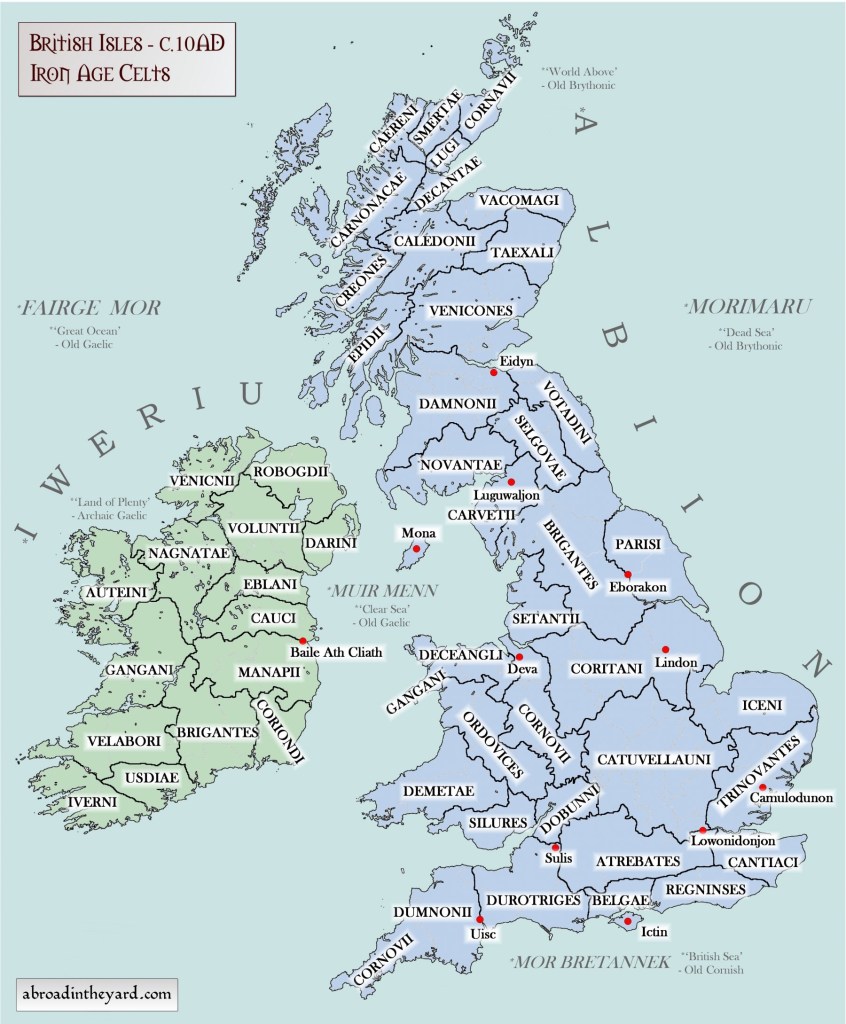
(Image courtesy of Vividmaps.com).
In pre-Roman times, Cornwall was part of the kingdom of Dumnonia. The ancient Britons formed a series of tribes, cultures and identities: the Dumnonii and Cornovii were the Celtic tribes who inhabited what was to become Cornwall during the Iron Age, Roman, and post-Roman periods. The map above shows the Cornovii tribe in the southwest peninsula of “England”, the area now known as Cornwall.
The Cornovii, Who Become The Cornish People
The Sack of Rome in the year 410 prompted a complete Roman departure from Britain, and Cornwall then experienced an influx of Celtic Christian missionaries from Ireland who had a profound effect upon the early Cornish people, their culture, faith, and architecture. These first centuries after the Romans left are known as the age of the saints. The ensuing decline of the Roman Empire encouraged the Anglo-Saxon invasion of Britain. The Angles, Jutes, Frisia, and Saxons, Germanic peoples from northern [mostly coastal] Europe, established petty kingdoms and settled in different regions of what was to become England, and parts of southern Scotland.
Historically, the Anglo-Saxon period denotes the period in Britain between about 450 and 1066. The early Anglo-Saxon period includes the creation of an English nation, of which many aspects still survive today, including regional government by shires and counties (also known as hundreds). During this period, Christianity was established and there was a flowering of literature and language. Charters and law were also established. The term Anglo-Saxon is popularly used for the language that was spoken and written by the Anglo-Saxons in England and southeastern Scotland from at least the mid-5th century until the mid-12th century. It is more commonly called Old English. (2)
The Norsemen, The Danes, and The Vikings
The Viking Age in Scandinavian history is recorded as the period from 793, the earliest record of the first Danish sea raids on England by Norsemen, lasting until the Norman Conquest of England in 1066. At that time, the present day nations of Norway, Sweden and Denmark did not exist. Those who came to the British Isles have been generally referred to as Vikings [from Scandinavia]. However, some scholars debate whether the term Viking represented all settlers, or just those who raided England and other countries.
In the 700s, Frankish and English records of political, military, and economic interactions with the north, describe the Danes as one people ruled by a king, and Denmark as comprising the peninsula of Jutland, all the islands, and Scania (part of Sweden). A unified realm was initiated by King Harald I Fairhair in the 9th century. His efforts in unifying the petty kingdoms of Norway resulted in the first known Norwegian central government.

Bright green: territories, and bright blue: sailing routes. (Image courtesy of Wikipedia.org).
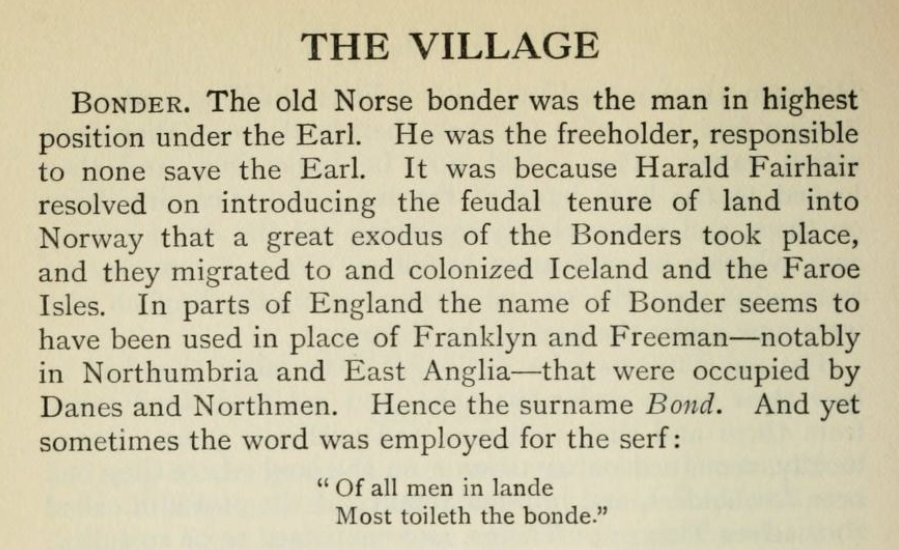
Sabine Baring-Gould writes in his Family Names and Their Meaning:
“It is now generally recognized that the name Bonde… (plural Bonder) was not originally a family name; but was the designation of a class of Norse landholders.
The old Norse Bonde was the man in highest position after the Earl. He was the free-holder responsible to none save the Earl. It was because [King] Harold Fairhair resolved on introducing the feudal tenure of land into Norway, that a great exodus of the Bonder took place; and they migrated and colonized Iceland and the Faroe Isles”.
Bonders emigrated to England from Scandinavian with, or as, Vikings. They may have arrived as early as the 800s and became landholders. They lived among the people and became “English”. At the onset of the Norman Conquest in 1066 they were initially overwhelmed in a common ruin with the Saxons and other tribes. However, not for long; within in a generation or two they adjusted to Norman rule, re-established themselves and began to identify by the old class title: Bond.
Observations: This establishes that the Bond name and its variations, was present throughout England in the centuries before the Norman Conquest, and that many of them were landholders during the Anglo-Saxon period. It is reasonable to assume that some of these Bond(ers) ended up in Cornwall.
The Anglo-Saxons referred to Cornwall as West Wales, to distinguish it from North Wales (modern-day Wales). The Saxons, of the Kingdom of Wessex, were expanding their territory westwards toward Cornwall. The Cornish were frequently embattled with the West Saxons, until King Athelstan of England, 927-939, determined that the River Tamar would become the formal boundary between the West Saxons and the Cornish in the year 936, making Cornwall one of the last retreats of the older Britons that encouraged the development of a distinct Cornish identity.
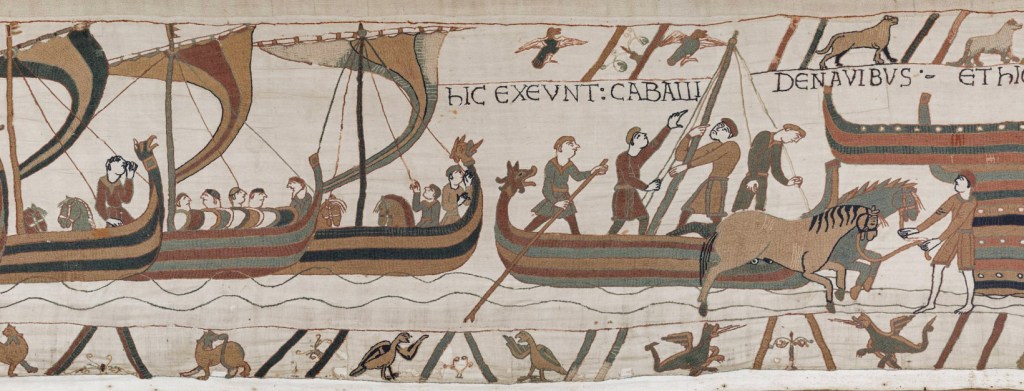
The Norman Conquest of England, which began with an invasion by the troops of William, Duke of Normandy (King William I of England) in 1066, resulted in the removal of the Anglo-Saxon derived monarchy, aristocracy, and clerical hierarchy. It was replaced by Normans, Scandinavian Vikings from northern France and their Breton allies where they maintained rule in the Brittonic-speaking parts of the conquered lands. England would come to absorb the Normans, but the Cornish (Cornwall) “vigorously resisted” their influence.
The Normans themselves were descendants of those Vikings who had been given feudal over-lordship of areas in northern France, namely the Duchy of Normandy, in the 10th century. In that respect, descendants of the Vikings continued to have an influence in northern Europe.

by Matthew Paris circa 1250-1259. (Image courtesy of Alamy).
Edward The Confessor died in January 1066 after a reign of 23 years as King of England. Edward was childless and had no heir to the throne. After his death there were several claimants to the English throne. Harold Godwinson, Harald Hardrada, King of Norway and Duke William II of Normandy. William was a first cousin once-removed of Edward the Confessor. Harold Godwinson repelled Hardrada and claimed the throne for 282 days. Duke William II of Normandy invaded England and defeated Harold at the Battle of Hastings in October 1066. He became William the Conqueror and King William I of England.
The Domesday Book
Oxford Reference defines the Domesday Book as “A survey of property in England conducted in 1086. Conceived by William I, but probably to some extent based on pre-Conquest administrative records. It was the most comprehensive assessment of property and land ever undertaken in medieval Europe. Its purpose was to maximize the revenues from the land tax…” The holdings / estates that became connected to the Bond families are mentioned in two places. Note: We have included these references to demonstrate that there were Bond, Bonde, Le Bonde, Bondi, Bondu etc., families present before the Norman invasion and that these families already had long histories in England.
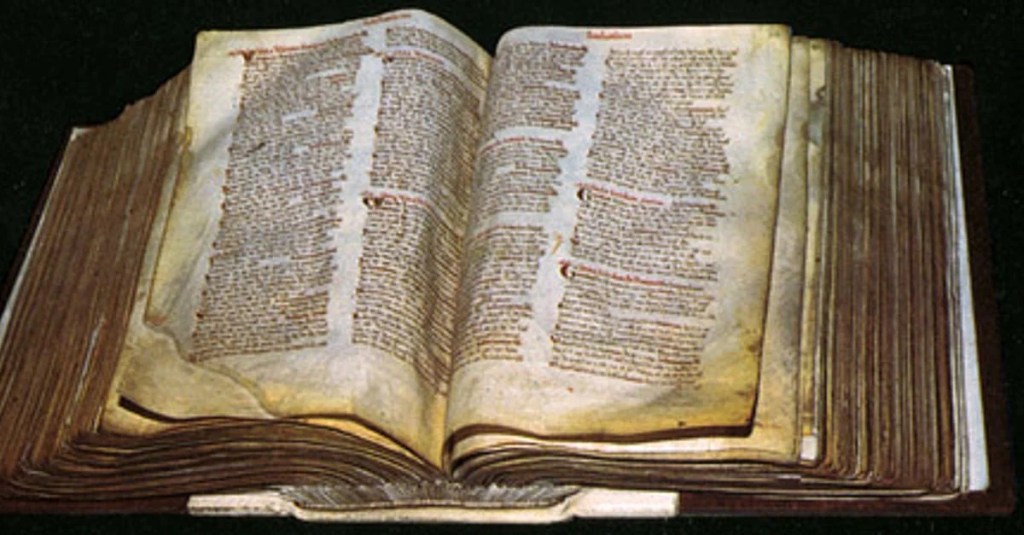
The Domesday Book established that the “Bondi” (derived from Bonder) family in ª(the future Wiltshire county) were endowed with ancient land holdings. At that time the recognition of land ownership gave them rights and privileges that were excluded from most other people.
Domesday Book, Folio Wiltshire, page 17, is where we see the name Bondi specifically mentioned:
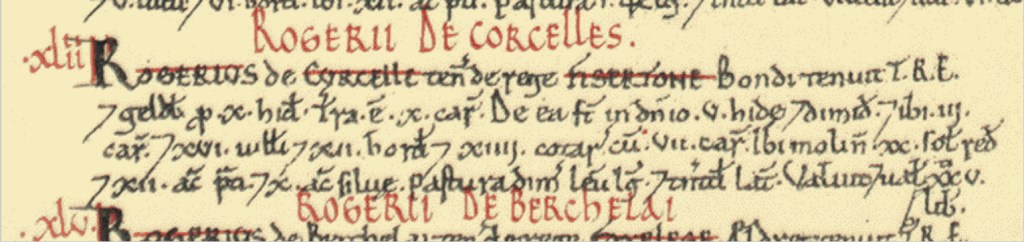
Domesday Book, Folio Wiltshire, page 10, is where the Fisherton estate (in Wilts) is specifically mentioned. Lord Roger DeCourseulles (also known as De Courcil) 1030-1121, came to England with William The Conqueror in 1066. In this Folio he is identified as the tenant in chief of Fisherton Delaware, Wiltshire, England. The Lord of Fisherton was surnamed Bondi. Lord Roger’s second son, Hugh Fitz Roger married the Bondi sister and heiress. Upon this marriage their offspring assumed the Bondi name. Note: From Lord Roger’s first son, John de Curichil, the family line eventually leads to Sir Winston Churchill.
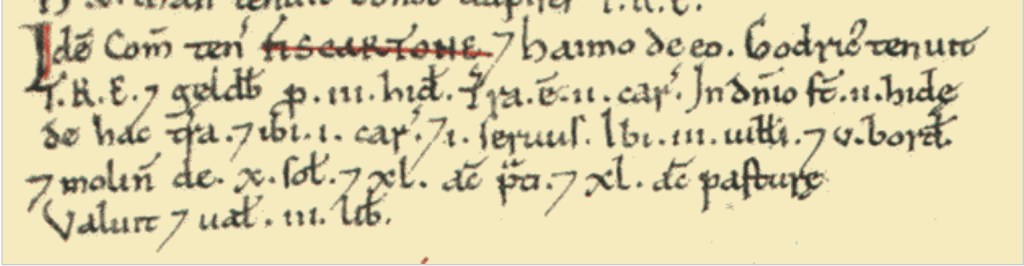
Fisherton [Anger], Folio Wiltshire, page 10, Domesday Book
In Cornwall, the Domesday Survey identified that the major landholders were King William I, his half-brother Robert, Count of Mortain and the Bishop of Exeter of Tavistock Abbey. (3)
Slavery, The Feudal System, and the Manor System
Throughout Europe, wartime captives were commonly forced into slavery — something that remained true for the people captured during Viking raids. As European kingdoms transitioned to feudal societies, serfdom began to replace slavery as the main economic and agricultural engine. From Slavery to Tenant Farming — “In England, slaves (or slave families) are recorded at the village level in the Domesday Book (1086). If counted as heads of households, the c. 28,000 slaves made up just over ten percent of the recorded population. In general, slavery was more prevalent in southwest England than in the east of England.” English Christians nominally discontinued owning slaves after the 1066 conquest. It is difficult to be certain about slave numbers, however, since the old Roman word for slave (servus) continued to be applied to unfree people whose status later was reflected by the term serf.
The system of having slaves gave way to the feudal system. It is most assured that our ancestors of the High Middle Ages worked under the feudal system.
From Western European Feudalism —
Establishing Order: “By the High Middle Ages… feudalism was completely developed and the Europeans benefited from it. Feudalism established a strong social order that provided protection and safety. Under feudalism, Europeans were linked to each other with promises which helped both parties, up and down in the hierarchy. The feudal system was just like an ecosystem – without one level, the entire system would fall apart. The hierarchies were formed of four main parts: Monarchs, Lords/Ladies (Nobles), Knights, and Peasants/Serfs. Each of the levels depended on each other on their everyday lives.”
From Wikipedia.org —
“The classic version of feudalism describes a set of reciprocal legal and military obligations which existed among the warrior nobility, revolving around the three key concepts of lords, vassals, and fiefs. In broad terms, a lord was a noble who held land, a vassal was a person who was granted possession of the land by the lord, and the land was known as a fief. In exchange for the use of the fief and protection by the lord, the vassal would provide some sort of service to the lord,” [such as tenant farming, and military service].
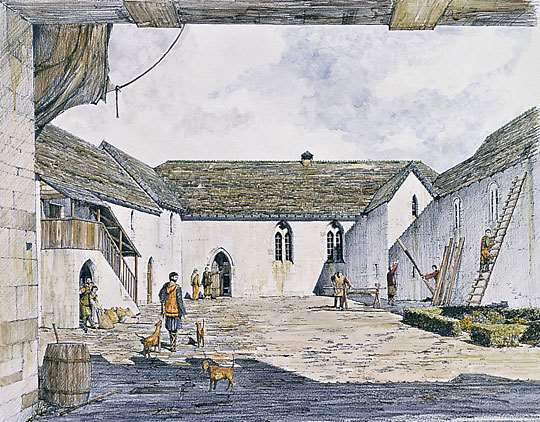
Penhallam Manor, with an example of a a 13th century manor house inner courtyard.
(Image courtesy of English Heritage, see footnotes).
The feudal system slowly morphed into “manorialism”. Again, from Wikipedia.org — “Manorialism, also known as the manor system, was the method of land ownership in parts of Europe, notably England, during the Middle Ages. Its defining features included a large, sometimes fortified manor house in which the lord of the manor and his dependents lived and administered a rural estate, and a population of labourers who worked the surrounding land to support themselves and the lord. Manorialism is sometimes included as part of the feudal system.” (4)
The Bond Family Surname
As explained in the section The Norsemen, The Danes, and The Vikings, the Bond family name has its origins in a class of landholders originally from Scandinavia who settled in England. As a consequence of the Norman Invasion and the purging of Anglo-Saxon culture, some Bond families (through good fortune) retained their land. Some had already transitioned to the use of surnames, which eventually came to be recognized through heraldry.
Sabine Baring-Gould: (An apt example) “Richard, the Bonde immigrant settler, became Richard Bonde [landowner], as the terror of the Norman rule relaxed. The completeness of the catastrophe of the Conquest may be perceived by the total and permanent disappearance of Saxon and Norse personal names.”
Throughout the records and rolls of
Sabine Baring-Gould,
the 12th and 13th centuries we find [that]
all our personal names are Norman.
The Saxon seems almost extinct.
This lament applies with full force to the
Bonds of Cornwall.
Thomas, William, Richard, Henry, [and] John repeat themselves generation after generation. …this compliance with Norman custom was really due to a contempt for everything pre-Conquest…
Family Names And Their Story
Ancestry.com also has a good summation of the origins the Bond surname —
English: status name for a peasant farmer or husbandman, Middle English bonde (Old English bonda, bunda, reinforced by Old Norse bóndi). The Old Norse word was also in use as a personal name, and this has given rise to other English and Scandinavian surnames alongside those originating as status names.

Definitely not a peasant farmer: So, who’s your favorite Bond?
From A Genealogical and Heraldic History of the Commoners of Great Britain and Ireland, Vol. I, provides two relevant (but unattributed) references. The first follows:
“Mr. Bond has an old MS. pedigree on vellum, dated 1636, which deduces their descent from a Norman, who came in at the Conquest, and married the daughter and heiress of Bond, of Penrynin Cornwall: and in Andersen’s pedigree, of Churchill, Duke of Marlborough, we find that Hugh Fitz Roger, second son of Roger de Council, (a follower of William the Conqueror, and who obtained from him extensive estates in Somersetshire, Dorsetshire, and Wiltshire, as appears by Domesday ) [circa 1086-1087], espousing the sister and heiress, lord of Fisherton, their offspring assumed the surname and arms of that family, viz sa fess or, and hence came the family of Bond. This Bond (or Bondi as he is called in the Domesday book) appears to have been a Saxon, and is mentioned in that record as holding Fisherton in Wilts, as well as other lordships in Dorset and Somerset, as early as the time of Edward the Confessor.”
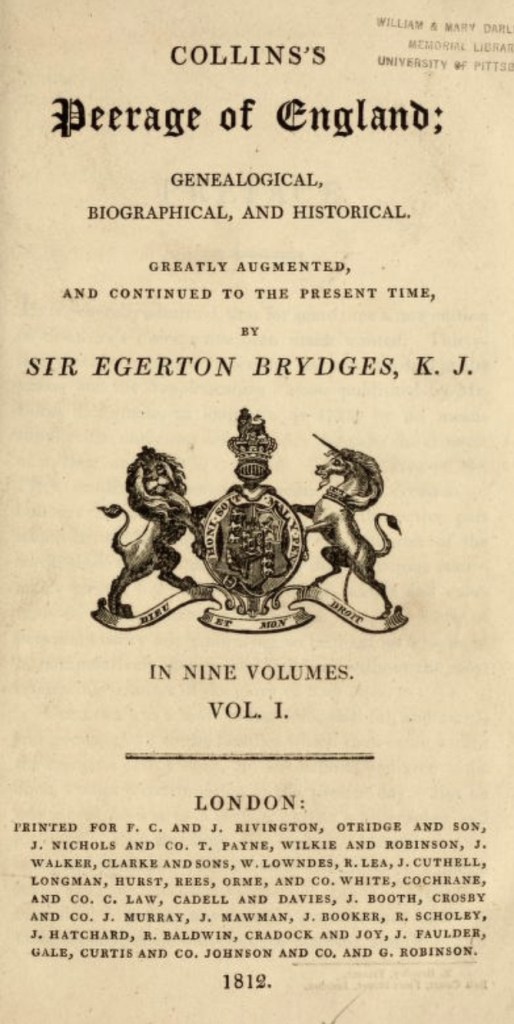
Observation: In the first sentence Roger De Courcil is marrying the daughter and heiress of Bond in Penryn, Cornwall. In Collins’s Peerage of England, Roger De Courcil wedded Gertruda, daughter of Sir Guy de Torbay. Then the mention of Hugh Fitz Roger marrying a sister and heiress of Fisherton and taking on the Bondi surname. All of the historical documents we have discovered, go back-and-forth in time with their references. As such, “what happened when and to whom” from a thousand years ago, can get a little cloudy. (5)
The Emerging Bond Family Lineage in Cornwall and Wilts
Our research has led us to believe that our Bond family line originates to a large extent, in Penryn, Cornwall, England. Cornwall was a distinct and to a great extent, separate part of the kingdom. In 1485, Polydore Vergil, the Italian cleric commissioned by King Henry VII to write a history of England, wrote that “The whole country of Britain is divided into four parts, whereof the one is inhabited by Englishmen, the other of Scots, the third of Welshmen, the fourth of Cornish people … and which all differ among themselves either in tongue, either in manners, or else in laws and ordinances.”

(Image courtesy of Cornish Studies Resources).
Penryn is one of Cornwall’s most ancient towns, located on the southwest coast of Cornwall. The town first appears in the Domesday Book under the name of Trelivel, and was named Penryn in 1216 by the Bishop of Exeter. It was once an important harbor, handling granite and tin, trade to be shipped to other parts of the country and the world, during the medieval period. We don’t know what our Penryn ancestors did for their living over the centuries. It seems likely that some of them could have been engaged (in some form) with the acquisition and refinement of tin.
At the time that our early Bonds lived there, Penryn was administered by the Bishop of Exeter. He had a manor house and our ancestors most likely were among the people who supported his manor through both trade and tax. (6)
The Two Centuries After William The Conqueror
Two years after the Norman Conquest, in 1068, there was a rebellion in the Southwest (Cornwall), causing King William I, to order that castles be built there. At this time, the Manor of Trematon was in the hands of William’s half-brother Robert, the Count of Mortain. Robert chose for his castle a site about 1-1/2 miles southeast of Trematon village, overlooking the Lynher estuary. The original castle defenses consisted of earthworks and timber palisades — it was built upon the Roman ruins of an earlier fort. Four Norman castles were built in east Cornwall at different periods, at Launceston, Trematon, Restormel, and Tintagel.

(Image courtesy of Archive.org).
Trematon Castle became the administrative center for the area, and Robert, (the Count) soon founded and promoted a weekly market outside the castle’s gate. This functioned administratively to focus the population on him charitably. In 1075, Robert ceded the Manor of Trematon to Richard de Valletort, a Norman knight who had fought at the Battle of Hastings.
From the Battle Abbey Roll:

Observation: We do not know with certainty if these ancients Bond(s) were Saxon, or Norman, or perhaps a bit of both.
The following text is taken directly from A Genealogical and Heraldic History of the Commoners of Great Britain and Ireland, Vol. I — “The family of Bond were of great antiquity in the county of Cornwall and are said to have been originally seated at Penryn in that county, but removed thence, at a very early period, to Earth, in the parish of St. Stephens, [near Trematon Castle] an estate they acquired in marriage with the daughter and heiress of a very ancient house, which took its name from that place.” (7)
Our Bond Penryn Ancestors
We have tried to give a bit of history of the possible origins of Bonds in England. However, we do not have documented records of Bonds until we learn of Robert Bond marrying Elizabeth de Erth in Saltash, Cornwall about 1400. Below are some references to Bonds found in family trees in Ancestry and/or Family Search. Without actual source material it is difficult to know the exact nature of our early ancestors.
The early Penryn ancestors (without sources) are listed below interspersed with important historical points:
1. John Le Bond I, born est. 1220
Observations: John LeBond is generally recognized as the progenitor of the Bond family line in Cornwall, but there are almost no verifiable records of him. It is interesting to note that his surname begins with ‘Le’. Could this be a Norman influence? Interestingly, in the Cornish language there is a word Laë , which means “High”. Perhaps Le Bond was a designation of high status?
1258: Grant to Bishop of Exeter for a market and fair at Penryn. “The granting of the right to hold markets and fairs was a very significant development for any town in the medieval period; they provided the underpinning for the economy of the town and brought trade in from the surrounding countryside.”
2. Gnu Le Bond est. 1250 – 1307, (A son with a curious name… Obviously the name is transcribed from some ancient name which we do not have reference to.)
1265: Glasney College was founded at Penryn by the Bishop of Exeter. On completion this fortified residence housed 26 clerics with its own church, domestic quarters, refectory, chapter house, mills, and cemetery. It was subsequently destroyed during the Reformation.
3. John Le Bond II est. 1280-1340, married toMnu 1285-1345 (What a name! — perhaps her name could be Mary?).
4. Richard of Penryn Bond est. 1300-1350, Penryn, Cornwall, married Sarah, Lady Bragham, est. 1300 -1330, Penryn, Cornwall.
1315-1317: Total failure of the harvest in Cornwall through bad weather. In Europe, climate change leads to the Great Famine.
5. Richard II of Penryn Bond est. 1330-1380, Penryn, Cornwall
The Black Death (or “Great Pestilence”) reached Cornwall 1349, almost certainly by a ship, peaking in 1350-51 and breaking-out again in 1352. Estimates suggest that towns in Cornwall such as Truro and Bodmin lost half of their populations.
6. John of Penryn Bond est. 1350-1400, Penryn, Cornwall England, married to Mary, dates unknown.
1360-1362: Second outbreak of The Black Death in Cornwall lasting to 1362.
After this period, we have records which indicate that Robert Bond est. 1375 – about 1434, relocated east to Erth, Saltash to marry Elizabeth deErth. Erth (Earth) is the area near Tremanton Castle and Plymouth Sound. Subsequent posts will show, that our Cornwall family history will move through: Penryn > Erth > Holwood > London to America. (8)
Following are the footnotes for the Primary Source Materials,
Notes, and Observations
Introduction: Our Ancient Origins
(1) — five records
Adapted from three sources:
Celtic Britons
https://en.wikipedia.org/wiki/Celtic_Britons
Celts
https://en.wikipedia.org/wiki/Celts
Prehistoric Britain
https://en.wikipedia.org/wiki/Prehistoric_Britain
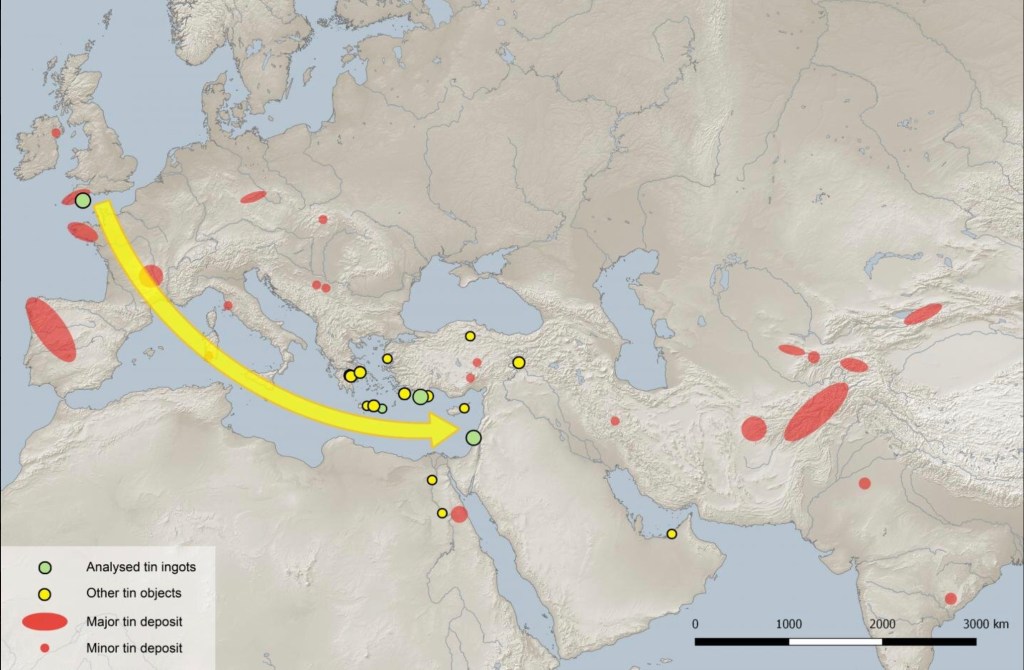
(Credit: Berger et al. 2019; Prepared by Daniel Berger)
The Times of Israel
Groundbreaking study: Ancient tin ingots found in Israel were mined in England
by Amanda Borschel-Dan
https://www.timesofisrael.com/groundbreaking-study-ancient-tin-ingots-found-in-israel-were-mined-in-england/
Vivid Maps
Roman Britain Explained in Maps
Britain and Ireland just before the Roman invasion (10 AD)
https://vividmaps.com/roman-britain/
Note: Scroll down, and the entry is found in the Comments section, as submitted under the name Chaplin.
The Cornovii, Who Become The Cornish People
and
The Norsemen, The Danes, and The Vikings
(2) — eight records
Adapted from six sources:
Cornish People
https://en.wikipedia.org/wiki/Cornish_people
Norman Conquest
https://en.wikipedia.org/wiki/Norman_Conquest
and
Anglo-Saxons
https://en.wikipedia.org/wiki/Anglo-Saxons
Vikings
https://en.wikipedia.org/wiki/Vikings
Viking activity in the British Isles
https://en.wikipedia.org/wiki/Viking_activity_in_the_British_Isles
and
Pre-Viking And Viking Age Denmark
https://www.encyclopedia.com/humanities/encyclopedias-almanacs-transcripts-and-maps/pre-viking-and-viking-age-denmark
The Story of The Bonds of Earth
by Allen Kerr Bond
https://archive.org/details/storyofbondsofea00bond/mode/2up
Book page: 17-18. Digital page: 33-34/328.
Alamy
William the Conqueror, William I of England (circa 1028-1087). First Norman King of England (1066-1087), holding Battle Abbey, illuminated manuscript portrait painting
by Matthew Paris circa 1250-1259
https://www.alamy.com/william-the-conqueror-william-i-of-england-circa-1028-1087-first-norman-king-of-england-1066-1087-holding-battle-abbey-illuminated-manuscript-portrait-painting-by-matthew-paris-circa-1250-1259-image545386459.html
The Domesday Book
(3) — eight records
Domesday Book
https://www.worldhistory.org/Domesday_Book/
Domesday Book (explained): https://www.oxfordreference.com/view/10.1093/oi/authority.20110803095725686
Here are the actual folios of the Domesday book from:
https://opendomesday.org
“This Bond (or Bondi as he is called in the Domesday book) appears to have been a Saxon, and is mentioned in that record as holding Fisherton in Wilts…” The two estates of ‘Fisherton’ in Wiltshire are mentioned in these folios, as follows:
First: https://opendomesday.org/place/SU0038/fisherton-de-la-mere/
and the original folios of the Domesday Book, Wiltshire, page 17, where the name Bondi is specifically mentioned: https://opendomesday.org/book/wiltshire/17/
Second: https://opendomesday.org/place/SU1329/fisherton-anger/
and the original folios of the Domesday B00k, Wiltshire, page 10: https://opendomesday.org/book/wiltshire/10/
Collins’s Peerage of England, Genealogical, Biographical, and Historical,
published 1812
by Sir Edgerton Brydges, K. J.
https://archive.org/details/collinsspeerage_01coll/page/n387/mode/2up?ref=ol&view=theater
Book page: 362, Digital page: 388/608
Slavery, The Feudal System, and the Manor System
(4) — six records
From Slavery to Tenant Farming
Elite Economies in the Nordic Area
c.1050 — 1250
by Frode Iversen
https://www.khm.uio.no/om/organisasjon/arkeologisk-seksjon/ansatte/frodeiv/frodes-artikler/iversen-2019.-from-slavery-to-tenant-farming.-nordic-elites-1050-1250-vol-1-with-list-of-contributors.pdf
and
Slavery in Medieval Europe https://en.wikipedia.org/wiki/Slavery_in_medieval_Europe
Western European Feudalism
Relationships Between The Levels
https://westerneuropefeudalism.weebly.com/relationships-between-levels.html
Feudalism
https://en.wikipedia.org/wiki/Feudalism
and
Manorialism
https://en.wikipedia.org/wiki/Manorialism
English Heritage
Home > Visit > Places to Visit > Penhallam Manor > History
https://www.english-heritage.org.uk/visit/places/penhallam-manor/history/
Note: Image located under the subtitle, The West Range.
The Bond Family Surname
(5) — five records
Family Names and Their Story
by Sabine Baring-Gould
https://archive.org/details/familynamestheir00bari/page/n5/mode/2up?ref=ol&view=theater
Book page: 116, Digital page: 116/431
Book page: 186, Digital page: 186/431
Book page: 190, Digital page: 190/431
Bond Family History / Bond Surname Meaning
https://www.ancestry.com/name-origin?surname=bond
Den of Geek
Sean Connery, Acting Icon and Original James Bond, Dies at 90
by Tony Sokol
https://www.denofgeek.com/movies/sean-connery-acting-icon-and-original-james-bond-dies-at-90/
Note: For the film still of Sean Connery as James Bond in the film Dr. No (1962).
A Genealogical and Heraldic History of the Commoners
of Great Britain and Ireland, Vol. I
History of the Commoners of Great Britain and Ireland
by John Burke, Esq.
https://www.ancestry.com/imageviewer/collections/48501/images/CommGBIrelandI-005332-240?pId=368839&lang=en-US
Book page: 240, Digital page: 303/787
Collins’s Peerage of England, Genealogical, Biographical, and Historical,
published 1812
by Sir Edgerton Brydges, K. J.
https://archive.org/details/collinsspeerage_01coll/page/n387/mode/2up?ref=ol&view=theater
Book page: 362, Digital page: 388/608
The Emerging Bond Family Lineage in Cornwall
(6) — two records
Cornwall Heritage Trust
Medieval Cornwall
https://www.cornwallheritagetrust.org/timeline/medieval-cornwall/
Note: “In 1485, Polydore Vergil… “
Penryn, Cornwall
https://en.wikipedia.org/wiki/Penryn,_Cornwall
The Two Centuries After William The Conqueror
(7) — five records
Welcome to Saltash
History 1066 to 1200
https://kernoweb.neocities.org/saltash/bhs1066.htm

Magna Brittanica, Being a Concise Topographical Account
of the Several Counties of Great Britain, Volume The Third
by Rev. Daniel Lysons and Samuel Lysons, Esq., 1814
by Daniel Lysons and Samuel Lysons
https://archive.org/details/b22012369_0002/page/288/mode/1up
Digital page: 671/800 (for the Trematon Castle on the River Lynher illustration)
The Battle Abbey Roll
by The Duchess of Cleveland
https://archive.org/details/battleabbeyrollw01battuoft/page/n5/mode/2up
Book page: 138, Digital page: 138/352
A Genealogical and Heraldic History of the Commoners
of Great Britain and Ireland, Vol. I
History of the Commoners of Great Britain and Ireland
by John Burke, Esq.
https://www.ancestry.com/imageviewer/collections/48501/images/CommGBIrelandI-005332-240?pId=368839&lang=en-US
Book page: 240, Digital page: 303/787
Note: For the Bonds of Grange coat-of-arms image.
Cornish Studies Resources
North Petherwin: the theft of a parish
https://bernarddeacon.com/2022/07/08/north-petherwin-the-theft-of-a-parish/
Note: For the 1812 map image of Cornwall and the town of Penryn.
Our Penryn Ancestors
(8) — three records
IntoCornwall.com
Cornwall History Timeline
https://www.intocornwall.com/features/cornwall-history-timeline.asp
John LeBond
https://www.ancestry.com/family-tree/person/tree/50985043/person/132260923995/facts
Poppyland Publishing
East Anglian History Books
Baldock
https://www.poppyland.co.uk/baldock.html#:~:text=The%20granting%20of%20the%20right,in%20from%20the%20surrounding%20countryside.
Note: For “The granting of the right to hold markets and fairs was a very significant development for any town in the medieval period; they provided the underpinning for the economy of the town and brought trade in from the surrounding countryside.”

 Our Ancestors, Our Narratives