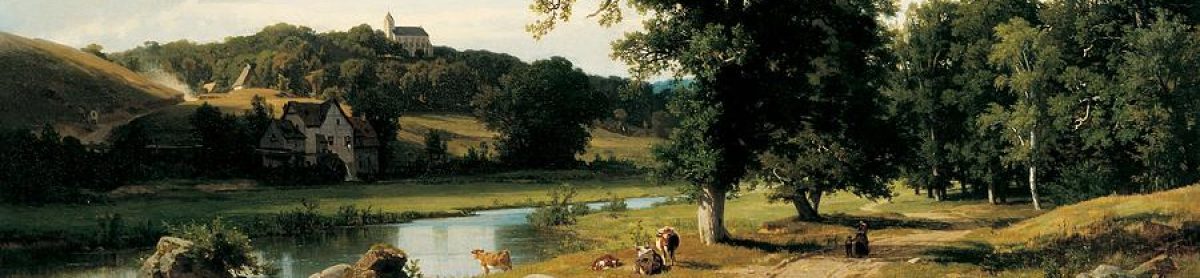
This is Chapter Eleven of eleven, being the last chapter of our narrative about the DeVoe Line. We hope that you have enjoyed following along, for this family line was sincerely, the most difficult to have researched due to certain enigmatic records… However, as we move toward the end of the 20th century, life still engages the DeVoe(s), as it has for many centuries.
Pressed Blossoms
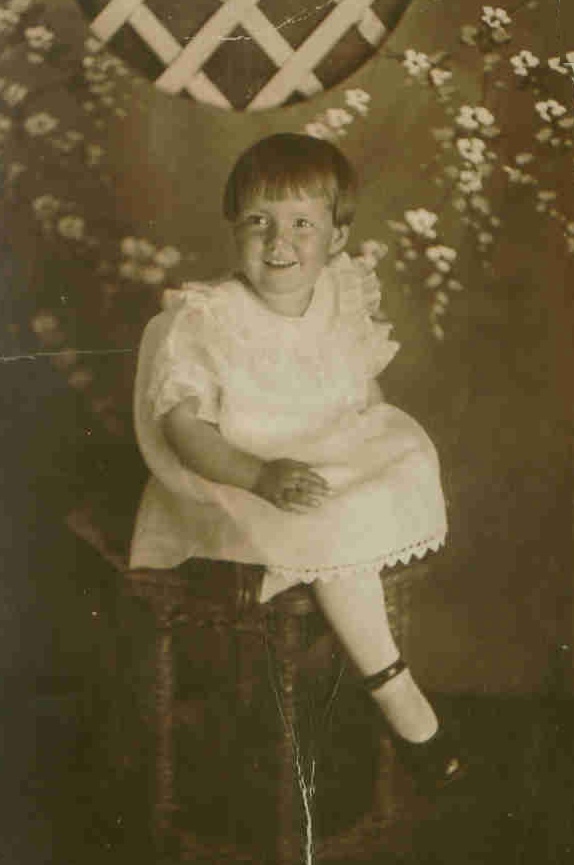
Both of our grandmothers long out-lived our grandfathers. As such, neither of us knew our grandfathers at all. Susan knew both of our grandmothers: Mary Adele (McCall) Bond and Lulu Mae (DeVoe) Gore. However, Grandma Mary died when I was quite young, so Grandma Lulu was really the only grandmother I ever knew. She lived nearby and was a strong influence on our family.
More than fifty years ago she made me a birthday card with a few pressed blossoms from her garden and I recently found it tucked-in amongst some family photographs I was reviewing for this history. She was an avid gardener and the perfect simplicity of this card still means much to me.
— Thomas, with Susan

Most Signed Their Name With an ‘X’
Our ancestors are a mixed lot when it came to their educations. If they had money, they likely had the 3-R’s of education: ’reading, ’riting, ’rithmatic. These educations seemed to be offered to our male relatives first, then second to the female relatives. If our ancestors didn’t have money, some of them still could sign their name.
If they were poor, generally speaking, education was an unobtainable luxury. We have seen so many documents where they simply signed their names with an ‘X’ which was accepted at that time. This made them dependent upon the courtesy of strangers, because witnesses were required to vouch for the signee.
Observation: Coming to understand this has helped explain why we have records for some of our ancestors that are inconsistent, with weird name spellings, incorrect locations, etc. It became apparent that many of our relatives couldn’t comprehend the words, but they knew that they were signing a contract, a deed, or a will...
The Class of ’99
Having an education became an increasingly important need as the world became more modern. Our Grandmother Lulu was the first person ever in her family, who as a young woman, graduated from high school — in the Chagrin Falls, Ohio, high school Class of 1899. (Then known as the Union School on Philomethian Street). None of her siblings accomplished this.
What is remarkable is this — that especially in that era, there were many people who thought it wasn’t necessary for a woman to be educated. Despite that prejudice, we believe that she was likely encouraged by her grandfather Peter A. DeVoe, who was a man who valued education. She became the beneficiary of his guidance, support, and encouragement throughout her youth. Most certainly, she always spoke fondly, almost reverently, about him.

Coming from a poor family and achieving this feat was rather astonishing and must have taken tremendous effort on her part. To accomplish this, she moved away from her parents in Russell township, and lived as a household servant for a family in Chagrin Falls while attending school.

After her high school graduation, she went through teacher training, and at the very beginning of the 20th century, she worked as a schoolteacher at different one-room schoolhouses in the area. One of the schools is located in Chester township, in Geauga County, and was then known as District School No. 2, or also, as the Scotland School. It still stands today and is now listed on the National Register of Historic Places. (1)

Originally built in 1847, it was used as a one-room schoolhouse until 1926, when it closed.
(Image courtesy of The National Register of Historic Places).
Some Things Change, and Then… Some Things Transform
In the present day, the Village of Chagrin Falls in Ohio, is considered to be an upscale place to live with many nice homes, beautiful scenery, good schools… Typical town boosters might describe it enthusiastically, like this:“Chagrin Falls, Ohio, nestled in the picturesque Cuyahoga County, offers a charming and idyllic lifestyle that beckons residents seeking tranquility, beauty, and a strong sense of ”
When our grandparents were alive, they certainly would have been much more circumspect in their description of the area. In their era, Chagrin Falls was a nice, but small, working-class hamlet, with a village center remarkable for its triangular shape, and a bent wood bandstand where they would waltz to music. We can recall our mother Marguerite describing that many of the houses in her 1920s childhood, really needed painting, — and this was before the Great Depression.

Our grandparents would put Marguerite in the Model T and go to the village for a haircut about once a month, while they also took care of other errands. Mom had an uncle on her father’s side who gave haircuts, (maybe Uncle Forest?) and also another uncle on her mother’s side (Uncle Frank) who did the same. It turns out that Uncle Frank was the craftier of the two, because he always gave Mom a lollipop when her haircut was done. Apparently it was always a drama to get her to go and see Uncle Forest, and who could blame a kid when lollipops were involved?
Knowing our mother as we did, in our mind’s eye, it seems likely she got bored hanging out at the farm, and longed for a bit more excitement in her life. When she was a young teenager, she worked for a time at Speice’s Drug Store as a soda-fountain jerk. The shop was located near the center of the Chagrin Falls village, about as far away from the farm as she could get in those days. It was the first job she had in a long career associated with food.
From Wikipedia: “Soda jerk… is an American term used to refer to a person… who would operate the sodafountain in a drugstore, preparing and serving soda [we actually said soda-pop] drinks and ice cream sodas. The drinks were made by mixing flavored syrup, carbonated water, and occasionally malt powder over either ice or a few scoops of ice cream. The drink would then be served in a tall glass with a long-handled spoon, most commonly known as a ‘oda spoon’, and drinking straws.”

Likely thinking she was a bit older than she actually was, we’re certain that Mom pictured her career as a soda fountain jerk with starry eyes… After all, the Depression was in full swing and after the local movie theater let out, all the cool kids went to the soda fountain. Maybe she thought her new career would be like this scene from a Hollywood movie?
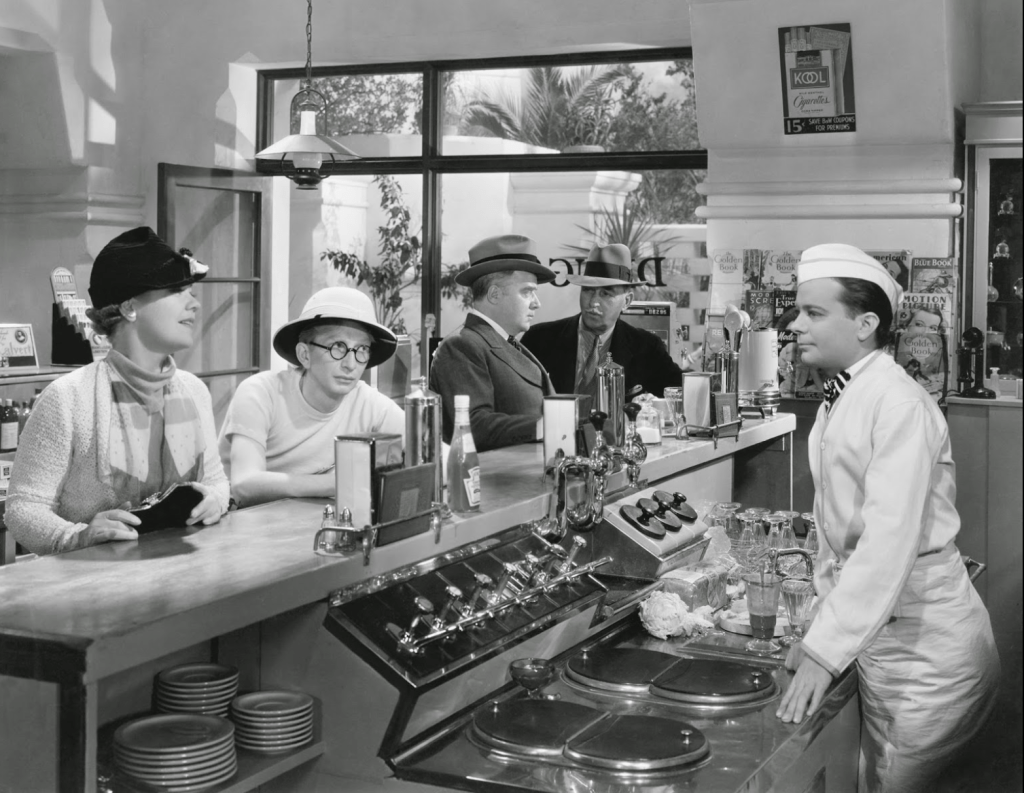
(Image courtesy of Heroes, Heroines & History).
Our mother led an interesting life. To see more about her, here are some of the other narratives in which she is written about. (Please see The Gore Line, A Narrative — Eight, The Peterman Line, A Narrative, and The Bond Line, A Narrative — Seven). (2)
Lulu Mae DeVoe Becomes Mrs. Harley Gore
It is through Lulu that we connect to the Mayflower through two different family lines. We will be writing about this lineage when we document the Warner line.
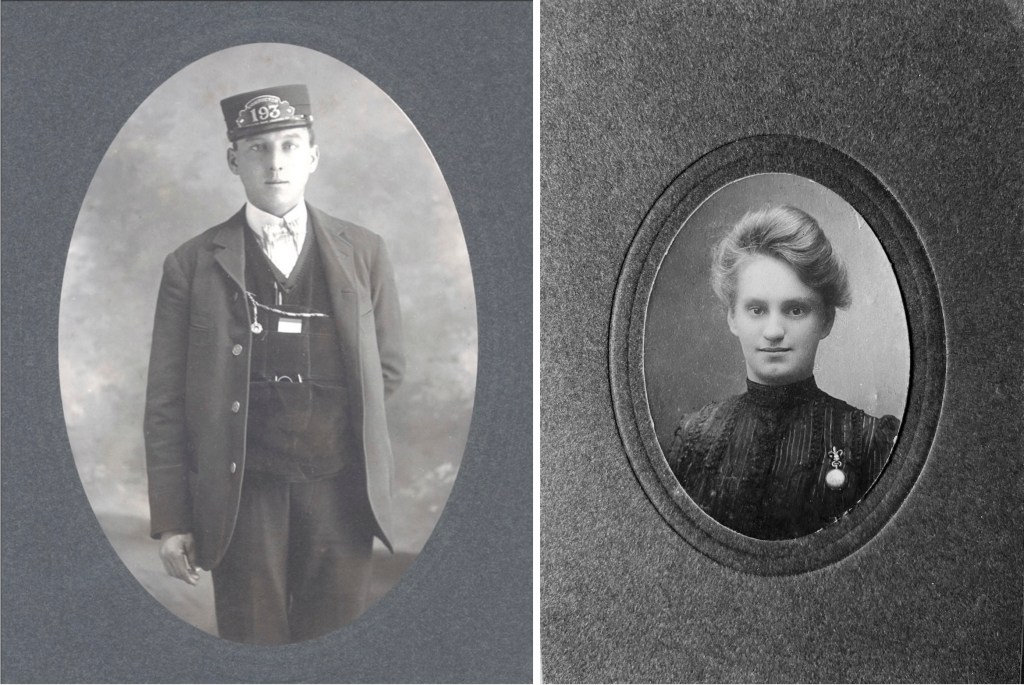
around the time of their wedding in 1905. (Family photographs).
In 1905, Lulu left her teaching career behind and married Harley William Gore becoming both a mother and a farmer’s wife. We believe that they met at a dance, or perhaps a picnic, and were introduced by mutual friends or family. At that time, it was a typical way to meet a young man during the Edwardian era. Social relationships were strictly defined by an unwritten set of rules. Young women had chaperones and one didn’t date, one was courted… All these years later, we’ve lost the thread of details about their courtship, but Grandmother used to mention dances in Triangle Park, in Chagrin Falls, and picnics at Pioneer Park at Punderson Lake in Newbury township.
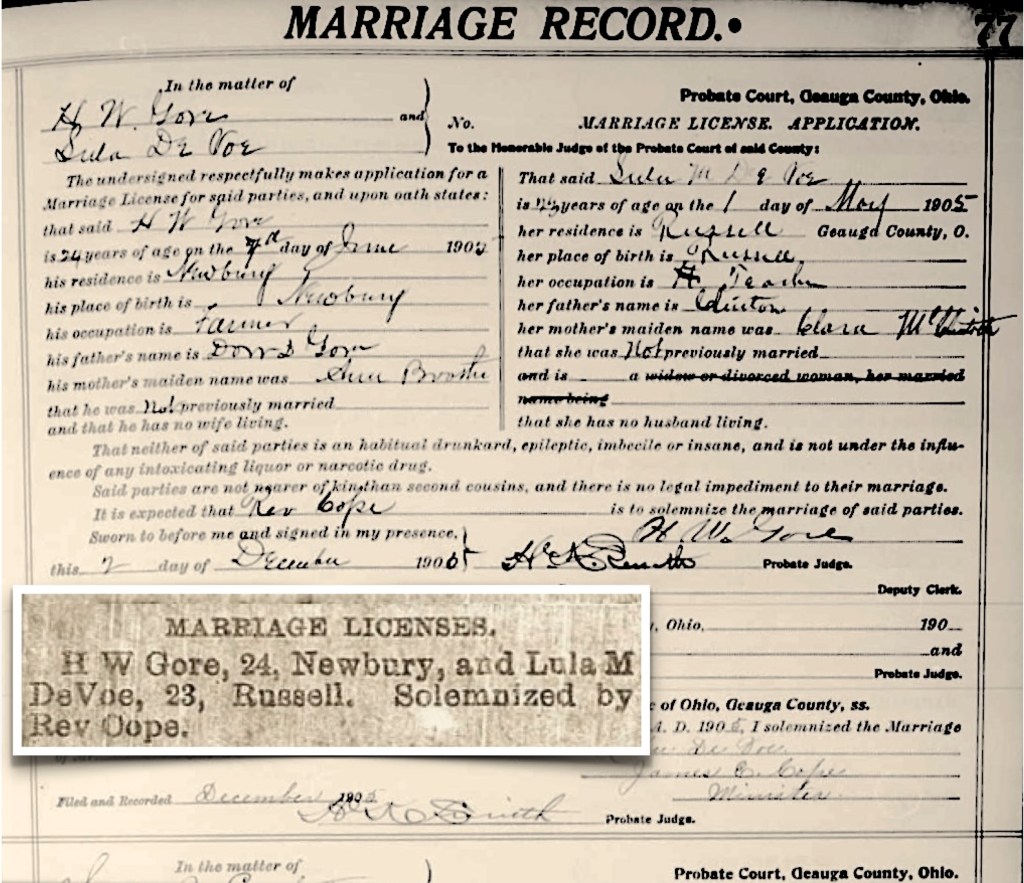
They had three children, all born in Russell township, Geauga County, Ohio:
- Leland Harley Gore, born September 30, 1906 — died October 1, 1993
- Elwyn Clinton Gore, born May 12, 1909 — died February 13, 1935
- Marguerite Lulu (Gore) Peterman Bond,
born June 28, 1920 — died March 4, 1999 (We are descended from Marguerite).
Some material for this aspect of our family narratives is covered in other narratives. We have written quite a bit about their life together, their children, and their extended family. (Please see The Gore Line, A Narrative — Eight).
We know that Grandma Gore was born at home and that there was no birth certificate. However, at some point in her life she needed one (perhaps to collect Social Security?) and the family had to “locate” two very ancient ladies that testified that she was born when and where she was… (3)
Parlor Games
For most people, television didn’t become a viable option for home entertainment until the middle of the 1950s. In prior decades, our ancestors had to be creative in how they entertained themselves in their limited leisure time. First, with the advent of the Edison phonograph, and then the development of home radios, suddenly there were many more options.
The Golden Age of Radio
The History of the Radio Industry in the United States to 1940
As a result, its popularity grew rapidly in the late 1920s and early 1930s, and by 1934, 60 percent of the nation’s households had radios. One and a half million cars were also equipped with them. The 1930s were the Golden Age of radio.
Carole E. Scott, State University of West Georgia
For our ancestors who were of an older age by the time the mid-century period came along, some of their traditional entertainment choices prevailed. One such choice was card games — especially Gin Rummy, Pinochle, and Canasta!
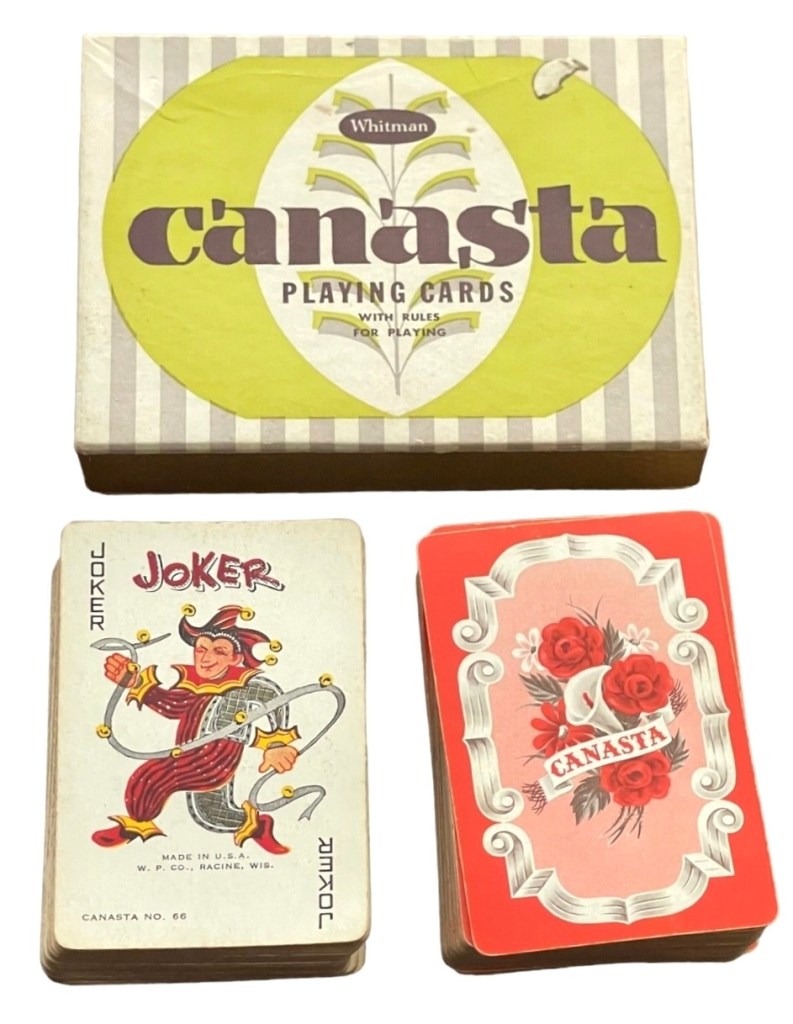
Most people today have probably not heard of Canasta, but it was extremely popular in the late 1940s through the 1950s. Our Grandmother, along with our Uncle George, our Aunts, and their respective spouses, (and other friends) would gather at each other’s homes for potluck Canasta parties. Up to ten tables would be arranged, and the games began. Everyone would compete, shift to different players at other tables, and eventually someone would win a prize. We could be a bit wistful and say times were simpler then — and in some aspects they were, but in other ways, not so much — it was just another era. (4)
One Day in 1966, the Cleveland Press Came to Call
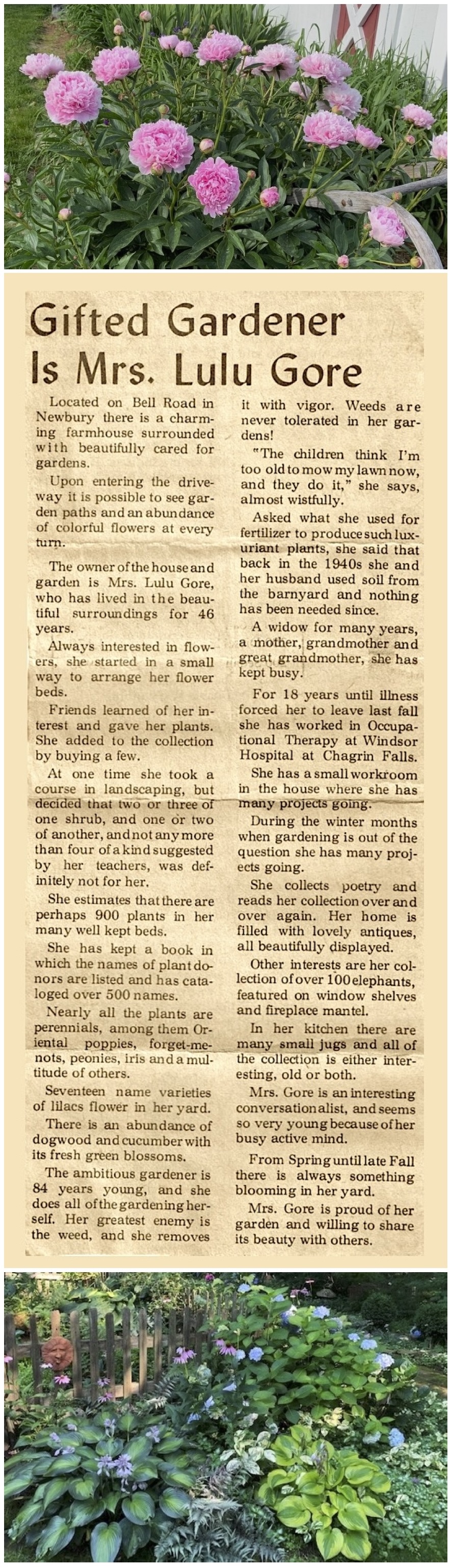
(Garden photographs courtesy of finegardening.com).
Being Rooted In One Place
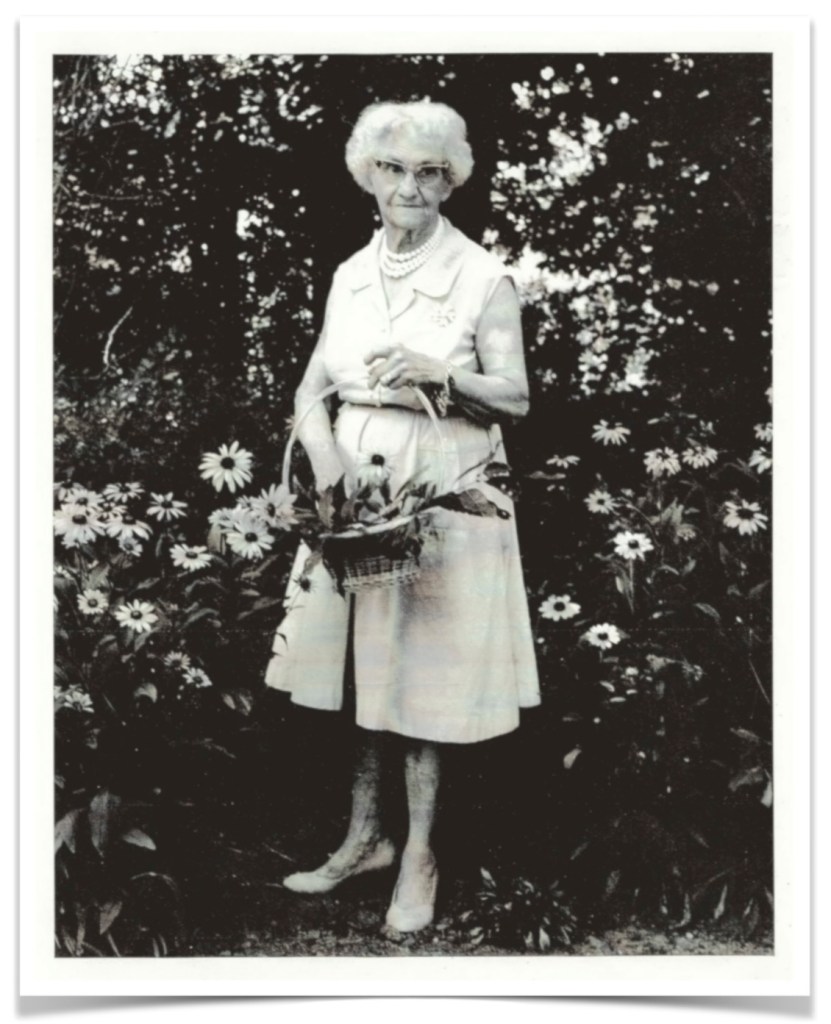
Lulu had deep devotion to her family, and her farm, but her passion was her ardent love of gardening, as the above article from the Cleveland Press newspaper highlights. We recall how the long rows of peony plants which lined her driveway, how the ancient maple trees surrounding the house provided shade in the hot summers, the way that boughs of lilacs perfumed the Spring air… We were allowed to play in these gardens, but there was an ever-present warning to be careful, stay on the garden paths, and not to damage the plants… (in other words, we needed to be respectful of her hard work).
Her extended family filled the surrounding communities and existed in many ways like our Irish ancestors did with their kith, kin, and clan sensibilities. This gives us pause to think that perhaps this is what it was like for many of our European ancestors in their communities before they immigrated first to the British Colonies in America, then to the United States. Communities gather together for a few generations and then they change, with some leaving and establishing their own respective “center”.
For those of us who have moved around much as adults, it sometimes feels a bit constraining to think about living in one place for a very long time, but this is what Lulu did. She planted deep roots in her community and lived her entire life like the progressive rings from one of her grand maple trees — all within a five mile radius of where she was born.
“A single great tree can make a kind of garden, an entirely new place on the land, and in my mind I was already visiting the place my maple made, resting in its shade.
Michael Pollan, “Putting Down Roots”
I’d decided on a maple because I’ve always liked the kind of light and air an old one seems to sponsor around itself. Maples suggest haven. They always look comfortable next to houses, in summer gathering the cool air under their low-hanging boughs and ushering it toward open windows.
Now I knew this wouldn’t happen overnight, probably not even
in my lifetime, but wasn’t that precisely the point?
To embark on a project that would outlast me, to plant a tree whose crown would shade not me, but my children or, more likely, the children of strangers?
Tree planting is always a utopian enterprise, it seems to me,
a wager on a future the planter doesn’t necessarily expect to witness.”
The New York Times Magazine, May 6, 1990
Lulu Mae (Devoe) Gore died four days before she would have been 93 years old. She is buried in Riverview Cemetery in Russell, Ohio next to her husband Harley William Gore, amidst many generations of other extended family members. (For more on their lives together, please see the chapter, The Gore Line, A Narrative —Eight).
She had once penned a poem, titled…
When I Quit
When I quit this mortal shore
And mosey ’round this earth no more,
Don’t weep, don’t sigh, don’t grieve, don’t sob
I may have struck a better job.
Don’t go and buy a large bouquet
For which you’ll find it hard to pay.
Don’t hang ’round me looking blue,
I may be better off than you!
Don’t tell folks I was a Saint
Or anything you know I ain’t.
If you have stuff like that to spread
Please hand it out before I’m dead.
If you have roses, bless your soul.
Just pin one on my button hole.
But do it while I’m at my best
Instead of when I’m safe at rest.
She was the person in our family who helped us gain an appreciation for genealogical research. One day she looked off into the middle distance and made a comment about her family having had picnics at cemeteries. That sounded (!) completely odd to us, but it turns out it was once a thing. From Atlas Obscura: “During the 19th century, and especially in its later years, snacking in cemeteries happened across the United States. It wasn’t just apple-munching alongside the winding avenues of graveyards. Since many municipalities still lacked proper recreational areas, many people had full-blown picnics in their local cemeteries. The tombstone-laden fields were the closest things, then, to modern-day public parks.”
(Family epherma).
Furthermore, “One of the reasons why eating in cemeteries become a “fad,” as some reporters called it, was that epidemics were raging across the country: Yellow fever and cholera flourished, children passed away before turning 10, women died during childbirth. Death was a constant visitor for many families, and in cemeteries, people could “talk” and break bread with family and friends, both living and deceased.”
One wonders if perhaps in their collective afterlife… our family members are still enjoying each other’s company breaking bread at family picnics? (5)
Following are the footnotes for the Primary Source Materials,
Notes, and Observations
The Class of ’99
(1) — two records
Flickr.com
One-room school house
Photograph by Steve Mather
https://www.flickr.com/photos/mathersteve/29573949615
Note: “Circa-1900, one-room school house. Wood & cast iron desks with inkwells. Tall stool and cone-shaped dunce cap. Teacher’s wooden desk with oil lamp. American flag. Slate chalk board. Framed photos of of American ”
Note: For the photograph.
The National Register of Historic Places
Ohio — Geauga County
Chester Township District School No. 2 (added 1982 – – #82001463)
https://nationalregisterofhistoricplaces.com/oh/geauga/state.html
Note: For the photograph.
Some Things Change, and Then… Some Things Transform
(2) — eight records
Benefits of Living in Chagrin Falls, OH
https://www.morsemoving.com/benefits-of-living-in-chagrin-falls-oh/#:~:text=Chagrin%20Falls%2C%20Ohio%2C%20nestled%20in,town%20has%20much%20to%20offer.
Note: For the text.
Discover Chagrin Falls History
Landmarks > High Falls
https://cfhs.me/?c=landmarks&t=high-falls
Schools, Churches, Libraries > Union School
https://cfhs.me/?c=schools-churches-libraries&t=union-school
Landmarks > Bandstand
https://cfhs.me/?c=landmarks&t=bandstand
Business > Druggists
https://cfhs.me/?c=business&t=druggists
Note: For historic photographs from this area.
Part 1. Chagrin Falls (1892 atlas map)
by George F. Cram, J. Q. A. Bennett, and J. H. Beers
https://archive.org/details/dr_part-1-chagrin-falls-12048097
Note: For the map. “This atlas gives a detailed cartographic record of the City of Cleveland, Ohio, and the surrounding areas in Cuyahoga County in 1892. 52 maps show Cleveland. Cram was known mostly for his world atlases and occasional regional atlases. This city and county atlas may be one of the few that he published”.
Soda Jerk
https://en.wikipedia.org/wiki/Soda_jerk
Note: For the data.
Heroes, Heroines & History
Soda Fountains — A Sweet Memory of the Past
by Pamela S. Meyers
https://www.hhhistory.com/2014/10/soda-fountains-sweet-memory-of-past.html
Note: For the soda fountain image, which is captioned as, A typical mid-20th Century soda fountain.
Lulu Mae DeVoe Becomes Mrs. Harley Gore
(3) — two records
A Mini-History of Newbury
Marian Gould Bottger and the Newbury Bicentennial Committee, 1976
https://www.newburyohio.com/Newbury_MiniHistory.pdf
Note: For the text.
H.w. Gore
Marriage – Ohio, County Marriages, 1789-2016
https://www.familysearch.org/ark:/61903/1:1:XDK5-YMD
Book page: 77, Digital page: 67/226. Right page, entry 1.
Note: For the data.
Parlor Games
(4) — two records
The History of the Radio Industry in the United States to 1940
Carole E. Scott, State University of West Georgia
https://eh.net/encyclopedia/the-history-of-the-radio-industry-in-the-united-states-to-1940/#:~:text=The Golden Age of Radio&text=As a result, its popularity,the Golden Age of radio.
Note: For the text.
Canasta
https://en.wikipedia.org/wiki/Canasta
Whitman Canasta Playing Cards Set with Box Red Roses MCM Vintage Double Deck
Note: Canasta playing cards image courtesy of eBay.com.
One Day in 1966, the Cleveland Press Came to Call
and Being Rooted In One Place
(5) — ten records
The article about our Grandmother’s floral garden was published in July 1966 in the Cleveland Press newspaper, (which ceased publishing in 1982).
Cleveland Press
https://en.wikipedia.org/wiki/Cleveland_Press
Note: For the data.
Fine Gardening.com
Revisiting an Ohio Garden photographs
https://www.finegardening.com/article/revisiting-an-ohio-garden
and
Mike and Brenda’s Ohio Garden
https://www.finegardening.com/article/mike-and-brendas-ohio-garden
Note: Due to the fact that no photographs survive of Lulu Gore’s expansive mid-century flower gardens, these contemporary photographs are (only) representative due to their similarity.
Note: For the floral photographs.
“Settle somewhere, become established, as in We’ve put down roots here and don’t want to move away. This metaphoric expression, first recorded in 1921, likens the rooting of a plant to human settlement”.
https://www.dictionary.com/browse/put-down-roots#
Note: For the data.
Putting Down Roots
Essay by Michael Pollan
The New York Times Magazine, May 6, 1990
https://michaelpollan.com/articles-archive/putting-down-roots/
Note: For the text.

Lulu M Gore
in the Ohio, U.S., Death Records, 1908-1932, 1938-2018
https://www.ancestry.com/discoveryui-content/view/817894:5763?tid=&pid=&queryId=8aceffb0-6b99-4026-88c8-c5331138b985&_phsrc=rxA1&_phstart=successSource
Note: For the data.
Lulu Gore
in the U.S., Find a Grave Index, 1600s-Current
https://www.ancestry.com/discoveryui-content/view/61357205:60525
Note: For the data.
Lulu DeVoe Gore
https://www.findagrave.com/memorial/98032392/lulu-gore
Note: For the data.
Atlas Obscura
Remembering When Americans Picnicked in Cemeteries
https://www.atlasobscura.com/articles/picnic-in-cemeteries-america
Note: For the text.

(Image courtesy of Woodland Cemetery and Arboretum, via Atlas Obscura).

 Our Ancestors, Our Narratives
I am so glad to have found your blog on the DeVoe family because I am a descendant of Peter M. DeVoe, and have been curious about the family for years but never made any headway in finding anything further back.
LikeLiked by 1 person