This is Chapter One of eleven. With this chapter we begin a long and complicated history of the DeVoe branch of our family. There will be eleven chapters total in this family line.
Nearly all of our family lines were in North America very early on, including the DeVoes. Like the tap root of a tree, the key foundational event for America is the Pilgrims landing at Plymouth Rock, and their founding of the first sustained immigrant community. It is also because of the DeVoe line, that we connect to two Mayflower passengers: Pilgrim George Soule, and Pilgrim Edward Doty. In future posts, we will be writing their family narratives.
The Best Place to Find a Needle is a Haystack
On the one hand, we have found that doing genealogy research can bring a happiness which results from discovering something cool about an ancestor you only vaguely knew. (Or better yet, finding ancestors you never knew existed!) On the other hand, frustration comes when you know the beginning and ending to a story, but the needed documents which connect those ends, are like trying to find a needle in the proverbial haystack.

From writer Mark Baker, “Conventional wisdom tells us that the best place for a needle is in a needle case, and the best place for hay is in a haystack. If you want to find something, or want other people to find it, you should put it in the right place. As we were all taught: a place for everything, and everything in its place. — That was true when we lived in the physical world. But we don’t live in the physical world anymore. We live on the Internet, and the Internet is topsy turvey world in which the best place to find a needle is actually a haystack. [As we know…]
Internet research has become the defacto tool of this era, and sometimes it is like a haystack. With this family, we found all the needles we were looking for, and some we weren’t, and learned a thing or two along the way. We have a great story to tell. So please, enjoy!
Preface: This particular history has two important paths, Politics and Religions. The first path is Politics. It is about the land — who lived where, and who was in charge of that land, etc. The second path is Religions — concerning what was happening with religious conflicts throughout these areas, during these centuries.
A note before we begin: For this blog chapter we are streamlining the complex history of this region, and only focusing on the time periods that affected our ancestors. Please think of this chapter as a synthesized history from many sources, (see footnotes). (1)
The First Path: Politics and Land — Understanding the Low Countries
The Low Countries, historically also known as the Netherlands, is a coastal lowland region in Northwestern Europe… consisting today of the three modern “Benelux” countries: Belgium, Luxembourg, and the Netherlands. Up until the very recent past this was not the case, because the region was almost continually overrun by ambitious imperial powers from adjoining regions. Over the centuries, geographically and historically, the area has also included parts of France and Germany.
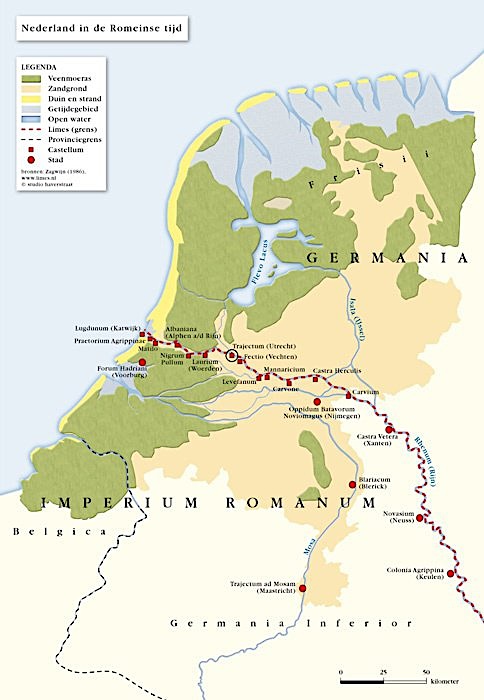
Comment: It’s natural for people today to think that their ancestors are defined by today’s borders, because for the most part, we live in an era where borders hardly move at all. Today, we identify through Borders. But this isn’t the way it should be thought about regarding ancestors who precede us. The world was different then. These ancestors lived in a place that doesn’t exist anymore. To use the “Benelux” example from above: then, Belgium didn’t exist; then, the Netherlands was an unrecognizable mash-up; then, Luxembourg was an obscure, distant Netherlands province.

From the Romans to the Mid-1400s
During the Roman Empire, the region of the Low Countries contained a militarized frontier and was the contact point between Rome and the Germanic tribes. After the long decline of the Roman Empire, this area was the scene of the early independent trading centers that marked the reawakening of Europe in the 12th century. As such, during the Middle Ages, the Low Countries were divided into numerous semi-independent principalities, where guilds and councils governed most of the cities along with a figurehead ruler. Interaction with these various rulers was regulated by a strict set of rules describing what the latter could and could not expect. All of the regions mainly depended on trade, manufacturing, and the encouragement of the free flow of goods and craftsmen.
What was very, very slowly emerging as the Netherlands, rivaled northern Italy as one of the most densely populated regions of Western Europe. Dutch and French dialects were the main languages used in secular city life.
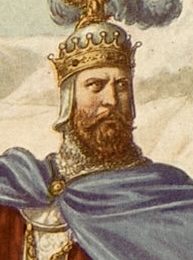


Otto I, known as Otto the Great, (912 – 973), founder of the Holy Roman Empire, The House of Valois-Burgundy, Mary of Burgundy (1457 – 1482), Charles V, Holy Roman Emperor (1500 – 1558) Archduke of Austria, King of Spain, and Lord of the Netherlands [as the titular Duke of Burgundy].
The Holy Roman Empire and The Habsburg Netherlands
The Saxony kings and emperors ruled the Netherlands in the 10th and 11th centuries. The Holy Roman Empire was founded by Otto I, known as Otto the Great. Through strategic marriages and personal appointments, Otto installed members of his family in the Duchy of Saxony kingdom’s most important duchies [the future Germany]. This strategy reduced the various dukes, who had previously been co-equals with the king, to royal subjects under his authority. In the latter part of his life, he conquered the Kingdom of Italy, thus being crowned in 962, Emperor of the Holy Roman Empire, by Pope John XII in Rome. Hence, Germany was called the Holy Roman Empire after the coronation of King Otto the Great, as Emperor.
About 500 years later, the Habsburg Netherlands was the Renaissance period collection of feudal land estates in the Low Countries, held together by the Holy Roman Empire’s House of Habsburg. The Hapsburg rule began in 1482, when Mary of Burgundy died. She was the last Valois-Burgundy ruler of the Netherlands, and the wife of Maximilian I of Austria. Their grandson, Emperor Charles V, was born in the Habsburg Netherlands and made Brussels one of his capitals. The Seventeen Provinces (the de facto fiefs of the Holy Roman Empire) formed the core of the Habsburg Netherlands, which passed to the Spanish Habsburgs, upon the abdication of Emperor Charles V in 1556.
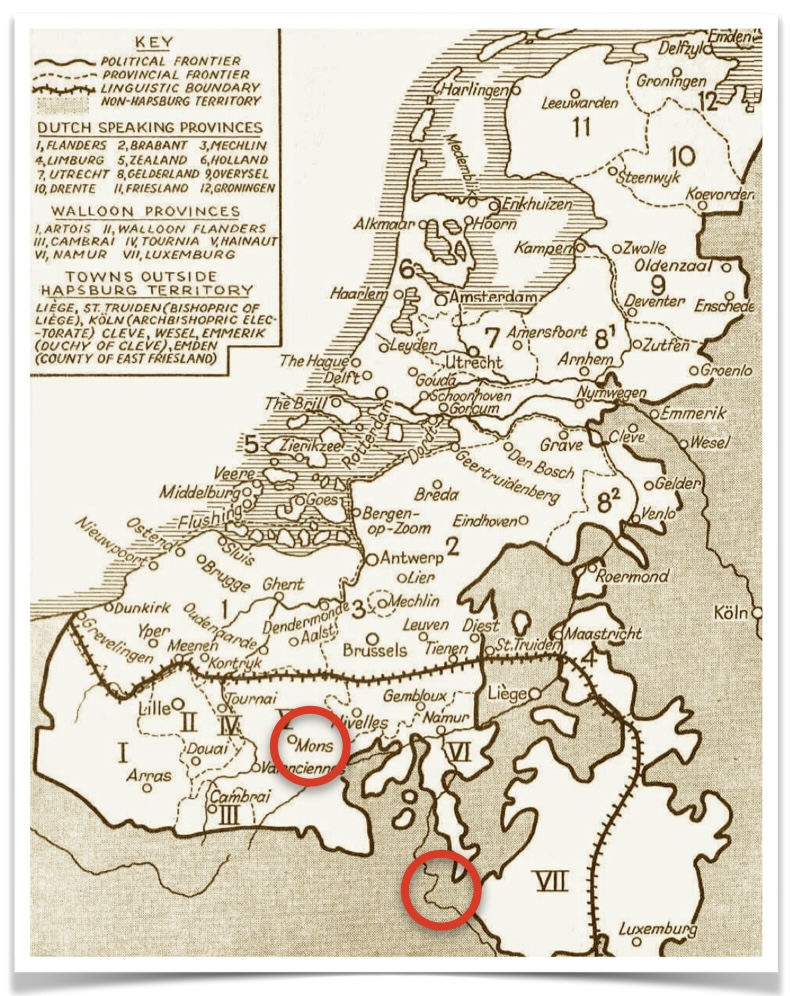
The Spanish Netherlands
Becoming known as the Seventeen Provinces in 1549, they were held by the Spanish branch of the Habsburgs from 1556, and known as the Spanish Netherlands from that time on. They named the area Flandes, which evolved into the name Flanders, and the Army of Flanders was given the task of defending the territory under Spanish service.
These Seventeen Provinces were already changing… In 1581, in the midst of the Dutch Revolt (see next section), the northern portion came together as the Seven United Provinces, and seceded from the rest of this territory to form the Dutch Republic. They still stayed under Spanish rule until the War of the Spanish Succession, (circa 1700). The remaining 10 provinces, in the area to the south where our ancestors lived, were also under Spanish control, but the area was referred to as the Southern Netherlands.
As the power of the Spanish branch of the Habsburgs waned in the latter decades of the 17th century, the territory of the Netherlands under Habsburg rule, was repeatedly invaded by the French and an increasing portion of the territory came under French control in many successive wars. (2)
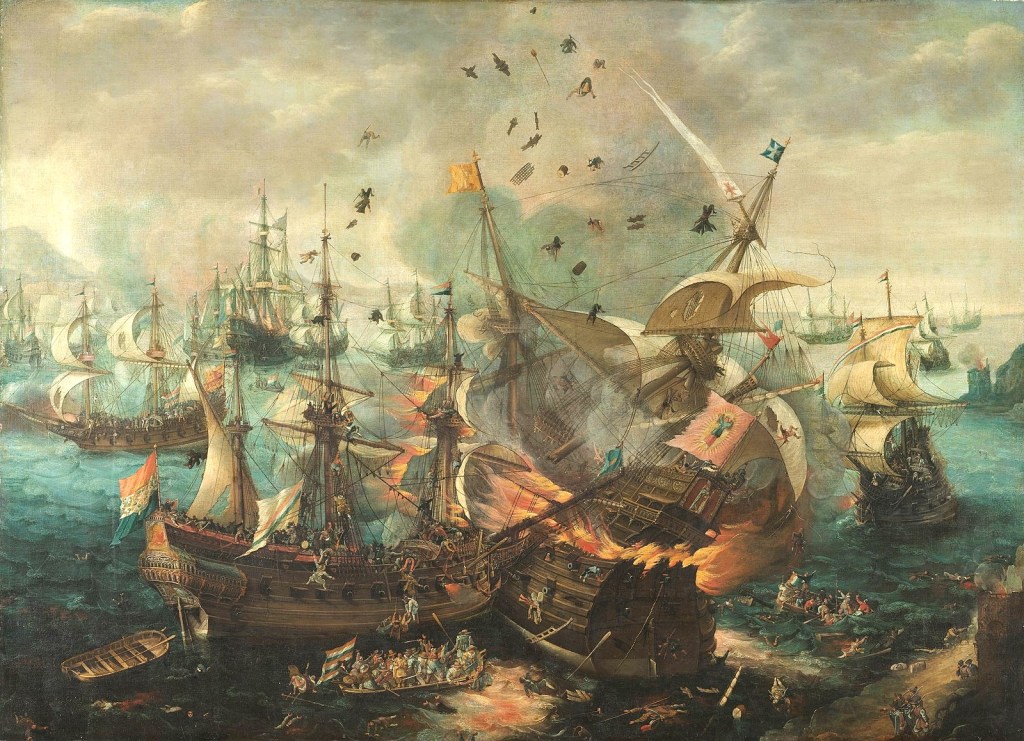
The Dutch Revolt and the 80 Years War
The Eighty Years’ War, or Dutch Revolt, was an armed conflict in the [Spanish] Habsburg Netherlands between disparate groups of rebels, and the Spanish government. The causes of the war included the Reformation, centralization, taxation, and the rights and privileges of the nobility and cities. After the initial stages, Philip II of Spain, the sovereign of the Netherlands, deployed his armies and regained control over most of the rebel-held territories. However, widespread mutinies in the Spanish army caused a general uprising.
The view from history is that “The Reformation led to many Netherlanders leaving the Catholic church and joining Protestant churches. The rise of Protestantism became closely linked to the movement for independence from Spain.” (Family Search) This desire to be free from Spain makes sense for our ancestors because they lived in a conflicted border area…. Some sections of the Low Countries were Catholic, and some sections were turning to the Reformation-led Protestantism…. This led to more strife. The Seven Provinces which had formed the Dutch Republic in 1581, were considered to be Protestant dominant by 1588.
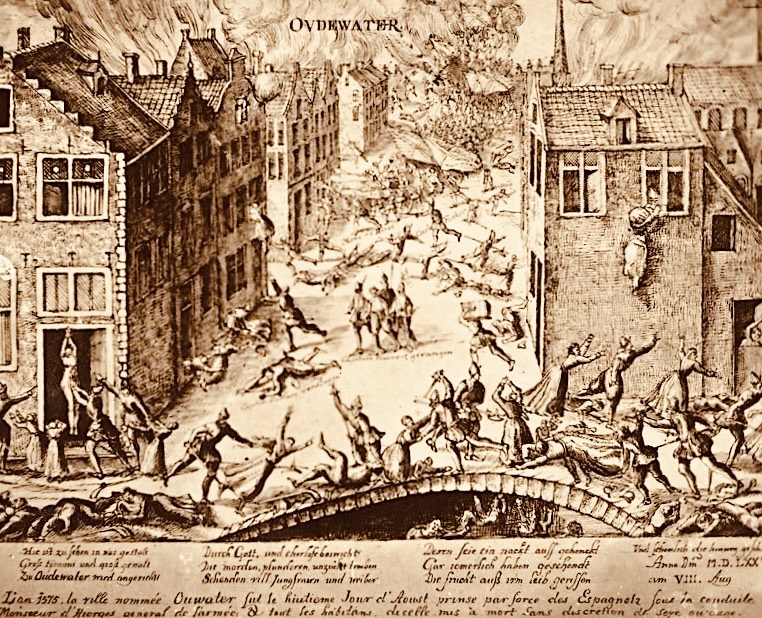
Observation: This revolt began in 1568 and ended in 1648, hence it’s aptly named as the Eighty Years’ War. When our ancestor was born into this milieu, [surroundings, setting, scene, environment] in 1620, the War had been going on for over half a century at that point.
In the ten years thereafter, the Dutch Republic made remarkable conquests in the north and east against a struggling Spanish Empire, and received diplomatic recognition from both France and England in 1596. The Dutch colonial empire emerged, which began with Dutch attacks on Portugal’s overseas territories.
The two sides agreed to a Twelve Years’ Truce in 1609; when it expired in 1621, fighting resumed as part of the broader Thirty Years’ War. An end was reached in 1648 with the Peace of Münster (a treaty part of the Peace of Westphalia), when Spain recognized the Dutch Republic as an independent country. (3)

The Dutch Golden Age and The United East India Company
This was a period in the history of the Netherlands, roughly spanning the era from 1588 until 1672 , in which Dutch trade, science, art, and the Dutch military were among the most acclaimed in Europe. The Golden Age continued in peacetime during the Dutch Republic until the end of the century, when expensive conflicts fueled economic decline. The transition by the Netherlands to becoming the foremost maritime and economic power in the world has been called the “Dutch Miracle” by some historians.
…both foreigners and Dutchmen were apt to believe that the
Koenraad Wolter Swart
Dutch Republic was unique in permitting an unprecedented degree of freedom in the fields of religion, trade, and politics…
In the eyes of contemporaries it was this combination of freedom and economic predominance that constituted the true miracle
of the Dutch Republic.
Professor of Dutch History and Institutions in the University of London
An Inaugural Lecture Delivered at University College London
on November 6, 1967
The United East India Company* was a chartered company established on the March 20, 1602 by the States General of the Netherlands uniting existing companies into the first joint-stock company in the world, granting it a 21-year monopoly to carry out trade activities in Asia. Shares in the company could be bought by any resident of the United Provinces and then subsequently bought and sold in open-air secondary markets (one of which became the Amsterdam Stock Exchange). It is sometimes considered to have been the first multinational corporation.

It was a powerful company, possessing quasi-governmental powers, including: the ability to wage war, imprison and execute convicts, negotiate treaties, strike its own coins, and establish colonies.
*In Dutch, the name of the company was the Vereenigde Nederlandsche Geoctroyeerde Oostindische Compagnie (abbreviated as the VOC), literally the “United Dutch Chartered East India Company”. Today, we generally refer to this company as The Dutch East India Company. (4)
The Second Path: Religious Persecution
James Riker wrote in The Revised History of Harlem — “From Mons, the rich capital of this province, seated to the north of Avesnes… came David du Four, of the same name, — and not improbably the same blood, as the martyr of Le Cateau [*], but whose posterity, which became numerous in his coimtry [territory or country], changed the form of their name to Devoor and Devoe.”
*This is what happened to the “The martyr of Le Cateau“— He was a man named David Du Four of whom Riker wrote: “Huguenots being held prisoners in the neighboring village of Troisville by the castellan and echevins [Roman Catholics] of Le Cateau, David Du Four and others went with arms and liberated them…” This happened in the late summer and autumn of 1566. The aftermath didn’t go so well: “Many executions followed during the ensuing month. One was that of David Du Four, before named. He was a tailor at Le Cateau, and only twenty-two years of age. But on his examination he with firmness declared that ‘he paid more regard to his salvation and to God, than to men.’ He and four others were hung, on April 9th [1567].

Before the Edict of Nantes, 1598. Woodcut, 19th century.
Our immigrant ancestor to New Amsterdam will also be named David Du Four, but he won’t be born for another half century yet [1620], but that’s in the next chapter. Back to our telling of this tale…
This was the first intriguing reference we had found as to where our possible ancestor with the DeVoe family name had originated, and it was linked in the context with the word martyrdom. Riker’s book was about the New Amsterdam Colony in North America, but this was about some place in Europe…
After much research, and coming to an understanding about what Holland was like in this period, we learned that our ancestors in Holland identified as Walloons. (See The DeVoe Line, A Narrative — Two). This was compelling, because we had been coming across some histories [like Genealogy of The De Veaux Family], indicating that our DeVoe ancestors could have been Huguenots. (Observation: Some contemporary writers have picked up on this Huguenot idea and run with it.) However, we have come to believe that the Holland DeVoe(s) were likely surrounded by Huguenots due to where they lived, not because of who they were. Due to religious persecution, many Huguenots were fleeing the areas in France where they lived, and resettling in England. This June 2012 article from The International Institute of Genealogical Studies, explains the situation very well.
History and Beliefs
The French-speaking Protestants who fled from religious persecution and civil war on the continent are all loosely referred to as Huguenots, however this term properly refers to only those from France, and not to the Walloons from the Low Countries. However, it is often impossible to distinguish the two groups because of the shared language and churches as well as much intermarriage in the early communities in England. Their beliefs were Calvinistic [Protestant] and closest to the English Presbyterian style of church government.

(Image courtesy of the New York Public Library Digital Collections).
Walloons
The first wave of many thousands of French-speaking Protestants were Walloon refugees who arrived in England from the Spanish Netherlands (now Belgium and the Netherlands) in 1567, having been forced to flee the suppression of Protestantism by King Philip of Spain’s forces lead by the Duke of Alva. This group had been in England for over a century before the true Huguenots came and the two groups settled in London and the same south-eastern towns.
…And in the Province of New York in New Amsterdam
From Genealogy Magazine.com: It was French-speaking Walloons from Hainaut who were among the first to settle the Hudson River Valley and Manhattan Island between 1620 and 1626. Eight Belgian [Southern Netherlands Walloon] Protestant families, fleeing from Catholic Spanish religious persecution, joined the Dutch settlers in 1624 to settle what became New Amsterdam. [Apparently, some writers as late as 2006, fail to understand that Belgium didn’t exist for 200 more than years, that is, until 1830.]
Huguenots
The Huguenots, (Protestants from France), first came in 1572 [to England] after the Massacre of St. Bartholomew in Paris,which saw 70,000 Huguenots across France brutally murdered. Elizabeth I’s court enter a period of mourning in honor of the Protestant lives lost to the Catholic terror. Although there was support for their religious freedom during the reigns of Elizabeth and James I, during that of Charles I… [there were restrictions imposed which forced the Huguenots to consider resettling somewhere else again]. In response, some moved to Holland, and the majority to the USA* [many to the new Amsterdam Colony in New York Province] taking their craft skills with them.
*OK, it should be obvious, but there was no USA yet. At the time, North America had Native Peoples, and was colonized by the British, Dutch, French, Spanish, and anybody else who could row a boat there. (5)
The Massacre of St. Bartholomew in Paris

The St. Bartholomew’s Day massacre in 1572 was a targeted group of assassinations and a wave of Catholic mob violence, directed against the Huguenots (French Protestants) during the French Wars of Religion. Traditionally believed to have been instigated by Queen Catherine de’ Medici, the mother of King Charles IX.
The massacre started a few days after the marriage on August 18, 1572 of the king’s sister Margaret to the Protestant King Henry III of Navarre. Many of the wealthiest and most prominent Huguenots had gathered in largely Catholic Paris to attend the wedding.

by Édouard Debat-Ponsan, 1880. (Image courtesy of Wikipedia).
The massacre began in the night of August 23-24, 1572, the eve of the feast of Bartholomew the Apostle, two days after the attempted assassination of Admiral Gaspard de Coligny, the military and political leader of the Huguenots. King Charles IX ordered the killing of a group of Huguenot leaders, including Coligny, and the slaughter spread throughout Paris. Lasting several weeks in all, the massacre expanded outward to the countryside and other urban centres. Modern estimates for the number of [the initially] dead across France vary widely, from 5,000 to 30,000. [Eventually] between two and four million people died from violence, famine or disease directly caused by the conflict, and it severely damaged the power of the French monarchy.
The massacre marked a turning point in the French Wars of Religion. The Huguenot political movement was crippled by the loss of many of its prominent aristocratic leaders. The fighting ended with a compromise in 1598, when Henry of Navarre, who had converted to Catholicism in 1593, was proclaimed King Henry IV of France and issued the Edict of Nantes, which granted substantial rights and freedoms to the Huguenots. However, Catholics continued to disapprove of Protestants and of Henry, and his assassination in 1610 triggered a fresh round of Huguenot rebellions in the 1620s. (Wikipedia) (6)

The Global Diaspora of The Huguenots and Their Protestant Allies
We’ve described the persecutions of the Huguenots, and their resulting diaspora. The term diaspora comes from an ancient Greek word meaning “to scatter about.” And that’s exactly what the people of a diaspora do — they scatter from their homeland to places across the globe, spreading their culture as they go. Our ancestors were Protestants, and eventually members of the Dutch Reformed Church.
In total, around 200,000 Huguenots were believed to have left France with around 50,000 settling in England. Many others immigrated to the American Colonies directly from France and indirectly from the Protestant countries of Europe, including the Netherlands, England, Germany, and Switzerland. Although the Huguenots settled along almost the entire eastern coast of North America, they showed a preference for what are now the states of Massachusetts, New York, Pennsylvania, Virginia, and South Carolina. The colonists became farmers, laborers, ministers, soldiers, sailors, and people who engaged in government. (7)
Our ancestors have followed many roads. In the next chapter, we will meet David Du Four, our Walloon ancestor from the Southern Netherlands who immigrated to New Amsterdam, which eventually became New York City.
Following are the footnotes for the Primary Source Materials,
Notes, and Observations
The Best Place to Find a Needle is a Haystack
(1) — two records
Every Page is Page One
The Best Place to Find a Needle is a Haystack
by Mark Baker
https://everypageispageone.com/2011/10/12/the-best-place-to-find-a-needle-is-a-haystack/
Haystacks, End of Summer
by Claude Monet, 1890-1891
https://en.m.wikipedia.org/wiki/File:Claude_Monet._Haystack._End_of_the_Summer._Morning._1891._Oil_on_canvas._Louvre,_Paris,_France.jpg
Note: For the haystack image.
The First Path: Politics and Land — Understanding the Low Countries
(2) — thirteen records
Low Countries
https://en.wikipedia.org/wiki/Low_Countries
Was the Netherlands part of the Roman Empire?
https://www.quora.com/Was-the-Netherlands-part-of-the-Roman-Empire
Note: For the map.
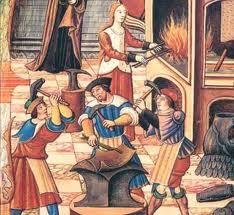
Brewminate: A Bold Blend of News and Ideas
The Economics of Medieval and Early Modern Guilds
By Dr. Sheilagh Ogilvie
Professor of Economic History, University of Cambridge
https://brewminate.com/the-economics-of-medieval-and-early-modern-guilds/
Otto I, Holy Roman Emperor, invading Italy (cropped image)
By Tancredi Scarpelli
https://www.meisterdrucke.ie/fine-art-prints/Tancredi-Scarpelli/36868/Otto-I,-Holy-Roman-Emperor,-invading-Italy.html
(Image courtesy of Meisterdrucke).
Otto the Great
https://en.wikipedia.org/wiki/Otto_the_Great
Note: For his portrait.
Mary of Burgundy (1458–1482)
Attributed to Michael Pacher
File:Mary of Burgundy (1458–1482), by Netherlandish or South German School of the late 15th Century.jpg
https://en.wikipedia.org/wiki/Mary_of_Burgundy#/media/File:Mary_of_Burgundy_(1458–1482),_by_Netherlandish_or_South_German_School_of_the_late_15th_Century.jpg
Note: For her portrait.
Mary of Burgundy
https://en.wikipedia.org/wiki/Mary_of_Burgundy
Ficheiro:Barend van Orley – Portrait of Charles V – Google Art Project.jpg
by Bernaert van Orley, circa 1515
https://pt.m.wikipedia.org/wiki/Ficheiro:Barend_van_Orley_-_Portrait_of_Charles_V_-_Google_Art_Project.jpg
Note: For his portrait.
Charles V, Holy Roman Emperor
https://en.wikipedia.org/wiki/Charles_V,_Holy_Roman_Emperor
The Most Remarkable Lives of Jan Jansen and his son Anthony
A Brief History of the Netherlands (map)
By Brian A. Smith, D.C.
https://ia801604.us.archive.org/32/items/2013JanAndAnthonyJansenPublic/2013 Jan and Anthony Jansen public.pdf
Book page: 3/145
Note: For the map.
History Maps
Part of the Holy Roman Empire
https://history-maps.com/story/History-of-the-Netherlands
History of the Netherlands, 5000 BCE – 2024
Habsburg Netherlands
https://en.wikipedia.org/wiki/Habsburg_Netherlands
Spanish Netherlands
https://en.wikipedia.org/wiki/Spanish_Netherlands
The Dutch Revolt and the 80 Years War
(3) — five records
The Battle of Gibraltar, 1607
by Cornelis Claesz van Wieringen, circa 1621
File:Slag bij Gibraltar in 1607 Het ontploffen van het Spaanse admiraalsschip tijdens de zeeslag bij Gibraltar, 25 april 1607, SK-A-2163.jpg
History Maps
The Dutch Revolt
https://history-maps.com/story/History-of-the-Netherlands
History of the Netherlands, 5000 BCE – 2024
Netherlands Church History
https://www.familysearch.org/en/wiki/Netherlands_Church_History
The killing of Oudewater (Netherlands) Spanish troops murder al civilisans after a siege during the eighty years war.
https://en.wikipedia.org/wiki/Siege_of_Oudewater_(1575)#/media/File:Oudewater_moord.jpg
Note: For the The Oudewater massacre… image.
Siege of Oudewater (1575)
https://en.wikipedia.org/wiki/Siege_of_Oudewater_(1575)#:~:text=II of Spain.-,Siege and massacre,leading to a major conflagration.
The Dutch Golden Age and The United East India Company
(4) — eight records
The Syndics of the Drapers’ Guild
by Rembrandt, 1662
File:Rembrandt – De Staalmeesters- het college van staalmeesters (waardijns) van het Amsterdamse lakenbereidersgilde – Google Art Project.jpg

Dutch East India Company
https://en.wikipedia.org/wiki/Dutch_East_India_Company#:~:text=In%20Dutch%2C%20the%20name%20of,the%20United%20East%20India%20Company).
Diana Muir Appelbaum
(We are posting this essay by Koenraad Wolter Swart (1916—1992) both because it is still useful and in order to spare would-be readers the eye strain that results from reading it on microfiche).
Miracle of the Dutch Republic
By K. W. Swart
Professor of Dutch History and Institutions in the University of London
An Inaugural Lecture Delivered at University College London on
November 6, 1967
http://www.dianamuirappelbaum.com/?p=583
Footnotes for the Dutch East India Company artifacts images:
Christie’s
An Arita Dish Commissioned by the Dutch East India Company
Edo Period, Late 17th Century
https://onlineonly.christies.com/s/japanese-art-english-court/arita-dish-commissioned-dutch-east-india-company-39/13671
The Arms of the Dutch East India Company and of the Town of Batavia,
Jeronimus Becx (II), 1651
https://www.rijksmuseum.nl/en/collection/SK-A-4643
Logo of the Amsterdam Chamber of the Dutch East India Company
https://en.m.wikipedia.org/wiki/File:VOC-Amsterdam.svg
Dutch East India Company, Gelderland (1726-1793), Duit(C) coins
https://www.educationalcoin.com/product/dutch-east-india-company-gelderland-1726-1793-duitc/
Batavia Dutch East India Company Ship Replica
https://www.amazon.com/Old-Modern-Handicrafts-Batavia-Collectible/dp/B00OP971EA
The Second Path: Religious Persecution
(5) — seven records

Revised History of Harlem (City of New York): Its Origin and Early Annals
by James Riker
https://archive.org/details/revisedhistoryh00unkngoog/page/n12/mode/2up
Book pages: 35-36, Digital pages: 34-36/907
Note: For general biographical information.
The Persecution of Huguenots in France Before the Edict of Nantes, 1598.
Wood engraving, late 19th century
https://www.walmart.com/ip/Huguenot-Persecution-Nthe-Persecution-Of-Huguenots-In-France-Before-The-Edict-Of-Nantes-1598-Wood-Engraving-Late-19Th-Century-Poster/508758362
Note: For The Persecution of Huguenots image.

Genealogy of The De Veaux Family : Introducing the Numerous Forms of Spelling the Name by Various Branches and Generations in the Past Eleven Hundred Years
by Thomas Farrington De Voe, 1811-1892
https://archive.org/details/genealogyofdevea00thom/page/n7/mode/2up
The International Institute of Genealogical Studies
England History of Huguenots, Walloons, Flemish Religions
https://www.familysearch.org/en/wiki/England_History_of_Huguenots,_Walloons,_Flemish_Religions_-_International_Institute
Genealogy Magazine.com
Belgian Migrations: Walloons Arrived Early in America
https://www.genealogymagazine.com/belgian-migrations-walloons-arrived-early-in-america/
and
Landing of the Walloons at Albany
https://digitalcollections.nypl.org/items/510d47e0-f393-a3d9-e040-e00a18064a99
Note: For the Landing of the Walloons at Albany image.
The National Archives
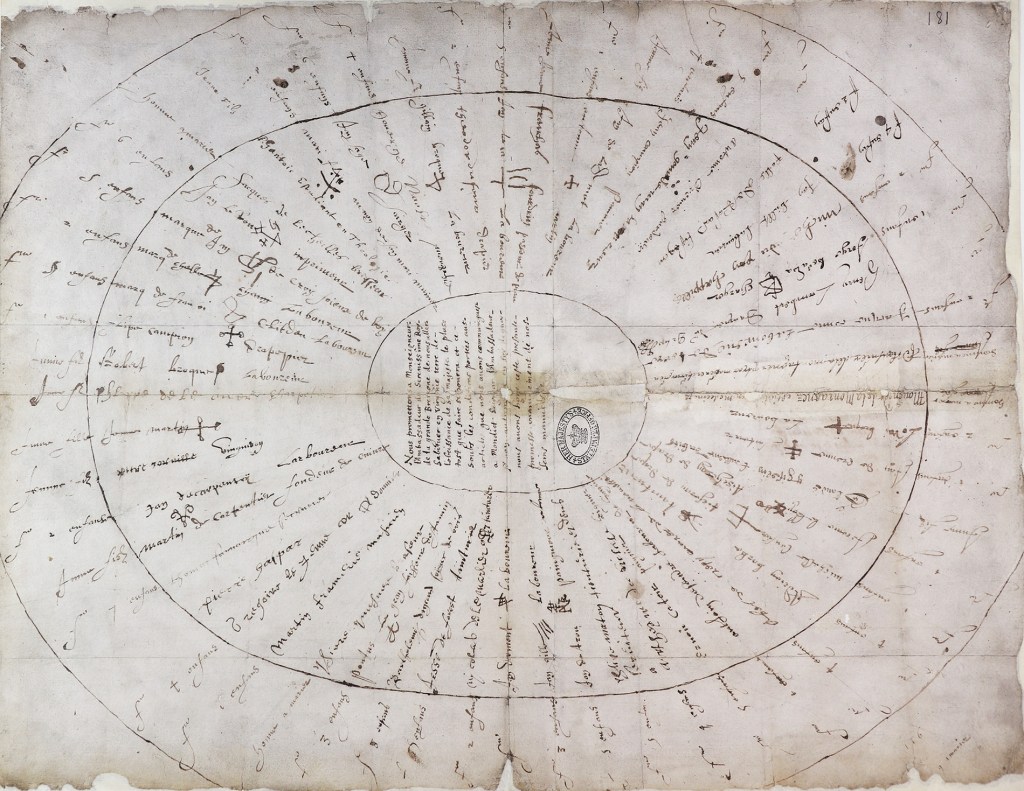
A ‘round robin’ from Walloon emigrants…
https://www.nationalarchives.gov.uk/education/resources/huguenots-in-england/huguenot-migrants-in-england-source-3a/
The Massacre of St. Bartholomew in Paris
(6) — three records
St. Bartholomew’s Day Massacre
by François Dubois, a Huguenot painter who fled France after the massacre.
https://commons.wikimedia.org/wiki/File:La_masacre_de_San_Bartolomé,_por_François_Dubois.jpg
Note: For the St. Bartholomew’s Day image.
French Wars of Religion
https://en.wikipedia.org/wiki/French_Wars_of_Religion
Catherine de Medici Gazing at Protestants in the Aftermath of the Massacre of St. Bartholomew
by Édouard Debat-Ponsan, 1880
https://pt.m.wikipedia.org/wiki/Ficheiro:Debat-Ponsan-matin-Louvre.jpg
Note: For the Catherine de Medici image.
The Global Diaspora of The Huguenots and Their Protestant Allies
(7) — four records
Vocabulary.com
Diaspora definition
https://www.vocabulary.com/dictionary/diaspora#:~:text=The%20term%20diaspora%20comes%20from,their%20culture%20as%20they%20go.
Historic UK
The Huguenots – England’s First Refugees
https://www.historic-uk.com/HistoryUK/HistoryofEngland/The-Huguenots/
The Huguenot Society of America
The Huguenots in America
https://www.huguenotsocietyofamerica.org/history/huguenot-history/
Historie Der Gereformeerde Kerken Van Vrankryk
(History of the Reformed Churches of Vrankryk)
by Élie Benoist, 1696
https://commons.wikimedia.org/wiki/File:Houghton_Typ_632.96.202_-_Historie_Der_Gereformeerde_Kerken_Van_Vrankryk.jpg
Note: For the “All The Ways to Leave France” image.

 Our Ancestors, Our Narratives

,_by_Netherlandish_or_South_German_School_of_the_late_15th_Century.jpg)


#/media/File:Oudewater_moord.jpg)
#/media/File:Oudewater_moord.jpg Siege of Oudewater (1575)
https://en.wikipedia.org/wiki/Siege_of_Oudewater_(1575)#:~:text=II of Spain.-,Siege and massacre,leading to a major conflagration.)
 van het Amsterdamse lakenbereidersgilde - Google Art Project.jpg)


