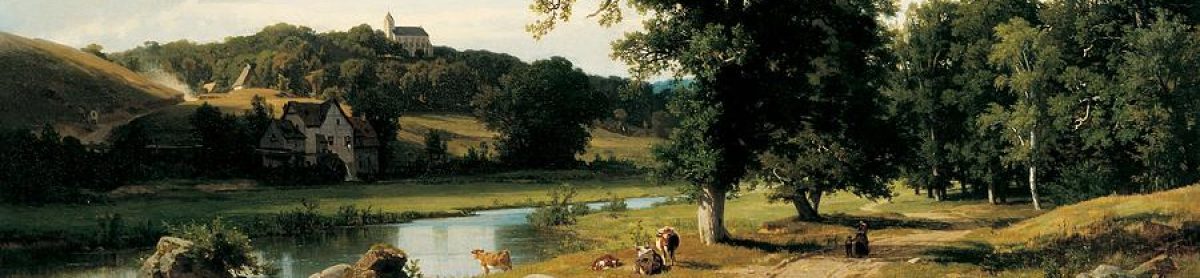
This is Chapter Six of eleven. In the few years immediately following the Revolutionary War, we lose track of Martinus DeVoe until March 1786, when he married.
Prior to then, we believe he was likely rebuilding his life in the community of Halfmoon, New York. He may have been living there already when he married, but we can definitely confirm his presence there with his young wife and family by the time of the 1790 United States Federal Census.
It’s apparent that his local community had not perceived him to be a Loyalist (due to his time of forced servitude at Fort St. Jean, Quebec, Canada). There are no records of his property having been seized by the American Patriots. In contrast within other communities, in retaliation, actual Loyalist families were often stripped of their property and then forced to flee to Canada.
He Was Both a Miller and a Farmer
We know that Martinus was a landowner and likely a farmer, because he described himself as working in agriculture on census materials. We also know that he very likely had a grist mill, due to where his property was located adjacent to water and a mill road. He owned valuable “mill rights” which were written about in the Will of a relative.
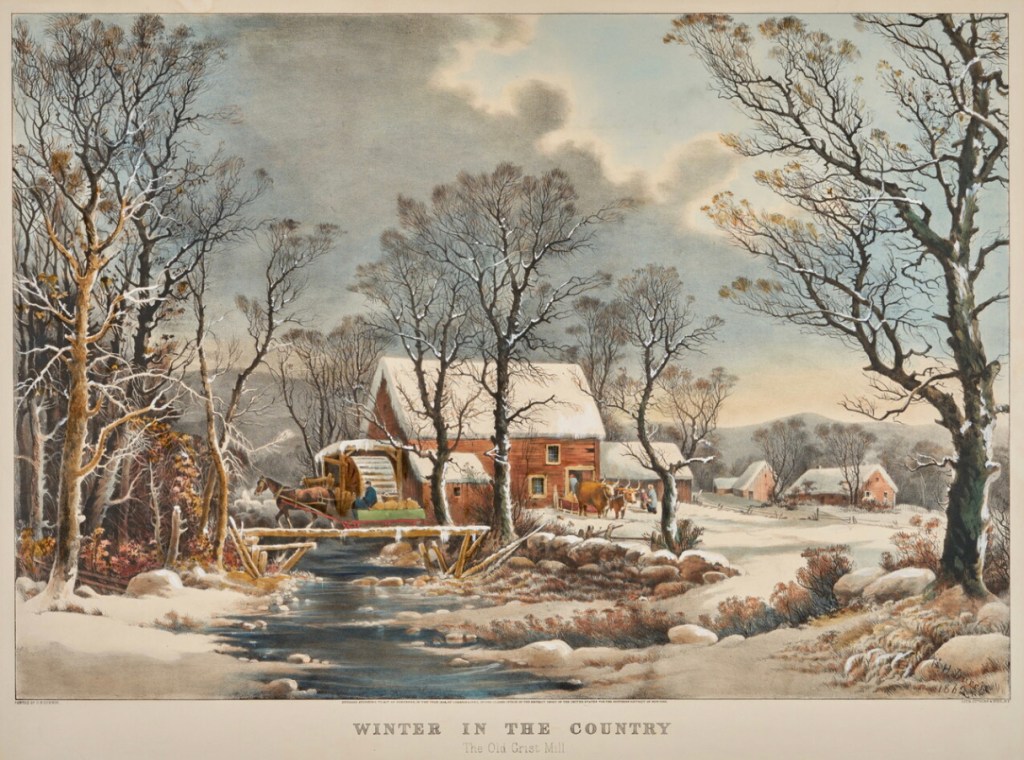
Published by Currier & Ives.
The illustration above shows a grist mill which is similar in time frame and landscape to where Martinus lived then.
As excerpted from Pennsylvania State University’s online article, Colonial America’s Pre-Industrial Age of Wood and Water:
“The development of mills was the first step in freeing agricultural people from the drudgery of rural life. Colonial farmers often traveled up to 50 miles to get grain ground into flour. The long trip to the mill was offset by the fact that it saved them the labor of grinding by hand... Mills were so important that communities often offered inducements such as free mill sites and adjoining land, limited monopoly rights, tax exemptions, exemptions from military duty, and even outright money gifts. Mills helped to attract settlers to a town and increased land value.”

The above map is known as the Van Schaick of Halfmoon Patent Map #1, 1762-1767 which includes both the Village and the Town of Waterford. The Patent itself was also known in 1700 as the Precinct of Halfmoon. Observations: 1) The map orientation requires the viewer to visualize the map as the top side is West, the right-hand side is actual North, the bottom side is East. 2) There is a Mill Road which bisects the town near Martinus’s property. This would have corresponded to his mill rights. 3) There are other nearby DeVoe properties belonging to DeVoes.

We also have located property tax records which support the fact that he was a landowner. Above is an example tax record from the year 1802. (1)
Understanding That Borders and Boundaries Were In Flux
Most research records indicate that Halfmoon, New York is/was located in Saratoga County, but this was not always the circumstance. This part of the newly-minted United States of America had borders which seemed to be altered every few years. From Wikipedia, “When counties were established in the Province of New York in 1683, the present Saratoga County was part of Albany County. This was an enormous county, including the northern part of New York, as well as all of the present state of Vermont and, in theory, extending westward to the Pacific Ocean. This large county was progressively reduced in size by the separation of several counties until 1791, when Saratoga County and Rensselaer County were split off from Albany County.”
So in 1791, Halfmoon became part of the new Saratoga County and home to our DeVoe ancestors.
The following is commentary is provided by Joseph Garver, Research Librarian, Map Collection, Harvard College, via Google Arts & Culture: “In the first decades after the American Revolution, cartographers played a critical role in the political and economic development of the new republic. The settlement of boundary disputes, the sale of public lands, and the planning of infrastructure projects all required accurate surveys. In New York the challenge of compiling a detailed, reliable map was placed in the capable hands of Simeon DeWitt, who served as the state’s surveyor general from 1784 to 1834.

by Simeon DeWitt, (Image courtesy of Google Arts & Culture).
As the official responsible for the disposition of millions of acres in the public domain (primarily land seized from Loyalists and the Iroquois), De Witt needed to coordinate many teams of surveyors, equipped only with compasses and chains, in the sparsely inhabited western and central parts of the state. He also consulted British colonial maps, incorporated new state boundary surveys, and collated hundreds of manuscript plans submitted by town supervisors and county clerks. The resulting map would show the state of New York entering the 19th century in its new boundaries, with an accurate depiction of its rivers, lakes, roads, and new settlements… It was admired not only for its scientific accuracy, but also for its vision of a state reinventing itself.”
The 1856 map below, shows the town of Waterford after it was carved out of the existing community of Halfmoon. From the History of Waterford, NY: “In 1816 the old precinct of Halve Maan (Halfmoon) was divided into two separate towns, Halfmoon and Waterford. The Village of Waterford is located within the town and holds the distinction of being the oldest continually incorporated village in the United States.”
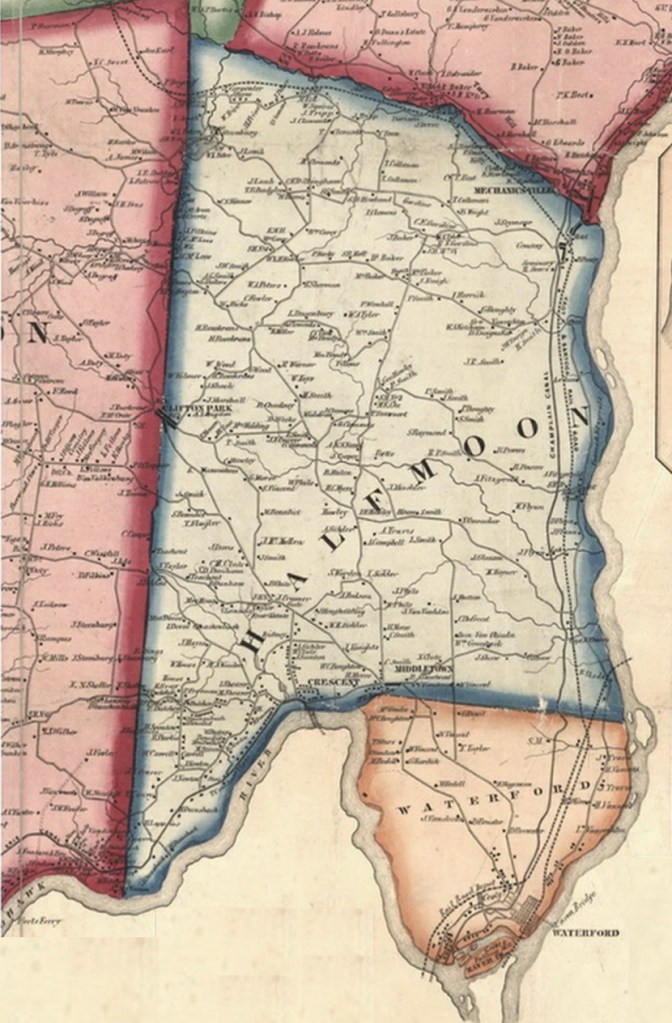
as being separated from the community of Half Moon.
Waterford had always been a hamlet within Halfmoon, but now it was its own separate community. By 1816, our ancestors now lived within the community of Waterford, in Saratoga County, New York. (2)
Martinus Takes A Bride
On March 18, 1786, Martinus DeVoe married Maria Steenbergh with the record located in the register of the Dutch Reformed Church Schenectady Marriages Vol 5. We found the record in The Holland Society archives, it being a transcription from older records. It is interesting to see that the record is written in Dutch — it translates as:
March 18 Martinus DeVoe, born in Half Moon with
Maria Steenbergh, born in Fishkill and both wed in Halfmoon.

(This is a 20th century transcription due to being a typewritten entry).

As noted above, Maria is identified as being from Fishkill, a town south of Halfmoon. Her family’s history took place primarily in Kingston and Dutchess counties. Let’s begin with her great-great grandfathers Theunis and Jan.

of The Hudson River PortFolio, 1820 by William Guy Wall.
Since we do not know how Maria and Martinus met, we are not sure when she was actually residing in Fishkill, Duchess County, or perhaps somewhere else in Albany County. At her wedding, maybe she just identified that her family was originally from the Fishkill area? From Wikipedia, “The third New York Provincial Congress convened in Fishkill in May 1776. Fishkill became part of one of the largest colonial military encampments during the Revolutionary War… [and that] The Dutch Reformed church was used as a military prison [during the war]”. (3)
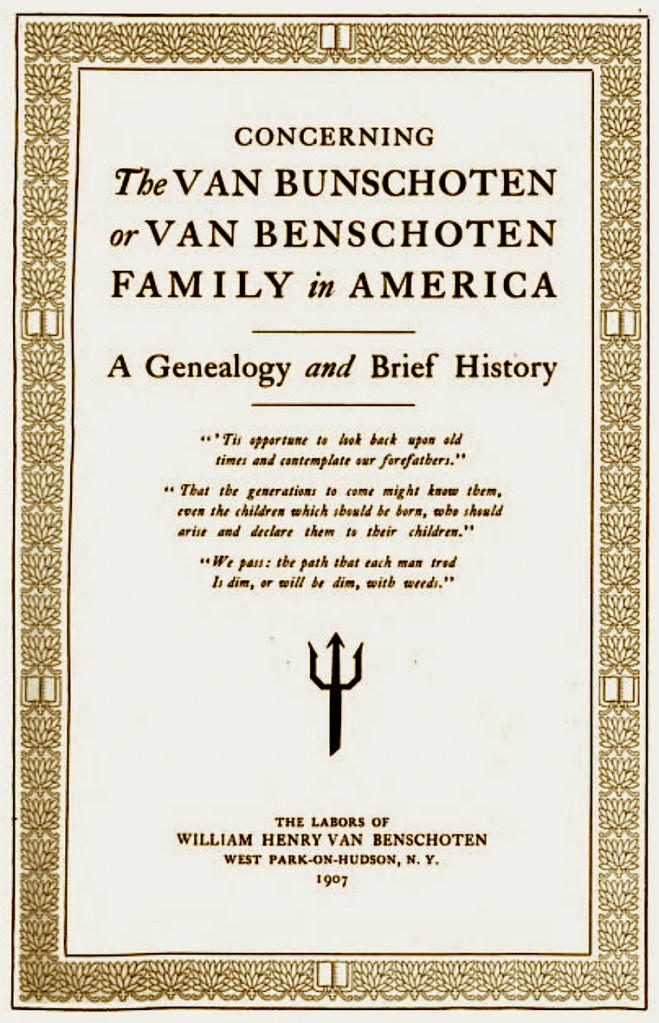
Concerning The Bunschoten or Benschoten Family in America
Maria (Steenburgh) DeVoe’s 2x Great Grandfather was Theunis Eliasen Van Bunschoten. The English translation of his name is Thenuis (Anthony) Eliasen, son of Elias, from the town of Bunschoten in Holland. This is important because the name Elias moved forward from generation to generation and eventually helped us uncover a great mystery in our family tree.
Theunis Eliasen, born November 11, 1643, in Bunschoten, Utrecht, Netherlands — died, 1727-28 in Kingston, Ulster, New York. His arrival in New Amsterdam is thought to be before 1660. He married Gerritje Gerrits Van Der Burgh February 27, 1674 in Bergen, Essex, New Jersey. Gerritje was born September 16, 1649 in Amsterdam, Noord-Holland, Netherlands — died, after 1700, also in Kingston. She arrived in New Amsterdam in 1662, at 13 years old.
Theunis and Gerritje’s daughter Marritje (Maria), married Matthias Van Steenbergen.
Family Surnames Can Be Complicated
Some background information on the name Van Steenbergen before we continue: Matthias (Matthew) was the son of Jan Jansen Van Amersfoort. As we can see, his father’s name translates as Jan (John) > son of Jan (John) > from Amersfoort, Holland. He was Maria’s other 2x Great Grandfather.
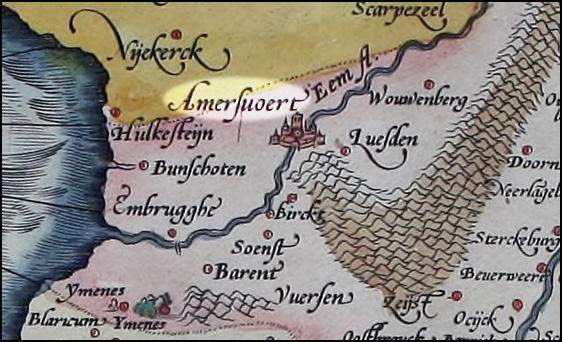
From the book, The Van Bunschoten or Van Benschoten Family in America, William Henry Van Benschoten writes, “Jan Jansen van Amersfoort or Jan Jansen Timmerman (the carpenter) as he was at first styled until the Van Steenbergen displaced both”. [Comment: Historically, family surnames have traditionally been connected to where someone was from, or what their profession was. Sometimes it was both things. The pattern we see here is: location (from Amersfoort), then profession (Timmerman, the carpenter), then Van Steenbergen (of the stone hills). We haven’t been able to find out why the family surname was changed to Van Steenbergen(!) because it doesn’t fit the pattern. This mystery gives us something to research in the future].
Note: Just as with the DeVoe ancestors, there are several spelling variations when we are documenting records of the same family. Among the variations you will see are: Van Steenbergen, Steenburgh, and Steenberg.
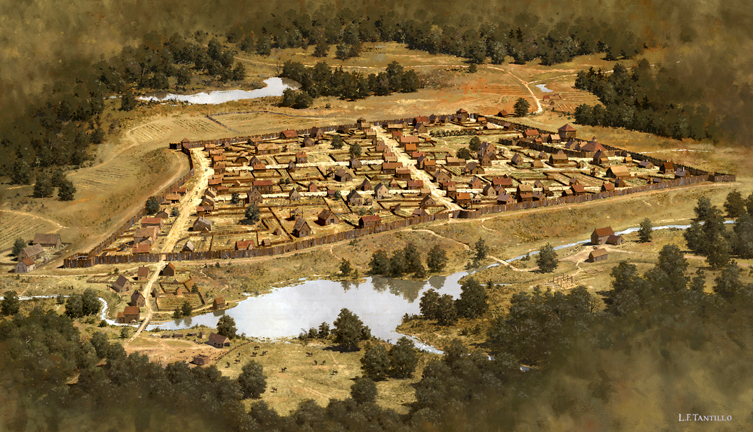
Continuing.., “Jan Jansen was among the very earliest residents at Esopus [Kingston, New York]; in 1658 he signed the agreement to concentrate the scattered settlements and erect a stockade; in 1662 he owned a lot in the village; in 1667, at the time of the so-called mutiny, he was one of the burghers [wealthy citizen] who took up arms against the English garrison; and, in fact, he figured quite extensively in the small community for years.”
Jan Jansen van Amersfoort/van Steenbergen, born about 1630 in Amersfoort, Utrecht, Netherlands — died, about 1678 in Kingston, Ulster, New York. He married Catryntie (Katryn) Mathysen Van Keuren, October 3, 1660 in Kingston. She was born about 1640 at Ft. Orange, Albany, New York — died, 1680-84 in Kingston.
The Van Bunschoten and Van Steenburgen families were joined when Matthias Van Steenbergen, born March 31, 1678 — died, about 1745, Kingston, married Marritje Van Bunschoten on March 12, 1699. She was born before 1678, also in Kingston, and died there about 1768. The new Van Steenburgen family had eight children, all of them born in Kingston, New York.
Their second son, Johannes Van Steenbergen (or Steenburgh by this time), was most likely born before January 1700 as there is a record he was baptized January 21, 1700 at the Dutch Reformed Church in Kingston, New York. There is no record of his death other than a document dated October 18, 1801 stating he died without a Will. From this many people think he died in 1800, which would have made him about 100 years old…quite an achievement in those days! In 1770 he owned land in Dutchess County. One could infer that perhaps he lived there in 1770. In this county we find the town of Fishkill, which was named as Maria Steenburgh’s location when she married Martinus DeVoe in 1786. (We are descended from Johannes.)

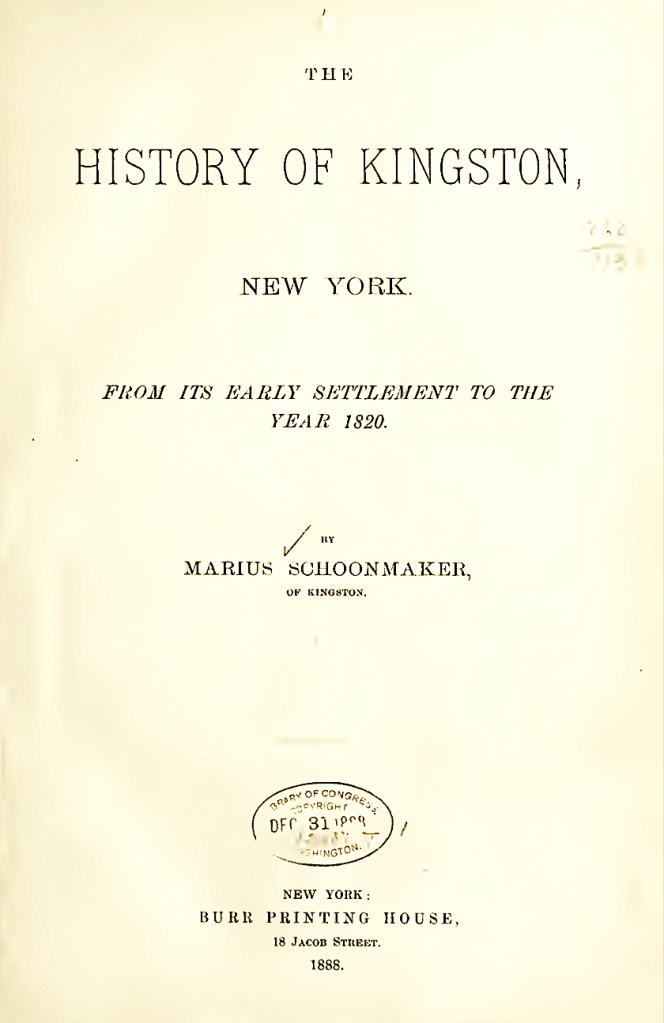
Lower image: Prior to the American Revolution, the city of Kingston was the Capitol of New York. During the Saratoga Campaign of that war, the British burned the city to the ground by destroying over 300 buildings. Interestingly, The Tobias Van Steenburgh House is shown as a late 1880s illustration portraying the home in 1777. It is regarded as the only house that survived from the burning of Kingston during this period, and still stands to this day. (See footnotes).
Comment: One son, Tobias Van Steenburgh, 1732-1738, inherited the family home in Kingston, New York. The footnotes give an interesting overview of how the house survived the American Revolution.
Johannes Van Steenbergen/Steenburgh married Grietjen Wiesborn on February 3, 1722 in Kingston, Ulster, New York. Grietje was born May 30, 1702 in Flammersfeld, Altenkirchen, Rheinland-Pfalz [Germany]. Her death date is unknown. Johannes and Grietje had nine children, all born in Kingston, New York.

(Image courtesy of ancestry.com).
Maria’s Parents
Jacobus Van Steenburgh, born 1731 Kingston, Ulster, New York — died 1800, Halfmoon, Saratoga, New York. He married Maria ‘Molly’ Schouten, 1755 in Kingston, New York. She was born, 1732 in Kingston – died, date unknown, Halfmoon. Molly’s parents were: Syman Schouten, 1717 – 1770, and Annatje Duytscher, 1718 – 1758.
During the Revolutionary War many men were required to serve at least a three month term in a local militia. On a document called The New York Colonial Muster Rolls we find Jacobus Van Steenburgh listed along with his brothers Tobia and Johannes.
It appears that it was this generation of the Van Steenburghs that moved north from Dutchess and Ulster counties, to Saratoga and Rensselaer counties. In the many census and cemetery records, beginning in the 1780s and 1790s, we find listings of Steenbergh siblings and their descendants. It is also in this period that the Van portion of the surname began to disappear, with the spelling, resulting in the simplified form of Steenburgh, or Steenbergh.

Jacobus and Molly had nine children, the first two born in Fishkill, Dutchess County, New York and the other seven born in Halfmoon, Saratoga County, New York. All were baptized at the Dutch Reformed Church at Schaghticoke, Rensselaer, County, New York. (4)
- Annatje Van Steenburgh, born December 14, 1758
- Jacobus (James) Van Steenburgh, born December 3, 1759 — died March 31, 1838, Alburgh, Grand Isle, Vermont. Married Rebecca Lake in 1779.
- Maria Van Steenburgh born March 29,1764 — death date unknown. Married Martinus DeVoe, March 18, 1786. (We are descended from Maria).
- Derick (Richard) Van Steenbergh, born 1769 — died February 6, 1847, Halfmoon, Saratoga, New York
- Johannes (John) Van Steenburgh , born 1771
- Margaret Van Steenburgh, born 1774
- Jannitje Van Steenburgh, born 1776
- Cattrina Van Steenburgh, born 1779
- Stephanus Van Steenburgh, dates unknown
Martinus and Maria Started a Family…
Right away, it seems! Almost exactly one month to the day after they were married, Maria (Steenbergh) DeVoe gave birth to her first child, a daughter they named Marytje. (As a very popular and common name in this era, it corresponds to the English name Mary, and would have been pronounced as Mahr-id-je).

U.S., Dutch Reformed Church Records in Selected States, 1639-1989,
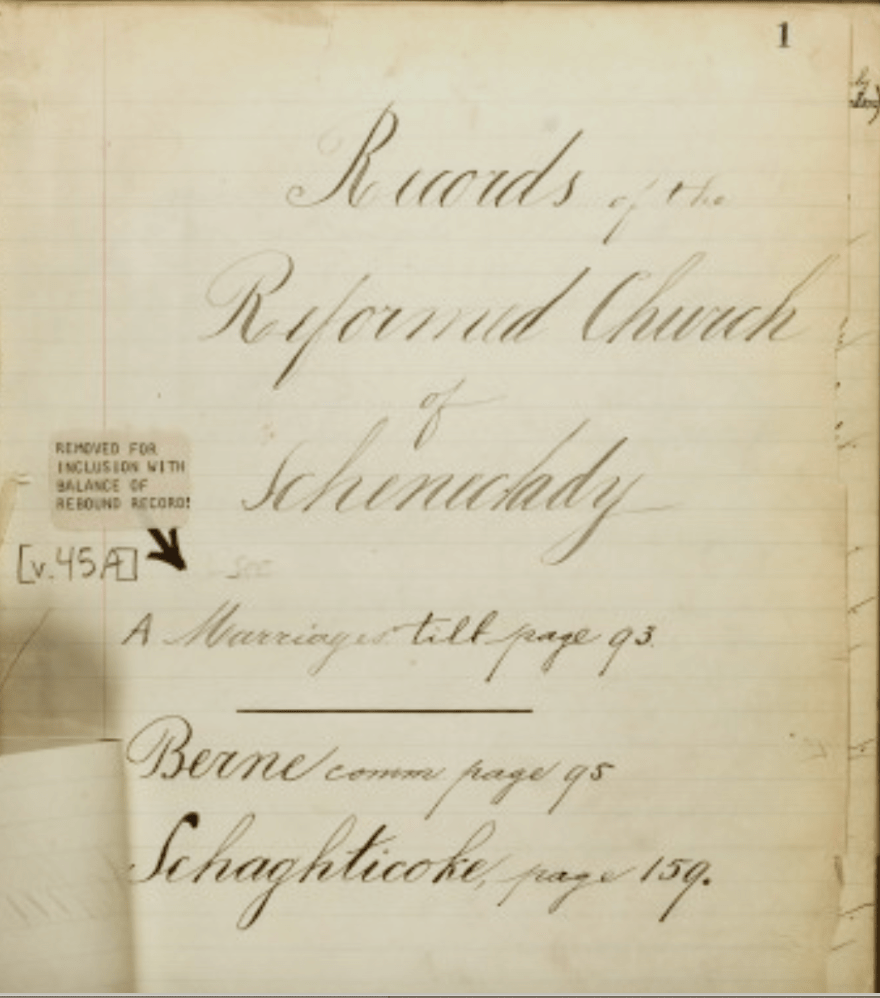
Schenectady, Berne, and Schaghticoke, Book 5.
Marytje was born on April 17, 1786. Observation: This is the same record book in which her mother Maria Steengergh’s birth is noted. Maria’s record is on book page 167; Marytje’s on page 393 —a difference of 21 years, and 266 pages.
Marytje DeVoe is also the only child from this marriage of whom we have a birth record. We spent years researching records, and have developed very plausible theories as to why the records likely do not still exist. To get to that, we first need to see the history of the Dutch Reformed Church in Waterford, and then review the various Census records available for this family. (5)
The Waterford Dutch Reformed Church
Our oral family stories have told us that Martinus and Maria had a large family. This is also confirmed through the various censuses in the next section. So why haven’t we been able to locate any baptismal records for their children, except for their firstborn daughter Marytje? (Their marriage record and Marytje’s birth record are found in the records of other congregations outside of the Halfmoon / Waterford immediate area. These areas are where other family members were then living).
There is only one seventy-nine page catalog available for the Waterford church: the Records of the Reformed Dutch Church of Waterford, Saratoga County, N.Y., 1824-1862, and it exists only on microfilm in Utah State. What is most noteworthy however, is that the records start in the year 1824, and by that time all of Martinus’s and Maria’s children were already born and well beyond their baptismal ages.
We have spent years turning over every stone and reviewing every congregation record that we could, and have turned up nothing. Although very frustrating, we have gained insights into what may have happened to this information.
The records have been lost within the DRC congregations…
From the records of The Holland Society, there were nearly eighty Dutch Reformed Church congregations dotting the Hudson River Valley in New York and portions of New Jersey during these centuries. Together, both services and records were provided in the Dutch language until the decades following the Revolutionary War. What this means for history, is that the population that made up the DRC congregations diminished through both emigration and intermarriage with people from other church denominations. As actual churches were closed, their records were then passed to other locations.

Some records just could not be salvaged…
It is clear that not all of the materials seem to have been preserved. Within The Holland Society records there are historical notes that some registers crumbled into myriad fragments which could not be salvaged. Those records which are still with us, are either handwritten or typed transcriptions from the 19th and 20th centuries.
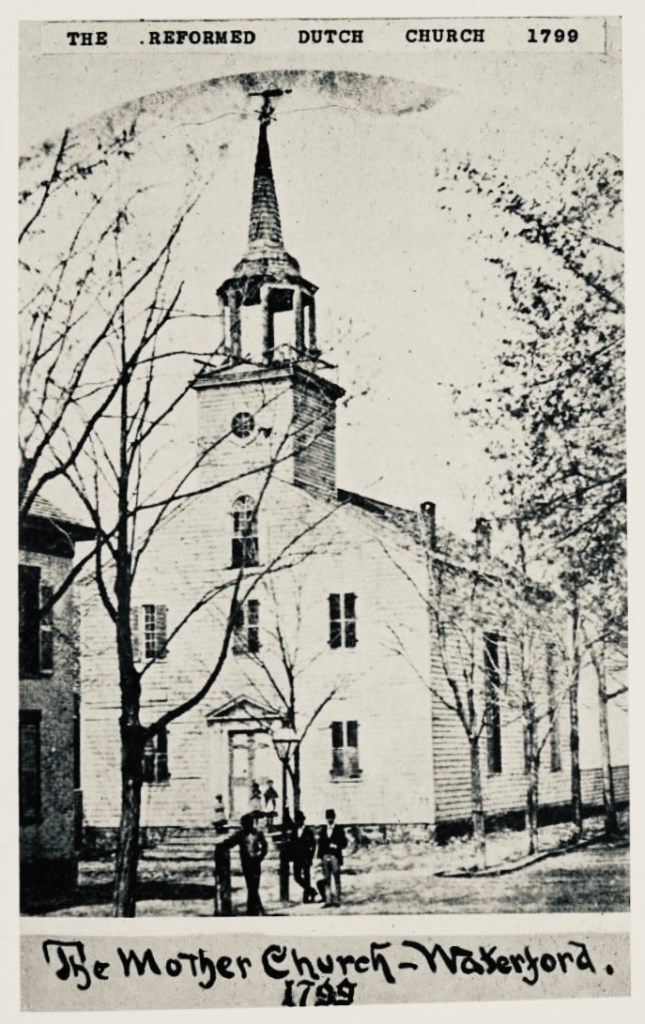
The church was relocated while they were still becoming parents…
Excerpted from History of Saratoga County, New York: “This society, now extinct, was the old pioneer church of Waterford; emphatically, the church of old times… [The old church] was taken down and removed [to] the corner of Middle and Third Streets, the work being finished in 1799… The year when the old house of worship up the river was built seems to be unknown, nor is it certain that it was the first… the records of this ancient society do not seem to have been preserved, and the names of its founders are not easily found.” Who knows? If there were records in Waterford prior to 1799, perhaps this is when they were lost in the shuffle.
And Then Mother Nature intervened…
In addition to the above short bit of history, Hammersley wrote: “In 1874 this old Dutch Church was said to have been struck by lightning and partly burned. It was torn down in 1876. Its cornerstone was fortunately preserved and is part of the foundation of the residence owned in 1955 by Miss A. Marian Button, resting upon the exact site of the old church, at No. 22 Third St.” A fire, smoke, and water damage, although it happened much later, is a sure way to have old paper records vanish.
Could they have just not cared anymore?
We have wondered if perhaps they just gave up on baptizing their children? It seems incredibly unlikely in that era. In fact, we know that their son Peter M. Devoe (our 3x Great Grandfather) was married in the Dutch Reformed Church in Boght, Albany County, New York in January, 1829. We will cover his family life in the chapter, The Devoe Line, A Narrative — Eight.
To sum this up, we believe that the birth records for most of the children of Martinus and Maria Devoe have been lost. Being ever the optimists, perhaps one day we will get lucky and discover a fresh resource. (6)
Starting With The First United States Census…
When George Washington was inaugurated as President in 1789, no one knew how many people lived in the new United States. From mountvernon.org: “The 1790 census was the first federally sponsored count of the American people. One of the most significant undertakings of George Washington’s first term as president, the census fulfilled a constitutional mandate and was interpreted by many as evidence of national prosperity and progress.” The art of conducting a census properly on a national level was something that would take decades to work out. What we see in some of these early records are just the bare bones information.
Observation 1: Please note with each census that spelling errors with surnames was then quite common. Sometimes this was due to the quill pen writing, and sometimes the general spelling was deemed not important.
Observation 2: It is interesting to note that initially, census formats were not standardized. The government required that the census takers provide their own paper to conduct their work. This led to much of the uniqueness we see in the early records.
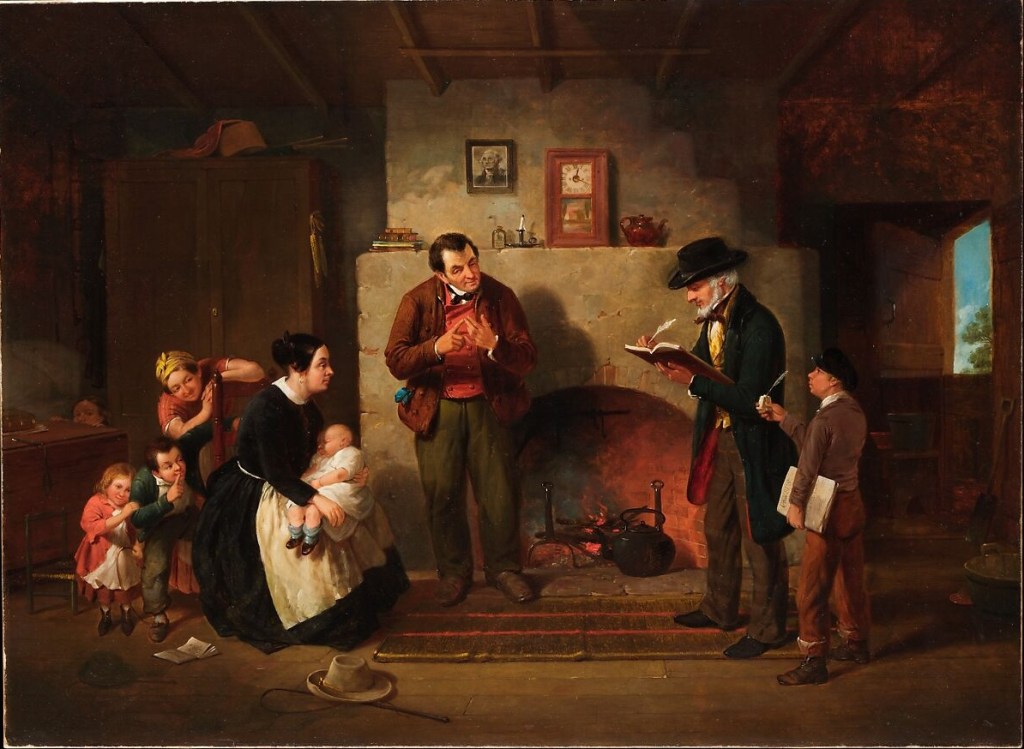
In this genre painting, Edmonds is depicting a time period much earlier than 1854.
Note the small portrait of George Washington above the fireplace.
(Image courtesy of the Metropolitan Museum of Art, New York).
1790, the first census
The first census of the United States, which started on August 2, 1790 and lasted for several months. In addition to Martinus, there are 4 free women listed in the home: his wife Maria, daughter Marytje, and 2 others.

1800, the second census
The second census began on Monday, August 4, 1800, and was finished within nine months.

Martinus is the last entry on the page. Including him, listed are 11 people total:
- 2 boys under 10 years old
- 1 man from 26 to 45 years old: the father, Martinus – the Head of Household
- 3 girls under 10 years old
- 3 girls 10 to 16 years old: the daughter Marytje, and 2 others
- 1 woman 16 to 26 years old: the mother, Maria
- 1 slave
1810, the third census
The census began on Monday, August 6, 1810, and was finished within nine months.

for Halfmoon, Saratoga County, New York.
Including Martinus, listed are 14 people total:
- 3 boys under 10 years old
- 1 boy 10 to 16 years old
- 2 men from 26 to 45 years old: the father, Martinus – the Head of Household and one more
- 2 girls under 10 years old
- 4 girls 10 to 16 years old
- 2 woman 26 to 45 years old: the mother, Maria, and daughter Marytje
1820, the fourth census
The census began on Monday, August 7, 1820, and was finished within six months. It appears that this was the first census that inquired about categories of status: Foreigners, Agriculture, Commerce, and Manufacturing. For his family, Martinus indicated that 2 people were employed with Agriculture.

Please note: There are 9 people listed according to the record, but it seems like there should be 10:
- 2 boys 10 to 16 years old
- 1 boy 16 to 18 years old
- 3 boys 16 to 26 years old
- 1 man 45 & up: the father, Martin – the Head of Household
- 2 girls 16 to 26 years old
- 1 woman 26 to 45 years old: Marytje is 34 years old at this point. This is either her, or her mother Maria. We wonder if Maria is still alive, or if Marytje has moved out of the home?

of The Hudson River PortFolio, 1821-25 by William Guy Wall.
1830, the fifth census
The census began on Tuesday, June 1, 1830, and was finished within six months. Shown below is a cropped excerpt of the final form to allow for scaled visibility of the information.
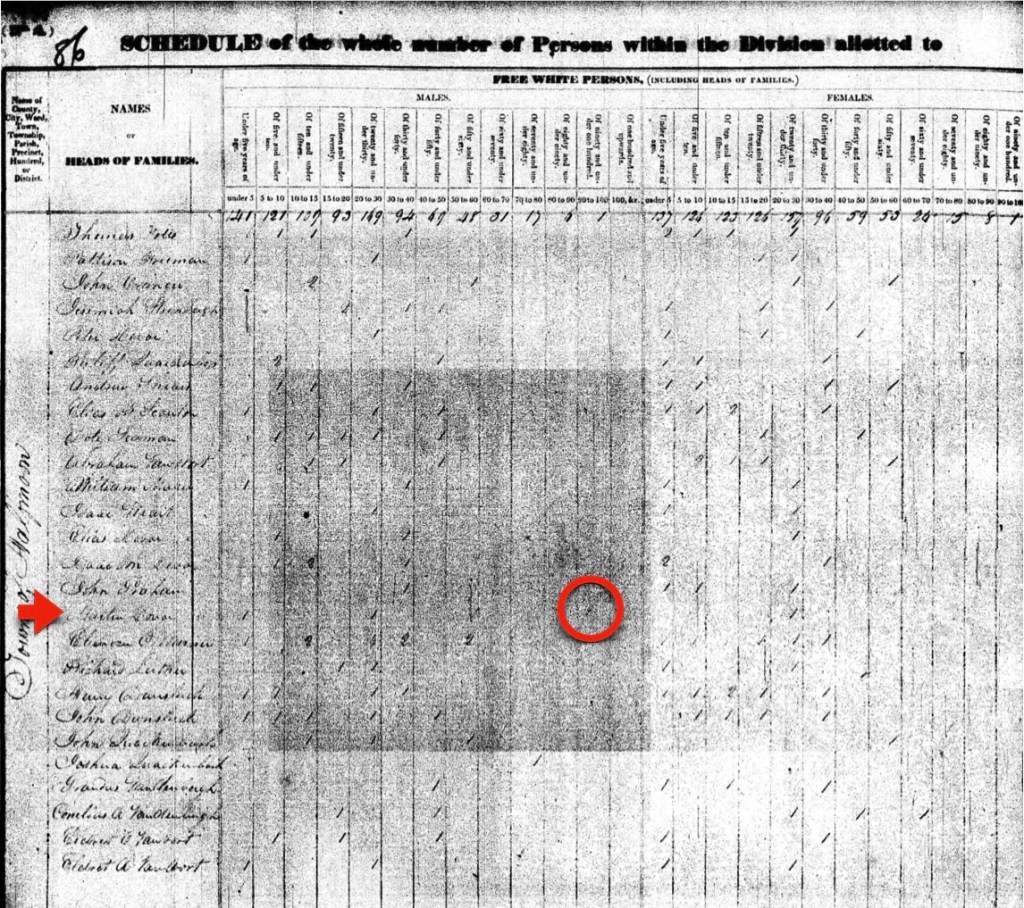
Please note: This is a very difficult scan to read and we noticed that some of the data is not correct. (This is likely due to machine reading). We have noted and made the corrections below. Listed are 5 people total:
- 1 boy under five years of age
- 1 man of 20 and under 30
- 1 man of 50 and under 60
- 1 man of 90 and under 100
- 1 woman of 20 and under 30
We have not located a death record, nor a tombstone for Martinus DeVoe. Therefore, we are not absolutely sure that he is still alive after approximately June 1831-32, because on December 22, 1830, he would have been 76 years old. By 1830, he was not likely listed as the Head of Household, so who was the Martin Devin listed above is most likely a relative (perhaps a son?) Also note that a male “of 90 and under 100” is listed, but we do not know who that likely was. The census enumerator could have placed whoever that is, into the wrong age category by accident?
What we do know is this: From the Probate Records / Land Sale documents following the probate of Elias Devoe’s Will, (which we will write about in the next section titled The DeVoe Line, A Narrative — Seven, we speculate that Martinus was dead by 1830-31.

Quoting from the Probate document, the following is entered into the record by George Palmer, the Surrogate of the Court of Saratoga County, on the first Monday [the 2nd] of December 1833: “…to the estate of the said deceased, by mortgage or lease, it is ordered by said Surrogate, and he doth hereby order, pursuant to the Revised Statutes, that the said Executor Sale the following real Estate of the said deceased, to enable him to pay the balance of the debts of the said deceased, vis, that certain piece, track or parcel of land situated in the town of Halfmoon and county of Saratoga and being part of a lot of land known and distinguished in the map of Halfmoon patent by the name of the mill rights which lately belonged to Martin Devoe, deceased, described and bounded as follows…” (7)
The next chapter in our narrative about The Devoe Line, is a “deep-dive” analysis into a document which is the only item we have found which helps us understand the next steps of our family history.It took years of work to complete this task…
Following are the footnotes for the Primary Source Materials,
Notes, and Observations
He Was Both a Miller and a Farmer
(1) — four records
Winter in the Country, The Old Grist Mill
by George H. Durrie (1820-1863)
Published by Currier & Ives
https://www.cartermuseum.org/collection/winter-country-old-grist-mill-1970173
The University of Pennsylvania
Colonial America’s Pre-Industrial Age of Wood and Water
From the Collections at Historic Bethlehem [PA]
https://www.engr.psu.edu/MTAH/articles/colonial_wood_water.htm
Martinus Devoe
in the New York, U.S., Tax Assessment Rolls of Real and Personal Estates, 1799-1804
Saratoga > 1802 > Halfmoon
https://www.ancestry.com/search/collections/6771/records/292915?tid=&pid=&queryId=702fdd50-c895-4c8a-8216-01be75ab657b&_phsrc=dxF3&_phstart=successSource
Digital page: 7/24, Entry 17 from the bottom of the page.
Note: Representative example for the year 1802.
The History of Waterford, New York
by Sydney Ernest Hammersley, 1957
https://archive.org/details/historyofwaterfo00hamm/page/n5/mode/2up
Understanding That Borders and Boundaries Were In Flux
(2) — three records
Saratoga County, New York
https://en.wikipedia.org/wiki/Saratoga_County,_New_York
A Map of the State of New York, 1804
by Simeon DeWitt (1756-1834)
https://artsandculture.google.com/asset/a-map-of-the-state-of-new-york/gQG44G8fdQpGwQ?hl=pt-PT
Note: For the map image.
Halfmoon & Waterford 1856 Old Town Map with Homeowner Names New York
https://www.etsy.com/listing/769981799/halfmoon-waterford-1856-old-town-map
Note: For the map image.
Martinus Takes A Bride
(3) — four records
Martynus Devoe
in the U.S., Dutch Reformed Church Records in Selected States, 1639-1989
New York > Schenectady > Schenectady Marriages, Vol 5, Book 45
https://www.ancestry.com/discoveryui-content/view/14332:6961
Digital page: 54/113 Last entry at the bottom of the page.
and here:
Records for 1786
Holland Society Archives > 10 Research Collections > 4 Collegiate / Dutch Reformed Church Collections > 3 Dutch Church Records, 42037 > Book 45 – Schenectady Marriages Vol 5, 1695-1800
https://hsny.localarchives.net/?a=d&d=A1695-RG10-SG04-S03-Bk-45-Schenectady-Marriages-Vol-5.1.54&e=——-en-20–1–txt-txIN%7ctxTA%7ctxCO%7ctxTY%7ctxTI%7ctxRG%7ctxSG%7ctxSE%7ctxSB%7ctxCT%7ctxIE%7ctxIT%7ctxTE%7ctxLA%7ctxSU%7ctxSP%7ctxDS%7ctxAD%7ctxPR%7ctxTR%7ctxFI-Schenectady———-
Book page:42, Digital page: Image 54 Last entry, bottom of the page.
Maria Steenberg
in the U.S., Dutch Reformed Church Records in Selected States, 1639-1989
New York > Schaghticoke > Schenectady, Berne, and Schaghticoke, Book 5
https://www.ancestry.com/discoveryui-content/view/48838:6961?tid=&pid=&queryId=f83438c3-25b9-4c85-b847-281bdf6a718c&_phsrc=KVr4&_phstart=successSource
Book page: 167, Digital page: 5/209
Fishkill, New York
https://en.wikipedia.org/wiki/Fishkill,_New_York#:~:text=The%20third%20New%20York%20Provincial,Alexander%20Hamilton%20took%20residence%20here.
Concerning The Bunschoten or Benschoten Family in America
(4) — thirty records
Kingston
New York, United States
https://www.britannica.com/place/Kingston-New-York
Note: “A fur-trading post was established on the site about 1615. The first permanent settlement, called Esopus, was made by the Dutch in 1652.”
WikiTree
https://www.wikitree.com/photo/jpg/Claeszen-7
Note: For the Utrecht: Amerſuoert map image.
The Fine Art of Historical and Marine Painting
The stockade at Kingston, New York (formerly Wiltwyck) circa 1695
by L. F. Tantillo
https://lftantillo.com/17th-century/kingston-new-york-1695.html
Van Bunschoten Concerning The Van Bunschoten Or Van Benschoten Family In America
By William Van Benschoten, 1907
https://archive.org/details/VanBunschotenConcerningTheVanBunschotenOrVanBenschotenFamilyInAmericaByWilliamVanBenschotenPub1907/mode/2up Book pages: 10-20, Digital pages: 26-36/937
Note: For Theunis Eliasen Van Bunschoten.
https://www.ancestry.com/family-tree/person/tree/73812899/person/48549432682/facts
Gerritje Gerrits Van Der Burgh
https://www.ancestry.com/family- tree/person/tree/73812899/person/48549432684/facts
Van Bunschoten Concerning The Van Bunschoten Or Van Benschoten Family In America
By William Van Benschoten, 1907
https://archive.org/details/VanBunschotenConcerningTheVanBunschotenOrVanBenschotenFamilyInAmericaByWilliamVanBenschotenPub1907/page/n865/mode/2up
Book pages: 798-804, Digital pages: 866/872
and
Jan Jansen vanAmersfoort Timmerman Van Steenbergen
https://www.ancestry.com/family-tree/person/tree/73812899/person/48549423476/facts
Catryntie Matthysen Van Keuren
https://www.ancestry.com/family-tree/person/tree/73812899/person/48549423477/facts
Note: for Catryntie (Van Keuren) Van Steenbergen
Van Bunschoten Concerning The Van Bunschoten Or Van Benschoten Family In America
By William Van Benschoten, 1907
https://archive.org/details/VanBunschotenConcerningTheVanBunschotenOrVanBenschotenFamilyInAmericaByWilliamVanBenschotenPub1907/page/n865/mode/2up
Book pages: 798-804, Digital pages: 866/872
Note: for Marritje, Daughter of Theunis Eliasen
Marritje Van Benschoten
https://www.ancestry.com/family-tree/person/tree/73812899/person/48549419814/facts
Note: Her her marriage and children.
Matthias Van Steenburgen
https://www.ancestry.com/family-tree/person/tree/73812899/person/48549419665/facts
Library of Congress
The Closet, from the British Cartoon Prints Collection
https://tile.loc.gov/storage-services/service/pnp/ds/11600/11617v.jpg
Note: Upper left corner inset detail of “the murder of Jane McCrea by Natives”
Burning of Kingston
https://en.wikipedia.org/wiki/Burning_of_Kingston
The History Of Kingston, New York
by Marius Schoonmaker
https://archive.org/details/historyofkingsto01scho/page/n5/mode/2up
Book page: 304, Digital page: 304/558
Note: For the illustration of the Van Steenbergh house.
Note: Below are two contemporary accounts of why the Van Steenburgh house was not burnt: a newspaper article, and a Wikipedia entry. We did not use either article, but the reader may find them interesting.
Van Steenburgh House Withstood Kingston Torching
by Anthony P. Musso
https://eu.poughkeepsiejournal.com/story/news/local/2016/06/28/van-steenburgh-local-history-dateline/86484310/
and
Tobias Van Steenburgh House
“The house was built by Jan Jansen Van Steenbergen presumably in the 1660’s. His descendant Tobias Van Steenburgh, son of Matthias Van Steenbergen, was the owner of record at the time of the American Revolution. It was the only house in Kingston, New York not burned to the ground by the British and is still standing today.” https://en.wikipedia.org/wiki/Tobias_Van_Steenburgh_House
Johannes Van Steenburgh
https://www.ancestry.com/family-tree/person/tree/31076362/person/13749401704/facts
and
Baptismal Records of Old Dutch Church in Kingston New York
Kingston Baptismal Register
https://www.ancestry.com/imageviewer/collections/20911/images/dvm_LocHist006999-00037-0?ssrc=pt&treeid=168567716&personid=102191024415&usePUB=true&pId=66
Book page: 58, Digital page: 67/806
Note: Entry 4 under subhead 1700, labeled #1148.
Grietjen Wiesbom
https://www.ancestry.com/family-tree/person/tree/31076362/person/13749401708/facts
and
Van Bunschoten Concerning The Van Bunschoten Or Van Benschoten Family In America
by William Van Benschoten, 1907
https://archive.org/details/VanBunschotenConcerningTheVanBunschotenOrVanBenschotenFamilyInAmericaByWilliamVanBenschotenPub1907/page/n867/mode/1up
Book pages: 799-800, Digital pages: 868-869/937
Note: For marriage and family of Grietjen (Weisbom) Van Steenbergen.
Fishkill NY Dutch Reformed Church
https://www.ancestry.com/mediaui-viewer/tree/87441358/person/320142427851/media/ecda803e-41ca-42b7-afa8-374708585ea5
Note: For the church image.
Jacobus Van Steenburgh
https://www.ancestry.com/family-tree/person/tree/87441358/person/320142427850/facts
and
New York Colonial Muster Rolls, 1664-1775, Vol. II
Index to New York Colonial Muster Volumes I & II
https://www.ancestry.com/imageviewer/collections/48600/images/NYMusterRollsII-004402-1108?pId=416649
Book page: 1108, Digital page: 676/698, Left column, center position.
Maria Schouten
https://www.ancestry.com/family-tree/person/tree/87441358/person/320142427851/facts
Note: For the mother of Maria Van Steenbergh.
and
Symen Schouten
https://www.ancestry.com/family-tree/person/tree/87441358/person/320142428456/facts
Note: For the maternal grandfather of Maria Van Steenbergh
and
Annatje Duytscher
https://www.ancestry.com/family-tree/person/tree/87441358/person/320142428458/facts
Note: For the maternal grandmother of Maria Van Steenbergh
Library of Congress
View from Fishkill Looking to West Point
by W.G. Wall; engraved by I. Hill
https://www.loc.gov/resource/pga.03829/
Note: For the landscape image.
Steenbergen [surname]
https://en.wikipedia.org/wiki/Steenbergen_(surname)
We did not use the reference below, but the reader may find interesting regarding the Van Steenbergh family surname change:
The History Of Kingston, New York
by Marius Schoonmaker
https://archive.org/details/historyofkingsto01scho/page/n5/mode/2up
Book page: 493, Digital page: 492/558
Note: for the Van Steenbergh name history
Martinus and Maria Started a Family…
(5) — three records
Martynus Devoe
in the U.S., Dutch Reformed Church Records in Selected States, 1639-1989
New York > Schaghticoke > Schenectady, Berne, and Schaghticoke, Book 5
https://www.ancestry.com/discoveryui-content/view/150048134:6961
Book page: 393, Digital page: 118/209 4th entry from the page bottom
Note: The record for their daughter Marytje, born on April 17, 1786.
and here:
Records for 1786
Holland Society Archives > 10 Research Collections > 4 Collegiate / Dutch Reformed Church Collections > 3 Dutch Church Records, 42037 > Book 05 – Schenectady Berne Schaghticoke
https://hsny.localarchives.net/?a=d&d=A-RG10-SG04-S03-Bk-05-Schenectady-Berne-Schaghticoke.1.153&e=——-en-20–1–txt-txIN%7ctxTA%7ctxCO%7ctxTY%7ctxTI%7ctxRG%7ctxSG%7ctxSE%7ctxSB%7ctxCT%7ctxIE%7ctxIT%7ctxTE%7ctxLA%7ctxSU%7ctxSP%7ctxDS%7ctxAD%7ctxPR%7ctxTR%7ctxFI-Schenectady———-
Book page: 393, Digital page: Image 153, Entry 4 from the page bottom.
Observation: This is the same record book in which her mother Maria Steengergh’s birth is noted.
View near Fishkill, New York: Preparatory Study for Plate 17
of The Hudson River PortFolio, 1820
By William Guy Wall
https://www.meisterdrucke.ie/fine-art-prints/William-Guy-Wall/307264/View-near-Fishkill,-New-York:-Preparatory-Study-for-Plate-17-of-The-Hudson-River-PortFolio,-1820-(Watercolor,-graphite,-selective-glazing,-and-scratching-out-with-touches-of-gouache-on-paper,-laid-o.html
Note: For the landscape image.
The Waterford Dutch Reformed Church
(6) — three records
Holland Society Archives > 10 Research Collections > 4 Collegiate / Dutch Reformed Church Collections > 3 Dutch Church Records, 42037 > Inventory and Digest of Early Church Records in the Library of the Holland Society of New York
https://hsny.localarchives.net/?a=d&d=A-RG10-SG04-S03-Inventory-Digest-Early-Church-Recs.1.4&e=——-en-20–1–txt-txIN%7ctxTA%7ctxCO%7ctxTY%7ctxTI%7ctxRG%7ctxSG%7ctxSE%7ctxSB%7ctxCT%7ctxIE%7ctxIT%7ctxTE%7ctxLA%7ctxSU%7ctxSP%7ctxDS%7ctxAD%7ctxPR%7ctxTR%7ctxFI-Schenectady———-
Book pages: 4-5, Digital pages: Image 4 and 5.
History of Saratoga County, New York, with Biographical Sketches
of Some of its Prominent Men and Pioneers
by Nathaniel Bartlett Sylvester, 1825-1894
https://archive.org/details/cu31924028833064/mode/2up
Book page: 329, Digital page: 472/780
The History of Waterford, New York
by Sydney Ernest Hammersley, 1957
https://archive.org/details/historyofwaterfo00hamm/page/n5/mode/2up
Book pages: 203-205, Digital pages: 203-205/408
Note: For “The Reformed Dutch Church of Waterford” text and photo.
Starting With The Very First United States Census…
(7) — thirteen records
The George Washington Presidential Library at Mount Vernon
First United States Census, 1790
https://www.mountvernon.org/library/digitalhistory/digital-encyclopedia/article/first-united-states-census-1790/#:~:text=The%201790%20census%20was%20the,of%20national%20prosperity%20and%20progress.
Taking the Census,
by Francis William Edmonds
American, 1854
https://www.metmuseum.org/art/collection/search/10423
Note: For the genre painting.
Martinus Devow
in the 1790 United States Federal Census
New York > Albany > Half Moon
https://www.ancestry.com/discoveryui-content/view/234153:5058?tid=&pid=&queryId=d18e010c-9fa5-4d31-a3fa-c801a1534d75&_phsrc=PcI1&_phstart=successSource
Book page: Noted as 322, Digital page: 2/4
Right column, 21st entry from the bottom of the page.
1800 Census Records
https://www.archives.gov/research/census/1800?_ga=2.142501554.1264195649.1717870981-1900689503.1717870949
Martinus Devoo
in the 1800 United States Federal Census
https://www.ancestry.com/discoveryui-content/view/284855:7590?tid=&pid=&queryId=20648f7c-7d32-4950-ade5-d497104be4a1&_phsrc=PcI5&_phstart=successSource
New York > Saratoga > Halfmoon
1810 Census Records
https://www.archives.gov/research/census/1810#:~:text=The%201810%20population%20census%20was,snapshot%20of%20the%20nation’s%20population.
1810 United States Federal Census
New York > Saratoga > Halfmoon
https://www.ancestry.com/discoveryui-content/view/323949:7613?tid=&pid=&queryId=0ab43030-032d-4e57-b2d4-15bbe6b8aa95&_phsrc=kyI1&_phstart=successSource
Digital Page: 16/17
Notes: For some reason, we were not able to “search for “pull up” this file directly using Martinus’s name, and had to search for it using the name of a neighbor.
1820 Census Records
https://www.archives.gov/research/census/1820?_ga=2.213796116.1264195649.1717870981-1900689503.1717870949
Martin Devoe
Census – United States Census, 1820
https://www.familysearch.org/ark:/61903/1:1:XHG8-V61
Digital page: 380/499
Notes: Martin is listed about halfway down the page. There are 9 people listed according to the record, but it seems like there should be 10.
Newburg, no.14
from the Hudson River Portfolio, engraved by J. Hill, 1821-25
by William Guy Wall
https://www.meisterdrucke.ie/fine-art-prints/William-Guy-Wall/369817/Newburg,-no.14-from-the-Hudson-River-Portfolio,-engraved-by-J.-Hill,-1821-25-.html
Note: For the landscape image.
1830 Census Records
https://www.archives.gov/research/census/1830?_ga=2.240011907.1264195649.1717870981-1900689503.1717870949
Martin Devin
in the 1830 United States Federal Census
https://www.ancestry.com/discoveryui-content/view/82451:8058?tid=&pid=&queryId=7646fa1d-f83d-4e7d-a36e-f117b6198cfb&_phsrc=gaz5&_phstart=successSource
Book page: 86, Digital page: 25/28
Notes: The fifth census began on June 1, 1830. This is a very difficult scan to read and we noticed that some of the data is not correct. (This is likely due to machine reading). We have noted this and made the corrections.
New York, U.S., Wills and Probate Records, 1659-1999 for Elias Devoe
Saratoga > Minutes, 1832-1842
https://www.ancestry.com/discoveryui-content/view/8359187:8800
Book pages: 55-56 , Digital pages: 35-36/538
Note: December 2, 1833 — This document describes additional land sales to satisfy the debts of Elias Devoe’s estate. Most importantly it states, “the mill rights which lately belonged to Martin Devoe, deceased…”

 Our Ancestors, Our Narratives
