This is Chapter One of four. The Guardian newspaper in England published an article a few years ago about why children need to know their family histories. “We all feel stronger if we are part of a tapestry,” says Stefan Walters, a family therapist. “One thread alone is weak, but, woven into something larger, surrounded by other threads, it is more difficult to unravel.”
Indeed it is.
This chapter begins the tapestry about the White family line. It will connect up to The Hoggarth Line — A Narrative.
A Whale Of A Tale
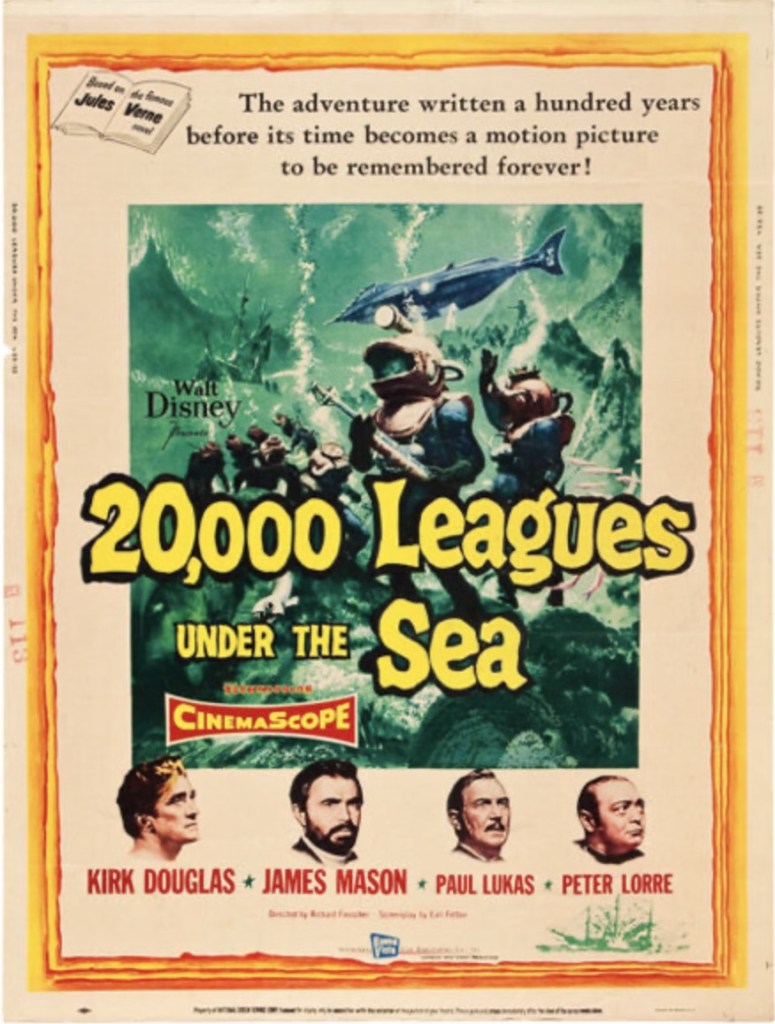
In 1954, the Disney company released the movie 20,000 Leagues Under The Sea, and although it wasn’t technically a musical, it did have one featured song — the aptly titled A Whale Of A Tale, which was sung by the actor Kirk Douglas. He sang, “Got a whale of a tale to tell ya, lads, A whale of a tale or two… A whale of a tale and it’s all true, I swear by my tattoo…” This phrase then entered the public consciousness and was used to describe that which was used to refer to something on a grand scale. (See footnotes).
In genealogy research, when we come across some stories, some of them seem like “tall tales”, similar to American folklore such as The Tale of Paul Bunyan, (a real tall tale — pun intended). We do our best to verify what facts we can distill from the story and sometimes this leads us to interesting developments. And then, sometimes not.

So it is when we encountered the 1932 book, Family History of James White and Fannie Pittinger. This book was written nearly one hundred years ago, by two descendants of James White, an early pioneer in Ohio. In general, these types of vanity books were popular in the late 1800s and the early part of the 20th century. They abound in apocryphal* stories that are mostly family legends.
*an unknown or dubious source or origin or may imply that the thing itself is dubious or inaccurate… (See footnotes).
In that era, it is apparent that the authors didn’t have the ability to source and verify information like we can today. In fact, the authors sheepishly admit [in a smaller type font on page 8], “We are unable to learn anything regarding the the parentage, or of the brothers or sisters of our forefather…” They also confuse our Ohio pioneer James White, with relatives who have the same name… Our exacting research has not revealed anything authentic and reliable before the year 1791. (1)
When he got done telling it there was one of them uncomfortable silences that comes, you know, when a person
Mark Twain,
has been telling a whopper and you feel sorry for him and wish
you could think of some way to change the subject
and let him down easy…
Chapter VII of Tom Sawyer Abroad
The Family History of James White and Fannie Pittinger Book
To be clear, we did find some great information in this book, which we will reference later in later sections, as Pittinger. We are providing the following text as a family tall tale, and nothing more:
“In the northern part of Ireland, about the year 1760, James White, the history of whose family is here recorded, first saw the light of day. He was born of Scotch-Irish parentage of Presbyterian faith, and was educated for the Presbyterian ministry, but apparently did not follow his profession to any considerable extent.
While a young man, eighteen years of age, he left his home in Ireland to sail for America to make his future home.
In those days no water for drinking purposes was obtainable on the boats on Sunday. Passengers were compelled to purchase wines and liquors to quench their thirst. Among the passengers on this boat was the father of two little girls whose tearful appeals for water to drink caused him to make repeated attempts to obtain water. At last, in desperation he appealed to the Captain of the boat who staunchly refused to furnish them even one drink. When all attempts had failed and the father was facing the Captain at the door leading to the water supply, he told the captain that he had made his last appeal and now he would have either water or blood. Even this threat failed, and he stabbed the captain to death.
They did not bury the captain at sea at once, but were compelled to soon after, because sharks were following the boat and endangering the lives of all on board.
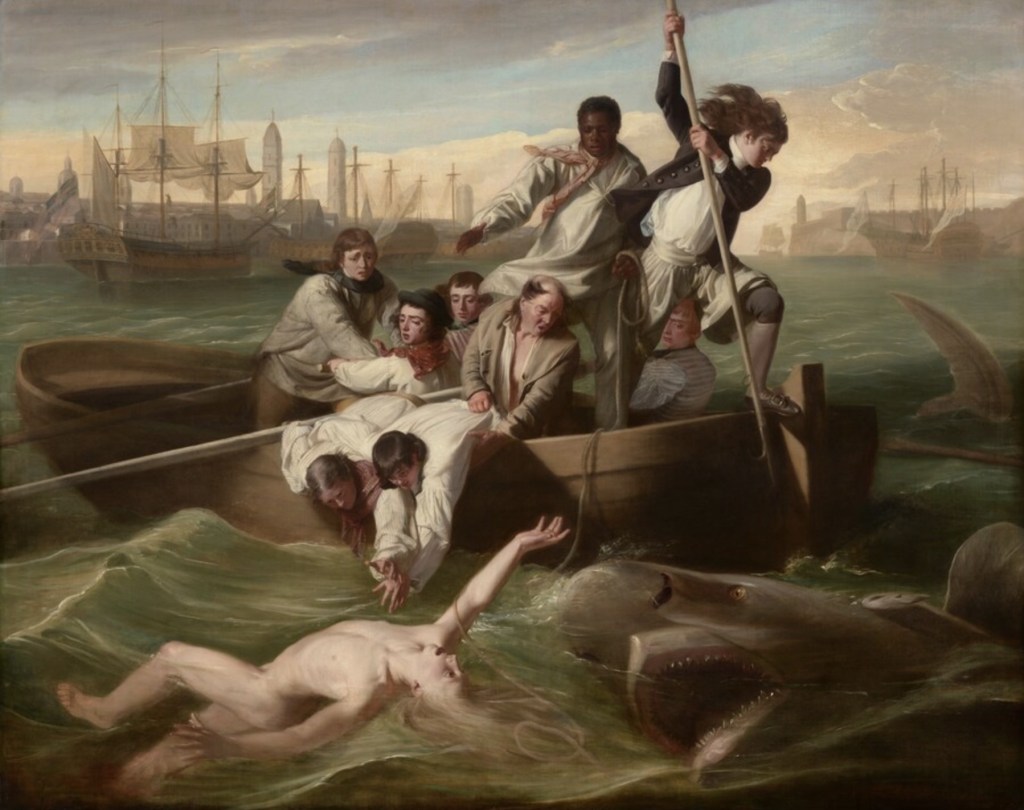
(Image courtesy of the National Gallery of Art).
After the captain’s death the first mate took command of the boat, and they became lost at sea. After fourteen weeks of aimless wandering the food and water supply was nearly exhausted. Those on board were preparing to draw lots to see who should be slaughtered for food to prolong the lives of the others, when the lookout sighted another vessel where they obtained food and water. The boat finally landed at Jamestown, Va. Later James White met and married Fannie Pittinger, a native of New Jersey.”
Comment: As we stated earlier, the information excerpted above cannot be verified. We have seen online comments from other genealogical researchers who have come to the same conclusions that we have… this tale may not be true. However, what follows below is true, because we have the records and they have been well verified. (See the footnotes on the findagrave.com biographies of James White).
What we do know is… Our Real History Which Can Be Documented Is What Follows — we first encounter James White (born 1791) from our family’s genealogical history already living in the Connecticut Western Reserve, a unique section of northeast Ohio.

We find the White family living in Trumbull County, Ohio very early on. At that time, this area was still considered to be a frontier, as Americans were starting to push westward from the New England states. In 1810, James White first appears in a Youngstown, Trumbull county census / tax record. (2)
The Connecticut Western Reserve
From Wikipedia: “The Connecticut Western Reserve was a portion of land claimed by the Colony of Connecticut and later by the state of Connecticut in what is now mostly the northeastern region of Ohio. The Reserve had been granted to the Colony under the terms of its charter by King Charles II.


Connecticut relinquished its claim to some of its western lands to the United States in 1786 following the American Revolutionary War and preceding the 1787 establishment of the Northwest Territory. Despite ceding sovereignty to the United States, Connecticut retained ownership of the eastern portion of its cession, south of Lake Erie. It sold much of this ‘Western Reserve’ to a group of speculators who operated as the Connecticut Land Company; they sold it in portions for development by new settlers… The territory was originally named ‘New Connecticut’ (later discarded in favor of ‘Western Reserve’), and settlers began to trickle in during the next few years. Youngstown was founded in 1796, Warren in 1798, Hudson and Ravenna in 1799, Ashtabula in 1803, and Stow in 1804.”
“Trumbull County was formed in 1800. On July 10 of that year Governor St. Clair proclaimed that ‘all that territory included in Jefferson County, lying north of the forty-first degree of north latitude and all that part of Wayne County included in the Connecticut Western Reserve’ should constitute a new county to be known by the name of Trumbull and that the seat of justice should be Warren. This made the new county co-extensive with the Western Reserve.” In other words, “Trumbull County comprised the entire Western Reserve until the formation of the state of Ohio in 1803.”
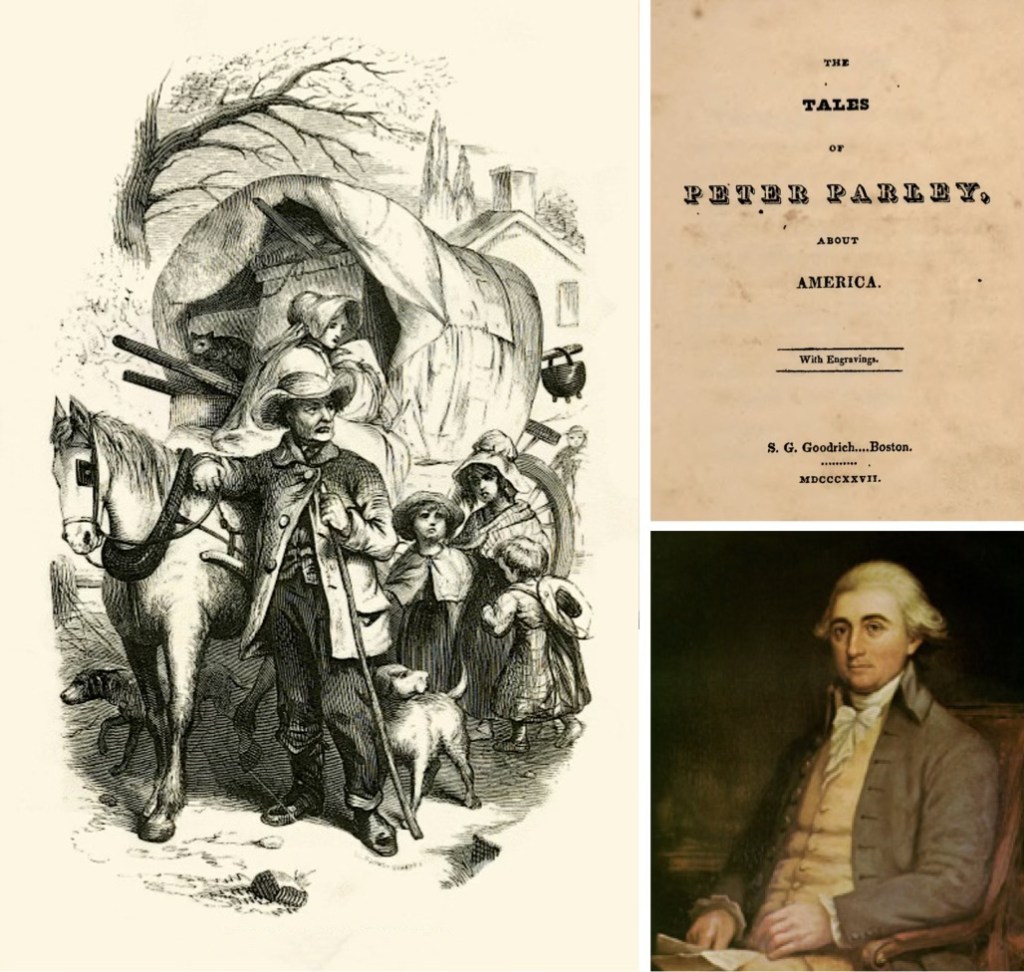
“The county was named for Governor Johnathan Trumbull, Jr., then governor of Connecticut. His family was a prominent one. His father, Johnathan Trumbull, Sr., also governor of Connecticut, was the only royal governor at the outbreak of the Revolution who supported the colonists and continued in office.” (Trumbull County OHGenWeb) (3)
The War of 1812
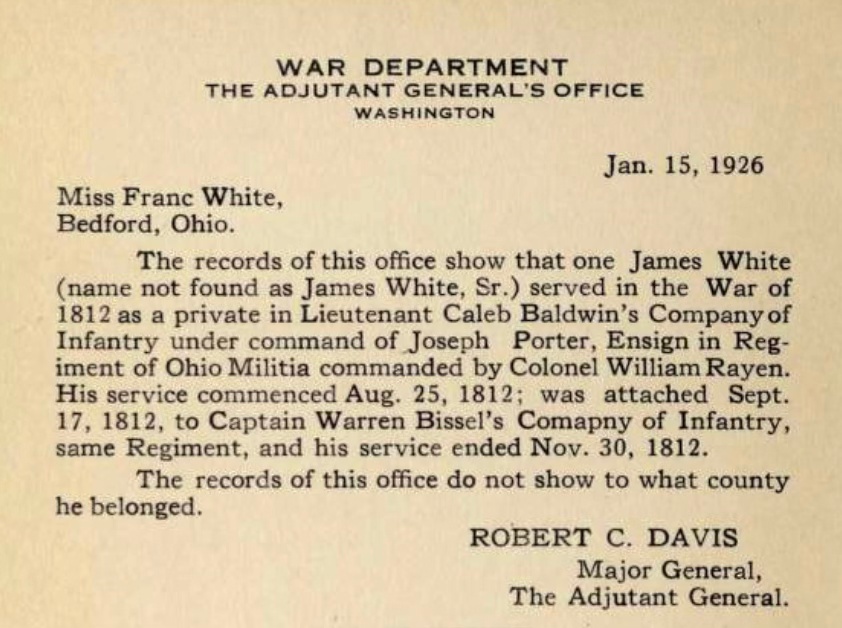
From Pittinger, we read about James White: “He served as a private in Lieutenant Caleb Baldwin’s Company of Infantry under the command of Joseph Porter, Ensign in Regiment of Ohio Militia commanded by William Ryen in the War of 1812. His services beginning August 25, 1812; was attached September 17, 1812 to Captain Warren Bissell’s Company of Infantry, same regiment, and was discharged November 30, 1812.
During the War of 1812, Ohio was on the front lines in the conflict between the United States, Great Britain, Canadians, and the Native American allies of each side. Fighting raged in the northeastern section of the state and on the adjacent Lake Erie.” (Wikipedia)

From Pittinger, we read: “In the War of 1812, the Indians chased his company back to their boats on Lake Erie. As they were running to safety a wounded man begged to be carried on and not have to endure death at the hands of the savages. James White halted while the rest rushed ahead. It was hard traveling through the water and deep grass to the boats, but he picked up the man and hastened on. The load was too heavy for him to go far without resting. He put him down and called to some of his companions to help him, but they were too intent on reaching safety to hear him, so he trudged on and finally reached the boat. His health was never good after this experience.

U.S., War of 1812 Pension Application Files Index, 1812-1815.
In after years he was in Pittsburg with a load of poultry, when he noticed a man examining his load. James White recognized him as the man whom he had rescued. He asked him how he lost his leg. The man replied, ‘By an Indian in the War of 1812’. Then James asked him if he remembered being carried through the swamp to the boat. The man remembered. James White said, ‘I am the man who carried you to the boat’. The man walked away, without considering it worth his while to say, ‘I thank you.’ “ (4)
A Chip or Two, or Three, or Twelve — Off The Old Block
In the aftermath of the War of 1812, James settled down, got married and started a family. He was about 21 years old, and his new wife was about 16.

James White Sr., was born on* June 19, 1791, in Pennsylvania, location unknown — died on March 25, 1862 (likely in) Weathersfield Township, Trumbull County, Ohio. He married Elizabeth ‘Betsey’ Erwin on February 11, 1813 in Trumbull. She was born in 1797, in Virginia, location unknown. She died in 1871, in Austintown, Mahoning County, Ohio. This location is just directly south of Weatherfield where they raised their family.
*His record for the Ohio, U.S., Soldier Grave Registrations, 1804-1958 states that July 19, 1791 — not June 19 — is his actual birthdate.
Together James and Betsey had a very large family of at least 12 children. For the censuses which cover the years 1810 and 1820, their home location is the nearby small city of Youngstown. From 1830 through 1860, their location is Weatherfield township in Trumbull County.
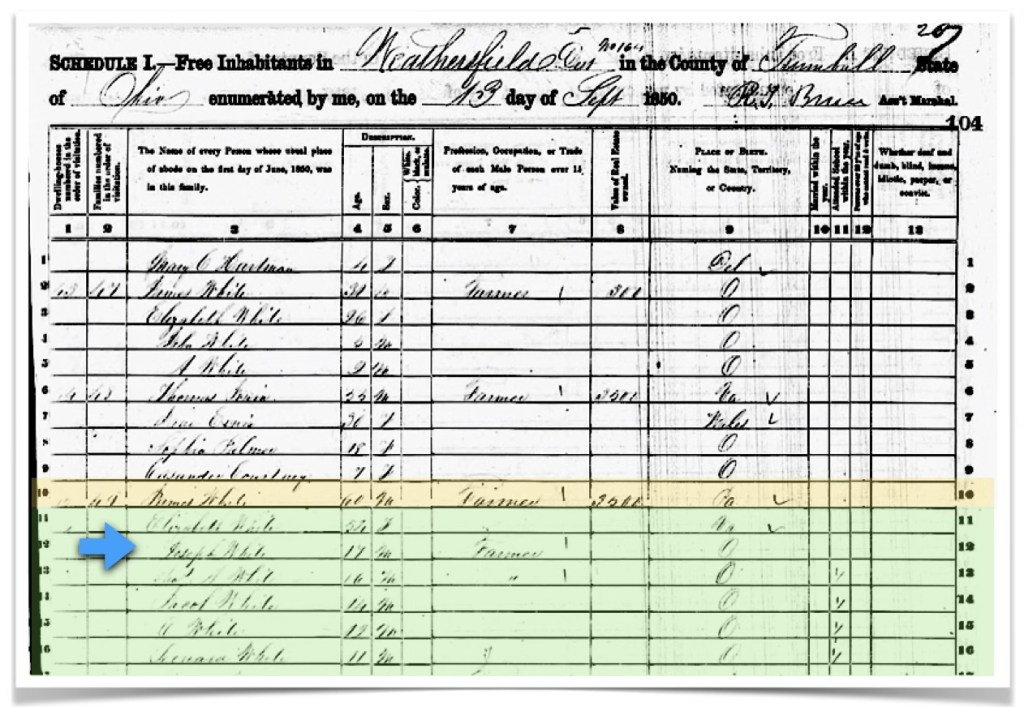
The early censuses for the United States do not provide much information except for the head of the household and tic marks indicating age categories for household inhabitants. By the time of the 1850 Ohio Census, we start to learn some important additional information. For example, on this census we learn that James was born in Pa (Pennsylvania) and Elizabeth, in Va (Virginia). Also, this is the first census where we see other family members named. The blue arrow indicates Joseph White, aged 17, from whom our family members descend. (5)
Their Life in Youngstown and Weathersfield Township
We are not sure what brought James White into northeastern Ohio. As he was born in Pennsylvania, and he worked as a farmer — perhaps it was to acquire farm land? His findagrave.com webpage describes at least eight land deals he was involved in between 1840 and 1861. These records are cited as being housed in the nearby Geauga County Courthouse in Chardon, Geauga County, Ohio.
From Pittinger, we read about their pioneering life in the community. “In the early days, wolves, bears, deer and other game were plentiful in those regions. James White would leave his family and take maple sugar, salt (which had been evaporated from the springs nearby) and other products to market at Pittsburg. This was a journey of several weeks. While he was gone his wife would boil the sap in kettles over an open fire in the log cabin. She would fasten the baby to her back. The wolves, attracted by the fire, would enter the cabin; and when she thought, by the baby’s cry, that they were getting too close she would throw a gourd of boiling sap at them to scare them away.”

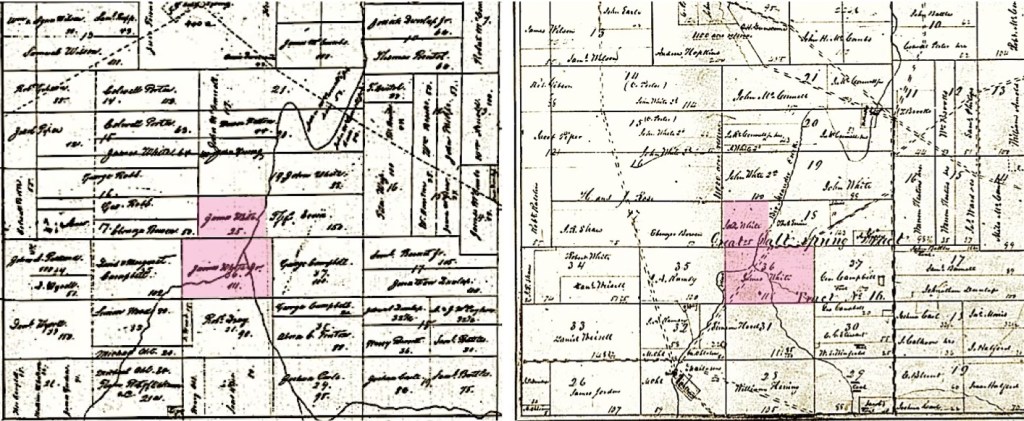
The top image: 1830 map showing James White’s property in the southwestern corner of the township. The bottom two maps show the southwest corner only.
Bottom left image: 1840 map, Bottom right image: 1850 map.
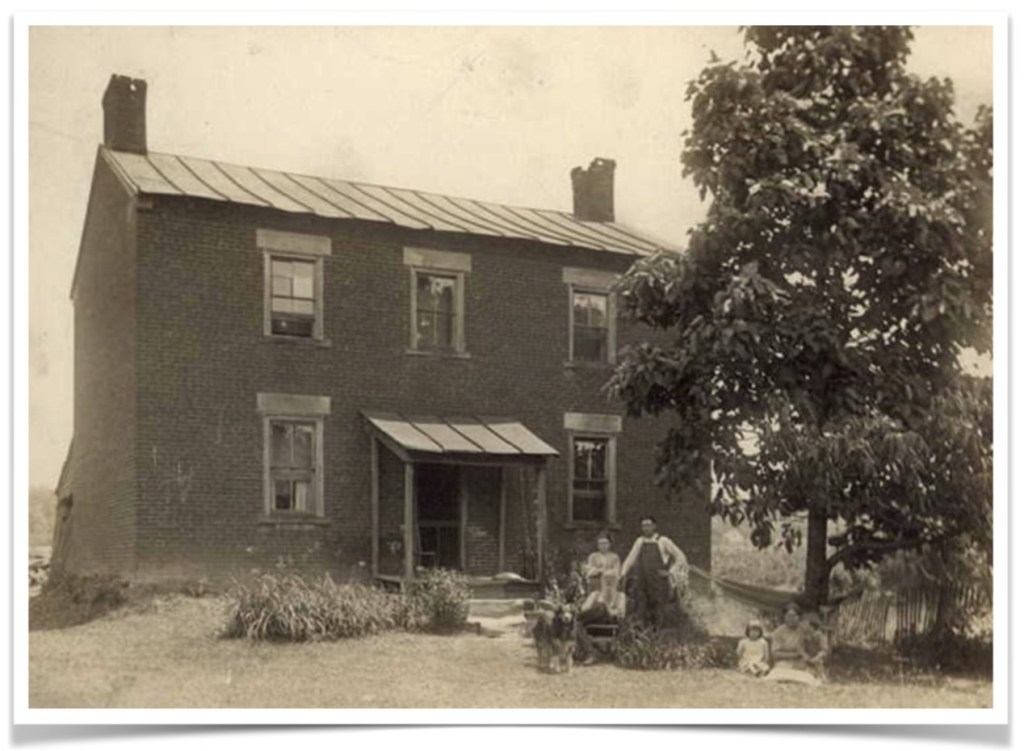
“The homestead in Weathersfield Twp., Trumbull County, Ohio, was on Mineral Ridge along rural mail route No. 1. When James White reached a condition of sufficient affluence he built a brick house, burning the brick himself. It was a log house, later replaced by the home built by James’ son, Jacob, which stood there for many years...” (Pittinger)
When we introduced the Western Reserve, we wrote that “Trumbull County is larger than it is in the present day.” In 1846, a portion of Trumbull County and a portions of Columbiana County were combined “when the counties were redefined and Mahoning County was established as a new county.” (Wikipedia). Thus, Weathersfield township became a southern border township for Trumbull county.
If you look carefully at the Weathersfield township maps above, you can observe that Big Meander Creek passed right through (in fact, it forked within) James White’s property.
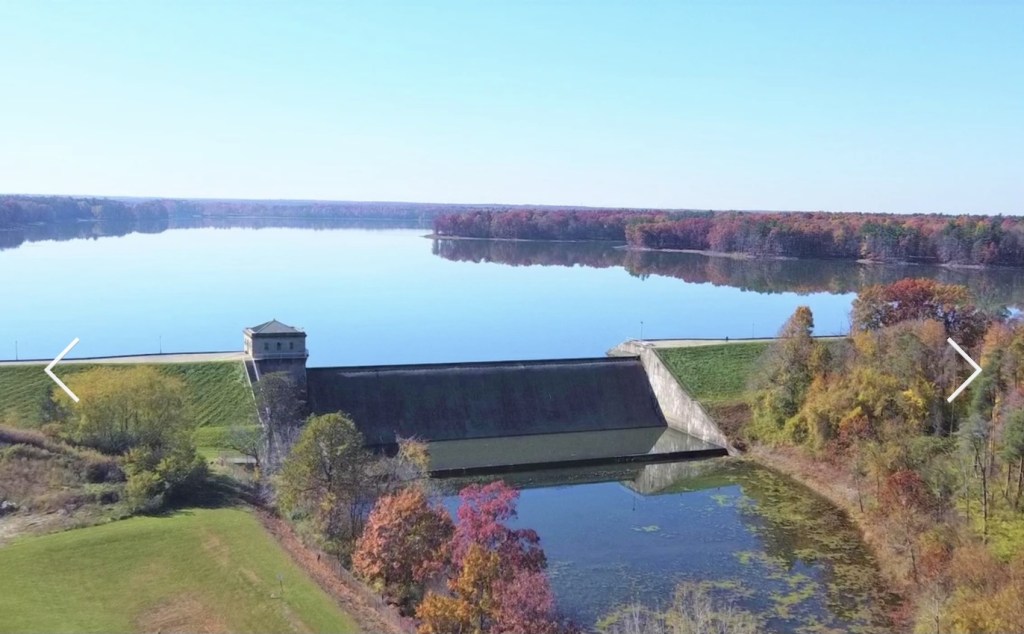
About 70 years later, the city of Youngstown had been experiencing much growth and the decision was made to create the Meander Reservoir, because… “the house was razed, and the farm [was] inundated to furnish water for Youngstown.” The northern portion of the reservoir almost completely covers what was once James White’s family farm. (6)


Having Taken Into Consideration The Uncertainty Of This Life
As he lived many decades of his life in Weathersfield township, James White died in 1862. His wife Betsey lived for about another nine years.

“In 1840 James White bought 49.94 acres of land in Middlefield township, near where the Mormons settled, called Nauvoo, and he sold it to his son William on Sept. 5, 1840 for the consideration of $100.” (Geauga County courthouse records)
This decision by James for his son William to own land in nearby Geauga County brought the White family into the county where we grew up. William’s younger brother Joseph, is the ancestor from whom some of our family members are descended. We will continue with Joseph’s story in the next chapter.
It is deeply ironic that we opened this chapter with a story about the movie 20,000 Leagues Under The Sea, explaining a family legend — and now we end the chapter — with our ancestor’s family farm being at the bottom of a modern reservoir!
Got a whale of a tale to tell ya, lads, A whale of a tale or two… (7)
Following are the footnotes for the Primary Source Materials,
Notes, and Observations
[Preface] — one record
Why children need to know their family history
by Rebecca Hardy
https://www.theguardian.com/lifeandstyle/2017/jan/14/children-family-histories-tales
A Whale Of A Tale
(1) — seven records
Quirky Sayings Have Strange Origins
https://northernwilds.com/quirky-sayings-have-strange-origins/
Note: “Some quirky sayings of the past include “Whale of a Tale” which was used to refer to something on a grand scale, like “Got a whale of a tale to tell you.” The origin is credited to a song featured in the 1954 Disney movie, “20,000 Leagues Under the Sea” sung by the late actor Kirk Douglas.”
A Whale Of A Tale Record Cover and Lyrics
https://genius.com/Kirk-douglas-a-whale-of-a-tale-lyrics
Tall Tale
https://en.wikipedia.org/wiki/Tall_tale
Paul Bunyan
https://en.wikipedia.org/wiki/Paul_Bunyan
LGB — Little Golden Book
The Tale of Paul Bunyan
https://www.penguin.co.nz/books/lgb-the-tale-of-paul-bunyan-9781984851796
Apocryphal [definition]
https://www.merriam-webster.com/dictionary/apocryphal#:~:text=apocryphal%20implies%20an%20unknown%20or,itself%20is%20dubious%20or%20inaccurate.
Whopper
https://en.wiktionary.org/wiki/whopper
The Family History of James White and Fannie Pittinger Book
(2) — two records

Family History of James White and Fannie Pittinger and their descendants
by Andrew J. White and Franc White
https://archive.org/details/familyhistoryofj00unse
Note: Page 7 for family tall tale.
Watson and the Shark, 1778
by John Singleton Copley
https://www.nga.gov/collection/art-object-page.46471.html
The Connecticut Western Reserve
(3) — five records
James White
in the Ohio, U.S., Compiled Census and Census Substitutes Index, 1790-1890
https://www.ancestry.com/search/collections/3567/records/25900104
Note: This established that he has Ohio residency by 1810.
Connecticut Western Reserve
https://en.wikipedia.org/wiki/Connecticut_Western_Reserve
Note: History references and the contemporary map.
Western Reserve Including the Fire Lands 1826
https://commons.wikimedia.org/wiki/File:Western_Reserve_Including_the_Fire_Lands_1826.jpg
Note: On this map, Trumbull County is larger than it is in the present day.
Trumbull County OHGenWeb
History & Genealogy
https://trumbull.ohgenweb.org/history/
Jonathan Trumbull Jr.
https://en.wikipedia.org/wiki/Jonathan_Trumbull_Jr.
Note: For portrait.
The War of 1812
(4) — six records
Family History of James White and Fannie Pittinger and their descendants
by Andrew J. White and Franc White
https://archive.org/details/familyhistoryofj00unse
Note: Page 8 for war record.
Roster of Ohio Soldiers in the War of 1812
Published by The Adjutant General of Ohio, 1916
Volume 1, pages 103-104.
https://ohiogenealogyexpress.com/military/1812_roster_086_095.html
Ohio in the War of 1812
https://en.wikipedia.org/wiki/Ohio_in_the_War_of_1812
Massacre of American prisoners at Frenchtown on the River Raisin.
American recruiting broadside.
by Unknown artist.
https://fortmeigs.org/the-war-of-1812/
Note: For illustration purposes only.
James White
in the U.S., War of 1812 Pension Application Files Index, 1812-1815
Wet – Wie
https://www.ancestry.com/search/collections/1133/records/5311?tid=&pid=&queryId=be064193-f5f7-4da3-a698-7c7595792028&_phsrc=IaT1&_phstart=successSource
Digital page: 512/1083
Note: Captain Bissell’s Company, Ohio Militia
James White
in the Ohio, U.S., Soldier Grave Registrations, 1804-1958
https://www.ancestry.com/search/collections/61438/records/295012
Notes: His birthdate here is July, other records indicate June.
| Birth Date | 19 Jul 1791 |
| Enlistment Date | 26 Aug 1812 |
| Discharge Date | 30 Nov 1812 |
| Death Date | 25 Mar 1862 |
| Burial Date | 27 Mar 1862 |
A Chip or Two, or Three, or Twelve — Off The Old Block
(5) — ten records
PVT James White
https://www.findagrave.com/memorial/28924173/james_white
Notes: Additional material from the findagrave.com website —
BIRTH: 19 Jun 1791
DEATH: 25 Mar 1862 (aged 70), Ohio, USA
Special Comment 1: The biographical excerpts listed on his page includes the following — “James White was a Virginian, and his father came to this country from Ireland… and he married Elizabeth Irwin, also from Virginia and of Dutch descent. . . James White was educated in the common schools of the Old Dominion state…” This biographical sketch was not written directly for the father James White, but for his son Jacob White. It can only be sourced at a website from 1998, at this link: https://heritagepursuit.com/Trumbull/Trumbull1909VIIP400.htm Scroll to the item 410 – HISTORY OF TRUMBULL COUNTY.
Our research has determined that James White is not from Virginia, but from Pennsylvania, as he himself stated on both the 1850 and 1860 censuses of Ohio. On the same censuses, his wife Betsey Erwin, stated that she was from Virginia. We have found no evidence that his forefathers were from Ireland, or that Elizabeth Erwin was of Dutch descent.
Special Comment 2: This book is cited, Family History of James White and Fannie Pittinger and their descendants, by Andrew J. White and Franc White. Although it contains some good information, there is not evidence available that the James White / Fanny Pittinger relationship actually existed. The authors of the book admit this on page 8.
Elizabeth ‘Betsy’ Erwin White
https://www.findagrave.com/memorial/40895763/elizabeth_white
Notes: Additional material from the findagrave.com website —
BIRTH: 1797
DEATH: 1871 (aged 73–74), Austintown, Mahoning County, Ohio, USA
Note: The findagrave.com entry lists 12 children, as follows:
- Frances (White) Shaw, 1813 — 1873
- Mary (White) Hurd, 1815 — 1888
- John White, 1817 — 1895
- PVT William White, 1819 — 1863
- James White, 1821 — 1865
- Andrew White, 1824 — 1906
- Margaret J White, 1826 — 1848
- Elizabeth Ann (White) Ohl, 1828 — 1906
- Joseph White, 1831 — 1905
(Some of our family members are descended from Joseph). - Thomas Atwood White, 1833 — 1898
- Jacob White, 1835 — 1918
- Christopher White, 1837 — 1912
Some sources suggest that there could have been 14 children. For example, Pittinger reports that “Eseneth White, daughter of James White and Elizabeth Irwin [Erwin], was born March 20, 1830, died October 31, 1848”. (page 100)
It is also said that James White and Elizabeth Erwin had 88 grandchildren. (History of Trumbull County)
James White
in the Ohio, U.S., County Marriage Records, 1774-1993
Trumbull > 1803 – 1842
https://www.ancestry.com/search/collections/61378/records/3570974?tid=&pid=&queryId=a89877db-85fa-42c7-af18-4a3c6d09d58b&_phsrc=IaT7&_phstart=successSource
Book page: 65, Digital page: 33/471, Left page, last entry at bottom.
James White
in the Ohio, U.S., Compiled Census and Census Substitutes Index, 1790-1890
https://www.ancestry.com/search/collections/3567/records/25900104
Note: This established that he has Ohio residency by 1810.
James White
in the 1820 United States Federal Census
Ohio > Trumbull > Youngstown
https://www.ancestry.com/search/collections/7734/records/290600
Book page: 690, Digital page: 2/5, Left page, entry line 20.
James White
in the 1830 United States Federal Census
Ohio > Trumbull > Weathersfield
https://www.ancestry.com/search/collections/8058/records/395267
Book page: 215, Digital page: 11/12, Entry line 13.
James White
in the 1840 United States Federal Census
Ohio > Trumbull > Weathersfield
https://www.ancestry.com/search/collections/8057/records/1754053
Book page: 215, Digital page: 7/16, Entry line 25, lower portion.
James White
in the 1850 United States Federal Census
Ohio > Trumbull > Weathersfield
https://www.ancestry.com/search/collections/8054/records/14604786
Digital page: 7/41, Entries 10 through 16.
Note 1: He indicates that he was born in Pennsylvania.
Note 2: This is the first census that Joseph White appears in directly by name, on line 12. He is 17 years old.
Jas White
in the 1860 United States Federal Census
Ohio > Trumbull > Weathersfield
https://www.ancestry.com/search/collections/7667/records/42172597
Book page: 159, Digital page: 47/76, Entries 3 through 7.
Note 1: He indicates that he was born in Pennsylvania.
Note 2: This is the last census he appears in.
Their Life in Youngstown and Weathersfield Township
(6) — twelve records
Family History of James White and Fannie Pittinger and their descendants
by Andrew J. White and Franc White
https://archive.org/details/familyhistoryofj00unse
Note: Pages 60-61 for their family history.
Trumbull County
Records Center & Archives Department
http://www.archives.co.trumbull.oh.us/archives_maps.html
Weathersfield, 1830 http://www.archives.co.trumbull.oh.us/Maps%201830/Weathersfield%20%201830.pdf
Weathersfield, 1840
http://www.archives.co.trumbull.oh.us/Maps%201840/WEATHERSFIELD.1840.pdf
Weathersfield, 1850
http://www.archives.co.trumbull.oh.us/Maps%201850/Weathersfield.pdf
Weathersfield, 1979
http://www.archives.co.trumbull.oh.us/Maps 1979/Weathersfield 1979.pdf
Photo of the White Family old brick house:
https://www.ancestry.com/mediaui-viewer/tree/193290280/person/182514484396/media/b0c5450a-bea5-43cc-bf6e-d1567d34d4c2
Note: Description included with the photograph reads, “This is house built by James White[ b.1791] Old man with beard is Jacob White s/o James. Jacob died 1918. House was demolished to make way for Meander Dam.”
Meander Creek Reservoir, Google Map Search
https://www.google.com/maps/@41.1679968,-80.7684869,10604m/data=!3m1!1e3?entry=ttu&g_ep=EgoyMDI0MTIwNC4wIKXMDSoASAFQAw%3D%3D
Mahoning County, Ohio
https://en.wikipedia.org/wiki/Mahoning_County,_Ohio
Meander Creek Watershed (contemporary map)
https://www.researchgate.net/figure/Meander-Creek-Reservoir-and-catchment-An-x-marks-the-location-of-the-core-samples_fig1_233308135
Meander Water (contemporary photo of reservoir)
https://www.meanderwater.org/
Meander Creek Reservoir
https://en.wikipedia.org/wiki/Meander_Creek_Reservoir
Having Taken Into Consideration The Uncertainty Of This Life
(7) — one record
James White
in the Ohio, U.S., Wills and Probate Records, 1786-1998
Trumbull > Wills, Vol 3, 1858-1868
https://www.ancestry.com/search/collections/8801/records/1849001
Book page: 218-219, Digital page: 223-224/651
Note: This appears to be a hand transcribed copy.

 Our Ancestors, Our Narratives

Hello, my name is Sidney Bond. My ancestors came into America at Beaufort NC in the late1600’s and later generations moved to MS in the early 1800’s. That is where I grew up. I have, through geni, if it can be trusted, traced my line all the way back to Erth Barton. I guess that makes us cousins somewhere back down the line. I found your blog by an internet search of the Bonds at Earth. I am enjoying your work. Where did your line of ancestry first enter America?
If you google, Bond Mississippi, there is a small community named for Col. John Bond Sr.,1749, Beaufort NC, 1837 Wiggins, Stone MS. His Grandfather came from England to Beaufort NC in 1690.
I currently live in southern IN, near Louisville KY.
Thanks for all your hard work,
Sid
LikeLike