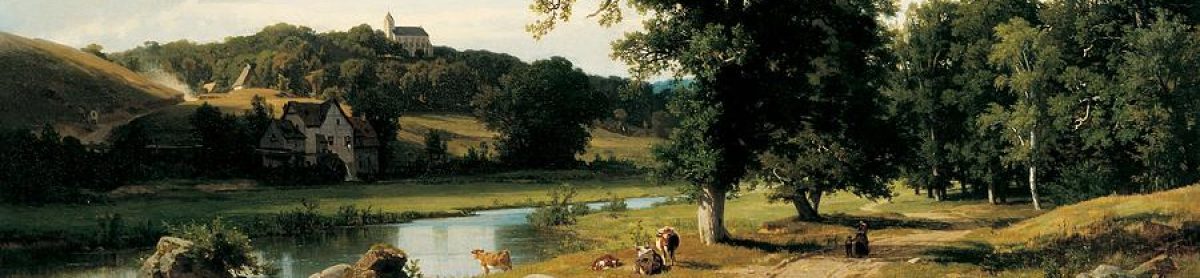
This is Chapter Five of seven, where we continue the historical development of the Soule line, as it enigmatically weaves its way slowly westward across the Province of Masssachsetts Bay.
Preface
Family surnames have evolved over time as generations change. Some of these changes happen through clerical records when family surnames were influenced by both profession, and whoever did the record keeping. Even understanding that, family surnames can also change through marriage. Let’s take a moment to review how our primary family surnames have shifted in just a few generations.
The Last Generation, in Europe — We began in chapter one with many name variations being encountered: Sol/Sols/Solis/Soltz/Soule, which connected through marriage with Lapis/Labis/Labus/Lapres/Laber.
Generation One, in America — In chapters two and three, Soule combined with:
Becket/Buckett, to standardize the Soule surname.
Generation Two, in America — (chapter four) The Haskell/Frowd family married with the Soule family, and the Soule name ended for our family. (The Stone and Hardy families also played important roles.)
Generation Three, in America — (Here: chapter five) The Haskell name ends for our family, and this generation is known by the name of Drinkwater.

by Carolyn Crandall Bremner and family in honor of their grandparents…”
(Image courtesy of the Minneapolis Institute of Art).
Every Stone, Every Leaf, Every Clue
A crazy quilt is made from irregular patches of cloth embroidered and gathered together with little or no regard to pattern, but — each piece of cloth has a story, and when they combine, they create a new unique tale. This is how it was with this generation of Drinkwater ancestors: just a crazy quilt of names, locations, dates, and hints of missing history.
We have created a narrative that tells much of their story, and when we see a point where we are not sure exactly what happened, we qualify that part and tell you what we think happened and why.
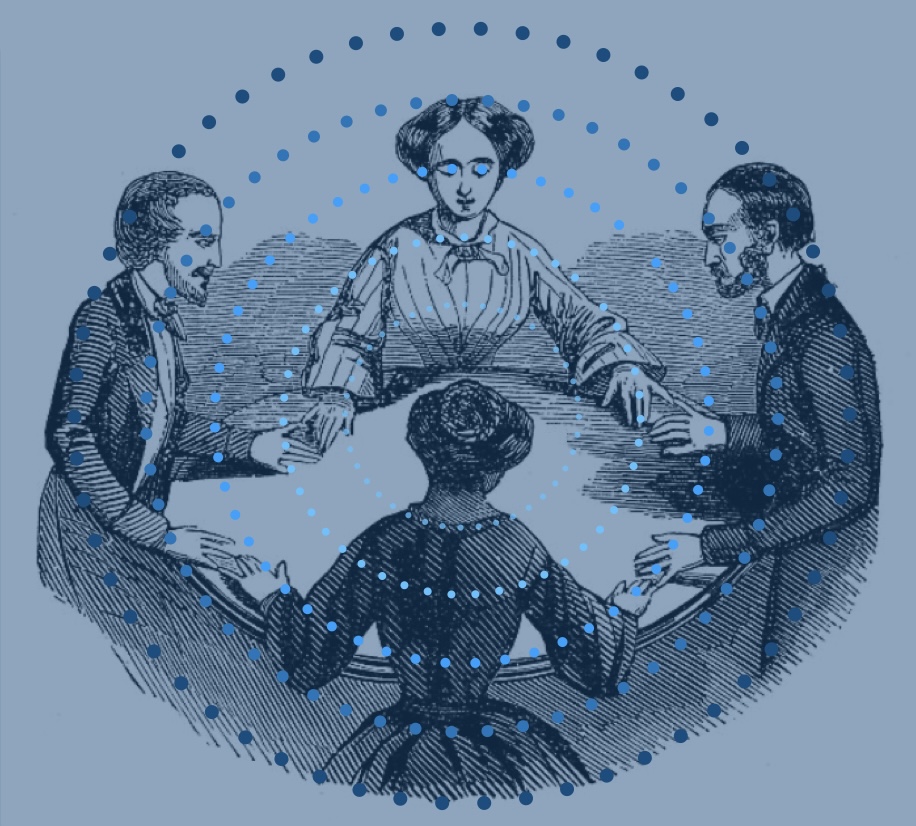
We have diligently turned over every stone, every leaf, every clue, by pouring through many different resources all trying in vain to locate some concrete information about the early life and parentage of our 6x Great Grandfather, Thomas Drinkwater. Short of holding a séance, we don’t think that his life before he and Elizabeth Haskell met will truly be known, unless new information is discovered and released. (We would welcome that event). (1)
The New England Colonies in the 1670s
This chapter begins with the world of Colonial New England being in a state of continual flux. The part of Massachusetts where they lived for much of their lives, is an area we are already familiar with — the Plymouth Colony going back to the 1620 arrival of the Mayflower. A little more than fifty years after George Soule arrived there, the entire region was engulfed in what is considered to be one of the deadliest conflicts in colonial history, King Phillip’s War. Many, many lives were lost and untold records were destroyed.
We don’t know exactly how, or when, Thomas Drinkwater and Elizabeth Haskell met, nor when they married. The lifetimes of Thomas Drinkwater and Elizabeth Haskell (in total), cover the 50 years from circa 1670 through 1715-20. We believe that they were married before 1699. The lives of their children cover almost the full breadth of the 18th century, from 1700 through 1790.
In the section below, Navigating Their Lives, we created a reconciled list of their children’s birthdates, marriage dates with spouses, and death dates. We needed to consult about 50-60 sources to verify details, so not all of them have footnotes. In doing that, we saw a great lack of conformity in record reporting, even with other modern researchers. We have tried to account for this by noting some important dates that affect interpretation of the surviving records. These items are noted just below this map.
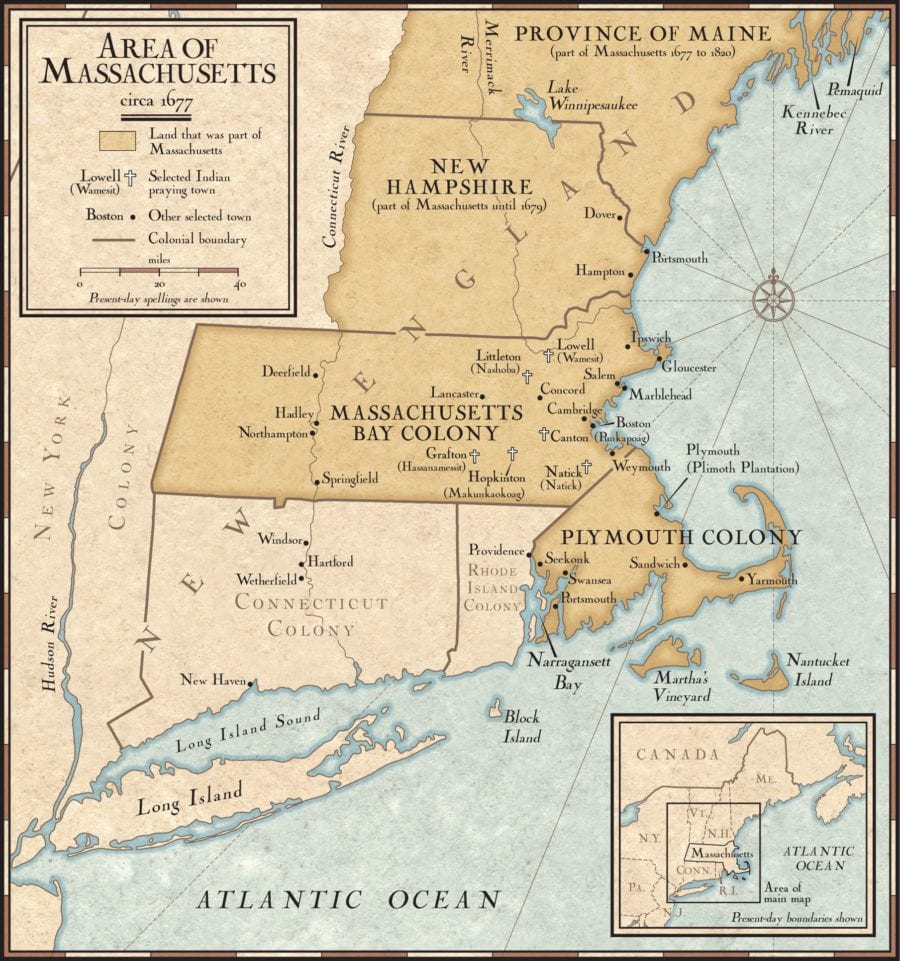
(Map courtesy of the National Geographic Society).
1643 — The official establishment and charter of the Rhode Island and Providence Plantations. Note: We are using Rhode Island Colony for brevity.
1661 — Middleborough / Middleboro / Middlebury is the name of the place formerly called Nemasket. The official town spelling is Middleborough. Middleboro is a shortened form cited in many historical documents for many years, even after 1661. Middlebury is now an archaic form. (Middleborough is just east of Plymouth on the map above. See the John Seeler 1675 map in The Soule Line, A Narrative — Four, for more clarity).
In 1677, Massachusetts was made up of Plymouth Colony and Massachusetts Bay Colony plus the areas of New Hampshire, the Province of Maine, Martha’s Vineyard, and Nantucket. The Connecticut Colony and the Colony of Rhode Island and Providence Plantations, were originally settled by people from Massachusetts. Maine was not officially a state until 1820.
1685 — Plymouth County is established, in anticipation of the merger with the Massachusetts Bay Colony. (Prior to this date, it was simply Plymouth Colony).
and
1685 — Bristol County is also established due to this intended merger.
1691 — PMB explained — is an acronym for the Province of Massachusetts Bay, a royal colony. (The Plymouth Colony merged with the Massachusetts Bay Colony and other territories to form the Province of Massachusetts Bay, which included the counties of Barnstable, Bristol, and Plymouth). Note: We are using PMB (in bold) for this designation for brevity.
1788 — On February 6, 1788, Massachusetts officially becomes a State. (2)
Navigating Their Lives
We have no actual birth and death records for Thomas Drinkwater, so the dates for his lifetime are inferred. We believe he was could have been born circa 1670, possibly in Plymouth, Plymouth Colony, Massachusetts, or possibly in Newport, Rhode Island Colony. (Even though we lack concrete evidence for either location). He died between the dates of September 10, 1711, and certainly before June 21, 1715. (See footnotes).

circa 1780.
(Image courtesy of the Boston Public Library).
We have used colors to indicate on this map the different locations where the family lived and where the children were born.
- Gray —
Plymouth and Duxbury are the origin places for the previous generation, and Plymouth is a possible origin place for the father Thomas Drinkwater. - Yellow —
The mother Elizabeth Haskell, was born in Middleborough, July 2, 1672, as were three of her children (see below). - Red —
The location of Freetown turns up in records as a place they lived, but no children are recorded as having been born there.
The eight children of Elizabeth Haskell and Thomas Drinkwater are:
- Blue —
Warren (aka Walter) Drinkwater, born August 8, 1700 in Newport, Newport*, Rhode Island Colony — died May 5, 1734 in Falmouth, Cumberland**, Maine.
Note: Did he change his name from Warren to Walter? No. (See our extensive footnotes). - Green —William Drinkwater, born about 1701 in Touisset (an area of) Swansea, Bristol, PMB — died 1758 in New Milford, Litchfield, Connecticut Colony. He married first Elizabeth Benedict, December 18, 1728 in New Milford, Connecticut Colony; they had 12 children. (We are descended from William and his wife Elizabeth.) He married second Susanna Washburn, March 14, 1751. They had 4 more children.
- Yellow —
George Drinkwater, born about 1702 in Middleborough, Plymouth, PMB — died November 21, 1737 in Yarmouth, Cumberland**, District of Maine. He married Elizabeth Parker. - Yellow —
John Drinkwater, born March 19, 1703 in Middleborough, PMB — died after 1772 in New Milford, Litchfield, Connecticut Colony, United States. He married Elizabeth Staple, September 23, 1742 in Portsmouth, Newport, Rhode Island Colony. - Yellow —
Elizabeth Drinkwater, born June 18, 1708 in Middleborough, Plymouth, PMB— died after June 18, 1729. She married John Dudly, May 2, 1717 in Dighton, Bristol, PMB. - Orange —
Joseph Drinkwater, born November 10, 1709 in Taunton, Bristol, PMB — died April 18, 1784 in North Yarmouth, Cumberland, District of Maine. He married Jane Latham May 18, 1732 in the same location. - Yellow or Orange —
Samuel Drinkwater, born April 25, 1711 in either Middleborough or Taunton, PMB — died between 1771 to March 6, 1789 in Dighton, Bristol, PMB. He married Dorrity Joselin, April 25, 1734 in same location where he died. - Teal —
Patience Drinkwater, born December 10, 1713 in Swansea, Bristol, PMB — died 1790 in Dartmouth, Bristol, Massachusetts State.
*became Newport County (in 1703), **became Cumberland County (in 1760)
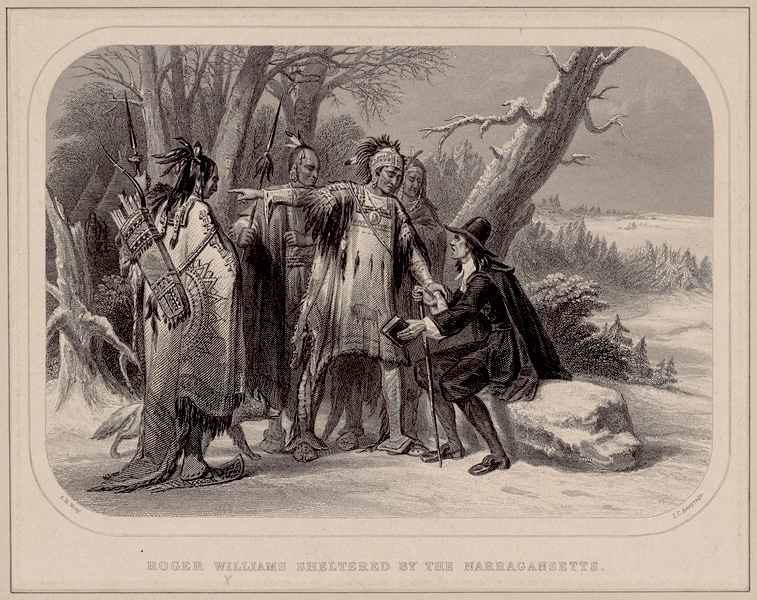
Roger Williams (c. 1603 – March 1683) was an English-born New England Puritan minister, theologian, and author who founded Providence Plantations, which became the Colony of Rhode Island and Providence Plantations and later the State of Rhode Island. He was a staunch advocate for religious freedom, separation of church and state, and fair dealings with the Native Americans. (Wikipedia).
Our Analysis: All of the births and deaths of these Great Aunts and Uncles seem pretty straightforward, except for these facts: What this map shows is that their first child (Warren), was born in Newport, Rhode Island Colony, followed by the birth of (William) in Swansea, PMB. Both locations are far away from the towns of Plymouth, Duxbury, and Middleborough, Massachusetts.
The next three children who followed, were born in Middleborough, which is near Elizabeth’s parents who were still living (for a few more years). Other family members were presumably in the area — their availability would have been helpful to this young and growing family.
Next, for child number six (Joseph), we move away again from Middleborough, to Tauton/Dighton.
For child seven (Samuel), born in Middleborough or Taunton, (but likely in Taunton).
Lastly, there is child eight (Patience), born as her older brother William was, in Swansea, PMB. For much of this period, there seems to be much relocation up and down the Taunton Great River.
What does all this mean in the absence of records? We can infer that there were a few years where they seem stable and living in Middleborough. Why were they there? Her parents John and Patience Haskell were near the ends of their lives and it’s plausible that Elizabeth wanted to be near them. Most of the other locations look like they could possibly be maritime related, or at least related to owning property near water that could then transport crops to market. (3)
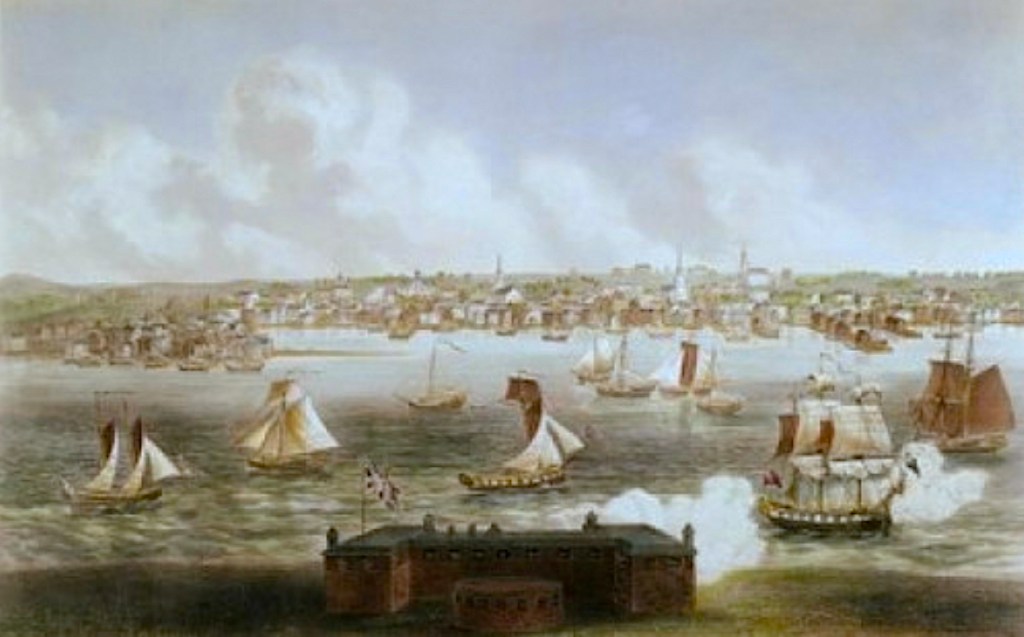
(Image courtesy of Posterazzi).
The Newport Mystery
Warren being born in Newport, Rhode Island Colony seemed especially odd because it just didn’t fit into any patterns we had seen before. The question became, why Newport? There are no records of the Drinkwater family name in the Plymouth area, until we encounter Thomas. Even though these locations don’t look that far apart on a map, in the 1670s, people just didn’t just pick up and move across land that was still considered to be a dangerous wilderness. When necessary, they probably traveled by water.
Had Thomas Drinkwater been a mariner? A captain of trading ships? More importantly, was there a family connection to that area? This is what we found:

A Thomas Drinkwatter (Note the two t’s in the surname spelling) was in Providence, Rhode Island Colony court in November 1668, for a case about illegally burning a fence. He was found not guilty. This event took place in November 1668 which was about two years before Thomas Drinkwater of Plymouth was born. That far back in time (over 350 years ago), there were very few Drinkwaters yet in New England.
We find it quite plausible that this person could be a relative — possibly a father, or an uncle? The fact that the case was in a Providence court was probably due to the fact that Providence was a more secure location inside of Narragansett Bay. That same Bay would have been the local superhighway for travel.
Summary: Our 6x Great Grandfather Thomas Drinkwater may have been from England, but it is more likely that his father, also named Thomas, was an immigrant from England. Our great grandfather was either born at the Rhode Island Providence Plantations, or he immigrated, as a very young child, with his family to America. He married our 6X Great Grandmother Elizabeth Haskell, probably in Middleborough, Massachusetts. They then set out for a life that took them from Newport, Rhode Island, to Plymouth County, Massachusetts, up and down the Great Taunton River. This crazy quilt of a life eventually fostered our 5x Great Grandfather William Drinkwater. (4)
To Finally Slip Away
We learned that Thomas Drinkwater died Intestate (without a Will). On the fifth line in the Drinkwater document below it indicates “Lately dyed Intestate.” This document, dated June 25, 1715, appoints his wife, Elizabeth Drinkwater, as the administrator of his inventory, listed as goods, chattels and credits*. The list of inventory is also shown below. The document lists September 20 and December 20, 1715 as dates by which the inventory needs to be completed.
We often see June 25, 1715 as the death date for Thomas Drinkwater. This document tells us that he died sometime before that date.
*Goods and chattels generally refer to property that is not real estate… In common law , the term broadly included any moveable property or property rights that did not involve land and real estate, including rights such as leases.” (Cornell Law School)
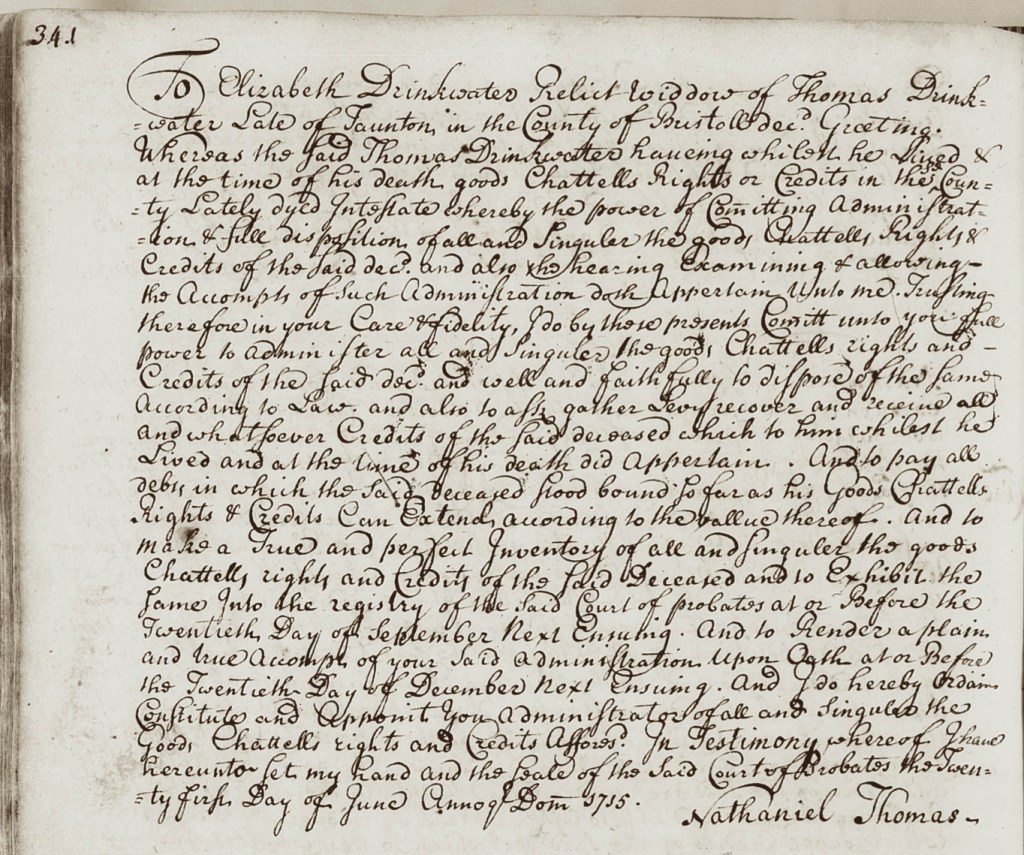
The document date is June 25, 1715.

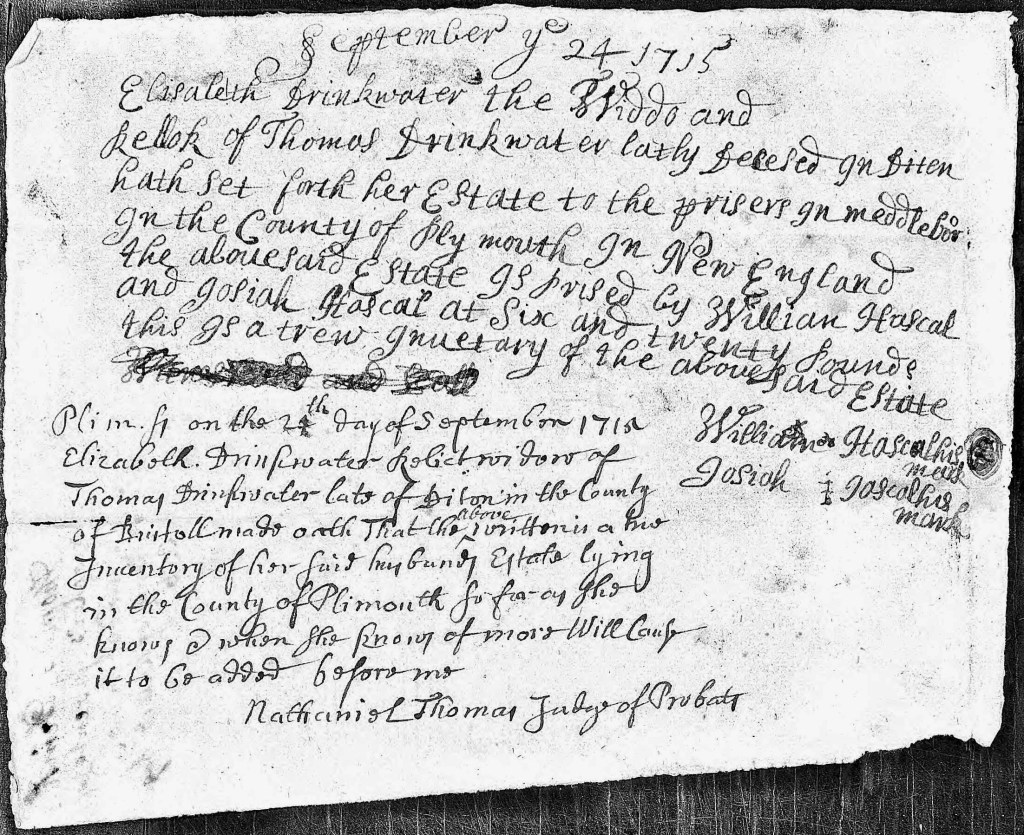
Notice on the above court document the signatures of Thomas Drinkwater’s sons William Hascall and Josiah Hascall. At first it appears as their signatures, but looking closely you can see the mark X indicating they could not write their names.
We have not located (nor has anyone else) an actual death record for Elizabeth (Haskell) Drinkwater, but nonetheless, we do not understand the 1715 date attached to her ‘findagrave.com’ website file. We believe that it is unlikely she actually died in 1715, because she is signing documents involved with the administration of her husband Thomas Drinkwater’s estate during that time. She had probably passed on by the early 1720s because several of her children are recorded as being involved in property transactions during that period.
We started this chapter by describing crazy quilts. Our Grandmother Lulu Gore used to sit in the church basement with her lady friends, everyone engaged in a group sewing activity. Working together, they carefully crafted quilts which were stretched tightly across wooden frames. It was always a shared experience — the quilting, the sewing, and the sharing of stories about the lives of their children. (5)
Following are the footnotes for the Primary Source Materials,
Notes, and Observations
Every Stone, Every Leaf, Every Clue
(1) — one record
Minneapolis Institute of Art
Mia’s newest crazy quilt recalls a grandmother’s love—and talent
by Leslie Ory Lewellen
https://new.artsmia.org/stories/mias-new-crazy-quilt-recalls-a-grandmothers-love-and-talent
Note: For the crazy quilt photo.
The New England Colonies in the 1670s
(2) — four records
The National Geographic Society
New England Colonies in 1677
https://education.nationalgeographic.org/resource/massachusetts-1677/
Note: For the map image.
Colony of Rhode Island and Providence Plantations
https://en.wikipedia.org/wiki/Colony_of_Rhode_Island_and_Providence_Plantations
Note: For location confirmation and dates.
Plymouth County, Massachsetts
About
https://www.plymouthcountyma.gov/about
Note: For the 1685 text.
National Park Service
Explorers and Settlers
Historical Background
https://www.nps.gov/parkhistory/online_books/explorers/intro25.htm#:~:text=In%201691%2C%20Massachusetts%20was%20granted,as%20formerly%2C%20but%20also%20Plymouth.
Note: For this text: “In 1691, Massachusetts was granted a new charter, as a royal colony, and to it was attached not only Maine, as formerly, but also Plymouth.”
Navigating Their Lives
(3) — nineteen records

Note: We have not been able to prove this familial connection, but we wanted to address this matter since it is out there causing mischief.
Thomas Drinkwater Death
in the U.S., Find a Grave Index, 1600s-Current
https://www.ancestry.com/search/collections/60525/records/73615725
and
Thomas Drinkwater
https://www.findagrave.com/memorial/124601468/thomas-drinkwater
Notes: For both entries, the June 25, 1715 date given for his death is not correct. He died sometime between the dates December 10, 1713— when his last child was born and before June 25, 1715 when his wife was in court being named his administrator because he died Intestate. It is most likely he died near the June 1715 date because the court would not have waited too long after his death to have his inventory completed and his debts paid.
On September 11, 1715 he quitclaimed a deed to John Hascall (brother-in-law) for land his wife inherited from her father, who had passed away.

Thomas Drinkwater
in the Mayflower Deeds and Probates, 1600-1850
https://www.ancestry.com/search/collections/3223/records/13888
Note: September 10, 1711 Quit claim deed record.
Thomas Drinkwater
in the Massachusetts, U.S., Wills and Probate Records, 1635-1991
https://www.ancestry.com/search/collections/9069/records/6848912
Plymouth > Probate Estate Files, No 6744-6790, Drew, William-Dunbar Jesse, Ca. 1686-1881
Digital pages: 104-108/1009 (5 pages Total)
Notes: Document file number is 6747. Probate date is January 21, 1715. It says that he lived in Midbury [Middleborough], Plymouth County.
Elizabeth Drinkwater
in the U.S., Find a Grave Index, 1600s-Current
https://www.ancestry.com/search/collections/60525/records/73615804
Note: For her death record.
and
Elizabeth Haskell Drinkwater
https://www.findagrave.com/memorial/124601558/elizabeth-drinkwater
Note: For her death record.
Boston Public Library
Norman B. Levanthal Map & Education Center Collection
A New and Accurate Map of the Colony of Massachusets Bay, In North America from a Late Survey
https://collections.leventhalmap.org/search/commonwealth:wd3765665
Note: Published in London in 1780.
Sources to create a compilation of the Thomas Drinkwater / Elizabeth Haskell children, were derived from these files—
Thomas Drinkwater
https://www.ancestry.com/family-tree/person/tree/21443362/person/1084690133/facts
Note: These files still required verification and clarity before we could use them.
The Strange Case of Warren and Walter Drinkwater of Freetown, MA – Ruth Wilder Sherman
https://www.ancestry.com/mediaui-viewer/collection/1030/tree/174263639/person/152378340108/media/9c6b8570-ea8b-4eaa-8775-3b092cd01479?galleryindex=1&sort=-created&filter=p
“Although Mayflower records state Warren was born at Middleboro, MA, Rhode Island vital records claim he was born at Newport. Mayflower records have omitted Walter from their list of Thomas’s children, saying ‘although the Drinkwater Family names the eldest son Walter, a diligent search has failed to find any reference to such a person.’ The 1991 addendum to this volume further explains that “Walter changed his name from Walter to Warren” which simply adds to the confusion. (He’s called Warren at birth).
Files however, show there was such a person with two references to Walter and one to Warren taken from Plymouth County deeds. Aug. 1, 1721, Walter Drinkwater of Freetown, (sold) two-ninths to James Rayment; Mar. 15, 1722, Walter Drinkwater of Freetown, to Stephen Easton and Sep 17, 1723, Warren Drinkwater of Freetown to Thomas Croade. The files contain references to all eight of Thomas Drinkwater’s children who deeded one-ninth of the share of their father’s estate, with the eldest deeding two-ninths. The eldest appears to be Walter with no mention of Warren. So, from the records cited, there is a Warren born in 1700, a Walter in 1721, a Walter in 1722 and a Warren in 1723. The only explanation appears to be that Warren changed his name to Walter, it was recorded incorrectly in the records, or they were two separate men. William Coddington, Town Clerk recorded Warren’s birth as May 29, 1723. There is no known marriage or children.
Comments: His father was not alive in 1723, and it is not likely that his mother was either — so the town clerk William Coddington must have been writing about some other Drinkwater family. In addition, May 23, 1723 is after the other property transactions were already concluded.
To support the Ruth Wilder Sherman viewpoint, we provide the following:
Rhode Island, U.S., Vital Extracts, 1636-1899
for Warren Drinkwater
Vol. 04: Newport County: Births, Marriages, Deaths
https://www.ancestry.com/search/collections/3897/records/51157
Book page: 94, Digital page: 218/691,
Note 1: The only Drinkwater reference on the page, it is found at the center, as entry 57
Note 2: It is a reference for a birth. The text reads, “57 DRINKWATER Warren, of Thomas and Elizabeth, Aug. 8, 1700.”
and
Mayflower Births and Deaths, Vol. 1 and 2
forWarren Drinkwater
Volume 2
https://www.ancestry.com/search/collections/3718/records/12189
Book page: 298, Digital page: 301/551
Note: File is just below.

We also discovered several references to Warren Drinkwater connected with three of his brothers and their life in North Yarmouth, Province of Maine.
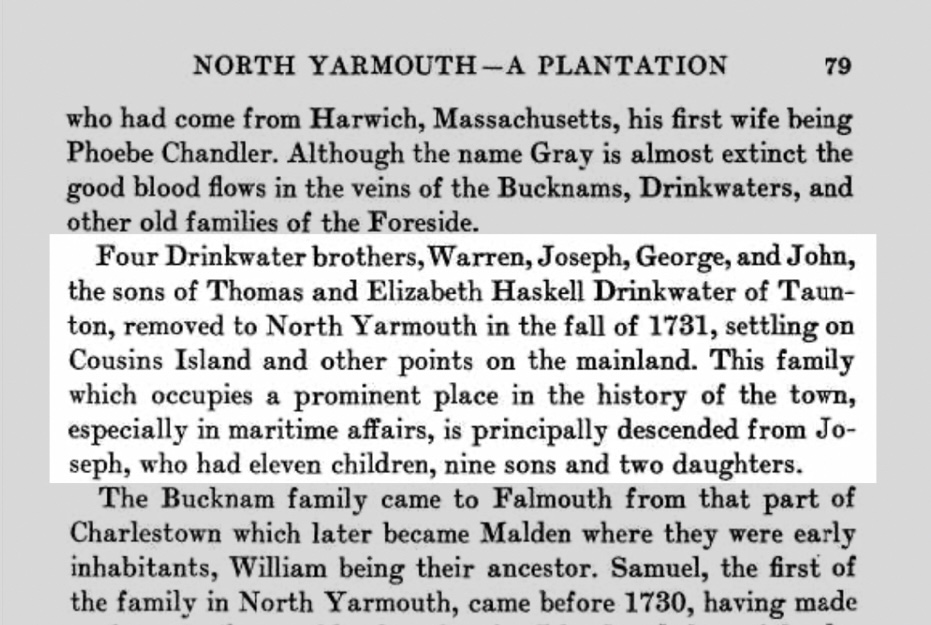
The above excerpt is from:
Ancient North Yarmouth and Yarmouth, Maine, 1636-1936: a history
Chapter III. North Yarmouth — A plantation. 1690-1733
https://www.ancestry.com/imageviewer/collections/21850/images/dvm_LocHist007949-00051-1?usePUB=true&pId=94
Book page: 79, Digital page: 97/473
As Warren Drinkwater, he is cited in the three court records a couple of years before he passed on:
Drinkwater, Warren
in the Maine Court Records, 1696-1854
https://www.ancestry.com/search/collections/6888/records/41073?tid=&pid=&queryId=58b948a1-40a1-4b77-b90f-35852028f470&_phsrc=bgv5&_phstart=successSource
Note: Court case for debts, January 1732.
and
https://www.ancestry.com/search/collections/6888/records/41108?tid=&pid=&queryId=92ddc495-1aaf-4e32-ac54-58fc3f20ac86&_phsrc=bgv7&_phstart=successSource
Note: Court case for debts, April 1732.
and
https://www.ancestry.com/search/collections/6888/records/47593?tid=&pid=&queryId=3d6e8635-f754-4349-af35-e67ff42119c4&_phsrc=bgv9&_phstart=successSource
Note: Court case for debts, July 1732.
Conclusion: This ancestor was born named Warren Drinkwater. Walter is either his middle name (if he had one), a nick-name (if he had one), or it is a clerical error on past paperwork. OR WAS HE A TWIN?
Comment: Even though we are not descendants of the brother Joseph Drinkwater, we wanted to share this 1901 newspaper clipping we came across here: https://www.findagrave.com/memorial/249845059/joseph-drinkwater . Please note that there are several documents at this location, but some of them could be unverified, apocryphal information.

New York Public Library
Roger Williams Sheltered by the Narragansetts
by A. H. Wray, circa 1856
https://digitalcollections.nypl.org/items/8bfe7940-ba01-0132-96dc-58d385a7bbd0
Note: For this image.

Roger Williams
https://en.wikipedia.org/wiki/Roger_Williams
Note: For his short biographical text.
Posterazzi
Newport Rhode Island in 1730
by J.P. Newell
https://www.posterazzi.com/newport-rhode-island-in-1730-j-p-newell-poster-print-item-varsal900116360/
Note: For the harbor image.
The Newport Mystery
(4) — two records
Rhode Island Court Records, Vol. II. Records of the Court of Trials of the Colony of Providence Plantation, 1662-1670
https://www.ancestry.com/imageviewer/collections/17373/images/dvm_PrimSrc000293-00082-0?queryId=8d913042-3192-4727-84aa-18d70120de9b&usePUB=true&_phsrc=wcy1&_phstart=successSource&pId=99&rcstate=dvm_PrimSrc000293-00098-0:365,3358,655,3407;668,3348,900,3401;562,3423,790,3477;617,3569,819,3614;461,546,612,651;469,832,592,917;471,830,690,942;544,1039,769,1085;585,1182,752,1227;468,1396,586,1460;462,1891,499,1931;633,1956,883,2051;512,2028,751,2111;535,2244,680,2322;552,2452,705,2510;572,2663,724,2744
Book page: 72-73, Digital page: 160-161
Note 1: The Volume II title page is at this link: https://www.ancestry.com/imageviewer/collections/17373/images/dvm_PrimSrc000293-00046-0?usePUB=true&_phsrc=nIq5&pId=54
Note 2: In the original court record of the case is on page 253.
Note 3: In the manner in which the cases are transcribed, makes it appear that this case was tried in 1668, possibly in November.
To Finally Slip Away
(5) — three records
Cornell Law School
Legal Information Institute, Good and Chattels
https://www.law.cornell.edu/wex/goods_and_chattels
Note: For the legal definition.
Massachusetts, Plymouth County, Probate Records, 1633-1967
Probate records 1708-1717 and 1817-1861 vol 3-3P
https://www.familysearch.org/ark:/61903/3:1:3QS7-997D-ZXLV?lang=en&i=181
Book page: 341, Digital page: 182/710
Note: For the record of probate.
Thomas Drinkwater
in the Massachusetts, U.S., Wills and Probate Records, 1635-1991
https://www.ancestry.com/search/collections/9069/records/6848912
Plymouth > Probate Estate Files, No 6744-6790, Drew, William-Dunbar Jesse, Ca. 1686-1881
Digital pages: 104-108/1009 (5 pages Total)
Note 1: 2 documents presented within document file number is 6747.
Note 2: The probate date is January 21, 1715, and it says that he lived in Midbury [Middleborough], Plymouth County

 Our Ancestors, Our Narratives