This is Chapter One of seven. We hope that you have taken the time to read the opening chapters we wrote based on the lives of The Pilgrims. It will help to make these The Soule Line chapters more accessible.
As the authors of this family history genealogy blog, we are in the 11th generation of Soule descendants in America. George and his wife Mary are our 8x Great Grandparents.
Introduction
The enigmatic Pilgrim George Soule was one of our two Mayflower ancestors. We use the word enigmatic to describe him because we didn’t know very much about him before he appears as a servant traveling with the family of Edward Winslow on that ship. His name appears on the Mayflower Compact as one of the signers. We also learned that he needed to be hidden for a time. Enigmatic and hidden… who doesn’t love to solve a mystery?
So, who was he and what were his origins? Much research has been done in the last decade to work toward a very plausible solution. First though, we should look at what he was not.

George Soule Was Probably Not an Englishman
Researchers at the Mayflower Society would be thrilled to find a birth record for this ancestor in England, but after decades of research, nothing credible has turned up. Additionally, cutting edge genetic research based on his possible Y-DNA chromosome male descendants in England — has also revealed nothing. As such, researchers decided to broaden their horizons and look at the life of the Pilgrims in Leiden, Holland during their years living there before they departed on the Mayflower.
It seems that this avenue of exploration may have yielded the clues his descendants have been looking for. Before we delve into that, we need to circle back for a concise review of the history from that era.
The Pilgrims were Separatists who chose to remove themselves from the Church of England and this act of defiance angered King James I, who was the head of the Church of England. He chose to persecute the Separatists, so in response, the Pilgrims escaped to Leiden, Holland. There they found a more compassionate environment for their point-of-view about religious matters.

(Image courtesy of Wikimedia Commons).
We must note however, that a very important aspect of their Leiden history, is the fact that William Brewster — as a member of the Pilgrim congregation and the future Governor of the Pilgrim Colony — was also a printer. King James I of England viewed Brewster’s printing work as criminal and subversive because it was critical of him and the Church of England. (For a more thorough explanation of this period, please see the chapter, The Pilgrims — Life in Leyden).
Our ancestor was very likely one of Brewster’s printing associates. Therefore, George Soule needed to be hidden for a time. Below is an excellent explanation of those events by the insightful researcher Louise Walsh Throop. We have gathered a very simple synopsis from three research papers she has published in the Mayflower Descendant and the Soule Kindred newsletter. Our synopsis is very basic, so we suggest that you consult her original work to appreciate the richness and clarity of her analysis. (See footnotes).
William Brewster’s Subterfuge
“Almost four hundred years after the event, the arrival of the
Mayflower off the shore of Cape Cod is still associated with a romantic
notion that its passengers were poor English farm folk, eager to take
the word of God to North America. Apparently the leaders were
also united in protecting William Brewster and his associates from the
wrath of King James I, and the romantic notion was part of a successful
deception.
…after May 1619 William Brewster was a fugitive who, if caught, would have been imprisoned or hanged. The printed work that incurred the wrath of King James I was published early in 1619. Entitled Perth Assembly, it was printed in
Holland by Brewster and smuggled into Scotland in a wine vat.” That this publication did not have the name of the printer, nor the location stated, made the printing press illegal under Dutch law.
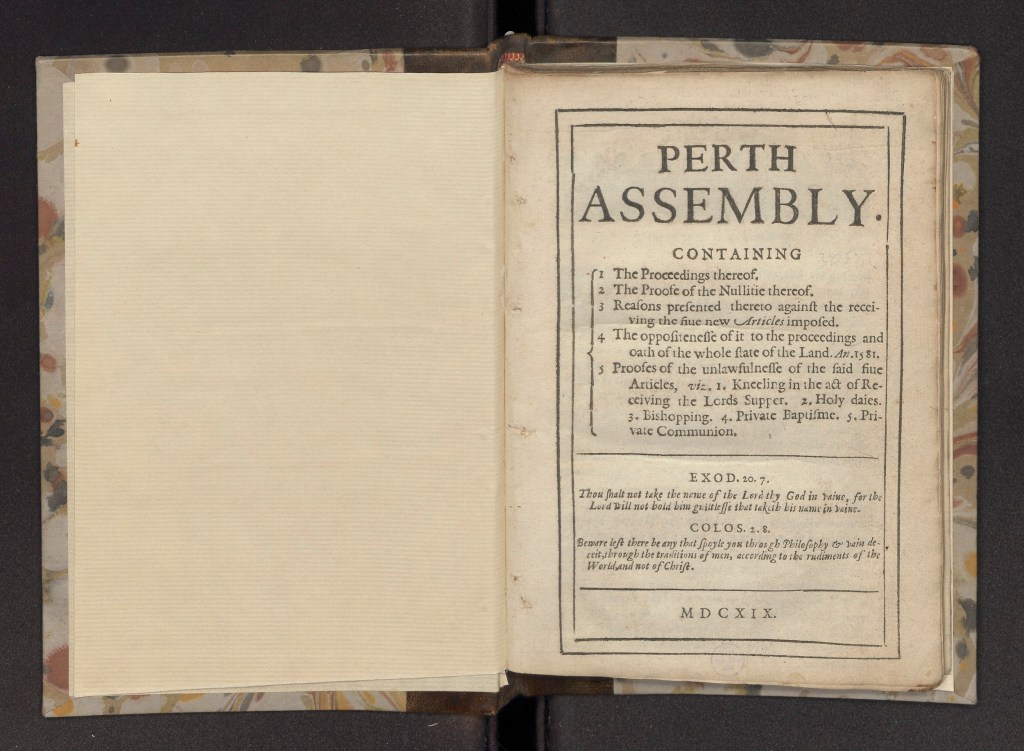
Perth Assembly, 1619
(Image courtesy of David Calderwood, Leiden University Libraries).
“A year before their departure for America, the Pilgrims published this pamphlet in Leiden. It was immediately banned in England since it criticised royal decisions that had been made during an assembly in Perth, Scotland in 1618. In this pamphlet, the Pilgrims express their dislike of the celebration of Christmas and Easter, the episcopal hierarchy and the practice of kneeling during Holy Communion.”
“Furthermore, when Brewster fled Holland, he brought with him
several of his associates in his printing venture in Leiden— probably to
protect them and prevent the King’s agents from eliciting information
about Brewster from them. To protect Brewster, names were changed
and documents altered—all part of a subterfuge.
The illegal printing of books critical of King James I and the
English Church was carefully planned. Two non-controversial books
were published in Latin in 1617 as a ‘front’ operation and perhaps
to gather the set type and gain income. William Brewster then faded
from view: he appeared in the Spring 1617 book trade catalog but
went underground and did not appear in the Autumn 1618 catalog.
Some of Brewster’s associates in this printing operation are
known—notably John Reynolds and Edward Winslow. [It was also with Winslow’s family that George Soule traveled as a servant on the Mayflower.] Brewster’s supporters and associates were also neighbors in Leiden—the city was teeming with printing associates ready to help.”
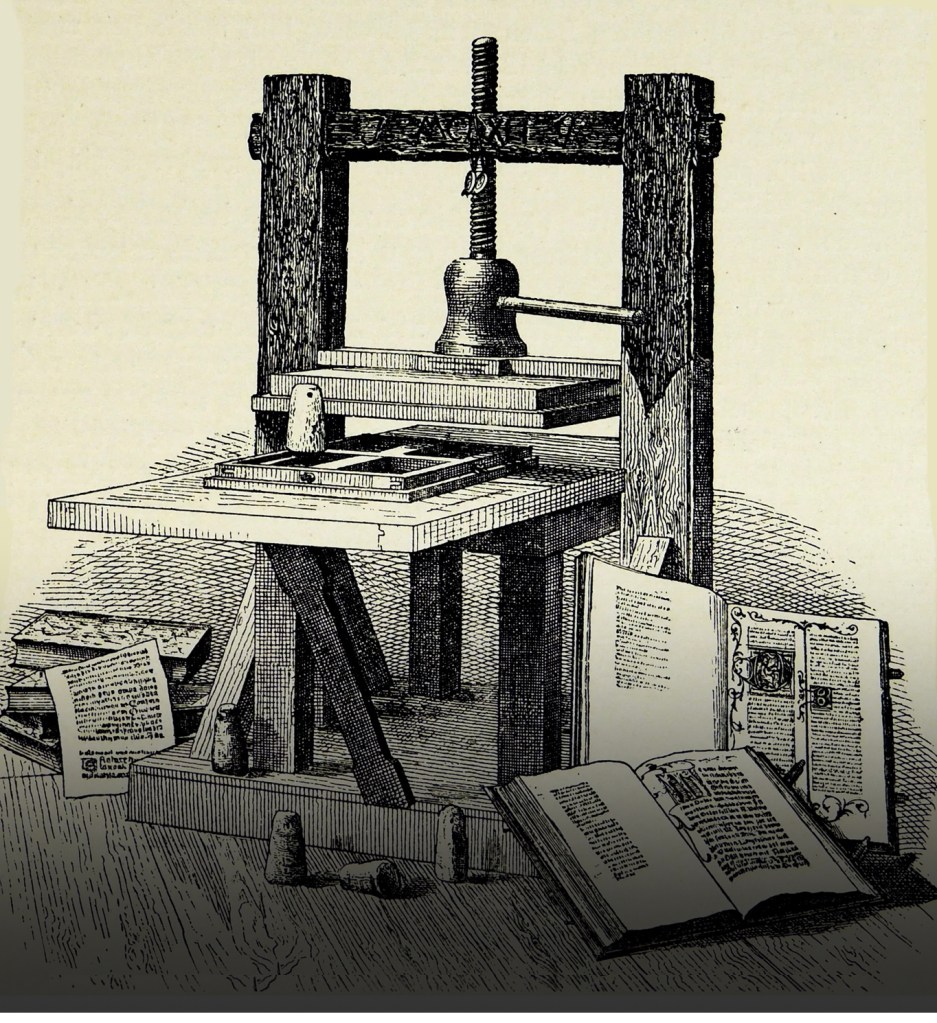
The Background History of Book Printing in Holland
When printing presses were becoming established, the interruptions which they caused in societies were problematic. The closest analogy we would have today, is when the internet came about and there was much fretting about the changes that were happening in society. In 16th century Holland, these interruptions were managed by regulation.
“Printing was regulated by local and/or regional authorities. Itinerant printers of the late 1500s traveled from town to town peddling pamphlets and broadsides produced on small hand-held presses. In 1608 Leiden banned foreigners from selling such printed matter by ‘calling out’ their wares. The basic printing laws in Holland were put forth in the edict of 1581, renewed and updated at various times from 1608 through 1651.
The salient point of these regulations was to require a printer to include information in his productions about his name, place, year, author, and translators. Anonymity and libel were illegal and fines for such behavior were heavy. Thus, by the printing regulations of the time, many of the books printed for Puritan and Separatist uses in Leiden and Amsterdam were illegal by reason of the omission of printer, author, or other essential data.
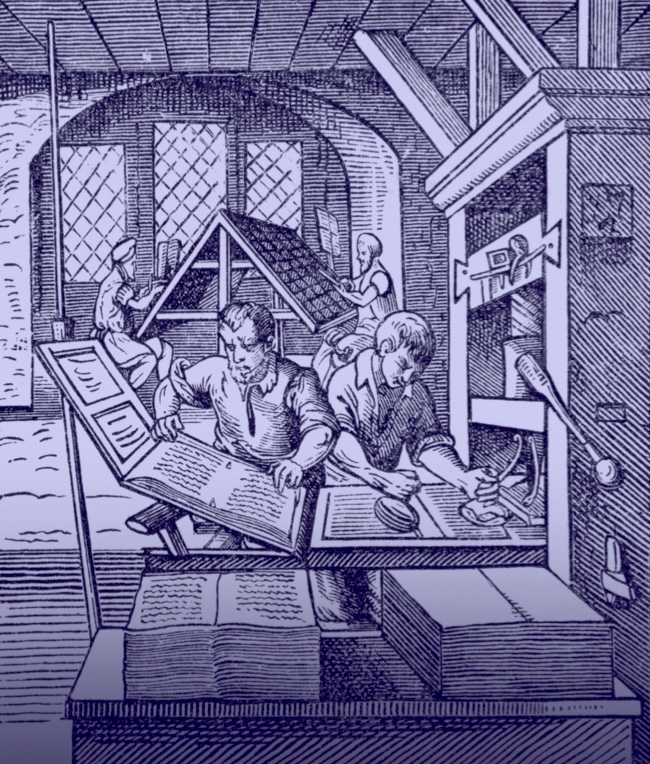
Around 1620 in Leiden, the book trade was in the middle of a transformation from a craft-based occupation peopled with printers, binders, type-founders and compositors to a commercially oriented industry peopled by booksellers, paper sellers, binders, typemakers, and printing firms.
The early printers in Leiden were actually small in number and appear to have known and worked or cooperated with each other. In any one year, there were probably no more than 20 printers working. The industry was growing, and after 1611 grew by 15 or more active workers in an average year. Leiden, with an estimated population in 1622 of 44,745, was home to a total of about 62 printers/booksellers in the period 1601-1625.”
A Friendly Neighbor, Johannes Sol
“A print shop in that period needed a minimum of three persons. William Brewster’s first assistant in this period was John Reynolds, who left after one year left when he married. [His second assistant was] Edward Winslow, who joined Brewster in Leiden late in 1617 after a four-year apprenticeship to stationer John Beal in London. Winslow, like Reynolds, married after assisting Brewster for about a year. Brewster also appears to have had assistance from the print shop of a friendly neighbor, Johannes Sol.
At Johannes Sol’s printshop, Johannes’s teenaged brother George Soule was available (no apprenticeship paperwork was needed). [Since we know George could read and sign his name, he probably also did proofreading.] The change of “Sol” to “Sowle” might have been part of Brewster’s subterfuge — to identify all Mayflower passengers as English.”

It is likely that “Johannes Sol died suddenly during the winter of 1618/19. A Dutch printer… suffered an accidental, fiery death while boiling printing varnish in country house outside Leiden on a Sabbath day… the printer’s house was burned and he and his only daughter died in the fire.” His death left his younger brother George Sol, without a livelihood” and exposed him as an associate of William Brewster, who was a hunted man.”
Everyone in the Pilgrim community was worried about the long arm of King James I, and we wonder if perhaps the horrid death of Johannes Sol was something instigated by King James I? We will likely never know, but certainly, people were nervous. (1)
A Walloon Refugee Family
We have encountered many spelling alternatives when it comes to the surname for the Soule family. It seems that much of this variation is dependent upon who was doing the record-keeping and what culture they were from. Moreover, much spelling then could sometimes be phonetic. In addition, William Brewster seems to have altered the Sol spelling to Sowle/Soule as part of his great deception to make the name seem more English.
Several researchers have found records for this family that all seem to agree on the point that they were likely a Walloon refugee family. (For an understanding of what was occurring with the Walloons in Europe during this period, please see the chapter of another family line who was experiencing the same difficulties: The DeVoe Line, A Narrative — One, Holland & Huguenots. It is interesting to note that the Soule line connects through marriage to the DeVoe line in 6 generations).
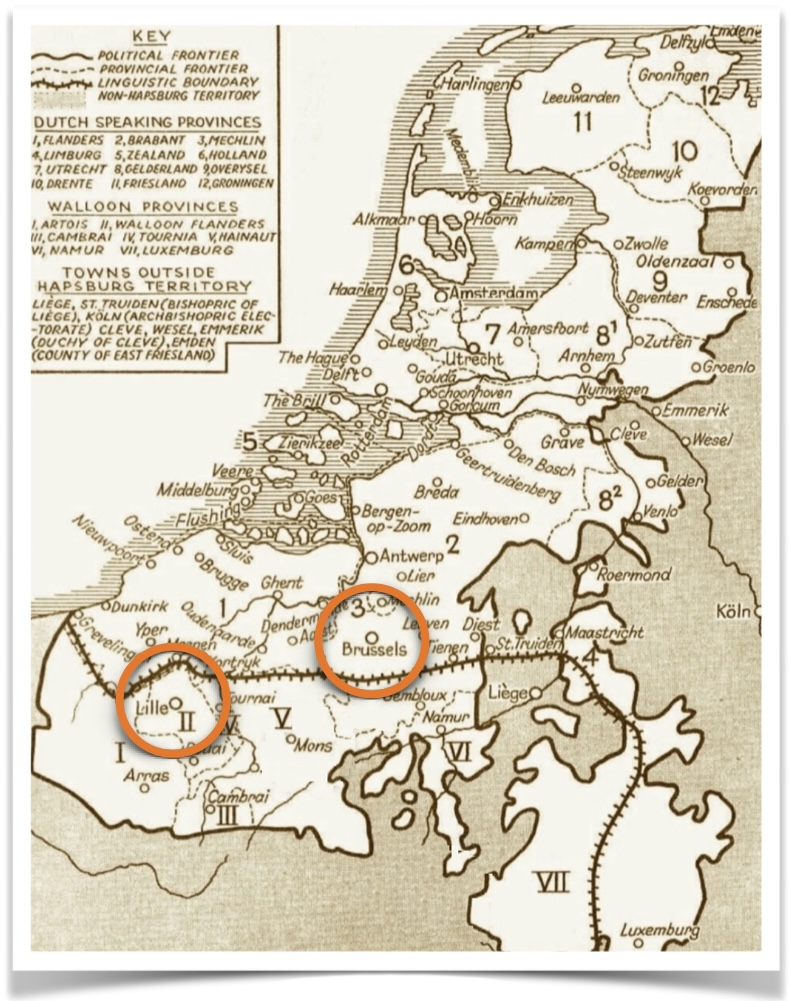
From researcher Louise Walsh Throop, the “Father Jan Sols experienced in his lifetime the revolt of the Spanish Netherlands, led by William of Orange. In 1568 the 80 Years War between the Netherlands and Spain began. In the 1570s, Protestant refugees fled north to cities like Brussels and Antwerp or across the Channel to England. The assassination of William of Orange in 1584 was followed by the fall of Ghent, Bruges, Brussels, and Antwerp. Refugees fled north [about 1585] to the newly independent Dutch provinces of Holland and Zeeland, or across the Channel to England. In the province of Holland are located the towns of Haarlem, Amsterdam and Leiden.” (2)

The Dutch Reformed Church of Austin Friars
The “origins of George Soule this last variation of Sols/Soltz, i.e., ‘Solis,’ is a clerical variation on the Latinized version: Solius …the marriage record of Jan Solis of Brussels, to Maecken Labus, at the Dutch Reformed Church in Austin Friars, London, dated 30 August 1586,” and “…that “John Sols and his wife” were admitted into the congregation in 1585. Seven other children were born after they returned to Haarlem about 1590” (Soule Kindred newsletter, Summer 2019)

as published in The Marriage, Baptismal and Burial Registers, 1571-1874,
and Monumental Inscriptions of the Dutch Reformed Church, Austin Friars, London.
(Image courtesy of The Internet Archive).
“Jan and Mayken were Protestant refugees who were married at Austin Friars, London, England, 30 August 1586. They were the parents of seven known children baptized in Haarlem, Holland, between 1590 and 1599. The marriage record of Jan Sol in London, England, in 1586 gives his origin, misread in English as ‘Brussels’ whereas it was more likely referring to what is now Lille, France. ” (Wikitree)
Jan (or John in English) married Mayken/Maecken (Mary in English) in London in 1586 and may have lingered a year or two in or near London. Possibly a proposed tax on refugees provided the impetus for leaving London. The baptisms of seven children in Haarlem 1590-9 means that George Soule would have been born about 1601.” (Throop, 2011)

to Maecken Labus at the Dutch Reformed Church, Austin Friars, London, England.
(Image courtesy of the Soule Kindred Newsletter, Summer 2019).
Indeed, they could have been from Brussels, or they could have been from Lille, France, or they could have been from both places. Due to the conflicts between Kingdoms at that time, the borders were always in flux and people were moving around much. (This same experience happened to our DeVoe family ancestors). What is most important is that they eventually ended up in Haarlem, Holland where they started their family.
Wikitree explains, “The Dutch Reformed Church records in Haarlem give the baptismal records for seven children of Jan Sols/Soltz, of Brussells, and his wife Mayken Labis/Labus/Lapres/Laber, including:
- Geertrude, baptized February 25, 1590
- Johannes, baptized October 6, 1591*
- Sara, baptized September 5, 1593
- Maria, baptized 28 March 28, 1596
- Johanna, baptized March 19, 1597
- Pieter, apparently twin with Susanna, baptized January 17, 1599
- Susanna, apparently twin with Pieter, baptized January 17, 1599
*This oldest son is the printer Johannes Sol from Leiden.” So where is George Soule in this family group? He was presumably the youngest of the family. (3)
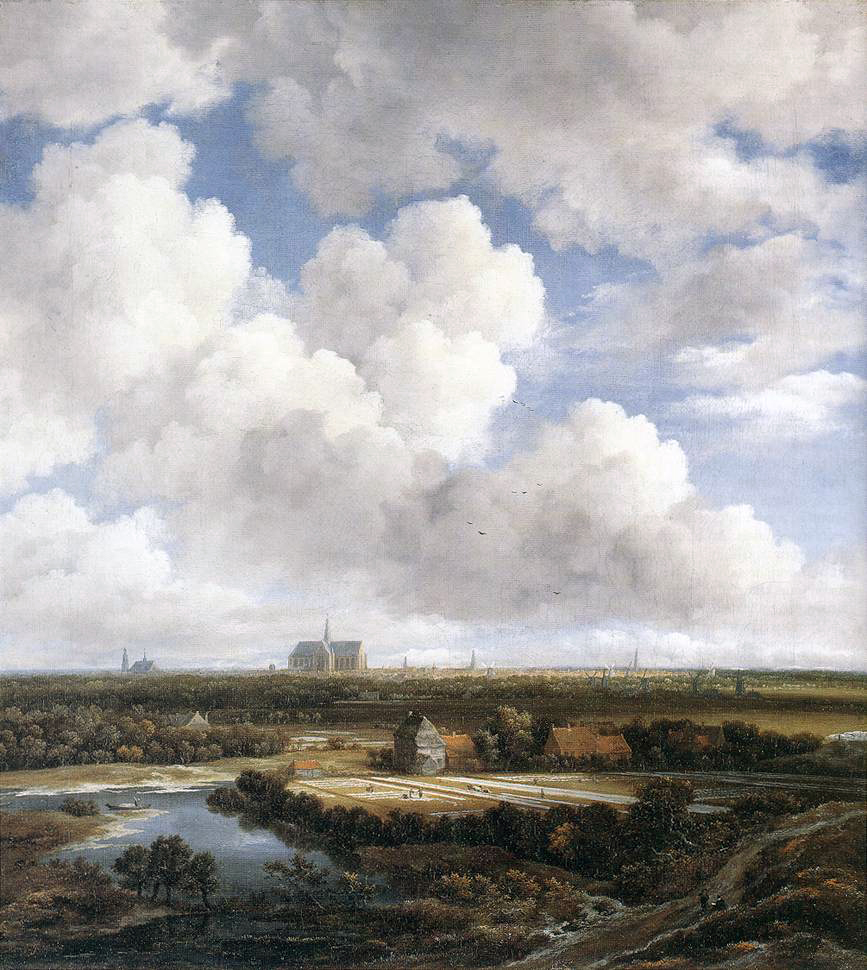
(Image courtesy of Wikipedia).
George Soule — Born About 1601
“It is not outside the realm of possibility for Johannes Sol to have a younger brother George, whose Dutch name would have been Joris (also Goris/Jurgem/Jurian/Jurn/Jury/Janz) Sol.” This places George’s birthdate somewhere in the range of November 1599 to November 1602. Therefore, researchers use the date of 1601 for his birthdate, and cite points of evidence for the familial relationship:
“Four of the 14 male servants on the Mayflower signed the Compact: John Howland, George Soule, Edward Doty, and Edward Leister. With regard to these men, we have help in calculating birth years: servants were not eligible to marry until their contract was up, which normally was when a man reached the age if 25 years. Thus, using George Soule’s projected marriage about 1626, his birth year was 1601 or earlier.”
“The naming of his children. “George married about 1626 in Plymouth Colony, and named two children for his presumed parents: Jan/John and Mayken/Mary (Labus/Labis) Sol. George [named a son after himself, and] also named a daughter Susannah, presumably for his sister Susanna, bap. in 1599.” Hence the names: John, Mary, George, Susannah. Mary could have been named for his mother, and/or his wife. (Both sections are Throop, 2009)
“A series of matching Y-DNA test results in 2017 supports the kinship of George Soule to Johannes Sol.” (Throop, 2009 and Wikipedia)

(Image courtesy of American Art Collector).
In Summary, Before We Sail to America —
“The available evidence points to a Dutch birthplace for George Soule with his possible father Jan Sol(s) moving from Brussels in Brabant to Haarlem in the Dutch province of Holland at least 10 years before George’s birth. Being born about 1601, and literate, George was probably handy when presumed brother Johannes Sol needed a printer’s devil or general helper about 1616-1617 in Leiden. About the middle of 1618, George apparently became involved in the efforts of the so-called Pilgrim Press, which was suppressed in September 1619. His association with Brewster and Winslow appears to have led to his inclusion on the passenger list of the Mayflower, and, like Brewster and possibly also Winslow, or he may have been hiding from the Dutch and English authorities.”
Our ancestor, the young George Soule, was likely born in 1601 in Haarlem, Haarlem, Netherlands. “It very well could have been the chance of a lifetime for young George Soule to be part of a group leaving Leiden in the middle of 1620 for the relative freedom of North America.” (Soule, Terry, and Throop, 2000, and Throop 2009) (4)
Following are the footnotes for the Primary Source Materials,
Notes, and Observations
Note, that these four sections all use the same Louise Walsh Throop references:
George Soule Was Probably Not an Englishman
William Brewster’s Subterfuge
The Background History of Book Printing in Holland
A Friendly Neighbor, Johannes Sol
(1) — eight records
Library of Congress
History of The Town of Middleboro, Massachusetts
by Thomas Weston, 1834-1920
https://www.loc.gov/resource/gdcmassbookdig.historyoftownofm00wes/?c=160&sp=5&st=pdf
Book page: 590, Digital page: 644/788
Note: For George Soule & Son 1671 signature
Mayflower Descendant, Volume 66, No. 1: Winter 2018
William Brewster’s Subterfuge
by Louise Walsh Throop
Book pages: 14-22
Note: .pdf file available for purchase from American Ancestors at,
https://shop.americanancestors.org/products/mayflower-descendant-volume-66-no-1-winter-2018?srsltid=AfmBOopdq6ksBjHLwiaPfTnd4DImwKhDX3pjK_h2UsoTorf_pmESZ-C5&pass-through=true
Note: For the text.
This statement by Throop is published as a response at this link: https://www.wikitree.com/wiki/Soule-33
“…in which I describe how William Brewster got out of Leiden before being picked up by the authorities, who were being pressured by the English ambassador. Brewster seems to have taken some of his print crew with him, including George Sowle, an English spelling [as his original name was Dutch and probably Joris Sol]. The modern proof is in y-DNA matching with a Forrest family from southern Scotland, as it appears an orphaned nephew of George Soule was adopted into a Forrest family, probably by remarriage of a widowed mother. The orphaned son was the only surviving child of a printer in Leiden named Johannes Sol; Johannes left an estate so the widow would have been quickly remarried so the new husband could have control of the estate, and baby boy. Johannes’ apprentice left in 1619 for Scotland, apparently taking tell-tale type from Brewster’s presswork, and probably also the (missing) Brewster press. His name was Edward Rabin and he is celebrated for being the first printer in Aberdeen, Scotland [see wikipedia]. In one of his diatribes against Sabbath-breaking and drinking, etc., he mentions without any names his former master who died in a fire [while working on a Sabbath], and whose estate was then (in 1623) under the control of unrelated person(s). The Forrest/Soule y-DNA matches are found on the Soule project housed with FamilyTreeDNA. This whole scenario is described in the article already mentioned in Mayflower Descendant. Now if you know someone who can research in the Netherlands, please let me know! The Soule Kindred in America has been focusing on English research in the past 10 years, probably because they received a bequest for research in England! They have found nothing.”
Merriam Webster Dictionary
Enigmatic definition
https://www.merriam-webster.com/dictionary/enigmatic#:~:text=An%20enigmatic%20person%20is%20someone,tested%20one’s%20alertness%20and%20cleverness.
Note: For the data.
Leiden Museum de Lakenhal
Pilgrims to America — And The Limits of Freedom (Exhibition)
via Heritage Leiden, Stadsarchief 1574 – 1816
Perth Assembly, 1619
(Image courtesy of David Calderwood, Leiden University Libraries).
https://www.lakenhal.nl/en/story/images-and-credit-lines-pilgrims
Notes: “A year before their departure for America, the Pilgrims published this pamphlet in Leiden. It was immediately banned in England since it criticised royal decisions that had been made during an assembly in Perth, Scotland in 1618. In this pamphlet, the Pilgrims express their dislike of the celebration of Christmas and Easter, the episcopal hierarchy and the practice of kneeling during Holy Communion.”
History.com
7 Ways the Printing Press Changed the World
by Dave Roos
https://www.history.com/news/printing-press-renaissance
Notes: For two illustrations, Johannes Gutenberg’s First Printing Press, and a 15th century print shop.
Further Searching for the Origins of Mayflower Passenger
George Soule: Printer’s Devil in Leiden?
by Louise Walsh Throop, M.B.A.
https://web.archive.org/web/20190403203131/https://soulekindred.org/resources/Documents/Newsletters/PDF-Newsletters/Vol.-43-No.-4-Autumn-2009.pdf
Note: For the text.
Conservar Património, no. 26, 2017
Associação Profissional de Conservadores Restauradores de Portugal
“On the recipe for a varnish used by El Greco”
by Michel Faver-Félix
https://www.redalyc.org/jatsRepo/5136/513654156004/html/index.html
Note: For the botanical images.
A Walloon Refugee Family
(2) — three records
The Most Remarkable Lives of Jan Jansen and his son Anthony
A Brief History of the Netherlands (map)
by Brian A. Smith, D.C.
https://ia801604.us.archive.org/32/items/2013JanAndAnthonyJansenPublic/2013 Jan and Anthony Jansen public.pdf
Book page: 3/145
Note: For the map.
Further Searching for the Origins of Mayflower Passenger
George Soule: Printer’s Devil in Leiden?
by Louise Walsh Throop, M.B.A.
https://web.archive.org/web/20190403203131/https://soulekindred.org/resources/Documents/Newsletters/PDF-Newsletters/Vol.-43-No.-4-Autumn-2009.pdf
Note: For the text.
Soule Kindred Newsletter
Fall 2011, Vol. XXXXV, No. 4
Continuing the Search for the Origins of George Soule and
Some Incidental Findings in the Search for His Descendants
by Louise Walsh Throop, M.B.A.
https://soulekindred.org/George-Soule-Research
Note: For the text.
The Dutch Reformed Church of Austin Friars
(3) — five records
London Remembers
First Dutch Church, Austin Friars
https://www.londonremembers.com/subjects/first-dutch-church-austin-friars
Note 1: For the 1820 illustration of the church, based upon A Topographical and Historical Description of London and Middlesex, by Edward Wedlake Brayley.
Note 2: From Wikipedia, “In the night of 15–16 October 1940, just a decade before the Dutch Church celebrated its 400th anniversary, the medieval building was completely destroyed by German bombs. The church’s collection of rare books including Dutch Bibles, atlases and encyclopedias had been moved out of London for safe-keeping one day before the bombing raid that destroyed the building.” Via https://en.wikipedia.org/wiki/Dutch_Church,_Austin_Friars
Soule Kindred Newsletter
Fall 2011, Vol. XXXXV, No. 4
Continuing the Search for the Origins of George Soule and
Some Incidental Findings in the Search for His Descendants
by Louise Walsh Throop, M.B.A.
https://soulekindred.org/George-Soule-Research
Note: For the text.
Soule Kindred Newsletter
Summer 2019, Vol. LIII, No. 2
Soule Sleuths Make Headway in theSearch for George
by Marcy Kelly
https://soulekindred.org/Newsletters-2010s
Note: For the text, and the (personal photograph) image of the marriage record for Jan Solis and Maecken Labus, found in parish registers of Austin Friars.
The Marriage, Baptismal and Burial Registers, 1571-1874, and Monumental Inscriptions of the Dutch Reformed Church, Austin Friars, London; with a short account of the strangers and their churches
by London. Dutch Reformed Church, Austin Friars; William John Charles Moens, 1833-1904 editor
https://archive.org/details/marriagebaptisma00lond/page/134/mode/2up
Book page: 135, Digital page: 190/295
Note: For the text.
WikiTree
George Soule Sr (abt. 1601 – bef. 1680)
https://www.wikitree.com/wiki/Soule-33
Note: For the text.
Note, that these two sections all use the same Louise Walsh Throop reference:
George Soule — Born About 1601
In Summary, Before We Sail to America —
(4) — five records
American Art Collector
The Sails Fill As The Mayflower Leaves Plymouth, 1620
by Peter Goodhall
https://www.americanartcollector.com/shows/1584/peter-goodhall
Note: For the painting image.
Further Searching for the Origins of Mayflower Passenger
George Soule: Printer’s Devil in Leiden?
by Louise Walsh Throop, M.B.A.
https://web.archive.org/web/20190403203131/https://soulekindred.org/resources/Documents/Newsletters/PDF-Newsletters/Vol.-43-No.-4-Autumn-2009.pdf
Note: For the text.
George Soule
Family Search family tree that indicates a 1601 birth
in Haarlem, Haarlem, Netherlands
https://www.familysearch.org/ark:/61903/2:2:QDJH-P1T
Note 1: This circa 2000 reference is cited for this family tree.
Mayflower Families In Progress –
George Soule of the Mayflower and his descendants in the Fifth and Sixth Generations (Families 1-229) ([Plymouth, Massachusetts]: G
by John E. Soule, Col. USA, Ret., M.C.E., Milton E. Terry, Ph.D., and Louise Walsh Throop, M.B.A.,
Note 2: This publication is also available here —
George Soule of the Mayflower and his descendants in the Fifth and Sixth Generations, at: https://archive.org/details/georgesouleofmay2000soul/page/2/mode/2up
Note: For the data.
George Soule (Mayflower passenger)
https://en.wikipedia.org/wiki/George_Soule_(Mayflower_passenger)#cite_note-soulekindred.org-9
Note: For the text.

 Our Ancestors, Our Narratives