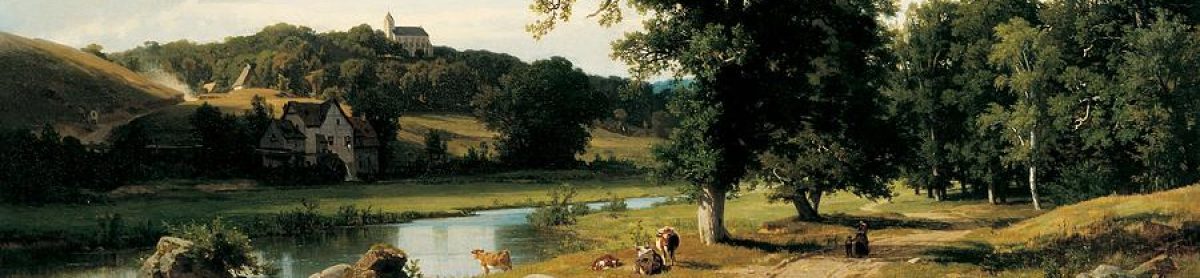
This is Chapter Four of nine. After more than a dozen years in the Plymouth Colony, Edward Doty’s life is about to take an affection new direction with his kindred. In this chapter, we are writing about his wife Faith, their children, and the end of this Mayflower Pilgrim’s journey with us.
The Freemen of 1633
In 1633, the Records of the Colony of New Plymouth in New England, list ‘Edward Dowty’ as being a Freeman. This meant that in the Plymouth Colony, being a Freeman gave him a specific legal and political status that granted certain rights and responsibilities. Freemen were considered part of the community and had the right to participate in the colony’s governance by voting and holding office. They were also expected to uphold the laws and contribute to the colony’s success. (1)
This anecdote has been transmitted from father to son…
Edward Doty’s land dealings are where he created much of his prosperity. As we learned in Chapter Two, his real estate holdings commenced with the 1623 Division of Land. Even earlier than this, however, it appears that as a young man, he was a bit eager and impatient to be a landholder — as this story from Thacher’s History of the Town of Plymouth relates:

Wikipedia also tells us that “… later [he was] granted an additional twenty acres. Records of the 1630s and 1640s show numerous land transactions by him apparently making him quite prosperous. Per the record of December 4, 1637, one such land transaction involved land being granted to him and Tristram Clarke, ‘his father in law.’ It is known that he did own land in central Plymouth where the Mayflower Society House now stands.” Also, “he periodically received land grants from court as with other residents, and received other property rights and benefits from being classed as a ‘first comer’ ”. (Wikipedia) (2)
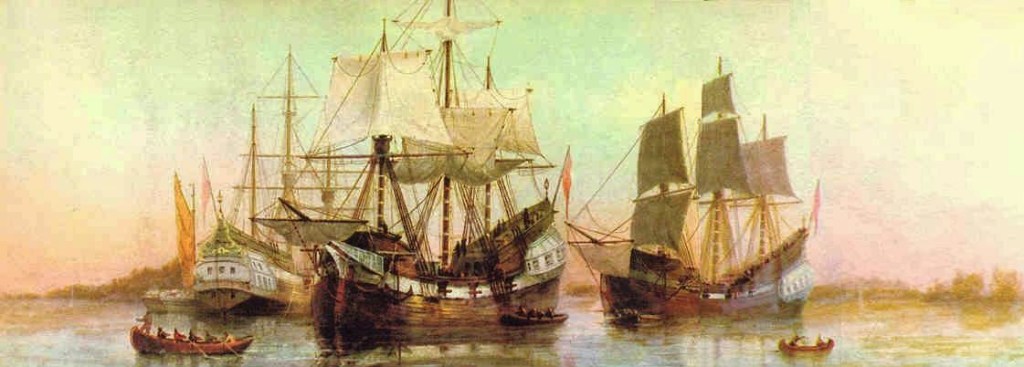
by William Formby Halsall, 1880
(Image courtesy of Merchant’s House Museum).
The Arrival of The Francis
After the Francis left Ipswich, England in late April 1634, it arrived in Plymouth Harbor likely in late May, or early June 1634.
“The years 1630 to 1640 are known as the Great Migration. The largely Puritan immigrants from England settled in New England, north of the settlement at Plymouth Bay, in a stretch of land known as the Massachusetts Bay Colony. The major centers of the new colony were the eastern coastal Massachusetts towns of Boston and Salem. During the Great Migration, an estimated two hundred ships reportedly carrying approximately 20,000 people arrived in Massachusetts.” (Ebsco) The ship Francis anchored in Plymouth Harbor, but it may have also visited the Massachusetts Bay Colony to the north of Plymouth.
It turns out that in 1634, Edward was soon share his life in the Plymouth Colony with the Clarkes (also spelled Clearke) family, of which his wife #2 was a member. In a ship reference list simply titled, Pilgrim Ship Lists Early 1600’s (see footnotes), the ship Francis’s passenger list includes:
- Clearke Thurston, aged 44, and
- Clearke Ffaythe, aged 15, (listed as a Ward of J Pease)
We know that Thurston Clearke, is actually Thurston Clarke Sr., the Clark family patriarch. Ffaythe Clearke, is his daughter Faith Clarke. (Why she was traveling as a ward of J. Pease is unknown). He is listed as Pease John, aged 27, “From Baddow, Magna, Essex, bound for Salem, Edgartown”.
Writer Ethan Allan Doty, writes about Faith and her family, in Doty-Doten Family in America,“Faith Clarke was born 1610, and was at this time but sixteen years of age, was the daughter of Thurston Clarke and Faith [same named], his wife. They came to Plymouth from Ipswich, Suffolk, England, in 1634 in the Francis, he being at that time forty-four years of age. His name is sometimes written Tristram Clarke.
Besides their daughter Faith they had two sons, Thurston, Jr., and Henry. They probably had no issue. [Meaning the brothers] Under date of 1st April, 1690, we find: ‘The selectmen of Duxborough having reported that two of their inhabitants, Henry Clarke and Thirston Clarke, by reason of their age indiscretion & weakness of understanding are incapable of their own support notwithstanding that they have an estate sufficient, and John Dotey of Plymouth their nephew having promised to take prudent care of them Is allowed to recoup himself from their estate,’ under certain conditions mentioned. (Doty-Doten Family in America, DDFA)
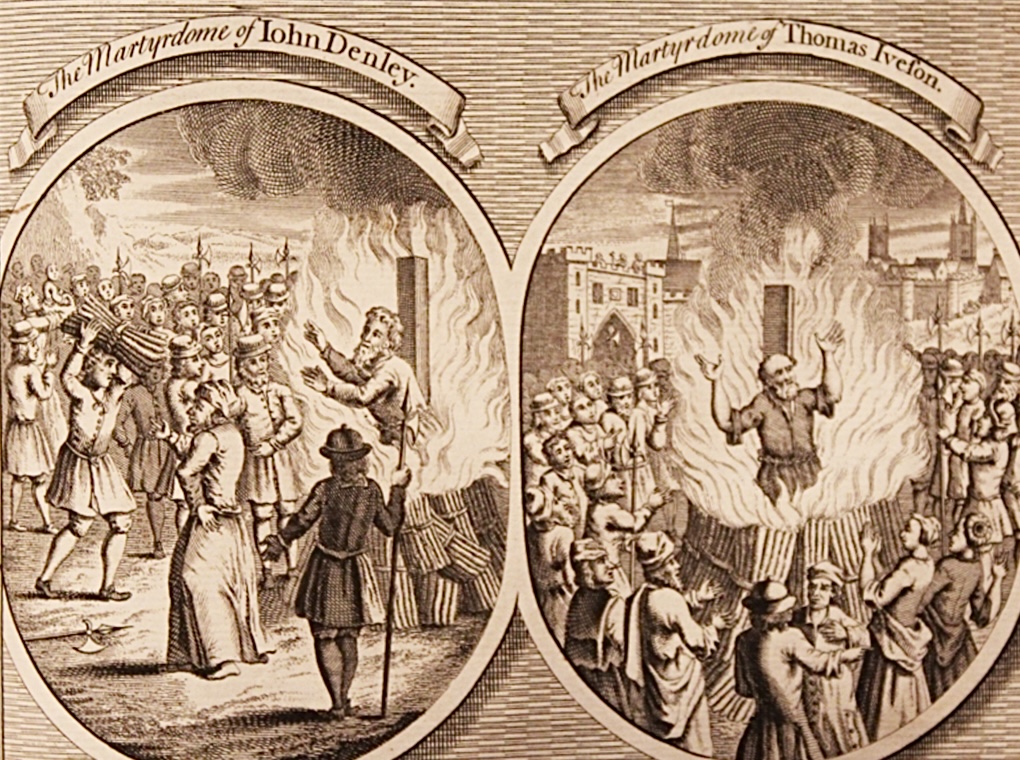
The reason for their emigration was likely religious. The Clarke family, being from Ipswich, England, would have been very aware of the persecution of Protestants in their town’s history. Wikipedia states, “In the time of Queen Mary [ruled 1553 – 1558] the Ipswich Martyrs were burnt at the stake on the Cornhill for their Protestant beliefs… From 1611 to 1634 Ipswich was a major centre for emigration to New England. This was encouraged by the Town Lecturer, Samuel Ward”.
Who was George Clarke?
Not everyone who lived in the Plymouth Colony who had the surname Clarke was related to the Thurston Clarke family. “Since several of Doty’s court cases involved Thurston Clarke and George Clarke, it would appear that some of his legal situations, including fights, were the result of in-law domestic problems. (Wikipedia) However, Ethan Allen Doty’s history of this family, states that George Clarke was not related to the Thurston Clarke family. (Doty-Doten Family in America, DDFA)
On January 6, 1635 Edward Doty and Faith Clarke were married. The actual Court Record reads, “6th Jany 1634-5. Edward Doten and Fayth Clarke wore married.”

Faith Clarke was born at Ipswich, England about 1619. When they married, Edward* was about 36 years old and Faith was about 16 years old. They had at least nine children over a period of about 16 years, all born at Plymouth, Massachusetts Colony.
*Going forward, after the birth of his oldest son, we will now refer to him as Edward Sr. (3)
With Six Boys, and Three Girls
Back in this era children were born at home, and very few records were kept that have survived. For nearly all of the Doty children, their birth dates are educated guesses.
- Edward Doty Jr., born about 1637 – died about December 20, 1675. He was married February 25, 1662 to Sarah Faunce in the same location. They had eleven children, with their last child Benjamin likely being born a few months after his father had already passed on.
“It is related that in a storm on the 8th Feb., 1689-90. Edward Dotey, with his son John and Elkanah Watson, another resident of Plymouth, were drowned in Plymouth harbor, or, perhaps more properly, by the wreck of their vessel in attempting to enter the harbor… On the 18th March following, Sarah Dotey relict widdow of Edward Dotey late of Plimouth deceased,” made oath to an inventory of the estate, to which her brother-in-law, ‘John Doten’, and son-in-law, James Warren, were witnesses. The widow continued to live in Plymouth until 1693, whereon the 26th April of that year she married John Buck, of Scituate, Mass… It is probable that at her second marriage Mrs. Buck removed to Scituate, where her death occurred 27th June, 1695.”

(Image courtesy of the Library of Congress).
- John Doty, born about 1639-40 — May 8, 1701. He married first Elizabeth Cooke in Plymouth in 1667; she died in 1692. They had nine children. [Her mother was a daughter of Mayflower passenger Stephen Hopkins and her father was a son of Mayflower passenger Francis Cooke. (Wikipedia)]
He married second Sarah (Rickard) Jones in 1695, also in Plymouth; they had three children. From his two marriages, John Doty had twelve children. It seems John Doty became the caretaker for his extended family. The following two passages are examples:
“1690, April 1. The selectmen of Duxborough having reported that two of their inhabitants Henry Clarke and Thisten Clarke, [his maternal uncles] by reason of their age, indiscretion and weakness of understanding are incapable of their own support notwithstanding they have an estate sufficient, and John Dotey of Plymouth their nephew having promised to take prudent care of them, is allowed to recoup himself from their estate, under certain provisions…”
“In 1695, after the death of his brother Edward’s widow, [(Sarah (Faunce) Doty]he and Elmer Faunee were appointed guardians for her minor children.” - Thomas Doty, born about 1641 — died about 1679. He was married to Mary Churchill about 1638; they had two children both born in Plymouth. From Wikipedia, “On January 17, 1671 Mary Churchill confessed she had gotten pregnant by Thomas, son of Edward Doty, with whom she had ‘carnall coppulation’ three times – first time on July 15, second time on August 8 and the third was about ‘senight’ after. A sergeant went to Mary Churchill’s house, found Doty there and took him into custody. Doty was warned ‘take heed lest evil come of such carriages’. Mary Churchill was fined and at the time of his court hearing Doty fled the colony, but the two finally married about the time of the birth of their first child.”

- Samuel Doty, born about 1643 — died November 15, 1715. He was most likely the first of the Doty siblings to leave Plymouth Colony, moving to New Jersey. He married to Jeane Harmon about 1678 in Piscataway, Middlesex, New Jersey; they had thirteen children. “He was the ancestor of the very large and influential branch of the Doty family, who, from the State of New Jersey, have gone forth as pioneers to the West and the South.” Comment: With thirteen children (!), no wonder they were a ‘large and influential branch’ of the family.
- Desire (Doty) Sherman/ Holmes/ Standish, born about 1645 — died January 1731. She was married three times, and outlived all three of her husbands. All of her marriages took place in Marshfield, Massachusetts. With her three husbands she had twelve children. She married first William Sherman on December 25, 1667; he died in 1679. She married second Israel Holmes on November 24, 1681; he died in 1684. She married third Alexander Standish in 1686; he died in 1702. Observation: in 1667, her mother Faith (Clarke) Doty was remarried to John Phillips and they relocated to the town of Marshfield, just north of Plymouth. It seems that Desire likely lived near her mother.
“She was a remarkable woman, as is evident from her history. Born on the High Cliff at Plymouth, losing her father at the age of ten years, her early married life especially unfortunate by reason of the insanity of her first* and the early death of her second husband, she not only successfully raised the young children left to her care, but her troubles had borne so lightly upon her that she attracted the attention of and married the well-to-do farmer of Duxbury [Alexander Standish, son of Miles Standish]. She lived to see her children well married and prosperous, and before her death her pathway was smoothed by hosts of grandchildren at Marshfield and Duxbury, who must have found delight in listening to the tales of one who had had such a long and varied experience.”
*Observation: Please see the footnotes for two passages which describe some of the likely circumstances which contributed to William Sherman’s being described as having died from insanity.

- Elizabeth (Doty) Rouse, born about 1647 — died April 7, 1741 in Marshfield, Massachusetts. She married John Rouse on January 13, 1675 in Plymouth; they had three children. She married second William Carver on January 28, 1718.
- Isaac Doty, born February 8, 1648 — died (after) January 7, 1728 in Oyster Bay, Queens County (existent as Nassau in 1899), New York. He married Elizabeth Wood about 1672 in the same county, and they had six children. They are profiled in the next chapter.
We are descended from Isaac and Elizabeth. - Joseph Doty, born April 30, 1651 — died about 1732 in Rochester, Plymouth County (existent 1685). He was married three times and outlived all three of his wives. He married first Elizabeth Warren about 1674 in Plymouth; they had two children. He married second Deborah Hatch about 1680 in Sandwich, (Barnstable County, existent 1685); they had seven children. He married Sarah Edwards on March 9, 1712 in Rochester, Plymouth County. From his three marriages, John Doty had nine children.
“He was thus, at the death of his father, but four years of age. He doubtless lived with his mother at Plymouth up to about the time of her marriage to John Phillips in 1667, and must have enjoyed considerable advantage in having the aid and counsel of his brothers, Edward and John, both of whom were now well established householders and prosperous and examplary citizens. The Colony records show that in 1672, he was living at Plymouth, and it is probable that he did not remove with his mother and sisters to Marshfield… Sepecan, or Scippican, was the early name for Rochester, Mass., which was also known as Mattapoiset. He became one of the original purchasers of Rochester, but apparently did not take up his residence there till about 1683”.

and also as Mattapoisett. It is located in the southwestern corner of Plymouth County.
(Map image courtesy of the Mattapoisett Museum).
- Mary (Doty) Hatch, born about 1653 in Plymouth — died (before) June 13, 1728. She married Samuel Hatch July 10, 1677 in Scituate, Plymouth Colony. (4)
Know All Men To Whom It May Concern
Pilgrim Edward Doty Sr. died on August 23, 1655 at Plymouth after having been ill. As per the Doty-Doten Family in America (DDFA) book, “His Will is dated there three months earlier, and as it states him then sick it is probable that his sickness continued altogether many months”. Also note that whoever wrote the document, created yet another spelling of his surname — now written as Dotten.
May the 20th 1655
In the Name of God Amen
Know all men to whom It may concerne that I Edward Dotten senir: of the Towne of New Plymouth in New England being sicke and yett by the mercye of God in prfect memory and upon matture Consideration Doe by this my last will and Testament leave and bequeath my purchase land lying att Coaksett unto my sons; my son Edward I give a Double portion and to the rest of my sonnes equall alike if they live to the age of one and twenty if they Die before then to bee prted among the rest onely to my wife I leave a third During her life and then after to returne to my sonnes, And unto my loveing wife I give and bequeath my house and lands and meddows within the precincts of New Plymouth together with all Chattles and moveables that are my proper goods onely Debts and engagements to bee paied; As for my Share of land att Punckquetest if it come to anything I give it unto my son Edward; This being my last will and Testament; I Edward Dotten Doe owne it for my Act and Deed before these my loveing ffrinds whoe are Witnesses; and Doe sett my hand to the same; the Day and yeare abovewritten
Witness
John howland Edward Dotten
James hurst his Marke
John Cooke
William hoskinsTher being many names besides Coaksett I mean all my purchase land According to the Deed
Att the generall court held the fift of March 1655; faith the wife of Edward Dotten Decased Did give up and make over all her right and enterest she had in the land of Edward Dotten Att Coaksett or places adjacent unto her Children this shee Did in the prsence of the said Court; held att Plymouth yt Day and yeare above expressed;
The above written Will and Testament of Edward Dotten Deceased was exhibited to the Court held att Plymouth the fift of March 1655 on the oathes of
Mr John howland
James hurst
John Cooke
and William Hoskins
Edward Sr. was interred at the Burial Hill cemetery… “Behind Plymouth’s town square, a steep hill abruptly rising to the height of 165 feet marks the site where the Pilgrims originally erected a stockade and meeting house. In the 1630s, however, the site began to be used as the town’s cemetery. Several of the Mayflower passengers were interred there, including Governor William Bradford, Church Elder William Brewster, and Mary Allerton, the last surviving passenger.” (TripSavvy)
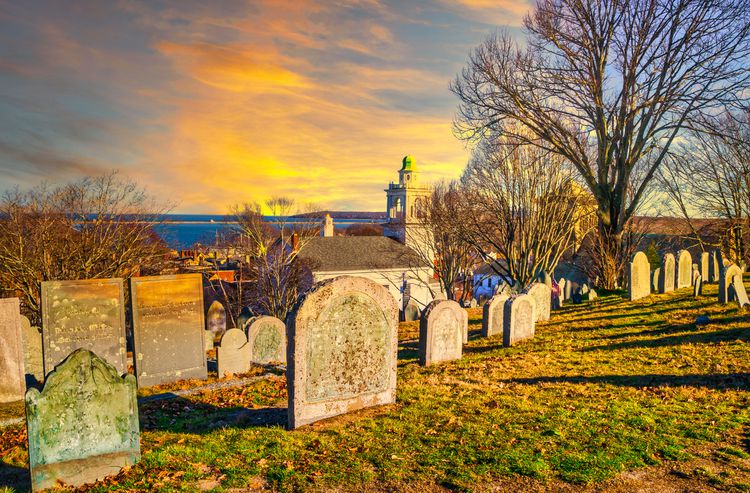
[A few years] “after Doty’s death, Faith [Doty] married John Philips on March 14, 1667 as his 2nd wife. She moved to Marshfield and died there December 21, 1675. She was buried at Winslow Cemetery in Marshfield.” (Wikipedia) (5)
The Prosperity of An Early Investor
Upon Edward Doty Sr. death, he left a considerable amount of real estate through his wheeling & dealing / negotiating / bargaining / deal making / horse-trading / and investing. These properties were then distributed amongst his heirs. The place names for several of these locations have changed over the centuries, but we have been able to investigate historical documents and records to discern the locations as diagrammed on the two maps below. Note that several of the properties are situated further away from the Plymouth Colony.
The first map shows the property known by the names of Heigh Cliffe, or High Cliff, or Skeart Hill, described as “six acres of meadow there” and “a locality still known by that name, being the extreme north of town, bordering on Kingston.” (DDFA) It has been described by researchers that he likely maintained this location as his residence throughout his life, after relocating there from the initial Watson Hill site. The inventory of his estate identifies “three score acres of upland with the meadow adjoining it” [which is 60+ acres]. So it seems that indeed, he came to own more land at High Cliff than just the first six acres with which he started.

(Image courtesy of Massachusetts Historical Society).
As we had learned in the The Doty Line, A Narrative — Two chapter, “In 1626, Edward Doty was one of twenty-seven Purchasers involved with the colony joint-stock company which afterwards was turned over to the control of senior colony members. That group [of investors] was called the “Undertakers”, and was made up initially of William Bradford, Myles Standish and Isaac Allerton, who were later joined by Edward Winslow, William Brewster, John Howland, John Alden, Thomas Prence, and four former Merchant Adventurers back in London. On the agreement, dated October 26, 1626, his surname appears as ‘Dotey’”. (Wikipedia)
Through an analysis of real estate place names, his Will, and the inventory of his estate, we have learned that Edward Doty eventually owned properties in the locations listed below on the following map.

New Plymouth
This area includes the lands known as High Cliff, and…
Clarke’s Island
Even though as a young man he was eager to set foot on this island in Plymouth Bay and was held back by other explorers on the Mayflower, ironically, he did eventually own the island.
The Dartmouth Tract
Doty had been an early investor in properties that fell to the southwest area of Plymouth. This area was eventually formalized by treaty as The Dartmouth Tract (or Old Dartmouth) in 1652, but he had been acquiring lands in that area for some years prior to that event. This area held several properties, including…
Coaksett (also known as Cohasset), and Mount’s Hill
These areas are mentioned in his Will, and are part of what became the town of Dartmouth. Of note, Mount’s Hill is where the University of Massachusetts Dartmouth is located.
Lakenham
This area was originally part of part of the hamlet of Plympton (see map above), and eventually became known first as Carver, and then North Carver.
Punckquesett (spelled as Punckquetest in his Will)
This area eventually became Tiverton, until 1676, when the border between colonies of Massachusetts Colony and Rhode Island Colony were adjusted.
Yarmouth
He was described as a large purchaser at Yarmouth, located on Cape Cod. (6)
Item: a ‘candlesticke’
The inventory of Edward Doty Sr.’s estate in November 1655, contains an entry for “6 pewter dishes and a candlesticke”, which could be the item below. (Look closely — it is hanging on a larger display pedestal). It doesn’t really look like a ‘candlesticke’ to our modern eyes, but we are writing with a description of how someone else saw it nearly 400 years ago. In any case, the Pilgrim House Museum contains this item. It is rather remarkable that it has survived through time to our era.

We wonder about the times when either Edward Sr. or Faith once lit this simple candleholder — initially, it was probably the only source of light in their home, except of course, for the fire in their hearth. How many simple things do any of us hold in our hands today, of which one of our future descendants could write about in another 4oo years?
As it is sometimes said, just as one candle can light another without diminishing — that the flame will continue on from generation-to-generation. Of the many children this family brought forth, we are descended from their son Isaac Doty and his wife Elizabeth Wood. We will be writing about their lives in the next chapter. (7)
Following are the footnotes for the Primary Source Materials,
Notes, and Observations
The Freemen of 1633
(1) — one record
Records of the Colony of New Plymouth in New England
by New Plymouth Colony; Nathaniel Bradstreet Shurtleff, David Pulsifer
https://archive.org/details/recordsofcolonyo0102newp/page/n5/mode/2up
Book page: 3, Digital pages: 24/432
Note: ‘Edward Dowty’ listed as being a Freeman
This anecdote has been transmitted from father to son…
(2) — three records
Edward Doty
https://en.wikipedia.org/wiki/Edward_Doty
Note: For the text.
History of the Town of Plymouth,
from its first settlement in 1620, to the present time
by James Thacher, circa 1835
https://archive.org/details/historyoftownofp03thac/page/330/mode/2up?view=theater
Book page: 330, Digital page: 348/424.
Note: For the Clark’s Island story.
Merchant’s House Museum
Arrival of Winthrops Company in Boston Harbor 1630
by William Formby Halsall, 1880
https://merchantshouse.org/blog/seabury-tredwell-ancestry/
Note: For the image of the painting.
The Arrival of The Francis
(3) — eight records
Pilgrim Ship Lists Early 1600’s
Over 7100 families and 290 ships
General list —
https://www.packrat-pro.com/ships/shiplist.htm
and the ship Francis —
https://www.packrat-pro.com/ships/francis.htm
Note: For the data.
Edward Doty
https://en.wikipedia.org/wiki/Edward_Doty
Note: For the text.
(DDFA)
Doty-Doten Family in America
Descendants of Edward Doty, an Emigrant by the Mayflower, 1620
by Ethan Allan Doty, 1897
https://archive.org/details/dotydotenfamilyi00doty/page/26/mode/2up
Book pages: 27-28, Digital pages: 32-34 /1048
Note: For the text about Faith Clarke’s family, her parents and her brothers, and this quote below —
“Thurston Clarke, the elder died at Duxbury, Mass., 1661. His widow died about 1663, as appears by an entry in the records 1st June, 1663. ‘The Court have ordered concerning the disposing of the estate of Faith Clarke widdow, deceased, that her daughter Faith Dotey widdow shall have a quarte pte,’ etc.”
Ipswich
https://en.wikipedia.org/wiki/Ipswich
Note: For the text.
The Armory
A Large Volume of Foxe’s Book of Martyrs 1570, by An Impartial Hand. Detailing the Burning at the Stake of the Protestant Martyrs Under Queen ‘Bloody’ Mary the 1st’s Rule, Published 1741, Formerly Part of the Richard Hoare Collection.
https://www.thelanesarmoury.co.uk/shop.php?code=19180
Note: For the excerpted illustration from Foxe’s Book of Martyrs.
(DDFA)
Doty-Doten Family in America
Descendants of Edward Doty, an Emigrant by the Mayflower, 1620
by Ethan Allan Doty, 1897
https://archive.org/details/dotydotenfamilyi00doty/page/16/mode/2up
Book pages: 17, Digital pages: 16/1048
Note: For the comment about George Clarke not being related to the Thurston Clarke family.
Ebsco
History of immigration from 1620 to 1783
https://www.ebsco.com/research-starters/history/history-immigration-1620-1783#:~:text=The%20years%201630%20to%201640,as%20the%20Massachusetts%20Bay%20Colony.
Note: For the text.
With Six Boys, and Three Girls
(4) — eighteen records
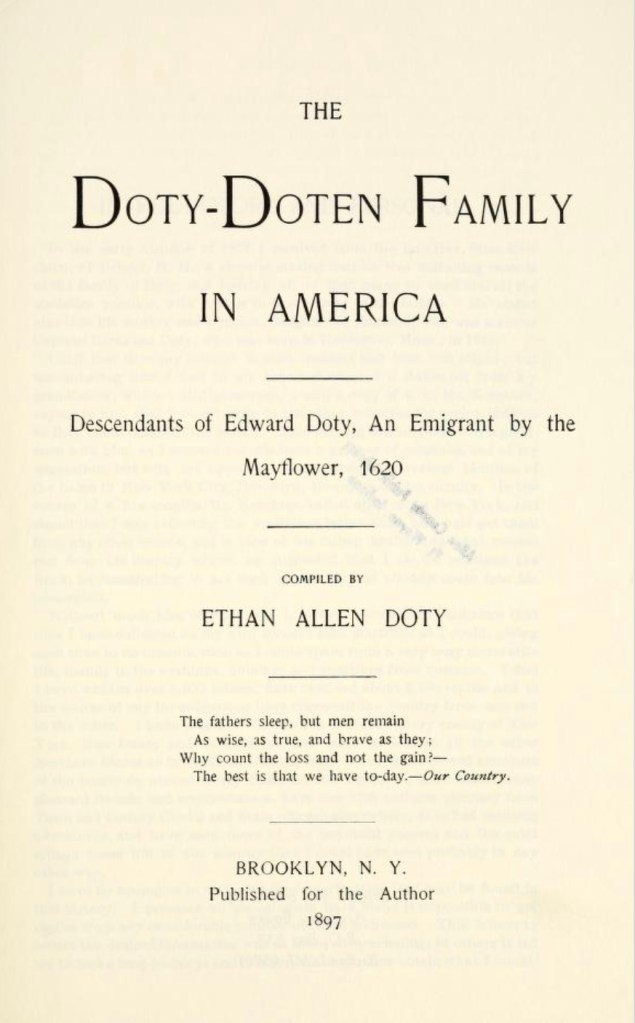
(DDFA)
Doty-Doten Family in America
Descendants of Edward Doty, an Emigrant by the Mayflower, 1620
by Ethan Allan Doty, 1897
https://archive.org/details/dotydotenfamilyi00doty/page/n5/mode/2up
Book pages: 6- 29, Digital pages: 12-34/1048
Note: For various texts as noted below:
*Indicates specific passages from the Doty-Doten book:
*Edward Doty, Jr., and Sarah Faunce
“It is related that… her death occurred 27th June, 1095.”
https://archive.org/details/dotydotenfamilyi00doty/page/30/mode/2up
Book page: 31-32, Digital page: 30/1048
Note: For the data.
Library of Congress
Handbook of Old Burial Hill, Plymouth, Massachusetts
Its history, its famous dead, and its quaint epitaphs
https://www.loc.gov/resource/gdcmassbookdig.handbookofoldbur00perki/?st=gallery
Book page: 6, Digital page: 12/86
Note: For the image of the sailing ship nears Clark’s Island.
*John Doty, and (w1) Elizabeth Cooke, (w2) Sarah Rickard
“1690, April 1. The selectmen… for her minor children.”
https://archive.org/details/dotydotenfamilyi00doty/page/142/mode/2up
Book page: 143, Digital page: 142/1048
and
Edward Doty
https://en.wikipedia.org/wiki/Edward_Doty
Note: For the information about Elizabeth Cooke’s relatives.
Thomas Doty, and Mary Churchill
Edward Doty
https://en.wikipedia.org/wiki/Edward_Doty
Note: For Mary Churchill’s admission about Thomas Doty.
and
Plymouth Colony, Its History & People, 1620-1691
by Eugene Aubrey Stratton
https://archive.org/details/plymouthcolonyit0000stra/mode/2up
Note: The Wikipedia link lists the relevant page as 194.
Puritans Going To Church,
Mezzotint after George Henry Boughton, circa 1884.
https://commons.wikimedia.org/wiki/File:Puritans_going_to_church)_-_G.H._Boughton_%2784_LCCN2006678318.jpg
and
https://www.pinterest.com/pin/529102656205618784/
Note: For the image.
*Samuel Doty, and Jeane Harmon
“He was the ancestor of … pioneers to the West and the South.”
https://archive.org/details/dotydotenfamilyi00doty/page/276/mode/2up
Book page: 276, Digital page: 282/1048
Note: For the text.
*Desire (Doty) Sherman Holmes Standish
“She was a remarkable woman… a long and varied experience.”
https://archive.org/details/dotydotenfamilyi00doty/page/492/mode/2up
Book page: 492, Digital page: 492/1048
Note: For the text.
Re: William Sherman and ‘insanity’
The following two passages describe some of the likely circumstances which contributed to William Sherman’s being described as having died from insanity. It is possible that perhaps he had a form of what we refer to today as post-traumatic stress disorder (PTSD). https://archive.org/details/dotydotenfamilyi00doty/page/490/mode/2up. (Please note the word choices are those of the original author).
“Desire Doty and her husband, William Sherman, lived at Marshfield. He was an extensive farmer there and an active man, and when the great Indian War, known as King Philip’s War, broke out in 1675, he, with most of the other able bodied men of the town, shouldered his musket and went to the front. The war proved in many respects a very severe one. The border settlements, which had now begun to be established at favorable points in the interior, as far as Springfield, were attacked, captured, burned and the settlers massacred. It taxed the utmost resources of the colony to cope with it, and it was not until some six hundred lives had been lost, twelve or thirteen towns had been destroyed and the colony had expended the immense sum of $500,000 that King Philip, the Indian chief, was tracked to his lair at Narragansett in the latter part of 1676 and killed”.

“In atrocities by the Indians on the defenseless settlers and on prisoners, this war was unquestionably a most harrowing experience for the colonists and William Sherman, by reason of the exposures and hardships, and witnessing the cruelties of that campaign, was subject after his return to periods of insanity during the balance of his life. In consideration of his affliction the colony, in 1675, granted him relief. And it has been noted before that, in 1677, after the death of Mrs. Faith Phillips, that thirty shillings of her estate by the consent of her sons, was to be divided in equal proportions between her daughters, Desire Sherman, Elizabeth Rouse and Mary Doten, unless the two younger sisters shall see reason, in respect of the low condition of the eldest, to consider her in that respect.”
Postcard MA Governor Winslow House Marshfield
from Picture Rock Treasures
https://www.ebay.com/itm/235827821669
Note: for the 1930 postcard image of the Governor Winslow House in Marshfield, Massachusetts
Elizabeth Doty
https://www.ancestry.com/family-tree/person/tree/1409952/person/418525322/facts
Note: For the three children of Elizabeth (Doty) Rouse.
*Joseph Doty, and (w1) Elizabeth Warren, (w2) Deborah Hatch, w3) Sarah Edwards
https://archive.org/details/dotydotenfamilyi00doty/page/626/mode/2up
“He was thus, at the death of his father… occupation than that of farmer.”
Book page: 626, Digital page: 626/1048
Note: For the text.
Mary Hatch
in the U.S., New England Marriages Prior to 1700
https://www.ancestry.com/search/collections/3824/records/152808?tid=&pid=&queryId=a87de511-8463-4be3-9006-5c96cb3e99c1&_phsrc=sWy4&_phstart=successSource
Note: For the reference on her husband.
Map image of southwestern Plymouth County
courtesy of the Mattapoisett Museum
https://www.mattapoisettmuseum.org
Note: For the map image.
Know All Men To Whom It May Concern
(5) — three records
Caleb Johnson’s Mayflower History.com
Will of Edward Doty
https://mayflowerhistory.com/will-of-edward-doty
Note: For the text.
(DDFA)
Doty-Doten Family in America
Descendants of Edward Doty, an Emigrant by the Mayflower, 1620
by Ethan Allan Doty, 1897
https://archive.org/details/dotydotenfamilyi00doty/page/22/mode/2up
Book page: 23/1035, Digital page: 22/1048
Note: For Edward Doty Sr.’s Will
Trip Savvy
The Top Things to Do in Plymouth, Massachusetts
by Rich Warren
https://www.tripsavvy.com/top-things-to-do-in-plymouth-massachusetts-5077597
Note: For the text and photograph.
The Prosperity of An Early Investor
(6) — five records
(DDFA)
Doty-Doten Family in America
Descendants of Edward Doty, an Emigrant by the Mayflower, 1620
by Ethan Allan Doty, 1897
https://archive.org/details/dotydotenfamilyi00doty/page/18/mode/2up
Book pages: 18-24, Digital pages: 18-26/1048
Note: For the descriptions of his lands at High Cliff, and other properties
Massachusetts Historical Society
Doten’s Cliff
Manuscript map of Plymouth harbor, circa 1795
https://www.masshist.org/database/viewer.php?item_id=1711
and for detail:
https://www.masshist.org/database/viewer.php?item_id=1711&mode=zoomify&img_step=1&
Note: This early map shows the location for the High Cliff property.
Old Dartmouth
https://en.wikipedia.org/wiki/Old_Dartmouth
Note: For the land purchase information.
Library of Congress
A new and accurate map of the colony of Massachusets [i.e. Massachusetts] Bay,
in North America, from a late survey.
by John Hinton, 1781
https://www.loc.gov/resource/g3760.ar088100/?r=-0.402,-0.067,1.841,0.917,0
Note: Published in London in 1780.
Item: a ‘candlesticke’
(7) — three records
Pilgrim Edward Doty Society
Edward Doty & Kin
https://www.edwarddoty.org/edward-doty-kin/
Note: For the oil lamp image.
Mayflower House Museum
https://en.wikipedia.org/wiki/Mayflower_House_Museum
and
Mayflower Society
https://en.wikipedia.org/wiki/Mayflower_Society
Note: For the text and photograph.

 Our Ancestors, Our Narratives
_-_G.H._Boughton_%2784_LCCN2006678318.jpg)
