This is Chapter One of nine. We hope that you have taken the time to read the opening chapters we wrote based on the lives of The Pilgrims. It will help to make these The Doty Line chapters more accessible.
As the authors of this family history genealogy blog, we are in the 12th generation of Doty descendants in America. Pilgrim Edward Doty and his wife Faith (Clarke) Doty Phillips are our 9x Great Grandparents. He was one of our two Mayflower ancestors, with the other being Pilgrim George Soule whose family line is profiled in The Soule Line’s seven chapters.
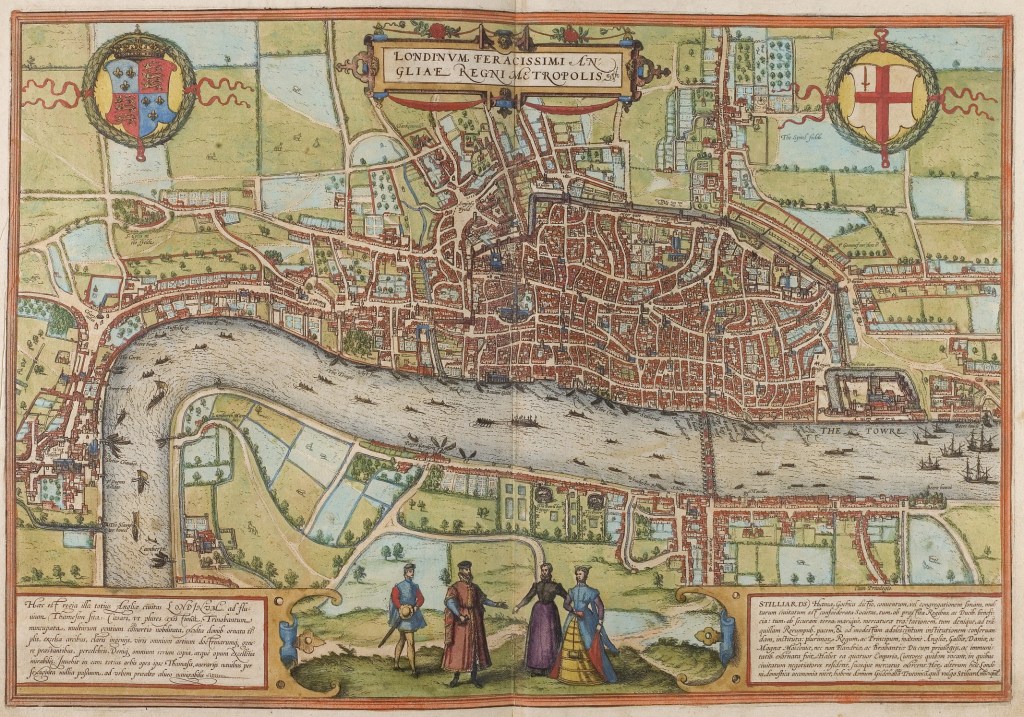
by Georg Braun and Frans Hogenberg in Civitates Orbis Terrarum.
(Image courtesy of Wikipedia).
A Man “of London”
Unfortunately, no one has been able to discern specifically the early origins for our 9x Great Grandfather Pilgrim Edward Doty. We wished to uncover more, but for now, until more credible evidence turns up, we must settle for the 20,000 foot view as to where he came from. One of these fine days, someone, somewhere, perhaps an observant researcher — will discover a clue that will reveal his true origins. For us, his name first comes up first in connection with the voyage of the Mayflower.
It’s 1620. He is sailing westward to the new colonies in North America, and for a few years, he is an indentured servant to the Stephen Hopkins family. This means that he was responsible for contributing to the success of the Hopkins family for a period of time, and until he had achieved the age of 25 years, he could not be released from this condition. Edward Leister, his fellow indentured traveler with the Hopkins family, was of the same status.
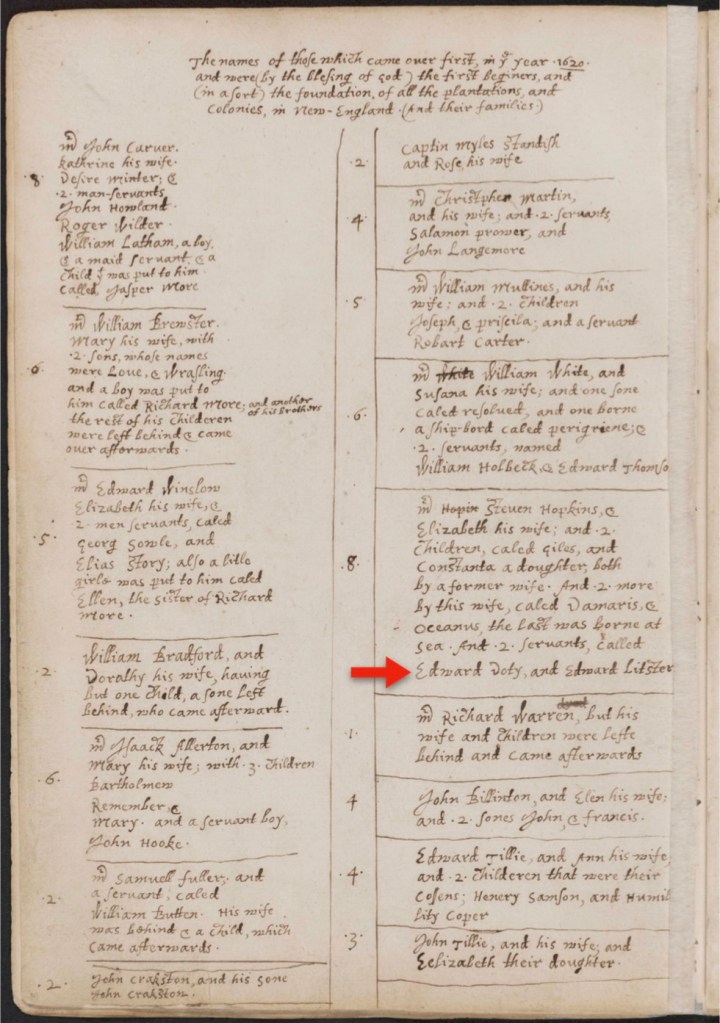
He is then briefly mentioned in a pamphlet titled Mourt’s Relation, written by Thomas Winslow of the New Plymouth Colony, with contributions from William Bradford. This booklet eventually gained great fame.
From the website Voyaging Through History —
The manuscript was carried out of New Plymouth by Robert Cushman, Chief Agent in London for the settlers, on board the Fortune in 1621. When Mourt’s Relation was sold in John Bellamy’s London bookshop in the 1620s its readers could have scarcely imagined this would become one of the most well-known texts in American history… Perhaps the most significant feature of Mourt’s Relation is its inclusion of ‘The Mayflower Compact’: the first governing document of Plymouth Colony. Signed on November 21, 1620 (prior to landing), the text gave a legal framework of government to the eventual settlement… Over time the Mayflower Compact has become revered as an antecedent to the American Constitution.
Something else we were able to see within Mourt’s Relation, is this text below. This is the only reference yet where we have found any indication for his origin before the Mayflower sailed.
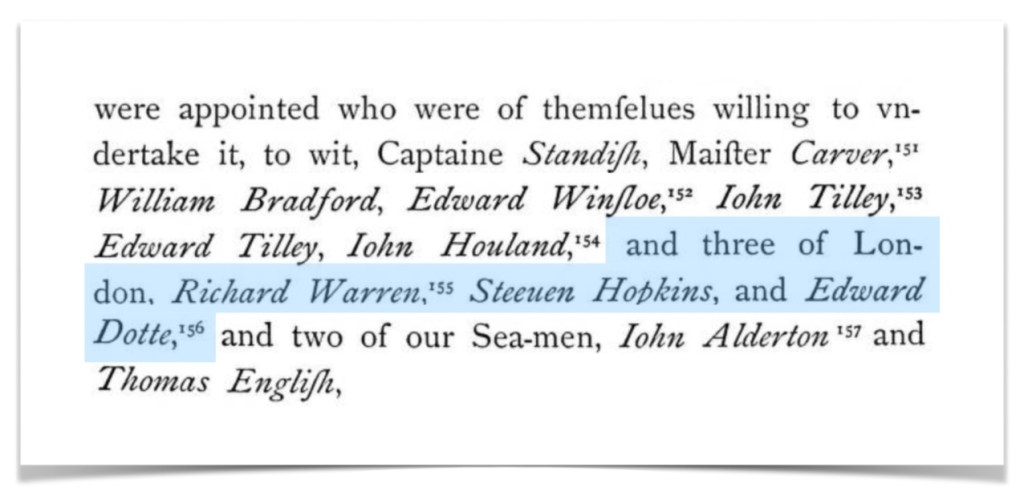
In this pamphlet, Edward’s name is mentioned as being of London next to the name of the man he was indentured to, “Steeuen Hopkins”, (Stephen Hopkins). For more about what Indentured Servitude was, please see our chapters on The Pilgrims — specifically the chapter: The Pilgrims — A Mayflower Voyage.
A note about name spellings:
Historical sources vary much in how these names are spelled. Stephen Hopkins’s first name is written as Steven, Stephen, or Steeuen in original documents. [We are using Stephen for our text]. Edward Doty’s surname has several spellings in original documents, including: Doty, Dotte, Doten, Dotten, Dotey, Dowty, and Dolton. [Whew! We are using Doty for our text].
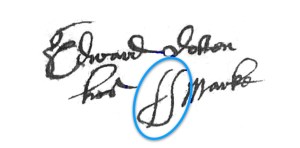
Most importantly, we know that Edward Doty was one the people who ‘signed’ The Mayflower Compact. However, the names of the signatories to the document were not published for many years out of the fear of reprisals from the British Monarchy. In any case, we know that Edward could not write his name:
“One is that no copy of the original [Mayflower Compact] document survives. Therefore, unfortunately we can’t see his signature. But considering he signed other legal documents, including his Will, with ‘his mark,’ he appears not to have learned how to write and we wouldn’t see much in the way of a signature anyway. Nevertheless, all accounts of the document give him credit for being among the 41 men who signed the pact.” (AFHB – A Family History Blog, see footnotes). (1)
Being thus arrived in a good harbor…
Only one primary source account exists which describes the events while the Mayflower was at sea. It was written by Plymouth Colony Governor William Bradford in his History of Plymouth Plantation. It concludes with this dramatic passage:
Being thus arrived in a good harbor and brought safe to land, they fell upon their knees and blessed the God of heaven, who had brought them over the vast and furious ocean, and delivered them from all the perils and miseries thereof, again to set their feet on the firm and stable earth, their proper element. And no marvel if they were thus joyful, seeing wise Seneca was so affected with sailing a few miles on the coast of his own Italy; as he affirmed, that he had rather remain twenty years on his way by land, then pass by sea to any place in a short time; so tedious and dreadful was the same unto him.
When Edward Doty and Edward Leister arrived with the Hopkins family in Plymouth Harbor, there were no truly accurate maps of the area, but that was soon to change. The 1623 map below shows the location of the Plymouth Colony, along with other (new) local names. The nearby Native People populations are also indicated. (2)

of early New England, including most of the settlements that began in 1623.
(Image courtesy of the Internet Archive).
So, Who Was Stephen Hopkins?
He was a man of many accomplishments. Wikipedia sums it up best when they describe him: “Steven Hopkins (fl. 1579 – d. 1644) was an English adventurer to the Virginia Colony and Plymouth Colony. Most notably, he was a passenger on the Mayflower in 1620, one of 41 signatories of the Mayflower Compact, and an assistant to the governor of Plymouth Colony through 1636. He worked as a tanner and merchant and was recruited by the Company of Merchant Adventurers of London to provide the governance for the colony and to assist with the colony’s ventures.

He was also the only Mayflower passenger with prior New World experience, having been shipwrecked [from the ship Sea Venture] in Bermuda in 1609 en route to Jamestown, Virginia. Hopkins left Jamestown in 1614 and returned to England. Hopkins traveled to New England in 1620 and died there in 1644.” (Wikipedia)
It is interesting to note that that he spent five years in Jamestown, Virginia after being shipwrecked. He was there for so long that his first wife Mary (who was living in England with their three children) died, leaving the children without a parent present. This could be one reason why he returned to England, where he married his second wife Elizabeth, who came with him on the Mayflower. For more information on the disastrous Jamestown Colony, please see our chapter, The Pilgrims — Colonial Pursuits.

(Image courtesy of Wikimedia Commons).
During his tenure in Bermuda (long story short), he was accused of treason and nearly beheaded. It is thought by scholars that the character of ‘Stephano’ in William Shakespeare’s The Tempest is based upon Stephen Hopkins’s experiences in Bermuda. (The play was first performed in November 1611). (3)
Living With The Hopkins Family in the Plimoth Plantation
The entire Hopkins family and their two indentured servants survived the first terrible winter, which is rather remarkable since so many other of their fellow travelers had passed away. What was it like for the indentured servants Edward Doty and Edward Leister to be living in the Stephen Hopkins home? Likely very crowded.
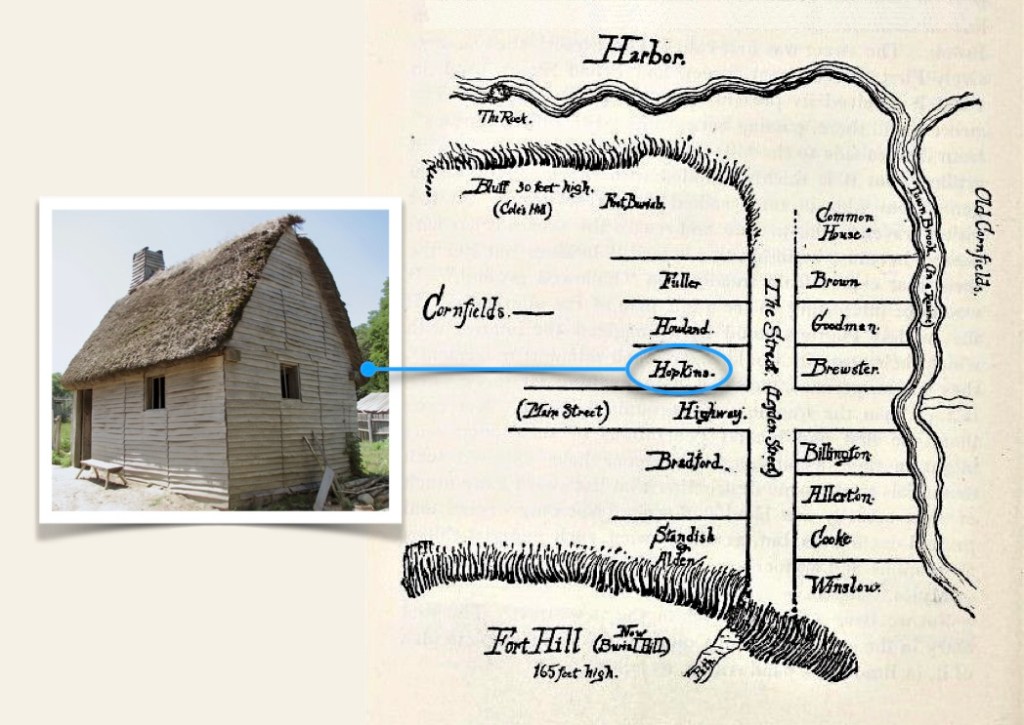
“The Mayflower Quarterly of December 2011, in an article on Plymouth-area taverns, has a paragraph on Stephen Hopkins, who kept an ‘ordinary’ (tavern) in Plymouth on the north side of Leyden Street from the earliest days of the colony.
The article defines a 17th-century ‘ordinary’ as a term for a tavern where set mealtimes and prices were offered. Terms such as ‘inn, alehouse and tavern’ were used interchangeably with ‘ordinary’ in early Plymouth records. Hopkins kept this tavern from the early colony days until his death in 1644. In the early 1600s he had also had an alehouse in Hampshire with his wife Mary and his mother-in-law Joan, which they maintained after he left for America in 1609.
Hopkins apparently had problems with the Court over his tavern. Plymouth records indicate that Hopkins let ‘men drink in his house upon the Lords day’, ‘for suffering servants and others to sit drinking in his house’ (contrary to Court orders), also to play games ‘& such like misdemeanors, is therefore fined fourty shillings.’ In addition, the Court had several charges against him ‘for selling wine, beere, strong waters, and nutmeggs at excessiue rates, is fined.’” (Wikipedia) (4)
Now that we have arrived in the new Plymouth Colony, the next chapters will narrate how the Doty Family grew, how they developed and changed, and what Life brought them during the subsequent generations.
Following are the footnotes for the Primary Source Materials,
Notes, and Observations
A Man “of London”
(1) — six records
Tudor London
https://en.wikipedia.org/wiki/Tudor_London
Note: For the 1561 “Civitates Orbis Terrarum” map image.
State Library of Massachusetts Digital Collections
Of Plimoth Plantation: manuscript, 1630-1650
https://archives.lib.state.ma.us/items/db0e9f79-477c-4a4c-979b-359c2be1d4ad
The actual page 530 is here:
https://archives.lib.state.ma.us/server/api/core/bitstreams/4d69e338-cc1b-4eda-b2ff-57bfbbb5c6ed/content
Note 1: For the original document on which Edward Doty is listed as a passenger on the Mayflower.
Note 2: The document is digitized and available as a .pdf download at the above link, file name: ocn137336369-Of-Plimoth-Plantation.pdf
Digital page: 530/546. First page, right column at center, with the Steven (Stephen) Hopkins family.
Voyaging Through History, the Mayflower and Britain
Mourt’s Relation (1622)
https://voyagingthroughhistory.exeter.ac.uk/2020/08/25/mourts-relation-1622/
Note: For the text.
Mourt’s Relation or Journal of The Plantation at Plymouth
by William Bradford, 1590-1657; Edward Winslow, 1595-1655;
(and Henry Martyn Dexter, 1821-1890)
https://archive.org/details/cu31924028815079/mode/2up
Digital pages: 100-102/242, Book pages: 43-45/176
Note: This edition is circa 1865.
(AFHB)
A Family History Blog
Signer of the Mayflower Compact
by Jamie
https://genealogy.thundermoon.us/blog/2020/09/26/signer-of-the-mayflower-compact/
Note 1: For the text, and the double flourish signature of Edward Doty.
Note 2: Jamie, the author of A Family History Blog, is another cousin. He is a descendant of Edward Doty’s son Isaac and his wife Elizabeth (England), as we are also. Hi cousin!
Being thus arrived in a good harbor…
(2) — two records
Mayflower
by Rootsweb Author, kee46@msn.com
https://homepages.rootsweb.com/~ahopkins/cushman/mayflowe.htm
Note: For the text.
Three Visitors to Early Plymouth
by Sydney V. James, Samuel Eliot Morison, Isaack de Rasieres; John Pory; Emmanuel Altham
https://archive.org/details/plymtuxet005/plymtuxet005_epub/
Digital page: 2/133
Note: For the map image.
So, Who Was Stephen Hopkins?
(3) — three records
Stephen Hopkins (pilgrim)
https://en.wikipedia.org/wiki/Stephen_Hopkins_(pilgrim)
Note: For the data.
The Bermudian.com (magazine)
The Wreck of the Sea Venture: The Untold Story
by Gavin Shorto
https://www.thebermudian.com/history/history-history/the-wreck-oftheseaventure-the-untold-story/
Notes: For the antique map image of the island of Bermuda, and the wreck of the Sea Venture ship painting.
The Tempest
https://en.wikipedia.org/wiki/The_Tempest
Note: For the folio image.
Living With The Hopkins Family in the Plimoth Plantation
(4) — three records
Stephen Hopkins’ House, Plimoth Plantation
https://www.worldhistory.org/image/13127/stephen-hopkins-house-plimoth-plantation/
Note: For the replica house photograph,
stephen-hopkins-house-plimoth-plantation-13127.jpg
The Pilgrim Republic : an historical review of the colony of New Plymouth, with sketches of the rise of other New England settlements, the history of Congregationalism, and the creeds of the period
by John Abbot Goodwin, 1824-1884
https://archive.org/details/pilgrimrepublic01goodgoog/page/106/mode/2up
Book page: 106, Digital page: 159/722
Note: For the plan image of early Plymouth.
Stephen Hopkins (pilgrim)
https://en.wikipedia.org/wiki/Stephen_Hopkins_(pilgrim)
Note: As cited in the article (footnote 17) —
Suitably Provided and Accommodated: Plymouth Area Taverns
by Stephen C. O’Neill
The Mayflower Quarterly (Plymouth, MA: The General Society of Mayflower Descendants), December 2011, vol. 77, no. 4, pp. 335, 336

 Our Ancestors, Our Narratives