This is Chapter 2 of 3, being the continuation of the history for this branch of the family. Here we delve into the emergence of our families into Minas Gerais, Bahia, and Paraíba and states in Brazil. As a reminder — in total, there are 6 chapters: the first set of 3 chapters is written in English; the second set of 3 chapters is translated into Portuguese.

Mr. Peabody and Sherman
A common lament among those people who do genealogy research should be — “Sherman, set the Wayback Machine to…”
This chapter of the Coutinho / Oliveira family history is the one where we wish that through some sort of magic, we had access to Mr. Peabody and Sherman’s Wayback Machine. (because > research reasons)
The records for the Coutinho and Oliveira families line are very scarce. In fact, we are only able to trace the line back for a few generations. In Brazil during this period, record-keeping did not appear to be very important unless you were a person of very high status. In fact, most records seem to have been kept by the Church, rather than the government. Thus, we are fortunate to have found what we have so far.
Also, it is more probable that many records may have not yet found their way to online databases. So, our fingers are crossed that his happens soon, since we will continue to research this family line.
Finally, as we wrote about in Chapter One, when we were documenting family heraldry in Portugal, there is a concurrence where both of the names Azeredo and Azevêdo are used on records we have located. These surnames are the same families, and this variance is mostly due to who was recording the information. This is a pattern seen in the normal variation of record-keeping, which began in a preliterate world, and has continued on into the 20th century. (1)

Ah Bahia!
This is where Portuguese Brazil began — at Porto Seguro, Bahia, circa 1500.
Most people do not understand the scale of the country of Brazil. It is the 5th largest country in the world, and has 26 states. The state of Bahia, where most of this family history takes place, has an area slightly larger than France, or similarly, Spain. Several of the smaller European countries could easily fit inside with some room to spare. The point is this — the distances are actually quite vast — and may not be understood by just referring to the map below.
The history of the Coutinho and Oliveira families takes place mostly within a triangle demarcated by the towns of Lençóis, Ilhéus, and the city of Salvador da Bahia. (2)
The de Azevedos Family Arrives in Brazil From Portugal
Let’s step back in time and take a look at how our branch of the de Azevedo family arrived in Brazil, and how they eventually connect with the Coutinho family. We wonder if any of them ever knew (?) of the old alliance of their ancient Noble Families, the House of Azerêdo – Coutinho.

Brasão de Manoel de Azeredo Coutinho Messeder, Fidalgo Cavaleiro,
from the Collection of The Brazilian National Archives, circa 1855.
(Image courtesy of Wikimedia Commons).
The de Azevedos have been traced back to before 1740 in Portugal. From that generation, we have only the name of Domingos Gomes de Azevêdo da Costa. It is believed that he came to Brazil as the original forefather, sometime in the early decades of the 1700s. As the map below clearly shows, this is how many people pictured Brazil in that early century. Notice how it was natural for immigrants to settle along the coastlines, due to the fact that travel via ship(s) was the only way to get around a vast territory.
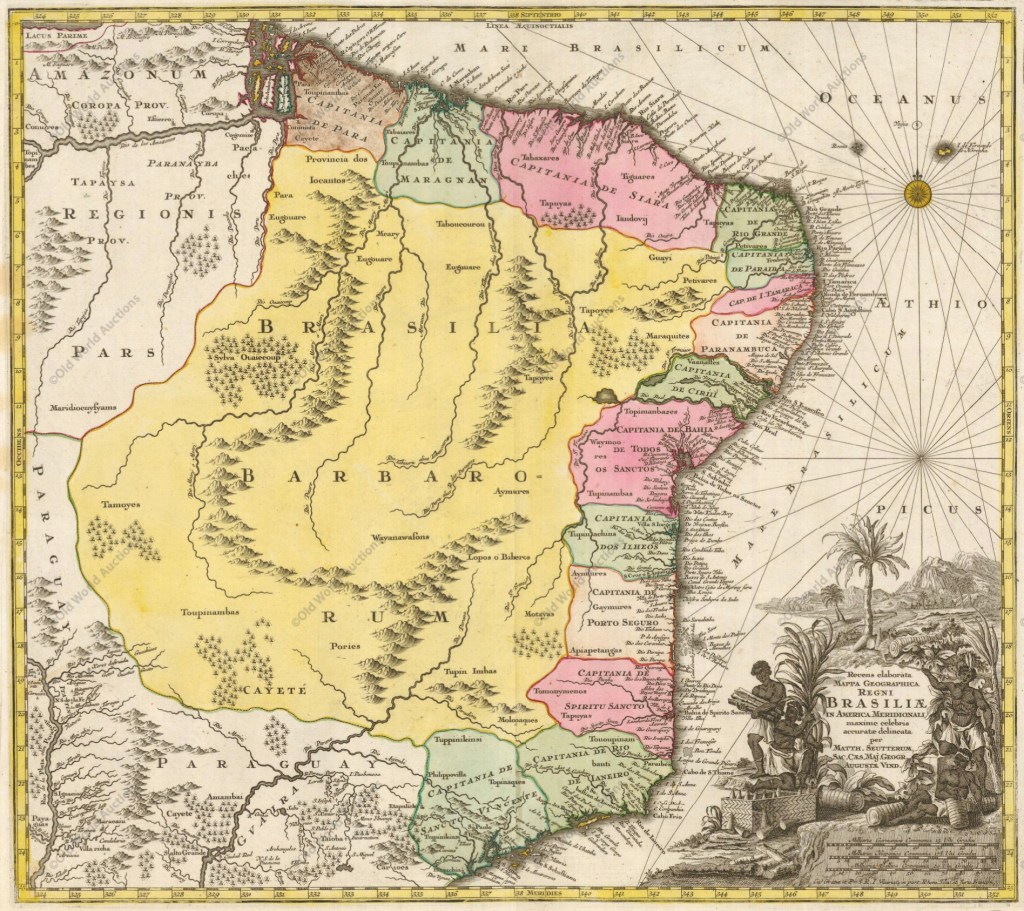
by Matthias Seutter, circa 1740. (Image courtesy of Old World Auctions).
We know that the son of the original forefather in Brazil was his (same-named) son: Domingos Gomes de Azevêdo, who was born 1740 in Diamantina, Minas Gerais, Brazil — died October 2, 1831. He married Ana Joaquina Sofia de Jesus. She was born in 1762, in Caetité, Bahia, Brazil. He is frequently recorded in documents as Captain Domingos Gomes de Azevêdo, and also as Domingos Gomes da Costa. His wife adopted the surname de Azevêdo instead of de Jesus, passing it on to her ten children.
Family Search has the following biography on him —
“The illustrious Commander Domingos Gomes de Azevêdo was responsible for the creation of the settlement in the District of Paz do Gentio, in the municipality of Guanambi, Bahia, [near Caetité]. He was born in the state of Minas Gerais, most likely in the Caetité region, in 1740. During the persecutions following the failure of the Minas Conspiracy, of which he was a part — with his entire family, belongings, associates, and friends, they fled from this defeat to Bahia. The Gomes de Azevêdo family arrived in the city of Caetité in the late last quarter of 1700 (meaning between 1775 and 1792), coming from the settlement of Tijuco (in Diamantina, Minas Gerais). Domingos Gomes de Azevêdo died in the city of Caetité on October 2, 1831.” (3)

The Inconfidência Mineira (or The Minas Gerais Conspiracy)
This historical event “…was an unsuccessful separatist movement in Colonial Brazil in 1789. It was the result of a confluence of external and internal causes. The external inspiration was the independence of [the] thirteen British colonies in North America following the American Revolutionary War, a development that impressed the intellectual elite of many — particularly the captaincy of Minas Gerais.
The main internal cause of the conspiracy was the decline of gold mining in that captaincy. As gold became less plentiful, the region’s gold miners faced increasing difficulties in fulfilling tax obligations to the Portuguese crown (the tax over gold was one-fifth). When the captaincy could not satisfy the royal demand for gold, it was burdened with an additional tax on gold, called derrama.
The leader of the conspiracy plot was Joaquim José da Silva Xavier, also known as Tiradentes. When the plot was uncovered by authorities, Tiradentes was arrested, tried and publicly hanged. [And then drawn and quartered!] The anniversary of his death is celebrated as a national holiday in Brazil.” (Wikipedia) (4)
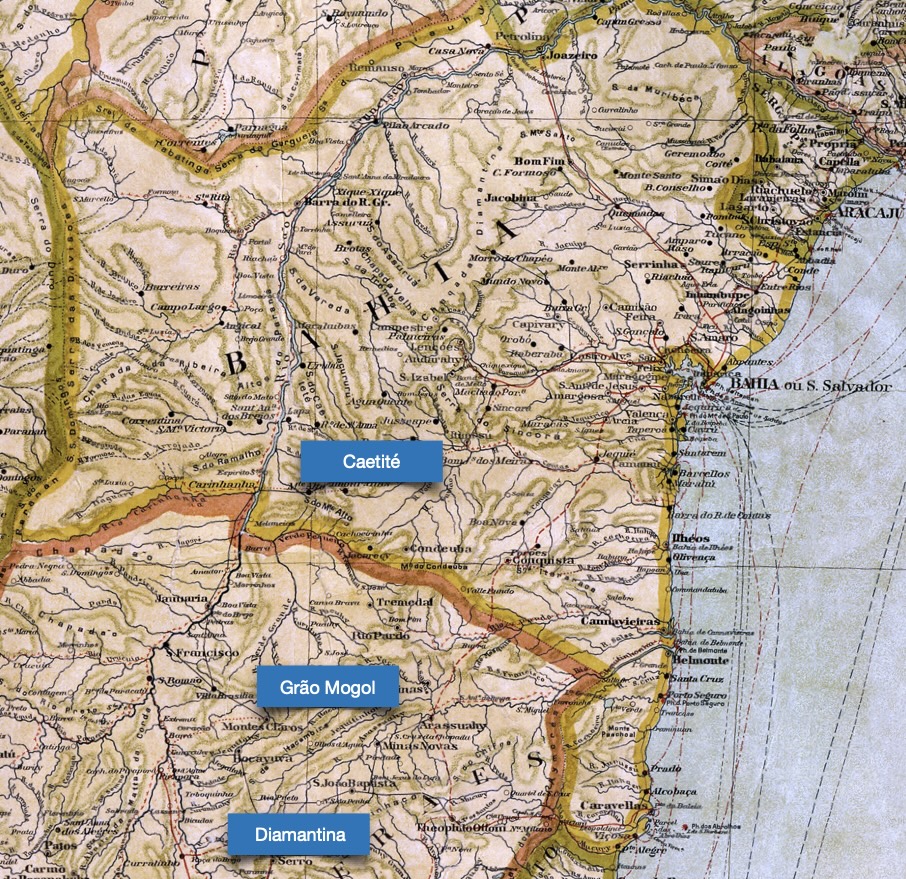
These Place Names Are Tongue Twisters!
The place names of towns and villages are a word salad, being derived from both the languages of various Native Peoples and the immigrant Portuguese.
Returning to the Domingos Gomes de Azevêdo family history, from Family Search, “According to studies and documents found in the archives of Itacambira, Minas Gerais, near Grão-Mogol, he resided at Sítio Bananal, in Itacambira. His son Joaquim was baptized in the church of Itacambira, thus leaving Itacambira for Ceraima, near Caetité and Guanambi.”

the Santo Antônio Church of Itacambira, Minas Gerais. (Family Search)
Thus, Domingos’s son Joaquim Venâncio Gomes de Azevêdo carries the line forward for another generation. He was born in 1797, and christened at Santo Antônio de Itacambira, Grão Mogol, Minas Gerais on July 7, 1797. He died October 25, 1844 in Caetité, Bahia and is buried at the Matriz de Sant’Anna Church, in Caetité, Bahia. His wife is named Maria Rosa de Azevêdo, but there is no further information on her. Joaquim was known as the Intendente de Caetité [the Mayor of Caetité ] from 1838, until his death in 1844. They had 12 children.

Joaquim and Maria Rosa’s son, José Venâncio Gomes de Azevêdo continues the history. He was likely born in Caetité , circa — died in 1874, in Lençóis, Bahia. He married Virginia Josefina Gomes de Azevêdo, born circa 1818 — died Date unknown, both likely in Caetité, Bahia.
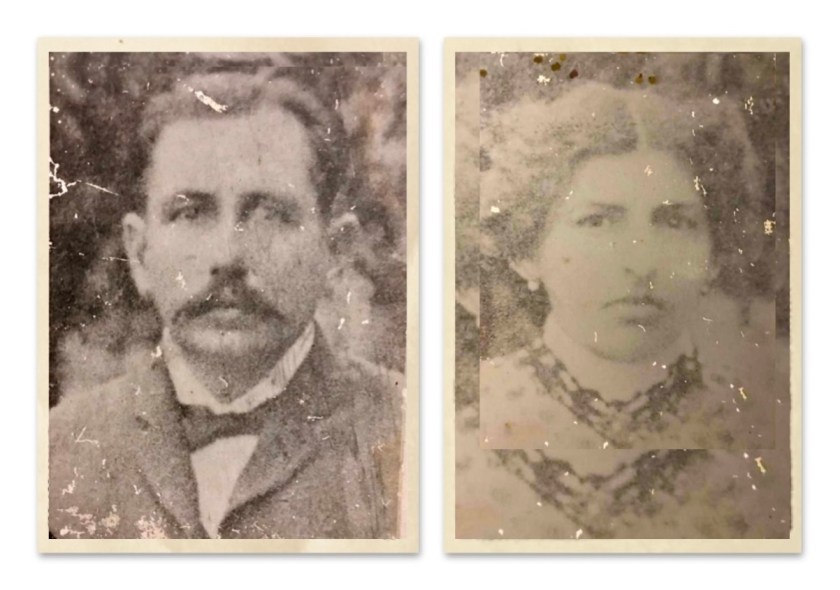
(Family photographs).
They had 11 children, one of whom is:
José Venâncio Gomes de Azevêdo, born August 4, 1861* — died May 7, 1916, both events in Lençóis, Bahia. He married Laura Angelica Viveiros de Azevêdo on February 3, 1889. She was born on December 17, 1869 in Mucugê, Bahia — died August 7, 1939, Salvador, Bahia. She is buried in the Cemiterio do Campo Santo. He is recorded as being a Colonel Commandant of the 442nd Infantry Battalion.
*One month after they married, the newlyweds did a Civil Registration (Certidāo da Casamento) of their marriage on March 2, 1889. He stated that he was 27 years old and she was 19 years old at the time of their wedding.
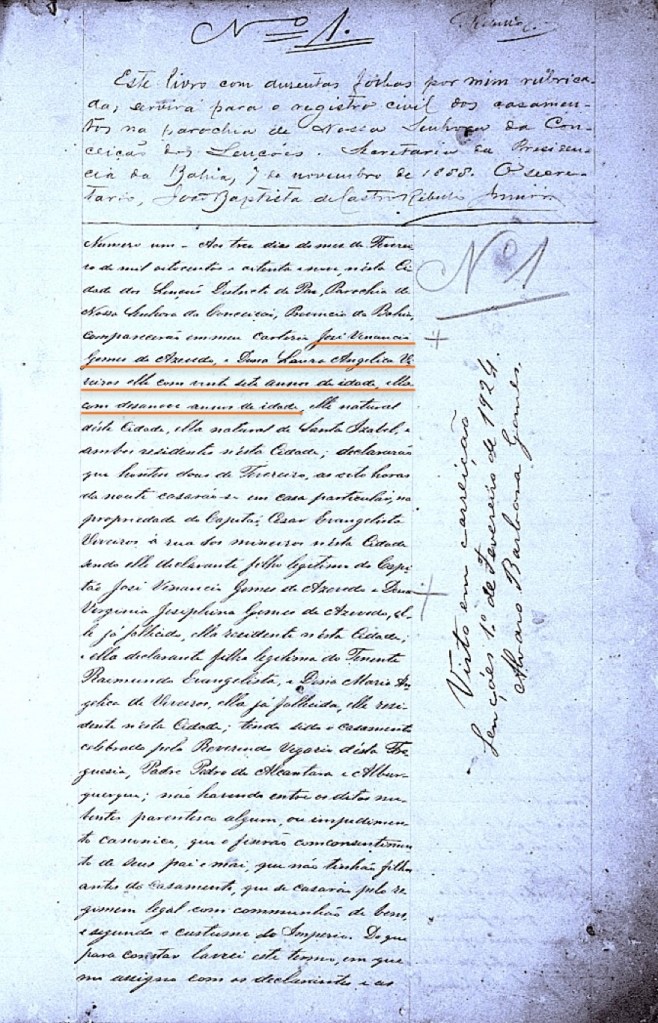
Family Search has this note attached to the records of Laura Angelica Viveiros de Azevêdo, “She was a devout Catholic and lived in the city of Lençois, Bahia, where she had 14 children, one of whom died at a young age. In honor of her 13 living children, she celebrated with a party and Mass at her home, where she had an altar devoted to Saint Anthony, a tradition that came from her family in the Azores, Santo Antônio da Costa Delgada, Portugal. Thus, each year, one of her 13 children was honored at the feast of devotion to the aforementioned Saint Anthony.” At this point in time, our resources account for 15 children.
Of their large number of children, one daughter, Guiomar Viveiros de Azevêdo, is the Grandmother of my husband, (who is coincidentally also named Leandro, after his Grandfather). This Grandparents history is written about in the section below titled, Getting to Know the Leandro and Guiomar Coutinho Family of Lençóis. (5)
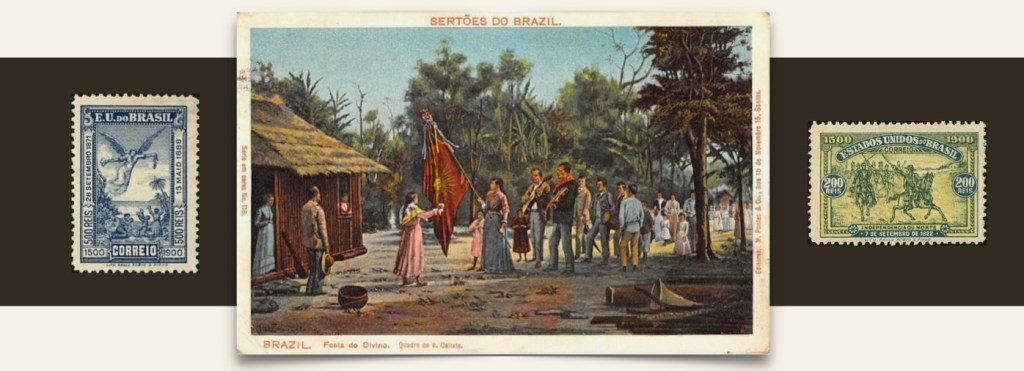
Diamonds In The Rough
The Lençóis Diamond Cycle
The first records we know of for this family take us to the town of Lençóis, located in a central section of Bahia, known as the gateway to the Chapada Diamantina National Park. “The town was founded when diamond deposits were discovered in [the nearby settlement of] Mucugê in the mid-19th century. At that time, adventurers arrived in large numbers and set up tents that, from a distance, looked like stretched sheets, giving the town its name. This origin of the name reflects the aesthetics of the place and is inextricably linked to the history of the town and its development during the Diamond Cycle.”

Derived from: The Diamond Trail: An Account of Travel Among the Little Known
Bahian Diamond Fields of Brazil, by Hugh Pearson, 1926. Note that Salvador (labeled as Bahia), is very far to the east, on the right side of the map. (Courtesy of the Internet Archive).
Lençóis was the richest town in the Chapada during the Diamond Cycle. A French Consulate was even established there to facilitate the export of the precious stones. However, when the deposits were exhausted, Lençóis fell into decadence, surviving on the extraction of carbonates [salts] and having to put up with the excesses of the colonels, who provoked major conflicts in the region. The most famous of these was Colonel Horácio de Mattos*, who had great political influence, including with the Federal Government.” (Text derived from, History and Tourist Attractions of Lençóis in Chapada Diamantina)
*See ‘The Problem With The ‘Coronelismo’ below.
The world had seen fevers like this before… In 1849, the discovery of gold at Sutter’s Mill in California gave birth to the famous California Gold Rush, an event which forever changed the history of the American West. As we learned about Lençóis, the same phenomenon happened in nearby Andaraí, Bahia and this family was right in the middle of it.

Andaraí is also in the aptly named Chapada Diamantina (loosely translated as the Plateau of Diamonds), just south of Lençóis. “The discovery of diamond deposits in Andaraí occurred in 1845 or 1846, (and) …as a result, a large number of people eager for the mineral arrived in the region,” — just like the California Gold Rush. “The settlement of Andaraí was formed in the best-known, most active and highest quality mining area in the region, which grew and with it, commerce and processing industries arrived. After the end of the Diamond Cycle, the Andaraí economy became based on coffee cultivation and small-scale mining.” (Wikipedia) (6)
Alfredo Viero de Azevêdo Coutinho and His Families
Alfredo Viero De Azevêdo Coutinho, born May 2, 1854, in Andaraí, Bahia — died March 31, 1941 in Palmeiras, Bahia. He married Carolina Athahydes* (or Ataide) de Molina, the exact date is unknown because we do not have a marriage record. However, we believe that they probably married circa 1880, and that he was about ten or fifteen years older than her. Alfredo and Carolina are the Great-Grandparents of the present generation.
*We have seen many, many spelling variations on her name.
Carolina was likely born in the late 1860s, and it is reported that she died in 1898. Her name is recorded on various civil records in Lençóis until several years after her death. Through diligent research, we have been able to ascertain that Alfredo and Carolina had at least four children together (and probably more), all likely born in Lençóis, Bahia.
- Leandro de Azevêdo Coutinho, born April 15, 1883 in Lençóis — died August 6, 1965 in Salvador.
(Leandro carries the family line forward. See his spouses and children below). - Ana de Azevêdo Coutinho, born circa 1887 — died date unknown — circa 1911 — May 25, 1937*.
- Manoel de Azevêdo Coutinho, born circa July 1890 — died January 23, 1891, in Itaparica, Bahia, aged about 7 months.

- Alvaro de Azevêdo Coutinho, born circa 1892/93 — died, Date unknown. He married Maria Juliana Paraguassu in 1915, in Lençóis, Bahia.
* Records on Ana de Azevêdo Coutinho are quite scarce. We found her in a 1911 ship passenger listing along with her father. (See footnotes). She is also mentioned in his 1941 Will as leaving a “perpetual inheritance” to her younger siblings. (Specifically, this meant that she had the foresight to designate money for the perpetual maintenance of her tomb and burial space. She is interred at the Santa Casa de Misercordia cemetery in Salvador da Bahia).

After the death of his wife Carolina, Alfredo had a long-term relationship with another woman, but it doesn’t seem that they married. Even so, the births of their children were registered, and at her request, their names were recorded in his Will of 1941. Her name is Ernestina Francisca Oliveira. Ernestina was born circa 1884 — died September 21, 1954 in Bahia. She is also a Great-Grandmother of the present generation.
Alfredo is the father of nine (or more) children in total. Together, he and Ernestina had five children, all born in Lençóis.
- Alcides de Oliveira Vieira, born circa 1907
- Edgard de Oliveira Vieira, born circa 1909
- Lamartine de Oliveira Vieira, born February 7, 1911 — died October 12, 1983. He married Lealdina Pereira Courado, born November 15, 1915 — died May 19, 1999. He had a son named Waldemar Dourado Vieira, (whose daughter, Isa Gunes Viera, was helpful with research on this family line). Thanks Isa!
- Liduina Vieira de Oliveira, born circa 1913
- Alice Vieira de Oliveira, born circa 1915
These family lines which go back further in time and are still being researched:
- The 2x Great-Grandparents of this generation are Lourenço Vieira de Azeredo Coutinho Filho (meaning: Junior), and Antonia Coutinho. His origins may in the area around Grão Mogol in Minas Gerais, Brazil.
- The 3x Great-Grandparents of this generation are (the same named) Lourenço Vieira de Azeredo Coutinho, and Maria Pereira de Arujo.
This branch of the family originated around 1754 with the marriage of José Vieira de Figueiredo and Andresa Teodora Grinalda (who would be the 4x Great-Grandparents). They adopted the Azeredo Coutinho surname from their mother for their children, and created the Vieira de Azeredo Coutinho family.

Diary of… The State of Bahia, Volume III for 1924
We discovered that for a number of years in an official Brazilian publication titled Diary of…, Alfredo was listed as an Exporter of Cattle and Agricultural Products. We know that he was a landowner of considerable means. Observation: Based upon how well dressed he appears in the above photograph with his son Leandro, he seems quite successful. (7)

Memoir of The State of Bahia, circa 1893
The State of Bahia commissioned and prepared a book titled, Memoir of The State of Bahia, for the World’s Columbian Exposition held in Chicago in 1893.
Observation: You would think that this book would have been written with the idea of comporting a beneficial view of Lençóis at the time, but you would be wrong. The opinion of the authors was somewhat curt. (Some of this may be attributed to the decline of the town due to the mines having been exhausted).
Times change — Today, Lençóis is considered to be a very beautiful city with verdant, abundant nature and beautiful colonial-era homes.

“The town is composed of 1500 houses. [and] This town is situated on a declivous ground [meaning: that it slopes downward] on the valleys of the rivers Lençóes and S. Jose, the two margins of the latter being connected by a bridge, and not far from the rivers S. Antonio and Ulinga.”
Here is what is stated about it by Colonel Durval de Aguiar:
“The town, standing on a declivous ground, has no beauty at all. A slope square, planted with a few trees and surrounded with lofty houses, the ground-floors of which are occupied by commercial establishments, leads on all sides to very uninteresting streets, of which some are paved with the very stones of the rock on which they were cut. A large and old lolly house on the square serves as a town-hall, and back of it, on Mineiros street, a floored house [only one?] is to be seen, which is used as a prison house and barrack. The parish church was never completed, wherefore its functions are performed in the church consecrated to O. L. of the Rosary, on Baderna street.”
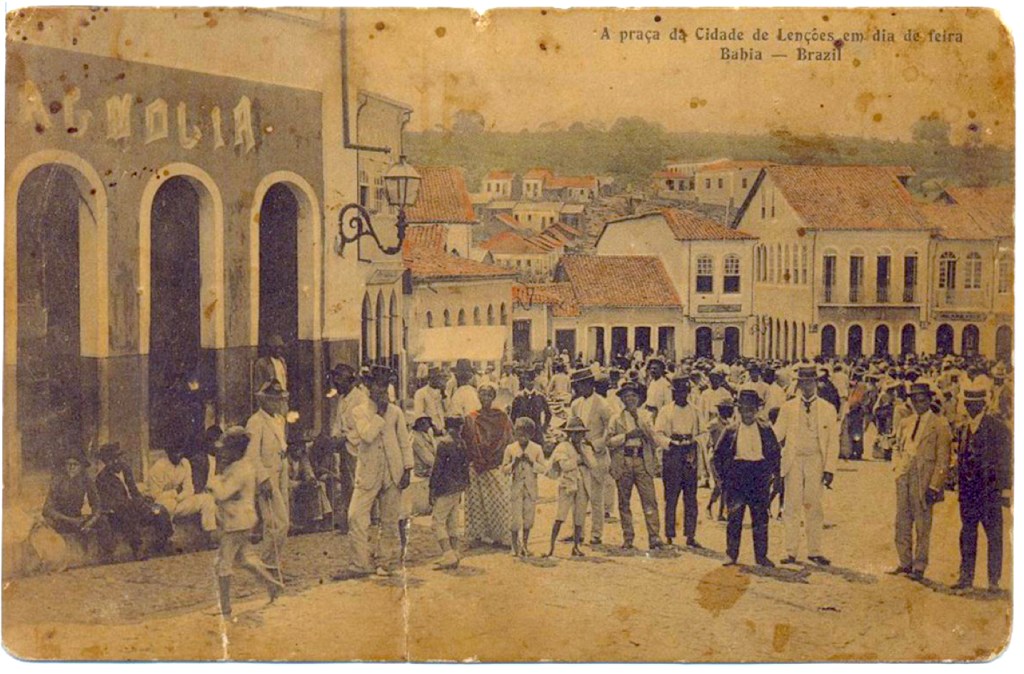
There was an active commercial movement, which has diminished to a great extent after the mines began to lose their importance. A fair, very uninteresting and little resorted to, is held every Monday. Two schools are at work in the town.
The mines being thus abandoned, the inhabitants of the municipium applied themselves to the cultivation of the coffee-tree, of a rare quality and planted in the places called grotas, that is to say — in valleys crossed by rivers and rivulets and lying in a craggy ground, formed by numerous mountains, which have been turned topsy-turvy after the mining works were commenced. These grotas are extremely fertile and have, up to the present time, produced a great deal of coffee. The digging for carbonates, now highly prized and paid, is nowadays the principal business of the miners.” (8)
Getting to Know the Leandro and Guiomar Coutinho Family of Lençóis
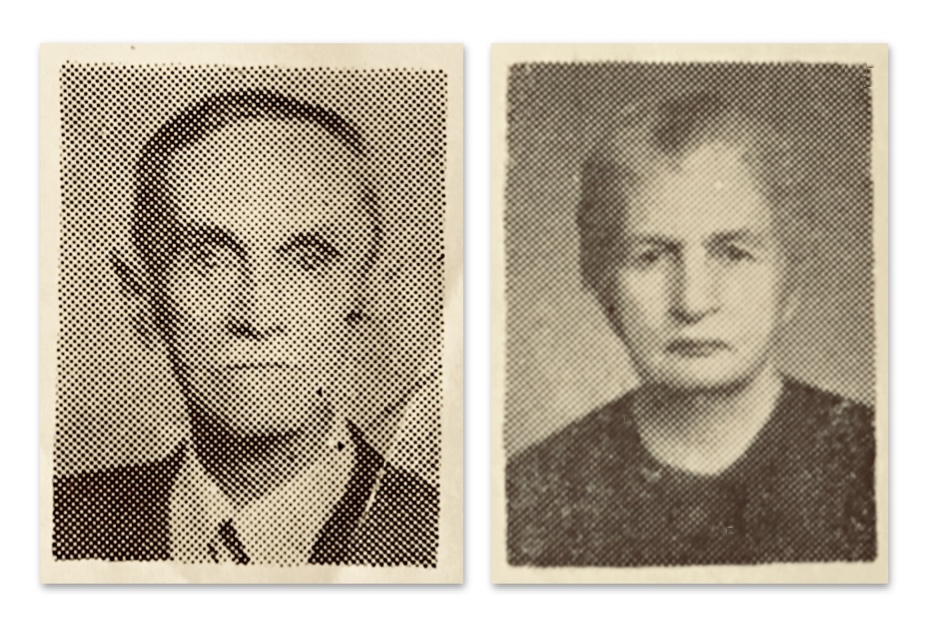
When Guiomar marries Leandro de Azevêdo Coutinho, her family surname gives way to the surname of Coutinho. All of their children were born in Lençóis.
Leandro de Azevêdo Coutinho, married Guiomar Viveiros de Azevêdo before 1908. She was born March 28, 1890 likely in Lençóis — died March 17, 1975 in Salvador. They had eight (or more) children together, as follows below.
Comment: Thanking Our Lucky Stars!
We did locate records for the births of two daughters: Dulce, and Eunice, which was incredibly helpful for our research. From those records, we were able to confirm exactly who were Leandro’s and Guiomar’s parents and grandparents.
- Dulce de Azevêdo (Coutinho) Antunes, born May 22, 1908 — died February 29, 2000. She married Antonio Cardoso Antunes.
- Carmen Viveiros de Azevêdo (Coutinho) Carrera, born July 5, 1910 — died circa 2004. She married José Carrera.
- Possible unknown male child, circa 1911. (See footnotes).
- Clarisse de Azevêdo Coutinho, born possibly in 1914 / died, Date unknown. She married Carlos Lopes Bittencourt.
- Eunice de Azevêdo Coutinho, born May 24, 1917 — died Date unknown; unmarried.
- Almir de Azevêdo Coutinho, born / died, Dates unknown.
- Paulo de Azevêdo Coutinho, born June 29, 1919 in Lençóis — died November 28, 1990 in Salvador. He married Lindaura Almeida Oliveira.
(Paulo and Lindaura carry the family line forward). - Waldette de Azevêdo Coutinho, born December 15, 1923 — died Date unknown ; unmarried.
- Humberto de Azevêdo Coutinho, born April 20, 1927 — died June 24, 1971.
He married Regina Chetto.
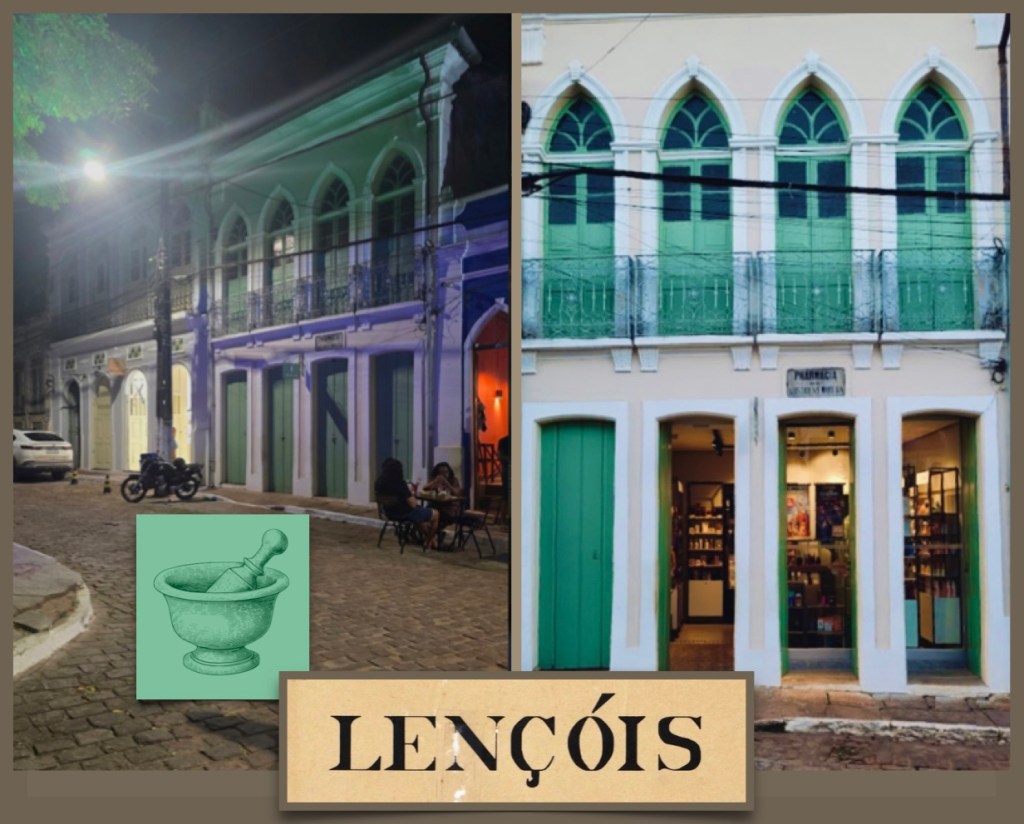
(Present day location images courtesy of Google Image Search).
‘Dr. Leandro’ and The Pharmacy
Leandro d’Azevedo Coutinho graduated with a degree in Dentistry, but he never practiced the profession. Instead, he was for a number of years, a pharmacist, whose business was located in the center of town at Avenida Rui Barbosa, 846, Centro, Lençóis. The building still stands today and is now an O Boticário store, which sells beauty products and cosmetics. His granddaughter Cristina (Coutinho) Pinheiro relates that, “Leandro lived near the pharmacy and would walk to work early in the morning. Vovô Leandro [grandfather], was like the town doctor. He would always examine people and prescribe effective medicine. He wouldn’t charge people who could not afford to pay and many times he received chickens, turkeys, and fruits as payment. He was loved by everyone. People called him Dr. Leandro.” (9)
The Troubles
Plague, bandits, and colonels… oh my!
As a family, we always wondered quite seriously, the reasons why Dr. Leandro Coutinho chose to give up his life in Lençóis and resettle his family in Salvador da Bahia. We believe that there were a number of contributing factors. Namely, he had a wife and many young children to keep safe in an environment that was rather dangerous, and therefore quite difficult to abide. By the end of all these many troubles, we can understand why he eventually felt that ‘We have had quite enough of this nonsense, thank you, and goodbye!’
Bubonic Plague
As someone who had a medical education, Dr. Leandro probably became concerned (over time) about Lençóis being so very far from an urban hospital which could provide the appropriate level of care for his family, when necessary. From the National Institute of Health, “The arrival of the [bubonic] plague in Brazil at the dawn of the 20th century marked a new chapter in the nation’s public health history. The disease first struck the port city of Santos in 1899, spreading rapidly to other major urban centres such as Rio de Janeiro, Salvador, and Recife. These outbreaks prompted an urgent response from both the government and the scientific community, leading to the implementation of quarantine measures, public health campaigns, and the establishment of specialized health institutions. Over time, the incidence of plague in Brazil declined, thanks to improved public health measures, nevertheless, the disease continued to occur in some rural areas, with sporadic cases.
“For much of its history, Brazil’s population remained bound along the coastline. Geographic features, such as coastal mountain ranges and a relative lack of navigable rivers, stymied efforts to settle and exploit the vast interior… in the late 19th century, efforts to connect the interior to the coast came via the telegraph and railroad… At the same time, [this] created conditions for intensified conflict between newcomers and those who had long called the interior home.”(Latin American History) Compared to Brazil’s coastal-life-zones, not many people had moved to the interior of the country, and to this day, a huge majority of people still live on the Atlantic coast.
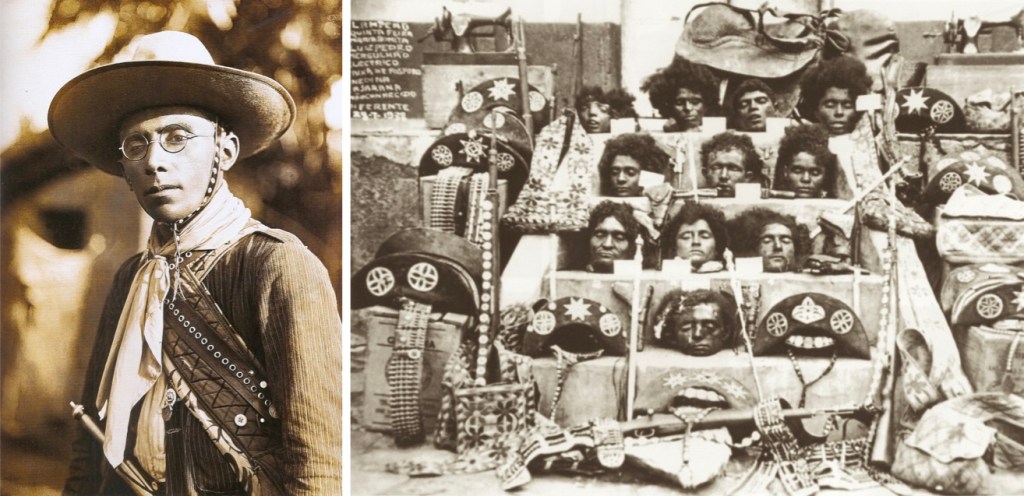
Lampião and Maria Bonita
Living in the vast interior of Brazil, probably made his family more vulnerable to the exploits of people who (to put it politely) had deeply problematic anti-social behaviors. Lampião “was probably the twentieth century’s most successful traditional bandit leader.” The banditry endemic to the Northeast of Brazil was called Cangaço. Cangaço had origins in the late 19th century but was particularly prevalent in the 1920s and 1930s. Lampião led a band of up to 100 cangaceiros, who occasionally took over small towns and who fought a number of successful actions against paramilitary police when heavily outnumbered. Lampião’s exploits and reputation turned him into a folk hero, the Brazilian equivalent of Jesse James, or Pancho Villa. His image, as well as that of his partner Maria Bonita, can be seen across the entirety of the Northeast of Brazil.
The backlands had little in the way of law and order, even the few police in existence were usually in the pocket of a ‘Coronel’ [Colonel] — a leading landowner who was also a regional political chief – and who would usually take sides in any dispute.” (Wikipedia) Lampião and Maria Bonita and their extensive gang acquired a reputation as the Brazilian version of Bonnie and Clyde. Their crime spree went on for years, but they were stopped and beheaded in an ambush in July 1938.

The Problem With The ‘Coronelismo’
In Lençóis, “At that time this part of Bahia was a poor area subject to Coronelismo, the rule of The Colonels, who exercised near feudal powers in the backlands of Brazil.” (Latin American Bureau)
“Horácio de Queirós Matos was a politician and colonel from the Bahian backlands during the first half of the 20th century. [He] was the leader of a veritable army of gunmen, engaging in numerous armed conflicts throughout his life — including a crucial role in the pursuit of the Miguel Costa-Prestes Column, (a social rebel movement that broke out in Brazil between 1925 and 1927). He ruled for a quarter of a century… [in a manner similar to that] of the Sicilian Cosa Nostra (mafia)… with an iron fist in the backlands of Chapada Diamantina and Chapada Velha, where the Matos clan lived. His political career began with his promotion to lieutenant colonel in the National Guard, inheriting the family command from an uncle. After many battles against adversaries, he became absolute lord of the vast region of Chapada Diamantina.
Horácio served as mayor of Lençóis, then a wealthy mining center, and as a state senator, a true symbol of the Coronelismo that shaped Brazilian politics during the Old Republic. Despite a life marked by warlike tendencies, he longed for the disarmament of the backlands, and when this finally occurred, he was assassinated under mysterious circumstances after being unjustifiably arrested by the Getúlio Vargas administration (circa 1930) in the Bahian capital.”
It Seems That Leandro Held Two Jobs…
When researching Leandro and Guiomar’s children, we found some very subtle evidence that Leandro was already working as a government tax collector during the time period in which they lived in Lençóis. (This was the profession that we know he took up in his later life in Salvador da Bahia). It makes sense that he could have had more than one profession, because he needed to support a growing family. We speculate that perhaps this tax collecting work may have created conflicts with The ‘Coronelismo’ and his associates. (10)
Land in Lençóis, and the Usucapião
‘Dr. Leandro’ was also a landowner of considerable means. When he took his family and left Lençóis for Salvador, it is quite unclear to those of us today as to what he did with it. There was many, many hectares of land. Family stories say that it was understood that this land was to be distributed among the generation of heirs after the last child of Leandro and Guiomar had passed on. (This was Waldette de Azevêdo Coutinho). The heirs generally understood and accepted this, but no one was watching the property carefully…

(Image courtesy of Etsy).
In Brazil, there is a law known as “Usucapião” which allows for someone to take over the land legally, even though they may appear at first to be property squatters. What is required is this: for someone to move to the land, and follow a very specific procedure of behavior. From Reddit, a similar story about someone else’s family land in the nearby state of Minas Gerais — “the fact [that] someone was occupying the land, taking care of it, paying the taxes, paying for electrical bill and water, empowers them to claim the land. If someone occupies and takes care of it for 5 years in a row, they can claim ownership. So based on your story, there is no way of reclaiming the land and no way of making profit of it.” (See footnotes for this and other legal sources).
This type of thing may have happened to our family lands. Thus, this being Brazil, the land ownership has become more complicated through ‘usucapião’. (11)
Traveling on the RMS Magdalena
In the past eras, the only practical way to get to Brazil was to travel there by boat. (Unless, of course, you wanted to walk in, and that we can presume, would have been much more complicated for the Coutinho and the Oliveira ancestors!)
In this period, Portugal and its former colonies remained interconnected through trade and business. People traveled to find work, or engage in commerce. Importantly, many families had ties to both countries, so travel was common for visits or to reunite with relatives. Unlike Portugal, most people in Brazil live along the coasts. This has become so historically embedded within the culture, that it has became a common expression.
“…scraped along the sea like crabs…”
Top, attributed to Historian Friar Vicente do Salvador, circa 1627,
“Brazilians cling to the coast like crabs.”
and Bottom, the same sentiment improved upon by the author Jorge Amado.
When you move out of a country, this is called: Emigration. When you move into a country, this is called: Immigration. We have spent much time reviewing ship registers for both of these families, for ships which went back and forth between Portugal and Brazil. Most voyages from Europe to South America started in Southhampton, or Liverpool, England, and had several ports of call along the way.
It appears to us that the various individuals of the early 20th century, who were tasked with keeping the ship registers for these routes — Nationalities and destinations were always dutifully noted. noted that almost all people who were entering Brazil were marked as Immigrants. Is this because there was no place to mark if they were Emigrants, and not Immigrants? So perhaps, this form of categorization was just understood as the normal way of doing things?

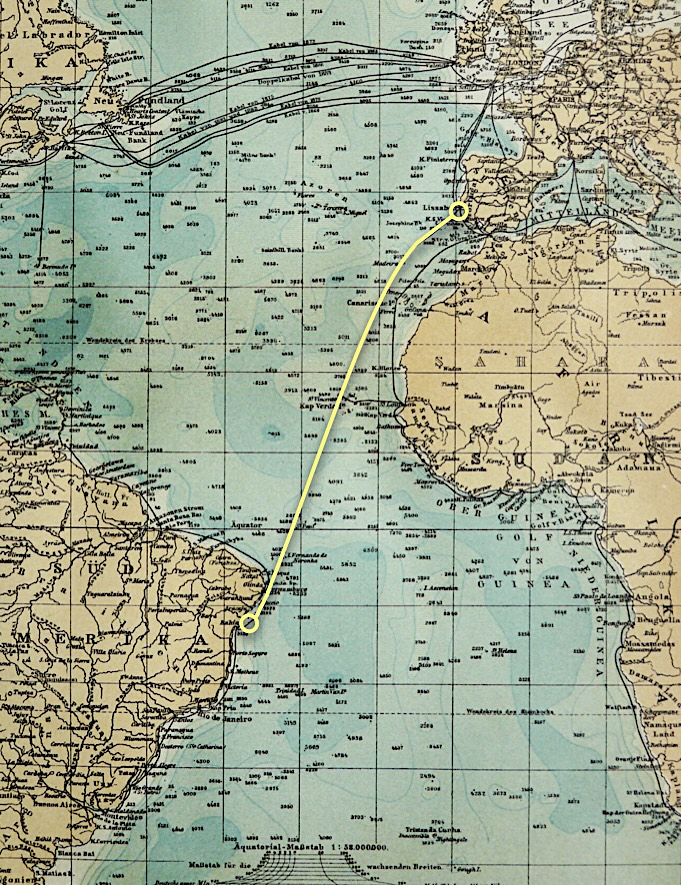
We found ship records from April 8, 1904 (and also from 1914) that indicate Leandro d’Azevedo Coutinho sailed to Brazil from Lisbon, Portugal. (There are other similar records, but we feel that these two are certainly him). He is recorded as being a Brasileira. We chose to focus on the 1904 journey, because we believe that this occurred before his first child was born. Why did he travel in 1904? We have no way of knowing for certain, but the possibilities include:
- His honeymoon trip with his wife Guiomar.
- His education. (We do not yet know where he went to dental school, nor pharmacy school.
- Other business trips, such as purchasing supplies for his pharmacy business. His father Alfredo had an import/export business, so perhaps this too.
- Maybe he was visiting friends or family in Portugal.
His final destination was either Bahia, or Rio de Janeiro, but the ship’s records indicate Rio. (We will never know for certain, but this could have been a data entry error, or perhaps he really did initially go to Rio de Janeiro for some reason).

The ship was named RMS Magdalena and it regularly traveled as “a British steamship that was built in 1889 as a Royal Mail Ship and ocean liner for the Royal Mail Steam Packet Company until 1923.” An advertisement which ran in The Times newspaper of London, on Saturday, Oct 20, 1900, read as follows:
ROYAL MAIL STEAM PACKET COMPANY, under Contract for Her Majesty’s Mails to West Indies, Brazil, and River Plate. Dates from Southampton:—Madalena, 5362 tons, (To Sail) Oct. 26, Ports: Cherbourg, Vigo, Lisbon, St. Vincent, Pernambuco, Bahia, Rio, Monte Video, and Buenos Ayres. (12)

in the 1930s. (Image courtesy of Facebook).
In Salvador, Leandro Changes Professions
The years that Leandro and Guiomar lived in Salvador, are generally framed in the context of, “The Fourth Brazilian Republic, also known as the ‘Populist Republic’ or as the ‘Republic of 46’… [This] is the period of Brazilian history between 1946 and 1964. It was marked by political instability and the military’s pressure on civilian politicians which ended with the 1964 Brazilian coup d’état and the establishment of the Brazilian military dictatorship”. (Wikipedia)
In Salvador, Leandro changed professions and worked as a federal tax collector and auditor. He and his wife Guiomar lived in the neighborhood of Nazaré. In the long history of Salvador, this was one of the first areas to be settled. It is located not far from the historical section called the Pelourinho, which is now UNESCO World Heritage site. (See footnotes). Nazaré is also “home to numerous historic structures of the city; it is additionally the home of several government and academic centers.” (Wikipedia)
Family stories circulate that Guiomar was ever vigilant in her desire to make sure that her grandchildren had much to eat — even when they had already eaten. Cristina Pinheiro relates, “Every time we visited Vovô [grandmother] she would toast bread and butter and caramelize the sugar she put on top of it. We loved it so much! She was always sweet and calm”.

Cidade do Salvador (1949, dir. Humberto Mauro). This short movie is about 21 minutes long, but quite worth viewing to appreciate the city of Salvador da Bahia in the mid-20th century. It’s available only in Portuguese, but don’t despair English language speakers, it is still quite interesting!
Please click on this link to watch the short film:
https://www.youtube.com/watch?v=Qf2vyJLy_Eo
Research Comment: The famous director Orson Welles, went to Bahia and the adjacent northeastern state of Ceará in 1941, to film footage for a proposed movie titled It’s All True, which was never finished. If you are interested, there is a link and some beautiful video footage of a long-vanished world, posted in the footnotes. (13)

Touchstones
Sometimes in life we are fortunate to inherit something meaningful that connects us to the generations that came before us. Such is the case with a pair of chairs (one of which is shown above), that have come down to my husband Leandro Coutihno (born 1965), the grandson of Leandro and Guiomar Coutinho. It came to him through his paternal Aunt Carmen Viveiros (Coutinho) Carrera. The chairs are handmade of Amazonian Jacaranda wood and are over 200 years old.
We have one more chapter of the Coutinho and Oliveira families which follows. We move forward into the generation from which my husband Leandro emerges in the mid-20th century. (14)
Following are the footnotes for the Primary Source Materials,
Notes, and Observations
Mr . Peabody and Sherman
(1) — two records
Ultra Swank
Mr Peabody and Sherman – The Original Cartoon
by Koop Kooper
https://www.ultraswank.net/television/mr-peabody-sherman-original-cartoon/
Note: For the 1960s film still.
Wayback Machine (Peabody’s Improbable History)
https://en.wikipedia.org/wiki/Wayback_Machine_(Peabody%27s_Improbable_History)
Note: For the reference.
Ah Bahia!
(2) — one record
Mapas Históricos da Bahia
Mapa da Bahia de 1911
https://www.historia-brasil.com/bahia/mapas-historicos/seculo-20.htm
Notes: This is a excerpted portion of the General Map of Brazil published in January 1911, and organized by the company Hartmann-Reichenbach. The red lines are railways.
The de Azevedos Family Arrives in Brazil From Portugal
(3) — four records
The Brazilian National Archives
Category: Coats of arms at Arquivo Nacional (Brazil)
https://commons.wikimedia.org/wiki/Category:Coats_of_arms_at_Arquivo_Nacional_(Brazil)
Note: The above reference then links to this file below.
Collection of The Brazilian National Archives, circa 1855
Brasão de Manoel de Azeredo Coutinho Messeder, Fidalgo Cavaleiro
https://commons.wikimedia.org/wiki/File:Brasão_de_Manoel_de_Azeredo_Coutinho_Messeder,_Fidalgo_Cavaleiro.tif
Note: Accession Number is — BR_RJANRIO_0D_0_0_0103_0003
Observation: When doing genealogy research, it is quite common to follow the lines of male ancestors, because historically there are more records for them. That being said, it is quite refreshing to discover lines that are well researched for our female ancestors, (especially when the male lines are, how shall we say, a bit sparse). For my husband’s Grandmother, Guiomar Viveiros (de Azevêdo) Coutinho, we were able to access the private Family Search records kindly provided by his cousin Maria Patrícia Bittencourt Ferreira. Thanks Pat!
> The family photographs in this section are from the personal family photograph collection.
Old World Auctions
Recently Elaborated Geographical Map of the Kingdom of Brazil in South America…
by Matthias Seutter, circa 1740
https://www.oldworldauctions.com/catalog/lot/128/473
Note: For the map image.

The Inconfidência Mineira (or The Minas Gerais Conspiracy)
(4) — five records
Inconfidência Mineira
https://en.wikipedia.org/wiki/Inconfidência_Mineira
Note: For the text regarding The Minas Conspiracy.
Tiradentes
https://en.wikipedia.org/wiki/Tiradentes
Note: For the text.
Museu Histórico Nacional, via Wikipedia Commons
Joaquim José da Silva Xavier, dressed in the report of ensigns of the paid troop of Minas Gerais.
by José Wasth Rodrigues, circa 1940
https://commons.wikimedia.org/wiki/File:Alferes_Tiradentes_01.jpg
Note: For the portrait.
The Flag of the Conspirators
by Carlos Oswald, circa 1939
https://commons.wikimedia.org/wiki/File:Bandeira_da_Inconfidência_1789_Os_Inconfidentes.jpg
Note: For the painting.
Tiradentes Quartered
by Pedro Americo, circa 1893
https://commons.wikimedia.org/wiki/File:Tiradentes_quartered_(Tiradentes_escuartejado)_by_Pedro_Américo_1893.jpg
Note: For the painting.
These Place Names Are Tongue Twisters!
(5) — six records
Mapas Históricos da Bahia
Mapa da Bahia de 1911
https://www.historia-brasil.com/bahia/mapas-historicos/seculo-20.htm
Notes: This is an excerpted portion of the General Map of Brazil published in January 1911. We are using it again for continuity, and because it allows to show the communities in their proper places.
Joaquim Venâncio Gomes de Azevedo
Batismo de Joaquim Venâncio de Azevedo
https://www.familysearch.org/en/tree/person/sources/GZ6H-WBT
Note: The file name is, 1305241B-2330-4440-ADD6-8AA2A006184F.jpg
Documents of the Ordinances in Caetité
The signature of Joaquim Venâncio de Azevedo
https://www.familysearch.org/en/tree/person/memories/GZ6H-WBT
Note: The file name is, A02ED4AB-C877-4AF1-AAB1-FF63C664C912.jpg
Downloadable file from:
Photographic portrait, Family Search Memories archive for
José Venâncio Gomes de Azevedo https://www.familysearch.org/en/tree/person/memories/G92F-5VR
Note: The file name is, 2657927E-E264-4FFC-AC4B-7FD606A65DE6.jpg
Downloadable file from:
Photographic portrait, Family Search Memories archive for
Laura Viveiros de Azevedo
https://www.familysearch.org/en/tree/person/memories/G92F-TWM
Note: The file name is, FFBF93C1-E221-49C1-88AC-1E235E03CC0B.jpg
Downloadable file from:
Civil registration of marriage, Family Search Memories archive for
José Venâncio Gomes de Azevedo
https://www.familysearch.org/en/tree/person/memories/G92F-5VR
Note: The file name is, 02BF08D8-49D4-4F44-8012-F6994AD7922E.jpg
Diamonds In The Rough
(6) — five records
ebay
Brazil South American Festival Of Divine Natives Antique Postcard K72076
https://www.ebay.com/itm/142525773982
Note: For the antique postcard image.
History and Tourist Attractions of Lençóis in Chapada Diamantina
Lençóis: The Gateway to Chapada Diamantina
by Author unknown
https://bahia.ws/en/guia-turismo-lencois-chapada-diamantina/#google_vignette
Note: For the text.
Fold-out map titled, Author’s Sketch Map of Gold and Diamond Districts of Bahia
Derived from:
The Diamond Trail : An Account of Travel Among the Little Known
Bahian Diamond Fields of Brazil
by Hugh Pearson, 1926
https://archive.org/details/DiamondTrailPearson/pearson-h-diamond-1926-RTL013509-LowRes/page/n9/mode/2up
Note: For the map image.
Mapas Históricos da Bahia
Mapa da Bahia de 1911
https://www.historia-brasil.com/bahia/mapas-historicos/seculo-20.htm
Notes: This is a excerpted portion of the General Map of Brazil published in January 1911. We are using it again for continuity, and because it allows to show the communities in their proper places.
Andaraí
https://pt.wikipedia.org/wiki/Andaraí
Note: For the text.
Alfredo Viero de Azevêdo Coutinho and His Families
(7) — seven records
> The family photographs in this section are from the personal family photograph collection.

Ca- Athahyde Molina de Azevedo Coutinho
Mentioned in the Record of UNKNOWN (in 1916)
Birth — Brasil, Bahia, Registro Civil, 1877-2021
https://www.familysearch.org/ark:/61903/1:1:6V4X-G8GG?lang=en
Note: This reference file is included because we believe it represents the best documentation of Carolina de Azevedo Coutinho’s maiden name: Carolina Athahydes Molina. Furthermore, listed on this record is her husband Alfred (as Ido Vieira de Azevedo Coutinho) and her son Alvaro de Azeredo Coutinho. Her name is also recorded on the above 1941 Civil Registration death certificate.

Alfredo de Coutinho (for Ana Coutinho passenger entry)
Migration — Brasil, Bahia, Salvador, Relações de passagieros e imigrantes, 1855-1964
https://www.familysearch.org/ark:/61903/1:1:71DC-QWW2?lang=en&cid=fs_email
Book page: 86, Digital page: 173/403
Note 1: Entries 14 and 15 from the top for Alfredo and Anna.
Note 2: Passengers entries for ship travel on the Ortega, dated July 2, 1911.
Manoel de Azevedo Coutinho
Death — Brasil, Bahía, Registros da Igreja Católica, 1598-2007
https://www.familysearch.org/ark:/61903/1:1:6BZF-S1JX?lang=en
Digital page: 26/80, Left page near the top.
Note: Despite what the record indicates as ‘zero days age’ at death, the words on the record state that he was 7 months old, and died from a gastrointestinal infection.
Alvaro de Azevedo Coutinho
Marriage — Brasil, Bahia, Registro Civil, 1877-2021
https://www.familysearch.org/ark:/61903/1:1:X9YD-YVPV?lang=en
Note 1: Record of his 1915 marriage to Maria Juliana Paraguassa.
Note 2: The records that he was born in 1892.
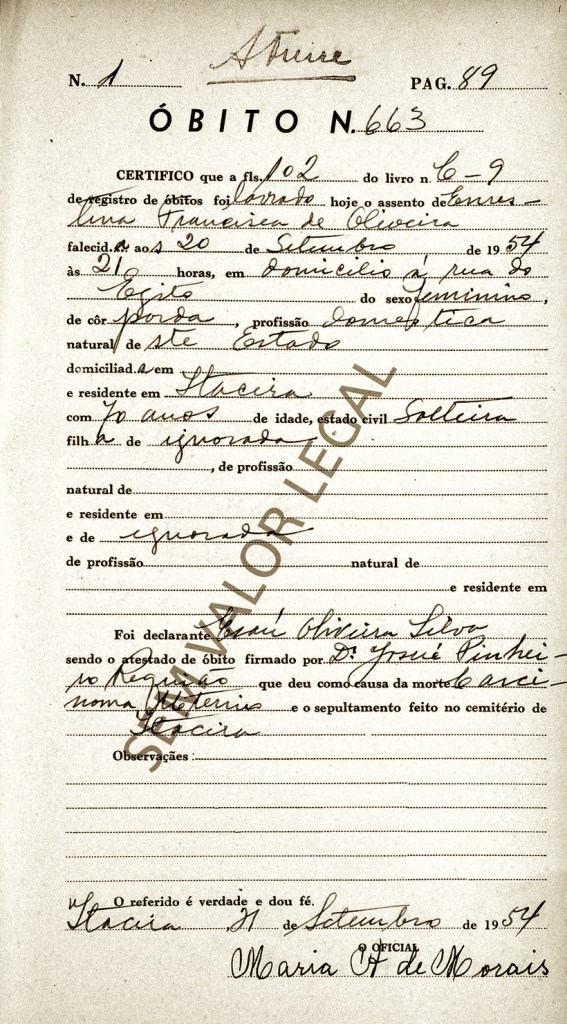
Ernestina Francisca de Oliveira
Death — Brasil, Bahia, Registro Civil, 1877-2021
https://www.familysearch.org/ark:/61903/1:1:Z2ZH-5HW2?lang=en
Note: For the data.
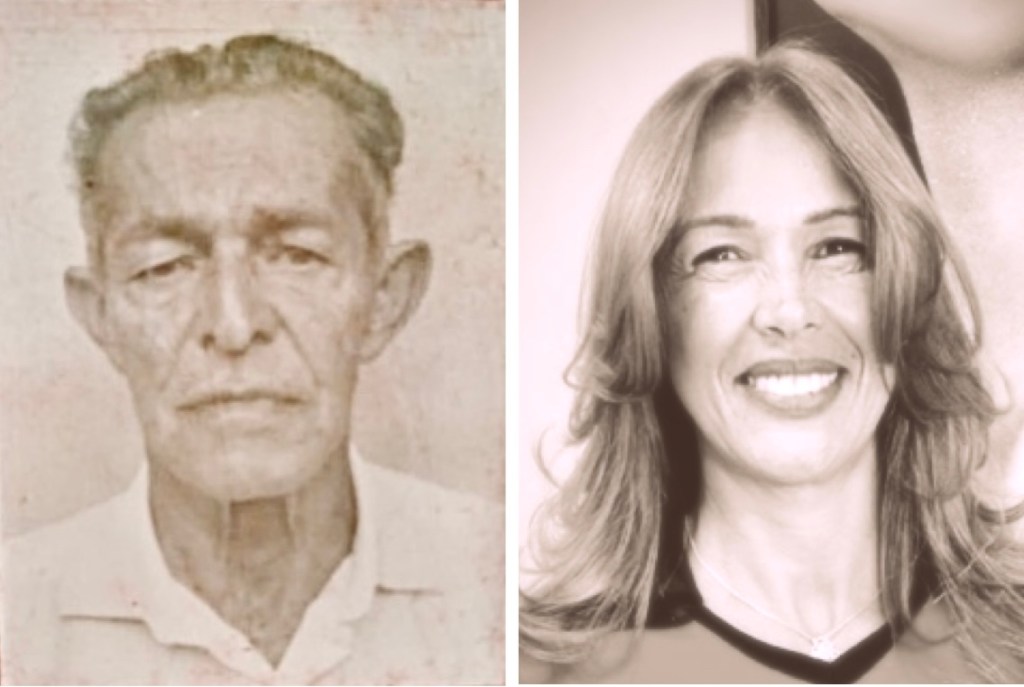
Memoir of The State of Bahia, circa 1893
(8) — six records
> The family photographs in this section are from the personal family photograph collection.
World’s Columbian Exposition
https://en.wikipedia.org/wiki/World%27s_Columbian_Exposition
Note: For the reference.
Musings from the Rosenthal Archives
Chicago Symphony Orchestra Association
of the The World’s Columbian Exposition of 1893
https://csoarchives.wordpress.com/2018/04/23/the-worlds-columbian-exposition-of-1893/
Note: For the pop-up book cover, circa 1893.
Chicago Public Library
Latin American Country Buildings at the 1893 World’s Columbian Exposition
https://www.chipublib.org/blogs/post/latin-american-country-buildings-at-the-1893-worlds-columbian-exposition/
Note: For the data and Brazil Building photograph.

Memoir of The State of Bahia, circa 1893
by Dr. Francisco Vicente Vianna, José Carlos Ferreira, Dr. Guilherme Pereira Rebello
https://archive.org/details/memoirofstateofb00bahi/page/468/mode/2up
Book page: 468 – 470, Digital Page: 468 – 470/742
Note: Prepared for the World’s Columbian Exposition, Chicago, 1893.
Universidade Federal da Bahia – UFBA
A praça da cidade de Lençóes em dia de feira
by Photographer unknown
https://repositorio.ufba.br/bitstream/ri/17582/1/Dissertação Romulo de Oliveira Martins.pdf
Note: For the town image.
Getting to Know the Leandro and Guiomar Coutinho Family of Lençóis
(9) — seven records
> The family photographs in this section are from the personal family photograph collection.
Leandro de Aze-Cido Coutinho
https://www.familysearch.org/ark:/61903/1:1:6V4H-BBC2?lang=en
Note: Mentioned in the record as the Father of Dulce de Azevedo Coutinho, who is a sister of Paulo de Azevêdo Coutinho, his son.
and
Gisiomarde Azevedo Coutinho
https://www.familysearch.org/ark:/61903/1:1:6V4H-BBCL?lang=en
Note: Mentioned in the record as the Mother of Dulce de Azevedo Coutinho, who is a sister of Paulo de Azevêdo Coutinho, her son.
Note: Birth records for Leandro and Guiomar’s children are scarce, but we did locate records for their daughters Dulce and Eunice. From those records, we were able to confirm who Leandro’s parents and grandparents were.
Dulce de Azevedo Coutinho
Birth — Brasil, Bahia, Registro Civil, 1877-2021
https://www.familysearch.org/ark:/61903/1:1:6V4H-BBCK?lang=en
Note: Daughter, for her birthdate and confirmation of the parents and grandparents. (1908)
1911
Lean Dro de Azeredo Coutinho
Mencionado no Registo de Azevedo Edilude
Birth — Brasil, Bahia, Registro Civil, 1877-2021
https://www.familysearch.org/ark:/61903/1:1:6V4C-W5LD?lang=en
Note: Leandro and his daughter Carmen are noted in the birth document for a male child, who was previously unknown.
1914
Guiomar de Azevedo Coutinho
Mentioned in the Record of UNKNOWN
Birth — Brasil, Bahia, Registro Civil, 1877-2021
https://www.familysearch.org/ark:/61903/1:1:6V4D-6PSG?lang=en
Note: Possible birth record for Leandro and Guiomar’s daughter Clarisse.
Eunice
Birth — Brasil, Bahia, Registro Civil, 1877-2021
https://www.familysearch.org/ark:/61903/1:1:6V46-9R7F?lang=en
Note: Daughter, for her birthdate and confirmation of the parents and grandparents. (1917)
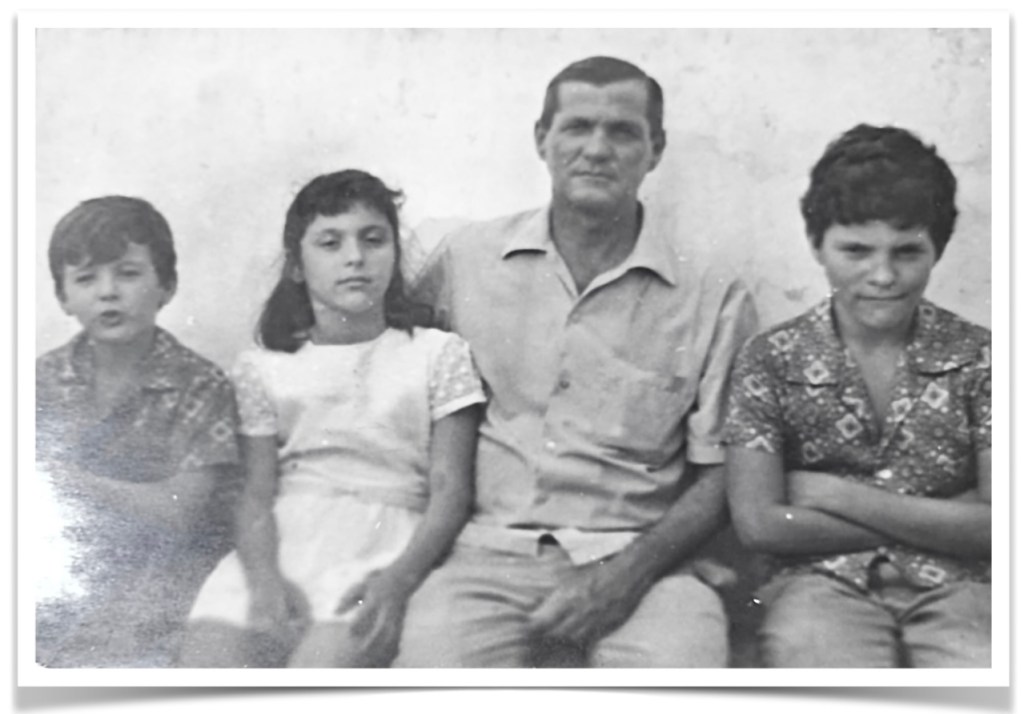
The Troubles
(10) — seven records
NIH (The National Institute of Health)
The National Library of Medicine
125 years of the plague in Brazil: lessons learnt, historical insights
and contemporary challenges
by Igor Vasconcelos Rocha, Matheus Filgueira Bezerra, Marise Sobreira, Alzira Maria Paiva de Almeida
https://pmc.ncbi.nlm.nih.gov/articles/PMC11851657/
Note: For the text.

Latin American History
Road Building in Brazil
by Emily Story
https://oxfordre.com/latinamericanhistory/display/10.1093/acrefore/9780199366439.001.0001/acrefore-9780199366439-e-992?p=emailAWhHANH3NNSUI&d=/10.1093/acrefore/9780199366439.001.0001/acrefore-9780199366439-e-992
Note: For the text.
Lampião
https://en.wikipedia.org/wiki/Lampião
and
Maria Bonita (bandit)
https://en.wikipedia.org/wiki/Maria_Bonita_(bandit)
Note: For the text and photos.
LAB
Latin American Bureau
Brazil: the Prestes Column in Bahia
https://lab.org.uk/brazil-the-prestes-column-in-bahia/
Note: For the text and newspaper image.
Horácio de Matos
https://pt.wikipedia.org/wiki/Horácio_de_Matos
Note: For the text and photos.
Coluna Prestes
https://en.wikipedia.org/wiki/Coluna_Prestes
Note: For the data.
Land in Lençóis, and the Usucapião
(11) — four records
Reddit
Legal Advice: My grandfather’s land in Minas Gerais has had squatters living there for 40+ years. Is it still ours?
https://www.reddit.com/r/Brazil/comments/39tndd/legal_advice_my_grandfathers_land_in_minas_gerais/
Note: For the text.
Etsy
MapometryCo
Chapada Diamantina National Park Panoramic Art Print: Brazil Travel Poster
https://www.etsy.com/listing/1733895652/chapada-diamantina-national-park
Note: For the artwork.
Machado Meyer Advogados
by Fatima Tadea Rombola Fonseca, Marina Rosa Cavalli,
Iasmim De Souza Nunes, and Marina Rosa Cavalli
STJ Welcomes Action Of Usucapião Of Private Property
Without Real Estate Registration
https://www.machadomeyer.com.br/en/recent-publications/publications/real-estate/stj-welcomes-action-of-usucapiao-of-private-property-without-real-estate-registration#:~:text=The Superior Court of Justice,other requirements required by law.
Note: For the reference.
“The usucapio is a constitutionally guaranteed institute. It allows the acquisition of real estate property by proving the possession exercised without opposition and for a certain time, in addition to other requirements required by law. Because it is an original form of acquisition of property, there is no transfer of liens or encumbrances on the real estate property for the plaintiff (the usucapiente). The registration of the usucapio on the enrollment certificate, therefore, is not done to constitute the acquisition, but rather to give publicity to it and allow the exercise of the right to dispose of the property, in addition to regularizing the registry itself.”
A General Introduction to Real Estate Law in Brazil
by Pinheiro Neto Advogados
https://www.lexology.com/library/detail.aspx?g=d95e5bc8-d57e-4ff0-9543-ad013fe64d14#:~:text=In Brazil, the right to,whoever may unlawfully hold it.
Note: For the reference.
“In Brazil, the right to own property is assured by Article 5, XXII of the Brazilian Federal Constitution. According to the Brazilian Civil Code (Law No. 10,406 of 2002), owners have the right to use, enjoy and dispose of their property, as well as to defend it from whoever may unlawfully hold it.”
Traveling on the RMS Magdalena
(12) — five records
Etsy
1895 Antique Map of the Atlantic Ocean
by Author unknown
https://www.etsy.com/listing/1528816009/1895-antique-map-of-the-atlantic-ocean
Note: Printed in Germany in 1895.

Leandro d’ Azevedo Coutinho
Migration — Brasil, Bahia, Salvador, Relações de passagieros e imigrantes, 1855-1964
https://www.familysearch.org/ark:/61903/1:1:WH84-3MPZ?lang=en
Book page: 29, Digital page: 59/400
Note: For the data.
SN, Ships Nostalgia
SS MAGDALENA Route in 1900
https://www.shipsnostalgia.com/threads/ss-magdalena-route-in-1900.23933/
Note: For the data.
RMS Magdalena (1889)
https://en.wikipedia.org/wiki/RMS_Magdalena_(1889)
Note: For the text.
Alfredo V de Azevedo Coutinho
Migration — Brasil, Bahia, Salvador, Relações de passagieros e imigrantes, 1855-1964
https://www.familysearch.org/ark:/61903/1:1:WS83-GKW2?lang=en
Note: For the reference.
In Salvador, Leandro Changes Professions
(13) — seven records
Facebook
Amo a História de Salvador
by Louti Bahia
https://www.facebook.com/photo.php?fbid=2630913453614695&id=729832370389489&set=a.729839003722159
Note 1: For the photo reference.
Note 2: The original photo caption reads, “The beautiful houses that stood in the old Jardim de Nazaré neighborhood in the 1930s.”
Fourth Brazilian Republic
https://en.wikipedia.org/wiki/Fourth_Brazilian_Republic
Note: For the text.
UNESCO World Heritage Convention
Historic Centre of Salvador de Bahia
https://whc.unesco.org/en/list/309
Note: For the reference.
Nazaré (neighborhood)
https://en.wikipedia.org/wiki/Nazaré_(neighbourhood)
Note: For the text.
Youtube.com
CTAv Centro Técnico Audiovisual
Cidade do Salvador (1949, dir. Humberto Mauro)
https://www.youtube.com/watch?v=Qf2vyJLy_Eo
It’s All True (film)
https://en.wikipedia.org/wiki/It%27s_All_True_(film)
Note: For the reference.
Youtube.com
Orson Welles – Four Men on a Raft
by Carlos J. Carpio L.
https://www.youtube.com/watch?v=GtaYuirQNpo
Notes: This is some of the best of all of the film that was shot in 1941. The preliminary portion explains the background, and the Welles footage begins at the 2:35 mark. (Total length is 9:55).
Touchstones
(15) — three records
> The family photograph in this section is from the personal family photograph collection.
Jacaranda copaia
https://en.wikipedia.org/wiki/Jacaranda_copaia
Note: For the reference.
Alamy
Jacaranda mimosifolia
Handcoloured copperplate engraving by Weddell after an illustration
by John Curtis from Samuel Curtis’s “Botanical Magazine,” London, 1822
https://www.alamy.com/trinidad-fern-tree-jacaranda-mimosifolia-oval-leaved-jacaranda-jacaranda-ovalifolia-handcoloured-copperplate-engraving-by-weddell-after-an-illustration-by-john-curtis-from-samuel-curtiss-botanical-magazine-london-1822-image331462351.html?imageid=6592413D-131B-46C4-808D-92A84A7B07F9&pn=1&searchId=006951c8677a72657123955a412ba84c&searchtype=0
Note: For the reference

 Our Ancestors, Our Narratives


_by_Pedro_Américo_1893.jpg)