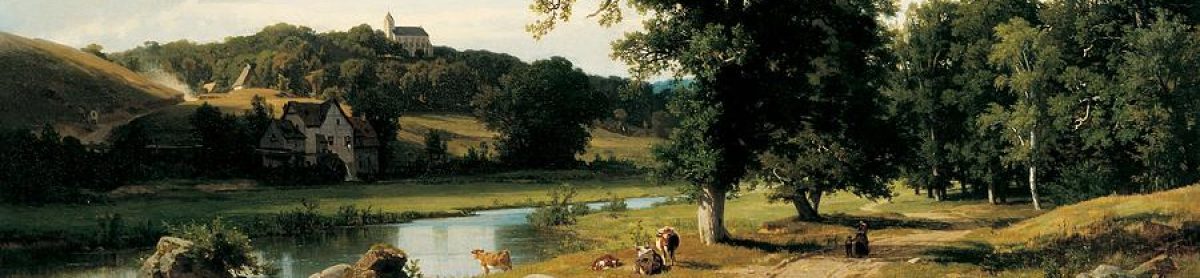
This is Chapter Six of seven. The Drinkwater surname continues in this Generation Four in America, with the marriage to both the Benedict, and Washburn families.
We have been in the area of the Province of Massachusetts ever since George Soule set foot on Plymouth Rock. In this chapter we finally get out of town and make our way to some new places. Unlike the previous generation of the Drinkwater family, where it was difficult to understand why they moved around so much, this generation stayed anchored in one area of the Connecticut Colony. They also left many interesting records.

by Jacques Nicholas Bellin, circa 1757. (Image courtesy of Barry Lawrence Ruderman
Antique Maps, Inc).
Most of the life of our 5x Great Grandfather William Drinkwater had been lived in the half century previous to when this elegant looking map was made. The westward migration of this branch of the family, from the communities near Plymouth County, Massachusetts — all the way across to the western edge of Connecticut Colony — had them moving toward areas which were still thought of as the frontier.
With Rods Belaboured…
“New-York, December 27th 1733 — We hear from Ridgefield, near the County of Westchester, that one William Drinkwater, late an inhabitant there, proving quarrelsome with his Neighbours and abusive to his Wife, the good Women of the Place took the Matter into Consideration and laid hold of an Opportunity to get him tied to a Cart, and there with Rods belaboured him on his Back, till, in striving to get away, he pulled one of his Arms out of joint, and then they unti’d him.
Mr. Drinkwater complained to sundrie Magistrates of this useage, but all he got by it was to be Laughed at. Whereupon he moved to New-Milford where we hear he proves a good Neighbour and a loveing Husband. A remarkable reformation arising from the Justice of the good Women!
—John Peter Zenger, The New-York Weekly Journal, Dec. 31, 1733”
Comment: Word must have travelled fast! As we all know, gossip can move like a whirlwind. — Ridgefield was a small town in the western side of Fairfield County, Connecticut. It is currently across the state line from Westchester County, New York. Everybody knows that marriages have ups and downs, but obviously they must have had a way of working things out —they had 12 children. (In those days it took time for stories to reach and get published in a newspaper. Please see the footnotes). (1)
Having Been Put Through The Mill
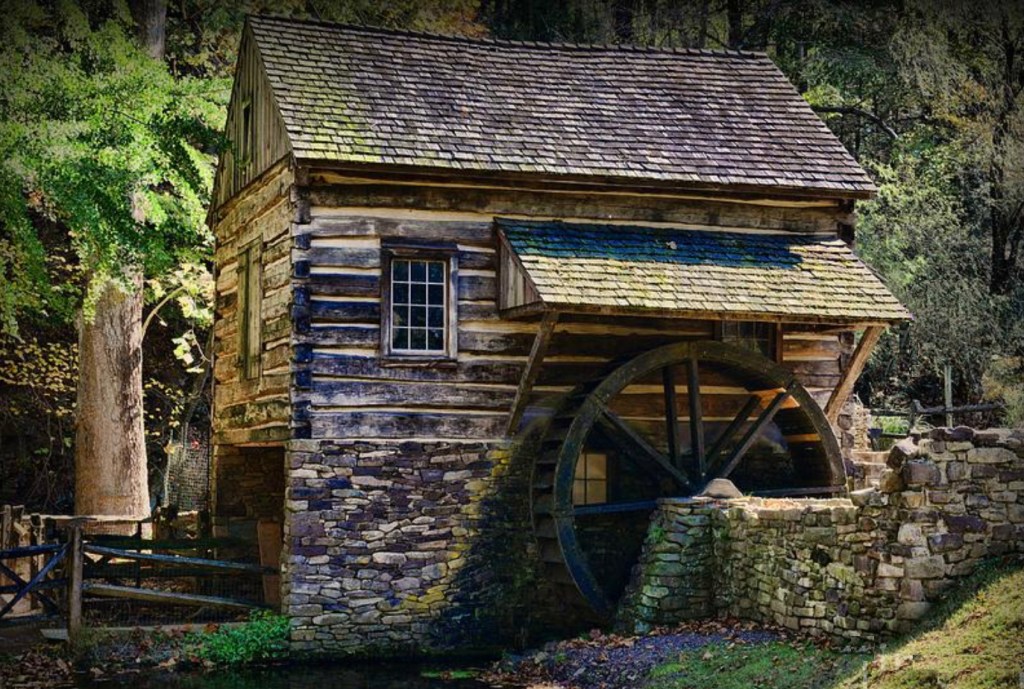
From the book, Two Centuries Of New Milford, Connecticut: “William settled in New Milford about 1730 [likely circa 1732] where some of his family became Quakers… [and] on Apr 20, 1730, William bought land from Zachariah Ferris where he built a Gristmill. The mill was located on the East Aspetuck, near or at the site of the present paper mill. He sold the mill to Nathan Terrill in March 1735. William was a prominent, active citizen, but died in 1758, leaving a large family.”
Having a grist mill allows William to be in the know about goings on in the community. “Aside of the ingenuity, the grist mill was also a social hub, of such importance that it turns out our language still reflects its impact. For example, if a number of people were looking to have their grains milled, a line would form. Unlike today’s supermarkets, where you just quietly stand in line and perhaps spy on the shopping cart of the stranger in front of you, this would have been a situation in which people knew each other. Those lines would result in ‘milling about’ while they gossiped, which is still referred to as a ‘rumor mill.’
Meanwhile, inside the grist mill, the floor would have been covered with a hay like material, referred to as thresh. A piece of wood at the doorway would help keep the thresh in place, which you’d stand on when you crossed the ‘threshold’.” (Hidden New England)
William’s younger brother John was also living in the area in the mid-1730s. “John Drinkwater, came from Rhode Island, and bought of Wm. Drinkwater, 10 acres of ‘near Little Mount Tom, with a dwelling-house on it,’ March 30, 1735, and sold the same to John Sherwood, July 5, 1736, and removed from the town so far as known.” (History of the Towns of New Milford and Bridgewater, Connecticut, 1703-1882) (2)

by Moses Park, 1766. (Image courtesy of the Boston Public Library).
There’s Many Trees In That Orchard!
Some of our ancestors stepped right up and took the Genesis 1:28 Biblical commandment to “be fruitful and multiply” quite seriously.
William Drinkwater, born about 1701 in Touisset (an area of) Swansea, Bristol, PMB — died circa 1758 in New Milford, Litchfield, Connecticut Colony, age 57. He married first Elizabeth Benedict, December 18, 1728 in New Milford, Connecticut Colony; they had 12 children. She was born January 17, 1704 in Ridgefield, Fairfield, Connecticut Colony — died July 2, 1749, in New Milford, Litchfield, Connecticut Colony, age 45.

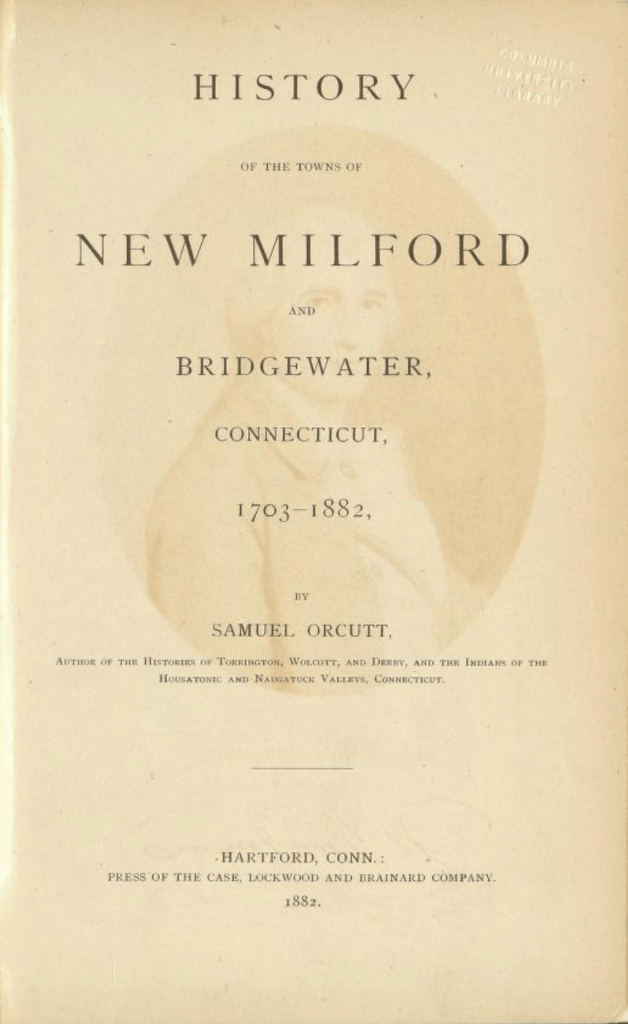
by Samuel Orcutt, circa 1882. Note: Despite all of these children, the list is still missing daughter Sarah, born February 18, 1737. There were 16 children in total.
Also please note: We have corrected mistakes, updated spelling, birthdates, etc. from records of both Ridgefield, and New Milford, Connecticut — which varies from what is shown in the book image above. See footnotes).
On May 10, 1666 Fairfield County was established by an act of the Connecticut General Court along with Hartford County, New Haven County, and New London County; which were the first four Connecticut counties. On October 9, 1751 Litchfield County was created by an act of the Connecticut General Court from land belonging to Fairfield, New Haven, and Hartford counties.
William and Elizabeth’s children were born in both counties. Births for the first two, Thomas and John Drinkwater, are recorded in the town of Ridgefield, Fairfield County:
- Thomas Drinkwater*, born November 3, 1729 —died November 3, 1755
- John Drinkwater*, born July 3, 1731 —died September 8, 1755
Births for Elizabeth (3) through Mercy (12) are recorded in the town of New Milford, Litchfield County: - Elizabeth Drinkwater, born April 2, 1733 — married John Beeman, May 1755
- Hanah Drinkwater, born August 11, 1734
- Mary Drinkwater, born February 5, 1735/6
- Abigail Drinkwater, born March 15, 1736
- Sarah Drinkwater, born February 18, 1738 — married Stephen Ferriss, August 27, 1771
- Jerusha Drinkwater, born June 16, 1740 — married Gamaliel Hurlbut, February 19, 1758
- William Drinkwater, Jr., born May 3, 1742
- Samuel Drinkwater, born June 27, 1744 — married Olive Gray, July 27, 1769
- Ann Drinkwater, born June 11, 1746
- Mercy Drinkwater, born March 25, 1748 — died October 22, 1813 in Sandgate, Bennington, Vermont. She married Eliphaz Warner, in 1769. (We are descended from Mercy and Eliphaz).
*Both died in the French and Indian War; see subtitle The French and Indian War below for more information
(Image courtesy of Wikimedia Commons).
After the death of William Drinkwater’s wife Elizabeth (Benedict) Drinkwater, He married second Susanna Washburn, March 14, 1751; they had 4 children. The youngest four children were born in the town of New Milford, in Litchfield, County.
- Ebenezer Drinkwater, born December 25, 1751
- Joannah Drinkwater, July 26, 1753
- Thomas Drinkwater, born January 13, 1756
- Ann Drinkwater, born May 17 or 19, 1758.
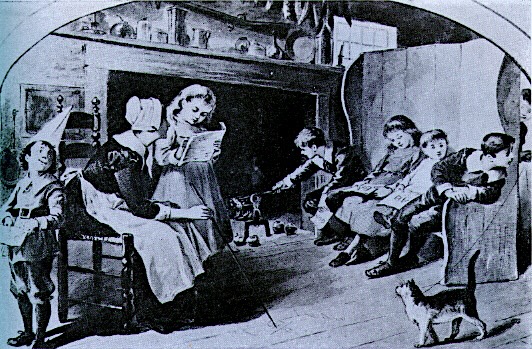
William’s second wife Susanna died at a young age in in 1758. We don’t know what happened, but in that era it could have been something from a long list of troubles. For example, just a couple of years earlier in 1755-56, “Epidemics of smallpox and measles strike in Massachusetts, Rhode Island, Connecticut, New York, and Pennsylvania. The population, both of settlers and Native peoples, is already weakened by the measles epidemic when the smallpox outbreak occurs.” (3)
The beginnings of the town of New Milford and the church
Ross Detwiler,
are so intermingled that they are inseparable.
What occurred to the church occurred to the town . . . Towns were considered the basic structure for protection of individuals
and the central part of that structure came from a church and
the teachings of its minister.
The Whole Story History Of The First Congregational Church
The Separatists’ Church of New Milford
We noted several times in our research of New Milford town records, that William Drinkwater was quite involved in both the civic affairs and goings-on with the local church. Considering that he had acquired a reputation for disreputable behavior when he was a younger man, this was quite a change of character. Here’s an example entry: “On Apr 11, 1731, the Separatist Church voted to take out part of the women’s seats in the Meetinghouse. Nathaniel Bostwick, Ebenezer Fisk and William Drinkwater were selected to do the work. William was among 35 members of the Separatist’s Church who became influential leaders.” (History of the Towns of New Milford and Bridgewater…)
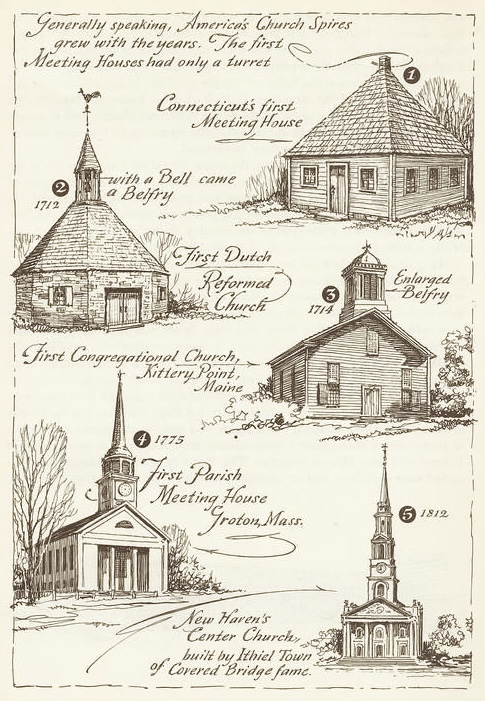
We wanted to understand more about his transformation, which led us to a larger understanding of what church life meant to our ancestors in colonial New England. No matter where you lived, it always began with the Meeting House. From an 1891 issue of The Atlantic magazine, writer Alice Morse Earle, wrote:
“When the Pilgrim Fathers landed at Plymouth, they at once assigned a Lord’s Day meeting-place for the Separatist church, — “a timber fort both strong and comely, with flat roof and battlements; ” and to this fort, every Sunday, the men and women walked reverently, three in a row, and in it they worshiped until they built for themselves a meeting-house in 1648.
As soon as each successive outlying settlement was located and established, the new community built a house for the purpose of assembling therein for the public worship of God; this house was called a meeting-house. Cotton Mather saith distinctly that he “found no just ground in Scripture to apply such a trope as church to a house for public assembly.” The church, in the Puritan’s way of thinking, worshiped in the meeting-house, and he was as bitterly opposed to calling this edifice a church as he was to calling the Sabbath Sunday. His favorite term for that day was the Lord’s Day.
The settlers were eager and glad to build their meeting-houses; for these houses of God were to them the visible sign of the establishment of that theocracy which they had left their fair homes and had come to New England to create and perpetuate. But lest some future settlements should be slow or indifferent about doing their duty promptly, it was enacted in 1675 that a meeting-house should be erected in every town in the colony; and if the people failed to do so at once, the magistrates were empowered to build it, and to charge the cost of its erection to the town. The number of members necessary to establish a separate church was very distinctly given in the Platform of Church Discipline : “ A church ought not to be of greater number than can ordinarilie meet convenientlie in one place, nor ordinarilie fewer than may conveniently carry on church-work.” Each church was quite independent in its work and government, and had absolute power to admit, expel, control, and censure its members.”

(Image courtesy of Wikimedia Commons).
So we were a bit confused to read this: “The beginning of the influences which were largely the cause of the formation and existence of the Separatists’ Church, in New Milford, were started and propagated by the idea of compelling people to obey the regulations of a legal church, while still pretending that the gospel taught the spirit of freedom and kindness. This occurred in a town vote in 1745, upon the question of settling a minister, the Rev. Noah Wells. The proceedings were such on that occasion as to lead thirty-five influential men to pledge themselves against that action, and to induce two of the leaders to pledge themselves to prosecute the matter in the county court if the decision of the meeting should be carried out in the settlement of Mr. Wells. These leaders, Joseph Ruggles and William Drinkwater, afterwards became strong men in starting, sustaining, and upholding the Separate Church. They were men of decided ability, means, and public influence, although they did not long remain in the town.” (History of the Towns of New Milford and Bridgewater…)
There again. It had been stated two times: Separatists’ Church and the Separate Church — but what were they separating from? We knew that the Quakers had built their own Meeting House in town in 1741, so was this related to that, or was there some other schism going on?
What was going on requires some explanation about the Connecticut Colony in that era. “Other religions may have made inroads in 18th-century Connecticut, but Puritanism, now known as Congregationalism, remained the faith of the ruling elite, and the Congregational Church remained the established church of the colony. The majority of the population remained Congregationalist. Like their Puritan forebears, Congregationalists believed that governments existed for the benefit of the people, and that governors needed to rule according the will of God.” (Connecticut History.org)
Furthermore, “The original colonies along the Connecticut River and in New Haven were established by separatist Puritans who were connected with the Massachusetts and Plymouth colonies. They held Calvinist religious beliefs similar to the English Puritans, but they maintained that their congregations needed to be separated from the English state church. They had immigrated to New England during the Great Migration. In the middle of the 18th century, the government restricted voting rights with a property qualification and a church membership requirement. (Wikipedia, Connecticut Colony)
(Image courtesy of Pinterest, via Etsy).
So after learning all about the Congregationalist viewpoint of that era, this passage suddenly made sense: “KINDNESS, used as an element of power, instead of law, would have saved the Church and the world millions of men, treasure, and great honor, and would have elevated the human race far beyond anything as yet attained. While law is not to be discarded, yet it is proper to recognize the fact that it has been used, in a vast majority of cases, in the Church and out of it, as a matter of will, to gratify the anger and dictatorial feelings of men.” (History of the Towns of New Milford and Bridgewater…)
Summary: The gist of it is this — the State had made a law that crossed a line and determined who could be a member of a church. In other words, the beliefs that had brought the earlier generations of Puritans to America were being eroded, by the State sticking its nose into church matters. Connecting the ideas of voting rights and property ownership, to the right of personal religious worship as one saw fit — People did not like this development at all.
It was as if the State was dictating who had appropriate, approved spirituality, and who did not. (Just like back in the English State Church which they had all left behind). In the same manner that the Pilgrims had once been called Separatists — the Separatists’ Church in New Milford was then conceived. (4)
Four Sons, and the French and Indian War
The William Drinkwater family had four sons who served in The French and Indian War, even though much of the action for that conflict took place far away from where they lived in Connecticut. The two oldest sons, Thomas and John, both died in battles in 1755. The two younger sons, William Jr. and Samuel, served from 1759 until 1762 in various capacities.
Sons John and Thomas—
Both of these sons were serving at Fort Edward, located on a bend in the Hudson River, at Lake George in the Province of New York. (In the present day, this is Washington County, New York).
At 24 years old, John died at the Battle of Lake George, serving under Captain Banjamin Hinman. It was “fought on 8 September 1755, in the north of the Province of New York, as part of a campaign by the British to expel the French from North America…The battle consisted of three separate phases and ended in victory for the British and their allies”.
Thomas, aged 25, is recorded as dying on November 3, 1755, also at Fort Edward under Captain Samuel Demmik. Based upon our research it seems he died either from wounds incurred in the earlier Battle of Lake George, or in skirmishes which occurred after that confrontation.

by Thomas Johnston.
(Image courtesy of the Smithsonian American Art Museum).
Sons Willam Jr. and Samuel —
We observed in the Rolls of the Connecticut Men in The French and Indian War, that son William, who was born in 1742, was involved in the 1759 Campaign of Connecticut Forces, and served from April 1 through December 1, 1759 (for 6 months). “In the Tenth Company of the Second Regiment (Colonel Nathaniel Whiting’s) commanded by Captain Gideon Stoddard, the name of William Drinkwater appears. There are some [family] tales of Bill Drinkwater, of Stephen Terrell, and Thomas Drinkwater, but they are so indefinite that all which can be gleaned from them is that these men went as far as Quebec, and were in the battle on the Heights of Abraham, and, possibly, in some of the others.” (Two Centuries Of New Milford, Connecticut — 2 Centuries…)

This engraving shows the three stages of the battle: the British disembarking,
scaling the cliff and the battle. (Image courtesy of the Library and Archives Canada).
“The Battle of the Plains of Abraham, also known as the Battle of Quebec (French: Bataille des Plaines d’Abraham, Première bataille de Québec), was a pivotal battle in the Seven Years’ War (referred to as the French and Indian War to describe the North American theatre). The battle, which began on 13 September 1759, was fought on a plateau by the British Army and Royal Navy against the French Army, just outside the walls of Quebec City… The battle involved fewer than 10,000 troops in total, but proved to be a deciding moment in the conflict between France and Britain over the fate of New France, influencing the later creation of Canada.” (Wikipedia)
From the same Connecticut Rolls book, we saw records that William and his younger brother Samuel (born 1744) were listed in the muster roll for the Connecticut Forces for the Campaign of 1761. They were in Captain Archibald McNeill’s Eleventh Company, recorded in June 1761.
Then, this book lists them again the next year as part of the muster roll of Captain Archibald McNeill’s Ninth Company, recorded June 1762.
William was enlisted from: March 27 until December 3, for slightly over eight months; Samuel,for a few days more, from: March 22 until December 3. (5)

circa 1786. (Image courtesy of Yale University Art Gallery).
Two Sons, and the Revolutionary War
Wiliam Drinkwater Jr. was apparently quite the Patriot. Not only did he serve in the French and Indian War, but he “was a private in the Continental Army. He was in Captain Starr’s Company when he was captured near Montreal Sept 25.” (2 Centuries…) This had to be in the months leading up to what is now called the Battle of Quebec. “Shortly after the American Revolutionary War broke out in April 1775, a small enterprising force led by Ethan Allen and Benedict Arnold captured the key [strategically important] Fort Ticonderoga on May 10. Arnold followed up the capture with a raid on Fort Saint-Jean not far from Montreal, alarming the British leadership there.
The Battle of Quebec (French: Bataille de Québec) was fought on December 31, 1775, between American Continental Army forces and the British defenders of Quebec City early in the American Revolutionary War. The battle was the first major defeat of the war for the Americans, and it came with heavy losses. General Richard Montgomery was killed, Benedict Arnold was wounded, and Daniel Morgan and more than 400 men were taken prisoner.” (Wikipedia)
Two Centuries Of New Milford, Connecticut continues, “William was captured and after being confined for a number of weeks in the Sugar House, prisoners were taken to the prison ship Dutton. Two hundred were transported to Milford and put ashore. Twenty were dead before the ship arrived and 20 more died soon after. All 40 are buried in a graveyard there.
Of the 12 men of New Milford, only four returned – Roger Blaisdell, David Buell, William Drinkwater and Lyman Noble. Through friends in Milford, they were able to secure a horse, and thus worked their way back to New Milford, reaching there about March 1777.” (6)
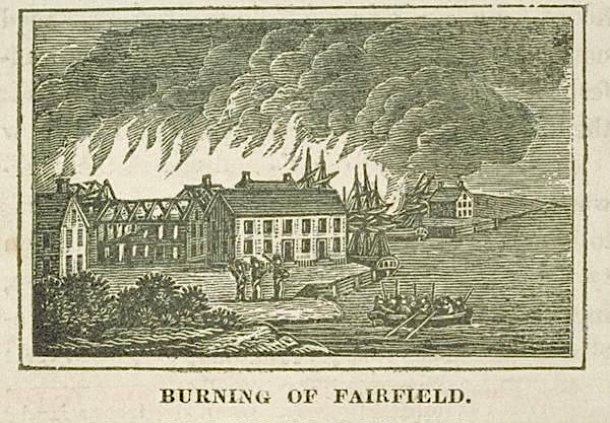
(Image courtesy of the Connecticut Museum of History and Culture).
“Many of the residents who lost their homes were offered the choice of money or an equivalent value of land from the half-million acres owned by Connecticut in what is now part of Ohio. Many took the property in what came to be called ‘the Fire Lands’ and never returned.”
The Burning of the Towns of Danbury, and Fairfield
Yet, he continued to serve even after his ordeal. “Capt. Bostwick appeared as a leader in the Danbury alarm. [The burning of Danbury, Connecticut Continental Army military supply depots by the British forces]. With him were John Terrell and David Buell and Bill Drinkwater. The group from Capt. Bostwick’s company was camped four days in the Danbury alarm.
The following story regarding this little band is extant: The British had commenced their retreat from Danbury by way of Ridgefield and our men were following them up very earnestly, pressing close to a grenadier regiment which was the rear guard of the head force. John Terrell, William Noble, Bill Drinkwater and David Buell rushed together up one side of the famous Ridgefield Hill, while the grenadiers [a soldier armed with grenades] were still on the other side. Men who crossed the Delaware with Capt Bostwick of New Milford, Dec. 25, 1776, and were in the battles of Trenton and Princeton, included William.” (2 Centuries…)
Where was Samuel Drinkwater?
We were wondering why there was no apparent military records for Samuel Drinkwater during the Revolutionary War in Connecticut. The answer was unexpected, and it turns out that the records were in New York, not Connecticut. From WikiTree we learned, “Samuel Drinkwater, the 3rd generation of this surname found in early America and a descendant of Thomas Drinkwater, changed the family name to DeWaters after the Revolutionary War. He, and his wife’s family, were Loyalists. Loyalists were punished by the Patriots and some fled to England or Canada. Loyalists were not allowed to own land and some had their lands confiscated, and some were jailed.” (WikiTree)
We were able to confirm his Loyalist behavior based on the “Minutes of the Committee and of the First Commission for Detecting and Defeating Conspiracies in the State of New York” which documents every detail. (See the footnotes). When we thought about it, the French and Indian War he had served in earlier, was a war fought to protect British interests in America. Samuel eventually ended up in Michigan where his son Amos purchased land for him to live on.

Samuel’s behavior was in contrast to that of his brother William. Despite that, William Jr. still got into much trouble by being in the wrong place, at the wrong time, with the wrong people. The same “Minutes of the Committee…” book explains — it seems that he was with a group of people one evening, and a couple of them were disaffected people which means Loyalist. This was reported, and he got in trouble for it, but he went through the interrogation process, and voluntarily took the “Oath of Allegiance to this State” and was then released. That was in April 1777.
His has many records in the system, quite a few indicating that he was sick, excused, or on furlough. We suspect that he may have gotten ill while he was on the prison ship Dutton. One record notes him as deserting (with an evident question mark ?), in April of 1779, after a little more than two years of service. Other records indicate that he was discharged from service on January 1, 1780. We are not exactly sure what happened there — perhaps he had had quite enough, thank you. He may have ended up raising a family in Dartmouth, Massachusetts, but again, we just don’t know. (7)
William Drinkwater, Late of New Milford
When William Drinkwater Sr. died, as was customary at the time, his estate needed to be inventoried and his debts settled. William and both of his wives are buried in the Northville Cemetery, New Milford, Litchfield County, Connecticut.
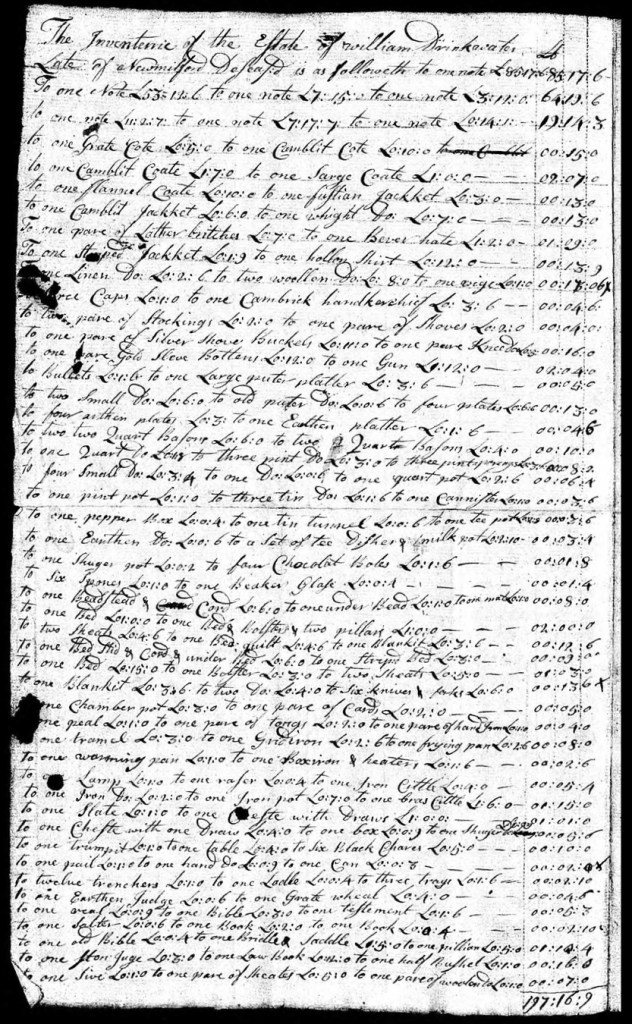

The next chapter is our final chapter in the Soule line. We begin in the Connecticut Colony with William Drainkwater’s daughter Mercy, who is the matriarch of Generation Five in America, with a new family line. (8)
Following are the footnotes for the Primary Source Materials,
Notes, and Observations
With Rods Belaboured…
(1) — five records
Barry Lawrence Ruderman
Antique Maps, Inc.
Carte De La Nouvelle Angleterre Nouvelle Yorck et Pensilvanie
by Jacques Nicholas Bellin, circa 1757
https://www.raremaps.com/gallery/detail/97868/carte-de-la-nouvelle-angleterre-nouvelle-yorck-et-pensilvan-bellin
Note: For the map image.

We initially found this newspaper excerpt attached to this file:
William Drinkwater
https://www.findagrave.com/memorial/147201109/william-drinkwater
Note: For the newspaper story by John Peter Zenger, The New-York Weekly Journal, Dec. 31, 1733.
However, the original newspaper story was excerpted two more times in the next two centuries, once in Lippincott’s Magazine, circa 1876 and once more in the The Hudson Valley Review, circa 2016 (see footnotes below). The newspaper publisher, John Peter Zenger became an important historical figure in the cause for freedom of the press in the United States:
The New York Weekly Journal
https://en.wikipedia.org/wiki/The_New_York_Weekly_Journal
Note: For the reference.
Lippincott’s Magazine of Popular Literature And Science
February, 1876., Vol. XVII.
Our Monthly Gossip > Our Early Newspapers
https://www.gutenberg.org/files/13154/13154-h/13154-h.htm
Note: This publication does not have page numbers; proceed to [pg 261].
The Hudson Valley Review, Spring 2016
Charivari on the Hudson:
Misrule, Disorder, and Festive Play, 1750-1900
by Thomas S. Wermuth
https://www.slideshare.net/slideshow/hrvr-2016/64294627#15
Book page: 46, Digital page: 57/137
Note: This version starts to stray from the original details.
Having Been Put Through The Mill
(2) — three records
PX Pixels
Colonial Grist Mill
by Paul Ward
https://pixels.com/featured/colonial-grist-mill-paul-ward.html
Note: For the mill image.
Two Centuries Of New Milford, Connecticut
An Account Of The Bi-Centennial Celebration Of The Founding Of The Town Held June 15, 16, 17 And 18, 1907, With A Number Of Historical Articles And Reminiscences
https://www.gutenberg.org/files/49048/49048-h/49048-h.htm
Notes: For the text.
Hidden New England
New England’s Grist Mills: Not Run-of-the-mill Historic Buildings
by Jay Bell
https://www.newenglandgoodlife.com/hidden-new-england/new-englands-grist-mills-not-run-of-the-mill-historic-buildings
Note: For the text.
There’s Many Trees In That Orchard!
(3) — fourteen records
Boston Public Library
Norman B. Levanthal Map & Education Center Collection
Plan of the Colony of Connecticut in North America
by Moses Park, 1766
https://collections.leventhalmap.org/search/commonwealth:z603vt46p
Note: For the map image. “Moses Park, a surveyor from Preston, Connecticut, executed this map in 1766 with the assistance of Asa Spaulding of Norwalk and Samuel Mott of Preston.”
William Drinkwater
in the U.S., Find a Grave Index, 1600s-Current
https://www.ancestry.com/search/collections/60525/records/122023930?tid=&pid=&queryId=4843a9fd-46f5-46ab-9c74-022e2410976d&_phsrc=qwN1&_phstart=successSource
and
William Drinkwater
https://www.findagrave.com/memorial/147201109/william-drinkwater
Note: For the data.
William Drinkwater
in the Connecticut, U.S., Town Marriage Records, pre-1870 (Barbour Collection)
New Milford Vital Records 1712-1860
https://www.ancestry.com/search/collections/1062/records/191143
Book page: 76, Digital page: 74/232
Note: For marriage 1.
Elizabeth Drinkwater
in the U.S., Find a Grave Index, 1600s-Current
https://www.ancestry.com/search/collections/60525/records/122024145
and
Elizabeth Benedict Drinkwater
https://www.findagrave.com/memorial/147201356/elizabeth-drinkwater
Note: For the text.
History of the Towns of New Milford and Bridgewater, Connecticut, 1703-1882
Genealogies (chapter)
by Samuel Orcutt, circa 1882
https://archive.org/details/ldpd_11727486_000/page/16/mode/2up
Book page: 692-693, Digital page: 724-725/943
Note: For the text.
Susanah Washburn
in the Connecticut, U.S., Town Marriage Records, pre-1870 (Barbour Collection) New Milford Vital Records 1712-1860
https://www.ancestry.com/search/collections/1062/records/186662?tid=&pid=&queryId=5d790e3c-e896-4e69-844c-f5687b26d2ed&_phsrc=Puk2&_phstart=successSource
Book page: 221, Digital page:219/232
Note: For marriage 2.
Susanna Drinkwater
in the U.S., Find a Grave Index, 1600s-Current
https://www.ancestry.com/search/collections/60525/records/122023247
and
Susanna Washburn Drinkwater
https://www.findagrave.com/memorial/147200354/susanna-drinkwater
Note: For the data.
To account for the births, deaths and marriages of the Drinkwater children from these two families, we created a chart based upon Family Search files, explaining below how to link to the actual files.
- Family Search, Birth — Connecticut, Births and Christenings, 1649-1906, Film # 007833261
- Browse the film #007833261, at: https://www.familysearch.org/en/search/film/007833261?i=0
- Enter file link number in upper left corner box: ___ of 7181. Here is an example: The oldest son Thomas Drinkwater, born in 1758. Type in file number 2795 (of 7181) and you will see his actual birth record. This numerical entry leads to this —
- A blue bus the appears around your file. Click on this blue box and the file pops up.
- All Drinkwater family links from then housed under this url: https://www.familysearch.org/ark:/61903/3:1:3Q9M-CS3F-K385-7?i=2939&lang=en&cc=2843390
| 1729 | Thomas | 2795 | Birth |
| 1755 | Thomas | 2976 | Death |
| 1731 | John | 2961 | Birth |
| 1755 | John | 2962 | Death |
| 1733 | Elizabeth | 2951 | Birth |
| 1755 | Elizabeth | 2953 | Marriage |
| 1734 | Hanah | 2955 | Birth |
| 1735/46 | Mary | 2963 | Birth |
| 1736 | Abigail | ||
| 1738 | Sarah | 2972 | Birth |
| 1771 | Sarah | 2974 | Marriage |
| 1740 | Jerusha | 2958 | Birth |
| 1758 | Jerusha | 2959 | Marriage |
| 1742 | William Jr. | 2983 | Birth |
| 1744 | Samuel | 2969 / 2970 | Birth |
| 1769 | Samuel | 2971 | Marriage |
| 1746 | Ann | ||
| 1748 | Mercy | 2965 | Birth |
| Unknown | Mercy | Other file link | Marriage |
| 1748 | Mercy | Other file link | Death |
| 1751 | Ebenezer | 2947 / 2949 | Birth |
| 1753 | Johannah | 2960 | Birth |
| 1756 | Thomas | 2977 | Birth |
| 1758 | Ann | 2940 | Birth |
A New England Dame school in old colonial times, 1713
by Artist unknown, Engraving. (Bettman Archive)
https://commons.wikimedia.org/wiki/File:Dame_School.jpeg
Note: For the image.
NIH > NLM, Native Voices
1755–56: Smallpox sweeps through northern British colonies
https://www.nlm.nih.gov/nativevoices/timeline/223.html
Note: For the text.
The Separatists’ Church of New Milford
(4) — eight records
Church History — The Whole Story History Of The First Congregational Church
New Milford, Connecticut
by Ross Detwiler, originally published November, 1983
revised 2001 and 2016
https://nmchurch.org/long-history/
Note: For the text.
History of the Towns of New Milford and Bridgewater, Connecticut, 1703-1882
Chapter VI. A Meeting-House and the North Purchase, 1716-1731
https://www.ancestry.com/imageviewer/collections/14676/images/dvm_LocHist003746-00063-0?usePUB=true&_phsrc=KMS3&pId=108&backlabel=Return&queryId=9c7228bee4240813c3a8238a9c32f67b&rcstate=dvm_LocHist003746-00038-1:285,940,575,978;1104,1012,1291,1051;1308,2571,1597,2610;1084,3234,1269,3273;1558,3365,1680,3408;103,940,286,978
Book page: 98 Digital page: 109/943
Note: For the text.
The Atlantic
The New England Meeting-House
by Alice Morse Earle
https://www.theatlantic.com/magazine/archive/1891/02/the-new-england-meeting-house/633979/
Note 1: This is not a typo. This is the February 1891 issue.
Note 2: For the text.
The First New Haven Meeting House, New Haven Colony, c. 1690
by Artist unknown, (1892)
File:The First New Haven Meeting House, New Haven Colony restored.jpg
https://commons.m.wikimedia.org/wiki/File:The_First_New_Haven_Meeting_House,_New_Haven_Colony_restored.jpg
Note: For the image.
Connecticut History.org
The Importance of Being Puritan: Church and State in Colonial Connecticut
https://connecticuthistory.org/the-importance-of-being-puritan-church-and-state-in-colonial-connecticut/
Note: For the text.
Wikipedia
Connecticut Colony
Religion
https://en.wikipedia.org/wiki/Connecticut_Colony
Note: For the text.History of the Towns of New Milford and Bridgewater, Connecticut, 1703-1882
Pinterest
Colonial Church Design
Early American Church Spires Vintage Print Meeting Houses | Etsy
https://www.pinterest.com/pin/331014641364220283/
Note: For the image.
History of the Towns of New Milford and Bridgewater, Connecticut, 1703-1882
Chapter XII, Church Of The Separates, 1753—1812
by Samuel Orcutt, circa 1882
https://archive.org/details/ldpd_11727486_000/page/16/mode/2up
Book page: 191 >, Digital page: 222 > (222/1014)
Note: For the text.
Four Sons, and the French and Indian War
(5) — six records
A Prospective Plan of the Battle Fought near Lake George on the 8th of September 1755, by Thomas Johnston
File:A Prospective Plan of the Battle Fought near Lake George on the 8th of September 1755-saam 1966.48.82.jpg
https://commons.wikimedia.org/wiki/File:A_Prospective_Plan_of_the_Battle_Fought_near_Lake_George_on_the_8th_of_September_1755-saam_1966.48.82.jpg
Note: For this image.
Collection of The Connecticut Historical Society, Volume X, circa 1905
Rolls of Connecticut Men in The French and Indian War, 1755-1762, Volume II, 175801762, Appendixes 1755-1764
File:Collections of the Connecticut historical society (IA collectionsofcon00conn).pdf
https://commons.wikimedia.org/wiki/File:Collections_of_the_Connecticut_historical_society_(IA_collectionsofcon00conn).pdf
Note: Pages 142, 280, and 338-339.

(Image courtesy of the Library of Congress).
(2 Centuries…)
Two Centuries Of New Milford, Connecticut
An Account Of The Bi-Centennial Celebration Of The Founding Of The Town Held June 15, 16, 17 And 18, 1907, With A Number Of Historical Articles And Reminiscences
https://www.gutenberg.org/files/49048/49048-h/49048-h.htm
Note 1: For the text.
Note 2: This book does not have page numbers. Refer to footnote number on the right-hand side of the page {33} and {34}.
The Canadian Encyclopedia
Battle of the Plains of Abraham
https://www.thecanadianencyclopedia.ca/en/article/battle-of-the-plains-of-abraham
Note: For the image, “A View of the Taking of Quebec, September 13, 1759”.
Battle of the Plains of Abraham
https://en.wikipedia.org/wiki/Battle_of_the_Plains_of_Abraham
Note: For the text.
Capt Archibald McNeill Jr.
https://www.findagrave.com/memorial/67585021/archibald-mcneill
Note: For his correct surname spelling.
Two Sons, and the Revolutionary War
(6) — three records
The Death of General Montgomery in the Attack on Quebec, December 31, 1775,
by John Trumbull, circa 1786.
https://en.wikipedia.org/wiki/File:The_Death_of_General_Montgomery_in_the_Attack_on_Quebec_December_31_1775.jpeg
Note: For this image.
(2 Centuries…)
Two Centuries Of New Milford, Connecticut
An Account Of The Bi-Centennial Celebration Of The Founding Of The Town Held June 15, 16, 17 And 18, 1907, With A Number Of Historical Articles And Reminiscences
https://www.gutenberg.org/files/49048/49048-h/49048-h.htm
Note 1: For the text.
Note 2: This book does not have page numbers. Refer to footnote number on the right-hand side of the page {39} and {40}.
British Merchant east indiaman ‘Dutton’ (1763)
https://threedecks.org/index.php?display_type=show_ship&id=29454
Note 1: The ship nationality is Great Britain, and it was operated by the East India Company until is was utilized to hold prisoners of war.
Note 2: Found in the comments — “Posted by Tom Hogan on Monday 14th of June 2021 12:45, This ship apparently held American prisoners at New York in 1776. In their pension applications, Pvt. Roswell Becket and Pvt. Enoch Greenwood, both taken at Fort Washington, reported being held for a time aboard the Dutton. The ship may have been in the Transport Service and was used as a prison after the large influx of captives from Fort Washington arrived in November 1776.”
Note: For the data about timeframe and country origin.
The Burning of the Towns of Danbury, and Fairfield
(7) — seven records
Connecticut History.org
The Burning of Danbury
https://connecticuthistory.org/the-burning-of-danbury/
Note: For reference.
Connecticut History.org
British Burn Fairfield – Today in History: July 7
Burning of Fairfield, 1779
by Artist unknown
https://connecticuthistory.org/british-burn-fairfield/
Note: For text and the woodcut illustration.
WikiTree
Drinkwater Name Study
Drinkwater Name Changed, Drinkwater > Dewalter
DeWaters
https://www.wikitree.com/wiki/Space:Drinkwater_Name_Study
Note 1: “Samuel (Drinkwater, the 3rd generation of this surname found in early America and a descendant of Thomas Drinkwater, changed the family name to DeWaters after the Revolutionary War. He, and his wife’s family, were Loyalists. Loyalists were punished by the Patriots and some fled to England or Canada. Loyalists were not allowed to own land and some had their lands confiscated, and some were jailed.”

Minutes of the Committee and of the First Commission for Detecting and Defeating Conspiracies in the State of New York, December 11, 1776-September 23, 1778, with collateral documents : to which is added Minutes of the Council of appointment, state of New York, April 2, 1778-May 3, 1779
by New York (State). Commissioners for Detecting and Defeating Conspiracies
https://archive.org/details/minutesofcommitt571newy/page/288/mode/2up
William Drinkwater
in the U.S., Compiled Revolutionary War Military Service Records, 1775-1783
Connecticut > Seventh Regiment > D
https://www.ancestry.com/search/collections/1309/records/440757?tid=&pid=&queryId=9a3bc703-5e28-4bb9-9d44-e4caaae3c054&_phsrc=Qwp1&_phstart=successSource
Digital page: 1409/1879
and
https://www.ancestry.com/search/collections/1309/records/440757?tid=&pid=&queryId=0e9420b9-85e2-45cf-8d6b-6f3652956042&_phsrc=Qwp5&_phstart=successSource
Digital page: 1452/1879
and
https://www.ancestry.com/search/collections/1309/records/440754?tid=&pid=&queryId=a04db6c4-0211-4b51-a0f3-d866cf058fdf&_phsrc=Qwp3&_phstart=successSource
Digital page: 1410/1879
Note: For the data.
William Drinkwater, Late of New Milford
(8) — one record
William Drinkwater
in the Connecticut, U.S., Wills and Probate Records, 1609-1999
Woodbury District > Probate Packets, Downs, C-Edmond, M, 1720-1880
https://www.ancestry.com/search/collections/9049/records/2465233?tid=&pid=&queryId=2aca2ddd-03e3-4f17-b65e-830efbf1bc7c&_phsrc=VgH4&_phstart=successSource
Digital page: 850-857/1417
Note: Case 1384
 Our Ancestors, Our Narratives


