The Coutinho / Oliveira Line, A Narrative — Three

This is Chapter 3 of 3, being the last chapter that follows this family line. (Again, as a reminder), in total there are 6 chapters: the first set of 3 chapters is written in English; second set of 3 chapters is translated into Portuguese.

Varig Airlines Jets to Bahia travel poster, circa 1960.
(Image courtesy of Librairie Elbé, Paris).

A Place Quite Apart

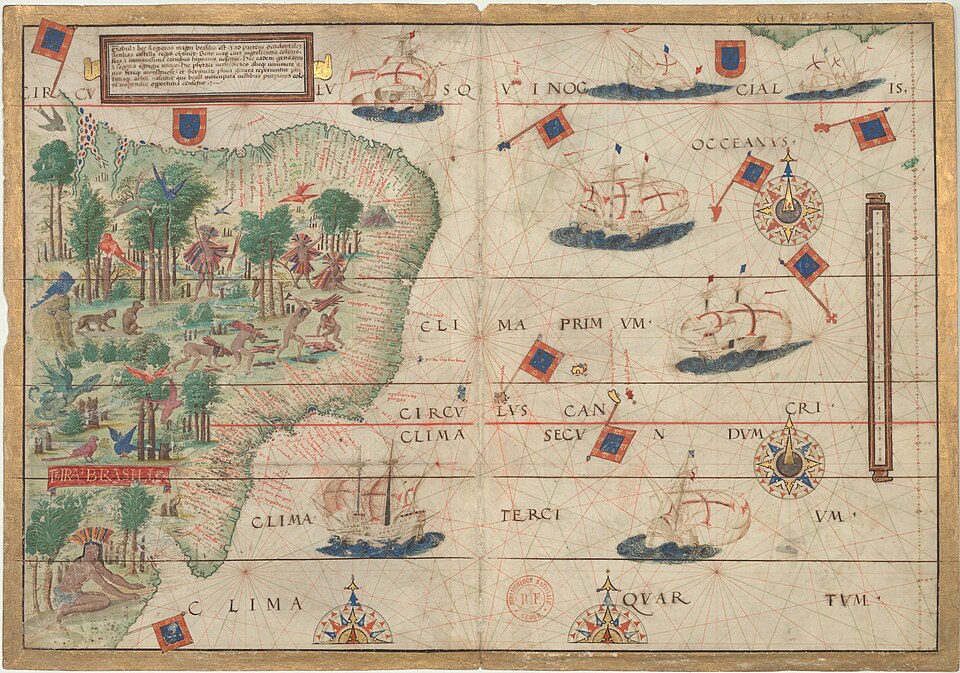
The Coutinho and Oliveira families are traditional Brazilian Roman Catholic families, descended from Portuguese immigrants. However, the northeastern state of Bahia, which they immigrated to, is a unique place quite apart from the rest of Brazil. There are historical reasons for this… (1)

Catholicism is the Foundational Religion of Brazil

“According to the tradition, the first Catholic mass celebrated in Brazil took place on April 26, 1500. It was celebrated by a priest who arrived in the country along with the Portuguese pirates and explorers to claim possession of the newfound land. The first diocese in Brazil was erected more than 50 years later, in 1551.

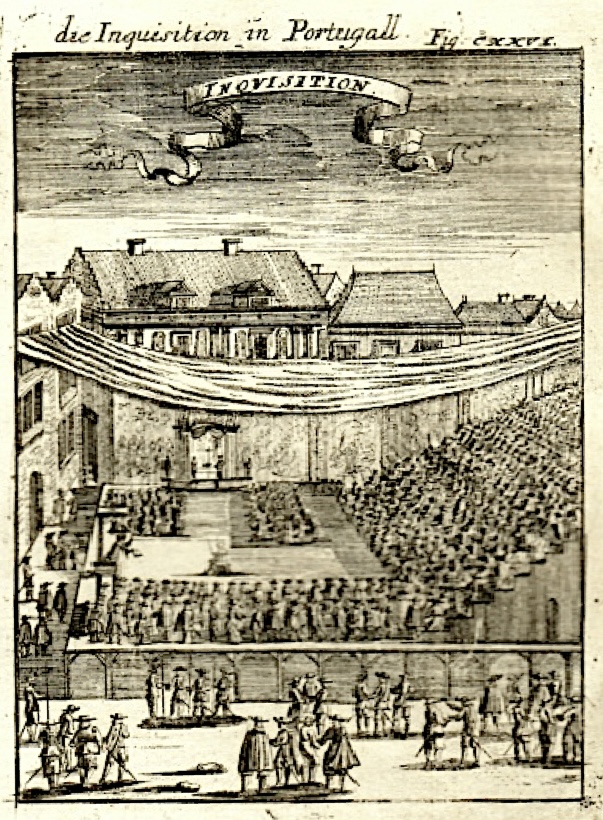
Brazil’s strong Catholic heritage can be traced to the Iberian missionary zeal, with the 15th-century goal of spreading Christianity. The Church missions began to hamper the government policy of exploiting the natives. [Thus] in 1782 the Jesuits were suppressed, and the government tightened its control over the Church. [In the present day,] the Catholic Church is the largest denomination in the country, where 119 million people, or 56.75% of the Brazilian population, were self-declared Catholics in 2022. These figures make Brazil the single country with the largest Catholic community in the world.” There is a large pantheon of saints in the Catholic tradition. (Wikipedia and Google)
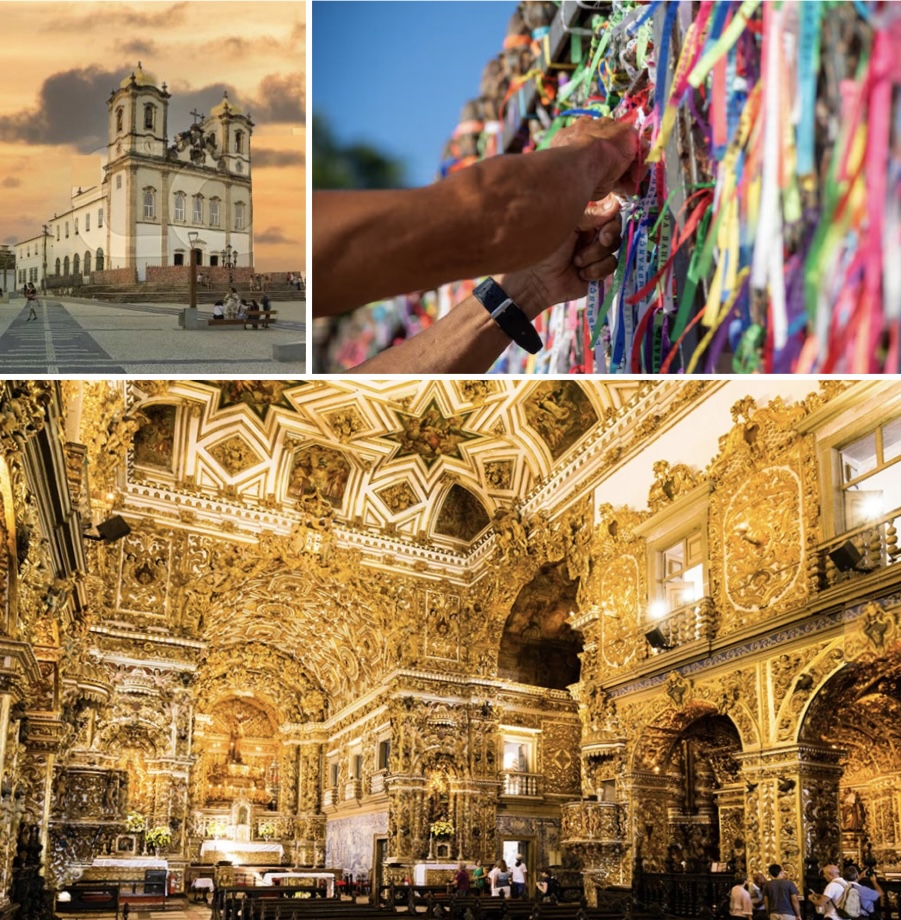
Top left: Exterior of the Church of Nosso Senhor do Bonfim, Salvador. Top right: Ribbons tied to the fence which surrounds the church. They read ‘Lembrança do Senhor do Bonfim da Bahia’ (Remembrance of the Lord of Bonfim of Bahia) and are linked to the belief of having your wishes granted. Bottom: Interior view of the Igreja e Convento de São Francisco / The São Francisco Church and Convent.

Comment: There are more Roman Catholics in Brazil than there are in Italy, simply because the population of Brazil is much greater than that of Italy. It would be very appropriate to say that Catholicism is an institutionalized religion in Bahia. Specifically, sources cite that there are more than 365 historic cathedrals and churches just in Salvador da Bahia alone. (One for each day of the year — So this makes us ponder, what about Leap Year Day? Instead of going to church, does everyone get a day off to go to the beach?) (2)

Slavery Did Not Officially End Until 1888

“During the Atlantic slave trade era, Brazil imported more enslaved Africans than any other country in the world. Out of the 12 million Africans who were forcibly brought to the New World, approximately 5.5 million were brought to Brazil between 1540 and the 1860s. The mass enslavement of Africans played a pivotal role in the country’s economy and was responsible for the production of vast amounts of wealth. In the first 250 years after the colonization of the land, roughly 70% of all immigrants to the colony were enslaved people.

Slavery was not legally ended nationwide until 1888, when Isabel, Princess Imperial of Brazil, promulgated the Lei Áurea (Golden Act). The Lei Áurea was preceded by the Rio Branco Law of September 28, 1871 (the Law of Free Birth), which freed all children born to slave parents, and by the Saraiva-Cotegipe Law (the Law of Sexagenarians), of September 28, 1885, that freed slaves when they reached the age of 60. Brazil was the last country in the Western world to abolish slavery.” (Wikipedia, see footnotes). (3)

At left: Isabel, Princess Imperial of Brazil, photographed by Joaquim Insley Pacheco, circa 1870.
At right: Manuscript of the Lei Áurea from the Brazilian National Archives.

Candomblé and Syncretism

When we lived in Bahia, we would sometimes view portions of Candomblé ceremonies that were held at a place called a terreiro, (a temple or house of worship). These sacred spaces are central to Candomblé, serving as the location for community worship, rituals, and connections with ancestral spirits. We both felt that it was rather remarkable that many different  Pai-de-santos (father of the saint) or Mãe-de-santos could look at you and tell you exactly which Orirá looked over you. (And among them in different times and places, they were always consistent).

“Candomblé developed among Afro-Brazilian communities amid the Atlantic slave trade of the 16th to 19th centuries. It arose through the blending of the traditional African religions from the Yoruba, Bantu, and Fon people brought to South America, along with Roman Catholicism, especially the Catholic saints. It primarily coalesced in the Bahia region during the 19th century.” (Wikipedia and Altar Gods)

One of the central religious traditions of Candomble is veneration of the Orixas, divine energies associated with different elements of nature. Individuals are believed to identify with one of the Orixas as their tutelary spirit. (Altar Gods)

When these many enslaved peoples arrived in Bahia during this diaspora, they encountered Roman Catholic Portuguese colonialists who then controlled the area. Very cleverly, they maintained their religious affiliations by covertly hiding their own saints who were linked to Catholic saints as a way to preserve African beliefs despite forced religious conversion. This is called syncretism. An example of this is the Orixa Ogun, who stands-in for, Saint George, Saint Sebastian, or Saint Anthony, depending upon your location. Candomblé can be thought of as a non-institutionalized religion in Bahia.

Image at top: Contemporary artwork representing three Orixas. Bottom left: A group of Candomblé practitioners photographed in 1902. (Both images are courtesy of Altar Gods). Bottom right: Family photograph of the Yemanjá festival held every February in Salvador, Bahia.

In summary, “Candomblé is a uniquely Afro-Brazilian religion, made possible by mixing African, European, and native Indian traditions in the New World. Candomblé is strongest in Bahia, Brazil, a major port for arriving Africans. Its principal city, Salvador, was the first capital city of Brazil. The first Candomblé temple was built in Salvador in the 19th century after the abolition of slavery.” (Wikipedia) (4)
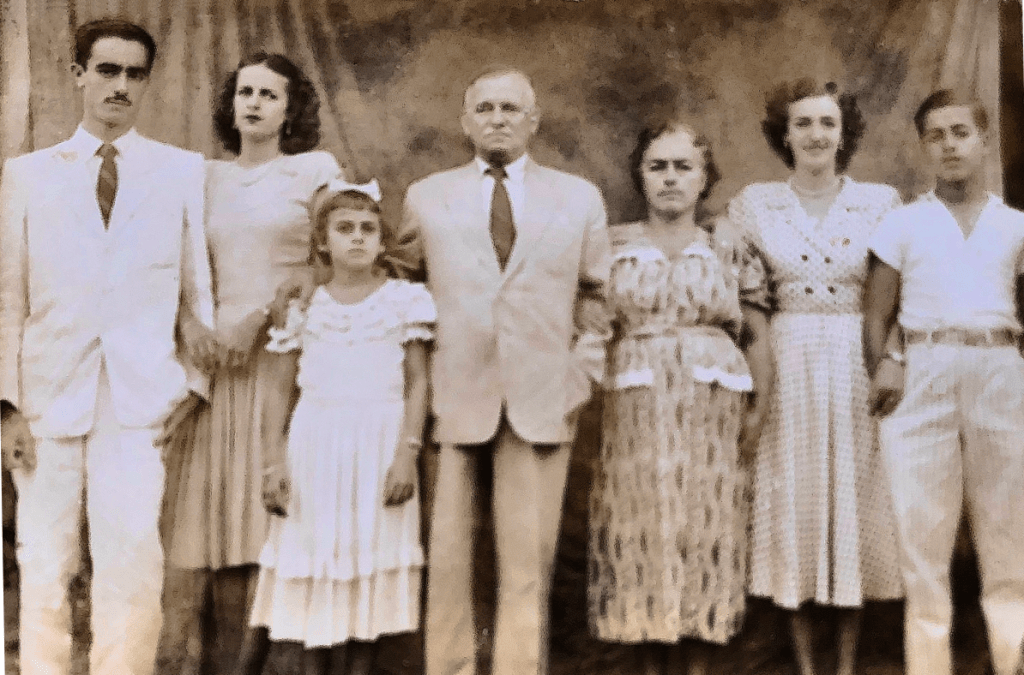
The Oliveira Family of Ubaitaba circa 1949-50. Left to right: Raynelde Dantas Motta, Laura (Oliveira) Motta, Lourdes Oliveira, João Celestino de Oliveira, Maria (Almeida) de Oliveira, Lindaura de Almeida Oliveira, and José Oliveira. (Family photograph).

The Oliveira Family of Ubaitaba

Ubaitaba is a small river city found in section of the remaining ancient Atlantic rainforest, in the state of Bahia, between the cities of Salvador and Ilhéus. This region “was formerly inhabited by Indigenous peoples [Tupi] until the arrival of Portuguese colonizers. After contact with the Portuguese and the establishment of the Captaincies of Brazil by King Manuel I of Portugal from 1504 onwards, the municipality’s territory became part of the lands of the Captaincy of São Jorge dos Ilhéus. The village of São Jorge dos Ilhéus was founded in 1536 as Vila de São Jorge dos Ilhéos. The modern name of Ubaitaba is from the Tupi language.

Throughout the 18th century, the Captaincy of São Jorge dos Ilhéus developed, and farms were established along the coast of the vast region. The origin of the village is related to the creation of both the Arraial de Tabocas and the Arraial de Faisqueira farms (in 1783), an area then used for timber extraction, sugar cane, cereal and cocoa cultivation.

This is a excerpted portion of the General Map of Brazil published in January 1911, and organized by the company Hartmann-Reichenbach. The red lines are railways. (Map image courtesy of Mapas Históricos da Bahia).

On January 28, 1914, a river flood destroyed the Arraial de Tabocas, scattering its population. Coordinated by physician Francisco Xavier de Oliveira, a resident of the village, the victims rebuilt the settlement, rising above the floodwaters. The name chosen was Itapira. [This name was changed to] Ubaitaba, conferred in 1933, a combination of the Indigenous words ‘ubá, meaning small canoe, ‘y,’ meaning river, and ‘taba’ meaning village / city.

When reviewing the very few historic photographs available of the city, the layout is two parallel roads which run along the river’s edge. Between the two streets is a wide, park-like meridien, with the Catholic Church anchoring one end of town. Shops and stores are one or two stories tall, and facing the street. We provide this description because the Oliveira family ran a general market store in Ubaitaba, of the type then known as a mercearia.

Left: One of the two main streets of the town of Ubaitaba, Bahia in the 19th century. Right: the church which anchored the end of the streets. The general market ‘mercearia’ which the Oliveira family operated, would have been somewhere along this street, and could have looked like the one shown in the lower photograph. (For photograph credits, see footnotes).


Before the rise of large retail chains, mercerias gerais (general stores) served as essential neighborhood stores where people could buy a range of everyday products, acting as a central point in local communities. They sold a wide variety of basic and imported goods, including staples like rice, beans, and sugar, along with everyday essentials like soap and matches, and a selection of imported foods and liquors. They also offered locally made products such as coffee, cheese, and fruits.

Some rare mercearias still exist to this day, but that particular evocative name has given way to the rather bland and universal name of mini-market. (Think lottery tickets, cigarettes, a carton of milk, and perhaps some chips, or donuts). In this modern Walmart era in which we live, very few places still exist in local communities, where you can walk into a small family store and everyone knows your name.

For the de Oliveira family
We can begin with, Manoel Celestino de Oliveira, born (likely) in Brazil. He married Rita Celestino de Oliveira. They had a son, who is named —

João Celestino de Oliveira, born November 6, 1890 — in Maceió, Alagoas (state) died November 25, 1968, in Ubaitaba. He was married two times: first to Eufrosina Souza Oliveira, until her death before 1925. They had one child.

Second, he married Maria de Almeida in 1925. She was born on March 20, 1900 in Maracás — died October 5, 1968, in Ubaitaba. They had four more children.
Maria de Almeida’s parents were: Cândido Olegário de Almeida and Balbina Olegário.

Together, João Celestino de Oliveira and Maria de Almeida raised 5 children. All births and deaths are in Bahia, Brazil, unless noted otherwise:

  • Agostinho Celestino de Oliveira, born August 13, 1919 — died April 12, 1983.
    (His birth mother was first wife Eufrosina Souza Oliveira). He married Ana Eusátquio de Souza on April 24, 1944.
  • Lindaura de Almeida (Oliveira) Coutinho, born October 24, 1927 in Ubaitaba — died June 19, 2020 in Salvador.
    (Lindaura carries the family line forward. See her spouse and children below).
  • Laura de Almeida (Oliveira) Motta, born March 27, 1929. She married Raynelde Dantas Motta, on March 30, 1949.
  • José Celestino de Oliveira, born December 20, 1937 — died 1992. He married Nidia Maria Amado de Oliveira in May 1968.
    She was a cousin of the beloved Brazilian novelist Jorge Amado, (see footnotes).
  • Maria Lourdes de Almeida (Oliveira) Cunha, born November 11, 1938. She married Humberto Olegário da Cunha on December 28, 1965. (5)
Paulo de Azevêdo Coutinho, circa 1966, and
Lindaura Almeida (Oliveira) Coutinho, circa 1950s.
(Family photographs).

You can’t imagine how much I’ve missed you…”

Before they were married, Paulo and Lindaura corresponded via letters for about two years before becoming engaged in September 1950. (At that time, letters were the only way they could communicate. Home telephones were still rather new and quite expensive, in the Brazil of that that era). None of those courtship letters have survived, but a few others have. When we looked at them we noted the degree of tenderness with which he still wrote to his wife Lindaura, even many years after they were married. In a 1968 letter (which we have placed the in the footnotes), we read these words —

April 11, 1968

My dear Lindaura,

Wishing you health together with our dear children.

I’m arranging things so that you can come here in the beginning of May. Rivaldo has found a house in Piranga, but he has to make major repairs. I won’t be paying rent, nor for any repairs.

I think that our little ones won’t be too unfamiliar with the climate in Piranga. Soon, I’ll write you a more detailed letter. You can’t imagine how much I’ve missed you. Many kisses to our children. A melancholic hug from your Paulo.

PS: The bonus will be worth it. NBR 500.00. If the “Ritom” truck doesn’t arrive by the 17th of this month, I’ll send Maria Celeste’s dresses by plane.

Their March 1952 wedding photograph. (Family photograph).

Paulo de Azevêdo Coutinho, born June 29, 1919 in Lençóis — died November 28, 1990 in Salvador. He married Lindaura Almeida de Oliveira on March 19, 1952 in Ubaitaba. She was born October 24, 1927 in Ubaitaba — died June 19, 2020 in Salvador.

They had five children together, as follows below. All births and deaths are in Bahia, Brazil, unless otherwise noted:

  • Maria Celeste Oliveira Coutinho, born July 14, 1953 in Salvador. She married Bernardino Dantas de Santana on July 28, 1989, — (ends) unknown date.
  • Maria Angela Oliveira (Coutinho) Martins Bass, born April 11, 1955 in Salvador. She married two times, first to Antonio Martins, Jr., 1985 — (ends) before 2002. She married second Robert Bass, 2002 — 2010, (his death). He died in Sarasota County, Florida, United States.
  • Maria Cristina Oliveira (Coutinho) Pinheiro, born May 27, 1961 in Ilhéus. She married Antonio Carlos Marques Pinheiro on September 17, 1983. They had two children.
  • Paulo Emilio Oliveira Coutinho, born September 17, 1963 in Ilhéus. He married once, first to Marizela Cardoso Sales, 1991 — (ends) before 2023. They had two children. Second, he was domestic-partnered to Sonia Alves Silva Chagas, in 2023. They have one child.
  • Leandro José Oliveira Coutinho, born September 30, 1965 in Ilhéus. He married Thomas Harley Bond on June 26, 2008.

Prior to knowing Lindaura Almeida Oliveira, Paulo de Azevêdo Coutinho had a previous relationship with a woman named Zulmira Silva. Even though they never married, and the fact that she passed on in 1952, from this union there were two children who were half-siblings of the (above) family. Paulo was then the father to seven children.
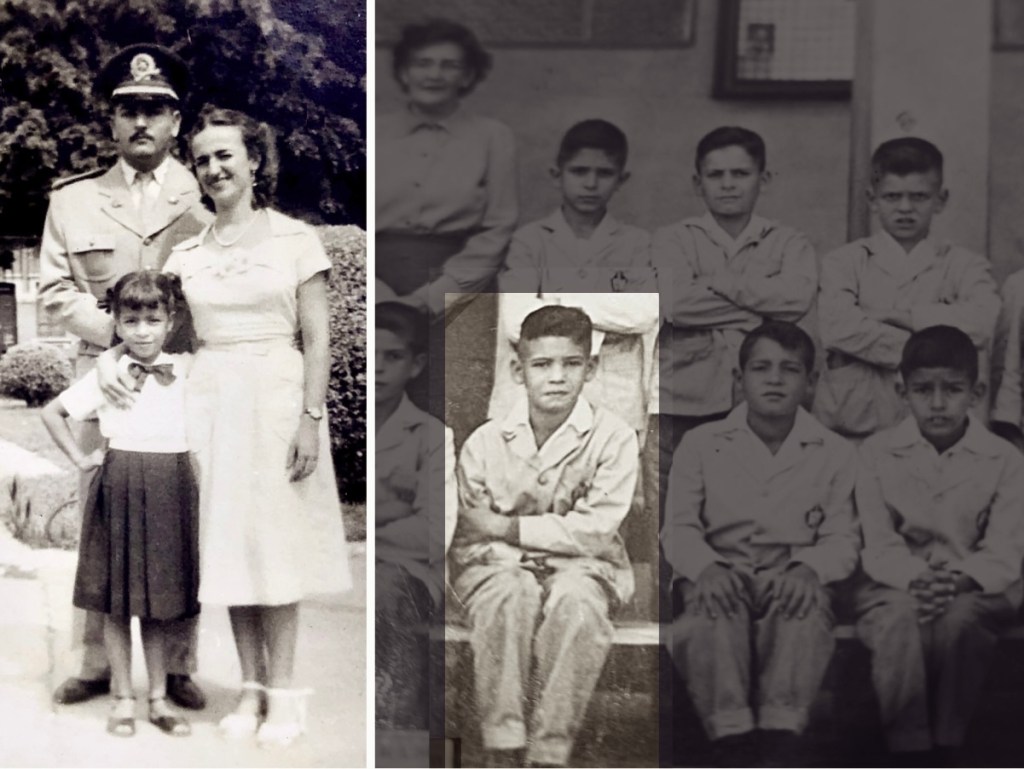
Left: Paulo, Lindaura, and Sonia Coutinho, circa 1950. Right: Newton in a school photograph, circa 1954. (Family photographs).
  • Sonia Maria De Azevêdo (Coutinho) Costa, born November 5, 1942, in Salvador. She married Jorge Augusto de Oliveira Costa in 1969. They had two children.
  • Newton de Azevêdo Coutinho, born September 25, 1944 — died May 27, 2000, both in Salvador. He married Titê _______ in 1971. They had one child. (6)
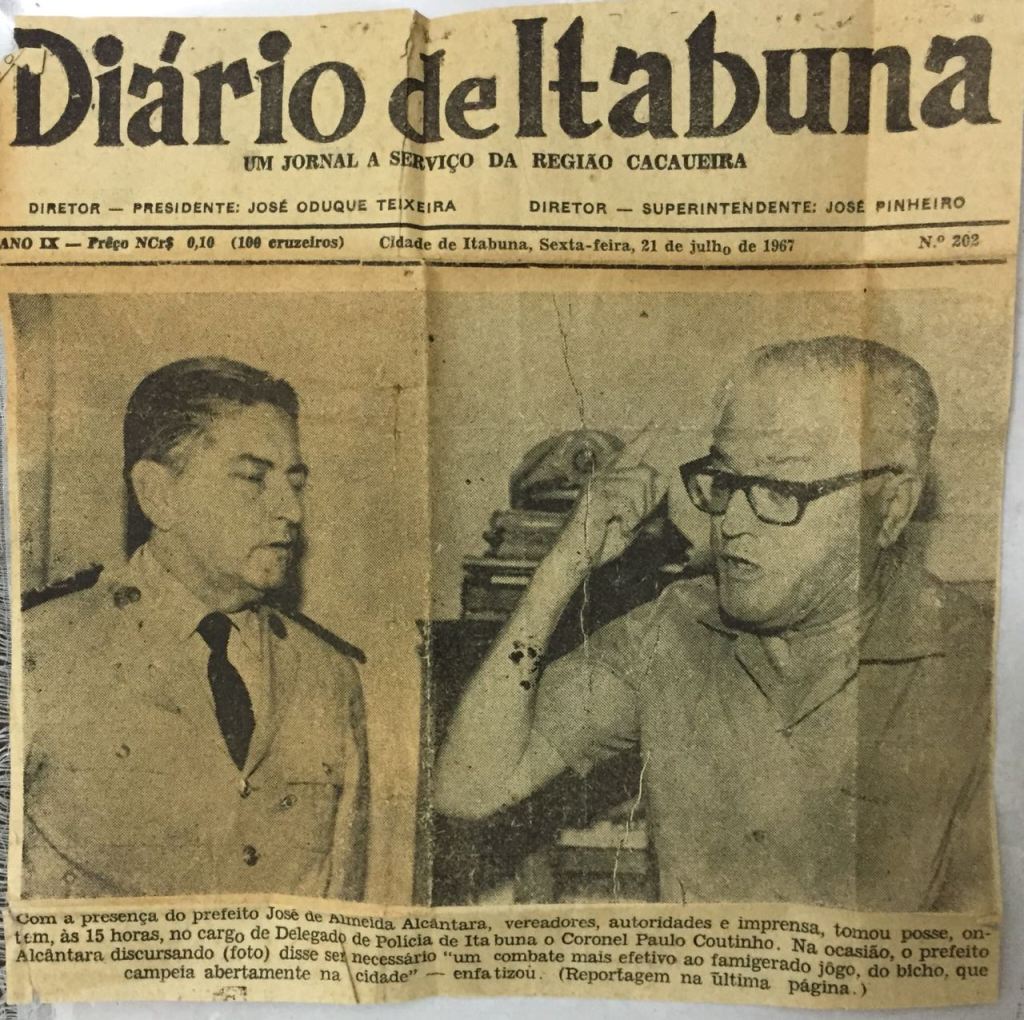
The July 21, 1967 edition of Diário de Itabuna newspaper:
“With Mayor José de Almeida Alcântara, council members, officials, and the press in attendance, Colonel Paulo Coutinho was sworn in as Itabuna Police Chief yesterday at 3 p.m. During his speech (photo), Mayor Alcantara (pictured) emphasized the need for ‘a more effective fight against the infamous jogo do bicho [an illegal gambling numbers game, see footnotes], which is openly rampant in the city.” (Family photograph).

Colonel Paulo Coutinho

The above newspaper photograph shows Colonel Paulo Coutinho as the newly-sworn-in Itabuna Police Chief in July 1967. The excited man waving his arm is José de Almeida Alcântara, the local mayor who seems quite upset about the local goings-on of an illegal gambling numbers enterprise called Jogo de Bicho. This was a game that was extremely popular, and at the same time, extremely illegal. It preyed upon people who simply could not afford to gamble. From Wikipedia, “The game is said to have become popular because it accepted bets of any amount, in a time when most Brazilians struggled to survive a very deep economic crisis. ‘If you see two shacks lost somewhere in the backlands’ a Brazilian diplomat once observed, ‘you can bet that a bicheiro [someone connected to the game] lives in one of them and a steady bettor in the other.’” 

It was Colonel Coutinho’s job to crack down on the illegal operation. This was an opportunity for someone in his position to take bribes and accept money under the table to look the other way, but he never did this. To this day, his family is quite clear that he was what could be described as a straight-arrow, who thought that living an honest life was better than advancing through corruption. (And this was during the era of a repressive military dictatorship, which his family also maintains that he steered clear of too).
“The name Military Police was only standardized in 1946 under the regime of Getúlio Vargas, with the new Constitution of 1946 after the Vargas Era of the Estado Novo (1937-1945), which had the objective of limiting the military capacity of the Public Forces in order to focus on being exclusively police forces. Historically in Brazil, ‘After World War II, the Military Police became a more traditional police force, similar to a gendarmerie, subject to the states’. Gendarmes are very rarely deployed in military situations, except in humanitarian deployments abroad. In a country like the United States, the military and police are separate in terms of they interact with the community.” Therefore, for those who are not from Brazil, this term may be misleading.

“According to Article 144 of the federal constitution, the function of the Military Police is to serve as a conspicuous police force and to preserve public order. [They] are organized as a military force and have a military-based rank structure. The commandant of a state’s Military Police is usually a Colonel. The command is divided into police regions, which deploy police battalions and companies.” (Wikipedia)

Colonel Coutinho worked in several different communities during his career: Ilhéus, Itabuna, Juazeiro, and Salvador. Some of these assignments sometimes separated him from his growing family for periods of time. (7)

The Coutinho home when they lived in Ilheus, Bahia, located at Rua Almiro Vinhas, 13.

Living in Ilhéus and then Piranga

The Coutinho family was a middle-class family during a time in Brazil when there were very few similar families. Indeed, from the 1950s through the 1980s, the middle class of was very small. Then things started to shift with the advancement of democracy and further economic prosperity. The “middle class comprised 15% of the Brazilian population in the early 1980s, and now they encompass nearly a third of the country’s 190 million inhabitants. It rose thanks to Brazil’s good economic performance in the recent years, poverty reduction policies, new work opportunities, and a better-educated workforce. (World Bank Group)
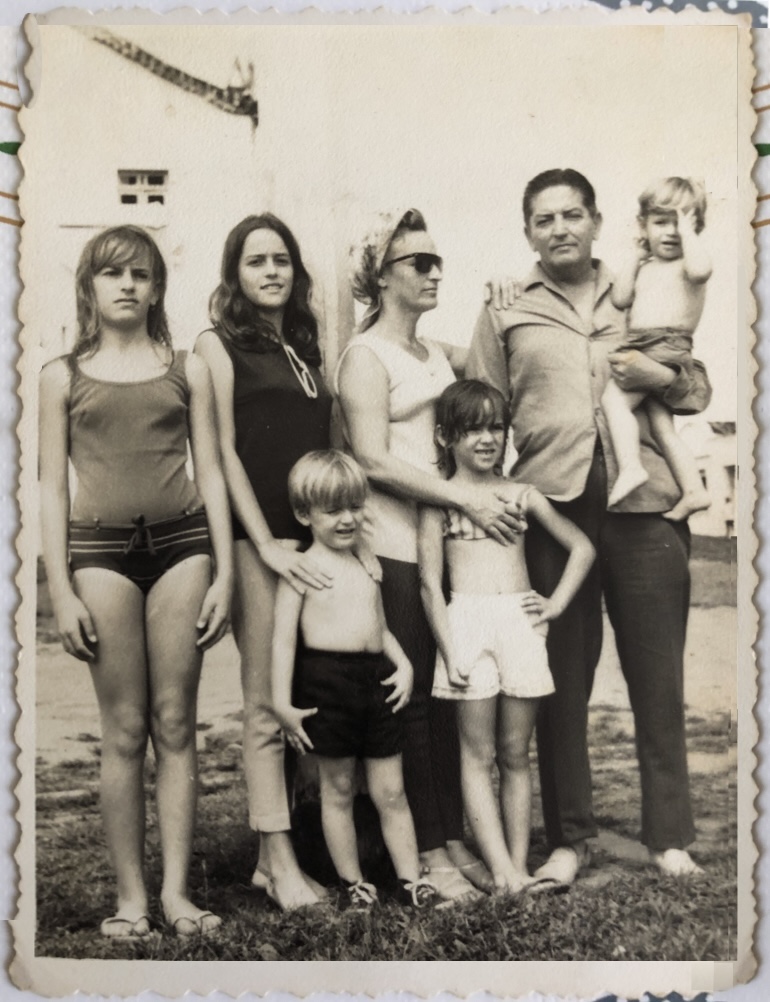
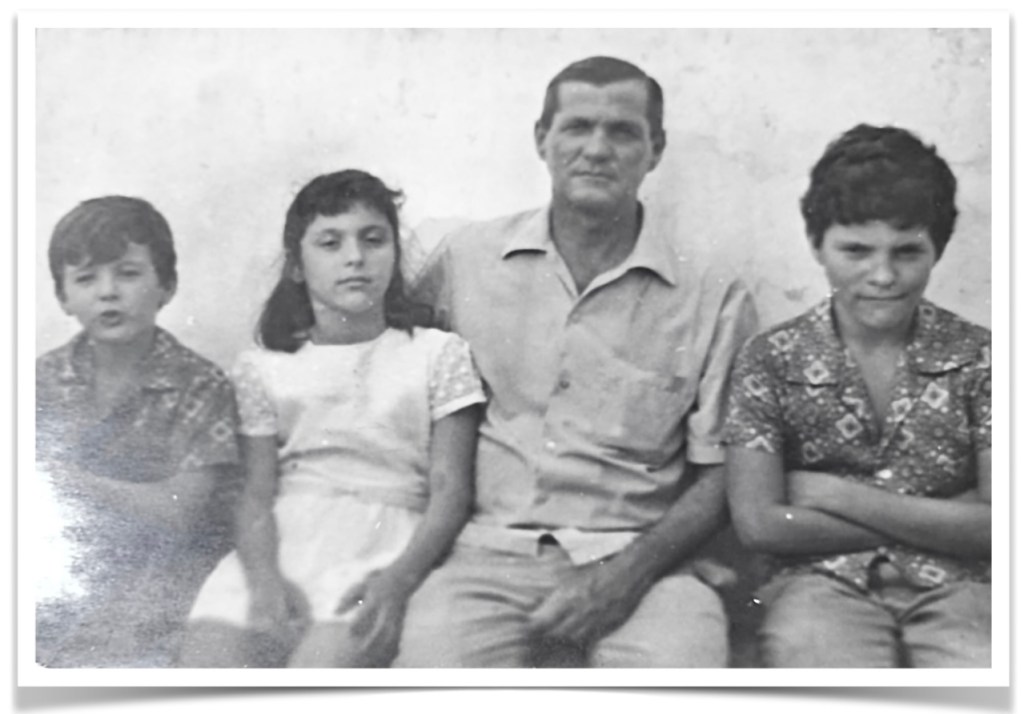
The Coutinho family, circa 1967. Front row, left to right: Paulo and Cristina. Back row, left to right: Angela, Celeste, Lindaura, Paulo Sr., and Leandro. (Family photograph).

Circa 1969, the family moved to the northern part of Bahia for a year and lived in Piranga, at the northern border of the Bahia state. As Paulo had written in his letter to Lindaura in April 1968, “The bonus will be worth it. NBR 500.00.” This informs us that their move north was likely due to a work promotion for his career as a Colonel with the Military Police.
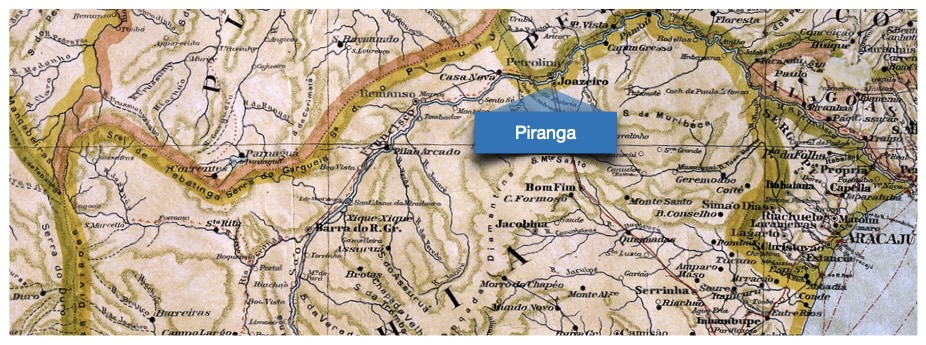
This is an excerpted portion of the General Map of Brazil published in January 1911. Piranga is a small municipality located on the São Francisco river in the very upper portion of Bahia. (Map image courtesy of Mapas Históricos da Bahia).

The Piranga community is small municipality and a suburb of Juazeiro, which “is twinned with Petrolina, in the [adjacent] state of Pernambuco. The two cities are connected by a modern bridge crossing the São Francisco River. Together they form the metropolitan region of Petrolina-Juazeiro, an urban conglomerate of close to 500,000 inhabitants’. (Wikipedia) The family returned to Ilhéus again before finally moving to Salvador in 1970. (8)

Thinking of Helena and Maria

Observation: When I was first living in Salvador da Bahia, I was startled by the sheer abundance of people who had other people available to work for them as household staff. As a middle class American child, this was not something that was even remotely available to us in any form. We always had many chores to do, in addition all the other responsibilities we bore as adolescents. — Thomas

“The end of slavery in 1888 didn’t come with any plan to integrate the black ex-slaves into a capitalist society based on paid work. While the paid jobs were offered to the Europeans that emigrated to Brazil after that time, for many of the poor and uneducated black women the only possibility was to continue working as maids”. As recalled by writer Mike Gatehouse, ‘The women… would live in a small bedroom in the working area of our flat. This was common for all my friends, as it had been for our parents. During those years chores were never part of my routine or something I had to worry about. The house worked like a hotel where rooms were cleaned, clothes washed and meals appeared as if by magic.’” (LAB — Latin American Bureau, see footnotes.)

Circa 1970, Paulo was promoted again. This took the family to the coastal city of Salvador, and into the Canela neighborhood.

In Ilhéus, Piranga, and Salvador, Helena was the person who fulfilled the important role of the home-helper. She lived with the Coutinho family until she was 21 years old, and assisted with looking after the children. Furthermore, another woman named Maria worked as a domestic servant, but she did not live in the house.
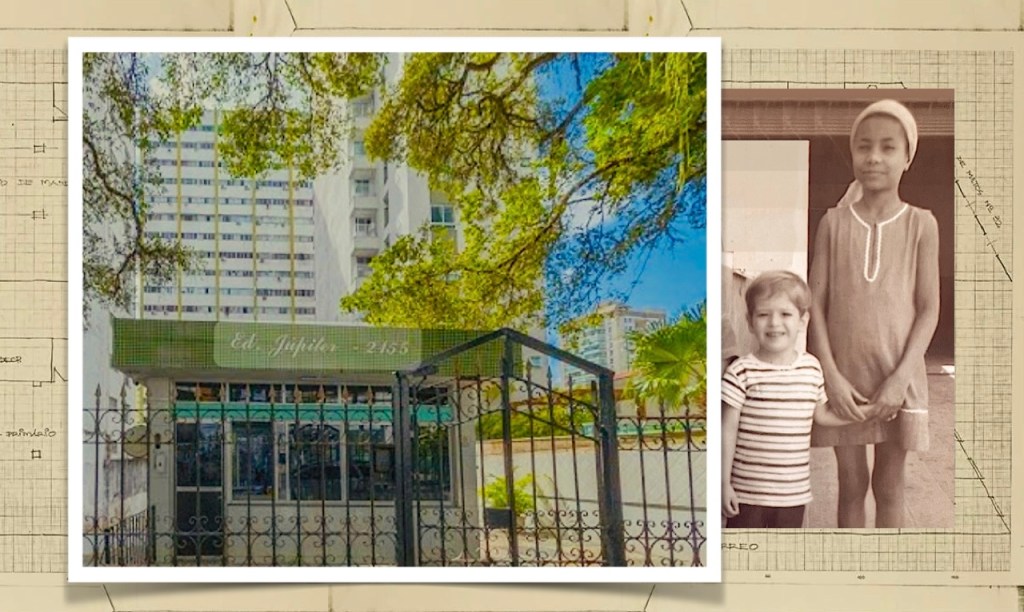
Left: The Coutinho home when they lived in Salvador, Bahia, located at Edificio Júpiter,
Avenida Sete de Septembre, 2155, in the Vitória neighborhood. Right: Helena, with Leandro. (Family photographs).

In 1975 they moved one last time, into a new home in a modern skyscraper named Edificio Júpiter, located on the celebrated Corredor da Vitória. (In Brazil, it is very common to identify buildings by their name, rather than their address). This building and the adjacent Vitória neighborhood afforded the family easy access to conveniences, good schools for the children, and quite importantly — safety, during a period of much tension in Brazil. Lindaura, the family’s mother, lived in Edificio Júpiter for 45 years.

Papelaria Brazileira City Plan of Salvador, Brazil. The area circled in green encloses
the Canela, and the Vitória districts where the Coutinho family lived.
(Image courtesy of Geographicus Rare Antique Maps).

“Less than a kilometer long, the Corredor da Vitória is home to the Bahia Art Museum, the Carlos Costa Pinto Museum, and the Bahia Geological Museum. Vitória is one of the most valued urban areas in Northeast Brazil.” (Wikipedia)

Leandro remembers the many mango trees and the grand old homes which still then lined the street. Sometimes, as the older families from the previous era passed away, their homes and gardens would become abandoned, and fall into disrepair. (Most of these homes were eventually razed to make way for modern high-rise apartment buildings). To this day, he shares tales that his passion for mangos would seduce him into sneaking into these old gardens, climbing the trees, and furtively sneaking away with a clutch of fresh mangos. (9)

Blame It On The Bossa Nova

When Leandro and I met, it was truly North America meets South America because his English was not very good, and my Portuguese was non-existent. (He had been living for the previous decade in Germany, and France before that, so his French and German were quite good). As the North American, I was then, (and am still somewhat now), a big contrast to his skillful linguistic ability. I have always been humbled by the ease with which he fluently slips into other languages at dinner parties.

Initially at that time, I thought about what I knew about Brazil, and the answer was not too much. When I was a boy, Brazil vanished in to repressive military regime and there just wasn’t any news about it in the local newspapers. When democracy returned to Brazil between 1985 — 1988, no one I knew was paying much attention, even though we were aware of this change.

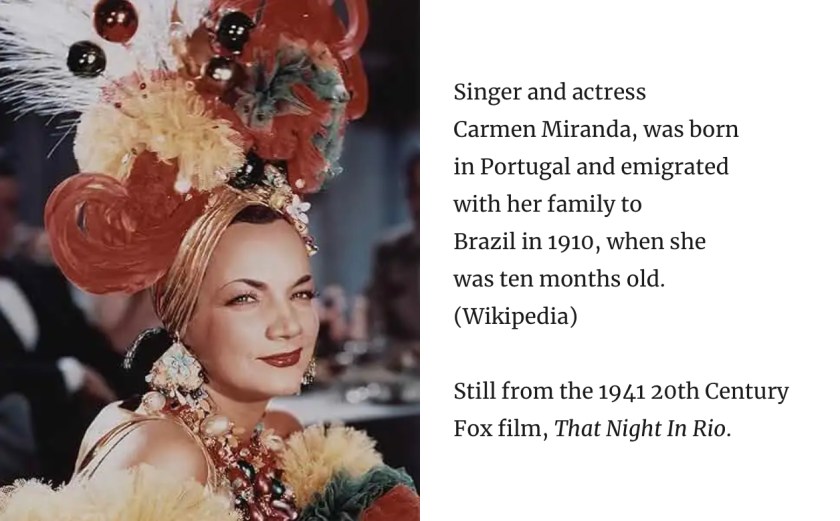
Like most Americans, if I knew much about Brazil, it was simply Carmen Miranda, and some Bossa Nova radio hits. Ms. Miranda was famous for her flair for wearing a banana hat in movies while looking lovely, (and also like she was having a lot of fun while doing this). Bossa Nova music was then translated into English for palatability to American audiences (and of course, to sell more records).
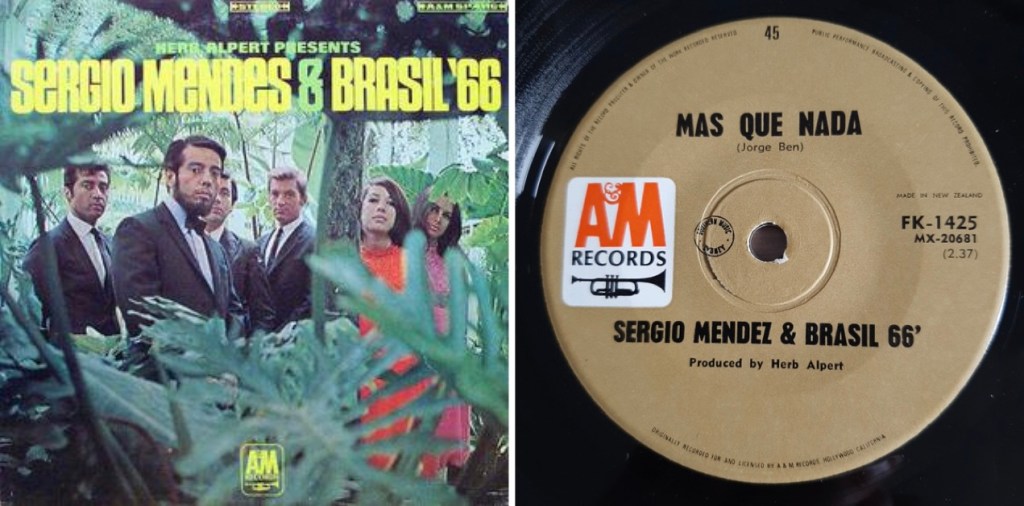
Most of us were aware of the hit song The Girl from Ipanema, which we heard on AM transistor radios. Influentialy, the band Sergio Mendes & Brazil ’66 was extremely popular in the mid-1960s, (around the time that Leandro was born). In fact, they were so famous that I still have a distinct memory of standing in a muddy field in Newbury Township, Ohio, after a rainstorm, when I was about 10 years old. I watched the Newbury High School Marching Band knock-out a pretty good version of the song Mas Que Nada (which ironically, was sung in Portuguese). I would say that it was toe-tapping good, but my boots were stuck in the mud.

Mas Que Nada as performed by Sergio Mendes and Brasil ’66.

For Leandro and his family lines, the Coutinhos and the Oliveiras — after many, many years, life has come full circle as we have returned to the ancient land of his ancestors. We see the world through our modern lens, thinking always about those who lived here before us. For this family line, we have reversed the tide of their past immigration, for we now live in Lisbon, Portugal. (10)

— Thomas

Following are the footnotes for the Primary Source Materials,
Notes, and Observations

A Place Quite Apart

(1) — one record

Librairie Elbé Paris
Jets to Brazil, Varig Airlines travel poster
by Artist unknown, circa 1960 
https://www.elbe.paris/en/vintage-travel-posters/1618-vintage-poster-1960-jets-brazil-varig-airlines.html
Note: For the vintage poster artwork.

Catholicism is the Foundational Religion of Brazil

(2) — four records

Catholic Church in Brazil
https://en.wikipedia.org/wiki/Catholic_Church_in_Brazil
Note: For the text.

Some of the Saints in the Roman Catholic pantheon.

Statues of Saints in Ouro Preto, Minas Gerais
by Photographer unknown
https://en.wikipedia.org/wiki/Catholic_Church_in_Brazil#/media/File:-i—i-_(6288973445).jpg
Note: For the photo shown above.

Afar
The São Francisco Church and Convent
Igreja e Convento de São Francisco

https://www.afar.com/places/igreja-e-convento-de-sao-francisco-salvador
Note: For the photograph.

Church of Nosso Senhor do Bonfim, Salvador
https://en.wikipedia.org/wiki/Church_of_Nosso_Senhor_do_Bonfim,_Salvador
Note: For the text explaining “Lembrança do Senhor do Bonfim da Bahia” (Remembrance of the Lord of Bonfim of Bahia).

Slavery Did Not Officially End Until 1888

(3) — four records

Slavery in Brazil
https://en.wikipedia.org/wiki/Slavery_in_Brazil
Note: For the text.

Isabel, Princess Imperial of Brazil
https://en.wikipedia.org/wiki/Isabel,_Princess_Imperial_of_Brazil
Note: For the reference.

Isabel, Princess Imperial of Brazil
photographed by Joaquim Insley Pacheco, circa 1870
https://en.wikipedia.org/wiki/Isabel,_Princess_Imperial_of_Brazil#/media/File:Isabel,_Princesa_do_Brasil,_1846-1921_(cropped).jpg
Note: For her portrait.

Lei Áurea
https://en.wikipedia.org/wiki/Lei_Áurea
Note: For the document image.

Candomblé and Syncretism

(4) — three records

Carybé illustration of the Orixa Yemanjá.
(Image courtesy of Pinterest).

Candomblé
https://en.wikipedia.org/wiki/Candomblé
Note: For the text and historical photograph from 1902.

Altar Gods
Candomble: Afro-Brazilian Faith and the Orixas 
https://altargods.com/candomble/candomble/
Note: For the text and artworks.

The Oliveira Family of Ubaitaba

(5) — five records

> The family photograph in this section is from the personal family photograph collection.

Ubaitaba
https://pt.wikipedia.org/wiki/Ubaitaba
Note: For the text.

Mapas Históricos da Bahia
Mapa da Bahia de 1911
https://www.historia-brasil.com/bahia/mapas-historicos/seculo-20.htm
Notes: This is a excerpted portion of the General Map of Brazil published in January 1911, and organized by the company Hartmann-Reichenbach. The red lines are railways.

Ubaitaba.com
História Regional and História
http://ubaitaba.com/historia-regional/
Note: Upper photographs are from the website section labeled História Regional and História.

Restos de Colecção
Mercearias e Mini-Mercados
https://restosdecoleccao.blogspot.com/2013/05/mercearias-e-mini-mercados.html
Note: For the lower photograph titled Antigas Mercearias.

You can’t imagine how much I’ve missed you…”

(6) — nine records

> The family photographs in this section are from the personal family photograph collection.

The April 11, 1968 letter from Paulo to his wife Lindaura, just before their move to Piranga, Bahia.

Jorge Amado, August 10, 1912 — August 6, 2001) “…was a Brazilian writer of the modernist school. He remains the best-known of modern Brazilian writers, with his work having been translated into some 49 languages and popularized in film, including Dona Flor and Her Two Husbands in 1976, and having been nominated for the Nobel Prize in Literature at least seven times.
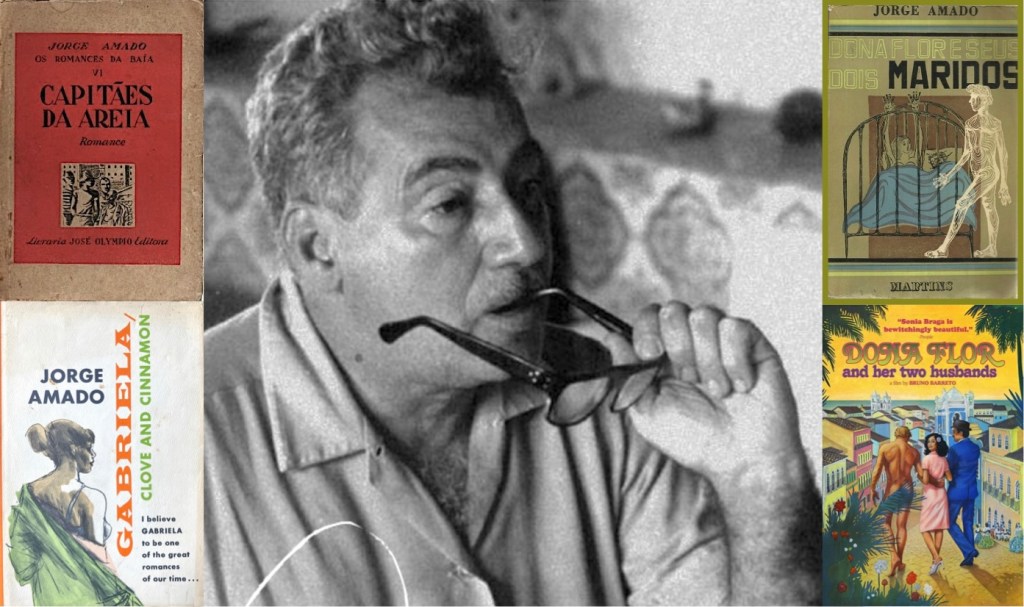
Portrait of novelist Jorge Amado.

His work reflects the image of a Mestiço* Brazil and is marked by religious syncretism. He depicted a cheerful and optimistic country that was beset, at the same time, with deep social and economic differences.” (Wikipedia) *Mestiço is a Portuguese term that refers to persons of mixed race, as people from European and Indigenous non-European ancestry.

Jorge Amado
https://en.wikipedia.org/wiki/Jorge_Amado
Note: For the text.

Fundação Casa de Jorge Amado
https://www.jorgeamado.org.br/
Note: For his portrait.

Brazilian Publishers
3 Books to Get to Know The Work of Jorge Amado,
Master of Social Realism and Bahian Imagination

https://brazilianpublishers.com.br/en/noticias-en/3-books-to-get-to-know-the-work-of-jorge-amado-master-of-social-realism-and-bahian-imagination/
Note: For the text.

The Brazilian Publishers website recommends that these “three essential books [which should be read] to discover the strength and diversity of his literature”. (The descriptive text below is from their website).

  • Captains of the Sands (Capitães da Areia)
    In the book, we follow Pedro Bala, Professor, Gato, Sem Pernas and Boa Vida, marginalized young people who grow up on the streets of Salvador. Living together at Trapiche, they form a close-knit community. The arrival of Dora and her brother Zé Fuinha, brought by Professor, causes a stir among the boys, who are not used to the female presence. Slowly, an emotional bond develops between the group’s leader and the girl.

    Captains of the Sands
    https://en.wikipedia.org/wiki/Captains_of_the_Sands
    Note: For the reference.
  • Dona Flor and Her Two Husbands (Dona Flor e Seus Dois Maridos)
    The story begins during the 1943 carnival in Bahia, when Vadinho, a womanizer and inveterate gambler, suddenly dies. Dona Flor, his wife, is inconsolable. Some time later, she marries Teodoro Madureira, a pharmacist who is the opposite of her first husband. Together, they have a stable and peaceful, but boring, life until the day when Vadinho’s ghost appears in Dona Flor’s bed.

    Dona Flor and Her Two Husbands (novel)
    https://en.wikipedia.org/wiki/Dona_Flor_and_Her_Two_Husbands_(novel)Note: For the reference.
  • Gabriela, Clove and Cinnamon (Gabriela, Cravo e Canela)
    The book tells the story of the romance between Nacib and Gabriela, set in Ilhéus in the 1920s, during the city’s cocoa-driven development. Gabriela’s sensuality wins over Nacib and many men, defying the law against female adultery. Published in 1958, the book was a worldwide success and became an acclaimed Brazilian soap opera.

Gabriela, Clove and Cinnamon
https://en.wikipedia.org/wiki/Gabriela,_Clove_and_Cinnamon
Note: For the reference.

Mestiço
https://en.wikipedia.org/wiki/Mestiço
Note: For the data.

Colonel Paulo Coutinho

(7) — four records

> The family photograph in this section is from the personal family photograph collection.

Jogo do bicho
https://en.wikipedia.org/wiki/Jogo_do_bicho
Note: For the reference.

Military Police (Brazil)
https://en.wikipedia.org/wiki/Military_Police_(Brazil)#:~:text=The Military Police was founded,on being exclusively police forces.
Note: For the text.

Gendarmerie
https://en.wikipedia.org/wiki/Gendarmerie
Note: For the reference.

World Bank Group
In Brazil, an emergent middle class takes off
https://www.worldbank.org/en/news/feature/2012/11/13/middle-class-in-Brazil-Latin-America-report
Note: For the text.

Living in Ilhéus and then Piranga

(8) — three records

> The family photographs in this section are from the personal family photograph collection.

Scenes of Salvador da Bahia by Carybé.

Exposição “Carybé e o Povo da Bahia”
celebra a identidade cultural no Museu de Arte da Bahia

https://jornalgrandebahia.com.br/2024/12/exposicao-carybe-e-o-povo-da-bahia-celebra-a-identidade-cultural-no-museu-de-arte-da-bahia/
Note: For the Carybé illustrations above.

Juazeiro
https://en.wikipedia.org/wiki/Juazeiro
Note: For the text.

Thinking of Helena and Maria

(9) — four records

> The family photograph in this section is from the personal family photograph collection.

LAB – Latin American Bureau
Brazilian Maids: A Photo Essay
by Mike Gatehouse
https://lab.org.uk/brazilian-maids-a-photo-essay/
Note: For the text.

Vitória (Salvador)
https://pt.wikipedia.org/wiki/Vitória_(Salvador)
Note: For the text.

Geographicus Rare Antique Maps
1931 Papelaria Brazileira City Plan of Salvador, Brazil
https://www.geographicus.com/P/AntiqueMap/salvadorbahia-papelariabrazileira-1931
Note: For the map image.

Blame It On The Bossa Nova

(10) — two records

Sérgio Mendes
https://en.wikipedia.org/wiki/Sérgio_Mendes
Note: For the reference.
and
Herb Alpert Presents Sergio Mendes & Brasil ’66
https://en.wikipedia.org/wiki/Herb_Alpert_Presents_Sergio_Mendes_%26_Brasil_%2766
Note: For the album cover artwork.


The Coutinho / Oliveira Line, A Narrative — Two

This is Chapter 2 of 3, being the continuation of the history for this branch of the family. Here we delve into the emergence of our families into Minas Gerais, Bahia, and Paraíba and states in Brazil. As a reminder — in total, there are 6 chapters: the first set of 3 chapters is written in English; the second set of 3 chapters is translated into Portuguese.

Mr. Peabody and Sherman strategizing about their approach into looking for the widely scattered Coutinho / Oliveira family records.

Mr. Peabody and Sherman

A common lament among those people who do genealogy research should be — “Sherman, set the Wayback Machine to…”

This chapter of the Coutinho / Oliveira family history is the one where we wish that through some sort of magic, we had access to Mr. Peabody and Sherman’s Wayback Machine. (because > research reasons)

The records for the Coutinho and Oliveira families line are very scarce. In fact, we are only able to trace the line back for a few generations. In Brazil during this period, record-keeping did not appear to be very important unless you were a person of very high status. In fact, most records seem to have been kept by the Church, rather than the government. Thus, we are fortunate to have found what we have so far.

Also, it is more probable that many records may have not yet found their way to online databases. So, our fingers are crossed that his happens soon, since we will continue to research this family line.

Finally, as we wrote about in Chapter One, when we were documenting family heraldry in Portugal, there is a concurrence where both of the names Azeredo and Azevêdo are used on records we have located. These surnames are the same families, and this variance is mostly due to who was recording the information. This is a pattern seen in the normal variation of record-keeping, which began in a preliterate world, and has continued on into the 20th century. (1)

This is an excerpted portion of the General Map of Brazil published in January 1911, and organized by the company Hartmann-Reichenbach. The red lines are railways. (Map image courtesy of Mapas Históricos da Bahia).

Ah Bahia!

This is where Portuguese Brazil began — at Porto Seguro, Bahia, circa 1500.

Most people do not understand the scale of the country of Brazil. It is the 5th largest country in the world, and has 26 states. The state of Bahia, where most of this family history takes place, has an area slightly larger than France, or similarly, Spain. Several of the smaller European countries could easily fit inside with some room to spare. The point is this — the distances are actually quite vast — and may not be understood by just referring to the map below.

The history of the Coutinho and Oliveira families takes place mostly within a triangle demarcated by the towns of Lençóis, Ilhéus, and the city of Salvador da Bahia. (2)

The de Azevedos Family Arrives in Brazil From Portugal

Let’s step back in time and take a look at how our branch of the de Azevedo family arrived in Brazil, and how they eventually connect with the Coutinho family. We wonder if any of them ever knew (?) of the old alliance of their ancient Noble Families, the House of Azerêdo – Coutinho.


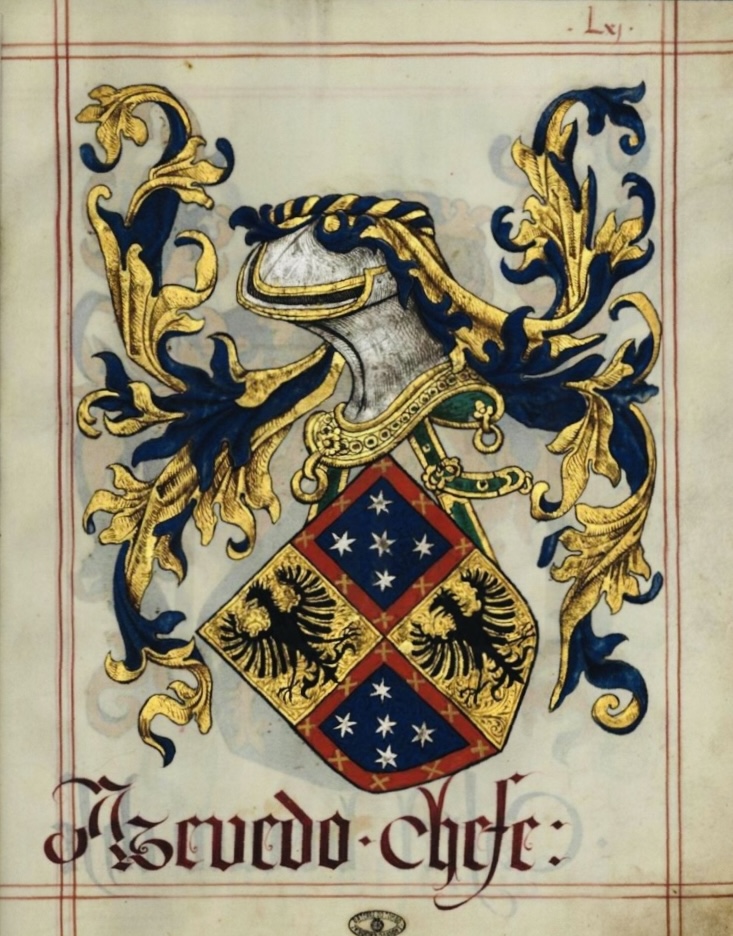
Brasão de Manoel de Azeredo Coutinho Messeder, Fidalgo Cavaleiro,
from the Collection of The Brazilian National Archives, circa 1855.
(Image courtesy of Wikimedia Commons).

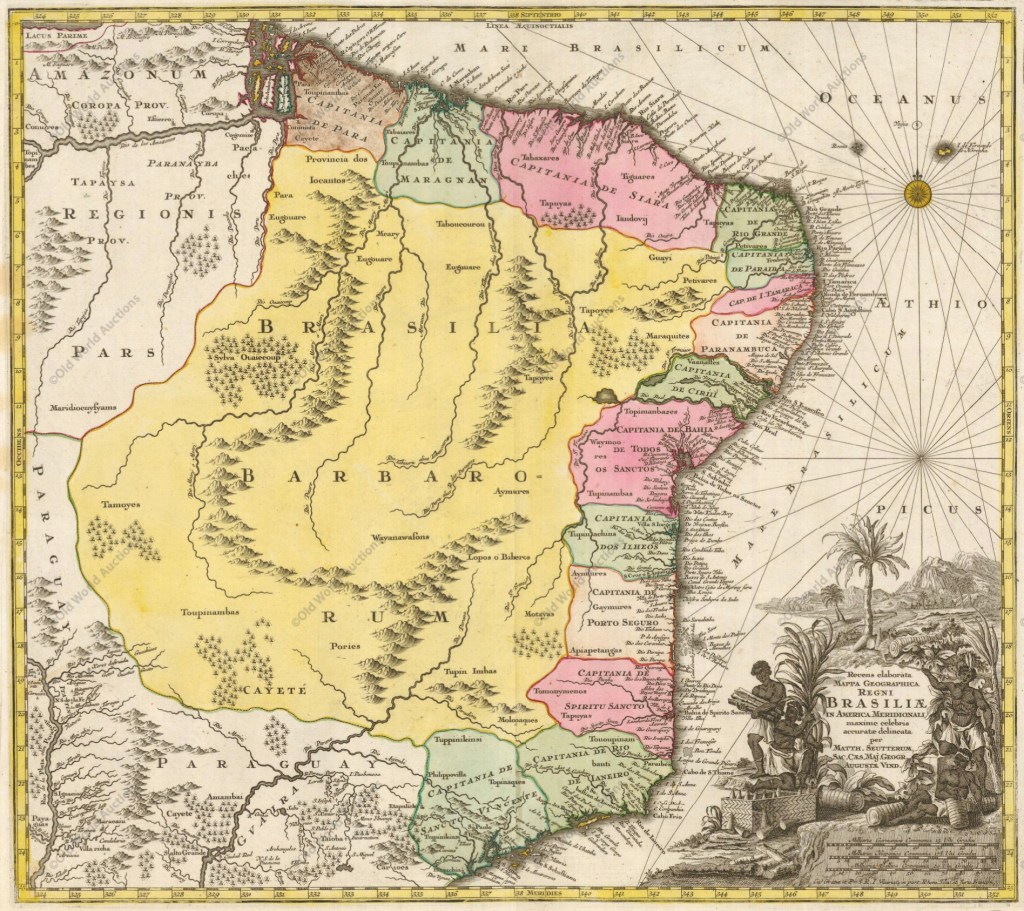
The de Azevedos have been traced back to before 1740 in Portugal. From that generation, we have only the name of Domingos Gomes de Azevêdo da Costa. It is believed that he came to Brazil as the original forefather, sometime in the early decades of the 1700s. As the map below clearly shows, this is how many people pictured Brazil in that early century. Notice how it was natural for immigrants to settle along the coastlines, due to the fact that travel via ship(s) was the only way to get around a vast territory.

Recently elaborated Geographical Map of the Kingdom of Brazil in South America,
by Matthias Seutter, circa 1740. (Image courtesy of Old World Auctions).

We know that the son of the original forefather in Brazil was his (same-named) son: Domingos Gomes de Azevêdo, who was born 1740 in Diamantina, Minas Gerais, Brazil — died October 2, 1831. He married Ana Joaquina Sofia de Jesus. She was born in 1762, in Caetité, Bahia, Brazil. He is frequently recorded in documents as Captain Domingos Gomes de Azevêdo, and also as Domingos Gomes da Costa. His wife adopted the surname de Azevêdo instead of de Jesus, passing it on to her ten children.

Family Search has the following biography on him — 
“The illustrious Commander Domingos Gomes de Azevêdo was responsible for the creation of the settlement in the District of Paz do Gentio, in the municipality of Guanambi, Bahia, [near Caetité]. He was born in the state of Minas Gerais, most likely in the Caetité region, in 1740. During the persecutions following the failure of the Minas Conspiracy, of which he was a part — with his entire family, belongings, associates, and friends, they fled from this defeat to Bahia. The Gomes de Azevêdo family arrived in the city of Caetité in the late last quarter of 1700 (meaning between 1775 and 1792), coming from the settlement of Tijuco (in Diamantina, Minas Gerais). Domingos Gomes de Azevêdo died in the city of Caetité on October 2, 1831.” (3)

Left: Joaquim José da Silva Xavier [Tiradentes], dressed in the report of ensigns of the paid troop of Minas Gerais, by José Wasth Rodrigues, circa 1940. (Image courtesy Museu Histórico Nacional, via Wikipedia Commons). Center: The Flag of the Conspirators, by Carlos Oswald, circa 1939. Right: Tiradentes Quartered, by Pedro Americo, circa 1893. (The last two images are courtesy of Wikimedia Commons).

The Inconfidência Mineira (or The Minas Gerais Conspiracy)

This historical event “…was an unsuccessful separatist movement in Colonial Brazil in 1789. It was the result of a confluence of external and internal causes. The external inspiration was the independence of [the] thirteen British colonies in North America following the American Revolutionary War, a development that impressed the intellectual elite of many — particularly the captaincy of Minas Gerais.

The main internal cause of the conspiracy was the decline of gold mining in that captaincy. As gold became less plentiful, the region’s gold miners faced increasing difficulties in fulfilling tax obligations to the Portuguese crown (the tax over gold was one-fifth). When the captaincy could not satisfy the royal demand for gold, it was burdened with an additional tax on gold, called derrama.

The leader of the conspiracy plot was Joaquim José da Silva Xavier, also known as Tiradentes. When the plot was uncovered by authorities, Tiradentes was arrested, tried and publicly hanged. [And then drawn and quartered!] The anniversary of his death is celebrated as a national holiday in Brazil.” (Wikipedia) (4)

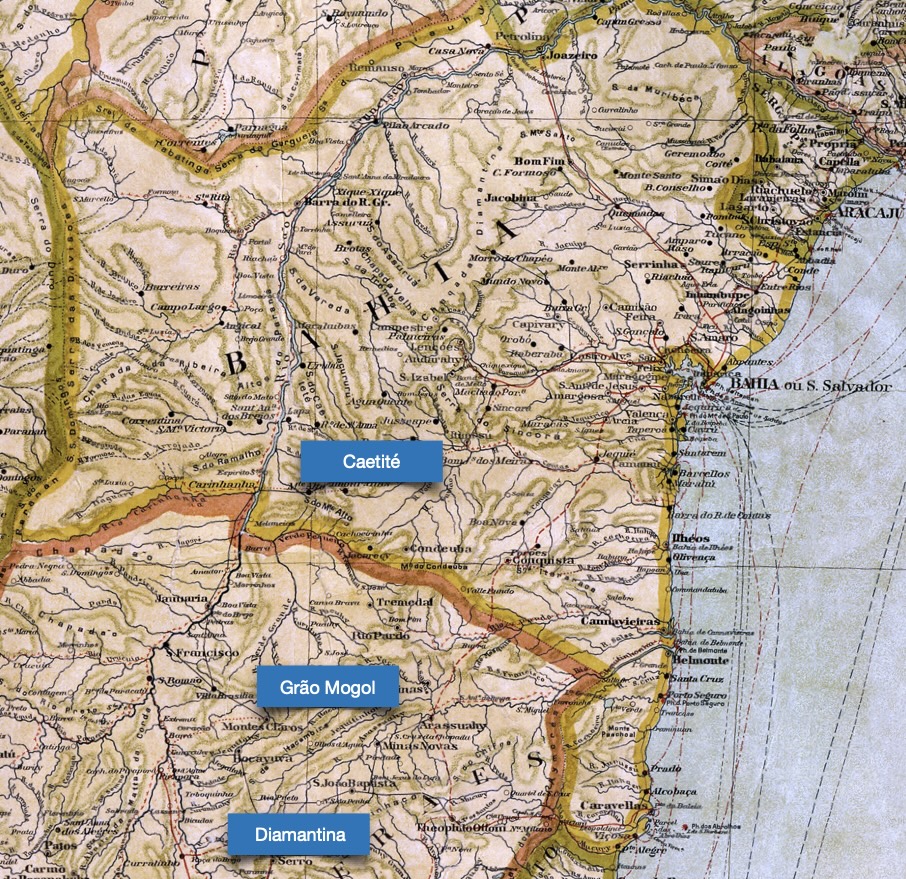
The state of Minas Gerais is located just south of Bahia. This is an excerpted portion of the General Map of Brazil published in January 1911. We are using it again for continuity, and because it allows to show the communities in their proper places. The maps older than this era, do not show all of the locations. (Map image courtesy of Mapas Históricos da Bahia).

These Place Names Are Tongue Twisters!

The place names of towns and villages are a word salad, being derived from both the languages of various Native Peoples and the immigrant Portuguese.

Returning to the Domingos Gomes de Azevêdo family history, from Family Search, “According to studies and documents found in the archives of Itacambira, Minas Gerais, near Grão-Mogol, he resided at Sítio Bananal, in Itacambira. His son Joaquim was baptized in the church of Itacambira, thus leaving Itacambira for Ceraima, near Caetité and Guanambi.”

Baptism record of Joaquim Venâncio de Azevedo, from the records of
the Santo Antônio Church of Itacambira, Minas Gerais. (Family Search)

Thus, Domingos’s son Joaquim Venâncio Gomes de Azevêdo carries the line forward for another generation. He was born in 1797, and christened at Santo Antônio de Itacambira, Grão Mogol, Minas Gerais on July 7, 1797. He died October 25, 1844 in Caetité, Bahia and is buried at the Matriz de Sant’Anna Church, in Caetité, Bahia. His wife is named Maria Rosa de Azevêdo, but there is no further information on her. Joaquim was known as the Intendente de Caetité [the Mayor of Caetité ] from 1838, until his death in 1844. They had 12 children.

The signature of Joaquim Venâncio Gomes de Azevêdo, date unknown. (Family Search)

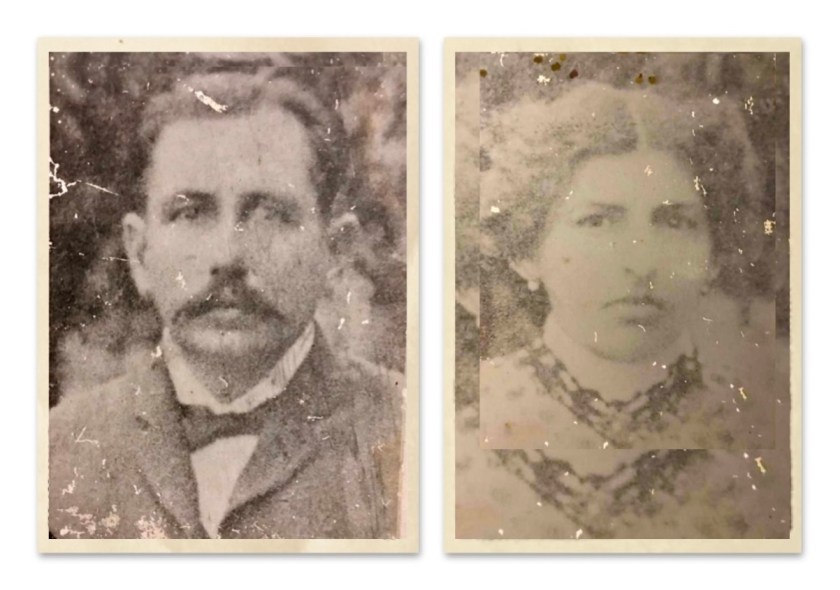
Joaquim and Maria Rosa’s son, José Venâncio Gomes de Azevêdo continues the history. He was likely born in Caetité , circa — died in 1874, in Lençóis, Bahia. He married Virginia Josefina Gomes de Azevêdo, born circa 1818 — died Date unknown, both likely in Caetité, Bahia.

José Venâncio Gomes de Azevêdo and Laura Angelica Viveiros Azevêdo, dates unknown.
(Family photographs).

They had 11 children, one of whom is:
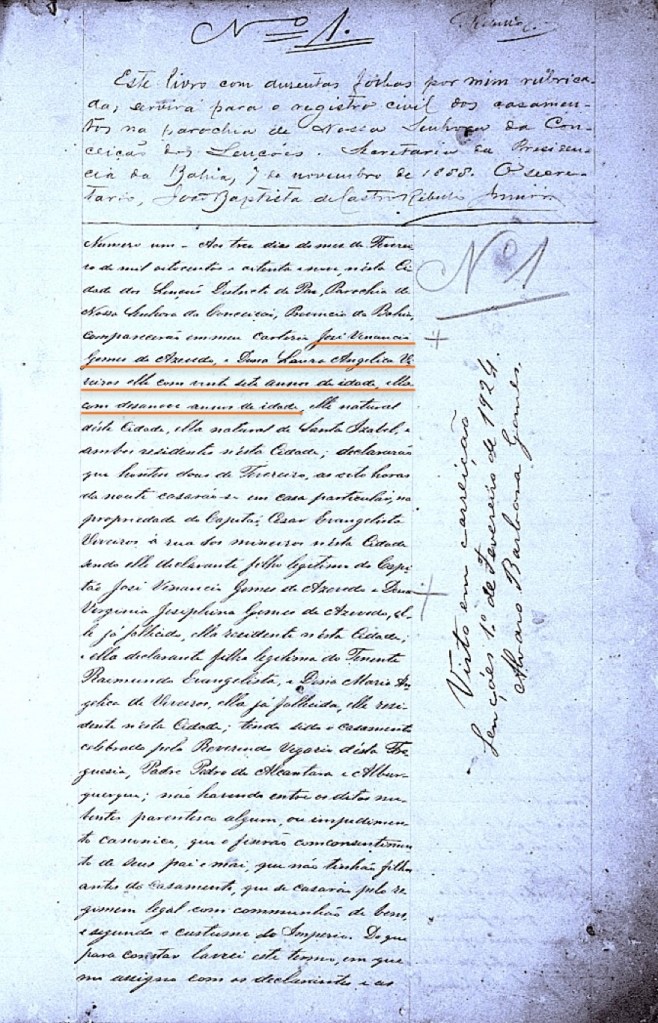
José Venâncio Gomes de Azevêdo, born August 4, 1861* — died May 7, 1916, both events in Lençóis, Bahia. He married Laura Angelica Viveiros de Azevêdo on February 3, 1889. She was born on December 17, 1869 in Mucugê, Bahia — died August 7, 1939, Salvador, Bahia. She is buried in the Cemiterio do Campo Santo. He is recorded as being a Colonel Commandant of the 442nd Infantry Battalion.

*One month after they married, the newlyweds did a Civil Registration (Certidāo da Casamento) of their marriage on March 2, 1889. He stated that he was 27 years old and she was 19 years old at the time of their wedding.

Civil Registration (Certidāo da Casamento) of their marriage on March 2, 1889. The underlined text confirms their names and reported ages. (Family Search).

Family Search has this note attached to the records of Laura Angelica Viveiros de Azevêdo, “She was a devout Catholic and lived in the city of Lençois, Bahia, where she had 14 children, one of whom died at a young age. In honor of her 13 living children, she celebrated with a party and Mass at her home, where she had an altar devoted to Saint Anthony, a tradition that came from her family in the Azores, Santo Antônio da Costa Delgada, Portugal. Thus, each year, one of her 13 children was honored at the feast of devotion to the aforementioned Saint Anthony.” At this point in time, our resources account for 15 children.

Of their large number of children, one daughter, Guiomar Viveiros de Azevêdo, is the Grandmother of my husband, (who is coincidentally also named Leandro, after his Grandfather). This Grandparents history is written about in the section below titled, Getting to Know the Leandro and Guiomar Coutinho Family of Lençóis. (5)

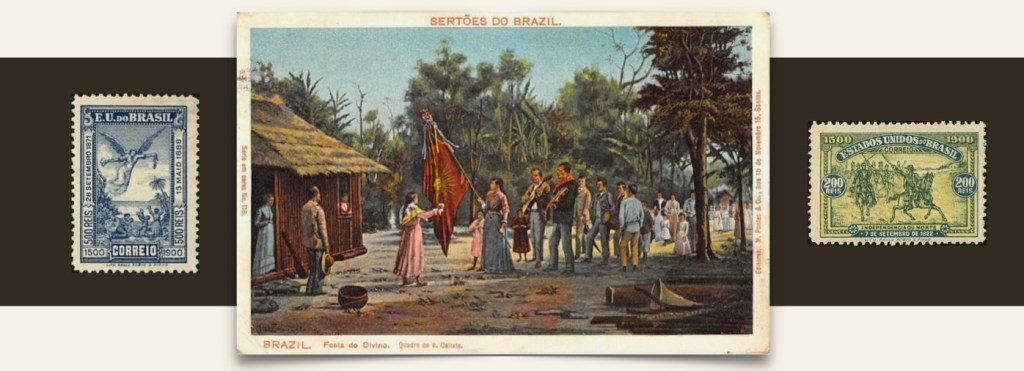
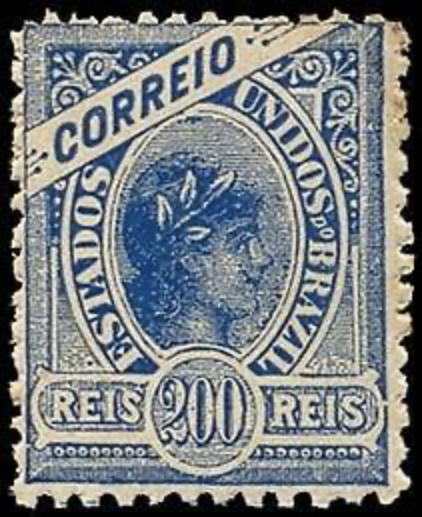
Antique postcard of the Sertões do Brazil, (Brazil South American Festival Of Divine Natives), circa 1900, in the region of Chapada Diamantina, Brazil. (Center image courtesy of eBay and left and right stamp images are from Google searches).

Diamonds In The Rough

The Lençóis Diamond Cycle
The first records we know of for this family take us to the town of Lençóis, located in a central section of Bahia, known as the gateway to the Chapada Diamantina National Park. “The town was founded when diamond deposits were discovered in [the nearby settlement of] Mucugê in the mid-19th century. At that time, adventurers arrived in large numbers and set up tents that, from a distance, looked like stretched sheets, giving the town its name. This origin of the name reflects the aesthetics of the place and is inextricably linked to the history of the town and its development during the Diamond Cycle.”

Fold-out map titled, Author’s Sketch Map of Gold and Diamond Districts of Bahia
Derived from: The Diamond Trail: An Account of Travel Among the Little Known
Bahian Diamond Fields of Brazil
, by Hugh Pearson, 1926. Note that Salvador (labeled as Bahia), is very far to the east, on the right side of the map. (Courtesy of the Internet Archive).

Lençóis was the richest town in the Chapada during the Diamond Cycle. A French Consulate was even established there to facilitate the export of the precious stones. However, when the deposits were exhausted, Lençóis fell into decadence, surviving on the extraction of carbonates [salts] and having to put up with the excesses of the colonels, who provoked major conflicts in the region. The most famous of these was Colonel Horácio de Mattos*, who had great political influence, including with the Federal Government.” (Text derived from, History and Tourist Attractions of Lençóis in Chapada Diamantina)
*See The Problem With The ‘Coronelismo’ below.

The world had seen fevers like this before… In 1849, the discovery of gold at Sutter’s Mill in California gave birth to the famous California Gold Rush, an event which forever changed the history of the American West. As we learned about Lençóis, the same phenomenon happened in nearby Andaraí, Bahia and this family was right in the middle of it.

Andaraí is located in the central region of Bahia, just south of Lençóis in Chapada Diamantina. This is an excerpted portion of the General Map of Brazil published in January 1911, and organized by the company Hartmann-Reichenbach. The red lines are railways. (Map image courtesy of Mapas Históricos da Bahia).

Andaraí is also in the aptly named Chapada Diamantina (loosely translated as the Plateau of Diamonds), just south of Lençóis. “The discovery of diamond deposits in Andaraí occurred in 1845 or 1846, (and) …as a result, a large number of people eager for the mineral arrived in the region,” — just like the California Gold Rush. “The settlement of Andaraí was formed in the best-known, most active and highest quality mining area in the region, which grew and with it, commerce and processing industries arrived. After the end of the Diamond Cycle, the Andaraí economy became based on coffee cultivation and small-scale mining.” (Wikipedia) (6)

Alfredo Viero de Azevêdo Coutinho and His Families

Alfredo Viero De Azevêdo Coutinho, born May 2, 1854, in Andaraí, Bahia — died March 31, 1941 in Palmeiras, Bahia. He married Carolina Athahydes* (or Ataide) de Molina, the exact date is unknown because we do not have a marriage record. However, we believe that they probably married circa 1880, and that he was about ten or fifteen years older than her. Alfredo and Carolina are the Great-Grandparents of the present generation.
*We have seen many, many spelling variations on her name.

Carolina was likely born in the late 1860s, and it is reported that she died in 1898. Her name is recorded on various civil records in Lençóis until several years after her death. Through diligent research, we have been able to ascertain that Alfredo and Carolina had at least four children together (and probably more), all likely born in Lençóis, Bahia.

  • Leandro de Azevêdo Coutinho, born April 15, 1883 in Lençóis — died August 6, 1965 in Salvador.
    (Leandro carries the family line forward. See his spouses and children below).
  • Ana de Azevêdo Coutinho, born circa 1887 — died date unknown — circa 1911 — May 25, 1937*.
  • Manoel de Azevêdo Coutinho, born circa July 1890 — died January 23, 1891, in Itaparica, Bahia, aged about 7 months.
Death Registration record for Manoel de Azevêdo Coutinho, dated January 23, 1891.
  • Alvaro de Azevêdo Coutinho, born circa 1892/93 — died, Date unknown. He married Maria Juliana Paraguassu in 1915, in Lençóis, Bahia.

    * Records on Ana de Azevêdo Coutinho are quite scarce. We found her in a 1911 ship passenger listing along with her father. (See footnotes). She is also mentioned in his 1941 Will as leaving a “perpetual inheritance” to her younger siblings. (Specifically, this meant that she had the foresight to designate money for the perpetual maintenance of her tomb and burial space. She is interred at the Santa Casa de Misercordia cemetery in Salvador da Bahia).
Alfredo Viero de Azevêdo Coutinho and his son Leandro de Azevêdo Coutinho, circa 1903. (Family photograph).

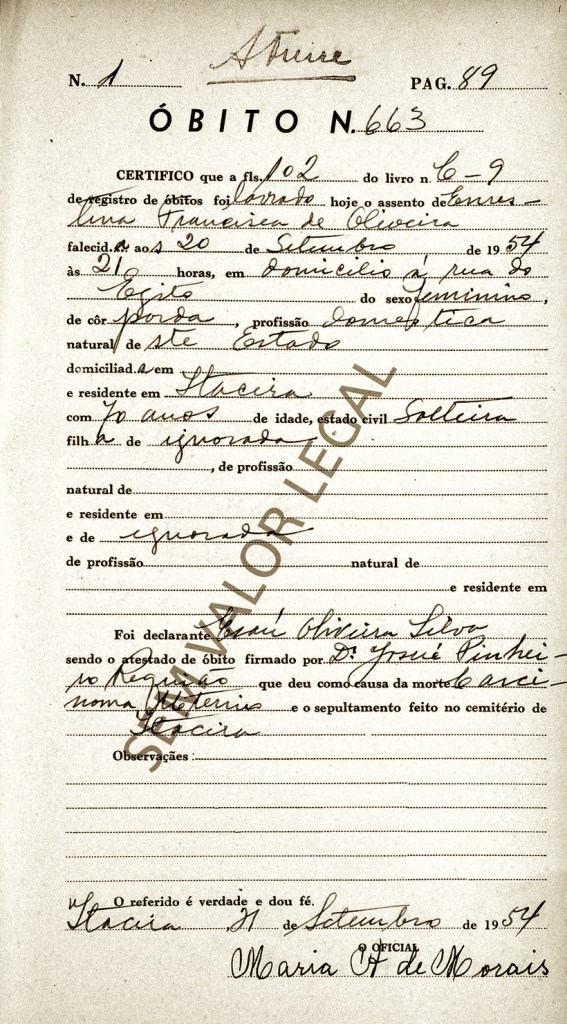
After the death of his wife Carolina, Alfredo had a long-term relationship with another woman, but it doesn’t seem that they married. Even so, the births of their children were registered, and at her request, their names were recorded in his Will of 1941. Her name is Ernestina Francisca Oliveira. Ernestina was born circa 1884 — died September 21, 1954 in Bahia. She is also a Great-Grandmother of the present generation.

Alfredo is the father of nine (or more) children in total. Together, he and Ernestina had five children, all born in Lençóis.

  • Alcides de Oliveira Vieira, born circa 1907
  • Edgard de Oliveira Vieira, born circa 1909
  • Lamartine de Oliveira Vieira, born February 7, 1911 — died October 12, 1983. He married Lealdina Pereira Courado, born November 15, 1915 — died May 19, 1999. He had a son named Waldemar Dourado Vieira, (whose daughter, Isa Gunes Viera, was helpful with research on this family line). Thanks Isa!
  • Liduina Vieira de Oliveira, born circa 1913
  • Alice Vieira de Oliveira, born circa 1915

These family lines which go back further in time and are still being researched:

  • The 2x Great-Grandparents of this generation are Lourenço Vieira de Azeredo Coutinho Filho (meaning: Junior), and Antonia Coutinho. His origins may in the area around Grão Mogol in Minas Gerais, Brazil.
  • The 3x Great-Grandparents of this generation are (the same named) Lourenço Vieira de Azeredo Coutinho, and Maria Pereira de Arujo.

This branch of the family originated around 1754 with the marriage of José Vieira de Figueiredo and Andresa Teodora Grinalda (who would be the 4x Great-Grandparents). They adopted the Azeredo Coutinho surname from their mother for their children, and created the Vieira de Azeredo Coutinho family.

Alfredo Viero De Azevêdo Coutinho, Exporter of Cattle and Agricultural Products
Diary of… The State of Bahia, Volume III for 1924

We discovered that for a number of years in an official Brazilian publication titled Diary of…, Alfredo was listed as an Exporter of Cattle and Agricultural Products. We know that he was a landowner of considerable means. Observation: Based upon how well dressed he appears in the above photograph with his son Leandro, he seems quite successful. (7)

Left: Book cover of the World’s Columbian Exposition, held in Chicago in 1893. Right: The Brazil Building at the Exposition. “Brazil contributed $50,000 to construct its pavilion. The entire first floor was dedicated to a detailed exhibit on Brazilian coffee, with regional varieties from São Paulo, Rio de Janeiro, and Minas Gerais on display. At the rear, a São Paulo coffee plantation installation served complimentary coffee to visitors”. (Chicago Public Library)

Memoir of The State of Bahia, circa 1893

The State of Bahia commissioned and prepared a book titled, Memoir of The State of Bahia, for the World’s Columbian Exposition held in Chicago in 1893.

Observation: You would think that this book would have been written with the idea of comporting a beneficial view of Lençóis at the time, but you would be wrong. The opinion of the authors was somewhat curt. (Some of this may be attributed to the decline of the town due to the mines having been exhausted).

Times change — Today, Lençóis is considered to be a very beautiful city with verdant, abundant nature and beautiful colonial-era homes.

Bookplate from, Memoir of The State of Bahia, circa 1893.

“The town is composed of 1500 houses. [and] This town is situated on a declivous ground [meaning: that it slopes downward] on the valleys of the rivers Lençóes and S. Jose, the two margins of the latter being connected by a bridge, and not far from the rivers S. Antonio and Ulinga.”

Here is what is stated about it by Colonel Durval de Aguiar:
“The town, standing on a declivous ground, has no beauty at all. A slope square, planted with a few trees and surrounded with lofty houses, the ground-floors of which are occupied by commercial establishments, leads on all sides to very uninteresting streets, of which some are paved with the very stones of the rock on which they were cut. A large and old lolly house on the square serves as a town-hall, and back of it, on Mineiros street, a floored house [only one?] is to be seen, which is used as a prison house and barrack. The parish church was never completed, wherefore its functions are performed in the church consecrated to O. L. of the Rosary, on Baderna street.”

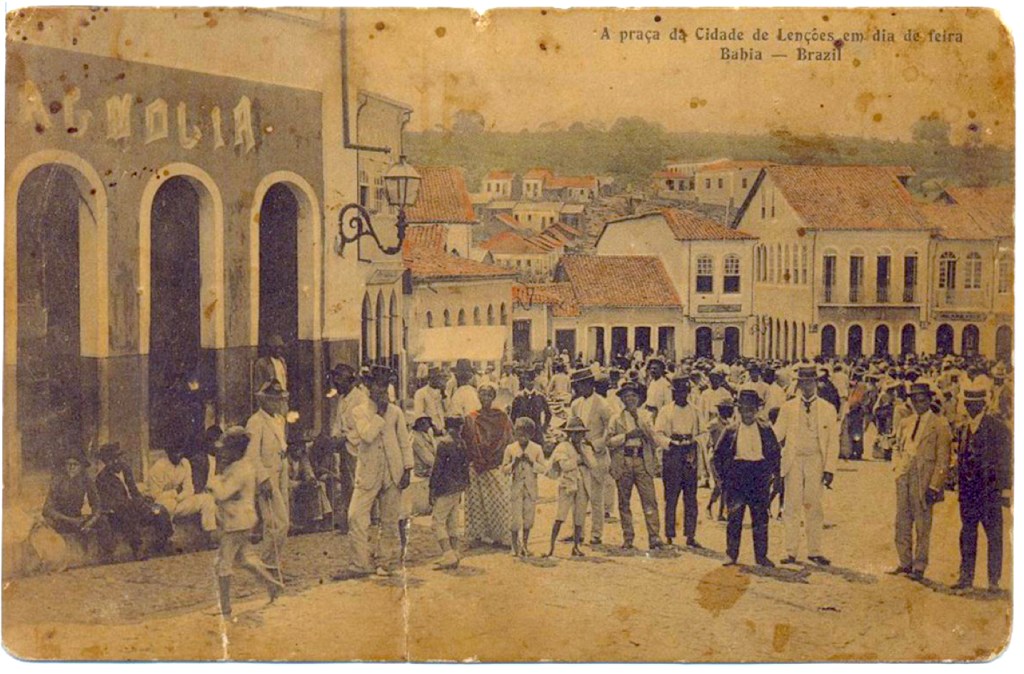
Late 19th century antique postcard image captioned, “Lençóis town square on market day.” (Image courtesy of Universidade Federal da Bahia – UFBA).

There was an active commercial movement, which has diminished to a great extent after the mines began to lose their importance. A fair, very uninteresting and little resorted to, is held every Monday. Two schools are at work in the town.

The mines being thus abandoned, the inhabitants of the municipium applied themselves to the cultivation of the coffee-tree, of a rare quality and planted in the places called grotas, that is to say — in valleys crossed by rivers and rivulets and lying in a craggy ground, formed by numerous mountains, which have been turned topsy-turvy after the mining works were commenced. These grotas are extremely fertile and have, up to the present time, produced a great deal of coffee. The digging for carbonates, now highly prized and paid, is nowadays the principal business of the miners.” (8)

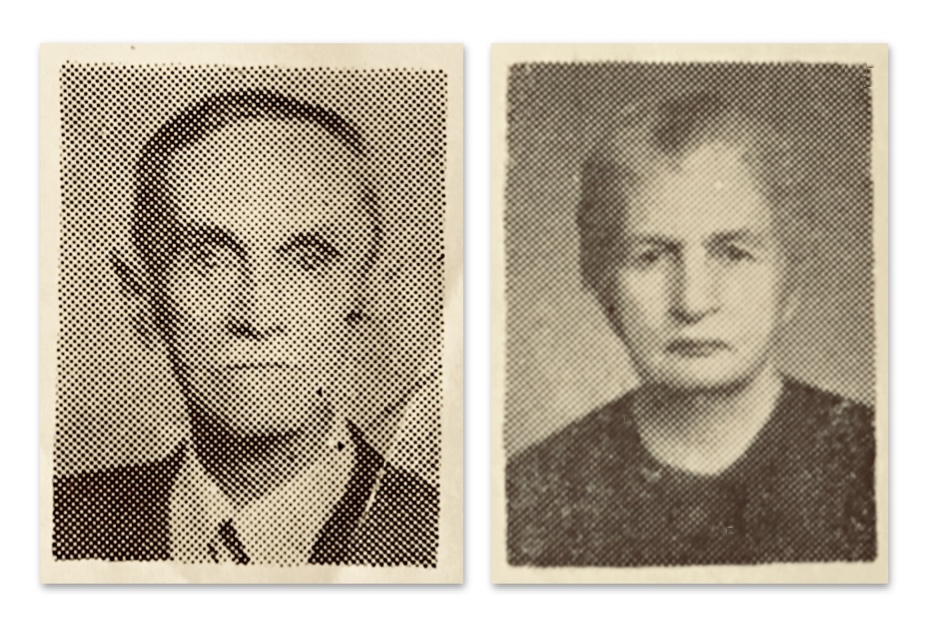
Leandro de Azevêdo Coutinho and Guiomar Viveiros (de Azevêdo) Coutinho. These printed photos were taken later in life, but the actual dates are unknown. (Family photographs).

Getting to Know the Leandro and Guiomar Coutinho Family of Lençóis

When Guiomar marries Leandro de Azevêdo Coutinho, her family surname gives way to the surname of Coutinho. All of their children were born in Lençóis.
Leandro de Azevêdo Coutinho, married Guiomar Viveiros de Azevêdo before 1908. She was born March 28, 1890 likely in Lençóis — died March 17, 1975 in Salvador. They had eight (or more) children together, as follows below.

Comment: Thanking Our Lucky Stars!
We did locate records for the births of two daughters: Dulce, and Eunice, which was incredibly helpful for our research. From those records, we were able to confirm exactly who were Leandro’s and Guiomar’s parents and grandparents.

  • Dulce de Azevêdo (Coutinho) Antunes, born May 22, 1908 — died February 29, 2000. She married Antonio Cardoso Antunes.
  • Carmen Viveiros de Azevêdo (Coutinho) Carrera, born July 5, 1910 — died circa 2004. She married José Carrera.
  • Possible unknown male child, circa 1911. (See footnotes).
  • Clarisse de Azevêdo Coutinho, born possibly in 1914 / died, Date unknown. She married Carlos Lopes Bittencourt.
  • Eunice de Azevêdo Coutinho, born May 24, 1917 — died Date unknown; unmarried.
  • Almir de Azevêdo Coutinho, born / died, Dates unknown.
  • Paulo de Azevêdo Coutinho, born June 29, 1919 in Lençóis — died November 28, 1990 in Salvador. He married Lindaura Almeida Oliveira.
    (Paulo and Lindaura carry the family line forward).
  • Waldette de Azevêdo Coutinho, born December 15, 1923 — died Date unknown ; unmarried.
  • Humberto de Azevêdo Coutinho, born April 20, 1927 — died June 24, 1971.
    He married Regina Chetto.
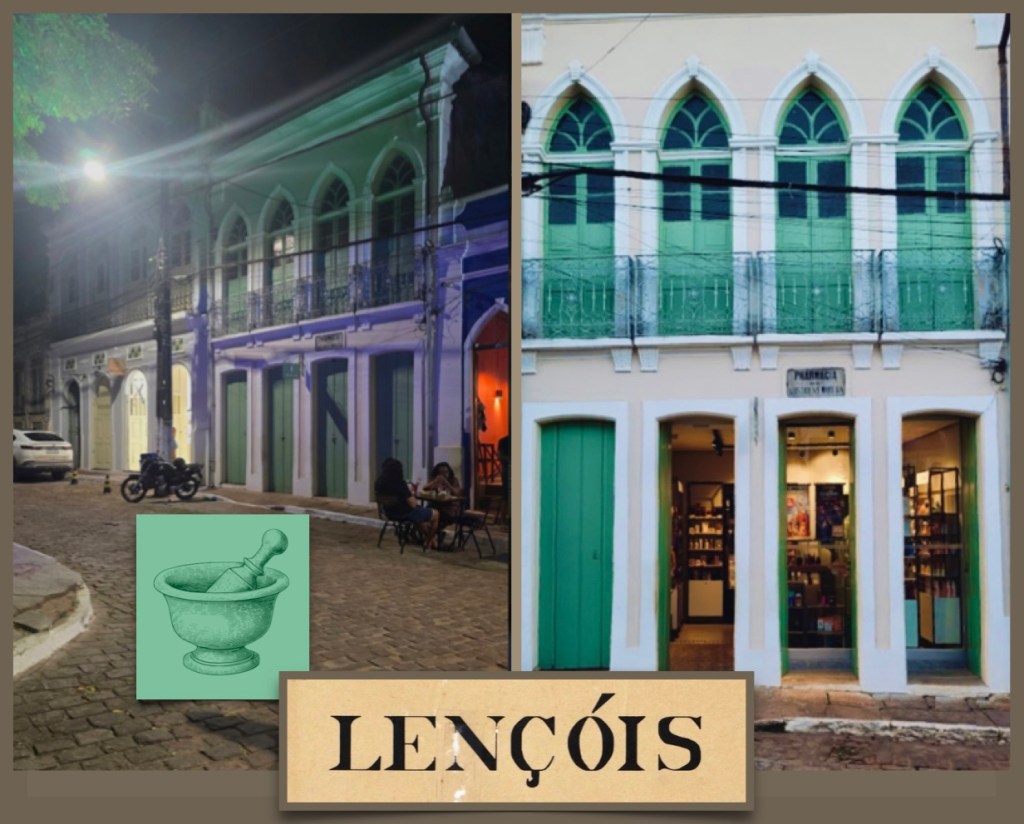
The pharmacy building still stands to this day at Avenida Rui Barbosa, 846, Lençóis.
(Present day location images courtesy of Google Image Search).

‘Dr. Leandro’ and The Pharmacy
Leandro d’Azevedo Coutinho graduated with a degree in Dentistry, but he never practiced the profession. Instead, he was for a number of years, a pharmacist, whose business was located in the center of town at Avenida Rui Barbosa, 846, Centro, Lençóis. The building still stands today and is now an O Boticário store, which sells beauty products and cosmetics. His granddaughter Cristina (Coutinho) Pinheiro relates that, “Leandro lived near the pharmacy and would walk to work early in the morning. Vovô Leandro [grandfather], was like the town doctor. He would always examine people and prescribe effective medicine. He wouldn’t charge people who could not afford to pay and many times he received chickens, turkeys, and fruits as payment. He was loved by everyone. People called him Dr. Leandro.” (9)

The Troubles

Plague, bandits, and colonels… oh my!
As a family, we always wondered quite seriously, the reasons why Dr. Leandro Coutinho chose to give up his life in Lençóis and resettle his family in Salvador da Bahia. We believe that there were a number of contributing factors. Namely, he had a wife and many young children to keep safe in an environment that was rather dangerous, and therefore quite difficult to abide. By the end of all these many troubles, we can understand why he eventually felt that ‘We have had quite enough of this nonsense, thank you, and goodbye!’

Bubonic Plague
As someone who had a medical education, Dr. Leandro probably became concerned (over time) about Lençóis being so very far from an urban hospital which could provide the appropriate level of care for his family, when necessary. From the National Institute of Health, “The arrival of the [bubonic] plague in Brazil at the dawn of the 20th century marked a new chapter in the nation’s public health history. The disease first struck the port city of Santos in 1899, spreading rapidly to other major urban centres such as Rio de Janeiro, Salvador, and Recife. These outbreaks prompted an urgent response from both the government and the scientific community, leading to the implementation of quarantine measures, public health campaigns, and the establishment of specialized health institutions. Over time, the incidence of plague in Brazil declined, thanks to improved public health measures, nevertheless, the disease continued to occur in some rural areas, with sporadic cases.

“For much of its history, Brazil’s population remained bound along the coastline. Geographic features, such as coastal mountain ranges and a relative lack of navigable rivers, stymied efforts to settle and exploit the vast interior… in the late 19th century, efforts to connect the interior to the coast came via the telegraph and railroad… At the same time, [this] created conditions for intensified conflict between newcomers and those who had long called the interior home.”(Latin American History) Compared to Brazil’s coastal-life-zones, not many people had moved to the interior of the country, and to this day, a huge majority of people still live on the Atlantic coast.

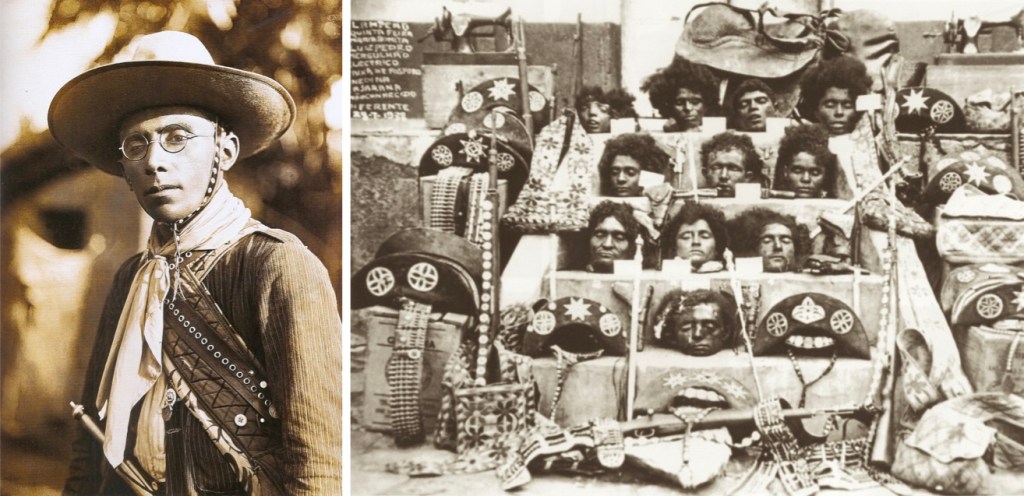
At left: Portrait of the bandit, Lampião, (Virgulino Ferreira da Silva), circa 1926. (Photograph attributed to Benjamin Abrahão Botto). At right: Circa July 1938, The severed heads of Lampião’s band exposed before the State Forensic Institute [in Salvador]. On the lowest level, the head of Lampião, immediately above is that of Maria Bonita. (Photographer unknown).
 

Lampião and Maria Bonita 
Living in the vast interior of Brazil, probably made his family more vulnerable to the exploits of people who (to put it politely) had deeply problematic anti-social behaviors. Lampião “was probably the twentieth century’s most successful traditional bandit leader.” The banditry endemic to the Northeast of Brazil was called Cangaço. Cangaço had origins in the late 19th century but was particularly prevalent in the 1920s and 1930s. Lampião led a band of up to 100 cangaceiros, who occasionally took over small towns and who fought a number of successful actions against paramilitary police when heavily outnumbered. Lampião’s exploits and reputation turned him into a folk hero, the Brazilian equivalent of Jesse James, or Pancho Villa. His image, as well as that of his partner Maria Bonita, can be seen across the entirety of the Northeast of Brazil.

The backlands had little in the way of law and order, even the few police in existence were usually in the pocket of a ‘Coronel [Colonel] — a leading landowner who was also a regional political chief – and who would usually take sides in any dispute.” (Wikipedia) Lampião and Maria Bonita and their extensive gang acquired a reputation as the Brazilian version of Bonnie and Clyde. Their crime spree went on for years, but they were stopped and beheaded in an ambush in July 1938.

At left: Colonel Horácio de Matos, circa 1900. (Photographer unknown). At right: Newspaper about the Prestes Column in Bahia. (See footnotes).

The Problem With The ‘Coronelismo’
In Lençóis, At that time this part of Bahia was a poor area subject to Coronelismo, the rule of The Colonels, who exercised near feudal powers in the backlands of Brazil.” (Latin American Bureau)

“Horácio de Queirós Matos was a politician and colonel from the Bahian backlands during the first half of the 20th century. [He] was the leader of a veritable army of gunmen, engaging in numerous armed conflicts throughout his life — including a crucial role in the pursuit of the Miguel Costa-Prestes Column, (a social rebel movement that broke out in Brazil between 1925 and 1927). He ruled for a quarter of a century… [in a manner similar to that] of the Sicilian Cosa Nostra (mafia)… with an iron fist in the backlands of Chapada Diamantina and Chapada Velha, where the Matos clan lived. His political career began with his promotion to lieutenant colonel in the National Guard, inheriting the family command from an uncle. After many battles against adversaries, he became absolute lord of the vast region of Chapada Diamantina.

Horácio served as mayor of Lençóis, then a wealthy mining center, and as a state senator, a true symbol of the Coronelismo that shaped Brazilian politics during the Old Republic. Despite a life marked by warlike tendencies, he longed for the disarmament of the backlands, and when this finally occurred, he was assassinated under mysterious circumstances after being unjustifiably arrested by the Getúlio Vargas administration (circa 1930) in the Bahian capital.”

It Seems That Leandro Held Two Jobs
When researching Leandro and Guiomar’s children, we found some very subtle evidence that Leandro was already working as a government tax collector during the time period in which they lived in Lençóis. (This was the profession that we know he took up in his later life in Salvador da Bahia). It makes sense that he could have had more than one profession, because he needed to support a growing family. We speculate that perhaps this tax collecting work may have created conflicts with The ‘Coronelismo’ and his associates. (10)

Land in Lençóis, and the Usucapião

‘Dr. Leandro’ was also a landowner of considerable means. When he took his family and left Lençóis for Salvador, it is quite unclear to those of us today as to what he did with it. There was many, many hectares of land. Family stories say that it was understood that this land was to be distributed among the generation of heirs after the last child of Leandro and Guiomar had passed on. (This was Waldette de Azevêdo Coutinho). The heirs generally understood and accepted this, but no one was watching the property carefully…

Contemporary Chapada Diamantina National Park travel poster.
(Image courtesy of Etsy).

In Brazil, there is a law known as “Usucapião” which allows for someone to take over the land legally, even though they may appear at first to be property squatters. What is required is this: for someone to move to the land, and follow a very specific procedure of behavior. From Reddit, a similar story about someone else’s family land in the nearby state of Minas Gerais — “the fact [that] someone was occupying the land, taking care of it, paying the taxes, paying for electrical bill and water, empowers them to claim the land. If someone occupies and takes care of it for 5 years in a row, they can claim ownership. So based on your story, there is no way of reclaiming the land and no way of making profit of it.” (See footnotes for this and other legal sources).

This type of thing may have happened to our family lands. Thus, this being Brazil, the land ownership has become more complicated through ‘usucapião’. (11)

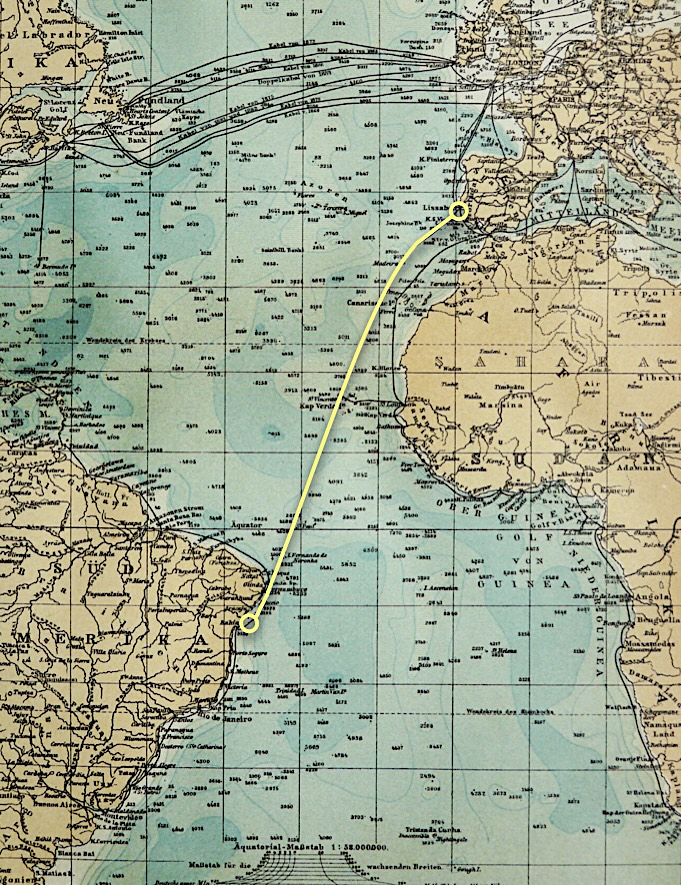
1895 Map of the Atlantic Ocean shipping and passenger routes, from Lisbon, Portugal to Bahia, Brazil. Printed in Germany. (Image courtesy of Etsy).

Traveling on the RMS Magdalena

In the past eras, the only practical way to get to Brazil was to travel there by boat. (Unless, of course, you wanted to walk in, and that we can presume, would have been much more complicated for the Coutinho and the Oliveira ancestors!)

In this period, Portugal and its former colonies remained interconnected through trade and business. People traveled to find work, or engage in commerce. Importantly, many families had ties to both countries, so travel was common for visits or to reunite with relatives. Unlike Portugal, most people in Brazil live along the coasts. This has become so historically embedded within the culture, that it has became a common expression.

“…scraped along the sea like crabs…”
“Brazilians cling to the coast like crabs.”

Top, attributed to Historian Friar Vicente do Salvador, circa 1627,
and Bottom, the same sentiment improved upon by the author Jorge Amado.

When you move out of a country, this is called: Emigration. When you move into a country, this is called: Immigration. We have spent much time reviewing ship registers for both of these families, for ships which went back and forth between Portugal and Brazil. Most voyages from Europe to South America started in Southhampton, or Liverpool, England, and had several ports of call along the way.

It appears to us that the various individuals of the early 20th century, who were tasked with keeping the ship registers for these routes — Nationalities and destinations were always dutifully noted. noted that almost all people who were entering Brazil were marked as Immigrants. Is this because there was no place to mark if they were Emigrants, and not Immigrants? So perhaps, this form of categorization was just understood as the normal way of doing things?

The RMS Magdalena ship record for April 8, 1904 listing Leandro d’Azevedo Coutinho as a passenger bound for Brazil.

We found ship records from April 8, 1904 (and also from 1914) that indicate Leandro d’Azevedo Coutinho sailed to Brazil from Lisbon, Portugal. (There are other similar records, but we feel that these two are certainly him). He is recorded as being a Brasileira. We chose to focus on the 1904 journey, because we believe that this occurred before his first child was born. Why did he travel in 1904? We have no way of knowing for certain, but the possibilities include:

  • His honeymoon trip with his wife Guiomar.
  • His education. (We do not yet know where he went to dental school, nor pharmacy school.
  • Other business trips, such as purchasing supplies for his pharmacy business. His father Alfredo had an import/export business, so perhaps this too.
  • Maybe he was visiting friends or family in Portugal.

His final destination was either Bahia, or Rio de Janeiro, but the ship’s records indicate Rio. (We will never know for certain, but this could have been a data entry error, or perhaps he really did initially go to Rio de Janeiro for some reason).

The RMS Magdalena, which Leandro d’Azevedo Coutinho traveled on from Portugal to Brazil in 1904. (Image courtesy of Scottish Built Ships).

The ship was named RMS Magdalena and it regularly traveled as “a British steamship that was built in 1889 as a Royal Mail Ship and ocean liner for the Royal Mail Steam Packet Company until 1923.” An advertisement which ran in The Times newspaper of London, on Saturday, Oct 20, 1900, read as follows:

ROYAL MAIL STEAM PACKET COMPANY, under Contract for Her Majesty’s Mails to West Indies, Brazil, and River Plate. Dates from Southampton:—Madalena, 5362 tons, (To Sail) Oct. 26, Ports: Cherbourg, Vigo, Lisbon, St. Vincent, Pernambuco, Bahia, Rio, Monte Video, and Buenos Ayres. (12)

The beautiful houses that stood in the old Jardim de Nazaré neighborhood of Salvador
in the 1930s. (Image courtesy of Facebook).

In Salvador, Leandro Changes Professions

The years that Leandro and Guiomar lived in Salvador, are generally framed in the context of, “The Fourth Brazilian Republic, also known as the ‘Populist Republic’ or as the ‘Republic of 46’… [This] is the period of Brazilian history between 1946 and 1964. It was marked by political instability and the military’s pressure on civilian politicians which ended with the 1964 Brazilian coup d’état and the establishment of the Brazilian military dictatorship”. (Wikipedia)

In Salvador, Leandro changed professions and worked as a federal tax collector and auditor. He and his wife Guiomar lived in the neighborhood of Nazaré. In the long history of Salvador, this was one of the first areas to be settled. It is located not far from the historical section called the Pelourinho, which is now UNESCO World Heritage site. (See footnotes). Nazaré is also “home to numerous historic structures of the city; it is additionally the home of several government and academic centers.” (Wikipedia)

Family stories circulate that Guiomar was ever vigilant in her desire to make sure that her grandchildren had much to eat — even when they had already eaten. Cristina Pinheiro relates, “Every time we visited Vovô [grandmother] she would toast bread and butter and caramelize the sugar she put on top of it. We loved it so much! She was always sweet and calm”.

(This is the placeholder image — see the link below to watch the film clip).

Cidade do Salvador (1949, dir. Humberto Mauro). This short movie is about 21 minutes long, but quite worth viewing to appreciate the city of Salvador da Bahia in the mid-20th century. It’s available only in Portuguese, but don’t despair English language speakers, it is still quite interesting!

Please click on this link to watch the short film:
https://www.youtube.com/watch?v=Qf2vyJLy_Eo

Research Comment: The famous director Orson Welles, went to Bahia and the adjacent northeastern state of Ceará in 1941, to film footage for a proposed movie titled It’s All True, which was never finished. If you are interested, there is a link and some beautiful video footage of a long-vanished world, posted in the footnotes. (13)

Left: One of the family Jacaranda wooden chairs, (family photograph). Right: Hand-colored botanical illustration from Samuel Curtis’s “Botanical Magazine,” London, 1822. (This illustration was done in the era in which these chairs were created).

Touchstones

Sometimes in life we are fortunate to inherit something meaningful that connects us to the generations that came before us. Such is the case with a pair of chairs (one of which is shown above), that have come down to my husband Leandro Coutihno (born 1965), the grandson of Leandro and Guiomar Coutinho. It came to him through his paternal Aunt Carmen Viveiros (Coutinho) Carrera. The chairs are handmade of Amazonian Jacaranda wood and are over 200 years old.

We have one more chapter of the Coutinho and Oliveira families which follows. We move forward into the generation from which my husband Leandro emerges in the mid-20th century. (14)

Following are the footnotes for the Primary Source Materials,
Notes, and Observations

Mr . Peabody and Sherman

(1) — two records

Ultra Swank
Mr Peabody and Sherman – The Original Cartoon
by Koop Kooper
https://www.ultraswank.net/television/mr-peabody-sherman-original-cartoon/
Note: For the 1960s film still.

Wayback Machine (Peabody’s Improbable History)
https://en.wikipedia.org/wiki/Wayback_Machine_(Peabody%27s_Improbable_History)
Note: For the reference.

Ah Bahia!

(2) — one record

Mapas Históricos da Bahia
Mapa da Bahia de 1911
https://www.historia-brasil.com/bahia/mapas-historicos/seculo-20.htm
Notes: This is a excerpted portion of the General Map of Brazil published in January 1911, and organized by the company Hartmann-Reichenbach. The red lines are railways.

The de Azevedos Family Arrives in Brazil From Portugal

(3) — four records

The Brazilian National Archives
Category: Coats of arms at Arquivo Nacional (Brazil)
https://commons.wikimedia.org/wiki/Category:Coats_of_arms_at_Arquivo_Nacional_(Brazil)
Note: The above reference then links to this file below.

Collection of The Brazilian National Archives, circa 1855
Brasão de Manoel de Azeredo Coutinho Messeder, Fidalgo Cavaleiro
https://commons.wikimedia.org/wiki/File:Brasão_de_Manoel_de_Azeredo_Coutinho_Messeder,_Fidalgo_Cavaleiro.tif
Note: Accession Number is — BR_RJANRIO_0D_0_0_0103_0003

Observation: When doing genealogy research, it is quite common to follow the lines of male ancestors, because historically there are more records for them. That being said, it is quite refreshing to discover lines that are well researched for our female ancestors, (especially when the male lines are, how shall we say, a bit sparse). For my husband’s Grandmother, Guiomar Viveiros (de Azevêdo) Coutinho, we were able to access the private Family Search records kindly provided by his cousin Maria Patrícia Bittencourt Ferreira. Thanks Pat!

> The family photographs in this section are from the personal family photograph collection.

Old World Auctions
Recently Elaborated Geographical Map of the Kingdom of Brazil in South America…
by Matthias Seutter, circa 1740
https://www.oldworldauctions.com/catalog/lot/128/473
Note: For the map image.

The flag proposed by the conspirators for the new republic, which became the basis for the current Flag of Minas Gerais. (Image courtesy of Wikipedia).

The Inconfidência Mineira (or The Minas Gerais Conspiracy)

(4) — five records

Inconfidência Mineira
https://en.wikipedia.org/wiki/Inconfidência_Mineira
Note: For the text regarding The Minas Conspiracy.

Tiradentes
https://en.wikipedia.org/wiki/Tiradentes
Note: For the text.

Museu Histórico Nacional, via Wikipedia Commons
Joaquim José da Silva Xavier, dressed in the report of ensigns of the paid troop of Minas Gerais.
by José Wasth Rodrigues, circa 1940
https://commons.wikimedia.org/wiki/File:Alferes_Tiradentes_01.jpg
Note: For the portrait.

The Flag of the Conspirators
by Carlos Oswald, circa 1939
https://commons.wikimedia.org/wiki/File:Bandeira_da_Inconfidência_1789_Os_Inconfidentes.jpg
Note: For the painting.

Tiradentes Quartered
by Pedro Americo, circa 1893
https://commons.wikimedia.org/wiki/File:Tiradentes_quartered_(Tiradentes_escuartejado)_by_Pedro_Américo_1893.jpg
Note: For the painting.

These Place Names Are Tongue Twisters!

(5) — six records

Mapas Históricos da Bahia
Mapa da Bahia de 1911
https://www.historia-brasil.com/bahia/mapas-historicos/seculo-20.htm
Notes: This is an excerpted portion of the General Map of Brazil published in January 1911. We are using it again for continuity, and because it allows to show the communities in their proper places.

Joaquim Venâncio Gomes de Azevedo
Batismo de Joaquim Venâncio de Azevedo
 https://www.familysearch.org/en/tree/person/sources/GZ6H-WBT
Note: The file name is, 1305241B-2330-4440-ADD6-8AA2A006184F.jpg

Documents of the Ordinances in Caetité
The signature of Joaquim Venâncio de Azevedo
https://www.familysearch.org/en/tree/person/memories/GZ6H-WBT
Note: The file name is, A02ED4AB-C877-4AF1-AAB1-FF63C664C912.jpg

Downloadable file from:
Photographic portrait, Family Search Memories archive for
José Venâncio Gomes de Azevedo https://www.familysearch.org/en/tree/person/memories/G92F-5VR
Note: The file name is, 2657927E-E264-4FFC-AC4B-7FD606A65DE6.jpg

Downloadable file from:
Photographic portrait, Family Search Memories archive for
Laura Viveiros de Azevedo
https://www.familysearch.org/en/tree/person/memories/G92F-TWM
Note: The file name is, FFBF93C1-E221-49C1-88AC-1E235E03CC0B.jpg

Downloadable file from:
Civil registration of marriage, Family Search Memories archive for
José Venâncio Gomes de Azevedo
https://www.familysearch.org/en/tree/person/memories/G92F-5VR
Note: The file name is, 02BF08D8-49D4-4F44-8012-F6994AD7922E.jpg

Diamonds In The Rough

(6) — five records

ebay
Brazil South American Festival Of Divine Natives Antique Postcard K72076
https://www.ebay.com/itm/142525773982
Note: For the antique postcard image.

History and Tourist Attractions of Lençóis in Chapada Diamantina
Lençóis: The Gateway to Chapada Diamantina
by Author unknown
https://bahia.ws/en/guia-turismo-lencois-chapada-diamantina/#google_vignette
Note: For the text.

Fold-out map titled, Author’s Sketch Map of Gold and Diamond Districts of Bahia
Derived from:
The Diamond Trail : An Account of Travel Among the Little Known
Bahian Diamond Fields of Brazil

by Hugh Pearson, 1926
https://archive.org/details/DiamondTrailPearson/pearson-h-diamond-1926-RTL013509-LowRes/page/n9/mode/2up
Note: For the map image.

Mapas Históricos da Bahia
Mapa da Bahia de 1911
https://www.historia-brasil.com/bahia/mapas-historicos/seculo-20.htm
Notes: This is a excerpted portion of the General Map of Brazil published in January 1911. We are using it again for continuity, and because it allows to show the communities in their proper places.

Andaraí
https://pt.wikipedia.org/wiki/Andaraí
Note: For the text.

Alfredo Viero de Azevêdo Coutinho and His Families

(7) — seven records

> The family photographs in this section are from the personal family photograph collection.

Alfredo Viero de Azevêdo Coutinho 1941 Civil Registration death certificate

Ca- Athahyde Molina de Azevedo Coutinho
Mentioned in the Record of UNKNOWN (in 1916)
Birth — Brasil, Bahia, Registro Civil, 1877-2021
https://www.familysearch.org/ark:/61903/1:1:6V4X-G8GG?lang=en
Note: This reference file is included because we believe it represents the best documentation of Carolina de Azevedo Coutinho’s maiden name: Carolina Athahydes Molina. Furthermore, listed on this record is her husband Alfred (as Ido Vieira de Azevedo Coutinho) and her son Alvaro de Azeredo Coutinho. Her name is also recorded on the above 1941 Civil Registration death certificate.

Passenger entries for Alfredo and Ana de Coutinho’s travel on the ship Ortega, dated July 2, 1911.

Alfredo de Coutinho (for Ana Coutinho passenger entry)
Migration — Brasil, Bahia, Salvador, Relações de passagieros e imigrantes, 1855-1964
https://www.familysearch.org/ark:/61903/1:1:71DC-QWW2?lang=en&cid=fs_email
Book page: 86, Digital page: 173/403
Note 1: Entries 14 and 15 from the top for Alfredo and Anna.
Note 2: Passengers entries for ship travel on the Ortega, dated July 2, 1911.

Manoel de Azevedo Coutinho
Death — Brasil, Bahía, Registros da Igreja Católica, 1598-2007
https://www.familysearch.org/ark:/61903/1:1:6BZF-S1JX?lang=en
Digital page: 26/80, Left page near the top.
Note: Despite what the record indicates as ‘zero days age’ at death, the words on the record state that he was 7 months old, and died from a gastrointestinal infection.

Alvaro de Azevedo Coutinho
Marriage — Brasil, Bahia, Registro Civil, 1877-2021
https://www.familysearch.org/ark:/61903/1:1:X9YD-YVPV?lang=en
Note 1: Record of his 1915 marriage to Maria Juliana Paraguassa.
Note 2: The records that he was born in 1892.

1954 Death Registration for Ernestina Francisco de Oliveira.

Ernestina Francisca de Oliveira
Death — Brasil, Bahia, Registro Civil, 1877-2021
https://www.familysearch.org/ark:/61903/1:1:Z2ZH-5HW2?lang=en
Note: For the data.

Left: Lamartine de Oliveira Vieira, date unknown. He is the Grandfather of Isa Gunes Viera, (pictured at right) who was helpful with research on this family line). Thanks Isa! (Family photographs).

Memoir of The State of Bahia, circa 1893

(8) — six records

> The family photographs in this section are from the personal family photograph collection.

World’s Columbian Exposition
https://en.wikipedia.org/wiki/World%27s_Columbian_Exposition
Note: For the reference.

Musings from the Rosenthal Archives
Chicago Symphony Orchestra Association
of the The World’s Columbian Exposition of 1893
https://csoarchives.wordpress.com/2018/04/23/the-worlds-columbian-exposition-of-1893/
Note: For the pop-up book cover, circa 1893.

Chicago Public Library
Latin American Country Buildings at the 1893 World’s Columbian Exposition
https://www.chipublib.org/blogs/post/latin-american-country-buildings-at-the-1893-worlds-columbian-exposition/
Note: For the data and Brazil Building photograph.

Memoir of The State of Bahia, circa 1893
by Dr. Francisco Vicente Vianna, José Carlos Ferreira, Dr. Guilherme Pereira Rebello
https://archive.org/details/memoirofstateofb00bahi/page/468/mode/2up
Book page: 468 – 470, Digital Page: 468 – 470/742
Note: Prepared for the World’s Columbian Exposition, Chicago, 1893.

Universidade Federal da Bahia – UFBA
A praça da cidade de Lençóes em dia de feira
by Photographer unknown
https://repositorio.ufba.br/bitstream/ri/17582/1/Dissertação Romulo de Oliveira Martins.pdf
Note: For the town image.

Getting to Know the Leandro and Guiomar Coutinho Family of Lençóis

(9) — seven records

> The family photographs in this section are from the personal family photograph collection.

Leandro de Aze-Cido Coutinho
https://www.familysearch.org/ark:/61903/1:1:6V4H-BBC2?lang=en
Note: Mentioned in the record as the Father of Dulce de Azevedo Coutinho, who is a sister of Paulo de Azevêdo Coutinho, his son.
and
Gisiomarde Azevedo Coutinho
https://www.familysearch.org/ark:/61903/1:1:6V4H-BBCL?lang=en
Note: Mentioned in the record as the Mother of Dulce de Azevedo Coutinho, who is a sister of Paulo de Azevêdo Coutinho, her son.

Note: Birth records for Leandro and Guiomar’s children are scarce, but we did locate records for their daughters Dulce and Eunice. From those records, we were able to confirm who Leandro’s parents and grandparents were.

Dulce de Azevedo Coutinho
Birth — Brasil, Bahia, Registro Civil, 1877-2021
https://www.familysearch.org/ark:/61903/1:1:6V4H-BBCK?lang=en
Note: Daughter, for her birthdate and confirmation of the parents and grandparents. (1908)

1911
Lean Dro de Azeredo Coutinho
Mencionado no Registo de Azevedo Edilude
Birth — Brasil, Bahia, Registro Civil, 1877-2021

https://www.familysearch.org/ark:/61903/1:1:6V4C-W5LD?lang=en
Note: Leandro and his daughter Carmen are noted in the birth document for a male child, who was previously unknown.

1914
Guiomar de Azevedo Coutinho
Mentioned in the Record of UNKNOWN
Birth — Brasil, Bahia, Registro Civil, 1877-2021

https://www.familysearch.org/ark:/61903/1:1:6V4D-6PSG?lang=en
Note: Possible birth record for Leandro and Guiomar’s daughter Clarisse.

Eunice
Birth — Brasil, Bahia, Registro Civil, 1877-2021
https://www.familysearch.org/ark:/61903/1:1:6V46-9R7F?lang=en
Note: Daughter, for her birthdate and confirmation of the parents and grandparents. (1917)

Humberto de Azevêdo Coutinho com os seus três filhos, (da esquerda para a direita) Carlos, Mariza, e José Leandro, cerca de 1960s. (Foto de família).

The Troubles

(10) — seven records

NIH (The National Institute of Health)
The National Library of Medicine
125 years of the plague in Brazil: lessons learnt, historical insights
and contemporary challenges
by Igor Vasconcelos Rocha, Matheus Filgueira Bezerra, Marise Sobreira, Alzira Maria Paiva de Almeida
https://pmc.ncbi.nlm.nih.gov/articles/PMC11851657/
Note: For the text.

This image of a Plague Doctor is from this link: https://www.nationalgeographic.com/animals/article/140129-justinian-plague-black-death-bacteria-bubonic-pandemic

Latin American History
Road Building in Brazil
by Emily Story
https://oxfordre.com/latinamericanhistory/display/10.1093/acrefore/9780199366439.001.0001/acrefore-9780199366439-e-992?p=emailAWhHANH3NNSUI&d=/10.1093/acrefore/9780199366439.001.0001/acrefore-9780199366439-e-992
Note: For the text.

Lampião
https://en.wikipedia.org/wiki/Lampião
and
Maria Bonita (bandit)
https://en.wikipedia.org/wiki/Maria_Bonita_(bandit)
Note: For the text and photos.

LAB
Latin American Bureau
Brazil: the Prestes Column in Bahia
https://lab.org.uk/brazil-the-prestes-column-in-bahia/
Note: For the text and newspaper image.

Horácio de Matos
https://pt.wikipedia.org/wiki/Horácio_de_Matos
Note: For the text and photos.

Coluna Prestes
https://en.wikipedia.org/wiki/Coluna_Prestes
Note: For the data.

Land in Lençóis, and the Usucapião

(11) — four records

Reddit
Legal Advice: My grandfather’s land in Minas Gerais has had squatters living there for 40+ years. Is it still ours?
https://www.reddit.com/r/Brazil/comments/39tndd/legal_advice_my_grandfathers_land_in_minas_gerais/
Note: For the text.

Etsy
MapometryCo
Chapada Diamantina National Park Panoramic Art Print: Brazil Travel Poster
https://www.etsy.com/listing/1733895652/chapada-diamantina-national-park
Note: For the artwork.

Machado Meyer Advogados
by Fatima Tadea Rombola Fonseca, Marina Rosa Cavalli,
Iasmim De Souza Nunes, and Marina Rosa Cavalli
STJ Welcomes Action Of Usucapião Of Private Property
Without Real Estate Registration

https://www.machadomeyer.com.br/en/recent-publications/publications/real-estate/stj-welcomes-action-of-usucapiao-of-private-property-without-real-estate-registration#:~:text=The Superior Court of Justice,other requirements required by law.
Note: For the reference.

“The usucapio is a constitutionally guaranteed institute. It allows the acquisition of real estate property by proving the possession exercised without opposition and for a certain time, in addition to other requirements required by law. Because it is an original form of acquisition of property, there is no transfer of liens or encumbrances on the real estate property for the plaintiff (the usucapiente). The registration of the usucapio on the enrollment certificate, therefore, is not done to constitute the acquisition, but rather to give publicity to it and allow the exercise of the right to dispose of the property, in addition to regularizing the registry itself.”

A General Introduction to Real Estate Law in Brazil
by Pinheiro Neto Advogados 
https://www.lexology.com/library/detail.aspx?g=d95e5bc8-d57e-4ff0-9543-ad013fe64d14#:~:text=In Brazil, the right to,whoever may unlawfully hold it.
Note: For the reference.

“In Brazil, the right to own property is assured by Article 5, XXII of the Brazilian Federal Constitution. According to the Brazilian Civil Code (Law No. 10,406 of 2002), owners have the right to use, enjoy and dispose of their property, as well as to defend it from whoever may unlawfully hold it.”

Traveling on the RMS Magdalena

(12) — five records

Etsy
1895 Antique Map of the Atlantic Ocean
by Author unknown
https://www.etsy.com/listing/1528816009/1895-antique-map-of-the-atlantic-ocean
Note: Printed in Germany in 1895.

Leandro d’ Azevedo Coutinho
Migration — Brasil, Bahia, Salvador, Relações de passagieros e imigrantes, 1855-1964
https://www.familysearch.org/ark:/61903/1:1:WH84-3MPZ?lang=en
Book page: 29, Digital page: 59/400
Note: For the data.

SN, Ships Nostalgia
SS MAGDALENA Route in 1900
https://www.shipsnostalgia.com/threads/ss-magdalena-route-in-1900.23933/
Note: For the data.

RMS Magdalena (1889)
https://en.wikipedia.org/wiki/RMS_Magdalena_(1889)
Note: For the text.

Alfredo V de Azevedo Coutinho
Migration — Brasil, Bahia, Salvador, Relações de passagieros e imigrantes, 1855-1964
https://www.familysearch.org/ark:/61903/1:1:WS83-GKW2?lang=en
Note: For the reference.

In Salvador, Leandro Changes Professions

(13) — seven records

Facebook
Amo a História de Salvador
by Louti Bahia
https://www.facebook.com/photo.php?fbid=2630913453614695&id=729832370389489&set=a.729839003722159
Note 1: For the photo reference.
Note 2: The original photo caption reads, “The beautiful houses that stood in the old Jardim de Nazaré neighborhood in the 1930s.”

Fourth Brazilian Republic
https://en.wikipedia.org/wiki/Fourth_Brazilian_Republic
Note: For the text.

UNESCO World Heritage Convention
Historic Centre of Salvador de Bahia
https://whc.unesco.org/en/list/309
Note: For the reference.

Nazaré (neighborhood)
https://en.wikipedia.org/wiki/Nazaré_(neighbourhood)
Note: For the text.

Youtube.com
CTAv Centro Técnico Audiovisual
Cidade do Salvador (1949, dir. Humberto Mauro)
https://www.youtube.com/watch?v=Qf2vyJLy_Eo

It’s All True (film)
https://en.wikipedia.org/wiki/It%27s_All_True_(film)
Note: For the reference.

(This is the placeholder image — see the link below to watch the film clip).

Youtube.com
Orson Welles – Four Men on a Raft
by Carlos J. Carpio L.
https://www.youtube.com/watch?v=GtaYuirQNpo
Notes: This is some of the best of all of the film that was shot in 1941. The preliminary portion explains the background, and the Welles footage begins at the 2:35 mark. (Total length is 9:55).

Touchstones

(15) — three records

> The family photograph in this section is from the personal family photograph collection.

Jacaranda copaia
https://en.wikipedia.org/wiki/Jacaranda_copaia
Note: For the reference.

Alamy
Jacaranda mimosifolia 
Handcoloured copperplate engraving by Weddell after an illustration
by John Curtis from Samuel Curtis’s “Botanical Magazine,” London, 1822

https://www.alamy.com/trinidad-fern-tree-jacaranda-mimosifolia-oval-leaved-jacaranda-jacaranda-ovalifolia-handcoloured-copperplate-engraving-by-weddell-after-an-illustration-by-john-curtis-from-samuel-curtiss-botanical-magazine-london-1822-image331462351.html?imageid=6592413D-131B-46C4-808D-92A84A7B07F9&pn=1&searchId=006951c8677a72657123955a412ba84c&searchtype=0
Note: For the reference

The Coutinho / Oliveira Line, A Narrative — One

This is Chapter 1 of 3, being the very first of our family line narratives that feature southern Europe and South America. Accordingly, this line will also be our first dual language family history, being written in two formats.

In total, there are 6 chapters: the first set of 3 chapters is written in English, and are labeled as One, Two, Three. The following second set of 3 chapters is translated into Portuguese, and are labeled as Primeira, Segunda, Terceira.

Eis um exemplo: No total, existem 6 capítulos: o primeiro conjunto de 3 capítulos está escrito em inglês e intitula-se Um, Dois e Três. O segundo conjunto de 3 capítulos está traduzido para português e intitula-se como Primeira, Segunda, Terceira.

After our wedding, we celebrated at Zuni restaurant in San Francisco, California.
(Family photograph).

Intertwined

When we married in 2008, we had already spent ten years together as a couple. As I sit here and tap the computer keys to write these chapters, I realize that we are coming up on nearly 30 years together as a family. So, what does it mean to have a family like ours? Especially one where, through your research, you discover long generational family histories going back for sometimes hundreds of years? 

My husband Leandro is from northeast Bahia, Brazil, and I [Thomas], am from northeast Ohio, USA — and for many years we have lived in various places: California, Ohio, Hawaii, Brazil, and now Portugal.

Our families are interconnected like two ribbons that have intertwined through time to create a strong silken cord that binds us all together. This chapter is about those family lines that originate from Leandro’s side of things; first in Portugal, and then in Brazil. (1)

— Thomas

The Battle of Aljubarrota (Castile vs Portugal, 1385), by Jean d’Wavrin (Chronique d’Angleterre).
(Image courtesy of the British Historical Society of Portugal).
The “Battle of Aljubarrota [was] fought between Portugal and Castille near the monastery of Batalha, [and was] called this name due precisely to the battle won by Portugal with the help of English archers with experience from France, in what was to be called the 100 year war”. This victory secured for the Kingdom of Portugal sovereignty against the ambitions of its neighbors.

What Does the Coutinho Family Name Mean in Portugal?

The deeper history of this family has been enlightening. On the paternal side of his family, Leandro’s father Paulo has the classic Portuguese surname of: Coutinho. This name is connected to the de Azervedo(s) (or the spelling variant) the de Azeredo(s). [Note the difference between the interim v, or r letter]. This led us to many interesting discoveries, but before we go there, we first we need to provide some general background information.

“The surname Coutinho is of Portuguese origin, belonging to the toponymic class of surnames, which are derived from the place where the initial bearer once lived or held land. Specifically, Coutinho comes from a diminutive form of couto, which referred to a fenced or enclosed place, such as a hunting preserve or a protected area. Therefore, Coutinho would have originally denoted someone who lived near or was associated with a small enclosed area or preserve.” (Wisdom Library)

Wikipedia also tells us that, “Coutinho is a noble Portuguese language surname. It is from Late Latin cautum, from the past participle of cavere to make safe.” (Wikipedia) (2)

Left and right: Photographs of the ruins of Marialva Castle in the Guarda District of central Portugal. Center: King Ferdinand I of Portugal (circa 1450), who created the office of the Marshal of the Kingdom of Portugal, which became the Count of Marialva.

The Marshals of the Kingdom of Portugal

The office of Marshal of the Kingdom of Portugal (Marechal do Reino de Portugal, sometimes Mariscal) was created by King Ferdinand I of Portugal in 1382, in the course of the reorganization of the higher offices of the army of the Kingdom of Portugal. The Marshal was directly subordinate to the Constable of Portugal (Condestável), being principally responsible for the high administrative matters, including the quartering of troops, supplies and other logistical matters.

Commander Gonçalo Vasques de Azevedo was appointed the first Marshal of the Kingdom in 1382. This title then became known as The Count(s) of Marialva. The office then passed to his son-in-law, Dom Gonçalo Vasques Fernandes Coutinho — This office was maintained within the Coutinho family until the Iberian Union of 1580.

  • Dom Gonçalo Vasques Fernandes Coutinho, the First Count of Marialva, (circa 1385— circa 1450). In 1412, Fernandes Coutinho married Dona Maria de Sousa (died 1472), the natural daughter of Lopo Dias de Sousa, master of the Order of Christ.
  • Dom Gonçalo Coutinho, the Second Count of Marialva, (circa 1415 — January 20, 1464). He died in Tangier, Morocco. Gonçalo was married to Beatriz de Melo, daughter of Martim Afonso de Melo and Briolanja de Sousa.
  • Dom João Coutinho, the Third Count of Marialva, (circa 1450 — August 24, 1471).
  • Dom Francisco Coutinho, the Fourth Count of Marialva, (circa 1480 — February 19, 1543). He married Beatriz de Meneses, 2nd Countess of Loulé.
  • Dona Guiomar Coutinho, 5th Countess of Marialva, 3rd Countess of Loulé, who married Fernando, Duke of Guarda, (1510 — 1534). He was the son of Manuel I and Maria of Aragon. (The portion of the Castle of Guarda still stands to this day).
Arms of Coutinho, granted to Dom Vasco Fernandes Coutinho (born 1385)
by King Afonso V of Portugal in 1440. (See footnotes for all sources).

At first glance, we thought that this contemporary coat-of-arms was just a little bit plain Jane, (in Portuguese, you might say that it needs salt and pepper). Then we came to realize that this is what authenticity looks like.

Research Observation: It is rather astonishing in genealogy research, to come across an instance where you can specifically identify the foundational origin and formalization of a family surname by royal decree, (in this case, circa 1382). Prior to this period most common families did not have true surnames.

*Very nearly all Coutinho-named descendants in Portugal likely related to this man’s family line. Google tells us that this timeframe from then-to-now is about 650 years. (If we allow about 25 years or so between generations, this allows for approximately 26 generations of Coutinho(s). (3)

The Ancient Heraldry of the Coutinho Family

“Heraldry has been practiced in Portugal at least since the 12th century, however it only became standardized and popularized in the 16th century, during the reign of King Manuel I of Portugal, who created the first heraldic ordinances in the country. Like in other Iberian heraldic traditions, the use of quartering and augmentations of honor is highly representative of Portuguese heraldry, but unlike in any other Iberian traditions, the use of heraldic crests is highly popular”.

The Important Significance of the Livro do Armeiro-Mor
“The Livro do Armeiro-Mor is an illuminated manuscript dating back to 1509, [created] during the reign of King Manuel I of Portugal. The codex is an armorial, a collection of heraldic arms, authored by the King of Arms João do Cró. It is considered one of the masterpieces of illuminated manuscripts preserved in Portugal… [It is] the oldest surviving Portuguese armorial to this day, being the oldest source we have regarding certain arms, and also for the beauty of its magnificent illuminations, it is considered the most important Portuguese armorial. It has been called the supreme monument of what we can call Portuguese heraldic culture.

The Count of Marialva (Coutinho) armorial, from folio 48 of the Livro do Armeiro-Mor, circa 1509, by João do Cró for King Manuel I of Portugal.

The work… was entrusted to the custody of the Chief Armourer, Álvaro da Costa, appointed in 1511, in whose family the position and the custody of the book remained for more than ten generations. For this reason, the Livro do Armeiro-Mor escaped the great 1755 Lisbon earthquake, which destroyed, among many other things, the Chancellery of Nobility.” (Wikipedia)

One can observe that some representation of Coats-of-Arms feature the escutcheon (shield) tilted at an angle, and the addition of other decorative elements throughout, which make Portuguese armory unique. These elements, however, were added through artistic license by the original artist(s) who crafted the Livro do Armeiro-Mor. Observe also that the stars are not 5-points, but are 7-points. As such, these alterations and additions are not part of the fundamental original coat-of-arms criteria.

What Did the Colors Mean?
The colors in heraldry are called tinctures. Old French words were used to describe the colors of the background, which came to have different meanings. Red (vermelho) was the color of a warrior and nobility, blue (azul) for truth and sincerity, black (negro) for piety and knowledge, and green (verde) for hope and joy. Presently, Portuguese heraldry has seven colors (tinctures) including two metals (gold/ouro, silver/prata) and five colors (blue, red, purple, black, green).

  • Estucheon, the shape of the shield. “Since very early, the round bottom shield has been the preferred shape to display the coat-of-arms in Portugal, causing this shape to often be referred as the Portuguese shield”. 
  • Helm, the top center of this shape, where future generations might add elements to represent their individual family.
  • Charge, there is no charge, but only a yellow (ouro) field.
  • Ordinaries, In this family, they had 5 stars on a yellow (ouro) field, the designs that appeared on the field. A star with five points and straight sides is called a mullet.

Note: For an interesting history as to why the need for heraldry emerged in English history, see the chapter, The Ancient Bonds of Erth — One, Family Heraldry. That chapter covers symbolic thinking in a pre-literate world, the meaning of various shapes and colors, and what a Coat-of-Arms actually is, versus a Family Crest. The exact same reasons for these developments apply in a parallel manner to the Kingdom of Portugal, even though it was a different country. (https://ourfamilynarratives.com/2022/06/13/the-ancient-bonds-of-erth-one-family-heraldry/)

Coats of arms of principal families of the Portuguese nobility in the Thesouro de Nobreza, 1675. Note that the Coutinho family appears in the lower right corner of the page. The Helm at the top of the Coutinho Coat-of-Arms appears to show a red lion holding a laurel wreath. (Image courtesy of Wikipedia).

There are extensive records for the noble classes of Portugal found in the three volume set of books titled, Nobreza de Portugal e Brasilia. These books feature the family names described above, and others.

“The Portuguese nobility was a social class enshrined in the laws of the Kingdom of Portugal with specific privileges, prerogatives, obligations and regulations. The nobility ranked immediately after royalty and was itself subdivided into a number of subcategories which included the titled nobility and nobility of blood at the top and civic nobility at the bottom, encompassing a small, but considerable proportion of Portugal’s citizenry.

The nobility was an open, regulated social class. Accession to it was dependent on a family’s merit, or, more rarely, an individual’s merit and proven loyalty to the Crown over generations. Formal access was granted by the monarch through letters of ennoblement. A family’s status within the noble class was determined by continued and significant services to Crown and country.” (Wikipedia)

The ranks of the titled nobility below The Royals, although similar to those in other European countries, have their idiosyncrasies in Portugal. They are listed here in hierarchical order and are slightly simplified for this family history.
Here are just a few examples of one ranked Noble in each category:

  • Dukedoms — The Duke of Viseu, created 1415.
  • Marquisates —The Marquis of Pombal, created 1769. Renowned for the rebuilding of Lisbon after the 1755 earthquake, tsunami, and fire which destroyed the city.
  • Countships — The Coutinho family as The Counts of Marialva, created 1440.
  • Viscountcies — The Viscount of São Jorge, created 1893.
  • Baronies — The Baron of Serra da Estrela, created 1818. (4)
The ceiling of the Coats-of-Arms Room within the Sintra National Palace, in Portugal.
(Image courtesy of Lifecooler).

We Are From Two of the 72 Portuguese Noble Class Families

The Coutinho Family later combined through marriage with another family from the same noble class. Known by both surname spellings, either Azerêdo or Azervêdo, this consolidation created the House of Azerêdo – Coutinho. The Coat-of-Arms for each family is featured within the Sintra National Place of Portugal. “…King Manuel I created the Coats-of-Arms Room (Sala dos Brasões) between 1515 – 1518, using the wealth engendered by the exploratory expeditions in the Age of Discovery. The room features a magnificent wooden coffered domed ceiling decorated with 72 coats-of-arms of the King and the main Portuguese noble families.”

The Azevedo armorial, from folio 61 of the Livro do Armeiro-Mor, circa 1509, by João do Cró
for King Manuel I of Portugal.

Throughout this history, we have been focusing on the paternal family line of the Coutinho family. We also have interesting things to share about the maternal side, the Oliveira family…

What Does the Oliveira Family Name Mean in Portugal?

“Oliveira is a Portuguese (and Galician) surname, used in Portuguese-speaking countries, and to a lesser extent in former Portuguese and Spanish colonies. Its origin is from the Latin word olivarĭus , meaning olive tree. Its first documented use dates back to the 13th century, from Évora noble Pedro de Oliveira, and his son, Braga archbishop D. Martinho Pires de Oliveira. Further tracing of its origins show that it derives from ancient Roman aristocrats from the gens* Oliva. (*Individuals who shared the same descent from a common ancestor).

Left: Shields of the twelve tribes of Israel, from a work published by Pieter Mortier in Amsterdam, 1705. Right: Oliveira armorial, from folio 128 of the Livro do Armeiro-Mor, circa 1509, by João do Cró for King Manuel I of Portugal. Oliveira is found in the last section, which documents the “Houses of lesser category and more recent nobility. These were not, in 1509, great manorial Houses; they were lineages whose sons held minor positions at the court throughout the 14th and 15th centuries”. (Wikipedia)

Furthermore, this surname takes us back to Biblical times, where the olive and olive tree were always very important to the Hebrew culture. One of the 12 Hebrew tribes, [known as Asher], had an olive tree inside of the tribe emblem. This is compelling evidence that the Asher Hebrew tribe name could have likely been transliterated into the Portuguese Oliveira surname, to better align with Portuguese Christian society and culture.

In Portuguese, de Oliveira may [therefore] refer to both of the olive tree and from the olive tree. In archaic Portuguese, we find the register of surnames with variations of their spelling, such as Olveira and Ulveira. By the time of King Diniz I, king of Portugal in 1281, Oliveira was already ‘an old, illustrious and honorable family’, as the King’s Books of Inquisitions show.

Comment: I have been pondering about what my mother-in-law Lindaura would have thought about this next part of the history. We do not know how much she truly knew of her family’s history… However, one very specific fact that you could certainly know about her was that she was a very, very devout Roman Catholic. (All her roads led to Rome). This next part was a bit if a revelation to us.

“It is noteworthy to mention that the offspring of the [12 Tribes of Israel] intentionally settled between Galicia [northwest Spain] and Portugal for two reasons — First, because they were inland and far from the great centers of Spain, where the first killings of Judeans (pogroms) began. These pogroms were promoted by fanatical Catholic priests of the Dominican and Carmelite orders, who urged the ignorant Christian population to kill the New Christian Jews and the unconverted Judeans. Second, Galicia and Portugal gave them freedom to cross the borders among the different countries accordingly to the laws of each State”. (Wikitree) This lead to the population being labeled historically with the ethnic definition of Sephardic Jews.

Research observation: We know that this family surname is very old in Portugal, however, we don’t yet know when it connects with the line from which our family descends. We could be from the very old branch, or the branch of people who adopted this surname during the times of oppression, or both.

The Iberian monarchs responsible for expelling Jews from Portugal. Left: King Manuel I of Portugal, by Colijn de Coter, circa 1515. Center: Queen Isabella I of Spain, by Unknown painter, circa 1490. Right: King Ferdinand II of Spain, by by Michael Sittow, circa 1450. (See footnotes).

Sephardic Jews
Oliveira, de Oliveira, and d’Oliveira, have historically been used by Jews who settled in Portugal and Spain, and adopted a translated form of their family name to hide their Judean origin. Sephardic Jews, are a Jewish diaspora population associated with the historic Jewish communities of the Iberian Peninsula (Spain and Portugal) and their descendants. The term Sephardic comes from Sepharad, the Hebrew word for Iberia. These communities flourished for centuries in Iberia until they were expelled in the late 15th century. (Over time, Sephardic has also come to refer more broadly to Jews, particularly in the Middle East and North Africa, who adopted Sephardic religious customs and legal traditions, often due to the influence of exiles).

In 1492, the Alhambra Decree by the Catholic Monarchs expelled Jews from Spain, and in 1496, King Manuel I of Portugal issued a similar edict*. de Oliveira was one of the Conversos surnames adopted by Sephardic families after converting (often forced) to Christianity [Roman Catholicism]. This practice was a means of avoiding the Portuguese Inquisition [with the high probability of] prosecution and possible torture, if found as non-Catholics.

We learned from historian Laurence Bergreen in his book, Over The Edge of the World, that “Manuel’s harshest policies concerned the Jews of Portugal, who distinguished themselves as scientists, artisans, merchants, scholars, doctors, and cosmographers. In 1496, when King Manuel wished to take the daughter of Ferdinand and Isabella as his wite, he was told that he could do so only on condition that he “purify” Portugal by expelling the Jews, as Spain had done four years earlier. Rather than lose this valuable segment of the population, Manuel encouraged conversions to Christianity — forced conversions, in many cases. As ‘new Christians’ (the title fooled no one), Portuguese Jews continued to occupy high positions in the government, and received royal trading concessions, in Brazil especially.” (Bergreen, see footnotes).

*Both the Spanish and Portuguese edicts ordered their respective Jewish residents to choose one of only three options: 1) Convert to Catholicism and therefore to be allowed to remain within the kingdom, 2) Remain Jewish and be expelled by the stipulated deadline, or 3) to be summarily executed. (Wikitree)

An engraving shows the burning of heretics by the Portuguese Inquisition.
(Image courtesy of Turning Portuguese via BBC News, and Wikipedia).

Despite Conversos Surnames, People Were Not Safe
In 1506, a Lisbon mob invaded one of the city’s old Jewish quarters and massacred around 3,000 people – including women and children. Under Manuel’s heir, João III, the Inquisition was set up in Portugal in 1536, focusing on New Christians suspected of secretly practising their old faith. It’s thought more than 40,000 individuals were charged by the Inquisition, which lasted until 1821 although the last public trial was in 1765. (BBC News)

According to historian Anita Novinsky of the University of São Paulo, a scholar of the Portuguese Inquisition, 1 out of every 3 Portuguese who arrived in Brazil in the first decades of the 16th century… were of Jewish descent. The de Oliveira(s) concentrated mainly in the Northeast Region and Minas Gerais in southeast Brazil. The chronicles of the time themselves attest to the presence of Levi, Levy, and de Oliveira families in large numbers in colonial Brazil.” (All above, except for BBC News and Wikitree, are derived from Wikipedia).

“The surname Oliveira, [is the] third most common in Brazil and sixth in Portugal.” (Oliveira Ledo Family, see footnotes). (6)

Left: Portrait of Henry The Navigator, attributed to painter Nuno Gonçalves, circa 1450-1470, Center: Christopher Columbus, by Unknown painter, circa 1519, Pope Julius II, by Raphael,
circa 1511. (See footnotes).

All Eyes On The Horizon

“The Portuguese began systematically exploring the Atlantic coast of Africa in 1418, under the sponsorship of Prince Henry the Navigator. In 1488, Bartolomeu Dias reached the Indian Ocean by this route.”

“In 1492, the Catholic Monarchs of Spain funded Genoese mariner Christopher Columbus’s plan to sail west to reach the Indies, by crossing the Atlantic. Columbus encountered a continent uncharted by Europeans (though it had been explored and temporarily colonized by the Norse 500 years earlier). Portugal quickly claimed those lands under the terms of the Treaty of Alcáçovas, but Castile was able to persuade the Pope, who was Castilian, to issue four papal bulls to divide the world into two regions of exploration, where each kingdom had exclusive rights to claim newly discovered lands. These were modified by the Treaty of Tordesillas, ratified by Pope Julius II.” Importantly, at the time, none of these explorers knew the true complete extent of the New World.

Planisphere World Map, by Francesco Rosselli, circa 1508. The far left blue line represents the Line of the Treaty of Tordesillas, 1494. The broken yellow line represents the Line of Demarcation from the Papal Bull Inter Caetera, 1493. The pink line represents the Treaty of Saragossa, 1529. (Map image courtesy of Wikimedia Commons).

In 1498, a Portuguese expedition commanded by Vasco da Gama reached India by sailing around Africa, opening up direct trade with Asia. While other exploratory fleets were sent from Portugal to northern North America, Portuguese India Armadas also extended this Eastern oceanic route, touching South America and opening a circuit from the New World to Asia (starting in 1500 by Pedro Álvares Cabral), and explored islands in the South Atlantic and Southern Indian Oceans. The Portuguese sailed further eastward, to the valuable Spice Islands in 1512, landing in China one year later. Japan was reached by the Portuguese in 1543. East and west exploration overlapped in 1522, when a Spanish expedition sailing westward, led by Portuguese navigator Ferdinand Magellan (and, after his death in what is now the Philippines, by navigator Juan Sebastián Elcano), completed the first circumnavigation of the world.

Left: Portrait of Vasco da Gama, by Artist unknown, circa 1525. Center: Contemporary illustration of Pedro Álvares Cabral, circa 1900. (No known portraits of him exist). Right: Portrait of Ferdinand Magellan, created 1550-1625, after his death. (See footnotes).

Spanish conquistadors explored the interior of the Americas, and some of the South Pacific islands. Their main objective was to disrupt Portuguese trade in the East.”

In summary, “As one of the earliest participants in the Age of Discovery, Portugal made several seminal advancements in nautical science. The Portuguese subsequently were among the first Europeans to explore and discover new territories and sea routes, establishing a maritime empire of settlements, colonies, and trading posts that extended mostly along the South Atlantic and Indian Ocean coasts.” (Wikipedia) (7)

“The sea with an end can be Greek or Roman,
but the endless sea is Portuguese.”

attributed to Portuguese poet and writer Fernando Pessoa

Starting in 1500… the Coutinhos As New World Colonizers

Brazil is a remarkably old country when compared to a country like the United States, which is thought of as being about half the age of Brazil. In the present day, these countries have an important characteristic in common: they are both immigrant-inspired democratic republics, and each one has their own Constitution. Initially, each place was a far-flung colony of a distant European Kingdom, and the paths each took to the present day are quite different. (8)

Map of Brazil in Miller’s Atlas of 1519, by Lopo Homem.
(Image courtesy of the Bibliothèque Nationale de France, via Wikimedia).

Old Brazil: From Colonial Captaincies to The First Republic

The Crown in Portugal, as did other sea-faring kingdoms, viewed resource extraction as the primary reason for having a colony. Simply put, they wanted all the resources and the wealth which this brought. “Colonial Brazil, sometimes referred to as Portuguese America, comprises the period from 1500, with the arrival of the Portuguese (at what they then aptly named Porto Seguro), until 1822, when Brazil was elevated to a kingdom in union with Portugal. During the 300 years of Brazilian colonial history, the main economic activities of the territory were based first on brazilwood extraction (brazilwood cycle), which gave the territory its name; sugar production (sugar cycle); and finally on gold and diamond mining (gold cycle). Slaves, especially those brought from Africa, provided most of the workforce of the Brazilian export economy after a brief initial period of Indigenous slavery to cut brazilwood.”

Series of Eight Figures, by Albert Eckout, 1641. (Images courtesy of the National Museum of Denmark, via the Kahn Academy).

“In 1630, the Dutch conquered the prosperous sugarcane-producing area in the northeast region of the Portuguese colony of Brazil. Although it only lasted for 24 years, the Dutch colony resulted in substantial art production. The governor Johan Maurits van Nassau-Siegen brought the artist, Albert Eckhout to Brazil to document the local flora, fauna, people, and customs.”

“Beginning in the early 16th century, the Portuguese monarchy used proprietorships or captaincies—land grants with extensive governing privileges—as a tool to colonize new lands… The history of the captaincies is turbulent, reflecting the needs of the Kings of Portugal, a small European country, to colonize and govern an enormous expanse of South America. Throughout the early colonial era Captaincies were granted, divided, subordinated, annexed, and abandoned. In 1548-49 when the captaincy of Baía de Todos os Santos (Bahia) reverted to the Crown due to [a] massacre, by indigenous cannibals, of its donee [a person given the gift of a powerful appointment], Francisco Pereira Coutinho [appointed on March 5, 1534] and his settlers; the King, Dom João III, established a royal governor (later a governor-general) at Bahia.”

In 1549, there were more troubles with the local native Peoples, and to make a complicated history much shorter — Captain Francisco Pereira Coutinho “was consumed by the Tupinambá in a cannibalistic feast” (!)

Mapa de Capitanias Hereditarias by Luiz Teixeira, circa 1574. In 1549,
the Captaincy Colonies of Brazil were united into the Governorate General of Brazil,
where they were provincial captaincies of Brazil. In the list on the right side of the map, the Coutinho family is listed as entry seven for Bahia. (Map courtesy of Wikipedia).

Brazil became independent of Portugal with the signing of the Treaty of Rio de Janeiro in 1825. For three years there had been “a series of political and military events that led to the independence” based upon the date of September 7, 1822 “when prince regent Pedro of Braganza declared the country’s independence from the United Kingdom of Portugal, Brazil and the Algarves on the banks of the Ipiranga brook… in what became known as the Cry of Ipiranga.” (9)

The Town of Cachoeira in the Province of Bahia. (Image courtesy of O Globo | Cultura).

The Coutinho Family and The Oliveira Family Immigrate to Brazil

The Northeast Region of Brazil was the first area of discovery in Brazil, when roughly 1,500 Portuguese arrived on April 22, 1500. In the mid-16th century, settlers from Spain and Portugal, Olinda, and Itamaracá founded Filipéia de Nossa Senhora das Neves (today João Pessoa) at the mouth of the Paraíba do Norte River.

The Coutinho Family
It is certain that families with the surname Coutinho immigrated to Brazil during the colonial period, as we have already written about the lurid death of Francisco Pereira Coutinho of the Bahia Captaincy (see above). “Upon the discovery of Pereira Coutinho’s death, King João immediately appropriated the captaincy from its heir Manuel Pereira Coutinho in exchange for a hereditary pension of 400,000 reals. [The family was not interested in remaining in the Americas in any case.]” (Wikipedia) With that knowledge, we are sure that the Coutinho family line begins elsewhere in Brazil. We just don’t yet know who, nor where, the original immigrant was for this family line, until more records shake loose.

The Oliveira Family As Conversos in Brazil
The history of the Jews in Brazil is a rather long and complex one, as it stretches from the very beginning of the European settlement in the new continent. Although only baptized Christians were subject to the Inquisition, Jews started settling in Brazil when the Inquisition reached Portugal, in the 16th century. They arrived in Brazil during the period of Dutch rule, setting up in Recife the first synagogue in the Americas, the Kahal Zur Israel Synagogue, as early as 1636. As a colony of Portugal, Brazil was affected by the 300 years of repression of the Portuguese Inquisition, [which quickly enough] expanded its scope of operations from Portugal to Portugal’s colonial possessions, including Brazil, Cape Verde, and Goa, where it continued investigating and trying cases based on supposed breaches of orthodox Roman Catholicism until 1821.

Center: First edition frontispiece of Adam Smith’s Wealth of Nations, 1776. Background top: Image from Smithsonian Magazine, Sugar Masters in a New World. Background bottom: Sugar Mill in Pernambuco, by Franz Post, 17th century. (See footnotes).

Most Portuguese settlers in Brazil, who throughout the entire colonial period tended to originate from Northern Portugal, moved to the northeastern part of the country to establish the first sugar plantations. In his The Wealth of Nations, Adam Smith attributed much of the development of Brazil’s sugar industry and cultivation to the arrival of Portuguese Jews who were forced out of Portugal during the Inquisition.

Interestingly, and somewhat ironically, many of the Jews who had been Sephardic Jews who had fled the Inquisition in Spain and Portugal to the religious freedom of the Netherlands. From 1630 to 1654 the Dutch controlled a long stretch of Northeastern Brazilian coast. In 1648-49 the [Portuguese] Brazilians defeated the Dutch in the first and second battles of Guararapes, and gradually recovered the Portuguese colonies of Brazil.
(Derived from both Wikitree and Wikipedia) (10)

Many other European nationalities, as well as many Japanese people, immigrated to Brazil during the 19th and 20th centuries. (See footnotes).

Historically, Why Were The Portuguese Attracted to Brazil?

The Portuguese people were not the only people who immigrated to Brazil, even though they are our focus for this family history. We learned some specifics we would like to discuss to help frame the long continuous stream of people immigrating from Portugal in Europe, to Brazil in South America:

  • “From 1500, when the Portuguese reached Brazil, until its independence in 1822, from 500,000 to 700,000 Portuguese settled in Brazil, 600,000 of whom arrived in the 18th century alone.
  • Between 1820 and 1876, 350,117 immigrants entered Brazil. Of these, 45.73% were Portuguese, [when] the total number of immigrants per year averaged 6,000].
  • From 1877 to 1903, almost two million immigrants arrived, at a rate of 71,000 per year.
  • From 1904 to 1930, 2,142,781 immigrants came to Brazil; the Portuguese constituted 38% of entries…” (Family Search)
Engravings made two years after the 1755 Lisbon Earthquake.
Top row, left to right: Ruins of: St. Nicholas Church, São Paulo Church, Patriarchal Square.
Bottom row, left to right: Lisbon Cathedral, Tower of São Roque or Tower of the Patriarch,
Royal Opera House. Engravings by the French artist Jacques Philippe Le Bas, 1757.
(Images courtesy of get Lisbon).

After the 1755 Lisbon earthquake devastated that city, the country of Portugal was never the same again. It was (no pun intended), literally uprooted as a world class city. Over the centuries, it began experiencing severe economic problems, financial instability, and political turmoil, which drove many to seek opportunities elsewhere. Thus, Brazil became a significant destination for those fleeing poverty and seeking a better life. This sense of instability pushed many to emigrate. (Derived from Instituto de Ciências Sociasis).

“Portuguese Brazilians are Brazilian citizens whose ancestry originates wholly or partly in Portugal. Most of the Portuguese who arrived throughout the centuries in Brazil sought economic opportunities. Although present since the onset of the colonization, Portuguese people began migrating to Brazil in larger numbers and without state support in the 18th century.

The majority settled in urban centers, mainly in São Paulo and Rio de Janeiro, working mainly as small traders, shopkeepers, porters, cobblers, and drivers. A smaller number became coal miners, dairy workers, and small-scale farmers outside of urban areas. Upheavals in Portugal after the 1910 Revolution and the establishment of the First Portuguese Republic caused a temporary exodus of Portuguese to Brazil.” (Wikipedia)

In the next chapter, we move forward with what we do know about the Coutinho and the De Azevedo families. Their lives unfold in the Brazilian states of Minas Gerais, Bahia, and Paraíba. Unlike many family lines we have researched in other chapters — we learn much about them through the lines of their grandmothers, rather than their grandfathers. (11)

Following are the footnotes for the Primary Source Materials,
Notes, and Observations

Intertwined

(1) — two records

> The family photograph (and wedding announcement below) in this section are from the personal family collection.

June 2008 Wedding Announcement
for Thomas Harley Bond and Leandro José Oliveira Coutinho

What Does the Coutinho Family Name Mean in Portugal?

(2) — five records

The British Historical Society of Portugal
Battle of Aljubarrota, 1385
https://www.bhsportugal.org/anglo-portuguese-timeline/battle-of-aljubarrota
Note: For the image and text.

Wisdom Library
Meaning of The Name Coutinho
https://www.wisdomlib.org/names/coutinho#google_vignette
Note: For the text.

Coutinho
https://en.wikipedia.org/wiki/Coutinho
Note: For the text.

Ferdinand I of Portugal
https://en.wikipedia.org/wiki/Ferdinand_I_of_Portugal
and
King Ferdinand I of Portugal, (detail)
https://en.wikipedia.org/wiki/Ferdinand_I_of_Portugal#/media/File:Ferdinand_I_of_Portugal_-_Chronique_d’_Angleterre_(Volume_III)_(late_15th_C),_f.201v_-_BL_Royal_MS_14_E_IV_(cropped).png
Note:  For his image.

The Marshals of the Kingdom of Portugal

(3) — sixteen records

Marshal of Portugal
https://en.wikipedia.org/wiki/Marshal_of_Portugal
Note: For the text.

Count of Marialva
https://en.wikipedia.org/wiki/Count_of_Marialva
Note: For the text and the Coutinho Coat-of-Arms.

Geneall
https://geneall.net/pt/titulo/739/condes-de-marialva/
Note 1: This website references this book,
Nobreza de Portugal e Brasil
Editorial Enciclopédia, Edição: 2, Lisboa 1989
Available at this link:
https://www.livraria-ler-com-gosto.com/nobreza-de-portugal-e-do-brasil-3-vols
Note 2: For the data.

These above volumes are also available as .pdf downloads at:
Volume 1
Open Repository of the University of Porto
https://repositorio-aberto.up.pt/handle/10216/9376
File: tesedoutnobrezav01000065918.pdf
Volume 2
https://repositorio-aberto.up.pt/handle/10216/9376
File: tesedoutnobrezav02000065920.pdf
Volume 3
MOA %E2%80%94 12.pdf

Vasco Fernandes Coutinho, 1st Count of Marialva
https://en.wikipedia.org/wiki/Vasco_Fernandes_Coutinho,_1st_Count_of_Marialva
Note: For the data.

Gonçalo Coutinho, 2nd Count of Marialva
https://en.wikipedia.org/wiki/Gonçalo_Coutinho,_2nd_Count_of_Marialva
Note: For the data.

Francisco Coutinho, 4th Count of Marialva
https://en.wikipedia.org/wiki/Francisco_Coutinho,_4th_Count_of_Marialvaand
Beatriz de Meneses, 2nd Countess of Loulé
https://en.wikipedia.org/wiki/Beatriz_de_Meneses,_2nd_Countess_of_Loulé
Note: For the data.

Count of Loulé
https://en.wikipedia.org/wiki/Count_of_Loulé
and
Infante Ferdinand, Duke of Guarda
https://en.wikipedia.org/wiki/Infante_Ferdinand,_Duke_of_Guarda
Note: For the data.

Costa of of the Coutinho family, counts of Marialva and counts of Loulé
https://commons.wikimedia.org/wiki/File:Armas_condes_marialva.svg
Note: The Coutinho Coat-of-Arms source file.

The Ancient Heraldry of the Coutinho Family

(4) — five records

Portuguese Heraldry
https://en.wikipedia.org/wiki/Portuguese_heraldry
Note: For the text and artwork.

Opening pages to the Livro Do Armeiro Mor.

Livro Do Armeiro Mor, João Do Cró (ou João Du Cros)
by João do Cró (ou João du Cros), circa 1509
https://archive.org/details/livro-do-armeiro-mor-joao-do-cro-ou-joao-du-cros-backup/mode/2up
Note: Count of Marialva (Coutinho), folio 48
https://archive.org/details/livro-do-armeiro-mor-joao-do-cro-ou-joao-du-cros-backup/page/n111/mode/2up
Digital page: 112/292

Coats-of-arms of principal families of the Portuguese nobility
in the Thesouro de Nobreza, 1675.

https://en.wikipedia.org/wiki/Portuguese_heraldry#/media/File:Fl-_27_Thesouro_de_Nobreza,_Armas_das_Familias_(cropped).jpg
Note 1: Observe the Coat-of-Arms of the Coutinho family in the lower right corner.
Note 2: For the artwork.

Portuguese Nobility
https://en.wikipedia.org/wiki/Portuguese_nobility
Note: for the text.

We Are From Two of the 72 Portuguese Noble Class Families

(5) — four records

Lifecooler
Palácio Nacional de Sintra (Palácio da Vila)
https://lifecooler.com/artigo/dormir/palcio-nacional-de-sintra-palcio-da-vila/326883
Note: For the Sala dos Brasões photograph.

Drawing of Sintra Royal Palace in 1509, by Duarte D’Armas.
(Image courtesy of the Libro das Fortalezas via Wikimedia Commons).

Sintra National Palace
https://en.wikipedia.org/wiki/Sintra_National_Palace
Note: For the text and the image above.

Livro Do Armeiro Mor, João Do Cró (ou João Du Cros)
by João do Cró (ou João du Cros), circa 1509
https://archive.org/details/livro-do-armeiro-mor-joao-do-cro-ou-joao-du-cros-backup/mode/2up
Note: Azevedo, folio 61
https://archive.org/details/livro-do-armeiro-mor-joao-do-cro-ou-joao-du-cros-backup/page/n135/mode/2up
Digital page: 136/292

What Does the Oliveira Family Name Mean in Portugal?

(6) — sixteen records

Oliveira (surname)
https://en.wikipedia.org/wiki/Oliveira_(surname)
Note: For the text.

Google Image Search
Shields of the Twelve Tribes of Israel
by Pieter Mortier, 1705
https://www.posterazzi.com/shields-of-the-twelve-tribes-of-israel-from-a-work-published-by-pieter-mortier-in-amsterdam-1705-poster-print-by-ken-welsh-11-x-17/
Note: This image is sourced from the contemporary website Posterazzi, but its original source is the “Shields of the twelve tribes of Israel, from a work published by Pieter Mortier in Amsterdam, 1705”.

Livro Do Armeiro Mor, João Do Cró (ou João Du Cros)
by João do Cró (ou João du Cros), circa 1509
https://archive.org/details/livro-do-armeiro-mor-joao-do-cro-ou-joao-du-cros-backup/mode/2up
Note: Armorial artwork for Oliveira, folio 128
https://archive.org/details/livro-do-armeiro-mor-joao-do-cro-ou-joao-du-cros-backup/page/n263/mode/2up
Digital page: 264/292, Right page, in the upper left corner.

Sephardic Jews
https://en.wikipedia.org/wiki/Sephardic_Jews
Note: For the text.

Alhambra Decree
https://en.wikipedia.org/wiki/Alhambra_Decree
Note: For the reference.

Wikitree
De Oliveira Name Study
https://www.wikitree.com/wiki/Space:De_Oliveira_Name_Study
Note: For the text.

Manuel I of Portugal
by Colijn de Coter, circa 1515
https://en.wikipedia.org/wiki/Manuel_I_of_Portugal
Note: For his portrait.

Isabella I of Castile
by Unknown artist, circa 1490
https://en.wikipedia.org/wiki/Isabella_I_of_Castile
Note: For her portrait.

Ferdinand II of Aragon
by Michael Sittow, circa 1450
https://en.wikipedia.org/wiki/Ferdinand_II_of_Aragon
Note: For his portrait.

Jewish Gen
The Jeff Malka Sephardic Collection: Sephardim.com Namelist
https://jewishgen.org/databases/sephardic/SephardimComNames.html
Note: For the data about the family surname de Oliveira.

Over The Edge of the World
by Laurence Bergreen
Chapter One: The Quest, paragraph 29
Note: We do not have a digital link to the text, but the book can be referenced here in English:
Over The Edge of the World
https://en.wikipedia.org/wiki/Over_the_Edge_of_the_World

BBC News
Turning Portuguese
https://www.bbc.co.uk/news/resources/idt-sh/Turning_Portuguese
Note: For the text.

Wikitree
de Oliveira of Paraíba, Brazil
https://www.wikitree.com/wiki/Space:De_Oliveira%27s_of_Paribia%2C_Brazil
Note: For the text under the subhead, Sephardi Jews Settlement and Expulsion From Spain and Portugal

Seal of the Portuguese Inquisition.

Representation of Executions by Fire in Terreiro do Paço, in Lisbon, Portugal.
https://pt.wikipedia.org/wiki/Inquisição
Note: For the engraved illustration.

Martins Castro
Oliveira Ledo Family: From Brick Making to the Colonization of Paraíba
https://martinscastro.pt/en/blogs/familia-oliveira-ledo/
Note: For this text —
“The surname Oliveira, [is the] third most common in Brazil and sixth in Portugal”.

All Eyes On The Horizon

(7) — fifteen records

Age of Discovery
https://en.wikipedia.org/wiki/Age_of_Discovery
Note: For the text.

Prince Henry the Navigator
https://en.wikipedia.org/wiki/Prince_Henry_the_Navigator
and
https://en.wikipedia.org/wiki/Prince_Henry_the_Navigator#/media/File:Henry_the_Navigator1.jpg
Note 1: Portrait attributed to painter Nuno Gonçalves, circa 1450.
Note 2: From the description, “Detail of standing man with moustache and Burgundian-style chaperon in the Panel of the Prince (third panel of the St. Vincent panels, usually dated c.1470, attributed to painter Nuno Gonçalves). This figure is most commonly identified as Prince Henry the Navigator (died 1460, aged 66). Several scholars (e.g. Markl, 1994; Salvador Marques, 1998) have recently disputed this identification, and instead proposed this to be an image of King Edward of Portugal (d. 1438, aged 47), although this is not yet widely accepted.”
Note 3: For his portrait.

Christopher Columbus
https://en.wikipedia.org/wiki/Christopher_Columbus
and
Portrait of a Man, Said to be Christopher Columbus
by Unknown painter
https://en.wikipedia.org/wiki/Christopher_Columbus#/media/File:Portrait_of_a_Man,_Said_to_be_Christopher_Columbus.jpg
Note: For his portrait.

Pope Julius II
https://en.wikipedia.org/wiki/Pope_Julius_II
and
Portrait if Pope Julius II
by Raphael
https://en.wikipedia.org/wiki/File:Pope_Julius_II.jpg#/media/File:Pope_Julius_II.jpg/2
Note: For his portrait.

Planisphere World Map
by Francesco Rosselli, circa 1508
https://commons.wikimedia.org/wiki/File:World_map_RMG_C4568_1.jpg
Note: For the map image.

The Departure of Vasco da Gama for Índia in 1497, by Alfredo Roque Gameiro, circa 1900.
(Image courtesy of the National Library of Portugal via Wikimedia Commons).

Vasco da Gama
https://en.wikipedia.org/wiki/Vasco_da_Gama
and
Vasco da Gama, anonymous portrait, c. 1525
https://en.wikipedia.org/wiki/Vasco_da_Gama#/media/File:Ignoto_portoghese,_ritratto_di_un_cavaliere_dell’ordine_di_cristo,_1525-50_ca._02.jpg
Note: For his portrait, and the image above.

Pedro Álvares Cabral
https://en.wikipedia.org/wiki/Pedro_Álvares_Cabral
and
https://en.wikipedia.org/wiki/Pedro_Álvares_Cabral#/media/File:Pedro_Álvares_Cabral.jpg
Note 1: From the description, “Detail of painting “Vaz de Caminha reads to Commander Cabral, Friar Henrique and Master João the letter that will be sent to King Dom Manuel I”. It depicts Pedro Álvares Cabral, leader of the Portuguese expediction that discovered the land that would later be known as Brazil in 1500.”
Note 2: For his contemporary portrait, circa 1900.

Ferdinand Magellan
https://en.wikipedia.org/wiki/Ferdinand_Magellan
and
Half-length portrait of a bearded Ferdinand Magellan
(circa 1480-1521) facing front.
https://en.wikipedia.org/wiki/Ferdinand_Magellan#/media/File:Ferdinand_Magellan.jpg
Note: For his portrait.

Starting in 1500… the Coutinhos As New World Colonizers

(8) — one record

Bibliothèque Nationale de France, via Wikimedia
Map of Brazil in the Miller Atlas of 1519,
by Lopo Homem
https://en.wikipedia.org/wiki/File:Brazil_16thc_map.jpg
Note: The file name is, Brazil 16thc map.jpg

Old Brazil: From Colonial Captaincies to The First Republic

(9) — nine records

Portugal
https://en.wikipedia.org/wiki/Portugal
Note: For the text.

Captaincy of Bahia
https://en.wikipedia.org/wiki/Captaincy_of_Bahia
Note: For the text.

Fernando Pessoa
https://en.wikipedia.org/wiki/Fernando_Pessoa
Note: For the reference.

Colonial Brazil
https://en.wikipedia.org/wiki/Colonial_Brazil
Note: For the text.

The National Museum of Denmark, via the Kahn Academy
Series of Eight Figures, by Albert Eckhout, 1641
by Rachel Zimmerman
https://pl.khanacademy.org/humanities/art-americas/new-spain/colonial-brazil/a/albert-eckhout-series-of-eight-figures
Note: For the artwork and text.

Captaincies of Brazil
https://en.wikipedia.org/wiki/Captaincies_of_Brazil
Note: For the text.

Francisco Pereira Coutinho
https://ancestors.familysearch.org/pt/LYPV-1X2/francisco-pereira-coutinho-1450-1549

História do Rio para todos
Mapa de Capitanias Hereditarias
by Luiz Teixeira, circa 1574
https://historiadorioparatodos.com.br/timeline/1534-capitanias-hereditarias/km_c258-20190503153124-6/
Note: From the Collection of the Ajuda Library Foundation, Lisbon.

O Globo | Cultura
De mapas manuscritos a pintura, livro reúne imagens da Bahia entre os séculos XVII e XIX nunca antes publicadas num único volume

by Nelson Vasconcelos
https://oglobo.globo.com/cultura/noticia/2024/11/17/de-mapas-manuscritos-a-pintura-livro-reune-imagens-da-bahia-entre-os-seculos-xvii-e-xix-nunca-antes-publicadas-num-unico-volume.ghtml
Note: For the image, The Town of Cachoeira in the Province of Bahia.

The Coutinho Family and The Oliveira Family Immigrate to Brazil

(10) — seven records

Captaincy of Bahia
https://en.wikipedia.org/wiki/Captaincy_of_Bahia
Note: For the text about Manuel Pereira Coutinho.

Die Inquisition in Portugal by Jean David Zunner (1685), via Wikipedia at: https://en.wikipedia.org/wiki/Portuguese_Inquisition#/media/File:1685_-_Inquisição_Portugal.jpg
Note: For the above image, Copper engraving of an auto de fé in Portugal.

History of the Jews in Brazil
https://en.wikipedia.org/wiki/History_of_the_Jews_in_Brazil
Note: For the text.

Wikitree
de Oliveira of Paraíba, Brazil
https://www.wikitree.com/wiki/Space:De_Oliveira%27s_of_Paribia%2C_Brazil
Note: For the text under the subhead, History of Northeastern Brazil

University of St. Andrews
Where we find new old books, chapter 4:
William Creech and a new first edition of Adam Smith’s Wealth of Nations

https://university-collections.wp.st-andrews.ac.uk/2015/12/15/where-we-find-new-old-books-chapter-4-william-creech-and-a-new-first-edition-of-adam-smiths-wealth-of-nations/
Note: For the book frontispiece photograph.

Smithsonian Magazine
Sugar Masters in a New World
by Heather Pringle
https://www.smithsonianmag.com/history/sugar-masters-in-a-new-world-5212993/
Note: For the background top image.

Sugar Mill in Pernambuco
by Franz Post, 17th century
https://commons.wikimedia.org/wiki/File:Frans_Post_-_Engenho_de_Pernambuco.jpg
Note 1: File name is, Frans Post – Engenho de Pernambuco.jpg
Note 2: For the background bottom image.

Historically, Why Were The Portuguese Attracted to Brazil?

(11) — nine records

Brazilian propaganda poster incentivizing
Italian immigration to Rio de Janeiro, 1870s.

https://www.reddit.com/r/PropagandaPosters/comments/1iio0a3/brazilian_propaganda_poster_incentivizing_italian/
Note: For the poster artwork.

Estado de São Paulo Brazil O Immigrante (Europa-Santos) 1908
https://pt.wikipedia.org/wiki/Ficheiro:Estado_de_São_Paulo_Brazil_O_Immigrante_(Europa-Santos)_1908.jpg#/media/Ficheiro:Estado_de_São_Paulo_Brazil_O_Immigrante_(Europa-Santos)_1908.jpg
Note: For the poster artwork.

Japanese Brazilian emigration propaganda poster
https://commons.wikimedia.org/wiki/File:Affiche_émigration_JP_au_BR-déb._XXe_s..jpg
Note: For the poster artwork.

Family Search
Portugal Emigration and Immigration
https://www.familysearch.org/en/wiki/Portugal_Emigration_and_Immigration
Note: For the data.

Derived from:
Instituto de Ciências Sociais de Universidade de Lisboa
The “Brasileiro”: a 19th century transnational social category
Chapter 10
by Isabel Corrêa da Silva
https://www.ics.ulisboa.pt/books/book1/ch10.pdf
Note: This is .pdf file of chapter 10.

Get Lisbon
The Tragic Earthquake of 1755
https://getlisbon.com/discovering/earthquake-of-1755/
Note: For the engravings made two years after the 1755 Lisbon Earthquake by the French artist Jacques Philippe Le Bas, 1757.

IMDB
Carmen Miranda
Portrait photograph by the Donaldson Collection/Getty Images
https://www.imdb.com/name/nm0000544/mediaviewer/rm3875448065?ref_=ext_shr_eml
and
https://www.imdb.com/title/tt0034273/mediaviewer/rm3703311617?ref_=ext_shr_eml
Note: For her photograph, and the movie poster.

Portuguese Brazilians
https://en.wikipedia.org/wiki/Portuguese_Brazilians
Note: For the text.