The DeVoe Line, A Narrative — Five

This is Chapter Five of eleven. In 1939, Winston Churchill was giving a radio address when he coined a phrase that ended up becoming an idiom. He said, “It is a riddle wrapped in a mystery inside an enigma, but perhaps there is a key”. When it comes to “a riddle wrapped in a mystery”… well, that seems to aptly sum up what we came up against with this chapter on the Devoes.

Preface — Sometimes Family Stories Are Just Plain Wrong

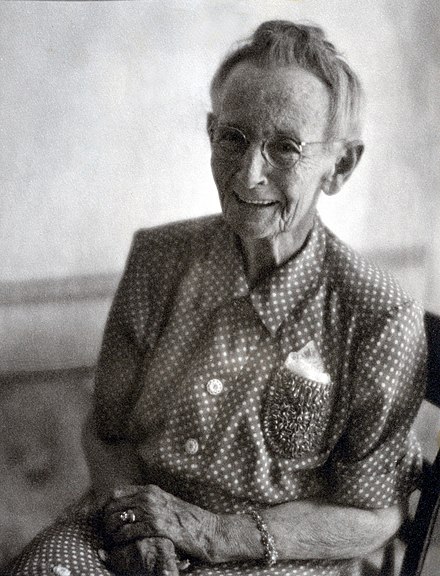
Tracing the history of our 4x Great Grandfather Martinus Devoe has been frustrating, difficult, and challenging. Our troubles began with his son, Peter M. Devoe (our 3x Great Grandfather), who was an enigma to us. We knew when he was born, we knew whom he married, we knew when he died, but beyond that… c r i c k e t s . We couldn’t be sure of exactly who his parents were. It didn’t help that our Grandmother Lulu (De Voe) Gore, and our Mother (Lulu’s daughter) Marguerite (Gore) Bond, weren’t comfortable discussing him. It seems they thought he had turned his back on the American Colonies and made his way to Canada. (What?! This was news to our ears.)

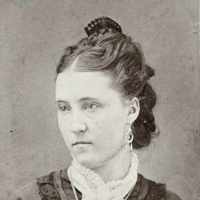
From left to right, Marguerite (Gore) Bond, Ricard and Daniel Bond, Lulu (De Voe) Gore,
at home circa 1954. (Family photograph).

Hearing something like that raised even more questions and it opened up a lot of mysterious doors for us as we did our research. It turns out that they were incorrect in their understanding of the actual family history for both Peter M. DeVoe and his father Martinus DeVoe. It’s quite likely that they had heard family stories, and as families do over time, they knitted something together which made sense for them. Whatever they thought they knew, it wasn’t an accurate history. However, there were some clues here and there…

Very little evidence about Martinus DeVoe, prior to the 1780s, has survived and now we know why. There was a war and the DeVoes lived right in the midst of it. We’ve finally unwrapped the riddle, having solved what really happened in the story of Martinus Devoe (this generation) and the one which followed (his son Peter M). It’s actually quite an interesting account.

A Map of the Provinces of New-York and New-Yersey [sic], with a part of Pennsylvania
and the Province of Quebec
, by Claude Joseph Sauthier, and Matthäus Albrecht Potter
Published in Augsburg, 1777.

The focus of this chapter is specifically on the period of the Revolutionary War when the Devoe family and their extended clan were living in different communities along the Hudson River Valley. Martinus Devoe’s family was centered around Halfmoon and Albany, but some of the story also unfolds just across the border within Canada.

Of special note: In this era, the Hudson River waterway was the superhighway of its time and led directly north from the Atlantic Ocean at Manhattan, all the way up to Lake Champlain and Canada.

The map above, which was printed in Europe in 1777, show how the borders of the American Colonies were still in flux. Vermont does not yet exist, the border with Canada was somewhat permeable, New Jersey was misspelled as New-Yersey, many Native American tribes lived in their own ‘country’, and the mapmakers colorfully described one section as The Endless Mountains. (1)
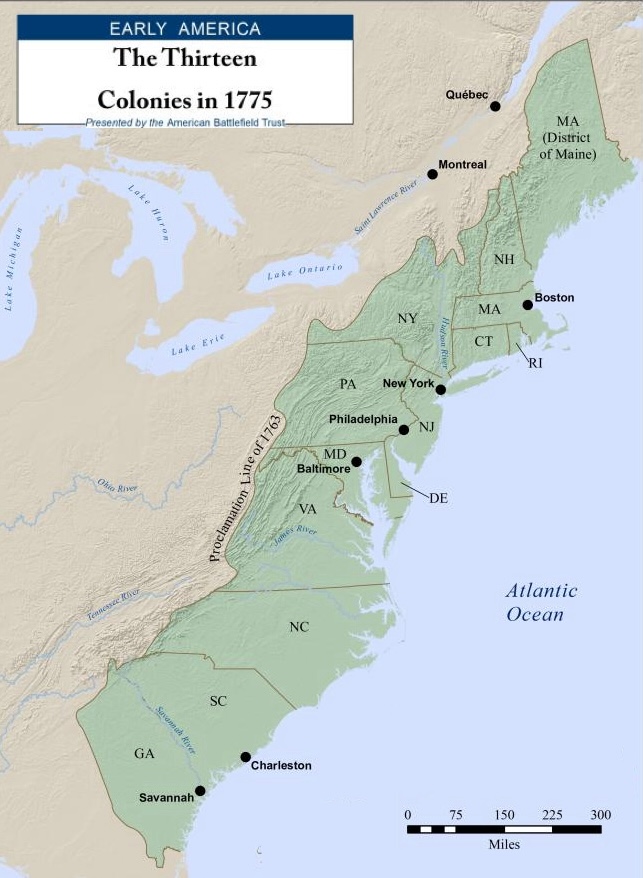
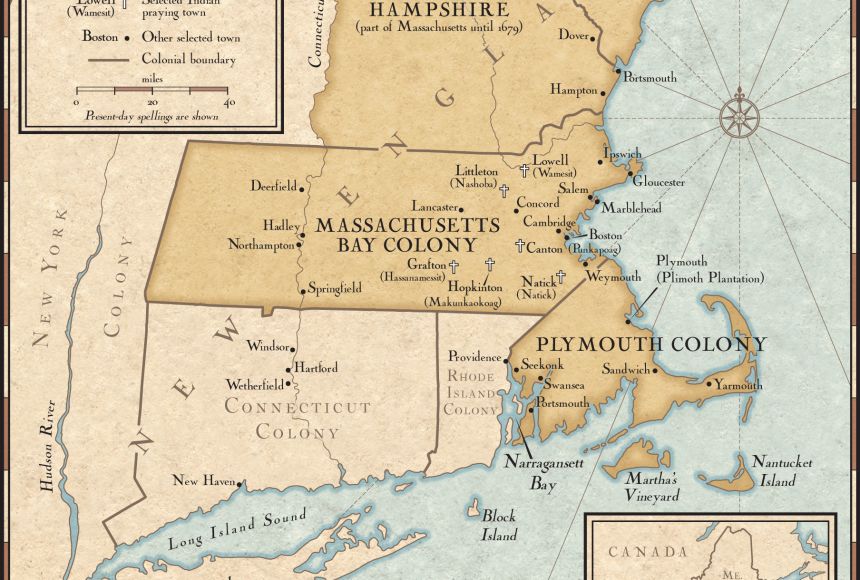
This contemporary map, shows the constraints of the 13 American Colonies in 1775.
Note how New York State contained an area which eventually became Vermont.
Much of what eventually became the United States was still held by other interests.
(Image Courtesy of The American Battlefield Trust).

The Patriots, The Loyalists, and The Fence-Sitters

In the midst of the Revolutionary War, the population of the British Colonies of North America could be divided into three groups. Those who wanted the War of Independence to succeed were called The Patriots. On the other side of the coin were The Loyalists who felt much more comfortable staying aligned with Great Britain and the interests of King George III. Between them were The Fence-Sitters. No matter which side you were on, there was much colorful language used all around to describe those on the other side, but we will keep things polite, and generally use: Patriots and Loyalists.

The Patriots
We all know who the Patriots were — a veritable cascade of famous names from American history: George Washington, John Adams, Thomas Jefferson, Benjamin Franklin, Paul Revere, Betsy Ross, etc. Besides being the winners of the war, they got to write The History. This means, as it always has with the victors of any conflict, that they could shape the history of those who lost in whatever form they wanted.

Any early example of viral media meme that existed centuries before the internet,
Benjamin Franklin’s 1754 cartoon “Join Or Die” depicted the original 13 American colonies.
Later, the Colonists repurposed it as a symbol of their unity against British rule.

What we never really learn about when studying American history, is what it was like for the people on the other side, or even more so, for those who were in the middle. It always seems to be a binary choice: The Patriots are usually given many virtues, and The Loyalists are dismissed as being unworthy traitors and losers. For our family, especially those living in the Hudson River Valley, the truth was not so black-and-white. There are many more shades to consider when writing about the character of —

The Loyalists
From the book, Loyalism in New York During The American Revolution by Alexander Clarence Flick, Ph.D., —“The loyalists were Americans, not Englishmen… Most American historians have characterized them as unprincipled royal office-holders, scheming political trimmers, a few aristocratic landlords and merchants, who were fearful of losing their wealth and indifferent to the rights of man…”, but there was actually more to this…

Flick continues, “Thus it appears that the loyalists of New York had within their ranks persons of all social positions from that of the poor emigrant but recently come to America; to the oldest and wealthiest family in the colony; from the ignorant agriculturist to the president of the only college in the province; from the humble cobbler and blacksmith to the most celebrated lawyer and physician in the metropolis…
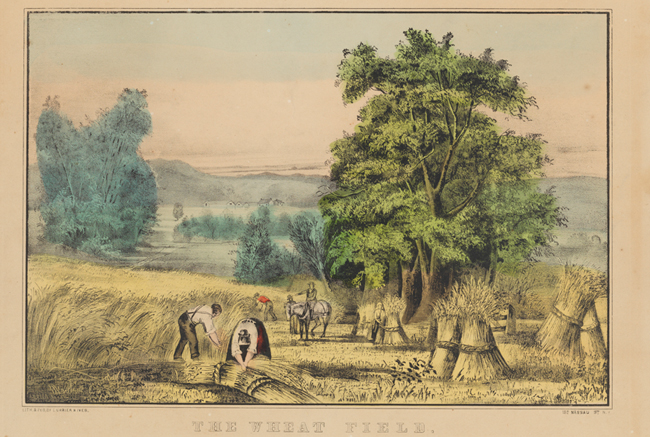
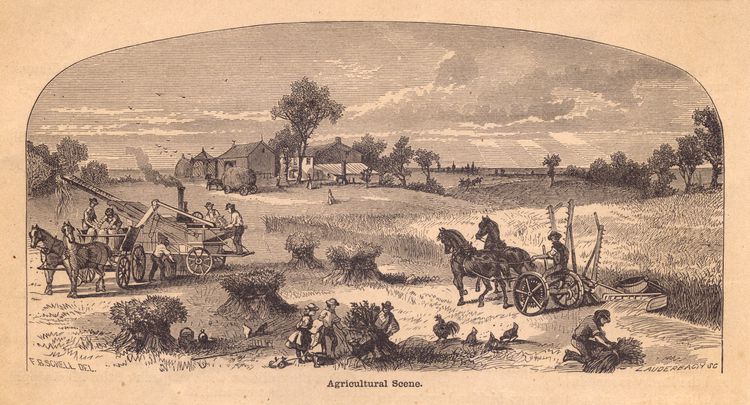
The Wheat Field, by Currier & Ives. Reproduced from the article,
New York: The Original Breadbasket of America, by Museum of the City of New York.

[There were many] conservative farmers in all parts of the colony, but especially in Queens, Kings, Richmond, Westchester, Albany and Tryon counties. They were happy and prosperous under the old regime. They did not feel the burdens complained of by the revolutionists, and consequently, had no sympathy with whig [Patriot] principles. But when their incomes were injured by the edicts of congress and committees and by war, their eyes turned toward the king’s army to restore their former peace and security”.

The Fence-Sitters
These people were the ones caught in the middle. The neighbor on this side could be an excitable Patriot (!), and the neighbor on that side could be an excitable Loyalist (!), and what was one to do (?) when the crops needed to be tended to, the children fed, etc.

In actuality, there was a third group that very nearly made
up the majority of the populous. Nearly 40% of the colonists were neither Patriot nor Loyalist, but neutral. These people
were the type that were either pacifists, recent immigrants,
or simply apolitical. They simply had no interest in the matter
or committing to either cause.
Another term for this group was “fence-sitters”.

From Loyalists vs Patriots: America’s Revolutionary Divide
History In Charts

The Wikipedia article Loyalists Fighting In The American Revolution states: “The Loyalists were as socially diverse as their Patriot opponents but some groups produced more Loyalists. Thus they included… many tenant farmers in New York and people of Dutch origin in New York and New Jersey. Loyalists were most often people who were conservative by nature or in politics, [and who] valued order…”

Finally, again from Wikipedia: “The great majority of Loyalists never left the United States; they stayed on and were allowed to be citizens of the new country. Some became nationally prominent leaders…”
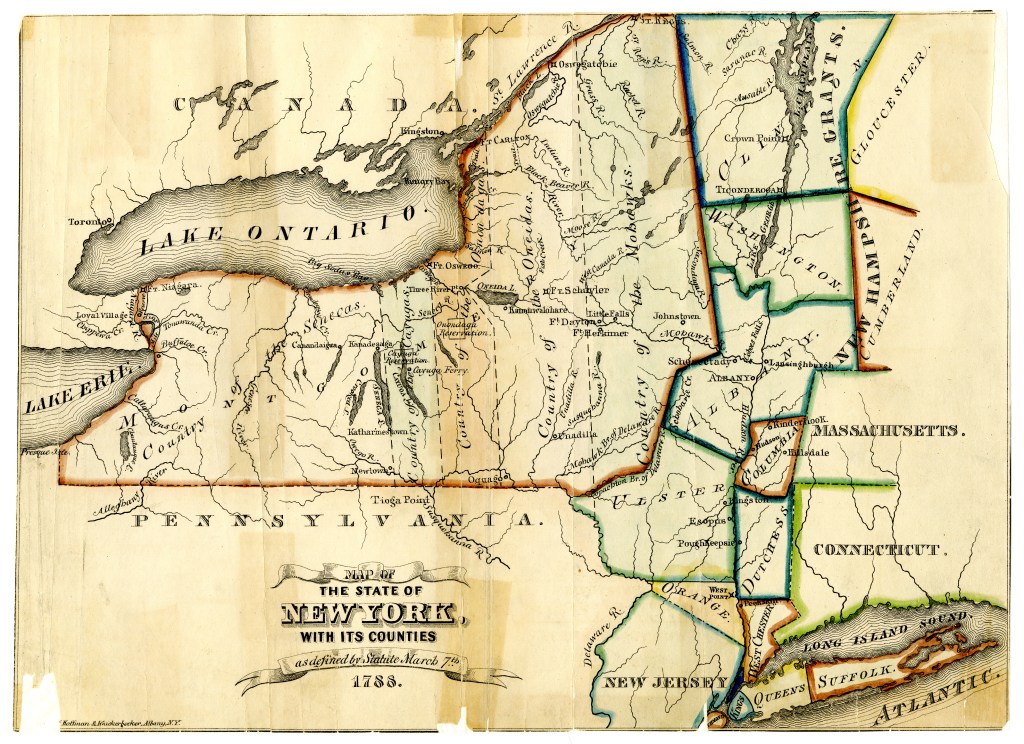
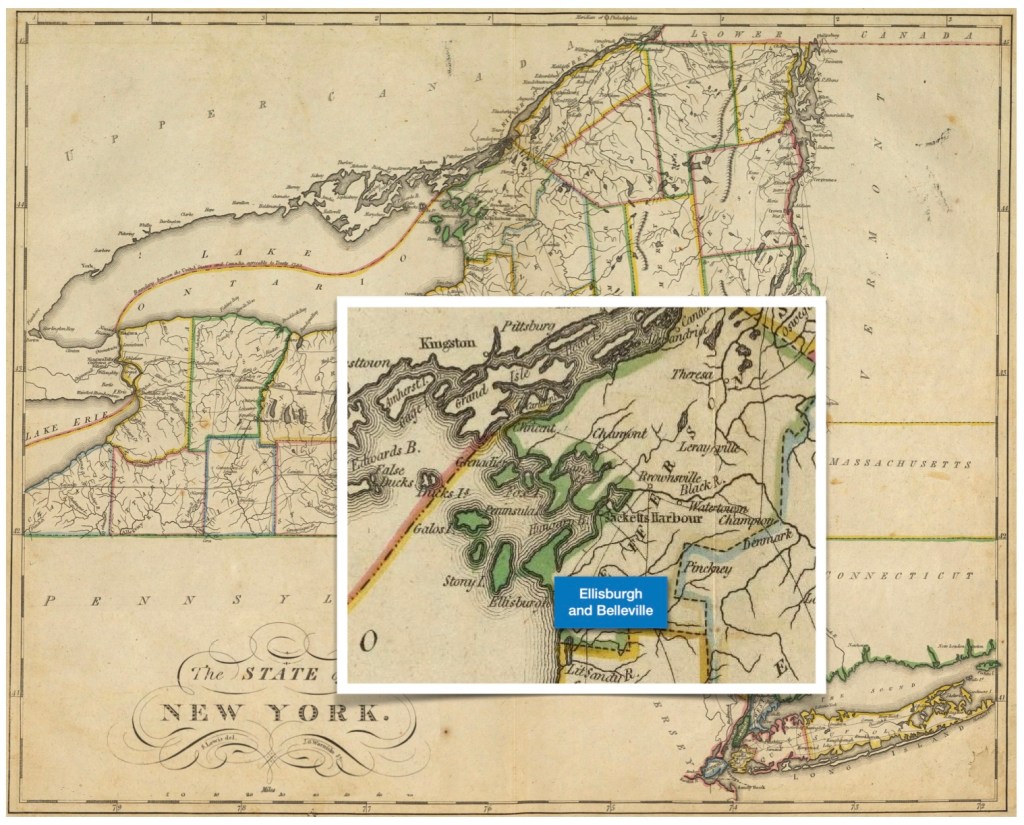
Map of the State of New York, 1788 via the New York State Archives Partnership Trust
Although this map is from five years after the end of the American War for Independence,
it delineates the ten counties and Native Peoples territories which existed in 1788.
(That is the year that New York became a State).

Creating A Continental Army
Initially in this era, being a soldier was not a full time job for many recruits. That might seem odd today, but back then a soldier would sign up for a term of work and then be relieved when he had to attend to farm duties, or if there were acute and pressing needs for his family.

In the archive of the Library of Congress: “In order to “preserve a good army,” one had to be created in the first place. It was a long and difficult road from the Continental Congress’s edict designating the militia around Boston as a Continental Army and creating such an army in fact. Although many colonials had had some military experience in the French and Indian War, most had served in militia units, a far cry from service in a regular European-style army.”
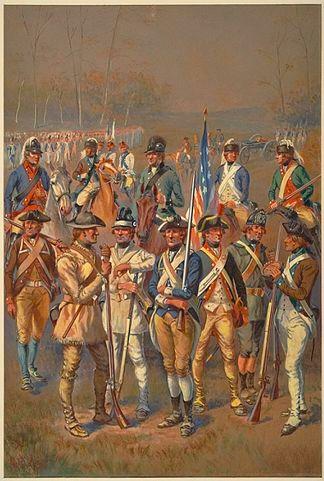
This watercolor by Charles M. Lefferts shows the wide variety of soldiers who made up the Continental Army. (Courtesy of Wikimedia Commons).

“Prior to 1777, enlistment in the Continental Army was of various durations but generally for a year of service. After 1778, Congress changed the rules and men served for either three years or the duration of the war. In some cases, bounties were paid to entice men to enlist or for men who chose to serve longer. Bounties could consist of additional money, additional clothing, or land west of the Ohio River, where many veterans would settle after the war.

Life in the Continental Army was difficult. It was mundane and monotonous. Generally, when not engaged in combat, soldiers in the Continental Army served three duties: fatigue or manual labor, such as digging vaults (latrines), clearing fields, or erecting fortifications. They also served on guard duty and drilled daily with their musket and in marching formations.
— The Fighting Man of the Continental Army, Daily Life as a Soldier

Jacobus Van Schoonhoven’s Regiment of Militia,
and the 12th Albany County Militia Regiment

We believe that our 4x Great Grandfather Martinus Devoe was a Patriot, because we can document that part of his history, starting in 1777. Of the Devoes listed below, Isaac Devoe, Jr. is likely his brother, and some of the others are cousins.
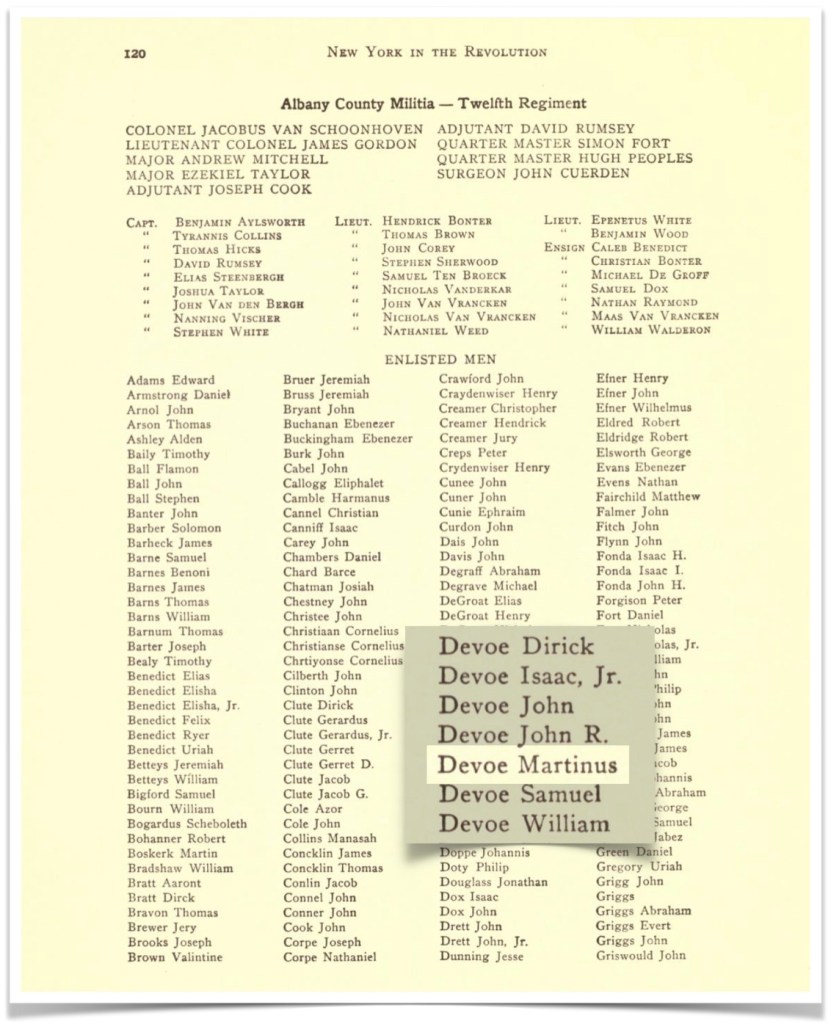
New York in the Revolution, page 120.

From Wikipedia, “The Van Schoonoven’s Regiment of Militia, also known as the 12th Albany County Militia Regiment, was called up in July 1777 at Halfmoon, New York, to reinforce Gen. Horatio Gates’s Continental Army during the Saratoga Campaign. The regiment served in Brigadier General Abraham Ten Broeck’s brigade.” The Saratoga Campaign was a resounding success for the Patriots in the war. (See The Saratoga Campaigns below).

When a young person is taught about the advent of the American Revolutionary War, the events are typically described almost as a level of mythos, (a body of interconnected myths or stories, especially those belonging to a particular religious or cultural tradition.) The midnight ride of Paul Revere, the Boston Tea Party, Patrick Henry’s “Give Me liberty, or give me death! — Americans are taught about the battles of Lexington and Concord, since they are the initial (1775) incidents… but the fact is, New York State was the scene of many terrible, epic battles. These events greatly affected our family. (3)

Pressed From All Sides: New York State in the Revolution

When the invasion of New York City was imminent, George Washington, as Commander of the Continental Army, wanted to burn The City to the ground, rather than allow that to happen. Congress disagreed and let it be invaded. In August 1776, British forces attacked Long Island in southern New York and within days, took over control of Manhattan Island for the duration of the war, (1776 to 1783). Due to the fact that much property was owned there by British occupants (Tories) and Loyalist sympathizers, Manhattan was never directly bombed by the British navy.

The Saratoga Battles: Burgoyne’s March on Albany June-October 1777
Note: Observe how Lake Champlain leads directly to Albany, New York as the Sauthier / Potter map (from above) indicates. (Image courtesy of wikipedia.com).

Written below are very brief notes about a few of the nearby battles.

The Saratoga Campaign
North of New York City, as the Hudson River moved north toward Lake Champlain, our ancestors were living in the area of Albany and Halfmoon. (Albany was just south of the area where the Battle of Saratoga took place, and Half Moon was slightly west). The Saratoga Campaign, which was actually two major battles in that area, was a complicated situation. Pressed from the north by the British forces from Quebec, who were moving south along Lake Champlain, and pressed from the south by the British forces around Manhattan who were moving north along the Hudson River, our ancestors were caught right in the middle.

Ultimately, the Patriots prevailed in the Saratoga Campaign and several important things resulted for the American Cause. The British learned that “the Rebels” could be fierce fighters even with the haphazard state of the Continental Army at that time. In addition, the country of France decided to support the Americans (likely because they despised the British and hoped to make money and ruin England at the same time).

The Battle of Oriskany
From Wikipedia, “The Battle of Oriskany was a significant engagement of the Saratoga campaign of the  American Revolutionary War, and one of the bloodiest battles in the conflict between Patriot forces and those loyal to Great Britain”. It took place in the Mohawk Valley on the Mohawk River which joins the Hudson River just above Albany. (This would be near the area of Halfmoon).

Patriot General Herkimer at the Battle of Oriskany by Frederick Coffay Yohn.
(Image courtesy of the public library of Utica, New York).

“The battle also marked the beginning of a war among the Iroquois, as Oneida warriors allied with the Patriot cause, as did the Tuscarora. The Mohawk, Seneca, Cayuga and Onondaga allied with the British. Each tribe was highly decentralized, and there were internal divisions among bands of the Oneida, some of whom became allies of the British. The battle’s location is known in Iroquois oral histories as “A Place of Great Sadness.”
Wikipedia — The Battle of Oriskany

Hand-drawn map indicating specific points at The Battle of Klock’s Field. Note that the city of Albany is shown on the left side, on the Hudson River.

The Battle of Klock’s Field
Our 4x Great Grandfather Martinus Devoe, could have participated in The Battle of Klock’s Field which occurred in 1780 on the north side of the Mohawk River. (It is likely that other members of his family did). Some regiments from Albany County were called up to fight, but we cannot verify conclusively whether-or-not he was there, because very soon after this battle, he and his cousin William were kidnapped by the British. (This would also be near Halfmoon). (4)
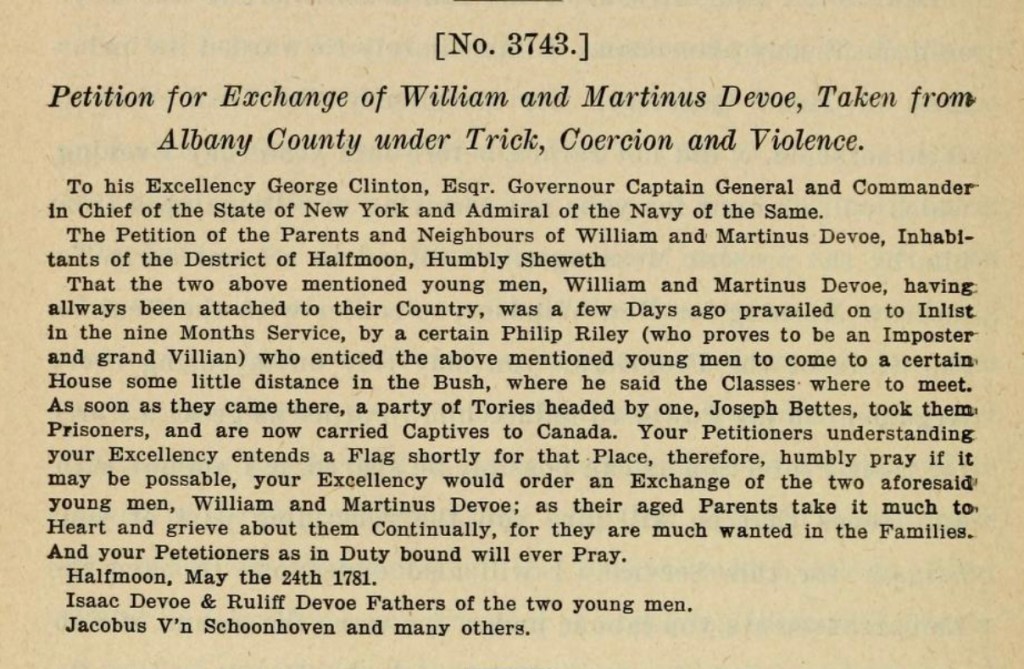
Excerpted from the Public Papers of George Clinton, First Governor of New York,
1777-1795, 1801-1804… This is the key document that helped us trace what happened to Martinus Devoe in Canada during a portion of the Revolutionary War.

Taken From Albany County Under Trick, Coercion and Violence

When we discovered the bit of evidence about Martinus Devoe’s life, it was the exciting key catalyst that helped us learn much more about him. When we analyzed it carefully, we learned that:

  • It confirmed that Isaac Devoe is indeed his father
  • Isaac Devoe’s brother Ruliff (Roelof), is the father of William Devoe
  • Martinus and William are therefore cousins
  • Martinus and William align with The Patriots
  • Joseph Bettes (Bettys) is their kidnaper
  • This petition was filed with George Clinton, Governor of the Province of New York
  • It was either filed with, or recorded on the date: May 14, 1781
  • The leader of their Albany regiment, Jacobus Van Schoonhoven (who was retired at this time), signed the petition along with “many others”

The Devoe families of Martinus and William were hopeful for a prisoner “exchange”, but this did not happen. Unbeknownst to them at the time, this type of complicated arrangement was only (and rarely) done for members of the Continental Army who were officers. Martinus and William never rose above the rank of Private. Additionally, The British were reluctant to recognize prisoner exchanges because that would have meant that they recognized The American Rebels as a sovereign state.

Observation: Martinus had indeed gone to Canada, not as someone who chose to be there, but as a kidnaping victim. We realized that this document confirmed what our mother and grandmother certainly did not knowthat this part of the story was new information. They thought that Martinus’s son, Peter M. Devoe had gone to Canada, and they likely didn’t seem to even know who Martinus was.

We had always wondered what the “M” stood for in Peter M. Devoe’s name, and now we think it possibly could have stood for Martinus, or Martin. It now made sense that over the generations as people shared stories, any mention of Canada just automatically came to mean that that person was a Loyalist “traitor”. Now we understand that perhaps Marguerite and Lulu had some familial self-imposed shame with this matter.

George Clinton, by Ezra Ames, circa 1814.

Joseph Bettys, Professional Scoundrel
The man who had arranged for the kidnapping to happen was one Joseph Bettys. A local man from Albany County known as “a renowned kidnapper of patriots in upstate New York with St. Johns, Canada as his base”. (McBurney, see footnotes) In writing about him, Wikipedia states: “He joined the Patriot forces and was made a Sergeant. He was said to be courageous, but intolerant of military discipline, for which he was demoted. In the summer of 1776 he was again promoted, and transferred to the fleet on Lake Champlain commanded by Benedict Arnold.

Illustration of the capture of British Loyalist spy Joseph Bettys
in the town of Ballston, New York, 1782, United States Magazine, 1857, p. 569.

On October 11, 1776 he distinguished himself in the Battle of Valcour Island, but was captured by the British and taken as a prisoner to Canada. In 1777, during his captivity, he changed sides, joining the British forces as an ensign. He served as a spy and messenger for the British; at one point he was captured, but was freed due to influence of family and friends. He rejoined British service and began recruiting soldiers among the population of Saratoga County [at that time still Albany County], raiding, burning farms and taking captives or killing Patriots”.

Observation: Joseph Bettys may have indeed “recruited” some people to the Loyalist side, but those words sound to us more like a euphemism for forced servitude.

In 1782, Bettys was captured and sent to Albany, where that year on the orders of General George Washington, he was tried and executed by hanging. Actually — after the noose was around his neck, he jumped down and died from the choking while falling. (We wonder if they kicked him when he was down).

British Prison Ship 1770s, Five Americans Escaping From The British Prison Ship Jersey
Anchored In The East River New York During The Revolutionary War
Wood Engraving American 1838.

The British Prison Ships
It was not that uncommon for soldiers, and especially for sailors, to be kidnapped and forced to serve for the opposing side. The worst possible fate that could befall someone in that situation would be that they were classified as a traitor to Great Britain, and be sent to rot in one of the many prison ships which were located in New York harbor… Wikipedia confirms the cruelty shown The patriots: “King George III of Great Britain had declared American forces traitors in 1775, which denied them prisoner-of-war status. However, British strategy in the early conflict included [the] pursuit of a negotiated settlement, and so officials declined to try or hang them, the usual procedure for treason, to avoid unnecessarily risking any public sympathy the British might still enjoy.”

History.com writes, “Most of the young Americans knew what imprisonment would mean. Colonial newspapers had reported on the horrific conditions and brutal treatment aboard the prison ships from the beginning…” And from the George Washington Presidential Library: “Though estimates vary, between eight and eleven thousand American prisoners (or perhaps higher) died in British custody in New York. These deaths were not caused by a deliberate policy, but rather through poor or indifferent planning and care”. [Read: cruelty, disease, pestilence, and indifference] (5)

Following the Breadcrumbs That Led Us to Canada

Early on, we first came across a record of a Martin Dafoe [Martinus Devoe?] in an ancestry.com file. His was a name at that point which we had never heard of, and the file was a puzzling record stating “War Office Records: Monthly Return of Loyalists coming in from the Colonies to Lower Canada, from Halfmoon”. Much later we then came then across this record:

Excerpted from The Old United Empire Loyalists List, (Supplementary List, Appendix B).

We learned that in Canada, the name Devoe was frequently spelled as Dafoe in record-keeping, and we uncovered a name for something called the King’s Rangers. Suddenly, the bread crumbs that we had already found were starting to point us into a direction where everything was new. Long story short: many months later we eventually came upon a resource which pulled everything together: A Short Service History and Master Roll of James Rogers’ 2nd Battalion, King’s Rangers, by Gavin K. Watt.

From Watt’s book: “Some of the best known Loyalist names that have ties to the King’s Rangers include Bell, Brisco, Dafoe, Kemp, Pringles, and of course Rogers.” We found our ancestor (!) listed there:

Dafoe, Martin
Alternate spellings of surname: Dave, Devore, Dave, Devon
Alternate spellings of given name: Martin, Martinne, Martain
Rank: Private
Enlistment date: November 18, 1780
Company: Captain Azariah Pritchard’s
Age: 29 (This is incorrect — he was closer to 26.)
Height: 5 feet, 6 inches
Place from and trade: Albany City, New York, and farmer
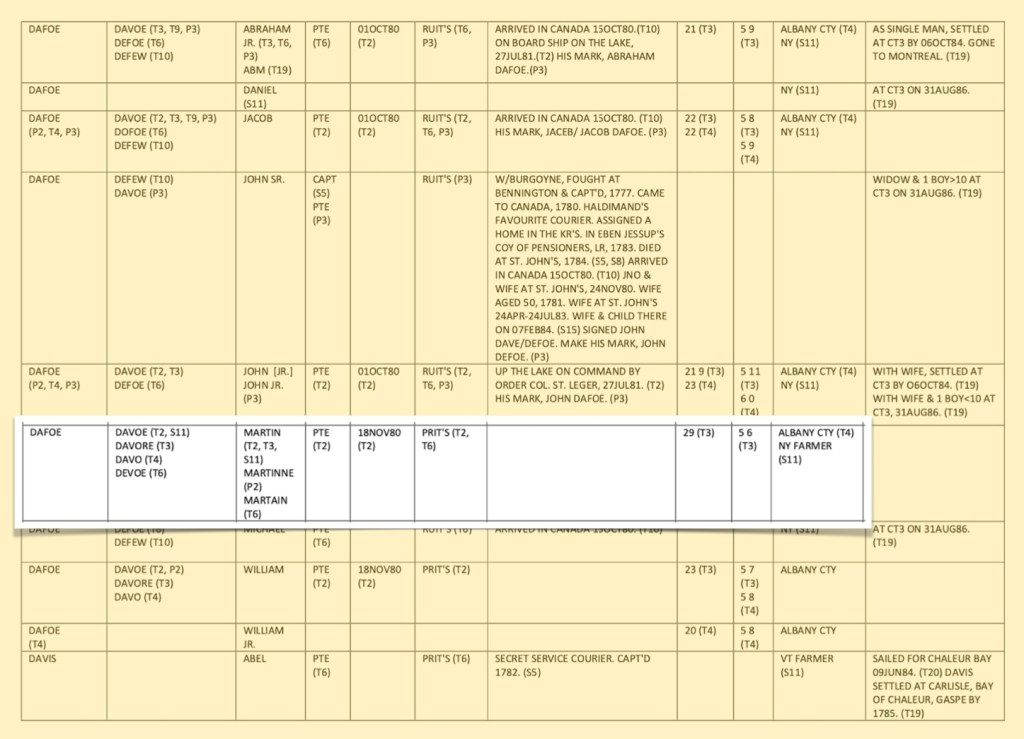
Excerpted from A Short Service History and Master Roll of James Rogers’ 2nd Battalion, KIng’s Rangers, page 50/85. Please see the footnotes for the explanation of codes.

Something was puzzling about the entry. His arrival date in Canada was listed as November 18, 1780? Earlier we had assumed that if he was in Canada the arrival date should correspond to something closer to the date noted on the Petition to Governor Clinton of New York. That date was May 15, 1781, fully six months later… what was going on? It now makes sense that the families of Martinus and William, were probably beside themselves with worries. It would have required much time and difficult logistics for the petition to be drafted, to gather multiple signatures, to present it to the Governor, etc. All of this while the War was raging all around them — that’s why we believe that the 1781 date is likely the recording date.

Some of the other names we saw on this roster confirmed other data we had previously collected. The William Devoe who arrived on “18 Nov 80” was likely his cousin William, a fellow kidnap victim. Observe the names of the brothers Abraham and Jacob Dafoe, sons of John Ernst DeVoe from a different DeVoe line. The arrival dates for Abraham and Jacob are the same “01 Oct 80”, having arrived about six weeks earlier. There is a notation that Abraham arrived via boat. There is another record of Jacob Defoe dated 1782- 1783, recorded near the end of the War (see footnotes). John Ernst DeVoe and his sons were Loyalist during the Revolutionary War. After the war the family remained in Canada. We even came across one of Abraham’s payroll sheets. Conversely, if Martinus and William were ever paid for their time in the KIng’s Rangers, those records have not been found. (6)

Corporal Abraham Defoe’s sheet from the Pay Roll of Ruiter’s Company.
Image courtesy of A Short Service History and Master Roll of James Rogers’ 2nd Battalion,
King’s Rangers
, by Gavin K. Watt, page 18.
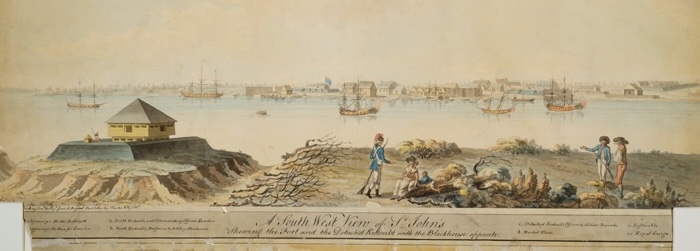
Siege of The Fort Saint-Jean, circa 1775, Watercolor by James Peachey (d. 1797)

Fort St. Jean, now known as Fort St. John

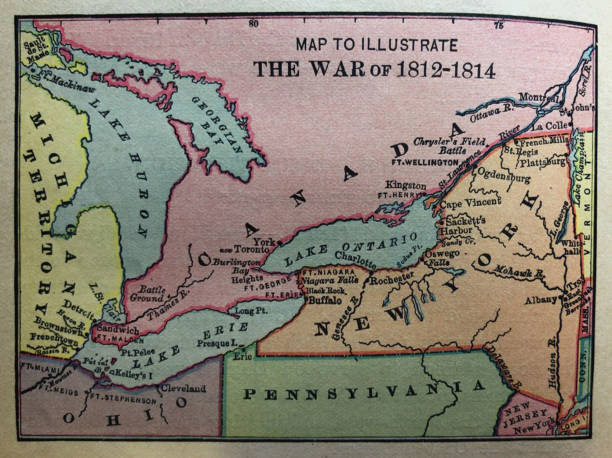
The operational center for the King’s Rangers was Fort St. Jean, Quebec. Martinus and William were fortunate enough* that they ended up at Fort St. Jean — which was just across the border from New York Province in Quebec. (See map at the top of this chapter). In fact, this fort was exactly 207 miles directly north from Albany City, New York, where they were likely ensconced until taken to Canada.

*If they had been P.O.W.s, they could have been sent to the death ships in New York Harbor. Since they were kidnapped and forcibly recruited, they were probably assigned with tasks like cleaning horse stables, and digging latrines, etc. We conjecture that they kept their heads down and decided to lay low. We observed on The Old United Empire Loyalists List from above, that William Devoe had deserted, but we do not know when this happened.

There were those in the fledgling United States who believed that it was their right to annex portions of Canada as new territories.

The Siege of Fort St. Jean
From the Siege of Fort St. Jean… article in the Revolutionary War Journal — “By late summer, 1775, the American Second Congress was determined to bring Canada, the British 14th colony in America, into the fold of rebellion along with the other thirteen colonies. Two small American armies would advance into Canada. The larger, commanded first by Major General Phillip Schuyler and later by General Richard Montgomery, would push up Lake Champlain and the Richelieu River into Canada. They would quickly capture Montreal. Then head northeast, down the St. Lawrence River to join the other American force approaching Quebec through Maine, led by Colonel Benedict Arnold. Together, the two factions would claim the crown of the Canadian colony; Quebec City’s Citadel”.

Ultimately, even though the Americans had prevailed at first, many of their soldiers grew sick over the winter. When reinforcements from Great Britain arrived six months later, the Americans withdrew and returned to the Colonies. (7)

Plan of Fort St. Jean in Quebec, Canada, circa 1775.
(Image courtesy of Bibliothèque et Archives Canada).

The King’s Rangers, also known as The King’s American Rangers

There were many companies on both sides of the war which used the word Ranger’s in their name. Our research has shown that our ancestors were part of the King’s Rangers, which is sometimes also referred to as The King’s American Rangers.

“In September 1779, the Second Battalion of King’s Rangers were garrisoned for a time at Fort St. Johns on the Richelieu River (now Saint Jean, Quebec). In October of 1780, a detachment of the Second Battalion took part in raids by Major Christopher Carleton into the Champlain Valley and the attacks on Fort Anne and Fort George NY. When rebels surrendered at Fort Anne, the King’s Rangers took advantage of an easy opportunity: they recruited 16 of the enemy prisoners into their own relatively small ranks.

There was, however, another side of the war. The Second Battalion was involved in the business of spying for the British. One of the more interesting missions was when James Breakenridge, Jr. of the King’s Rangers accompanied another loyalist carrying a secret proposal from Vermont’s Governor Thomas Chittendon and Ethan Allen regarding negotiations for Vermont to become a Canadian province. [In other words, similar to the earlier ambitions of the American Second Congress regarding Canada, both sides wanted more territory]. Known as “The Vermont Negotiations,” Major James Rogers was reportedly heavily involved in correspondence and face to face meetings with Allen and his associates”.
— Excerpted from History of the King’s Rangers, via James Breakenridge’s Company of the King’s Rangers
From Wikipedia, “Despite recruitment issues being faced by the Rangers, the second battalion was active in scouting and recruiting along the frontiers of New York, Lake Champlain and the area that was to later become Vermont. They also engaged in the taking of Patriot prisoners of war… Due to the relatively small size of the Rangers, [they were] restricted [in] their operational capabilities to conducting reconnaissance for other corps, constructing fortifications, executing general garrison duties, assisting refugees in Quebec, aiding the escape of Loyalist families, and guarding prisoners of war”. (8)

These illustrations represent descriptions of the uniforms worn by The King’s Rangers.
Artwork by artist Don Troiani.

The Winding Down of The War, and The Treaty of Paris

The American War for Independence formally ended with the signing of the Treaty of Paris in 1783. From the National Archives: “The American War for Independence (1775-1783) was actually a world conflict, involving not only the United States and Great Britain, but also France, Spain, and the Netherlands. The peace process brought a nascent United States into the arena of international diplomacy, playing against the largest and most established powers on earth”.

Page one of twelve pages for the Treaty of Paris; September 3, 1783,
Perfected Treaties, 1778 – 1945, General Records of the United States Government,
Record Group 11, National Archives Building, Washington, DC.

“The three American negotiators – John Adams, Benjamin Franklin, and John Jay – proved themselves ready for the world stage, achieving many of the objectives sought by the new United States. Two crucial provisions of the treaty were British recognition of U.S. independence and the delineation of boundaries that would allow for American western expansion”.
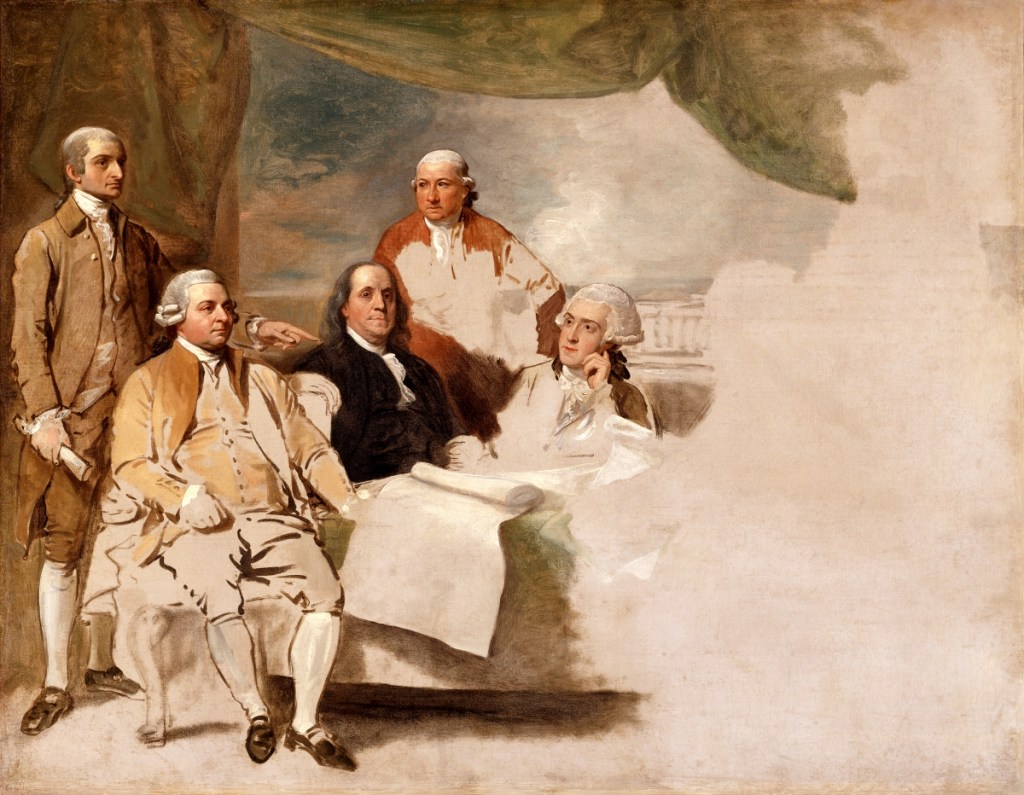
American Commissioners of the Preliminary Peace Agreement with Great Britain, 1783-1784,
London, England, by Benjamin West
(oil on canvas, unfinished sketch), Winterthur Museum, Winterthur, Delaware
From left to right: John Jay, John Adams, Benjamin Franklin, Henry Laurens, and William Temple Franklin. The British commissioners refused to pose, and the picture was never finished.

As a perfect bookend to where our search for Martinus Devoe began, we came across the file that is the Canadian record for when he returned to New York State. “Martin Dafoe” returned from Fort St. Jean in Canada sometime in 1782-1783. We conjecture that is was likely 1783 after the Treaty of Paris had been signed. The record reads: “Memorandum — of the names of the whole 245 Persons of the King’s Rangers — collected from the Muster Rolls and paylists of Maj. Rogers’s, Capn. Pritchards and Capn. Ruiters Co. in the years 1782-83”.

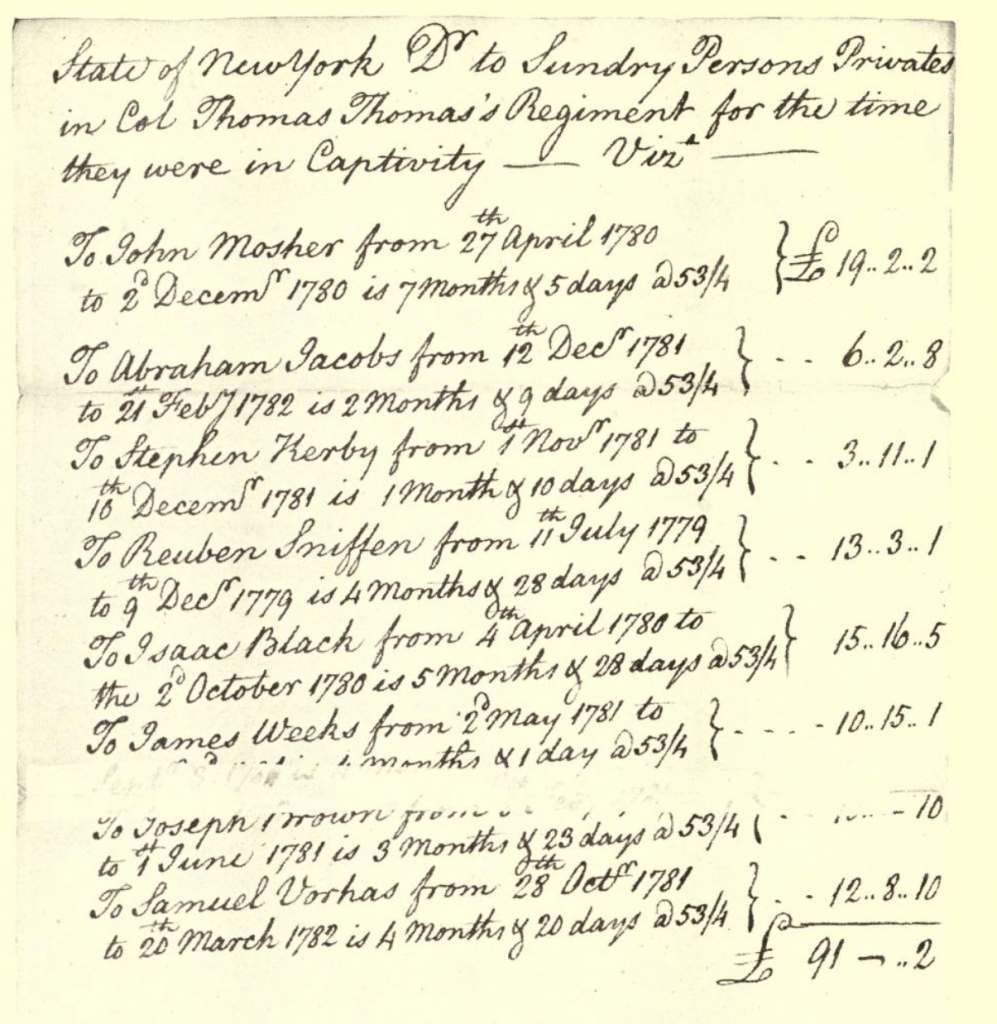
The above document is a record of payment found in The George Washington Presidential Library at Mount Vernon. It was payment given to troops that were held as prisoners-of-war in Virginia. We have not been able to locate a similar payment record for Martinus which records him as a prisoner-of-war. This confirms our belief that, unlike Abraham Devoe, he may not have been paid due to his forced servitude.
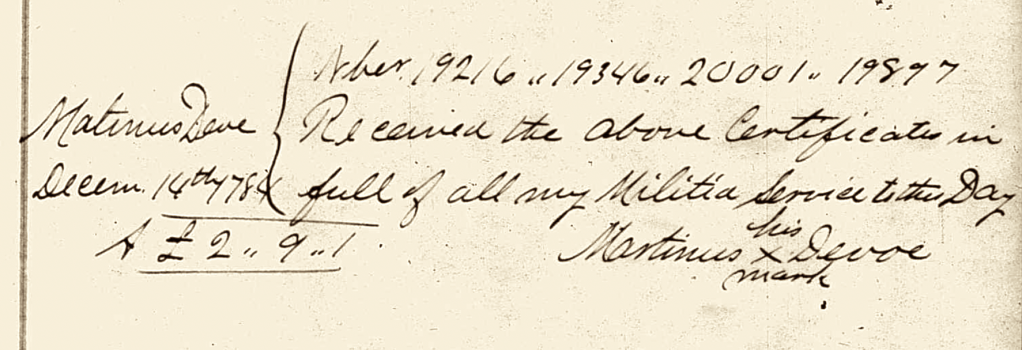
Martinus Devoe’s payment for Revolutionary War service. Payment date is December 14, 1784.

However, our 4x Great Grandfather Martinus was indeed paid for his service in the Continental Army. On the above record, the four sets of numbers correspond to certificates that all soldiers and sailors were given. It is interesting and a bit ironic to see that the records are in (£) British Pound Stirling . English Sterling was the money standard until after the Revolution. Money was scarce, with only two to three million pounds in circulation. (Hammersley) The newly formed USA did not have much cash money on hand, but it made promises, i.e. some soldiers received land in newly opening areas such as the Ohio Valley to the west.

Our next chapter will discuss Martinus’ life in Halfmoon, New York, his marriage, and his rather large brood of children., from which, our 3x Great Grandfather Peter M. Devoe emerges. (9)

“Tory Refugees on the Way to Canada” by Howard Pyle.
The work appeared in Harper’s Monthly in December 1901.

Following are the footnotes for the Primary Source Materials,
Notes, and Observations

Preface — Sometimes Family Stories Are Just Plain Wrong

(1) — one record

“a riddle, wrapped in a mystery, inside an enigma”
https://idioms.thefreedictionary.com/a+riddle%2C+wrapped+in+a+mystery%2C+inside+an+enigma

The Patriots, The Loyalists, and The Fence-Sitters

(2) — nine records

Library of Congress
A Map of the Provinces of New-York and New-Yersey, with a part of Pennsylvania and the Province of Quebec
by Sauthier, Claude Joseph and Lotter, Matthäus Albrecht, 1741-1810
Published in Augsburg, 1777.
https://www.loc.gov/item/74692644
Note: For the map image.

The American Battlefield Trust
American Revolution Facts
https://www.battlefields.org/learn/articles/american-revolution-faqs

History.com
How Benjamin Franklin’s Viral Political Cartoon United the 13 Colonies
https://www.history.com/news/ben-franklin-join-or-die-cartoon-french-indian-war
Note: For the drawing.

Loyalism In New York During The American Revolution
by Alexander Clarence Flick, Ph.D.
https://archives.gnb.ca/exhibits/forthavoc/html/NYLoyalism.aspx?culture=en-CA

Loyalists Fighting in the American Revolution
https://en.wikipedia.org/wiki/Loyalists_fighting_in_the_American_Revolution

Loyalist (American Revolution)
https://en.wikipedia.org/wiki/Loyalist_(American_Revolution)

The Wheat Field, by Currier & Ives.
Reproduced from the article, New York: The Original Breadbasket of America, by Museum of the City of New York
https://www.mcny.org/story/new-york-original-breadbasket-america
Note: For the farming image.

Loyalists vs Patriots: America’s Revolutionary Divide
https://historyincharts.com/patriot-and-loyalist-support-for-the-american-revolution/

New York State Archives Partnership Trust
Map of the State of New York, 1788
1788 Map of New York State showing native lands and ten counties, printed by Hoffman & Knickerbocker, Albany, N.Y.
https://www.nysarchivestrust.org/education/consider-source/browse-primary-source-documents/indigenous-history/map-state-new-york-1788
Note: For the map image.

Jacobus Van Schoonhoven’s Regiment of Militia,
and the 12th Albany County Militia Regiment

(3) — six records

Library of Congress
Creating a Continental Army
https://www.loc.gov/classroom-materials/united-states-history-primary-source-timeline/american-revolution-1763-1783/creating-a-continental-army/

The American Battlefield Trust
The Fighting Man of the Continental Army, Daily Life as a Soldier
https://www.battlefields.org/learn/articles/fighting-man-continental-army

Van Schoonhoven’s Regiment of Militia
https://en.wikipedia.org/wiki/Van_Schoonhoven%27s_Regiment_of_Militia

Jacobus Van Schoonhoven
https://en.wikipedia.org/wiki/Jacobus_Van_Schoonhoven

New York In The Revolution as Colony and State
A Compilation of Documents and Records From the Office Of the State Comptroller
https://archive.org/details/newyorkrevolution01statrich/page/120/mode/2up?view=theater
Book page: 120, Digital page: 120/534

Myth
https://en.wikipedia.org/wiki/Myth#:~:text=Because%20%22myth%22%20is%20sometimes%20used,particular%20religious%20or%20cultural%20tradition.

Pressed From All Sides: New York State in the Revolution

(4) — five records

The George Washington Presidential Library at Mount Vernon
British Occupation of New York City
https://www.mountvernon.org/library/digitalhistory/digital-encyclopedia/article/british-occupation-of-new-york-city/#:~:text=Five%20days%20later%2C%20an%20expeditionary,the%20City%20of%20New%20York.

Battles of Saratoga
https://en.wikipedia.org/wiki/Battles_of_Saratoga

Saratoga Campaign
https://en.wikipedia.org/wiki/Saratoga_campaign

Battle of Oriskany
https://en.wikipedia.org/wiki/Battle_of_Oriskany

Battle of Klock’s Field
https://en.wikipedia.org/wiki/Battle_of_Klock’s_Field

Taken From Albany County Under Trick, Coercion and Violence

(5) — nine records
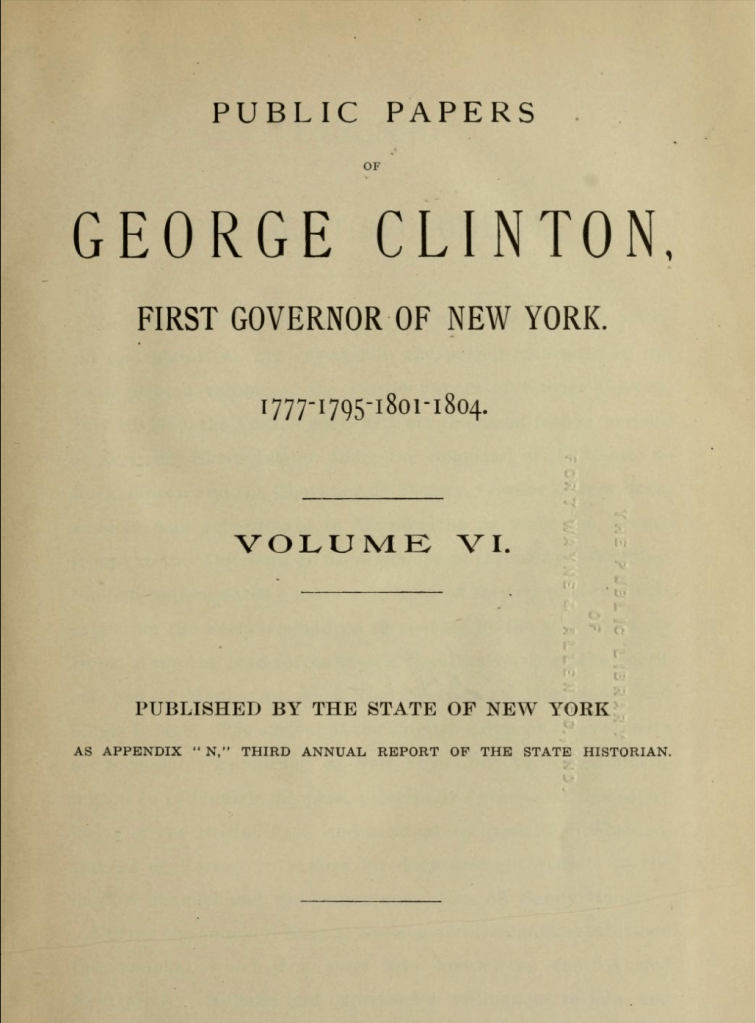
Petition for Exchange of William and Martinus Devoe, Taken from Albany County under Trick, Coercion and Violence
from the Public Papers of George Clinton,
First Governor of New York, 1777-1795, 1801-1804 …
by New York (State). Governor (1777-1795 : Clinton)
https://archive.org/details/publicpapersofge06innewy/page/906/mode/2up
Book page: 906, Digital page: 906/918

Early New Netherlands Settlers
David <?> Du Four, (Rn=25344)
https://freepages.rootsweb.com/~rclarke/genealogy/page1/dufour.htm
Note: Information about Isaac, Roelof, and William Devoe.

George Clinton
by Ezra Ames, circa 1814
https://en.wikipedia.org/wiki/File:George_Clinton_by_Ezra_Ames_(full_portrait).jpg
Note: For his portrait.

Journal of The American Revolution
What do you think was the strangest or most unconventional moment, battle or event of the Revolution?
https://allthingsliberty.com/2017/01/weirdest-moment/
“I would have to pick the antics of Joseph Bettys, a Tory who became a renowned kidnapper of patriots in upstate New York with St. Johns, Canada as his base.  In the Great Kidnapping Caper of 1781, the British Secret Service at St. Johns planned for eight parties of kidnappers to attempt abducting upstate New York patriots at the same time so as to keep the element of surprise.  The leader of one of the bands, Joseph Bettys, was charged with kidnapping a Patriot in Ballstown, New York.  Bettys had a crush on a local young woman.  Amazingly, he left his band in the lurch and went off to persuade her to run off with him, which she did.  Her outraged father, even though he was a Tory, went to the local Patriot committee, called the Albany County Commissioners for Detecting and Defeating Conspiracies.  This alerted Patriots the entire kidnapping plot.  None of them succeeded, but Bettys did successfully bring his girlfriend to Canada.  Later, after succeeding in kidnapping some Patriots, Bettys was captured and hanged”. –Christian M. McBurney

Joseph Bettys
https://en.wikipedia.org/wiki/Joseph_Bettys#:~:text=Joseph%20Bettys%20(%22Joe%22),a%20British%20Spy%20in%201782.&text=Joe%20was%20born%20and%20grew,Town%20of%20Ballston,%20New%20York.

The Capture of Joe Bettys
United States Magazine, 1857, p. 569.
https://en.wikipedia.org/wiki/Joseph_Bettys#/media/File:The_Capture_of_Joe_Bettys.png
Note: For the Bettys illustration.

Prisoners of War in the American Revolutionary War
https://en.wikipedia.org/wiki/Prisoners_of_war_in_the_American_Revolutionary_War

History.com
The Appalling Way the British Tried to Recruit Americans Away from Revolt
https://www.history.com/news/british-prison-ships-american-revolution-hms-jersey

The George Washington Presidential Library at Mount Vernon
Prisoners of War
https://www.mountvernon.org/library/digitalhistory/digital-encyclopedia/article/prisoners-of-war/

Following th Breadcrumbs That Led Us to Canada

(6) — five records

Martin Devoe
in the Canadian Immigrant Records, Part One

War Office Records: Monthly Return of Loyalists coming in from the Colonies to Lower Canada, from Half Moon
https://www.ancestry.com/discoveryui-content/view/118848:3795?tid=&pid=&queryId=35bfa0c6-6799-4cd1-8778-623c4e66d6b6&_phsrc=Fpd49&_phstart=successSource
National Archives of Canada:
Microfilm Reel No. B-2867 (MG 11 W.O. 28/10), page 118

The Old United Empire Loyalists List (Supplementary List, Appendix B)
https://www.ancestry.com/imageviewer/collections/48267/images/OldEmpireLoyalists-006200-293?treeid=&personid=&queryId=f6d5dc2a-b2db-4138-8a89-4648724a3b67&usePUB=true&_phsrc=Rlk7&_phstart=successSource&pId=273793&rcstate=OldEmpireLoyalists-006200-293:180,1134,275,1159;279,1135,411,1161;180,1164,274,1191;290,1453,429,1480;180,1071,275,1097;180,1103,275,1129 
Book page: 293, Digital page: 297/339

A Short Service History and Master Roll of James Rogers’ 2nd Battalion,
King’s Rangers

By Gavin K. Watt
Published by Global Heritage Press, Milton, 2015
ISBN 978-1-77240-029-8
https://globalgenealogy.com/countries/canada/loyalist/resources/101044.htm
Note: Digital edition, .pdf download for purchase. Page 50/85 is the roster page which contains Martinus Devoe’s information.

The five listings below are the specific information for each transcription from the above reference, for the roster records for Martinus Devoe:
(P2)
Return of a Detachment of the King’s Rangers Commanded by Major James Rogers, in Canada, for which he is entitled to the King’s Bounty, at five Dollars pr. Man. St. John’s, 10th January 1782. AO, HO, AddMss21827, 296-97.
(S11)
E. Keith Fitzgerald, Loyalist Lists: Over 2000 Loyalist names and families from the Haldimand papers (Toronto: Ontario Genealogical Society, 1984) transcribed from the LAC transcript, MG21, B166, ff154-56. (AddMss21826) circa 1783.
(T2)
Muster Roll of a Detachment (three companies) of the King’s Rangers Commanded by Major James Rogers, St. John’s 27th July 1781. Horst Dresler research. LAC, W028/4/96-98.
(T3)
A Return of the Names, Cuntry [sic], Age, size and tim [sic] of service of a Detachment of the Kings rangers quartered at St. Johns — 1st January 1782. Braisted research. LAC, W028/10-142-43.
(T6)
Nominal Rolls of the King’s Rangers, 27th January, 1784. LAC, HP, B160 (AddMss21820) 153-56. Transcribed in H.M., Rogers’ Rangers, A History (Toronto: self published, 1953) 187-202.

Jacob Dafoe
in the Canadian Immigrant Records, Part Two

https://www.ancestry.com/discoveryui-content/view/1648:3798?ssrc=pt&tid=14402677&pid=427511048


Early New Netherlands Settlers
David <?> Du Four, (Rn=25344)
https://freepages.rootsweb.com/~rclarke/genealogy/page1/dufour.htm
Note: Reference for information about the various DeVoe’s: William, Abraham, and Jacob Devoe.

Fort St. Jean, now known as Fort St. John

(7) — four records

Siege of The Fort Saint-Jean, circa 1775
Watercolor by James Peachey (d. 1797) https://en.wikipedia.org/wiki/Fort_Saint-Jean_(Quebec)#/media/File:FortStJeanPeachey1790.jpg
Note: For the fort image.

Siege of Fort St. Jean, September 17 – November 3, 1775
https://revolutionarywarjournal.com/siege-of-fort-st-jean-september-17-november-3-1775/

Fort Saint-Jean (Quebec)
https://en.wikipedia.org/wiki/Fort_Saint-Jean_(Quebec)

[Plan of Fort St. Jean in Quebec, Canada, circa 1775]
Plan des redoutes érigées à Saint-Jean lors de l’été 1775. Bibliothèque et Archives Canada, NMC-2771
https://en.wikipedia.org/wiki/Siege_of_Fort_St._Jean#/media/File:Redoutes_Sud_et_Nord_1775.jpg

The King’s Rangers, also known as The King’s American Rangers

(8) — three records

James Breakenridge’s Company of the King’s Rangers
History of the King’s Rangers
http://www.kingsrangers.org/history.php

King’s Rangers
https://en.wikipedia.org/wiki/King%27s_Rangers#:~:text=The%20King’s%20Rangers%2C%20also%20known,during%20the%20American%20Revolutionary%20War.

Pinterest, King’s Royal Regiment of New York
by Don Troiani
https://fi.pinterest.com/pin/483362972507218407/
Note: For the King’s Ranger’s uniforms.

The Winding Down Of The War, and The Treaty of Paris

(9) — nine records

National Archives, Milestone Documents
Treaty of Paris (1783)
https://www.archives.gov/milestone-documents/treaty-of-paris

American Commissioners of the Preliminary Peace Agreement
with Great Britain, 1783-1784, London, England, by Benjamin West
(oil on canvas, unfinished sketch), Winterthur Museum, Winterthur, Delaware
From left to right: John Jay, John Adams, Benjamin Franklin, Henry Laurens, and William Temple Franklin.
https://en.wikipedia.org/wiki/Treaty_of_Paris_(1783)#/media/File:Treaty_of_Paris_by_Benjamin_West_1783.jpg
Note: The British commissioners refused to pose, and the picture was never finished.

Martin Dafoe
in the Canadian Immigrant Records, Part Two

https://www.ancestry.com/discoveryui-content/view/1650:3798?tid=&pid=&queryId=76c7720d-1bb8-48a9-af88-2ad63bd07ae4&_phsrc=Fpd55&_phstart=successSource
Transcribed from original documents held in the collection of the
National Archives of Canada [Ottawa]: RG 19, vol. 4447, file 36.

Prisoners of War in the American Revolutionary War
https://en.wikipedia.org/wiki/Prisoners_of_war_in_the_American_Revolutionary_War

The George Washington Presidential Library at Mount Vernon
Prisoners of War
https://www.mountvernon.org/library/digitalhistory/digital-encyclopedia/article/prisoners-of-war/

New York. Military Records 1775–1783
https://www.familysearch.org/ark:/61903/3:1:3QS7-89WB-8Z7H?view=index&action=view
Digital page: 125/691
and
Martinus Deve
in the U.S., Compiled Revolutionary War Military Service Records, 1775-1783

New York > Van Schoonhoven´s Regiment (Albany County), Militia > A – Z
https://www.ancestry.com/search/collections/1309/records/218144?tid=&pid=&queryId=47f4707e-798a-418b-83ac-3a4bb9d45038&_phsrc=dxF1&_phstart=successSource
Digital page: 380-381/1593

The History of Waterford, New York
by Sydney Ernest Hammersley, 1957
https://archive.org/details/historyofwaterfo00hamm/page/n5/mode/2up

“Tory Refugees on the Way to Canada” by Howard Pyle.
https://en.wikipedia.org/wiki/Loyalist_(American_Revolution)#/media/File:Tory_Refugees_by_Howard_Pyle.jpg
Note 1: For the illustration.
Note 2: The work appeared in Harper’s Monthly in December 1901.
The DeVoe Line, A Narrative — Four

This is Chapter Four of eleven. We are very lucky to have so many interesting ancestors whose history we are able to trace (for the most part!). There are some unexpected discoveries in this chapter as we learn about our Great Grandparents of nearly 400 years ago.

Preface: It’s Finally Settled!

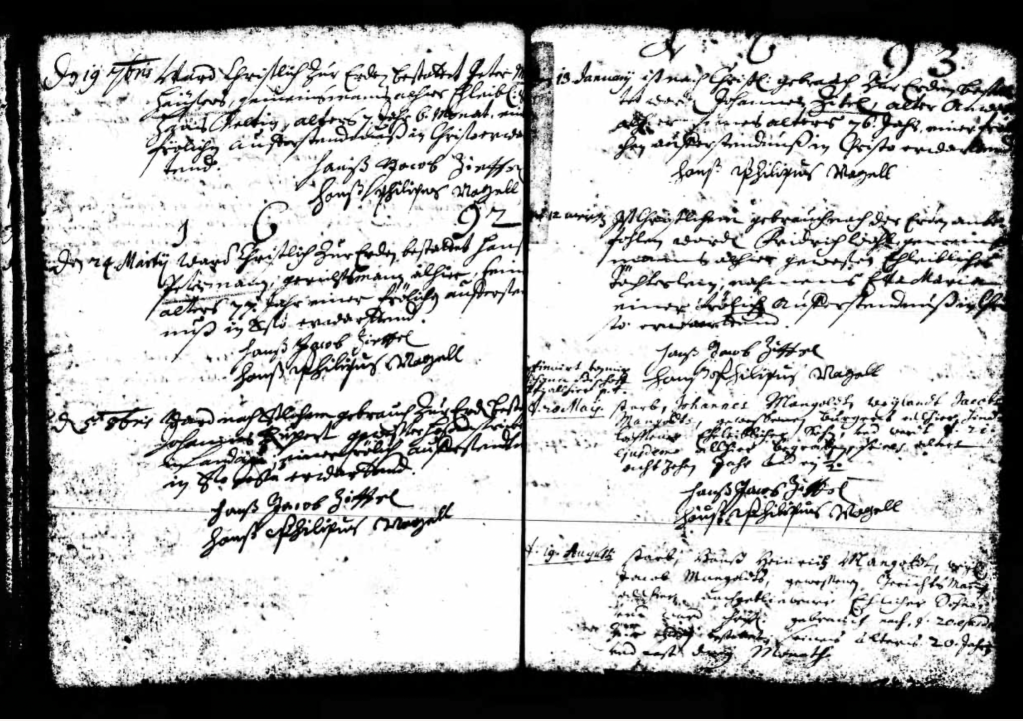
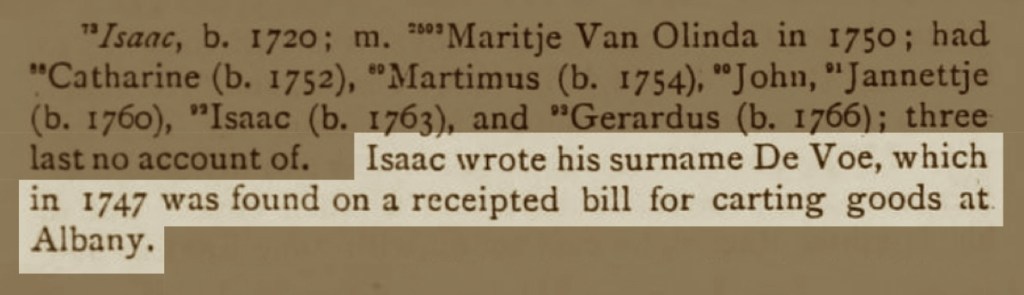
In the book, the Genealogy of The De Veaux Family, we came across an rare anecdote about our Grandfather Isaac. This little tidbit has finally settled (when) the surname spelling of our branch of the DeVoe family name, became what it is today. (1)

This anecdote was found on page 20 of the Genealogy of The De Veaux Family. (See footnotes).

What Was Attractive to Our Ancestors in This Part of New York State?

We can thank the last ice age for the rich farming country that exists in both the Hudson River Valley and the Mohawk Valley —exactly the areas our ancestors were drawn to in this era. From the history of the Town of Colonie, we learned, “The lowland areas of the Hudson and Mohawk Valleys are characterized by long alluvial flats [deposition of sediment at riverbanks]. These were the first lands selected by both the Indians and the early colonists, since the continual flooding created fertile soils for agriculture. The alluvial flats along the Mohawk River near the Mohawk View area was designated by the Indians as ‘Canastagione’, a name that had many spellings, and eventually became Niskayuna.

‘Canastagione’ referred to the Indian corn fields on the Mohawk.”

The landscape painting below starts to allude to this perspective. The riverbanks are low and fertile, the forest is crowded with life, the water is fresh and abundant. One can see clearings in the distance that our ancestors likely embraced for their farm fields.

Mohawk River, New York, by Albert Bierstadt, 1864 (Image courtesy of the Portland Art Museum).

At a time when there were few roads, the Hudson River waterway was a super-highway for people to travel by ship up the Hudson from Manhattan to the outpost of Albany. Near this place, the Mohawk River branched off from the Hudson, and at this delta, our ancestors also lived in Halfmoon. For the most part, they were all farmers, but at least once, a “tailor, and sometime fur trader” has turned up. (2)

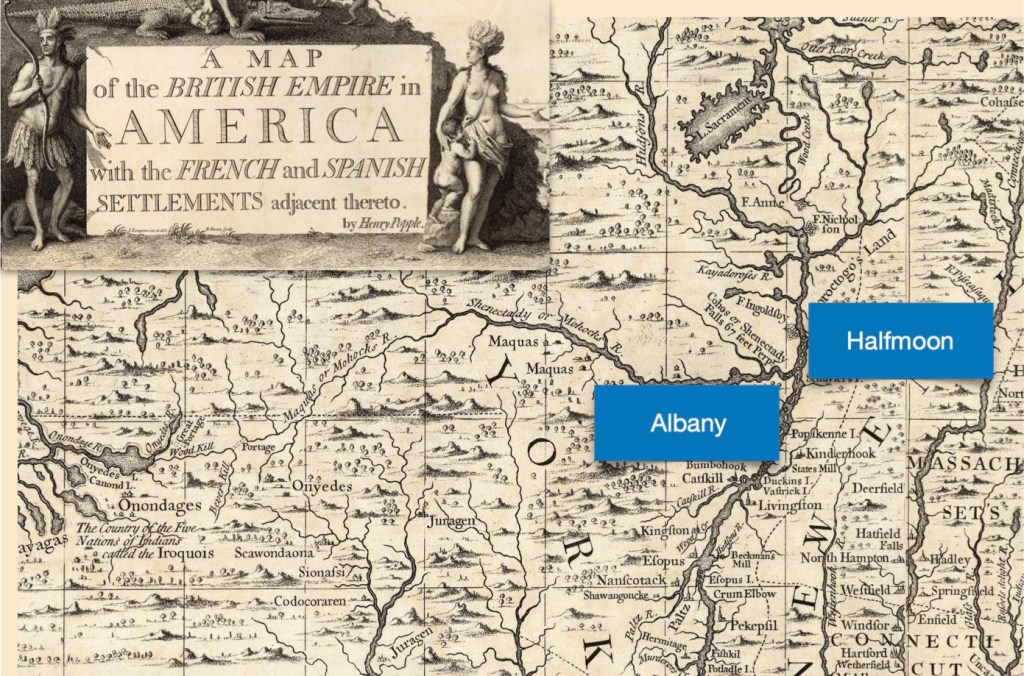
This is the composite map of the British Empire in America, 1733, by Henry Popple. Up to this time, New York had been settled mostly along the Hudson River. Observe in the lower left corner all of the still-existing nations of Native Peoples., which were sometimes referred to as the Iroquois Confederacy. (Image courtesy of the David Ramsey Map Collection).

Life in Albany and Halfmoon Before The Revolutionary War

It was still a dangerous time to leave the relatively protected area like Manhattan and move to a new area. From American History Central, “The conflicts between Britain and France for control over North America often took place in the frontier between New York and New France [the St. Lawrence River, Newfoundland, Nova Scotia, expanding to include much of the Great Lakes], and both nations sought to secure the support of the Iroquois Confederacy. Due to their control of the Fur Trade and influence in Western New York, the Iroquois skillfully manipulated the English and French, pitting them against each other to serve their own interests.”

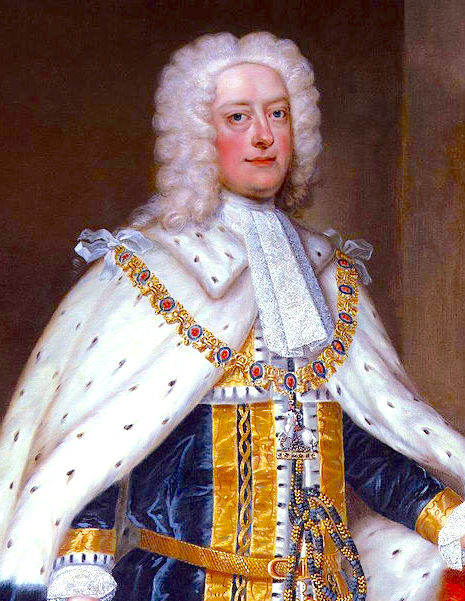
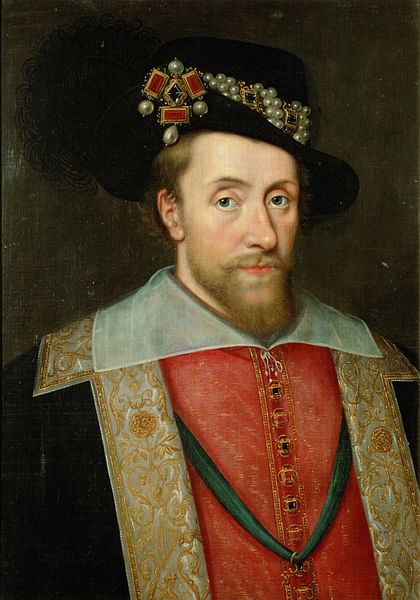
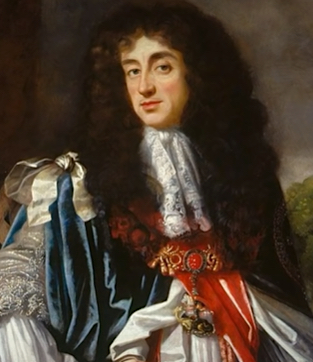
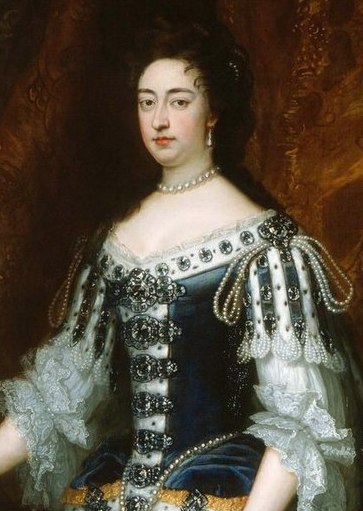
The Houses of Stuart and Orange: King William III (reigned 1689 – 1703), Queen Anne (reigned 1702 – 1707), and then she continued as Queen under The House of Stuart, (reigned 1707 – 1714), The House of Hanover, George II (reigned 1727 – 1760).

“The first three Anglo-French conflicts — King William’s War (1689–1697), Queen Anne’s War (1702–1713), and King George’s War (1744–1748) — had significant consequences in North America due to: destruction of frontier settlements, disruption in the fur trade, and [an] increased importance of New York in the effort to remove France from North America. During the French and Indian War (1754–1763), most of the major battles on the mainland took place north of Albany, which is where the final invasion of Canada was launched. Albany became the focal point for mainland operations, and the French were finally driven out of North America in 1763.” (3)

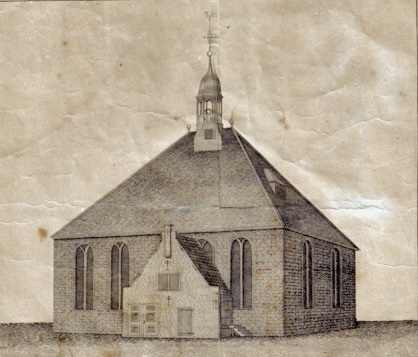
Illustration of First Dutch Reformed Church building, Albany, NY,
built in 1715 and replaced in 1789. It was demolished in 1806. (Public domain).

Isaac DeVoe, Marytje Van Olinda, and Their Children

Isaac DeVoe, was baptized December 11, 1720, in the Dutch Reformed Church of Albany, New York, British American Colonies — death date unknown. On August 19, 1750 he married Marytje (Van Olinda) DeVoe in the Dutch Reformed Church, also in Albany. She was baptized on April 27, 1729 also at the same location. Her death date is unknown.

Dutch Reformed Church records for the birth of Isaac DeVoe, December 11, 1720.
Dutch Reformed Church marriage record for Isaac DeVoe and Mareytje Van Olinda, our 5x Great Grandparents on August 19, 1750.
Dutch Reformed Church baptismal record for Mareytje “Maria” Van Olinda, for April 27, 1729.
Entry from Genealogies of the First Settlers of Albany, via American Ancestors. (See footnotes).

Together, they had six children, all of whom were born in Albany, Albany County, New York, British American Colonies, and baptized at the Dutch Reformed Church in the same location.

  • Catarina (DeVoe) Quackenbosch, baptized December 24, 1752 — death date unknown. She married February 3, 1776, Jacob Quackenbosch.
  • Martinus DeVoe, baptized December 22, 1754 — died 1831-32. He married March 18, 1786, Maria (Steenbergh) DeVoe. (We are descended from Martinus).
  • Jan (John) DeVoe, baptized November 20, 1757 — death date unknown. He married September 10, 1778, Annatje (Conover) DeVoe.
  • Jannetje DeVoe, baptized November 9, 1760 — death date unknown
  • Isaac DeVoe (2), baptized June 5, 1763* — death date unknown
  • Gerardus DeVoe, born April 19, 1766 — death date unknown. He married September 1, 1795, Annatje (Merkel) DeVoe.

    *as per Dutch Reformed Church records: Isaac DeVoe (2) was four weeks old when he was baptized, and Gerardus DeVoe’s birthdate is listed as being April 19, not April 14, as per the American Ancestors record.
Birth record for Martinus DeVoe, our 4x Great Grandfather. (See footnotes)

Finding actual records on our 4x Great Grandfather Martinus is a cause for celebration (!) because there just isn’t much out there on him that has survived. That being said, tenacious as we are — we dug in and found enough information about his life to craft an excellent history about his interesting life. We document his family thoroughly during the Revolutionary War and into the years following, in: The DeVoe Line, A Narrative — Five, Six, and Seven. (4)

When Did the DeVoe(s) Relocate to Halfmoon?

This is a funny question to resolve absolutely… Here’s what we do know, along with what we cannot know—

Isaac DeVoe’s father John (2) was born in 1680 in the Bloemendaal section of Manhattan, New York. For reasons we cannot explicitly explain John (2) chose to move to the Albany area up the Hudson River. He married Catharina VanderWerken in 1706 in Albany, and by the early date of 1720 he was a Freeholder in Halfmoon. They had eleven children between 1707 and 1725, all born in Albany. Did the whole family live live in Halfmoon that early, when the community would have been rather rough?

Their eighth child, Isaac DeVoe, was born in 1720 in Albany. He married Marytje Van Olinda in 1750 in Albany and had six children with her. Did Isaac’s wife Marytje and some of the children stay in Albany until things were more stable in Halfmoon?

The two communities were not that far from each other, but this was still an early period of settlement and the infrastructure (roads) were very poor to non-existent, and things were rather unsafe. During this time frame there were two major wars: King George’s War (1744–1748), and the French and Indian War (1754–1763). (From Life In Albany… above) “…most of the major battles on the mainland took place north of Albany, which is where the final invasion of Canada was launched.” After this period, there continued to be many conflicts leading up to the American Revolutionary War (1775–1783). So the question is: If you were a parent, would you want your kids living safe in the Albany stockade, or exposed in the unprotected Halfmoon farm fields?

Isaac and wife Marytje (Van Olinda), married in Albany in 1750. All of their children baptized at the Dutch Reformed Church in Albany, New York. This location most likely was chosen because her side of the Van Olinda family lived in Albany and had and had ties to that church.

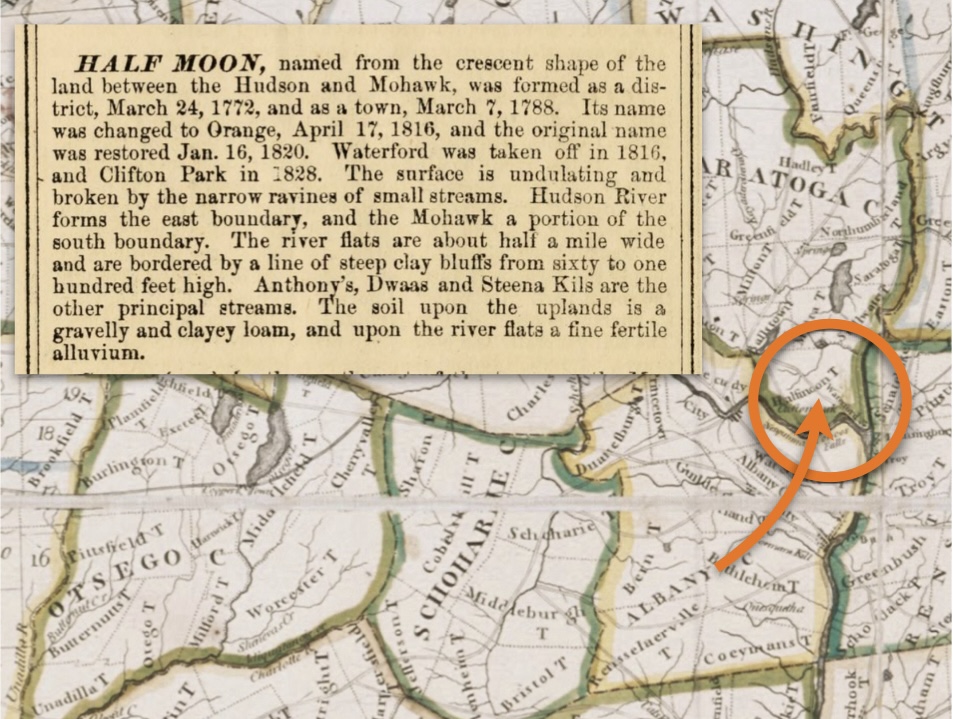
The background is A Map of the State of New York, 1804 (inset portions),
by Simeon DeWitt — the only known map that shows Halfmoon before there were boundary and name changes soon after 1804. When our family first moved there, Saratoga County did not yet exist until 1791. The inset panel is a description from an 1871 Gazetteer and Business Directory of Saratoga County. (Background image courtesy of Google Arts & Culture).
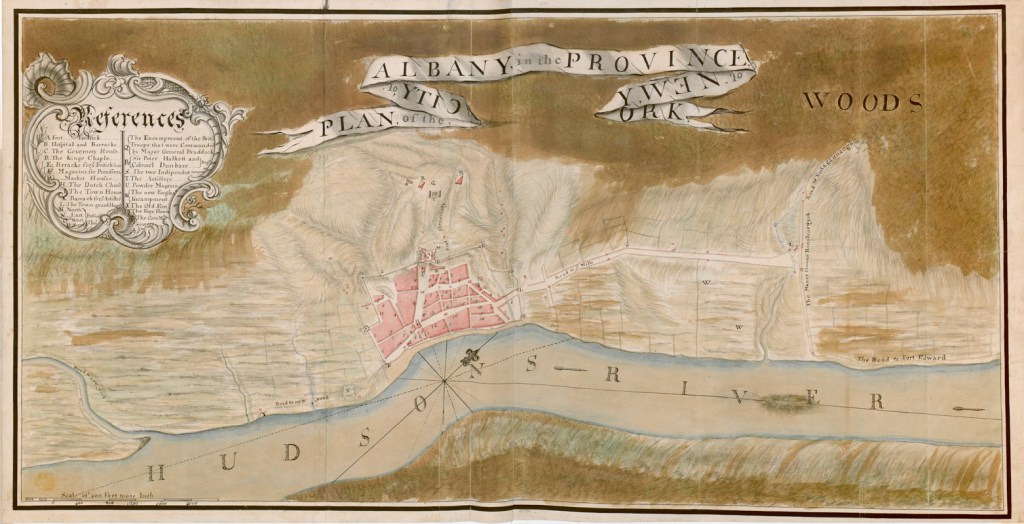
Plan, of the City, of Albany, in the Province of New York, by Thomas Sowers, 1756, (Image courtesy of the Norman B. Leventhal Map and Education Center at the Boston Public Library).

In 1756, about six years after Isaac and Marytje were married, the City of Albany looked like this — basically a small fortress still surrounded by an outer wooden stockade. (One wonders if Halfmoon is just a backwoods hamlet at this point, even though there are people living there. We covered the development of Halfmoon in the previous chapter, The DeVoe Line, A Narrative — Three).

Early American Colonial City: AlbanyAlbany 1770, by Robert Yates. (Image courtesy of The Urban Anecdotes).

After twenty years of marriage, there are some changes. It’s interesting to see that by 1770, Albany has grown some. The biggest change is that the outer wooden stockade has been removed, which opens things up a lot.

The only documents we can access for this period which give us clues about where his family was living are the 1790 Census and some tax records. The Isaac DeVoe who is our 5x Great Grandfather would have been about 70 years old at this point— he may have no longer been living. In fact, he could have lived his entire life without being recorded in a discernible way either by a Census, or by tax records. We have located only one Isaac DeVoe living in Halfmoon at that time, and it could possibly be his son (also named Isaac, born 1763).

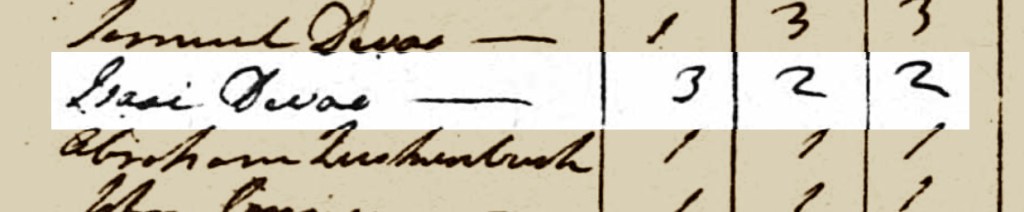
1790 United States Federal Census, Halfmoon, Albany County, New York.

1790, the first census
The first census of the United States, which started on August 2, 1790 and lasted for several months. In addition to “this particular” Isaac, there are 7 people total living in the home. Censuses done during this era have an inherent problem, in that they are very limited, (in other words little information is provided). We will never know, but at 70 years of age, it is unlikely that this is our Grandfather Isaac because of the ages of the people living in the home.

  • 3 free white persons – males 16 and over
  • 2 free white persons – males under 16
  • 2 free white persons female

The 1786-1788 Tax Records
The earliest Halfmoon tax records we have located are for 1786 and 1788. From those we see taxes being paid in both years by what are presumably two sons of Isaac DeVoe: his son John (born 1757) and his namesake son, Isaac (2). Here are the records for Isaac (2) in 1786:

Halfmoon tax roll for 1786, New York State Archives Digital Collections.

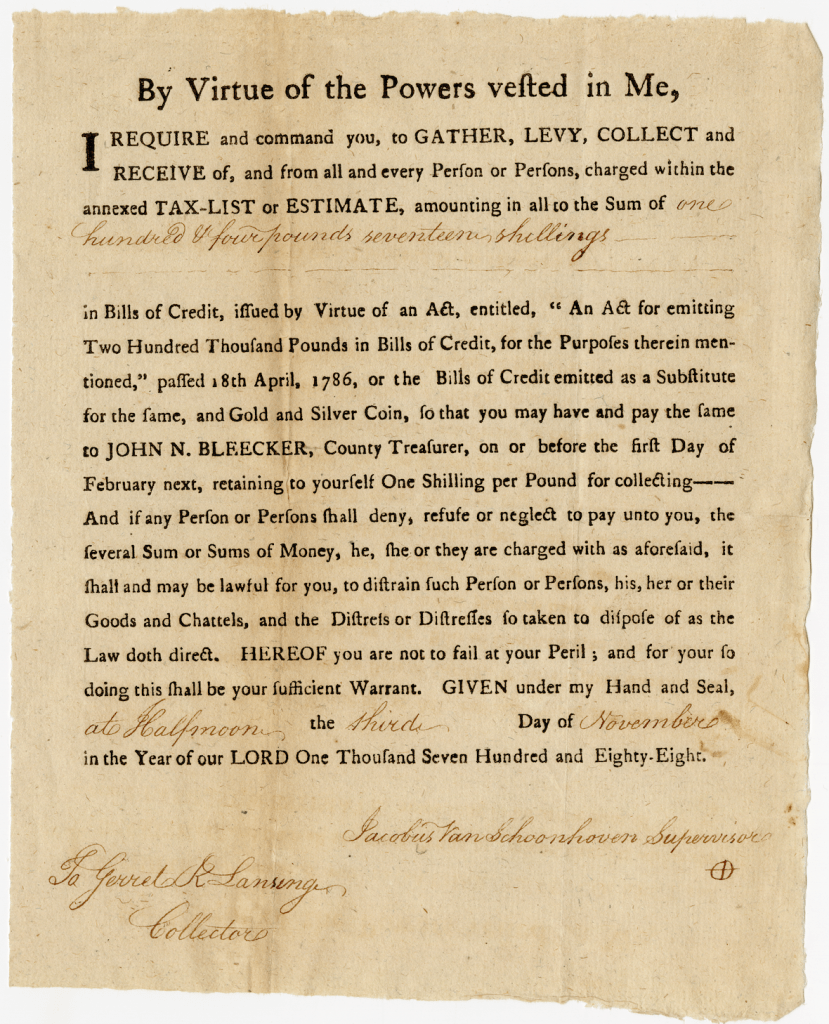
It appears that many people in the community were a little slow, or reluctant, (or both!) to pay their taxes. By 1788, the local Powers That Be posted a rather cranky notice to the villagers, most of whom could not read and had to get someone kind to inform them.

Halfmoon tax roll for 1788, “Hereof you are not to fail at your Peril” cranky notice,
New York State Archives Digital Collections.

What we do know is this: Isaac’s son, Martinus DeVoe was living in Halfmoon by 1790 because we have both the 1790 Census and 1802 tax records to support this view. (See The DeVoe Line, A Narrative — Six.)

So the point of all this is to demonstrate that we really don’t know exactly when Isaac and Marytje were living in Halfmoon. We know that several of their children took up residence there, and it is plausible that if they lived into their elder years, perhaps they were living with one of their children. (5)

When People Had Free Moments…

All of these territory conflicts were serious matters, but not everything in life is serious…

The writer Lindsay Forecast, in the article Leisure Activities in The Colonial Era, states, “The amount of time devoted to leisure, whether defined as recreation, sport, or play, depends on the time available after productive work is completed and the value placed on such pursuits at any given moment in time. There is no doubt that from the late 1600s to the mid-1850s, less time was devoted to pure leisure than today. The reasons for this are many – from the length of each day, the time needed for both routine and complex tasks, and religious beliefs about keeping busy with useful work. There is evidence that men, women, and children did pursue leisure activities when they had the chance, but there was just less time available.”

The Soldier’s Wife by George Smith, (Cropped image, courtesy of Gallerix.org).

“Before the revolution, one’s station in life tended to determine how one would spend one’s leisure. For the cultured elite, the necessity of sharpening social skills to an acceptable level occupied many hours and eventually many years of one’s life. Chances for social interaction outside the towns of colonial America included the quilting and sewing bees organized by women to provide company in what otherwise could become a too-cloistered environment. Most men were also required to attend periodic militia drills. As the individual aged, what was considered leisure activities changed with them.”

Quill pen writing illustration courtesy of The Paul Revere House, (Public domain).

Quilting Bees, Sewing Bees —Just Wondering If They Ever Had Spelling Bees…
We have commented in other chapters about how for many people at this time, spelling was more of a phonetic adventure, rather than a disciplined practice. Here is an example: We once read a colonial era letter that, in addition to having to discern quill pen calligraphy (our nemesis), some of the words had what appeared to be idiosyncratic spellings. One word was “yfe” which we could not figure out.

It turns out that it was a clever phonetic spelling for the word wife. (6)

The Van Olinda Family Were Early Pioneers

One thing that we took note of with this family line, is that the name of a female Van Olinda ancestor was quite present in the documents which have survived. This is a bit unusual, and not typical of the histories we encounter from this era — but we applaud it. Frequently, her name appears in treaties and real estate documents.

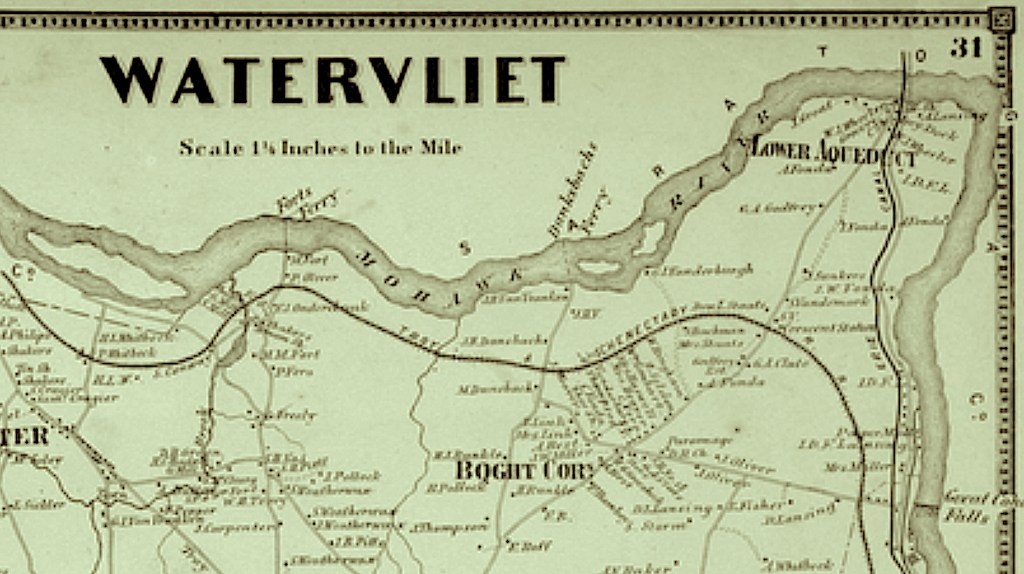
This 1866 map from two centuries later, shows the area being described as “purchased by Alice van Olinde in 1667 from the Mohawk natives.” Of note is the small hamlet of Boght Corners in the lower portion. In 1829, “Alice’s” 4x Great Grandson Peter M. DeVoe, was married at the Dutch Reformed Church located there. (Image courtesy of the New York Public Library Digital Archives).

Here is an example from Wikipedia, “Boght Road, which was once called Cohoes Road and Manor Avenue, was the northern boundary of the Manor of Rensselaerswyck. North of the Manor was purchased by Alice van Olinde* in 1667 from the Mohawk natives, and the van Olinde family then sold and leased out farms to potential settlers. Loudon Road (today US 9), named in honor of Earl Loudon was built in 1755 for the purpose of bringing provisions north from Albany to Lake George and Fort Ticonderoga.”

*We were intrigued. Who is this Alice van Olinde? It turns out her real name was slightly different than this. Further on, see our Observation at the end of the section below, subtitled The Legacy of Our Grandmother… (7)

The Legacy of Our Grandmother — Hilletje (Van Slyck) Van Olinda

The dictionary defines the word apocryphal as being of questionable or doubtful authorship or authenticity — and so it is when it comes to some research in genealogy. Usually we refer to these items as family stories, but when the passed-on information gets to be very, very old, it can become apocryphal. It’s almost like the game of telephone: stories > told > again > and > again > become > altered.

To recount the history of the Van Olinda branch of the family forces us to confront a bit of this, and make some decisions. We know that our 8x Great Grandmother in this line is named Hilletje (Van Slyck) Van Olinda and that she was half Mohican. Her history is quite compelling, which we will get to in a moment, but first we need to address the issue of who her mother was, or was not. There is much information out there about her, with some researchers claiming that her name was Ots Toch Owisto’k, and that Hilletje’s father was a French fur trader named Jacques Hertel. The problem with this specificity is that there is no direct evidence to support it. In fact, there is no indirect evidence either. [We prefer to see some form of evidence to support claims.] Apocryphal stories which are put out there without supporting evidence are a genealogist’s version of the game of telephone.

“The practice of historians is to treat legends as meritless unless merit can be demonstrated. A rule of thumb that some historians apply to oral traditions is that after 200 years they have lost any reliability they might have had at the beginning.”

Jacques Hertel in Legend And History II
by Genealogical Researcher Cynthia Brott Biasca

Genealogical Researcher Cynthia Brott Biasca does a remarkable investigation and refutation into the many claims of Hilletje’s parentage. We observed that the overall problem lies with the notions of writers from the 18th and 19th centuries, (and then the unquestioned adoption of that information by later writers). Unlike the world today, where we are marinated in media, back then writers only had the power of words to intrigue and impress their readers. It was natural to freely embellish histories with opinions, prejudices, half-truths, (and an occasional Indian Princess). When we first encounter our Grandmother Hilletje, this is how she is described in the book, The Mohawk Valley : Its Legends and Its History

“She was born of a Christian father (Van Slake) and an Indian mother of the Mohawk tribes. Her mother remained in the country and lived among the Mohawks, and she lived with her the same as Indians live together. Her mother would never listen to anything about Christians, as it was against her heart from an inward unfounded hate. As Hilletie sometimes went among the whites to trade, some of the Christians took a fancy to the girl, discovering more resemblance to the Christians than the Indians, and wished to take her and bring her up, but her mother would not let her go. The little daughter had no disposition to go at first, but she felt a great inclination and love in her heart to those who spoke to her about Christ and the Christian religion. Her mother observed it and grew to hate her and finally drove her from her forest home. She went to those who had solicited her to come so long. She had a particular desire to learn to read and finally made her profession and was baptized.” (This was written in 1901, by Reid. See footnotes).

Left to right: The Mohawk Valley : Its Legends and Its History by W. Max Reid, 1901. Journal of Jasper Danckaerts, 1679-1680, and a Dutch Bible from 1782. (See footnotes).

Much of this is derived from three chapters of an earlier book written in Dutch in the late 17th century and titled [the] Journal of Jasper Danckaerts, 1679-1680. It was discovered > and translated about 80-90 years later in the 18th century >, then continually edited > again and again > for other editions. It is the closest we get to the actual description of the woman Hilletje. However, Danckaerts was a missionary, and it is through his lens that we see her —

“While we were there, a certain Indian woman, or half-breed, that is, from a European and an Indian woman, came with a little boy, her child, who was dumb, or whose tongue had grown fast. It was about four years old; she had heard we were there, and came to ask whether we knew of any advice for her child, or whether we could not do a little something to cure it. We informed her we were not doctors or surgeons, but we gave her our opinion, just as we thought. Sanders told me aside that she was a Christian, that is, had left the Indians, and had been taught by the Christians and baptized… She had said all this with a tender and affectionate heart, and with many tears, but tears which you felt proceeded from the heart, and from love towards God. I was surprised to find so far in the woods, and among Indians — but why say among Indians? among Christians ten times worse than Indians — a person who should address me with such affection and love of God; but I answered and comforted her. She then related to me from the beginning her case, that is, how she had embraced Christianity. She was born of a Christian father and an Indian mother, of the Mohawk tribes. [text continues as per Reid above, word-for-word]… She had especially a great desire to learn to read; and applied herself to that end day and night, and asked others, who were near her, to the vexation and annoyance of the other maids, who lived with her, who could sometimes with difficulty keep her back. But that did not restrain her ; she felt such an eagerness and desire to learn that she could not be withheld, particularly when she began to understand the Dutch language, and what was expressed in the New Testament, where her whole heart was. In a short time, therefore, she understood more about it than the other girls with whom she conversed, and who had first instructed her…” Finally, she made her profession, and was baptized.” (This was written by Danckaerts in the late 17th century and translated much later.)

*Observation: The genealogy game of telephone (before there were real telephones!) was actively being played soon after Hilletje met Jasper Danckaerts. This became apparent as we were sorting through the many variations of her first name.

We have no record of her given Mohawk name. Jasper Danckaerts in 1680 wrote her name in Dutch, which was then translated about 80 years later into the first English edition as: Aletta. Most of the time we see spelling variations that are: Hilletje (which is a Dutch name equivalent for Hilda). If the name is pronounced with a silent ‘H’ it is possible to sound a bit more like Aletta. However, the Dutch language name equivalent for Alice is: Aaltje, or Aeltje. (Google search) So it seems some contemporary writers have just selected Alice.

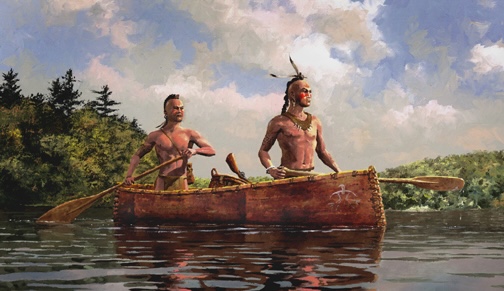
The Lake of the Iroquois by L. F. Tantillo. The artist writes, “Lake of the Iroquois depicts two Mohawk tribesmen crossing an Adirondack lake in a time frame after contact with Europeans, circa 1640. The canoe is based on period accounts of native vessels constructed of elm bark. The musket in the canoe was a common trade item at that time.”

The Southern Border of the Mohawk Nation
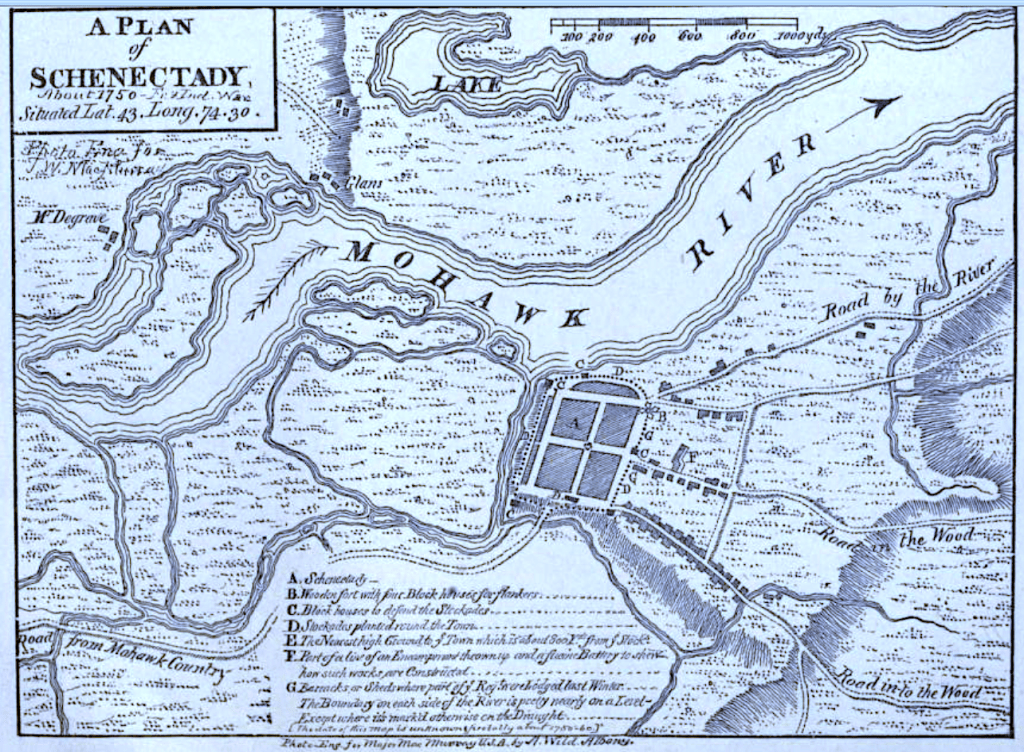
The map below shows the community of Schenectady, which is slightly northwest of Albany. This area and the Rensselaer Manor adjacent to the south, is where most of the Van Olinda families were initially granted land patents. The areas west of here were still Native People areas, called the Country of the Five Nations of Indians (also sometimes referred to as the Iroquois Confederacy) — and the aptly named Mohawk River, represented the southern border of the more northerly Mohawk Nation. During an era of many conflicts between Dutch and English Colonists with the Native Peoples and also the French — this border community was evolving from a dangerous area to a somewhat settled area in which to live.

A Plan of Schenectady from A History of The Schenectady Patent in The Dutch and English Times, page 317. In Hilletje’s life, this area would have been much less settled. (See footnotes).

So what do we know about her life?
From Greene’s book on the Mohawk Valley (see footnotes), her father, “the original Van Slyck, was Cornelis Antonissen Van Slyck, meaning ‘Cornelis, the son of Antonis of Slyck.’ The Dutch immigrant Antonissen Van Slyck, (alias ‘Borer Carnelis’ by the natives)” is noted as her father in Hudson-Mohawk Genealogical and Family Memoirs, Vol. II, and that she was born circa 1640s.

From Stefan Bielinski, Historian for the Colonial Albany Social History Project at the New York State Museum, we learned regarding Hilletje, “By the 1670s, this legendary historical character had become the wife of Albany businessman and regional property holder Pieter Danielse Van Olinda and the mother of several of his children.”

Map from page 58 of A History of The Schenectady Patent in The Dutch and English Times:
Being Contributions Toward a History of The Lower Mohawk Valley
, by Jonathan Pearson.

“Well known in the country west of Albany, Hilletie’s special talent was that of the interpreter. In 1667, she is said to have been given five islands in the Mohawk at Niskayuna in payment for her services. During the 1690s and possibly afterwards, she was paid by the provincial government as the ‘interpretess to the Indians at Albany.’ She was able to secure a number of parcels of land in the region in payment for her work as interpreter. A number of visitors mentioned her in their narratives.” (Bielinski)

Remember this word from the Introduction? “Canastagione” referred to the Indian corn fields on the Mohawk.” (Colonie) “Their lifestyle included farming on cleared flats near the river and hunting over a vast forested area. Their small villages were moved as necessary to preserve their way of life.” (Town of Halfmoon website) These islands were considered ideal locations for the growing of corn, and in a sense, show how esteemed Hilletje must have been by the Mohawks to have received such valuable areas as gifts.

Indian Deed to Hilletie Van Olinda, October 6, 1704. Note the Native American pictorial glyph signature alongside the wax seals. (Image courtesy of the New York State Archives Digital Collections)
Dutch Reformed Church 1707 death record for Hilletje Van Olinda.

We know that Hilletje was married to Pieter Danielse Van Olinda and that they had several children. She died on February 10, 1707. Her husband Pieter, outlived her and “was a farmer, tailor, and sometime fur trader… He has been identified as one of the original patentees of Schenectady. In 1674, he was among those invited to the funeral of the director of Rensselaerswyck — where he held property… he filed a Will in August 1715 (died 1716)Much of this real estate came to him through the work of his wife, the then late Hilletie Van Slyck… (Bielinski)

Which children eventually lead to Marytje (Van Olinda) DeVoe?
As per American Ancestors (see footnotes) for our family, we are descended from the Van Olinda family as follows:

  • Antonis of Slyck, Dutch immigrant father of Antonissen Van Slyck
  • Antonissen Van Slyck was the father of a (half Mohawk) daughter, Hilletje Van Slyck
  • Hilletje (Van Slyck) Van Olinda — married Pieter Danielle Van Olinda. She died February 10, 1707. They had a son named…
  • Daniel Van Olinda, named as the eldest son in the Will of his father Pieter, continued the family line in the community of Halfmoon where he lived. Daniel Van Olinda married Lysbeth (Kregier) Van Olinda on June 11, 1696. They had a son named…
  • Marten Van Olinda, married Jannetie Van Der Werken on April 8, 1724. They had a daughter named…
  • Marytje [Maria] (Van Olinda) DeVoe, who became our 5x Great Grandmother (8)

In the next chapter, we feature our 4x Great Grandfather Martinus DeVoe, and his life during the Revolutionary War. It was one of the most complicated chapters of the DeVoe Line to write (truly and actually) because of the game of > telephone >> and >>> family >>>> stories.


Just ask Ernestine. We’re sure that she knows all about our history.

Following are the footnotes for the Primary Source Materials,
Notes, and Observations

Preface: It’s Finally Settled!

(1) — one record

Genealogy of The De Veaux Family : Introducing the Numerous Forms of Spelling the Name by Various Branches and Generations in the Past Eleven Hundred Years
by Thomas Farrington De Voe, 1811-1892
https://archive.org/details/genealogyofdevea00thom/page/n7/mode/2up
Book page: 20, Digital page: 20/302
Note: For the anecdote about Isaac DeVoe and the receipted bill.

What Was Attractive to Our Ancestors in This Part of New York State?

(2) — three records

Town of Colonie, Town Historian
The Early History of Colonie
https://www.colonie.org/departments/historian/early-history

Mohawk River, New York
by Albert Bierstadt, 1864, oil on canvas – Portland Art Museum – Portland, Oregon – DSC08750.jpg
https://commons.m.wikimedia.org/wiki/File:Mohawk_River,_New_York,_by_Albert_Bierstadt,_1864,_oil_on_canvas_-_Portland_Art_Museum_-_Portland,_Oregon_-_DSC08750.jpg
Note: For the landscape image.

David Ramsey Map Collection
Composite (map): British Empire in America, 1733
by Henry Popple
https://www.davidrumsey.com/luna/servlet/detail/RUMSEY~8~1~887~70081:-Composite-Map-of–A-Map-of-the-Bri
Note: For the map image.

Life in Albany and Halfmoon Before The Revolutionary War

(3) — five records

Britannica
Iroquois Confederacy, American Indian confederation
https://www.britannica.com/topic/Iroquois-Confederacy

American History Central
New York Colony 1524 – 1763
New York Colony, the Iroquois, and New France
https://www.americanhistorycentral.com/entries/new-york-colony/

List of English Monarchs
Houses of Stuart and Orange
https://en.wikipedia.org/wiki/List_of_English_monarchs
Note: For their portraits.

[Queen Anne]
File:Dahl, Michael – Queen Anne – NPG 6187.jpg
https://commons.wikimedia.org/wiki/File:Dahl,MichaelQueen_Anne-_NPG_6187.jpg
Note: For her portrait.

King George II
https://commons.wikimedia.org/wiki/File:King_George_II_by_Charles_Jervas.jpg
Note: For his portrait.

Isaac DeVoe, Marytje Van Olinda, and Their Children

(4) — fifteen records

Illustration of First Dutch Reformed Church building, Albany, NY
https://en.wikipedia.org/wiki/First_Church_in_Albany_(Reformed)#/media/File:1715_Dutch_Reformed_Church,_Albany,_NY.jpg
Note: For the church building image.

First Church in Albany (Reformed)
https://en.wikipedia.org/wiki/First_Church_in_Albany_(Reformed)

Albany County, New York: First Settlers, 1630-1800 (Archived1)
https://www.americanancestors.org/databases/albany-county-new-york-first-settlers-1630-1800-archived1/image?volumeId=63472&pageName=42&rId=10007842425
Book page: 42, Digital page: 42/182

Isaac De Voe
in the U.S., Dutch Reformed Church Records in Selected States, 1639-1989

New York > Albany > Albany, Vol I, Book 1
https://www.ancestry.com/discoveryui-content/view/40264:6961?ssrc=pt&tid=48708924&pid=240082063566
Book page: 95, Digital page: 99/368, Right page, entry 2 from the top.
Note: For marriage information. Hand transcription      

Genealogies of The First Settlers of Albany
https://www.americanancestors.org/databases/albany-county-new-york-first-settlers-1630-1800-archived/image?rId=6526998&volumeId=7370&pageName=129&filterQuery=
Book page: 129
Note: See left column entry for Van Olinda, and follow:
Pieter/Hilletie > Daniel/Lysbeth > Marten/Jannetie > Maria

Maritje Van Olinda
https://www.ancestry.com/family-tree/person/tree/6000267/person/252272497714/facts?_phsrc=wfr1&_phstart=successSource
and
Part 4, 1750–1764, Holland Society of New York (1907)
Records of the Reformed Dutch Church of Albany, New York, 1683–1809
http://aleph0.clarku.edu/~djoyce/gen/albany/part4.html#marriage
Note 1: Click on this link: Marriages, 1750 to 1762, then see entry for August 19, 1750.
Note 2: Both entries are for marriage records.
Note 3: We have not been able to discern what the notation “with pardon” means in this context. It is interesting to look at the other notations: “2 living at the Half Moon, born at Nistigoenen, live near Schaghticoke”.

U.S., Dutch Reformed Church Records in Selected States, 1639-1989
New York > Albany > Albany, Vol I, Book 1
https://www.ancestry.com/discoveryui-content/view/39413:6961?tid=&pid=&queryId=c38b5d34-11bb-42af-a384-6478a5a4718a&_phsrc=yJB1&_phstart=successSource
Book page: 268, Digital page: 272/368
Note 1: Birth record for Marytje Van Olinda.
Note 2: The entry is noted under April 20, 1729, with the indication of d7 — that it is 7 days after is her actual birthday (d7 equals April 27).
Note 3: This is the same location that all of their children were baptized.

Records of the Reformed Dutch Church of Albany, New York, 1683–1809
(Excerpted from Year Books of the Holland Society of New York, 1907)
DRC of Albany Baptismal Record, 1789 to 1809
http://aleph0.clarku.edu/~djoyce/gen/albany/refchurch.html
Note: We have itemized each individual record for their children which are found in three links, as directed below.

Here are the individual records for the first 4 children of Isaac DeVoe and Marytje (Van Olinda) DeVoe —
Catarina, Martinus, Jan (John), and Jannetje are found at this link,
Baptismal Record, 1750 to 1762:
http://aleph0.clarku.edu/~djoyce/gen/albany/part4.html#baptismal

> [page 31] 1752
1752, Dec. 24. Catarina, of Isaac De Voy and Maritje V. drlinden. Wit.: Isaac Vosburg, Geerteruy Van de Linden
and here also:
Isaac De Voy
in the U.S., Dutch Reformed Church Records in Selected States, 1639-1989
New York > Albany > Albany, Vol III, Book 3
https://www.ancestry.com/discoveryui-content/view/150162502:6961?ssrc=pt&tid=48708924&pid=240082063566
Book page: 64, Digital page: 268/506
Note: Hand transcription.        Left page, fourth entry from the top

> [page 44] 1754
1754, Dec. 22. Martinus, of Isak Du Foe and Marytje Van der Linde. Wit.: Martinus V. d. Linden, Elisabeth Doxs.

> [page 57] 1757
1757, Nov. 20. Jan (John), of Isaac Devoe and Maria Van Olinde. Wit.: Jan Dox, Maria Coerteny.

> [page 71] 1760
1760, Nov. 9. Jannetie of Izak De Voe and Marytje V. der Linde (Van Olinde). Wit.: Daniel V. der Linde (Van Olinde), Elisabeth Bekker.
and here also:Izak De Voe
in the U.S., Dutch Reformed Church Records in Selected States, 1639-1989
New York > Albany > Albany, Vol III, Book 3https://www.ancestry.com/discoveryui-content/view/150163354:6961?ssrc=pt&tid=48708924&pid=240082063566
Book page: 186, Digital page: 190/506
Note: Hand transcription.        Left page, fifth entry from the bottom

Isaac is found at this link: Baptismal Record, 1763 and 1764:
http://aleph0.clarku.edu/~djoyce/gen/albany/part4.html#baptismal2
> [page 93] 1763
1763, June 5. Yzaac (Isaac) of Yzac (Izak) de Foe (de Voe) and Maria V. d. Linde. Wit. Cornelis V. d. Berg, Claartje Knoet. Note: Four weeks old.

Gerardus is found at this link: Baptismal Record, 1765 and 1771:
http://aleph0.clarku.edu/~djoyce/gen/albany/part5.html#baptismal
> [page 19] 1766 (bo = born on)
bo. Apr. 19. Gerardus, of Yzaac du Voe and Marytje V. Olinde. Wit.: Gerardus V. Olinde, Lena du Voe.

Early New Netherlands Settlers
David <?> Du Four, (Rn=25344)
https://freepages.rootsweb.com/~rclarke/genealogy/page1/dufour.htm

When Did the DeVoe(s) Relocate to Halfmoon?

(5) — nine records

Gazetteer and Business Directory of Saratoga County, N.Y.,
and Queensbury, Warren County,
for 1871
https://archive.org/details/gazetteerbusines00chi/page/92/mode/2up?view=theater
Book page: 92, Digital page: 92/303

A Map of the State of New York, 1804 (cropped portion)
Simeon DeWitt (1756-1834)
https://artsandculture.google.com/asset/a-map-of-the-state-of-new-york/gQG44G8fdQpGwQ?hl=pt-PT
Note: For map image.

Boston Public Library
Norman B. Leventhal Map and Education Center
Plan, of the City, of Albany, in the Province of New York (map)
by Thomas Sowers, 1756
https://collections.leventhalmap.org/search/commonwealth:hx11z365w

The Urban Anecdotes
Early American Colonial City: Albany
Albany 1770 (map)
by Robert Yates
https://www.the-urban-anecdotes.com/post/early-american-colonial-city-albany
Note: For the map image.

The George Washington Presidential Library at Mount Vernon
First United States Census, 1790
https://www.mountvernon.org/library/digitalhistory/digital-encyclopedia/article/first-united-states-census-1790/#:~:text=The%201790%20census%20was%20the,of%20national%20prosperity%20and%20progress.

American Revolutionary War
https://en.wikipedia.org/wiki/American_Revolutionary_War#:~:text=The%20American%20Revolutionary%20War%20(April,and%20commanded%20by%20George%20Washington

Isaac Devoe
in the 1790 United States Federal Census

New York > Albany > Half Moon
https://www.ancestry.com/discoveryui-content/view/234148:5058?tid=&pid=&queryId=47cac8d0-7968-4a12-b3a0-4d1b0ec73750&_phsrc=nLK2&_phstart=successSource
Book page: Noted as 322, Digital page: 1/4, Left column, entry 25 from the bottom of the page.

New York State Archives Digital Collections
Halfmoon tax roll, 1786
https://digitalcollections.archives.nysed.gov/index.php/Detail/objects/57252
Note: There are 16 downloadable files.This is the relevant file: NYSA_A1201-78_1786_Albany_Halfmoon_p04.tiff

New York State Archives Digital Collections
Halfmoon tax roll, 1788
https://digitalcollections.archives.nysed.gov/index.php/Detail/objects/95585

When People Had Free Moments…

(6) — three records

The Revere House Gazette, Spring 2016
Leisure Activities in The Colonial Era
by Lindsay Forecast
https://www.paulreverehouse.org/wp-content/uploads/2016/06/PaulRevereHouse_Gazette122_Spring16.pdf

The Soldiers Wife (image cropped)
by George Smith (1829-1901)
https://gallerix.org/storeroom/1073111432/N/718/
Note: For the image of the children playing.

Quill Pen Writing and Drawing illustration
https://www.paulreverehouse.org/event/quill-pen-writing-and-drawing-aug2023/
Note: For the illustration.

The Van Olinda Family Were Early Pioneers

(7) — three records

History of the Mohawk Valley: Gateway to the West 1614-1925,
Volume 1

Nelson Greene, editor
https://www.schenectadyhistory.org/resources/mvgw/history/022.html
Book pages: 326-351
Note: Chapter 22: Settlers at Schenectady, 1661-1664

Watervliet, New York (map)
New Topographical Atlas of the Counties of Albany and Schenectady New York
https://digitalcollections.nypl.org/items/510d47e3-72e9-a3d9-e040-e00a18064a99/book?parent=76f52680-c5f6-012f-6a69-58d385a7bc34#page/17/mode/2up
Book page: 31
Note 1: For the map image.
Note 2: Known in the present day as the town of Colonie.

Boght Corners, New York
https://en.wikipedia.org/wiki/Boght_Corners,_New_York
Note: For the mention of “was purchased by Alice van Olinde in 1667 from the Mohawk natives…”

The Legacy of Our Grandmother  — Hilletje (Van Slyck) Van Olinda

(8) — eighteen records

Apocryphal [definition]
https://www.merriam-webster.com/dictionary/apocryphal#:~:text=apocryphal%20implies%20an%20unknown%20or,itself%20is%20dubious%20or%20inaccurate.

Jacques Hertel in Legend And History II
by Cynthia Brott Biasca
https://www.familysearch.org/memories/memory/134755036

The Mohawk Valley: Its Legends and Its History
by W. Max Reid, 1901
https://ia600507.us.archive.org/13/items/mohawkvalleyitsl00reid/mohawkvalleyitsl00reid.pdf
Book pages: 156-160

1782 BÍBLIA ENCADERNADA DE COURO com FECHOS BIBLIA SACRA
antiga na Holanda Holandesa
[1782 LEATHER BOUND BIBLE with LOCKS Antique HOLY BIBLE in Dutch Holland]
https://www.ebay.com/itm/364780333183?norover=1&mkevt=1&mkrid=711-167022-160074-6&mkcid=2&itemid=364780333183&targetid=296633477513&device=c&mktype=pla&googleloc=9197425&poi=&campaignid=20741944936&mkgroupid=158218881347&rlsatarget=pla-296633477513&abcId=&merchantid=5300591862&gad_source=1&gbraid=0AAAAAD_QDh_LgbL-MlCni_jX5IWQJNcW7&gclid=Cj0KCQjwkdO0BhDxARIsANkNcrdM9VcKURsHWIfTYIAb3fyHXC8OqZt0uH34KI6nRzdABQ_ESrxluZMaArrcEALw_wcB

Smithsonian Libraries
Journal of Jasper Danckaerts, 1679-1680,
These three chapters: The Story of Aletta, The Indian, The Story of Wouter, Aletta’s Nephew, Interview With Aletta and Wouter
https://library.si.edu/digital-library/book/journalofjasper00danc
Book pages: 201-211, Digital pages: 200-210/313

Mohawk Village, 1780
A Mohawk Native American village in central New York, c1780.
Engraving, 19th century
https://www.mediastorehouse.com/granger-art-on-demand/mohawk-village-1780-mohawk-native-american-7505681.html
Note: For the village illustration.

Hudson-Mohawk Genealogical and Family Memoirs, Vol. II
Hudson-Mohawk Family Histories
by Cuyler Reynolds (editor)
https://www.ancestry.com/imageviewer/collections/48324/images/HudsonMohawkII-002620-704?ssrc=&backlabel=Return&pId=291902
Book page: 704, Digital page: 221/465

The Fine Art of Historical and Marine Painting
Lake of the Iroquois
Two Iroquois in the Adirondacks, circa 1640

by L. F. Tantillo
https://lftantillo.com/native-americans-in-new-york/lake-of-the-iroquois.html

A History of The Schenectady Patent in The Dutch and English Times: Being Contributions Toward a History of The Lower Mohawk Valley
by Jonathan Pearson, and Junius Wilson MacMurray
https://archive.org/details/historyofschenec00pearuoft/historyofschenec00pearuoft/page/n7/mode/2up
Note 1: For the Bouwlands map, Book page: 58, Digital page: 86/514
Note 2: For the Schenectady map, Book page: 317, Digital page: 349/514

History of the County of Schenectady, N. Y., from 1662 to 1886…
by John H. Munsell , George Rogers Howell
https://archive.org/details/historycountysc00howegoog/page/n30/mode/2up
Book pages: 15-16, Digital pages: 31/254

A Brief History of Early Halfmoon
by The Town of Halfmoon, New York
https://www.townofhalfmoon-ny.gov/historian/pages/a-brief-history-of-early-halfmoon

New York State Archives Digital Collections
Indian Deed to Hilletie Van Olinda, October 6, 1704
https://digitalcollections.archives.nysed.gov/index.php/Search/objects?search=Van+Olinda
Description of the document:
“Indian deed to Hilletie van Olinda, accompanying a petition for a patent for a tract of woodland, known by the Indian name of Dewaethoeiacocks, lying on the south side of the Maquase river, being bounded on the north side by Killian Van Ransleaer’s patent; on the west by the patent of Peter Hendrick de Haes; easterly down along the said river, by the Kahoos or Great falls, containing about 400 acres.”

U.S., Dutch Reformed Church Records in Selected States, 1639-1989
New York > Albany > Albany, Vol III, Book 3
https://www.ancestry.com/imageviewer/collections/6961/images/42037_1521003239_0772-00018?ssrc=&backlabel=Return
Book page: 13, Digital page: 17/506, last entry before November 4, 1710.
Note: 1707 death record for Hilletje Van Olinda

Pieter Danielse Van Olinda
by Stefan Bielinski
https://exhibitions.nysm.nysed.gov/albany/bios/vo/pdvolinda.html

Calendar of wills on file and recorded in the offices of the Clerk of the Court of Appeals, of the County Clerk at Albany, and of the Secretary of State, 1626-1836
Berthold Fernow, 1837-1908
https://archive.org/details/calendarwillson00appegoog/page/449/mode/2up
Book page: 449 Digital page: 449/657, Left page, middle.
Note: For Peter van Olinda 1715 Will.

Albany County, New York: First Settlers, 1630-1800 (Archived1)
https://www.americanancestors.org/databases/albany-county-new-york-first-settlers-1630-1800-archived1/image?volumeId=63472&pageName=42&rId=10007842425
Book page: 42, Digital page: 42/182

We present this family tree for information purposes only, since some of the information is unsourced. Be careful!
https://www.familysearch.org/tree/pedigree/landscape/LDHG-GMP

The Hollywood Reporter
Laugh-In’ Tribute Set at Netflix With Original Star Lily Tomlin
https://www.hollywoodreporter.com/tv/tv-news/laugh-tribute-set-at-netflix-original-star-lily-tomlin-1191978/

The DeVoe Line, A Narrative — Two

This is Chapter Two of eleven. In this chapter we introduce you to our 11x Great Grandfather David Du Four, who was the progenitor of our DeVoe line in North America. He had an interesting life in New Amsterdam, which in today’s world we know as one of the world’s most famous places — Manhattan, New York City.

“What’s in a name? That which we call a rose / By any other name would smell as sweet.” — William Shakespeare

The Cobbe Portrait of WillIam Shakespeare (1564-1616), artist unknown. (Image courtesy of wikipedia.org).

Writer Chris Waugh comments that “William Shakespeare made these lines immortal in his legendary tale of star-crossed lovers named Romeo & Juliet. The question within the quote (What’s in a name?) is still regularly used today as a popular adage expressing the point that the name or label we put on things or persons may vary, but these can still accurately describe the subject at hand. Simply put: “It is what it is” and “You are what you are.” 

In this part of our history, we’ve carefully observed that the DeVoe family surname varies much in spelling within the records. Do not be alarmed, because the spelling of family surnames in this pre-literate era was not yet considered to be very important. Among the jumble of variations you will observe here are: de Foar, De Foo, De Four, Du Four, De Vaux, Devauxe, De Voor, DeVors, Devoor, and DeVoe.

Frontispiece for Revised History of Harlem (City of New York): its origin and early annals
by James Riker, which is cited much in this history.

James Riker wrote in The Revised History of Harlem — “From Mons, the rich capital of this province, seated to the north of Avesnes… came David du Four whose posterity, which became numerous in his coimtry [territory or country], changed the form of their name to Devoor and Devoe.”

Our research turned up a similar story of surname confusion with a French immigrant family named Vorce. Their history relates, “there is the same confusion as other family names arising from the fact of their being written by those unfamiliar with their correct spelling… [hence, converted] comfortably to the pronunciation of their Dutch neighbors.” They even quoted Riker’s speculative story about David Du Four, “…settled in Harlem, where… in 1662… he was residing when Nicholas de Vaux arrived from France. The surnames of each being so much alike, they may have been led to the conclusion they were kinsmen, which led DeFour to alter the F to V, which later became DeVors, Devoe and other forms of the name…” The Vorce family solved the confusion around their surname by deciding “they were all Dutch together.” It’s likely Du Four also decided: Let’s All Be Dutch. (1)

Was David Du Four Belgian?

Not really… Belgium didn’t exist then.

Belgium didn’t become Belgium until more than 200 years after David Du Four was born. From Wikipedia, “For most of its history, what is now Belgium was either a part of a larger territory, such as the Carolingian Empire, or divided into a number of smaller states, prominent among them being the Duchy of Brabant, the County of Flanders, the Prince-Bishopric of Liège, the County of Namur, the County of Hainaut [where he lived], and the County of Luxembourg. Due to its strategic location as a country of contact between different cultures, Belgium has been called the ‘crossroads of Europe’; for the many armies fighting on its soil, it has also been called the ‘battlefield of Europe’…”

Map of the Netherlands in the Shape of a Lion, by Leo Belgicus, circa 1650.
(Image courtesy of Wikimedia Commons).

Historically, there were royal families ruling Europe at this time, and conquest whether for resources, or for religious reasons, was in its heyday. The locations where the Du Fours lived were border areas, and hence regions of conflict, with battles fought repeatedly. Over the 16th, 17th, and 18th centuries, this area was repeatedly attacked and occupied by the Dutch, Spanish, French, and English forces. (At the beginning of the David Du Four’s life, Spain was supposedly in control of the area where David lived the Southern Netherlands but, neighboring France, and also Holland, wanted control).

Observation: Like a tide that kept washing in and out, it was a long era of endless hostilities…

Here is the short history version, continuing with Wikipedia: “The Eighty Years’ War (1568–1648) later led to the split between a northern Dutch Republic and the Southern Netherlands from which Belgium and Luxembourg developed. The area, long a Habsburg stronghold, briefly came under Bourbon control during the War of the Spanish Succession.

This map from 1705, indicates (with the red oval) the very southerly region within which our ancestors lived, before they emigrated to New Amsterdam.

The French Revolutionary wars led to Belgium becoming part of France in 1795. After the defeat of the French in 1814, the Congress of Vienna created two new states, the United Kingdom of the Netherlands and the Grand Duchy of Luxembourg… The Southern Netherlands rebelled during the 1830 Belgian Revolution, establishing the modern Belgian state…” (2)

A portion of the Walloon Region in present day Belgium. Namvrcvm Comitatvs, (county of Namur) circa 1665. (Image courtesy of Blaeu Prints).

David Du Four Identified as a Walloon

What this means essentially, is that he lived in a part of the world, where his cultural identity was not necessarily tied to the nearby borders (which were always in flux). The Wallonia region is part of the low-lying area of Flanders and the hilly region of the Ardennes. The ancestral description of being a Walloon refers to the ancient Roman populations of the Burgundian Netherlands. As we have learned, this area was occupied by other nations many times, consequently, the Walloons are a mixed cultural ancestry of French / Dutch / Germanic / Celtic. Today, being Walloon is still a unique culture-based identity, recognized within the present borders of Belgium. David likely spoke in French dialects (or perhaps some Flemish), and then later in life, in Dutch.

Wikipedia writes: “Walloons are primarily Roman Catholic, with a historical minority of Protestantism which dates back to the Reformation era.” We know through research in the historical records, that David Du Four was a Protestant, and that eventually his family were members of the Dutch Reformed Church. It also seems that they likely also had affinities with the Huguenots and their diaspora. We speculate that perhaps with all of the religious and political turmoil within Wallonia — this may have inspired him to relocate his family to New Amsterdam. (3)

Map of Mons in the 16th century by Lodovico Guicciardini

The Man From Mons

David Du Four was born about 1620 at Bergen, Graafschap Henegouwen, Habsburgse Nederlanden (now Mons), Province de Hainaut, Southern Netherlands (now Belgium). He married twice — died before May 1699 at age 79, in Harlem or Turtle Bay, Manhattan, New York City, British American Colonies. [Note: New Amsterdam officially became New York City in the British American Colonies in 1665.]

Riker continues, “David Du Four, a native of Mons, in Hainault, upon this place being threatened by the successes of the French in the Walloon districts, retired [relocated] with others of his family to Sedan, and afterward to Amsterdam, where Du Four, though fitted by education for a better position, became an “opperman,” or drayman*. Left by the death of his wife, Marie Boulen [Boulyn], with a young child, Jean [John], born during their stay at Sedan…”
*A drayman was historically the driver of a dray, a low, flat-bed wagon without sides, pulled generally by horses or mules that were used to transport all kinds of goods. (Wikipedia) 

Contemporary map of the Netherlands, Belgium, and Luxembourg, (c. 1900), which shows the exact locations where the David Du Four family lived in Europe. Please note: The borders of these countries did not look at all like this in earlier centuries: see The DeVoe Line, A Narrative — One, Holland & Huguenots.

So, David’s first wife was Marie Boulyn. After they had relocated to Sedan, Ardennes, France, they had a boy whose name is John. Marie died sometime before 1657, and unfortunately, other than those facts, we really don’t know very much about her life.

Archief van de Burgerlijke, 1657, (Civil Archives of 1657).

In those days, especially if a man had a young child, he usually remarried pretty quickly. Again, from Riker: “…He found another companion in Jeanne Franzes, a lady of mature thirty-two years, from Queivrain, a little east of Mons, to whom he was married July 10th, 1657. That same year, with his new wife and his little son aforesaid [Jean], he sailed for Manhattan Island.”

Jeanne (Franzes) Du Four was born about 1625 at Quievremont, Province de Hainaut, Belgium — died after 1699 at Coale Kill, Turtle Bay, Manhattan, New Amsterdam, [New York City] after 74 years of age. Together, including the first born son John (1), they had seven children:

  • John DeVoor (1), born about 1651, Sedan, Provence du Picardie, France — died before April 1724, Bloemendaal (Bloomingdale), Manhattan, New York City, British American Colonies, 73 years of age. (We are descended from John (1), whose name is also sometimes recorded as Jan, or Jean).
  • Joris DeVoor, baptized July 7, 1658, and died before 1671
  • David DeVoor, baptized October 5, 1659, and married Elizabeth (Jansen) DeVoor
  • Pieter DeVoor, baptized October 15, 1662
  • Anthony /Teunis DeVoor, born about 1664 — died August 31, 1668.
  • Adriaen DeVoor, baptized January 28, 1665 — died before 1671
  • Glaude DeVoor, born about 1667 — died after February 1687. (4)
Map of New Netherland published by Nicolaes Visscher II (1649–1702) in 1684. (Image courtesy of world history.org).

A New Life In Harlem, New Amsterdam

We have not located the actual ship that David Du Four traveled on with his wife Jeanne and their son John. In fact, we are not sure if he arrived in 1657, or soon after, but we do know that he was there early on. We would be very lucky indeed if we found a ship manifest which names him, but at that time and in that era, it was not considered essential and was usually done only if the ship Captain thought it was necessary.

According to the Wikipedia article New Netherland, “The colony experienced dramatic growth during the 1650s, and became a major center for trade across the North Atlantic… The inhabitants of New Netherland were European colonists, Native Americans, and Africans imported as slave laborers. Not including Native Americans, the colonial population, many of whom were not of Dutch descent, was 4,301 in 1650, and 8,000 to 9,000 at the time of transfer to England in 1674.” (Colonial America to 1763)

View of New Amsterdam circa 1653, copy of a 17th Century painting for I.N. Stokes —
Iconography of Manhattan Island, vol. IV plate 9, NYC Municipal Library.

We learned that he had been there “for three years” already by the “close of 1661” when it was documented in Riker’s Harlem history on page 183: “For three years this had been steadily growing, and at the close of 1661 contained over thirty adult male residents, mostly heads of families and freeholders. The following [top chart below] are the names of these pioneers, who first succeeded in planting the seeds of civilization and religion in this vicinity.” David is in the lower left column: note that he is listed by “nationality” as one of four Walloons, amongst French, Hollanders, Danes, Swedes, and Germans.

Charts extracted from the Revised History of Harlem (City of New York) by James Riker,
from pages 183, 186 and 190.

More records continued — The middle and bottom charts show that, not surprisingly, he was a farmer who owned land. From the Riker book, (paraphrasing)… It seems that he had tired of being a drayman, so then he was helping his neighbors by shepherding their cows and oxen. Things didn’t go so well and somehow he lost some of the oxen. His understandably upset neighbors complained loudly and he had to find something else to do.

Riker wrote “Du Four, the Amsterdam drayman, better at driving a team [farming] than stupid cows, was soon disgusted with his new occupation and turned it over to Jean Gervoe, the soldier. But now the cattle were not well looked after, as was alleged; in fact, some of the oxen, when needed for the yoke, were missing.” Apparently one of the ways that Du Four had to compensate his neighbors, was by paying them “guilders” and giving them butter…

In early 1662, “the Van Keulen Hook lots were drawn” and we noticed that David was first on the list. The final chart, from slightly later in 1662, shows the amount of land he owned: 10 morgen(s). Hopefully, his neighbors were no longer upset about the oxen incident.

The blue arrow indicates David Du Four’s property. Map of Harlem, Showing the Lands as in the Original Lots and Farms. Appendix F from the Revised History of Harlem (City of New York) by James Riker.

The word morgen is from both the Dutch and German languages, and was used in their former colonies. It means morning. In practical usage it corresponds to as much land as one person can plow in a morning. As a unit of land measure it is equal to about two acres, or 0.8 hectare. (Dictionary.com) (5)

The Tragic Death of Young Teunis

On top of all the other many unfortunate things that our ancestors dealt with, one particular event has stood out in the historical record. The Du Four son Teunis (also known as Anthony), was accidentally murdered by John Copstaff, a drunken soldier who was shooting off a gun. He was only about four years old.(Riker) “In 1668, Du Four, passing in a canoe un the East River, and with him his child, Anthony, when, between Turtle Bay and Blackwell’s Island, John Copstaff, a drunken soldier in another boat, let off a gun which wounded little Anthony; this was on August 18, and he died August 31. Copstaff was convicted of manslaughter. Du Four being very ill, he and wife, Jannetie, made a will, September 14, 1671, naming…” The Will was a precaution against future unknown circumstances. Both of the Du Four parents lived for many more years. (6)

For. Every. Little. Kerfuffle. With. Your. Neighbors.

It seems that David Du Four had several showings in court because the records have survived. Here’s a little background on the times. In 1670s he was a “frequent flyer” at court, with several cases. In New Amsterdam, people from all walks of life could bring a case to court. They could defend the case themselves, or ask someone to speak for them.  It was not necessary for them to have a lawyer for every case. This is because…

The city tavern was renamed the City Hall, the Stadt Huys in 1653.
George Hayward for I.N. Stokes — Iconography of Manhattan Island.
(Image courtesy of the NYC Municipal Library).

(The following is extracted from Wikipedia)
“In the first years after Henry Hudson sailed up the river in 1609 and claimed the area for the Dutch East India Company and… there was no real New Netherlands government and judicial system. The inhabitants of the small trading community of Manhattan Island as well as the members of the crew of the ships that came to the area, were subject to the rule of their captains.”

Around 1621, “the Dutch presence in America intensified and… the New Amsterdam judicial system was initially developed privately by the Dutch East India Company, and gradually brought into closer conformity with Dutch law of the period. There were no jury trials and the use of arbitration to resolve disputes was widespread. Although the magistrates were laymen, they were generally held to have a good knowledge of Dutch (customary) law. The Dutch East India Company provided law books…”

To a degree, it seems like going to court was similar to being sent to the Principals Office. You had to go and plead your case. For example:

Case: Ariaen Vincent v. David de Four:
demand for payment of debt for a purchased horse: disputed: ordered to pay.

Case minutes for Ariaen Vincent v. David de Four, 1674. (Our ancestor’s case is found in the bottom section).

Our transcription will give you the gist of it:
Mr. Vincent (the plaintiff) demands payment from the defendant (Mr. de Four), the sum of 100 florins for a horse sold him last year, which defendant must pay him in beavers* at 20 florins the [a] piece. Defendant says, he did not make any agreement, how high the beavers should go [sounds like it was about the price per beaver?]. The W. Court condemns the defendant to satisfy and pay the plaintiff the sum demanded in beavers at 20 florins, unless he [the] defendant proves[s] the contrary at the next Court day. (7)

*We’re just guessing, but that must be about 5 beavers?

New Amsterdam Becomes New York

The English had their own designs for the developing colonies in the New World, and their plans did not include letting the Dutch keep control of Manhattan. However, getting the Dutch out of Manhattan is not the same as getting the Dutch out of Manhattan. Much culture remained, and it took years for things to settle out.

Wikipedia writes: “The city was captured by the English in 1664; they took complete control of the colony in 1674 and renamed it New York. [The official name change was in 1665]. However the Dutch landholdings remained, and the Hudson River Valley maintained a traditional Dutch character until the 1820s.” and “…British ships entered Gravesend Bay in modern Brooklyn, and troops marched to capture the ferry across the East River to the city, with minimal resistance: the governor at the time, Peter Stuyvesant, was unpopular with the residents of the city. Articles of Capitulation 1664 were drawn up, the Dutch West India Company’s colors were struck on September 8, 1664, and the soldiers of the garrison marched to the East River for the trip home to the Netherlands…”

By 1677, the residents of Harlem were collectively desiring to expand their land holdings under the British. This was something that involved the attentions of the new Governor Andros. James Riker writes, “No little concern was felt at the silence of Governor Andros in regard to his promise to distribute more land among them, and at reports of the large grants he was intending to make in their immediate vicinity, and even within their limits.” A resolution was reached and new farms were established along the banks of the East River. Later that year, “60 [acres were granted] to David du Four and son [likely John 1]at Turtle Bay. (Notice that the land measurement units were no longer the Dutch morgens, but are now the English acres).

Manhattan map, inset detail, illustration and deed showing the location of the Turtle Bay farm.

Side Bar Observation: My, how times change! To be honest, as descendants of David Du Four, we wish that our family still owned that land at Turtle Bay… Presently it is the site of the United Nations Headquarters in New York City.

“Standing on the eastern shore of Manhattan Island, on the banks of New York City’s East River, the 18-acre UN Headquarters remains both a symbol of peace and a beacon of hope.”

“During the latter half of 1946, following selection of the US as host country, a special UN site committee studied possible locations in such places as Philadelphia, Boston and San Francisco. While consideration was given at first to areas north of New York City, crowded Manhattan had not been seriously investigated. A last-minute offer of $8.5 million by John D. Rockefeller, Jr. for the purchase of the present site was accepted by a large majority of the General Assembly on 14 December 1946. The site chosen by the UN was a run-down area of slaughterhouses, light industry and a railroad barge landing.”
— History of United Nations Headquarters. (8)

Some Thoughts About Their Lives

Mary Louise Booth writes in her book, the History of The City of New York that, “In the beginning of the settlement, the people had been forced to accommodate themselves to the necessities of a new country, and their houses, furniture and apparel had necessarily been of the rudest kind… the houses were one story in height with two rooms on a floor. The chimneys were of wood, and the roofs were thatched with reeds and straw. The furniture was of the rudest kind, carpets were unknown, as indeed they continued to be for many years after; the stools and tables were hewn out of rough planks by the hands of the colonists; wooden platters and pewter spoons took the place of more expensive crockery, and naught but the indispensable chest of homespun linen and a stray piece of plate or porcelain, a treasured memento of the Fatherland, was seen to remind one of civilization.”

Dutch Cottage in New York, 1679. (Image courtesy of the New York Public Library Digital Collections).

She continues, “As the forests became cleared away, and the colony increased, the style of living experienced a material change. The straw roofs and wooden chimneys were deemed unsafe, and were ordered to be removed ; and the settlers commenced to build their houses of brick and stone…

Household in the old Dutch Colony times. (From the History of The City of New York, by Mary Louise Booth, page 176).

The windows were small and the doors large; the latter were divided horizontally, so that, the upper half being swung open, the burgher could lean on the lower and smoke his pipe in peaceful contemplation. Not less comfortable were the social “ stoeps,” and the low, projecting eaves, beneath which the friendly neighbors congregated at twilight to smoke their long pipes and discuss the price of beaver-skins. These institutions have come down to our own times, and are still known and appreciated in the suburbs of the city.”

Upper portion of page one of David Du Four’s 1671 Will.

David Du Four died before May 1699 at age 79, in Harlem or Turtle Bay, Manhattan, New Amsterdam, [New York City]. His wife Jeanne (Frances) Du Four, died after 1699 at the same location after 74 years of age. 

Page 97 extract, Calendar of Wills on File and Recorded in the Offices of the Clerk of the Court of Appeals, of the County Clerk at Albany, and of the Secretary of State, 1626-1836

On September 14, 1671, after the unexpected death of their son Teunis, they had written a Will. Historian James Riker indicates that, more than twenty five years later “His will was proved May 1, 1699. It names his children Jan [John 1], David, Pieter and Glaude.” The Will had not been updated in those years, and not all of these sons had survived as long as their father, or mother. (9)

Importantly for our family, we are descended from the oldest son, John (1). We will write about the history of his family in the next chapter.

Following are the footnotes for the Primary Source Materials,
Notes, and Observations

“What’s in a name? That which we call a rose / By any other name would smell as sweet.”

(1) — eight records

“What’s In A Name?”
by Chris Haugh
http://www.historysharkproductions.com/whats-in-a-name.html

The Cobbe Portrait of WillIam Shakespeare (1564-1616)
File:Cobbe portrait of Shakespeare.jpg
https://en.wikipedia.org/wiki/File:Cobbe_portrait_of_Shakespeare.jpg

Genealogy of the De Veaux Family
Introducing the Numerous Forms of Spelling the Name by Various Branches

and Generations in the Past Eleven Hundred Years
by Thomas F. De Voe
https://archive.org/details/genealogyofdevea00devo/page/n3/mode/2up

Revised History of Harlem (City of New York): Its Origin and Early Annals
by James Riker
https://archive.org/details/revisedhistoryh00unkngoog/page/n12/mode/2up
Note: For general biographical information —
Book page: 65, Digital page: 64/907
Book page: 193, Digital page: 192/907
Book page: 408, Digital page: 408/907

VORCE
https://freepages.rootsweb.com/~hubbard/genealogy/NNY_index/vorce.html
and
Genealogical and Family History of Northern New York:
A Record of The Achievements of Her People in the Making of a Commonwealth and The Founding of a Nation
by William Richard Cutter, 1847 edition
https://archive.org/details/genealogicalfami02incutt/page/430/mode/2up
Book page: 431, Digital page: 430/860

Was David Du Four Belgian?

(2) — four records

Belgium’s Independence (1830 – present time)
“… A provisional government declared independence on October 4th, 1830.”
https://www.belgium.be/en/about_belgium/country/history/belgium_from_1830#:~:text=Following%20this%20rising%20Belgium%20separated,or%20who%20had%20special%20qualifications.

History of Belgium
https://en.wikipedia.org/wiki/History_of_Belgium

Map of the Netherlands in the Shape of a Lion, by Leo Belgicus, circa 1650
https://commons.wikimedia.org/wiki/File:Joannes_van_Deutecum_-_Leo_Belgicus_1650_-_published_by_Claes_Jansz_Visscher_Amsterdam.jpg
Note: For the map image.

Sanderus Antique Maps & Books
Northern Netherlands (VII Provinces), by Pieter Mortier. c. 1705
https://sanderusmaps.com/our-catalogue/antique-maps/europe/low-countries-netherlands/northern-netherlands-vii-provinces-by-pieter-mortier
“United Provinces of the Netherlands with their Acquisitions in Flanders, Brabant, Limburg, and Lyege and the Places which they possessed on the Rhine, in the Duchy of Cleves, and in the Archbishopric and Electorate of Cologne.”
Note: For the map image.

David Du Four Identified as a Walloon

(3) — three records

Namvrcvm Comitatvs, circa 1665 (map)
Prints Blaeu website
https://shop.blaeuprints.com/buy/maps/belgium/namur-malonne-jambes/?v=35357b9c8fe4 
Note: ‘Namvrcvm Comitatvs’ translates to ‘County of Namur’ in English.

The Flag of Wallonia

Walloons
https://en.wikipedia.org/wiki/Walloons
and
Flag of Wallonia
https://en.wikipedia.org/wiki/Flag_of_Wallonia

The Man From Mons

(4) — sixteen records

Map of Mons in the 16th Century, circa 1550
by Lodovico Guicciardini
https://en.wikipedia.org/wiki/Mons,_Belgium#/media/File:Stadsplan_Mons_uit_de_zestiende_eeuw.jpg
Note: For the map image.

Revised History of Harlem (City of New York): Its Origin and Early Annals
by James Riker
https://archive.org/details/revisedhistoryh00unkngoog/page/n12/mode/2up
Book pages: 99-100, Digital pages: 98-100/907
Note: For general biographical information.

Drayman
https://en.wikipedia.org/wiki/Drayman

Davidt de Four (abt. 1625 – bef. 1699)
https://www.wikitree.com/wiki/De_Four-2
Notes: Various points of information were pulled from this file:
– David Du Four’s exact birthplace
– The marriage certificate of David du Four and Jeanne Franzen —
https://archief.amsterdam/indexen/persons?ss=%7B%22q%22:%22Jeanne%20Fransen%22%7D
File number: OTR00052000157, Digital page: 15C/242, Left page, entry 1.

WikiTree
Marie (Boulen) Bouvie (1635 – bef. 1657)
https://www.wikitree.com/wiki/Boulen-1

Britannica.com
Map of the Netherlands, Belgium, and Luxembourg, (c. 1900), 
from the article Low Countries in the 10th edition of Encyclopedia Britannica
https://www.britannica.com/place/Low-Countries
Note: For the map image.

WikiTree
Jeanne Frans (abt. 1625 – aft. 1699)
https://www.wikitree.com/wiki/Frans-85
Note: For Jeanne (Franzen) Du Four’s death location

David Du Four
in the Netherlands, Select Marriages, 1565-1892

https://www.ancestry.com/discoveryui-content/view/611949:60076?tid=&pid=&queryId=4ea6d503-225d-4d73-bf58-9ed334277e1c&_phsrc=LhJ2&_phstart=successSource

Early New Netherlands Settlers
David <?> Du Four, (Rn=25344)
https://freepages.rootsweb.com/~rclarke/genealogy/page1/dufour.htm

Jean Du Voor
in the U.S. and Canada, Passenger and Immigration Lists Index, 1500s-1900s

https://www.ancestry.com/discoveryui-content/view/1620944:7486?ssrc=pt&tid=108788208&pid=162384998722
Notes: Sourced from the book The Early Germans of New Jersey, Their History, Churches and Genealogies, Dover, NJ: Theodore Frelinghuysen Chambers, 1895, located at: https://archive.org/details/earlygermansofne00cham/page/344/mode/2up?view=theater&q=%22Du+Voor%22
Book pages: 344-345, Digital pages: 334-345/667

Baptisms from 1639 to 1730 in the Reformed Dutch Church, New York
by Thomas Grier Evans
https://archive.org/details/baptismsfrom163921evan/page/n11/mode/2up
Notes: These are transcribed records. The following children of David du Four and Jeanne (Frans) Du Four are confirmed in this book, as follows:
Joris, Book page: 49, Digital page: 104/680
David, Book page: 54, Digital page: 114/680
Pieter, Book page: 67, Digital page: 126/680
Adriaen, Book page: 78, Digital page: 162/680

A New Life In Harlem, New Amsterdam

(5) — six records

New Netherland
https://en.wikipedia.org/wiki/New_Netherland
and
Colonial America to 1763
by Thomas L. Purvis.
https://archive.org/details/colonialamericat00purv_0/page/128/mode/2up
Book page: 128, Digital page: 128/386

New York City Department of Records & Information Services
View of New Amsterdam circa 1653,
copy of a 17th Century painting for I.N. Stokes —
Iconography of Manhattan Island, vol. IV plate 9, NYC Municipal Library.
From:
A Charter for New Amsterdam: February 2, 1653
https://www.archives.nyc/blog/2023/1/31/a-charter-for-new-amsterdam-february-2-1653

Revised History of Harlem (City of New York): Its Origin and Early Annals
by James Riker
https://archive.org/details/revisedhistoryh00unkngoog/page/n12/mode/2up
Note: For general biographical information, three charts,
and the oxen incident
Book pages: 182-183, Digital page: 182/907
Book page: 186, Digital page: 186/907
Book page: 190, Digital page: 190/907
Book pages: 193-194, Digital pages: 192-194/907

Revised History of Harlem (City of New York): Its Origin and Early Annals
by James Riker
https://archive.org/details/revisedhistoryof01rike/page/n861/mode/2up?view=theater&q=1
Book page: Appendix F, pull-out map, Digital page: 862/952
Note: This is a different edition from the above reference, and is for the pull-out map Appendix F only featured at the back of this edition.

Dictionary.com
Morgen
https://www.dictionary.com/browse/morgen#

The Tragic Death of Young Teunis

(6) — one record

Revised History of Harlem (City of New York): its origin and early annals
by James Riker
https://archive.org/details/revisedhistoryh00unkngoog/page/n12/mode/2up
Book page: 408, Digital page: 408/907
Note: General biographical information.

For. Every. Little. Kerfuffle. With. Your. Neighbors.

(7) — six records

Stadt Huys (City Hall) in 1679
https://commons.wikimedia.org/wiki/File:The_Stadt_Huys_(City_Hall)_of_New_York_in_1679_at_Pearl_Street.jpg

New Amsterdam Judicial System
https://en.wikipedia.org/wiki/New_Amsterdam_judicial_system

New York Municipal Archives
Guide to the records of New Amsterdam, 1647-1862
Collection No. MSS 0040
https://www.nyc.gov/assets/records/pdf/Dutch-NewAmsterdam_MSS0040_MASTER.pdf

The records of New Amsterdam from 1653 to 1674 anno Domini
Vol. VII. Court minutes of New Amsterdam
https://www.ancestry.com/imageviewer/collections/12896/images/dvm_PrimSrc000280-01255-0?treeid=&personid=&queryId=efac883e-ba59-4547-b7e9-bfda4edf6885&usePUB=true&_phsrc=LhJ1&_phstart=successSource&pId=2487&rcstate=dvm_PrimSrc000280-01255-0:1086,1979,1290,2028
Digital page: 2489/2765

New Amsterdam History Center
Mapping New York | Encyclopedia
Document: Minutes | Case | Philip Waldman v. Jan Smedes: default
https://encyclopedia.nahc-mapping.org/document/minutescasephilip-waldman-v-jan-smedes-default

Vintage BEAVER print
https://www.etsy.com/listing/156335324/vintage-beaver-print?utm_source=Pinterest&utm_medium=PageTools&utm_campaign=Share&epik=dj0yJnU9MnJJVzhqQTcwWTdJckhfeE1UakNfd2FhVGtEd2Q3LXcmcD0wJm49cGpfWGlUSXA2ZkJneGlUWXRrVGpNQSZ0PUFBQUFBR1o5Z1N3

New Amsterdam Becomes New York

(8) — seven records

Colonial History of the United States
https://en.wikipedia.org/wiki/Colonial_history_of_the_United_States

Conquest of New Netherland
https://en.wikipedia.org/wiki/Conquest_of_New_Netherland

Revised History of Harlem (City of New York): Its Origin and Early Annals
by James Riker
https://archive.org/details/revisedhistoryh00unkngoog/page/n12/mode/2up
Book page: 338-340, Digital page: 338-340/907
Note: General biographical information.

Map of New York City and of Manhattan Island with the American Defences in 1776.
https://commons.wikimedia.org/wiki/File:1878_Bien_and_Johnson_Map_of_New_York_City_(Manhattan_Island)_During_the_Revolutionary_War_-_Geographicus_-_NewYorkCity-johnsonbien-1878.jpg
Note: Used for two small inset maps to indicate where David Du Four owned property in Turtle Bay, Manhattan.

Turtle Bay, East River, N.Y. 1853
by George Hayward
https://commons.wikimedia.org/wiki/File:Turtle_Bay,_Manhattan_1853.jpg
Note: For the Turtle Bay image.

The Iconography of Manhattan Island, 1498-1909
by Isaac Newton Phelps Stokes,1867-1944; Victor Hugo Paltsits,1867-1952; Frederik Caspar Wieder, 1874-1943
https://archive.org/details/iconographyofman06stok/page/n239/mode/2up
Book page: 138, Digital page: 240/820.
Note: Left page, right column, under the heading: The Edmund Seaman Farm, Block Check List. 1345-1364-1325-1362, Introduction: The Grant to David du Four

History of United Nations Headquarters
https://www.un.org/sites/un2.un.org/files/headquarters.pdf
Note: For the building image.

Some Thoughts About Their Lives

(9) — six records

History of The City of New York, from its Earliest Settlement to The Present Time
by Booth, Mary Louise, 1831-1889
https://archive.org/details/historyofcityofn00boot_0/page/194/mode/2up

Dutch Cottage in New York, 1679
The New York Public Library Digital Collections
https://digitalcollections.nypl.org/items/510d47e1-2ba1-a3d9-e040-e00a18064a99

1648: A Glimpse into Dutch Household: Daily Life in New (Nieuw) Amsterdam
https://www.history101.nyc/dutch-household-new-amsterdam-1600s?v=2

David Du Four
in the New York County, New York, U.S., Wills and Probate Records, 1658-1880 (NYSA)
J0038-82: Probated Wills, 1671-1815 > Wills, Box 04-06, Crispell, Cornelius-Erwin, Samuel, 1767-1778
https://www.ancestry.com/discoveryui-content/view/52776:60387?tid=&pid=&queryId=f8d0f93f-3723-4704-8f8a-6f507ee548b1&_phsrc=LiJ42&_phstart=successSource
Digital pages: 197-201/964
and
David Du Foor
in the New York, U.S., Wills and Probate Records, 1659-1999

https://www.ancestry.com/discoveryui-content/view/1747140:8800?tid=&pid=&queryId=14cf0f49-97b0-412e-82e5-d6dab8e8581c&_phsrc=LhJ4&_phstart=successSource
Digital pages: 501-504/688

The Dutch language Will of David Du Four, from the New York, U.S., Wills and Probate Records, 1659-1999. (See footnotes).

Calendar of Wills on File and Recorded in the Offices of the Clerk of the Court of Appeals, of the County Clerk at Albany, and of the Secretary of State, 1626-1836
by Fernow, Berthold, 1837-1908, Comptroller of the New York (State) Court of Appeals; Albany County (N.Y.); New York (State) Secretary’s Office
https://archive.org/details/calendarwillson00appegoog/page/97/mode/2up?view=theater
Book page: 97, Digital page: 97/657, Left page, entry 3

The DeVoe Line, A Narrative — One, Holland & Huguenots

This is Chapter One of eleven. With this chapter we begin a long and complicated history of the DeVoe branch of our family. There will be eleven chapters total in this family line.

Nearly all of our family lines were in North America very early on, including the DeVoes. Like the tap root of a tree, the key foundational event for America is the Pilgrims landing at Plymouth Rock, and their founding of the first sustained immigrant community. It is also because of the DeVoe line, that we connect to two Mayflower passengers: Pilgrim George Soule, and Pilgrim Edward Doty. In future posts, we will be writing their family narratives.

The Best Place to Find a Needle is a Haystack

On the one hand, we have found that doing genealogy research can bring a happiness which results from discovering something cool about an ancestor you only vaguely knew. (Or better yet, finding ancestors you never knew existed!) On the other hand, frustration comes when you know the beginning and ending to a story, but the needed documents which connect those ends, are like trying to find a needle in the proverbial haystack.

Haystacks, End of Summer, by Claude Monet, 1890-1891

From writer Mark Baker, “Conventional wisdom tells us that the best place for a needle is in a needle case, and the best place for hay is in a haystack. If you want to find something, or want other people to find it, you should put it in the right place. As we were all taught: a place for everything, and everything in its place.That was true when we lived in the physical world. But we don’t live in the physical world anymore. We live on the Internet, and the Internet is topsy turvey world in which the best place to find a needle is actually a haystack. [As we know…]

Internet research has become the defacto tool of this era, and sometimes it is like a haystack. With this family, we found all the needles we were looking for, and some we weren’t, and learned a thing or two along the way. We have a great story to tell. So please, enjoy!

Preface: This particular history has two important paths, Politics and Religions. The first path is Politics. It is about the land — who lived where, and who was in charge of that land, etc. The second path is Religions — concerning what was happening with religious conflicts throughout these areas, during these centuries.

A note before we begin: For this blog chapter we are streamlining the complex history of this region, and only focusing on the time periods that affected our ancestors. Please think of this chapter as a synthesized history from many sources, (see footnotes). (1)

The First Path: Politics and Land — Understanding the Low Countries

The Low Countries, historically also known as the Netherlands, is a coastal lowland region in Northwestern Europe… consisting today of the three modern “Benelux” countries: Belgium, Luxembourg, and the Netherlands. Up until the very recent past this was not the case, because the region was almost continually overrun by ambitious imperial powers from adjoining regions. Over the centuries, geographically and historically, the area has also included parts of France and Germany.

Map showing the northern border of the Roman Empire (the Lines), which ran through what is now the Netherlands. (Image courtesy of Quora.com).

Comment: It’s natural for people today to think that their ancestors are defined by today’s borders, because for the most part, we live in an era where borders hardly move at all. Today, we identify through Borders. But this isn’t the way it should be thought about regarding ancestors who precede us. The world was different then. These ancestors lived in a place that doesn’t exist anymore. To use the “Benelux” example from above: then, Belgium didn’t exist; then, the Netherlands was an unrecognizable mash-up; then, Luxembourg was an obscure, distant Netherlands province.

Medieval Market Scene, (Public domain).

From the Romans to the Mid-1400s
During the Roman Empire, the region of the Low Countries contained a militarized frontier and was the contact point between Rome and the Germanic tribes. After the long decline of the Roman Empire, this area was the scene of the early independent trading centers that marked the reawakening of Europe in the 12th century. As such, during the Middle Ages, the Low Countries were divided into numerous semi-independent principalities, where guilds and councils governed most of the cities along with a figurehead ruler. Interaction with these various rulers was regulated by a strict set of rules describing what the latter could and could not expect. All of the regions mainly depended on trade, manufacturing, and the encouragement of the free flow of goods and craftsmen.

What was very, very slowly emerging as the Netherlands, rivaled northern Italy as one of the most densely populated regions of Western Europe. Dutch and French dialects were the main languages used in secular city life.

Otto I, known as Otto the Great, (912 – 973), founder of the Holy Roman Empire, The House of Valois-Burgundy, Mary of Burgundy (1457 – 1482), Charles V, Holy Roman Emperor (1500 – 1558) Archduke of Austria, King of Spain, and Lord of the Netherlands [as the titular Duke of Burgundy].

The Holy Roman Empire and The Habsburg Netherlands 
The Saxony kings and emperors ruled the Netherlands in the 10th and 11th centuries. The Holy Roman Empire was founded by Otto I, known as Otto the Great. Through strategic marriages and personal appointments, Otto installed members of his family in the Duchy of Saxony kingdom’s most important duchies [the future Germany]. This strategy reduced the various dukes, who had previously been co-equals with the king, to royal subjects under his authority. In the latter part of his life, he conquered the Kingdom of Italy, thus being crowned in 962, Emperor of the Holy Roman Empire, by Pope John XII in Rome. Hence, Germany was called the Holy Roman Empire after the coronation of King Otto the Great, as Emperor.

About 500 years later, the Habsburg Netherlands was the Renaissance period collection of feudal land estates in the Low Countries, held together by the Holy Roman Empire’s House of Habsburg. The Hapsburg rule began in 1482, when Mary of Burgundy died. She was the last Valois-Burgundy ruler of the Netherlands, and the wife of Maximilian I of Austria. Their grandson, Emperor Charles V, was born in the Habsburg Netherlands and made Brussels one of his capitals. The Seventeen Provinces (the de facto fiefs of the Holy Roman Empire) formed the core of the Habsburg Netherlands, which passed to the Spanish Habsburgs, upon the abdication of Emperor Charles V in 1556.

 A Brief History of the Netherlands map, circa 1555, by Brian A. Smith, D.C. The red circles indicate areas where our ancestors would live in the Walloon Provinces, during a time of shifting borders. Note: These Walloon Provinces are important to our family history.

The Spanish Netherlands
Becoming known as the Seventeen Provinces in 1549, they were held by the Spanish branch of the Habsburgs from 1556, and known as the Spanish Netherlands from that time on. They named the area Flandes, which evolved into the name Flanders, and the Army of Flanders was given the task of defending the territory under Spanish service. 

These Seventeen Provinces were already changing… In 1581, in the midst of the Dutch Revolt (see next section), the northern portion came together as the Seven United Provinces, and seceded from the rest of this territory to form the Dutch Republic. They still stayed under Spanish rule until the War of the Spanish Succession, (circa 1700). The remaining 10 provinces, in the area to the south where our ancestors lived, were also under Spanish control, but the area was referred to as the Southern Netherlands.

As the power of the Spanish branch of the Habsburgs waned in the latter decades of the 17th century, the territory of the Netherlands under Habsburg rule, was repeatedly invaded by the French and an increasing portion of the territory came under French control in many successive wars. (2)

The Battle of Gibraltar, 1607, by Cornelis Claesz van Wieringen, circa 1621. (Image courtesy of Wikimedia Commons).

The Dutch Revolt and the 80 Years War

The Eighty Years’ War, or Dutch Revolt, was an armed conflict in the [Spanish] Habsburg Netherlands between disparate groups of rebels, and the Spanish government. The causes of the war included the Reformation, centralization, taxation, and the rights and privileges of the nobility and cities. After the initial stages, Philip II of Spain, the sovereign of the Netherlands, deployed his armies and regained control over most of the rebel-held territories. However, widespread mutinies in the Spanish army caused a general uprising.

The view from history is that “The Reformation led to many Netherlanders leaving the Catholic church and joining Protestant churches. The rise of Protestantism became closely linked to the movement for independence from Spain.” (Family Search) This desire to be free from Spain makes sense for our ancestors because they lived in a conflicted border area…. Some sections of the Low Countries were Catholic, and some sections were turning to the Reformation-led Protestantism…. This led to more strife. The Seven Provinces which had formed the Dutch Republic in 1581, were considered to be Protestant dominant by 1588.

The Oudewater Massacre, committed by Spanish soldiers against Dutch civilians in 1575, during the 80 Years War. (Image courtesy of Wikipedia.com).

Observation: This revolt began in 1568 and ended in 1648, hence it’s aptly named as the Eighty Years’ War. When our ancestor was born into this milieu, [surroundings, setting, scene, environment] in 1620, the War had been going on for over half a century at that point.

In the ten years thereafter, the Dutch Republic made remarkable conquests in the north and east against a struggling Spanish Empire, and received diplomatic recognition from both France and England in 1596. The Dutch colonial empire emerged, which began with Dutch attacks on Portugal’s overseas territories.

The two sides agreed to a Twelve Years’ Truce in 1609; when it expired in 1621, fighting resumed as part of the broader Thirty Years’ War. An end was reached in 1648 with the Peace of Münster (a treaty part of the Peace of Westphalia), when Spain recognized the Dutch Republic as an independent country. (3)

The Syndics of the Drapers’ Guild, by Rembrandt, 1662. (Image courtesy of Google Art Project).

The Dutch Golden Age and The United East India Company

This was a period in the history of the Netherlands, roughly spanning the era from 1588 until 1672 , in which Dutch trade, science, art, and the Dutch military were among the most acclaimed in Europe. The Golden Age continued in peacetime during the Dutch Republic until the end of the century, when expensive conflicts fueled economic decline. The transition by the Netherlands to becoming the foremost maritime and economic power in the world has been called the “Dutch Miracle” by some historians.

…both foreigners and Dutchmen were apt to believe that the
Dutch Republic was unique in permitting an unprecedented degree of freedom in the fields of religion, trade, and politics…
In the eyes of contemporaries it was this combination of freedom and economic predominance that constituted the true miracle
of the Dutch Republic.

Koenraad Wolter Swart
Professor of Dutch History and Institutions in the University of London
An Inaugural Lecture Delivered at University College London
on November 6, 1967

The United East India Company* was a chartered company established on the March 20, 1602 by the States General of the Netherlands uniting existing companies into the first joint-stock company in the world, granting it a 21-year monopoly to carry out trade activities in Asia. Shares in the company could be bought by any resident of the United Provinces and then subsequently bought and sold in open-air secondary markets (one of which became the Amsterdam Stock Exchange). It is sometimes considered to have been the first multinational corporation.

Various artifacts of the Dutch East India Company, left to right: An Arita Dish, Eco Period, Japan / The Arms of the Dutch East India Company and of the Town of Batavia / Logo of the Amsterdam Chamber of the Dutch East India Company / copper coins / Batavia Ship Replica (See footnotes).

It was a powerful company, possessing quasi-governmental powers, including: the ability to wage war, imprison and execute convicts, negotiate treaties, strike its own coins, and establish colonies.

*In Dutch, the name of the company was the Vereenigde Nederlandsche Geoctroyeerde Oostindische Compagnie (abbreviated as the VOC), literally the “United Dutch Chartered East India Company”. Today, we generally refer to this company as The Dutch East India Company. (4)

The Second Path: Religious Persecution

James Riker wrote in The Revised History of Harlem — “From Mons, the rich capital of this province, seated to the north of Avesnes… came David du Four, of the same name, — and not improbably the same blood, as the martyr of Le Cateau [*], but whose posterity, which became numerous in his coimtry [territory or country], changed the form of their name to Devoor and Devoe.”

*This is what happened to the “The martyr of Le Cateau“— He was a man named David Du Four of whom Riker wrote: “Huguenots being held prisoners in the neighboring village of Troisville by the castellan and echevins [Roman Catholics] of Le Cateau, David Du Four and others went with arms and liberated them…” This happened in the late summer and autumn of 1566. The aftermath didn’t go so well: “Many executions followed during the ensuing month. One was that of David Du Four, before named. He was a tailor at Le Cateau, and only twenty-two years of age. But on his examination he with firmness declared that ‘he paid more regard to his salvation and to God, than to men.’ He and four others were hung, on April 9th [1567].

The Persecution of Huguenots in France
Before the Edict of Nantes, 1598
. Woodcut, 19th century.

Our immigrant ancestor to New Amsterdam will also be named David Du Four, but he won’t be born for another half century yet [1620], but that’s in the next chapter. Back to our telling of this tale…

This was the first intriguing reference we had found as to where our possible ancestor with the DeVoe family name had originated, and it was linked in the context with the word martyrdom. Riker’s book was about the New Amsterdam Colony in North America, but this was about some place in Europe…

After much research, and coming to an understanding about what Holland was like in this period, we learned that our ancestors in Holland identified as Walloons. (See The DeVoe Line, A Narrative — Two). This was compelling, because we had been coming across some histories [like Genealogy of The De Veaux Family], indicating that our DeVoe ancestors could have been Huguenots. (Observation: Some contemporary writers have picked up on this Huguenot idea and run with it.) However, we have come to believe that the Holland DeVoe(s) were likely surrounded by Huguenots due to where they lived, not because of who they were. Due to religious persecution, many Huguenots were fleeing the areas in France where they lived, and resettling in England. This June 2012 article from The International Institute of Genealogical Studies, explains the situation very well.

History and Beliefs
The French-speaking Protestants who fled from religious persecution and civil war on the continent are all loosely referred to as Huguenots, however this term properly refers to only those from France, and not to the Walloons from the Low Countries. However, it is often impossible to distinguish the two groups because of the shared language and churches as well as much intermarriage in the early communities in England. Their beliefs were Calvinistic [Protestant] and closest to the English Presbyterian style of church government.

Landing of the Walloons at Albany, circa 1620s.
(Image courtesy of the New York Public Library Digital Collections).

Walloons
The first wave of many thousands of French-speaking Protestants were Walloon refugees who arrived in England from the Spanish Netherlands (now Belgium and the Netherlands) in 1567, having been forced to flee the suppression of Protestantism by King Philip of Spain’s forces lead by the Duke of Alva. This group had been in England for over a century before the true Huguenots came and the two groups settled in London and the same south-eastern towns.

And in the Province of New York in New Amsterdam
From Genealogy Magazine.com: It was French-speaking Walloons from Hainaut who were among the first to settle the Hudson River Valley and Manhattan Island between 1620 and 1626. Eight Belgian [Southern Netherlands Walloon] Protestant families, fleeing from Catholic Spanish religious persecution, joined the Dutch settlers in 1624 to settle what became New Amsterdam. [Apparently, some writers as late as 2006, fail to understand that Belgium didn’t exist for 200 more than years, that is, until 1830.]

“An example of a round robin, which was a document written in circular fashion to disguise the order in which it was done. This document is a promise by certain Walloons and French to go and inhabit Virginia, a land under obedience of the Kings of Great Britain’. 1621.” (Image courtesy of The National Archives, Great Britain).

Huguenots
The Huguenots, (Protestants from France), first came in 1572 [to England] after the Massacre of St. Bartholomew in Paris,which saw 70,000 Huguenots across France brutally murdered. Elizabeth I’s court enter a period of mourning in honor of the Protestant lives lost to the Catholic terror. Although there was support for their religious freedom during the reigns of Elizabeth and James I, during that of Charles I… [there were restrictions imposed which forced the Huguenots to consider resettling somewhere else again]. In response, some moved to Holland, and the majority to the USA* [many to the new Amsterdam Colony in New York Province] taking their craft skills with them. 

*OK, it should be obvious, but there was no USA yet. At the time, North America had Native Peoples, and was colonized by the British, Dutch, French, Spanish, and anybody else who could row a boat there. (5)

The Massacre of St. Bartholomew in Paris

St. Bartholomew’s Day Massacre, by François Dubois. (Image courtesy of Wikimedia Commons).

The St. Bartholomew’s Day massacre in 1572 was a targeted group of assassinations and a wave of Catholic mob violence, directed against the Huguenots (French Protestants) during the French Wars of Religion. Traditionally believed to have been instigated by Queen Catherine de’ Medici, the mother of King Charles IX.

The massacre started a few days after the marriage on August 18, 1572 of the king’s sister Margaret to the Protestant King Henry III of Navarre. Many of the wealthiest and most prominent Huguenots had gathered in largely Catholic Paris to attend the wedding.

Catherine de Medici Gazing at Protestants in the Aftermath of the Massacre of St. Bartholomew
by Édouard Debat-Ponsan, 1880. (Image courtesy of Wikipedia).

The massacre began in the night of August 23-24, 1572, the eve of the feast of Bartholomew the Apostle, two days after the attempted assassination of Admiral Gaspard de Coligny, the military and political leader of the Huguenots. King Charles IX ordered the killing of a group of Huguenot leaders, including Coligny, and the slaughter spread throughout Paris. Lasting several weeks in all, the massacre expanded outward to the countryside and other urban centres. Modern estimates for the number of [the initially] dead across France vary widely, from 5,000 to 30,000. [Eventually] between two and four million people died from violence, famine or disease directly caused by the conflict, and it severely damaged the power of the French monarchy. 

The massacre marked a turning point in the French Wars of Religion. The Huguenot political movement was crippled by the loss of many of its prominent aristocratic leaders. The fighting ended with a compromise in 1598, when Henry of Navarre, who had converted to Catholicism in 1593, was proclaimed King Henry IV of France and issued the Edict of Nantes, which granted substantial rights and freedoms to the Huguenots. However, Catholics continued to disapprove of Protestants and of Henry, and his assassination in 1610 triggered a fresh round of Huguenot rebellions in the 1620s. (Wikipedia) (6)

The popular name for this image is “All The Ways to Leave France,” from 1696, by Élie Benoist. In many ways, it aptly portrays the scattering of the Dutch Huguenots. (Image courtesy of Wikimedia Commons).

The Global Diaspora of The Huguenots and Their Protestant Allies

We’ve described the persecutions of the Huguenots, and their resulting diaspora. The term diaspora comes from an ancient Greek word meaning “to scatter about.” And that’s exactly what the people of a diaspora do — they scatter from their homeland to places across the globe, spreading their culture as they go. Our ancestors were Protestants, and eventually members of the Dutch Reformed Church.

In total, around 200,000 Huguenots were believed to have left France with around 50,000 settling in England. Many others immigrated to the American Colonies directly from France and indirectly from the Protestant countries of Europe, including the Netherlands, England, Germany, and Switzerland. Although the Huguenots settled along almost the entire eastern coast of North America, they showed a preference for what are now the states of Massachusetts, New York, Pennsylvania, Virginia, and South Carolina. The colonists became farmers, laborers, ministers, soldiers, sailors, and people who engaged in government. (7)

Our ancestors have followed many roads. In the next chapter, we will meet David Du Four, our Walloon ancestor from the Southern Netherlands who immigrated to New Amsterdam, which eventually became New York City.

Following are the footnotes for the Primary Source Materials,
Notes, and Observations

The Best Place to Find a Needle is a Haystack

(1) — two records

Every Page is Page One
The Best Place to Find a Needle is a Haystack
by Mark Baker
https://everypageispageone.com/2011/10/12/the-best-place-to-find-a-needle-is-a-haystack/

Haystacks, End of Summer
by Claude Monet, 1890-1891
https://en.m.wikipedia.org/wiki/File:Claude_Monet._Haystack._End_of_the_Summer._Morning._1891._Oil_on_canvas._Louvre,_Paris,_France.jpg
Note: For the haystack image.

The First Path: Politics and Land — Understanding the Low Countries

(2) — thirteen records

Low Countries
https://en.wikipedia.org/wiki/Low_Countries

Was the Netherlands part of the Roman Empire?
https://www.quora.com/Was-the-Netherlands-part-of-the-Roman-Empire
Note: For the map.

Representation of a guild in the Middle Ages. (Public domain)

Brewminate: A Bold Blend of News and Ideas
The Economics of Medieval and Early Modern Guilds
By Dr. Sheilagh Ogilvie
Professor of Economic History, University of Cambridge
https://brewminate.com/the-economics-of-medieval-and-early-modern-guilds/

Otto I, Holy Roman Emperor, invading Italy (cropped image)
By Tancredi Scarpelli
https://www.meisterdrucke.ie/fine-art-prints/Tancredi-Scarpelli/36868/Otto-I,-Holy-Roman-Emperor,-invading-Italy.html
(Image courtesy of Meisterdrucke).

Otto the Great
https://en.wikipedia.org/wiki/Otto_the_Great
Note: For his portrait.

Mary of Burgundy (1458–1482)
Attributed to Michael Pacher
File:Mary of Burgundy (1458–1482), by Netherlandish or South German School of the late 15th Century.jpg
https://en.wikipedia.org/wiki/Mary_of_Burgundy#/media/File:Mary_of_Burgundy_(1458–1482),_by_Netherlandish_or_South_German_School_of_the_late_15th_Century.jpg
Note: For her portrait.

Mary of Burgundy
https://en.wikipedia.org/wiki/Mary_of_Burgundy

Ficheiro:Barend van Orley – Portrait of Charles V – Google Art Project.jpg
by Bernaert van Orley, circa 1515
https://pt.m.wikipedia.org/wiki/Ficheiro:Barend_van_Orley_-_Portrait_of_Charles_V_-_Google_Art_Project.jpg
Note: For his portrait.

Charles V, Holy Roman Emperor
https://en.wikipedia.org/wiki/Charles_V,_Holy_Roman_Emperor

The Most Remarkable Lives of Jan Jansen and his son Anthony
A Brief History of the Netherlands (map)
By Brian A. Smith, D.C.
https://ia801604.us.archive.org/32/items/2013JanAndAnthonyJansenPublic/2013 Jan and Anthony Jansen public.pdf
Book page: 3/145
Note: For the map.

History Maps
Part of the Holy Roman Empire
https://history-maps.com/story/History-of-the-Netherlands
History of the Netherlands, 5000 BCE – 2024

Habsburg Netherlands
https://en.wikipedia.org/wiki/Habsburg_Netherlands

Spanish Netherlands
https://en.wikipedia.org/wiki/Spanish_Netherlands

The Dutch Revolt and the 80 Years War

(3) — five records

The Battle of Gibraltar, 1607
by Cornelis Claesz van Wieringen, circa 1621
File:Slag bij Gibraltar in 1607 Het ontploffen van het Spaanse admiraalsschip tijdens de zeeslag bij Gibraltar, 25 april 1607, SK-A-2163.jpg

History Maps
The Dutch Revolt
https://history-maps.com/story/History-of-the-Netherlands
History of the Netherlands, 5000 BCE – 2024

Netherlands Church History
https://www.familysearch.org/en/wiki/Netherlands_Church_History

The killing of Oudewater (Netherlands) Spanish troops murder al civilisans after a siege during the eighty years war.
https://en.wikipedia.org/wiki/Siege_of_Oudewater_(1575)#/media/File:Oudewater_moord.jpg
Note: For the The Oudewater massacre… image.

Siege of Oudewater (1575)
https://en.wikipedia.org/wiki/Siege_of_Oudewater_(1575)#:~:text=II of Spain.-,Siege and massacre,leading to a major conflagration.

The Dutch Golden Age and The United East India Company

(4) — eight records

The Syndics of the Drapers’ Guild
by Rembrandt, 1662
File:Rembrandt – De Staalmeesters- het college van staalmeesters (waardijns) van het Amsterdamse lakenbereidersgilde – Google Art Project.jpg

The flag of the Dutch East India Company.

Dutch East India Company
https://en.wikipedia.org/wiki/Dutch_East_India_Company#:~:text=In%20Dutch%2C%20the%20name%20of,the%20United%20East%20India%20Company).

Diana Muir Appelbaum
(We are posting this essay by Koenraad Wolter Swart (1916—1992) both because it is still useful and in order to spare would-be readers the eye strain that results from reading it on microfiche).
Miracle of the Dutch Republic
By K. W. Swart
Professor of Dutch History and Institutions in the University of London
An Inaugural Lecture Delivered at University College London on
November 6, 1967
http://www.dianamuirappelbaum.com/?p=583

Footnotes for the Dutch East India Company artifacts images:
Christie’s
An Arita Dish Commissioned by the Dutch East India Company
Edo Period, Late 17th Century
https://onlineonly.christies.com/s/japanese-art-english-court/arita-dish-commissioned-dutch-east-india-company-39/13671

The Arms of the Dutch East India Company and of the Town of Batavia,
Jeronimus Becx (II), 1651
https://www.rijksmuseum.nl/en/collection/SK-A-4643

Logo of the Amsterdam Chamber of the Dutch East India Company
https://en.m.wikipedia.org/wiki/File:VOC-Amsterdam.svg

Dutch East India Company, Gelderland (1726-1793), Duit(C) coins
https://www.educationalcoin.com/product/dutch-east-india-company-gelderland-1726-1793-duitc/

Batavia Dutch East India Company Ship Replica
https://www.amazon.com/Old-Modern-Handicrafts-Batavia-Collectible/dp/B00OP971EA

The Second Path: Religious Persecution

(5) — seven records

Revised History of Harlem (City of New York): Its Origin and Early Annals
by James Riker
https://archive.org/details/revisedhistoryh00unkngoog/page/n12/mode/2up
Book pages: 35-36, Digital pages: 34-36/907
Note: For general biographical information.

The Persecution of Huguenots in France Before the Edict of Nantes, 1598.
Wood engraving, late 19th century
https://www.walmart.com/ip/Huguenot-Persecution-Nthe-Persecution-Of-Huguenots-In-France-Before-The-Edict-Of-Nantes-1598-Wood-Engraving-Late-19Th-Century-Poster/508758362
Note: For The Persecution of Huguenots image.

Genealogy of The De Veaux Family : Introducing the Numerous Forms of Spelling the Name by Various Branches and Generations in the Past Eleven Hundred Years
by Thomas Farrington De Voe, 1811-1892
https://archive.org/details/genealogyofdevea00thom/page/n7/mode/2up

The International Institute of Genealogical Studies
England History of Huguenots, Walloons, Flemish Religions
https://www.familysearch.org/en/wiki/England_History_of_Huguenots,_Walloons,_Flemish_Religions_-_International_Institute

Genealogy Magazine.com
Belgian Migrations: Walloons Arrived Early in America
https://www.genealogymagazine.com/belgian-migrations-walloons-arrived-early-in-america/
and
Landing of the Walloons at Albany
https://digitalcollections.nypl.org/items/510d47e0-f393-a3d9-e040-e00a18064a99
Note: For the Landing of the Walloons at Albany image.

The National Archives
A ‘round robin’ from Walloon emigrants
https://www.nationalarchives.gov.uk/education/resources/huguenots-in-england/huguenot-migrants-in-england-source-3a/

The Massacre of St. Bartholomew in Paris

(6) — three records

St. Bartholomew’s Day Massacre
by François Dubois, a Huguenot painter who fled France after the massacre.
https://commons.wikimedia.org/wiki/File:La_masacre_de_San_Bartolomé,_por_François_Dubois.jpg
Note: For the St. Bartholomew’s Day image.

French Wars of Religion
https://en.wikipedia.org/wiki/French_Wars_of_Religion

Is it just us, or does Catherine de Medici remind you of this famous Disney villain?

Catherine de Medici Gazing at Protestants in the Aftermath of the Massacre of St. Bartholomew
by Édouard Debat-Ponsan, 1880
https://pt.m.wikipedia.org/wiki/Ficheiro:Debat-Ponsan-matin-Louvre.jpg
Note: For the Catherine de Medici image.

The Global Diaspora of The Huguenots and Their Protestant Allies

(7) — four records

Vocabulary.com
Diaspora definition
https://www.vocabulary.com/dictionary/diaspora#:~:text=The%20term%20diaspora%20comes%20from,their%20culture%20as%20they%20go.

Historic UK
The Huguenots – England’s First Refugees
https://www.historic-uk.com/HistoryUK/HistoryofEngland/The-Huguenots/

The Huguenot Society of America
The Huguenots in America
https://www.huguenotsocietyofamerica.org/history/huguenot-history/

Historie Der Gereformeerde Kerken Van Vrankryk
(History of the Reformed Churches of Vrankryk)
by Élie Benoist, 1696
https://commons.wikimedia.org/wiki/File:Houghton_Typ_632.96.202_-_Historie_Der_Gereformeerde_Kerken_Van_Vrankryk.jpg
Note: For the “All The Ways to Leave France” image.

The Gore Line, A Narrative — Five

This is Chapter Five of eight. In this chapter we will be writing about how our ancestors migrated first into New York State, and then how the next generation spread into other states and territories to the west, outside of New England. This was an era of much conflict with the French and Indian War, the War for Independence, and the War of 1812.

When we were younger, our Grandmother Lulu Gore lived near us for much of our childhood years. As a creative, can-do type of Grandma, she inspired us with her gardens, her interesting holiday decorations, and her interest in family history. We lived in a rural Ohio area, and Lulu was the wife of our Grandfather Harley Gore. He had passed away years before we were born. However, before his death she helped him begin his Gore genealogy work. Toward the end of his life in 1941, as he was dying of heart disease, he asked his wife if she could begin the story of his family’s origins. The work was never finished, (as genealogy work never is…) However, we feel honored to continue what she began.

Grandma Moses Certainly Knew How to Paint The Rural Life

Anna Mary Robertson Moses, also known as “Grandma Moses” was a prolific American painter of the last century. From Wikipedia: “Moses painted scenes of rural life from earlier days, which she called “old-timey” New England landscapes. Moses said that she would “get an inspiration and start painting; then I’ll forget everything, everything except how things used to be and how to paint it so people will know how we used to live.” Grandma Moses artwork has appeared in museums and galleries the world over, and often, she painted scenes of New England life.

Moving Day on the Farm, circa 1951.
Anna Mary Robertson Moses, known as “Grandma Moses”
(Courtesy of wikiart.org).

We know that our ancestors didn’t live in a pastoral, problem-free world, but the work of Anna May Robinson Moses inspires us to reconnect with our many ancestors who lived before our time. (1)

Elijah Gore Sr., and Desire Safford Have a Big Family

As the third son of Samuel Gore (3) and Desire (Safford) Gore, Elijah Gore Sr., was born on February 11, 1743 in Norwich, Connecticut Colony – died about 1794, probably in Halifax, Windham, Vermont. He married Sarah Little December 11, 1767 in Voluntown, Connecticut Colony, when he was 24 and she was 18. She was born September 5, 1749 in Sutton, Worcester, Massachusetts Colony – died August 26, 1805 in Halifax, Windham, Vermont, aged 60.

*see The 1790 “Census” of Vermont (below)

The birth registrations for Sarah Little and her older brother Moses.
Massachusetts, Town Clerk, Vital and Town Records, 1626-2001.
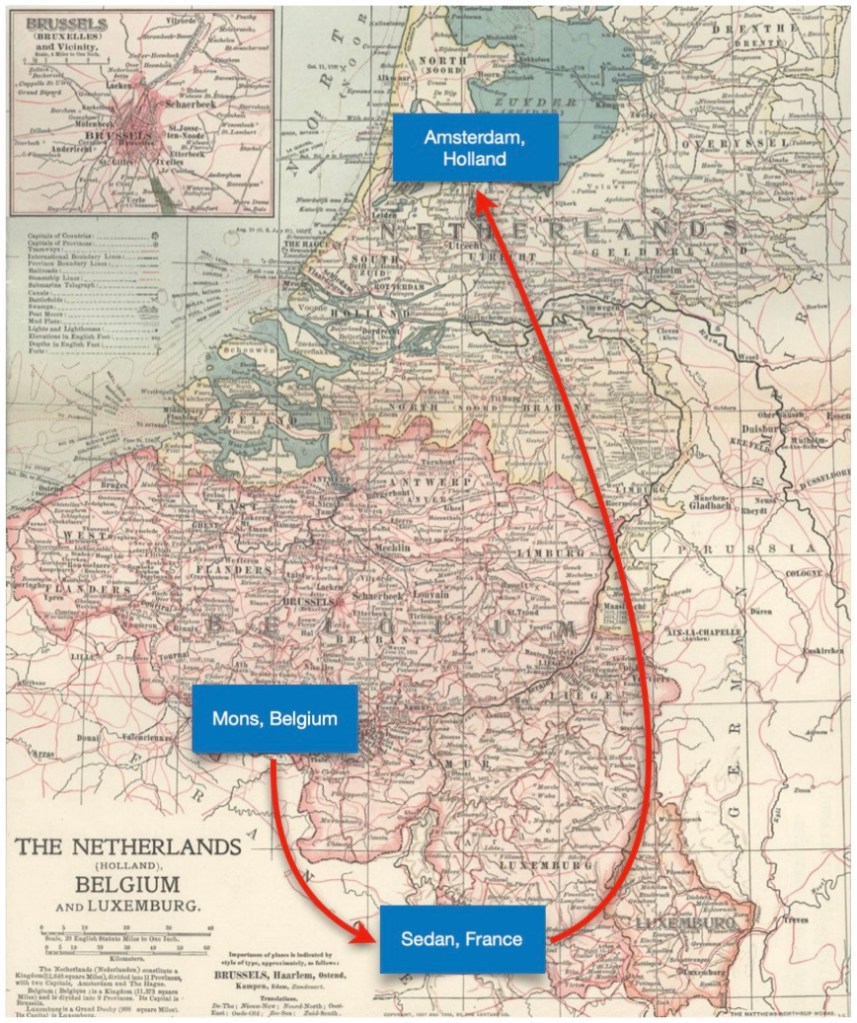
Sarah (Little) Gore was the daughter of Ezekiel and Margret (Fitts) Little. She is buried at Stafford Cemetery in Halifax , and it is assumed that Elijah is buried next to her, even though there is no headstone, nor record of his death.

Before 1779, Elijah Gore Sr. and his family left Connecticut for Vermont. They settled in Halifax, Windham (county), Vermont. Here he owned land located on Vermont’s southern border with Massachusetts. As is often the case, as pioneers moved from place to place they named their new towns and counties after the places they had previously lived. As a result, Windham County is in both Connecticut, and Vermont. Some of their family records also cite the adjacent location of Guilford township, which borders Halifax on its eastern side.

McClelland’s Map of Windham County, Vermont, circa 1856.
Inset image: Halifax and Guilford townships from Vermont’s southern border.
(Image courtesy of the Library of Congress).

Elijah and Sarah Gore had ten children. Their first born, Elijah Jr., was born in Killingly, Connecticut Colony, the next four were born in Voluntown, Connecticut Colony, and the rest in Halifax, Vermont Colony. (2)

  • Elijah Gore Jr., born (Killingly, Connecticut Colony), September 5, 1768 – died 1798
  • Ezekiel Gore, born November 20, 1770 – died May 14, 1847 in Bernardston, Franklin, Massachusetts
  • Margaret (Gore) Stafford, born February 10, 1773 – died March 10, 1864 in Monroe, Franklin, Massachusetts
  • Samuel Gore (4), born, April 10, 1775 – died August 10, 1815 in Belleville, Jefferson, New York (We are descended from Samuel 4).
  • Obadiah Gore born November 20, 1777 – death date unknown
  • Hannah (Gore) Starr, born September 1, 1779 – died 1819 in Halifax, Windham, Vermont
  • Lucy (Gore) Bennett, born May 21, 1781 – death date unknown
  • Daniel Gore, born October 30, 1783 and died April 10, 1859 in Monroe, Franklin, Massachusetts
  • Desire (Gore) Bixby, born November 8, 1786 – died December 8, 1833 in Guilford, Windham, Vermont
  • Sarah (Gore) Slater, born August 12, 1789 and died September 19, 1858 in Chardon, Geauga, Ohio

The French and Indian War

Like the previous narrative, The Gore Line — Four, wars were an elemental part of history in the new American Colonies. In 1666, France claimed “Vermont” as part of New France. From Wikipedia: “French explorer Samuel de Champlain claimed the area of what is now Lake Champlain, giving the name, Verd Mont (Green Mountain) to the region he found, on a 1647 map.”

British forces under fire from the French and Indian forces.

“The French and Indian War (1754–1763) was a theater of the Seven Years’ War, which pitted the North American colonies of the British Empire against those of the French, each side being supported by various Native American tribes. At the start of the war, the French colonies had a population of roughly 60,000 settlers, compared with 2 million in the British colonies. The outnumbered French particularly depended on their native allies. French Canadians call it the guerre de la Conquête  — ‘War of the Conquest’.

Following France’s loss in the French and Indian War, the 1763 Treaty of Paris gave control of the whole region to the British... The end of the war brought new settlers to Vermont. The first settler of the grants was Samuel Robinson, who began clearing land in Bennington in 1761.. In the 28 years from 1763 to 1791, the non-Indian population of Vermont rose from 300 to 85,000.

The Elijah Gore Family were living in a territory that was a disputed frontier, likely quite rugged, and similar enough to other areas their forebears had lived in — that it was filled with opportunity. Indeed, this family was living in “Vermont” before Vermont was Vermont. (3)

Many People Had Tried to Claim Land in Vermont

It’s a complicated situation which played out over several decades and involved different English monarchs, Colonial Governors and various legal representatives, as the borders of Vermont were always in dispute — not only with the French, but also with the neighboring colonies, whose settlers seemed to continually want to expand their land holdings. Some of our ancestors probably got up in the morning and thought to themselves, “I feel a bit betwixt and between — wonder who is in charge today?”

From Wikipedia, on the History of Vermont: “A fort at Crown Point had been built in 1759, and the road stretched across the Green Mountains from Springfield to Chimney Point, making traveling from the neighboring British colonies easier than ever before. Three colonies laid claim to the area. The Province of Massachusetts Bay claimed the land on the basis of the 1629 charter of the Massachusetts Bay Colony. The Province of New York claimed Vermont based on land granted to the Duke of York (later King James II & VII) in 1664. The Province of New Hampshire, whose western limits had never been determined, also claimed Vermont, in part based upon a decree of George II in 1740.”

Engraving depicting Ethan Allen at the Capture of Fort Ticonderoga in 1775.
(Image courtesy of Wikipedia.org).

There was a lot of acrimonious behavior: “In 1770, Ethan Allen—along with his brothers Ira and Levi, as well as Seth Warner—recruited an informal militia, the Green Mountain Boys, to protect the interests of the original New Hampshire settlers against the new migrants from New York… The American Revolution changed the face of these various conflicts after the battle of Bennington, Vermont became important. “The battle was a major strategic success for the American cause…”

In Guilford, the township adjacent to Halifax, we learn from the website, We Are Vermont: “There was so much controversy between Yorkist and Vermont factions at the beginning of the Revolutionary War that 2 sets of officials were fighting for control in Guilford. The fighting escalated to a point where, in 1783, the Vermont government sent Ethan Allen with a Militia to the town to enforce martial law and collect taxes. This was known as the “Guilford War” and eventually those who opposed Vermont’s laws moved to settle in New York.” (4)

*The 1790 “Census” of Vermont

According to the National Archives: “Vermont became a state on March 4, 1791, [as the 14th state] so the census was taken in Vermont in 1791…” Specifically, “The Census was taken in Rhode Island on 7-5-1790 and in Vermont on 3-2-1791 [March 2, 1791], after they ratified the constitution.” [USGenWeb] Even though Vermont had a census, it was after everyone else’s census, and it continues to be mistakenly referred to as the “1790” census.

Our research has concluded that our ancestor Elijah Gore, even though we do not know his exact death date, was still alive after March 1791. We analyzed the census and believe this for the following reasons:
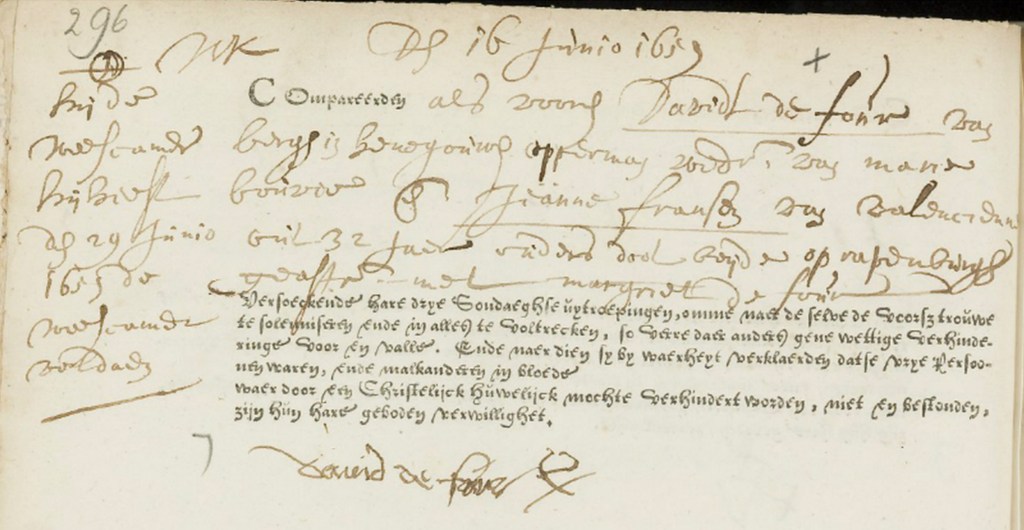
Heads of Families first Vermont census, Page 50, conducted on March 2, 1791.
  1. Their son Elijah Jr. married Susannah Barney on August 17, 1789, in nearby Guilford, so he was likely no longer living with his parents. (When the census was done, it would be highly improbable that his household numbers could match up with the 1791 census data.) Even though he has the same name as his father Elijah Sr., there is only one listing for a man with this name in Halifax Town, Windham County, Vermont, at this time.
  2. The “Free White Males of 16 years and upward including heads of families” would be Elijah Gore Sr., our grandfather, and his son Ezekiel, age 20 years.
  3. The categories show only one “Free White Males under 16 years” living in the home. That would likely be our ancestor Samuel Gore (4), who was 15 at the time.
  4. The “Free White Females including heads of families” indicates one person, who is likely our grandmother Sarah Little.
  5. “All other free persons” are everyone else who was living in the home. That number is 8, which corresponds exactly to everyone else, from Margaret through Sarah.
  6. Lastly, there are no slaves listed. We would expect this from people who identified as Puritans.

Unfortunately, there is scant evidence on the life activities of this ancestor. Elijah’s occupation is unknown, but it’s very likely, he was a farmer. (5)

Two Locations in Windham County?

This branch of the Gore family, owned land in Windham county in two adjacent townships: Halifax and Guilford. (This explains why family records intermix the two locations). The Official History of Guilford, Vermont, 1678-1961, cites the sale of land in Guilford, as illustrated below.

Note that Lot 168 is mentioned as being “on the Halifax line.” It also appears that Elijah Gore may have also owned a portion of Lot 167.

A plan of Guilford, drawn by Nathan Dwight, surveyor, in 1765, showing the original 50-acre and 100-acre lots. The names of many of the earliest settlers have been added, according to the best information available in existing records. From the Official History of Guilford, Vermont, 1678-1961, Digital pages, Inset: 309/585 and for Map: 396/610.

Even though these two townships are next door neighbors, because they were in disputed areas, the records are a bit complicated. Initially, the Royal Governor of New Hampshire, Benning Wentworth, was in charge of the area. From Wikipedia: “Halifax was the second town chartered, west of the Connecticut River on May 11, 1750 by New Hampshire Governor Benning Wentworth, meaning Halifax is the second oldest town in the state after Bennington…” and also, Guilford was “Chartered as Guilford New Hampshire in 1754… chartered [again] “as Guilford, Vermont in 1791″ when Vermont became an official state. Additionally, Guilford is “the most populous town in Vermont from 1791-1820.”

This may also help explain that our research turned up that Elijah Gore Sr. is recorded as having served in the American Revolutionary War, under the banner of Captain Samuel Fillbrick’s Company in (oddly enough) New Hampshire. From the Official history of Guilford, Vermont, 1678-1961, page 135:

This puzzled us at first, but it makes sense that some militias would be organized under the names of other Colonies, since Vermont did not technically exist until after the war, in 1791. (6)

Samuel Gore (4) and Rebeckah Barney Marry

Our ancestor, Samuel Gore (4), born April 10, 1775 Voluntown, Windham, Connecticut Colony – died August 10, 1815 in Belleville, Jefferson County, New York. He married Rebeckah Barney on February 22, 1798, in a ceremony at Halifax, Vermont, officiated by Darius Bullock. She was born April 6, 1782 Guilford, Windham, Vermont – died October 26, 1860 in Belleville, Jefferson, New York. They likely met socially through family or friends because their home townships, Halifax and Guilford, were adjacent to each other.

Rebeckah was the daughter of Deacon Edward Barney, who was a physician and Baptist Deacon. He was born August 18, 1749 in Rehoboth, Bristol, Massachusetts Colony – died August 9, 1839 in Ellisburg, Jefferson, New York. Rebeckah’s mother was Elizabeth Brown, born October 3, 1750 in Middletown, Middlesex, Connecticut – died March 5, 1793 in Guilford, Windham, Vermont. Elizabeth died in childbirth with her 12th pregnancy at the age of 42 — her newborn infant daughter Mabel was buried with her. [William Barney and Familysearch.com footnotes] Together the Barneys had twelve children, with Rebeckah being the 7th child.

Our 4x Great-Grandmother, Rebeckah (Barney) Gore.

Samuel (4) and Rebecca had seven children. The first five were born in Halifax, Windham, Vermont and the youngest two were born in Belleville, Jefferson County, New York.

Observation: Quite notable about this family group, is that these are the first ancestors of whom we have photographic portraits! We’ll meet their children in just a moment, but first, we need to discuss this newly invented portraiture… (7)

The Waking Century — The Advent of Portrait Photography

Suddenly, a new age was upon us…

“Getting painted portraits done used to be exclusive to families in the upper classes of society. That all changed when photography came into existence. In 1839, Robert Cornelius shot the first successful portrait, a self-portrait (a selfie, no less), using the venerable daguerreotype. Cornelius took advantage of the light outdoors to get a faster exposure. Sprinting out of his father’s shop, Robert held this pose for a whole minute before rushing back and putting the lens cap back on.”

“You see, shooting with the daguerreotype required between 3 to 15 minutes of exposure time depending on the available light — making portraiture incredibly impractical if not impossible.” [Soriano, A Brief History of Portrait Photography]

Robert Cornelius’s Self-Portrait, 1839.

Did you ever wonder why the ancestors in many old photographs are not smiling, which is our custom today? From Time Magazine: “Experts say that the deeper reason for the lack of smiles early on is that photography took guidance from pre-existing customs in painting—an art form in which many found grins uncouth and inappropriate for portraiture. Accordingly, high-end studio photographers would create an elegant setting and direct the subject how to behave, producing the staid expressions which are so familiar in 19th century photographs. The images they created were formal and befitted the expense of paying to have a portrait made, especially when that portrait might be the only image of someone.” Indeed, these are the scant few images we have of these ancestors…

Observation: It is quite notable that this generation, born after the Revolutionary War, began heading west and moved into new states and territories: Iowa, Minnesota, New York, Ohio, and Wisconsin — none of them died in Vermont.

Shown below are each of the Samuel and Rebeckah Gore children, with their families and respective portraits.

Gratia (Gore) Cook, born September 27, 1800, Halifax, Windham, Vermont – died, February 16, 1876, Winneconne, Winnebago, Wisconsin.
Left to right: Gratia (Gore) Cook; her sons Eugene Kincaid Cook, and Malcolm G. Cook.

Hart Gore [twin of Clark], born December 13, 1802, Halifax, Windham, Vermont – died February 11, 1892, Rushford, Fillmore, Minnesota.
Top Row, left to right: Hart Gore, his wife Miranda Goodenough, their son Leslie Gore, Bottom row, left to right: Their son Charles W. Gore, his wife Martha E. (Bartley) Gore, and their daughter Mary Jeanette (Gore) Valentine.

Clark Gore [twin of Hart] born December 13, 1803 in Halifax, Windham, Vermont. He married Lydia Burge and they had three children: Martha Lydia Gore, Myron Gore, and Alice Gore.

Luke Gore, born April 1, 1805, Halifax, Windham, Vermont – died October 2, 1868, Newbury, Geauga, Ohio (We are descended from Luke.)
Top Row, left to right: Luke Gore, his second wife, Electa (Stanhope) Gore (our grandmother). Milan R. Gore,* Bottom row, left to right: Crockett Gore*, his wife Lois (Haven) Gore, and Crockett’s son Dana D. Gore.
*Milan and Crockett are the children of Luke Gore and his first wife: Mila Gore. She was born in 1813 in Halifax, Windham, Vermont – died September 29, 1848 in Newbury, Geauga, Ohio. Luke and Mila were first cousins.

Belinda (Gore) Barton, born July 15, 1807, Halifax, Windham, Vermont – died August 15, 1900, Madison, Lake, Ohio
Top row, left to right: Belinda (Gore) Barton, her husband Horace Barton, and their son Hanford Barton. Bottom row, left to right: Their daughter Frances (Barton) Cook, and her husband Eugene Kincaid Cook. Note: Frances (Barton) Cook married her first cousin Eugene Kincaid Cook [see Gratia (Gore) Cook above].

Susan (Gore) Bishop, born February 27, 1812, Belleville, Jefferson, New York – died August 15, 1897, Jefferson County, New York.
Left image: Susan (Gore) Bishop and Center image: Her daughter Emogene Matilda Birdy Bishop.

Mary Genette (Gore) Brayman, born June 18, 1814, Belleville, Jefferson, New York – died February 28, 1891, Farmington, Van Burn, Iowa.
Top Row, left to right: Mary Genette (Gore) Brayman, her daughter Victoria Icebenda (Brayman) Goodenough, and Victoria’s husband Gilbert Clark Goodenough. Bottom row, left to right: The Brayman children — their sons Andrew Jackson Brayman, Edward Barney Brayman, and their daughter Flora Arabella (Brayman) Orr. (8)

Ellisburgh, and Belleville, Jefferson County, New York

After his wife Elizabeth died in 1793, Deacon Edward Barney eventually remarried. He and his second wife Phebe Bennett had six more children. They also moved from Vermont to New York just after the turn of the 19th century.

From the book, The Growth of A Century: “Deacon Edward Barney came from Guilford, Vermont, about 1803 and settled in the town of Ellisburgh. He was a physician and farmer. He died in 1835, aged 86 years. Three of his sons, substantial business men, settled and raised families in that town, and were foremost in efforts to repel invasion during the War of 1812, especially in defence of Sackets Harbor.” [More on this area below.]

So, it’s clear that he relocated his family to New York State, and it was quite a move(!) They relocated up near the border with Canada at the eastern edge of Lake Ontario. Apparently, Samuel Gore (4) and his wife Rebeckah also followed sometime between 1807 when Belinda was born in Vermont, and 1812 when Susan was born in New York.

Ellisburgh and Belleville are located at the eastern edge of Lake Ontario, as indicated by
the inset image. Map of New York 1814 by Mathew Carey from “Careys General Atlas”
(Image courtesy of http://www.old-maps.com).

We often wondered what made them decide to emigrate to a new area after spending generations in New England. The article The Coming of the Pioneers from newyorkgenealogy.org helped explain what had been in the air: “By 1800 the tide of immigration towards Northern New York had definitely set in. The lure of cheap lands in a new country brought settlers by the hundreds from the New England states and the still new settlements in the vicinity of Utica. Marvelous tales were told there of the fertility of the lands in the Black River Country, of corn planted in the ground without plowing growing to over eleven feet in height and of wheat yielding from twenty-five to thirty-five bushels to the acre. A traveling missionary commenting on the universal contention of the pioneers in their new homes along the Black river said that he had not “seen an unhappy person for 90 miles on that river.”

“These tales and others brought sturdy, young men and their families from Vermont and Plattsburgh over the woodland trail into Chateaugay and finally to the infant settlements springing up along the St. Lawrence, the Grass and the St. Regis rivers. They brought others, their household goods laden on crude wood sleds, drawn by oxen, up through the trackless woods of the Black River Country…”

To this day, according to Wikipedia, Ellisburgh, New York is still considered a village, and Belleville, (just north of Ellisburgh even smaller), is considered a hamlet. Most of our ancestors who were there, left the area, or didn’t stay there for very long. The only exception was Susan (Gore) Bishop, who was a lifelong resident. (9)

The War of 1812

Like his father Elijah before him, Samuel Gore (4) participated in the new country’s war efforts, as a private in Captain Jonathan Scott’s Company of Colonel Anthony Sprague’s Regiment Jefferson County Militia, New York. (Curiously, his wife Rebeckah never claimed his war pension, likely because he survived unhurt: “All pensions granted to veterans of the War of 1812 and their surviving dependents before 1871 were based exclusively on service-connected death or disability.”)

We had always thought that the War of 1812 was fought because England was rather cranky and upset that they had lost the American Revolutionary War a generation earlier. [Honestly, it just wasn’t deemed to be that important in American high school history classes.] However, there was much more to the conflict.

From the USS Constitution Museum.org: “The War of 1812 pitted the young United States in a war against Great Britain, from whom the American colonies had won their independence in 1783. The conflict was a byproduct of the broader conflict between Great Britain and France over who would dominate Europe and the wider world.” If you recall, in The Gore Line, A Narrative — Four, we had commented on the fact that England had crafted an economic model that benefited them by extracting resources from their Colonies. This changed after the War For Independence, and was aggravated further when President Jefferson passed the Embargo Act of 1807 in retaliation for what was happening to America’s ships and sailors at sea. The embargo was hard on American farmers because it reduced the market for their products, but they weathered the storm, so to speak.

“In Britain’s effort to control the world’s oceans, the British Royal Navy encroached upon American maritime rights and cut into American trade during the Napoleonic Wars. In response, the young republic declared war on Britain on June 18, 1812. The two leading causes of the war were the British Orders-in-Council, which limited American trade with Europe, and impressment, [read as: kidnapping and forced servitude] the Royal Navy’s practice of taking seamen from American merchant vessels to fill out the crews of its own chronically undermanned warships. Under the authority of the Orders in Council, the British seized some 400 American merchant ships and their cargoes between 1807 and 1812.”

It’s hard to believe this today, but in the expansionist era our ancestors lived in, and with everything else that was going on… There were many Hawks in the Continental Congress who believed, The War would allow them to expand American territory into the areas of Canada, which were defined as Upper Canada (essentially Ontario), and Lower Canada (present day Quebec).

“The acquisition of Canada this year, as far as the neighborhood of Quebec, will be a mere matter of marching; and will give us experience for the attack of
Halifax the next, and the final expulsion of England from
the American continent.”

Thomas Jefferson to William Duane, 4 August 1812

According to the National Park Service: “…many Americans assumed that the Canadian population would welcome the arrival of American forces. In reality, the inhabitants of Canada—a mix of French settlers, American loyalists who had fled north during the War of Independence, and a growing population of ambivalent American transplants – had little reason to embrace an incursion from the south.”

Indeed, “Jefferson also overestimated the readiness of the American armies. Optimists assumed that the U.S. army could be effective as an invading and occupying force… Jefferson also misjudged the effectiveness of the British army. Their own success fighting and defeating the British redcoats during their War of Independence proved a deceptive lesson. Unlike the British troops Americans faced during the Revolution, the British army that arrived in Canada was better led and battle-hardened by twenty years of experience fighting against Napoleonic France.”

However, with our ancestors living where they lived, it was a prime area for much conflict. “Jefferson County early became the theater of active military and naval operations. Sackets Harbor was then the most important point on Lake Ontario. It was made the headquarters of the northern division of the American fleet, and here were fitted out numerous important expeditions against the British in Canada.”[RootsWeb, Child’s Gazetteers 1890]

Furthermore, “The war started in 1812 and lasted until 1815, though a peace treaty had been signed in 1814. Over 2200 US soldiers died and over 1600 British. Jefferson County played a central role in the war, from beginning to end. It was the headquarters of Commodore Isaac Chauncey and the US Navy of the Great Lakes. Six armed engagements were fought in Jefferson County during the war, more so than any other county on American soil. The successful campaigns against York and Niagara (1813) were launched from Sackets Harbor, as were the not so successful campaigns on Montreal and Niagara (1814). Perry’s victory on Lake Erie was also directed from Jefferson County under the command of Isaac Chauncey.” [Jefferson County NY Wiki]

As far as we know, it’s a miracle that none of our family members in this line, died during this time. In Part Six we are writing about our ancestor Luke Gore and his family, as they move west from New England — perhaps following other family members who led the way. (10)

Following are the footnotes for the Primary Source Materials,
Notes, and Observations

A Special Note About This Chapter
There is a wealth of well done documentation completed by other fellow researchers about this family line, in the Familysearch.org website. We would like to bring this work to your attention, as follows:

Note 1: For an excellent traditional muti-generational classical family tree which includes names, dates, marriages, and children, see —
https://www.familysearch.org/tree/pedigree/landscape/LQ5C-1D1

Note 2: The research also contains a robust amount of detail and source information for those researchers who would like to research their ancestors beyond the classical “family tree” level.

Note 3: Here is an example — again from this link: https://www.familysearch.org/tree/pedigree/landscape/LQ5C-1D1 , then click on the name Samuel Gore found within the center screen block above his wife’s name, Rebeckah Barney. This will open a biography box on the right side of your screen.

From there, click on the PERSON box, just below Samuel’s birth and death information. This will open a new window which displays useful links such as Details, Sources, etc.

Here is the path: Pedigree landscape view (classical tree) > Samuel Gore biography page > PERSON link > Useful links

Grandma Moses Certainly Knew How to Paint The Rural Life

(1) — two records

Moving Day on the Farm
Painting by Anna Mary Robertson Moses, known as “Grandma Moses”
https://www.wikiart.org/en/grandma-moses/morning-day-on-the-farm-1951

Grandma Moses
https://en.wikipedia.org/wiki/Grandma_Moses

Elijah Gore Sr., and Desire Safford Have a Big Family

(2) — eight records

Elijah Gore
Birth – Connecticut Births and Christenings, 1649-1906
 https://www.familysearch.org/ark:/61903/1:1:F74J-LJY
Note: This is his christening record, one week after his birth.

Sarah Little
Vital – Massachusetts, Town Clerk, Vital and Town Records, 1626-2001

https://www.familysearch.org/ark:/61903/1:1:F4FR-L9K
Book page: 117, Digital page: 65/544.    Right page, last entry.
Note: For her birth registration.

Elijah Gore and Sarah Little marriage
Marriage – Connecticut, Vital Records, Prior to 1850

https://www.familysearch.org/ark:/61903/1:1:QPQ7-57TX
Digital page: 8822/10,566

Sarah Little Gore
https://www.findagrave.com/memorial/57390841/sarah-gore

Elijah Gore
in the Connecticut, U.S., Town Marriage Records, pre-1870 (Barbour Collection)

Voluntown Vital Records 1708-1850
https://www.ancestry.com/discoveryui-content/view/225419:1062?tid=&pid=&queryId=1d2415c4e44686d563db8be245d11749&_phsrc=DZs10&_phstart=successSource
Book page: 180, Digital page: 52/122, Lower portion of page.
Note: For the Gore family children born in Voluntown, Connecticut.

The Descendants of George Little Who Came to Newbury, Massachusetts, in 1640, from the American Genealogical-Biographical Index (AGBI)
by George Thomas Little, A.M., 1892
https://www.ancestry.com/imageviewer/collections/10376/images/dvm_GenMono000214-00002-0?ssrc=&backlabel=Return&pId=2000000000
Book pages: 53-54, Digital pages: 73-74/664 Under Entry 200
Note: This file lists a Joseph Gore born 1797, a child which we have not included because we believe that it is an error.

Elijah Gore
in the Geneanet Community Trees Index
https://www.ancestry.com/discoveryui-content/view/6873371156:62476
Note: This file lists a Joseph Gore born 1797, a child which we have not included because we believe that it is an error.

Library of Congress
McClellan’s Map of Windham County, Vermont
by J. Chace, C. McClellan & Co.
https://www.loc.gov/resource/g3753w.la001192/?r=-0.491,0.249,1.604,0.777,0
Note: For map image.

The French and Indian War

(3) — three records

History of Vermont
https://en.wikipedia.org/wiki/History_of_Vermont

French and Indian War
https://en.wikipedia.org/wiki/French_and_Indian_War

We Are The Mighty
Today in Military History: George Washington spills first blood of French and Indian War
https://www.wearethemighty.com/articles/today-in-military-history-george-washington-spills-first-blood-of-french-and-indian-war/
Note: For the illustration.

Many People Had Tried to Claim Land in Vermont

(4) — four records

History of Vermont
https://en.wikipedia.org/wiki/History_of_Vermont

Battle of Bennington
https://en.wikipedia.org/wiki/Battle_of_Bennington

File:Fort Ticonderoga 1775.jpg
https://commons.wikimedia.org/wiki/File:Fort_Ticonderoga_1775.jpg
Note: For the Illustration of Ethan Allen

Vermont.com
Vermont.com Guide to Guilford
https://vermont.com/cities/guilford/

*The 1790 “Census” of Vermont

(5) — four records

1790 Census: Heads of Families at the First Census of the United States 
Taken in the Year 1790

https://www.census.gov/library/publications/1907/dec/heads-of-families.html
Note 1: 5 Downloadable .pdf files
Note 2: Click on Vermont, Published in 1907 > Download All Vermont [21.0 MB]

The National Archives
1790 Census Records
https://www.archives.gov/research/census/1790

USGenWeb Free Census Project Help, HISTORY of the United States – Federal Census, 1790-1920
http://www.usgwcensus.org/help/history.html

Elijah Gove Jr
in the Vermont, U.S., Vital Records, 1720-1908

https://www.ancestry.com/discoveryui-content/view/345462:4661
Digital page: 2859/4084

Two Locations in Windham County?

(6) — four records

Official History of Guilford, Vermont, 1678-1961.
With Genealogies and Biographical Sketches
Edited by National Grange, Vermont State Grange, Broad Brook Grange No. 151, Guilford
https://archive.org/details/officialhistoryo00unse/page/308/mode/2up
Note 1: Gore farm sale, Book page 309, Digital page: 308/585
Note 2: Tipped-in, foldout map of original property lots, Digital page 396/610

Halifax, Vermont
https://en.wikipedia.org/wiki/Halifax,_Vermont#External_links

Guilford, Vermont
https://en.wikipedia.org/wiki/Guilford,_Vermont

Official History of Guilford, Vermont, 1678-1961.
With Genealogies and Biographical Sketches
Edited by National Grange, Vermont State Grange, Broad Brook Grange No. 151, Guilford
https://archive.org/details/officialhistoryo00unse/page/308/mode/2up
Note: Elijah Gore Revolutionary War service, page 135.

Samuel Gore (4) and Rebeckah Barney Marry

(7) — three records

Genealogy.com
Re: Barneys and Potters and Briggs, Oh My:-)
By William Barney
https://www.genealogy.com/forum/surnames/topics/barney/776/
Note: Home > Forum > Surnames > Barney

Mrs Elizabeth Barney
Vital – Vermont, Vital Records, 1760-1954

https://www.familysearch.org/ark:/61903/1:1:XFFT-335
Digital page: 2891/4008
Note: For her death record.

Source for the Gore Family Photograph Portraits:
https://www.familysearch.org/tree/pedigree/landscape/LQ5C-1D1

The Waking Century — The Advent of Portrait Photography

(8) — two records

Photography by Jay
A Brief History of Portrait Photography
by Jay Soriano
https://jaysoriano.com/a-brief-history-of-portrait-photography/

Time
Now You Know: Why Do People Always Look So Serious in Old Photos?
by Merrill Fabray
https://time.com/4568032/smile-serious-old-photos/

Ellisburgh, and Belleville, Jefferson County, New York

(9) — six records

Growth of a Century : as illustrated in the history of Jefferson County, New York, from 1793 to 1894
by John A. Haddock https://archive.org/details/growthofcenturya00hadd/page/n749/mode/2up
Note: For information on the Barney family and Deacon Edward Barney

NY Genealogy
The Coming of the Pioneers
Franklin County, Jefferson County, Lewis County, Oswego County, Saint Lawrence County
by New York Genealogy
https://newyorkgenealogy.org/franklin/the-coming-of-the-pioneers.htm

Map of New York 1814 by Mathew Carey from “Careys General Atlas”
by Mathew Carey
http://www.old-maps.com/NY/ny-state/NY_1814_Carey-web.jpg
Note: For map image.


ThoughtCo.
History of American Agriculture
American Agriculture 1776–1990
by Mary Bellis
[Under the subhead] Agricultural Advances in the United States, 1775–1889
https://www.thoughtco.com/history-of-american-agriculture-farm-machinery-4074385
Note: For the farm scene image.

Ellisburg, New York
https://en.wikipedia.org/wiki/Ellisburg,_New_York
and
Belleville, New York
https://en.wikipedia.org/wiki/Belleville%2C_New_York

The War of 1812

(10) — nine records

USS Constitution Museum
The War of 1812 Overview
https://ussconstitutionmuseum.org/major-events/war-of-1812-overview/#:~:text=The%20two%20leading%20causes%20of,its%20own%20chronically%20undermanned%20warships.

Samuel Gore
Military – United States War of 1812 Index to Service Records, 1812-1815

https://www.familysearch.org/ark:/61903/3:1:33SQ-G5Z8-9GNM?view=index&action=view&cc=1916219
Digital page: 2210/2843

Samuel Gore
in the U.S., War of 1812 Pension Application Files Index, 1812-1815

https://www.ancestry.com/discoveryui-content/view/72654:1133
Digital page: 740/946

National Archives and Records Administration
Bounty-Land Warrants for Military Service, 1775–1855
https://www.archives.gov/files/dc-metro/know-your-records/genealogy-fair/2012/handouts/war-of-1812-bounty-lands.pdf
and
Publication Number: M-313
Publication Title: Index to War of 1812 Pension Application Files
https://www.archives.gov/files/research/military/army/dc/m313.pdf

Britannica.com
Embargo Act , United States [1807]
https://www.britannica.com/topic/Embargo-Act

The National Park Service, article —
“The acquisition of Canada this year will be a mere matter of marching”
https://www.nps.gov/articles/a-mere-matter-of-marching.htm

Jefferson County NY Wiki
War of 1812
https://jeffcowiki.miraheze.org/wiki/War_of_1812#:~:text=Jefferson%20County%20played%20a%20central,other%20county%20on%20American%20soil.

WAR OF 1812
(from Child’s Gazetteer(1890) – pp. 141-171)
https://freepages.rootsweb.com/~twigs2000/genealogy/warchilds.html

The War of 1812 Gallery images:
From various Google search sources.

The Gore Line, A Narrative — Four

This is Chapter Four of eight. In this chapter of the Gore narrative, we are documenting a momentous century in the lives of the men and women in two more generations of our family. They journey from their homes in Roxbury, Massachusetts Colony, to the Connecticut Colony, and eventually find themselves facing the American Revolution.

Our ancestors were born into a world already in transition… before we venture further, it is important to understand some of what had been occurring in the New England area of their births.

The New England Colonies in 1677. (Image courtesy of the National Geographic Society).

Preface: Troubles Brewing — Change is Fomenting

The English Monarchy governed its far-flung colonies by the power of extracting resources, then having those resources shipped to England for their own manufacturing use. These raw materials were then processed into goods (for example, textiles such as blankets), which were then shipped to the North American Colonies, sold and taxed. This scheme worked very well for England, but added to a growing sense of displacement which many Colonists felt about their place in the world. What were their rights to self-governance? How did a distant, far off monarchy fit into their worldviews?

Literally and figuratively, boundaries were shifting.
Literally, with the actuality that colonies, territories, and borders, were all shifting in a state of flux. Unlike today, as we move through a highly-bound, demarcated world, they were somewhat unbound, trying to figure it out as they went along. Figuratively, our ancestors were starting to form a ‘mental map’ of a world which was really quite different from that of their forbearers.

The English Monarchy was also going through some important changes. From essayist Joerg Knipprath: “There have been few times as crucial to the development of English constitutional practice as the 17th century. The period began with absolute monarchs ruling by the grace of God and ended with a new model of a constitutional monarchy under law created by Parliament. That story was well known to the Americans of the founding period.

The Gore family had settled in Roxbury, Massachusetts, which is on the far eastern shore of the North American continent. As time went on, more colonists arrived and land holdings expanded to fill what was available under British governance. People wanted stability and prosperity, but the choices about where to further go were somewhat limited. For the settlers, this meant that ‘you’ needed to expand to the colonies to the north, or to the south. Movement into the western areas, was prohibited, but also, those areas in the 17th century were wilderness, unexplored, and generally hostile. (1)

King Philip’s War

Our ancestors were used to thinking about kings and queens of the European sort, but now they were going to meet a local king, who was new to their understanding. The following is excerpted from the Native Heritage Project article, King Philip’s War:

“King Philip’s War was sometimes called the First Indian War, Metacom’s War, or Metacom’s Rebellion and was an armed conflict between Native American inhabitants of present-day southern New England, English colonists and their Native American allies in 1675–76. The war is named after the main leader of the Native American side, Metacomet, known to the English as “King Philip”. 

“Throughout the Northeast, the Native Americans had suffered severe population losses due to pandemics of smallpox, spotted fever, typhoid and measles, infectious diseases carried by European fishermen, starting in about 1618, two years before the first colony at Plymouth had been settled. Plymouth, Massachusetts, [which] was established in 1620 with significant early help from Native Americans, particularly… Metacomet’s father and chief of the Wampanoag tribe.

“Prior to King Philip’s War, tensions fluctuated between different groups of Native Americans and the colonists, but relations were generally peaceful. As the colonists’ small population of a few thousand grew larger over time and the number of their towns increased, the Wampanoag, Nipmuck, Narragansett, Mohegan, Pequot, and other small tribes were each treated individually (many were traditional enemies of each other) by the English colonial officials of Rhode Island, Plymouth, Massachusetts Bay, Connecticut and the New Haven colony.”

Over time, “…the building of [Colonial] towns… progressively encroached on traditional Native American territories. As their population increased, the New Englanders continued to expand their settlements along the region’s coastal plain and up the Connecticut River valley. By 1675 they had even established a few small towns in the interior between Boston and the Connecticut River settlements. Tensions escalated and the war itself actually started almost accidentally, certainly not intentionally, but before long, it has spiraled into a full scale war between the 80,000 English settlers and the 10,000 or so Indians.

Drawing depicting the capture of Mrs. Rolandson during the King Philip’s War between colonists and New England tribes, 1857, Harper’s Monthly. (Image courtesy Library of Congress).

From Wikipedia: “The war was the greatest calamity in seventeenth-century New England and is considered by many to be the deadliest war in Colonial American history. In the space of little more than a year, 12 of the region’s towns were destroyed and many more were damaged, the economy of Plymouth and Rhode Island Colonies was all but ruined and their population was decimated, losing one-tenth of all men available for military service. More than half of New England’s towns were attacked by Natives.” (2)

King Philip’s War began the development of
an independent American identity.
The New England colonists faced their enemies without support
from any European government or military,
and this began to give them a group identity separate and distinct from Britain.

The Name of War: 
King Philip’s War and the Origins of American Identity
by Jill Lepore

Philip Wells and The Dominion of New England,
1686-1689

The institution of The Dominion of New England by the Royal Fiat of King Charles II added to an already existing “stew” of tensions in the colonies. It didn’t last that long, and Sir Edmund Andros was dispatched by the Colonists fairly quickly. For our family, the most important resulting aspect was this:

The British rulers knew that when you have accurate maps, you have power.

From the Historical Journal of Massachusetts: “The arrival of Wells and Andros’s government in Massachusetts signaled a major change in how the colonists described borders. In late 1686, King James II appointed Edmund Andros as the governor of the Dominion of New England, an administrative body that combined all the colonies.”

“While previously Massachusetts colonists selected their governors, Andros was an imposition from the King. King James II aimed to streamline the administration of the small New England colonies and bring their unruly subjects more directly under imperial control. A stark contrast to the less experienced, agrarian focused, and rurally raised leaders of early New England.”

“Although Massachusetts colonists had begun to gradually embrace mapping as a tool after the 1650s, the Dominion, an imperial tool, accelerated this process. Unsurprisingly, Andros employed familiar tools of state building and state power, including maps. He gave Wells a new appointment as the head surveyor for the Dominion and hired at least three deputy surveyors, Richard Clements, John Gore, and John Smith. Each man generally operated in a particular area… John Gore in “Napmuge [Nipmuck] Country” in present-day central Massachusetts. (3)

Did the Gore Brothers See An Opportunity?

When we first met our ancestor Samuel Gore (1) in The Gore Line — Three, we learned that he had been born in Roxbury, Massachusetts Colony, in October 1652. He was not the oldest surviving son in the family. That distinction belonged to his older brother John (2), who was the (part-time) Writ for the town of Roxbury, and was also a sought-after, skilled surveyor. These positions would have required some degree of formal education, and would be in demand in a fast-growing colony.

Inset: A youthful George Washington surveying at Pope’s Creek, Virginia. Image courtesy of the National Park Service. Background: Frontispiece from Samuel Wyld’s The Practical Surveyor (1780). (Image courtesy of the American Philosophical Society, APS).

Notes: As the oldest son, John (2) would have benefited from primogeniture*, which was the standard for that time. (This meant that the Lions Share of the father’s estate went to the oldest son before any other person.) However, this did not always happen in the Northern Colonies, and in his father’s Will of 1657, this did not happen for John (2), as he had already received his portion of his father’s estate. Hence, his younger brother Samuel (1) likely benefited somewhat.

*primogeniture (noun)
– the state or fact of being the firstborn of children of the same parents.
Law. the system of inheritance or succession by the firstborn, specifically the eldest son.

Observation: Additionally, as a surveyor, he was involved in projects which may have influenced the younger Samuel in his choices about where his family would live. They appear to have interacted frequently throughout their lives, as they both did surveying work, and were land-holders themselves. During a time of frequent land speculation, it seems quite likely, that they both benefited from information gained while doing their professions. From the Cameron County Genealogy Project: “Samuel Gore came into the sole possession of his father’s common lands in 1716… On 2 March 1712/13 he was elected one of the Fence Viewers of Roxbury and 3 March 1717 was one of the Surveyers of Highways.” (4)

The New Roxbury Colony, and The Mashamoquet Purchase

The people of Roxbury, Massachusetts Colony had run out of land and they decided to do something about it rather than wait for permission from, or action by, their British Governor-by-fiat, Sir Edmund Andros.

The town of Roxbury was one of the most ancient and influential in Massachusetts Colony.
”The Roxbury people were the best that came from England,” and filled many of the highest offices in the colonial government.

Nothing was lacking for their growth and prosperity
but a larger area of territory, then “limits being so scanty and not capable of enlargement that several persons…
— were compelled to remove out of the town and colony.

Ellen D. Larned
author of The History of Windham County,
page 18

In 1642, the Woodward and Saffery line was established as the southern border of the Massachusetts Colony, and thus, the northern border of the Connecticut Colony. Within a couple of decades of that date, in the rough-and-tumble early Colonial period, the people of Massachusetts wanted more land, and their neighbors to the south in the Connecticut Colony, started to take issue with what they felt was their land. It all got very complicated.

In addition, many skirmishes between the Colonists and the Native American tribes had resulted in King Philip’s War, which had destroyed much infrastructure and weakened both sides. The “Indians” in shock from their defeat, had started to return to their old haunts, which the Colonists were looking to expand into. Perhaps the Roxbury settlers were spurred on by the arrival of The Dominion, because by 1686, boundaries and settlements were changing.

There was a grant for “Indian” lands that consisted of two portions in Nipmuck County — one portion was called Myanexet, and the other Quinnatesset. This land had been acquired by the English representatives William Stoughton and Joseph Dudley; purchased in 1682 from the Indian representative Black James, for £50 by the English Government. From The History of Windham County: Among the first to arrive… “The land thus purchased was laid out in June, 1684, by John Gore [2], of Roxbury, under the supervision of Colonel William Dudley.”

This colorful image purports to show George Washington working as a surveyor in Colonial America. We are using it as a stand-in for our ancestor John Gore working with Indian guides in the wilds of the Massachusetts and Connecticut colonies.

Circa May 1686 —
“In May, they were visited ‘ by Samuel Williams, Sen., Lieutenant Timothy Stevens and John Curtis, who, with John Gore as surveyor, came as committee from Roxbury, ‘to view the land, in order to the laying out of the same ; settle the southern bounds (upon or near the colony line)… Eleven days were spent by Mr. Gore in making the needful surveys and measurements — Massachusetts’ South boundary line evaded their search, so they made a station about one and a half miles south of Plaine Ilill, and thence marked trees east and west for the south line of their grant, nearly two miles south of the invisible Woodward’s and Safferys line, thus securing to Massachusetts another strip of Connecticut territory.”

Problems arose due to the perceived position of the Woodward and Saffery line, and then it was not clear who exactly who was at fault with information from 1642. (Remember, earlier maps were not very precise before this period). Ultimately, what was surveyed created problems for both Colonies.

This chart from page 15 of Windham County shows the survey work by John Gore (2) that was completed for the Quinnatesset portion of the land purchase. The horizontal line is the Woodward and Saffery line. Above that line is Massachusetts and below it is Connecticut. The small letter ‘e’ on the left portion is the designation for Samuel Gore (1)‘s purchase — the father of John Gore (2). For whatever reason, land purchased by both Thompson and Gore ended up “being-ish” (new word!) in Connecticut, not Massachusetts. This was a problem in the fact that the Colonies were (of course) governed by Britain, and these two colonies had separate governments whose interests were not aligned.

Further excerpted material from Windham County: “No attempt was made to occupy and cultivate these farms by their owners. Thompson’s land remained in his family for upwards of an hundred years, and the town that subsequently included it was named in his honor.”

As time went on, Mashamoquet was the name of a river which was frequently used as a boundry marker. By 1686, the land was known as the Mashamoquet Purchase, and the village settlement was called New Roxbury.

“The survey and divisions (of land) were accomplished during the winter, and on March 27th, 1694, nearly eight years after the date of purchase, the several proprietors received their allotments in the following order: 1, Esther Grosvenor; 2, Thomas Mowry; 3, John Ruggles; 4, John Gore; 5, Samuel Gore [1] ’s heirs; 6, Samuel Ruggles; 7, John Chandler; 8, Jacob, Benjamin and Daniel Dana; 9, Benjamin Sabin; 1 0, Thomas and Elizabeth Ruggles; 11, John White; 12, Joseph Griffin… Note that Samuel Gore’s heirs received his allotment of land. Samuel died in 1694, age 41, two years before the division of land in Connecticut was completed.”

In 1690, the village was renamed Woodstock.

Connecticut was originally settled by Dutch Fur Traders. The first English settlers arrived in Connecticut in 1663 under the leadership of Reverenced Thomas Hooker. They were Puritans from the Massachusetts Bay Colony.

“By the settlement of Massachusetts boundary line in 1713… Massachusetts was forced to admit that Woodward’s and Saffery’s line ran some miles south of the bound prescribed by her patent… That Connecticut had a lawful right to the fee as well as jurisdiction of this land no one could deny, but beset by enemies at home and abroad she was forced to yield it to the stronger Colony, and allowed Massachusetts, by formal agreement and covenant, to keep the towns laid out by her in Connecticut territory, and the various grantees to retain possession of this land, receiving as equivalent an equal number of acres in distant localities. Under this arrangement, Connecticut yielded: To the town of Woodstock, 50,410 acres. …To John Gore, 500 acres…

…and in 1749 the town officially chose to became part of Connecticut.

In the more southern portion of the Mashamoquet Purchase, below the village of Woodstock (formerly New Roxbury), another small township was established named Pomfret. It was incorporated in 1713, and is important to the next generation of the Gore Family. (5)

Captain Samuel Gore (2) Marries Hannah Draper

Samuel Gore (2) was born on October 20, 1681, in Roxbury, Massachusetts Colony – died May 27, 1756, in Norwich, Connecticut Colony. He married Hannah Draper about 1703, when he was 22 and she was 17 years old. Hannah was born April 8, 1686 in Roxbury, Massachusetts Colony and died July 11, 1741, in Norwich, Connecticut Colony. They are both buried in the Eliot Burying Ground in Roxbury, Suffolk County, Massachusetts.

Hannah was the daughter of Moses Draper and Hannah Chandler. He was born on September 15, 1664 in Dedham, Massachusetts – died August 14, 1693 in Boston, Massachusetts Colony, age 29. His parents were James Draper and Miriam Stansfield.

Hannah (Chandler) Draper, was born September 19, 1669 in Roxbury, Suffolk, Massachusetts Colony – died June 9, 1692 in Roxbury, Massachusetts, age 22. Her parents were John Chandler and Elizabeth Douglass.

Hannah (Draper) Gore was six years old when her mother died in July 1692. In November 1962 her father, Moses Draper, married Mary Thatcher. A child, Moses Draper, Jr. was born September 12, 1693. However, the father, Moses, had died the month before his birth. By age seven, Hannah was an orphan. Her guardianship was given to her Uncle James Draper on August 1, 1695. It is unclear if she was raised by him, or remained with Mary (Thatcher) Draper and her step-brother Moses. Below is interesting information regarding the settlement by 1715 of Moses Draper’s estate.

All three pages above are from The Drapers In America, Being a History and Genealogy Those of That Name and Connection, by Thomas Wall-Morgan Draper, 1892. Note on the third page (167): A past genealogist wrote-in “Samuel” in pencil, to correct the author’s error about her husband.

Samuel Gore (2) and Hannah (Draper) Gore Family

For the first eleven years of their marriage Samuel (2) and Hannah lived in Roxbury, Massachusetts where the first six of their nine children were born.
Note: CTC = Connecticut Colony, CT = Connecticut State

  • Elizabeth (Gore) Witter, born January 12, 1704 – died April 9, 1761 Preston, CTC
  • Samuel Gore, born March 26, 1705 – died May 22, 1706 (one year old)
  • Samuel Gore (3), born May 29, 1707 – died July 26, 1791 Voluntown, CT
    (We are descended from Samuel 3).
  • Moses Gore, born September 23, 1709 – died 1786 Cornwallis, Kings, Nova Scotia, Canada
  • John Gore, born October 11, 1711 – died January 19, 1735, Norwich CTC
  • Obadiah Gore, born July 26, 1714 – died 10 January 1779, of smallpox in Wyoming, Pennsylvania. Notably, he lost several adult children in another Native American “Indian War” — the Wyoming Valley Massacre July 3, 1778.

    Their youngest three were born in Norwich, Connecticut Colony (CTC):
  • Daniel Gore, born September 6, 1719- died October 4, 1719 (one month old)
  • Hannah (Gore) Burrow/Gallup, born December 20, 1720 – died March 19, 1810 Stonington, CT
  • Sarah (Gore) Hobart born January 15, 1723 – died July 28, 1743 Stonington, CTC

After his wife Hannah (Draper) Gore died in 1741, Samuel (2) married for a second time to Mrs. Dorcas Blunt on May 13, 1742. (6)

What The Connecticut Charter of 1662 Accomplished

The Conneticut Charter was remarkable for several reasons. From Wikipedia: The English Parliament restored the monarchy in 1660, and King Charles II assumed the English throne. Connecticut had never been officially recognized as a colony by the English government, so the General Court determined that the independence of Connecticut must be legitimized... The key document mapping out Connecticut’s original boundaries wasn’t in fact a map. It was, instead, a royal charter… arguably the most important document in Connecticut’s history—contains among its other provisions a written description of the colony’s boundaries that served the same function as a drawn map.

Charter of the Colony of Connecticut, 1662 – Connecticut State Library.

The document described Connecticut’s western borders extending through Pennsylvania-claimed lands all the way to the ‘southern sea”. From Connecticut History.org: “The “South Sea”—what we call the Pacific Ocean—was well known to early navigators, but its exact location in relation to Connecticut Colony was unclear in 1662. What England’s King Charles II effectively granted Connecticut through that grandiose wording was a swath of land some 70 miles north to south, stretching from the Narragansett Bay on the east to the northern California/Oregon coast just west of Mount Shasta...

“Historians have long marveled at the generous provisions of the 1662 royal charter. In addition to the transcontinental footprint, the king also granted Connecticut virtually complete governmental autonomy more than a century before the Declaration of Independence. The charter’s provisions in this regard were so complete that when other states scrambled to create new constitutions at the start of the American Revolution, Connecticut simply replaced the king’s name with “the people of Connecticut” and continued using the charter as its constitution until 1818!”

Observations: It is plausible that these boundaries would could have influenced the choices of the ancestral descendants found further on in The Gore Line after this era. For us in the present day, the “western” boundary became a defining feature of where we grew up in Ohio. (7)

The Houses of Stuart and Orange: Queen Anne (reigned 1702 – 1707), and then she continued as Queen under The House of Stuart, (reigned 1707 – 1714), The House of Hanover, George I (reigned 1714-1727), George II (reigned 1727 – 1760).

The Samuel Gore Family Moves to Norwich in the Connecticut Colony

Observation: Samuel Gore (2), was the son of a carpenter and part-time surveyor, but most importantly, he was connected through his relatives to land investments in New England. Land ownership may have been his primary means of retaining wealth. He may have been a farmer (yeoman), but we doubt that he ever pushed a plow in his early life. He likely leased his lands and had other people to do much of the hard labor. (This may have been different for his children and grandchildren…)

The History of Windham County records that John Chandler, the grandfather of Hannah (Chandler) Gore purchased “Pomfret land” from Samuel Gore (2) about 1716. It is probable that Samuel (2) had likely acquired the land he sold, through his inheritance from his father Samuel (1). John then moved his family from Roxbury, Massachusetts Colony to Pomfret, Connecticut Colony. Pomfret was then a newly established area formed from the Mashamoquet Purchase.

Additionally, the Weld Collections, by Charles Frederick Robinson, records of Samuel (2)… “He was of Roxbury in 1719, and 20 July, 1734, he was of Norwich, Conn. He sold on the former date [1719] land in Roxbury on the Dedham road, for £420, Hannah his wife releasing her right of dower (SD 57.16). It is likely that this land “on Dedham Road” was the original land of Moses Draper, the father of his wife Hannah, (see Drapers in America, p 165 above).

In 1721, Samuel (2) was commissioned Captain of the 5th Company, Connecticut Militia, located in Norwich. (8)

The Susquehanna Company

Can we acquire that land?
…seemed to be a dominant theme for these generations of the Gore Family. From Connecticut History.Org: “In 1753, amidst a flurry of land speculation and westward expansion that captivated the imagination of American colonists, Connecticut settlers formed the Susquehanna Company for the purposes of developing the Wyoming Valley in northeastern Pennsylvania... a shortage of farmland and a growing population had encouraged some in Connecticut to revisit the terms of the colony’s original land grant…” — the one that promised that Connecticut’s borders extended ever westward. See above: What The Connecticut Charter of 1662 Accomplished

“Pennsylvania also had a royal charter, issued in 1681 by the same king, that gave it title to the territory in question. This was not unusual, as the imperial bureaucracy back in England often possessed only rudimentary knowledge of the vast American terrain.”

Map The Part of Pennsylvania that Lies Between the Forks of the Susquehanna, Divided into Townships, ca. 1790s. Courtesy of the Library of Congress, Geography and Map Division.

“So, in 1754, when the Susquehanna Company acquired the land for 2,000 pounds from an Iroquois delegation at a conference in Albany, New York, many called the validity of the transaction into question. Settlement of the area (which also included land west of the Wyoming Valley and made up almost one-third of Pennsylvania) quickly became a divisive issue among Connecticut, Pennsylvania, and several tribal nations, as well as within the Connecticut colony itself.

Samuel Gore (2) and his son, Obadiah Gore, had become members of The Susquehanna Company. As owners of one right, or share, their names appear among the names of the grantees in the Indian deed of July 11, 1754. Twenty-four years later the younger Gore generation would fight in the Battle of Wyoming (a county in Pennsylvania).

Ultimately by 1799, Connecticut gave up any claim it had to lands in Pennsylvania, but this was not before one particularly famous, but truly terrible battle, changed the lives of some of our ancestors. (9)

The Battle of Wyoming (County), Pennsylvania

The situation in Pennsylvania came to a head in the Wyoming Valley Massacre of July 3, 1778. The family of Captain Obadiah Gore did not fare well. (10)

Battle Of Wyoming, 1778 by Alonzo Chapel (1858). Public domain.

“When the Battle of Wyoming was fought, Capt. Obadiah Gore was one of the small company of old men who remained in Forty fort for its defense…” Three of Obadiah Gore’s sons and two sons-in-law died in the Battle of Wyoming that day fighting for The Continental Army. Fully recounted below, more than a century later, in A History Of, Luzerne County, Pennsylvania, 1893 edition:

Samuel Gore (3) Marries Desire Safford

Samuel Gore (3) was born on May 29, 1707, in Roxbury, Massachusetts Colony – died July 26, 1791, in Voluntown, Connecticut, USA. He moved with his parents to Norwich, Connecticut sometime in his childhood. He married Desire Safford February 25, 1735/36 in Norwich, New London County, Connecticut Colony. She was born on October 18, 1717 in Voluntown, Connecticut Colony – died September 11, 1772, same location. Desire was the daughter of John Safford and Dorothy Larrabee.

From Family Search.org: “Before 1881, Voluntown belonged to Windham County, Connecticut, instead of New London County. Much of the land situated in what is now Voluntown was granted to the volunteers of the Narragansett War in 1700. The name ‘Volunteer’s Town’ turned into what is now known as Voluntown.

Although this map was created in 1856, Voluntown boundaries had stayed the same since Samuel Gore (3)’s lifetime.

Samuel Gore (3) and Desire had nine children. He moved his family from Voluntown, some 14 miles north east of Norwich, and then returned to Norwich, and even later returned to Voluntown. He owned land in both places, and where they were living influenced where each child’s birth was recorded, as noted below — all were born in either Norwich, New London County, or Voluntown, Windham County, Connecticut Colony.
Note: CTC = Connecticut Colony, CT = Connecticut State

  • John Gore, born November 15,1736, Norwich, New London, CTC – died August 15, 1773, Norwich, CT
  • Elizabeth (Gore) Eddy, born December 15, 1738, Voluntown, New London, CTC – died March 14, 1790, Salisbury, Litchfield, CT
  • Hannah Gore, born June 26, 1741, Voluntown, CTC – death date unknown
  • Dorothy (Gore) Titus, born February 6, 1746/47, Norwich, New London, CTC- died 1816, Stirling City, Windham, CT
  • Desire Gore, born April 19, 1750, Norwich, New London, CTC – death date unknown
  • Elijah Gore, born February 11, 1754, Norwich, CTC – died after 1791 Halifax, Windham, Vermont. (We are descended from Elijah).
  • Amos Gore, born October 9, 1755, Norwich, New London, CTC- died June 11, 1827, Halifax, Windham, Vermont
  • Esther (Gore) Stafford, born January 22, 1759, Norwich, New London, CTC – October 24, 1836, Halifax, Windham, Vermont
  • Ebenezer Gore, born February 3, 1762, Voluntown, New London, CTC- died September 30, 1790, Killingly, Windham, CT

Observation: Elijah Gore and family along with his siblings, Amos and Lydia (Carpenter) Gore, and Samuel and Esther (Gore) Stafford, moved to Halifax, Windham, Vermont, where they lived for the rest of their lives. Note that the name Windham County (confusingly) repeats in Vermont.

Samuel Gore (3) was a beneficiary of his father’s estate, so this may have provided him with the economic means to live the life of a gentleman farmer: he was a land-holder, who also did some farming. It also seems that his life was quieter than those of his father’s and grandfathers’ generations. The administrative documents for his estate are interesting, extensive, and quite illegible. In those times, all debts were to be settled when the Will was probated, so sometimes an extensive inventory of assets were necessary. (The frequent bane of our research, is trying to interpret the poor quill-penmanship of court administrators and census takers! ‘Our hats are off (to you)’ if you can read the 34 administrative papers!) (11)

First page of the administrative documents for the estate of Samuel Gore (3), circa 1791.

The Last King of America

From Wikipedia.org: “George III’s life and reign were marked by a series of military conflicts involving his kingdoms, much of the rest of Europe, and places farther afield in Africa, the Americas and Asia. Early in his reign, Great Britain defeated France in the Seven Years’ War, becoming the dominant European power in North America and India. However, many of Britain’s American colonies were soon lost in the American War of Independence… [The War] was the culmination of the civil and political American Revolution. In the 1760s, a series of acts by Parliament was met with resistance in Britain’s Thirteen Colonies in America. In particular they rejected new taxes levied by Parliament, a body in which they had no direct representation. The colonies had previously enjoyed a high level of autonomy in their internal affairs and viewed Parliament’s acts as a denial of their rights as Englishmen… The colonies declared their independence in July 1776…” (12)

The House of Hanover, George III (reigned 1760-1820). King George III in his Coronation Robes, by Allan Ramsay, circa 1765.

In the next chapter, The Gore Line — Five, we will feature the last of our Gore relatives who live in Connecticut. They venture on to Vermont, and then move westward to New York state. Indeed very soon, the people of the newly formed United States of America begin their westward journey.

Following are the footnotes for the Primary Source Materials,
Notes, and Observations

Preface: Troubles Brewing — Change is Fomenting

(1) — two records

National Geographic | Education
The New England Colonies in 1677
https://education.nationalgeographic.org/resource/massachusetts-1677/
Note: For the map image.

King vs. Parliament in 17th Century England: From Absolutism to Constitutional Monarchy, Influence on American Governing
https://constitutingamerica.org/90day-aer-king-vs-parliament-17th-century-england-from-absolutism-to-constitutional-monarchy-influence-on-american-governing-guest-essayist-joerg-knipprath/

King Philip’s War

(2) — seven records

Native Heritage Project
King Philip’s War
https://nativeheritageproject.com/2012/09/02/king-philips-war/

King Philip’s War
https://en.wikipedia.org/wiki/King_Philip’s_War

World History Encyclopedia
Death of King Philip or Metacom
https://www.worldhistory.org/image/13670/death-of-king-philip-or-metacom/
Note: For the illustration.

Britannica.com
King Philip’s War
https://www.britannica.com/event/King-Philips-War
Note: For the illustration, Metacom (King Philip), Wampanoag sachem, meeting settlers, c. 1911

A group of Indians armed with bow-and-arrow, along with a fire in a carriage ablaze, burn a log-cabin in the woods during King Philip’s War, 1675-1676, hand-colored woodcut from the 19th century.
https://commons.wikimedia.org/wiki/File:KingPhilipsWarAttack.webp
Note: For the illustration.

America’s Best History, Pre-Revolution Timeline – The 1600s
1675 Detail
https://americasbesthistory.com/abhtimeline1675m.html
Note: For the illustration depicting the capture of Mrs. Rolandson during the King Philip’s War between colonists and New England tribes, 1857, Harper’s Monthly.

The Name of War: King Philip’s War and the Origins of American Identity
by Jill Lepore
Vintage Books, 1999
Book pages: 5-7

Philip Wells and The Dominion of New England,
1686-1689

(3) — one record

Historical Journal of Massachusetts, Winter 2020
Article: Colonial Mapping in Massachusetts, 1629-1688
by Thomas Graves and Phillip Wells
https://www.westfield.ma.edu/historical-journal/wp-content/uploads/2020/Colonial-Mapping-FINAL1.pdf
Downloadable .pdf document, Page 165

Did the Gore Brothers See An Opportunity?

(4) — three records

American Philosophical Society
A Few Technical Items: Questions about 18th Century Surveying Instruments Answered (Part I)
by Erin Holmes
https://www.amphilsoc.org/blog/few-technical-items-questions-about-18th-century-surveying-instruments-answered-part-i

Dictionary.com
primogeniture
https://www.dictionary.com/browse/primogeniture

Cameron County Genealogy Project, Gore Family
Contributed by Mike Wennin
https://sites.rootsweb.com/~pacamero/gorefam.htm

The New Roxbury Colony, and The Mashamoquet Purchase

(5) — six records

History of Windham County, Connecticut
Volume 1 1600 – 1760
Ellen D. Larned, 1874 edition
https://archive.org/details/historywindhamc01larngoog/page/n10/mode/2up

George Washington, Surveyor
https://images.slideplayer.com/9/2519012/slides/slide_1.jpg
Note: For the illustration.

Woodstock, Connecticut
https://en.wikipedia.org/wiki/Woodstock,_Connecticut

Sutori
The Connecticut Colony
https://www.sutori.com/en/story/the-connecticut-colony–koYJgeyWL5FQjAtCQWEP3yzM

[For the list of siblings]
Lt Samuel Gore Jr
https://www.ancestry.com/family-tree/person/tree/40371118/person/28057081430/facts
and
Saved Ancestry Family Trees for Lt Samuel Gore Jr
https://www.ancestry.com/family-tree/pt/PersonMatch.aspx?tid=40371118&pid=28057081430&src=m

Captain Samuel Gore Marries Hannah Draper

(6) — eight records

History of the Town of Stonington, County of New London, Connecticut,
from its First Settlement in 1649 to 1900
by Richard Anson Wheeler
https://archive.org/details/historytownston00wheegoog/mode/2up
Digital pages: 398-399/754

The Drapers In America, Being a History and Genealogy Those of That Name and Connection
by Thomas Wall-Morgan Draper, 1892
https://ia600905.us.archive.org/26/items/drapersinamerica00drap/drapersinamerica00drap.pdf
Downloadable .pdf document, Book pages: 165-167

Genealogy of the Kennan Family
by Thomas Lathrop Kennan
https://archive.org/details/genealogyofkenna00kenn/page/n7/mode/2up
Book pages: 94-98, Digital pages: 94-98/164

The Genealogy of the Payne and Gore Families
Compiled by W. H. Whitmore
https://archive.org/details/genealogypaynea00whitgoog/page/n21/mode/2up
Book Pages: 28, Digital Pages: 38/80

Weld Collections
by Charles Frederick Robinson
https://www.familysearch.org/search/catalog/2558919
and
ibid.
https://www.familysearch.org/library/books/viewer/357789/?offset=0#page=59&viewer=picture&o=download&n=0&q=
Downloadable .pdf document, Section No. 9,
Book page: 59/267, Left column center.

Capt Samuel Gore Jr.
[Samuel Gore 2]
https://www.findagrave.com/memorial/129489751/samuel-gore

Samuel Gore III
[Samuel Gore 3]
https://www.findagrave.com/memorial/129491438/samuel-gore?_gl=1*19z07sy*_gcl_au*OTc0NzY2ODkxLjE2OTA5MjM3MzU.*_ga*MTU4MTY5MjA2NC4xNjkwOTIzNzM2*_ga_4QT8FMEX30*OWE5NjcyMGEtZTNmMC00ZjRlLWFjYTctNTNkYzMyMzFmMmY5LjIwLjEuMTY5NjE5NjczMC41OS4wLjA.*_ga_LMK6K2LSJH*OWE5NjcyMGEtZTNmMC00ZjRlLWFjYTctNTNkYzMyMzFmMmY5LjMuMS4xNjk2MTk2NzMwLjAuMC4w

What The Connecticut Charter of 1662 Accomplished

(7) — seven records

History of the Connecticut Constitution
https://en.wikipedia.org/wiki/History_of_the_Connecticut_Constitution

Connecticut History.org
From the State Historian: The Map That Wasn’t a Map
https://connecticuthistory.org/from-the-state-historian-the-map-that-wasnt-a-map/

List of English Monarchs
Houses of Stuart and Orange
https://en.wikipedia.org/wiki/List_of_English_monarchs
Note: For their portraits.

List of British monarchs
https://en.wikipedia.org/wiki/List_of_British_monarchs

Queen Anne
File:Dahl, Michael – Queen Anne – NPG 6187.jpg
https://commons.wikimedia.org/wiki/File:Dahl,MichaelQueen_Anne-_NPG_6187.jpg
Note: For her portrait.

King George I
File:King George I by Sir Godfrey Kneller c.1715-1719.jpg
Note: For his portrait.

King George II
https://commons.wikimedia.org/wiki/File:King_George_II_by_Charles_Jervas.jpg
Note: For his portrait.

The Samuel Gore Family Moves to Norwich in the Connecticut Colony

(8) — four records

CT Genealogy
Early Settlement of Pomfret Connecticut
by Dennis Partridge
https://connecticutgenealogy.com/windham/pomfret_early_settlement.htm

Connecticut Historical Collections, Containing a General Collection of Interesting Facts, Traditions, Biographical Sketches, Anecdotes &c, Relating to the History and Antiquities of Every Town in Connecticut
by John Warner Barber
https://www.google.pt/books/edition/Connecticut_Historical_Collections/zQwWAAAAYAAJ?hl=pt-PT&gbpv=1&dq=John+Warner+Barber&printsec=frontcover
Book pages and Digital pages are the same:
Woodstock, 294-304
Pomfret, 437-440
Norwich, 294-304

Maps Of The Past
Historic State Map – Connecticut Colony – 1766 – 23 X 31.56 – Vintage Wall Art
https://www.mapsofthepast.com/colony-of-connecticut-county-map-1766.html

The Susquehanna Company

(9) — two records

Connecticut History.org
The Susquehanna Settlers
https://connecticuthistory.org/the-susquehanna-settlers/

The Gore Family History — Jeff Gore’s Blog
https://jgoredotorg.wordpress.com/2018/05/27/the-gore-family-history/

The Battle of Wyoming (County), Pennsylvania

(10) — three records

The Battle of Wyoming
Painting by Alonzo Chapel, 1858
https://pabook.libraries.psu.edu/literary-cultural-heritage-map-pa/feature-articles/neighbor-vs-neighbor-wyoming-valley
Note: For the battle image.

A History of Luzerne County, Pennsylvania, 1893 edition [only]
by H. C. Bradsby, editor
https://www.google.pt/books/edition/History_of_Luzerne_County_Pennsylvania/4BkVAAAAYAAJ?hl=pt-PT&gbpv=1&dq=A+History+Of+Wilkes-Barre,+Luzerne+County,+Pennsylvania,+c1893,+Chapter+XII&pg=PR6&printsec=frontcover
Book pages and digital pages are the same: 347-348 (Chapter XII)

Gallery photos courtesy of:
Wyoming Commemoration Association Facebook Group
https://www.facebook.com/Wyomingcommemorative/photos

Samuel Gore (3) Marries Desire Safford

(11) — eleven records

Samuel Gore III
https://www.findagrave.com/memorial/129491438/samuel-gore?_gl=1*19z07sy*_gcl_au*OTc0NzY2ODkxLjE2OTA5MjM3MzU.*_ga*MTU4MTY5MjA2NC4xNjkwOTIzNzM2*_ga_4QT8FMEX30*OWE5NjcyMGEtZTNmMC00ZjRlLWFjYTctNTNkYzMyMzFmMmY5LjIwLjEuMTY5NjE5NjczMC41OS4wLjA.*_ga_LMK6K2LSJH*OWE5NjcyMGEtZTNmMC00ZjRlLWFjYTctNTNkYzMyMzFmMmY5LjMuMS4xNjk2MTk2NzMwLjAuMC4w

Dorothy Larrabee
https://www.familysearch.org/tree/person/details/LHRW-J5S
and
https://www.familysearch.org/tree/pedigree/landscape/LH2S-MS8
and
https://www.familysearch.org/tree/pedigree/landscape/LH2S-MS8

Elijah Gore
in the Connecticut, U.S., Town Marriage Records, pre-1870 (Barbour Collection)

Voluntown Vital Records 1708-1850
https://www.ancestry.com/discoveryui-content/view/225419:1062?tid=&pid=&queryId=1d2415c4e44686d563db8be245d11749&_phsrc=DZs10&_phstart=successSource
Book page: 180, Digital page: 52/122, Lower portion of page.
Note: For the Gore family children born in Voluntown, Connecticut.

Amos Gore
https://www.findagrave.com/memorial/43068929/amos-gore

Esther Gore Stafford
https://www.findagrave.com/memorial/60666654/esther-stafford

Old Maps
Voluntown , Connecticut 1856 Windham Co. – Old Map Custom Print
https://shop.old-maps.com/connecticut/towns/windham-co-ct-1856-town/voluntown-connecticut-1856-windham-co-old-map-custom-print/
Note: For map image.

Grammarist.com
Hats Off (to You) – Idiom & Meaning In English
https://grammarist.com/idiom/hats-off-to/

Voluntown, New London County, Connecticut Genealogy
https://www.familysearch.org/en/wiki/Voluntown,_New_London_County,_Connecticut_Genealogy

Samuel Gore
in the Connecticut, U.S., Wills and Probate Records, 1609-1999

https://www.ancestry.com/discoveryui-content/view/2422197:9049?tid=&pid=&queryId=8b401cb68de4c847bc225eb31904b5ab&_phsrc=qGQ4180&_phstart=successSource
Digital pages: 682-716/1402
Note: There are 35 images in this docket.

The Last King of America

(12) — two records

George III
https://en.wikipedia.org/wiki/George_III

King George III Coronation Portrait
by Allan Ramsay
https://en.wikipedia.org/wiki/George_III#/media/File:Allan_Ramsay_-_King_George_III_in_coronation_robes_-_Google_Art_Project.jpg
Note: For his portrait.

The Gore Line, A Narrative — Three

This is Chapter Three of eight. Our Gore relatives move from the United Kingdom to the New England Colonies in the New World. The relationship of the Gore(s) to the British Crown, like many others in the Great Migration, was one of physical distance, and then increasingly emotional distance.

In this chapter, we are covering the first two generations of the Gore Family in the Massachusetts Bay Colony.

The Stuarts: King James I (reigned 1603 – 1625), King Charles I (reigned 1625 – 1649), and King Charles II (reigned 1660 – 1685). The Stuarts represent the Union of Scottish and the English Crowns. As such, they were the first kings of the United Kingdom. (1)

The Great Migration, 1620-1640

The term Great Migration can refer to the migration in the period of English Puritans to the New England colonies, starting with the Plymouth Colony and then the Massachusetts Bay Colony, (where the Gore family immigrated to). They came in family groups rather than as isolated individuals and were mainly motivated for their freedom to practice their beliefs.

This religious conflict worsened after Charles I became king in 1625, and Parliament increasingly opposed his authority. In 1629, Charles dissolved Parliament with no intention of summoning a new one, in an ill-fated attempt to neutralize his enemies there, which included numerous Puritans. With the religious and political climate so unpromising, many Puritans decided to leave the country. (2)

A New Era Begins in The American Colonies

Richard and Elizabeth Gore’s son John Gore (John 1 in America), born 1606 in Alton, East Hampshire District, Hampshire – died June 4, 1657 in Roxbury, Suffolk County, Massachusetts, British Colonies. He was interred at the Eliot Burying Ground at the same location. In England, he lived in North Baddesley and Southampton, Hampshire.

In July 1625 John Gore, aged 19, earned a B.A. from Queens College in Cambridge. He married Rhoda Gardner, on July 24, 1627, at Saint Trinity The Less, London Hackney, London. We believe she was born circa 1605, [“Rhoda wife of John Gore” deposed on May 19, 1655 “aged forty-five years or thereabouts”] near Waltham Abbey, Essex, England. By 1635, they had immigrated to Boston, Massachusetts in the British Colonies. Soon thereafter they moved to Roxbury where they had 10 children, all of them born in Roxbury, except as noted:

  • Mary (Gore) Mylame, born March 1632 (baptized April 1) in England in the parish of Ippolitts in Hertfordshire; the only record we’ve found of her is in her father’s Will
  • John (John 2, in America), born May 23, 1634 in England and baptized in the parish of Ippolitts in Hertfordshire in England – died June 26, 1706
  • Obadiah (I), born June 1636 – died September 1636 (3 months)
  • Abigail (I), born August 1641 – died before May 1643 (1 year)
  • Abigail (II), born May 7, 1643 – died October 31, 1671
  • Hannah, born May 1646 – died July 1686
  • Obadiah (II), born 1648 – died September 3, 1653
  • Gore Twins, birth & death dates unknown (possibly stillborn)*
  • Samuel (1), born June 11, 1651 – died July 26, 1692 (We are descended from Samuel).
    * The birth and death dates for the Gore twins is incomplete and contradictory in various records.

John Gore (1) was one of the few men in Roxbury who were given the honorific title of “Mister”. When he died in 1657, he provided in his Will for his wife and his five surviving children, as follows:

1657 Will of John Gore of Roxbury, Massachusetts Colony.

Rhoda married a second time, about 1659, to John Remington. Documentation found in Volume 3 of the book, The Great Migration…, indicates that “on 14 July 1662, “Rhoda Gore executrix aforesaid” stated that she had “some years since married with Lieutenant John Remington of Rowley, and that an event following the marriage had taken place “two years since (i.e., two years ago)”. She married for the third time on June 3, 1674, to Edward Porter. Finally, she married for the fourth time, after February 12, 1677-78 and before May 15, 1679 to Joshua Tidd. 

Rhoda (Gardner) Gore Remington Porter Tidd died August 22, 1693 in Roxbury, Norfolk County, Massachusetts. She outlived three of her husbands, and her burial details are unknown.

In our research on our Gore family we came across a wonderful and very thorough Gore Family History written by a “cousin”, Jeff Gore. We have excerpted some of his writing in our narrative. You can find his complete Gore Family History at: https://jgoredotorg.wordpress.com/2018/05/27/the-gore-family-history/. Thank you, Jeff! (3)

The Massachusetts Bay Colony 

Arrival of the Winthrop Colony, by William F. Halsall,
(W. F. Halsall, Public Domain).

“John and Rhoda Gore arrived at the Massachusetts Bay Colony in 1635 with two young children. At the time of their arrival there were only a few thousand colonists in all of New England. This was just fifteen years after the Pilgrims arrived at Plymouth Rock, and five years after John Winthrop founded the city of Boston following the arrival of a fleet containing eleven ships and 700 colonists (see drawing by Halsall above). This was the second attempt by a group of investors to colonize the area, after an unsuccessful attempt in 1623 to establish a settlement further north on Cape Ann. This second attempt was successful, with about 20,000 people migrating to New England in the 1620s and 1630s in what is known as the Great Migration. The Puritans had been embroiled in a long dispute with the Monarchy regarding the practice of their religion, culminating in King Charles I dissolving a rebellious Parliament in 1629.”

Bird’s eye view of Queens’ College, Cambridge by David Loggan, published in 1690, probably drawn in 1685. (Image courtesy of Wikimedia Commons).

John immigrated to the American colonies seven years after graduating from Queen’s College in Oxford University (drawing of Queen’s College above is from 1690). Although Harvard would not be founded for another year, Queen’s College was approaching its 300 year anniversary. John was from a wealthy English family, son of Richard Gore (1574-1644) of North Baddesley and Southampton, Hampshire. Richard [had] married Elizabeth Gore (1576- 1650) in 1599 and together they had two sons, John and Thomas.”

Research has not revealed what the reasons were regarding John’s decision to immigrate to the Massachusetts Bay Colony with his family.

Plan of Boston showing existing ways and owners on December 25, 1635
George Lamb, creator, Boston Public Library, Norman B. Leventhal Map Center

“At the time of John Gore’s arrival, the town of Boston was unrecognizable. Most strikingly, the Back Bay and South End were not yet filled in, meaning that only a narrow spit of land connected the town of Boston to Roxbury and the rest of the mainland (see far left in image above). “The “Field near Colbron’s” will turn into Boston Common, whereas what we refer to as Beacon Hill extends from the region labeled “West Hill” to the original “Beacon Hill” to the South. The town of Boston was still so small that this map could list the name of the owner of each house in the map!” (4)

First in Boston, Then Settling in Roxbury


Plan of Roxbury, made by John G. Hales
(Image courtesy of digitalcommonwealth.org).

“In 1637, John Gore moved to Roxbury, just across the isthmus from Boston, with his wife Rhoda Gardner and the beginnings of their family. Although Roxbury is now a neighborhood within Boston, at the time it was an independent town. It was one of the first towns established in the Massachusetts Bay Colony. “

1839 engraving from Historical Collections, Being a General Collection of Interesting Facts,
Traditions, Biographical Sketches, Anecdotes &c, Relating to the History and Antiquities
of Every Town in Massachusetts, by John Warner Barber.

“Originally the name was spelled “Rocksbury,” and Barber, in his Historical Collections, says: “A great part of this town is rocky land; hence the name of Rocksbury.” The rocky soil caused challenges for farming, and William Pynchon, the original founder of Rocksbury, gave up on the location just before John Gore settled there and left with a third of the population to settle what became Springfield. Despite these initial challenges, Roxbury eventually became famous for its apples, pears, and other fruits.”

John arrived in Roxbury with his wife Rhoda on
April 18, 1637 and was one of the few men in the colony honored with the title of “Mister”. He is mentioned in a list of landowners of the year 1643 as owning 188 acres.

When he landed at Boston and passed on Boston Neck to Roxbury, “Mrs Gore was carried by two men, as the ground was wet and swampy. Arriving at Roxbury, the men stopped with their fair burden on a small hill, when Mrs Gore,
who was much fatiqued, exclaimed “This is Paradise”, and the spot was henceforth named “Paradise Hill”.

from the Cameron County Genealogy Project

“In 1638, John was a member of the Ancient and Honorable Artillery Company, the oldest chartered military organization in North America and the third oldest chartered military organization in the world. Multiple generations of the Gore family stayed in the Roxbury area, and indeed many of the early Gore Family, including John, are buried in the Eliot Burial Ground.”

“Finally, John Gore was one of the founders of Roxbury Latin School, and his signature is on the school charter. His son John was an early graduate of the school, studied at Harvard from 1651-1654, and later became a master in 1673 back at Roxbury Latin.”

“About 1674 he leased the Bell Homestead in Roxbury for twenty-one years, agreeing [either to] teach the free school, to provide a substitute teacher, or to pay twelve pounds yearly in corn or cattle.” — Cutter

“At the time of his death, John Gore’s estate contained 812 pounds of real estate and buildings, including 4000 acres (over six square miles).” (5)

The Gore Family Home

The Town of Roxbury: its Memorable Persons and Places…
by Francis Samuel Drake, 1828-1885, (Image courtesy of archive.org).

Excerpted from the article Paul Gore, written by Walter H. Marx for the Jamaica Plain Historical Society, in September 1990:

“The Gores prospered and early appear as selectmen in the Town of Roxbury.  Their homestead (see picture from Drake’s “Town of Roxbury” above) stood by Stony Brook (before it was put into a culvert) and Tremont Street near Roxbury Crossing.  A piece of the estate was later sliced off when the railroad to Providence was built. 

The homestead, however, continued to stand until 1876 and was inhabited by the Gores, until the land was sold and cut up as a prize location in a Roxbury that was rapidly becoming industrialized.  The present Gore Street, running parallel to Tremont Street on the west side into Parker Street, still commemorates the ancient Roxbury family and is probably the reason why the municipal government ordered Paul added to the Gore Street in Jamaica Plain to prevent confusion.”

Left: Detail of the 1843 Map of The City of Roxbury, Charles Whitney, cr.
Right: Detail of the Map of the City of Boston and Immediate Neighborhood, Henry McIntyre cr.
Boston Public Library, Norman B. Leventhal Map Center

“…a happy side effect of the Revolutionary War was that Britain became exceedingly interested in the Boston Area and commisioned a number of maps to be made, the most famous of which is likely the Pelham map.” (6)

A Plan of Boston in New England with its Environs
Henry Pelham, cartographer, Francis Jukes, engraver, published 1777.
(Image courtesy of the Mount Vernon Ladies Association).

Samuel Gore, The Second Generation

“John and Rhoda had ten children, and [we] descend from his son Samuel (1638 – 1692, although some sources list 1651 as [his] birth date). As we have seen in discussions of the original Homestead, many of the descendants of John Gore Jr stayed in the Boston region, whereas many of Samuel’s descendants spread across the Union. Although primogeniture [*] was not commonly practiced in the Northern colonies, there may still have been a difference in inheritance that led to this asymmetry.

*primogeniture (noun)
– the state or fact of being the firstborn of children of the same parents.
Law. the system of inheritance or succession by the firstborn, specifically the eldest son.

Samuel was still relatively young when his father passed away in 1657, but his father’s property should have provided a launching pad for the young Samuel. His mother also received land, and in any case within two years was remarried to Lieutenant John Remington.

Samuel grew up to be a carpenter and, [and also did surveying work] like his father John Gore, served as selectman in Roxbury. In 1689, Samuel was one of the three officers in the military company from the town of Roxbury that took part in what you might consider a prelude to the Revolutionary War that would occur nearly a century later.”

The Houses of Stuart and Orange: King James II (reigned 1685 – 1688), Queen Mary II (reigned 1689 – 1694), and King William III (reigned 1689 – 1703). James II was ousted by Parliament less than four years after ascending to the throne. To settle the question of who should replace the deposed monarch, a Convention Parliament elected James’ daughter Mary II and her husband (also his nephew) William III co-regents, in the Glorious Revolution.

“In 1684, King Charles II revoked the charter of the Massachusetts Bay Colony because the colonial leaders had refused [to] make administrative changes that would have brought the colony under tighter control of the Crown.”

In response, King James II–the successor to King Charles II after his passing in 1685–created the Dominion of New England and appointed [the] former governor of New York, Sir Edmund Andros, dominion. This was deeply unpopular among the colonists, and in 1689 there was an uprising in which 2000 militia members rose up and deposed Andros, eventually leading to the restoration of the Massachusetts Bay Colony.”

Note: The Dominion of New England is also revisited in The Gore Line — Four.

Observation: Having an education afforded John Gore the ability to be the “Writ” (the clerk) of the local Roxbury government. When you read the ancient records of Roxbury, you are reading our ancestor’s handiwork, see below. (7)

Inset excerpt from: The Town of Roxbury: its memorable people and places… Background image: The Expulsion of Sir Edmund Andros

Samuel Gore (1) Marries Elizabeth Weld

“At the age of 21, Samuel [on August 28, 1672] married Elizabeth Weld (1655-1717). [She was the] granddaughter of Captain Joseph Weld. Joseph Weld was one of the richest men in Massachusetts, and indeed the Weld family has a long distinguished history within the region (William Weld, governor of Massachusetts from 1991-1997, is the most famous living member of the Weld family). Given that the Weld and Gore families both had extensive land holdings in Roxbury, the families would have known each other well. Indeed, both Samuel and Elizabeth were born in Roxbury, with Samuel born four years earlier.”

During their marriage Samuel (1) and Elizabeth had seven children. All of the children were born in Roxbury, Massachusetts.

  • Abigail, born May 29, 1673 – died July 1675
  • John, born November 10, 1676 – died March 10, 1679
  • Child Gore born and died September 24, 1680
  • Samuel Jr. (2), October 20, born 1681 – died May 27, 1756
    (We are descended from Samuel).
  • John, born June 22, 1683 – died November 12, 1720
  • Thomas, born August 16, 1686 – died October 17, 1689
  • Obadiah, born July 13, 1688 – died 8, 1721

Samuel Gore (1) lived his entire life in Roxbury. “He was Lieutenant in the Military Company of Roxbury in 1689, which took part in the revolution that overthrew the government of Sir Edmund Andros…” [Abbott, Courtright footnote]

Samuel Gore (1) death record, July 4, 1692.

He died on July 4, 1692 at age 41 and is buried at the Eliot Burying Ground in Roxbury, Massachusetts. (8)

The Weld Family Was Famous and Prosperous

Map of New England printed by John Seller John in 1675 CE, based on William Reed’s original survey of 1665 CE. Image courtesy of the Norman B. Leventhal Map Center.

“Elizabeth Weld was the daughter of John Weld (1630-1691) and Margaret Bowen (1623 – 1692). As was the case for most of these early colonists, her family traced their roots back to Wales and England. Captain Joseph Weld (1599–1646) was the youngest of the three brothers who immigrated from England. For his role in the Pequot War of 1637, the colonial legislature granted Weld 278 acres (1.13 km2) in the town of Roxbury. Captain Weld’s land is now much of present-day Jamaica Plain and Roslindale, and in particular the Arnold Arboretum. With the wealth generated from this grant, Joseph Weld became one of the first donors to Harvard and a founder of the Ancient and Honorable Artillery Company of Massachusetts.”

After Samuel Gore died in 1692 Elizabeth (Weld) Gore married Benjamin Tucker in 1695. He died in 1713 and this left Elizabeth a widow once again. Ten years later in 1723 , aged 68, she married John Smith. Elizabeth (Weld) Gore Tucker Smith died in 1725. It is assumed that she is buried in the Eliot Burying Grounds with her family members. (9)

Women in Colonial America

Throughout the Gore narratives, we have been documenting what we can about our many ancestral grandmothers, but records are scarce. Sometimes we come upon source material that enlightens us as to what was expected of women from that era, and select a passage or two, to share. It can be difficult to understand and to not judge ancestors who held different beliefs from those we hold in the modern era.

A colonial woman’s main duty was to be married and bear as many children as possible to contribute to populating the new American country. It was common for women to have as many as six to twelve children by the time she was 40 – 45. Unfortunately, many of these children did not live into adolescence. A woman could have easily gone through her entire adulthood being pregnant and/or nursing a child. All too often many women died before reaching age 50.

“Women primarily worked at home.”
(Illustration from Women in Colonial America, courtesy of Study.com).

In addition to bearing children a woman’s day of labor began at dawn and ended when the work was completed. From page 108 in Women of Colonial America

“Wherever she lived, whether in a colonial town, on a farm or on the distant frontier, she began her day with a dizzying whirl of daily chores. Her family’s survival often depended upon her skills and efforts – her mastering housewifery.”

“Her duties included management of the house and yard which included dairy (milking, making cheese) planting and tending a kitchen garden, taking care of the hen house and often small animals such as a pig or goat. Of course, she also had to cook, clean the home, make the clothes and care for the children. If the children lived past infancy they were able to help with daily chores, including the farm work.”

Of course, some women did “make a name” for themselves. We have included the following information about Anne Hutchinson because we think it is interesting to understand how women with their own ideas were treated in the very early years of America. Additionally, our ancestor, Joseph Weld and his uncle, the Reverend Thomas Weld, are mentioned. Here is a very brief summary of her story from Women of Colonial America:

Free thought and expression did not go well for Anne Hutchinson.

Anne Hutchinson “A Woman Unfit for Our Society”

Excerpted from page 55: Will and Anne Hutchinson and their eleven children arrived in the Massachusetts Bay Colony in 1634 as a part of the Puritan movement to America. At that time John Winthrop was the most powerful man, and minister, in the Colony.

“Puritans believed revelation came through scripture interpreted by a minister. Anne claimed God had revealed himself directly to her, a claim considered a vain and arrogant boast for a woman – she placed herself on an equal plane with her betters, the ministers.”

Free thought and expression did not go well for Anne Hutchinson.

On November 7, 1637 at age 46 and during her 16th pregnancy, Anne was tried by a jury of men led by John Winthrop because “she commented, interpreted and preached on church doctrine. She encouraged her followers to evaluate and question their ministers.”

“The men confronting Anne in the Cambridge meetinghouse that day
saw a dangerous threat to authority, a woman who dabbled in matters
not befitting a female. There was something dark, they thought, something of the devil in a woman so bold and sharp-tongued as Mistress Hutchinson.”

Anne was tried for her interpretation of God and her indiscretions to the men of the Puritan church. Her sentence “was to be banished from our jurisdiction as being a woman unfit for our society and are to be imprisoned till the court shall send you away.”

Portrait of John Winthrop of the Massachusetts Bay Colony, date unknown .
(Image courtesy of the World History Encyclopedia).

At this point in Anne’s trial, the Weld(s) are involved.

“That long cold winter Anne lived under house arrest at the home of Joseph Weld.”
(Captain) Joseph Weld was Elizabeth (Weld) Gore’s grandfather. He and his brother, Reverend Thomas Weld, were deeply involved with the Puritan church. Thomas Weld was one of the ministers who took part in Anne Hutchinson’s trial. Eventually, Anne and her family were expelled from Massachusetts Bay Colony and moved on to the Rhode Island Colony.

Other women were thought to be witches and went through some real terror.

The Examination of a Witch (1853), depicting the trial of Quaker preacher Mary Fisher in 1656. Oil on canvas, 97.8 x 137 cm (38.5 x 53.9 in). Image courtesy of the Peabody Essex Museum, Salem, Massachusetts, via Wikipedia Commons.

1692/1693: from Smithsonian Magazine “The Salem witch trials occurred in colonial Massachusetts between early 1692 and mid-1693. More than 200 people were accused of practicing witchcraft—the devil’s magic—and 20 were executed.” (10)

Observation: Some of these Puritan ancestors don’t appear to be (as we would phrase it today) a barrel of laughs...

In Part 4 we will be continuing the story of the Gore(s), writing about the son Samuel Gore (2) and his wife Hannah Draper, covering two generations.

Following are the footnotes for the Primary Source Materials,
Notes, and Observations

(1) — three records

World History Encyclopedia
James I of England
https://www.worldhistory.org/James_I_of_England/
Note: For his portrait.

Study.com
Charles I of England History & Facts
https://study.com/learn/lesson/charles-i-england-history-trial-execution.html
Note: For his portrait.

Charles II of England: History, Family, Reign & Achievements
https://simple.wikiquote.org/wiki/Charles_II_of_England
Note: For his portrait.

The Great Migration

(2) — one record

Puritan Migration to New England (1620–1640)
https://en.wikipedia.org/wiki/Puritan_migration_to_New_England_(1620–1640)

New England, The Great Migration and The Great Migration Begins, 1620-1635
Great Migration, Vol 3, G-H
https://www.ancestry.com/imageviewer/collections/2496/images/42521_b158314-00000?ssrc=&backlabel=Return
Book pages: 114-120, Digital pages: 197-203/682

A New Era Begins in The American Colonies

(3) — twenty-three records

John Gore I
https://www.ancestry.com/family-tree/person/tree/38440429/person/29794662765/facts
and
John Goare Sr
https://www.ancestry.com/family-tree/person/tree/51080710/person/382429869086/facts
and
John Gore Sr
https://www.findagrave.com/memorial/148040209/john-gore?_gl=15iqp3u_gaNjM1OTE4NzE2LjE2NzQxNjc5NjI._ga_4QT8FMEX30*MTY3NDI0Nzk0Mi4yLjEuMTY3NDI2OTc2MC4xNi4wLjA.

John Gore in the U.S. and Canada, Passenger and Immigration Lists Index, 1500s-1900s
https://www.ancestry.com/discoveryui-content/view/718912:7486?ssrc=pt&tid=38440429&pid=29794662770

Nutfield Genealogy
Surname Saturday ~ Gore of Roxbury, Massachusetts
https://nutfieldgenealogy.blogspot.com/2013/09/surname-saturday-gore-of-roxbury.html

Rhoda Gardner
https://www.ancestry.com/family-tree/person/tree/38440429/person/29794662770/facts
and
Thoda Gardner Gore
in the U.S. and Canada, Passenger and Immigration Lists Index, 1500s-1900s
https://www.ancestry.com/discoveryui-content/view/721129:7486
and
Rhoda Gore Remington Porter Tidd
https://www.findagrave.com/memorial/37144161/rhoda-gore_remington_porter_tidd?_gl=1fdkuhw_gaNDM0NTIxMTQ0LjE2NzQzNDU3MDk._ga_4QT8FMEX30*MTY3NDM0NTcwOC4xLjEuMTY3NDM1NDUwOS41Ny4wLjA.

Rhoda Gore
in the U.S., New England Marriages Prior to 1700

U.S., New England Marriages Prior to 1700 for Rhoda Gore
Second Supplement To Torrey´s New England Marriages Prior to 1700
https://www.ancestry.com/discoveryui-content/view/900183268:3824

Rhoda Gore in the U.S., Sons of the American Revolution Membership Applications, 1889-1970
https://www.ancestry.com/discoveryui-content/view/12954:2204
Digital pages: 512-513/651
and
Rhoda Gore Remington Porter Tidd
https://www.ancestry.com/family-tree/person/tree/51080710/person/382429870496/facts
and
Rhoda Tidd 
in the Massachusetts, U.S., Town and Vital Records, 1620-1988

Roxbury
Births, Marriages, Deaths Publishments, 1630-1844
https://www.ancestry.com/discoveryui-content/view/43486033:2495?ssrc=pt&tid=47996627&pid=20148939490
Digital page: 86/243, Left page, entry for August 22.
and
Rhoda Tidd (unknown)
https://www.geni.com/people/Rhoda-Tidd/6000000000112109712
and
Rhoda Gardner
https://www.ancestry.com/family-tree/person/tree/47996627/person/20148939490/facts
Note: The information on Rhoda’a parents is incorrect.

The Courtright (Kortright) family: descendants of Bastian Van Kortryk,
a Native of Belgium Who Emigrated to Holland About 1615
by John Howard Abbott
https://www.familysearch.org/library/books/viewer/130441/?offset=0#page=2&viewer=picture&o=info&n=0&q=
Book pages: 106-110, Digital pages: 110-114/153
Note: Some date details are incorrect.

John Gore
New England Historical Genealogical Register Online
https://www.familysearch.org/en/wiki/New_England_Historical_Genealogical_Register_Online
Note: For the copy of his Will.

The New England Historical and Genealogical Register, Volume 8, 1854
by New England Historic Genealogical Society
https://books.google.pt/books?id=IhHtlHzeygYC&printsec=frontcover&hl=pt-PT&source=gbs_ge_summary_r&cad=0#v=onepage&q&f=false
Book page: 282

WMGS Members’ Genealogy
The Gore Family of Roxbury: New Evidence and Suspected Connections
by Douglas Richardson
https://trees.wmgs.org/showsource.php?sourceID=S267&tree=Schirado

Dawes-Gates Ancestral Lines : A Memorial Volume Containing the American Ancestry of Rufus R. Dawes, Vol. I, 1943
Compiled by Mary Walton Ferris

https://www.ancestry.com/search/collections/11708/ Vol I. Gore
Book pages: 320-325, Digital pages: 354-360/1773

John Gore
in the Massachusetts, U.S., Town and Vital Records, 1620-1988

Roxbury > Births, Marriages, Deaths Publishments, 1630-1844
https://www.ancestry.com/search/collections/2495/records/43485741?tid=&pid=&queryId=6b685af7-cede-4892-b3a5-86ce74f4f577&_phsrc=wVz1&_phstart=successSource
Book page (original from transcription): p. 182, Digital page: 81/243
Note: John Gore death, first entry for June 1657, right page.

Cameron County Genealogy Project
Contributed by Mike Wennin
https://sites.rootsweb.com/~pacamero/gorefam.htm

History of the Town of Stonington, County of New London, Connecticut,
from its First Settlement in 1649 to 1900
by Richard Anson Wheeler
https://archive.org/details/historytownston00wheegoog/mode/2up
Digital pages: 396-398/754

The Genealogy of the Payne and Gore Families
Compiled by W. H. Whitmore
https://archive.org/details/genealogypaynea00whitgoog/page/n21/mode/2up
Book Pages: 26-30, Digital Pages: 38-42/80

The Massachusetts Bay Colony

(4) — four records

The Gore Family History — Jeff Gore’s Blog
https://jgoredotorg.wordpress.com/2018/05/27/the-gore-family-history/

WikiTree
Arrival of Winthrop’s Company in Boston Harbor (1630)
by William Formby Halsall (painted ca. 1880)
https://www.wikitree.com/photo/jpg/Puritan_Great_Migration_Editing_Guidance-1
Note: For ships painting.

File: Queens’ College, Cambridge by Loggan 1690
https://upload.wikimedia.org/wikipedia/commons/thumb/d/df/Queens%27_College%2C_Cambridge_by_Loggan_1690_-quns_Loggan1685.jpg/1280px-Queens%27_College%2C_Cambridge_by_Loggan_1690-_quns_Loggan1685.jpg
Note: For image of college.

Boston Public LIbrary
Norman B. Leventhal Map & Education Center Collection
Plan of Boston showing existing ways and owners on December 25, 1635
by George Lamb
https://collections.leventhalmap.org/search/commonwealth:9s161947r
Note: For map image.

First in Boston, Then Settling in Roxbury

(5) — four records

The Gore Family History — Jeff Gore’s Blog
https://jgoredotorg.wordpress.com/2018/05/27/the-gore-family-history/

Digital Commonwealth
Massachusetts Collections Online
Plan of Roxbury made by John G. Hales, dated 1830
https://www.digitalcommonwealth.org/search/commonwealth:25152n00g
Note: For map image.

The Town of Roxbury: its Memorable Persons and Places…
Francis S. Drake, 1828-1885
https://archive.org/details/townofroxburyits00drak/page/320/mode/2up
Book Page: 321, Digital Page: 320/475

Historical Collections, Being a General Collection of Interesting Facts, Traditions, Biographical Sketches, Anecdotes &c, Relating to the History and Antiquities of Every Town in Massachusetts
by John Warner Barber
https://books.google.pt/books?id=XYEUAAAAYAAJ&printsec=frontcover&hl=pt-PT&source=gbs_ge_summary_r&cad=0#v=onepage&q&f=false
Book pages: 482-486

The Gore Family Home

(6) — six records

The Gore Family History — Jeff Gore’s Blog
https://jgoredotorg.wordpress.com/2018/05/27/the-gore-family-history/

Jamaica Plain Historical Society
Paul Gore
https://www.jphs.org/people/2005/4/14/paul-gore.html

The Town of Roxbury: its memorable persons and places, its history and antiquities, with numerous illustrations of its old landmarks and noted personages
Francis Samuel Drake
https://archive.org/details/townofroxburyits00drak
For The Revolution of 1689: Book page 19, Digital page: 18/475

Map of the City of Roxbury
https://collections.leventhalmap.org/search/commonwealth:9s161f230
Note: For map image.

Map of the City of Boston and Immediate Neighborhood : from original surveys
https://collections.leventhalmap.org/search/commonwealth:3f4632536
Note: For map image.

A Plan of Boston in New England with its Environs
by Henry Pelham, cartographer; Francis Jukes, engraver, 1775-1777
https://encyclopediavirginia.org/4702hpr-66c692627255665/
Note: For map image.

Samuel Gore, The Second Generation

(7) — four records

The Gore Family History — Jeff Gore’s Blog
https://jgoredotorg.wordpress.com/2018/05/27/the-gore-family-history/

Dictionary.com
primogeniture
https://www.dictionary.com/browse/primogeniture

List of English Monarchs
Houses of Stuart and Orange
https://en.wikipedia.org/wiki/List_of_English_monarchs
Note: For their portraits.

1689 Boston Revolt
https://en.wikipedia.org/wiki/1689_Boston_revolt
Background image source: https://commons.wikimedia.org/wiki/File:AndrosaPrisonerInBoston.png

Samuel Gore Marries Elizabeth Weld

(8) — seven records

The Gore Family History — Jeff Gore’s Blog
https://jgoredotorg.wordpress.com/2018/05/27/the-gore-family-history/

Jamaica Plain Historical Society
The Weld Family
https://www.jphs.org/people/2005/3/14/the-weld-family.html

Weld Collections
by Charles Frederick Robinson
https://www.familysearch.org/search/catalog/2558919
and
ibid.
https://www.familysearch.org/library/books/viewer/357789/?offset=0#page=59&viewer=picture&o=download&n=0&q=
(Downloadable pdf) Book page: 59/267

The Genealogy of the Payne and Gore Families
Compiled by W. H. Whitmore
https://archive.org/details/genealogypaynea00whitgoog/page/n21/mode/2up
Book Pages: 26-30, Digital Pages: 38-42/80

Genealogy of the Kennan Family
by Thomas Lathrop Kennan
https://archive.org/details/genealogyofkenna00kenn/page/n7/mode/2up
Book pages: 94-98, Digital pages: 94-98/164

Samuel Gore
in the Massachusetts, U.S., Town and Vital Records, 1620-1988

Roxbury > Records Births, Marriages, Deaths, 1630-1785
https://www.ancestry.com/discoveryui-content/view/43450206:2495?ssrc=pt&tid=73698554&pid=78019623135
Digital page: 35/115
Note: For his death record. Left page, entry 2 from the bottom.

The Weld Family Was Famous and Prosperous

(9) — five records

The Gore Family History — Jeff Gore’s Blog
https://jgoredotorg.wordpress.com/2018/05/27/the-gore-family-history/

Elizabeth Weld
in the Massachusetts, U.S., Town and Vital Records, 1620-1988

Roxbury > Records Births, Marriages, Deaths, 1630-1785; Vol. 1
https://www.ancestry.com/discoveryui-content/view/43457021:2495?tid=&pid=&queryId=745a397cad972b36c88900114e9a711f&_phsrc=udC9&_phstart=successSource
Digital page: 8/168, Left page, entry 9 [borne] November 14.
Note: For her birth date.

Elisebeth Weld
in the Massachusetts, U.S., Compiled Birth, Marriage, and Death Records, 1700-1850

Roxbury
https://www.ancestry.com/discoveryui-content/view/91619543:61401?tid=&pid=&queryId=f9f0ed1b4c6cb58fba34bd64ce57a8db&_phsrc=iQQ14&_phstart=successSource
Book page: 174, Digital page: 572/1080
Note: For her marriage to Samuel Gore, 1672, Lower middle of page.

Elizabeth Tucker
in the U.S., New England Marriages Prior to 1700

Marriage to Benjamin Tucker, 1695
New England Marriages Prior to 1700
https://www.ancestry.com/discoveryui-content/view/170884:3824?tid=&pid=&queryId=d2f2b2b4b8c5f28a262df4364d572d78&_phsrc=udC14&_phstart=successSource
Book page: 174, Digital page: 771/1022
Note: For her marriage to Benjamin Tucker, Lower middle of page.

Elizabeth Tucker
in the Massachusetts, U.S., Town and Vital Records, 1620-1988

Roxbury > Records Births, Marriages, Deaths, 1630-1785
https://www.ancestry.com/discoveryui-content/view/66339175:2495?tid=&pid=&queryId=30a6e31fedac6ede9684cb128a297249&_phsrc=iQQ8&_phstart=successSource
Digital page: 62/115
Note: For her marriage to John Smith, 1723, Left page, center.

Women in Colonial America,
Anne Hutchinson “A Woman Unfit for Our Society”

(10) — five records

Women of Colonial America
13 Stories of Courage and Survival in the New World, page 55 & 108
by Brandon Marie Miller
https://www.chicagoreviewpress.com/women-of-colonial-america-products-9781556524882.php

Study.com
Women in Colonial America
https://study.com/learn/lesson/women-in-colonial-america-roles-rights-significance.html
Note: For the illustration, “Women worked primarily in the home.

John Winthrop, Governor of the Massachusetts Bay Colony
by A follower of Anthony van Dyck [attribution]
https://www.worldhistory.org/image/13016/john-winthrop-governor-of-massachussets-bay-colony/
Note: For his portrait.

Smithsonian Magazine
A Brief History of the Salem Witch Trials
One town’s strange journey from paranoia to pardon
by Jess Blumberg
https://www.smithsonianmag.com/history/a-brief-history-of-the-salem-witch-trials-175162489/#:~:text=The%20Salem%20witch%20trials%20occurred,magic—and%2020%20were%20executed.

File:Examination of a Witch – Tompkins Matteson.jpg
by T.H. Matteson, 1853
https://commons.wikimedia.org/wiki/File:Examination_of_a_Witch_-_Tompkins_Matteson.jpg
Note: For the painting image.


The Bond Line, A Narrative — Five

This is Chapter Five of seven: Peter Bond, The Immigrant, seeks a fresh start in the British Colonies in America. We then move through several generations in Maryland, and eventually, we find ourselves moving further west to the Ohio frontier.

Preface: Be Wary Of Those K rations!

Our father Dean Phillip Bond, loved to fuss around in his summer vegetable garden every year. He was proud that he had grown beautiful, tasty vegetables which we very gratefully devoured practically every evening. As children, when we observed him taking a pause in his labors, he would rock back on his heels, and take a long drag on his ever-present cigarette, moving his arm in a long slow arc. We’re sure that he certainly thought about the demonic mosquitos and three corner flies which tormented him… but occasionally, we would see him staring off somewhere into the middle distance. Perhaps he was dreaming about his “unlived life” — that of a gentleman farmer.

 United States sailor holds a carton of Philip Morris cigarettes under one arm and a duffle bag over his other shoulder, while smoking a cigarette. (Image courtesy of http://www.azcentral.com).

Pop started smoking in WWII when he would receive K rations, which included four cigarettes, and a small book of matches. (He said that before that time, he had never smoked.) His habit eventually became a two-pack-a-day routine need, which seemed to be typical of many in his generation. Three months after our parents 50th wedding anniversary, he passed away from lung disease.

We bring this is up because there is a lot of rich irony in this history of our family. The progenitor of our line in America is Peter Bond, The Immigrant. In 1660 Peter arrived in the British Colony of Maryland and eventually prospered as he became a tobacco planter. In his era, tobacco was such a precious item that it was literally used as currency for many years. In other words, he could grow his own money.

If our father had known of this fantastical, but true story, I’m sure that he would have dreamed and desired to somehow take his cigarette butts and grow his own magic money. Or better yet, drop a penny into a garden furrow and let each one grow into a crisp one hundred dollar bill. (1)

The British Colonies Desperately Needed Workers

Until 1680 or so, due to the fact that the British Colonies in North America were large and had become quite successful, England determined that relocating “labor” to the Colonies was in their best interest. Ships from certain ports would transport people from the Mother Country to America. Each empty ship would then load up on valuable items which were much desired back home in England. This included prized commodities like cotton, indigo, tobacco, and sugar. This was a scheme where English merchants made money on both sections of the voyage.

View of Bristol Harbour with the Cathedral and the Quay. (Art by Nicholas Pocock).

From the article, Indentured Servants at Gunston Hall

“When English settlers arrived in the New World, they brought indentured servitude with them.  Under this system, people worked for a set period of time as a payment for something. — Indentured servants were men and women who willingly signed a contract in which they agreed to work for a certain number of years to compensate for their voyage to America. 

Three different types of indentured servant agreements existed in the 18th century: free-willers, King’s passengers, and redemptioners… Free-will indentured servants decided to come to America on their own merit and willingly signed a contract before departing England. King’s passengers, [also known as convict servants], were criminals who were sent to America to serve a term of seven or fourteen years, depending on the crime they committed. Finally, redemptioners were passengers who were given two weeks to redeem the price of their voyage once they got to America and if they were unable to make the payment, they were sold to the highest bidder.”

In these modern times, a phrase such as “sold to the highest bidder” gives us a bit of pause. Early on, the English had such a desperate fever to send laborers to The Colonies that many unscrupulous people, orphans, and indigents were “spirited” away [kidnapped and not at their choice], who became a commodity in places like Virginia and Maryland. The city of Bristol, England was the epicenter for this white slave trade, which was lucrative for both the merchants and their agents. England was then, and still is to some extent now, a class-driven society. One has to wonder if this spiriting practice was unfortunately due to the “undesirables and destitute” being from a lower social class? Many of these poor people didn’t last very long in the Colonies due to poor health and mistreatment.

Tobacco in Colonial Virginia, map detail.

This however, wasn’t true for all people who immigrated. For Peter Bond, and many people in his class, to become an indentured servant was not something that carried a stigma. As a free-will indentured servants, he was an immigrant who was under a contract, for a short period of years. Once he had met his commitment, he was free by having paid his freedom dues. His passage and care had been provided, and he could now practice a new trade. That is why they were referred to as Servants.

“In the 1650s, an estimated 72,000 individuals, the majority of them indentured servants, went from England to the New World.” By this point in time, to remedy the problem of many [slave] laborers dying in The Colonies, and to create a more attractive market for immigrants, the courts required that proper records be kept and they were. The existing indenture system was revitalized and its use brought many new people to America. A register, known as the Tolzey Book [1654], introduced by the Common Council in 1654, indicates that The Servants, rather than being the destitute, actually consisted of: 

Yeomen39 per cent
(yeomen were a wide range of agricultural workers) 
Artisans23 per cent
Husbandmen16 per cent
Labourers13 per sent
Gentlemen2 per cent
Unknown7 per cent 
The Servants as documented in the 1654 Tolzey Book.

After 1680, the plantation owners in North America came to the conclusion that it was too expensive to continue with the English indentured servant system to staff workers for their properties. Over the next century, servant contracts tapered off. From this period forward, they transitioned to purchasing many more slaves from Africa. Hence, the slave system became quite firmly embedded in the central and southern portion of the British Colonies, as well as the Caribbean. (2)

Example of an indentured
servant contract from 1738,
for British North America.

The Bristol Registry of Servants Sent to Foreign Plantations 1654-1686

There probably was not much for Peter Bond to inherit from his family by this period. The economy in London was very depressed at that time, as a consequence of the English Civil War. So we conjecture that perhaps he wanted to try his luck in the New World — as many young men of his class did at the time.

The Bristol Registry of Servants Sent to Foreign Plantations 1654-1686, page 121 detail.

At 19, Peter became a free-will indentured servant on November 29, 1659. He was one of eight people so indentured to a merchant named Henry Read, who was the agent. (This meant that he negotiated the contract(s) with the ship captain). For a few years prior to 1659, registries had become exacting by listing parents, destinations, etc., but apparently by November ’59, registries were getting “thin” and less detailed.

There are several things to note here: 1) Peter’s parents are not named because we know that both of them had died before his departure, 2) Nor is his destination given, 3) He gave his residence as Whitechapel in London which is the section of London where he was born and grew up in, which assures us that it is indeed our Peter, and 4) For the times, an indenture of four years is remarkable for all eight people. Many contracts were longer, so it certifies that none of them were criminals. Perhaps this was also indicative of their social class? (3)

The Early Settlers of Maryland

The Early Settlers of Maryland, title page.

Some other researchers propose that Peter Bond went for a short time to Virginia, and then to Maryland. Some ships in that era, would go to a port, load up on trade goods, and then go to another port. We have found no concrete evidence to support that this happened with Peter.

In fact, in the book The Early Settlers of Maryland, Peter Bond is listed as being in Maryland in 1660. We know that this is our ancestor, because he is listed as being from Anne Arundel County, which is in fact where he lived. Of note, there are two other Peter Bond(s) listed as being transported: one in 1653; another 1679. The word transported meant that they were indentured servants of some type. (We wonder if their same name(s) have confused other researchers?) Interestingly, Peter is not listed as being transported, even though we know that he had also been an indentured servant.

Peter Bond detail on page 48/525 of The Early Settlers of Maryland.

Fantastically, some people have proposed that he had a wife and child in England who traveled with him. Then his wife died, unnamed in records. Also, that he had two marriages in Maryland. Again, no concrete evidence of that. (4)

The Maryland Colony

The Maryland Colony was founded for religious reasons, not business reasons.

“The Province began as a proprietary colony of the English Lord Baltimore, who wished to create a haven for English Catholics in the New World at the time of the European wars of religion. Although Maryland was an early pioneer of religious toleration in the English colonies, religious strife among Anglicans, Puritans, Catholics, and Quakers was common in the early years…” Ultimately, due to the influx of the indentured servants, the majority of the population at that time were Protestants, and eventually they supplanted the Catholics.

“…the Province of Maryland developed along very similar lines to Virginia… and, like Virginia, Maryland’s economy quickly became centered on the cultivation of tobacco, for sale in Europe.”

British Roots of Maryland Families, page 61.

We see land ownership in the above passage from the book British Roots of Maryland Families which confirms that both Peter Bond and William Jones received their land under the “headright” system, which was used to attract immigrants to Maryland. From Wikipedia: “Headrights were granted to anyone who would pay for the transportation costs of an indentured laborer. These land grants consisted of 50 acres for someone newly moving to the area and 100 acres for people previously living in the area.” Indentured servants were not allowed to obtain rights to land until their period of service obligations had been met.

A New Map of Virginia, Maryland, And The Improved Parts Of Pennsylvania & New Jersey by Christopher Browne, 1685

There is much evidence that Peter, his descendants and associates prospered during their years in Maryland as evidenced by the extensive records of land ownership that still exist — as we wrote in the Preface, we knew he had an extensive tobacco plantation. Most of the properties our direct ancestors held were in both Anne Arundel County (AA) and Baltimore County (Bal). To our modern eyes, some of these property names seem both curious and quaint.

Settlers of Maryland, 1679-1783, Consolidated Edition.
This Book lists various Bond properties in Maryland in the 1679-1783 period, assembled here into one file. Book pages: 59-61, Digital Pages: 73-75/906.

We know that he received some land starting sometime in 1667, as written in the book British Roots of Maryland Families, on page 61. Allen Kerr Bond wrote in The Story of The Bonds of Earth, “Nine years after, he is repaid by the authorities a considerable amount of tobacco (the local currency) for services of a nature not specified; and again, in 1678, for services, not military, to the government in a brief war with the Indians.” Further, “Ten years after this [about 1688], Peter becomes a planter… along the Patapsco [river]… on “three hundred and one acres, to be recorded as Bond’s Forest on the rent rolls of Lord Baltimore.”

“It is difficult to determine where Peter lived in Anne Arundel County because the land records were destroyed in a fire in 1703, but one deed dated 12 JUL 1673 regarding him was brought in when the new court house was built that proves he owned a tract on Swan Point on the north side of the Severn River when he conveyed a 40 acre part of his plantation to James Smith.”

Alan Kerr Bond wrote further, “…in 1698 the boundary between Anne Arundel and the newly formed Baltimore County” shifted, and “Baltimore County had moved to him…” (5)

Peter Bond Marries the Widow, Alice (Cole) Gill Drury

By 1677, Peter Bond was a married man. We haven’t discovered much personal information about him, except for some land records, until his marriage to Alice (Cole) Gill Drury.

Alice’s origins are a mystery. Was she born in England or America approximately between 1650-1655, or earlier? Why was she in Maryland? We first see references to her when she appears in marriage records. Before her marriage to Peter Bond, Alice was married twice. Her first husband was Stephen Gill, Sr. and with him Alice had a son named Stephen Gill, Jr., (born about 1673). Her second husband, William Drury, a widower, left a will naming Alice as his wife on August 22, 1676. This is proved because Peter & Alice Bond sued Drury’s executor for her share of his estate in June 1678. By the time she married Peter in late 1676 or early 1677she had been twice widowed with one child.

Peter and Alice were the parents of four sons who are mentioned in his Will:

  • Peter Bond Jr., born 1676 – died, February 28, 1718
  • Thomas Bond, born May 26, 1679 – died, December 18, 1755
    (We are descended from Thomas).
  • William Bond, born 1685 – died, August 23, 1742
  • John Bond, born 1689 – died, April 17, 1720

After Peter’s death Alice Bond was married for the fourth time by May 14, 1707 to Philip Washington. The couple were living apart by 1708 and the following year an agreement appears in the records which states :

“Whereas Philip Washington and Alice, his wife, have joyously consent to separate and live apart…”, etc. — Peter Bond, Jr. posted a (£ One Hundred Sterling) bond that stated he would support his mother.

After a long, and interesting life, Peter Bond, Sr. wrote a will on August 23, 1704; probated April 28, 1705. This informs us that he died sometime during that period. He had written [concise form] —
     “I, Peter Bond, being sick and weak in body butt still In sound and perfect memory I make this my last will testamentItem I doe give and bequeth my soul to my Lord god and maker and my body to ye Earth from where It Came
     Item – I doe Leave my well beloved wife Ealse (Alice) Bond my soule and hole Execkticx
[Executrix]
     Item – I give and bequeth unto forsaid wife my plantation and the land belonging to it during her Life and afterward to my son Peter Bon
d
     Item – I give and bequeth to my three sons Thomas William and John Bond Equally divided between them 300 Acres of Land Lying in aforesaid County att the head if bush River as will appears
     Item – I give and bequeth unto my son Thomas Bond one Cos
(cow?) Called Dollor and her hefor
     Item – I give and bequeth after my wifes desease my personal Effects to be Equally Divided among my three sons Peter William and John further my will is that my two sons William and John be free and to work for them – att ye adge (age) of Eighteene Of hears unto Enter thangably sett my hand and seale ye day and years above written. Peter Bond.
” (6)

Was Peter Bond a Quaker?

The proof that Peter Bond, The Immigrant was a Quaker, is pretty thin.

As a group in Britain, the Quakers suffered great abuse for their beliefs, and the progenitor, George Fox spent much of the 1660s jailed. However, he did have adherents who continued to grow the movement. When William Penn in 1681 created the Pennsylvania Colony as a sanctuary for religious freedom and tolerance, thousands of British people immigrated there.

George Fox, English missionary and founder of the Society of Friends (Quakers),
preaching in a tavern, c. 1650. (Image courtesy of Britannica.com).

“The Religious Society of Friends, also referred to as the Quaker Movement, was founded in England in the 17th century by George Fox. He and other early Quakers, or Friends, were persecuted for their beliefs, which included the idea that the presence of God exists in every person. Quakers rejected elaborate religious ceremonies, didn’t have official clergy and believed in spiritual equality for men and women. Quaker missionaries first arrived in America in the mid-1650s. Quakers, who practice pacifism, played a key role in both the abolitionist and women’s rights movements.”

In April 1649, [Maryland] colonists voted into law An Act Concerning Religion (later known as the Maryland Toleration Act), which granted freedom of worship for all Christians. Although permanently repealed in 1692, the act was one of the first statutes granting religious liberty of any kind and was an important step toward true freedom of religion in the United States.

Quaker missionaries arrived in North America in the mid-1650s. The first was Elizabeth Harris, who visited Virginia and Maryland. By the early 1660s, more than 50 other Quakers had followed Harris. So, Peter Bond was likely aware of the Quaker Movement, but whether or not he was a believer isn’t proven. Among his sons and extended family, there were Quakers, with some even donating land for meeting houses and schools. (7)

Pierce Brosnan as James Bond 007. Since he is an avid genealogist, we consulted with him about the Quaker pedigree of Peter Bond, The Immigrant. (His expression says it all.) Image courtesy of the guardian.com.

Thomas Bond was The Father of Eight Sons and Two Daughters

Of Peter Bond’s four sons, his son Thomas became regarded as an esteemed, respected citizen of Maryland. He was sometimes written of as Thomas of Emmorton, based upon the community where he lived.

Allen Kerr Bond wrote —
“Locating with his two brothers, William and John, lads not yet of age, in the present Harford County, on the three hundred acres of ‘Harris His Trust’ given them by their father, Thomas Bond seems to have put all of his energies into the accumulation of enormous holdings of the fertile forest uplands in that vicinity.” [If you consult the Bond Properties Chart above, you will see that this is quite true.]

Thomas was likely very aware of the Society of Friends movement which had been occurring in Great Britain, which also was attracting many immigrants to relocate to the British Colonies, seeking freedom to practice their religious beliefs in peace. Maryland had attracted many believers and the founder of the sect, George Fox, had visited the area in 1672 when Thomas would have been about thirteen years old. It seems there was a lot of Quaker energy present in the area.

Thomas Bond married Anne Robison on September 20, 1770 at All Hallows Parish, Anne Arundel, Maryland . Her father may have been a John Robison (or Robinson) and her mother is unknown. Thomas Bond died at “Kalmia”, his Emmorton, Maryland estate on December 18, 1755. He may have been buried “under a tree” on his property, however there is no official record of his burial. Anne was born on March 28, 1680 in West River, a community in Anne Arundel County. Her death date is unknown.

Thomas and Anne had a large family of ten children. In order of their births:

  • Thomas Bond (Jr), born 1703 – died 1781
  • Peter Bond, born April 28, 1705 – died December 23, 1738
  • William Bond, born 1708 – died 1769
  • John Bond, born November 10, 1712 – died March 11, 1786
    (We are descended from John).
  • Sarah Bond, born April 29, 1715 – died, December 12, 1759
  • Joshua Bond (1), born October 8, 1718 – died March 30, 1720
  • Ann Bond, born May 29, 1720 – died, August 20, 1720
  • Jacob Bond, born 1725 – died, November 30, 1780
  • Daniel Bond, born 1727 – died (by) August 11, 1780
  • Joshua Bond (2), born 1729 – died, July 8, 1768

Observation: It is probable that John and Anne became Quakers at some point during their marriage. Their headstones probably never existed, because before the mid-19th century Quaker headstones were rare, as they are not in keeping with the plain life.

Unbeknownst to either of us, and as wonderful surprise, it turns out that two very good friends of ours, the sisters Lessley and Barbara Berry, are our (very) distant cousins. We were friends for many years before we discovered this fact! From our shared ancestor, Thomas Bond, we are descended from two of his sons, John [>Susan and Thomas] and *Jacob [>Lessley and Barbara]. The world can be a small place sometimes.

*Jacob Bond — “The most prominent of the Bonds from the standpoint of Harford history, was Jacob, who died in November, 1780. He was a prominent member of the Committee of Harford County in the Revolution, having been elected by the people, and was captain of Company Eleven, of Harford militia, in the Revolution… Jacob Bond represented Harford County in the convention which met at Annapolis in 1776 and formed the first constitution of the State… He was also one of Harford’s representatives in the Annapolis convention of June 22, 1774, which protested against the tax on tea…” Jacob married Frances Partridge on December 28, 1747 at St. Paul’s Protestant Episcopal Church, Baltimore Co, Maryland

We know from several records that some of Thomas and Anne’s children became Quakers. It can be taken for granted that those who fought in the early wars were no longer Quakers, and records show many Bonds on the early Military Records.

History of Harford County, p. 206

Thomas of Emmorton, as he was known, was generous to his fellow Quakers by providing a Friends Meeting House at Fallston, for their worship. These buildings were designed in simple, domestic styles unlike more elaborate church architecture.

History of Harford County, p. 207

Thomas Bond may have been a man of good piety, but it seems that some of his prodigy were, how shall we say, not up to standard. This generation was “the first to backslide and fall under the displeasure of the Friends Meeting.” The offenders are pointed out in the following excerpts (below) of carefully kept records from Maryland Friends Meetings. (8)

What Would These Quaker Ancestors Think About Our Time?

Below is some of the information we found regarding the discipline and dismissal of Bond’s who were Quakers. By today’s standards most of this seems extreme!

U.S., Quaker Meeting Records, 1681-1935
Baltimore, Maryland, Gunpowder Monthly Meeting, Minutes, 1768-1784

“John Bond married out of meeting – dismissed; James Bond – plays the fiddle – disowned; Samuel Bond – joins the Militia disciplined; Ann Bond – gone contrary to principle (pretty bonnet) disciplined; Susannah Bond – taking undue liberties and going to places of diversion and dancing – disowned; Joshua Bond – plays cards – disciplined: John Bond lends a man a gun disciplined; Hannah Bond married by a priest – disowned.” (9)

Gentleman John Bond and His Wife Aliceanna Webster

What was a Gentleman in Colonial Maryland? The Colony of Virginia and the Province of Maryland carried over some of the old social class structures from England, and then remodeled them to fit life in the British Colonies. In England, the lowest level of the Landed Gentry were The Gentlemen. They lived on plantations, and unlike their forebears, they no longer had to work with their own hands. Many were involved in managing their properties and investing in business ventures. After a plantation had been settled for several generations, the Planter would be free to have himself referred to as a Gentleman, or Gentleman Planter, as he wished.

John Bond and Elizanna Webster marriage record in the U.S., Quaker Meeting Records, 1681-1935, Nottingham Monthly Meeting, page J4.

On May 26, 1734, John Bond married Aliceanna Webster at the Nottingham Meeting of The Society of Friends in Harford County, Maryland. This is our first solid clue of Quakerism in the Bond family. Aliceanna was born on January 21, 1716 and she died on October 13, 1768, aged 52 years. She was the daughter of John Webster and Hannah Butterworth. The Websters and Butterworths played a large role in the settling of Harford County, Maryland.

In addition to raising her large family Aliceanna was highly regarded as a midwife. Here is a transcription by (present day) Thomas Bond of her obituary:

“On the 13th day of Octr. 1768, died Alisanna Bond wife of John Bond of Fells Point, aged 52 years, and on the 18th: was Intsred [Interred] at the Burying Ground of the Quaker Meeting on Bonds Forrest where was a large _____ [?] of that family. She was Youngest Daughter of John Webster Senior, who had many good Qualities and Understood Medicine and Midwifery which she administered without fees or reward. She left 10 children to console her loose [loss] with their Father. give her the fruits of her hands ___ own works ___ praise her.”

Alisanna Bond obituary, courtesy of The Fells Point Story, addendum exhibits at near book’s end, app. page 102.

John and Aliceanna had eleven children. In the order of their births:

  • Samuel Bond, born January 23, 1736 – died October 19, 1801
  • Ann (Bond) Fell, born June 27, 1737 – died July 27, 1791
  • Thomas Bond, born September 29, 1739 – died January 23, 1791
  • Pamela (Bond) Moore, born May 30, 1740 – died September 28, 1801
  • Abigail Bond, born May 17, 1741 – died, May 26, 1805
  • Susanna (Bond) Hunt, born 1742 – died February 14, 1817
  • Jane Bond, born July 28, 1743 – died, January 30, 1812
  • William Bond, born March 8, 1746 – died unknown
    (We are descended from William).
  • John Bond, born November 30, 1748 – died December 8, 1812
  • Aliceanna (Bond) Kell, born 1749 – died, May 30, 1767
  • Hannah (Bond) Johns, is the eleventh child born (unknown) – death (unknown), however, we have her marriage record of January 27, 1757. We find Hannah in her father’s will, (see John Bond footnotes).

Having accrued a degree of wealth, our ancestor Gentleman John Bond lived his life on the plantation, and in the winter, at the Fells Point area of Baltimore. “He was a large land owner and merchant, shipping tobacco from Joppa and Baltimore to England…” He served as a justice of the peace, coroner, judge of the Orphan’s Court (1769-73).

Since he had taken an oath of office, the Quakers were aggrieved with this “going against testimony” and felt it went contrary to their principles. As a consequence, Gentleman John was “finally read out of meeting for his contumacy.” (That word means: stubborn resistance to authority.) He was an investor in not only his plantations, but also in ship building, home construction and mining. Some of his correspondence from his mercantile ventures survive, with one example shown below.

Letter from John Philpot of London to John Bond — April 24, 1766, courtesy of The Fells Point Story, addendum exhibits at near book’s end, app. page 104.

From the Maryland Genealogical and Memorial Encyclopedia — “He was a large land owner and merchant, shipping tobacco from Joppa and Baltimore to England, until he became involved in financial difficulties connected with the Bush River Company, which he and his father-in-law had organized.”

From The Bonds of Earth by Allen Kerr Bond — “Maryland contains a great variety of mineral deposits, which were worked profitably in many of her counties… Exactly when John Bond began to mine this ore, I do not know… Three years later [about 1762], John seems already to be a partner in the Bush River Company, formed by a number of Hartford County gentlemen… In 1773 it was sold out.” They had been mining iron ore (or what they called pig iron), but by 1773, the vein ran out. Prior to this time, “in the colonial days [they] were forbidden to manufacture anything from our iron. We must send the pig iron to England and buy back from that ‘Mother’ country the finished articles we needed; so that British manufacturing business might be built up.”

When the mine failed, Gentleman John found himself in debt for £3000 Stirling. His plantation home was nearly sold at auction, but it was rescued and saved by his son Thomas, “the Methodist”. His will also mentions the Fountain Copper Works, of which he and four other planters were all partners. It was located in Frederick County, not far from the town of Union Bridge. His four planter-partners must have also been English, because it is recorded that the mine closed at the beginning of the Revolutionary War, when the other partners returned to England.

Observations: This makes us wonder if John Bond and some members of his family were torn between loyalty to England, or loyalty to (the new) Maryland. Our family was involved with three groups, all of whom had a stake in the game, as it were… Many colonists were troubled about exorbitant British taxes and frustrated about how they were forced to purchase imported goods that they could have made themselves. They wanted change now. Some of the planter class were worried that their livelihoods were threatened — some wanted change and some wanted the status quo. The Quakers were pacifists, and they were having serious problems with the institution of slavery, and the idea of going to war. Quakerism had started in England, and even though many were persecuted, it was still a confusing period for them.

Eighteen yeas after his beloved wife Aliceanna died John Bond, Gentleman, died on March 11, 1786 in Harford County, Maryland.

John and Aliceanna’s daughter Ann married Edward Fell on November 2, 1758. They were first cousins as he was the son of William and Sarah (Bond) Fell. (Sarah was a younger sister of John Bond). The Fells were the original settlers of Fells Point in Baltimore. Edward and Ann lived at Fells Point and were very active in beginning to develop it as a place to live. He died six short years after their marriage and the birth of their son, William Fell. William was born on August 28, 1759 and died, unmarried, on October 6, 1786.

After Edward’s death Ann, with the help of her father, Gentleman John Bond, was heavily involved in the continued development of Fells Point. At this time in colonial history it was unusual for a woman to develop land or a community. To this day their is a Bond Street and an Aliceanna Street in Fells Point, Baltimore, Maryland. Further, “…200 years ago, it was one of colonial America’s biggest seaports, one that played a key role in thwarting the British during the War of 1812.”

In 1744 Ann (Bond) Fell married James Giles and they had three children together. Ann died in 1791 in Baltimore County, Maryland. (10)

Portrait of Ann Bond Fell by John Hesselius, 1728 – April 9, 1778
Courtesy of The National Portrait Gallery, Washington, DC.

The William and Sarah (Wrongs) Bond Family

In this generation, with this particular family, the historical record gets a bit sparse. This has required us to make some inferential observations when we lack a direct record.

William Bond was the eighth child of John and Aliceanna Bond. His first seven siblings were all born in quick, nearly unbroken succession, and then after his sister Jane, there was a pause before we meet William. That’s a lot of siblings, and there were three more after William. In general, it seems they all lived long lives. All except for William, which we will get to in a bit.

William and Sarah Wrongs were married on November 16, 1771, in St. George’s Parish Baltimore County, Maryland. St. George’s, also known as the Spesutia Parish… [was] the oldest Episcopal parish in Maryland. [The Episcopal Church describes itself as “Protestant, yet Catholic” and claims apostolic succession, tracing its bishops back to the apostles via holy orders… The Episcopal Church was formally separated from the Church of England in 1789 so that American clergy would not be required to accept the supremacy of the British monarch.]

Observation: The fact that they were married in a parish that was an Anglican order, and Episcopalian in its practice, points to the strong possibility that she might have been British and baptized into the Church of England. We have found a record in the papers of All Saints Wakefield Cathedral, West Yorkshire, England, which is part of the Church of England that may be a record of Sarah Wrongs birth. We have not found a birth record for her in America, and we first meet her when she marries William Bond.

Sarah D: of Robt Brook Wrongs [Sarah, daughter of Robert Brook Wrongs].
Baptismal record from Wakefield All Saints Cathedral, dated March 12, 1747.
South East View of the Parish Church of All Saints Wakefield, aquatint, by I. Cawthorn, circa 1807. Courtesy of The British Library.

When William married Sarah, it did not sit well with the Quakers. They had an expectation that partners would be selected from within their own community, certainly at the meeting house. In 1772, the Society of Friends, upset with both William and his brother Thomas for their marriages, removed them from participation in the Society of Friends.

Excerpted from Quaker meeting notes from the Gunpowder Monthly Meeting, Baltimore County, Maryland. (What is shown below below are from the bottom of one page, and the top of the next page).

“Where as Thomas and William Bond (sons of John Bond) have had a Birthright Among us the People Called Quakers but they having gone out in Marriage to Women of Other Professions Contrary to the good Order used Amongst Friends, Which Mission = doest [?] of theirs we Testify Against and Disown them from being any longer members of Our Society, unlike they Condemn their outgoing to the satisfaction of this Meeting and that their Conduct For later may Render them Worthy of Our Notice and Christian Care is Our Desire. Given forth from Our Monthly Meeting Held at Gunpowder the 25th of the 3rd month 1772. [March 25, 1772]

We next find William and Sarah in the Maryland Preliminary Census of 1776 which lists both of them as 30 years old. At that time, it was “taken for the purpose of setting Maryland’s quota for a tax to support the Revolutionary War.” We have not been able to identify the other people who are listed with them on this census.

Maryland Records, 1776 Harford County, Bush River Lower census cover sheet and p. 127

William and Sarah were the parents of four children:

  • John Bond, born, 1772 – died, unknown
  • Abigail (Bond) Everist, born 1776 – died, unknown
  • Edward Fell Bond, born March 4, 1777 – died, February 20, 1822
    (We are descended from Edward Fell).
  • Jane (Bond) Bradford, born 1782 – died, January 7, 1860

William Bond, being a child of the planter class, had inherited property from his father John Bond, the Gentleman. We don’t know much about his and Sarah’s life together at this point, simply because no records have been located. We can however, infer some things about William…

Observation: Even though the Quakers seriously rebuked him, we think that he may have still retained some of their pacifist tendencies. Alan Kerr Bond wrote in The Bonds of Earth, that William “was a non-associator in 1775 and 1776; yet like others in Quaker families who would not take up arms, he may have later become county magistrate…”

Like his father John Bond, William chose to disregard the Quaker prohibition against taking oaths, and we locate him as the probable “the worshipful William Bond” administering the Oath of Fidelity and Support to mustered militia men from Harford County. From Wikipedia: The term Non-Associators was applied to American colonists who refused to support and sign “military association” charters.

Also from Wikipedia: “In 1777, all Maryland voters were required to take the Oath of Fidelity and Support. This was an oath swearing allegiance to the state of Maryland and denying allegiance and obedience to Great Britain. As enacted by the Maryland General Assembly in 1777, all persons holding any office of profit or trust, including attorneys at law, and all voters were required to take the oath no later than March 1, 1778.”

Alan Kerr Bond identified William as a probable magistrate, which was defined in colonial times as “…the major figure in the colonial court system… the magistrate (a local official with limited power), often called justice of the peace or, simply, judge. This person mostly dealt with petty (minor) crimes in his local area.” Further, dictionary.com defines worshipful as — WorshipfulBritish. a formal title of honor used in announcing or mentioning certain highly regarded or respected persons.

Observation: William saw his father John suffer at the burden of British taxes on his tobacco and sugar shipments. He may have felt a need to do what he could to support and help create a new Maryland? Perhaps he felt being a magistrate was a non-violent way to participate in the cause?

Some ‘Quakers’ took up arms against the British, but some did not. Pacifist Quakers were treated with some disdain by their neighbors during and after the Revolutionary War. There are two other men named William Bond from other Maryland Counties, which we found records for, which have survived. It seems likely that our William Bond, unlike the others, never took up arms, but had found a social balance between engagement and pacifism to sustain himself and his family. (11)

The Kentucky Mystery

The rise of maintaining family histories through family bibles, journal stories, and embroidered family trees has had a long history. First, in the British Colonies, and then in the subsequent United States. By the 1800s, some families started cataloging their ancestors as a way to create their own history — “…some Americans came to see the process of learning one’s family history as a moral endeavor—a person could learn much from what her ancestors had done right or wrong… Even before the Civil War, there was ‘lineage consciousness’ among those descended from elite colonial families, who used their descent from ‘high’ birth to justify and enforce their higher social rank.”

We agree that some of these records can be filled with rich information, but you always need to verify your sources. In our research on our family lines, we have encountered two Daughters of the American Revolution publications which have asked us to call into question if they are accurate. Both state that William Bond “was killed by Indians on his way to Kentucky.” We believe that this is an error, and that this mistake was perpetuated through several other subsequent publications.

Records were kept by the new United States Confederation which documented in careful detail who was entitled to land (due to their war service), in new frontier areas (like Kentucky). William Bond’s name does not appear on any of these records, nor does his wife’s name appear on any war service pension records.

The fate of William Bond and Sarah Wrongs is a mystery. (This aspect of our family history will still continue to be researched). We know what happened with their four children. We are descended from their son Edward Fell Bond.(For more about his story, see The Bond Line — Part Six). Their daughter, Jane (Bond) Bradford’s son went on to have a high profile role in Maryland history. (12)

Where are William and Sarah Bond hiding?

Jane (Bond) Bradford and Her Famous Son Augustus

Edward Fell Bond’s younger sister Jane Bond, married Samuel Bradford on July 21, 1803 in Harford County. Their son, Augustus Williamson Bradford was born on January 9, 1806, in Bel Air, Maryland, a community near Baltimore.

Augustus was a law school graduate; politically first a Whig and then a Democrat. He was elected Governor of Maryland and served from January 8, 1862 – January 10, 1866 (essentially the length of the Civil War). As Governor, he was a staunch Union supporter and a fierce opponent of slavery.

During the American Civil War (1861–1865), Maryland, a slave state, was one of the border states, straddling the South and North. Despite some popular support for the cause of the Confederate States of America, Maryland did not secede during the Civil War. Across the state, some 50,000 citizens signed up for the military, with most joining the Union Cause. Approximately 5,000 citizens went south to fight for the Confederacy. This was a rough period for Maryland, because as a border state, it saw much conflict, due to military activity and unrest among a conflicted population.

Augustus Williamson Bradford, circa 1855-65, Photograph by Mathew Brady. Courtesy of The Library of Congress

In April 1864, both President Lincoln and Governor Augustus Bradford spoke at a fair in Baltimore, Maryland, which was held to raise funds for the welfare of Union soldiers. Certainly then, they knew each other.

Three months later — “During the War, the Confederates invaded Maryland three times. During the last of these, Bradley T. Johnson’s raiders visited Bradford’s home in July of 1864, and during his absence, burned it to the ground together with all his furniture, library, and papers.”  Learning this, it’s regrettable how much information from our family history was likely lost.

Augustus Williamson Bradford died in Baltimore on March 1, 1881, at the age of seventy-six.

Historical marker in Maryland concerning our distant relative.
(Photo courtesy of civilwarquilts.blogspot.com).

About nine months later, on April 14, 1865 the actor John Wilkes Booth assassinated President Abraham Lincoln at Ford’s Theatre in Washington, D.C. Booth was a Marylander and a Confederate sympathizer.

Memory: In March 1975, we traveled with our parents to Washington, D.C., to see the historical sites in anticipation of the approaching 1976 Bicentennial year. Among the memories was a visit to Ford’s Theatre and the upstairs bedroom across the street where Lincoln had died. At that time, we knew next to nothing about our family history. (13)

Unused Ticket for Ford’s Theatre April 14, 1865 (The night Lincoln was assassinated there).
Image courtesy of http://www.shapell.org

Following are the footnotes for the Primary Source Materials,
Notes, and Observations

Preface: Be Wary Of Those K rations!

(1) — two records

AZ Central
Vintage: Romantic Photos of The Soldier and The Cigarette
A United States sailor holds a carton of Philip Morris cigarettes under one arm and a duffle bag over his other shoulder while smoking a cigarette.
https://www.azcentral.com/picture-gallery/money/business/2014/04/02/vintage-romantic-photos-of-the-soldier-and-the-cigarette/7217459/
Maryland tobacco as currency:
http://www.thecurrencycollector.com/pdfs/Maryland_Colonial_and_Continental_Bank.pdf

The British Colonies Desperately Needed Workers

(2) — three records

George Mason’s Gunston Hall
Indentured Servants at Gunston Hall
https://gunstonhall.org/learn/people-of-gunston-hall/indentured-servants/

Encyclopedia Virginia
Tobacco in Colonial Virginia
https://encyclopediavirginia.org/entries/tobacco-in-colonial-virginia/
Note: For map detail.

U.S. History, Pre-Columbian to the New Millenium
The Southern Colonies
Indentured Servants
https://www.ushistory.org/us/5b.asp

The Bristol Registry of Servants Sent to Foreign Plantations 1654-1686

(3) — three records

The Bristol Registry of Servants Sent to Foreign Plantations 1654-1686
1659
by Peter Wilson Coldham
https://www.ancestry.com/imageviewer/collections/49090/images/FLHG_BristolRegistersofServants-0132?treeid=&lang=en-US&pId=14021
Book pages: 121-122, Digital Pages: 131-132/502
And confirmed here:
Virtual Jamestown.org
Indentured Servants Basic Search Results
http://www.virtualjamestown.org/indentures/search_indentures.cgi?search_type=basic&start_page=0&servant_ln=Bond&servant_fn=Peter&servant_place=&servant_occ=&destination=&ship=&year-ops=&year=&year1=&sex=male&agent_ln=&agent_fn=&agent_place=&agent_occ=&result_order=&submit=Initiate+Search&db=bristol_ind

Price Genealogy
Origins of Colonial Chesapeake Indentured Servants: American and English Sources
https://www.pricegen.com/genealogy-learning-center/overseas-origins/

The Early Settlers of Maryland

(4) — one record

The Early Settlers of Maryland; an index to names of immigrants compiled from records of land patents, 1633-1680, in the Hall of Records, Annapolis, Maryland
https://archive.org/details/earlysettlersofm00skor/page/n5/mode/2up
by Gust Skordas, John M, Brewer, Arthur Trader
Book page: 16 and 48, Digital Pages: 16 and 48/525
Note 1: Page 48/525 which list: our Peter, other Peter(s), and other Bonds.
Note 2: Our Peter is from Anne Arundel County and immigrated in 1660.

The Maryland Colony

(5) — six records

Province of Maryland
https://en.wikipedia.org/wiki/Province_of_Maryland

British Roots of Maryland Families
by Robert W. Barnes
B
https://www.ancestry.com/imageviewer/collections/49095/images/FLHG_BritishRoots-0101?usePUB=true&_phsrc=Ovg3&pId=15510
Book pages: 61, Digital Pages: 101/686

A New Map of Virginia, Maryland, And The Improved Parts
Of Pennsylvania & New Jersey 
by Christopher Browne, 1685
https://en.wikipedia.org/wiki/Province_of_Maryland#/media/File:A_new_map_of_Virginia,Maryland,_and_the_improved_parts_of_Pennsylvania&New_Jersey._LOC_2005630923(cropped).jpg

Settlers of Maryland, 1679-1783. [Consolidated Edition]
by Peter Wilson Coldham
B (section)
Explanation of file data: Various Bond properties are shown on this link which we have assembled into a chart for this blog chapter —
https://www.ancestry.com/imageviewer/collections/49058/images/FLHG_SettlersMaryland2-0074?treeid=&personid=&usePUB=true&_phsrc=Xqj2&_phstart=successSource&pId=101720&rcstate=FLHG_SettlersMaryland2-0074%3A337%2C703%2C422%2C732%3B556%2C703%2C643%2C733%3B653%2C703%2C742%2C733%3B821%2C745%2C935%2C775%3B224%2C952%2C313%2C982%3B820%2C953%2C933%2C985%3B223%2C1160%2C313%2C1190%3B223%2C1241%2C313%2C1270%3B594%2C1243%2C680%2C1273%3B820%2C1285%2C933%2C1316%3B223%2C1324%2C312%2C1354%3B820%2C1408%2C931%2C1438%3B818%2C1451%2C931%2C1480%3B818%2C1491%2C931%2C1521%3B818%2C1533%2C931%2C1563%3B818%2C1574%2C931%2C1605%3B818%2C1618%2C930%2C1648%3B815%2C2075%2C928%2C2105%3B813%2C2119%2C928%2C2149%3B813%2C2160%2C926%2C2190%3B813%2C2200%2C926%2C2230%3B813%2C2368%2C926%2C2399%3B813%2C2410%2C925%2C2440%3B813%2C2452%2C925%2C2482%3B810%2C2577%2C930%2C2608%3B1500%2C2624%2C1591%2C2656%3B810%2C2747%2C928%2C2777%3B210%2C2955%2C300%2C2986%3B807%2C2959%2C920%2C2990%3B807%2C2999%2C920%2C3031%3B1030%2C217%2C1312%2C254%3B225%2C457%2C314%2C487%3B823%2C456%2C941%2C487%3B224%2C539%2C314%2C569%3B337%2C539%2C422%2C569%3B821%2C580%2C935%2C611%3B224%2C703%2C314%2C733
Book pages: 59-61, Digital Pages: 73-75/906.
Note: This book lists land ownership in Maryland in the 1679-1783 period.

Peter Bond Marries the Widow, Alice (Cole) Gill Drury

(6) — six records

The Story of The Bonds of Earth
by Allen Kerr Bond
https://archive.org/details/storyofbondsofea00bond/mode/2up
Book pages: 164-166. Digital pages: 164-166/299

WikiTree
Peter Bond (abt. 1636 – bef. 1705)
https://www.wikitree.com/wiki/Bond-340
Note: Some smaller details in this link do not agree with other reliable sources.

WikiTree
Alice (Cole) Washington (abt. 1638 – aft. 1708)
Alice Cole, Washington (abt. 1638 – aft. 1708)
https://www.wikitree.com/wiki/Bond-340
Note: Some smaller details in this link do not agree with other reliable sources.

Baltimore County Families 1659-1759
by Robert W. Barnes
For the Peter Bond Family
— Book page: 47, Digital page: 57/935
https://www.ancestry.com/imageviewer/collections/48162/images/BaltimoreCoFamilies-002226-47?treeid=&personid=&usePUB=true&_phsrc=jhl2&_phstart=successSource&pId=224348&rcstate=BaltimoreCoFamilies-002434-255%3A167%2C1264%2C239%2C1285%3B332%2C1265%2C426%2C1285%3B1241%2C1262%2C1296%2C1282%3B695%2C1363%2C759%2C1384%3B166%2C1432%2C199%2C1451%3B666%2C1431%2C728%2C1451%3B719%2C1531%2C775%2C1557%3B979%2C1529%2C1034%2C1550%3B1163%2C1563%2C1220%2C1584%3B775%2C1598%2C830%2C1617%3B656%2C1866%2C718%2C1886%3B1176%2C1864%2C1238%2C1884%3B673%2C161%2C839%2C181%3B887%2C764%2C946%2C784%3B370%2C797%2C425%2C824%3B423%2C797%2C594%2C821%3B257%2C830%2C314%2C851%3B1129%2C828%2C1187%2C849%3B999%2C863%2C1056%2C883%3B258%2C997%2C313%2C1022%3B665%2C1063%2C722%2C1082%3B167%2C1097%2C201%2C1117%3B1178%2C1228%2C1302%2C1249

Rhinehart & Bassett Family Tree
Peter Bond’s probated Will from 1705:
http://www.bassett.net/gendata-o/p10576.htm
and from the:
Maryland Calendar of Wills:
by Jane Cotten, Roberta Bolling Henry, Eleanor Janet Whitall
https://archive.org/details/marylandcalendar03cott/page/n107/mode/2up?q=bond
Book page: 49, Digital page: 108/680
Bond, Peter, Balto. Co., 23rd Aug., 1704; 28th Apr., 1705.
“To wife Alice, extx., plantation and land during life; to pass to son Peter and hrs. at her decease. To sons Thomas, William and John, 300 A. at hd. of Bush R. To sons afsd., residue of estate afsd. at decease of wife. Sons William and John to be of age at 18 yrs.” Test: Lancelott Todd, John Lockett, Wm. Felps. 3. 451

Was Peter Bond a Quaker?

(7) — six records

Quakers
https://www.history.com/topics/immigration/history-of-quakerism

Quakers in Great Britain; 1650s-1750s
https://haygenealogy.com/hay/quaker/quaker-GB.html

George Fox
https://en.wikipedia.org/wiki/George_Fox

George Fox

Quakers & Slavery
George Fox’s Ambiguous Anti-Slavery Legacy
https://web.tricolib.brynmawr.edu/speccoll/quakersandslavery/commentary/people/fox.php

Society of Friends
https://www.britannica.com/topic/Society-of-Friends

The Guardian newspaper
Pierce Brosnan: I was ‘kicked to the kerb’ as James Bond after Die Another Day
https://www.theguardian.com/film/2015/nov/24/pierce-brosnan-james-bond-kicked-to-the-kerb-after-die-another-day
Note: For Pierce Brosnan as James Bond 007

Thomas Bond was The Father of Eight Sons and Two Daughters

(8) — six records

The Story of The Bonds of Earth
by Allen Kerr Bond
https://archive.org/details/storyofbondsofea00bond/mode/2up
Book page: 186, Digital page: 186/299

Thomas Bond
Vital – Maryland, Marriages, 1666-1970

Maryland Marriages, 1666-1970
https://www.familysearch.org/ark:/61903/1:1:F4V7-5M7?from=lynx1UIV8&treeref=LTV6-2WQ
and here:
All Hollows Parish, Anne Arundel, Maryland (1691 — 1858)
https://www.familysearch.org/ark:/61903/3:1:3Q9M-CSMZ-Q7HL-8
Book page: 32, Digital page: 1377/1933, 10th transcribed entry, SER Number #00044-8

Baltimore County Families 1659-1759
by Robert W. Barnes
For the Peter Bond Family
— Book page: 48, Digital page: 58/935

Baltimore County Families 1659-1759
by Robert W. Barnes
> Thomas Bond, Book page: 48, Digital page: 58/935
https://www.ancestry.com/imageviewer/collections/48162/images/BaltimoreCoFamilies-002227-48?treeid=&personid=&usePUB=true&_phsrc=jhl2&_phstart=successSource&pId=224349&rcstate=BaltimoreCoFamilies-002434-255%3A167%2C1264%2C239%2C1285%3B332%2C1265%2C426%2C1285%3B1241%2C1262%2C1296%2C1282%3B695%2C1363%2C759%2C1384%3B166%2C1432%2C199%2C1451%3B666%2C1431%2C728%2C1451%3B719%2C1531%2C775%2C1557%3B979%2C1529%2C1034%2C1550%3B1163%2C1563%2C1220%2C1584%3B775%2C1598%2C830%2C1617%3B656%2C1866%2C718%2C1886%3B1176%2C1864%2C1238%2C1884%3B673%2C161%2C839%2C181%3B887%2C764%2C946%2C784%3B370%2C797%2C425%2C824%3B423%2C797%2C594%2C821%3B257%2C830%2C314%2C851%3B1129%2C828%2C1187%2C849%3B999%2C863%2C1056%2C883%3B258%2C997%2C313%2C1022%3B665%2C1063%2C722%2C1082%3B167%2C1097%2C201%2C1117%3B1178%2C1228%2C1302%2C1249

Ann Robinson
https://www.ancestry.com/family-tree/person/tree/100009207/person/192283883876/facts
Note: Possible portrait of Ann Robison.

History of Harford County, title page.

History of Harford County Maryland
by Walter W. Preston, 1901
Jacob Bond
https://archive.org/details/historyharfordc00changoog/page/n226/mode/2up?view=theater
Book pages: 206-207, Digital page: 227/413

“Quaker headstones before the mid-19th century are rare, as they are not in keeping with the plain life.”
Sarah Brown Bond
https://www.findagrave.com/memorial/63562855/sarah-bond
Note: This gravesite is noted on this blog only for this quotation.

What Would These Quaker Ancestors Think About Our Time?

(9) — two records

Scattered Leaves : Genealogy of the Johnson – Bond and Utermoehlen (and) Bredehoeft Families
by Robert E. Johnson
https://www.familysearch.org/library/books/viewer/531365/?offset=0#page=14&viewer=picture&o=info&n=0&q=
Book page: 10, Digital page: 12/174
Note: Excerpted from the document: “The family of Thomas Bond seems to be the first to backslide and fall under the displeasure of Friends Meeting (Quakers)”.

Susanna Bond
in the U.S., Quaker Meeting Records, 1681-1935

Maryland > Baltimore > Gunpowder Monthly Meeting > Minutes, 1768-1784
https://www.ancestry.com/discoveryui-content/view/1107209832:2189?_phsrc=dGC21&_phstart=successSource&gsfn=Susannah&gsln=Bond&ml_rpos=4&queryId=1fe861c3b709e46848daa11c6905627c
Book page: “50”, Digital Pages: 54/374

Gentleman John Bond and His Wife Aliceanna Webster

(10) — eight records

John Bond
in the U.S., Quaker Meeting Records, 1681-1935

Pennsylvania > Chester > Nottingham Monthly Meeting > Minutes, 1730-1889
https://www.ancestry.com/discoveryui-content/view/1107234025:2189
Book page: 14, Digital Pages: 16/392

The Fells Point Story, cover.

The Fells Point Story
by Norman Rukert, 1976
https://www.rukert.com/docs/FellsPointStory1976.pdf
From a section with our direct page numbers, titled “Bond and Fell Papers”
– app. page 102, Alisanna Bond obituary, courtesy of Brown’s Wharf Museum.
– app. page 104, Letter from John Philpot in London…, courtesy of Brown’s Wharf Museum.

Genealogical and Memorial Encyclopedia of the State of Maryland: A Record of the Achievements of Her People in the Making of a Commonwealth and the Founding of a Nation, Vol 1
by Richard Henry Spencer
The only section is under Thomas Emerson Bond, MD. (5 pages only).
https://www.ancestry.com/imageviewer/collections/7719/images/7719-Volume1-0057?treeid=&personid=&usePUB=true&_phsrc=tTC5&_phstart=successSource&pId=57&rcstate=7719-Volume1-0058%3A766%2C958%2C882%2C1003%3B332%2C1205%2C558%2C1262%3B694%2C1267%2C814%2C1312%3B837%2C1267%2C953%2C1312%3B1034%2C1940%2C1260%2C1998%3B514%2C2131%2C631%2C2178%3B1378%2C649%2C1499%2C695%3B97%2C708%2C213%2C755%3B294%2C710%2C488%2C756%3B97%2C894%2C216%2C940%3B326%2C958%2C446%2C1004%3B627%2C959%2C748%2C1004
Book pages: 48-52,  Digital Pages: 1-5

The Story of The Bonds of Earth
by Allen Kerr Bond
https://archive.org/details/storyofbondsofea00bond/page/196/mode/2up
Book pages: 197- 199, Digital pages: 196-198/299

Wilson Cary notes on the Bond family*
https://usgenwebsites.org/MDBaltimore/family/bondresearchnotes.html
Note: These files migrated to ancestry.com when the company was acquired. We have not been able to relocate them there — however, we did locate this in 2024.*

John Bond of Harford Co [County]
Lud [land} to be div [divided amongst] his 3 sons Samuel — John — & William 5$ ea. & no more of his R&P. est. [right & proper estate].

— To gr. son John Bond (s. Thomas) [son of Thomas] that pl. [plantation] of “Bonds Forest” where I now dwell adj. [adjoining] Jacob Rush & Wm Tnuch [?] – Wm Baxler, Spring branch Falls – including Enoch William land & Benj Lancaster ld [land] — ½ & cd [called] “Fountain Copper Mines”, ½ of the pl [plantation of resurv. [resurveyed] next adj. [adjoining] that I now hold wh. [which] is the 1/3 pl [plantation] thereof of & the other pls [plantations] that has fallen to the company by any means so ever (being a copper mine in Feda Co. [Frederick County] — also ½ of my lots w.s. [west-south of?] Thames St [Street] Fells Pt [Point] — wh. [which] prop. [property] is to be left in the hands of my son Thomas for [the] bringing up & ed. [educating] of my grand son John Bond (s. of Thos) [son of Thomas] till 21 & then to be put in full pos. [possession] 

— to gr. Son [grandson] Thomas Bond (s.Thomas) [son of Thomas] ½ of sd [said] Fountain Copper Mines & ½ Thames St Lots & so on as above 

— to gr. Son William Bd [grand son William Bond] (s. Samuel) [son of Samuel] 5A.[?] on Great Road W. the Quaker Meeting house & adj [adjoining] Wm Smith Esq [Esquire]

— Dau [daughter] Alesanna Kell (ux [wife of] Thomas Kell) the plant [plantation] where as she now lives being 2 t. [tracts] of ld cd [land called] 2d Thory pt [Thorny Point?] & 2d T. [?] improved & all that pl [plantation] of Bonds Pleast[ant] Hills that lies adj [adjoining] Prospect & Capt[ain] Thos Kell’s ld [land] & what I have before given her & no money of my est. [estate] whatever 

— to my dau [daughter] Hannah Johns ux [wife of] (Aquilla) 20₤. 

— Dau [daughter] Susanna Hunt (ux [wife of] Phineus) ₤50. 

— Gr Dau [Grand daughter] Alisana Lockwood ₤50. 

— Dau [daughter] Pameula Moore (ux [wife of William) of Balt[imore]town my ho. [house?] on Fells Pt Cd [Fells Point called] & known by name of The Coffee House and also 1 lot wh. [with] improvements & house built by Hy Carver E.S. Thames St 

— Gr. Son [Grandson] John Bond (s. Wm) [son of William] pt [plantation] of l. cd [lands called] “Bonds Forest” where Wm [William] Bond now lives & all the ld [land] that lies betw [between 2 brs [branches or brooks] Overshot & old Ives Spring Branch down to the Falls & over to the Bond’s Forest line 

— To Gr son [Grandson] EdwD [Edward] Fell Bond (s. Wm) [son of William] the pl [plantation] of (cont. [containing] 2nd Page 4a) Bonds Forest where the Strandfords now live – ho [?] & orchard estb [established] at 100A [acres} – also t. [tract] where Amos Jones lives 65A. [acres]

— Gr son [Grandson] John Bond Fell (s. Thomas) [son of Thomas] pl [plantation] Bonds Pleast[ant] Hills where Iona Ady now lives estd 100A. [acres] 

— Frnd [Friend? Quaker?] Isaac Everett l. [lots] where he now lives bdg [bordering] on Olojues Sp’g br. – [branch or brook]

Exrs [executors]
— son Thomas Bond (surv. exr [surveyed executor] at probate) & 
— s.-1. c [said 1 called] Capt Thos Kell [Captain Thomas Kell]
– Bro Jno Bond [Brother John ]

wits [witnesses] 
— George Rush 
— Enoch Williams (Quaker) 
— Benj Rush Jr. (Quaker)

*We located this data in 2024:
Baltimore County MDGenWeb, BOND Family Research Notes
Bond Family Notes of Wilson Cary, Found in Maryland Historical Society
Transcribed by Lawrence E. Alley
https://usgenwebsites.org/MDBaltimore/family/bondresearchnotes.html
Note: This transcription may not match this original transcription exactly, but it I call me hove at present. Transcription of John Bond, Gentleman’s Will based on Wilson Carey content and annotations, written in 1786:

John Bond of HarfordCo lud to be div his 3 sons Samuel – John – & William 5$ ea. & no more of his R&P. est. To gr. son John Bond (s. Thomas) that pl. of “Bonds Forest” where I now dwell adj. Jacob Rush & Wm Tnuch? – Wm Baxler, Spring branch Falls – including Enoch William land & Benj Lancaster ld – ½ & cd? “Forunlain? Copper Mines”, ½ of the pl of resurv. next adj. that I now hold wh. is the 1/3 pl thereof of & the other pls that has fallen to the company by any means so ever (being a copper mine in Feda Co. – also ½ of my lots w.s. Thames SFells Pt – wh. prop. is to be left in the hands of my son Thomas for bringing up & ed. of my grand son John Bond (s. of Thos) till 21 & then to be put in full pos. To gr. Son Thomas Bond (s.Thomas) – ½ of sd Forulain? Copper Mines & ½ Thames St Lots & so on as above – to gr. Son William Bd (s. Samuel) 5A. on Great Road W. the Quaker Meeting house & adj Wm Smith Esq – Dau Alesanna Kell (ux Thomas Kell) the plant where as she now lives being 2 t. of ld cd 2d Thory pt & 2d T. improved & all that pl of Bonds Pleast Hills that lies adj Prospect & Capt Thos Kell’s ld & what I have before given her & no money of my est. whatever – to my dau Hannah Johns ux (Aquilla) 20₤. Dau Susanna Hunt (ux Phineus) ₤50. Gr Dau Alisana Lockwood ₤50. Dau Pameula Moore (ux Wm) of Balt. town my ho. on Fells Pt Cd & known by name of The Coffee House and also 1 lot wh. improvements & house built by Hy Carver E.S. Thames St – Gr. Son John Bond (s. Wm) pt of l. cd “Bonds Forest” where Wm Bond now lives & all the ld that lies betw 2 brs Overshot & old Ives Spring Branch down to the Falls & over to the Bond’s Forest line – To Gr son EdwD Fell Bond (s. Wm) the pl of (cont. 2nd Page 4a) Bonds Forest where the Strandfords now live – ho & orchard estb at 100A – also t. where Amos Jones lives 65A. – Gr son – John Bond Fell (s. Thomas) pl Bonds Pleast Hills where Iona Ady now lives estd 100A. Frnd Isaac Everett l. where he now lives bdg on Olojues Sp’g br. – 

Exrs son Thomas Bond (surv. exr at probate) & s.-1. c Capt Thos Kell – Bro Jno Bond.

wits George Rush. Enoch Williams (Quaker). Benj Rush Jr. (Quaker)”

Maryland Historical Magazine
Mining For Copper and Related Materials in Maryland
by Nancy C. Pearre
March 1964
https://msa.maryland.gov/megafile/msa/speccol/sc5800/sc5881/000001/000000/000233/pdf/msa_sc_5881_1_233.pdf
Note: Page 20 mentions the the Fountain Copper Works.

Baltimore County Families 1659-1759
by Robert W. Barnes
> John Bond Book pages: 50-51, Digital page: 60-61/935
https://www.ancestry.com/imageviewer/collections/48162/images/BaltimoreCoFamilies-002229-50?treeid=&personid=&usePUB=true&_phsrc=jhl2&_phstart=successSource&pId=224351&rcstate=BaltimoreCoFamilies-002434-255%3A167%2C1264%2C239%2C1285%3B332%2C1265%2C426%2C1285%3B1241%2C1262%2C1296%2C1282%3B695%2C1363%2C759%2C1384%3B166%2C1432%2C199%2C1451%3B666%2C1431%2C728%2C1451%3B719%2C1531%2C775%2C1557%3B979%2C1529%2C1034%2C1550%3B1163%2C1563%2C1220%2C1584%3B775%2C1598%2C830%2C1617%3B656%2C1866%2C718%2C1886%3B1176%2C1864%2C1238%2C1884%3B673%2C161%2C839%2C181%3B887%2C764%2C946%2C784%3B370%2C797%2C425%2C824%3B423%2C797%2C594%2C821%3B257%2C830%2C314%2C851%3B1129%2C828%2C1187%2C849%3B999%2C863%2C1056%2C883%3B258%2C997%2C313%2C1022%3B665%2C1063%2C722%2C1082%3B167%2C1097%2C201%2C1117%3B1178%2C1228%2C1302%2C1249

The Society for the Preservation of Federal Hill and Fell’s Point
Rediscover
Fell’s Point During the War of 1812
https://www.preservationsociety.com/rediscover/fells-point-during-the-war-of-1812
Note: For “…200 years ago, it was one of colonial America’s biggest seaports…”

The William Bond and Sarah Wrongs Family

(11) nineteen records

William Bond
in the Maryland, U.S., Compiled Marriages, 1655-1850

https://www.ancestry.com/discoveryui-content/view/20002:7846

St. George’s Spesutia, Maryland’s Oldest Episcopal Parish, to End Worship Services
https://www.baltimoresun.com/ph-ag-st-georges-closing-1109-20121108-story.html

Episcopal Church (United States)
https://en.wikipedia.org/wiki/Episcopal_Church_(United_States)

History of the Episcopal Church (United States)
https://en.wikipedia.org/wiki/History_of_the_Episcopal_Church_(United_States)

Sarah Wrong
in the West Yorkshire, England, Church of England Baptisms,

Marriages and Burials, 1512-1812
Wakefield, All Saints > 1747
https://www.ancestry.com/discoveryui-content/view/9793815:2256?tid=&pid=&queryId=37e0ee6ae697c64b5a80b5cef8723c13&_phsrc=cqI3&_phstart=successSource
Book page: 14, Digital page: 7/16

Wakefield Cathedral
https://en.wikipedia.org/wiki/Wakefield_Cathedral

Baltimore County Families 1659-1759
by Robert W. Barnes

> William Bond Book page: 53, Digital page: 63/935
https://www.ancestry.com/imageviewer/collections/48162/images/BaltimoreCoFamilies-002232-53?treeid=&personid=&usePUB=true&_phsrc=jhl2&_phstart=successSource&pId=224354&rcstate=BaltimoreCoFamilies-002434-255%3A167%2C1264%2C239%2C1285%3B332%2C1265%2C426%2C1285%3B1241%2C1262%2C1296%2C1282%3B695%2C1363%2C759%2C1384%3B166%2C1432%2C199%2C1451%3B666%2C1431%2C728%2C1451%3B719%2C1531%2C775%2C1557%3B979%2C1529%2C1034%2C1550%3B1163%2C1563%2C1220%2C1584%3B775%2C1598%2C830%2C1617%3B656%2C1866%2C718%2C1886%3B1176%2C1864%2C1238%2C1884%3B673%2C161%2C839%2C181%3B887%2C764%2C946%2C784%3B370%2C797%2C425%2C824%3B423%2C797%2C594%2C821%3B257%2C830%2C314%2C851%3B1129%2C828%2C1187%2C849%3B999%2C863%2C1056%2C883%3B258%2C997%2C313%2C1022%3B665%2C1063%2C722%2C1082%3B167%2C1097%2C201%2C1117%3B1178%2C1228%2C1302%2C1249

William Bond
in the U.S., Quaker Meeting Records, 1681-1935
https://www.ancestry.com/discoveryui-content/view/1107209922:2189?tid=&pid=&queryId=e9ff387cc8a9d899f26526d32b1d3f98&_phsrc=bKo4&_phstart=successSource
Book page: “78”, Digital page: 82/374

Maryland Records courtesy of http://www.grasslandfoundation.com

Maryland Records
Colonial, Revolutionary, County and Church from Original Sources, Volume II
http://www.grasslandfoundation.com/wp-content/uploads/2014/08/Maryland-Records-II.pdf
Book page: 122, for 1776 Hartford County, Bush River Lower Hundred census
Book page: 236, for Harford County, Oaths of Fidelity, MarchCourt, 1778 “The Worshipful William Bond’s Returns

Abigal Bond
Mentioned in the Record of Joshua Everist (Abigal Bond’s Husband)
Vital – Maryland, Marriages, 1666-1970

https://www.familysearch.org/ark:/61903/1:1:F4J2-CM9?from=lynx1UIV8&treeref=KHDZ-XP9

Jane Bond
Mentioned in the Record of Samuel Bradford (Jane Bond’s Husband)
Vital – Maryland, Marriages, 1666-1970

https://www.familysearch.org/ark:/61903/1:1:F4J7-3QC

The Story of The Bonds of Earth
by Allen Kerr Bond
https://archive.org/details/storyofbondsofea00bond/page/204/mode/2up
Book pages 205- 206, Digital pages: 204-206/299

Maryland State Archives
Guide to Government Records
Information on S961 — (Census of 1776)
http://guide.msa.maryland.gov/pages/series.aspx?action=viewseries&id=s961

Associators
https://en.wikipedia.org/wiki/Associators

Oath of Fidelity and Support
https://en.wikipedia.org/wiki/Oath_of_Fidelity_and_Support

Finding The Maryland 400
Persecuted in Revolutionary Baltimore: The Sufferings of Quakers
https://msamaryland400.com/2016/08/31/persecuted-in-revolutionary-baltimore-the-sufferings-of-quakers/

The Kentucky Mystery

(12) — three records

Why Are We All So Obsessed with Genealogy?
by Lilly Copeland
https://lithub.com/we-are-we-all-so-obsessed-with-genealogy/

William Bond
in the North America, Family Histories, 1500-2000

D > Daughters of the American Revolution > Lineage Book : NSDAR : Volume 087 : 1911
https://www.ancestry.com/discoveryui-content/view/2593487:61157?_phsrc=tuJ4&_phstart=successSource&gsfn=William&gsln=Bond&ml_rpos=21&queryId=67a251fade8a58408ae339fc2c081458
Book page: 287,  Digital Pages: 293/362
Note 1: Lineage Book, National Society of the Daughters of the American Revolution, volume LXXXVII, 86001-87000, published 1911, Entry 86899
Note 2: We believe that this history in in error, and that this did not happen: “…and was killed by Indians on his way to Kentucky.”

Sarah Wrongs
in the North America, Family Histories, 1500-2000

D > Daughters of the American Revolution > Lineage Book : NSDAR : Volume 021 : 1897
https://www.ancestry.com/discoveryui-content/view/1946106:61157
Book page: 236,  Digital Pages: 249/418
Note 1: Lineage Book, National Society of the Daughters of the American Revolution, volume LXXXVII, 20001-21000, published 1897, Entry 20672
Note 2: We believe that this history in in error, and that this did not happen: “…and was killed by Indians on his way to Kentucky.”

Jane (Bond) Bradford and Her Famous Son Augustus

(13) — eight records

Genealogy Trails History Group
Maryland Genealogy Trails, Governors of Maryland, 31st-35th
Augustus Williamson Bradford
http://genealogytrails.com/mary/governors7.html

File:Augustus Williamson Bradford – photo portrait standing.jpg
by Mathew Brady
https://commons.wikimedia.org/wiki/File:Augustus_Williamson_Bradford_-_photo_portrait_standing.jpg
Note: For photograph.

Maryland in the American Civil War
https://en.wikipedia.org/wiki/Maryland_in_the_American_Civil_War

Baltimore American newspaper front page
April 19, 1864
https://msa.maryland.gov/megafile/msa/speccol/sc3500/sc3520/001400/001463/tif/baltam4-19-1864.tif
and
Black Past
(1864) Abraham Lincoln “Address At A Sanitary Fair”
https://www.blackpast.org/african-american-history/1864-abraham-lincoln-definition-liberty/

Archives of Maryland (Biographical Series)
Augustus W. Bradford (1806-1881)
https://msa.maryland.gov/megafile/msa/speccol/sc3500/sc3520/001400/001463/html/1463bio2.html

Civil War Quilts
Quilts & Women’s History Focusing on the American Civil War
by Barbara Brackman
Maryland State Historical Marker (photo)
http://civilwarquilts.blogspot.com/2020/01/baltimore-marylands-sanitary-fair-union.html
Note: Photo caption, “Co-Chair Elizabeth Kell Bradford (1818-1894) was Governor Augustus Bradford’s wife. The family was enough of a Union symbol that Confederate troops burned their house a month or two after the fair in the closest raid the South made to Baltimore”.

Shapell Manuscript Foundation
Unused Ticket for Ford’s Theatre April 14, 1865 — The Night Lincoln Was Assassinated There
https://www.shapell.org/manuscript/ticket-for-fords-theatre-april-1865-night-of-lincoln-assassination/

The Bond Line, A Narrative — Four

This is Chapter Four of seven: Our intrepid predecessors, moved to Holwood Manor — then to London — and then to the British Colonies in America.

A Pre-Scientific World

In the The Bond Line, A Narrative — One, we discussed the historical evolution of heraldry, and how that proved useful to our ancestors for ordering their lives. This set of “identities” developed and changed over time as societies evolved. Communities became less centralized, individual family surnames became more important, people moved around a little more. However, our ancestors were still living in a pre-scientific world in which religion was still the dominant player.

Galileo Galilei at His Trial by the Inquisition in Rome in 1633., i.e. Galileo pushes away the Bible. (Courtesy of The Wellcome Collection via Wikimedia Commons).

That perspective might be a little hard for those of us in the modern world to understand. Before us, people didn’t have the perspective to comprehend things which we take for granted: stars and planets, germ-theory, equal opportunity, democratic rule, freedom of religion, etc.

New worlds were being discovered, but their world was still the Britain of their ancient forebears. What was ahead was a century of continued ongoing conflict in which royalty and the church were pitted against each other for control of the English people. (1)

The Italians Were Winning The Renaissance Footrace

“The English Renaissance was a cultural and artistic movement in England from the early 16th century to the early 17th century. It is associated with the pan-European Renaissance that is usually regarded as beginning in Italy in the late 14th century. As in most of the rest of northern Europe, England saw little of these developments until more than a century later. Renaissance style and ideas, however, were slow to penetrate England, and the Elizabethan era in the second half of the 16th century is usually regarded as the height of the English Renaissance.

The English Renaissance is different from the Italian Renaissance in several ways. The dominant art forms of the English Renaissance were literature and music. Visual arts in the English Renaissance were much less significant than in the Italian Renaissance. The English period began far later than the Italian…”

Stage setting design drawing by Cyril Walter Hodges, Folger Shakespeare Library.
(ART Box H688 no.1 pt.4).

To understand how much change was a foot in the world — here are just a few of the people who were alive during the century of 1530-1630 outside of England — artists, scientists, philosophers: Michelangelo, Copernicus, Galileo Galilei, René Descartes. Inside of England, it was a virtual hit parade of politicians, but also some explorers and writers: Henry VIII, Elizabeth I, Mary Queen of Scots, Sir Francis Drake, William Shakespeare, Walter Raleigh, Oliver Cromwell. (2)

Dramatic Religious and Military Upheaval

It was always a challenge with English history to figure out where your family fits in, much less what was their religious philosophy. For everyday Englishmen, the times of the Tudors and the times of the Stuarts were especially rough. Looking back on this period, it’s a bit of a paradox . England was entrenched in various religious persecutions, as if their old worldview was clashing with the newly emerging one. Geographic boundaries expanded —the world had entered an age of discovery. Inner boundaries shifted — the age of enlightenment was at hand, which would bring great change to our ancestral family.

Martin Luther posting his 95 theses in 1517.
(Painting by Belgian artist Ferdinand Pauwels, via Wikimedia Commons).

On October 31, 1517, Martin Luther, that strong willed German monk, posted his 95 arguments against the Catholic Church, ushering in the Reformation.  Declaring Faith and Scripture alone as necessary for Christian salvation, Luther’s rejection of papal authority opened the floodgates for an increasingly varied array of personal revelations and Christian beliefs… Aided by the newly emergent printing press, and a growing humanist unease at the worldly ambitions of Renaissance popes, Luther’s ideas quickly spread.”  Most Christian rulers strongly condemned these heretical Lutherans; rightly fearing that…”

…if the pope’s supremacy
could be toppled,
what would stop a king’s subjects
from someday condemning their
own divinely crowned ruler?
  Chaos, anarchy, and civil war would surely follow.

Candis Murray, Ph.D.
writing for the Shaker Heritage Society

Before 1534, England was Roman Catholic; Wales and Ireland were Roman Catholic as well, but Scotland was largely Pagan. (3)

The Tudor Family Put the ‘Fun’ in Dysfunctional

1534 marks the date when Henry VIII wished a divorce, so he split with the Roman Catholic Church (during the Reformation) to create the Church of England with himself [as] head instead of the Pope. His three successors in 1547-1603 varied between Catholic and Protestant, with each successive monarch trying to purge the country of the opposite religion.

1547: Henry VIII dies, and is succeeded by his son Edward VI.

1585: The Roanoke Island colony, the first English settlement in the New World, is founded by English explorer Sir Walter Raleigh.


Painting of Elizabeth I of England, attributed to George Gower, circa 1585.
(Image courtesy of world history.com).

1603: Following Queen Elizabeth I’s death, the Venetian ambassador writes that the “late queen had ruled over five different ‘peoples’ – English, Welsh, Cornish, Scottish, and Irish”. 

Protestant James I’s reign (1603-1625) culminated with the start of the cataclysmic Thirty Years War (1618-1648) which raged throughout central Europe primarily between Protestants and Catholics, with 1643-1647 being an English Civil War.


The Miseries of War; No. 11, The Hanging, or Les Miseres et les Mal-Hevrs de la Guerre
by Jacques Callot, between 1632 and 1633.

To put this time period into perspective: Thus, religious intolerance was extreme for the entire century… with much bloodshed and deep-seated hatred between those of different views. The end of the Thirty Years War (no victors; it ended by treaty) did not ring in a period of tolerance for all religions.

To our good fortune, the Bond family lines passed through this period without much turmoil. This was likely due to being far removed from much of the conflicts due to their estates being in Cornwall. (4)

London CallingLiving Near the Fulham Palace

Thomas Bond, first of Erth and Holwood, relinquished Holwood to his young son, William, and moved on to Fulham, a hamlet of London. We speculate that his wife Jone remained at Holwood to raise their son William. “The Court Rolls show that Thomas Bonde held property in several parts of Fulham…” In 1566, he and some others were “fined 12 pence because he had no bows.” The Court inflicted this fine under a statute passed in the reign of Philip and Mary.

From the book, Fulham Old And New : Being An Exhaustive History Of The Ancient Parish of Fulham, page 254. https://archive.org/details/b29010433_0002/page/254/mode/2up

From the above record, we have inferred that Thomas either lived in, or lived adjacent to the manor-house, or palace of Fulham. It had been, from a very early period, the principal summer residence of the Bishops of London. The renowned gardens at Fulham “first became remarkable in the time of Bishop Grindall, who was one of the earliest encouragers of botany, and the first person who imported the tamarisk-tree into this country, about the year 1560. His grapes, at Fulham, were esteemed of that value, and a fruit the Queen stood so well affected to, and so early ripe, that the Bishop used every year to send her Majesty a present of them.”

Fulham Palace. Courtesy of https://layersoflondon.humap.site
From the book Fulham Old And New : Being An Exhaustive History Of The Ancient Parish of Fulham, page 236. https://archive.org/details/b29010433_0001/page/236/mode/2up?view=theater

A very remarkable memorial tablet to Thomas Bonde, dated 1600, is described in the book Fulham Old And New : Being An Exhaustive History Of The Ancient Parish of Fulham. His will is dated 20 March 1599, (old calendar). The memorial tablet is dated March 1600, (also old calendar where the new year began 25 March). Thus he died between 25 and 31 March 1600.

Detail extracted from the lower photo. If you look carefully, there is marshalled heraldry
shown in quadrants for the following:
Upper left: Bonds of Erth, Upper right: Erth, Lower left: Maynard (of Easton, Essex)
Lower right: Coryton. These families are written about in The Bond Line — A Narrative, Three.
Memorial plaque for Thomas Bonde found at the All Saints Churchyard in
Fulham, London (Borough of Hammersmith and Fulham, Greater London), England. If you look carefully at the top portion, there is marshalled heraldry for— Upper left: Bonds of Erth, Upper right: Erth, Lower left: Maynard (of Easton, Essex) Lower right: Coryton.

The poem on the memorial plaque reads:
“At Earth in Cornwall was my firste beginnings
From Bonde’s and Corringstone (Coritons), as it may apere;
Now to Earth in Fulham God disposed my endinge
In March, the thousand and six hundred yere,
Tyll both in body and soul I shall be fully blest.”

Thomas Bonde, obit A Aetatis Sure 68 (68 years old)

We are not sure how Thomas made his fortunes, but he must have been a man of some prominence. His will, dated March 20, 1599/1600 and proved April 18, 1600: He left “Margaret Meridith, a widow, a piece of farm land and arranged for 20 shillings to be paid yearly forever to the officers of the poor unless the field was given for the use of the poor.” (This is the first time we see the name Margaret Meredith , a widow, in connection to Thomas Bond. We have not located records of what their relationship was.) For the transcribed will with annotations giving us an idea of Thomas’ generosity, see the footnotes.

Observation: 1620: The Mayflower is on route to America with the Pilgrims. (5)

The William and Alice (Hall) Bond Family

William Bond son of William Bond and Wilmot (Haughton) Bond, was born in 1608 at Holwood Manor, County Cornwall, England. He died in England, but the exact date is unknown. Other family records determine that his death was likely after 1643, and before 1659. William was born in Cornwall in 1608 and thus a descendant of the Bonds of Erth and Holwood. Was he taken to London about 1620 to learn the mariner’s trade? He could have been sponsored by his grandfather, Thomas Bond, then living in Fulham, or by half-brother Thomas Bond, a member of Parliament and the Virginia Company.

London, England, Church of England Baptisms, Marriages and Burials, 1538-1812,
Tower Hamlets, St Dunstan and all Saints, Stepney, 1609-1632.

The above original document is a record of the marriage for Alice Hall and William Bond on September 21, 1630 in St. Dunstan, Stepney, London, England. William’s church was St. Botulphs Without Bishopsgate. Wikipedia tells us that Bishopsgate was one of the eastern gates in London’s former defensive wall. The gate gave its name to the Bishopsgate Ward of the City of London. The ward is traditionally divided into Bishopsgate Within, inside the line wall, and Bishopsgate Without, beyond it. Bishopsgate Without is described as part of London’s East End. In the marriage record William is identified as a Mariner.

Alice Hall was the daughter of Captain Henry Hall, Jr. and Elizabeth Martin. She was christened April 12, 1615 in St. Dunstan, Stepney, London. At the time they married Alice was only 15 years old and William was 22 years old. Alice (Hall) Bond died in London, aged 44. She was buried 22 March 22, 1659 in St. Olave Churchyard, Hart Street, London, England, as shown in the record below, (noted as Alce Bond). Her husband, William, had died before her because she is listed as a “widdowe” (widow).

Observation: Was there an illness circulating in London at this time? The Great Plague was still five years in the future… The year 1659 saw the following deaths in the Alice (Hall) Bond family: Elizabeth (Martin) Hall, her mother, died on February 3, with burial on February 4. Alice herself died and was buried on March 22 (as noted above). Her father, Henry Hall, Jr. died on March 31, 1659. Three deaths in quick succession is startling, but no evidence of the cause of their deaths has been uncovered.

From The Registers of St. Olave, Hart Street, London, 1563-1700 with Alce Bond listed last.

William and Alice had six children. Sarah Bond was christened September 2, 1632 in St. Botolph, Bishopsgate, London, England. The other five children were all christened at St. Olave, Hart Street, Stepney, London. John Bond was christened October 18, 1635. Ann Bond was christened March 18, 1638. Peter Bond was christened March 15, 1640. (We are descended from Peter.) William Bond Jr. was christened 22 Aug 1641. Finally, Christopher Bond was christened 21 Dec 1642. (6)

Peter Bond christening, March 15, 1640. St. Olave, Hart Street, 1631-1707 Note: It is very faint, but legible. Look for the number 15 on the left.
Peter Bond christening, March 15, 1640. The Registers of St. Olave, Hart Street, London, 1563-1700

The family may have lived in Whitechapel, an east suburb of Old London about a mile from the now famous London Tower. It is evident that although William was most likely away, Alice with her children, stayed in the area of London where she was born.

The Commonwealth Period

At the time of Charles I’s beheading Peter Bond was nine years old. The English government became the Commonwealth run by Oliver Cromwell and his son Richard from 1653-1659. In May 1660, the House of Stuart was restored.

“In retrospect, the period of republican rule for England was a failure in the short term. During the 11-year period, no stable government was established to rule the English state for longer than a few months at a time. Several administrative structures were tried, and several Parliaments called and seated, but little in the way of meaningful, lasting legislation was passed. The only force keeping it together was the personality of Oliver Cromwell, who exerted control through the military…Not only did Cromwell’s regime crumble into near anarchy upon his death and the brief administration of his son, but the monarchy he overthrew was restored in 1660, and its first act was officially to erase all traces of any constitutional reforms of the Republican period. Still, the memory of the Parliamentarian cause, [would] eventually result in a constitutional monarchy.” (Wikipedia)

Our direct ancestor, Peter Bond, lived in London during this period before departing for the British Colonies in North America. (7)

Vintage engraving of a Birds-eye view of Westminster, London in the 16th Century. 1584

“Terra Maria” in the British American Colonies

“In 1608, Captain John Smith thought there was “no place more perfect for man’s habitation” than the Chesapeake Bay. [Maryland] Fur trader William Claiborne thought so, too, and set up a fur trading post on Kent Island in 1631. This was the first English settlement in the upper Chesapeake.

Maryland began as a colony when King Charles I promised George Calvert, the first Lord Baltimore, a colony north of Virginia. Before he could visit the colony, George Calvert died. His son, Cecilius, became the second Lord Baltimore and the Lord Proprietor of Maryland. He named his colony “Terra Maria,” or “Maryland” in honor of the king’s wife, Queen Henrietta Maria. Because Cecilius Calvert had to remain in England, he sent his younger brother, Leonard, to accompany the colonists and to be the first governor.”

It is recorded that Peter Bond arrived in Maryland in 1660, aged 20 years old.  Having been born and raised in London, he was witness to the chaos and ineffectiveness of the Commonwealth government run by Cromwell. Also, his mother Alice (Hall) Bond and both of her parents, had died the year before he left, as well as his father’s unknown death date. The aftermath of the English Civil War of his childhood, (1642-1651) had left the economy severely depressed. We wonder if these many events had anything to do with his leaving for America? As a young man, perhaps he just wanted a fresh start? (8)

Most importantly for us, our path was headed to the New World in the West.

Borrowed from The Far Side by Gary Larson
Copyright 2019-2022 by FarWorks, Inc. Thanks Gary!

Bubonic Plague and The Great London Fire

About five years after Peter Bond left for the Maryland colony, central London was devastated by two disasters. Plague returned in 1665, killing one-quarter of the population. The next year, 1666, The Great Fire completely destroyed everything in central London that was enclosed by the ancient Roman walls.

This amazing short 3-1/2 minute video by six students from De Montfort University (taking part in the Crytek Off the Map project), have built a virtual 3D representation of 17th century London before The Great Fire of 1666. (9)

To watch, clink on this link: https://www.youtube.com/watch?v=SPY-hr-8-M0

With Bubonic plague and fires burning down everything around you, what our ancestors really needed was for James Bond to step in and fix things.

Timothy Dalton as James Bond 007 in A License to Kill. Martinis always soothe the nerves.
Courtesy of http://www.cinemablend.com

Following are the footnotes for the Primary Source Materials,
Notes, and Observations

A Pre-Scientific World

(1) — one record

Galileo Galilei at His Trial by the Inquisition in Rome in 1633, i.e. Galileo pushes away the Bible.
Courtesy of The Wellcome Collection via Wikimedia Commons
https://commons.wikimedia.org/wiki/File:Galileo_Galilei_at_his_trial_Wellcome_V0018717.jpg#/media/File:Galileo_Galilei;_Galileo_Galilei_at_his_trial_at_the_Inquisi_Wellcome_V0018716.jpg

The Italians Were Winning The Renaissance Footrace

(2) — one record

English Renaissance
https://en.wikipedia.org/wiki/English_Renaissance

Dramatic Religious and Military Upheaval

(3) — three records

Luther Posting His 95 Theses
by Ferdinand Pauwels
https://commons.wikimedia.org/wiki/File:Luther95theses.jpg#file
Note: For painting.

Shaker Heritage Society
For God, King, & Country: Why the Shakers Irritated England https://home.shakerheritage.org/god-king-country-shakers-irritated-england/

The Hanging, or Les Miseres et les Mal-Hevrs de la Guerre
from the suite The Miseries and Misfortunes of War, 1633
by Jacques Callot
https://www.artgallery.nsw.gov.au/collection/works/DO10.1963.11/

The Tudor Family Put the ‘Fun’ in Dysfunctional

(4) — three records

World History Encyclopedia
Elizabeth I Armada Portrait
https://www.worldhistory.org/image/12284/elizabeth-i-armada-portrait/

IntoCornwall.com
Cornwall History Timeline
https://www.intocornwall.com/features/cornwall-history-timeline.asp

History.com
This Day In History
1590, Roanoke Colony Deserted
https://www.history.com/this-day-in-history/roanoke-colony-deserted

London CallingLiving Near the Fulham Palace

(5) — sis records

BHO | British History Online
Fulham
https://www.british-history.ac.uk/london-environs/vol2/pp344-424#p29

Fulham Old And New : Being An Exhaustive History Of The Ancient Parish Of Fulham, Title page.

Fulham Old And New : Being An Exhaustive History
Of The Ancient Parish Of Fulham
https://archive.org/details/b29010433_0002/page/254/mode/2up
Book page: 254, Digital page: 254/311

Thomas Bonde
https://www.findagrave.com/memorial/64029140/thomas-bonde
Note: For memorial plaque.

The Story of The Bonds of Earth
by Allen Kerr Bond
https://archive.org/details/storyofbondsofea00bond/mode/2up
Book page: 37-47, Digital page: 36-46/299

The “Will” of Thomas Bonde as transcribed by Susan Bond from source material originally found on rootsweb.com, which was subsequently acquired by ancestry.com. The original digital transcription file is referenced online, but cannot now be located, likely due the business merger.

(Our observations are in bold italic).

Thomas Bond 1599/1600 Will 

In the name of God Amen The Twentieth day of March in the Two and Fortieth [42nd] year of our Sovereign Lady Elizabeth by the grace of god Queen of England France and Ireland defender of the … and in the year of our Lord god One thousand five hundred ninety nine. [20 March 1600 new calendar]

I Thomas Bond of Fulham in the county Middlesex gent [gentleman] although weak of bodies yet perfect mind and memory thanks be to god do make and ordain this my perfect testimony conveying therein my last will in manner and form following that it to say finite and principally & command my soul into the hands of Almighty god my creator. And I also trust my Redeemer and Savior by the merit of what death and passion I trust that my sins are forgiven me and that in the resurrection of the righteous I shall be made perfect of the joys eternal prepared for the faithful and elected [chosen] children.  Amen

My body to be buried at the discretion of my Governor and overseers hereafter named. And as to the disposition of all my goods & chattels, lands & cenemente [?] what serve my mind & will is in manner & form following:

Item: I give and bequeath to Mary Meredith, widow, my two acres and a rood [a measure of land area equal to a quarter of an acre] of Freehold Land I have in a … field in Fulham called Anscens Field with the appurtenances [accessories] to have and to hold the said two acres and a rood land with the appurtenances unto the said Margaret Meredith and her heirs and fignes [?]  for over conditionally that the said Margaret Meredith and her heirs shall yearly pay to the collectors or other officers for the poor in the same parish for the time being and their …to the use of the poor of the same parish for … Twenty Shillings [= 1 Pound] of good and lawful money of England Balse [?] nearly by porcine [in person]… that if the said Margaret Meredith or her …. shall …or deme [deny]  to pay the said some of Twenty Shillings in manor and form of ore [?] said being lawfully demanded, then my will and mind is that from and asce [after? anie?] …Two acres and a rood of land with appurtenances shall … remain and to be churchwardens of the said parishes for the time being and their … forever to the rest of the poor people of the same parish of Fulham to be distributed amongst them upon the day of my funeral by the discretion of my Governor and… Twenty Shillings …

Item:  I give and bequeath to every one of William Arnold’s children being seaven(?) Twenty Shillings a piece Bequeathed 7 Pounds 

Item:  I give and bequeath to every one of Mathew Robyn’s children being Four-Twenty Shillings a piece Bequeathed 4 Pounds

Item:  I give and bequeath to every one of Margaret Meredith’s children being Four-Twenty Shillings a piece. Bequeathed 4 Pounds

Item:  I give and bequeath to Robert Wardon – Son of Sable Wardon my wife’s daughter Twenty Shillings Bequeathed 2 Pounds

Item:  I give and bequeath to each one of John Chandlehill’s children being Two Twenty Shillings a piece Bequeathed 2 Pounds

Item: I give and bequeath to my goddaughter Cathorin Weimall Twenty Shillings Bequeathed 1 Pound

Item:  Whereas I am behind and unpaid one yearly annuity of Twenty Shillings from the decease of William Bond my oldest brother somet mes [?] of Earth in the county of Cornwall bc gentleman, by virtue of one writing or deed …the hand and seal of the said William bearing date the eight day of December in the First year of the reign of our late Sovereign Lady Queen Mary (1553) as by the same deed more at ardge [?] appeared.

I do give and bequeath to Roger Bond my brother & Elizabeth Jackman my sister, if they be living the said yearly, annuity of Twenty Shillings [1 Pound] and the armories thereof behind together with the said deed & all my estate and intoees [?] which I have orchad [?] in the same or anie of them to have and to hold to the said Roger and Elizabeth if the be living and to the survivor of them to their own proper use forever.

Bequeathed 1 Pound each x 2 people for the rest of their lives

Item:  I do give and bequeath to William Wrennolle my first gown and my best gown a woolen snit-x waistcoat and my service books

Item:  I do give and bequeath to Latherin Arnold the wife of William Arnold holder my best gold ring

Item:  I do give and bequeath to Ronny Francis my godson my best satin doublet.

Item:  I do give and bequeath to Ellyn Robin of Rown To Mary Idlott of old as Branitford & Ellin Donbee of ntuvy(?) to each of them a smock and one apron of my wife’s

Item:  I do give and bequeath to John Bond four Pounds and eleven Shillings which he owed me and I give and bequeath to him more five Pounds & one Shilling of lawful money of England to make it. Bequeath = 10 Pounds

Item:  I do give and bequeath to Johan (Jone) (blank space), widow, my servant, forty Shillings if she happen to dwell with me at the time of my death.

Bequeathed 4 Pounds

Item:  I do give and bequeath to Elizabeth and Blanse my servant and John Ronney my countryman if they marry together my best mattress a feather bolster a coverlet the brought with herself a pair of Heels, a plain bedstead, a brass pot, broad mouthed and peered in the brime and forty Shillings of lawful money of England The residue of all goods moveable and unmovable my debts paid and legacies performed.

Bequeathed 4 Pounds

I give and bequeath to Richard Rawles my nephew whom I make my sole governor of my will and I do ordain and make my loving friends master… Edward person of Chelsey and Ronney Thorneton of Fulham my overseers

And I do give and bequeath to each of them forty Shillings towards their [?] anies herein to be taken Provided always that if my said governor shall refuse to be ordered and directed by my said overseers or the survivor of them and that testified under their hands and seals in writing them my will and mind is that from and after such certificate his interest of governorship aforesaid shall cease and be void.

Bequeathed 4 Pounds each = 12 Pounds total

And that then and from thence forth my said brother Roger shall be my governor and pay and do as is aforesaid In witness whereof I have hereunto set my hand & seal the day & year above said this will be subscribed sealed & acknowledged for his last will the day and year above said in the presence of us
Thomas Burton John Burtons msc. Thomas Burton Smith

Thomas Bond A short paragraph written in Latin

The will is dated 20 March 1599, (old calender). The memorial tablet is dated March 1600, (also old calender where the new year began on 25 March). Thus he died between 25 and 31 March 1600.

The Richard Bond Family in America
by Rev. Thomas A. Bond, Abbey of the Genesee, 1981
Microfilmed by the Genealogical Department of the Church of Jesus Christ of Latter-day Saints on April 9, 1986
(Item 14, Project and Roll XLIB 7-102 2017, G.S. Call 1321093)

The William Bond and Alice Hall Family

(6) — eight records

William Bond
in the London, England, Church of England Baptisms,

Marriages and Burials, 1538-1812
Tower Hamlets > St Dunstan and All Saints > Stepney, 1609-1632
https://www.ancestry.com/discoveryui-content/view/1098358:1624
Digital page: 131/140, Left page, entry for September 21, 1630.
Note: Peter was actually christened in 1640, not 1639.

Bishopsgate
https://en.wikipedia.org/wiki/Bishopsgate

Elizabeth Martin
https://www.ancestry.com/family-tree/person/tree/166487322/person/422244353591/facts

Henry Hall, Jr.
https://www.ancestry.com/family-tree/person/tree/166487322/person/422244353564/facts

Peter Bond
in the London, England, Church of England Baptisms,
Marriages and Burials, 1538-1812

City of London > St. Olave, Hart Street > 1631-1707 https://www.ancestry.com/imageviewer/collections/1624/images/31281_a100776-00011?pId=4754774
Note 1: Digital page: 10/75, Entry for March 15 (left page and very faint).
Note 2: The Church was using the old calendar where the new year began on March 25. This later changed, so therefore, we believe that his baptism was actually on March 15, 1640.

The Registers of St. Olave, Hart Street, London, 1563-1700
by Bruce W. Bannerman, 1862-1933
https://archive.org/details/registersofstola46stol/mode/2up
Note 1: For Peter Bond’s christening. see book page 49. Digital page: 48/362.
Note 2: Asserted in the footnote above, The Church was using the old calendar where the new year began on March 25. This later changed, so therefore, we believe that his baptism was actually on March 15, 1640.
Note 3: For Alice Bond’s burial, see book page 192. Digital page: 192/362.

Richard Bond and desendents [sic]
https://www.ancestry.com/mediaui-viewer/tree/10403921/person/6979535919/media/5f0ecfd9-3dd2-4c1a-a1ab-bfb0e84b19f6?_phsrc=qGQ3868&_phstart=successSource

Birds-Eye View of Westminster, London in the 16th Century
https://www.istockphoto.com/vector/birds-eye-view-of-westminster-london-in-the-16th-century-gm1136341577-302600877

The Commonwealth Period

(7) — two records

Commonwealth of England
https://en.wikipedia.org/wiki/Commonwealth_of_England

Portrait of Oliver Cromwell
by Samuel Cooper
https://en.wikipedia.org/wiki/Oliver_Cromwell#/media/File:Oliver_Cromwell_by_Samuel_Cooper.jpg

“Terra Maria” in the British American Colonies

(8) — one record

Maryland Office of Tourism
The First Marylanders — Native Americans and The First Colonists
https://www.visitmaryland.org/info/first-marylanders
Note: For the reference, “He named his colony “Terra Maria,” or “Maryland” in honor of the king’s wife, Queen Henrietta Maria.”

Bubonic Plague and The Great London Fire

(9) — one record

Pudding Lane Productions, Crytek Off The Map
A virtual recreation of 17th century London…
https://www.youtube.com/watch?v=SPY-hr-8-M0

The Peterman Line, A Narrative

This chapter is about a line from our family that was filled with much mystery and drama. Our research has cleared away many myths…

Preface

In 1936, our mother, Marguerite Lulu (Gore) Peterman Bond eloped with a young man named Clarence Arthur Peterman, Jr., and they married in Ripley, Chautauqua County, New York. The state of New York was chosen because they could travel there by car in one day, and it had laws that allowed a young woman of 16 years to get married without parental permission. Most importantly, even though the marriage was not a successful one, Marguerite had three children with “Art” — James, Jo Ann, and John. Their family lines are documented within this blog, we thought it essential to document the Peterman family line for the future benefit of our many nieces and nephews, and their descendants.

Map of the Rheinland-Pfalz by Gerard de Jode, 1593.
(Image courtesy of Sanderus Antique Maps & Books).

Rhineland-Pfalz, or the Rhineland-Palatinate

The Peterman family is first encountered in the Rhineland-Pfalz (Rhineland-Palatinate), located in the southwestern area of Germany. In those times, this small section of what would later become Germany, was very close to the borders of both France and Belgium. From britannica.com “Rhineland-Palatinate has had a long history of division and possession by foreign powers…” and, “The Reformation of the 16th and 17th centuries saw further territorial divisions that originated in the conflicts of Protestantism, Roman Catholicism, and Calvinism and led to the Thirty Years’ War (1618–48). Foreign countries and principalities—particularly Bavaria, Spain, Austria, Sweden, and France—determined the political development of Rhineland. In the 17th and 18th centuries the Palatinate had close political and cultural ties with France. Essentially, the area was one of shifting borders, changing political alliances, and religious conflict. (1)

Heraldry for Landau from a 17th century document. (Courtesy of Heraldry-Wiki.com).

The Peterman Line Begins in Bavaria

The oldest surviving records for the Peterman line begin with the birth of Hanns Velti Petermann I in 1615. He lived his life in the small village called Wollmesheim, located adjacent to the city of Landau, in the Rhineland-Palatinate. He died on March 24, 1692. Depending upon who recorded the information and when, records may also list Bayern (Bavaria), and Deutschland (Germany).

We don’t know what he did for a living, but we do know he married a woman named Agnes (maiden name unknown) Petermann who was born circa 1623, also in Rhineland-Pfalz, Germany. She died on April 20, 1701 at the same location. There are two recorded dates for their marriage, one in 1643, and another in 1658, but we cannot confirm which date is the actual year they married. What we did observe is that both of their sons were born after the 1658 date.

Hans Petermann in the Germany, Lutheran Baptisms, Marriages, and Burials, 1500-1971. (Ancestry.com, see footnotes).

The oldest surviving son from the marriage of Hanns Velti Petermann I and Agnes, is their son who was named after his father: Hanss Velten Petermann II. We have learned that he was born in 1659, in Mörzheim, Landau, Bayern, Germany, his death date is unknown. His wife named Margaretha Kuhn. She was born in 1670 in Baden, Preuben, Germany. She died in 1743 at the same location. Hanns II and Margaretha had 7 children. Their oldest son continued the line.

As what seems to have been a strong family tradition with the naming oldest sons, Hans Valentin Petermann III was born on June 4, 1692 in Mörzheim, Stadt Landau, Rhineland-Palatinate, Germany. This was only a few months after his grandfather Hans I had died. He married Anna Elisabeth Barbara (Liebeta) Matthessin, who was born on December 24, 1702, in Odernheim, Bayern, Germany. They married in 1718 and had 12 children, all of whom were born in Mörzheim, Stadt Landau, Rhineland-Palatinate, Germany.

Equestrian portrait of Louis XIV (1638–1715) by René-Antoine Houasse. At this time, “The Sun King” was the most powerful monarch in Europe.

The area that they lived in continued to have much volatility. From britannica.com, “During the War of the Grand Alliance (1689–97), [also known as the Nine Years War] the troops of the French monarch Louis XIV ravaged the Rhenish [Southeastern Germany] Palatinate, causing many Germans to emigrate. Many of the early German settlers of America (the Pennsylvania Germans, commonly called the Pennsylvania Dutch) were refugees from the Palatinate.” (2)

The Harrowing Journey on the Osgood

Wikipedia writes that “Gottlieb Mittelberger (1714 – 1758) was a German author, schoolmaster, organist, and Lutheran pastor. He was best known for his work Journey to Pennsylvania (1756). Mittelberger’s travelogue provides a firsthand historic account of the misery and exploitation of German immigrants during the US colonial period... [He] wrote a two-part travelogue about his voyage and experiences in colonial America... Observing from the perspective of a ship passenger aboard the Dutch vessel Osgood, Mittelberger documented the harrowing experiences of the 400 impoverished European immigrants making the transatlantic voyage from Rotterdam to Philadelphia. The majority of the passengers were representative of the influx of Germans to America from Baden, Württemberg, and the Palatinate.”

The front cover of Gottlieb Mittelberger’s 1756 book, Journey to Pennsylvania in the Year 1750 and Return to Germany in the Year 1754. (Image courtesy of Wikipedia).

As it happens, in 1750, the family immigrated to the American British Colonies, on the same ship, the Osgood. An account of the harrowing passage, including reference to (Johan) Michael Peterman has survived at: http://susanleachsnyder.com/Genealogy/TheOsgoodShip1750.html
(Please see the footnotes section at the end for a transcription).

They passed through ports in Holland, and arrived in Philadelphia—but, settled in the town of York, in the newly established (1749) York County, in the Pennsylvania Colony. Their new home was a community of people who, like them, had left Europe behind. Perhaps they were seeking a new start in a place less burdened by tradition, with less strife from wars.  This move afforded their children a chance at new lives, in a new world.

The ship Osgood, circa 1750. The background image is from The Pennsylvania Gazette (Philadelphia), the October 4, 1750 issue. It is included for this line of text announcing the arrival of the ship Osgood a few days earlier: “Since our last Captain Wilkie arrived here from Holland with Palatines.”

Hans III died in York, Pennsylvania Colony, on September 26, 1782. He and Ana Elizabetha may have had 12-13 children. Their son Johan Michael Petermann, carried the family line forth in America. (3)

Life in the British Colony of Pennsylvania

Their choice of settling in York, Pennsylvania was a prodigious one. It was laid out as a city in 1741, so they were among the very first settlers. After our ancestors were well established, the city became very famous for being the temporary Capitol of the United States, for the Continental Congress during the Revolutionary War. (1775-1783)

“The City of York, Pennsylvania – named for York, England – was part of the building of our nation, … [the] City was the birthplace of the Articles of Confederation and it was here that the words “The United States of America” were first spoken.”

The Articles of Confederation and Perpetual Union was an agreement among the 13 original states of the United States of America that served as its first frame of government. It was approved after much debate (between July 1776 and November 1777) by the Second Continental Congress on November 15, 1777, and sent to the states for ratification. The Articles of Confederation came into force on March 1, 1781, after ratification by all the states. 

A guiding principle of the Articles was to establish and preserve the independence and sovereignty of the states.” Between 1787-1789, the Articles of Confederation were superseded by the present Constitution of the United States, our main governing document which is still in use to this day.

Continental Congress Court House, circa 1777.

In this new country, Johan Michael Peterman, his wife Anna Maria Wegener, and their children prospered. He had been born on March 15, 1727 in Mörzheim, Stadt Landau, Rhineland-Palatinate, Germany. He died on October 11, 1784 in Windsor, York County, Pennsylvania, United States. His wife Anna Maria Wegener, had been born in the British Colonies in York, Pennsylvania in 1734, and died November 15, 1810 in Baytown, Lancaster County, Pennsylvania.

They married in 1755 in York, Pennsylvania Colony and had 11 children. From this large family, it was their son George Michael Peterman who is our ancestor. (4)

 The Family Name is Shortened by One Letter

It is interesting to note that about this time in this generation, the family surname was shortened by dropping the last letter “n”. From this point forward, the family name was simply spelled as Peterman. With this, George Michael Peterman now had an American name. George was born on September 3, 1763 in Windsor, York County, Pennsylvania (colony), and died on August 20, 1853 in Stoystown, Somerset County, Pennsylvania (state). George was a farmer his entire life.

In 1785, he married Anna Maria Frey in Stoystown, Pennsylvania. She was born on December 18, 1789 in Washington, Franklin County, Pennsylvania and together they had 9 children, all born in Pennsylvania. Anna Maria died in March 9, 1853 in Somerset, Pennsylvania. It is their eldest son, John George Peterman, who carried our family line forward. (5)

O Canada!

John George Peterman was born on May 9, 1785 in Hooverville, Shade Township, Somerset, Pennsylvania. He was the only member of his family who relocated to Vaughn Township, Ontario, Canada. John George, preferred the name “George” and used it throughout his life. He married Susanna Sell in Somerset, sometime before 1812. She was born in Washington, Franklin County, Pennsylvania on December 18, 1789. It seems that George and Susannah moved to Vaughan, Ontario, soon after they were married. Their first child, a daughter, was born in 1813 in Vaughan Township, which was located just north of Little York (Toronto).

We don’t have direct evidence of why they moved to Canada, but we can make observations about the times they lived in. The country of Canada was loyal to the British Crown. Perhaps (John) George Peterman was a Loyalist and thought that he would prosper in a place that was under British rule? It could also be that he was tired of the conflicts generated by the American Revolution, and the approaching War of 1812.

Cover of sheet music for “O Canada,” published by Frederick Harris Music Co.

At the time, Canada’s boundaries were in flux:
“In 1786, Lord Dorchester arrived in Quebec City as Governor-in-Chief of British North America. His mission was to solve the problems of the newly landed Loyalists. At first, Dorchester suggested opening the new Canada West as districts under the Quebec government, but the British Government made known its intention to split Canada into Upper and Lower Canada. Dorchester began organizing for the new province of Upper Canada, including a capital. Dorchester’s first choice was Kingston, but he was aware of the number of Loyalists in the Bay of Quinte and Niagara areas, and he chose instead the location north of the Bay of Toronto, midway between the settlements and 30 miles (48 km) from the US.”

“Dorchester intended for the location of the new capital to be named Toronto. Instead, Lieutenant Governor Simcoe ordered the name of the new settlement to be called York, after the Duke of York, who had guided a recent British victory in Holland. Simcoe is recorded as both disliking aboriginal names and disliking Dorchester. The new capital was named York on August 27, 1793… [named so from 1793 -1834] …To differentiate it from York in England and New York City, the town was known as Little York.”

In America, York County, Pennsylvania, had been important to their family’s history. So, it is very interesting to observe that now there was a place rich with opportunities in Canada which was also called York:

“The Battle of York was an easy win for Americans as they eyed expansion into Canada in the first years of the War of 1812.  On April 27th 1813 in York, Ontario, now present-day Toronto, 2,700 Americans stormed Fort York, defeating the 750 British and Ojibwa Indians defending what was at the time the capitol of Upper Canada…”

American strategy at the beginning of the War of 1812 was one
of a young country looking for room to grow.
Seeing the rivers and lakes to the North as key routes for trade
and transportation, Americans attempted, unsuccessfully at first,
to gain control of Canada.”

The American Battlefield Trust

Perhaps they moved to Canada because they had friends and acquaintances who had already relocated there, and they saw a farmland opportunity as advantageous. He was starting a new family and maybe he wanted a fresh start.

“Despite the hardships of pioneer life, settlers came to Vaughan in considerable numbers. The population grew from 19 men, 5 women, and 30 children in 1800 to 4,300 in 1840. The first people to arrive were mainly Pennsylvania Germans, with a smaller number of families of English descent and a group of French Royalists.” “The first settlers to arrive were Pennsylvanian Germans from the United States, but the influx of homesteaders was a mere trickle at first. In 1800, there were a mere 54 people in all of Vaughan Township. After the war of 1812, however, a massive wave of British migrants flooded the area.”

George and Susanna Peterman, circa 1860.

Canada conducts a census every ten years, beginning in the year 1851. On that census, (John) George’s occupation is listed as farmer.

He and Susanna had nine children, all born in Canada. He died on August 16, 1871, in Vaughan Township, York, Ontario, Canada. Susanna died on January 25, 1866 in the same location. They are buried in the Zion Lutheran Church Cemetery in Vaughan, Ontario. Their last child, a boy named John Peterman, is the next ancestor of whom we will write about.

John George Peterman, Jr. was born on October 20, 1814 in Vaughan, York, Ontario. On May 6, 1834, he married Susan Robins in the Vaughan Township, York, Ontario, Canada of Ontario. She was born on October 1, 1814, location unknown. Between 1886 and the 1900 United States census, John Jr. and Susan had relocated to Cheboygan, Cheboygan County, Michigan. She died there on November 20, 1892. John Jr. had a long life — he died in Cheboygan on January 16, 1911. They had eight children, but one record indicates that perhaps there were two more, for ten total. Their oldest son, George Alfred Peterman, continues the narrative.

George Alfred Peterman was born on October 30, 1832 Vaughan, York, Ontario. He died in the small lake town of Innisfil, Simcoe County, (north of Toronto), on December 20, 1927. He worked as a farmer his entire life. On January 22, 1853, he married Charlotte Elizabeth Shuttleworth in York, Ontario. Charlotte was from Lancashire, England, United Kingdom. She died on January 1, 1911 in Bradford, Simcoe, Ontario.

They had four children, and their second son was William Albert Peterman (Sr). He is the one who continues our narrative. It appears that succeeding generations of the family eventually settled in the nearby town of Newmarket.

William Albert Peterman (Sr.) was a new year’s baby, born on January 1, 1857 in Vaughan, York, Ontario, Canada. He married Mary Strasler in Scott Township, Ontario, on February 8, 1881. Mary was born on November 13, 1858 in Ontario, and both of Mary’s parents, Henry Strasler and Susanna (Meyer) had been born in Switzerland. 

On the 1901 Canada Census, all four children are living at home. William lists his occupation as a carpenter. He identifies their “Race or Tribe” as German, their nationality as Canadian, and their religion as Methodist. Interestingly, on this census they identify their “Race or Tribe” as Dutch*, not German, and their nationality as Canadian. William is listed as a Cabinetmaker who works for himself.

* Could they have been confused about their family’s earlier generations having lived among a Dutch population in Pennsylvania, or perhaps, the family’s passage through Holland
on the way to the American Colonies?

Observations after reviewing documents

William Albert Peterman died on April 17, 1926 in Newmarket, York County, Ontario, Canada. Mary died on May 5, 1938 in the same location. Of their four children, Clarence Arthur Peterman (Sr.) continues the history. (6)

A Man Shrouded in Mystery

Clarence A. Peterman (Sr.) was born in Newmarket, York County, Canada on May 26, 1894. He has been shrouded in mystery over the years and was not on the 1911 Canadian census with his parents. He would have been 17 in 1911 and he may have already left home. The next record we found for him is dated June 5, 1917. He was living in Minneapolis, Minnesota and had filed a US registration card, presumably for World War I. The registration information indicates that he was working as a mechanic for the Oakland Motor Company and that he was a Registered Alien in the US because he was still a Canadian citizen. Information on the card indicates he is 23 years old, single, and had no dependents. He is described as “short, slender, brown eyes, and black hair”.

Clarence Arther Peterman Sr., World War I draft registration card.

Clarence also filed a second WW I registration card. This one was for the British Expeditionary Force of the Royal Flying Corps based in Toronto, Canada. His involvement (or job) in the Corps is unknown. Perhaps he worked as a mechanic. There is no indication that he was a pilot, or that he left Canada to fight in WW I.

It seems that while he was in Toronto Clarence Arthur Peterman met, or knew, Elizabeth Patten Hines. At that time, she went by the name Bessie. Later in her life, she was known as Betty Lemr. On August 23, 1918, she gave birth to a son, Clarence Arthur Peterman, Jr. Two weeks later, on September 6, 1918, she and Clarence Sr. were married. On their marriage certificate his occupation is listed as soldier. Bessie returned to York to live with her parents, and Clarence returned to Toronto. The separation may have been because of his service in the Royal Flying Corps, or because they did not intend to live together.

Eighteen months later, in January 1920, Clarence Sr. is living in Indianapolis, Indiana. This information comes from the 1920 United States census. On the census it specifies he is single, age 26, and is an Alien (Canadian) working in the United States. (29) Since Clarence specified he was single, we looked for a record of a separation or divorce from Bessie (Hines) Peterman. To date, a document has not been located. Therefore, it is possible they were still married, but not living together. On the 1921 Canadian census, Bessie and her two year old son, Clarence Peterman Jr., are living with her parents, George and Olivia Hines in Toronto, Canada.

Map of the city of Indianapolis, Indiana, circa 1926. (See footnotes).

In 1920, Clarence is living as a boarder in the William Stroud home. William is a superintendent in the auto industry and Clarence is working as a mechanic in the same industry. Looking closely at the census, the family he is living with is from Minnesota, where Clarence had previously lived. It’s possible there was a connection in Minnesota. In addition to William Stroud, the other family members are his wife Lydia, age 28, son William, age 10, daughter Doris, age 8, and William’s mother Anna, age 72. The importance of this information will follow.

As stated earlier, Clarence A. Peterman Sr. had been shrouded in mystery over the years. What was his relationship with his son? Why didn’t he remain in Canada and live with his wife and son? One important story has been that he was involved with a woman and wanted to marry her. We know he died young, age 31 on October 16, 1925. The following story in The Indianapolis Times newspaper dated October 17, answers the questions about Clarence Arthur Peterman Sr. – or perhaps creates new ones.

The Indianapolis Times, October 17, 1925 — front page and page 3.

The tragic newspaper account above indicates that on October 16, 1925 he died in a murder/suicide with a gunshot wound to his head. His death certificate indicates that he was married, but with no information about a wife. (Recall, that on the 1920 census he registered as single.) The death certificate is signed by William Stroud, the man in whose home he was boarding.

Clarence Arthur Peterman, Sr. was buried on October 20, 1925 in Newmarket Cemetery, Newmarket, York, Ontario, Canada. He preceded his parents in death. Even though his life ended sordidly, Clarence Arthur Peterman Sr. did have a son with Bessie Hines, who was named after him and is important to the rest of our narrative.

For more information on the Hines family, see The Hines Line, A Narrative. (7)

Building a Nest… or Two

We continue with the childhood of Clarence Arthur Peterman, Jr. He was referred to by the name of “Art” most of his life, so to distinguish him from his father, we will refer to him by that name.

Art was born in Toronto, York County, Ontario on August 23, 1918 and he died on May 10, 1994 in Johnstown, Cambria County, Pennsylvania. His story in Ohio begins when he first entered the United States on January 3, 1924. His mother, Elizabeth “Bessie” (Hines) Peterman crossed into the United States with her 5 year old son Art, through Buffalo, New York. Her destination was Cleveland, Ohio to visit her sister, Emma (Hines) Wright, for three weeks.

Elizabeth “Bessie” (Hines) Peterman 1924 entry card.

It’s unknown how long he remained in the United States. One story is that he was raised by his maternal grandmother, Olivia Hines, in Toronto, Canada. This may be true because his mother Bessie married Frank Lemr in 1929, in Cleveland, Ohio. On the 1930 United States census, Art is not living with them. He cannot be found on either the 1930 United States census, nor the 1931 Canadian census.

As stated in the introduction, in 1936, just after his 18th birthday, he eloped with Marguerite Lulu Gore and they married in Ripley, Chautauqua County, New York on September 19, 1936. Marguerite was born in Russell Township, Geauga County, Ohio on June 28, 1920, and was the only daughter, and the youngest sibling with two older brothers.

Comment: Their trip to a legal marriage was the absolute shortest path possible, so they plotted well (as some teenagers do).The town of Ripley is just over the border from Pennsylvania, so literally their journey was 120 miles — a small jaunt across northeast Ohio, then a short section of Pennsylvania, and then Voilà, they were in Ripley. They did this trip in one day — they drove there, got married, drove home, and then told the parents.

This map shows the distance between Chagrin Falls, Ohio and Ripley, New York — about 120 miles of driving. (map image courtesy of Curtis Wright Maps).

They had married quite young and they had a fractious marriage. He was barely 18, and she was 16 — it’s likely that they both thought they were older than their years. Being married was probably quite fun at first, but very quickly, a baby was on the way (!)

Art and Marguerite had three children. James Elwyn Peterman was born on June 26, 1936 in the evening, at Bedford, Cuyahoga County, Ohio. From the very moment he was born, he had severe medical problems with his heart, and also his lungs. We were told that he was a blue baby, which is a condition caused when there is a shortage of oxygen in the baby’s blood. He lived for a few hours and died early in the morning on June 27, 1936 of respiratory failure. The next day, Marguerite turned 17. He is buried in Briar Hill Cemetery (Riverview) in Russell Township, Geauga County, Ohio.

In 1939, Marguerite and Art welcomed their daughter Jo Ann (Peterman) Bond White into their family. She was born on May 9, 1939 in Bedford, and died August 6, 2010. She is buried at the Western Reserve Memorial Gardens in Chesterland, Geauga, Ohio. On December 18, 1940, they also celebrated the holidays with the arrival of their last child, John Alfred (Peterman) Bond, who was also born in Bedford, a few days before Christmas.

The Peterman Family, 1940 US census.

The 1940 Census contains quite a bit of information about their life together. One of the questions asked was where had they lived in 1939? The answer given was Newbury, Geauga, Ohio. It is reasonable to assume they were living with Marguerite’s parents, Harley and Lulu Gore. Art’s job is listed as farm hand. Harley was quite ill and not able to work the farm — his son Leland Gore was operating his father’s farm, as well as his own. Art was most likely working on one, or both of the farms.

By May 1940, Art and Marguerite were living in a house in nearby Chagrin Falls, Ohio. Listed in the home are (Clarence) Art, age 24 [his correct age is almost 22], Marguerite, age 20 (pregnant with son John), Jo Ann, (age one), and June Wright, age 16. June Wright was Art’s cousin and attending Chagrin Falls High School. Art and June are listed as non US citizens, both born in Canada. Also in 1940, Art registered for the WW II draft. He indicates that he is working for City Ice and Fuel, in Cleveland, Ohio. (8)

Clarence Arthur Peterman Jr. Becomes a Naturalized Citizen

To become a United States citizen one needed to complete several documents. In 1941, Art Peterman completed a Petition for Naturalization. He is identified as being 5’6” tall, weighs 145 pounds, has brown eyes and dark brown hair. Interestingly, he states his Race as French and his Nationality as Great Britain. Canada was still part of the British Empire at the time, but his nationality should have been Canadian. Why he listed his Race as French is a mystery because the family’s history is German and English, not French.

Clarence Arthur Peterman Jr., Petition for Naturalization, circa 1941 — 1942.

There are two additional documents. An Affidavit of Witness on which two witnesses said they were acquainted with him since August 1938. A third document is the Certificate of Arrival. This document tells us that Art first entered the United States with his mother, Bessie (Hines) Peterman, on January 3, 1924 when he was five years old. They entered the United States in Buffalo, New York on the Michigan Central Railway. Clarence Arthur Peterman became a Naturalized United States Citizen on June 12, 1942.

On November 24, 1941 Harley Gore, Marguerite’s father, died of heart disease. By this time Marguerite and Art had endured a very difficult marriage and had grown apart. After her father’s death, Marguerite and the children, Jo Ann and John, moved into her mother’s home in Newbury, Ohio. By May of 1942, Art and Marguerite Peterman were divorced. On his Order of Admission form dated June 12, 1942, Art Peterman was living in Cleveland, Ohio.

By then the United States was deeply involved in WW II. In October 1942, Clarence Arthur Peterman Jr. joined the United States Coast Guard – Merchant Marines. From 1942 to 1945, he served on ships that transported vast quantities of war materiel, supplies, and equipment needed to fight the war between the United States and parts of Europe. (9)

WWII Recruitment Poster for The Merchant Marines.
(Image courtesy The National WWII Museum, New Orleans).

Life After World War II

Art was discharged from the Coast Guard in 1945 at the end of the war. He and Dorothy Weyant were married, date unknown. On July 19, 1946, their only child, Dennis A. Peterman, was born in Lorain County, Ohio. Also in 1946,  Marguerite (Gore) Peterman married Dean Phillip Bond. At the time of Dean and Marguerite’s marriage, Art asked Dean if he would legally adopt his children, Jo Ann and John. The adoption went forward and thereafter, Jo Ann and John’s legal last surname became Bond, and they were raised by Dean.(See footnotes).

Dennis A. Peterman, circa 1964.

At some point, Art and Dorothy Peterman moved to Johnstown, Pennsylvania. Their son Dennis married Madeline S. Koot on June 17, 1967 in Windber, Pennsylvania. Five years later, Dennis Peterman, aged 32, died on March 23, 1979, cause unknown, in Lorain County, Ohio. His mother Dorothy’s memorial on findagrave.com mentions her daughter-in-law Madeline (Koot) Peterman-Teli, her grandchildren, and her great-grandchildren.

Art Peterman died on May 10, 1994 in Johnstown, Dorothy J. (Weyant) Peterman died on March 19, 2013. Art, Dorothy and Dennis are buried in Richland Cemetery, Richland Township, Cambria County, Pennsylvania. (10)

Following are the footnotes for the Primary Source Materials,
Notes, and Observations

Please note: Ancestry.com and FamilySearch.com were used extensively in researching information for The Peterman Line, A Narrative blog post. We observed that each site had both strengths and weaknesses with regards to correct information. Errors are mostly due to data entry errors by other people. It is important to look for other supporting evidence (when possible) to document correct genealogical histories.

Preface
and
Rhineland-Pfalz, or the Rhineland-Palatinate

(1) — two records

Sanderus Antique Maps & Books
Rheinland-Pfalz by Gerard de Jode, 1593
https://sanderusmaps.com/our-catalogue/antique-maps/europe/germany/old-antique-map-of-rheinland-pfalz-by-de-jode-5335
Note: Palatinatus Rheni & Circumiacentes Regiones, Alsatica, Witebergica, Zweibruckselis

Rhineland — Palatinate
https://www.britannica.com/place/Rhineland-Palatinate
Note: For the historical description.

The Peterman Line Begins in Bavaria

(2) — eleven records

[Author’s note: While researching material for this blog post, we have observed that some of the files on ancestry.com are messy and can lead the viewer down false trails. We include these links only for the interesting details found within them. However, the files found at family search.com are extensive and much more accurate in diagramming this family lineage. For an example, see * below in the section Life in the British Colony of Pennsylvania].

Hanns Velti Petermann I
https://www.ancestry.com/family-tree/person/tree/28909926/person/420055862058/facts
and here:
https://mccurdyfamilylineage.com/ancestry/p11007.htm

Agnes Petermann
https://www.ancestry.com/family-tree/person/tree/28909926/person/420055862121/facts
and here: https://www.ancestry.com/discoveryui-content/view/3654225:9868?s
and here:
https://mccurdyfamilylineage.com/ancestry/p52.htm

Hans Petermann
in the Germany, Lutheran Baptisms, Marriages, and Burials, 1500-1971

Electorate of Bavaria > Wollmesheim > Taufen, Heiraten, Tote, Konfirmationen U Konfirmanden 1685-1839
https://www.ancestry.com/search/collections/61229/records/4032763?tid=&pid=&queryId=f2f7fd6c-6b73-4542-a70a-eb37ac8b6d84&_phsrc=yYL3&_phstart=successSource
Digital page: 279/347

Hanns Velten Petermann II
https://www.ancestry.com/family-tree/person/tree/28909926/person/420055861093/facts

Margaretha Kuhn
https://www.ancestry.com/family-tree/person/tree/28909926/person/420055861221/facts

Hanns Valentin Petermann III
https://www.ancestry.com/family-tree/person/tree/28909926/person/420055860569/facts

Anna Elisabeth Matthessin or Liebeta
https://www.ancestry.com/family-tree/person/tree/28909926/person/420055860596/facts

Nine Years’ War
https://en.wikipedia.org/wiki/Nine_Years’_War
Note: For the Equestrian portrait of Louis XIV (1638–1715) by René-Antoine Houasse. The Sun King was the most powerful monarch in Europe.

The Harrowing Journey on the Osgood

(3) — two records

Gottlieb Mittelberger
https://en.wikipedia.org/wiki/Gottlieb_Mittelberger
Notes: See the section on the Journey to Pennsylvania book and the Dutch vessel the Osgood.

From Gottlieb Mittleberger — 
Journey to Pennsylvania in the Year 1750 and Return to Germany in the Year 1754, trans. Carl Theo Eben (Philadelphia: John Jos. McVey, n.d.), as excerpted from:
http://susanleachsnyder.com/Genealogy/TheOsgoodShip1750.html

Here is the transcription about travel on The Osgood Ship:
A German immigrant by the name of Gottlieb Mittelberger, who arrived along with Michael Peterman in Philadelphia in 1750 on the ship Osgood, gave us a vivid account of his crossing to America.

“Both in Rotterdam and in Amsterdam the people are packed densely, like herrings so to say, in the large sea-vessels. One person receives a place of scarcely 2 feet width and 6 feet length in the bedstead, while many a ship carries four to six hundred souls; not to mention the innumerable implements, tools, provisions, water-barrels and other things which likewise occupy such space.

On account of contrary winds it takes the ships sometimes 2, 3, and 4 weeks to make the trip from Holland to . . England. But when the wind is good, they get there in 8 days or even sooner. Everything is examined there and the custom-duties paid, whence it comes that the ships ride there 8, 10 or 14 days and even longer at anchor, till they have taken in their full cargoes. During that time every one is compelled to spend his last remaining money and to consume his little stock of provisions which had been reserved for the sea; so that most passengers, finding themselves on the ocean where they would be in greater need of them, must greatly suffer from hunger and want. Many suffer want already on the water between Holland and Old England.

When the ships have for the last time weighed their anchors near the city of Kaupp [Cowes] in Old England, the real misery begins with the long voyage. For from there the ships, unless they have good wind, must often sail 8, 9, 10 to 12 weeks before they reach Philadelphia. But even with the best wind the voyage lasts 7 weeks.

But during the voyage there is on board these ships terrible misery, stench, fumes, horror, vomiting, many kinds of sea-sickness, fever, dysentery, headache, heat, constipation, boils, scurvy, cancer, mouth rot, and the like, all of which come from old and sharply salted food and meat, also from very bad and foul water, so that many die miserably.

Add to this want of provisions, hunger, thirst, frost, heat, dampness, anxiety, want, afflictions and lamentations, together with other trouble, as . . . the lice abound so frightfully, especially on sick people, that they can be scraped off the body. The misery reaches the climax when a gale rages for 2 or 3 nights and days, so that every one believes that the ship will go to the bottom with all human beings on board. In such a visitation the people cry and pray most piteously.

Children from 1 to 7 years rarely survive the voyage. I witnessed . . . misery in no less than 32 children in our ship, all of whom were thrown into the sea. The parents grieve all the more since their children find no resting-place in the earth, but are devoured by the monsters of the sea.
That most of the people get sick is not surprising, because, in addition to all other trials and hardships, warm food is served only three times a week, the rations being very poor and very little. Such meals can hardly be eaten, on account of being so unclean. The water which is served out of the ships is often very black, thick and full of worms, so that one cannot drink it without loathing, even with the greatest thirst. Toward the end we were compelled to eat the ship’s biscuit which had been spoiled long ago; though in a whole biscuit there was scarcely a piece the size of a dollar that had not been full of red worms and spiders’ nests. . .

At length, when, after a long and tedious voyage, the ships come in sight of land, so that the promontories can be seen, which the people were so eager and anxious to see, all creep from below on deck to see the land from afar, and they weep for joy, and pray and sing, thanking and praising God. The sight of the land makes the people on board the ship, especially the sick and the half dead, alive again, so that their hearts leap within them; they shout and rejoice, and are content to bear their misery in patience, in the hope that they may soon reach the land in safety. But alas!

When the ships have landed at Philadelphia after their long voyage, no one is permitted to leave them except those who pay for their passage or can give good security; the others, who cannot pay, must remain on board the ships till they are purchased, and are released from the ships by their purchasers. The sick always fare the worst, for the healthy are naturally preferred and purchased first; and so the sick and wretched must often remain on board in front of the city for 2 or 3 weeks, and frequently die, whereas many a one, if he could pay his debt and were permitted to leave the ship immediately, might recover and remain alive.

The sale of human beings in the market on board the ship is carried out thus: Every day Englishmen, Dutchmen and High-German people come from the city of Philadelphia and other places, in part from a great distance, say 20, 30, or 40 hours away, and go on board the newly arrived ship that has brought and offers for sale passengers from Europe, and select among the healthy persons such as they deem suitable for their business, and bargain with them how long they will serve for their passage money, which most of them are still in debt for. When they have come to an agreement, it happens that adult persons bind themselves in writing to serve 3, 4, 5 or 6 years for the amount due by them, according to their age and strength. But very young people, from 10 to 15 years, must serve till they are 21 years old. Many parents must sell and trade away their children like so many head of cattle; for if their children take the debt upon themselves, the parents can leave the ship free and unrestrained; but as the parents often do not know where and to what people their children are going, it often happens that such parents and children, after leaving the ship, do not see each other again for many years, perhaps no more in all their lives. . .

It often happens that whole families, husband, wife and children, are separated by being sold to different purchasers, especially when they have not paid any part of their passage money.

When a husband or wife has died a sea, when the ship has made more than half of her trip, the survivor must pay or serve not only for himself or herself but also for the deceased. When both parents have died over half-way at sea, their children, especially when they are young and have nothing to pawn or pay, must stand for their own and their parents’ passage, and serve till they are 21 years old. When one has served his or her term, he or she is entitled to a new suit of clothes at parting; and if it has been so stipulated, a man gets in addition a horse, a woman, a cow. When a serf has an opportunity to marry in this country, he or she must pay for each year which he or she would have yet to serve, 5 or 6 pounds.”

Life in the British Colony of Pennsylvania

(4) — seven records

* https://www.familysearch.org/tree/pedigree/landscape/KGM5-1LD

Palatinate
https://www.britannica.com/place/Palatinate

City of York – The First Capital of the United States
https://www.yorkcity.org/about/history/

Articles of Confederation
https://en.wikipedia.org/wiki/Articles_of_Confederation

Continental Congress Court House, circa 1777 https://www.theconstitutional.com/blog/2021/11/15/articles-confederation-are-approved-day-history-november-15-1777

Johan Michael Petermann
https://www.ancestry.com/family-tree/person/tree/167237401/person/132268324400/facts?_phsrc=qGQ3719&_phstart=successSource

Anna Wegener
https://www.ancestry.com/family-tree/person/tree/28909926/person/420170158952/facts

 The Family Name is Shortened by One Letter

(5) — two records

George Michael Peterman
https://www.ancestry.com/family-tree/person/tree/106211067/person/410051838340/facts?_phsrc=OiU1&_phstart=successSource

Anna Maria Frey
https://www.ancestry.com/family-tree/person/tree/106211067/person/410051838414/facts

O Canada!

(6) — eighteen records

John George Peterman
https://www.ancestry.com/family-tree/person/tree/106211067/person/412295018122/facts

Susanna Sell
https://www.ancestry.com/family-tree/person/tree/85179543/person/332249664555/facts

The Town of York (Toronto)
https://en.wikipedia.org/wiki/Name_of_Toronto

The Battle of York
https://www.battlefields.org/learn/war-1812/battles/york

Vaughn
https://en.wikipedia.org/wiki/Vaughan

History of Vaughan
https://www.yorkregion.com/community-story/1440030-history-of-vaughan/

George and Susanna Peterman
https://www.ancestry.com/mediaui-viewer/tree/88380732/person/202318621457/media/fe04da88-3f41-4405-a5ee-c7206d4f485b?_phsrc=bEu2&_phstart=successSource

Collection and Analysis of Rediscovered Urban Space
P
sychogeography Portrait 32, First Ten Blocks — Toronto 1793 — 2021
http://urbansquares.com/17PsychoPortraits/32blocks1793.html
Note: For the illustrative map of 1834 York (Toronto).

George Peterman
in the 1851 Census of Canada East, Canada West, New Brunswick, and Nova Scotia

Canada West (Ontario) > York County > Vaughan
https://search.ancestry.com/cgi-bin/sse.dll?indiv=1&dbid=1061&h=485128&tid=&pid=&queryId=79bb7547fae894a71cdcace7810e25e4&usePUB=true&_phsrc=bEu1&_phstart=successSource
Book page: 237, Digital page: 238/363, Right page, entry line 20.

Death record for John George Peterman in Canada  
(lower section, center)
https://www.familysearch.org/ark:/61903/3:1:S3HT-DCJZ-9K?i=357&cc=1307826&personaUrl=%2Fark%3A%2F61903%2F1%3A1%3AJK7R-C6R
Book page: 274, Digital page: 358/823, Right page, left entry 019266

Susan Peterman
https://www.findagrave.com/memorial/77871502/susan-peterman

John Peterman
https://www.findagrave.com/memorial/77871467/john-peterman

John Peterman
https://www.ancestry.com/family-tree/person/tree/179335275/person/412334572905/facts

George Alfred Peterman https://www.familysearch.org/tree/pedigree/landscape/KJKR-9JT

Charlotte Elizabeth Shuttleworth https://www.familysearch.org/tree/pedigree/landscape/KJKR-9JT

Mary Strasler death certificate (indicating a Switzerland birth for her parents)
York > 1938 https://www.ancestry.com/imageviewer/collections/8946/images/32917_258645-00024?pId=4033340
Digital page: 8436/9437

1901 Census of Canada for Mary Peterman (William Albert Peterman family)
Ontario > Ontario (West/Ouest) > Newmarket (Town/Ville)
https://www.ancestry.com/imageviewer/collections/8826/images/z000089759?pId=14023400
Book page: 6, Digital page: 43/54, Entry lines 20 through 25.

William Albert Peterman
in the Ontario, Canada, Deaths and Deaths Overseas, 1869-1950

York > 1926
https://www.ancestry.com/discoveryui-content/view/566882:8946?tid=&pid=&queryId=dcf0ea00cd45e80ecacfa68f5ca452e2&_phsrc=PNe3&_phstart=successSource
Book page: 229, Digital page: 2555/3077, Top right corner, entry 038864.

A Man Shrouded in Mystery

(7) — eleven records

Clarance Arthur Peterman [Sr.]
in the Ontario, Canada, Marriages, 1826-1942
York > 1918
https://www.ancestry.com/discoveryui-content/view/404477:8838
Note: His birth registration.

Clarence Arthur Peterman [Sr.]
in the U.S., World War I Draft Registration Cards, 1917-1918
Minnesota > Minneapolis City > 08 > P
https://www.ancestry.com/discoveryui-content/view/29980070:6482?tid=&pid=&queryId=90b71dec2673e1d027ba03d3a24b4370&_phsrc=PNe6&_phstart=successSource
Digital page: 82/415

Clarance Arthur Peterman
in the UK, Royal Air Force Airmen Records, 1918-1940
U.S., Residents Serving in the British Expeditionary Forces, 1917-1919 https://www.ancestry.com/discoveryui-content/view/11190:9178
Note: This file is only visible with a Fold3 membership.

Clarance Arthur Peterman
in the Ontario, Canada, Marriages, 1826-1942

York > 1918
https://www.ancestry.com/discoveryui-content/view/2504323:7921?tid=&pid=&queryId=530df812fc8e99ece1eb40d6f4399dd6&_phsrc=PNe13&_phstart=successSource
Digital page: 7830/11343
Note: 1918 Marriage Certificate for Clarence Arthur Peterman (Sr.) and Bessie Hines.

Arthur C Peterman
in the 1920 United States Federal Census

Indiana > Marion > Indianapolis Ward 4 > District 0085
https://www.ancestry.com/discoveryui-content/view/24261493:6061?tid=&pid=&queryId=6161fb8f8410a6ba915a94a4e7c7194f&_phsrc=PNe19&_phstart=successSource
Book page: 5B, Digital page: 10/24, Entry lines 51 through 55.
Note: He is living as a boarder in the Stroud home.

George Hines
in the 1921 Census of Canada
(for Bessie Peterman)
Ontario > York South > Sub-District 67 – Toronto (City)
https://www.ancestry.com/imageviewer/collections/8991/images/1921_101-e003054608?treeid=&personid=&rc=&usePUB=true&_phsrc=qGQ3756&_phstart=successSource&pId=2919208
Book page: 2, Digital page: 3/28, Entry lines 19 through 25.
Note: Bessie (Hines) Peterman’s name is listed as Mary on line 24. (Why is that?)

Indiana State Library Digital Collections
Map of Indianapolis and Center Township, 1926
https://indianamemory.contentdm.oclc.org/digital/collection/p15078coll8/id/3448/

Hoosier State Chronicles, The Indianapolis Times, Volume 37, Number 145, Indianapolis, 17 October 1925
https://newspapers.library.in.gov/?a=d&d=IPT19251017

Clarence Arthur peterman Sr. 1925 death certificate.

Indiana, U.S., Death Certificates, 1899-2017 for Clarence A Peterman
Certificate > 1925 > 13
https://www.ancestry.com/imageviewer/collections/60716/images/44494_350087-02432?treeid=&personid=&hintid=&queryId=49919fcad6448d7bd33fcd8713da65e6&usePUB=true&_phsrc=PNe23&_phstart=successSource&usePUBJs=true&_ga=2.40688994.1134371682.1650726185-619480823.1591804932&_gac=1.119736698.1648412315.CjwKCAjwloCSBhAeEiwA3hVo_bgMqECwam6dNLYf4c_0Pfwew1zw4GSdvSWgH-yRu8jLAIbooiaoYhoCw0MQAvD_BwE&pId=4832838
Digital page: 2433/2504
Note: His correct death age is 31 years, not 34 as recorded.

Clarence Arthur Peterman
in the Canada, Find a Grave Index, 1600s-Current

https://www.ancestry.com/discoveryui-content/view/143951153:60527?tid=&pid=&queryId=0dd6fd84bb13adb2b9ff80de372085d0&_phsrc=PNe26&_phstart=successSource
and
Clarence Arthur Peterman
https://www.findagrave.com/memorial/179669956/clarence-arthur-peterman

Building a Nest… or Two

(8) — twelve records

The information provided in this link is the only document we have found that lists both his birthdate and location.  https://www.familysearch.org/tree/person/details/GQY6-FT4

Clarence Arthur Peterman (Jr.) Pennsylvania,
U.S., Veterans Burial Cards, 1777-2012

Series 3 (Miscellaneous WWII, Korea, and Vietnam) > Peterman-Pierce
https://www.ancestry.com/discoveryui-content/view/1194755:1967?tid=&pid=&queryId=445cfaa448c7b6cff599077cd830a34c&_phsrc=PNe44&_phstart=successSource
and here:
Clarence A Peterman
in the U.S., Find a Grave Index, 1600s-Current

https://www.ancestry.com/discoveryui-content/view/139853205:60525
and here:
Clarence A Peterman
https://www.findagrave.com/memorial/175180409/clarence-a-peterman

New York, Northern Arrival Manifests, 1902-1956 https://www.familysearch.org/ark:/61903/1:1:Q23H-BVVP

Betty Peterman
Ohio County Marriages, 1789-2016  
https://www.familysearch.org/ark:/61903/1:1:2Q72-BS9
Book page: 344, Digital page: 483/922, Left page, second from the bottom.
Note: Application # 243219.

Marguerite Gore in the New York State, Marriage Index, 1881-1967
1936 > Marriage  
https://search.ancestry.com/cgi-bin/sse.dll?indiv=1&dbid=61632&h=4705770&tid=&pid=&queryId=f5855cd416ad05e5d2312ba1f6b65641&usePUB=true&_phsrc=PNe56&_phstart=successSource
Book page: 1758, Digital page: 1788/2587, Entry #44279.
Note: Click on the document, then forward click until page 1788 of 2587).

Curtis Wright Maps
Nickel Plate Road
https://curtiswrightmaps.com/product/nickel-plate-road/
Note: For map image documenting the distance between Chagrin Falls, Ohio and Ripley, New York.

James Elwyn Peterman death certificate, 1937.

James Elwyn Peterman
Death – Ohio, Deaths, 1908-1953
https://www.familysearch.org/ark:/61903/1:1:XZNY-D86
Digital page: 1337/3301

James Elwyn Peterman (gravesite)
https://www.findagrave.com/memorial/98032182/james-elwyn-peterman

Clarence Peterman [Jr.]
in the 1940 United States Federal Census
Ohio > Cuyahoga > Chagrin Falls > 18-26
https://www.ancestry.com/discoveryui-content/view/30275103:2442?tid=&pid=&queryId=d1a16d76e7790fad9be9bf7e1c754141&_phsrc=AHL41&_phstart=successSource
Book page: 12B, Digital page: 24/28, Entry lines 44 through 47.

Clarence Arthur Peterman [Jr.]
U.S., World War II Draft Cards Young Men, 1940-1947
Ohio > Paterson-Predmore > Petering, Williams-Peters, Ralph
https://www.ancestry.com/discoveryui-content/view/199441456:2238
Digital page: 152/2292
Note: He indicates that he is working for City Ice and Fuel, in Cleveland, Ohio. 

Clarence Arthur Peterman (Jr.) Becomes a Naturalized Citizen

(9) — four records

Clarence Arthur Peterman [Jr.],
In the Ohio, U.S. Naturalization Petition and Record Books, 1988-1946

Northern District, Eastern Division > ALL > 083146-083641
https://search.ancestry.com/cgi-bin/sse.dll?indiv=1&dbid=2363&h=218674&tid=&pid=&queryId=87b55d9605ea14b8ea8fb76f5b605e64&usePUB=true&_phsrc=ksu3&_phstart=successSource
Digital page: 1511/1921, Petition #83536.

Clarence Arthur Peterman [Jr.],
Ohio, U.S., Naturalization Petition and Record Books, 1888-1946

(Affidavit of Witnesses)
Northern District, Eastern Division > ALL > 083146-083641
https://www.ancestry.com/imageviewer/collections/2363/images/m1995_0209-01547?treeid=&personid=&hintid=&queryId=87b55d9605ea14b8ea8fb76f5b605e64&usePUB=true&_phsrc=ksu5&_phstart=successSource&usePUBJs=true&_ga=2.247939265.798631884.1650234939-1046850128.1650234939&pId=218676
Digital page: 1512/1921
Note: This file is the reverse side of the above document: Clarence Arthur Peterman [Jr.], In the Ohio, U.S. Naturalization Petition and Record Books, 1988-1946, Northern District, Eastern Division > ALL > 083146-083641.

Clarence Arthur Peterman [Jr.],
Ohio, U.S., Naturalization Petition and Record Books, 1888-1946

(Certificate of Arrival)
Northern District, Eastern Division > ALL > 083146-083641
https://www.ancestry.com/imageviewer/collections/2363/images/m1995_0209-01545?treeid=&personid=&hintid=&queryId=d087ef2db97004f293ef70ef41176e03&usePUB=true&_phsrc=ksu7&_phstart=successSource&usePUBJs=true&_ga=2.247521345.798631884.1650234939-1046850128.1650234939&pId=218672
Digital page: 1510/1921

U.S., Naturalization Records Indexes, 1794-1995
(“Date of order of admission record”)
Ohio > Cleveland > Pawski-Pirnat
https://www.ancestry.com/discoveryui-content/view/1010151:1192?tid=&pid=&queryId=c8ae2251068e0f9fbe01545c4a31b050&_phsrc=ksu34&_hstart=successSource
Digital page: 1373/3336, Record #5624013

Supplying Victory: The History of Merchant Marine in World War II
https://www.nationalww2museum.org/war/articles/merchant-marine-world-war-ii
Note: For the poster, Let’s Finish The Job!

Life After World War II

(10) — twelve records

Clarence A Peterman [Jr.],
Migration – New York, New York Passenger and Crew Lists, 1909, 1925-1958

https://www.familysearch.org/ark:/61903/1:1:2H36-HPB
Book page: 185, Digital page: 416/772
Note: The ship name: William D Moseley — List or Manifest of Aliens Employed on the Vessel as Members of Crew.

The following six documents are related to the adoption of Jo Ann (Peterman) Bond White, and John Alfred (Peterman) Bond by Dean Phillip Bond in 1948. The original documents were lost and in 1985, duplicate documents were sourced.

June 1985, Letter from Daniel Earl Bond to Clarence Arthur Peterman, Jr. requesting cooperation in providing evidence for adoption(s) of Jo Ann (Peterman) Bond by Dean Phillip Bond. (Family document).
1985 Telephone notes from Daniel Earl Bond’s correspondence with Clarence Arthur Peterman, Jr. Note: “She said she thinks he decided not to execute the form.”
Authorization form for adoption document duplicate.
Jo Ann Bond adoption form (duplicate).
Authorization form for adoption document duplicate.
John Alfred Bond adoption form (duplicate).

Dennis A Peterman
Marriage – Pennsylvania, County Marriages, 1775-1991

https://www.familysearch.org/ark:/61903/1:1:Q285-VPXW?from=lynx1UIV8&treeref=G7S2-TC8
Book page: 162, Digital page: 96/473, Left page.

Dennis A Peterman
Vital – Ohio, Death Index, 1908-1932, 1938-1944, and 1958-2007

https://www.familysearch.org/ark:/61903/1:1:VKGQ-HTT?from=lynx1UIV8&treeref=G7S2-TC8

Clarence Arthur Peterman [Jr.],
in the U.S., Department of Veterans Affairs BIRLS Death File, 1850-2010

https://www.ancestry.com/discoveryui-content/view/11977388:2441?ssrc=pt&tid=108215774&pid=402131733477

Clarence A Peterman [Jr.],
https://www.findagrave.com/memorial/175180409/clarence_a_peterman

Dorothy J. Peterman
https://www.findagrave.com/memorial/112661672/dorothy-j-peterman
From the Associated Press: “WINDBER — PETERMAN – Dorothy J., 90, Windber, went home to be with the Lord March 19, 2013. Born March 25, 1922, in Windber. Dorothy lived in Windber for most of her years prior to moving to Richland and recently resided at Church of the Brethren Home. Dorothy graduated from Windber Area High School in 1941 and was a member of Trinity United Methodist Church Scalp Level. She completed her studies in cosmetology and received her license in l961 after which she opened and operated “Dorothy’s Beauty Salon” in Scalp Level for more than 20 years. She also was a member of Anna L. Windolph Chapter 495 Order of the Eastern Star, Johnstown. Dorothy was a strong, kind-hearted, loving mother and grandmother. Despite her recent set backs, she remained high-spirited. She devoted her life to her family, especially her grandchildren and great-grandchildren who will miss her dearly.

Survivors include her brother, Charles J. Weyant, Richland; daughter-in-law, Madeline (Koot) Peterman-Teli; grandsons, Jason Peterman and Ryan Peterman; and great-grandchildren, Nadine and Caden Peterman, all of Ohio; and her “living guardian angel,” Bonnie Ott from Windber. Also survived by several nieces and nephews. Preceded in death by parents, Leslie and Margaret (Shearer); husband, Clarence “Art” Peterman; son, Dennis A. Peterman; brother, Donald Weyant; and devoted friend, Robert “Bob” Caldwell…”