This is Chapter One of seven: Please start here — everything will be explained in due time. We’re not in a rush.
Introduction: Hollywood Has Really Messed Things Up
If you think about classic movies like The Adventures of Robin Hood, or Monty Python and the Holy Grail, viewers have the sanitized impression that the Middle Ages were a lot of fun and games, hither ’n yon, etc., but of course… we all know that just wasn’t true.
There were a lot of wars, people were stressed out, dry cleaners didn’t exist, and worst of all (!), there was no Tylenol available for those tension headaches after a night of drinking too much “mulled wine”. But our ancestors, resourceful as they were, somehow pulled through. We know, we’ve got their genes.
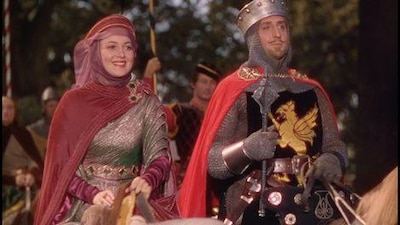
At some point, our ancestors switched from eating like this:

To eating like this:

Surely, we jest? But there is signifigance in what a Pegasus heraldry symbol meant to the other troops, and what the finally laid table of an upperclass British family meant to the villagers: there was always an audience looking on.
When it comes to the ancient deErth family and the ancient Bond family, we had heraldry for a purpose. Let us explain… (1)
Let’s Pause for a Moment to Look at Symbolic Thinking
We all know what these symbols mean, right? Creating and adding meaning to symbols is a uniquely human trait. As such, symbolic thinking is a feature which sets us apart from all other thinking creatures.

In the pre-literate world, symbols became very important, because once learned, they guided people to understand with whom, or what, they were dealing with. To an extant, that is still true today, especially with sports, commerce, and religion.
Heraldry originated when most people were illiterate, but could easily recognize a bold, striking, and simple design. I guess you could call it an early form of social media, with the court heralds being influencers.
What is a Coat-of-Arms?
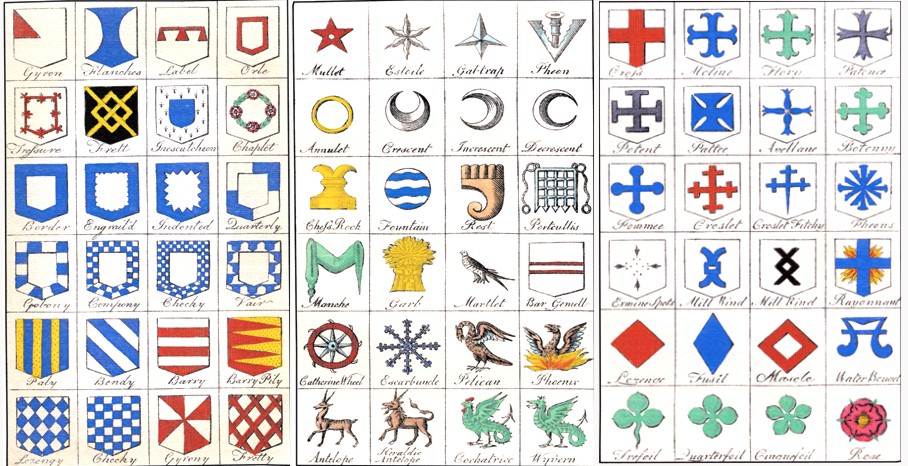
How did a coat-of-arms get started? The first coat-of-arms were used to distinguish one knight from another. When a knight had on his full armor, including plate mail and helmet, even his friends couldn’t recognize him. Because of this, knights began to paint symbols on their shields. The symbols on a coat-of-arms were meant to represent the achievements of the person, manor, or state, to whom the arms were granted. They eventually began to put the symbol on their banner and the cloth surcoat they wore over their armor. This is how it got the name coat-of-arms.
To use and legally bear a coat-of-arms, a person had to be granted the honor by a ruling monarch. The laws and rules regarding the right to use them, and if they could be passed on varied greatly by region, ruler, and country. In England and Scotland, the individual granted the coat-of-arms was the only one who could use it and display it. It wasn’t until King Richard I, in the 13th century, that a coat-of-arms became hereditary.
Coat-of-Arms for the DeErth and Bonds of Erth Families

Ancient heraldry for the deErth family. The only design which was evident within the Bond family following the deErth family’s three deer heads of Erth. The subsequent black chevron with three gold bezants (coins), is the registered and recognized Bonds of Erth heraldry.
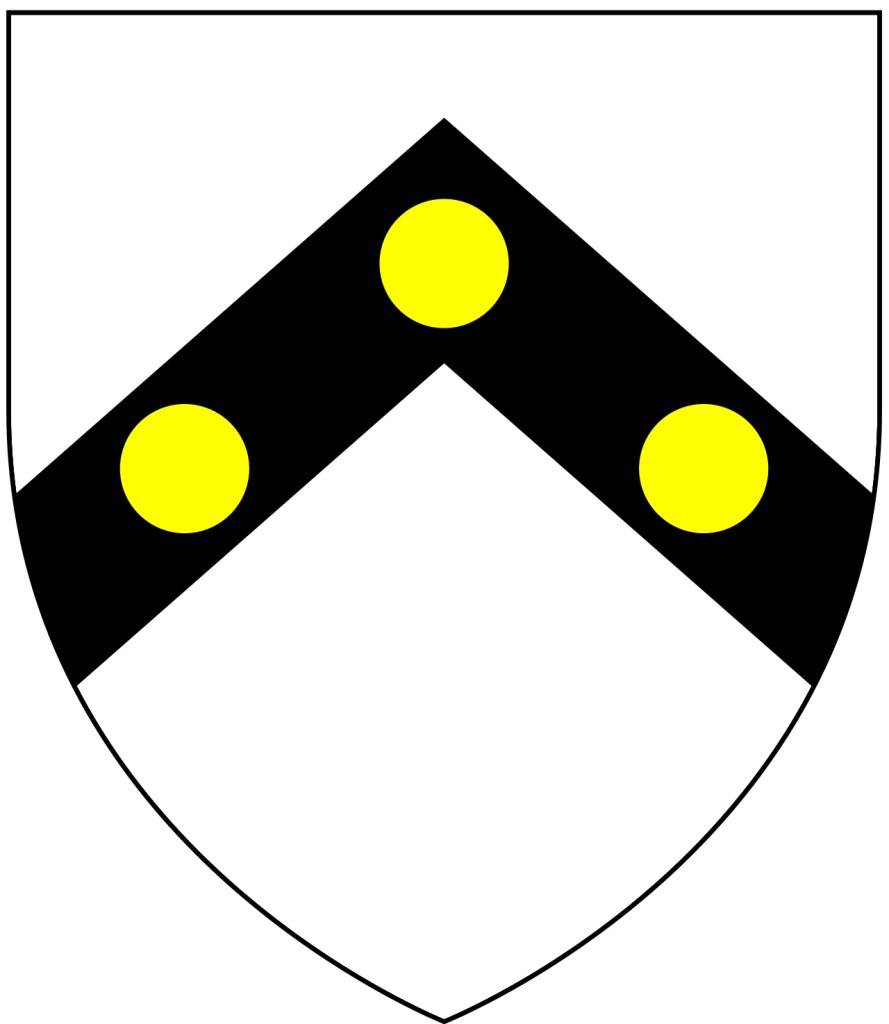
(Image courtesy of Wikipedia.com).
At first glance, we thought that this coat-of-arms was just a little bit plain jane. Then we came to realize that this is what authenticity looks like.
What Did the Colors Mean?
The colors in heraldry are called tinctures. Old French words were used to describe the colors of the background, which came to have different meanings. Red (gules) was the color of a warrior and nobility, blue (azure) for truth and sincerity, black (sable) for piety and knowledge, and green (vert) for hope and joy. Presently, English heraldry has seven colors (tinctures) including two metals (gold, silver) and five colors (blue, red, purple, black, green).
- Estucheon, the shape of the shield.
- Helm, the top center of this shape, where future generations might add elements to represent their individual family.
- Charge, the main picture in the center of the coat of arms. In our family, we had a black Chevron, that is the pointed shape on the estucheon.
- Ordinaries, designs that appeared on the field. In our family, we had Bezants, these are the three gold coins diplayed on the black chevron. This motif is derived from Richard, the Earl of Cornwall.
What is a Family Crest?
Everyone gets confused and uses these coat-of-arms and family crest interchangeably. They are not the same. The crest is the helm (top portion) of the coat-of-arms and is actually part of the overall design. The crest is an identifier for what the person (who was originally granted the coat-of-arms) did, in order to receive the honor. Some families have used it as a symbol, without the full arms beneath it.
In the Introduction we wrote about how different eating styles have evolved over time. Family crests evolved for the fortunate few to to use to mark their property. For example, if your Family Shield was too complex to recreate at a small scale, a family crest would be used. Perfect for stamping on the silverware to show your pedigree!

The Heralds Were Busy Bureaucrats…
It became the job of people called heralds to keep track of the different coats-of-arms. They made sure that each design was unique, and they also kept track as to whom each Family Arms belonged.
From Britannica: “In the second half of the 12th century the men who supervised festivities and delivered invitations to guests were often the same minstrels who, after tournaments and battles, extolled [sang the praises of] the virtues and deeds of the victors. Heralds can be identified in the descriptions of tournaments from about 1170. The duties of minstrels and messengers appear then to have merged, and, as the minstrels recounted the deeds and virtues of their masters and their masters’ ancestors, their interest in genealogy developed. That new skill was related to their tournament duties, which included the necessity to recognize the banners and shields of all those invited to attend”. In other words, somebody had to keep things sorted out.
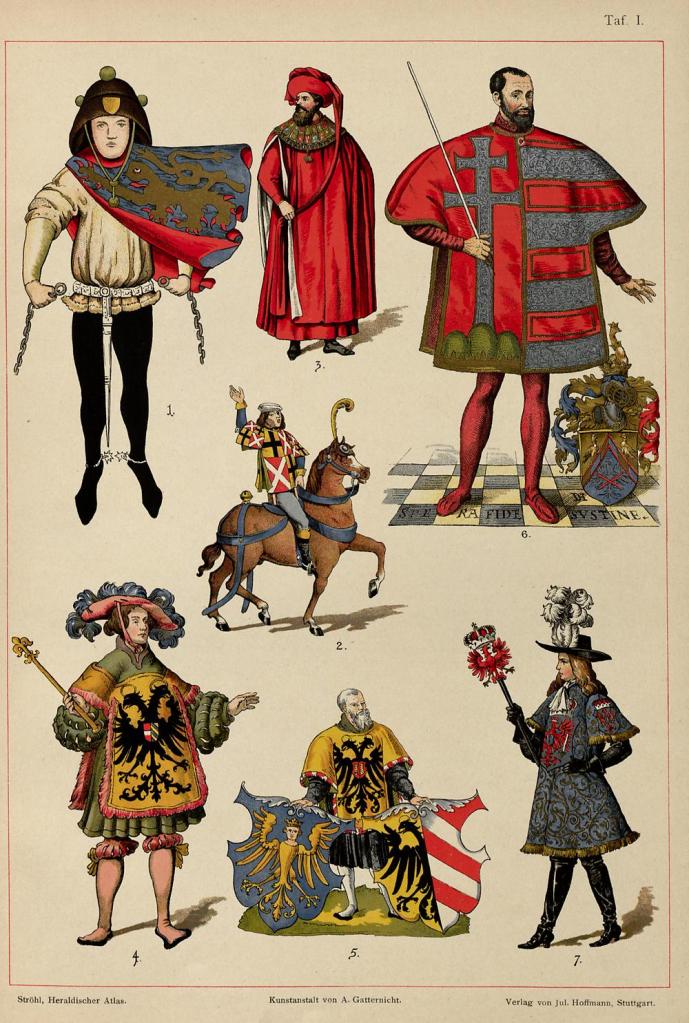
By the 12th century, the use of the coat-of-arms had become much more common, and in the 13th-century family use of the coat-of-arms became common as the symbols had been passed down from ancestors in the previous centuries. Usually, the oldest son would often inherit the coat-of-arms from his father without any changes, while younger brothers often added symbols to make theirs unique. When a woman married, the coat-of-arms of her family was often added to her husband’s arms, called marshaling.
As families grew, the shield of the coat-of-arms was sometimes divided into different parts (e.g. quartered) to represent the merging of families (although this is not the only reason a shield might be divided). Even still, families would have to alter the Arms enough to distinguish it from prior generations. This is where it would become a Family Arms, the symbol for the family, instead of the symbol for an individual.

Cornish heraldry generally conformed with the rules and customs of English heraldry… however, the use of arms was far more widespread amongst the Cornish than the English and there was far less control over the use of heraldry. The writer Richard Carew wrote in the early 17th century, “The Cornish appear to change and diversify their arms at pleasure… The most Cornish gentlemen can better vaunt of their pedigree than their livelihood for that they derive from great antiquity, and I make question whether any shire in England of but equal quantitie can muster a like number of faire coate-armours”. Even back then, Carew was sniffing out the socially ambitious families.
This is why you will see several Arms for one surname or family, that can look only slightly different, or can look entirely different from each other.

Notice in the above example of heraldry for The Bonds of Grange from A Genealogical and Heraldic History of the Commoners of Great Britain and Ireland, Vol. I. The Coat-of-Arms for that particular family has been marshaled (four quadrants) and elements have been added to the top (the helm). If you look carefully, you can still see the chevron with the three bezants.

Notice in the example above how the Bond Coat-of-Arms has gotten a lot more decorated. There’s even a catchy motto added. This phrase is frequently translated from Latin as: The World Does Not Suffice, or The World Is Not Enough.
As the Bond family married, immigrated, and went on with their lives, it once again became fashionable (rather than a basic necessity) to have a family coat-of-arms. The trouble was, there were so many Bond families, and not a lot of widespread scholarship to support what designs went forward. There were no more heralds to manage who-really-was-who.
Even George Lazenby, in his only film as James Bond, got in on the act.

As we all know, James Bond always prevailed in his fight for good-versus-evil. (Even with that modern, exuberant coat-of-arms). That’s why we love him. (2)
Following are the footnotes for the Primary Source Materials,
Notes, and Observations
Introduction: Hollywood Has Really Messed Things Up
(1) — two records
The Adventures of Robin Hood, 1938
http://deepfocusreview.com/definitives/the-adventures-of-robin-hood/
TV Series Finale
Downton Abbey: Crewmembers Recall the Final Season’s Big Dinner Table Scene
https://tvseriesfinale.com/tv-show/downton-abbey-crewmembers-recall-final-seasons-big-dinner-table-scene/
(2) — twelve records
For these six Sections listed below, all records are adapted from the links that follow:
Let’s Pause for a Moment to Look atSymbolic Thinking
What is a Coat-of-Arms?
Coat-of-Arms for the DeErth and Bonds of Erth Families
What Did the Colors Mean?
What is a Family Crest?
The HeraldsWere Busy Bureaucrats…
Encyclopædia Britannica
Heraldry
https://www.britannica.com/topic/heraldry
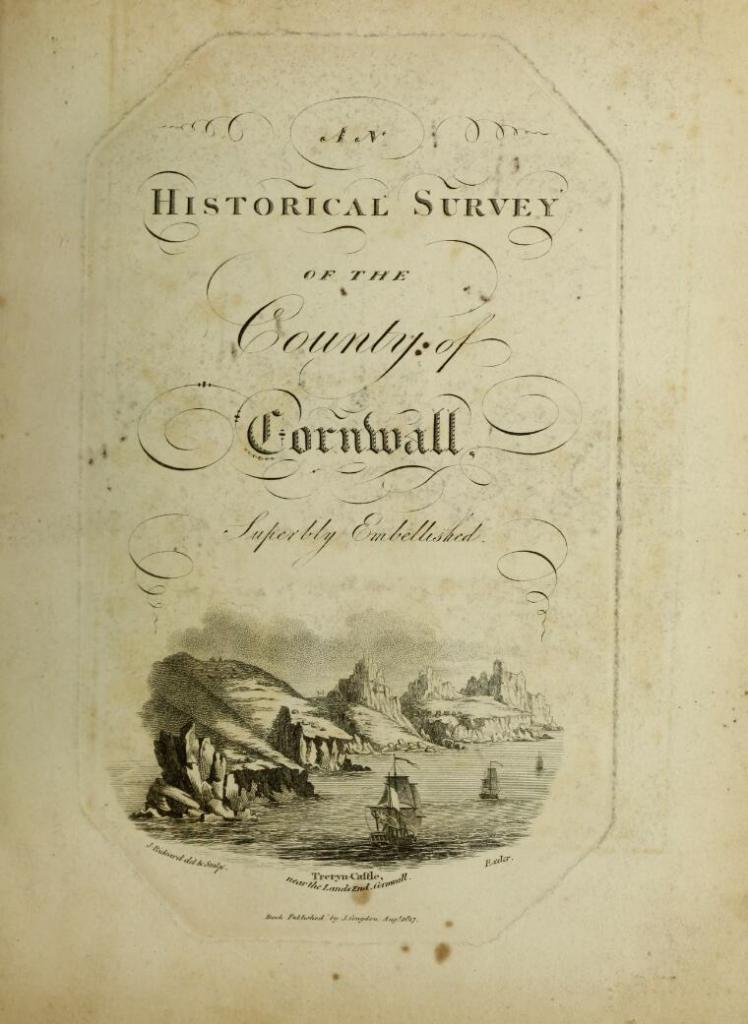
An Historical Survey of the County of Cornwall: to which is added, a complete heraldry, by C. S. Gilbert, 1817
https://wellcomecollection.org/works/g68eerr8/items?canvas=9
Note 1: Book page: 30, Digital page: 30/441, for the Bond family historical text reference.
Note 2: For two Coat-of-Arms, as follows:
– Bond Coat-of-Arms, Plate VI (6)
– De Erth Coat-of-Arms, Plate XIII (13)
Note: This edition contains the heraldry bookplates.
A Genealogical and Heraldic History of the Commoners
of Great Britain and Ireland, Vol. I
https://www.ancestry.com/imageviewer/collections/48501/images/CommGBIrelandI-005335-243?pId=368839&lang=en-US
Book page: 243, Digital page: 306/787
– Bond (ancient) — A fess or. [a horizontal belt of honor]
– Bond, of Cornwall — Arg. on a chevron sa. Three bezants
The Gene Genie
Coat-of-Arms and Crests, What’s The Difference?https://thegenegenieblog.wordpress.com/2017/07/09/coat-of-arms-and-crests-whats-the-difference/
Cornish Heraldry
https://en.wikipedia.org/wiki/Cornish_heraldry
The Heraldry Society
The Emergence of the Heraldic Phrase in the Thirteenth Century https://www.theheraldrysociety.com/articles/the-emergence-of-the-heraldic-phrase-in-the-thirteenth-century/
Ducksters
Middle Ages, A Knight’s Coat-of-Arms https://www.ducksters.com/history/middle_ages/knight_coat_of_arms.php
Heraldischer Atlas
https://en.wikipedia.org/wiki/Heraldischer_Atlas
Note: For the pictures of heralds
(John Speed Map of Cornwall, 1611)
University of Cambridge Digital Library
The theatre of the empire of Great Britaine: presenting an exact geography of the kingdomes of England, Scotland, Ireland,… (Atlas.2.61.1)
https://cudl.lib.cam.ac.uk/view/PR-ATLAS-00002-00061-00001/18
A Genealogical and Heraldic History of the Commoners
of Great Britain and Ireland, Vol. I
https://www.ancestry.com/imageviewer/collections/48501/images/CommGBIrelandI-005332-240?pId=368839
Book page: 240, Digital page: 303/787
Note: For the Bonds of Grange coat-of-arms image.
The Story of The Bonds of Earth
by Allen Kerr Bond
https://archive.org/details/storyofbondsofea00bond/page/n5/mode/2up
Book page: Frontispiece image, Digital page: 6/332.
Note: For the Bonds of Erth and Holewood coat-of-arms image.
Film still from: On Her Majesty’s Secret Service https://www.reddit.com/r/MovieDetails/comments/dt1imx/on_her_majestys_secret_service_james_bonds_family/
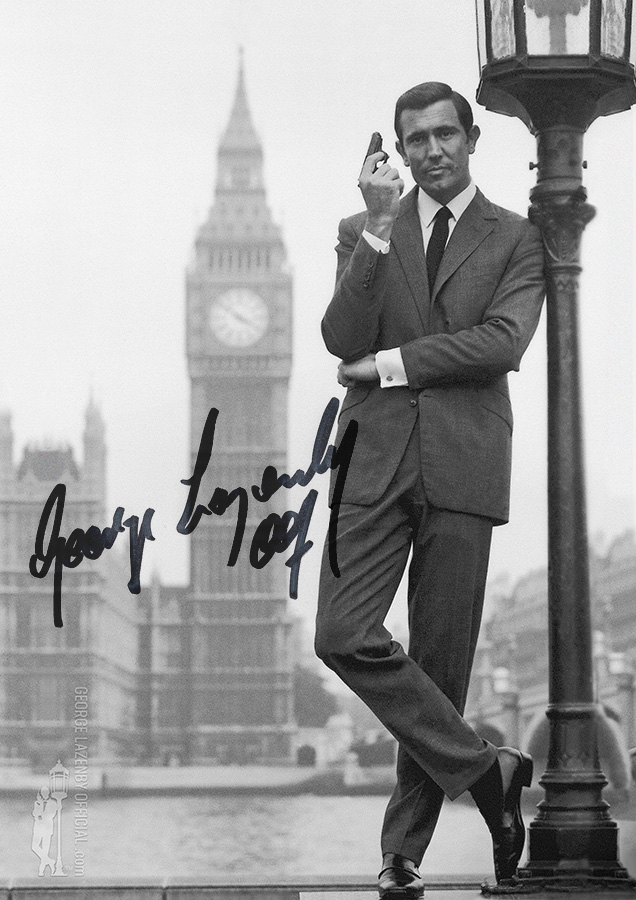
(Image courtesy of http://www.jamesbondlifestyle.com).
 Our Ancestors, Our Narratives