The Doty Line, A Narrative — Seven

This is Chapter Seven of nine. We have wondered if Joseph Doty, Jr. moved from New Amsterdam, up to the Nine Partners area of the Hudson River Valley due to the influence of the family of his wife Geisje (Lucretia) Van Schaick. Perhaps he somehow connected with her family through the prevalence of the Dutch culture of Manhattan when he lived there? (His militia service was also was affiliated with the Dutch Burgher Guards).

Joseph also had his cousins Charles and Elias Doty from Oyster Bay, living in the Dutchess County area. So, it’s also possible that he and Lucretia could have connected through family, or the Dutch Reformed Church. Who knows, we’re just glad that they met!
Tintin struggles as he peers intently at a map of the Hudson River Valley. He is surrounded by clues and artifacts, piecing them together to try to puzzle-out the hidden locations.
(Image courtesy of Shutterstock).

From Wikipedia, The Adventures of Tintin is a series of 24 comic albums created by Belgian cartoonist Georges Remi, who wrote under the pen name Hergé. The series was one of the most popular European comics of the 20th century. The country of Belgium was created in 1830, after it gained independence from the Southern Netherlands.

Let’s Talk About Place Names

During their lifetimes, our ancestors lived in a places that changed their name(s) quite a few times. This gets confusing. We have corrected the history in this chapter to reflect these transformations.

We have observed that many researchers have rather clumsily used inappropriate place names for locations mentioned in this history. Some of this is understandable, since two different countries clashed over who had control of the area. Be that as it may, many past record sources, and then more contemporary records, have not thought about this sufficiently. We are following them in time and have a longer view of how the area names and boundaries evolved. So let’s address this issue —

New Netherland vs. The Province of New York
The area was first known as New Netherland, a Dutch colony, until 1664. The English renamed it when they took control in 1664 as the Province of New York, after the Duke of York (later King James II).

New Amsterdam > Manhattan
First, it was called New Amsterdam, then the English changed the name to New York City in 1664, for the same reason cited above.

Fort Orange > Albany
Located on the upper Hudson River, it was named as Fort Orange by the Dutch. It was initially founded in 1614-1624 as a fur trading post. The English then renamed it Albany, designating it first as a settlement in 1664, a county in 1686, then as a city in 1686. It is the oldest city in New York State.
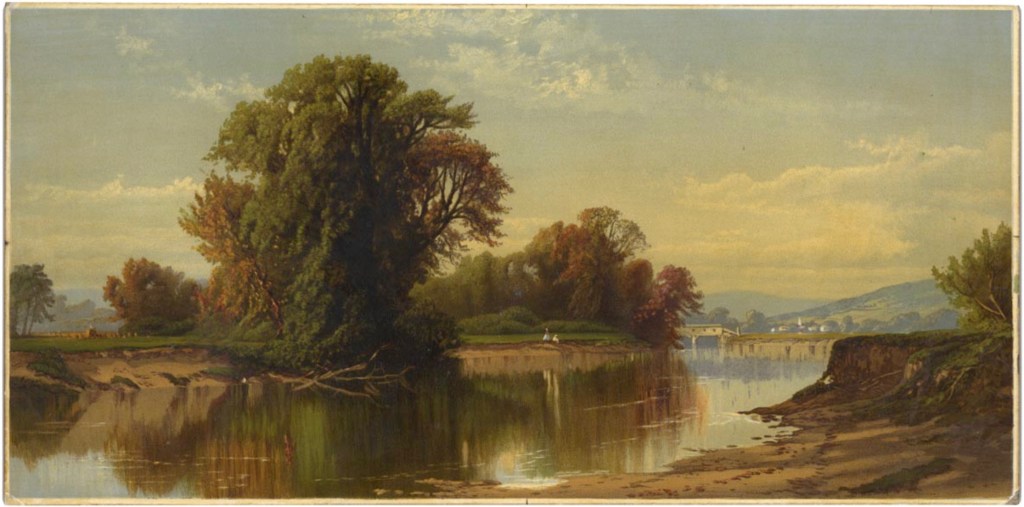
Early Autumn on Esopus Creek, by A. T. Bircher. (Image courtesy of The Old Print Shop).

Esopus > Wiltwyck > Kingston
This was a broad area on the upper Hudson River named by Native Peoples to describe a creek. The Dutch used this name because it was convenient to do so. In 1657, Peter Stuyvesant, the director-general of New Netherland, built a stockade to protect the Dutch, and renamed the Esopus village Wiltwyck. A few years later the English renamed portions of it as Kingston in 1669.

Kinderhook
This was a settlement which existed prior to 1651. First it was in Albany County, then this area became Columbia County in 1786, after the American Revolutionary War.

Ulster County
Derived from parts of the Esopus area by the Duke of York in 1683. Prior to that it was simply named Esopus. (Note: The Dutch were not very concerned about the names of interior settlements, since they concentrated mostly on extracting resources, such as beaver pelts from along the Hudson River). (1)
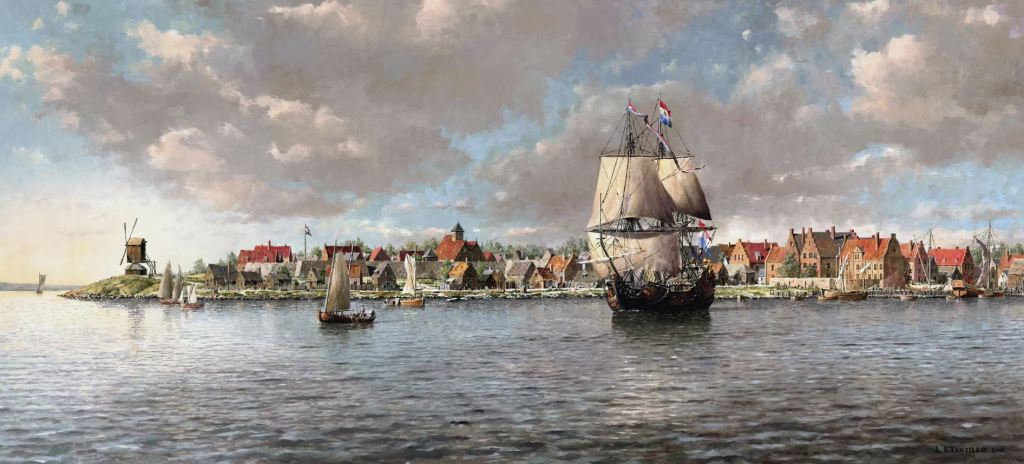
Manhattan 1660* (view from Governor’s Island), by L. F. Tantillo Fine Art.
(Image courtesy of the New Amsterdam History Center, via The Dutch Collection of the Metropolitan Museum of Art). *Technically, the location then is New Amsterdam.

The De Longs, and The Van Schaicks, Come to America

Both family genealogical histories for our 6x Great Grandmother Geisje (Lucretia) DeLong’s maternal and paternal lines begin in The Netherlands (Holland). These lines then cross the Atlantic Ocean to America in a like manner, with them then building new lives in a Dutch-controlled New Amsterdam (Manhattan), in a similar time frame. However, the two families then diverge slightly for a couple of generations, before coming together in the third generation. We’ll start with the De Longs, who are the paternal side. Please note that in all records there are several spellings for this family surname. Among them: Delange, De Lange, Delong, De Long.

The Paternal Line, the De Langes / De Longs —
During this period of history, it was completely normal for Dutch immigrants to enter America through New Amsterdam. We don’t know the amount of time this family actually stayed there, but it seems plausible that fairly quickly they chose to relocate again. This time, they moved northward up the Hudson River to the area known by the Dutch as Esopus. In that area, they are considered to be very early pioneers since that area was still a rough frontier.
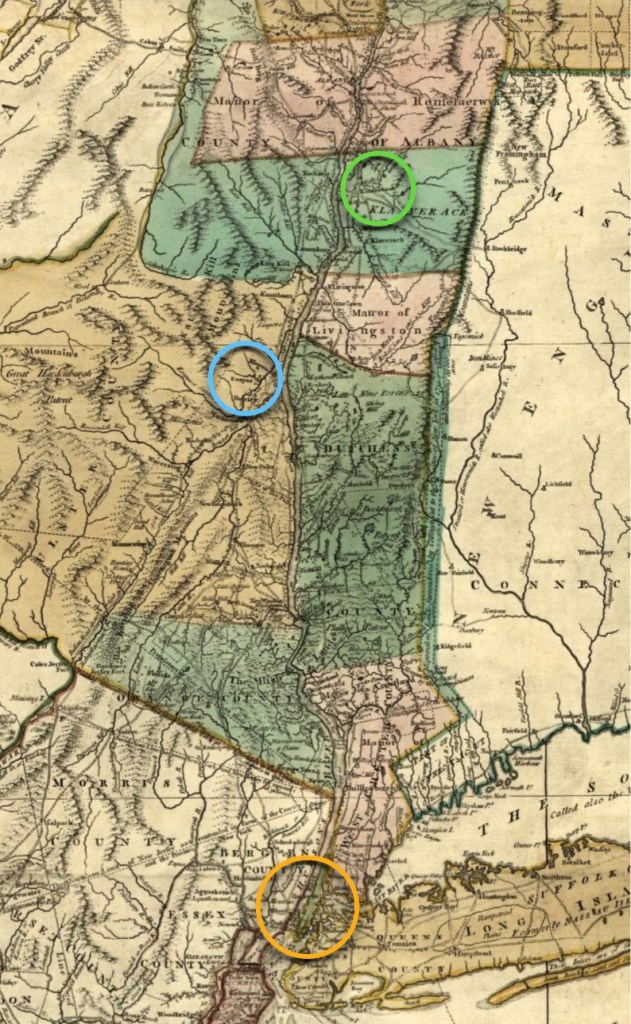
Detail excerpt from The Provinces of New York and New Jersey; with part of Pensilvania, 
and the Province of Quebec,
by Thomas Pownall, and Samuel Holland, circa 1776.
(Image courtesy of the Library of Congress).
The lower orange circle indicates where the De Longs and the Van Schaicka certainly first entered New Amsterdam. The upper blue circle indicates where the De Long family was active; the upper green circle, where the Van Schaicks were active.

The first DeLange to arrive in America was Franciscus Adrianus (Arie) De Lange, born about 1627 in Leur, Etten-Leur, Noord-Brabant, The Netherlands — died April 17, 1699 in Kingston, the Province of New York. He married Anna (maiden name unknown).

In the next generation, the De Lange line continues on in the Esopus and (then the) Kingston areas. Adrianus Franciscusz De Lange, was born about 1650, in the same location as his father Arie — died before April 17, 1699 in Brabant, an area of Kingston, Ulster County, the Province of New York. He married first Rachel Jansen, date unknown. He married second, Anna (maiden name unknown), date unknown.

The Maternal Line, the Van Schaicks
For Geisje (Lucretia) maternal family line, we return to The Netherlands. This history begins with Niclass Laurenzen Van Schaick, born about 1633 in Utrecht, The Netherlands — died about 1688 at Kinderhook, Albany County, the Province of New York. He married Jennetjie Cornelis circa 1664, before they immigrated to America. She was born about 1642, (possibly) in Beverwyck, Netherlands — died February 8, 1728, in the same location as her husband.

Fort Orange and The Patroon’s House, by L. F. Tantillo.
(Image courtesy of the New York State Museum).

As with the De Longs, we do not know how long the Van Schaicks were in New Amsterdam. Some of the literature suggests a family connection — and that perhaps Niclass was the brother of Gerrit Goosensz Van Schaick, who was also born in Utrecht, The Netherlands. Known as Goosen, he was one of the original settlers in the community of Fort Orange > Albany. It makes sense that Niclass and Jennetje would live in the same area.

Often, other researchers have not captured the birth of all ten of Niclass and Jannetje’s children. Maritje Van Schaick, our 7x Great Grandmother was the last of their children, born about 1683 at Kinderhook, Albany settlement, (Albany County in 1686). After several generations in America, the DeLange/DeLong family is finally joined by marriage to the Van Schaick family.
(See our Research Observation in the footnotes).

Marriage Record of September 6, 1703 for Frans Arie DeLong and Maritje Van Schaick.
(Note that their names are spelled differently).
From the records of the Dutch Reformed Church in Albany, the Province of New York.

Frans Arie DeLong, born April 24, 1681, in Ulster County, the Province of New York — died May 29, 1755, in Beekman, Dutchess County, same Province. He married Maritje Van Schaick, September 6, 1703 She was born October 19, 1694, in Stuvesant/Kinderhook, Albany County [Columbia County, circa 1786] — died February 1758 in Dutchess County, Province of New York. Frans and Maritje (Van Schaick) DeLong had a large family of twelve children, with the eleventh being our 6x Great Grandmother, Giesje (De Lange/De Long) Doty. (2)

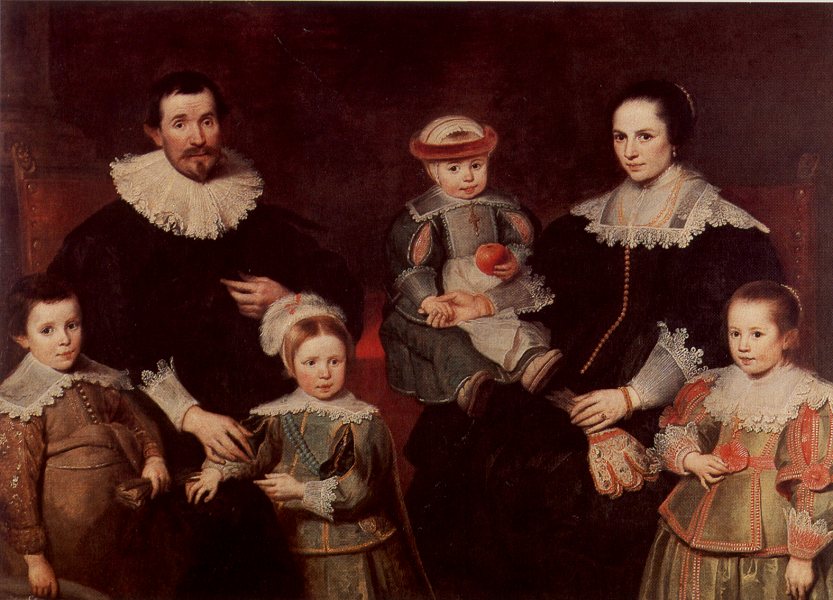
If the DeLange, or Van Schaick families were dressed in their very, very, very best clothes, their portraits would have looked somewhat like this. (Image courtesy of Nicole Kipar’s late 17th Century Costume history).

A Flourishing Family In The Hudson River Valley

The Joseph Doty Jr. family spent the arc of their lifetimes situated on either Long Island Sound, or within the Hudson River Valley. He was born in 1708 in Oyster Bay, Long Island, New York Province — died about 1788 likely in Lansingburgh, Rensselaer  County, New York State.

Marriage Record of March 20, 1743 for Joseph Doty Jr. and Giesje De Lange.
From the records of the Dutch Reformed Church in Fishkill (Rombout Patent), Dutchess County, the Province of New York.

On March 20, 1743, Joseph Doty Jr., married Geisje De Lange* at the Dutch Reformed Church located in the hamlet of Fishkill, Rombount Precinct, Dutchess County, New York Province. She was born in the Crum Elbow Precinct, Dutchess County, the Province of New York, about 1725, daughter of Frans Arie DeLong and Maritje (Van Schaick) DeLong. She died after 1773, likely in Lansingburgh, Rensselaer County.

*Geisje DeLong’s surname became anglicized to De Long (from De Lange). On many records, her first name is recorded as “Lucretia”. This was actually her nickname which she used for most of her life.

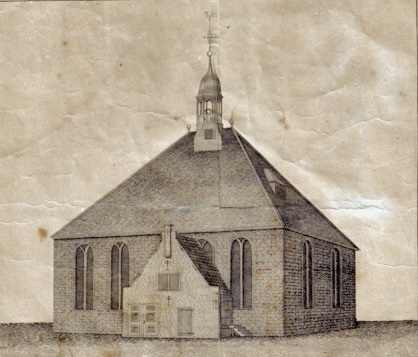
The Dutch Reformed Church in Fishkill, New York, date unknown.
(Image courtesy of ancestry.com).

Together Joseph and Lucretia had 10 children, who are listed below. The records cited are quoted from the The Doty-Doten Family in America (DDFA) book.
Note: All of their children were born in the Province of New York. We have made corrections to their birth locations.

The first five children, Ormond, Peter, Rebecca, Elizabeth, and Rhoda, were born in the Crum Elbow Precinct, Dutchess County:

  • Ormond Doty was born November 24, 1746 in Crum Elbow Precinct, Dutchess County. He died in South Wallingford, Vermont, November 18, 1826. He married Phoebe Vail; she died at the same location, May 1, 1830. “It is reported that during the Revolution Ormond Doty lived at or in the vicinity of Albany, N. Y.; that he was a Loyalist and was imprisoned at Albany for some time on that charge, but at the intercession of his brothers, who were Patriots, he was released on the condition of going to South Wallingford, Vermont, at that time a wilderness. He removed there with his family, where they settled and remained.”
  • Peter Doty was born about 1750 in Crum Elbow Precinct, Dutchess County. He died in 1811 after a Will was written dated July 2, 1811. He married Catharine Overrocker, who died January 1820.“They lived Schaghticoke. N. Y. He was a prosperous farmer there. His Will, dated July 2, 1811, is on record at Troy, N. Y.”
  • Rebecca Doty (twin) was born about 1756 in Crum Elbow Precinct, Dutchess, New York. She married (1) John Irish; (2) Stutely Stafford.
    “She married first John Irish. He was killed as a British spy at Tinmouth, Vermont, during the Revolution. She married second, Stutely Stafford. They lived South Wallingford, Vermont.”
  • Elizabeth Doty (twin) was born about 1756 in Crum Elbow Precinct, Dutchess County. She married Daniel Barheit.
  • Rhoda Doty (also known as Rhody), was born about 1759 in Crum Elbow Precinct, Dutchess County. She married Jacob Stover.
    “They lived Schaghticoke. N. Y., and it is probable that descendants lived Schuylerville, Saratoga County, and Greenwich, Washington County, N. Y.”

    The next three children, Mary, Jacob, and Marian, were born in the same location, but renamed as the Charlotte Precinct, Dutchess County:
  • Mary Doty (also known as Polly), was born about 1763 in Charlotte Precinct, Dutchess County. She married Leonard Schermerhorn. “They lived Berne, N. Y.”
  • Jacob Doty was born about 1766, in Charlotte Precinct, Dutchess County. He married Zilla Berrie. “He is said to have lived in Albany or vicinity, during the Revolution, but afterward removed to Vermont.”
  • Marian Doty was born about 1768 in Charlotte Precinct, Dutchess County. She married Ephraim Putnam.

    The last two children, Lydia and Nancy, were born in a new location: Lansingburgh, Rensselaer County:
  • Lydia Doty was born in December 1769, in Lansingburgh, Rensselaer County. She married Daniel Shaw about 1783. Lydia died November 2, 1830 in Schaghticoke, also in Rensselaer County.
    (We are descended from Lydia and Daniel).
  • Nancy Doty was born about 1773, in Lansingburgh, Rensselaer, County. She married Mark Jimney. (3)
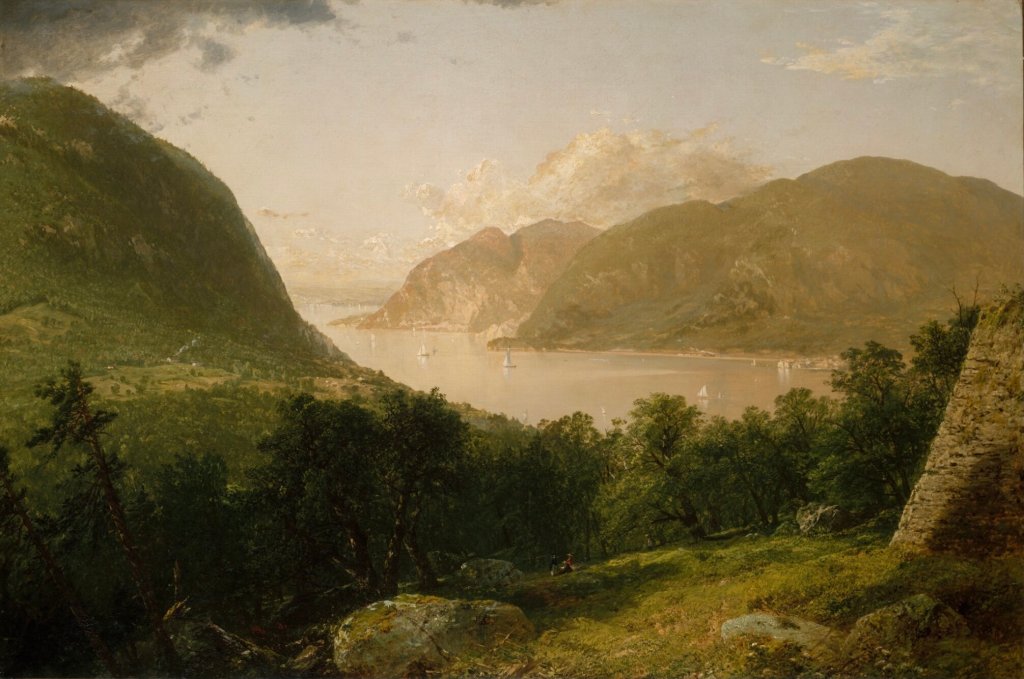
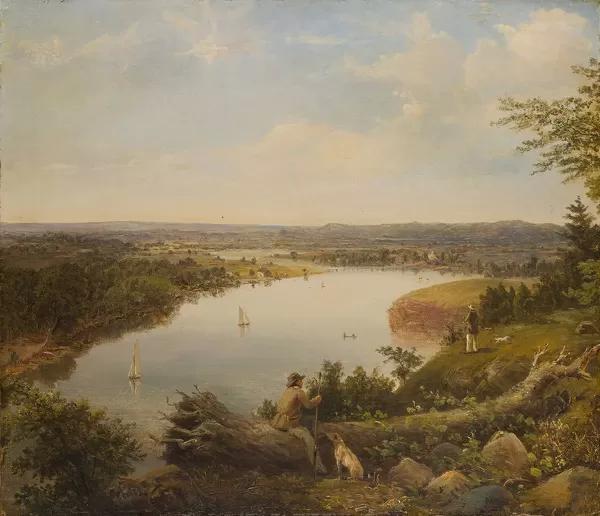
Hudson River Scene, by John Frederick Kensett.
(Image courtesy of the Beacon Historical Society via the Metropolitan Museum of Art).

The Dutch Words Were — Kromme Elleboog

While doing research for this chapter on the Doty Family, we encountered these odd-seeming place names in the Hudson River Valley: Crum Elbow, or Crom Elbow. They seemed like real head scratchers to us, but we’ve seen other odd things — such as trying to interpret quill-pen written manuscripts where the writer was implausibly scribbling away while experiencing a serious medical emergency.

Therefore, we were delighted to learn the following, simply because it made this aspect of our family history, that much more interesting. From the Dutchess County Historical Society Yearbook of 1933 —

In the seventeenth century, while the Dutch held sovereignty over the valley of the Hudson, that is: from 1609 to 1664, they established settlements at three places,—one on the site of the city of New York, one on the site of Albany and one on the site of Kingston. They made no attempt to explore or to clear the forested regions on either side of the river between New York and Albany, chiefly because they were greatly concerned with the trade in furs, and the three settlements just mentioned did an active business as trading posts.

Ignoring the hinterland [the interior land areas], the Dutch plied the river in sailboats, learned to know the river well and had names for many of the sailing courses and for natural features along the shores.

In 1664 sovereignty over the Hudson valley passed to the English. They, after a few years, began to be interested in the regions east and west of the river and in 1683 the colonial legislature passed an Act by which those lands were laid out into counties. Coincidently with the creation of counties there arose an era of speculation in land, during which the desirable tracts along the river were bought up and ultimately opened for settlement.

In the course of the development, government officials filed documents and conducted correspondence in English and encouraged the common use of that tongue. It took just about a century for the English language to supplant the Dutch and, while the two were in use at once, original documents were recorded in which may now be found many instances of phonetic spelling, occasions when an Englishman tried to write down the Dutch words he heard in use about him.

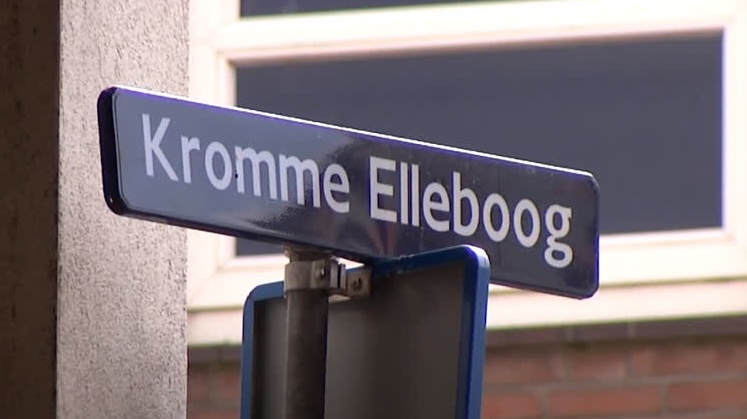
An instance of such phonetic spelling and of partial translation is the place-name: Krom Elbow. The Dutch words were: Kromme Elleboog, meaning a bent or crooked elbow. In the seventeenth and eighteenth centuries; Kromme was rendered in the records as: Krom, Krum, Crom, Crum and even Crown (K being a characteristic Dutch letter and C English), while Elleboog was translated in full into Elbow.

[Excerpted from from an article by Helen Wilkinson Reynolds,
in The Dutchess County Historical Society Yearbook for 1933.]

The following bit of information from the excerpt above, became very important with the ongoing history of the Doty Family. “In 1683… coincidently with the creation of counties there arose an era of speculation in land, during which the desirable tracts along the river were bought up and ultimately opened for settlement”. (4)

The Nine Partners Patent in Dutchess County

“The Great Nine Partners Patent, also known as the ‘Lower Nine Partners Patent,’ was a land grant in Dutchess County, New York, made on May 27, 1697, by New York governor Benjamin Fletcher. The parcel included about four miles (6 km) along the Hudson River and was eight to ten miles (13 to 16 km) wide, extending from the Hudson River to the Connecticut border…

It was the ninth of fourteen patents granted between 1685 and 1706 which came to cover the entirety of historic Dutchess County [which until 1812 also included today’s Putnam County]. (Wikipedia, 9 Partners) Some modern writers also refer to the patent as the Nine Partners area.

The sepia rectangle shows The Great Nine Partners Patent, a land grant in Dutchess County, New York, as surveyed by Richard Edsall, circa 1740. [It is barely legible] The map which overlays the The Great Nine Partners Patent map is from the Dutchess Count Historical Society yearbook of 1939, and indicates the many land patents that were scattered over the breadth of Dutchess County.

Note also in the lower left corner of Duchess County is the hamlet of Fishkill in the Rombout Patent. This is the place where Joseph Doty and his wife Giesje De Lange (Lucretia De Long) were married.

The Crum Elbow Precinct
Encouraging settlers to move into the new counties that lined the Hudson River superhighway was very successful.“Prior to 1734, there had been little settlement in the area, but it proceeded rapidly thereafter. Settlers came to the area up the Hudson, but also from New England. When the legislature divided Dutchess County into precincts in 1737, the Nine Partners Grant was included in the Crum Elbow Precinct.” (Wikipedia, 9 Partners)

Observation: The Province of New York used many Precinct Names in this era, but not many town names. “Towns” were quite frequently scattered, and being very tiny hamlets, of not much more than where two paths crossed. Some modern researchers have developed a tendency to magnify and enlarge some of these characteristics of places / hamlets / crossroads in their desire for a sense of a “town”.

So the historical place naming sequence (generally speaking) is:
> Counties (commencing in 1683)
> Patents (for Dutchess County, from 1685 until 1706)
> Precincts (or Dutchess County, in 1737, and then ongoing as needed for an administrative function)
> Town names (This varies, but precincts were eliminated in 1788. From that point on, only town names were used).

Detail excerpt from The Provinces of New York and New Jersey; with part of Pensilvania,
and the Province of Quebec, by Thomas Pownall, and Samuel Holland, circa 1776.
(Image courtesy of the Library of Congress).

The area outlined in white (above) is the border of the Crum Elbow Precinct from 1697 through 1762. The Doty family lived within this Precinct for most of their time in Dutchess County. Seven years later, in 1769, the entire family relocated north to Lansingburg, Rensselaer County.

The Crum Elbow Precinct Is Divided Twice More
In 1762, the Crum Elbow Precinct was divided into two new precincts, called the Amenia and Charlotte Precincts. From that point forward, the Amenia Precinct was a separate entity. In 1786, Charlotte Precinct was divided again into: the Clinton Precinct and the Washington Precinct. Washington Precinct included the towns presently known as Stanford and Washington. Clinton Precinct included present-day Clinton, Hyde Park, and Pleasant Valley.

The later divisions of 1786 did not affect this family, because, in 1769, the whole family relocated to Lansingburg, Rensselaer County, which was the next county north of Dutchess County moving up the Hudson River.

The Doty family had lived in the Crum Elbow Precinct for many years, but we do not know exactly where. We likely never will know where unless some new records turn up. Some researchers have mentioned the Charlotte Precinct, but the Dotys only experienced that place name for about seven years before they moved. Some have mentioned the Clinton Precinct, but this precinct did not exist when they lived there. (5)

The Van Allen Homestead, by Henry A. Ferguson
(Courtesy of the Albany Institute of History & Art).

Literally Mending Fences Here And There

This was an era when there was no municipal government to take care of roads so that they were safe and passable. In addition, since many people had livestock, and boundary markers were generally a bit vague, someone had to pay attention to where the fences actually were. Joseph Doty was not alone in this role. Many of his neighbors had similar roles and a few interesting records do survive, such as —

In the book Records of Crum Elbow Precinct, Dutchess County, New York, 1738… President Franklin D. Roosevelt (who knew he liked genealogy?), cited that Joseph Doty [Jr.] was:

  • Either an Overseer, or a Path Master of the High Ways in the Crum Elbow Precinct for the years: 1756 and 1759
  • Then the same role for the Charlotte Precinct four years later
  • The Delong family’s bridge (of his wife’s family) is also mentioned as being in the Charlotte Precinct in 1772
    (See footnotes). (6)
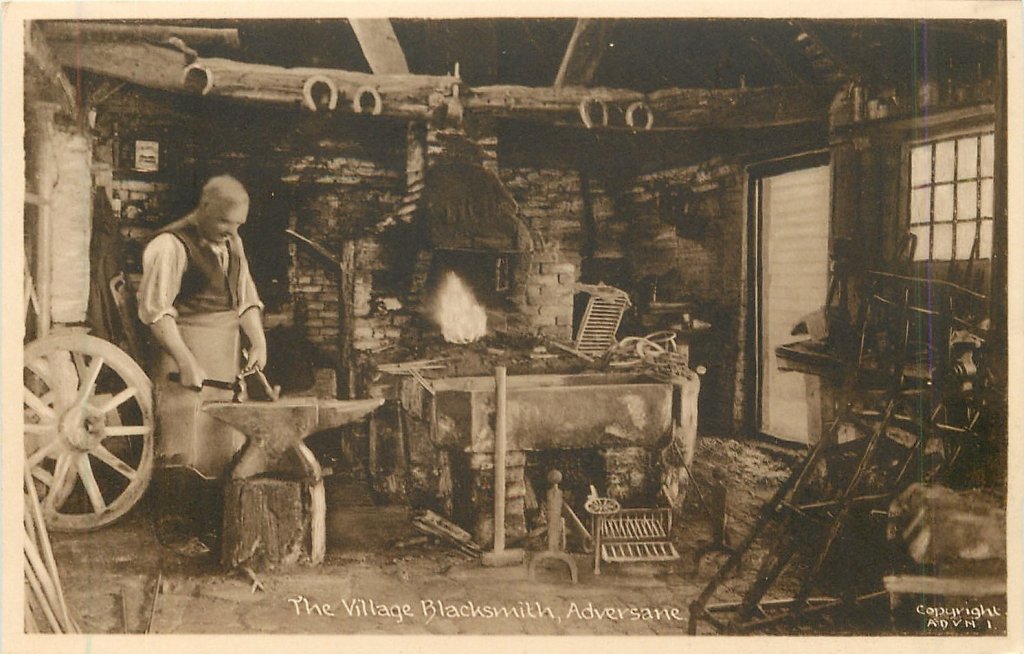
A Blacksmith, Probably in Good Circumstances

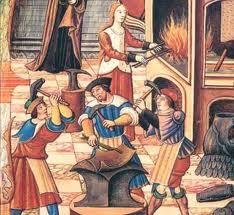
In the later 1760s, Joseph and Lucretia sold some of their properties in the Crum Elbow Precinct (which had recently been renamed as the Charlotte Precinct). There are two records which are written about in the Doty-Doten Family book, on page 505 — “Joseph Doty was a blacksmith, probably in good circumstances, his sons and daughters all being people of good position… June 5, 1767. Joseph Doty, blacksmith, of Crum Elbow, Dutchess Co., N. Y., mortgages land there. March 30, 1769. Joseph Doty, blacksmith, and his wife Cashea [Lucretia] of Charlotte, sell lots there, being part of nine partners, to Samuel Smith, Jr. of Jamaica, Queens Co., and Melancthon Smith of Charlotte.” The Precinct they lived in was populated by farmers and tradesmen. We speculate that Joseph may have learned the blacksmith trade during his time in Manhattan, perhaps as part of his militia service role.

From these old records we were able to learn his profession as a blacksmith. Also, we recovered an index record for the second land sale (likely due to the fact that we were fortunate to have a distinctive name such as Melancthon Smith to work with). The index indicates that the original deed is found on page 292, but the original record book is not cited. What’s more, we found a tax record for Joseph Doty of Nine Partners / Crum Elbow / Charlotte, for the time period of June 1754 – June 1768. This supports both his residency there, and the fact that since his tax record ends in June 1768, that there was change afoot. (See footnotes).

Dutchess County, Grantee Deed Indexes. (Image courtesy of Family Search)

Observation: Finding colonial era records in New York State is a very hit-or-miss affair, due to both the history of the area, and to be quite honest, the State of New York bureaucracy. They have not been very organized when it comes to digitizing older documents. We don’t have any records for when the Dotys first acquired property. So, we can only speculate as to when they left Fishkill, and moved north to the Crum Elbow Precinct. Does this mean that their residency there began about June 1754, as the tax records could imply? No, not really, because tax records for the years 1749, 1750, 1751, and 1752 are missing.

Records are quite scant. Censuses for population did not yet exist, nor did income taxes, and you cannot pay property taxes, unless you own property. (7)
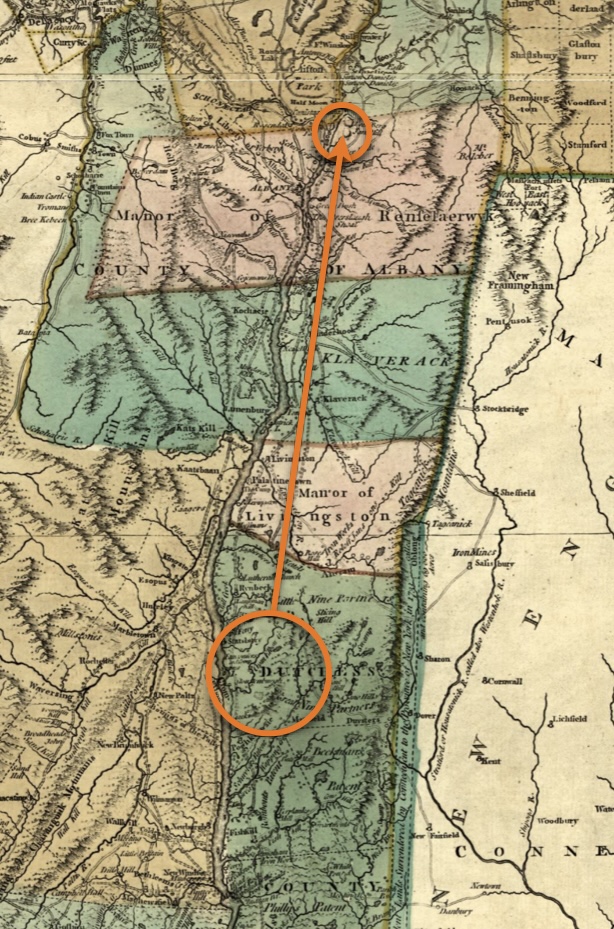
Detail excerpt from The Provinces of New York and New Jersey; with part of Pensilvania,
and the Province of Quebec, by Thomas Pownall, and Samuel Holland, circa 1776.
(Image courtesy of the Library of Congress).
This map documents the family’s transition from the Crum Elbow Precinct in Dutchess County, to the new town of Lansingburg in Rensselaer County in 1769.

Where the Hudson Meets the Mohawk

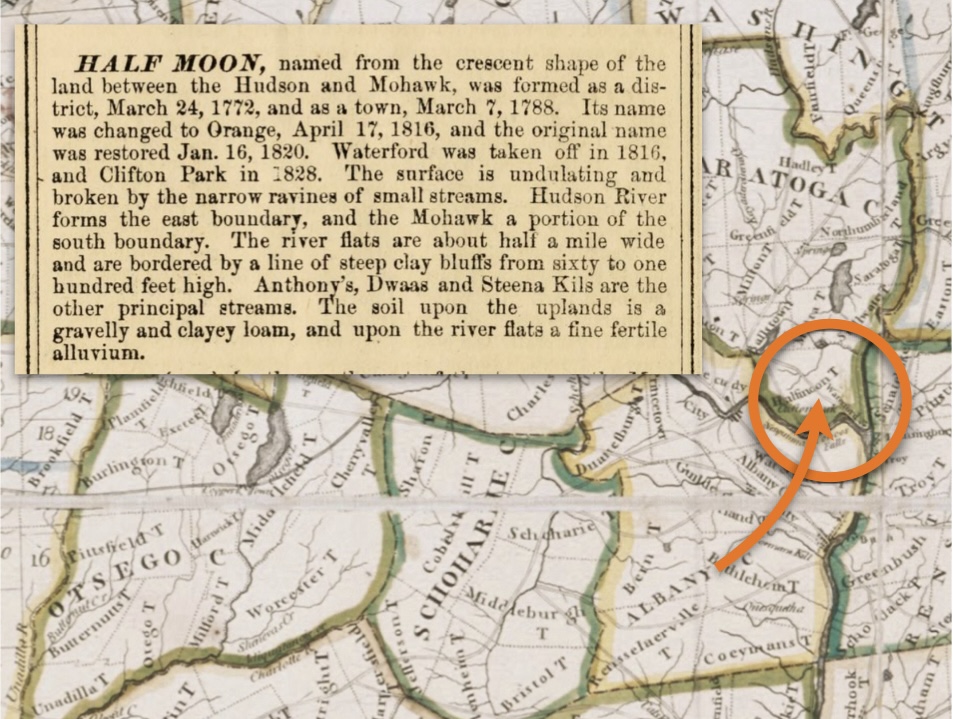
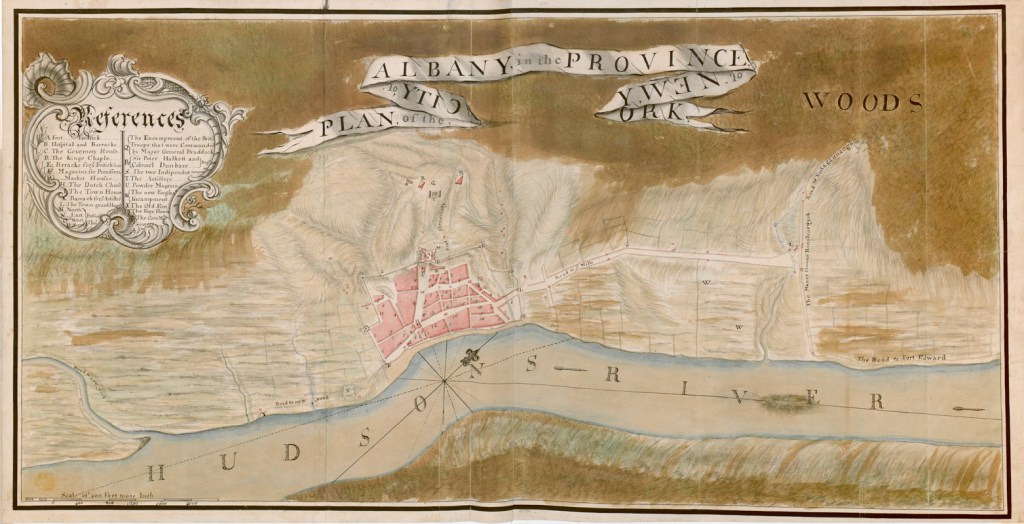
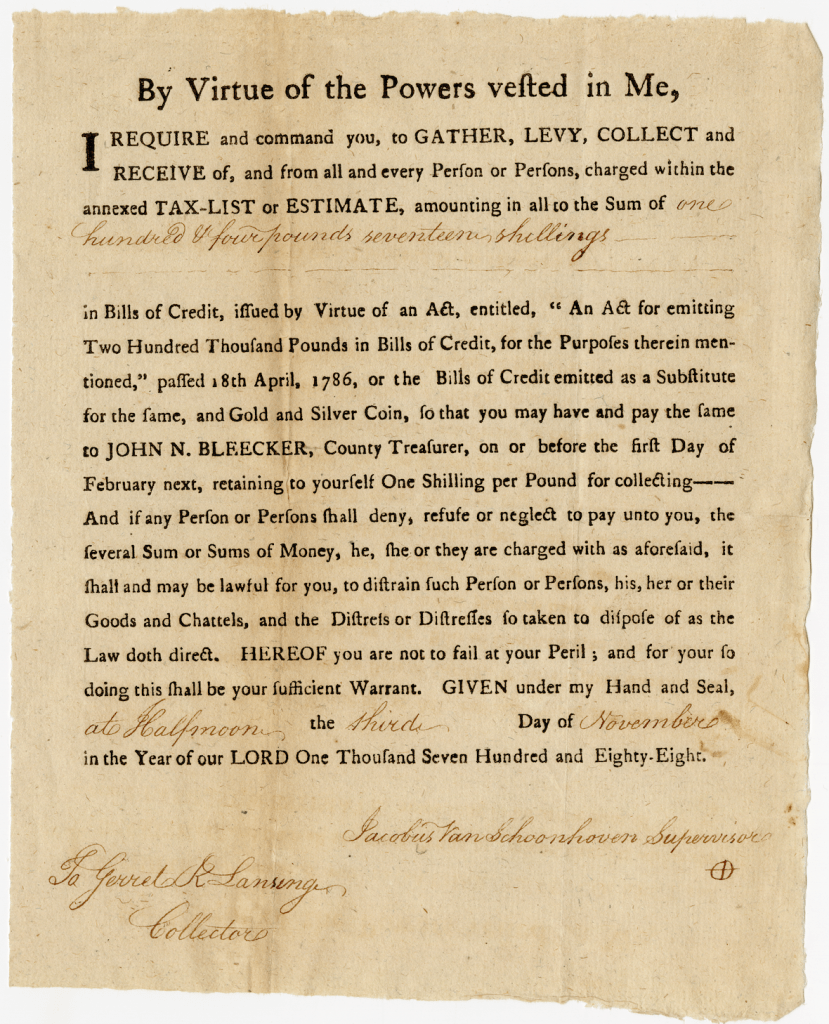
In 1769, they moved to Lansingburgh [Village], New York, located further north in Rensselaer County. The specific area where they moved to was at first, very sparsely settled. This is where the Hudson River meets the Mohawk River. Just slightly north, across the rivers was the established community of Halfmoon, and the town of Albany was to the south. (Albany had long been established; initially as a Dutch trading post in 1614).

The book, the History of Rensselaer County records, “The purchase by Abraham Jacob Lansing on June 21, 1763, was followed soon after by his actual settlement. Two or three other families were already here… and several others soon followed. In seven years quite a settlement was formed. The map of the city plat laid out by Mr. Lansing was tiled May 11, 1771. The survey had taken place a year or two earlier, for quite a number of lots were sold in 1770, and the town-meeting that adopted the ‘proposals’ had met in January before the map was tiled.” This book does not record that they were purchasers of property there.

Initially the area was called the New City. A. J. Weise’s History of Lansingburgh records that there were an estimated 50 people living there in 1771, 400 living there in 1780, and that by 1790, the population had increased to 500 people. In 1788, the year that Joseph Doty, Jr. likely passed away, this enthusiastic description was written: “Elkanah Watson, a traveler, thus writes in his journal concerning New City, in the year 1788: “This place is thronged with merchants, emigrants, principally, from New England, who have enjoyed a very extensive and lucrative trade, supplying Vermont and the region on both banks of the Hudson,  as far as Lake George, with merchandise, and receiving in payment wheat,  pot [potash] and pearl ashes, and lumber.” (See footnotes). (8)

These two maps indicate the position of the ‘New City’ of Lansingburgh
near the town of Halfmoon, the Province of New York.
(Images courtesy of the Lansingburgh Historical Society).

Our story about the Dotys is nearing its final resolution with the Doty family name giving way to the Shaw family name in the next chapter. Be that as it may, we have one more chapter to go, where the Shaw name then gives way to the Devoe family name, of which we have much, much history.

Following are the footnotes for the Primary Source Materials,
Notes, and Observations

Let’s Talk About Place Names

(1) — nine records

Tintin and Snowy

The Adventures of Tintin
https://en.wikipedia.org/wiki/The_Adventures_of_Tintin
Note: For information on Tintin and his creator Hergé.

Province of New York
https://en.wikipedia.org/wiki/Province_of_New_York
Note: For the data.

History of Manhattan
https://en.wikipedia.org/wiki/History_of_Manhattan
Note: For the data.

Fort Orange (New Netherland)
https://en.wikipedia.org/wiki/Fort_Orange_(New_Netherland)
Note: For the data.
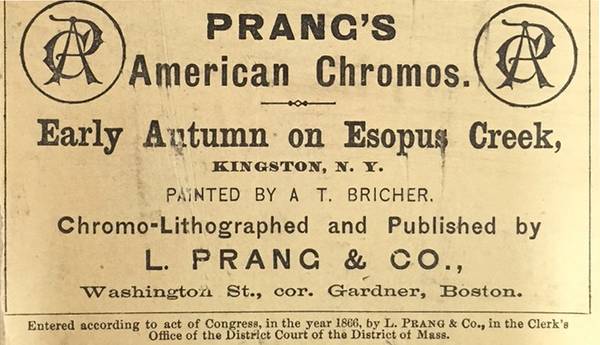
Verso of Bricher’s painting.

The Old Print Shop
Early Autumn on Esopus Creek
by A. T. Bricher, circa 1875
https://oldprintshop.com/product/147946
Note: For the landscape image.

Esopus Creek
https://en.wikipedia.org/wiki/Esopus_Creek
and
Esopus, New York
https://en.wikipedia.org/wiki/Esopus,_New_York
Notes: For the data.

Kinderhook, New York
https://en.wikipedia.org/wiki/Kinderhook,_New_York
Note: For the data.

Ulster County, New York
https://en.wikipedia.org/wiki/Ulster_County,_New_York
Note: For the data.

The De Longs, and The Van Schaicks Come to America

(2) — ten records

The New Amsterdam History Center,
via The Dutch Collection of the Metropolitan Museum of Art
Manhattan 1660 (view from Governor’s Island), by L. F. Tantillo Fine Art.
https://newamsterdamhistorycenter.org/fat-event/metropolitan-museum-of-art/
Note: For the panoramic artwork of New Amsterdam.

Library of Congress
The Provinces of New York and New Jersey;
with part of Pensilvania, and the Province of Quebec.
by Thomas Pownall, and Samuel Holland, circa 1776
https://www.loc.gov/resource/g3800.ar104500/?r=0.402,1.183,0.673,0.371,0
Note: For sections of the map which indicate the areas of Esopus and New Amsterdam.

Franciscus Adrianus De Lange
https://www.geni.com/people/Franciscus-De-Lange/6000000002665615528
Note: For the data. (Use this file with caution!)

Adrianus Franciscuzs DeLange
https://www.geni.com/people/Adrianus-Franciscusz-De-Lange/6000000000115739032
Note: For the data. (Use this file with caution!)

Nicholas <Laurens or Gerrit?> Van Schaick
https://freepages.rootsweb.com/~rclarke/genealogy/page1/vschai-n.htm
Note 1: For the birth order of Maritjie with her siblings.
Note 2: She is listed as number eleven in the tracing, but looking closely, you will observe that she is child #10.

Nicholas Laurens Van Schaick (1633 – 1699)
https://www.wikitree.com/wiki/Van_Schaick-116
Note: This document (also) lists Maritje as his daughter.

New York State Museum
Introduction to the Fort Orange Educational Guide
Fort Orange and The Patroon’s House
by L. F. Tantillo.
https://nysm.nysed.gov/fort-orange-educational-guide
Note: For the landscape image.

Frans Arie DeLong
https://www.geni.com/people/Frans-DeLong/6000000002665613104
Note: For the data. (Use this file with caution!)

Maria Van Schaak
in the U.S., Dutch Reformed Church Records in Selected States, 1639-1989
New York > Albany > Albany, Vol II, Book 2
https://www.ancestry.com/search/collections/6961/records/2220205
Book page: 230, Digital page: 234/308
Note: For the marriage record.

Research Observation: Unfortunately, many, many, (if not most), genealogical websites and family trees have incorrectly identified Lucretia’s mother, Maritje Van Schaick. Often she is listed as the daughter of Iden Van Schaick and Isabel Bloedgoet. Iden and Isobel did have a daughter named Maritje, but she is not the Maritje Van Schaick who was born in Kinderhook, New York. In fact, it is completely implausible that this mother (Isabel), uniquely gave birth to Maritje in 1680s Kinderhook, which is about 130 miles further north, when all her other children were born in New Amsterdam.

Nicole Kipar’s 17 the century Costume Archive
The Painter’s Family, circa 1630-35
by Cornelis De Vos
http://www.kipar.org/archive/period-galleries/galleries_dutch_paintings1.html
Note: For the family portrait.

A Flourishing Family In The Hudson River Valley

(3) — nine records
(DDFA)
Doty-Doten Family in America
Descendants of Edward Doty, an Emigrant by the Mayflower, 1620

by Ethan Allan Doty, 1897
https://archive.org/details/dotydotenfamilyi00doty/page/504/mode/2up?view=theater
Book pages: 505-506, Digital pages: 504-506 /1048
Note: For the text.

Giesje De Lange
in the U.S., Dutch Reformed Church Records in Selected States, 1639-1989
New York > Fishkill > Hopewell, Fishkill and MarbleTown, Book 14
https://www.ancestry.com/search/collections/6961/records/2028806
Book page: 127, Digital page: 33/56
Note: For the marriage record of Joseph Doty, Jr, and Giesje De Lange [Lucretia (De Long) Doty]

Fishkill NY Dutch Reformed Church
https://www.ancestry.com/mediaui-viewer/tree/87441358/person/320142427851/media/ecda803e-41ca-42b7-afa8-374708585ea5
Note: For the church image.

Hudson-Mohawk Genealogical and Family Memoirs:
a record of achievements of the people of the Hudson and Mohawk valleys in New York state, included within the present counties of Albany, Rensselaer, Washington, Saratoga, Montgomery, Fulton, Schenectady, Columbia and Greene

Volume 3
Cuyler Reynolds, 1866-1934, ed
https://babel.hathitrust.org/cgi/pt?id=njp.32101030753469&seq=170
Book page: 1058, Digital page: 170/680
Note: On the page, see the entry for Doty-Eaton.

(DDFA)
Doty-Doten Family in America
Descendants of Edward Doty, an Emigrant by the Mayflower, 1620

by Ethan Allan Doty, 1897
https://archive.org/details/dotydotenfamilyi00doty/page/504/mode/2up?view=theater
Book pages: 505-506, Digital pages: 504-506 /1048
Note: For the text, and for the brief biographies of the children.

Apparently, to this day this name is still used for streets in The Netherlands. (Image courtesy of: https://www.rtvdordrecht.nl/nieuws/de-kromme-elleboog-is-een-logische-straatnaam-voor-het-centrum).

The Dutch Words Were — Kromme Elleboog

(4) — five records

The Dutchess County Historical Society Yearbook for 1933, Volume 18
Kromme Elleboog
A Seventeenth Century Place-Name in the Hudson Valley

by Helen Wilkinson Reynolds
https://issuu.com/dchsny/docs/dchs_yb_v018_1933_masterfile/s/15204965
Note: For the text.

Hudson River Scene
John Frederick Kensett, circa 1857
https://www.metmuseum.org/art/collection/search/11310
Note: For the landscape image.

Library of Congress
The Provinces of New York and New Jersey;
with part of Pensilvania, and the Province of Quebec.
by Thomas Pownall, and Samuel Holland, circa 1776
https://www.loc.gov/resource/g3800.ar104500/?r=0.402,1.183,0.673,0.371,0
Note: For sections of the map which indicate the Great Nine Partners purchase and the Crum Elbow Precinct.

Timeline of Town Creation in the Hudson Valley
https://en.wikipedia.org/wiki/Timeline_of_town_creation_in_the_Hudson_Valley
Note: For the data.

The Nine Partners Patent in Dutchess County

(5) — three records

(Wikipedia, 9 Partners)
Great Nine Partners Patent
https://en.wikipedia.org/wiki/Great_Nine_Partners_Patent
Note: For the text.

Untitled Manuscript Map of Great Nine Partners Patent
in Dutchess County, New York

by Richard Edsall (surveyor), circa 1740
https://digitalcollections.nypl.org/items/140a7300-fcc4-0132-425e-58d385a7b928?canvasIndex=0
Note: For the map image, (Image ID 5376733)

Dutchess County Historical Society
18th Century Maps
by Author unknown
https://dchsny.org/18th-century-maps/
Note: For the DCHS 1939 Yearbook (map)

Literally Mending Fences Here And There

(6) — two records

Left: Franklin Delano Roosevelt, 1882 — 1945.
32nd President of the United States, and Right: Frontispiece for Records of Crum Elbow precinct, Dutchess county, New York

Records of Crum Elbow Precinct, Dutchess County, New York, 1738-1761,
together with records of Charlotte precinct, 1762-1785,
records of Clinton precinct, 1786-1788, and
records of the town of Clinton, 1789-1799

by Franklin Delano Roosevelt, 1882-1945, editor
https://archive.org/details/recordsofcrumelb00roos/page/n7/mode/2up
Note 1: Joseph Doty is listed as either an Overseer, or a Path Master of the High Ways in the Crum Elbow Precinct for the years: 1756 (page 28), 1759 (page 30); then for the Charlotte Precinct in 1763 (page 66).
Note 2: The Delong family’s bridge is mentioned in the Charlotte Precinct in 1772 (page 75).

The Making of the Hudson River School, The Improved Landscape
The Van Allen Homestead
by Henry A. Ferguson 
https://www.albanyinstitute.org/online-exhibition/the-making-of-the-hudson-river-school/section/the-improved-landscape
Note: For the painting.

A Blacksmith, Probably in Good Circumstances

(7) — three records

TuckDB Postcards
The Village Blacksmith
https://www.tuckdbpostcards.org/items/16508-the-village-blacksmith
Note: For the postcard image.

Joseph Doty
Mentioned in the Record of Melancthon Smith
Land – New York, Land Records, 1630-1975
https://www.familysearch.org/ark:/61903/1:1:Z82J-HL6Z?lang=en
Note: For the land deed.
Book page: 2144, Digital page: Image 11 of 347
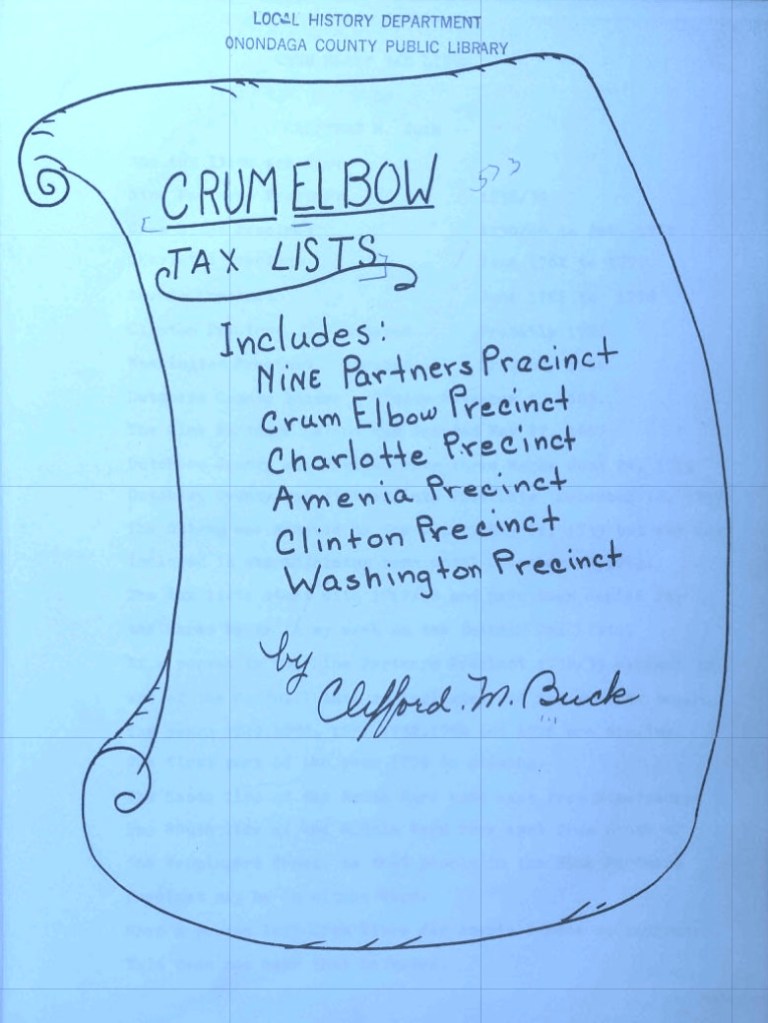
Crum Elbow tax lists: includes Nine Partners precinct, Crum Elbow precinct, Charlotte precinct, Amenia precinct, Clinton precinct, Washington precinct
by Clifford M. Buck
https://www.familysearch.org/library/books/viewer/296090/?offset=0#page=13&viewer=picture&o=info&n=0&q=
Book page 12, Digital page: 13/76
Note 1: Typed tax record for Joseph Doty of Crum Elbow, for the the time period of June 1754 – June 1768.
Note 2: Document identifier number 285952.

Where the Hudson Meets the Mohawk

(8) — five records

Library of Congress
The Provinces of New York and New Jersey;
with part of Pensilvania, and the Province of Quebec.
by Thomas Pownall, and Samuel Holland, circa 1776
https://www.loc.gov/resource/g3800.ar104500/?r=0.402,1.183,0.673,0.371,0
Note: For sections of the map documenting the transition from the Crum Elbow Precinct in Dutchess County, to the hamlet of Lansingburg Village in Rensselaer County in 1769.
History of Rensselaer Co., New York
by Nathaniel Bartlett Sylvester, circa 1880
https://archive.org/details/historyofrenssel00sylv/mode/2up
Book page: 293, Digital page: 292/844
Note: For the text on the history of Lansingburgh Village.

Albany, New York
https://en.wikipedia.org/wiki/Albany,_New_York
Note: For reference.

The History of Lansingburgh, N. Y.
From the Years 1760 to 1877

by A. J. Weise, A. M., circa 1877
https://ia801209.us.archive.org/6/items/historyoflansing00weis/historyoflansing00weis.pdf
Note 1: Book page 39 — for the text regarding population statistics.
Note 2: Book page 11 — for the quote from the traveler Elkanah Watson.
Note 3: Book page 7 — For the description of the original town map, as follows,
“The Map is filed in the Albany County Clerk’s office, and is marked number 18. The following description is attached to it: “This Map describeth a tract of land lying on the east side of Hudson’s river, about eight miles above the City of Albany, and is layed out in a regular square for the erecting a City by the name of Lansingburgh; the lots are one hundred and twenty feet long and fifty wide. The streets are seventy feet wide, and the alleys are twenty feet wide the oblong square (the Green or Park) in the center is reserved for publick uses. Laid down by a scale of ninety feet to an inch. June 7, 1771. 
Joseph Blanchard, Surveyor. May 11, 1771. A. Jacob Lansingh.”

Lansingburgh Historical Society
Old Maps of Lansingburgh
https://www.lansingburghhistoricalsociety.org/old-maps
Notes: For the two map images, described accordingly on their website —
“Detail showing New City within boundaries of (unlabeled) Stone Arabia, and Iron Hill north of it. Cropped from ‘A chorographical map of the Northern Department of North-America’ (1780)”
and
“This Map describeth a Tract of Land […] Lay’d out in a Regular form for the Erecting a city by the name of Lansinghburrough”

The Doty Line, A Narrative — Six

This is Chapter Six of nine. The settlement of the Isaac Doty family in Oyster Bay, Long Island was the first step in their journey away from the Plymouth Colony. Time brought even more change… In this chapter we will be focusing on the son Joseph Doty Sr. and his wife Sarah (whose last name is unknown), and their family.

Seascape

In the same way that a wave returns the borrowed grains of a sandcastle back to their beach — once gone, we only see the newly smoothed surface. And like that, we know very little about the life of our ancestor Joseph Doty Sr., because records about his life are very scant, or perhaps, they have not yet been discovered.

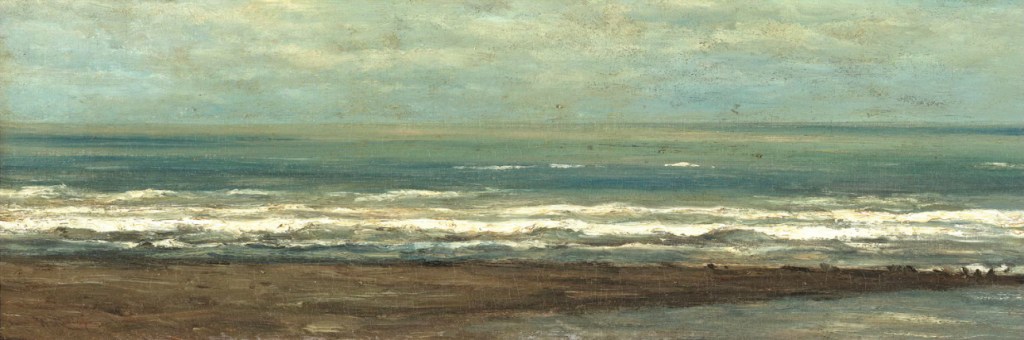
Seascape Near Heijst, by Willem Roelofs, 19th century. (Image courtesy of Fine Art America).

Despite this, we do know a few things about his lifetime: He lived his entire life in Oyster Bay, Long Island, the Province of New York. He married a woman named Sarah (maiden name unknown), and he was the father of four children. Joseph died remarkably young, probably around the age of 36. When he died, his wife Sarah was pregnant with their fourth child. We know these things from the only meaningful record we have from this portion of his life — his 1716 Will.

Author Ethan Allan Doty tells us in his book, The Doty-Doten Family in America,
“His will is recorded at Jamaica, Queens Co., N. Y. , signed Joseph Doughty of Oyster Bay, made July 7, 1716, and devises his estate to his eldest son Joseph, to his son Isaac, to his daughter Sarah, and to his wife Sarah, and provides for a child in case his wife be with child.” It seems likely that his Will was written in haste, so something must have been going on with either his health or perhaps he’d been in a life threatening accident. We do not know.

We can infer from this document that his children were all born in Oyster Bay, and that their names are:

  • Sarah Doty, born about 1706, “She married John Jackson, probably the son of James Jackson and Rebecca Hallett.”
  • Joseph Doty Jr., born about 1708, (We are descended from Joseph Jr.).
  • Isaac Doty, born 1711, and who probably died young
  • Elizabeth Doty, born about 1716, most likely after Joseph Sr.’s death. [She] Married there 1730, Daniel Dunning (or Downing). Marriage license issued to Daniel Dunning and Elizabeth Doty of Queens County,
    N. Y., August 4, 1730”.

Interestingly, the document also mentions receipts, which are “When an executor or administrator paid debts owed by the estate and collected money from those who owed the deceased person, receipts were issued which were filed with the annual accounting and final settlement. Among these will be receipts signed by the heirs as they receive money from the estate”. (Family Search)

  • His widow Sarah, received receipts for her share of above, January 29, 1717. From this date it is safe to assume that Joseph Sr. most likely died shortly after writing his Will.
  • Sarah (Doty) Jackson, wife John Jackson, received receipts May 7, 1724. 
  • Joseph Doty Jr. receipts for 178£*, in full. May 6, 1729. 
  • Elizabeth Doty received receipts for her share, July 24, 1736.

*Observation: It is certain that Joseph Jr. received this money from his late father’s estate around the time of his 21st birthday. The value of 178£ calculates to over $44,500 dollars in today’s currency, (see footnotes). Cha-ching!

It also seems that property Joseph Sr. owned in Oyster Bay was eventually sold, about two years after he died. On “July 30, 1718, Jervis Mudge, Thomas Cirby and Joseph Carpenter, executors of Joseph Doty, deceased, sell to Isaac Doty, Jr., certain land at Oyster Bay, which is an equal one-third of land given by their father, Isaac Doty, Sr., to his three sons, Joseph, Jacob and James.” (1)

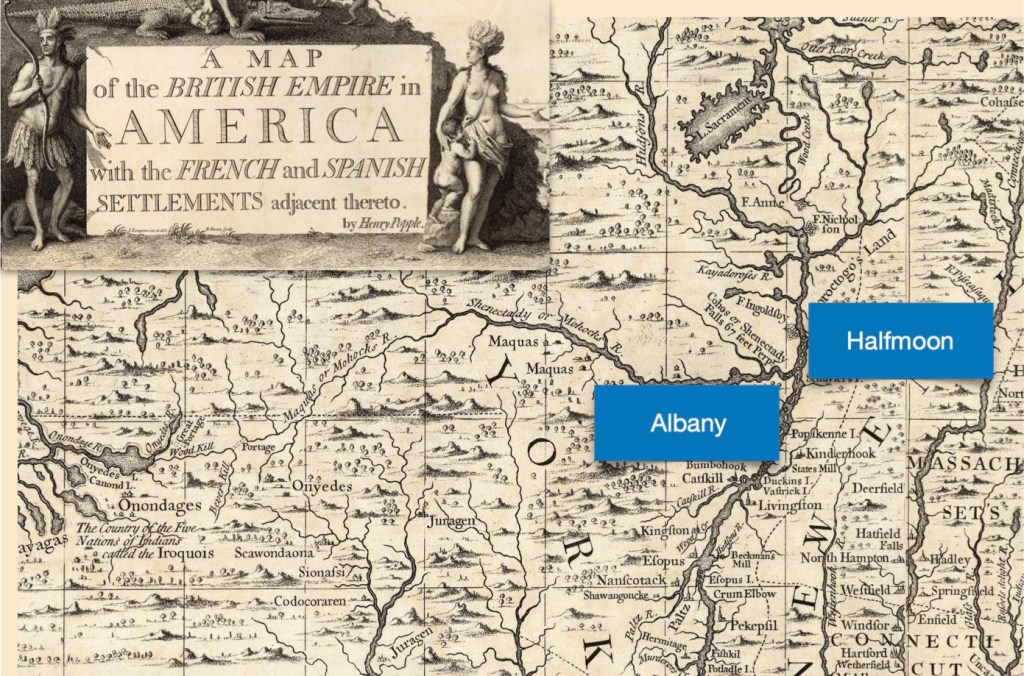
A Panoramic View of New York Harbor As Seen From Long Island, 1727 by Henry Popple, and issued in 1733. (Image courtesy of Wikipedia).

Manhattan Calling

We know that Joseph Jr. was soon living in Manhattan, and that he didn’t have to travel very far to get there. Why was he there? Of course, we don’t know for certain. Nevertheless, receiving the equivalent of $44,500 plus dollars when you are aged 21 years in Colonial America, certainly eased this transition.

In those days, despite the Dutch having first colonized the area, the population was a mixture of many different types of people. The English population eventually came to dominant governance. Wikipedia tells us, “By 1700, the Lenape population [Native Peoples] of New York had diminished to 200. The Dutch West Indies Company transported African slaves to the post as trading laborers used to build the fort and stockade, and some gained freedom under the Dutch. After the seizure of the colony in 1664, the slave trade continued to be legal. In 1703, 42% of the New York households had slaves; they served as domestic servants and laborers but also became involved in skilled trades, shipping and other fields. Yet following reform in ethics according to American Enlightenment thought, by the 1770s slaves made up less than 25% of the population.”

It was into this colonial admixture of European Dutch and English immigrants, and enslaved peoples, that Joseph Jr.had moved. (2)

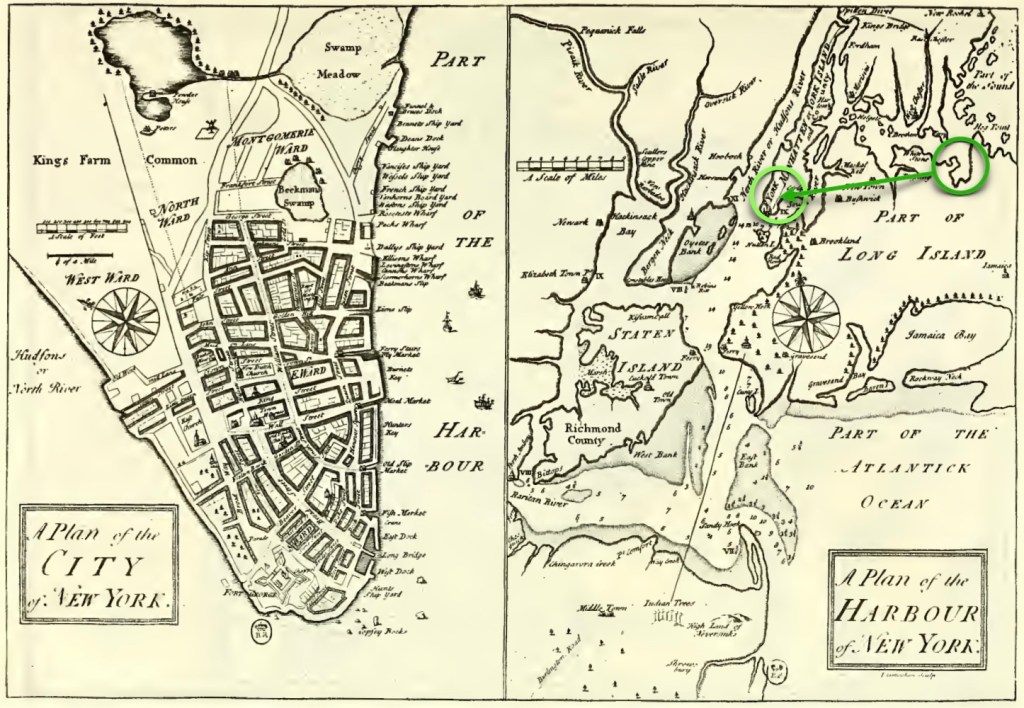
The image on the right shows the short distance that Joseph Doty, Jr. needed to travel to relocate to Manhattan. (Note that the geography of Long Island is not very accurate).
Plate 27-A from, A Plan of the City of New York (and) A Plan of the Harbour of New York
by Author unknown, circa 1730-35, from Bibliotheque Nationale, Paris, Print Department.
Plate 32-A from, A Plan of the City and Environs of New York [Grim’s General Plan
by David Grim, circa 1742-44, from from The New York Historical Society.

All three map plates shown above are derived from the book, The Iconography of Manhattan Island, Volume 1, by I. N. Phelps Stokes, circa 1915.

The Burgher Guards

The Burgher Guard of Manhattan, also known as the Burgher Militia, was a citizen militia organized by the Dutch West India Company in 1640 to protect New Amsterdam (Manhattan) from external threats. These local militias were utilized to supplement the presence of the Dutch garrison, and were known as the Burgher Guards. These citizen-soldiers, composed of adult male residents, were responsible for maintaining order and defending the colony. Membership in the Burgher Guard was a sign of citizenship and was initially restricted to certain residents, excluding indentured servants and enslaved Africans. 

After the English takeover in 1664, the Burgher Guard was eventually absorbed into the English colonial militia system, with the burgher class-right transitioning to the English concept of freemanship. (3)

Captain Charles Laroex’s Company of New York City Militia in 1738

The world of 1730s Manhattan was still a far-flung New England outpost of the British Empire, and despite a century of colonization, the English were still trying to figure out how to govern the area appropriately. With regard to defense, it was not practical for England to maintain standing armies throughout the colonies. So, it makes sense that they carried over one of the same systems that they already knew —that of forming local militias.

These groups were a community-based force, with Companies drawn from specific geographic areas within towns. They varied in size, with a minimum of 24 men to form a company and larger companies including officers like captains, lieutenants, and sergeants. Their main function included maintaining order, providing local defense, and assisting in emergencies. The militias also played a role in town governance, with records of town meetings reflecting militia-related concerns such as fence heights, road maintenance, and care for the poor.

When we discovered that our 6x Great Grandfather Joseph Doty, Jr. had been cited repeatedly by other researchers as being a private in Captain Charles Laroex’s Company of New York City Militia in 1738, but no one had provided any support for this intriguing fact. We searched high-and-low to verify this. A big concern was the fact that the 1911 fire at the State Library in Albany, New York had destroyed many colonial era records. “The English volumes of Colonial Manuscripts included censuses, assessment lists, muster rolls, and other items useful to genealogists, almost all of which were destroyed by the fire.” (See footnotes, NYG&B) However, despite our concerns, diligence finally paid off.

Detail from an article titled Great War Marks End Of Burgher Guards, found on page 10 of the August 19, 1917 edition of The Sun newspaper. (See footnotes).

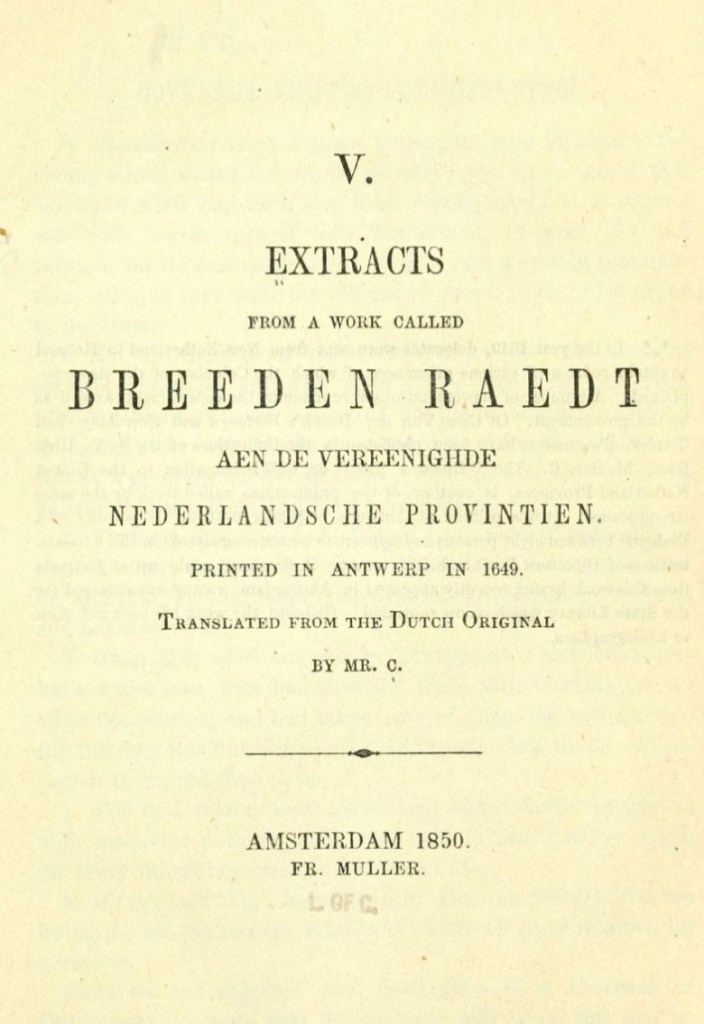
We first found confirmation that the Laroex Company did indeed exist. It is mentioned in an August 19, 1917 The Sun newspaper article, “…But the old burgher spirit could not be ‘snuffed out’, and as late as 1738 the Independent companies in this city were almost exclusively Dutch American. They were Beekmans’s, Laroex’s, Stuyvesant’s, Richard’s, Van Horn’s and Cuyler’s and the Blue Artillery”. (The Sun) Digging further, we found a book at the Library of Congress, published in Amsterdam in 1850, titled Breeden Raedt Aen De Vereenighde Nederlandsche Provintien. (It had been translated from the original Dutch). This book contained many records of 1738 Manhattan, as well as the full rosters the various militia companies. (4)

Excerpted from Breeden Raedt Aen De Vereenighde Nederlandsche Provintien. (Image courtesy of the Library of Congress).

The Fires and Riots of 1741...

As we had written about the population of enslaved people in Manhattan at that time, “By the 1740s, 20% of the residents of New York were slaves, totaling about 2,500 people… After a series of fires in 1741, the city panicked over rumors of its black population conspiring with some poor whites to burn the city. Historians believe their alarm was mostly fabrication and fear, but officials rounded up 31 black and 4 white people, who over a period of months were convicted of arson. Of these, the city executed 13 black people by burning them alive and hanged the remainder of those incriminated.”

Propagandist illustrations documenting the New York Slavery Conspiracy of 1741, taken from The Evolution of Slavery, Abolition in NY, and the NY Courts, The Lemmon Slave Case.

Comment: That text about the 1741 riots and lynch mobs is difficult to read, but sometimes we see that there is much cruelty in history. We don’t know if Joseph Doty was still involved with the Laroex Company militia at that time, or quite honestly, if he even was still living in Manhattan by 1741. If he was there, we wonder if perhaps these events influenced his decision to leave the city? (5)

In due course he moved up the Hudson River to the community of Nine Partners – Crum Elbow Precinct in Duchess County and by 1744 he was married.

Before we leave Manhattan and the Oyster Bay area, we thought it would be very interesting to take a look at the history of oysters in New York Harbor. It’s not with every ancestor that you get to delve into something so unique!

Slurp, painting by Pam Talley. (Image courtesy of Fine Art America).

Oysters and New York’s Past

It might seem obvious, but why was the town which Isaac Doty and his family lived in called Oyster Bay?

In 1609, when English explorer Henry Hudson sailed into the harbor of what later became known as New York City, he “could not have seen… [that there] were 220,000 acres of oyster beds below the surface on the harbor floor, constituting nearly half of the oysters in the entire world”. Later in time, on nearby Long Island, the early Dutch settlers referred to the area as Oyster Bay due to the vast number of high-quality oysters native to the region. Oysters became a staple of the colonial New York diet. (Untapped New York)

It was the Lenape people [Native Peoples] who showed the settlers how to harvest oysters from the harbor. “The local Lenape had been living off the reefs for generations. They would open the oyster shells by wrapping the entire oyster in seaweed before tossing them fire”.

Mine oysters – Dredging boats in the Chesapeake, from Harper’s Weekly magazine, March 16, 1872. (Image courtesy of The New York Public Library Digital Collections).

“Oysters were always popular and in high demand. Literal tons of oysters were eaten everyday. Worried that the supply might not last, the local government introduced a conservation law in 1715, banning the harvest of oysters during the months without an R, which lasts from May to August. The popularity of New York oysters [continued to] spread across the nation and to Europe, where large shipments of oysters were being sold. In order to meet the demand, the conservation law from 1715 was lifted in 1807, prompting the unsustainable harvesting of the oyster reefs. The supply was still not enough to meet the demand, and so oysters from Long Island, Connecticut, and New Jersey were brought into New York. These oysters were able to be sold as New York oysters because they were in the harbor for a short amount of time”. (Untapped New York, and the Billion Oyster Project)

Historically, oysters were deeply woven into the life of East Coast cities, as Charles Dickens described enthusiastically in his 1842 travelogue American Notes. He then “describes cellars serving oysters, pretty nigh as large as cheese-plates”. (BBC)

Eventually, pollution in New York Harbor decimated the viability of the oyster harvest. Recent efforts to revitalize the harbor and bring back the native oysters is ongoing. “That thriving population of oysters is long gone. But over the past 10 years, one of New York’s most ambitious rewilding projects has sought to revive its once-famous oysters, adding 150 million larvae across 20 acres of harbour since its beginnings. The goal: restoring the city’s coastal habitat, improving water quality and educating the public.” (BBC) (6)

Detail excerpt from The Provinces of New York and New Jersey; with part of Pensilvania,
and the Province of Quebec, by Thomas Pownall, and Samuel Holland, circa 1776.
(Image courtesy of the Library of Congress).

This map documents the family’s transition from Oyster Bay, Long Isand, to the Crum Elbow Precinct in Dutchess County, to the hamlet of Lansingburg Village in Rensselaer County.

Saying Farewell to Oyster Bay

When you eat a well prepared fresh oyster it should taste a bit like the sea… just a bit salty (and delicious!) We say this because, when we have been researching out ancestral lines, occasionally we come across an intriguing bit of family folklore that sometimes leads us down a new and exciting path. However, sometimes a fanciful story can lead us down a rabbit hole. Such is the story with a legend we encountered in the Doty-Doten book (DDFA) , and this story must be taken with a very large grain of salt. Like your food, you can immediately tell when it is just too salty.

Wikipedia tells us that “To take something with a ‘grain of salt’ or ‘pinch of salt’ is an English idiom that suggests to view something, specifically claims that may be misleading or unverified, with skepticism or not to interpret something literally. In the old-fashioned English units of weight, a grain weighs approximately 65 mg, which is about how much table salt a person might pick up between the fingers as a pinch.

On the left, Pliny the Elder, author of Naturalis Historia. He is also noted for dying in the AD 79 explosion of Mount Vesuvius, which buried the City of Pompeii. At right, a 1917 Morton Salt Company advertisement featuring the famous slogan, ‘When It Rains It Pours’ and an image of the Morton Salt Girl.

The phrase is thought to come from Pliny the Elder’s Naturalis Historia, regarding the discovery of a recipe written by the Pontic King Mithridates to make someone immune to poison. One of the ingredients in the recipe was a grain of salt. Threats involving poison were thus to be ‘with a grain of salt’, and therefore less seriously.”

Ethan Alan Doty had written this, “The legend in the family was that Elsha Van Schaick was daughter and sole heir of an Amsterdam banker, and that she eloped with Francis De Long, who was a French officer. This story made it difficult to obtain full items [property?] of some branches, who were suspicious that they were to be defrauded of their share of valuable estate.”

Comment: What a great story! Even so, it’s just not true. We extensively researched the Van Schaick family. The closest this branch ever came to anything to do with banking was long after Lucretia’s lifetime. Another branch of the family is actually featured in a prestigious vanity book from 1881 titled, Contributions to the History of Ancient Families of New Amsterdam and New York, by Edwin R. Purple.* We suspect that this book was printed for Gilded Age Manhattan families who swirled in New York High Society circles.
* The perfect name for a writer of that genre. See “Quote or No Quote?” in the footnotes at the end of this chapter.

The Van Schaicks were indeed very early in New Amsterdam, and then Manhattan. Some branches of the family went into the Hudson River Valley, therefore the history truly develops from what branch of the family you belong within. Then, what was going on with this tale of a banking heiress and a French army officer? We came upon a well researched file about Lucretia’s father Frans DeLang, which covers this family legend. It states:

“In discussing the marriage of Joseph Doty and Geesje (Lucretia) De Long, the Doty Genealogy gives her parents as Frans and ‘Elsha’, the latter an obvious error and presumably confusion with Maritje’s youngest daughter Egge or Echa.” Lucretia’s mother was named Maritje Van Schaick.

“The story is also another of the 19th century attempts to assign a French heritage to a Dutch family. Frans was not a French officer, he was born to Dutch parents and in the new world. I doubt if Claas Van Schaick was an Amsterdam banker before emigration, and Maritje was not likely his sole heir.

“An even more inane version appears in the History of Danby (Vermont) which says Lucretia Doty was daughter of ‘Hielcha DeLong, the wife of Francis DeLong, a French officer. They say she let herself down from a two story building in Amsterdam in 1780, came to America, and settled on Long Island.’ So this puts American-born Frans in Amsterdam and eloping at the age of 99! I hope he didn’t hold her ladder.”

For an extensive history of the De Lange /De Lang / De Long family, please see the footnote for Frans DeLang at the end of this chapter. It is written by Delong family descendant Roy Delong, basing his observations on, “…the following notes from the late John D. Baldwin (50+ year Delong researcher). (Note various spellings of surname in this text…”). (7)

In the next chapter, we follow the Joseph Doty Jr. as he leaves Manhattan, and first ventures forth into Dutchess County. Then with his new wife Geisje ‘Lucretia’ De Long and their family, they settle in the oddly-named Crum Elbow Precinct in Dutchess County. Eventually, Life then takes them still further in their northward trek up the Hudson River Valley, and finally into Rensselaer County.

Following are the footnotes for the Primary Source Materials,
Notes, and Observations

Seascape

(1) — seven records

Fine Art America
Seascape Near Heijst
painting by Willem Roelofs, 19th century
https://fineartamerica.com/featured/seascape-near-heijst-willem-roelofs-1822-1897.html
Note: For the seascape image.

(DDFA)
Doty-Doten Family in America
Descendants of Edward Doty, an Emigrant by the Mayflower, 1620

by Ethan Allan Doty, 1897
https://archive.org/details/dotydotenfamilyi00doty/page/500/mode/2up
Book pages: 501, Digital pages: 500 /1048
and
https://archive.org/details/dotydotenfamilyi00doty/page/504/mode/2up?view=theater
Book pages: 505, Digital pages: 504 /1048
Note: For the texts.

U.S. Probate Records Class Handout
Under the subtitle: Distributing the Estate
https://www.familysearch.org/en/wiki/U.S._Probate_Records_Class_Handout
Note: To explain the role of receipts in a Colonial American Will.

Pounds Sterling to Dollars: Historical Conversion of Currency
https://www.uwyo.edu/numimage/currency.htm
Note: For the calculation of the inheritance value for Joseph Doty, Jr. from his late father’s estate when he was 21 years old.

Joseph Doty
in the Mayflower Births and Deaths, Vol. 1 and 2

https://www.ancestry.com/search/collections/3718/records/37992?tid=&pid=&queryId=ab22e56d-3bb2-4c0f-b15c-cffa1c314979&_phsrc=ylI10&_phstart=successSource
Book page: 422, Digital page: 434/537
Note: For confirmation of birth date and his Will date.

Joseph Doty
in the U.S., Find a Grave Index, 1600s-Current
https://www.ancestry.com/search/collections/60525/records/137781328
and
Joseph Doty
in the Global, Find a Grave Index for Burials at Sea and other Select Burial Locations, 1300s-Current
https://www.ancestry.com/search/collections/60541/records/182712503
Joseph Doty
https://www.findagrave.com/memorial/172015138/joseph-doty

Manhattan Calling

(2) — four records

A Panoramic View of New York Harbor As Seen From Long Island, 1727
by Henry Popple, and originally engraved by William Henry Toms
(who also signed it) & R.W. Seale, issued in 1733
https://en.wikipedia.org/wiki/History_of_New_York_City#/media/File:New_York_Harbor_Waterfront_1727_panorama_map.jpg
Note: This is an inset from A Map of the British Empire in America with the French and Spanish Settlements adjacent thereto…

History of New York City
https://en.wikipedia.org/wiki/History_of_New_York_City
Note: For the text.

The three map plates in this chapter are derived from the book,
The Iconography of Manhattan Island, Volume 1

by I. N. Phelps Stokes, circa 1915 —

Plate 27-A
Bibliotheque Nationale, Paris, Print Department
A Plan of the City of New York (and) A Plan of the Harbour of New York
by Author unknown, circa 1730-35
https://upload.wikimedia.org/wikipedia/commons/8/84/IA_Query_”sponsor-(Sloan)_date-(1000_TO_1925)_publisher-((New_York)_OR_Chicago_OR_Jersey_OR_Illan)”_(IA_iconographyofman01stok).pdf
Book pages: 260-261, for map explanation

Plate 32-A
from The New York Historical Society
A Plan of the City and Environs of New York [Grim’s General Plan]
by David Grim, circa 1742-44
https://upload.wikimedia.org/wikipedia/commons/8/84/IA_Query_”sponsor-(Sloan)_date-(1000_TO_1925)_publisher-((New_York)_OR_Chicago_OR_Jersey_OR_Illan)”_(IA_iconographyofman01stok).pdf
Book pages: 270-271, for map explanation

The Burgher Guards

(3) — one record

New Amsterdam Stories
What happened to the burgher right after the English invasion in 1664? 
https://newamsterdamstories.archives.nyc/english-invasion#:~:text=The burgher right continued to, a sign of municipal identity.
Note: For research on the text.

Captain Charles Laroex’s Company of New York City Militia in 1738

(4) — four records

Journal of the American Revolution
Colonial Militia on the Eve of War, Prewar Conflict (< 1775)
by Michael Cecere
https://allthingsliberty.com/2025/04/colonial-militia-on-the-eve-of-war/
Note: For research on the text.

(NYG&B)
New York Genealogical & Biographical Society
The 1911 State Library Fire And Its Effect On New York Genealogy
by Harry Macy, Jr.
https://www.newyorkfamilyhistory.org/knowledgebase/1911-state-library-fire-and-its-effect-new-york-genealogy
Note: For the text.

Page 10 article titled Great War Marks End Of Burgher Guards, found in the
August 19, 1917 edition of The Sun newspaper.

NYS Historic Newspapers
The Sun, 19 August 1917
Article: Great War Marks End of Burgher Guards
https://www.nyshistoricnewspapers.org/?a=d&d=suna19170819-01.1.72&e=——-en-20–1–txt-txIN———-
Newspaper page: 10, Filmstrip pdf page: 72

V. Extracts From A Work Called Breeden Raedt Aen De Vereenighde Nederlandsche Provintien. Translated From The Dutch Original by Mr. C.
A List of the Company [of Militia]
Belonging Under the Command of Capt. Charles Laroexs
https://tile.loc.gov/storage-services/public/gdcmassbookdig/extractsfromwork00mely/extractsfromwork00mely.pdf
Book page: 213-214
Note: For the listing of Joseph Doty in the 1738 New York City Militia Company of Captain Charles Laroexs.

The Fires and Riots of 1741...

(5) — two records

History of New York City
https://en.wikipedia.org/wiki/History_of_New_York_City
Note: For various texts.

The Historical Society of New York Courts
The Evolution of Slavery, Abolition in NY, and the NY Courts,
The Lemmon Slave Case
by Hon. Albert M. Rosenblatt
https://history.nycourts.gov/wp-content/uploads/2020/05/20200420-Lemmon-Slave-Case-Slide-Presentation.pdf
Note: For the images.

Oysters and New York’s Past

(6) — six records

Fine Art America
Slurp 
painting by Pam Talley
https://fineartamerica.com/featured/slurp-pam-talley.html?product=poster
Note: For the oyster painting..

Untapped New York
Aw Shucks: The Tragic History of New York City Oysters
by Thomas Hynes
https://www.untappedcities.com/history-new-york-oysters/
Note: For the text.

History of New York Harbor
https://www.billionoysterproject.org/harbor-history
Note: For the text.

The Oysters of New York’s Past
by Wenjun Liang
https://storymaps.arcgis.com/stories/1ce158b2123a4c9c9898278e98f015d5
Note: For reference.

The New York Public Library Digital Collections
Mine oysters – Dredging boats in the Chesapeake
from Harper’s Weekly magazine, March 16, 1872

https://iiif-prod.nypl.org/index.php?id=4018402&t=v
Note: For the 1872 image of the oyster farmers.

BBC
Oysters as large as cheese plates:
How New Yorkers are reclaiming their harbour’s heritage

by Anna Bressanin
https://www.bbc.com/future/article/20241118-how-new-yorkers-are-reclaiming-their-harbours-heritage
Note: For the text.

Saying Farewell to Oyster Bay

(7) — eight records

Library of Congress
The Provinces of New York and New Jersey;
with part of Pensilvania, and the Province of Quebec.
by Thomas Pownall, and Samuel Holland, circa 1776
https://www.loc.gov/resource/g3800.ar104500/?r=0.402,1.183,0.673,0.371,0
Note: For sections of the map which document this family’s journey from Oyster Bay, Long Island to Rensellaer County, the Province of New York.

Encyclopædia Britannica
Pliny the Elder
https://www.britannica.com/biography/Pliny-the-Elder
Note: For the portrait.
Made In Chicago Museum
Morton Salt Company, est. 1848
https://www.madeinchicagomuseum.com/single-post/morton-salt-co/
Note: An advertisement from 1917/1918, featuring the original iteration of the Morton Salt Girl and the “It Pours” slogan on the blue can.

A grain of salt”
https://en.wikipedia.org/wiki/A_grain_of_salt
Note: For just a pinch of the text.

(DDFA)
Doty-Doten Family in America
Descendants of Edward Doty, an Emigrant by the Mayflower, 1620

by Ethan Allan Doty, 1897
https://archive.org/details/dotydotenfamilyi00doty/page/504/mode/2up?view=theater
Book pages: 505-506, Digital pages: 504-506 /1048
Note: For the text.

Contributions to the History of Ancient Families of New Amsterdam and New York
by Edwin R. Purple, circa 1881
https://archive.org/details/ldpd_6499396_000/page/n11/mode/2upBook page: 9, Digital page: 30/164

Professor Buzzkill podcast
Quote or No Quote? Who Said,
“If you don’t have anything nice to say, come and sit here by me”?

https://professorbuzzkill.com/2023/11/29/quote-or-no-quote-who-said-if-you-dont-have-anything-nice-to-say-come-and-sit-here-by-me/
Note 1: For the text.
Note 2: Gilded Age Society has some interesting stories —
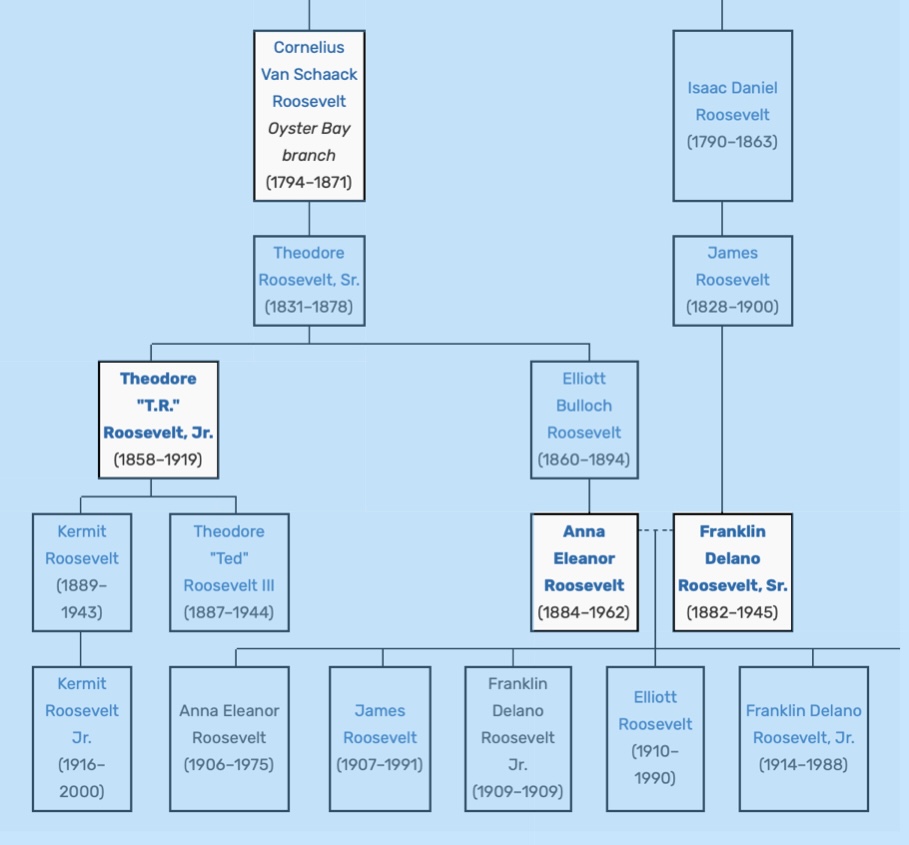
“If you don’t have anything nice to say about someone, come sit here by me,” It was originally said by Alice Roosevelt, the eldest daughter of President Theodore Roosevelt. [From the Oyster Bay, New York social circles…]

By the time her father ascended to the Presidency, Alice Roosevelt was a prominent writer and well-known socialite in New York and Washington. According to the most solid evidence we have, what Alice said (or, more accurately, what she had embroidered on a couch pillow) was ‘If you can’t say something good about someone, sit here by me.

Alice Roosevelt Longworth

From all accounts, Alice Roosevelt was vivacious, intelligent, curious, and constantly in motion. She was known to come into the President’s office, unbidden, several times a day, to offer her thoughts and suggestions on politics and to make comments on social affairs. Apparently, this frustrated the President greatly. So much so, in fact, that, after multiple ‘Alice interruptions’ one morning, Teddy Roosevelt turned to an advisor and said, ‘I can either run the country, or I can attend to Alice, but I cannot possibly do both.’”

Frans DeLang
https://www.findagrave.com/memorial/103424712/frans-delang?_gl=1*1hxjf0b*_gcl_au*MTM3MTk4NzE2Mi4xNzQ5MDYwMjEx*_ga*MTAxNTA3NTUwNi4xNzMyMjExNDYx*_ga_4QT8FMEX30*c2M1ZjIzNmVmLTZkNDEtNGRhYS05ZGEyLTQ1OTBlY2Q0OTZkOSRvNjkkZzEkdDE3NTQ3Njk1MzkkajM0JGwwJGgw*_ga_LMK6K2LSJH*c2M1ZjIzNmVmLTZkNDEtNGRhYS05ZGEyLTQ1OTBlY2Q0OTZkOSRvNjgkZzEkdDE3NTQ3Njk1MzkkajM0JGwwJGgw
Note 1: For three quotes from the text.
Note 2: The content of this extensive history is researched and excerpted from
“…the following notes from the late John D. Baldwin (50+ year Delong researcher). (Note various spellings of surname in this text…”.

The Doty Line, A Narrative — Five

This is Chapter Five of nine. When our ancestor Edward Doty Sr. died in 1655, his son Isaac was only about seven years old. As he had grown up in a large family with eight other siblings. Some of these brothers and sisters stayed local and then had big families of their own… so, we speculate that he may have gotten just a bit tired of seeing so many Doty relatives everywhere he looked?

This suggests that he then sought out some new horizons. Author Ethan Allan Doty wrote, “At the death of his father he was just six years of age, and probably continued to live with his mother until about the time of her marriage to John Phillips, in 1667. It is somewhat doubtful where he spent the next five years of his life, but it is probable that it was in Sandwich. Mass.. where his brother Joseph was also, early in life, a resident. But it is possible that he may have visited in this period Oyster Bay on Long Island where he subsequently lived.” (Doty-Doten Family in America, DDFA) (1)

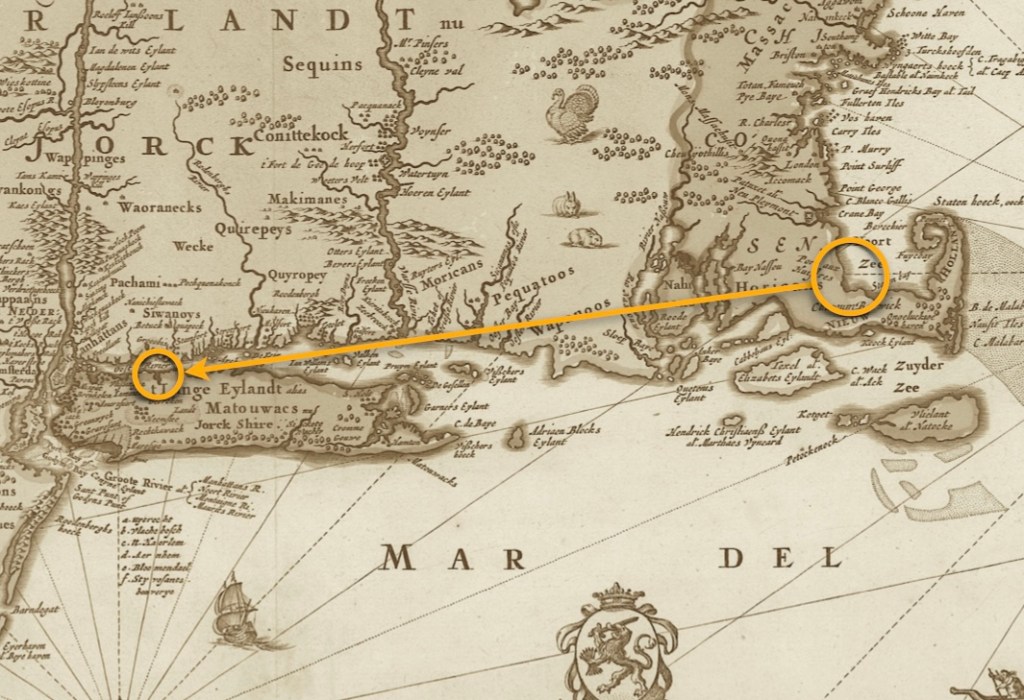
Map of New Netherland and New England, and also parts of Virginia, also known as the Novi Belgii Novæque Angliæ nec non partis Virginiæ tabula. Although this map is not considered to be very accurate for its geography, but it is correct for the time period in which Isaac Doty lived.

Drawn in 1685 by Nicolaes Visscher, it shows the distance that Isaac Doty traveled from the Plymouth Colony area which was undertake control of England — to the area of Oyster Bay, Long Island, New Amsterdam, which was under the control of the Dutch.
Created a mere 70 years later than the map above, A Map of the Most Inhabited Part of New England, by Braddock Mead (alias John Green) — this clearly shows how much cartography [map making] skills had improved in those years.

Breaking New Ground

For reasons which we continue to ponder, Isaac Doty, broke away from the Plymouth Colony and relocated much further west, settling at Oyster Bay, Long Island. At the time, this area was the border between the English settlements in the New York Colony, and the Dutch settlement of New Amsterdam. We will write in detail about both the historical details and Isaac’s family history later on in this chapter. First, we would like to set the stage about what was happening in Long Island before he moved there.

The name ’t Lange Eylandt alias Matouwacs” appears in Dutch maps from the 1650s, with ’t Lange Eylandt translating to Long Island from Old Dutch. The English referred to Long Island as Nassau Island, after the House of Nassau of the Dutch Prince William of Nassau, Prince of Orange (who later also ruled as King William III of England). It is unclear when the name “Nassau Island” was discontinued. Another indigenous name from colonial time, Paumanok, comes from the Native American name for Long Island and means “the island that pays tribute.” (Wikipedia)

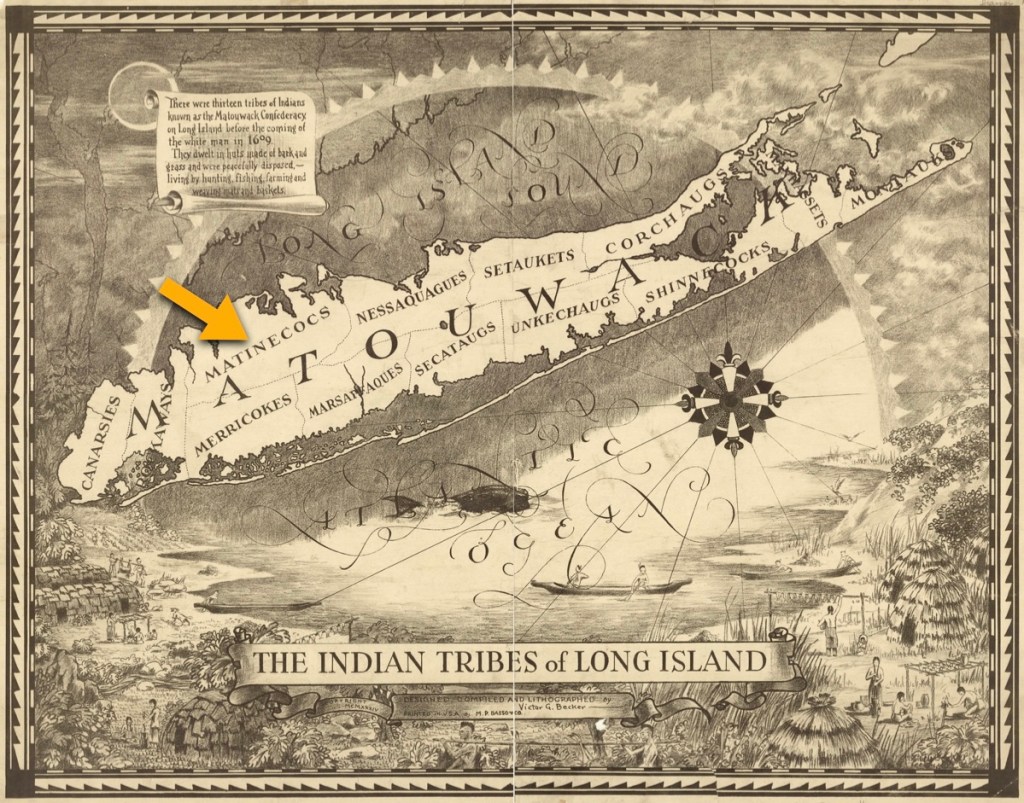
Writer John E. Hammond from The Oyster Bay Historical Society, [as quoted throughout,] tellsl us in The Early Settlement of Oyster Bay — “The original settlers of the area” and the group which Isaac Doty had the most contact with, were the Matinecocks. In their language, their name meant “at the hilly ground”. They were part of the thirteen tribes who made up the Matouwack Confederacy, (see map below).

“They were a part of the Algonquin language and cultural group but had no written language. When the first Europeans arrived in the early 1600s the total population of the 13 chieftaincies on Long Island was estimated at about 6,500.” Like many of our other family lines who were in New England in this era, they witnessed that the Europeans “had a great impact on the” Native Peoples; “many were decimated by diseases which they had no resistance to”. (2)

Shows areas of Long Island held by the various Native People tribes that made up the Matouwack Confederacy as of 1609. Isaac Doty interacted with the Matinecocs. (Image courtesy of the Brooklyn Public Library).

The Matinecock People

As with other tribal groups in the area, “their leaders were called sachems and were shown great respect by the other members of the community”. Furthermore, “…the sachems sought the opinions of the other members of the community while sitting in council, and the sachem’s decision on any subject was always final”. When the Dutch and English settlers “began buying up the land”, many of the native sachems “thought this was just another form of tribute; many did not believe that they were actually selling off the rights to their land”.

The effect on the population from the diminishing ravages of disease cannot be underestimated. “By the year 1685, the last piece of land was bought by the European settlers”. By 1709, there were no Native Peoples left on the island “except small remnants of a few scattered communities. The remaining Matinecocks moved to join with the Shinnecocks and Montaucks… Those that chose to stay on their ancestral land settled within small hamlets near sites of their earlier villages and sought work on English plantations”. (Hammond)

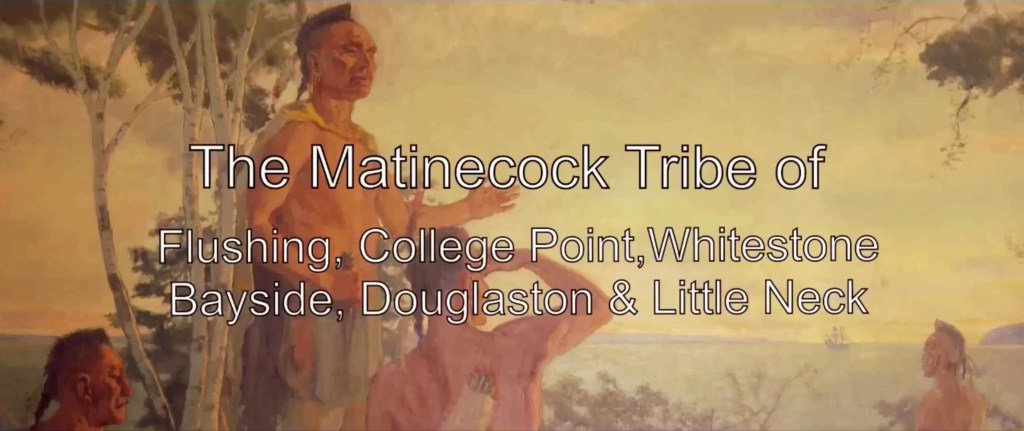
An unknown artist’s representation of the Matinecock People (note the colonial era ship in the distance). This is a screen grab of a video about the Matinecocks which we have linked in the footnotes.

The decades before Isaac Doty’s arrival in the Oyster Point area saw the Matinecocks facing profound challenges, including conflicts like Kieft’s War and the Battle of Madnan’s Neck, which further impacted their population and landholdings. (Wikipedia, see footnotes). (3)

The Dutch Held New Amsterdam

In this period, Manhattan Island was called New Amsterdam* because it was under the control of the Dutch, who desired to control more land territory. Very close to the mouth of the Hudson River, there was also Long Island, where the Dutch controlled the western one-third, and the eastern two-thirds of Long Island was controlled by the English.
(*and sometimes it was also called, the New Netherlands)

The point where there was tension between the two empires, was more-or-less right through the area of Oyster Bay.

Left image: Map of Long Island [Long Iland sirvaide], by Robert Ryder, circa 1675. (Image courtesy of The Brooklyn Library). Right image: A contemporary map of Oyster Bay to better understand the true landscape and harbors. (image courtesy of Historical Nautical Charts of New York).

Again, as explained by writer Hammond, the Dutch and the British had different perspectives about what constituted the exact boundaries of Oyster Bay. This caused much confusion about who had the right to govern the area… The Dutch perspective was that only Part A below was Oyster Bay. (They referred to Part B as Martin Gerritsen’s Bay). The English perspective was that Oyster Bay was both Part A and Part B, as shown below.

The Dutch had difficulty in populating the territory after they claimed the New Netherlands and freely accepted English settlers within their territory. [This was] allowed, provided the English settlers swore an oath to the Dutch Directors and paid their tithes; one tenth of all their crops were taken by the Dutch as taxes.

The settlement at Oyster Bay was by a group of traders from Plymouth who neither swore any oath to the Dutch nor had any political connection with the Hartford or New Haven colonies. The Oyster Bay settlement was under no government and was therefore the center of a long dispute between the Dutch at New Amsterdam and the English in New England.” (4)

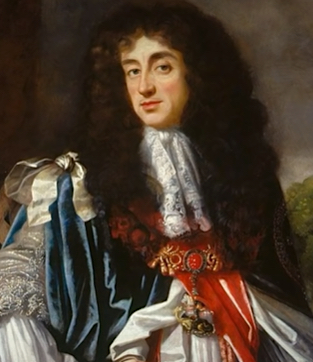
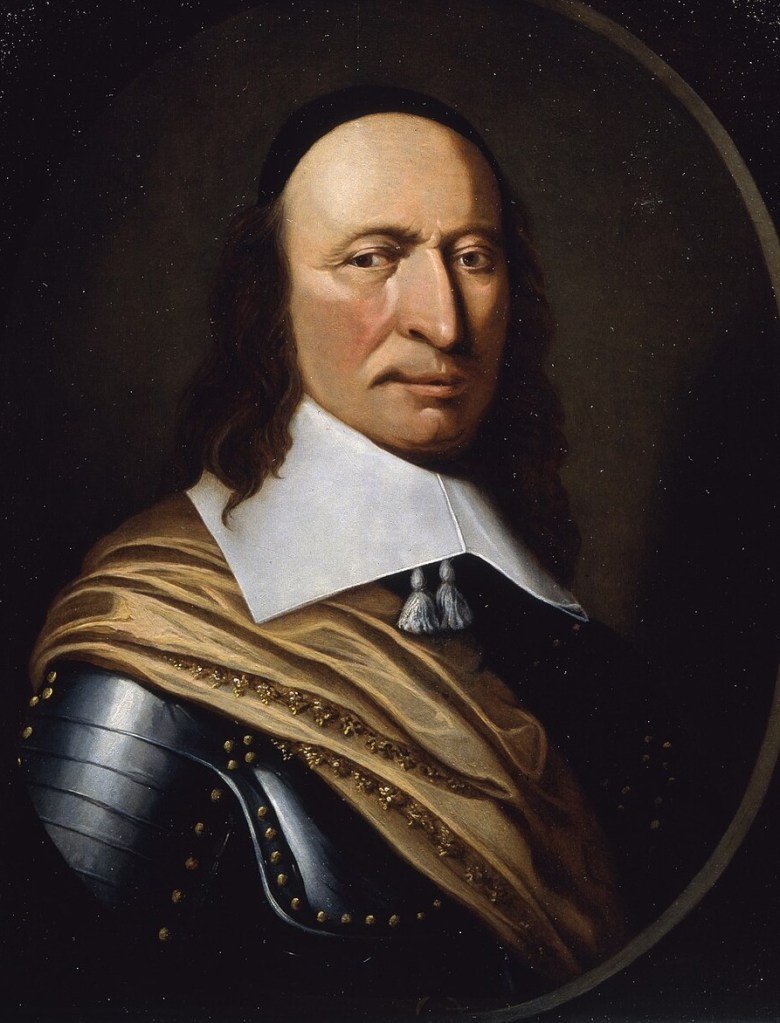
The Stuarts: King Charles II (reigned 1660 – 1685). The Houses of Stuart and Orange: James, first as the Duke of York, then King James II (reigned 1685 – 1688). Peter Stuyvesant, Director-General of New Netherland, (1647 – 1664).

The 1660s Brought Change and a Charter

Continuing with Hammond, “In 1660 King Charles II was restored to the throne in England. Believing that all of the English villages on the western end of Long Island were now theirs, the General Court of Hartford ordered on October 23, 1662, that all English towns on Long Island send representatives to the General Assembly at Hartford. This was the first time that the settlement at Oyster Bay came under the protection of any government other than themselves.

…on March 22, 1664, King Charles II gave the entire territory to his brother James, Duke of York [the future King James II] and Oyster Bay then became part of the North Riding of Yorkshire. In August 1664, Peter Stuyvesant was forced to relinquish all control over New Amsterdam. The Duke’s Laws were issued in 1665, and in 1667 the settlement at Oyster Bay received its charter from the new colony and thereby formally began the political entity we know today as the Township of Oyster Bay.

[From 1664 until 1776, what was once called the New York Colony became known as the Province of New York]. (5)

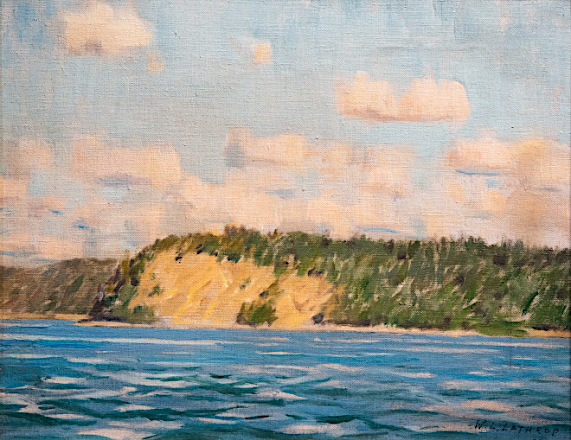
Oyster Bay, by William Langson Lathrop, 1933, via the Heckscher Museum. (Image courtesy of the Empire State Plaza & New York State Capitol).

Isaac Doty Acquires a Home and Land

The records for very old property deeds in the Oyster Bay Area are not that great, and many original documents are simple gone. We think that this may have had something to do with the fact that “Oyster Bay settlement was under no government” until the later 1670s, and even then, it took some time to get everything settled. There are however, a few bright spots where we have located either a mention of property he was involved with, or property he owned.

First, we need a little background about his life in Plymouth. When his father Edward Doty Sr., died, he left extensive land holdings which were divided up between his many children. One of those areas was property in Yarmouth, Barnstable County, on Cape Cod, near Plymouth County where Isaac had grown up. The map below show the town of Sandwich just south of Plymouth and not far from Yarmouth, which was to the east.

From the book The Doty-Doten Family in America (DDFA), written by his descendant Ethan Allan Doty, we learned that the settlement of Oyster Bay began thus, “The first purchase, as above said, was made in 1651 and by emigrants from Sandwich, the principal of whom were Peter and Anthony Wright, two brothers, who, with their father, had come from Lynn, Mass., to Sandwich, shortly before. The larger part of the emigrants for the next twenty or thirty years came from Sandwich and it is probable that Isaac Doty, having spent a portion of his minority there, was attracted by the reports of returning visitors to his new home on Long Island.” It was here that Isaac likely met the Wright family, of which, Anthony Wright was to have much influence on his life.

“The first purchase… was made in 1651 and by emigrants from Sandwich, the principal of whom were Peter and Anthony Wright, two brothers, who, with their father, had come from Lynn, Mass., to Sandwich, shortly before. The larger part of the emigrants for the next twenty or thirty years came from Sandwich… and that it is probable that Isaac Doty, having spent a portion of his minority there [in Plymouth and Sandwich], was attracted by the reports of returning visitors to [then relocate to] his new home on Long Island.”

He was received with favor. A piece of land for a house lot was at once granted, January 6 [or 23], 1673, and he proceeded to build a house upon it. It is probable that he was married by this time, as the house lot was seldom granted by the town to a young single man.

Oyster Bay property records from the description found in the book, The Village of Oyster Bay,
Its Founding and Growth From 1653 to 1700
, by Van S. Merle-Smith, Jr.
This set of two maps indicates at least some of the property that Isaac Doty owned in Oyster Bay, Long Island, New York Colony. At left, the circle indicates property that he purchased circa 1682-1685. At right, Lot 23 in the township settlement. (Images derived from The Village of Oyster Bay, Its Founding and Growth From 1653 to 1700, by Van S. Merle-Smith, Jr.).

[Lot 23] — This plot was situated upon what is known in the present village as South street, at the head of that street and the corner of Pine Hollow road. He continued to live there several years, while he added constantly to his possessions through the neighboring country.”

All of the following records are from the The Doty-Doten Family in America book, unless noted otherwise:

1675
“On the town records it appears, under date of 26th June, 1675, Anthony Wright by a deed of gift to James Townsend and Isaac Douty, all of Oyster Bay, conveys a certain piece of meadow land at Monensscussott Beach in Sandwich in Plymouth Colony, said lot having been granted to said Anthony Wright by the town of Sandwich in return for certain services rendered the town. And Anthony Wright’s will, made 20th of 3d month. 1678, bequeaths to ‘James Townsend five shillings; to his wife, Elizabeth Townsend, two shillings six pence; and to Isaack Dotye, one cow.’

It is a matter of speculation why Isaac Doty should have received these repeated favors from Anthony Wright; for besides the direct gifts he probably owed his favorable reception in the town and the grants of land there by the town meeting to the influence of this same Anthony Wright. It can hardly have been by reason of any connection by marriage, for Anthony Wright was not married, or at least had no issue. He died September 9, 1680, and aside from the above bequests left his whole estate to Alice, the widow of his brother, Peter Wright.

Page 90 from The Village of Oyster Bay.

1676 through 1678
In 1676, his name appears in deeds; May 21, 1677. A list of the freeholders, among whom, entitled to one share of the town, was Isaac Doutty; [in] 1678, he bought one share at Unkaway Neck. [This strange name is an obsolete name for a section of land in the southern part of Oyster Bay].

The 1680s
July 5, 1681. He buys of the Indians a plot where he lives on the east side of Hempstead Harbor; October 16, 1682. Isaac Doughty and William N. Crooker hire for seven years the farm at Littleworth of Robert Godfree. Littleworth was in the western part of the town on the eastern side of Hempstead Harbor; it is now known as Glenwood [Glen Cove] and is in the town of North Hempstead; Up to this time the Indians had continued to hold a considerable part of their old possessions, but in 1685 Isaac Doughty, with a number of others, united and purchased from the chief of the Matinecocks [The Sachem] the balance of their lands in this vicinity.

“A List Of The Estates Of Ye Inhabitants Of Oyster Baye For A Contry Rate, This 29Te Of Sept 1683.” From Documentary History of the State of New-York, Volume Two by Edmund Bailey O’Callaghan). Image courtesy of the Internet Archive).

In 1688, his wife, Elizabeth, joins with him in executing a deed, which she signs with her mark; but the absence of her name in other deeds, both before and after, has no significance, as it was not customary at this time for the wife to sign deeds with the husband. Throughout this period Isaac Doty was frequently appointed to ‘lay out lots,’ to settle boundary lines and to act as commissioner for various purposes, which show him to have been held in high respect by his neighbors, and his judgment to have been greatly esteemed.

In 1703, he is mentioned as one of the proprietors of Littleworth, and in 1704, in a deed, calls his residence at Oyster Bay, New York. (6)

Farmer At The Plough, from  John Tobler’s Almanack, 1761, published by Christopher Sower, the Library Company of Philadelphia. (Image courtesy of Who Built America?)

In consideration of filial duty and affection

Isaac Doty, Sr. was born on February 8, 1648 in the Plymouth, Massachusetts Colony — died about 1728 in Oyster Bay, Long Island, New York Colony. He married Elizabeth Wood* about 1672, in the same location. Elizabeth was born in Portsmouth, Rhode Island and Providence Plantations — died about 1722 in Oyster Bay, Long Island, New York Colony.

*The John Wood Family
There is much information circulating online that records Elizabeth’s family surname as England, rather than as Wood. (However, the name England is an error. This mistake stems from a misreading of a 1684 Will of a man named Hugh Parsons. Please see the footnotes for a detailed explanation).

Together Isaac and Elizaeth had six children (all boys), who were born, lived and died in Oyster Bay, Long Island, the Province of New York. The land and civic records cited are from the The Doty-Doten Family in America (DDFA) book —

  • Isaac Doty, Jr. was born about 1673 — died after 1718
    He married Elizabeth Jackson and they lived in Oyster Bay. On March 29th, 1697, his father “By a deed of gift he conveys to his son, Isaac, Jr., a farm”.
  • Joseph Doty (Sr.?) was born about 1680 — died July 7, 1716. He married Sarah (last name unknown). On “June 9th, 1704. In consideration of filial duty and affection he conveys a farm to his son Joseph, and the same day another to his son Jacob.”
    We are descended from Joseph and Sarah.
Road to the Beach, Shinnecock Hills, by Charles L. Wright II, 1891
(Image courtesy of the Long Island Museum).
  • Jacob Doty was born June 19, 1683 — died after 1750. He married Penelope Albertson on September 2, 1713 in Oyster Bay. She was born in 1694 — death date unknown. (See June 9th, 1704 land record above).
  • Solomon Doty was born about 1691 — died about 1761. He married Rachel Seaman about 1722.
  • James Doty was born about 1693 — died about 1773. He married Catherine Latting about 1730. She was born about 1710 — died about 1781. In a notation for his brother Samuel Doty, it is shown that he had a farm near his brothers.
  • Samuel Doty was born about 1695 — died about 1741. He married Charity Mudge, and records indicate that this family were members of the Society of Friends [the Quakers]. On “March 5th, 1723. In consideration of his fatherly love for his son, Samuel, he conveys to him a farm, adjoining those of his brothers, Jacob, Joseph, Isaac and James.”
It is likely that the properties Isaac Doty Sr. gifted to his sons were located in the western section of Oyster Bay, near Hempstead Harbor. The views then would have been similar to this —
Paradise Woods, Southold, Long Island, by Whitney M. Hubbard.
(Image courtesy of the Long Island Museum).

Outside of records which account for property he left his sons, there are also a couple of civic records. Isaac Doty Sr., “was a member of the Episcopal Church of Oyster Bay and at the meetings held 12th January, 1703, and 14th January, 1707, was appointed vestryman; the first time his name is written Isaac Doughty; the second time it is Isaac Doty, Sr., his son Isaac being now also a householder”. According to idiom.com, A vestryman is a person who “is a member of the vestry, a committee of parishioners responsible for the financial and administrative affairs of a church. As a vestryman, he contributed to the decision-making process regarding church maintenance and community events”.

“September 29th, 1727. He acknowledged in person deeds made by him, 1702-3. [and] January 7th, 1728. He appeared before a magistrate to identify some old landmarks or boundary lines, testifying that he was then about seventy nine years of age. This is the last reference to him upon the records of the town, but he probably died shortly after, and must have been buried in the Episcopal Cemetery at Oyster Bay, though no stone now marks his resting place”.

In his summation about Isaac Doty Sr., author Ethan Allan Doty wrote, “It may be readily seen from the documents already quoted that Isaac Doty was of an exceptionally strong character. He possessed in a marked degree that element of industry and thrift which characterized, to greater or less extent, every one of the children of Edward Doty. With an energy that was commendable, he pushed out to a new territory, constantly extended his lines, and lived to see a prosperous settlement and each one of his sons provided with a farm well cleared and tilled, which his foresight had made possible, and which his fatherly affection had secured.

Upright in all his dealings, his word was respected by his neighbors, who were glad to refer their disputes to his arbitration. He was an active member and supporter of the established church of his town, and encouraged the attendance of his family. His posterity have generally maintained these characteristics, and there have been no more solid and highly esteemed men in the localities where they have lived than his immediate descendants on Long Island and in the western part of Dutchess County. N.Y.” (7)

A rare image of Christ Church in Oyster Bay, Long Island, New York Colony in 1750. Image courtesy of Historic Structures, see footnotes).

The Christ Church (Episcopal) of Oyster Bay

We looked into the available history for the Episcopal Church of Oyster Bay and found some interesting information about its founding. “From a genealogical record in Thompson’s History of Long Island it appears that a great-grandson of the Rev. John ‘was a leading man in the Episcopal ’ and did much toward the erection of a place of worship for that denomination on or near the site of the present Oyster Bay academy, which land is still known as the church lot. This Mr. Youngs was born in 1716, and his exertions must have been directed toward the completion of the church.

The question of the actual date of the erection of the first church is now definitively settled by a letter from the Rev. Mr. Thomas to the Society for the Propagation of the Gospel in Foreign Parts, in which he speaks of a church having been erected in Oyster Bay. The date of the letter is April 22nd 1707.”

The church was built and thrived for many years, however, life did eventually intervene… Soldiers on both sides of the Revolutionary War took shelter there, and took wooden planks and stones from the church structure to supply their firewood and to build fortifications. “The church finally blew down, and the materials were sold at auction in 1804. The last vestige of the church having disappeared, and there being in all probability no Episcopalian in the parish, the church ground was taken for the location of an academy. One or more of the persons having charge of this new institution set out trees in the yard, took up tombstones and leveled graves, which at one time were numerous in all parts of the yard.” (History of Queens County, New York)

This means that if Isaac Doty Sr. and his wife Elizabeth were indeed buried there, then their graves ended up under ‘an academy’. Subsequent history indicates that the academy eventually evolved into another place of worship. In total, it is likely that through both rebuilding and remodeling, at least five church structures have likely stood on the site.

For an interesting historical viewpoint from more current times, the present (Episcopal) Christ Church in Oyster Bay (on that same site) has this distinction that, “The most famous parishioner of Christ Church was President Theodore Roosevelt, whose funeral took place here on January 8, 1919.” (8)

As we continue the generations of the Doty family, we move into the next two generations which follow — both ancestors are named with the same name. The first is Joseph Doty, Sr., followed by his son Joseph Doty, Jr., being the one who sought out new areas to live in the Hudson River Valley.

Following are the footnotes for the Primary Source Materials,
Notes, and Observations

(1) — one record

(DDFA)
Doty-Doten Family in America
Descendants of Edward Doty, an Emigrant by the Mayflower, 1620

by Ethan Allan Doty, 1897
https://archive.org/details/dotydotenfamilyi00doty/page/496/mode/2up
Book pages: 496-500 Digital pages: 496-500 /1048
Note: For the text.

Breaking New Ground

(2) — five records

Map of New Netherland and New England, and also parts of Virginia,
which is also known as the
Novi Belgii Novæque Angliæ nec non partis Virginiæ tabula
by Nicolaes Visscher, 1685
https://en.wikipedia.org/wiki/New_Netherland#/media/File:Map-Novi_Belgii_Novæque_Angliæ_(Amsterdam,_1685).jpg
Note: For the map image.

Boston Public Library
Norman B. Levanthal Map & Education Center Collection
via Wikipedia
A Map of the Most Inhabited Part of New England
by Braddock Mead (alias John Green)
https://commons.wikimedia.org/wiki/File:A_map_of_the_most_inhabited_part_of_New_England_(2674889207).jpg
Note: “This large, detailed map of New England was compiled by Braddock Mead (alias John Green), and first published by Thomas Jefferys in 1755. Green was an Irish translator, geographer, and editor, as well as one of the most talented British map-makers at mid-century. The map was re-published at the outset of the American Revolution, as it remained the most accurate and detailed survey of New England.”

Long Island
https://en.wikipedia.org/wiki/Long_Island
Note: For the text.

(Hammond)
The Oyster Bay Historical Society
The Early Settlement of Oyster Bay
by John E. Hammond
https://www.oysterbayhistorical.org/history-of-oyster-bay.html
Note: Their .pdf download of the town’s history is from:
The Freeholder, Spring 2003, Volume 7, no. 4. 3-9, 18-19.
https://www.oysterbayhistorical.org/uploads/4/9/5/1/4951065/__the_early_settlement_of_oyster_bay.pdf
Note: For the text.

The Matinecock People

(3) — four records

Brooklyn Public Library
Center for Brooklyn History Map Collections
The Indian Tribes of Long Island

(Designed, compiled and lithographed) by Victor G. Becker, 1934
https://mapcollections.brooklynhistory.org/map/the-indian-tribes-of-long-island-designed-compiled-and-lithographed-by-victor-g-becker/
Note: For the map image.

(Hammond)
The Oyster Bay Historical Society
The Early Settlement of Oyster Bay
by John E. Hammond
https://www.oysterbayhistorical.org/history-of-oyster-bay.html
Note: Their .pdf download of the town’s history is from:
The Freeholder, Spring 2003, Volume 7, no. 4. 3-9, 18-19.
https://www.oysterbayhistorical.org/uploads/4/9/5/1/4951065/__the_early_settlement_of_oyster_bay.pdf
Note: For the text.

Lost Matinecock Tribe of Flushing, College Point, Whitestone, Bayside, Douglaston, Little Neck, NY
by Thomas Byrne

Kieft’s War
https://en.wikipedia.org/wiki/Kieft%27s_War
Note: For reference only.

The Dutch Held New Amsterdam

(4) — five records

Brooklyn Public Library
Center for Brooklyn History Map Collections
Map of Long Island [Long Iland sirvaide]
by Robert Ryder, circa 1675
https://mapcollections.brooklynhistory.org/map/long-iland-sirvaide-by-robartt-sic-ryder/
Note 1: From the Blathwayt Atlas in the John Carter Brown Library, 1949
Note 2: Also available at this link —
https://hdl.huntington.org/digital/collection/p15150coll4/id/2688/

Historical Nautical Charts of New York
Harbor Charts of Long Island – Page 2
Chart 367 – Oyster Bay 1916
https://www.old-maps.com/NY/ny_Nautical_Historical_LI_Harbors_2.htm
Note: This map better documents the land and harbors of Oyster Bay, New York.

(Hammond)
The Oyster Bay Historical Society
The Early Settlement of Oyster Bay
by John E. Hammond
https://www.oysterbayhistorical.org/history-of-oyster-bay.html
Note: Their .pdf download of the town’s history is from:
The Freeholder, Spring 2003, Volume 7, no. 4. 3-9, 18-19.
https://www.oysterbayhistorical.org/uploads/4/9/5/1/4951065/__the_early_settlement_of_oyster_bay.pdf
Note: For the text.

The 1660s Brought Change and a Charter

(5) — nine records

Charles II of England: History, Family, Reign & Achievements
https://simple.wikiquote.org/wiki/Charles_II_of_England
Note: For his portrait.

List of English Monarchs
Houses of Stuart and Orange
https://en.wikipedia.org/wiki/List_of_English_monarchs
Note: For the portrait of James II.

Peter Stuyvesant,
Director-General of New Netherland, (1647 – 1664)
https://en.m.wikipedia.org/wiki/File:Petrus_(Peter_Pieter)_Stuyvesant_portrait_c1660.jpg
Note: For his portrait.
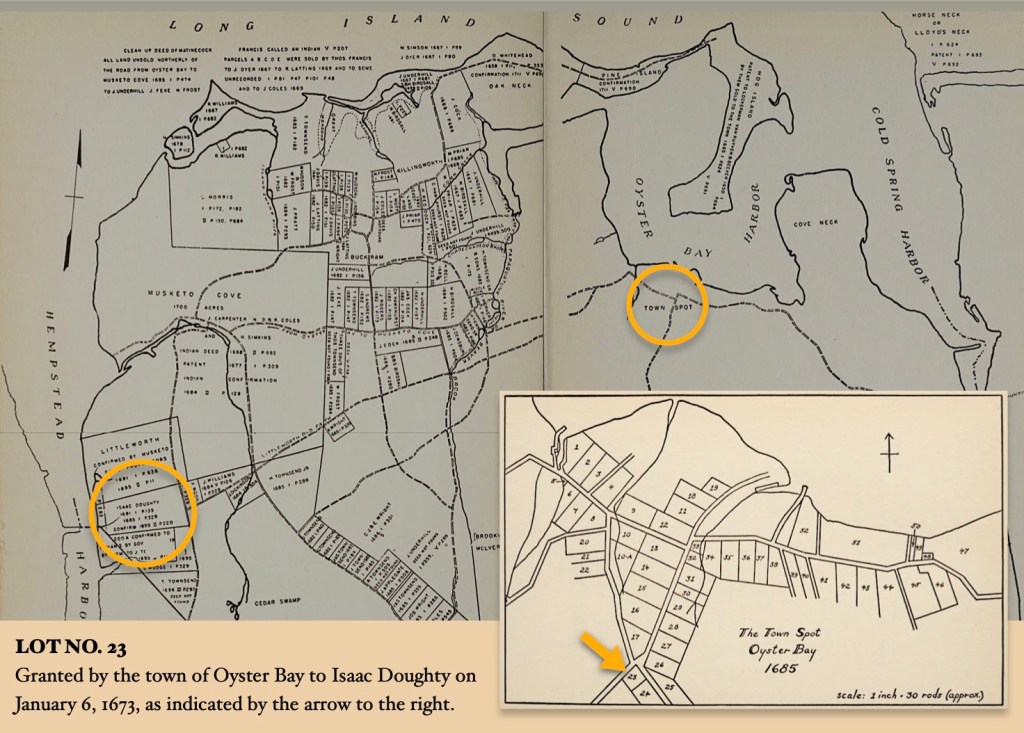
The Empire State Plaza & New York State Capitol
Oyster Bay
by William Langson Lathrop, 1933, via the Heckscher Museum
https://empirestateplaza.ny.gov/hall-new-york/long-island
Note: For the painting.

Isaac Doty Acquires a Home and Land

(6) — six records

(DDFA)
Doty-Doten Family in America
Descendants of Edward Doty, an Emigrant by the Mayflower, 1620

by Ethan Allan Doty, 1897
https://archive.org/details/dotydotenfamilyi00doty/page/496/mode/2up
Book pages: 496-500 Digital pages: 496-500 /1048
Note: For the text.

The Village of Oyster Bay,
Its Founding and Growth From 1653 to 1700

by Van S. Merle-Smith, Jr.
https://archive.org/details/villageofoysterb00merl/page/n5/mode/2up
Book page 62, Digital page: 62/136
Note 1: Small inset township map of home lots, titled The Town Spot Oyster Bay 1685.
Book page 73, Digital page: 72/136
Note 2: Description for Lot. 23 where Isaac Doty had his homesite. Also shown at left is property that he purchased circa 1682-1685.
Note 3: The background map was created from the book endsheets.
Book pages: front and back end sheets
Book page 90, Digital page: 118/136
Note 4: Isaac Doty’s surviving real estate records from 1677 through at least 1702.

(Hammond)
The Oyster Bay Historical Society
The Early Settlement of Oyster Bay
by John E. Hammond
https://www.oysterbayhistorical.org/history-of-oyster-bay.html
Note: Their .pdf download of the town’s history is from:
The Freeholder, Spring 2003, Volume 7, no. 4. 3-9, 18-19.
https://www.oysterbayhistorical.org/uploads/4/9/5/1/4951065/__the_early_settlement_of_oyster_bay.pdf
Note: For the text.

Documentary History of the State of New-York
Volume Two

by Edmund Bailey O’Callaghan
https://archive.org/details/documentaryhisto00ocal_0/page/n327/mode/2up
Book page: 306-307, Digital page: 328/766
Note 1: For the record of “A List Of The Estates Of Ye Inhabitants Of Oyster Baye For A Contry Rate, This 29Te Of Sept 1683.”
Note 2: See —Isack dotty…………..066, Left column, 19th entry

Who Built America?, Volume 1, Chapter 3
Family Labor and the Growth of the Northern Colonies, 1640-1760
Farmer At The Plough, from  John Tobler’s Almanack, 1761
published by Christopher Sower, the Library Company of Philadelphia.
https://www.whobuiltamerica.org/book/wba/part-i-colonization-and-revolution-1492-1815/family-labor-and-the-growth-of-the-northern-colonies-1640-1760/
Note: For the image

In consideration of filial duty and affection

(7) — eleven records

(DDFA)
Doty-Doten Family in America
Descendants of Edward Doty, an Emigrant by the Mayflower, 1620

by Ethan Allan Doty, 1897
https://archive.org/details/dotydotenfamilyi00doty/page/496/mode/2up
Book pages: 496-504 Digital pages: 496-504 /1048
Note: For the text.

John Wood of Rhode Island and
His Early Descendants on the Mainland

by Bertha W. Clark
https://www.ancestry.com/imageviewer/collections/28334/images/dvm_GenMono007787-00001-0?usePUB=true&_phsrc=YEO2&pId=2000000000
Book pages: 11-11~1/2) and 15-16, Digital pages: 23-24/171 and 28-29/171).

Elizabeth (Wood) Doty And Susanna (Wood) (England) Carpenter
Of Rhode Island And Long Island:
Daughters Of John Wood, Not William England 

by Henry B. Hoff
Excerpted from:
The Mayflower Descendant: A Magazine of Pilgrim Genealogy and History
Volume: 54, Page 27, Winter 2005
https://www.americanancestors.org/DB407/i/14019/27/259013230
The same article is also found here:
Elizabeth Wood Doty
unknown – unknown – Burial Details Unknown
https://www.findagrave.com/memorial/57325018/elizabeth-doty

From The Mayflower Descendant article by Henry B. Hoff:

“In the sketch of William England of Portsmouth, R.I., Austin’s Genealogical Dictionary of Rhode Island informs us that England’s widow Elizabeth married second Hugh Parsons whose 1684 will “to wife Elizabeth’s two daughters living on Long Island, viz.: Susannah Carpenter and Elizabeth Doty, certain legacies,” Subsequent works, such as the 1897 Doty genealogy and the 1901 Carpenter genealogy, explained the sole rationale for identifying Hugh Parsons’ stepdaughters as children of William England; namely, the marriage of Ephrain: Carpenter and Susanna England in Oyster Bay, Long Island on 3 December 1677. From this record Austin and others had assumed that this was Susanna’s first marriage and so her maiden name (and that of her sister Elizabeth) was England — and thus Hugh Parsons’ wife Elizabeth was the widow of William England.

However, since 1966 the correct identification of Susanna and Elizabeth has been available at the New England Historic Genealogical Society in Boston, Mass., and several other libraries from a typescript by Bertha W. Clark, “John Wood of Rhode Island and His Early Descendants on the Mainland.” On pages 10 through 16, Miss Clark, an accomplished genealogist, showed that Hugh Parsons married Elizabeth, the widow of John Wood of Portsmouth, and that her daughter Susanna Wood married first Josiah England and second Ephraim Carpenter. Miss Clark cited the 1655 settlement of John Wood’s estate.

The Empire State Plaza & New York State Capitol
Road to the Beach, Shinnecock Hills,
by Charles L. Wright II, 1891, via the Long Island Museum).
https://empirestateplaza.ny.gov/hall-new-york/long-island
Note: Named after the Shinnecock Nation, these sprawling hills in Suffolk County are the highest point on Long Island’s East End, and the only place on the island where one can see both shorelines. Charles L. Wright II (1876-1966) was born in Long Island and lived there until the age of 15 when he left to study art in Paris. Following his studies, Wright gained notoriety for his landscape paintings, especially of the area surrounding Shinnecock Hills, and for his movie poster art for RKO studios.

The Empire State Plaza & New York State Capitol
Paradise Woods, Southold, Long Island
by Whitney M. Hubbard, via the Long Island Museum
https://empirestateplaza.ny.gov/hall-new-york/long-island
Note: Whitney M. Hubbard (1875-1965) was educated at the Art Students League in New York. He led a secluded life in Greenport, Long Island for seventy years, producing a body of marine and landscape paintings. When he died in 1965, Hubbard’s paintings were not highly valued, but have since gained recognition for their exceptional quality and authentic impressions of Long Island.

Idiom.com English Dictionary
Vestryman Role
https://getidiom.com/dictionary/english/vestryman-role
Note: For the text.

The Christ Church (Episcopal) of Oyster Bay

(8) — three records

Historic Structures
Christ Church, Oyster Bay New York
https://www.historic-structures.com/ny/oyster_bay/christ-church-oyster-bay/
Note: For the 1750 church image.

History of Queens County, New York
with Illustrations, Portraits, & Sketches

Town Village and City Histories: Oyster Bay
https://archive.org/details/historyofqueensc00unse/page/n535/mode/2up?view=theater
Book pages: 500-502, Digital pages: 536-538/617
Note: For the text and the image of the 1878 building of Christ Church, Oyster Bay.

Theodore Roosevelt, 1858 — 1919.
26th President of the United States

Christ Church Oyster Bay
History of Christ Church Oyster Bay
https://christchurchoysterbay.org/who-we-are/history
Note: For the text about President Theodore Roosevelt.

The Soule Line — A Narrative, Three

This is Chapter Three of seven. It’s important to understand that this era was filled with much conflict. The new British America in which the Soule family lived, was exceedingly different from their European experience.

In this chapter, we are starting to explore the life experiences of the Second Generation in America. Like all generations, the one that follows sometimes does things a bit differently than their parents did…

“In my extreme old age and weakness been tender…”

Mary (Becket/Buckett) Soule died circa December 1676. She is buried in the Miles Standish Burial Ground, Duxbury, Plymouth County, Massachusetts. We know her death date because — her son John Soule indicated this in his account of “the inventory of the goods of George Soule, circa 1679, that ‘since my mother died which was three yeer the Last December except some smale time my sister Patience Dressed his victualls.’ (Pilgrim Hall Museum)

George Soule died shortly before 22 January 1679, when inventory was taken of his estate. He is also buried at Myles Standish Burial Ground in Duxbury, Plymouth County, Massachusetts.

“George Soule [had] made his will on 11 August 1677 and mentions his eldest son John ‘my eldest son John Soule and his family hath in my extreme old age and weakness been tender and careful of me and very helpful to me.’ John was his executor and to whom was given nearly all of Soule’s estate.

But after he wrote his will, on 12 September 1677 George seemed to have second thoughts and made a codicil to the will to the effect that if John or any family member were to trouble his daughter Patience or her heirs, the Will would be void. And if such happened, Patience would then become the executor of his last Will and Testament with virtually all that he owned becoming hers. To put his youngest daughter to inherit his estate ahead of his eldest son would have been a major humiliation for John Soule. But John must have done well in his father’s eyes since after his father’s death, he did inherit the Duxbury estate. Twenty years later Patience and her husband sold the Middleboro estate they had received from her father.” (Wikipedia)

We observed that in the inventory list of his estate, there was this notation —“Item bookes” — which reinforces the observation that George Soule was a literate, educated man who read. Most people in the Plymouth Colony did not own books, unless it was a Bible. We wish we knew what the titles of these books were, but we will never know and can only dream of what their pages revealed to this ___ Great-Grandfather.

George Soule, with his long life, had outlived all of his associates who were involved in William Brewster’s Subterfuge, even King James I.

Upper image: George Soule Will which he drafted on August 11, 1677. Lower image: Codicil that he added on September 20, 1677.

Here is the codicil of September 12, 1677 —

If my son John Soule above-named or his heirs or assigns or any of them shall at any time disturb my daughter Patience or her heirs or assigns or any of them in peaceable possession or enjoyment of the lands I have given her at Nemasket alias Middleboro and recover the same from her or her heirs or assigns or any of them; that then my gift to my son John Soule shall be void; and that then my will is my daughter Patience shall have all my lands at Duxbury and she shall be my sole executrix of this my last will and testament and enter into my housing lands and meadows at Duxbury. (1)

Kids These Days!

We speculate that there isn’t a parent alive today (and also in the past for that matter), who hasn’t rolled their eyes and thought to themselves with a touch of exasperation, kids these days! George and Mary Soule were likely no exception.

Nathaniel
“Nathaniel may have caused the most colony trouble of any of his siblings. On 5 March 1667/8, he made an appearance in Plymouth court to ‘answer for his abusing of Mr. John Holmes, teacher of the church of Christ at Duxbury, by many false, scandalous and opprobrious speeches.’ He was sentenced to make a public apology for his actions, find sureties* for future good behavior and to sit in the stocks, with the stock sentence remitted [because the man he offended asked for mercy to be shown]. His father George and brother John had to pay surety for Nathaniel’s good behavior with he being bound for monies and to pay a fine.
*The Cambridge Dictionary defines surety as “a person who accepts legal responsibility for another person’s debt or behaviour.”

Three years later, on 5 June 1671, he was fined for “telling several lies which tended greatly to the hurt of the Colony in reference to some particulars about the Indians.” And then on 1 March 1674/5 he was sentenced to be whipped for “lying with an Indian woman,” and had to pay a fine in the form of bushels of corn to the Indian woman towards the keeping of her child.”(Wikipedia)

“His crime would have been punished (by the lesser punishment of a fine) if he had committed it with an English woman, but there is other evidence to suggest that sex with Native Americans caused particular anxiety (hence the whipping), as it breached the racial boundaries of the Bible commonwealth itself.) (Whittock)

We wonder is perhaps maybe Nathaniel and Elizabeth could have coordinated their schedules and just done their time together? Perhaps it would have been easier on George and Mary. (Image courtesy of the New York Public Library).

Elizabeth
“Elizabeth, like her brother Nathaniel, also had her share of problems with the Plymouth Court. On 3 March 1662/3, the Court fined Elizabeth and Nathaniel Church for committing fornication. Elizabeth then in turn sued Nathaniel Church “for committing an act of fornication with her… and then denying to marry her.” The jury awarded her damages plus court costs.

On 2 July 1667 Elizabeth was sentenced to be whipped at the post “for committing fornication the second time.” And although the man with whom she committed the act was not named, Elizabeth did marry Francis Walker within the following year.” Whittock writes, “These activities do not imply promiscuity on Elizabeth’s part, since many in her society considered intention to marry as allowing licit intercourse. Consequently, about 20 percent of English brides at the time were pregnant at marriage.” (Two sources, see footnotes).

Observations: OK, it’s 400 years later and we’re a bit late to the party. Although we don’t excuse his behavior, perhaps Nathaniel Soule was just both a mouthy cad and a foolish, horny young man? It seems to us however, that Elizabeth was judged a bit unfairly, and likely because she was a woman. Nathaniel Church probably led her on… that seems quite plausible since the court awarded her a judgement. Can you imagine the utter audacity it took for her to sue him in court? And as far as the second case goes, it was likely that her partner was her future husband Francis. But, who knows? Why was this man not named, and why was Elizabeth the only one who was publicly punished?

Around the time when Nathaniel Soule was born, the New England area was engaged in a war with some of the native tribes, namely The Pequots. The various wars with the Native Peoples came and went as the populations within the region shifted. Many of these conflicts played out during the lifetimes of George and Mary Soule’s children—we are going to write about the two major conflicts which directly affected this family. (2)

The Pequot War

“The Pequot War was fought in 1636–37 by the Pequot people against a coalition of English settlers from the Massachusetts Bay, Connecticut, and Saybrook colonies and their Native American allies (including the Narragansett and Mohegan) that eliminated the Pequot as an impediment to English colonization of southern New England. It was an especially brutal war and the first sustained conflict between Native Americans and Europeans in northeastern North America.

Even though our ancestors were Pilgrims and not Puritans, an event like this would have had the same consequences — Puritans Barricading Their House Against Indians, by Albert Bobbett. (Image courtesy of Media Storehouse).

To best understand the Pequot War, one needs to consider the economic, political, and cultural changes brought about by the arrival of the Dutch on Long Island and in the Connecticut River valley at the beginning of the 17th century and of English traders and settlers in the early 1630s. The world into which they entered was dominated by the Pequot, who had subjugated dozens of other tribes throughout the area during the 1620s and early ’30s in an attempt to control the region’s fur and wampum trade. Through the use of diplomacy, coercion, intermarriage, and warfare, by 1635 the Pequot had exerted their economic, political, and military control over the whole of modern-day Connecticut and eastern Long Island and, in the process, established a confederacy of dozens of tribes in the region.

The struggle for control of the fur and wampum trade [decorative strings of beads] in the Connecticut River valley was at the root of the Pequot War. Before the arrival of the English in the early 1630s, the Dutch and Pequot controlled all the region’s trade, but the situation was precarious because of the resentment held by the subservient Native American tribes for their Pequot overlords.

The war lasted 11 months and involved thousands of combatants who fought several battles over an area encompassing thousands of square miles. In the first six months of the war, the Pequot, with no firearms, won every engagement against the English. Both sides showed a high degree of sophistication, planning, and ingenuity in adjusting to conditions and enemy countermeasures.

The turning point in the conflict came when the Connecticut colony declared war on the Pequot on May 1, 1637, following a Pequot attack on the English settlement at Wethersfield—the first time women and children were killed during the war. Capt. John Mason of Windsor was ordered to conduct an offensive war against the Pequot in retaliation for the Wethersfield raid.

The most-significant battles of the war then followed, including the Mistick Campaign of May 10–26, 1637 (Battle of Mistick Fort, present day Mystic), during which an expeditionary force of 77 Connecticut soldiers and as many as 250 Native American allies attacked and burned the fortified Pequot village at Mistick. Some 400 Pequot (including an estimated 175 women and children) were killed in less than an hour, half of whom burned to death. 

Engraving depicting The Attack on The Pequot Fort at Mystic, from John Underhill Newes from America, London, 1638. (Image courtesy of Wikipedia).

The Battles of Mistick Fort and the English Withdrawal were significant victories for the English, and they led to their complete victory over the Pequot six weeks later at the Swamp Fight in Fairfield, Connecticut—the last battle of the war.” (Encyclopædia Britannica) (3)

King Philip’s War

Our Soule ancestors were used to thinking about kings and queens of the European sort, but now they were going to meet a local king, who was new to their understanding. The following is excerpted from the Native Heritage Project article, King Philip’s War:

“King Philip’s War was sometimes called the First Indian War, Metacom’s War, or Metacom’s Rebellion and was an armed conflict between Native American inhabitants of present-day southern New England, English colonists and their Native American allies in 1675–76. The war is named after the main leader of the Native American side, Metacomet, known to the English as ‘King Philip’s War.” 

“Throughout the Northeast, the Native Americans had suffered severe population losses due to pandemics of smallpox, spotted fever, typhoid and measles, infectious diseases carried by European fishermen, starting in about 1618, two years before the first colony at Plymouth had been settled. Plymouth, Massachusetts, [which] was established in 1620 with significant early help from Native Americans, particularly… Metacomet’s father and chief of the Wampanoag tribe.”

“Prior to King Philip’s War, tensions fluctuated between different groups of Native Americans and the colonists, but relations were generally peaceful. As the colonists’ small population of a few thousand grew larger over time and the number of their towns increased, the Wampanoag, Nipmuck, Narragansett, Mohegan, Pequot, and other small tribes were each treated individually (many were traditional enemies of each other) by the English colonial officials of Rhode Island, Plymouth, Massachusetts Bay, Connecticut and the New Haven colony.”

The New England Colonies in 1677. (Image courtesy of the National Geographic Society).

Over time, “…the building of [Colonial] towns… progressively encroached on traditional Native American territories. As their population increased, the New Englanders continued to expand their settlements along the region’s coastal plain and up the Connecticut River valley. By 1675 they had even established a few small towns in the interior between Boston and the Connecticut River settlements. Tensions escalated and the war itself actually started almost accidentally, certainly not intentionally, but before long, it has spiraled into a full scale war between the 80,000 English settlers and the 10,000 or so Indians.”

Drawing depicting the capture of Mrs. Rolandson during the King Philip’s War between colonists and New England tribes, 1857, Harper’s Monthly. (Image courtesy Library of Congress).

From Wikipedia: “The war was the greatest calamity in seventeenth-century New England and is considered by many to be the deadliest war in Colonial American history. In the space of little more than a year, 12 of the region’s towns were destroyed and many more were damaged, the economy of Plymouth and Rhode Island Colonies was all but ruined and their population was decimated, losing one-tenth of all men available for military service. More than half of New England’s towns were attacked by Natives.”

King Philip’s War began the development of
an independent American identity.
The New England colonists faced their enemies without support
from any European government or military,
and this began to give them a group identity separate and distinct from Britain.

The Name of War: 
King Philip’s War and the Origins of American Identity
by Jill Lepore

Nine Men’s Misery

Benjamin Soule, the youngest son of George and Mary Soule, “fell with Captain Pierce 26 March 1676 during King Philip’s War.” (The Great Migration) We observed this notation about and researched a bit further, learning that —

“On March 26, 1676, during King Philip’s War, Captain Michael Pierce led approximately 60 Plymouth Colony militia and 20 Wampanoag warriors in pursuit of the Narragansett tribe, who had burned down several Rhode Island settlements and attacked Plymouth Colony. Pierce’s troops caught up with the Narragansett, Wampanoag, Nashaway, Nipmuck, and Podunk fighters, but were ambushed in what is now Central Falls, Rhode Island.

The Narragansett War is another term used to describe King Philip’s War.

Pierce’s troops fought the Narragansett warriors for several hours but were surrounded by the larger force. The battle was one of the biggest defeats of colonial troops during King Philip’s War; nearly all of the colonial militia were killed, including Captain Pierce and their Wampanoag allies (exact numbers vary by account). The Narragansett tribe lost only a handful of warriors.

Ten of the colonists were taken prisoner. Nine of these men were tortured to death by the Narragansett warriors at a site in Cumberland, Rhode Island, currently on the Cumberland Monastery and Library property, along with a tenth man who survived. The nine men were buried by English colonists who found the corpses and created a pile of stones [a cairn] to memorialize the men. This pile is believed to be the oldest war memorial in the United States, and a cairn of stones has continuously marked the site since 1676.” (Wikipedia)

The plaque on the memorial pictured at left reads: NINE MEN’S MISERY, On this spot where they were slain by the Indians were buried the nine soldiers captured in Pierce’s fight, March 26, 1676. (Images courtesy of Atlas Obscura and History Net).

To this day, it is unclear if Benjamin Soule is buried near the battle site, which is now known as the Pierce Park and Riverwalk, Central Falls, Providence County, Rhode Island. Or, if perhaps he was one of the soldiers who were tortured and are buried near the cairn mentioned above.

“In terms of population, King Philip’s War was the bloodiest conflict in American history. Fifty-two English towns were attacked, a dozen were destroyed, and more than 2,500 colonists died — perhaps 30% of the English population of New England.” (Westfield)

In the next chapter, we move continue with the specific history of Generation Two in America of the Soule descendants. We will be focusing on George and Mary’s daughter Patience (Soule) Haskell, our 7x Great Grandmother and her husband John. (5)

Following are the footnotes for the Primary Source Materials,
Notes, and Observations

(1) — seven records

“In my extreme old age and weakness been tender…”

Mary Soule
in the U.S., Find a Grave Index, 1600s-Current
https://www.ancestry.com/discoveryui-content/view/89809163:60525
and here:
Mary Beckett Soule
https://www.findagrave.com/memorial/26862296/mary-soule?_gl=1*1e3xq4g*_ga*MzEyNDMzMzU1LjE3NDAzMzEyOTI.*_ga_4QT8FMEX30*N2Q1YTE1YTQtN2EwYi00ZjFlLTkzYTAtNzIxYzI5ZWMxN2IzLjEuMC4xNzQwMzMxMjkyLjYwLjAuMA..*_gcl_au*NjE1ODQzOTgzLjE3NDAzMzEyOTI.

Pilgrim Hall Museum
The Last Will and Testament of George Soule
https://www.pilgrimhall.org/pdf/George_Soule_Will_Inventory.pdf
Note: For the text.

George Soule
in the U.S., Find a Grave Index, 1600s-Current
https://www.ancestry.com/discoveryui-content/view/2192512:60525
and here:
George Soule
https://www.findagrave.com/memorial/5728447/george-soule

George Soule (Mayflower passenger)
https://en.wikipedia.org/wiki/George_Soule_(Mayflower_passenger)
Note: For the text.

Caleb Johnson’s Mayflower History.com
George Soule
http://mayflowerhistory.com/soule/
Note: For the text regarding his George Soule’s Will codicil.

Kids These Days!

(2) — four records

George Soule (Mayflower passenger)
https://en.wikipedia.org/wiki/George_Soule_(Mayflower_passenger)
Note: For the text.

Cambridge Dictionary
Surety definition
https://dictionary.cambridge.org/dictionary/english/surety#google_vignette
Note: For the text.

Mayflower Lives Pilgrims in a New World and the Early American Experience
by Martyn Whittock
https://myuniuni.oss-cn-beijing.aliyuncs.com/files/sat/Mayflower Lives Pilgrims in a New World and the Early American Experience by Whittock, Martyn (z-lib.org).epub.pdf
Book pages: 242-244
Note 1: .pdf download file from the above link.
Note 2: Chapter 13, “The Rebels’ Story: the Billingtons, the Soules, and Other Challenges to Morality and Order”
Note 3: From the index: Soule, see: 14 The details of the Soules’ offenses and punishments can be found in C. H. Johnson, The Mayflower and Her Passengers, 207–208.

New York Public Library Digital Collections
Man and Woman in Stocks
https://digitalcollections.nypl.org/items/510d47e1-1d93-a3d9-e040-e00a18064a99
Note: For the illustration.

The Pequot War

(3) — four records

Encyclopædia Britannica
Pequot War, United States history [1636–1637]
by Kevin McBride
https://www.britannica.com/topic/Pequot-War
Note: For the text.

Deviantart.com
Colonial New England, 1620-40 (map)
by Ed Thomasten
https://www.deviantart.com/edthomasten/art/New-England-1620-40-245657170
Note: For the map image.

Media Storehouse
Felix Octavius Carr Collection
Puritans Barricading Their House Against Indians
by Albert Bobbett, circa 1877
https://www.mediastorehouse.com/heritage-images/puritans-barricading-house-indians-19044638.html
Note: For the image.

Engraving depicting The Attack on The Pequot Fort at Mystic
from John Underhill Newes from America, London, 1638
by Engraver unknown
File:Mystic Massacre in New England 1638 Photo Facsimile.png
https://commons.wikimedia.org/wiki/File:Mystic_Massacre_in_New_England_1638_Photo_Facsimile.png
Note: For the Pequot Fort image.

King Philip’s War

(4) — eight records

Native Heritage Project
King Philip’s War
https://nativeheritageproject.com/2012/09/02/king-philips-war/

King Philip’s War
https://en.wikipedia.org/wiki/King_Philip’s_War

World History Encyclopedia
Death of King Philip or Metacom
https://www.worldhistory.org/image/13670/death-of-king-philip-or-metacom/
Note: For the illustration.

Britannica.com
King Philip’s War
https://www.britannica.com/event/King-Philips-War
Note: For the illustration, Metacom (King Philip), Wampanoag sachem, meeting settlers, c. 1911

A group of Indians armed with bow-and-arrow, along with a fire in a carriage ablaze, burn a log-cabin in the woods during King Philip’s War, 1675-1676, hand-colored woodcut from the 19th century.
https://commons.wikimedia.org/wiki/File:KingPhilipsWarAttack.webp
Note: For the illustration.

National Geographic | Education
The New England Colonies in 1677
https://education.nationalgeographic.org/resource/massachusetts-1677/
Note: For the map image.

America’s Best History, Pre-Revolution Timeline – The 1600s
1675 Detail
https://americasbesthistory.com/abhtimeline1675m.html
Note: For the illustration depicting the capture of Mrs. Rolandson during the King Philip’s War between colonists and New England tribes, 1857, Harper’s Monthly.

The Name of War: King Philip’s War and the Origins of American Identity
by Jill Lepore
Vintage Books, 1999
Book pages: 5-7
Note: For the text.

Nine Men’s Misery

(5) — eight records

George Soule in the 
New England, The Great Migration and The Great Migration Begins, 1620-1635
https://www.ancestry.com/search/collections/2496/records/65782?tid=&pid=&queryId=41c48ad9-6fb5-45be-b3c3-255e8c9d21f4&_phsrc=GMi2&_phstart=successSource
Book pages: 1704-1708 , Digital pages: 393-397/795
Notes: Not all of this information is considered to be correct by today’s historians. Son Benjamin Soule’s death is mentioned on digital page 396/795.

Deviantart.com
The Narragansett War 1645 (map)
by Ed Thomasten
https://www.deviantart.com/edthomasten/art/The-Narragansett-War-1645-332325221
Notes: For the map image. Observe that the map has the incorrect year of 1645, which we have corrected.

Nine Men’s Misery
https://en.wikipedia.org/wiki/Nine_Men’s_Misery
Note: For the text.

Atlas Obscura
Nine Mens Misery
https://www.atlasobscura.com/places/nine-mens-misery
Note: For the image.

HMdb.org
The Historical Marker Database
Nine Men’s Misery
https://www.hmdb.org/m.asp?m=2924
Notes: For the text on the plaque. 

History Net
King Philip’s War And A Fight Neither Side Wanted
by Douglas L. Gifford
https://www.historynet.com/king-philips-war-and-a-fight-neither-side-wanted/
Note: For the battle illustration.

Benjamin Soule (Veteran)
1651 – 1676 – Pierce Park and Riverwalk
https://www.findagrave.com/memorial/278272111/benjamin-soule
Note: For the plaque image.

Westfield State College
Institute for Massachusetts Studies
Historical Journal of Massachusetts, Volume 37, Fall 2009
“Weltering in Their Own Blood”: Puritan Casualties in King Philip’s War
by Robert E. Cray, Jr.
https://www.westfield.ma.edu/historical-journal/wp-content/uploads/2018/06/Weltering-in-their-Own-Blood-Puritan-Casualties.pdf
Book pages: 106-123
Note: For the text.

The Soule Line — A Narrative, Two

This is Chapter Two of seven. During his lifetime in America, George Soule was known as both a farmer, and for animal husbandry (animals raised for products such as meat, milk, fibers for cloth, etc.). This was a typical profession of the time, if one was to survive in a far off colony, and pay off your debts to the English underwriters. (1)

For a Time, An Indentured Servant

As we learned in previous chapters, George was an indentured servant to the Edward Winslow family. This means that he responsible for contributing to the success of the Winslow family for a period of several years, and until he had achieved the age of 25 years, he could not be released from this condition. Elias Story his fellow travelers with the Winslow family on the Mayflower, was of the same status.

The original document Of Plimoth Plantation, by William Bradford, page 530. George Soule is listed as traveling with the Edward Winslow family. (Image courtesy of the State Library of Massachusetts, Digital Collections).

They arrived in Plymouth at the onset of a terrible winter and were woefully unprepared for their new environment. Within three months half of the people who had sailed, had died. Of the Winslow traveling group, Elias Story and Ellen More died first, and then Edward Winslow’s wife Elizabeth died. She was the last person to pass away in what colony Governor William Bradford called The Great Mortality.

The colony went through many struggles in the first year, but they received much help from the Native Peoples. This was especially true of the Wampanoag Confederacy who helped the settlers adapt and thrive in this new place. (2)

This map from the book Three Visitors to Early Plymouth, captures the geography
of early New England, including most of the settlements that began in 1623.
(Image courtesy of the Internet Archive).

The Common Cause of Labor

“Working communally — also known as the “common course of labor” — was a key part of the business model planned for Plymouth Colony. In the original terms and conditions for funding and planting the colony, all the colonists agreed to work together for seven years at commercial fishing, trading, and farming “making such commodities as shall be most useful for the colony.” At the end of the seven years, the terms and conditions dictated that the colonists would receive a share of the common stock including land and livestock.

After three years, Plymouth Colony’s governor William Bradford ended communal work as related to farming, because it caused too much internal conflict and resulted in poor corn harvests. Without a good corn harvest to feed the colony and without regular supplies from England, the colony would not survive. It is interesting to note, however, that this injunction affected only grain and other field production. All other group work — hunting, fishing, trading and defense – continued as before and seemingly without tension.” (Plimoth Patuxet)

George continued to do his work for the Winslow family as part of his commitment to the greater good. However, as one of the original settlers (the old-comers) within the Plymouth Colony, he was entitled a certain privileges which this status afforded him. One of these was the right to have land tenure.

The 1623 Division of Land in which George Soule received one acre. As described above, “these lye on the South side of the brooke to the baywards.”

“In 1623 a parcel of land was allotted to each man to till for his family and to maintain those who were exempt from agricultural employment because of other duties. Each family was given one acre per family member. In abandoning the “common course and condition” everyone worked harder and more willingly. The food problem was ended, and after the first abundant harvest under individual cultivation, the Pilgrims did not have to endure the meager rations of the first years. The plots assigned them permanently in 1624 became privately owned in 1627.” (Images of Old Hawaii)

“The people mentioned in the Division of Land came on the Mayflower (1620), the Fortune (1621), and the Anne (1623). A couple may have arrived on the Swan(1622) or the Little James (1623), but these were small ships carrying mostly cargo. The Division of Land is recorded in Volume XII of the ‘Records of the Colony of New Plymouth’ ”(The Plymouth Colony Archive Project – TPCAP)

At this time, one acre of land was distributed to each family member. George Soule received one acre of land “between the property of ‘Frances’ Cooke and ‘Mr. Isaak’ Allerton”, as he was a single man. (Wikipedia) (3)

Animals Resting in a Pasture, by Paulus Potter, circa 1650.
(Image courtesy of Wikimedia Commons).

About The Division of Cattle

Th next thing we learn about George is gained from what is known as The 1627 Division of Cattle. “In the 1627 Plymouth division of cattle George Sowle, Mary Sowle, and Zakariah Sowle were the eleventh, twelfth and thirteenth persons in the ninth company.” (American Ancestors) From this we learn that George has married a woman named Mary and that they have a son whom they have named Zachariah. In total, as a family they received 3 cows and 2 goats.

So, who is Mary and where did she come from? (4)

The 1627 Division of Cattle. Note in the lower left corner that George, his wife Mary, and their son Zachariah all received animals.

The Arrival of The Anne and The Little James

It turns out Mary had been in Plymouth since 1623. George’s wife Mary presumably landed at Plymouth on the ship The Anne, on July 10, 1623. She leaves very few historical records. “Mary has been identified by many writers as Mary Buckett of the 1623 land division on that basis that no other Mary was available in the limited Plymouth population of the earliest years).”

The 1623 Division of Land in which Mary Buckett received one acre. “These following lye on the other side of the towne towards the eele-river. Marie Buckett [sic] adioyning to Joseph Rogers.”

The “Anne and Little James [with about 90 new settlers] were the third and fourth ships financed by the London-based Company of Merchant Adventurers to travel together to North America in support of the Plymouth Colony, following Mayflower in 1620 and Fortune in 1621. Anne carried mostly passengers, while the much smaller Little James carried primarily cargo, albeit with a few passengers as well. Soon after arrival, the crew of Anne went to work loading whatever timber and beaver skins could be provided as cargo and sailed straight back across the Atlantic to home on September 10, 1623, carrying Edward Winslow on the first of several voyages back to England.” (Wikipedia, and the Mayflower Quarterly Magazine, Fall 2022)

It is interesting to note that Edward Winslow chose to return to England in 1623, after having left there fearing the wrath of King James I. It seems like Edward probably figured that he was no longer threatened. By this point in time King James “was often seriously ill during the last year of his life. He suffered increasingly from arthritis, gout, and kidney stones. He also lost his teeth and drank heavily. He died in Hertfordshire on March 27, 1625…” (Wikipedia)

Research has determined that Mary Buckett, was likely born “Mary Beckett of Watford, Hertfordshire, was baptized on 24 February 1605, the daughter of John and Ann (Alden) Beckett. It was hypothesized that Mary came on the ship Anne in the care of the Warrens, and that explains George and Mary Soule’s apparent association with the Warren family in the 1627 Division of Cattle. The Warren family was also from Hertfordshire.

Mary Beckett 1605 birth record from the Watford, Hertfordshire, England Parish register.
(See footnotes).

Her father John Becket died in 1619, and no further record “of this Mary Beckett was located in Watford or any of the surrounding parishes; combined with the death of her father in 1619 and non-remarriage of her mother (still a widow in 1622), this further suggests custody of her was transferred to another family and she left the area.” (Caleb Johnson, Soule Kindred in America)

If you know Mayflower Pilgrim names and were wondering…
Researchers have not been able to yet connect her mother’s family surname of Alden, to the John Alden family of Plymouth.

Observation: With grandparents from this far back in time, we are grateful to know what we do know. Their birth records are highly probable, but not specific. We do know when they arrived at the Plymouth Colony, and we do know when they likely passed on. For now, we shall focus next on their family. (5)

Since These Beginnings…

George and Mary had at least nine children over a period of about 24 years. The first three children were born at Plymouth:

  • Zachariah Soule, born by 1627 — died before December 11, 1663. He was married before 1663 to Margaret Ford, who was possibly the daughter of William Ford. “He died during the 1663 Canadian Expedition [fighting Mohawk Indians] and his estate went to his brother John.” There were no children.
  • John Soule, born March 8, 1631/32 — died before November 14, 1707 at Duxbury. Married first circa 1656 to Rebecca Simmons; they had nine children. Married circa 1678 second to Esther Delano Samson; they had three children.
  • Nathaniel Soule, born circa 1637 — died at Dartmouth before October 12, 1699. Married circa 1680 to Rosamund Thorn.

The following six children were born at Duxbury:

  • George Soule, born about circa 1639 — died before June 22, 1704. He married circa 1664 Deborah _____, who was possibly surnamed Thomas; they had eight children.
  • Susanna Soule, born circa 1642 — died date unknown. She married circa 1661 to Francis West.
  • Mary Soule, born circa 1643 — died at Plymouth after 1720. She married John Peterson by 1665; they had nine children.
  • Elizabeth Soule, born circa 1644 — died at Middleboro, date unknown. She married Francis Walker by 1668.
  • Patience Soule, born circa 1648 — died at Middleboro, March 11, 1705/06. Married circa 1666 John Haskell in Middleboro; they had eight children. (We are descended from Patience).
  • Benjamin Soule, born circa 1651 — died at Rhode Island, March 26, 1676, during King Phillip’s War. (6)

Duxbury / Ducksburrow / Duxbarrow

From Wikipedia, “Historic records indicate Soule became a freeman prior to 1632/33 (Johnson) or was on the 1633 list of freemen, [and that in 1633/34, he] “was taxed at the lowest rate which indicates that his estate was without much significance.” We read this to mean that he and Mary were doing fine, but that comfort and prosperity was still not yet achieved. At this point, they had a couple of children, a small amount of acreage for farming, some animals, and certainly, a vegetable garden. George and Mary Soule took their family and moved slightly north of the Plymouth Colony because this new area offered a chance at more prosperity. Nevertheless, George remained involved in the civic life of Plymouth.

These are sample records that record Plymouth Colony deeds for George Soule in 1637 and 1639. In his lifetime there, he was involved in 22 property transactions.

If you recall from The Common Cause of Labor above, the “financial backers in London, [had] required [for the settlers] live together in a tight community for seven years. At the end of that term in 1627, land along the coast was allotted to settlers for farming. Thus, the coastline from Plymouth to Marshfield, including Duxbury, likely named after Myles Standish’s ancestral home of Duxbury Hall in Chorley, was parceled out, and many settlers began moving away from Plymouth.

This map indicates the location of Soule property in the northernmost part of Duxbury at Powder Point. (Image graphics adapted from a contemporary Alden Kindred of America map).

From the mid-1630s forward, a series of small pieces of property were (mostly) granted to him, but there was also a sale completed by 1639. “The 1638 land records note that ‘one acre of land is granted to George Soule at the watering place…and also a parcel of Stony Marsh at Powder Point, containing two acres.’ The land at the ‘watering place’ in south Plymouth was sold the next year, possibly as he was living in Duxbury at that time and did not need his property in south Plymouth. In 1640 he was granted a meadow at Green’s Harbor—now Marshfield.” (Several sources, see footnotes).

Old Dartmouth purchase deed from November 29, 1652.

“The General Court voted 5 March 1639/40 to pay these ‘Purchasers or Old Comers’ for the surrender of their [original land] patent. George’s interests in Old Dartmouth originated in 1652/3, when Plymouth Colony assigned ‘over one hundred thousand acres’ along Buzzards Bay to significant old-comers (i.e., persons ‘who arrived at Plymouth before 1627’), among them George.

This large coastal area, organized as Old Dartmouth in 1664, comprises today the towns of ‘Dartmouth, New Bedford, Westport, Fairhaven, and Acushnet, Massachusetts, and a strip of Tiverton and Little Compton, Rhode Island.’ Assignments were made shortly after 29 Nov 1652, the date on which the indigenous leader Wesamequen and his son Wamsutta ‘sold’ the land to William Bradford, Myles Standish, Thomas Southworth, John Winslow, John Cooke ‘and their associates, the purchasers or old-comers.’

Interests were then assigned to thirty-six old-comers, 7 Mar 1652/3, including George, who received an undivided one thirty-fourth share of the lands.‘As [the assignees] all had their residences in other parts of the colony, it was not expected that they would remove to this territory. It was merely a dividend in land, which cost them nothing to buy and [for a time] nothing in taxes to hold.’ George never settled in Old Dartmouth, but his sons George and Nathaniel did.” (WikiTree)

Gosnold on Cuttyhunk, 1602 by Albert Bierstadt. From Wikipedia, “The first European settlement in the Old Dartmouth area was at present-day Cuttyhunk Island by the explorer Bartholomew Gosnold in 1602.”

By the end of his life, his land holdings included property in several towns, those being Bridgewater, Dartmouth, Duxbury, Marshfield, Nemaskett, (i.e. Middleborough), and Plymouth. He distributed much of this land among his children during the last twenty years of his life. (7)

Excerpted from the book, Sketches of Early Middleborough. (See footnotes).

George’s Role In The Civic Life of The Plymouth Colony

“On 27 September 27, 1642 he appeared before the General Court as one of two ‘Deputies’ or representatives from Duxbury, Plymouth Colony having established representative government in 1639 after finding it no longer practicable to have all the colonists participate as individuals. The representatives were limited to terms of one year and denied the right of succession so we find George Soule serving each alternate year for many years, concluding in June 1654.”

“First in 1642 and last in 1662, he was assigned to at least five grand and petty juries.” George also served on important committees: one for granting land, in 1640 and 1645, a committee on magistrates and deputies in 1650, and another on boundaries in 1658.

We thought that this was curious. “On 20 October 1646 Soule, with Anthony Thatcher, was chosen to be on a ‘committee to draw up an order concerning disorderly drinking (smoking) of tobacco.’ The law, as drawn up, provided strict limitations on where tobacco could be smoked and what fines could be levied against lawbreakers.” (George was ahead of his time!)

Raleigh’s First Pipe in England, an illustration included in the 1859 book, Tobacco, its History and Associations, by Frederick William Fairholt.

As a defender of the colony —
In the 1630s, southeastern New England was rocked by the conflict of the Pequot War. We will be writing about this in the next chapter, but we note it here because George volunteered for Pequot War on June 7, 1637 as one of 42 men under Lieutenant William Holmes and Reverend Thomas Prence as chaplain. Despite this, “when they were ready to march . . . they had word to stay; for the enemy was as good as vanquished and there would be no need.” His name appears on “the 1643 Able to Bear Arms List, with George and his son Zachariah (listed as ‘Georg’ and ‘Zachary’). They appear with those bearing arms from Duxbury (written as ‘Duxbarrow’).” When his estate was evaluated, a gun was listed in the inventory valued at 15 shillings. (Several sources, see footnotes).

In the next chapter, we will take a look at George’s estate, his Will, and the behavior of some of his and Mary’s children. New England was changing with many more people pouring into the area whose aims were different from those of the Pilgrims. The character of some of these new immigrants contributed to tense circumstances, which then lead to ongoing wars with the Native Peoples. (8)

Following are the footnotes for the Primary Source Materials,
Notes, and Observations

(1) — one record

Animal husbandry
https://en.wikipedia.org/wiki/Animal_husbandry

For a Time, An Indentured Servant

(2) — three records

State Library of Massachusetts Digital Collections
Of Plimoth Plantation: manuscript, 1630-1650
https://archives.lib.state.ma.us/items/db0e9f79-477c-4a4c-979b-359c2be1d4ad
The actual page 530 is here:
https://archives.lib.state.ma.us/server/api/core/bitstreams/4d69e338-cc1b-4eda-b2ff-57bfbbb5c6ed/content
Note 1: For the original document on which George Soule is listed as a passenger on the Mayflower.
Note 2: The document is digitized and available as a .pdf download at the above link, file name: ocn137336369-Of-Plimoth-Plantation.pdf
Digital page: 530/546. First page, left column at center, with the Edward Winslow family.

Three Visitors to Early Plymouth
by Sydney V. James, Samuel Eliot Morison, Isaack de Rasieres; John Pory; Emmanuel Altham
https://archive.org/details/plymtuxet005/plymtuxet005_epub/
Digital page: 2/133
Note: For the map image.

The Common Cause of Labor

(3) — six records

Plimoth Patuxet Museums
As Precious As Silver
https://plimoth.org/yath/unit-3/as-precious-as-silver
Note: For the text.

Dividing the Land and Development of Towns
https://imagesofoldhawaii.com/wp-content/uploads/Dividing-the-Land-and-Development-of-Towns.pdf
Note: For the text.

Plymouth Colony 1623 Division of Land document
Massachusetts, Land Records, 1620-1986 > Plymouth > Deeds 1620-1651 vol 1
https://www.familysearch.org/ark:/61903/3:1:3QS7-89Z7-5Z3H?i=7&wc=MCBR-538%3A361612701%2C362501301&lang=en
Note 1: One acre of land for George Soule, as an unmarried man.
Note 2: This file is available at two locations. As indicated above, and also here:
https://www.familysearch.org/ark:/61903/3:1:3QS7-89Z7-5Z3H?i=7&wc=MCBR-538:361612701,362501301&lang=en
Digital page: Image 8 of 239, Lower portion of page.

The Plymouth Colony Archive Project
Plymouth Colony Division of Land, 1623
http://www.histarch.illinois.edu/plymouth/landdiv.html
Note: For the text. Additionally, “In 1623, the Pilgrims divided up their land. The people mentioned in the Division of Land came on the Mayflower (1620), the Fortune (1621), and the Anne (1623). A couple may have arrived on the Swan(1622) or the Little James (1623), but these were small ships carrying mostly cargo. The Division of Land is recorded in Volume XII of the ‘Records of the Colony of New Plymouth’, and reprinted in the ‘Mayflower Descendant’, 1:227-230. Each family was given one acre per family member.”

George Soule (Mayflower passenger)
https://en.wikipedia.org/wiki/George_Soule_(Mayflower_passenger)
Note: For the text.

About The Division of Cattle

(4) — three records

Animals Resting in the Pasture
by Paulus Potter, circa 1650
File:Paulus Potter – Animals Resting in the Pasture.jpg
https://commons.wikimedia.org/wiki/File:Paulus_Potter_-_Animals_Resting_in_the_Pasture.jpg
Note: For the painting image.

American Ancestors 2020
George Soule
https://mayflower.americanancestors.org/george-soule-biography
Note: For the text.

Plymouth Colony 1627 Division of Cattle
Massachusetts, Land Records, 1620-1986 > Plymouth > Deeds 1620-1651 vol 1
https://www.familysearch.org/ark:/61903/3:1:3QS7-89Z7-5ZQL?i=33&wc=MCBR-538:361612701,362501301&lang=en
Book page: 56, Digital page: Image 34 of 239, Upper portion of page.
Note: For the image.

The Arrival of The Anne and The Little James

(5) — seven records

The Plymouth Colony Archive Project
Plymouth Colony Division of Land, 1623
http://www.histarch.illinois.edu/plymouth/landdiv.html
Note: For the text.

Plymouth Colony 1623 Division of Land document
Massachusetts, Land Records, 1620-1986 > Plymouth > Deeds 1620-1651 vol 1
https://www.familysearch.org/ark:/61903/3:1:3QS7-99Z7-5ZZ1?i=10&wc=MCBR-538%3A361612701%2C362501301&lang=en
Digital page: Image 11 of 239, Lower portion of page.
Note: One acre of land for Marie Buckett.

Mayflower Quarterly Magazine ( Vol 88 No 3) Fall 2022
by General Society of Mayflower Decendants
https://archive.org/details/mayflower-quarterly-magazine-vol-88-no-3-fall-2022/page/20/mode/2up
Book pages: 20-23, Digital pages: 22-24/28
Note: For the text.

Continuation of Research into the Origin of Mary Buckett,
early Plymouth colonist and wife of Mayflower passenger George Soule

By Caleb H. Johnson, With English research assistance from Simon Neal
Funded by the Soule Kindred in America, 2015
https://www.sherylaperry.com/histories/Caleb%20Johnson%202016%20Research%20Summary%20on%20Mary%20Bucket.pdf
Note: For the text.

James VI and I
https://en.wikipedia.org/wiki/James_VI_and_I
Note: Foe the text regarding the death of King James I.

Vital – England, Births and Christenings, 1538-1975
Mary Becket
https://www.familysearch.org/ark:/61903/1:1:J973-XY2?lang=en
The actual Watford Parish record is here:
https://www.familysearch.org/ark:/61903/3:1:33SQ-GRQK-16Z?i=72&lang=en
Film # 004946648
Digital page: 73/610, The entry is located on the right page, left column, in about the center.
Note: This document is very difficult to read.

Since These Beginnings…

(6) — seven records

Hip Postcard
Massachusetts, Plymouth – Children In Pilgrim Costume – [MA-786]
https://www.hippostcard.com/listing/massachusetts-plymouth-children-in-pilgrim-costume-ma-786/29106265
Note: For the image.

For their childrens’ birth, death, and marriage records, we combined data from these two sources:
The Mayflower Society
The Soule Family, Passenger Profile
https://themayflowersociety.org/passenger-profile/passenger-profiles/the-soule-family/
Note: Note that the birth information for George Soule Sr., on this file is now considered out of date due to Y-DNA data research.
and
American Ancestors 2020
George Soule
https://mayflower.americanancestors.org/george-soule-biography
Note: For the text regarding his childrens’ births, and deaths, and marriages.

Notes for the next two entries below:
There are strong arguments based upon the evidence, that Patience Soule’s likely birth year is actually 1648. (See WikiTree and the FamilySearch Library footnotes).

WikiTree
George Soule Sr (abt. 1601 – bef. 1680)
https://www.wikitree.com/wiki/Soule-33
Note: For the text about Patience Soule’s probable birth year.
“Birth — Arriving at an estimated birth year, is not an exact science. At some times in the past Patience, the daughter of George Soule and Mary Bucket, has been placed earlier in the birth order of George’s children, hence 1630 in Plymouth. An article on John Haskell her husband in the American Genealogist also says born 1639-1640, but if you take the statement that she died in 1706 after 40 years of marriage, that makes her married about 1666. If she were married at 18, she would have been born in 1648. The newer Mayflower Society publications have Patience listed as the next to last child, and born about 1648. Her last child was born 1691, making her aged 43 at this birth [a usual age for birth of last child–after a long series of children].”

FamilySearch Library
400 Years With Haskells
by Ivan Youd Haskell
https://www.familysearch.org/library/books/records/item/559000-redirect#page=1&viewer=picture&o=info&n=0&q=
Notes: Family Search Identifier #692782, for the text and chart.

This chart with our Haskell ancestors is found on digital page: 392/434.

Patience (Soule) Haskell (abt. 1648 – 1706)
https://www.wikitree.com/wiki/Soule-82
Note: Referenced for information about Patience Soule’s birth year.

Westernlady’s Weblog
Our Pilgrim Ancestor George Soule
https://westernlady.wordpress.com/2012/11/11/our-pilgrim-ancestor-george-soule/
Note: For the text regarding Zachariah Soule’s death on the 1663 Canadian Expedition.

Duxbury / Ducksburrow / Duxbarrow

(7) — nine records

George Soule (Mayflower passenger)
https://en.wikipedia.org/wiki/George_Soule_(Mayflower_passenger)
Note: For the text.

Records of the Colony of New Plymouth in New England
by New Plymouth Colony; Nathaniel Bradstreet Shurtleff, David Pulsifer
https://archive.org/details/recordsofcolonyo0102newp/page/n5/mode/2up
Book page: 3-4, Digital pages: 24-26/432
Note: ‘George Sowle’ listed as being a Freeman

Duxbury, Massachusetts
https://en.wikipedia.org/wiki/Duxbury,_Massachusetts
Note: For the text.

Plymouth Colony July 1639 Soule Duxbury property
Massachusetts, Land Records, 1620-1986 > Plymouth > Deeds 1620-1651 vol 1
https://www.familysearch.org/ark:/61903/3:1:3QS7-99Z7-5CYK?i=71&wc=MCBR-538:361612701,362501301&lang=en
Digital page: 72/239, Top of page.
Note: For the record of 22 property deeds during his lifetime.

WikiTree
George Soule Sr (abt. 1601 – bef. 1680)
https://www.wikitree.com/wiki/Soule-33
Note: For the text about the Old Dartmouth property and the deed image.

Old Dartmouth
https://en.wikipedia.org/w/index.php?title=Old_Dartmouth&oldid=1253342937
Note: For the 1652 deed image.

Gosnold at Cuttyhunk, 1602
by Albert Bierstadt
File:Gosnold at Cuttyhunk.jpg
https://commons.wikimedia.org/wiki/File:Gosnold_at_Cuttyhunk.jpg
Note: For the painting image.

The New England Historical and Genealogical Register
Sketches of the Early History of Middleborough (Specific chapter)
by Waters, Henry Fitz-Gilbert Watres), and the New England Historic Genealogical Society, 1848
https://archive.org/details/newenglandhistor001wate/page/334/mode/2up
Book page: 335, Digital page: 334/456
Note: For the excerpted book text.

Excerpt from Mayflower Deeds and Probates, 1600-1850.

Mayflower Deeds and Probates, 1600-1850
Mayflower Deeds and Probates
https://www.ancestry.com/search/collections/3223/records/13373
Book page: 406, Digital page: 418/671

George’s Role In The Civic Life of The Plymouth Colony

(8) — four records

George Soule (Mayflower passenger)
https://en.wikipedia.org/wiki/George_Soule_(Mayflower_passenger)
Note: For the text.

Raleigh’s First Pipe in England
by Artist unknown, circa 1859
File:Raleigh’s first pipe in England.jpeg
https://commons.wikimedia.org/wiki/File:Raleigh%27s_first_pipe_in_England.jpeg
Note: For the image, “An illustration included in Frederick William Fairholt’s Tobacco, its history and associations.”

American Ancestors 2020
George Soule
https://mayflower.americanancestors.org/george-soule-biography
Note: For the text.

Westernlady’s Weblog
Our Pilgrim Ancestor George Soule
https://westernlady.wordpress.com/2012/11/11/our-pilgrim-ancestor-george-soule/
Note: For the text.

The Soule Line — A Narrative, One

This is Chapter One of seven. We hope that you have taken the time to read the opening chapters we wrote based on the lives of The Pilgrims. It will help to make these The Soule Line chapters more accessible.

As the authors of this family history genealogy blog, we are in the 11th generation of Soule descendants in America. George and his wife Mary are our 8x Great Grandparents.

Introduction

The enigmatic Pilgrim George Soule was one of our two Mayflower ancestors. We use the word enigmatic to describe him because we didn’t know very much about him before he appears as a servant traveling with the family of Edward Winslow on that ship. His name appears on the Mayflower Compact as one of the signers. We also learned that he needed to be hidden for a time. Enigmatic and hidden… who doesn’t love to solve a mystery?

So, who was he and what were his origins? Much research has been done in the last decade to work toward a very plausible solution. First though, we should look at what he was not.

George Soule Was Probably Not an Englishman

Researchers at the Mayflower Society would be thrilled to find a birth record for this ancestor in England, but after decades of research, nothing credible has turned up. Additionally, cutting edge genetic research based on his possible Y-DNA chromosome male descendants in England — has also revealed nothing. As such, researchers decided to broaden their horizons and look at the life of the Pilgrims in Leiden, Holland during their years living there before they departed on the Mayflower.

It seems that this avenue of exploration may have yielded the clues his descendants have been looking for. Before we delve into that, we need to circle back for a concise review of the history from that era.

The Pilgrims were Separatists who chose to remove themselves from the Church of England and this act of defiance angered King James I, who was the head of the Church of England. He chose to persecute the Separatists, so in response, the Pilgrims escaped to Leiden, Holland. There they found a more compassionate environment for their point-of-view about religious matters.

View of Leiden From the Northeast, by Jan van Goyen, circa 1650.
(Image courtesy of Wikimedia Commons).

We must note however, that a very important aspect of their Leiden history, is the fact that William Brewster — as a member of the Pilgrim congregation and the future Governor of the Pilgrim Colony — was also a printer. King James I of England viewed Brewster’s printing work as criminal and subversive because it was critical of him and the Church of England. (For a more thorough explanation of this period, please see the chapter, The Pilgrims — Life in Leyden).

Our ancestor was very likely one of Brewster’s printing associates. Therefore, George Soule needed to be hidden for a time. Below is an excellent explanation of those events by the insightful researcher Louise Walsh Throop. We have gathered a very simple synopsis from three research papers she has published in the Mayflower Descendant and the Soule Kindred newsletter. Our synopsis is very basic, so we suggest that you consult her original work to appreciate the richness and clarity of her analysis. (See footnotes).

William Brewster’s Subterfuge

“Almost four hundred years after the event, the arrival of the
Mayflower off the shore of Cape Cod is still associated with a romantic
notion that its passengers were poor English farm folk, eager to take
the word of God to North America. Apparently the leaders were
also united in protecting William Brewster and his associates from the
wrath of King James I, and the romantic notion was part of a successful
deception.

…after May 1619 William Brewster was a fugitive who, if caught, would have been imprisoned or hanged. The printed work that incurred the wrath of King James I was published early in 1619. Entitled Perth Assembly, it was printed in
Holland by Brewster and smuggled into Scotland in a wine vat.” That this publication did not have the name of the printer, nor the location stated, made the printing press illegal under Dutch law.

Leiden Museum de Lakenhal
Perth Assembly, 1619
(Image courtesy of David Calderwood, Leiden University Libraries).
“A year before their departure for America, the Pilgrims published this pamphlet in Leiden. It was immediately banned in England since it criticised royal decisions that had been made during an assembly in Perth, Scotland in 1618. In this pamphlet, the Pilgrims express their dislike of the celebration of Christmas and Easter, the episcopal hierarchy and the practice of kneeling during Holy Communion.”

“Furthermore, when Brewster fled Holland, he brought with him
several of his associates in his printing venture in Leiden— probably to
protect them and prevent the King’s agents from eliciting information
about Brewster from them. To protect Brewster, names were changed
and documents altered—all part of a subterfuge.

The illegal printing of books critical of King James I and the
English Church was carefully planned. Two non-controversial books
were published in Latin in 1617 as a ‘front’ operation and perhaps
to gather the set type and gain income. William Brewster then faded
from view: he appeared in the Spring 1617 book trade catalog but
went underground and did not appear in the Autumn 1618 catalog.

Some of Brewster’s associates in this printing operation are
known—notably John Reynolds and Edward Winslow. [It was also with Winslow’s family that George Soule traveled as a servant on the Mayflower.] Brewster’s supporters and associates were also neighbors in Leiden—the city was teeming with printing associates ready to help.”

Illustration of Johannes Gutenberg’s First Printing Press, from 7 Ways the Printing Press Changed the World. (Image courtesy of History.com).

The Background History of Book Printing in Holland

When printing presses were becoming established, the interruptions which they caused in societies were problematic. The closest analogy we would have today, is when the internet came about and there was much fretting about the changes that were happening in society. In 16th century Holland, these interruptions were managed by regulation.

“Printing was regulated by local and/or regional authorities. Itinerant printers of the late 1500s traveled from town to town peddling pamphlets and broadsides produced on small hand-held presses. In 1608 Leiden banned foreigners from selling such printed matter by ‘calling out’ their wares. The basic printing laws in Holland were put forth in the edict of 1581, renewed and updated at various times from 1608 through 1651.

The salient point of these regulations was to require a printer to include information in his productions about his name, place, year, author, and translators. Anonymity and libel were illegal and fines for such behavior were heavy. Thus, by the printing regulations of the time, many of the books printed for Puritan and Separatist uses in Leiden and Amsterdam were illegal by reason of the omission of printer, author, or other essential data.

Illustration of a 15th century print shop, from 7 Ways the Printing Press Changed the World. (Image courtesy of History.com).

Around 1620 in Leiden, the book trade was in the middle of a transformation from a craft-based occupation peopled with printers, binders, type-founders and compositors to a commercially oriented industry peopled by booksellers, paper sellers, binders, typemakers, and printing firms.

The early printers in Leiden were actually small in number and appear to have known and worked or cooperated with each other. In any one year, there were probably no more than 20 printers working. The industry was growing, and after 1611 grew by 15 or more active workers in an average year. Leiden, with an estimated population in 1622 of 44,745, was home to a total of about 62 printers/booksellers in the period 1601-1625.”

A Friendly Neighbor, Johannes Sol

“A print shop in that period needed a minimum of three persons. William Brewster’s first assistant in this period was John Reynolds, who left after one year left when he married. [His second assistant was] Edward Winslow, who joined Brewster in Leiden late in 1617 after a four-year apprenticeship to stationer John Beal in London. Winslow, like Reynolds, married after assisting Brewster for about a year. Brewster also appears to have had assistance from the print shop of a friendly neighbor, Johannes Sol.

At Johannes Sol’s printshop, Johannes’s teenaged brother George Soule was available (no apprenticeship paperwork was needed). [Since we know George could read and sign his name, he probably also did proofreading.] The change of “Sol” to “Sowle” might have been part of Brewster’s subterfuge — to identify all Mayflower passengers as English.”

“On the recipe for a varnish used by El Greco” by Michel Faver-Félix. (Image courtesy of Conservar Património, no. 26, 2017, Associação Profissional de Conservadores Restauradores de Portugal).

It is likely that “Johannes Sol died suddenly during the winter of 1618/19. A Dutch printer… suffered an accidental, fiery death while boiling printing varnish in country house outside Leiden on a Sabbath day… the printer’s house was burned and he and his only daughter died in the fire.” His death left his younger brother George Sol, without a livelihood” and exposed him as an associate of William Brewster, who was a hunted man.”

Everyone in the Pilgrim community was worried about the long arm of King James I, and we wonder if perhaps the horrid death of Johannes Sol was something instigated by King James I? We will likely never know, but certainly, people were nervous. (1)

A Walloon Refugee Family

We have encountered many spelling alternatives when it comes to the surname for the Soule family. It seems that much of this variation is dependent upon who was doing the record-keeping and what culture they were from. Moreover, much spelling then could sometimes be phonetic. In addition, William Brewster seems to have altered the Sol spelling to Sowle/Soule as part of his great deception to make the name seem more English.

Several researchers have found records for this family that all seem to agree on the point that they were likely a Walloon refugee family. (For an understanding of what was occurring with the Walloons in Europe during this period, please see the chapter of another family line who was experiencing the same difficulties: The DeVoe Line, A Narrative — One, Holland & Huguenots. It is interesting to note that the Soule line connects through marriage to the DeVoe line in 6 generations).

 A Brief History of the Netherlands map, circa 1555, by Brian A. Smith, D.C. The orange circles indicate areas where our Jan Solis and Maecken Labus may have lived in the Walloon Provinces, before going to London, England for a few years.

From researcher Louise Walsh Throop, the “Father Jan Sols experienced in his lifetime the revolt of the Spanish Netherlands, led by William of Orange. In 1568 the 80 Years War between the Netherlands and Spain began. In the 1570s, Protestant refugees fled north to cities like Brussels and Antwerp or across the Channel to England. The assassination of William of Orange in 1584 was followed by the fall of Ghent, Bruges, Brussels, and Antwerp. Refugees fled north [about 1585] to the newly independent Dutch provinces of Holland and Zeeland, or across the  Channel to England. In the province of Holland are located the towns of Haarlem, Amsterdam and Leiden.” (2)

1820 illustration of the Dutch Reformed Church of Austin Friars, based upon illustration in A Topographical and Historical Description of London and Middlesex, by Edward Wedlake Brayley. (Image courtesy of Wikipedia).

The Dutch Reformed Church of Austin Friars

The “origins of George Soule this last variation of Sols/Soltz, i.e., ‘Solis,’ is a clerical variation on the Latinized version: Solius …the marriage record of Jan Solis of Brussels, to Maecken Labus, at the Dutch Reformed Church in Austin Friars, London, dated 30 August 1586,” and “…that “John Sols and his wife” were admitted into the congregation in 1585. Seven other children were born after they returned to Haarlem about 1590” (Soule Kindred newsletter, Summer 2019)

Entry for the marriage record of Jan Solis and Maecken Labus — August 30, 1586,
as published in The Marriage, Baptismal and Burial Registers, 1571-1874,
and Monumental Inscriptions of the Dutch Reformed Church, Austin Friars, London.
(Image courtesy of The Internet Archive).

“Jan and Mayken were Protestant refugees who were married at Austin Friars, London, England, 30 August 1586. They were the parents of seven known children baptized in Haarlem, Holland, between 1590 and 1599. The marriage record of Jan Sol in London, England, in 1586 gives his origin, misread in English as ‘Brussels’ whereas it was more likely referring to what is now Lille, France. ” (Wikitree)

Jan (or John in English) married Mayken/Maecken (Mary in English) in London in 1586 and may have lingered a year or two in or near London. Possibly a proposed tax on refugees provided the impetus for leaving London. The baptisms of seven children in Haarlem 1590-9 means that George Soule would have been born about 1601.” (Throop, 2011)

See the middle entry — August 30, 1586 marriage record for Jan Solis of Brussels, to Maecken Labus at the Dutch Reformed Church, Austin Friars, London, England. (Image courtesy of the Soule Kindred Newsletter, Summer 2019).

Indeed, they could have been from Brussels, or they could have been from Lille, France, or they could have been from both places. Due to the conflicts between Kingdoms at that time, the borders were always in flux and people were moving around much. (This same experience happened to our DeVoe family ancestors). What is most important is that they eventually ended up in Haarlem, Holland where they started their family.

Wikitree explains, “The Dutch Reformed Church records in Haarlem give the baptismal records for seven children of Jan Sols/Soltz, of Brussells, and his wife Mayken Labis/Labus/Lapres/Laber, including:

  • Geertrude, baptized February 25, 1590
  • Johannes, baptized October 6, 1591*
  • Sara, baptized September 5, 1593
  • Maria, baptized 28 March 28, 1596
  • Johanna, baptized March 19, 1597
  • Pieter, apparently twin with Susanna, baptized January 17, 1599
  • Susanna, apparently twin with Pieter, baptized January 17, 1599

*This oldest son is the printer Johannes Sol from Leiden.” So where is George Soule in this family group? He was presumably the youngest of the family. (3)

View of Haarlem with Bleaching Grounds, by Jacob van Ruisdael, circa 1665.
(Image courtesy of Wikipedia).

George Soule — Born About 1601

“It is not outside the realm of possibility for Johannes Sol to have a younger brother George, whose Dutch name would have been Joris (also Goris/Jurgem/Jurian/Jurn/Jury/Janz) Sol.” This places George’s birthdate somewhere in the range of November 1599 to November 1602. Therefore, researchers use the date of 1601 for his birthdate, and cite points of evidence for the familial relationship:

“Four of the 14 male servants on the Mayflower signed the Compact: John Howland, George Soule, Edward Doty, and Edward Leister. With regard to these men, we have help in calculating birth years: servants were not eligible to marry until their contract was up, which normally was when a man reached the age if 25 years. Thus, using George Soule’s projected marriage about 1626, his birth year was 1601 or earlier.”

“The naming of his children. “George married about 1626 in Plymouth Colony, and named two children for his presumed parents: Jan/John and Mayken/Mary (Labus/Labis) Sol. George [named a son after himself, and] also named a daughter Susannah, presumably for his sister Susanna, bap. in 1599.” Hence the names: John, Mary, George, Susannah. Mary could have been named for his mother, and/or his wife. (Both sections are Throop, 2009)

“A series of matching Y-DNA test results in 2017 supports the kinship of George Soule to Johannes Sol.” (Throop, 2009 and Wikipedia)

The Sails Fill As The Mayflower Leaves Plymouth, 1620, by Peter Goodhall.
(Image courtesy of American Art Collector).

In Summary, Before We Sail to America —

“The available evidence points to a Dutch birthplace for George Soule with his possible father Jan Sol(s) moving from Brussels in Brabant to Haarlem in the Dutch province of Holland at least 10 years before George’s birth. Being born about 1601, and literate, George was probably handy when presumed brother Johannes Sol needed a printer’s devil or general helper about 1616-1617 in Leiden. About the middle of 1618, George apparently became involved in the efforts of the so-called Pilgrim Press, which was suppressed in September 1619. His association with Brewster and Winslow appears to have led to his inclusion on the passenger list of the Mayflower, and, like Brewster and possibly also Winslow, or he may have been hiding from the Dutch and English authorities.”

Our ancestor, the young George Soule, was likely born in 1601 in Haarlem, Haarlem, Netherlands. “It very well could have been the chance of a lifetime for young George Soule to be part of a group leaving Leiden in the middle of 1620 for the relative freedom of North America.” (Soule, Terry, and Throop, 2000, and Throop 2009) (4)

Following are the footnotes for the Primary Source Materials,
Notes, and Observations

Note, that these four sections all use the same Louise Walsh Throop references:
George Soule Was Probably Not an Englishman
William Brewster’s Subterfuge
The Background History of Book Printing in Holland
A Friendly Neighbor, Johannes Sol

(1) — eight records

Library of Congress
History of The Town of Middleboro, Massachusetts
by Thomas Weston, 1834-1920
https://www.loc.gov/resource/gdcmassbookdig.historyoftownofm00wes/?c=160&sp=5&st=pdf
Book page: 590, Digital page: 644/788
Note: For George Soule & Son 1671 signature

Mayflower Descendant, Volume 66, No. 1: Winter 2018
William Brewster’s Subterfuge
by Louise Walsh Throop
Book pages: 14-22
Note: .pdf file available for purchase from American Ancestors at,
https://shop.americanancestors.org/products/mayflower-descendant-volume-66-no-1-winter-2018?srsltid=AfmBOopdq6ksBjHLwiaPfTnd4DImwKhDX3pjK_h2UsoTorf_pmESZ-C5&pass-through=true
Note: For the text.

This statement by Throop is published as a response at this link: https://www.wikitree.com/wiki/Soule-33

“…in which I describe how William Brewster got out of Leiden before being picked up by the authorities, who were being pressured by the English ambassador. Brewster seems to have taken some of his print crew with him, including George Sowle, an English spelling [as his original name was Dutch and probably Joris Sol]. The modern proof is in y-DNA matching with a Forrest family from southern Scotland, as it appears an orphaned nephew of George Soule was adopted into a Forrest family, probably by remarriage of a widowed mother. The orphaned son was the only surviving child of a printer in Leiden named Johannes Sol; Johannes left an estate so the widow would have been quickly remarried so the new husband could have control of the estate, and baby boy. Johannes’ apprentice left in 1619 for Scotland, apparently taking tell-tale type from Brewster’s presswork, and probably also the (missing) Brewster press. His name was Edward Rabin and he is celebrated for being the first printer in Aberdeen, Scotland [see wikipedia]. In one of his diatribes against Sabbath-breaking and drinking, etc., he mentions without any names his former master who died in a fire [while working on a Sabbath], and whose estate was then (in 1623) under the control of unrelated person(s). The Forrest/Soule y-DNA matches are found on the Soule project housed with FamilyTreeDNA. This whole scenario is described in the article already mentioned in Mayflower Descendant. Now if you know someone who can research in the Netherlands, please let me know! The Soule Kindred in America has been focusing on English research in the past 10 years, probably because they received a bequest for research in England! They have found nothing.”

Merriam Webster Dictionary
Enigmatic definition
https://www.merriam-webster.com/dictionary/enigmatic#:~:text=An%20enigmatic%20person%20is%20someone,tested%20one’s%20alertness%20and%20cleverness.

Leiden Museum de Lakenhal
Pilgrims to America — And The Limits of Freedom (Exhibition)
via Heritage Leiden, Stadsarchief 1574 – 1816
Perth Assembly, 1619
(Image courtesy of David Calderwood, Leiden University Libraries).
https://www.lakenhal.nl/en/story/images-and-credit-lines-pilgrims
Notes: “A year before their departure for America, the Pilgrims published this pamphlet in Leiden. It was immediately banned in England since it criticised royal decisions that had been made during an assembly in Perth, Scotland in 1618. In this pamphlet, the Pilgrims express their dislike of the celebration of Christmas and Easter, the episcopal hierarchy and the practice of kneeling during Holy Communion.”

History.com
7 Ways the Printing Press Changed the World
by Dave Roos
https://www.history.com/news/printing-press-renaissance
Notes: For two illustrations, Johannes Gutenberg’s First Printing Press, and a 15th century print shop.

Further Searching for the Origins of Mayflower Passenger
George Soule: Printer’s Devil in Leiden?

by Louise Walsh Throop, M.B.A.
https://web.archive.org/web/20190403203131/https://soulekindred.org/resources/Documents/Newsletters/PDF-Newsletters/Vol.-43-No.-4-Autumn-2009.pdf
Note: For the text.

Conservar Património, no. 26, 2017
Associação Profissional de Conservadores Restauradores de Portugal
“On the recipe for a varnish used by El Greco”
by Michel Faver-Félix
https://www.redalyc.org/jatsRepo/5136/513654156004/html/index.html
Note: For the botanical images.

A Walloon Refugee Family

(2) — three records

The Most Remarkable Lives of Jan Jansen and his son Anthony
A Brief History of the Netherlands (map)
by Brian A. Smith, D.C.
https://ia801604.us.archive.org/32/items/2013JanAndAnthonyJansenPublic/2013 Jan and Anthony Jansen public.pdf
Book page: 3/145
Note: For the map.

Further Searching for the Origins of Mayflower Passenger
George Soule: Printer’s Devil in Leiden?

by Louise Walsh Throop, M.B.A.
https://web.archive.org/web/20190403203131/https://soulekindred.org/resources/Documents/Newsletters/PDF-Newsletters/Vol.-43-No.-4-Autumn-2009.pdf
Note: For the text.

Soule Kindred Newsletter
Fall 2011, Vol. XXXXV, No. 4
Continuing the Search for the Origins of George Soule and
Some Incidental Findings in the Search for His Descendants
by Louise Walsh Throop, M.B.A.
https://soulekindred.org/George-Soule-Research
Note: For the text.

The Dutch Reformed Church of Austin Friars

(3) — five records

London Remembers
First Dutch Church, Austin Friars
https://www.londonremembers.com/subjects/first-dutch-church-austin-friars
Note 1: For the 1820 illustration of the church, based upon A Topographical and Historical Description of London and Middlesex, by Edward Wedlake Brayley.
Note 2: From Wikipedia, “In the night of 15–16 October 1940, just a decade before the Dutch Church celebrated its 400th anniversary, the medieval building was completely destroyed by German bombs. The church’s collection of rare books including Dutch Bibles, atlases and encyclopedias had been moved out of London for safe-keeping one day before the bombing raid that destroyed the building.” Via https://en.wikipedia.org/wiki/Dutch_Church,_Austin_Friars

Soule Kindred Newsletter
Fall 2011, Vol. XXXXV, No. 4
Continuing the Search for the Origins of George Soule and
Some Incidental Findings in the Search for His Descendants
by Louise Walsh Throop, M.B.A.
https://soulekindred.org/George-Soule-Research
Note: For the text.

Soule Kindred Newsletter
Summer 2019, Vol. LIII, No. 2
Soule Sleuths Make Headway in theSearch for George
by Marcy Kelly
https://soulekindred.org/Newsletters-2010s
Note: For the text, and the (personal photograph) image of the marriage record for Jan Solis and Maecken Labus, found in parish registers of Austin Friars.

The Marriage, Baptismal and Burial Registers, 1571-1874, and Monumental Inscriptions of the Dutch Reformed Church, Austin Friars, London; with a short account of the strangers and their churches
by London. Dutch Reformed Church, Austin Friars; William John Charles Moens, 1833-1904 editor
https://archive.org/details/marriagebaptisma00lond/page/134/mode/2up
Book page: 135, Digital page: 190/295
Note: For the text.

WikiTree
George Soule Sr (abt. 1601 – bef. 1680)
https://www.wikitree.com/wiki/Soule-33
Note: For the text.

Note, that these two sections all use the same Louise Walsh Throop reference:
George Soule — Born About 1601
In Summary, Before We Sail to America —

(4) — five records

American Art Collector
The Sails Fill As The Mayflower Leaves Plymouth, 1620
by Peter Goodhall
https://www.americanartcollector.com/shows/1584/peter-goodhall
Note: For the painting image.

Further Searching for the Origins of Mayflower Passenger
George Soule: Printer’s Devil in Leiden?

by Louise Walsh Throop, M.B.A.
https://web.archive.org/web/20190403203131/https://soulekindred.org/resources/Documents/Newsletters/PDF-Newsletters/Vol.-43-No.-4-Autumn-2009.pdf
Note: For the text.

George Soule
Family Search family tree that indicates a 1601 birth
in Haarlem, Haarlem, Netherlands
https://www.familysearch.org/ark:/61903/2:2:QDJH-P1T
Note 1: This circa 2000 reference is cited for this family tree.
Mayflower Families In Progress –
George Soule of the Mayflower and his descendants in the Fifth and Sixth Generations (Families 1-229) ([Plymouth, Massachusetts]: G
by John E. Soule, Col. USA, Ret., M.C.E., Milton E. Terry, Ph.D., and Louise Walsh Throop, M.B.A.,
Note 2: This publication is also available here —
George Soule of the Mayflower and his descendants in the Fifth and Sixth Generations, at: https://archive.org/details/georgesouleofmay2000soul/page/2/mode/2up
Note: For the data.

George Soule (Mayflower passenger)
https://en.wikipedia.org/wiki/George_Soule_(Mayflower_passenger)#cite_note-soulekindred.org-9
Note: For the text.

The DeVoe Line, A Narrative — Eleven

This is Chapter Eleven of eleven, being the last chapter of our narrative about the DeVoe Line. We hope that you have enjoyed following along, for this family line was sincerely, the most difficult to have researched due to certain enigmatic records… However, as we move toward the end of the 20th century, life still engages the DeVoe(s), as it has for many centuries.

Pressed Blossoms

Both of our grandmothers long out-lived our grandfathers. As such, neither of us knew our grandfathers at all. Susan knew both of our grandmothers: Mary Adele (McCall) Bond and Lulu Mae (DeVoe) Gore. However, Grandma Mary died when I was quite young, so Grandma Lulu was really the only grandmother I ever knew. She lived nearby and was a strong influence on our family.

More than fifty years ago she made me a birthday card with a few pressed blossoms from her garden and I recently found it tucked-in amongst some family photographs I was reviewing for this history. She was an avid gardener and the perfect simplicity of this card still means much to me.

— Thomas, with Susan

Most Signed Their Name With an “X”

Our ancestors are a mixed lot when it came to their educations. If they had money, they likely had the “3 R’s” of education: ‘reading, ‘riting, ‘rithmatic. These educations seemed to be offered to our male relatives first, then second to the female relatives. If our ancestors didn’t have money, some of them still could sign their name.

If they were poor, generally speaking, education was an unobtainable luxury. We have seen so many documents where they simply signed their names with an “X” which was accepted at that time. This made them dependent upon the courtesy of strangers, because witnesses were required to vouch for the signee.

Observation: Coming to understand this has helped explain why we have records for some of our ancestors that are inconsistent, with weird name spellings, incorrect locations, etc. It became apparent that many of our relatives couldn’t comprehend the words, but they knew that they were signing a contract, a deed, or a will...

The Class of ’99

Having an education became an increasingly important need as the world became more modern. Our Grandmother Lulu was the first person ever in her family, who as a young woman, to have graduated from high school — in the Chagrin Falls, Ohio, high school Class of 1899. (Then known as the Union School on Philomethian Street). None of her siblings accomplished this.

What is remarkable is this — that especially in that era, there were many people who thought it wasn’t necessary for a woman to be educated. Despite that prejudice, we believe that she was likely encouraged by her grandfather Peter A. DeVoe, who was a man who valued education. She became the beneficiary of his guidance, support, and encouragement throughout her youth. Most certainly, she always spoke fondly, almost reverently, about him.

The Union School, built in 1885, was the home of the High School until 1914. Photograph courtesy of cfhs.me — Discover Chagrin Falls History.

Coming from a poor family and achieving this feat was rather astonishing and must have taken tremendous effort on her part. To accomplish this, she moved away from her parents in Russell township, and lived as a household servant for a family in Chagrin Falls while attending school.

After her high school graduation, she went through teacher training and at the very beginning of the 20th century, she worked as a schoolteacher at different one-room schoolhouses in the area. One of the schools is located in Chester township, in Geauga County, and was then known as District School No. 2, or also, as the Scotland School. It still stands today and is now listed on the National Register of Historic Places. (1)

The former Chester Township District School No. 2 was also known as Scotland School.  Originally built in 1847, it was used as a one-room schoolhouse until 1926, when it closed.

Some Things Change, and Then… Some Things Transform

In the present day, the Village of Chagrin Falls in Ohio, is considered to be an upscale place to live with many nice homes, beautiful scenery, good schools… Typical town boosters might describe it enthusiastically, like this: “Chagrin Falls, Ohio, nestled in the picturesque Cuyahoga County, offers a charming and idyllic lifestyle that beckons residents seeking tranquility, beauty, and a strong sense of community.”

When our grandparents were alive, they certainly would have been much more circumspect in their description of the area. In their era, Chagrin Falls was a nice, but small working-class hamlet, with a village center remarkable for its triangular shape, and a bent wood bandstand where they would waltz to music. We can recall our mother Marguerite describing that many of the houses in her 1920s childhood, really needed painting, — and this was before the Great Depression.

Images of the town of Chagrin Falls, Ohio from the 1870s through the 1910s. Top row, left to right: The High Falls, after which the town is named. Right: The Chagrin Falls park band which performed in the Triangle Park gazebo. Middle center image: Map of the town from the 1892 Cuyahoga County Atlas. Bottom row, left: Main Street. Center: The Atlas cover sheet. Right: Triangle Park in the 1870s before the gazebo was built.

Our grandparents would put Marguerite in the Model T and go to the village for a haircut about once a month, while they also took care of other errands. Mom had an uncle on her father’s side who gave haircuts, (maybe Uncle Forest?) and also another uncle on her mother’s side (Uncle Frank) who did the same. It turns out that Uncle Frank was the craftier of the two, because he always gave her a lollipop when her haircut was done. Apparently it was always a drama to get her to go and see Uncle Forest, and who could blame a kid when lollipops were involved?

Marguerite Lulu (Gore) Bond, circa 1922. (Family photograph).

Knowing our mother as we did, in our mind’s eye, it seems likely she got bored hanging out at the farm, and longed for a bit more excitement in her life. When she was a young teenager, she worked for a time at Speice’s Drug Store as a soda-fountain jerk. The shop was located near the center of the Chagrin Falls village, about as far away from the farm as she could get in those days. It was the first job she had in a long career associated with food.

From Wikipedia: Soda jerk… is an American term used to refer to a person… who would operate the soda fountain in a drugstore, preparing and serving soda [we actually said soda-pop] drinks and ice cream sodas. The drinks were made by mixing flavored syrup, carbonated water, and occasionally malt powder over either ice or a few scoops of ice cream. The drink would then be served in a tall glass with a long-handled spoon, most commonly known as a “soda spoon”, and drinking straws.”

Likely thinking she was a bit older than she actually was, we’re certain that Mom pictured her career as a soda fountain jerk with starry eyes… After all, the Depression was in full swing and after the local movie theater let out, all the cool kids went to the soda fountain. Maybe she thought her new career would be like this scene from a Hollywood movie?

To this day, as far as we know, Chagrin Falls, Ohio,
has never had palm trees, nor pith helmets.

Our mother led an interesting life. To see more about her, here are some of the other narratives in which she is written about. (Please see The Gore Line, A Narrative — Eight, The Peterman Line, A Narrative, and The Bond Line, A Narrative — Seven). (2)

Lulu Mae DeVoe Becomes Mrs. Harley Gore

It is through Lulu that we connect to the Mayflower through two different family lines. We will be writing about this lineage when we document the Warner line.

Harley William Gore and Lulu Mae (DeVoe) Gore
around the time of their wedding in 1905. (Family photographs).

In 1905, Lulu left her teaching career behind and married Harley William Gore becoming both a mother and a farmer’s wife. We believe that they met at a dance, or perhaps a picnic, and were introduced by mutual friends or family. At that time, it was a typical way to meet a young man during the Edwardian era. Social relationships were strictly defined by an unwritten set of rules. Young women had chaperones and one didn’t date, one was courted… All these years later, we’ve lost the thread of details about their courtship, but Grandmother used to mention dances in Triangle Park, in Chagrin Falls, and picnics at Pioneer Park at Punderson Lake in Newbury township.

Harley William Gore and Lulu Mae Devoe marriage application, 1905.

They had three children, all born in Russell township, Geauga County, Ohio:

  • Leland Harley Gore, born September 30, 1906 — died October 1, 1993
  • Elwyn Clinton Gore, born May 12, 1909 — died February 13, 1935
  • Marguerite Lulu (Gore) Peterman Bond,
    born June 28, 1920 — died March 4, 1999 (We are descended from Marguerite).

Some material for this aspect of our family narratives is covered in other narratives. We have written quite a bit about their life together, their children, and their extended family. (Please see The Gore Line, A Narrative — Eight).

We know that Grandma Gore was born at home and that there was no birth certificate. However, at some point in her life she needed one (perhaps to collect Social Security?) and the family had to “locate” two very ancient ladies that testified that she was born when and where she was… (3)

Parlor Games

For most people, television didn’t become a viable option for home entertainment until the middle of the 1950s. In prior decades, our ancestors had to be creative in how they entertained themselves in their limited leisure time. First, with the advent of the Edison phonograph, and then the development of home radios, suddenly there were many more options.

The Golden Age of Radio
As a result, its popularity grew rapidly in the late 1920s and early 1930s, and by 1934, 60 percent of the nation’s households had radios. One and a half million cars were also equipped with them. The 1930s were the Golden Age of radio.

The History of the Radio Industry in the United States to 1940
Carole E. Scott, State University of West Georgia

For our ancestors who were of an older age by the time the mid-century period came along, some of their traditional entertainment choices prevailed. One such choice was card games — especially Gin Rummy, Pinochle, and Canasta!

Most people today have probably not heard of Canasta, but it was extremely popular in the late 1940s through the 1950s. Our Grandmother, along with our Uncle George, our Aunts, and their respective spouses, (and other friends) would gather at each other’s homes for potluck Canasta parties. Up to ten tables would be arranged, and the games began. Everyone would compete, shift to different players at other tables, and eventually someone would win a prize. We could be a bit wistful and say times were simpler then — and in some aspects they were, but in other ways, not so much — it was just another era. (4)

One Day in 1966, the Cleveland Press Came to Call

Lulu Gore in her flower garden in July 1966, as published in the following article Gifted Gardener Is Mrs. Lulu Gore, from the Cleveland Press, July 1966. (Family photograph).
Gifted Gardener Is Mrs. Lulu Gore, Published in the Cleveland Press, July 1966.
Garden photographs courtesy of finegardening.com.

Being Rooted In One Place

Lulu had deep devotion to her family, and her farm, but her passion was her ardent love of gardening, as the above article from the Cleveland Press newspaper highlights. We recall how the long rows of peony plants which lined her driveway, how the ancient maple trees surrounding the house provided shade in the hot summers, the way that boughs of lilacs perfumed the Spring air… We were allowed to play in these gardens, but there was an ever-present warning to be careful, stay on the garden paths, and not damage the plants… (in other words, we needed to be respectful of her hard work).

Her extended family filled the surrounding communities and existed in many ways like our Irish ancestors did with their kith, kin, and clan sensibilities. This gives us pause to think that perhaps this is what it was like for many of our European ancestors in their communities before they immigrated first to the British Colonies in America, then to the United States. Communities gather together for a few generations and then they change, with some leaving and establishing their own respective “center”.

For those of us who have moved around much as adults, it sometimes feels a bit constraining to think about living in one place for a very long time, but this is what Lulu did. She planted deep roots in her community and lived her entire life like the progressive rings from one of her grand maple trees — all within a five mile radius of where she was born.

“A single great tree can make a kind of garden, an entirely new place on the land, and in my mind I was already visiting the place my maple made, resting in its shade.

I’d decided on a maple because I’ve always liked the kind of light and air an old one seems to sponsor around itself. Maples suggest haven. They always look comfortable next to houses, in summer gathering the cool air under their low-hanging boughs and ushering it toward open windows.

Now I knew this wouldn’t happen overnight, probably not even
in my lifetime, but wasn’t that precisely the point?
To embark on a project that would outlast me, to plant a tree whose crown would shade not me, but my children or, more likely, the children of strangers?

Tree planting is always a utopian enterprise, it seems to me,
a wager on a future the planter doesn’t necessarily expect to witness.”

Michael Pollan, “Putting Down Roots
The New York Times Magazine, May 6, 1990

Lulu Mae (Devoe) Gore died four days before she would have been 93 years old. She is buried in Riverview Cemetery in Russell, Ohio next to her husband Harley William Gore, amidst many generations of other extended family members. (For more on their lives together, please see the chapter, The Gore Line, A Narrative —Eight).

She had once written a poem, titled…

When I Quit

When I quit this mortal shore
And mosey ’round this earth no more,
Don’t weep, don’t sigh, don’t grieve, don’t sob
I may have struck a better job.

Don’t go and buy a large bouquet
For which you’ll find it hard to pay.
Don’t hang ’round me looking blue,
I may be better off than you!

Don’t tell folks I was a Saint
Or anything you know I ain’t.
If you have stuff like that to spread
Please hand it out before I’m dead.

If you have roses, bless your soul.
Just pin one on my button hole.
But do it while I’m at my best
Instead of when I’m safe at rest.

She was the person in our family who helped us gain an appreciation for genealogical research. One day she looked off into the middle distance and made a comment about her family having had picnics at cemeteries. That sounded (!) completely odd to us, but it turns out it was once a thing. From Atlas Obscura: “During the 19th century, and especially in its later years, snacking in cemeteries happened across the United States. It wasn’t just apple-munching alongside the winding avenues of graveyards. Since many municipalities still lacked proper recreational areas, many people had full-blown picnics in their local cemeteries. The tombstone-laden fields were the closest things, then, to modern-day public parks.”

Lulu’s handwritten genealogy notes as she diagrammed her family relationships. (Family epherma).

Furthermore, “One of the reasons why eating in cemeteries become a “fad,” as some reporters called it, was that epidemics were raging across the country: Yellow fever and cholera flourished, children passed away before turning 10, women died during childbirth. Death was a constant visitor for many families, and in cemeteries, people could “talk” and break bread with family and friends, both living and deceased.”

One wonders if perhaps in their collective afterlife… our family members are still enjoying each other’s company breaking bread at family picnics? (5)

Following are the footnotes for the Primary Source Materials,
Notes, and Observations

The Class of ’99

(1) — two records

Flickr.com
One-room school house
Photograph by Steve Mather
https://www.flickr.com/photos/mathersteve/29573949615
Note: “Circa-1900, one-room school house. Wood & cast iron desks with inkwells. Tall stool and cone-shaped dunce cap. Teacher’s wooden desk with oil lamp. American flag. Slate chalk board. Framed photos of of American Presidents…”

The National Register of Historic Places
Ohio — Geauga County
Chester Township District School No. 2 (added 1982 – – #82001463)
https://nationalregisterofhistoricplaces.com/oh/geauga/state.html

Some Things Change, and Then… Some Things Transform

(2) — seven records

Benefits of Living in Chagrin Falls, OH
https://www.morsemoving.com/benefits-of-living-in-chagrin-falls-oh/#:~:text=Chagrin%20Falls%2C%20Ohio%2C%20nestled%20in,town%20has%20much%20to%20offer.

Discover Chagrin Falls History
Landmarks > High Falls
https://cfhs.me/?c=landmarks&t=high-falls
Schools, Churches, Libraries > Union School
https://cfhs.me/?c=schools-churches-libraries&t=union-school
Landmarks > Bandstand
https://cfhs.me/?c=landmarks&t=bandstand
Business > Druggists
https://cfhs.me/?c=business&t=druggists
Note: For historical photographs from this area.

Part 1. Chagrin Falls (1892 atlas map)
by George F. Cram, J. Q. A. Bennett, and J. H. Beers
https://archive.org/details/dr_part-1-chagrin-falls-12048097
Note: “This atlas gives a detailed cartographic record of the City of Cleveland, Ohio, and the surrounding areas in Cuyahoga County in 1892. 52 maps show Cleveland. Cram was known mostly for his world atlases and occasional regional atlases. This city and county atlas may be one of the few that he published.”

Soda Jerk
https://en.wikipedia.org/wiki/Soda_jerk

Lulu Mae DeVoe Becomes Mrs. Harley Gore

(3) — two records

A Mini-History of Newbury
Marian Gould Bottger and the Newbury Bicentennial Committee, 1976
https://www.newburyohio.com/Newbury_MiniHistory.pdf

H.w. Gore
Marriage – Ohio, County Marriages, 1789-2016

https://www.familysearch.org/ark:/61903/1:1:XDK5-YMD
Book page: 77, Digital page: 67/226. Right page, entry 1.

Parlor Games

(4) — two records

The History of the Radio Industry in the United States to 1940
Carole E. Scott, State University of West Georgia
https://eh.net/encyclopedia/the-history-of-the-radio-industry-in-the-united-states-to-1940/#:~:text=The Golden Age of Radio&text=As a result, its popularity,the Golden Age of radio.

Canasta
https://en.wikipedia.org/wiki/Canasta
Whitman Canasta Playing Cards Set with Box Red Roses MCM Vintage Double Deck
Note: Canasta playing cars image courtesy of eBay.com.

One Day in 1966, the Cleveland Press Came to Call
and Being Rooted In One Place

(5) — ten records

The article about our Grandmother’s floral garden was published in July 1966 in the Cleveland Press newspaper, which ceased publishing in 1982.

Cleveland Press
https://en.wikipedia.org/wiki/Cleveland_Press

Fine Gardening.com
Revisiting an Ohio Garden photographs
https://www.finegardening.com/article/revisiting-an-ohio-garden
and
Mike and Brenda’s Ohio Garden
https://www.finegardening.com/article/mike-and-brendas-ohio-garden
Note: Due to the fact that no photographs survive of Lulu Gore’s expansive mid-century flower gardens, these contemporary photographs are (only) representative due to their similarity.

“Settle somewhere, become established, as in We’ve put down roots here and don’t want to move away. This metaphoric expression, first recorded in 1921, likens the rooting of a plant to human settlement”.
https://www.dictionary.com/browse/put-down-roots#

Putting Down Roots
Essay by Michael Pollan
The New York Times Magazine, May 6, 1990
https://michaelpollan.com/articles-archive/putting-down-roots/

Lulu Mae Gore April 1975 death notice..

Lulu M Gore
in the Ohio, U.S., Death Records, 1908-1932, 1938-2018

https://www.ancestry.com/discoveryui-content/view/817894:5763?tid=&pid=&queryId=8aceffb0-6b99-4026-88c8-c5331138b985&_phsrc=rxA1&_phstart=successSource

Lulu Gore
in the U.S., Find a Grave Index, 1600s-Current

https://www.ancestry.com/discoveryui-content/view/61357205:60525

Lulu DeVoe Gore
https://www.findagrave.com/memorial/98032392/lulu-gore

Atlas Obscura
Remembering When Americans Picnicked in Cemeteries
https://www.atlasobscura.com/articles/picnic-in-cemeteries-america

A historic image of the Woodland Cemetery in Dayton, Ohio.
(Image courtesy of Woodland Cemetery and Arboretum, via Atlas Obscura).

The DeVoe Line, A Narrative — Nine

This is Chapter Nine of eleven. In this chapter we write about the two Peters: father Peter M., and his son Peter A. We try to consistently use the letters of their middle names to distinguish them from each other, because it seems that in life, they each used their middle initial frequently to do exactly that. Despite this, it is ironic that we have never seen documentation which actually informs us of either of their complete middle name(s).

A Chip Off The Old Block?

As we learned in the previous chapter, Peter A. DeVoe was the fourth of eight children born to his father Peter M. DeVoe and his mother Alida (Shaw) DeVoe. We don’t know very much about the first twenty years of his life, but his father was a prosperous farmer, so it’s likely that the younger Peter A. followed the same model — at least for a while, anyway.

Map excerpted from the 1813 edition of H.G. Spafford’s gazetteer: A gazetteer of the
State of New-York. Albany, 1813. (Image courtesy of the Library of Congress).

The above map shows the eastern edge of New York State and the western edge of Vermont as they abutted each other just after the War of 1812, and before the commencement of the Civil War. The three principal communities indicated show where our ancestors lived during this period, prior to the westward emigration of our Great-Great-Grandparents to the Ohio Country. (1)

Learning From the 1855 New York State Census

Here is what makes the 1855 New York state census unique and also very helpful with our research: “The 1855 New York state census is notable because it was the first to record the names of every individual in the household. It also asked about the relationship of each family member to the head of the household—something that was not asked in the federal census until 1880. 

The 1855 New York state census also provides the length of time that people had lived in their towns or cities as well as their state or country of origin—this is particularly helpful for tracing immigrant ancestors. If born in New York State, the county of birth was noted, which is helpful for tracing migration within New York State.”

Peter A. DeVoe is listed on line 10, as being 20 years old, living in his parents’ home, working as a farmer, and that he was born in Saratoga County, New York.

1855 New York State Census for Easton, Washington County.

In 1855, Mary Ann was already residing in the town of Wilton* in Saratoga County, for three years, having moved there from Sandgate, Vermont. She is shown on line 24, as being 22 years old, and working as a weaver. We can also observe that she was born in Vermont, and that she is a boarder among ten other women who are also working as weavers. All of these women are living in a boarding house belonging to Bethelvel Shaw.

1855 New York State Census for Wilton, Saratoga County.

*In carefully analyzing the census materials, we learned that the landlord, Bethelvel Shaw and his family, ran a boarding house (which appears to have been situated amongst other boarding houses), in Victory Village, Saratoga County, New York. For both the 1855 and 1860 censuses, it is that same location, [despite being recorded as Wilton on the 1855 census].

Left to right, top: A cotton flower and bole, a millworker weaver working bobbins.
Center: Map of the Victory Mills hamlet in Saratoga County, New York, where our 2x Great Grandmother Mary Ann lived and worked in the early 1850s. Bottom: Stereoscopic view of a cotton mill in Lowell, Massachusetts, (See footnotes for credits).

When Mary Ann Warner lived there she worked as a weaver, so we analyzed histories of Saratoga County and maps from that era. We learned that there were very few mills that processed wool or cotton in Saratoga County during the period of 1852 through 1855. Having determined that she was recorded as living in Victory Village, the only place she could have worked at was the nearby Saratoga Victory Manufacturing Company. (2)

The Saratoga Victory Manufacturing Company

We don’t know what brought Mary Ann Warner to come and leave Vermont and move to Saratoga County, New York, but it plausibly could have been for economic opportunity. In the 1820s, one of the first cotton factory mills to have opened to great success in the United States was in Lowell, Massachusetts, and word likely spread out from there about employment.

As the National Park Service writes: “The term ‘mill girls’ was occasionally used in [1840s] antebellum newspapers and periodicals to describe the young Yankee women, generally 15 – 30 years old, who worked in the large cotton factories… To find workers for their mills in early Lowell, the textile corporations recruited women from New England farms and villages.”

Female textile workers often described themselves
as
mill girls, while affirming the virtue of their class and
the dignity of their labor. 

These “daughters of Yankee farmers” had few economic opportunities, and many were enticed by
the prospect of monthly cash wages and room and board
in a comfortable boardinghouse.

The Mill Girls of Lowell
The National Park Service

Beginning in 1823, with the opening of Lowell’s first factory, large numbers of young women moved to the growing city. In the mills, female workers faced long hours of toil and often grueling working conditions. Yet many female textile workers saved money and gained a measure of economic independence. In addition, the city’s shops and religious institutions, along with its educational and recreational activities, offered an exciting social life that most women from small villages had never experienced.”

Recruitment flyer for mill workers, circa 1840s.
(Image courtesy of Medium, via Thinking Citizen Blog).

Although not as famous as the factories in Lowell, Massachusetts, the Saratoga Victory Manufacturing Company grew to be a very large business enterprise. It operated under several owners until finally closing in the year 2000.

From the Eustace Families Association website:
“The village of Victory is a suburb of Schuylerville, Saratoga County, New York. Victory is located just south of Schuylerville on Fish Creek, a tributary to the historic Hudson River… Victory is the product of the industrial revolution. The number of textile mills, which required abundant waterpower, grew rapidly during the mid-1800s… [By 1846], The Saratoga Victory Manufacturing Company [was built as] a three-story cotton cloth manufacturing plant costing $425,000. The company flourished and the number of employees living near the mill increased. In 1850, the cotton mill employed 160 men, 209 women, working at 12,500 spindles and 309 looms and produced over 1,800,000 yards of cotton cloth.”

“The development and expansion of Victory Mill coincided with the Potato Famine in Ireland. As a result, many Irish Catholic immigrants found work at the mills and as early as 1847, there was already a significant number of Irish families settled there.” Observation: The frequency of Irish family names was something that we took note of when we analyzed the census materials. In this era, on our father’s side of the family, our Irish 2x Great Grandmother Elizabeth (McGuire) McMahon also worked as a weaver at a mill in Doune Village, Stirlingshire, Scotland. (See The McMahon and The McCall Lines, A Narrative). (3)

The City’s Shops and Religious Institutions… Offered an Exciting Social Life

To be honest, we really don’t know how, nor where, Peter A. and Mary Ann met. Were they introduced by friends at a dance, or a picnic? We have read that for many of the young women who worked in the mills, churches offered an acceptable social outlet for their young lives. At nearly 170 years ago, one can only conjecture what the circumstance was.

We also understand from his 1909 obituary, “He and his wife confessed Christ and united with Baptist Church in the East”. This explains how they became involved with the Baptist Church — but for all of the Dutch generations before him, his family had been devout members of the Dutch Reformed Church. Was this conversion the influence of Mary Ann’s family, or was it a natural progression of life, as one moves away from their parent’s home and ventures out into the world to find one’s self?

Photos to record the wedding of Peter A. and Mary Ann (Warner) DeVoe, circa 1856.
Marriage date: February 2, 1856
(Contemporary family photographs obtained from daguerratypes).
The Descendants of Andrew Warner > Seventh Generation, page 381.

Peter A. DeVoe and Mary Ann Warner were married on February 2, 1856. The location is likely either in Sandgate, Bennington County, Vermont, or in Easton, Washington County, New York. However, we cannot yet confirm the exact location, because a specific marriage record has not been discovered. We will keep on searching for it, but for now, we have relied on other credible sources for their marriage date. Mary Ann Warner is the youngest daughter of our 3x Great-Grandparents William Warner of Vermont, and his third wife, Prudence Nickerson.

Peter A. and Mary Ann had two children:

  • Clinton Chauncey DeVoe, born in New York, April 10, 1858 — died November 19, 1930 (We are descended from Clinton).
    For the specifics about Clinton Chauncey DeVoe’s life, please see
    The DeVoe Line, A Narrative — Ten.
  • Charles Raymond DeVoe, (see below)

Charles Raymond DeVoe was the younger son in the family. He was born at home in Russell, Geauga County, Ohio on November 4, 1861. He died July 28, 1939 also in Russell, Ohio. Charles DeVoe married Adeline M. “Addie” Parker, on November 4, 1884, in Geauga, Ohio. She was born on November 10, 1865 in Munson, Geauga, Ohio, the daughter of DeWitt Clinton Parker and Lucina Robinson. She died on March 25, 1944 in Auburn, Geauga, Ohio. (4)

Marriage License for Charles R. Devoe and Addie M. Parker,1884.

The Years Before the Civil War — How Did They Travel?

We do not know by which route Peter A., Mary Ann, and young Clinton Devoe traveled to Northeast Ohio. In the late 1850s, for people emigrating westward to Ohio from the counties in New York and Vermont where our ancestors lived — they would have likely traveled by a combination of canals, railroads, and roads.

This contemporary image indicates the travel options that existed in the 1850s
between Saratoga County, New York and the Western Reserve of Ohio. (Image courtesy of Quora).
Red = roadway routes, Blue = canal routes, Black = railway routes

The Canal Routes
The primary water route was a series of linked canals, dominated by the Erie Canal, which connected with the Champlain Canal. The Champlain ran between the Saratoga and Washington County borders, where Peter A’s parents and other relatives lived. It would have been very easy for them to access this route. Wikipedia states about the Erie, “The Erie’s peak year was 1855 when 33,000 commercial shipments took place.”

View on the Erie Canal (1830-32) by John William Hill
via The New York Public Library.

The Railway Routes
During this decade, railroad lines were also being constructed. If a traveler were fortunate, a rail line might exist for their destination. From Wikipedia: “The Mohawk and Hudson Railroad opened in 1837, providing a bypass to the slowest part of the canal between Albany and Schenectady. Other railroads were soon chartered and built to continue the line west to Buffalo, and in 1842 a continuous line (which later became the New York Central Railroad and its Auburn Road in 1853) was open the whole way to Buffalo.

The Roadway Routes
Roadways, however, were a rough, mixed-bag of environments. What type of road surface one encountered depended upon the circumstances of the area you were passing through. There were: improved surfaces, packed dirt, corduroy (felled trees were used as planks), and pathways through fields. Taking a land route the entire way would have been the most difficult option.

We heard family stories about wagon travel, but to be honest, we just do not know how they made their way to northeast Ohio. What we do know is that the western end of the Erie Canal, and the endpoint for the railroads [in 1859], was at Buffalo, New York, on Lake Erie. This became the decision point about what to do next.

Inset image: Horse drawn covered wagon. (Image courtesy of Little House books).
Background image: Gathering With Covered Wagon, 20th century image correct for
Conestoga wagon, oxen, style of dress, and Ohio designation.
(Image courtesy of digitalcommonwealth.org).

At Buffalo, a horse drawn wagon, or a heavy covered wagon such as the Conestoga wagon, would have been required for travel across Pennsylvania to the their new home in the Western Reserve of Ohio. This type of wagon was extremely popular in the years just before the Civil War, which started in 1861. (5)

Map of the Western Reserve Including the Fire Lands 1826. On this map, Geauga County is still combined with the future Lake County and Russell township (pink area) is not yet named. (Image courtesy of Wikimedia Commons).

Many New Englanders Were Moving to the Western Reserve in Ohio

We believe that their attraction to northeast Ohio was most likely because the influence of family members from Mary Ann’s side of the marriage. She was part of a large, extended Warner family.

Note: Her father William S. Warner Sr., was married three times: first to Lucy Coan which brought seven children into the world, and second to Abigail Root —a brief marriage due to Abigail’s death; without children. William Warner’s third marriage was to Mary Ann’s mother, Prudence B. Nickerson, bringing four more children.

From William’s first marriage to Lucy Coan, five older brothers of Mary Ann’s were living in the Western Reserve of Ohio, all of them in Geauga County. Her older sister, Lucina married Clark Reed and they settled in Pike County, in southeast Ohio. The Warner siblings migrated to Ohio in two waves. The first was in the 1830s, and the second was in the 1850s. The Willoughby Independent Newspaper, of Willoughby, Ohio, in 1881, recounts:

“Out of a family of eleven children of William Warner, Sr. of Sandgate, Bennington County, Vermont, seven migrated to Geauga County, Ohio at a time in American history when Ohio was considered the far west. Six located permanently in Geauga County, the other, Lusina (Warner) Reed, removed with her husband Clark Reed, to Pike County, Ohio.”

“The first to arrive was Gaylord C,. who came in 1830 followed the next year by his brothers, William Jr., Joseph and Benjamin and later John and a sister, [Mary] Ann, who married Peter DeVoe and settled in Russell. For the past 120 years these Warners, with their descendants, have contributed their bit to the progress of the Western Reserve. There are at present descendants of the family living in 10 of the 16 townships of Geauga. Besides many who moved on to help build a bigger and better America.” For many decades up to the present time, a yearly Warner Family Reunion has been held. The first reunion was in 1880 at the home of William Warner Jr.

Peter A. DeVoe’s 1909 obituary states that they entered Ohio in 1859. The 1860 United States Federal Census records them living in Russell township, Geauga County, Ohio.

1860 United States Federal Census for Russell township, Geauga County, Ohio.
1863 Civil War draft registration record for the counties of northeast Ohio in 1863.
Note that below Peter’s name is his younger brother Chauncey Devoe,
who must have been living in the area before he returned to New York state.

In the midst of the Civil war period, Peter A.’s younger brother Chauncey must have been living in the area, because he and Peter registered for Civil War service. Even though the War did not affect Ohio very much, Peter’s obituary in 1909 states, “His musical talent was above the ordinary… He served for a short time in the Civil war as a musician.”

March 1870 United States Federal Census for Russell township, Geauga County, Ohio.

By the time of the March 1870 census, Prudence Warner, Mary Ann’s mother, is living with them. We observed that one of the children listed — Warren French, is the neighbor’s child who must have been residing there also. We are neither sure when, nor how, Prudence Warner in her elder years traveled to Ohio from Sandgate, Vermont. Since it was the 1860s, railroad lines were fast developing, and it is quite possible that perhaps the entire trip was by railroad. (6)

Russell Township, from the Atlas of Lake and Geauga Counties 1874, Ohio
Published by Titus, Simmons and Titus, Philadelphia. Image courtesy of historicmapworks.com.

The Last Township to be Named

If you look carefully at the 1826 Western Reserve Firelands map/illustration a few paragraphs above, you can see that Russell township is not yet named. When researching why this is, we came across this passage from the 1878 book, the History of Geauga and Lake Counties, Ohio:
“Russell was the last to be peopled, of all the townships, and the most of her early inhabitants removed to her borders from the surrounding country. This is said by her historians to have resulted from the high prices at which the proprietors held the land. It was also due to the generally low estimate which prevailed, set upon her soil and timber.”

This was rather startling to read, because (at present) the township is heavily forested and there is also much farmland. We wonder if perhaps local politics and land speculation was affecting the early settlers, of which there were many in our family. From the 1880 edition of the Pioneer and General History of Geauga County..., we learned that both aspects were true.
“At the commencement of its settlement, it was called the West Woods by the people of Newbury. The reason why it was not settled as soon as the adjoining townships, I suppose, to be that the speculators who bought of the Connecticut Land company, held it out of the market, or held it above the market price.”

Interestingly, we learned that other people from Bennington County, Vermont, where the Warner family hailed from, were present in the area since the 1820s…
“Clark Robinson moved from Shaftsbury, Bennington County, Vermont, to Middlefield, in the fall of 1820… and bought a lot of land in Russell Center at three dollars per acre…on the eighth of November, 1825, moved his family into the body of a log house…” (7)

The Legacy of Briar Hill and Old Riverview

Riverview Chapel, 1930s newspaper epherma, Old Riverview / Briar Hill Cemetery,
Russell township, Ohio.

Amongst old family ancestry records we discovered a portion of a small 1910s(?), 1920s(?) newspaper article about our 2x Great Grandfather Peter A. Devoe. It describes how in earlier years he had donated a portion of his land to create the Riverview Cemetery, an adjunct to the Briar Hill Cemetery. If you examine his property map (shown above) from 1874, you can discern on the upper corner that it says Wesleyan Cemetery and shows a small indication labeled ‘Ch’ for a church, or chapel.

From the 1880 edition of the Pioneer and General History of Geauga County..., we discovered this:
“The Wesleyan Methodist Church. — About the year 1848 there was a division among the Methodists on the slavery question, a part of the members withdrew, and a Wesleyan Methodist church was organized embracing two families that were left of a Congregational church, that was formed in the northwest part of Russell, in the summer of 1840, when J. M. Childs was chosen deacon, and A. H. Childs was chosen clerk, which had become reduced to the two families mentioned, when their organization was given up, and they, uniting with those who came away from the Methodist Episcopal church, formed the Wesleyan Methodist church, and in 1850 they bought a piece of land of L. T. Tambling, two miles north of the center, on the west side of the Chillicothe road, a nice sandy knoll for a burying ground, and to build a meeting house on, and four of them paid for it, to-wit: H. Cummins, John Wesley, David Nutt, and J. M. Childs, and had it deeded to the trustees of the first Wesleyan Methodist church in Russell, and to their successors in office. The first three named that paid for the burying ground are dead and gone to their reward ; Mr. Childs is living yet. He says that in 1851 they began to make preparations to build a meeting house, but, being poor, and new beginners, it went on slow, but with a hard struggle with poverty and bad management, it was finished.”

The Wesleyan Cemetery eventually became known as Briar Hill Cemetery. The meeting house became the Riverview Chapel where Baptist religious services were held. Peter A. Devoe and his extended family members gathered there for worship. Our Grandmother Lulu Mae (DeVoe) Gore often spoke of his love of music and how he would lead musical performances at the chapel.

There are six generations of our family buried in Riverview Cemetery. These family lines are: Bond, DeVoe, Gore, McClintock, and Warner. (8)

They Joined Their Ancestors

Both Peter and Mary Ann were descended from many generations of people who earned their living as farmers from an agrarian economy. They carried on that tradition, as their sons did after them.

Mary A. Devoe death record, 1899.

Mary Ann (Warner) DeVoe was the first to pass away on April 10, 1899. We have found two records about her death, and they indicate that she died from either consumption, or measles.

Peter A. DeVoe was born on June 23, 1834 in Saratoga County, New York. After his wife Mary Ann passed away, he lived into the 20th century for another ten years . He died on October 31, 1909 from an accidental fall. This newspaper account describes what happened. Peter’s obituary (further below) speaks to how beloved he was in his community. (9)

An account of his death was published in
The Geauga Republican, or the Cleveland Leader, on November 3, 1909.
Peter died on October 31, 1909. This obituary was published (likely in the Geauga Republican)
on November 12, 1909.

In the next chapter we will write about Peter and Mary Ann’s son Clinton Chauncey DeVoe, his wife Clara Antionette McClintock, and their children.

Following are the footnotes for the Primary Source Materials,
Notes, and Observations

A Chip Off The Old Block?

(1) — one records

Library of Congress
State of New-York for Spafford’s gazetteer, 1813
https://www.loc.gov/resource/g3800.ct003432/?r=-0.195,0.049,1.46,0.862,0
Note: For a portion of the map image.

Learning From the 1855 New York State Census

(2) — eight records

New York Genealogical & Biographical Society
New York State Census Records Online
https://www.newyorkfamilyhistory.org/subject-guide/new-york-state-census-records-online#1855

Peter M Devoe
in the 1860 United States Federal Census

New York > Washington > Easton
https://www.ancestry.com/discoveryui-content/view/48630571:7667?tid=&pid=&queryId=35ec4bd5-43de-42e5-bb2e-505bfa1707e1&_phsrc=Rxw27&_phstart=successSource
Book page: 160, Digital page: 28/80, Entries 23 through 29.

Mary A Warner
Census – New York State Census, 1855

https://www.familysearch.org/ark:/61903/1:1:K63D-4G5
Digital page: 247/481, Entry 24.
Note: This census is recoded as Election District 2 / Wilton, but the location it covered for our Great-Great-Grandmother Mary Ann Warner is actually the small town of Victory Village, just south of Wilton. See the notes below on Bethuel Shaw.

Bethuel Shaw (or Nathaniel Shaw)
https://www.findagrave.com/memorial/118426704/bethuel-sha
Notes: Much research was done on Bethuel Shaw, and the following was determined — He and his family ran a boarding house (which appears to have been situated amongst other boarding houses), in Saratoga County, New York. For the 1855 “Wilton” census and for the “Victory Village” 1860 census, it is the same location because the names of the neighbors are exactly the same (the Taylor family and the Kelly family). On the 1860 census, his name Bethuel is recorded as Nathaniel.

History of Saratoga County, New York, with Biographical Sketches of Some of its Prominent Men and Pioneers
by Nathaniel Bartlett Sylvester, 1878
https://archive.org/details/cu31924028833064/page/n7/mode/2up

New Topographical Atlas Of Saratoga Co. New York
From Actual Surveys by S.N. & D.G. Beers and Assistants

Stone & Stewart, Publishers. Philadelphia. 1866
https://mathcs.clarku.edu/~djoyce/gen/saratoga/Atlas.html

Gossypium barbadense, cotton plant
Illustration from the Botany Library Plate Collection held at the
Natural History Museum, London
https://www.mediastorehouse.com.au/mary-evans-prints-online/gossypium-barbadense-cotton-plant-8613143.html
Note: For the cotton plant illustration.

Resources for History Teachers
The New England Textile Industry in the 19th Century
http://resourcesforhistoryteachers.pbworks.com/w/page/125185436/The%20New%20England%20Textile%20Industry%20in%20the%2019th%20Century
Note: For the Lowell, Massachusetts stereoscopic view card mill image.

The Saratoga Victory Manufacturing Company

(3) — four records

The Mill Girls of Lowell
https://www.nps.gov/lowe/learn/historyculture/the-mill-girls-of-lowell.htm#:~:text=To find workers for their,board in a comfortable boardinghouse.

Eustace Families Association
http://www.roneustice.com/Family History/IrishFamiliessub/EustisVictoryMills/VictoryMills.6.7.09.htm

Thinking Citizen Blog — Massachusetts (Part Two) Textiles, Shoes, Telephones
https://john-muresianu.medium.com/thinking-citizen-blog-massachusetts-part-two-textiles-shoes-telephones-55beeb38c6de

“Several companies owned and operated the facility over the years and unfortunately ended up closing its doors in 2000.”
https://www.villageofvictory.com/about-historical-victory/

The City’s Shops and Religious Institutions… Offered an Exciting Social Life

(4) — five records

The Descendants of Andrew Warner
> Seventh Generation
Compiled by Lucien C. Warner and Mrs. Josephine Genung Nichols
https://archive.org/details/descendantsofand00warn/page/380/mode/2up?view=theater
Book page: 381-382, Digital page: 380-382/804, Right page, entry 355.
Note: “Ann (or Mary Ann) Warner marries Peter DeVoe”

Charles R. Devoe
Marriage – Ohio, County Marriages, 1789-2016

https://www.familysearch.org/ark:/61903/1:1:XD2M-HMQ
Book page: 321, Digital page: 182/516      Right page bottom, entry 3.
Note 1: Spouse is, Addie Parker / Adeline M. Parker
Note 2: Marriage date, November 4.1884, in Geauga County, Ohio

Chas Raymond Devoe
Death – Ohio Deaths, 1908-1953

https://www.familysearch.org/ark:/61903/1:1:X8MR-L8D
Digital page: 1544/3320
Note: This file also documents his birth date.

Charles Raymond DeVoe death certificate, 1939.

Addie Parker Devoe
Death – Ohio Deaths, 1908-1953

https://www.familysearch.org/ark:/61903/1:1:X8ML-Y6F
Digital page: 2697/3295
Notes: Birth date and location, death date and location. 

Addie M. (Parker) DeVoe death certificate, 1944.

Adeline M. Parker
https://www.familysearch.org/tree/person/details/99B3-JDD
Note: Addie DeVoe’s parents are: DeWitt Clinton Parker and Lucina Robinson.

The Years Before the Civil War — How Did They Travel?

(5) — five records

Quora map image
How would someone in the 1850s get from New York to Kansas?https://www.quora.com/How-would-someone-in-the-1850s-get-from-New-York-to-Kansas

CBS News
All Hail The Erie Canal
“View on the Erie Canal” (1830-32) by John William Hill
via The New York Public Library
https://www.cbsnews.com/news/all-hail-the-erie-canal-200th-anniversary/
Note: For the landscape painting.

Erie Canal
https://en.wikipedia.org/wiki/Erie_Canal

Covered Wagon With Horses photo
Little House Books
http://lhbooks.weebly.com/covered-wagons.html
Note: For the covered wagon image in color.

Gathering With Covered Wagon
by Associated Photofeature Syndicate, 58 Charles Street, Boston, Massachusetts
https://www.digitalcommonwealth.org/search/commonwealth:0r96gd67j
Note: For the covered wagon image, sepia toned.

Many New Englanders Were Moving to the Western Reserve in Ohio

(6) — six records

Western Reserve Including the Fire Lands 1826
https://commons.wikimedia.org/wiki/File:Western_Reserve_Including_the_Fire_Lands_1826.jpg
Note: On this map, Geauga County is still combined with the future Lake County and Russell township is not yet named.

North America, Family Histories, 1500-2000 for Ann Warner
W > Warner > The Descendants of Andrew Warner
https://www.ancestry.com/imageviewer/collections/61157/images/46155_b290135-00262?usePUB=true&usePUBJs=true&pId=1810137
Book page: 254-255, Digital page: 262-263/812
Note: Entry 355 on page 263, is a notation for her marriage to Peter Devoe.

P Devon
in the 1860 United States Federal Census

https://www.ancestry.com/discoveryui-content/view/43403745:7667?tid=&pid=&queryId=a14478bc-ce31-4745-9564-8089cb4f9791&_phsrc=cUK2&_phstart=successSource
Book page: 18, Digital page: 18/25, Entries 27-29.

Peter Devoe
in the U.S., Civil War Draft Registrations Records, 1863-1865

Ohio > 19th > Class 1, A-K, Volume 1 of 4
https://www.ancestry.com/discoveryui-content/view/1035699:1666?tid=&pid=&queryId=74778971-fe58-4cc5-a090-2f50318fd932&_phsrc=cUK4&_phstart=successSource
Book page: 145, Digital page: 168/338, Entries 13 and 14.

Peter De Voe
Census – United States Census, 1870

https://www.familysearch.org/ark:/61903/1:1:M62W-W7Z
Book page: 2-3, Digital page: 612-613/733
Notes: Entries 35 through 40 at the bottom of the left page and entry 1
at the top of the (next right) page.

Extracts from the Willoughby Independent, 1881, Willoughby, Ohio Newspaper
Judy Jane Stebbins, 3/1/2013
https://usgenwebsites.org/OHLake/newspaper/Willoughby%20Independent%201881c%20Stebbins.pdf

The Last Township to be Named

(7) — three records

Cover for the Atlas of Lake and Geauga Counties 1874, Ohio.

Historic Map Works
Russell, Fowler’s Mills
From Lake and Geauga Counties 1874, Ohio

Published by Titus, Simmons and Titus in 1874
https://historicmapworks.com/Map/US/24292/Russell++Fowler+s+Mills/

History of Geauga and Lake Counties, Ohio
https://archive.org/details/oh-geauga-lake-1879-williams/page/n9/mode/2up
Book page: 207, Digital page: 318/443

1798 – 1880, Pioneer and General History of Geauga County, with Sketches
of Some of the Pioneers and Prominent Men
by The Historical Society of Geauga County
Russell > For Early Proprietors, and > Early Events:
https://archive.org/details/oh-geauga-1880-historical-society/page/109/mode/2up?view=theater
Book page: 109-110, Digital page: 109-110/821

The Legacy of Briar Hill and Old Riverview

(8) — two records

Russell Township
Township Cemeteries
https://russelltownship.us/departments/administration-1/cemetery
Note: For the Riverview Chapel image.

1798 – 1880, Pioneer and General History of Geauga County, with Sketches of Some of the Pioneers and Prominent Men
by The Historical Society of Geauga County
Russell > The Wesleyan Methodist Church
https://archive.org/details/oh-geauga-1880-historical-society/page/113/mode/2up?view=theater
Book page: 114, Digital page: 113/821

They Joined Their Ancestors

(9) — four records

Mary A. Devoe
Vital – Ohio Deaths and Burials, 1854-1997

https://www.familysearch.org/ark:/61903/1:1:F6D5-ST5
Book page: 8, Digital page: 435/469, Left page, entry #4828.
Note: her cause of death is listed as consumption (tuberculosis).

Peter Devoe
Death – Ohio Deaths, 1908-1953

https://www.familysearch.org/ark:/61903/1:1:X6XS-W2N
Digital page: 98/3051

Peter A. DeVoe death certificate, 1909.

Peter Devoe
in the Ohio, U.S., Rutherford B. Hayes Presidential Center Obituary Index, 1810s-2016

https://www.ancestry.com/discoveryui-content/view/2222115:1671?tid=&pid=&queryId=8f21bb29-7ea3-4d5b-9aed-f7ae3dc6ea30&_phsrc=bTB3&_phstart=successSource

Ohio, U.S., Wills and Probate Records, 1786-1998 for Peter De Voe
Geauga > Probate Files, Dutton, Charles O-Downing, Cornelia A
https://www.ancestry.com/imageviewer/collections/8801/images/005441006_01234?pId=15350799
Digital pages: 1234 through 1250
Note: There are about 17 images in this docket.

Peter Devoe
in the Ohio, U.S., Death Records, 1908-1932, 1938-2018

D
https://www.ancestry.com/discoveryui-content/view/6201688:5763?tid=&pid=&queryId=138f15d6-7ebf-4d55-ae45-6660f57adcfa&_phsrc=Wxe18&_phstart=successSource
Book page: 335, Digital page: 30/2684, Entry 15 from the bottom.

The DeVoe Line, A Narrative — Five

This is Chapter Five of eleven. In 1939, Winston Churchill was giving a radio address when he coined a phrase that ended up becoming an idiom. He said, “It is a riddle wrapped in a mystery inside an enigma, but perhaps there is a key”. When it comes to “a riddle wrapped in a mystery”… well, that seems to aptly sum up what we came up against with this chapter on the Devoes.

Preface — Sometimes Family Stories Are Just Plain Wrong

Tracing the history of our 4x Great Grandfather Martinus Devoe has been frustrating, difficult, and challenging. Our troubles began with his son, Peter M. Devoe (our 3x Great Grandfather), who was an enigma to us. We knew when he was born, we knew whom he married, we knew when he died, but beyond that… c r i c k e t s . We couldn’t be sure of exactly who his parents were. It didn’t help that our Grandmother Lulu (De Voe) Gore, and our Mother (Lulu’s daughter) Marguerite (Gore) Bond, weren’t comfortable discussing him. It seems they thought he had turned his back on the American Colonies and made his way to Canada. (What?! This was news to our ears.)

From left to right, Marguerite (Gore) Bond, Ricard and Daniel Bond, Lulu (De Voe) Gore,
at home circa 1954. (Family photograph).

Hearing something like that raised even more questions and it opened up a lot of mysterious doors for us as we did our research. It turns out that they were incorrect in their understanding of the actual family history for both Peter M. DeVoe and his father Martinus DeVoe. It’s quite likely that they had heard family stories, and as families do over time, they knitted something together which made sense for them. Whatever they thought they knew, it wasn’t an accurate history. However, there were some clues here and there…

Very little evidence about Martinus DeVoe, prior to the 1780s, has survived and now we know why. There was a war and the DeVoes lived right in the midst of it. We’ve finally unwrapped the riddle, having solved what really happened in the story of Martinus Devoe (this generation) and the one which followed (his son Peter M). It’s actually quite an interesting account.

A Map of the Provinces of New-York and New-Yersey [sic], with a part of Pennsylvania
and the Province of Quebec
, by Claude Joseph Sauthier, and Matthäus Albrecht Potter
Published in Augsburg, 1777.

The focus of this chapter is specifically on the period of the Revolutionary War when the Devoe family and their extended clan were living in different communities along the Hudson River Valley. Martinus Devoe’s family was centered around Halfmoon and Albany, but some of the story also unfolds just across the border within Canada.

Of special note: In this era, the Hudson River waterway was the superhighway of its time and led directly north from the Atlantic Ocean at Manhattan, all the way up to Lake Champlain and Canada.

The map above, which was printed in Europe in 1777, show how the borders of the American Colonies were still in flux. Vermont does not yet exist, the border with Canada was somewhat permeable, New Jersey was misspelled as New-Yersey, many Native American tribes lived in their own ‘country’, and the mapmakers colorfully described one section as The Endless Mountains. (1)

This contemporary map, shows the constraints of the 13 American Colonies in 1775.
Note how New York State contained an area which eventually became Vermont.
Much of what eventually became the United States was still held by other interests.
(Image Courtesy of The American Battlefield Trust).

The Patriots, The Loyalists, and The Fence-Sitters

In the midst of the Revolutionary War, the population of the British Colonies of North America could be divided into three groups. Those who wanted the War of Independence to succeed were called The Patriots. On the other side of the coin were The Loyalists who felt much more comfortable staying aligned with Great Britain and the interests of King George III. Between them were The Fence-Sitters. No matter which side you were on, there was much colorful language used all around to describe those on the other side, but we will keep things polite, and generally use: Patriots and Loyalists.

The Patriots
We all know who the Patriots were — a veritable cascade of famous names from American history: George Washington, John Adams, Thomas Jefferson, Benjamin Franklin, Paul Revere, Betsy Ross, etc. Besides being the winners of the war, they got to write The History. This means, as it always has with the victors of any conflict, that they could shape the history of those who lost in whatever form they wanted.

Any early example of viral media meme that existed centuries before the internet,
Benjamin Franklin’s 1754 cartoon “Join Or Die” depicted the original 13 American colonies.
Later, the Colonists repurposed it as a symbol of their unity against British rule.

What we never really learn about when studying American history, is what it was like for the people on the other side, or even more so, for those who were in the middle. It always seems to be a binary choice: The Patriots are usually given many virtues, and The Loyalists are dismissed as being unworthy traitors and losers. For our family, especially those living in the Hudson River Valley, the truth was not so black-and-white. There are many more shades to consider when writing about the character of —

The Loyalists
From the book, Loyalism in New York During The American Revolution by Alexander Clarence Flick, Ph.D., —“The loyalists were Americans, not Englishmen… Most American historians have characterized them as unprincipled royal office-holders, scheming political trimmers, a few aristocratic landlords and merchants, who were fearful of losing their wealth and indifferent to the rights of man…”, but there was actually more to this…

Flick continues, “Thus it appears that the loyalists of New York had within their ranks persons of all social positions from that of the poor emigrant but recently come to America; to the oldest and wealthiest family in the colony; from the ignorant agriculturist to the president of the only college in the province; from the humble cobbler and blacksmith to the most celebrated lawyer and physician in the metropolis…

The Wheat Field, by Currier & Ives. Reproduced from the article,
New York: The Original Breadbasket of America, by Museum of the City of New York.

[There were many] conservative farmers in all parts of the colony, but especially in Queens, Kings, Richmond, Westchester, Albany and Tryon counties. They were happy and prosperous under the old regime. They did not feel the burdens complained of by the revolutionists, and consequently, had no sympathy with whig [Patriot] principles. But when their incomes were injured by the edicts of congress and committees and by war, their eyes turned toward the king’s army to restore their former peace and security”.

The Fence-Sitters
These people were the ones caught in the middle. The neighbor on this side could be an excitable Patriot (!), and the neighbor on that side could be an excitable Loyalist (!), and what was one to do (?) when the crops needed to be tended to, the children fed, etc.

In actuality, there was a third group that very nearly made
up the majority of the populous. Nearly 40% of the colonists were neither Patriot nor Loyalist, but neutral. These people
were the type that were either pacifists, recent immigrants,
or simply apolitical. They simply had no interest in the matter
or committing to either cause.
Another term for this group was “fence-sitters”.

From Loyalists vs Patriots: America’s Revolutionary Divide
History In Charts

The Wikipedia article Loyalists Fighting In The American Revolution states: “The Loyalists were as socially diverse as their Patriot opponents but some groups produced more Loyalists. Thus they included… many tenant farmers in New York and people of Dutch origin in New York and New Jersey. Loyalists were most often people who were conservative by nature or in politics, [and who] valued order…”

Finally, again from Wikipedia: “The great majority of Loyalists never left the United States; they stayed on and were allowed to be citizens of the new country. Some became nationally prominent leaders…”

Map of the State of New York, 1788 via the New York State Archives Partnership Trust
Although this map is from five years after the end of the American War for Independence,
it delineates the ten counties and Native Peoples territories which existed in 1788.
(That is the year that New York became a State).

Creating A Continental Army
Initially in this era, being a soldier was not a full time job for many recruits. That might seem odd today, but back then a soldier would sign up for a term of work and then be relieved when he had to attend to farm duties, or if there were acute and pressing needs for his family.

In the archive of the Library of Congress: “In order to “preserve a good army,” one had to be created in the first place. It was a long and difficult road from the Continental Congress’s edict designating the militia around Boston as a Continental Army and creating such an army in fact. Although many colonials had had some military experience in the French and Indian War, most had served in militia units, a far cry from service in a regular European-style army.”

This watercolor by Charles M. Lefferts shows the wide variety of soldiers who made up the Continental Army. (Courtesy of Wikimedia Commons).

“Prior to 1777, enlistment in the Continental Army was of various durations but generally for a year of service. After 1778, Congress changed the rules and men served for either three years or the duration of the war. In some cases, bounties were paid to entice men to enlist or for men who chose to serve longer. Bounties could consist of additional money, additional clothing, or land west of the Ohio River, where many veterans would settle after the war.

Life in the Continental Army was difficult. It was mundane and monotonous. Generally, when not engaged in combat, soldiers in the Continental Army served three duties: fatigue or manual labor, such as digging vaults (latrines), clearing fields, or erecting fortifications. They also served on guard duty and drilled daily with their musket and in marching formations.
— The Fighting Man of the Continental Army, Daily Life as a Soldier

Jacobus Van Schoonhoven’s Regiment of Militia,
and the 12th Albany County Militia Regiment

We believe that our 4x Great Grandfather Martinus Devoe was a Patriot, because we can document that part of his history, starting in 1777. Of the Devoes listed below, Isaac Devoe, Jr. is likely his brother, and some of the others are cousins.

New York in the Revolution, page 120.

From Wikipedia, “The Van Schoonoven’s Regiment of Militia, also known as the 12th Albany County Militia Regiment, was called up in July 1777 at Halfmoon, New York, to reinforce Gen. Horatio Gates’s Continental Army during the Saratoga Campaign. The regiment served in Brigadier General Abraham Ten Broeck’s brigade.” The Saratoga Campaign was a resounding success for the Patriots in the war. (See The Saratoga Campaigns below).

When a young person is taught about the advent of the American Revolutionary War, the events are typically described almost as a level of mythos, (a body of interconnected myths or stories, especially those belonging to a particular religious or cultural tradition.) The midnight ride of Paul Revere, the Boston Tea Party, Patrick Henry’s “Give Me liberty, or give me death! — Americans are taught about the battles of Lexington and Concord, since they are the initial (1775) incidents… but the fact is, New York State was the scene of many terrible, epic battles. These events greatly affected our family. (3)

Pressed From All Sides: New York State in the Revolution

When the invasion of New York City was imminent, George Washington, as Commander of the Continental Army, wanted to burn The City to the ground, rather than allow that to happen. Congress disagreed and let it be invaded. In August 1776, British forces attacked Long Island in southern New York and within days, took over control of Manhattan Island for the duration of the war, (1776 to 1783). Due to the fact that much property was owned there by British occupants (Tories) and Loyalist sympathizers, Manhattan was never directly bombed by the British navy.

The Saratoga Battles: Burgoyne’s March on Albany June-October 1777
Note: Observe how Lake Champlain leads directly to Albany, New York as the Sauthier / Potter map (from above) indicates. (Image courtesy of wikipedia.com).

Written below are very brief notes about a few of the nearby battles.

The Saratoga Campaign
North of New York City, as the Hudson River moved north toward Lake Champlain, our ancestors were living in the area of Albany and Halfmoon. (Albany was just south of the area where the Battle of Saratoga took place, and Half Moon was slightly west). The Saratoga Campaign, which was actually two major battles in that area, was a complicated situation. Pressed from the north by the British forces from Quebec, who were moving south along Lake Champlain, and pressed from the south by the British forces around Manhattan who were moving north along the Hudson River, our ancestors were caught right in the middle.

Ultimately, the Patriots prevailed in the Saratoga Campaign and several important things resulted for the American Cause. The British learned that “the Rebels” could be fierce fighters even with the haphazard state of the Continental Army at that time. In addition, the country of France decided to support the Americans (likely because they despised the British and hoped to make money and ruin England at the same time).

The Battle of Oriskany
From Wikipedia, “The Battle of Oriskany was a significant engagement of the Saratoga campaign of the  American Revolutionary War, and one of the bloodiest battles in the conflict between Patriot forces and those loyal to Great Britain”. It took place in the Mohawk Valley on the Mohawk River which joins the Hudson River just above Albany. (This would be near the area of Halfmoon).

Patriot General Herkimer at the Battle of Oriskany by Frederick Coffay Yohn.
(Image courtesy of the public library of Utica, New York).

“The battle also marked the beginning of a war among the Iroquois, as Oneida warriors allied with the Patriot cause, as did the Tuscarora. The Mohawk, Seneca, Cayuga and Onondaga allied with the British. Each tribe was highly decentralized, and there were internal divisions among bands of the Oneida, some of whom became allies of the British. The battle’s location is known in Iroquois oral histories as “A Place of Great Sadness.”
Wikipedia — The Battle of Oriskany

Hand-drawn map indicating specific points at The Battle of Klock’s Field. Note that the city of Albany is shown on the left side, on the Hudson River.

The Battle of Klock’s Field
Our 4x Great Grandfather Martinus Devoe, could have participated in The Battle of Klock’s Field which occurred in 1780 on the north side of the Mohawk River. (It is likely that other members of his family did). Some regiments from Albany County were called up to fight, but we cannot verify conclusively whether-or-not he was there, because very soon after this battle, he and his cousin William were kidnapped by the British. (This would also be near Halfmoon). (4)

Excerpted from the Public Papers of George Clinton, First Governor of New York,
1777-1795, 1801-1804… This is the key document that helped us trace what happened to Martinus Devoe in Canada during a portion of the Revolutionary War.

Taken From Albany County Under Trick, Coercion and Violence

When we discovered the bit of evidence about Martinus Devoe’s life, it was the exciting key catalyst that helped us learn much more about him. When we analyzed it carefully, we learned that:

  • It confirmed that Isaac Devoe is indeed his father
  • Isaac Devoe’s brother Ruliff (Roelof), is the father of William Devoe
  • Martinus and William are therefore cousins
  • Martinus and William align with The Patriots
  • Joseph Bettes (Bettys) is their kidnaper
  • This petition was filed with George Clinton, Governor of the Province of New York
  • It was either filed with, or recorded on the date: May 14, 1781
  • The leader of their Albany regiment, Jacobus Van Schoonhoven (who was retired at this time), signed the petition along with “many others”

The Devoe families of Martinus and William were hopeful for a prisoner “exchange”, but this did not happen. Unbeknownst to them at the time, this type of complicated arrangement was only (and rarely) done for members of the Continental Army who were officers. Martinus and William never rose above the rank of Private. Additionally, The British were reluctant to recognize prisoner exchanges because that would have meant that they recognized The American Rebels as a sovereign state.

Observation: Martinus had indeed gone to Canada, not as someone who chose to be there, but as a kidnaping victim. We realized that this document confirmed what our mother and grandmother certainly did not knowthat this part of the story was new information. They thought that Martinus’s son, Peter M. Devoe had gone to Canada, and they likely didn’t seem to even know who Martinus was.

We had always wondered what the “M” stood for in Peter M. Devoe’s name, and now we think it possibly could have stood for Martinus, or Martin. It now made sense that over the generations as people shared stories, any mention of Canada just automatically came to mean that that person was a Loyalist “traitor”. Now we understand that perhaps Marguerite and Lulu had some familial self-imposed shame with this matter.

George Clinton, by Ezra Ames, circa 1814.

Joseph Bettys, Professional Scoundrel
The man who had arranged for the kidnapping to happen was one Joseph Bettys. A local man from Albany County known as “a renowned kidnapper of patriots in upstate New York with St. Johns, Canada as his base”. (McBurney, see footnotes) In writing about him, Wikipedia states: “He joined the Patriot forces and was made a Sergeant. He was said to be courageous, but intolerant of military discipline, for which he was demoted. In the summer of 1776 he was again promoted, and transferred to the fleet on Lake Champlain commanded by Benedict Arnold.

Illustration of the capture of British Loyalist spy Joseph Bettys
in the town of Ballston, New York, 1782, United States Magazine, 1857, p. 569.

On October 11, 1776 he distinguished himself in the Battle of Valcour Island, but was captured by the British and taken as a prisoner to Canada. In 1777, during his captivity, he changed sides, joining the British forces as an ensign. He served as a spy and messenger for the British; at one point he was captured, but was freed due to influence of family and friends. He rejoined British service and began recruiting soldiers among the population of Saratoga County [at that time still Albany County], raiding, burning farms and taking captives or killing Patriots”.

Observation: Joseph Bettys may have indeed “recruited” some people to the Loyalist side, but those words sound to us more like a euphemism for forced servitude.

In 1782, Bettys was captured and sent to Albany, where that year on the orders of General George Washington, he was tried and executed by hanging. Actually — after the noose was around his neck, he jumped down and died from the choking while falling. (We wonder if they kicked him when he was down).

British Prison Ship 1770s, Five Americans Escaping From The British Prison Ship Jersey
Anchored In The East River New York During The Revolutionary War
Wood Engraving American 1838.

The British Prison Ships
It was not that uncommon for soldiers, and especially for sailors, to be kidnapped and forced to serve for the opposing side. The worst possible fate that could befall someone in that situation would be that they were classified as a traitor to Great Britain, and be sent to rot in one of the many prison ships which were located in New York harbor… Wikipedia confirms the cruelty shown The patriots: “King George III of Great Britain had declared American forces traitors in 1775, which denied them prisoner-of-war status. However, British strategy in the early conflict included [the] pursuit of a negotiated settlement, and so officials declined to try or hang them, the usual procedure for treason, to avoid unnecessarily risking any public sympathy the British might still enjoy.”

History.com writes, “Most of the young Americans knew what imprisonment would mean. Colonial newspapers had reported on the horrific conditions and brutal treatment aboard the prison ships from the beginning…” And from the George Washington Presidential Library: “Though estimates vary, between eight and eleven thousand American prisoners (or perhaps higher) died in British custody in New York. These deaths were not caused by a deliberate policy, but rather through poor or indifferent planning and care”. [Read: cruelty, disease, pestilence, and indifference] (5)

Following the Breadcrumbs That Led Us to Canada

Early on, we first came across a record of a Martin Dafoe [Martinus Devoe?] in an ancestry.com file. His was a name at that point which we had never heard of, and the file was a puzzling record stating “War Office Records: Monthly Return of Loyalists coming in from the Colonies to Lower Canada, from Halfmoon”. Much later we then came then across this record:

Excerpted from The Old United Empire Loyalists List, (Supplementary List, Appendix B).

We learned that in Canada, the name Devoe was frequently spelled as Dafoe in record-keeping, and we uncovered a name for something called the King’s Rangers. Suddenly, the bread crumbs that we had already found were starting to point us into a direction where everything was new. Long story short: many months later we eventually came upon a resource which pulled everything together: A Short Service History and Master Roll of James Rogers’ 2nd Battalion, King’s Rangers, by Gavin K. Watt.

From Watt’s book: “Some of the best known Loyalist names that have ties to the King’s Rangers include Bell, Brisco, Dafoe, Kemp, Pringles, and of course Rogers.” We found our ancestor (!) listed there:

Dafoe, Martin
Alternate spellings of surname: Dave, Devore, Dave, Devon
Alternate spellings of given name: Martin, Martinne, Martain
Rank: Private
Enlistment date: November 18, 1780
Company: Captain Azariah Pritchard’s
Age: 29 (This is incorrect — he was closer to 26.)
Height: 5 feet, 6 inches
Place from and trade: Albany City, New York, and farmer

Excerpted from A Short Service History and Master Roll of James Rogers’ 2nd Battalion, KIng’s Rangers, page 50/85. Please see the footnotes for the explanation of codes.

Something was puzzling about the entry. His arrival date in Canada was listed as November 18, 1780? Earlier we had assumed that if he was in Canada the arrival date should correspond to something closer to the date noted on the Petition to Governor Clinton of New York. That date was May 15, 1781, fully six months later… what was going on? It now makes sense that the families of Martinus and William, were probably beside themselves with worries. It would have required much time and difficult logistics for the petition to be drafted, to gather multiple signatures, to present it to the Governor, etc. All of this while the War was raging all around them — that’s why we believe that the 1781 date is likely the recording date.

Some of the other names we saw on this roster confirmed other data we had previously collected. The William Devoe who arrived on “18 Nov 80” was likely his cousin William, a fellow kidnap victim. Observe the names of the brothers Abraham and Jacob Dafoe, sons of John Ernst DeVoe from a different DeVoe line. The arrival dates for Abraham and Jacob are the same “01 Oct 80”, having arrived about six weeks earlier. There is a notation that Abraham arrived via boat. There is another record of Jacob Defoe dated 1782- 1783, recorded near the end of the War (see footnotes). John Ernst DeVoe and his sons were Loyalist during the Revolutionary War. After the war the family remained in Canada. We even came across one of Abraham’s payroll sheets. Conversely, if Martinus and William were ever paid for their time in the KIng’s Rangers, those records have not been found. (6)

Corporal Abraham Defoe’s sheet from the Pay Roll of Ruiter’s Company.
Image courtesy of A Short Service History and Master Roll of James Rogers’ 2nd Battalion,
King’s Rangers
, by Gavin K. Watt, page 18.
Siege of The Fort Saint-Jean, circa 1775, Watercolor by James Peachey (d. 1797)

Fort St. Jean, now known as Fort St. John

The operational center for the King’s Rangers was Fort St. Jean, Quebec. Martinus and William were fortunate enough* that they ended up at Fort St. Jean — which was just across the border from New York Province in Quebec. (See map at the top of this chapter). In fact, this fort was exactly 207 miles directly north from Albany City, New York, where they were likely ensconced until taken to Canada.

*If they had been P.O.W.s, they could have been sent to the death ships in New York Harbor. Since they were kidnapped and forcibly recruited, they were probably assigned with tasks like cleaning horse stables, and digging latrines, etc. We conjecture that they kept their heads down and decided to lay low. We observed on The Old United Empire Loyalists List from above, that William Devoe had deserted, but we do not know when this happened.

There were those in the fledgling United States who believed that it was their right to annex portions of Canada as new territories.

The Siege of Fort St. Jean
From the Siege of Fort St. Jean… article in the Revolutionary War Journal — “By late summer, 1775, the American Second Congress was determined to bring Canada, the British 14th colony in America, into the fold of rebellion along with the other thirteen colonies. Two small American armies would advance into Canada. The larger, commanded first by Major General Phillip Schuyler and later by General Richard Montgomery, would push up Lake Champlain and the Richelieu River into Canada. They would quickly capture Montreal. Then head northeast, down the St. Lawrence River to join the other American force approaching Quebec through Maine, led by Colonel Benedict Arnold. Together, the two factions would claim the crown of the Canadian colony; Quebec City’s Citadel”.

Ultimately, even though the Americans had prevailed at first, many of their soldiers grew sick over the winter. When reinforcements from Great Britain arrived six months later, the Americans withdrew and returned to the Colonies. (7)

Plan of Fort St. Jean in Quebec, Canada, circa 1775.
(Image courtesy of Bibliothèque et Archives Canada).

The King’s Rangers, also known as The King’s American Rangers

There were many companies on both sides of the war which used the word Ranger’s in their name. Our research has shown that our ancestors were part of the King’s Rangers, which is sometimes also referred to as The King’s American Rangers.

“In September 1779, the Second Battalion of King’s Rangers were garrisoned for a time at Fort St. Johns on the Richelieu River (now Saint Jean, Quebec). In October of 1780, a detachment of the Second Battalion took part in raids by Major Christopher Carleton into the Champlain Valley and the attacks on Fort Anne and Fort George NY. When rebels surrendered at Fort Anne, the King’s Rangers took advantage of an easy opportunity: they recruited 16 of the enemy prisoners into their own relatively small ranks.

There was, however, another side of the war. The Second Battalion was involved in the business of spying for the British. One of the more interesting missions was when James Breakenridge, Jr. of the King’s Rangers accompanied another loyalist carrying a secret proposal from Vermont’s Governor Thomas Chittendon and Ethan Allen regarding negotiations for Vermont to become a Canadian province. [In other words, similar to the earlier ambitions of the American Second Congress regarding Canada, both sides wanted more territory]. Known as “The Vermont Negotiations,” Major James Rogers was reportedly heavily involved in correspondence and face to face meetings with Allen and his associates”.
— Excerpted from History of the King’s Rangers, via James Breakenridge’s Company of the King’s Rangers

From Wikipedia, “Despite recruitment issues being faced by the Rangers, the second battalion was active in scouting and recruiting along the frontiers of New York, Lake Champlain and the area that was to later become Vermont. They also engaged in the taking of Patriot prisoners of war… Due to the relatively small size of the Rangers, [they were] restricted [in] their operational capabilities to conducting reconnaissance for other corps, constructing fortifications, executing general garrison duties, assisting refugees in Quebec, aiding the escape of Loyalist families, and guarding prisoners of war”. (8)

These illustrations represent descriptions of the uniforms worn by The King’s Rangers.
Artwork by artist Don Troiani.

The Winding Down of The War, and The Treaty of Paris

The American War for Independence formally ended with the signing of the Treaty of Paris in 1783. From the National Archives: “The American War for Independence (1775-1783) was actually a world conflict, involving not only the United States and Great Britain, but also France, Spain, and the Netherlands. The peace process brought a nascent United States into the arena of international diplomacy, playing against the largest and most established powers on earth”.

Page one of twelve pages for the Treaty of Paris; September 3, 1783,
Perfected Treaties, 1778 – 1945, General Records of the United States Government,
Record Group 11, National Archives Building, Washington, DC.

“The three American negotiators – John Adams, Benjamin Franklin, and John Jay – proved themselves ready for the world stage, achieving many of the objectives sought by the new United States. Two crucial provisions of the treaty were British recognition of U.S. independence and the delineation of boundaries that would allow for American western expansion”.

American Commissioners of the Preliminary Peace Agreement with Great Britain, 1783-1784,
London, England, by Benjamin West
(oil on canvas, unfinished sketch), Winterthur Museum, Winterthur, Delaware
From left to right: John Jay, John Adams, Benjamin Franklin, Henry Laurens, and William Temple Franklin. The British commissioners refused to pose, and the picture was never finished.

As a perfect bookend to where our search for Martinus Devoe began, we came across the file that is the Canadian record for when he returned to New York State. “Martin Dafoe” returned from Fort St. Jean in Canada sometime in 1782-1783. We conjecture that is was likely 1783 after the Treaty of Paris had been signed. The record reads: “Memorandum — of the names of the whole 245 Persons of the King’s Rangers — collected from the Muster Rolls and paylists of Maj. Rogers’s, Capn. Pritchards and Capn. Ruiters Co. in the years 1782-83”.

The above document is a record of payment found in The George Washington Presidential Library at Mount Vernon. It was payment given to troops that were held as prisoners-of-war in Virginia. We have not been able to locate a similar payment record for Martinus which records him as a prisoner-of-war. This confirms our belief that, unlike Abraham Devoe, he may not have been paid due to his forced servitude.

Martinus Devoe’s payment for Revolutionary War service. Payment date is December 14, 1784.

However, our 4x Great Grandfather Martinus was indeed paid for his service in the Continental Army. On the above record, the four sets of numbers correspond to certificates that all soldiers and sailors were given. It is interesting and a bit ironic to see that the records are in (£) British Pound Stirling . English Sterling was the money standard until after the Revolution. Money was scarce, with only two to three million pounds in circulation. (Hammersley) The newly formed USA did not have much cash money on hand, but it made promises, i.e. some soldiers received land in newly opening areas such as the Ohio Valley to the west.

Our next chapter will discuss Martinus’ life in Halfmoon, New York, his marriage, and his rather large brood of children., from which, our 3x Great Grandfather Peter M. Devoe emerges. (9)

“Tory Refugees on the Way to Canada” by Howard Pyle.
The work appeared in Harper’s Monthly in December 1901.

Following are the footnotes for the Primary Source Materials,
Notes, and Observations

Preface — Sometimes Family Stories Are Just Plain Wrong

(1) — one record

“a riddle, wrapped in a mystery, inside an enigma”
https://idioms.thefreedictionary.com/a+riddle%2C+wrapped+in+a+mystery%2C+inside+an+enigma

The Patriots, The Loyalists, and The Fence-Sitters

(2) — nine records

Library of Congress
A Map of the Provinces of New-York and New-Yersey, with a part of Pennsylvania and the Province of Quebec
by Sauthier, Claude Joseph and Lotter, Matthäus Albrecht, 1741-1810
Published in Augsburg, 1777.
https://www.loc.gov/item/74692644
Note: For the map image.

The American Battlefield Trust
American Revolution Facts
https://www.battlefields.org/learn/articles/american-revolution-faqs

History.com
How Benjamin Franklin’s Viral Political Cartoon United the 13 Colonies
https://www.history.com/news/ben-franklin-join-or-die-cartoon-french-indian-war
Note: For the drawing.

Loyalism In New York During The American Revolution
by Alexander Clarence Flick, Ph.D.
https://archives.gnb.ca/exhibits/forthavoc/html/NYLoyalism.aspx?culture=en-CA

Loyalists Fighting in the American Revolution
https://en.wikipedia.org/wiki/Loyalists_fighting_in_the_American_Revolution

Loyalist (American Revolution)
https://en.wikipedia.org/wiki/Loyalist_(American_Revolution)

The Wheat Field, by Currier & Ives.
Reproduced from the article, New York: The Original Breadbasket of America, by Museum of the City of New York
https://www.mcny.org/story/new-york-original-breadbasket-america
Note: For the farming image.

Loyalists vs Patriots: America’s Revolutionary Divide
https://historyincharts.com/patriot-and-loyalist-support-for-the-american-revolution/

New York State Archives Partnership Trust
Map of the State of New York, 1788
1788 Map of New York State showing native lands and ten counties, printed by Hoffman & Knickerbocker, Albany, N.Y.
https://www.nysarchivestrust.org/education/consider-source/browse-primary-source-documents/indigenous-history/map-state-new-york-1788
Note: For the map image.

Jacobus Van Schoonhoven’s Regiment of Militia,
and the 12th Albany County Militia Regiment

(3) — six records

Library of Congress
Creating a Continental Army
https://www.loc.gov/classroom-materials/united-states-history-primary-source-timeline/american-revolution-1763-1783/creating-a-continental-army/

The American Battlefield Trust
The Fighting Man of the Continental Army, Daily Life as a Soldier
https://www.battlefields.org/learn/articles/fighting-man-continental-army

Van Schoonhoven’s Regiment of Militia
https://en.wikipedia.org/wiki/Van_Schoonhoven%27s_Regiment_of_Militia

Jacobus Van Schoonhoven
https://en.wikipedia.org/wiki/Jacobus_Van_Schoonhoven

New York In The Revolution as Colony and State
A Compilation of Documents and Records From the Office Of the State Comptroller
https://archive.org/details/newyorkrevolution01statrich/page/120/mode/2up?view=theater
Book page: 120, Digital page: 120/534

Myth
https://en.wikipedia.org/wiki/Myth#:~:text=Because%20%22myth%22%20is%20sometimes%20used,particular%20religious%20or%20cultural%20tradition.

Pressed From All Sides: New York State in the Revolution

(4) — five records

The George Washington Presidential Library at Mount Vernon
British Occupation of New York City
https://www.mountvernon.org/library/digitalhistory/digital-encyclopedia/article/british-occupation-of-new-york-city/#:~:text=Five%20days%20later%2C%20an%20expeditionary,the%20City%20of%20New%20York.

Battles of Saratoga
https://en.wikipedia.org/wiki/Battles_of_Saratoga

Saratoga Campaign
https://en.wikipedia.org/wiki/Saratoga_campaign

Battle of Oriskany
https://en.wikipedia.org/wiki/Battle_of_Oriskany

Battle of Klock’s Field
https://en.wikipedia.org/wiki/Battle_of_Klock’s_Field

Taken From Albany County Under Trick, Coercion and Violence

(5) — nine records

Petition for Exchange of William and Martinus Devoe, Taken from Albany County under Trick, Coercion and Violence
from the Public Papers of George Clinton,
First Governor of New York, 1777-1795, 1801-1804 …
by New York (State). Governor (1777-1795 : Clinton)
https://archive.org/details/publicpapersofge06innewy/page/906/mode/2up
Book page: 906, Digital page: 906/918

Early New Netherlands Settlers
David <?> Du Four, (Rn=25344)
https://freepages.rootsweb.com/~rclarke/genealogy/page1/dufour.htm
Note: Information about Isaac, Roelof, and William Devoe.

George Clinton
by Ezra Ames, circa 1814
https://en.wikipedia.org/wiki/File:George_Clinton_by_Ezra_Ames_(full_portrait).jpg
Note: For his portrait.
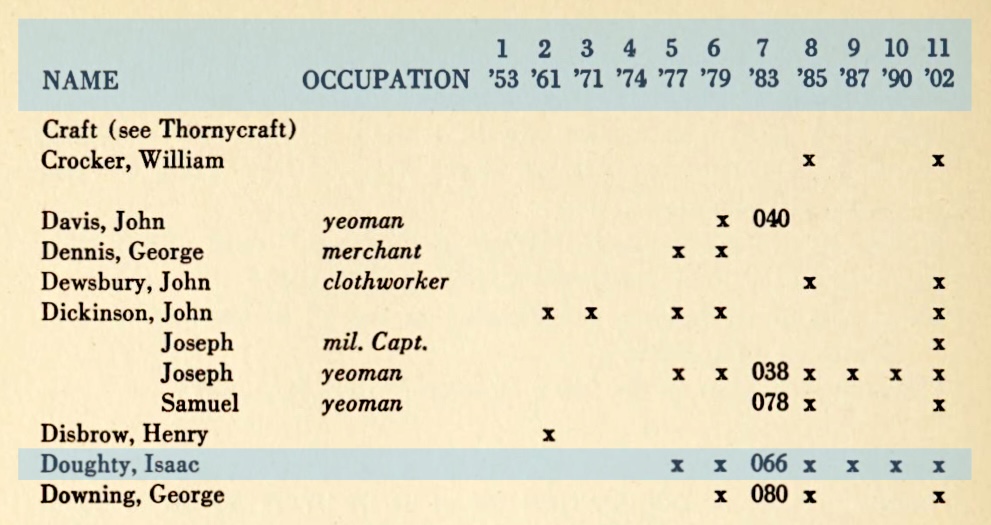
Journal of The American Revolution
What do you think was the strangest or most unconventional moment, battle or event of the Revolution?
https://allthingsliberty.com/2017/01/weirdest-moment/
“I would have to pick the antics of Joseph Bettys, a Tory who became a renowned kidnapper of patriots in upstate New York with St. Johns, Canada as his base.  In the Great Kidnapping Caper of 1781, the British Secret Service at St. Johns planned for eight parties of kidnappers to attempt abducting upstate New York patriots at the same time so as to keep the element of surprise.  The leader of one of the bands, Joseph Bettys, was charged with kidnapping a Patriot in Ballstown, New York.  Bettys had a crush on a local young woman.  Amazingly, he left his band in the lurch and went off to persuade her to run off with him, which she did.  Her outraged father, even though he was a Tory, went to the local Patriot committee, called the Albany County Commissioners for Detecting and Defeating Conspiracies.  This alerted Patriots the entire kidnapping plot.  None of them succeeded, but Bettys did successfully bring his girlfriend to Canada.  Later, after succeeding in kidnapping some Patriots, Bettys was captured and hanged”. –Christian M. McBurney

Joseph Bettys
https://en.wikipedia.org/wiki/Joseph_Bettys#:~:text=Joseph%20Bettys%20(%22Joe%22),a%20British%20Spy%20in%201782.&text=Joe%20was%20born%20and%20grew,Town%20of%20Ballston,%20New%20York.

The Capture of Joe Bettys
United States Magazine, 1857, p. 569.
https://en.wikipedia.org/wiki/Joseph_Bettys#/media/File:The_Capture_of_Joe_Bettys.png
Note: For the Bettys illustration.

Prisoners of War in the American Revolutionary War
https://en.wikipedia.org/wiki/Prisoners_of_war_in_the_American_Revolutionary_War

History.com
The Appalling Way the British Tried to Recruit Americans Away from Revolt
https://www.history.com/news/british-prison-ships-american-revolution-hms-jersey

The George Washington Presidential Library at Mount Vernon
Prisoners of War
https://www.mountvernon.org/library/digitalhistory/digital-encyclopedia/article/prisoners-of-war/

Following th Breadcrumbs That Led Us to Canada

(6) — five records

Martin Devoe
in the Canadian Immigrant Records, Part One

War Office Records: Monthly Return of Loyalists coming in from the Colonies to Lower Canada, from Half Moon
https://www.ancestry.com/discoveryui-content/view/118848:3795?tid=&pid=&queryId=35bfa0c6-6799-4cd1-8778-623c4e66d6b6&_phsrc=Fpd49&_phstart=successSource
National Archives of Canada:
Microfilm Reel No. B-2867 (MG 11 W.O. 28/10), page 118

The Old United Empire Loyalists List (Supplementary List, Appendix B)
https://www.ancestry.com/imageviewer/collections/48267/images/OldEmpireLoyalists-006200-293?treeid=&personid=&queryId=f6d5dc2a-b2db-4138-8a89-4648724a3b67&usePUB=true&_phsrc=Rlk7&_phstart=successSource&pId=273793&rcstate=OldEmpireLoyalists-006200-293:180,1134,275,1159;279,1135,411,1161;180,1164,274,1191;290,1453,429,1480;180,1071,275,1097;180,1103,275,1129 
Book page: 293, Digital page: 297/339

A Short Service History and Master Roll of James Rogers’ 2nd Battalion,
King’s Rangers

By Gavin K. Watt
Published by Global Heritage Press, Milton, 2015
ISBN 978-1-77240-029-8
https://globalgenealogy.com/countries/canada/loyalist/resources/101044.htm
Note: Digital edition, .pdf download for purchase. Page 50/85 is the roster page which contains Martinus Devoe’s information.

The five listings below are the specific information for each transcription from the above reference, for the roster records for Martinus Devoe:
(P2)
Return of a Detachment of the King’s Rangers Commanded by Major James Rogers, in Canada, for which he is entitled to the King’s Bounty, at five Dollars pr. Man. St. John’s, 10th January 1782. AO, HO, AddMss21827, 296-97.
(S11)
E. Keith Fitzgerald, Loyalist Lists: Over 2000 Loyalist names and families from the Haldimand papers (Toronto: Ontario Genealogical Society, 1984) transcribed from the LAC transcript, MG21, B166, ff154-56. (AddMss21826) circa 1783.
(T2)
Muster Roll of a Detachment (three companies) of the King’s Rangers Commanded by Major James Rogers, St. John’s 27th July 1781. Horst Dresler research. LAC, W028/4/96-98.
(T3)
A Return of the Names, Cuntry [sic], Age, size and tim [sic] of service of a Detachment of the Kings rangers quartered at St. Johns — 1st January 1782. Braisted research. LAC, W028/10-142-43.
(T6)
Nominal Rolls of the King’s Rangers, 27th January, 1784. LAC, HP, B160 (AddMss21820) 153-56. Transcribed in H.M., Rogers’ Rangers, A History (Toronto: self published, 1953) 187-202.

Jacob Dafoe
in the Canadian Immigrant Records, Part Two

https://www.ancestry.com/discoveryui-content/view/1648:3798?ssrc=pt&tid=14402677&pid=427511048


Early New Netherlands Settlers
David <?> Du Four, (Rn=25344)
https://freepages.rootsweb.com/~rclarke/genealogy/page1/dufour.htm
Note: Reference for information about the various DeVoe’s: William, Abraham, and Jacob Devoe.

Fort St. Jean, now known as Fort St. John

(7) — four records

Siege of The Fort Saint-Jean, circa 1775
Watercolor by James Peachey (d. 1797) https://en.wikipedia.org/wiki/Fort_Saint-Jean_(Quebec)#/media/File:FortStJeanPeachey1790.jpg
Note: For the fort image.

Siege of Fort St. Jean, September 17 – November 3, 1775
https://revolutionarywarjournal.com/siege-of-fort-st-jean-september-17-november-3-1775/

Fort Saint-Jean (Quebec)
https://en.wikipedia.org/wiki/Fort_Saint-Jean_(Quebec)

[Plan of Fort St. Jean in Quebec, Canada, circa 1775]
Plan des redoutes érigées à Saint-Jean lors de l’été 1775. Bibliothèque et Archives Canada, NMC-2771
https://en.wikipedia.org/wiki/Siege_of_Fort_St._Jean#/media/File:Redoutes_Sud_et_Nord_1775.jpg

The King’s Rangers, also known as The King’s American Rangers

(8) — three records

James Breakenridge’s Company of the King’s Rangers
History of the King’s Rangers
http://www.kingsrangers.org/history.php

King’s Rangers
https://en.wikipedia.org/wiki/King%27s_Rangers#:~:text=The%20King’s%20Rangers%2C%20also%20known,during%20the%20American%20Revolutionary%20War.

Pinterest, King’s Royal Regiment of New York
by Don Troiani
https://fi.pinterest.com/pin/483362972507218407/
Note: For the King’s Ranger’s uniforms.

The Winding Down Of The War, and The Treaty of Paris

(9) — nine records

National Archives, Milestone Documents
Treaty of Paris (1783)
https://www.archives.gov/milestone-documents/treaty-of-paris

American Commissioners of the Preliminary Peace Agreement
with Great Britain, 1783-1784, London, England, by Benjamin West
(oil on canvas, unfinished sketch), Winterthur Museum, Winterthur, Delaware
From left to right: John Jay, John Adams, Benjamin Franklin, Henry Laurens, and William Temple Franklin.
https://en.wikipedia.org/wiki/Treaty_of_Paris_(1783)#/media/File:Treaty_of_Paris_by_Benjamin_West_1783.jpg
Note: The British commissioners refused to pose, and the picture was never finished.

Martin Dafoe
in the Canadian Immigrant Records, Part Two

https://www.ancestry.com/discoveryui-content/view/1650:3798?tid=&pid=&queryId=76c7720d-1bb8-48a9-af88-2ad63bd07ae4&_phsrc=Fpd55&_phstart=successSource
Transcribed from original documents held in the collection of the
National Archives of Canada [Ottawa]: RG 19, vol. 4447, file 36.

Prisoners of War in the American Revolutionary War
https://en.wikipedia.org/wiki/Prisoners_of_war_in_the_American_Revolutionary_War

The George Washington Presidential Library at Mount Vernon
Prisoners of War
https://www.mountvernon.org/library/digitalhistory/digital-encyclopedia/article/prisoners-of-war/

New York. Military Records 1775–1783
https://www.familysearch.org/ark:/61903/3:1:3QS7-89WB-8Z7H?view=index&action=view
Digital page: 125/691
and
Martinus Deve
in the U.S., Compiled Revolutionary War Military Service Records, 1775-1783

New York > Van Schoonhoven´s Regiment (Albany County), Militia > A – Z
https://www.ancestry.com/search/collections/1309/records/218144?tid=&pid=&queryId=47f4707e-798a-418b-83ac-3a4bb9d45038&_phsrc=dxF1&_phstart=successSource
Digital page: 380-381/1593

The History of Waterford, New York
by Sydney Ernest Hammersley, 1957
https://archive.org/details/historyofwaterfo00hamm/page/n5/mode/2up

“Tory Refugees on the Way to Canada” by Howard Pyle.
https://en.wikipedia.org/wiki/Loyalist_(American_Revolution)#/media/File:Tory_Refugees_by_Howard_Pyle.jpg
Note 1: For the illustration.
Note 2: The work appeared in Harper’s Monthly in December 1901.

The DeVoe Line, A Narrative — Four

This is Chapter Four of eleven. We are very lucky to have so many interesting ancestors whose history we are able to trace (for the most part!). There are some unexpected discoveries in this chapter as we learn about our Great Grandparents of nearly 400 years ago.

Preface: It’s Finally Settled!

In the book, the Genealogy of The De Veaux Family, we came across an rare anecdote about our Grandfather Isaac. This little tidbit has finally settled (when) the surname spelling of our branch of the DeVoe family name, became what it is today. (1)

This anecdote was found on page 20 of the Genealogy of The De Veaux Family. (See footnotes).

What Was Attractive to Our Ancestors in This Part of New York State?

We can thank the last ice age for the rich farming country that exists in both the Hudson River Valley and the Mohawk Valley —exactly the areas our ancestors were drawn to in this era. From the history of the Town of Colonie, we learned, “The lowland areas of the Hudson and Mohawk Valleys are characterized by long alluvial flats [deposition of sediment at riverbanks]. These were the first lands selected by both the Indians and the early colonists, since the continual flooding created fertile soils for agriculture. The alluvial flats along the Mohawk River near the Mohawk View area was designated by the Indians as ‘Canastagione’, a name that had many spellings, and eventually became Niskayuna.

‘Canastagione’ referred to the Indian corn fields on the Mohawk.”

The landscape painting below starts to allude to this perspective. The riverbanks are low and fertile, the forest is crowded with life, the water is fresh and abundant. One can see clearings in the distance that our ancestors likely embraced for their farm fields.

Mohawk River, New York, by Albert Bierstadt, 1864 (Image courtesy of the Portland Art Museum).

At a time when there were few roads, the Hudson River waterway was a super-highway for people to travel by ship up the Hudson from Manhattan to the outpost of Albany. Near this place, the Mohawk River branched off from the Hudson, and at this delta, our ancestors also lived in Halfmoon. For the most part, they were all farmers, but at least once, a “tailor, and sometime fur trader” has turned up. (2)

This is the composite map of the British Empire in America, 1733, by Henry Popple. Up to this time, New York had been settled mostly along the Hudson River. Observe in the lower left corner all of the still-existing nations of Native Peoples., which were sometimes referred to as the Iroquois Confederacy. (Image courtesy of the David Ramsey Map Collection).

Life in Albany and Halfmoon Before The Revolutionary War

It was still a dangerous time to leave the relatively protected area like Manhattan and move to a new area. From American History Central, “The conflicts between Britain and France for control over North America often took place in the frontier between New York and New France [the St. Lawrence River, Newfoundland, Nova Scotia, expanding to include much of the Great Lakes], and both nations sought to secure the support of the Iroquois Confederacy. Due to their control of the Fur Trade and influence in Western New York, the Iroquois skillfully manipulated the English and French, pitting them against each other to serve their own interests.”

The Houses of Stuart and Orange: King William III (reigned 1689 – 1703), Queen Anne (reigned 1702 – 1707), and then she continued as Queen under The House of Stuart, (reigned 1707 – 1714), The House of Hanover, George II (reigned 1727 – 1760).

“The first three Anglo-French conflicts — King William’s War (1689–1697), Queen Anne’s War (1702–1713), and King George’s War (1744–1748) — had significant consequences in North America due to: destruction of frontier settlements, disruption in the fur trade, and [an] increased importance of New York in the effort to remove France from North America. During the French and Indian War (1754–1763), most of the major battles on the mainland took place north of Albany, which is where the final invasion of Canada was launched. Albany became the focal point for mainland operations, and the French were finally driven out of North America in 1763.” (3)

Illustration of First Dutch Reformed Church building, Albany, NY,
built in 1715 and replaced in 1789. It was demolished in 1806. (Public domain).

Isaac DeVoe, Marytje Van Olinda, and Their Children

Isaac DeVoe, was baptized December 11, 1720, in the Dutch Reformed Church of Albany, New York, British American Colonies — death date unknown. On August 19, 1750 he married Marytje (Van Olinda) DeVoe in the Dutch Reformed Church, also in Albany. She was baptized on April 27, 1729 also at the same location. Her death date is unknown.

Dutch Reformed Church records for the birth of Isaac DeVoe, December 11, 1720.
Dutch Reformed Church marriage record for Isaac DeVoe and Mareytje Van Olinda, our 5x Great Grandparents on August 19, 1750.
Dutch Reformed Church baptismal record for Mareytje “Maria” Van Olinda, for April 27, 1729.
Entry from Genealogies of the First Settlers of Albany, via American Ancestors. (See footnotes).

Together, they had six children, all of whom were born in Albany, Albany County, New York, British American Colonies, and baptized at the Dutch Reformed Church in the same location.

  • Catarina (DeVoe) Quackenbosch, baptized December 24, 1752 — death date unknown. She married February 3, 1776, Jacob Quackenbosch.
  • Martinus DeVoe, baptized December 22, 1754 — died 1831-32. He married March 18, 1786, Maria (Steenbergh) DeVoe. (We are descended from Martinus).
  • Jan (John) DeVoe, baptized November 20, 1757 — death date unknown. He married September 10, 1778, Annatje (Conover) DeVoe.
  • Jannetje DeVoe, baptized November 9, 1760 — death date unknown
  • Isaac DeVoe (2), baptized June 5, 1763* — death date unknown
  • Gerardus DeVoe, born April 19, 1766 — death date unknown. He married September 1, 1795, Annatje (Merkel) DeVoe.

    *as per Dutch Reformed Church records: Isaac DeVoe (2) was four weeks old when he was baptized, and Gerardus DeVoe’s birthdate is listed as being April 19, not April 14, as per the American Ancestors record.
Birth record for Martinus DeVoe, our 4x Great Grandfather. (See footnotes)

Finding actual records on our 4x Great Grandfather Martinus is a cause for celebration (!) because there just isn’t much out there on him that has survived. That being said, tenacious as we are — we dug in and found enough information about his life to craft an excellent history about his interesting life. We document his family thoroughly during the Revolutionary War and into the years following, in: The DeVoe Line, A Narrative — Five, Six, and Seven. (4)

When Did the DeVoe(s) Relocate to Halfmoon?

This is a funny question to resolve absolutely… Here’s what we do know, along with what we cannot know—

Isaac DeVoe’s father John (2) was born in 1680 in the Bloemendaal section of Manhattan, New York. For reasons we cannot explicitly explain John (2) chose to move to the Albany area up the Hudson River. He married Catharina VanderWerken in 1706 in Albany, and by the early date of 1720 he was a Freeholder in Halfmoon. They had eleven children between 1707 and 1725, all born in Albany. Did the whole family live live in Halfmoon that early, when the community would have been rather rough?

Their eighth child, Isaac DeVoe, was born in 1720 in Albany. He married Marytje Van Olinda in 1750 in Albany and had six children with her. Did Isaac’s wife Marytje and some of the children stay in Albany until things were more stable in Halfmoon?

The two communities were not that far from each other, but this was still an early period of settlement and the infrastructure (roads) were very poor to non-existent, and things were rather unsafe. During this time frame there were two major wars: King George’s War (1744–1748), and the French and Indian War (1754–1763). (From Life In Albany… above) “…most of the major battles on the mainland took place north of Albany, which is where the final invasion of Canada was launched.” After this period, there continued to be many conflicts leading up to the American Revolutionary War (1775–1783). So the question is: If you were a parent, would you want your kids living safe in the Albany stockade, or exposed in the unprotected Halfmoon farm fields?

Isaac and wife Marytje (Van Olinda), married in Albany in 1750. All of their children baptized at the Dutch Reformed Church in Albany, New York. This location most likely was chosen because her side of the Van Olinda family lived in Albany and had and had ties to that church.

The background is A Map of the State of New York, 1804 (inset portions),
by Simeon DeWitt — the only known map that shows Halfmoon before there were boundary and name changes soon after 1804. When our family first moved there, Saratoga County did not yet exist until 1791. The inset panel is a description from an 1871 Gazetteer and Business Directory of Saratoga County. (Background image courtesy of Google Arts & Culture).
Plan, of the City, of Albany, in the Province of New York, by Thomas Sowers, 1756, (Image courtesy of the Norman B. Leventhal Map and Education Center at the Boston Public Library).

In 1756, about six years after Isaac and Marytje were married, the City of Albany looked like this — basically a small fortress still surrounded by an outer wooden stockade. (One wonders if Halfmoon is just a backwoods hamlet at this point, even though there are people living there. We covered the development of Halfmoon in the previous chapter, The DeVoe Line, A Narrative — Three).

Early American Colonial City: AlbanyAlbany 1770, by Robert Yates. (Image courtesy of The Urban Anecdotes).

After twenty years of marriage, there are some changes. It’s interesting to see that by 1770, Albany has grown some. The biggest change is that the outer wooden stockade has been removed, which opens things up a lot.

The only documents we can access for this period which give us clues about where his family was living are the 1790 Census and some tax records. The Isaac DeVoe who is our 5x Great Grandfather would have been about 70 years old at this point— he may have no longer been living. In fact, he could have lived his entire life without being recorded in a discernible way either by a Census, or by tax records. We have located only one Isaac DeVoe living in Halfmoon at that time, and it could possibly be his son (also named Isaac, born 1763).

1790 United States Federal Census, Halfmoon, Albany County, New York.

1790, the first census
The first census of the United States, which started on August 2, 1790 and lasted for several months. In addition to “this particular” Isaac, there are 7 people total living in the home. Censuses done during this era have an inherent problem, in that they are very limited, (in other words little information is provided). We will never know, but at 70 years of age, it is unlikely that this is our Grandfather Isaac because of the ages of the people living in the home.

  • 3 free white persons – males 16 and over
  • 2 free white persons – males under 16
  • 2 free white persons female

The 1786-1788 Tax Records
The earliest Halfmoon tax records we have located are for 1786 and 1788. From those we see taxes being paid in both years by what are presumably two sons of Isaac DeVoe: his son John (born 1757) and his namesake son, Isaac (2). Here are the records for Isaac (2) in 1786:

Halfmoon tax roll for 1786, New York State Archives Digital Collections.

It appears that many people in the community were a little slow, or reluctant, (or both!) to pay their taxes. By 1788, the local Powers That Be posted a rather cranky notice to the villagers, most of whom could not read and had to get someone kind to inform them.

Halfmoon tax roll for 1788, “Hereof you are not to fail at your Peril” cranky notice,
New York State Archives Digital Collections.

What we do know is this: Isaac’s son, Martinus DeVoe was living in Halfmoon by 1790 because we have both the 1790 Census and 1802 tax records to support this view. (See The DeVoe Line, A Narrative — Six.)

So the point of all this is to demonstrate that we really don’t know exactly when Isaac and Marytje were living in Halfmoon. We know that several of their children took up residence there, and it is plausible that if they lived into their elder years, perhaps they were living with one of their children. (5)

When People Had Free Moments…

All of these territory conflicts were serious matters, but not everything in life is serious…

The writer Lindsay Forecast, in the article Leisure Activities in The Colonial Era, states, “The amount of time devoted to leisure, whether defined as recreation, sport, or play, depends on the time available after productive work is completed and the value placed on such pursuits at any given moment in time. There is no doubt that from the late 1600s to the mid-1850s, less time was devoted to pure leisure than today. The reasons for this are many – from the length of each day, the time needed for both routine and complex tasks, and religious beliefs about keeping busy with useful work. There is evidence that men, women, and children did pursue leisure activities when they had the chance, but there was just less time available.”

The Soldier’s Wife by George Smith, (Cropped image, courtesy of Gallerix.org).

“Before the revolution, one’s station in life tended to determine how one would spend one’s leisure. For the cultured elite, the necessity of sharpening social skills to an acceptable level occupied many hours and eventually many years of one’s life. Chances for social interaction outside the towns of colonial America included the quilting and sewing bees organized by women to provide company in what otherwise could become a too-cloistered environment. Most men were also required to attend periodic militia drills. As the individual aged, what was considered leisure activities changed with them.”

Quill pen writing illustration courtesy of The Paul Revere House, (Public domain).

Quilting Bees, Sewing Bees —Just Wondering If They Ever Had Spelling Bees…
We have commented in other chapters about how for many people at this time, spelling was more of a phonetic adventure, rather than a disciplined practice. Here is an example: We once read a colonial era letter that, in addition to having to discern quill pen calligraphy (our nemesis), some of the words had what appeared to be idiosyncratic spellings. One word was “yfe” which we could not figure out.

It turns out that it was a clever phonetic spelling for the word wife. (6)

The Van Olinda Family Were Early Pioneers

One thing that we took note of with this family line, is that the name of a female Van Olinda ancestor was quite present in the documents which have survived. This is a bit unusual, and not typical of the histories we encounter from this era — but we applaud it. Frequently, her name appears in treaties and real estate documents.

This 1866 map from two centuries later, shows the area being described as “purchased by Alice van Olinde in 1667 from the Mohawk natives.” Of note is the small hamlet of Boght Corners in the lower portion. In 1829, “Alice’s” 4x Great Grandson Peter M. DeVoe, was married at the Dutch Reformed Church located there. (Image courtesy of the New York Public Library Digital Archives).

Here is an example from Wikipedia, “Boght Road, which was once called Cohoes Road and Manor Avenue, was the northern boundary of the Manor of Rensselaerswyck. North of the Manor was purchased by Alice van Olinde* in 1667 from the Mohawk natives, and the van Olinde family then sold and leased out farms to potential settlers. Loudon Road (today US 9), named in honor of Earl Loudon was built in 1755 for the purpose of bringing provisions north from Albany to Lake George and Fort Ticonderoga.”

*We were intrigued. Who is this Alice van Olinde? It turns out her real name was slightly different than this. Further on, see our Observation at the end of the section below, subtitled The Legacy of Our Grandmother… (7)

The Legacy of Our Grandmother — Hilletje (Van Slyck) Van Olinda

The dictionary defines the word apocryphal as being of questionable or doubtful authorship or authenticity — and so it is when it comes to some research in genealogy. Usually we refer to these items as family stories, but when the passed-on information gets to be very, very old, it can become apocryphal. It’s almost like the game of telephone: stories > told > again > and > again > become > altered.

To recount the history of the Van Olinda branch of the family forces us to confront a bit of this, and make some decisions. We know that our 8x Great Grandmother in this line is named Hilletje (Van Slyck) Van Olinda and that she was half Mohican. Her history is quite compelling, which we will get to in a moment, but first we need to address the issue of who her mother was, or was not. There is much information out there about her, with some researchers claiming that her name was Ots Toch Owisto’k, and that Hilletje’s father was a French fur trader named Jacques Hertel. The problem with this specificity is that there is no direct evidence to support it. In fact, there is no indirect evidence either. [We prefer to see some form of evidence to support claims.] Apocryphal stories which are put out there without supporting evidence are a genealogist’s version of the game of telephone.

“The practice of historians is to treat legends as meritless unless merit can be demonstrated. A rule of thumb that some historians apply to oral traditions is that after 200 years they have lost any reliability they might have had at the beginning.”

Jacques Hertel in Legend And History II
by Genealogical Researcher Cynthia Brott Biasca

Genealogical Researcher Cynthia Brott Biasca does a remarkable investigation and refutation into the many claims of Hilletje’s parentage. We observed that the overall problem lies with the notions of writers from the 18th and 19th centuries, (and then the unquestioned adoption of that information by later writers). Unlike the world today, where we are marinated in media, back then writers only had the power of words to intrigue and impress their readers. It was natural to freely embellish histories with opinions, prejudices, half-truths, (and an occasional Indian Princess). When we first encounter our Grandmother Hilletje, this is how she is described in the book, The Mohawk Valley : Its Legends and Its History

“She was born of a Christian father (Van Slake) and an Indian mother of the Mohawk tribes. Her mother remained in the country and lived among the Mohawks, and she lived with her the same as Indians live together. Her mother would never listen to anything about Christians, as it was against her heart from an inward unfounded hate. As Hilletie sometimes went among the whites to trade, some of the Christians took a fancy to the girl, discovering more resemblance to the Christians than the Indians, and wished to take her and bring her up, but her mother would not let her go. The little daughter had no disposition to go at first, but she felt a great inclination and love in her heart to those who spoke to her about Christ and the Christian religion. Her mother observed it and grew to hate her and finally drove her from her forest home. She went to those who had solicited her to come so long. She had a particular desire to learn to read and finally made her profession and was baptized.” (This was written in 1901, by Reid. See footnotes).

Left to right: The Mohawk Valley : Its Legends and Its History by W. Max Reid, 1901. Journal of Jasper Danckaerts, 1679-1680, and a Dutch Bible from 1782. (See footnotes).

Much of this is derived from three chapters of an earlier book written in Dutch in the late 17th century and titled [the] Journal of Jasper Danckaerts, 1679-1680. It was discovered > and translated about 80-90 years later in the 18th century >, then continually edited > again and again > for other editions. It is the closest we get to the actual description of the woman Hilletje. However, Danckaerts was a missionary, and it is through his lens that we see her —

“While we were there, a certain Indian woman, or half-breed, that is, from a European and an Indian woman, came with a little boy, her child, who was dumb, or whose tongue had grown fast. It was about four years old; she had heard we were there, and came to ask whether we knew of any advice for her child, or whether we could not do a little something to cure it. We informed her we were not doctors or surgeons, but we gave her our opinion, just as we thought. Sanders told me aside that she was a Christian, that is, had left the Indians, and had been taught by the Christians and baptized… She had said all this with a tender and affectionate heart, and with many tears, but tears which you felt proceeded from the heart, and from love towards God. I was surprised to find so far in the woods, and among Indians — but why say among Indians? among Christians ten times worse than Indians — a person who should address me with such affection and love of God; but I answered and comforted her. She then related to me from the beginning her case, that is, how she had embraced Christianity. She was born of a Christian father and an Indian mother, of the Mohawk tribes. [text continues as per Reid above, word-for-word]… She had especially a great desire to learn to read; and applied herself to that end day and night, and asked others, who were near her, to the vexation and annoyance of the other maids, who lived with her, who could sometimes with difficulty keep her back. But that did not restrain her ; she felt such an eagerness and desire to learn that she could not be withheld, particularly when she began to understand the Dutch language, and what was expressed in the New Testament, where her whole heart was. In a short time, therefore, she understood more about it than the other girls with whom she conversed, and who had first instructed her…” Finally, she made her profession, and was baptized.” (This was written by Danckaerts in the late 17th century and translated much later.)

*Observation: The genealogy game of telephone (before there were real telephones!) was actively being played soon after Hilletje met Jasper Danckaerts. This became apparent as we were sorting through the many variations of her first name.

We have no record of her given Mohawk name. Jasper Danckaerts in 1680 wrote her name in Dutch, which was then translated about 80 years later into the first English edition as: Aletta. Most of the time we see spelling variations that are: Hilletje (which is a Dutch name equivalent for Hilda). If the name is pronounced with a silent ‘H’ it is possible to sound a bit more like Aletta. However, the Dutch language name equivalent for Alice is: Aaltje, or Aeltje. (Google search) So it seems some contemporary writers have just selected Alice.

The Lake of the Iroquois by L. F. Tantillo. The artist writes, “Lake of the Iroquois depicts two Mohawk tribesmen crossing an Adirondack lake in a time frame after contact with Europeans, circa 1640. The canoe is based on period accounts of native vessels constructed of elm bark. The musket in the canoe was a common trade item at that time.”

The Southern Border of the Mohawk Nation
The map below shows the community of Schenectady, which is slightly northwest of Albany. This area and the Rensselaer Manor adjacent to the south, is where most of the Van Olinda families were initially granted land patents. The areas west of here were still Native People areas, called the Country of the Five Nations of Indians (also sometimes referred to as the Iroquois Confederacy) — and the aptly named Mohawk River, represented the southern border of the more northerly Mohawk Nation. During an era of many conflicts between Dutch and English Colonists with the Native Peoples and also the French — this border community was evolving from a dangerous area to a somewhat settled area in which to live.

A Plan of Schenectady from A History of The Schenectady Patent in The Dutch and English Times, page 317. In Hilletje’s life, this area would have been much less settled. (See footnotes).

So what do we know about her life?
From Greene’s book on the Mohawk Valley (see footnotes), her father, “the original Van Slyck, was Cornelis Antonissen Van Slyck, meaning ‘Cornelis, the son of Antonis of Slyck.’ The Dutch immigrant Antonissen Van Slyck, (alias ‘Borer Carnelis’ by the natives)” is noted as her father in Hudson-Mohawk Genealogical and Family Memoirs, Vol. II, and that she was born circa 1640s.

From Stefan Bielinski, Historian for the Colonial Albany Social History Project at the New York State Museum, we learned regarding Hilletje, “By the 1670s, this legendary historical character had become the wife of Albany businessman and regional property holder Pieter Danielse Van Olinda and the mother of several of his children.”

Map from page 58 of A History of The Schenectady Patent in The Dutch and English Times:
Being Contributions Toward a History of The Lower Mohawk Valley
, by Jonathan Pearson.

“Well known in the country west of Albany, Hilletie’s special talent was that of the interpreter. In 1667, she is said to have been given five islands in the Mohawk at Niskayuna in payment for her services. During the 1690s and possibly afterwards, she was paid by the provincial government as the ‘interpretess to the Indians at Albany.’ She was able to secure a number of parcels of land in the region in payment for her work as interpreter. A number of visitors mentioned her in their narratives.” (Bielinski)

Remember this word from the Introduction? “Canastagione” referred to the Indian corn fields on the Mohawk.” (Colonie) “Their lifestyle included farming on cleared flats near the river and hunting over a vast forested area. Their small villages were moved as necessary to preserve their way of life.” (Town of Halfmoon website) These islands were considered ideal locations for the growing of corn, and in a sense, show how esteemed Hilletje must have been by the Mohawks to have received such valuable areas as gifts.

Indian Deed to Hilletie Van Olinda, October 6, 1704. Note the Native American pictorial glyph signature alongside the wax seals. (Image courtesy of the New York State Archives Digital Collections)
Dutch Reformed Church 1707 death record for Hilletje Van Olinda.

We know that Hilletje was married to Pieter Danielse Van Olinda and that they had several children. She died on February 10, 1707. Her husband Pieter, outlived her and “was a farmer, tailor, and sometime fur trader… He has been identified as one of the original patentees of Schenectady. In 1674, he was among those invited to the funeral of the director of Rensselaerswyck — where he held property… he filed a Will in August 1715 (died 1716)Much of this real estate came to him through the work of his wife, the then late Hilletie Van Slyck… (Bielinski)

Which children eventually lead to Marytje (Van Olinda) DeVoe?
As per American Ancestors (see footnotes) for our family, we are descended from the Van Olinda family as follows:

  • Antonis of Slyck, Dutch immigrant father of Antonissen Van Slyck
  • Antonissen Van Slyck was the father of a (half Mohawk) daughter, Hilletje Van Slyck
  • Hilletje (Van Slyck) Van Olinda — married Pieter Danielle Van Olinda. She died February 10, 1707. They had a son named…
  • Daniel Van Olinda, named as the eldest son in the Will of his father Pieter, continued the family line in the community of Halfmoon where he lived. Daniel Van Olinda married Lysbeth (Kregier) Van Olinda on June 11, 1696. They had a son named…
  • Marten Van Olinda, married Jannetie Van Der Werken on April 8, 1724. They had a daughter named…
  • Marytje [Maria] (Van Olinda) DeVoe, who became our 5x Great Grandmother (8)

In the next chapter, we feature our 4x Great Grandfather Martinus DeVoe, and his life during the Revolutionary War. It was one of the most complicated chapters of the DeVoe Line to write (truly and actually) because of the game of > telephone >> and >>> family >>>> stories.


Just ask Ernestine. We’re sure that she knows all about our history.

Following are the footnotes for the Primary Source Materials,
Notes, and Observations

Preface: It’s Finally Settled!

(1) — one record

Genealogy of The De Veaux Family : Introducing the Numerous Forms of Spelling the Name by Various Branches and Generations in the Past Eleven Hundred Years
by Thomas Farrington De Voe, 1811-1892
https://archive.org/details/genealogyofdevea00thom/page/n7/mode/2up
Book page: 20, Digital page: 20/302
Note: For the anecdote about Isaac DeVoe and the receipted bill.

What Was Attractive to Our Ancestors in This Part of New York State?

(2) — three records

Town of Colonie, Town Historian
The Early History of Colonie
https://www.colonie.org/departments/historian/early-history

Mohawk River, New York
by Albert Bierstadt, 1864, oil on canvas – Portland Art Museum – Portland, Oregon – DSC08750.jpg
https://commons.m.wikimedia.org/wiki/File:Mohawk_River,_New_York,_by_Albert_Bierstadt,_1864,_oil_on_canvas_-_Portland_Art_Museum_-_Portland,_Oregon_-_DSC08750.jpg
Note: For the landscape image.

David Ramsey Map Collection
Composite (map): British Empire in America, 1733
by Henry Popple
https://www.davidrumsey.com/luna/servlet/detail/RUMSEY~8~1~887~70081:-Composite-Map-of–A-Map-of-the-Bri
Note: For the map image.

Life in Albany and Halfmoon Before The Revolutionary War

(3) — five records

Britannica
Iroquois Confederacy, American Indian confederation
https://www.britannica.com/topic/Iroquois-Confederacy

American History Central
New York Colony 1524 – 1763
New York Colony, the Iroquois, and New France
https://www.americanhistorycentral.com/entries/new-york-colony/

List of English Monarchs
Houses of Stuart and Orange
https://en.wikipedia.org/wiki/List_of_English_monarchs
Note: For their portraits.

[Queen Anne]
File:Dahl, Michael – Queen Anne – NPG 6187.jpg
https://commons.wikimedia.org/wiki/File:Dahl,MichaelQueen_Anne-_NPG_6187.jpg
Note: For her portrait.
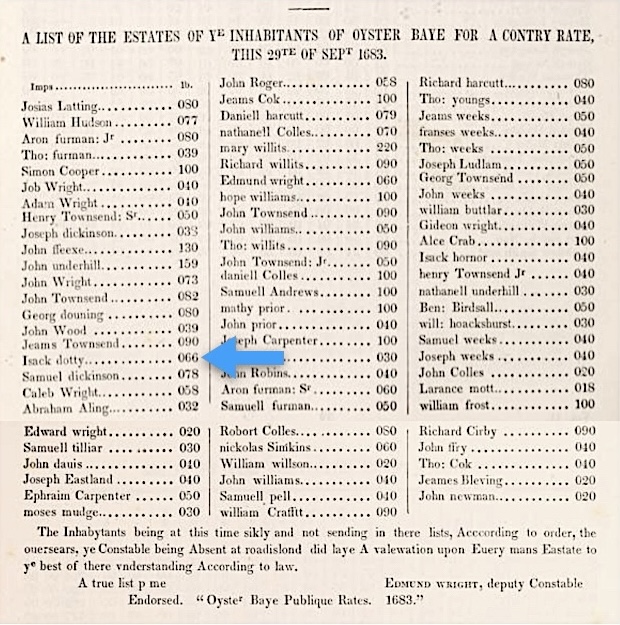
King George II
https://commons.wikimedia.org/wiki/File:King_George_II_by_Charles_Jervas.jpg
Note: For his portrait.
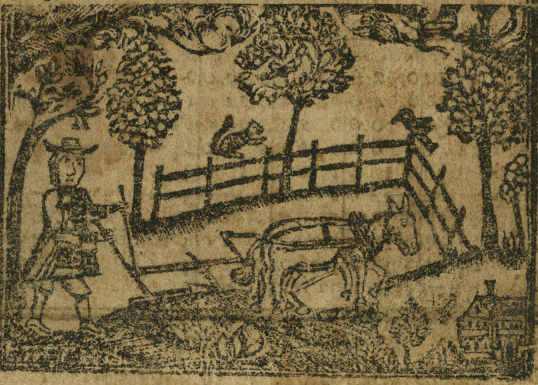
Isaac DeVoe, Marytje Van Olinda, and Their Children

(4) — fifteen records

Illustration of First Dutch Reformed Church building, Albany, NY
https://en.wikipedia.org/wiki/First_Church_in_Albany_(Reformed)#/media/File:1715_Dutch_Reformed_Church,_Albany,_NY.jpg
Note: For the church building image.

First Church in Albany (Reformed)
https://en.wikipedia.org/wiki/First_Church_in_Albany_(Reformed)

Albany County, New York: First Settlers, 1630-1800 (Archived1)
https://www.americanancestors.org/databases/albany-county-new-york-first-settlers-1630-1800-archived1/image?volumeId=63472&pageName=42&rId=10007842425
Book page: 42, Digital page: 42/182

Isaac De Voe
in the U.S., Dutch Reformed Church Records in Selected States, 1639-1989

New York > Albany > Albany, Vol I, Book 1
https://www.ancestry.com/discoveryui-content/view/40264:6961?ssrc=pt&tid=48708924&pid=240082063566
Book page: 95, Digital page: 99/368, Right page, entry 2 from the top.
Note: For marriage information. Hand transcription      

Genealogies of The First Settlers of Albany
https://www.americanancestors.org/databases/albany-county-new-york-first-settlers-1630-1800-archived/image?rId=6526998&volumeId=7370&pageName=129&filterQuery=
Book page: 129
Note: See left column entry for Van Olinda, and follow:
Pieter/Hilletie > Daniel/Lysbeth > Marten/Jannetie > Maria

Maritje Van Olinda
https://www.ancestry.com/family-tree/person/tree/6000267/person/252272497714/facts?_phsrc=wfr1&_phstart=successSource
and
Part 4, 1750–1764, Holland Society of New York (1907)
Records of the Reformed Dutch Church of Albany, New York, 1683–1809
http://aleph0.clarku.edu/~djoyce/gen/albany/part4.html#marriage
Note 1: Click on this link: Marriages, 1750 to 1762, then see entry for August 19, 1750.
Note 2: Both entries are for marriage records.
Note 3: We have not been able to discern what the notation “with pardon” means in this context. It is interesting to look at the other notations: “2 living at the Half Moon, born at Nistigoenen, live near Schaghticoke”.

U.S., Dutch Reformed Church Records in Selected States, 1639-1989
New York > Albany > Albany, Vol I, Book 1
https://www.ancestry.com/discoveryui-content/view/39413:6961?tid=&pid=&queryId=c38b5d34-11bb-42af-a384-6478a5a4718a&_phsrc=yJB1&_phstart=successSource
Book page: 268, Digital page: 272/368
Note 1: Birth record for Marytje Van Olinda.
Note 2: The entry is noted under April 20, 1729, with the indication of d7 — that it is 7 days after is her actual birthday (d7 equals April 27).
Note 3: This is the same location that all of their children were baptized.

Records of the Reformed Dutch Church of Albany, New York, 1683–1809
(Excerpted from Year Books of the Holland Society of New York, 1907)
DRC of Albany Baptismal Record, 1789 to 1809
http://aleph0.clarku.edu/~djoyce/gen/albany/refchurch.html
Note: We have itemized each individual record for their children which are found in three links, as directed below.

Here are the individual records for the first 4 children of Isaac DeVoe and Marytje (Van Olinda) DeVoe —
Catarina, Martinus, Jan (John), and Jannetje are found at this link,
Baptismal Record, 1750 to 1762:
http://aleph0.clarku.edu/~djoyce/gen/albany/part4.html#baptismal

> [page 31] 1752
1752, Dec. 24. Catarina, of Isaac De Voy and Maritje V. drlinden. Wit.: Isaac Vosburg, Geerteruy Van de Linden
and here also:
Isaac De Voy
in the U.S., Dutch Reformed Church Records in Selected States, 1639-1989
New York > Albany > Albany, Vol III, Book 3
https://www.ancestry.com/discoveryui-content/view/150162502:6961?ssrc=pt&tid=48708924&pid=240082063566
Book page: 64, Digital page: 268/506
Note: Hand transcription.        Left page, fourth entry from the top

> [page 44] 1754
1754, Dec. 22. Martinus, of Isak Du Foe and Marytje Van der Linde. Wit.: Martinus V. d. Linden, Elisabeth Doxs.

> [page 57] 1757
1757, Nov. 20. Jan (John), of Isaac Devoe and Maria Van Olinde. Wit.: Jan Dox, Maria Coerteny.

> [page 71] 1760
1760, Nov. 9. Jannetie of Izak De Voe and Marytje V. der Linde (Van Olinde). Wit.: Daniel V. der Linde (Van Olinde), Elisabeth Bekker.
and here also:Izak De Voe
in the U.S., Dutch Reformed Church Records in Selected States, 1639-1989
New York > Albany > Albany, Vol III, Book 3https://www.ancestry.com/discoveryui-content/view/150163354:6961?ssrc=pt&tid=48708924&pid=240082063566
Book page: 186, Digital page: 190/506
Note: Hand transcription.        Left page, fifth entry from the bottom

Isaac is found at this link: Baptismal Record, 1763 and 1764:
http://aleph0.clarku.edu/~djoyce/gen/albany/part4.html#baptismal2
> [page 93] 1763
1763, June 5. Yzaac (Isaac) of Yzac (Izak) de Foe (de Voe) and Maria V. d. Linde. Wit. Cornelis V. d. Berg, Claartje Knoet. Note: Four weeks old.

Gerardus is found at this link: Baptismal Record, 1765 and 1771:
http://aleph0.clarku.edu/~djoyce/gen/albany/part5.html#baptismal
> [page 19] 1766 (bo = born on)
bo. Apr. 19. Gerardus, of Yzaac du Voe and Marytje V. Olinde. Wit.: Gerardus V. Olinde, Lena du Voe.

Early New Netherlands Settlers
David <?> Du Four, (Rn=25344)
https://freepages.rootsweb.com/~rclarke/genealogy/page1/dufour.htm

When Did the DeVoe(s) Relocate to Halfmoon?

(5) — nine records

Gazetteer and Business Directory of Saratoga County, N.Y.,
and Queensbury, Warren County,
for 1871
https://archive.org/details/gazetteerbusines00chi/page/92/mode/2up?view=theater
Book page: 92, Digital page: 92/303

A Map of the State of New York, 1804 (cropped portion)
Simeon DeWitt (1756-1834)
https://artsandculture.google.com/asset/a-map-of-the-state-of-new-york/gQG44G8fdQpGwQ?hl=pt-PT
Note: For map image.

Boston Public Library
Norman B. Leventhal Map and Education Center
Plan, of the City, of Albany, in the Province of New York (map)
by Thomas Sowers, 1756
https://collections.leventhalmap.org/search/commonwealth:hx11z365w

The Urban Anecdotes
Early American Colonial City: Albany
Albany 1770 (map)
by Robert Yates
https://www.the-urban-anecdotes.com/post/early-american-colonial-city-albany
Note: For the map image.

The George Washington Presidential Library at Mount Vernon
First United States Census, 1790
https://www.mountvernon.org/library/digitalhistory/digital-encyclopedia/article/first-united-states-census-1790/#:~:text=The%201790%20census%20was%20the,of%20national%20prosperity%20and%20progress.

American Revolutionary War
https://en.wikipedia.org/wiki/American_Revolutionary_War#:~:text=The%20American%20Revolutionary%20War%20(April,and%20commanded%20by%20George%20Washington

Isaac Devoe
in the 1790 United States Federal Census

New York > Albany > Half Moon
https://www.ancestry.com/discoveryui-content/view/234148:5058?tid=&pid=&queryId=47cac8d0-7968-4a12-b3a0-4d1b0ec73750&_phsrc=nLK2&_phstart=successSource
Book page: Noted as 322, Digital page: 1/4, Left column, entry 25 from the bottom of the page.

New York State Archives Digital Collections
Halfmoon tax roll, 1786
https://digitalcollections.archives.nysed.gov/index.php/Detail/objects/57252
Note: There are 16 downloadable files.This is the relevant file: NYSA_A1201-78_1786_Albany_Halfmoon_p04.tiff

New York State Archives Digital Collections
Halfmoon tax roll, 1788
https://digitalcollections.archives.nysed.gov/index.php/Detail/objects/95585

When People Had Free Moments…

(6) — three records

The Revere House Gazette, Spring 2016
Leisure Activities in The Colonial Era
by Lindsay Forecast
https://www.paulreverehouse.org/wp-content/uploads/2016/06/PaulRevereHouse_Gazette122_Spring16.pdf

The Soldiers Wife (image cropped)
by George Smith (1829-1901)
https://gallerix.org/storeroom/1073111432/N/718/
Note: For the image of the children playing.

Quill Pen Writing and Drawing illustration
https://www.paulreverehouse.org/event/quill-pen-writing-and-drawing-aug2023/
Note: For the illustration.

The Van Olinda Family Were Early Pioneers

(7) — three records

History of the Mohawk Valley: Gateway to the West 1614-1925,
Volume 1

Nelson Greene, editor
https://www.schenectadyhistory.org/resources/mvgw/history/022.html
Book pages: 326-351
Note: Chapter 22: Settlers at Schenectady, 1661-1664

Watervliet, New York (map)
New Topographical Atlas of the Counties of Albany and Schenectady New York
https://digitalcollections.nypl.org/items/510d47e3-72e9-a3d9-e040-e00a18064a99/book?parent=76f52680-c5f6-012f-6a69-58d385a7bc34#page/17/mode/2up
Book page: 31
Note 1: For the map image.
Note 2: Known in the present day as the town of Colonie.

Boght Corners, New York
https://en.wikipedia.org/wiki/Boght_Corners,_New_York
Note: For the mention of “was purchased by Alice van Olinde in 1667 from the Mohawk natives…”

The Legacy of Our Grandmother  — Hilletje (Van Slyck) Van Olinda

(8) — eighteen records

Apocryphal [definition]
https://www.merriam-webster.com/dictionary/apocryphal#:~:text=apocryphal%20implies%20an%20unknown%20or,itself%20is%20dubious%20or%20inaccurate.

Jacques Hertel in Legend And History II
by Cynthia Brott Biasca
https://www.familysearch.org/memories/memory/134755036

The Mohawk Valley: Its Legends and Its History
by W. Max Reid, 1901
https://ia600507.us.archive.org/13/items/mohawkvalleyitsl00reid/mohawkvalleyitsl00reid.pdf
Book pages: 156-160

1782 BÍBLIA ENCADERNADA DE COURO com FECHOS BIBLIA SACRA
antiga na Holanda Holandesa
[1782 LEATHER BOUND BIBLE with LOCKS Antique HOLY BIBLE in Dutch Holland]
https://www.ebay.com/itm/364780333183?norover=1&mkevt=1&mkrid=711-167022-160074-6&mkcid=2&itemid=364780333183&targetid=296633477513&device=c&mktype=pla&googleloc=9197425&poi=&campaignid=20741944936&mkgroupid=158218881347&rlsatarget=pla-296633477513&abcId=&merchantid=5300591862&gad_source=1&gbraid=0AAAAAD_QDh_LgbL-MlCni_jX5IWQJNcW7&gclid=Cj0KCQjwkdO0BhDxARIsANkNcrdM9VcKURsHWIfTYIAb3fyHXC8OqZt0uH34KI6nRzdABQ_ESrxluZMaArrcEALw_wcB

Smithsonian Libraries
Journal of Jasper Danckaerts, 1679-1680,
These three chapters: The Story of Aletta, The Indian, The Story of Wouter, Aletta’s Nephew, Interview With Aletta and Wouter
https://library.si.edu/digital-library/book/journalofjasper00danc
Book pages: 201-211, Digital pages: 200-210/313

Mohawk Village, 1780
A Mohawk Native American village in central New York, c1780.
Engraving, 19th century
https://www.mediastorehouse.com/granger-art-on-demand/mohawk-village-1780-mohawk-native-american-7505681.html
Note: For the village illustration.

Hudson-Mohawk Genealogical and Family Memoirs, Vol. II
Hudson-Mohawk Family Histories
by Cuyler Reynolds (editor)
https://www.ancestry.com/imageviewer/collections/48324/images/HudsonMohawkII-002620-704?ssrc=&backlabel=Return&pId=291902
Book page: 704, Digital page: 221/465

The Fine Art of Historical and Marine Painting
Lake of the Iroquois
Two Iroquois in the Adirondacks, circa 1640

by L. F. Tantillo
https://lftantillo.com/native-americans-in-new-york/lake-of-the-iroquois.html

A History of The Schenectady Patent in The Dutch and English Times: Being Contributions Toward a History of The Lower Mohawk Valley
by Jonathan Pearson, and Junius Wilson MacMurray
https://archive.org/details/historyofschenec00pearuoft/historyofschenec00pearuoft/page/n7/mode/2up
Note 1: For the Bouwlands map, Book page: 58, Digital page: 86/514
Note 2: For the Schenectady map, Book page: 317, Digital page: 349/514

History of the County of Schenectady, N. Y., from 1662 to 1886…
by John H. Munsell , George Rogers Howell
https://archive.org/details/historycountysc00howegoog/page/n30/mode/2up
Book pages: 15-16, Digital pages: 31/254

A Brief History of Early Halfmoon
by The Town of Halfmoon, New York
https://www.townofhalfmoon-ny.gov/historian/pages/a-brief-history-of-early-halfmoon

New York State Archives Digital Collections
Indian Deed to Hilletie Van Olinda, October 6, 1704
https://digitalcollections.archives.nysed.gov/index.php/Search/objects?search=Van+Olinda
Description of the document:
“Indian deed to Hilletie van Olinda, accompanying a petition for a patent for a tract of woodland, known by the Indian name of Dewaethoeiacocks, lying on the south side of the Maquase river, being bounded on the north side by Killian Van Ransleaer’s patent; on the west by the patent of Peter Hendrick de Haes; easterly down along the said river, by the Kahoos or Great falls, containing about 400 acres.”

U.S., Dutch Reformed Church Records in Selected States, 1639-1989
New York > Albany > Albany, Vol III, Book 3
https://www.ancestry.com/imageviewer/collections/6961/images/42037_1521003239_0772-00018?ssrc=&backlabel=Return
Book page: 13, Digital page: 17/506, last entry before November 4, 1710.
Note: 1707 death record for Hilletje Van Olinda

Pieter Danielse Van Olinda
by Stefan Bielinski
https://exhibitions.nysm.nysed.gov/albany/bios/vo/pdvolinda.html

Calendar of wills on file and recorded in the offices of the Clerk of the Court of Appeals, of the County Clerk at Albany, and of the Secretary of State, 1626-1836
Berthold Fernow, 1837-1908
https://archive.org/details/calendarwillson00appegoog/page/449/mode/2up
Book page: 449 Digital page: 449/657, Left page, middle.
Note: For Peter van Olinda 1715 Will.

Albany County, New York: First Settlers, 1630-1800 (Archived1)
https://www.americanancestors.org/databases/albany-county-new-york-first-settlers-1630-1800-archived1/image?volumeId=63472&pageName=42&rId=10007842425
Book page: 42, Digital page: 42/182

We present this family tree for information purposes only, since some of the information is unsourced. Be careful!
https://www.familysearch.org/tree/pedigree/landscape/LDHG-GMP

The Hollywood Reporter
Laugh-In’ Tribute Set at Netflix With Original Star Lily Tomlin
https://www.hollywoodreporter.com/tv/tv-news/laugh-tribute-set-at-netflix-original-star-lily-tomlin-1191978/

The DeVoe Line, A Narrative — One, Holland & Huguenots

This is Chapter One of eleven. With this chapter we begin a long and complicated history of the DeVoe branch of our family. There will be eleven chapters total in this family line.

Nearly all of our family lines were in North America very early on, including the DeVoes. Like the tap root of a tree, the key foundational event for America is the Pilgrims landing at Plymouth Rock, and their founding of the first sustained immigrant community. It is also because of the DeVoe line, that we connect to two Mayflower passengers: Pilgrim George Soule, and Pilgrim Edward Doty. In future posts, we will be writing their family narratives.

The Best Place to Find a Needle is a Haystack

On the one hand, we have found that doing genealogy research can bring a happiness which results from discovering something cool about an ancestor you only vaguely knew. (Or better yet, finding ancestors you never knew existed!) On the other hand, frustration comes when you know the beginning and ending to a story, but the needed documents which connect those ends, are like trying to find a needle in the proverbial haystack.

Haystacks, End of Summer, by Claude Monet, 1890-1891

From writer Mark Baker, “Conventional wisdom tells us that the best place for a needle is in a needle case, and the best place for hay is in a haystack. If you want to find something, or want other people to find it, you should put it in the right place. As we were all taught: a place for everything, and everything in its place.That was true when we lived in the physical world. But we don’t live in the physical world anymore. We live on the Internet, and the Internet is topsy turvey world in which the best place to find a needle is actually a haystack. [As we know…]

Internet research has become the defacto tool of this era, and sometimes it is like a haystack. With this family, we found all the needles we were looking for, and some we weren’t, and learned a thing or two along the way. We have a great story to tell. So please, enjoy!

Preface: This particular history has two important paths, Politics and Religions. The first path is Politics. It is about the land — who lived where, and who was in charge of that land, etc. The second path is Religions — concerning what was happening with religious conflicts throughout these areas, during these centuries.

A note before we begin: For this blog chapter we are streamlining the complex history of this region, and only focusing on the time periods that affected our ancestors. Please think of this chapter as a synthesized history from many sources, (see footnotes). (1)

The First Path: Politics and Land — Understanding the Low Countries

The Low Countries, historically also known as the Netherlands, is a coastal lowland region in Northwestern Europe… consisting today of the three modern “Benelux” countries: Belgium, Luxembourg, and the Netherlands. Up until the very recent past this was not the case, because the region was almost continually overrun by ambitious imperial powers from adjoining regions. Over the centuries, geographically and historically, the area has also included parts of France and Germany.

Map showing the northern border of the Roman Empire (the Lines), which ran through what is now the Netherlands. (Image courtesy of Quora.com).

Comment: It’s natural for people today to think that their ancestors are defined by today’s borders, because for the most part, we live in an era where borders hardly move at all. Today, we identify through Borders. But this isn’t the way it should be thought about regarding ancestors who precede us. The world was different then. These ancestors lived in a place that doesn’t exist anymore. To use the “Benelux” example from above: then, Belgium didn’t exist; then, the Netherlands was an unrecognizable mash-up; then, Luxembourg was an obscure, distant Netherlands province.

Medieval Market Scene, (Public domain).

From the Romans to the Mid-1400s
During the Roman Empire, the region of the Low Countries contained a militarized frontier and was the contact point between Rome and the Germanic tribes. After the long decline of the Roman Empire, this area was the scene of the early independent trading centers that marked the reawakening of Europe in the 12th century. As such, during the Middle Ages, the Low Countries were divided into numerous semi-independent principalities, where guilds and councils governed most of the cities along with a figurehead ruler. Interaction with these various rulers was regulated by a strict set of rules describing what the latter could and could not expect. All of the regions mainly depended on trade, manufacturing, and the encouragement of the free flow of goods and craftsmen.

What was very, very slowly emerging as the Netherlands, rivaled northern Italy as one of the most densely populated regions of Western Europe. Dutch and French dialects were the main languages used in secular city life.

Otto I, known as Otto the Great, (912 – 973), founder of the Holy Roman Empire, The House of Valois-Burgundy, Mary of Burgundy (1457 – 1482), Charles V, Holy Roman Emperor (1500 – 1558) Archduke of Austria, King of Spain, and Lord of the Netherlands [as the titular Duke of Burgundy].

The Holy Roman Empire and The Habsburg Netherlands 
The Saxony kings and emperors ruled the Netherlands in the 10th and 11th centuries. The Holy Roman Empire was founded by Otto I, known as Otto the Great. Through strategic marriages and personal appointments, Otto installed members of his family in the Duchy of Saxony kingdom’s most important duchies [the future Germany]. This strategy reduced the various dukes, who had previously been co-equals with the king, to royal subjects under his authority. In the latter part of his life, he conquered the Kingdom of Italy, thus being crowned in 962, Emperor of the Holy Roman Empire, by Pope John XII in Rome. Hence, Germany was called the Holy Roman Empire after the coronation of King Otto the Great, as Emperor.

About 500 years later, the Habsburg Netherlands was the Renaissance period collection of feudal land estates in the Low Countries, held together by the Holy Roman Empire’s House of Habsburg. The Hapsburg rule began in 1482, when Mary of Burgundy died. She was the last Valois-Burgundy ruler of the Netherlands, and the wife of Maximilian I of Austria. Their grandson, Emperor Charles V, was born in the Habsburg Netherlands and made Brussels one of his capitals. The Seventeen Provinces (the de facto fiefs of the Holy Roman Empire) formed the core of the Habsburg Netherlands, which passed to the Spanish Habsburgs, upon the abdication of Emperor Charles V in 1556.

 A Brief History of the Netherlands map, circa 1555, by Brian A. Smith, D.C. The red circles indicate areas where our ancestors would live in the Walloon Provinces, during a time of shifting borders. Note: These Walloon Provinces are important to our family history.

The Spanish Netherlands
Becoming known as the Seventeen Provinces in 1549, they were held by the Spanish branch of the Habsburgs from 1556, and known as the Spanish Netherlands from that time on. They named the area Flandes, which evolved into the name Flanders, and the Army of Flanders was given the task of defending the territory under Spanish service. 

These Seventeen Provinces were already changing… In 1581, in the midst of the Dutch Revolt (see next section), the northern portion came together as the Seven United Provinces, and seceded from the rest of this territory to form the Dutch Republic. They still stayed under Spanish rule until the War of the Spanish Succession, (circa 1700). The remaining 10 provinces, in the area to the south where our ancestors lived, were also under Spanish control, but the area was referred to as the Southern Netherlands.

As the power of the Spanish branch of the Habsburgs waned in the latter decades of the 17th century, the territory of the Netherlands under Habsburg rule, was repeatedly invaded by the French and an increasing portion of the territory came under French control in many successive wars. (2)

The Battle of Gibraltar, 1607, by Cornelis Claesz van Wieringen, circa 1621. (Image courtesy of Wikimedia Commons).

The Dutch Revolt and the 80 Years War

The Eighty Years’ War, or Dutch Revolt, was an armed conflict in the [Spanish] Habsburg Netherlands between disparate groups of rebels, and the Spanish government. The causes of the war included the Reformation, centralization, taxation, and the rights and privileges of the nobility and cities. After the initial stages, Philip II of Spain, the sovereign of the Netherlands, deployed his armies and regained control over most of the rebel-held territories. However, widespread mutinies in the Spanish army caused a general uprising.

The view from history is that “The Reformation led to many Netherlanders leaving the Catholic church and joining Protestant churches. The rise of Protestantism became closely linked to the movement for independence from Spain.” (Family Search) This desire to be free from Spain makes sense for our ancestors because they lived in a conflicted border area…. Some sections of the Low Countries were Catholic, and some sections were turning to the Reformation-led Protestantism…. This led to more strife. The Seven Provinces which had formed the Dutch Republic in 1581, were considered to be Protestant dominant by 1588.

The Oudewater Massacre, committed by Spanish soldiers against Dutch civilians in 1575, during the 80 Years War. (Image courtesy of Wikipedia.com).

Observation: This revolt began in 1568 and ended in 1648, hence it’s aptly named as the Eighty Years’ War. When our ancestor was born into this milieu, [surroundings, setting, scene, environment] in 1620, the War had been going on for over half a century at that point.

In the ten years thereafter, the Dutch Republic made remarkable conquests in the north and east against a struggling Spanish Empire, and received diplomatic recognition from both France and England in 1596. The Dutch colonial empire emerged, which began with Dutch attacks on Portugal’s overseas territories.

The two sides agreed to a Twelve Years’ Truce in 1609; when it expired in 1621, fighting resumed as part of the broader Thirty Years’ War. An end was reached in 1648 with the Peace of Münster (a treaty part of the Peace of Westphalia), when Spain recognized the Dutch Republic as an independent country. (3)

The Syndics of the Drapers’ Guild, by Rembrandt, 1662. (Image courtesy of Google Art Project).

The Dutch Golden Age and The United East India Company

This was a period in the history of the Netherlands, roughly spanning the era from 1588 until 1672 , in which Dutch trade, science, art, and the Dutch military were among the most acclaimed in Europe. The Golden Age continued in peacetime during the Dutch Republic until the end of the century, when expensive conflicts fueled economic decline. The transition by the Netherlands to becoming the foremost maritime and economic power in the world has been called the “Dutch Miracle” by some historians.

…both foreigners and Dutchmen were apt to believe that the
Dutch Republic was unique in permitting an unprecedented degree of freedom in the fields of religion, trade, and politics…
In the eyes of contemporaries it was this combination of freedom and economic predominance that constituted the true miracle
of the Dutch Republic.

Koenraad Wolter Swart
Professor of Dutch History and Institutions in the University of London
An Inaugural Lecture Delivered at University College London
on November 6, 1967

The United East India Company* was a chartered company established on the March 20, 1602 by the States General of the Netherlands uniting existing companies into the first joint-stock company in the world, granting it a 21-year monopoly to carry out trade activities in Asia. Shares in the company could be bought by any resident of the United Provinces and then subsequently bought and sold in open-air secondary markets (one of which became the Amsterdam Stock Exchange). It is sometimes considered to have been the first multinational corporation.

Various artifacts of the Dutch East India Company, left to right: An Arita Dish, Eco Period, Japan / The Arms of the Dutch East India Company and of the Town of Batavia / Logo of the Amsterdam Chamber of the Dutch East India Company / copper coins / Batavia Ship Replica (See footnotes).

It was a powerful company, possessing quasi-governmental powers, including: the ability to wage war, imprison and execute convicts, negotiate treaties, strike its own coins, and establish colonies.

*In Dutch, the name of the company was the Vereenigde Nederlandsche Geoctroyeerde Oostindische Compagnie (abbreviated as the VOC), literally the “United Dutch Chartered East India Company”. Today, we generally refer to this company as The Dutch East India Company. (4)

The Second Path: Religious Persecution

James Riker wrote in The Revised History of Harlem — “From Mons, the rich capital of this province, seated to the north of Avesnes… came David du Four, of the same name, — and not improbably the same blood, as the martyr of Le Cateau [*], but whose posterity, which became numerous in his coimtry [territory or country], changed the form of their name to Devoor and Devoe.”

*This is what happened to the “The martyr of Le Cateau“— He was a man named David Du Four of whom Riker wrote: “Huguenots being held prisoners in the neighboring village of Troisville by the castellan and echevins [Roman Catholics] of Le Cateau, David Du Four and others went with arms and liberated them…” This happened in the late summer and autumn of 1566. The aftermath didn’t go so well: “Many executions followed during the ensuing month. One was that of David Du Four, before named. He was a tailor at Le Cateau, and only twenty-two years of age. But on his examination he with firmness declared that ‘he paid more regard to his salvation and to God, than to men.’ He and four others were hung, on April 9th [1567].

The Persecution of Huguenots in France
Before the Edict of Nantes, 1598
. Woodcut, 19th century.

Our immigrant ancestor to New Amsterdam will also be named David Du Four, but he won’t be born for another half century yet [1620], but that’s in the next chapter. Back to our telling of this tale…

This was the first intriguing reference we had found as to where our possible ancestor with the DeVoe family name had originated, and it was linked in the context with the word martyrdom. Riker’s book was about the New Amsterdam Colony in North America, but this was about some place in Europe…

After much research, and coming to an understanding about what Holland was like in this period, we learned that our ancestors in Holland identified as Walloons. (See The DeVoe Line, A Narrative — Two). This was compelling, because we had been coming across some histories [like Genealogy of The De Veaux Family], indicating that our DeVoe ancestors could have been Huguenots. (Observation: Some contemporary writers have picked up on this Huguenot idea and run with it.) However, we have come to believe that the Holland DeVoe(s) were likely surrounded by Huguenots due to where they lived, not because of who they were. Due to religious persecution, many Huguenots were fleeing the areas in France where they lived, and resettling in England. This June 2012 article from The International Institute of Genealogical Studies, explains the situation very well.

History and Beliefs
The French-speaking Protestants who fled from religious persecution and civil war on the continent are all loosely referred to as Huguenots, however this term properly refers to only those from France, and not to the Walloons from the Low Countries. However, it is often impossible to distinguish the two groups because of the shared language and churches as well as much intermarriage in the early communities in England. Their beliefs were Calvinistic [Protestant] and closest to the English Presbyterian style of church government.

Landing of the Walloons at Albany, circa 1620s.
(Image courtesy of the New York Public Library Digital Collections).

Walloons
The first wave of many thousands of French-speaking Protestants were Walloon refugees who arrived in England from the Spanish Netherlands (now Belgium and the Netherlands) in 1567, having been forced to flee the suppression of Protestantism by King Philip of Spain’s forces lead by the Duke of Alva. This group had been in England for over a century before the true Huguenots came and the two groups settled in London and the same south-eastern towns.

And in the Province of New York in New Amsterdam
From Genealogy Magazine.com: It was French-speaking Walloons from Hainaut who were among the first to settle the Hudson River Valley and Manhattan Island between 1620 and 1626. Eight Belgian [Southern Netherlands Walloon] Protestant families, fleeing from Catholic Spanish religious persecution, joined the Dutch settlers in 1624 to settle what became New Amsterdam. [Apparently, some writers as late as 2006, fail to understand that Belgium didn’t exist for 200 more than years, that is, until 1830.]

“An example of a round robin, which was a document written in circular fashion to disguise the order in which it was done. This document is a promise by certain Walloons and French to go and inhabit Virginia, a land under obedience of the Kings of Great Britain’. 1621.” (Image courtesy of The National Archives, Great Britain).

Huguenots
The Huguenots, (Protestants from France), first came in 1572 [to England] after the Massacre of St. Bartholomew in Paris,which saw 70,000 Huguenots across France brutally murdered. Elizabeth I’s court enter a period of mourning in honor of the Protestant lives lost to the Catholic terror. Although there was support for their religious freedom during the reigns of Elizabeth and James I, during that of Charles I… [there were restrictions imposed which forced the Huguenots to consider resettling somewhere else again]. In response, some moved to Holland, and the majority to the USA* [many to the new Amsterdam Colony in New York Province] taking their craft skills with them. 

*OK, it should be obvious, but there was no USA yet. At the time, North America had Native Peoples, and was colonized by the British, Dutch, French, Spanish, and anybody else who could row a boat there. (5)

The Massacre of St. Bartholomew in Paris

St. Bartholomew’s Day Massacre, by François Dubois. (Image courtesy of Wikimedia Commons).

The St. Bartholomew’s Day massacre in 1572 was a targeted group of assassinations and a wave of Catholic mob violence, directed against the Huguenots (French Protestants) during the French Wars of Religion. Traditionally believed to have been instigated by Queen Catherine de’ Medici, the mother of King Charles IX.

The massacre started a few days after the marriage on August 18, 1572 of the king’s sister Margaret to the Protestant King Henry III of Navarre. Many of the wealthiest and most prominent Huguenots had gathered in largely Catholic Paris to attend the wedding.

Catherine de Medici Gazing at Protestants in the Aftermath of the Massacre of St. Bartholomew
by Édouard Debat-Ponsan, 1880. (Image courtesy of Wikipedia).

The massacre began in the night of August 23-24, 1572, the eve of the feast of Bartholomew the Apostle, two days after the attempted assassination of Admiral Gaspard de Coligny, the military and political leader of the Huguenots. King Charles IX ordered the killing of a group of Huguenot leaders, including Coligny, and the slaughter spread throughout Paris. Lasting several weeks in all, the massacre expanded outward to the countryside and other urban centres. Modern estimates for the number of [the initially] dead across France vary widely, from 5,000 to 30,000. [Eventually] between two and four million people died from violence, famine or disease directly caused by the conflict, and it severely damaged the power of the French monarchy. 

The massacre marked a turning point in the French Wars of Religion. The Huguenot political movement was crippled by the loss of many of its prominent aristocratic leaders. The fighting ended with a compromise in 1598, when Henry of Navarre, who had converted to Catholicism in 1593, was proclaimed King Henry IV of France and issued the Edict of Nantes, which granted substantial rights and freedoms to the Huguenots. However, Catholics continued to disapprove of Protestants and of Henry, and his assassination in 1610 triggered a fresh round of Huguenot rebellions in the 1620s. (Wikipedia) (6)

The popular name for this image is “All The Ways to Leave France,” from 1696, by Élie Benoist. In many ways, it aptly portrays the scattering of the Dutch Huguenots. (Image courtesy of Wikimedia Commons).

The Global Diaspora of The Huguenots and Their Protestant Allies

We’ve described the persecutions of the Huguenots, and their resulting diaspora. The term diaspora comes from an ancient Greek word meaning “to scatter about.” And that’s exactly what the people of a diaspora do — they scatter from their homeland to places across the globe, spreading their culture as they go. Our ancestors were Protestants, and eventually members of the Dutch Reformed Church.

In total, around 200,000 Huguenots were believed to have left France with around 50,000 settling in England. Many others immigrated to the American Colonies directly from France and indirectly from the Protestant countries of Europe, including the Netherlands, England, Germany, and Switzerland. Although the Huguenots settled along almost the entire eastern coast of North America, they showed a preference for what are now the states of Massachusetts, New York, Pennsylvania, Virginia, and South Carolina. The colonists became farmers, laborers, ministers, soldiers, sailors, and people who engaged in government. (7)

Our ancestors have followed many roads. In the next chapter, we will meet David Du Four, our Walloon ancestor from the Southern Netherlands who immigrated to New Amsterdam, which eventually became New York City.

Following are the footnotes for the Primary Source Materials,
Notes, and Observations

The Best Place to Find a Needle is a Haystack

(1) — two records

Every Page is Page One
The Best Place to Find a Needle is a Haystack
by Mark Baker
https://everypageispageone.com/2011/10/12/the-best-place-to-find-a-needle-is-a-haystack/

Haystacks, End of Summer
by Claude Monet, 1890-1891
https://en.m.wikipedia.org/wiki/File:Claude_Monet._Haystack._End_of_the_Summer._Morning._1891._Oil_on_canvas._Louvre,_Paris,_France.jpg
Note: For the haystack image.

The First Path: Politics and Land — Understanding the Low Countries

(2) — thirteen records

Low Countries
https://en.wikipedia.org/wiki/Low_Countries

Was the Netherlands part of the Roman Empire?
https://www.quora.com/Was-the-Netherlands-part-of-the-Roman-Empire
Note: For the map.

Representation of a guild in the Middle Ages. (Public domain)

Brewminate: A Bold Blend of News and Ideas
The Economics of Medieval and Early Modern Guilds
By Dr. Sheilagh Ogilvie
Professor of Economic History, University of Cambridge
https://brewminate.com/the-economics-of-medieval-and-early-modern-guilds/

Otto I, Holy Roman Emperor, invading Italy (cropped image)
By Tancredi Scarpelli
https://www.meisterdrucke.ie/fine-art-prints/Tancredi-Scarpelli/36868/Otto-I,-Holy-Roman-Emperor,-invading-Italy.html
(Image courtesy of Meisterdrucke).

Otto the Great
https://en.wikipedia.org/wiki/Otto_the_Great
Note: For his portrait.
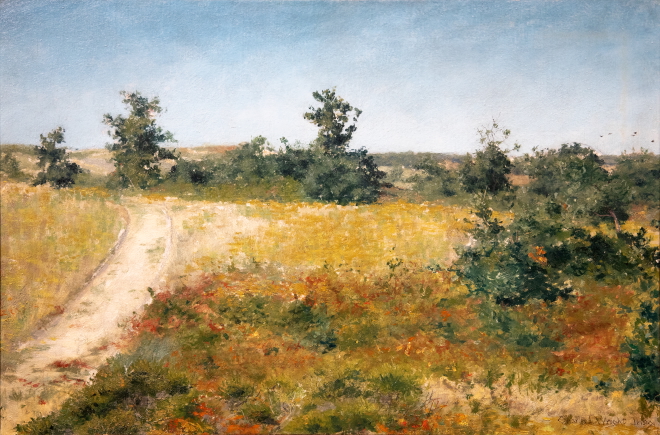
Mary of Burgundy (1458–1482)
Attributed to Michael Pacher
File:Mary of Burgundy (1458–1482), by Netherlandish or South German School of the late 15th Century.jpg
https://en.wikipedia.org/wiki/Mary_of_Burgundy#/media/File:Mary_of_Burgundy_(1458–1482),_by_Netherlandish_or_South_German_School_of_the_late_15th_Century.jpg
Note: For her portrait.

Mary of Burgundy
https://en.wikipedia.org/wiki/Mary_of_Burgundy

Ficheiro:Barend van Orley – Portrait of Charles V – Google Art Project.jpg
by Bernaert van Orley, circa 1515
https://pt.m.wikipedia.org/wiki/Ficheiro:Barend_van_Orley_-_Portrait_of_Charles_V_-_Google_Art_Project.jpg
Note: For his portrait.
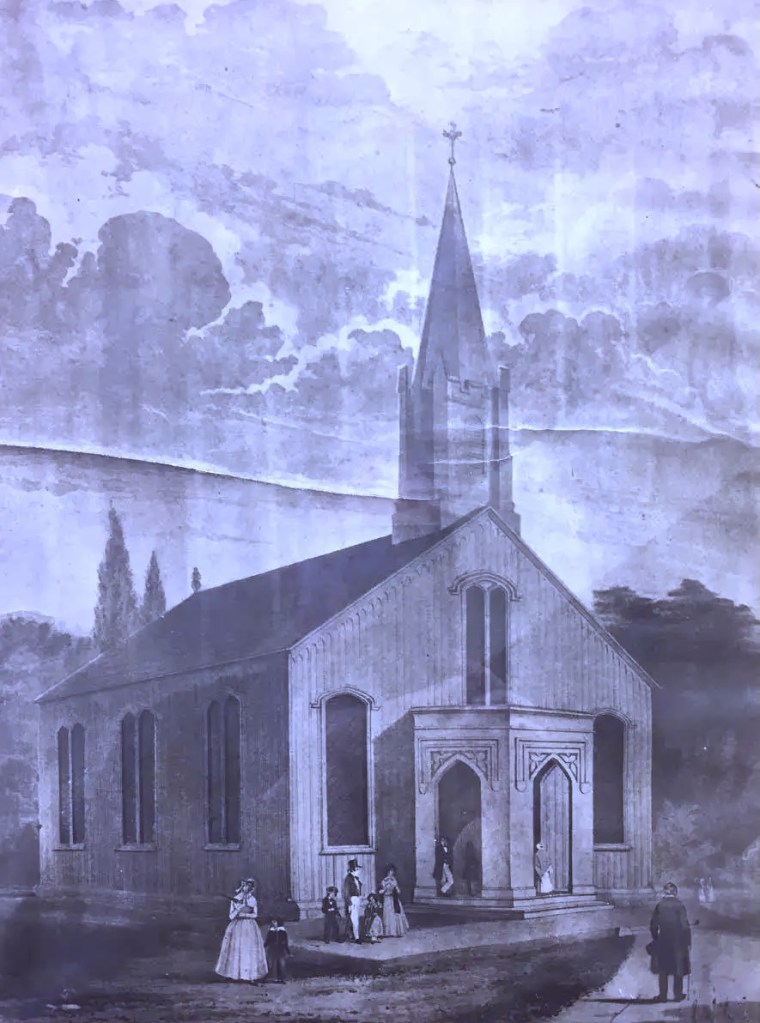
Charles V, Holy Roman Emperor
https://en.wikipedia.org/wiki/Charles_V,_Holy_Roman_Emperor

The Most Remarkable Lives of Jan Jansen and his son Anthony
A Brief History of the Netherlands (map)
By Brian A. Smith, D.C.
https://ia801604.us.archive.org/32/items/2013JanAndAnthonyJansenPublic/2013 Jan and Anthony Jansen public.pdf
Book page: 3/145
Note: For the map.

History Maps
Part of the Holy Roman Empire
https://history-maps.com/story/History-of-the-Netherlands
History of the Netherlands, 5000 BCE – 2024

Habsburg Netherlands
https://en.wikipedia.org/wiki/Habsburg_Netherlands

Spanish Netherlands
https://en.wikipedia.org/wiki/Spanish_Netherlands

The Dutch Revolt and the 80 Years War

(3) — five records

The Battle of Gibraltar, 1607
by Cornelis Claesz van Wieringen, circa 1621
File:Slag bij Gibraltar in 1607 Het ontploffen van het Spaanse admiraalsschip tijdens de zeeslag bij Gibraltar, 25 april 1607, SK-A-2163.jpg

History Maps
The Dutch Revolt
https://history-maps.com/story/History-of-the-Netherlands
History of the Netherlands, 5000 BCE – 2024

Netherlands Church History
https://www.familysearch.org/en/wiki/Netherlands_Church_History

The killing of Oudewater (Netherlands) Spanish troops murder al civilisans after a siege during the eighty years war.
https://en.wikipedia.org/wiki/Siege_of_Oudewater_(1575)#/media/File:Oudewater_moord.jpg
Note: For the The Oudewater massacre… image.

Siege of Oudewater (1575)
https://en.wikipedia.org/wiki/Siege_of_Oudewater_(1575)#:~:text=II of Spain.-,Siege and massacre,leading to a major conflagration.

The Dutch Golden Age and The United East India Company

(4) — eight records

The Syndics of the Drapers’ Guild
by Rembrandt, 1662
File:Rembrandt – De Staalmeesters- het college van staalmeesters (waardijns) van het Amsterdamse lakenbereidersgilde – Google Art Project.jpg

The flag of the Dutch East India Company.

Dutch East India Company
https://en.wikipedia.org/wiki/Dutch_East_India_Company#:~:text=In%20Dutch%2C%20the%20name%20of,the%20United%20East%20India%20Company).

Diana Muir Appelbaum
(We are posting this essay by Koenraad Wolter Swart (1916—1992) both because it is still useful and in order to spare would-be readers the eye strain that results from reading it on microfiche).
Miracle of the Dutch Republic
By K. W. Swart
Professor of Dutch History and Institutions in the University of London
An Inaugural Lecture Delivered at University College London on
November 6, 1967
http://www.dianamuirappelbaum.com/?p=583

Footnotes for the Dutch East India Company artifacts images:
Christie’s
An Arita Dish Commissioned by the Dutch East India Company
Edo Period, Late 17th Century
https://onlineonly.christies.com/s/japanese-art-english-court/arita-dish-commissioned-dutch-east-india-company-39/13671

The Arms of the Dutch East India Company and of the Town of Batavia,
Jeronimus Becx (II), 1651
https://www.rijksmuseum.nl/en/collection/SK-A-4643

Logo of the Amsterdam Chamber of the Dutch East India Company
https://en.m.wikipedia.org/wiki/File:VOC-Amsterdam.svg

Dutch East India Company, Gelderland (1726-1793), Duit(C) coins
https://www.educationalcoin.com/product/dutch-east-india-company-gelderland-1726-1793-duitc/

Batavia Dutch East India Company Ship Replica
https://www.amazon.com/Old-Modern-Handicrafts-Batavia-Collectible/dp/B00OP971EA

The Second Path: Religious Persecution

(5) — seven records

Revised History of Harlem (City of New York): Its Origin and Early Annals
by James Riker
https://archive.org/details/revisedhistoryh00unkngoog/page/n12/mode/2up
Book pages: 35-36, Digital pages: 34-36/907
Note: For general biographical information.

The Persecution of Huguenots in France Before the Edict of Nantes, 1598.
Wood engraving, late 19th century
https://www.walmart.com/ip/Huguenot-Persecution-Nthe-Persecution-Of-Huguenots-In-France-Before-The-Edict-Of-Nantes-1598-Wood-Engraving-Late-19Th-Century-Poster/508758362
Note: For The Persecution of Huguenots image.

Genealogy of The De Veaux Family : Introducing the Numerous Forms of Spelling the Name by Various Branches and Generations in the Past Eleven Hundred Years
by Thomas Farrington De Voe, 1811-1892
https://archive.org/details/genealogyofdevea00thom/page/n7/mode/2up

The International Institute of Genealogical Studies
England History of Huguenots, Walloons, Flemish Religions
https://www.familysearch.org/en/wiki/England_History_of_Huguenots,_Walloons,_Flemish_Religions_-_International_Institute

Genealogy Magazine.com
Belgian Migrations: Walloons Arrived Early in America
https://www.genealogymagazine.com/belgian-migrations-walloons-arrived-early-in-america/
and
Landing of the Walloons at Albany
https://digitalcollections.nypl.org/items/510d47e0-f393-a3d9-e040-e00a18064a99
Note: For the Landing of the Walloons at Albany image.

The National Archives
A ‘round robin’ from Walloon emigrants
https://www.nationalarchives.gov.uk/education/resources/huguenots-in-england/huguenot-migrants-in-england-source-3a/

The Massacre of St. Bartholomew in Paris

(6) — three records

St. Bartholomew’s Day Massacre
by François Dubois, a Huguenot painter who fled France after the massacre.
https://commons.wikimedia.org/wiki/File:La_masacre_de_San_Bartolomé,_por_François_Dubois.jpg
Note: For the St. Bartholomew’s Day image.

French Wars of Religion
https://en.wikipedia.org/wiki/French_Wars_of_Religion

Is it just us, or does Catherine de Medici remind you of this famous Disney villain?

Catherine de Medici Gazing at Protestants in the Aftermath of the Massacre of St. Bartholomew
by Édouard Debat-Ponsan, 1880
https://pt.m.wikipedia.org/wiki/Ficheiro:Debat-Ponsan-matin-Louvre.jpg
Note: For the Catherine de Medici image.

The Global Diaspora of The Huguenots and Their Protestant Allies

(7) — four records

Vocabulary.com
Diaspora definition
https://www.vocabulary.com/dictionary/diaspora#:~:text=The%20term%20diaspora%20comes%20from,their%20culture%20as%20they%20go.

Historic UK
The Huguenots – England’s First Refugees
https://www.historic-uk.com/HistoryUK/HistoryofEngland/The-Huguenots/

The Huguenot Society of America
The Huguenots in America
https://www.huguenotsocietyofamerica.org/history/huguenot-history/

Historie Der Gereformeerde Kerken Van Vrankryk
(History of the Reformed Churches of Vrankryk)
by Élie Benoist, 1696
https://commons.wikimedia.org/wiki/File:Houghton_Typ_632.96.202_-_Historie_Der_Gereformeerde_Kerken_Van_Vrankryk.jpg
Note: For the “All The Ways to Leave France” image.

The DeVoe Line, A Narrative — Eight

This is Chapter Eight of eleven. This chapter of our family’s history takes place almost entirely within Saratoga County and the adjacent Washington County in New York State. Our 3x Great Grandparents Peter M. Devoe and Alida Shaw had a large family and much prosperity during a period of time which saw the advent of The Civil War.

Introduction — A Family of the 19th Century

Some of our ancestors didn’t move around very much. This is likely due to the fact that many of them were farmers and they owned land. Peter and Alida lived most of their lives within (no more than) a thirty mile radius (48 km) of where they were born.

Excerpt showing Saratoga and Washington counties, from
the Atlas & Asher New Topographical Gazetteer of New York, circa 1871.

When they married, our ancestors lived in Halfmoon — but were married in the Dutch Reformed Church located in the nearby hamlet of Boght “Some of the earliest European settlements in Albany County were located in the general Boght Corners area [a hamlet of the present-day town of Colonie, New York], which is usually cited as ‘The Boght’ or ‘The Boght of the Kahoos’ in early colonial documents. ‘Boght’ is a corruption of the Old Dutch word for “bay” or “bend” referring to the bend in the Mohawk River... While hamlets in New York do not have specifically demarcated borders, the corners in the name itself is from the four corners created by the intersection of Boght Road and [present-day] US Route 9.

The first church in this area, the Reformed Dutch Church of the Boght, was established in 1781. The church, which was the first north of the city of Albany, was established on petition from the citizens of that city. The church was an offspring of the Niskayuna Reformed Church due to the common pastorate; this union of the two churches ended in 1803. The church worship was conducted in the Dutch language until the first decade of the 19th century. (Wikipedia) (1)

Peter M. Devoe and Alida Shaw Marry

Marriage of Peter M. Devoe to Alida Shaw, 1829, (This is a 20th century transcription due to being a typewritten entry). Bought U.S. Dutch Reformed Church, Boght, Albany, New York
Background image: Middle Dutch Church, New York City, by William Burgis.
(Courtesy of wikimedia.org).

Peter M. DeVoe was the eleventh of twelve children in the family, born at home in Saratoga County, New York on March 1, 1807. He died on December 26, 1888 in Easton, Washington County, New York. Peter M. Devoe married Alida [or Elida] Shaw on January 22, 1829 in Boght, Albany County, New. York at the Dutch Reformed Church. She was born on April 10, 1812, in Rensselaer County, New York, the daughter of Orman Shaw and Elizabeth ________ (Last name unknown). Alida died on February 17, 1896, in Easton, Washington County, New York. We observed that in some documents, she is also named as Olive, which may have been a nick name.

They had eight children:

  • Clarissa (DeVoe) Doty, born May 1, 1830 — died December 14, 1865
  • Lewis DeVoe, born May 31, 1831 — died January 26, 1901
  • Norman DeVoe, born 1832 — died October 16, 1900
  • Peter A. DeVoe, born June 23, 1834 — died October 31, 1909
    (We are descended from Peter A.)
  • Charles DeVoe, born 1837 — died December 22, 1886
  • Chauncey DeVoe, born 1838 — died November 7, 1902
  • Esther (DeVoe) Norton, born 1840 — died date unknown
  • Sarah C. (DeVoe) Cozzens, born December 25, 1842 — died March 5, 1911 (2)
The Hudson River Valley near Hudson, New York, ca. 1850.
(Image courtesy of Media Storehouse).

Putting On Our Detective Hats When Looking at the Early Census Materials

As we have done research on our family lines, we have always found census material to be helpful, but also sometimes problematic. Early Federal census material lacks much information and as just discussed, we end up having to put on our detective hats to take a look at what was likely going on.

After we were able to solve the mysteries of the parent’s names and the names of all the siblings through our analysis of the Will of Elias DeVoe… We continued to be confounded by a lack of many surviving early records which mention Peter M. Devoe. For a time, we even made comments about him just magically appearing in 1829 to marry Alida Shaw.

The 1840 United States Federal Census
The sixth Federal Census of the United States was done in 1840. The census began on June 1, 1840, and lasted six months. We did locate this particular census record, which shows him already living in the community of Easton, Washington County, New York.

Compiled sample for Peter M. Devoe — United States Federal Census of 1840.

From this Federal census we can learn that including him, listed are 10 people total:

  • 2 boys under 5 years old: Charles, Chauncey
  • 3 boys from 5 to 10 years old: Lewis, Norman, and Peter A.
  • 1 man from 30 to 40 years old: Peter M. — the Head of Household
  • 1 man from 50 to 60 years old: unknown male, perhaps Maty?
  • 1 girl under 5 years old: Esther
  • 1 girl 10 to 15 years old: Clarissa
  • 1 woman 20 to 30 years old: the mother Alida

Here is an example where we have to interpret data: The general guidance on census information is this: you don’t know who answered the questions… you don’t know who was at the door… you don’t know what they knew or didn’t know… you don’t know if perhaps they were guessing, in a hurry, etc., etc.

Author Thomas Halliday describes this type of analysis, when he writes —

“Everything that we will see is nonetheless grounded in fact, either directly observable… [or] strongly inferred, or, where our knowledge is incomplete, plausible based on what we can say for sure.”

Thomas Halliday,
from his book “Otherlands, A Journey Through Earth’s Extinct Worlds”

We see that there is a girl under 5 years old living in the home, yet we have no record of a daughter (Esther) being born until the next year (1841). Yet it makes the most sense to us that this is the daughter Esther — even though some later records say 1841 is her birth year. Since we do not have an actual birth record for her, it’s more than likely that she was born in 1840, perhaps late in the year.

The Consequences of the 1911 New York State Fire
New York State conducted their own census every five years, starting in 1825. However, we learned from the New York Genealogical and Biographical Society that: “The first three state censuses for New York are difficult to access and largely unavailable online…” (1825, 1835, and 1845) “Most records have been lost—due to the 1911 State Capitol fire, all copies of this state census held by New York at that time were completely destroyed.

On March 29, 1911, the collections of the New York State Library,
Manuscripts and Special Collections, Albany, New York, burned entirely. State census records from 1825, 1835, and 1845 were lost.

The 1850 Federal Census
By the 1850 Federal Census, (the seventh census) we are able to account for one additional daughter: Sarah, born in December 1842. Being pretty good detectives, we also started to notice something unusual in the census material starting around 1850. We noticed that a Matey Devoe is listed as being age 60, and a male. We had no accounting as to who this person was.

1850 United States Federal Census — Line 17, Matey (male)
Note: The age is noted incorrectly as 60, (the actual age is 65).

The 1855 New York State Census
We learn (again) from the New York Genealogical and Biographical Society that: “The 1855 New York state census is notable because it was the first to record the names of every individual in the household. It also asked about the relationship of each family member to the head of the household—something that was not asked in the federal census until 1880. The 1855 New York state census also provides the length of time that people had lived in their towns or cities as well as their state or country of origin—this is particularly helpful for tracing immigrant ancestors.”

Extract from the New York State Census of 1855

What caught our attention were two notes listed on line 15, next to the name Maty Devoe — this description noted Maty as being 70 years old, and also a hermaphrodite (known today as intersex), and as a brother to Peter M.

Detail from line 15 of the New York State Census of 1855.

This was a surprise, but a pleasant one and after we spent much time talking about it, it made sense. We had always wondered who this person was and why their name had different spellings and genders in various documents over time.

Marytje Defoe’s birth record in the
U.S., Dutch Reformed Church Records in Selected States, 1639-1989,
Schenectady, Berne, and Schaghticoke, Book 5 (hand transcription).

We believe that Maty is Peter M. Devoe’s oldest sister Marytje, who was born on April 17, 1786. (Please see The DeVoe Line, A Narrative — Six). Also, we have come to believe that Marytje Devoe / Maty Devoe never married and lived their life in the home of relatives. It seems that at first Marytje lived with her parents Martinus and Maria Devoe of Halfmoon, until they passed away in the 1830s. From the 1840s onward, as Maty Devoe, they lived in the home of Peter M. Devoe and his wife Elida in Easton.

The 1860 Federal Census
The eighth census of the United States took place on June 1, 1860 and took five months. We noticed several important changes in the home — Peter M. and his wife Elida still lived there. Their son Norman also lived there along with his wife Julia. Peter and Elida’s daughters Sarah (aged 17), and Elida (aged 3), were still at home.

Extract from the United States Federal Census of 1860.

Of note, it appears that Marytje / Maty is still living in the home, but now is identified as being named Mita… [One thing to interject here is that census takers were often wrong in how to spell someone’s name.] …and aged 75, when their correct age should be listed as closer to 75 years, and listed with a small ‘f’ for female gender.

This is the last record we see of Marytje /Maty/ Mita, since they are not on the 1865 New York State Census. We believe that they must have passed on before 1865, having lived a long life. (3)

Intersex and Hermaphrodite People

Please note that this section contains an image of sensitive historical medical photography.

We were curious about how our intersex ancestor would have been perceived and how they would have lived during a much earlier era. It seemed to us, even though we cannot document this, that we observed Marytje /Maty as being loved by their family — certainly through the fact that they were always part of either their parent’s, or their brother’s homes.

From the John Hopkins University Press we read: “In early America, there was no surgery to “correct” genital anomalies; people lived with whatever bodies they were born with, in whichever gender that most suited them—though not without worry that their difference would be found out, particularly if they sometimes crossed the gender divide in their daily lives.

Hermaphrodite (Nadar) is a series of medical photographs of a young intersex person, who had a male build and stature and may have been assigned female or self-identified as female.
Photo taken by the French photographer Nadar (real name Gaspard-Félix Tournachon) in 1860.
(Image courtesy of wikipedia.org).

Having focused on the word “hermaphrodite” found in the census material, we came to understand the need for a more contemporary term. From Wikipedia: “Terms used to describe intersex people are contested, and change over time and place. Intersex people were previously referred to as “hermaphrodites” or “congenital eunuchs”. In the 19th and 20th centuries, some medical experts devised new nomenclature in an attempt to classify the characteristics that they had observed… terms including the word “hermaphrodite” are considered to be misleading, stigmatizing, and scientifically specious in reference to humans… Some people with intersex traits use the term “intersex”, and some prefer other language.” (4)

Peter and Alida Devoe Owned Much Property

The last census in which we see Peter M. Devoe is the Federal Census from 1800. We observe that he and his wife Elida are the only ones living at home, but his son Chauncey and wife Calpurna appear to be living next door. Both men are noted as Farmers, and both women are Keeping house.

Extract from the United States Federal Census of 1880.

When Peter M. Devoe died on December 26, 1888, he had left a Last Will and Testament*, with both monies and land distributed to his wife Alida and amongst his various children. We noticed that he had to sign his Will with an “X” which indicated that he had not received any formal education. His Will was dated June 29, 1881, and probated on August 16, 1889 — (Please see the footnotes).

We found the following map, which is the only resource we have located, which shows Peter M. Devoe’s properties in Easton, Washington County, on the Hudson River. We know that he also owned property in Halfmoon, Saratoga County which was right next door.

Inset detail indicating the two properties owned by Peter M. Devoe in the 1850s in Easton, Washington County, New York. (Image courtesy of the Library of Congress).
Map of Washington County, New York
by Morris Levy, James D. Scott, Robert Pearsall Smith, Published in Philadelphia in 1853.

Being a farmer, it seems that he left a substantial estate. For example: In the Will he left his son Norman the oddly particular amount of $2,763 dollars. Today, that dollar value would be $91,345 — and Norman was just one of many people named… Lands were also distributed and the eventual administration of these ended up figuring into a lawsuit which the oldest son, Lewis Devoe, brought to the New York Supreme Court ten years later in 1899.

We cannot verify if Peter M. Devoe had received any property from his father Martinus Devoe, when Martinus died circa 1831-32, but… We do know from Lewis’s court paperwork that Peter M. was already acquiring land starting in the 1830s, and that he held on to that land for fifty years.

Sample document which shows the values of Peter M. Devoe’s land holdings in Washington County, New York, as of June 3, 1880.

Many years later our generation heard family stories, in which it was rumored that Peter M. Devoe had much money — but — he also had a lot of children. So when it came down to our 2x Great Grandfather, Peter A. Devoe, there weren’t many resources left. It seems that this doesn’t ring quite true because Peter A. received $1,150 in cash when his father died, which was a substantial amount at that time ($38,019 today). Peter A. also received property even though he had relocated to Ohio decades earlier. (5)

The Lewis Devoe New York State Supreme Court Case

What we have been able to discern from these documents from over 100 years ago, is that Lewis was looking into the records about how different pieces of his family’s land were being assessed in Washington County, New York. It is interesting to note that this occurred nearly ten years after his father Peter M. Devoe had passed away, and also after his mother Alida had passed in 1896.

Compiled Excerpt from the Washington Grantee index 1891-1900 vol 7. 

Observation: Perhaps the death of his mother brought new information to light? Apparently Lewis had strong concerns about what he learned, because he then brought a suit against his siblings that went all the way to the New York State Supreme Court. The gist of all this brouhaha was: It seems that he was quite upset that properties had been rented to tenants, then monies collected, and… well… Where was the accounting of this? Where did the money go to? To the children of the siblings?

Exterior folder, Page One for the documents relating to the 1899 Lewis Devoe lawsuit.
(Family documents, — please see the footnotes).

What was the outcome of this case? To be certain, we haven’t been able to locate documents which provide resolution, but it is quite likely that it was settled amongst the various family members.

Except for the two siblings who had died in earlier years: Clarissa (DeVoe) Doty, who passed away in 1865, and Charles Devoe, who passed in 1886 — most of the children of Peter M. and Alida Devoe all passed away in the course of the next twelve years. As follows: Lewis (1901), Norman (1900), Peter A. (1909), Chauncey (1902), Esther (unknown), and Sarah (1911).

The Will Found, painting by George Smith, 1868
(Image courtesy of MutualArt).

In the next chapter we will be writing about our 2x Great Grandfather, Peter A. DeVoe, and his life in Ohio. He was very important and influential in the life of our Grandmother Lulu Mae (DeVoe) Gore. (6)

Following are the footnotes for the Primary Source Materials,
Notes, and Observations

Introduction — A Family of the 19th Century 

(1) — three records

Boght Corners, New York
https://en.wikipedia.org/wiki/Boght_Corners,_New_York

Watervliet (town), New York
https://en.wikipedia.org/wiki/Watervliet_(town),_New_York
Note: Watervliet is now known in the present day as Colonie.

Cover page for Atlas & Asher New Topographical Gazetteer of New York, circa 1871

Atlas & Asher New Topographical Gazetteer of New York, circa 1871
https://digitalcollections.nypl.org/items/510d47e3-1c74-a3d9-e040-e00a18064a99/book?parent=49161ec0-c5f6-012f-15b7-58d385a7bc34#page/2/mode/1up

Peter M. Devoe and Alida Shaw Marry

(2) — thirteen records

Maps of Antiquity
1871 – Warren, Washington, and Saratoga Counties – Antique Map
https://mapsofantiquity.com/products/warren-washington-and-saratoga-counties-asher-and-adams-nyo523
Note: For the map image.

Peter Devoe
in the U.S., Dutch Reformed Church Records in Selected States, 1639-1989

New York > Bought > Bought, Book 6
https://www.ancestry.com/discoveryui-content/view/216615:6961
Book page: 13, Digital page: 59/105, Entry 1.

Middle Dutch Church, New York City, by William Burgis
https://commons.wikimedia.org/wiki/File:Middle_Dutch_Church,_New_York_City,_by_William_Burgis.jpg
Note: For background image.

Clarissa Doty
https://www.findagrave.com/memorial/117887685/clarissa-doty?
and
Claracy Devorux
in the New York, U.S., County Marriage Records, 1847-1849, 1907-1936

https://www.ancestry.com/search/collections/61377/records/900482362?tid=&pid=&queryId=b5d3795d-78f4-416b-8f9f-b43b80be9baa&_phsrc=UnS9&_phstart=successSource
Washington > 1841-1908
Digital page: 41/428, Left column, entry 1.

Doty-Doten Family in America
Descendants of Edward Doty, an Emigrant by the Mayflower, 1620

by Ethan Allan Doty, 1897
https://archive.org/details/dotydotenfamilyi00doty/page/562/mode/2up
Book pages: 562, Digital pages: 562 /1048
Note 1: Clarissa DeVoe is also recoded in this history which has been used frequently in our history of The Doty Line — A Narrative. She and her husband Jacob N. Doty are listed in entry 7401.
Note 2: The book index has her listed as entry 7403, which is an error.

As explained by Susan Deanna Bond in an email dated August 9, 2025:

Lewis DeVoe
https://www.findagrave.com/memorial/120850897/lewis-devoe

Norman Devoe
https://www.findagrave.com/memorial/95566454/norman-devoe

Peter A. DeVoe
Note: We have written extensively about the life of Peter A. DeVoe in the next chapter. (Please see The DeVoe Line, A Narrative — Nine).

Charles DeVoe
in the U.S., Find a Grave Index, 1600s-Current

https://www.ancestry.com/discoveryui-content/view/133711122:60525?tid=&pid=&queryId=0630ab78-d8a5-459e-b4a6-5124ba69049a&_phsrc=FsV3&_phstart=successSource
and
Charles Devoe
https://www.findagrave.com/memorial/163938371/charles-devoe

Chauncey DeVoe
https://www.findagrave.com/memorial/179186338/chauncey-devoe

Esther DeVoe
Census – New York State Census, 1875
https://www.familysearch.org/ark:/61903/1:1:VNVQ-CT8
Book page: 10, Digital page: 141/488 Entry line 10
Note: We know her married name is Norton through Peter M. Devoe’s Will.

Sarah C. DeVoe Cozzens
https://www.findagrave.com/memorial/84524682/sarah-c-cozzens

Media Storehouse
The Hudson River Valley Near Hudson (Looking Toward Albany, New York)
by Unknown Painter, American School, circa 1850
https://www.mediastorehouse.com.au/heritage-images/hudson-river-valley-near-hudson-new-york-ca-19843763.html
Note: For the landscape image.

Putting On Our Detective Hats When Looking at the Early Census Materials

(3) — eleven records

The National Archives
1840 Census Records
https://www.archives.gov/research/census/1840

Peter M Daves
in the 1840 United States Federal Census

New York > Washington > Easton
https://www.ancestry.com/discoveryui-content/view/1616065:8057?tid=&pid=&queryId=326ef017-2790-44e9-921e-30cf4aca7577&_phsrc=Zxc2&_phstart=successSource
Book page: 142 (or 266), Digital page: 31/40, Entry 12 from the bottom.

Cover for the book Otherlands by Thomas Halliday.

Otherlands, A Journey Through Earth’s Extinct Worlds
or
Otherlands, A World in the Making
by Thomas Halliday, 2022
ISBN-10: ‎ 0593132882, ISBN-13: ‎ 978-0593132883

Fire at the New York State Library
https://www.newyorkfamilyhistory.org/blog/fire-new-york-state-library

Peter M Devoe
in the 1850 United States Federal Census

https://www.ancestry.com/discoveryui-content/view/8764443:8054?tid=&pid=&queryId=d9214997-668a-4c15-919e-cc751384d5b2&_phsrc=Rxw29&_phstart=successSource
Book page: 364, Digital page: 37/77, Entries 8 through 18.
Note: Entry 18 lists a 24 year old woman named Mary Augen, from Ireland. We believe that she may have been a servant girl.

The New York Genealogical and Biographical Society
New York State Census Records Online — 1855 New York State Census
https://www.newyorkfamilyhistory.org/subject-guide/new-york-state-census-records-online#:~:text=1825%2C%201835%2C%20and%201845%20New%20York%20State%20Censuses&text=In%20some%20cases%2C%20counties%20may,by%20checking%20with%20county%20repositories.

Peter M Devoe
in the New York, U.S., State Census, 1855

https://www.ancestry.com/discoveryui-content/view/1654641341:7181?tid=&pid=&queryId=202e327c-c66c-478c-9b6b-4ba4ad93da39&_phsrc=Rxw12&_phstart=successSource
Digital page: 4/32, Left page, entries 7 through 15.
Notes: Of particular importance is entry 16 — Maty Devoe, listed as a brother of Peter M. Devoe, aged 70 years, and who is noted as an hermaphrodite.

Martynus Devoe
in the U.S., Dutch Reformed Church Records in Selected States, 1639-1989

New York > Schaghticoke > Schenectady, Berne, and Schaghticoke, Book 5
https://www.ancestry.com/discoveryui-content/view/150048134:6961
Book page: 393, Digital page: 118/209, Entry 4 from the page bottom.
Note: The record for their daughter Marytje, born on April 17, 1786.
and here:
Records for 1786
Holland Society Archives > 10 Research Collections > 4 Collegiate / Dutch Reformed Church Collections > 3 Dutch Church Records, 42037 > Book 05 – Schenectady Berne Schaghticoke
https://hsny.localarchives.net/?a=d&d=A-RG10-SG04-S03-Bk-05-Schenectady-Berne-Schaghticoke.1.153&e=——-en-20–1–txt-txIN%7ctxTA%7ctxCO%7ctxTY%7ctxTI%7ctxRG%7ctxSG%7ctxSE%7ctxSB%7ctxCT%7ctxIE%7ctxIT%7ctxTE%7ctxLA%7ctxSU%7ctxSP%7ctxDS%7ctxAD%7ctxPR%7ctxTR%7ctxFI-Schenectady———-
Book page: 393, Digital page: Image 153, Entry 4 from the page bottom.

The United States Census Bureau
1860 Census: Population of the United States
https://www.census.gov/library/publications/1864/dec/1860a.html

Peter M Devoe
in the 1860 United States Federal Census

New York > Washington > Easton
https://www.ancestry.com/discoveryui-content/view/48630571:7667?tid=&pid=&queryId=35ec4bd5-43de-42e5-bb2e-505bfa1707e1&_phsrc=Rxw27&_phstart=successSource
Book page: 160, Digital page: 28/80, Entries 23 through 29.

Intersex and Hermaphroditic People

(4) — three records

Intersex People In The Past and Present:
Contemporary Advocacy in Historical Context
by Elizabeth Reis, Macaulay Honors College, City University of New York
https://www.press.jhu.edu/newsroom/intersex-people-past-and-present-contemporary-advocacy-historical-context
Note: Ms Reis is the author of Bodies In Doubt, An American History of Intersex

Intersex
https://en.wikipedia.org/wiki/Intersex

Self portrait in Smock Félix Nadar, photographer,
(Image courtesy of The Getty Center via commons.wikimedia.org).

Hermaphrodite (Nadar)
1860s medical photography by Nadar
https://en.wikipedia.org/wiki/Hermaphrodite_(Nadar)

Peter and Alida Devoe Owned Much Property

(5) — five records

Map of Washington County, New York Copy 1
by Morris Levy, James D. Scott, Robert Pearsall Smith
Published in Philadelphia in 1853
https://www.loc.gov/resource/g3803w.la000573/?r=0.043,-0.261,1.472,0.74,0
Note: At this link the map is zoomable for more detail.

Peter Devoe
Census – United States Census, 1880
https://www.familysearch.org/ark:/61903/1:1:MZNZ-9DY
Digital page: 141/898, Entries 27 through 30.

Peter M Deroe
in the New York, U.S., Wills and Probate Records, 1659-1999

Washington > Wills, Vol V-W, 1888-1892
https://www.ancestry.com/discoveryui-content/view/4806965:8800?tid=&pid=&queryId=5ac78e48-6b64-4511-8d11-0221dae472df&_phsrc=BYb9&_phstart=successSource
Book pages: 240-244 , Digital pages: 130-132/663
Notes: This record appears to be a handwritten transcription from the original document. Below is a typed transcription of the Will from the above file:
__________________________________________

I, Peter M. Devoe, of the town of Easton, in the County of Washington, State of New York, being of sound mind and memory, do make ordain, publish and declare this to be my last will and testament, that is to say:
FIRST — After all my lawful debts are paid and discharged, I give, devise and bequeath to my beloved wife, Alida Devoe, in lieu of ___r, the sole use and control of my homestead farm, with all the appurtenances thereto, including Stock, Horses, Wagons, Plows and all the farming implements, together with all the household furniture, Beds, Bedding, &c., during her natural life.

2nd — I give devise and bequeath to my grand-daughter, Anna Doty, one hundred (100) dollars.

3rd — After the death of my said wife, Alida. I give devise and bequeath to my sons Lewis, Norman, Peter, Charles, and Chauncey and to my daughters, Esther Norton and Sarrah C. Cozzens, and to their heirs, all the residue of my estate, both Real and Personal in whatever it may consist to be divided between them equally, share and share alike, including the several sums or portions heretofore Paid or given to them, which sums are as follows, viz: I have given to Lewis, fifteen hundred and fifty (1550) dollars, to Norman, twenty-seven hundred and sixty three (2763) dollars. For fifteen hundred (1500) Dollars of which I had a mortgage against him, which said mortgage I direct my executors to cancel and discharge after my death, without interest. To Peter, eleven hundred and fifty (1150) Dollars. Charles, three hundred (300) Dollars. To Chauncey, fourteen hundred and seventy (1470) dollars, and to my daughter, Sarah C. Cozzens two hundred (200) Dollars.

4th — I further direct that the premises known as the “Hemlock Grocery.” situated on the Champlain canal, between Schuyler Ville and Cove Ville, shall be included in the portion of Lewis, at the price of six hundred (600) dollars, and hereby give, devise and bequeath same unto him.

5th — 1 further direct that my farm of Forty (40) acres, situated in the town of Halfmoon and known as the “John Simmons” Farm shall be included in the portion of Chauncey, at the price of one thousand (1000) dollars, and I hereby give, devise and bequeath the same to him.

6th — I further direct that the income derived from all Moneys [sic], Notes, Bonds or other indences of debt of which I may be possessed at my death, shall be at the disposal of my said Wife, Alida, if she shall need the same for her support or comfort, and if the same shall not be needed by her as above stated, then I direct that my executors place the same at interest in some safe place, or invest in some safe securities to be accounted for at her decease.

7th and lastly —I further direct that no interest shall be charged on any of the sums paid or given to any my children above named.

Likewise, I make, constitute and appoint my said Wife Alida Devoe, and my son-in-law, Frederick Cozzens, at Easton and Greenwich, in Washington county respectively residing, to be executrix and executor of this my last Will and Testament. hereby revoking all former Wills by me made.

In Witness Whereof, I have hereunto subscribed my name and affixed my seal the 29th day of June in the year of our Lord one thousand eight hundred and eighty-one (1881).

PETER M.  X   DEVOE [his mark]

Witness to mark, J. T. Smith
The above instrument consisting of one sheet, was at the date thereof subscribed by Peter M. Devoe, in the presence of us and each he at the time of making such subscription, acknowledged that he made the same, and declared the said instrument so subscribed by him to be his last Will + Testament. Whereupon we then and there at his request and in his presence and in the presence of each other subscribed our names as witnesses hereto.

J. T. SMITH, residing at Schuyler Ville, N. Y.
Thomass Toohey, residing at Schuyler Ville, N. Y.

__________________________________________

Peter M Deroe
in the New York, U.S., Wills and Probate Records, 1659-1999

Washington > Minutes, Vol W-X, 1889-1891
https://www.ancestry.com/discoveryui-content/view/1724296:8800?tid=&pid=&queryId=78260969-514b-4129-bba5-ddbee3a9efea&_phsrc=BYb13&_phstart=successSource
Digital pages:
Note 1: Peter M. Devoe’s Will was entered into Probate until August 16, 1889. Note 2: Leading up to this there were additional notices filed with the Court on the following 1889 dates: January 14, February 18, April 8, August 16.

“$1 in 1888 is worth $33.06 today…”
https://www.in2013dollars.com/us/inflation/1888

The Lewis Devoe New York State Supreme Court Case

(6) — two records

Land – United States, New York Land Records, 1630-1975
Washington Grantee index 1891-1900 vol 7 

https://www.familysearch.org/ark:/61903/3:1:3QS7-89WC-KCWH?i=121&cc=2078654&personaUrl=%2Fark%3A%2F61903%2F1%3A1%3AC33P-G4PZ
Book page: 216, Digital page: 122/531
Note: Categorized as Land Assessment and Deed Records

Exterior folder, Page One for the documents relating to the 1899 Lewis Devoe lawsuit,
(Family documents).
Page Two for the documents relating to the 1899 Lewis Devoe lawsuit,
(Family documents).
Page Three for the documents relating to the 1899 Lewis Devoe lawsuit,
(Family documents).

MutualArt
The Will Found, by George Smith, 1868
https://www.mutualart.com/Artwork/THE-WILL-FOUND/A5D86394FC8B44A0
Note: For the genre painting.