The Doty Line, A Narrative — Four

This is Chapter Four of nine. After more than a dozen years in the Plymouth Colony, Edward Doty’s life is about to take an affection new direction with his kindred. In this chapter, we are writing about his wife Faith, their children, and the end of this Mayflower Pilgrim’s journey with us.

The Freemen of 1633

In 1633, the Records of the Colony of New Plymouth in New England, list ‘Edward Dowty’ as being a Freeman. This meant that in the Plymouth Colony, being a Freeman gave him a specific legal and political status that granted certain rights and responsibilities. Freemen were considered part of the community and had the right to participate in the colony’s governance by voting and holding office. They were also expected to uphold the laws and contribute to the colony’s success. (1)

This anecdote has been transmitted from father to son…

Edward Doty’s land dealings are where he created much of his prosperity. As we learned in Chapter Two, his real estate holdings commenced with the 1623 Division of Land. Even earlier than this, however, it appears that as a young man, he was a bit eager and impatient to be a landholder — as this story from Thacher’s History of the Town of Plymouth relates:

History of the Town of Plymouth, by James Thacher, page 330. (See footnotes).

Wikipedia also tells us that “… later [he was] granted an additional twenty acres. Records of the 1630s and 1640s show numerous land transactions by him apparently making him quite prosperous. Per the record of December 4, 1637, one such land transaction involved land being granted to him and Tristram Clarke, ‘his father in law.’ It is known that he did own land in central Plymouth where the Mayflower Society House now stands.” Also, “he periodically received land grants from court as with other residents, and received other property rights and benefits from being classed as a ‘first comer’ ”. (Wikipedia) (2)
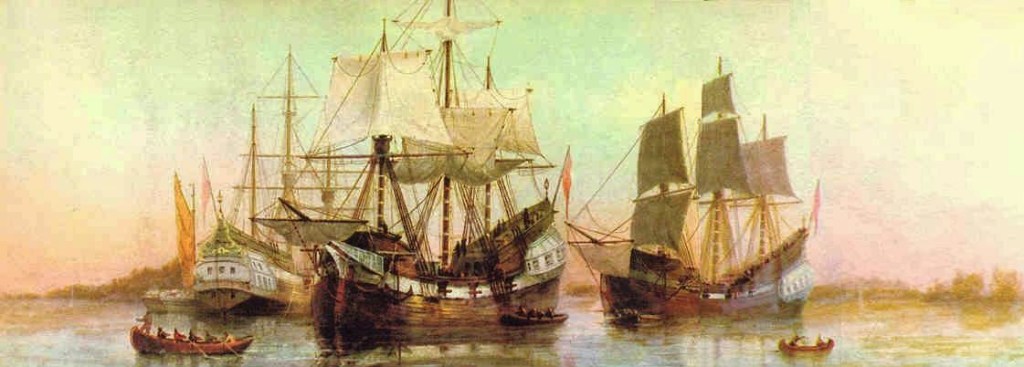
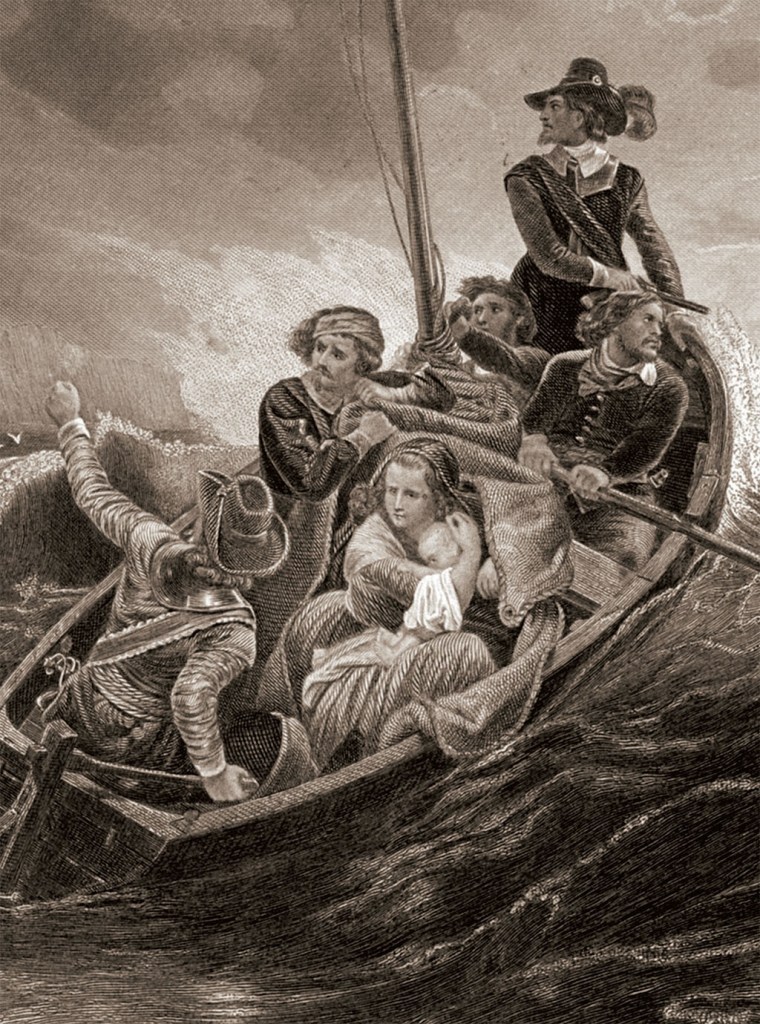
Arrival of Winthrops Company in Boston Harbor 1630
by William Formby Halsall, 1880
(Image courtesy of Merchant’s House Museum).

The Arrival of The Francis

After the Francis left Ipswich, England in late April 1634, it arrived in Plymouth Harbor likely in late May, or early June 1634.

“The years 1630 to 1640 are known as the Great Migration. The largely Puritan immigrants from England settled in New England, north of the settlement at Plymouth Bay, in a stretch of land known as the Massachusetts Bay Colony. The major centers of the new colony were the eastern coastal Massachusetts towns of Boston and Salem. During the Great Migration, an estimated two hundred ships reportedly carrying approximately 20,000 people arrived in Massachusetts.” (Ebsco) The ship Francis anchored in Plymouth Harbor, but it may have also visited the Massachusetts Bay Colony to the north of Plymouth.

It turns out that in 1634, Edward was soon share his life in the Plymouth Colony with the Clarkes (also spelled Clearke) family, of which his wife #2 was a member. In a ship reference list simply titled, Pilgrim Ship Lists Early 1600’s (see footnotes), the ship Francis’s passenger list includes:

  • Clearke Thurston, aged 44, and
  • Clearke Ffaythe, aged 15, (listed as a Ward of J Pease)

We know that Thurston Clearke, is actually Thurston Clarke Sr., the Clark family patriarch. Ffaythe Clearke, is his daughter Faith Clarke. (Why she was traveling as a ward of J. Pease is unknown). He is listed as Pease John, aged 27, “From Baddow, Magna, Essex, bound for Salem, Edgartown”.

Writer Ethan Allan Doty, writes about Faith and her family, in Doty-Doten Family in America,“Faith Clarke was born 1610, and was at this time but sixteen years of age, was the daughter of Thurston Clarke and Faith [same named], his wife. They came to Plymouth from Ipswich, Suffolk, England, in 1634 in the Francis, he being at that time forty-four years of age. His name is sometimes written Tristram Clarke.

Besides their daughter Faith they had two sons, Thurston, Jr., and Henry. They probably had no issue. [Meaning the brothers] Under date of 1st April, 1690, we find: ‘The selectmen of Duxborough having reported that two of their inhabitants, Henry Clarke and Thirston Clarke, by reason of their age indiscretion & weakness of understanding are incapable of their own support notwithstanding that they have an estate sufficient, and John Dotey of Plymouth their nephew having promised to take prudent care of them Is allowed to recoup himself from their estate,’ under certain conditions mentioned. (Doty-Doten Family in America, DDFA)
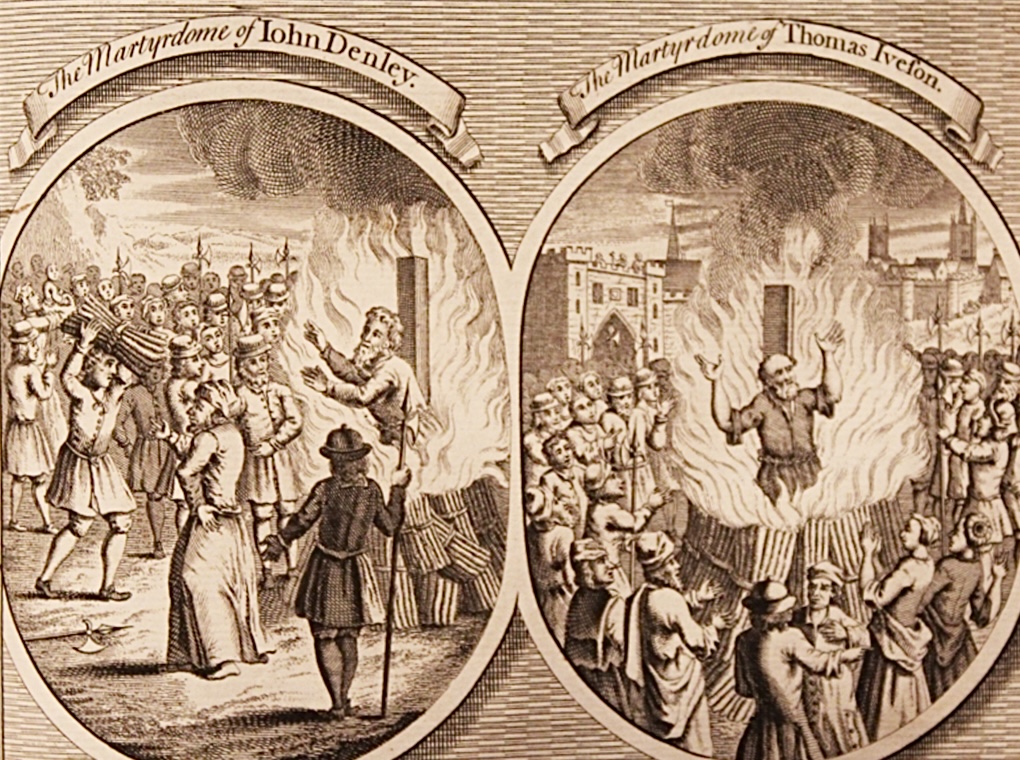
Excerpted illustration from Foxe’s Book of Martyrs, published in 1570.

The reason for their emigration was likely religious. The Clarke family, being from Ipswich, England, would have been very aware of the persecution of Protestants in their town’s history. Wikipedia states, “In the time of Queen Mary [ruled 1553 – 1558] the Ipswich Martyrs were burnt at the stake on the Cornhill for their Protestant beliefs… From 1611 to 1634 Ipswich was a major centre for emigration to New England. This was encouraged by the Town Lecturer, Samuel Ward”.

Who was George Clarke?
Not everyone who lived in the Plymouth Colony who had the surname Clarke was related to the Thurston Clarke family. “Since several of Doty’s court cases involved Thurston Clarke and George Clarke, it would appear that some of his legal situations, including fights, were the result of in-law domestic problems. (Wikipedia) However, Ethan Allen Doty’s history of this family, states that George Clarke was not related to the Thurston Clarke family. (Doty-Doten Family in America, DDFA)

On January 6, 1635 Edward Doty and Faith Clarke were married. The actual Court Record reads, “6th Jany 1634-5. Edward Doten and Fayth Clarke wore married.” 

Faith Clarke was born at Ipswich, England about 1619. When they married, Edward* was about 36 years old and Faith was about 16 years old. They had at least nine children over a period of about 16 years, all born at Plymouth, Massachusetts Colony. 
*Going forward, after the birth of his oldest son, we will now refer to him as Edward Sr. (3)

With Six Boys, and Three Girls

Back in this era children were born at home, and very few records were kept that have survived. For nearly all of the Doty children, their birth dates are educated guesses.

  • Edward Doty Jr., born about 1637 – died about December 20, 1675. He was married February 25, 1662 to Sarah Faunce in the same location. They had eleven children, with their last child Benjamin likely being born a few months after his father had already passed on.

    “It is related that in a storm on the 8th Feb., 1689-90. Edward Dotey, with his son John and Elkanah Watson, another resident of Plymouth, were drowned in Plymouth harbor, or, perhaps more properly, by the wreck of their vessel in attempting to enter the harbor… On the 18th March following, Sarah Dotey relict widdow of Edward Dotey late of Plimouth deceased,” made oath to an inventory of the estate, to which her brother-in-law, ‘John Doten’, and son-in-law, James Warren, were witnesses. The widow continued to live in Plymouth until 1693, whereon the 26th April of that year she married John Buck, of Scituate, Mass… It is probable that at her second marriage Mrs. Buck removed to Scituate, where her death occurred 27th June, 1695.”
Illustration from the Handbook of Old Burial Hill, Plymouth, Massachusetts, page 6.
(Image courtesy of the Library of Congress).
  • John Doty, born about 1639-40 — May 8, 1701. He married first Elizabeth Cooke in Plymouth in 1667; she died in 1692. They had nine children. [Her mother was a daughter of Mayflower passenger Stephen Hopkins and her father was a son of Mayflower passenger Francis Cooke. (Wikipedia)]

    He married second Sarah (Rickard) Jones in 1695, also in Plymouth; they had three children. From his two marriages, John Doty had twelve children. It seems John Doty became the caretaker for his extended family. The following two passages are examples:

    “1690, April 1. The selectmen of Duxborough having reported that two of their inhabitants Henry Clarke and Thisten Clarke, [his maternal uncles] by reason of their age, indiscretion and weakness of understanding are incapable of their own support notwithstanding they have an estate sufficient, and John Dotey of Plymouth their nephew having promised to take prudent care of them, is allowed to recoup himself from their estate, under certain provisions…”

    In 1695, after the death of his brother Edward’s widow, [(Sarah (Faunce) Doty]he and Elmer Faunee were appointed guardians for her minor children.”
  • Thomas Doty, born about 1641 — died about 1679. He was married to Mary Churchill about 1638; they had two children both born in Plymouth. From Wikipedia, “On January 17, 1671 Mary Churchill confessed she had gotten pregnant by Thomas, son of Edward Doty, with whom she had ‘carnall coppulation’ three times – first time on July 15, second time on August 8 and the third was about ‘senight’ after. A sergeant went to Mary Churchill’s house, found Doty there and took him into custody. Doty was warned ‘take heed lest evil come of such carriages’. Mary Churchill was fined and at the time of his court hearing Doty fled the colony, but the two finally married about the time of the birth of their first child.”
Puritans Going To Church, Mezzotint after George Henry Boughton, circa 1884.
  • Samuel Doty, born about 1643 — died November 15, 1715. He was most likely the first of the Doty siblings to leave Plymouth Colony, moving to New Jersey. He married to Jeane Harmon about 1678 in Piscataway, Middlesex, New Jersey; they had thirteen children. “He was the ancestor of the very large and influential branch of the Doty family, who, from the State of New Jersey, have gone forth as pioneers to the West and the South.” Comment: With thirteen children (!), no wonder they were a ‘large and influential branch’ of the family.
  • Desire (Doty) Sherman/ Holmes/ Standish, born about 1645 — died January 1731. She was married three times, and outlived all three of her husbands. All of her marriages took place in Marshfield, Massachusetts. With her three husbands she had twelve children. She married first William Sherman on December 25, 1667; he died in 1679. She married second Israel Holmes on November 24, 1681; he died in 1684. She married third Alexander Standish in 1686; he died in 1702. Observation: in 1667, her mother Faith (Clarke) Doty was remarried to John Phillips and they relocated to the town of Marshfield, just north of Plymouth. It seems that Desire likely lived near her mother.

    “She was a remarkable woman, as is evident from her history. Born on the High Cliff at Plymouth, losing her father at the age of ten years, her early married life especially unfortunate by reason of the insanity of her first* and the early death of her second husband, she not only successfully raised the young children left to her care, but her troubles had borne so lightly upon her that she attracted the attention of and married the well-to-do farmer of Duxbury [Alexander Standish, son of Miles Standish]. She lived to see her children well married and prosperous, and before her death her pathway was smoothed by hosts of grandchildren at Marshfield and Duxbury, who must have found delight in listening to the tales of one who had had such a long and varied experience.”

    *Observation: Please see the footnotes for two passages which describe some of the likely circumstances which contributed to William Sherman’s being described as having died from insanity.
A 1930 postcard image of the Governor Winslow House in Marshfield, Massachusetts. It was built in 1699, and is still standing today. Desire (Doty) Standish lived until 1731, so this building would have been something that she knew. (Image courtesy of Picture Rock Treasures).
  • Elizabeth (Doty) Rouse, born about 1647 — died April 7, 1741 in Marshfield, Massachusetts. She married John Rouse on January 13, 1675 in Plymouth; they had three children. She married second William Carver on January 28, 1718.
  • Isaac Doty, born February 8, 1648 — died (after) January 7, 1728 in Oyster Bay, Queens County (existent as Nassau in 1899), New York. He married Elizabeth Wood about 1672 in the same county, and they had six children. They are profiled in the next chapter.
    We are descended from Isaac and Elizabeth.
  • Joseph Doty, born April 30, 1651 — died about 1732 in Rochester, Plymouth County (existent 1685). He was married three times and outlived all three of his wives. He married first Elizabeth Warren about 1674 in Plymouth; they had two children. He married second Deborah Hatch about 1680 in Sandwich, (Barnstable County, existent 1685); they had seven children. He married Sarah Edwards on March 9, 1712 in Rochester, Plymouth County. From his three marriages, John Doty had nine children.

    “He was thus, at the death of his father, but four years of age. He doubtless lived with his mother at Plymouth up to about the time of her marriage to John Phillips in 1667, and must have enjoyed considerable advantage in having the aid and counsel of his brothers, Edward and John, both of whom were now well established householders and prosperous and examplary citizens. The Colony records show that in 1672, he was living at Plymouth, and it is probable that he did not remove with his mother and sisters to Marshfield… Sepecan, or Scippican, was the early name for Rochester, Mass., which was also known as Mattapoiset. He became one of the original purchasers of Rochester, but apparently did not take up his residence there till about 1683”.
The town which became Rochester, was earlier known as Sepecan, or Scippican,
and also as Mattapoisett. It is located in the southwestern corner of Plymouth County.
(Map image courtesy of the Mattapoisett Museum).
  • Mary (Doty) Hatch, born about 1653 in Plymouth — died (before) June 13, 1728. She married Samuel Hatch July 10, 1677 in Scituate, Plymouth Colony. (4)

Know All Men To Whom It May Concern

Pilgrim Edward Doty Sr. died on August 23, 1655 at Plymouth after having been ill. As per the Doty-Doten Family in America (DDFA) book, “His Will is dated there three months earlier, and as it states him then sick it is probable that his sickness continued altogether many months”. Also note that whoever wrote the document, created yet another spelling of his surname — now written as Dotten.

May the 20th 1655

In the Name of God Amen

Know all men to whom It may concerne that I Edward Dotten senir: of the Towne of New Plymouth in New England being sicke and yett by the mercye of God in prfect memory and upon matture Consideration Doe by this my last will and Testament leave and bequeath my purchase land lying att Coaksett unto my sons; my son Edward I give a Double portion and to the rest of my sonnes equall alike if they live to the age of one and twenty if they Die before then to bee prted among the rest onely to my wife I leave a third During her life and then after to returne to my sonnes, And unto my loveing wife I give and bequeath my house and lands and meddows within the precincts of New Plymouth together with all Chattles and moveables that are my proper goods onely Debts and engagements to bee paied; As for my Share of land att Punckquetest if it come to anything I give it unto my son Edward; This being my last will and Testament; I Edward Dotten Doe owne it for my Act and Deed before these my loveing ffrinds whoe are Witnesses; and Doe sett my hand to the same; the Day and yeare abovewritten

Witness 
John howland Edward Dotten 
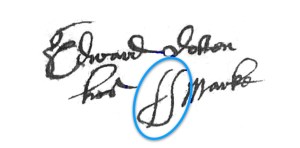
James hurst his Marke 
John Cooke 
William hoskins

Ther being many names besides Coaksett I mean all my purchase land According to the Deed

Att the generall court held the fift of March 1655; faith the wife of Edward Dotten Decased Did give up and make over all her right and enterest she had in the land of Edward Dotten Att Coaksett or places adjacent unto her Children this shee Did in the prsence of the said Court; held att Plymouth yt Day and yeare above expressed;

The above written Will and Testament of Edward Dotten Deceased was exhibited to the Court held att Plymouth the fift of March 1655 on the oathes of
Mr John howland
James hurst
John Cooke
and William Hoskins

Edward Sr. was interred at the Burial Hill cemetery… “Behind Plymouth’s town square, a steep hill abruptly rising to the height of 165 feet marks the site where the Pilgrims originally erected a stockade and meeting house. In the 1630s, however, the site began to be used as the town’s cemetery. Several of the Mayflower passengers were interred there, including Governor William Bradford, Church Elder William Brewster, and Mary Allerton, the last surviving passenger.” (TripSavvy)
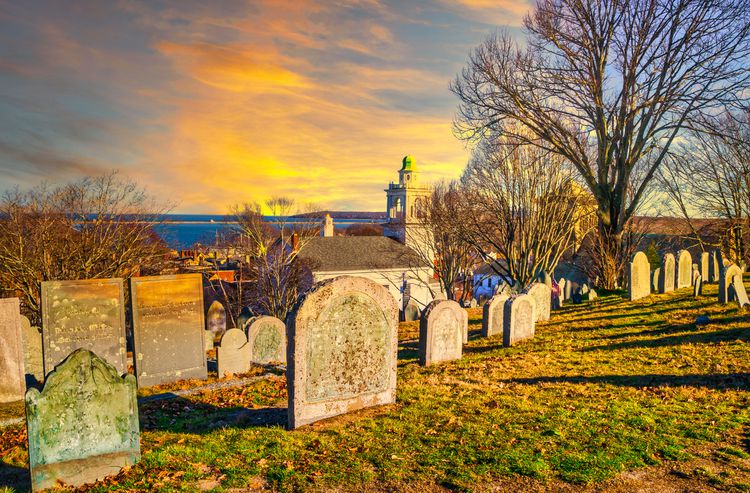
Contemporary photograph of Burial Hill cemetery in Plymouth, Massachusetts. (Photo by Ken Weidemann / Getty Images, via the TripSavvy article).

[A few years] “after Doty’s death, Faith [Doty] married John Philips on March 14, 1667 as his 2nd wife. She moved to Marshfield and died there December 21, 1675. She was buried at Winslow Cemetery in Marshfield.” (Wikipedia) (5)

The Prosperity of An Early Investor

Upon Edward Doty Sr. death, he left a considerable amount of real estate through his wheeling & dealing / negotiating / bargaining / deal making / horse-trading / and investing. These properties were then distributed amongst his heirs. The place names for several of these locations have changed over the centuries, but we have been able to investigate historical documents and records to discern the locations as diagrammed on the two maps below. Note that several of the properties are situated further away from the Plymouth Colony.

The first map shows the property known by the names of Heigh Cliffe, or High Cliff, or Skeart Hill, described as “six acres of meadow there” and “a locality still known by that name, being the extreme north of town, bordering on Kingston.” (DDFA) It has been described by researchers that he likely maintained this location as his residence throughout his life, after relocating there from the initial Watson Hill site. The inventory of his estate identifies “three score acres of upland with the meadow adjoining it” [which is 60+ acres]. So it seems that indeed, he came to own more land at High Cliff than just the first six acres with which he started.

Manuscript map of Plymouth harbor, circa 1795. Note the inset detail written as Doten’s Cliff.
(Image courtesy of Massachusetts Historical Society).

As we had learned in the The Doty Line, A Narrative — Two chapter, “In 1626, Edward Doty was one of twenty-seven Purchasers involved with the colony joint-stock company which afterwards was turned over to the control of senior colony members. That group [of investors] was called the “Undertakers”, and was made up initially of William Bradford, Myles Standish and Isaac Allerton, who were later joined by Edward Winslow, William Brewster, John Howland, John Alden, Thomas Prence, and four former Merchant Adventurers back in London. On the agreement, dated October 26, 1626, his surname appears as ‘Dotey’”. (Wikipedia)

Through an analysis of real estate place names, his Will, and the inventory of his estate, we have learned that Edward Doty eventually owned properties in the locations listed below on the following map.

This map of Massachusetts by John Hinton, 1781 , documents the locations where Pilgrim Edward Doty Sr. had held property more than a century earlier. (Map courtesy of the Library Congress).

New Plymouth
This area includes the lands known as High Cliff, and…

Clarke’s Island
Even though as a young man he was eager to set foot on this island in Plymouth Bay and was held back by other explorers on the Mayflower, ironically, he did eventually own the island.

The Dartmouth Tract
Doty had been an early investor in properties that fell to the southwest area of Plymouth. This area was eventually formalized by treaty as The Dartmouth Tract (or Old Dartmouth) in 1652, but he had been acquiring lands in that area for some years prior to that event. This area held several properties, including…

Coaksett (also known as Cohasset), and Mount’s Hill
These areas are mentioned in his Will, and are part of what became the town of Dartmouth. Of note, Mount’s Hill is where the University of Massachusetts Dartmouth is located.

Lakenham
This area was originally part of part of the hamlet of Plympton (see map above), and eventually became known first as Carver, and then North Carver.

Punckquesett (spelled as Punckquetest in his Will)
This area eventually became Tiverton, until 1676, when the border between colonies of Massachusetts Colony and Rhode Island Colony were adjusted.

Yarmouth
He was described as a large purchaser at Yarmouth, located on Cape Cod. (6)

Item: a ‘candlesticke’

The inventory of Edward Doty Sr.’s estate in November 1655, contains an entry for “6 pewter dishes and a candlesticke”, which could be the item below. (Look closely — it is hanging on a larger display pedestal). It doesn’t really look like a ‘candlesticke’ to our modern eyes, but we are writing with a description of how someone else saw it nearly 400 years ago. In any case, the Pilgrim House Museum contains this item. It is rather remarkable that it has survived through time to our era.

We wonder about the times when either Edward Sr. or Faith once lit this simple candleholder — initially, it was probably the only source of light in their home, except of course, for the fire in their hearth. How many simple things do any of us hold in our hands today, of which one of our future descendants could write about in another 4oo years?

As it is sometimes said, just as one candle can light another without diminishing — that the flame will continue on from generation-to-generation. Of the many children this family brought forth, we are descended from their son Isaac Doty and his wife Elizabeth Wood. We will be writing about their lives in the next chapter. (7)

Following are the footnotes for the Primary Source Materials,
Notes, and Observations

The Freemen of 1633

(1) — one record

Records of the Colony of New Plymouth in New England
by New Plymouth Colony; Nathaniel Bradstreet Shurtleff, David Pulsifer
https://archive.org/details/recordsofcolonyo0102newp/page/n5/mode/2up
Book page: 3, Digital pages: 24/432
Note: ‘Edward Dowty’ listed as being a Freeman

This anecdote has been transmitted from father to son…

(2) — three records

Edward Doty
https://en.wikipedia.org/wiki/Edward_Doty
Note: For the text.

History of the Town of Plymouth,
from its first settlement in 1620, to the present time

by James Thacher, circa 1835
https://archive.org/details/historyoftownofp03thac/page/330/mode/2up?view=theater
Book page: 330, Digital page: 348/424.
Note: For the Clark’s Island story.

Merchant’s House Museum
Arrival of Winthrops Company in Boston Harbor 1630
by William Formby Halsall, 1880
https://merchantshouse.org/blog/seabury-tredwell-ancestry/
Note: For the image of the painting.

The Arrival of The Francis

(3) — eight records

Pilgrim Ship Lists Early 1600’s
 Over 7100 families and 290 ships

General list —
https://www.packrat-pro.com/ships/shiplist.htm
and the ship Francis
https://www.packrat-pro.com/ships/francis.htm
Note: For the data.

Edward Doty
https://en.wikipedia.org/wiki/Edward_Doty
Note: For the text.

(DDFA)
Doty-Doten Family in America

Descendants of Edward Doty, an Emigrant by the Mayflower, 1620
by Ethan Allan Doty, 1897
https://archive.org/details/dotydotenfamilyi00doty/page/26/mode/2up
Book pages: 27-28, Digital pages: 32-34 /1048
Note: For the text about Faith Clarke’s family, her parents and her brothers, and this quote below —
“Thurston Clarke, the elder died at Duxbury, Mass., 1661. His widow died about 1663, as appears by an entry in the records 1st June, 1663. ‘The Court have ordered concerning the disposing of the estate of Faith Clarke widdow, deceased, that her daughter Faith Dotey widdow shall have a quarte pte,’ etc.”

Ipswich
https://en.wikipedia.org/wiki/Ipswich
Note: For the text.

The Armory
A Large Volume of Foxe’s Book of Martyrs 1570, by An Impartial Hand. Detailing the Burning at the Stake of the Protestant Martyrs Under Queen ‘Bloody’ Mary the 1st’s Rule, Published 1741, Formerly Part of the Richard Hoare Collection.
https://www.thelanesarmoury.co.uk/shop.php?code=19180
Note: For the excerpted illustration from Foxe’s Book of Martyrs.

(DDFA)
Doty-Doten Family in America
Descendants of Edward Doty, an Emigrant by the Mayflower, 1620

by Ethan Allan Doty, 1897
https://archive.org/details/dotydotenfamilyi00doty/page/16/mode/2up
Book pages: 17, Digital pages: 16/1048
Note: For the comment about George Clarke not being related to the Thurston Clarke family.

Ebsco
History of immigration from 1620 to 1783
https://www.ebsco.com/research-starters/history/history-immigration-1620-1783#:~:text=The%20years%201630%20to%201640,as%20the%20Massachusetts%20Bay%20Colony.
Note: For the text.

With Six Boys, and Three Girls

(4) — eighteen records
(DDFA)
Doty-Doten Family in America
Descendants of Edward Doty, an Emigrant by the Mayflower, 1620

by Ethan Allan Doty, 1897
https://archive.org/details/dotydotenfamilyi00doty/page/n5/mode/2up
Book pages: 6- 29, Digital pages: 12-34/1048
Note: For various texts as noted below:

*Indicates specific passages from the Doty-Doten book:

*Edward Doty, Jr., and Sarah Faunce
“It is related thather death occurred 27th June, 1095.”
https://archive.org/details/dotydotenfamilyi00doty/page/30/mode/2up
Book page: 31-32, Digital page: 30/1048
Note: For the data.

Library of Congress
Handbook of Old Burial Hill, Plymouth, Massachusetts
Its history, its famous dead, and its quaint epitaphs

https://www.loc.gov/resource/gdcmassbookdig.handbookofoldbur00perki/?st=gallery
Book page: 6, Digital page: 12/86
Note: For the image of the sailing ship nears Clark’s Island.

*John Doty, and (w1) Elizabeth Cooke, (w2) Sarah Rickard
“1690, April 1. The selectmenfor her minor children.”
https://archive.org/details/dotydotenfamilyi00doty/page/142/mode/2up
Book page: 143, Digital page: 142/1048
and
Edward Doty
https://en.wikipedia.org/wiki/Edward_Doty
Note: For the information about Elizabeth Cooke’s relatives.
Thomas Doty, and Mary Churchill
Edward Doty
https://en.wikipedia.org/wiki/Edward_Doty
Note: For Mary Churchill’s admission about Thomas Doty.
and
Plymouth Colony, Its History & People, 1620-1691
by Eugene Aubrey Stratton
https://archive.org/details/plymouthcolonyit0000stra/mode/2up
Note: The Wikipedia link lists the relevant page as 194.

Puritans Going To Church,
Mezzotint after George Henry Boughton, circa 1884.
https://commons.wikimedia.org/wiki/File:Puritans_going_to_church)_-_G.H._Boughton_%2784_LCCN2006678318.jpg
and
https://www.pinterest.com/pin/529102656205618784/
Note: For the image.

*Samuel Doty, and Jeane Harmon
“He was the ancestor of … pioneers to the West and the South.”
https://archive.org/details/dotydotenfamilyi00doty/page/276/mode/2up
Book page: 276, Digital page: 282/1048
Note: For the text.

*Desire (Doty) Sherman Holmes Standish
“She was a remarkable womana long and varied experience.”
https://archive.org/details/dotydotenfamilyi00doty/page/492/mode/2up
Book page: 492, Digital page: 492/1048
Note: For the text.

Re: William Sherman and ‘insanity’
The following two passages describe some of the likely circumstances which contributed to William Sherman’s being described as having died from insanity. It is possible that perhaps he had a form of what we refer to today as post-traumatic stress disorder (PTSD). https://archive.org/details/dotydotenfamilyi00doty/page/490/mode/2up. (Please note the word choices are those of the original author).

“Desire Doty and her husband, William Sherman, lived at Marshfield. He was an extensive farmer there and an active man, and when the great Indian War, known as King Philip’s War, broke out in 1675, he, with most of the other able bodied men of the town, shouldered his musket and went to the front. The war proved in many respects a very severe one. The border settlements, which had now begun to be established at favorable points in the interior, as far as Springfield, were attacked, captured, burned and the settlers massacred. It taxed the utmost resources of the colony to cope with it, and it was not until some six hundred lives had been lost, twelve or thirteen towns had been destroyed and the colony had expended the immense sum of $500,000 that King Philip, the Indian chief, was tracked to his lair at Narragansett in the latter part of 1676 and killed”.

A group of Indians armed with bow-and-arrow, along with a fire in a carriage ablaze, burn a log-cabin in the woods during King Philip’s War, 1675-1676, hand-colored woodcut from the 19th century. https://commons.wikimedia.org/wiki/File:KingPhilipsWarAttack.webp

“In atrocities by the Indians on the defenseless settlers and on prisoners, this war was unquestionably a most harrowing experience for the colonists and William Sherman, by reason of the exposures and hardships, and witnessing the cruelties of that campaign, was subject after his return to periods of insanity during the balance of his life. In consideration of his affliction the colony, in 1675, granted him relief. And it has been noted before that, in 1677, after the death of Mrs. Faith Phillips, that thirty shillings of her estate by the consent of her sons, was to be divided in equal proportions between her daughters, Desire Sherman, Elizabeth Rouse and Mary Doten, unless the two younger sisters shall see reason, in respect of the low condition of the eldest, to consider her in that respect.”

Postcard MA Governor Winslow House Marshfield
from Picture Rock Treasures
https://www.ebay.com/itm/235827821669
Note: for the 1930 postcard image of the Governor Winslow House in Marshfield, Massachusetts

Elizabeth Doty
https://www.ancestry.com/family-tree/person/tree/1409952/person/418525322/facts
Note: For the three children of Elizabeth (Doty) Rouse.

*Joseph Doty, and (w1) Elizabeth Warren, (w2) Deborah Hatch, w3) Sarah Edwards
https://archive.org/details/dotydotenfamilyi00doty/page/626/mode/2up
“He was thus, at the death of his fatheroccupation than that of farmer.”
Book page: 626, Digital page: 626/1048
Note: For the text.

Mary Hatch
in the U.S., New England Marriages Prior to 1700
https://www.ancestry.com/search/collections/3824/records/152808?tid=&pid=&queryId=a87de511-8463-4be3-9006-5c96cb3e99c1&_phsrc=sWy4&_phstart=successSource
Note: For the reference on her husband.

Map image of southwestern Plymouth County
courtesy of the Mattapoisett Museum
https://www.mattapoisettmuseum.org
Note: For the map image.

Know All Men To Whom It May Concern

(5) — three records

Caleb Johnson’s Mayflower History.com
Will of Edward Doty
https://mayflowerhistory.com/will-of-edward-doty
Note: For the text.

(DDFA)
Doty-Doten Family in America
Descendants of Edward Doty, an Emigrant by the Mayflower, 1620

by Ethan Allan Doty, 1897
https://archive.org/details/dotydotenfamilyi00doty/page/22/mode/2up
Book page: 23/1035, Digital page: 22/1048
Note: For Edward Doty Sr.’s Will

Trip Savvy
The Top Things to Do in Plymouth, Massachusetts
by Rich Warren
https://www.tripsavvy.com/top-things-to-do-in-plymouth-massachusetts-5077597
Note: For the text and photograph.

The Prosperity of An Early Investor

(6) — five records

(DDFA)
Doty-Doten Family in America
Descendants of Edward Doty, an Emigrant by the Mayflower, 1620

by Ethan Allan Doty, 1897
https://archive.org/details/dotydotenfamilyi00doty/page/18/mode/2up
Book pages: 18-24, Digital pages: 18-26/1048
Note: For the descriptions of his lands at High Cliff, and other properties

Massachusetts Historical Society
Doten’s Cliff
Manuscript map of Plymouth harbor, circa 1795
https://www.masshist.org/database/viewer.php?item_id=1711
and for detail:
https://www.masshist.org/database/viewer.php?item_id=1711&mode=zoomify&img_step=1&
Note: This early map shows the location for the High Cliff property.

Old Dartmouth
https://en.wikipedia.org/wiki/Old_Dartmouth
Note: For the land purchase information.

Library of Congress
A new and accurate map of the colony of Massachusets [i.e. Massachusetts] Bay,
in North America, from a late survey.

by John Hinton, 1781
https://www.loc.gov/resource/g3760.ar088100/?r=-0.402,-0.067,1.841,0.917,0
Note: Published in London in 1780.

Item: a ‘candlesticke’

(7) — three records

Pilgrim Edward Doty Society
Edward Doty & Kin
https://www.edwarddoty.org/edward-doty-kin/
Note: For the oil lamp image.

Mayflower House Museum
https://en.wikipedia.org/wiki/Mayflower_House_Museum
and
Mayflower Society
https://en.wikipedia.org/wiki/Mayflower_Society
Note: For the text and photograph.

The Doty Line, A Narrative — Three

This is Chapter Three of nine. Edward Doty was a farmer, but he is sometimes also written of as being a yeoman (which is the same as a farmer), or sometimes as a plantor. (With the ‘or’ suffix spelling, plantor is likely an antique mis-spelling).

He was never a ‘Capital P’ Planter — which is something different, being a more elevated class of (usually tropical) plantation owners.

“What is the difference between a colonial farmer & a Planter? The difference between a colonial farmer and a Planter is a farmer worked in small, family-run farms. Farmers also cleared land, dug ditches, built fences and farm buildings, plowed, and did other heavy labor. Planters were wealthy, educated men who oversaw the operations on their large farms, or plantations.” (IPL, Learneo Services) (1)

Mr. Hot Under The Collar?

You Prigger! No I’m not , you’re a Prancer!! You’re a Doxie! Is that so?! Gilt! Rum Dubber!! You’re a Palliard and always will be! Your family are Clapperdogeons! [Faux Gasp] You Filching Cove! You should talk, you’re a Filching Mort! You’re a Lubber and so are all your Lollpooping friends! Rook! Rook! Rook!

…And so it goes, on and on in every era… These are just a few of the Colonial Era insults that used to be bandied about by some of our forebears. The Offended might have occasionally whispered under their breath that The Offender was A Gentlleman of Three Outs. (See footnotes).

We mentioned in the last chapter that Edward Doty had a history of being in court frequently in the Plymouth Colony being on both sides of things. As an example of a typical case, here is an excerpt from The Plymouth Colony Archive Project, from the Records of the General Court 1 April 1633, Records of Plymouth Colony 1:12“William Bennet accuses Dowty of New Plymouth’ of slander by calling him a rogue. 😡 The foreman of the jury, Josuah Pratt found Dowty guilty and fined him 50 shillings, plus 20 for ‘the King’ and gave him eight month to make payment”.

An intriguing entry from 1643, (about Wolf Traps, yikes!) notes the following, “At a Townes meeting holden the xth ffebruary 1643 It is agreed That wolfe traps be made according to the order of the Court in manner following, That one be made at Playne Dealing — by Mr Combe, Mr Lee ffrancis Billington Georg Clark John Shawe and Edward Dotey”.

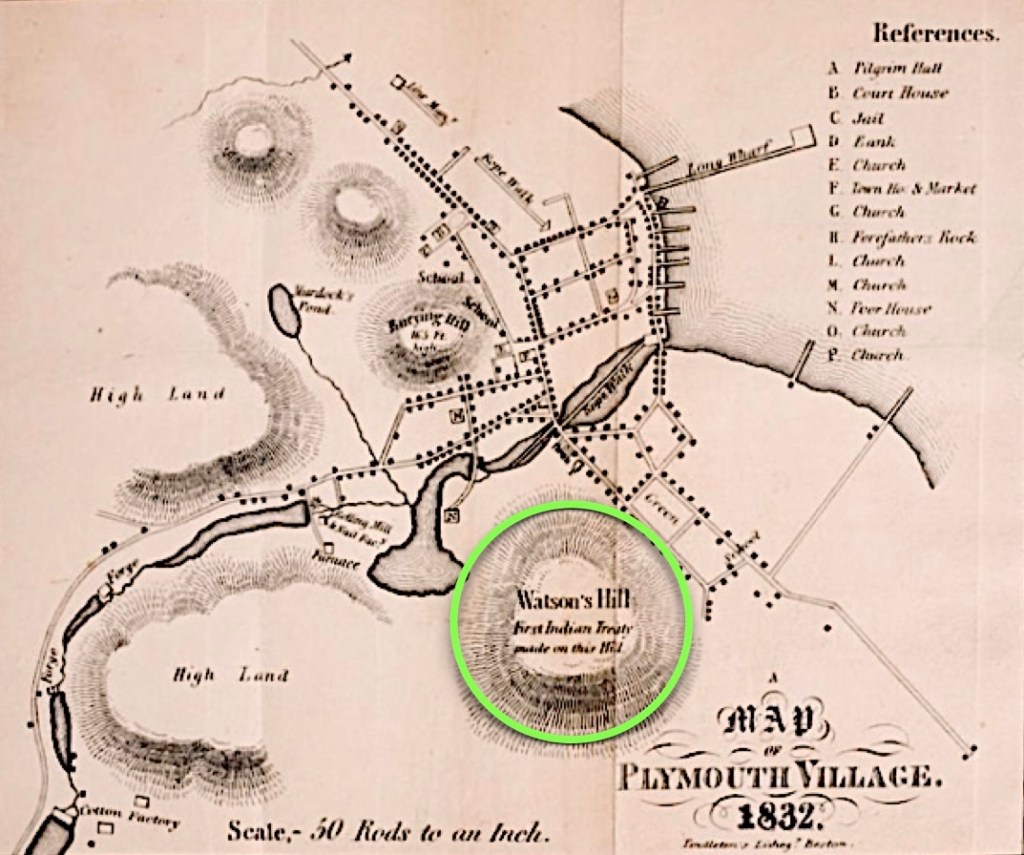
Near Watson Hill “…in 1624, Edward received his share of land allotment [for a home lot] and in 1627, in an allotment given to “heads of families and young men of prudence…” Edward was, also, given a share, even though he was unmarried, which shows him to have gained the confidence of the governor.” (Mayflower Ancestors)

This is a foldout map from the 1835 book, History of the Town of Plymouth, by James Thacher,
which clearly shows where Edward Doty began his real estate holding in Plymouth, with land near Watson’s Hill.

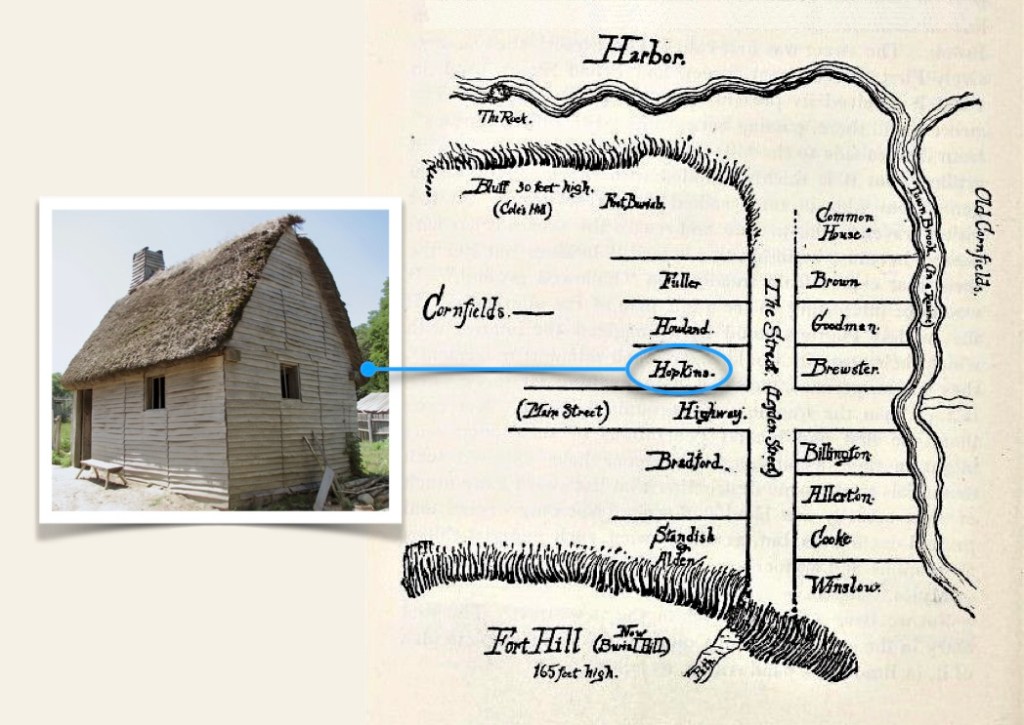
Watson Hill is uniquely remembered because it is the vantage point from which the Native Person Samoset first observed the Pilgrims. “Stephen Hopkins, who had previously lived at Jamestown and, through interaction with the Powhatan tribe of Virginia, knew a little of the Algonquian language Samoset spoke”.(World History Encyclopedia) This resulted in Samoset staying in Hopkins’s home that evening, which is the same home that Edward Doty was also living. We speculate, that through his association with first Samoset, and then Squanto, that perhaps Doty favored Watson Hill as his home site. We cover much about the relationship between the Pilgrims and Native Peoples in the [same-named] chapter The Pilgrims — The Native Peoples. (2)

Whatever Happened to Edwards’s First Wife?

Plymouth Archives have Edward Doty records for everything from court cases, to land-dealing records, to the birth of his children… it’s actually a bit exhausting to wade through all of it. That may be, but as we wrote, there are many straightforward records of his real estate transactions in the Plymouth documents. He left much property to his children upon his death, which we will review in the later chapter, The Doty Line, A Narrative — Four.

Edward Doty had two wives, but there are no credible surviving records about who wife #1 actually was. There has been speculation that his first wife was in England, but if that were true, historians should be able to locate something? However, the fact that Edward Doty’s origins in England are also quite obscure, doesn’t help matters much, does it? He could have married someone who arrived on a later ship?

The issue with that is the timing —Edward Doty received land in 1623, but both he and Edward Leister are listed under Stephen Hopkins’s name. This leads us to believe that neither man was yet married, probably because their indentures to Hopkins were coming to an end. In the 1627 Division of Cattle, as with our other Pilgrim ancestor George Soule, if Doty had been married then, his wife would have been entitled to an additional share. Yet, no spouse is listed for him. (Could have had a very short marriage between 1623 and 1627? Perhaps.) About seven more years would pass before he would meet his wife #2. During this interval, many, many ships came to the New England Colonies during the Great Migration. They brought immigrants to the far north of Maine, all the way south to and beyond Jamestown, Virginia. Some of these ships did come through Plymouth.

If indeed Doty had a wife in the Plymouth Colony before he married wife #2 in 1635, then certainly Governor William Bradford would have recorded this in his manuscript, Of Plimoth Plantation. It is highly unlikely that under the meticulous and watchful eyes of Bradford, that Doty’s first marriage would have been unobserved, much less disregarded, but it could have happened. (3)

From the original document Of Plimoth Plantation, by William Bradford. Edward Doty is listed as having had a second wife. Note that it indicates 7 children — after this was initially written, they had 2 more children, for a total of 9 children in the family. (Image courtesy of the State Library of Massachusetts, Digital Collections).

Comment: The following section below is adapted from a post made at Fine Artist Made, (see footnotes).

Edward Doty Wasn’t The Only Person Who Could Get Upset
— The Incident At Ipswich, England

Back in England, by 1630, Britain had already been entrenched, for a number of years, in a period of political turmoil, social unrest and economic uncertainty. On top of that, the Church of England, in consort with the Crown, had launched a campaign of religious persecution against a growing Puritan reform movement, whose mission was to revitalize a church grown stale, tyrannical and corrupt. The Great Migration of Puritans to British North America had begun, and would continue fitfully until the pending English Civil War.

The situation worsened for the Puritans in 1633, with the appointment of William Laud, a fierce opponent to their cause, as the Archbishop of Canterbury. They would need to take their chances in the untested wilderness of the Massachusetts Bay Colony.

A romantic painting by Bernard Gribble (1872–1962), showing The Pilgrim Fathers Boarding the Mayflower for Their Voyage to America. Although the Mayflower was certainly not this grand and imposing, this painting does show what it was like for emigrants going to British North America to travel on merchant ships in that era. (Image courtesy of the Times Literary Supplement).

The process, technicalities and red tape involved with preparations for a voyage of this magnitude were likely frustrating and expensive. Passengers (Puritans and Others) had to acquire licenses and documents to pass the port — then locate a ship. Finding an appropriate vessel would have involved an intensive search followed by serious negotiations. They had to procure provisions for their passage, as well as for their first year in New England. All this by necessity must have been accomplished surreptitiously.

Early in February 1634, two vessels were moored in Ipswich Harbor on the estuary of the Orwell River. Their passenger lists consisted largely of single men, married couples, and families — as many children as adults; some as young as one year old. They were middle class artisans and farmers. The first ship, called the Francis* was commanded by Master John Cutter and carried 84 passengers. The other was the Elizabeth with 101 passengers and Master William Andrewes at her helm. These two captains were planning to make their passage in tandem for their mutual benefit and safety. Their ships, rigged for a lengthy uncertain voyage, suddenly had their passages blocked.
(*Please see the last paragraph at the end of this chapter).

What happened was this: there was immediate opposition to this “progressive” contingent by the conservative officials in the Church of England, (who felt no sympathy for the Puritan’s case). On February 4, the Archdeacon of Suffolk’s agent, Henry Dade, the Commissary of Suffolk, wrote a letter from his office in Ipswich, to the Church of England’s principal leader, the Archbishop of Canterbury, William Laud. Dade reported that two ships were about to sail from Ipswich Port with men and provisions for their abiding in New England, and that in each ship “are appointed to go about six score men.” He supposed they were debtors or persons discontented with the government of the Church of England.

In this 1874 engraving, English Puritans Escaping to America, was captioned “strength of faith and character mark the faces of those setting forth to the New World”. (Image courtesy of British Heritage Travel).

[Our observation: It seems Dade had worked himself up into quite a frothy state.] He told the Archbishop that his intelligence had informed him, that some 600 more were planning to shortly follow and described the “ill effects of suffering such swarms going out of England could cause; that trade would be overthrown and persons indebted would flee to New England to avoid bankruptcy and be treated as religious men for leaving the kingdom because they could not endure the ceremonies of the church.

He blamed the Puritan minister, Samuel Ward, for inciting desire among his flock to relocate to Massachusetts. Ward was stationed in the ancient church of St. Mary-le-Tower, the civic church of the Corporation of Ipswich. The records of the Privy Council show that a warrant for tying up the two Ipswich vessels was issued within the week. A few days later, on February 14, similar steps were taken for the detention of ten other ships lying in the Thames near London — all under similar charters for Massachusetts Bay Colony.

(Here is where we invoke long story short…) After much drama, these conditions were imposed on everyone for the voyages:

  • If anyone blasphemes or profanes the holy name of God, they shall be severely punished.
  • On the ship, everyone must attend when the “Booke of Common Prayer” (established in the Church of England) were said at both Morning and Evening Prayers.
  • All persons must have the ‘Certificate from the officers of the port’ where they departed, have taken both the oath of allegiance and supremacie (the belief that a particular group is superior to others, and should dominate them).
  • That upon their return to this Kingdom they certify to the Board, the names of all persons transported, together with their proceedings in the execution of the aforesaid articles.

Finally, in mid to late April 1634, once the powers that be had sufficiently flexed their muscles, the Francis and Elizabeth set sail. Plying the vast Atlantic without further incident or loss of life, they entered the clear unfettered waters of the Massachusetts Bay some five to ten weeks later.

From left to right: William Laud, the Archbishop of Canterbury, Center: A painting, Ipswich England harbor, Boat on Beach, Sunset, by John Moore of Ipswich, and Right: Samuel Ward, of the ancient church of St. Mary-le-Tower

Then by November, Samuel Ward (thanks to Dade’s efforts), was banned from preaching for life for encouraging immigration to New England. There were riots in the streets of Ipswich. The Corporation of Ipswich refused to replace Ward, paid his stipend for life and after his death in 1640, supported his widow and eldest son who could not work himself. In 1637, Ward’s compatriot, Timothy Dalton, after his own suspension, immigrated to New Hampshire.

In the end, the Henry Dade as the Commissary of Suffolk’s unyielding persecutor of the Puritans of Ipswich — this would prove to be undoing. Amidst charges of corruption, oppression and extortion brought by a friend of Ward’s, a humble Puritan cobbler, he was compelled to resign his posts. (The cobbler himself was faced with excommunication and sought asylum in New England).

As for Dade’s accomplice, William Laud, the Archbishop of Canterbury — in 1645, in the midst of the English Civil War, in part, for his crimes against the Puritans — he was beheaded.

The importance of relating this saga about strife and bureaucracy in England, with the ship Francis, is that this ship brought our 9x Great Grandmother Faith Clarke (along with her father Thurston Clarke), to the Plymouth Colony. The good news is, that very soon, we will meet the new Mrs. Doty. (4)

Following are the footnotes for the Primary Source Materials,
Notes, and Observations

(1) — one record

IPL, Learneo Services
What Is The Difference Between A Colonial Farmer And A Planter?
https://www.ipl.org/essay/What-Is-The-Difference-Between-A-Colonial-17E05078F5C70CC6
Note: For the text.

Mr. Hot Under The Collar?

(2) — seven records

Medium
The Art and Science of Swearing
by Robert Roy Britt
https://medium.com/wise-well/the-art-and-science-of-swearing-5fadb0b6c979
Note: For the insult cloud artwork.

10 Colonial Insults for Lollpools, Doxies and Prigs
by The New England Historical Society
https://newenglandhistoricalsociety.com/lollpoops-doxies-prigs-ten-colonial-insults/#google_vignette
Note: For the reference, you _______!

The Plymouth Colony Archive Project
EDWARD DOTEY (DOTEN, DOTTEN, DOTY, DOWTIE)
of Plymouth
http://www.histarch.illinois.edu/plymouth/DOTEYED.htm
Note: For the text.

Mayflower Ancestors
Edward Doty & Descendants
Edward Doty: 1599 – 1655
https://gardenmayflowerancestors.wordpress.com/
Note: For the text.

History of the Town of Plymouth,
from its first settlement in 1620, to the present time

by James Thacher, circa 1835
https://archive.org/details/historyoftownofp03thac/page/n11/mode/2up
Note: For the foldout map at the beginning of the book.

World History Encyclopedia
Samoset
https://www.worldhistory.org/Samoset/
Note: For the text.

Interview of Samoset With The Pilgrims, book engraving
by Artist unknown, circa 1853
File:Interview of Samoset with the Pilgrims.jpg
https://commons.wikimedia.org/wiki/File:Interview_of_Samoset_with_the_Pilgrims.jpg
Note: For the image of Interview of Samoset With The Pilgrims

Whatever Happened to Edwards’s First Wife?

(3) — two records

The Plymouth Colony Archive Project
EDWARD DOTEY (DOTEN, DOTTEN, DOTY, DOWTIE)
of Plymouth
http://www.histarch.illinois.edu/plymouth/DOTEYED.htm
Note: For the text.

State Library of Massachusetts Digital Collections
Of Plimoth Plantation: manuscript, 1630-1650
https://archives.lib.state.ma.us/items/db0e9f79-477c-4a4c-979b-359c2be1d4ad
Note 1: The notation for Edward Doty having a wife from a second marriage is located very close to the end of the book.
Note 2: There are no page numbers, but the page is possibly — Digital page:534/546, left column.
Note 3: The document is digitized and available as a .pdf download at the above link, file name: ocn137336369-Of-Plimoth-Plantation.pdf

Edward Doty Wasn’t The Only Person Who Could Get Upset
— The Incident At Ipswich, England

(4) — seven records

Fine Artist Made
Incident at Ipswich, Part 1
https://www.fineartistmade.com/blog/blog-detail.php?Incident-at-Ipswich-part-1-68
and
Incident at Ipswich, Part 2
https://www.fineartistmade.com/blog/blog-detail.php?Incident-at-Ipswich-part-2-70
by Patrick Mealey and Joyce Jackson
Note: For the text.Historic UK

Times Literary Supplement
The Pilgrim Fathers Boarding the Mayflower for their Voyage to America
by Bernard Gribble, (1872–1962)
https://www.the-tls.com/history/early-modern-history/mayflower-voyage-400
Note: For the ship painting.

British Heritage Travel
From East Anglia to A City Upon A Hill
https://britishheritage.com/from-east-anglia-to-a-city-upon-a-hill
Note: Primedia Archive, for the fleeing Puritans in a boat image.

The Life and Death of William Laud
https://www.historic-uk.com/HistoryUK/HistoryofEngland/The-Life-and-Death-Of-Wiliam-Laud/
Note: For the Laud portrait.

Boat on Beach, Sunset
by John Moore of Ipswich (1821–1902)
https://artuk.org/discover/artworks/boat-on-beach-sunset-12029
Note: For the Ipswich, England harbor scene.

The Digital Puritan
Samuel Ward
https://digitalpuritan.net/samuel-ward/
Note: For the Samuel Ward portrait.

The Doty Line, A Narrative — Two

This is Chapter Two of nine. This chapter covers the early dramatic events of the 162os: a foolish knife fight, how land was distributed, how cattle and other livestock were shared, and how The Colony started to find itself.

In the last chapter, we wrote about picturing our ancestors in our mind’s eye. One of the drawbacks about that way of pondering the Pilgrims is this — it is normal to picture them in a bucolic environment, with ordered streets, clean clothes, rosy cheeks. Hollywood has never really been very good at looking at how rough and tough things initially were for them.

When the Mayflower finally disappeared over the horizon, they were truly alone in the New World.

The Departure of the Mayflower for England in 1621 by N.C. Wyeth. This was part of a series of murals the artist created for the MetLife building in New York City in 1941.
(Image courtesy of the Brandywine Museum of Art).

Only 53 Passengers Remained

Consider the fact that the Mayflower was the home of the Pilgrims for a long time and that it was a very old merchant ship.

“During the winter, the passengers [had] remained on board Mayflower, suffering an outbreak of a contagious disease described as a mixture of scurvy, pneumonia, and tuberculosis. After it was over, only 53 passengers remained—just over half; half of the crew died as well. In the spring, they built huts ashore, and the passengers disembarked from Mayflower on March 31, 1621.”

Captain Christopher “Jones had originally planned to return to England as soon as the Pilgrims found a settlement site. But his crew members began to be ravaged by the same diseases that were felling the Pilgrims, and he realized that he had to remain in Plymouth Harbor ‘till he saw his men began to recover.’  Mayflower lay in New Plymouth harbor through the winter of 1620–21, then set sail for England on April 15, 1621. As with the Pilgrims, her sailors had been decimated by disease. Jones had lost his boatswain, his gunner, three quartermasters, the cook, and more than a dozen sailors. Mayflower made excellent time on her voyage back to England. The westerly winds that had buffeted her on the initial voyage pushed her along on the return trip home. She arrived in London on May 16, 1621, less than half the time that it had taken her to sail to America.” (Wikipedia)

Historian Caleb Johnson writes that, “Christopher Jones took the ship out on a trading voyage to Rochelle, France, in October 1621, returning with a cargo of Bay salt. [As the] master and quarter-owner of the Mayflower, [he] died and was buried at Rotherhithe, County. Surrey, England, on 5 March 1621/2. No further record of the Mayflower is found until May 1624, when it was appraised for the purposes of probate and was described as being in ‘ruinis’.  The ship was almost certainly sold off as scrap.” (Mayflower History.com)

With all of the many demands put upon the new shore-bound Plymouth community, our ancestor Edward Doty was about to steal the spotlight through a bit of infamy. (1)

Seeing Red + Flying Off The Handle = (We’re) Fit to Be Tied

Well, the two Edwards seemed to have had quite enough of each other and entered into a duel. It is reportedly the first duel fought in New England, which may be true, but how can you prove something like that? Who would want to?

Edward Doty and Edward Leister were both young men who were indentured servants in the home of the Stephen Hopkins family. Admittedly, the initial voyage of the Mayflower had been harrowing… they were both living as servants in a tiny, rather rough looking house, in far away new world colony… Mr. Hopkins ran a tavern (out of his home?) and just about everyone drank beer in those days because water could be contaminated… Was a young lady involved? Who knows? — but their rather intense dust-up has been featured by historians for over 400 years, which is a rather long time for a local fight to echo through history.

From the standpoint of their community, this fight took place slightly less than eight weeks after the Mayflower had departed for England. Everyone was probably exhausted after leaving the ship, continuing to care for the sick and dying, building huts to live in, and trying to source food in a new land. Who had the free time or energy to get caught up in a duel? Apparently, these two did.

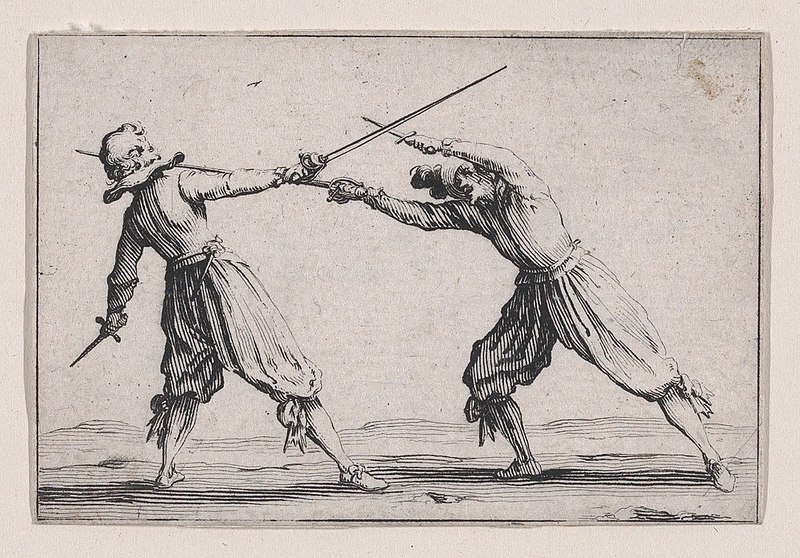
Copy of Le Duel a l’Épée et au Poignard (The Duel with the Sword and Dagger),
from “Les Caprices” (Image courtesy of The Metropolitan Museum of Art).

William Bradford, the Governor of the Plymouth Colony at the time, recorded the details in his journal, but that original document was eventually lost. Transcriptions of what was recorded have survived and we found an account published in a Boston newspaper called The Liberator, on June 12, 1840. In an intriguing way, we noticed this newspaper account falls (more-or-less) at the halfway point between the 1620s and our present era.

Excerpted newspaper account from The Liberator newspaper, June 12, 1840, page 4.
(Image courtesy of Newspapers.com).

If history has a way a not-forgetting, then perhaps we all need to mind our manners in today’s world? It seems that Edward Doty had a history of being in court frequently in the Plymouth Colony being on both sides of things. Maybe he was a bit of a hot head? As elaborated upon by our quite far distant cousin Anna Kasper in her blog post, Anna’s Musings & Writings, 52 Ancestors in 52 Weeks, Week 7: “…Edward Doty did not always make good on that promise of ‘a better carriage.’ He did not like to pay his servants, he just let his cattle kind of wander around, he got into fights, and is found in the Plymouth Court records numerous times! To say that Edward was notably a contentious man would be correct.”

We are reminded of our ancestor David Du Four from a separate family line who we chronicled in The DeVoe Line, A Narrative — Two. (David did not seem to be a contentious man). We wrote this in the section subtitled:
For. Every. Little. Kerfuffle. With. Your. Neighbors.
“It seems that David Du Four had several showings in court because the records have survived. Here’s a little background on the times. In 1670s he was a “frequent flyer” at court, with several cases. In New Amsterdam, people from all walks of life could bring a case to court. They could defend the case themselves, or ask someone to speak for them.  It was not necessary for them to have a lawyer for every case. This is because…” there wasn’t a true court system existent. “To a degree, it seems like going to court was similar to being sent to the Principal’s Office. You had to go and plead your case.”

Then, whatever happened to Edward Leister? We don’t know very much. Governor William Bradford later recorded, “Lester, after he was at liberty, went to Virginia and there died”. American Ancestors has discerned a bit more, by evaluating some of the surviving colonial documents: “…in the 1623 division of land are two men with [the] first name [of] Edward but without surnames; these must be his two servants, Edward Doty and Edward Leister. But Leister is not in the 1627 division of cattle, so he must have left for Virginia between those two dates. He does not appear in the February 1623/4 list of those in Virginia living and dead, or in the February 1624/5 Virginia muster of inhabitants.”

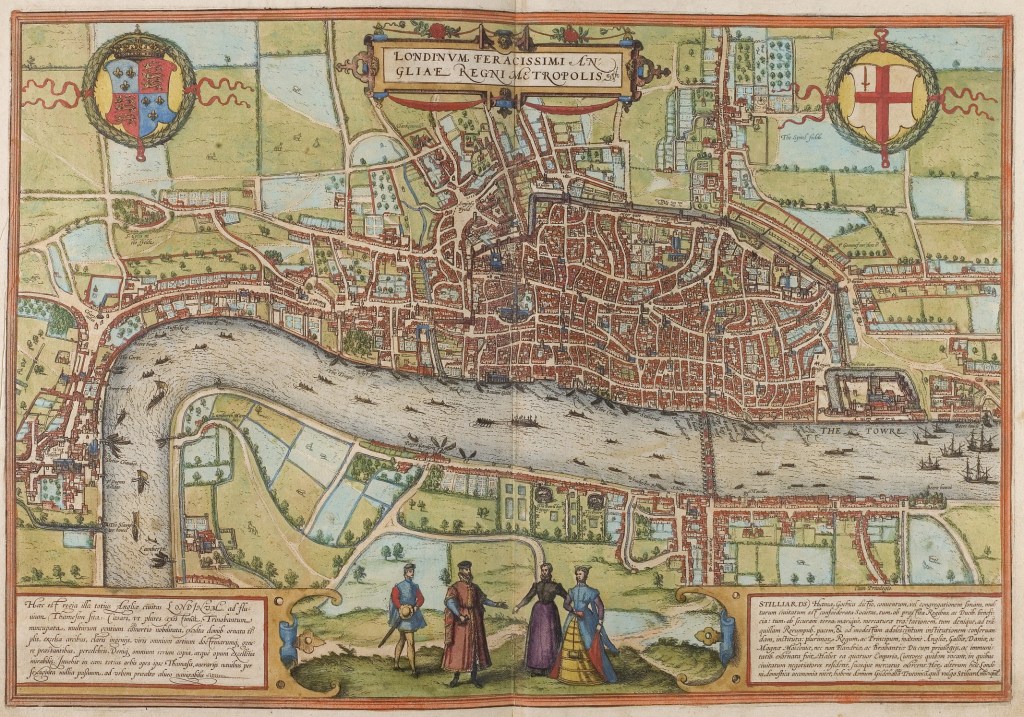
Panoramic View of London in the early 1600s,
by Matthäus Merian der Ältere (Matthew Merian), 1638.

For Edward Doty, we do not know exactly when, nor where, he was born. He was recorded as being of London, but we don’t know if he had been born in another part of England and then had perhaps migrated to London. When he was a signer of the Mayflower Compact, there is speculation that he may have been slightly underage, but the Mayflower Society believe that he was probably at least 18 years of age. (It appears that there are a couple of other signers who were in similar circumstances). We do know however, that as an indentured servant to Stephen Hopkins, he was contracted to that obligation until the age of 25 years.

With that fact in mind, we can parse that he was likely born circa 1598. (2)

The Common Cause of Labor

“Working communally — also known as the “common course of labor” — was a key part of the business model planned for Plymouth Colony. In the original terms and conditions for funding and planting the colony, all the colonists agreed to work together for seven years at commercial fishing, trading, and farming “making such commodities as shall be most useful for the colony.” At the end of the seven years, the terms and conditions dictated that the colonists would receive a share of the common stock including land and livestock.

After three years, Plymouth Colony’s governor William Bradford ended communal work as related to farming, because it caused too much internal conflict and resulted in poor corn harvests. Without a good corn harvest to feed the colony and without regular supplies from England, the colony would not survive. It is interesting to note, however, that this injunction affected only grain and other field production. All other group work — hunting, fishing, trading and defense – continued as before and seemingly without tension.” (Plimoth Patuxet)

Edward continued to do his work for the Hopkins family as part of his commitment to the greater good. However, as one of the original settlers (the old-comers) within the Plymouth Colony, he was entitled a certain privileges which this status afforded him. One of these was the right to have land tenure.

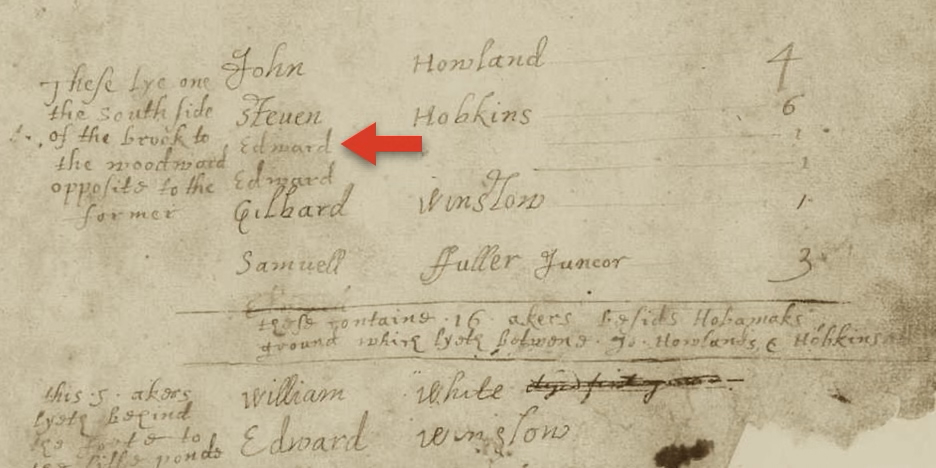
The 1623 Division of Land in which Edward Doty received one acre. As described above, “These lye on the South side of the brook to the woodward opposite to the former”

It is likely that Edward was about 25 years old at this time. “In 1623 a parcel of land was allotted to each man to till for his family and to maintain those who were exempt from agricultural employment because of other duties. Each family was given one acre per family member. In abandoning the ‘common course and condition’ everyone worked harder and more willingly. The food problem was ended, and after the first abundant harvest under individual cultivation, the Pilgrims did not have to endure the meager rations of the first years. The plots assigned them permanently in 1624 became privately owned in 1627.” (Images of Old Hawaii)

“The people mentioned in the Division of Land came on the Mayflower (1620), the Fortune (1621), and the Anne (1623). A couple may have arrived on the Swan(1622) or the Little James (1623), but these were small ships carrying mostly cargo. The Division of Land is recorded in Volume XII of the ‘Records of the Colony of New Plymouth’ ”(TPCAP – The Plymouth Colony Archive Project)

At this time, one acre of land was distributed to each family member. As he was a single man, Edward Doty received one acre of land described communally as, “These lye on the South side of the brook to the woodward opposite to the former”. (Family Search) (3)

Animals Resting in a Pasture, by Paulus Potter, circa 1650.
(Image courtesy of Wikimedia Commons).

About The Division of Cattle

Like the distribution of land in 1623, in 1627, the Pilgrims divided their livestock (cattle, goats, etc.) into separate lots.

“The Pilgrims did not bring any large livestock animals with them on the Mayflower. In fact, the only animals known with certainty to have come on the Mayflower were two dogs, an English mastiff and an English spaniel, who are mentioned on a couple of occasions in the Pilgrims’ journals.

In 1624, [Governor William] Bradford reports that ‘Mr. Winslow came over, and brought a prety good supply, and the ship came on fishing, a thing fatall to this plantation. He brought 3. Heifers & a bull, the first begining of any catle of that kind in ye land’. Other cattle came, some nicknamed the Great Black Cow, the Lesser Black Cow, and the Great White-Backed Cow. By 1627, both the Lesser Black Cow and the Great White-backed Cow had calves.

The 1627 Division of Cattle. Edward Doty is listed as #11, as Edward Dolton. “The fourth lot fell to John Howland & his company Joyned to him his wife. To this lot fell one of the 4 heyfers Came in the Jacob Called ”

Onboard the Jacob in 1624 were four black heifers (a heifer is a young female cow that has not yet had a calf.) The four black heifers were nicknamed Least, Raghorn, Blind, and Smooth-Horned. There was also a Red Cow that belonged to the poor of the colony, which had a red female calf around 1625, and a male calf in 1627. By May 1627, there were 16 head of cattle and at least 22 goats living in Plymouth.” (Images of Old Hawaii)

It appears that Edward Doty, as part of the group of colonists (listed above as part of ‘John Howland & his company’), communally shared the ‘4 heyfers’ which had arrived on the ship Jacob in 1624. (4)

The Council for New England

We understand that Edward Doty was a man who didn’t die a poor man by the standards of his era. He was an early investor in the development of the Plymouth Colony and a land owner. The three passages excerpted below describe the business aspects he was involved with in those early decades.

“The Council for New England was a 17th-century English joint stock company to which James I of England awarded a royal charter, with the purpose of expanding his realm over parts of North America by establishing colonial settlements. The Council was established in November of 1620, and was disbanded (although with no apparent changes in land titles) in 1635. It provided for the establishment of the Plymouth Colony, the Province of New Hampshire, the Massachusetts Bay Colony, the New Haven Colony, and the Province of Maine”.

Left image: The Stuarts, King James I (reigned 1603 – 1625). Painting of James VI and I
Wearing the Jewel Called the Three Brothers in His Hat, circa 1605, (after) John de Critz.
Upper right: The Seal of The Council For New England, and
Lower right: (Shown at a small scale, the actual Peirce Patent from 1621.. It is cited as one of the most important documents in Anglo-American history.)

“In 1621, King James I authorized the Council for New England to plant and govern land in this area. This Council granted the Peirce Patent, confirming the Pilgrims’ settlement and governance of Plymouth. Peirce and his associates, the merchant adventurers, were allotted 100 acres for each settler the Company transported. The Pilgrims had a contract with the Company stating all land and profits would accrue to the Company for 7 years at which time the assets would be divided among the shareholders. Most of the Pilgrims held some stock. The Pilgrims negotiated a more favorable contract with the Company in 1626. In 1627, 53 Plymouth freemen, known as “The Purchasers,” agreed to buy out the Company over a period of years. In turn, 12 “Undertakers” (8 from Plymouth and 4 from London) agreed to pay off Plymouth’s debts in return for trade benefits”. (Pilgrim Hall Museum)

“In 1626, Edward Doty was one of twenty-seven Purchasers involved with the colony joint-stock company which afterwards was turned over to the control of senior colony members. That group [of investors] was called the “Undertakers”, and was made up initially of William Bradford, Myles Standish and Isaac Allerton, who were later joined by Edward Winslow, William Brewster, John Howland, John Alden, Thomas Prence, and four former Merchant Adventurers back in London. On the agreement, dated October 26, 1626, his surname appears as ‘Dotey’.” (Wikipedia) (5)

We continue our narrative about the Edward Doty in the next chapter, with his initial focus on acquiring stability through land ownership. (After all, a farmer who works the land, might want to own it too.) Then we look back a bit at the immigration unrest in Ipswich, England — which was certainly not a merry place at this time.

Following are the footnotes for the Primary Source Materials,
Notes, and Observations

Only 53 passengers Remained

(1) — three records

The Departure of the Mayflower for England in 1621
by N.C. Wyeth
https://collections.brandywine.org/objects/11394/the-departure-of-the-mayflower-for-england-in-1621?ctx=a8ad2d38-5e2e-466c-ae9e-f1f68e71df17&idx=8
Note: This was part of a series of murals the artist created for the MetLife building in New York City in 1941.

Mayflower
https://en.wikipedia.org/wiki/Mayflower
Note: For the text.

Caleb Johnson’s Mayflower History.com
The End of the Mayflower
https://mayflowerhistory.com/end-of-the-mayflower
Note: For the text.

Seeing Red + Flying Off The Handle = (We’re) Fit to Be Tied

(2) — seven records

The Met [The Metropolitan Museum of Art]
Copy of Le Duel a l’Épée et au Poignard (The Duel with the Sword and Dagger),
from Les Caprices
by Anonymous, (After Jacques Callot French, 17th century)
https://www.metmuseum.org/art/collection/search/417395
Note: For the illustration.

Edward Doty and Edward Leister duel 1621
https://www.newspapers.com/article/the-liberator-edward-doty-and-edward-lei/5952148/
Note: From Newspapers.com “The Liberator was a radical [their words] abolitionist newspaper published from 1831-65 in Boston, Massachusetts. A weekly four-page paper, it was the most influential abolitionist publication in the United States during the nineteenth century. At its peak, the Liberator was circulating 3,000 copies a week, primarily across the free North. It was funded and read largely by the free Black population in the North”.

HOW THE PILGRIM FATHERS SERVED DUELISTS.
The following account of the first duel fought in New England, and the second political offence committed in the Plymouth Colony, we take from a work entitled The New-England Chronology.’ The date of the event is June 8th, 1621.

The second offence is the first duel fought in New-England, upon a challenge to single combat, with sword and dagger, between Edward Doty and Edward Leister, servants of Mr. Hopkins. Both being wounded, the one in the hand, the other in the thigh, they are adjudged by the whole company to have their head and feet tied together, and so to lie for twenty-four hours, without meat or drink; which is begun to be inflicted. But within an hour, because of their great pains, at their own and their master’s humble request, upon promise of better carriage, they are released by the Governor.’
— Pa. Observer.

The DeVoe Line, A Narrative — Two
https://ourfamilynarratives.wordpress.com/wp-admin/post.php?post=13086&action=edit
Note: For the text in the section —
For. Every. Little. Kerfuffle. With. Your. Neighbors.

Anna’s Musings & Writings
52 Ancestors in 52 Weeks. Week 7: Landed. February Theme: Branching Out. My Contentious and Quarrelsome Mayflower Pilgrim Ancestor Edward Doty.
https://anna-kasper.com/2022/02/15/my-contentious-and-quarrelsome-mayflower-pilgrim-ancestor-edward-doty/
Note: For the text.
Hi cousin!

A contemporary reenactment of a farm laborer from the Plimouth Plantation Living Museum.

.American Ancestors 2020
Edward Leister
https://mayflower.americanancestors.org/edward-leister-biography#:~:text=Edward%20Leister%20came%20to%20Plymouth,%5BBradford%20442%2C%20445%5D.
Note: For the text.

Battlemaps.us
Panoramic View of London in the early 1600s,
by Matthäus Merian der Ältere (Matthew Merian), 1638
https://www.battlemaps.us/products/london-1600s-panoramic-view?srsltid=AfmBOoqFDoZLYTk2TCIRr2uUgV98KngVjw-QLKUO2raArsDdj_lOQJsq
Note: For the panoramic view of London.

The Mayflower Society
The Doty Family, Passenger Profile
https://themayflowersociety.org/passenger-profile/passenger-profiles/edward-doty/
Note: For the text.

The Common Cause of Labor

(3) — five records

Plimoth Patuxet Museums
As Precious As Silver
https://plimoth.org/yath/unit-3/as-precious-as-silver
Note: For the text.

Dividing the Land and Development of Towns
https://imagesofoldhawaii.com/wp-content/uploads/Dividing-the-Land-and-Development-of-Towns.pdf
Note: For the text.

Plymouth Colony 1623 Division of Land document
Massachusetts, Land Records, 1620-1986 > Plymouth > Deeds 1620-1651 vol 1
https://www.familysearch.org/ark:/61903/3:1:3QS7-89Z7-5Z3H?i=7&wc=MCBR-538%3A361612701%2C362501301&lang=en
Note 1: One acre of land for Edward Doty, as an unmarried man.
Note 2: This file is available at two locations. As indicated above, and also here:
https://www.familysearch.org/ark:/61903/3:1:3QS7-89Z7-5Z3H?i=7&wc=MCBR-538:361612701,362501301&lang=en
Book page: 4, Digital page: Image 8 of 239, Lower portion of page.
Note 3: He is the first Edward listed after Steven Hopkins’s name.

(TPCAP)
The Plymouth Colony Archive Project
Plymouth Colony Division of Land, 1623
http://www.histarch.illinois.edu/plymouth/landdiv.html
Note: For the text. Additional context, “In 1623, the Pilgrims divided up their land. The people mentioned in the Division of Land came on the Mayflower (1620), the Fortune (1621), and the Anne (1623). A couple may have arrived on the Swan(1622) or the Little James (1623), but these were small ships carrying mostly cargo. The Division of Land is recorded in Volume XII of the ‘Records of the Colony of New Plymouth’, and reprinted in the ‘Mayflower Descendant’, 1:227-230. Each family was given one acre per family member”.

About The Division of Cattle

(4) — four records

Animals Resting in the Pasture
by Paulus Potter, circa 1650
File:Paulus Potter – Animals Resting in the Pasture.jpg
https://commons.wikimedia.org/wiki/File:Paulus_Potter_-_Animals_Resting_in_the_Pasture.jpg
Note: For the painting image.

Plymouth Colony 1627 Division of Cattle document
Massachusetts, Land Records, 1620-1986 > Plymouth > Deeds 1620-1651 vol 1https://www.familysearch.org/ark:/61903/3:1:3QS7-99Z7-5ZZW?i=31&wc=MCBR-538%3A361612701%2C362501301&lang=en
Book page: 52, Digital page: Image 32 of 239, Middle of page.
Note: For the image. Edward Doty is listed in the Fourth Lot, as #11, named Edward Dolton.

The Plymouth Colony Archive Project
Plymouth Colony Division of Cattle, 1627
http://www.histarch.illinois.edu/plymouth/cattlediv.html
Note: Additional context, “1627. At a publique court held the 22th of May it was concluded by the whole Companie, that the cattle wch were the Companies, to wit, the Cowes & the Goates should be equal devided to all the posts of the same company & she kept until the expiration of ten years after the date above written & that every one should well and sufficiently paid for there own pt under penalty of forfeiting the same. That the old stock with half th increase should remain for common use to be divided at then of the said terms or otherwise as location fallers out, & the other half to be their own for ever. Upon wch agreement they were equally divided by Lotts she as the burthen of keeping the males then being should be borne for common use by those to whose lot the best Cowes should fall & so the Lotts fell as followers. thirteenepsonts being portioned to one lot.”

Division of Cattle
https://imagesofoldhawaii.com/wp-content/uploads/Division-of-Cattle.pdf
Note: For the text.

The Council for New England

(5) — six records

The Coat of Arms of King James VI and I

Council for New England
https://en.wikipedia.org/wiki/Council_for_New_England
Note: For the text.

Painting of James VI and I Wearing the Jewel Called the Three Brothers in His Hat, circa 1605
by (after) John de Critz 
File:Portrait of James I of England wearing the jewel called the Three Brothers in his hat.jpg
https://commons.wikimedia.org/wiki/File:Portrait_of_James_I_of_England_wearing_the_jewel_called_the_Three_Brothers_in_his_hat.jpg
Note: For the portrait of James I.

Digital Commonwealth
Seal of the Council for New England
https://www.digitalcommonwealth.org/search/commonwealth:h128nr41z
Note: For the seal artwork.

Plymouth Live
Important piece of American history is being brought to Plymouth
https://www.plymouthherald.co.uk/whats-on/whats-on-news/important-piece-american-history-being-2587196
Note: For the Peirce Patent document image.

Pilgrim Hall Museum
Beyond The Pilgrim Story
https://pilgrimhall.org/bradford_17th_century_documents.htm
Note: Excerpted text is from the section, Willliam Bradford: a 1626 “Undertaker”.
Note: For the text.

Edward Doty
https://en.wikipedia.org/wiki/Edward_Doty#CITEREFBanks2006
Note: For the text.

The Doty Line, A Narrative — One

This is Chapter One of nine. We hope that you have taken the time to read the opening chapters we wrote based on the lives of The Pilgrims. It will help to make these The Doty Line chapters more accessible.

As the authors of this family history genealogy blog, we are in the 12th generation of Doty descendants in America. Pilgrim Edward Doty and his wife Faith (Clarke) Doty Phillips are our 9x Great Grandparents. He was one of our two Mayflower ancestors, with the other being Pilgrim George Soule whose family line is profiled in The Soule Line’s seven chapters.

A map of London during the Tudor Period and prior to 1561,
by Georg Braun and Frans Hogenberg in Civitates Orbis Terrarum.
(Image courtesy of Wikipedia).

A Man “of London

Unfortunately, no one has been able to discern specifically the early origins for our 9x Great Grandfather Pilgrim Edward Doty. We wished to uncover more, but for now, until more credible evidence turns up, we must settle for the 20,000 foot view as to where he came from. One of these fine days, someone, somewhere, perhaps an observant researcher — will discover a clue that will reveal his true origins. For us, his name first comes up first in connection with the voyage of the Mayflower.

It’s 1620. He is sailing westward to the new colonies in North America, and for a few years, he is an indentured servant to the Stephen Hopkins family. This means that he was responsible for contributing to the success of the Hopkins family for a period of time, and until he had achieved the age of 25 years, he could not be released from this condition. Edward Leister, his fellow indentured traveler with the Hopkins family, was of the same status.

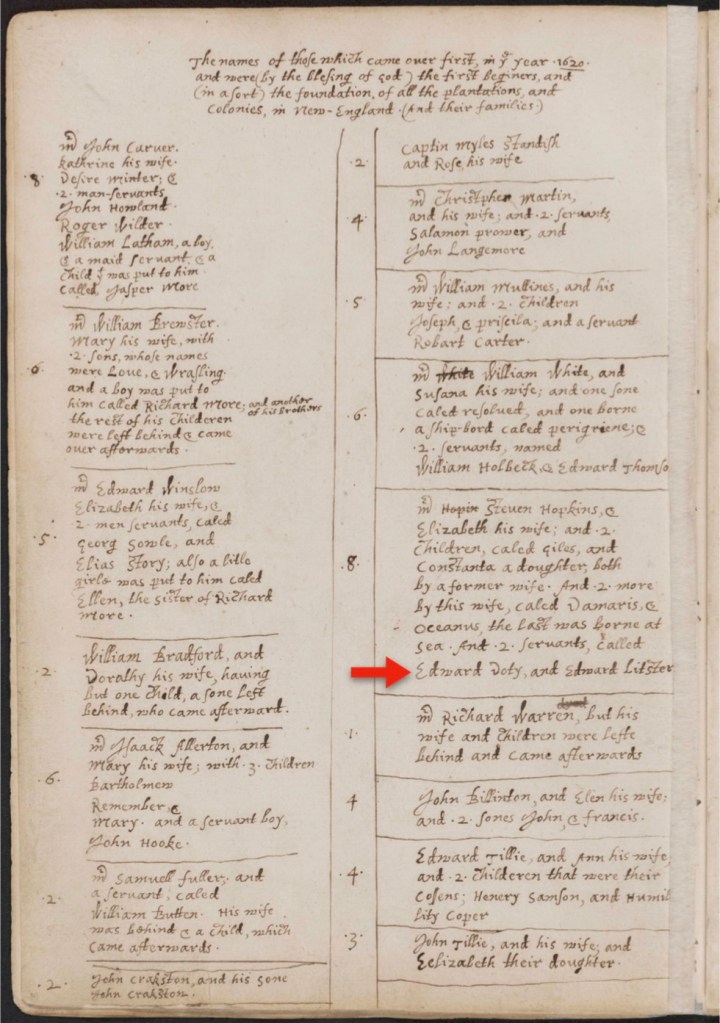
The original document Of Plimoth Plantation, by William Bradford, page 530. Edward Doty is listed as traveling with the Steven (Stephen) Hopkins family. (Image courtesy of the State Library of Massachusetts, Digital Collections).

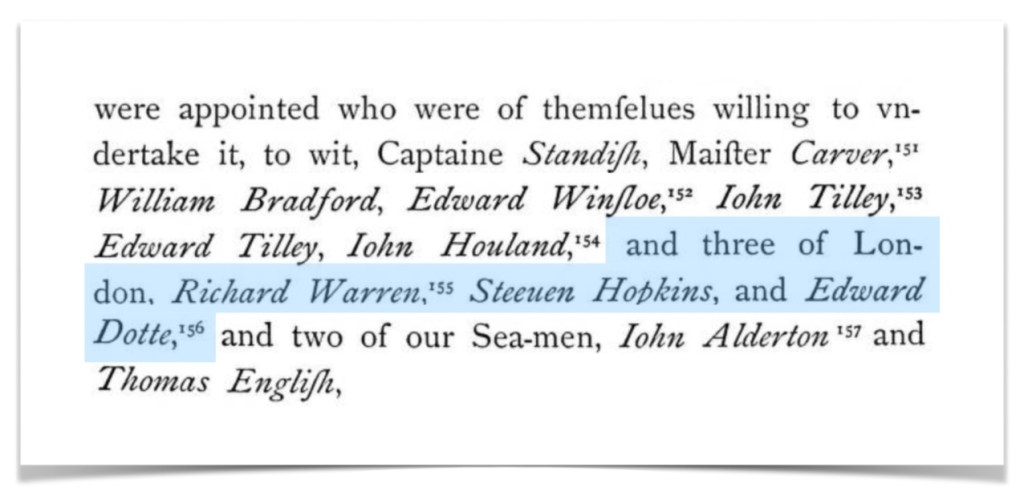
He is then briefly mentioned in a pamphlet titled Mourt’s Relation, written by Thomas Winslow of the New Plymouth Colony, with contributions from William Bradford. This booklet eventually gained great fame.

From the website Voyaging Through History

The manuscript was carried out of New Plymouth by Robert Cushman, Chief Agent in London for the settlers, on board the Fortune in 1621. When Mourt’s Relation was sold in John Bellamy’s London bookshop in the 1620s its readers could have scarcely imagined this would become one of the most well-known texts in American history… Perhaps the most significant feature of Mourt’s Relation is its inclusion of ‘The Mayflower Compact’: the first governing document of Plymouth Colony. Signed on November 21, 1620 (prior to landing), the text gave a legal framework of government to the eventual settlement… Over time the Mayflower Compact has become revered as an antecedent to the American Constitution.

Something else we were able to see within Mourt’s Relation, is this text below. This is the only reference yet where we have found any indication for his origin before the Mayflower sailed.

In this pamphlet, Edward’s name is mentioned as being of London next to the name of the man he was indentured to, “Steeuen Hopkins”, (Stephen Hopkins). For more about what Indentured Servitude was, please see our chapters on The Pilgrims — specifically the chapter: The Pilgrims — A Mayflower Voyage.

A note about name spellings:
Historical sources vary much in how these names are spelled. Stephen Hopkins’s first name is written as Steven, Stephen, or Steeuen in original documents. [We are using Stephen for our text]. Edward Doty’s surname has several spellings in original documents, including: Doty, Dotte, Doten, Dotten, Dotey, Dowty, and Dolton. [Whew! We are using Doty for our text].

Most importantly, we know that Edward Doty was one the people who ‘signed’ The Mayflower Compact. However, the names of the signatories to the document were not published for many years out of the fear of reprisals from the British Monarchy. In any case, we know that Edward could not write his name:

“One is that no copy of the original [Mayflower Compact] document survives. Therefore, unfortunately we can’t see his signature. But considering he signed other legal documents, including his Will, with ‘his mark,’ he appears not to have learned how to write and we wouldn’t see much in the way of a signature anyway. Nevertheless, all accounts of the document give him credit for being among the 41 men who signed the pact.” (AFHB – A Family History Blog, see footnotes). (1)

As with many of our ancestors, their ability to read, write, and sign their name was not as important then as it is today. Clearly, someone drafted the text to Edward’s 1655 Will and wrote his name. He then endorsed this with ‘his marke’, a double flourish which we have circled.

Being thus arrived in a good harbor

Only one primary source account exists which describes the events while the Mayflower was at sea. It was written by Plymouth Colony Governor William Bradford in his History of Plymouth Plantation. It concludes with this dramatic passage:

Being thus arrived in a good harbor and brought safe to land, they fell upon their knees and blessed the God of heaven, who had brought them over the vast and furious ocean, and delivered them from all the perils and miseries thereof, again to set their feet on the firm and stable earth, their proper element. And no marvel if they were thus joyful, seeing wise Seneca was so affected with sailing a few miles on the coast of his own Italy; as he affirmed, that he had rather remain twenty years on his way by land, then pass by sea to any place in a short time; so tedious and dreadful was the same unto him.

When Edward Doty and Edward Leister arrived with the Hopkins family in Plymouth Harbor, there were no truly accurate maps of the area, but that was soon to change. The 1623 map below shows the location of the Plymouth Colony, along with other (new) local names. The nearby Native People populations are also indicated. (2)

This map from the book Three Visitors to Early Plymouth, captures the geography
of early New England, including most of the settlements that began in 1623.
(Image courtesy of the Internet Archive).

So, Who Was Stephen Hopkins?

He was a man of many accomplishments. Wikipedia sums it up best when they describe him: “Steven Hopkins (fl. 1579 – d. 1644) was an English adventurer to the Virginia Colony and Plymouth Colony. Most notably, he was a passenger on the Mayflower in 1620, one of 41 signatories of the Mayflower Compact, and an assistant to the governor of Plymouth Colony through 1636. He worked as a tanner and merchant and was recruited by the Company of Merchant Adventurers of London to provide the governance for the colony and to assist with the colony’s ventures.

He was also the only Mayflower  passenger with prior New World experience, having been shipwrecked [from the ship Sea Venture] in Bermuda in 1609 en route to Jamestown, Virginia. Hopkins left Jamestown in 1614 and returned to England. Hopkins traveled to New England in 1620 and died there in 1644.” (Wikipedia)

It is interesting to note that that he spent five years in Jamestown, Virginia after being shipwrecked. He was there for so long that his first wife Mary (who was living in England with their three children) died, leaving the children without a parent present. This could be one reason why he returned to England, where he married his second wife Elizabeth, who came with him on the Mayflower. For more information on the disastrous Jamestown Colony, please see our chapter, The Pilgrims — Colonial Pursuits.

The first page of Shakespeare’s The Tempest, printed in the First Folio of 1623.
(Image courtesy of Wikimedia Commons).

During his tenure in Bermuda (long story short), he was accused of treason and nearly beheaded. It is thought by scholars that the character of ‘Stephano’ in William Shakespeare’s The Tempest is based upon Stephen Hopkins’s experiences in Bermuda. (The play was first performed in November 1611). (3)

Living With The Hopkins Family in the Plimoth Plantation

The entire Hopkins family and their two indentured servants survived the first terrible winter, which is rather remarkable since so many other of their fellow travelers had passed away. What was it like for the indentured servants Edward Doty and Edward Leister to be living in the Stephen Hopkins home? Likely very crowded.

The image at the left shows the reproduction home of the Stephen Hopkins family located at the Plimoth Patuxet Museum historical site. The “elaborated” 1879 map at right show the location of that home within the context of William Bradford’s original sketch for New Plymouth. (See footnotes).

“The Mayflower Quarterly of December 2011, in an article on Plymouth-area taverns, has a paragraph on Stephen Hopkins, who kept an ‘ordinary’ (tavern) in Plymouth on the north side of Leyden Street from the earliest days of the colony.

The article defines a 17th-century ‘ordinary’ as a term for a tavern where set mealtimes and prices were offered. Terms such as ‘inn, alehouse and tavern’ were used interchangeably with ‘ordinary’ in early Plymouth records. Hopkins kept this tavern from the early colony days until his death in 1644. In the early 1600s he had also had an alehouse in Hampshire with his wife Mary and his mother-in-law Joan, which they maintained after he left for America in 1609.

Hopkins apparently had problems with the Court over his tavern. Plymouth records indicate that Hopkins let ‘men drink in his house upon the Lords day’, ‘for suffering servants and others to sit drinking in his house’ (contrary to Court orders), also to play games ‘& such like misdemeanors, is therefore fined fourty shillings.’ In addition, the Court had several charges against him ‘for selling wine, beere, strong waters, and nutmeggs at excessiue rates, is fined.’” (Wikipedia) (4)

Now that we have arrived in the new Plymouth Colony, the next chapters will narrate how the Doty Family grew, how they developed and changed, and what Life brought them during the subsequent generations.

Following are the footnotes for the Primary Source Materials,
Notes, and Observations

A Man “of London

(1) — six records

Tudor London
https://en.wikipedia.org/wiki/Tudor_London
Note: For the 1561 “Civitates Orbis Terrarum” map image.

State Library of Massachusetts Digital Collections
Of Plimoth Plantation: manuscript, 1630-1650
https://archives.lib.state.ma.us/items/db0e9f79-477c-4a4c-979b-359c2be1d4ad
The actual page 530 is here:
https://archives.lib.state.ma.us/server/api/core/bitstreams/4d69e338-cc1b-4eda-b2ff-57bfbbb5c6ed/content
Note 1: For the original document on which Edward Doty is listed as a passenger on the Mayflower.
Note 2: The document is digitized and available as a .pdf download at the above link, file name: ocn137336369-Of-Plimoth-Plantation.pdf
Digital page: 530/546. First page, right column at center, with the Steven (Stephen) Hopkins family.

Voyaging Through History, the Mayflower and Britain
Mourt’s Relation (1622)

https://voyagingthroughhistory.exeter.ac.uk/2020/08/25/mourts-relation-1622/
Note: For the text.

Mourt’s Relation or Journal of The Plantation at Plymouth
by William Bradford, 1590-1657; Edward Winslow, 1595-1655; 
(and Henry Martyn Dexter, 1821-1890)
https://archive.org/details/cu31924028815079/mode/2up
Digital pages: 100-102/242, Book pages: 43-45/176
Note: This edition is circa 1865.

(AFHB)
A Family History Blog
Signer of the Mayflower Compact
by Jamie
https://genealogy.thundermoon.us/blog/2020/09/26/signer-of-the-mayflower-compact/
Note 1: For the text, and the double flourish signature of Edward Doty.
Note 2: Jamie, the author of A Family History Blog, is another cousin. He is a descendant of Edward Doty’s son Isaac and his wife Elizabeth (England), as we are also. Hi cousin!

Being thus arrived in a good harbor

(2) — two records

Mayflower
by Rootsweb Author, kee46@msn.com
https://homepages.rootsweb.com/~ahopkins/cushman/mayflowe.htm
Note: For the text.

Three Visitors to Early Plymouth
by Sydney V. James, Samuel Eliot Morison, Isaack de Rasieres; John Pory; Emmanuel Altham
https://archive.org/details/plymtuxet005/plymtuxet005_epub/
Digital page: 2/133
Note: For the map image.

So, Who Was Stephen Hopkins?

(3) — three records

Stephen Hopkins (pilgrim)
https://en.wikipedia.org/wiki/Stephen_Hopkins_(pilgrim)
Note: For the data.

The Bermudian.com (magazine)
The Wreck of the Sea Venture: The Untold Story
by Gavin Shorto
https://www.thebermudian.com/history/history-history/the-wreck-oftheseaventure-the-untold-story/
Notes: For the antique map image of the island of Bermuda, and the wreck of the Sea Venture ship painting.

The Tempest
https://en.wikipedia.org/wiki/The_Tempest
Note: For the folio image.

Living With The Hopkins Family in the Plimoth Plantation

(4) — three records

Stephen Hopkins’ House, Plimoth Plantation
https://www.worldhistory.org/image/13127/stephen-hopkins-house-plimoth-plantation/
Note: For the replica house photograph,
stephen-hopkins-house-plimoth-plantation-13127.jpg

The Pilgrim Republic : an historical review of the colony of New Plymouth, with sketches of the rise of other New England settlements, the history of Congregationalism, and the creeds of the period
by John Abbot Goodwin, 1824-1884
https://archive.org/details/pilgrimrepublic01goodgoog/page/106/mode/2up
Book page: 106, Digital page: 159/722
Note: For the plan image of early Plymouth.

Stephen Hopkins (pilgrim)
https://en.wikipedia.org/wiki/Stephen_Hopkins_(pilgrim)
Note: As cited in the article (footnote 17) —
Suitably Provided and Accommodated: Plymouth Area Taverns
by Stephen C. O’Neill
The Mayflower Quarterly (Plymouth, MA: The General Society of Mayflower Descendants), December 2011, vol. 77, no. 4, pp. 335, 336