The Hoggarth Line, A Narrative — Two

This is Chapter Two of two. We first met John Richard Hogarth Jr., in the last chapter of our narrative about the Hoggarth family when he was born only a few months before his father John Richard Sr., passed away in 1871. During almost all of his life, he spelled his family surname with a double ‘g’ which is what we will do from this point forward.

Place Names Change All The Time

We find John Jr. in The Toronto City Directory for 1890, on page 798 learning the craft of being a carriage maker. He is boarding at 9 Alice Street, nearby his mother who is living at 12 Alice Street.

The Toronto City Directory for 1890, by R.L. Polk & Co., page 798, and from the
Historical Maps of Toronto, the 1893 Fisk and Co. Map of Toronto.

From, Lost Street Names of Toronto by Chris Bateman, we learned, “Generally speaking, Toronto’s street grid has remained largely unchanged since the early days of the city, but there are a few examples of streets which have [been] demolished, renamed or absorbed into other routes, never to be seen again. Here’s a look at a few: Albert, Louisa and Alice Streets (Eaton Centre).” When a new City Hall was built, and then the Eaton Centre shopping complex, Alice Street largely faded into history.

If you look very carefully at the map, on the north side of Alice Street, one can discern both number 9 (where John boarded), and number 12, (where Elizabeth lived). The blue rectangle represents modern urban development. From The Lost Street Names of Toronto, by Chris Bateman. This background map image is: Wadsworth and Unwin’s Map of the City of Toronto, 1872.

Then, the 1891 Census of Canada finds John living in Toronto with his mother, Elizabeth, and her 5 year old granddaughter (who is a child from one of her other children). John is 20 years old and we see more confirmation that he is working as a carriage builder. This census does not supply us with a specific street address, but it does tell us that they were located in the what was then referred to as East Toronto, in the district of Saint Lawrence Ward. This location is directly east from the old Alice Street location.

The 1891 Census of Canada.

Due to the fact that Toronto was experiencing rapid growth during this period, it seems that as the city grew, it kept incorporating outlying areas over time. For example, East Toronto had been considered an outlying village only a few years earlier. Now it was part of the city. The birds-eye-view image from 1893 (below) consists of three panels. The Hoggarths would have been living somewhere in the middle portion of the right panel.

Observation: In our present time, much of Toronto expanded greatly in an easterly direction. The part of Toronto where the Hoggarth family lived is now referred to as Old Toronto). (1)

1893 Barclay, Clark & Co. Bird’s Eye View Chromolithograph from Historical Maps of Toronto.

The Dixon Carriage Works

We learned from The Toronto City Directory for 1890 that John Richard Hoggarth Jr. worked for “W Dixon”, which is the name of the William Dixon Carriage Manufacturer company. Remember that his father had been a specialized blacksmith? It makes sense that John Jr. would work in an affiliated trade. We know from other research about his life, that this is where he likely learned his future trade, which was carpentry.

We learned about this period from writer Bonnie Durtnall: “Along with Blacksmiths, carriage and wagon makers and repairers played a significant role in the development of Ontario, physically and economically.  Wagons and carriages were the main mode of transportation. They not only carried people from one point to another, but they also conveyed various types of supplies and goods, including those for retailers. Until the railway made shipping goods faster and more practical, wagons fulfilled this essential role in any community…

Wagons and Carriages are similar in one way. They all required horse, oxen or mule power. Beyond that, shapes, sizes and styles differed. The purpose of each vehicle also varied. Wagons were designed for hauling goods and other items; carriages were for riding in… Most carriages and their winter version – cutters, were usually not intended for freight, although they could carry luggage and mail.”

Images related to the Dixon Carriage Works, top to bottom.
Top:‘Lawton Park’, Yonge St., northwest corner of Heath St. West, looking west, Toronto, Ontario (circa 1896). Photograph by John Fisken. Middle: A receipt from the company, circa 1873. Bottom: Adelaide Street where the factory was located, Adelaide Street During the Duke’s Visit (1901), Stereocard by M. H. Zahner. (See footnotes for credits).

There were actually two Dixon brothers — “William became a very accomplished Carriage Maker and at one point was in partnership with his brother, John. The Dixon Brothers Coach and Carriage Manufacturers was located at 149 Queen St. in 1863. They parted ways and each opened their own businesses in Toronto. William Dixon’s Longacre Carriage Works was on Adelaide St. West.” (From findagrave.com, see footnotes).

By the late 1890s, innovation had led to the decline of the traditional horse and carriage. The times were changing and people were in a hurry! Railroads had taken over, and people had just started learning about automobiles. John Dixon, the other Dixon brother, was exploring designs for an electric automobile.

“As described in a Globe newspaper account dated Dec. 7, 1896, Fred [Fetherstonaugh] got together with John Dixon, who owned the Dixon Carriage Works factory on Bay St. near Temperance St., and together they designed a vehicle that weighed 700 pounds and was steered using a tiller. It took [the inventor] Still 18 months to complete his work [on an electrical motor] and finally on Dec. 5, 1896, with a recent snow storm having made the streets impassable, the pioneer electric car made several circuits of the interior of the carriage factory.” (Toronto Sun)

Ultimately, nothing much came of all this work on an electric car. We wonder, was it because snow tires had not yet been invented? (2)
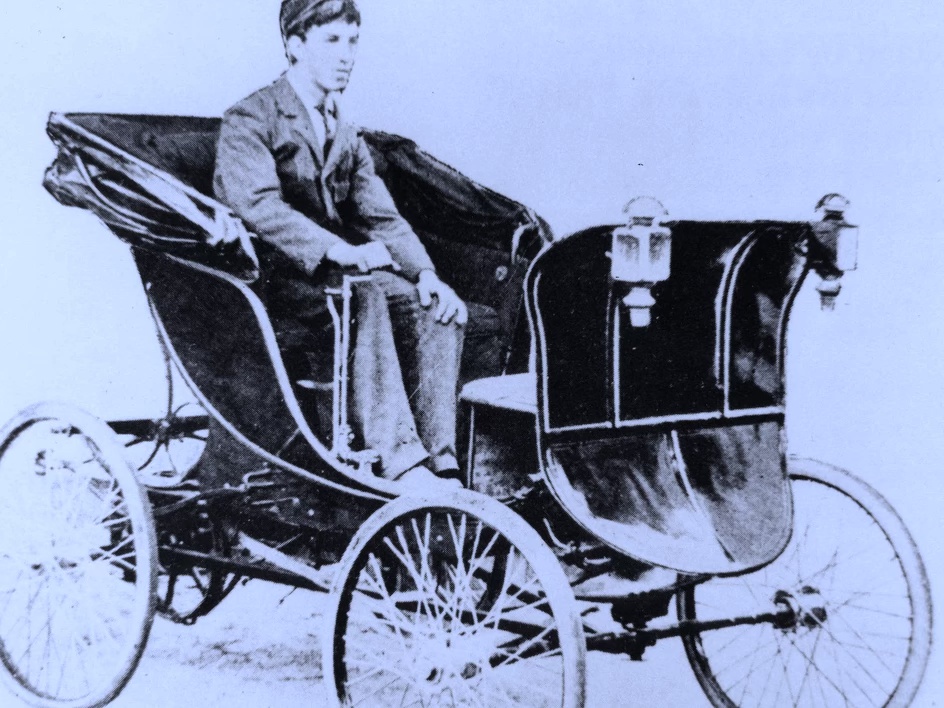
From the Toronto Sun, “Seen here is one of the few images of Frederick Barnard Fetherstonaugh’s pioneer electric vehicle. It was built in 1896 in John Dixon’s carriage factory on Toronto’s Bay St. Unfortunately, no one knows what happened to this uniquely Canadian creation.”

And Sadie Makes Three

On March 1, 1898, John Richard Hogarth Jr., married Alice Lavina Nelson Weegar. She was born February 25, 1880 — died, July 1, 1910. Alice was the daughter of Jacob Nelson Weegar* and Elizabeth Louisa (Herdon) Weegar.

From Ontario, Canada, Marriages, 1826-1942.

*It’s a bit odd, but sometimes her father Jacob Nelson Weegar dropped his surname Weegar and used Nelson as his surname, which it was not. The marriage record above is an example of this. What was the reason for this reinvention? We really don’t know, but we will put forward our theories in the upcoming The Weegar Line, A Narrative chapters.

From Ontario, Canada Births, 1832-1917.

On December 18, 1898, John and Alice welcomed the birth of their daughter Sarah Alice Elizabeth Hoggarth. In her life, Sarah liked to be called Sadie. (Our family members are descended from Sadie.) Being born 9 months and three weeks after their marriage, gave Sadie honeymoon baby status! (3)

To Renounce Forever All Allegiance and Fidelity To Any Foreign Prince…

John Hoggarth Jr. traveled to the United States and on August 15, 1905, signed a declaration that it was “my intention to become a citizen of the United States…” He also wrote that he had first visited the United States on July 3, 1900.

Shown above is John Richard Hoggarth Jr’s 1905 Declaration “to become a citizen of the United States” along with the 1905 flanking flags of Canada and the United States.

We don’t know why they chose to immigrate to the United States in 1905. Sometimes these matters have to do with employment and prosperity. They may have been following Alice’s family, since we can observe that they are living in the house of her father Jacob Nelson Weegar in Rockport, Cuyahoga County, Ohio. This is just across Lake Erie from Canada.

The 1910 United States Federal Census for Rockport, Cuyahoga County, Ohio.

Some of the other details we can discern are: John is working as a carpenter and the family is already naturalized. This census also confirms their 1905 immigration date. This west side of Cleveland suburb (Rockport) later became the Village of Rocky River. On maps from that period, their home is actually shown as being in the adjacent community of Lakewood.

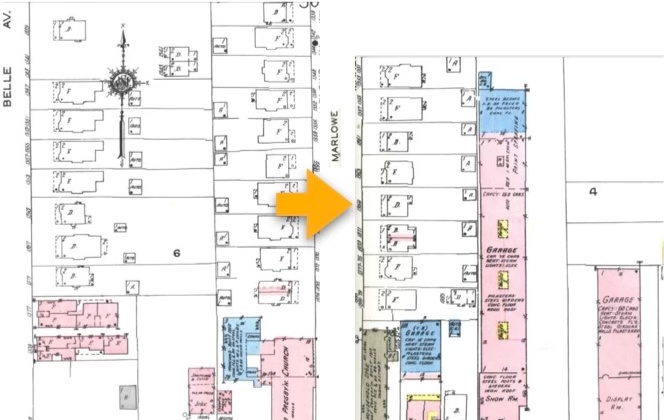
In these 1952 maps of Cleveland, Ohio, we can get a sense of where the Hoggarth family lived. Above: The community of Lakewood (number 12) is located on the west side of Cleveland . Below: 1369 Marlowe Avenue, (Rockport neighborhood) Lakewood, where they lived with the Jacob Nelson Weegar family. (See footnotes for sources).
1369 Marlowe Avenue, Lakewood, Ohio. (See footnotes for sources).

We have been fortunate to locate a photograph of John Hoggarth. Comment: However, it is a bit difficult to date this image because this is a black and white photo and there is clearly some visible distortion. He appears to have blond hair and lightly colored eyes. The detachable collar he is wearing was a popular item for men’s fashion from circa the 1890s through 1915. He might be wearing a winter coat? We are guessing that this could have been taken around the time of his second marriage in 1914. (4)
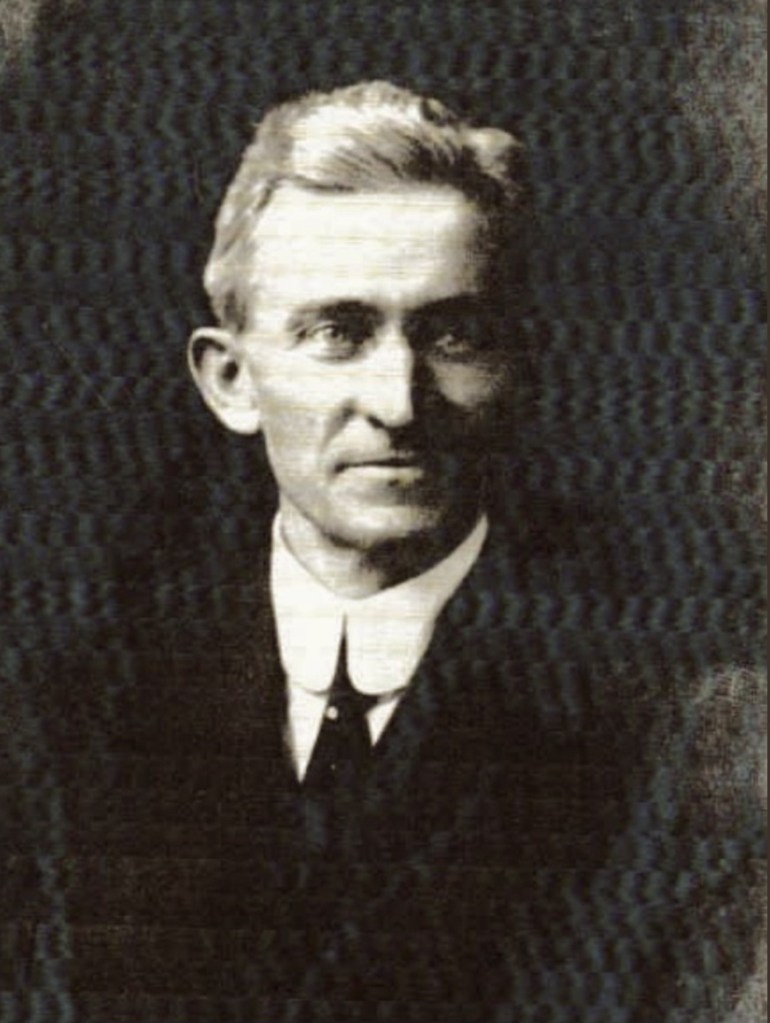
Photograph of John Richard Hogarth Jr.

JHR Jr. Marries For A Second Time

Alice Lavina (Weegar) Hoggarth died in 1910 and four years after her death John remarried on May 21, 1914. His new wife was Teresa M. (Sirl) Payton. Teresa was born in Germany about 1879 and was the daughter of Carl Sirl and Margaret Nagel. She had been married to William Payton in 1899, but the marriage ended in divorce in March 1914.
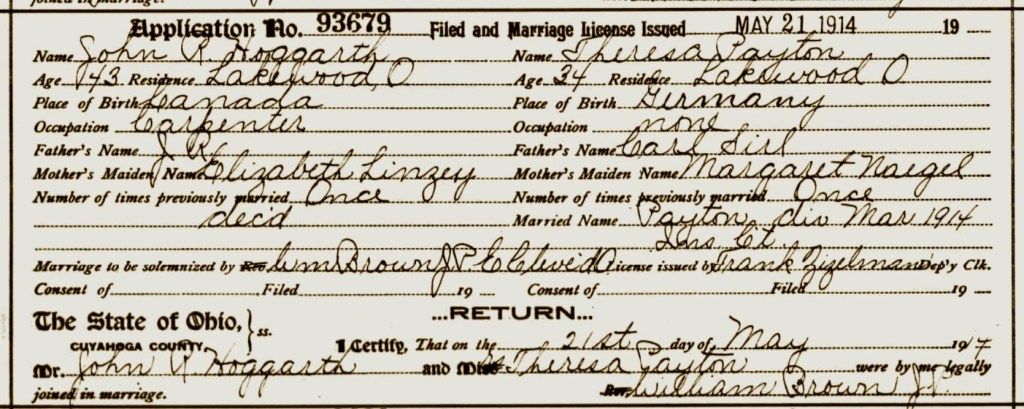
From the Cuyahoga County, Ohio, U.S., Marriage Records and Indexes, 1810-1973.

Theresa brought her three daughters to the marriage: Margaret (Payton) Hoggarth Rhoades (1900-1976), Helen F. (Payton) Hoggarth (1901-1978), and Eleanor (Payton) Hoggarth (1906-1965). Now the Hoggarths were a blended family of six, including John’s daughter Sadie. (5)
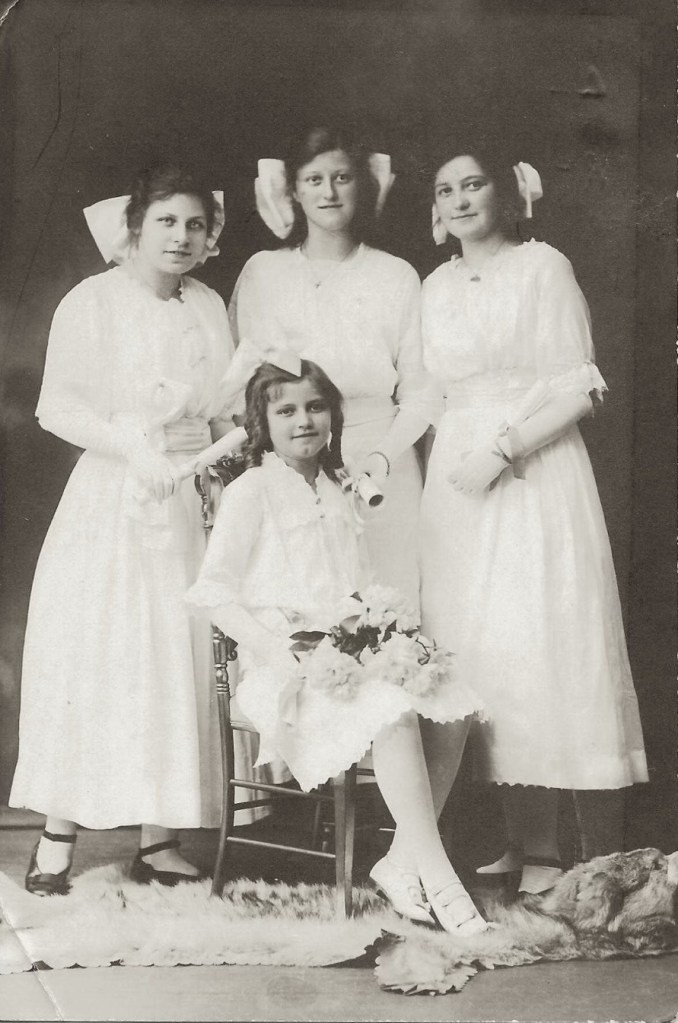
The Hoggarth sisters circa 1916.
In the front: Eleanor; in the back, left to right: Sadie, Helen, and Margaret.

The Hoggarth Sisters

Sadie
(aka Sarah Alice Elizabeth)
Sadie’s story will continue on in The White Line,  A Narrative — Four.
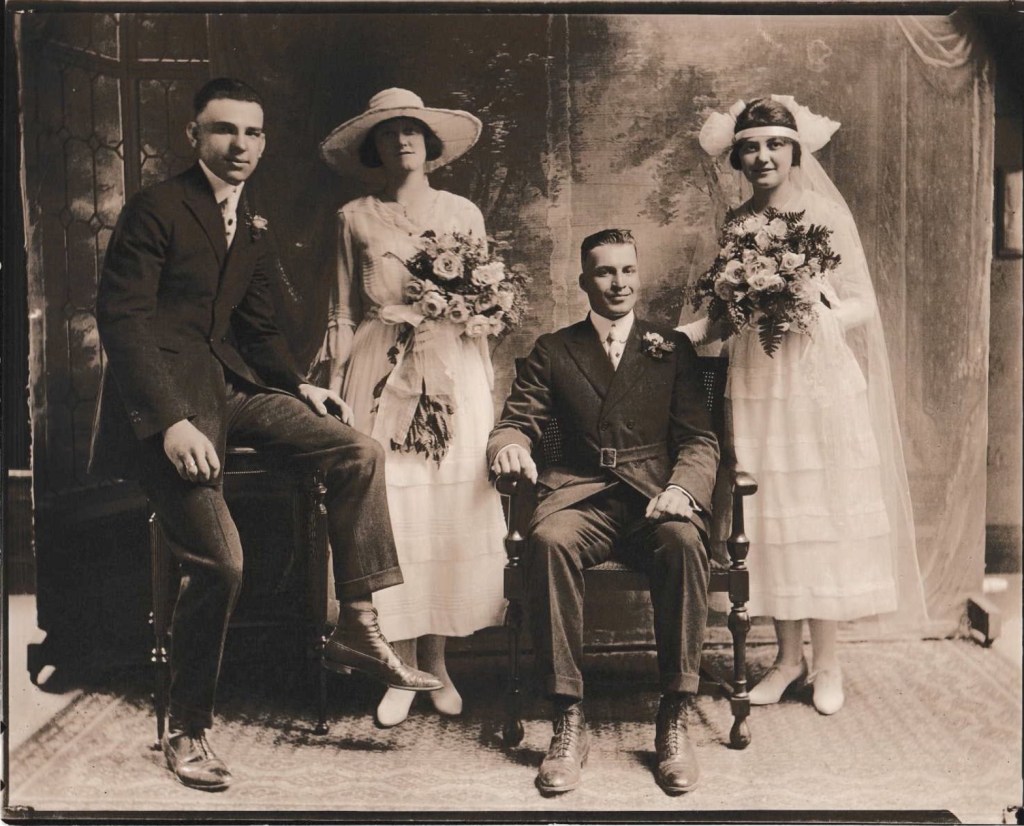
Wedding photograph for the June 1920 wedding of Melvin Jacob Rhoades to Margaret Payton Hoggarth. From right to left: Margaret, Melvin, Bridesmaid Helen Hoggarth, and unknown man.

Margaret
On June 9, 1920, Margaret married Melvin Jacob Rhoades and they lived the rest of their adult lives in the Washington, D.C., area. They had a daughter named Aleen Marie (Rhoades) Cooley. Margaret passed on in 1976 and is buried in Winchester City, Virginia.

Helen and Eleanor
They seem to have lived with their parents for their adult lives. Helen worked for many years as a bookkeeper and accountant. She eventually worked her way up to become the Chief Clerk for the Cleveland Electric Illuminating Company. (6)

The Cleveland City Directory of 1925

1925 finds the family continuing to live at 1430 Winchester Avenue in Lakewood, Ohio. Sadie is not listed in the census because she was working as an accountant and lodging in the home of her maternal grandfather Jacob Nelson Weegar.

1430 Winchester Avenue, Lakewood, Ohio. (See footnotes for sources).

Census materials have consistantly identified John’s trade as being a carpenter. We see this again in the Cleveland City Directory for 1925 on page 1457. He is listed at his home address, as his daughter Helen. (7)

The 1940 Census

The last census we find John Richard Hoggarth Jr. in is the 1940 census. He is 69 years old and likely retired because no occupation is listed. His wife Teresa (60), daughters Helen F. (39), Eleanor (33), and his grandson Richard L. Rhoades (16), are also living there. Their home is at 1467 Belle Avenue in Lakewood, Ohio in a neighborhood where they have lived in since migrating from Canada many years earlier.

1467 Belle Avenue, Lakewood, Ohio. (See footnotes for sources).

John Richard Hoggarth Jr. died on May 7, 1946. His cause of death was heart failure, and his wife Theresa lived on for another few years, passing on in 1950. Eleanor Hoggarth passed on February 22, 1965, and her sister Helen Hoggarth passed on August 2, 1978. The oldest daughter Sarah Alice Elizabeth (Hoggarth) White [i.e. Sadie], outlived all of them. She is our ancestor who will carry forward the history in the next chapter. (8)

Following are the footnotes for the Primary Source Materials, 
Notes, and Observations

Place Names Change All The Time

(1) — six records

John Richard Hogarth [Jr]
in the 1871 Census of Canada
Ontario > Wellington South > Guelph
https://www.ancestry.com/discoveryui-content/view/records?recordId=2934486&collectionId=1578&tid=&pid=&queryId=c48e496c-bc1a-429a-a0e4-18a6d835b46f&_phsrc=UYo20&_phstart=successSource
Digital pages: 500-501/544

Toronto Public Library
Digital Archive
The Toronto City Directory for 1890
by R.L. Polk & Co.
https://digitalarchive.tpl.ca/internal/media/dispatcher/2117803/full
Book page: 798
Note: For John Hogarth working as a carriage builder.

Historical Maps of Toronto
1893 Fisk and Co. Map of Toronto
http://oldtorontomaps.blogspot.com/2013/01/1893-fisk-and-co-map-of-toronto.html
Note: For the 9 Alice Street location.

The Lost Street Names of Toronto
by Chris Bateman
https://www.blogto.com/city/2012/03/the_lost_street_names_of_toronto/

Historical Maps of Toronto
1893 Barclay, Clark & Co. Bird’s Eye View Chromolithograph
by Barclay, Clark & Co. Lithographers
http://oldtorontomaps.blogspot.com/2013/01/1893-barclay-clark-co-birds-eye-view.html

John R Hoggarth
in the 1891 Census of Canada

https://www.ancestry.com/search/collections/1274/records/4103741
Book page: 24 , Digital page: 43/164, Upper page, entries 10 through 12.

The Dixon Carriage Works

(2) — seven records

Guelph Museums
McConnell’s Carriage Works Employees, c.1885
https://guelph.pastperfectonline.com/Photo/E850C32F-A117-455E-A4AA-466016278749

Laboring All Our Lives
Carriages And Wagons: From Minor Repair Work To Manufacturing
by Bonnie Durtnall
https://labouringallourlives.ca/carriages-and-wagons-from-minor-repair-work-to-manufacturing/
Note: For sepia toned photograph of carriage workers and excerpt from article.

For the Dixon collage (next three entries):
Toronto Public Library
Digital Archive
‘Lawton Park’, Yonge St., northwest corner of Heath St. West looking west, Toronto, Ontario
(circa 1896) 
Photograph by John Fisken
https://digitalarchiveontario.ca/objects/347844/fisken-john-lawton-park-yonge-street-northwest-corner?ctx=59219743900965fdde01e5eb65710c99b013da37&idx=99

Toronto Public Library, Digital Archive
Receipt of customer John Lauder Esq. Part of Morris Norman donation of business papers, 2002. [purple receipt]
To William Dixon, carriage manufacturer, carriages, buggies and sleighs of every description kept on hand or made to order, 1873
https://digitalarchiveontario.ca/objects/386538/to-william-dixon-carriage-manufacturer-carriages-buggies?ctx=af05aeea4ce078725be902414073ca6a4dc45d9e&idx=13

Adelaide Street During the Duke’s Visit (1901)
Stereocard by M. H. Zahner
https://jenikirbyhistory.getarchive.net/media/adelaide-street-during-dukes-visit-1901-358964
“A stereocard showing decorations on Adelaide Street in Toronto, Ontario, Canada, in anticipation of the royal tour by the Duke of Cornwall and York (the future George V)”.
William Dixon
1834- 1904,  St. James Cemetery
https://www.findagrave.com/memorial/257650592/william_dixon
Note: For biographical information.
“William became a very accomplished Carriage Maker and at one point was in partnership with his brother, John. The Dixon Brothers Coach and Carriage Manufacturers was located at 149 Queen St. in 1863. They parted ways and each opened their own businesses in Toronto. William Dixon’s Longacre Carriage Works was on Adelaide St. West.”

Toronto Sun
THE WAY WE WERE: Early electric car developed in Toronto
by Mike Filey, published January 25, 2020
https://torontosun.com/opinion/columnists/the-way-we-were-early-electric-car-developed-in-toronto

And Sadie Makes Three

(3) — three records

John Richard Hoggarth
in the Ontario, Canada, Marriages, 1826-1942

Wellington > 1898
https://www.ancestry.com/search/collections/7921/records/3343865
Digital page: 41/99

Alice Lavina Weegar Hoggarth
https://www.findagrave.com/memorial/81820811/alice_lavina_hoggarth
Notes: Additional material from the findagrave.com website —
BIRTH, 25 Feb 1880
Whitby, Durham Regional Municipality, Ontario, Canada
DEATH, 1 Jul 1910 (aged 30)
Lakewood, Cuyahoga County, Ohio, USA
Name: Hoggarth, Alice L.
Date: July 4, 1910
Source: unknown, Reel #38
Notes: Hoggarth-Alice L. (nee Weegar), wife of J. R. Hoggarth, at her residence, 1369 Marlowe st., Lakewood, Friday, July 1…

John Richard Hoggarth
in the Ontario, Canada Births, 1832-1917

York > 1890-1899
https://www.ancestry.com/search/collections/8838/records/15569540
Note: For the birth of daughter Sadie.

To Renounce Forever All Allegiance and Fidelity To Any Foreign Prince…

(4) — eight records

J R Haggarth
Migration – Ohio, County Naturalization Records, 1800-1977

https://www.familysearch.org/ark:/61903/3:1:3QSQ-G996-KWFQ?view=index&personArk=/ark:/61903/1:1:QGT8-TP93&action=view&cc=1987615
Book page: 397, Digital page: 238/290
Note: Declaration No. 19790, signed August 15, 1905.

John Richard Hoggarth
in the Ohio, U.S., County Naturalization Records, 1800-1977

https://www.ancestry.com/search/collections/60096/records/56842
Note: Although born in Canada, (on this form) his birthplace is noted as Great Britain because Canada is under the dominion of Great Britain, i.e. the British Empire.

The World Flag Chart
Flags of 1905
https://flaglog.com/1905

John R Hogarth
in the 1910 United States Federal Census

Ohio > Cuyahoga > Rockport > District 0036
https://www.ancestry.com/discoveryui-content/view/records?recordId=135419572&collectionId=7884&tid=&pid=&queryId=33c5abe8-055a-44ff-84a3-0d93d935f7a4&_phsrc=UYo16&_phstart=successSource
Digital page: 3/36 Entry lines 12-14.
Note 1: He is living with his wife Alice in the house of his father-in-law Jacob Nelson Weegar.
Note 2: Working as a carpenter and already naturalized.
Note 3: Confirms their 1905 immigration date.

Library of Congress
Sanborn Fire Insurance Map from Cleveland, Cuyahoga County, Ohio
Vol. 12, 1913; Republished 1952
https://www.loc.gov/resource/g4084cm.g4084cm_g06648195212/?st=gallery
Note: For Lakewood community location.
and
1369 Marlowe Avenue links: (2 limages were joined to create the one image)
https://www.loc.gov/resource/g4084cm.g4084cm_g06648195212/?sp=41&st=image&r=-0.505,0.007,1.94,0.779,0
and
https://www.loc.gov/resource/g4084cm.g4084cm_g06648195212/?sp=42&st=image

John Richard Hoggarth
Photo gallery image (year unknown)
https://www.ancestry.com/family-tree/person/tree/67591201/person/32170163263/gallery?galleryPage=1&tab=0&sort=-created&filter=s,p

JHR Jr. Marries For A Second Time

(5) — six records

[Second marriage]
John R Hoggarth
in the Cuyahoga County, Ohio, U.S., Marriage Records and Indexes, 1810-1973
1901-1925

Reel 049 > Marriage Records 1913 Dec – 1914 Jul
https://www.ancestry.com/discoveryui-content/view/records?recordId=1056511&collectionId=1876&tid=&pid=&queryId=6d9ae5ff-a37b-4b19-9bdc-176ce36bacb6&_phsrc=oMw6&_phstart=successSource
Note: For marriage to Sirl/Taylor, 21 May 1914.

Theresa M Hoggarth
in the U.S., Find a Grave Index, 1600s-Current

https://www.ancestry.com/search/collections/60525/records/40783284
and
https://www.findagrave.com/memorial/81821100/theresa-m-hoggarth
Notes: Additional material from the findagrave.com website —
Married:
1. William Payton, 26 Oct 1899, Cleveland, Cuyahoga, Ohio
2. John Richard Hoggarth, 21 May 1914, Cuyahoga county, Ohio
Id#: 0150639
Name: Hoggarth, Theresa R
Date: Nov 3 1950
Source: Cleveland Press; Cleveland Necrology File, Reel #038.
“Hoggarth, Theresa R wife of the late John R., beloved mother of Mrs. Margaret Rhoades of Washington, D. C., Helen and Eleanor; grandmother and great-grandmother; residence, 1467 Belle Ave. “Friends may call at the Daniels Funeral Home, 15800 Detroit Ave. Services at St. Clement’s Church (corner of Marlow and Madison). Monday, Nov 6, at 10 a. m.”
Observation: We noticed that the findagrave.com notes do not mention her marriage to William Payton, nor her daughter Margaret.
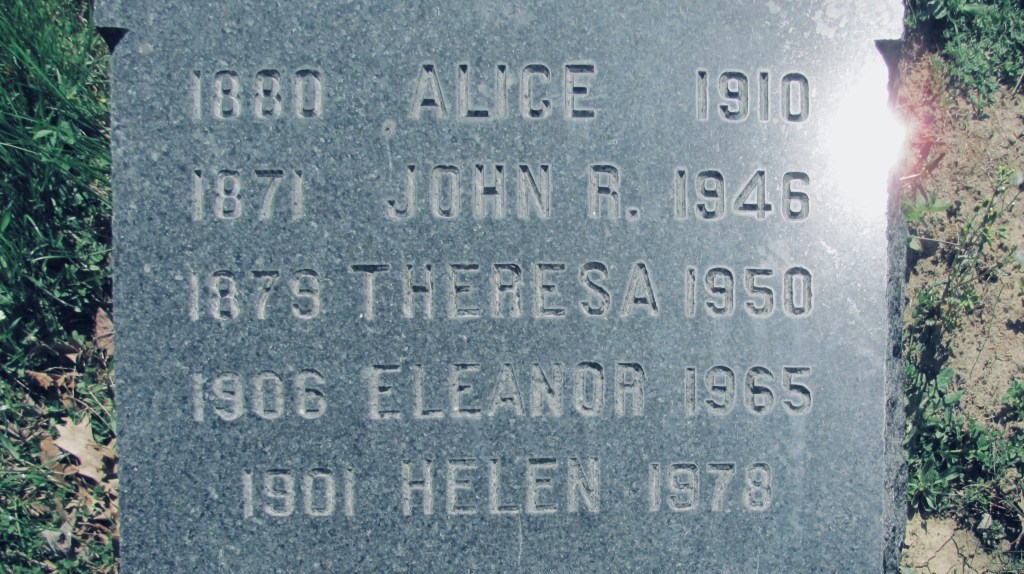
Hoggarth family memorial marker from Alger Cemetery, Cleveland, Cuyahoga County, Ohio. (Source: findagrave.com)

Theresa Sirl
in the Cuyahoga County, Ohio, U.S., Marriage Records and Indexes, 1810-1973

https://www.ancestry.com/search/collections/1876/records/2446703
Note: Her 1899 marriage to William Payton.

Sara E Hogarth
in the 1920 United States Federal Census

Ohio > Cuyahoga > Cleveland Ward 26 > District 0491
https://www.ancestry.com/search/collections/6061/records/76428272
Book page 21B, Digital page: 42/45, Entries 71 through 76.
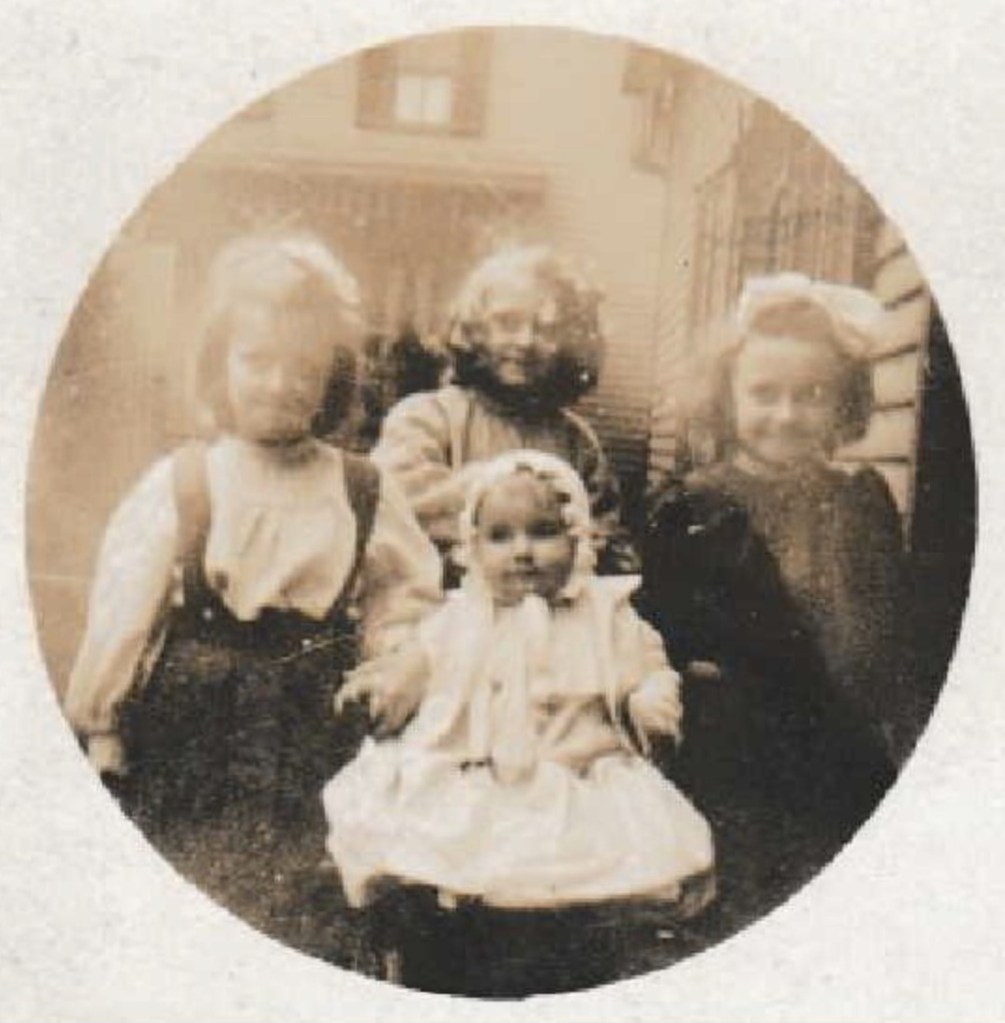
Postcard image from left to right, The Payton (Hoggarth) sisters when very young:
Eleanor, Margaret, Helen. (The identity of the infant is unknown).

Hogarth Sisters Helen, Margaret & Eleanor (photo)
https://www.ancestry.com/mediaui-viewer/collection/1030/tree/67591201/person/32170178138/media/5ca89bf4-7a07-460f-a089-fef75ff2080c?queryId=85ecad9f-8ae6-42fb-91a2-7b17be9d01f2&searchContextTreeId=&searchContextPersonId=&_phsrc=hWy1&_phstart=successSource
Note: Description from the file: “Sent by Terry Rhoades Gallagher granddaughter of Margaret.. This picture is a postcard from right to left Aunt Helen, My ( Terry ) my grandmother Margaret, & Aunt Eleanor..I don’t know who the baby is??”

The Hoggarth Sisters

(6) — seven records

Sadie A Hoggarth (photo)
https://www.ancestry.com/mediaui-viewer/tree/67591201/person/270136386791/media/e4588971-178e-4e6b-a8b7-a46cbb85d5dd
Note: We used this file is for the Hogarth sisters photograph only. Other data on the file is not completely accurate.

Margaret Payton Hoggarth
in the Ohio, U.S., County Marriage Records, 1774-1993

Cuyahoga > 1915 – 1930
https://www.ancestry.com/search/collections/61378/records/902399184
Book page: 454, Digital page: 222/1274, Last entry on the page.
Note: Records for her life spell her married surname in two forms: Rhodes, and Rhoades.

Margaret P. Rhoades
https://www.findagrave.com/memorial/3007801/margaret-p.-rhoades
Note: Additional material from the findagrave.com website —
BIRTH: 10 Mar 1900
DEATH: 22 Nov 1976 (aged 76)

Wedding Rhoades Hogarth 9 Jun 1920 Cuyahoga County Ohio (photo)
https://www.ancestry.com/mediaui-viewer/collection/1030/tree/67591201/person/32170178138/media/283d5dd5-6a56-4216-b0bf-b40cfa021bdd?queryId=23e78a18-b49c-4e3a-888e-a67d67a6bd74&searchContextTreeId=&searchContextPersonId=&_phsrc=UIM8&_phstart=successSource
Note: Description from the file: “Melvin & Margaret Hogarth Rhoades.. Maid of honor Helen Hograth, Margaret’s oldest sister.. I don’t know who the man is sitting on the table…. Picture was shared by Theresa Rhoades Gallagher..”
Note: For the Hoggarth/Rhoades wedding photograph.

Helen F Hoggarth
https://www.findagrave.com/memorial/81821098/helen-f-hoggarth
Note: Additional material from the findagrave.com website —
BIRTH: 1901
DEATH: 2 Aug 1978 (aged 76–77)

Helen F Hoggarth
in the U.S., City Directories, 1822-1995

Ohio > Lakewood > 1954 > Lakewood, Ohio, City Directory, 1954
https://www.ancestry.com/search/collections/2469/records/310934844?tid=&pid=&queryId=3e0a0e5d-706c-4e35-833b-9208dade123c&_phsrc=hWy7&_phstart=successSource
Book page: 291, Digital page: 159/667, Right page, left column, near top.

Eleanor Hoggarth
in the U.S., Find a Grave Index, 1600s-Current

https://www.findagrave.com/memorial/81821097/eleanor-hoggarth
Note: Additional material from the findagrave.com website —
BIRTH: 1906
DEATH: 22 Feb 1965 (aged 58–59)
Name: Hoggarth, Eleanor
Date: Feb 26 1965
Source: Plain Dealer; Cleveland Necrology File, Reel #118.
“Hoggarth. Eleanor Hoggarth, dearly beloved sister of Margaret Rhoades and Helen Hoggarth, dear aunt of John and Richard Rhoades and Aleen Cooley, daughter of the late John and Theresa (Sirl), suddenly Monday, late residence, 1467 B? Ave. “Friends received at the Nickels Funeral Home, 14500 Madison Ave. Funeral mass Friday, Feb. 26, St. Clement Church at 11 a. m.”

The Cleveland City Directory of 1925

(7) — three records

Sanborn Fire Insurance Map from Cleveland, Cuyahoga County, Ohio
https://www.loc.gov/resource/g4084cm.g4084cm_g06648195212/?st=gallery
Vol. 12, 1913; Republished 1952
Note: 1430 Winchester Avenue link https://www.loc.gov/resource/g4084cm.g4084cm_g06648195212/?sp=73&st=image&r=0.176,0.087,1.164,0.467,0

John R Hoggarth
in the U.S., City Directories, 1822-1995

Ohio > Cleveland > 1925 > Cleveland, Ohio, City Directory, 1925
https://www.ancestry.com/discoveryui-content/view/records?recordId=291671963&collectionId=2469&tid=&pid=&queryId=248734e5-a90c-47e0-b13d-51bf2d14ba6a&_phsrc=UYo1&_phstart=successSource
Book page: 1457, Digital page: 726/1773, Right page, right column., center.

The 1940 Census

(8) — five records

John R Hoggarth
in the 1940 United States Federal Census

Ohio > Cuyahoga > Lakewood > 18-197
https://www.ancestry.com/search/collections/2442/records/30209052
Book page: 7B, Digital page: 14/22

Sanborn Fire Insurance Map from Cleveland, Cuyahoga County, Ohio
https://www.loc.gov/resource/g4084cm.g4084cm_g06648195212/?st=gallery
Vol. 12, 1913; Republished 1952
Note: 1467 Belle Avenue link https://www.loc.gov/resource/g4084cm.g4084cm_g06648195212/?sp=57&st=image&r=-0.371,0.138,1.617,0.649,0

John R Hoggarth
https://www.findagrave.com/memorial/81821099/john_r_hoggarth
Notes: Additional material from the findagrave.com website —
Id#: 0150638
Name: Hoggarth, John R.
Date: May 10 1946
Source: Source unknown; Cleveland Necrology File, Reel #038.
Hoggarth: John R., beloved husband of Theresa (nee Sirl); father and grandfather; residence 1467 Belle Ave. Services in charge of Holy Grail Commandery Knight Templar. No. 70.
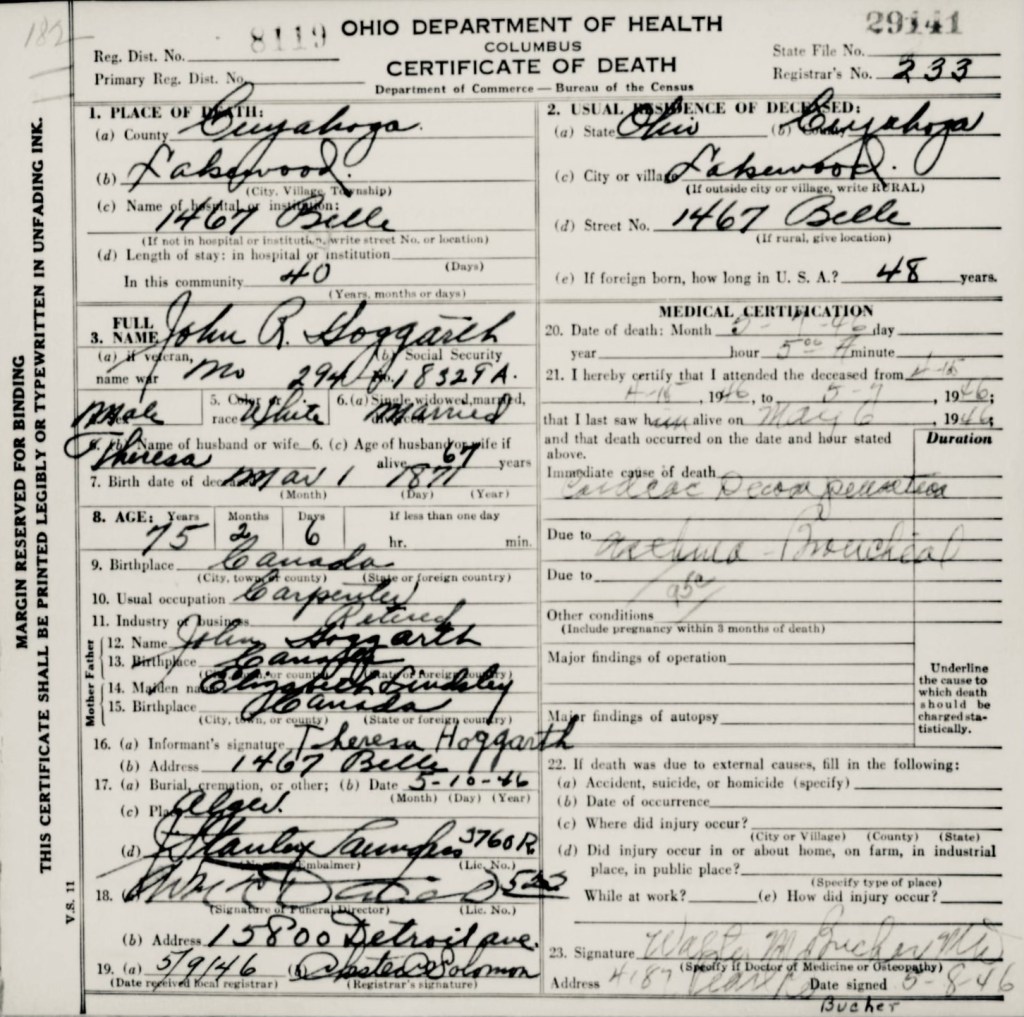
1946 Death Certificate for John Richard Hoggarth Jr.

John R Hoggarth
https://www.ancestry.com/mediaui-viewer/tree/2100335/person/6776450855/media/755efcb5-c0fe-4f87-9d66-ca33af9a06d1
Note: For death Certificate file.

The Hoggarth Line, A Narrative — One

This is Chapter One of two. Researching family lines is a little bit like digging through the soil of a garden where other people had previously had their own version of a garden. You find roots and old growth that lead you in different directions. Sometimes you find an old root that just keeps on going, and going, but you never find the end.

This chapter is about the Hoggarth family line. It will connect up to The Weegar Line — A Narrative, and The White Line — A Narrative. You will notice that this family surname was sometimes spelled slightly different depending upon who was recording the information. Sometimes as Hogarth, and sometimes as Hoggarth with the additional G.

Preface

Does anyone remember when everyone’s mothers had a set of brightly colored Tupperware bowls which nested inside of each other? Think about those bowls as a “stand-in” for understanding how one’s awareness shifts as we each grow up and experience new things. Every phase of our life lifts us outward from the center bowl, on to the next one, as our thinking and consciousness expands.

We grew up in the Great Lakes region of the United States, a land known for snowy winters, hot summers, and football. Our parent’s home was in Newbury township in Geauga County, Ohio just below the southern edge of Lake Erie. Technically speaking, we were about 25 miles east-southeast of the city of Cleveland, but out where we were living, it wasn’t even the suburbs — it was the country. In the summertime, while chasing fire flies in the backyard, one could gaze westward, and see the distant glow of the Cleveland lights under the dome of the night sky. We never thought much about things beyond those horizons.

After we each moved away, we came to appreciate just how close we had lived to another country — Canada — which was just across Lake Erie. Back then, neither of us paid any attention to that. Everyone is familiar with the long northern United States / Canada border which runs along the 49th parallel. What is astonishing about that line is this…

“Actually, many of Canada’s most populated regions (and about 72% of the population) are south of the 49th parallel, including the two largest cities Toronto (43°42′ north) and Montreal (45°30′ north). The federal capital Ottawa (45°25′ north), and the provincial capital of seven provinces (Ontario, Quebec, New Brunswick, Prince Edward Island, Nova Scotia, Newfoundland and Labrador, and British Columbia) are south of the 49th parallel. Three provinces, New Brunswick, Prince Edward Island, and Nova Scotia, are each entirely south of the parallel, but the vast majority of Canadian territory lies north of it.” (Wikipedia)

In other words, Canada has a lot of territory, but just about everyone likes to live near the Great Lakes. One branch of our family, the Hoggarths, were in this part of Canada early on and in this chapter we will be writing about their lives. (1)

The Province of Upper Canada

“The Canada Company was a private British land development company that was established to aid in the colonization of a large part of Upper Canada. It was incorporated by royal charter on August 19, 1826, under the Canada Company Act 1825 of the British parliament, which was given royal assent on June 27, 1825.” (Wikipedia)

Much of this area had been ravaged during the war of 1812. Prior to this, many of the settlers in Upper Canada had come from the American Colonies — some as Loyalists during the Revolutionary War. The British Crown was interested in fostering interest there in new settlement, by people who did not come from the American Colonies.

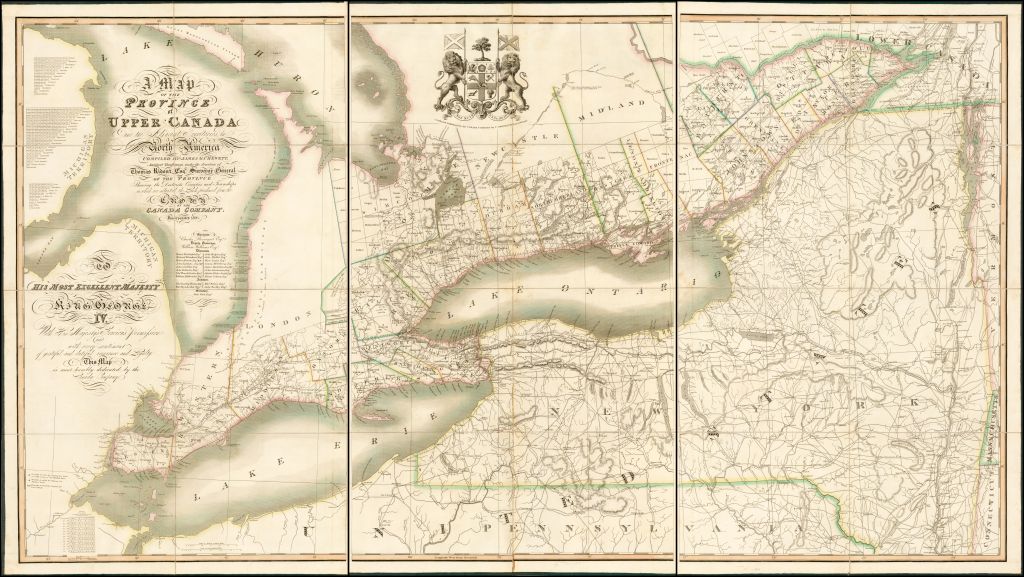
The three panel map below was produced in London in 1826. Its purpose being to show prospective new settlers the Royal Territories in Upper Canada. (2)

A Map of the Province of Upper Canada and the Adjacent Territories in North America … Shewing the Districts, Counties and Townships in which are situated the Lands purchased from the Crown by The Canada Company“. (Image courtesy of the Stanford Libraries).

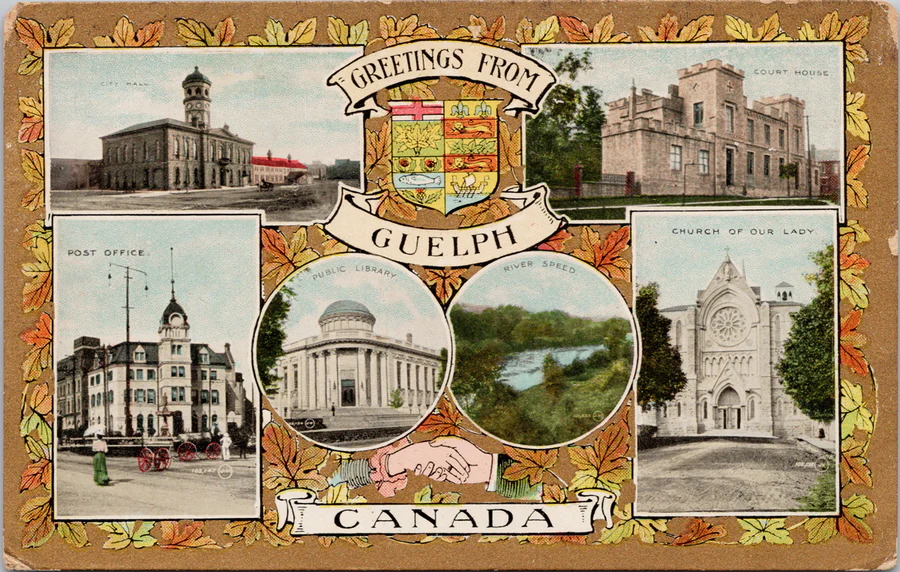
Where is the Town of Guelph?

The enlarged map detail below shows where the town of Guelph was established around the time that this map was created. [See the orange circle at the west end of Lake Ontario and the city of Toronto]. This area was eventually organized as Wellington County.

“Guelph began as a settlement in the 1820s, established by John Galt, who was in Upper Canada as the first superintendent of the Canada Company. He based the headquarters, and his home, in the community. The area—much of which became Wellington County—was part of the Halton Block, a Crown reserve for the Six Nations Iroquois. Galt is generally considered Guelph’s founder… [He designed] the town to resemble a European city centre, complete with squares, broad main streets and narrow side streets, resulting in a variety of block sizes and shapes which are still in place today.” (Wikipedia)

“The founding was symbolized by the felling of a tree by Galt and William “Tiger” Dunlop… The name Guelph comes, via the Italian Guelfo, from the Bavarian Welf. It is a reference to the House of Welf, and was chosen to honour King George IV—the reigning British monarch at the time of the city’s founding—whose family, the Hanoverians, descended from the Welfs. It is for this reason that the city has the nickname The Royal City.” (Wikipedia)

From left to right: Left, Portrait of John Galt, by Charles Grey, 1835. Center, Coat of arms for The Canada Company, circa 1828. Right: Lithograph of George IV in profile, by George Atkinson, printed by C. Hullmandel, 1821.

Who Were the John Richard Hogarth Sr. Family?

When we first meet John Richard Hogarth Sr., he is 33 years old, and married to his wife Elizabeth who is 28. They are the parents of three daughters: Annie 5, Almira 3, and Sarah 1. (We learned this from the 1861 Census of Canada, conducted in their province on January 14, 1861).

They are living in the young city of Guelph, Wellington County, Ontario, and he is working as a “f__ier”. We can also see that he is from England.

The 1861 Census for the town of Guelph, Wellington, Canada.

We do not know where he and Elizabeth married, nor exactly what year they came to live in Upper Canada. However, we did find their final resting places in the Woodlawn Memorial Park cemetery. From that we learned the following:

John Richard Hogarth was born in 1826, and from the 1861 census data, we know that it was in England. He died on December 19*, 1871 in Toronto, York County, Ontario. (We will cover the events surrounding his death further down in this narrative). Elizabeth Jane (Lindsay) Hogarth was born in 1839, also in England. She died May 22, 1893 in Guelph, Wellington County, Ontario. Please see the footnotes for a complete list of their children.
*His official death certificate states December 19, 1871, but the findagrave website lists December 20. (3)

Furrier versus Farrier

Trying to discern quill pen writing can be a real challenge to interpret in some of these old documents. When we first came across something that listed John Richard Hogarth Sr.’s profession, we honestly thought it said “furrier” which was intriguing. (Did his wife Elizabeth have gorgeous coats to wear to church?) However, it later became clear that we had not looked closely enough. JRH was what is known as a “farrier” which is the polar opposite of a furrier. A farrier is a specialized blacksmith that shoes horses.

Britannica explains it well:
[A blacksmith is a] “craftsman who fabricates objects out of iron by hot and cold forging on an anvil. Blacksmiths who specialized in the forging of shoes for horses were called farriers. The term blacksmith derives from iron, formerly called “black metal,” and farrier from the Latin ferrum, [for] iron.

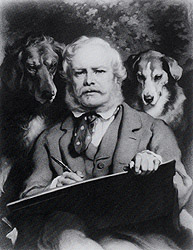
Shoeing, 1844. Painting by Sir Edwin Henry Landseer, held at the Tate Britain, London. (Image courtesy of Media Storehouse).

Blacksmiths made an immense variety of common objects used in everyday life: nails, screws, bolts, and other fasteners; sickles, plowshares, axes, and other agricultural implements; hammers and other tools used by artisans; candlesticks and other household objects; swords, shields, and armour; wheel rims and other metal parts in wagons and carriages; fireplace fittings and implements; spikes, chains, and cables used on ships; and the ironwork, both functional and decorative, used in furniture and in the building trades.”

From the Wellington County Directory and Gazetteer, 1871-1872, we learned that John’s farrier business was located in the old town section of Guelph, on Nottingham Street. The orange oval indicates the approximate location. (The map is from the year 1847, see footnotes).

The Guelph Historical Society writes: “In the earliest days of settlement, a blacksmith was an extremely important figure. He was the proverbial jack-of-all-trades. While farmers took care of their tools, it was the blacksmith who was trained to make and repair these same tools. Using forge, anvil and hammer, the blacksmith worked with the single most important and common metal of the period – iron…

Village Blacksmith (1947)
This simple silent film from British Pathé shows what it was like for a village blacksmith, or a farrier, to practice his trade. Note: if the film does not load, it can be viewed here: https://www.youtube.com/watch?v=Hs5WBTAzo6s

As Guelph was considered by many as a stop-over in its early years, the blacksmith was involved in a fair amount of vehicular repair. He saw to the shoeing of horses and acted as a veterinarian. This function was essential in a world where horses and oxen played a primary role. In fact, in May 1828, Lynch imported the first horse – a mare – and the first cow, which he loaned to community members. As the only horse within a 14-mile (20 kilometer) radius, she was so over-worked that her healthy condition rapidly deteriorated. Within a few months, she was skin and bones. Fortunately, a merchant, J. D. Oliver, imported a team of horses later that year and the mare received a well-earned rest.” (Guelph Historical Society) (4)

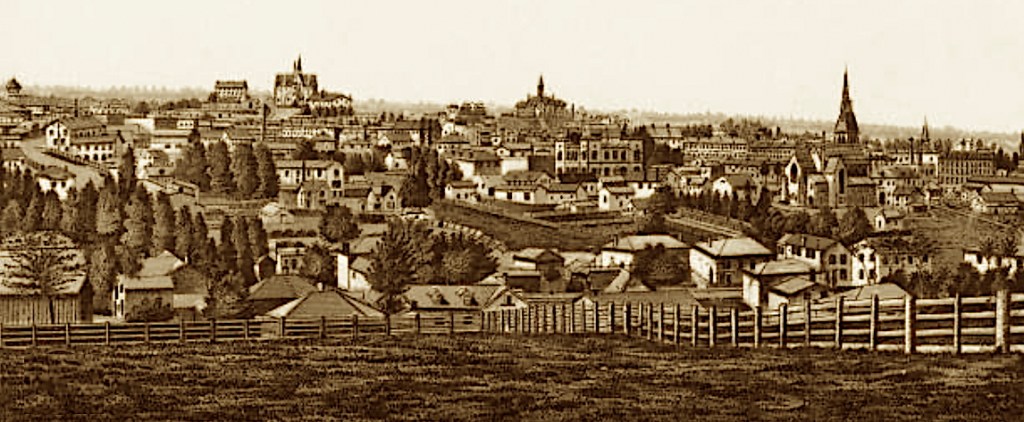
Cityscape of Guelph, Ontario, Canada – 19th Century. (Image courtesy of iStock by Getty Images).

Not All Children Are Found In A Census

When we looked at the files for John and Elizabeth’s gravesite information, we learned that they had a son who had died between the time of the 1861 and 1871 censuses. He was their first son and they named him John R (likely for the name Richard) Hogarth Jr. He was born in 1862 and he died on December 20, 1869, aged 6-7 years. We have observed in other family lines, that it was not unusual for parents to reuse lost children’s names with subsequent sibling births. (5)

The Tragedy in the 1871 Census

When we looked at the 1871 Census of Canada we were struck by a stark observation. Where was the father? This is what we were able to discern:

1) Although it was unusual to not have a father present, perhaps he was working somewhere else when the census was conducted?

2) A decade later the family has grown. There are now five daughters: Anne (14), who is not in school. The next three are all attending school — Elmira [Almyra Maud] (12), Sarah (11), Mary (9). Martha (4) is yet too young for school. We surmise that perhaps the oldest daughter Anne is not in school because she is helping her mother with the childcare of her siblings, or perhaps she has a job.

3) We see that another son has been born and that he has received the same name as his previous deceased brother. This is John Richard Hogart Jr. (2), from whom our family members are descended. [After this point we will drop the (2) designation from his identification and simple refer to him as Jr.]

4) Observation: This John Richard Hogarth Jr. (later in his life) identified different years for his birth depending upon when he was asked. We have observed this behavior in other family lines, and this is not unusual for the time period — because thoughts about one’s age were more fluid then. He eventually settled on the year 1871, but this census data makes us wonder if he was born in 1870, or 1871? Other pages of this census indicate ages younger than 1, such as 1/12 for a one month old child. John Jr.’s later records state that he was born March 1, 1871, so technically if that is true, he was one month old, and the census enumerator recorded his age incorrectly. Otherwise, he was 13 months old at the time of this census.

The 1871 Census of Canada for the community of Guelph, the Province of Ontario, conducted on April 2, 1871. Note: We excerpted the mother Elizabeth Hogarth from the bottom of the previous census page and inserted her with her family for this exhibit.

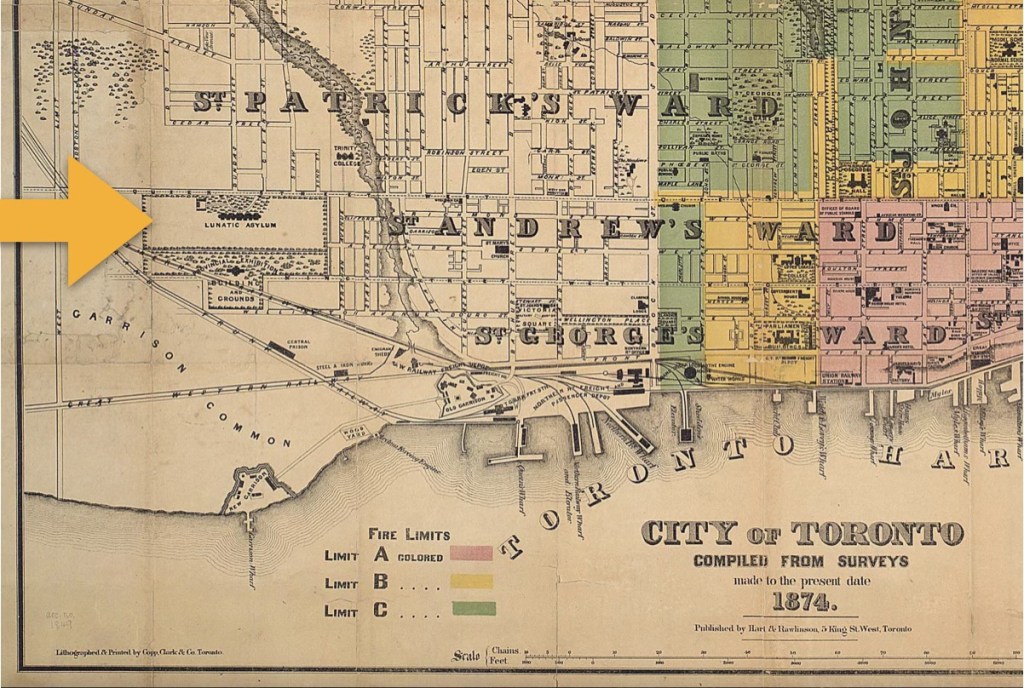
We cast a wider net in searching for John Richard Hogarth Sr. and found him in a nearby community, but there were surprises. He is shown below on line 18. If you scan the top columns left to right, the far right category is titled “Infirmities” with column 22 labeled as “Unsound mind”. Suddenly it now made sense why he had not been listed on the Guelph census. He was living in a nearby city and was recorded on the Toronto / York census. It seems that he was housed in an institution that was then referred to as a “lunatic asylum”. (6)

The 1871 Census of Canada for the Province of Ontario, conducted on April 2, 1871.

The Provincial Lunatic Asylum

In the Victorian era, medical science was evolving and mental health science was just non-existent. If someone had something that was viewed as incurable, they were frequently housed away from their home. It seems the John Richard Sr. was suffering from a “brain disease”, but we don’t specifically know what those terms mean today.

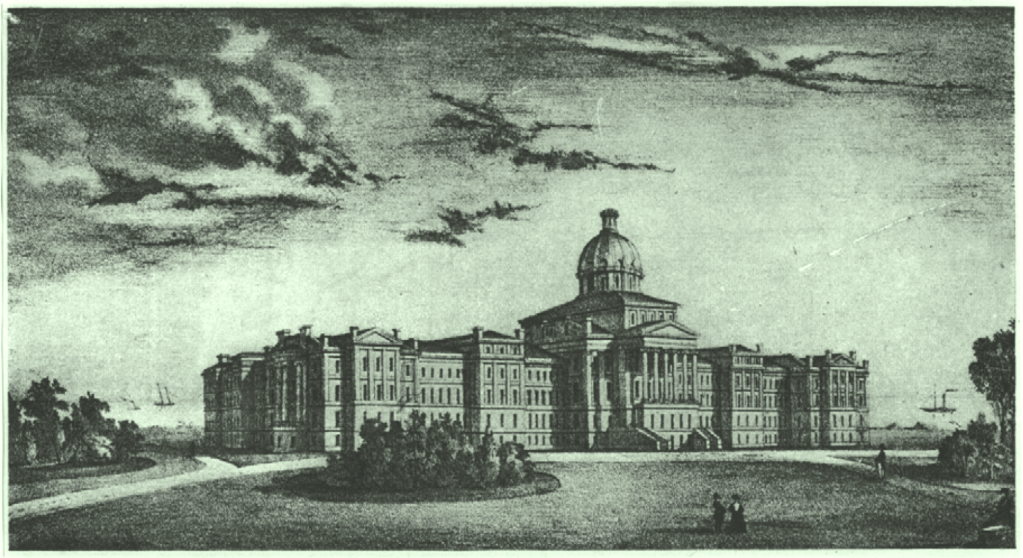
“Until the mid-19th century, mental illness was hidden away in Canadian society, and it was left to family members, prisons, and so-called “madhouses” to shoulder the responsibility of caring for the mentally ill. Around 1850, mental healthcare practices throughout North America were called into question and reforms were enacted. Reformers called for humane and hygienic treatment protocols, centralized in one institution, and this movement led to the construction of the Provincial Lunatic Asylum in the City of Toronto.”

North View of the Provincial Lunatic Asylum, Toronto, Ontario,
Lithograph from, Scrobie & Balfour, publishers, circa 1850.

Comment: We ponder his condition — was it an organic illness like a cancerous tumor, or perhaps was it the result of the environmental influences from his occupation as a farrier? Could he literally have been kicked by a horse which led to other complications? It’s a tragic story no matter how you look at it, and we will never know the answer to these questions.

1874 Hart & Rawlinson City of Toronto with Fire Limits
Published by Hart & Rawlinson, Toronto. (Image courtesy of Historical Maps of Toronto).

When he passed on, John Sr. was only 44 or 45 years old. His wife Elizabeth had 7 children living at home. It also became apparent to us that their young son John Richard Hogarth Jr., never knew his father. (7)

John Richard Hogarth Sr.’s 1871 death certificate.

Life for Elizabeth Hogarth Afterwards

On John Richard Sr.’s death certificate file, it indicated that they lived in St. Patricks Ward in Guelph. Throughout the 1870s there are several tax records for Elizabeth Hogarth, or Mrs. Hogarth as she was sometimes recorded. These provide some information about her life with her children.

Excerpted detail from an 1873 tax assessment.

At first she lived on Nottingham Street, likely at or near to where John Richard Sr. had his blacksmith shop. By 1873, she owned her own home at a new address: Surrey 166 about two blacks away. Through these years all of her children continued to live with her. She also owned at least two cattle and a hog or two. (Our ancestors in those days had to be quite resourceful. They couldn’t just stop by the Safeway to pick up some groceries!) She likely produced her own milk, butter, and meat. They probably had a summer garden also.

With seven children to support, in those times, it was quite normal for a woman to remarry. (We noticed that there were no records of tax assessments for her after 1874, but we knew that she lived until 1893. So, we went looking…

It seems that she married again, this time to bachelor William B. Chisholm on August 27, 1875. He was born in Elgin, Scotland and worked as a “cooper” (a barrel maker). Of particular note, we see that this document provides two important pieces of information: the names of her parents, and her birth location in London, England.

By the time of the 1881 census, we find that she is listed as Elizabeth Chisholm, aged 45 and living in Guelph. With her are three of her children: Mary (16), Martha (14) and John Jr. (11). Similar to the 1871 census of 10 years earlier, there is no husband present on the record. This is because Elizabeth’s second husband William B. Chisholm is very ill. He died in July 1882 of consumption, which was then the way which people generally described tuberculosis. As such, he had probably been housed at a hospital or sanitarium that specialized in the treatment of people who had that incurable condition. We can infer this from the fact that his death was in Ontario County and not Wellington County where Guelph is located, and that he was also missing from the 1881 census.

About 15 months later, on October 13, 1883, Elizabeth married for a third time to William Hewes, who was from England. He worked as a “drover”, which means “one who drives cattle, sheep, etc. to market; a dealer in cattle.” (See footnotes). It is interesting to note that for this third marriage, she had already returned to using the Hogarth surname when she married William Hewes.

We have not located a death certificate for Willam Hewes, therefore we do not know if the marriage lasted until his passing, or if it ended in a divorce. (We have not located records which indicate that she ever used the surname of her third husband.) However, we do know from The Toronto City Directory for 1889, that by that time, she was living at 12 Alice Street near the city center, and using the Hogarth surname. She died in 1893, and chose to be buried next to her first husband John Richard Hogarth Sr., with that family name on the grave marker. (8)

The Toronto City Directory for 1889, by R.L. Polk & Co., page 714 and from the
Historical Maps of Toronto, the 1893 Fisk and Co. Map of Toronto.

Why We Cannot Move Further Back In Time

We have not been able to go further back in time with the Hogarth and Lindsay family lines due to the fact that there is not reliable data available. One important aspect of this research is this: both the first names and the family surnames of these ancestors are very, very common. Many, many people with British cultural backgrounds were named John Hogarth, or Elizabeth Jane Lindsay.

Another important concern —much of what exists online within the websites of both Ancestry.com and Familysearch.com has become unusable due to so much information being published without reliable evidence for support. We try our best to maintain high standards for our research, and will not write a family history from records and conclusions which are questionable. As more online records become available in the future, we will monitor this and add data for these families when appropriate.

For now, the next chapter is about their last born son, John Richard Hogarth, Jr., his years in Canada, his marriage and children, as well as his naturalization in the United States.

Following are the footnotes for the Primary Source Materials, 
Notes, and Observations

Preface

(1) — three records

Tupperware mixing bowls
https://www.etsy.com/listing/1578572501/your-choice-vintage-tupperware-mixing

SAS Blogs
Where do Canadians live? (graphically speaking)
https://blogs.sas.com/content/graphicallyspeaking/2021/11/11/where-do-canadians-live/

49th Parallel North
https://en.wikipedia.org/wiki/49th_parallel_north

The Province of Upper Canada

(2) — five records

Stanford Libraries
Barry Lawrence Ruderman Map Collection
A Map of the Province of Upper Canada and the Adjacent Territories in North America … Shewing the Districts, Counties and Townships in which are situated the Lands purchased from the Crown by The Canada Company.
https://exhibits.stanford.edu/ruderman/catalog/kz809km4822
Note: Produced in London, circa 1826.

Canada Company
https://en.wikipedia.org/wiki/Canada_Company

Guelph
https://en.wikipedia.org/wiki/Guelph

File:John Galt – Charles Grey 1835 (cropped).jpg
https://commons.wikimedia.org/wiki/File:John_Galt_-_Charles_Grey_1835_(cropped).jpg
Note: For portrait.

Lithograph of George IV in profile, by George Atkinson,
printed by C. Hullmandel, 1821
https://en.wikipedia.org/wiki/George_IV#/media/File:His_Most_Excellent_Majesty_George_the_Fourth,_lithograph_by_T.C.P.,_from_the_original_by_George_Atkinson,_profile_artist_to_His_Majesty,_printed_by_C._Hullmandel,_published_by_G._Atkinson,_Brighton,_November_15,_1821.jpg
Note: For portrait.

Who Were the John Richard Hogarth Sr. Family?

(3) — seven records

John Hogarth
in the 1861 Census of Canada

Canada West > Wellington
https://www.ancestry.com/discoveryui-content/view/records?recordId=794650132&collectionId=1570&tid=&pid=&queryId=4d5a5f14-a36f-460f-8e3b-6459b81a30a7&_phsrc=iwD3&_phstart=successSource
Book page: 45, Digital page: 556/1610. Entry lines 16 through 20
Note 1: He is lasted as being a Farrier (a specialized blacksmith)
Note 2: He is 33, wife Elizabeth is 28. Their children are: Annie 5, Almira 3, Sarah 1.
This census data is also found here:
Elizth Hogarth
Census – Canada, Ontario, Census, 1861

https://www.familysearch.org/ark:/61903/1:1:MQQ1-WMP
Book page: 45, Digital page: 208/620

Library and Archives Canada
Pre-Confederation, 1825 to 1867 > Census of 1861 > Ontario > Districts and sub-districts: Census of 1861
https://library-archives.canada.ca/eng/collection/research-help/genealogy-family-history/censuses/Pages/pre-confederation.aspx#1861

York County, Ontario
https://en.wikipedia.org/wiki/York_County,_Ontario

John Richard Hogarth
https://www.findagrave.com/memorial/229263133/john_richard_hogarth

Elizabeth Jane Lindsay Hogarth
https://www.findagrave.com/memorial/229263159/elizabeth_jane_hogarth

Note 1: This Ancestry file (immediately below) is here for the sibling list only. The general file contains several factual errors, so please refer to it with caution:
1) Problem — The second son John Richard Hoggarth Jr. (2) is not listed.
2) Problem — The location for the mother’s birth is likely incorrect.
John Richard Hogarth
https://www.ancestry.com/family-tree/person/tree/87252877/person/44564322138/facts?_phsrc=zON15&_phstart=successSource
Note 2: This file lists John Richard Sr., and Elizabeth Hogarth’s children. Of important note, is that the first son John Richard is listed, but the second one John Richard is not. (The researcher probably thought this was a record keeping error, or they just didn’t notice this discrepancy).
Anne Hogarth 1857-
Almyra Maud Hogarth 1858-1928
Sarah Hogarth 1860-
John Richard Hogarth Jr. (1) 1862-1869
Mary Hogarth 1865-1928
Martha Hogarth 1869-1928
[We have added] John Richard Hoggarth Jr. (2) 1870 or 1871-1944

Furrier versus Farrier

(4) — seven records

Blacksmith
https://www.britannica.com/topic/blacksmith#ref321444

Sir Edwin Henry Landseer was a favorite of Queen Victoria.

Shoeing, 1844 (1938)
by Edwin Henry Landseer
https://www.mediastorehouse.com/heritage-images/shoeing-1844-1938-14928366.html

John Hogarth in the Canada, City and Area Directories, 1819-1906
Wellington County Directory and Gazetteer, 1871-1872
https://www.ancestry.com/discoveryui-content/view/records?recordId=334062&collectionId=3789&tid=&pid=&queryId=3e3471e8-06f5-4931-afb9-01b14959b0ca&_phsrc=iwD7&_phstart=successSource
Book page: 45, Digital page: 25/128

Guelph’s Historical Maps And Their Present Usage For Heritage
And Cultural Resources Using GIS Technology

by Anne Holman
https://www.guelphhistoricalsociety.ca/downloads/may-2018-newsletter.pdf
Note: Plan of the Town of Guelph, 1847, by Donald McDonald. (Private Collection)

Archives, Historic Guelph, Volume 46
The Most Important Craftsman In Town
https://www.guelphhistoricalsociety.ca/archives/historic-guelph/volume-46/the-most-important-craftsman-in-town

Village Blacksmith (1947)
https://www.youtube.com/watch?v=Hs5WBTAzo6s

Cityscape of Guelph, Ontario, Canada – 19th Century
https://www.istockphoto.com/pt/vetorial/cityscape-of-guelph-ontario-canada-19th-century-gm1165760324-320880947

Not All Children Are Found In A Census

(5) — one records

John R Hogarth
https://www.findagrave.com/memorial/229263163/john_r_hogarth

The Tragedy in the 1871 Census

(6) — four records

John Richard Hogarth [Jr]
in the 1871 Census of Canada

Ontario > Wellington South > Guelph
https://www.ancestry.com/discoveryui-content/view/records?recordId=2934486&collectionId=1578&tid=&pid=&queryId=c48e496c-bc1a-429a-a0e4-18a6d835b46f&_phsrc=UYo20&_phstart=successSource
Digital pages: 500-501/544
Note 1: His mother is listed as being English, on page 500 (bottom image, entry 20) is aged 36 and married, but where is the father?
Note 2: JRH Jr. is listed as 1 year old, on page 501, top image, entry 6.

1871 Canadian census
https://en.wikipedia.org/wiki/1871_Canadian_census#:~:text=April%202%2C%201871,-General%20information&text=All%20inhabitants%20of%20Canada%20were,New%20Brunswick%2C%20and%20Nova%20Scotia.
“All inhabitants of Canada were included, including aboriginals. While this was the first national census of Canada, only four provinces were enumerated: Ontario, Quebec, New Brunswick, and Nova Scotia.”
and
https://library-archives.canada.ca/eng/collection/research-help/genealogy-family-history/censuses/Pages/dominion-canada.aspx#1871

John Hogarthin the 1871 Census of Canada
Ontario > Toronto West > St Patricks Ward
https://www.ancestry.com/search/collections/1578/records/3169459?tid=&pid=&queryId=99accf29-73ba-4a29-ba27-95c9e0da2080&_phsrc=sGo2&_phstart=successSource
Note: For mental asylum census.

The Provincial Lunatic Asylum

(7) — four records

CanadARThistories via Open Library
The Provincial Lunatic Asylum
(Centre for Addiction and Mental Health),
Toronto (1850)
https://ecampusontario.pressbooks.pub/canadarthistories/chapter/the-provincial-lunatic-asylum-centre-for-addiction-and-mental-health/

Images of the Toronto Provincial Asylum, 1846-1890
by Nathan Flis
https://www.erudit.org/fr/revues/scientia/2009-v32-n1-scientia3237/037628ar.pdf

1874 Hart & Rawlinson City of Toronto with Fire Limits
http://oldtorontomaps.blogspot.com/2013/01/1874-hart-rawlinson-city-of-toronto.html

John Hogarth
in the Ontario, Canada, Deaths and Deaths Overseas, 1869-1950

York > 1871
https://www.ancestry.com/discoveryui-content/view/records?recordId=1681563&collectionId=8946&tid=&pid=&queryId=82ec3039-6f5e-45dd-9839-109e19f28f27&_phsrc=iwD1&_phstart=successSource
Book page: 410, Digital page: 87/124, Right page, entry 1.
Note: Death certificate, entry number 027222.

Life for Elizabeth Hogarth Afterwards

(8) — eleven records

Elizabeth Hogarth
Tax – Canada, Ontario Tax Assessment Rolls, 1834-1899

1871
https://www.familysearch.org/ark:/61903/1:1:682V-CK1V
Digital page: 355/593, entry 135
Note: Living on Nottingham Street, likely near where her husband had his blacksmith business.
Note: 7 children living at home, and 2 cattle, 1 hog.

Elizabeth Hogarth
Tax – Canada, Ontario Tax Assessment Rolls, 1834-1899

1872
https://www.familysearch.org/ark:/61903/1:1:66NZ-Z5PS
Digital page: 58/581, entry 229
Note 1: Living on Nottingham Street, likely near where her husband had his blacksmith business.
Note 2: 7 children living at home, and 2 cattle.

Elizabeth Hogarth
Tax – Canada, Ontario Tax Assessment Rolls, 1834-1899

1873
https://www.familysearch.org/ark:/61903/1:1:66N7-D3NV
Digital page: 339/581, entry 26
Note 1: Now living at 166 Surrey address, in Guelph. She owns this property.
Note 2: 7 children living at home, and 3 cattle, 1 hog.

Elizabeth Hogarth
Tax – Canada, Ontario Tax Assessment Rolls, 1834-1899

1874
https://www.familysearch.org/ark:/61903/1:1:6D3J-S1RX
Digital page: 43/608
Note 1: Continues living at 166 Surrey address, in Guelph.
Note 2: 7 children living at home, and 3 cattle, 3 hogs.

[Marriage 2]
Elizabeth Hoggarth
Marriage – Canada, Ontario Marriages, 1869-1927

https://www.familysearch.org/ark:/61903/1:1:FMND-KWT
Book page: 202, Digital page: 208/508 Center entry #009723
Note 1: This document provides information about her parents and that she is from London, England.
Note 2: This is the first place we see the Hogarth surname spelled with 2 g’s.

[Marriage 3]
Elizabeth Hogarth
Marriage – Canada, Ontario Marriages, 1869-1927

https://www.familysearch.org/ark:/61903/1:1:FMJH-8DQ
Book page: 546, Digital page: 401/628, Right entry #013176.

Old Occupations & Trade Names, and what they mean
https://homepages.rootsweb.com/~george/oldprofessions.html
Note: Regarding drover.

Elizabeth Chisholm
in the 1881 Census of Canada
Ontario > Wellington South > Guelph
https://www.ancestry.com/search/collections/1577/records/3509449?tid=&pid=&queryId=40c105eb-a1c7-4171-b728-52e1fe02c870&_phsrc=rim13&_phstart=successSource
Book page: 21, Digital page: 225/263, Lower page, entries 16 through 19.

William B. Chisholm death certificate, 1882.

William Chisholm
in the Ontario, Canada, Deaths and Deaths Overseas, 1869-1950
https://www.ancestry.com/search/collections/8946/records/891754?tid=&pid=&queryId=cce51ff9-ade1-4427-a19d-95f1d73be186&_phsrc=dsN20&_phstart=successSource
Book page: 291, Digital page: 31/84, Right page, Entry 1.
Note: Death certificate, entry #012936 (barely legible).

Toronto Public Library
Digital Archive
The Toronto City Directory for 1889
by R.L. Polk & Co.
https://digitalarchive.tpl.ca/internal/media/dispatcher/2117802/full
Book page: 714, Right column, lower portion.
Note: For Elizabeth Hogarth living at 12 Alice Street in 1889.

Historical Maps of Toronto
1893 Fisk and Co. Map of Toronto
http://oldtorontomaps.blogspot.com/2013/01/1893-fisk-and-co-map-of-toronto.html
Note: For the 12 Alice Street location.