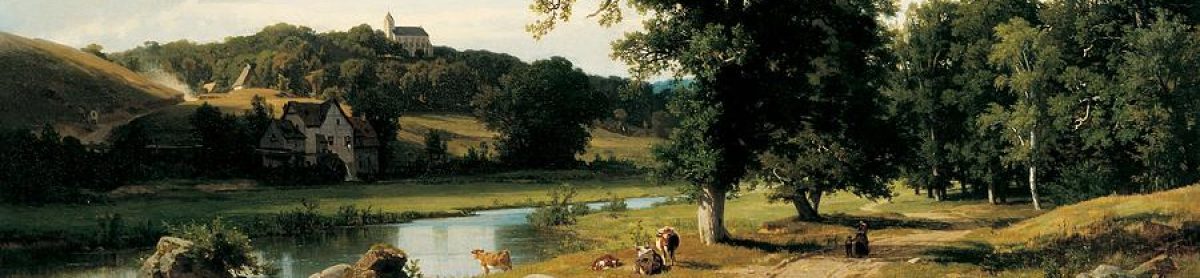
This is Chapter Four of seven. In this Generation Two in America we learn a bit about the Stone, Haskell, and Hardy families who were early English immigrants to the Massachusetts Colony. Our 7x Great Grandparents John and Patience Haskell continue the history.
The Haskell Family Were Originally From Somerset, England
The Haskell family can be reliably traced back to William Haskell and Elinor Frowd of Charlton Parish, northern Wiltshire, England. This small Parish is near the Shire borders of Dorset, Somerset, and Wiltshire. Elinor and William had seven children, all baptized at this parish, including the oldest son Roger, who was Christened March 6, 1613/14. William Haskell died and is buried there, circa 1630.

this reads “Roger Haskall the son of William Haskall was baptized the 6th day of March — 1613.
(Image courtesy of Ancestry.com).
The widow Elinor Haskell, then married John Stone “a fellow also with a son, whose wife had died. John Stone had a Certificate from the Minister at Hawkhurst, that stated, they were conformable to the Church of England”, so they immigrated to America [sailing on] the “Elizabeth of London” and tradition is that they sailed from Bristol, England to Salem, [Massachusetts Colony] and anchored in the North River off Massey’s Cove.
Observations: If they were comformable with the Church of England, they may have been Puritans. “On March 19, 1628, the King [Charles I] granted a royal charter to the Massachusetts Bay Company, promoting the settlement of the territory ‘from sea to sea’ that had been granted to the Puritans, and to govern its colonies. The charter was the first foundation of government for the Massachusetts Bay Colony.” (See footnotes). Therefore, we wonder if those people who were allowed to immigrate to the Massachusetts Bay Colony were encouraged to be Puritans. The Plymouth Colony never received this same status from any King of England. This is one of the contributing factors as to why the Plymouth Colony was eventually absorbed into the Massachusetts Bay Colony in 1691.
“It was common in those early days of the settlement of the new world, that you would gain a deed to the property after having lived there one year. It was an incentive to have people come from England and etc. to move to the new world or the frontier. Often they would apply for additional lands as the years went by.

(Image courtesy of Historic New England).
Salem and Beverly was separated by a river, and from the increased traffic, it became necessary to provide the means to cross the river and a ferry was provided. John Stone owned and operated the ferry from Massey’s Cove in Salem, later selling it to William Dixie. In a grant of 1637, John Stone and family received 10 acres and on January 1, 1638 an additional 30 acres with him being recorded as having seven in the household…
Roger worked as a farmer and also with John Hardy as a fisherman. The first few years of the Salem Colony, they followed the sea and made fishing their livelihood. It was while he was thus employed, that he became interested in the daughter of John Hardy and undoubtedly had many occasions to come into contact with her during those great fishing years. Roger Haskell and Elizabeth Hardy marry before 1644, when the father-in-law [John Hardy] interceded [with] 6 acres of Meadow Land for Roger. They lived with the Hardys for several years before moving to a house of their own. They had nine children; John, William, Mark, Elizabeth, Hannah, Roger, Josiah, Sarah, and Samuel — 6 boys and 3 girls.
John Hardy became a well-to-do landowner, and in his Will which “was proved on January 30, 1652… he bequeathed all his land lying near the Basse River to Roger Haskell — my son-in-law (being all the land given him by the town of Salem). He gave Roger a steer and a cow which Roger was then taking care of, also an Ox which John’s wife Elizabeth was to pick from three in the William Flint herd.

(Image courtesy of Ag Learning Hub).
Roger served on a Jury 1655, 1662, and 1664, also was the Constable of the Basse River side for Salem for two years 1657 and 58. He was in the Court Record several times in connection with his job. Due to the land descriptions being somewhat clouded, Roger was in the courts many times clarifying descriptions. Old deeds and documents are most interesting and would often present a problem, as an instance, take this strange and unusual boundary, ‘running to a white oak with a birds nest in it’. Roger acquired considerable land holdings and was in court many times about boundaries.” (FamilySearch Library, 400 Years With Haskells — FSL400) (1)
Enter John Haskell
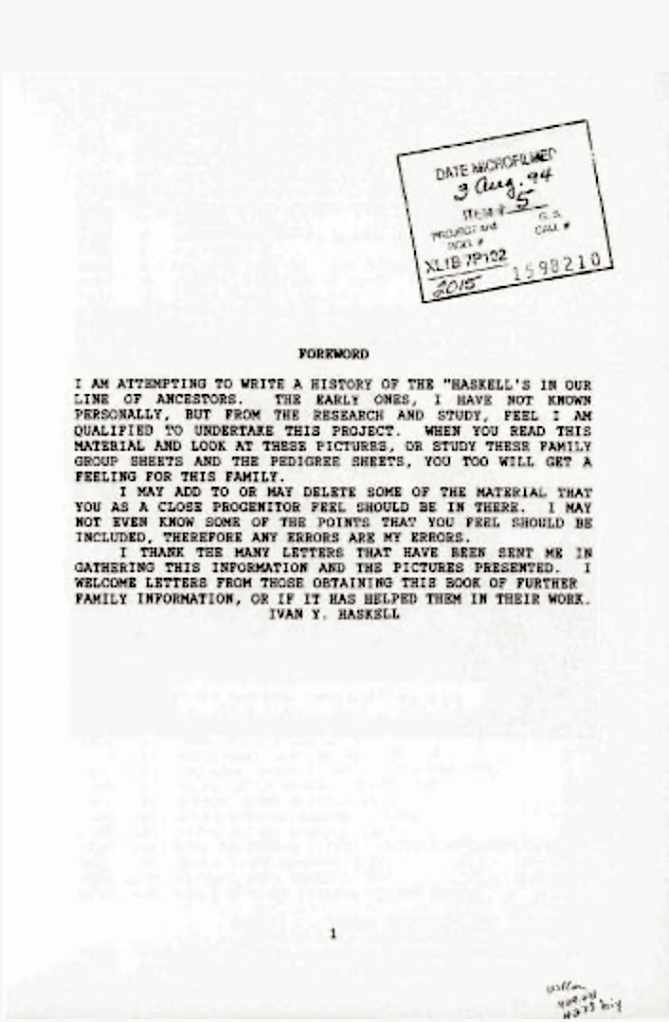
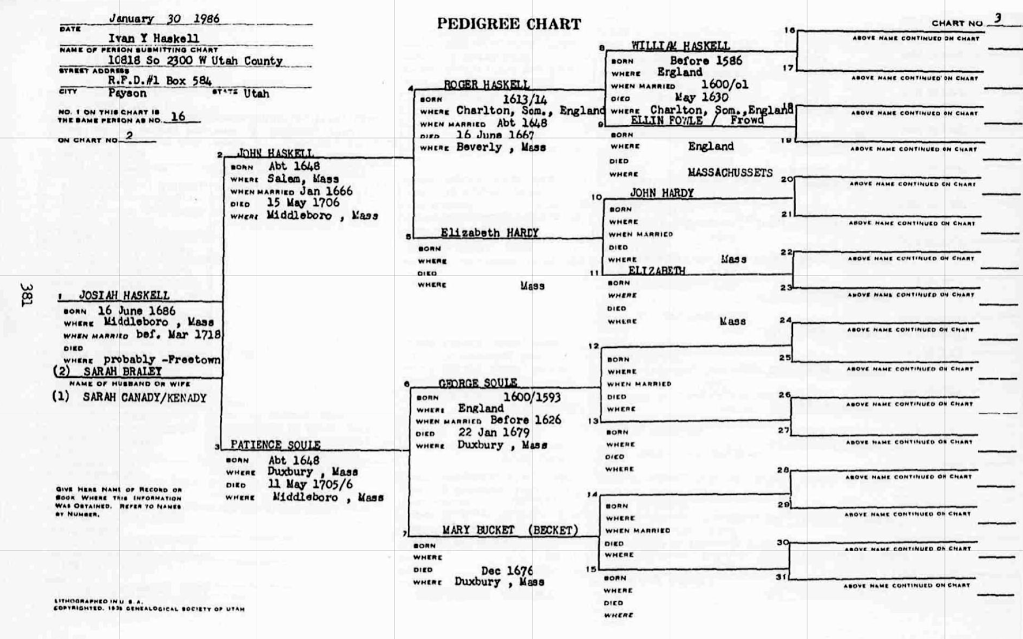
“John Haskell, [born about 1640, the husband of Patience Soule], was the first son of Roger Haskell, an emigrant from England, and Elizabeth Hardy whose father was in the fishing business. An interesting item was that John was sued for Breach of Promise in an Ipswitch, term of Court by John Proctor, in March of 1665 on behalf of his daughter Martha, which he won.
It must have not deterred John though, because he married Patience Soule in January 1666.” (FSL400) Their marriage is recorded in the records for Middleborough, Plymouth, Massachusetts Colony.

(Image courtesy of Ancestry.com).
The map below has three arrows on it, for indications as to where these ancestors were born and raised. John Haskell is from Salem [Essex County], indicated by the uppermost white arrow. We already know that Patience Soule is from Duxbury, as shown by the lower white arrow. The bright green arrow indicates where the town of Middleborough, just east of Plymouth, is located. This is where they lived and raised their own family.

A foundation in the early history of the mapping of New England, this map is the first printed version of William Read’s original survey of 1665.
(Image courtesy of the Norman B. Leventhal Map & Education Center Collection,
of the Boston Public Library).
1661 — Middleborough / Middleboro / Middlebury is the name of the place formerly called Nemasket. The official town spelling is Middleborough. Middleboro is a shortened form cited in many historical documents for many years, even after 1661. Middlebury is now an archaic form.
“As the town records were destroyed in the [King Phillip’s] war, it is impossible to give an exact list of men living in Middleborough… John [and Patience] lived in Middleborough before the year 1670, as the town records show birth of children between that time and the year 1684… [Nonetheless] it is hardly probable that the court at Plymouth would have incorporated a town unless there had been a larger number of inhabitants. We give below a list of forty-one who are known to have lived here, as the names are to be found in Plymouth records, in deeds, as office-holders and freemen, from records of births and deaths, as well as from reliable family note-books, and seven who were here according to generally accepted tradition.” – listed is John Haskall. (History of The Town of Middleboro, Massachusetts – HTM) (2)
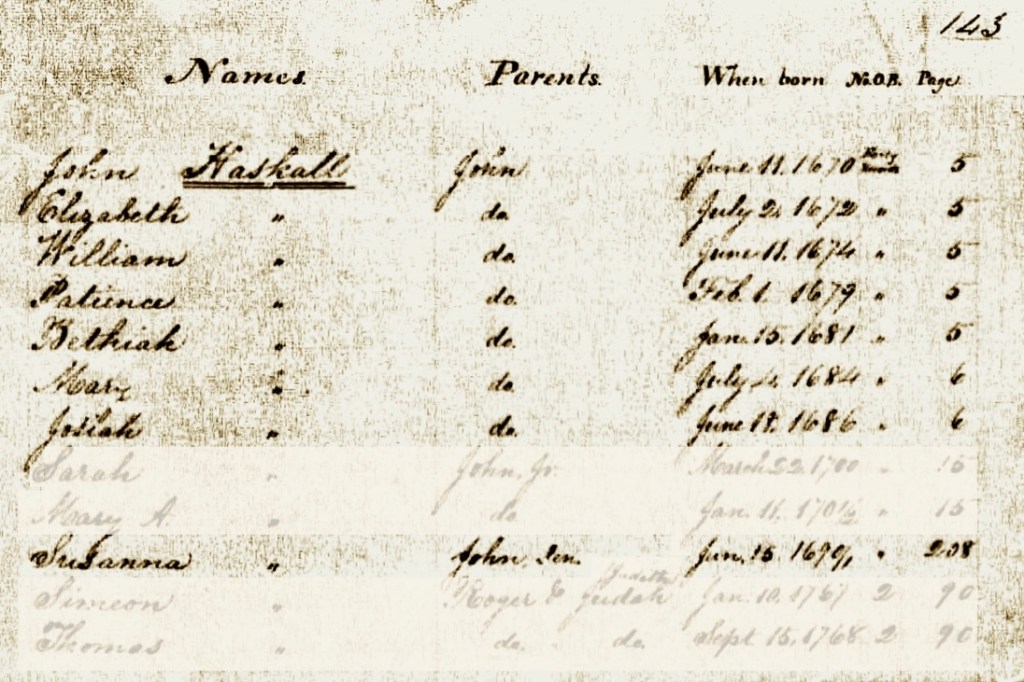
The Haskell Family Children
John and Patience had eight children over a period of about 16 years. All of the children were likely born in Middleborough, Plymouth County [as such in 1685]. All deaths were in the Province of Massachusetts Bay [as such in 1691], unless otherwise noted.
In 1685, Plymouth County and Bristol County were established, in anticipation of pending merger with the Massachusetts Bay Colony. (Prior to this date, it was simply Plymouth Colony).
In 1691, The Plymouth Colony merged with the Massachusetts Bay Colony and other territories to form the Province of Massachusetts Bay, a royal colony. The included counties of Barnstable, Bristol, and Plymouth continued to exist). We use PMB for this designation for brevity.
- John Haskell, Jr., born June 11, 1670 — died February 17, 1728 in Killingly, Connecticut. He married Mary Squire, March 2, 1700 in Middleborough; they had 12 children.
- Elizabeth Haskell, born July 2, 1672 — died 1715 in Middleborough, Plymouth County. She married Thomas Drinkwater, circa 1695-99 in Middleborough; they had 8 children.
We are descended from Elizabeth and Thomas. - William Haskell, born June 11, 1674 — died date unknown.
- Patience Haskell, born February 1, 1679 — died February 14, 1706 in Middleborough, Plymouth County.
- Bethiah Haskell, born January 15, 1681 — died after March 1739 in Rochester, Plymouth County. She married first Richard Westcott, May 10, 1715 in Dighton, Bristol County. She married second Thomas Childs, August 29, 1727 in Rochester, Plymouth County; she married third, William Sherman; one child.
- Mary Haskell, born July 4, 1684 — died date unknown. She married Scotto Clarke, April 17, 1706 in Rochester, Plymouth County; they had 10 children.
- Josiah Haskell, born June 18, 1686 — died in Freetown, Bristol County, before March 1775. He married first Sarah Kenedy/Canady, March 26, 1718 in Middleborough, Plymouth County; they had 6 children. He married second Sarah Brayley, March 27, 1729 in the same location; they had four more children.
- Susannah Haskell, born January 15, 1691 — died in Freetown, Bristol County, between 1723 and 1731. She married Thomas Paine, February 21, 1712 in Taunton; they had 5 children. (3)
Also Known As Middleboro John
He was one of twelve who were freemen before the year 1689, and was a large owner of real estate in the Twentysix Men’s Purchase, [and the Sixteen Shillings Purchase], with other purchases. [These purchased properties can be inferred from the map shown below on the left]. At one time he owned, with his brother-in-law, Francis Walker, a tract of land bounded by Raven Brook and the Indian Path, which included the pasture land and swamp later owned by Joshua Eddy, Esq. (HTM)
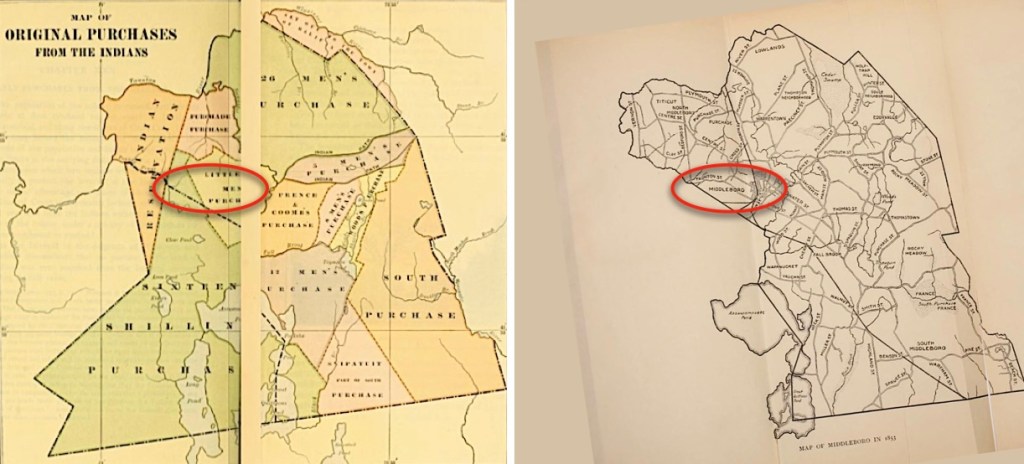
by Thomas Weston. The map on the left is a foldout map, that was not completely digitally archived. The map on the right is from 1853, and shows the same area with the town of Middleboro indicated. (See footnotes).
Some records refer to John Haskell as Middleboro John because he owned so much property there. “He not only was a farmer, but also [did] work in wood. He traded 30 wooden oars to Erasmus/Eramus James for one black horse, to be delivered January 15, 1676 at Bass River Ferry. [About the oars], 12 of them to be 26 feet long, 12 to be 24 feet long, and 6 to be 22 feet long.

Even though he lived in Middleboro there was a great many dealings in the public record, several Beverly business transactions where his father lived, and also with his Uncle William. The family may have thought John wasn’t given a fair share in his father, Roger Haskell’s, Will, for they had him sue his mother and her [second] husband William Berry. Also a forty acre adjustment of land with Richard Dodge which necessitated an original deed of his father’s.” (FSL400)
It would seem that life was pretty good, but fate sometimes intrudes… “they had none of the luxuries, or what we consider to-day comforts, of life; there was also the extreme danger from hostile Indians before King Philip’s War, and the constant annoyance and depredations from wolves and bears, which attacked not only their crops, but sometimes the settlers themselves.’’ (HTM) (4)
The Middleborough Fort and King Phillip’s War
For those of us living today, it’s somewhat difficult to appreciate the utter wilderness that New England was in this period, despite the fact that many native Peoples had lived in the area for many years. This was a region that was in transition and accordingly, it would never be the same. Our ancestors, the Haskell / Soule family were living in a frontier community during this period.
“The proximity to Plymouth [to the East] had for some time kept the early settlers here informed of the danger feared by the authorities. In accordance with the requirements of the laws of the colony, Middleboro men had built a fort for their protection on the western bank of the Nemasket River, not far from the old Indian wading-place, on the land owned in later years by Colonel Peter H. Peirce. No description of this has come down to us. It was evidently something more than a garrison house, and was large enough to accommodate, for more than six weeks, the inhabitants of the town, who, with the men, women, and children, probably numbered seventy-five or more. It was enclosed with a wall strong enough to have deterred the many roving bands of hostile Indians from attempting to attack or to surround it.

of Brookfield, Massachusetts in August 1675, attributed to the English School.
(Image courtesy of Meisterdrucke, UK).
The war began on the 24th day of June, 1675, [near] the then frontier town of Swansea. The Sunday previous, the Indians had killed many of the cattle belonging to the settlers. Nine men were killed on the highway, and shortly after eight more. Gershom Cobb, a resident of Middleboro, was among the number… Encouraged by the success of their first encounter, they extended their operations to other parts of the colony, stealthily hiding in woods and swamps, behind fences and bushes, killing the whites as they came upon them, and burning their houses.
Shortly before this, many occurrences had served to confirm the fears of the Middleboro settlers. Some of the Indians were sullen and morose, manifesting unusual boldness and eagerness in procuring firearms and powder at almost any cost. This, in addition to ofificiousness [in a domineering manner] in many acts of friendliness with the evident design of covering some plot, did not deceive the settlers, who found their cows milked, and occasionally some animal missing. Most of the inhabitants, especially those living far from the center, thought it unsafe to remain about their farms and came to the garrison, some taking their provision and household furniture, others in such haste that they left everything, on hearing of the attack on Swansea. They were unable to gather any of their crops, and no aid could be sent from Plymouth, as all of the available forces in the colony had been despatched [sic] to towns where the danger was even greater than at Middleboro.

(See footnotes).
After the [Middleboro] mill was burned, many of the houses were destroyed by fire; among them the houses of John Tomson, William Nelson, Obadiah Eddy, John Morton, Henry Wood, George Dawson, Francis Coombs, and William Clark.
The inhabitants who had found refuge in the fort remained about six weeks; then it was deemed wise to go to Plymouth. With the small amount of provisions, arms, and ammunition, they would have been wholly unable to resist a siege or an attack from as large a band of warriors as had destroyed Swansea and other towns in the colony. After the abandonment of the fort, it was burned by the Indians. The inhabitants remained in Plymouth till after the close of the war, as did also the inhabitants of Dartmouth and Swansea.
In King Philip’s War, so far as [it] relates to Plymouth Colony, the decisive battle was the engagement at Scituate. If the Indians had not been defeated at that battle, it was their intention to go down along the coast, burn all of the houses, and destroy the inhabitants. Plymouth was not sufficiently fortified to have escaped the general massacre. The able-bodied men in the western part of the colony had joined the forces of Captain Church to meet the Indians, and their families had gone to Plymouth… The little fort at Middleboro was the only one on the west, and there was nothing to have prevented the Indians, had they passed Scituate, from continuing their march of destruction to Plymouth.” (History of The Town of Middleboro, Massachusetts – HTM) (5)
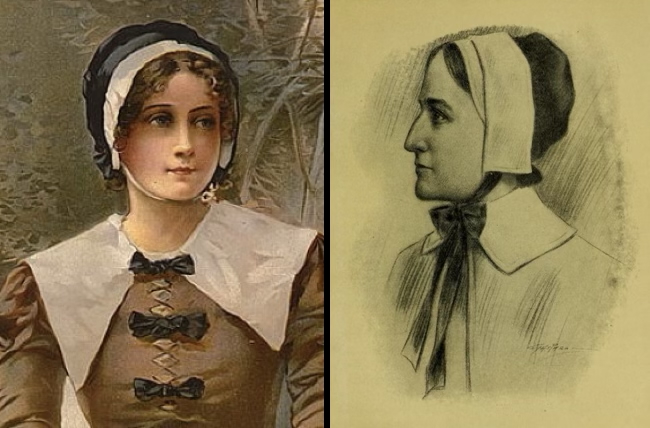
what her thoughts were like?
Artwork which portrays Pilgrim and Puritan women almost always features pious, demure, serious, even dour poses . These moods are choices for ‘ideas about personality’ made by later artists, who are mostly men. As a consequence, these artworks never cover the full range of emotions these women felt from their lived experiences. (For images, see footnotes).
An Outcry
None of us really have any true control on how history records us. The only story we have found about Patience Haskell is a civic matter that involves ‘an out cry’ and a meeting house. From Middleboro History (HTM) —
May 20, 1700.
“Being a town meeting it was voted by the inhabitants that 40 shillings shall be raised on the town to be expended on the raising of the meeting house for the refreshment of such as shall be at the raising. It is likewise agreed on and carried by the vote of the inhabitants of the town that the meeting house shall be raised on that piece of land that lies between the two roads, that is to say, on the Northerly side of the County Road that leads to Plymouth and on the Southeast side of the road that leads to Bridgewater.”
Much more than a year later… August 5, 1701.
At a town meeting of the inhabitants of Midleberry Aug. 5, 1701, the meeting house was exposed to seale at an outcry and Patiance Hascall, the wife of John Hascall, bid five pounds, 2 shillings money to be paid to the selectmen within 3 months and the meeting house to be removed some time between this and winter.” Was this an auction to raise money to build a new meeting house, or tear down the old one? It’s confusing. (HTM)
Or maybe Patience was confused because she was just getting on in years?
Our take on this: If you believe that she was a little bit antsy to get things going on building the new meeting house, you could say she was being Mrs. imPatience Haskall — or —perhaps she got caught up in the moment, because she just wanted to win (!) That was a lot of money to spend back then, even for a meeting house. (6)
Exactly Nine Months Between Them
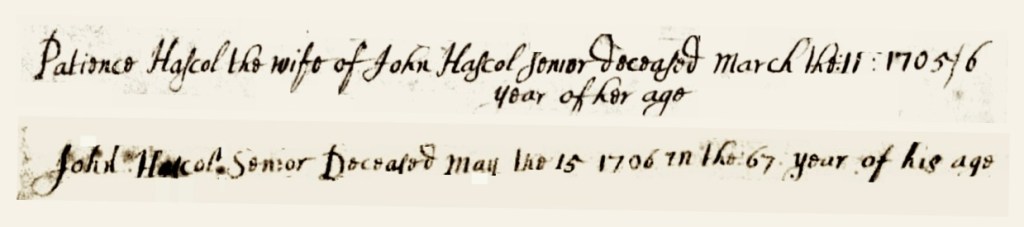
Patience died March 15, 1705, aged about 58 years and John died exactly none months later on May 15, 1706, aged about sixty-six years. They are buried in the Miles Standish Burial Ground, Duxbury, Plymouth County, Massachusetts. Neither one left a Will; both dying intestate.
The next generation of this family line continues with the marriage and children of daughter Elizabeth Haskell to a new family line, that of Thomas Drinkwater. Due to the King Phillip’s War, many records from their time period were utterly destroyed, yet, we have been able to weave together a story about their life together. The next three generations are about the Drinkwater Family. (7)
Following are the footnotes for the Primary Source Materials,
Notes, and Observations
The Haskell Family Were Originally From Somerset, England
(1) — eight records
Roger Haskall in the
Somerset, England, Church of England Baptisms, Marriages,
and Burials, 1531-1812
Charlton Musgrove > 1538-1764
https://www.ancestry.com/search/collections/60856/records/938903?tid=&pid=&queryId=f306b694-0713-4f69-baa7-a51945fa9b57&_phsrc=BnS35&_phstart=successSource
Digital page: 16/42. Right page, 6th entry from the top.
Note 1: For his Christening record.
Note 2: Note that church calendar years then ran from April to April in this period. Since his birthday was in March, he was actually born in March 1614, by today’s calendar.
John Stone
in the U.S., Find a Grave Index, 1600s-Current
https://www.ancestry.com/search/collections/60525/records/147265285?tid=&pid=&queryId=e9cc19b1-2d7f-4192-b44d-2ef32ecc451e&_phsrc=BnS32&_phstart=successSource
and
John Stone
https://www.findagrave.com/memorial/183486616/john-stone
Note: For the data.
(FSL400)
FamilySearch Library
400 Years With Haskells
by Ivan Youd Haskell
https://www.familysearch.org/library/books/records/item/559000-redirect#page=1&viewer=picture&o=info&n=0&q=
Note: Family Search Identifier #692782, for the text and chart.
Secretary of the Commonwealth of Massachusetts
William Francis Galvin
Historical Sketch of Massachusetts > Early European Contact
https://www.sec.state.ma.us/divisions/cis/historical/historical-sketch.htm#:~:text=On%20March%2019%2C%201628%2C%20the,for%20the%20Massachusetts%20Bay%20Colony.
Note: For this text: “On March 19, 1628, the King granted a royal charter to the Massachusetts Bay Company, promoting the settlement of the territory “from sea to sea” that had been granted to the Puritans, and to govern its colonies. The charter was the first foundation of government for the Massachusetts Bay Colony.”
Historic New England
“The Hardships + Sacrifice Masseys Cove Salem 1626 The First Winter. A mighty nation was born God leading these noble men and women. JOJ Frost Marblehead.”
by John Orne Johnson Frost, circa 1920-28
https://www.historicnewengland.org/explore/collections-access/gusn/179828
Note: For the landscape image.
John Hardy, in the
New England, The Great Migration and The Great Migration Begins, 1620-1635
https://www.ancestry.com/search/collections/2496/records/2003?tid=&pid=&queryId=3ada0a72-b896-4161-ac7d-ea4862c0944a&_phsrc=Ixt2&_phstart=successSource
Note: For the data.
Ag Learning Hub
Agriculture During the Colonial Period in the Americas
https://aglearninghub.com/agriculture-during-the-colonial-period-in-the-americas/
Note: For the Providence agricultural image.
Enter John Haskell
(2) — four records
(FSL400)
FamilySearch Library
400 Years With Haskells
by Ivan Youd Haskell
https://www.familysearch.org/library/books/records/item/559000-redirect#page=1&viewer=picture&o=info&n=0&q=
Note: Family Search Identifier #692782, for the text and chart.
Patience Sole in the
Massachusetts, U.S., Town and Vital Records, 1620-1988
Middleborough > Town and Proprietors’ Records, with Births, Marriages, and Deaths
https://www.ancestry.com/search/collections/2495/records/58976985?tid=&pid=&queryId=74e44bb9-cd86-4ead-b121-00571c865af0&_phsrc=zBu4&_phstart=successSource
Book page: 3, Digital page: 3/136
Note: Her marriage record to John Haskell.
Norman B. Leventhal Map & Education Center Collection,
of the Boston Public Library
A mapp [sic] of New England,
by John Seller, circa 1675.
https://collections.leventhalmap.org/search/commonwealth:3f462s90h
Note: “A foundation in the early history of the mapping of New England, this map is the first printed version of William Reed’s original survey of 1665. The survey was commissioned by Massachusetts authorities to support the colonial boundaries as described in the first Massachusetts Charter of 1628”.
(HTM)
Library of Congress
History of The Town of Middleboro, Massachusetts
by Thomas Weston, 1834-1920
https://www.loc.gov/resource/gdcmassbookdig.historyoftownofm00wes/?c=160&sp=5&st=pdf
Note: For the text.
The Haskell Family Children
(3) — four records
Plymouth County, Massachsetts
About
https://www.plymouthcountyma.gov/about
Note: For the 1685 text.
National Park Service
Explorers and Settlers
Historical Background
https://www.nps.gov/parkhistory/online_books/explorers/intro25.htm#:~:text=In%201691%2C%20Massachusetts%20was%20granted,as%20formerly%2C%20but%20also%20Plymouth.
Note: For this text: “In 1691, Massachusetts was granted a new charter, as a royal colony, and to it was attached not only Maine, as formerly, but also Plymouth.”
John Haskall
in the Massachusetts, U.S., Town and Vital Records, 1620-1988
Middleborough > Births, Marriages and Death
https://www.ancestry.com/search/collections/2495/records/11903022
Book page: 143, Digital page: 67/2504. Right page, bottom entries.
Note: This document lists — John, Elizabeth, William, Patience, Bethiah, Mary, Josiah, (skip a space) and Susannah.
Patience (Soule) Haskell (abt. 1648 – 1706)
https://www.wikitree.com/wiki/Soule-82
Note: Although this file is quite good, we needed to research each individual child.
Also Known As Middleboro John
(4) — four records
(HTM)
Library of Congress
History of The Town of Middleboro, Massachusetts
by Thomas Weston, 1834-1920
https://www.loc.gov/resource/gdcmassbookdig.historyoftownofm00wes/?c=160&sp=5&st=pdf
Note 1: For the text.
Digital page for the maps vary, see specific notes below —
Note 2: For the partial foldout Map of Original Purchases From The Indians, Digital pages: 627-628/779.
Note 3: For the Map of Middleboro in 1853, Digital page: 17/779.
(FSL400)
FamilySearch Library
400 Years With Haskells
by Ivan Youd Haskell
https://www.familysearch.org/library/books/records/item/559000-redirect#page=1&viewer=picture&o=info&n=0&q=
Note: Family Search Identifier #692782, for the text.
Wooden sports kayak paddle isolated on white background.
https://www.shutterstock.com/image-photo/wooden-sports-kayak-paddle-isolated-on-1662186265
Note: For the image.
Library of Congress
History of The Town of Middleboro, Massachusetts
by Thomas Weston, 1834-1920
https://www.loc.gov/resource/gdcmassbookdig.historyoftownofm00wes/?c=160&sp=5&st=pdf
Note: For the text.
The Middleboro Fort and King Phillip’s War
(5) — three records
(HTM)
Library of Congress
History of The Town of Middleboro, Massachusetts
by Thomas Weston, 1834-1920
https://www.loc.gov/resource/gdcmassbookdig.historyoftownofm00wes/?c=160&sp=5&st=pdf
Note: For the text.
Meisterdrucke, UK
Nipmuc Indians Attack the Settlement of Brookfield, Massachusetts in August 1675
attributed to the English School
https://www.meisterdrucke.uk/fine-art-prints/School-English/1090351/Nipmuc-Indians-attack-the-settlement-of-Brookfield,-Massachusetts-in-August-1675-(coloured-engraving).html
Note: For the image.
Frontier Partisans
Firearms Of The Frontier Partisans — The Guns Of King Philip’s War
by Jim Cornelius
https://frontierpartisans.com/27781/firearms-of-the-frontier-partisans-the-guns-of-king-philips-war/
Note: For the illustration.
An Outcry!
(6) — three records
Library of Congress
A Fair Puritan
by E. Percy Moran
https://www.loc.gov/resource/cph.3g04290/
Note: For the portrait on the left.
and
Quahog.org
Rhode Island History Exhumed
Old Stone Bank History of Rhode Island: Anne Hutchinson
https://quahog.org/FactsFolklore/History/OSBHoRI/Anne_Hutchinson
Note: For the portrait on the right.
(HTM)
Library of Congress
History of The Town of Middleboro, Massachusetts
by Thomas Weston, 1834-1920
https://www.loc.gov/resource/gdcmassbookdig.historyoftownofm00wes/?c=160&sp=5&st=pdf
Note: For the text.
Exactly Nine Months Between Them
(7) — six records
Patience Hascol
in the Massachusetts, U.S., Town and Vital Records, 1620-1988
Middleborough > Town Records, with Births, Marriages, and Deaths
https://www.ancestry.com/search/collections/2495/records/11057713?tid=&pid=&queryId=cd915ce6-5e82-4813-b209-fa0ec3cae38a&_phsrc=zBu1&_phstart=successSource
Book page: 4, Digital page: 19/1022
Note: For her death record.
and
Patience Haskell
in the U.S., Find a Grave Index, 1600s-Current
https://www.ancestry.com/search/collections/60525/records/73615547
and here:
https://www.findagrave.com/memorial/124601265/patience-haskell
Note: For her death record.
John Hascol Sr
in the Massachusetts, U.S., Town and Vital Records, 1620-1988
Middleborough > Town Records, with Births, Marriages, and Deaths
https://www.ancestry.com/search/collections/2495/records/11057672?tid=&pid=&queryId=86becdb1-9936-40bb-b51b-9eb6b558d52e&_phsrc=LSY18&_phstart=successSource
Book page: 4, Digital page: 19/1022
Note: For his death record.
and
John Haskell
in the U.S., Find a Grave Index, 1600s-Current
https://www.ancestry.com/search/collections/60525/records/73615461
and here:
https://www.findagrave.com/memorial/124601170/john-haskell
Note: For his death record.
 Our Ancestors, Our Narratives