We grew up in a family where people (on both sides) had forever been telling stories about their ancestors, although much of it was apocryphal.* Yet nothing was truly researched, nor documented meeting today’s contemporary standards. The world was so different then, and doing research on your family made you indebted to only a few available sources. Much work was done by writing letters to people, who knew people, who researched cemeteries, and had family bibles.
*An apocryphal story is probably not true, although it is often told and believed by some people to have happened. (Via the Cambridge Dictionary)
Then One Afternoon…
Around 1967, or thereabouts, our maternal grandmother Lulu Mae (DeVoe) Gore sat down at her dining room table, delicately unfolded and smoothed with her hands, a very large fan-fold style family tree. It was a decades old project at that point, having been carefully researched and crafted by her hand. Lulu’s husband Harley had passed on nearly thirty years earlier. It was his desire near the end of his life, to know more about his family origins — so, as we understand it today, this was when our family history started to become real to us.
When we met to discuss this, present were Lulu’s daughter Marguerite and her granddaughter Susan, both of whom shared an interest in family history. Grandson Thomas was also present, but being somewhat younger, he was told to “sit still, and don’t touch anything”.
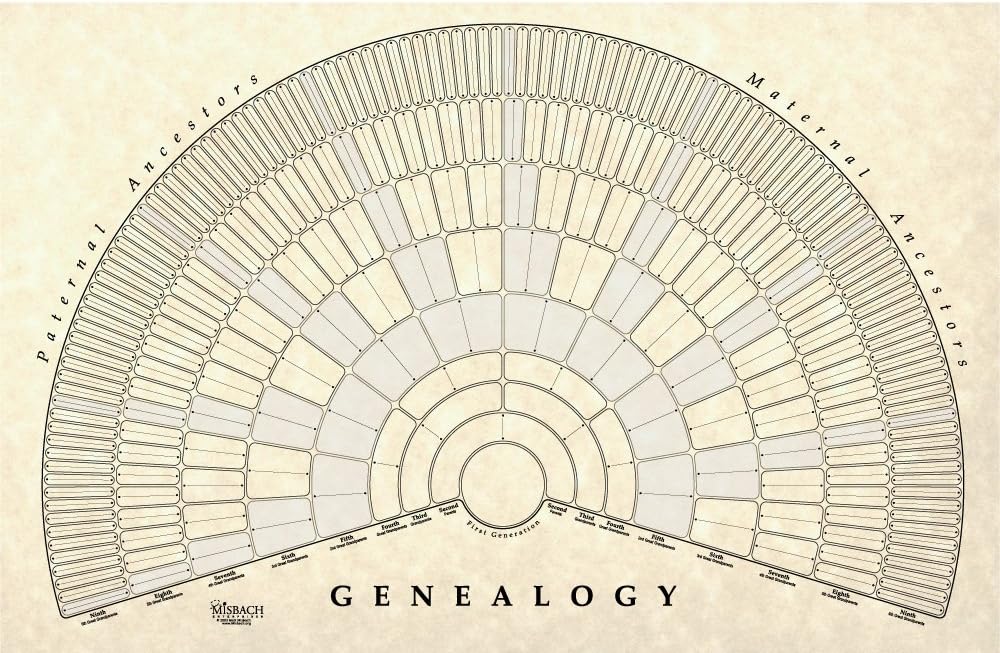
This is when we first heard stories about some New England ancestors, ongoing suspicions about there perhaps being a Mayflower relative.., all of it still very vivid today as memories. Peppering our Grandmother with questions, we tried to understand how it all fit together. Lulu had her grand chart, many photographs, and lots of anecdotal stories. She had opened the past to us, and for her, she was likely pleased that she had a daughter and granddaughter to share this legacy with.
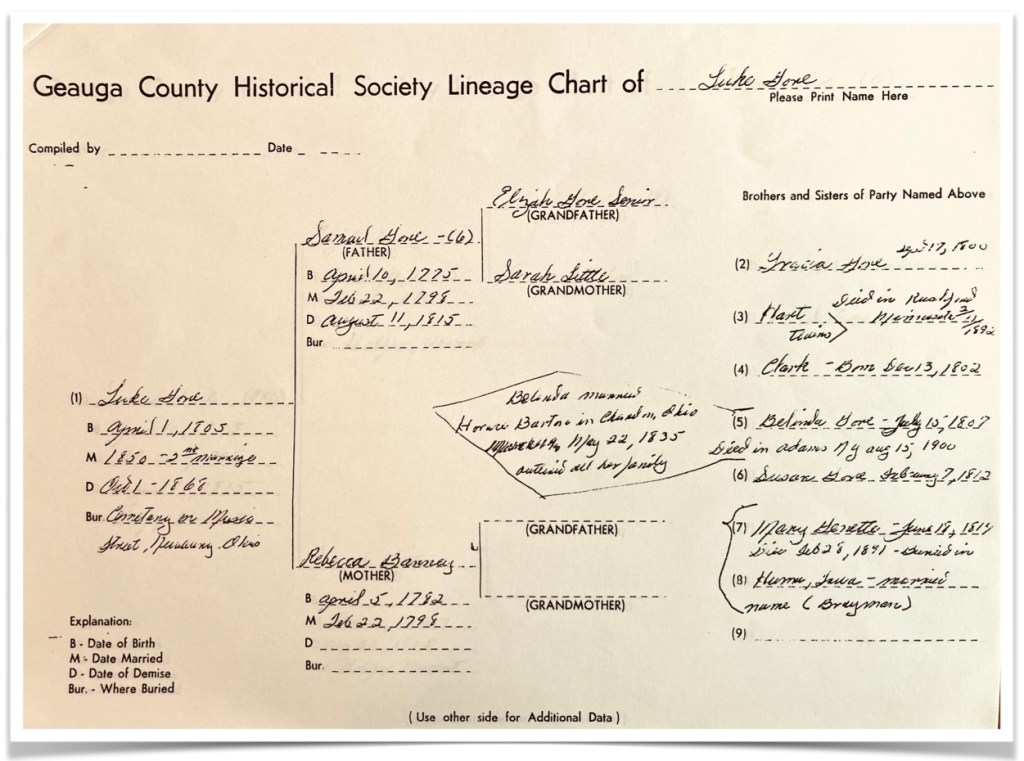
Lulu Gore passed on in 1975 and her daughter Marguerite Bond took over the task of researching family history via traditional methods. When she retired in the 1980s, she relied mostly on resource books, and trips to both the local Western Reserve Historical Society in Cleveland, Ohio and the Geauga County Courthouse in Chardon, Ohio. In addition, she traveled to Plymouth, Massachusetts to research the 1620 history of the Mayflower, and to the small city of Steubenville, in Jefferson County, Ohio (to research her husband Dean’s side of the family). Time went on, and she did what she could while slowing losing her ability to retain memories.
Comment: Marguerite swore that she would never, ever work on a computer. (She came from a generation which viewed a “thingamajig” like a computer with much trepidation, and in her case, some disdain). True to her word, and quite ironically, about the time that online databases started to appear, Marguerite decided to disappear — passing on in 1999. She passed her research on to her daughter Susan. (1)
Hide and Seek
In 1999, the world was in the midst of the newly flourishing Go-Go-Days of the Internet. Both Susan and Thomas were living at the epicenter of this change, both residing in San Francisco, California. Suddenly, it became quite apparent that we now had new resources to help us work out “how it all fit together”. However, this didn’t happen quickly. Even though resources had greatly evolved, it took much time for the databases to be sufficiently trustworthy for our needs. We then had to dig-in and look at everything with fresh eyes. Back then much research was like a game of Hide and Seek.
Susan spent years making new discoveries, but also verifying the work of her Grandmother and Mother. She sometimes spent time tramping around cemeteries, looking for relatives whose records had fallen away.
Twenty-five years later, for our present research, we have been using the online sources: Ancestry.com, FamilySearch.com, and the Internet Archive. Depending upon the family line, we also seek out resources and databases far beyond these three websites. As an example, when we documented the Irish families on our father’s side, we utilized much of the invaluable resources available on the website ScotlandsPeople.com. That chapter alone,
The McMahon and The McCall Lines, A Narrative, took one year of dedicated research and writing. (You will be able to see, at the end of each chapter we list the specific print and website resources for that chapter).
Covid 19
It’s worth emphasizing that the Ancestry and FamilySearch databases can sometimes be unreliable. Here is our viewpoint on this —
Covid 19 required that many people stay at home to prevent further spread of the virus to others. As such, many people decided to undertake projects which involved new hobbies. This is a polite way of saying that many people (would-be-tree makers) launched their own family tree projects, when most of them had no research experience. Hence, the Ancestry and FamilySearch websites became a perfect storm of poorly researched, and inaccurate information. There is still some valuable information to be found therein, but one must look very, very carefully with great discernment at what is presented. If there can be secondary sources (such as books, actual documents, etc.), which verify discoveries, then the information can probably be acceptable. (2)
Why Context Is Important
Context provides us an opportunity to understand the world as it once existed but is no more, and most importantly, narrate the world in which our ancestors lived.
Family trees are only interesting up to a point, then they can get a bit mundane. Think of historical biographies. If they were written in such a way that “this person married that person, and then they had children”, it’s likely that this category of interesting books would struggle to find readers. We would be a much poorer society for it.
“What is intelligence, and how does it work?”
Devon Eriksen
Intelligence is the ability to tell stories... The “story” that I am talking about is a much broader category, and it is that type of story that forms the basis for thought. It is our superior ability to tell that kind of story that separates us from the animals.
Your brain likes these things I write, both fiction and non-fiction, because the conscious part of your brain is a story engine. It evolved to connect a bunch of observed facts into a coherent story that makes them all make sense together, and to make plans, which are also stories.
One thing which we came to realize, is that much family history is written about the Men who were our Grandfathers, but much less is written about the Women in their lives. In some circumstances, we have been unable to learn anything about some of our Grandmothers other than their name, because scant information is available.
When it comes to historical books about women who were mostly lost to history, we often think of this book by author Jill Lepore: Book of Ages, The Life and Opinions of Jane Franklin. She was the youngest sister of her very famous brother, inventor, printer, writer, diplomat, and one of the founding fathers of the United States, Benjamin Franklin. They were close as siblings, but their individual lives went in very different directions, and Jane Franklin left only a few records. The author did a remarkable job in telling her life story, making it possible for those of us who are alive today, to understand, appreciate, and ponder Jane’s life.

If you notice in the above chart on the right, we see that in the Josiah Franklin family, there were an astonishing number of seventeen children born from two different mothers. Women often had many children in those days, and sometimes they died in childbirth. Whenever that happened, the husband frequently remarried pretty quickly because someone needed to provide directly for the children. If the husband was the one who died, the wife also sometimes remarried quickly. This had much to do with preserving prosperity because inheritance laws back then were not favorable to women.
From the Pulitzer Prize winning book, Prairie Fires, The American Dreams of Laura Ingalls Wilder by Caroline Fraser, we admired this excerpt because it’s a point of view which captures the essence of us seeking out our ancestors.
“DISCOVERING how Charles Ingalls and his family came to find themselves a few miles from the shores of Lake Pepin, just a few years after Pepin County was first marked on a map, is a detective story tracking generations into the past. Pieces of the family portrait survive, but the whole remains elusive, obscured under the soot of time. It may never be complete.

That is always a problem, in writing about poor people. The powerful, the rich and influential, tend to have a healthy sense of their self-importance. They keep things: letters, portraits, and key documents, such as the farm record of Thomas Jefferson, which preserved the number and identity of his slaves. No matter how far they may travel, people of high status and position are likely to be rooted by their very wealth, protecting fragile ephemera in a manse or great home. They have a Mount Vernon, a Monticello, a Montpelier.
But the Ingallses were not people of power or wealth. Generation after generation, they traveled light, leaving things behind. Looking for their ancestry is like looking through a glass darkly, images flickering in obscurity. As far as we can tell, from the moment they arrived on this continent they were poor, restless, struggling, constantly moving from one place to another in an attempt to find greater security from hunger and want. And as they moved, the traces of their existence were scattered and lost. Sometimes their lives vanish from view, as if in a puff of smoke.
So as we look back across the ages, trying to find what made Laura’s parents who they were, imagine that we’re on a prairie in a storm. The wind is whipping past and everything is obscured. But there are the occasional bright, blinding moments that illuminate a face here and there. Sometimes we hear a voice, a song snatched out of the air.”
With those thoughts in mind, there is one final thought we would like to bring forward… (3)
Genealogy Is Not Genetics
When testing for genetic ancestry became available, four of us from a family of seven siblings thought it might be interesting to look into our family’s genetic history to ascertain how similar we are. The idea was that if we each used a different company, we could look and see how similar the genes each of us inherited are to each other, and how the research science shaped this outcome. Of note: Our family, like many of our ancestors, is a blended family with the same biological mother, but two biological fathers. (See the chapters The Peterman Line, A Narrative and The Bond Line, A Narrative — Seven for the history).
What we learned by using different companies, is that the quality of the results varied widely. Some of that was to be expected, since three of us (Daniel, Richard, Thomas) are males and could research both the X and Y chromosome lines. Our sister Susan was researching only the X line, because at this time, that is only what can be done for females. However, some of the companies we enlisted didn’t seem too interested in our genetics, as much as they were interested in selling us other products, etc.
Perhaps also we were influenced by family reunions where people said “We’re English through and through. Or, we sometimes heard “That’s your Irish side.” Hollywood also likely influenced our expectations due to its simplistic presentation of various immigrant cultures. What we learned is that we are Northern European for the most part, with some of us presenting a bit more Dutch than we knew was possibly in there. The Neanderthal genes were also a surprise!
The idea of inheriting genes which determine your culture has been roundly disproved by genetic research. Some behaviors can be determined through the influence of genetic inheritance, but to be honest, all of us are a rather varied admixture of our ancestors. This chart shows why:
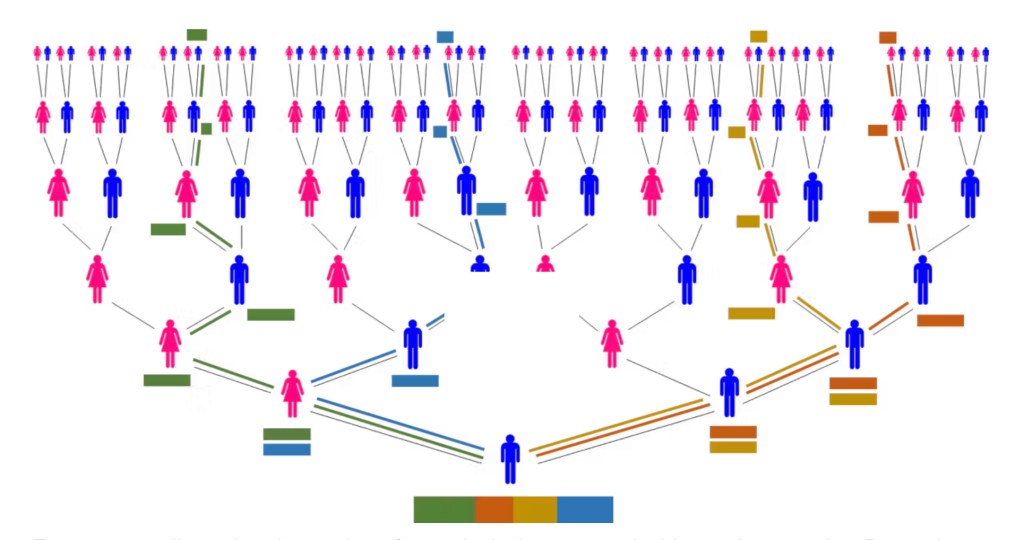
The word “Gene” and “Genealogy” both come from the same root word “genə-, also gen-, Proto-Indo-European root meaning give birth, beget, with derivatives referring to procreation and familial and tribal groups”. <Familial and tribal groups> is the most important aspect of this definition in the sense that it is the most meaningful.
Therefore, we are a product of both Nature (our genes) and Nuture (our environment). With regard to our genealogy, we feel that it’s essentially about our community and our familial bonds. Those are the things which remain.
For over 400 years, our ancestors migrated westward from Europe to new lives in North America, settling primarily in the United States. In the 2020s, both Thomas and Susan also migrated. Susan moved to Chesapeake, Virginia, and Thomas — contrary to the drift of his ancestors — moved to Europe. He now lives in Lisbon, Portugal. (4)
Following are the footnotes for the Primary Source Materials,
Notes, and Observations
Then One Afternoon…
(1) — three records
Apocryphal [definition]
https://dictionary.cambridge.org/dictionary/english/apocryphal
TreeSeek Genealogy Fan Wall Chart | Large Blank Fillable Pedigree Form for Family History and Ancestry
https://www.amazon.com/TreeSeek-Genealogy-Fillable-Pedigree-Ancestry/dp/B0131UD0CK?
The Western Reserve Historical Society
https://www.wrhs.org
Hide and Seek
(2) — seven records
Ancestry.com article [history]
https://en.wikipedia.org/wiki/Ancestry.com#:~:text=Ancestry%20officially%20went%20online%20with,of%20Ancestry.com%20in%201996.
and
Ancestry.com homepage link:
https://www.ancestry.com
FamilySearch.com article [history]
https://en.wikipedia.org/wiki/FamilySearch
and
FamilySearch.com homepage link:
https://www.familysearch.org/en/
Internet Archive article [history]
https://en.wikipedia.org/wiki/Internet_Archive
and
Internet Archive homepage link:
https://archive.org
Scotland’s People website
https://www.scotlandspeople.gov.uk
Why Context Is Important
(3) — four records
Devon Eriksen
Devon’s Substack article, “What is Intelligence?”
https://devoneriksen.substack.com/p/what-is-intelligence?r=2q1yxd&utm_medium=ios&triedRedirect=true
Book of Ages: The Life and Opinions of Jane Franklin
by Jill Lepore
https://scholar.harvard.edu/jlepore/publications/book-ages-life-and-opinions-benjamin-franklins-sister
The Electric Benjamin Franklin
Temple’s Diary — A Tale Of Benjamin Franklin’s Family, In the Days Leading up to The American Revolution
https://www.ushistory.org/franklin/temple/part9_070276.htm?srsltid=AfmBOor21c9XyhhDFVFoUtLdlCSEigt_lMU4HHj9oCH0ixJr5POTBoWz
Prairie Fires, The American Dreams of Laura Ingalls Wilder
by Caroline Fraser
https://prairiefiresbook.com
Genealogy Is Not Genetics
(4) — two records
The Conversation [article]
DNA says you’re related to a Viking, a medieval German Jew or a 1700s enslaved African? What a genetic match really means
by Shai Carmi and Harald Ringbauer
https://theconversation.com/dna-says-youre-related-to-a-viking-a-medieval-german-jew-or-a-1700s-enslaved-african-what-a-genetic-match-really-means-222833
Etymology Dictionary
https://www.etymonline.com/search?q=gene
 Our Ancestors, Our Narratives