The Soule Line, A Narrative — Seven

This is Chapter Seven of seven. In this last narrative on the descendants of Pilgrim George Soule, we cover Generations Five and Six in America. Both of these generations carry the new family surname of Warner.

Preface

Our introduction to the Drinkwater name family goes back to the early 1970s, when first heard the name Mercy Drinkwater from our Grandmother Lulu Gore. Mercy was the 2x Great Grandmother to Lulu, and it was likely that Mercy’s first name evolved from an idea in Christian theology. The “seven lively virtues… are those opposite to the seven deadly sins. They are often enumerated as chastity, temperance, charity, diligence, kindness, patience, and humility.” (Wikipedia). We could see the name ‘Mercy’ falling right in line with that point-of-view. (1)

Just ask Homer Simpson which one has more fun.

However, we must admit a bit sheepishly that the ‘deadly sin’ part of our personalities cannot help but notice that when you say her name out loud, it sounds distinctly like you are either openly worrying about dehydration, or echoing the emergency response team from the Poison Control Center:
Mercy! Drink water!

So much… for lively virtue.

Woodbury, Connecticut Colony

Like our ancestors who founded the Plymouth Colony in Massachusetts, the settlers who founded Woodbury, Connecticut were also religious objectors. “The founders of Woodbury came from Stratford, Connecticut, in the early 1670s. Ancient Woodbury consisted of the present towns of Woodbury, Southbury, Roxbury, Bethlehem, most of Washington and parts of Middlebury and Oxford.

Two groups of settlers came from Stratford. The first, religious dissidents unhappy with the church in Stratford, was led by Woodbury’s first minister, the Reverend Zachariah Walker. The second, led by Deacon Samuel Sherman, had been given approval by the general court to purchase land from local Native Americans in order to establish a new settlement. Together, fifteen families (about fifty people), arrived in ancient Woodbury, known as ‘Pomperaug Plantation’, early in 1673”. (Wikipedia, Woodbury Connecticut)

“By the end of the eighteenth century Woodbury had developed as a thriving center of agricultural trade because of its proximity to the Housatonic River, which provided a major navigational route to the coast. A measure of Woodbury’s wealth was the large number of artisans and tradesmen such as millers, blacksmiths, wheelwrights and clothiers as well as tinsmiths, tanners, joiners and goldsmiths.” (The Old Woodbury Historical Society)
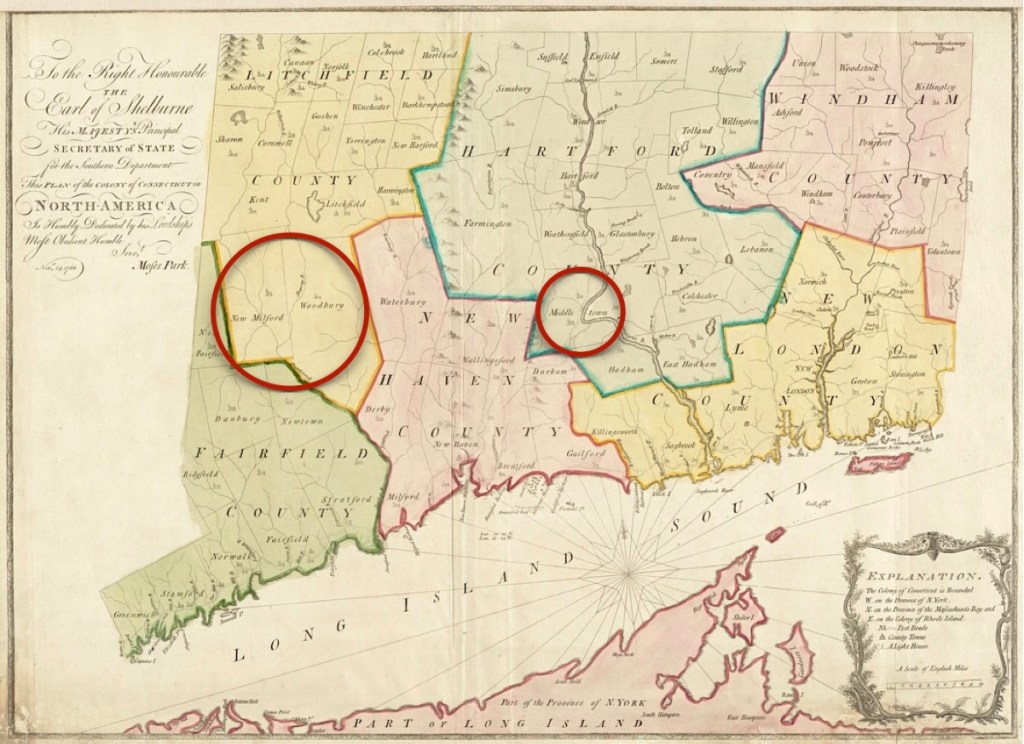
Plan of the Colony of Connecticut in North America, by Moses Park, 1766.
Mercy Drinkwater is from the area of the larger circle to the left; Eliphaz Warner, from the smaller circle to the right. (Image courtesy of the Boston Public Library).

One of the things about our Ancestral Grandmothers is the fact that not many records survive about these women. The eras that they lived in didn’t allow the creation of many meaningful records due to the customs of the time: things like civic records, inheritance laws, even Census data until about 1850… there just isn’t much there, or even that has survived. So it is with Mercy Drinkwater, especially as a young child.

We know when she was born, and that she was the youngest of 12 children from her father’s first wife. Her mother Elizabeth (Benedict) Drinkwater, died in 1749 when Mercy was about 15 months old. Her father William then remarried Susannah Washburn in 1751, when Mercy was about 3. Then in 1758, when Mercy was 10 years old, the records tell us that both William and her step-mother Susannah (Washburn) Drinkwater died.

So our primary question became, Who then raised Mercy for the next 10-11 years until she married? Was it her mother’s family the Benedicts? Or perhaps an older sister? How did she meet her husband, Eliphaz Warner? When exactly did they marry? We were not able to resolve these questions. We have looked everywhere and we don’t think that the marriage record has survived. We have to infer from what we know.

Mercy Drinkwater, born March 25, 1748, New Milford, Litchfield County, Connecticut Colony — died October 22, 1813, Sandgate, Bennington, Vermont. She was the daughter of William Drinkwater and Elizabeth Benedict.

Eliphaz Warner, born September 1, 1742, Middletown, Hartford* County, Connecticut Colony — died March 12, 1816, Sandgate, Bennington, Vermont. He was the son of Jabez Warner and Hannah Warner. He married Mercy Drinkwater by 1769, in an unknown location* in Connecticut; together they had seven children.

*We believe that the exact record for their marriage has been lost. This could be due to destruction caused by the church burning down, arson from conflicts with the Native Peoples, natural forces like a flood… Sometimes when the organizing government domain changes, records disappear through lack of oversight. Hartford County became Middlesex County in May 1785, being created from portions of Hartford County and New London County. Perhaps the record was lost then?

What we do know is this — it is highly probable is that they married in one of the three communities where their family members lived: Ridgefield, New Milford, or Woodbury. We just don’t know exactly where at this time. (2)
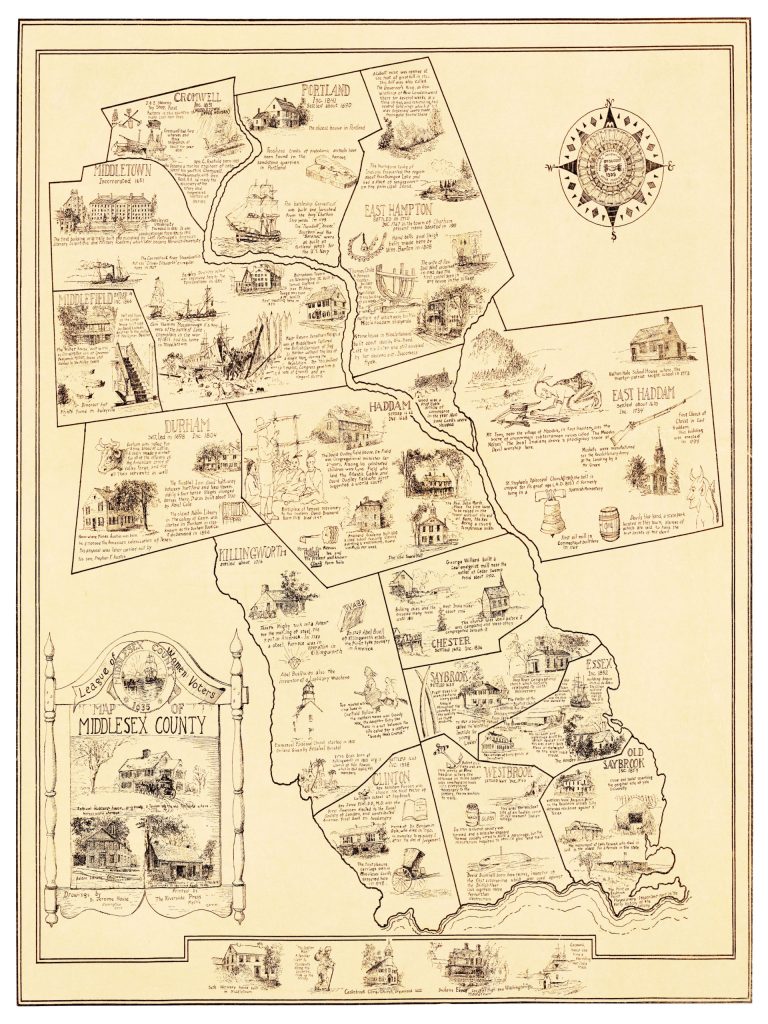
“This old map of Middlesex County, CT was commissioned in 1934 by the Connecticut League of Women Voters. S. Jerome Hoxie illustrated the map and it was printed by The Riverside Press in Mystic Connecticut.” (See footnotes).

Eliphaz and Mercy (Drinkwater) Warner Children

The first two children were born in Judea Parrish, Woodbury, Litchfield County, Connecticut Colony. “Before it became a separate town in 1779, and chose to name itself ‘Washington’, the area was known as ‘Judea’, and was part of Woodbury, Connecticut”. (Wikipedia, Judea Cemetery)

  • William S. Warner, born November 12, 1770 — died May 24, 1856, Sandgate, Bennington County, Vermont. He married first, (1798) Lucy Coan, in Woodbury, Litchfield County, Connecticut; they had 7 children. He married second, (circa 1816-17), Abigail Root; they had no children. He married third, (circa 1819) Prudence B. Nickerson, in Sandgate, Bennington, Vermont; they had 4 children.
    (We are descended from William and Prudence (Nickerson) Warner).
  • Dr. John Warner, born December 1772 — died September 4, 1839, Starkey, Yates County, New York. He married Mary DeWitt in October 1808.
  • Anna Warner, born 1773 in Middletown, Middlesex County, Connecticut Colony — died September 30, 1834, Sandgate, Bennington, Vermont. (Note: Anna may have been born in either Judea Parrish, Woodbury, Litchfield County, Connecticut, or Middletown, Middlesex County, Connecticut. The records conflict on this detail).

    By 1776 the family moved from Connecticut to Sandgate, Bennington County, The Vermont Republic (1771-1791), where the next four children were born .
  • Elizabeth Warner, born 1777 — died April 7, 1845, Salem, Washington County, New York. She married Joel Bassett, born Feb. 5, 1782 — died September 5, 1840, same location.
  • Hannah Warner, born 1783 — died October 13, 1818, Sandgate, Bennington County, Vermont.
  • Dr. James Warner, born 1785 — died February 21, 1813, Jericho, Chittenden County, Vermont.
  • Jabez Joseph Warner, born December 14, 1791 — died February 1, 1792 Sandgate, Bennington, County, Vermont.

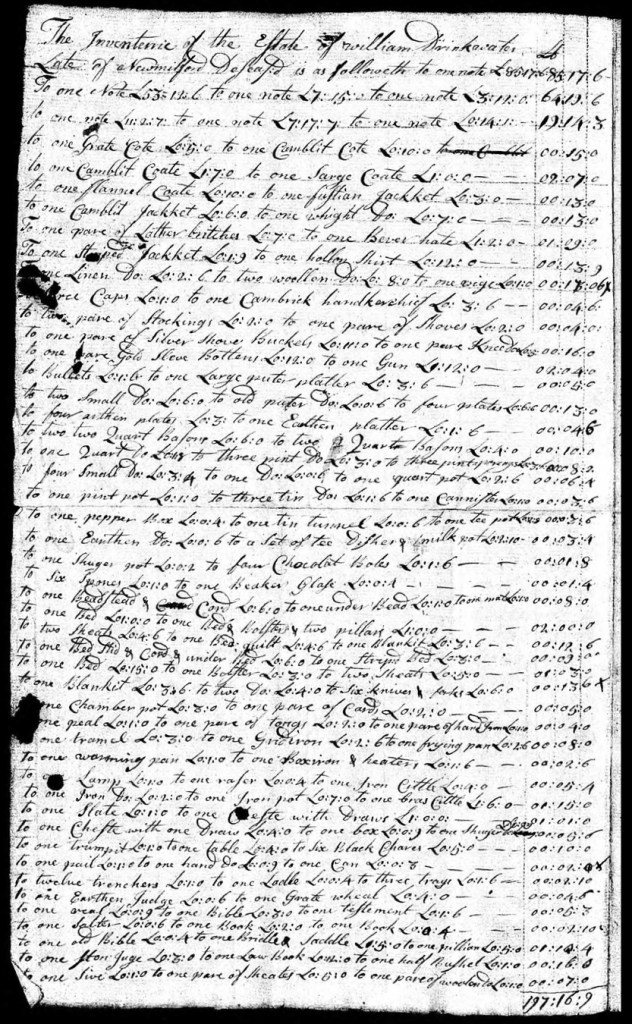
A few years before they moved to the Vermont frontier, this document appears. It’s one of the few things with Mercy (Drinkwater) Warner’s name attached to it. Why was this document done in 1770, 12 years after her father William Drinkwater had died? We speculate that perhaps Mercy and her husband Eliphaz Warner wanted to make sure that any portion of his estate (she was due), had been delivered to her? (3)
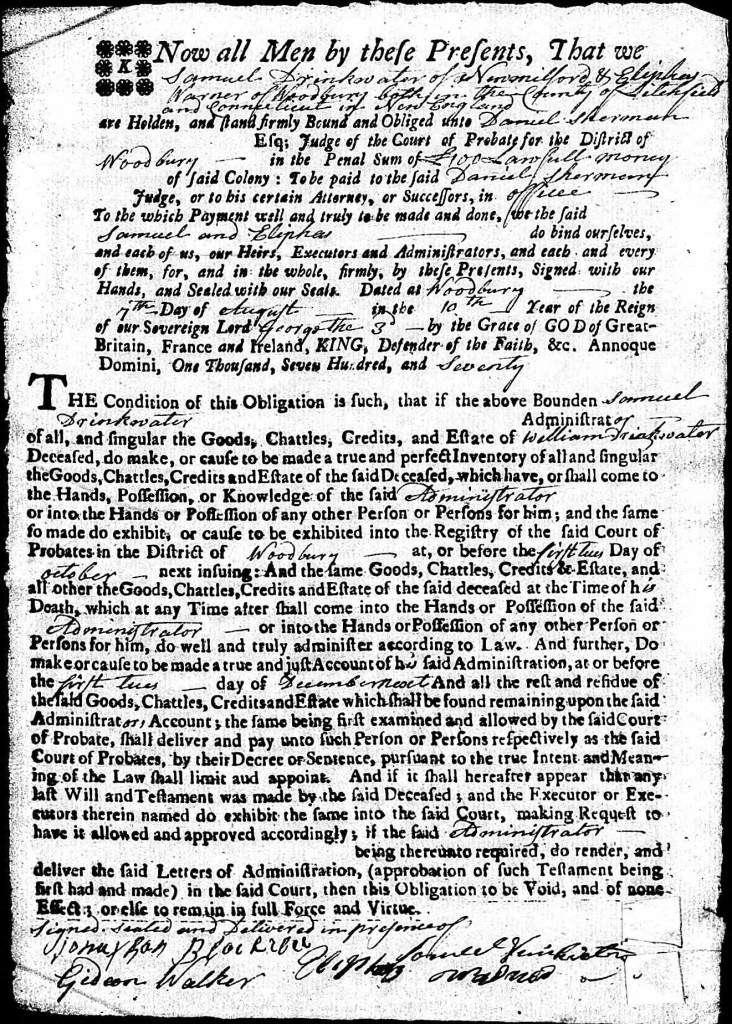
Administration papers from the estate of William Drinkwater, circa 1770.
From the Connecticut, U.S., Wills and Probate Records, 1609-1999.

Colonel Seth Warner, a Distant Cousin

The Warner’s were a large family. And in those days, cousins married each other, which sometimes causes us to “fret and pull our hair out” when trying to figure out who is related to who… in this case our “cousinship” to Seth Warner is distant for us, but much closer to our Warner line during the 1760s and 1770s.

  • Seth Warner’s 2x Great-Grandfather, John Warner, Jr. was also the father of our 4x Great-Grandmother, Hannah (Warner) Warner.
  • She was married to her first cousin, Jabez Warner, our 4x Great-Grandfather.
  • Their son Eliphaz Warner, was our 3x Great Grandfather.

In 1754 Hannah and Jabez Warner moved to Woodbury, Litchfield, Connecticut Colony, a town next to Roxbury where lived Seth Warner and Ethan Allen, cousins via their Baker relatives. We can’t know how much they interacted some 150 years ago, but they were all of the same age and the adventuresome sort. At this time the state of Vermont did not exist yet. The area was called the New Hampshire Grants. It was a wild and unsettled area in the early 1760s. There were constant disputes between New York and New Hampshire as the Grants were being settled.
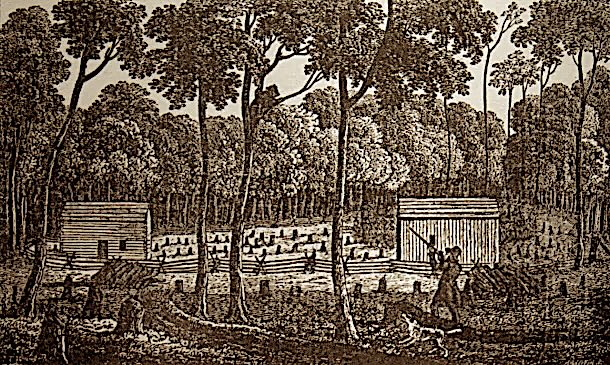
This print accompanied the narrative Seth Hubbell published in 1824
about his years spent struggling to establish a farm in the wilds of Vermont in 1789.
(Image courtesy of the Vermont Historical Society).

Dr. Benjamin Warner, Seth’s father, moved his family to this area in 1763. We know that they settled in what is now Bennington, Vermont. But there is some evidence that Seth held property in a small section called Sandgate, about 20 miles north of Bennington. At this time, families from Roxbury, Woodbury, and other parts of Connecticut began moving into the New Hampshire Grants. The Hurds, the Hurlburts, the Bakers and the Allens settled throughout the area and eventually, the Eliphaz Warners settled in Sandgate.

Under-appreciated by History?
Seth Warner is famous in Vermont history through his activities with Ethan Allen of the Green Mountain Boys just prior to and during the Revolutionary War. However, we wonder if perhaps he has been under-appreciated by American historians in general. We learned, from a fascinating online article by writer Gene Procknow at All Things Liberty —

“The legendary stories of Ethan Allen and Vermont’s Green Mountain Boys have long been part of American folklore. Their heroically described exploits are fabled in many fictional accounts and in children’s books. Allen’s name is synonymously linked with the Green Mountain Boys as if he was their sole leader.  However, while Allen receives the fame, there is a strong case that Seth Warner, a lesser-known member of the Green Mountain Boys, was the more impactful military leader during the American Revolution.

From left to right, the Colonel Seth Warner Monument in Bennington, Vermont.
Center: The flag of the Green Mountain Boys,
Right: Green Mountain Rangers, 1776 by Lt. Charles M. Lefferts. (See footnotes).

During the revolution, Seth Warner emerged as the leader of the Green Mountain Boys.  A day after Fort Ticonderoga fell [Allan’s victory], Warner led a contingent of the Green Mountain Boys in capturing British forces at Crown Point [Warner’s victory]. Both Warner and Ethan Allen traveled to Philadelphia to meet with the Continental Congress to obtain military pay for the Green Mountain Boys and to obtain permission to enlist a Green Mountain regiment in the Continental Army.  They returned with both. [The Green Mountain Boys were then referred to as the Green Mountain Rangers, and Warner’s Regiment].

In July 1777, he ably commanded undersized rear guard units at the battle of Hubbarton, Vermont and rallied his troops to cement a patriot victory at Bennington* in August.  British losses at these two battles weakened their invasion force, which aided the Continental Army victory at Saratoga in October.  After the 1777 campaign, Warner continued leading his regiment despite declining health until the unit was disbanded on January 1, 1781.
* See the text, The Battle of Bennington below.

Seth Warner was the elected and recognized commander of the Green Mountain Boys during their entire service with the Continental Army, with Ethan Allen playing the important political roles of firebrand, publicist, and spokesperson. Clearly, the American cause benefited from Seth Warner’s military leadership, while Ethan Allen’s political leadership was critical to the formation of Vermont as a distinct, independent sovereign entity”. (All Things Liberty) (4)

Being Early to Bennington, Republic of Vermont

Even though Vermont is recognized as the 14th state of the United States, it was born out of a complicated mess of issues as to who had the right to live in that rural territory, and who had the right to govern it. Among the interested parties were (quite naturally) the Native Peoples, the French Government and their settlers, and the British Government and their settlers. Like a tide that kept washing in and out, people came in and went out. After the French were defeated in the French and Indian War, the rights to this area were given by the Treaty of Paris (in 1763), to the British.

Be that as it may, the New York Colony, and the Province of Massachusetts Bay Colony, and the Province of New Hampshire continued to squabble over who had the land rights to the territory. Much of this was due to the fact that the population of the area increased dramatically in a short period of less than 30 years. “In the 28 years from 1763 to 1791, the non-Indian population of ‘New Hampshire Grants’ rose from 300 to 85,000.

Plan of Sandgate (map), by Benning Wentworth, circa 1761.
(Image courtesy of the Library of Congress).

New Hampshire’s [Colonial] governor, Benning Wentworth, [had] issued a series of 135 land grants between 1749 and 1764 called the New Hampshire Grants. Many of these were in a large valley on the west (or New York side) of the Green Mountains and only about forty miles from Albany. The town was laid out in 1749 and was settled after the war in 1761. The town was named Bennington for Wentworth. Ultimately, by 1754, Wentworth had granted lands for 15 towns. (Wikipedia, History of Vermont)

“The first settler in Sandgate was Reuben Thomas, who came from Woodbury, Connecticut. Congregational Church records show “1769, December 27th — Reuben Thomas Esqr. moved his family which was the first family into this town.” (Sandgate Vermont)

“In 1770, Ethan Allen—along with his brothers Ira and Levi, as well as Seth Warner—recruited an informal militia, the Green Mountain Boys, to protect the interests of the original New Hampshire settlers against the new migrants from New York. A significant standoff occurred at the Breakenridge farm in Bennington, when a sheriff from Albany arrived with a posse of 750 men to dispossess Breakenridge. The residents raised a body of about 300 armed men to resist. The Albany sheriff demanded Breakenridge, and was informed, ‘If you attempt it, you are a dead man.’ The sheriff returned to Albany.

In the summer of 1776, the first general convention of freemen of the New Hampshire Grants met in Dorset, Vermont, resolving ‘to take suitable measures to declare the New Hampshire Grants a free and independent district.’ On January 15, 1777, representatives of the New Hampshire Grants convened in Westminster and declared their land an independent republic, The Vermont Republic (from 1777 until 1791). Then in 1791, Vermont became a state.
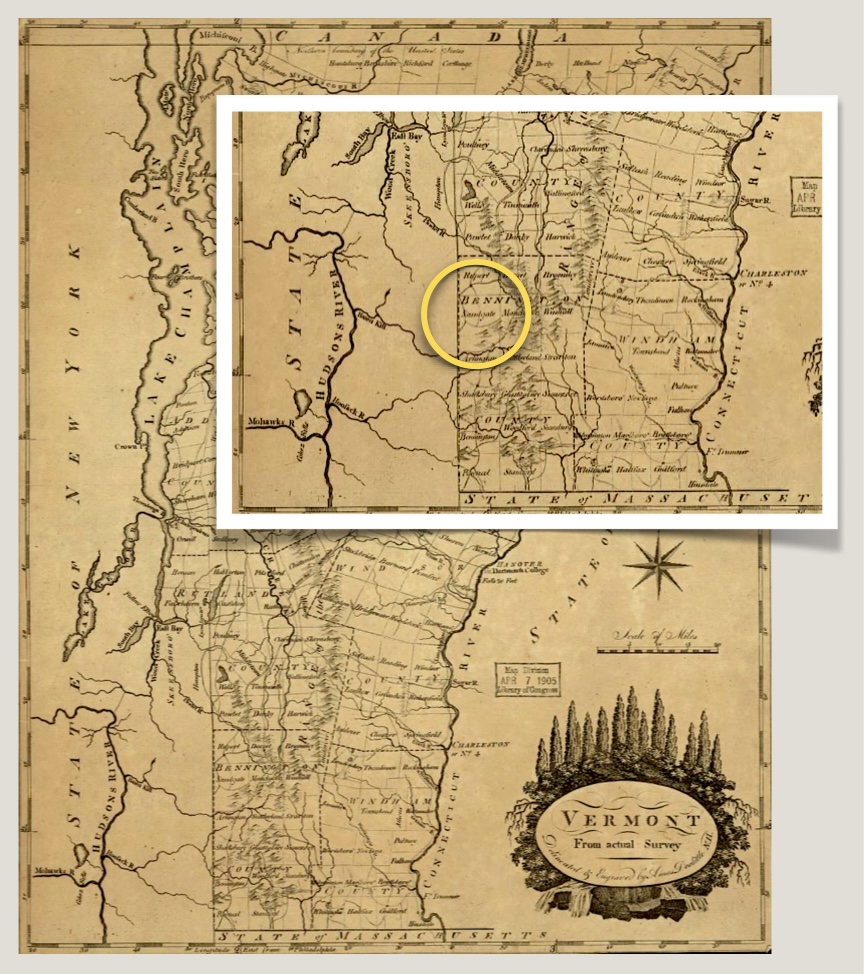
Vermont, from actual survey, by Amos Doolittle and Mathew Carey, circa 1795. This map shows where the Warners were living in the small town of Sandgate, Vermont from 1776 onwards. (Image courtesy of the Library of Congress).

Observation: 1776 is the year when the Eliphaz Warner family moved from the Woodbury, Litchfield County, Connecticut area to Sandgate, Bennington, Vermont Republic. They moved right into the very thick of things.

On June 2, [1776] a second convention of 72 delegates met at Westminster, known as the ‘Westminster Convention’. At this meeting, the delegates adopted the name ‘Vermont’ on the suggestion of Dr. Thomas Young of Philadelphia, a supporter of the delegates who wrote a letter advising them on how to achieve statehood. [One month later…] On July 4, the Constitution of Vermont was drafted during a violent thunderstorm at the Windsor Tavern owned by Elijah West. It was adopted by the delegates on July 8 after four days of debate. This was the first written constitution in North America to provide for the abolition of slavery (for adults), suffrage [voting rights] for men who did not own land, and public schools.” (Wikipedia, History of Vermont) (5)

The first page of the original Constitution for Vermont, with a vintage postcard featuring the Old Constitution House, the former Windsor Tavern. (See footnotes).

Or This Night Molly Stark Sleeps a Widow!

“During the summer of 1777, the invading British army of General John Burgoyne slashed its way southward through the thick forest, from Quebec to the Hudson River, captured the strategic stronghold of Fort Ticonderoga, and drove the Continental Army into a desperate southward retreat. Raiding parties of British soldiers and native warriors freely attacked, pillaged and burned the frontier communities of the Champlain Valley and threatened all settlements to the south. The Vermont frontier collapsed in the face of the British invasion. The New Hampshire legislature, fearing an invasion from the west, mobilized the state’s militia under the command of General John Stark.

General Burgoyne received intelligence that large stores of horses, food and munitions were kept at Bennington, which was the largest community in the land grant area. He dispatched 2,600 troops, nearly a third of his army, to seize the colonial storehouse there, unaware that General Stark’s New Hampshire troops were then traversing the Green Mountains to join up at Bennington with the Vermont continental regiments commanded by Colonel Seth Warner, together with the local Vermont and western Massachusetts militia. 

The combined American forces, under Stark’s command, attacked the British column at Hoosick, New York, just across the border from Bennington. General Stark reportedly challenged his troops to fight to the death, telling them ‘There are your enemies, the redcoats and the Tories. They are ours, or this night Molly Stark sleeps a widow!’ ” (Wikipedia, History of Vermont) (6)
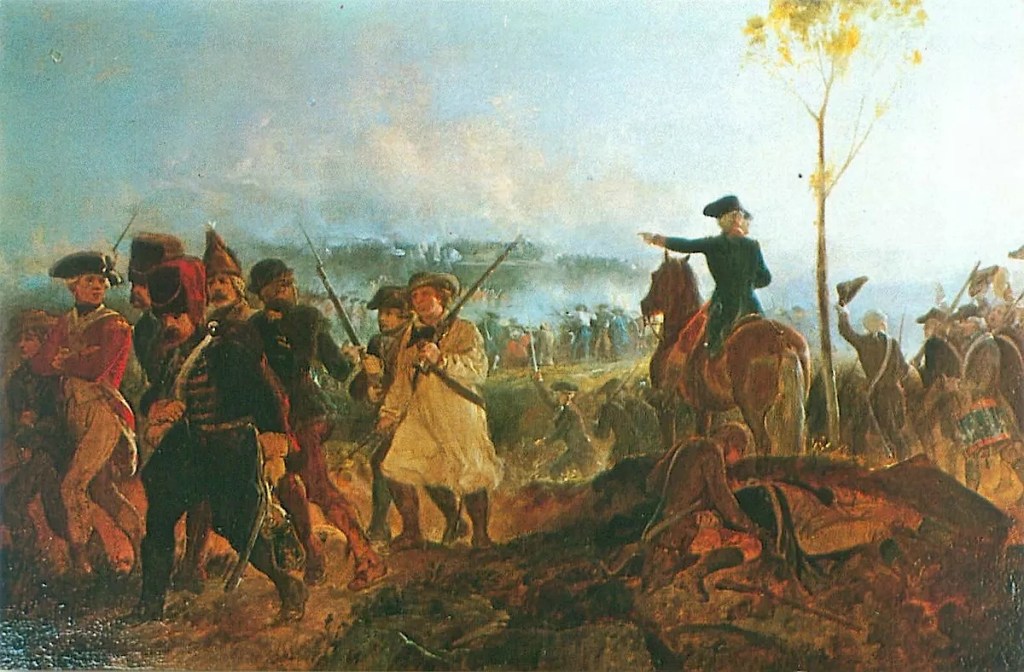
Battle of Bennington, 1777 by Alonzo Chappel.
(Image courtesy of The Bennington Museum).

The Battle of Bennington

“The town is known in particular for the Battle of Bennington, which took place during the Revolutionary War. Although the battle took place approximately 12 miles (19 km) to the west in what is now the state of New York, an ammunition storage building located in Bennington was an important strategic target. On August 16, 1777, Gen. John Stark’s 1,500-strong New Hampshire Militia defeated 800 German (Hessian) mercenaries, local Loyalists, Canadians and Indians under the command of German Lt. Col. Friedrich Baum. German reinforcements under the command of Lt. Col. Heinrich von Breymann looked set to reverse the outcome, but were prevented by the arrival of Seth Warner’s Green Mountain Boys, the Vermont militia founded by Ethan Allen”. (Wikipedia, Bennington Vermont)
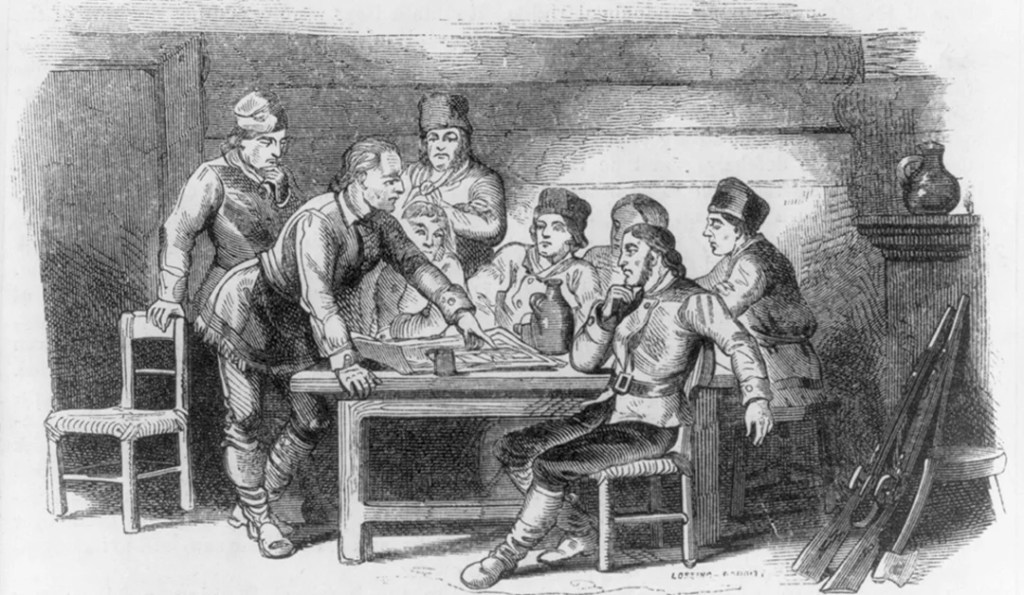
This illustration depicts Ethan Allen [pointing at the map]
and the other leaders of the Green Mountain Boys, which included Seth Warner.
(Image courtesy of the Library of Congress).

The “all-day battle fought in intense summer heat, the army of Yankee farmers defeated the British, killing or capturing 900 soldiers. Burgoyne never recovered from this loss and eventually surrendered at Saratoga on October 17. (Wikipedia, History of Vermont)

During the War, Eliphaz Warner was called to serve in several instances. Shown below is one of the payroll records “for service done to guard the frontiers”. (7)
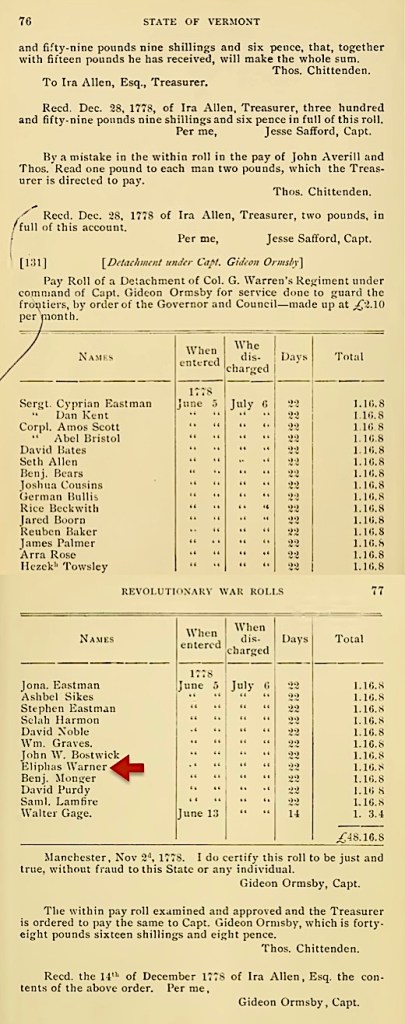
From the book, Rolls of the Soldiers in the Revolutionary War, 1775 to 1783,
by John E, Goodrich. “Payroll under Col. G. Warren’s Regiment under the command
of Capt. Gideon Ormsby”, pages: 76-77. (Image courtesy of the Library of Congress).
For other rosters, see the footnotes.

Time’s Arrow Points in One Direction

If anyone has spent any time glancing over census data, it quickly becomes clear that early censuses were simple, and later ones grew increasingly more complex. “Statistics show that as the Nation’s population grew and its demographics changed, so did the decennial* census evolve in order to measure that growth and change. As a result, no two censuses are exactly alike. To count a population of 3,329,326 in 1790, the census cost $44,377, utilized 1,650 enumerators, and culminated in one published volume totaling 56 pages. The 1990 Census counted a population of 248,709,873, cost $2.5 billion, and culminated in published census reports totaling 450,000 pages”.
*All of the following censuses are decennial, meaning they recur every ten years.
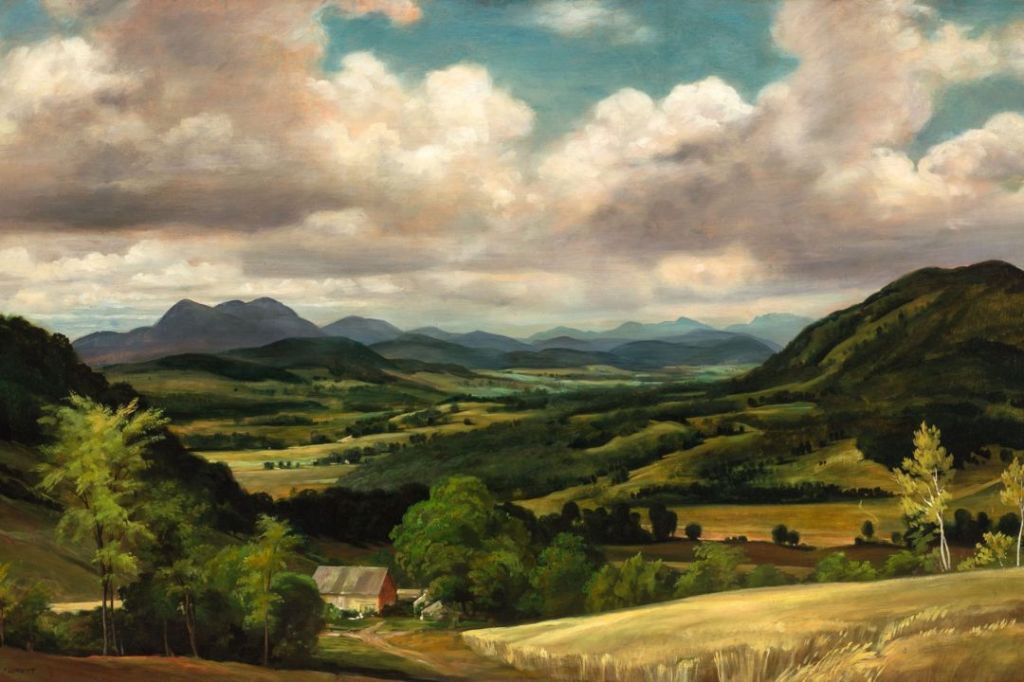
From the Vermont Historical Society, this painting titled
Derby View, 1939 by William Dean Fausett,
was painted to portray what colonial era Vermont would have looked like.

1790 —
“The census began on Monday, August 2, 1790, and was finished within 9 months, under the rules and directions established in an Act of Congress approved March 1, 1790. The 1790 population census was the First Decennial* Census of the United States”. (The National Archives)

The 1790 United States census for Sandgate, Vermont.

The 1790 census tells us that Eliphaz Warner had 8 people in his home, who were enumerated as follows (with our observations for people inserted):

  • 3 men of 16 years & upwards, including heads of families: sons William, John, and father Eliphaz — Head of Family
    • 1 boy under 16 years: son James
    • 4 women including heads of families: daughters Anna, Elizabeth, Hannah, and mother Mercy
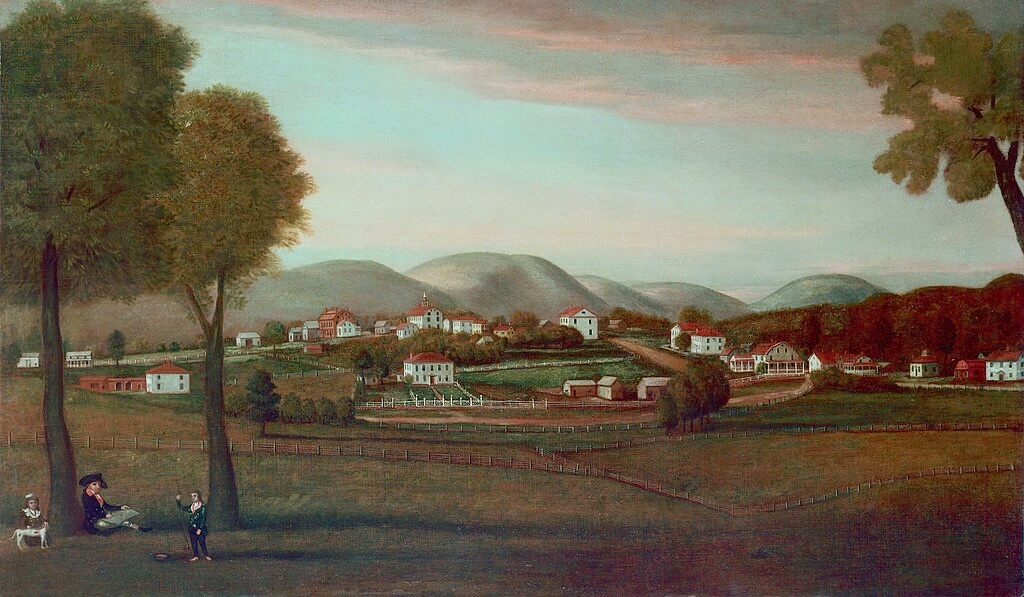
Townscape of Bennington; Landscape View of Old Bennington, circa 1798, by Ralph Earl.
It is interesting to note how the landscape had changed from dense forest to open fields.
(Image courtesy of the Bennington Museum).

In 1798, Eliphaz and Mercy’s oldest son William Warner, married (1) Lucy Coan, daughter of Mulford and Elizabeth (Howd) Coan, in Woodbury, Litchfield, Connecticut. William returned to Woodbury for their marriage, and together she went with him to Sandgate, Vermont. They had seven children, who are interwoven throughout the following years of Census data shown below. (8)

For clarity, here is a list of their seven children:

  • Mary Warner, 1799 – 1859
  • William Warner, Jr., 1801-1890
  • Joseph Warner, 1803 -1890
  • Lucina Warner, 1805 – 1874
  • Gaylord Coan Warner, 1808 – 1886
  • Benjamin Stone Warner, 1810 – 1893
  • John Warner, 1812 – 1889

A New Century Begins

1800 —
“The census began on Monday, August 4, 1800, and was finished within 9 months, under the rules and directions established in an Act of Congress approved February 28, 1800. The 1800 population census was the Second Decennial Census of the United States”.

The 1800 United States census for Sandgate, Vermont.

For the Eliphaz Warner family, there were 5 people living there, as follows:

  • 1 boy 10 thru 15: son James
  • 1 man 45 and over: Eliphaz – Head of Family
  • 2 women 16 thru 25: daughters Hannah, Anna
  • 1 female 45 and over: mother Mercy

    This same 1800 census shows us that son William Warner is counted as a separate household. He is likely living nearby, if not next door. He had four people living in his home, enumerated as follows:
  • 2 men 26 thru 44: William – Head of Family, and an (unknown male)
  • 1 girl under 10: daughter Mary
  • 1 woman 45 and over: mother Lucy Coan (William’s first wife)

Observation: As we analyzed the censuses, it became clear that these two families lived next door to each other and that their lives were all intertwined. Eliphaz always had William living nearby, and after Eliphaz was no more, William usually had a sibling, or one of his own children nearby.

1810 —
“The census began on Monday, August 6, 1810, and was finished within 9 months, under the rules and directions established in an Act of Congress approved March 26, 1810. The 1810 population census was the Third Decennial Census of the United States”.

The 1810 United States census for Sandgate, Vermont. Note that Eliphaz’s name is positioned below his son William’s name.

This Census tells us that Eliphaz had 5 people in his home, who were enumerated as follows (with our observations of whom inserted):

  • 1 man 26 thru 44: son James (son John married, 1808 and lived in New York)
  • 1 man 45 and over: father Eliphaz – Head of Family
  • 2 women 26 thru 44: daughters Anna and Hannah (daughter Elizabeth married, 1808 and lived in New York)
  • 1 woman 45 and over: mother Mercy
Macdonough’s victory on Lake Champlain and defeat of the British Army at Plattsburg
by Genl. Macomb, Sept. 11 1814. Hand colored engraving by Benjamin Tanner, circa 1816.
(Image courtesy of Wikimedia Commons).

The 1810 Census is the last census that Eliphaz and Mercy appear in. From this point forward, all descriptions will only be about William Warner Sr.’s family. The 1810 Census further tells us that William Sr. had 9 people in his home, who were enumerated as follows (with our observations of whom inserted):

  • 4 boys under 10: sons William Jr., Joseph, Gaylord, and Benjamin
  • 1 man 26 thru 44: William Sr. – Head of Family
  • 2 girls under 10: daughters Lucina, and (unknown girl)
  • 1 girl: 10 thru 15: daughter Mary
  • 1 woman 26 thru 44: mother Lucy Coan

When the War of 1812 broke out in the young United States, Vermont was mostly removed from the battle sites of the war. The closest battle was The Battle of Plattsburg, which took place at the northern end of Lake Champlain, not very far away in New York State. “A relatively small force of approximately 5,000 Americans, including 2,200 Vermont militiamen, defeated a formidable force of roughly 11,000 British sailors on Sept. 11, 1814. This battle ended the British Invasion from Canada”. (Vermont National Guard Museum) We have not located any records that confirm that this branch of the Warner family actually participated in this war.

Besides, William Warner Sr. had his hands quite full. There was a house abundant of young children, his parents were elderly, and it seems that his wife Lucy had her troubles also — Several members of this family died during this decade; all of them in Vermont. Son Dr. James Warner died February 21, 1813 in Jericho, Chittenden County and is buried there. Mercy (Drinkwater) Warner soon followed. She died in October 22, 1813 in Sandgate, Bennington County and is buried in the Sandgate Center Cemetary. Eliphaz Warner died March 12, 1816 in Sandgate and is buried near his wife Mercy. Daughter Hannah Warner died October 13, 1818 in Sandgate and is buried near her parents. (9)

This brings us to…

The Decade of Three Wives

William Warner Sr.’s first wife, Lucy Coan, who had come to Vermont with him from Connecticut, died on October 2, 1815. She is buried at Sandgate Center Cemetery.

William was a widower with young children. He remarried after 1815 to his second wife (2) Abagail (Root) Warner. She was born about 1784 (based on the age of 34 years listed on her death record). Abagail has left very few records. She died soon after they were married, on June 13, 1818; there were no children.

At age 25, (3) Prudence B. Nickerson entered the family when she married William Warner in 1819; they had 4 children, James Ward, Lucy Mercy, Ira Nickerson, and Mary Ann. Like Abagail Root before her, there are very few records of her life prior to when she married William Sr. We know she was born in 1794 supposedly in Massachusetts, although some documents identify her birth in Vermont. We also note that there was a 24 year age gap when they married – William was 49 at the time.

Together, they are our 3x Great Grandparents — we are descended from William and Prudence B. (Nickerson) Warner and their daughter Mary Ann Warner.
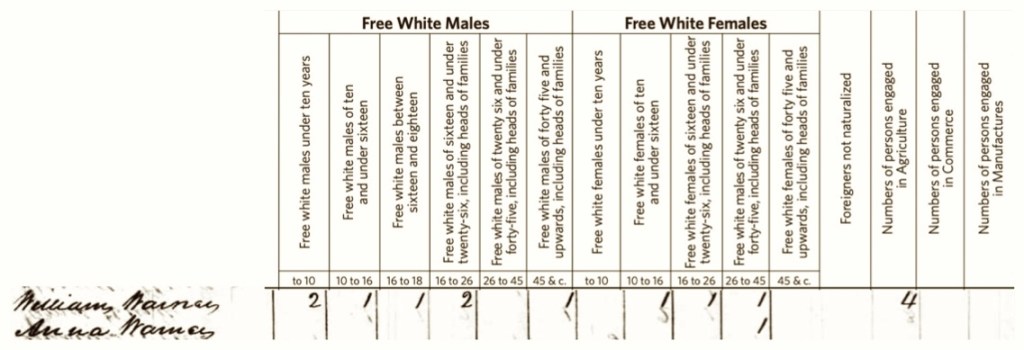
The 1820 United States census for Sandgate, Vermont for William Warner and his unmarried sister Anna Warner.

1820 —
“The census began on Monday, August 7, 1820, and was finished within 6 months, under the rules and directions established in an Act of Congress approved March 14, 1820. The 1820 population census was the Fourth Decennial Census of the United States”. The census tells us that 10 people are living there. William Sr.’s sister Anna never married and is living next door, probably in her parents home. She is listed separately on this census. (10)

  • 2 boys under 10: sons Benjamin, John.
  • 1 boy 10 to 15: son Gaylord
  • 1 boy from 16 to 18: (unknown male)
  • 2 men 16 to 25: sons Joseph, William Jr.
  • 1 man 45 and upwards: William Sr. — Head of Family
  • 1 girl from 10 to 15: daughter Lucina
  • 1 girl/woman from 16 to 25: daughter Mary
  • 1 woman 26 to 45: (step-mother) Prudence.
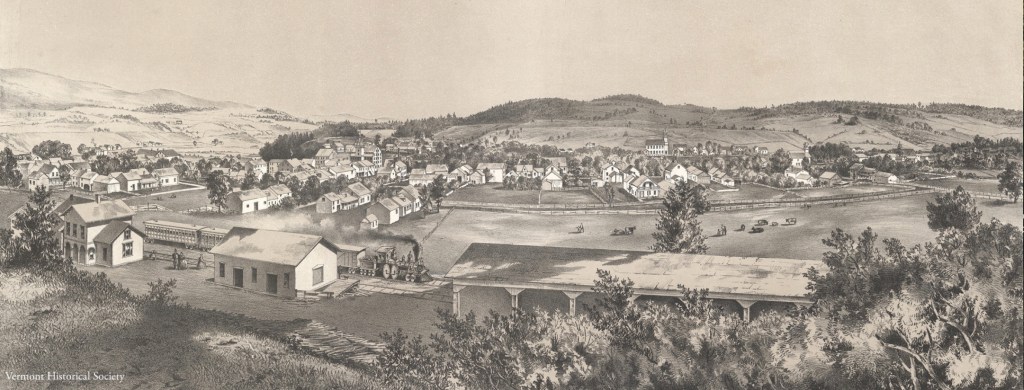
Baaa-aaa-ah. Who knew? Where are the trees?
(Image courtesy of the Vermont Historical Society).

A World Awash in Merino Sheep

William Warner Sr. was a farmer, but we don’t know if he raised sheep. If he needed any, he wouldn’t have needed to go very far. From the Vermont History Explorer, “Vermont’s landscape looks very different today than it did nearly 200 years ago. Many places that are now covered with trees were open fields. In the 1830s and 1840s, those fields were full of Merino sheep. Almost 1.7 million sheep lived in Vermont in 1840. At the same time, fewer than 300,000 people lived in the state. There were nearly six times more sheep than people in Vermont! These sheep produced almost 3.7 million pounds of wool.”

The 1830 United States census for Sandgate, Vermont.

1830 —
“The census began on Tuesday, June 1, 1830, and was finished within 6 months, under the rules and directions established in an Act of Congress approved March 23, 1830. The 1830 population census was the Fifth Decennial Census of the United States”. The census tells us that 9 people are living in the Warner home. William Sr.’s sister Anna is still living next door and is listed separately on this census.

  • 1 boy under 5: son Ira (likely an infant)
  • 1 boy 6 to 10: son James Ward
  • 1 boy 15 to 20: sons, Benjamin or John
  • 1 man 20 to 29: son Gaylord
  • 1 man 50 to 59: William — Head of Family
  • 1 girl under 5: (unknown girl)
  • 2 girls 5 to 9: daughter Lucy Mercy, and (unknown girl)
  • 1 woman 30 to 39: mother Prudence

This is the first census that begins counting the children that were born after Prudence and William Sr. married circa 1819. Their children were born in Sandgate, Bennington, Vermont.

Son James Ward Warner was born September 26, 1820 — died October 25, 1908, in Kennewick, Benton, Washington. (For a fuller description of his descendants, See Descendant Appendix A in the footnotes for this section). Daughter Lucy Mercy Warner was born May 2, 1823 — died November 14, 1879, Bennington, Bennington, Vermont. (For a fuller description of her descendants, See Descendant Appendix B in the footnotes for this section). Son Ira Nickerson Warner was born May 20, 1830 — died March 6, 1877 in Aurora, DuPage, Illinois. (For a fuller description of his descendants, See Descendant Appendix C in the footnotes for this section).

The 1840 United States census for Sandgate, Vermont.

1840 —
“The census began on Monday, June 1, 1840, and was finished within five months, under the rules and directions established in an Act of Congress approved March 3, 1839. The 1840 population census was the Sixth Decennial Census of the United States”. The census tells us that 7 people are living there. William’s oldest daughter Mary (Warner) Meeker is living next door, and is listed separately on this census.

  • 1 boy 10 to 14: son Ira
  • 1 boy 15 to 19: son James
  • 1 man 60 to 69: William – Head of Family
  • 1 girl 5 to 9: daughter Mary Ann
  • 1 girl 15 to 19: daughter Lucy Mercy
  • 1 woman 40 to 49: mother Prudence
  • 1 woman 70 to 79: (unknown woman)
Taking the census — after a sketch by Thomas Worth.
As published in Harper’s Weekly magazine, 1870.
(Image courtesy of the Library of Congress).

In 1833, Prudence and William had their last child, a daughter, Mary Ann Warner. She was born on February 9, 1833 — died April 10, 1899 in South Russell, Geauga, Ohio. On February 2, 1856 she married Peter A. DeVoe; they had 2 children. They are our Great-Great-Grandparents — we are descended from Peter and Mary Ann. For the history of Peter and Mary Ann’s further lives together, please see: The DeVoe Line, A Narrative — Nine.
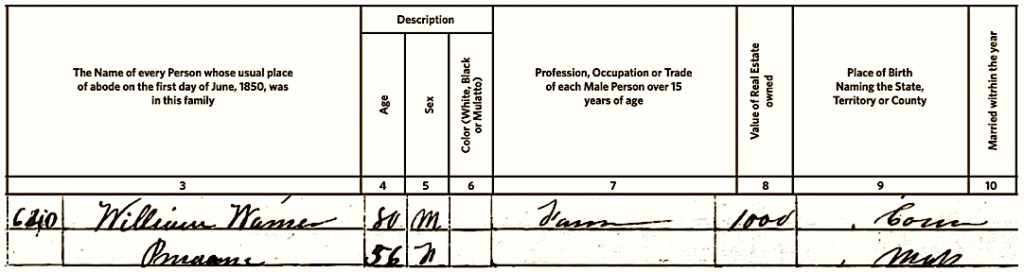
The 1850 United States census for Sandgate, Vermont.

1850 —
“The census began on Saturday, June 1, 1850, and was finished within 5 months, under the rules and directions established in an Act of Congress approved May 23, 1850. The 1850 population census was the Seventh Decennial Census of the United States”. The is the first Census where we see all members of the household listed.

Things seem to have quieted down a lot at the Warner home with just William and Prudence living there. In 1850, their daughter Mary Ann is living nearby in Sandgate, at her older sister Mary Meeker’s home, where her brother Ira is also residing. Mary Ann’s name is sometimes recorded as Ann, probably because (in this case) there were two people living there with the same name of Mary.

The 1850 United States census for Sandgate, Vermont.

William Warner Sr. died on May 24, 1856. He is buried at Sandgate Center Cemetery, at which a remarkable number of Warner family members are also interred. Near William are his wives Lucy, and Abagail, some of his siblings, and several of his children. For his estate papers, please see the footnotes. (11)

Sometimes Life Is A Circle

From the 1830s through this pre Civil War period, seven of William Sr.’s eleven children, relocated from Vermont to the Connecticut Western Reserve of Ohio. This emigration included his youngest daughter Mary Ann (Warner) DeVoe and her husband, Peter A. DeVoe. William’s surviving wife Prudence moved there by 1870 and is buried near their daughter.

As we learned more about Mary Ann Warner’s history — we found that by 1855, she had already been residing in the town of Wilton in Saratoga County, New York for three years. She is working as a weaver at the nearby Saratoga Victory Manufacturing Company, in Victory Village. An ironic thing about her occupation, is the fact that the wool she was likely using to manufacture products, had likely been produced right in her old backyard in Bennington, Vermont. Like Mary Ann Warner at her loom — we ourselves also gather the threads, of family stories, and weave them into the warp and weft of a meaningful family narrative.
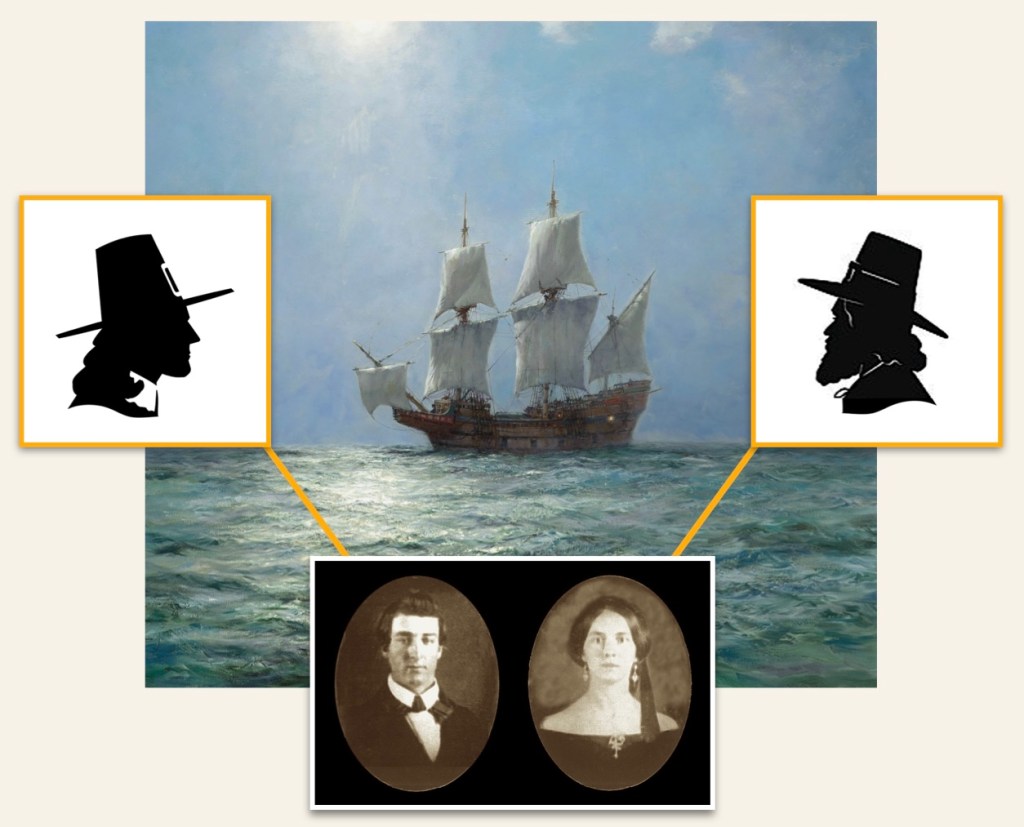
We are descended from two of the original Plymouth Pilgrim families, from the 1620 voyage
of the Mayflower. Both of these lines meet with our 2x Great Grandparents, through
the marriage of Peter A. DeVoe (for Edward Doty), and Mary Ann Warner (for George Soule).
Background image, Isolation: The Mayflower Becalmed on a Moonlit Night, by Montague Dawson.

With Generation Seven in America, the Warner family surname gives way to the surname of DeVoe. Mary Ann’s husband, Peter A. DeVoe, is a direct descendant of another Mayflower passenger, Pilgrim Edward Doty. Not only does this line of descent circle back to the Mayflower, but the DeVoe line traces its origins back to the same region of Holland where Pilgrim George Soule began his journey.

You can read about the DeVoe family, who have their own amazing history starting with, The DeVoe Line, A Narrative — One, Holland & Huguenots, and the Doty family, starting with, The Doty Line, A Narrative — One. (12)

Following are the footnotes for the Primary Source Materials,
Notes, and Observations

Preface

(1) — one record

Seven virtues
https://en.wikipedia.org/wiki/Seven_virtues#:~:text=In%20Christian%20history%2C%20the%20seven,faith%2C%20hope%2C%20and%20charity.
Note: For the text.

Woodbury, Connecticut Colony

(2) — eleven records

Woodbury, Connecticut
https://en.wikipedia.org/wiki/Woodbury,_Connecticut
Note: For the text.

The Old Woodbury Historical Society
History of Woodbury
https://www.owhs.org/history.html
Note: For the text.

Boston Public Library
Norman B. Levanthal Map & Education Center Collection
Plan of the Colony of Connecticut in North America
by Moses Park, 1766
https://collections.leventhalmap.org/search/commonwealth:z603vt46p
Note: For the map image. “Moses Park, a surveyor from Preston, Connecticut, executed this map in 1766 with the assistance of Asa Spaulding of Norwalk and Samuel Mott of Preston.”

Mercy Drinkwater
in the Connecticut, U.S., Town Birth Records, pre-1870 (Barbour Collection)
New Milford Vital Records 1712-1860

https://www.ancestry.com/search/collections/1034/records/191129?tid=&pid=&queryId=65f6527a-b69f-4af3-8bf1-1576fb5d0bef&_phsrc=dRx1&_phstart=successSource
Book page: 76, Digital page: 74/232
Note: Listed as the 14th entry on the page.

Mercy Warner
in the U.S., Find a Grave Index, 1600s-Current
https://www.ancestry.com/search/collections/60525/records/91584565
and
Mercy Drinkwater Warner
https://www.findagrave.com/memorial/16704122/mercy-warner
Note: For the data.

Eliphaz Warner
The Descendants of Andrew Warner (book)
Fourth Generation
https://www.ancestry.com/imageviewer/collections/15319/images/dvm_GenMono000758-00056-0?usePUB=true&_phsrc=dRx5&pId=104&backlabel=Return&queryId=0095c2f420af5ec55c6e85937768fa6e&rcstate=dvm_GenMono000758-00056-0:227,1330,361,1362;361,1329,481,1353;352,1361,477,1388;332,1395,456,1420;336,1428,458,1453;324,1462,456,1491;359,1493,479,1523;320,1561,446,1588;466,1625,594,1653;502,1743,709,1774;191,1793,321,1821;429,1868,578,1897;890,104,1041,127;729,413,857,443;426,602,641,631;177,649,307,678;179,771,308,799;681,761,831,791;650,803,804,832;980,878,1128,909;947,999,1099,1034;365,1195,488,1219;348,1229,469,1254
Book page: 98, Digital page: 107/184

Eliphaz Warner
in the U.S., Find a Grave Index, 1600s-Current
https://www.ancestry.com/search/collections/60525/records/91584550?tid=&pid=&queryId=e60befba-7e73-4827-b3c5-efdd800afda8&_phsrc=PRY1&_phstart=successSource
and
Eliphaz Warner
https://www.findagrave.com/memorial/16704105/eliphaz-warner
Note: For the data.

Middletown, Connecticut
https://en.wikipedia.org/wiki/Middletown,_Connecticut
Note: For the data.

KNOWOL
Historical Map of Middlesex County, Connecticut
https://www.knowol.com/information/connecticut/middlesex-county-map/
Note: For the map image and caption.

The Eliphaz and Mercy Warner Children

(3) — eight records

Eliphaz Warner
The Descendants of Andrew Warner (book)
Fifth Generation
https://www.ancestry.com/imageviewer/collections/15319/images/dvm_GenMono000758-00084-0?usePUB=true&_phsrc=dRx4&pId=160&backlabel=Return&queryId=0095c2f420af5ec55c6e85937768fa6e&rcstate=dvm_GenMono000758-00084-0:268,488,490,523;500,489,714,516;183,529,337,564;336,529,493,563;903,649,1071,679;339,933,477,957;304,1033,420,1059;369,1066,492,1093;349,1398,468,1422;324,1431,444,1456;637,1560,835,1588;240,1603,419,1639;419,1602,573,1638;484,1763,633,1795;887,83,1037,105;314,159,435,183;378,193,499,216;379,226,495,250;349,292,473,316;328,358,449,382
Book page: 154, Digital page 163/184
Note: For his family records.

Judea Cemetery
https://en.wikipedia.org/wiki/Judea_Cemetery
Note: For the text.

William Drinkwater
in the Connecticut, U.S., Wills and Probate Records, 1609-1999
Woodbury District > Probate Packets, Downs, C-Edmond, M, 1720-1880
https://www.ancestry.com/imageviewer/collections/9049/images/007629576_00856?usePUB=true&_phsrc=VgH4&_phstart=successSource&usePUBJs=true&pId=2465233
Digital page: 856/1417
Note: Case 1384 — Administration papers from the estate of William Drinkwater, circa 1770.

Colonel Seth Warner, a Distant Cousin

(4) — five records

Journal of The American Revolution
Seth Warner or Ethan Allen: Who Led the Green Mountain Boys?
by Gene Procknow
https://allthingsliberty.com/2014/05/seth-warner-or-ethan-allen-who-led-the-green-mountain-boys/
Note: For the text.

VT Digger, News and Culture
Then Again: Plagued by Diversity, Wolcott’s First Settler Persevered
by Mark Bushnell
https://vtdigger.org/2018/09/09/plagued-adversity-wolcotts-first-settler-persevered/
Note: For the image.

The Historical Marker Database
Colonel Seth Warner
https://www.hmdb.org/m.asp?m=77023
Note: For the image, Photo 6 by Howard C. Ohlhous, October 24, 2008.

Flag of the Green Mountain Boys
https://en.wikipedia.org/wiki/Flag_of_the_Green_Mountain_Boys
Notes: Also known as the Stark Flag, this image is replica flag made by Amber Kincaid.

Uniforms of The American Revolution
Green Mountain Rangers, 1776
by Lt. Charles M. Lefferts, circa 1926
https://www.srcalifornia.com/uniforms/p24.htm
Note: For the image.

Being Early to Bennington (Vermont)

(5) — six records

History of Vermont
https://en.wikipedia.org/wiki/History_of_Vermont
Note: For the text.

Library of Congress
Plan of Sandgate (map)
by Benning Wentworth, circa 1809
https://www.loc.gov/resource/g3754s.ar087800/?r=-1.311,-0.37,3.622,1.808,0
Note: For the map image.

Sandgate Vermont
Early Settlers
https://www.sandgatevermont.com/settlers.php

Library of Congress
Vermont, from actual survey
by Amos Doolittle and Mathew Carey, circa 1795
https://www.loc.gov/resource/g3750.ct000093/?r=-0.878,-0.069,2.756,1.376,0
Note: For the map image.

Vermont History Explorer
The Vermont Constitution
https://vermonthistoryexplorer.org/the-vermont-constitution
Note: For the image of page one of the Vermont Constitution.

Hip Postcard
Vermont WINDSOR Old Constitution House, Built 1777 — DB
United States — Vermont — Other, Postcard

https://www.hippostcard.com/listing/vermont-windsor-old-constitution-house-built-1777-db/33113359
Note: For the vintage postcard image.

Or This Night Molly Stark Sleeps a Widow!

(6) — one record

History of Vermont
https://en.wikipedia.org/wiki/History_of_Vermont
Note: For the text.

The Battle of Bennington

(7) — eight records

Battle of Bennington, 1777 https://bennington.pastperfectonline.com/webobject/A4B796E5-ADE8-455B-8DF7-217237214000
by Alonzo Chappel.
Note: For the battle painting.

Bennington, Vermont
https://en.wikipedia.org/wiki/Bennington%2C_Vermont
Note: For the text.

Library of Congress
[Ethan Allen, 1738-1789, full-length portrait, standing,
before “the Green Mountain Boays in Council”, examining map]
digital file from b&w film copy neg.
https://www.loc.gov/resource/cph.3a47655/
Note: For the image.

History of Vermont
https://en.wikipedia.org/wiki/History_of_Vermont
Note: For the text.

Eliphaz Warner
The Descendants of Andrew Warner (book)
Fifth Generation
https://www.ancestry.com/imageviewer/collections/15319/images/dvm_GenMono000758-00084-0?usePUB=true&_phsrc=dRx4&pId=160&backlabel=Return&queryId=0095c2f420af5ec55c6e85937768fa6e&rcstate=dvm_GenMono000758-00084-0:268,488,490,523;500,489,714,516;183,529,337,564;336,529,493,563;903,649,1071,679;339,933,477,957;304,1033,420,1059;369,1066,492,1093;349,1398,468,1422;324,1431,444,1456;637,1560,835,1588;240,1603,419,1639;419,1602,573,1638;484,1763,633,1795;887,83,1037,105;314,159,435,183;378,193,499,216;379,226,495,250;349,292,473,316;328,358,449,382
Book page: 154, Digital page 163/184
Note: For his Revolutionary War service records.

Library of Congress
Rolls of the Soldiers in the Revolutionary War,
1775 to 1783

by John E, Goodrich, circa 1904
https://www.loc.gov/resource/gdcmassbookdig.rollsofsoldiersi01verm/?sp=7&r=-1.249,-0.065,3.497,1.718,0
Records from 3 sections as follows:
Shown with the Revolutionary War Subtitle Section.
— Col. G. Warren’s Regiment under command of Capt. Gideon Ormsby
Book pages: 76-77, Digital pages: 106-107/964

— Capt. Lemuel Bradley’s Company
Book page: 414, Digital pages: 444/964
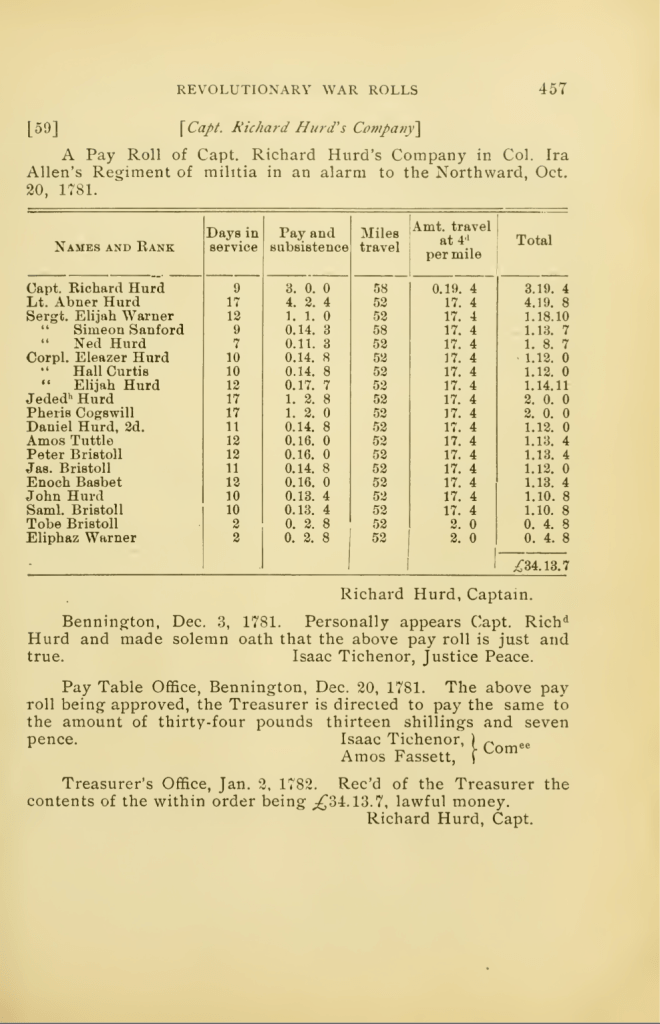
— Capt. Richard Hurd’s Company in Col. Ira Allen’s Regiment
Book page: 457, Digital pages: 487/964

Time’s Arrow Points in One Direction

(8) — seven records

STEM Fellowship
The Arrow of Time
https://live.stemfellowship.org/the-arrow-of-time/
Note: For the data.

Vermont History
Vermont Historical Society Mounting a Major Exhibition:
For The Love of Vermont: The Lyman Orton Collection

Derby View
by William Dean Fausett, circa 1939
https://vermonthistory.org/lyman-orton-for-the-love-of-vermont-art-exhibition
Note: For the paining by William Dean Fausett.

Library of Congress
U.S. Census Connections: A Resource Guide
History of the U.S. Census
https://guides.loc.gov/census-connections/census-history
Note: For the text.

The National Archives
1790 Census Records
https://www.archives.gov/research/census/1790
Note: For the data.

Townscape of Bennington; Landscape View of Old Bennington, circa 1798
by Ralph Earl
https://commons.wikimedia.org/wiki/File:View_of_Bennington,_by_Ralph_Earl_(1798).jpg
Note: For the landscape image.

Eliphas Warner
in the 1790 United States Federal Census
Vermont > Bennington > Sandgate
https://www.ancestry.com/search/collections/5058/records/398650?tid=&pid=&queryId=98a8efe8-5fcc-4d84-9d21-54d2862efc2c&_phsrc=Qmi3&_phstart=successSource
Book page: 21, Digital page: 1 of 2
Note: For the data.

William Warner
in the North America, Family Histories, 1500-2000
https://www.ancestry.com/search/collections/61157/records/1807060
Note: For the data about his 1798 marriage to Lucy Coan.

A New Century Begins

(9) — twelve records

The National Archives
1800 Census Records
https://www.archives.gov/research/census/1800
Note: For the data.

Eliphaz Warner
in the 1800 United States Federal Census
Vermont > Bennington > Sandgate
https://www.ancestry.com/search/collections/7590/records/517748?tid=&pid=&queryId=4786d902-5d82-43a8-b238-b7cf626d86d1&_phsrc=Qmi4&_phstart=successSource

The National Archives
1810 Census Records
https://www.archives.gov/research/census/1810?_ga=2.101688962.2084972955.1741276218-755645739.1741276218
Note: For the data.

Macdonough’s Victory on Lake Champlain and Defeat of the British Army
at Plattsburg by Genl. Macomb, Sept. 11 1814.
Engraverː Benjamin Tanner, after painting by Hugh Reinagle, circa 1816
File:Macdonough’s victory on Lake Champlain and defeat of the British Army at Plattsburg by Genl. Macomb, Sept. 11 1814 (cropped).jpg
https://commons.wikimedia.org/wiki/File:Macdonough’s_victory_on_Lake_Champlain_and_defeat_of_the_British_Army_at_Plattsburg_by_Genl._Macomb,_Sept._11_1814_(cropped).jpg
Note: For the engraved war image.

1810 United States Federal Census
Vermont > Bennington > Sandgate
https://www.ancestry.com/search/collections/7613/records/613235?tid=&pid=&queryId=e72c38ad-6cba-40d7-8668-722546e89da1&_phsrc=LaX10&_phstart=successSource
Note: Digital page: 5/7
Note 1: For the data.
Note 2: We found this under the name of another community member: Stephen Scinter because it found not appear in searches using either Warner family name.

Vermont National Guard
Home > Museum >  > History > Wars > War Of 1812
Museum > > History > Wars > War Of 1812
https://vt.public.ng.mil/Museum/History/Wars/War-of-1812/#:~:text=A relatively small force of,the British Invasion from Canada.
Note: For the text.”>https://vt.public.ng.mil/Museum/History/Wars/War-of-1812/#:~:text=A relatively small force of,the British Invasion from Canada.
Note: For the text.

Dr. James Warner
https://www.findagrave.com/memorial/15098846/james-warner
Note: For her death record in 1813.

Hannah Warner
https://www.findagrave.com/memorial/16704110/hannah-warner
Note: For her death record in 1818.

Mercy Warner
in the U.S., Find a Grave Index, 1600s-Current
https://www.ancestry.com/search/collections/60525/records/91584565
and
Mercy Drinkwater Warner
https://www.findagrave.com/memorial/16704122/mercy-warner
Note: For the data.

Eliphaz Warner
in the U.S., Find a Grave Index, 1600s-Current
https://www.ancestry.com/search/collections/60525/records/91584550?tid=&pid=&queryId=e60befba-7e73-4827-b3c5-efdd800afda8&_phsrc=PRY1&_phstart=successSource
and
Eliphaz Warner
https://www.findagrave.com/memorial/16704105/eliphaz-warner
Note: For the data.

The Decade of Three Wives

(10) — ten records

Pinterest
Birds’ Nests (illustrations)
by Carl F. Gronemann
https://www.pinterest.com/pin/7951736837238337/
Notes: For the nest images.

Lucy Warner
in the U.S., Find a Grave Index, 1600s-Current
https://www.ancestry.com/search/collections/60525/records/91584559https://www.findagrave.com/memorial/16704116/lucy-warner
and
Lucy Coan Warner
https://www.findagrave.com/memorial/16704116/lucy-warner?_gl=1*qogcgg*_gcl_au*MTgzMjczMjIxLjE3NDE0NDY3MzA.*_ga*MTQ0MTY4ODk1OS4xNzQxNDQ2NzMw*_ga_4QT8FMEX30*MmMwNGE4ZTItNTkwOC00ZGIwLWFjMmItZWZiMjgxMTllMWVlLjIuMS4xNzQxNDU2ODEyLjU5LjAuMA..
Note: For the death data.

203 William Warner
The Descendants of Andrew Warner (book)
Sixth Generation
https://www.ancestry.com/imageviewer/collections/15319/images/dvm_GenMono000758-00134-0?usePUB=true&_phsrc=mYH3&pId=260&backlabel=Return&queryId=38e8346280d3fd1c8363358237de551d&rcstate=dvm_GenMono000758-00134-0%3A172%2C1481%2C285%2C1510%3B285%2C1481%2C417%2C1509%3B667%2C1482%2C770%2C1515%3B581%2C1522%2C679%2C1551%3B915%2C1683%2C1009%2C1716%3B714%2C413%2C802%2C442%3B338%2C1152%2C476%2C1180%3B727%2C1250%2C809%2C1274%3B548%2C1281%2C636%2C1314%3B791%2C1280%2C892%2C1314
Book page: 254, Digital page: 263/814
Note: For the Lucy Coan marriage data.

Abaigail Warner
in the Vermont, U.S., Vital Records, 1720-1908
https://www.ancestry.com/search/collections/4661/records/475913?tid=&pid=&queryId=4f4a50a5-af4e-4843-8b1b-e00c55e93578&_phsrc=mYH31&_phstart=successSource
and
Abigail Warner
in the U.S., Find a Grave Index, 1600s-Current
https://www.ancestry.com/search/collections/60525/records/91584543
and
https://www.findagrave.com/memorial/16704098/abigail-warner
Note: For the data.

Prudence Nickerson
in the North America, Family Histories, 1500-2000
W > Warner > The descendants of Andrew Warner
https://www.ancestry.com/search/collections/61157/records/1810112
Book page: 254, Digital page: 262/812
Note: For her marriage information.

The National Archives
1820 Census Records
https://www.archives.gov/research/census/1820?_ga=2.45009575.2084972955.1741276218-755645739.1741276218
Note: For the data.

William Warner
in the 1820 United States Federal Census
https://www.ancestry.com/search/collections/7734/records/166385?tid=&pid=&queryId=6f327c11-f22f-48ff-a316-60e1b9de1f93&_phsrc=unJ1&_phstart=successSource
Digital page: 1/6
Note: For the data.

A World Awash in Merino Sheep

(11) — twenty records, and three Descendant Appendices: A, B, C

Vermont History Explorer
Sheep in Vermont
https://vermonthistoryexplorer.org/sheep-in-vermont
Note: For the text.

The National Archives
1830 Census Records
https://www.archives.gov/research/census/1830?_ga=2.68161170.2084972955.1741276218-755645739.1741276218
Note: For the data.

Wm Warner
in the 1830 United States Federal Census
Vermont > Bennington > Sandgate
https://www.ancestry.com/search/collections/8058/records/781387?tid=&pid=&queryId=f25c311a-c9c4-4a64-bab4-cdb98f9bf760&_phsrc=unJ7&_phstart=successSource
Digital page: 1/12
Note: For the data.

Descendant Appendix A
Son James Ward Warner was married twice and had four children.

  • James Ward Warner was born September 26, 1820 — died October 25, 1908, in Kennewick, Benton, Washington. He married first Jane Mary Walton in 1845 in Manchester, Vermont. She died in 1854 in Wisconsin where they had moved. From this marriage, they had 3 children:
  • Sylvester C, 1842-1847 (possibly born before their marriage),
  • Helen Agnes, 1848-1931 and
  • James, born 1860 – date unknown
  • He married second, Anne Ross in 1856. She was born in 1826 in New York and died 1902 in Spokane, Washington. They had one son:
  • William Abner, 1860 – 1912. It appears William Abner moved west to Washington State where his parents died and are buried in Spokane. He died in Santa Monica, Los Angeles, California.

Descendant Appendix B
Daughter Lucy Mercy Warner married twice and had two children.

  • Lucy Mercy Warner was born May 2, 1823 — died November 14, 1879, Bennington, Bennington, Vermont. She married first in 1844 Henry G. Stewart, 1806 – 1848. They had 1 daughter:
  • Ellen 1845-1922. Ellen married Alexander Chapman in 1867, and they had two sons: George 1873 – unknown date, and John, 1878 – 1938.
  • After Henry Stewart’s death, Lucy married second Thomas Jefferson (TJ) Albro in 1859; they had 1 daughter:
  • Theresa, 1860 – 1921. Theresa married Frank Henry Crawford in 1884, and they had 3 children: Randall who lived for 11 months in 1885, Buel, 1887 – 1958, and Alida ‘Lida’ (Crawford) Beran, 1894 – 1945.

Descendant Appendix C
Son Ira Nickerson Warner married once and had five children.

  • Ira Nickerson Warner was born May 20, 1830 — died March 6, 1877 in Aurora, DuPage, Illinois. By 1858 he married Julia Barrett, 1833 – unknown date. They had 5 children:
  • Charles D., 1859 – 1864
  • George A., 1864 – unknown date
  • Frederick A. 1866 – 1935
  • Ida Rowena, 1869 – 1943
  • Lillian J., 1872 – 1899

James Ward Warner
https://www.familysearch.org/en/tree/person/details/L69H-5CC
Note: For the data.

Lucy Mercy Warner
https://www.familysearch.org/en/tree/person/details/LZ6N-QJX
Note: For the data.

Ira N Warner
Pension – United States, General Index to Pension Files, 1861-1934
https://www.familysearch.org/ark:/61903/1:1:QJD5-MLYG?lang=en
Notes: For the data. James Warner was the beneficiary of his brother Ira’s military pension?  We find this curious because he and Julia were married in 1860 at beginning of Civil War.

Ira Nickerson Warner
https://www.findagrave.com/memorial/39675687/ira-n-warner
Note 1: For the data. His death date on his tombstone is incorrect.
Note 2: Posted at the findagrave website:
“Civil War Soldier – Source The Beacon News Online, May 13, 2005.
Ira Nickerson Warner, born in Sandgate, VT 20 May 1830 was the son of William Warner and Prudence Nickerson. He enlisted 29 July 1862; mustered in 1 September 1862 as Private, Company E, 10th Vermont Infantry. He was wounded May 10, 1864 in the Battle of Spotsylvania Court House in Virginia, the second major engagement in Lt. Gen. Ulysses S. Grant’s Overland Campaign; 30,000 soldiers lost their lives during this battle that lasted 14 days. Source: U.S., Civil War Soldier Records and Profiles, 1861-1865. In 1865 he married Julia ___ and had a son Fred born in 1866. He died in 1877 of typhoid pneumonia in Aurora, Kane, IL.”

Library of Congress
Taking the census — after sketch by Thomas Worth, circa 1870.
https://www.loc.gov/item/93510014/
Note: For the illustration.

The National Archives
1840 Census Records
https://www.archives.gov/research/census/1840?_ga=2.46571940.2084972955.1741276218-755645739.1741276218
Note: For the data.

Wm Warner
in the 1840 United States Federal Census
Sandgate > Bennington > Vermont
https://www.ancestry.com/search/collections/8057/records/3433594?tid=&pid=&queryId=e99fa725-5ecf-4b6d-a915-76171699b658&_phsrc=unJ9&_phstart=successSource
Digital page: 9/15
Note: For the data.

The National Archives
1850 Census Records
https://www.archives.gov/research/census/1850?_ga=2.43385638.2084972955.1741276218-755645739.1741276218
Note: For the data.

William Warner
in the 1850 United States Federal Census
Sandgate > Bennington > Vermont
https://www.ancestry.com/search/collections/8054/records/1138454?tid=&pid=&queryId=586edbac-fa8d-451e-b15b-03df2333af9c&_phsrc=unJ11&_phstart=successSource
Digital page: 3/21
Note: For the data, entry lines 13 and 14.

Mary Hecker [Meeker]
in the 1850 United States Federal Census
Vermont > Bennington > Sandgate
https://www.ancestry.com/search/collections/8054/records/1138439?tid=&pid=&queryId=672895b9-401b-4f6a-963d-4078278551fd&_phsrc=nVv10&_phstart=successSource
Digital page: 2/21, entry lines 40 to 42.
Note: Her married surname is Meeker, but in this file it is incorrectly recorded as Hecker.

William Warner
in the U.S., Find a Grave Index, 1600s-Current
https://www.ancestry.com/search/collections/60525/records/91584571
and
William Warner
https://www.findagrave.com/memorial/16704128/william-warner
Note: For the data.

William Warner Sr 1770-1856
https://www.ancestry.com/mediaui-viewer/collection/1030/tree/85459977/person/44522992343/media/da5e28d8-21ce-479f-bba0-208da4f29196?queryId=41c505ab-9453-432d-bce5-448937b1d2c9&searchContextTreeId=&searchContextPersonId=&_phsrc=unJ4&_phstart=successSource
Note: For his photographic portrait. It is linked to this file: https://www.ancestry.com/family-tree/person/tree/85459977/person/44522992343/facts

William Warner
in the Vermont, U.S., Wills and Probate Records, 1749-1999
https://www.ancestry.com/search/collections/9084/records/1048224
Note 1: For the documents.
Note 2: There are 10 documents in this set of estate papers, organized as Will, administration papers, guardianship papers, and order papers.

Prudence B Warner
in the U.S., Find a Grave Index, 1600s-Current
https://www.ancestry.com/search/collections/60525/records/70522415?tid=&pid=&queryId=a898bdda-9ee5-4082-b05b-37c14c260542&_phsrc=Qok1&_phstart=successSource
and
Prudence B Nickerson Warner
https://www.findagrave.com/memorial/97254137/prudence-b-warner
Note: For the data.

Sometimes Life Is A Circle

(12) — two records

Warp and weft
https://en.wikipedia.org/wiki/Warp_and_weft
Note: For the data.

Isolation: The Mayflower becalmed on a moonlit night
by Montague Dawson, (British, 1890-1973)
https://www.mutualart.com/Artwork/Isolation–The-Mayflower-becalmed-on-a-m/FD8D6C1A6976C620
Note: For the image of the Mayflower painting.

The Soule Line, A Narrative — Six

This is Chapter Six of seven. The Drinkwater surname continues in this Generation Four in America, with the marriage to both the Benedict, and Washburn families.

We have been in the area of the Province of Massachusetts ever since George Soule set foot on Plymouth Rock. In this chapter we finally get out of town and make our way to some new places. Unlike the previous generation of the Drinkwater family, where it was difficult to understand why they moved around so much, this generation stayed anchored in one area of the Connecticut Colony. They also left many interesting records.

Carte De La Nouvelle Angleterre Nouvelle Yorck et Pensilvanie,
by Jacques Nicholas Bellin, circa 1757. (Image courtesy of Barry Lawrence Ruderman
Antique Maps, Inc).

Most of the life of our 5x Great Grandfather William Drinkwater had been lived in the half century previous to when this elegant looking map was made. The westward migration of this branch of the family, from the communities near Plymouth County, Massachusetts — all the way across to the western edge of Connecticut Colony — had them moving toward areas which were still thought of as the frontier.

With Rods Belaboured

“New-York, December 27th 1733 — We hear from Ridgefield, near the County of Westchester, that one William Drinkwater, late an inhabitant there, proving quarrelsome with his Neighbours and abusive to his Wife, the good Women of the Place took the Matter into Consideration and laid hold of an Opportunity to get him tied to a Cart, and there with Rods belaboured him on his Back, till, in striving to get away, he pulled one of his Arms out of joint, and then they unti’d him.

Mr. Drinkwater complained to sundrie Magistrates of this useage, but all he got by it was to be Laughed at. Whereupon he moved to New-Milford where we hear he proves a good Neighbour and a loveing Husband. A remarkable reformation arising from the Justice of the good Women!

—John Peter Zenger, The New-York Weekly Journal, Dec. 31, 1733”

Comment: Word must have travelled fast! As we all know, gossip can move like a whirlwind. — Ridgefield was a small town in the western side of Fairfield County, Connecticut. It is currently across the state line from Westchester County, New York. Everybody knows that marriages have ups and downs, but obviously they must have had a way of working things out —they had 12 children. (In those days it took time for stories to reach and get published in a newspaper. Please see the footnotes). (1)

Colonial Grist Mill, photograph by Paul Ward.

Having Been Put Through The Mill

From the book, Two Centuries Of New Milford, Connecticut: “William settled in New Milford about 1730 [likely circa 1732] where some of his family became Quakers… [and] on Apr 20, 1730, William bought land from Zachariah Ferris where he built a Gristmill. The mill was located on the East Aspetuck, near or at the site of the present paper mill. He sold the mill to Nathan Terrill in March 1735. William was a prominent, active citizen, but died in 1758, leaving a large family.”

Having a grist mill allows William to be in the know about goings on in the community. “Aside of the ingenuity, the grist mill was also a social hub, of such importance that it turns out our language still reflects its impact. For example, if a number of people were looking to have their grains milled, a line would form. Unlike today’s supermarkets, where you just quietly stand in line and perhaps spy on the shopping cart of the stranger in front of you, this would have been a situation in which people knew each other. Those lines would result in ‘milling about’ while they gossiped, which is still referred to as a ‘rumor mill.’

Meanwhile, inside the grist mill, the floor would have been covered with a hay like material, referred to as thresh. A piece of wood at the doorway would help keep the thresh in place, which you’d stand on when you crossed the ‘threshold’.” (Hidden New England)

William’s younger brother John was also living in the area in the mid-1730s. “John Drinkwater, came from Rhode Island, and bought of Wm. Drinkwater, 10 acres of ‘near Little Mount Tom, with a dwelling-house on it,’ March 30, 1735, and sold the same to John Sherwood, July 5, 1736, and removed from the town so far as known.” (History of the Towns of New Milford and Bridgewater, Connecticut, 1703-1882) (2)

Plan of the Colony of Connecticut in North America,
by Moses Park, 1766. (Image courtesy of the Boston Public Library).

There’s Many Trees In That Orchard!

Some of our ancestors stepped right up and took the Genesis 1:28 Biblical commandment to “be fruitful and multiply” quite seriously.

William Drinkwater, born about 1701 in Touisset (an area of) Swansea, Bristol, PMB — died circa 1758 in New Milford, Litchfield, Connecticut Colony, age 57. He married first Elizabeth Benedict, December 18, 1728 in New Milford, Connecticut Colony; they had 12 children. She was born January 17, 1704 in Ridgefield, Fairfield, Connecticut Colony — died July 2, 1749, in New Milford, Litchfield, Connecticut Colony, age 45.

Excerpted from History of the Towns of New Milford and Bridgewater, Connecticut, 1703-1882
by Samuel Orcutt, circa 1882. Note: Despite all of these children, the list is still missing daughter Sarah, born February 18, 1737. There were 16 children in total.

Also please note: We have corrected mistakes, updated spelling, birthdates, etc. from records of both Ridgefield, and New Milford, Connecticut — which varies from what is shown in the book image above. See footnotes).

On May 10, 1666 Fairfield County was established by an act of the Connecticut General Court along with Hartford County, New Haven County, and New London County; which were the first four Connecticut counties. On October 9, 1751 Litchfield County was created by an act of the Connecticut General Court from land belonging to Fairfield, New Haven, and Hartford counties.

William and Elizabeth’s children were born in both counties. Births for the first two, Thomas and John Drinkwater, are recorded in the town of Ridgefield, Fairfield County:

  • Thomas Drinkwater*, born November 3, 1729 —died November 3, 1755
  • John Drinkwater*, born July 3, 1731 —died September 8, 1755

    Births for Elizabeth (3) through Mercy (12) are recorded in the town of New Milford, Litchfield County:
  • Elizabeth Drinkwater, born April 2, 1733 — married John Beeman, May 1755
  • Hanah Drinkwater, born August 11, 1734
  • Mary Drinkwater, born February 5, 1735/6
  • Abigail Drinkwater, born March 15, 1736
  • Sarah Drinkwater, born February 18, 1738 — married Stephen Ferriss, August 27, 1771
  • Jerusha Drinkwater, born June 16, 1740 — married Gamaliel Hurlbut, February 19, 1758
  • William Drinkwater, Jr., born May 3, 1742
  • Samuel Drinkwater, born June 27, 1744 — married Olive Gray, July 27, 1769 
  • Ann Drinkwater, born June 11, 1746
  • Mercy Drinkwater, born March 25, 1748 — died October 22, 1813 in Sandgate, Bennington, Vermont. She married Eliphaz Warner, in 1769. (We are descended from Mercy and Eliphaz).

*Both died in the French and Indian War; see subtitle The French and Indian War below for more information

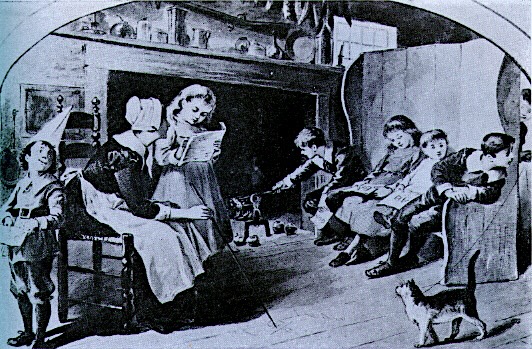
A New England Dame school in old colonial times, 1713 by Artist unknown.
(Image courtesy of Wikimedia Commons).

After the death of William Drinkwater’s wife Elizabeth (Benedict) Drinkwater, He married second Susanna Washburn, March 14, 1751; they had 4 children. The youngest four children were born in the town of New Milford, in Litchfield, County.

  • Ebenezer Drinkwater, born December 25, 1751
  • Joannah Drinkwater, July 26, 1753
  • Thomas Drinkwater, born January 13, 1756
  • Ann Drinkwater, born May 17 or 19, 1758.

William’s second wife Susanna died at a young age in in 1758. We don’t know what happened, but in that era it could have been something from a long list of troubles. For example, just a couple of years earlier in 1755-56, “Epidemics of smallpox and measles strike in Massachusetts, Rhode Island, Connecticut, New York, and Pennsylvania. The population, both of settlers and Native peoples, is already weakened by the measles epidemic when the smallpox outbreak occurs.” (3)

The beginnings of the town of New Milford and the church
are so intermingled that they are inseparable.
What occurred to the church occurred to the town . . . Towns were considered the basic structure for protection of individuals
and the central part of that structure came from a church and
the teachings of its minister. 

Ross Detwiler,
The Whole Story History Of The First Congregational Church

The Separatists’ Church of New Milford

We noted several times in our research of New Milford town records, that William Drinkwater was quite involved in both the civic affairs and goings-on with the local church. Considering that he had acquired a reputation for disreputable behavior when he was a younger man, this was quite a change of character. Here’s an example entry: “On Apr 11, 1731, the Separatist Church voted to take out part of the women’s seats in the Meetinghouse. Nathaniel Bostwick, Ebenezer Fisk and William Drinkwater were selected to do the work. William was among 35 members of the Separatist’s Church who became influential leaders. (History of the Towns of New Milford and Bridgewater…)

We wanted to understand more about his transformation, which led us to a larger understanding of what church life meant to our ancestors in colonial New England. No matter where you lived, it always began with the Meeting House. From an 1891 issue of The Atlantic magazine, writer Alice Morse Earle, wrote:

“When the Pilgrim Fathers landed at Plymouth, they at once assigned a Lord’s Day meeting-place for the Separatist church, — “a timber fort both strong and comely, with flat roof and battlements; ” and to this fort, every Sunday, the men and women walked reverently, three in a row, and in it they worshiped until they built for themselves a meeting-house in 1648.

As soon as each successive outlying settlement was located and established, the new community built a house for the purpose of assembling therein for the public worship of God; this house was called a meeting-house. Cotton Mather saith distinctly that he “found no just ground in Scripture to apply such a trope as church to a house for public assembly.” The church, in the Puritan’s way of thinking, worshiped in the meeting-house, and he was as bitterly opposed to calling this edifice a church as he was to calling the Sabbath Sunday. His favorite term for that day was the Lord’s Day.

The settlers were eager and glad to build their meeting-houses; for these houses of God were to them the visible sign of the establishment of that theocracy which they had left their fair homes and had come to New England to create and perpetuate. But lest some future settlements should be slow or indifferent about doing their duty promptly, it was enacted in 1675 that a meeting-house should be erected in every town in the colony; and if the people failed to do so at once, the magistrates were empowered to build it, and to charge the cost of its erection to the town. The number of members necessary to establish a separate church was very distinctly given in the Platform of Church Discipline : “ A church ought not to be of greater number than can ordinarilie meet convenientlie in one place, nor ordinarilie fewer than may conveniently carry on church-work.” Each church was quite independent in its work and government, and had absolute power to admit, expel, control, and censure its members.”

The First New Haven Meeting House, New Haven Colony, c. 1690, by Artist unknown, (1892).
(Image courtesy of Wikimedia Commons).

So we were a bit confused to read this: “The beginning of the influences which were largely the cause of the formation and existence of the Separatists’ Church, in New Milford, were started and propagated by the idea of compelling people to obey the regulations of a legal church, while still pretending that the gospel taught the spirit of freedom and kindness. This occurred in a town vote in 1745, upon the question of settling a minister, the Rev. Noah Wells. The proceedings were such on that occasion as to lead thirty-five influential men to pledge themselves against that action, and to induce two of the leaders to pledge themselves to prosecute the matter in the county court if the decision of the meeting should be carried out in the settlement of Mr. Wells. These leaders, Joseph Ruggles and William Drinkwater, afterwards became strong men in starting, sustaining, and upholding the Separate Church. They were men of decided ability, means, and public influence, although they did not long remain in the town.” (History of the Towns of New Milford and Bridgewater…)

There again. It had been stated two times: Separatists’ Church and the Separate Church — but what were they separating from? We knew that the Quakers had built their own Meeting House in town in 1741, so was this related to that, or was there some other schism going on?

What was going on requires some explanation about the Connecticut Colony in that era. “Other religions may have made inroads in 18th-century Connecticut, but Puritanism, now known as Congregationalism, remained the faith of the ruling elite, and the Congregational Church remained the established church of the colony. The majority of the population remained Congregationalist. Like their Puritan forebears, Congregationalists believed that governments existed for the benefit of the people, and that governors needed to rule according the will of God.” (Connecticut History.org)

Furthermore, “The original colonies along the Connecticut River and in New Haven were established by separatist Puritans who were connected with the Massachusetts and Plymouth colonies. They held Calvinist religious beliefs similar to the English Puritans, but they maintained that their congregations needed to be separated from the English state church. They had immigrated to New England during the Great Migration. In the middle of the 18th century, the government restricted voting rights with a property qualification and a church membership requirement. (Wikipedia, Connecticut Colony)

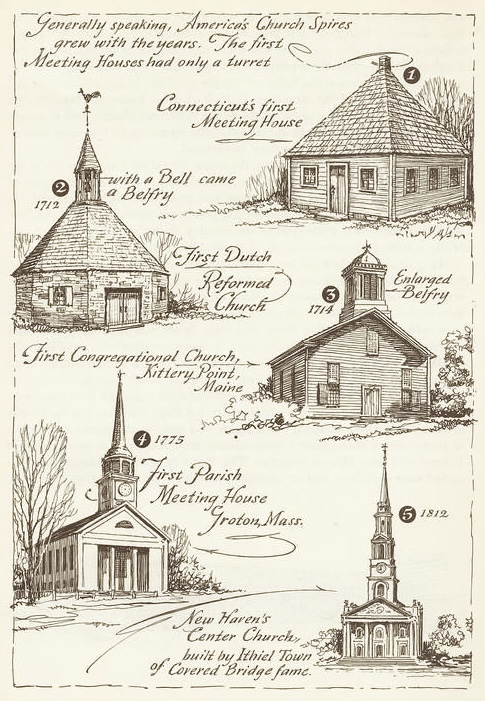
Colonial Church Design, Early American Church Spires Vintage Print Meeting Houses.
(Image courtesy of Pinterest, via Etsy).

So after learning all about the Congregationalist viewpoint of that era, this passage suddenly made sense: “KINDNESS, used as an element of power, instead of law, would have saved the Church and the world millions of men, treasure, and great honor, and would have elevated the human race far beyond anything as yet attained. While law is not to be discarded, yet it is proper to recognize the fact that it has been used, in a vast majority of cases, in the Church and out of it, as a matter of will, to gratify the anger and dictatorial feelings of men.” (History of the Towns of New Milford and Bridgewater…)

Summary: The gist of it is this — the State had made a law that crossed a line and determined who could be a member of a church. In other words, the beliefs that had brought the earlier generations of Puritans to America were being eroded, by the State sticking its nose into church matters. Connecting the ideas of voting rights and property ownership, to the right of personal religious worship as one saw fit — People did not like this development at all.

It was as if the State was dictating who had appropriate, approved spirituality, and who did not. (Just like back in the English State Church which they had all left behind). In the same manner that the Pilgrims had once been called Separatists — the Separatists’ Church in New Milford was then conceived. (4)

Four Sons, and the French and Indian War

The William Drinkwater family had four sons who served in The French and Indian War, even though much of the action for that conflict took place far away from where they lived in Connecticut. The two oldest sons, Thomas and John, both died in battles in 1755. The two younger sons, William Jr. and Samuel, served from 1759 until 1762 in various capacities.

Sons John and Thomas—
Both of these sons were serving at Fort Edward, located on a bend in the Hudson River, at Lake George in the Province of New York. (In the present day, this is Washington County, New York).

At 24 years old, John died at the Battle of Lake George, serving under Captain Banjamin Hinman. It  was “fought on 8 September 1755, in the north of the Province of New York, as part of a campaign by the British to expel the French from North America…The battle consisted of three separate phases and ended in victory for the British and their allies”.

Thomas, aged 25, is recorded as dying on November 3, 1755, also at Fort Edward under Captain Samuel Demmik. Based upon our research it seems he died either from wounds incurred in the earlier Battle of Lake George, or in skirmishes which occurred after that confrontation.

A Prospective Plan of the Battle Fought near Lake George on the 8th of September 1755,
by Thomas Johnston.
(Image courtesy of the Smithsonian American Art Museum).

Sons Willam Jr. and Samuel —
We observed in the Rolls of the Connecticut Men in The French and Indian War, that son William, who was born in 1742, was involved in the 1759 Campaign of Connecticut Forces, and served from April 1 through December 1, 1759 (for 6 months). “In the Tenth Company of the Second Regiment (Colonel Nathaniel Whiting’s) commanded by Captain Gideon Stoddard, the name of William Drinkwater appears. There are some [family] tales of Bill Drinkwater, of Stephen Terrell, and Thomas Drinkwater, but they are so indefinite that all which can be gleaned from them is that these men went as far as Quebec, and were in the battle on the Heights of Abraham, and, possibly, in some of the others.” (Two Centuries Of New Milford, Connecticut — 2 Centuries…)

“A View of the Taking of Quebec”, September 13, 1759. Published by Laurie and Whittle, 1759.
This engraving shows the three stages of the battle: the British disembarking,
scaling the cliff and the battle. (Image courtesy of the Library and Archives Canada).

“The Battle of the Plains of Abraham, also known as the Battle of Quebec (French: Bataille des Plaines d’Abraham, Première bataille de Québec), was a pivotal battle in the Seven Years’ War (referred to as the French and Indian War to describe the North American theatre). The battle, which began on 13 September 1759, was fought on a plateau by the British Army and Royal Navy against the French Army, just outside the walls of Quebec City… The battle involved fewer than 10,000 troops in total, but proved to be a deciding moment in the conflict between France and Britain over the fate of New France, influencing the later creation of Canada.” (Wikipedia)

From the same Connecticut Rolls book, we saw records that William and his younger brother Samuel (born 1744) were listed in the muster roll for the Connecticut Forces for the Campaign of 1761. They were in Captain Archibald McNeill’s Eleventh Company, recorded in June 1761.

Then, this book lists them again the next year as part of the muster roll of Captain Archibald McNeill’s Ninth Company, recorded June 1762.
William was enlisted from: March 27 until December 3, for slightly over eight months; Samuel,for a few days more, from: March 22 until December 3. (5)

The Death of General Montgomery in the Attack on Quebec, December 31, 1775, by John Trumbull,
circa 1786. (Image courtesy of Yale University Art Gallery).

Two Sons, and the Revolutionary War

Wiliam Drinkwater Jr. was apparently quite the Patriot. Not only did he serve in the French and Indian War, but he “was a private in the Continental Army. He was in Captain Starr’s Company when he was captured near Montreal Sept 25.” (2 Centuries…) This had to be in the months leading up to what is now called the Battle of Quebec. “Shortly after the American Revolutionary War broke out in April 1775, a small enterprising force led by Ethan Allen and Benedict Arnold captured the key [strategically important] Fort Ticonderoga on May 10. Arnold followed up the capture with a raid on Fort Saint-Jean not far from Montreal, alarming the British leadership there.

The Battle of Quebec (French: Bataille de Québec) was fought on December 31, 1775, between American Continental Army forces and the British defenders of Quebec City early in the American Revolutionary War. The battle was the first major defeat of the war for the Americans, and it came with heavy losses. General Richard Montgomery was killed, Benedict Arnold was wounded, and Daniel Morgan and more than 400 men were taken prisoner.” (Wikipedia)

Two Centuries Of New Milford, Connecticut continues, “William was captured and after being confined for a number of weeks in the Sugar House, prisoners were taken to the prison ship Dutton. Two hundred were transported to Milford and put ashore. Twenty were dead before the ship arrived and 20 more died soon after. All 40 are buried in a graveyard there.

Of the 12 men of New Milford, only four returned – Roger Blaisdell, David Buell, William Drinkwater and Lyman Noble. Through friends in Milford, they were able to secure a horse, and thus worked their way back to New Milford, reaching there about March 1777.” (6)

Burning of Fairfield, 1779, by Artist unknown.
(Image courtesy of the Connecticut Museum of History and Culture).

“Many of the residents who lost their homes were offered the choice of money or an equivalent value of land from the half-million acres owned by Connecticut in what is now part of Ohio. Many took the property in what came to be called ‘the Fire Lands’ and never returned.”

The Burning of the Towns of Danbury, and Fairfield

Yet, he continued to serve even after his ordeal. “Capt. Bostwick appeared as a leader in the Danbury alarm. [The burning of Danbury, Connecticut Continental Army military supply depots by the British forces]. With him were John Terrell and David Buell and Bill Drinkwater. The group from Capt. Bostwick’s company was camped four days in the Danbury alarm.

The following story regarding this little band is extant: The British had commenced their retreat from Danbury by way of Ridgefield and our men were following them up very earnestly, pressing close to a grenadier regiment which was the rear guard of the head force. John Terrell, William Noble, Bill Drinkwater and David Buell rushed together up one side of the famous Ridgefield Hill, while the grenadiers [a soldier armed with grenades] were still on the other side. Men who crossed the Delaware with Capt Bostwick of New Milford, Dec. 25, 1776, and were in the battles of Trenton and Princeton, included William.” (2 Centuries…)

Where was Samuel Drinkwater?
We were wondering why there was no apparent military records for Samuel Drinkwater during the Revolutionary War in Connecticut. The answer was unexpected, and it turns out that the records were in New York, not Connecticut. From WikiTree we learned, “Samuel Drinkwater, the 3rd generation of this surname found in early America and a descendant of Thomas Drinkwater, changed the family name to DeWaters after the Revolutionary War. He, and his wife’s family, were Loyalists. Loyalists were punished by the Patriots and some fled to England or Canada. Loyalists were not allowed to own land and some had their lands confiscated, and some were jailed.” (WikiTree)

We were able to confirm his Loyalist behavior based on the “Minutes of the Committee and of the First Commission for Detecting and Defeating Conspiracies in the State of New York” which documents every detail. (See the footnotes). When we thought about it, the French and Indian War he had served in earlier, was a war fought to protect British interests in America. Samuel eventually ended up in Michigan where his son Amos purchased land for him to live on.

Samuel’s behavior was in contrast to that of his brother William. Despite that, William Jr. still got into much trouble by being in the wrong place, at the wrong time, with the wrong people. The same “Minutes of the Committee…” book explains — it seems that he was with a group of people one evening, and a couple of them were disaffected people which means Loyalist. This was reported, and he got in trouble for it, but he went through the interrogation process, and voluntarily took the “Oath of Allegiance to this State” and was then released. That was in April 1777.

His has many records in the system, quite a few indicating that he was sick, excused, or on furlough. We suspect that he may have gotten ill while he was on the prison ship Dutton. One record notes him as deserting (with an evident question mark ?), in April of 1779, after a little more than two years of service. Other records indicate that he was discharged from service on January 1, 1780. We are not exactly sure what happened there — perhaps he had had quite enough, thank you. He may have ended up raising a family in Dartmouth, Massachusetts, but again, we just don’t know. (7)

William Drinkwater, Late of New Milford

When William Drinkwater Sr. died, as was customary at the time, his estate needed to be inventoried and his debts settled. William and both of his wives are buried in the Northville Cemetery, New Milford, Litchfield County, Connecticut.

Inventory documents from the Probate of William Drinkwater’s estate.

The next chapter is our final chapter in the Soule line. We begin in the Connecticut Colony with William Drainkwater’s daughter Mercy, who is the matriarch of Generation Five in America, with a new family line. (8)

Following are the footnotes for the Primary Source Materials,
Notes, and Observations

With Rods Belaboured

(1) — five records

Barry Lawrence Ruderman
Antique Maps, Inc.
Carte De La Nouvelle Angleterre Nouvelle Yorck et Pensilvanie
by Jacques Nicholas Bellin, circa 1757
https://www.raremaps.com/gallery/detail/97868/carte-de-la-nouvelle-angleterre-nouvelle-yorck-et-pensilvan-bellin
Note: For the map image.

We initially found this newspaper excerpt attached to this file:
William Drinkwater
https://www.findagrave.com/memorial/147201109/william-drinkwater
Note: For the newspaper story by John Peter Zenger, The New-York Weekly Journal, Dec. 31, 1733.

However, the original newspaper story was excerpted two more times in the next two centuries, once in Lippincott’s Magazine, circa 1876 and once more in the The Hudson Valley Review, circa 2016 (see footnotes below). The newspaper publisher, John Peter Zenger became an important historical figure in the cause for freedom of the press in the United States:
The New York Weekly Journal
https://en.wikipedia.org/wiki/The_New_York_Weekly_Journal
Note: For the reference.

Lippincott’s Magazine of Popular Literature And Science
February, 1876., Vol. XVII.
Our Monthly Gossip > Our Early Newspapers
https://www.gutenberg.org/files/13154/13154-h/13154-h.htm 
Note: This publication does not have page numbers; proceed to [pg 261].

The Hudson Valley Review, Spring 2016
Charivari on the Hudson:
Misrule, Disorder, and Festive Play, 1750-1900
by Thomas S. Wermuth
https://www.slideshare.net/slideshow/hrvr-2016/64294627#15
Book page: 46, Digital page: 57/137
Note: This version starts to stray from the original details.

Having Been Put Through The Mill

(2) — three records

PX Pixels
Colonial Grist Mill
by Paul Ward
https://pixels.com/featured/colonial-grist-mill-paul-ward.html
Note: For the mill image.

Two Centuries Of New Milford, Connecticut
An Account Of The Bi-Centennial Celebration Of The Founding Of The Town Held June 15, 16, 17 And 18, 1907, With A Number Of Historical Articles And Reminiscences

https://www.gutenberg.org/files/49048/49048-h/49048-h.htm
Notes: For the text.

Hidden New England
New England’s Grist Mills: Not Run-of-the-mill Historic Buildings
by Jay Bell
https://www.newenglandgoodlife.com/hidden-new-england/new-englands-grist-mills-not-run-of-the-mill-historic-buildings
Note: For the text.

There’s Many Trees In That Orchard!

(3) — fourteen records

Boston Public Library
Norman B. Levanthal Map & Education Center Collection
Plan of the Colony of Connecticut in North America
by Moses Park, 1766
https://collections.leventhalmap.org/search/commonwealth:z603vt46p
Note: For the map image. “Moses Park, a surveyor from Preston, Connecticut, executed this map in 1766 with the assistance of Asa Spaulding of Norwalk and Samuel Mott of Preston.”

William Drinkwater
in the U.S., Find a Grave Index, 1600s-Current
https://www.ancestry.com/search/collections/60525/records/122023930?tid=&pid=&queryId=4843a9fd-46f5-46ab-9c74-022e2410976d&_phsrc=qwN1&_phstart=successSource
and
William Drinkwater
https://www.findagrave.com/memorial/147201109/william-drinkwater
Note: For the data.

William Drinkwater
in the Connecticut, U.S., Town Marriage Records, pre-1870 (Barbour Collection)
New Milford Vital Records 1712-1860
https://www.ancestry.com/search/collections/1062/records/191143
Book page: 76, Digital page: 74/232
Note: For marriage 1.

Elizabeth Drinkwater
in the U.S., Find a Grave Index, 1600s-Current
https://www.ancestry.com/search/collections/60525/records/122024145
and
Elizabeth Benedict Drinkwater
https://www.findagrave.com/memorial/147201356/elizabeth-drinkwater
Note: For the text.

History of the Towns of New Milford and Bridgewater, Connecticut, 1703-1882
Genealogies (chapter)
by Samuel Orcutt, circa 1882
https://archive.org/details/ldpd_11727486_000/page/16/mode/2up
Book page: 692-693, Digital page: 724-725/943
Note: For the text.

Susanah Washburn
in the Connecticut, U.S., Town Marriage Records, pre-1870 (Barbour Collection) New Milford Vital Records 1712-1860
https://www.ancestry.com/search/collections/1062/records/186662?tid=&pid=&queryId=5d790e3c-e896-4e69-844c-f5687b26d2ed&_phsrc=Puk2&_phstart=successSource
Book page: 221, Digital page:219/232
Note: For marriage 2.

Susanna Drinkwater
in the U.S., Find a Grave Index, 1600s-Current
https://www.ancestry.com/search/collections/60525/records/122023247
and
Susanna Washburn Drinkwater
https://www.findagrave.com/memorial/147200354/susanna-drinkwater
Note: For the data.

To account for the births, deaths and marriages of the Drinkwater children from these two families, we created a chart based upon Family Search files, explaining below how to link to the actual files.

1729Thomas2795Birth
1755Thomas2976Death
1731John2961Birth
1755John2962Death
1733Elizabeth2951Birth
1755Elizabeth2953Marriage
1734Hanah2955Birth
1735/46Mary2963Birth
1736Abigail
1738Sarah2972Birth
1771Sarah2974Marriage
1740Jerusha2958Birth
1758Jerusha2959Marriage
1742William Jr.2983Birth
1744Samuel2969 / 2970Birth
1769Samuel2971Marriage
1746Ann
1748Mercy2965Birth
UnknownMercyOther file linkMarriage
1748MercyOther file linkDeath
1751Ebenezer2947 / 2949Birth
1753Johannah2960Birth
1756Thomas2977Birth
1758Ann2940Birth

A New England Dame school in old colonial times, 1713
by Artist unknown, Engraving. (Bettman Archive)
https://commons.wikimedia.org/wiki/File:Dame_School.jpeg
Note: For the image.

NIH > NLM, Native Voices
1755–56: Smallpox sweeps through northern British colonies
https://www.nlm.nih.gov/nativevoices/timeline/223.html
Note: For the text.

The Separatists’ Church of New Milford

(4) — eight records

Church History — The Whole Story History Of The First Congregational Church
New Milford, Connecticut

by Ross Detwiler, originally published November, 1983
revised 2001 and 2016
https://nmchurch.org/long-history/
Note: For the text.

History of the Towns of New Milford and Bridgewater, Connecticut, 1703-1882
Chapter VI. A Meeting-House and the North Purchase, 1716-1731
https://www.ancestry.com/imageviewer/collections/14676/images/dvm_LocHist003746-00063-0?usePUB=true&_phsrc=KMS3&pId=108&backlabel=Return&queryId=9c7228bee4240813c3a8238a9c32f67b&rcstate=dvm_LocHist003746-00038-1:285,940,575,978;1104,1012,1291,1051;1308,2571,1597,2610;1084,3234,1269,3273;1558,3365,1680,3408;103,940,286,978
Book page: 98 Digital page: 109/943
Note: For the text.

The Atlantic
The New England Meeting-House
by Alice Morse Earle
https://www.theatlantic.com/magazine/archive/1891/02/the-new-england-meeting-house/633979/
Note 1: This is not a typo. This is the February 1891 issue.
Note 2: For the text.

The First New Haven Meeting House, New Haven Colony, c. 1690
by Artist unknown, (1892)
File:The First New Haven Meeting House, New Haven Colony restored.jpg
https://commons.m.wikimedia.org/wiki/File:The_First_New_Haven_Meeting_House,_New_Haven_Colony_restored.jpg
Note: For the image.

Connecticut History.org
The Importance of Being Puritan: Church and State in Colonial Connecticut
https://connecticuthistory.org/the-importance-of-being-puritan-church-and-state-in-colonial-connecticut/
Note: For the text.

Wikipedia
Connecticut Colony
Religion
https://en.wikipedia.org/wiki/Connecticut_Colony
Note: For the text.History of the Towns of New Milford and Bridgewater, Connecticut, 1703-1882

Pinterest
Colonial Church Design
Early American Church Spires Vintage Print Meeting Houses | Etsy
https://www.pinterest.com/pin/331014641364220283/
Note: For the image.

History of the Towns of New Milford and Bridgewater, Connecticut, 1703-1882
Chapter XII, Church Of The Separates, 1753—1812
by Samuel Orcutt, circa 1882
https://archive.org/details/ldpd_11727486_000/page/16/mode/2up
Book page: 191 >, Digital page: 222 > (222/1014)
Note: For the text.

Four Sons, and the French and Indian War

(5) — six records

A Prospective Plan of the Battle Fought near Lake George on the 8th of September 1755, by Thomas Johnston
File:A Prospective Plan of the Battle Fought near Lake George on the 8th of September 1755-saam 1966.48.82.jpg
https://commons.wikimedia.org/wiki/File:A_Prospective_Plan_of_the_Battle_Fought_near_Lake_George_on_the_8th_of_September_1755-saam_1966.48.82.jpg
Note: For this image.

Collection of The Connecticut Historical Society, Volume X, circa 1905
Rolls of Connecticut Men in The French and Indian War, 1755-1762, Volume II, 175801762, Appendixes 1755-1764
File:Collections of the Connecticut historical society (IA collectionsofcon00conn).pdf
https://commons.wikimedia.org/wiki/File:Collections_of_the_Connecticut_historical_society_(IA_collectionsofcon00conn).pdf
Note: Pages 142, 280, and 338-339.

Bird’s-eye-view of New Milford, Connecticut, 1906, by Hughes & Bailey, circa 1906.
(Image courtesy of the Library of Congress).

(2 Centuries…)
Two Centuries Of New Milford, Connecticut
An Account Of The Bi-Centennial Celebration Of The Founding Of The Town Held June 15, 16, 17 And 18, 1907, With A Number Of Historical Articles And Reminiscences

https://www.gutenberg.org/files/49048/49048-h/49048-h.htm
Note 1: For the text.
Note 2: This book does not have page numbers. Refer to footnote number on the right-hand side of the page {33} and {34}.

The Canadian Encyclopedia
Battle of the Plains of Abraham
https://www.thecanadianencyclopedia.ca/en/article/battle-of-the-plains-of-abraham
Note: For the image, “A View of the Taking of Quebec, September 13, 1759”.

Battle of the Plains of Abraham
https://en.wikipedia.org/wiki/Battle_of_the_Plains_of_Abraham
Note: For the text.

Capt Archibald McNeill Jr.
https://www.findagrave.com/memorial/67585021/archibald-mcneill
Note: For his correct surname spelling.

Two Sons, and the Revolutionary War

(6) — three records

The Death of General Montgomery in the Attack on Quebec, December 31, 1775,
by John Trumbull, circa 1786.
https://en.wikipedia.org/wiki/File:The_Death_of_General_Montgomery_in_the_Attack_on_Quebec_December_31_1775.jpeg
Note: For this image.

(2 Centuries…)
Two Centuries Of New Milford, Connecticut
An Account Of The Bi-Centennial Celebration Of The Founding Of The Town Held June 15, 16, 17 And 18, 1907, With A Number Of Historical Articles And Reminiscences

https://www.gutenberg.org/files/49048/49048-h/49048-h.htm
Note 1: For the text.
Note 2: This book does not have page numbers. Refer to footnote number on the right-hand side of the page {39} and {40}.

British Merchant east indiaman ‘Dutton’ (1763)
https://threedecks.org/index.php?display_type=show_ship&id=29454
Note 1: The ship nationality is Great Britain, and it was operated by the East India Company until is was utilized to hold prisoners of war.
Note 2: Found in the comments — “Posted by Tom Hogan on Monday 14th of June 2021 12:45, This ship apparently held American prisoners at New York in 1776. In their pension applications, Pvt. Roswell Becket and Pvt. Enoch Greenwood, both taken at Fort Washington, reported being held for a time aboard the Dutton. The ship may have been in the Transport Service and was used as a prison after the large influx of captives from Fort Washington arrived in November 1776.”
Note: For the data about timeframe and country origin.

The Burning of the Towns of Danbury, and Fairfield

(7) — seven records

Connecticut History.org
The Burning of Danbury
https://connecticuthistory.org/the-burning-of-danbury/
Note: For reference.

Connecticut History.org
British Burn Fairfield – Today in History: July 7
Burning of Fairfield, 1779
by Artist unknown
https://connecticuthistory.org/british-burn-fairfield/
Note: For text and the woodcut illustration.

WikiTree
Drinkwater Name Study
Drinkwater Name Changed, Drinkwater > Dewalter
DeWaters
https://www.wikitree.com/wiki/Space:Drinkwater_Name_Study
Note 1: “Samuel (Drinkwater, the 3rd generation of this surname found in early America and a descendant of Thomas Drinkwater, changed the family name to DeWaters after the Revolutionary War. He, and his wife’s family, were Loyalists. Loyalists were punished by the Patriots and some fled to England or Canada. Loyalists were not allowed to own land and some had their lands confiscated, and some were jailed.”

Minutes of the Committee and of the First Commission for Detecting and Defeating Conspiracies in the State of New York, December 11, 1776-September 23, 1778, with collateral documents : to which is added Minutes of the Council of appointment, state of New York, April 2, 1778-May 3, 1779
by New York (State). Commissioners for Detecting and Defeating Conspiracies
https://archive.org/details/minutesofcommitt571newy/page/288/mode/2up

William Drinkwater
in the U.S., Compiled Revolutionary War Military Service Records, 1775-1783
Connecticut > Seventh Regiment > D
https://www.ancestry.com/search/collections/1309/records/440757?tid=&pid=&queryId=9a3bc703-5e28-4bb9-9d44-e4caaae3c054&_phsrc=Qwp1&_phstart=successSource
Digital page: 1409/1879
and
https://www.ancestry.com/search/collections/1309/records/440757?tid=&pid=&queryId=0e9420b9-85e2-45cf-8d6b-6f3652956042&_phsrc=Qwp5&_phstart=successSource
Digital page: 1452/1879
and
https://www.ancestry.com/search/collections/1309/records/440754?tid=&pid=&queryId=a04db6c4-0211-4b51-a0f3-d866cf058fdf&_phsrc=Qwp3&_phstart=successSource
Digital page: 1410/1879
Note: For the data.

William Drinkwater, Late of New Milford

(8) — one record

William Drinkwater
in the Connecticut, U.S., Wills and Probate Records, 1609-1999
Woodbury District > Probate Packets, Downs, C-Edmond, M, 1720-1880
https://www.ancestry.com/search/collections/9049/records/2465233?tid=&pid=&queryId=2aca2ddd-03e3-4f17-b65e-830efbf1bc7c&_phsrc=VgH4&_phstart=successSource
Digital page: 850-857/1417
Note: Case 1384

The Soule Line, A Narrative — Five

This is Chapter Five of seven, where we continue the historical development of the Soule line, as it enigmatically weaves its way slowly westward across the Province of Masssachsetts Bay.

Preface

Family surnames have evolved over time as generations change. Some of these changes happen through clerical records when family surnames were influenced by both profession, and whoever did the record keeping. Even understanding that, family surnames can also change through marriage. Let’s take a moment to review how our primary family surnames have shifted in just a few generations.

The Last Generation, in Europe — We began in chapter one with many name variations being encountered: Sol/Sols/Solis/Soltz/Soule, which connected through marriage with Lapis/Labis/Labus/Lapres/Laber.

Generation One, in America — In chapters two and three, Soule combined with:
Becket/Buckett, to standardize the Soule surname.

Generation Two, in America — (chapter four) The Haskell/Frowd family married with the Soule family, and the Soule name ended for our family. (The Stone and Hardy families also played important roles.)

Generation Three, in America — (Here: chapter five) The Haskell name ends for our family, and this generation is known by the name of Drinkwater.

This vintage crazy quilt, circa 1882, is captioned “The crazy quilt given to Mia in 2016
by Carolyn Crandall Bremner and family in honor of their grandparents…”
(Image courtesy of the Minneapolis Institute of Art).

Every Stone, Every Leaf, Every Clue

A crazy quilt is made from irregular patches of cloth embroidered and gathered together with little or no regard to pattern, but — each piece of cloth has a story, and when they combine, they create a new unique tale. This is how it was with this generation of Drinkwater ancestors: just a crazy quilt of names, locations, dates, and hints of missing history.

We have created a narrative that tells much of their story, and when we see a point where we are not sure exactly what happened, we qualify that part and tell you what we think happened and why.

We have diligently turned over every stone, every leaf, every clue, by pouring through many different resources all trying in vain to locate some concrete information about the early life and parentage of our 6x Great Grandfather, Thomas Drinkwater. Short of holding a séance, we don’t think that his life before he and Elizabeth Haskell met will truly be known, unless new information is discovered and released. (We would welcome that event). (1)

Genealogy research can be quite serious work.

The New England Colonies in the 1670s

This chapter begins with the world of Colonial New England being in a state of continual flux. The part of Massachusetts where they lived for much of their lives, is an area we are already familiar with — the Plymouth Colony going back to the 1620 arrival of the Mayflower. A little more than fifty years after George Soule arrived there, the entire region was engulfed in what is considered to be one of the deadliest conflicts in colonial history, King Phillip’s War. Many, many lives were lost and untold records were destroyed.

We don’t know exactly how, or when, Thomas Drinkwater and Elizabeth Haskell met, nor when they married. The lifetimes of Thomas Drinkwater and Elizabeth Haskell (in total), cover the 50 years from circa 1670 through 1715-20. We believe that they were married before 1699. The lives of their children cover almost the full breadth of the 18th century, from 1700 through 1790.

In the section below, Navigating Their Lives, we created a reconciled list of their children’s birthdates, marriage dates with spouses, and death dates. We needed to consult about 50-60 sources to verify details, so not all of them have footnotes. In doing that, we saw a great lack of conformity in record reporting, even with other modern researchers. We have tried to account for this by noting some important dates that affect interpretation of the surviving records. These items are noted just below this map.

New England Colonies in 1677.
(Map courtesy of the National Geographic Society).

1643 — The official establishment and charter of the Rhode Island and Providence Plantations. Note: We are using Rhode Island Colony for brevity.

1661 — Middleborough / Middleboro / Middlebury is the name of the place formerly called Nemasket. The official town spelling is Middleborough. Middleboro is a shortened form cited in many historical documents for many years, even after 1661. Middlebury is now an archaic form. (Middleborough is just east of Plymouth on the map above. See the John Seeler 1675 map in The Soule Line, A Narrative — Four, for more clarity).

In 1677, Massachusetts was made up of Plymouth Colony and Massachusetts Bay Colony plus the areas of New Hampshire, the Province of Maine, Martha’s Vineyard, and Nantucket. The Connecticut Colony and the Colony of Rhode Island and Providence Plantations, were originally settled by people from Massachusetts. Maine was not officially a state until 1820.

1685 — Plymouth County is established, in anticipation of the merger with the Massachusetts Bay Colony. (Prior to this date, it was simply Plymouth Colony).
and
1685 — Bristol County is also established due to this intended merger.

1691 — PMB explained — is an acronym for the Province of Massachusetts Bay, a royal colony. (The Plymouth Colony merged with the Massachusetts Bay Colony and other territories to form the Province of Massachusetts Bay, which included the counties of Barnstable, Bristol, and Plymouth). Note: We are using PMB (in bold) for this designation for brevity.

1788 — On February 6, 1788, Massachusetts officially becomes a State. (2)

Navigating Their Lives

We have no actual birth and death records for Thomas Drinkwater, so the dates for his lifetime are inferred. We believe he was could have been born circa 1670, possibly in Plymouth, Plymouth Colony, Massachusetts, or possibly in Newport, Rhode Island Colony. (Even though we lack concrete evidence for either location). He died between the dates of September 10, 1711, and certainly before June 21, 1715. (See footnotes).

A New and Accurate Map of the Colony of Massachusets Bay, In North America from a Late Survey,
circa 1780.
(Image courtesy of the Boston Public Library).

We have used colors to indicate on this map the different locations where the family lived and where the children were born.

  • Gray —
    Plymouth and Duxbury are the origin places for the previous generation, and Plymouth is a possible origin place for the father Thomas Drinkwater.
  • Yellow —
    The mother Elizabeth Haskell, was born in Middleborough, July 2, 1672, as were three of her children (see below).
  • Red —
    The location of Freetown turns up in records as a place they lived, but no children are recorded as having been born there.

The eight children of Elizabeth Haskell and Thomas Drinkwater are:

  • Blue —
    Warren (aka Walter) Drinkwater, born August 8, 1700 in Newport, Newport*, Rhode Island Colony — died May 5, 1734 in Falmouth, Cumberland**, Maine.
    Note: Did he change his name from Warren to Walter? No. (See our extensive footnotes).
  • Green —William Drinkwater, born about 1701 in Touisset (an area of) Swansea, Bristol, PMB — died 1758 in New Milford, Litchfield, Connecticut Colony. He married first Elizabeth Benedict, December 18, 1728 in New Milford, Connecticut Colony; they had 12 children. (We are descended from William and his wife Elizabeth.) He married second Susanna Washburn, March 14, 1751. They had 4 more children.
  • Yellow —
    George Drinkwater, born about 1702 in Middleborough, Plymouth, PMB — died November 21, 1737 in Yarmouth, Cumberland**, District of Maine. He married Elizabeth Parker.
  • Yellow —
    John Drinkwater, born March 19, 1703 in Middleborough, PMB — died after 1772 in New Milford, Litchfield, Connecticut Colony, United States. He married Elizabeth Staple, September 23, 1742 in Portsmouth, Newport, Rhode Island Colony.
  • Yellow —
    Elizabeth Drinkwater, born June 18, 1708 in Middleborough, Plymouth, PMB— died after June 18, 1729. She married John Dudly, May 2, 1717 in Dighton, Bristol, PMB.
  • Orange —
    Joseph Drinkwater, born November 10, 1709 in Taunton, Bristol, PMB — died April 18, 1784 in North Yarmouth, Cumberland, District of Maine. He married Jane Latham May 18, 1732 in the same location.
  • Yellow or Orange —
    Samuel Drinkwater, born April 25, 1711 in either Middleborough or Taunton, PMB — died between 1771 to March 6, 1789 in Dighton, Bristol, PMB. He married Dorrity Joselin, April 25, 1734 in same location where he died.
  • Teal —
    Patience Drinkwater, born December 10, 1713 in Swansea, Bristol, PMB —  died 1790 in Dartmouth, Bristol, Massachusetts State.

*became Newport County (in 1703), **became Cumberland County (in 1760)

Roger Williams Sheltered by the Narragansetts, by A. H. Wray, circa 1856. (Image courtesy of the New York Public Library).

Roger Williams (c. 1603 – March 1683) was an English-born New England Puritan minister, theologian, and author who founded Providence Plantations, which became the Colony of Rhode Island and Providence Plantations and later the State of Rhode Island. He was a staunch advocate for religious freedom, separation of church and state, and fair dealings with the Native Americans. (Wikipedia).

Our Analysis: All of the births and deaths of these Great Aunts and Uncles seem pretty straightforward, except for these facts: What this map shows is that their first child (Warren), was born in Newport, Rhode Island Colony, followed by the birth of (William) in Swansea, PMB. Both locations are far away from the towns of Plymouth, Duxbury, and Middleborough, Massachusetts.

The next three children who followed, were born in Middleborough, which is near Elizabeth’s parents who were still living (for a few more years). Other family members were presumably in the area — their availability would have been helpful to this young and growing family.

Next, for child number six (Joseph), we move away again from Middleborough, to Tauton/Dighton.

For child seven (Samuel), born in Middleborough or Taunton, (but likely in Taunton).

Lastly, there is child eight (Patience), born as her older brother William was, in Swansea, PMB. For much of this period, there seems to be much relocation up and down the Taunton Great River.

What does all this mean in the absence of records? We can infer that there were a few years where they seem stable and living in Middleborough. Why were they there? Her parents John and Patience Haskell were near the ends of their lives and it’s plausible that Elizabeth wanted to be near them. Most of the other locations look like they could possibly be maritime related, or at least related to owning property near water that could then transport crops to market. (3)

Newport Rhode Island in 1730, by J.P. Newell.
(Image courtesy of Posterazzi).

The Newport Mystery

Warren being born in Newport, Rhode Island Colony seemed especially odd because it just didn’t fit into any patterns we had seen before. The question became, why Newport? There are no records of the Drinkwater family name in the Plymouth area, until we encounter Thomas. Even though these locations don’t look that far apart on a map, in the 1670s, people just didn’t just pick up and move across land that was still considered to be a dangerous wilderness. When necessary, they probably traveled by water.

Had Thomas Drinkwater been a mariner? A captain of trading ships? More importantly, was there a family connection to that area? This is what we found:

Excerpted from pages 72-73 of the Rhode Island Court Records, Vol. II. Records of the Court of Trials of the Colony of Providence Plantation, 1662-1670. (Image courtesy of Ancestry.com).

A Thomas Drinkwatter (Note the two t’s in the surname spelling) was in Providence, Rhode Island Colony court in November 1668, for a case about illegally burning a fence. He was found not guilty. This event took place in November 1668 which was about two years before Thomas Drinkwater of Plymouth was born. That far back in time (over 350 years ago), there were very few Drinkwaters yet in New England.

We find it quite plausible that this person could be a relative — possibly a father, or an uncle? The fact that the case was in a Providence court was probably due to the fact that Providence was a more secure location inside of Narragansett Bay. That same Bay would have been the local superhighway for travel.

Summary: Our 6x Great Grandfather Thomas Drinkwater may have been from England, but it is more likely that his father, also named Thomas, was an immigrant from England. Our great grandfather was either born at the Rhode Island Providence Plantations, or he immigrated, as a very young child, with his family to America. He married our 6X Great Grandmother Elizabeth Haskell, probably in Middleborough, Massachusetts. They then set out for a life that took them from Newport, Rhode Island, to Plymouth County, Massachusetts, up and down the Great Taunton River. This crazy quilt of a life eventually fostered our 5x Great Grandfather William Drinkwater. (4)

To Finally Slip Away

We learned that Thomas Drinkwater died Intestate (without a Will). On the fifth line in the Drinkwater document below it indicates “Lately dyed Intestate.” This document, dated June 25, 1715, appoints his wife, Elizabeth Drinkwater, as the administrator of his inventory, listed as goods, chattels and credits*.  The list of inventory is also shown below. The document lists September 20 and December 20, 1715 as dates by which the inventory needs to be completed.

We often see June 25, 1715 as the death date for Thomas Drinkwater. This document tells us that he died sometime before that date.

*Goods and chattels generally refer to property that is not real estate… In common law , the term broadly included any moveable property or property rights that did not involve land and real estate, including rights such as leases.” (Cornell Law School)

From the Massachusetts, Plymouth County, Probate Records, 1633-1967.
The document date is June 25, 1715.
The inventory and administration papers of Thomas Drinkwater’s estate.

Notice on the above court document the signatures of Thomas Drinkwater’s sons William Hascall and Josiah Hascall. At first it appears as their signatures, but looking closely you can see the mark X indicating they could not write their names.

We have not located (nor has anyone else) an actual death record for Elizabeth (Haskell) Drinkwater, but nonetheless, we do not understand the 1715 date attached to her ‘findagrave.com’ website file. We believe that it is unlikely she actually died in 1715, because she is signing documents involved with the administration of her husband Thomas Drinkwater’s estate during that time. She had probably passed on by the early 1720s because several of her children are recorded as being involved in property transactions during that period.

We started this chapter by describing crazy quilts. Our Grandmother Lulu Gore used to sit in the church basement with her lady friends, everyone engaged in a group sewing activity. Working together, they carefully crafted quilts which were stretched tightly across wooden frames. It was always a shared experience — the quilting, the sewing, and the sharing of stories about the lives of their children. (5)

Following are the footnotes for the Primary Source Materials,
Notes, and Observations

Every Stone, Every Leaf, Every Clue

(1) — one record

Minneapolis Institute of Art
Mia’s newest crazy quilt recalls a grandmother’s love—and talent
by Leslie Ory Lewellen
https://new.artsmia.org/stories/mias-new-crazy-quilt-recalls-a-grandmothers-love-and-talent
Note: For the crazy quilt photo.

The New England Colonies in the 1670s

(2) — four records

The National Geographic Society
New England Colonies in 1677
https://education.nationalgeographic.org/resource/massachusetts-1677/
Note: For the map image.

Colony of Rhode Island and Providence Plantations
https://en.wikipedia.org/wiki/Colony_of_Rhode_Island_and_Providence_Plantations
Note: For location confirmation and dates.

Plymouth County, Massachsetts
About
https://www.plymouthcountyma.gov/about
Note: For the 1685 text.

National Park Service
Explorers and Settlers
Historical Background
https://www.nps.gov/parkhistory/online_books/explorers/intro25.htm#:~:text=In%201691%2C%20Massachusetts%20was%20granted,as%20formerly%2C%20but%20also%20Plymouth.
Note: For this text: “In 1691, Massachusetts was granted a new charter, as a royal colony, and to it was attached not only Maine, as formerly, but also Plymouth.”

Navigating Their Lives

(3) — nineteen records

The Arms of Drinkwater of Salford County, Lancashire.
Note: We have not been able to prove this familial connection, but we wanted to address this matter since it is out there causing mischief.

Thomas Drinkwater Death
in the U.S., Find a Grave Index, 1600s-Current
https://www.ancestry.com/search/collections/60525/records/73615725
and
Thomas Drinkwater
https://www.findagrave.com/memorial/124601468/thomas-drinkwater
Notes: For both entries, the June 25, 1715 date given for his death is not correct. He died sometime between the dates December 10, 1713— when his last child was born and before June 25, 1715 when his wife was in court being named his administrator because he died Intestate. It is most likely he died near the June 1715 date because the court would not have waited too long after his death to have his inventory completed and his debts paid.

On September 11, 1715 he quitclaimed a deed to John Hascall (brother-in-law) for land his wife inherited from her father, who had passed away.

Thomas Drinkwater
in the Mayflower Deeds and Probates, 1600-1850
https://www.ancestry.com/search/collections/3223/records/13888
Note: September 10, 1711 Quit claim deed record.

Thomas Drinkwater
in the Massachusetts, U.S., Wills and Probate Records, 1635-1991
https://www.ancestry.com/search/collections/9069/records/6848912
Plymouth > Probate Estate Files, No 6744-6790, Drew, William-Dunbar Jesse, Ca. 1686-1881
Digital pages: 104-108/1009 (5 pages Total)
Notes: Document file number is 6747. Probate date is January 21, 1715. It says that he lived in Midbury [Middleborough], Plymouth County.

Elizabeth Drinkwater
in the U.S., Find a Grave Index, 1600s-Current
https://www.ancestry.com/search/collections/60525/records/73615804
Note: For her death record.
and
Elizabeth Haskell Drinkwater
https://www.findagrave.com/memorial/124601558/elizabeth-drinkwater
Note: For her death record.

Boston Public Library
Norman B. Levanthal Map & Education Center Collection
A New and Accurate Map of the Colony of Massachusets Bay, In North America from a Late Survey
https://collections.leventhalmap.org/search/commonwealth:wd3765665
Note: Published in London in 1780.

Sources to create a compilation of the Thomas Drinkwater / Elizabeth Haskell children, were derived from these files—

Thomas Drinkwater
https://www.ancestry.com/family-tree/person/tree/21443362/person/1084690133/facts
Note: These files still required verification and clarity before we could use them.

The Strange Case of Warren and Walter Drinkwater of Freetown, MA – Ruth Wilder Sherman
https://www.ancestry.com/mediaui-viewer/collection/1030/tree/174263639/person/152378340108/media/9c6b8570-ea8b-4eaa-8775-3b092cd01479?galleryindex=1&sort=-created&filter=p

“Although Mayflower records state Warren was born at Middleboro, MA, Rhode Island vital records claim he was born at Newport. Mayflower records have omitted Walter from their list of Thomas’s children, saying ‘although the Drinkwater Family names the eldest son Walter, a diligent search has failed to find any reference to such a person.’ The 1991 addendum to this volume further explains that “Walter changed his name from Walter to Warren” which simply adds to the confusion. (He’s called Warren at birth).

Files however, show there was such a person with two references to Walter and one to Warren taken from Plymouth County deeds. Aug. 1, 1721, Walter Drinkwater of Freetown, (sold) two-ninths to James Rayment; Mar. 15, 1722, Walter Drinkwater of Freetown, to Stephen Easton and Sep 17, 1723, Warren Drinkwater of Freetown to Thomas Croade. The files contain references to all eight of Thomas Drinkwater’s children who deeded one-ninth of the share of their father’s estate, with the eldest deeding two-ninths. The eldest appears to be Walter with no mention of Warren. So, from the records cited, there is a Warren born in 1700, a Walter in 1721, a Walter in 1722 and a Warren in 1723. The only explanation appears to be that Warren changed his name to Walter, it was recorded incorrectly in the records, or they were two separate men. William Coddington, Town Clerk recorded Warren’s birth as May 29, 1723. There is no known marriage or children.

Comments: His father was not alive in 1723, and it is not likely that his mother was either — so the town clerk William Coddington must have been writing about some other Drinkwater family. In addition, May 23, 1723 is after the other property transactions were already concluded.

To support the Ruth Wilder Sherman viewpoint, we provide the following:
Rhode Island, U.S., Vital Extracts, 1636-1899
for Warren Drinkwater
Vol. 04: Newport County: Births, Marriages, Deaths
https://www.ancestry.com/search/collections/3897/records/51157
Book page: 94, Digital page: 218/691,
Note 1: The only Drinkwater reference on the page, it is found at the center, as entry 57
Note 2: It is a reference for a birth. The text reads, “57 DRINKWATER Warren, of Thomas and Elizabeth, Aug. 8, 1700.”
and
Mayflower Births and Deaths, Vol. 1 and 2
forWarren Drinkwater
Volume 2
https://www.ancestry.com/search/collections/3718/records/12189
Book page: 298, Digital page: 301/551
Note: File is just below.

We also discovered several references to Warren Drinkwater connected with three of his brothers and their life in North Yarmouth, Province of Maine.

The above excerpt is from:
Ancient North Yarmouth and Yarmouth, Maine, 1636-1936: a history
Chapter III. North Yarmouth — A plantation. 1690-1733
https://www.ancestry.com/imageviewer/collections/21850/images/dvm_LocHist007949-00051-1?usePUB=true&pId=94
Book page: 79, Digital page: 97/473

As Warren Drinkwater, he is cited in the three court records a couple of years before he passed on:

Drinkwater, Warren
in the Maine Court Records, 1696-1854
https://www.ancestry.com/search/collections/6888/records/41073?tid=&pid=&queryId=58b948a1-40a1-4b77-b90f-35852028f470&_phsrc=bgv5&_phstart=successSource
Note: Court case for debts, January 1732.
and
https://www.ancestry.com/search/collections/6888/records/41108?tid=&pid=&queryId=92ddc495-1aaf-4e32-ac54-58fc3f20ac86&_phsrc=bgv7&_phstart=successSource
Note: Court case for debts, April 1732.
and
https://www.ancestry.com/search/collections/6888/records/47593?tid=&pid=&queryId=3d6e8635-f754-4349-af35-e67ff42119c4&_phsrc=bgv9&_phstart=successSource
Note: Court case for debts, July 1732.

Conclusion: This ancestor was born named Warren Drinkwater. Walter is either his middle name (if he had one), a nick-name (if he had one), or it is a clerical error on past paperwork. OR WAS HE A TWIN?

Comment: Even though we are not descendants of the brother Joseph Drinkwater, we wanted to share this 1901 newspaper clipping we came across here: https://www.findagrave.com/memorial/249845059/joseph-drinkwater . Please note that there are several documents at this location, but some of them could be unverified, apocryphal information.

New York Public Library
Roger Williams Sheltered by the Narragansetts
by A. H. Wray, circa 1856
https://digitalcollections.nypl.org/items/8bfe7940-ba01-0132-96dc-58d385a7bbd0
Note: For this image.

Roger Williams
https://en.wikipedia.org/wiki/Roger_Williams
Note: For his short biographical text.

Posterazzi
Newport Rhode Island in 1730
by J.P. Newell
https://www.posterazzi.com/newport-rhode-island-in-1730-j-p-newell-poster-print-item-varsal900116360/
Note: For the harbor image.

The Newport Mystery

(4) — two records

Rhode Island Court Records, Vol. II. Records of the Court of Trials of the Colony of Providence Plantation, 1662-1670
https://www.ancestry.com/imageviewer/collections/17373/images/dvm_PrimSrc000293-00082-0?queryId=8d913042-3192-4727-84aa-18d70120de9b&usePUB=true&_phsrc=wcy1&_phstart=successSource&pId=99&rcstate=dvm_PrimSrc000293-00098-0:365,3358,655,3407;668,3348,900,3401;562,3423,790,3477;617,3569,819,3614;461,546,612,651;469,832,592,917;471,830,690,942;544,1039,769,1085;585,1182,752,1227;468,1396,586,1460;462,1891,499,1931;633,1956,883,2051;512,2028,751,2111;535,2244,680,2322;552,2452,705,2510;572,2663,724,2744
Book page: 72-73, Digital page: 160-161
Note 1: The Volume II title page is at this link: https://www.ancestry.com/imageviewer/collections/17373/images/dvm_PrimSrc000293-00046-0?usePUB=true&_phsrc=nIq5&pId=54
Note 2: In the original court record of the case is on page 253.
Note 3: In the manner in which the cases are transcribed, makes it appear that this case was tried in 1668, possibly in November.

To Finally Slip Away

(5) — three records

Cornell Law School
Legal Information Institute, Good and Chattels
https://www.law.cornell.edu/wex/goods_and_chattels
Note: For the legal definition.

Massachusetts, Plymouth County, Probate Records, 1633-1967
Probate records 1708-1717 and 1817-1861 vol 3-3P
https://www.familysearch.org/ark:/61903/3:1:3QS7-997D-ZXLV?lang=en&i=181
Book page: 341, Digital page: 182/710
Note: For the record of probate.

Thomas Drinkwater
in the Massachusetts, U.S., Wills and Probate Records, 1635-1991
https://www.ancestry.com/search/collections/9069/records/6848912
Plymouth > Probate Estate Files, No 6744-6790, Drew, William-Dunbar Jesse, Ca. 1686-1881
Digital pages: 104-108/1009 (5 pages Total)
Note 1: 2 documents presented within document file number is 6747.
Note 2: The probate date is January 21, 1715, and it says that he lived in Midbury [Middleborough], Plymouth County

The Soule Line, A Narrative — Four

This is Chapter Four of seven. In this Generation Two in America we learn a bit about the Stone, Haskell, and Hardy families who were early English immigrants to the Massachusetts Colony. Our 7x Great Grandparents John and Patience Haskell continue the history.

The Haskell Family Were Originally From Somerset, England

The Haskell family can be reliably traced back to William Haskell and Elinor Frowd of Charlton Parish, northern Wiltshire, England. This small Parish is near the Shire borders of Dorset, Somerset, and Wiltshire. Elinor and William had seven children, all baptized at this parish, including the oldest son Roger, who was Christened March 6, 1613/14. William Haskell died and is buried there, circa 1630.

From the Somerset, England, Church of England Baptisms, Marriages, and Burials, 1531-1812,
this reads “Roger Haskall the son of William Haskall was baptized the 6th day of March — 1613.
(Image courtesy of Ancestry.com).

The widow Elinor Haskell, then married John Stone “a fellow also with a son, whose wife had died. John Stone had a Certificate from the Minister at Hawkhurst, that stated, they were conformable to the Church of England”, so they immigrated to America [sailing on] the “Elizabeth of London” and tradition is that they sailed from Bristol, England to Salem, [Massachusetts Colony] and anchored in the North River off Massey’s Cove. 

Observations: If they were comformable with the Church of England, they may have been Puritans. “On March 19, 1628, the King [Charles I] granted a royal charter to the Massachusetts Bay Company, promoting the settlement of the territory ‘from sea to sea’ that had been granted to the Puritans, and to govern its colonies. The charter was the first foundation of government for the Massachusetts Bay Colony.” (See footnotes). Therefore, we wonder if those people who were allowed to immigrate to the Massachusetts Bay Colony were encouraged to be Puritans. The Plymouth Colony never received this same status from any King of England. This is one of the contributing factors as to why the Plymouth Colony was eventually absorbed into the Massachusetts Bay Colony in 1691.

“It was common in those early days of the settlement of the new world, that you would gain a deed to the property after having lived there one year. It was an incentive to have people come from England and etc. to move to the new world or the frontier. Often they would apply for additional lands as the years went by.

The Hardships + Sacrifice Masseys Cove Salem 1626 The First Winter. A mighty nation was born God leading these noble men and women.” by John Orne Johnson Frost, circa 1920-28.
(Image courtesy of Historic New England).

Salem and Beverly was separated by a river, and from the increased traffic, it became necessary to provide the means to cross the river and a ferry was provided. John Stone owned and operated the ferry from Massey’s Cove in Salem, later selling it to William Dixie. In a grant of 1637, John Stone and family received 10 acres and on January 1, 1638 an additional 30 acres with him being recorded as having seven in the household…

Roger worked as a farmer and also with John Hardy as a fisherman. The first few years of the Salem Colony, they followed the sea and made fishing their livelihood. It was while he was thus employed, that he became interested in the daughter of John Hardy and undoubtedly had many occasions to come into contact with her during those great fishing years. Roger Haskell and Elizabeth Hardy marry before 1644, when the father-in-law [John Hardy] interceded [with] 6 acres of Meadow Land for Roger. They lived with the Hardys for several years before moving to a house of their own. They had nine children; John, William, Mark, Elizabeth, Hannah, Roger, Josiah, Sarah, and Samuel — 6 boys and 3 girls. 

John Hardy became a well-to-do landowner, and in his Will which “was proved on January 30, 1652… he bequeathed all his land lying near the Basse River to Roger Haskell — my son-in-law (being all the land given him by the town of Salem). He gave Roger a steer and a cow which Roger was then taking care of, also an Ox which John’s wife Elizabeth was to pick from three in the William Flint herd.

Scene of colonial agriculture, Providence 1650, by Jean Blackburn.
(Image courtesy of Ag Learning Hub).

Roger served on a Jury 1655, 1662, and 1664, also was the Constable of the Basse River side for Salem for two years 1657 and 58. He was in the Court Record several times in connection with his job. Due to the land descriptions being somewhat clouded, Roger was in the courts many times clarifying descriptions. Old deeds and documents are most interesting and would often present a problem, as an instance, take this strange and unusual boundary, ‘running to a white oak with a birds nest in it’. Roger acquired considerable land holdings and was in court many times about boundaries.” (FamilySearch Library, 400 Years With Haskells — FSL400) (1)

Enter John Haskell

“John Haskell, [born about 1640, the husband of Patience Soule], was the first son of Roger Haskell, an emigrant from England, and Elizabeth Hardy whose father was in the fishing business. An interesting item was that John was sued for Breach of Promise in an Ipswitch, term of Court by John Proctor, in March of 1665 on behalf of his daughter Martha, which he won. 

It must have not deterred John though, because he married Patience Soule in January 1666.” (FSL400) Their marriage is recorded in the records for Middleborough, Plymouth, Massachusetts Colony.

Patience Sole in the Massachusetts, U.S., Town and Vital Records, 1620-1988.
(Image courtesy of Ancestry.com).

The map below has three arrows on it, for indications as to where these ancestors were born and raised. John Haskell is from Salem [Essex County], indicated by the uppermost white arrow. We already know that Patience Soule is from Duxbury, as shown by the lower white arrow. The bright green arrow indicates where the town of Middleborough, just east of Plymouth, is located. This is where they lived and raised their own family.

A mapp [sic] of New England, by John Seller, circa 1675.
A foundation in the early history of the mapping of New England, this map is the first printed version of William Read’s original survey of 1665.
(Image courtesy of the Norman B. Leventhal Map & Education Center Collection,
of the Boston Public Library).

1661 — Middleborough / Middleboro / Middlebury is the name of the place formerly called Nemasket. The official town spelling is Middleborough. Middleboro is a shortened form cited in many historical documents for many years, even after 1661. Middlebury is now an archaic form.

“As the town records were destroyed in the [King Phillip’s] war, it is impossible to give an exact list of men living in Middleborough… John [and Patience] lived in Middleborough before the year 1670, as the town records show birth of children between that time and the year 1684… [Nonetheless] it is hardly probable that the court at Plymouth would have incorporated a town unless there had been a larger number of inhabitants. We give below a list of forty-one who are known to have lived here, as the names are to be found in Plymouth records, in deeds, as office-holders and freemen, from records of births and deaths, as well as from reliable family note-books, and seven who were here according to generally accepted tradition.” – listed is John Haskall. (History of The Town of Middleboro, Massachusetts – HTM) (2)

The Haskell children in the Massachusetts, U.S., Town and Vital Records, 1620-1988. (Image courtesy of Ancestry.com).

The Haskell Family Children

John and Patience had eight children over a period of about 16 years. All of the children were likely born in Middleborough, Plymouth County [as such in 1685]. All deaths were in the Province of Massachusetts Bay [as such in 1691], unless otherwise noted.

In 1685, Plymouth County and Bristol County were established, in anticipation of pending merger with the Massachusetts Bay Colony. (Prior to this date, it was simply Plymouth Colony).

In 1691, The Plymouth Colony merged with the Massachusetts Bay Colony and other territories to form the Province of Massachusetts Bay, a royal colony. The included counties of Barnstable, Bristol, and Plymouth continued to exist). We use PMB for this designation for brevity.

  • John Haskell, Jr., born June 11, 1670 — died February 17, 1728 in Killingly, Connecticut. He married Mary Squire, March 2, 1700 in Middleborough; they had 12 children.
  • Elizabeth Haskell, born July 2, 1672 — died 1715 in Middleborough, Plymouth County. She married Thomas Drinkwater, circa 1695-99 in Middleborough; they had 8 children.
    We are descended from Elizabeth and Thomas.
  • William Haskell, born June 11, 1674 — died date unknown.
  • Patience Haskell, born February 1, 1679 — died February 14, 1706 in Middleborough, Plymouth County.
  • Bethiah Haskell, born January 15, 1681 — died after March 1739 in Rochester, Plymouth County. She married first Richard Westcott, May 10, 1715 in Dighton, Bristol County. She married second Thomas Childs, August 29, 1727 in Rochester, Plymouth County; she married third, William Sherman; one child.
  • Mary Haskell, born July 4, 1684 — died date unknown. She married Scotto Clarke, April 17, 1706 in Rochester, Plymouth County; they had 10 children.
  • Josiah Haskell, born June 18, 1686 — died in Freetown, Bristol County, before March 1775. He married first Sarah Kenedy/Canady, March 26, 1718 in Middleborough, Plymouth County; they had 6 children. He married second Sarah Brayley, March 27, 1729 in the same location; they had four more children.
  • Susannah Haskell, born January 15, 1691 — died in Freetown, Bristol County, between 1723 and 1731. She married  Thomas Paine, February 21, 1712 in Taunton; they had 5 children. (3)

Also Known As Middleboro John

He was one of twelve who were freemen before the year 1689, and was a large owner of real estate in the Twentysix Men’s Purchase, [and the Sixteen Shillings Purchase], with other purchases. [These purchased properties can be inferred from the map shown below on the left]. At one time he owned, with his brother-in-law, Francis Walker, a tract of land bounded by Raven Brook and the Indian Path, which included the pasture land and swamp later owned by Joshua Eddy, Esq. (HTM)

Two maps from the book, the History of The Town of Middleboro, Massachusetts
by Thomas Weston. The map on the left is a foldout map, that was not completely digitally archived. The map on the right is from 1853, and shows the same area with the town of Middleboro indicated. (See footnotes).

Some records refer to John Haskell as Middleboro John because he owned so much property there. “He not only was a farmer, but also [did] work in wood. He traded 30 wooden oars to Erasmus/Eramus James for one black horse, to be delivered January 15, 1676 at Bass River Ferry. [About the oars], 12 of them to be 26 feet long, 12 to be 24 feet long, and 6 to be 22 feet long. 

Even though he lived in Middleboro there was a great many dealings in the public record, several Beverly business transactions where his father lived, and also with his Uncle William. The family may have thought John wasn’t given a fair share in his father, Roger Haskell’s, Will, for they had him sue his mother and her [second] husband William Berry. Also a forty acre adjustment of land with Richard Dodge which necessitated an original deed of his father’s.” (FSL400)

It would seem that life was pretty good, but fate sometimes intrudes… “they had none of the luxuries, or what we consider to-day comforts, of life; there was also the extreme danger from hostile Indians before King Philip’s War, and the constant annoyance and depredations from wolves and bears, which attacked not only their crops, but sometimes the settlers themselves.’’ (HTM) (4)

The Middleborough Fort and King Phillip’s War

For those of us living today, it’s somewhat difficult to appreciate the utter wilderness that New England was in this period, despite the fact that many native Peoples had lived in the area for many years. This was a region that was in transition and accordingly, it would never be the same. Our ancestors, the Haskell / Soule family were living in a frontier community during this period.

“The proximity to Plymouth [to the East] had for some time kept the early settlers here informed of the danger feared by the authorities. In accordance with the requirements of the laws of the colony, Middleboro men had built a fort for their protection on the western bank of the Nemasket River, not far from the old Indian wading-place, on the land owned in later years by Colonel Peter H. Peirce. No description of this has come down to us. It was evidently something more than a garrison house, and was large enough to accommodate, for more than six weeks, the inhabitants of the town, who, with the men, women, and children, probably numbered seventy-five or more. It was enclosed with a wall strong enough to have deterred the many roving bands of hostile Indians from attempting to attack or to surround it.

During King Phillip’s War, Nipmuc Indians Attack the Settlement
of Brookfield, Massachusetts in August 1675, attributed to the English School.
(Image courtesy of Meisterdrucke, UK).

The war began on the 24th day of June, 1675, [near] the then frontier town of Swansea. The Sunday previous, the Indians had killed many of the cattle belonging to the settlers. Nine men were killed on the highway, and shortly after eight more. Gershom Cobb, a resident of Middleboro, was among the number… Encouraged by the success of their first encounter, they extended their operations to other parts of the colony, stealthily hiding in woods and swamps, behind fences and bushes, killing the whites as they came upon them, and burning their houses.

Shortly before this, many occurrences had served to confirm the fears of the Middleboro settlers. Some of the Indians were sullen and morose, manifesting unusual boldness and eagerness in procuring firearms and powder at almost any cost. This, in addition to ofificiousness [in a domineering manner] in many acts of friendliness with the evident design of covering some plot, did not deceive the settlers, who found their cows milked, and occasionally some animal missing. Most of the inhabitants, especially those living far from the center, thought it unsafe to remain about their farms and came to the garrison, some taking their provision and household furniture, others in such haste that they left everything, on hearing of the attack on Swansea. They were unable to gather any of their crops, and no aid could be sent from Plymouth, as all of the available forces in the colony had been despatched [sic] to towns where the danger was even greater than at Middleboro.

Illustration from “Firearms Of The Frontier Partisans — The Guns Of King Philip’s War.”
(See footnotes).

After the [Middleboro] mill was burned, many of the houses were destroyed by fire; among them the houses of John Tomson, William Nelson, Obadiah Eddy, John Morton, Henry Wood, George Dawson, Francis Coombs, and William Clark.

The inhabitants who had found refuge in the fort remained about six weeks; then it was deemed wise to go to Plymouth. With the small amount of provisions, arms, and ammunition, they would have been wholly unable to resist a siege or an attack from as large a band of warriors as had destroyed Swansea and other towns in the colony. After the abandonment of the fort, it was burned by the Indians. The inhabitants remained in Plymouth till after the close of the war, as did also the inhabitants of Dartmouth and Swansea.

In King Philip’s War, so far as [it] relates to Plymouth Colony, the decisive battle was the engagement at Scituate. If the Indians had not been defeated at that battle, it was their intention to go down along the coast, burn all of the houses, and destroy the inhabitants. Plymouth was not sufficiently fortified to have escaped the general massacre. The able-bodied men in the western part of the colony had joined the forces of Captain Church to meet the Indians, and their families had gone to Plymouth… The little fort at Middleboro was the only one on the west, and there was nothing to have prevented the Indians, had they passed Scituate, from continuing their march of destruction to Plymouth.” (History of The Town of Middleboro, Massachusetts – HTM) (5)

We wonder what Patient (Soule) Haskell really looked like, what her personality was like,
what her thoughts were like?
Artwork which portrays Pilgrim and Puritan women almost always features pious, demure, serious, even dour poses . These moods are choices for ‘ideas about personality’ made by later artists, who are mostly men. As a consequence, these artworks never cover the full range of emotions these women felt from their lived experiences. (For images, see footnotes).

An Outcry

None of us really have any true control on how history records us. The only story we have found about Patience Haskell is a civic matter that involves ‘an out cry’ and a meeting house. From Middleboro History (HTM) —

May 20, 1700.
“Being a town meeting it was voted by the inhabitants that 40 shillings shall be raised on the town to be expended on the raising of the meeting house for the refreshment of such as shall be at the raising. It is likewise agreed on and carried by the vote of the inhabitants of the town that the meeting house shall be raised on that piece of land that lies between the two roads, that is to say, on the Northerly side of the County Road that leads to Plymouth and on the Southeast side of the road that leads to Bridgewater.”

Much more than a year later… August 5, 1701.
At a town meeting of the inhabitants of Midleberry Aug. 5, 1701, the meeting house was exposed to seale at an outcry and Patiance Hascall, the wife of John Hascall, bid five pounds, 2 shillings money to be paid to the selectmen within 3 months and the meeting house to be removed some time between this and winter.” Was this an auction to raise money to build a new meeting house, or tear down the old one? It’s confusing. (HTM)

Or maybe Patience was confused because she was just getting on in years?
Our take on this: If you believe that she was a little bit antsy to get things going on building the new meeting house, you could say she was being Mrs. imPatience Haskall — or —perhaps she got caught up in the moment, because she just wanted to win (!) That was a lot of money to spend back then, even for a meeting house. (6)

Exactly Nine Months Between Them

Patience died March 15, 1705, aged about 58 years and John died exactly none months later on May 15, 1706, aged about sixty-six years. They are buried in the Miles Standish Burial Ground, Duxbury, Plymouth County, Massachusetts. Neither one left a Will; both dying intestate.

Patience (Soule) Haskell’s 1705/06 death record, and John Haskell’s 1706 death record, in the Massachusetts, U.S., Town and Vital Records, 1620-1988. (Image courtesy of Ancestry.com).

The next generation of this family line continues with the marriage and children of daughter Elizabeth Haskell to a new family line, that of Thomas Drinkwater. Due to the King Phillip’s War, many records from their time period were utterly destroyed, yet, we have been able to weave together a story about their life together. The next three generations are about the Drinkwater Family. (7)

Following are the footnotes for the Primary Source Materials,
Notes, and Observations

The Haskell Family Were Originally From Somerset, England

(1) — eight records

Roger Haskall in the 
Somerset, England, Church of England Baptisms, Marriages,
and Burials, 1531-1812

Charlton Musgrove > 1538-1764
https://www.ancestry.com/search/collections/60856/records/938903?tid=&pid=&queryId=f306b694-0713-4f69-baa7-a51945fa9b57&_phsrc=BnS35&_phstart=successSource
Digital page: 16/42. Right page, 6th entry from the top.
Note 1: For his Christening record.
Note 2: Note that church calendar years then ran from April to April in this period. Since his birthday was in March, he was actually born in March 1614, by today’s calendar.

John Stone
in the U.S., Find a Grave Index, 1600s-Current
https://www.ancestry.com/search/collections/60525/records/147265285?tid=&pid=&queryId=e9cc19b1-2d7f-4192-b44d-2ef32ecc451e&_phsrc=BnS32&_phstart=successSource
and
John Stone

https://www.findagrave.com/memorial/183486616/john-stone
Note: For the data.

(FSL400)
FamilySearch Library
400 Years With Haskells
by Ivan Youd Haskell
https://www.familysearch.org/library/books/records/item/559000-redirect#page=1&viewer=picture&o=info&n=0&q=
Note: Family Search Identifier #692782, for the text and chart.

Secretary of the Commonwealth of Massachusetts
William Francis Galvin
Historical Sketch of Massachusetts > Early European Contact
https://www.sec.state.ma.us/divisions/cis/historical/historical-sketch.htm#:~:text=On%20March%2019%2C%201628%2C%20the,for%20the%20Massachusetts%20Bay%20Colony.
Note: For this text: “On March 19, 1628, the King granted a royal charter to the Massachusetts Bay Company, promoting the settlement of the territory “from sea to sea” that had been granted to the Puritans, and to govern its colonies. The charter was the first foundation of government for the Massachusetts Bay Colony.”

Historic New England
“The Hardships + Sacrifice Masseys Cove Salem 1626 The First Winter. A mighty nation was born God leading these noble men and women. JOJ Frost Marblehead.”
by John Orne Johnson Frost, circa 1920-28
https://www.historicnewengland.org/explore/collections-access/gusn/179828
Note: For the landscape image.

John Hardy, in the 
New England, The Great Migration and The Great Migration Begins, 1620-1635
https://www.ancestry.com/search/collections/2496/records/2003?tid=&pid=&queryId=3ada0a72-b896-4161-ac7d-ea4862c0944a&_phsrc=Ixt2&_phstart=successSource
Note: For the data.

Ag Learning Hub
Agriculture During the Colonial Period in the Americas
https://aglearninghub.com/agriculture-during-the-colonial-period-in-the-americas/
Note: For the Providence agricultural image.

Enter John Haskell

(2) — four records

(FSL400)
FamilySearch Library
400 Years With Haskells
by Ivan Youd Haskell
https://www.familysearch.org/library/books/records/item/559000-redirect#page=1&viewer=picture&o=info&n=0&q=
Note: Family Search Identifier #692782, for the text and chart.

This chart with our Haskell ancestors is found on digital page: 392/434.

Patience Sole in the
Massachusetts, U.S., Town and Vital Records, 1620-1988
Middleborough > Town and Proprietors’ Records, with Births, Marriages, and Deaths
https://www.ancestry.com/search/collections/2495/records/58976985?tid=&pid=&queryId=74e44bb9-cd86-4ead-b121-00571c865af0&_phsrc=zBu4&_phstart=successSource
Book page: 3, Digital page: 3/136
Note: Her marriage record to John Haskell.

Norman B. Leventhal Map & Education Center Collection,
of the Boston Public Library
A mapp [sic] of New England,
by John Seller, circa 1675.
https://collections.leventhalmap.org/search/commonwealth:3f462s90h
Note: “A foundation in the early history of the mapping of New England, this map is the first printed version of William Reed’s original survey of 1665. The survey was commissioned by Massachusetts authorities to support the colonial boundaries as described in the first Massachusetts Charter of 1628”.

(HTM)
Library of Congress
History of The Town of Middleboro, Massachusetts
by Thomas Weston, 1834-1920
https://www.loc.gov/resource/gdcmassbookdig.historyoftownofm00wes/?c=160&sp=5&st=pdf
Note: For the text.

The Haskell Family Children

(3) — four records

Plymouth County, Massachsetts
About
https://www.plymouthcountyma.gov/about
Note: For the 1685 text.

National Park Service
Explorers and Settlers
Historical Background
https://www.nps.gov/parkhistory/online_books/explorers/intro25.htm#:~:text=In%201691%2C%20Massachusetts%20was%20granted,as%20formerly%2C%20but%20also%20Plymouth.
Note: For this text: “In 1691, Massachusetts was granted a new charter, as a royal colony, and to it was attached not only Maine, as formerly, but also Plymouth.”

John Haskall
in the Massachusetts, U.S., Town and Vital Records, 1620-1988
Middleborough > Births, Marriages and Death
https://www.ancestry.com/search/collections/2495/records/11903022
Book page: 143, Digital page: 67/2504. Right page, bottom entries.
Note: This document lists — John, Elizabeth, William, Patience, Bethiah, Mary, Josiah, (skip a space) and Susannah.

Patience (Soule) Haskell (abt. 1648 – 1706)
https://www.wikitree.com/wiki/Soule-82
Note: Although this file is quite good, we needed to research each individual child.

Also Known As Middleboro John

(4) — four records

(HTM)
Library of Congress
History of The Town of Middleboro, Massachusetts
by Thomas Weston, 1834-1920
https://www.loc.gov/resource/gdcmassbookdig.historyoftownofm00wes/?c=160&sp=5&st=pdf
Note 1: For the text.
Digital page for the maps vary, see specific notes below —
Note 2: For the partial foldout Map of Original Purchases From The Indians, Digital pages: 627-628/779.
Note 3: For the Map of Middleboro in 1853, Digital page: 17/779.

(FSL400)
FamilySearch Library
400 Years With Haskells
by Ivan Youd Haskell
https://www.familysearch.org/library/books/records/item/559000-redirect#page=1&viewer=picture&o=info&n=0&q=
Note: Family Search Identifier #692782, for the text.

Wooden sports kayak paddle isolated on white background.
https://www.shutterstock.com/image-photo/wooden-sports-kayak-paddle-isolated-on-1662186265
Note: For the image.

Library of Congress
History of The Town of Middleboro, Massachusetts
by Thomas Weston, 1834-1920
https://www.loc.gov/resource/gdcmassbookdig.historyoftownofm00wes/?c=160&sp=5&st=pdf
Note: For the text.

The Middleboro Fort and King Phillip’s War

(5) — three records

(HTM)
Library of Congress
History of The Town of Middleboro, Massachusetts
by Thomas Weston, 1834-1920
https://www.loc.gov/resource/gdcmassbookdig.historyoftownofm00wes/?c=160&sp=5&st=pdf
Note: For the text.

Meisterdrucke, UK
Nipmuc Indians Attack the Settlement of Brookfield, Massachusetts in August 1675
attributed to the English School
https://www.meisterdrucke.uk/fine-art-prints/School-English/1090351/Nipmuc-Indians-attack-the-settlement-of-Brookfield,-Massachusetts-in-August-1675-(coloured-engraving).html
Note: For the image.

Frontier Partisans
Firearms Of The Frontier Partisans — The Guns Of King Philip’s War
by Jim Cornelius
https://frontierpartisans.com/27781/firearms-of-the-frontier-partisans-the-guns-of-king-philips-war/
Note: For the illustration.

An Outcry!

(6) — three records

Library of Congress
A Fair Puritan
by E. Percy Moran
https://www.loc.gov/resource/cph.3g04290/
Note: For the portrait on the left.
and
Quahog.org
Rhode Island History Exhumed
Old Stone Bank History of Rhode Island: Anne Hutchinson
https://quahog.org/FactsFolklore/History/OSBHoRI/Anne_Hutchinson
Note: For the portrait on the right.

(HTM)
Library of Congress
History of The Town of Middleboro, Massachusetts
by Thomas Weston, 1834-1920
https://www.loc.gov/resource/gdcmassbookdig.historyoftownofm00wes/?c=160&sp=5&st=pdf
Note: For the text.

Exactly Nine Months Between Them

(7) — six records

Patience Hascol
in the Massachusetts, U.S., Town and Vital Records, 1620-1988
Middleborough > Town Records, with Births, Marriages, and Deaths
https://www.ancestry.com/search/collections/2495/records/11057713?tid=&pid=&queryId=cd915ce6-5e82-4813-b209-fa0ec3cae38a&_phsrc=zBu1&_phstart=successSource
Book page: 4, Digital page: 19/1022
Note: For her death record.
and
Patience Haskell
in the U.S., Find a Grave Index, 1600s-Current
https://www.ancestry.com/search/collections/60525/records/73615547
and here:
https://www.findagrave.com/memorial/124601265/patience-haskell
Note: For her death record.

John Hascol Sr
in the Massachusetts, U.S., Town and Vital Records, 1620-1988
Middleborough > Town Records, with Births, Marriages, and Deaths
https://www.ancestry.com/search/collections/2495/records/11057672?tid=&pid=&queryId=86becdb1-9936-40bb-b51b-9eb6b558d52e&_phsrc=LSY18&_phstart=successSource
Book page: 4, Digital page: 19/1022
Note: For his death record.
and
John Haskell
in the U.S., Find a Grave Index, 1600s-Current
https://www.ancestry.com/search/collections/60525/records/73615461
and here:
https://www.findagrave.com/memorial/124601170/john-haskell
Note: For his death record.

The Soule Line — A Narrative, Three

This is Chapter Three of seven. It’s important to understand that this era was filled with much conflict. The new British America in which the Soule family lived, was exceedingly different from their European experience.

In this chapter, we are starting to explore the life experiences of the Second Generation in America. Like all generations, the one that follows sometimes does things a bit differently than their parents did…

“In my extreme old age and weakness been tender…”

Mary (Becket/Buckett) Soule died circa December 1676. She is buried in the Miles Standish Burial Ground, Duxbury, Plymouth County, Massachusetts. We know her death date because — her son John Soule indicated this in his account of “the inventory of the goods of George Soule, circa 1679, that ‘since my mother died which was three yeer the Last December except some smale time my sister Patience Dressed his victualls’.” (Pilgrim Hall Museum)

George Soule died shortly before 22 January 1679, when inventory was taken of his estate. He is also buried at Myles Standish Burial Ground in Duxbury, Plymouth County, Massachusetts.

“George Soule [had] made his will on 11 August 1677 and mentions his eldest son John ‘my eldest son John Soule and his family hath in my extreme old age and weakness been tender and careful of me and very helpful to me. John was his executor and to whom was given nearly all of Soule’s estate.

But after he wrote his will, on 12 September 1677 George seemed to have second thoughts and made a codicil to the will to the effect that if John or any family member were to trouble his daughter Patience or her heirs, the Will would be void. And if such happened, Patience would then become the executor of his last Will and Testament with virtually all that he owned becoming hers. To put his youngest daughter to inherit his estate ahead of his eldest son would have been a major humiliation for John Soule. But John must have done well in his father’s eyes since after his father’s death, he did inherit the Duxbury estate. Twenty years later Patience and her husband sold the Middleboro estate they had received from her father.” (Wikipedia)

We observed that in the inventory list of his estate, there was this notation —“Item bookes” — which reinforces the observation that George Soule was a literate, educated man who read. Most people in the Plymouth Colony did not own books, unless it was a Bible. We wish we knew what the titles of these books were, but we will never know and can only dream of what their pages revealed to this 8x Great-Grandfather.

George Soule, with his long life, had outlived all of his associates who were involved in William Brewster’s Subterfuge, even King James I.

Upper image: George Soule Will which he drafted on August 11, 1677. Lower image: Codicil that he added on September 20, 1677.

Here is the codicil of September 12, 1677 —

If my son John Soule above-named or his heirs or assigns or any of them shall at any time disturb my daughter Patience or her heirs or assigns or any of them in peaceable possession or enjoyment of the lands I have given her at Nemasket alias Middleboro and recover the same from her or her heirs or assigns or any of them; that then my gift to my son John Soule shall be void; and that then my will is my daughter Patience shall have all my lands at Duxbury and she shall be my sole executrix of this my last will and testament and enter into my housing lands and meadows at Duxbury. (1)

Kids These Days!

We speculate that there isn’t a parent alive today (and also in the past for that matter), who hasn’t rolled their eyes and thought to themselves with a touch of exasperation, kids these days! George and Mary Soule were likely no exception.

Nathaniel
“Nathaniel may have caused the most colony trouble of any of his siblings. On 5 March 1667/8, he made an appearance in Plymouth court to ‘answer for his abusing of Mr. John Holmes, teacher of the church of Christ at Duxbury, by many false, scandalous and opprobrious speeches’. He was sentenced to make a public apology for his actions, find sureties* for future good behavior and to sit in the stocks, with the stock sentence remitted [because the man he offended asked for mercy to be shown]. His father George and brother John had to pay surety for Nathaniel’s good behavior with he being bound for monies and to pay a fine.
*The Cambridge Dictionary defines surety as “a person who accepts legal responsibility for another person’s debt or behaviour.”

Three years later, on 5 June 1671, he was fined for “telling several lies which tended greatly to the hurt of the Colony in reference to some particulars about the Indians.” And then on 1 March 1674/5 he was sentenced to be whipped for “lying with an Indian woman,” and had to pay a fine in the form of bushels of corn to the Indian woman towards the keeping of her child.”(Wikipedia)

“His crime would have been punished (by the lesser punishment of a fine) if he had committed it with an English woman, but there is other evidence to suggest that sex with Native Americans caused particular anxiety (hence the whipping), as it breached the racial boundaries of the Bible commonwealth itself.) (Whittock)

We wonder is perhaps maybe Nathaniel and Elizabeth could have coordinated their schedules
and just done their time together? Perhaps it would have been easier on George and Mary.
(Image courtesy of the New York Public Library).

Elizabeth
“Elizabeth, like her brother Nathaniel, also had her share of problems with the Plymouth Court. On 3 March 1662/3, the Court fined Elizabeth and Nathaniel Church for committing fornication. Elizabeth then in turn sued Nathaniel Church “for committing an act of fornication with her… and then denying to marry her.” The jury awarded her damages plus court costs.

On 2 July 1667 Elizabeth was sentenced to be whipped at the post “for committing fornication the second time.” And although the man with whom she committed the act was not named, Elizabeth did marry Francis Walker within the following year.” Whittock writes, “These activities do not imply promiscuity on Elizabeth’s part, since many in her society considered intention to marry as allowing licit intercourse. Consequently, about 20 percent of English brides at the time were pregnant at marriage.” (Two sources, see footnotes).

Observations: OK, it’s 400 years later and we’re a bit late to the party. Although we don’t excuse his behavior, perhaps Nathaniel Soule was just both a mouthy cad and a foolish, horny young man? It seems to us however, that Elizabeth was judged a bit unfairly, and likely because she was a woman. Nathaniel Church probably led her on… that seems quite plausible since the court awarded her a judgement. Can you imagine the utter audacity it took for her to sue him in court? And as far as the second case goes, it was likely that her partner was her future husband Francis. But, who knows? Why was this man not named, and why was Elizabeth the only one who was publicly punished?

Around the time when Nathaniel Soule was born, the New England area was engaged in a war with some of the native tribes, namely The Pequots. The various wars with the Native Peoples came and went as the populations within the region shifted. Many of these conflicts played out during the lifetimes of George and Mary Soule’s children—we are going to write about the two major conflicts which directly affected this family. (2)

The Pequot War

“The Pequot War was fought in 1636–37 by the Pequot people against a coalition of English settlers from the Massachusetts Bay, Connecticut, and Saybrook colonies and their Native American allies (including the Narragansett and Mohegan) that eliminated the Pequot as an impediment to English colonization of southern New England. It was an especially brutal war and the first sustained conflict between Native Americans and Europeans in northeastern North America.

Even though our ancestors were Pilgrims and not Puritans, an event like this would have had the same consequences — Puritans Barricading Their House Against Indians, by Albert Bobbett. (Image courtesy of Media Storehouse).

To best understand the Pequot War, one needs to consider the economic, political, and cultural changes brought about by the arrival of the Dutch on Long Island and in the Connecticut River valley at the beginning of the 17th century and of English traders and settlers in the early 1630s. The world into which they entered was dominated by the Pequot, who had subjugated dozens of other tribes throughout the area during the 1620s and early ’30s in an attempt to control the region’s fur and wampum trade. Through the use of diplomacy, coercion, intermarriage, and warfare, by 1635 the Pequot had exerted their economic, political, and military control over the whole of modern-day Connecticut and eastern Long Island and, in the process, established a confederacy of dozens of tribes in the region.

The struggle for control of the fur and wampum trade [decorative strings of beads] in the Connecticut River valley was at the root of the Pequot War. Before the arrival of the English in the early 1630s, the Dutch and Pequot controlled all the region’s trade, but the situation was precarious because of the resentment held by the subservient Native American tribes for their Pequot overlords.


Map of Colonial New England, 1620-40, by Ed Thomasten.
(Image courtesy of Deviantart.com).

The war lasted 11 months and involved thousands of combatants who fought several battles over an area encompassing thousands of square miles. In the first six months of the war, the Pequot, with no firearms, won every engagement against the English. Both sides showed a high degree of sophistication, planning, and ingenuity in adjusting to conditions and enemy countermeasures.

The turning point in the conflict came when the Connecticut colony declared war on the Pequot on May 1, 1637, following a Pequot attack on the English settlement at Wethersfield—the first time women and children were killed during the war. Capt. John Mason of Windsor was ordered to conduct an offensive war against the Pequot in retaliation for the Wethersfield raid.

The most-significant battles of the war then followed, including the Mistick Campaign of May 10–26, 1637 (Battle of Mistick Fort, present day Mystic), during which an expeditionary force of 77 Connecticut soldiers and as many as 250 Native American allies attacked and burned the fortified Pequot village at Mistick. Some 400 Pequot (including an estimated 175 women and children) were killed in less than an hour, half of whom burned to death. 

Engraving depicting The Attack on The Pequot Fort at Mystic, from John Underhill Newes from America, London, 1638. (Image courtesy of Wikipedia).

The Battles of Mistick Fort and the English Withdrawal were significant victories for the English, and they led to their complete victory over the Pequot six weeks later at the Swamp Fight in Fairfield, Connecticut—the last battle of the war.” (Encyclopædia Britannica) (3)

King Philip’s War

Our Soule ancestors were used to thinking about kings and queens of the European sort, but now they were going to meet a local king, who was new to their understanding. The following is excerpted from the Native Heritage Project article, King Philip’s War:

“King Philip’s War was sometimes called the First Indian War, Metacom’s War, or Metacom’s Rebellion and was an armed conflict between Native American inhabitants of present-day southern New England, English colonists and their Native American allies in 1675–76. The war is named after the main leader of the Native American side, Metacomet, known to the English as ‘King Philip’s War.” 

“Throughout the Northeast, the Native Americans had suffered severe population losses due to pandemics of smallpox, spotted fever, typhoid and measles, infectious diseases carried by European fishermen, starting in about 1618, two years before the first colony at Plymouth had been settled. Plymouth, Massachusetts, [which] was established in 1620 with significant early help from Native Americans, particularly… Metacomet’s father and chief of the Wampanoag tribe.”

“Prior to King Philip’s War, tensions fluctuated between different groups of Native Americans and the colonists, but relations were generally peaceful. As the colonists’ small population of a few thousand grew larger over time and the number of their towns increased, the Wampanoag, Nipmuck, Narragansett, Mohegan, Pequot, and other small tribes were each treated individually (many were traditional enemies of each other) by the English colonial officials of Rhode Island, Plymouth, Massachusetts Bay, Connecticut and the New Haven colony.”

The New England Colonies in 1677. (Image courtesy of the National Geographic Society).

Over time, “…the building of [Colonial] towns… progressively encroached on traditional Native American territories. As their population increased, the New Englanders continued to expand their settlements along the region’s coastal plain and up the Connecticut River valley. By 1675 they had even established a few small towns in the interior between Boston and the Connecticut River settlements. Tensions escalated and the war itself actually started almost accidentally, certainly not intentionally, but before long, it has spiraled into a full scale war between the 80,000 English settlers and the 10,000 or so Indians.”

Drawing depicting the capture of Mrs. Rolandson during the King Philip’s War between colonists and New England tribes, 1857, Harper’s Monthly. (Image courtesy Library of Congress).

From Wikipedia: “The war was the greatest calamity in seventeenth-century New England and is considered by many to be the deadliest war in Colonial American history. In the space of little more than a year, 12 of the region’s towns were destroyed and many more were damaged, the economy of Plymouth and Rhode Island Colonies was all but ruined and their population was decimated, losing one-tenth of all men available for military service. More than half of New England’s towns were attacked by Natives.”

King Philip’s War began the development of
an independent American identity.
The New England colonists faced their enemies without support
from any European government or military,
and this began to give them a group identity separate and distinct from Britain.

The Name of War: 
King Philip’s War and the Origins of American Identity
by Jill Lepore

Nine Men’s Misery

Benjamin Soule, the youngest son of George and Mary Soule, “fell with Captain Pierce 26 March 1676 during King Philip’s War.” (The Great Migration) We observed this notation about and researched a bit further, learning that —

“On March 26, 1676, during King Philip’s War, Captain Michael Pierce led approximately 60 Plymouth Colony militia and 20 Wampanoag warriors in pursuit of the Narragansett tribe, who had burned down several Rhode Island settlements and attacked Plymouth Colony. Pierce’s troops caught up with the Narragansett, Wampanoag, Nashaway, Nipmuck, and Podunk fighters, but were ambushed in what is now Central Falls, Rhode Island.

The Narragansett War is another term used to describe King Philip’s War.

Pierce’s troops fought the Narragansett warriors for several hours but were surrounded by the larger force. The battle was one of the biggest defeats of colonial troops during King Philip’s War; nearly all of the colonial militia were killed, including Captain Pierce and their Wampanoag allies (exact numbers vary by account). The Narragansett tribe lost only a handful of warriors.

Ten of the colonists were taken prisoner. Nine of these men were tortured to death by the Narragansett warriors at a site in Cumberland, Rhode Island, currently on the Cumberland Monastery and Library property, along with a tenth man who survived. The nine men were buried by English colonists who found the corpses and created a pile of stones [a cairn] to memorialize the men. This pile is believed to be the oldest war memorial in the United States, and a cairn of stones has continuously marked the site since 1676.” (Wikipedia)

The plaque on the memorial pictured at left reads: NINE MEN’S MISERY, On this spot where they were slain by the Indians were buried the nine soldiers captured in Pierce’s fight, March 26, 1676. (Images courtesy of Atlas Obscura and History Net).

To this day, it is unclear if Benjamin Soule is buried near the battle site, which is now known as the Pierce Park and Riverwalk, Central Falls, Providence County, Rhode Island. Or, if perhaps he was one of the soldiers who were tortured and are buried near the cairn mentioned above.

“In terms of population, King Philip’s War was the bloodiest conflict in American history. Fifty-two English towns were attacked, a dozen were destroyed, and more than 2,500 colonists died — perhaps 30% of the English population of New England.” (Westfield)

In the next chapter, we move continue with the specific history of Generation Two in America of the Soule descendants. We will be focusing on George and Mary’s daughter Patience (Soule) Haskell, our 7x Great Grandmother and her husband John. (5)

Following are the footnotes for the Primary Source Materials,
Notes, and Observations

(1) — seven records

“In my extreme old age and weakness been tender…”

Mary Soule
in the U.S., Find a Grave Index, 1600s-Current
https://www.ancestry.com/discoveryui-content/view/89809163:60525
and here:
Mary Beckett Soule
https://www.findagrave.com/memorial/26862296/mary-soule?_gl=1*1e3xq4g*_ga*MzEyNDMzMzU1LjE3NDAzMzEyOTI.*_ga_4QT8FMEX30*N2Q1YTE1YTQtN2EwYi00ZjFlLTkzYTAtNzIxYzI5ZWMxN2IzLjEuMC4xNzQwMzMxMjkyLjYwLjAuMA..*_gcl_au*NjE1ODQzOTgzLjE3NDAzMzEyOTI.

Pilgrim Hall Museum
The Last Will and Testament of George Soule
https://www.pilgrimhall.org/pdf/George_Soule_Will_Inventory.pdf
Note: For the text.

George Soule
in the U.S., Find a Grave Index, 1600s-Current
https://www.ancestry.com/discoveryui-content/view/2192512:60525
and here:
George Soule
https://www.findagrave.com/memorial/5728447/george-soule

George Soule (Mayflower passenger)
https://en.wikipedia.org/wiki/George_Soule_(Mayflower_passenger)
Note: For the text.

Caleb Johnson’s Mayflower History.com
George Soule
http://mayflowerhistory.com/soule/
Note: For the text regarding his George Soule’s Will codicil.

Kids These Days!

(2) — four records

George Soule (Mayflower passenger)
https://en.wikipedia.org/wiki/George_Soule_(Mayflower_passenger)
Note: For the text.

Cambridge Dictionary
Surety definition
https://dictionary.cambridge.org/dictionary/english/surety#google_vignette
Note: For the text.

Mayflower Lives Pilgrims in a New World and the Early American Experience
by Martyn Whittock
https://myuniuni.oss-cn-beijing.aliyuncs.com/files/sat/Mayflower Lives Pilgrims in a New World and the Early American Experience by Whittock, Martyn (z-lib.org).epub.pdf
Book pages: 242-244
Note 1: .pdf download file from the above link.
Note 2: Chapter 13, “The Rebels’ Story: the Billingtons, the Soules, and Other Challenges to Morality and Order”
Note 3: From the index: Soule, see: 14 The details of the Soules’ offenses and punishments can be found in C. H. Johnson, The Mayflower and Her Passengers, 207–208.

New York Public Library Digital Collections
Man and Woman in Stocks
https://digitalcollections.nypl.org/items/510d47e1-1d93-a3d9-e040-e00a18064a99
Note: For the illustration.

The Pequot War

(3) — four records

Encyclopædia Britannica
Pequot War, United States history [1636–1637]
by Kevin McBride
https://www.britannica.com/topic/Pequot-War
Note: For the text.

Deviantart.com
Colonial New England, 1620-40 (map)
by Ed Thomasten
https://www.deviantart.com/edthomasten/art/New-England-1620-40-245657170
Note: For the map image.

Media Storehouse
Felix Octavius Carr Collection
Puritans Barricading Their House Against Indians
by Albert Bobbett, circa 1877
https://www.mediastorehouse.com/heritage-images/puritans-barricading-house-indians-19044638.html
Note: For the image.

Engraving depicting The Attack on The Pequot Fort at Mystic
from John Underhill Newes from America, London, 1638
by Engraver unknown
File:Mystic Massacre in New England 1638 Photo Facsimile.png
https://commons.wikimedia.org/wiki/File:Mystic_Massacre_in_New_England_1638_Photo_Facsimile.png
Note: For the Pequot Fort image.

King Philip’s War

(4) — eight records

Native Heritage Project
King Philip’s War
https://nativeheritageproject.com/2012/09/02/king-philips-war/

King Philip’s War
https://en.wikipedia.org/wiki/King_Philip’s_War

World History Encyclopedia
Death of King Philip or Metacom
https://www.worldhistory.org/image/13670/death-of-king-philip-or-metacom/
Note: For the illustration.

Britannica.com
King Philip’s War
https://www.britannica.com/event/King-Philips-War
Note: For the illustration, Metacom (King Philip), Wampanoag sachem, meeting settlers, c. 1911

A group of Indians armed with bow-and-arrow, along with a fire in a carriage ablaze, burn a log-cabin in the woods during King Philip’s War, 1675-1676, hand-colored woodcut from the 19th century.
https://commons.wikimedia.org/wiki/File:KingPhilipsWarAttack.webp
Note: For the illustration.

National Geographic | Education
The New England Colonies in 1677
https://education.nationalgeographic.org/resource/massachusetts-1677/
Note: For the map image.

America’s Best History, Pre-Revolution Timeline – The 1600s
1675 Detail
https://americasbesthistory.com/abhtimeline1675m.html
Note: For the illustration depicting the capture of Mrs. Rolandson during the King Philip’s War between colonists and New England tribes, 1857, Harper’s Monthly.

The Name of War: King Philip’s War and the Origins of American Identity
by Jill Lepore
Vintage Books, 1999
Book pages: 5-7
Note: For the text.

Nine Men’s Misery

(5) — eight records

George Soule in the 
New England, The Great Migration and The Great Migration Begins, 1620-1635
https://www.ancestry.com/search/collections/2496/records/65782?tid=&pid=&queryId=41c48ad9-6fb5-45be-b3c3-255e8c9d21f4&_phsrc=GMi2&_phstart=successSource
Book pages: 1704-1708 , Digital pages: 393-397/795
Notes: Not all of this information is considered to be correct by today’s historians. Son Benjamin Soule’s death is mentioned on digital page 396/795.

Deviantart.com
The Narragansett War 1645 (map)
by Ed Thomasten
https://www.deviantart.com/edthomasten/art/The-Narragansett-War-1645-332325221
Notes: For the map image. Observe that the map has the incorrect year of 1645, which we have corrected.

Nine Men’s Misery
https://en.wikipedia.org/wiki/Nine_Men’s_Misery
Note: For the text.

Atlas Obscura
Nine Mens Misery
https://www.atlasobscura.com/places/nine-mens-misery
Note: For the image.

HMdb.org
The Historical Marker Database
Nine Men’s Misery
https://www.hmdb.org/m.asp?m=2924
Notes: For the text on the plaque. 

History Net
King Philip’s War And A Fight Neither Side Wanted
by Douglas L. Gifford
https://www.historynet.com/king-philips-war-and-a-fight-neither-side-wanted/
Note: For the battle illustration.

Benjamin Soule (Veteran)
1651 – 1676 – Pierce Park and Riverwalk
https://www.findagrave.com/memorial/278272111/benjamin-soule
Note: For the plaque image.

Westfield State College
Institute for Massachusetts Studies
Historical Journal of Massachusetts, Volume 37, Fall 2009
“Weltering in Their Own Blood”: Puritan Casualties in King Philip’s War
by Robert E. Cray, Jr.
https://www.westfield.ma.edu/historical-journal/wp-content/uploads/2018/06/Weltering-in-their-Own-Blood-Puritan-Casualties.pdf
Book pages: 106-123
Note: For the text.

The Soule Line — A Narrative, Two

This is Chapter Two of seven. During his lifetime in America, George Soule was known as both a farmer, and for animal husbandry (animals raised for products such as meat, milk, fibers for cloth, etc.). This was a typical profession of the time, if one was to survive in a far off colony, and pay off your debts to the English underwriters. (1)

For a Time, An Indentured Servant

As we learned in previous chapters, George was an indentured servant to the Edward Winslow family. This means that he responsible for contributing to the success of the Winslow family for a period of several years, and until he had achieved the age of 25 years, he could not be released from this condition. Elias Story his fellow travelers with the Winslow family on the Mayflower, was of the same status.

The original document Of Plimoth Plantation, by William Bradford, page 530. George Soule is listed as traveling with the Edward Winslow family. (Image courtesy of the State Library of Massachusetts, Digital Collections).

They arrived in Plymouth at the onset of a terrible winter and were woefully unprepared for their new environment. Within three months half of the people who had sailed, had died. Of the Winslow traveling group, Elias Story and Ellen More died first, and then Edward Winslow’s wife Elizabeth died. She was the last person to pass away in what colony Governor William Bradford called The Great Mortality.

The colony went through many struggles in the first year, but they received much help from the Native Peoples. This was especially true of the Wampanoag Confederacy who helped the settlers adapt and thrive in this new place. (2)

This map from the book Three Visitors to Early Plymouth, captures the geography
of early New England, including most of the settlements that began in 1623.
(Image courtesy of the Internet Archive).

The Common Cause of Labor

“Working communally — also known as the “common course of labor” — was a key part of the business model planned for Plymouth Colony. In the original terms and conditions for funding and planting the colony, all the colonists agreed to work together for seven years at commercial fishing, trading, and farming “making such commodities as shall be most useful for the colony.” At the end of the seven years, the terms and conditions dictated that the colonists would receive a share of the common stock including land and livestock.

After three years, Plymouth Colony’s governor William Bradford ended communal work as related to farming, because it caused too much internal conflict and resulted in poor corn harvests. Without a good corn harvest to feed the colony and without regular supplies from England, the colony would not survive. It is interesting to note, however, that this injunction affected only grain and other field production. All other group work — hunting, fishing, trading and defense – continued as before and seemingly without tension.” (Plimoth Patuxet)

George continued to do his work for the Winslow family as part of his commitment to the greater good. However, as one of the original settlers (the old-comers) within the Plymouth Colony, he was entitled a certain privileges which this status afforded him. One of these was the right to have land tenure.

The 1623 Division of Land in which George Soule received one acre. As described above, “these lye on the South side of the brooke to the baywards.”

“In 1623 a parcel of land was allotted to each man to till for his family and to maintain those who were exempt from agricultural employment because of other duties. Each family was given one acre per family member. In abandoning the “common course and condition” everyone worked harder and more willingly. The food problem was ended, and after the first abundant harvest under individual cultivation, the Pilgrims did not have to endure the meager rations of the first years. The plots assigned them permanently in 1624 became privately owned in 1627.” (Images of Old Hawaii)

“The people mentioned in the Division of Land came on the Mayflower (1620), the Fortune (1621), and the Anne (1623). A couple may have arrived on the Swan (1622) or the Little James (1623), but these were small ships carrying mostly cargo. The Division of Land is recorded in Volume XII of the ‘Records of the Colony of New Plymouth’ ” (The Plymouth Colony Archive Project – TPCAP)

At this time, one acre of land was distributed to each family member. George Soule received one acre of land “between the property of ‘Frances’ Cooke and ‘Mr. Isaak’ Allerton”, as he was a single man. (Wikipedia) (3)

Animals Resting in a Pasture, by Paulus Potter, circa 1650.
(Image courtesy of Wikimedia Commons).

About The Division of Cattle

Th next thing we learn about George is gained from what is known as The 1627 Division of Cattle. “In the 1627 Plymouth division of cattle George Sowle, Mary Sowle, and Zakariah Sowle were the eleventh, twelfth and thirteenth persons in the ninth company.” (American Ancestors) From this we learn that George has married a woman named Mary and that they have a son whom they have named Zachariah. In total, as a family they received 3 cows and 2 goats.

So, who is Mary and where did she come from? (4)

The 1627 Division of Cattle. Note in the lower left corner that George, his wife Mary, and their son Zachariah all received animals.

The Arrival of The Anne and The Little James

It turns out Mary had been in Plymouth since 1623. George’s wife Mary presumably landed at Plymouth on the ship The Anne, on July 10, 1623. She leaves very few historical records. “Mary has been identified by many writers as Mary Buckett of the 1623 land division on that basis that no other Mary was available in the limited Plymouth population of the earliest years).”

The 1623 Division of Land in which Mary Buckett received one acre. “These following lye on the other side of the towne towards the eele-river. Marie Buckett [sic] adioyning to Joseph Rogers.”

The “Anne and Little James [with about 90 new settlers] were the third and fourth ships financed by the London-based Company of Merchant Adventurers to travel together to North America in support of the Plymouth Colony, following Mayflower in 1620 and Fortune in 1621. Anne carried mostly passengers, while the much smaller Little James carried primarily cargo, albeit with a few passengers as well. Soon after arrival, the crew of Anne went to work loading whatever timber and beaver skins could be provided as cargo and sailed straight back across the Atlantic to home on September 10, 1623, carrying Edward Winslow on the first of several voyages back to England.” (Wikipedia, and the Mayflower Quarterly Magazine, Fall 2022)

It is interesting to note that Edward Winslow chose to return to England in 1623, after having left there fearing the wrath of King James I. It seems like Edward probably figured that he was no longer threatened. By this point in time King James “was often seriously ill during the last year of his life. He suffered increasingly from arthritis, gout, and kidney stones. He also lost his teeth and drank heavily. He died in Hertfordshire on March 27, 1625…” (Wikipedia)

Research has determined that Mary Buckett, was likely born “Mary Beckett of Watford, Hertfordshire, was baptized on 24 February 1605, the daughter of John and Ann (Alden) Beckett. It was hypothesized that Mary came on the ship Anne in the care of the Warrens, and that explains George and Mary Soule’s apparent association with the Warren family in the 1627 Division of Cattle. The Warren family was also from Hertfordshire.

Mary Beckett 1605 birth record from the Watford, Hertfordshire, England Parish register.
(See footnotes).

Her father John Becket died in 1619, and no further record “of this Mary Beckett was located in Watford or any of the surrounding parishes; combined with the death of her father in 1619 and non-remarriage of her mother (still a widow in 1622), this further suggests custody of her was transferred to another family and she left the area.” (Caleb Johnson, Soule Kindred in America)

If you know Mayflower Pilgrim names and were wondering…
Researchers have not been able to yet connect her mother’s family surname of Alden, to the John Alden family of Plymouth.

Observation: With grandparents from this far back in time, we are grateful to know what we do know. Their birth records are highly probable, but not specific. We do know when they arrived at the Plymouth Colony, and we do know when they likely passed on. For now, we shall focus next on their family. (5)

Since These Beginnings…

George and Mary had at least nine children over a period of about 24 years. The first three children were born at Plymouth:

  • Zachariah Soule, born by 1627 — died before December 11, 1663. He was married before 1663 to Margaret Ford, who was possibly the daughter of William Ford. “He died during the 1663 Canadian Expedition [fighting Mohawk Indians] and his estate went to his brother John.” There were no children.
  • John Soule, born March 8, 1631/32 — died before November 14, 1707 at Duxbury. Married first circa 1656 to Rebecca Simmons; they had nine children. Married circa 1678 second to Esther Delano Samson; they had three children.
  • Nathaniel Soule, born circa 1637 — died at Dartmouth before October 12, 1699. Married circa 1680 to Rosamund Thorn.

The following six children were born at Duxbury:

  • George Soule, born about circa 1639 — died before June 22, 1704. He married circa 1664 Deborah _____, who was possibly surnamed Thomas; they had eight children.
  • Susanna Soule, born circa 1642 — died date unknown. She married circa 1661 to Francis West.
  • Mary Soule, born circa 1643 — died at Plymouth after 1720. She married John Peterson by 1665; they had nine children.
  • Elizabeth Soule, born circa 1644 — died at Middleboro, date unknown. She married Francis Walker by 1668.
  • Patience Soule, born circa 1648 — died at Middleboro, March 11, 1705/06. Married circa 1666 John Haskell in Middleboro; they had eight children. (We are descended from Patience).
  • Benjamin Soule, born circa 1651 — died at Rhode Island, March 26, 1676, during King Phillip’s War. (6)

Duxbury / Ducksburrow / Duxbarrow

From Wikipedia, “Historic records indicate Soule became a freeman prior to 1632/33 (Johnson) or was on the 1633 list of freemen, [and that in 1633/34, he] “was taxed at the lowest rate which indicates that his estate was without much significance.” We read this to mean that he and Mary were doing fine, but that comfort and prosperity was still not yet achieved. At this point, they had a couple of children, a small amount of acreage for farming, some animals, and certainly, a vegetable garden. George and Mary Soule took their family and moved slightly north of the Plymouth Colony because this new area offered a chance at more prosperity. Nevertheless, George remained involved in the civic life of Plymouth.

These are sample records that record Plymouth Colony deeds for George Soule in 1637 and 1639. In his lifetime there, he was involved in 22 property transactions.

If you recall from The Common Cause of Labor above, the “financial backers in London, [had] required [for the settlers] live together in a tight community for seven years. At the end of that term in 1627, land along the coast was allotted to settlers for farming. Thus, the coastline from Plymouth to Marshfield, including Duxbury, likely named after Myles Standish’s ancestral home of Duxbury Hall in Chorley, was parceled out, and many settlers began moving away from Plymouth.

This map indicates the location of Soule property in the northernmost part of Duxbury at Powder Point. (Image graphics adapted from a contemporary Alden Kindred of America map).

From the mid-1630s forward, a series of small pieces of property were (mostly) granted to him, but there was also a sale completed by 1639. “The 1638 land records note that ‘one acre of land is granted to George Soule at the watering place…and also a parcel of Stony Marsh at Powder Point, containing two acres.’ The land at the ‘watering place’ in south Plymouth was sold the next year, possibly as he was living in Duxbury at that time and did not need his property in south Plymouth. In 1640 he was granted a meadow at Green’s Harbor—now Marshfield.” (Several sources, see footnotes).

Old Dartmouth purchase deed from November 29, 1652.

“The General Court voted 5 March 1639/40 to pay these ‘Purchasers or Old Comers’ for the surrender of their [original land] patent. George’s interests in Old Dartmouth originated in 1652/3, when Plymouth Colony assigned ‘over one hundred thousand acres’ along Buzzards Bay to significant old-comers (i.e., persons ‘who arrived at Plymouth before 1627’), among them George.

This large coastal area, organized as Old Dartmouth in 1664, comprises today the towns of ‘Dartmouth, New Bedford, Westport, Fairhaven, and Acushnet, Massachusetts, and a strip of Tiverton and Little Compton, Rhode Island.’ Assignments were made shortly after 29 Nov 1652, the date on which the indigenous leader Wesamequen and his son Wamsutta ‘sold’ the land to William Bradford, Myles Standish, Thomas Southworth, John Winslow, John Cooke ‘and their associates, the purchasers or old-comers.’

Interests were then assigned to thirty-six old-comers, 7 Mar 1652/3, including George, who received an undivided one thirty-fourth share of the lands.‘As [the assignees] all had their residences in other parts of the colony, it was not expected that they would remove to this territory. It was merely a dividend in land, which cost them nothing to buy and [for a time] nothing in taxes to hold.’ George never settled in Old Dartmouth, but his sons George and Nathaniel did.” (WikiTree)

Gosnold on Cuttyhunk, 1602 by Albert Bierstadt. From Wikipedia, “The first European settlement in the Old Dartmouth area was at present-day Cuttyhunk Island by the explorer Bartholomew Gosnold in 1602.”

By the end of his life, his land holdings included property in several towns, those being Bridgewater, Dartmouth, Duxbury, Marshfield, Nemaskett, (i.e. Middleborough), and Plymouth. He distributed much of this land among his children during the last twenty years of his life. (7)

Excerpted from the book, Sketches of Early Middleborough. (See footnotes).

George’s Role In The Civic Life of The Plymouth Colony

“On 27 September 27, 1642 he appeared before the General Court as one of two ‘Deputies’ or representatives from Duxbury, Plymouth Colony having established representative government in 1639 after finding it no longer practicable to have all the colonists participate as individuals. The representatives were limited to terms of one year and denied the right of succession so we find George Soule serving each alternate year for many years, concluding in June 1654.”

“First in 1642 and last in 1662, he was assigned to at least five grand and petty juries.” George also served on important committees: one for granting land, in 1640 and 1645, a committee on magistrates and deputies in 1650, and another on boundaries in 1658.

We thought that this was curious. “On 20 October 1646 Soule, with Anthony Thatcher, was chosen to be on a ‘committee to draw up an order concerning disorderly drinking (smoking) of tobacco.’ The law, as drawn up, provided strict limitations on where tobacco could be smoked and what fines could be levied against lawbreakers.” (George was ahead of his time!)

Raleigh’s First Pipe in England, an illustration included in the 1859 book, Tobacco, its History and Associations, by Frederick William Fairholt.

As a defender of the colony —
In the 1630s, southeastern New England was rocked by the conflict of the Pequot War. We will be writing about this in the next chapter, but we note it here because George volunteered for Pequot War on June 7, 1637 as one of 42 men under Lieutenant William Holmes and Reverend Thomas Prence as chaplain. Despite this, “when they were ready to march . . . they had word to stay; for the enemy was as good as vanquished and there would be no need.” His name appears on “the 1643 Able to Bear Arms List, with George and his son Zachariah (listed as ‘Georg’ and ‘Zachary’). They appear with those bearing arms from Duxbury (written as ‘Duxbarrow’).” When his estate was evaluated, a gun was listed in the inventory valued at 15 shillings. (Several sources, see footnotes).

In the next chapter, we will take a look at George’s estate, his Will, and the behavior of some of his and Mary’s children. New England was changing with many more people pouring into the area whose aims were different from those of the Pilgrims. The character of some of these new immigrants contributed to tense circumstances, which then lead to ongoing wars with the Native Peoples. (8)

Following are the footnotes for the Primary Source Materials,
Notes, and Observations

(1) — one record

Animal husbandry
https://en.wikipedia.org/wiki/Animal_husbandry
Note: For the data.

For a Time, An Indentured Servant

(2) — three records

State Library of Massachusetts Digital Collections
Of Plimoth Plantation: manuscript, 1630-1650
https://archives.lib.state.ma.us/items/db0e9f79-477c-4a4c-979b-359c2be1d4ad
The actual page 530 is here:
https://archives.lib.state.ma.us/server/api/core/bitstreams/4d69e338-cc1b-4eda-b2ff-57bfbbb5c6ed/content
Note 1: For the original document on which George Soule is listed as a passenger on the Mayflower.
Note 2: The document is digitized and available as a .pdf download at the above link, file name: ocn137336369-Of-Plimoth-Plantation.pdf
Digital page: 530/546. First page, left column at center, with the Edward Winslow family.

Three Visitors to Early Plymouth
by Sydney V. James, Samuel Eliot Morison, Isaack de Rasieres; John Pory; Emmanuel Altham
https://archive.org/details/plymtuxet005/plymtuxet005_epub/
Digital page: 2/133
Note: For the map image.

The Common Cause of Labor

(3) — six records

Plimoth Patuxet Museums
As Precious As Silver
https://plimoth.org/yath/unit-3/as-precious-as-silver
Note: For the text.

Dividing the Land and Development of Towns
https://imagesofoldhawaii.com/wp-content/uploads/Dividing-the-Land-and-Development-of-Towns.pdf
Note: For the text.

Plymouth Colony 1623 Division of Land document
Massachusetts, Land Records, 1620-1986 > Plymouth > Deeds 1620-1651 vol 1
https://www.familysearch.org/ark:/61903/3:1:3QS7-89Z7-5Z3H?i=7&wc=MCBR-538%3A361612701%2C362501301&lang=en
Note 1: One acre of land for George Soule, as an unmarried man.
Note 2: This file is available at two locations. As indicated above, and also here:
https://www.familysearch.org/ark:/61903/3:1:3QS7-89Z7-5Z3H?i=7&wc=MCBR-538:361612701,362501301&lang=en
Digital page: Image 8 of 239, Lower portion of page.

The Plymouth Colony Archive Project
Plymouth Colony Division of Land, 1623
http://www.histarch.illinois.edu/plymouth/landdiv.html
Note: For the text. Additionally, “In 1623, the Pilgrims divided up their land. The people mentioned in the Division of Land came on the Mayflower (1620), the Fortune (1621), and the Anne (1623). A couple may have arrived on the Swan(1622) or the Little James (1623), but these were small ships carrying mostly cargo. The Division of Land is recorded in Volume XII of the ‘Records of the Colony of New Plymouth’, and reprinted in the ‘Mayflower Descendant’, 1:227-230. Each family was given one acre per family member.”

George Soule (Mayflower passenger)
https://en.wikipedia.org/wiki/George_Soule_(Mayflower_passenger)
Note: For the text.

About The Division of Cattle

(4) — three records

Animals Resting in the Pasture
by Paulus Potter, circa 1650
File:Paulus Potter – Animals Resting in the Pasture.jpg
https://commons.wikimedia.org/wiki/File:Paulus_Potter_-_Animals_Resting_in_the_Pasture.jpg
Note: For the painting image.

American Ancestors 2020
George Soule
https://mayflower.americanancestors.org/george-soule-biography
Note: For the text.

Plymouth Colony 1627 Division of Cattle
Massachusetts, Land Records, 1620-1986 > Plymouth > Deeds 1620-1651 vol 1
https://www.familysearch.org/ark:/61903/3:1:3QS7-89Z7-5ZQL?i=33&wc=MCBR-538:361612701,362501301&lang=en
Book page: 56, Digital page: Image 34 of 239, Upper portion of page.
Note: For the image.

The Arrival of The Anne and The Little James

(5) — seven records

The Plymouth Colony Archive Project
Plymouth Colony Division of Land, 1623
http://www.histarch.illinois.edu/plymouth/landdiv.html
Note: For the text.

Plymouth Colony 1623 Division of Land document
Massachusetts, Land Records, 1620-1986 > Plymouth > Deeds 1620-1651 vol 1
https://www.familysearch.org/ark:/61903/3:1:3QS7-99Z7-5ZZ1?i=10&wc=MCBR-538%3A361612701%2C362501301&lang=en
Digital page: Image 11 of 239, Lower portion of page.
Note: One acre of land for Marie Buckett.

Mayflower Quarterly Magazine ( Vol 88 No 3) Fall 2022
by General Society of Mayflower Decendants
https://archive.org/details/mayflower-quarterly-magazine-vol-88-no-3-fall-2022/page/20/mode/2up
Book pages: 20-23, Digital pages: 22-24/28
Note: For the text.

Continuation of Research into the Origin of Mary Buckett,
early Plymouth colonist and wife of Mayflower passenger George Soule

By Caleb H. Johnson, With English research assistance from Simon Neal
Funded by the Soule Kindred in America, 2015
https://www.sherylaperry.com/histories/Caleb%20Johnson%202016%20Research%20Summary%20on%20Mary%20Bucket.pdf
Note: For the text.

James VI and I
https://en.wikipedia.org/wiki/James_VI_and_I
Note: Foe the text regarding the death of King James I.

Vital – England, Births and Christenings, 1538-1975
Mary Becket
https://www.familysearch.org/ark:/61903/1:1:J973-XY2?lang=en
The actual Watford Parish record is here:
https://www.familysearch.org/ark:/61903/3:1:33SQ-GRQK-16Z?i=72&lang=en
Film # 004946648
Digital page: 73/610, The entry is located on the right page, left column, in about the center.
Note: This document is very difficult to read.

Since These Beginnings…

(6) — seven records

Hip Postcard
Massachusetts, Plymouth – Children In Pilgrim Costume – [MA-786]
https://www.hippostcard.com/listing/massachusetts-plymouth-children-in-pilgrim-costume-ma-786/29106265
Note: For the image.

For their childrens’ birth, death, and marriage records, we combined data from these two sources:
The Mayflower Society
The Soule Family, Passenger Profile
https://themayflowersociety.org/passenger-profile/passenger-profiles/the-soule-family/
Note: Note that the birth information for George Soule Sr., on this file is now considered out of date due to Y-DNA data research.
and
American Ancestors 2020
George Soule
https://mayflower.americanancestors.org/george-soule-biography
Note: For the text regarding his childrens’ births, and deaths, and marriages.

Notes for the next two entries below:
There are strong arguments based upon the evidence, that Patience Soule’s likely birth year is actually 1648. (See WikiTree and the FamilySearch Library footnotes).

WikiTree
George Soule Sr (abt. 1601 – bef. 1680)
https://www.wikitree.com/wiki/Soule-33
Note: For the text about Patience Soule’s probable birth year.
“Birth — Arriving at an estimated birth year, is not an exact science. At some times in the past Patience, the daughter of George Soule and Mary Bucket, has been placed earlier in the birth order of George’s children, hence 1630 in Plymouth. An article on John Haskell her husband in the American Genealogist also says born 1639-1640, but if you take the statement that she died in 1706 after 40 years of marriage, that makes her married about 1666. If she were married at 18, she would have been born in 1648. The newer Mayflower Society publications have Patience listed as the next to last child, and born about 1648. Her last child was born 1691, making her aged 43 at this birth [a usual age for birth of last child–after a long series of children].”

FamilySearch Library
400 Years With Haskells
by Ivan Youd Haskell
https://www.familysearch.org/library/books/records/item/559000-redirect#page=1&viewer=picture&o=info&n=0&q=
Notes: Family Search Identifier #692782, for the text and chart.

This chart with our Haskell ancestors is found on digital page: 392/434.

Patience (Soule) Haskell (abt. 1648 – 1706)
https://www.wikitree.com/wiki/Soule-82
Note: Referenced for information about Patience Soule’s birth year.

Westernlady’s Weblog
Our Pilgrim Ancestor George Soule
https://westernlady.wordpress.com/2012/11/11/our-pilgrim-ancestor-george-soule/
Note: For the text regarding Zachariah Soule’s death on the 1663 Canadian Expedition.

Duxbury / Ducksburrow / Duxbarrow

(7) — nine records

George Soule (Mayflower passenger)
https://en.wikipedia.org/wiki/George_Soule_(Mayflower_passenger)
Note: For the text.

Records of the Colony of New Plymouth in New England
by New Plymouth Colony; Nathaniel Bradstreet Shurtleff, David Pulsifer
https://archive.org/details/recordsofcolonyo0102newp/page/n5/mode/2up
Book page: 3-4, Digital pages: 24-26/432
Note: ‘George Sowle’ listed as being a Freeman

Duxbury, Massachusetts
https://en.wikipedia.org/wiki/Duxbury,_Massachusetts
Note: For the text.

Plymouth Colony July 1639 Soule Duxbury property
Massachusetts, Land Records, 1620-1986 > Plymouth > Deeds 1620-1651 vol 1
https://www.familysearch.org/ark:/61903/3:1:3QS7-99Z7-5CYK?i=71&wc=MCBR-538:361612701,362501301&lang=en
Digital page: 72/239, Top of page.
Note: For the record of 22 property deeds during his lifetime.

WikiTree
George Soule Sr (abt. 1601 – bef. 1680)
https://www.wikitree.com/wiki/Soule-33
Note: For the text about the Old Dartmouth property and the deed image.

Old Dartmouth
https://en.wikipedia.org/w/index.php?title=Old_Dartmouth&oldid=1253342937
Note: For the 1652 deed image.

Gosnold at Cuttyhunk, 1602
by Albert Bierstadt
File:Gosnold at Cuttyhunk.jpg
https://commons.wikimedia.org/wiki/File:Gosnold_at_Cuttyhunk.jpg
Note: For the painting image.

The New England Historical and Genealogical Register
Sketches of the Early History of Middleborough (Specific chapter)
by Waters, Henry Fitz-Gilbert Watres), and the New England Historic Genealogical Society, 1848
https://archive.org/details/newenglandhistor001wate/page/334/mode/2up
Book page: 335, Digital page: 334/456
Note: For the excerpted book text.

Excerpt from Mayflower Deeds and Probates, 1600-1850.

Mayflower Deeds and Probates, 1600-1850
Mayflower Deeds and Probates
https://www.ancestry.com/search/collections/3223/records/13373
Book page: 406, Digital page: 418/671

George’s Role In The Civic Life of The Plymouth Colony

(8) — four records

George Soule (Mayflower passenger)
https://en.wikipedia.org/wiki/George_Soule_(Mayflower_passenger)
Note: For the text.

Raleigh’s First Pipe in England
by Artist unknown, circa 1859
File:Raleigh’s first pipe in England.jpeg
https://commons.wikimedia.org/wiki/File:Raleigh%27s_first_pipe_in_England.jpeg
Note: For the image, “An illustration included in Frederick William Fairholt’s Tobacco, its history and associations”.

American Ancestors 2020
George Soule
https://mayflower.americanancestors.org/george-soule-biography
Note: For the text.

Westernlady’s Weblog
Our Pilgrim Ancestor George Soule
https://westernlady.wordpress.com/2012/11/11/our-pilgrim-ancestor-george-soule/
Note: For the text.

The Soule Line — A Narrative, One

This is Chapter One of seven. We hope that you have taken the time to read the opening chapters we wrote based on the lives of The Pilgrims. It will help to make these The Soule Line chapters more accessible.

As the authors of this family history genealogy blog, we are in the 11th generation of Soule descendants in America. George and his wife Mary are our 8x Great Grandparents.

Introduction

The enigmatic Pilgrim George Soule was one of our two Mayflower ancestors. We use the word enigmatic to describe him because we didn’t know very much about him before he appears as a servant traveling with the family of Edward Winslow on that ship. His name appears on the Mayflower Compact as one of the signers. We also learned that he needed to be hidden for a time. Enigmatic and hidden… who doesn’t love to solve a mystery?

So, who was he and what were his origins? Much research has been done in the last decade to work toward a very plausible solution. First though, we should look at what he was not.

George Soule Was Probably Not an Englishman

Researchers at the Mayflower Society would be thrilled to find a birth record for this ancestor in England, but after decades of research, nothing credible has turned up. Additionally, cutting edge genetic research based on his possible Y-DNA chromosome male descendants in England — has also revealed nothing. As such, researchers decided to broaden their horizons and look at the life of the Pilgrims in Leiden, Holland during their years living there before they departed on the Mayflower.

It seems that this avenue of exploration may have yielded the clues his descendants have been looking for. Before we delve into that, we need to circle back for a concise review of the history from that era.

The Pilgrims were Separatists who chose to remove themselves from the Church of England and this act of defiance angered King James I, who was the head of the Church of England. He chose to persecute the Separatists, so in response, the Pilgrims escaped to Leiden, Holland. There they found a more compassionate environment for their point-of-view about religious matters.

View of Leiden From the Northeast, by Jan van Goyen, circa 1650.
(Image courtesy of Wikimedia Commons).

We must note however, that a very important aspect of their Leiden history, is the fact that William Brewster — as a member of the Pilgrim congregation and the future Governor of the Pilgrim Colony — was also a printer. King James I of England viewed Brewster’s printing work as criminal and subversive because it was critical of him and the Church of England. (For a more thorough explanation of this period, please see the chapter, The Pilgrims — Life in Leyden).

Our ancestor was very likely one of Brewster’s printing associates. Therefore, George Soule needed to be hidden for a time. Below is an excellent explanation of those events by the insightful researcher Louise Walsh Throop. We have gathered a very simple synopsis from three research papers she has published in the Mayflower Descendant and the Soule Kindred newsletter. Our synopsis is very basic, so we suggest that you consult her original work to appreciate the richness and clarity of her analysis. (See footnotes).

William Brewster’s Subterfuge

“Almost four hundred years after the event, the arrival of the
Mayflower off the shore of Cape Cod is still associated with a romantic
notion that its passengers were poor English farm folk, eager to take
the word of God to North America. Apparently the leaders were
also united in protecting William Brewster and his associates from the
wrath of King James I, and the romantic notion was part of a successful
deception.

…after May 1619 William Brewster was a fugitive who, if caught, would have been imprisoned or hanged. The printed work that incurred the wrath of King James I was published early in 1619. Entitled Perth Assembly, it was printed in
Holland by Brewster and smuggled into Scotland in a wine vat.” That this publication did not have the name of the printer, nor the location stated, made the printing press illegal under Dutch law.

Leiden Museum de Lakenhal
Perth Assembly, 1619
(Image courtesy of David Calderwood, Leiden University Libraries).
“A year before their departure for America, the Pilgrims published this pamphlet in Leiden. It was immediately banned in England since it criticised royal decisions that had been made during an assembly in Perth, Scotland in 1618. In this pamphlet, the Pilgrims express their dislike of the celebration of Christmas and Easter, the episcopal hierarchy and the practice of kneeling during Holy Communion.”

“Furthermore, when Brewster fled Holland, he brought with him
several of his associates in his printing venture in Leiden— probably to
protect them and prevent the King’s agents from eliciting information
about Brewster from them. To protect Brewster, names were changed
and documents altered—all part of a subterfuge.

The illegal printing of books critical of King James I and the
English Church was carefully planned. Two non-controversial books
were published in Latin in 1617 as a ‘front’ operation and perhaps
to gather the set type and gain income. William Brewster then faded
from view: he appeared in the Spring 1617 book trade catalog but
went underground and did not appear in the Autumn 1618 catalog.

Some of Brewster’s associates in this printing operation are
known—notably John Reynolds and Edward Winslow. [It was also with Winslow’s family that George Soule traveled as a servant on the Mayflower.] Brewster’s supporters and associates were also neighbors in Leiden—the city was teeming with printing associates ready to help.”

Illustration of Johannes Gutenberg’s First Printing Press, from 7 Ways the Printing Press Changed the World. (Image courtesy of History.com).

The Background History of Book Printing in Holland

When printing presses were becoming established, the interruptions which they caused in societies were problematic. The closest analogy we would have today, is when the internet came about and there was much fretting about the changes that were happening in society. In 16th century Holland, these interruptions were managed by regulation.

“Printing was regulated by local and/or regional authorities. Itinerant printers of the late 1500s traveled from town to town peddling pamphlets and broadsides produced on small hand-held presses. In 1608 Leiden banned foreigners from selling such printed matter by ‘calling out’ their wares. The basic printing laws in Holland were put forth in the edict of 1581, renewed and updated at various times from 1608 through 1651.

The salient point of these regulations was to require a printer to include information in his productions about his name, place, year, author, and translators. Anonymity and libel were illegal and fines for such behavior were heavy. Thus, by the printing regulations of the time, many of the books printed for Puritan and Separatist uses in Leiden and Amsterdam were illegal by reason of the omission of printer, author, or other essential data.

Illustration of a 15th century print shop, from 7 Ways the Printing Press Changed the World. (Image courtesy of History.com).

Around 1620 in Leiden, the book trade was in the middle of a transformation from a craft-based occupation peopled with printers, binders, type-founders and compositors to a commercially oriented industry peopled by booksellers, paper sellers, binders, typemakers, and printing firms.

The early printers in Leiden were actually small in number and appear to have known and worked or cooperated with each other. In any one year, there were probably no more than 20 printers working. The industry was growing, and after 1611 grew by 15 or more active workers in an average year. Leiden, with an estimated population in 1622 of 44,745, was home to a total of about 62 printers/booksellers in the period 1601-1625.”

A Friendly Neighbor, Johannes Sol

“A print shop in that period needed a minimum of three persons. William Brewster’s first assistant in this period was John Reynolds, who left after one year left when he married. [His second assistant was] Edward Winslow, who joined Brewster in Leiden late in 1617 after a four-year apprenticeship to stationer John Beal in London. Winslow, like Reynolds, married after assisting Brewster for about a year. Brewster also appears to have had assistance from the print shop of a friendly neighbor, Johannes Sol.

At Johannes Sol’s printshop, Johannes’s teenaged brother George Soule was available (no apprenticeship paperwork was needed). [Since we know George could read and sign his name, he probably also did proofreading.] The change of “Sol” to “Sowle” might have been part of Brewster’s subterfuge — to identify all Mayflower passengers as English.”

“On the recipe for a varnish used by El Greco” by Michel Faver-Félix. (Image courtesy of Conservar Património, no. 26, 2017, Associação Profissional de Conservadores Restauradores de Portugal).

It is likely that “Johannes Sol died suddenly during the winter of 1618/19. A Dutch printer… suffered an accidental, fiery death while boiling printing varnish in country house outside Leiden on a Sabbath day… the printer’s house was burned and he and his only daughter died in the fire.” His death left his younger brother George Sol, without a livelihood” and exposed him as an associate of William Brewster, who was a hunted man.”

Everyone in the Pilgrim community was worried about the long arm of King James I, and we wonder if perhaps the horrid death of Johannes Sol was something instigated by King James I? We will likely never know, but certainly, people were nervous. (1)

A Walloon Refugee Family

We have encountered many spelling alternatives when it comes to the surname for the Soule family. It seems that much of this variation is dependent upon who was doing the record-keeping and what culture they were from. Moreover, much spelling then could sometimes be phonetic. In addition, William Brewster seems to have altered the Sol spelling to Sowle/Soule as part of his great deception to make the name seem more English.

Several researchers have found records for this family that all seem to agree on the point that they were likely a Walloon refugee family. (For an understanding of what was occurring with the Walloons in Europe during this period, please see the chapter of another family line who was experiencing the same difficulties: The DeVoe Line, A Narrative — One, Holland & Huguenots. It is interesting to note that the Soule line connects through marriage to the DeVoe line in 6 generations).

 A Brief History of the Netherlands map, circa 1555, by Brian A. Smith, D.C. The orange circles indicate areas where our Jan Solis and Maecken Labus may have lived in the Walloon Provinces, before going to London, England for a few years.

From researcher Louise Walsh Throop, the “Father Jan Sols experienced in his lifetime the revolt of the Spanish Netherlands, led by William of Orange. In 1568 the 80 Years War between the Netherlands and Spain began. In the 1570s, Protestant refugees fled north to cities like Brussels and Antwerp or across the Channel to England. The assassination of William of Orange in 1584 was followed by the fall of Ghent, Bruges, Brussels, and Antwerp. Refugees fled north [about 1585] to the newly independent Dutch provinces of Holland and Zeeland, or across the  Channel to England. In the province of Holland are located the towns of Haarlem, Amsterdam and Leiden.” (2)

1820 illustration of the Dutch Reformed Church of Austin Friars, based upon illustration in A Topographical and Historical Description of London and Middlesex, by Edward Wedlake Brayley. (Image courtesy of Wikipedia).

The Dutch Reformed Church of Austin Friars

The “origins of George Soule this last variation of Sols/Soltz, i.e., ‘Solis,’ is a clerical variation on the Latinized version: Solius …the marriage record of Jan Solis of Brussels, to Maecken Labus, at the Dutch Reformed Church in Austin Friars, London, dated 30 August 1586,” and “…that “John Sols and his wife” were admitted into the congregation in 1585. Seven other children were born after they returned to Haarlem about 1590” (Soule Kindred newsletter, Summer 2019)

Entry for the marriage record of Jan Solis and Maecken Labus — August 30, 1586,
as published in The Marriage, Baptismal and Burial Registers, 1571-1874,
and Monumental Inscriptions of the Dutch Reformed Church, Austin Friars, London.
(Image courtesy of The Internet Archive).

“Jan and Mayken were Protestant refugees who were married at Austin Friars, London, England, 30 August 1586. They were the parents of seven known children baptized in Haarlem, Holland, between 1590 and 1599. The marriage record of Jan Sol in London, England, in 1586 gives his origin, misread in English as ‘Brussels’ whereas it was more likely referring to what is now Lille, France. ” (Wikitree)

Jan (or John in English) married Mayken/Maecken (Mary in English) in London in 1586 and may have lingered a year or two in or near London. Possibly a proposed tax on refugees provided the impetus for leaving London. The baptisms of seven children in Haarlem 1590-9 means that George Soule would have been born about 1601.” (Throop, 2011)

See the middle entry — August 30, 1586 marriage record for Jan Solis of Brussels,
to Maecken Labus at the Dutch Reformed Church, Austin Friars, London, England.
(Image courtesy of the Soule Kindred Newsletter, Summer 2019).

Indeed, they could have been from Brussels, or they could have been from Lille, France, or they could have been from both places. Due to the conflicts between Kingdoms at that time, the borders were always in flux and people were moving around much. (This same experience happened to our DeVoe family ancestors). What is most important is that they eventually ended up in Haarlem, Holland where they started their family.

Wikitree explains, “The Dutch Reformed Church records in Haarlem give the baptismal records for seven children of Jan Sols/Soltz, of Brussells, and his wife Mayken Labis/Labus/Lapres/Laber, including:

  • Geertrude, baptized February 25, 1590
  • Johannes, baptized October 6, 1591*
  • Sara, baptized September 5, 1593
  • Maria, baptized 28 March 28, 1596
  • Johanna, baptized March 19, 1597
  • Pieter, apparently twin with Susanna, baptized January 17, 1599
  • Susanna, apparently twin with Pieter, baptized January 17, 1599

*This oldest son is the printer Johannes Sol from Leiden.” So where is George Soule in this family group? He was presumably the youngest of the family. (3)

View of Haarlem with Bleaching Grounds, by Jacob van Ruisdael, circa 1665.
(Image courtesy of Wikipedia).

George Soule — Born About 1601

“It is not outside the realm of possibility for Johannes Sol to have a younger brother George, whose Dutch name would have been Joris (also Goris/Jurgem/Jurian/Jurn/Jury/Janz) Sol.” This places George’s birthdate somewhere in the range of November 1599 to November 1602. Therefore, researchers use the date of 1601 for his birthdate, and cite points of evidence for the familial relationship:

“Four of the 14 male servants on the Mayflower signed the Compact: John Howland, George Soule, Edward Doty, and Edward Leister. With regard to these men, we have help in calculating birth years: servants were not eligible to marry until their contract was up, which normally was when a man reached the age if 25 years. Thus, using George Soule’s projected marriage about 1626, his birth year was 1601 or earlier.”

“The naming of his children. “George married about 1626 in Plymouth Colony, and named two children for his presumed parents: Jan/John and Mayken/Mary (Labus/Labis) Sol. George [named a son after himself, and] also named a daughter Susannah, presumably for his sister Susanna, bap. in 1599.” Hence the names: John, Mary, George, Susannah. Mary could have been named for his mother, and/or his wife. (Both sections are Throop, 2009)

“A series of matching Y-DNA test results in 2017 supports the kinship of George Soule to Johannes Sol.” (Throop, 2009 and Wikipedia)

The Sails Fill As The Mayflower Leaves Plymouth, 1620, by Peter Goodhall.
(Image courtesy of American Art Collector).

In Summary, Before We Sail to America —

“The available evidence points to a Dutch birthplace for George Soule with his possible father Jan Sol(s) moving from Brussels in Brabant to Haarlem in the Dutch province of Holland at least 10 years before George’s birth. Being born about 1601, and literate, George was probably handy when presumed brother Johannes Sol needed a printer’s devil or general helper about 1616-1617 in Leiden. About the middle of 1618, George apparently became involved in the efforts of the so-called Pilgrim Press, which was suppressed in September 1619. His association with Brewster and Winslow appears to have led to his inclusion on the passenger list of the Mayflower, and, like Brewster and possibly also Winslow, or he may have been hiding from the Dutch and English authorities.”

Our ancestor, the young George Soule, was likely born in 1601 in Haarlem, Haarlem, Netherlands. “It very well could have been the chance of a lifetime for young George Soule to be part of a group leaving Leiden in the middle of 1620 for the relative freedom of North America.” (Soule, Terry, and Throop, 2000, and Throop 2009) (4)

Following are the footnotes for the Primary Source Materials,
Notes, and Observations

Note, that these four sections all use the same Louise Walsh Throop references:
George Soule Was Probably Not an Englishman
William Brewster’s Subterfuge
The Background History of Book Printing in Holland
A Friendly Neighbor, Johannes Sol

(1) — eight records

Library of Congress
History of The Town of Middleboro, Massachusetts
by Thomas Weston, 1834-1920
https://www.loc.gov/resource/gdcmassbookdig.historyoftownofm00wes/?c=160&sp=5&st=pdf
Book page: 590, Digital page: 644/788
Note: For George Soule & Son 1671 signature

Mayflower Descendant, Volume 66, No. 1: Winter 2018
William Brewster’s Subterfuge
by Louise Walsh Throop
Book pages: 14-22
Note: .pdf file available for purchase from American Ancestors at,
https://shop.americanancestors.org/products/mayflower-descendant-volume-66-no-1-winter-2018?srsltid=AfmBOopdq6ksBjHLwiaPfTnd4DImwKhDX3pjK_h2UsoTorf_pmESZ-C5&pass-through=true
Note: For the text.

This statement by Throop is published as a response at this link: https://www.wikitree.com/wiki/Soule-33

“…in which I describe how William Brewster got out of Leiden before being picked up by the authorities, who were being pressured by the English ambassador. Brewster seems to have taken some of his print crew with him, including George Sowle, an English spelling [as his original name was Dutch and probably Joris Sol]. The modern proof is in y-DNA matching with a Forrest family from southern Scotland, as it appears an orphaned nephew of George Soule was adopted into a Forrest family, probably by remarriage of a widowed mother. The orphaned son was the only surviving child of a printer in Leiden named Johannes Sol; Johannes left an estate so the widow would have been quickly remarried so the new husband could have control of the estate, and baby boy. Johannes’ apprentice left in 1619 for Scotland, apparently taking tell-tale type from Brewster’s presswork, and probably also the (missing) Brewster press. His name was Edward Rabin and he is celebrated for being the first printer in Aberdeen, Scotland [see wikipedia]. In one of his diatribes against Sabbath-breaking and drinking, etc., he mentions without any names his former master who died in a fire [while working on a Sabbath], and whose estate was then (in 1623) under the control of unrelated person(s). The Forrest/Soule y-DNA matches are found on the Soule project housed with FamilyTreeDNA. This whole scenario is described in the article already mentioned in Mayflower Descendant. Now if you know someone who can research in the Netherlands, please let me know! The Soule Kindred in America has been focusing on English research in the past 10 years, probably because they received a bequest for research in England! They have found nothing.”

Merriam Webster Dictionary
Enigmatic definition
https://www.merriam-webster.com/dictionary/enigmatic#:~:text=An%20enigmatic%20person%20is%20someone,tested%20one’s%20alertness%20and%20cleverness.
Note: For the data.

Leiden Museum de Lakenhal
Pilgrims to America — And The Limits of Freedom (Exhibition)
via Heritage Leiden, Stadsarchief 1574 – 1816
Perth Assembly, 1619
(Image courtesy of David Calderwood, Leiden University Libraries).
https://www.lakenhal.nl/en/story/images-and-credit-lines-pilgrims
Notes: “A year before their departure for America, the Pilgrims published this pamphlet in Leiden. It was immediately banned in England since it criticised royal decisions that had been made during an assembly in Perth, Scotland in 1618. In this pamphlet, the Pilgrims express their dislike of the celebration of Christmas and Easter, the episcopal hierarchy and the practice of kneeling during Holy Communion.”

History.com
7 Ways the Printing Press Changed the World
by Dave Roos
https://www.history.com/news/printing-press-renaissance
Notes: For two illustrations, Johannes Gutenberg’s First Printing Press, and a 15th century print shop.

Further Searching for the Origins of Mayflower Passenger
George Soule: Printer’s Devil in Leiden?

by Louise Walsh Throop, M.B.A.
https://web.archive.org/web/20190403203131/https://soulekindred.org/resources/Documents/Newsletters/PDF-Newsletters/Vol.-43-No.-4-Autumn-2009.pdf
Note: For the text.

Conservar Património, no. 26, 2017
Associação Profissional de Conservadores Restauradores de Portugal
“On the recipe for a varnish used by El Greco”
by Michel Faver-Félix
https://www.redalyc.org/jatsRepo/5136/513654156004/html/index.html
Note: For the botanical images.

A Walloon Refugee Family

(2) — three records

The Most Remarkable Lives of Jan Jansen and his son Anthony
A Brief History of the Netherlands (map)
by Brian A. Smith, D.C.
https://ia801604.us.archive.org/32/items/2013JanAndAnthonyJansenPublic/2013 Jan and Anthony Jansen public.pdf
Book page: 3/145
Note: For the map.

Further Searching for the Origins of Mayflower Passenger
George Soule: Printer’s Devil in Leiden?

by Louise Walsh Throop, M.B.A.
https://web.archive.org/web/20190403203131/https://soulekindred.org/resources/Documents/Newsletters/PDF-Newsletters/Vol.-43-No.-4-Autumn-2009.pdf
Note: For the text.

Soule Kindred Newsletter
Fall 2011, Vol. XXXXV, No. 4
Continuing the Search for the Origins of George Soule and
Some Incidental Findings in the Search for His Descendants
by Louise Walsh Throop, M.B.A.
https://soulekindred.org/George-Soule-Research
Note: For the text.

The Dutch Reformed Church of Austin Friars

(3) — five records

London Remembers
First Dutch Church, Austin Friars
https://www.londonremembers.com/subjects/first-dutch-church-austin-friars
Note 1: For the 1820 illustration of the church, based upon A Topographical and Historical Description of London and Middlesex, by Edward Wedlake Brayley.
Note 2: From Wikipedia, “In the night of 15–16 October 1940, just a decade before the Dutch Church celebrated its 400th anniversary, the medieval building was completely destroyed by German bombs. The church’s collection of rare books including Dutch Bibles, atlases and encyclopedias had been moved out of London for safe-keeping one day before the bombing raid that destroyed the building.” Via https://en.wikipedia.org/wiki/Dutch_Church,_Austin_Friars

Soule Kindred Newsletter
Fall 2011, Vol. XXXXV, No. 4
Continuing the Search for the Origins of George Soule and
Some Incidental Findings in the Search for His Descendants
by Louise Walsh Throop, M.B.A.
https://soulekindred.org/George-Soule-Research
Note: For the text.

Soule Kindred Newsletter
Summer 2019, Vol. LIII, No. 2
Soule Sleuths Make Headway in theSearch for George
by Marcy Kelly
https://soulekindred.org/Newsletters-2010s
Note: For the text, and the (personal photograph) image of the marriage record for Jan Solis and Maecken Labus, found in parish registers of Austin Friars.

The Marriage, Baptismal and Burial Registers, 1571-1874, and Monumental Inscriptions of the Dutch Reformed Church, Austin Friars, London; with a short account of the strangers and their churches
by London. Dutch Reformed Church, Austin Friars; William John Charles Moens, 1833-1904 editor
https://archive.org/details/marriagebaptisma00lond/page/134/mode/2up
Book page: 135, Digital page: 190/295
Note: For the text.

WikiTree
George Soule Sr (abt. 1601 – bef. 1680)
https://www.wikitree.com/wiki/Soule-33
Note: For the text.

Note, that these two sections all use the same Louise Walsh Throop reference:
George Soule — Born About 1601
In Summary, Before We Sail to America —

(4) — five records

American Art Collector
The Sails Fill As The Mayflower Leaves Plymouth, 1620
by Peter Goodhall
https://www.americanartcollector.com/shows/1584/peter-goodhall
Note: For the painting image.

Further Searching for the Origins of Mayflower Passenger
George Soule: Printer’s Devil in Leiden?

by Louise Walsh Throop, M.B.A.
https://web.archive.org/web/20190403203131/https://soulekindred.org/resources/Documents/Newsletters/PDF-Newsletters/Vol.-43-No.-4-Autumn-2009.pdf
Note: For the text.

George Soule
Family Search family tree that indicates a 1601 birth
in Haarlem, Haarlem, Netherlands
https://www.familysearch.org/ark:/61903/2:2:QDJH-P1T
Note 1: This circa 2000 reference is cited for this family tree.
Mayflower Families In Progress –
George Soule of the Mayflower and his descendants in the Fifth and Sixth Generations (Families 1-229) ([Plymouth, Massachusetts]: G
by John E. Soule, Col. USA, Ret., M.C.E., Milton E. Terry, Ph.D., and Louise Walsh Throop, M.B.A.,
Note 2: This publication is also available here —
George Soule of the Mayflower and his descendants in the Fifth and Sixth Generations, at: https://archive.org/details/georgesouleofmay2000soul/page/2/mode/2up
Note: For the data.

George Soule (Mayflower passenger)
https://en.wikipedia.org/wiki/George_Soule_(Mayflower_passenger)#cite_note-soulekindred.org-9
Note: For the text.