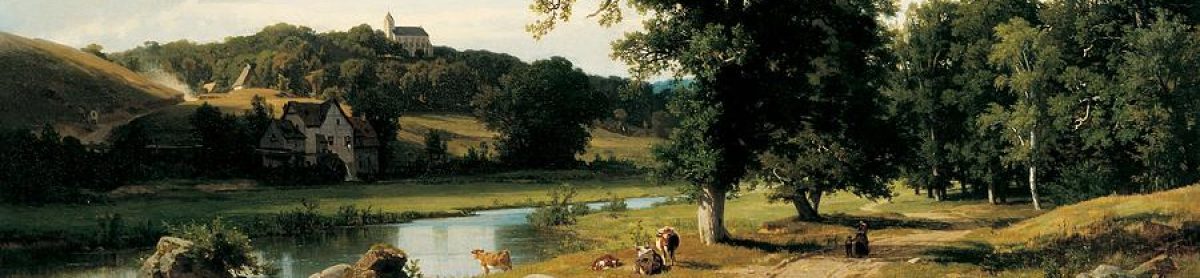
This is Chapter Three of seven: Digging deeper into our Cornwall ancestors— from Erth Barton, to Holwood Manor.
Wessex, one of the kingdoms of Anglo-Saxon England, was land which now approximates the modern counties of Hampshire, Dorset, Wiltshire, and Somerset, and eventually expanded westward to cover Devon and Cornwall.
This may be how the name Bondi, came to be identified as the Bonds of Erth, who were located near the border of Devon and Cornwall, near Plymouth Sound. We do not know when our ancestors arrived in Penryn, Cornwall, but we do know that about the year 1400 our ancestor Robert Bond (of Penryn) married Elizabeth de Erth (Earth) and that upon that marriage, the Bonds of Erth began. (1)

The Cornish Gentry
Gentry is defined as an old English word signifying people from a high social class, i.e. the landed gentry.
The names of most of the Cornish gentry are local — “The Cornish,” says Carew, “entitle one another with his owne and his father’s Christian name, and conclude with the place of his dwelling.” Carew was the author of the 1602 edition of the Survey of Cornwall.
The practice of families taking their names from the place of their abode, with the addition of de, was, at an early period, more or less prevalent throughout England. “Bond, of Earth, near Saltash, married the heiress of an ancient family, who took their name from that Barton [the manor house of a farm].”
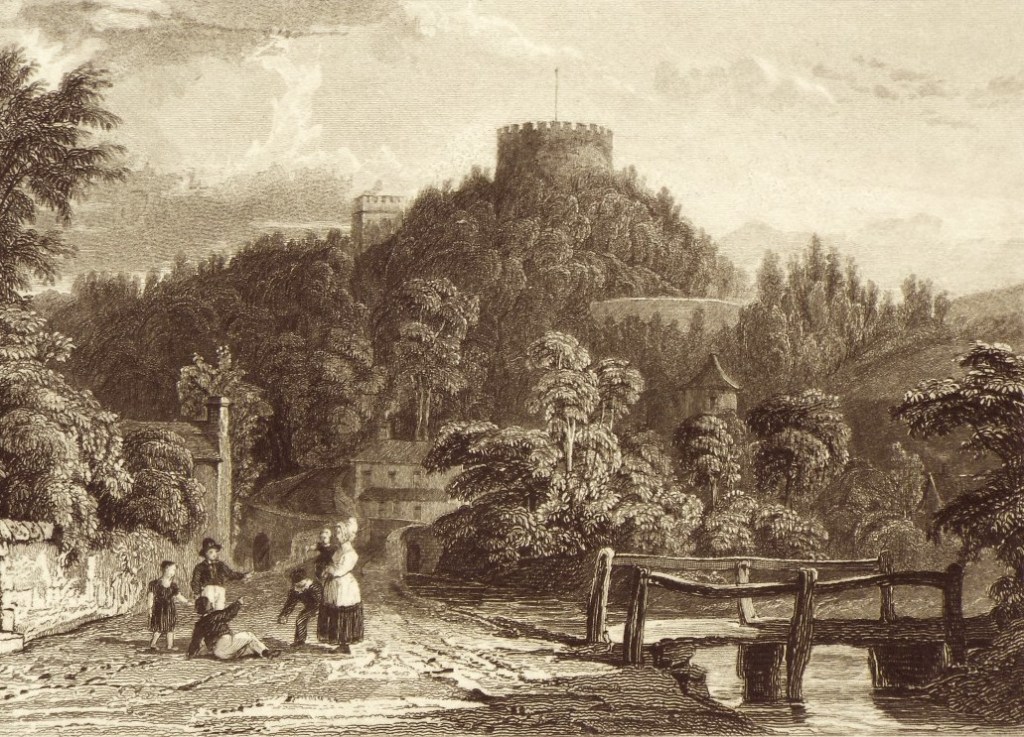
published 1830 by Fisher, Son & Co. London.
Before the Duchy of Cornwall was created, as an annex to the English crown in 1337, Trematon Castle was one of four principal residences of the Earls of Cornwall. (2)
Hugh de Erth and His Descendants
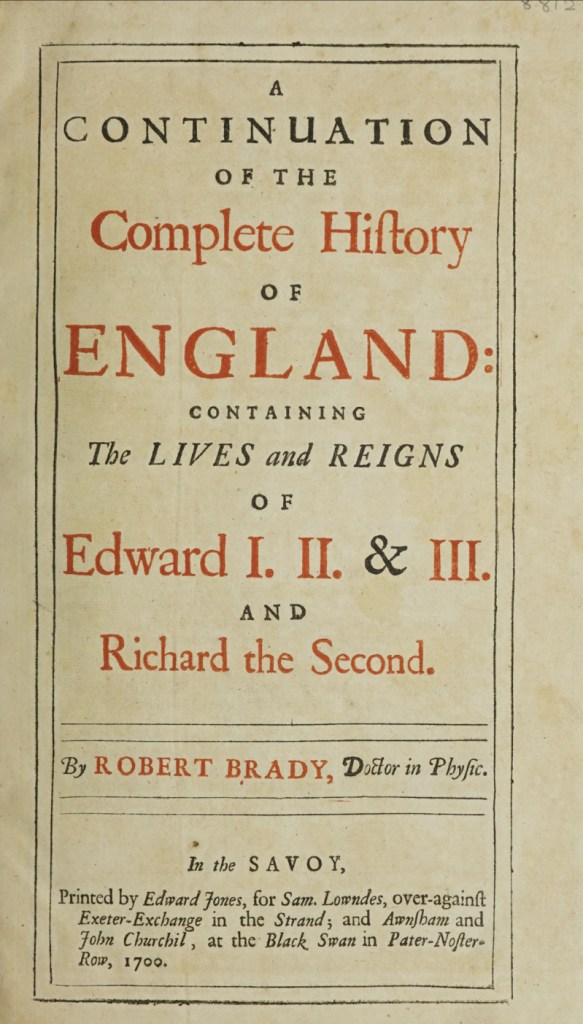
We first learned about the de Erth family with the mention of both Hugh and William de Erth in a long-titled book — A Continuation of the Complete History of England: containing the lives and reigns of Edward I, II & III and Richard the Second by Robery Brady, published in 1700. (This is the only historical reference we have found for William de Erth.)
On page 78 of that book, Brady writes that in 1304, the Terms given to, and accepted by John Comyn [terms of submission by the Scots after the last insurrection] … “These things are agreed on with Monsieur Richard de Burgh, earl of Ulster, Monsieur Aymer de Valance, … Monsieur Henry de Percy, Knights, and John Comyn of Badenagh, for Himself and his Aydants of Scotland, … in the Name of the King, … Monsieur Hugh de Erth, Monsieur William de Erth, Monsieur James de Ross, … Knights, for themselves and all their Scots assistants, who would be sworn in the Peace and Faith of the King, were Sworn.”
Hence, Hugh de Erth was sworn as a Knight for his faithful service in battles for King Edward I, who reigned from A.D. 1272 – 1307. Edward was also known as Edward Longshanks, and the Hammer of the Scots. Hugh de Erth must have been very brave and valiant in battles to catch the attention of the King. Here is a little background:
–24 February 1303: The Battle of Roslin takes place between English and Scottish forces at Roslin, south of Edinburgh, resulting in a Scottish victory.
– An irritated and impatient man, King Edward I, in May 1303, invaded Scotland once more, with a view to subjugating the country once and for all.
– 3 February 1304: The Community of Scotland under the Guardianship of John III Comyn agrees to a peace treaty with King Edward I.

Detail excerpt from page 78. Note the use of the French language.
Obviously, King Edward I and his successors thought highly of the de Erth family from Cornwall. In 1299, Henry de Erth was born in Erth, St. Stephens Parish, Cornwall. His father was Sir Hugh de Erth, Knight, but his mother’s name is unrecorded. (Possibly her name could have been Helena Beckstead?)
In research from nearly a century ago, Allen Kerr Bond wrote in The Story of The Bonds of Earth — “The first mention of Earth in history that I can find, is in the English Calendar of Patent Rolls for 1337 A.D. (for King Edward III) when Henry de Erth [a Knight] is made Constable of the strong castle of Tremerton [Trematon], a few miles from Earth. Although this Knight of Earth was not a Bond, it was by marriage with one of his heiress descendants a little later that the first Bond came to Earth as its knightly possessor…” Henry de Erth had been bestowed these lands for services rendered to John of Eltham, the Earl of Cornwall, and the brother of King Edward III who reigned from A.D. 1327-1377. (Note: Kerr Bond uses the spelling Earth while we have chosen to use the original spelling Erth).
It must have been nice to be “in good” with the royal family. Hugh de Erth’s son, Sir Henry de Erth, was also a Knight, and apparently a very good friend and servant to John of Eltham, the Duke of Cornwall, a younger brother of King Edward III.
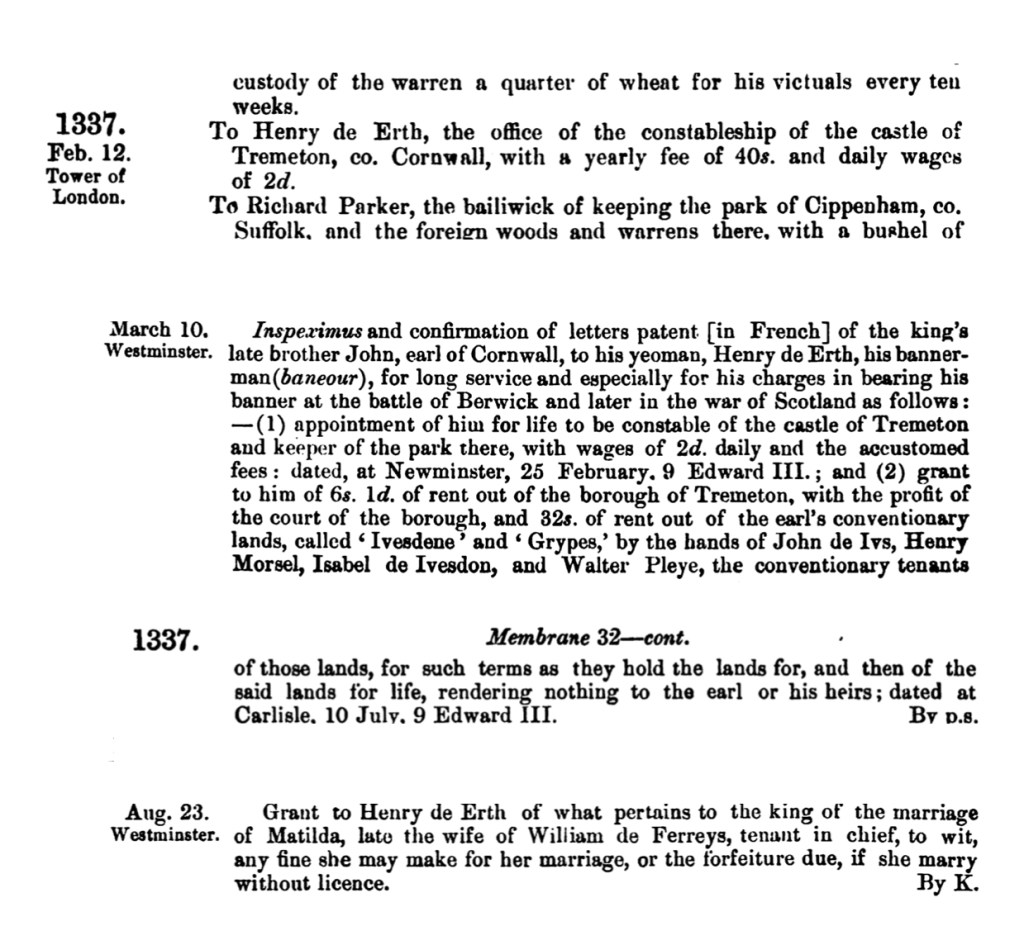
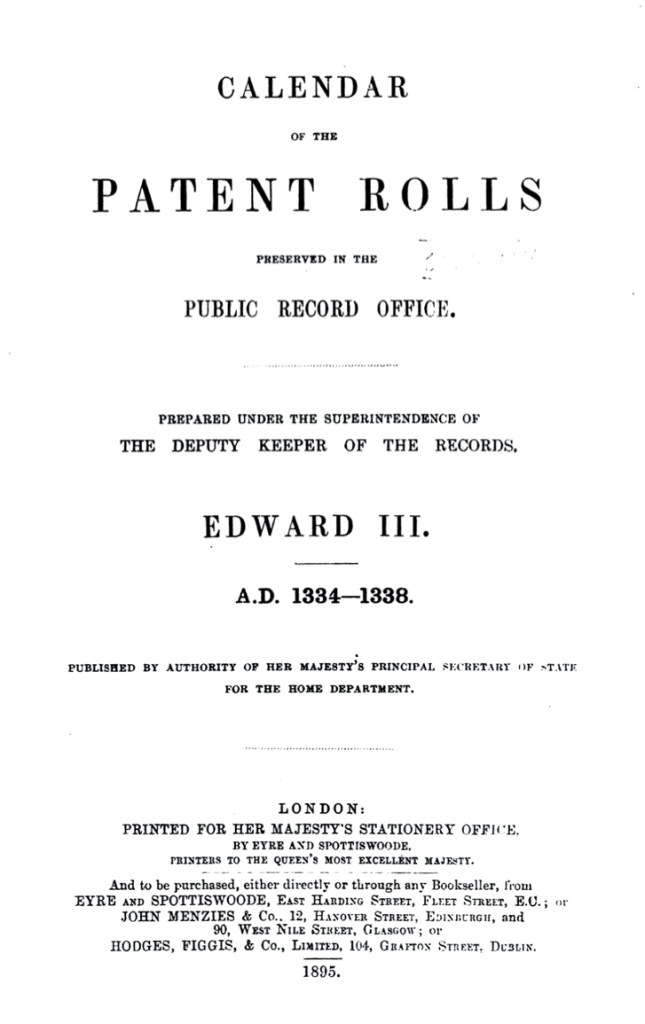
for Edward III A. D. 1334-1338. From pages 382-383, 395, and 509.
There are (shown above) three excerpts from the 1337 Calendar of the Patent Rolls for Edward III A. D. 1334-1338, which identify Sir Henry de Erth specifically. The first two are the most important:
– The first excerpt endows him with the constableship of Tremonton Castle, which is a Knight’s role.
– The second excerpt reinforces the first endowment, establishes the terms, and recognizes Sir Henry de Erth’s long time services to John of Eltham. It further identifies Henry’s role as a “baneour”. That important role is the chief standard-bearer of the King; a Knight Banneret. John of Eltham was a warrior prince and Henry would have been right there in battle, beside him. In 1333, King Edward III made his greatest expedition against Scotland, resulting in the capture and permanent annexation to England of the strong Scottish border fortress of Berwick.
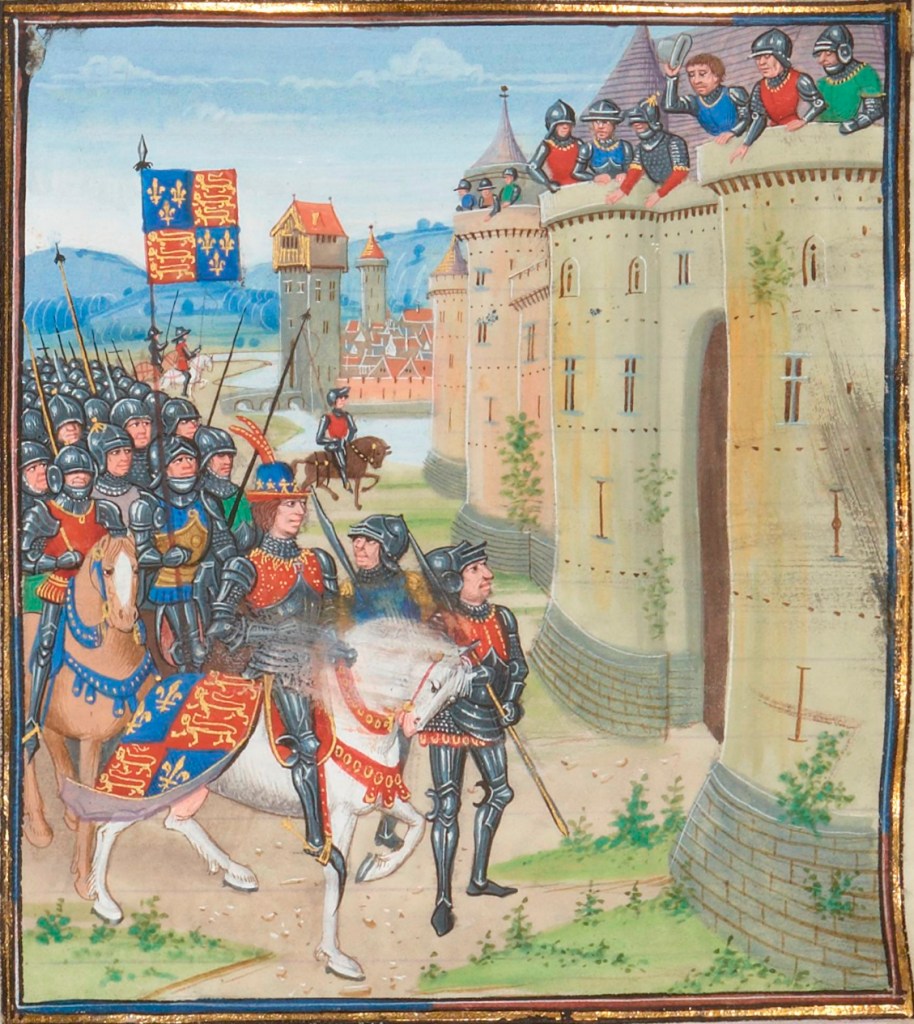
The Knight Banneret carrying the square-shaped banner is Sir Henry de Erth.
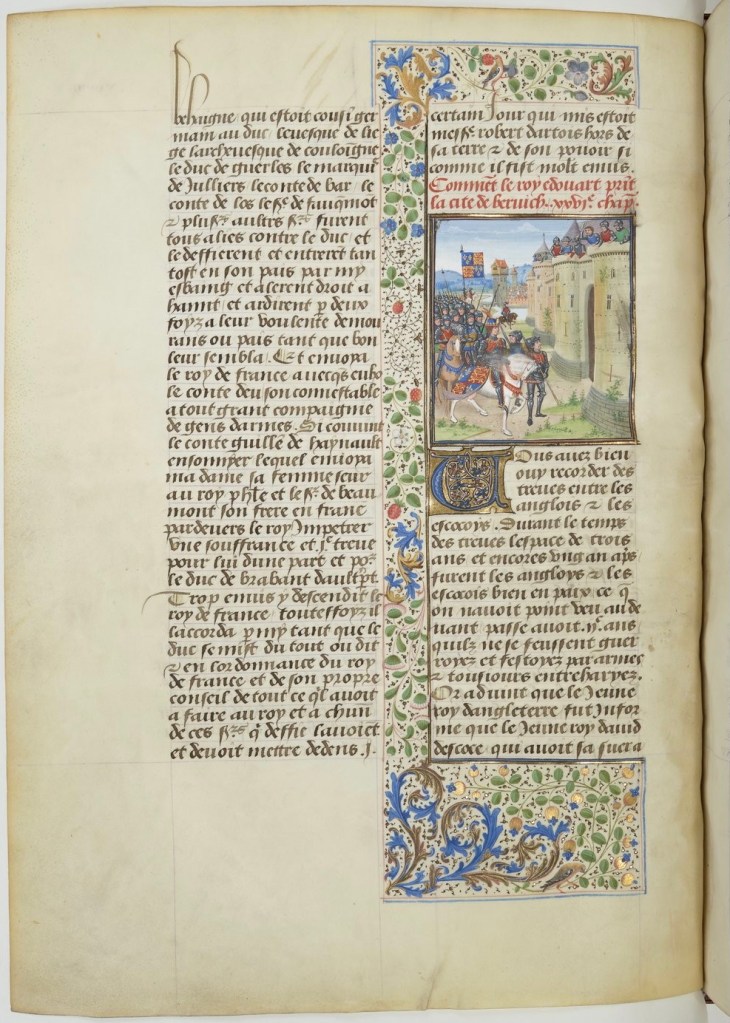
Sir Henry de Erth’s son Geoffrey de Erth, was likely born at Erth in St. Stephen’s Parish, Saltash, and died circa 1405. Geoffrey had a daughter named Elizabeth de Erth. As the heiress of Erth, she was his favored daughter — her birth is estimated to be circa 1375. Elizabeth is written about (below) in Our Erth Ancestors. (3)
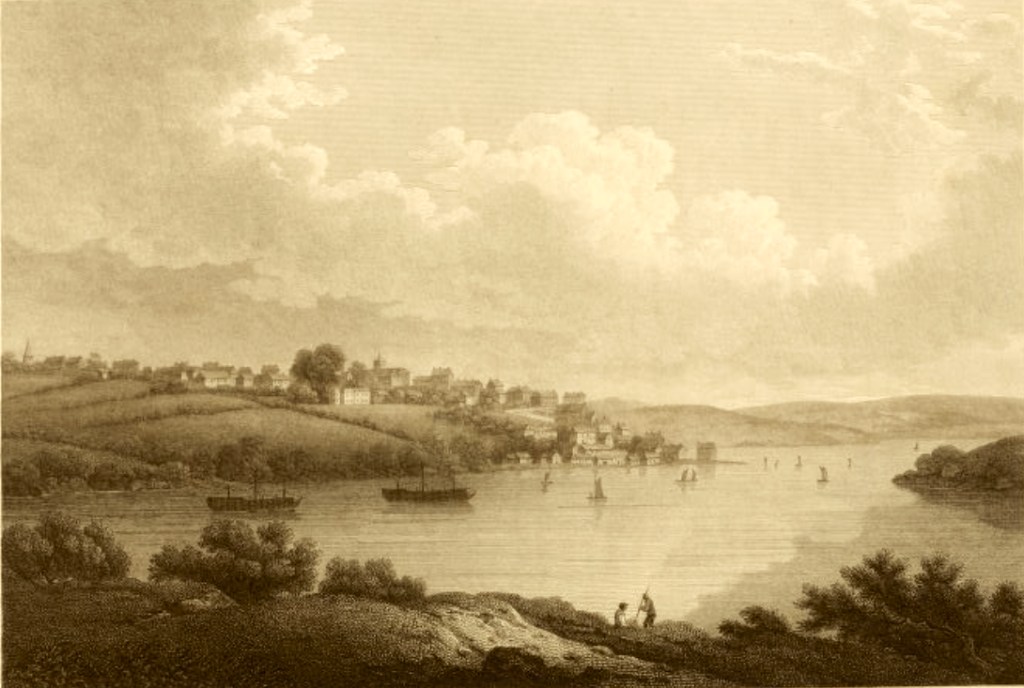
Where on Earth was Erth?
The Erth settlement, or estate, was likely located on the Lynher river, which connected to Plymouth Sound, not very far from the village of Trematon. From the book, The Bonds of Earth, by Allen Kerr Bond: “The great harbor of Plymouth, marking the beginning of the line of boundary between Cornwall and Devonshire; and beside a little river of Cornwall which enters this great harbor is the homestead ‘Earth’ or ‘Erth’, the ancient dwelling of the Bonds of Cornwall.”

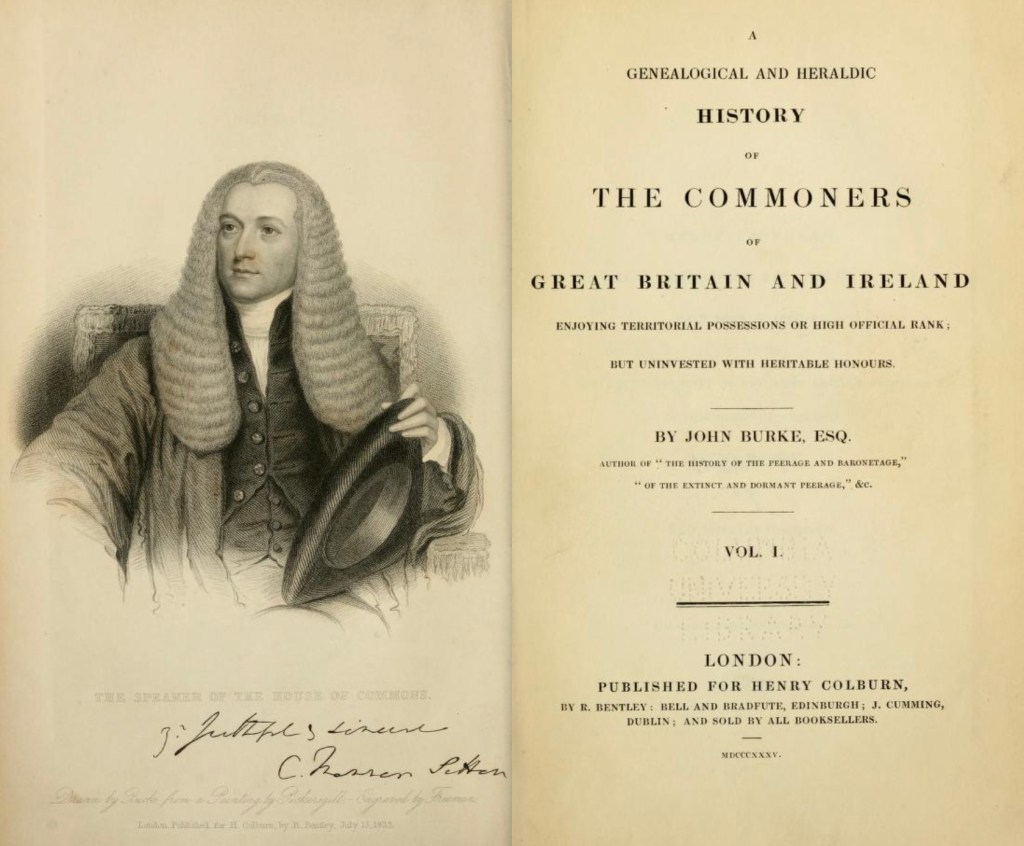
A Genealogical and Heraldic History of the Commoners of Great Britain and Ireland, Vol. I, provides two relevant (but unattributed) references. The second entry follows: “In following the course of the Lyner [the Lynher river], you fall down by Master Bond’s ancient house at Erth, descended to his ancestors from a daughter and heir of that name”. We discovered that this quote was taken from The Survey of Cornwall by Richard Carew, published in 1602.
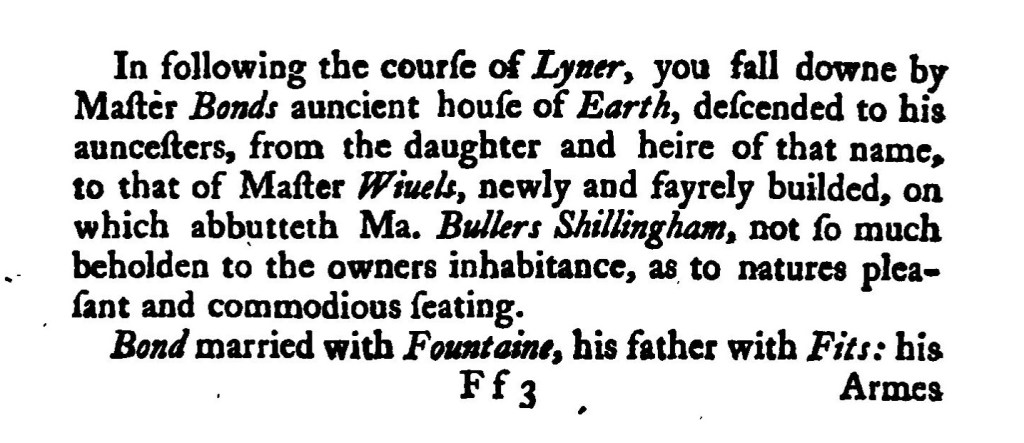
In the “Table of the Second Booke” Bond is listed as being in the East Hundred, [similar to a county]. This is the easternmost county of Cornwall. This table falls near the end of the book.
Our research led us to add many new sources which confirm the establishment of the Bond family at Erth. (4)
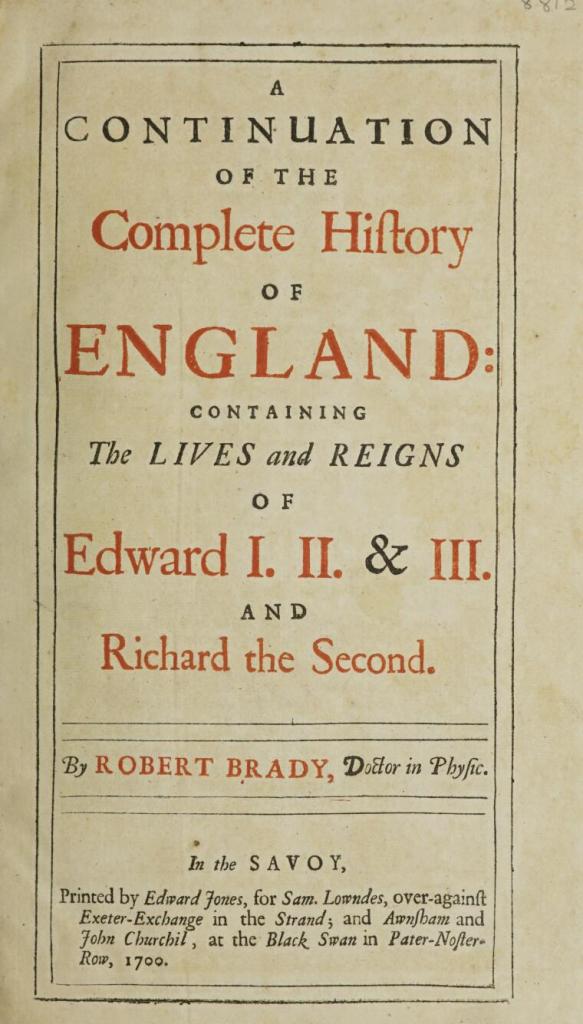
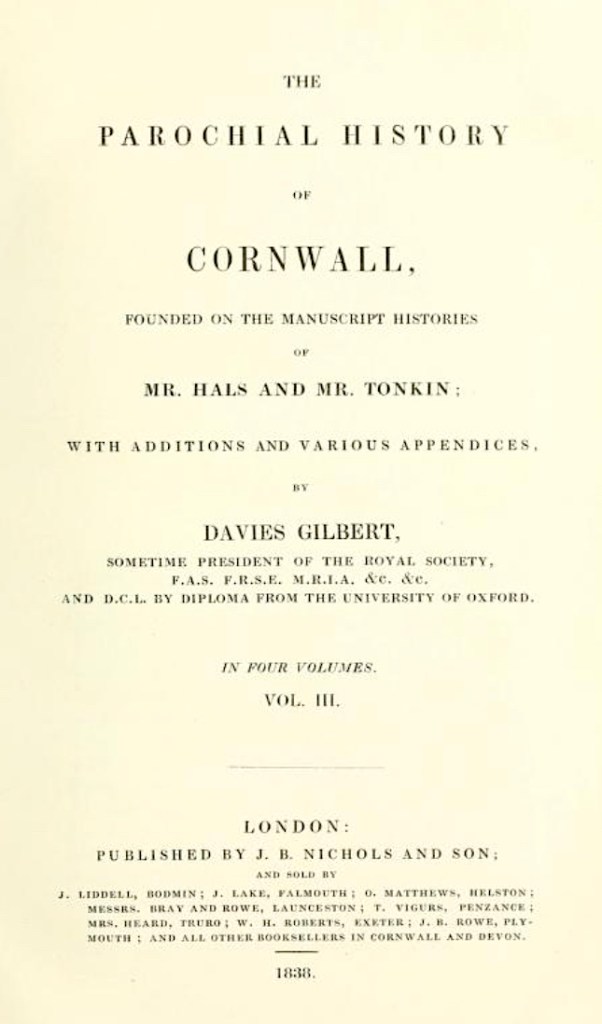
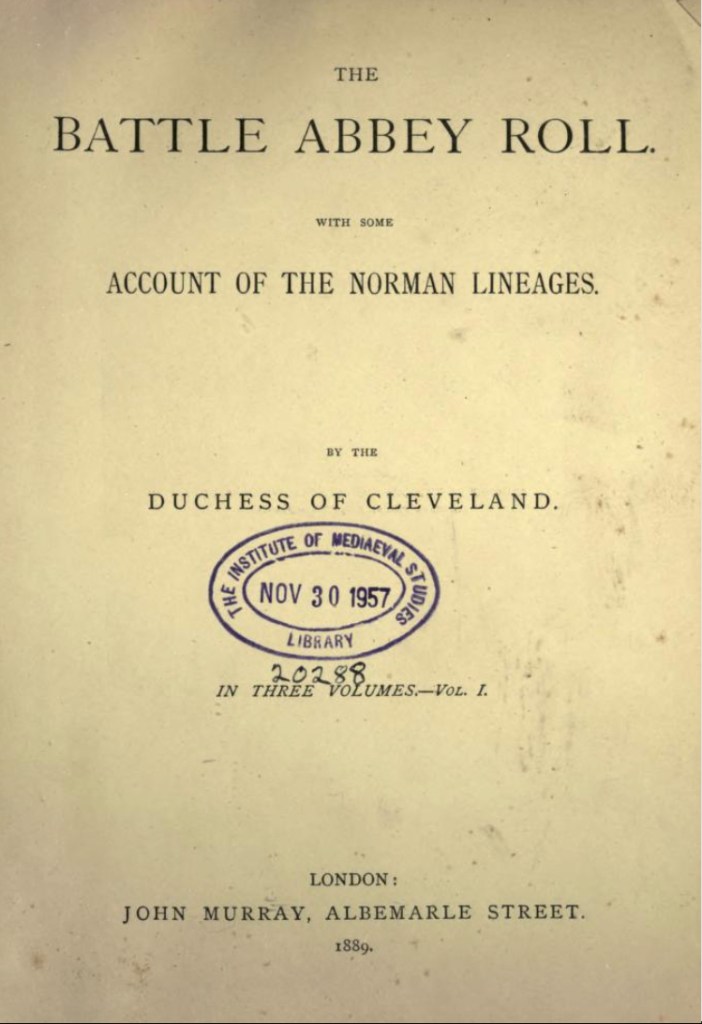
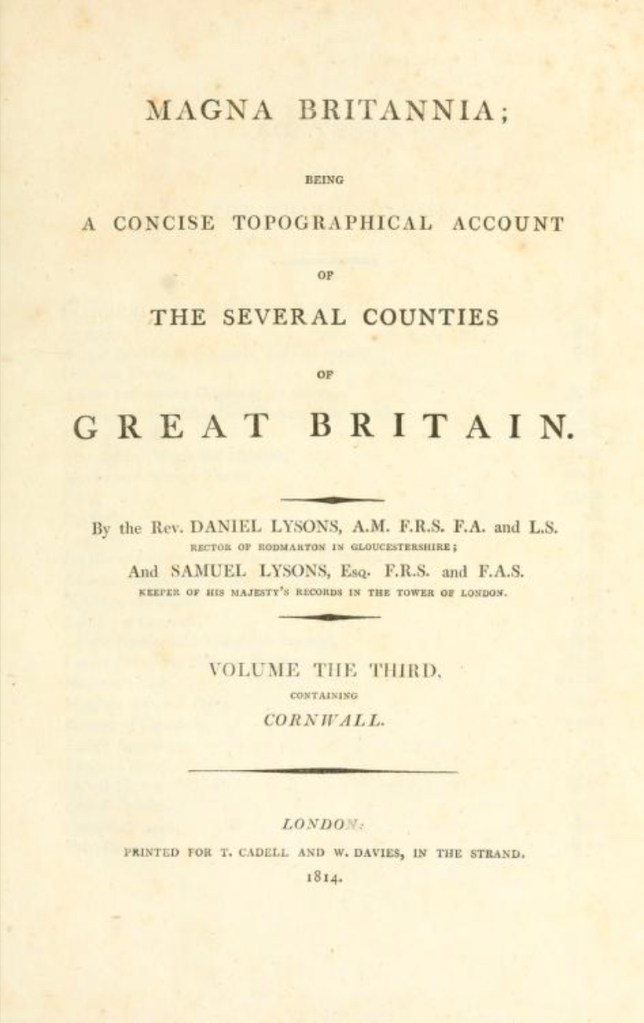
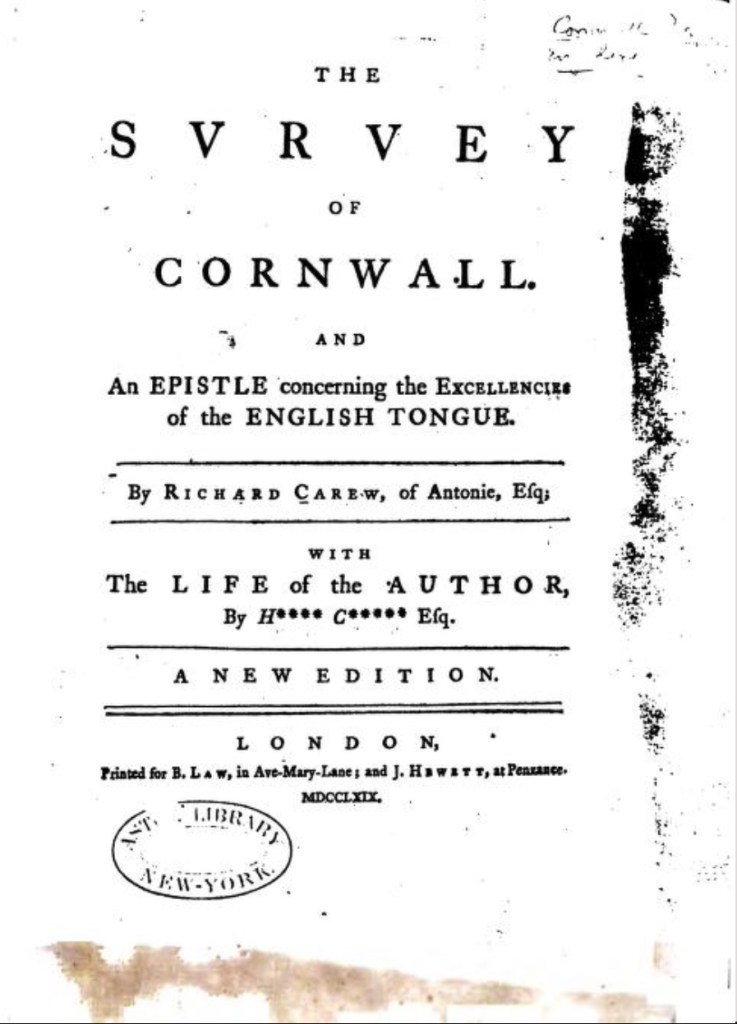
We cited the two books in the top row left and center, in our writing about Hugh de Erth and His Descendants. Excerpts from the other four sources are situated below:
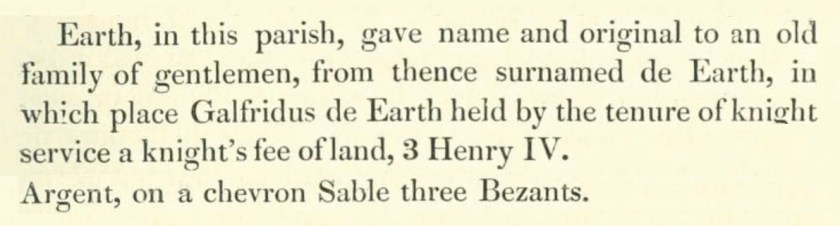
Note: Galfridus is an Anglo-Norman variant of the name Geoffrey.


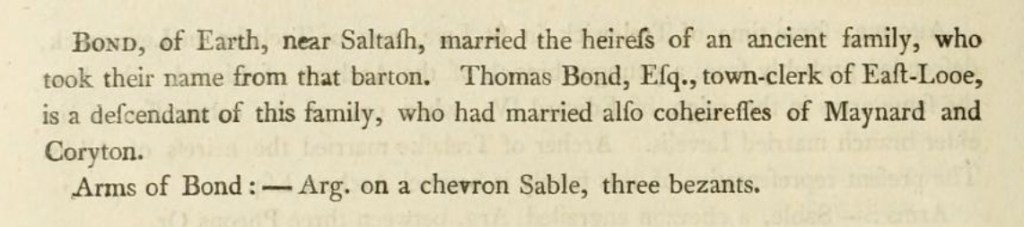

Our Erth Ancestors
We know some of the lineage of the de Erth line and the names of some of the early family. For the de Erth family, their gentry status within the Cornish society, we can infer: 1) Their names are location-based and so they must be from the landowning classes. 2) In a feudal society, land was power and so this placed them well above most Englishmen.
This map is included to show the difference in location from Penryn to Erth, Cornwall. Trains travelling from Penryn to Saltash cover a distance of around 43 miles (69 km) during the journey. Our ancestors could have easily sailed from one location to the other.
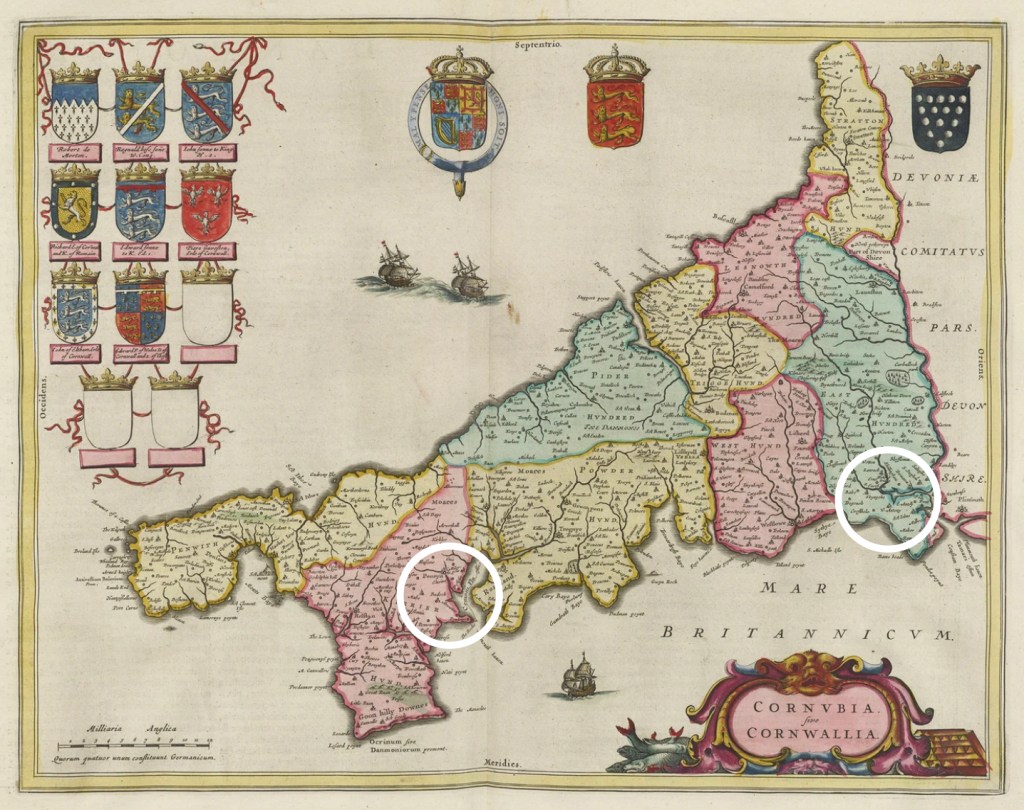
[Cornwall] Cornubia sive Cornwallia, by Willem Janszoon Blaeu, Amsterdam, circa 1650.
The circled areas indicate Penryn on the left, and Erth on the right.
(Image courtesy of Barry Lawrence Ruderman Antique Maps).
The deErth and Penryn ancestors for whom we have records, are listed below interspersed with important historical points. All births and deaths were in Cornwall, England, unless noted. For the Bonds of Penryn, we show a list only, as we have no knowledge of them as persons; how they lived, their education, and little of their professions.
When Goffery de Erth died, (Hugh de Erth and His Descendants section), the next owner of Erth Barton was Robert Bond of Penryn, who had married his daughter, Elizabeth de Erth.
- Robert Bond was born est. 1370, in Penryn, Cornwall and died est.1434 at Erth, Saltash, Cornwall . He married Elizabeth de Erth who was born est. 1375 and died est. 1434. Elizabeth was likely born at Erth, Saltash, Cornwall and died in the same location. The Barton of Erth is located in St. Stephen Parish. As a result of this advantageous marriage, the Bonds of Penryn became the Bonds of Erth, and Robert Bond vastly increased his landholdings.

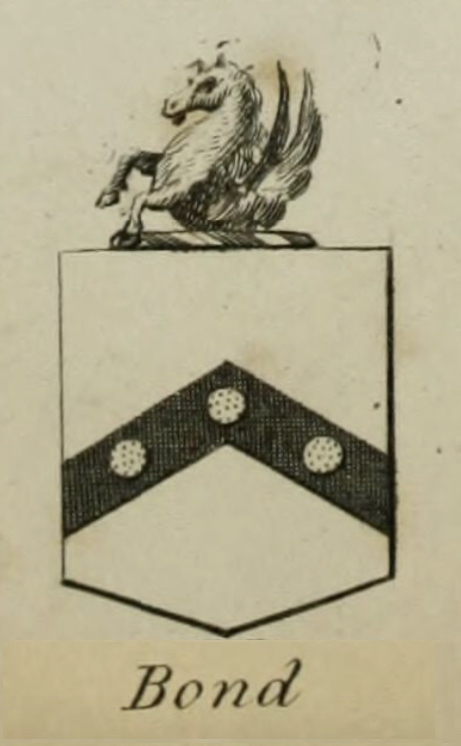
Elizabeth and Robert had three sons, all born at Erth, Saltash, Cornwall:
– Thomas born est. 1400 – death date unknown
– Robert born est. 1408 – death date unknown
– Richard born est. 1410 and died est. 1462
We are descended from Richard Bond — He remained at Erth and continued the direct family line there. His brother Robert, is the founder of the Dorset Branch of the Bond family.
1387: John Trevisa of Cornwall wrote the first book about England in the English language (previously Latin was the language most frequently used by authors).
2. Richard Bond born est. 1410 at Erth, Saltash, Cornwall and died est. 1462 in the same place. Richard married first Elizabeth Maynard est. 1400-1430 of Dorset, and subsequently after her death he married, in 1434, her sister, Agenta ‘Agnes’ Maynard who was born est. 1411 in Dorset and died est. 1470 at Erth, Saltash, Cornwall. It has been written that Agnes Maynard was an heiress of an old Cornish family said to be descended from Irish kings.

John Burke, Esq. wrote A Genealogical and Heraldic History of the Commoners of Great Britain and Ireland, in 4 Volumes, published between 1833-1838. According to Burke: “Richard, of Earth , who m. in 1434 , (during the reign of 12th Henry VI) Agnes, second daughter and co-heiress of Richard Maynard, and their posterity were still residing at Earth at the visitation of Cornwall , anno 1620 . The Bonds, of Holwood, in the same county, were a younger branch of those of Earth , and are now represented by Thomas Bond in the county of Cornwall.”

Richard and Agnes had two sons: Thomas and Richard.
(We are descended from Thomas).
3. Thomas Bond was born est. 1440 and died est. 1510, both at Erth, Saltash, Cornwall. (The website findagrave.com states Thomas was born in 1450, but that would make him a pre-teen when married!)
Thomas Bond married Elizabeth Kendall of Duloe, Cornwall, date unknown. She was born est. 1445 in Duloe to Richard and Jane (Penpons) Kendall and died est. 1516 at Erth, Saltash, Cornwall. Thomas and Elizabeth are buried in the ancient St. Stephen Churchyard in Saltash, Cornwall, England.
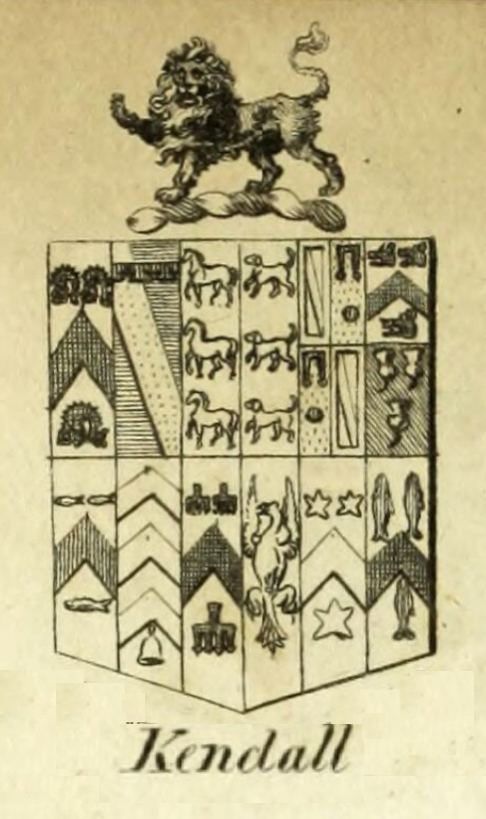
Thomas and Elizabeth had three children, all born at Erth, Saltash, Cornwall.
– John born est. 1462 – death date unknown
– William (Willms) born est. 1465 – death est. 1529 also at Erth, Cornwall
(We are descended from William).
– Agenta born est. 1467 – death date unknown.
1485: Polydore Vergil, an Italian cleric commissioned by King Henry VII to write a history of England, states that “The whole country of Britain is divided into four parts, whereof the one is inhabited by Englishmen, the other of Scots, the third of Welshmen, the fourth of Cornish people … and which all differ among themselves either in tongue, either in manners, or else in laws and ordinances.”
4. William (Willms) Bond married Jane Gibbs of Dorset about 1500. She was born est. 1480 in Dorset and died est. 1539 at Erth, Saltash, Cornwall. Both are buried in St. Stephen Parish churchyard in Saltash.
William and Jane had three children at Erth, Saltash:
– William II born est. 1503 – death date unknown
– Richard born 1507 and died 1553 at Erth.
(We are descended from Richard).
– Elizabeth est. 1509 – death date unknown. She was married three times; William Killigrewe, Robert Trevisa, and John Piper.
1498: Plague, a.k.a. the Black Death which one of the most devastating pandemics in human history sweeps England.

(Image courtesy of Wikimedia Commons).
1509: Henry VIII’s coronation procession includes “nine children of honour” representing England and France, Gascony, Guienne, Normandy, Anjou, Cornwall, Wales and Ireland.
Oh No! 1509-1510 More Plague in Cornwall...
1533-1540 Henry VIII founds Church of England and commences the Reformation. Dissolution of the Monasteries including Glasney College in Penryn (Part One).
5. Richard Bond was born September 22, 1507 and died December 20, 1553, both at Erth, Saltash, Cornwall. In 1530, Richard married Elizabeth Coriton of Saltash, Cornwall, daughter and co-heiress of Thomas Coryton/Coriton. Why the spelling of the Coryton name changed is unknown . Elizabeth was the widow of John Batten. The Coritons (Coryton) were an old family who as far back as 1250 were seated at Coryton in Devonshire. Elizabeth was born est. 1508 in Saltash, Cornwall. Her death date is unknown but she most likely died at Erth, Saltash, Cornwall.
Richard and Elizabeth had seven children. Their son, Thomas Bond, was born est. 1532 at Erth Barton, Saltash, Cornwall and died in 1600 at Fulham, London, England. (We are descended from Thomas, see The Bond Line, A Narrative — Four) (5)
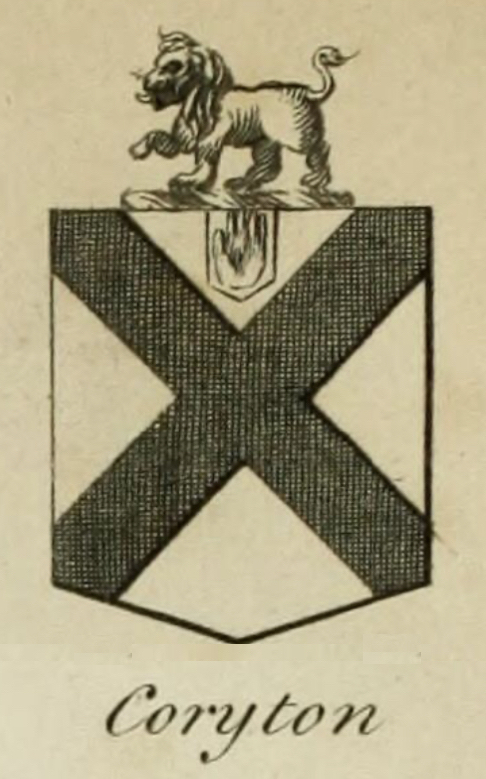
1545: The captain of Henry VIII’s ship the Mary Rose, Roger Grenville of Stowe (father of Sir Richard Grenville of the Revenge) dies in the sinking of the ship. This ship was acting as the flagship of vice-admiral Sir George Carew when the ship was struck by a squall and sank at Spithead (Portsmouth) on July 19th. Comment: In the 1980s, our parents toured the recovered and restored ship wreck, Mary Rose, at the Cleveland Historical Society at University Circle, Cleveland, Ohio.
It should be noted that the Bonds of Erth continued through Thomas’s brother, William Bond, who married Katherine Fitz de Ford and carried on the family Bonds of Erth. There are indications that other children and their decedents moved north of Quethiock to an area known as Tresunger in St. Endellion, County Cornwall. (5)
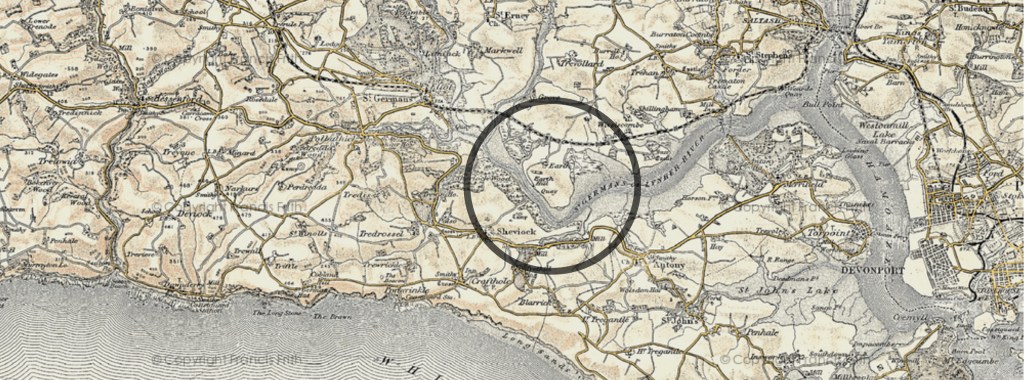
for the extracted detail of Erth Barton, Cornwall.
(Image courtesy of The Francis Frith Collection, see footnotes.).
Erth Barton
The ancient ancestral Bond Estate is located close to the small city of Saltash in Cornwall, near Plymouth Sound. The Erth House is a Norman Manor House, and the Barton, or Farm, was once called Goffery Manor, in the 9th Century AD.
In 1610, a study was commissioned to determine if Erth House was the oldest building in Cornwall, and the conclusion was that it indeed was the oldest building due to large sections of the interior structure being intact. It did however, receive remodeling in the 17th century. It is documented as a “barton at Erth held by Golfridus [Geoffrey] de Earth temp Henry IV (1399-1413)”. The building is today a country manor Bed and Breakfast with the same name.


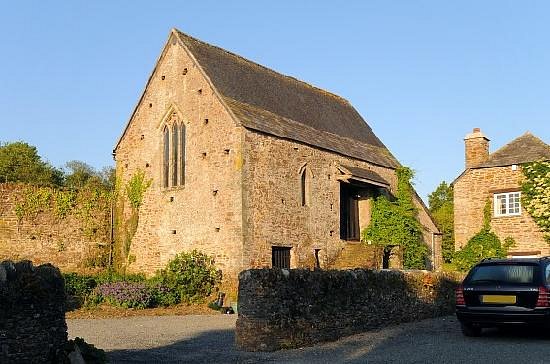


The present day Erth Barton looks like a nice place to stay if you are in the Cornwall, England area. When I wrote about glancing backward in the preface for The Bond Line, A Narrative — Two, I now realize that if I had earlier attained this level of scholarship about family genealogy — I (Thomas) would certainly have found a pathway for our parents to see the significant, original Bond estate. (6)
Quite Quintessentially Quethiocke – Our Holwood Ancestors
6. Thomas Bond married Jone (maiden name unknown) about 1560 and acquired the Holwood estate by marriage with Jone. She had probably inherited it from her family. Jone was the widow of T. Tome and had a daughter named Sable Tome. From the website findagrave.com for Thomas Bond(e) the following is a description of Holwood, the estate of Thomas and Jone Bond. “Thomas Bonde, a younger son, left Earth and located at Holwood, a seat higher up the river Lyner, of very great antiquity,… from him descend the family of ‘Bonds of Erth and Holwood.’ … Gilbert describes the place as “a fine estate abounding in tillage and pasture lands, excellent timber and fruits.” Holwood is 2 miles west of Quethiock Parish, Cornwall. It is also about seven miles northwest of the Bonds of Erth, Saltash, also in County Cornwall.
Depending upon who was recording the information, the new parish was called Quethiocke, which had been known by other names. According to Bannister’s Glossary of Names: “The parish, formerly called Quethiocke, Quedic, Queidike, and Cruetheke, means ‘The weaver’s place (gwia) to weave’. And from genuki.org:
“The parish of Quethiock, (Cornish: Gwydhek), is pronounced ‘Gwithick’; anciently called Cruetheke… It is named after the Old Cornish for a wooded place”.
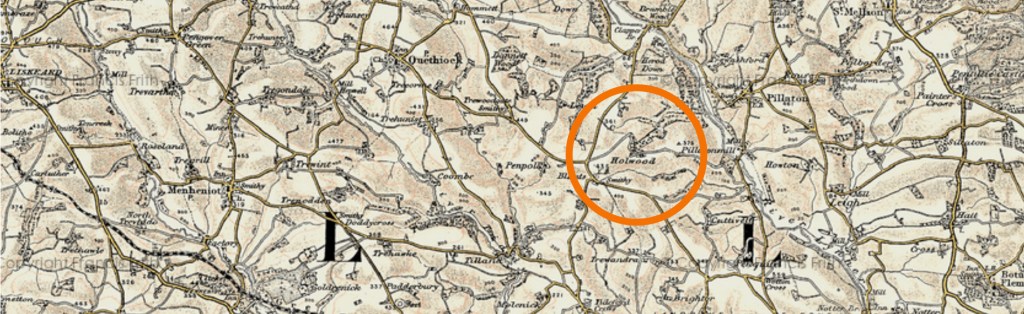
Historic Ordnance Survey Map of Doddycross, 1900.
(Image courtesy of The Francis Frith Collection, see footnotes.).
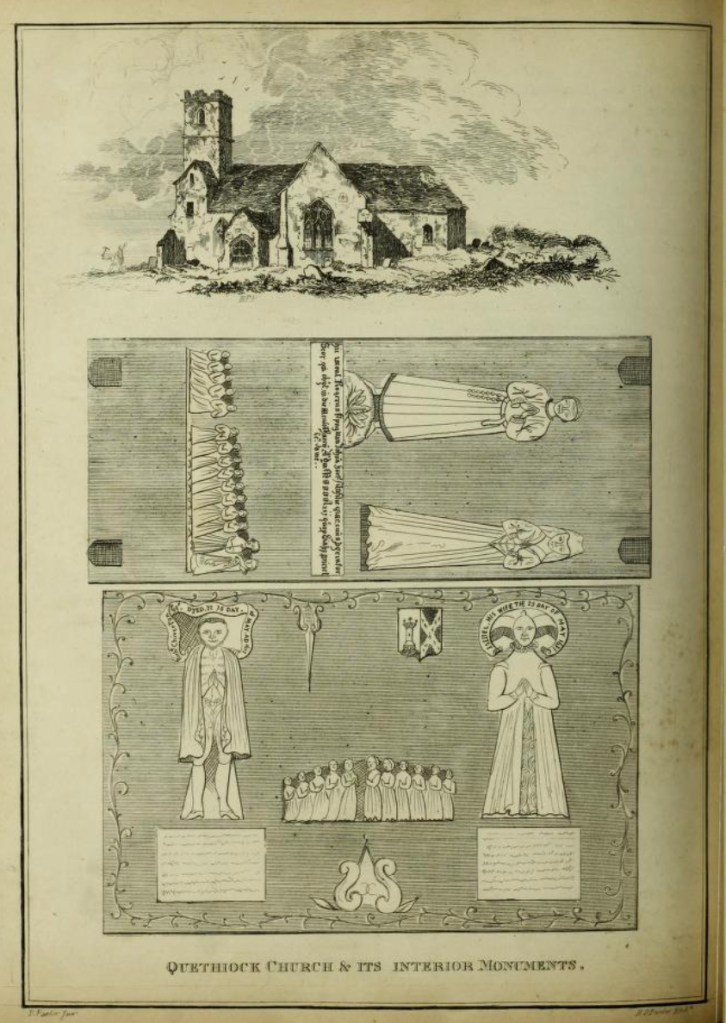
Gilbert’s An Historical Survey of the County of Cornwall, 1820 edition, page 462.
7. William Bond, the only child of Thomas and Jone Bond, was born in 1561 at Holewood Manor, Quethiock, County Cornwall and died there in 1610. In 1582 William married Jane Sproue, daughter of Thomas Sproue of Northill. Children born to this marriage were: Eleanor 1583 (wife of Hugh Rositer), Thomas 1584 (the Second, of Holwood), Susanna 1587 (wife of Peter Hunt), John 1689, Christopher 1591, Anna 1593 (wife of Richard Roberts), and (possibly) Richard 1594. Jane (Sproue) Bond died, death date unknown.
At some point in time, we know that Thomas removed from Holwood and moved to Fulham, London, England. We can only speculate why and when this occurred. His young son, William, became “the lord of the manor”. We will elaborate on Thomas Bond of Fulham in The Bond Line, A Narrative — Four.

Clearly perplexed, he’s likely trying to sort out the endless stream of male ancestors
named “William Bond” over the generations. (Image courtesy of Digital Spy).
After the death of his first wife, Jane, William Bond married a second time about 1606, to Wilmot Haughton, widow of Philip Stroud. Wilmot was born about 1570 at Haughton Towers in Lancashire, England to William and Anne (DeVerney) Haughton. Wilmot’s death at Holwood Manor is estimated about 1633. To this marriage two sons were born: William Bond 1608 (our ancestor) and his brother Peter Bond 1610. We will follow our ancestor William Bond in Section Four.
Thomas, the first born son of William and Jane (Sproue) Bond, most likely inherited Holwood Manor, as cited below, by the reign of Charles II (1660-1685). In the following generations of the William and Jane (Sproue) Bond’s family there are several males named William. As the generations grew it is likely that Thomas (b. 1688, son of William, b. 1663), had likely inherited Holwood. However, he “died without offspring”. In his will, dated April 18, 1723, he left all of his lands to Richard, his first cousin… with “the provision that he make either the mansion of Earth or Holwood his principle place of residence, under penalty of forfeiture of all lands so demised.” Richard chose Holwood, but he also died without offspring. With their deaths, Erth and Holwood probably passed out of the family’s hands.
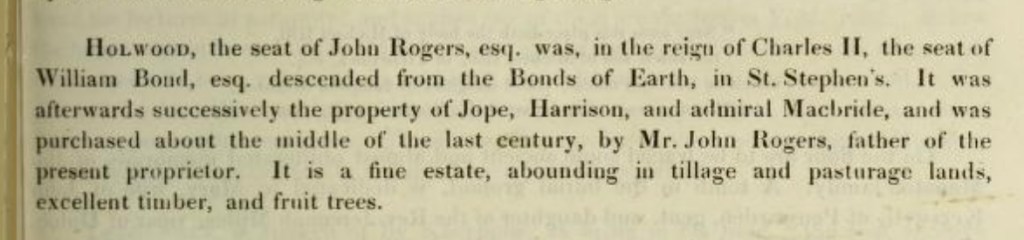
Gilbert’s An Historical Survey of the County of Cornwall, 1820 edition, page 465.
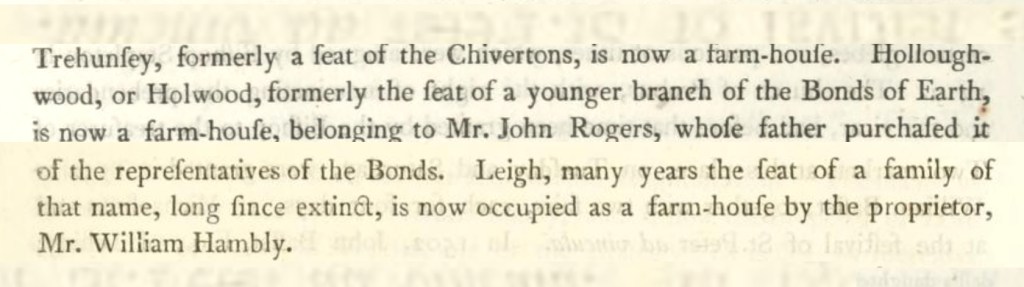
Our line of the Bonds of Erth and Holwood were minor political players, still mostly concerned with tending to their country manor houses, with their plantations, and Devon cattle. Eventually, some of the Bond cousins of the Dorset line would become rather prominent in London, but that is not our direct lineage. Some in our line stayed at Erth, some went just a bit north to Holwood for a few generations, and some went to Fulham, London. (7)
Following are the footnotes for the Primary Source Materials,
Notes, and Observations
(1) — one record
Britannica
Wessex
https://www.britannica.com/place/Wessex-historical-kingdom
The Cornish Gentry
(2) — two records
World History Encyclopedia
Matthew Paris’ Map of Britain
https://www.worldhistory.org/image/14133/matthew-paris-map-of-britain/
Note: For the Map of Cornwall and the South West, extracted from the map of England by Matthew Paris, circa 1250.
BHO | British History Online
General history: Gentry
Cornish Gentry
https://www.british-history.ac.uk/magna-britannia/vol3/xcviii-cxviii
Hugh de Erth and His Descendants
(3) — thirteen records
A Continuation of the Complete History of England:
Containing the Lives and Reigns of Edward I, II & III and Richard the Second
by Robery Brady, 1627 — 1700
https://wellcomecollection.org/works/evc94t65
and
https://wellcomecollection.org/works/evc94t65/items?canvas=88
Book page: 78, Digital page: 88/636.
The Story of The Bonds of Earth
by Allen Kerr Bond
https://archive.org/details/storyofbondsofea00bond/mode/2up
Book page: 1-2, Digital page: 15-16/299.
Three mentions of Henry de Erth in the
Calendar of the Patent Rolls for Edward III A. D. 1334-1338:
Excerpt One: Membrane 39
Book page: 383, Digital page: 395/820, Located about halfway down the page. https://babel.hathitrust.org/cgi/pt?id=mdp.39015011275826&view=1up&seq=395&skin=2021
Excerpt Two: Membrane 32
Book page: 382-393, Digital page: 405/820, Located near the bottom and at the top of the next page.
https://babel.hathitrust.org/cgi/pt?id=mdp.39015011275826&view=1up&seq=405&skin=2021
Excerpt Three: Membrane 6
Book page: 497, Digital page 509/820, Located near the bottom and at the top of the next page.
“Henry de Erth had been bestowed these lands for services rendered to John of Eltham, the Earl of Cornwall, and brother of Edward II.”
Many Mini Biographies
Bond Family History in England
by Rodney Bond
http://www.teachergenealogist007.com/2009/12/bond-256-257.html
Henry DeErth
https://www.ancestry.com/family-tree/person/tree/84073441/person/32503277148/facts
Geoffrey DeErth
https://www.ancestry.com/family-tree/person/tree/58654237/person/44036735936/facts
Knight Banneret
https://en.wikipedia.org/wiki/Knight_banneret
Les nouvelles Croniques de France et d’Angleterre, made and compiled by Jehan Froissart
The Seige of Berwick (1333) https://en.wikipedia.org/wiki/Siege_of_Berwick_(1333)
and for the illustration link:
File:Edouard III devant Berwick.jpg
Note: Here is the painting in its original context:
BnF Archives et Manuscrits, Français 2643 -2646
Chroniques sire JEHAN FROISSART ». Français 2643
Froissart, Jean (1337?-1410?). Auteur du texte
https://gallica.bnf.fr/ark:/12148/btv1b84386043/f90#
BONDWORLD
Bond, Where Did You Come From?
(An interesting personal reflection of Bond family history by Peter Bond)
https://web.archive.org/web/20150515032419/http://myweb.tiscali.co.uk/bondworld/page03.htm
Where on Earth was Erth?
(4) — seven records
Richard Carew (1555-1620), aged 32,
as High Sheriff & Deputy-Lieutenant of Cornwall
https://commons.wikimedia.org/wiki/File:British_%28English%29_School_-_Richard_Carew_%281555–1620%29,_Aged_32,_as_High-Sherrif_and_Deputy-Lieutenant_of_Cornwall_-_352348_-_National_Trust.jpg
Note: For his portrait.
Carew’s Survey of Cornwall
by Richard Carew, of Antoine, Esq.
https://archive.org/details/surveycornwalla00caregoog/page/n250/mode/2up?view=theater
Book page: 111, Digital page: 251/377
The Parochial History of Cornwall, Vol. III
Founded on the manuscript histories of Mr. Hals and Mr. Tonkin, with
with additions and various appendices by Davies Gilbert, 1838
https://archive.org/details/parochialhistory03gilb/page/464/mode/2up
Book page: 465, Digital page: 464/470
The Battle Abbey Roll
by The Duchess of Cleveland
https://archive.org/details/battleabbeyrollw01battuoft/page/n5/mode/2up
Book page: 138, Digital page: 138/352

Magna Brittanica, Being a Concise Topographical Account
of the Several Counties of Great Britain, Volume The Third
by Rev. Daniel Lysons and Samuel Lysons, Esq., 1814
https://archive.org/details/magnabrittanicab03lyso/page/n7/mode/2up
Book page: 290, Digital page: 291/360
Book page: C, Digital page: 124/780
Book page: cxxxii, Digital page: 156/780
Digital page: 650/780 (for the Village of Saltash illustration)
Our Erth Ancestors
(5) — ten records
Barry Lawrence Ruderman Antique Maps
[Cornwall] Cornubia sive Cornwallia
by Willem Janszoon Blaeu, Amsterdam, circa 1650
https://www.raremaps.com/gallery/detail/111054
Note: For the map image.
An Historical Survey of the County of Cornwall: to which is added, a complete heraldry, by C. S. Gilbert, 1817 (This edition contains the heraldry bookplates.)
https://wellcomecollection.org/works/g68eerr8/items?canvas=9
Note 1: Book page: 30, Digital page: 30/441, for the Bond family reference.
Note 2: For five Coat of Arms, as follows:
– Bond Coat of Arms, Plate VI (6)
– De Erth Coat of Arms, Plate XIII (13)
– Coryton Coat of Arms, Plate VI (6)
– Kendall Coat of Arms, Plate XV (15)
– Maynard Coat of Arms, Plate XVII (17)
Note 3: The Maynard family coat of arms (as demonstrated in Gilbert’s book),
may be a localized Cornwall variation. Excerpted from the Description found in this file: https://commons.wikimedia.org/wiki/File:Maynard_%28of_Easton,_Essex%29_Arms.svg , as follows:
– Maynard Baronets, Baron Maynard, Viscount Maynard. Descended from Maynard of Sherford in the parish of Brixton, Devon (as is stated on monument to Sir Henty Maynard (d.1610).
– The Visitations of the County of Devon: Comprising the Heralds’ Visitations of 1531, 1564 & 1620, Exeter, 1895, p.561); Sherford located in parish of Brixton per Risdon, Tristram, Survey of Devon, 1811 edition, London, 1811, with 1810 Additions, p.392.
A Genealogical and Heraldic History of the Commoners of Great Britain and Ireland…
by John Burke
https://archive.org/details/genealogicalheral01burk/page/n27/mode/2up
IntoCornwall.com
Cornwall History Timeline
https://www.intocornwall.com/features/cornwall-history-timeline.asp
Portrait of Henry VIII of England (1491-1547)
by Meynnart Wewyck, circa 1509.
https://commons.wikimedia.org/wiki/File:HenryVIII_1509.jpg
Note: For his portrait.
Robert of Penryn Bond
https://www.ancestry.com/family-tree/person/tree/50985043/person/27101647611/facts
Thomas Bond
https://www.findagrave.com/memorial/175760445/thomas-bond
Elizabeth Kendall Bond
https://www.findagrave.com/memorial/175760509/elizabeth_bond
Note: For burial references at St. Stephen Churchyard, Saltash, Cornwall.
The Story of The Bonds of Earth
by Allen Kerr Bond
https://archive.org/details/storyofbondsofea00bond/mode/2up
Book page: 37-47, Digital page: 36-46/299
Erth Barton
(6) — three records
The Francis Frith Collection
Historic Ordnance Survey Map of Devonport, 1899-1900
https://www.francisfrith.com/devonport/map-of-devonport-1899-1900_rnc690529
Note: For the discreet map image of Erth Barton’s location.
Heritage Gateway
Historic England Research Records
Earth Barton
https://www.heritagegateway.org.uk/Gateway/Results_Single.aspx?uid=436604&resourceID=19191
Note: For ownership details
The present day country manor bed and breakfast: https://www.tripadvisor.com/Hotel_Review-g209971-d310884-Reviews-Erth_Barton-Saltash_Cornwall_England.html
Quite Quintessentially Quethiocke — Our Holwood Ancestors
(7) – thirteen records

A Glossary of Cornish Names
by John Bannister, 1871
https://babel.hathitrust.org/cgi/pt?id=coo1.ark:/13960/t2s477p68&view=2up&seq=160
GENUKI, UK and Ireland Genealogy
Quethiock
https://www.genuki.org.uk/big/eng/CON/Quethiock
Geni
William Bond, of Holewood
https://www.geni.com/people/William-Bond-of-Holewood/6000000174135300843
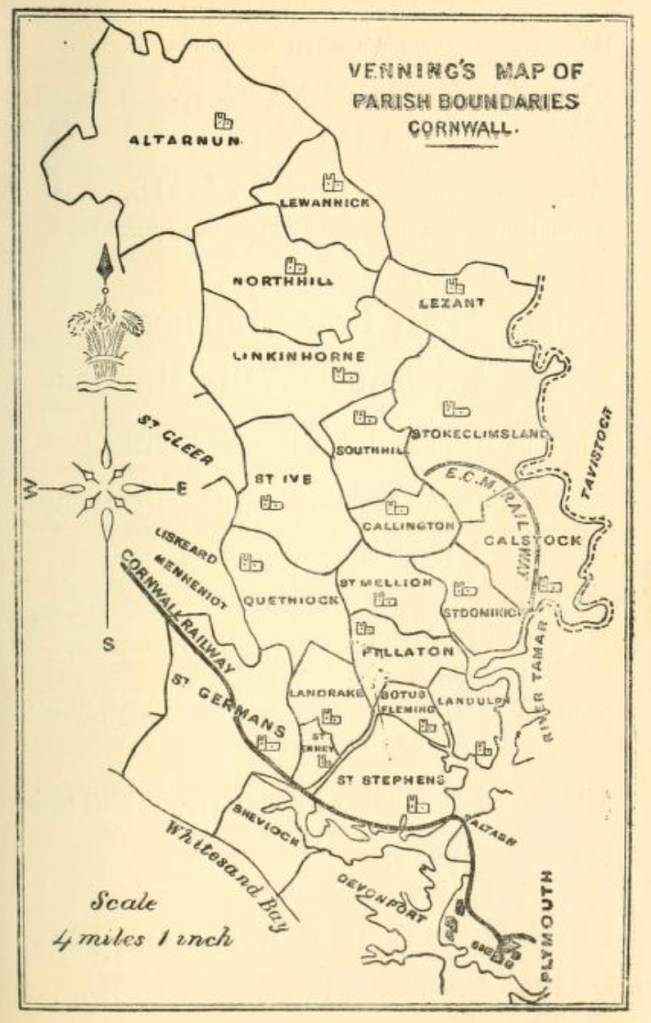
An Illustrated Postal Directory, Twenty Parishes in East Cornwall
for The New Century
by Venning and Birkbeck, third edition 1901
Book page: 228, Digital page: 228/280, for “Holwood or Holloughwood”
https://archive.org/details/illustratedposta00venn/page/n33/mode/2up?view=theater
The Francis Frith Collection
Historic Ordnance Survey Map of Doddycross, 1900
https://www.francisfrith.com/trehawke/map-of-doddycross-1900_rnc691465
Note: For the discreet images of Holwood and Quethiocke Parish.
An Historical Survey of the County of Cornwall:
To Which Is Added, A Complete Heraldry
by C. S. Gilbert, 1820
https://archive.org/details/b2201195x_0002/page/n7/mode/2up?view=theater Book page: Frontispiece, Digital page: 8/1082
and here:
https://wellcomecollection.org/works/g68eerr8/items?canvas=9
Note: For both versions, this edition did NOT contain heraldry bookplates.
Magna Brittanica, Being a Concise Topographical Account
of the Several Counties of Great Britain, Volume The Third
by Rev. Daniel Lysons and Samuel Lysons, Esq., 1814
– Holloughwood, or Holwood Manor…
Book page: 274 (bottom) — 275 (top), Digital page: 274-275/361, for
https://archive.org/details/magnabrittanicab03lyso/page/274/mode/2up
BHO | British History Online
Parishes: Quethiock – Ruan Minor
Quethiock, or Quithiock
https://www.british-history.ac.uk/magna-britannia/vol3/pp274-280
The Richard Bond Family in America
by Rev. Thomas A. Bond, Abbey of the Genesee, 1981
Microfilmed by the Genealogical Department of the Church of Jesus Christ of Latter-day Saints on April 9, 1986
(Item 14, Project and Roll XLIB 7-102 2017, G.S. Call 1321093)
Richard Bond and desendents [sic]
https://www.ancestry.com/mediaui-viewer/tree/10403921/person/6979535919/media/5f0ecfd9-3dd2-4c1a-a1ab-bfb0e84b19f6?_phsrc=qGQ3868&_phstart=successSource
IntoCornwall.com
Cornwall History Timeline
https://www.intocornwall.com/features/cornwall-history-timeline.asp
Digital Spy
Sir Roger Moore, star of James Bond, has sadly died aged 89
https://www.digitalspy.com/movies/a829011/sir-roger-moore-james-bond-obituary-dies/
Note: For his portrait.
 Our Ancestors, Our Narratives


