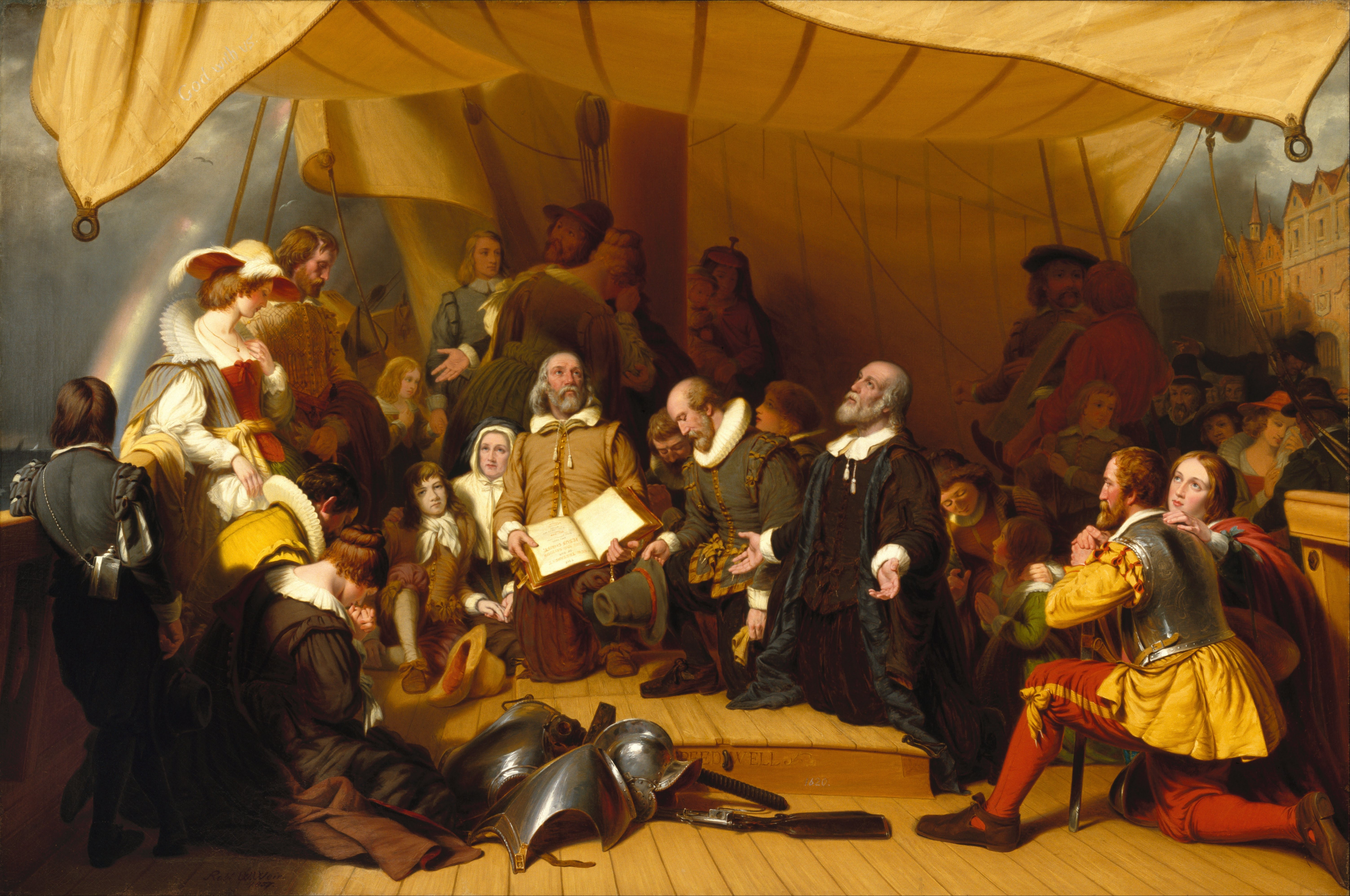
This is Chapter Four of seven. Finally, after many troubles, both Pilgrim Soule and Pilgrim Doty board the Mayflower and sail with the Saints and Strangers to the New World. As we learned in the chapter The Pilgrims — Colonial Pursuits, several European nations in the 15th and 16th centuries were seeking to exploit the resources available in the New World. They just needed good maps to guide them on their various quests.
Samuel de Champlain, Explorer and Cartographer
One of the most famous early explorers and cartographers was the Frenchman, Samuel de Champlain (1574 — 1635). “He made between 21 and 29 trips across the Atlantic Ocean, [creating] the first accurate coastal map during his explorations [as he] founded various colonial settlements.
Born into a family of sailors, Champlain began exploring North America in 1603, under the guidance of his uncle, François Gravé Du Pont. From 1604 to 1607, he participated in the exploration and creation of the first permanent European settlement north of Florida. Champlain was the first European to describe the Great Lakes, and published maps of his journeys and accounts of what he learned from the natives and the French living among the Natives.” (Wikipedia) (1)

Reliable Maps Were Difficult To Come By
“On March 3, 1614, Captain John Smith set sail for Monhegan Island, a rocky outcrop ten miles off the coast of Maine. The spot was popular for fishing, and the funders of Smith’s voyage expected fresh whale on his return. When Smith and the crew of his two whaling ships landed in what was then called Northern Virginia that April, however, they found rorqual and finback whales to be painfully difficult to catch. To make the trip worthwhile, most of the men fished and traded furs, while Smith and eight other shipmates explored the shore.
Smith quickly discerned that the half-dozen maps of the region he had in his possession were useless, saying that they ‘so unlike each to other; and most so differing from any true proportion, or resemblance of the Countrey [sic], as they did mee [sic] no more good, then so much waste paper, though they cost me more.’
With a humble set of surveying tools—a crude compass, astrolabe, sextant, a lead line to measure depth, a quill pen and paper—they gathered notes for their very own map of what Smith named ‘New England.’ The official map was published alongside Smith’s book, A Description of New England, in 1616.” (Smithsonian)

Many writers feel that the Pilgrims almost certainly had access to the map of New England published by Captain John Smith in 1616. An interesting fact: Some people have assumed that the Pilgrims named Plymouth after the English port city they knew in England. Actually, John Smith had already named the area New Plimouth on his 1616 map. “John Smith had studied the region… he even offered to guide the Pilgrim leaders. They rejected his services as too expensive and carried his guidebook along instead.” (Lies My Teacher Told Me – LMTTM)

Observation: Recalling that two of the concerns which the Pilgrims had when they chose to leave Leyden, Holland, were these: Losing their English culture, and losing their religious viewpoint (their worldviews), to Dutch influence, to Dutch language, and to that culture. Did these ideas in any way influence the possibility that New Amsterdam needed to be avoided? It turns out that this observation is true — “The [Pilgrim] congregation obtained a land patent from the Plymouth Company in June 1619. They had declined the opportunity to settle south of Cape Cod in New Amsterdam because of their desire to avoid the Dutch influence.” (Wikipedia) (2)
But What Destination Exactly Were The Pilgrims Supposed To Sail To?
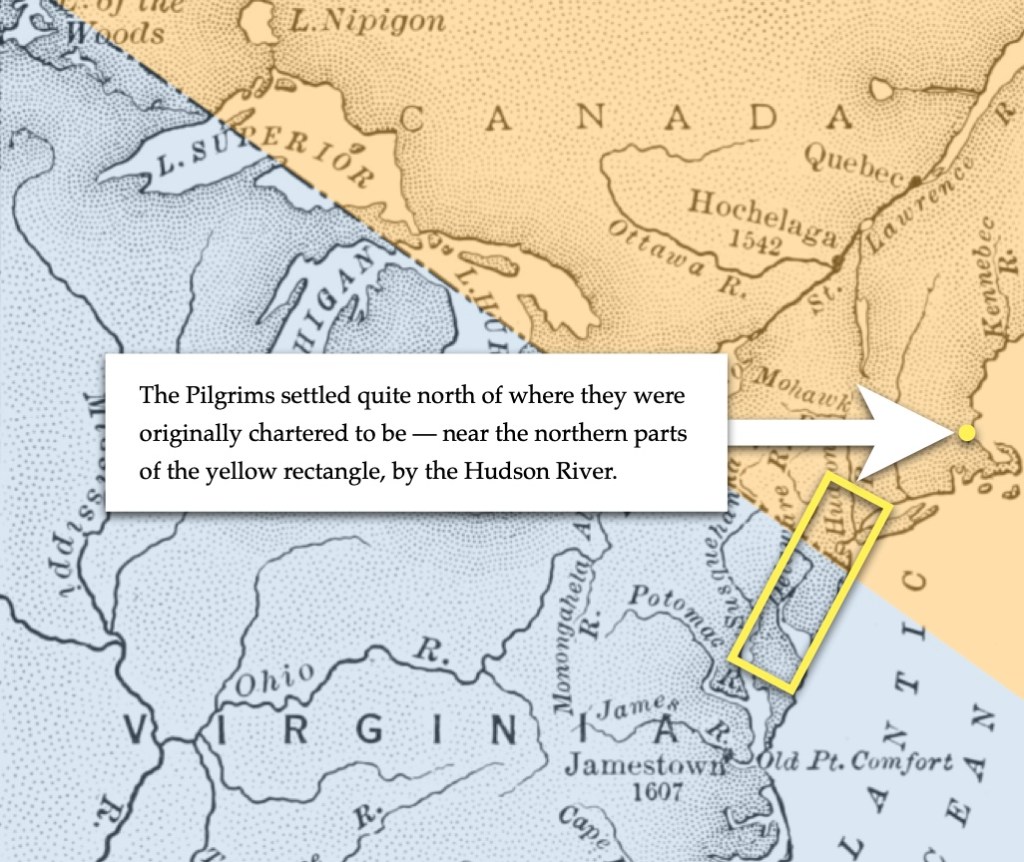
“In 1620, Virginia extended far beyond its current boundaries and the Mayflower was originally meant to land at its ‘northern parts,’ specifically the Hudson River. When the Mayflower attempted to sail around Cape Cod to reach the Hudson, contrary winds and dangerous shoals forced the ship to turn around and instead anchor in modern day Provincetown Harbor.” (The Mayflower Society)
Was something fishy going on?
“The textbooks say the Pilgrims intended to go to Virginia, where there existed a British settlement already. But “the little party on the Mayflower”, explains American History, “never reached Virginia. On November 9, they sighted land on Cape Cod.” How did the Pilgrims wind up in Massachusetts when they set out for Virginia? “Violent storms blew their ship off course,” according to some textbooks; others blame an “error in navigation.” Both explanations may be wrong. Some historians believe the Dutch bribed the captain of the Mayflower to sail north so the Pilgrims would not settle near New Amsterdam. Others hold that the Pilgrims went to Cape Cod on purpose.
Bear in mind that the Pilgrims numbered only about 35 of the 102 settlers aboard the Mayflower; the rest were ordinary folk seeking their fortunes in the new Virginia colony. Author George Willison [of Saints and Strangers book fame] has argued that the Pilgrim leaders, wanting to be far from Anglican control, never planned to settle in Virginia. According to Willison, they intended a hijacking.” (LMTTM)
We have some observations about “something fishy” going on —
Observation 1: Despite what history textbooks say about bad weather hampering their voyage, the Pilgrims still spent about six weeks exploring the coastline along what eventually became the Massachusetts Colony. Even back then, that is a long time to sail up and down the coast line. Suspicious? Perhaps, but the evidence is soft.
Observation 2: Virginia was quite a vast area at that time. Perhaps some writers get confused about what was actually designated as Virginia. The northern area where the Pilgrims settled, was still technically Virginia territory; it was just the very, very outer reaches of Virginia in 1620. Boundaries then were still in flux in North America. As such, this caused many disputes among both nations and their colonizers.
The Pilgrims Patent was in question because of this, and it was a fundamental reason why the Mayflower Compact was crafted. The definition of what was constituted as Virginia and as English territory, settled out in the decades after the Pilgrims landed, and was fully resolved as England gained more control of the area.
Observation 3: Despite their charter, they actually settled quite north of the Hudson River. The Dutch were slowly building strong militarized influence near the Hudson River. Since the Pilgrims had just left Leyden, they wanted to steer completely clear of anything Dutch, their culture, their language, their influences, etc.
Observation 4: Jamestown was further south, in the area that was shared by another charter, so why not go there? At this time, Jamestown was still a tough, difficult colony. If the Pilgrims thought Leyden was wrong for their families, then tales of the many struggles in Jamestown (cannibalism!), probably made going there out of the question. And, it was also a place named after someone who for years had worked actively against their safety and beliefs. So that was not a real possibility either.
What choices did they actually have? Perhaps they intended a hijacking, but it is also plausible that they just couldn’t sail south. (3)
The Mayflower — A Merchant Ship
“The Mayflower was [newly] built shortly before its purchase in 1608. Experts estimate that the length of the deck was between 80 and 90 feet and that the ship was 24 feet at its widest ” (Family Search)
“The Mayflower is first recorded in 1609, at which time it was a merchant ship travelling to Baltic ports, most notably Norway. It was at that time owned by Christopher Nichols, Richard Child, Thomas Short, and Christopher Jones II. The ship was about 180 tons, and rested in Harwich. In its early years it was employed in the transportation of tar, lumber, and fish; and possibly did some Greenland whaling. Later on in its life, it became employed in Mediterranean wine and spice trading.
In 1620, Thomas Weston assisted by John Carver and Robert Cushman, hired the Mayflower and the Speedwell to undertake the voyage to plant a colony in Northern Virginia. Christopher Jones was the captain of the Mayflower when it took the Pilgrims to New England in 1620.” (Rootsweb)

by Montague Dawson. (Image courtesy of Bonhams).
“The Mayflower set sail for home on April 5, 1621, arriving back May 6, 1621. The ship made a few more trading runs, to Spain, Ireland, and lastly to France. However, Captain Christopher Jones died shortly thereafter, and was buried March 5, 1621 or 1622, in Rotherhithe, Surrey, England. The ship lay dormant for about two years, at which point it was appraised for probate.
This probate inventory is the last record of the Mayflower. The ship was not in very good condition, being called “in ruinis” in a 1624 High Court of Admiralty record (HCA 3/30, folio 227) written in Latin. Ships in that condition were more valuable as wood (which was in shortage in England at the time), so the Mayflower was most likely broken apart and sold as scrap.” (Rootsweb)
“After 1624, the Mayflower disappeared from maritime records. Several places in England claim to have a piece of the original ship, but there is no historical proof to support these claims.” (Orange County Register – OCR) (4)

Saints, and Strangers, and Pilgrims, and Debts…
At the time, the definition “of who was a Pilgrim was much narrower than it is today. On board the 1620 voyage of the Mayflower to the New World were 102 passengers and 30 crew.” Not Everyone on the Mayflower was a Pilgrim.
The Saints
Of the passengers, 40 or so comprised a band of English seekers of religious independence [religious Separatists, also sometimes called Brownists], These religious people – whose journey to the New World began in Leiden, Holland – referred to themselves as Saints, and to the others – who boarded in Southampton, England — as Strangers.
The Strangers
These passengers are identified as people who were sympathetic to the cause of the Saints, but not necessarily people who shared their exact, specific viewpoint on faith. Some of them were Adventurers, who had contracted with the merchant Thomas Weston (1584-1647), for a ship to take them to the New World. Weston had enlisted some of the Strangers to assist the Separatists in establishing a colony and turning a profit for the investors who financed the expedition.
The Pilgrims
Later in time, William Bradford [the Colony Governor, who once referred to] the so-called Saints as Pilgrims, from an Old Testament reference, and the name eventually stuck. During the bicentennial celebration in 1820 of the founding of Plymouth, the term Pilgrim was broadened to include all of the Mayflower passengers. “The English term ‘pilgrim’ originally comes from the Latin word peregrinus (per, through + ager, field, country, land), which means a foreigner, a stranger, someone on a journey, or a temporary resident”. (University of York)
from July 31, 1627. (Image courtesy of Bridgeman Images).
The Indentured Servants
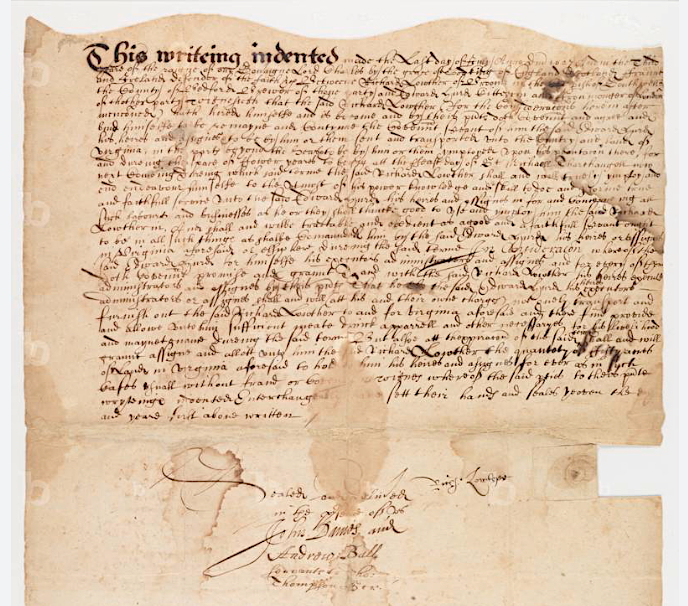
“Indentured servitude is a form of labor in which a person is contracted to work without salary for a specific number of years. Between one-half and two-thirds of European immigrants to the American Colonies between the 1630s and the American Revolution came under indentures. The contract [is called an] ‘indenture’, [and] may be entered voluntarily for a prepaid lump sum, as payment for some good or service (e.g. travel), purported eventual compensation, or debt repayment.
Historically, in an apprenticeship, an apprentice worked with no pay for a master tradesman to learn a trade. This was often for a fixed length of time, usually seven years or less. Apprenticeship was not the same as indentureship”.
The Pilgrims started out deeply in debt —
“Seeking the right to worship as they wished, the Pilgrims had signed a contract with the Virginia Company to settle on land near the Hudson River, which was then part of northern Virginia.” (History.com / Mayflower Compact))
“To pay for the journey to America, the Pilgrims took a loan for 1,700 pounds. This was an astronomical sum of money, considering the average day’s wage back then was 10 pence. To repay the loan, the Pilgrims signed a legal contract called an indenture, which obligated them to work for seven years, six days a week, harvesting furs and cod. However, more than half the Pilgrims died from the bitter cold the first winter.” (OCR)
The Pilgrims were finally able to erase their debt to the Merchant Adventurers by 1648. (NY NJ PA Weather – NYNJPA) (5)
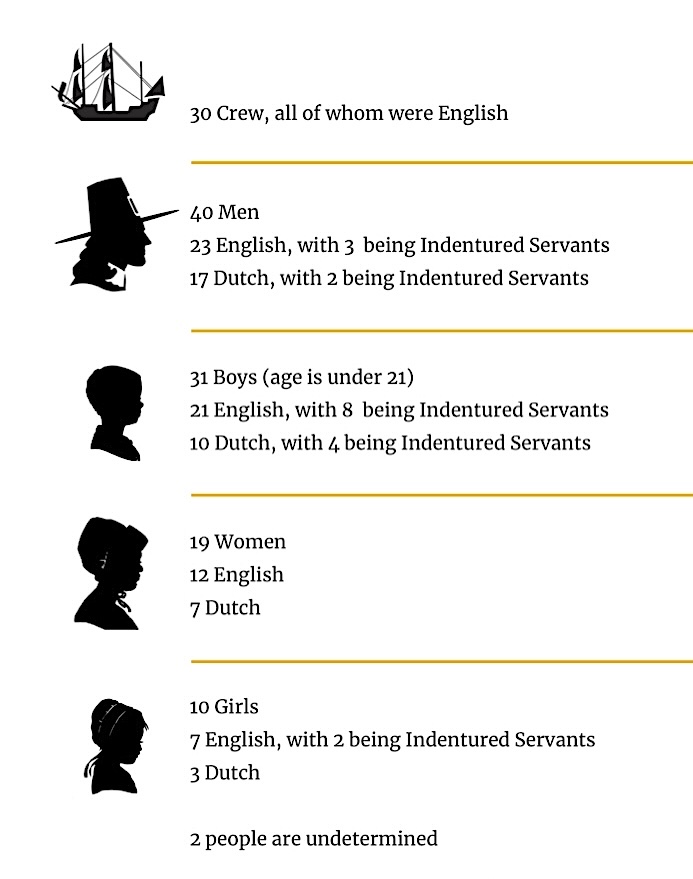
However, before we sail, here are some statistics about those who were on board. Of the 132 people on board —
The Julian Calendar Versus The Gregorian Calendar
An important understanding about calendars —
We have come across this important bit of information which we would like to share — When original sources are cited by some writers, it’s important to verify if they are citing dates that make sense with the calendar that is in use today. At the historical time of this journey, two calendars were in use. (Many writers do not realize this error).
“Simply put, the Mayflower passengers used a different calendar than we do now. According to their old-style
Tamura Jones, for
Julian calendar,
the Mayflower departed England on September 6, 1620.
However, the actual anniversary of their departure,
according to the Gregorian calendar we use today,
was September 16, 1620.”
Vita Brevis, Mayflower Myths 2020
“When the Pilgrims lived in Leiden, [known as the Low Countries] the Dutch were using the Gregorian calendar, while the English were still using the Julian calendar.” The difference is about ten days.
“The Julian calendar is named after Julius Caesar, who introduced it as a reform of the Roman calendar. The Gregorian calendar is named after Pope Gregorius XIII, who introduced it as a reform of the Julian calendar. Henry VIII had thumbed his nose at the Pope by creating the Anglican Church, with the English head of state as the head of the Anglican Church. The English monarch was not going to jump at some papal decision. Great Britain and the many English colonies kept using the Julian calendar till 1751.” (Vita Brevis)
Note: In the following section, we have corrected the calendar dates to correspond to the Gregorian calendar we use today. (6)

The Speedwell and The Mayflower
“The Pilgrim’s arduous journey to the New World technically began on August 1, 1620, when a large group of colonists boarded a ship called the Speedwell in the Dutch port city of Delfshaven. From there, they sailed to Southampton, UK, where they met the rest of the passengers as well as a second ship, the Mayflower. The two ships disembarked from Southampton on August 15 with hopes of speedy crossing to northern Virginia.”

By Leslie Wilcox, circa 1971.
Between August 22 and September 14. through the ports at both Dartmouth and Plymouth, “The Mayflower and Speedwell [had] twice set sail from England and returned because the Speedwell leaked. After the second return, the Speedwell was deemed unseaworthy, although no specific leak was found*. A significant reorganization of the voyage followed. The frustrated and exhausted Pilgrims docked at Plymouth and made the difficult decision to ditch the Speedwell. Some of the Pilgrims also called it quits in Plymouth, but the rest of the passengers and cargo from the Speedwell were transferred to the already overcrowded Mayflower.
*Later it was found to be deliberately sabotaged by the crew who didn’t want to make the long voyage across the ocean on that ship. (NYNJPA)
On September 16, 1620, 102 passengers and 30 crew members crowded on board the Mayflower and set sail again, a month behind schedule. (Some of the passengers had already been living on the ship for one month by this time). They were leaving behind some of the passengers and vital supplies and would be crossing the Atlantic Ocean at the height of the storm season.

The Mayflower was a modest merchant ship built to carry crew and cargo. It had no passenger cabins, beds, dining rooms, or toilets. It also had very little ventilation. The passengers stayed on the gun deck, which measured about five feet tall (152.4 centimeters), preventing anyone taller than that from standing upright. At that time, all ships were cargo ships; the concept of passenger ships would not emerge for another two hundred years.

On November 21, the ship sighted American land, and the passengers rejoiced. However, as they approached the upper end of Cape Cod, they realized they were north of the area where King James had authorized them to settle. (This is the day when they signed The Mayflower Compact). After deliberating with the shipmaster, the Mayflower changed direction to sail south along the coast to its intended destination.
Within a day, joy turned to terror as treacherous shallow waters and crashing waves threatened to splinter the ship. They could not continue south. Harsh winter weather was upon them, food and drink supplies were nearly gone, and passengers and crew were ill and dying. Having no choice, they reversed their course and sailed back to Cape Cod to look for a place to settle.
The Mayflower anchored at Provincetown. The long voyage was eventful. A baby was born, [They named him Oceanus Hopkins], a young passenger died [William Butten], a main mast cracked and fell during a storm, casting doubt on the ship’s fate until its repair; and a male passenger [John Howland]* fell overboard, requiring a dramatic rescue. In addition, the seas were often stormy, and the relentlessly cold and wet passengers suffered from seasickness, scurvy, dehydration, and hunger.
*Comment: “Howland not only made it to America and worked off his indenture, but married a pretty young woman in the new colony named Elizabeth Tilley. They produced ten children, who begat 88 grandchildren, from whom an estimated two million Americans descended over the next four centuries. These included Ralph Waldo Emerson, Joseph Smith, Franklin Delano Roosevelt, Humphrey Bogart, Chevy Chase, and both Presidents Bush.” (National Endowment For The Humanities – NEFTH) (7)
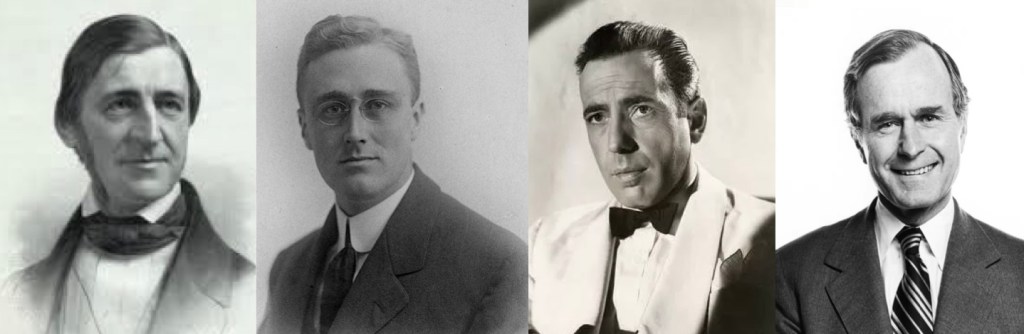
John and Elizabeth (Tilley) Howland should be proud of these four grandchildren,
if not many more of their two million (and counting) descendants.
From left to right: Ralph Waldo Emerson, poet and essayist; Franklin Delano Roosevelt,
32nd President of the United States; Humphrey Bogart, Hollywood legend;
and George H.W. Bush, 41st President of the United States.
What Was The Mayflower Compact?
When Pilgrims and other settlers set out on the ship for America in 1620, they intended to lay anchor in northern Virginia. But after treacherous shoals and storms drove their ship off course, the settlers landed in Massachusetts instead, near Cape Cod, outside of Virginia’s jurisdiction.
“English colonies at the time required “patents” – documents granted by the King or authorized companies which gave permission to settle at a particular place. Since the Mayflower passengers had obtained a patent for Virginia, when they instead landed in New England this patent was no longer valid.” (The Mayflower Society)
Comment: See Observation 2 (from above) under the section, But What Destination Exactly Were The Pilgrims Supposed To Sail To?

Tensions arose on board the ship, and discord began before the colonists even left the ship. The strangers argued the Virginia Company contract was void. They felt since the Mayflower had landed outside of Virginia Company territory, they were no longer bound to the company’s charter. The defiant strangers refused to recognize any rules since there was no official government over them. Pilgrim leader William Bradford later wrote, ‘several strangers made discontented and mutinous speeches.’ (BBC)
[The strategy of the Pilgrim leaders was to] to quell the rebellion before it took hold. After all, establishing a New World colony would be difficult enough without dissent in the ranks. The Pilgrims knew they needed as many productive, law-abiding souls as possible to make the colony successful. With that in mind, they set out to create a temporary set of laws for ruling themselves as per the majority agreement.
On November 11, 1620 [November 21 on our Gregorian Calendar], 41 adult male colonists signed the Mayflower Compact, although it wasn’t called that at the time.
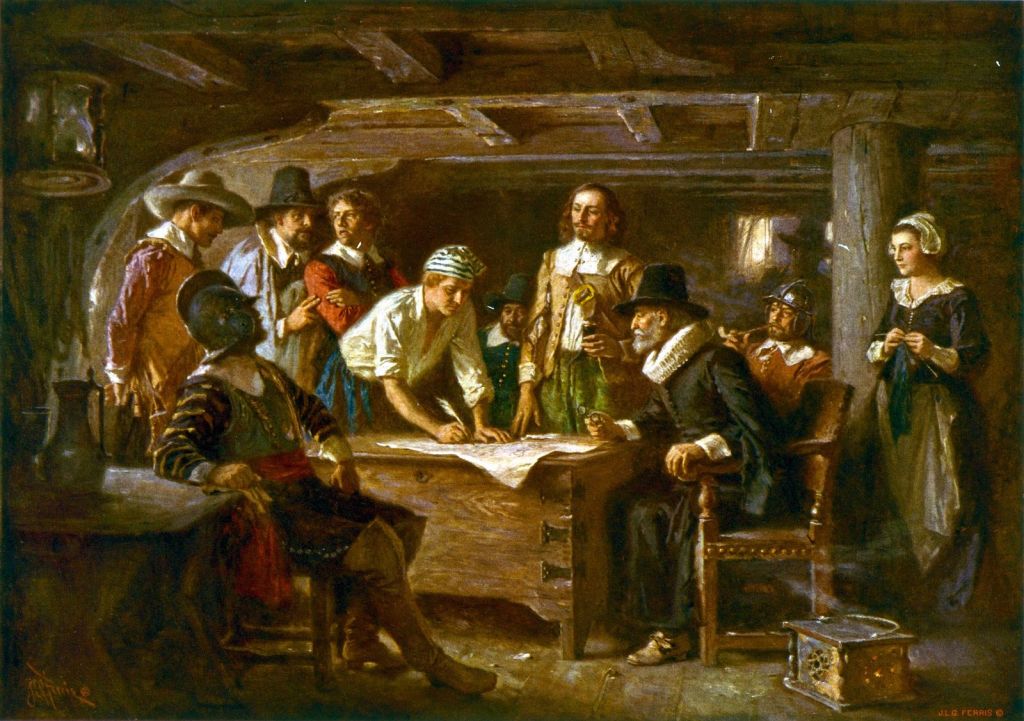
(Image courtesy of Wikimedia Commons).
The Mayflower Compact created laws for Mayflower Pilgrims and non-Pilgrims alike for the good of their new colony. It was a short document which established that:
- The colonists would live in accordance with the Christian faith.
- The colonists would remain loyal subjects to King James, despite their need for self-governance.
- The colonists would create and enact “laws, ordinances, acts, constitutions and offices…” for the good of the colony, and abide by those laws.
- The colonists would create one society and work together to further it.”
(History.com)
“The influence of the Mayflower Compact has far outlasted and outgrown the Pilgrims’ original intent. Legally, it was superseded when the Pilgrims obtained a patent from the Council of New England for their settlement at Plimoth in 1621. However, the Compact had already gained symbolic importance in the Pilgrims’ lifetimes, as it was considered important enough to be read at government meetings in Plimoth Colony for many years.” (The Mayflower Society)
The text of the Mayflower Compact was published as early as 1622, (see Mourt’s Relation below). However, the names of the signatories of that document were not published for many years due to fears of political retaliation against them. Both of our ancestors, Pilgrim George Soule and Pilgrim Edward Doty, were signers. (8)

Mourt’s Relation
“The earliest text detailing the settlement of New Plymouth is known as Mourt’s Relation or ‘A Relation or Journal of the Beginning and Proceedings of the English Plantation Settled at Plimoth in New England’ (1622). The manuscript was carried out of New Plymouth by Robert Cushman, Chief Agent in London for the settlers, on board the Fortune in 1621. When Mourt’s Relation was sold in John Bellamy’s London bookshop in the 1620s, its readers could have scarcely imagined this would become one of the most well-known texts in American history.
Perhaps the most significant feature of Mourt’s Relation is its inclusion of ‘The Mayflower Compact’: the first governing document of Plymouth Colony. Signed on November 21, 1620 (prior to landing), the text gave a legal framework of government to the eventual settlement.” (Voyaging Through History, the Mayflower and Britain – VTHMB) (9)
Being thus arrived in a good harbor…
There is only one primary source account existing which describes the events while the Mayflower was at sea. It was written by Plymouth Colony Governor William Bradford in his History of Plymouth Plantation. It concludes with this dramatic passage:
Being thus arrived in a good harbor and brought safe to land, they fell upon their knees and blessed the God of heaven, who had brought them over the vast and furious ocean, and delivered them from all the perils and miseries thereof, again to set their feet on the firm and stable earth, their proper element. And no marvel if they were thus joyful, seeing wise Seneca was so affected with sailing a few miles on the coast of his own Italy; as he affirmed, that he had rather remain twenty years on his way by land, then pass by sea to any place in a short time; so tedious and dreadful was the same unto him. (10)
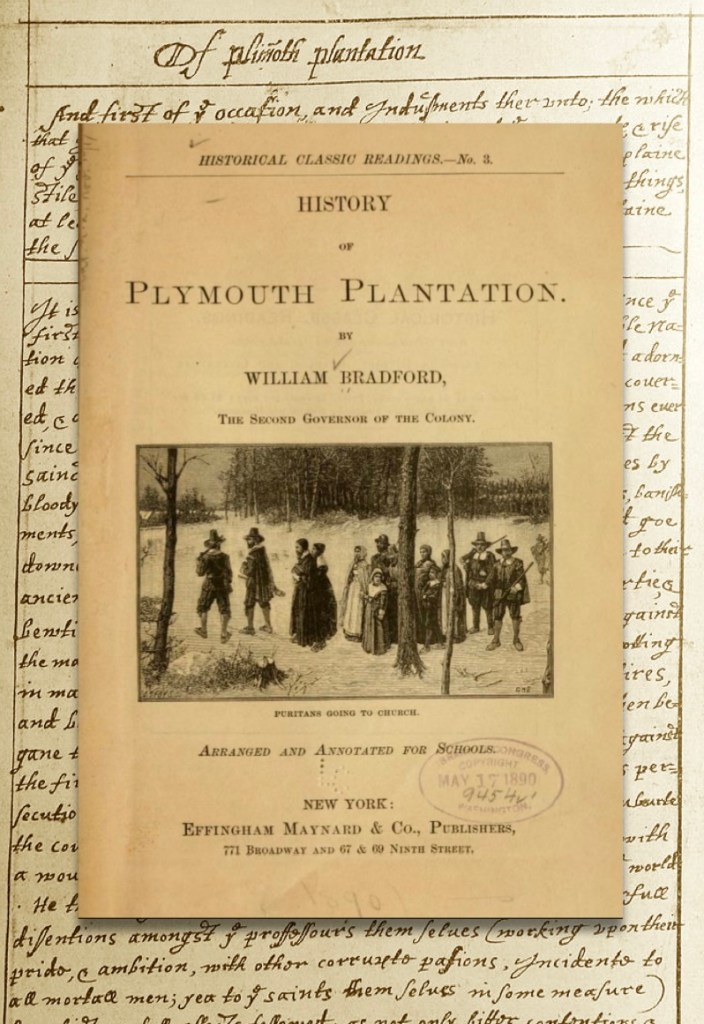
(this edition), circa 1890. Background image: The first page of his original document,
Of Plimoth Plantation. (See footnotes).
What Was It Like to Live on the Mayflower Gun Deck?
Writer Jeff Goertzen describes it pretty gruesomely — “You’re crammed in a room, shoulder to shoulder with 100 other passengers. [The distance from the floor to the ceiling was only five feet (152.4 centimeters) — so anyone taller than that, was constantly bent over].*
It’s dark. It smells. It’s wet and very cold. There’s no privacy. No bathrooms. Your meals are pitiful — salted meat and a hard, dry biscuit. [hardtack biscuits] You, and people around you are sick, because the room is rocking side to side. There’s no fresh water and no change of clean clothes. In essence, you‘re trapped because land is thousands of miles away. These conditions seem inhumane, but this was the Mayflower, the Pilgrims’ only means of transportation to a better life in the New Land.
*Observation: (Looking at you artist Jean Leon Gerome Ferris, circa 1899). Many artists like you have painted scenes inside of the Mayflower (gun deck) showing fabulous amounts of head space, lots of light, healthy, noble looking voyagers, etc. We surmise that this made the paintings more palatable to your patrons, rather than realistic looking scenes of seasick people slightly hunched over in the dark?
Of the passengers, most of the men had been farmers and were used to working long, hard hours. But on the ship, they spent most of their time reading or playing board games. The men also met to talk about the journey and plans for their new home. The women: On the ship, women cared for the children, prepared the meals, and sewed clothes. Women were expected to obey their husbands, so they never questioned their decision to go to the New World. Of the children, there were 41 minors on board the Mayflower. Only ten were girls. The older girls helped care for the younger children and there was no place for them to play.” (OCR)
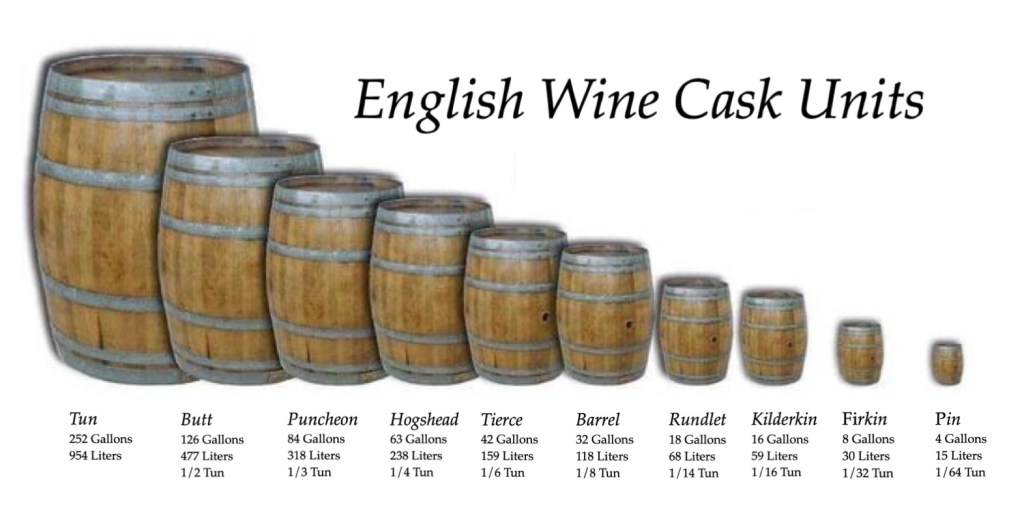
From Quora: “The Puritans [actually the Pilgrims] brought more beer than water on the Mayflower. They carried 42 tons [tun or tonne] of beer (in contrast to only 14 tons of water) and 10,000 gallons of wine. The beverage of choice for many extended voyages was beer. The casks of fresh water tended to go “off” during long storage. Even on land, water was questionable as a potable drink — sometimes even dangerous. Young children were often given beer to drink as their daily beverage. The brews weren’t necessarily crafted with an eye toward imbibing alcohol; they were actually carried to avoid the water on board the ship.”
Observation: So understandably, beer was the beverage of choice. Thus, as in other earlier historical periods — before there was reliable, clean, fresh water available for people to drink — everyone drank fermented beverages. The microorganisms of the beer-making process rendered the beverage safe, and even the children drank beer. However, we have pondered just how much they could have drunk on a voyage like this — not too much we gather, because the ship was always heaving too and fro.

The Mayflower was originally a merchant ship that transported goods across the English Channel. It’s “castle-like” structures fore and aft (front and back) of the ship were designed to protect the crew from the elements. This made it very difficult to sail against the North Atlantic westerly winds, which is why it took more than two months to complete the journey.
- Poop house: Despite this name, this was the living quarters for the Captain, and the higher ranking crew.
- Cabin: The general sleeping quarters for the Mayflower’s crew. The 20-30 crewmembers took shifts working the ship and sleeping in this small space.
- Steerage Room: Where the pilot steered the Mayflower with a special stick called a whip-staff, which moved the tiller, which then moved the rudder.
- Upper Deck: Where the seamen worked and attended to the ship.
- Forecastle: Where meals were cooked and the crew’s food supplies were kept.
- Capstan: A large apparatus used to lift and lower cargo.
- Gun Deck: Where the cannons were located — the ship carried 12 cannons to defend itself against pirates. Also, on merchant ships it was used to hold additional cargo, meaning this is where the ship’s passengers lived day in and day out. Note that there were no windows. All of the 102 passengers on the Mayflower’s journey to the new world lived in this cramped 58 foot x 24 foot space, [which equals 17.6 meters x 7.3 meters]. There was very little privacy and only the occasional opportunity to venture to the top deck to enjoy the sunshine and fresh air.
- Cargo Hold: This is where the Pilgrims stored their cargo, which consisted of biscuits, salt, dried beef, salted pork, oats, peas, beer, wheat, clothing, canvas sheets filled with straw bedding, pots and pans, utensils, and tools for building and farming. (OCR) (11)

The Pilgrims have finally made it to America, but it is late and Winter was arriving — but truthfully, it had already started! In the next chapter, we are going to write about their initial arrival and life at the Plimoth Plantation.
Following are the footnotes for the Primary Source Materials,
Notes, and Observations
Samuel de Champlain, Explorer and Cartographer
(1) — three records
Samuel de Champlain
https://en.wikipedia.org/wiki/Samuel_de_Champlain
Note: For the text.
Library of Congress
Les voyages dv sievr de Champlain Xaintongeois,
capitaine ordinaire pour le Roy, en la marine. Divisez en devx livres.
ou, Iovrnal tres-fidele des observations faites és descouuertures
de la Nouuelle France
by Samuel de Champlain, circa 1605
https://www.loc.gov/item/22006274/
Book page: 80, Digital page: 112/436
Note: For the book frontipiece and credits.
and
Plimoth Patuxet Museums
Port St. Louis (map)
https://plimoth.org/yath/unit-1/port-st-louis
Note: For the text and map.
Reliable Maps Were Difficult To Come By
(2) — three records
Smithsonian Magazine
John Smith Coined the Term New England on This 1616 Map
by Megan Gambino
https://www.smithsonianmag.com/history/john-smith-coined-the-term-new-england-on-this-1616-map-180953383/
Note: For the text and the map image.
(LMTTM)
Lies My Teacher Told Me
by James W. Loewen
https://www.google.pt/books/edition/Lies_My_Teacher_Told_Me/5m23RrMeLt4C?hl=en&gbpv=1&pg=PA1&printsec=frontcover
Book pages: 70-92
Note: For Chapter 3: “The Truth About The First Thanksgiving”
History Extra
(The official website for BBC History Magazine)
Your Guide to the Pilgrim Fathers, plus 6 interesting facts
https://www.historyextra.com/period/stuart/pilgrim-fathers-facts-history-mayflower-who-why-leave-religion-new-world/
Note: For the 19th century image of the Pilgrims leaving Delft.
But What Destination Exactly Were The Pilgrims Supposed To Sail To?
(3) — four records
The Mayflower Society
The Mayflower Compact
https://themayflowersociety.org/history/the-mayflower-compact/
Note: For the text.
(LMTTM)
Lies My Teacher Told Me
by James W. Loewen
https://www.google.pt/books/edition/Lies_My_Teacher_Told_Me/5m23RrMeLt4C?hl=en&gbpv=1&pg=PA1&printsec=frontcover
Book pages: 70-92
Note: For Chapter 3: “The Truth About The First Thanksgiving”
Plymouth Colony
https://en.wikipedia.org/wiki/Plymouth_Colony
Note: For the text.
Virginia Company
https://en.m.wikipedia.org/wiki/Virginia_Company
Note: For the text and map.
The Mayflower — A Merchant Ship
(4) — five records
Take a Virtual Tour of the Mayflower
by Jessica Grimaud
https://www.familysearch.org/en/blog/virtual-tour-mayflower-ship
Note: For some dimensions of the Mayflower in 1608.
Mayflower
by Rootsweb Author, kee46@msn.com
https://homepages.rootsweb.com/~ahopkins/cushman/mayflowe.htm
Note: For the text.
Mayflower II on Her Sailing Trials in the Waters
Off Brixham, South Devon, April 1957
by Montague Dawson, (British, 1890-1973)
https://www.bonhams.com/auction/23272/lot/54/montague-dawson-british-1890-1973-mayflower-ii-on-her-sailing-trials-in-the-waters-off-brixham-south-devon-april-1957-together-with-ramseys-book-montague-dawson-rsma-frsa-the-greatest-sea-painter-in-the-world/
Note: For the ship image.
Embarkation of the Pilgrims
by Robert Walter Wier, 1857
https://upload.wikimedia.org/wikipedia/commons/9/94/Robert_Walter_Weir_-_Embarkation_of_the_Pilgrims_-_Google_Art_Project.jpg
Note: For the painting image.
Orange County Register
How 102 Pilgrims Crammed Inside the Mayflower
a Year Before Their First Thanksgiving
by Jeff Goertzen
https://www.ocregister.com/2017/11/20/ahead-of-thanksgiving-day-2017-a-look-back-inside-the-mayflower/amp/
Note: For the text.
Saints, and Strangers, and Adventurers, and Debts…
(5) — six records
The University of York
Pilgrims and Pilgrimage
https://www.york.ac.uk/projects/pilgrimage/intro.html
Note: For text regarding the definition of Pilgrim.
Indentured servant agreement between Richard Lowther and Edward Lyurd, 31st July 1627 (ink on paper)
https://www.bridgemanimages.com/en/american-school/indentured-servant-agreement-between-richard-lowther-and-edward-lyurd-31st-july-1627-ink-on-paper/ink-on-paper/asset/443693
Note: Example document, subtitled as “From the Virginia Historical Society, An example of an Indentured servant agreement from July 31, 1627.”
Indentured Servitude
https://en.wikipedia.org/wiki/Indentured_servitude
Note: For the text.
History.com
Mayflower Compact
https://www.history.com/topics/colonial-america/mayflower-compact
Note: For the text.
Orange County Register
How 102 Pilgrims Crammed Inside the Mayflower
a Year Before Their First Thanksgiving
by Jeff Goertzen
https://www.ocregister.com/2017/11/20/ahead-of-thanksgiving-day-2017-a-look-back-inside-the-mayflower/amp/
Note: For the text.
(NYNJPA)
The Pilgrims Barely Survived Their First Winter At Plymouth
https://nynjpaweather.com/public/2023/11/17/the-pilgrims-barely-survived-their-first-winter-at-plymouth/
Note: For the text.
The Julian Calendar Versus The Gregorian Calendar
(6) — two records
Vita Brevis
Mayflower Myths 2020
by Tamura Jones
https://vitabrevis.americanancestors.org/2020/07/mayflower-myths-2020
Note 1: This reference gives a very precise timeline for the Pilgrims journey from Holland to North America.
Note 2: For information about the differences between the Julian calendar and the Gregorian calendar.
Family Search Blog
When Did the Mayflower Land in America? The Answer Might Surprise You!
by Jessica Grimaud
https://www.familysearch.org/en/blog/when-did-mayflower-land-depart
The Speedwell and The Mayflower
(7) — nine records
Massachusetts Society of Mayflower Descendants
The Mayflower and Speedwell in Dartmouth Harbor
by Leslie Wilcox, circa 1971
https://www.facebook.com/MassMayflowerDesc/photos/a.397753117000504/408962462546236/?type=3
Note: For this rare painting showing the two ships together.
Descriptions of the voyage are combined from these four sources:
(OCR)
Orange County Register
How 102 Pilgrims Crammed Inside the Mayflower
a Year Before Their First Thanksgiving
by Jeff Goertzen
https://www.ocregister.com/2017/11/20/ahead-of-thanksgiving-day-2017-a-look-back-inside-the-mayflower/amp/
Note: For some captions.
and
The Oklahoma Society of Mayflower Descendants
The Voyage
https://www.okmayflower.com/voyage
and
https://www.okmayflower.com/maps-1
Note 1: For the three maps, and the voyage information.
Note 2: We have corrected the dates from this online article to match the Gregorian calendar as per the Vita Brevis footnote above.
and
History.com
The Pilgrims’ Miserable Journey Aboard the Mayflower
by Dave Roos
https://www.history.com/news/mayflower-journey-pilgrims-america
Note: For the text.
and
(Rootsveb)
Mayflower
by Rootsweb Author, kee46@msn.com
https://homepages.rootsweb.com/~ahopkins/cushman/mayflowe.htm
Note: For the text.
AP News
Meet John Howland, A Lucky Pilgrim — and Maybe Your Ancestor
by Mark Pratt
https://apnews.com/general-news-0d370c58d0034038b6a16c3f57c22af4
Note: Show off!
(NYNJPA)
The Pilgrims Barely Survived Their First Winter At Plymouth
https://nynjpaweather.com/public/2023/11/17/the-pilgrims-barely-survived-their-first-winter-at-plymouth/
Note: For the text.
(NEFTH)
The National Endowment For The Humanities
Who Were the Pilgrims Who Celebrated the First Thanksgiving?
by Craig Lambert
https://www.neh.gov/humanities/2015/novemberdecember/feature/who-were-the-pilgrims-who-celebrated-the-first-thanksgiving
Note: For the text.
What Was The Mayflower Compact?
(8) — four records
BBC
What is the Mayflower and why is it celebrated 400 years later?
https://www.bbc.co.uk/newsround/54152197
Note: For the text.
The Mayflower Society
The Mayflower Compact
https://themayflowersociety.org/history/the-mayflower-compact/
Note: For the text.
File:The Mayflower at sea.jpg
by John Clark Ridpath
https://commons.wikimedia.org/wiki/File:The_Mayflower_at_sea.jpg
Note: From the 1893 textbook, United States; a history: the most complete and most popular history of the United States of America from the aboriginal times to the present day…
File:The Mayflower Compact 1620 cph.3g07155.jpg
Signing The Mayflower Compact 1620
by Jean Leon Gerome Ferris, circa 1899
https://commons.wikimedia.org/wiki/File:The_Mayflower_Compact_1620_cph.3g07155.jpg
Note: For the painting image.
Mourt’s Relation
(9) — two records
(VTHMB)
Voyaging Through History, the Mayflower and Britain
Mourt’s Relation (1622)
https://voyagingthroughhistory.exeter.ac.uk/2020/08/25/mourts-relation-1622/
Caleb Johnson’s Mayflower History.com
The Mayflower Compact
http://mayflowerhistory.com/mayflower-compact
Note: We have included an exact, line-by-line transcription with the original spelling and punctuation. (The words of the text have not been modernized ).
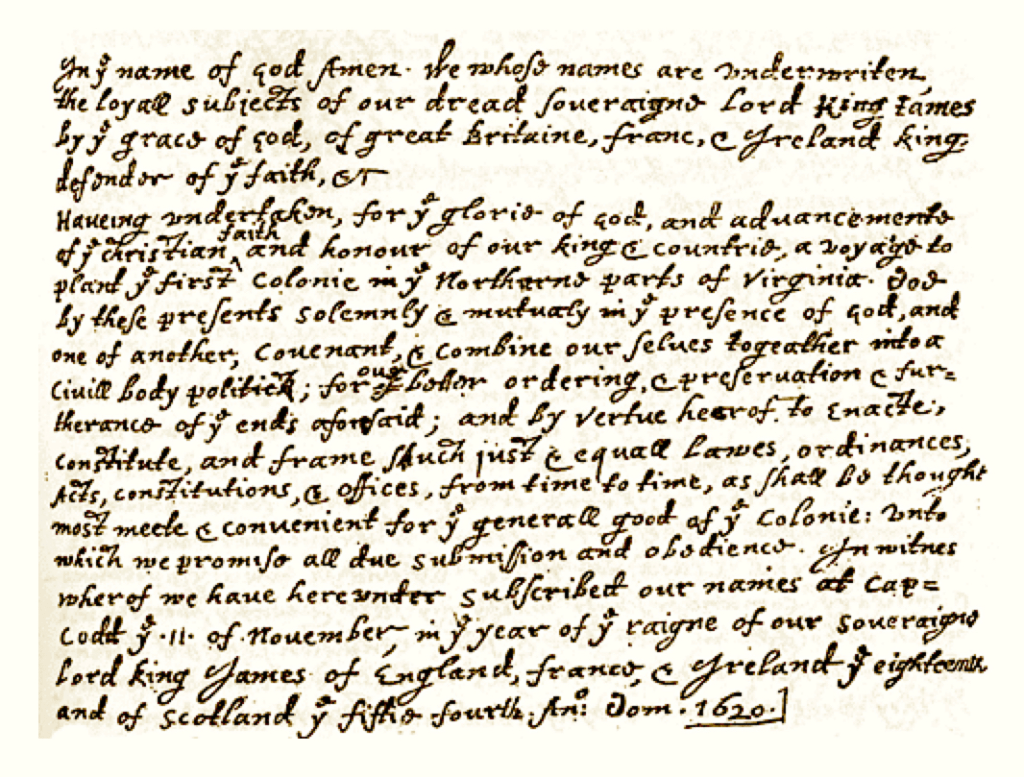
In ye name of God Amen· We whose names are vnderwriten,
the loyall subjects of our dread soueraigne Lord King James
by ye grace of God, of great Britaine, franc, & Ireland king,
defender of ye faith, &c
Haueing vndertaken, for ye glorie of God, and aduancemente
of ye christian ^faith and honour of our king & countrie, a voyage to
plant ye first colonie in ye Northerne parts of Virginia· doe
by these presents solemnly & mutualy in ye presence of God, and
one of another, couenant, & combine our selues togeather into a
ciuill body politick; for ye our better ordering, & preseruation & fur=
therance of ye ends aforesaid; and by vertue hearof, to enacte,
constitute, and frame shuch just & equall lawes, ordinances,
Acts, constitutions, & offices, from time to time, as shall be thought
most meete & conuenient for ye generall good of ye colonie: vnto
which we promise all due submission and obedience. In witnes
wherof we haue herevnder subscribed our names at Cap=
Codd ye ·11· of Nouember, in ye year of ye raigne of our soueraigne
Lord king James of England, france, & Ireland ye eighteenth
and of Scotland ye fiftie fourth. Ano: Dom ·1620·|
Being thus arrived in a good harbor…
(10) — three records
Mayflower
by Rootsweb Author, kee46@msn.com
https://homepages.rootsweb.com/~ahopkins/cushman/mayflowe.htm
Note: For the text.
Library of Congress
History of Plymouth Plantation, circa 1890
by William Bradford, 1590-1657
https://www.loc.gov/resource/gdcmassbookdig.historyofplymout00bra/?st=gallery&c=16
Note: For the cover image.
and
First page of “Of Plimoth Plantation” from a circa 1900 publication.
by William Brewster
File:Of Plimoth Plantation First 1900.jpg
https://commons.wikimedia.org/wiki/File:Of_Plimoth_Plantation_First_1900.jpg
Note: For the background image.
What Was It Like to Live on the Mayflower Gun Deck?
(11) — four records
Take a Virtual Tour of the Mayflower
by Jessica Grimaud
https://www.familysearch.org/en/blog/virtual-tour-mayflower-ship
Note: For some captions describing various rooms on the 1620 Mayflower.
(OCR)
The Orange County Register
How 102 Pilgrims Crammed Inside the Mayflower
a Year Before Their First Thanksgiving
by Jeff Goertzen
https://www.ocregister.com/2017/11/20/ahead-of-thanksgiving-day-2017-a-look-back-inside-the-mayflower/amp/
Note: For the ship cut away image, and some captions.
Quora
Did settlers really land at Plymouth Rock because they were out of beer?
by James M. Volo
(MA in Military History and Wars , American Military University)
https://www.quora.com/Did-settlers-really-land-at-Plymouth-Rock-because-they-were-out-of-beer
Note: For the text and the image of the barrels chart.
Mayflower ship
https://www.britannica.com/topic/Mayflower-ship
Note: For the Mayflower II ship image.
 Our Ancestors, Our Narratives