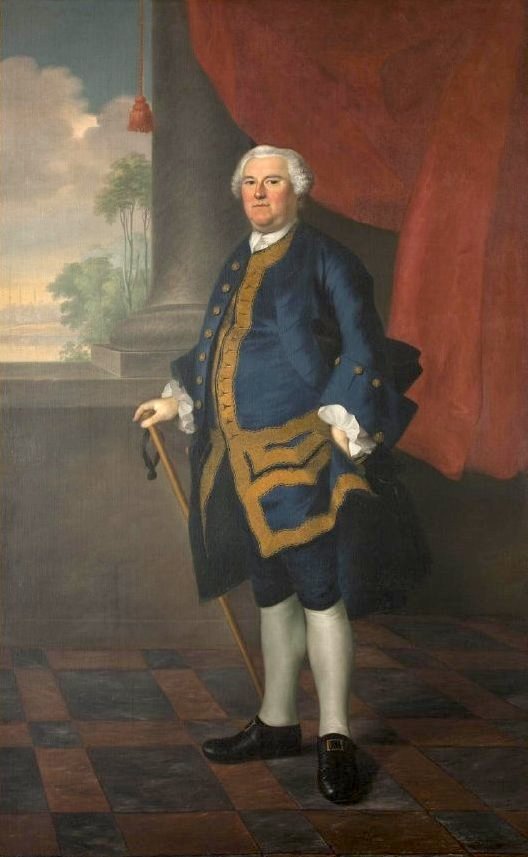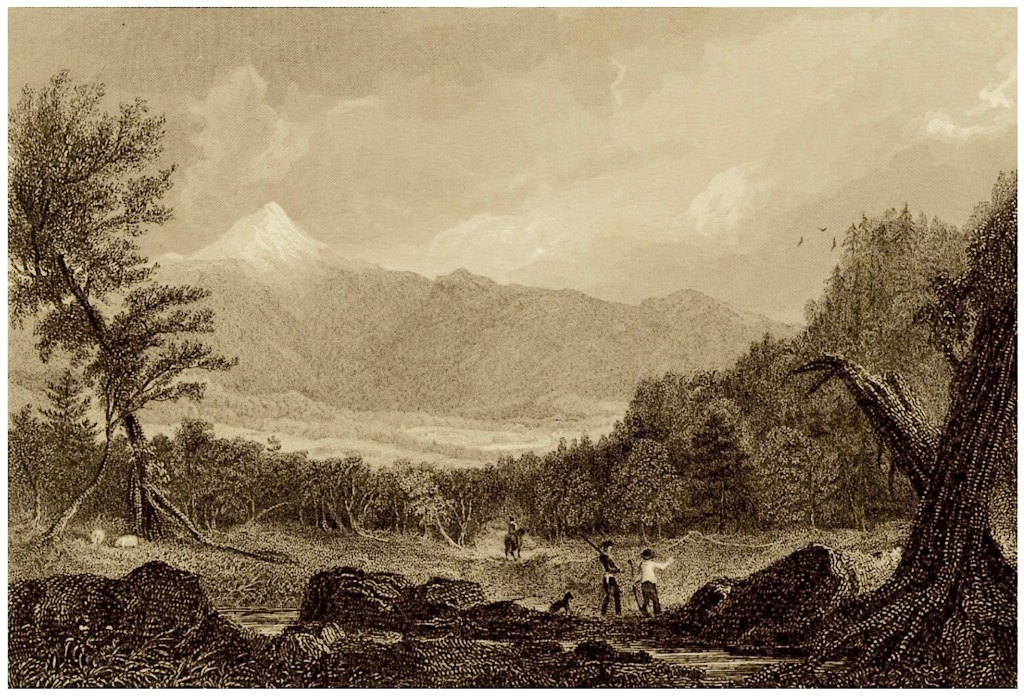
The McClintock Line, A Narrative — Six

This is Chapter Six of seven. In this chapter, our ancestors who have been in New Hampshire since it was a Province and part of British North America, made the major decision to move Westward. They packed their belongings and left New Hampshire and headed to New York State.
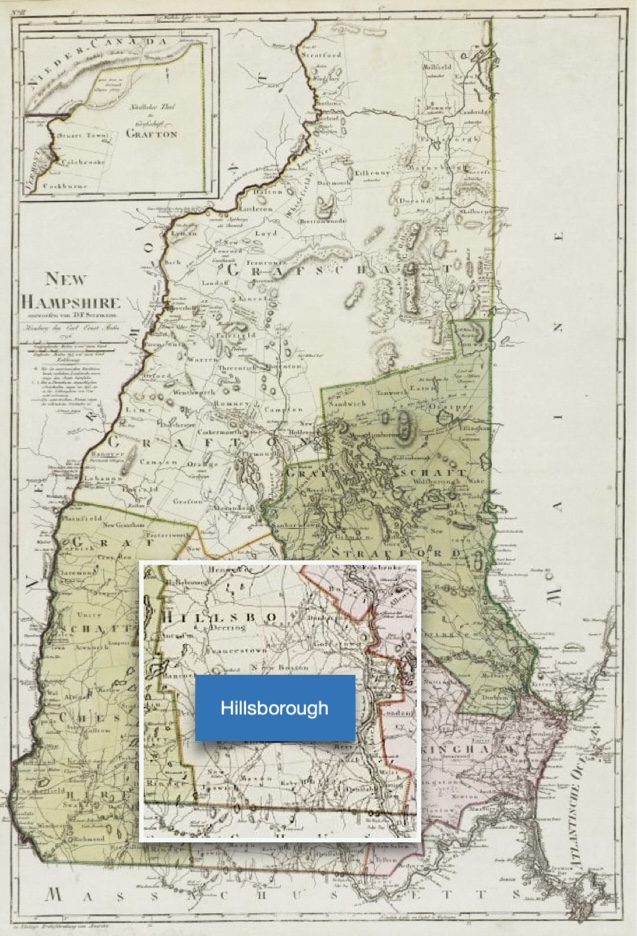
The Sotzmann-Ebeling Map of New Hampshire, Circa 1796. (Image courtesy of Boston Rare Maps).

Be Fruitful and Multiply

James McClintock,(Sr.), born January 3, 1778, Hillsborough (town), New Hampshire Province — died September 1845, Bainbridge, Geauga, Ohio. He married Hephzibah Jones in circa 1803, in New Hampshire. She was born in 1784, in New Hampshire Province — died July 13, 1871, Laingsburg, Shiawassee, Michigan. They had nine children. The first five were born in Hillsborough (town), Hillsborough, New Hampshire.

  • Thirza (McClintock) Taylor, born about 1807, Hillsborough (town), Hillsborough, New Hampshire — died June 25, 1893, Cuyahoga, Ohio.
  • Mahala L. (McClintock) Short, born about 1808, Hillsborough (town), Hillsborough, New Hampshire — died June 29, 1827, Phelps, Ontario, New York
  • Dr. Freeman Brazilla McClintock, born October 28, 1811, Hillsborough (town), Hillsborough, New Hampshire — died March 18, 1882, Laingsburg, Michigan
  • Sarah (McClintock) Short, born about 1812, Hillsborough (town), Hillsborough, New Hampshire — died August 10, 1872, Solon, Cuyahoga, Ohio
  • Joshua John McClintock, born about July 29, 1814 — died July 23, 1892, Solon, Cuyahoga, Ohio
  • The last four were born in two locations in New York State:
  • James McClintock (Jr.), born about 1818, Phelps, Ontario, New York — died January 1, 1854, Bainbridge, Geauga, Ohio
  • Dexter McClintock, born August 15, 1819, Phelps, Ontario, New York — died April 12, 1899, Chagrin Falls, Cuyahoga, Ohio (We are descended from Dexter.)
  • William McClintock, born August 13, 1821, Lyons* (Arcadia), Ontario, New York — died July 6, 1893, West Union, Fayette, Iowa
    Note: *Wayne County, New York was created in 1823. The Town of Arcadia was formed from the Town of Lyons in 1825.
  • Louisa M. McClintock, born about 1827, Arcadia, Wayne, New York — died after 1870 location unknown (1)
A View of Manchester, N.H. — A lithographic print by J.B. Bachelder, 1855. (Image courtesy of the Library of Congress).

The Censuses of 1800 through 1830 and Their Differences

These censuses are the second, third, fourth, and fifth that the United States had completed. Each year the government was learning a little more about what data it needed to know in able to run the country, and also some new questions to ask. Unfortunately, when we analyze these forms today, we still see many tic marks, but not much detail.

For the 1800 census, James McClintock was unmarried. We do not know with whom he was living in 1800. We are sure in was in Hillsborough, New Hampshire.

The 1810 Census in New Hampshire
Then in 1810, we first encounter the James McClintock family when he and his wife Hephzibah (Jones) McClintock were married and had children living in their home. They were still residing in Hillsborough, New Hampshire where both of them had grown up.

1810 Census excerpt, Hillsborough, New York
Map Of The State Of New York, Published by A. Finley Philadelphia,1824. The yellow circle indicate the area within which they lived during the 1820s. (Image courtesy of the Internet Archive).

The 1820 Census In New York
By 1820, they have more children and have left New Hampshire behind them. They are now living in the town of Phelps, Ontario County, New York. The reasons that they left New Hampshire are unknown, but there was a large westward migration already occurring in this era. Perhaps they were seeking additional farmland because arable land meant prosperity to farmers. James’s brother Samuel either came with them, or he was already in New York State, which may be one reason why they moved there — there was a family connection.

1820 Census excerpt, Phelps, New York. Note James as entry #738, and his brother Samuel as entry #739.

The 1830 Census In New York
It appears that the family has moved locally from the town of Phelps in Ontario County, to the town of Arcadia, just slightly north in the new (April 1823) Wayne County. This is the first Federal census we see where there is an actual printed form for the census taker to utilize for consistency. Prior to this, many census takers just made up their own forms trying to adhere to guidelines they were given.

1830 Census excerpt, Arcadia, New York. We overlaid it on an 1830 period accurate template for category clarity.

We also know that by this time, James’s brother Samuel had left New York state and moved further west to the Ohio Country, where he was paying property taxes as early as 1831 in what is now Solon, Ohio. We already had members of other family lines living in this area, but we believe that it’s plausible that he was the first member of the McClintock branch of our family to arrive there. We also understand that he was quite the drinker… (2)

1831 Property tax record for Samuel McClintock in Solon, Cuyahoga, Ohio.

Let’s Pause A Moment for Some Refreshment, Shall We?

As we learned from the census, for a portion of the 1820s and at the beginning of the 1830s, the James McClintock Sr. family lived in New York State. We came across an interesting account of what it was like to live in Arcadia, New York during this period —

“Up to 1830 the state of temperance was bad enough. Within a distance of three miles along Mud creek there were four distilleries, operated by Harrison, Luce, Sherman, and Mansfield. Whisky was sold as low as twenty-five cents a gallon, and was drank on all occasions. Whether at general training, Fourth of July, logging-bee, raising, or harvesting, the liquor was freely used. It stood upon the sideboard to treat the casual visitor and teacher, doctor, and preacher were alike accustomed to potations from the cup. Ladies met to help along a quilting, and the “sling” imbibed made conversation spirited. If any failed to provide this stimulus it was made a subject of sharp comment. As years went by, a feeling prevailed that this system should be broken up. A preacher found intoxicated was dismissed, and in the county medical society a member accustomed to using liquors to excess was expelled. Still, tippling was common in taverns and in groceries.”
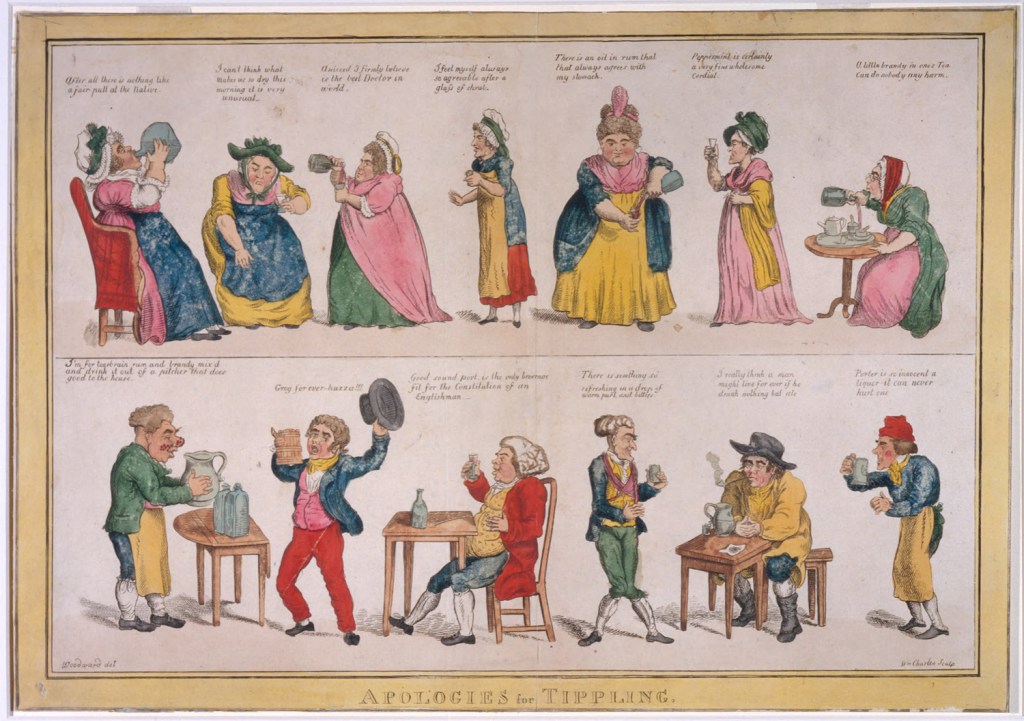
“Apologies for Tippling” by William Charles and George Moutard Woodward, circa 1800. This political cartoon shows some of the many reasons people found for “tippling” or drinking excessively. Courtesy of the Library Company of Philadelphia.

Some of our ancestors were Pilgrims, some were Quakers, some were Presbyterians, some were Catholics — and some were, …non-conformers.

“For the colonists of the 1600s and 1700s much of daily life was filled by tiring drudgery, but throughout the long hours of the work day, beer, cider, rum, and other intoxicating beverages provided a dependable source of comfort. Each day was supplemented by a generous allotment of alcoholic beverages imbibed from their waking hours all the way through the late evening. As author Corin Hirsch states in Forgotten Drinks of Colonial New England, “From breakfast cider to afternoon beer to evening flips, toddies and glasses of Canary wine, alcohol lubricated almost every hour of every day.” Drinking accompanied a diverse range of occasions that often took place in taverns, or during meals, work breaks, business meetings, weddings, funerals, trials, and legislative sessions. Daily, day-long “tippling” was simply a fact of life in the colonial period.

While this behavior may be frowned upon in the modern era, colonials viewed the constant intake of liquor as a necessary and beneficial practice. Despite a lack of scientific understanding, the early settlers of North America knew that drinking from certain water sources could make a person deathly ill. Without proper sanitation practices or a way of discerning contaminated water from clean, they largely avoided it, instead seeking hydration from beverages unintentionally sanitized through the processes of fermentation and distillation. Alcohol was not only potable, but also was seen as a healthy, invigorating substance, which was even used in the treatment of disease. While the relatively staid puritan communities of New England such as Windsor admonished drunkenness, they hailed alcohol as the “good creature of God”. (Windsor Historical Society)

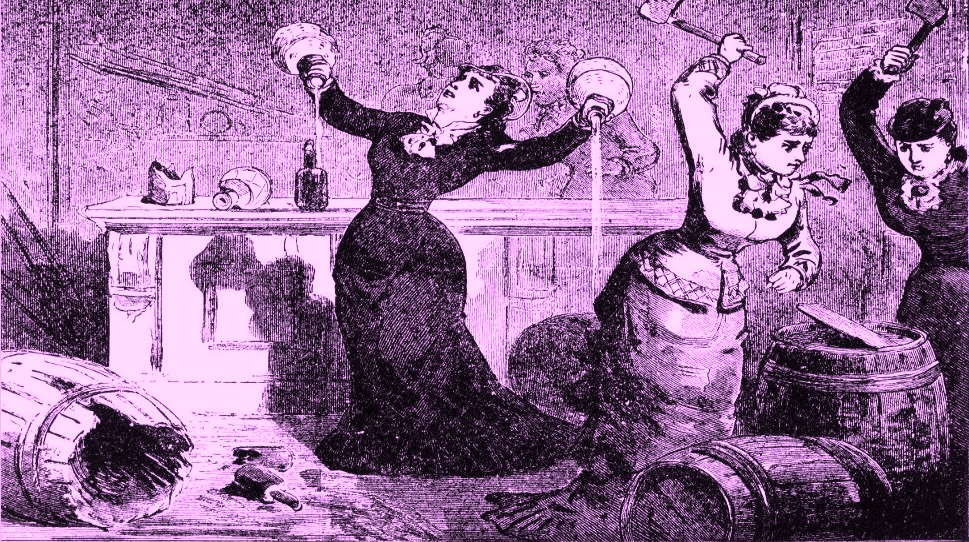
“A woman’s liquor raid – How the ladies of Fredericktown, Ohio, abolished the traffic of ardent spirits in their town.” Line engraving from the Police Gazette.

Observation: James McClintock Sr.’s 2x Great Grandfather Thomas Mclintoch of Glasgow had been a “Maltman” (a brewer), and his Grandfather William McClintock was fond of his homemade “rhum”…so, it seems like “tippling” probably ran through the veins of the McClintock family. Despite this, Freeman McClintock maintains in his biographical profile that his “parents instilled into the minds of their children principles of morality and religion.” Perhaps his uncle Samuel never got that family message.

It’s compelling to ponder ‘about how many’ of our ancestors were likely tipplers, and how over the decades, this behavior paved the way for future temperance movements. (3)

And Back to The Census…

The 1840 Census in Ohio
After decades of censuses in other locations, the McClintock family has immigrated in en masse to the Western Reserve of Ohio. We’ve been able to determine through tax records (starting in 1833) that along with James and his wife, most of their adult children also relocated to this area of northeast Ohio.

1840 Census excerpt, Bainbridge, Ohio.

The census above is for the father James McClintock, Sr. who was living in Bainbridge township at the time of the census. On another 1840 census his son James Jr. and other siblings lived in Solon township. (4)

Map of the Western Reserve Including the Fire Lands 1826. On this map, Geauga County is still combined with the future Lake County and Solon and Bainbridge townships are colored yellow. (Image courtesy of Wikimedia Commons).

The Western Reserve of Ohio

In the early part of the 18th century, the Ohio Country was frequently referred to as the West, and from the perspective of New Englanders who settled it, it was indeed pioneer country. By the 1830s and 40s, the Western Reserve wasn’t thought of as a frontier anymore, but actually, it still was in many ways.

The Western Reserve area of northeastern Ohio, was originally established as The Firelands of Ohio, created by the Connecticut legislature in 1792 to help compensate her citizens for their losses when some of the towns were ravaged during the Revolutionary War. Connecticut had a history of belief that her manifest destiny was the inherent right of their northern and southern borders to extend from New England all the way to the Pacific Coast. This area was chartered and land sales were managed by the Connecticut Land Grant Company. The company eventually failed, and Connecticut yielded on their idea of manifest destiny, but the Western Reserve endured. Ohio became a state in 1803.

For all of our many ancestors from here, we believe that this is very true — “Following the Revolutionary War, for the next 25 years, Ohio became the primary destination of westward bound pioneers because of the fertile farmland in the Ohio River Valley. Some families stayed for the remainder of their lives.” (Family Search) For the James McClintock Sr. family, when his children were seeking prosperity for their own future families, owning land in Ohio beckoned. (5)
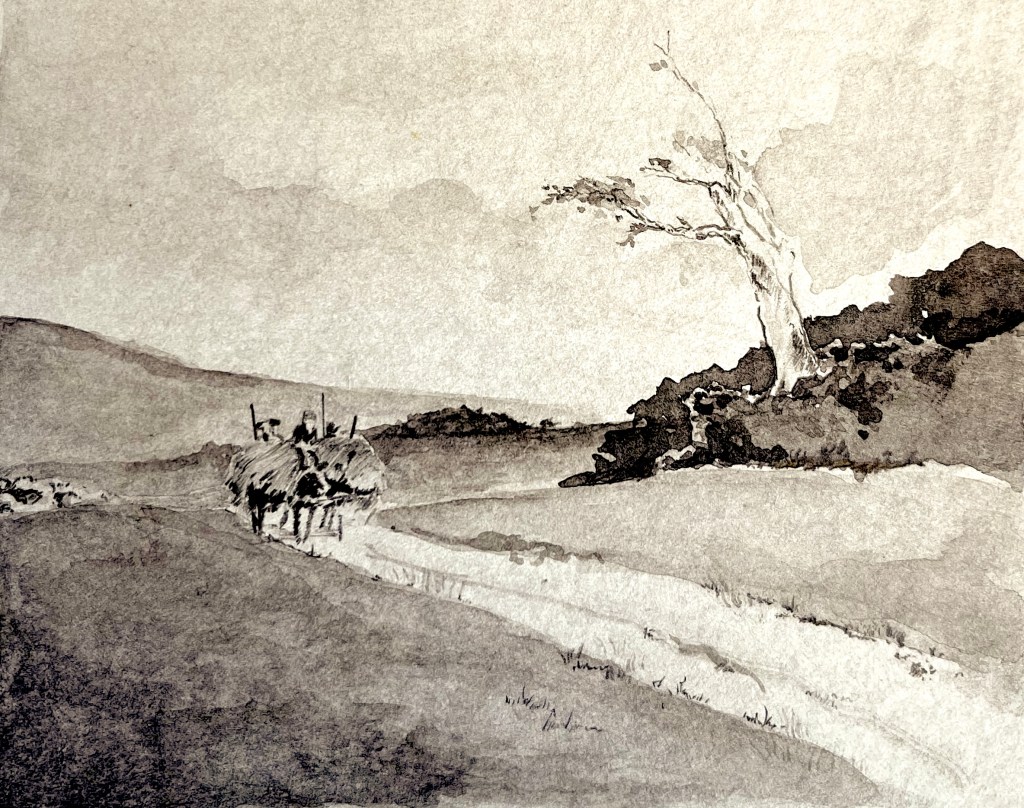
This is a small pen and ink sketch of farmers in the Western Reserve,
which I did in the Spring of 1980. (Thomas Harley Bond)

The Settling of Solon Township, Ohio

Wikipedia informs us that, “In 1820, the first settlers arrived from Connecticut… The township was named after Lorenzo Solon Bull, who was the son of Isaac Bull, one of the first settlers. Purportedly, the selection of young Lorenzo’s middle name was due to its derivation from the “father of democracy”, Solon, the lawmaker of Ancient Greece. The early settlers faced challenges common to pioneers, but in Solon, drainage and wetlands issues complicated settlement and agriculture. Overcoming these obstacles, Solon Township became an arable farming area, producing corn and wheat crops and supporting dairy farms…”

The vast majority of the McClintocks were farmers, with the notable exception of two people, the siblings: Dr. Freeman McClintock, and William McClintock. Although Freeman farmed in Solon, Ohio for a few years, he eventually gave it up and went on to do many remarkable things throughout North America. “The first man who built a house at the Center [of Solon Township] was Freeman McClintock, who located there in 1832 or ’33. He resided there in his log cabin two or three years before any joined him.”

Ohio Log Cabin and Farm by Granger.

We find this historical anecdote to be interesting, but not completely accurate. We know that his uncle Samuel was already living there. Freeman’s wife Lydia came with him, and his parents arrived in October 1833. Many of his siblings were also leaving New York on the canal boats, schooners, and wagons headed his way. We determined these things based upon his biography and the county tax records. (See footnotes).

William McClintock preferred the legal profession. He was a lawyer, having been admitted to the Ohio Bar in 1849. Eventually he moved his family west to Iowa and became the founder and publisher of a newspaper. (Both brothers have interesting biographical links in the footnotes). (6)

“..Nothing Can be Said to be Certain, Except Death and Taxes…”

We know that the McClintocks had arrived in Ohio by 1831, because there are property tax records in Cuyahoga County which support this. When we analyzed the years 1833 through 1844, we saw some interesting patterns. It appears that in most years, James Sr. either owned most of the land, or was paying most of the taxes for some reason. For example in 1836, James Sr., was paying everyone’s property tax even though some of that land belonged to some of his children. (Gee, thanks dad!)

McClintocks listed in the Cuyahoga County 1852 landownership map index

James Sr. died in September 1845, but the exact date was not recorded.

Later in that same month, there are record documents from a future court case, which state that — “James Jr., sold the real estate to Dexter McClintock [our ancestor] for $1,125 on September 25, 1845” and that “James Jr. died in 1849[*] and there was considerable dispute among his heirs and the heirs of James Sr., as to the ownership of the property.”
*Correction: James Jr.’s correct death date is recorded as January 1, 1854. He died of typhoid fever, leaving behind a wife and several small children: wife Betsey, and children, Orvil, Antionette, Seth, Edith, and James. (7)

We will be covering this court case in the next chapter, The McClintock Line, A Narrative — Seven). The case involves land, alcoholism, temperance societies, gold, and lots of ruffled feathers.

Following are the footnotes for the Primary Source Materials,
Notes, and Observations

Be Fruitful and Multiply

(1) — thirty two records

Boston Rare Maps
The Sotzmann-Ebeling Map of New Hampshire, Circa 1796
https://bostonraremaps.com/inventory/sotzmann-ebeling-new-hampshire-1796/
Note: For the map image.

James McClintock Sr
in the U.S., Find a Grave Index, 1600s-Current

https://www.ancestry.com/discoveryui-content/view/58353478:60525?ssrc=pt&tid=75768616&pid=42330432184
Note: Birth and death dates
and
James McClintock Sr.
https://www.findagrave.com/memorial/95744747/james_mcclintock
and
Ohio Cemetery Records
Gravestone Inscriptions in Old Southwest Burying Ground, Bainbridge, Geauga Co., OH
https://www.ancestry.com/imageviewer/collections/48347/images/OHCemeteryRecords-000382-157?ssrc=&backlabel=Return&pId=304646
Book page: 157, Digital page: 167/506, Lower section, entry 3 from the bottom of the page.

Hephzibah “Hepsie” Jones McClintock
https://www.findagrave.com/memorial/92303259/mccl
Note: There are some minimal family records.

Hepzidah McClintock
in the Michigan, U.S., Death Records, 1867-1952

https://www.ancestry.com/discoveryui-content/view/1403875:60872?tid=&pid=&queryId=78c1cb54-4fc6-46dd-897e-ede148c8d4b1&_phsrc=orQ32&_phstart=successSource
Book page: 203, Digital page: 590/651, Left page, entry 636.
Notes: The information for her parents, and the county name, are incorrect on this file (transcription errors?). She appears to have been living with her son Dr. Freeman McClintock, who died in Michigan.

Thirza Taylor
in the Ohio, U.S., Wills and Probate Records, 1786-1998

Cuyahoga > Estate Files, Docket 34, Case No 9031-62092, 1813-1913
https://www.ancestry.com/discoveryui-content/view/6426020:8801
Digital pages: 2 through 7/209
and
The Connection: When Thirza’s younger brother James Jr. died on January 1, 1854, his wife Betsey McClintock remarried eight months later (on August 10, 1854), to Tirza’s son Philonzo Taylor Jr. (Thirza lost a brother and gained a daughter-in-law). Here is the 1850 census to document the Taylor family —
Thirza Taylor
in the 1850 United States Federal Census

https://www.ancestry.com/discoveryui-content/view/13469152:8054?tid=&pid=&queryId=0d8c99c5-6e9b-49d3-af1f-1446805483c0&_phsrc=IPg31&_phstart=successSource
Digital pages: 9-10/30, Entries 38-42, and 1-4 (next page top).
and
The August 10, 1854 remarriage:
Betsey Ann McClintock
in the Ohio, U.S., County Marriage Records, 1774-1993

Geauga > 1841 – 1854
https://www.ancestry.com/discoveryui-content/view/900862477:61378?tid=&pid=&queryId=7b4f7af5-2a9c-4c25-a297-4327d843e3c4&_phsrc=IPg6&_phstart=successSource
Digital page: 412/437, Left page, entry 2.

Mahala Short
in the U.S., Find a Grave Index, 1600s-Current

https://www.ancestry.com/discoveryui-content/view/26447561:60525?tid=&pid=&queryId=ce7d9371-67a5-4f32-b666-460c32adfea5&_phsrc=Lml7&_phstart=successSource
and
Mahala Short
https://www.findagrave.com/memorial/53699209/mahala-short
Notes: We connected her husband Shubal Short through her residence with her family who lived in Phelps, Ontario, New York and this lawsuit, where her husband is named: https://www.ancestry.com/imageviewer/collections/28306/images/dvm_LocHist012267-00246-1-0?ssrc=&backlabel=Return&pId=400
Notes: The McClintock family is connected to the Short family of Phelps, Ontario County, New York through 3 marriages:

Dr Freeman McClintock
in the U.S., Find a Grave Index, 1600s-Current

https://www.ancestry.com/discoveryui-content/view/86876122:60525?tid=&pid=&queryId=2b92d9cc-fbdc-4124-862f-bcb7bc69167a&_phsrc=aWz3&_phstart=successSource
and
Dr Freeman McClintock
https://www.findagrave.com/memorial/33127439/freeman-mcclintock
Note 1: For birth and death dates.
Note 2: The McClintock family is connected to the Short family of Phelps, Ontario County, New York through 3 marriages:

  • Sarah McClintock, married Sidney Smith Short about 1831
  • Mahala McClintock, married Shobal Pula Short Sr. about 1826
  • Freeman Brazilla McClintock, Lydia A. Short, on November 27, 1831, as identified in American Biographical History of Eminent and Self-made Men : Michigan volume, The Sixth Congressional District

Dr. Freeman McClintock led a dynamic life and was profiled in this book — American Biographical History of Eminent and Self-made Men : Michigan volume, The Sixth Congressional District
https://www.ancestry.com/imageviewer/collections/25026/images/dvm_LocHist010122-00622-0?pId=704
Book pages: 50-51, Digital pages: 797-798/984

image4
Handwritten note, gallery image for Joshua John McClintock
https://www.ancestry.com/mediaui-viewer/collection/1030/tree/1173647/person/-1913123119/media/11ee9170-8904-4927-9240-ed38c9b3fa82?queryId=8f38b5df-7553-47d9-b0ec-1f41dd4ae931&_phsrc=xAm11&_phstart=successSource
Notes: Below is the handwritten document, that also provides information about his wife Lucy Seward. His birth location is incorrect being listed as Manchester. The family never lived in Manchester, but in the nearby town of Hillsborough, where  his other siblings from the same timeframe were likely born.

Handwritten document posted on Ancestry.com. (See comments above).

J J McClintock
in the Ohio, U.S., Wills and Probate Records, 1786-1998
Cuyahoga > Will Records, Vol X-Y, 1892-1893
https://www.ancestry.com/discoveryui-content/view/13657472:8801?tid=&pid=&queryId=1dbe9c61-e191-4563-aedd-fb10ce11e962&_phsrc=AKd1&_phstart=successSource
Digital page: 206/682
Note: For death date.
and
will [of JJ McClintock]
https://www.ancestry.com/mediaui-viewer/collection/1030/tree/1173647/person/-1913123119/media/7a207c15-7b42-4acf-b42b-b3fc2648f551?galleryindex=1&sort=-created
and
will p2
https://www.ancestry.com/mediaui-viewer/collection/1030/tree/1173647/person/-1913123119/media/54bd5581-d1fe-4174-90d8-1993a9606f73?galleryindex=2&sort=-created
Note: There are two pages to this hand drafted document as indicated by the two links above. The Will is found in an ancestry.com photo gallery.

James McClintock [Jr.]
https://www.findagrave.com/memorial/53699189/james_mcclintock
Note: For his birth and death dates.

Dexter McClintock
in the Web: Ohio, Find A Grave Index, 1787-2012

https://www.ancestry.com/discoveryui-content/view/7887384:70559?ssrc=pt&tid=18269704&pid=635845738
and
Dexter McClintock
https://www.findagrave.com/memorial/19154853/mccl

William McClintock
https://www.findagrave.com/memorial/108474075/william_mcclintock
Notes: For his birth and death dates.

Observation: Not to be outdone by his older brother Freeman, it appears that William McClintock was also a very accomplished man. A newspaper he started named the Fayette County Union was published continuously until 1944.

Portrait and Biographical Album of Fayette County, Iowa.
Containing Full Page Portraits and Biographical Sketches of Prominent and Representative Citizens of the County
by Lake City Publishing Company
https://archive.org/details/portraitbiogra00lake/page/272/mode/2up?view=theater
Book page: 273, Digital page: 272/698
and a transcribed copy —
Fayette County, Iowa
Biography Directory
Portrait & Biographical Album of Fayette County Iowa
Containing Full Page Portraits and Biographical Sketches of Prominent and Representative Citizens of the County
Lake City Publishing Co., Chicago, March 1891
https://iagenweb.org/fayette/bios/1891/373b.htm

Library of Congress
Fayette County Union (West Union, Iowa) 1866-1944
https://www.loc.gov/item/sn83025183/

Louisa McClintock
in the 1870 United States Federal Census

Michigan > Shiawassee > Sciota
https://www.ancestry.com/discoveryui-content/view/27514564:7163?tid=&pid=&queryid=2efdaa07-be2b-4470-a5cc-681975d47192&_phsrc=dPv25&_phstart=successSource
Book page: 2, Digital page: 2/32, Entries 12 and 13.
Notes: Louisa’s birthdate is inferred from this record. In 1870, she is living in Michigan taking care of her mother, who died there the next year.

The Connection: Throughout the 1850s and 186os she is making property tax payments in Solon, Cuyahoga, Ohio. The last record for Ohio is:
Louisa M McClintock
in the Cuyahoga County, Ohio, U.S., Tax Lists, 1819-1869
1865
https://www.ancestry.com/discoveryui-content/view/1320613:2100?tid=&pid=&queryid=8220d991-1796-464a-8766-f71723b626c5&_phsrc=FPj1&_phstart=successSource
Book page: 26, Digital page: 500/558

Wayne County, New York
https://en.wikipedia.org/wiki/Wayne_County,_New_York
Note: For founding date.

Library of Congress
A View of Manchester, N.H.
by J.B. Bachelder, 1855
https://www.loc.gov/resource/cph.3g08323/
Note: For the landscape painting.

The Censuses of 1800 through 1830 and Their Differences

(2) — eleven records

The National Archives
The 1810 Census
https://www.archives.gov/research/census/1810
Note: “The census began on Monday, August 6, 1810, and was finished within 9 months…”, and for the form questions: 
https://www.archives.gov/files/research/genealogy/charts-forms/1810-census.pdf

James McClintock
in the 1810 United States Federal Census

New Hampshire > Hillsborough > Windsor
https://www.ancestry.com/discoveryui-content/view/187893:7613?ssrc=pt&tid=18269704&pid=635866414
Digital page: 2/2, Entry 16.

Map Of The State Of New York
Published by A. Finley Philadelphia,1824
https://archive.org/details/dr_map-of-the-state-of-new-york-published-by-a-finley-philada-1824-copy-ri-2587002

The National Archives
1820 Census Records
https://www.archives.gov/research/census/1820
Note: “The census began on Monday, August 7, 1820, and was finished within 6 months…”, and for the form questions:
https://www.archives.gov/files/research/genealogy/charts-forms/1820-census.pdf

James McClintock
in the 1820 United States Federal Census

New York > Ontario > Phelps
https://www.ancestry.com/discoveryui-content/view/567539:7734?ssrc=pt&tid=18269704&pid=635866414
Digital page: 10/12, Entry 11.
Note: He is entry #738 and the next entry #739, is his brother Samuel. 

The National Archives
1830 Census Records
https://www.archives.gov/research/census/1830
Note: “The census began on Tuesday, June 1, 1830, and was finished within 6 months,…” and for the form questions:
https://www.archives.gov/files/research/genealogy/charts-forms/1830-census.pdf

James McClintick
in the 1830 United States Federal Census

New York > Wayne > Arcadia
https://www.ancestry.com/discoveryui-content/view/163551:8058
Digital page: 35/48, Entry 17.

Samuel McClintock
in the Cuyahoga County, Ohio, U.S., Tax Lists, 1819-1869

1831-1833
https://www.ancestry.com/discoveryui-content/view/1665566:2100?tid=&pid=&queryid=c0b09afb-af21-4cc1-ae13-d957d6a769a8&_phsrc=NeN1&_phstart=successSource
Digital page: 194/636, Last entry.

Let’s Pause A Moment for Some Refreshment, Shall We?

(3) — three records

History of the Town of Arcadia
https://wayne.nygenweb.net/everts/arcadiaeverts.html

Windsor Historical Society
Colonial Boozing
https://windsorhistoricalsociety.org/colonial-boozing/

Medium
The Temperance Movement Was Totally Badass
https://medium.com/@benfreeland/the-temperance-movement-was-truly-badass-dfeaed03a3e0
Note: For temperance illustration of Fredericktown, Ohio reformers.
You go, girls!

And Back to The Census…

(4) — three records

The National Archives
1840 Census Records
https://www.archives.gov/research/census/1840
Note: “The census began on Monday, June 1, 1840, and was finished within five months…”, and for the form questions:
https://www.archives.gov/files/research/genealogy/charts-forms/1840-census.pdf

James Mcclintock
in the 1840 United States Federal Census

Ohio > Geauga > Bainbridge
https://www.ancestry.com/discoveryui-content/view/2629792:8057?ssrc=pt&tid=18269704&pid=635866414
Digital page: 9/14, Entry 3.

The Western Reserve of Ohio

(5) — four records

Western Reserve Including the Fire Lands 1826
https://commons.wikimedia.org/wiki/File:Western_Reserve_Including_the_Fire_Lands_1826.jpg
Note: On this map, Geauga County is still combined with the future Lake County and Russell township is not yet named.
Note: For the map image.

History of the Firelands
https://lymevillage.org/history-of-the-firelands/

United States Migration to Ohio, Northwest Territory, Southwest 1785 to 1840 – International Institute
https://www.familysearch.org/en/wiki/United_States_Migration_to_Ohio,Northwest_Territory,_Southwest_1785_to_1840-_International_Institute

Connecticut Western Reserve
https://en.wikipedia.org/wiki/Connecticut_Western_Reserve
Note: For the map of “Connecticut’s land claims in the Western United States.”

The Settling of Solon Township, Ohio

(6) — two records

Solon, Ohio
https://en.wikipedia.org/wiki/Solon,_Ohio

History of Cuyahoga County, Ohio …
With Portraits and Biographical Sketches of its Prominent Men and Pioneers
by Crisfeld Johnson
https://archive.org/details/historyofcuyahog00injohn/page/516/mode/2up?q=“McClintock”
Book page: 517, Digital page: 516/534

“Nothing Can be Said to be Certain, Except Death and Taxes…”

(7) — seven records

Death and Taxes [idiom]
https://en.wikipedia.org/wiki/Death_and_taxes_(idiom)#:~:text=%22Death%20and%20taxes%22%20is%20a,certain%2C%20except%20death%20and%20taxes.

James Mcclintock
in the Cuyahoga County, Ohio, U.S., Tax Lists, 1819-1869
1833-1835
https://www.ancestry.com/discoveryui-content/view/1651638:2100?ssrc=pt&tid=18269704&pid=635866414
Digital page: 65/658, Entries 8 through 17 (based upon name).

James McClintock
in the Cuyahoga County, Ohio, U.S., Tax Lists, 1819-1869
1835-1837
https://www.ancestry.com/discoveryui-content/view/1647946:2100?ssrc=pt&tid=18269704&pid=635866414
Digital page: 487/648, Entries 7 through 18 (based upon name).

James McClintock
in the Cuyahoga County, Ohio, U.S., Tax Lists, 1819-1869

1842-1843
https://www.ancestry.com/discoveryui-content/view/1607066:2100?ssrc=pt&tid=18269704&pid=635866414
Digital page: 537/686, Entries 10 through 14 (based upon name).

James McClintock
in the Cuyahoga County, Ohio, U.S., Tax Lists, 1819-1869

1844-1845
https://www.ancestry.com/discoveryui-content/view/1195813:2100?ssrc=pt&tid=18269704&pid=635866414
Digital page: 303/682, Entries 12 through 17 (based upon name).

Listed in the Cuyahoga County 1852 landownership map index
https://www.ancestry.com/imageviewer/collections/21248/images/dvm_LocHist007250-00029-1?ssrc=pt&treeid=18269704&personid=635866414&usePUB=true&pId=52
Digital page: 54/107, Entry 20.

Annals of Cleveland.
Vol. II. Abstracts of the records of court cases in Cuyahoga County
https://www.ancestry.com/imageviewer/collections/28306/images/dvm_LocHist012267-00246-1-0?ssrc=&backlabel=Return&pId=400
Book page: 111-112, Digital page:: 470-471/3048

The McClintock Line, A Narrative — Four

This is Chapter Four of seven, as we continue with the unfolding history of the McClintock family.

This chapter of our narrative has two parts. The first part is about wars and conflict; the second part, peace and community. It is unusual for us to find so many records about an ancestor who was not well known to history. This is due to the fact that William McClintock was deeply involved as an Selectman for the town of Derryfield in both governmental and religious matters, (and that the records have survived!)

Colonists Walking to Church, by James S. King (Public domain).

Before the American Revolution, a town like Chester had a widely scattered population. The History of New Hampshire states, that “men, women and children had been accustomed to walk six and eight miles to attend [religious] services.” (Ya gotta hand it to these ancestors… show of hands for anyone who does this today on a regular basis…) (1)

In Times of War, We Suffer

In the year 1748, there was palpable fear in Tyng’s Township of Indians (Native Peoples) attacking the settlers. “There seems to have been more fear of the Indians this year than in any other. There were several garrisons kept in town. The house now occupied by Benjamin Hills still has the port-holes through the boarding…” (These portholes are related to the sides of a wooden ship which was repurposed to build the wall of a house. The portholes were windows which the setters would shoot through toward people they viewed as aggressors.) Below is an example of a petition that our ancestors, who appear to have lived far from the town center. (History of Old Chester)

The third petition of 1748.

Our ancestors were inhabiting the lower reaches of the British New Hampshire Province. The upper portion was a border area, sparsely filled with the French, who had their various alliances with Native Peoples. Hence, the region was a border area filled with conflict, some of it percolating down to southern New Hampshire. “In British America, wars were often named after the sitting British monarch, such as King William’s War or Queen Anne’s War. There had already been a King George’s War in the 1740s during the reign of King George II, so British colonists named this conflict after their opponents, and it became known as the French and Indian War.” (Wikipedia) (2)

Louis-Joseph de Montcalm trying to stop Native Americans from attacking British soldiers and civilians as they leave Fort William Henry at the Battle of Fort William Henry, during the French and Indian War. (Image courtesy of Wikimedia Commons).

Military Service in Two Wars

The French and Indian War
“The French and Indian War (1754–1763) was a theater of the Seven Years’ War, which pitted the North American colonies of the British Empire against those of the French, each side being supported by various Native American tribes. Two years into the war, in 1756, Great Britain declared war on France, beginning the worldwide Seven Years’ War. At the start of the war, the French colonies had a population of roughly 60,000 settlers, compared with 2 million in the British colonies. The outnumbered French particularly depended on their native allies. The British colonists were supported at various times by the Iroquois, Catawba, and Cherokee tribes, and the French colonists were supported by Wabanaki Confederacy members Abenaki and Mi’kmaq…” (Wikipedia)

American Commissioners of the Preliminary Peace Agreement with Great Britain, 1783-1784,
London, England, by Benjamin West
(oil on canvas, unfinished sketch), Winterthur Museum, Winterthur, Delaware
From left to right: John Jay, John Adams, Benjamin Franklin, Henry Laurens, and William Temple Franklin. The British commissioners refused to pose, and the picture was never finished.

Records show that that William and his twin brother Michael were involved in military service for two wars during the decades of the 1740s through the 1770s. William McClintock achieved the rank of Sergeant, and his brother Michael achieved the rank of Captain. We found records of military payments in pounds and shillings, made to William McClintock and his brother Michael. Browne writes in the Early Records of the Town of Derryfield, “Paid by the Sundrey persons hereafter Named to Nethaniel Martin Teopilus Griflfen & Nat Baker as volenters men they went to Noumber four about the Retreet from Ty — are as followeth
William mc Clintok 0 6 0 0″ (See the notes from the Harvard Library at the end of this section, for an explanation about payments).

The conflict William was paid for was the siege of “Number four about the retreat from Ty” [Tyngstown] which “was a frontier action at present-day Charlestown, New Hampshire, during King George’s War”.(Collections of The Bennington Museum, Bennington, Vermont)

The Association Test
“In March 1776 the Continental Congress resolved that all persons who refused to sign the Association to defend the cause of the Colonies should be disarmed. To put this resolve into effect, the New Hampshire Committee of Safety directed the local authorities, usually the selectmen, to have all adult males sign the Association and to report the names of those who refused to sign. The end result amounted to a census of the adult male inhabitants of New Hampshire for 1776…” (Inhabitants of New Hampshire 1776)

From this document we learned that both Michael(Nicheall) and William signed the Association, and that they were both still living in Derryfield. William’s sons Alexander and John also signed, but were then living in the nearby town of Hillsborough.

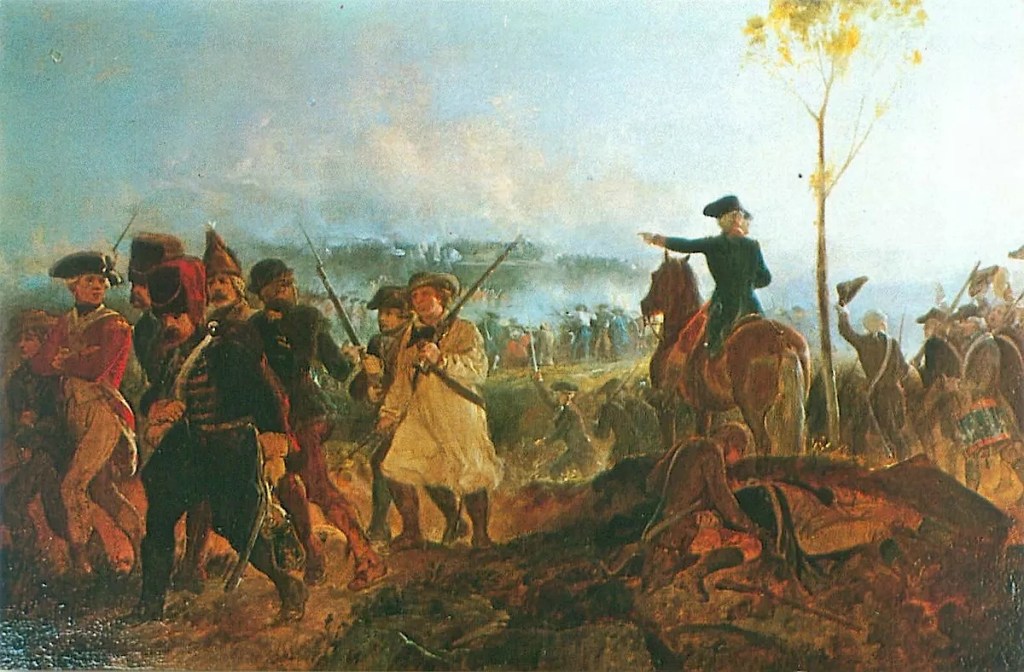
Battle of Bennington, 1777 by Alonzo Chappel. (Image courtesy of The Bennington Museum).

The Battle of Bennington, Revolutionary War
John Stark of Derryfield, New Hampshire was friends with both of the McClintock brothers as he had served with them as one of the town administrators during the 1760s. During the Revolutionary War, he “was commissioned [as] a brigadier general of the New Hampshire militia and was ordered to lead a force to Bennington, there to cooperate with Seth Warner’s Green Mountain Boys posted at Manchester.

Stark agreed to take the independent command, so long as he was issued a commission from only New Hampshire. He refused to take orders from Congress or from any Continental officer.  As the historian Richard Ketchum has emphasized, “the effect was startling.  Within six days, twenty-five companies – almost fifteen hundred men – signed up to follow him, some of them even walking out of a church service when they heard of his appointment. [In August 1777] General Stark marched his force to Bennington – a small village that one British officer called ‘the metropolis of the [future] state of Vermont.’” (Champlain Valley NHP, see footnotes)

From the Early Records of the Town of Derryfield, “Paid by indeviduels to hold on John Nutt Enoch Harvey Theophilus Griffin & David Farmer and others went with General Stark at the Battel at Benenten are as folloeth (viz)
Micheal mc Clintok   1  2  0  0
William mc  Clintok   1  4  0  0″

It’s unclear if William and Michael were paid in (£) Pound sterling, shillings, and pence, or in the scrip of the Continental Congress. “When the Second Continental Congress met in Philadelphia in 1775, it authorized the issue of bills of credit to the value of two million Spanish milled dollars as a way of funding the Revolutionary War. The Continental Congress granted a charter to create the Bank of North America in Philadelphia to issue the notes. Paul Revere of Boston engraved the plates for the first of these bills, which were known as Continental Currency. As had been the case in the days of Colonial Scrip, each of the colonies printed its own notes, some denominated in pounds, shillings, and pence, and others in dollars.” (Harvard Library)

The Stamp Act of 1765 was one of the outrages which helped lead to the American Revolution in 1776. At the time, the British government was forcing American Colonists to pay for the costs of the French and Indian War through extra taxation.

Observations: In 1755, when the French and Indian War began, both of the brothers would have been 46 years old. When the conflicts for the Revolutionary War began in 1775, they would have been 68 years old. We thought that might be a bit too old to serve, but the records for the date of the Battle of Bennington correspond to gaps in their records with the town administration of Derryfield. So, even though they were older, it seems possible. Family Search records that the age range for Servicemen during the French and Indian War, and the Revolutionary War, was 16-60 years. Additionally, author Browne wrote in The History of Hillsborough, New Hampshire, 1735-1921,“An examination of this list made nearly a year after the battle of Lexington shows that… of the forty-seven men eighteen were over fifty years of age, and beyond the military limit, though this did not deter the most of them from entering the service sometime during the war.” (3)

William Wore Many Hats in Addition to His Tricorne Cap!

As we wrote about in the last chapter, our McClintock ancestors lived in an area that had several names (Tyng’s Township, circa 1727 > Derryfield, circa 1751 > Manchester, circa 1810). William McClintock was the most active member of the town administration and there are many records which feature his various responsibilities. From the book, the History of Manchester, 1735-1921, author Browne writes:

“…a board of officers known as “Select Men,” usually consisting of five of the most prominent men in the community, were chosen to look after matters in the intervals [between town meetings]. Finally these came to be elected for a year, and the meetings were made annual, unless some uncommon subject demanded a special meeting, and March, the least busy period of all the year for the tillers of the soil, was selected as the month in which to hold these gatherings. Soon the Selectmen became known as ‘The Fathers of the Town,’ a very apt term, considering that they were in truth masters of the situation and lawmakers as well as lawgivers.

New England town meeting image courtesy of Winchester News. (Public domain).

The next officer of importance to the Selectmen, and we are not unmindful of the Moderator, who must have been the oldest official, was the person who was intrusted [sic] with the keeping of the records, the Clerk… There had to be men to keep the peace, and the restrictions were very rigid in those days, and these officers were called ‘Constables.’ As soon as the time came when money was needed to finance the public business taxes had to be assessed, which called for ‘Assessors,’ though the Selectmen usually performed this duty, and do until this day in most country towns. In order to obtain these taxes, men had to go out and collect them, for even then money was not paid over until called for, and this duty was performed for a time by the Constable. (The History of Hillsborough, 1735-1921)

Records for Michael and William McClintock were gathered from two sources: Early Records of the Town of Derryfield: Now Manchester, N. H. 1751 – 1782, and The History of Hillsborough, New Hampshire, 1735-1921).

RoleYearsBroad duties
Assessor1751Raised money
Committees1751, 1754, 1769, 1778
Constable1756Collects taxes
Moderator1753, 1754, 1758, 1766, 1767, 1769, 1775Manages meetings
Preacher1759
Selectman1754,
1758 through 1760
1763 through 1765
1769 through 1772
Administration
Surveyor of Highways1758, 1779Field work

Michael McClintock had several roles over the years, but he seems to have spent more time doing other activities such as his agricultural work. With his brother being involved in local government more deeply, he must have been quite aware of what was going on at different times, but chose to keep a lower profile.

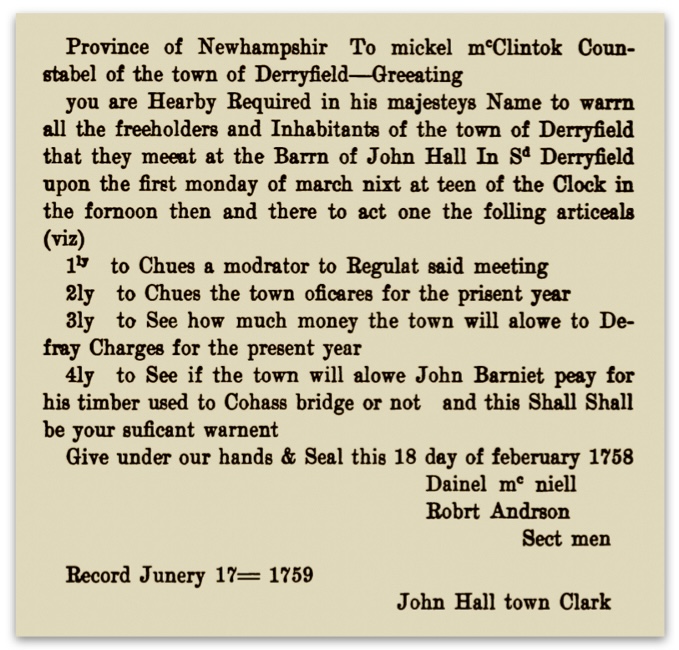
Public notice posted by Michael McClintock the year he was a Constable, advising the townspeople of an upcoming meeting. (Early Records of the Town of Derryfield, p. 61)
RoleYearsDuties
Constable1757 through 1759Collects taxes
Deerkeeper1766
Surveyor of Highways1766Field work
Tithingman1752, 1760, 1761, 1771Preserves order during church services

In January 1776, New Hampshire became the first colony to set up an independent government and the first to establish a constitution. (Wikipedia) By 1778, town records indicate that William McClintock was part of a committee involved in the framing a new state Constitution.

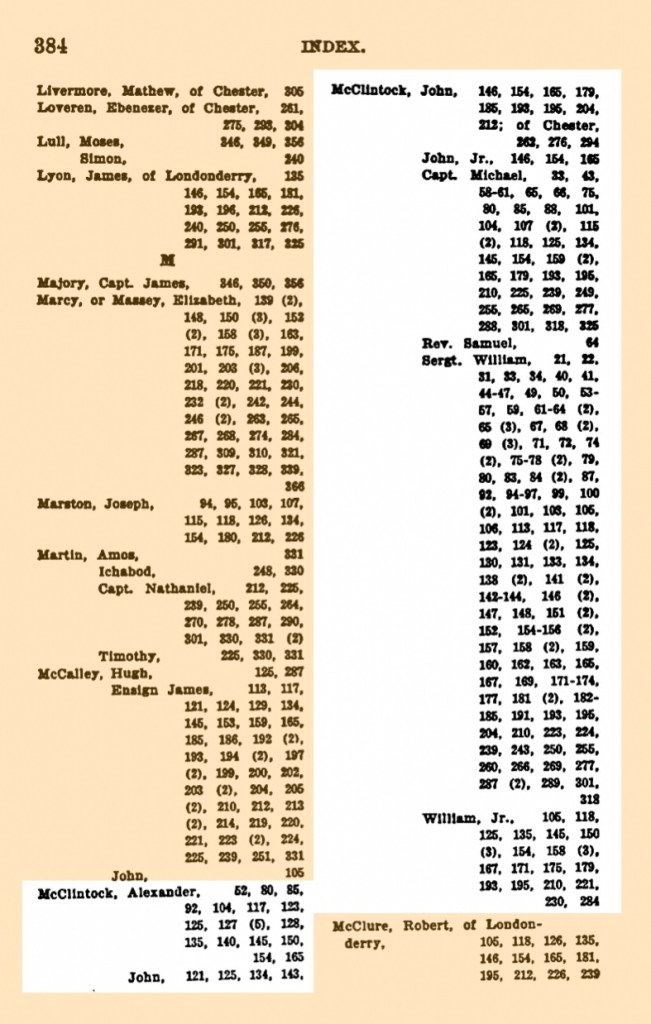
Comment: To create the above charts, we did an extensive analysis of the copious administrative records for both William and Michael McClintock. If interested in that level of detail, please see the many index entries listed in the footnotes of the Early Records of the Town of Derryfield: Now Manchester, N. H., 1751 — 1782, Volumes I and VIII. (4)

In Times of Peace, We Try to Build A Community

The Colonial Meeting House
“A colonial meeting house was a meeting house used by communities in colonial New England. Built using tax money, the colonial meeting house was the focal point [central focus] of the community where the town’s residents could discuss local issues, conduct religious worship, and engage in town business.” [It] was usually the largest building in the town.

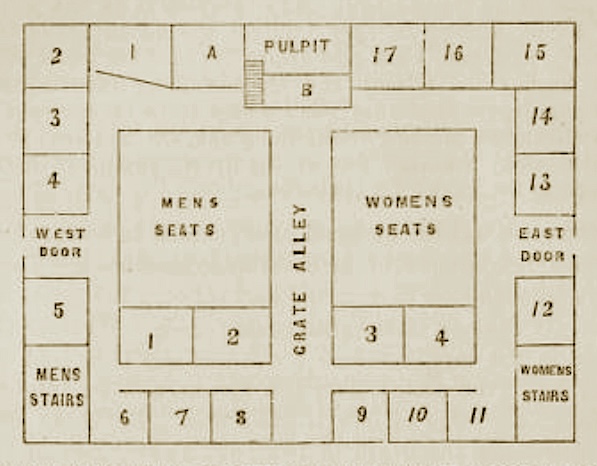
Most were almost square, with a steep pitched roof running east to west. There were usually three doors: The one in the center of the long south wall was called the “Door of Honor,” and was used by the minister and his family, and honored out-of-town guests. The other doors were located in the middle of the east and west walls, and were used by women and men, respectively. A balcony (called a “gallery”) was usually built on the east, south, and west walls, and a high pulpit was located on the north wall.

From the Derryfield history, the 1754 seating plan for the town Meeting House.

Following the separation of church and state, some towns architecturally separated the building’s religious and governmental functions by constructing a floor at the balcony level, and using the first floor for town business, and the second floor for church.

“They were simple buildings with no statues, decorations, stained glass, or crosses on the walls. Box pews were provided for families, and single men and women (and slaves) usually sat in the balconies. Large windows were located at both the ground floor and gallery levels. It was a status symbol to have much glass in the windows, as the glass was expensive and had to be imported from England.” (Wikipedia)

The following YouTube.com video, by photographer Peter Hoving, beautifully explains the layout and concepts behind New England Meeting Houses. Some of which he as photographed in New Hampshire.

If the above video does not run for some reason, it can be linked here: https://www.youtube.com/watch?v=dSgmQzbnkOU

In the Early Records of the Town of Derryfield, in describing the period after the French and Indian War, “An era of prosperity had dawned upon the province, but unfortunately for the harmony and welfare of the new town two combative elements of human life made up the minds and sinews of the men of Derryfield. Its inhabitants consisted of two distinct races, the Scotch-Irish who had begun to settle within the bounds of its territory as early as 1720, with others following from time to time… while the grant of the Tyng township in 1735 called thirty or more families of the English colony of Massachusetts, the latter largely along the banks and at the mouth of Cohas brook.

The Scotch Presbyterians, who somewhat outnumbered their contemporaries, were imbued with their set, vivid views of what constituted their civil and religious liberties, while the English in their belief were as rigid and dogmatical as they. We see the coloring of this difference of opinion coming to the surface almost immediately, for within a year of the granting of the charter a controversy arose relative to the building of a meeting-house and settling of a minister.”

The gist of this history seems to be that there were two groups of people who made up Derryfield: the Scotch Presbyterians, and the resettled English from Massachusetts. (Remember that Massachusetts had once long been an “overlord” of New Hampshire province). It seems that in an era when religious practice was a very strong component of people’s lives, both sides had resolute religious viewpoints.

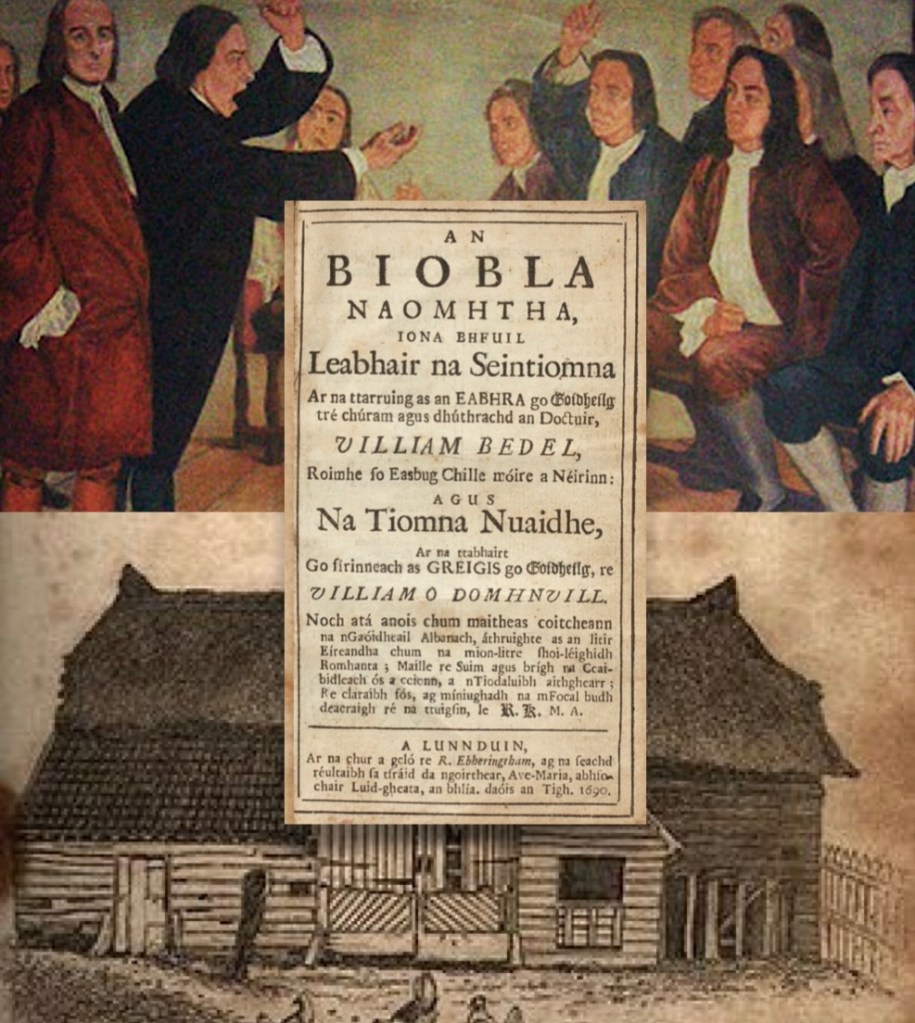
Center: Irish Bible, circa 1690, Background top: Section of a mural depicting The Rev. John Wise of Ipswich, and Bottom: Illustration artwork for a barn in the English style. (See footnotes).

In the town records of Derryfield, we saw William McClintock involved as early as 1752, in conducting Presbyterian religious services out of his home. Apparently, since the town lacked a meeting center, and a Preacher (as they termed it), it was not unusual to do religious services at one’s home, or even one’s barn. Additional town records indicate that the Selectman who administered the town were actively interviewing and seeking “preachers’ throughout the 1750s. Occasionally they would find someone, but it seems that it was never a long-term solution.

In this era, town residents had been paying taxes and fees which were collected to provide for a a town center, i.e. a Meeting House. This was a normal New England circumstance — that a Meeting House would exist at the center of the “village” and this facility would be where town meetings, town administration, and religious services would be conducted. For myriad reasons that are not important now, locations would be chosen, taxes would be paid, things would be agreed to, and then at the next town meeting, all of it would be undone as different sides squabbled. This literally delayed construction for decades.

Comment: No wonder they couldn’t get a Preacher. Who would want to work in that environment if everyone was so inflexible and argumentative.

A meeting house building plan and site would eventually be agreed to, and construction begun, but the building was only used as the Meeting House for a short period, before being replaced by another structure, built by a new generation. Lost tax revenues due to the Revolutionary War didn’t help matters. (5)

From The Town Church of Manchester, by Thomas Chalmers, 1869 (1903 edition).

A Rhum and A Sunset

Not everything was about war and politics. The book, The Town Church of Manchester records, “The records of Tyngstown contain an interesting account of the expense of the raising of the meetinghouse. [As monetary records for pounds and shillings] The first two items are —
To Joseph Blanchard for Rum & Provisions  2  5  3
To the Rev’d M’r Thomas Parker  2  0  0

After all our respect for the piety of the fathers, preaching seems to have been a secondary matter when it came to “rum and provisions.’” Rum was an important factor in that raising, for it constituted both the first and the last items in the bill of expenses. The last item is —

“Had of William McClinto for Raiseing 6 g’lls [gallons] of Rhum 
at 18s per G’ll [gallon] @ 5  8  0″

After all, William was the descendant of a Glasgow “Maltman” (a brewer).

I measured off 20 acres of Meadow and Swamp for
William McClintock in the meadow below his house to
Abraham Merrill and others for which McClintock
paid me a Dollar and I paid him
11/ Hampshire old Tenor for 1/2 a pint of Rum

Matthew Patten
December 28th, 1770 diary entry from
The Diary of Matthew Patten of Bedford, N.H.


Matthew Patten lived in Bedford, not very far from William McClintock. From the quote above, observe the odd words like “Hampshire old Tenor” to describe the form of payment. We forget that as America was being settled each province had it’s own currency. It must have been very confusing to travelers back then.

Example of the currency use in the New Hampshire Province before 1799. (Google images).

From the article, Money in The American Colonies, we learned from writer Ron Michener, “The monetary arrangements in use in America before the Revolution were extremely varied. Each colony had its own conventions, tender laws, and coin ratings, and each issued its own paper money. The units of account in colonial times were pounds, shillings, and pence (1£ = 20s., 1s. = 12d.). These pounds, shillings, and pence, however, were local units, such as New York money, Pennsylvania money, Massachusetts money, or South Carolina money and should not be confused with sterling. [the English currency] To do so is comparable to treating modern Canadian dollars and American dollars as interchangeable simply because they are both called dollars… after 1799, in which year a law was passed requiring all accounts to be kept in dollars or units, dimes or tenths, cents or hundredths, and mills or thousandths.”

The Sotzmann-Ebeling Map of New Hampshire, Circa 1796. (Image courtesy of Boston Rare Maps).

In 1769, New Hampshire created five counties: Cheshire, Grafton, Hillsborough, Rockingham, and Strafford. Subsequently, much of the historical records have William and Michael McClintock in the records of both Hillsborough County and the city of Manchester. New Hampshire became a state in 1781. However, for most of their lives, they lived in the Province of New Hampshire, without a County, in the small town of Derryfield.

We are not sure how long either Michael McClintock or William McClintock lived. For Michael, we do know this — From the National Archives, “The census began on Monday, August 2, 1790, and was finished within 9 months.” In Derryfield, Hillsborough County, there is a record of a Michael McClintock living there with a woman. Both are recorded as being over 16 years of age. A general issue for genealogical research with this first census, is that it provides almost no detail, nor context. By the time 1790 rolled around, Michael would have been about 81 years old. It could be him, we just cannot say for sure. The last tax record we have for him is from the Derryfield history, for the “Continental County and Town Tax” for 1779-80.

As for William McClintock, the same tax record observation applies to him. We are not sure that he was still living by the time of the 1790 census, because there is no record of him being counted directly. He had five children and perhaps he could have been living in one of their homes? As we know with Michael… the 1790 census only records someone as being either over, or under 16 years of age, providing no further detail. However, since there was no listing for William McClintock we can assume he was probably no longer living by 1790.(6)

In the next chapter, we will meet our 4x Great Grandfather, John McClintock (Sr.), the youngest son of William and Agnes McClintock.

Following are the footnotes for the Primary Source Materials,
Notes, and Observations

(1) — one record

Colonists Walking to Church, 19th-Century Print
by James S. King
https://www.magnoliabox.com/products/19th-century-print-of-colonists-walking-to-church-f1299
Note: For the family image.

History of New Hampshire
by J. N. McClintock
https://archive.org/details/bub_gb_8e6FpX4eu1wC/page/130/mode/2up?q=%22men%2C+women+and+children+had+been+accustomed+to+walk+six+and+eight+miles+to+attend%22
Book page: 131, Digital page: 130/691

In Times of War, We Suffer

(2) — one record

History of Old Chester [N. H.] from 1719 to 1869
by Benjamin Chase 1799-1889
https://archive.org/details/historyofoldches00chas/page/558/mode/2up
Book page: 107, Digital page: 106/702
Note: For the Third Petition of 1748.

Military Service in Two Wars

(3) — nineteen records

French and Indian War
https://en.wikipedia.org/wiki/French_and_Indian_War

Louis-Joseph de Montcalm trying to stop Native Americans from attacking British soldiers and civilians as they leave Fort William Henry at the Battle of Fort William Henry
https://commons.wikimedia.org/wiki/File:Montcalm_trying_to_stop_the_massacre.jpg
Note: For the battle image.

American Commissioners of the Preliminary Peace Agreement
with Great Britain, 1783-1784, London, England, by Benjamin West
(oil on canvas, unfinished sketch), Winterthur Museum, Winterthur, Delaware
From left to right: John Jay, John Adams, Benjamin Franklin, Henry Laurens, and William Temple Franklin.
https://en.wikipedia.org/wiki/Treaty_of_Paris_(1783)#/media/File:Treaty_of_Paris_by_Benjamin_West_1783.jpg
Note: The British commissioners refused to pose, and the picture was never finished.

Office of The Historian of the Department of State
Treaty of Paris, 1763
https://history.state.gov/milestones/1750-1775/treaty-of-paris#:~:text=The%20Treaty%20of%20Paris%20of,to%20the%20British%20colonies%20there.

Fort at Number 4
https://en.wikipedia.org/wiki/Fort_at_Number_4

Early Records of the Town of Derryfield: Now Manchester, N. H.
1782 — 1800, Volumes II and IX

by George Waldo Browne
https://archive.org/details/earlyrecordstow00nhgoog/page/n6/mode/2up
Book pages: 109-110, Digital pages: 129-131/425
Note: Descriptions of payment for year 1776 military service to “Noumber four about the Retreet from Ty” and “the Battel at Benenten”

Early Records of the Town of Derryfield: Now Manchester, N. H.
1782 — 1800, Volumes II and IX

by George Waldo Browne
https://archive.org/details/earlyrecordstow00nhgoog/page/n128/mode/2up
Book pages: 108-110, Digital pages: 129-131/425
Note: For payments due to military service.

This file confirms the above footnotes, for military service payments:
History of Hillsborough County, New Hampshire
History of Manchester
https://www.ancestry.com/imageviewer/collections/23240/images/dvm_LocHist008921-00058-1?ssrc=&backlabel=Return&pId=38
Book page: 45-46, Digital page: 71-72/878

Inhabitants of New Hampshire, 1776
by Emily S. Wilson
https://www.ancestry.com/imageviewer/collections/49199/images/FLHG_InhabitantsofNH-0071?ssrc=&backlabel=Return&pId=52151
Book pages: 4 and 71, Digital pages: 4/170 and 71/130

Battle of Bennington, 1777
by Alonzo Chappel.
https://bennington.pastperfectonline.com/webobject/A4B796E5-ADE8-455B-8DF7-217237214000
Note: For the battle painting.

Champlain Valley National Heritage Partnership
Threads of History
John Stark, The Hero of Bennington
https://champlainvalleynhp.org/2022/08/john-stark-the-hero-of-bennington/

Battle of Bennington
https://en.wikipedia.org/wiki/Battle_of_Bennington

Early Records of the Town of Derryfield: Now Manchester, N. H.
1782 — 1800, Volumes II and IX

by George Waldo Browne
https://archive.org/details/earlyrecordstow00nhgoog/page/n128/mode/2up
Book pages: 108-110, Digital pages: 129-131/425
Note: For payments due to military service.

Harvard Library Curiosity Collections
American Currency, Continental Currency
https://curiosity.lib.harvard.edu/american-currency/feature/continental-currency

Stamp Act Congress
https://en.wikipedia.org/wiki/Stamp_Act_Congress

The History of Hillsborough, New Hampshire, 1735-1921
by George Waldo Browne
https://archive.org/details/historyofhillsbo01brow/page/110/mode/2up?view=theater
Book page: 111, Digital page: 110/567
Note: For the quote about military age over 50 years.

Ages of Servicemen in Wars
https://www.familysearch.org/en/wiki/Ages_of_Servicemen_in_Wars
Notes: Revolutionary War Duration, 1776-1783 > Typical Years of Birth, 1757-1767 > Typical Ages 16 to 60

The History of Hillsborough, New Hampshire, 1735-1921
by George Waldo Browne
https://archive.org/details/historyofhillsbo01brow/page/n5/mode/2up?view=theater
Book pages: 225-226, Digital pages: Page numbers are inaccurate.
Note: For descriptions of Assessor, Selectman, Constable.

Manchester A Brief Record of its Past and a Picture of its Present…
by Maurice D. Clarke, 1875
https://archive.org/details/manchester00clarrich/page/n5/mode/2up
Book pages: 33-34, 38, Digital pages: Page numbers are inaccurate.

William Wore Many Hats in Addition to His Tricorne Cap!

(4) — three records

Winchester News
Chaos Reigns on Fourth Night of Town Meeting
https://winchesternews.org/20231118chaos-reigns-on-fourth-night-of-town-meeting/
Note: For the New England town meeting image.

Early Records of the Town of Derryfield: Now Manchester, N. H.
1751 — 1782, Volumes I and VIII

by George Waldo Browne
https://archive.org/details/earlyrecordstow01nhgoog/page/n4/mode/2up
Book page: 61, Digital page: 67/407,
Note: For Michael McClintock constable posting.

From the Derryfield History, we see many index entries for the McClintock family. From the Early Records of the Town of Derryfield: Now Manchester, N. H., 1751 — 1782, Volumes I and VIII.

History of New Hampshire
https://en.wikipedia.org/wiki/History_of_New_Hampshire
Note: Regarding new state Constitutional issues

In Times of Peace, We Try to Build A Community

(5) — eight records

Colonial Meeting House
https://en.m.wikipedia.org/wiki/Colonial_meeting_house

History of Old Chester [N. H.] from 1719 to 1869
by Benjamin Chase 1799-1889
https://archive.org/details/historyofoldches00chas/page/96/mode/2up
Book page: 96, Digital page: 96/702
Note: The Ground Plan of the Old-Meeting House as Seated in 1754…

Colonial Meeting Houses of New England – (2007}
https://www.youtube.com/watch?v=dSgmQzbnkOU

Early Records of the Town of Derryfield: Now Manchester, N. H.
1751 — 1782, Volumes I and VIII

by George Waldo Browne
https://archive.org/details/earlyrecordstow01nhgoog/page/n4/mode/2up
Book pages: 10-11, Digital pages: 15/407
Note: For the description of the two different communities which made up Derryfield.

Credits for Church and Barn Gallery:
BIBLE, Irish — 1690
https://www.sothebys.com/en/buy/auction/2020/english-literature-history-childrens-books-and-illustrations/bible-irish-1690
and
Historic Ipswich
Mural depicting The Rev. John Wise of Ipswich
https://historicipswich.net/2022/11/15/john-wise/
and
English Historical Fiction Authors
Barn image cover artwork for The Red Barn Murder
by Regina Jeffers
https://englishhistoryauthors.blogspot.com/2014/05/the-red-barn-murder.html

Towns of New England and Old England, Ireland and Scotland … connecting links between cities and towns of New England and those of the same name in England, Ireland and Scotland
https://archive.org/details/townsnewengland02stat/page/n10/mode/1up
Book page: 120, Digital page: 120/225

A Rhum and A Sunset

(0) — ____ records

The Town Church of Manchester
by Thomas Chalmers, 1869 (1903 edition)
https://archive.org/details/townchurchofmanc00chal/page/n5/mode/2up
Book pages: Frontispiece and 26, Digital pages: 26/155
Note: Frontispiece photograph, and the Rhum quote.

The Diary of Matthew Patten of Bedford, N.H.
(Copied of Matthew Pattens diary)
https://www.ancestry.com/imageviewer/collections/23193/images/dvm_LocHist008938-00132-1?ssrc=pt&treeid=18269704&personid=635978899&usePUB=true&pId=256
Book page: 257, Digital page: 257/545

Money in the American Colonies
by Ron Michener, University of Virginia
https://eh.net/encyclopedia/money-in-the-american-colonies/

Boston Rare Maps
The Sotzmann-Ebeling Map of New Hampshire, Circa 1796
https://bostonraremaps.com/inventory/sotzmann-ebeling-new-hampshire-1796/
Note: To document the five original counties established in 1769.

The National Archives
1790 Census Records
https://www.archives.gov/research/census/1790

Michael McClintock
in the 1790 United States Federal Census

New Hampshire > Hillsborough > Hollis
https://www.ancestry.com/discoveryui-content/view/213949:5058?ssrc=pt&tid=18269704&pid=643749156
Digital page: 4/4, Right column, entry 1.

The McClintock Line, A Narrative — Three

This is Chapter Three of seven. So many of our ancestors came to British North America through the classic New England colonies: Massachusetts, Vermont, New York. In this chapter we learn about one place which is new to our history — New Hampshire Province.

People Were Hearing Stories About America

What was pulling Presbyterians from Scotland and the Ulster, Ireland plantations to New Hampshire in British North America? “In the early 1700s, however, [the English] Parliament imposed strong restrictions on trade, which caused severe problems in both Irish and Scottish commerce. This in turn led to more conflict between the Irish and the Scots settlers over rapidly dwindling resources, made especially urgent by a harsh winter in 1717...

“Beginning of petition dated March 26, 1718, sent by 319 “Inhabitants of the North of Ireland” to the “Right Honourable Collonel Samuel [Shute] Governour of New England,” expressing interest in moving to New England if encouraged. New Hampshire Historical Society.”

The situation was dominated by the Ulster-Irish /Ulster-Scots Presbyterians and their sympathizers in Scotland. “New England was being touted as a paradise of opportunity, cheap land, and religious tolerance – things very much lacking in Ulster at this point – and in 1718 a petition was signed by over 300 Ulster Scots families to ask the governor of Massachusetts for land. Rev. William Boyd undertook the long journey from Ulster to Boston to give the petition to Gov. Samuel Shute, who was amenable to the idea. Between 1718 and 1755, what is known as the Great Migration took place, with hundreds of thousands of Scots travelling across the Atlantic to Massachusetts, Pennsylvania, and Virginia.” (Worcester Historical Museum Library and Archives)

Across the ocean in the British Colonies of North America, “In 1679 King Charles II separated New Hampshire from Massachusetts, issuing a charter for the royal Province of New Hampshire, with John Cutt as governor.  New Hampshire was absorbed into the Dominion of New England in 1686, which collapsed in 1689. After a brief period without formal government (the settlements were de facto ruled by Massachusetts) William III and Mary II issued a new provincial charter in 1691. From 1699 to 1741 the governors of Massachusetts were also commissioned as governors of New Hampshire.

The province’s geography placed it on the frontier between British and French colonies in North America, and it was for many years subjected to native claims, especially in the central and northern portions of its territory. Because of these factors, it was on the front lines of many military conflicts, including King William’s War, Queen Anne’s War, Father Rale’s War, and King George’s War. By the 1740s most of the native population had either been killed or driven out of the province’s territory.

Governor Benning Wentworth, by Joseph Blackburn, circa 1760, (Image courtesy of Wikimedia Commons).

Since the political powers in Massachusetts had been used to running things in New Hampshire, there were many disputes about borders which were not resolved until 1741. “Benning Wentworth in 1741 became the first non-Massachusetts governor since Edward Cranfield succeeded John Cutt in the 1680s.” (Wikipedia) (1)

The Province of New Hampshire

“New Hampshire has been known as the Province of New Hampshire, the Upper Province of Massachusetts, the Upper Plantation of Massachusetts, and New Hampshire Colony.” (American History Central)

Notice in the very old, (very brown) 1757 map of the New Hampshire Province below, that most of the settlement is located in the southeastern corner. These communities are not far from the location of the port of Portsmouth, and also hug the northern Massachusetts border. This map doesn’t yet delineate a true shape for the state.

An Accurate Map of His Majesty’s Province of New-Hampshire in New England…
by Samuel Langdon, circa 1757. (Image courtesy of the Library of Congress).

The Massachusetts Colony had been settled much earlier, and the terrain was a far more friendly environment for farming and settlement. New Hampshire was mountainous and the soils were more like what was found back in Scotland.

The terrain of New Hampshire Colony was rough and covered with forests, rivers, plateaus, and mountains. The soil was rocky, which made it difficult for farmers to cultivate fields and raise certain crops. The plentiful forests provided access to timber. New Hampshire features around 1,300 lakes and ponds, plus 40,000 miles of streams… Access to rivers and the coast made fishing and whaling popular. The thick forests provided wood that was used for timber, including masts for ships. The forests were also full of animals that provided valuable furs for trade.” (American History Central) (2)

Thomas. Cole’s engraving of the White Mountains, New Hampshire. (Image courtesy of the Syracuse University Art Museum).

The Scotch Range of New Hampshire

Four travelers — Michael McClintock and his wife Margaret; William McClintock and his wife Agnes — immigrated to the Province of New Hampshire around 1731. From William Copley’s book, Scotch-Irish Settlers in New Hampshire, 1719-1776, we learned that the “date and place of first mention of residence in the New World” is 1731. This date is “Extracted from several sources, mainly New Hampshire Provincial Deeds, 1641-1771,” and it implies that they had the resources to acquire property. They arrived either in 1731, or shortly before that time.

They had left the Scottish Belt (Glasgow) behind and moved to what was known as the Scotch Range in New Hampshire. “The southernmost towns in New Hampshire… town names like Londonderry, Antrim, Bedford” were brought over from Scottish and Irish locations (Quora). Additionally, “The Scotch-Irish settlements, like Londonderry, were Presbyterian.” (American History Central)

The Copley book record (cited above) is conclusive for us because it documents two records for each couple, both of which agree in the details: dates, spouses, and family surname spellings. The book, History of Old Chester, from 1719 to 1869, by Benjamin Chase, also contains information about our family, but importantly, the surname is oddly recorded as “McClento”. This matches up like a hand and glove to the Copley book for their journey, along with land records.

From this point forward, unfortunately, there isn’t really any history about their wives. This often happens with ancestral lines.

A View of Portsmouth in Piscataqua River, aquaqtint print by J.F.W. Des Barres, circa 1781. (Image courtesy of Boston Rare Maps). Note that this image was created half a century after they journeyed from Scotland. Portsmouth must have been much simpler when they arrived.

Due to their arrival date (1731 or earlier) in the Colonies, we believe that it is certainly plausible that the four traveled together. Very few ship records exist from that time period, but it is likely that they ventured from the port at Glasgow, Scotland to the port at Portsmouth, New Hampshire Province. It’s also interesting to note that as twins, both men would have been 22 years old, which means that they had reached their age of majority in Scotland.

In the Old Chester book, Chase further records: “The first [settlement] in that part of Chester was by William and Michael McClento. Michael was in Londonderry and bought land there in 1731, and 1733. He is in Chester in 1744. William McClento of Kingstown [Kingston] bought of Thomas Packer of Dracut, 1 lot in the 3d range in ‘Tyngstown,’* in June, 1739. So they probably settled there under a claim from Tyngstown, about 1740. But so far as Chester was concerned, they were squatters.”

*Tyngs Township was one of the early names for Derryfield. The name was changed in 1751.

Please note: Judging distances on this map is deceiving. This inset from the Langdon map above, shows the communities in which they lived. William’s family walked up to 120 miles from Kingston to Londonderry and from there, both families went to Chester.

“The Proprietors sued them, and a verdict was rendered in favor of the defendants, Dec. 8, 1743, and appealed. The land on which they settled was not lotted until 1745. They came up from Londonderry on foot with their effects. [That is a distance of up to 120 miles]. It is said by some that Michael settled on No. 1, 4th D… William with his pack, and his wife with a ‘bairn’* in her arms, forded the brook some distance below the present road, with the water to their ‘haunches,’ and erected a hut [log cabin] near the river, but afterwards built at the Huse place, on lot No, 4. William’s wife was Agnes.”

*Bairn is a Northern England English, Scottish English and Scots term for a child. It originated in Old English as “bearn”, becoming restricted to Scotland and the North of England c. 1700. (Wikipedia)

“Michael McClento had a daughter Nancy. He used to buy thread and perhaps fine linen cloth, and he and his daughter would take each a pack, and carry it to Boston to sell, taking from four to six days, and sometimes netting them three pounds.” (3)

The Mt. Desert Widow Book Half-Problem

There has been much confusion between the histories of the McClintock family and the Gamble family and we would like to address this. We know that the McClintock families and the Gamble families knew each other because they lived in the same communities.

William McClintock had a son named Alexander McClintock who was born about 1738. In 1760, he married a woman named Janet Gamble, and in 1895 a book titled The Mt. Desert Widow : Genealogy of the Maine Gamble Family from First Landing… by Greenleaf Cilley and Jonathan Cilley was published. This is where the troubles began.

At the end of the 19th century, it was very popular to publish family histories that were essentially vanity publications. These sources can be invaluable for genealogy research, but they can also be problematic unless they are very, very carefully reviewed.  Sometimes materials that were submitted to the authors were not well vetted. (This is a problem created by families where stories get repeated over time until someone writes them down, and then storytelling becomes a fact, when [ha!] in fact, it is nothing like that.)

It seems as if someone blended together the history of another William McClintock family who are Irish, and immigrated from Ireland… (There was a William McClintock family from Ireland living in Portsmouth, New Hampshire during this period, but this is not our family.) Our William McClintock family is from Scotland — and our family never lived in Ireland. As we said, no one thought to look carefully at the history…

Parts of the McClintock family history, such as the towns where they lived: Londonderry, Derryfield, Hillsborough, are certainly true, and the stories of the bridges which they built, are likely true. However, other parts of the Gamble/McClintock history are completely wrong.

The Mt. Widow book had wrong arrival dates, direct statements that Michael and William were father and son, it cites Ireland as their origin location, etc., but none of this is true. What we do know is that William Gamble was born in Derry, County Cavan, Ulster, Ireland, and that he came to New Hampshire in 1736, after our ancestors were already there. We looked at his birth information, along with his will, his marriages, and estate probate records to verify his information. It’s unfortunate that in the present day, so many “tree-makers” cite a record like the Mt. Widow book, but for our family it is quite simply not accurate.

One last thing, we discovered a book titled (the) History of Manchester, formerly Derryfield, in New-Hampshire… by Chandler Eastman Potter, which was published in 1856 — 40 years earlier that the Mt. Widow book. The story in the Mt. Widow book was lifted almost word-for-word from the previous book, and it still reads like family apocrypha. (See footnotes).

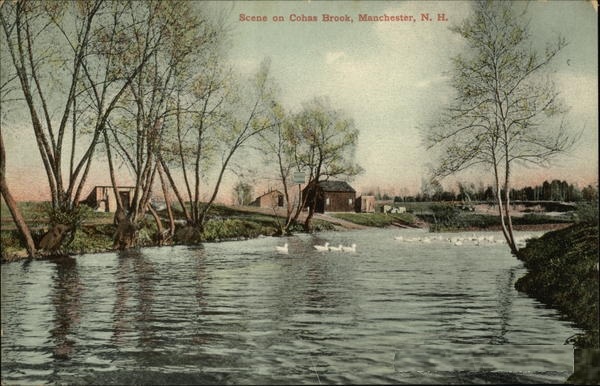
Cohas Brook in Manchester, New Hampshire. It is likely that the sites where our McClintock ancestors (possibly) built bridges were probably similar to this image.

As problematic as some of the information is, it is plausible that the information about the bridges which the McClintocks built is accurate, because it does describe where they were living. (We are taking it as anecdotal evidence because this is the only place where we have seen this information). “They were industrious, thriving people and… built the first bridge across the Cohas, and also another across the little Cohas on the road from Amoskeag to Derry. These bridges were built in 1738… The McClintocks were voted 20 S. [shillings] a year for 10 years for the use of the bridges. The McClintocks moved to Hillsboro, N.H., where their descendants yet reside.” (Note: Hillsboro is also spelled as Hillborough, and the spelling in old documents varies). (4)

Polyonymous: Which Means — Known By Several Different Names

This area of New Hampshire Province where they lived went through name changes during their lifetimes. In 1722, a man named John Goffe settled in Old Harry’s Town, in the British Province of New Hampshire. (Even so, this was never an official name for the place). Five years later in 1727, Tyngstown (or “Tyng’s Township”) was established. McClintock’s were in the area by 1731.

Hand-drawn map indicating the boundaries of the newly-formed town of Derryfield. From the book, the Early Records of Derryfield: Now Manchester, N.H.

Some sources indicate that their community was sometimes referred to as Nutfield because of the Chestnut trees, and in 1751, Tyngstown was rechartered as Derryfield, which was created from carving out sections from portions of the other surrounding communities, such as Chester.

From the book, the Early Records of Derryfield: Now Manchester, N.H., “…As this territory was not deemed of sufficient size to make a “respectable township,” enough was taken from the adjoining towns to make up the desired area… Thus the Derryfield charter covered about thirty-five square miles of coimtry [a colonial word for country > meaning, land] from the following sources: eight square miles of Tyng township, nine square miles of the northwestern portion of Londonderry, formerly Nutfield, and seventeen and three-fourths square miles of Chester, erstwhile called “the chestnut country.” The name of Derryfield is claimed to have originated from the practice of stock [sheep and cattle] owners of Londonderry in allowing their herds to graze on the clearings within its limits, and arising from the term “Derry’s field.”

Cows Grazing Under The Oaks, by Edward Mitchell Bannister, circa 1893

So then, the question becomes, did they move from Chester to Derryfield, or did Derryfield come to them? It seems that Derryfield came to them.

On June 21, 1788, after the American Revolution, the Province of New Hampshire becomes the State of New Hampshire. In 1810, long after both William and Michael had passed on, Derryfield was renamed “Manchester” and remains named that to this day. (5)

Comment: Since various record writers have used town names from different eras in a mix’n match fashion, the proper sequence is this: Harry Town, circa 1722 > Nutfield (unofficial) > Tyng’s Township, circa 1727 > Derryfield, circa 1751 > Manchester, circa 1810.

The Family of William McClintock

William McClintock, who along with his twin brother Michael, was born on September 18, 1709, in Glasgow Scotland, the son of Thomas and Margarit (Gilhagie) Mclintoch. William married Agnes (last name unknown) before 1731, in Scotland.

As a reference point for an extended Colonial New England family from this time period, we like the sensibility of this portrait — The Peale Family, by Charles Willson Peale, circa 1771–1773.

We’ve uncovered records that William and Agnes had at least five children, all born in the Province of New Hampshire. The first three children were likely born in Chester; the last two, in Tyngstown, (all locations eventually becoming Derryfield > Manchester).

  • William Jr., about 1736 — death date unknown
  • Alexander, about 1738 — death date unknown
  • Mary (McClintock) Starrett, September 29, 1739 — December 19, 1785
  • Janet (McClintock) Dickey, about 1742 — June 11, 1811
  • John McClintock, about 1744 — October 9, 1803, (We are descended from John).

We believe that William and his brother Michael made their livings in agriculture, through farming and some animal husbandry. Even though this was not their background in their younger lives in Glasgow, Scotland, it was the primary occupation of their community in New Hampshire. Even with that, both of them, but especially William, were deeply involved in the local government through various activities. In the book index for the Derryfield History, there are almost one hundred entries for “Sergeant” William McClintock alone. In addition, his brother Michael, his sons William Jr., Alexander, and John are all also indexed with numerous entries. (6)

In the next chapter, we will explore the life of this family during the years before, and during the Revolutionary War, as well as their lives within the community.

Following are the footnotes for the Primary Source Materials,
Notes, and Observations

People Were Hearing Stories About America…

(1) — five records

Worcester Historical Museum Library and Archives
The Water is Wide: Scottish Journeys to Ireland and New England, 1603-1718
https://worcesterhistorical.com/worcester-1718/the-water-is-wide-scottish-journeys-to-ireland-and-new-england-1603-1718/

History of New Hampshire
https://en.wikipedia.org/wiki/History_of_New_Hampshire

Timeline of New Hampshire History
https://www.nhhistory.org/Timeline?id=1676.1

Benning Wentworth
by Joseph Blackburn, circa 1760
https://commons.wikimedia.org/wiki/File:Governor_Benning_Wentworth.jpg
Note: For his portrait.

New Hampshire Colony Facts, 1622–1761
https://www.americanhistorycentral.com/entries/new-hampshire-colony-facts/

The Province of New Hampshire

(2) — one record

Library of Congress
An accurate map of His Majesty’s Province of New-Hampshire in New England…
by Samuel Langdon, 1723-1797
https://www.loc.gov/resource/g3740.ar086900/?r=0.343,0.005,0.964,0.464,0
Note: The map is circa 1757.

The Scotch Range of New Hampshire

(3) — eleven records

Book, not available online:
COPELY, WILLIAM. Scotch-Irish Settlers in New Hampshire, 1719-1776.
In Historical New Hampshire (New Hampshire Historical Society, Concord), vol. 50:3/4 (Fall/Winter 1995), pp. 213-228.
“Date and place of first mention of residence in the New World. Extracted from several sources, mainly “New Hampshire Provincial Deeds, 1641-1771,” which is on microfilm at the New Hampshire Historical Society.”

Michael McClintock
in the U.S. and Canada, Passenger and Immigration Lists Index, 1500s-1900s

https://www.ancestry.com/discoveryui-content/view/1609990:7486
Note: Page 222, His wife Margaret is with him. This is the record of their New Hampshire residency in 1731.
and
Michael McClento
in the U.S. and Canada, Passenger and Immigration Lists Index, 1500s-1900s

https://www.ancestry.com/discoveryui-content/view/1612648:7486?tid=&pid=&queryId=8a6a4302-ef12-4ec3-bf2f-96f04e36caf7&_phsrc=PXe49&_phstart=successSource
Note: The McClento surname agrees with the history in Chester book, (see below).

William McClintock
in the U.S. and Canada, Passenger and Immigration Lists Index, 1500s-1900s

https://www.ancestry.com/discoveryui-content/view/1610051:7486
Note: His wife Agness is with him. This is the record of their New Hampshire residency in 1731.
and
William McClento
in the U.S. and Canada, Passenger and Immigration Lists Index, 1500s-1900s

https://www.ancestry.com/discoveryui-content/view/1612649:7486?tid=&pid=&queryId=47d1a30e-7c5b-4b2d-a03b-10ed68419e19&_phsrc=PXe43&_phstart=successSource
Note: The McClento surname agrees with the history in Chester book, (see below).

History of Old Chester, from 1719 to 1869
Chapter XVII : A Notice of the Early Settlers, or the Genealogical and Biographical History of Chester
https://www.ancestry.com/imageviewer/collections/23246/images/dvm_LocHist008953-00319-1?ssrc=&backlabel=Return&pId=573
Book page: 558-559, Digital page: 573-574/713
Note: Fully transcribed record. The family name is recorded here as McClento.
and
History of Old Chester [N. H.] from 1719 to 1869
by Benjamin Chase 1799-1889
https://archive.org/details/historyofoldches00chas/page/558/mode/2up
Book page: 558-559, Digital page: 558-559/702

Quora reference about The Scotch Belt of New Hampshire
https://www.quora.com/Why-did-the-Scotch-Irish-leave-Scotland-and-Ireland-What-were-their-reasons-for-coming-to-America

Syracuse University Art Museum
White Mountains, New Hampshire (engraving)
Thomas Cole, circa 1831
https://onlinecollections.syr.edu/objects/29389/white-mountains-new-hampshire
Note: For the landscape image.

Boston Rare Maps
A View of Portsmouth in Piscataqua River
(Lovely Aquatint View of Portsmouth, New Hampshire
from The Atlantic Neptune, circa 1781)
by J.F.W. Des Barres
https://bostonraremaps.com/inventory/atlantic-neptune-portsmouth-new-hampshire-1781/
Note 1: For the landscape image.
Note 2: these comments were attached at the file source — Lovely Aquatint View of Portsmouth, New Hampshire, from The Atlantic Neptune, circa 1781)

Bairn
https://en.wikipedia.org/wiki/Bairn#:~:text=Bairn%20is%20a%20Northern%20England,the%20word%20Bain%20is%20used.

The Mt. Desert Widow Book Half-Problem

(4) — seven records

Agnes
in the North America, Family Histories, 1500-2000
The Mount Desert Widow: Genealogy of the Maine Gamble Family from First Landing : On the Coast of Mount Desert Down to the Present Day 
(From the Knox County Historical and Genealogical Magazine, August 1896)
Article by Greenleaf and Jonathan P. Cilley
https://www.ancestry.com/discoveryui-content/view/3949974:61157?ssrc=pt&tid=18269704&pid=635978908
G > Gamble > The Mt Desert Widow : Genealogy of the Maine Gamble Family…Book page 192, Digital page: 198/207
and
The Mount Desert Widow: Genealogy of the Maine Gamble Family from First Landing : On the Coast of Mount Desert Down to the Present Day 
https://archive.org/details/mountdesertwidow1895cill
Book page 192, Digital page: 192/196

William Gambell
in the New Hampshire, U.S., Wills and Probate Records, 1643-1982

https://www.ancestry.com/discoveryui-content/view/128905:8996?tid=&pid=&queryId=f8150094-67fe-4e60-a4a6-0db37ffebc35&_phsrc=cMr5&_phstart=successSource

William Gamble
in the U.S. and Canada, Passenger and Immigration Lists Index, 1500s-1900s

https://www.ancestry.com/discoveryui-content/view/1611488:7486?tid=&pid=&queryId=9f251364-4870-42e0-b43f-def86aefbdc2&_phsrc=xam12&_phstart=successSource

William Gamble
in the Geneanet Community Trees Index

https://www.ancestry.com/discoveryui-content/view/6737731216:62476

History of Manchester, formerly Derryfield, in New-Hampshire : including that of ancient Amoskeag, or the middle Merrimack Valley, together with the address, poem, and other proceedings of the centennial celebration of the incorporation of Derryfield at Manchester, October 22, 1851
by C. E. Potter, (Chandler Eastman)
https://archive.org/details/historyofmanches00pott
Book page: 184, Digital page: 184/763

Cohas Brook, Manchester, New Hampshire (postcard)
High-Resolution Image File – 600 DPI Scan #419277
https://www.cardcow.com/stock-photo/419277/
Note: For Cohas River image.

Polyonymous: Which Means — Known By Several Different Names

(5) — five records

Merriam-Webster dictionary
Polyonymous
https://www.merriam-webster.com/dictionary/polyonymous

Timeline of Manchester, New Hampshire
https://en.wikipedia.org/wiki/Timeline_of_Manchester,_New_Hampshire

Early Records of the Town of Derryfield: Now Manchester, N. H.
1751 — 1782, Volumes I and VIII

by George Waldo Browne
https://archive.org/details/earlyrecordstow01nhgoog/page/n4/mode/2up
Book page: 8-10, Digital page: 13-15/407,
Note: For the town map and Derryfield naming information.

From the Derryfield History, we see many index entries for the McClintock family. From the Early Records of the Town of Derryfield: Now Manchester, N. H., 1751 — 1782, Volumes I and VIII.

Index page from the Derryfield book, as shown above:
Early Records of the Town of Derryfield: Now Manchester, N. H.
1751 — 1782, Volumes I and VIII
by George Waldo Browne
https://archive.org/details/earlyrecordstow01nhgoog/page/n390/mode/2up
Book page 384, Digital page: 391/407

Defunct Placenames of New Hampshire
https://en.wikipedia.org/wiki/Defunct_placenames_of_New_Hampshire#cite_note-Fogg-1

The Family of William McClintock

(6) — six records

Mary M. Starrett
in the U.S., Find a Grave Index, 1600s-Current

https://www.ancestry.com/discoveryui-content/view/88923493:60525?ssrc=pt&tid=18269704&pid=643749176
and
Mary M. McClintock Starrett
https://www.findagrave.com/memorial/7624518/mary-m.-starrett

Colonial Gravestone Inscriptions in the State of New Hampshire
Alphabetical List of Towns and Cemeteries > New Boston
https://www.ancestry.com/imageviewer/collections/48183/images/GravestonesNH-006438-102?pId=232883
Book page: 102, Digital Page: 102/160
Note: The exact text reads, “DICKEY, Janet, d. June 11, 1811, ae. 69yrs.”

John McClintock
https://www.findagrave.com/memorial/96906535/john-mcclintock?_gl=1*7cddiw*_gcl_au*MTk5MDU4MTkzOC4xNzIyODU4NDQ0*_ga*MTQ4NjkxODM4NC4xNzIyODU4NDQ0*_ga_4QT8FMEX30*OTM1MmQyNGYtOWRhYS00MzZiLTk3NDgtOTdhY2I2ZjAwZGUxLjQuMS4xNzIyODc2OTUzLjEwLjAuMA..*_ga_LMK6K2LSJH*OTM1MmQyNGYtOWRhYS00MzZiLTk3NDgtOTdhY2I2ZjAwZGUxLjQuMS4xNzIyODc2OTUzLjAuMC4w

Cows Grazing Under The Oaks
by Edward Mitchell Bannister, circa 1893
https://www.groganco.com/auction-lot/edward-mitchell-bannister-american-1828-1901_2524D4E929
Note: For the landscape image.

The Peale Family
by Charles Willson Peale, circa 1771–1773
Collection of the New-York Historical Society.
from The American Yawp, 4. Colonial Life
https://www.americanyawp.com/text/04-colonial-society/
Note: For the family portrait image.