This is Chapter Four of four. This is the concluding chapter we have written for the White family. They have been quite interesting, what with family legends at sea, modern reservoirs, a ship named Grumpus, Amish people, trees and vines…
This chapter will connect us to several other family lines which we have documented. These chapters are —
- The Hoggarth Line, A Narrative — One and Two
- The Peterman Line, A Narrative
- The Bond Line, A Narrative — Seven
“Sadie, Sadie, Married Lady, That’s Me!”
Ralph Hiram White married “Sadie” i.e. Sarah Alice Elizabeth Hoggarth, on August 23, 1924, in Cuyahoga County, Ohio. She was born December 18, 1898 in Toronto, Ontario, Canada — died September 8, 1989 in Kirtland, Lake County, Ohio. Sadie was the daughter of John Richard Hoggarth Jr. and Alice Lavina Nelson Weegar.

For more about Sadie’s life before she met Ralph, see, The Hoggarth Line, A Narrative — One and Two.
Sadie’s personality would aptly be described as vivacious. She had bright red hair which made her stand out when she entered a room. But the most distinctive characteristic she had was her voice: slightly higher pitched and sing-song like. Talking with her was a contest where you just tried to keep up (!) with her rapid delivery. Thanksgiving dinners were festive affairs, but the conversation always reached a loud fever pitch because Sadie always set the pace.
This is the first ancestor we’ve had who is named Sadie — and with great delight, we just couldn’t resist sharing this…
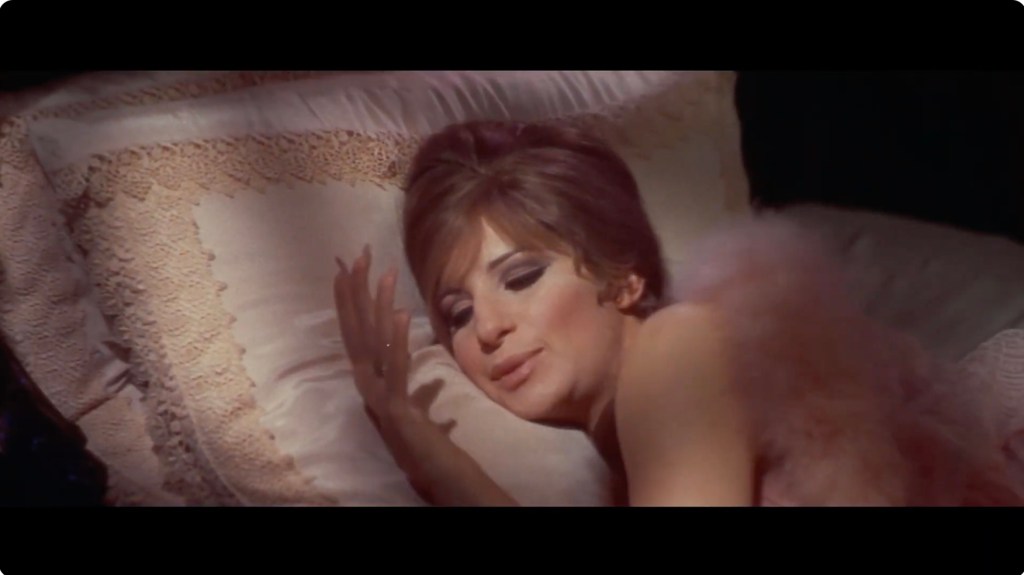
The clip can viewed at this link:
https://www.youtube.com/watch?v=h51msoRqLSo
Ralph and Sadie lived lives anchored in two locations which were not very far apart from each other, on the east side of Cleveland. Their first census finds them living on 2164 Stearns Road, near an area referenced as University Circle. This neighborhood is famous for being a somewhat posh cultural hub. It was then and is now, “a busy cultural hub with institutions like the Cleveland Natural History Museum and the Museum of Contemporary Art, a modern mirrored structure with regularly changing exhibitions. Severance Hall hosts performances by the Cleveland Orchestra, and paths wind past roses and maple trees at the Cleveland Botanical Garden.” It is also the home of the famous Cleveland Museum of Art. (See footnotes).
However, trying to document this exact location sent us on a bit of an adventure, since urban renewal has altered the character of the section where they lived. In fact, it’s just about impossible to specifically map this, but we do know how to describe it.

1930 Census of Euclid, Cuyahoga County, Ohio. Note that Ralph’s cousin Leo is living with them.
The postcard image below characterizes what Stearns Road was like then. It shows the Normal School, located about one block from their apartment building. Since we know the address they lived at, the Cleveland City Directory for 1930 led us to a man named Dewey M. Cupps (unrelated to our family), who lived at that location. Perhaps he lived there just before they did since the 1930 Directory material would have been gathered before the 1930 Census? Did they know each other? What was especially interesting for us was this anecdote we came across regarding Mr. Cupps and his family: “In 1930 he and his wife and their daughter lived in an apartment they were renting for $35 a month at 2164 Stearns Road in Cleveland, OH. They did have a radio. He worked as a motorman for a street railway.” Interestingly, that $35 rent would translate to about $625 in today’s money, and would never cover the current cost of rent in that area in today’s market. (So it seems that, Mr. Cupps had a good deal then!)
The Cleveland City Directory for 1932 lists Sadie and Ralph by name and indicates that he works as a foreman at the Dairymens Milk Company in Cleveland. The 1930 census had listed him as an auto mechanic, so he must have changed jobs. He worked for the Dairymens Milk Company for many years.

Bottom: The Dairymens Milk Company where Ralph White worked in 1932. (See footnotes).
The throes of the Great Depression occured during the 1930s. The following excerpt from History.com gives a brief description of the Great Depression suffered by many, (see footnotes).
“The Great Depression was the worst economic downturn in the history of the industrialized world, lasting from 1929 to 1939. It began after the stock market crash of October 1929, which sent Wall Street into a panic and wiped out millions of investors. Over the next several years, consumer spending and investment dropped, causing steep declines in industrial output and employment as failing companies laid off workers. By 1933, when the Great Depression reached its lowest point, some 15 million Americans were unemployed and nearly half the country’s banks had failed.” (1)
Euclid Was Once Vineyards
In the 1930s, the White family had moved to the nearby Cleveland Metro area known as Euclid. We have always thought of Euclid as a community given over to much small industrialization. However, 50 years earlier it was quite different. “In the 19th century, the area was largely agricultural. Over 200 acres were given over to vineyards in the 1880s.” (Case Western Reserve University)
“By the turn of the 20th century, winemaking was thriving in Ohio, with dozens of wineries located along the shores of Lake Erie and thousands of gallons of wine produced in this region. The area’s reputation for delicious wines increased vineyards throughout southern Lake Erie, which became famous as the Lake Erie Grape Belt. Despite Prohibition, which effectively wiped-out winemaking in Ohio…” (The History of Wineries and Vineyards in Ohio)
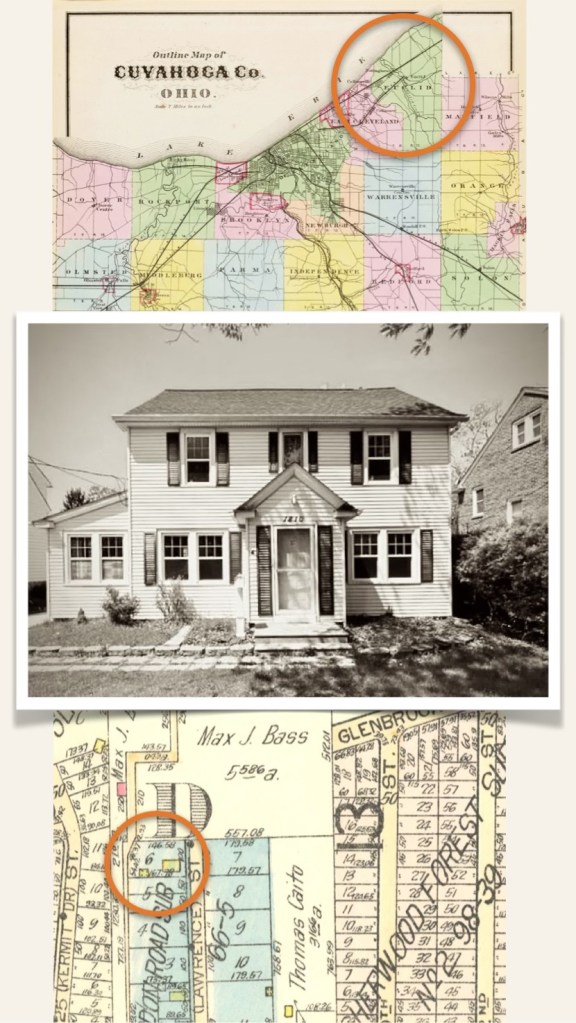
Center: 1810 East 227th Street home where the Ralph White family lived for more than 25 years.
Bottom: That exact street location for the home. (See footnotes).

1940 Census of Euclid, Cuyahoga County, Ohio.
The 1940 Census finds Ralph and Sadie as parents with two young children, Alice Ada (9) and Wayne (3). Ralph is still working at the Dairymens Milk Company. By the time of the 1950 Census, their children are teenagers and daughter Alice is attending high school. Ralph is now working as a garage manager in an auto repair business, and Alice is working as a switchboard operator. (2)

1950 Census of Euclid, Cuyahoga County, Ohio.
What Was Life Like in Euclid During the 1940s and 1950s?
“During World War II, Euclid came to be home to the Tapco defense plant at 23555 Euclid Ave. With that plant came housing projects on East 200th Street and at Briardale Avenue. The post-World War II boom, and the prosperity that went with it, made Euclid an ideal place for families. Neighborhoods were like little villages, boasting their own community centers and activities. Euclid, which had been described as being ‘out in the country’ 15 years earlier, was now a thriving suburb.
With Euclid’s railroad lines and location just beyond Cleveland’s borders, industry poured in. These industries paid taxes, and soon the Euclid Schools rivaled the esteemed Shaker Heights schools as the best in the area. With jobs plentiful and top-notch schools, the population kept on growing.” (Euclid Sun Journal article)

So many previous generations of White family men were farmers… It is interesting to note that Ralph Hiram White seems to have rejected that way of life. Perhaps he didn’t find that path fulfilling as a young man living in rural Middlefield township? His brother Forrest had similarly also decided to not be a farmer, but a postman instead.
Likely, Ralph was also conditioned by the era he was living in, having married in the “Roaring 1920s”. Sadie had always lived in either urban, or suburban environments, so perhaps this was the best way for them to have a happy and successful marriage. We know that people then considered that Euclid was a desirable area to raise a family in. We speculate that they chose that community because it was a good functional midpoint for the both of them: her family was not too far away, his family was not too far away — and so, they located in an area that seemed to be a halfway point and raised their family.
Ralph died in May 1951 at the relatively young age of 55, from cardio vascular renal disease. His wife Sadie lived on for nearly forty more years, passing on in 1989.


Their Euclidian senior high school yearbook photos: Left, Alice Ada (White) Cameron, circa 1950 and Right, Wayne Ronald White, circa 1954.
Alice Ada White married Neil Paul Cameron circa 1957 and they lived in northeast Ohio their entire lives. They did not have children. (See footnotes). Wayne White became our brother-in-law when he married our sister Jo Ann Bond. Their story follows next. (3)
Oh That Matchmaker Marylou!
When Wayne and Jo Ann first met, it was a type of circular story, because it led from suburban Euclid back to rural Geauga County where the White family had long been established. As Ralph White’s son, Wayne had grown up in the somewhat more cosmopolitan suburbs of mid-century Cleveland, in Cuyahoga County. However, it seems that he, unlike his father Ralph, must have had an affection for rural township life. His cousin Marylou Portman (related through his uncle, Forrest White), was the person who initially introduced Wayne to Jo Ann. Jo Ann was a senior at Newbury High School, where she and Marylou were friends. They graduated in 1957.

Wayne Ronald White, born July 1, 1936, Cuyahoga County, Ohio — died [unknown date] 2020, in Chardon, Geauga County. He married [First] Jo Ann Bond, October 5, 1958, in Newbury, Geauga County — divorced November 16, 1977, also in Geauga County. She was born May 9, 1939, in Bedford, Cuyahoga County — died August 6, 2010, Chagrin Falls, Cuyahoga County. (All locations are in Ohio).
Together they had two children:
- Mark Alan White Sr., born 1959
- Wendy Carol (White) Wright, born 1961
This was quite common for their generation…
Wayne and Jo Ann were married for 19 years, having married in 1958, at a young age. Nonetheless, as these things sometimes go, they both evolved and eventually grew apart. They decided to separate, and their marriage ended in a dissolution in November 1977.
In 1978, Wayne married a second time —
Wayne Ronald White married [Second] Sharon L. Stivers, September 16, 1978, Geauga County, Ohio. She was born February 3, 1943. They lived in Middlefield and Claridon townships in Geauga County. (4)

Through the 1960s and 1970s
Wayne and Jo Ann settled in Newbury township, Geauga County. Despite spending his youth in the Cleveland suburbs, he returned to the pattern of his forefathers —by being the third generation of his family to live in Geauga County. As explained in the maps above, the White family kept moving westward across Geauga County township-by-township, generation-to-generation: Middlefield > Burton > Newbury. This started with his Great-Great-Grandfather James White, who was one of the first settlers in the area, having arrived in the Western Reserve sometime before 1810.

He preferred to do manual labor…
Similar to his father Ralph, Wayne literally steered toward jobs that were mechanical in nature. First he was partner at a small Texaco gas station in Newbury, then he went to work for Cleveland Freight Lines driving large semi-trucks as part of a delivery fleet. Lastly, he worked for the Andrews Moving and Storage Company helping others to relocate.
Their family life centered around their children…
Mark and Wendy benefited from many school clubs and extra curricular activities: camping, sports, Boy Scouts and Girl Scouts, and 4-H Clubs, which highlighted the end of summer at the Great Geauga County Fair. This fair “is Ohio’s oldest continuous county fair and home to one of the oldest existing agricultural societies in America. It is held annually in Burton, Ohio every Labor Day weekend as a ‘grand finale’ to the summer. It has been around for more than 200 years…” and “Many of the buildings on the grounds used today date back to the nineteenth century, [and are]listed on the National Register of Historic Places.” (Wikipedia)


Upper left: Wayne, Jo Ann, Mark, and Wendy attending the July 1967 Bond family summer reunion. Upper right: Wendy, Wayne, and Mark at home, circa December 1970. Lower right: Wayne and Mark at the 1970 Great Geauga County Fair in Burton, Ohio. Lower right: Wendy practicing baton twirling in the summer of 1969. (Family photographs).
After the end of the marriage, Jo Ann returned to school to gain the practical skills she needed for gainful employment: she became a travel agent and worked in that vocation for 20 years. In the world then (prior to the vast changes the internet brought to the travel industry), everyone was heavily dependent upon travel agents to coordinate all of their travel needs. As such, travel agents could receive ‘perks’ as part of their employment —where, for example, a cruise ship company might offer a free cruise to an agent so that the travel agent could get to know their product. Thus, Jo Ann traveled extensively throughout the Caribbean, (and likely sold a lot of cruise packages).
Most interestingly, at the beginning of her career she went to the mainland of the People’s Republic of China (PRC) in late 1979, or very early in 1980. At the time, this was rather remarkable. She went as part of a group of travel agents who were among the first travel agents to be in China in many, many decades. Their mission was to learn about the newly-opened culture and to promote travel there.
A bit of background…
From Wikipedia, “From February 21 to 28, 1972, United States President Richard Nixon visited the People’s Republic of China (PRC) in the culmination of his administration’s efforts to establish relations with the PRC after years of U.S. diplomatic policy that favored the Republic of China in Taiwan. His visit was the first time a U.S. president had visited the PRC, and his arrival in Beijing ended 25 years of no communication or diplomatic ties between the two countries.” Further on, “Beginning in 1978 and 1979, Deng Xiaoping promoted the development of tourism for purposes of economic development. As tourism became an important means of obtaining foreign currency for the government, China emphasized its exotic qualities to international tourists.”

Jo Ann recounted that the hotel facilities were not very comfortable, and we remember that the photographs showed many of the Chinese guides dressed in military fatigues while wearing red hats. Her photographs from that time are now lost. The world has changed very much since then, but the photos of her standing on the Great Wall of China were impressive and exciting. (5)
For more about Jo Ann’s life, see The Peterman Line, and A Narrative,
and The Bond Line, A Narrative — Seven.
Four Generations of Women Gathered In One Photo
In the mid-1960s, Four Generations of Women Gathered In One Photo, was taken. That original version featured the matriarch, Lulu (DeVoe) Gore, her daughter Marguerite (Gore) Bond, her daughter Jo Ann (Bond) White, and finally her daughter Wendy White. That was the first time ever that we had been able to document those relationships in one photograph. Alas, just like Jo Ann’s travel photos, any copies seem to be lost.
A little more than thirty years later (as shown below), we again had the opportunity to document an update to Four Generations of Women Gathered In One Photo. This time, Lulu had long ago passed on, and Emily, Wendy’s daughter, was brand new.
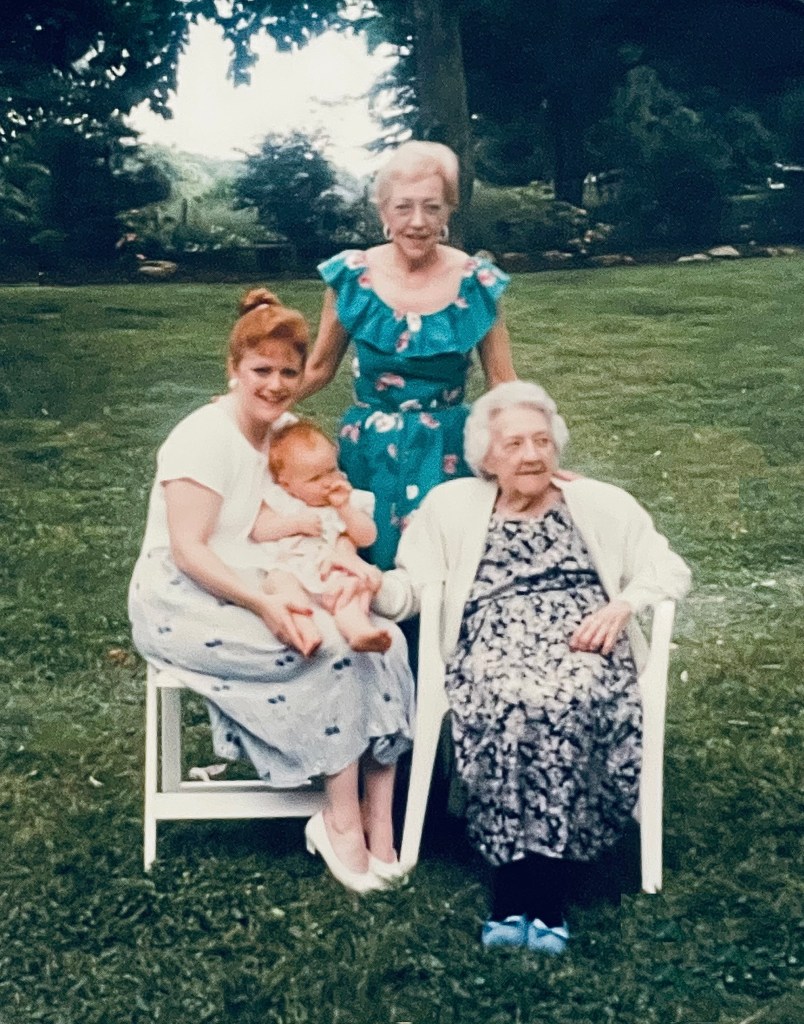
Taken in 1996, it shows four generations of women who have contributed to the White family line. Starting with the eldest person who is seated on the right — our mother, Marguerite Lulu (Gore) Bond, standing in back — Jo Ann (Bond) White. Seated on the left, Wendy Carol (White) Wright, holding her daughter Emily Grace Wright. (Family photograph).
Multiple generations of the White family have enriched our lives. It is because of the endurance and the sacrifices of these ancestors that we are here today — and we thank them for that privilege. (4)
Following are the footnotes for the Primary Source Materials,
Notes, and Observations
“Sadie, Sadie, Married Lady, That’s Me!”
(1) — twenty one records
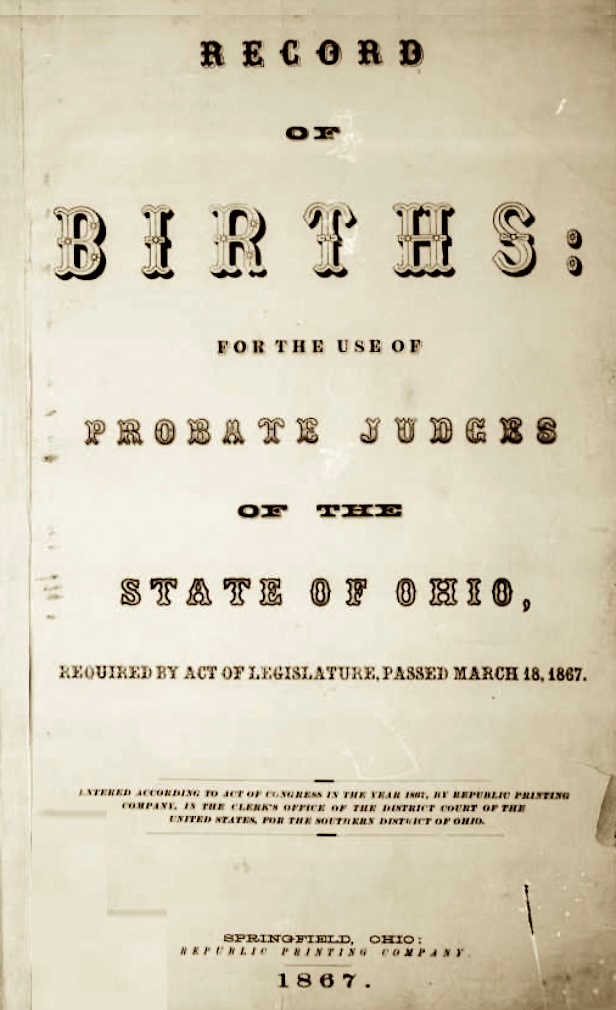
Ralph White
Birth – Ohio, County Births, 1841-2003
https://www.familysearch.org/ark:/61903/1:1:X695-C4C
Book page: 250, Digital page: 159/319, Entry #5526, left page.
Ralph White
in the Ohio, U.S., Births and Christenings Index, 1774-1973
https://www.ancestry.com/search/collections/2541/records/3357416
Ralph H White
https://www.findagrave.com/memorial/42393802/ralph-h-white
Notes: Additional material from the findagrave.com website —
BIRTH: 13 Sep 1895
DEATH: 11 May 1951 (aged 55)
Source: Cleveland Press, Reel #127
“White, Ralph H., 1810 E. 227th St., Euclid, husband of Sadie (nee Hoggarth), father of Alice Ada and Wayne Ronald of Euclid, brother of Blanche Hickox and Forest (deceased).” Name: White, Ralph H., Obituary date: May 12 1951

Ralph Hiram White
Death – Ohio, Deaths, 1908-1953
https://www.familysearch.org/ark:/61903/1:1:X6GK-Q7Q
Note: Death certificate
Ralph H White
in the U.S., Social Security Applications and Claims Index, 1936-2007
https://www.ancestry.com/search/collections/60901/records/3666670?tid=&pid=&queryId=f648f269-693a-4a17-88f3-e67e507d53fb&_phsrc=RGK4&_phstart=successSource
Note: Confirms birth and death dates.
Sarah E. “Sadie” Hoggarth White
https://www.findagrave.com/memorial/68174060/sarah_e_white
Notes: Additional material from the findagrave.com website —
BIRTH: 18 Dec 1898 Toronto, Toronto Municipality, Ontario, Canada
DEATH: 8 Sep 1989 (aged 90) Kirtland, Lake County, Ohio, USA
Date: 1989-09-09
Source: Plain Dealer, pg. 10 sec. D
Sarah E. White
in the U.S., Social Security Death Index, 1935-2014
https://www.ancestry.com/search/collections/3693/records/66932914?tid=&pid=&queryId=049e9dc6-9371-4bba-ac96-7b36ef769db2&_phsrc=Nif12&_phstart=successSource
Notes: Birth, December 18, 1898. Death, September 8, 1989
Sarah E Hoggarth
in the Cuyahoga County, Ohio, U.S., Marriage Records and Indexes, 1810-1973
1901-1925
Reel 076 > Marriage Records 1924 Jul – 1924 Dec
https://www.ancestry.com/search/collections/1876/records/2726617
Book page: 235, Digital page: 235/1000, Last entry on the page.
Notes: Married on August 23, 1924.

Funny Girl | Sadie, Sadie, Married Lady | CineStream
https://www.youtube.com/watch?v=h51msoRqLSo
“A major critical and commercial success, Funny Girl became the highest-grossing film of 1968 in the United States and received eight Academy Award nominations. Streisand won the award for Best Actress for her performance, tying with Katharine Hepburn (The Lion in Winter)… Funny Girl is considered one of the greatest musical films ever. In 2016, Funny Girl was deemed ‘culturally, historically, or aesthetically significant’ by the United States Library of Congress, and selected for preservation in the National Film Registry.”
Newly Renovated Office/Lab Opportunity in University Circle
https://images1.showcase.com/d2/mBtoR0y_n996Dofd0VmNcwhhWgYG6tdWL9LE1rFnQUo/document.pdf
Note: For this text, “…a busy cultural hub with institutions like the Cleveland Natural History Museum and the Museum of Contemporary Art, a modern mirrored structure with regularly changing exhibitions. Severance Hall hosts performances by the Cleveland Orchestra, and paths wind past roses and maple trees at the Cleveland Botanical Garden.”
For the 2164 Stearns Road collage —
Cleveland Public Library Digital Gallery
Cleveland Normal School (postcard)
https://clevelandhistorical.org/index.php/files/show/4265
Cleveland City Directory 1930
https://cplorg.contentdm.oclc.org/digital/collection/p16014coll29/id/41130
Book page: 1960, Digital page: 1952/2206
Note: The apartment is found here, for 2164 Stearns Road.
and
and for the Dewey Cupps reference:
https://www.findagrave.com/memorial/18261196/dewey-marquis-cupps
“In 1930 he and his wife and their daughter lived in an apartment they were renting for $35 a month at 2164 Stearns Road in Cleveland, OH. They did have a radio. He worked as a motorman for a street railway.”
and
Cleveland Public Library Digital Gallery
Cleveland City Directory 1932
https://cplorg.contentdm.oclc.org/digital/collection/p16014coll29/id/11603/rec/6
Book page: 1362, Digital page: 1363/1938
Note: They are listed by name.
Cleveland Memory.org
Dairymen’s Milk Company (plant)
https://clevelandmemory.contentdm.oclc.org/digital/collection/press/id/6651/
Calculate the Value of $35 in 1930
https://www.dollartimes.com/inflation/inflation.php?amount=35&year=1930
Note: In 2024, $35 is worth about $625.
Sarah A White
in the 1930 United States Federal Census
Ohio > Cuyahoga > Cleveland (Districts 251-500) > District 0367
https://www.ancestry.com/search/collections/6224/records/73830227?tid=&pid=&queryId=37ad860c-04ec-407a-b577-c8e0885aea44&_phsrc=Nif2&_phstart=successSource
Book page: 5A, Digital page: 7/40, Entries 47 through 49.
Note: Their home address is: 2164 Stearns Road; location not available to map.
For the 1810 East 227th Street collage —
David Rumsey Map Collection
Outline map of Cuyahoga Co. Ohio
By D. J. Lake, circa 1871
https://www.davidrumsey.com/luna/servlet/detail/RUMSEY~8~1~359116~90125968

and
Cleveland Public Library Digital Gallery:
Plat Book of Cuyahoga County, Ohio Volume 5 (Hopkins, 1927-1943)
https://cplorg.contentdm.oclc.org/digital/collection/p4014coll24/id/4985/rec/9
Then click on this link:
Plate 23, Euclid Village
https://cplorg.contentdm.oclc.org/digital/collection/p4014coll24/id/5011/rec/9
History.com
Great Depression History
https://www.history.com/topics/great-depression/great-depression-history
Euclid Was Once Vineyards
(2) — five records
Case Western Reserve University
Encyclopedia of Cleveland History
Euclid
https://case.edu/ech/articles/e/euclid
“In the 19th century, the area was largely agricultural. Over 200 acres were given over to vineyards in the 1880s.”
The History of Wineries and Vineyards in Ohio
by Sabah Drabu
https://cookingenie.com/content/blog/the-history-of-wineries-and-vineyards/
Sarah White
in the 1940 United States Federal Census
Ohio > Cuyahoga > Euclid >18-128
https://www.ancestry.com/search/collections/2442/records/30166899?tid=&pid=&queryId=83b8a363-f27a-420c-9311-d006f513f017&_phsrc=Nif4&_phstart=successSource
Book page: 1B, Digital page: 2/36, Entries 58 through 61.
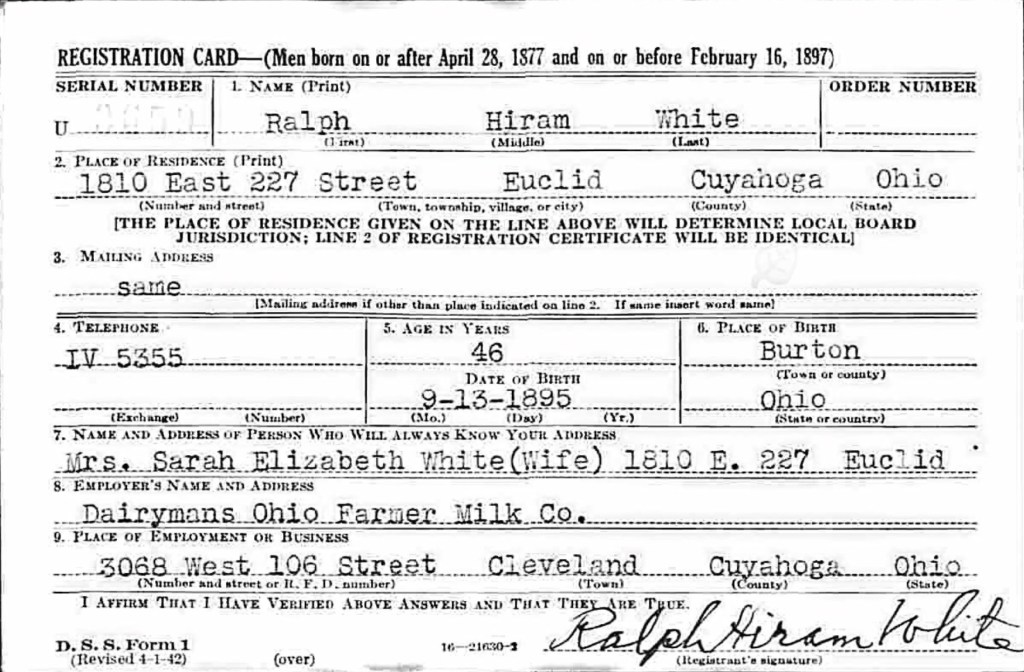
Mrs Sarah Elizabeth White [for husband Ralph]
in the U.S., World War II Draft Registration Cards, 1942
https://www.ancestry.com/search/collections/1002/records/120585725?tid=&pid=&queryId=6c95d513-928b-4847-a09b-30c93a011a36&_phsrc=Nif10&_phstart=successSource
Sadie White
in the 1950 United States Federal Census
Ohio > Cuyahoga > Euclid >18-144
https://www.ancestry.com/search/collections/62308/records/209660545?tid=&pid=&queryId=7458b34d-ee15-4201-924a-7b9230ac8945&_phsrc=Nif6&_phstart=successSource
Book page: 87, Digital page: 92/96, Entries 3 through 6.
What Was Life Like in Euclid During the 1940s and 1950s?
(3) — eight records
Smith’s Restaurant & Cocktail Lounge, Route 283, Euclid, Ohio [postcard]
https://www.digitalcommonwealth.org/search/commonwealth:7p88ck46k
Euclid Sun Journal Had Front Seat to Euclid History
https://www.cleveland.com/euclidsunjournal/2009/07/euclid_sun_journal_had_front_s.html
Euclidian ((Euclid High School yearbook, 1950)
Euclid Senior High School
Alice White
https://archive.org/details/euclidian1950unse/page/28/mode/2up
Book page: 29, Digital page: 628/188, Right page, lower right corner.
Euclidian (Euclid High School yearbook, 1954)
Euclid High School
Wayne White
https://archive.org/details/euclidian1954unse/page/62/mode/2up
Book page: 62, Digital page: 62/218, Right page, upper right corner.
Alice Ada White Cameron
https://www.findagrave.com/memorial/64105413/alice-ada-cameron?_gl=1*1phbsey*_gcl_au*NTk4MzA1ODk2LjE3MzM5MzU2MjE.*_ga*MTg0ODQyNTE3Ny4xNzMzOTM1NjIx*_ga_4QT8FMEX30*MWU3OTQyNzItNWU3OS00NmVlLTgxOWEtZDE2YmY0MTc4MWVjLjIuMS4xNzMzOTQ1ODM0LjQyLjAuMA..*_ga_LMK6K2LSJH*MWU3OTQyNzItNWU3OS00NmVlLTgxOWEtZDE2YmY0MTc4MWVjLjIuMS4xNzMzOTQ1ODM0LjAuMC4w
Notes: Additional material from the findagrave.com website —
BIRTH: 11 Feb 1931 Cleveland, Cuyahoga County, Ohio, USA
DEATH: 4 May 2000 (aged 69) Garrettsville, Portage County, Ohio, USA
and
Alice Ada Cameron
in the U.S., Find a Grave Index, 1600s-Current
https://www.ancestry.com/search/collections/60525/records/23516688
Alice Ada Cameron
in the Ohio, U.S., Death Records, 1908-1932, 1938-2022
https://www.ancestry.com/search/collections/5763/records/45462?tid=856575&pid=6903443108&ssrc=pt

(He was the spouse of Alice Ada White).
Oh That Matchmaker Marylou!
(4) — sixteen records
Jo Ann Bond
in the U.S., School Yearbooks, 1900-2016
Ohio > Newbury > Newbury High School > 1957
https://www.ancestry.com/search/collections/1265/records/410027197
Note: For Home Economics class photograph.
Wayne White
in the Ohio, U.S., Birth Index, 1908-2003
https://www.ancestry.com/search/collections/3146/records/2662040?tid=&pid=&queryId=feab2f32-1670-470c-bd18-a363ff238cb2&_phsrc=LGc3&_phstart=successSource
Wayne White
in the Ohio, U.S., Death Records, 1908-1932, 1938-2022
https://www.ancestry.com/search/collections/5763/records/10516626

Jo Ann Bond
in the U.S., School Yearbooks, 1900-2016
Ohio > Newbury > Newbury High School > 1957
https://www.ancestry.com/search/collections/1265/records/410026838?tid=&pid=&queryId=c818fe2f-0e0e-4e0d-a223-9586cfe7c310&_phsrc=LGc14&_phstart=successSource
Note: For her Senior Class graduation photo.
The following four documents are related to the adoption of Jo Ann Peterman Bond White by Dean Phillip Bond in 1948. The original documents were lost and in 1985, duplicate documents were sourced.
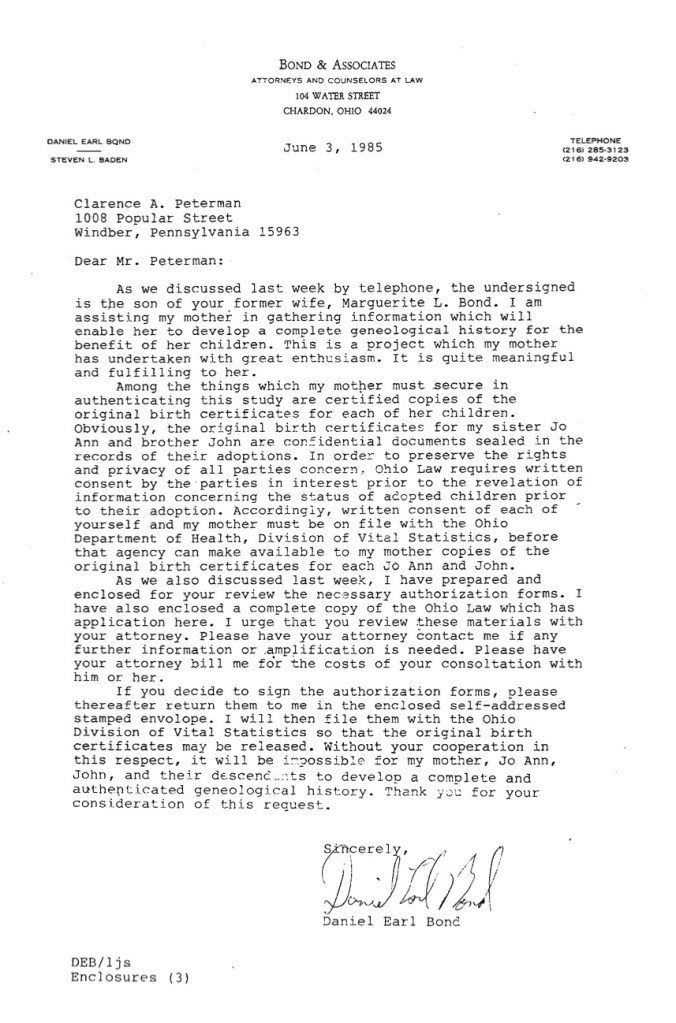
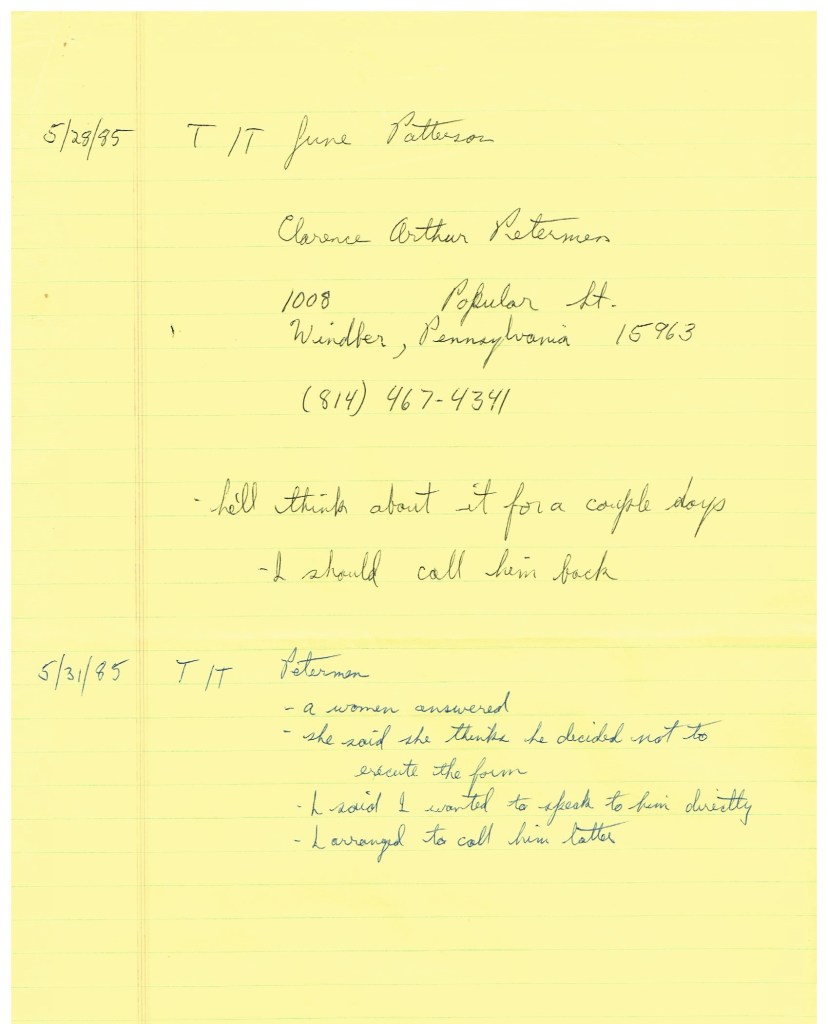
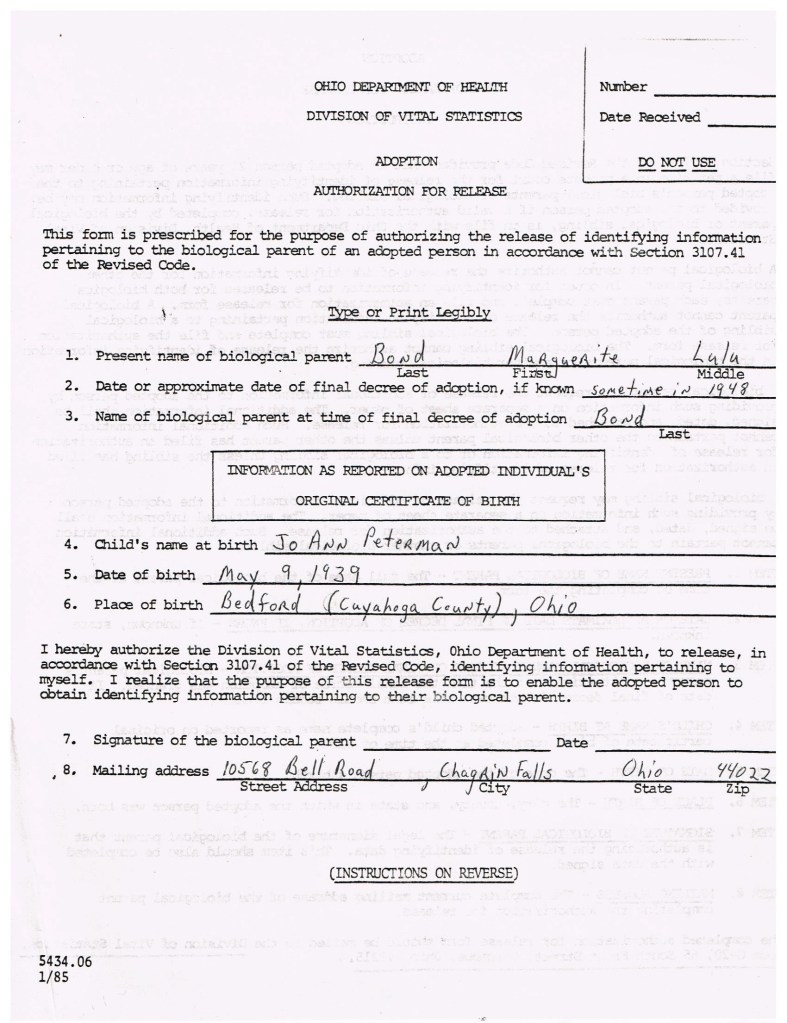

Jo Ann (Bond) White in the Ohio, U.S., Death Records,
1908-1932, 1938-2018
https://www.ancestry.com/discoveryui-content/view/8822354:5763
Wayne R. White
in the U.S., Newspapers.com Marriage Index, 1800s-current
https://www.ancestry.com/search/collections/62116/records/500861666?tid=&pid=&queryId=811f5bdd-b4e7-41f0-a668-8a082aa0ab49&_phsrc=LGc5&_phstart=successSource
Note: For 1958 marriage to Jo Ann Bond.
Wayne White
in the Ohio, U.S., Divorce Abstracts, 1962-1963, 1967-1971, 1973-2007
https://www.ancestry.com/search/collections/2026/records/3176060
Note: For 1977 marriage dissolution with Jo Ann White.
Mark White
in the Ohio, U.S., Birth Index, 1908-2003
https://www.ancestry.com/search/collections/3146/records/7022981?tid=&pid=&queryId=a59f6c5c-a869-4c40-8023-82e483b17e53&_phsrc=zLu2&_phstart=successSource
Note: Certificate #1959093136
Wendy White
in the Ohio, U.S., Birth Index, 1908-2003
https://www.ancestry.com/search/collections/3146/records/7834248?tid=&pid=&queryId=12a00a98-433b-4075-8ff6-dc1ec0a99c9c&_phsrc=zLu5&_phstart=successSource
Note: Certificate #1961098459
Wayne R White
in the Ohio, U.S., Marriage Abstracts, 1970, 1972-2007
https://www.ancestry.com/search/collections/2025/records/794538?tid=&pid=&queryId=42e537cf-aa32-4836-8f72-c1a0b592aef3&_phsrc=LGc2&_phstart=successSource
Note: Marriage 1978 marriage to Sharon L. Stivers.
The National Archives
General Highway Map of Geauga County, Ohio
File:1950 Census Enumeration District Maps – Ohio (OH) – Geauga County – Geauga County – ED 28-1 to 28 – NARA – 26128376.jpg
See The Wonderful World Of Ohio!
1966, Ohio Department of Highways
https://www.oldmapsonline.org/en/Geauga_County,_Ohio?gid=2959dca8-9d79-5d71-914b-651274cf549a#position=9.0073/41.471/-81.263&year=1966
Through the 1960s and 1970s
(5) — five records
1961 Ford HD-1000 Diesel Tractor Truck
https://en.wheelsage.org/ford/h-series_trucks/ford_hd-1000_diesel_tractor_truck
Geauga County Fair https://en.wikipedia.org/wiki/Geauga_County_Fair#:~:text=6%20External%20links-,History,Chardon%2C%20Ohio%20on%20October%2023.
1972 visit by Richard Nixon to China
https://en.wikipedia.org/wiki/1972_visit_by_Richard_Nixon_to_China
Tourism in China
https://en.m.wikipedia.org/wiki/Tourism_in_China
1979 Pan Am Airlines People’s Republic Of China World Tours VTG Travel Booklet
https://www.ebay.com.sg/itm/126864589042





 Our Ancestors, Our Narratives
 - Geauga County - Geauga County - ED 28-1 to 28 - NARA - 26128376.jpg)