The McClintock Line, A Narrative — Seven

This is Chapter Seven of seven, where we conclude the history of the McClintock family. The story of their daughter Clara McClintock, our Great-Grandmother, continues in The DeVoe Line, A Narrative — Ten and Eleven.

The more things change, the more they stay the same…

The arc of experience for this branch of the McClintock family was mostly embodied in the 19th century, and almost all of them were farmers. Even so, change abounded due to the progress of the agricultural sciences, and the invention of the railroad which brought food to market.  In 1790, farmers made up 90% of America’s labor force. By 1850, when Dexter McClintock was new to Ohio, that proportion had shifted, with farmers making up 64% of the labor force. In 1900, when his life had closed, farmers made up 38% of the labor force. (See footnotes). (1)

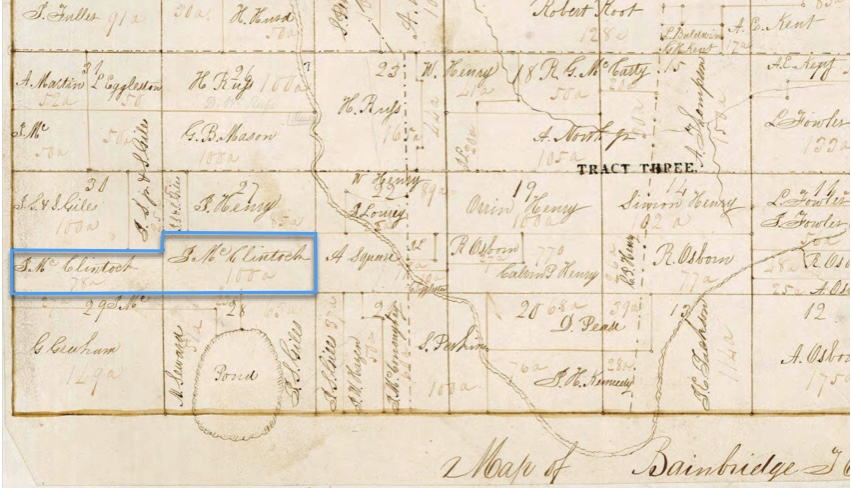
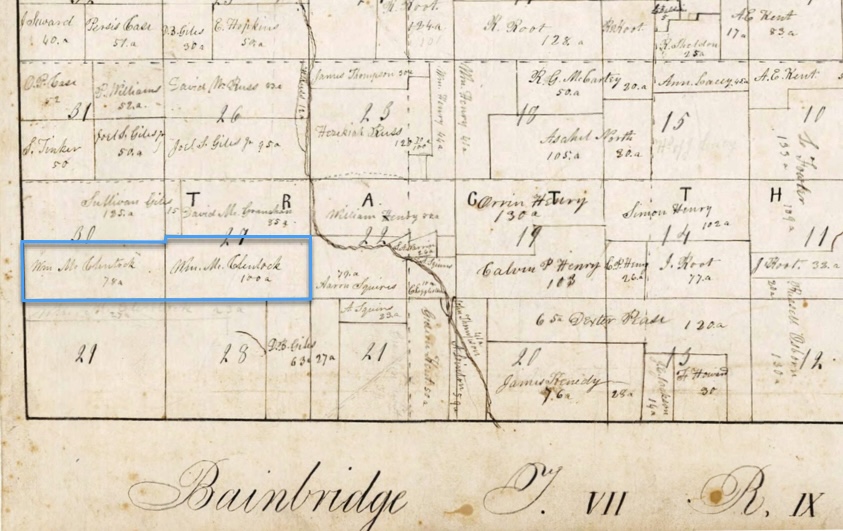
Solon Township, Plate 195 of the Atlas of Cuyahoga County, Ohio, from Actual Surveys by and Under the Directions of D. J. Lake, 1874. (Image courtesy of the Cleveland Public Library Digital Collection).

One Generation To The Next

Our Great-Great-Grandparents are Dexter and Sarah Olive (Dickinson) McClintock. Dexter McClintock, The eighth child & fourth son of James Sr. and Hepzibah McClintock was born August 15,1819 in Phelps, Ontario, New York — died April 12, 1899 in Chagrin Falls, Cuyahoga, Ohio. He married Sarah Olive Dickinson November 6, 1840, in Phelps, Ontario, New York. She was born on April 22, 1822 in Phelps, Ontario, New York and baptized in the Dutch Reformed Church at Howes Cave*, New York on May 19, 1822. She died on September 23, 1906, Novelty, Geauga, Ohio. Her parents were Elijah Dickinson and Elizabeth Bice.
*“Howes Cave is a hamlet in Schoharie County, New York, United States. The community is 5.3 miles east of Cobleskill.” (Wikipedia).

Together they had seven children. Their first child was born in New York state, and the other six children were born in Cuyahoga County, Ohio.

  • Hepzebah A. (McClintock) Martin, born about 1842 in Phelps, Ontario, New York — died after 1911.
  • Milo Alphonso McClintock, born December 30, 1844, Chagrin Falls, Cuyahoga, Ohio — died November 20, 1920, Twinsburg, Summit, Ohio.
  • Walter Ransom McClintock, born October 18, 1848, in Solon, Cuyahoga, Ohio — died June 12, 1924, Sherman, Iosco, Michigan
  • Martha Elizabeth (McClintock) Cochran, born June 13, 1853, Solon, Cuyahoga, Ohio — died July 6, 1925, Solon, Cuyahoga, Ohio
  • Charles D. McClintock*, born November 10, 1856, Chagrin Falls, Cuyahoga, Ohio — died July 22, 1937, Limestone Township, Peoria, Illinois (*Please see extensive notes on Charles McClintock in the footnotes).
  • Clara Antionette (McClintock) DeVoe, born July 14, 1860, Solon, Cuyahoga, Ohio — died September 6, 1932, Chagrin Falls, Cuyahoga, Ohio. (We are descended from Clara).
  • Sarah A. (McClintock) Hoyt, born September 20, 1863, Solon, Cuyahoga, Ohio — died November 15, 1927, Los Angeles, Los Angeles County, California
Destruction of the 1890 Census by the Great Fire of 1921 at the Commerce Department Building
in Washington, D.C. (Image courtesy of raogk.org).

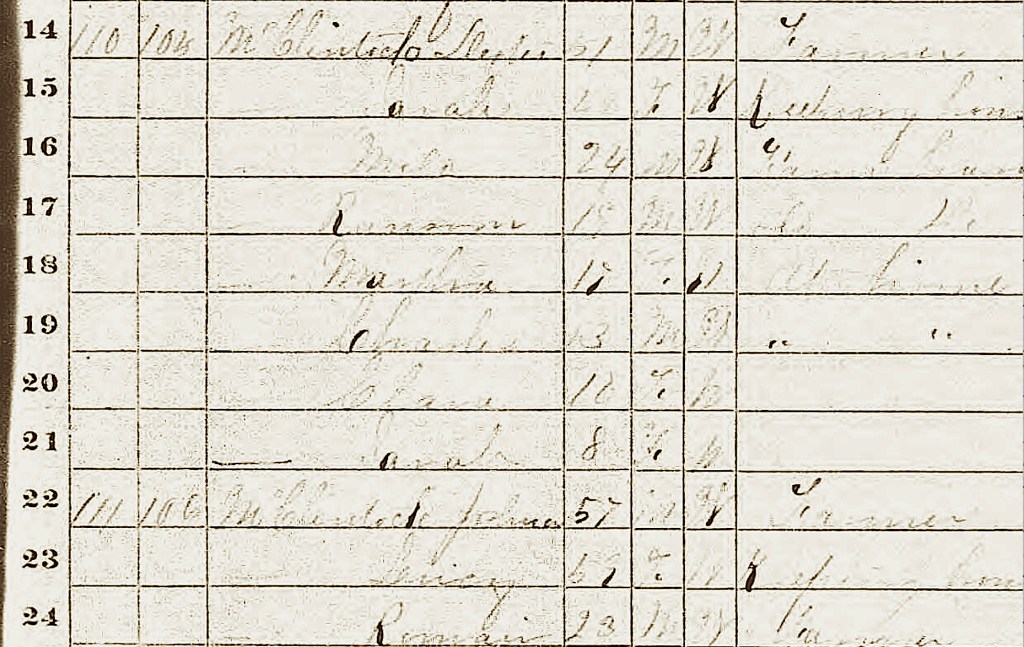
We have four censuses of the family in this area, from 1850 through 1880. Each one shows a prospering and growing family, with some children eventually splitting off as they form families of their own.

Due to a major fire in 1921, and the subsequent water damage, there are almost no 1890 Census records existing. “A January 10, 1921 fire at the U.S. Department of Commerce building in Washington, DC, destroyed the majority of the population schedules from the 1890 Census. The fire left an enormous gap in many families’ genealogical record. Although alternative records may provide some information, the loss of the 1890 Census schedules remains an insurmountable obstacle for many researchers attempting to trace families between the 1880 and 1900 censuses.” (Census.gov)

Dexter died in 1899, so the family census records were lost for him and his wife Sarah. She died in 1906, so there should be a 1900 Census record of her located somewhere. We just haven’t found it, but will continue to look. (2)

This gallery is a collection of images from 19th century Solon, Ohio history. The center image is
“Members of the Chamberlain family… clearing land at what is believed to be their property located on Liberty Road…Other well known families at the time were the McConougheys, and the McClintocks…” (See footnotes for resources).

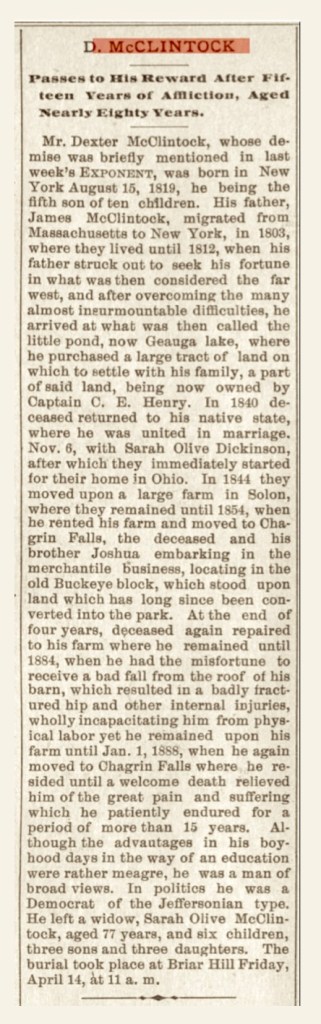
They Were A Well Known Family

The gallery above is designed to evoke a feeling of what the rural and agricultural life of these ancestors must have been like. When they first arrived in the Western Reserve there were almost no roads, so they had to make their own if they wanted to get anywhere. If you wanted to eat, you were the one responsible for growing most of your own food. (This was similar to the wilds of New Hampshire their forebears had encountered when they arrived from Scotland). Things had evolved over the 170 years — there were some opportunities for education, and there were some small stores for sundry items. However, life was still very agricultural.

We think of Dexter and Sarah’s lives as being slow-and-steady, generation-to-the- next-generation. For example, he never seemed to miss a property tax payment. We have observed over 25 years of property tax payments made on the properties shown in the Solon map — starting in 1844, through 1880. (Dexter also made some property tax payments in the nearby township of Chagrin Falls in the 1850s, so they probably lived there during part of their lives together).

Solon, Cuyahoga County, Ohio, Property tax payment for, 1844

He must have been well respected in the community, because he was identified in The Western Reserve Register for 1852 as the Constable for that year. Observation: Here again he seems to demonstrate his same principle of stepping-up when necessary: if you wanted good roads, healthy food, a safe community… you had be to be responsible for that yourself.

The Western Reserve Register for 1852, announces in the last line that Dexter McClintock is Constable for the year 1852.

“Duly sworn Ohio constables are considered peace officers under Ohio law… The office developed from its British counterpart during the colonial period. Prior to the modernization of law enforcement in the middle 19th century, local law enforcement was performed by constables and watchmen. Constables were appointed or elected at the local level for specific terms and, like their UK counterparts the Parish Constable, were not paid and did not wear a uniform. They were often paid a fee by the courts for each writ served and warrant executed. Following the example of the British Metropolitan Police established in 1829, the states gradually enacted laws to permit municipalities to establish police departments.” (Wikipedia) (3)

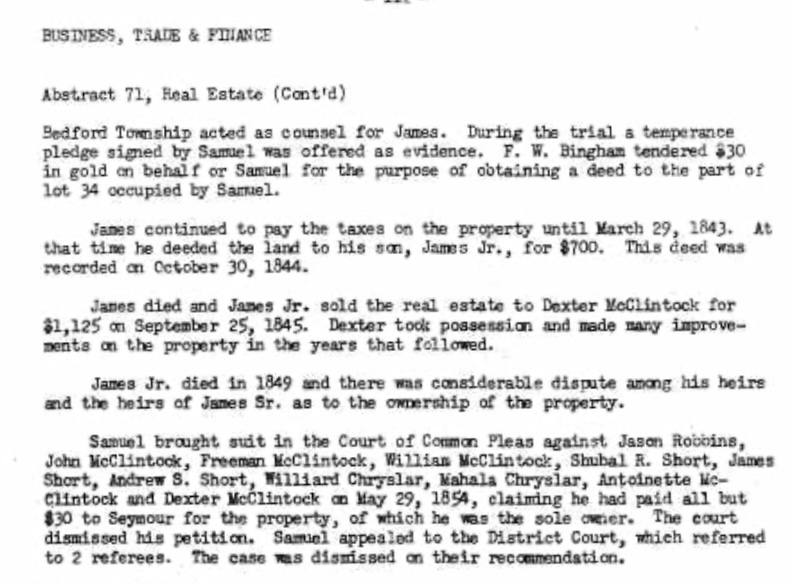
Annals of Cleveland, Volume II, Abstract 71, Real Estate

The 1850s weren’t drama free for this family — they got a jump start on their own rehearsal for The Civil War. This was a case that pitted one brother against another brother with his two sons.

In the previous chapter, we wrote about tippling. As we know in this modern era, an occasional alcoholic drink is fun, and with moderation, not a problem. Unfortunately, some people may be more persuaded to drink by their genetics, life experiences, or both. This was the case with 3x Great Grandfather, James McClintock Sr.’s brother, Samuel McClintock. We believe Samuel was the first family member to arrive in the Solon area, because he was paying property taxes as early as 1831. But this case started earlier than that…

An example of an 1806 handbill advertising land sales. (Image courtesy of the Library of Congress).

The following paragraphs and timeline describe the history of this court case and are taken directly from the abstract.

July 1829
Charles Seymour, a resident of Canandaigua, New York and agent of the State of Connecticut, in July 1829 issued a printed hand bill describing lands of the state which were for sale.

April 1830, until November 1830
Seymour agreed on April 27, 1830 to give Samuel McClintock, [who was] the owner of a farm in Manchester, Ontario County, New York, his selection of any tract of 125 acres listed on the hand bill [for land in Ohio] and $400 in cash in exchange for the Manchester farm. Samuel made his selection on November 8, choosing part of lot 33 and the west end of lot 34 in Solon Township, Ohio. (See the map below).

Dexter McClintock property as shown in this excerpted inset image from Solon Township, Plate 195. The property to the north belongs to his brother Joshua John (J.J.) McClintock. The lot to the west belongs to Romain Steward (R.S.) McClintock, who we infer is the grandson of Joshua John.

December 1830, until October 1832
The deed to the Ohio land was executed on December 16 by Isaac Spencer, treasurer of Connecticut, and sent to Seymour. Samuel desired to make an arrangement with [Samuel’s] brother, James McClintock Sr., for an interest in the property and asked for a new deed in James’ name. Since the state treasurer had already passed title to Samuel, it was impossible to make a new deed. Samuel moved from New York State to Michigan about October 1832.

November 1832, until May 1834
Under Samuel’s instructions, Seymour held up delivery of the deed until James should pay $30 still due to Seymour, which amount Samuel had lent his brother. James complied and Seymour delivered the deed to James on November 21, 1832 and also drew a separate deed to be executed by Samuel to James. Samuel signed the deed on July 5, 1833 and it was recorded on May 30, 1834.

About 1836
Samuel reputedly was a heavy drinker and lost his property in New York and in Michigan because of that habit. He moved to a farm near Parma [Ohio] about 1836. Later James permitted him to occupy a small piece of lot 34 near Solon. It was agreed between the brothers that Samuel could stay on the property for his lifetime, or purchase it at its cost price, if he would join a temperance society. At that time Samuel was a widower.

A temperance pledge signed by those who pledge to stop or reduce their use of alcohol, similar to those common during the 1830s and 1840s. (Image courtesy of Virginia Commonwealth University).

1841, until October 1844
In 1841 James [Sr.] sued Samuel for forcible entry and detainer in the court of Justice of the Peace Simeon D. Kelley of Solon Township… During the trial a temperance pledge signed by Samuel was offered as evidence. F. W. Bingham tendered $30 in gold on behalf or [of?] Samuel for the purpose of obtaining a deed to the part of lot 34 occupied by Samuel. James Sr. continued to pay the taxes on the property until March 29, 1841. At that time, he deeded the land to his son, James Jr., for $700. This deed was recorded October 30, 1844.

September 1845, until January 1854
James [Sr.] died [in September 1845] and James Jr. sold the real estate to [his brother] Dexter McClintock [our ancestor] for $1,125 on September 25, 1845. Dexter took possession and made many improvements on the property in the years that followed. James Jr., died in 1849.” [Correction, the actual date James Jr. died is January 1, 1854].
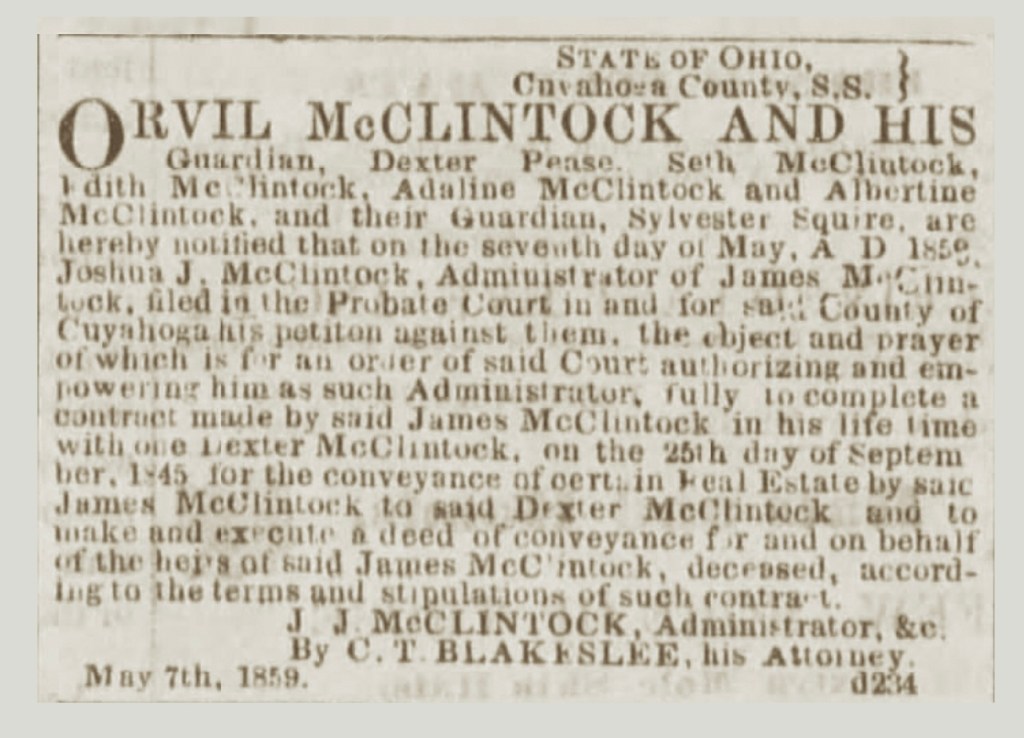
Legal Notice, published in: The Cleveland Leader, on Wednesday, May 18, 1859, page 2. We see that some of the late James McClintock Jr.’s children (Orvil, Seth, Edith) are listed.

May 1859
This legal notice was published about five years after the court proceedings. We don’t know why specifically, but speculate that perhaps some of the children were getting older and the court required this?

Comments: Outside of his reputed tendency to drink, we don’t understand what the motivation was by Samuel McClintock for the lawsuit. The facts seem pretty clear as to the history of events. Not to be too cynical, but it seems quite likely to have been about his need for money after all of his various failures and disappointments. (4)

We Hear That She Liked To Be Called Clarrie

Our Great Grandmother, Clara Antionette (McClintock) DeVoe is someone that we don’t know much about, even though we seem to know much about everyone else around her. She was Dexter and Sarah’s second youngest daughter, born July 14, 1860 and grew up in Solon, Ohio.
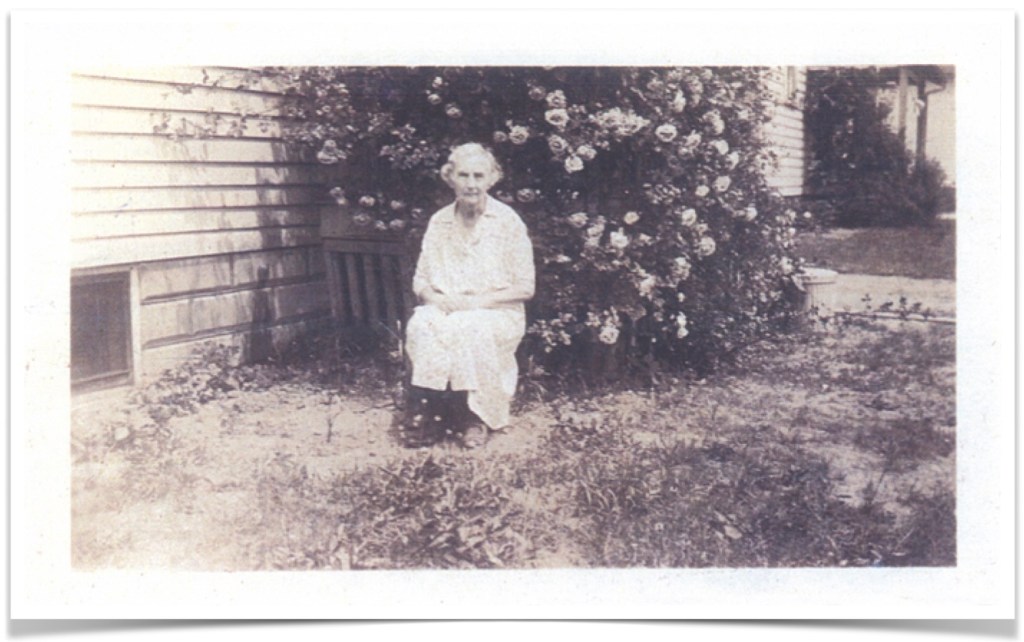
Clara DeVoe in her later years, circa 1920s. (Family photograph).

On November 18, 1877, our Great Grandfather Clinton DeVoe, married Clara Antoinette McClintock in Solon, Ohio. She died on November 6, 1932 in Chagrin Falls, Cuyahoga, Ohio. (5) Together they raised five children: George, Lulu (our grandmother), Anna, Lena, and Nell.

Clinton DeVoe and Clara McClintock marriage license, 1877.

For more about Clara’s life, please see the chapters, The DeVoe Line, A Narrative — Ten and Eleven.

Following are the footnotes for the Primary Source Materials,
Notes, and Observations

The more things change, the more they stay the same…

(1) — two records

Book Browse
Well-Known Expressions
“The more things change, the more they stay the same”
https://www.bookbrowse.com/expressions/detail/index.cfm/expression_number/483/the-more-things-change-the-more-they-stay-the-same#:~:text=The%20first%20recorded%20use%20of,French%20novelist%2C%20critic%20and%20journalist.

Quora
How did we go in the United States from 90 percent of people being farmers two centuries ago to less than 2 percent today?
https://www.quora.com/What-is-the-percentage-of-people-in-the-US-that-worked-in-agriculture-in-the-1800s#:~:text=By 1850, farm people made,105.7 million, the report said.

One Generation To The Next

(2) — thirty-nine records

Atlas of Cuyahoga County, Ohio,
from Actual Surveys by and Under the Directions
of D. J. Lake (1874)
https://cplorg.contentdm.oclc.org/digital/collection/p4014coll24/id/502/
and
Plate 195 Solon
https://cplorg.contentdm.oclc.org/digital/collection/p4014coll24/id/493
Note: For the map image.

Dexter McClintock
in the Web: Ohio, Find A Grave Index, 1787-2012

https://www.ancestry.com/discoveryui-content/view/7887384:70559?ssrc=pt&tid=18269704&pid=635845738
and
Dexter McClintock
https://www.findagrave.com/memorial/19154853/mccl

Sarah Olive Dickinson
in the U.S., Dutch Reformed Church Records in Selected States, 1639-1989

New York > Howe’s Cave > First Reformed Church, Records, 1810-1919
https://www.ancestry.com/discoveryui-content/view/2267436:6961
Book page: 82, Digital page: 36/55 Left page, entry 61.
Notes: Parents are Elijah Dickinson and Elizabeth Bice. Birth date: April 22,1822, and baptism date: May 19, 1822.

Howes Cave, New York
https://en.wikipedia.org/wiki/Howes_Cave,_New_York

Sarah Olive McClintock
in the U.S., Find a Grave Index, 1600s-Current

https://www.ancestry.com/discoveryui-content/view/95142176:60525?tid=&pid=&queryid=0c1a50eb-796e-4a47-aaa6-c928ab070a29&_phsrc=mZH1&_phstart=successSource
and
Sarah Olive Dickinson McClintock
https://www.findagrave.com/memorial/97413613/sarah-olive-mcclintock

Hepzebah A. (McLintock) Martin
in the 1850 United States Federal Census

Ohio > Cuyahoga > Solon
https://www.ancestry.com/discoveryui-content/view/13455018:8054?tid=&pid=&queryId=24fb4c69-b8cb-4ccf-a1e0-6fe3f4a86964&_phsrc=Lgc11&_phstart=successSource
Notes: This record cites her age as 10 years old and her birthplace as New York State. She is also known as “Hepsie” throughout her life.
Digital page: 20/30, Entries 6 through 9.

Research about Hepzebah A. (McClintock) Martin: The first record we have of her is the 1850 census, and it unclear to her in her history what her birth year actually is.

  • 1860 Census: Michigan, married to William Martin, has a one year old daughter named Adele, and revises her birth year to be 1839 in Ohio. She is living in Michigan near her Great Uncle Freeman McClintock’s family, and other McClintock relatives in the area.
  • 1870 census, she cites birth year as about 1836 in New York, and is living right next door to the Freeman McClintock family.
  • 1880 and 1910 censuses, she claims her birth year to be 1842 in New York
  • 1911, listed in a Detroit, Michigan directory as a widow of William Martin
  • Death by 1930, her death and maiden name are confirmed on her daughter Adele’s death certificate.

Milo Alphonso Mcclintock
Death – Ohio Deaths, 1908-1953

https://www.familysearch.org/ark:/61903/1:1:X8GD-385
and
Milo Alphonse McClintock
in the U.S., Find a Grave Index, 1600s-Current
https://www.ancestry.com/discoveryui-content/view/71580788:60525?ssrc=pt&tid=18269704&pid=635866426
and
Milo Alphonse McClintock
https://www.findagrave.com/memorial/114531073/milo-alphonse-mcclintock
Note: For his birth and death dates.

Wallie R Mc Clintick
in the Michigan, U.S., Death Records, 1867-1952

Certificates, 1921-1945 > 204: Iosco
https://www.ancestry.com/discoveryui-content/view/3230051:60872?tid=&pid=&queryId=619697c6-78c6-4abd-8a08-f506d6bb081b&_phsrc=zqx43&_phstart=successSource
Digital page: 327/2300
Note: For his birth and death dates.
and
Walter Ransom Mcclintock
Mentioned in the Record of Oney R Mcclintock (Walter Ransom Mcclintock’s Son)

Death – Ohio Deaths, 1908-1953
https://www.familysearch.org/ark:/61903/1:1:X89H-XQW
Digital page: 2219/3295
Note: For confirmation of his middle name as Ransom.

Martha Elizabeth Cochran
Death – Ohio Deaths, 1908-1953

https://www.familysearch.org/ark:/61903/1:1:X6S8-14F
Note: For birth and death dates.
Digital page: 507/2983
and
Mattie McClintock
in the Cuyahoga County, Ohio, U.S., Marriage Records and Indexes, 1810-1973

https://www.ancestry.com/discoveryui-content/view/2802910:1876
Book page: 115, Digital page: 576/1017, Entry 2.
Note: For their marriage information.

Our research about Charles McClintock: It seems he was married four times and lived in Ohio, Michigan, and Illinois. This affected obtaining accurate birth and death information on him. The history with twelve footnote entries, is as follows:

Charles D. McClintock
in the U.S., Find a Grave Index, 1600s-Current

https://www.ancestry.com/discoveryui-content/view/178374076:60525
Note: For birth and death dates
and
Charles E. McClintock
https://www.findagrave.com/memorial/213188701/charles-e.-mcclintock
Note: For birth and death dates.

Charles McClintock
in the 1860 United States Federal Census

Ohio > Cuyahoga > Solon
https://www.ancestry.com/discoveryui-content/view/43661488:7667?tid=&pid=&queryId=0ccfa077-c465-4643-b42b-2204b2d90758&_phsrc=LFc29&_phstart=successSource
Book page: 50, Digital page: 11/27, Entries 25 through 40.
Note: Inferred birth date is 1856.

Charles McClintock
in the 1880 United States Federal Census

Ohio > Cuyahoga > Solon > 075
https://www.ancestry.com/discoveryui-content/view/44931741:6742?tid=&pid=&queryId=de63bba2-000c-4507-bee6-7e79435ba8fb&_phsrc=LFc40&_phstart=successSource
Book page: 13, Digital page: 13/18, Entries 1 through 3.
Note: Marriage No.1 is inferred, to Phebe. The 1880 census in Rosefield, Peoria, Illinois states that he first married at age 22, which would confirm his birth year as 1856, and confirm that he and Phebe married in 1878.

Charles D. Mcclintock
in the Ohio, U.S., County Marriage Records, 1774-1993

https://www.ancestry.com/discoveryui-content/view/1152821:61378
Book page: 41, Digital page: 207/447, Right side, entry 3.
Note: Marriage No. 2 date is December 29, 1886, to Evangeline Alexander.

Chas D McClintock
in the Michigan, U.S., Marriage Records, 1867-1952

Registers, 1887-1925 > 1911-1915 > 1911 Washtenaw-1912 Barry
https://www.ancestry.com/discoveryui-content/view/651244:9093?tid=&pid=&queryid=af7ab19c-d5ea-4623-a12f-7e366b935c27&_phsrc=LFc11&_phstart=successSource
Book page: 427?, Digital page: 281/656, Left page, entry 78971.
Notes: Marriage No.3 date is July 15, 1911, to Mary S. Beck.
Observation: We wonder if this marriage took place in Detroit because his oldest sister Hepsie (McClintock) Martin was living there?

Charles D McClintock
in the U.S., City Directories, 1822-1995

Ohio > Cleveland > 1916 > Cleveland, Ohio, City Directory, 1916
https://www.ancestry.com/discoveryui-content/view/315294244:2469?tid=&pid=&queryid=91a5df14-4722-4119-9c5a-dcc91c95266c&_phsrc=SqZ35&_phstart=successSource
Digital page: 504/1133, Left page, right column, entry 4 under McClintock.
Note: They are living in Cleveland. This is the last city directory we find for him in Cleveland, Ohio.
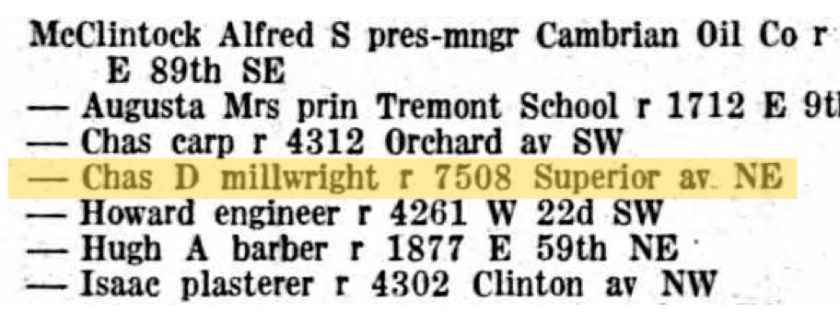
1916 Cleveland, Ohio, City Directory, page 1016.

Mary S Beck McClintock
in the Pennsylvania, U.S., Death Certificates, 1906-1970

1934 > 063501-066500
https://www.ancestry.com/discoveryui-content/view/5290214:5164
Digital page: 1887/3528
Notes: By 1920 she was widowed. It’s unclear if the informer knew her well, but the husband’s name is wrong: Robert John McClintock?, when all other records record Charles D. McClintock.

Mary S Mcclintock
in the 1920 United States Federal Census

Ohio > Cuyahoga > Cleveland Ward 21 > District 0417
https://www.ancestry.com/discoveryui-content/view/104724814:6061
Book page: 13A, Digital page: 25/41, Entries 26 through 28.
Note: By 1920 she is living with her daughter in Cleveland (again); states that she is married. Charles D. McClintock is not on this census.

Charls E Mcclintock
in the 1930 United States Federal Census

Illinois > Rosefield > District 0094
https://www.ancestry.com/discoveryui-content/view/87288507:6224
Book page: 2B, Digital page: 4/16, Entries 65 and 66.

Charles E. McClintock
in the U.S., Find a Grave Index, 1600s-Current

https://www.ancestry.com/discoveryui-content/view/178374076:60525
Note: For birth and death dates.

Charles E. McClintock
https://www.findagrave.com/memorial/213188701/charles-e.-mcclintock
Notes: We believe that his middle initial is actually D, not E, and his actual birth year is 1856.

Clara A De Voe
Death – Ohio Deaths, 1908-1953

https://www.familysearch.org/ark:/61903/1:1:X6SP-PMB
Digital page: 1360/3428
and
Clara A. McClintock
https://www.familysearch.org/tree/person/details/99PJ-5J7
Note: For death certificate birth and death dates.
and
Clara McClintoch
Marriage – Ohio, County Marriages, 1789-2016

https://www.familysearch.org/ark:/61903/1:1:XZ6L-7YN
Note: For marriage date of November 18, 1877 to Clinton Chauncey DeVoe.

Sadie A McClintock
in the Cuyahoga County, Ohio, U.S., Marriage Records and Indexes, 1810-1973

1876-1900 > Reel 011 Marriage Records 1878 Sep – 1881 Jan
https://www.ancestry.com/discoveryui-content/view/2430290:1876?tid=&pid=&queryId=b4ad8a6e-6781-4183-98b3-6d07ddde4add&_phsrc=AQQ34&_phstart=successSource
Book page: 506, Digital page: 507/1030, Entry 1.

Labeled as an Obituary, but it is actually a copy of her death certificate.
https://www.ancestry.com/mediaui-viewer/tree/157973032/person/322095985501/media/d6df20ce-513e-4409-90b1-96b2ea6862a0
Notes: For her birth date in Ohio, and for her death date of November 15, 1927, in Los Angeles, Los Angeles, California.
and
Norwalk. Death Certificates
https://www.familysearch.org/ark:/61903/3:1:3QS7-89SV-MXBV?view=index&personArk=%2Fark%3A%2F61903%2F1%3A1%3AQP7Y-1ZNZ&action=view
Digital page: 1725/2729

Random Acts of Genealogical Kindness
Fate of the 1890 Population Census
https://raogk.org/census-records/1890-fire/

The United States Census Bureau
U.S. Census Bureau History: 1890 Census Fire, January 10, 1921
https://www.census.gov/history/www/homepage_archive/2021/january_2021.html#:~:text=A January 10, 1921 fire,in many families’ genealogical record.

Deytie McLintock
in the 1850 United States Federal Census

Ohio > Cuyahoga > Solon
https://www.ancestry.com/discoveryui-content/view/13455016:8054?tid=&pid=&queryId=81babe28-0b53-493a-a3a8-b2763239de54&_phsrc=NhM1&_phstart=successSource
Digital page: 20/30, Entries 6 through 9.

Dexter McClintock
in the 1860 United States Federal Census

https://www.ancestry.com/discoveryui-content/view/43661483:7667?tid=&pid=&queryId=3c64b783-fd2b-49f0-8bbc-6103316ee9e4&_phsrc=NhM3&_phstart=successSource
Book page: 50, Digital page: 11/27, Entries 35 through 40.

1870 Census, page enhancement for legality:
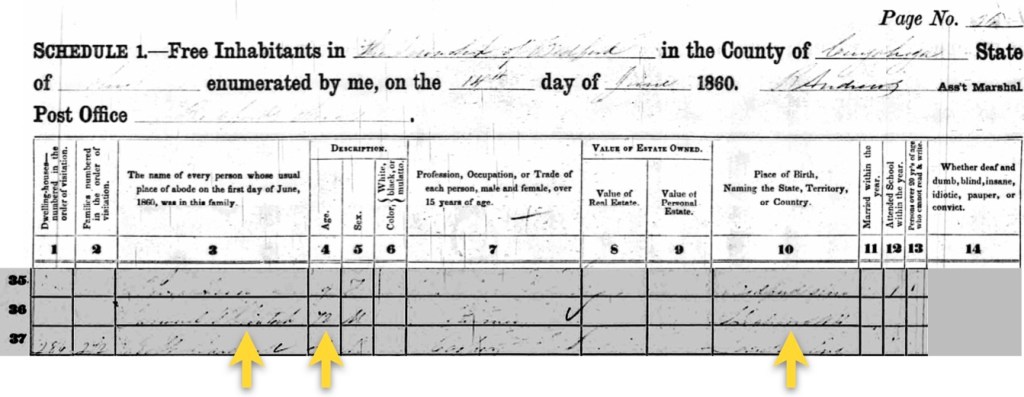
Dexter, 51
Sarah, 48
Milo, 24
(Walter) Ransom, 19
Martha. 17
Charles, 13
Clara, 10
Sarah, 8
Notice that Dexter’s brother Joshua John is living next door.

Dyler Mcclintick
in the 1870 United States Federal Census

Ohio > Cuyahoga > Solon
https://www.ancestry.com/discoveryui-content/view/38891740:7163
Book page: 13, Digital page: 13/23, Entry lines 14 through 21.
Note: The document is barely legible.

Dert McClintock
in the 1880 United States Federal Census

Ohio > Cuyahoga > Solon > 075
https://www.ancestry.com/discoveryui-content/view/25436133:6742
Book page: 13, Digital page: 13/18, Entries 1 and 2.
Note: Observe that Charles is married and living in the home with his wife Phebe.
They Were A Well Known Family

(3) — seven records

It is from the next three footnotes that we gathered images for the Solon Gallery:

Authors, Arsonists and Industry Make Up History of Solon (photos, video):
The stories of our towns

https://www.cleveland.com/solon/2014/07/authors_arsonists_and_industry.html
and
Solon Historical Society
W.P. Trimple General Store
https://www.solonhistoricalsociety.org/2022/08/24/solon-businesses/
and
History of the City
https://www.solonohio.org/DocumentCenter/View/553/Article-II-?bidId=
Note: It is from this document that we saw the comment about the “well thought of nature” of the McClintock family.

The Western Reserve Register for 1852
Townships
https://www.ancestry.com/imageviewer/collections/26616/images/dvm_LocHist011047-00045-0?ssrc=&backlabel=Return&pId=87
Book page: 64, Digital page: 88/229
and
The Western Reserve Register for 1852 : containing lists of the officers of the general governments and of the officers and institutions on the reserve
https://archive.org/details/westernreservere00inhuds/page/n51/mode/2up
Digital page: 52/121, Left panel, center.

Dexter McClintock
in the Cuyahoga County, Ohio, U.S., Tax Lists, 1819-1869

1844-1845
https://www.ancestry.com/discoveryui-content/view/1195948:2100?tid=&pid=&queryId=81650450-8ff3-4ec5-9d61-75b89fe67b89&_phsrc=SqZ1&_phstart=successSource
Digital page: 310/682, Left column, entry 6.
Note: This is the first evidence of a property tax payment made in Solon, Cuyahoga, Ohio.

Constables in the United States
https://en.wikipedia.org/wiki/Constables_in_the_United_States

Annals of Cleveland, Volume II, Abstract 71, Real Estate

(4) — four records

Annals of Cleveland,
Vol. II. Abstracts of the records of court cases in Cuyahoga County
https://www.ancestry.com/imageviewer/collections/28306/images/dvm_LocHist012267-00246-1-0?ssrc=&backlabel=Return&pId=400
Book page: 111-112, Digital page:: 470-471/3048

Notes: these two pages document the facts of the Court Case brought by Samuel McClintock against his brothers.

Library of Congress
[Handbill example]
Lands for sale: the following tracts of land are offered for sale on very reasonable terms…
by Samuel Baird, 1806
https://www.loc.gov/resource/rbpe.15100300/?sp=1

The Second Great Awakening in the United States
https://www.thecollector.com/american-second-great-awakening/
Note: For temperance pledge example.

Legal Notice, found in:
The Cleveland Leader, on Wednesday, May 18, 1859
https://www.newspapers.com/image/78793034/?xid=637&_gl=1*qfra6i*_gcl_au*NDc1NTQ2MzQyLjE3MjE3MjYyNjk.*_ga*MTc5NjEyOTEzMC4xNzIxNzI2MjY5*_ga_4QT8FMEX30*MzE4NjdkMjctNjEyNy00YzQzLTk5OTAtMDg4YTgxZjVhYjNhLjEuMS4xNzIxNzI4MjM5LjEwLjAuMA..*_ga_LMK6K2LSJH*MzE4NjdkMjctNjEyNy00YzQzLTk5OTAtMDg4YTgxZjVhYjNhLjEuMS4xNzIxNzI4MjM3LjAuMC4w
Note 1: The Cleveland Leader, Wednesday, May 18, 1859, newspaper archive, page 2.
Note 2: There are 7 columns on the page from left to right. This is excerpted from Column 6, about halfway down the page.

We Hear That She Liked To Be Called Clarrie

(5) — one record

Clinton C. Devoe
Marriage – Ohio, County Marriages, 1789-2016

https://www.familysearch.org/ark:/61903/1:1:XZ6L-7YF
Book pages: 247, Digital pages: 160/322, Right page, Entry 2.

The McClintock Line, A Narrative — Six

This is Chapter Six of seven. In this chapter, our ancestors who have been in New Hampshire since it was a Province and part of British North America, made the major decision to move Westward. They packed their belongings and left New Hampshire and headed to New York State.

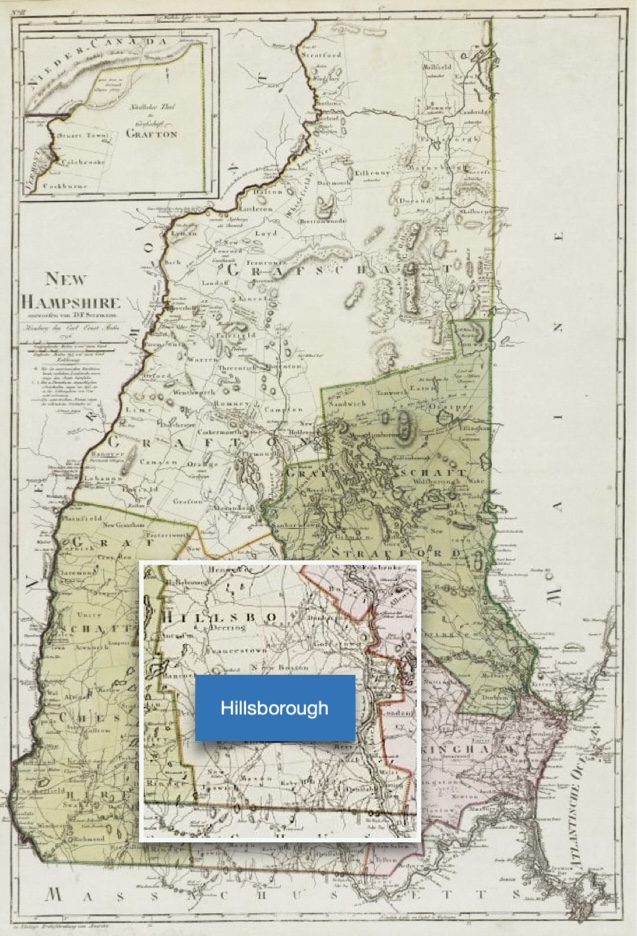
The Sotzmann-Ebeling Map of New Hampshire, Circa 1796. (Image courtesy of Boston Rare Maps).

Be Fruitful and Multiply

James McClintock,(Sr.), born January 3, 1778, Hillsborough (town), New Hampshire Province — died September 1845, Bainbridge, Geauga, Ohio. He married Hephzibah Jones in circa 1803, in New Hampshire. She was born in 1784, in New Hampshire Province — died July 13, 1871, Laingsburg, Shiawassee, Michigan. They had nine children. The first five were born in Hillsborough (town), Hillsborough, New Hampshire.

  • Thirza (McClintock) Taylor, born about 1807, Hillsborough (town), Hillsborough, New Hampshire — died June 25, 1893, Cuyahoga, Ohio.
  • Mahala L. (McClintock) Short, born about 1808, Hillsborough (town), Hillsborough, New Hampshire — died June 29, 1827, Phelps, Ontario, New York
  • Dr. Freeman Brazilla McClintock, born October 28, 1811, Hillsborough (town), Hillsborough, New Hampshire — died March 18, 1882, Laingsburg, Michigan
  • Sarah (McClintock) Short, born about 1812, Hillsborough (town), Hillsborough, New Hampshire — died August 10, 1872, Solon, Cuyahoga, Ohio
  • Joshua John McClintock, born about July 29, 1814 — died July 23, 1892, Solon, Cuyahoga, Ohio
  • The last four were born in two locations in New York State:
  • James McClintock (Jr.), born about 1818, Phelps, Ontario, New York — died January 1, 1854, Bainbridge, Geauga, Ohio
  • Dexter McClintock, born August 15, 1819, Phelps, Ontario, New York — died April 12, 1899, Chagrin Falls, Cuyahoga, Ohio (We are descended from Dexter.)
  • William McClintock, born August 13, 1821, Lyons* (Arcadia), Ontario, New York — died July 6, 1893, West Union, Fayette, Iowa
    Note: *Wayne County, New York was created in 1823. The Town of Arcadia was formed from the Town of Lyons in 1825.
  • Louisa M. McClintock, born about 1827, Arcadia, Wayne, New York — died after 1870 location unknown (1)
A View of Manchester, N.H. — A lithographic print by J.B. Bachelder, 1855. (Image courtesy of the Library of Congress).

The Censuses of 1800 through 1830 and Their Differences

These censuses are the second, third, fourth, and fifth that the United States had completed. Each year the government was learning a little more about what data it needed to know in able to run the country, and also some new questions to ask. Unfortunately, when we analyze these forms today, we still see many tic marks, but not much detail.

For the 1800 census, James McClintock was unmarried. We do not know with whom he was living in 1800. We are sure in was in Hillsborough, New Hampshire.

The 1810 Census in New Hampshire
Then in 1810, we first encounter the James McClintock family when he and his wife Hephzibah (Jones) McClintock were married and had children living in their home. They were still residing in Hillsborough, New Hampshire where both of them had grown up.

1810 Census excerpt, Hillsborough, New York
Map Of The State Of New York, Published by A. Finley Philadelphia,1824. The yellow circle indicate the area within which they lived during the 1820s. (Image courtesy of the Internet Archive).

The 1820 Census In New York
By 1820, they have more children and have left New Hampshire behind them. They are now living in the town of Phelps, Ontario County, New York. The reasons that they left New Hampshire are unknown, but there was a large westward migration already occurring in this era. Perhaps they were seeking additional farmland because arable land meant prosperity to farmers. James’s brother Samuel either came with them, or he was already in New York State, which may be one reason why they moved there — there was a family connection.
1820 Census excerpt, Phelps, New York. Note James as entry #738, and his brother Samuel as entry #739.

The 1830 Census In New York
It appears that the family has moved locally from the town of Phelps in Ontario County, to the town of Arcadia, just slightly north in the new (April 1823) Wayne County. This is the first Federal census we see where there is an actual printed form for the census taker to utilize for consistency. Prior to this, many census takers just made up their own forms trying to adhere to guidelines they were given.

1830 Census excerpt, Arcadia, New York. We overlaid it on an 1830 period accurate template for category clarity.

We also know that by this time, James’s brother Samuel had left New York state and moved further west to the Ohio Country, where he was paying property taxes as early as 1831 in what is now Solon, Ohio. We already had members of other family lines living in this area, but we believe that it’s plausible that he was the first member of the McClintock branch of our family to arrive there. We also understand that he was quite the drinker… (2)

1831 Property tax record for Samuel McClintock in Solon, Cuyahoga, Ohio.

Let’s Pause A Moment for Some Refreshment, Shall We?

As we learned from the census, for a portion of the 1820s and at the beginning of the 1830s, the James McClintock Sr. family lived in New York State. We came across an interesting account of what it was like to live in Arcadia, New York during this period —

“Up to 1830 the state of temperance was bad enough. Within a distance of three miles along Mud creek there were four distilleries, operated by Harrison, Luce, Sherman, and Mansfield. Whisky was sold as low as twenty-five cents a gallon, and was drank on all occasions. Whether at general training, Fourth of July, logging-bee, raising, or harvesting, the liquor was freely used. It stood upon the sideboard to treat the casual visitor and teacher, doctor, and preacher were alike accustomed to potations from the cup. Ladies met to help along a quilting, and the “sling” imbibed made conversation spirited. If any failed to provide this stimulus it was made a subject of sharp comment. As years went by, a feeling prevailed that this system should be broken up. A preacher found intoxicated was dismissed, and in the county medical society a member accustomed to using liquors to excess was expelled. Still, tippling was common in taverns and in groceries.”

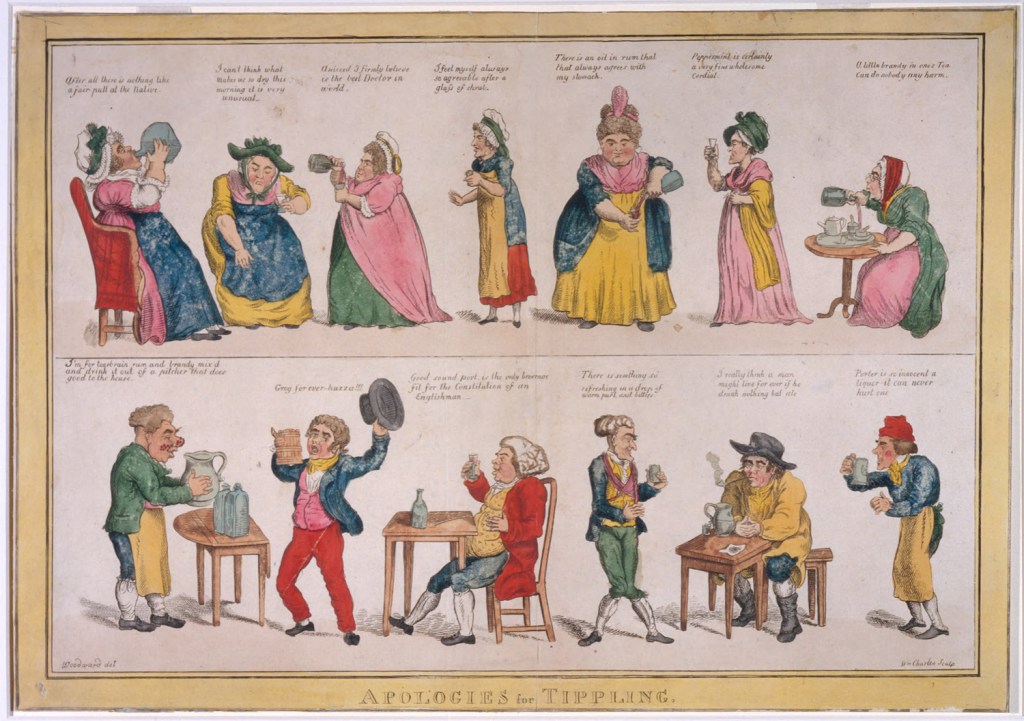
“Apologies for Tippling” by William Charles and George Moutard Woodward, circa 1800. This political cartoon shows some of the many reasons people found for “tippling” or drinking excessively. Courtesy of the Library Company of Philadelphia.

Some of our ancestors were Pilgrims, some were Quakers, some were Presbyterians, some were Catholics — and some were, …non-conformers.

“For the colonists of the 1600s and 1700s much of daily life was filled by tiring drudgery, but throughout the long hours of the work day, beer, cider, rum, and other intoxicating beverages provided a dependable source of comfort. Each day was supplemented by a generous allotment of alcoholic beverages imbibed from their waking hours all the way through the late evening. As author Corin Hirsch states in Forgotten Drinks of Colonial New England, “From breakfast cider to afternoon beer to evening flips, toddies and glasses of Canary wine, alcohol lubricated almost every hour of every day.” Drinking accompanied a diverse range of occasions that often took place in taverns, or during meals, work breaks, business meetings, weddings, funerals, trials, and legislative sessions. Daily, day-long “tippling” was simply a fact of life in the colonial period.

While this behavior may be frowned upon in the modern era, colonials viewed the constant intake of liquor as a necessary and beneficial practice. Despite a lack of scientific understanding, the early settlers of North America knew that drinking from certain water sources could make a person deathly ill. Without proper sanitation practices or a way of discerning contaminated water from clean, they largely avoided it, instead seeking hydration from beverages unintentionally sanitized through the processes of fermentation and distillation. Alcohol was not only potable, but also was seen as a healthy, invigorating substance, which was even used in the treatment of disease. While the relatively staid puritan communities of New England such as Windsor admonished drunkenness, they hailed alcohol as the “good creature of God”. (Windsor Historical Society)

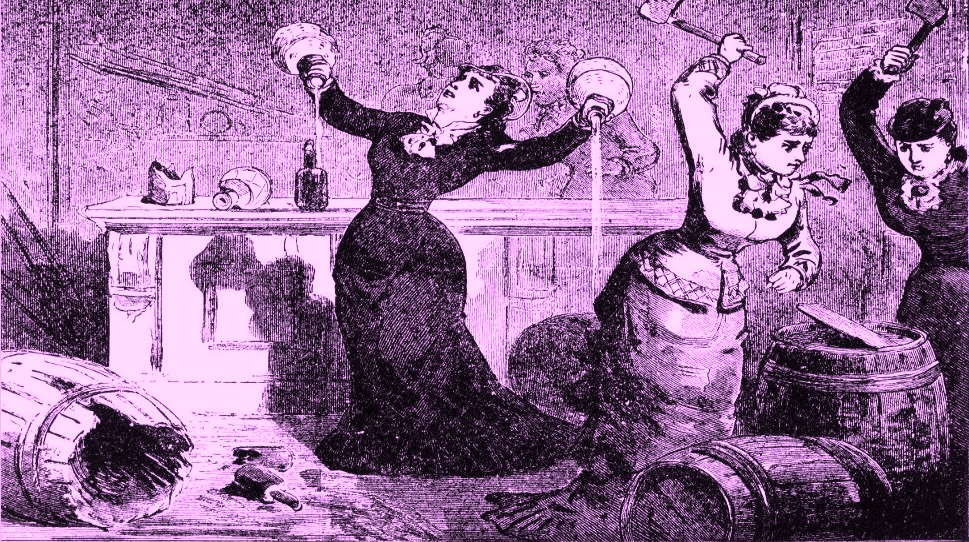
“A woman’s liquor raid – How the ladies of Fredericktown, Ohio, abolished the traffic of ardent spirits in their town.” Line engraving from the Police Gazette.

Observation: James McClintock Sr.’s 2x Great Grandfather Thomas Mclintoch of Glasgow had been a “Maltman” (a brewer), and his Grandfather William McClintock was fond of his homemade “rhum”…so, it seems like “tippling” probably ran through the veins of the McClintock family. Despite this, Freeman McClintock maintains in his biographical profile that his “parents instilled into the minds of their children principles of morality and religion.” Perhaps his uncle Samuel never got that family message.

It’s compelling to ponder ‘about how many’ of our ancestors were likely tipplers, and how over the decades, this behavior paved the way for future temperance movements. (3)

And Back to The Census…

The 1840 Census in Ohio
After decades of censuses in other locations, the McClintock family has immigrated in en masse to the Western Reserve of Ohio. We’ve been able to determine through tax records (starting in 1833) that along with James and his wife, most of their adult children also relocated to this area of northeast Ohio.

1840 Census excerpt, Bainbridge, Ohio.

The census above is for the father James McClintock, Sr. who was living in Bainbridge township at the time of the census. On another 1840 census his son James Jr. and other siblings lived in Solon township. (4)

Map of the Western Reserve Including the Fire Lands 1826. On this map, Geauga County is still combined with the future Lake County and Solon and Bainbridge townships are colored yellow. (Image courtesy of Wikimedia Commons).

The Western Reserve of Ohio

In the early part of the 18th century, the Ohio Country was frequently referred to as the West, and from the perspective of New Englanders who settled it, it was indeed pioneer country. By the 1830s and 40s, the Western Reserve wasn’t thought of as a frontier anymore, but actually, it still was in many ways.

The Western Reserve area of northeastern Ohio, was originally established as The Firelands of Ohio, created by the Connecticut legislature in 1792 to help compensate her citizens for their losses when some of the towns were ravaged during the Revolutionary War. Connecticut had a history of belief that her manifest destiny was the inherent right of their northern and southern borders to extend from New England all the way to the Pacific Coast. This area was chartered and land sales were managed by the Connecticut Land Grant Company. The company eventually failed, and Connecticut yielded on their idea of manifest destiny, but the Western Reserve endured. Ohio became a state in 1803.

For all of our many ancestors from here, we believe that this is very true — “Following the Revolutionary War, for the next 25 years, Ohio became the primary destination of westward bound pioneers because of the fertile farmland in the Ohio River Valley. Some families stayed for the remainder of their lives.” (Family Search) For the James McClintock Sr. family, when his children were seeking prosperity for their own future families, owning land in Ohio beckoned. (5)

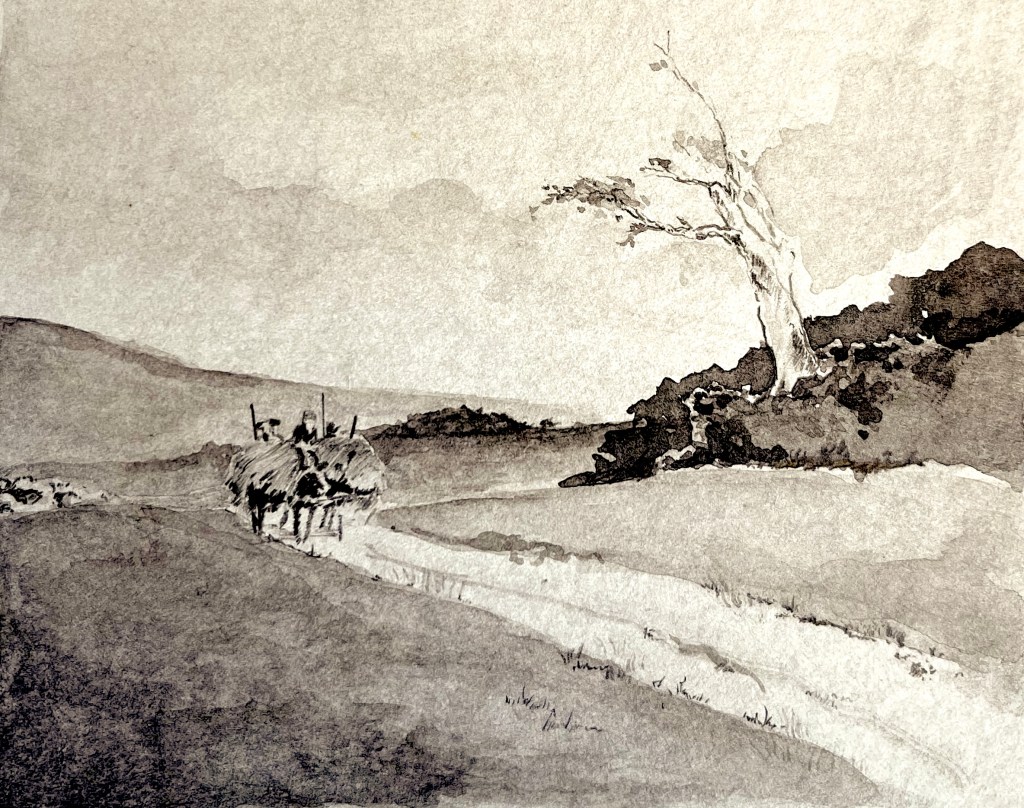
This is a small pen and ink sketch of farmers in the Western Reserve,
which I did in the Spring of 1980. (Thomas Harley Bond)

The Settling of Solon Township, Ohio

Wikipedia informs us that, “In 1820, the first settlers arrived from Connecticut… The township was named after Lorenzo Solon Bull, who was the son of Isaac Bull, one of the first settlers. Purportedly, the selection of young Lorenzo’s middle name was due to its derivation from the “father of democracy”, Solon, the lawmaker of Ancient Greece. The early settlers faced challenges common to pioneers, but in Solon, drainage and wetlands issues complicated settlement and agriculture. Overcoming these obstacles, Solon Township became an arable farming area, producing corn and wheat crops and supporting dairy farms…”

The vast majority of the McClintocks were farmers, with the notable exception of two people, the siblings: Dr. Freeman McClintock, and William McClintock. Although Freeman farmed in Solon, Ohio for a few years, he eventually gave it up and went on to do many remarkable things throughout North America. “The first man who built a house at the Center [of Solon Township] was Freeman McClintock, who located there in 1832 or ’33. He resided there in his log cabin two or three years before any joined him.”

Ohio Log Cabin and Farm by Granger.

We find this historical anecdote to be interesting, but not completely accurate. We know that his uncle Samuel was already living there. Freeman’s wife Lydia came with him, and his parents arrived in October 1833. Many of his siblings were also leaving New York on the canal boats, schooners, and wagons headed his way. We determined these things based upon his biography and the county tax records. (See footnotes).

William McClintock preferred the legal profession. He was a lawyer, having been admitted to the Ohio Bar in 1849. Eventually he moved his family west to Iowa and became the founder and publisher of a newspaper. (Both brothers have interesting biographical links in the footnotes). (6)

“..Nothing Can be Said to be Certain, Except Death and Taxes…”

We know that the McClintocks had arrived in Ohio by 1831, because there are property tax records in Cuyahoga County which support this. When we analyzed the years 1833 through 1844, we saw some interesting patterns. It appears that in most years, James Sr. either owned most of the land, or was paying most of the taxes for some reason. For example in 1836, James Sr., was paying everyone’s property tax even though some of that land belonged to some of his children. (Gee, thanks dad!)

McClintocks listed in the Cuyahoga County 1852 landownership map index

James Sr. died in September 1845, but the exact date was not recorded.

Later in that same month, there are record documents from a future court case, which state that — “James Jr., sold the real estate to Dexter McClintock [our ancestor] for $1,125 on September 25, 1845” and that “James Jr. died in 1849[*] and there was considerable dispute among his heirs and the heirs of James Sr., as to the ownership of the property.”
*Correction: James Jr.’s correct death date is recorded as January 1, 1854. He died of typhoid fever, leaving behind a wife and several small children: wife Betsey, and children, Orvil, Antionette, Seth, Edith, and James. (7)

We will be covering this court case in the next chapter, The McClintock Line, A Narrative — Seven). The case involves land, alcoholism, temperance societies, gold, and lots of ruffled feathers.

Following are the footnotes for the Primary Source Materials,
Notes, and Observations

Be Fruitful and Multiply

(1) — thirty two records

Boston Rare Maps
The Sotzmann-Ebeling Map of New Hampshire, Circa 1796
https://bostonraremaps.com/inventory/sotzmann-ebeling-new-hampshire-1796/
Note: For the map image.

James McClintock Sr
in the U.S., Find a Grave Index, 1600s-Current

https://www.ancestry.com/discoveryui-content/view/58353478:60525?ssrc=pt&tid=75768616&pid=42330432184
Note: Birth and death dates
and
James McClintock Sr.
https://www.findagrave.com/memorial/95744747/james_mcclintock
and
Ohio Cemetery Records
Gravestone Inscriptions in Old Southwest Burying Ground, Bainbridge, Geauga Co., OH
https://www.ancestry.com/imageviewer/collections/48347/images/OHCemeteryRecords-000382-157?ssrc=&backlabel=Return&pId=304646
Book page: 157, Digital page: 167/506, Lower section, entry 3 from the bottom of the page.

Hephzibah “Hepsie” Jones McClintock
https://www.findagrave.com/memorial/92303259/mccl
Note: There are some minimal family records.

Hepzidah McClintock
in the Michigan, U.S., Death Records, 1867-1952

https://www.ancestry.com/discoveryui-content/view/1403875:60872?tid=&pid=&queryId=78c1cb54-4fc6-46dd-897e-ede148c8d4b1&_phsrc=orQ32&_phstart=successSource
Book page: 203, Digital page: 590/651, Left page, entry 636.
Notes: The information for her parents, and the county name, are incorrect on this file (transcription errors?). She appears to have been living with her son Dr. Freeman McClintock, who died in Michigan.

Thirza Taylor
in the Ohio, U.S., Wills and Probate Records, 1786-1998

Cuyahoga > Estate Files, Docket 34, Case No 9031-62092, 1813-1913
https://www.ancestry.com/discoveryui-content/view/6426020:8801
Digital pages: 2 through 7/209
and
The Connection: When Thirza’s younger brother James Jr. died on January 1, 1854, his wife Betsey McClintock remarried eight months later (on August 10, 1854), to Tirza’s son Philonzo Taylor Jr. (Thirza lost a brother and gained a daughter-in-law). Here is the 1850 census to document the Taylor family —
Thirza Taylor
in the 1850 United States Federal Census

https://www.ancestry.com/discoveryui-content/view/13469152:8054?tid=&pid=&queryId=0d8c99c5-6e9b-49d3-af1f-1446805483c0&_phsrc=IPg31&_phstart=successSource
Digital pages: 9-10/30, Entries 38-42, and 1-4 (next page top).
and
The August 10, 1854 remarriage:
Betsey Ann McClintock
in the Ohio, U.S., County Marriage Records, 1774-1993

Geauga > 1841 – 1854
https://www.ancestry.com/discoveryui-content/view/900862477:61378?tid=&pid=&queryId=7b4f7af5-2a9c-4c25-a297-4327d843e3c4&_phsrc=IPg6&_phstart=successSource
Digital page: 412/437, Left page, entry 2.

Mahala Short
in the U.S., Find a Grave Index, 1600s-Current

https://www.ancestry.com/discoveryui-content/view/26447561:60525?tid=&pid=&queryId=ce7d9371-67a5-4f32-b666-460c32adfea5&_phsrc=Lml7&_phstart=successSource
and
Mahala Short
https://www.findagrave.com/memorial/53699209/mahala-short
Notes: We connected her husband Shubal Short through her residence with her family who lived in Phelps, Ontario, New York and this lawsuit, where her husband is named: https://www.ancestry.com/imageviewer/collections/28306/images/dvm_LocHist012267-00246-1-0?ssrc=&backlabel=Return&pId=400
Notes: The McClintock family is connected to the Short family of Phelps, Ontario County, New York through 3 marriages:

Dr Freeman McClintock
in the U.S., Find a Grave Index, 1600s-Current

https://www.ancestry.com/discoveryui-content/view/86876122:60525?tid=&pid=&queryId=2b92d9cc-fbdc-4124-862f-bcb7bc69167a&_phsrc=aWz3&_phstart=successSource
and
Dr Freeman McClintock
https://www.findagrave.com/memorial/33127439/freeman-mcclintock
Note 1: For birth and death dates.
Note 2: The McClintock family is connected to the Short family of Phelps, Ontario County, New York through 3 marriages:

  • Sarah McClintock, married Sidney Smith Short about 1831
  • Mahala McClintock, married Shobal Pula Short Sr. about 1826
  • Freeman Brazilla McClintock, Lydia A. Short, on November 27, 1831, as identified in American Biographical History of Eminent and Self-made Men : Michigan volume, The Sixth Congressional District

Dr. Freeman McClintock led a dynamic life and was profiled in this book — American Biographical History of Eminent and Self-made Men : Michigan volume, The Sixth Congressional District
https://www.ancestry.com/imageviewer/collections/25026/images/dvm_LocHist010122-00622-0?pId=704
Book pages: 50-51, Digital pages: 797-798/984

image4
Handwritten note, gallery image for Joshua John McClintock
https://www.ancestry.com/mediaui-viewer/collection/1030/tree/1173647/person/-1913123119/media/11ee9170-8904-4927-9240-ed38c9b3fa82?queryId=8f38b5df-7553-47d9-b0ec-1f41dd4ae931&_phsrc=xAm11&_phstart=successSource
Notes: Below is the handwritten document, that also provides information about his wife Lucy Seward. His birth location is incorrect being listed as Manchester. The family never lived in Manchester, but in the nearby town of Hillsborough, where  his other siblings from the same timeframe were likely born.

Handwritten document posted on Ancestry.com. (See comments above).

J J McClintock
in the Ohio, U.S., Wills and Probate Records, 1786-1998
Cuyahoga > Will Records, Vol X-Y, 1892-1893
https://www.ancestry.com/discoveryui-content/view/13657472:8801?tid=&pid=&queryId=1dbe9c61-e191-4563-aedd-fb10ce11e962&_phsrc=AKd1&_phstart=successSource
Digital page: 206/682
Note: For death date.
and
will [of JJ McClintock]
https://www.ancestry.com/mediaui-viewer/collection/1030/tree/1173647/person/-1913123119/media/7a207c15-7b42-4acf-b42b-b3fc2648f551?galleryindex=1&sort=-created
and
will p2
https://www.ancestry.com/mediaui-viewer/collection/1030/tree/1173647/person/-1913123119/media/54bd5581-d1fe-4174-90d8-1993a9606f73?galleryindex=2&sort=-created
Note: There are two pages to this hand drafted document as indicated by the two links above. The Will is found in an ancestry.com photo gallery.

James McClintock [Jr.]
https://www.findagrave.com/memorial/53699189/james_mcclintock
Note: For his birth and death dates.

Dexter McClintock
in the Web: Ohio, Find A Grave Index, 1787-2012

https://www.ancestry.com/discoveryui-content/view/7887384:70559?ssrc=pt&tid=18269704&pid=635845738
and
Dexter McClintock
https://www.findagrave.com/memorial/19154853/mccl

William McClintock
https://www.findagrave.com/memorial/108474075/william_mcclintock
Notes: For his birth and death dates.

Observation: Not to be outdone by his older brother Freeman, it appears that William McClintock was also a very accomplished man. A newspaper he started named the Fayette County Union was published continuously until 1944.

Portrait and Biographical Album of Fayette County, Iowa.
Containing Full Page Portraits and Biographical Sketches of Prominent and Representative Citizens of the County
by Lake City Publishing Company
https://archive.org/details/portraitbiogra00lake/page/272/mode/2up?view=theater
Book page: 273, Digital page: 272/698
and a transcribed copy —
Fayette County, Iowa
Biography Directory
Portrait & Biographical Album of Fayette County Iowa
Containing Full Page Portraits and Biographical Sketches of Prominent and Representative Citizens of the County
Lake City Publishing Co., Chicago, March 1891
https://iagenweb.org/fayette/bios/1891/373b.htm

Library of Congress
Fayette County Union (West Union, Iowa) 1866-1944
https://www.loc.gov/item/sn83025183/

Louisa McClintock
in the 1870 United States Federal Census

Michigan > Shiawassee > Sciota
https://www.ancestry.com/discoveryui-content/view/27514564:7163?tid=&pid=&queryid=2efdaa07-be2b-4470-a5cc-681975d47192&_phsrc=dPv25&_phstart=successSource
Book page: 2, Digital page: 2/32, Entries 12 and 13.
Notes: Louisa’s birthdate is inferred from this record. In 1870, she is living in Michigan taking care of her mother, who died there the next year.

The Connection: Throughout the 1850s and 186os she is making property tax payments in Solon, Cuyahoga, Ohio. The last record for Ohio is:
Louisa M McClintock
in the Cuyahoga County, Ohio, U.S., Tax Lists, 1819-1869
1865
https://www.ancestry.com/discoveryui-content/view/1320613:2100?tid=&pid=&queryid=8220d991-1796-464a-8766-f71723b626c5&_phsrc=FPj1&_phstart=successSource
Book page: 26, Digital page: 500/558

Wayne County, New York
https://en.wikipedia.org/wiki/Wayne_County,_New_York
Note: For founding date.

Library of Congress
A View of Manchester, N.H.
by J.B. Bachelder, 1855
https://www.loc.gov/resource/cph.3g08323/
Note: For the landscape painting.

The Censuses of 1800 through 1830 and Their Differences

(2) — eleven records

The National Archives
The 1810 Census
https://www.archives.gov/research/census/1810
Note: “The census began on Monday, August 6, 1810, and was finished within 9 months…”, and for the form questions: 
https://www.archives.gov/files/research/genealogy/charts-forms/1810-census.pdf

James McClintock
in the 1810 United States Federal Census

New Hampshire > Hillsborough > Windsor
https://www.ancestry.com/discoveryui-content/view/187893:7613?ssrc=pt&tid=18269704&pid=635866414
Digital page: 2/2, Entry 16.

Map Of The State Of New York
Published by A. Finley Philadelphia,1824
https://archive.org/details/dr_map-of-the-state-of-new-york-published-by-a-finley-philada-1824-copy-ri-2587002

The National Archives
1820 Census Records
https://www.archives.gov/research/census/1820
Note: “The census began on Monday, August 7, 1820, and was finished within 6 months…”, and for the form questions:
https://www.archives.gov/files/research/genealogy/charts-forms/1820-census.pdf

James McClintock
in the 1820 United States Federal Census

New York > Ontario > Phelps
https://www.ancestry.com/discoveryui-content/view/567539:7734?ssrc=pt&tid=18269704&pid=635866414
Digital page: 10/12, Entry 11.
Note: He is entry #738 and the next entry #739, is his brother Samuel. 

The National Archives
1830 Census Records
https://www.archives.gov/research/census/1830
Note: “The census began on Tuesday, June 1, 1830, and was finished within 6 months,…” and for the form questions:
https://www.archives.gov/files/research/genealogy/charts-forms/1830-census.pdf

James McClintick
in the 1830 United States Federal Census

New York > Wayne > Arcadia
https://www.ancestry.com/discoveryui-content/view/163551:8058
Digital page: 35/48, Entry 17.

Samuel McClintock
in the Cuyahoga County, Ohio, U.S., Tax Lists, 1819-1869

1831-1833
https://www.ancestry.com/discoveryui-content/view/1665566:2100?tid=&pid=&queryid=c0b09afb-af21-4cc1-ae13-d957d6a769a8&_phsrc=NeN1&_phstart=successSource
Digital page: 194/636, Last entry.

Let’s Pause A Moment for Some Refreshment, Shall We?

(3) — three records

History of the Town of Arcadia
https://wayne.nygenweb.net/everts/arcadiaeverts.html

Windsor Historical Society
Colonial Boozing
https://windsorhistoricalsociety.org/colonial-boozing/

Medium
The Temperance Movement Was Totally Badass
https://medium.com/@benfreeland/the-temperance-movement-was-truly-badass-dfeaed03a3e0
Note: For temperance illustration of Fredericktown, Ohio reformers.
You go, girls!

And Back to The Census…

(4) — three records

The National Archives
1840 Census Records
https://www.archives.gov/research/census/1840
Note: “The census began on Monday, June 1, 1840, and was finished within five months…”, and for the form questions:
https://www.archives.gov/files/research/genealogy/charts-forms/1840-census.pdf

James Mcclintock
in the 1840 United States Federal Census

Ohio > Geauga > Bainbridge
https://www.ancestry.com/discoveryui-content/view/2629792:8057?ssrc=pt&tid=18269704&pid=635866414
Digital page: 9/14, Entry 3.

The Western Reserve of Ohio

(5) — four records

Western Reserve Including the Fire Lands 1826
https://commons.wikimedia.org/wiki/File:Western_Reserve_Including_the_Fire_Lands_1826.jpg
Note: On this map, Geauga County is still combined with the future Lake County and Russell township is not yet named.
Note: For the map image.

History of the Firelands
https://lymevillage.org/history-of-the-firelands/

United States Migration to Ohio, Northwest Territory, Southwest 1785 to 1840 – International Institute
https://www.familysearch.org/en/wiki/United_States_Migration_to_Ohio,Northwest_Territory,_Southwest_1785_to_1840-_International_Institute

Connecticut Western Reserve
https://en.wikipedia.org/wiki/Connecticut_Western_Reserve
Note: For the map of “Connecticut’s land claims in the Western United States.”

The Settling of Solon Township, Ohio

(6) — two records

Solon, Ohio
https://en.wikipedia.org/wiki/Solon,_Ohio

History of Cuyahoga County, Ohio …
With Portraits and Biographical Sketches of its Prominent Men and Pioneers
by Crisfeld Johnson
https://archive.org/details/historyofcuyahog00injohn/page/516/mode/2up?q=“McClintock”
Book page: 517, Digital page: 516/534

“Nothing Can be Said to be Certain, Except Death and Taxes…”

(7) — seven records

Death and Taxes [idiom]
https://en.wikipedia.org/wiki/Death_and_taxes_(idiom)#:~:text=%22Death%20and%20taxes%22%20is%20a,certain%2C%20except%20death%20and%20taxes.

James Mcclintock
in the Cuyahoga County, Ohio, U.S., Tax Lists, 1819-1869
1833-1835
https://www.ancestry.com/discoveryui-content/view/1651638:2100?ssrc=pt&tid=18269704&pid=635866414
Digital page: 65/658, Entries 8 through 17 (based upon name).

James McClintock
in the Cuyahoga County, Ohio, U.S., Tax Lists, 1819-1869
1835-1837
https://www.ancestry.com/discoveryui-content/view/1647946:2100?ssrc=pt&tid=18269704&pid=635866414
Digital page: 487/648, Entries 7 through 18 (based upon name).

James McClintock
in the Cuyahoga County, Ohio, U.S., Tax Lists, 1819-1869

1842-1843
https://www.ancestry.com/discoveryui-content/view/1607066:2100?ssrc=pt&tid=18269704&pid=635866414
Digital page: 537/686, Entries 10 through 14 (based upon name).

James McClintock
in the Cuyahoga County, Ohio, U.S., Tax Lists, 1819-1869

1844-1845
https://www.ancestry.com/discoveryui-content/view/1195813:2100?ssrc=pt&tid=18269704&pid=635866414
Digital page: 303/682, Entries 12 through 17 (based upon name).

Listed in the Cuyahoga County 1852 landownership map index
https://www.ancestry.com/imageviewer/collections/21248/images/dvm_LocHist007250-00029-1?ssrc=pt&treeid=18269704&personid=635866414&usePUB=true&pId=52
Digital page: 54/107, Entry 20.

Annals of Cleveland.
Vol. II. Abstracts of the records of court cases in Cuyahoga County
https://www.ancestry.com/imageviewer/collections/28306/images/dvm_LocHist012267-00246-1-0?ssrc=&backlabel=Return&pId=400
Book page: 111-112, Digital page:: 470-471/3048

The McClintock Line, A Narrative — Five

This is Chapter Five of seven, about our family line, the McClintocks. We have always been interested in genealogy, but we wonder about the current “epidemic” happening on websites like Ancestry and Family Search. Is this present situation a product of living in these times — due to the exponential growth of the internet, and the availability of genetic DNA testing? Our ancestors presumably framed their thoughts on ancestry a little bit differently…

A Certain Cultural Cachet…

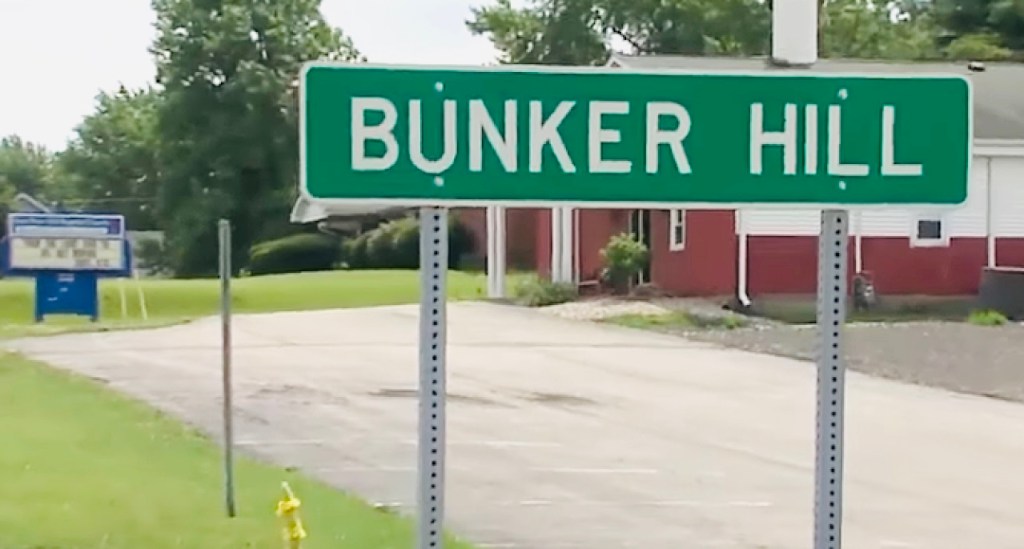
“What is that wonderful cologne you’re wearing?” “Ohhh, do you like it? It’s Eau de Bunker Hill! Absolutely everybody’s wearing it!”

Sometimes we wonder why everybody who likes to look into their ancestry — or at least those who talk about aspects of it at a family reunion, always think they may have a famous relative. Why is there always someone who seems so invested in the idea of having an ancestor who fought at Bunker Hill? Is it something about the name? Is it a password for a certain level of American cultural cachet?

This is not the Bunker Hill you are most likely thinking of — this is Bunker Hill, Miami. And not that Miami, either. This is Bunker Hill, Miami, Indiana.

In this history, we encountered several stories where someone insisted their ancestors were directly connected to Bunker Hill, i.e., “I’m descended from ______ McClintock, who was a ______, and who fought at Bunker Hill.” Rest assured, this did not happen in our branch of the McClintock family line. If it had happened, we’d celebrate it, but we will never just make something up. (1)

John and Christen Raised Many Children

William and Agnes McClintock’s last child was John McClintock (Sr.), born about 1744 in Tyngstown, New Hampshire Province — died October 9, 1803, Hillsborough, Hillsborough County, New Hampshire. He married Christen McNeil on December 29, 1768, in Derryfield, New Hampshire Province. She was born July 20, 1748, Derryfield, New Hampshire Province — died March 27, 1790, Hillsborough, Hillsborough County, New Hampshire. They had at least eight children.

The first four children were born in: Derryfield, New Hampshire Province.

  • Rachel (McClintock) Knox, born February 22, 1770 Derryfield, New Hampshire Province — died January 22, 1835, Pembroke, Merrimack County, New Hampshire
  • Margaret McClintock, born September 14, 1771, Derryfield, New Hampshire Province — death date unknown
  • Agnes McClintock, born August 2, 1773, Derryfield, New Hampshire Province — death date unknown
  • William McClintock, born August 2, 1773, Derryfield, New Hampshire Province — death date unknown

    The next four children were born in: Hillsborough* (town), New Hampshire Province. (*See notes on Revolutionary War payments.)
  • Daniel McClintock, born December 15, 1775, Hillsborough (town), New Hampshire Province — death date unknown
  • James McClintock (Sr.), born January 3, 1778, Hillsborough (town), New Hampshire Province — died September 1845, Bainbridge, Geauga County, Ohio (We are descended from James). (James and John were twins).
  • John McClintock (Jr.), born January 3, 1778, Hillsborough (town), New Hampshire Province — died January 13, 1808, Hillsborough, New Hampshire Province
  • Samuel McClintock, born about 1788 — died after 1860, Bedford, Cuyahoga, Ohio

    Comment: After the birth of the twins John and James McClintock, there was a fall off in the frequency of births (or at least reasonably believable birth records). Christen the mother, died in 1790 at 41 years old. She may have had more children between 1778 and 1788, but we just cannot verify that she did. With the exception of Samuel, who was born in 1788 — and we only knew about him due to tax records and a court case. (For more about Samuel, see The McClintock Line, A Narrative — Six, and Seven). (2)

The 1790 Census

In the 1790 census, we see that John is living near his brother Alexander. “The census began on Monday, August 2, 1790, and was finished within 9 months.” (The National Archives). The data collected was very simple with only these categories applied and no other details:

  • Name of head of family
  • Number of free white males age 16 years and upwards, including head of family
  • Number of free white males under 16 years old
  • Number of free white females, including head of family
The 1790 Census, the first census of the new United States.

In John’s home he is counted as the Head of Home (category: free white males 16 years and upwards, including head of family). There are 5 free white males under 16 years of age, and 5 (free white females, including head of family). When we compare the birth records of their children to the category ages in this census, the five boys under 16 line up, but the five females do not. We also know that John’s wife Christen died in March about 5 months before the census was conducted. This means that she was never counted in a census. We also know that there were three daughters at that time. The inclusion of the two additional females is unknown.

In the Derryfield town records, if within the community there was a child in need, either without a parent, or a parent unable to care for them… then that child would be sheltered at a home within the community. Such was the case with a woman named Elizabeth Massey and her unnamed child who was described as sickly. Perhaps the additional females were of this sort.

The 1790 census is the only census where we directly find John McClintock. He died in 1803. Near the end of his life, around the time of the 1800 census, he could have been living in the home of one of his children. If that happened, he would not have been listed as the Head of Household. (3)

This inset map shows the communities of Hillsborough, Goffstown, and Derryfield where the McClintocks were living between the 1740s and 1803. An Accurate Map of His Majesty’s Province of New-Hampshire in New England… by Samuel Langdon, circa 1757. (Image courtesy of the Library of Congress).
This is an example of the Association Test document from the community of Hampton, New Hampshire. (Image courtesy of Hampton History Matters).

The Beginning of the Revolutionary War

The Association Test
“In March 1776 the Continental Congress resolved that all persons who refused to sign the Association to defend the cause of the Colonies should be disarmed. To put this resolve into effect, the New Hampshire Committee of Safety directed the local authorities, usually the selectmen, to have all adult males sign the Association and to report the names of those who refused to sign. The end result amounted to a census of the adult male inhabitants of New Hampshire for 1776…” (Inhabitants of New Hampshire 1776)

From this document we learned that the elder, Michael and William McClintock, signed the Association Test, and that they were both still living in Derryfield. William’s sons Alexander and John [our ancestor] also signed, but were then living in the nearby town of Hillsborough. (4)

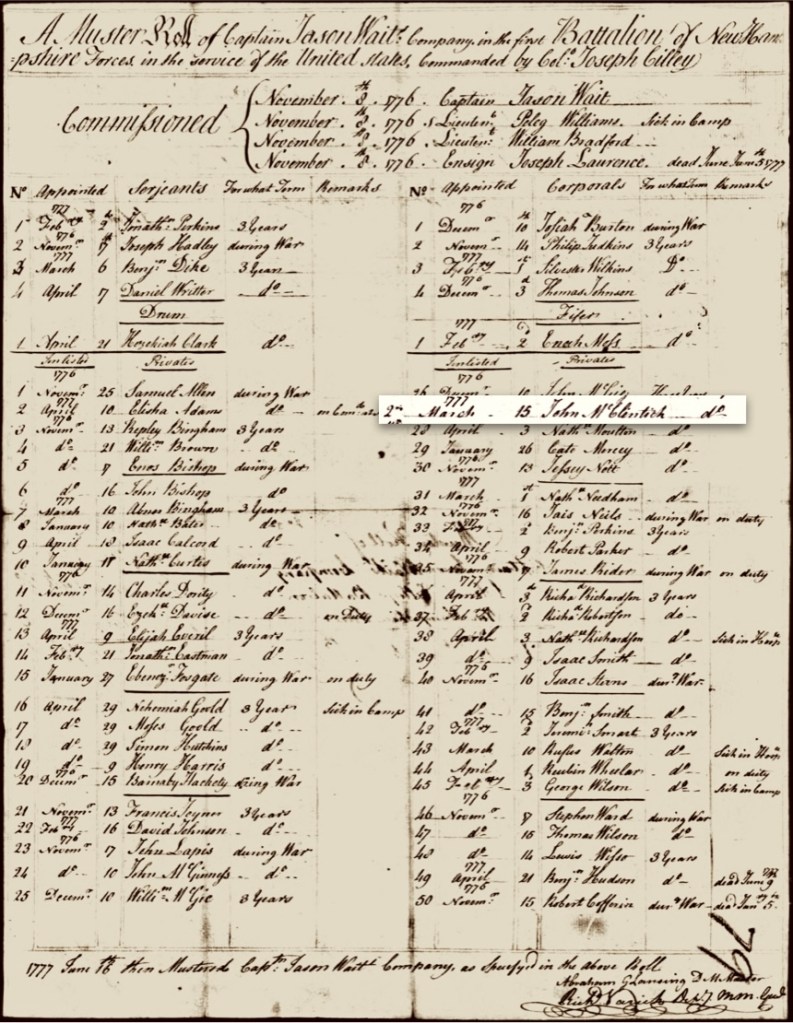
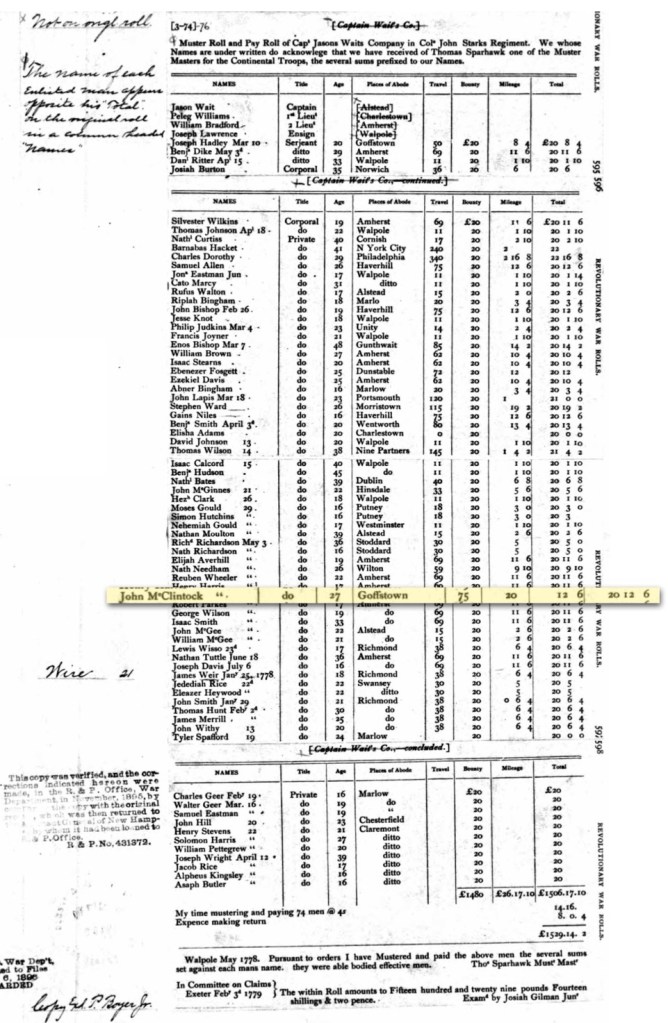
U.S., Revolutionary War Rolls, 1775-1783 for John McClintock, New Hampshire, 1st Regiment, 1777-1780, Captain Jason Waits Company, Colonel John Stark’s Regiment.

The First New Hampshire Regiment

John McClintock joined the First New Hampshire Regiment On March 15, 1777 for an agreed three year term of service. However, he served less that the agreed three years. Records indicate that during this “appointed” period, he was a Private in this Regiment. This required him to travel where he was needed which seems to be tours in the Northern Territory, and then some of the battles listed in the text below.

Military Commanders associated with the First New Hampshire Regiment. From Left to Right: Major General John Sullivan, Colonel John Stark, and Lieutenant Colonel Joseph Cilley. (See footnotes for resources).

“The 1st New Hampshire Regiment was authorized as New Hampshire State Troops on May 22, 1775, and was organized as 10 companies of 800 volunteers from Hillsborough and Rockingham counties… commanded by John Stark. The regiment was adopted into the Continental Army on June 14, 1775, and assigned to General John Sullivan’s brigade on July 22, 1775. The regiment saw action at the Battle of Bunker Hill. Note: the battle was fought on June 15, 1775…John joined in 1777, that’s why our John McClintock was never there.

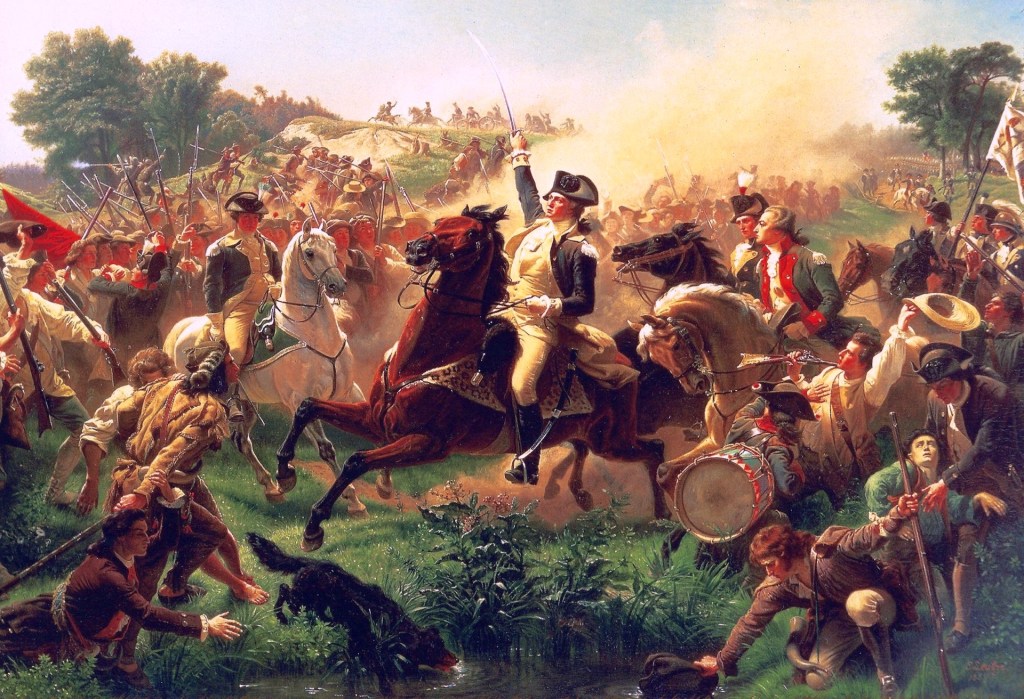
On January 1, 1777, the 5th Continental Regiment was re-organized to eight companies and re-designated as the 1st New Hampshire Regiment. With the resignation of John Stark, [Joseph] Cilley took command of the 1st New Hampshire and led them during the Saratoga Campaign of 1777, and the Battle of Monmouth, and the Battle of Stony Point in 1778. In 1779, Cilley and the 1st New Hampshire were with Gen. Sullivan in his campaign against the Iroquois and Loyalists in western New York.” (Wikipedia)

Washington Rallying the Troops at Monmouth, by Emanuel Leutz, circa

We discovered records from the town of Hillsborough which made us understand that John McClintock likely only participated in battles which occurred between March of 1777 and March of 1779.Why he left before the end of three years probably had to do with the fact that he was responsible for a wife and seven children at home. Additionally, he became the Constable of the town of Hillsborough in March 1779.

From the History of Hillsborough, New Hampshire, 1735-1921, it states, “John McClintock was chosen Constable, the most important office in town. It was not only his duty to maintain peace, but he performed the functions of sheriff and collector of taxes. No town meeting could be called without his signature to the warrant, and altogether it was the most difficult office to fill. Not infrequently persons chosen to the positions refused to serve, and the Selectmen had to find some one willing to fill the vacancy. Sometimes the man elected was compelled to find a substitute. The reward for filling the round of arduous duties was slight.”

We also saw this curious passage in the book, “Another Scotch-Irish family, four strong, were the McClintocks, always eager for an argument, but never ready to give up. They were a stalwart race, though not as tall as the Monroes or as slim as the Andrews.” Collins Dictionary defines stalwart as: ” A stalwart supporter or worker is loyal, steady, and completely reliable.” (We guess that’s why the Hillsborough Town Council must have thought John would be a good town constable!)

Observation: We don’t know if during his tenure in the army he was ever allowed to see his wife and children. He had a big family, and it seems to us that his wife Christen became pregnant with twin sons during the days just before he left to serve in the war. (These children are their last two sons: John Jr., and James, our ancestor. There is an extensive history of some wives and families being Camp Followers during the war, but we see no record of this with our family).

American soldiers at the siege of Yorktown, by Jean-Baptiste-Antoine DeVerger, watercolor, 1781.

Catch-As-Catch-Can*
When the Revolutionary War started, the American Patriot side of the conflict was not very well-organized initially. Who would expect them to be? The situation was more in the vein of a civil war when things started up. The history of how the troops were outfitted and supplied, was one of making do with what was at hand, until much later. (When France started supplying uniforms to the American Rebels, as payback against the British, who they were really angry with, about… many, many things…)
*From the Merriam Webster Dictionary, “using any available means or method: hit or miss”

The Uniforms of the 1st New Hampshire Regiment 1775-1784 A Historical Research Project, taught us that “The 1st NH began the war in civilian clothing, being composed of minute and militia companies responding to the “Lexington Alarm”. As the war progressed, the unit was issued several different uniforms, including two different sets of brown coats with red facings, brown coats with white facings and green coats with maroon facings From our recent research we can find no mention of the unit ever having been issued the traditional blue coats with white facings as prescribed for New England regiments by Washington in his 1779 uniform regulations.”

Revolutionary War Payments
Birth records for James and John (Jr.) McClintock indicate that they were born in Hillsborough, NH. Revolutionary War payment records for their father, John Sr., indicate that he was from Goffstown, which is the town adjacent to Derryfield. It seems strange to us that there is a notation about Goffstown, when all other records point first to Derryfield and then to Hillsborough.

A Picturesque View of the State Of The Nation, from “How was the Revolutionary War paid for?” by the Journal of the American Revolution.

Furthermore, the book History of Manchester, Formerly Derryfield, in New-Hampshire.., author Potter writes “It is interesting to note the readiness with which the towns, composing the ancient Amoskeag, contributed to the patriot cause. Their people were ever ready to respond to the call of country; thus Bedford, Chester, Derryfield, Goffstown, and Londonderry in 1777, 1778, and 1789, furnished the following regular soldiers, or “three years men;” [John McClintock Sr. is listed under Goffstown].

These Revolutionary War payment records list John McClintock Sr. as being 27 years old in 1777. He was actually closer to 33 years of age, and he either did not know his correct age, or someone wrote it down incorrectly. His gravestone very clearly records that he was 59 years old when he died in 1803, therefore, born in 1744.

In 1780, the residents of Hillsborough petitioned the government for funds to have a bridge built over the nearby Contoocook River “which we should have built four or five years ‘a goe had it not ben for this unhappy war.” We don’t know if the petition was honored or not, but this is the only place we have ever seen the actual quill pen signatures of John McClintock Sr. and his brother, Alexander.

Hillsborough, New Hampshire government petition of May 8, 1780.

In the years 1782-1784, John McClintock Sr. was paying “non resident taxes” on property that he continued to own in Derryfield. We wonder if this property was actually in Derryfield or the next door town of Goffstown? Just a few years later, his death and that of his wife Christen, are recorded as being in Hillsborough. (6)

An example advertisement seeking the return of Deserted Soldiers during the Revolutionary War.

Robert Finney and the Indian Corn Incident.

Parsing through legal documents written in a form of English which is 250 years old, can be somewhat puzzling. We found records of a court case brought by the Selectmen of the Town of Hillsborough against John McClintock Sr. which we now call Robert Finney and the Indian Corn Incident.

It seems that for some unknown reason two of these Selectmen, Samuel Bradford and John McColley, approached John McClintock Sr., and agreed to pay him money and Indian Corn, if he would arrange “for the hire of a Certain Robert Finney who the said McClintock had procured to enlist into the Continatal Army said year as a man for the said Town of Hillsborough.” [Then] “immediately after his Muster Diserted and Never Joined the Army at all and your petitioners vehemently Suspect that this Disertion was advised and Countinanced by the sd [said] McClintock.” It seems that John did arrange for the man to join, and then, Robert Finney disappeared.

Apparently, John was paid the money, but the men who were buying the service of Mr. Finney were understandably not happy that he had deserted. They wanted their money back. This went to trial in 1782, and “Judgement entered against the Persons who Signed the said note for the sum of 47 16 8d Damage and 3 13 8d Cost of Court as appears of Record.” This means that Bradford and McColley lost. No reasoning was provided for the decision, but it seems to us it could be like this: How could a veteran of the War, who is also the Town Constable, encourage someone to be a deserter? There was no proof of that belief. This bubbled up now and then and went on until 1786, when some amicable decision was finally reached by everyone involved. (7)

In the next chapter, we follow our 3x Great Grandfather James McClintock as his family leaves New Hampshire and eventually resettles in the Western Reserve of northeast Ohio.

Following are the footnotes for the Primary Source Materials,
Notes, and Observations

A Certain Cultural Cachet…

(1) — one record

Bunker Hill current and former clerk-treasurers must repay $6K, audit says
[sotto voce] > The town has faced scrutiny over the past decade
https://www.wrtv.com/news/wrtv-investigates/bunker-hill-current-and-former-clerk-treasurers-must-repay-6k-audit-says
Note: For the photo, and a bit of the scandal too…

John and Christen Raised Many Children

(2) — sixteen records

John McClintock
https://www.findagrave.com/memorial/96906535/john-mcclintock?_gl=1*7cddiw*_gcl_au*MTk5MDU4MTkzOC4xNzIyODU4NDQ0*_ga*MTQ4NjkxODM4NC4xNzIyODU4NDQ0*_ga_4QT8FMEX30*OTM1MmQyNGYtOWRhYS00MzZiLTk3NDgtOTdhY2I2ZjAwZGUxLjQuMS4xNzIyODc2OTUzLjEwLjAuMA..*_ga_LMK6K2LSJH*OTM1MmQyNGYtOWRhYS00MzZiLTk3NDgtOTdhY2I2ZjAwZGUxLjQuMS4xNzIyODc2OTUzLjAuMC4w
Note: Birth and death dates

Cristen Macniel
in the New Hampshire, U.S., Marriage Records, 1700-1971

1700-1900 > McCh-McGo
https://www.ancestry.com/discoveryui-content/view/90143222:61836
Digital page: 209/3386

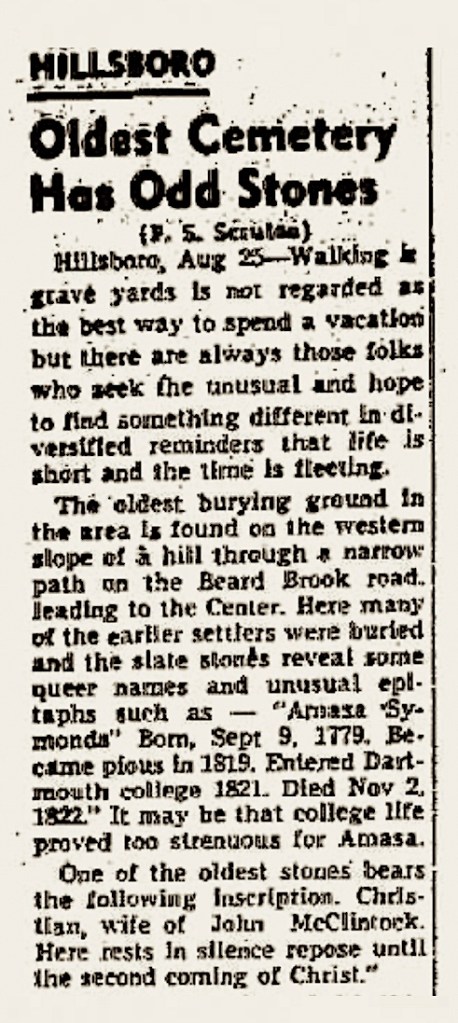
From the Nashua Telegraph newspaper, August 25, 1954.

Nashua Telegraph (Nashua, New Hampshire)
1954 > August > 25
https://www.ancestry.com/imageviewer/collections/6931/images/NEWS-NH-NA_TE.1954_08_25-0015?ssrc=pt&treeid=75768616&personid=42330432825&usePUB=true&pId=500458511
Digital page: 15/22
Note: Newspaper article about old cemetery monuments which cites the Christen (Mc Neil) McClintock headstone.

Cristieu McNeill
in the New Hampshire, U.S., Birth Index, 1659-1900

Melendy – Mooers
https://www.ancestry.com/discoveryui-content/view/477356:4582?ssrc=pt&tid=18269704&pid=635945484
Digital page: 3779/5042
Note: For her birth date.

Christen McClintock
in the U.S., Find a Grave Index, 1600s-Current

https://www.ancestry.com/discoveryui-content/view/63229320:60525?ssrc=pt&tid=75768616&pid=42330432884
Note: For her birth and death dates.
and
Christen McNeil McClintock
https://www.findagrave.com/memorial/96906517/christen-mcclintock

The History of Hillsborough, New Hampshire, 1735-1921
by George Waldo Browne, page 144.

The History of Hillsborough, New Hampshire, 1735-1921
by George Waldo Browne
https://archive.org/details/historyofhillsbo01brow/page/144/mode/2up?view=theater
Note: For the Bible Hill Burial Ground photo.

Rachel McClintock Knox
https://www.findagrave.com/memorial/150016663/rachel_knox
and
https://www.ancestry.com/discoveryui-content/view/172507:4582?ssrc=pt&tid=18269704&pid=635978912
Note: For her birth and death dates.

History of Pembroke, N. H. 1730-1895
by Nathan Franklin Carter and Trueworthy Ladd Fowler
https://archive.org/details/cu31924028836471/page/186/mode/2up
Book page: 186, Digital page: 186/459
Note: For the marriage record of (18) Daniel Knox to Rachel McClintock.

Margaret McClintock
in the New Hampshire, U.S., Birth Index, 1659-1900

Lewis – McDonald
https://www.ancestry.com/discoveryui-content/view/172506:4582?ssrc=pt&tid=18269704&pid=635978916
Digital page: 3219/5039

Agnes MacClintock
in the New Hampshire, U.S., Birth Records, 1631-1920

Lewis – McDonald
https://www.ancestry.com/discoveryui-content/view/283652:61833
Digital page: 3221/5039

William Macclintok
in the New Hampshire, U.S., Birth Records, 1631-1920

Birth Certificate> 1631-1900 > McCalley-Myc
https://www.ancestry.com/discoveryui-content/view/283648:61833
Digital page: 1125/3740

Daniel McClintok
in the New Hampshire, U.S., Birth Records, 1631-1920
Birth Certificate> 1631-1900 > McCalley-Myc
https://www.ancestry.com/discoveryui-content/view/283647:61833?tid=&pid=&queryId=8392da29-618e-440e-85ba-9c629b4af1f0&_phsrc=Azi10&_phstart=successSource
Digital page: 1123/3740

James McClintock Sr
in the U.S., Find a Grave Index, 1600s-Current

https://www.ancestry.com/discoveryui-content/view/58353478:60525?ssrc=pt&tid=75768616&pid=42330432184
Note: Birth and death dates
and here:
James McClintock Sr.
https://www.findagrave.com/memorial/95744747/james-mcclintock

John McClintock [II]
Lewis – McDonald
https://www.ancestry.com/discoveryui-content/view/172528:4582
Digital page: 3241/5039
and
https://www.americanancestors.org/databases/new-hampshire-births-deaths-and-marriages-1654-1969/RecordDisplay?volumeId=13805&pageName=11374&rId=246296673
Note: For his birth date.
John McClintock II
https://www.findagrave.com/memorial/96906548/john_mcclintock
Note: For his death date.

Samuel McClintock
in the 1860 United States Federal Census

Ohio > Cuyahoga > Bedford
https://www.ancestry.com/discoveryui-content/view/43833580:7667?tid=&pid=&queryid=c3f3887a-3273-44c0-8ee0-f2e68300c68f&_phsrc=mfA15&_phstart=successSource
Book page: 36, Digital page: 36/50
Notes: We were able to deduce that this is Samuel McClintock who is the brother related to James McClintock, the primary subject of the next chapter, The McClintock Line, A Narrative — Six.

1860 Bedford, Cuyahoga County, Ohio Census record. We were able to discern the McClintock surname, his age of 72 years, and NH as part of his birthplace. Hence — Samuel McClintock, born about 1788, likely in Hillsboro [Hillsborough], NH.

It appears that he is a boarder in the Perkins home. Furthermore, the 1860 Ohio census is completely illegible. So we were able to manipulate the file in a photographic program to discern enough data to confirm that this is indeed our ancestor.

The 1790 Census

(3) — five records

The National Archives
1790 Census Records
https://www.archives.gov/research/census/1790

John McClintock
in the 1790 United States Federal Census

New Hampshire > Hillsborough > Hillsborough
https://www.ancestry.com/discoveryui-content/view/215073:5058?ssrc=pt&tid=18269704&pid=635945483
Digital page: 3/3, Left columns, Entry 16 above Alexander McClintock.
and
The History of Hillsborough, New Hampshire, 1735-1921
by George Waldo Browne
https://archive.org/details/historyofhillsbo01brow/page/n5/mode/2up?view=theater
Book page: 172, Digital page: 172/567

Early Records of the Town of Derryfield: Now Manchester, N. H.
1751 — 1782, Volumes I and VIII
by George Waldo Browne
https://archive.org/details/earlyrecordstow01nhgoog/page/n224/mode/2up?view=theater
Book page: 218, Digital page: 225/407,
Note: Representative notice of support for Elizabeth Massey and her child. These notices are numerous within these records.

Library of Congress
An accurate map of His Majesty’s Province of New-Hampshire in New England…
by Samuel Langdon, 1723-1797
https://www.loc.gov/resource/g3740.ar086900/?r=0.343,0.005,0.964,0.464,0
Note: The map is circa 1757, and is cropped to feature the town of Hillsborough.

The Beginning Of The Revolutionary War

(4) — five records

Inhabitants of New Hampshire, 1776
by Emily S. Wilson
https://www.ancestry.com/imageviewer/collections/49199/images/FLHG_InhabitantsofNH-0071?ssrc=&backlabel=Return&pId=52151
Book pages: 4 and 71, Digital pages: 4/170 and 71/130

Signers of the Association Test, and “credited as belonging to the training band of Hillsborough in 1776”
https://archive.org/details/historyofhillsbo01brow/page/108/mode/2up?view=theater
Book pages: 109-110, Digital pages: 108-110/567

Not pictured here in the footnotes, but in the preceding chapter —
U.S., Revolutionary War Rolls, 1775-1783 for John McClintick
New Hampshire > 01st Regiment, 1777-1780 (Folders 6-12)
https://www.ancestry.com/imageviewer/collections/4282/images/miusa1775a_113592-00612?pId=1245062
Document name: miusa1775a_113592-00612 .jpeg
Digital page: 613/740

Shown above:
U.S., Revolutionary War Rolls, 1775-1783 for John McClintick
New Hampshire > 01st Regiment, 1777-1780 (Folders 6-12)
https://www.ancestry.com/imageviewer/collections/4282/images/miusa1775a_113592-00693?pId=1247116
Document name: miusa1775a_113592-00693.jpg
Digital page: 694/740

Shown above:
U.S., Revolutionary War Rolls, 1775-1783 for John McClintick
New Hampshire > 01st Regiment, 1777-1780 (Folders 6-12)
https://www.ancestry.com/imageviewer/collections/4282/images/miusa1775a_113592-00656?pId=1246304
Document name: miusa1775a_113592-00656 .jpeg
Digital page: 657/740

The First New Hampshire Regiment

(5) — sixteen records

First New Hampshire Regiment Commander Gallery credits:
The Revolutionary War on Staten Island
Sullivan’s raid [in his own words] of Staten Island, August 22, 1777
https://revolutionarywarstatenisland.com/2017/06/
Note: For his portrait.
and
Frontier Partisans
Live Free Or Die: John Stark
https://frontierpartisans.com/31962/live-free-or-die-john-stark-all-american-badass/
Note: For his portrait.
and
The Society of the Cincinnati in the State of New Hampshire
Colonel Joseph Cilley, 1st Regiment, N.H. Continental Line
https://www.socnh.org/joseph-cilley/
Note: For his portrait.

1st New Hampshire Regiment
https://en.wikipedia.org/wiki/1st_New_Hampshire_Regiment

Washington Rallying the Troops at Monmouth
by Emanuel Leutz
https://commons.wikimedia.org/wiki/File:BattleofMonmouth.jpg
For: The battlefield image painting.

The History of Hillsborough, New Hampshire, 1735-1921
by George Waldo Browne
https://archive.org/details/historyofhillsbo01brow/page/n5/mode/2up?view=theater
Book page: 235, Digital page: 234/567,
Note: Hillsborough town notes re: John McClintock as Constable
Book page 232, Digital page: 232/567
Note: For the comment, “Another Scotch-Irish family…”

Collins Dictionary
Stalwart
https://www.collinsdictionary.com/dictionary/english/stalwart

American soldiers at the siege of Yorktown,
by Jean-Baptiste-Antoine DeVerger, watercolor, 1781
https://pt.m.wikipedia.org/wiki/Ficheiro:Soldiers_at_the_siege_of_Yorktown_(1781),_by_Jean-Baptiste-Antoine_DeVerger.png
Note: For the soldier uniform(s) image.

Merriam-Webster Dictionary
Catch-As-Catch-Can
https://www.merriam-webster.com/dictionary/catch-as-catch-can
Note: The meaning of Catch-As-Catch-Can is using any available means or method : hit-or-miss.

The Uniforms of the 1st New Hampshire Regiment 1775-1784
A Historical Research Project
https://www.continentalline.org/CL/article-000201/

Shown above:
John McClintock
in the U.S., Revolutionary War Rolls, 1775-1783

New Hampshire > 01st Regiment, 1777-1780 (Folders 6-12)
https://www.ancestry.com/discoveryui-content/view/1246570:4282
Document name: miusa1775a_113592-00666 .jpeg
Digital page: 667/740
Note: This is a transcribed record.

Journal of the American Revolution
How was the Revolutionary War paid for?https://allthingsliberty.com/2015/02/how-was-the-revolutionary-war-paid-for/

History of Manchester, formerly Derryfield, in New-Hampshire : including that of ancient Amoskeag, or the middle Merrimack Valley, together with the address, poem, and other proceedings of the centennial celebration of the incorporation of Derryfield at Manchester, October 22, 1851
by C. E. Potter, (Chandler Eastman)
https://archive.org/details/historyofmanches00pott
Book page: 184, Digital page: 184/763

Early Records of the Town of Derryfield: Now Manchester, N. H.
1782 — 1800, Volumes II and IX

by George Waldo Browne
https://archive.org/details/earlyrecordstow00nhgoog/page/n6/mode/2up
Notes: For John McClintock —
Book page: 21-22, Digital page: 29/425, Non resident taxes for 1782
Book page: 40-41, Digital page: 49/425, Non resident taxes for 1783
Book page: 59-60, Digital page: 67-69/425, Non resident taxes for 1784

The Indian Corn Incident

(6) — four records

Early Records of the Town of Derryfield: Now Manchester, N. H.
1751 — 1782, Volumes I and VIII
by George Waldo Browne
https://archive.org/details/earlyrecordstow01nhgoog/page/n224/mode/2up?view=theater
Book page: 218, Digital page: 225/407,
Note: Representative notice of support for Elizabeth Massey and her child. These notices are numerous within these records.

Alexandrew McClintock
in the New Hampshire, U.S., Government Petitions, 1700-1826

Box 11-20 > Box 14: Oct 1779-Sept 1780 > May 1780
https://www.ancestry.com/discoveryui-content/view/25354:62199?tid=&pid=&queryid=e7a12054-205b-44de-bf89-7aca26e34e48&_phsrc=mfA11&_phstart=successSource
Digital pages: 9-10/16
Notes: Their signatures are on page 10. His actual name is Alexander McClintock.

Forgotten Voices of the Revolutionary War
Deserter Ads, People of Color, and Racial Descriptions at the Redding Encampment
https://forgottenvoicesrevwar.org/deserter-ads-people-of-color-and-racial-descriptions-at-the-redding-encampment/
Note: For “Deserter Ad of William Berry and William Benson, both at Redding during the winter of 1778- 1779.”

The History of Hillsborough, New Hampshire, 1735-1921
by George Waldo Browne
https://archive.org/details/historyofhillsbo01brow/page/n5/mode/2up?view=theater
Book pages: 140-141, Digital pages: 140/567
Note: For Robert Finney and the Indian Corn Incident.

The McClintock Line, A Narrative — Four

This is Chapter Four of seven, as we continue with the unfolding history of the McClintock family.

This chapter of our narrative has two parts. The first part is about wars and conflict; the second part, peace and community. It is unusual for us to find so many records about an ancestor who was not well known to history. This is due to the fact that William McClintock was deeply involved as an Selectman for the town of Derryfield in both governmental and religious matters, (and that the records have survived!)

Colonists Walking to Church, by James S. King (Public domain).

Before the American Revolution, a town like Chester had a widely scattered population. The History of New Hampshire states, that “men, women and children had been accustomed to walk six and eight miles to attend [religious] services.” (Ya gotta hand it to these ancestors… show of hands for anyone who does this today on a regular basis…) (1)

In Times of War, We Suffer

In the year 1748, there was palpable fear in Tyng’s Township of Indians (Native Peoples) attacking the settlers. “There seems to have been more fear of the Indians this year than in any other. There were several garrisons kept in town. The house now occupied by Benjamin Hills still has the port-holes through the boarding…” (These portholes are related to the sides of a wooden ship which was repurposed to build the wall of a house. The portholes were windows which the setters would shoot through toward people they viewed as aggressors.) Below is an example of a petition that our ancestors, who appear to have lived far from the town center. (History of Old Chester)

The third petition of 1748.

Our ancestors were inhabiting the lower reaches of the British New Hampshire Province. The upper portion was a border area, sparsely filled with the French, who had their various alliances with Native Peoples. Hence, the region was a border area filled with conflict, some of it percolating down to southern New Hampshire. “In British America, wars were often named after the sitting British monarch, such as King William’s War or Queen Anne’s War. There had already been a King George’s War in the 1740s during the reign of King George II, so British colonists named this conflict after their opponents, and it became known as the French and Indian War.” (Wikipedia) (2)

Louis-Joseph de Montcalm trying to stop Native Americans from attacking British soldiers and civilians as they leave Fort William Henry at the Battle of Fort William Henry, during the French and Indian War. (Image courtesy of Wikimedia Commons).

Military Service in Two Wars

The French and Indian War
“The French and Indian War (1754–1763) was a theater of the Seven Years’ War, which pitted the North American colonies of the British Empire against those of the French, each side being supported by various Native American tribes. Two years into the war, in 1756, Great Britain declared war on France, beginning the worldwide Seven Years’ War. At the start of the war, the French colonies had a population of roughly 60,000 settlers, compared with 2 million in the British colonies. The outnumbered French particularly depended on their native allies. The British colonists were supported at various times by the Iroquois, Catawba, and Cherokee tribes, and the French colonists were supported by Wabanaki Confederacy members Abenaki and Mi’kmaq…” (Wikipedia)

American Commissioners of the Preliminary Peace Agreement with Great Britain, 1783-1784,
London, England, by Benjamin West
(oil on canvas, unfinished sketch), Winterthur Museum, Winterthur, Delaware
From left to right: John Jay, John Adams, Benjamin Franklin, Henry Laurens, and William Temple Franklin. The British commissioners refused to pose, and the picture was never finished.

Records show that that William and his twin brother Michael were involved in military service for two wars during the decades of the 1740s through the 1770s. William McClintock achieved the rank of Sergeant, and his brother Michael achieved the rank of Captain. We found records of military payments in pounds and shillings, made to William McClintock and his brother Michael. Browne writes in the Early Records of the Town of Derryfield, “Paid by the Sundrey persons hereafter Named to Nethaniel Martin Teopilus Griflfen & Nat Baker as volenters men they went to Noumber four about the Retreet from Ty — are as followeth
William mc Clintok 0 6 0 0″ (See the notes from the Harvard Library at the end of this section, for an explanation about payments).

The conflict William was paid for was the siege of “Number four about the retreat from Ty” [Tyngstown] which “was a frontier action at present-day Charlestown, New Hampshire, during King George’s War”.(Collections of The Bennington Museum, Bennington, Vermont)

The Association Test
“In March 1776 the Continental Congress resolved that all persons who refused to sign the Association to defend the cause of the Colonies should be disarmed. To put this resolve into effect, the New Hampshire Committee of Safety directed the local authorities, usually the selectmen, to have all adult males sign the Association and to report the names of those who refused to sign. The end result amounted to a census of the adult male inhabitants of New Hampshire for 1776…” (Inhabitants of New Hampshire 1776)

From this document we learned that both Michael(Nicheall) and William signed the Association, and that they were both still living in Derryfield. William’s sons Alexander and John also signed, but were then living in the nearby town of Hillsborough.

Battle of Bennington, 1777 by Alonzo Chappel. (Image courtesy of The Bennington Museum).

The Battle of Bennington, Revolutionary War
John Stark of Derryfield, New Hampshire was friends with both of the McClintock brothers as he had served with them as one of the town administrators during the 1760s. During the Revolutionary War, he “was commissioned [as] a brigadier general of the New Hampshire militia and was ordered to lead a force to Bennington, there to cooperate with Seth Warner’s Green Mountain Boys posted at Manchester.

Stark agreed to take the independent command, so long as he was issued a commission from only New Hampshire. He refused to take orders from Congress or from any Continental officer.  As the historian Richard Ketchum has emphasized, “the effect was startling.  Within six days, twenty-five companies – almost fifteen hundred men – signed up to follow him, some of them even walking out of a church service when they heard of his appointment. [In August 1777] General Stark marched his force to Bennington – a small village that one British officer called ‘the metropolis of the [future] state of Vermont.’” (Champlain Valley NHP, see footnotes)

From the Early Records of the Town of Derryfield, “Paid by indeviduels to hold on John Nutt Enoch Harvey Theophilus Griffin & David Farmer and others went with General Stark at the Battel at Benenten are as folloeth (viz)
Micheal mc Clintok   1  2  0  0
William mc  Clintok   1  4  0  0″

It’s unclear if William and Michael were paid in (£) Pound sterling, shillings, and pence, or in the scrip of the Continental Congress. “When the Second Continental Congress met in Philadelphia in 1775, it authorized the issue of bills of credit to the value of two million Spanish milled dollars as a way of funding the Revolutionary War. The Continental Congress granted a charter to create the Bank of North America in Philadelphia to issue the notes. Paul Revere of Boston engraved the plates for the first of these bills, which were known as Continental Currency. As had been the case in the days of Colonial Scrip, each of the colonies printed its own notes, some denominated in pounds, shillings, and pence, and others in dollars.” (Harvard Library)

The Stamp Act of 1765 was one of the outrages which helped lead to the American Revolution in 1776. At the time, the British government was forcing American Colonists to pay for the costs of the French and Indian War through extra taxation.

Observations: In 1755, when the French and Indian War began, both of the brothers would have been 46 years old. When the conflicts for the Revolutionary War began in 1775, they would have been 68 years old. We thought that might be a bit too old to serve, but the records for the date of the Battle of Bennington correspond to gaps in their records with the town administration of Derryfield. So, even though they were older, it seems possible. Family Search records that the age range for Servicemen during the French and Indian War, and the Revolutionary War, was 16-60 years. Additionally, author Browne wrote in The History of Hillsborough, New Hampshire, 1735-1921,“An examination of this list made nearly a year after the battle of Lexington shows that… of the forty-seven men eighteen were over fifty years of age, and beyond the military limit, though this did not deter the most of them from entering the service sometime during the war.” (3)

William Wore Many Hats in Addition to His Tricorne Cap!

As we wrote about in the last chapter, our McClintock ancestors lived in an area that had several names (Tyng’s Township, circa 1727 > Derryfield, circa 1751 > Manchester, circa 1810). William McClintock was the most active member of the town administration and there are many records which feature his various responsibilities. From the book, the History of Manchester, 1735-1921, author Browne writes:

“…a board of officers known as “Select Men,” usually consisting of five of the most prominent men in the community, were chosen to look after matters in the intervals [between town meetings]. Finally these came to be elected for a year, and the meetings were made annual, unless some uncommon subject demanded a special meeting, and March, the least busy period of all the year for the tillers of the soil, was selected as the month in which to hold these gatherings. Soon the Selectmen became known as ‘The Fathers of the Town,’ a very apt term, considering that they were in truth masters of the situation and lawmakers as well as lawgivers.

New England town meeting image courtesy of Winchester News. (Public domain).

The next officer of importance to the Selectmen, and we are not unmindful of the Moderator, who must have been the oldest official, was the person who was intrusted [sic] with the keeping of the records, the Clerk… There had to be men to keep the peace, and the restrictions were very rigid in those days, and these officers were called ‘Constables.’ As soon as the time came when money was needed to finance the public business taxes had to be assessed, which called for ‘Assessors,’ though the Selectmen usually performed this duty, and do until this day in most country towns. In order to obtain these taxes, men had to go out and collect them, for even then money was not paid over until called for, and this duty was performed for a time by the Constable. (The History of Hillsborough, 1735-1921)

Records for Michael and William McClintock were gathered from two sources: Early Records of the Town of Derryfield: Now Manchester, N. H. 1751 – 1782, and The History of Hillsborough, New Hampshire, 1735-1921).

RoleYearsBroad duties
Assessor1751Raised money
Committees1751, 1754, 1769, 1778
Constable1756Collects taxes
Moderator1753, 1754, 1758, 1766, 1767, 1769, 1775Manages meetings
Preacher1759
Selectman1754,
1758 through 1760
1763 through 1765
1769 through 1772
Administration
Surveyor of Highways1758, 1779Field work

Michael McClintock had several roles over the years, but he seems to have spent more time doing other activities such as his agricultural work. With his brother being involved in local government more deeply, he must have been quite aware of what was going on at different times, but chose to keep a lower profile.

Public notice posted by Michael McClintock the year he was a Constable, advising the townspeople of an upcoming meeting. (Early Records of the Town of Derryfield, p. 61)
RoleYearsDuties
Constable1757 through 1759Collects taxes
Deerkeeper1766
Surveyor of Highways1766Field work
Tithingman1752, 1760, 1761, 1771Preserves order during church services

In January 1776, New Hampshire became the first colony to set up an independent government and the first to establish a constitution. (Wikipedia) By 1778, town records indicate that William McClintock was part of a committee involved in the framing a new state Constitution.

Comment: To create the above charts, we did an extensive analysis of the copious administrative records for both William and Michael McClintock. If interested in that level of detail, please see the many index entries listed in the footnotes of the Early Records of the Town of Derryfield: Now Manchester, N. H., 1751 — 1782, Volumes I and VIII. (4)

In Times of Peace, We Try to Build A Community

The Colonial Meeting House
“A colonial meeting house was a meeting house used by communities in colonial New England. Built using tax money, the colonial meeting house was the focal point [central focus] of the community where the town’s residents could discuss local issues, conduct religious worship, and engage in town business.” [It] was usually the largest building in the town.

Most were almost square, with a steep pitched roof running east to west. There were usually three doors: The one in the center of the long south wall was called the “Door of Honor,” and was used by the minister and his family, and honored out-of-town guests. The other doors were located in the middle of the east and west walls, and were used by women and men, respectively. A balcony (called a “gallery”) was usually built on the east, south, and west walls, and a high pulpit was located on the north wall.

From the Derryfield history, the 1754 seating plan for the town Meeting House.

Following the separation of church and state, some towns architecturally separated the building’s religious and governmental functions by constructing a floor at the balcony level, and using the first floor for town business, and the second floor for church.

“They were simple buildings with no statues, decorations, stained glass, or crosses on the walls. Box pews were provided for families, and single men and women (and slaves) usually sat in the balconies. Large windows were located at both the ground floor and gallery levels. It was a status symbol to have much glass in the windows, as the glass was expensive and had to be imported from England.” (Wikipedia)

The following YouTube.com video, by photographer Peter Hoving, beautifully explains the layout and concepts behind New England Meeting Houses. Some of which he as photographed in New Hampshire.

If the above video does not run for some reason, it can be linked here: https://www.youtube.com/watch?v=dSgmQzbnkOU

In the Early Records of the Town of Derryfield, in describing the period after the French and Indian War, “An era of prosperity had dawned upon the province, but unfortunately for the harmony and welfare of the new town two combative elements of human life made up the minds and sinews of the men of Derryfield. Its inhabitants consisted of two distinct races, the Scotch-Irish who had begun to settle within the bounds of its territory as early as 1720, with others following from time to time… while the grant of the Tyng township in 1735 called thirty or more families of the English colony of Massachusetts, the latter largely along the banks and at the mouth of Cohas brook.

The Scotch Presbyterians, who somewhat outnumbered their contemporaries, were imbued with their set, vivid views of what constituted their civil and religious liberties, while the English in their belief were as rigid and dogmatical as they. We see the coloring of this difference of opinion coming to the surface almost immediately, for within a year of the granting of the charter a controversy arose relative to the building of a meeting-house and settling of a minister.”

The gist of this history seems to be that there were two groups of people who made up Derryfield: the Scotch Presbyterians, and the resettled English from Massachusetts. (Remember that Massachusetts had once long been an “overlord” of New Hampshire province). It seems that in an era when religious practice was a very strong component of people’s lives, both sides had resolute religious viewpoints.

Center: Irish Bible, circa 1690, Background top: Section of a mural depicting The Rev. John Wise of Ipswich, and Bottom: Illustration artwork for a barn in the English style. (See footnotes).

In the town records of Derryfield, we saw William McClintock involved as early as 1752, in conducting Presbyterian religious services out of his home. Apparently, since the town lacked a meeting center, and a Preacher (as they termed it), it was not unusual to do religious services at one’s home, or even one’s barn. Additional town records indicate that the Selectman who administered the town were actively interviewing and seeking “preachers’ throughout the 1750s. Occasionally they would find someone, but it seems that it was never a long-term solution.

In this era, town residents had been paying taxes and fees which were collected to provide for a a town center, i.e. a Meeting House. This was a normal New England circumstance — that a Meeting House would exist at the center of the “village” and this facility would be where town meetings, town administration, and religious services would be conducted. For myriad reasons that are not important now, locations would be chosen, taxes would be paid, things would be agreed to, and then at the next town meeting, all of it would be undone as different sides squabbled. This literally delayed construction for decades.

Comment: No wonder they couldn’t get a Preacher. Who would want to work in that environment if everyone was so inflexible and argumentative.

A meeting house building plan and site would eventually be agreed to, and construction begun, but the building was only used as the Meeting House for a short period, before being replaced by another structure, built by a new generation. Lost tax revenues due to the Revolutionary War didn’t help matters. (5)

From The Town Church of Manchester, by Thomas Chalmers, 1869 (1903 edition).

A Rhum and A Sunset

Not everything was about war and politics. The book, The Town Church of Manchester records, “The records of Tyngstown contain an interesting account of the expense of the raising of the meetinghouse. [As monetary records for pounds and shillings] The first two items are —
To Joseph Blanchard for Rum & Provisions  2  5  3
To the Rev’d M’r Thomas Parker  2  0  0

After all our respect for the piety of the fathers, preaching seems to have been a secondary matter when it came to “rum and provisions.’” Rum was an important factor in that raising, for it constituted both the first and the last items in the bill of expenses. The last item is —

“Had of William McClinto for Raiseing 6 g’lls [gallons] of Rhum 
at 18s per G’ll [gallon] @ 5  8  0″

After all, William was the descendant of a Glasgow “Maltman” (a brewer).

I measured off 20 acres of Meadow and Swamp for
William McClintock in the meadow below his house to
Abraham Merrill and others for which McClintock
paid me a Dollar and I paid him
11/ Hampshire old Tenor for 1/2 a pint of Rum

Matthew Patten
December 28th, 1770 diary entry from
The Diary of Matthew Patten of Bedford, N.H.


Matthew Patten lived in Bedford, not very far from William McClintock. From the quote above, observe the odd words like “Hampshire old Tenor” to describe the form of payment. We forget that as America was being settled each province had it’s own currency. It must have been very confusing to travelers back then.

Example of the currency use in the New Hampshire Province before 1799. (Google images).

From the article, Money in The American Colonies, we learned from writer Ron Michener, “The monetary arrangements in use in America before the Revolution were extremely varied. Each colony had its own conventions, tender laws, and coin ratings, and each issued its own paper money. The units of account in colonial times were pounds, shillings, and pence (1£ = 20s., 1s. = 12d.). These pounds, shillings, and pence, however, were local units, such as New York money, Pennsylvania money, Massachusetts money, or South Carolina money and should not be confused with sterling. [the English currency] To do so is comparable to treating modern Canadian dollars and American dollars as interchangeable simply because they are both called dollars… after 1799, in which year a law was passed requiring all accounts to be kept in dollars or units, dimes or tenths, cents or hundredths, and mills or thousandths.”

The Sotzmann-Ebeling Map of New Hampshire, Circa 1796. (Image courtesy of Boston Rare Maps).

In 1769, New Hampshire created five counties: Cheshire, Grafton, Hillsborough, Rockingham, and Strafford. Subsequently, much of the historical records have William and Michael McClintock in the records of both Hillsborough County and the city of Manchester. New Hampshire became a state in 1781. However, for most of their lives, they lived in the Province of New Hampshire, without a County, in the small town of Derryfield.

We are not sure how long either Michael McClintock or William McClintock lived. For Michael, we do know this — From the National Archives, “The census began on Monday, August 2, 1790, and was finished within 9 months.” In Derryfield, Hillsborough County, there is a record of a Michael McClintock living there with a woman. Both are recorded as being over 16 years of age. A general issue for genealogical research with this first census, is that it provides almost no detail, nor context. By the time 1790 rolled around, Michael would have been about 81 years old. It could be him, we just cannot say for sure. The last tax record we have for him is from the Derryfield history, for the “Continental County and Town Tax” for 1779-80.

As for William McClintock, the same tax record observation applies to him. We are not sure that he was still living by the time of the 1790 census, because there is no record of him being counted directly. He had five children and perhaps he could have been living in one of their homes? As we know with Michael… the 1790 census only records someone as being either over, or under 16 years of age, providing no further detail. However, since there was no listing for William McClintock we can assume he was probably no longer living by 1790.(6)

In the next chapter, we will meet our 4x Great Grandfather, John McClintock (Sr.), the youngest son of William and Agnes McClintock.

Following are the footnotes for the Primary Source Materials,
Notes, and Observations

(1) — one record

Colonists Walking to Church, 19th-Century Print
by James S. King
https://www.magnoliabox.com/products/19th-century-print-of-colonists-walking-to-church-f1299
Note: For the family image.

History of New Hampshire
by J. N. McClintock
https://archive.org/details/bub_gb_8e6FpX4eu1wC/page/130/mode/2up?q=%22men%2C+women+and+children+had+been+accustomed+to+walk+six+and+eight+miles+to+attend%22
Book page: 131, Digital page: 130/691

In Times of War, We Suffer

(2) — one record

History of Old Chester [N. H.] from 1719 to 1869
by Benjamin Chase 1799-1889
https://archive.org/details/historyofoldches00chas/page/558/mode/2up
Book page: 107, Digital page: 106/702
Note: For the Third Petition of 1748.

Military Service in Two Wars

(3) — nineteen records

French and Indian War
https://en.wikipedia.org/wiki/French_and_Indian_War

Louis-Joseph de Montcalm trying to stop Native Americans from attacking British soldiers and civilians as they leave Fort William Henry at the Battle of Fort William Henry
https://commons.wikimedia.org/wiki/File:Montcalm_trying_to_stop_the_massacre.jpg
Note: For the battle image.

American Commissioners of the Preliminary Peace Agreement
with Great Britain, 1783-1784, London, England, by Benjamin West
(oil on canvas, unfinished sketch), Winterthur Museum, Winterthur, Delaware
From left to right: John Jay, John Adams, Benjamin Franklin, Henry Laurens, and William Temple Franklin.
https://en.wikipedia.org/wiki/Treaty_of_Paris_(1783)#/media/File:Treaty_of_Paris_by_Benjamin_West_1783.jpg
Note: The British commissioners refused to pose, and the picture was never finished.

Office of The Historian of the Department of State
Treaty of Paris, 1763
https://history.state.gov/milestones/1750-1775/treaty-of-paris#:~:text=The%20Treaty%20of%20Paris%20of,to%20the%20British%20colonies%20there.

Fort at Number 4
https://en.wikipedia.org/wiki/Fort_at_Number_4

Early Records of the Town of Derryfield: Now Manchester, N. H.
1782 — 1800, Volumes II and IX

by George Waldo Browne
https://archive.org/details/earlyrecordstow00nhgoog/page/n6/mode/2up
Book pages: 109-110, Digital pages: 129-131/425
Note: Descriptions of payment for year 1776 military service to “Noumber four about the Retreet from Ty” and “the Battel at Benenten”

Early Records of the Town of Derryfield: Now Manchester, N. H.
1782 — 1800, Volumes II and IX

by George Waldo Browne
https://archive.org/details/earlyrecordstow00nhgoog/page/n128/mode/2up
Book pages: 108-110, Digital pages: 129-131/425
Note: For payments due to military service.

This file confirms the above footnotes, for military service payments:
History of Hillsborough County, New Hampshire
History of Manchester
https://www.ancestry.com/imageviewer/collections/23240/images/dvm_LocHist008921-00058-1?ssrc=&backlabel=Return&pId=38
Book page: 45-46, Digital page: 71-72/878

Inhabitants of New Hampshire, 1776
by Emily S. Wilson
https://www.ancestry.com/imageviewer/collections/49199/images/FLHG_InhabitantsofNH-0071?ssrc=&backlabel=Return&pId=52151
Book pages: 4 and 71, Digital pages: 4/170 and 71/130

Battle of Bennington, 1777
by Alonzo Chappel.
https://bennington.pastperfectonline.com/webobject/A4B796E5-ADE8-455B-8DF7-217237214000
Note: For the battle painting.

Champlain Valley National Heritage Partnership
Threads of History
John Stark, The Hero of Bennington
https://champlainvalleynhp.org/2022/08/john-stark-the-hero-of-bennington/

Battle of Bennington
https://en.wikipedia.org/wiki/Battle_of_Bennington

Early Records of the Town of Derryfield: Now Manchester, N. H.
1782 — 1800, Volumes II and IX

by George Waldo Browne
https://archive.org/details/earlyrecordstow00nhgoog/page/n128/mode/2up
Book pages: 108-110, Digital pages: 129-131/425
Note: For payments due to military service.

Harvard Library Curiosity Collections
American Currency, Continental Currency
https://curiosity.lib.harvard.edu/american-currency/feature/continental-currency

Stamp Act Congress
https://en.wikipedia.org/wiki/Stamp_Act_Congress

The History of Hillsborough, New Hampshire, 1735-1921
by George Waldo Browne
https://archive.org/details/historyofhillsbo01brow/page/110/mode/2up?view=theater
Book page: 111, Digital page: 110/567
Note: For the quote about military age over 50 years.

Ages of Servicemen in Wars
https://www.familysearch.org/en/wiki/Ages_of_Servicemen_in_Wars
Notes: Revolutionary War Duration, 1776-1783 > Typical Years of Birth, 1757-1767 > Typical Ages 16 to 60

The History of Hillsborough, New Hampshire, 1735-1921
by George Waldo Browne
https://archive.org/details/historyofhillsbo01brow/page/n5/mode/2up?view=theater
Book pages: 225-226, Digital pages: Page numbers are inaccurate.
Note: For descriptions of Assessor, Selectman, Constable.

Manchester A Brief Record of its Past and a Picture of its Present…
by Maurice D. Clarke, 1875
https://archive.org/details/manchester00clarrich/page/n5/mode/2up
Book pages: 33-34, 38, Digital pages: Page numbers are inaccurate.

William Wore Many Hats in Addition to His Tricorne Cap!

(4) — three records

Winchester News
Chaos Reigns on Fourth Night of Town Meeting
https://winchesternews.org/20231118chaos-reigns-on-fourth-night-of-town-meeting/
Note: For the New England town meeting image.

Early Records of the Town of Derryfield: Now Manchester, N. H.
1751 — 1782, Volumes I and VIII

by George Waldo Browne
https://archive.org/details/earlyrecordstow01nhgoog/page/n4/mode/2up
Book page: 61, Digital page: 67/407,
Note: For Michael McClintock constable posting.

From the Derryfield History, we see many index entries for the McClintock family. From the Early Records of the Town of Derryfield: Now Manchester, N. H., 1751 — 1782, Volumes I and VIII.

History of New Hampshire
https://en.wikipedia.org/wiki/History_of_New_Hampshire
Note: Regarding new state Constitutional issues

In Times of Peace, We Try to Build A Community

(5) — eight records

Colonial Meeting House
https://en.m.wikipedia.org/wiki/Colonial_meeting_house

History of Old Chester [N. H.] from 1719 to 1869
by Benjamin Chase 1799-1889
https://archive.org/details/historyofoldches00chas/page/96/mode/2up
Book page: 96, Digital page: 96/702
Note: The Ground Plan of the Old-Meeting House as Seated in 1754…

Colonial Meeting Houses of New England – (2007}
https://www.youtube.com/watch?v=dSgmQzbnkOU

Early Records of the Town of Derryfield: Now Manchester, N. H.
1751 — 1782, Volumes I and VIII

by George Waldo Browne
https://archive.org/details/earlyrecordstow01nhgoog/page/n4/mode/2up
Book pages: 10-11, Digital pages: 15/407
Note: For the description of the two different communities which made up Derryfield.

Credits for Church and Barn Gallery:
BIBLE, Irish — 1690
https://www.sothebys.com/en/buy/auction/2020/english-literature-history-childrens-books-and-illustrations/bible-irish-1690
and
Historic Ipswich
Mural depicting The Rev. John Wise of Ipswich
https://historicipswich.net/2022/11/15/john-wise/
and
English Historical Fiction Authors
Barn image cover artwork for The Red Barn Murder
by Regina Jeffers
https://englishhistoryauthors.blogspot.com/2014/05/the-red-barn-murder.html

Towns of New England and Old England, Ireland and Scotland … connecting links between cities and towns of New England and those of the same name in England, Ireland and Scotland
https://archive.org/details/townsnewengland02stat/page/n10/mode/1up
Book page: 120, Digital page: 120/225

A Rhum and A Sunset

(0) — ____ records

The Town Church of Manchester
by Thomas Chalmers, 1869 (1903 edition)
https://archive.org/details/townchurchofmanc00chal/page/n5/mode/2up
Book pages: Frontispiece and 26, Digital pages: 26/155
Note: Frontispiece photograph, and the Rhum quote.

The Diary of Matthew Patten of Bedford, N.H.
(Copied of Matthew Pattens diary)
https://www.ancestry.com/imageviewer/collections/23193/images/dvm_LocHist008938-00132-1?ssrc=pt&treeid=18269704&personid=635978899&usePUB=true&pId=256
Book page: 257, Digital page: 257/545

Money in the American Colonies
by Ron Michener, University of Virginia
https://eh.net/encyclopedia/money-in-the-american-colonies/

Boston Rare Maps
The Sotzmann-Ebeling Map of New Hampshire, Circa 1796
https://bostonraremaps.com/inventory/sotzmann-ebeling-new-hampshire-1796/
Note: To document the five original counties established in 1769.

The National Archives
1790 Census Records
https://www.archives.gov/research/census/1790

Michael McClintock
in the 1790 United States Federal Census

New Hampshire > Hillsborough > Hollis
https://www.ancestry.com/discoveryui-content/view/213949:5058?ssrc=pt&tid=18269704&pid=643749156
Digital page: 4/4, Right column, entry 1.

The McClintock Line, A Narrative — Three

This is Chapter Three of seven. So many of our ancestors came to British North America through the classic New England colonies: Massachusetts, Vermont, New York. In this chapter we learn about one place which is new to our history — New Hampshire Province.

People Were Hearing Stories About America

What was pulling Presbyterians from Scotland and the Ulster, Ireland plantations to New Hampshire in British North America? “In the early 1700s, however, [the English] Parliament imposed strong restrictions on trade, which caused severe problems in both Irish and Scottish commerce. This in turn led to more conflict between the Irish and the Scots settlers over rapidly dwindling resources, made especially urgent by a harsh winter in 1717...

“Beginning of petition dated March 26, 1718, sent by 319 “Inhabitants of the North of Ireland” to the “Right Honourable Collonel Samuel [Shute] Governour of New England,” expressing interest in moving to New England if encouraged. New Hampshire Historical Society.”

The situation was dominated by the Ulster-Irish /Ulster-Scots Presbyterians and their sympathizers in Scotland. “New England was being touted as a paradise of opportunity, cheap land, and religious tolerance – things very much lacking in Ulster at this point – and in 1718 a petition was signed by over 300 Ulster Scots families to ask the governor of Massachusetts for land. Rev. William Boyd undertook the long journey from Ulster to Boston to give the petition to Gov. Samuel Shute, who was amenable to the idea. Between 1718 and 1755, what is known as the Great Migration took place, with hundreds of thousands of Scots travelling across the Atlantic to Massachusetts, Pennsylvania, and Virginia.” (Worcester Historical Museum Library and Archives)

Across the ocean in the British Colonies of North America, “In 1679 King Charles II separated New Hampshire from Massachusetts, issuing a charter for the royal Province of New Hampshire, with John Cutt as governor.  New Hampshire was absorbed into the Dominion of New England in 1686, which collapsed in 1689. After a brief period without formal government (the settlements were de facto ruled by Massachusetts) William III and Mary II issued a new provincial charter in 1691. From 1699 to 1741 the governors of Massachusetts were also commissioned as governors of New Hampshire.

The province’s geography placed it on the frontier between British and French colonies in North America, and it was for many years subjected to native claims, especially in the central and northern portions of its territory. Because of these factors, it was on the front lines of many military conflicts, including King William’s War, Queen Anne’s War, Father Rale’s War, and King George’s War. By the 1740s most of the native population had either been killed or driven out of the province’s territory.

Governor Benning Wentworth, by Joseph Blackburn, circa 1760, (Image courtesy of Wikimedia Commons).

Since the political powers in Massachusetts had been used to running things in New Hampshire, there were many disputes about borders which were not resolved until 1741. “Benning Wentworth in 1741 became the first non-Massachusetts governor since Edward Cranfield succeeded John Cutt in the 1680s.” (Wikipedia) (1)

The Province of New Hampshire

“New Hampshire has been known as the Province of New Hampshire, the Upper Province of Massachusetts, the Upper Plantation of Massachusetts, and New Hampshire Colony.” (American History Central)

Notice in the very old, (very brown) 1757 map of the New Hampshire Province below, that most of the settlement is located in the southeastern corner. These communities are not far from the location of the port of Portsmouth, and also hug the northern Massachusetts border. This map doesn’t yet delineate a true shape for the state.

An Accurate Map of His Majesty’s Province of New-Hampshire in New England…
by Samuel Langdon, circa 1757. (Image courtesy of the Library of Congress).

The Massachusetts Colony had been settled much earlier, and the terrain was a far more friendly environment for farming and settlement. New Hampshire was mountainous and the soils were more like what was found back in Scotland.

The terrain of New Hampshire Colony was rough and covered with forests, rivers, plateaus, and mountains. The soil was rocky, which made it difficult for farmers to cultivate fields and raise certain crops. The plentiful forests provided access to timber. New Hampshire features around 1,300 lakes and ponds, plus 40,000 miles of streams… Access to rivers and the coast made fishing and whaling popular. The thick forests provided wood that was used for timber, including masts for ships. The forests were also full of animals that provided valuable furs for trade.” (American History Central) (2)

Thomas. Cole’s engraving of the White Mountains, New Hampshire. (Image courtesy of the Syracuse University Art Museum).

The Scotch Range of New Hampshire

Four travelers — Michael McClintock and his wife Margaret; William McClintock and his wife Agnes — immigrated to the Province of New Hampshire around 1731. From William Copley’s book, Scotch-Irish Settlers in New Hampshire, 1719-1776, we learned that the “date and place of first mention of residence in the New World” is 1731. This date is “Extracted from several sources, mainly New Hampshire Provincial Deeds, 1641-1771,” and it implies that they had the resources to acquire property. They arrived either in 1731, or shortly before that time.

They had left the Scottish Belt (Glasgow) behind and moved to what was known as the Scotch Range in New Hampshire. “The southernmost towns in New Hampshire… town names like Londonderry, Antrim, Bedford” were brought over from Scottish and Irish locations (Quora). Additionally, “The Scotch-Irish settlements, like Londonderry, were Presbyterian.” (American History Central)

The Copley book record (cited above) is conclusive for us because it documents two records for each couple, both of which agree in the details: dates, spouses, and family surname spellings. The book, History of Old Chester, from 1719 to 1869, by Benjamin Chase, also contains information about our family, but importantly, the surname is oddly recorded as “McClento”. This matches up like a hand and glove to the Copley book for their journey, along with land records.

From this point forward, unfortunately, there isn’t really any history about their wives. This often happens with ancestral lines.

A View of Portsmouth in Piscataqua River, aquaqtint print by J.F.W. Des Barres, circa 1781. (Image courtesy of Boston Rare Maps). Note that this image was created half a century after they journeyed from Scotland. Portsmouth must have been much simpler when they arrived.

Due to their arrival date (1731 or earlier) in the Colonies, we believe that it is certainly plausible that the four traveled together. Very few ship records exist from that time period, but it is likely that they ventured from the port at Glasgow, Scotland to the port at Portsmouth, New Hampshire Province. It’s also interesting to note that as twins, both men would have been 22 years old, which means that they had reached their age of majority in Scotland.

In the Old Chester book, Chase further records: “The first [settlement] in that part of Chester was by William and Michael McClento. Michael was in Londonderry and bought land there in 1731, and 1733. He is in Chester in 1744. William McClento of Kingstown [Kingston] bought of Thomas Packer of Dracut, 1 lot in the 3d range in ‘Tyngstown,’* in June, 1739. So they probably settled there under a claim from Tyngstown, about 1740. But so far as Chester was concerned, they were squatters.”

*Tyngs Township was one of the early names for Derryfield. The name was changed in 1751.

Please note: Judging distances on this map is deceiving. This inset from the Langdon map above, shows the communities in which they lived. William’s family walked up to 120 miles from Kingston to Londonderry and from there, both families went to Chester.

“The Proprietors sued them, and a verdict was rendered in favor of the defendants, Dec. 8, 1743, and appealed. The land on which they settled was not lotted until 1745. They came up from Londonderry on foot with their effects. [That is a distance of up to 120 miles]. It is said by some that Michael settled on No. 1, 4th D… William with his pack, and his wife with a ‘bairn’* in her arms, forded the brook some distance below the present road, with the water to their ‘haunches,’ and erected a hut [log cabin] near the river, but afterwards built at the Huse place, on lot No, 4. William’s wife was Agnes.”

*Bairn is a Northern England English, Scottish English and Scots term for a child. It originated in Old English as “bearn”, becoming restricted to Scotland and the North of England c. 1700. (Wikipedia)

“Michael McClento had a daughter Nancy. He used to buy thread and perhaps fine linen cloth, and he and his daughter would take each a pack, and carry it to Boston to sell, taking from four to six days, and sometimes netting them three pounds.” (3)

The Mt. Desert Widow Book Half-Problem

There has been much confusion between the histories of the McClintock family and the Gamble family and we would like to address this. We know that the McClintock families and the Gamble families knew each other because they lived in the same communities.

William McClintock had a son named Alexander McClintock who was born about 1738. In 1760, he married a woman named Janet Gamble, and in 1895 a book titled The Mt. Desert Widow : Genealogy of the Maine Gamble Family from First Landing… by Greenleaf Cilley and Jonathan Cilley was published. This is where the troubles began.

At the end of the 19th century, it was very popular to publish family histories that were essentially vanity publications. These sources can be invaluable for genealogy research, but they can also be problematic unless they are very, very carefully reviewed.  Sometimes materials that were submitted to the authors were not well vetted. (This is a problem created by families where stories get repeated over time until someone writes them down, and then storytelling becomes a fact, when [ha!] in fact, it is nothing like that.)

It seems as if someone blended together the history of another William McClintock family who are Irish, and immigrated from Ireland… (There was a William McClintock family from Ireland living in Portsmouth, New Hampshire during this period, but this is not our family.) Our William McClintock family is from Scotland — and our family never lived in Ireland. As we said, no one thought to look carefully at the history…

Parts of the McClintock family history, such as the towns where they lived: Londonderry, Derryfield, Hillsborough, are certainly true, and the stories of the bridges which they built, are likely true. However, other parts of the Gamble/McClintock history are completely wrong.

The Mt. Widow book had wrong arrival dates, direct statements that Michael and William were father and son, it cites Ireland as their origin location, etc., but none of this is true. What we do know is that William Gamble was born in Derry, County Cavan, Ulster, Ireland, and that he came to New Hampshire in 1736, after our ancestors were already there. We looked at his birth information, along with his will, his marriages, and estate probate records to verify his information. It’s unfortunate that in the present day, so many “tree-makers” cite a record like the Mt. Widow book, but for our family it is quite simply not accurate.

One last thing, we discovered a book titled (the) History of Manchester, formerly Derryfield, in New-Hampshire… by Chandler Eastman Potter, which was published in 1856 — 40 years earlier that the Mt. Widow book. The story in the Mt. Widow book was lifted almost word-for-word from the previous book, and it still reads like family apocrypha. (See footnotes).

Cohas Brook in Manchester, New Hampshire. It is likely that the sites where our McClintock ancestors (possibly) built bridges were probably similar to this image.

As problematic as some of the information is, it is plausible that the information about the bridges which the McClintocks built is accurate, because it does describe where they were living. (We are taking it as anecdotal evidence because this is the only place where we have seen this information). “They were industrious, thriving people and… built the first bridge across the Cohas, and also another across the little Cohas on the road from Amoskeag to Derry. These bridges were built in 1738… The McClintocks were voted 20 S. [shillings] a year for 10 years for the use of the bridges. The McClintocks moved to Hillsboro, N.H., where their descendants yet reside.” (Note: Hillsboro is also spelled as Hillborough, and the spelling in old documents varies). (4)

Polyonymous: Which Means — Known By Several Different Names

This area of New Hampshire Province where they lived went through name changes during their lifetimes. In 1722, a man named John Goffe settled in Old Harry’s Town, in the British Province of New Hampshire. (Even so, this was never an official name for the place). Five years later in 1727, Tyngstown (or “Tyng’s Township”) was established. McClintock’s were in the area by 1731.

Hand-drawn map indicating the boundaries of the newly-formed town of Derryfield. From the book, the Early Records of Derryfield: Now Manchester, N.H.

Some sources indicate that their community was sometimes referred to as Nutfield because of the Chestnut trees, and in 1751, Tyngstown was rechartered as Derryfield, which was created from carving out sections from portions of the other surrounding communities, such as Chester.

From the book, the Early Records of Derryfield: Now Manchester, N.H., “…As this territory was not deemed of sufficient size to make a “respectable township,” enough was taken from the adjoining towns to make up the desired area… Thus the Derryfield charter covered about thirty-five square miles of coimtry [a colonial word for country > meaning, land] from the following sources: eight square miles of Tyng township, nine square miles of the northwestern portion of Londonderry, formerly Nutfield, and seventeen and three-fourths square miles of Chester, erstwhile called “the chestnut country.” The name of Derryfield is claimed to have originated from the practice of stock [sheep and cattle] owners of Londonderry in allowing their herds to graze on the clearings within its limits, and arising from the term “Derry’s field.”

Cows Grazing Under The Oaks, by Edward Mitchell Bannister, circa 1893

So then, the question becomes, did they move from Chester to Derryfield, or did Derryfield come to them? It seems that Derryfield came to them.

On June 21, 1788, after the American Revolution, the Province of New Hampshire becomes the State of New Hampshire. In 1810, long after both William and Michael had passed on, Derryfield was renamed “Manchester” and remains named that to this day. (5)

Comment: Since various record writers have used town names from different eras in a mix’n match fashion, the proper sequence is this: Harry Town, circa 1722 > Nutfield (unofficial) > Tyng’s Township, circa 1727 > Derryfield, circa 1751 > Manchester, circa 1810.

The Family of William McClintock

William McClintock, who along with his twin brother Michael, was born on September 18, 1709, in Glasgow Scotland, the son of Thomas and Margarit (Gilhagie) Mclintoch. William married Agnes (last name unknown) before 1731, in Scotland.

As a reference point for an extended Colonial New England family from this time period, we like the sensibility of this portrait — The Peale Family, by Charles Willson Peale, circa 1771–1773.

We’ve uncovered records that William and Agnes had at least five children, all born in the Province of New Hampshire. The first three children were likely born in Chester; the last two, in Tyngstown, (all locations eventually becoming Derryfield > Manchester).

  • William Jr., about 1736 — death date unknown
  • Alexander, about 1738 — death date unknown
  • Mary (McClintock) Starrett, September 29, 1739 — December 19, 1785
  • Janet (McClintock) Dickey, about 1742 — June 11, 1811
  • John McClintock, about 1744 — October 9, 1803, (We are descended from John).

We believe that William and his brother Michael made their livings in agriculture, through farming and some animal husbandry. Even though this was not their background in their younger lives in Glasgow, Scotland, it was the primary occupation of their community in New Hampshire. Even with that, both of them, but especially William, were deeply involved in the local government through various activities. In the book index for the Derryfield History, there are almost one hundred entries for “Sergeant” William McClintock alone. In addition, his brother Michael, his sons William Jr., Alexander, and John are all also indexed with numerous entries. (6)

In the next chapter, we will explore the life of this family during the years before, and during the Revolutionary War, as well as their lives within the community.

Following are the footnotes for the Primary Source Materials,
Notes, and Observations

People Were Hearing Stories About America…

(1) — five records

Worcester Historical Museum Library and Archives
The Water is Wide: Scottish Journeys to Ireland and New England, 1603-1718
https://worcesterhistorical.com/worcester-1718/the-water-is-wide-scottish-journeys-to-ireland-and-new-england-1603-1718/

History of New Hampshire
https://en.wikipedia.org/wiki/History_of_New_Hampshire

Timeline of New Hampshire History
https://www.nhhistory.org/Timeline?id=1676.1

Benning Wentworth
by Joseph Blackburn, circa 1760
https://commons.wikimedia.org/wiki/File:Governor_Benning_Wentworth.jpg
Note: For his portrait.

New Hampshire Colony Facts, 1622–1761
https://www.americanhistorycentral.com/entries/new-hampshire-colony-facts/

The Province of New Hampshire

(2) — one record

Library of Congress
An accurate map of His Majesty’s Province of New-Hampshire in New England…
by Samuel Langdon, 1723-1797
https://www.loc.gov/resource/g3740.ar086900/?r=0.343,0.005,0.964,0.464,0
Note: The map is circa 1757.

The Scotch Range of New Hampshire

(3) — eleven records

Book, not available online:
COPELY, WILLIAM. Scotch-Irish Settlers in New Hampshire, 1719-1776.
In Historical New Hampshire (New Hampshire Historical Society, Concord), vol. 50:3/4 (Fall/Winter 1995), pp. 213-228.
“Date and place of first mention of residence in the New World. Extracted from several sources, mainly “New Hampshire Provincial Deeds, 1641-1771,” which is on microfilm at the New Hampshire Historical Society.”

Michael McClintock
in the U.S. and Canada, Passenger and Immigration Lists Index, 1500s-1900s

https://www.ancestry.com/discoveryui-content/view/1609990:7486
Note: Page 222, His wife Margaret is with him. This is the record of their New Hampshire residency in 1731.
and
Michael McClento
in the U.S. and Canada, Passenger and Immigration Lists Index, 1500s-1900s

https://www.ancestry.com/discoveryui-content/view/1612648:7486?tid=&pid=&queryId=8a6a4302-ef12-4ec3-bf2f-96f04e36caf7&_phsrc=PXe49&_phstart=successSource
Note: The McClento surname agrees with the history in Chester book, (see below).

William McClintock
in the U.S. and Canada, Passenger and Immigration Lists Index, 1500s-1900s

https://www.ancestry.com/discoveryui-content/view/1610051:7486
Note: His wife Agness is with him. This is the record of their New Hampshire residency in 1731.
and
William McClento
in the U.S. and Canada, Passenger and Immigration Lists Index, 1500s-1900s

https://www.ancestry.com/discoveryui-content/view/1612649:7486?tid=&pid=&queryId=47d1a30e-7c5b-4b2d-a03b-10ed68419e19&_phsrc=PXe43&_phstart=successSource
Note: The McClento surname agrees with the history in Chester book, (see below).

History of Old Chester, from 1719 to 1869
Chapter XVII : A Notice of the Early Settlers, or the Genealogical and Biographical History of Chester
https://www.ancestry.com/imageviewer/collections/23246/images/dvm_LocHist008953-00319-1?ssrc=&backlabel=Return&pId=573
Book page: 558-559, Digital page: 573-574/713
Note: Fully transcribed record. The family name is recorded here as McClento.
and
History of Old Chester [N. H.] from 1719 to 1869
by Benjamin Chase 1799-1889
https://archive.org/details/historyofoldches00chas/page/558/mode/2up
Book page: 558-559, Digital page: 558-559/702

Quora reference about The Scotch Belt of New Hampshire
https://www.quora.com/Why-did-the-Scotch-Irish-leave-Scotland-and-Ireland-What-were-their-reasons-for-coming-to-America

Syracuse University Art Museum
White Mountains, New Hampshire (engraving)
Thomas Cole, circa 1831
https://onlinecollections.syr.edu/objects/29389/white-mountains-new-hampshire
Note: For the landscape image.

Boston Rare Maps
A View of Portsmouth in Piscataqua River
(Lovely Aquatint View of Portsmouth, New Hampshire
from The Atlantic Neptune, circa 1781)
by J.F.W. Des Barres
https://bostonraremaps.com/inventory/atlantic-neptune-portsmouth-new-hampshire-1781/
Note 1: For the landscape image.
Note 2: these comments were attached at the file source — Lovely Aquatint View of Portsmouth, New Hampshire, from The Atlantic Neptune, circa 1781)

Bairn
https://en.wikipedia.org/wiki/Bairn#:~:text=Bairn%20is%20a%20Northern%20England,the%20word%20Bain%20is%20used.

The Mt. Desert Widow Book Half-Problem

(4) — seven records

Agnes
in the North America, Family Histories, 1500-2000
The Mount Desert Widow: Genealogy of the Maine Gamble Family from First Landing : On the Coast of Mount Desert Down to the Present Day 
(From the Knox County Historical and Genealogical Magazine, August 1896)
Article by Greenleaf and Jonathan P. Cilley
https://www.ancestry.com/discoveryui-content/view/3949974:61157?ssrc=pt&tid=18269704&pid=635978908
G > Gamble > The Mt Desert Widow : Genealogy of the Maine Gamble Family…Book page 192, Digital page: 198/207
and
The Mount Desert Widow: Genealogy of the Maine Gamble Family from First Landing : On the Coast of Mount Desert Down to the Present Day 
https://archive.org/details/mountdesertwidow1895cill
Book page 192, Digital page: 192/196

William Gambell
in the New Hampshire, U.S., Wills and Probate Records, 1643-1982

https://www.ancestry.com/discoveryui-content/view/128905:8996?tid=&pid=&queryId=f8150094-67fe-4e60-a4a6-0db37ffebc35&_phsrc=cMr5&_phstart=successSource

William Gamble
in the U.S. and Canada, Passenger and Immigration Lists Index, 1500s-1900s

https://www.ancestry.com/discoveryui-content/view/1611488:7486?tid=&pid=&queryId=9f251364-4870-42e0-b43f-def86aefbdc2&_phsrc=xam12&_phstart=successSource

William Gamble
in the Geneanet Community Trees Index

https://www.ancestry.com/discoveryui-content/view/6737731216:62476

History of Manchester, formerly Derryfield, in New-Hampshire : including that of ancient Amoskeag, or the middle Merrimack Valley, together with the address, poem, and other proceedings of the centennial celebration of the incorporation of Derryfield at Manchester, October 22, 1851
by C. E. Potter, (Chandler Eastman)
https://archive.org/details/historyofmanches00pott
Book page: 184, Digital page: 184/763

Cohas Brook, Manchester, New Hampshire (postcard)
High-Resolution Image File – 600 DPI Scan #419277
https://www.cardcow.com/stock-photo/419277/
Note: For Cohas River image.

Polyonymous: Which Means — Known By Several Different Names

(5) — five records

Merriam-Webster dictionary
Polyonymous
https://www.merriam-webster.com/dictionary/polyonymous

Timeline of Manchester, New Hampshire
https://en.wikipedia.org/wiki/Timeline_of_Manchester,_New_Hampshire

Early Records of the Town of Derryfield: Now Manchester, N. H.
1751 — 1782, Volumes I and VIII

by George Waldo Browne
https://archive.org/details/earlyrecordstow01nhgoog/page/n4/mode/2up
Book page: 8-10, Digital page: 13-15/407,
Note: For the town map and Derryfield naming information.

From the Derryfield History, we see many index entries for the McClintock family. From the Early Records of the Town of Derryfield: Now Manchester, N. H., 1751 — 1782, Volumes I and VIII.

Index page from the Derryfield book, as shown above:
Early Records of the Town of Derryfield: Now Manchester, N. H.
1751 — 1782, Volumes I and VIII
by George Waldo Browne
https://archive.org/details/earlyrecordstow01nhgoog/page/n390/mode/2up
Book page 384, Digital page: 391/407

Defunct Placenames of New Hampshire
https://en.wikipedia.org/wiki/Defunct_placenames_of_New_Hampshire#cite_note-Fogg-1

The Family of William McClintock

(6) — six records

Mary M. Starrett
in the U.S., Find a Grave Index, 1600s-Current

https://www.ancestry.com/discoveryui-content/view/88923493:60525?ssrc=pt&tid=18269704&pid=643749176
and
Mary M. McClintock Starrett
https://www.findagrave.com/memorial/7624518/mary-m.-starrett

Colonial Gravestone Inscriptions in the State of New Hampshire
Alphabetical List of Towns and Cemeteries > New Boston
https://www.ancestry.com/imageviewer/collections/48183/images/GravestonesNH-006438-102?pId=232883
Book page: 102, Digital Page: 102/160
Note: The exact text reads, “DICKEY, Janet, d. June 11, 1811, ae. 69yrs.”

John McClintock
https://www.findagrave.com/memorial/96906535/john-mcclintock?_gl=1*7cddiw*_gcl_au*MTk5MDU4MTkzOC4xNzIyODU4NDQ0*_ga*MTQ4NjkxODM4NC4xNzIyODU4NDQ0*_ga_4QT8FMEX30*OTM1MmQyNGYtOWRhYS00MzZiLTk3NDgtOTdhY2I2ZjAwZGUxLjQuMS4xNzIyODc2OTUzLjEwLjAuMA..*_ga_LMK6K2LSJH*OTM1MmQyNGYtOWRhYS00MzZiLTk3NDgtOTdhY2I2ZjAwZGUxLjQuMS4xNzIyODc2OTUzLjAuMC4w

Cows Grazing Under The Oaks
by Edward Mitchell Bannister, circa 1893
https://www.groganco.com/auction-lot/edward-mitchell-bannister-american-1828-1901_2524D4E929
Note: For the landscape image.

The Peale Family
by Charles Willson Peale, circa 1771–1773
Collection of the New-York Historical Society.
from The American Yawp, 4. Colonial Life
https://www.americanyawp.com/text/04-colonial-society/
Note: For the family portrait image.

The McClintock Line, A Narrative — One

This is Chapter One of seven, about a family line which begins in Europe and through the remarkable deeds of two twin brothers, they found an expansive family line in America.

Clara (McClintock) DeVoe is our Great-Grandmother on our mother Marguerite (Gore) Bond’s maternal side of the family. Through her family, she is our direct connection to Scotland during the period of colonial immigration. On our father Dean Bond’s side of things, some of our Irish relatives went to Scotland to find work (and survive) during the Great Hunger of the potato famine. They also had many children there, but maintained their cultural identity as Irish people. (His side then immigrated to the United States in the 1880s).

Clara McClintock’s family also immigrated, but at a much earlier time than the Irish side did. Their story starts here…

Scotland in the Early Middle Ages, (Image courtesy of Wikimedia Commons). This general map of Scotland is attributed to Robert Gordon of Straloch, circa 1654. Along the right side of the map is an inset with representations of the islands north of Scotland.

Fàilte! (This Means Welcome in Scottish Gaelic)

Our story begins in the Highlands of Scotland, around the shores of the famous Loch Lomond. Our ancestors in this family line are descended from the Clan McClintock families who lived there. The Loch is pictured in this map almost exactly in the center section.

This inset map from the top image indicates the area around Loch Lomond where the Clan Colquhoun were situated, and it is from this area where the McClintock name originates.

But first, let’s explain the origins of the surname, and then its affiliation as a “Sept” of the Clan Colquhoun from this area. (1)

All Around Loch Lomond

The following text is excerpted from The History of the McClintock Family, by Col. R. S. McClintock. “The name Mac Lintock, McLintock or McClintock is a Highland one, and, in Scotland, though nowhere else, is chiefly to be found in the South-western Highlands and especially in the district round Loch Lomond, formerly subject to the Laird of Luss whose name was Colquhoun.

In Gaelic it is spelt ‘Mac Ghiolla Fhionntog’, or – to adopt the Scottish method which omits the mute letters – ‘Mac’ill’intog’, and means ‘son of the servant (i.e. religious follower) of Fintag’. Fintag, like the better known name of Fintán, is a diminutive of Fionn (anglicized Finn) meaning fair-haired.”

Saint Fintan of Clonenagh (circa 524 – 603)

[R. S. McClintock was] “…making researches in Edinburgh [and discovered] …the record of an action taken in 1528 by the Abbot of Cambuskenneth against the parishioners of the parish of Kilmarnock in Dumbartonshire. These parishioners were sued for refusing to pay their “tiends” or tithes which were due to the Abbot, who was patron of the parish… probably caused by the Abbot neglecting to appoint a minister and [instead] putting the stipend into his own pocket.

However this may be, we have a list of the defaulting parishioners with the amounts of their assessments, and among such names, in modern spelling… we find three McClintocks: Andrew of Ballagane, Donald of Balloch and Andrew of Boturich: probably there was only one Andrew – who was assessed on two separate holdings. Balloch is at the south end of Loch Lomond where the river Leven flows out of the Loch and Ballagane and Boturich lay 2 and 4 miles respectively to the northwards.”

“I had always imagined that the McClintocks were people of importance and I pictured them as striding over the heather in kilts with an eagle’s feather in their bonnet, but this dream was rudely shattered when I was lunching with the Duke of Argyll at Rosneath – I asked whether there were many of the name in Argyll. ‘Oh yes,’ said the Duke, ‘there are plenty – they are mostly tinkers, water tinkers.’* Water tinkers, I may mention, is a branch of the trade much looked down upon by the other tinkers. However, the Duke added “They’re very good chaps: you’d like them.” 

From our research, we have learned that “Water Tinkers” were likely tinsmiths who traveled by boat. (2)

From left to top right: Portrait of the 28th Clan Chief — Colonel Sir Alan Colquhoun of Luss (1838–1910). Frontispiece and Crest from Chiefs of Colquhoun and their country, Volume 2, and Excerpt from the Gill Humphreys Clan Map of Scotland. (See footnotes for image sources).

Clan Colquhoun

“Clan Colquhoun (Scottish Gaelic: Clann a’ Chombaich) is a Highland Scottish clan whose lands are located around the borders of the Loch Lomond lake. The Clan Colquhoun International Society, the official organization representing the clan considers the following names as septs* of clan Colquhoun. However several of the names are claimed by other clans, including Clan Gregor – traditional enemy of clan Colquhoun.

As follows — Calhoun, Cahoon, Cahoone, Cohoon, Colhoun, Cowan, Cowen, Cowing, Ingram (or Ingraham), Kilpatrick, King, Kirkpatrick, Laing (or Lang), McCowan, McMains (or McMain), McManus, McClintock and McOwan, Covian, McCovian.

*In the context of Scottish clans, septs are families that followed another family’s chief, or part of the extended family and that hold a different surname. These smaller septs would then be part of the chief’s larger clan. A sept might follow another chief if two families were linked through marriage, or, if a family lived on the land of a powerful laird [estate owner], they would follow him whether they were related or not.

The clan chief’s early stronghold was at Dunglass Castle, which is perched on a rocky promontory by the River Clyde. Dunglass Castle was also close to the royal Dumbarton Castle, of which later Colquhoun chiefs were appointed governors and keepers.” (Wikipedia)

“The Colquhouns can claim to be both a Highland and Lowland clan, as their ancient territory bestrides the Highland Boundary Fault, where it passes through Loch Lomond”. (The National). (3)

We Know Where They Lived — But, How Did They Live?

We are of course curious about the lives of these relatives, but we know little about them until they immigrate to British North America. They did come out of the Scottish culture of the late 17th century, so what was that like?

“The Highlands, for most people, started at Loch Lomond and The Trossachs.  They still do – but no longer in the sense understood by Lowland Scots until well into the 18th century.

The Highlands were a different society, where the Highland clan system held different values. The feudal system of Lowland Scotland (and England), where ‘vassals’ held land from ‘superiors’, did not prevail in the Highlands. Instead land tenure was closely linked to kinship and loyalty – members of the clan had an allegiance to their chief, a kind of mutual protection whereby the clansfolk lived securely in their territories but would unswervingly answer the chief’s call to arms if it came.  In effect, clans were – potentially – private armies. In mediaeval Scotland they had even threatened the established monarchy.

Antique Scottish Landscape Highland Cattle on Loch Pathway Mountains, by A. Lewis

A clan’s wealth was formerly measured in cattle (as a means of seeing them through the harsh Highland winters). Many of the clans around Loch Lomond and The Trossachs, closest to the Highland line, and with the rich farms of the Lowlands within easy reach, gained a reputation as cattle-thieves. At the very least they had expertise both in cattle-droving or protecting cattle from other marauding clans.” (Clans of Loch Lomond & The Trossachs)

There Were Established Levels to Everything
“Scotland in this period was a hierarchical society, with a complex series of ranks and orders” for those that lived in the urban centers and the rural areas:
Of course, at the top we can see the Monarchy, and just below them are the High Noble Classes, consisting of the Dukes and Earls.

A table of ranks in early modern Scottish society, (Wikipedia).

In rural society, we see some middle ranking people, mostly defined by how much land they owned. At the Rural Top were the Lairds / Bonnet Lairds, who owned the most; the Yeoman, (still major landholders); the Husbandmen (smaller landholders); the Cottars (peasant farmers). In urban society, at the upper end we see the Burgesses, and the Alderman Bailies, who were essentially different levels of municipal administrators. Then the merchant class, craftsmen, workers, and brute laborers. (Wikipedia)

Observation: This societal hierarchy was probably very hard to transcend. In records that have survived to this day, we see that our later McClintock ancestors could sign their names, and read and write. We know this through their participation in local government. But some other accounts also describe them in a bit “rougher” terms regarding their behaviors. In regard to Scotland, we are not sure about what social rank they were inhabiting, but they were from Glasgow, so it was likely the Merchant Class, or Craftsmen. They had to have the resources necessary to pay for their ship passage to the Colonies, and to then provide for themselves afterwards.

Detail from Slezer’s Prospect of Dunfermline, by John Slezer, circa 1693

“17th century Scotland looked very different to today: it was predominantly rural, the landscape being made up of clusters of small farms, surrounded by narrow strips of cultivated ground (rigs) in an otherwise barren landscape. There were few trees or hedges, but plenty of bogs, mountains and moorland. There were very few roads, with access generally being by muddy tracks that were frequently impassable due to the weather. Most of the farms were quite small – usually less than 300 acres in total. Individual families lived on as little as 20 acres and survived by subsistence farming. 

The departure of King James to London in 1603 [as Heir to the English throne after Elizabeth I’s death] brought about change, particularly for wealthy Scottish landowners. If they wanted to remain part of the King’s court and retain their political influence, then they had to follow James to England. As a result, many became ‘absentee’ landlords. In England, however, they became aware of potential improvements and alternative methods of farming that would fuel the agricultural revolution that followed in the 18th century.” (Scottish Archives for Schools, a division of the National Records of Scotland)

The actions of these absentee Scottish landlords precipitated a big change in Scotland called the Lowland Clearances. From Wikipedia, “As farmland became more commercialized in Scotland during the 18th century, land was often rented through auctions. This led to an inflation of rents that priced many tenants out of the market. Thousands of cottars and tenant farmers from the southern counties (Lowlands) of Scotland migrated from farms and small holdings they had occupied to the new industrial centers of Glasgow, Edinburgh and northern England or abroad.” Big population changes were starting to occur. (4)

Inset image from the Robert Gordon of Straloch map of Scotland from the Introduction. This map shows the location of the city of Glasgow in the Lanarkshire District, just south of Loch Lomond.

Lanarkshire and the City of Glasgow

Our ancestors had begun in the areas around Loch Lomond, but had migrated south down the River Clyde, to the area of the City of Glasgow in Lanarkshire. From Wikipedia, “By the 16th century, the city’s tradesmen and craftsmen had begun to wield significant influence, particularly the Incorporation of Tailors, which in 1604 was the largest guild in Glasgow; members of merchant and craft guilds accounted for about 10% of the population by the 17th century. With the discovery of the Americas and the trade routes it opened up, Glasgow was ideally placed to become an important trading centre with the River Clyde providing access to the city and the rest of Scotland for merchant shipping...

The engraving above shows Glasgow, Scotland, the area where our ancestors lived circa 1700. (Public domain).

Access to the Atlantic Ocean allowed the import of slave-produced cash crops such as American tobacco and cotton along with Caribbean sugar into Glasgow, which were then further exported throughout Europe. These imports flourished after 1707, when union with England made the trade legal.” Interestingly in 1726, the famous English novelist Daniel Defoe (of Robinson Crusoe) describes “Glasgow as ‘The cleanest and best-built city in Britain’; 50 ships a year sail to America.”

It is from this location that two brothers decided to immigrate directly from Glasgow to the British Colonies in North America. This city underwent much change in the century after they left, losing much of its rural character. (5)

Who Immigrated to North America in the 17th Century?

“Immigration to North America in the 17th and 18th centuries reflects a complex blend of motivations. European royals, political, and business leaders sought wealth, power, and resources. Missionaries wanted to convert Native Americans to Christianity, while others looked to escape religious persecution. Violent conflicts, high land rents, and criminal punishments also caused—or forced—people to sail to the colonies.

The first immigrants came mainly from northern European countries. They arrived to establish a new life in North America—the British colonies, New France, New Netherlands, New Sweden, or New Spain. In the 18th century, European migration to North America continued and increased, as colonies became more established.

English, Welsh, Irish, Scottish, and Scots-Irish people from Ulster [Ireland] left their homelands for myriad reasons. Religious refuge was sought by Quakers, Puritans, Presbyterians, Congregationalists, and Catholics, for example. And as the British agricultural system shifted in favor of larger landholders—through the 18th-century Enclosure Movement—smaller farmers were forced off their lands. This prompted many to journey across the Atlantic.” (Ancestry) (6)

Who are the — Scots / Scotch-Irish / Scots-Irish / Ulster-Irish / Ulster-Scots ?

We have been observing how some writers use different terms when describing these ancestral groups who came to British North America. (It’s confusing enough to drive one to drink!) Our ancestors appear to have come directly from Scotland to New England, without stopping over in England, or Ireland (now chiefly known as Ulster-Scots). Therefore, we agree with  this expression — “Scotch is the drink, Scots are the people.”

The Highlander on the right looks a bit like he is wearing a kilt that’s pretty close to that of the Clan Colquhoun tartan?

Writer Michael Montgomery helped us understand these various descriptors when he wrote, “I began noticing Scots-Irish [no small h]. I observed that academics and genealogists used it to some extent… to conform to usage in the British Isles, where today people from Scotland are called Scots rather than Scotch. 

In the United States Scotch-Irish [notice the small h] has been used for Ulster immigrants (mainly of Presbyterian heritage) for more than three centuries and well over one hundred years for their descendants. Why Scotch-Irish rather than Scots-Irish? Simply because, as we will see, people of Scottish background were known as Scotch in the eighteenth century, so that term was brought to America, where it took root and flourished.

In the nineteenth century Scotch-Irish widened to encompass other Protestants (Anglicans, Quakers, etc.) and eventually some writers applied it to Ulster immigrants collectively [Ulster-Scots] because they were presumed all to have absorbed the Scottish-influenced culture of Presbyterians who had come to Ulster from Scotland in the seventeenth century.” (7)

Therefore, it seems that these ancestors are, to put it simply, Scots.

We don’t definitively know why the McClintocks came to British North America, but we do understand that they were likely Presbyterians based upon their histories. In the next chapter, we will lift a glass and toast to them as they eventually make plans to journey across the Atlantic Ocean to their new home.

Following are the footnotes for the Primary Source Materials,
Notes, and Observations

Fàilte! (This Means Welcome in Scottish Gaelic)

(1) — one record

How to Pronounce Fáilte? (WELCOME!) | Irish, Gaelic Scottish, Pronunciation Guide
https://www.youtube.com/watch?v=ijgg-z1nPqs#:~:text=Information%20%26%20Source%3A%20Fáilte%20(Irish,a%20word%20meaning%20%22welcome%22.

All Around Loch Lomond

(2) — four records

Saint of the Day – 17 February
Saint Fintan of Clonenagh (c 524 – 603)
The “Father of the Irish Monks”.
https://anastpaul.com/2021/02/17/saint-of-the-day-17-february-saint-fintan-of-clonenagh-c-524-603-father-of-the-irish-monks/

Fintán of Taghmon
https://en.wikipedia.org/wiki/Fintán_of_Taghmon
Note: “In Scotland, he is venerated as the patron saint of Clan Campbell.”

Scotland in the Early Middle Ages (map)
Attributed to Robert Gordon of Straloch, circa 1654
https://commons.wikimedia.org/wiki/File:Atlas_Van_der_Hagen-KW1049B11_038-SCOTIA_REGNUM_cum_insulis_adjacentibus.jpeg
Note: “In 1654 Joan Blaeu (1598-1673) published an atlas which was completely dedicated to the kingdom of Scotland. Blaeu composed this atlas in cooperation with the Scottish Government. The framework of the atlas was a collection of manuscript maps by the Scottish pastor Timothy Pont (c. 1560- c. 1614). This material had been prepared for publication from 1626 under orders from Blaeu by the Scottish cartographer Robert Gordon of Straloch (1580-1661) who completed the collection with 11 new maps. This general map of Scotland is one of those new maps. Along the right side of the map is an inset with representations of the islands north of Scotland.

A History of The McClintock Family
By Col. R. S. McClintock
https://www.ancestry.com/sharing/12464119?h=4f58fa

Clan Colquhoun

(3) — seven records

Clan Colquhoun
https://en.wikipedia.org/wiki/Clan_Colquhoun
and
Sept
https://en.wikipedia.org/wiki/Sept

Clan Colquhoun Tartan

Colquhoun Gallery Images:
Colquhoun Tartan Shop
https://www.pinterest.co.uk/pin/382383824601666368/
Note: For the portrait of the 28th Clan Chief — Colonel Sir Alan Colquhoun of Luss (1838–1910).
and
Chiefs of Colquhoun and their country, Volume 2
https://digital.nls.uk/histories-of-scottish-families/archive/96522650#?c=0&m=0&s=0&cv=0&xywh=-1363,-196,5224,3907
Note: For Arms and Book Frontispiece.
and
Scot Clans
Clan Colquhoun History
http://109.74.200.198/scottish-clans/clan-colquhoun/
Note: Excerpt from Gill Humphreys Clan Map of Scotland

File:Dunglass Castle.jpg
https://commons.wikimedia.org/wiki/File:Dunglass_Castle.jpg
(Image courtesy of Wikipedia Commons)

The Best Tales from Scotland’s Most Prolific Lowland Clans
By Hamish MacPherson
https://www.thenational.scot/culture/20061267.best-tales-scotlands-prolific-lowland-clans/

We Know Where They Lived — But, How Did They Live?

(4) — seven records

Friends of Loch Lomond & The Trossachs Park Clans
Clans of Loch Lomond & The Trossachs https://www.lochlomondtrossachs.org.uk/park-clans

Antique Scottish Landscape Highland Cattle on Loch Pathway Mountains
by A. Lewis
https://www.1stdibs.com/art/paintings/landscape-paintings/lewis-antique-scottish-landscape-highland-cattle-on-loch-pathway-mountains/id-a_12176282/
Note: For the landscape painting.

Scottish Society in the Early Modern Era
https://en.wikipedia.org/wiki/Scottish_society_in_the_early_modern_era
Note: For “A table of ranks in early modern Scottish society”

The Scottish Archives for Schools
Seventeenth Century Scotland
https://www.scottisharchivesforschools.org/unionCrowns/17thCenturyScotland.asp

Prospect of Dunfermline
by John Slezer, circa 1693
https://commons.wikimedia.org/wiki/File:17thC_Scottish_Lowland_farm.jpg
Note: For the illustration.

General History of the Highlands
The Living Conditions in the Highlands prior to 1745 (Part 1)
https://www.electricscotland.com/history/working/index.htm
Note: For the plough image.

Lowland Clearances
https://en.wikipedia.org/wiki/Lowland_Clearances

Lanarkshire and the City of Glasgow

(5) —three records

History of Glasgow
https://en.wikipedia.org/wiki/History_of_Glasgow

Port Glasgow from the South East, circa 1700.
Drawn by J. Fleming, engraved by Joseph Swan.
https://randomscottishhistory.com/2018/05/23/port-glasgow-pp-87-98/
Random Scottish History, Port Glasgow, pp.87-98
Note: For the landscape image.

Timeline of Glasgow History
https://en.wikipedia.org/wiki/Timeline_of_Glasgow_history

Who Immigrated to North America in the 17th Century?

(6) — one record

Immigration in the 1600s and 1700s
https://www.ancestry.com/c/family-history-learning-hub/1600s-1700s-immigration

Who are the — Scots / Scotch-Irish / Scots-Irish / Ulster-Irish ?

(7) — two records

The Ulster-Scots Language Society
Scotch-Irish or Scots-Irish: What’s in a Name?
By Michael Montgomery
http://www.ulsterscotslanguage.com/en/texts/scotch-irish/scotch-irish-or-scots-irish/

Scotch Whisky – A Primer From Vintage Direct
https://www.nicks.com.au/info/a-scotch-whisky-primer-761065
Note: For the vintage whisky advertisements.