This is Chapter Nine of eleven. In this chapter we write about the two Peters: father Peter M., and his son Peter A. We try to consistently use the letters of their middle names to distinguish them from each other, because it seems that in life, they each used their middle initial frequently to do exactly that. Despite this, it is ironic that we have never seen documentation which actually informs us of either of their complete middle name(s).
A Chip Off The Old Block?
As we learned in the previous chapter, Peter A. DeVoe was the fourth of eight children born to his father Peter M. DeVoe and his mother Alida (Shaw) DeVoe. We don’t know very much about the first twenty years of his life, but his father was a prosperous farmer, so it’s likely that the younger Peter A. followed the same model — at least for a while, anyway.
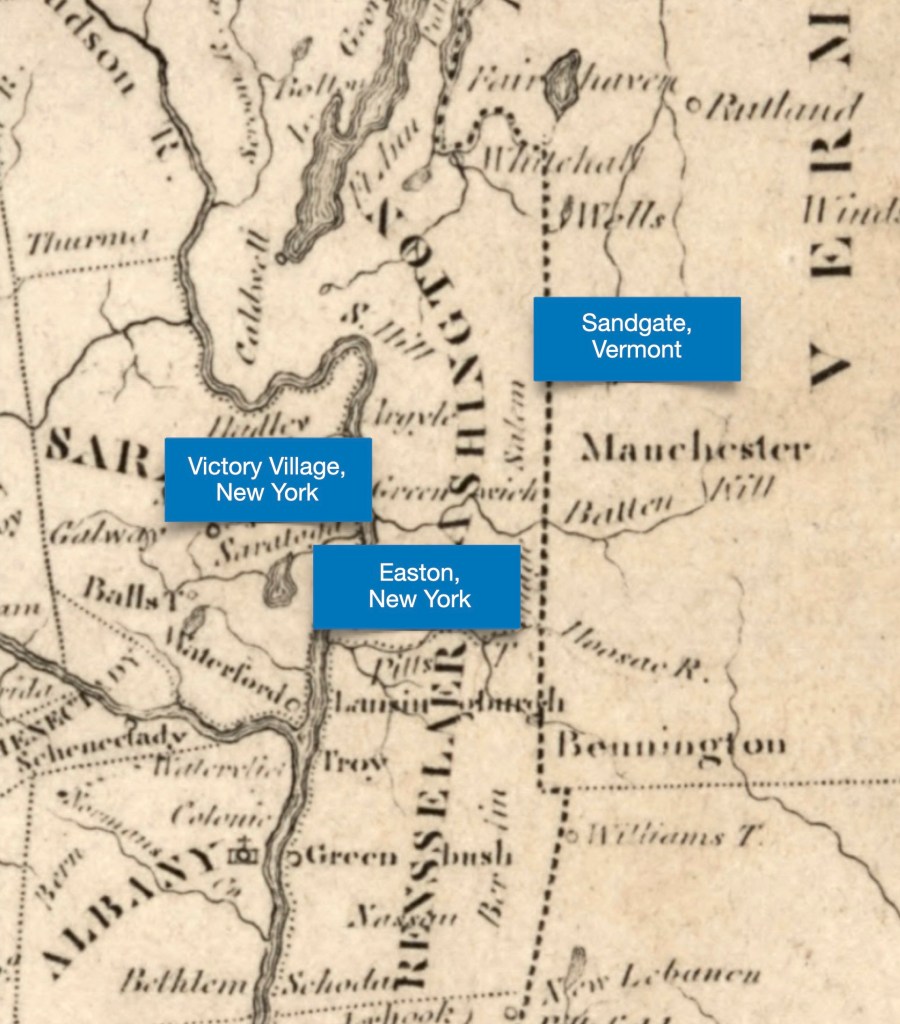
State of New-York. Albany, 1813. (Image courtesy of the Library of Congress).
The above map shows the eastern edge of New York State and the western edge of Vermont as they abutted each other just after the War of 1812, and before the commencement of the Civil War. The three principal communities indicated show where our ancestors lived during this period, prior to the westward emigration of our Great-Great-Grandparents to the Ohio Country. (1)
Learning From the 1855 New York State Census
Here is what makes the 1855 New York state census unique and also very helpful with our research: “The 1855 New York state census is notable because it was the first to record the names of every individual in the household. It also asked about the relationship of each family member to the head of the household—something that was not asked in the federal census until 1880.
The 1855 New York state census also provides the length of time that people had lived in their towns or cities as well as their state or country of origin—this is particularly helpful for tracing immigrant ancestors. If born in New York State, the county of birth was noted, which is helpful for tracing migration within New York State.”
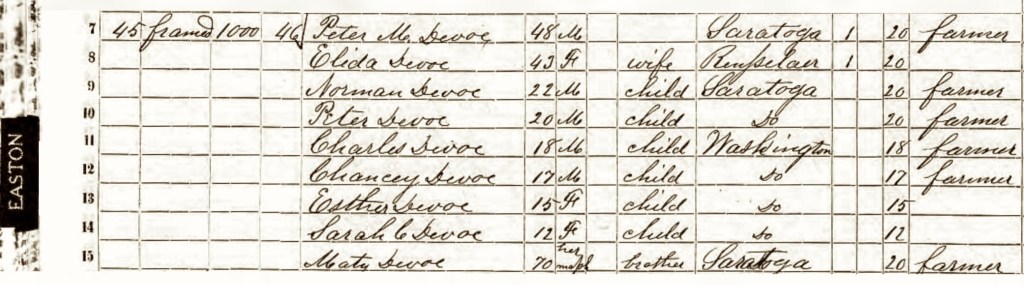
Peter A. DeVoe is listed on line 10, as being 20 years old, living in his parents’ home, working as a farmer, and that he was born in Saratoga County, New York.
In 1855, Mary Ann was already residing in the town of Wilton* in Saratoga County, for three years, having moved there from Sandgate, Vermont. She is shown on line 24, as being 22 years old, and working as a weaver. We can also observe that she was born in Vermont, and that she is a boarder among ten other women who are also working as weavers. All of these women are living in a boarding house belonging to Bethelvel Shaw.
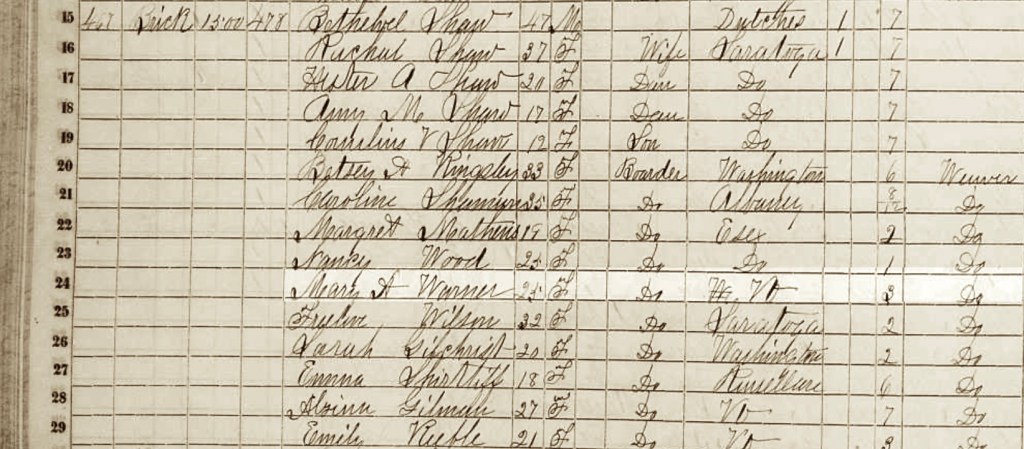
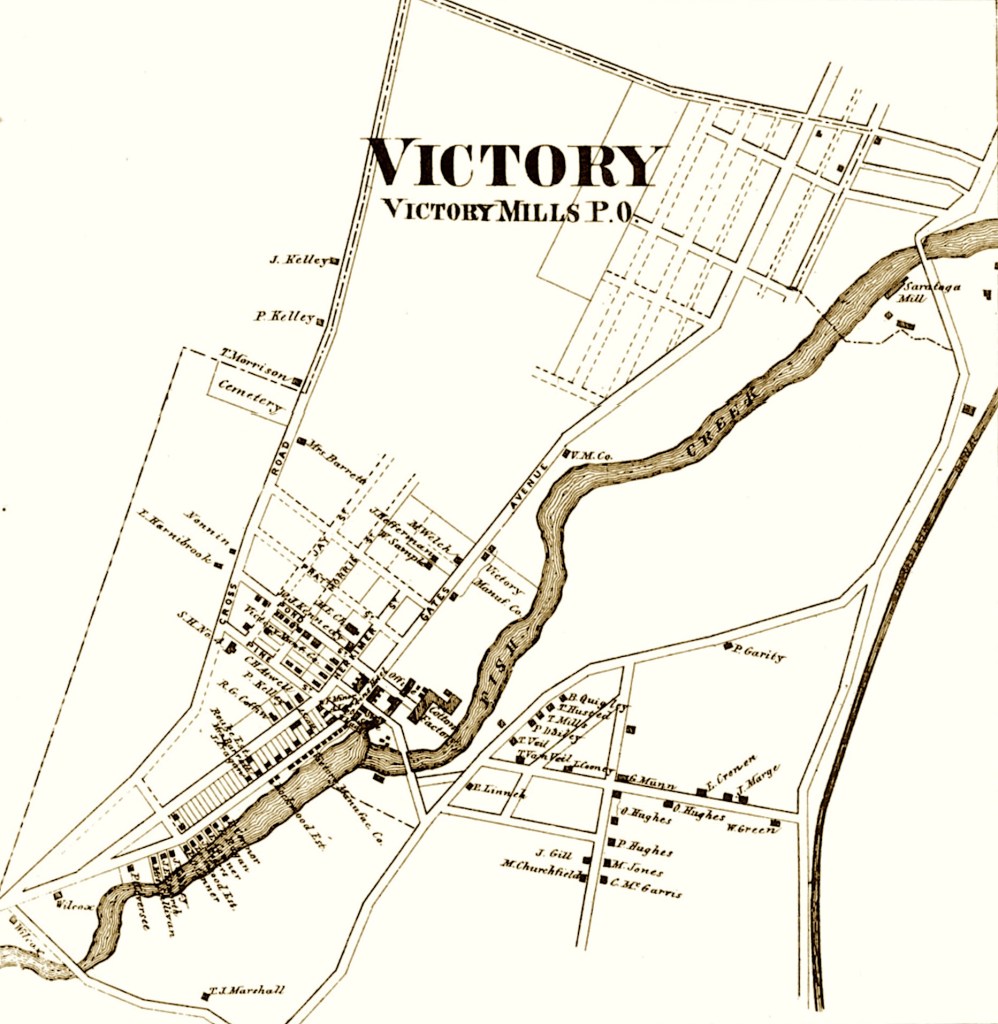
*In carefully analyzing the census materials, we learned that the landlord, Bethelvel Shaw and his family, ran a boarding house (which appears to have been situated amongst other boarding houses), in Victory Village, Saratoga County, New York. For both the 1855 and 1860 censuses, it is that same location, [despite being recorded as Wilton on the 1855 census].

Center: Map of the Victory Mills hamlet in Saratoga County, New York, where our 2x Great Grandmother Mary Ann lived and worked in the early 1850s. Bottom: Stereoscopic view of a cotton mill in Lowell, Massachusetts, (See footnotes for credits).
When Mary Ann Warner lived there she worked as a weaver, so we analyzed histories of Saratoga County and maps from that era. We learned that there were very few mills that processed wool or cotton in Saratoga County during the period of 1852 through 1855. Having determined that she was recorded as living in Victory Village, the only place she could have worked at was the nearby Saratoga Victory Manufacturing Company. (2)
The Saratoga Victory Manufacturing Company
We don’t know what brought Mary Ann Warner to come and leave Vermont and move to Saratoga County, New York, but it plausibly could have been for economic opportunity. In the 1820s, one of the first cotton factory mills to have opened to great success in the United States was in Lowell, Massachusetts, and word likely spread out from there about employment.
As the National Park Service writes: “The term ‘mill girls’ was occasionally used in [1840s] antebellum newspapers and periodicals to describe the young Yankee women, generally 15 – 30 years old, who worked in the large cotton factories… To find workers for their mills in early Lowell, the textile corporations recruited women from New England farms and villages.”
Female textile workers often described themselves
The Mill Girls of Lowell
as mill girls, while affirming the virtue of their class and
the dignity of their labor.
These “daughters of Yankee farmers” had few economic opportunities, and many were enticed by
the prospect of monthly cash wages and room and board
in a comfortable boardinghouse.
The National Park Service
“Beginning in 1823, with the opening of Lowell’s first factory, large numbers of young women moved to the growing city. In the mills, female workers faced long hours of toil and often grueling working conditions. Yet many female textile workers saved money and gained a measure of economic independence. In addition, the city’s shops and religious institutions, along with its educational and recreational activities, offered an exciting social life that most women from small villages had never experienced.”
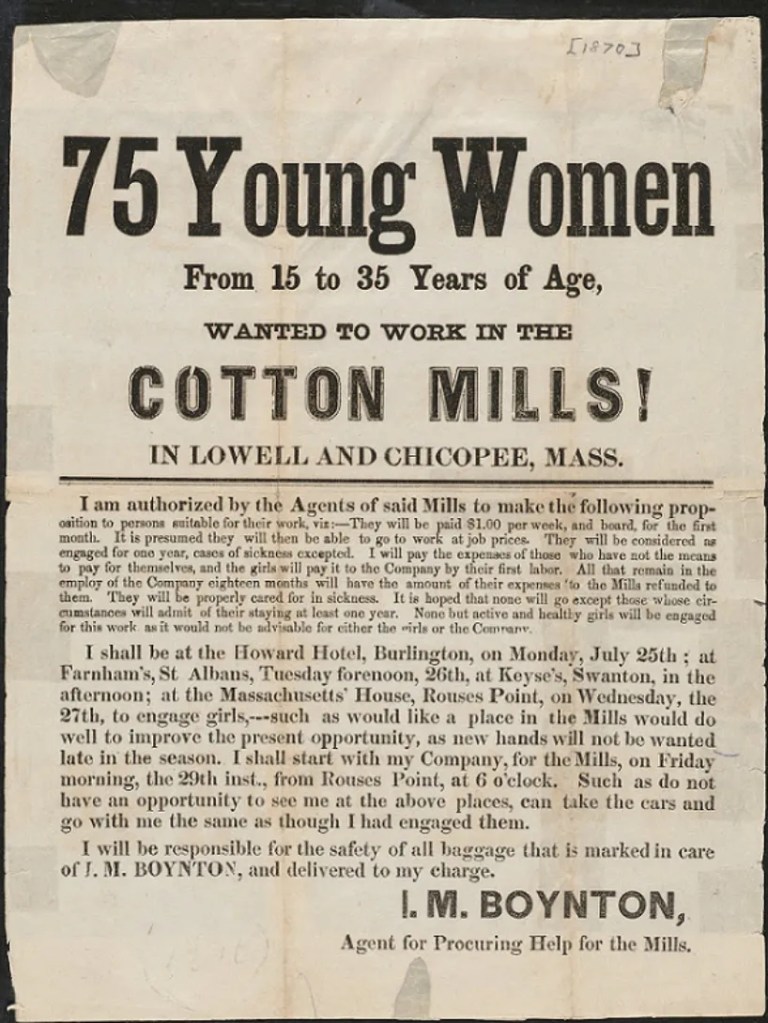
(Image courtesy of Medium, via Thinking Citizen Blog).
Although not as famous as the factories in Lowell, Massachusetts, the Saratoga Victory Manufacturing Company grew to be a very large business enterprise. It operated under several owners until finally closing in the year 2000.
From the Eustace Families Association website:
“The village of Victory is a suburb of Schuylerville, Saratoga County, New York. Victory is located just south of Schuylerville on Fish Creek, a tributary to the historic Hudson River… Victory is the product of the industrial revolution. The number of textile mills, which required abundant waterpower, grew rapidly during the mid-1800s… [By 1846], The Saratoga Victory Manufacturing Company [was built as]a three-story cotton cloth manufacturing plant costing $425,000. The company flourished and the number of employees living near the mill increased. In 1850, the cotton mill employed 160 men, 209 women, working at 12,500 spindles and 309 looms and produced over 1,800,000 yards of cotton cloth.”
“The development and expansion of Victory Mill coincided with the Potato Famine in Ireland. As a result, many Irish Catholic immigrants found work at the mills and as early as 1847, there was already a significant number of Irish families settled there.” Observation: The frequency of Irish family names was something that we took note of when we analyzed the census materials. In this era, on our father’s side of the family, our Irish 2x Great Grandmother Elizabeth (McGuire) McMahon also worked as a weaver at a mill in Doune Village, Stirlingshire, Scotland. (See The McMahon / McCall Lines, A Narrative — One). (3)
The City’s Shops and Religious Institutions… Offered an Exciting Social Life
To be honest, we really don’t know how, nor where, Peter A. and Mary Ann met. Were they introduced by friends at a dance, or a picnic? We have read that for many of the young women who worked in the mills, churches offered an acceptable social outlet for their young lives. At nearly 170 years ago, one can only conjecture what the circumstance was.
We also understand from his 1909 obituary, “He and his wife confessed Christ and united with Baptist Church in the East”. This explains how they became involved with the Baptist Church — but for all of the Dutch generations before him, his family had been devout members of the Dutch Reformed Church. Was this conversion the influence of Mary Ann’s family, or was it a natural progression of life, as one moves away from their parent’s home and ventures out into the world to find one’s self?

Marriage date: February 2, 1856
(Contemporary family photographs obtained from daguerratypes).
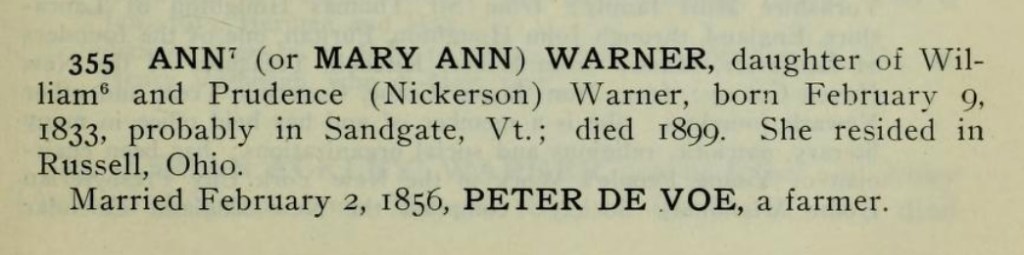
Peter A. DeVoe and Mary Ann Warner were married on February 2, 1856. The location is likely either in Sandgate, Bennington County, Vermont, or in Easton, Washington County, New York. However, we cannot yet confirm the exact location, because a specific marriage record has not been discovered. We will keep on searching for it, but for now, we have relied on other credible sources for their marriage date. Mary Ann Warner is the youngest daughter of our 3x Great-Grandparents William Warner of Vermont, and his third wife, Prudence Nickerson.
Peter A. and Mary Ann had two children:
- Clinton Chauncey DeVoe, born in New York, April 10, 1858 — died November 19, 1930 (We are descended from Clinton).
For the specifics about Clinton Chauncey DeVoe’s life, please see
The DeVoe Line, A Narrative — Ten. - Charles Raymond DeVoe, (see below)
Charles Raymond DeVoe was the younger son in the family. He was born at home in Russell, Geauga County, Ohio on November 4, 1861. He died July 28, 1939 also in Russell, Ohio. Charles DeVoe married Adeline M. “Addie” Parker, on November 4, 1884, in Geauga, Ohio. She was born on November 10, 1865 in Munson, Geauga, Ohio, the daughter of DeWitt Clinton Parker and Lucina Robinson. She died on March 25, 1944 in Auburn, Geauga, Ohio. (4)

The Years Before the Civil War — How Did They Travel?
We do not know by which route Peter A., Mary Ann, and young Clinton Devoe traveled to Northeast Ohio. In the late 1850s, for people emigrating westward to Ohio from the counties in New York and Vermont where our ancestors lived — they would have likely traveled by a combination of canals, railroads, and roads.

between Saratoga County, New York and the Western Reserve of Ohio. (Image courtesy of Quora).
Red = roadway routes, Blue = canal routes, Black = railway routes
The Canal Routes
The primary water route was a series of linked canals, dominated by the Erie Canal, which connected with the Champlain Canal. The Champlain ran between the Saratoga and Washington County borders, where Peter A.’s parents and other relatives lived. It would have been very easy for them to access this route. Wikipedia states about the Erie,“The Erie’s peak year was 1855 when 33,000 commercial shipments took place.”
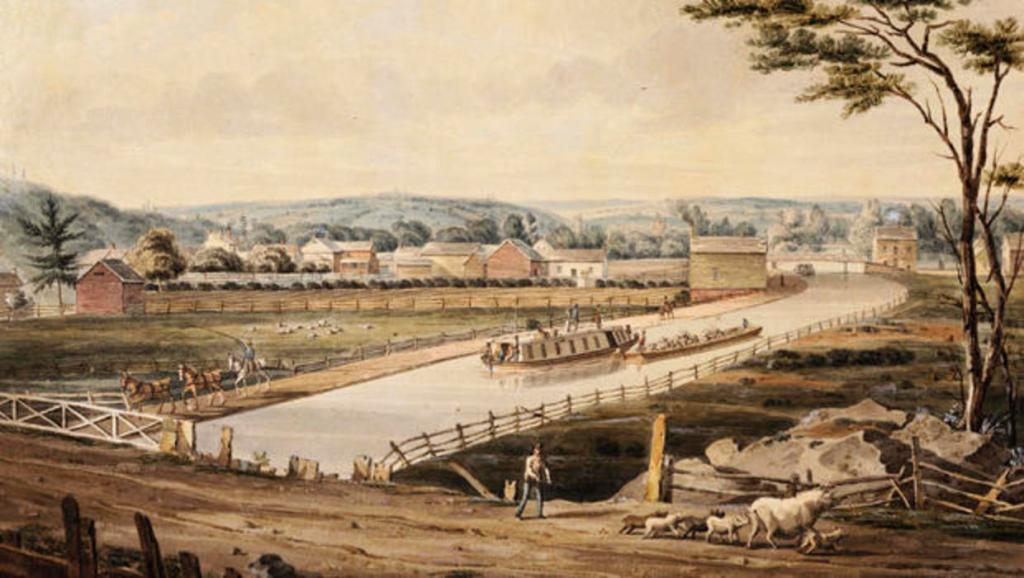
via The New York Public Library.
The Railway Routes
During this decade, railroad lines were also being constructed. If a traveler were fortunate, a rail line might exist for their destination. From Wikipedia: “The Mohawk and Hudson Railroad opened in 1837, providing a bypass to the slowest part of the canal between Albany and Schenectady. Other railroads were soon chartered and built to continue the line west to Buffalo, and in 1842 a continuous line (which later became the New York Central Railroad and its Auburn Road in 1853) was open the whole way to Buffalo”.
The Roadway Routes
Roadways, however, were a rough, mixed-bag of environments. What type of road surface one encountered depended upon the circumstances of the area you were passing through. There were: improved surfaces, packed dirt, corduroy (felled trees were used as planks), and pathways through fields. Taking a land route the entire way would have been the most difficult option.
We heard family stories about wagon travel, but to be honest, we just do not know how they made their way to northeast Ohio. What we do know is that the western end of the Erie Canal, and the endpoint for the railroads [in 1859], was at Buffalo, New York, on Lake Erie. This became the decision point about what to do next.

Background image: Gathering With Covered Wagon, 20th century image correct for
Conestoga wagon, oxen, style of dress, and Ohio designation.
(Image courtesy of digitalcommonwealth.org).
At Buffalo, a horse drawn wagon, or a heavy covered wagon such as the Conestoga wagon, would have been required for travel across Pennsylvania to the their new home in the Western Reserve of Ohio. This type of wagon was extremely popular in the years just before the Civil War, which started in 1861. (5)
Many New Englanders Were Moving to the Western Reserve in Ohio
We believe that their attraction to northeast Ohio was most likely because the influence of family members from Mary Ann’s side of the marriage. She was part of the large, extended Warner family.
Note: Her father William S. Warner Sr., was married three times: first to Lucy Coan which brought seven children into the world, and second to Abigail Root —a brief marriage due to Abigail’s death; without children. William Warner’s third marriage was to Mary Ann’s mother, Prudence B. Nickerson, bringing four more children.
From William’s first marriage to Lucy Coan, five older brothers of Mary Ann were living in the Western Reserve of Ohio, all of them in Geauga County. Her older sister, Lucina married Clark Reed and they settled in Pike County, in southeast Ohio. The Warner siblings migrated to Ohio in two waves. The first was in the 1830s, and the second was in the 1850s. The Willoughby Independent Newspaper, of Willoughby, Ohio, in 1881, recounts:
“Out of a family of eleven children of William Warner, Sr. of Sandgate, Bennington County, Vermont, seven migrated to Geauga County, Ohio at a time in American history when Ohio was considered the far west. Six located permanently in Geauga County, the other, Lusina (Warner) Reed, removed with her husband Clark Reed, to Pike County, Ohio.”
“The first to arrive was Gaylord C., who came in 1830 followed the next year by his brothers, William Jr., Joseph and Benjamin and later John and a sister, [Mary] Ann, who married Peter DeVoe and settled in Russell. For the past 120 years these Warners, with their descendants, have contributed their bit to the progress of the Western Reserve. There are at present descendants of the family living in 10 of the 16 townships of Geauga. Besides many who moved on to help build a bigger and better America.” For many decades up to the present time, a yearly Warner Family Reunion has been held. The first reunion was in 1880 at the home of William Warner Jr.
Peter A. DeVoe’s 1909 obituary states that they entered Ohio in 1859. The 1860 United States Federal Census records them living in Russell township, Geauga County, Ohio.


Note that below Peter’s name is his younger brother Chauncey Devoe,
who must have been living in the area before he returned to New York state.
In the midst of the Civil war period, Peter A.’s younger brother Chauncey must have been living in the area, because he and Peter registered for Civil War service. Even though the War did not affect Ohio very much, Peter’s obituary in 1909 states, “His musical talent was above the ordinary… He served for a short time in the Civil war as a musician.”

By the time of the March 1870 census, Prudence Warner, Mary Ann’s mother, is living with them. We observed that one of the children listed — Warren French, is the neighbor’s child who must have been residing there also. We are neither sure when, nor how, Prudence Warner in her elder years, traveled to Ohio from Sandgate, Vermont. Since it was the 1860s, railroad lines were fast developing, and it is quite possible that perhaps the entire trip was by railroad. (6)

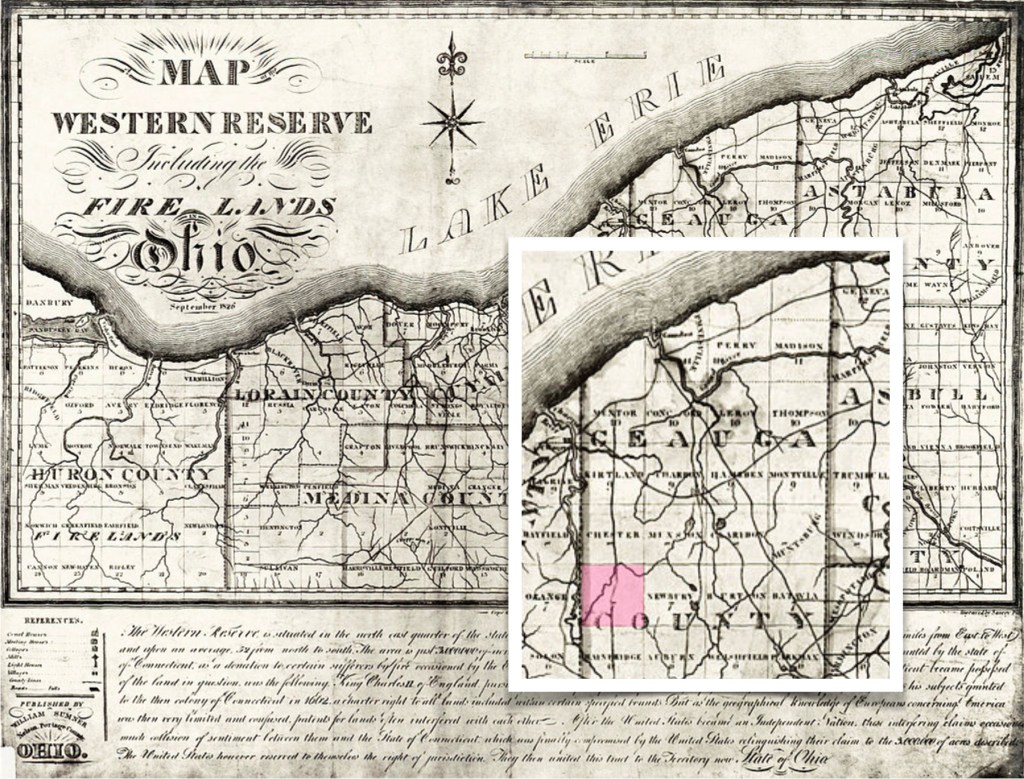
Published by Titus, Simmons and Titus, Philadelphia. Image courtesy of historicmapworks.com.
The Last Township to be Named
If you look carefully at the 1826 Western Reserve Firelands map/illustration a few paragraphs above, you can see that Russell township is not yet named. When researching why this is, we came across this passage from the 1878 book, the History of Geauga and Lake Counties, Ohio:
“Russell was the last to be peopled, of all the townships, and the most of her early inhabitants removed to her borders from the surrounding country. This is said by her historians to have resulted from the high prices at which the proprietors held the land. It was also due to the generally low estimate which prevailed, set upon her soil and timber.”
This was rather startling to read, because (at present) the township is heavily forested and there is also much farmland. We wonder if perhaps local politics and land speculation was affecting the early settlers, of which there were many in our family. From the 1880 edition of the Pioneer and General History of Geauga County..., we learned that both aspects were true.
“At the commencement of its settlement, it was called the West Woods by the people of Newbury. The reason why it was not settled as soon as the adjoining townships, I suppose, to be that the speculators who bought of the Connecticut Land company, held it out of the market, or held it above the market price.”
Interestingly, we learned that other people from Bennington County, Vermont, where the Warner family hailed from, were present in the area since the 1820s…
“Clark Robinson moved from Shaftsbury, Bennington County, Vermont, to Middlefield, in the fall of 1820… and bought a lot of land in Russell Center at three dollars per acre…on the eighth of November, 1825, moved his family into the body of a log house…” (7)
The Legacy of Briar Hill and Old Riverview
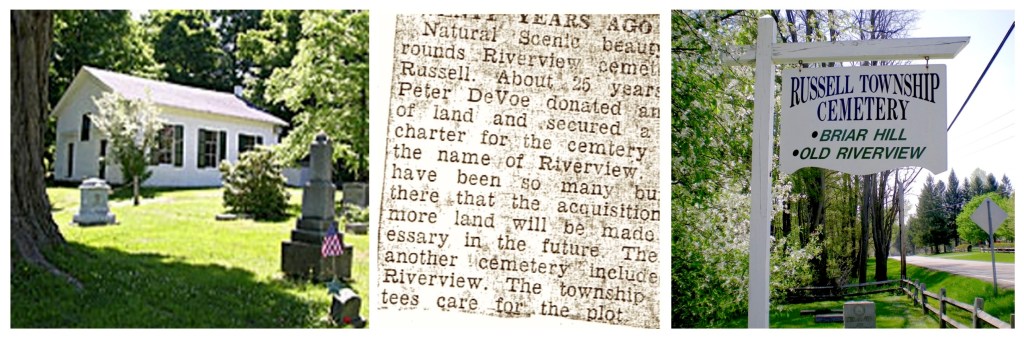
Russell township, Ohio.
Amongst old family ancestry records we discovered a portion of a small 1910s(?), 1920s(?) newspaper article about our 2x Great Grandfather Peter A. Devoe. It describes how in earlier years he had donated a portion of his land to create the Riverview Cemetery, an adjunct to the Briar Hill Cemetery. If you examine his property map (shown above) from 1874, you can discern on the upper corner that it says Wesleyan Cemetery and shows a small indication labeled ‘Ch’ for a church, or chapel.
From the 1880 edition of the Pioneer and General History of Geauga County..., we discovered this:
“The Wesleyan Methodist Church. — About the year 1848 there was a division among the Methodists on the slavery question, a part of the members withdrew, and a Wesleyan Methodist church was organized embracing two families that were left of a Congregational church, that was formed in the northwest part of Russell, in the summer of 1840, when J. M. Childs was chosen deacon, and A. H. Childs was chosen clerk, which had become reduced to the two families mentioned, when their organization was given up, and they, uniting with those who came away from the Methodist Episcopal church, formed the Wesleyan Methodist church, and in 1850 they bought a piece of land of L. T. Tambling, two miles north of the center, on the west side of the Chillicothe road, a nice sandy knoll for a burying ground, and to build a meeting house on, and four of them paid for it, to-wit: H. Cummins, John Wesley, David Nutt, and J. M. Childs, and had it deeded to the trustees of the first Wesleyan Methodist church in Russell, and to their successors in office. The first three named that paid for the burying ground are dead and gone to their reward; Mr. Childs is living yet. He says that in 1851 they began to make preparations to build a meeting house, but, being poor, and new beginners, it went on slow, but with a hard struggle with poverty and bad management, it was finished.”
The Wesleyan Cemetery eventually became known as Briar Hill Cemetery. The meeting house became the Riverview Chapel where Baptist religious services were held. Peter A. Devoe and his extended family members gathered there for worship. Our Grandmother Lulu Mae (DeVoe) Gore often spoke of his love of music and how he would lead musical performances at the chapel.
There are six generations of our family buried in Riverview Cemetery. These family lines are: Bond, DeVoe, Gore, McClintock, and Warner. (8)
They Joined Their Ancestors
Both Peter and Mary Ann were descended from many generations of people who earned their living as farmers from an agrarian economy. They carried on that tradition, as their sons did after them.

Mary Ann (Warner) DeVoe was the first to pass away on April 10, 1899. We have found two records about her death, and they indicate that she died from either consumption, or measles.
Peter A. DeVoe was born on June 23, 1834 in Saratoga County, New York. After his wife Mary Ann passed away, he lived into the 20th century for another ten years . He died on October 31, 1909 from an accidental fall. This newspaper account describes what happened. Peter’s obituary (further below) speaks to how beloved he was in his community. (9)

The Geauga Republican, or the Cleveland Leader, on November 3, 1909.
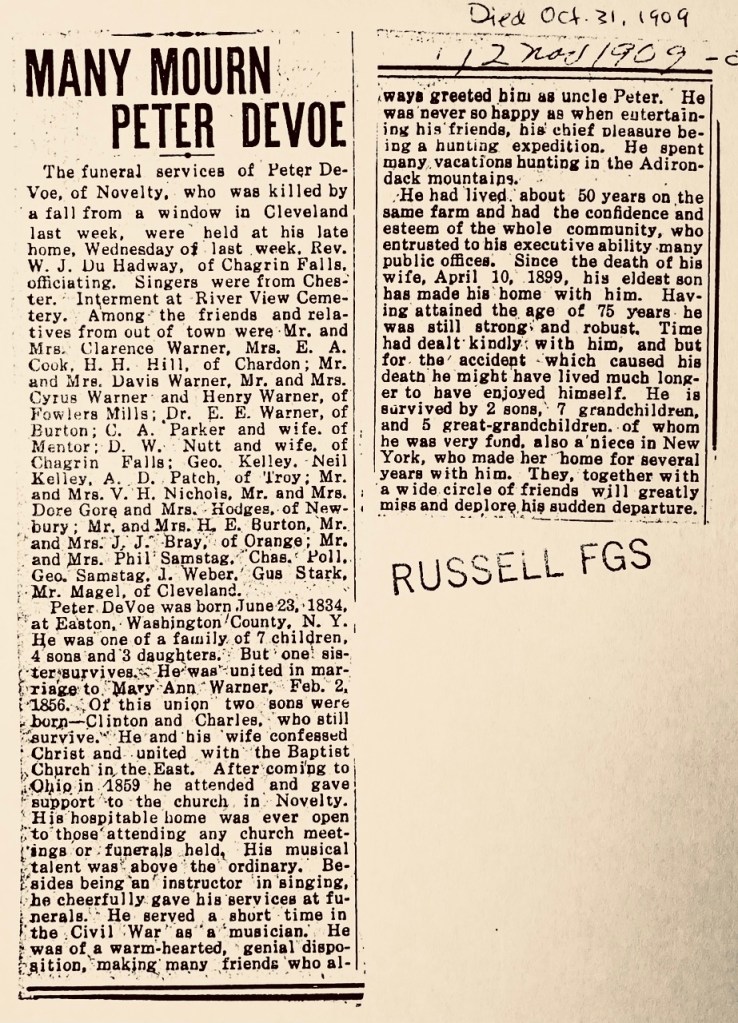
on November 12, 1909.
In the next chapter we will write about Peter and Mary Ann’s son Clinton Chauncey DeVoe, his wife Clara Antionette McClintock, and their children.
Following are the footnotes for the Primary Source Materials,
Notes, and Observations
A Chip Off The Old Block?
(1) — one records
Library of Congress
State of New-York for Spafford’s gazetteer, 1813
https://www.loc.gov/resource/g3800.ct003432/?r=-0.195,0.049,1.46,0.862,0
Note: For a portion of the map image.
Learning From the 1855 New York State Census
(2) — eight records
New York Genealogical & Biographical Society
New York State Census Records Online
https://www.newyorkfamilyhistory.org/subject-guide/new-york-state-census-records-online#1855
Peter M Devoe
in the 1860 United States Federal Census
New York > Washington > Easton
https://www.ancestry.com/discoveryui-content/view/48630571:7667?tid=&pid=&queryId=35ec4bd5-43de-42e5-bb2e-505bfa1707e1&_phsrc=Rxw27&_phstart=successSource
Book page: 160, Digital page: 28/80, Entries 23 through 29.
Mary A Warner
Census – New York State Census, 1855
https://www.familysearch.org/ark:/61903/1:1:K63D-4G5
Digital page: 247/481, Entry 24.
Note: This census is recoded as Election District 2 / Wilton, but the location it covered for our Great-Great-Grandmother Mary Ann Warner is actually the small town of Victory Village, just south of Wilton. See the notes below on Bethuel Shaw.
Bethuel Shaw (or Nathaniel Shaw)
https://www.findagrave.com/memorial/118426704/bethuel-sha
Notes: Much research was done on Bethuel Shaw, and the following was determined — He and his family ran a boarding house (which appears to have been situated amongst other boarding houses), in Saratoga County, New York. For the 1855 “Wilton” census and for the “Victory Village” 1860 census, it is the same location because the names of the neighbors are exactly the same (the Taylor family and the Kelly family). On the 1860 census, his name Bethuel is recorded as Nathaniel.
History of Saratoga County, New York, with Biographical Sketches of Some of its Prominent Men and Pioneers
by Nathaniel Bartlett Sylvester, 1878
https://archive.org/details/cu31924028833064/page/n7/mode/2up

New Topographical Atlas Of Saratoga Co. New York
From Actual Surveys by S.N. & D.G. Beers and Assistants
Stone & Stewart, Publishers. Philadelphia. 1866
https://mathcs.clarku.edu/~djoyce/gen/saratoga/Atlas.html
Gossypium barbadense, cotton plant
Illustration from the Botany Library Plate Collection held at the
Natural History Museum, London
https://www.mediastorehouse.com.au/mary-evans-prints-online/gossypium-barbadense-cotton-plant-8613143.html
Note: For the cotton plant illustration.
Resources for History Teachers
The New England Textile Industry in the 19th Century
http://resourcesforhistoryteachers.pbworks.com/w/page/125185436/The%20New%20England%20Textile%20Industry%20in%20the%2019th%20Century
Note: For the Lowell, Massachusetts stereoscopic view card mill image.
The Saratoga Victory Manufacturing Company
(3) — four records
The Mill Girls of Lowell
https://www.nps.gov/lowe/learn/historyculture/the-mill-girls-of-lowell.htm#:~:text=To find workers for their,board in a comfortable boardinghouse.
Eustace Families Association
http://www.roneustice.com/Family History/IrishFamiliessub/EustisVictoryMills/VictoryMills.6.7.09.htm
Thinking Citizen Blog — Massachusetts (Part Two) Textiles, Shoes, Telephones
https://john-muresianu.medium.com/thinking-citizen-blog-massachusetts-part-two-textiles-shoes-telephones-55beeb38c6de
“Several companies owned and operated the facility over the years and unfortunately ended up closing its doors in 2000.”
https://www.villageofvictory.com/about-historical-victory/
The City’s Shops and Religious Institutions… Offered an Exciting Social Life
(4) — five records
The Descendants of Andrew Warner
> Seventh Generation
Compiled by Lucien C. Warner and Mrs. Josephine Genung Nichols
https://archive.org/details/descendantsofand00warn/page/380/mode/2up?view=theater
Book page: 381-382, Digital page: 380-382/804, Right page, entry 355.
Note: “Ann (or Mary Ann) Warner marries Peter DeVoe”
Charles R. Devoe
Marriage – Ohio, County Marriages, 1789-2016
https://www.familysearch.org/ark:/61903/1:1:XD2M-HMQ
Book page: 321, Digital page: 182/516 Right page bottom, entry 3.
Note 1: Spouse is, Addie Parker / Adeline M. Parker
Note 2: Marriage date, November 4.1884, in Geauga County, Ohio
Chas Raymond Devoe
Death – Ohio Deaths, 1908-1953
https://www.familysearch.org/ark:/61903/1:1:X8MR-L8D
Digital page: 1544/3320
Note: This file also documents his birth date.

Addie Parker Devoe
Death – Ohio Deaths, 1908-1953
https://www.familysearch.org/ark:/61903/1:1:X8ML-Y6F
Digital page: 2697/3295
Notes: Birth date and location, death date and location.
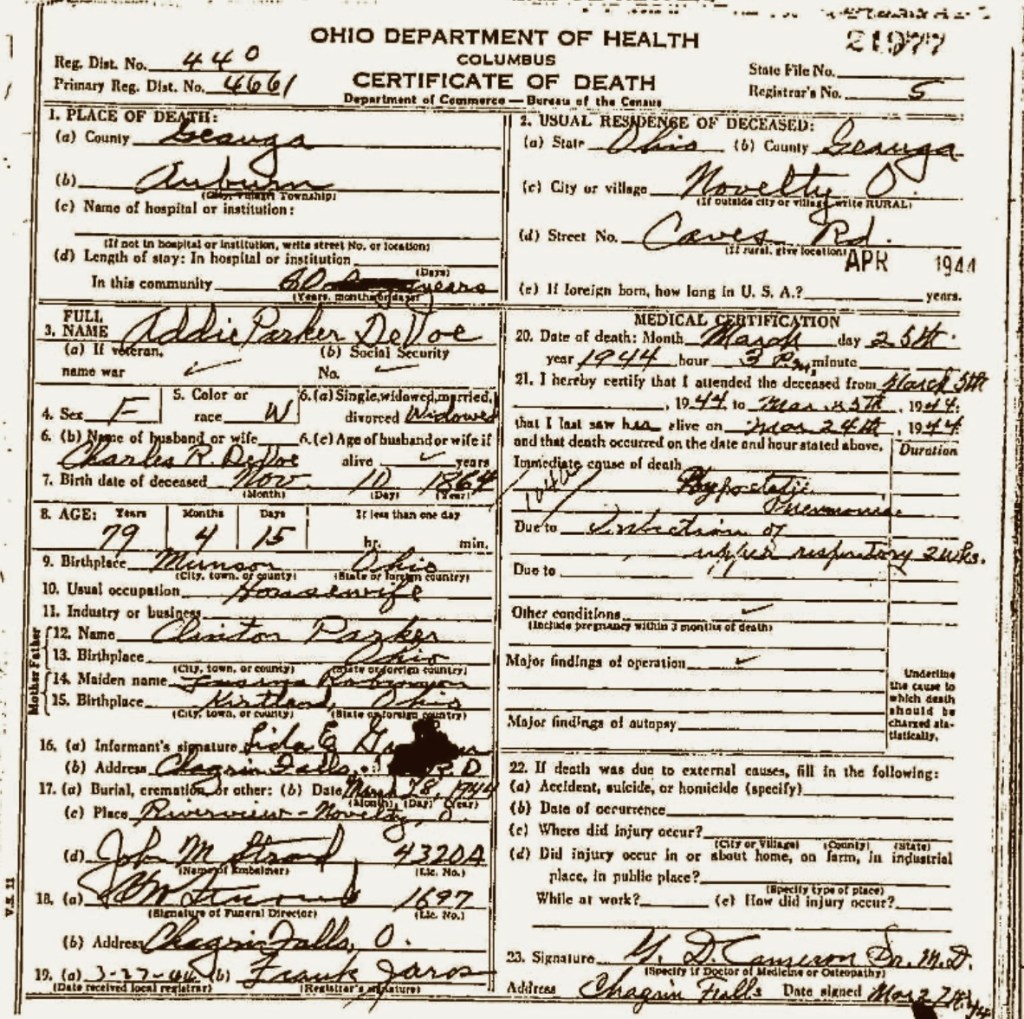
Adeline M. Parker
https://www.familysearch.org/tree/person/details/99B3-JDD
Note: Addie DeVoe’s parents are: DeWitt Clinton Parker and Lucina Robinson.
The Years Before the Civil War — How Did They Travel?
(5) — five records
Quora map image
How would someone in the 1850s get from New York to Kansas?https://www.quora.com/How-would-someone-in-the-1850s-get-from-New-York-to-Kansas
CBS News
All Hail The Erie Canal
“View on the Erie Canal” (1830-32) by John William Hill
via The New York Public Library
https://www.cbsnews.com/news/all-hail-the-erie-canal-200th-anniversary/
Note: For the landscape painting.
Erie Canal
https://en.wikipedia.org/wiki/Erie_Canal
Covered Wagon With Horses photo
Little House Books
http://lhbooks.weebly.com/covered-wagons.html
Note: For the covered wagon image in color.
Gathering With Covered Wagon
by Associated Photofeature Syndicate, 58 Charles Street, Boston, Massachusetts
https://www.digitalcommonwealth.org/search/commonwealth:0r96gd67j
Note: For the covered wagon image, sepia toned.
Many New Englanders Were Moving to the Western Reserve in Ohio
(6) — six records
Western Reserve Including the Fire Lands 1826
https://commons.wikimedia.org/wiki/File:Western_Reserve_Including_the_Fire_Lands_1826.jpg
Note: On this map, Geauga County is still combined with the future Lake County and Russell township is not yet named.
North America, Family Histories, 1500-2000 for Ann Warner
W > Warner > The Descendants of Andrew Warner
https://www.ancestry.com/imageviewer/collections/61157/images/46155_b290135-00262?usePUB=true&usePUBJs=true&pId=1810137
Book page: 254-255, Digital page: 262-263/812
Note: Entry 355 on page 263, is a notation for her marriage to Peter Devoe.
P Devon
in the 1860 United States Federal Census
https://www.ancestry.com/discoveryui-content/view/43403745:7667?tid=&pid=&queryId=a14478bc-ce31-4745-9564-8089cb4f9791&_phsrc=cUK2&_phstart=successSource
Book page: 18, Digital page: 18/25, Entries 27-29.
Peter Devoe
in the U.S., Civil War Draft Registrations Records, 1863-1865
Ohio > 19th > Class 1, A-K, Volume 1 of 4
https://www.ancestry.com/discoveryui-content/view/1035699:1666?tid=&pid=&queryId=74778971-fe58-4cc5-a090-2f50318fd932&_phsrc=cUK4&_phstart=successSource
Book page: 145, Digital page: 168/338, Entries 13 and 14.
Peter De Voe
Census – United States Census, 1870
https://www.familysearch.org/ark:/61903/1:1:M62W-W7Z
Book page: 2-3, Digital page: 612-613/733
Notes: Entries 35 through 40 at the bottom of the left page and entry 1
at the top of the (next right) page.
Extracts from the Willoughby Independent, 1881, Willoughby, Ohio Newspaper
Judy Jane Stebbins, 3/1/2013
https://usgenwebsites.org/OHLake/newspaper/Willoughby%20Independent%201881c%20Stebbins.pdf
The Last Township to be Named
(7) — three records

Historic Map Works
Russell, Fowler’s Mills
From Lake and Geauga Counties 1874, Ohio
Published by Titus, Simmons and Titus in 1874
https://historicmapworks.com/Map/US/24292/Russell++Fowler+s+Mills/

History of Geauga and Lake Counties, Ohio
https://archive.org/details/oh-geauga-lake-1879-williams/page/n9/mode/2up
Book page: 207, Digital page: 318/443
1798 – 1880, Pioneer and General History of Geauga County, with Sketches
of Some of the Pioneers and Prominent Men
by The Historical Society of Geauga County
Russell > For Early Proprietors, and > Early Events:
https://archive.org/details/oh-geauga-1880-historical-society/page/109/mode/2up?view=theater
Book page: 109-110, Digital page: 109-110/821
The Legacy of Briar Hill and Old Riverview
(8) — two records
Russell Township
Township Cemeteries
https://russelltownship.us/departments/administration-1/cemetery
Note: For the Riverview Chapel image.
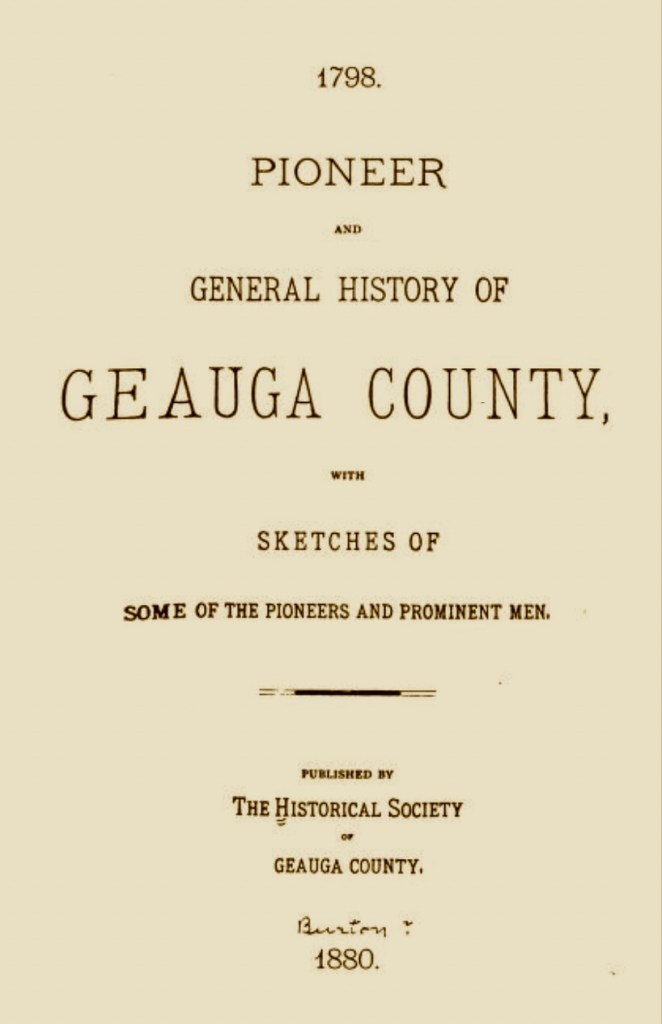
1798 – 1880, Pioneer and General History of Geauga County, with Sketches of Some of the Pioneers and Prominent Men
by The Historical Society of Geauga County
Russell > The Wesleyan Methodist Church
https://archive.org/details/oh-geauga-1880-historical-society/page/113/mode/2up?view=theater
Book page: 114, Digital page: 113/821
They Joined Their Ancestors
(9) — four records
Mary A. Devoe
Vital – Ohio Deaths and Burials, 1854-1997
https://www.familysearch.org/ark:/61903/1:1:F6D5-ST5
Book page: 8, Digital page: 435/469, Left page, entry #4828.
Note: her cause of death is listed as consumption (tuberculosis).
Peter Devoe
Death – Ohio Deaths, 1908-1953
https://www.familysearch.org/ark:/61903/1:1:X6XS-W2N
Digital page: 98/3051

Peter Devoe
in the Ohio, U.S., Rutherford B. Hayes Presidential Center Obituary Index, 1810s-2016
https://www.ancestry.com/discoveryui-content/view/2222115:1671?tid=&pid=&queryId=8f21bb29-7ea3-4d5b-9aed-f7ae3dc6ea30&_phsrc=bTB3&_phstart=successSource
Ohio, U.S., Wills and Probate Records, 1786-1998 for Peter De Voe
Geauga > Probate Files, Dutton, Charles O-Downing, Cornelia A
https://www.ancestry.com/imageviewer/collections/8801/images/005441006_01234?pId=15350799
Digital pages: 1234 through 1250
Note: There are about 17 images in this docket.
Peter Devoe
in the Ohio, U.S., Death Records, 1908-1932, 1938-2018
D
https://www.ancestry.com/discoveryui-content/view/6201688:5763?tid=&pid=&queryId=138f15d6-7ebf-4d55-ae45-6660f57adcfa&_phsrc=Wxe18&_phstart=successSource
Book page: 335, Digital page: 30/2684, Entry 15 from the bottom.
 Our Ancestors, Our Narratives
