The Soule Line, A Narrative — Seven

This is Chapter Seven of seven. In this last narrative on the descendants of Pilgrim George Soule, we cover Generations Five and Six in America. Both of these generations carry the new family surname of Warner.

Preface

Our introduction to the Drinkwater name family goes back to the early 1970s, when first heard the name Mercy Drinkwater from our Grandmother Lulu Gore. Mercy was the 2x Great Grandmother to Lulu, and it was likely that Mercy’s first name evolved from an idea in Christian theology. The “seven lively virtues… are those opposite to the seven deadly sins. They are often enumerated as chastity, temperance, charity, diligence, kindness, patience, and humility.” (Wikipedia). We could see the name ‘Mercy’ falling right in line with that point-of-view. (1)

Just ask Homer Simpson which one has more fun.

However, we must admit a bit sheepishly that the ‘deadly sin’ part of our personalities cannot help but notice that when you say her name out loud, it sounds distinctly like you are either openly worrying about dehydration, or echoing the emergency response team from the Poison Control Center:
Mercy! Drink water!

So much… for lively virtue.

Woodbury, Connecticut Colony

Like our ancestors who founded the Plymouth Colony in Massachusetts, the settlers who founded Woodbury, Connecticut were also religious objectors. “The founders of Woodbury came from Stratford, Connecticut, in the early 1670s. Ancient Woodbury consisted of the present towns of Woodbury, Southbury, Roxbury, Bethlehem, most of Washington and parts of Middlebury and Oxford.

Two groups of settlers came from Stratford. The first, religious dissidents unhappy with the church in Stratford, was led by Woodbury’s first minister, the Reverend Zachariah Walker. The second, led by Deacon Samuel Sherman, had been given approval by the general court to purchase land from local Native Americans in order to establish a new settlement. Together, fifteen families (about fifty people), arrived in ancient Woodbury, known as ‘Pomperaug Plantation’, early in 1673”. (Wikipedia, Woodbury Connecticut)

“By the end of the eighteenth century Woodbury had developed as a thriving center of agricultural trade because of its proximity to the Housatonic River, which provided a major navigational route to the coast. A measure of Woodbury’s wealth was the large number of artisans and tradesmen such as millers, blacksmiths, wheelwrights and clothiers as well as tinsmiths, tanners, joiners and goldsmiths.” (The Old Woodbury Historical Society)
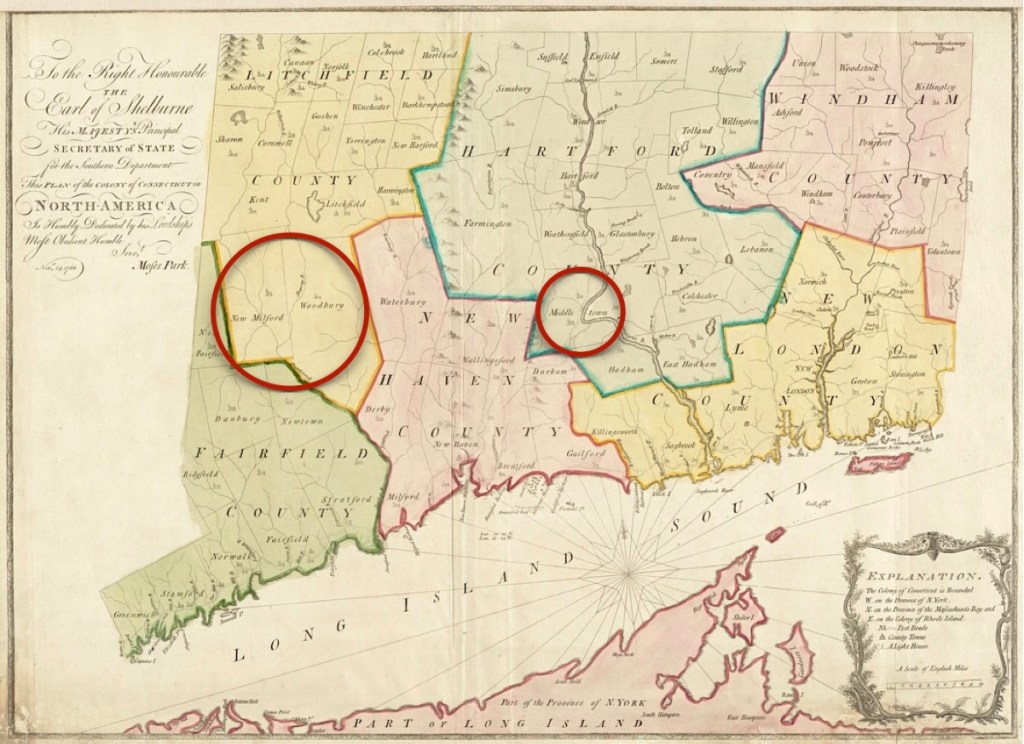
Plan of the Colony of Connecticut in North America, by Moses Park, 1766.
Mercy Drinkwater is from the area of the larger circle to the left; Eliphaz Warner, from the smaller circle to the right. (Image courtesy of the Boston Public Library).

One of the things about our Ancestral Grandmothers is the fact that not many records survive about these women. The eras that they lived in didn’t allow the creation of many meaningful records due to the customs of the time: things like civic records, inheritance laws, even Census data until about 1850… there just isn’t much there, or even that has survived. So it is with Mercy Drinkwater, especially as a young child.

We know when she was born, and that she was the youngest of 12 children from her father’s first wife. Her mother Elizabeth (Benedict) Drinkwater, died in 1749 when Mercy was about 15 months old. Her father William then remarried Susannah Washburn in 1751, when Mercy was about 3. Then in 1758, when Mercy was 10 years old, the records tell us that both William and her step-mother Susannah (Washburn) Drinkwater died.

So our primary question became, Who then raised Mercy for the next 10-11 years until she married? Was it her mother’s family the Benedicts? Or perhaps an older sister? How did she meet her husband, Eliphaz Warner? When exactly did they marry? We were not able to resolve these questions. We have looked everywhere and we don’t think that the marriage record has survived. We have to infer from what we know.

Mercy Drinkwater, born March 25, 1748, New Milford, Litchfield County, Connecticut Colony — died October 22, 1813, Sandgate, Bennington, Vermont. She was the daughter of William Drinkwater and Elizabeth Benedict.

Eliphaz Warner, born September 1, 1742, Middletown, Hartford* County, Connecticut Colony — died March 12, 1816, Sandgate, Bennington, Vermont. He was the son of Jabez Warner and Hannah Warner. He married Mercy Drinkwater by 1769, in an unknown location* in Connecticut; together they had seven children.

*We believe that the exact record for their marriage has been lost. This could be due to destruction caused by the church burning down, arson from conflicts with the Native Peoples, natural forces like a flood… Sometimes when the organizing government domain changes, records disappear through lack of oversight. Hartford County became Middlesex County in May 1785, being created from portions of Hartford County and New London County. Perhaps the record was lost then?

What we do know is this — it is highly probable is that they married in one of the three communities where their family members lived: Ridgefield, New Milford, or Woodbury. We just don’t know exactly where at this time. (2)
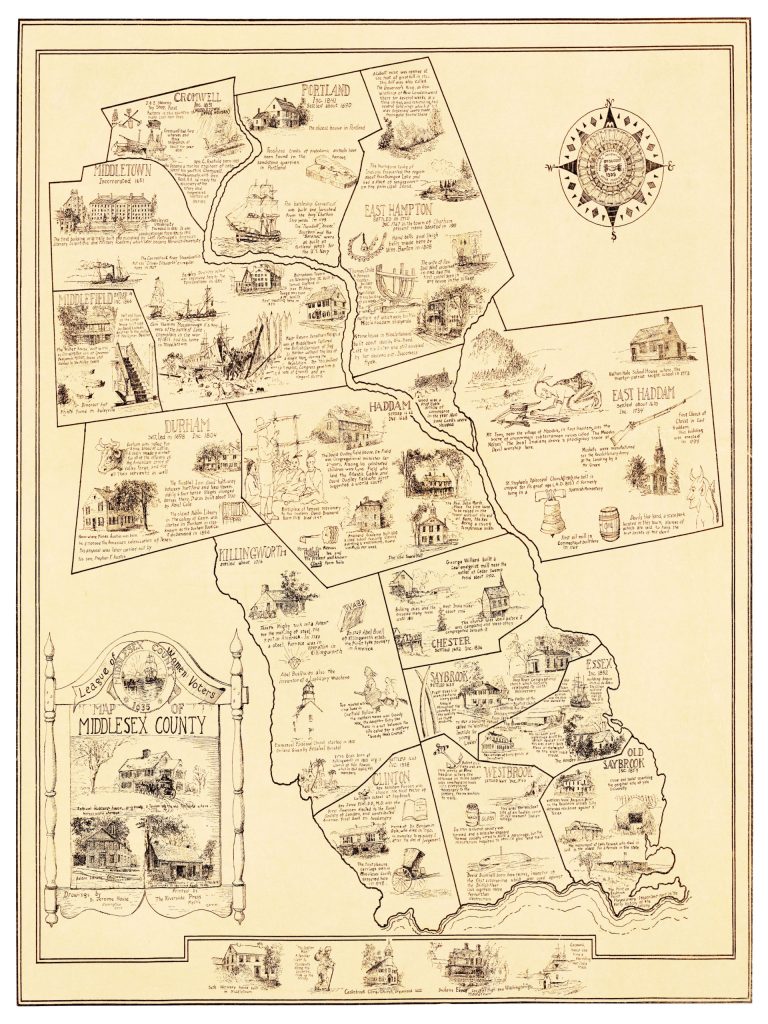
“This old map of Middlesex County, CT was commissioned in 1934 by the Connecticut League of Women Voters. S. Jerome Hoxie illustrated the map and it was printed by The Riverside Press in Mystic Connecticut.” (See footnotes).

Eliphaz and Mercy (Drinkwater) Warner Children

The first two children were born in Judea Parrish, Woodbury, Litchfield County, Connecticut Colony. “Before it became a separate town in 1779, and chose to name itself ‘Washington’, the area was known as ‘Judea’, and was part of Woodbury, Connecticut”. (Wikipedia, Judea Cemetery)

  • William S. Warner, born November 12, 1770 — died May 24, 1856, Sandgate, Bennington County, Vermont. He married first, (1798) Lucy Coan, in Woodbury, Litchfield County, Connecticut; they had 7 children. He married second, (circa 1816-17), Abigail Root; they had no children. He married third, (circa 1819) Prudence B. Nickerson, in Sandgate, Bennington, Vermont; they had 4 children.
    (We are descended from William and Prudence (Nickerson) Warner).
  • Dr. John Warner, born December 1772 — died September 4, 1839, Starkey, Yates County, New York. He married Mary DeWitt in October 1808.
  • Anna Warner, born 1773 in Middletown, Middlesex County, Connecticut Colony — died September 30, 1834, Sandgate, Bennington, Vermont. (Note: Anna may have been born in either Judea Parrish, Woodbury, Litchfield County, Connecticut, or Middletown, Middlesex County, Connecticut. The records conflict on this detail).

    By 1776 the family moved from Connecticut to Sandgate, Bennington County, The Vermont Republic (1771-1791), where the next four children were born .
  • Elizabeth Warner, born 1777 — died April 7, 1845, Salem, Washington County, New York. She married Joel Bassett, born Feb. 5, 1782 — died September 5, 1840, same location.
  • Hannah Warner, born 1783 — died October 13, 1818, Sandgate, Bennington County, Vermont.
  • Dr. James Warner, born 1785 — died February 21, 1813, Jericho, Chittenden County, Vermont.
  • Jabez Joseph Warner, born December 14, 1791 — died February 1, 1792 Sandgate, Bennington, County, Vermont.

A few years before they moved to the Vermont frontier, this document appears. It’s one of the few things with Mercy (Drinkwater) Warner’s name attached to it. Why was this document done in 1770, 12 years after her father William Drinkwater had died? We speculate that perhaps Mercy and her husband Eliphaz Warner wanted to make sure that any portion of his estate (she was due), had been delivered to her? (3)
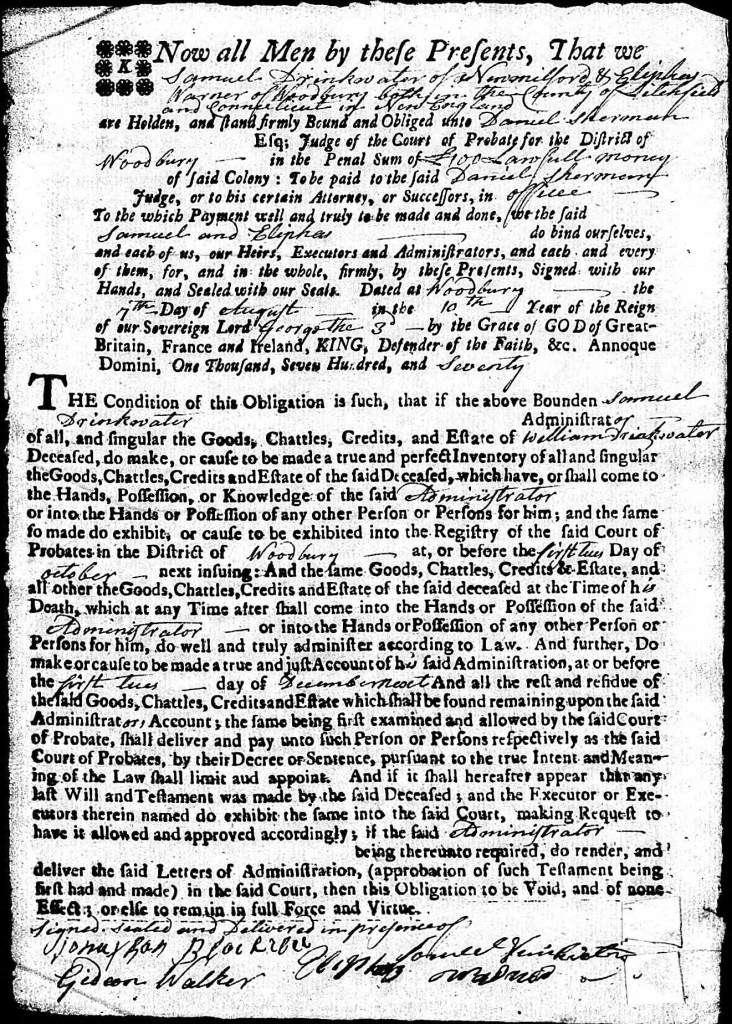
Administration papers from the estate of William Drinkwater, circa 1770.
From the Connecticut, U.S., Wills and Probate Records, 1609-1999.

Colonel Seth Warner, a Distant Cousin

The Warner’s were a large family. And in those days, cousins married each other, which sometimes causes us to “fret and pull our hair out” when trying to figure out who is related to who… in this case our “cousinship” to Seth Warner is distant for us, but much closer to our Warner line during the 1760s and 1770s.

  • Seth Warner’s 2x Great-Grandfather, John Warner, Jr. was also the father of our 4x Great-Grandmother, Hannah (Warner) Warner.
  • She was married to her first cousin, Jabez Warner, our 4x Great-Grandfather.
  • Their son Eliphaz Warner, was our 3x Great Grandfather.

In 1754 Hannah and Jabez Warner moved to Woodbury, Litchfield, Connecticut Colony, a town next to Roxbury where lived Seth Warner and Ethan Allen, cousins via their Baker relatives. We can’t know how much they interacted some 150 years ago, but they were all of the same age and the adventuresome sort. At this time the state of Vermont did not exist yet. The area was called the New Hampshire Grants. It was a wild and unsettled area in the early 1760s. There were constant disputes between New York and New Hampshire as the Grants were being settled.
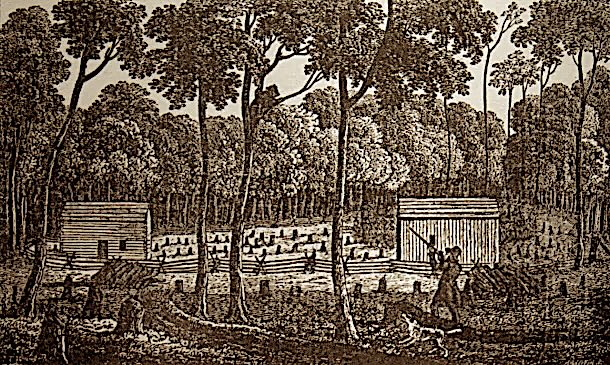
This print accompanied the narrative Seth Hubbell published in 1824
about his years spent struggling to establish a farm in the wilds of Vermont in 1789.
(Image courtesy of the Vermont Historical Society).

Dr. Benjamin Warner, Seth’s father, moved his family to this area in 1763. We know that they settled in what is now Bennington, Vermont. But there is some evidence that Seth held property in a small section called Sandgate, about 20 miles north of Bennington. At this time, families from Roxbury, Woodbury, and other parts of Connecticut began moving into the New Hampshire Grants. The Hurds, the Hurlburts, the Bakers and the Allens settled throughout the area and eventually, the Eliphaz Warners settled in Sandgate.

Under-appreciated by History?
Seth Warner is famous in Vermont history through his activities with Ethan Allen of the Green Mountain Boys just prior to and during the Revolutionary War. However, we wonder if perhaps he has been under-appreciated by American historians in general. We learned, from a fascinating online article by writer Gene Procknow at All Things Liberty —

“The legendary stories of Ethan Allen and Vermont’s Green Mountain Boys have long been part of American folklore. Their heroically described exploits are fabled in many fictional accounts and in children’s books. Allen’s name is synonymously linked with the Green Mountain Boys as if he was their sole leader.  However, while Allen receives the fame, there is a strong case that Seth Warner, a lesser-known member of the Green Mountain Boys, was the more impactful military leader during the American Revolution.

From left to right, the Colonel Seth Warner Monument in Bennington, Vermont.
Center: The flag of the Green Mountain Boys,
Right: Green Mountain Rangers, 1776 by Lt. Charles M. Lefferts. (See footnotes).

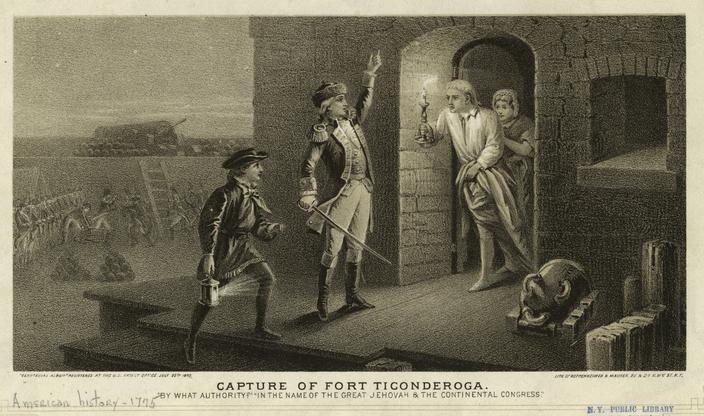
During the revolution, Seth Warner emerged as the leader of the Green Mountain Boys.  A day after Fort Ticonderoga fell [Allan’s victory], Warner led a contingent of the Green Mountain Boys in capturing British forces at Crown Point [Warner’s victory]. Both Warner and Ethan Allen traveled to Philadelphia to meet with the Continental Congress to obtain military pay for the Green Mountain Boys and to obtain permission to enlist a Green Mountain regiment in the Continental Army.  They returned with both. [The Green Mountain Boys were then referred to as the Green Mountain Rangers, and Warner’s Regiment].

In July 1777, he ably commanded undersized rear guard units at the battle of Hubbarton, Vermont and rallied his troops to cement a patriot victory at Bennington* in August.  British losses at these two battles weakened their invasion force, which aided the Continental Army victory at Saratoga in October.  After the 1777 campaign, Warner continued leading his regiment despite declining health until the unit was disbanded on January 1, 1781.
* See the text, The Battle of Bennington below.

Seth Warner was the elected and recognized commander of the Green Mountain Boys during their entire service with the Continental Army, with Ethan Allen playing the important political roles of firebrand, publicist, and spokesperson. Clearly, the American cause benefited from Seth Warner’s military leadership, while Ethan Allen’s political leadership was critical to the formation of Vermont as a distinct, independent sovereign entity”. (All Things Liberty) (4)

Being Early to Bennington, Republic of Vermont

Even though Vermont is recognized as the 14th state of the United States, it was born out of a complicated mess of issues as to who had the right to live in that rural territory, and who had the right to govern it. Among the interested parties were (quite naturally) the Native Peoples, the French Government and their settlers, and the British Government and their settlers. Like a tide that kept washing in and out, people came in and went out. After the French were defeated in the French and Indian War, the rights to this area were given by the Treaty of Paris (in 1763), to the British.

Be that as it may, the New York Colony, and the Province of Massachusetts Bay Colony, and the Province of New Hampshire continued to squabble over who had the land rights to the territory. Much of this was due to the fact that the population of the area increased dramatically in a short period of less than 30 years. “In the 28 years from 1763 to 1791, the non-Indian population of ‘New Hampshire Grants’ rose from 300 to 85,000.

Plan of Sandgate (map), by Benning Wentworth, circa 1761.
(Image courtesy of the Library of Congress).

New Hampshire’s [Colonial] governor, Benning Wentworth, [had] issued a series of 135 land grants between 1749 and 1764 called the New Hampshire Grants. Many of these were in a large valley on the west (or New York side) of the Green Mountains and only about forty miles from Albany. The town was laid out in 1749 and was settled after the war in 1761. The town was named Bennington for Wentworth. Ultimately, by 1754, Wentworth had granted lands for 15 towns. (Wikipedia, History of Vermont)

“The first settler in Sandgate was Reuben Thomas, who came from Woodbury, Connecticut. Congregational Church records show “1769, December 27th — Reuben Thomas Esqr. moved his family which was the first family into this town.” (Sandgate Vermont)

“In 1770, Ethan Allen—along with his brothers Ira and Levi, as well as Seth Warner—recruited an informal militia, the Green Mountain Boys, to protect the interests of the original New Hampshire settlers against the new migrants from New York. A significant standoff occurred at the Breakenridge farm in Bennington, when a sheriff from Albany arrived with a posse of 750 men to dispossess Breakenridge. The residents raised a body of about 300 armed men to resist. The Albany sheriff demanded Breakenridge, and was informed, ‘If you attempt it, you are a dead man.’ The sheriff returned to Albany.

In the summer of 1776, the first general convention of freemen of the New Hampshire Grants met in Dorset, Vermont, resolving ‘to take suitable measures to declare the New Hampshire Grants a free and independent district.’ On January 15, 1777, representatives of the New Hampshire Grants convened in Westminster and declared their land an independent republic, The Vermont Republic (from 1777 until 1791). Then in 1791, Vermont became a state.
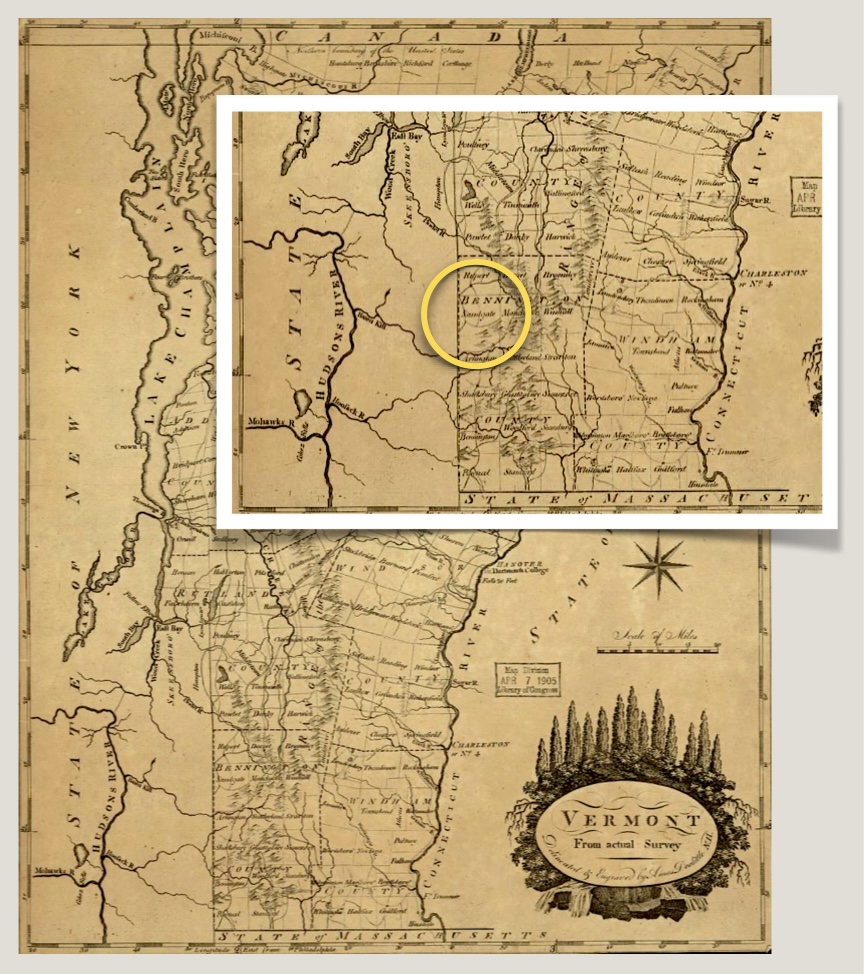
Vermont, from actual survey, by Amos Doolittle and Mathew Carey, circa 1795. This map shows where the Warners were living in the small town of Sandgate, Vermont from 1776 onwards. (Image courtesy of the Library of Congress).

Observation: 1776 is the year when the Eliphaz Warner family moved from the Woodbury, Litchfield County, Connecticut area to Sandgate, Bennington, Vermont Republic. They moved right into the very thick of things.

On June 2, [1776] a second convention of 72 delegates met at Westminster, known as the ‘Westminster Convention’. At this meeting, the delegates adopted the name ‘Vermont’ on the suggestion of Dr. Thomas Young of Philadelphia, a supporter of the delegates who wrote a letter advising them on how to achieve statehood. [One month later…] On July 4, the Constitution of Vermont was drafted during a violent thunderstorm at the Windsor Tavern owned by Elijah West. It was adopted by the delegates on July 8 after four days of debate. This was the first written constitution in North America to provide for the abolition of slavery (for adults), suffrage [voting rights] for men who did not own land, and public schools.” (Wikipedia, History of Vermont) (5)

The first page of the original Constitution for Vermont, with a vintage postcard featuring the Old Constitution House, the former Windsor Tavern. (See footnotes).

Or This Night Molly Stark Sleeps a Widow!

“During the summer of 1777, the invading British army of General John Burgoyne slashed its way southward through the thick forest, from Quebec to the Hudson River, captured the strategic stronghold of Fort Ticonderoga, and drove the Continental Army into a desperate southward retreat. Raiding parties of British soldiers and native warriors freely attacked, pillaged and burned the frontier communities of the Champlain Valley and threatened all settlements to the south. The Vermont frontier collapsed in the face of the British invasion. The New Hampshire legislature, fearing an invasion from the west, mobilized the state’s militia under the command of General John Stark.

General Burgoyne received intelligence that large stores of horses, food and munitions were kept at Bennington, which was the largest community in the land grant area. He dispatched 2,600 troops, nearly a third of his army, to seize the colonial storehouse there, unaware that General Stark’s New Hampshire troops were then traversing the Green Mountains to join up at Bennington with the Vermont continental regiments commanded by Colonel Seth Warner, together with the local Vermont and western Massachusetts militia. 

The combined American forces, under Stark’s command, attacked the British column at Hoosick, New York, just across the border from Bennington. General Stark reportedly challenged his troops to fight to the death, telling them ‘There are your enemies, the redcoats and the Tories. They are ours, or this night Molly Stark sleeps a widow!’ ” (Wikipedia, History of Vermont) (6)
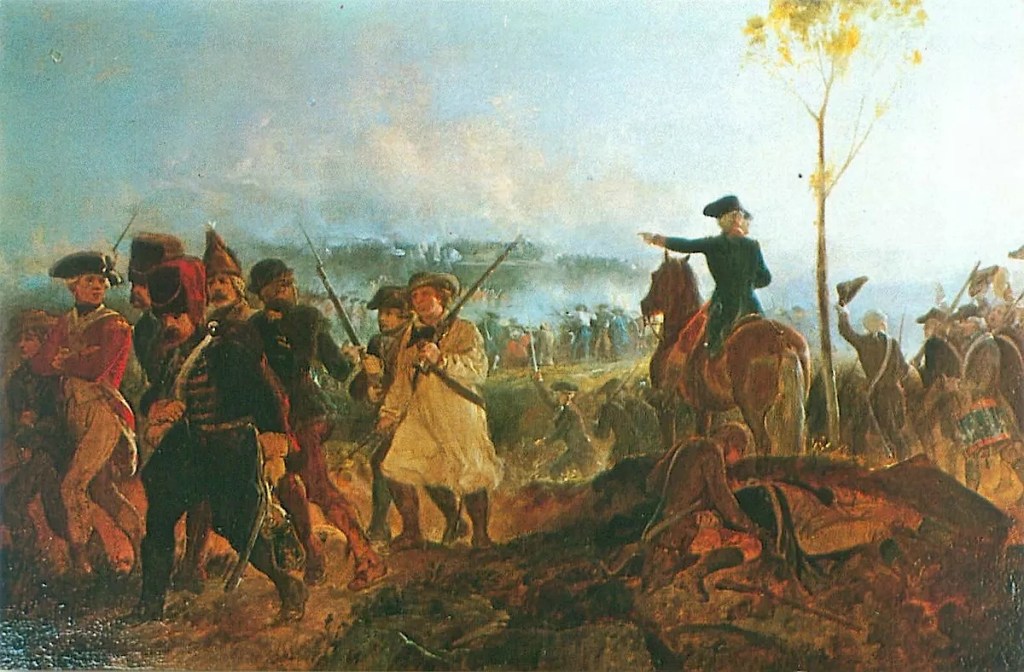
Battle of Bennington, 1777 by Alonzo Chappel.
(Image courtesy of The Bennington Museum).

The Battle of Bennington

“The town is known in particular for the Battle of Bennington, which took place during the Revolutionary War. Although the battle took place approximately 12 miles (19 km) to the west in what is now the state of New York, an ammunition storage building located in Bennington was an important strategic target. On August 16, 1777, Gen. John Stark’s 1,500-strong New Hampshire Militia defeated 800 German (Hessian) mercenaries, local Loyalists, Canadians and Indians under the command of German Lt. Col. Friedrich Baum. German reinforcements under the command of Lt. Col. Heinrich von Breymann looked set to reverse the outcome, but were prevented by the arrival of Seth Warner’s Green Mountain Boys, the Vermont militia founded by Ethan Allen”. (Wikipedia, Bennington Vermont)
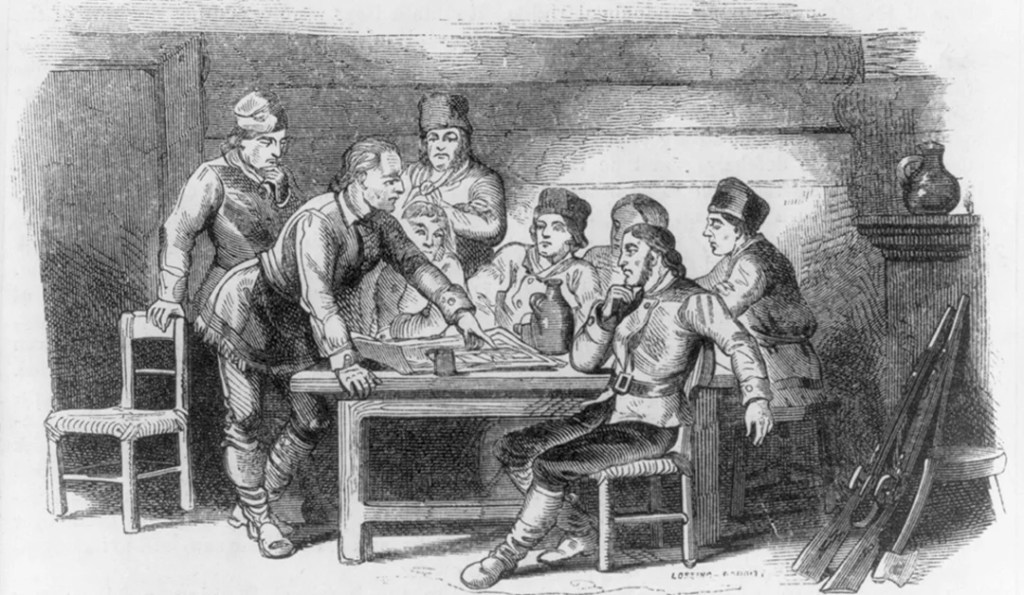
This illustration depicts Ethan Allen [pointing at the map]
and the other leaders of the Green Mountain Boys, which included Seth Warner.
(Image courtesy of the Library of Congress).

The “all-day battle fought in intense summer heat, the army of Yankee farmers defeated the British, killing or capturing 900 soldiers. Burgoyne never recovered from this loss and eventually surrendered at Saratoga on October 17. (Wikipedia, History of Vermont)

During the War, Eliphaz Warner was called to serve in several instances. Shown below is one of the payroll records “for service done to guard the frontiers”. (7)
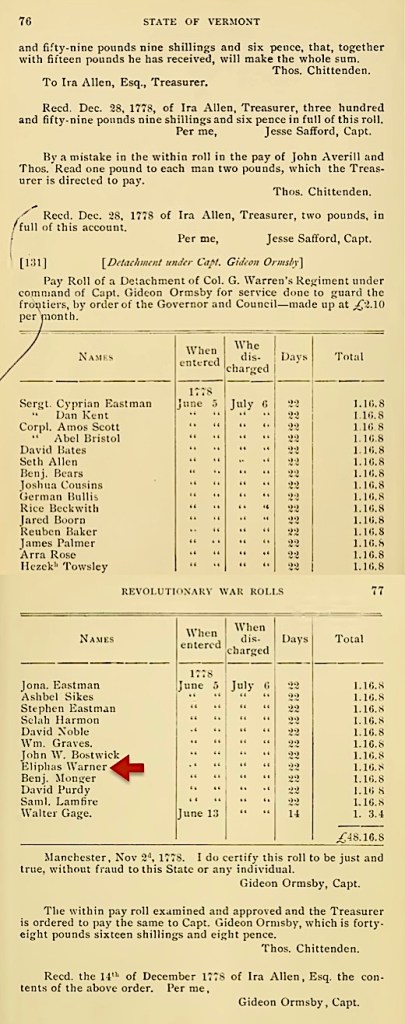
From the book, Rolls of the Soldiers in the Revolutionary War, 1775 to 1783,
by John E, Goodrich. “Payroll under Col. G. Warren’s Regiment under the command
of Capt. Gideon Ormsby”, pages: 76-77. (Image courtesy of the Library of Congress).
For other rosters, see the footnotes.

Time’s Arrow Points in One Direction

If anyone has spent any time glancing over census data, it quickly becomes clear that early censuses were simple, and later ones grew increasingly more complex. “Statistics show that as the Nation’s population grew and its demographics changed, so did the decennial* census evolve in order to measure that growth and change. As a result, no two censuses are exactly alike. To count a population of 3,329,326 in 1790, the census cost $44,377, utilized 1,650 enumerators, and culminated in one published volume totaling 56 pages. The 1990 Census counted a population of 248,709,873, cost $2.5 billion, and culminated in published census reports totaling 450,000 pages”.
*All of the following censuses are decennial, meaning they recur every ten years.
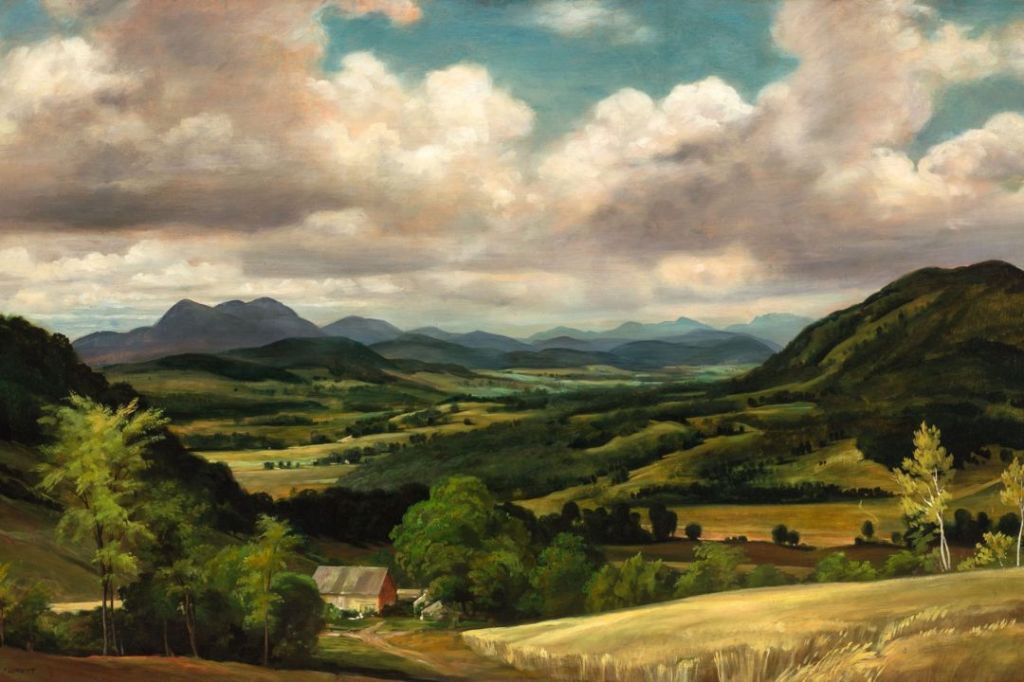
From the Vermont Historical Society, this painting titled
Derby View, 1939 by William Dean Fausett,
was painted to portray what colonial era Vermont would have looked like.

1790 —
“The census began on Monday, August 2, 1790, and was finished within 9 months, under the rules and directions established in an Act of Congress approved March 1, 1790. The 1790 population census was the First Decennial* Census of the United States”. (The National Archives)

The 1790 United States census for Sandgate, Vermont.

The 1790 census tells us that Eliphaz Warner had 8 people in his home, who were enumerated as follows (with our observations for people inserted):

  • 3 men of 16 years & upwards, including heads of families: sons William, John, and father Eliphaz — Head of Family
    • 1 boy under 16 years: son James
    • 4 women including heads of families: daughters Anna, Elizabeth, Hannah, and mother Mercy
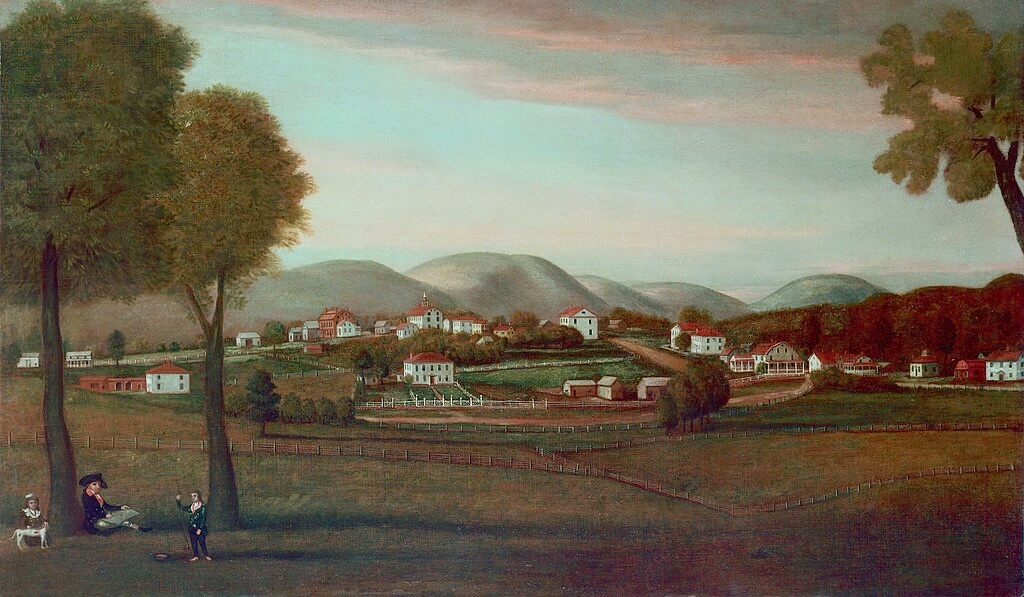
Townscape of Bennington; Landscape View of Old Bennington, circa 1798, by Ralph Earl.
It is interesting to note how the landscape had changed from dense forest to open fields.
(Image courtesy of the Bennington Museum).

In 1798, Eliphaz and Mercy’s oldest son William Warner, married (1) Lucy Coan, daughter of Mulford and Elizabeth (Howd) Coan, in Woodbury, Litchfield, Connecticut. William returned to Woodbury for their marriage, and together she went with him to Sandgate, Vermont. They had seven children, who are interwoven throughout the following years of Census data shown below. (8)

For clarity, here is a list of their seven children:

  • Mary Warner, 1799 – 1859
  • William Warner, Jr., 1801-1890
  • Joseph Warner, 1803 -1890
  • Lucina Warner, 1805 – 1874
  • Gaylord Coan Warner, 1808 – 1886
  • Benjamin Stone Warner, 1810 – 1893
  • John Warner, 1812 – 1889

A New Century Begins

1800 —
“The census began on Monday, August 4, 1800, and was finished within 9 months, under the rules and directions established in an Act of Congress approved February 28, 1800. The 1800 population census was the Second Decennial Census of the United States”.

The 1800 United States census for Sandgate, Vermont.

For the Eliphaz Warner family, there were 5 people living there, as follows:

  • 1 boy 10 thru 15: son James
  • 1 man 45 and over: Eliphaz – Head of Family
  • 2 women 16 thru 25: daughters Hannah, Anna
  • 1 female 45 and over: mother Mercy

    This same 1800 census shows us that son William Warner is counted as a separate household. He is likely living nearby, if not next door. He had four people living in his home, enumerated as follows:
  • 2 men 26 thru 44: William – Head of Family, and an (unknown male)
  • 1 girl under 10: daughter Mary
  • 1 woman 45 and over: mother Lucy Coan (William’s first wife)

Observation: As we analyzed the censuses, it became clear that these two families lived next door to each other and that their lives were all intertwined. Eliphaz always had William living nearby, and after Eliphaz was no more, William usually had a sibling, or one of his own children nearby.

1810 —
“The census began on Monday, August 6, 1810, and was finished within 9 months, under the rules and directions established in an Act of Congress approved March 26, 1810. The 1810 population census was the Third Decennial Census of the United States”.

The 1810 United States census for Sandgate, Vermont. Note that Eliphaz’s name is positioned below his son William’s name.

This Census tells us that Eliphaz had 5 people in his home, who were enumerated as follows (with our observations of whom inserted):

  • 1 man 26 thru 44: son James (son John married, 1808 and lived in New York)
  • 1 man 45 and over: father Eliphaz – Head of Family
  • 2 women 26 thru 44: daughters Anna and Hannah (daughter Elizabeth married, 1808 and lived in New York)
  • 1 woman 45 and over: mother Mercy
Macdonough’s victory on Lake Champlain and defeat of the British Army at Plattsburg
by Genl. Macomb, Sept. 11 1814. Hand colored engraving by Benjamin Tanner, circa 1816.
(Image courtesy of Wikimedia Commons).

The 1810 Census is the last census that Eliphaz and Mercy appear in. From this point forward, all descriptions will only be about William Warner Sr.’s family. The 1810 Census further tells us that William Sr. had 9 people in his home, who were enumerated as follows (with our observations of whom inserted):

  • 4 boys under 10: sons William Jr., Joseph, Gaylord, and Benjamin
  • 1 man 26 thru 44: William Sr. – Head of Family
  • 2 girls under 10: daughters Lucina, and (unknown girl)
  • 1 girl: 10 thru 15: daughter Mary
  • 1 woman 26 thru 44: mother Lucy Coan

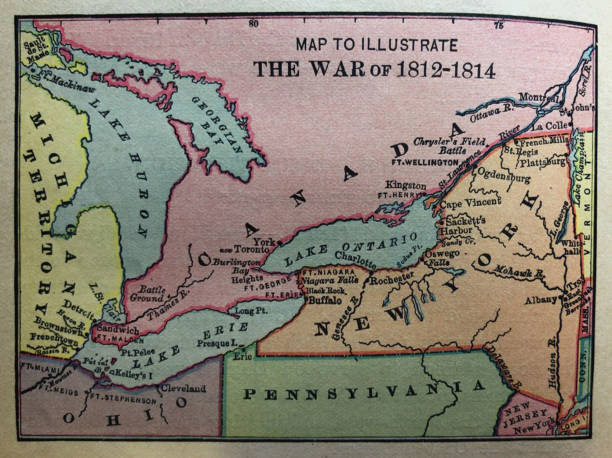
When the War of 1812 broke out in the young United States, Vermont was mostly removed from the battle sites of the war. The closest battle was The Battle of Plattsburg, which took place at the northern end of Lake Champlain, not very far away in New York State. “A relatively small force of approximately 5,000 Americans, including 2,200 Vermont militiamen, defeated a formidable force of roughly 11,000 British sailors on Sept. 11, 1814. This battle ended the British Invasion from Canada”. (Vermont National Guard Museum) We have not located any records that confirm that this branch of the Warner family actually participated in this war.

Besides, William Warner Sr. had his hands quite full. There was a house abundant of young children, his parents were elderly, and it seems that his wife Lucy had her troubles also — Several members of this family died during this decade; all of them in Vermont. Son Dr. James Warner died February 21, 1813 in Jericho, Chittenden County and is buried there. Mercy (Drinkwater) Warner soon followed. She died in October 22, 1813 in Sandgate, Bennington County and is buried in the Sandgate Center Cemetary. Eliphaz Warner died March 12, 1816 in Sandgate and is buried near his wife Mercy. Daughter Hannah Warner died October 13, 1818 in Sandgate and is buried near her parents. (9)

This brings us to…

The Decade of Three Wives

William Warner Sr.’s first wife, Lucy Coan, who had come to Vermont with him from Connecticut, died on October 2, 1815. She is buried at Sandgate Center Cemetery.

William was a widower with young children. He remarried after 1815 to his second wife (2) Abagail (Root) Warner. She was born about 1784 (based on the age of 34 years listed on her death record). Abagail has left very few records. She died soon after they were married, on June 13, 1818; there were no children.

At age 25, (3) Prudence B. Nickerson entered the family when she married William Warner in 1819; they had 4 children, James Ward, Lucy Mercy, Ira Nickerson, and Mary Ann. Like Abagail Root before her, there are very few records of her life prior to when she married William Sr. We know she was born in 1794 supposedly in Massachusetts, although some documents identify her birth in Vermont. We also note that there was a 24 year age gap when they married – William was 49 at the time.

Together, they are our 3x Great Grandparents — we are descended from William and Prudence B. (Nickerson) Warner and their daughter Mary Ann Warner.
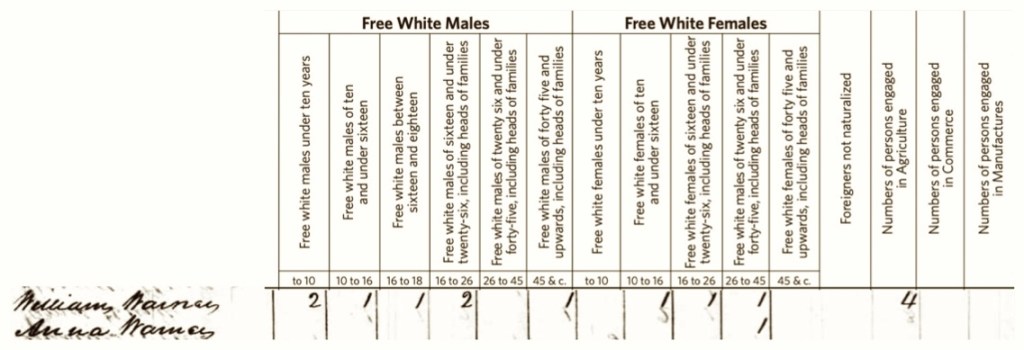
The 1820 United States census for Sandgate, Vermont for William Warner and his unmarried sister Anna Warner.

1820 —
“The census began on Monday, August 7, 1820, and was finished within 6 months, under the rules and directions established in an Act of Congress approved March 14, 1820. The 1820 population census was the Fourth Decennial Census of the United States”. The census tells us that 10 people are living there. William Sr.’s sister Anna never married and is living next door, probably in her parents home. She is listed separately on this census. (10)

  • 2 boys under 10: sons Benjamin, John.
  • 1 boy 10 to 15: son Gaylord
  • 1 boy from 16 to 18: (unknown male)
  • 2 men 16 to 25: sons Joseph, William Jr.
  • 1 man 45 and upwards: William Sr. — Head of Family
  • 1 girl from 10 to 15: daughter Lucina
  • 1 girl/woman from 16 to 25: daughter Mary
  • 1 woman 26 to 45: (step-mother) Prudence.
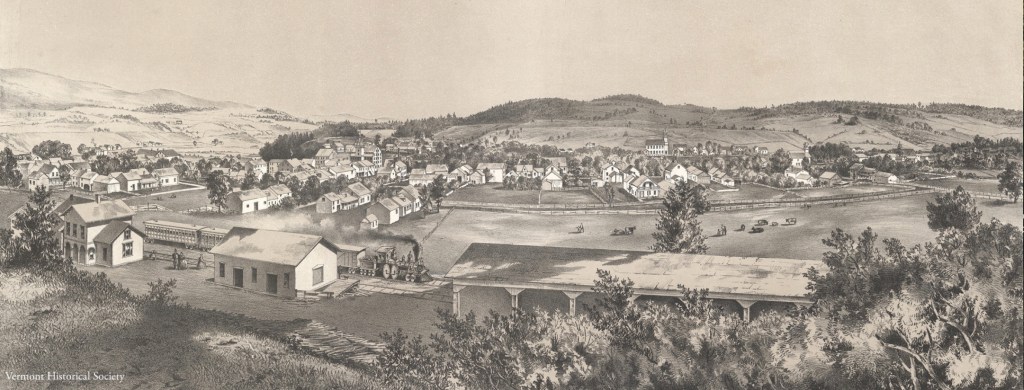
Baaa-aaa-ah. Who knew? Where are the trees?
(Image courtesy of the Vermont Historical Society).

A World Awash in Merino Sheep

William Warner Sr. was a farmer, but we don’t know if he raised sheep. If he needed any, he wouldn’t have needed to go very far. From the Vermont History Explorer, “Vermont’s landscape looks very different today than it did nearly 200 years ago. Many places that are now covered with trees were open fields. In the 1830s and 1840s, those fields were full of Merino sheep. Almost 1.7 million sheep lived in Vermont in 1840. At the same time, fewer than 300,000 people lived in the state. There were nearly six times more sheep than people in Vermont! These sheep produced almost 3.7 million pounds of wool.”

The 1830 United States census for Sandgate, Vermont.

1830 —
“The census began on Tuesday, June 1, 1830, and was finished within 6 months, under the rules and directions established in an Act of Congress approved March 23, 1830. The 1830 population census was the Fifth Decennial Census of the United States”. The census tells us that 9 people are living in the Warner home. William Sr.’s sister Anna is still living next door and is listed separately on this census.

  • 1 boy under 5: son Ira (likely an infant)
  • 1 boy 6 to 10: son James Ward
  • 1 boy 15 to 20: sons, Benjamin or John
  • 1 man 20 to 29: son Gaylord
  • 1 man 50 to 59: William — Head of Family
  • 1 girl under 5: (unknown girl)
  • 2 girls 5 to 9: daughter Lucy Mercy, and (unknown girl)
  • 1 woman 30 to 39: mother Prudence

This is the first census that begins counting the children that were born after Prudence and William Sr. married circa 1819. Their children were born in Sandgate, Bennington, Vermont.

Son James Ward Warner was born September 26, 1820 — died October 25, 1908, in Kennewick, Benton, Washington. (For a fuller description of his descendants, See Descendant Appendix A in the footnotes for this section). Daughter Lucy Mercy Warner was born May 2, 1823 — died November 14, 1879, Bennington, Bennington, Vermont. (For a fuller description of her descendants, See Descendant Appendix B in the footnotes for this section). Son Ira Nickerson Warner was born May 20, 1830 — died March 6, 1877 in Aurora, DuPage, Illinois. (For a fuller description of his descendants, See Descendant Appendix C in the footnotes for this section).

The 1840 United States census for Sandgate, Vermont.

1840 —
“The census began on Monday, June 1, 1840, and was finished within five months, under the rules and directions established in an Act of Congress approved March 3, 1839. The 1840 population census was the Sixth Decennial Census of the United States”. The census tells us that 7 people are living there. William’s oldest daughter Mary (Warner) Meeker is living next door, and is listed separately on this census.

  • 1 boy 10 to 14: son Ira
  • 1 boy 15 to 19: son James
  • 1 man 60 to 69: William – Head of Family
  • 1 girl 5 to 9: daughter Mary Ann
  • 1 girl 15 to 19: daughter Lucy Mercy
  • 1 woman 40 to 49: mother Prudence
  • 1 woman 70 to 79: (unknown woman)
Taking the census — after a sketch by Thomas Worth.
As published in Harper’s Weekly magazine, 1870.
(Image courtesy of the Library of Congress).

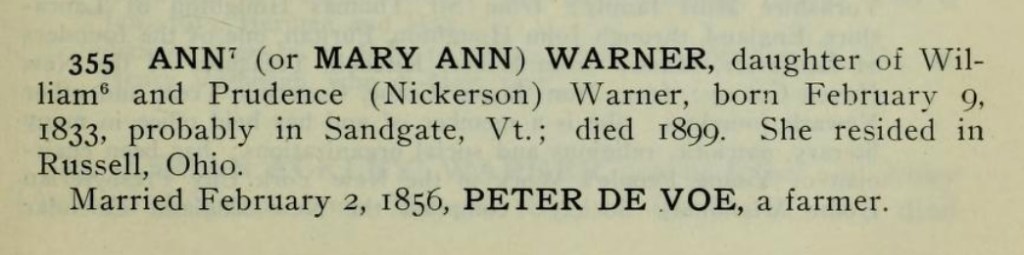
In 1833, Prudence and William had their last child, a daughter, Mary Ann Warner. She was born on February 9, 1833 — died April 10, 1899 in South Russell, Geauga, Ohio. On February 2, 1856 she married Peter A. DeVoe; they had 2 children. They are our Great-Great-Grandparents — we are descended from Peter and Mary Ann. For the history of Peter and Mary Ann’s further lives together, please see: The DeVoe Line, A Narrative — Nine.
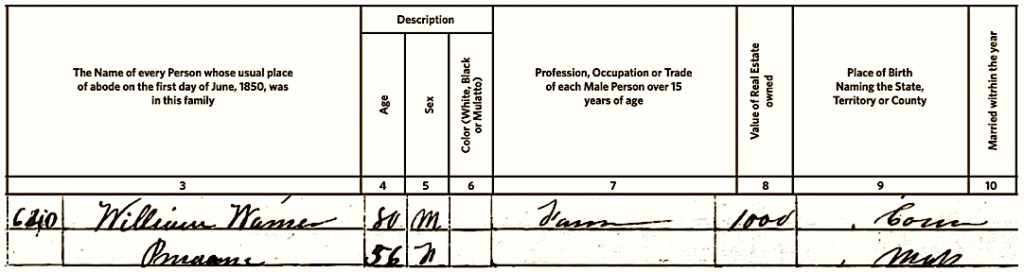
The 1850 United States census for Sandgate, Vermont.

1850 —
“The census began on Saturday, June 1, 1850, and was finished within 5 months, under the rules and directions established in an Act of Congress approved May 23, 1850. The 1850 population census was the Seventh Decennial Census of the United States”. The is the first Census where we see all members of the household listed.

Things seem to have quieted down a lot at the Warner home with just William and Prudence living there. In 1850, their daughter Mary Ann is living nearby in Sandgate, at her older sister Mary Meeker’s home, where her brother Ira is also residing. Mary Ann’s name is sometimes recorded as Ann, probably because (in this case) there were two people living there with the same name of Mary.

The 1850 United States census for Sandgate, Vermont.

William Warner Sr. died on May 24, 1856. He is buried at Sandgate Center Cemetery, at which a remarkable number of Warner family members are also interred. Near William are his wives Lucy, and Abagail, some of his siblings, and several of his children. For his estate papers, please see the footnotes. (11)

Sometimes Life Is A Circle

From the 1830s through this pre Civil War period, seven of William Sr.’s eleven children, relocated from Vermont to the Connecticut Western Reserve of Ohio. This emigration included his youngest daughter Mary Ann (Warner) DeVoe and her husband, Peter A. DeVoe. William’s surviving wife Prudence moved there by 1870 and is buried near their daughter.

As we learned more about Mary Ann Warner’s history — we found that by 1855, she had already been residing in the town of Wilton in Saratoga County, New York for three years. She is working as a weaver at the nearby Saratoga Victory Manufacturing Company, in Victory Village. An ironic thing about her occupation, is the fact that the wool she was likely using to manufacture products, had likely been produced right in her old backyard in Bennington, Vermont. Like Mary Ann Warner at her loom — we ourselves also gather the threads, of family stories, and weave them into the warp and weft of a meaningful family narrative.
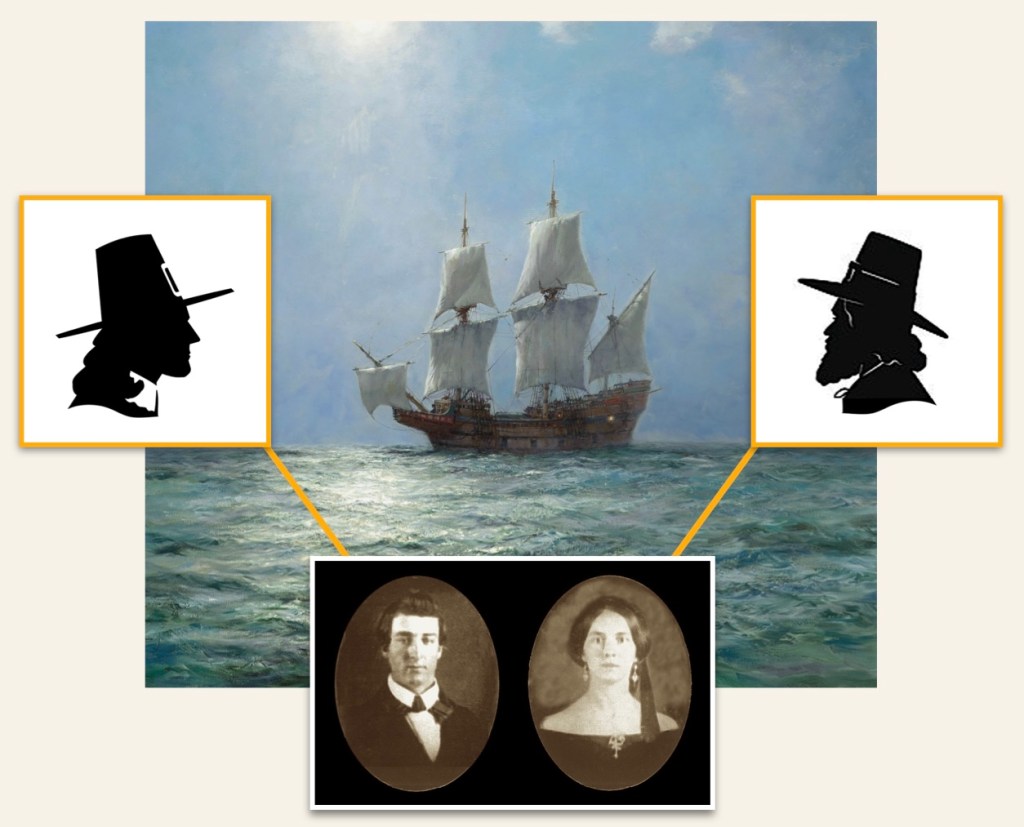
We are descended from two of the original Plymouth Pilgrim families, from the 1620 voyage
of the Mayflower. Both of these lines meet with our 2x Great Grandparents, through
the marriage of Peter A. DeVoe (for Edward Doty), and Mary Ann Warner (for George Soule).
Background image, Isolation: The Mayflower Becalmed on a Moonlit Night, by Montague Dawson.

With Generation Seven in America, the Warner family surname gives way to the surname of DeVoe. Mary Ann’s husband, Peter A. DeVoe, is a direct descendant of another Mayflower passenger, Pilgrim Edward Doty. Not only does this line of descent circle back to the Mayflower, but the DeVoe line traces its origins back to the same region of Holland where Pilgrim George Soule began his journey.

You can read about the DeVoe family, who have their own amazing history starting with, The DeVoe Line, A Narrative — One, Holland & Huguenots, and the Doty family, starting with, The Doty Line, A Narrative — One. (12)

Following are the footnotes for the Primary Source Materials,
Notes, and Observations

Preface

(1) — one record

Seven virtues
https://en.wikipedia.org/wiki/Seven_virtues#:~:text=In%20Christian%20history%2C%20the%20seven,faith%2C%20hope%2C%20and%20charity.
Note: For the text.

Woodbury, Connecticut Colony

(2) — eleven records

Woodbury, Connecticut
https://en.wikipedia.org/wiki/Woodbury,_Connecticut
Note: For the text.

The Old Woodbury Historical Society
History of Woodbury
https://www.owhs.org/history.html
Note: For the text.

Boston Public Library
Norman B. Levanthal Map & Education Center Collection
Plan of the Colony of Connecticut in North America
by Moses Park, 1766
https://collections.leventhalmap.org/search/commonwealth:z603vt46p
Note: For the map image. “Moses Park, a surveyor from Preston, Connecticut, executed this map in 1766 with the assistance of Asa Spaulding of Norwalk and Samuel Mott of Preston.”

Mercy Drinkwater
in the Connecticut, U.S., Town Birth Records, pre-1870 (Barbour Collection)
New Milford Vital Records 1712-1860

https://www.ancestry.com/search/collections/1034/records/191129?tid=&pid=&queryId=65f6527a-b69f-4af3-8bf1-1576fb5d0bef&_phsrc=dRx1&_phstart=successSource
Book page: 76, Digital page: 74/232
Note: Listed as the 14th entry on the page.

Mercy Warner
in the U.S., Find a Grave Index, 1600s-Current
https://www.ancestry.com/search/collections/60525/records/91584565
and
Mercy Drinkwater Warner
https://www.findagrave.com/memorial/16704122/mercy-warner
Note: For the data.

Eliphaz Warner
The Descendants of Andrew Warner (book)
Fourth Generation
https://www.ancestry.com/imageviewer/collections/15319/images/dvm_GenMono000758-00056-0?usePUB=true&_phsrc=dRx5&pId=104&backlabel=Return&queryId=0095c2f420af5ec55c6e85937768fa6e&rcstate=dvm_GenMono000758-00056-0:227,1330,361,1362;361,1329,481,1353;352,1361,477,1388;332,1395,456,1420;336,1428,458,1453;324,1462,456,1491;359,1493,479,1523;320,1561,446,1588;466,1625,594,1653;502,1743,709,1774;191,1793,321,1821;429,1868,578,1897;890,104,1041,127;729,413,857,443;426,602,641,631;177,649,307,678;179,771,308,799;681,761,831,791;650,803,804,832;980,878,1128,909;947,999,1099,1034;365,1195,488,1219;348,1229,469,1254
Book page: 98, Digital page: 107/184

Eliphaz Warner
in the U.S., Find a Grave Index, 1600s-Current
https://www.ancestry.com/search/collections/60525/records/91584550?tid=&pid=&queryId=e60befba-7e73-4827-b3c5-efdd800afda8&_phsrc=PRY1&_phstart=successSource
and
Eliphaz Warner
https://www.findagrave.com/memorial/16704105/eliphaz-warner
Note: For the data.

Middletown, Connecticut
https://en.wikipedia.org/wiki/Middletown,_Connecticut
Note: For the data.

KNOWOL
Historical Map of Middlesex County, Connecticut
https://www.knowol.com/information/connecticut/middlesex-county-map/
Note: For the map image and caption.

The Eliphaz and Mercy Warner Children

(3) — eight records

Eliphaz Warner
The Descendants of Andrew Warner (book)
Fifth Generation
https://www.ancestry.com/imageviewer/collections/15319/images/dvm_GenMono000758-00084-0?usePUB=true&_phsrc=dRx4&pId=160&backlabel=Return&queryId=0095c2f420af5ec55c6e85937768fa6e&rcstate=dvm_GenMono000758-00084-0:268,488,490,523;500,489,714,516;183,529,337,564;336,529,493,563;903,649,1071,679;339,933,477,957;304,1033,420,1059;369,1066,492,1093;349,1398,468,1422;324,1431,444,1456;637,1560,835,1588;240,1603,419,1639;419,1602,573,1638;484,1763,633,1795;887,83,1037,105;314,159,435,183;378,193,499,216;379,226,495,250;349,292,473,316;328,358,449,382
Book page: 154, Digital page 163/184
Note: For his family records.

Judea Cemetery
https://en.wikipedia.org/wiki/Judea_Cemetery
Note: For the text.

William Drinkwater
in the Connecticut, U.S., Wills and Probate Records, 1609-1999
Woodbury District > Probate Packets, Downs, C-Edmond, M, 1720-1880
https://www.ancestry.com/imageviewer/collections/9049/images/007629576_00856?usePUB=true&_phsrc=VgH4&_phstart=successSource&usePUBJs=true&pId=2465233
Digital page: 856/1417
Note: Case 1384 — Administration papers from the estate of William Drinkwater, circa 1770.

Colonel Seth Warner, a Distant Cousin

(4) — five records

Journal of The American Revolution
Seth Warner or Ethan Allen: Who Led the Green Mountain Boys?
by Gene Procknow
https://allthingsliberty.com/2014/05/seth-warner-or-ethan-allen-who-led-the-green-mountain-boys/
Note: For the text.

VT Digger, News and Culture
Then Again: Plagued by Diversity, Wolcott’s First Settler Persevered
by Mark Bushnell
https://vtdigger.org/2018/09/09/plagued-adversity-wolcotts-first-settler-persevered/
Note: For the image.

The Historical Marker Database
Colonel Seth Warner
https://www.hmdb.org/m.asp?m=77023
Note: For the image, Photo 6 by Howard C. Ohlhous, October 24, 2008.

Flag of the Green Mountain Boys
https://en.wikipedia.org/wiki/Flag_of_the_Green_Mountain_Boys
Notes: Also known as the Stark Flag, this image is replica flag made by Amber Kincaid.

Uniforms of The American Revolution
Green Mountain Rangers, 1776
by Lt. Charles M. Lefferts, circa 1926
https://www.srcalifornia.com/uniforms/p24.htm
Note: For the image.

Being Early to Bennington (Vermont)

(5) — six records

History of Vermont
https://en.wikipedia.org/wiki/History_of_Vermont
Note: For the text.

Library of Congress
Plan of Sandgate (map)
by Benning Wentworth, circa 1809
https://www.loc.gov/resource/g3754s.ar087800/?r=-1.311,-0.37,3.622,1.808,0
Note: For the map image.

Sandgate Vermont
Early Settlers
https://www.sandgatevermont.com/settlers.php

Library of Congress
Vermont, from actual survey
by Amos Doolittle and Mathew Carey, circa 1795
https://www.loc.gov/resource/g3750.ct000093/?r=-0.878,-0.069,2.756,1.376,0
Note: For the map image.

Vermont History Explorer
The Vermont Constitution
https://vermonthistoryexplorer.org/the-vermont-constitution
Note: For the image of page one of the Vermont Constitution.

Hip Postcard
Vermont WINDSOR Old Constitution House, Built 1777 — DB
United States — Vermont — Other, Postcard

https://www.hippostcard.com/listing/vermont-windsor-old-constitution-house-built-1777-db/33113359
Note: For the vintage postcard image.

Or This Night Molly Stark Sleeps a Widow!

(6) — one record

History of Vermont
https://en.wikipedia.org/wiki/History_of_Vermont
Note: For the text.

The Battle of Bennington

(7) — eight records

Battle of Bennington, 1777 https://bennington.pastperfectonline.com/webobject/A4B796E5-ADE8-455B-8DF7-217237214000
by Alonzo Chappel.
Note: For the battle painting.

Bennington, Vermont
https://en.wikipedia.org/wiki/Bennington%2C_Vermont
Note: For the text.

Library of Congress
[Ethan Allen, 1738-1789, full-length portrait, standing,
before “the Green Mountain Boays in Council”, examining map]
digital file from b&w film copy neg.
https://www.loc.gov/resource/cph.3a47655/
Note: For the image.

History of Vermont
https://en.wikipedia.org/wiki/History_of_Vermont
Note: For the text.

Eliphaz Warner
The Descendants of Andrew Warner (book)
Fifth Generation
https://www.ancestry.com/imageviewer/collections/15319/images/dvm_GenMono000758-00084-0?usePUB=true&_phsrc=dRx4&pId=160&backlabel=Return&queryId=0095c2f420af5ec55c6e85937768fa6e&rcstate=dvm_GenMono000758-00084-0:268,488,490,523;500,489,714,516;183,529,337,564;336,529,493,563;903,649,1071,679;339,933,477,957;304,1033,420,1059;369,1066,492,1093;349,1398,468,1422;324,1431,444,1456;637,1560,835,1588;240,1603,419,1639;419,1602,573,1638;484,1763,633,1795;887,83,1037,105;314,159,435,183;378,193,499,216;379,226,495,250;349,292,473,316;328,358,449,382
Book page: 154, Digital page 163/184
Note: For his Revolutionary War service records.

Library of Congress
Rolls of the Soldiers in the Revolutionary War,
1775 to 1783

by John E, Goodrich, circa 1904
https://www.loc.gov/resource/gdcmassbookdig.rollsofsoldiersi01verm/?sp=7&r=-1.249,-0.065,3.497,1.718,0
Records from 3 sections as follows:
Shown with the Revolutionary War Subtitle Section.
— Col. G. Warren’s Regiment under command of Capt. Gideon Ormsby
Book pages: 76-77, Digital pages: 106-107/964

— Capt. Lemuel Bradley’s Company
Book page: 414, Digital pages: 444/964
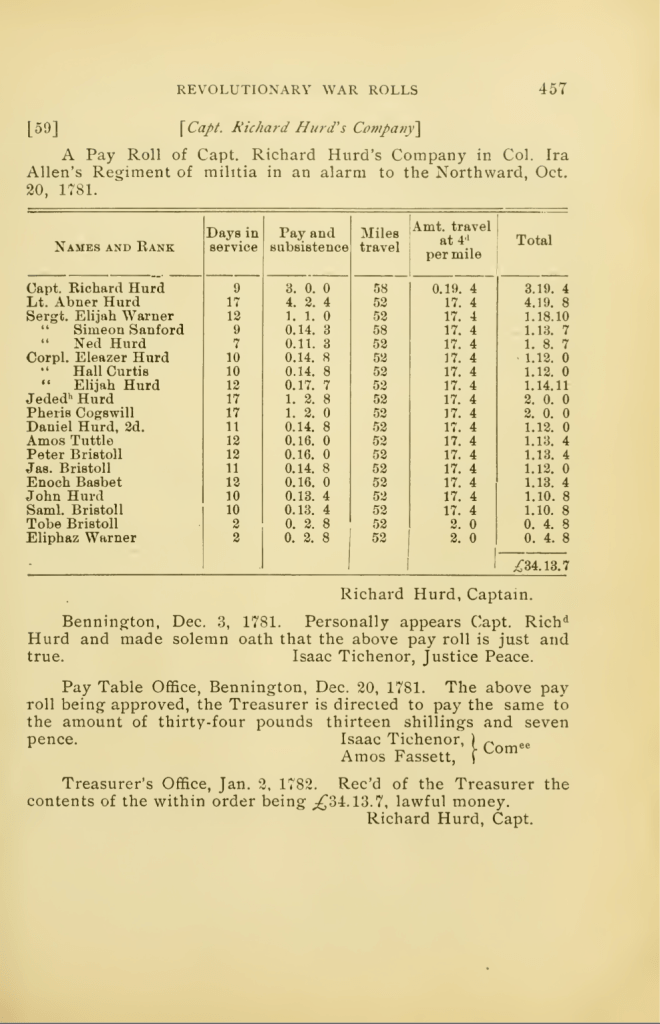
— Capt. Richard Hurd’s Company in Col. Ira Allen’s Regiment
Book page: 457, Digital pages: 487/964

Time’s Arrow Points in One Direction

(8) — seven records

STEM Fellowship
The Arrow of Time
https://live.stemfellowship.org/the-arrow-of-time/
Note: For the data.

Vermont History
Vermont Historical Society Mounting a Major Exhibition:
For The Love of Vermont: The Lyman Orton Collection

Derby View
by William Dean Fausett, circa 1939
https://vermonthistory.org/lyman-orton-for-the-love-of-vermont-art-exhibition
Note: For the paining by William Dean Fausett.

Library of Congress
U.S. Census Connections: A Resource Guide
History of the U.S. Census
https://guides.loc.gov/census-connections/census-history
Note: For the text.

The National Archives
1790 Census Records
https://www.archives.gov/research/census/1790
Note: For the data.

Townscape of Bennington; Landscape View of Old Bennington, circa 1798
by Ralph Earl
https://commons.wikimedia.org/wiki/File:View_of_Bennington,_by_Ralph_Earl_(1798).jpg
Note: For the landscape image.

Eliphas Warner
in the 1790 United States Federal Census
Vermont > Bennington > Sandgate
https://www.ancestry.com/search/collections/5058/records/398650?tid=&pid=&queryId=98a8efe8-5fcc-4d84-9d21-54d2862efc2c&_phsrc=Qmi3&_phstart=successSource
Book page: 21, Digital page: 1 of 2
Note: For the data.

William Warner
in the North America, Family Histories, 1500-2000
https://www.ancestry.com/search/collections/61157/records/1807060
Note: For the data about his 1798 marriage to Lucy Coan.

A New Century Begins

(9) — twelve records

The National Archives
1800 Census Records
https://www.archives.gov/research/census/1800
Note: For the data.

Eliphaz Warner
in the 1800 United States Federal Census
Vermont > Bennington > Sandgate
https://www.ancestry.com/search/collections/7590/records/517748?tid=&pid=&queryId=4786d902-5d82-43a8-b238-b7cf626d86d1&_phsrc=Qmi4&_phstart=successSource

The National Archives
1810 Census Records
https://www.archives.gov/research/census/1810?_ga=2.101688962.2084972955.1741276218-755645739.1741276218
Note: For the data.

Macdonough’s Victory on Lake Champlain and Defeat of the British Army
at Plattsburg by Genl. Macomb, Sept. 11 1814.
Engraverː Benjamin Tanner, after painting by Hugh Reinagle, circa 1816
File:Macdonough’s victory on Lake Champlain and defeat of the British Army at Plattsburg by Genl. Macomb, Sept. 11 1814 (cropped).jpg
https://commons.wikimedia.org/wiki/File:Macdonough’s_victory_on_Lake_Champlain_and_defeat_of_the_British_Army_at_Plattsburg_by_Genl._Macomb,_Sept._11_1814_(cropped).jpg
Note: For the engraved war image.

1810 United States Federal Census
Vermont > Bennington > Sandgate
https://www.ancestry.com/search/collections/7613/records/613235?tid=&pid=&queryId=e72c38ad-6cba-40d7-8668-722546e89da1&_phsrc=LaX10&_phstart=successSource
Note: Digital page: 5/7
Note 1: For the data.
Note 2: We found this under the name of another community member: Stephen Scinter because it found not appear in searches using either Warner family name.

Vermont National Guard
Home > Museum >  > History > Wars > War Of 1812
Museum > > History > Wars > War Of 1812
https://vt.public.ng.mil/Museum/History/Wars/War-of-1812/#:~:text=A relatively small force of,the British Invasion from Canada.
Note: For the text.”>https://vt.public.ng.mil/Museum/History/Wars/War-of-1812/#:~:text=A relatively small force of,the British Invasion from Canada.
Note: For the text.

Dr. James Warner
https://www.findagrave.com/memorial/15098846/james-warner
Note: For her death record in 1813.

Hannah Warner
https://www.findagrave.com/memorial/16704110/hannah-warner
Note: For her death record in 1818.

Mercy Warner
in the U.S., Find a Grave Index, 1600s-Current
https://www.ancestry.com/search/collections/60525/records/91584565
and
Mercy Drinkwater Warner
https://www.findagrave.com/memorial/16704122/mercy-warner
Note: For the data.

Eliphaz Warner
in the U.S., Find a Grave Index, 1600s-Current
https://www.ancestry.com/search/collections/60525/records/91584550?tid=&pid=&queryId=e60befba-7e73-4827-b3c5-efdd800afda8&_phsrc=PRY1&_phstart=successSource
and
Eliphaz Warner
https://www.findagrave.com/memorial/16704105/eliphaz-warner
Note: For the data.

The Decade of Three Wives

(10) — ten records

Pinterest
Birds’ Nests (illustrations)
by Carl F. Gronemann
https://www.pinterest.com/pin/7951736837238337/
Notes: For the nest images.

Lucy Warner
in the U.S., Find a Grave Index, 1600s-Current
https://www.ancestry.com/search/collections/60525/records/91584559https://www.findagrave.com/memorial/16704116/lucy-warner
and
Lucy Coan Warner
https://www.findagrave.com/memorial/16704116/lucy-warner?_gl=1*qogcgg*_gcl_au*MTgzMjczMjIxLjE3NDE0NDY3MzA.*_ga*MTQ0MTY4ODk1OS4xNzQxNDQ2NzMw*_ga_4QT8FMEX30*MmMwNGE4ZTItNTkwOC00ZGIwLWFjMmItZWZiMjgxMTllMWVlLjIuMS4xNzQxNDU2ODEyLjU5LjAuMA..
Note: For the death data.

203 William Warner
The Descendants of Andrew Warner (book)
Sixth Generation
https://www.ancestry.com/imageviewer/collections/15319/images/dvm_GenMono000758-00134-0?usePUB=true&_phsrc=mYH3&pId=260&backlabel=Return&queryId=38e8346280d3fd1c8363358237de551d&rcstate=dvm_GenMono000758-00134-0%3A172%2C1481%2C285%2C1510%3B285%2C1481%2C417%2C1509%3B667%2C1482%2C770%2C1515%3B581%2C1522%2C679%2C1551%3B915%2C1683%2C1009%2C1716%3B714%2C413%2C802%2C442%3B338%2C1152%2C476%2C1180%3B727%2C1250%2C809%2C1274%3B548%2C1281%2C636%2C1314%3B791%2C1280%2C892%2C1314
Book page: 254, Digital page: 263/814
Note: For the Lucy Coan marriage data.

Abaigail Warner
in the Vermont, U.S., Vital Records, 1720-1908
https://www.ancestry.com/search/collections/4661/records/475913?tid=&pid=&queryId=4f4a50a5-af4e-4843-8b1b-e00c55e93578&_phsrc=mYH31&_phstart=successSource
and
Abigail Warner
in the U.S., Find a Grave Index, 1600s-Current
https://www.ancestry.com/search/collections/60525/records/91584543
and
https://www.findagrave.com/memorial/16704098/abigail-warner
Note: For the data.

Prudence Nickerson
in the North America, Family Histories, 1500-2000
W > Warner > The descendants of Andrew Warner
https://www.ancestry.com/search/collections/61157/records/1810112
Book page: 254, Digital page: 262/812
Note: For her marriage information.

The National Archives
1820 Census Records
https://www.archives.gov/research/census/1820?_ga=2.45009575.2084972955.1741276218-755645739.1741276218
Note: For the data.

William Warner
in the 1820 United States Federal Census
https://www.ancestry.com/search/collections/7734/records/166385?tid=&pid=&queryId=6f327c11-f22f-48ff-a316-60e1b9de1f93&_phsrc=unJ1&_phstart=successSource
Digital page: 1/6
Note: For the data.

A World Awash in Merino Sheep

(11) — twenty records, and three Descendant Appendices: A, B, C

Vermont History Explorer
Sheep in Vermont
https://vermonthistoryexplorer.org/sheep-in-vermont
Note: For the text.

The National Archives
1830 Census Records
https://www.archives.gov/research/census/1830?_ga=2.68161170.2084972955.1741276218-755645739.1741276218
Note: For the data.

Wm Warner
in the 1830 United States Federal Census
Vermont > Bennington > Sandgate
https://www.ancestry.com/search/collections/8058/records/781387?tid=&pid=&queryId=f25c311a-c9c4-4a64-bab4-cdb98f9bf760&_phsrc=unJ7&_phstart=successSource
Digital page: 1/12
Note: For the data.

Descendant Appendix A
Son James Ward Warner was married twice and had four children.

  • James Ward Warner was born September 26, 1820 — died October 25, 1908, in Kennewick, Benton, Washington. He married first Jane Mary Walton in 1845 in Manchester, Vermont. She died in 1854 in Wisconsin where they had moved. From this marriage, they had 3 children:
  • Sylvester C, 1842-1847 (possibly born before their marriage),
  • Helen Agnes, 1848-1931 and
  • James, born 1860 – date unknown
  • He married second, Anne Ross in 1856. She was born in 1826 in New York and died 1902 in Spokane, Washington. They had one son:
  • William Abner, 1860 – 1912. It appears William Abner moved west to Washington State where his parents died and are buried in Spokane. He died in Santa Monica, Los Angeles, California.

Descendant Appendix B
Daughter Lucy Mercy Warner married twice and had two children.

  • Lucy Mercy Warner was born May 2, 1823 — died November 14, 1879, Bennington, Bennington, Vermont. She married first in 1844 Henry G. Stewart, 1806 – 1848. They had 1 daughter:
  • Ellen 1845-1922. Ellen married Alexander Chapman in 1867, and they had two sons: George 1873 – unknown date, and John, 1878 – 1938.
  • After Henry Stewart’s death, Lucy married second Thomas Jefferson (TJ) Albro in 1859; they had 1 daughter:
  • Theresa, 1860 – 1921. Theresa married Frank Henry Crawford in 1884, and they had 3 children: Randall who lived for 11 months in 1885, Buel, 1887 – 1958, and Alida ‘Lida’ (Crawford) Beran, 1894 – 1945.

Descendant Appendix C
Son Ira Nickerson Warner married once and had five children.

  • Ira Nickerson Warner was born May 20, 1830 — died March 6, 1877 in Aurora, DuPage, Illinois. By 1858 he married Julia Barrett, 1833 – unknown date. They had 5 children:
  • Charles D., 1859 – 1864
  • George A., 1864 – unknown date
  • Frederick A. 1866 – 1935
  • Ida Rowena, 1869 – 1943
  • Lillian J., 1872 – 1899

James Ward Warner
https://www.familysearch.org/en/tree/person/details/L69H-5CC
Note: For the data.

Lucy Mercy Warner
https://www.familysearch.org/en/tree/person/details/LZ6N-QJX
Note: For the data.

Ira N Warner
Pension – United States, General Index to Pension Files, 1861-1934
https://www.familysearch.org/ark:/61903/1:1:QJD5-MLYG?lang=en
Notes: For the data. James Warner was the beneficiary of his brother Ira’s military pension?  We find this curious because he and Julia were married in 1860 at beginning of Civil War.

Ira Nickerson Warner
https://www.findagrave.com/memorial/39675687/ira-n-warner
Note 1: For the data. His death date on his tombstone is incorrect.
Note 2: Posted at the findagrave website:
“Civil War Soldier – Source The Beacon News Online, May 13, 2005.
Ira Nickerson Warner, born in Sandgate, VT 20 May 1830 was the son of William Warner and Prudence Nickerson. He enlisted 29 July 1862; mustered in 1 September 1862 as Private, Company E, 10th Vermont Infantry. He was wounded May 10, 1864 in the Battle of Spotsylvania Court House in Virginia, the second major engagement in Lt. Gen. Ulysses S. Grant’s Overland Campaign; 30,000 soldiers lost their lives during this battle that lasted 14 days. Source: U.S., Civil War Soldier Records and Profiles, 1861-1865. In 1865 he married Julia ___ and had a son Fred born in 1866. He died in 1877 of typhoid pneumonia in Aurora, Kane, IL.”

Library of Congress
Taking the census — after sketch by Thomas Worth, circa 1870.
https://www.loc.gov/item/93510014/
Note: For the illustration.

The National Archives
1840 Census Records
https://www.archives.gov/research/census/1840?_ga=2.46571940.2084972955.1741276218-755645739.1741276218
Note: For the data.

Wm Warner
in the 1840 United States Federal Census
Sandgate > Bennington > Vermont
https://www.ancestry.com/search/collections/8057/records/3433594?tid=&pid=&queryId=e99fa725-5ecf-4b6d-a915-76171699b658&_phsrc=unJ9&_phstart=successSource
Digital page: 9/15
Note: For the data.

The National Archives
1850 Census Records
https://www.archives.gov/research/census/1850?_ga=2.43385638.2084972955.1741276218-755645739.1741276218
Note: For the data.

William Warner
in the 1850 United States Federal Census
Sandgate > Bennington > Vermont
https://www.ancestry.com/search/collections/8054/records/1138454?tid=&pid=&queryId=586edbac-fa8d-451e-b15b-03df2333af9c&_phsrc=unJ11&_phstart=successSource
Digital page: 3/21
Note: For the data, entry lines 13 and 14.

Mary Hecker [Meeker]
in the 1850 United States Federal Census
Vermont > Bennington > Sandgate
https://www.ancestry.com/search/collections/8054/records/1138439?tid=&pid=&queryId=672895b9-401b-4f6a-963d-4078278551fd&_phsrc=nVv10&_phstart=successSource
Digital page: 2/21, entry lines 40 to 42.
Note: Her married surname is Meeker, but in this file it is incorrectly recorded as Hecker.

William Warner
in the U.S., Find a Grave Index, 1600s-Current
https://www.ancestry.com/search/collections/60525/records/91584571
and
William Warner
https://www.findagrave.com/memorial/16704128/william-warner
Note: For the data.

William Warner Sr 1770-1856
https://www.ancestry.com/mediaui-viewer/collection/1030/tree/85459977/person/44522992343/media/da5e28d8-21ce-479f-bba0-208da4f29196?queryId=41c505ab-9453-432d-bce5-448937b1d2c9&searchContextTreeId=&searchContextPersonId=&_phsrc=unJ4&_phstart=successSource
Note: For his photographic portrait. It is linked to this file: https://www.ancestry.com/family-tree/person/tree/85459977/person/44522992343/facts

William Warner
in the Vermont, U.S., Wills and Probate Records, 1749-1999
https://www.ancestry.com/search/collections/9084/records/1048224
Note 1: For the documents.
Note 2: There are 10 documents in this set of estate papers, organized as Will, administration papers, guardianship papers, and order papers.

Prudence B Warner
in the U.S., Find a Grave Index, 1600s-Current
https://www.ancestry.com/search/collections/60525/records/70522415?tid=&pid=&queryId=a898bdda-9ee5-4082-b05b-37c14c260542&_phsrc=Qok1&_phstart=successSource
and
Prudence B Nickerson Warner
https://www.findagrave.com/memorial/97254137/prudence-b-warner
Note: For the data.

Sometimes Life Is A Circle

(12) — two records

Warp and weft
https://en.wikipedia.org/wiki/Warp_and_weft
Note: For the data.

Isolation: The Mayflower becalmed on a moonlit night
by Montague Dawson, (British, 1890-1973)
https://www.mutualart.com/Artwork/Isolation–The-Mayflower-becalmed-on-a-m/FD8D6C1A6976C620
Note: For the image of the Mayflower painting.
The DeVoe Line, A Narrative — Nine

This is Chapter Nine of eleven. In this chapter we write about the two Peters: father Peter M., and his son Peter A. We try to consistently use the letters of their middle names to distinguish them from each other, because it seems that in life, they each used their middle initial frequently to do exactly that. Despite this, it is ironic that we have never seen documentation which actually informs us of either of their complete middle name(s).

A Chip Off The Old Block?

As we learned in the previous chapter, Peter A. DeVoe was the fourth of eight children born to his father Peter M. DeVoe and his mother Alida (Shaw) DeVoe. We don’t know very much about the first twenty years of his life, but his father was a prosperous farmer, so it’s likely that the younger Peter A. followed the same model — at least for a while, anyway.

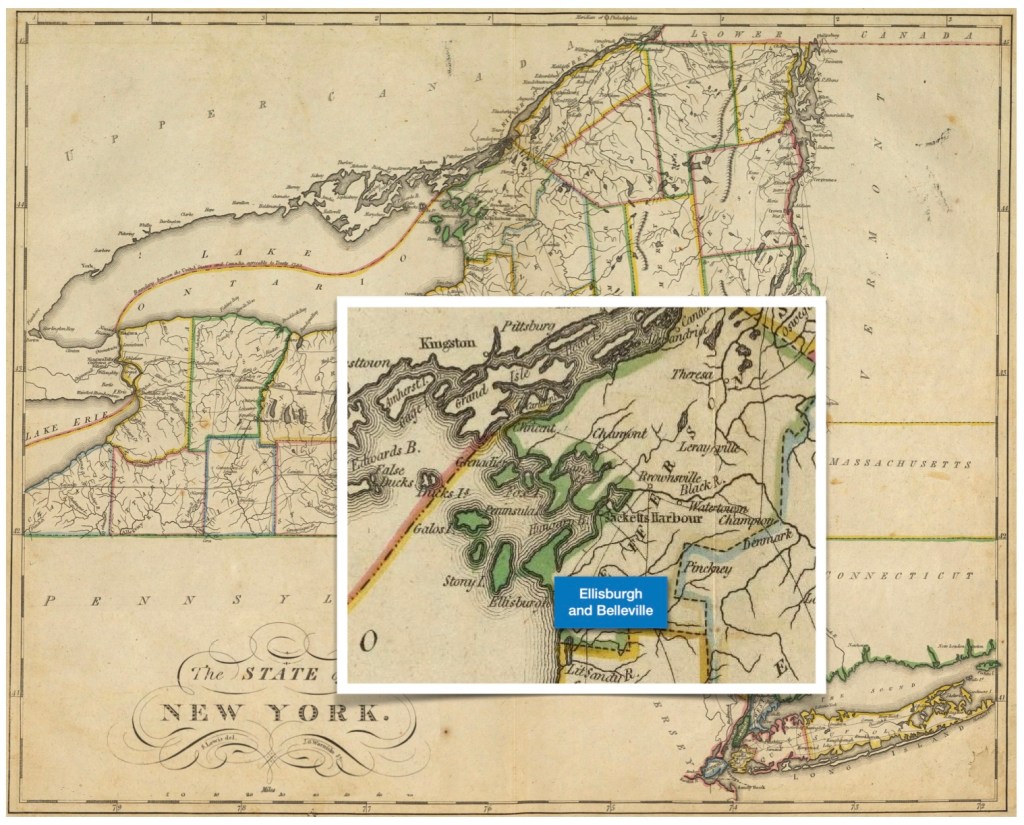
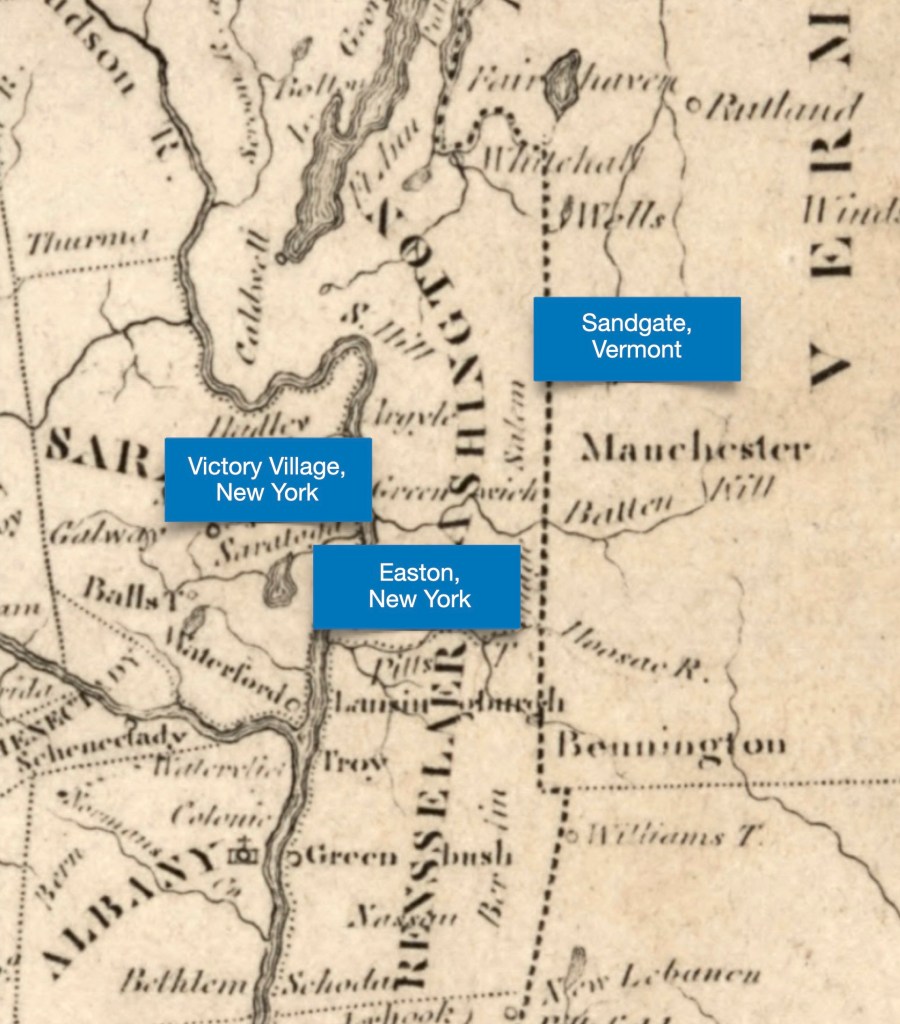
Map excerpted from the 1813 edition of H.G. Spafford’s gazetteer: A gazetteer of the
State of New-York. Albany, 1813. (Image courtesy of the Library of Congress).

The above map shows the eastern edge of New York State and the western edge of Vermont as they abutted each other just after the War of 1812, and before the commencement of the Civil War. The three principal communities indicated show where our ancestors lived during this period, prior to the westward emigration of our Great-Great-Grandparents to the Ohio Country. (1)

Learning From the 1855 New York State Census

Here is what makes the 1855 New York state census unique and also very helpful with our research: “The 1855 New York state census is notable because it was the first to record the names of every individual in the household. It also asked about the relationship of each family member to the head of the household—something that was not asked in the federal census until 1880. 

The 1855 New York state census also provides the length of time that people had lived in their towns or cities as well as their state or country of origin—this is particularly helpful for tracing immigrant ancestors. If born in New York State, the county of birth was noted, which is helpful for tracing migration within New York State.

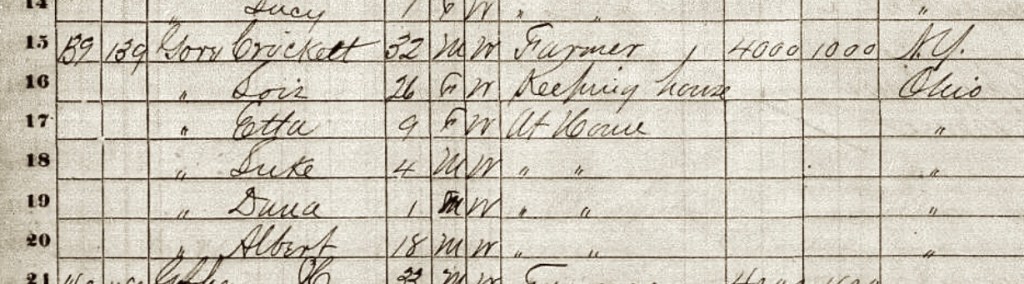
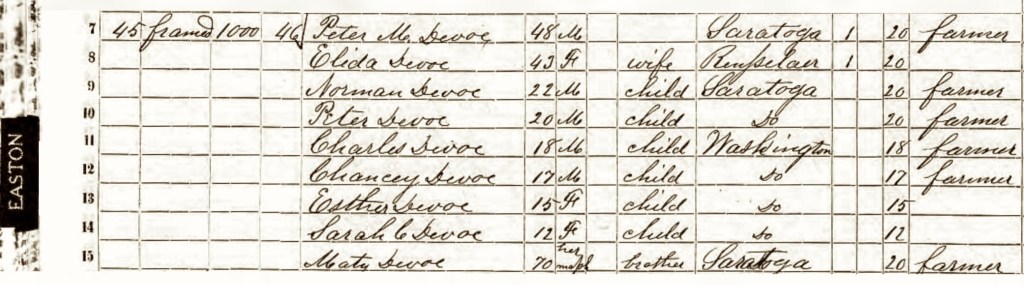
Peter A. DeVoe is listed on line 10, as being 20 years old, living in his parents’ home, working as a farmer, and that he was born in Saratoga County, New York.

1855 New York State Census for Easton, Washington County.

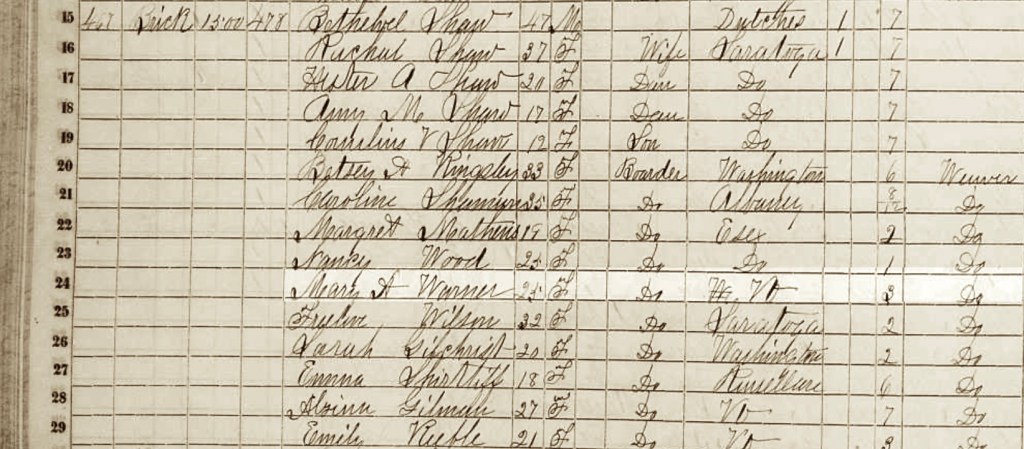
In 1855, Mary Ann was already residing in the town of Wilton* in Saratoga County, for three years, having moved there from Sandgate, Vermont. She is shown on line 24, as being 22 years old, and working as a weaver. We can also observe that she was born in Vermont, and that she is a boarder among ten other women who are also working as weavers. All of these women are living in a boarding house belonging to Bethelvel Shaw.

1855 New York State Census for Wilton, Saratoga County.

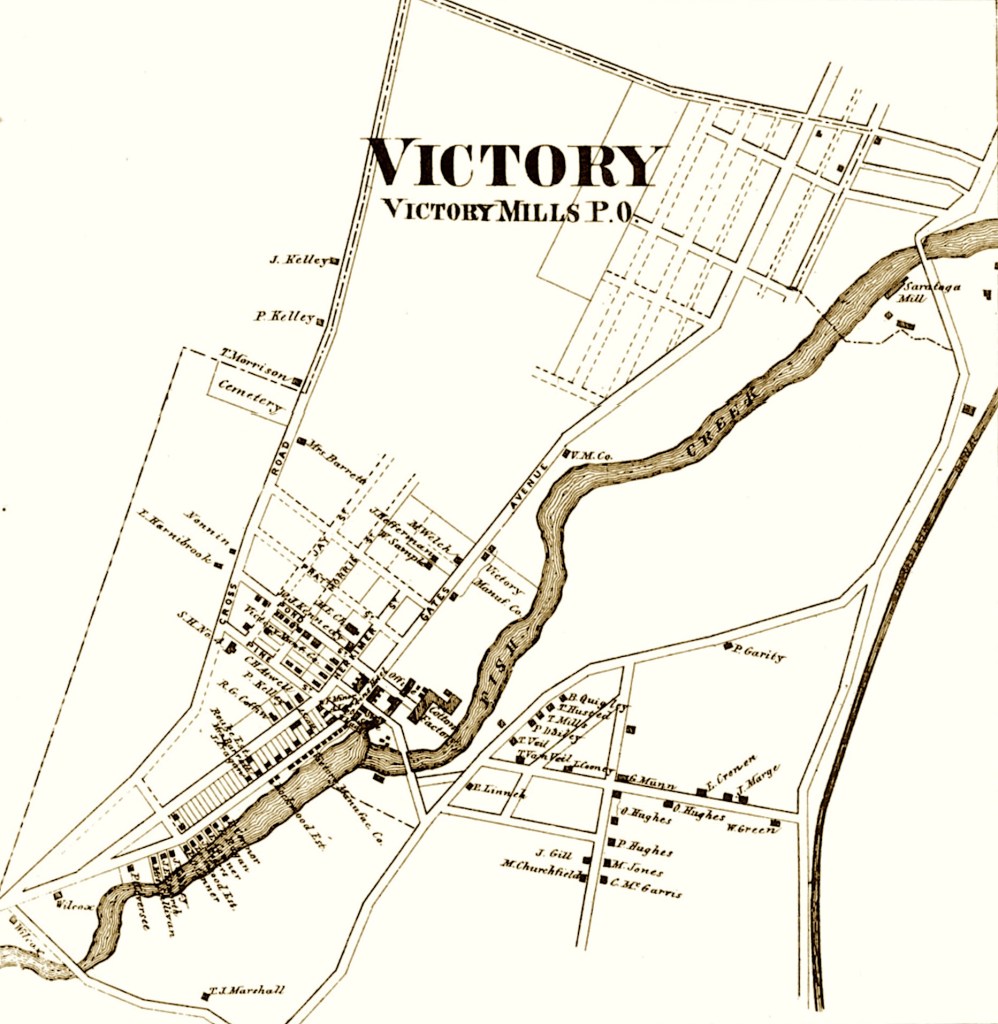
*In carefully analyzing the census materials, we learned that the landlord, Bethelvel Shaw and his family, ran a boarding house (which appears to have been situated amongst other boarding houses), in Victory Village, Saratoga County, New York. For both the 1855 and 1860 censuses, it is that same location, [despite being recorded as Wilton on the 1855 census].

Left to right, top: A cotton flower and bole, a millworker weaver working bobbins.
Center: Map of the Victory Mills hamlet in Saratoga County, New York, where our 2x Great Grandmother Mary Ann lived and worked in the early 1850s. Bottom: Stereoscopic view of a cotton mill in Lowell, Massachusetts, (See footnotes for credits).

When Mary Ann Warner lived there she worked as a weaver, so we analyzed histories of Saratoga County and maps from that era. We learned that there were very few mills that processed wool or cotton in Saratoga County during the period of 1852 through 1855. Having determined that she was recorded as living in Victory Village, the only place she could have worked at was the nearby Saratoga Victory Manufacturing Company. (2)

The Saratoga Victory Manufacturing Company

We don’t know what brought Mary Ann Warner to come and leave Vermont and move to Saratoga County, New York, but it plausibly could have been for economic opportunity. In the 1820s, one of the first cotton factory mills to have opened to great success in the United States was in Lowell, Massachusetts, and word likely spread out from there about employment.

As the National Park Service writes: “The term ‘mill girls’ was occasionally used in [1840s] antebellum newspapers and periodicals to describe the young Yankee women, generally 15 – 30 years old, who worked in the large cotton factories… To find workers for their mills in early Lowell, the textile corporations recruited women from New England farms and villages.”

Female textile workers often described themselves
as
mill girls, while affirming the virtue of their class and
the dignity of their labor. 

These “daughters of Yankee farmers” had few economic opportunities, and many were enticed by
the prospect of monthly cash wages and room and board
in a comfortable boardinghouse.

The Mill Girls of Lowell
The National Park Service

Beginning in 1823, with the opening of Lowell’s first factory, large numbers of young women moved to the growing city. In the mills, female workers faced long hours of toil and often grueling working conditions. Yet many female textile workers saved money and gained a measure of economic independence. In addition, the city’s shops and religious institutions, along with its educational and recreational activities, offered an exciting social life that most women from small villages had never experienced.

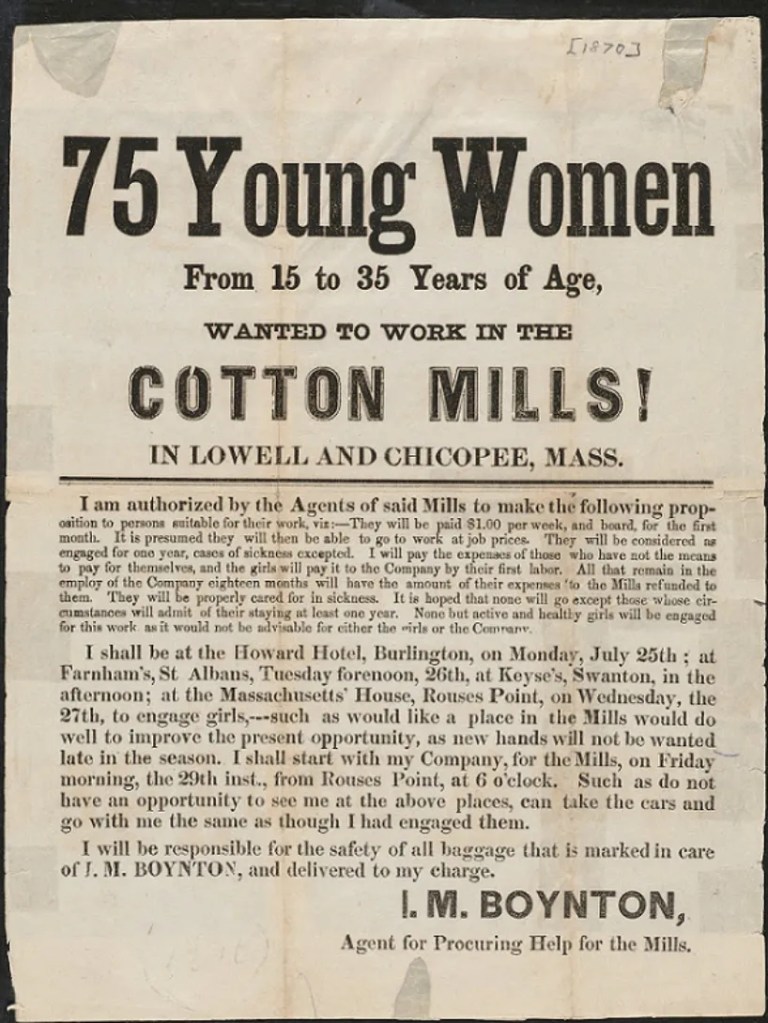
Recruitment flyer for mill workers, circa 1840s.
(Image courtesy of Medium, via Thinking Citizen Blog).

Although not as famous as the factories in Lowell, Massachusetts, the Saratoga Victory Manufacturing Company grew to be a very large business enterprise. It operated under several owners until finally closing in the year 2000.

From the Eustace Families Association website:
“The village of Victory is a suburb of Schuylerville, Saratoga County, New York. Victory is located just south of Schuylerville on Fish Creek, a tributary to the historic Hudson River… Victory is the product of the industrial revolution. The number of textile mills, which required abundant waterpower, grew rapidly during the mid-1800s… [By 1846], The Saratoga Victory Manufacturing Company [was built as]a three-story cotton cloth manufacturing plant costing $425,000. The company flourished and the number of employees living near the mill increased. In 1850, the cotton mill employed 160 men, 209 women, working at 12,500 spindles and 309 looms and produced over 1,800,000 yards of cotton cloth.”

“The development and expansion of Victory Mill coincided with the Potato Famine in Ireland. As a result, many Irish Catholic immigrants found work at the mills and as early as 1847, there was already a significant number of Irish families settled there.Observation: The frequency of Irish family names was something that we took note of when we analyzed the census materials. In this era, on our father’s side of the family, our Irish 2x Great Grandmother Elizabeth (McGuire) McMahon also worked as a weaver at a mill in Doune Village, Stirlingshire, Scotland. (See The McMahon / McCall Lines, A Narrative — One). (3)

The City’s Shops and Religious Institutions… Offered an Exciting Social Life

To be honest, we really don’t know how, nor where, Peter A. and Mary Ann met. Were they introduced by friends at a dance, or a picnic? We have read that for many of the young women who worked in the mills, churches offered an acceptable social outlet for their young lives. At nearly 170 years ago, one can only conjecture what the circumstance was.

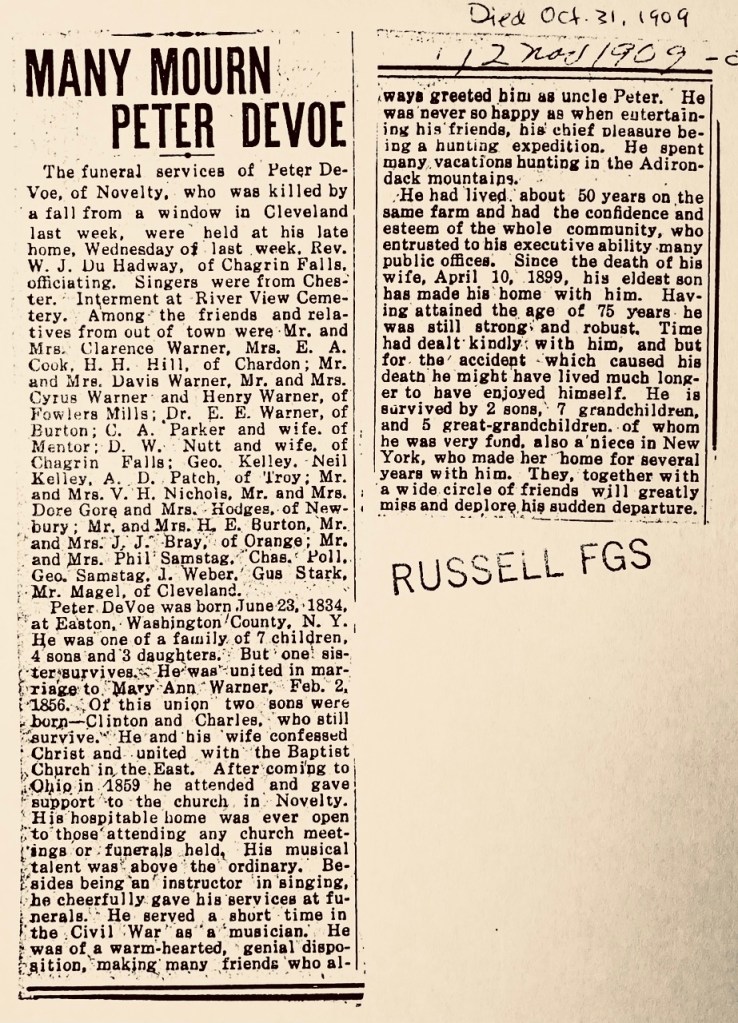
We also understand from his 1909 obituary, “He and his wife confessed Christ and united with Baptist Church in the East”. This explains how they became involved with the Baptist Church — but for all of the Dutch generations before him, his family had been devout members of the Dutch Reformed Church. Was this conversion the influence of Mary Ann’s family, or was it a natural progression of life, as one moves away from their parent’s home and ventures out into the world to find one’s self?

Photos to record the wedding of Peter A. and Mary Ann (Warner) DeVoe, circa 1856.
Marriage date: February 2, 1856
(Contemporary family photographs obtained from daguerratypes).
The Descendants of Andrew Warner > Seventh Generation, page 381.

Peter A. DeVoe and Mary Ann Warner were married on February 2, 1856. The location is likely either in Sandgate, Bennington County, Vermont, or in Easton, Washington County, New York. However, we cannot yet confirm the exact location, because a specific marriage record has not been discovered. We will keep on searching for it, but for now, we have relied on other credible sources for their marriage date. Mary Ann Warner is the youngest daughter of our 3x Great-Grandparents William Warner of Vermont, and his third wife, Prudence Nickerson.

Peter A. and Mary Ann had two children:

  • Clinton Chauncey DeVoe, born in New York, April 10, 1858 — died November 19, 1930 (We are descended from Clinton).
    For the specifics about Clinton Chauncey DeVoe’s life, please see
    The DeVoe Line, A Narrative — Ten.
  • Charles Raymond DeVoe, (see below)

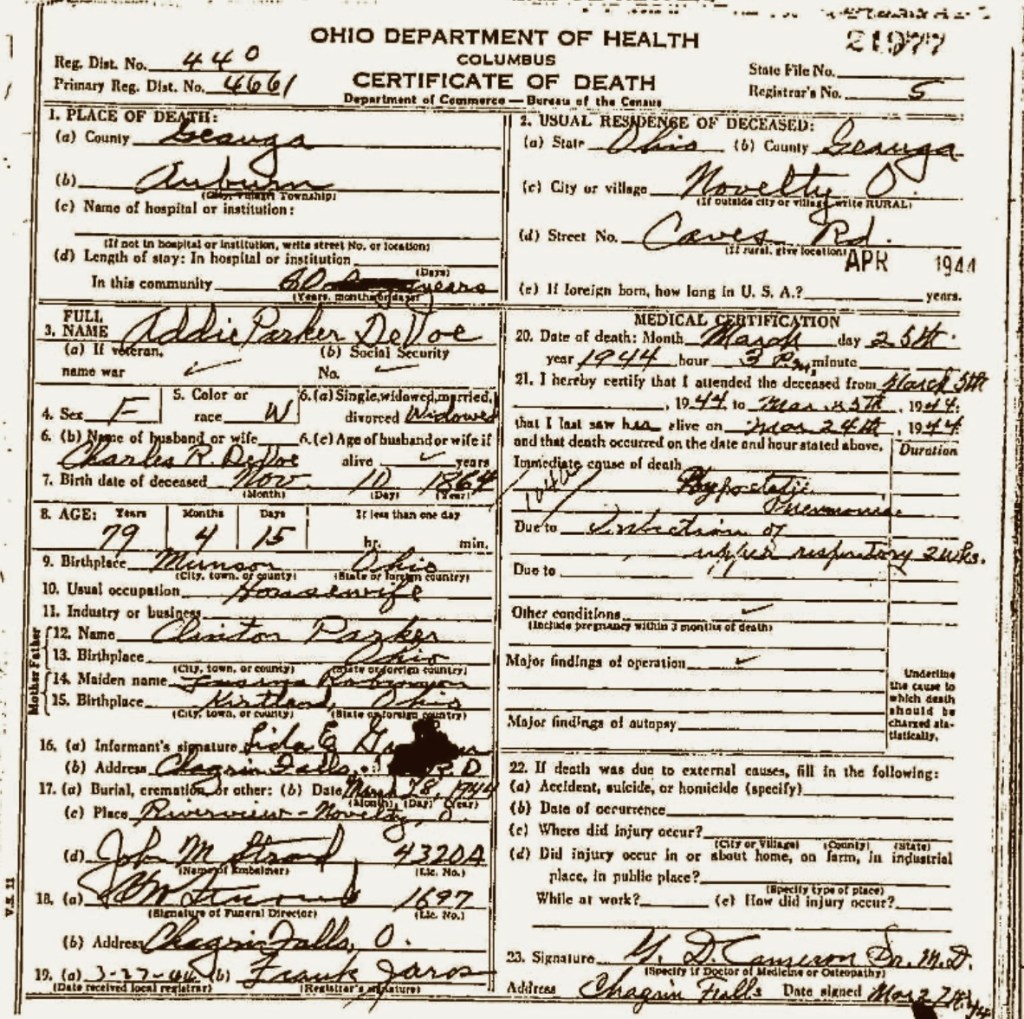
Charles Raymond DeVoe was the younger son in the family. He was born at home in Russell, Geauga County, Ohio on November 4, 1861. He died July 28, 1939 also in Russell, Ohio. Charles DeVoe married Adeline M. “Addie” Parker, on November 4, 1884, in Geauga, Ohio. She was born on November 10, 1865 in Munson, Geauga, Ohio, the daughter of DeWitt Clinton Parker and Lucina Robinson. She died on March 25, 1944 in Auburn, Geauga, Ohio. (4)

Marriage License for Charles R. Devoe and Addie M. Parker,1884.

The Years Before the Civil War — How Did They Travel?

We do not know by which route Peter A., Mary Ann, and young Clinton Devoe traveled to Northeast Ohio. In the late 1850s, for people emigrating westward to Ohio from the counties in New York and Vermont where our ancestors lived — they would have likely traveled by a combination of canals, railroads, and roads.

This contemporary image indicates the travel options that existed in the 1850s
between Saratoga County, New York and the Western Reserve of Ohio. (Image courtesy of Quora).
Red = roadway routes, Blue = canal routes, Black = railway routes

The Canal Routes
The primary water route was a series of linked canals, dominated by the Erie Canal, which connected with the Champlain Canal. The Champlain ran between the Saratoga and Washington County borders, where Peter A.’s parents and other relatives lived. It would have been very easy for them to access this route. Wikipedia states about the Erie,“The Erie’s peak year was 1855 when 33,000 commercial shipments took place.

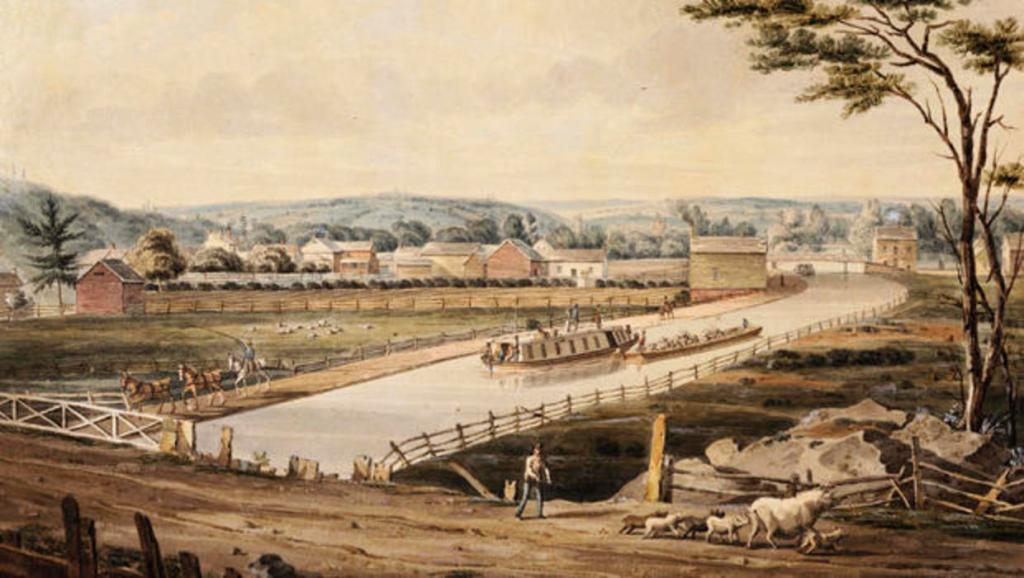
View on the Erie Canal (1830-32) by John William Hill
via The New York Public Library.

The Railway Routes
During this decade, railroad lines were also being constructed. If a traveler were fortunate, a rail line might exist for their destination. From Wikipedia: “The Mohawk and Hudson Railroad opened in 1837, providing a bypass to the slowest part of the canal between Albany and Schenectady. Other railroads were soon chartered and built to continue the line west to Buffalo, and in 1842 a continuous line (which later became the New York Central Railroad and its Auburn Road in 1853) was open the whole way to Buffalo”.

The Roadway Routes
Roadways, however, were a rough, mixed-bag of environments. What type of road surface one encountered depended upon the circumstances of the area you were passing through. There were: improved surfaces, packed dirt, corduroy (felled trees were used as planks), and pathways through fields. Taking a land route the entire way would have been the most difficult option.

We heard family stories about wagon travel, but to be honest, we just do not know how they made their way to northeast Ohio. What we do know is that the western end of the Erie Canal, and the endpoint for the railroads [in 1859], was at Buffalo, New York, on Lake Erie. This became the decision point about what to do next.

Inset image: Horse drawn covered wagon. (Image courtesy of the Little House books).
Background image: Gathering With Covered Wagon, 20th century image correct for
Conestoga wagon, oxen, style of dress, and Ohio designation.
(Image courtesy of digitalcommonwealth.org).

At Buffalo, a horse drawn wagon, or a heavy covered wagon such as the Conestoga wagon, would have been required for travel across Pennsylvania to the their new home in the Western Reserve of Ohio. This type of wagon was extremely popular in the years just before the Civil War, which started in 1861. (5)

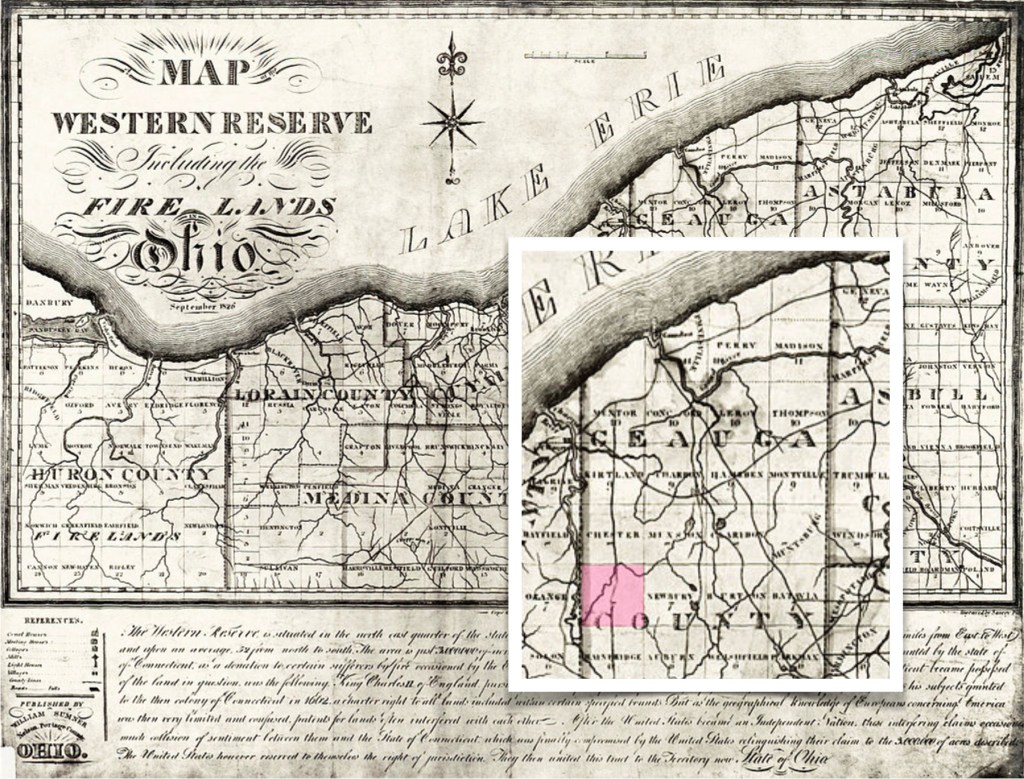
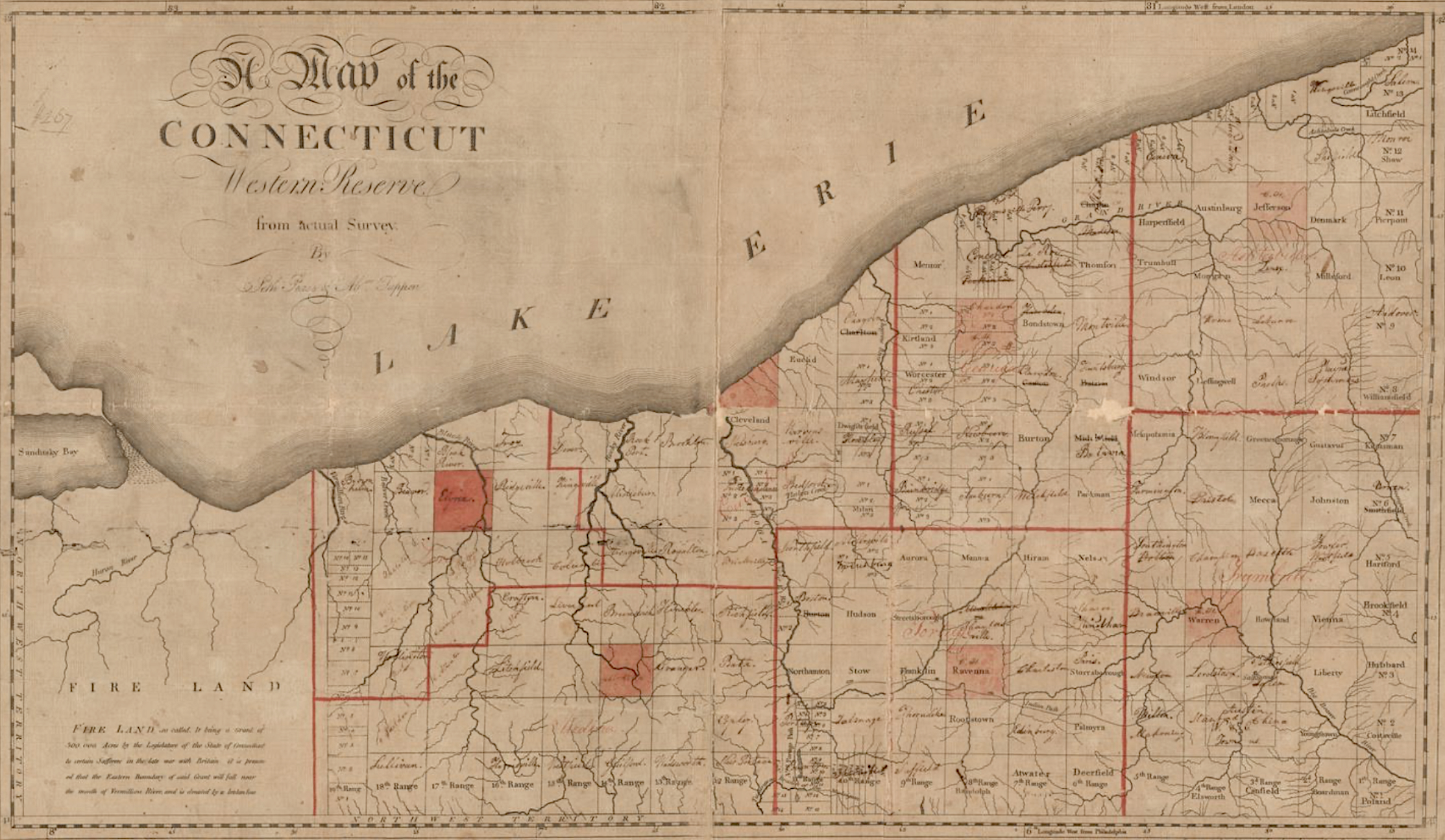
Map of the Western Reserve Including the Fire Lands 1826. On this map, Geauga County is still combined with the future Lake County and Russell township (pink area) is not yet named. (Image courtesy of Wikimedia Commons).

Many New Englanders Were Moving to the Western Reserve in Ohio

We believe that their attraction to northeast Ohio was most likely because the influence of family members from Mary Ann’s side of the marriage. She was part of the large, extended Warner family.

Note: Her father William S. Warner Sr., was married three times: first to Lucy Coan which brought seven children into the world, and second to Abigail Root —a brief marriage due to Abigail’s death; without children. William Warner’s third marriage was to Mary Ann’s mother, Prudence B. Nickerson, bringing four more children.

From William’s first marriage to Lucy Coan, five older brothers of Mary Ann were living in the Western Reserve of Ohio, all of them in Geauga County. Her older sister, Lucina married Clark Reed and they settled in Pike County, in southeast Ohio. The Warner siblings migrated to Ohio in two waves. The first was in the 1830s, and the second was in the 1850s. The Willoughby Independent Newspaper, of Willoughby, Ohio, in 1881, recounts:

“Out of a family of eleven children of William Warner, Sr. of Sandgate, Bennington County, Vermont, seven migrated to Geauga County, Ohio at a time in American history when Ohio was considered the far west. Six located permanently in Geauga County, the other, Lusina (Warner) Reed, removed with her husband Clark Reed, to Pike County, Ohio.”

“The first to arrive was Gaylord C., who came in 1830 followed the next year by his brothers, William Jr., Joseph and Benjamin and later John and a sister, [Mary] Ann, who married Peter DeVoe and settled in Russell. For the past 120 years these Warners, with their descendants, have contributed their bit to the progress of the Western Reserve. There are at present descendants of the family living in 10 of the 16 townships of Geauga. Besides many who moved on to help build a bigger and better America.” For many decades up to the present time, a yearly Warner Family Reunion has been held. The first reunion was in 1880 at the home of William Warner Jr.

Peter A. DeVoe’s 1909 obituary states that they entered Ohio in 1859. The 1860 United States Federal Census records them living in Russell township, Geauga County, Ohio.

1860 United States Federal Census for Russell township, Geauga County, Ohio.
1863 Civil War draft registration record for the counties of northeast Ohio in 1863.
Note that below Peter’s name is his younger brother Chauncey Devoe,
who must have been living in the area before he returned to New York state.

In the midst of the Civil war period, Peter A.’s younger brother Chauncey must have been living in the area, because he and Peter registered for Civil War service. Even though the War did not affect Ohio very much, Peter’s obituary in 1909 states, “His musical talent was above the ordinary… He served for a short time in the Civil war as a musician.

March 1870 United States Federal Census for Russell township, Geauga County, Ohio.

By the time of the March 1870 census, Prudence Warner, Mary Ann’s mother, is living with them. We observed that one of the children listed — Warren French, is the neighbor’s child who must have been residing there also. We are neither sure when, nor how, Prudence Warner in her elder years, traveled to Ohio from Sandgate, Vermont. Since it was the 1860s, railroad lines were fast developing, and it is quite possible that perhaps the entire trip was by railroad. (6)

Russell Township, from the Atlas of Lake and Geauga Counties 1874, Ohio
Published by Titus, Simmons and Titus, Philadelphia. Image courtesy of historicmapworks.com.

The Last Township to be Named

If you look carefully at the 1826 Western Reserve Firelands map/illustration a few paragraphs above, you can see that Russell township is not yet named. When researching why this is, we came across this passage from the 1878 book, the History of Geauga and Lake Counties, Ohio:
“Russell was the last to be peopled, of all the townships, and the most of her early inhabitants removed to her borders from the surrounding country. This is said by her historians to have resulted from the high prices at which the proprietors held the land. It was also due to the generally low estimate which prevailed, set upon her soil and timber.

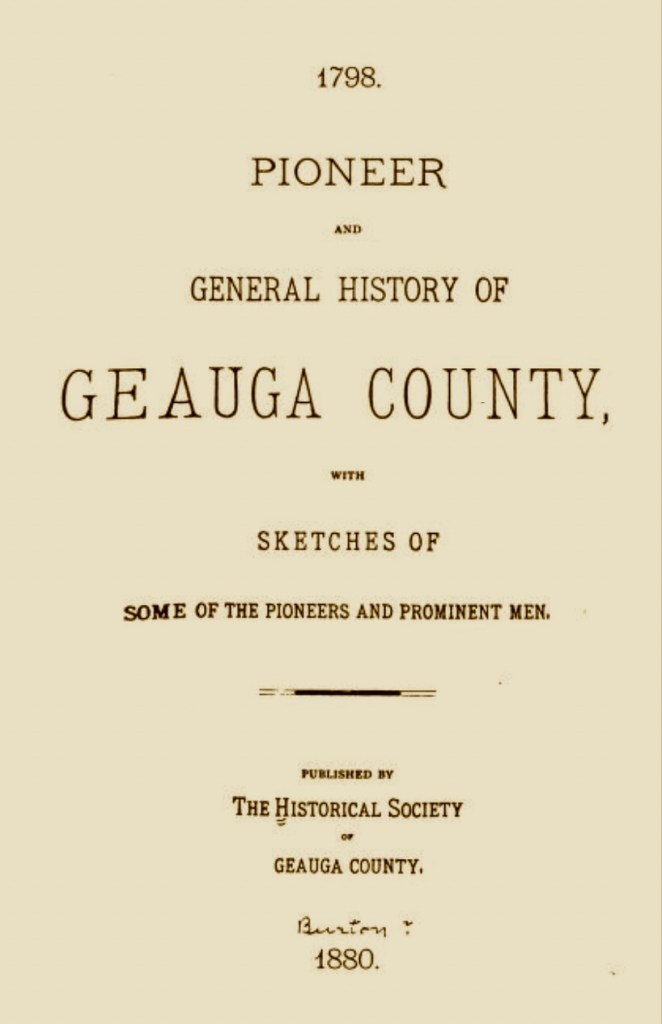
This was rather startling to read, because (at present) the township is heavily forested and there is also much farmland. We wonder if perhaps local politics and land speculation was affecting the early settlers, of which there were many in our family. From the 1880 edition of the Pioneer and General History of Geauga County..., we learned that both aspects were true.
“At the commencement of its settlement, it was called the West Woods by the people of Newbury. The reason why it was not settled as soon as the adjoining townships, I suppose, to be that the speculators who bought of the Connecticut Land company, held it out of the market, or held it above the market price.

Interestingly, we learned that other people from Bennington County, Vermont, where the Warner family hailed from, were present in the area since the 1820s…
“Clark Robinson moved from Shaftsbury, Bennington County, Vermont, to Middlefield, in the fall of 1820… and bought a lot of land in Russell Center at three dollars per acre…on the eighth of November, 1825, moved his family into the body of a log house…” (7)

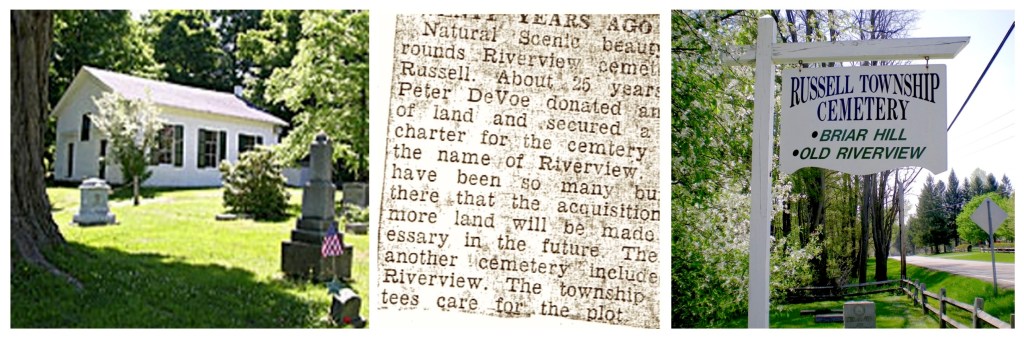
The Legacy of Briar Hill and Old Riverview

Riverview Chapel, 1930s newspaper epherma, Old Riverview / Briar Hill Cemetery,
Russell township, Ohio.

Amongst old family ancestry records we discovered a portion of a small 1910s(?), 1920s(?) newspaper article about our 2x Great Grandfather Peter A. Devoe. It describes how in earlier years he had donated a portion of his land to create the Riverview Cemetery, an adjunct to the Briar Hill Cemetery. If you examine his property map (shown above) from 1874, you can discern on the upper corner that it says Wesleyan Cemetery and shows a small indication labeled ‘Ch’ for a church, or chapel.

From the 1880 edition of the Pioneer and General History of Geauga County..., we discovered this:
“The Wesleyan Methodist Church. — About the year 1848 there was a division among the Methodists on the slavery question, a part of the members withdrew, and a Wesleyan Methodist church was organized embracing two families that were left of a Congregational church, that was formed in the northwest part of Russell, in the summer of 1840, when J. M. Childs was chosen deacon, and A. H. Childs was chosen clerk, which had become reduced to the two families mentioned, when their organization was given up, and they, uniting with those who came away from the Methodist Episcopal church, formed the Wesleyan Methodist church, and in 1850 they bought a piece of land of L. T. Tambling, two miles north of the center, on the west side of the Chillicothe road, a nice sandy knoll for a burying ground, and to build a meeting house on, and four of them paid for it, to-wit: H. Cummins, John Wesley, David Nutt, and J. M. Childs, and had it deeded to the trustees of the first Wesleyan Methodist church in Russell, and to their successors in office. The first three named that paid for the burying ground are dead and gone to their reward; Mr. Childs is living yet. He says that in 1851 they began to make preparations to build a meeting house, but, being poor, and new beginners, it went on slow, but with a hard struggle with poverty and bad management, it was finished.

The Wesleyan Cemetery eventually became known as Briar Hill Cemetery. The meeting house became the Riverview Chapel where Baptist religious services were held. Peter A. Devoe and his extended family members gathered there for worship. Our Grandmother Lulu Mae (DeVoe) Gore often spoke of his love of music and how he would lead musical performances at the chapel.

There are six generations of our family buried in Riverview Cemetery. These family lines are: Bond, DeVoe, Gore, McClintock, and Warner. (8)

They Joined Their Ancestors

Both Peter and Mary Ann were descended from many generations of people who earned their living as farmers from an agrarian economy. They carried on that tradition, as their sons did after them.

Mary A. Devoe death record, 1899.

Mary Ann (Warner) DeVoe was the first to pass away on April 10, 1899. We have found two records about her death, and they indicate that she died from either consumption, or measles.

Peter A. DeVoe was born on June 23, 1834 in Saratoga County, New York. After his wife Mary Ann passed away, he lived into the 20th century for another ten years . He died on October 31, 1909 from an accidental fall. This newspaper account describes what happened. Peter’s obituary (further below) speaks to how beloved he was in his community. (9)

An account of his death was published in
The Geauga Republican, or the Cleveland Leader, on November 3, 1909.
Peter died on October 31, 1909. This obituary was published (likely in the Geauga Republican)
on November 12, 1909.

In the next chapter we will write about Peter and Mary Ann’s son Clinton Chauncey DeVoe, his wife Clara Antionette McClintock, and their children.

Following are the footnotes for the Primary Source Materials,
Notes, and Observations

A Chip Off The Old Block?

(1) — one records

Library of Congress
State of New-York for Spafford’s gazetteer, 1813
https://www.loc.gov/resource/g3800.ct003432/?r=-0.195,0.049,1.46,0.862,0
Note: For a portion of the map image.

Learning From the 1855 New York State Census

(2) — eight records

New York Genealogical & Biographical Society
New York State Census Records Online
https://www.newyorkfamilyhistory.org/subject-guide/new-york-state-census-records-online#1855

Peter M Devoe
in the 1860 United States Federal Census

New York > Washington > Easton
https://www.ancestry.com/discoveryui-content/view/48630571:7667?tid=&pid=&queryId=35ec4bd5-43de-42e5-bb2e-505bfa1707e1&_phsrc=Rxw27&_phstart=successSource
Book page: 160, Digital page: 28/80, Entries 23 through 29.

Mary A Warner
Census – New York State Census, 1855

https://www.familysearch.org/ark:/61903/1:1:K63D-4G5
Digital page: 247/481, Entry 24.
Note: This census is recoded as Election District 2 / Wilton, but the location it covered for our Great-Great-Grandmother Mary Ann Warner is actually the small town of Victory Village, just south of Wilton. See the notes below on Bethuel Shaw.

Bethuel Shaw (or Nathaniel Shaw)
https://www.findagrave.com/memorial/118426704/bethuel-sha
Notes: Much research was done on Bethuel Shaw, and the following was determined — He and his family ran a boarding house (which appears to have been situated amongst other boarding houses), in Saratoga County, New York. For the 1855 “Wilton” census and for the “Victory Village” 1860 census, it is the same location because the names of the neighbors are exactly the same (the Taylor family and the Kelly family). On the 1860 census, his name Bethuel is recorded as Nathaniel.

History of Saratoga County, New York, with Biographical Sketches of Some of its Prominent Men and Pioneers
by Nathaniel Bartlett Sylvester, 1878
https://archive.org/details/cu31924028833064/page/n7/mode/2up

New Topographical Atlas Of Saratoga Co. New York
From Actual Surveys by S.N. & D.G. Beers and Assistants

Stone & Stewart, Publishers. Philadelphia. 1866
https://mathcs.clarku.edu/~djoyce/gen/saratoga/Atlas.html

Gossypium barbadense, cotton plant
Illustration from the Botany Library Plate Collection held at the
Natural History Museum, London
https://www.mediastorehouse.com.au/mary-evans-prints-online/gossypium-barbadense-cotton-plant-8613143.html
Note: For the cotton plant illustration.

Resources for History Teachers
The New England Textile Industry in the 19th Century
http://resourcesforhistoryteachers.pbworks.com/w/page/125185436/The%20New%20England%20Textile%20Industry%20in%20the%2019th%20Century
Note: For the Lowell, Massachusetts stereoscopic view card mill image.

The Saratoga Victory Manufacturing Company

(3) — four records

The Mill Girls of Lowell
https://www.nps.gov/lowe/learn/historyculture/the-mill-girls-of-lowell.htm#:~:text=To find workers for their,board in a comfortable boardinghouse.

Eustace Families Association
http://www.roneustice.com/Family History/IrishFamiliessub/EustisVictoryMills/VictoryMills.6.7.09.htm

Thinking Citizen Blog — Massachusetts (Part Two) Textiles, Shoes, Telephones
https://john-muresianu.medium.com/thinking-citizen-blog-massachusetts-part-two-textiles-shoes-telephones-55beeb38c6de

“Several companies owned and operated the facility over the years and unfortunately ended up closing its doors in 2000.”
https://www.villageofvictory.com/about-historical-victory/

The City’s Shops and Religious Institutions… Offered an Exciting Social Life

(4) — five records

The Descendants of Andrew Warner
> Seventh Generation
Compiled by Lucien C. Warner and Mrs. Josephine Genung Nichols
https://archive.org/details/descendantsofand00warn/page/380/mode/2up?view=theater
Book page: 381-382, Digital page: 380-382/804, Right page, entry 355.
Note: “Ann (or Mary Ann) Warner marries Peter DeVoe”

Charles R. Devoe
Marriage – Ohio, County Marriages, 1789-2016

https://www.familysearch.org/ark:/61903/1:1:XD2M-HMQ
Book page: 321, Digital page: 182/516      Right page bottom, entry 3.
Note 1: Spouse is, Addie Parker / Adeline M. Parker
Note 2: Marriage date, November 4.1884, in Geauga County, Ohio

Chas Raymond Devoe
Death – Ohio Deaths, 1908-1953

https://www.familysearch.org/ark:/61903/1:1:X8MR-L8D
Digital page: 1544/3320
Note: This file also documents his birth date.

Charles Raymond DeVoe death certificate, 1939.

Addie Parker Devoe
Death – Ohio Deaths, 1908-1953

https://www.familysearch.org/ark:/61903/1:1:X8ML-Y6F
Digital page: 2697/3295
Notes: Birth date and location, death date and location. 

Addie M. (Parker) DeVoe death certificate, 1944.

Adeline M. Parker
https://www.familysearch.org/tree/person/details/99B3-JDD
Note: Addie DeVoe’s parents are: DeWitt Clinton Parker and Lucina Robinson.

The Years Before the Civil War — How Did They Travel?

(5) — five records

Quora map image
How would someone in the 1850s get from New York to Kansas?https://www.quora.com/How-would-someone-in-the-1850s-get-from-New-York-to-Kansas

CBS News
All Hail The Erie Canal
“View on the Erie Canal” (1830-32) by John William Hill
via The New York Public Library
https://www.cbsnews.com/news/all-hail-the-erie-canal-200th-anniversary/
Note: For the landscape painting.
Erie Canal
https://en.wikipedia.org/wiki/Erie_Canal

Covered Wagon With Horses photo
Little House Books
http://lhbooks.weebly.com/covered-wagons.html
Note: For the covered wagon image in color.

Gathering With Covered Wagon
by Associated Photofeature Syndicate, 58 Charles Street, Boston, Massachusetts
https://www.digitalcommonwealth.org/search/commonwealth:0r96gd67j
Note: For the covered wagon image, sepia toned.

Many New Englanders Were Moving to the Western Reserve in Ohio

(6) — six records

Western Reserve Including the Fire Lands 1826
https://commons.wikimedia.org/wiki/File:Western_Reserve_Including_the_Fire_Lands_1826.jpg
Note: On this map, Geauga County is still combined with the future Lake County and Russell township is not yet named.

North America, Family Histories, 1500-2000 for Ann Warner
W > Warner > The Descendants of Andrew Warner
https://www.ancestry.com/imageviewer/collections/61157/images/46155_b290135-00262?usePUB=true&usePUBJs=true&pId=1810137
Book page: 254-255, Digital page: 262-263/812
Note: Entry 355 on page 263, is a notation for her marriage to Peter Devoe.

P Devon
in the 1860 United States Federal Census

https://www.ancestry.com/discoveryui-content/view/43403745:7667?tid=&pid=&queryId=a14478bc-ce31-4745-9564-8089cb4f9791&_phsrc=cUK2&_phstart=successSource
Book page: 18, Digital page: 18/25, Entries 27-29.

Peter Devoe
in the U.S., Civil War Draft Registrations Records, 1863-1865

Ohio > 19th > Class 1, A-K, Volume 1 of 4
https://www.ancestry.com/discoveryui-content/view/1035699:1666?tid=&pid=&queryId=74778971-fe58-4cc5-a090-2f50318fd932&_phsrc=cUK4&_phstart=successSource
Book page: 145, Digital page: 168/338, Entries 13 and 14.

Peter De Voe
Census – United States Census, 1870

https://www.familysearch.org/ark:/61903/1:1:M62W-W7Z
Book page: 2-3, Digital page: 612-613/733
Notes: Entries 35 through 40 at the bottom of the left page and entry 1
at the top of the (next right) page.

Extracts from the Willoughby Independent, 1881, Willoughby, Ohio Newspaper
Judy Jane Stebbins, 3/1/2013
https://usgenwebsites.org/OHLake/newspaper/Willoughby%20Independent%201881c%20Stebbins.pdf

The Last Township to be Named

(7) — three records

Cover for the Atlas of Lake and Geauga Counties 1874, Ohio.

Historic Map Works
Russell, Fowler’s Mills
From Lake and Geauga Counties 1874, Ohio

Published by Titus, Simmons and Titus in 1874
https://historicmapworks.com/Map/US/24292/Russell++Fowler+s+Mills/

History of Geauga and Lake Counties, Ohio
https://archive.org/details/oh-geauga-lake-1879-williams/page/n9/mode/2up
Book page: 207, Digital page: 318/443

1798 – 1880, Pioneer and General History of Geauga County, with Sketches
of Some of the Pioneers and Prominent Men
by The Historical Society of Geauga County
Russell > For Early Proprietors, and > Early Events:
https://archive.org/details/oh-geauga-1880-historical-society/page/109/mode/2up?view=theater
Book page: 109-110, Digital page: 109-110/821

The Legacy of Briar Hill and Old Riverview

(8) — two records

Russell Township
Township Cemeteries
https://russelltownship.us/departments/administration-1/cemetery
Note: For the Riverview Chapel image.

1798 – 1880, Pioneer and General History of Geauga County, with Sketches of Some of the Pioneers and Prominent Men
by The Historical Society of Geauga County
Russell > The Wesleyan Methodist Church
https://archive.org/details/oh-geauga-1880-historical-society/page/113/mode/2up?view=theater
Book page: 114, Digital page: 113/821

They Joined Their Ancestors

(9) — four records

Mary A. Devoe
Vital – Ohio Deaths and Burials, 1854-1997

https://www.familysearch.org/ark:/61903/1:1:F6D5-ST5
Book page: 8, Digital page: 435/469, Left page, entry #4828.
Note: her cause of death is listed as consumption (tuberculosis).

Peter Devoe
Death – Ohio Deaths, 1908-1953

https://www.familysearch.org/ark:/61903/1:1:X6XS-W2N
Digital page: 98/3051

Peter A. DeVoe death certificate, 1909.

Peter Devoe
in the Ohio, U.S., Rutherford B. Hayes Presidential Center Obituary Index, 1810s-2016

https://www.ancestry.com/discoveryui-content/view/2222115:1671?tid=&pid=&queryId=8f21bb29-7ea3-4d5b-9aed-f7ae3dc6ea30&_phsrc=bTB3&_phstart=successSource

Ohio, U.S., Wills and Probate Records, 1786-1998 for Peter De Voe
Geauga > Probate Files, Dutton, Charles O-Downing, Cornelia A
https://www.ancestry.com/imageviewer/collections/8801/images/005441006_01234?pId=15350799
Digital pages: 1234 through 1250
Note: There are about 17 images in this docket.

Peter Devoe
in the Ohio, U.S., Death Records, 1908-1932, 1938-2018

D
https://www.ancestry.com/discoveryui-content/view/6201688:5763?tid=&pid=&queryId=138f15d6-7ebf-4d55-ae45-6660f57adcfa&_phsrc=Wxe18&_phstart=successSource
Book page: 335, Digital page: 30/2684, Entry 15 from the bottom.

The Gore Line, A Narrative — Seven

This is Chapter Seven of eight. We have been covering many interesting centuries of the Gore Family and their forebears, but now we are coming up on these modern times. For the most part, our ancestors are now firmly established in Ohio, living as either farmers, tradesmen, or keeping house.

Where Did These Things Come From?

Tucked in among the paperwork and family ephemera we went through when our Grandmother Lulu Gore died in 1975, were several different anti-slavery newspapers. They both surprised and baffled us because our family stories were silent on the subject of slavery — we wondered how these things had come into the family.

A clue was hiding in plain site on the top of one of the newspapers, where the name Wm Munn had been written in with a quill pen. (This was not really a surprise, because the local Munn family had been in the area as long as our family had, and perhaps, even a bit longer. However, we didn’t see the connection yet). Almost 50 years later, the mystery was solved when we wrote The Gore Line, A Narrative — Six, our previous chapter. In that section, we learned that our Great-Great-Grandfather Luke Gore had been a town clerk in Newbury township, Ohio for the years 1842 and 1844. Looking more closely we observed that William Munn, had served in the same role in 1843 and 1845. It seems then they must have been friends and alternated in this role over the four years.

These newspapers are, the —

  • Geauga Republican & Whig, March 18, 1845
  • National Anti-Slavery Standard, July 22, 1847
  • National Anti-Slavery Standard, May 13, 1852

This got us to thinking about the role that the people of the Western Reserve played in the years leading up to and including the Civil War. In the early part of the 18th century, the Ohio Country was frequently referred to as the West, and from the perspective of New Englanders who settled it, it was indeed pioneer country. By the 1850s and 60s, the Western Reserve wasn’t thought of as a frontier anymore, but actually, it still was — that frontier being a psychological perspective, a state-of-mind about what it meant to be a good citizen in this newly-created country. (1)

The New England of The West

From an article written in 1957, titled The Connecticut Reserve and The Civil War, we learned several interesting perspectives about the area. “Within this region [of] some three million acres, approximately the size of Connecticut herself… [and] modified only slightly by contact with the frontier, the area became more like New England then New England itself.”

This meant that there was a moral fervor, conditioned by the churches of Protestant Puritanism, which had been transplanted from the New England states, to this new area. Furthermore, the leveling tendencies of the frontier experience had deepened the ideas of New England democracy within the population of settlers.

This resulted in an emphasis on “the democracy of the town… [and] Eastern culture provided a new synthesis in the field of popular education… social mobility and a re-affirmation of individual worth, equality, and dignity of man in general.” [Lottick] In other words, their state-of-mind, their ethos of hard work, having an education, using a democratic voice, and righteous behavior, was the desired standard. This was an empowering shift from of the previous generations who had chaffed under the rule of a capricious king in the British Colonies.

In the 19th century, the Western Reserve “was probably the most intensely antislavery section of the country”. 
John Brown Jr. called it, in 1859, “the New England of the West.”

Wikipedia article on the Connecticut Western Reserve,
discussing John Brown, Jr.

Twenty years before the Civil War, “According to the theory of Boston’s Wm. Lloyd Garrison and the American Anti-Slavery Society (1833), slavery was a personal and social sin requiring immediate repentance of slaveholders and all others who had failed to witness against the institution”. [Case Western]

The Western Reserve College and Oberlin College became centers of Abolitionist agitation. In truth, Oberlin’s abolitionist viewpoint “was strengthened further when recruits from the Lane Theological Seminary…joined its fold”. [Lottick] Abolitionism then, grew out the mingled influences of both religion and education in the area where our ancestors lived. “People known as abolitionists believed that slavery should not exist and fought to end it. Northeast Ohio was a hotbed of abolitionist activity. Men and women, Black and White, free and enslaved, worked together for their cause”. [Cuyahoga Valley National Park article]

In contrast, the Southern states during this period had flourished under a very different system that most New Englanders (and their transplants) found to be very strange. It was a way of life built upon the use of slaves — essentially, upon a class-and-caste system of belief. As such, the possibility of “social mobility and a re-affirmation of individual worth” were not part of the equation.

Top section, left image: Participants from the Oberlin-Wellington Rescue. Center image: Leg shackles used in the Trans-Atlantic slave trade. Right image: A painting of fugitives smuggled during winter, The Underground Railroad (1893 ) by Charles T. Webber. Lower section, left image: the National Anti-Slavery Standard newspaper, July 22, 1847, family document. Right image: April 24, 1851 “CAUTION!! Colored People of Boston” broadside warning of watchmen and police acting as kidnappers and slave catchers. [Please see the footnotes for specifics.] (2)

“Routes of the Underground Railroad.”
The Underground Railroad was not an actual railroad, but a network of secret routes and safe houses used by black slaves in the United States to escape to free states and Canada.
(Observation: There are so many red line over Ohio, that it looks like a cardiac diagram).

The Underground Railroad in the Western Reserve

The battles of the Civil War did not have a profound effect upon the Western Reserve territory, but the existence of the Underground Railroad did. In fact, initially there were many people in Cleveland who were not particularly concerned about the plight of slaves. This changed when “The completion of the Ohio Canal in 1832 enhanced the strategic importance of the city…” because this became one of the most direct routes from the slave-holding South, to freedom in Canada.

Furthermore, the indifferent attitude of some people changed dramatically when The Fugitive Slave Act was passed in 1850. This law lit a white hot fire under the Abolitionists. “The severity of this statute inspired an increased number of abolitionists, the development of a more efficient Underground Railroad, and the establishment of new personal-liberty laws in the North. These personal liberty laws were enacted in eight Northern States and prohibited state officials from assisting in returning fugitive slaves to the South…” [Case Western]

Our ancestors, being settlers from New England, and as evidenced by the anti-slavery newspapers, were likely concerned about and involved with, the abolitionist movement. We know for certain, that this branch of our family did not own slaves. (3)

The 1870s in Geauga County, Ohio

Luke Gore died in 1868, but several of his children continued to live in the area. When we reviewed the 1870 census, it showed that Dorr B. Gore is 18 and listed as living with his mother Electa, and his brothers Milan and Otto. They have a domestic servant, Myra Fowler — it turns out that she eventually married Dorr B.’s older brother Milan Gore on July 4, 1870. Observation: Perhaps this family liked holiday themed weddings? (Maybe it was budget-friendly and helped them save on decorations.)

Engraving of the Geauga County Courthouse reproduced from the
History of Geauga and Lake Counties, Ohio, by the Williams Brothers, circa 1879. (See footnotes).

We observed that Luke Gore’s oldest son, Crockett Gore, was living with his wife Etta and their young family in Russell township. He was working as a farmer on land that his father had previously farmed (see The Gore Line, A Narrative — Six). From the Russell township Historical Society newsletter, March 1999: “Luke enlarged the farm, adding land in Russell to a total of 163.5 acres. After he died, his eldest son Crockett Gore, farmed the land”.

“He married a neighbor, Lois Havens, and they had Luke W., Dana and Ralph C. Luke W. is listed in our old school records as a student in the brick school in 1872. He died at the age of 17 in Russell, and Ralph C. also died young, aged 21. Both are buried with their parents in Munn cemetery in Newbury”.

“In 1882 Crockett built the home that is still there. He quarried sandstone for the foundation from a quarry on the farm, and cut and used wood from his own woodlot. He died in 1900 in Clio Michigan, but is buried in Munn cemetery in Newbury, with his parents, his wife Lois and a son who died at the age of 17.” (4)

The Kids Get Married! Dorr B. Gore Marries Ann Susan Booth

As always, times change, but love blooms eternal — starting the new year off right (!), our young Great-Grandfather Dorr B Gore (at just 21), married our Great-Grandmother, (even younger at 19), Ann Susan Booth, on January 1, 1872 in Burton, Geauga County, Ohio.

1872 Antique Victorian Home Insurance Company, promotional calendar.

Dorr B. Gore, born September 8, 1851 in Newbury, Geauga County, Ohio – died June 11, 1930 in Cleveland, Cuyahoga County, Ohio. Ann Booth was born October 30, 1852 in Burton, Geauga, Ohio – died March 11, 1908 in Newbury, Geauga, Ohio.

Ann’s parents are James Monroe Booth (March 12, 1827-July 8, 1889) and Adelia Rose (March 31, 1827-January 25, 1910), whose families were among the very first pioneers to settle in the Western Reserve area.

They had four children:

  • Nettie Belle (Gore) Robinson, born December 24, 1873 in Geauga, Ohio – died April 20, 1922 in Oblong, Crawford, Illinois.
  • Clara Edna (Gore) Matthews, born July 3, 1876 in Auburn, Geauga, Ohio – died March 26, 1933 in Russell, Geauga, Ohio (Note: it is interesting to observe that she is a centennial baby).
  • Forrest Munroe Gore, born August 11, 1878 in Newbury, Geauga, Ohio – died January 31, 1930 in Chagrin Falls, Cuyahoga County, Ohio

On the 1880 census, Dorr B. is 28 and also on the census are: Ann 28, Nellie 6, Clara 3, Forrest 1, his mother Electa 58, and the farm hand Elmer E. Brewer.

  • Harley William Gore, born June 7, 1881 Russell, Geauga, Ohio – died November 24, 1941 Newbury, Geauga, Ohio.
    (We are descended from Harley). (5)

Dorr B. Gore Had Two Wives

The Gores continued to live their lives mostly as farmers. Dorr B. Gore’s wife Ann Booth died on March 11, 1908 of heart failure after having had pneumonia for three weeks. Eighteen months later he married for a second time, to Amelia Harnden on October 12, 1909. A local resident, Amelia was born January 1, 1863 – died July 8, 1947, having outlived her husband Dorr B. by seventeen years.

Ann Susan (Booth) Gore death notice, March 1908. (Source unknown).

A transcription of Ann Susan (Booth) Gore death notice:
August 7 — Ann Susan Booth, daughter of Monroe and Adelia Booth was born in Burton, Ohio, Oct. 30, 1851 where she lived until Jan. 1, 1872 when she married Dorr B. Gore of Newbury, where she lived the rest of her life. She had heart trouble for years and after a sickness of a little over three weeks with heart trouble and pneumonia she passed away Thursday morning, March 12, 1908, aged 56 years, 4 months, 12 days. She was a true kind and sweet disposition carrying love and sunshine where ever she went. She leaves a husband and four children who loved her and will miss her more than words can tell. Nettie B. Robinson, Clara E. Mathews, Harley W of Russell, and Forest M, who lives at the old home in Newbury, also an aged mother, Mrs. Adelia Booth, Burton. Three sisters, Mrs. P. D. Bishop, Andover, Mrs. Chas Stickney and Mrs. Carl Wicks of Burton, and her twin brother, Wm Booth of Midland, Mich. (6)

Tiny, but mighty. The modest and unassuming Union Chapel located in Newbury township, Ohio, is listed on the National Register of Historic Places.

The Union Chapel and “Equal Rights in Newbury

Our Grandmothers never had the right to vote until the year that our mother Marguerite (Gore) Bond was born — in 1920. That’s still rather astonishing today, but her mother Lulu was 38 years old, before she had the right to vote. Here is how women’s suffrage happened in our local community.

When the Abolitionist movement was birthed, “Many were entering the political arena for the first time. Women in Northeast Ohio organized female anti-slavery societies, circulated petitions, served as delegates to state and national antislavery conventions, and drafted editorials that were published in local papers such as The Anti-Slavery Bugle. In time, growing political experience and awareness of the plight of enslaved people, inspired women to consider their own freedom more critically; the women’s suffrage movement grew from the ranks of the abolitionist movement.” [Cuyahoga Valley National Park article]

The Union Chapel “was built between 1858-1859 by outraged citizens after members of the Congregational Church across the street refused to allow future President James A. Garfield to speak, fearing his topic would be controversial.”

“At the time the area was a vibrant settlement with a grist mill, tannery, tavern wagon and blacksmith shops, a post office and other shops. The population was described as liberal… In retaliation for the church’s snub, Anson Matthews, a store owner and the man who had invited Garfield to speak at the church, donated a one-acre plot of his land across the street for the Union Chapel. Today, both of the buildings continue to face each other.”

“The Union Chapel’s premise was for a ‘public hall or meeting house for literary, scientific, moral and religious purposes and lectures on all useful subjects,’ according to its deed. It was to be open and free and not to be used to the exclusion of anyone. Numerous important social reform movements were launched from within its walls.” [Cleveland.com article]

Gallery, left image: James A. Garfield. Right image: Susan Brownell Anthony (Images courtesy of the National Portrait Gallery).

Famous among the many speakers at the Union Chapel were James A. Garfield, the 20th President of the United States, and Susan B. Anthony.“She is known as a staunch advocate for women’s suffrage, [but] Anthony also participated in a wide spectrum of social reform movements. 

Here, community reformers—mostly women, but men, too—pushed for progress considered radical for its time. Newbury, like other nearby towns, had been settled by travelers from the East, many from Massachusetts, then considered the center of culture and ‘advanced thinking’.”

The unconventional truth is, the women of Newbury township started to get people’s attention when some of them rightly decided that-corsets-were-just- not-at-all-sensible. “The first reform movement, in 1870, called for women to dress without ‘unnatural and unhealthy’ corsets, bustles and sweeping skirts. ‘Dress reform’ advocate Ellen Munn caused quite a stir when she showed up at a community picnic in trousers.” [Esmont]

“Ruth Fisher was born on January 25, 1809 in Newbury, Ohio. She married William Munn on April 18, 1833.” [Northeast Ohio Suffrage article] We have met William Munn in the introduction to this chapter, as he was a friend and colleague of our Great-Great-Grandfather Luke Gore.

[The year 1871] “witnessed the most significant crusade in the chapel’s history—to secure the right of women to vote.” [Esmont]

“The dress reform organization led to the formation of the South Newbury Woman’s Suffrage Political Club… [It] was established after a group of women, including Munn, presented themselves at the polls to vote in a previous election, but were refused. The chapel served as an incubator for the budding suffrage movement, and became home to the second-oldest women’s suffrage group in Ohio. In 1871, Munn was one of nine women to illegally cast a ballot in a local election at the Chapel, becoming one of the first female voters in Ohio’s history.” [Northeast Ohio Suffrage]

“More women would show up at subsequent elections to cast ballots. An account in the Geauga Republican newspaper from 1873 stated the election judges were ‘courteous and gentlemanly, as usual’ but declined the votes. The women—and the men who supported them—inscribed 50 ballots: ‘People’s Ticket. Equal Suffrage for all Citizens of the United States, an Inalienable and Constitutional Right. Knowledge and Truth in Opposition to Ignorance and Prejudice’.” [Esmont]

On the occasion of the 100th anniversary of the founding of the United States, on July 4, 1876, the Suffrage Club members planted a tree which came to be known as the Centennial Oak.

Top row, left image: Ruth (Fisher) Munn. Center image: Illustration of typical corsets worn in the 1880s. Right image: Dr. Julia Porter Green, shown August 23, 1919. She was the only surviving charter member of the South Newbury Woman’s Suffrage and Political Club to attend the August 23, 1919 procession at the South Newbury Union Chapel, as shown in the bottom image —“On Aug. 23, 1919, suffragists marched from South Newbury Union Chapel to a wreath-laying at the nearby Centennial Oak to commemorate the 19th Amendment”, via [Valiant Visionaries of the Vote].

A full report of the adoption of a constitution for the South Newbury Woman’s Suffrage and Political Club, including committee members, can be found in the book: 1798 – 1880, Pioneer and General History of Geauga County, with Sketches of Some of the Pioneers and Prominent Men by The Historical Society of Geauga County. (Please see the footnotes).

“The 19th amendment legally guarantees American women the right to vote. Achieving this milestone required a lengthy and difficult struggle—victory took decades of agitation and protest. Passed by Congress June 4, 1919, and ratified on August 18, 1920, the 19th amendment granted women the right to vote”. [archives.gov]

“Planted by the Newbury Women’s Political Suffrage Club on July 4, 1876, the tree, just like the suffrage movement, survived and grew larger and stronger. It was a symbolic move, planting the roots of a movement that would go on to change America’s face forever”.

In the next chapter, which is our last chapter for The Gore Line, we will be writing about our Gore grandparents, our uncles and our mother, during their times in the 20th century.

We have found, like other genealogical researchers, that so much deep history is recorded mostly about men — that when we find records for our female ancestors, our premise returns to… sometimes our ancestral grandmothers are more interesting than our ancestral grandfathers. And as always, these women, the foremothers, are quietly there… and in our family, we’re thinking about Lulu and Marguerite. (7)

Following are the footnotes for the Primary Source Materials,
Notes, and Observations

Where Did These Things Come From?

(1) These newspapers are items from our family collection and have been donated to the Geauga County Historical Society.

The New England of The West

(2) — seven records

Connecticut Western Reserve
https://en.wikipedia.org/wiki/Connecticut_Western_Reserve
Note: For the contemporary map image.

Western Reserve Including the Fire Lands 1826
https://commons.wikimedia.org/wiki/File:Western_Reserve_Including_the_Fire_Lands_1826.jpg
Note: On this map, Geauga County is still combined with the future Lake County and Russell township is not yet named.

JSTOR
History of Education Journal, Vol. 8, No. 3 (Spring, 1957), pp. 92-104
The Connecticut Reserve and the Civil War
by Kenneth V. Lottick
https://www.jstor.org/stable/3692620?read-now=1&seq=1#page_scan_tab_contents
Note: For the text.

John Brown Junior
https://en.wikipedia.org/wiki/John_Brown_Junior
Note: For the data.

Abolitionism
https://case.edu/ech/articles/a/abolitionism
Note: For the data.

Underground Railroad in Ohio
http://touringohio.com/history/ohio-underground-railroad.html
Note: For the data and the Oberlin photo.

Fugitive Slave Act of 1850
Fugitive Slave Act of 1850https://socialwelfare.library.vcu.edu/federal/fugitive-slave-act-of-1850/
Note: For the slavery poster.

The Underground Railroad in the Western Reserve

(3) — three records

The National Park Service, article —
Cuyahoga Valley’s Ties to the Underground Railroad
https://www.nps.gov/articles/000/cuyahoga-valleys-ties-to-underground-railroad.htm
Note: For the text.

Underground Railroad
https://en.wikipedia.org/wiki/Underground_Railroad
Note: For the text and map.

Abolitionism
https://case.edu/ech/articles/a/abolitionism
Note: For the text.

The 1870s in Geauga County, Ohio

(4) — three records

History of Geauga and Lake Counties, Ohio
https://archive.org/details/oh-geauga-lake-1879-williams/page/n9/mode/2up
Digital page: 9/443
Note: For the image of the Geauga County Courthouse.

Dorr Gore
Census – United States, Census, 1870

https://www.familysearch.org/ark:/61903/3:1:S3HT-68V3-RZY?view=index&action=view&cc=1438024
Book pages: 10-11, Digital page: 504-505/733, Entries 15-20, page center.
Note: For the data.

From our family documents:
Russell Township Historical Society Newsletter
March 1999, Volume 10, Issue 8, page 1

The Kids Get Married! Dorr B. Gore Marries Ann Susan Booth

(5) — twelve records

The Box SF
1872 Antique Victorian Home Insurance Company
Promotional 12 Month Calendar

https://theboxsf.com/products/00-205
Note: For the calendar artwork.

Dore Gore
Marriage – Ohio, County Marriages, 1789-2016

https://www.familysearch.org/ark:/61903/1:1:XZZ1-PZQ
Book page: 86, Digital page: 58/169, Left page, top entry
Note: For Dorr Gore marriage to Ann Susan Boothe.

Dorr B Gore
https://www.findagrave.com/memorial/69080449/dorr-b-gore
Note: For death reference, June 11, 1930.

Anne Susan Booth Gore
https://www.findagrave.com/memorial/69080314/anne-susan-gore
Note: For the data.

James Monroe Booth
https://www.findagrave.com/memorial/63806292/james-monroe-booth
Note: For the data.

Adelia “Delia” Rose Booth
https://www.findagrave.com/memorial/63806271/adelia-booth
Note: For the data.

Nellie Belle Gore Robinson
https://www.findagrave.com/memorial/100710304/nettie-belle-robinson
Note: For the data.

Forest M Gore
Death – Ohio, Deaths, 1908-1953

https://www.familysearch.org/ark:/61903/1:1:X8RV-847
Digital page: 780/3377.
Note: For the data.

Clara Matthews
Death – Ohio, Deaths, 1908-1953

https://www.familysearch.org/ark:/61903/1:1:X6QS-TZV
Digital page: 600/3322
Note: For the data.

Dorr B. Gore
Census – United States, Census, 1880

https://www.familysearch.org/ark:/61903/1:1:M8MJ-371
Digital page: 145/794, Entries 26 through 32.
Note: For the data.

Harley Gore
Listed in the Ohio, County Births, 1841-2003

in Newbury, Geauga County, Ohio
https://www.familysearch.org/ark:/61903/3:1:33SQ-GT7G-915K?cc=1932106
Book page 134, Digital page: 100/469, Left page, entry 2, #2845.
Note: For the data.

Harley W Gore
Death – Ohio Deaths, 1908-1953

https://www.familysearch.org/ark:/61903/1:1:X89M-9C2
Digital page: 1422/3314
Note: For the data.

Dorr B. Gore Had Two Wives

(6) — three records

Amelia Harnden Gore
Death – Ohio, Deaths, 1908-1953

https://www.familysearch.org/ark:/61903/1:1:X6V7-GXB
Digital page: 1856/3542
Note: For the data.

Don B Gore
Census – United States Census, 1910

https://www.familysearch.org/ark:/61903/1:1:MLXS-J3P
Book page: 6, Digital page: 283/1,152, Entries 92 and 93.
Note: For the data.

Dorr B Gore
Census – United States Census, 1920

https://www.familysearch.org/ark:/61903/1:1:MDBV-YRC
Book page: 4, Digital page: 772/1,105, Entries 56 and 57.
Note: For the data.

The Union Chapel and “Equal Rights in Newbury”

(7) — ten records

The National Register of Historic Places
Ohio — Geauga County
South Newbury Union Chapel (added 2012 – – #12000033)

https://nationalregisterofhistoricplaces.com/oh/geauga/state.html
Note: For the photo of the chapel.

South Newbury Union Chapel Honored:
Was key to women’s suffrage movement
https://www.cleveland.com/west-geauga/2012/10/south_newbury_union_chapel_hon.html
Note: For the text.

The National Portrait Gallery
James Garfield
by Ole Peter Hansen Balling
https://npg.si.edu/object/npg_NPG.65.25
Note: For his portrait.

The National Portrait Gallery
Susan Brownell Anthony
by Carl Gutherz
https://npg.si.edu/object/npg_NPG.2019.6
Note: For her portrait.

Cradle of Equal Suffrage
South Newbury Union Chapel 
By Erin Esmont
https://geaugaparkdistrict-org.s3.amazonaws.com/wp-content/uploads/2020/04/30082618/ohio-history-connection-echoes-magazine-marchapril2020.pdf
Note: For history and photo images.

Northeast Ohio Suffrage
Valiant Visionaries of the Vote
https://www.neohiosuffrage.org/Valiant-Visionaries/geauga-county-suffrage#
Note: For history and photo images.

Vintage Dancer
1877 Victorian Corsets
https://vintagedancer.com/victorian/victorian-corsets-custom-costume-patterns/
Note: For the vintage corset illustrations.

The Landscape I Love
Beverly Ash, Michael Fath & Sandra Woolf
https://www.tclf.org/sites/default/files/microsites/LandscapeILove/union-chapel.html
Note: For image of the Centennial Oak.

The National Archives
Milestone Documents
19th Amendment to the U.S. Constitution: Women’s Right to Vote (1920)
https://www.archives.gov/milestone-documents/19th-amendment#:~:text=Passed by Congress June 4,decades of agitation and protest.
Note: For the data.

1798 – 1880, Pioneer and General History of Geauga County, with Sketches of Some of the Pioneers and Prominent Men
by The Historical Society of Geauga County
https://archive.org/details/oh-geauga-1880-historical-society/page/n9/mode/2up?view=theater
Book page: 89, Digital page: 89/821
Note: For the data regarding equal rights in Newbury.

The Gore Line, A Narrative — Six

This is Chapter Six of eight. In this chapter, we will spend all of our time with our family in the 19th century, almost entirely in an area known as the Connecticut Western Reserve located in the Ohio Country.

Family

So much work in genealogy is about looking backward and trying to make sense of whatever history, stories, family anecdotes — are receding into the rearview mirror. For these family history narratives, we are attempting to look forward into the future — to a future that we know we will not be part of someday. We are creating and crafting a resource for the benefit of future generations.

“During the years when my ancestors went West, so did millions of other people… Many families moved again and again;
only a few headed back East across the mountains…

A French observer said that a true American’s life was like a soldier’s, here today and tomorrow fifty miles off…
Old America seems to be breaking up, and moving westward… towards the Ohio…”

Ian Frazier, author of Family
page 60

In 1994, the great American writer Ian Frazier published a wonderful book called Family, in which he criss-crossed the United States beautifully writing about the past and present histories of his family — from both sides —his mother’s, and his father’s. Much of the book took place in the Western Reserve of Ohio. It inspired us then and still does today! It was such joy for us to read, and with our encouragement, several of our siblings also read it. (In those years, our parents were in much declined health, and even though we told them how much we enjoyed Mr. Frazier’s Family, neither of them were able to read the book.)

We have excerpted a few Family quotes from Mr. Frazier’s book to use in this chapter. We hope he doesn’t mind — with thanks to you, Ian!

“In 1790, almost all
Americans lived along
the coast in the original
thirteen colonies;
by 1850, only half did.”
— Ian Frazier,
author of Family,
page 61

The last place we were with our grandfather Luke Gore, was in Belleville, Jefferson County, New York in the years after the War of 1812. From his generation, he and most of his siblings spread out across the young United States. We continue his story. (1)

Luke Gore Marries his First Cousin Mila

Luke Gore, being our 2x Grandfather, married 2x, (twice ha!), but we’ll write about his first marriage to his first cousin Mila Gore.

In 1834, when Luke was 28 years old, he traveled to Bernardston, Massachusetts to visit his cousins — his paternal uncle, Ezekiel Gore’s family. Ezekiel was married to Miriam Strate and they had three daughters: Anna, Esther, and Mila. The History of The Town of Bernardston, Franklin Co., Massachusetts 1739-1900, wryly describes his visit:

“Mila m.[married] Jan 19, 1834, Luke Gore (a cousin) of Black River, N.Y., after a long and tedious courtship of three days.

Mila was born in Halifax, Windham, Vermont and was living with her parents in Bernardston, Massachusetts. At that time Luke was living in Jefferson County, New York. The Bernardston book describes him as being from Black River, a small village in Jefferson county, named after the local river.

How were they cousins, you ask? In the previous generation, (see The Gore Line, A Narrative — Five), Luke Gore’s father Samuel Gore (4) and Mila Gore’s father Ezekiel Gore, were brothers. Observation: It’s reasonable to assume that marrying first cousins would not be allowed in today’s time, but things were different then…

We have a letter from a distant cousin, Pearl Avia Gordon Vestal, written on January 25, 1940, to our Grandmother Lulu (DeVoe) Gore, a portion of which further discusses this trip:

From the above letter it seems clear that Pearl thought Rebeckah (Barney) Gore moved to Ohio.
We are not so sure, since Rebeckah is buried in Belleville, New York.

Luke Gore is our Great-Great-Grandfather, born April 1, 1805, Halifax, Windham, Vermont – died October 2, 1868, Newbury, Geauga, Ohio. He married Mila Gore on January 19, 1834 (as written above). She was born circa 1813 Bernardston, Franklin, Massachusetts – died September 29, 1848, Newbury, Geauga, Ohio. They had three children:

  • Crockett Gore, born 1839 Brattleboro, Windham, Vermont – died December 9, 1900 Vienna, Genesee, Michigan. On January 16, 1866 he married Lois Haven.
  • Eliza (Gore) Richmond, born May 1846 Russell, Geauga, Ohio – died June 9, 1917 Allapattah, Dade, Florida. On August 10, 1867 she married Cassius Richmond.
  • Milan R. Gore, born January 6, 1847 Newbury, Geauga, Ohio – died February 20, 1920 Newton Falls, Trumbull, Ohio. On July 4, 1870 he married Myra Fowler.

Luke Gore married a second time about one year after Mila died. He was a widower with three young children. His second wife is Electa Stanhope, who is our Great-Great-Grandmother. They married September 20, 1849 in Claridon, Geauga, Ohio. Electa was born September 13, 1822 in New York – died January 6, 1907 in Chagrin Falls, Cuyahoga County, Ohio.

Her parents are Asahel Redington Stanhope born July 11, 1793 Gill, Franklin, Massachusetts – died September 8, 1879 Mantua, Portage, Ohio and Mary Finch. She was born May 21, 1798 in New York State – died 1873, unknown location.

Marriage license for Luke Gore and Electa Stanhope, September 20, 1849.

Electa and Luke had two sons:

  • Dorr B. Gore, born September 8, 1851 Newbury, Geauga, Ohio – died June 11, 1930 Cleveland, Cuyahoga, Ohio.
    (We are descended from Dorr B.)
  • Otto S. Gore, born September 1854 Newbury, Geauga, Ohio – died April 17, 1941, same location. Otto married Charlotte (Luce) Reed in 1902. (2)

What Was Going On In ‘The Ohio Country’?

We grew up in the Western Reserve of Ohio and it was puzzling for us when visitors would go-on-and-on about how beautiful New England was in the Autumn. And then this: OH MY, Oh My, oh my! The Maple Syrup! From our viewpoint, things around us looked just like Connecticut, and our maple syrup was already a matter of esteemed civic pride. It all makes sense now, that where we grew up, really is New England’s child.

“As a colony, and then as a state, Connecticut had never accepted the finality of her western boundary… After the war, when other states were giving up their western lands, Connecticut said she would yield all but a strip of the Ohio country 120 miles long and 50 miles wide.  She said she reserved this section for herself, which is how it got the name Western Reserve. Congress finally accepted this reserve… maybe because Connecticut was so persistent it was just easier to let her have her way.” [Frazier, page 54]

The area was the first gateway westward for the Northwest Territory, and became critical for settlement after President Jefferson’s Louisiana Purchase of 1803. From Wikipedia.org:“The Ohio Lands were the several grants, tracts, districts and cessions which make up what is now the U.S. state of Ohio The Ohio Country was one of the first settled parts of the Midwest, and indeed one of the first settled parts of the United States beyond the original Thirteen Colonies.”

From the Western Reserve Historical Society, “The Connecticut Western Reserve was the area of northeast Ohio that Connecticut had reserved for her citizens in 1786 in exchange for ceding all western land claims to the U.S. government. The area comprised all land south of Lake Erie to 41′ latitude and within 120 miles of Pennsylvania’s western border. The Connecticut Land Company (1795-1809) was authorized by Connecticut to purchase and resell most of the Western Reserve, and received title to all Reserve land except for the 500,000-acre Firelands on the extreme west which was reserved for Connecticut victims whose lands were burned by the British in the Revolution. Gen. Moses Cleaveland, a company director and its general agent, led the first company survey party to the Reserve in 1796 and founded the settlement of Cleveland at the mouth of the Cuyahoga River.”

Because of many problems, the Connecticut Land Company failed to return a profit and was dissolved in about 1809. With the advent of the War of 1812, progress was further delayed, but eventually, settlers started to move into the region.

“There were two routes to the Western Reserve. One was through the Mohawk
Valley, crossed New York to Buffalo and entered Ohio either by boat or along the
lakeshore to Conneaut. The other crossed Pennsylvania, climbed the mountains and down to Pittsburgh, following the trails to Youngstown and into the Reserve from the southeast. Travel time for both was about the same.”
[A Mini-History of Newbury]

Ohio became a state in 1803. Geauga County originated as part of Trumbull County, then partitioned and reorganized as Geauga County in 1806. In 1840, the northern part of the county was partitioned off to become Lake County. Since that time, Geauga County has had 16 townships. (3)

Those Two Younger Sisters

Perhaps it was the zeitgeist, or the spirit of the age, that propelled our ancestor Luke Gore with the urge to move west and settle in the Western Reserve of Ohio. It could also simply be because his two younger sisters (and his aunt) had gotten there first.

Belinda (Gore) Barton married Horace Barton in Chardon township, Geauga County, Ohio in 1835. Belinda lived in that area until she died in Lake County in 1900. Additionally, Mary Genette (Gore) Brayman married Lewis Brayman in Claridon township, Geauga, Ohio in 1837 and at some point the Brayman family then continued west to Iowa.

We also know that Luke Gore’s Aunt Sarah (Gore) Slater and her husband John were living in Chardon township at this time. They are listed as residing there for both the 1840 and 1850 censuses, so they must have arrived before 1840. Therefore, we think that all of these family members arrived in the area at about the same time.

Many of his children were born there
We know that our grandfather Luke Gore was living in Geauga County in the 1840s, as four of his five children were born there, starting in 1846 with Eliza, then Milan in 1847, Dorr in 1851, and finally Otto in 1854.

Tax assessments
He was also paying tax assessments from 1838 through 1852. One particular tax record of 1838 through 1852, for Newbury township, includes the name of his brother, Hart Gore.

His oldest son Crockett Gore, was born in 1839, Brattleboro, Windham, Vermont, so we know that Luke and Mila were not living in Ohio yet — but after Crockett was born, he and Mila were on their way! Observation: So Luke was likely an investor and probably influenced by the choices of his relatives: his aunt, his younger sisters, and their husbands. (4)

Our Great Great Grandfather Luke Gore is listed as the Newbury township Clerk in 1842 1nd 1844.
From 1798 – 1880, Pioneer and General History of Geauga County, with Sketches of
Some of the Pioneers and Prominent Men, page 237.

“1798-1880 Pioneer and General History of Geauga County”

Below are excerpts from the book, 1798-1880 Pioneer and General History of Geauga County, which paint a picture of what life was like in that area from 1810 until the 1840s. It seems that initially, it was quite a wilderness.

Detail showing Newbury township, Geauga County, Ohio in 1847.
Reproduced from the foldout map endpiece, Historical Collections of Ohio,
published in one volume in 1847 by Henry Howe.

“When the lands composing the Western Reserve were first surveyed [the 1790s], they were all covered by a dense forest, and were considered of little value, so were surveyed very carelessly. They connected but few or no lines. Many of the townships were surveyed by the job, as it is called… The townships of our county are called five miles square…”

“In the month of July, 1810, Mr. Lemuel Punderson and wife moved from Burton (where they had lived most of the time since their marriage in 1808) and settled where the Punderson homestead now stands, near the foot of the lake, and commenced improvements in earnest, where he had previously built their mill and distillery.” Mr. Punderson had been an agent for the Connecticut Land Grant Company. We were taught in school that our township of Newbury was among the first places to be surveyed in the area due to the large lakes there providing excellent sight-lines for the later surveyors. Today, those lakes are an Ohio state park named after Mr. Punderson.

Reproduced from the Historical Collections of Ohio,
published in one volume in 1847 by Henry Howe, page 189.

“From [about] that time [1810] the settlement of Newbury became a reality, and family after family came into town from the eastern States.In the year 1812 the State road was cut through to Chardon. [the County Seat] The contract was to cut all timber less than eight inches, and clear out the road. The larger timber was girdled so it would die.In the year 1817 the present township of Newbury was set off from the township of Burton by the commissioners…”

“In 1819 Joshua M. Burnett returned to Massachusetts, received pay for property sold, and came back, bringing with him material for building, and that season employed David Hill, of Burton, to erect him a frame house, it being the first frame house in the township. [Prior to this time, settlers lived in log cabins] People gathered from all this and neighboring townships to the raising. They came early and stayed late, it being a new era in the new settlement. The building was named, after the custom of those days, “The Farmers’ Delight,” by Mr. Hamlet Coe, after which the bottle of whiskey was thrown from the top of the house to the center of the road without breaking, which was considered a good omen, and called forth loud huzzas.”
Reproduced from the Historical Collections of Ohio,
published in one volume in 1847 by Henry Howe, page 125.

“In 1820, Welcome Bullock, J. M. Burnett, Lemuel Punderson, Jonah Johnson, and others blazed the trees and cut the brush from Burnett’s tavern to Chagrin Falls, there meeting a company from Cleveland at work on the same undertaking. They all camped a few rods north and east of the Falls. The next morning, after breakfast, they separated, each company going home over their own road.
Observation: This roadway was very likely the street that we grew up on.

In fact, right next to the home we grew up in, was located the Morton Home. It was famous for who married there. From A Mini-History of Newbury: “Brigham Young married Mary Ann Angel, one of his numerous wives [wife number two], on the front porch of this house. She was a cousin of Mrs. Morton and a convert to Mormonism. Abraham Morton opposed the marriage and would not let Brigham Young into the house so the marriage took place on the front porch. That was in February 1834, and Brigham Young was 24 and Mary Ann Angel was 18.” (5)

The 1857 Library of Congress Map of Geauga County

Since 1838, Luke Gore had been paying taxes on properties he owned in various townships. Some of the names are localized designations within each township: Auburn Corners, Bainbridge, and South Newbury. Old tax records helped to locate some of the properties.

This incredible map provides a guide to exact locations in townships where Luke and some of his other family members owned property in the year 1857. This link provides a high resolution file which is zoomable:
https://www.loc.gov/resource/g4083g.la000628/?r=0.306,0.936,0.098,0.047,0

From the high resolution map link above, we were able to locate the property he owned in Auburn Corners and South Newbury, situated on the border of the two townships. [See L. Gore 81a, 129a, 96-1/2a just below.] (6)

Map detail from the 1857 Smith map indicating property owned by Luke Gore in 1857.

“After That, Mushrooms Were Never Served in the Home”

When we quizzed our mother Marguerite about what she knew of her Great-Grandfather Luke Gore, one of her stories always ended with the words, “After that, mushrooms were never served in the home.” Apparently, Grandfather Luke died on October 2, 1868 — from being poisoned by mushrooms. (Since the best season to forage for mushrooms in northeastern Ohio is late March and early April, perhaps the ones that killed him were mushrooms which had been stored for the winter? We will never know for certain…)

Deadly amanita, by William Hamilton Gibson,
from his book Our Edible Toadstools and Mushrooms, 1895. (Image courtesy of Alamy).

There are many types of mushrooms available for foraging, but the likely culprit here is probably Amanita phalloides. From Wikipedia.org: “These toxic mushrooms resemble several edible species (most notably Caesar’s mushroom and the straw mushroom) commonly consumed by humans… The genus Amanita contains about 600 species of agarics [a fungus of this style], including some of the most toxic known mushrooms found worldwide, as well as some well-regarded edible species. This genus is responsible for approximately 95% of the fatalities resulting from mushroom poisoning…”

Luke Gore death record, October 2, 1868.

Luke’s wife Electa lived on after him for another 38 years, dying in 1907 in Newbury, Geauga, Ohio. In the next chapter, we are following the life of their son, the uniquely-named Dorr B. Gore, our Great-Grandfather. After what seems like centuries of Thomas(s), Richard(s), and William(s) — it’s very refreshing to have a uniquely named relative! (7)

Following are the footnotes for the Primary Source Materials,
Notes, and Observations

Family

(1) — one record

Family
by Ian Frazier
Farrar Straus Giroux, New York publishers
1994, First edition
Note: We have excerpted material from pages 54, 60, and 61.

Luke Gore Marries his First Cousin Mila

(2) — sixteen records

History of the Town of Bernardston, Franklin County, Massachusetts. 1736-1900. With genealogies
Lucy Jane Cutler Kellogg
https://archive.org/details/historyoftownofb00kell/page/398/mode/2up
Book page: 399, Digital page: 398/581
Note: For the data.

Luke Gore
Vital – Vermont Vital Records, 1760-1954

https://www.familysearch.org/ark:/61903/1:1:XFVV-SNP
and here:
Mila Gore
Vital – Vermont, Vital Records, 1760-1954

https://www.familysearch.org/ark:/61903/1:1:XFVV-SN5
Digital page: 2136/3631
Note: For their marriage.

Black River, New York
https://en.wikipedia.org/wiki/Black_River,_New_York
Note: For the data.

Personal letter from Pearl Avia Gordon Vestal, written on January 25, 1940,
to our Grandmother Lulu (DeVoe) Gore. Note: Pearl is the Great-Granddaughter of Mary Gennette (Gore) Brayman, the sister of our Great-Great-Grandfather, Luke Gore.

(This letter is family ephemera).

Electa Stanhope
Marriage – Ohio, County Marriages, 1789-2016

https://www.familysearch.org/ark:/61903/1:1:XDK1-1XM
Book page: 98, Digital page: 51/304, Left page, bottom entry.
Note: For their marriage record.

Electa Gore
in the U.S., Find a Grave Index, 1600s-Current

https://www.ancestry.com/discoveryui-content/view/33908463:60525?tid=&pid=&queryId=01e68cb856b290befd25d11e71fc4700&_phsrc=tde1&_phstart=successSource
and here:
Electa Stanhope Gore
https://www.findagrave.com/memorial/69080516/electa-gore
Note: For the data.

Asahel Redington Stanhope
https://www.familysearch.org/tree/person/details/K4YX-CQH
Note: For information on Electa Stanhope’s father, mother, siblings, etc.

Crockett Gore
Marriage – Ohio, County Marriages, 1789-2016

https://www.familysearch.org/ark:/61903/1:1:XZZ1-3HW
and
Crocket Gore
https://www.familysearch.org/tree/person/details/99BS-9CJ

Eliza E. Gore
Marriage – Ohio, County Marriages, 1789-2016

https://www.familysearch.org/ark:/61903/1:1:XZZ1-C4Q
and
https://www.familysearch.org/tree/person/details/LYV5-LBS

Milan Gore
Vital – Ohio Marriages, 1800-1958

https://www.familysearch.org/ark:/61903/1:1:XDN7-MLV
and
Milan R Gore
https://www.familysearch.org/tree/person/details/99Y1-5FL

Otto S Gore
Death – Ohio Deaths, 1908-1953

https://www.familysearch.org/ark:/61903/1:1:XZDC-TDL

Otto S. Gore
Marriage – Ohio, County Marriages, 1789-2016

https://www.familysearch.org/ark:/61903/1:1:XDL9-6JP

What Was Going On In “The Ohio Country”?

(3) — fifteen records

Connecticut Museum of Culture and History
A Map of the Connecticut Western Reserve, from actual Survey, circa 1798
Surveyed by Seth Pease
Updated by Abraham Tappan
http://emuseum.chs.org/emuseum/objects/16111/a-map-of-the-connecticut-western-reserve-from-actual-survey;jsessionid=3FC242D53A8EC28FBD414CE74F33B0D2
Note: For the map.

WRHS
Western Reserve Historical Society
Manuscripts Relating to the Early History of the Connecticut Western Reserve (MS0001)
https://wrhs.saas.dgicloud.com/islandora/object/wrhs:MS0001?solr_nav[id]=d7c76b828d9b67d7021f&solr_nav[page]=0&solr_nav[offset]=1
Note: For the data.

Ohio Lands
https://en.wikipedia.org/wiki/Ohio_Lands#:~:text=The Ohio Lands were the,beyond the original Thirteen Colonies.
Note: For the map.

Conneticut Land Company
https://en.wikipedia.org/wiki/Connecticut_Land_Company
Note: For the text.

Annual Report of the Western Reserve Historical Society 1916
The Western Reserve, article
https://archive.org/details/connecticutlandc00west/page/68/mode/2up?view=theater
Book pages: 69-70, Digital pages: 68-70/234
Note: For the data.

A Mini-History of Newbury
Marian Gould Bottger and the Newbury Bicentennial Committee, 1976
https://www.newburyohio.com/Newbury_MiniHistory.pdf
Downloadable .pdf document.
Note: For the data.

There are multiple tax records for Luke Gore in the Geauga County area, in three locations:
Auburn Corners, Auburn township
Bainbridge, Bainbridge township
South Newbury, Newbury township
https://www.familysearch.org/search/record/results?f.collectionId=1473259&q.anyDate.from=1798&q.anyPlace=Geauga,%20Ohio,%20United%20States&q.givenName=Luke&q.surname=Gore
Note: For the data.

“1798-1880 Pioneer and General History of Geauga County”

(4) — four records

Geauga County, Ohio
https://en.wikipedia.org/wiki/Geauga_County,_Ohio

1798 – 1880, Pioneer and General History of Geauga County, with Sketches of Some of the Pioneers and Prominent Men
by The Historical Society of Geauga County
https://archive.org/details/oh-geauga-1880-historical-society/page/n9/mode/2up?view=theater
Notes: Topics researched as follows —
Surveying work, Book page: 56, Digital page: 55/821
Mr. Lemuel Punderson, Book page: 228, Digital page: 227/821
1810 in Newbury, Book page: 228, Digital page: 227/821
State road to Chardon, Book page: 229, Digital page: 229/821
Township clerk listing, Book page: 237, Digital page: 237/821

Historical Collections of Ohio
by Henry Howe
https://archive.org/details/historicalcollec00howe_4/page/n9/mode/2up?view=theater
Notes: Topics researched as follows —
Geauga County, Book pages: 187-190, Digital pages: 186-190/593
Chagrin Falls, Book pages: 125-126, Digital pages: 124-126/593
View in Chardon, Book page: 189, Digital pages: 189/593
Note: “…is a work of history published in one volume in 1847 by Henry Howe (1816–1893). Howe had spent more than a year traveling across the state of Ohio making sketches, interviewing people, and collecting data.”

Those Two Younger Sisters

(5) — ten records

Bilindy Gore
Marriage – Ohio, County Marriages, 1789-2016

Book page: 99, Digital page: 54/247, Right page, center entry.
Note: For Belinda Gore 1835 marriage to Horace Barton, in Chardon, Ohio.
Note: For the data.

Mary G. Gore
Marriage – Ohio, County Marriages, 1789-2016

https://www.familysearch.org/ark:/61903/1:1:X8F4-BRM
Book page: 1100, Digital page: 519/658      Left page, bottom entry
Note: For Mary Genette Gore 1837 marriage to Lewis Brayman, in Portage County, Ohio.
Note: For the data.

John Slater
in the 1840 United States Federal Census

https://www.ancestry.com/discoveryui-content/view/2631001:8057?tid=&pid=&queryId=bdbd843f14af9ad72653b54ed1691fcf&_phsrc=akv29&_phstart=successSource
Digital page: 5/20, Entry 3 from the end (last entry).
Note:For Sarah (Gore) Slater and her husband John Slater, in Chardon township, Geauga County, Ohio.
and
John Slater
in the 1850 United States Federal Census

https://www.familysearch.org/ark:/61903/3:1:S3HT-D8MW-6BK?view=index&personArk=/ark:/61903/1:1:MXQS-2RZ&action=view

Digital page: 276/448, Entries 5 and 6.
Note: For the data.

Luke Gore
Tax – Ohio Tax Records, 1800-1850

https://www.familysearch.org/search/record/results?f.collectionId=1473259&q.anyDate.from=1798&q.anyPlace=Geauga, Ohio, United States&q.givenName=Luke&q.surname=Gore
Note: For the data.

Luke Gore, Tax – Ohio Tax Records, 1800-1850
https://www.familysearch.org/ark:/61903/1:1:Q2RG-S4GP
Note: The actual record is for 1838-1852 and includes the name
of his Uncle Hart Gore.
Digital page: 172/735, Left page, lower middle.
Note: For the data.

A Mini-History of Newbury
Marian Gould Bottger and the Newbury Bicentennial Committee, 1976
https://www.newburyohio.com/Newbury_MiniHistory.pdf
Downloadable .pdf document.
Note: For the data.

Brigham Young and Mary Ann Angell Young Family Portrait
(Image courtesy of familysearch.org).

Brigham Young
Marriage – Ohio, County Marriages, 1789-2016
https://www.familysearch.org/ark:/61903/1:1:X86K-5V3
Book page: 34, Digital page: 24/312, Left page, middle entry.
Note: For the data.

Brigham Young
in the Ohio, U.S., County Marriage Records, 1774-1993

https://www.ancestry.com/discoveryui-content/view/2148305:61378?tid=&pid=&queryId=a76b4bcd-5e77-4f2e-95ab-f328b13b6739&_phsrc=DBV1&_phstart=successSource
cd-5e77-4f2e-95ab-f328b13b6739&_phsrc=DBV1&_phstart=successSource
Book page: 42, Digital page: 22/391, Left page, bottom entry
Note: For the data.

The 1857 Library of Congress Map of Geauga County

(6) — two records

Library of Congress
1857 Map of Geauga and Lake Counties, Ohio
by Robert Pearsall Smith, 1827-1898, Philadelphia : S.H. Matthews [1857]
https://www.loc.gov/item/2012591126/
and here:
This link provides a high resolution file which is zoomable:
https://www.loc.gov/resource/g4083g.la000628/?r=0.306,0.936,0.098,0.047,0
Note: For the map images.

“After That, Mushrooms Were Never Served in the Home”

(7) — four records

Ohio State University Extension
Wild Mushrooms
https://ohioline.osu.edu/factsheet/plpath-gen-11#
Note: For the data.

Alamy
Deadly amanita
by William Hamilton Gibson, from his book Our Edible Toadstools and Mushrooms, Harper, New York, 1895
https://www.alamy.com/deadly-amanita-fools-mushroom-destroying-angel-or-the-mushroom-fool-amanita-verna-amanita-vernus-chromolithograph-after-a-botanical-illustration-by-william-hamilton-gibson-from-his-book-our-edible-toadstools-and-mushrooms-harper-new-york-1895-image211133239.html
Note: For the image.

Amanita
https://en.wikipedia.org/wiki/Amanita
and
Amanita phalloides
https://en.wikipedia.org/wiki/Amanita_phalloides#:~:text=Amanita%20phalloides%20is%20the%20type,Amanita%20species%20thus%20far%20identified.
Note: For the data.

Luke Gore
Vital – Ohio Deaths and Burials, 1854-1997

Film # 004016916
https://www.familysearch.org/ark:/61903/1:1:F6ZP-L59
Book page: 8, Digital page: 210/469, Left page, entry #73.
Note: For the data.

The Gore Line, A Narrative — Five

This is Chapter Five of eight. In this chapter we will be writing about how our ancestors migrated first into New York State, and then how the next generation spread into other states and territories to the west, outside of New England. This was an era of much conflict with the French and Indian War, the War for Independence, and the War of 1812.

When we were younger, our Grandmother Lulu Gore lived near us for much of our childhood years. As a creative, can-do type of Grandma, she inspired us with her gardens, her interesting holiday decorations, and her interest in family history. We lived in a rural Ohio area, and Lulu was the wife of our Grandfather Harley Gore. He had passed away years before we were born. However, before his death she helped him begin his Gore genealogy work. Toward the end of his life in 1941, as he was dying of heart disease, he asked his wife if she could begin the story of his family’s origins. The work was never finished, (as genealogy work never is…) However, we feel honored to continue what she began.

Grandma Moses Certainly Knew How to Paint The Rural Life

Anna Mary Robertson Moses, also known as Grandma Moses was a prolific American painter of the last century. From Wikipedia: “Moses painted scenes of rural life from earlier days, which she called ‘old-timey’ New England landscapes. Moses said that she would ‘get an inspiration and start painting; then I’ll forget everything, everything except how things used to be and how to paint it so people will know how we used to live.’ ” Grandma Moses artwork has appeared in museums and galleries the world over, and often, she painted scenes of New England life.

Moving Day on the Farm, circa 1951.
Anna Mary Robertson Moses, known as ‘Grandma Moses’
(Courtesy of wikiart.org).

We know that our ancestors didn’t live in a pastoral, problem-free world, but the work of Anna May Robinson Moses inspires us to reconnect with our many ancestors who lived before our time. (1)

Elijah Gore Sr., and Desire Safford Have a Big Family

As the third son of Samuel Gore (3) and Desire (Safford) Gore, Elijah Gore Sr., was born on February 11, 1743 in Norwich, Connecticut Colony – died about 1794, probably in Halifax, Windham, Vermont. He married Sarah Little December 11, 1767 in Voluntown, Connecticut Colony, when he was 24 and she was 18. She was born September 5, 1749 in Sutton, Worcester, Massachusetts Colony – died August 26, 1805 in Halifax, Windham, Vermont, aged 60.

*see The 1790 “Census” of Vermont (below)

The birth registrations for Sarah Little and her older brother Moses.
Massachusetts, Town Clerk, Vital and Town Records, 1626-2001.

Sarah (Little) Gore was the daughter of Ezekiel and Margret (Fitts) Little. She is buried at Stafford Cemetery in Halifax , and it is assumed that Elijah is buried next to her, even though there is no headstone, nor record of his death.

Before 1779, Elijah Gore Sr. and his family left Connecticut for Vermont. They settled in Halifax, Windham (county), Vermont. Here he owned land located on Vermont’s southern border with Massachusetts. As is often the case, as pioneers moved from place to place they named their new towns and counties after the places they had previously lived. As a result, Windham County is in both Connecticut, and Vermont. Some of their family records also cite the adjacent location of Guilford township, which borders Halifax on its eastern side.

McClelland’s Map of Windham County, Vermont, circa 1856.
Inset image: Halifax and Guilford townships from Vermont’s southern border.
(Image courtesy of the Library of Congress).

Elijah and Sarah Gore had ten children. Their first born, Elijah Jr., was born in Killingly, Connecticut Colony, the next four were born in Voluntown, Connecticut Colony, and the rest in Halifax, Vermont Colony. (2)

  • Elijah Gore Jr., born (Killingly, Connecticut Colony), September 5, 1768 – died 1798
  • Ezekiel Gore, born November 20, 1770 – died May 14, 1847 in Bernardston, Franklin, Massachusetts
  • Margaret (Gore) Stafford, born February 10, 1773 – died March 10, 1864 in Monroe, Franklin, Massachusetts
  • Samuel Gore (4), born, April 10, 1775 – died August 10, 1815 in Belleville, Jefferson, New York (We are descended from Samuel 4).
  • Obadiah Gore born November 20, 1777 – death date unknown
  • Hannah (Gore) Starr, born September 1, 1779 – died 1819 in Halifax, Windham, Vermont
  • Lucy (Gore) Bennett, born May 21, 1781 – death date unknown
  • Daniel Gore, born October 30, 1783 and died April 10, 1859 in Monroe, Franklin, Massachusetts
  • Desire (Gore) Bixby, born November 8, 1786 – died December 8, 1833 in Guilford, Windham, Vermont
  • Sarah (Gore) Slater, born August 12, 1789 and died September 19, 1858 in Chardon, Geauga, Ohio

The French and Indian War

Like the previous narrative, The Gore Line — Four, wars were an elemental part of history in the new American Colonies. In 1666, France claimed ‘Vermont’ as part of New France. From Wikipedia: “French explorer Samuel de Champlain claimed the area of what is now Lake Champlain, giving the name, Verd Mont (Green Mountain) to the region he found, on a 1647 map”.

British forces under fire from the French and Indian forces.

“The French and Indian War (1754–1763) was a theater of the Seven Years’ War, which pitted the North American colonies of the British Empire against those of the French, each side being supported by various Native American tribes. At the start of the war, the French colonies had a population of roughly 60,000 settlers, compared with 2 million in the British colonies. The outnumbered French particularly depended on their native allies. French Canadians call it the guerre de la Conquête  — ‘War of the Conquest’.”

“Following France’s loss in the French and Indian War, the 1763 Treaty of Paris gave control of the whole region to the British... The end of the war brought new settlers to Vermont. The first settler of the grants was Samuel Robinson, who began clearing land in Bennington in 1761.. In the 28 years from 1763 to 1791, the non-Indian population of Vermont rose from 300 to 85,000”.

The Elijah Gore Family were living in a territory that was a disputed frontier, likely quite rugged, and similar enough to other areas their forebears had lived in — that it was filled with opportunity. Indeed, this family was living in ‘Vermont’ before Vermont was Vermont. (3)

Many People Had Tried to Claim Land in Vermont

It’s a complicated situation which played out over several decades and involved different English monarchs, Colonial Governors and various legal representatives, as the borders of Vermont were always in dispute — not only with the French, but also with the neighboring colonies, whose settlers seemed to continually want to expand their land holdings. Some of our ancestors probably got up in the morning and thought to themselves, “I feel a bit betwixt and between — wonder who is in charge today?

From Wikipedia, on the History of Vermont: “A fort at Crown Point had been built in 1759, and the road stretched across the Green Mountains from Springfield to Chimney Point, making traveling from the neighboring British colonies easier than ever before. Three colonies laid claim to the area. The Province of Massachusetts Bay claimed the land on the basis of the 1629 charter of the Massachusetts Bay Colony. The Province of New York claimed Vermont based on land granted to the Duke of York (later King James II & VII) in 1664. The Province of New Hampshire, whose western limits had never been determined, also claimed Vermont, in part based upon a decree of George II in 1740”.

Engraving depicting Ethan Allen at the Capture of Fort Ticonderoga in 1775.
(Image courtesy of Wikipedia.org).

There was a lot of acrimonious behavior: “In 1770, Ethan Allen—along with his brothers Ira and Levi, as well as Seth Warner—recruited an informal militia, the Green Mountain Boys, to protect the interests of the original New Hampshire settlers against the new migrants from New York… The American Revolution changed the face of these various conflicts after the battle of Bennington, Vermont became important. ‘The battle was a major strategic success for the American cause…’ ”

In Guilford, the township adjacent to Halifax, we learn from the website, We Are Vermont: “There was so much controversy between Yorkist and Vermont factions at the beginning of the Revolutionary War that 2 sets of officials were fighting for control in Guilford. The fighting escalated to a point where, in 1783, the Vermont government sent Ethan Allen with a Militia to the town to enforce martial law and collect taxes. This was known as the ‘Guilford War’ and eventually those who opposed Vermont’s laws moved to settle in New York.” (4)

*The ‘Census’ of Vermont

According to the National Archives: “Vermont became a state on March 4, 1791, [as the 14th state] so the census was taken in Vermont in 1791…” Specifically, “The Census was taken in Rhode Island on 7-5-1790 and in Vermont on 3-2-1791 [March 2, 1791], after they ratified the constitution.” [USGenWeb] Even though Vermont had a census, it was after everyone else’s census, and it continues to be mistakenly referred to as the “1790” census.

Our research has concluded that our ancestor Elijah Gore, even though we do not know his exact death date, was still alive after March 1791. We analyzed the census and believe this for the following reasons:

Heads of Families first Vermont census, Page 50, conducted on March 2, 1791.
  1. Their son Elijah Jr. married Susannah Barney on August 17, 1789, in nearby Guilford, so he was likely no longer living with his parents. (When the census was done, it would be highly improbable that his household numbers could match up with the 1791 census data.) Even though he has the same name as his father Elijah Sr., there is only one listing for a man with this name in Halifax Town, Windham County, Vermont, at this time.
  2. The Free White Males of 16 years and upward including heads of families would be Elijah Gore Sr., our grandfather, and his son Ezekiel, age 20 years.
  3. The categories show only one Free White Males under 16 years living in the home. That would likely be our ancestor Samuel Gore (4), who was 15 at the time.
  4. The Free White Females including heads of families indicates one person, who is likely our grandmother Sarah Little.
  5. All other free persons are everyone else who was living in the home. That number is 8, which corresponds exactly to everyone else, from Margaret through Sarah.
  6. Lastly, there are no slaves listed. We would expect this from people who identified as Puritans.

Unfortunately, there is scant evidence on the life activities of this ancestor. Elijah’s occupation is unknown, but it’s very likely, he was a farmer. (5)

Two Locations in Windham County?

This branch of the Gore family, owned land in Windham county in two adjacent townships: Halifax and Guilford. (This explains why family records intermix the two locations). The Official History of Guilford, Vermont, 1678-1961, cites the sale of land in Guilford, as illustrated below.

Note that Lot 168 is mentioned as being “on the Halifax line”. It also appears that Elijah Gore may have also owned a portion of Lot 167.

A plan of Guilford, drawn by Nathan Dwight, surveyor, in 1765, showing the original 50-acre and 100-acre lots. The names of many of the earliest settlers have been added, according to the best information available in existing records. From the Official History of Guilford, Vermont, 1678-1961, Digital pages, Inset: 309/585 and for Map: 396/610.

Even though these two townships are next door neighbors, because they were in disputed areas, the records are a bit complicated. Initially, the Royal Governor of New Hampshire, Benning Wentworth, was in charge of the area. From Wikipedia: “Halifax was the second town chartered, west of the Connecticut River on May 11, 1750 by New Hampshire Governor Benning Wentworth, meaning Halifax is the second oldest town in the state after Bennington…” and also, Guilford was “Chartered as Guilford New Hampshire in 1754… chartered [again] as Guilford, Vermont in 1791” when Vermont became an official state. Additionally, Guilford is “the most populous town in Vermont from 1791-1820”.

This may also help explain that our research turned up that Elijah Gore Sr. is recorded as having served in the American Revolutionary War, under the banner of Captain Samuel Fillbrick’s Company in (oddly enough) New Hampshire. From the Official history of Guilford, Vermont, 1678-1961, page 135:

This puzzled us at first, but it makes sense that some militias would be organized under the names of other Colonies, since Vermont did not technically exist until after the war, in 1791. (6)

Samuel Gore (4) and Rebeckah Barney Marry

Our ancestor, Samuel Gore (4), born April 10, 1775 Voluntown, Windham, Connecticut Colony – died August 10, 1815 in Belleville, Jefferson County, New York. He married Rebeckah Barney on February 22, 1798, in a ceremony at Halifax, Vermont, officiated by Darius Bullock. She was born April 6, 1782 Guilford, Windham, Vermont – died October 26, 1860 in Belleville, Jefferson, New York. They likely met socially through family or friends because their home townships, Halifax and Guilford, were adjacent to each other.

Rebeckah was the daughter of Deacon Edward Barney, who was a physician and Baptist Deacon. He was born August 18, 1749 in Rehoboth, Bristol, Massachusetts Colony – died August 9, 1839 in Ellisburg, Jefferson, New York. Rebeckah’s mother was Elizabeth Brown, born October 3, 1750 in Middletown, Middlesex, Connecticut – died March 5, 1793 in Guilford, Windham, Vermont. Elizabeth died in childbirth with her 12th pregnancy at the age of 42 — her newborn infant daughter Mabel was buried with her. [William Barney and Familysearch.com footnotes] Together the Barneys had twelve children, with Rebeckah being the 7th child.

Our 4x Great-Grandmother, Rebeckah (Barney) Gore.

Samuel (4) and Rebecca had seven children. The first five were born in Halifax, Windham, Vermont and the youngest two were born in Belleville, Jefferson County, New York.

Observation: Quite notable about this family group, is that these are the first ancestors of whom we have photographic portraits! We’ll meet their children in just a moment, but first, we need to discuss this newly invented portraiture… (7)

The Waking Century — The Advent of Portrait Photography

Suddenly, a new age was upon us…

“Getting painted portraits done used to be exclusive to families in the upper classes of society. That all changed when photography came into existence. In 1839, Robert Cornelius shot the first successful portrait, a self-portrait (a selfie, no less), using the venerable daguerreotype. Cornelius took advantage of the light outdoors to get a faster exposure. Sprinting out of his father’s shop, Robert held this pose for a whole minute before rushing back and putting the lens cap back on”.

“You see, shooting with the daguerreotype required between 3 to 15 minutes of exposure time depending on the available light — making portraiture incredibly impractical if not impossible.” [Soriano, A Brief History of Portrait Photography]

Robert Cornelius’s Self-Portrait, 1839.

Did you ever wonder why the ancestors in many old photographs are not smiling, which is our custom today? From Time Magazine: “Experts say that the deeper reason for the lack of smiles early on is that photography took guidance from pre-existing customs in painting—an art form in which many found grins uncouth and inappropriate for portraiture. Accordingly, high-end studio photographers would create an elegant setting and direct the subject how to behave, producing the staid expressions which are so familiar in 19th century photographs. The images they created were formal and befitted the expense of paying to have a portrait made, especially when that portrait might be the only image of someone. Indeed, these are the scant few images we have of these ancestors…

Observation: It is quite notable that this generation, born after the Revolutionary War, began heading west and moved into new states and territories: Iowa, Minnesota, New York, Ohio, and Wisconsin — none of them died in Vermont.

Shown below are each of the Samuel and Rebeckah Gore children, with their families and respective portraits.

Gratia (Gore) Cook, born September 27, 1800, Halifax, Windham, Vermont – died, February 16, 1876, Winneconne, Winnebago, Wisconsin.
Left to right: Gratia (Gore) Cook; her sons Eugene Kincaid Cook, and Malcolm G. Cook.

Hart Gore [twin of Clark], born December 13, 1802, Halifax, Windham, Vermont – died February 11, 1892, Rushford, Fillmore, Minnesota.
Top Row, left to right: Hart Gore, his wife Miranda Goodenough, their son Leslie Gore, Bottom row, left to right: Their son Charles W. Gore, his wife Martha E. (Bartley) Gore, and their daughter Mary Jeanette (Gore) Valentine.

Clark Gore [twin of Hart] born December 13, 1803 in Halifax, Windham, Vermont. He married Lydia Burge and they had three children: Martha Lydia Gore, Myron Gore, and Alice Gore.

Luke Gore, born April 1, 1805, Halifax, Windham, Vermont – died October 2, 1868, Newbury, Geauga, Ohio (We are descended from Luke.)
Top Row, left to right: Luke Gore, his second wife, Electa (Stanhope) Gore (our grandmother). Milan R. Gore,* Bottom row, left to right: Crockett Gore*, his wife Lois (Haven) Gore, and Crockett’s son Dana D. Gore.
*Milan and Crockett are the children of Luke Gore and his first wife: Mila Gore. She was born in 1813 in Halifax, Windham, Vermont – died September 29, 1848 in Newbury, Geauga, Ohio. Luke and Mila were first cousins.

Belinda (Gore) Barton, born July 15, 1807, Halifax, Windham, Vermont – died August 15, 1900, Madison, Lake, Ohio
Top row, left to right: Belinda (Gore) Barton, her husband Horace Barton, and their son Hanford Barton. Bottom row, left to right: Their daughter Frances (Barton) Cook, and her husband Eugene Kincaid Cook. Note: Frances (Barton) Cook married her first cousin Eugene Kincaid Cook [see Gratia (Gore) Cook above].

Susan (Gore) Bishop, born February 27, 1812, Belleville, Jefferson, New York – died August 15, 1897, Jefferson County, New York.
Left image: Susan (Gore) Bishop and Center image: Her daughter Emogene Matilda Birdy Bishop.

Mary Genette (Gore) Brayman, born June 18, 1814, Belleville, Jefferson, New York – died February 28, 1891, Farmington, Van Burn, Iowa.
Top Row, left to right: Mary Genette (Gore) Brayman, her daughter Victoria Icebenda (Brayman) Goodenough, and Victoria’s husband Gilbert Clark Goodenough. Bottom row, left to right: The Brayman children — their sons Andrew Jackson Brayman, Edward Barney Brayman, and their daughter Flora Arabella (Brayman) Orr. (8)

Ellisburgh, and Belleville, Jefferson County, New York

After his wife Elizabeth died in 1793, Deacon Edward Barney eventually remarried. He and his second wife Phebe Bennett had six more children. They also moved from Vermont to New York just after the turn of the 19th century.

From the book, The Growth of A Century: “Deacon Edward Barney came from Guilford, Vermont, about 1803 and settled in the town of Ellisburgh. He was a physician and farmer. He died in 1835, aged 86 years. Three of his sons, substantial business men, settled and raised families in that town, and were foremost in efforts to repel invasion during the War of 1812, especially in defence of Sackets Harbor”. [More on this area below.]

So, it’s clear that he relocated his family to New York State, and it was quite a move(!) They relocated up near the border with Canada at the eastern edge of Lake Ontario. Apparently, Samuel Gore (4) and his wife Rebeckah also followed sometime between 1807 when Belinda was born in Vermont, and 1812 when Susan was born in New York.

Ellisburgh and Belleville are located at the eastern edge of Lake Ontario, as indicated by
the inset image. Map of New York 1814 by Mathew Carey from “Careys General Atlas”
(Image courtesy of Old-maps.com).

We often wondered what made them decide to emigrate to a new area after spending generations in New England. The article The Coming of the Pioneers from newyorkgenealogy.org helped explain what had been in the air: “By 1800 the tide of immigration towards Northern New York had definitely set in. The lure of cheap lands in a new country brought settlers by the hundreds from the New England states and the still new settlements in the vicinity of Utica. Marvelous tales were told there of the fertility of the lands in the Black River Country, of corn planted in the ground without plowing growing to over eleven feet in height and of wheat yielding from twenty-five to thirty-five bushels to the acre. A traveling missionary commenting on the universal contention of the pioneers in their new homes along the Black river said that he had not “seen an unhappy person for 90 miles on that river.”

“These tales and others brought sturdy, young men and their families from Vermont and Plattsburgh over the woodland trail into Chateaugay and finally to the infant settlements springing up along the St. Lawrence, the Grass and the St. Regis rivers. They brought others, their household goods laden on crude wood sleds, drawn by oxen, up through the trackless woods of the Black River Country…

To this day, according to Wikipedia, Ellisburgh, New York is still considered a village, and Belleville, (just north of Ellisburgh even smaller), is considered a hamlet. Most of our ancestors who were there, left the area, or didn’t stay there for very long. The only exception was Susan (Gore) Bishop, who was a lifelong resident. (9)
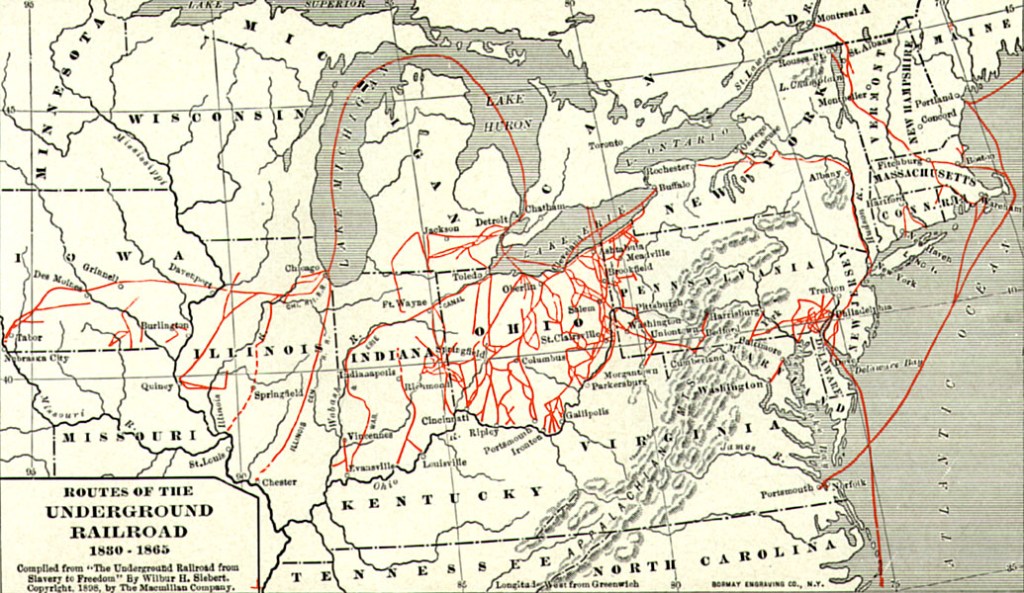
The War of 1812

Like his father Elijah before him, Samuel Gore (4) participated in the new country’s war efforts, as a private in Captain Jonathan Scott’s Company of Colonel Anthony Sprague’s Regiment Jefferson County Militia, New York. (Curiously, his wife Rebeckah never claimed his war pension, likely because he survived unhurt: “All pensions granted to veterans of the War of 1812 and their surviving dependents before 1871 were based exclusively on service-connected death or disability”.)
We had always thought that the War of 1812 was fought because England was rather cranky and upset that they had lost the American Revolutionary War a generation earlier. [Honestly, it just wasn’t deemed to be that important in American high school history classes.] However, there was much more to the conflict.

From the USS Constitution Museum.org: “The War of 1812 pitted the young United States in a war against Great Britain, from whom the American colonies had won their independence in 1783. The conflict was a byproduct of the broader conflict between Great Britain and France over who would dominate Europe and the wider world.” If you recall, in The Gore Line, A Narrative — Four, we had commented on the fact that England had crafted an economic model that benefited them by extracting resources from their Colonies. This changed after the War For Independence, and was aggravated further when President Jefferson passed the Embargo Act of 1807 in retaliation for what was happening to America’s ships and sailors at sea. The embargo was hard on American farmers because it reduced the market for their products, but they weathered the storm, so to speak.

“In Britain’s effort to control the world’s oceans, the British Royal Navy encroached upon American maritime rights and cut into American trade during the Napoleonic Wars. In response, the young republic declared war on Britain on June 18, 1812. The two leading causes of the war were the British Orders-in-Council, which limited American trade with Europe, and impressment, [read as: kidnapping and forced servitude] the Royal Navy’s practice of taking seamen from American merchant vessels to fill out the crews of its own chronically undermanned warships. Under the authority of the Orders in Council, the British seized some 400 American merchant ships and their cargoes between 1807 and 1812”.

It’s hard to believe this today, but in the expansionist era our ancestors lived in, and with everything else that was going on… There were many Hawks in the Continental Congress who believed, The War would allow them to expand American territory into the areas of Canada, which were defined as Upper Canada (essentially Ontario), and Lower Canada (present day Quebec).

The acquisition of Canada this year, as far as the neighborhood of Quebec, will be a mere matter of marching; and will give us experience for the attack of
Halifax the next, and the final expulsion of England from
the American continent.

Thomas Jefferson to William Duane, 4 August 1812

According to the National Park Service: “…many Americans assumed that the Canadian population would welcome the arrival of American forces. In reality, the inhabitants of Canada—a mix of French settlers, American loyalists who had fled north during the War of Independence, and a growing population of ambivalent American transplants – had little reason to embrace an incursion from the south”.

Indeed, “Jefferson also overestimated the readiness of the American armies. Optimists assumed that the U.S. army could be effective as an invading and occupying force… Jefferson also misjudged the effectiveness of the British army. Their own success fighting and defeating the British redcoats during their War of Independence proved a deceptive lesson. Unlike the British troops Americans faced during the Revolution, the British army that arrived in Canada was better led and battle-hardened by twenty years of experience fighting against Napoleonic France”.

However, with our ancestors living where they lived, it was a prime area for much conflict. “Jefferson County early became the theater of active military and naval operations. Sackets Harbor was then the most important point on Lake Ontario. It was made the headquarters of the northern division of the American fleet, and here were fitted out numerous important expeditions against the British in Canada”. [RootsWeb, Child’s Gazetteers 1890]

Furthermore, “The war started in 1812 and lasted until 1815, though a peace treaty had been signed in 1814. Over 2200 US soldiers died and over 1600 British. Jefferson County played a central role in the war, from beginning to end. It was the headquarters of Commodore Isaac Chauncey and the US Navy of the Great Lakes. Six armed engagements were fought in Jefferson County during the war, more so than any other county on American soil. The successful campaigns against York and Niagara (1813) were launched from Sackets Harbor, as were the not so successful campaigns on Montreal and Niagara (1814). Perry’s victory on Lake Erie was also directed from Jefferson County under the command of Isaac Chauncey.” [Jefferson County NY Wiki]

As far as we know, it’s a miracle that none of our family members in this line, died during this time. In Part Six we are writing about our ancestor Luke Gore and his family, as they move west from New England — perhaps following other family members who led the way. (10)

Following are the footnotes for the Primary Source Materials,
Notes, and Observations

A Special Note About This Chapter
There is a wealth of well done documentation completed by other fellow researchers about this family line, in the Familysearch.org website. We would like to bring this work to your attention, as follows:

Note 1: For an excellent traditional muti-generational classical family tree which includes names, dates, marriages, and children, see —
https://www.familysearch.org/tree/pedigree/landscape/LQ5C-1D1

Note 2: The research also contains a robust amount of detail and source information for those researchers who would like to research their ancestors beyond the classical family tree level.

Note 3: Here is an example — again from this link: https://www.familysearch.org/tree/pedigree/landscape/LQ5C-1D1 , then click on the name Samuel Gore found within the center screen block above his wife’s name, Rebeckah Barney. This will open a biography box on the right side of your screen.

From there, click on the PERSON box, just below Samuel’s birth and death information. This will open a new window which displays useful links such as Details, Sources, etc.

Here is the path: Pedigree landscape view (classical tree) > Samuel Gore biography page > PERSON link > Useful links

Grandma Moses Certainly Knew How to Paint The Rural Life

(1) — two records

Moving Day on the Farm
Painting by Anna Mary Robertson Moses, known as ‘Grandma Moses’
https://www.wikiart.org/en/grandma-moses/morning-day-on-the-farm-1951

Grandma Moses
https://en.wikipedia.org/wiki/Grandma_Moses

Elijah Gore Sr., and Desire Safford Have a Big Family

(2) — eight records

Elijah Gore
Birth – Connecticut Births and Christenings, 1649-1906
 https://www.familysearch.org/ark:/61903/1:1:F74J-LJY
Note: This is his christening record, one week after his birth.

Sarah Little
Vital – Massachusetts, Town Clerk, Vital and Town Records, 1626-2001

https://www.familysearch.org/ark:/61903/1:1:F4FR-L9K
Book page: 117, Digital page: 65/544.    Right page, last entry.
Note: For her birth registration.

Elijah Gore and Sarah Little marriage
Marriage – Connecticut, Vital Records, Prior to 1850

https://www.familysearch.org/ark:/61903/1:1:QPQ7-57TX
Digital page: 8822/10,566
Note: For the data.

Sarah Little Gore
https://www.findagrave.com/memorial/57390841/sarah-gore
Note: For the data.

Elijah Gore
in the Connecticut, U.S., Town Marriage Records, pre-1870 (Barbour Collection)

Voluntown Vital Records 1708-1850
https://www.ancestry.com/discoveryui-content/view/225419:1062?tid=&pid=&queryId=1d2415c4e44686d563db8be245d11749&_phsrc=DZs10&_phstart=successSource
Book page: 180, Digital page: 52/122, Lower portion of page.
Note: For the Gore family children born in Voluntown, Connecticut.

The Descendants of George Little Who Came to Newbury, Massachusetts, in 1640, from the American Genealogical-Biographical Index (AGBI)
by George Thomas Little, A.M., 1892
https://www.ancestry.com/imageviewer/collections/10376/images/dvm_GenMono000214-00002-0?ssrc=&backlabel=Return&pId=2000000000
Book pages: 53-54, Digital pages: 73-74/664 Under Entry 200
Note: This file lists a Joseph Gore born 1797, a child which we have not included because we believe that it is an error.

Elijah Gore
in the Geneanet Community Trees Index
https://www.ancestry.com/discoveryui-content/view/6873371156:62476
Note: This file lists a Joseph Gore born 1797, a child which we have not included because we believe that it is an error.

Library of Congress
McClellan’s Map of Windham County, Vermont
by J. Chace, C. McClellan & Co.
https://www.loc.gov/resource/g3753w.la001192/?r=-0.491,0.249,1.604,0.777,0
Note: For map image.

The French and Indian War

(3) — three records

History of Vermont
https://en.wikipedia.org/wiki/History_of_Vermont
Note: For the data.

French and Indian War
https://en.wikipedia.org/wiki/French_and_Indian_War
Note: For the data and illustration.

We Are The Mighty
Today in Military History: George Washington spills first blood of French and Indian War
https://www.wearethemighty.com/articles/today-in-military-history-george-washington-spills-first-blood-of-french-and-indian-war/
Note: For the illustration.

Many People Had Tried to Claim Land in Vermont

(4) — four records

History of Vermont
https://en.wikipedia.org/wiki/History_of_Vermont
Note: For the data.

Battle of Bennington
https://en.wikipedia.org/wiki/Battle_of_Bennington
Note: For the data.

File:Fort Ticonderoga 1775.jpg
https://commons.wikimedia.org/wiki/File:Fort_Ticonderoga_1775.jpg
Note: For the Illustration of Ethan Allen.

Vermont.com
Vermont.com Guide to Guilford
https://vermont.com/cities/guilford/
Note: For the data.

The 1790 ‘Census’ of Vermont

(5) — four records

1790 Census: Heads of Families at the First Census of the United States 
Taken in the Year 1790

https://www.census.gov/library/publications/1907/dec/heads-of-families.html
Note 1: 5 Downloadable .pdf files
Note 2: Click on Vermont, Published in 1907 > Download All Vermont [21.0 MB]

The National Archives
1790 Census Records
https://www.archives.gov/research/census/1790
Note: For the data.

USGenWeb Free Census Project Help, HISTORY of the United States – Federal Census, 1790-1920
http://www.usgwcensus.org/help/history.html
Note: For the data.

Elijah Gove Jr
in the Vermont, U.S., Vital Records, 1720-1908

https://www.ancestry.com/discoveryui-content/view/345462:4661
Digital page: 2859/4084
Note: For the data.

Two Locations in Windham County?

(6) — four records

Official History of Guilford, Vermont, 1678-1961.
With Genealogies and Biographical Sketches
Edited by National Grange, Vermont State Grange, Broad Brook Grange No. 151, Guilford
https://archive.org/details/officialhistoryo00unse/page/308/mode/2up
Note 1: Gore farm sale, Book page 309, Digital page: 308/585
Note 2: Tipped-in, foldout map of original property lots, Digital page 396/610

Halifax, Vermont
https://en.wikipedia.org/wiki/Halifax,_Vermont#External_links
Note: For the data.

Guilford, Vermont
https://en.wikipedia.org/wiki/Guilford,_Vermont
Note: For the data.

Official History of Guilford, Vermont, 1678-1961.
With Genealogies and Biographical Sketches
Edited by National Grange, Vermont State Grange, Broad Brook Grange No. 151, Guilford
https://archive.org/details/officialhistoryo00unse/page/308/mode/2up
Note: Elijah Gore Revolutionary War service, page 135.

Samuel Gore (4) and Rebeckah Barney Marry

(7) — three records

Genealogy.com
Re: Barneys and Potters and Briggs, Oh My:-)
By William Barney
https://www.genealogy.com/forum/surnames/topics/barney/776/
Note: Home > Forum > Surnames > Barney

Mrs Elizabeth Barney
Vital – Vermont, Vital Records, 1760-1954

https://www.familysearch.org/ark:/61903/1:1:XFFT-335
Digital page: 2891/4008
Note: For her death record.

Family Search Tree (not our files)
https://www.familysearch.org/tree/pedigree/landscape/LQ5C-1D1
Note 1: Our source for only the Gore Family Photograph Portraits.
Note 2: This is not a family tree of our construction, therefore, we have not verified other information here.

The Waking Century — The Advent of Portrait Photography

(8) — two records

Photography by Jay
A Brief History of Portrait Photography
by Jay Soriano
https://jaysoriano.com/a-brief-history-of-portrait-photography/
Note: For the text and image.

Time
Now You Know: Why Do People Always Look So Serious in Old Photos?
by Merrill Fabray
https://time.com/4568032/smile-serious-old-photos/
Note: For the text.

Ellisburgh, and Belleville, Jefferson County, New York

(9) — six records

Growth of a Century: as illustrated in the history of Jefferson County, New York, from 1793 to 1894
by John A. Haddock https://archive.org/details/growthofcenturya00hadd/page/n749/mode/2up
Note: For information on the Barney family and Deacon Edward Barney.

NY Genealogy
The Coming of the Pioneers
Franklin County, Jefferson County, Lewis County, Oswego County, Saint Lawrence County
by New York Genealogy
https://newyorkgenealogy.org/franklin/the-coming-of-the-pioneers.htm
Note: For the data.

Old Maps
Map of New York 1814 by Mathew Carey from “Careys General Atlas
by Mathew Carey
http://www.old-maps.com/NY/ny-state/NY_1814_Carey-web.jpg
Note: For map image.

ThoughtCo.
History of American Agriculture
American Agriculture 1776–1990
by Mary Bellis
[Under the subhead] Agricultural Advances in the United States, 1775–1889
https://www.thoughtco.com/history-of-american-agriculture-farm-machinery-4074385
Note: For the farm scene image.

Ellisburg, New York
https://en.wikipedia.org/wiki/Ellisburg,_New_York
and
Belleville, New York
https://en.wikipedia.org/wiki/Belleville%2C_New_York
Note: For the data.

The War of 1812

(10) — nine records

USS Constitution Museum
The War of 1812 Overview
https://ussconstitutionmuseum.org/major-events/war-of-1812-overview/#:~:text=The%20two%20leading%20causes%20of,its%20own%20chronically%20undermanned%20warships.
Note: For the data.

Samuel Gore
Military – United States War of 1812 Index to Service Records, 1812-1815

https://www.familysearch.org/ark:/61903/3:1:33SQ-G5Z8-9GNM?view=index&action=view&cc=1916219
Digital page: 2210/2843
Note: For the data.

Samuel Gore
in the U.S., War of 1812 Pension Application Files Index, 1812-1815

https://www.ancestry.com/discoveryui-content/view/72654:1133
Digital page: 740/946
Note: For the data.

National Archives and Records Administration
Bounty-Land Warrants for Military Service, 1775–1855
https://www.archives.gov/files/dc-metro/know-your-records/genealogy-fair/2012/handouts/war-of-1812-bounty-lands.pdf
and
Publication Number: M-313
Publication Title: Index to War of 1812 Pension Application Files
https://www.archives.gov/files/research/military/army/dc/m313.pdf
Note: For the data.

Encyclopædia Britannica
Embargo Act , United States [1807]
https://www.britannica.com/topic/Embargo-Act
Note: For the data.

The National Park Service, article —
“The acquisition of Canada this year will be a mere matter of marching”
https://www.nps.gov/articles/a-mere-matter-of-marching.htm
Note: For the data.

Jefferson County NY Wiki
War of 1812
https://jeffcowiki.miraheze.org/wiki/War_of_1812#:~:text=Jefferson%20County%20played%20a%20central,other%20county%20on%20American%20soil.
Note: For the data.

WAR OF 1812
(from Child’s Gazetteer(1890) – pp. 141-171)
https://freepages.rootsweb.com/~twigs2000/genealogy/warchilds.html
Note: For the data.

The War of 1812 Gallery images:
From various sources on Google search.