This is Chapter Five of seven: Peter Bond, The Immigrant, seeks a fresh start in the British Colonies in America. We then move through several generations in Maryland, and eventually, we find ourselves moving further west to the Ohio frontier.
Preface: Be Wary Of Those K rations!
Our father Dean Phillip Bond, loved to fuss around in his summer vegetable garden every year. He was proud that he had grown beautiful, tasty vegetables which we very gratefully devoured practically every evening. As children, when we observed him taking a pause in his labors, he would rock back on his heels, and take a long drag on his ever-present cigarette, moving his arm in a long slow arc. We’re sure that he certainly thought about the demonic mosquitos and three corner flies which tormented him… but occasionally, we would see him staring off somewhere into the middle distance. Perhaps he was dreaming about his “unlived life” — that of a gentleman farmer.

Pop started smoking in WWII when he would receive K rations, which included four cigarettes, and a small book of matches. (He said that before that time, he had never smoked.) His habit eventually became a two-pack-a-day routine need, which seemed to be typical of many in his generation. Three months after our parents 50th wedding anniversary, he passed away from lung disease.
We bring this is up because there is a lot of rich irony in this history of our family. The progenitor of our line in America is Peter Bond, The Immigrant. In 1660 Peter arrived in the British Colony of Maryland and eventually prospered as he became a tobacco planter. In his era, tobacco was such a precious item that it was literally used as currency for many years. In other words, he could grow his own money.
If our father had known of this fantastical, but true story, we’re sure that he would have dreamed and desired to somehow take his cigarette butts and grow his own magic money. Or better yet, drop a penny into a garden furrow and let each one grow into a crisp one hundred dollar bill. (1)
The British Colonies Desperately Needed Workers
Until 1680 or so, due to the fact that the British Colonies in North America were large and had become quite successful, England determined that relocating “labor” to the Colonies was in their best interest. Ships from certain ports would transport people from the Mother Country to America. Each empty ship would then load up on valuable items which were much desired back home in England. This included prized commodities like cotton, indigo, tobacco, and sugar. This was a scheme where English merchants made money on both sections of the voyage.
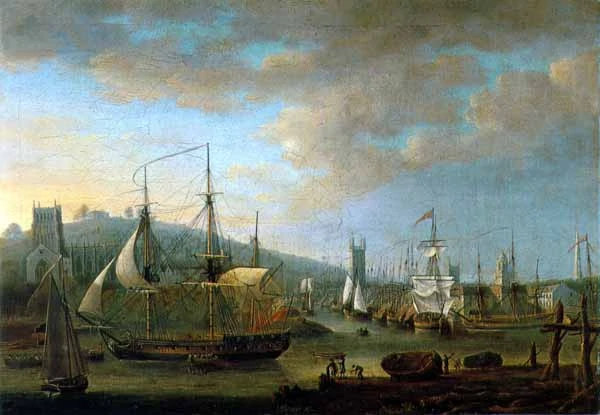
(Image courtesy of Art UK).
From the article, Indentured Servants at Gunston Hall —
“When English settlers arrived in the New World, they brought indentured servitude with them. Under this system, people worked for a set period of time as a payment for something. — Indentured servants were men and women who willingly signed a contract in which they agreed to work for a certain number of years to compensate for their voyage to America.
Three different types of indentured servant agreements existed in the 18th century: free-willers, King’s passengers, and redemptioners… Free-will indentured servants decided to come to America on their own merit and willingly signed a contract before departing England. King’s passengers, [also known as convict servants], were criminals who were sent to America to serve a term of seven or fourteen years, depending on the crime they committed. Finally, redemptioners were passengers who were given two weeks to redeem the price of their voyage once they got to America and if they were unable to make the payment, they were sold to the highest bidder.”
In these modern times, a phrase such as “sold to the highest bidder” gives us a bit of pause. Early on, the English had such a desperate fever to send laborers to The Colonies that many unscrupulous people, orphans, and indigents were “spirited” away [kidnapped, and not at their choice], who became a commodity in places like Virginia and Maryland. The city of Bristol, England was the epicenter for this white slave trade, which was lucrative for both the merchants and their agents. England was then, and still is to some extent now, a class-driven society. One has to wonder if this spiriting practice was unfortunately due to the “undesirables and destitute” being from a lower social class? Many of these poor people didn’t last very long in the Colonies due to poor health and mistreatment.
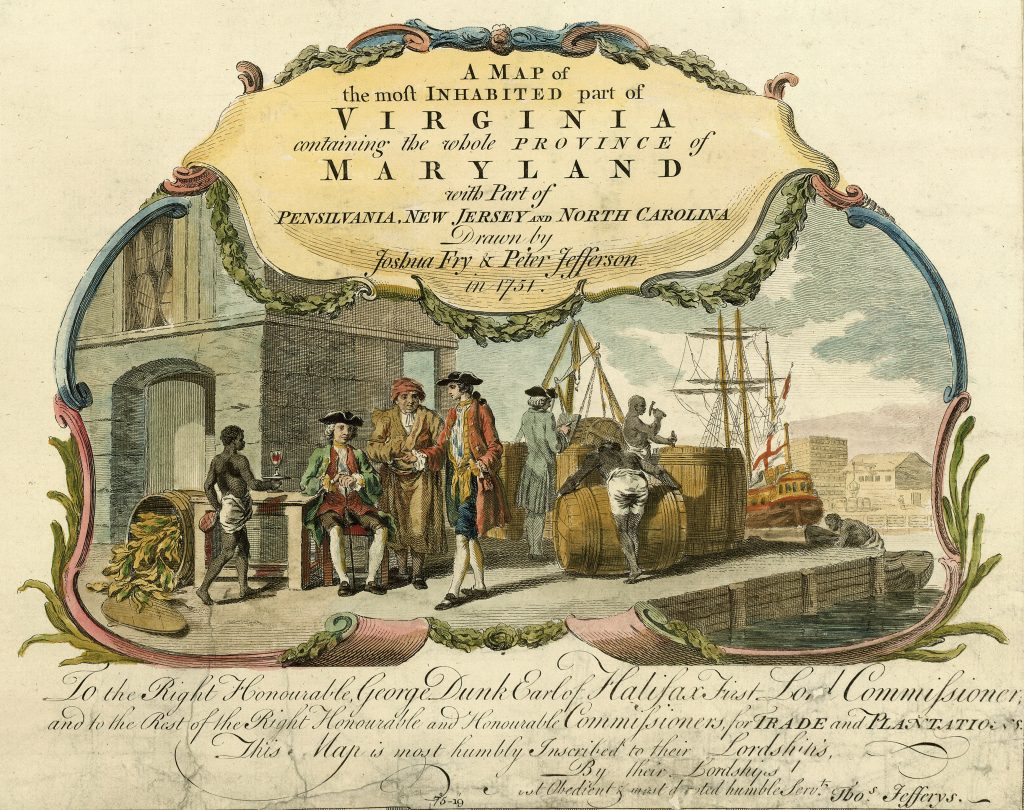
(Image courtesy of Encyclopedia Virginia).
This however, wasn’t true for all people who immigrated. For Peter Bond, and many people in his class, to become an indentured servant was not something that carried a stigma. As a free-will indentured servants, he was an immigrant who was under a contract, for a short period of years. Once he had met his commitment, he was free by having paid his freedom dues. His passage and care had been provided, and he could now practice a new trade. That is why they were referred to as Servants.
“In the 1650s, an estimated 72,000 individuals, the majority of them indentured servants, went from England to the New World.” By this point in time, to remedy the problem of many [slave] laborers dying in The Colonies, and to create a more attractive market for immigrants, the courts required that proper records be kept and they were. The existing indenture system was revitalized and its use brought many new people to America. A register, known as the Tolzey Booke [1654], introduced by the Common Council in 1654, indicates that The Servants, rather than being the destitute, actually consisted of:
| Yeomen | 39 per cent (yeomen were a wide range of agricultural workers) |
| Artisans | 23 per cent |
| Husbandmen | 16 per cent |
| Labourers | 13 per sent |
| Gentlemen | 2 per cent |
| Unknown | 7 per cent |
After 1680, the plantation owners in North America came to the conclusion that it was too expensive to continue with the English indentured servant system to staff workers for their properties. Over the next century, servant contracts tapered off. From this period forward, they transitioned to purchasing many more slaves from Africa. Hence, the slave system became quite firmly embedded in the central and southern portion of the British Colonies, as well as the Caribbean. (2)
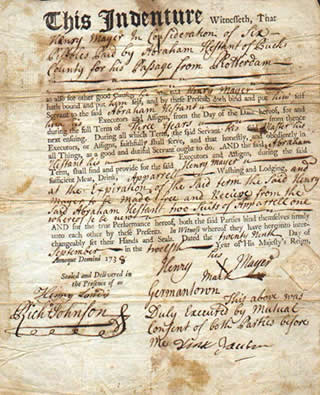
Example of an indentured
servant contract from 1738,
for British North America.
(Image courtesy of
Wikimedia Commons).
The Bristol Registry of Servants Sent to Foreign Plantations 1654-1686
There probably was not much for Peter Bond to inherit from his family by this period. The economy in London was very depressed at that time, as a consequence of the English Civil War. So we conjecture that perhaps he wanted to try his luck in the New World — as many young men of his class did at the time.

At 19, Peter became a free-will indentured servant on November 29, 1659. He was one of eight people so indentured to a merchant named Henry Read, who was the agent. (This meant that he negotiated the contract(s) with the ship captain). For a few years prior to 1659, registries had become exacting by listing parents, destinations, etc., but apparently by November ’59, registries were getting “thinner” and less detailed.
There are several things to note here: 1) Peter’s parents are not named because we know that both of them had died before his departure. 2) Nor is his destination given. 3) He gave his residence as Whitechapel in London which is the section of London where he was born and grew up in, which assures us that it is indeed our Peter, and 4) For the times, an indenture of four years is remarkable for all eight people. Many contracts were longer, so it certifies that none of them were criminals. Perhaps this was also indicative of their social class? (3)
The Early Settlers of Maryland

Some other researchers propose that Peter Bond went for a short time to Virginia, and then to Maryland. Some ships in that era, would go to a port, load up on trade goods, and then go to another port. We have found no concrete evidence to support that this happened with Peter.
In fact, in the book The Early Settlers of Maryland, Peter Bond is listed as being in Maryland in 1660. We know that this is our ancestor, because he is listed as being from Anne Arundel County, which is in fact where he lived. Of note, there are two other Peter Bond(s) listed as being transported: one in 1653; another 1679. The word transported meant that they were indentured servants of some type. (We wonder if their same name(s) have confused other researchers?) Interestingly, Peter is not listed as being transported, even though we know that he had also been an indentured servant.
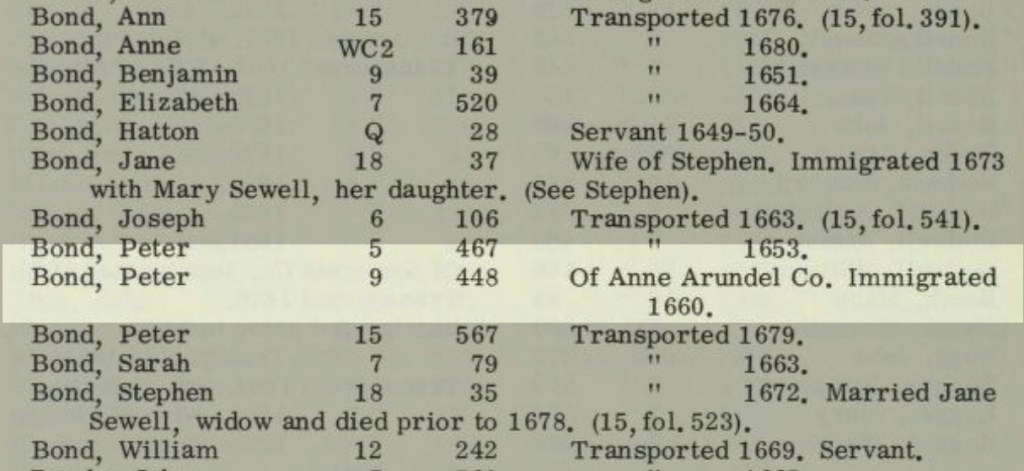
Fantastically, some people have proposed that he had a wife and child in England who traveled with him. Then his wife died, unnamed in records. Also, that he had two marriages in Maryland. Again, no concrete evidence of that. (4)
The Maryland Colony
The Maryland Colony was founded for religious reasons, not business reasons.
“The Province began as a proprietary colony of the English Lord Baltimore, who wished to create a haven for English Catholics in the New World at the time of the European wars of religion. Although Maryland was an early pioneer of religious toleration in the English colonies, religious strife among Anglicans, Puritans, Catholics, and Quakers was common in the early years…” Ultimately, due to the influx of the indentured servants, the majority of the population at that time were Protestants, and eventually they supplanted the Catholics.
“…the Province of Maryland developed along very similar lines to Virginia… and, like Virginia, Maryland’s economy quickly became centered on the cultivation of tobacco, for sale in Europe.”

We see land ownership in the above passage from the book British Roots of Maryland Families which confirms that both Peter Bond and William Jones received their land under the “headright” system, which was used to attract immigrants to Maryland. From Wikipedia: “Headrights were granted to anyone who would pay for the transportation costs of an indentured laborer. These land grants consisted of 50 acres for someone newly moving to the area and 100 acres for people previously living in the area.” Indentured servants were not allowed to obtain rights to land until their period of service obligations had been met.
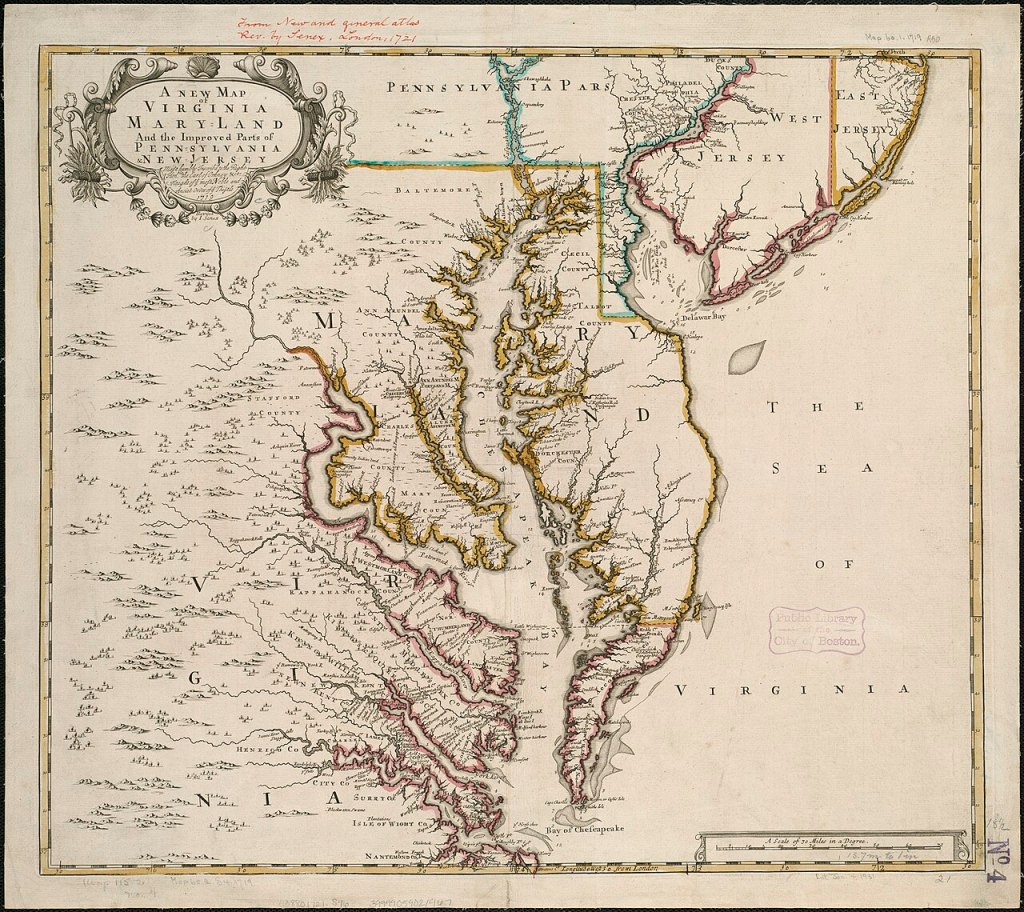
There is much evidence that Peter, his descendants and associates prospered during their years in Maryland as evidenced by the extensive records of land ownership that still exist — as we wrote in the preface, we knew he had an extensive tobacco plantation. Most of the properties our direct ancestors held were in both Anne Arundel County (AA) and Baltimore County (Bal). To our modern eyes, some of these property names seem both curious and quaint.
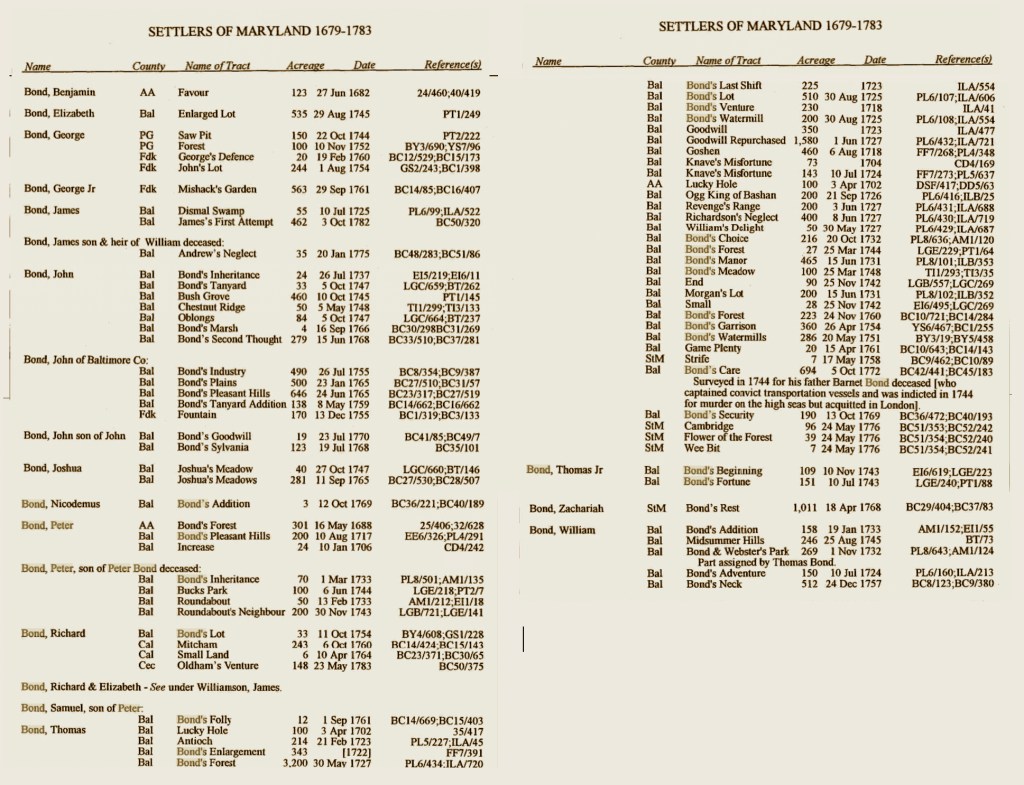
This book lists various Bond properties in Maryland in the 1679-1783 period,
assembled here into one file.
We know that he received some land starting sometime in 1667, as written on page 61 in the book British Roots of Maryland Families. Allen Kerr Bond wrote in The Story of The Bonds of Earth, “Nine years after, he is repaid by the authorities a considerable amount of tobacco (the local currency) for services of a nature not specified; and again, in 1678, for services, not military, to the government in a brief war with the Indians.” Further, “Ten years after this [about 1688], Peter becomes a planter… along the Patapsco [river]… on ‘three hundred and one acres, to be recorded as Bond’s Forest on the rent rolls of Lord Baltimore.’”
“It is difficult to determine where Peter lived in Anne Arundel County because the land records were destroyed in a fire in 1703, but one deed dated 12 JUL 1673 regarding him was brought in when the new court house was built that proves he owned a tract on Swan Point on the north side of the Severn River when he conveyed a 40 acre part of his plantation to James Smith.”
Alan Kerr Bond wrote further, “…in 1698 the boundary between Anne Arundel and the newly formed Baltimore County” shifted, and “Baltimore County had moved to him…” (5)
Peter Bond Marries the Widow, Alice (Cole) Gill Drury
By 1677, Peter Bond was a married man. We haven’t discovered much personal information about him, except for some land records, until his marriage to Alice (Cole) Gill Drury.
Alice’s origins are a mystery. Was she born in England or America approximately between 1650-1655, or earlier? Why was she in Maryland? We first see references to her when she appears in marriage records. Before her marriage to Peter Bond, Alice was married twice. Her first husband was Stephen Gill, Sr. and with him Alice had a son named Stephen Gill, Jr., (born about 1673). Her second husband, William Drury, a widower, left a Will naming Alice as his wife on August 22, 1676. This is proved because Peter & Alice Bond sued Drury’s executor for her share of his estate in June 1678. By the time she married Peter in late 1676 or early 1677 she had been twice widowed with one child.
Peter and Alice were the parents of four sons who are mentioned in his Will:
- Peter Bond Jr., born 1676 – died, February 28, 1718
- Thomas Bond, born May 26, 1679 – died, December 18, 1755
(We are descended from Thomas). - William Bond, born 1685 – died, August 23, 1742
- John Bond, born 1689 – died, April 17, 1720
After Peter’s death Alice Bond was married for the fourth time by May 14, 1707 to Philip Washington. The couple were living apart by 1708 and the following year an agreement appears in the records which states :
“Whereas Philip Washington and Alice, his wife, have joyously consent to separate and live apart…”, etc. — Peter Bond, Jr. posted a (£ One Hundred Sterling) bond that stated he would support his mother.
After a long, and interesting life, Peter Bond, Sr. wrote a Will on August 23, 1704; probated April 28, 1705. This informs us that he died sometime during that period. He had written [concise form] —
“I, Peter Bond, being sick and weak in body butt still In sound and perfect memory I make this my last will testamentItem I doe give and bequeth my soul to my Lord god and maker and my body to ye Earth from where It Came
Item – I doe Leave my well beloved wife Ealse (Alice) Bond my soule and hole Execkticx [Executrix]
Item – I give and bequeth unto forsaid wife my plantation and the land belonging to it during her Life and afterward to my son Peter Bond
Item – I give and bequeth to my three sons Thomas William and John Bond Equally divided between them 300 Acres of Land Lying in aforesaid County att the head if bush River as will appears
Item – I give and bequeth unto my son Thomas Bond one Cos (cow?)Called Dollor and her hefor
Item – I give and bequeth after my wifes desease my personal Effects to be Equally Divided among my three sons Peter William and John further my will is that my two sons William and John be free and to work for them – att ye adge (age) of Eighteene Of hears unto Enter thangably sett my hand and seale ye day and years above written. Peter Bond.” (6)
Was Peter Bond a Quaker?
The proof that Peter Bond, The Immigrant was a Quaker, is pretty thin.
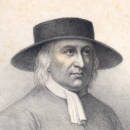
As a group in Britain, the Quakers suffered great abuse for their beliefs, and the progenitor, George Fox spent much of the 1660s jailed. However, he did have adherents who continued to grow the movement. When William Penn in 1681 created the Pennsylvania Colony as a sanctuary for religious freedom and tolerance, thousands of British people immigrated there.

preaching in a tavern, c. 1650. (Image courtesy of Encyclopædia Britannica).
“The Religious Society of Friends, also referred to as the Quaker Movement, was founded in England in the 17th century by George Fox. He and other early Quakers, or Friends, were persecuted for their beliefs, which included the idea that the presence of God exists in every person. Quakers rejected elaborate religious ceremonies, didn’t have official clergy and believed in spiritual equality for men and women. Quaker missionaries first arrived in America in the mid-1650s. Quakers, who practice pacifism, played a key role in both the abolitionist and women’s rights movements.”
In April 1649, [Maryland] colonists voted into law An Act Concerning Religion (later known as the Maryland Toleration Act), which granted freedom of worship for all Christians. Although permanently repealed in 1692, the act was one of the first statutes granting religious liberty of any kind and was an important step toward true freedom of religion in the United States.
Quaker missionaries arrived in North America in the mid-1650s. The first was Elizabeth Harris, who visited Virginia and Maryland. By the early 1660s, more than 50 other Quakers had followed Harris. So, Peter Bond was likely aware of the Quaker Movement, but whether or not he was a believer isn’t proven. Among his sons and extended family, there were Quakers, with some even donating land for meeting houses and schools. (7)

Image courtesy of the Guardian.com.
Thomas Bond was The Father of Eight Sons and Two Daughters
Of Peter Bond’s four sons, his son Thomas became regarded as an esteemed, respected citizen of Maryland. He was sometimes written of as Thomas of Emmorton, based upon the community where he lived.
Allen Kerr Bond wrote —
“Locating with his two brothers, William and John, lads not yet of age, in the present Harford County, on the three hundred acres of ‘Harris His Trust’ given them by their father, Thomas Bond seems to have put all of his energies into the accumulation of enormous holdings of the fertile forest uplands in that vicinity.” [If you consult the Bond Properties Chart shown above, you will see that this is quite true.]
Thomas was likely very aware of the Society of Friends movement which had been occurring in Great Britain, which also was attracting many immigrants to relocate to the British Colonies, seeking freedom to practice their religious beliefs in peace. Maryland had attracted many believers and the founder of the sect, George Fox, had visited the area in 1672 when Thomas would have been about thirteen years old. It seems there was a lot of Quaker energy present in the area.
Thomas Bond married Anne Robison on September 20, 1770 at All Hallows Parish, Anne Arundel, Maryland . Her father may have been a John Robison (or Robinson) and her mother is unknown. Thomas Bond died at ‘Kalmia’, his Emmorton, Maryland estate on December 18, 1755. He may have been buried ‘under a tree’ on his property, however there is no official record of his burial. Anne was born on March 28, 1680 in West River, a community in Anne Arundel County. Her death date is unknown.
Thomas and Anne had a large family of ten children. In order of their births:
- Thomas Bond (Jr), born 1703 – died 1781
- Peter Bond, born April 28, 1705 – died December 23, 1738
- William Bond, born 1708 – died 1769
- John Bond, born November 10, 1712 – died March 11, 1786
(We are descended from John). - Sarah Bond, born April 29, 1715 – died, December 12, 1759
- Joshua Bond (1), born October 8, 1718 – died March 30, 1720
- Ann Bond, born May 29, 1720 – died, August 20, 1720
- Jacob Bond, born 1725 – died, November 30, 1780
- Daniel Bond, born 1727 – died (by) August 11, 1780
- Joshua Bond (2), born 1729 – died, July 8, 1768
Observation: It is probable that John and Anne became Quakers at some point during their marriage. Their headstones probably never existed, because before the mid-19th century Quaker headstones were rare, as they are not in keeping with the plain life.
Unbeknownst to either of us, and as a wonderful surprise, it turns out that two very good friends of ours, the sisters Lessley and Barbara Berry, are our (very) distant cousins. We were friends for many years before we discovered this fact! From our shared ancestor, Thomas Bond, we are descended from two of his sons, John [>Susan and Thomas] and *Jacob [>Lessley and Barbara]. The world can be a small place sometimes.
*Jacob Bond — “The most prominent of the Bonds from the standpoint of Harford history, was Jacob, who died in November, 1780. He was a prominent member of the Committee of Harford County in the Revolution, having been elected by the people, and was captain of Company Eleven, of Harford militia, in the Revolution… Jacob Bond represented Harford County in the convention which met at Annapolis in 1776 and formed the first constitution of the State… He was also one of Harford’s representatives in the Annapolis convention of June 22, 1774, which protested against the tax on tea…” Jacob married Frances Partridge on December 28, 1747 at St. Paul’s Protestant Episcopal Church, Baltimore Co, Maryland.
We know from several records that some of Thomas and Anne’s children became Quakers. It can be taken for granted that those who fought in the early wars were no longer Quakers, and that records show many Bonds within the early Military Records.

Thomas of Emmorton, as he was known, was generous to his fellow Quakers by providing a Friends Meeting House at Fallston, for their worship. These buildings were designed in simple, domestic styles unlike more elaborate church architecture.

Thomas Bond may have been a man of good piety, but it seems that some of his prodigy were, how shall we say, not up to standard. This generation was “the first to backslide and fall under the displeasure of the Friends Meeting.” The offenders are pointed out in the following excerpts (below) of carefully kept records from Maryland Friends Meetings. (8)
What Would These Quaker Ancestors Think About Our Time?
Below is some of the information we found regarding the discipline and dismissal of Bond’s who were Quakers. By today’s standards most of this seems extreme!
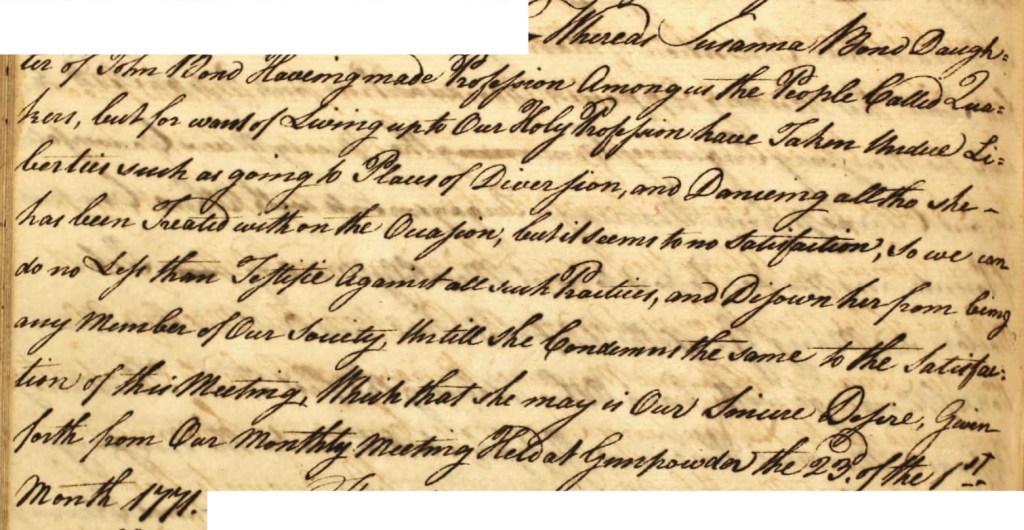
Baltimore, Maryland, Gunpowder Monthly Meeting, Minutes, 1768-1784
“John Bond married out of meeting – dismissed; James Bond – plays the fiddle – disowned; Samuel Bond – joins the Militia disciplined; Ann Bond – gone contrary to principle (pretty bonnet) disciplined; Susannah Bond – taking undue liberties and going to places of diversion and dancing – disowned; Joshua Bond – plays cards – disciplined: John Bond lends a man a gun disciplined; Hannah Bond married by a priest – disowned.” (9)
Gentleman John Bond and His Wife Aliceanna Webster
What was a Gentleman in Colonial Maryland? The Colony of Virginia and the Province of Maryland carried over some of the old social class structures from England, and then remodeled them to fit life in the British Colonies. In England, the lowest level of the Landed Gentry were The Gentlemen. They lived on plantations, and unlike their forebears, they no longer had to work with their own hands. Many were involved in managing their properties and investing in business ventures. After a plantation had been settled for several generations, the Planter would be free to have himself referred to as a Gentleman, or Gentleman Planter, as he wished.

On May 26, 1734, John Bond married Aliceanna Webster at the Nottingham Meeting of The Society of Friends in Harford County, Maryland. This is our first solid clue of Quakerism in the Bond family. Aliceanna was born on January 21, 1716 and she died on October 13, 1768, aged 52 years. She was the daughter of John Webster and Hannah Butterworth. The Websters and Butterworths played a large role in the settling of Harford County, Maryland.
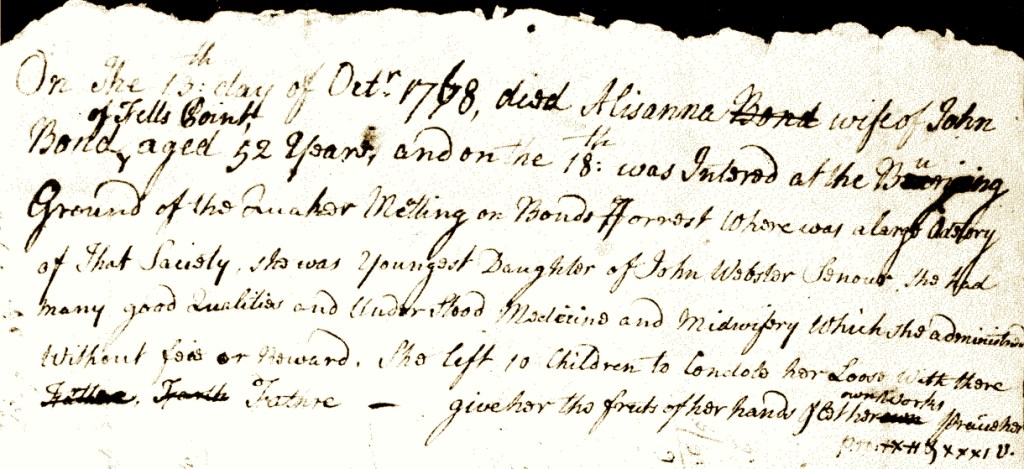
In addition to raising her large family Aliceanna was highly regarded as a midwife. Here is a transcription by (present day) Thomas Bond of her obituary:
“On the 13th day of Octr. 1768, died Alisanna Bond wife of John Bond of Fells Point, aged 52 years, and on the 18th: was Intsred [Interred] at the Burying Ground of the Quaker Meeting on Bonds Forrest where was a large _____ [?] of that family. She was Youngest Daughter of John Webster Senior, who had many good Qualities and Understood Medicine and Midwifery which she administered without fees or reward. She left 10 children to console her loose [loss] with their Father. give her the fruits of her hands ___ own works ___ praise her.”
John and Aliceanna had eleven children. In the order of their births:
- Samuel Bond, born January 23, 1736 – died October 19, 1801
- Ann (Bond) Fell, born June 27, 1737 – died July 27, 1791
- Thomas Bond, born September 29, 1739 – died January 23, 1791
- Pamela (Bond) Moore, born May 30, 1740 – died September 28, 1801
- Abigail Bond, born May 17, 1741 – died, May 26, 1805
- Susanna (Bond) Hunt, born 1742 – died February 14, 1817
- Jane Bond, born July 28, 1743 – died, January 30, 1812
- William Bond, born March 8, 1746 – died unknown
(We are descended from William). - John Bond, born November 30, 1748 – died December 8, 1812
- Aliceanna (Bond) Kell, born 1749 – died, May 30, 1767
- Hannah (Bond) Johns, is the eleventh child born (unknown) – death (unknown), however, we have her marriage record of January 27, 1757. We find Hannah in her father’s will, (see John Bond footnotes).
Having accrued a degree of wealth, our ancestor Gentleman John Bond lived his life on the plantation, and in the winter, at the Fells Point area of Baltimore. “He was a large land owner and merchant, shipping tobacco from Joppa and Baltimore to England…” He served as a justice of the peace, coroner, judge of the Orphan’s Court (1769-73).
Since he had taken an oath of office, the Quakers were aggrieved with this “going against testimony” and felt it went contrary to their principles. As a consequence, Gentleman John was “finally read out of meeting for his contumacy.” (That word means: stubborn resistance to authority.) He was an investor in not only his plantations, but also in ship building, home construction and mining. Some of his correspondence from his mercantile ventures survive, with one example shown below.

From the Maryland Genealogical and Memorial Encyclopedia —“He was a large land owner and merchant, shipping tobacco from Joppa and Baltimore to England, until he became involved in financial difficulties connected with the Bush River Company, which he and his father-in-law had organized.”
From The Bonds of Earth by Allen Kerr Bond — “Maryland contains a great variety of mineral deposits, which were worked profitably in many of her counties… Exactly when John Bond began to mine this ore, I do not know… Three years later [about 1762], John seems already to be a partner in the Bush River Company, formed by a number of Hartford County gentlemen… In 1773 it was sold out.” They had been mining iron ore (or what they called pig iron), but by 1773, the vein ran out. Prior to this time, “in the colonial days [they]were forbidden to manufacture anything from our iron. We must send the pig iron to England and buy back from that ‘Mother’ country the finished articles we needed; so that British manufacturing business might be built up.”
When the mine failed, Gentleman John found himself in debt for £3000 Stirling. His plantation home was nearly sold at auction, but it was rescued and saved by his son Thomas, “the Methodist”. His will also mentions the Fountain Copper Works, of which he and four other planters were all partners. It was located in Frederick County, not far from the town of Union Bridge. His four planter-partners must have also been English, because it is recorded that the mine closed at the beginning of the Revolutionary War, when the other partners returned to England.
Observations: This makes us wonder if John Bond and some members of his family were torn between loyalty to England, or loyalty to (the new) Maryland. Our family was involved with three groups, all of whom had a stake in the game, as it were… Many colonists were troubled about exorbitant British taxes and frustrated about how they were forced to purchase imported goods that they could have made themselves. They wanted change now. Some of the planter class were worried that their livelihoods were threatened — some wanted change and some wanted the status quo. The Quakers were pacifists, and they were having serious problems with the institution of slavery, and the idea of going to war. Quakerism had started in England, and even though many were persecuted, it was still a confusing period for them.
Eighteen yeas after his beloved wife Aliceanna died John Bond, Gentleman, died on March 11, 1786 in Harford County, Maryland.
John and Aliceanna’s daughter Ann married Edward Fell on November 2, 1758. They were first cousins as he was the son of William and Sarah (Bond) Fell. (Sarah was a younger sister of John Bond). The Fells were the original settlers of Fells Point in Baltimore. Edward and Ann lived at Fells Point and were very active in beginning to develop it as a place to live. He died six short years after their marriage and the birth of their son, William Fell. William was born on August 28, 1759 and died, unmarried, on October 6, 1786.
After Edward’s death Ann, with the help of her father, Gentleman John Bond, was heavily involved in the continued development of Fells Point. At this time in colonial history it was unusual for a woman to develop land or a community. To this day their is a Bond Street and an Aliceanna Street in Fells Point, Baltimore, Maryland. Further, “…200 years ago, it was one of colonial America’s biggest seaports, one that played a key role in thwarting the British during the War of 1812.”
In 1744 Ann (Bond) Fell married James Giles and they had three children together. Ann died in 1791 in Baltimore County, Maryland. (10)
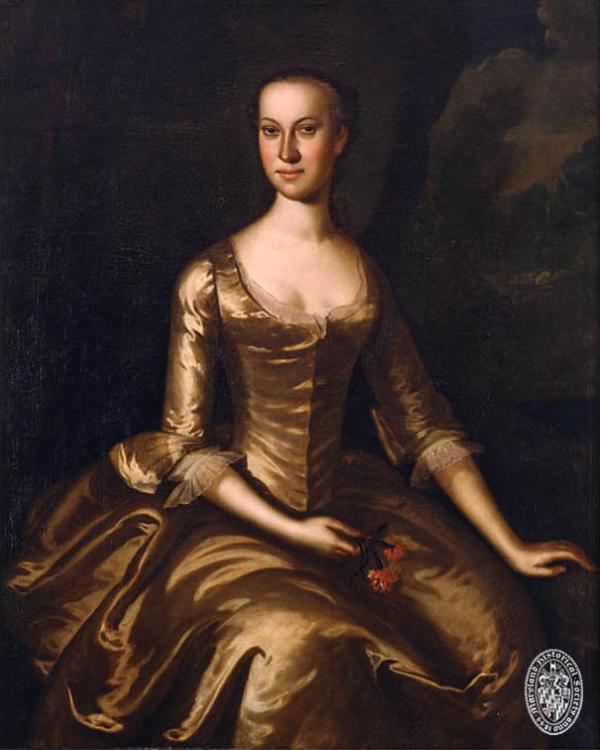
(Image courtesy of The National Portrait Gallery, Washington, DC).
The William and Sarah (Wrongs) Bond Family
In this generation, with this particular family, the historical record gets a bit sparse. This has required us to make some inferential observations when we lack a direct record.
William Bond was the eighth child of John and Aliceanna Bond. His first seven siblings were all born in quick, nearly unbroken succession, and then after his sister Jane, there was a pause before we meet William. That’s a lot of siblings, and there were three more after William. In general, it seems they all lived long lives. All except for William, which we will get to in a bit.
William and Sarah Wrongs were married on November 16, 1771, in St. George’s Parish Baltimore County, Maryland. St. George’s, also known as the Spesutia Parish… [was] the oldest Episcopal parish in Maryland. [The Episcopal Church describes itself “Protestant, yet Catholic” and claims apostolic succession, tracing its bishops back to the apostles via holy orders… The Episcopal Church was formally separated from the Church of England in 1789 so that American clergy would not be required to accept the supremacy of the British monarch.]
Observation: The fact that they were married in a parish that was an Anglican order, and Episcopalian in its practice, points to the strong possibility that she might have been British and baptized into the Church of England. We have found a record in the papers of All Saints Wakefield Cathedral, West Yorkshire, England, which is part of the Church of England that may be a record of Sarah Wrongs birth. We have not found a birth record for her in America, and we first meet her when she marries William Bond.

Baptismal record from Wakefield All Saints Cathedral, dated March 12, 1747.

When William married Sarah, it did not sit well with the Quakers. They had an expectation that partners would be selected from within their own community, certainly at the meeting house. In 1772, the Society of Friends, upset with both William and his brother Thomas for their marriages, removed them from participation in the Society of Friends.
Excerpted from Quaker meeting notes from the Gunpowder Monthly Meeting, Baltimore County, Maryland. (What is shown below below are from the bottom of one page, and the top of the next page).

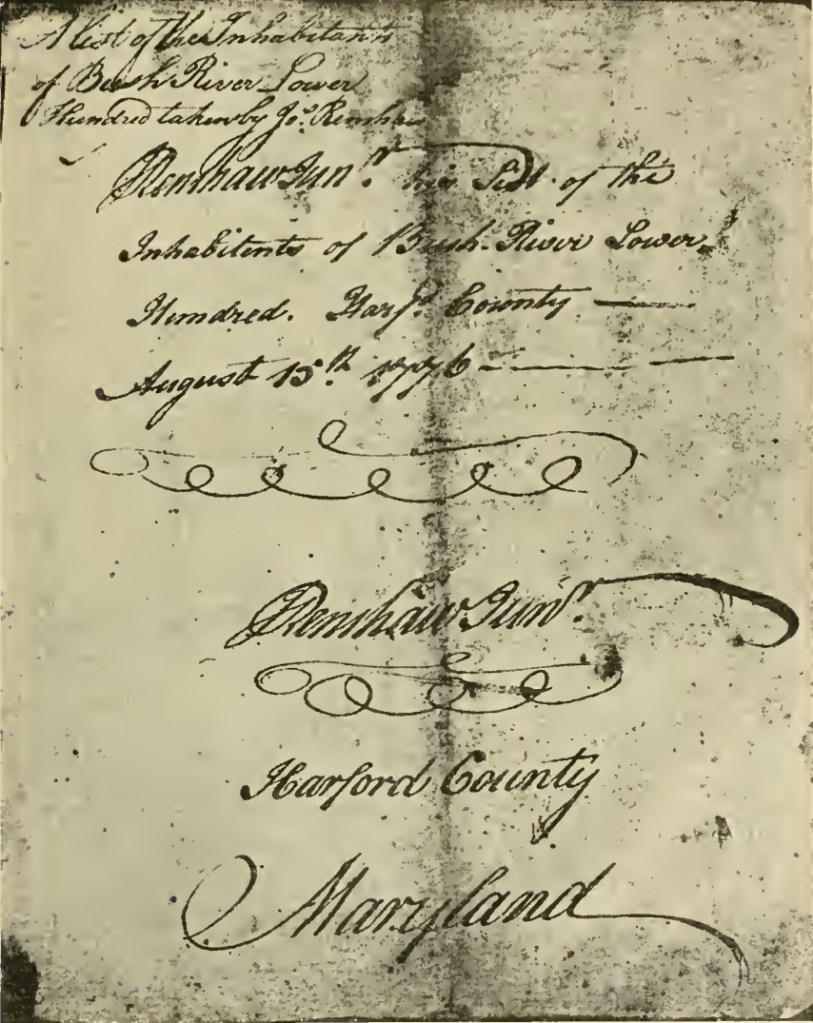
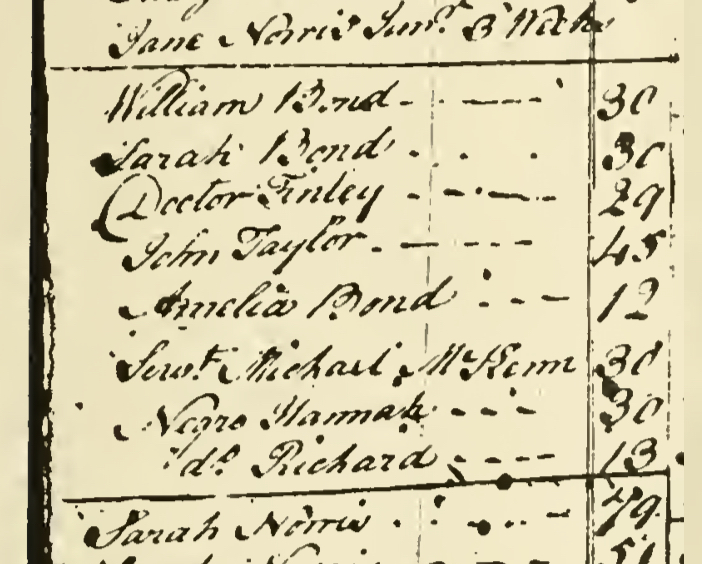
We next find William and Sarah in the Maryland Preliminary Census of 1776 which lists both of them as 30 years old. At that time, it was “taken for the purpose of setting Maryland’s quota for a tax to support the Revolutionary War.” We have not been able to identify the other people who are listed with them on this census.
William and Sarah were the parents of four children:
- John Bond, born, 1772 – died, unknown
- Abigail (Bond) Everist, born 1776 – died, unknown
- Edward Fell Bond, born March 4, 1777 – died, February 20, 1822
(We are descended from Edward Fell). - Jane (Bond) Bradford, born 1782 – died, January 7, 1860
William Bond, being a child of the planter class, had inherited property from his father John Bond, the Gentleman. We don’t know much about his and Sarah’s life together at this point, simply because no records have been located. We can however, infer some things about William…
Observation: Even though the Quakers seriously rebuked him, we think that he may have still retained some of their pacifist tendencies. Alan Kerr Bond wrote in The Bonds of Earth, that William “was a non-associator in 1775 and 1776; yet like others in Quaker families who would not take up arms, he may have later become county magistrate…”
Like his father John Bond, William chose to disregard the Quaker prohibition against taking oaths, and we locate him as the probable “the worshipful William Bond” administering the Oath of Fidelity and Support to mustered militia men from Harford County. From Wikipedia: The term Non-Associators was applied to American colonists who refused to support and sign “military association” charters.
Also from Wikipedia: “In 1777, all Maryland voters were required to take the Oath of Fidelity and Support. This was an oath swearing allegiance to the state of Maryland and denying allegiance and obedience to Great Britain. As enacted by the Maryland General Assembly in 1777, all persons holding any office of profit or trust, including attorneys at law, and all voters were required to take the oath no later than March 1, 1778.”
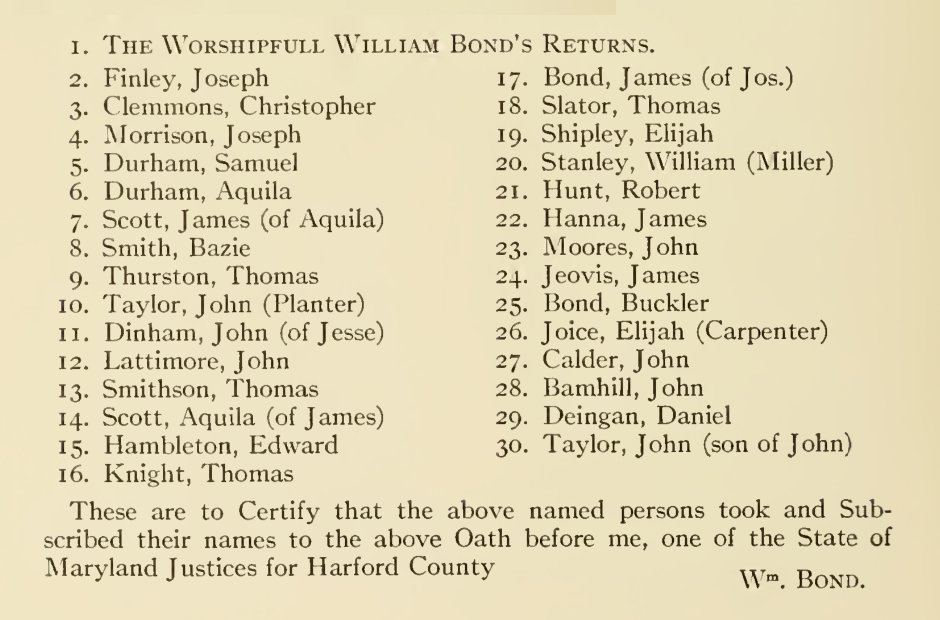
Alan Kerr Bond identified William as a probable magistrate, which was defined in colonial times as “…the major figure in the colonial court system… the magistrate (a local official with limited power), often called justice of the peace or, simply, judge. This person mostly dealt with petty (minor) crimes in his local area.” Further, dictionary.com defines worshipful as —Worshipful, British. a formal title of honor used in announcing or mentioning certain highly regarded or respected persons.
Observation: William saw his father John suffer at the burden of British taxes on his tobacco and sugar shipments. He may have felt a need to do what he could to support and help create a new Maryland? Perhaps he felt being a magistrate was a non-violent way to participate in the cause?
Some ‘Quakers’ took up arms against the British, but some did not. Pacifist Quakers were treated with some disdain by their neighbors during and after the Revolutionary War. There are two other men named William Bond from other Maryland Counties, which we found records for, which have survived. It seems likely that our William Bond, unlike the others, never took up arms, but had found a social balance between engagement and pacifism to sustain himself and his family. (11)
The Kentucky Mystery
The rise of maintaining family histories through family bibles, journal stories, and embroidered family trees has had a long history. First, in the British Colonies, and then in the subsequent United States. By the 1800s, some families started cataloging their ancestors as a way to create their own history — “…some Americans came to see the process of learning one’s family history as a moral endeavor—a person could learn much from what her ancestors had done right or wrong… Even before the Civil War, there was ‘lineage consciousness’ among those descended from elite colonial families, who used their descent from ‘high’ birth to justify and enforce their higher social rank.”
We agree that some of these records can be filled with rich information, but you always need to verify your sources. In our research on our family lines, we have encountered two Daughters of the American Revolution publications which have asked us to call into question if they are accurate. Both state that William Bond “was killed by Indians on his way to Kentucky.” We believe that this is an error, and that this mistake has been perpetuated through several other subsequent publications.
Records were kept by the new United States Confederation which documented in careful detail who was entitled to land (due to their war service), in new frontier areas (like Kentucky). William Bond’s name does not appear on any of these records, nor does his wife’s name appear on any war service pension records.
The fate of William Bond and Sarah Wrongs is a mystery. (This aspect of our family history will still continue to be researched). We know what happened with their four children. We are descended from their son Edward Fell Bond.(For more about his story, see The Bond Line — Part Six). Their daughter, Jane (Bond) Bradford’s son went on to have a high profile role in Maryland history. (12)

Jane (Bond) Bradford and Her Famous Son Augustus
Edward Fell Bond’s younger sister Jane Bond, married Samuel Bradford on July 21, 1803 in Harford County. Their son, Augustus Williamson Bradford was born on January 9, 1806, in Bel Air, Maryland, a community near Baltimore.
Augustus was a law school graduate; politically first a Whig and then a Democrat. He was elected Governor of Maryland and served from January 8, 1862 – January 10, 1866 (essentially the length of the Civil War). As Governor, he was a staunch Union supporter and a fierce opponent of slavery.
During the American Civil War (1861–1865), Maryland, a slave state, was one of the border states, straddling the South and North. Despite some popular support for the cause of the Confederate States of America, Maryland did not secede during the Civil War. Across the state, some 50,000 citizens signed up for the military, with most joining the Union Cause. Approximately 5,000 citizens went south to fight for the Confederacy. This was a rough period for Maryland, because as a border state, it saw much conflict, due to military activity and unrest among a conflicted population.
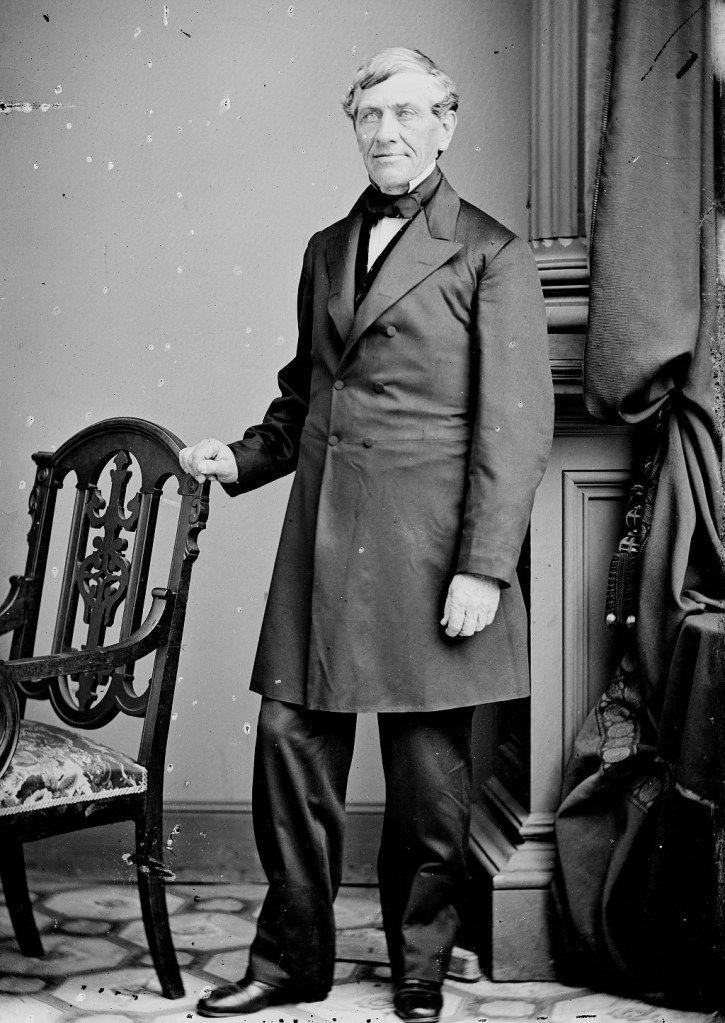
(Image courtesy of The Library of Congress).
In April 1864, both President Lincoln and Governor Augustus Bradford spoke at a fair in Baltimore, Maryland, which was held to raise funds for the welfare of Union soldiers. Certainly then, they knew each other.
Three months later — “During the War, the Confederates invaded Maryland three times. During the last of these, Bradley T. Johnson’s raiders visited Bradford’s home in July of 1864, and during his absence, burned it to the ground together with all his furniture, library, and papers.” Learning this, it’s regrettable how much information from our family history was likely lost.
Augustus Williamson Bradford died in Baltimore on March 1, 1881, at the age of seventy-six.
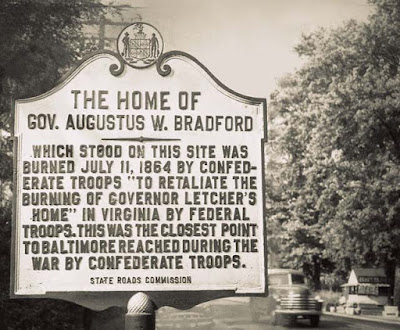
(Photo courtesy of civilwarquilts.blogspot.com).
About nine months later, on April 14, 1865 the actor John Wilkes Booth assassinated President Abraham Lincoln at Ford’s Theatre in Washington, D.C. Booth was a Marylander and a Confederate sympathizer.
Memory: In March 1975, we traveled with our parents to Washington, D.C., to see the historical sites in anticipation of the approaching 1976 Bicentennial year. Among the memories was a visit to Ford’s Theatre and the upstairs bedroom across the street where Lincoln had died. At that time, we knew next to nothing about our family history. (13)

Image courtesy of http://www.shapell.org
Following are the footnotes for the Primary Source Materials,
Notes, and Observations
Preface: Be Wary Of Those K rations!
(1) — two records
AZ Central
Vintage: Romantic Photos of The Soldier and The Cigarette
A United States sailor holds a carton of Philip Morris cigarettes under one arm and a duffle bag over his other shoulder while smoking a cigarette.
https://www.azcentral.com/picture-gallery/money/business/2014/04/02/vintage-romantic-photos-of-the-soldier-and-the-cigarette/7217459/
Note: For the photograph.
Maryland State Archives — Guide to Government Records
Understanding Maryland Records Money
https://guide.msa.maryland.gov/pages/viewer.aspx?page=money
Note: For the data, “Because coined and printed money were in short supply during the early Colonial period, records frequently showed payments being made in pounds of tobacco”.
The British Colonies Desperately Needed Workers
(2) — five records
Art UK
View of Bristol Harbour with the Cathedral and the Quay
by Nicholas Pocock (1740–1821)
https://artuk.org/discover/artworks/view-of-bristol-harbour-with-the-cathedral-and-the-quay-188964
Note: For the painting.
George Mason’s Gunston Hall
Indentured Servants at Gunston Hall
https://gunstonhall.org/learn/people-of-gunston-hall/indentured-servants/
Encyclopedia Virginia
Cartouche on Fry-Jefferson Map
https://encyclopediavirginia.org/1018hpr-0194e1b221bf0c6/
Note: For the cartouche map artwork.
U.S. History, Pre-Columbian to the New Millenium
The Southern Colonies
Indentured Servants
https://www.ushistory.org/us/5b.asp
The Widening Gate
Bristol and the Atlantic Economy, 1450-1700
by David Harris Sacks
University of California Press
UC Press E-Books Collection, 1982-2004
>The Capitalism of the Spirit, 1650–1700 > A Shoemakers’ Holiday
https://publishing.cdlib.org/ucpressebooks/view?docId=ft3f59n8d1&chunk.id=d0e20595&toc.id=ch8&toc.depth=1&brand=ucpress;query=Tilley&anchor.id=d0e20643#X
Note: Footnote 8 references BRO… Bristol Record Office, Common Council Proceedings, Vol. 5, p. 72, with this text: “all Boyes Maides and other persons which for the future shall be transported beyond the Seas as servants… before their going aship board to have their Covenants or Indentures of service and apprenticeship inrolled in the Tolzey booke as other Indentures of apprenticeship are and haue used to be and that noe Master or other officer whatsoever of any ship or vessell shall (before such inrolment be made) receive into his or their ship or vessell or therein permit to be transported beyond the Seas such Boyes Maides or other persons”.
The Bristol Registry of Servants Sent to Foreign Plantations 1654-1686
(3) — four records
An indenture signed by Henry Mayer, with an “X”, in 1738. This contract bound Mayer to Abraham Hestant of Bucks County, Pennsylvania, who had paid for Mayer to travel from Europe.
https://commons.wikimedia.org/wiki/File:Indenturecertificate.jpg
Note: For the sample contract.
The Bristol Registry of Servants Sent to Foreign Plantations 1654-1686
1659
by Peter Wilson Coldham
https://www.ancestry.com/imageviewer/collections/49090/images/FLHG_BristolRegistersofServants-0132?treeid=&lang=en-US&pId=14021
Book pages: 121-122, Digital Pages: 131-132/502
And confirmed here:
Virtual Jamestown.org
Indentured Servants Basic Search Results
http://www.virtualjamestown.org/indentures/search_indentures.cgi?search_type=basic&start_page=0&servant_ln=Bond&servant_fn=Peter&servant_place=&servant_occ=&destination=&ship=&year-ops=&year=&year1=&sex=male&agent_ln=&agent_fn=&agent_place=&agent_occ=&result_order=&submit=Initiate+Search&db=bristol_ind
Price Genealogy
Origins of Colonial Chesapeake Indentured Servants: American and English Sources
https://www.pricegen.com/genealogy-learning-center/overseas-origins/
The Early Settlers of Maryland
(4) — one record
The Early Settlers of Maryland; an index to names of immigrants compiled from records of land patents, 1633-1680, in the Hall of Records, Annapolis, Maryland
https://archive.org/details/earlysettlersofm00skor/page/n5/mode/2up
by Gust Skordas, John M, Brewer, Arthur Trader
Book page: 16 and 48, Digital Pages: 16 and 48/525
Note 1: Page 48/525 which list: our Peter, other Peter(s), and other Bonds.
Note 2: Our Peter is from Anne Arundel County and immigrated in 1660.
The Maryland Colony
(5) — five records
Province of Maryland
https://en.wikipedia.org/wiki/Province_of_Maryland
British Roots of Maryland Families
by Robert W. Barnes
B (section)
https://www.ancestry.com/imageviewer/collections/49095/images/FLHG_BritishRoots-0101?usePUB=true&_phsrc=Ovg3&pId=15510
Book pages: 61, Digital Pages: 101/686
A New Map of Virginia, Maryland, And The Improved Parts
Of Pennsylvania & New Jersey
by Christopher Browne, 1685
https://commons.wikimedia.org/wiki/File:A_new_map_of_Virginia,_Mary-land_and_the_improved_parts_of_Penn-sylvania_%26_New_Jersey_(4231929854).jpg
Settlers of Maryland, 1679-1783. [Consolidated Edition]
by Peter Wilson Coldham
B (section)
Explanation of file data: Various Bond properties are shown on this link which we have assembled into a chart for this blog chapter —
https://www.ancestry.com/imageviewer/collections/49058/images/FLHG_SettlersMaryland2-0074?treeid=&personid=&usePUB=true&_phsrc=Xqj2&_phstart=successSource&pId=101720&rcstate=FLHG_SettlersMaryland2-0074%3A337%2C703%2C422%2C732%3B556%2C703%2C643%2C733%3B653%2C703%2C742%2C733%3B821%2C745%2C935%2C775%3B224%2C952%2C313%2C982%3B820%2C953%2C933%2C985%3B223%2C1160%2C313%2C1190%3B223%2C1241%2C313%2C1270%3B594%2C1243%2C680%2C1273%3B820%2C1285%2C933%2C1316%3B223%2C1324%2C312%2C1354%3B820%2C1408%2C931%2C1438%3B818%2C1451%2C931%2C1480%3B818%2C1491%2C931%2C1521%3B818%2C1533%2C931%2C1563%3B818%2C1574%2C931%2C1605%3B818%2C1618%2C930%2C1648%3B815%2C2075%2C928%2C2105%3B813%2C2119%2C928%2C2149%3B813%2C2160%2C926%2C2190%3B813%2C2200%2C926%2C2230%3B813%2C2368%2C926%2C2399%3B813%2C2410%2C925%2C2440%3B813%2C2452%2C925%2C2482%3B810%2C2577%2C930%2C2608%3B1500%2C2624%2C1591%2C2656%3B810%2C2747%2C928%2C2777%3B210%2C2955%2C300%2C2986%3B807%2C2959%2C920%2C2990%3B807%2C2999%2C920%2C3031%3B1030%2C217%2C1312%2C254%3B225%2C457%2C314%2C487%3B823%2C456%2C941%2C487%3B224%2C539%2C314%2C569%3B337%2C539%2C422%2C569%3B821%2C580%2C935%2C611%3B224%2C703%2C314%2C733
Book pages: 59-61, Digital Pages: 73-75/906.
Note: This book lists land ownership in Maryland in the 1679-1783 period.
The Story of The Bonds of Earth
by Allen Kerr Bond
https://archive.org/details/storyofbondsofea00bond/mode/2up
Book pages: 164-166. Digital pages: 164-166/299
Peter Bond Marries the Widow, Alice (Cole) Gill Drury
(6) — five records
WikiTree
Peter Bond (abt. 1636 – bef. 1705)
https://www.wikitree.com/wiki/Bond-340
Note: Some smaller details in this link do not agree with other reliable sources.
WikiTree
Alice (Cole) Washington (abt. 1638 – aft. 1708)
Alice Cole, Washington (abt. 1638 – aft. 1708)
https://www.wikitree.com/wiki/Bond-340
Note: Some smaller details in this link do not agree with other reliable sources.
Baltimore County Families 1659-1759
by Robert W. Barnes
For the Peter Bond Family
— Book page: 47, Digital page: 57/935
https://www.ancestry.com/imageviewer/collections/48162/images/BaltimoreCoFamilies-002226-47?treeid=&personid=&usePUB=true&_phsrc=jhl2&_phstart=successSource&pId=224348&rcstate=BaltimoreCoFamilies-002434-255%3A167%2C1264%2C239%2C1285%3B332%2C1265%2C426%2C1285%3B1241%2C1262%2C1296%2C1282%3B695%2C1363%2C759%2C1384%3B166%2C1432%2C199%2C1451%3B666%2C1431%2C728%2C1451%3B719%2C1531%2C775%2C1557%3B979%2C1529%2C1034%2C1550%3B1163%2C1563%2C1220%2C1584%3B775%2C1598%2C830%2C1617%3B656%2C1866%2C718%2C1886%3B1176%2C1864%2C1238%2C1884%3B673%2C161%2C839%2C181%3B887%2C764%2C946%2C784%3B370%2C797%2C425%2C824%3B423%2C797%2C594%2C821%3B257%2C830%2C314%2C851%3B1129%2C828%2C1187%2C849%3B999%2C863%2C1056%2C883%3B258%2C997%2C313%2C1022%3B665%2C1063%2C722%2C1082%3B167%2C1097%2C201%2C1117%3B1178%2C1228%2C1302%2C1249
Rhinehart & Bassett Family Tree
Peter Bond’s probated Will from 1705:
http://www.bassett.net/gendata-o/p10576.htm
and from the:
Maryland Calendar of Wills:
by Jane Cotten, Roberta Bolling Henry, Eleanor Janet Whitall
https://archive.org/details/marylandcalendar03cott/page/n107/mode/2up?q=bond
Book page: 49, Digital page: 108/680
Bond, Peter, Balto. Co., 23rd Aug., 1704; 28th Apr., 1705.
“To wife Alice, extx., plantation and land during life; to pass to son Peter and hrs. at her decease. To sons Thomas, William and John, 300 A. at hd. of Bush R. To sons afsd., residue of estate afsd. at decease of wife. Sons William and John to be of age at 18 yrs.” Test: Lancelott Todd, John Lockett, Wm. Felps. 3. 451
Was Peter Bond a Quaker?
(7) — six records
Quakers
https://www.history.com/topics/immigration/history-of-quakerism
Quakers in Great Britain; 1650s-1750s
https://haygenealogy.com/hay/quaker/quaker-GB.html
George Fox
https://en.wikipedia.org/wiki/George_Fox
Quakers & Slavery
George Fox’s Ambiguous Anti-Slavery Legacy
https://web.tricolib.brynmawr.edu/speccoll/quakersandslavery/commentary/people/fox.php
Encyclopædia Britannica
Society of Friends
https://www.britannica.com/topic/Society-of-Friends
Note: Describes as, “George Fox, English missionary and founder of the Society of Friends (Quakers), preaching in a tavern, c. 1650”.
The Guardian newspaper
Pierce Brosnan: I was ‘kicked to the kerb’ as James Bond after Die Another Day
https://www.theguardian.com/film/2015/nov/24/pierce-brosnan-james-bond-kicked-to-the-kerb-after-die-another-day
Note: For the photo of Pierce Brosnan as James Bond 007
Thomas Bond was The Father of Eight Sons and Two Daughters
(8) — six records
The Story of The Bonds of Earth
by Allen Kerr Bond
https://archive.org/details/storyofbondsofea00bond/mode/2up
Book page: 186, Digital page: 186/299
Thomas Bond
Vital – Maryland, Marriages, 1666-1970
Maryland Marriages, 1666-1970
https://www.familysearch.org/ark:/61903/1:1:F4V7-5M7?from=lynx1UIV8&treeref=LTV6-2WQ
and here:
All Hollows Parish, Anne Arundel, Maryland (1691 — 1858)
https://www.familysearch.org/ark:/61903/3:1:3Q9M-CSMZ-Q7HL-8
Book page: 32, Digital page: 1377/1933, 10th transcribed entry, SER Number #00044-8
Baltimore County Families 1659-1759
by Robert W. Barnes
For the Peter Bond Family
and
For Thomas Bond
https://www.ancestry.com/imageviewer/collections/48162/images/BaltimoreCoFamilies-002227-48?treeid=&personid=&usePUB=true&_phsrc=jhl2&_phstart=successSource&pId=224349&rcstate=BaltimoreCoFamilies-002434-255%3A167%2C1264%2C239%2C1285%3B332%2C1265%2C426%2C1285%3B1241%2C1262%2C1296%2C1282%3B695%2C1363%2C759%2C1384%3B166%2C1432%2C199%2C1451%3B666%2C1431%2C728%2C1451%3B719%2C1531%2C775%2C1557%3B979%2C1529%2C1034%2C1550%3B1163%2C1563%2C1220%2C1584%3B775%2C1598%2C830%2C1617%3B656%2C1866%2C718%2C1886%3B1176%2C1864%2C1238%2C1884%3B673%2C161%2C839%2C181%3B887%2C764%2C946%2C784%3B370%2C797%2C425%2C824%3B423%2C797%2C594%2C821%3B257%2C830%2C314%2C851%3B1129%2C828%2C1187%2C849%3B999%2C863%2C1056%2C883%3B258%2C997%2C313%2C1022%3B665%2C1063%2C722%2C1082%3B167%2C1097%2C201%2C1117%3B1178%2C1228%2C1302%2C1249
Book page: 48, Digital page: 58/935
Ann Robinson
https://www.ancestry.com/family-tree/person/tree/100009207/person/192283883876/facts
Note: Possible portrait of Ann Robison.

History of Harford County Maryland
by Walter W. Preston, 1901
Jacob Bond
https://archive.org/details/historyharfordc00changoog/page/n226/mode/2up?view=theater
Book pages: 206-207, Digital page: 227/413
Sarah Brown Bond
https://www.findagrave.com/memorial/63562855/sarah-bond
Note: This gravesite is noted on this blog only for this specific quotation:
“Quaker headstones before the mid-19th century are rare, as they are not in keeping with the plain life.”
What Would These Quaker Ancestors Think About Our Time?
(9) — two records
Scattered Leaves: Genealogy of the Johnson – Bond
and Utermoehlen (and) Bredehoeft Families
by Robert E. Johnson
https://www.familysearch.org/library/books/viewer/531365/?offset=0#page=14&viewer=picture&o=info&n=0&q=
Book page: 10, Digital page: 12/174
Note: Excerpted from the document: “The family of Thomas Bond seems to be the first to backslide and fall under the displeasure of Friends Meeting (Quakers)”.
Susanna Bond
in the U.S., Quaker Meeting Records, 1681-1935
Maryland > Baltimore > Gunpowder Monthly Meeting > Minutes, 1768-1784
https://www.ancestry.com/discoveryui-content/view/1107209832:2189?_phsrc=dGC21&_phstart=successSource&gsfn=Susannah&gsln=Bond&ml_rpos=4&queryId=1fe861c3b709e46848daa11c6905627c
Book page: “50”, Digital Pages: 54/374
Gentleman John Bond and His Wife Aliceanna Webster
(10) — eight records
John Bond
in the U.S., Quaker Meeting Records, 1681-1935
Pennsylvania > Chester > Nottingham Monthly Meeting > Minutes, 1730-1889
https://www.ancestry.com/discoveryui-content/view/1107234025:2189
Book page: 14, Digital Pages: 16/392

The Fells Point Story
by Norman G. Rukert, 1976
https://www.rukert.com/docs/FellsPointStory1976.pdf
From a section with our direct page numbers, titled “Bond and Fell Papers”
– app. page 102, Alisanna Bond obituary, courtesy of Brown’s Wharf Museum.
– app. page 104, Letter from John Philpot in London…, courtesy of Brown’s Wharf Museum.
Genealogical and Memorial Encyclopedia of the State of Maryland: A Record of the Achievements of Her People in the Making of a Commonwealth and the Founding of a Nation, Vol 1
by Richard Henry Spencer
The only section is under Thomas Emerson Bond, MD. (5 pages only).
https://www.ancestry.com/imageviewer/collections/7719/images/7719-Volume1-0057?treeid=&personid=&usePUB=true&_phsrc=tTC5&_phstart=successSource&pId=57&rcstate=7719-Volume1-0058%3A766%2C958%2C882%2C1003%3B332%2C1205%2C558%2C1262%3B694%2C1267%2C814%2C1312%3B837%2C1267%2C953%2C1312%3B1034%2C1940%2C1260%2C1998%3B514%2C2131%2C631%2C2178%3B1378%2C649%2C1499%2C695%3B97%2C708%2C213%2C755%3B294%2C710%2C488%2C756%3B97%2C894%2C216%2C940%3B326%2C958%2C446%2C1004%3B627%2C959%2C748%2C1004
Book pages: 48-52, Digital Pages: 1-5
The Story of The Bonds of Earth
by Allen Kerr Bond
https://archive.org/details/storyofbondsofea00bond/page/196/mode/2up
Book pages: 197- 199, Digital pages: 196-198/299
Wilson Cary notes on the Bond family*
https://usgenwebsites.org/MDBaltimore/family/bondresearchnotes.html
Note: These files migrated to ancestry.com when the company was acquired. We have not been able to relocate them there — however, *we did locate this data (copied below), in 2024.
John Bond of Harford Co [County]
Lud [land} to be div [divided amongst] his 3 sons Samuel — John — & William 5$ ea. & no more of his R&P. est. [right & proper estate].
— To gr. son John Bond (s. Thomas) [son of Thomas] that pl. [plantation] of “Bonds Forest” where I now dwell adj. [adjoining] Jacob Rush & Wm Tnuch [?] – Wm Baxler, Spring branch Falls – including Enoch William land & Benj Lancaster ld [land] — ½ & cd [called] “Fountain Copper Mines”, ½ of the pl [plantation of resurv. [resurveyed] next adj. [adjoining] that I now hold wh. [which] is the 1/3 pl [plantation] thereof of & the other pls [plantations] that has fallen to the company by any means so ever (being a copper mine in Feda Co. [Frederick County] — also ½ of my lots w.s. [west-south of?] Thames St [Street] Fells Pt [Point] — wh. [which] prop. [property] is to be left in the hands of my son Thomas for [the] bringing up & ed. [educating] of my grand son John Bond (s. of Thos) [son of Thomas] till 21 & then to be put in full pos. [possession]
— to gr. Son [grandson] Thomas Bond (s.Thomas) [son of Thomas] ½ of sd [said] Fountain Copper Mines & ½ Thames St Lots & so on as above
— to gr. Son William Bd [grand son William Bond] (s. Samuel) [son of Samuel] 5A.[?] on Great Road W. the Quaker Meeting house & adj [adjoining] Wm Smith Esq [Esquire]
— Dau [daughter] Alesanna Kell (ux [wife of] Thomas Kell) the plant [plantation] where as she now lives being 2 t. [tracts] of ld cd [land called] 2d Thory pt [Thorny Point?] & 2d T. [?] improved & all that pl [plantation] of Bonds Pleast[ant] Hills that lies adj [adjoining] Prospect & Capt[ain] Thos Kell’s ld [land] & what I have before given her & no money of my est. [estate] whatever
— to my dau [daughter] Hannah Johns ux [wife of] (Aquilla) 20₤.
— Dau [daughter] Susanna Hunt (ux [wife of] Phineus) ₤50.
— Gr Dau [Grand daughter] Alisana Lockwood ₤50.
— Dau [daughter] Pameula Moore (ux [wife of William) of Balt[imore]town my ho. [house?] on Fells Pt Cd [Fells Point called] & known by name of The Coffee House and also 1 lot wh. [with] improvements & house built by Hy Carver E.S. Thames St
— Gr. Son [Grandson] John Bond (s. Wm) [son of William] pt [plantation] of l. cd [lands called] “Bonds Forest” where Wm [William] Bond now lives & all the ld [land] that lies betw [between 2 brs [branches or brooks] Overshot & old Ives Spring Branch down to the Falls & over to the Bond’s Forest line
— To Gr son [Grandson] EdwD [Edward] Fell Bond (s. Wm) [son of William] the pl [plantation] of (cont. [containing] 2nd Page 4a) Bonds Forest where the Strandfords now live – ho [?] & orchard estb [established] at 100A [acres} – also t. [tract] where Amos Jones lives 65A. [acres]
— Gr son [Grandson] John Bond Fell (s. Thomas) [son of Thomas] pl [plantation] Bonds Pleast[ant] Hills where Iona Ady now lives estd 100A. [acres]
— Frnd [Friend? Quaker?] Isaac Everett l. [lots] where he now lives bdg [bordering] on Olojues Sp’g br. – [branch or brook]
Exrs [executors]
— son Thomas Bond (surv. exr [surveyed executor] at probate) &
— s.-1. c [said 1 called] Capt Thos Kell [Captain Thomas Kell]
– Bro Jno Bond [Brother John ]
wits [witnesses]
— George Rush
— Enoch Williams (Quaker)
— Benj Rush Jr. (Quaker)
*As stated above, we located this data in 2024:
Baltimore County MDGenWeb, BOND Family Research Notes
Bond Family Notes of Wilson Cary, Found in Maryland Historical Society
Transcribed by Lawrence E. Alley
https://usgenwebsites.org/MDBaltimore/family/bondresearchnotes.html
Note: This transcription may not match this original transcription exactly… Transcription of John Bond, Gentleman’s Will based on Wilson Carey content and annotations, written in 1786:
“John Bond of HarfordCo lud to be div his 3 sons Samuel – John – & William 5$ ea. & no more of his R&P. est. To gr. son John Bond (s. Thomas) that pl. of “Bonds Forest” where I now dwell adj. Jacob Rush & Wm Tnuch? – Wm Baxler, Spring branch Falls – including Enoch William land & Benj Lancaster ld – ½ & cd? “Forunlain? Copper Mines”, ½ of the pl of resurv. next adj. that I now hold wh. is the 1/3 pl thereof of & the other pls that has fallen to the company by any means so ever (being a copper mine in Feda Co. – also ½ of my lots w.s. Thames St Fells Pt – wh. prop. is to be left in the hands of my son Thomas for bringing up & ed. of my grand son John Bond (s. of Thos) till 21 & then to be put in full pos. To gr. Son Thomas Bond (s.Thomas) – ½ of sd Forulain? Copper Mines & ½ Thames St Lots & so on as above – to gr. Son William Bd (s. Samuel) 5A. on Great Road W. the Quaker Meeting house & adj Wm Smith Esq – Dau Alesanna Kell (ux Thomas Kell) the plant where as she now lives being 2 t. of ld cd 2d Thory pt & 2d T. improved & all that pl of Bonds Pleast Hills that lies adj Prospect & Capt Thos Kell’s ld & what I have before given her & no money of my est. whatever – to my dau Hannah Johns ux (Aquilla) 20₤. Dau Susanna Hunt (ux Phineus) ₤50. Gr Dau Alisana Lockwood ₤50. Dau Pameula Moore (ux Wm) of Balt. town my ho. on Fells Pt Cd & known by name of The Coffee House and also 1 lot wh. improvements & house built by Hy Carver E.S. Thames St – Gr. Son John Bond (s. Wm) pt of l. cd “Bonds Forest” where Wm Bond now lives & all the ld that lies betw 2 brs Overshot & old Ives Spring Branch down to the Falls & over to the Bond’s Forest line – To Gr son EdwD Fell Bond (s. Wm) the pl of (cont. 2nd Page 4a) Bonds Forest where the Strandfords now live – ho & orchard estb at 100A – also t. where Amos Jones lives 65A. – Gr son – John Bond Fell (s. Thomas) pl Bonds Pleast Hills where Iona Ady now lives estd 100A. Frnd Isaac Everett l. where he now lives bdg on Olojues Sp’g br. –
Exrs son Thomas Bond (surv. exr at probate) & s.-1. c Capt Thos Kell – Bro Jno Bond.
wits George Rush. Enoch Williams (Quaker). Benj Rush Jr. (Quaker)”
Maryland Historical Magazine
Mining For Copper and Related Materials in Maryland
by Nancy C. Pearre
March 1964
https://msa.maryland.gov/megafile/msa/speccol/sc5800/sc5881/000001/000000/000233/pdf/msa_sc_5881_1_233.pdf
Note: Page 20 mentions the the Fountain Copper Works.
Baltimore County Families 1659-1759
by Robert W. Barnes
For John Bond
https://www.ancestry.com/imageviewer/collections/48162/images/BaltimoreCoFamilies-002229-50?treeid=&personid=&usePUB=true&_phsrc=jhl2&_phstart=successSource&pId=224351&rcstate=BaltimoreCoFamilies-002434-255%3A167%2C1264%2C239%2C1285%3B332%2C1265%2C426%2C1285%3B1241%2C1262%2C1296%2C1282%3B695%2C1363%2C759%2C1384%3B166%2C1432%2C199%2C1451%3B666%2C1431%2C728%2C1451%3B719%2C1531%2C775%2C1557%3B979%2C1529%2C1034%2C1550%3B1163%2C1563%2C1220%2C1584%3B775%2C1598%2C830%2C1617%3B656%2C1866%2C718%2C1886%3B1176%2C1864%2C1238%2C1884%3B673%2C161%2C839%2C181%3B887%2C764%2C946%2C784%3B370%2C797%2C425%2C824%3B423%2C797%2C594%2C821%3B257%2C830%2C314%2C851%3B1129%2C828%2C1187%2C849%3B999%2C863%2C1056%2C883%3B258%2C997%2C313%2C1022%3B665%2C1063%2C722%2C1082%3B167%2C1097%2C201%2C1117%3B1178%2C1228%2C1302%2C1249
Book pages: 50-51, Digital page: 60-61/935
The Society for the Preservation of Federal Hill and Fells Point
Rediscover
Fells Point During the War of 1812
https://www.preservationsociety.com/rediscover/fells-point-during-the-war-of-1812
Note: For “…200 years ago, it was one of colonial America’s biggest seaports…”
The National Portrait Gallery
Portrait of Ann Bond Fell, circa 1764
by John Hesselius (1728 – 1778)
https://npg.si.edu/object/npg_1986.105.4_MDHS?destination=edan-search/catalog_of_america%3Freturn_all%3D1%26edan_local%3D1%26edan_q%3DAnn%252BBond%252BFell
Note: For her portrait.
The William Bond and Sarah Wrongs Family
(11) —twenty records
William Bond
in the Maryland, U.S., Compiled Marriages, 1655-1850
https://www.ancestry.com/discoveryui-content/view/20002:7846
St. George’s Spesutia, Maryland’s Oldest Episcopal Parish, to End Worship Services
https://www.baltimoresun.com/ph-ag-st-georges-closing-1109-20121108-story.html
Episcopal Church (United States)
https://en.wikipedia.org/wiki/Episcopal_Church_(United_States)
History of the Episcopal Church (United States)
https://en.wikipedia.org/wiki/History_of_the_Episcopal_Church_(United_States)
Sarah Wrong
in the West Yorkshire, England, Church of England Baptisms,
Marriages and Burials, 1512-1812
Wakefield, All Saints > 1747
https://www.ancestry.com/discoveryui-content/view/9793815:2256?tid=&pid=&queryId=37e0ee6ae697c64b5a80b5cef8723c13&_phsrc=cqI3&_phstart=successSource
Book page: 14, Digital page: 7/16
Wakefield Cathedral
https://en.wikipedia.org/wiki/Wakefield_Cathedral
Note: For the engraving.
Baltimore County Families 1659-1759
by Robert W. Barnes
For William Bond
https://www.ancestry.com/imageviewer/collections/48162/images/BaltimoreCoFamilies-002232-53?treeid=&personid=&usePUB=true&_phsrc=jhl2&_phstart=successSource&pId=224354&rcstate=BaltimoreCoFamilies-002434-255%3A167%2C1264%2C239%2C1285%3B332%2C1265%2C426%2C1285%3B1241%2C1262%2C1296%2C1282%3B695%2C1363%2C759%2C1384%3B166%2C1432%2C199%2C1451%3B666%2C1431%2C728%2C1451%3B719%2C1531%2C775%2C1557%3B979%2C1529%2C1034%2C1550%3B1163%2C1563%2C1220%2C1584%3B775%2C1598%2C830%2C1617%3B656%2C1866%2C718%2C1886%3B1176%2C1864%2C1238%2C1884%3B673%2C161%2C839%2C181%3B887%2C764%2C946%2C784%3B370%2C797%2C425%2C824%3B423%2C797%2C594%2C821%3B257%2C830%2C314%2C851%3B1129%2C828%2C1187%2C849%3B999%2C863%2C1056%2C883%3B258%2C997%2C313%2C1022%3B665%2C1063%2C722%2C1082%3B167%2C1097%2C201%2C1117%3B1178%2C1228%2C1302%2C1249
Book page: 53, Digital page: 63/935
William Bond
in the U.S., Quaker Meeting Records, 1681-1935
https://www.ancestry.com/discoveryui-content/view/1107209922:2189?tid=&pid=&queryId=e9ff387cc8a9d899f26526d32b1d3f98&_phsrc=bKo4&_phstart=successSource
Book page: ‘78’, Digital page: 82/374

Maryland Records
Colonial, Revolutionary, County and Church from Original Sources
Volume II
http://www.grasslandfoundation.com/wp-content/uploads/2014/08/Maryland-Records-II.pdf
Book page: 122, for 1776 Hartford County, Bush River Lower Hundred census
Book page: 236, for Harford County, Oaths of Fidelity, March Court, 1778 “The Worshipful William Bond’s Returns”
Abigal Bond
Mentioned in the Record of Joshua Everist (Abigal Bond’s Husband)
Vital – Maryland, Marriages, 1666-1970
https://www.familysearch.org/ark:/61903/1:1:F4J2-CM9?from=lynx1UIV8&treeref=KHDZ-XP9
Jane Bond
Mentioned in the Record of Samuel Bradford (Jane Bond’s Husband)
Vital – Maryland, Marriages, 1666-1970
https://www.familysearch.org/ark:/61903/1:1:F4J7-3QC
The Story of The Bonds of Earth
by Allen Kerr Bond
https://archive.org/details/storyofbondsofea00bond/page/204/mode/2up
Book pages 205- 206, Digital pages: 204-206/299
Maryland State Archives — Guide to Government Records
Information on S961 — (Census of 1776)
http://guide.msa.maryland.gov/pages/series.aspx?action=viewseries&id=s961
Associators
https://en.wikipedia.org/wiki/Associators
Oath of Fidelity and Support
https://en.wikipedia.org/wiki/Oath_of_Fidelity_and_Support
Finding The Maryland 400
Persecuted in Revolutionary Baltimore: The Sufferings of Quakers
https://msamaryland400.com/2016/08/31/persecuted-in-revolutionary-baltimore-the-sufferings-of-quakers/
The Kentucky Mystery
(12) — three records
Why Are We All So Obsessed with Genealogy?
by Lilly Copeland
https://lithub.com/we-are-we-all-so-obsessed-with-genealogy/
William Bond
in the North America, Family Histories, 1500-2000
D > Daughters of the American Revolution > Lineage Book : NSDAR : Volume 087 : 1911
https://www.ancestry.com/discoveryui-content/view/2593487:61157?_phsrc=tuJ4&_phstart=successSource&gsfn=William&gsln=Bond&ml_rpos=21&queryId=67a251fade8a58408ae339fc2c081458
Book page: 287, Digital Pages: 293/362
Note 1: Lineage Book, National Society of the Daughters of the American Revolution, volume LXXXVII, 86001-87000, published 1911, Entry 86899
Note 2: We believe that this history in in error, and that this did not happen: “…and was killed by Indians on his way to Kentucky.”
Sarah Wrongs
in the North America, Family Histories, 1500-2000
D > Daughters of the American Revolution > Lineage Book : NSDAR : Volume 021 : 1897
https://www.ancestry.com/discoveryui-content/view/1946106:61157
Book page: 236, Digital Pages: 249/418
Note 1: Lineage Book, National Society of the Daughters of the American Revolution, volume LXXXVII, 20001-21000, published 1897, Entry 20672
Note 2: We believe that this history in in error, and that this did not happen: “…and was killed by Indians on his way to Kentucky.”
iStock
Book and Magnifying Glass
https://www.istockphoto.com/pt/vetorial/book-and-magnifying-glass-gm947299110-258660933
Note: For the illustration.
Jane (Bond) Bradford and Her Famous Son Augustus
(13) — eight records
Genealogy Trails History Group
Maryland Genealogy Trails, Governors of Maryland, 31st-35th
Augustus Williamson Bradford
http://genealogytrails.com/mary/governors7.html
File: Augustus Williamson Bradford – photo portrait standing.jpg
by Mathew Brady
https://commons.wikimedia.org/wiki/File:Augustus_Williamson_Bradford_-_photo_portrait_standing.jpg
Note: For the photograph.
Maryland in the American Civil War
https://en.wikipedia.org/wiki/Maryland_in_the_American_Civil_War
Baltimore American newspaper front page
April 19, 1864
https://msa.maryland.gov/megafile/msa/speccol/sc3500/sc3520/001400/001463/tif/baltam4-19-1864.tif
and
Black Past
(1864) Abraham Lincoln “Address At A Sanitary Fair”
https://www.blackpast.org/african-american-history/1864-abraham-lincoln-definition-liberty/
Archives of Maryland (Biographical Series)
Augustus W. Bradford (1806-1881)
https://msa.maryland.gov/megafile/msa/speccol/sc3500/sc3520/001400/001463/html/1463bio2.html
Civil War Quilts
Quilts & Women’s History Focusing on the American Civil War
by Barbara Brackman
Maryland State Historical Marker (photo)
http://civilwarquilts.blogspot.com/2020/01/baltimore-marylands-sanitary-fair-union.html
Note: Historical marker in Maryland concerning our distant relative.
Photo caption, “Co-Chair Elizabeth Kell Bradford (1818-1894) was Governor Augustus Bradford’s wife. The family was enough of a Union symbol that Confederate troops burned their house a month or two after the fair in the closest raid the South made to Baltimore”.
Shapell Manuscript Foundation
Unused Ticket for Ford’s Theatre April 14, 1865 — The Night Lincoln Was Assassinated There
https://www.shapell.org/manuscript/ticket-for-fords-theatre-april-1865-night-of-lincoln-assassination/
Note: For the ticket image.
 Our Ancestors, Our Narratives

.jpg)
