The McClintock Line, A Narrative — Seven

This is Chapter Seven of seven, where we conclude the history of the McClintock family. The story of their daughter Clara McClintock, our Great-Grandmother, continues in The DeVoe Line, A Narrative — Ten and Eleven.

The more things change, the more they stay the same…

The arc of experience for this branch of the McClintock family was mostly embodied in the 19th century, and almost all of them were farmers. Even so, change abounded due to the progress of the agricultural sciences, and the invention of the railroad which brought food to market.  In 1790, farmers made up 90% of America’s labor force. By 1850, when Dexter McClintock was new to Ohio, that proportion had shifted, with farmers making up 64% of the labor force. In 1900, when his life had closed, farmers made up 38% of the labor force. (See footnotes). (1)

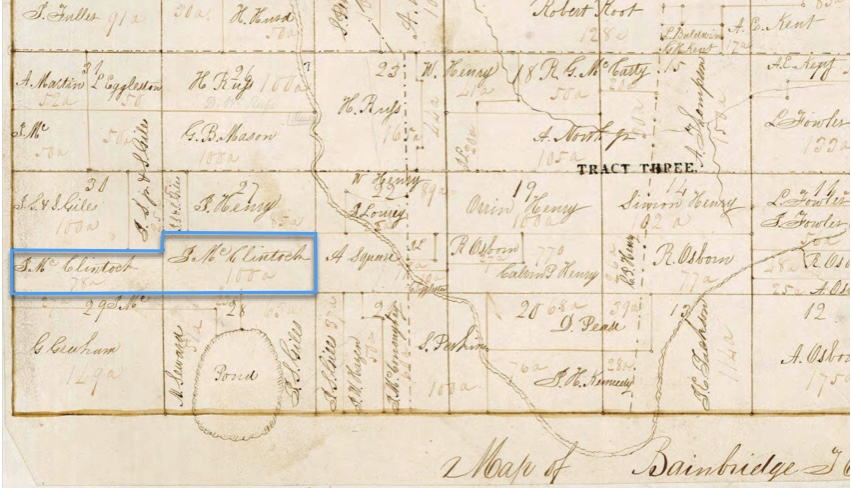
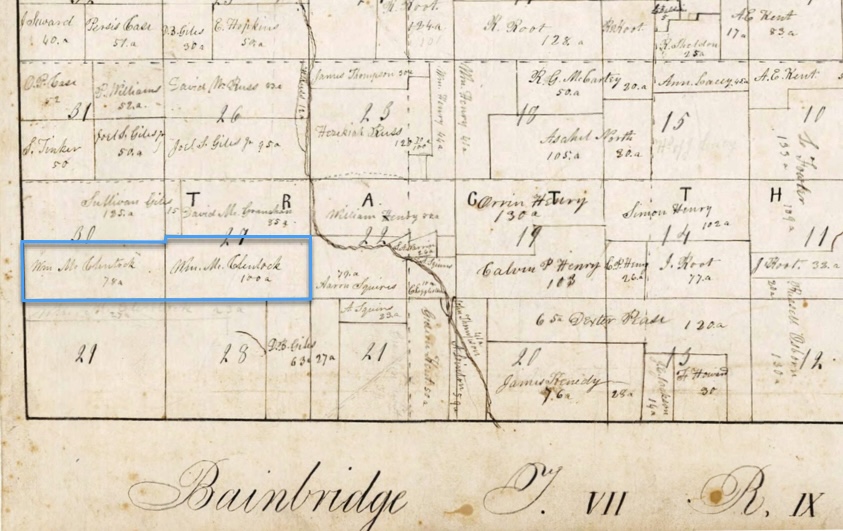
Solon Township, Plate 195 of the Atlas of Cuyahoga County, Ohio, from Actual Surveys by and Under the Directions of D. J. Lake, 1874. (Image courtesy of the Cleveland Public Library Digital Collection).

One Generation To The Next

Our Great-Great-Grandparents are Dexter and Sarah Olive (Dickinson) McClintock. Dexter McClintock, The eighth child & fourth son of James Sr. and Hepzibah McClintock was born August 15,1819 in Phelps, Ontario, New York — died April 12, 1899 in Chagrin Falls, Cuyahoga, Ohio. He married Sarah Olive Dickinson November 6, 1840, in Phelps, Ontario, New York. She was born on April 22, 1822 in Phelps, Ontario, New York and baptized in the Dutch Reformed Church at Howes Cave*, New York on May 19, 1822. She died on September 23, 1906, Novelty, Geauga, Ohio. Her parents were Elijah Dickinson and Elizabeth Bice.
*“Howes Cave is a hamlet in Schoharie County, New York, United States. The community is 5.3 miles east of Cobleskill.” (Wikipedia).

Together they had seven children. Their first child was born in New York state, and the other six children were born in Cuyahoga County, Ohio.

  • Hepzebah A. (McClintock) Martin, born about 1842 in Phelps, Ontario, New York — died after 1911.
  • Milo Alphonso McClintock, born December 30, 1844, Chagrin Falls, Cuyahoga, Ohio — died November 20, 1920, Twinsburg, Summit, Ohio.
  • Walter Ransom McClintock, born October 18, 1848, in Solon, Cuyahoga, Ohio — died June 12, 1924, Sherman, Iosco, Michigan
  • Martha Elizabeth (McClintock) Cochran, born June 13, 1853, Solon, Cuyahoga, Ohio — died July 6, 1925, Solon, Cuyahoga, Ohio
  • Charles D. McClintock*, born November 10, 1856, Chagrin Falls, Cuyahoga, Ohio — died July 22, 1937, Limestone Township, Peoria, Illinois (*Please see extensive notes on Charles McClintock in the footnotes).
  • Clara Antionette (McClintock) DeVoe, born July 14, 1860, Solon, Cuyahoga, Ohio — died September 6, 1932, Chagrin Falls, Cuyahoga, Ohio. (We are descended from Clara).
  • Sarah A. (McClintock) Hoyt, born September 20, 1863, Solon, Cuyahoga, Ohio — died November 15, 1927, Los Angeles, Los Angeles County, California
Destruction of the 1890 Census by the Great Fire of 1921 at the Commerce Department Building
in Washington, D.C. (Image courtesy of raogk.org).

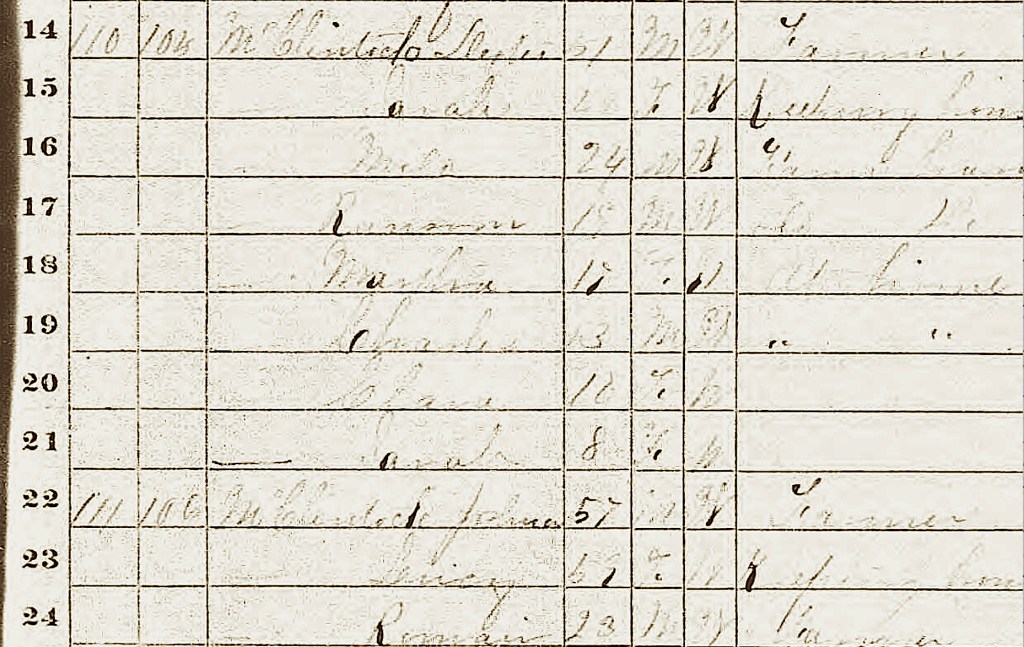
We have four censuses of the family in this area, from 1850 through 1880. Each one shows a prospering and growing family, with some children eventually splitting off as they form families of their own.

Due to a major fire in 1921, and the subsequent water damage, there are almost no 1890 Census records existing. “A January 10, 1921 fire at the U.S. Department of Commerce building in Washington, DC, destroyed the majority of the population schedules from the 1890 Census. The fire left an enormous gap in many families’ genealogical record. Although alternative records may provide some information, the loss of the 1890 Census schedules remains an insurmountable obstacle for many researchers attempting to trace families between the 1880 and 1900 censuses.” (Census.gov)

Dexter died in 1899, so the family census records were lost for him and his wife Sarah. She died in 1906, so there should be a 1900 Census record of her located somewhere. We just haven’t found it, but will continue to look. (2)

This gallery is a collection of images from 19th century Solon, Ohio history. The center image is
“Members of the Chamberlain family… clearing land at what is believed to be their property located on Liberty Road…Other well known families at the time were the McConougheys, and the McClintocks…” (See footnotes for resources).

They Were A Well Known Family

The gallery above is designed to evoke a feeling of what the rural and agricultural life of these ancestors must have been like. When they first arrived in the Western Reserve there were almost no roads, so they had to make their own if they wanted to get anywhere. If you wanted to eat, you were the one responsible for growing most of your own food. (This was similar to the wilds of New Hampshire their forebears had encountered when they arrived from Scotland). Things had evolved over the 170 years — there were some opportunities for education, and there were some small stores for sundry items. However, life was still very agricultural.

We think of Dexter and Sarah’s lives as being slow-and-steady, generation-to-the- next-generation. For example, he never seemed to miss a property tax payment. We have observed over 25 years of property tax payments made on the properties shown in the Solon map — starting in 1844, through 1880. (Dexter also made some property tax payments in the nearby township of Chagrin Falls in the 1850s, so they probably lived there during part of their lives together).

Solon, Cuyahoga County, Ohio, Property tax payment for, 1844

He must have been well respected in the community, because he was identified in The Western Reserve Register for 1852 as the Constable for that year. Observation: Here again he seems to demonstrate his same principle of stepping-up when necessary: if you wanted good roads, healthy food, a safe community… you had be to be responsible for that yourself.

The Western Reserve Register for 1852, announces in the last line that Dexter McClintock is Constable for the year 1852.

“Duly sworn Ohio constables are considered peace officers under Ohio law… The office developed from its British counterpart during the colonial period. Prior to the modernization of law enforcement in the middle 19th century, local law enforcement was performed by constables and watchmen. Constables were appointed or elected at the local level for specific terms and, like their UK counterparts the Parish Constable, were not paid and did not wear a uniform. They were often paid a fee by the courts for each writ served and warrant executed. Following the example of the British Metropolitan Police established in 1829, the states gradually enacted laws to permit municipalities to establish police departments.” (Wikipedia) (3)

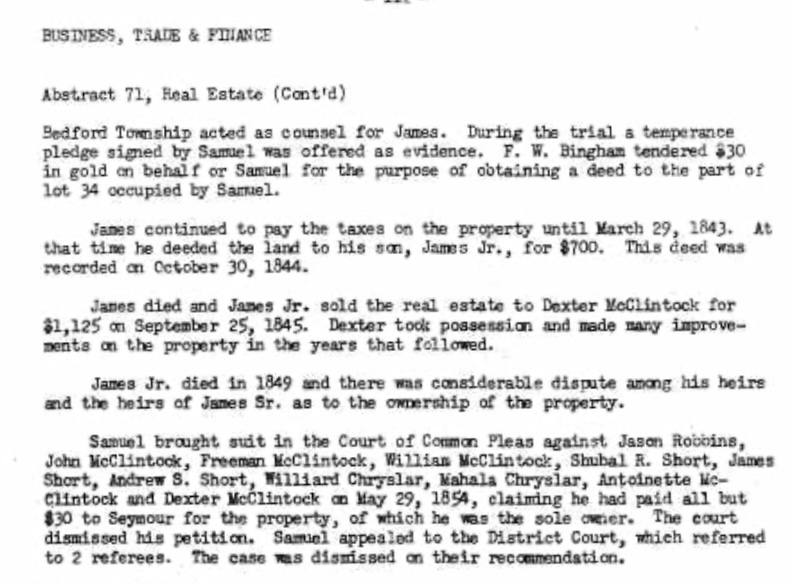
Annals of Cleveland, Volume II, Abstract 71, Real Estate

The 1850s weren’t drama free for this family — they got a jump start on their own rehearsal for The Civil War. This was a case that pitted one brother against another brother with his two sons.

In the previous chapter, we wrote about tippling. As we know in this modern era, an occasional alcoholic drink is fun, and with moderation, not a problem. Unfortunately, some people may be more persuaded to drink by their genetics, life experiences, or both. This was the case with 3x Great Grandfather, James McClintock Sr.’s brother, Samuel McClintock. We believe Samuel was the first family member to arrive in the Solon area, because he was paying property taxes as early as 1831. But this case started earlier than that…

An example of an 1806 handbill advertising land sales. (Image courtesy of the Library of Congress).

The following paragraphs and timeline describe the history of this court case and are taken directly from the abstract.

July 1829
Charles Seymour, a resident of Canandaigua, New York and agent of the State of Connecticut, in July 1829 issued a printed hand bill describing lands of the state which were for sale.

April 1830, until November 1830
Seymour agreed on April 27, 1830 to give Samuel McClintock, [who was] the owner of a farm in Manchester, Ontario County, New York, his selection of any tract of 125 acres listed on the hand bill [for land in Ohio] and $400 in cash in exchange for the Manchester farm. Samuel made his selection on November 8, choosing part of lot 33 and the west end of lot 34 in Solon Township, Ohio. (See the map below).

Dexter McClintock property as shown in this excerpted inset image from Solon Township, Plate 195. The property to the north belongs to his brother Joshua John (J.J.) McClintock. The lot to the west belongs to Romain Steward (R.S.) McClintock, who we infer is the grandson of Joshua John.

December 1830, until October 1832
The deed to the Ohio land was executed on December 16 by Isaac Spencer, treasurer of Connecticut, and sent to Seymour. Samuel desired to make an arrangement with [Samuel’s] brother, James McClintock Sr., for an interest in the property and asked for a new deed in James’ name. Since the state treasurer had already passed title to Samuel, it was impossible to make a new deed. Samuel moved from New York State to Michigan about October 1832.

November 1832, until May 1834
Under Samuel’s instructions, Seymour held up delivery of the deed until James should pay $30 still due to Seymour, which amount Samuel had lent his brother. James complied and Seymour delivered the deed to James on November 21, 1832 and also drew a separate deed to be executed by Samuel to James. Samuel signed the deed on July 5, 1833 and it was recorded on May 30, 1834.

About 1836
Samuel reputedly was a heavy drinker and lost his property in New York and in Michigan because of that habit. He moved to a farm near Parma [Ohio] about 1836. Later James permitted him to occupy a small piece of lot 34 near Solon. It was agreed between the brothers that Samuel could stay on the property for his lifetime, or purchase it at its cost price, if he would join a temperance society. At that time Samuel was a widower.

A temperance pledge signed by those who pledge to stop or reduce their use of alcohol, similar to those common during the 1830s and 1840s. (Image courtesy of Virginia Commonwealth University).

1841, until October 1844
In 1841 James [Sr.] sued Samuel for forcible entry and detainer in the court of Justice of the Peace Simeon D. Kelley of Solon Township… During the trial a temperance pledge signed by Samuel was offered as evidence. F. W. Bingham tendered $30 in gold on behalf or [of?] Samuel for the purpose of obtaining a deed to the part of lot 34 occupied by Samuel. James Sr. continued to pay the taxes on the property until March 29, 1841. At that time, he deeded the land to his son, James Jr., for $700. This deed was recorded October 30, 1844.

September 1845, until January 1854
James [Sr.] died [in September 1845] and James Jr. sold the real estate to [his brother] Dexter McClintock [our ancestor] for $1,125 on September 25, 1845. Dexter took possession and made many improvements on the property in the years that followed. James Jr., died in 1849.” [Correction, the actual date James Jr. died is January 1, 1854].
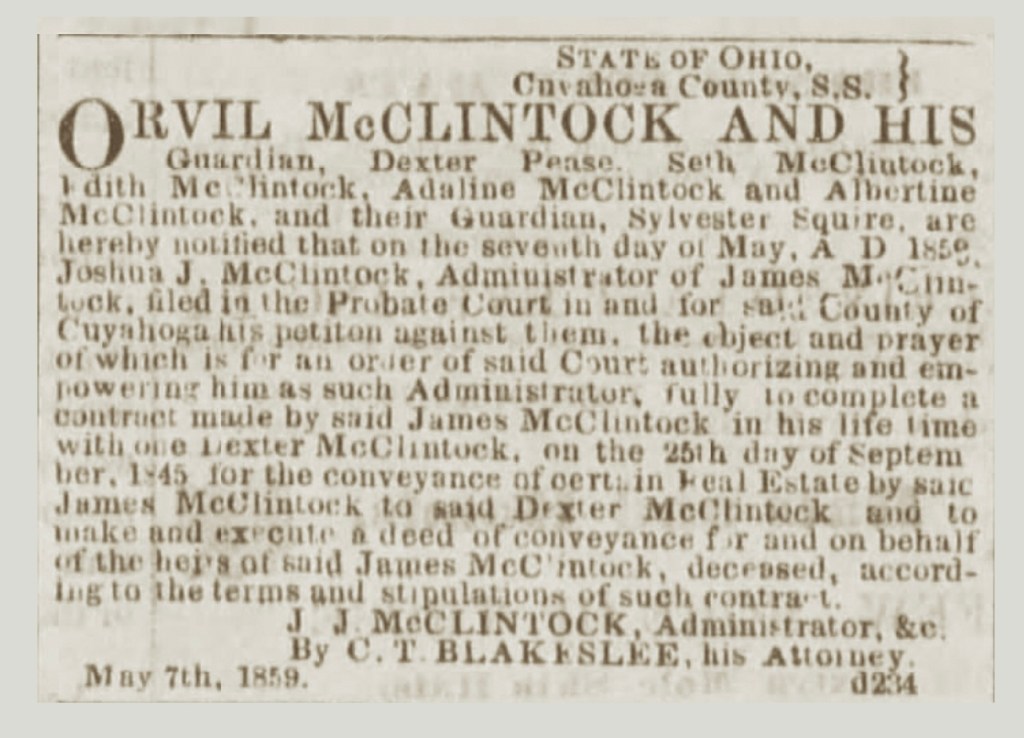
Legal Notice, published in: The Cleveland Leader, on Wednesday, May 18, 1859, page 2. We see that some of the late James McClintock Jr.’s children (Orvil, Seth, Edith) are listed.

May 1859
This legal notice was published about five years after the court proceedings. We don’t know why specifically, but speculate that perhaps some of the children were getting older and the court required this?

Comments: Outside of his reputed tendency to drink, we don’t understand what the motivation was by Samuel McClintock for the lawsuit. The facts seem pretty clear as to the history of events. Not to be too cynical, but it seems quite likely to have been about his need for money after all of his various failures and disappointments. (4)

We Hear That She Liked To Be Called Clarrie

Our Great Grandmother, Clara Antionette (McClintock) DeVoe is someone that we don’t know much about, even though we seem to know much about everyone else around her. She was Dexter and Sarah’s second youngest daughter, born July 14, 1860 and grew up in Solon, Ohio.
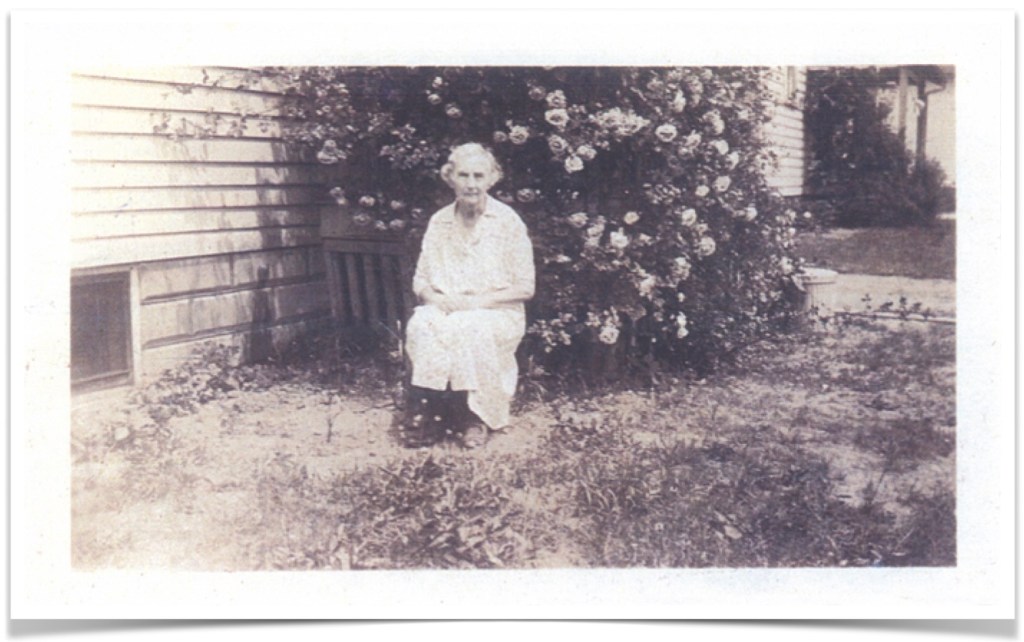
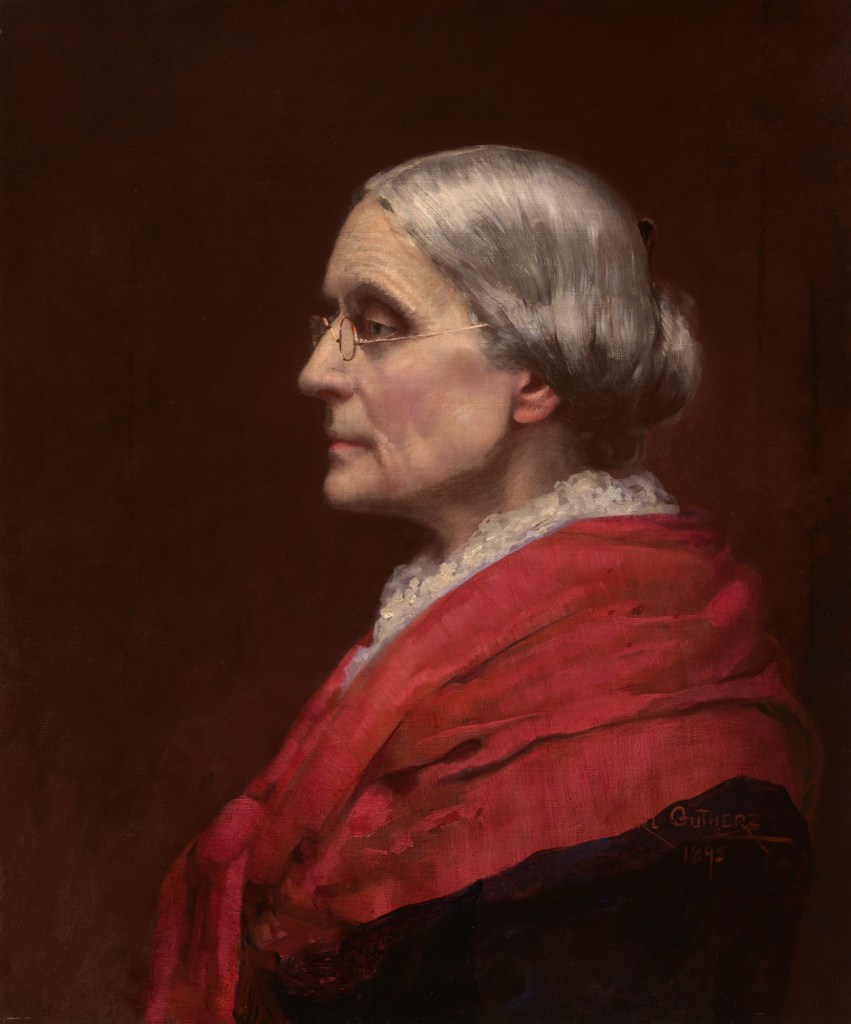
Clara DeVoe in her later years, circa 1920s. (Family photograph).

On November 18, 1877, our Great Grandfather Clinton DeVoe, married Clara Antoinette McClintock in Solon, Ohio. She died on November 6, 1932 in Chagrin Falls, Cuyahoga, Ohio. (5) Together they raised five children: George, Lulu (our grandmother), Anna, Lena, and Nell.

Clinton DeVoe and Clara McClintock marriage license, 1877.

For more about Clara’s life, please see the chapters, The DeVoe Line, A Narrative — Ten and Eleven.

Following are the footnotes for the Primary Source Materials,
Notes, and Observations

The more things change, the more they stay the same…

(1) — two records

Book Browse
Well-Known Expressions
“The more things change, the more they stay the same”
https://www.bookbrowse.com/expressions/detail/index.cfm/expression_number/483/the-more-things-change-the-more-they-stay-the-same#:~:text=The%20first%20recorded%20use%20of,French%20novelist%2C%20critic%20and%20journalist.

Quora
How did we go in the United States from 90 percent of people being farmers two centuries ago to less than 2 percent today?
https://www.quora.com/What-is-the-percentage-of-people-in-the-US-that-worked-in-agriculture-in-the-1800s#:~:text=By 1850, farm people made,105.7 million, the report said.

One Generation To The Next

(2) — thirty-nine records

Atlas of Cuyahoga County, Ohio,
from Actual Surveys by and Under the Directions
of D. J. Lake (1874)
https://cplorg.contentdm.oclc.org/digital/collection/p4014coll24/id/502/
and
Plate 195 Solon
https://cplorg.contentdm.oclc.org/digital/collection/p4014coll24/id/493
Note: For the map image.

Dexter McClintock
in the Web: Ohio, Find A Grave Index, 1787-2012

https://www.ancestry.com/discoveryui-content/view/7887384:70559?ssrc=pt&tid=18269704&pid=635845738
and
Dexter McClintock
https://www.findagrave.com/memorial/19154853/mccl

Sarah Olive Dickinson
in the U.S., Dutch Reformed Church Records in Selected States, 1639-1989

New York > Howe’s Cave > First Reformed Church, Records, 1810-1919
https://www.ancestry.com/discoveryui-content/view/2267436:6961
Book page: 82, Digital page: 36/55 Left page, entry 61.
Notes: Parents are Elijah Dickinson and Elizabeth Bice. Birth date: April 22,1822, and baptism date: May 19, 1822.

Howes Cave, New York
https://en.wikipedia.org/wiki/Howes_Cave,_New_York

Sarah Olive McClintock
in the U.S., Find a Grave Index, 1600s-Current

https://www.ancestry.com/discoveryui-content/view/95142176:60525?tid=&pid=&queryid=0c1a50eb-796e-4a47-aaa6-c928ab070a29&_phsrc=mZH1&_phstart=successSource
and
Sarah Olive Dickinson McClintock
https://www.findagrave.com/memorial/97413613/sarah-olive-mcclintock

Hepzebah A. (McLintock) Martin
in the 1850 United States Federal Census

Ohio > Cuyahoga > Solon
https://www.ancestry.com/discoveryui-content/view/13455018:8054?tid=&pid=&queryId=24fb4c69-b8cb-4ccf-a1e0-6fe3f4a86964&_phsrc=Lgc11&_phstart=successSource
Notes: This record cites her age as 10 years old and her birthplace as New York State. She is also known as “Hepsie” throughout her life.
Digital page: 20/30, Entries 6 through 9.

Research about Hepzebah A. (McClintock) Martin: The first record we have of her is the 1850 census, and it unclear to her in her history what her birth year actually is.

  • 1860 Census: Michigan, married to William Martin, has a one year old daughter named Adele, and revises her birth year to be 1839 in Ohio. She is living in Michigan near her Great Uncle Freeman McClintock’s family, and other McClintock relatives in the area.
  • 1870 census, she cites birth year as about 1836 in New York, and is living right next door to the Freeman McClintock family.
  • 1880 and 1910 censuses, she claims her birth year to be 1842 in New York
  • 1911, listed in a Detroit, Michigan directory as a widow of William Martin
  • Death by 1930, her death and maiden name are confirmed on her daughter Adele’s death certificate.

Milo Alphonso Mcclintock
Death – Ohio Deaths, 1908-1953

https://www.familysearch.org/ark:/61903/1:1:X8GD-385
and
Milo Alphonse McClintock
in the U.S., Find a Grave Index, 1600s-Current
https://www.ancestry.com/discoveryui-content/view/71580788:60525?ssrc=pt&tid=18269704&pid=635866426
and
Milo Alphonse McClintock
https://www.findagrave.com/memorial/114531073/milo-alphonse-mcclintock
Note: For his birth and death dates.

Wallie R Mc Clintick
in the Michigan, U.S., Death Records, 1867-1952

Certificates, 1921-1945 > 204: Iosco
https://www.ancestry.com/discoveryui-content/view/3230051:60872?tid=&pid=&queryId=619697c6-78c6-4abd-8a08-f506d6bb081b&_phsrc=zqx43&_phstart=successSource
Digital page: 327/2300
Note: For his birth and death dates.
and
Walter Ransom Mcclintock
Mentioned in the Record of Oney R Mcclintock (Walter Ransom Mcclintock’s Son)

Death – Ohio Deaths, 1908-1953
https://www.familysearch.org/ark:/61903/1:1:X89H-XQW
Digital page: 2219/3295
Note: For confirmation of his middle name as Ransom.

Martha Elizabeth Cochran
Death – Ohio Deaths, 1908-1953

https://www.familysearch.org/ark:/61903/1:1:X6S8-14F
Note: For birth and death dates.
Digital page: 507/2983
and
Mattie McClintock
in the Cuyahoga County, Ohio, U.S., Marriage Records and Indexes, 1810-1973

https://www.ancestry.com/discoveryui-content/view/2802910:1876
Book page: 115, Digital page: 576/1017, Entry 2.
Note: For their marriage information.

Our research about Charles McClintock: It seems he was married four times and lived in Ohio, Michigan, and Illinois. This affected obtaining accurate birth and death information on him. The history with twelve footnote entries, is as follows:

Charles D. McClintock
in the U.S., Find a Grave Index, 1600s-Current

https://www.ancestry.com/discoveryui-content/view/178374076:60525
Note: For birth and death dates
and
Charles E. McClintock
https://www.findagrave.com/memorial/213188701/charles-e.-mcclintock
Note: For birth and death dates.

Charles McClintock
in the 1860 United States Federal Census

Ohio > Cuyahoga > Solon
https://www.ancestry.com/discoveryui-content/view/43661488:7667?tid=&pid=&queryId=0ccfa077-c465-4643-b42b-2204b2d90758&_phsrc=LFc29&_phstart=successSource
Book page: 50, Digital page: 11/27, Entries 25 through 40.
Note: Inferred birth date is 1856.

Charles McClintock
in the 1880 United States Federal Census

Ohio > Cuyahoga > Solon > 075
https://www.ancestry.com/discoveryui-content/view/44931741:6742?tid=&pid=&queryId=de63bba2-000c-4507-bee6-7e79435ba8fb&_phsrc=LFc40&_phstart=successSource
Book page: 13, Digital page: 13/18, Entries 1 through 3.
Note: Marriage No.1 is inferred, to Phebe. The 1880 census in Rosefield, Peoria, Illinois states that he first married at age 22, which would confirm his birth year as 1856, and confirm that he and Phebe married in 1878.

Charles D. Mcclintock
in the Ohio, U.S., County Marriage Records, 1774-1993

https://www.ancestry.com/discoveryui-content/view/1152821:61378
Book page: 41, Digital page: 207/447, Right side, entry 3.
Note: Marriage No. 2 date is December 29, 1886, to Evangeline Alexander.

Chas D McClintock
in the Michigan, U.S., Marriage Records, 1867-1952

Registers, 1887-1925 > 1911-1915 > 1911 Washtenaw-1912 Barry
https://www.ancestry.com/discoveryui-content/view/651244:9093?tid=&pid=&queryid=af7ab19c-d5ea-4623-a12f-7e366b935c27&_phsrc=LFc11&_phstart=successSource
Book page: 427?, Digital page: 281/656, Left page, entry 78971.
Notes: Marriage No.3 date is July 15, 1911, to Mary S. Beck.
Observation: We wonder if this marriage took place in Detroit because his oldest sister Hepsie (McClintock) Martin was living there?

Charles D McClintock
in the U.S., City Directories, 1822-1995

Ohio > Cleveland > 1916 > Cleveland, Ohio, City Directory, 1916
https://www.ancestry.com/discoveryui-content/view/315294244:2469?tid=&pid=&queryid=91a5df14-4722-4119-9c5a-dcc91c95266c&_phsrc=SqZ35&_phstart=successSource
Digital page: 504/1133, Left page, right column, entry 4 under McClintock.
Note: They are living in Cleveland. This is the last city directory we find for him in Cleveland, Ohio.
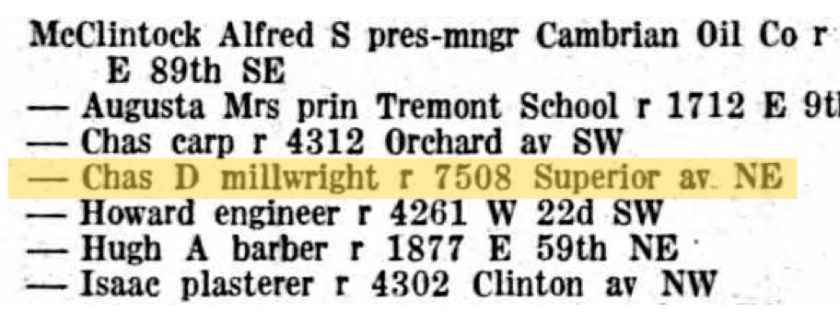
1916 Cleveland, Ohio, City Directory, page 1016.

Mary S Beck McClintock
in the Pennsylvania, U.S., Death Certificates, 1906-1970

1934 > 063501-066500
https://www.ancestry.com/discoveryui-content/view/5290214:5164
Digital page: 1887/3528
Notes: By 1920 she was widowed. It’s unclear if the informer knew her well, but the husband’s name is wrong: Robert John McClintock?, when all other records record Charles D. McClintock.

Mary S Mcclintock
in the 1920 United States Federal Census

Ohio > Cuyahoga > Cleveland Ward 21 > District 0417
https://www.ancestry.com/discoveryui-content/view/104724814:6061
Book page: 13A, Digital page: 25/41, Entries 26 through 28.
Note: By 1920 she is living with her daughter in Cleveland (again); states that she is married. Charles D. McClintock is not on this census.

Charls E Mcclintock
in the 1930 United States Federal Census

Illinois > Rosefield > District 0094
https://www.ancestry.com/discoveryui-content/view/87288507:6224
Book page: 2B, Digital page: 4/16, Entries 65 and 66.

Charles E. McClintock
in the U.S., Find a Grave Index, 1600s-Current

https://www.ancestry.com/discoveryui-content/view/178374076:60525
Note: For birth and death dates.

Charles E. McClintock
https://www.findagrave.com/memorial/213188701/charles-e.-mcclintock
Notes: We believe that his middle initial is actually D, not E, and his actual birth year is 1856.

Clara A De Voe
Death – Ohio Deaths, 1908-1953

https://www.familysearch.org/ark:/61903/1:1:X6SP-PMB
Digital page: 1360/3428
and
Clara A. McClintock
https://www.familysearch.org/tree/person/details/99PJ-5J7
Note: For death certificate birth and death dates.
and
Clara McClintoch
Marriage – Ohio, County Marriages, 1789-2016

https://www.familysearch.org/ark:/61903/1:1:XZ6L-7YN
Note: For marriage date of November 18, 1877 to Clinton Chauncey DeVoe.

Sadie A McClintock
in the Cuyahoga County, Ohio, U.S., Marriage Records and Indexes, 1810-1973

1876-1900 > Reel 011 Marriage Records 1878 Sep – 1881 Jan
https://www.ancestry.com/discoveryui-content/view/2430290:1876?tid=&pid=&queryId=b4ad8a6e-6781-4183-98b3-6d07ddde4add&_phsrc=AQQ34&_phstart=successSource
Book page: 506, Digital page: 507/1030, Entry 1.

Labeled as an Obituary, but it is actually a copy of her death certificate.
https://www.ancestry.com/mediaui-viewer/tree/157973032/person/322095985501/media/d6df20ce-513e-4409-90b1-96b2ea6862a0
Notes: For her birth date in Ohio, and for her death date of November 15, 1927, in Los Angeles, Los Angeles, California.
and
Norwalk. Death Certificates
https://www.familysearch.org/ark:/61903/3:1:3QS7-89SV-MXBV?view=index&personArk=%2Fark%3A%2F61903%2F1%3A1%3AQP7Y-1ZNZ&action=view
Digital page: 1725/2729

Random Acts of Genealogical Kindness
Fate of the 1890 Population Census
https://raogk.org/census-records/1890-fire/

The United States Census Bureau
U.S. Census Bureau History: 1890 Census Fire, January 10, 1921
https://www.census.gov/history/www/homepage_archive/2021/january_2021.html#:~:text=A January 10, 1921 fire,in many families’ genealogical record.

Deytie McLintock
in the 1850 United States Federal Census

Ohio > Cuyahoga > Solon
https://www.ancestry.com/discoveryui-content/view/13455016:8054?tid=&pid=&queryId=81babe28-0b53-493a-a3a8-b2763239de54&_phsrc=NhM1&_phstart=successSource
Digital page: 20/30, Entries 6 through 9.

Dexter McClintock
in the 1860 United States Federal Census

https://www.ancestry.com/discoveryui-content/view/43661483:7667?tid=&pid=&queryId=3c64b783-fd2b-49f0-8bbc-6103316ee9e4&_phsrc=NhM3&_phstart=successSource
Book page: 50, Digital page: 11/27, Entries 35 through 40.

1870 Census, page enhancement for legality:
Dexter, 51
Sarah, 48
Milo, 24
(Walter) Ransom, 19
Martha. 17
Charles, 13
Clara, 10
Sarah, 8
Notice that Dexter’s brother Joshua John is living next door.

Dyler Mcclintick
in the 1870 United States Federal Census

Ohio > Cuyahoga > Solon
https://www.ancestry.com/discoveryui-content/view/38891740:7163
Book page: 13, Digital page: 13/23, Entry lines 14 through 21.
Note: The document is barely legible.

Dert McClintock
in the 1880 United States Federal Census

Ohio > Cuyahoga > Solon > 075
https://www.ancestry.com/discoveryui-content/view/25436133:6742
Book page: 13, Digital page: 13/18, Entries 1 and 2.
Note: Observe that Charles is married and living in the home with his wife Phebe.
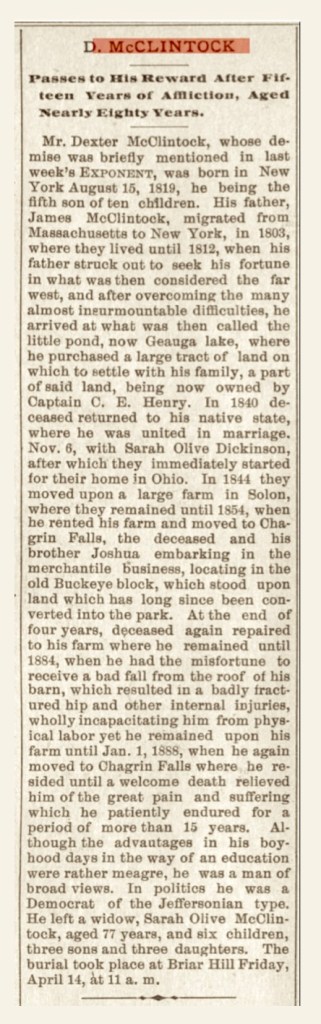
They Were A Well Known Family

(3) — seven records

It is from the next three footnotes that we gathered images for the Solon Gallery:

Authors, Arsonists and Industry Make Up History of Solon (photos, video):
The stories of our towns

https://www.cleveland.com/solon/2014/07/authors_arsonists_and_industry.html
and
Solon Historical Society
W.P. Trimple General Store
https://www.solonhistoricalsociety.org/2022/08/24/solon-businesses/
and
History of the City
https://www.solonohio.org/DocumentCenter/View/553/Article-II-?bidId=
Note: It is from this document that we saw the comment about the “well thought of nature” of the McClintock family.

The Western Reserve Register for 1852
Townships
https://www.ancestry.com/imageviewer/collections/26616/images/dvm_LocHist011047-00045-0?ssrc=&backlabel=Return&pId=87
Book page: 64, Digital page: 88/229
and
The Western Reserve Register for 1852 : containing lists of the officers of the general governments and of the officers and institutions on the reserve
https://archive.org/details/westernreservere00inhuds/page/n51/mode/2up
Digital page: 52/121, Left panel, center.

Dexter McClintock
in the Cuyahoga County, Ohio, U.S., Tax Lists, 1819-1869

1844-1845
https://www.ancestry.com/discoveryui-content/view/1195948:2100?tid=&pid=&queryId=81650450-8ff3-4ec5-9d61-75b89fe67b89&_phsrc=SqZ1&_phstart=successSource
Digital page: 310/682, Left column, entry 6.
Note: This is the first evidence of a property tax payment made in Solon, Cuyahoga, Ohio.

Constables in the United States
https://en.wikipedia.org/wiki/Constables_in_the_United_States

Annals of Cleveland, Volume II, Abstract 71, Real Estate

(4) — four records

Annals of Cleveland,
Vol. II. Abstracts of the records of court cases in Cuyahoga County
https://www.ancestry.com/imageviewer/collections/28306/images/dvm_LocHist012267-00246-1-0?ssrc=&backlabel=Return&pId=400
Book page: 111-112, Digital page:: 470-471/3048

Notes: these two pages document the facts of the Court Case brought by Samuel McClintock against his brothers.

Library of Congress
[Handbill example]
Lands for sale: the following tracts of land are offered for sale on very reasonable terms…
by Samuel Baird, 1806
https://www.loc.gov/resource/rbpe.15100300/?sp=1

The Second Great Awakening in the United States
https://www.thecollector.com/american-second-great-awakening/
Note: For temperance pledge example.

Legal Notice, found in:
The Cleveland Leader, on Wednesday, May 18, 1859
https://www.newspapers.com/image/78793034/?xid=637&_gl=1*qfra6i*_gcl_au*NDc1NTQ2MzQyLjE3MjE3MjYyNjk.*_ga*MTc5NjEyOTEzMC4xNzIxNzI2MjY5*_ga_4QT8FMEX30*MzE4NjdkMjctNjEyNy00YzQzLTk5OTAtMDg4YTgxZjVhYjNhLjEuMS4xNzIxNzI4MjM5LjEwLjAuMA..*_ga_LMK6K2LSJH*MzE4NjdkMjctNjEyNy00YzQzLTk5OTAtMDg4YTgxZjVhYjNhLjEuMS4xNzIxNzI4MjM3LjAuMC4w
Note 1: The Cleveland Leader, Wednesday, May 18, 1859, newspaper archive, page 2.
Note 2: There are 7 columns on the page from left to right. This is excerpted from Column 6, about halfway down the page.

We Hear That She Liked To Be Called Clarrie

(5) — one record

Clinton C. Devoe
Marriage – Ohio, County Marriages, 1789-2016

https://www.familysearch.org/ark:/61903/1:1:XZ6L-7YF
Book pages: 247, Digital pages: 160/322, Right page, Entry 2.

The McClintock Line, A Narrative — Six

This is Chapter Six of seven. In this chapter, our ancestors who have been in New Hampshire since it was a Province and part of British North America, made the major decision to move Westward. They packed their belongings and left New Hampshire and headed to New York State.

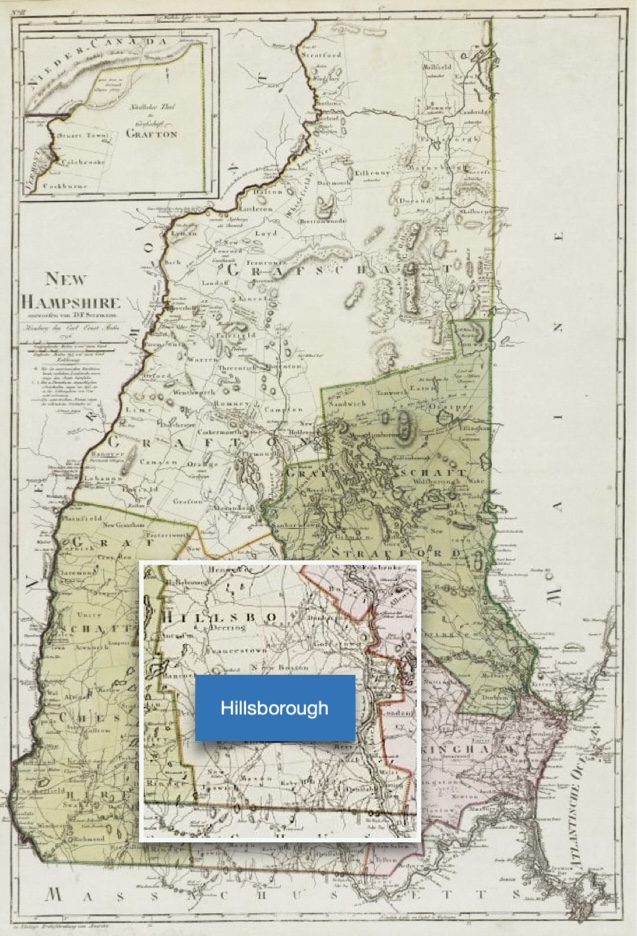
The Sotzmann-Ebeling Map of New Hampshire, Circa 1796. (Image courtesy of Boston Rare Maps).

Be Fruitful and Multiply

James McClintock,(Sr.), born January 3, 1778, Hillsborough (town), New Hampshire Province — died September 1845, Bainbridge, Geauga, Ohio. He married Hephzibah Jones in circa 1803, in New Hampshire. She was born in 1784, in New Hampshire Province — died July 13, 1871, Laingsburg, Shiawassee, Michigan. They had nine children. The first five were born in Hillsborough (town), Hillsborough, New Hampshire.

  • Thirza (McClintock) Taylor, born about 1807, Hillsborough (town), Hillsborough, New Hampshire — died June 25, 1893, Cuyahoga, Ohio.
  • Mahala L. (McClintock) Short, born about 1808, Hillsborough (town), Hillsborough, New Hampshire — died June 29, 1827, Phelps, Ontario, New York
  • Dr. Freeman Brazilla McClintock, born October 28, 1811, Hillsborough (town), Hillsborough, New Hampshire — died March 18, 1882, Laingsburg, Michigan
  • Sarah (McClintock) Short, born about 1812, Hillsborough (town), Hillsborough, New Hampshire — died August 10, 1872, Solon, Cuyahoga, Ohio
  • Joshua John McClintock, born about July 29, 1814 — died July 23, 1892, Solon, Cuyahoga, Ohio
  • The last four were born in two locations in New York State:
  • James McClintock (Jr.), born about 1818, Phelps, Ontario, New York — died January 1, 1854, Bainbridge, Geauga, Ohio
  • Dexter McClintock, born August 15, 1819, Phelps, Ontario, New York — died April 12, 1899, Chagrin Falls, Cuyahoga, Ohio (We are descended from Dexter.)
  • William McClintock, born August 13, 1821, Lyons* (Arcadia), Ontario, New York — died July 6, 1893, West Union, Fayette, Iowa
    Note: *Wayne County, New York was created in 1823. The Town of Arcadia was formed from the Town of Lyons in 1825.
  • Louisa M. McClintock, born about 1827, Arcadia, Wayne, New York — died after 1870 location unknown (1)
A View of Manchester, N.H. — A lithographic print by J.B. Bachelder, 1855. (Image courtesy of the Library of Congress).

The Censuses of 1800 through 1830 and Their Differences

These censuses are the second, third, fourth, and fifth that the United States had completed. Each year the government was learning a little more about what data it needed to know in able to run the country, and also some new questions to ask. Unfortunately, when we analyze these forms today, we still see many tic marks, but not much detail.

For the 1800 census, James McClintock was unmarried. We do not know with whom he was living in 1800. We are sure in was in Hillsborough, New Hampshire.

The 1810 Census in New Hampshire
Then in 1810, we first encounter the James McClintock family when he and his wife Hephzibah (Jones) McClintock were married and had children living in their home. They were still residing in Hillsborough, New Hampshire where both of them had grown up.

1810 Census excerpt, Hillsborough, New York
Map Of The State Of New York, Published by A. Finley Philadelphia,1824. The yellow circle indicate the area within which they lived during the 1820s. (Image courtesy of the Internet Archive).

The 1820 Census In New York
By 1820, they have more children and have left New Hampshire behind them. They are now living in the town of Phelps, Ontario County, New York. The reasons that they left New Hampshire are unknown, but there was a large westward migration already occurring in this era. Perhaps they were seeking additional farmland because arable land meant prosperity to farmers. James’s brother Samuel either came with them, or he was already in New York State, which may be one reason why they moved there — there was a family connection.

1820 Census excerpt, Phelps, New York. Note James as entry #738, and his brother Samuel as entry #739.

The 1830 Census In New York
It appears that the family has moved locally from the town of Phelps in Ontario County, to the town of Arcadia, just slightly north in the new (April 1823) Wayne County. This is the first Federal census we see where there is an actual printed form for the census taker to utilize for consistency. Prior to this, many census takers just made up their own forms trying to adhere to guidelines they were given.

1830 Census excerpt, Arcadia, New York. We overlaid it on an 1830 period accurate template for category clarity.

We also know that by this time, James’s brother Samuel had left New York state and moved further west to the Ohio Country, where he was paying property taxes as early as 1831 in what is now Solon, Ohio. We already had members of other family lines living in this area, but we believe that it’s plausible that he was the first member of the McClintock branch of our family to arrive there. We also understand that he was quite the drinker… (2)

1831 Property tax record for Samuel McClintock in Solon, Cuyahoga, Ohio.

Let’s Pause A Moment for Some Refreshment, Shall We?

As we learned from the census, for a portion of the 1820s and at the beginning of the 1830s, the James McClintock Sr. family lived in New York State. We came across an interesting account of what it was like to live in Arcadia, New York during this period —

“Up to 1830 the state of temperance was bad enough. Within a distance of three miles along Mud creek there were four distilleries, operated by Harrison, Luce, Sherman, and Mansfield. Whisky was sold as low as twenty-five cents a gallon, and was drank on all occasions. Whether at general training, Fourth of July, logging-bee, raising, or harvesting, the liquor was freely used. It stood upon the sideboard to treat the casual visitor and teacher, doctor, and preacher were alike accustomed to potations from the cup. Ladies met to help along a quilting, and the “sling” imbibed made conversation spirited. If any failed to provide this stimulus it was made a subject of sharp comment. As years went by, a feeling prevailed that this system should be broken up. A preacher found intoxicated was dismissed, and in the county medical society a member accustomed to using liquors to excess was expelled. Still, tippling was common in taverns and in groceries.”

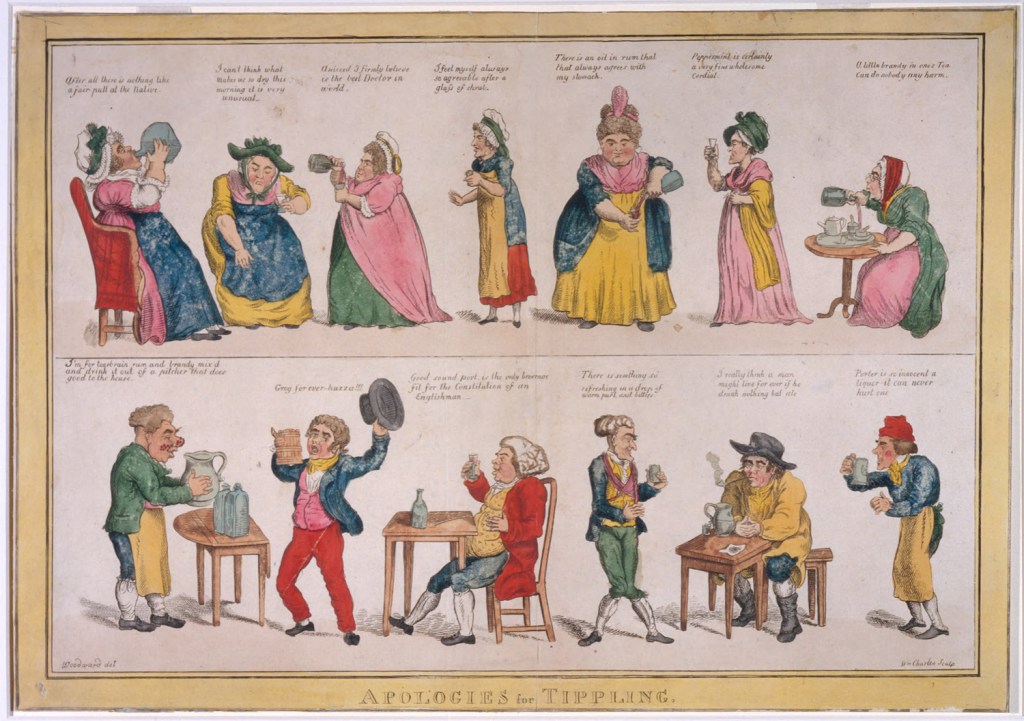
“Apologies for Tippling” by William Charles and George Moutard Woodward, circa 1800. This political cartoon shows some of the many reasons people found for “tippling” or drinking excessively. Courtesy of the Library Company of Philadelphia.

Some of our ancestors were Pilgrims, some were Quakers, some were Presbyterians, some were Catholics — and some were, …non-conformers.

“For the colonists of the 1600s and 1700s much of daily life was filled by tiring drudgery, but throughout the long hours of the work day, beer, cider, rum, and other intoxicating beverages provided a dependable source of comfort. Each day was supplemented by a generous allotment of alcoholic beverages imbibed from their waking hours all the way through the late evening. As author Corin Hirsch states in Forgotten Drinks of Colonial New England, “From breakfast cider to afternoon beer to evening flips, toddies and glasses of Canary wine, alcohol lubricated almost every hour of every day.” Drinking accompanied a diverse range of occasions that often took place in taverns, or during meals, work breaks, business meetings, weddings, funerals, trials, and legislative sessions. Daily, day-long “tippling” was simply a fact of life in the colonial period.

While this behavior may be frowned upon in the modern era, colonials viewed the constant intake of liquor as a necessary and beneficial practice. Despite a lack of scientific understanding, the early settlers of North America knew that drinking from certain water sources could make a person deathly ill. Without proper sanitation practices or a way of discerning contaminated water from clean, they largely avoided it, instead seeking hydration from beverages unintentionally sanitized through the processes of fermentation and distillation. Alcohol was not only potable, but also was seen as a healthy, invigorating substance, which was even used in the treatment of disease. While the relatively staid puritan communities of New England such as Windsor admonished drunkenness, they hailed alcohol as the “good creature of God”. (Windsor Historical Society)

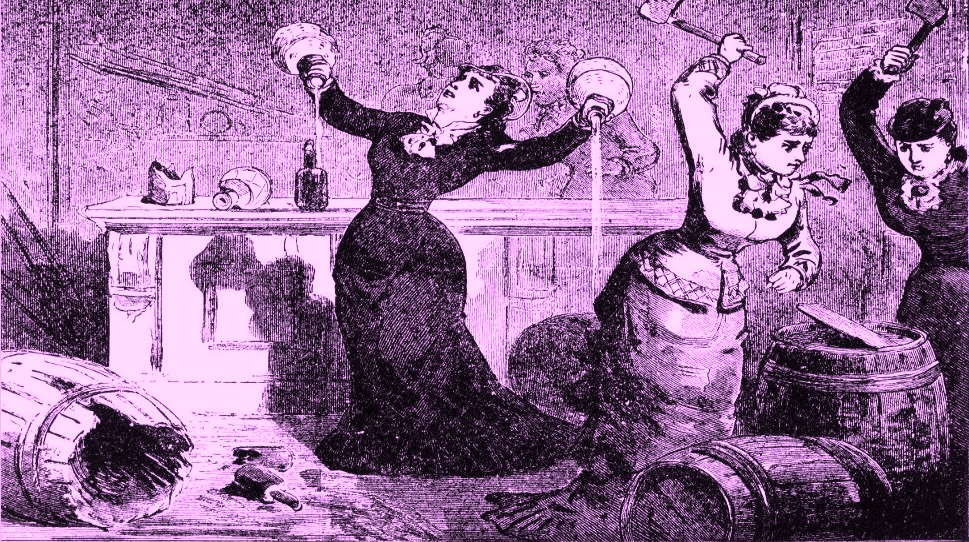
“A woman’s liquor raid – How the ladies of Fredericktown, Ohio, abolished the traffic of ardent spirits in their town.” Line engraving from the Police Gazette.

Observation: James McClintock Sr.’s 2x Great Grandfather Thomas Mclintoch of Glasgow had been a “Maltman” (a brewer), and his Grandfather William McClintock was fond of his homemade “rhum”…so, it seems like “tippling” probably ran through the veins of the McClintock family. Despite this, Freeman McClintock maintains in his biographical profile that his “parents instilled into the minds of their children principles of morality and religion.” Perhaps his uncle Samuel never got that family message.

It’s compelling to ponder ‘about how many’ of our ancestors were likely tipplers, and how over the decades, this behavior paved the way for future temperance movements. (3)

And Back to The Census…

The 1840 Census in Ohio
After decades of censuses in other locations, the McClintock family has immigrated in en masse to the Western Reserve of Ohio. We’ve been able to determine through tax records (starting in 1833) that along with James and his wife, most of their adult children also relocated to this area of northeast Ohio.

1840 Census excerpt, Bainbridge, Ohio.

The census above is for the father James McClintock, Sr. who was living in Bainbridge township at the time of the census. On another 1840 census his son James Jr. and other siblings lived in Solon township. (4)

Map of the Western Reserve Including the Fire Lands 1826. On this map, Geauga County is still combined with the future Lake County and Solon and Bainbridge townships are colored yellow. (Image courtesy of Wikimedia Commons).

The Western Reserve of Ohio

In the early part of the 18th century, the Ohio Country was frequently referred to as the West, and from the perspective of New Englanders who settled it, it was indeed pioneer country. By the 1830s and 40s, the Western Reserve wasn’t thought of as a frontier anymore, but actually, it still was in many ways.

The Western Reserve area of northeastern Ohio, was originally established as The Firelands of Ohio, created by the Connecticut legislature in 1792 to help compensate her citizens for their losses when some of the towns were ravaged during the Revolutionary War. Connecticut had a history of belief that her manifest destiny was the inherent right of their northern and southern borders to extend from New England all the way to the Pacific Coast. This area was chartered and land sales were managed by the Connecticut Land Grant Company. The company eventually failed, and Connecticut yielded on their idea of manifest destiny, but the Western Reserve endured. Ohio became a state in 1803.

For all of our many ancestors from here, we believe that this is very true — “Following the Revolutionary War, for the next 25 years, Ohio became the primary destination of westward bound pioneers because of the fertile farmland in the Ohio River Valley. Some families stayed for the remainder of their lives.” (Family Search) For the James McClintock Sr. family, when his children were seeking prosperity for their own future families, owning land in Ohio beckoned. (5)

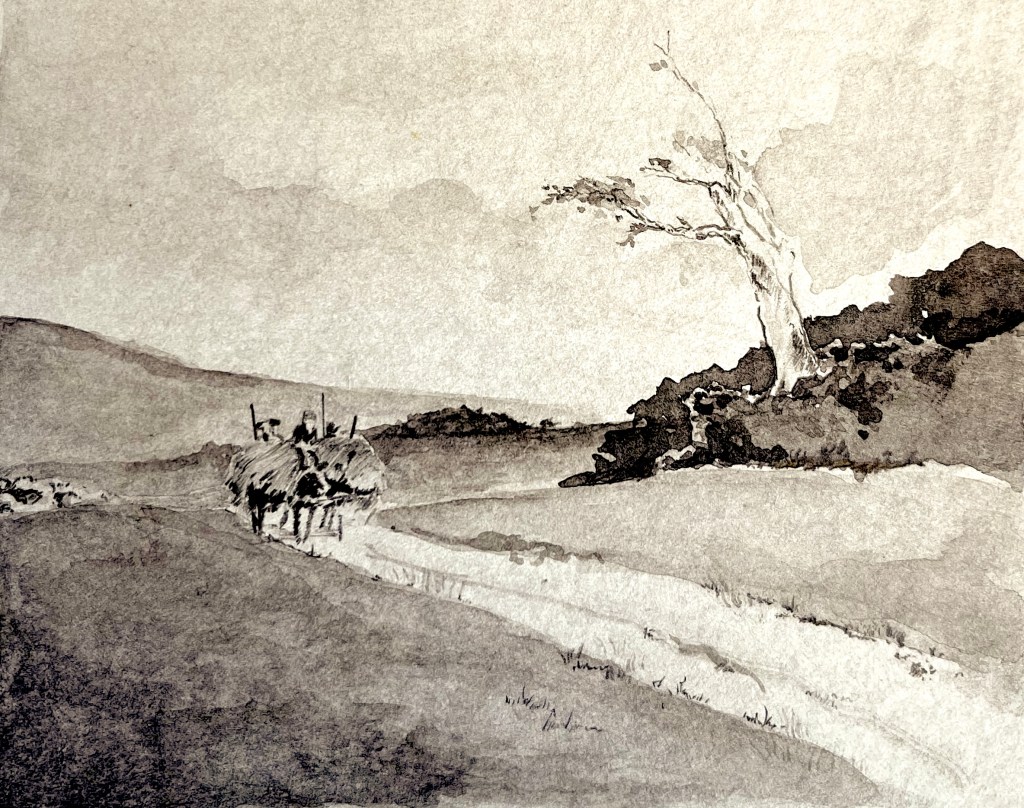
This is a small pen and ink sketch of farmers in the Western Reserve,
which I did in the Spring of 1980. (Thomas Harley Bond)

The Settling of Solon Township, Ohio

Wikipedia informs us that, “In 1820, the first settlers arrived from Connecticut… The township was named after Lorenzo Solon Bull, who was the son of Isaac Bull, one of the first settlers. Purportedly, the selection of young Lorenzo’s middle name was due to its derivation from the “father of democracy”, Solon, the lawmaker of Ancient Greece. The early settlers faced challenges common to pioneers, but in Solon, drainage and wetlands issues complicated settlement and agriculture. Overcoming these obstacles, Solon Township became an arable farming area, producing corn and wheat crops and supporting dairy farms…”

The vast majority of the McClintocks were farmers, with the notable exception of two people, the siblings: Dr. Freeman McClintock, and William McClintock. Although Freeman farmed in Solon, Ohio for a few years, he eventually gave it up and went on to do many remarkable things throughout North America. “The first man who built a house at the Center [of Solon Township] was Freeman McClintock, who located there in 1832 or ’33. He resided there in his log cabin two or three years before any joined him.”

Ohio Log Cabin and Farm by Granger.

We find this historical anecdote to be interesting, but not completely accurate. We know that his uncle Samuel was already living there. Freeman’s wife Lydia came with him, and his parents arrived in October 1833. Many of his siblings were also leaving New York on the canal boats, schooners, and wagons headed his way. We determined these things based upon his biography and the county tax records. (See footnotes).

William McClintock preferred the legal profession. He was a lawyer, having been admitted to the Ohio Bar in 1849. Eventually he moved his family west to Iowa and became the founder and publisher of a newspaper. (Both brothers have interesting biographical links in the footnotes). (6)

“..Nothing Can be Said to be Certain, Except Death and Taxes…”

We know that the McClintocks had arrived in Ohio by 1831, because there are property tax records in Cuyahoga County which support this. When we analyzed the years 1833 through 1844, we saw some interesting patterns. It appears that in most years, James Sr. either owned most of the land, or was paying most of the taxes for some reason. For example in 1836, James Sr., was paying everyone’s property tax even though some of that land belonged to some of his children. (Gee, thanks dad!)

McClintocks listed in the Cuyahoga County 1852 landownership map index

James Sr. died in September 1845, but the exact date was not recorded.

Later in that same month, there are record documents from a future court case, which state that — “James Jr., sold the real estate to Dexter McClintock [our ancestor] for $1,125 on September 25, 1845” and that “James Jr. died in 1849[*] and there was considerable dispute among his heirs and the heirs of James Sr., as to the ownership of the property.”
*Correction: James Jr.’s correct death date is recorded as January 1, 1854. He died of typhoid fever, leaving behind a wife and several small children: wife Betsey, and children, Orvil, Antionette, Seth, Edith, and James. (7)

We will be covering this court case in the next chapter, The McClintock Line, A Narrative — Seven). The case involves land, alcoholism, temperance societies, gold, and lots of ruffled feathers.

Following are the footnotes for the Primary Source Materials,
Notes, and Observations

Be Fruitful and Multiply

(1) — thirty two records

Boston Rare Maps
The Sotzmann-Ebeling Map of New Hampshire, Circa 1796
https://bostonraremaps.com/inventory/sotzmann-ebeling-new-hampshire-1796/
Note: For the map image.

James McClintock Sr
in the U.S., Find a Grave Index, 1600s-Current

https://www.ancestry.com/discoveryui-content/view/58353478:60525?ssrc=pt&tid=75768616&pid=42330432184
Note: Birth and death dates
and
James McClintock Sr.
https://www.findagrave.com/memorial/95744747/james_mcclintock
and
Ohio Cemetery Records
Gravestone Inscriptions in Old Southwest Burying Ground, Bainbridge, Geauga Co., OH
https://www.ancestry.com/imageviewer/collections/48347/images/OHCemeteryRecords-000382-157?ssrc=&backlabel=Return&pId=304646
Book page: 157, Digital page: 167/506, Lower section, entry 3 from the bottom of the page.

Hephzibah “Hepsie” Jones McClintock
https://www.findagrave.com/memorial/92303259/mccl
Note: There are some minimal family records.

Hepzidah McClintock
in the Michigan, U.S., Death Records, 1867-1952

https://www.ancestry.com/discoveryui-content/view/1403875:60872?tid=&pid=&queryId=78c1cb54-4fc6-46dd-897e-ede148c8d4b1&_phsrc=orQ32&_phstart=successSource
Book page: 203, Digital page: 590/651, Left page, entry 636.
Notes: The information for her parents, and the county name, are incorrect on this file (transcription errors?). She appears to have been living with her son Dr. Freeman McClintock, who died in Michigan.

Thirza Taylor
in the Ohio, U.S., Wills and Probate Records, 1786-1998

Cuyahoga > Estate Files, Docket 34, Case No 9031-62092, 1813-1913
https://www.ancestry.com/discoveryui-content/view/6426020:8801
Digital pages: 2 through 7/209
and
The Connection: When Thirza’s younger brother James Jr. died on January 1, 1854, his wife Betsey McClintock remarried eight months later (on August 10, 1854), to Tirza’s son Philonzo Taylor Jr. (Thirza lost a brother and gained a daughter-in-law). Here is the 1850 census to document the Taylor family —
Thirza Taylor
in the 1850 United States Federal Census

https://www.ancestry.com/discoveryui-content/view/13469152:8054?tid=&pid=&queryId=0d8c99c5-6e9b-49d3-af1f-1446805483c0&_phsrc=IPg31&_phstart=successSource
Digital pages: 9-10/30, Entries 38-42, and 1-4 (next page top).
and
The August 10, 1854 remarriage:
Betsey Ann McClintock
in the Ohio, U.S., County Marriage Records, 1774-1993

Geauga > 1841 – 1854
https://www.ancestry.com/discoveryui-content/view/900862477:61378?tid=&pid=&queryId=7b4f7af5-2a9c-4c25-a297-4327d843e3c4&_phsrc=IPg6&_phstart=successSource
Digital page: 412/437, Left page, entry 2.

Mahala Short
in the U.S., Find a Grave Index, 1600s-Current

https://www.ancestry.com/discoveryui-content/view/26447561:60525?tid=&pid=&queryId=ce7d9371-67a5-4f32-b666-460c32adfea5&_phsrc=Lml7&_phstart=successSource
and
Mahala Short
https://www.findagrave.com/memorial/53699209/mahala-short
Notes: We connected her husband Shubal Short through her residence with her family who lived in Phelps, Ontario, New York and this lawsuit, where her husband is named: https://www.ancestry.com/imageviewer/collections/28306/images/dvm_LocHist012267-00246-1-0?ssrc=&backlabel=Return&pId=400
Notes: The McClintock family is connected to the Short family of Phelps, Ontario County, New York through 3 marriages:

Dr Freeman McClintock
in the U.S., Find a Grave Index, 1600s-Current

https://www.ancestry.com/discoveryui-content/view/86876122:60525?tid=&pid=&queryId=2b92d9cc-fbdc-4124-862f-bcb7bc69167a&_phsrc=aWz3&_phstart=successSource
and
Dr Freeman McClintock
https://www.findagrave.com/memorial/33127439/freeman-mcclintock
Note 1: For birth and death dates.
Note 2: The McClintock family is connected to the Short family of Phelps, Ontario County, New York through 3 marriages:

  • Sarah McClintock, married Sidney Smith Short about 1831
  • Mahala McClintock, married Shobal Pula Short Sr. about 1826
  • Freeman Brazilla McClintock, Lydia A. Short, on November 27, 1831, as identified in American Biographical History of Eminent and Self-made Men : Michigan volume, The Sixth Congressional District

Dr. Freeman McClintock led a dynamic life and was profiled in this book — American Biographical History of Eminent and Self-made Men : Michigan volume, The Sixth Congressional District
https://www.ancestry.com/imageviewer/collections/25026/images/dvm_LocHist010122-00622-0?pId=704
Book pages: 50-51, Digital pages: 797-798/984

image4
Handwritten note, gallery image for Joshua John McClintock
https://www.ancestry.com/mediaui-viewer/collection/1030/tree/1173647/person/-1913123119/media/11ee9170-8904-4927-9240-ed38c9b3fa82?queryId=8f38b5df-7553-47d9-b0ec-1f41dd4ae931&_phsrc=xAm11&_phstart=successSource
Notes: Below is the handwritten document, that also provides information about his wife Lucy Seward. His birth location is incorrect being listed as Manchester. The family never lived in Manchester, but in the nearby town of Hillsborough, where  his other siblings from the same timeframe were likely born.

Handwritten document posted on Ancestry.com. (See comments above).

J J McClintock
in the Ohio, U.S., Wills and Probate Records, 1786-1998
Cuyahoga > Will Records, Vol X-Y, 1892-1893
https://www.ancestry.com/discoveryui-content/view/13657472:8801?tid=&pid=&queryId=1dbe9c61-e191-4563-aedd-fb10ce11e962&_phsrc=AKd1&_phstart=successSource
Digital page: 206/682
Note: For death date.
and
will [of JJ McClintock]
https://www.ancestry.com/mediaui-viewer/collection/1030/tree/1173647/person/-1913123119/media/7a207c15-7b42-4acf-b42b-b3fc2648f551?galleryindex=1&sort=-created
and
will p2
https://www.ancestry.com/mediaui-viewer/collection/1030/tree/1173647/person/-1913123119/media/54bd5581-d1fe-4174-90d8-1993a9606f73?galleryindex=2&sort=-created
Note: There are two pages to this hand drafted document as indicated by the two links above. The Will is found in an ancestry.com photo gallery.

James McClintock [Jr.]
https://www.findagrave.com/memorial/53699189/james_mcclintock
Note: For his birth and death dates.

Dexter McClintock
in the Web: Ohio, Find A Grave Index, 1787-2012

https://www.ancestry.com/discoveryui-content/view/7887384:70559?ssrc=pt&tid=18269704&pid=635845738
and
Dexter McClintock
https://www.findagrave.com/memorial/19154853/mccl

William McClintock
https://www.findagrave.com/memorial/108474075/william_mcclintock
Notes: For his birth and death dates.

Observation: Not to be outdone by his older brother Freeman, it appears that William McClintock was also a very accomplished man. A newspaper he started named the Fayette County Union was published continuously until 1944.

Portrait and Biographical Album of Fayette County, Iowa.
Containing Full Page Portraits and Biographical Sketches of Prominent and Representative Citizens of the County
by Lake City Publishing Company
https://archive.org/details/portraitbiogra00lake/page/272/mode/2up?view=theater
Book page: 273, Digital page: 272/698
and a transcribed copy —
Fayette County, Iowa
Biography Directory
Portrait & Biographical Album of Fayette County Iowa
Containing Full Page Portraits and Biographical Sketches of Prominent and Representative Citizens of the County
Lake City Publishing Co., Chicago, March 1891
https://iagenweb.org/fayette/bios/1891/373b.htm

Library of Congress
Fayette County Union (West Union, Iowa) 1866-1944
https://www.loc.gov/item/sn83025183/

Louisa McClintock
in the 1870 United States Federal Census

Michigan > Shiawassee > Sciota
https://www.ancestry.com/discoveryui-content/view/27514564:7163?tid=&pid=&queryid=2efdaa07-be2b-4470-a5cc-681975d47192&_phsrc=dPv25&_phstart=successSource
Book page: 2, Digital page: 2/32, Entries 12 and 13.
Notes: Louisa’s birthdate is inferred from this record. In 1870, she is living in Michigan taking care of her mother, who died there the next year.

The Connection: Throughout the 1850s and 186os she is making property tax payments in Solon, Cuyahoga, Ohio. The last record for Ohio is:
Louisa M McClintock
in the Cuyahoga County, Ohio, U.S., Tax Lists, 1819-1869
1865
https://www.ancestry.com/discoveryui-content/view/1320613:2100?tid=&pid=&queryid=8220d991-1796-464a-8766-f71723b626c5&_phsrc=FPj1&_phstart=successSource
Book page: 26, Digital page: 500/558

Wayne County, New York
https://en.wikipedia.org/wiki/Wayne_County,_New_York
Note: For founding date.

Library of Congress
A View of Manchester, N.H.
by J.B. Bachelder, 1855
https://www.loc.gov/resource/cph.3g08323/
Note: For the landscape painting.

The Censuses of 1800 through 1830 and Their Differences

(2) — eleven records

The National Archives
The 1810 Census
https://www.archives.gov/research/census/1810
Note: “The census began on Monday, August 6, 1810, and was finished within 9 months…”, and for the form questions: 
https://www.archives.gov/files/research/genealogy/charts-forms/1810-census.pdf

James McClintock
in the 1810 United States Federal Census

New Hampshire > Hillsborough > Windsor
https://www.ancestry.com/discoveryui-content/view/187893:7613?ssrc=pt&tid=18269704&pid=635866414
Digital page: 2/2, Entry 16.

Map Of The State Of New York
Published by A. Finley Philadelphia,1824
https://archive.org/details/dr_map-of-the-state-of-new-york-published-by-a-finley-philada-1824-copy-ri-2587002

The National Archives
1820 Census Records
https://www.archives.gov/research/census/1820
Note: “The census began on Monday, August 7, 1820, and was finished within 6 months…”, and for the form questions:
https://www.archives.gov/files/research/genealogy/charts-forms/1820-census.pdf

James McClintock
in the 1820 United States Federal Census

New York > Ontario > Phelps
https://www.ancestry.com/discoveryui-content/view/567539:7734?ssrc=pt&tid=18269704&pid=635866414
Digital page: 10/12, Entry 11.
Note: He is entry #738 and the next entry #739, is his brother Samuel. 

The National Archives
1830 Census Records
https://www.archives.gov/research/census/1830
Note: “The census began on Tuesday, June 1, 1830, and was finished within 6 months,…” and for the form questions:
https://www.archives.gov/files/research/genealogy/charts-forms/1830-census.pdf

James McClintick
in the 1830 United States Federal Census

New York > Wayne > Arcadia
https://www.ancestry.com/discoveryui-content/view/163551:8058
Digital page: 35/48, Entry 17.

Samuel McClintock
in the Cuyahoga County, Ohio, U.S., Tax Lists, 1819-1869

1831-1833
https://www.ancestry.com/discoveryui-content/view/1665566:2100?tid=&pid=&queryid=c0b09afb-af21-4cc1-ae13-d957d6a769a8&_phsrc=NeN1&_phstart=successSource
Digital page: 194/636, Last entry.

Let’s Pause A Moment for Some Refreshment, Shall We?

(3) — three records

History of the Town of Arcadia
https://wayne.nygenweb.net/everts/arcadiaeverts.html

Windsor Historical Society
Colonial Boozing
https://windsorhistoricalsociety.org/colonial-boozing/

Medium
The Temperance Movement Was Totally Badass
https://medium.com/@benfreeland/the-temperance-movement-was-truly-badass-dfeaed03a3e0
Note: For temperance illustration of Fredericktown, Ohio reformers.
You go, girls!

And Back to The Census…

(4) — three records

The National Archives
1840 Census Records
https://www.archives.gov/research/census/1840
Note: “The census began on Monday, June 1, 1840, and was finished within five months…”, and for the form questions:
https://www.archives.gov/files/research/genealogy/charts-forms/1840-census.pdf

James Mcclintock
in the 1840 United States Federal Census

Ohio > Geauga > Bainbridge
https://www.ancestry.com/discoveryui-content/view/2629792:8057?ssrc=pt&tid=18269704&pid=635866414
Digital page: 9/14, Entry 3.

The Western Reserve of Ohio

(5) — four records

Western Reserve Including the Fire Lands 1826
https://commons.wikimedia.org/wiki/File:Western_Reserve_Including_the_Fire_Lands_1826.jpg
Note: On this map, Geauga County is still combined with the future Lake County and Russell township is not yet named.
Note: For the map image.

History of the Firelands
https://lymevillage.org/history-of-the-firelands/

United States Migration to Ohio, Northwest Territory, Southwest 1785 to 1840 – International Institute
https://www.familysearch.org/en/wiki/United_States_Migration_to_Ohio,Northwest_Territory,_Southwest_1785_to_1840-_International_Institute

Connecticut Western Reserve
https://en.wikipedia.org/wiki/Connecticut_Western_Reserve
Note: For the map of “Connecticut’s land claims in the Western United States.”

The Settling of Solon Township, Ohio

(6) — two records

Solon, Ohio
https://en.wikipedia.org/wiki/Solon,_Ohio

History of Cuyahoga County, Ohio …
With Portraits and Biographical Sketches of its Prominent Men and Pioneers
by Crisfeld Johnson
https://archive.org/details/historyofcuyahog00injohn/page/516/mode/2up?q=“McClintock”
Book page: 517, Digital page: 516/534

“Nothing Can be Said to be Certain, Except Death and Taxes…”

(7) — seven records

Death and Taxes [idiom]
https://en.wikipedia.org/wiki/Death_and_taxes_(idiom)#:~:text=%22Death%20and%20taxes%22%20is%20a,certain%2C%20except%20death%20and%20taxes.

James Mcclintock
in the Cuyahoga County, Ohio, U.S., Tax Lists, 1819-1869
1833-1835
https://www.ancestry.com/discoveryui-content/view/1651638:2100?ssrc=pt&tid=18269704&pid=635866414
Digital page: 65/658, Entries 8 through 17 (based upon name).

James McClintock
in the Cuyahoga County, Ohio, U.S., Tax Lists, 1819-1869
1835-1837
https://www.ancestry.com/discoveryui-content/view/1647946:2100?ssrc=pt&tid=18269704&pid=635866414
Digital page: 487/648, Entries 7 through 18 (based upon name).

James McClintock
in the Cuyahoga County, Ohio, U.S., Tax Lists, 1819-1869

1842-1843
https://www.ancestry.com/discoveryui-content/view/1607066:2100?ssrc=pt&tid=18269704&pid=635866414
Digital page: 537/686, Entries 10 through 14 (based upon name).

James McClintock
in the Cuyahoga County, Ohio, U.S., Tax Lists, 1819-1869

1844-1845
https://www.ancestry.com/discoveryui-content/view/1195813:2100?ssrc=pt&tid=18269704&pid=635866414
Digital page: 303/682, Entries 12 through 17 (based upon name).

Listed in the Cuyahoga County 1852 landownership map index
https://www.ancestry.com/imageviewer/collections/21248/images/dvm_LocHist007250-00029-1?ssrc=pt&treeid=18269704&personid=635866414&usePUB=true&pId=52
Digital page: 54/107, Entry 20.

Annals of Cleveland.
Vol. II. Abstracts of the records of court cases in Cuyahoga County
https://www.ancestry.com/imageviewer/collections/28306/images/dvm_LocHist012267-00246-1-0?ssrc=&backlabel=Return&pId=400
Book page: 111-112, Digital page:: 470-471/3048

The DeVoe Line, A Narrative — Nine

This is Chapter Nine of eleven. In this chapter we write about the two Peters: father Peter M., and his son Peter A. We try to consistently use the letters of their middle names to distinguish them from each other, because it seems that in life, they each used their middle initial frequently to do exactly that. Despite this, it is ironic that we have never seen documentation which actually informs us of either of their complete middle name(s).

A Chip Off The Old Block?

As we learned in the previous chapter, Peter A. DeVoe was the fourth of eight children born to his father Peter M. DeVoe and his mother Alida (Shaw) DeVoe. We don’t know very much about the first twenty years of his life, but his father was a prosperous farmer, so it’s likely that the younger Peter A. followed the same model — at least for a while, anyway.

Map excerpted from the 1813 edition of H.G. Spafford’s gazetteer: A gazetteer of the
State of New-York. Albany, 1813. (Image courtesy of the Library of Congress).

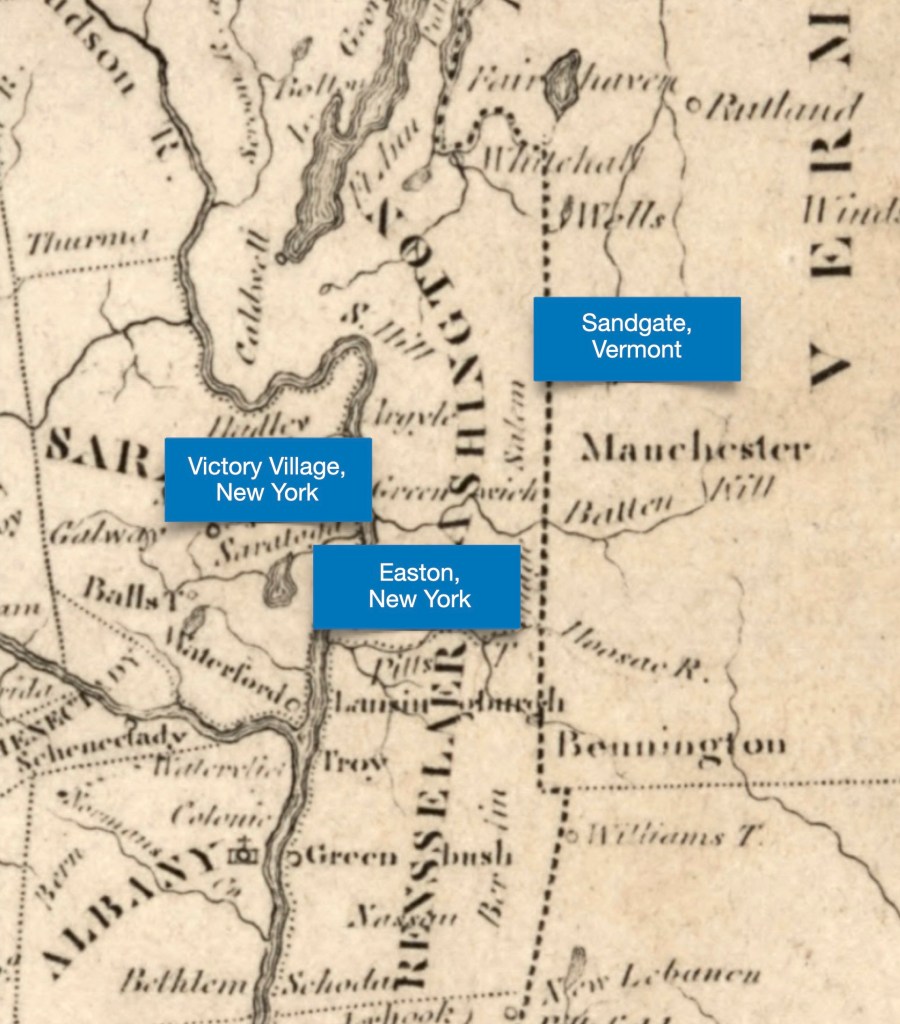
The above map shows the eastern edge of New York State and the western edge of Vermont as they abutted each other just after the War of 1812, and before the commencement of the Civil War. The three principal communities indicated show where our ancestors lived during this period, prior to the westward emigration of our Great-Great-Grandparents to the Ohio Country. (1)

Learning From the 1855 New York State Census

Here is what makes the 1855 New York state census unique and also very helpful with our research: “The 1855 New York state census is notable because it was the first to record the names of every individual in the household. It also asked about the relationship of each family member to the head of the household—something that was not asked in the federal census until 1880. 

The 1855 New York state census also provides the length of time that people had lived in their towns or cities as well as their state or country of origin—this is particularly helpful for tracing immigrant ancestors. If born in New York State, the county of birth was noted, which is helpful for tracing migration within New York State.”

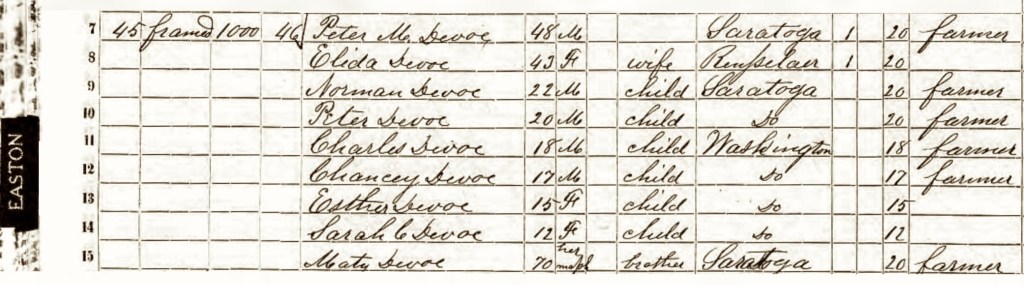
Peter A. DeVoe is listed on line 10, as being 20 years old, living in his parents’ home, working as a farmer, and that he was born in Saratoga County, New York.

1855 New York State Census for Easton, Washington County.

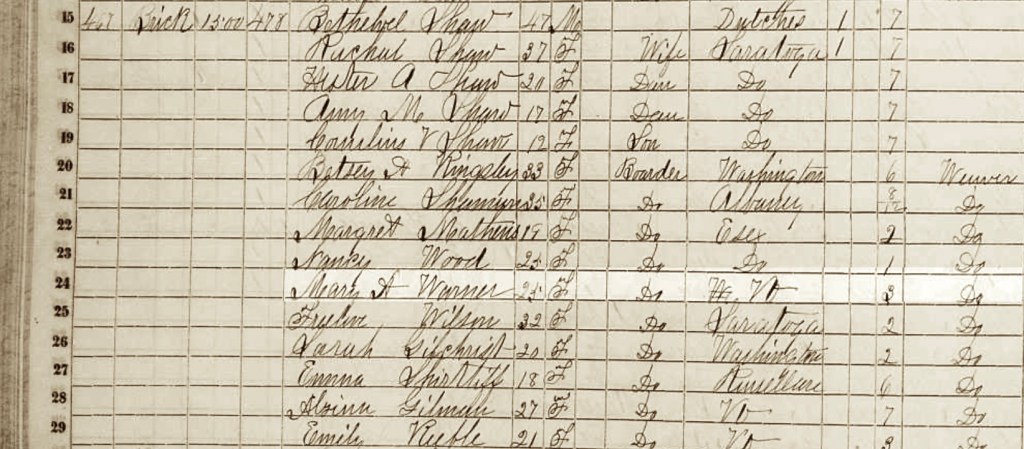
In 1855, Mary Ann was already residing in the town of Wilton* in Saratoga County, for three years, having moved there from Sandgate, Vermont. She is shown on line 24, as being 22 years old, and working as a weaver. We can also observe that she was born in Vermont, and that she is a boarder among ten other women who are also working as weavers. All of these women are living in a boarding house belonging to Bethelvel Shaw.

1855 New York State Census for Wilton, Saratoga County.

*In carefully analyzing the census materials, we learned that the landlord, Bethelvel Shaw and his family, ran a boarding house (which appears to have been situated amongst other boarding houses), in Victory Village, Saratoga County, New York. For both the 1855 and 1860 censuses, it is that same location, [despite being recorded as Wilton on the 1855 census].

Left to right, top: A cotton flower and bole, a millworker weaver working bobbins.
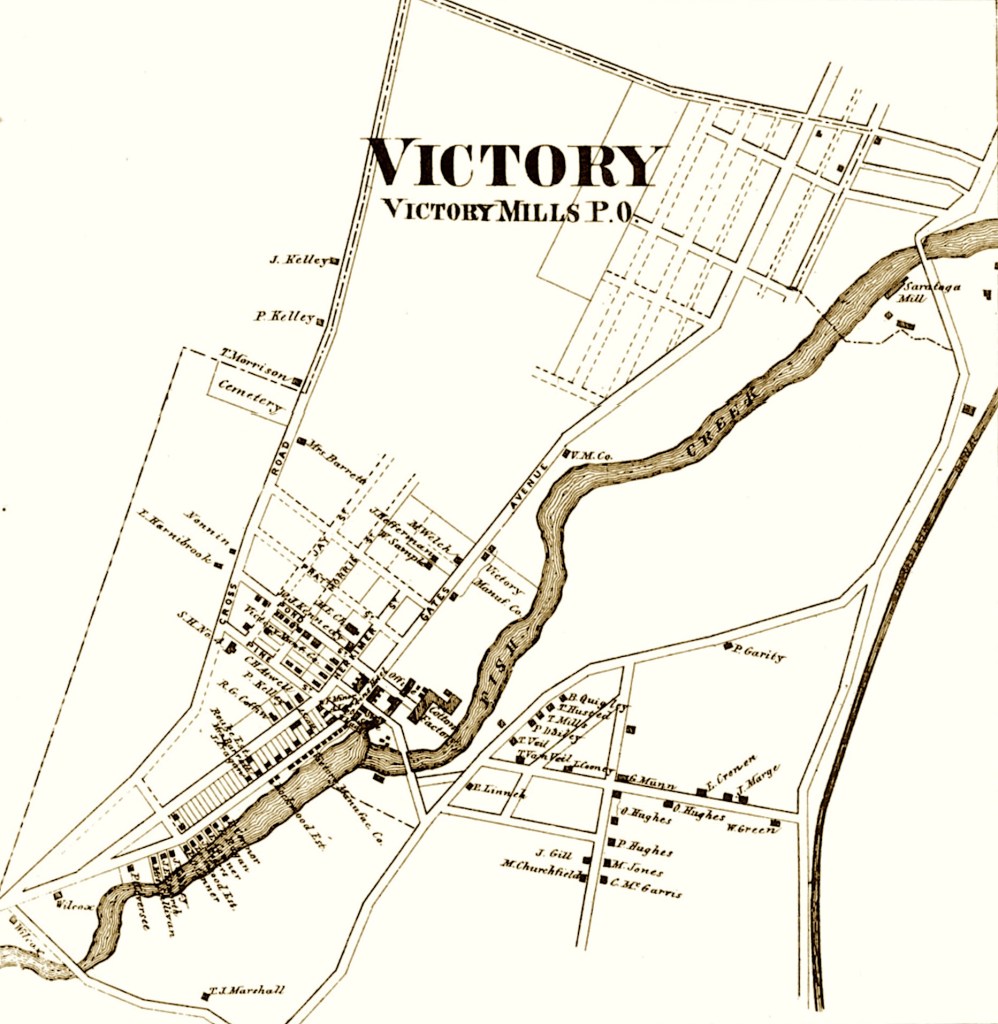
Center: Map of the Victory Mills hamlet in Saratoga County, New York, where our 2x Great Grandmother Mary Ann lived and worked in the early 1850s. Bottom: Stereoscopic view of a cotton mill in Lowell, Massachusetts, (See footnotes for credits).

When Mary Ann Warner lived there she worked as a weaver, so we analyzed histories of Saratoga County and maps from that era. We learned that there were very few mills that processed wool or cotton in Saratoga County during the period of 1852 through 1855. Having determined that she was recorded as living in Victory Village, the only place she could have worked at was the nearby Saratoga Victory Manufacturing Company. (2)

The Saratoga Victory Manufacturing Company

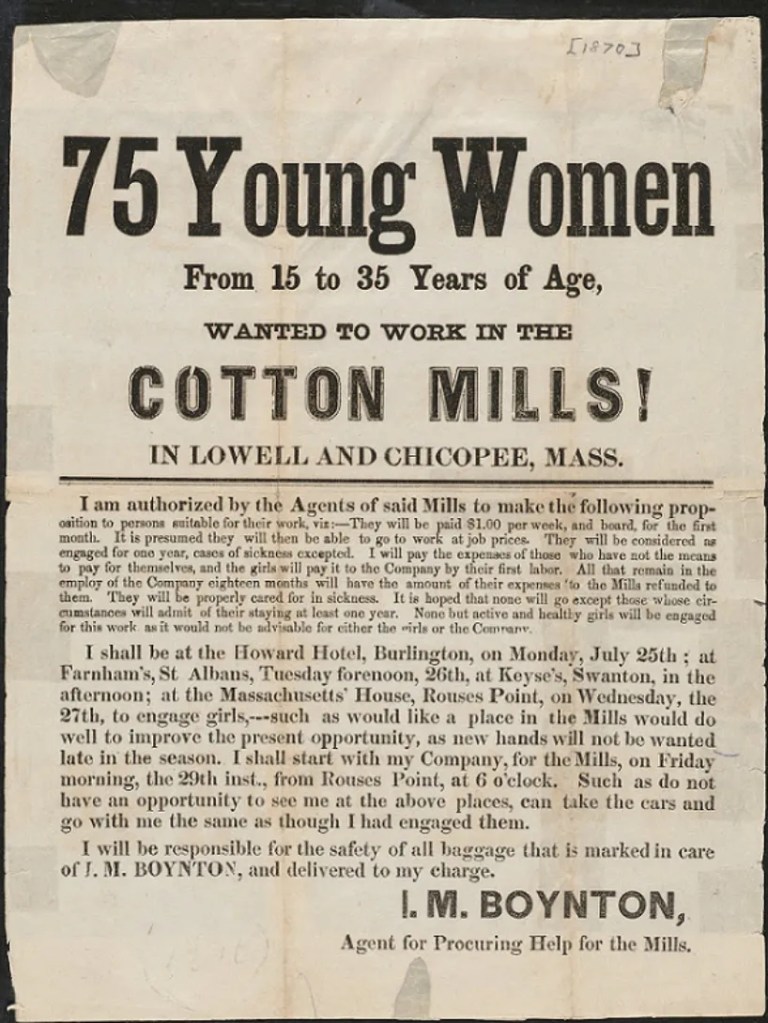
We don’t know what brought Mary Ann Warner to come and leave Vermont and move to Saratoga County, New York, but it plausibly could have been for economic opportunity. In the 1820s, one of the first cotton factory mills to have opened to great success in the United States was in Lowell, Massachusetts, and word likely spread out from there about employment.

As the National Park Service writes: “The term ‘mill girls’ was occasionally used in [1840s] antebellum newspapers and periodicals to describe the young Yankee women, generally 15 – 30 years old, who worked in the large cotton factories… To find workers for their mills in early Lowell, the textile corporations recruited women from New England farms and villages.”

Female textile workers often described themselves
as
mill girls, while affirming the virtue of their class and
the dignity of their labor. 

These “daughters of Yankee farmers” had few economic opportunities, and many were enticed by
the prospect of monthly cash wages and room and board
in a comfortable boardinghouse.

The Mill Girls of Lowell
The National Park Service

Beginning in 1823, with the opening of Lowell’s first factory, large numbers of young women moved to the growing city. In the mills, female workers faced long hours of toil and often grueling working conditions. Yet many female textile workers saved money and gained a measure of economic independence. In addition, the city’s shops and religious institutions, along with its educational and recreational activities, offered an exciting social life that most women from small villages had never experienced.”

Recruitment flyer for mill workers, circa 1840s.
(Image courtesy of Medium, via Thinking Citizen Blog).

Although not as famous as the factories in Lowell, Massachusetts, the Saratoga Victory Manufacturing Company grew to be a very large business enterprise. It operated under several owners until finally closing in the year 2000.

From the Eustace Families Association website:
“The village of Victory is a suburb of Schuylerville, Saratoga County, New York. Victory is located just south of Schuylerville on Fish Creek, a tributary to the historic Hudson River… Victory is the product of the industrial revolution. The number of textile mills, which required abundant waterpower, grew rapidly during the mid-1800s… [By 1846], The Saratoga Victory Manufacturing Company [was built as] a three-story cotton cloth manufacturing plant costing $425,000. The company flourished and the number of employees living near the mill increased. In 1850, the cotton mill employed 160 men, 209 women, working at 12,500 spindles and 309 looms and produced over 1,800,000 yards of cotton cloth.”

“The development and expansion of Victory Mill coincided with the Potato Famine in Ireland. As a result, many Irish Catholic immigrants found work at the mills and as early as 1847, there was already a significant number of Irish families settled there.” Observation: The frequency of Irish family names was something that we took note of when we analyzed the census materials. In this era, on our father’s side of the family, our Irish 2x Great Grandmother Elizabeth (McGuire) McMahon also worked as a weaver at a mill in Doune Village, Stirlingshire, Scotland. (See The McMahon and The McCall Lines, A Narrative). (3)

The City’s Shops and Religious Institutions… Offered an Exciting Social Life

To be honest, we really don’t know how, nor where, Peter A. and Mary Ann met. Were they introduced by friends at a dance, or a picnic? We have read that for many of the young women who worked in the mills, churches offered an acceptable social outlet for their young lives. At nearly 170 years ago, one can only conjecture what the circumstance was.

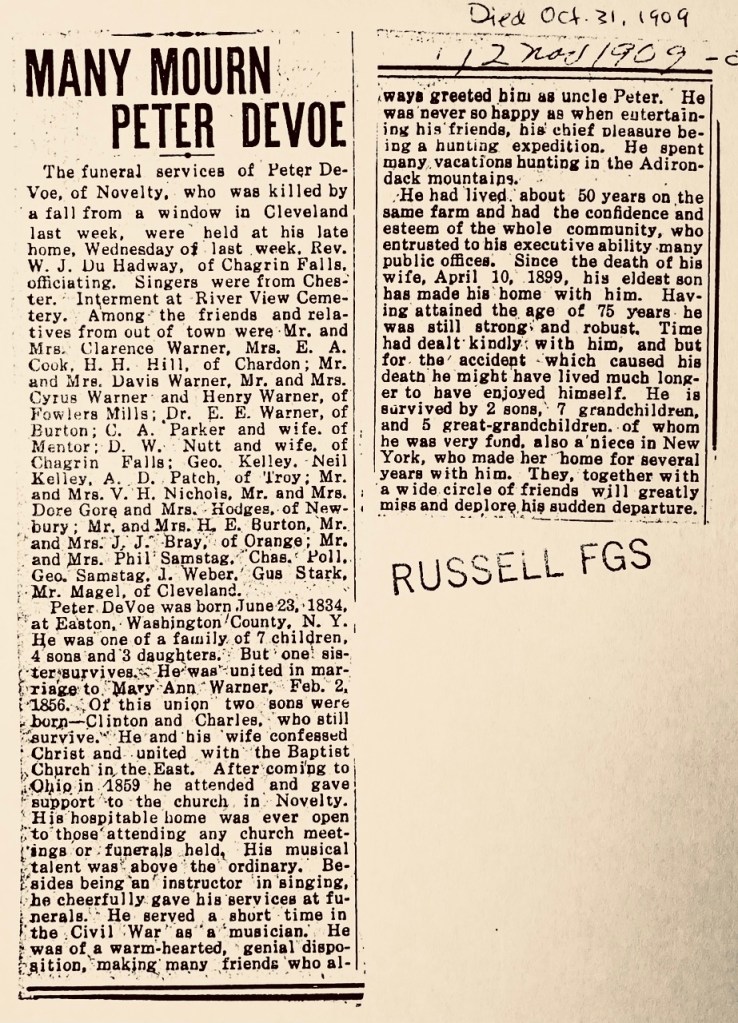
We also understand from his 1909 obituary, “He and his wife confessed Christ and united with Baptist Church in the East”. This explains how they became involved with the Baptist Church — but for all of the Dutch generations before him, his family had been devout members of the Dutch Reformed Church. Was this conversion the influence of Mary Ann’s family, or was it a natural progression of life, as one moves away from their parent’s home and ventures out into the world to find one’s self?

Photos to record the wedding of Peter A. and Mary Ann (Warner) DeVoe, circa 1856.
Marriage date: February 2, 1856
(Contemporary family photographs obtained from daguerratypes).
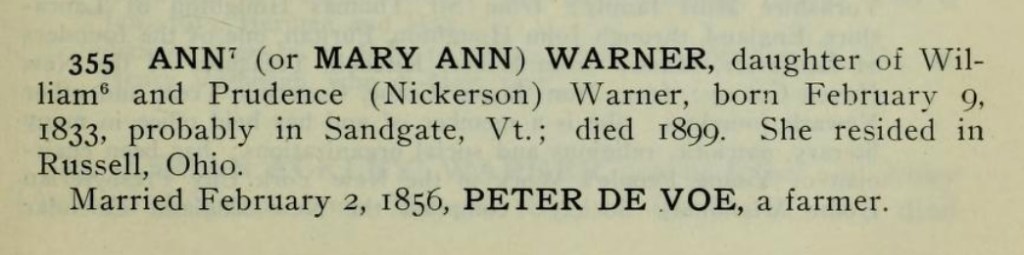
The Descendants of Andrew Warner > Seventh Generation, page 381.

Peter A. DeVoe and Mary Ann Warner were married on February 2, 1856. The location is likely either in Sandgate, Bennington County, Vermont, or in Easton, Washington County, New York. However, we cannot yet confirm the exact location, because a specific marriage record has not been discovered. We will keep on searching for it, but for now, we have relied on other credible sources for their marriage date. Mary Ann Warner is the youngest daughter of our 3x Great-Grandparents William Warner of Vermont, and his third wife, Prudence Nickerson.

Peter A. and Mary Ann had two children:

  • Clinton Chauncey DeVoe, born in New York, April 10, 1858 — died November 19, 1930 (We are descended from Clinton).
    For the specifics about Clinton Chauncey DeVoe’s life, please see
    The DeVoe Line, A Narrative — Ten.
  • Charles Raymond DeVoe, (see below)

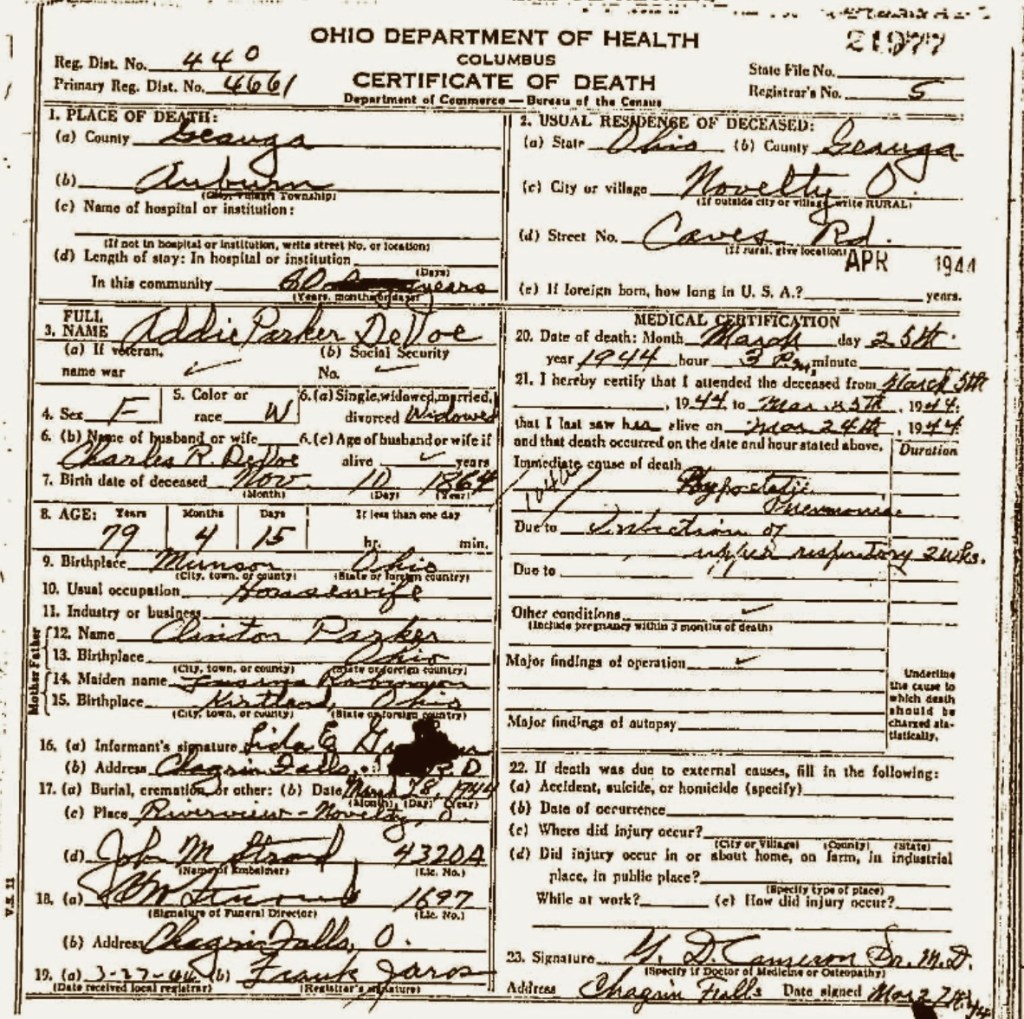
Charles Raymond DeVoe was the younger son in the family. He was born at home in Russell, Geauga County, Ohio on November 4, 1861. He died July 28, 1939 also in Russell, Ohio. Charles DeVoe married Adeline M. “Addie” Parker, on November 4, 1884, in Geauga, Ohio. She was born on November 10, 1865 in Munson, Geauga, Ohio, the daughter of DeWitt Clinton Parker and Lucina Robinson. She died on March 25, 1944 in Auburn, Geauga, Ohio. (4)

Marriage License for Charles R. Devoe and Addie M. Parker,1884.

The Years Before the Civil War — How Did They Travel?

We do not know by which route Peter A., Mary Ann, and young Clinton Devoe traveled to Northeast Ohio. In the late 1850s, for people emigrating westward to Ohio from the counties in New York and Vermont where our ancestors lived — they would have likely traveled by a combination of canals, railroads, and roads.

This contemporary image indicates the travel options that existed in the 1850s
between Saratoga County, New York and the Western Reserve of Ohio. (Image courtesy of Quora).
Red = roadway routes, Blue = canal routes, Black = railway routes

The Canal Routes
The primary water route was a series of linked canals, dominated by the Erie Canal, which connected with the Champlain Canal. The Champlain ran between the Saratoga and Washington County borders, where Peter A’s parents and other relatives lived. It would have been very easy for them to access this route. Wikipedia states about the Erie, “The Erie’s peak year was 1855 when 33,000 commercial shipments took place.”

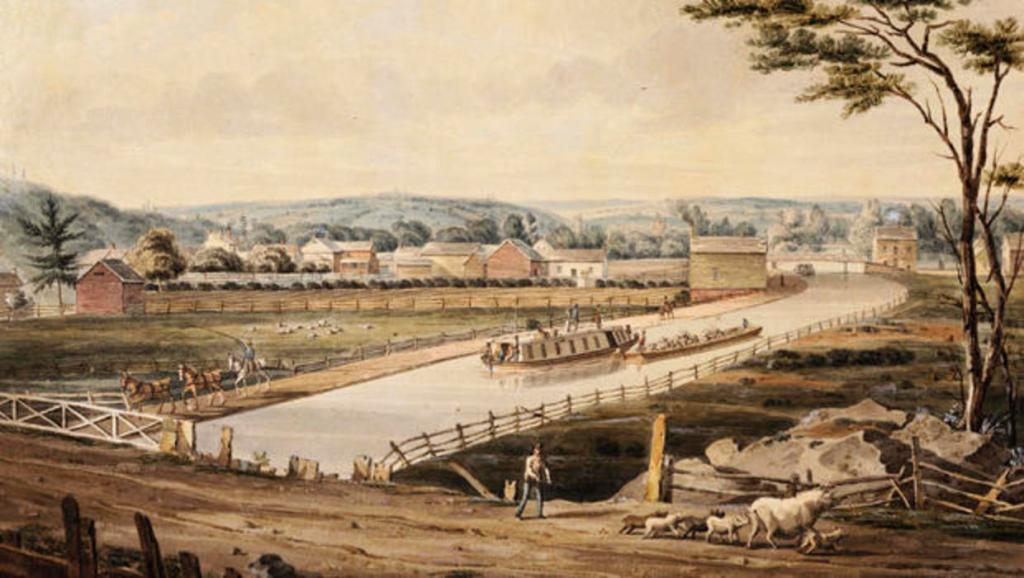
View on the Erie Canal (1830-32) by John William Hill
via The New York Public Library.

The Railway Routes
During this decade, railroad lines were also being constructed. If a traveler were fortunate, a rail line might exist for their destination. From Wikipedia: “The Mohawk and Hudson Railroad opened in 1837, providing a bypass to the slowest part of the canal between Albany and Schenectady. Other railroads were soon chartered and built to continue the line west to Buffalo, and in 1842 a continuous line (which later became the New York Central Railroad and its Auburn Road in 1853) was open the whole way to Buffalo.

The Roadway Routes
Roadways, however, were a rough, mixed-bag of environments. What type of road surface one encountered depended upon the circumstances of the area you were passing through. There were: improved surfaces, packed dirt, corduroy (felled trees were used as planks), and pathways through fields. Taking a land route the entire way would have been the most difficult option.

We heard family stories about wagon travel, but to be honest, we just do not know how they made their way to northeast Ohio. What we do know is that the western end of the Erie Canal, and the endpoint for the railroads [in 1859], was at Buffalo, New York, on Lake Erie. This became the decision point about what to do next.

Inset image: Horse drawn covered wagon. (Image courtesy of Little House books).
Background image: Gathering With Covered Wagon, 20th century image correct for
Conestoga wagon, oxen, style of dress, and Ohio designation.
(Image courtesy of digitalcommonwealth.org).

At Buffalo, a horse drawn wagon, or a heavy covered wagon such as the Conestoga wagon, would have been required for travel across Pennsylvania to the their new home in the Western Reserve of Ohio. This type of wagon was extremely popular in the years just before the Civil War, which started in 1861. (5)

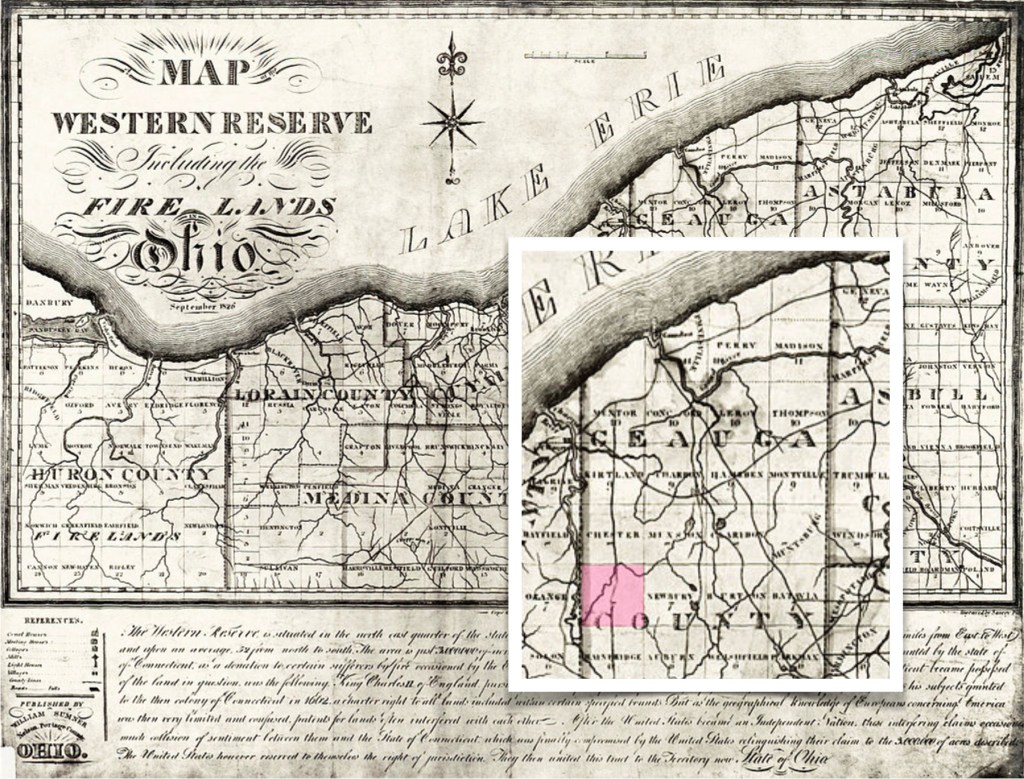
Map of the Western Reserve Including the Fire Lands 1826. On this map, Geauga County is still combined with the future Lake County and Russell township (pink area) is not yet named. (Image courtesy of Wikimedia Commons).

Many New Englanders Were Moving to the Western Reserve in Ohio

We believe that their attraction to northeast Ohio was most likely because the influence of family members from Mary Ann’s side of the marriage. She was part of a large, extended Warner family.

Note: Her father William S. Warner Sr., was married three times: first to Lucy Coan which brought seven children into the world, and second to Abigail Root —a brief marriage due to Abigail’s death; without children. William Warner’s third marriage was to Mary Ann’s mother, Prudence B. Nickerson, bringing four more children.

From William’s first marriage to Lucy Coan, five older brothers of Mary Ann’s were living in the Western Reserve of Ohio, all of them in Geauga County. Her older sister, Lucina married Clark Reed and they settled in Pike County, in southeast Ohio. The Warner siblings migrated to Ohio in two waves. The first was in the 1830s, and the second was in the 1850s. The Willoughby Independent Newspaper, of Willoughby, Ohio, in 1881, recounts:

“Out of a family of eleven children of William Warner, Sr. of Sandgate, Bennington County, Vermont, seven migrated to Geauga County, Ohio at a time in American history when Ohio was considered the far west. Six located permanently in Geauga County, the other, Lusina (Warner) Reed, removed with her husband Clark Reed, to Pike County, Ohio.”

“The first to arrive was Gaylord C,. who came in 1830 followed the next year by his brothers, William Jr., Joseph and Benjamin and later John and a sister, [Mary] Ann, who married Peter DeVoe and settled in Russell. For the past 120 years these Warners, with their descendants, have contributed their bit to the progress of the Western Reserve. There are at present descendants of the family living in 10 of the 16 townships of Geauga. Besides many who moved on to help build a bigger and better America.” For many decades up to the present time, a yearly Warner Family Reunion has been held. The first reunion was in 1880 at the home of William Warner Jr.

Peter A. DeVoe’s 1909 obituary states that they entered Ohio in 1859. The 1860 United States Federal Census records them living in Russell township, Geauga County, Ohio.

1860 United States Federal Census for Russell township, Geauga County, Ohio.
1863 Civil War draft registration record for the counties of northeast Ohio in 1863.
Note that below Peter’s name is his younger brother Chauncey Devoe,
who must have been living in the area before he returned to New York state.

In the midst of the Civil war period, Peter A.’s younger brother Chauncey must have been living in the area, because he and Peter registered for Civil War service. Even though the War did not affect Ohio very much, Peter’s obituary in 1909 states, “His musical talent was above the ordinary… He served for a short time in the Civil war as a musician.”

March 1870 United States Federal Census for Russell township, Geauga County, Ohio.

By the time of the March 1870 census, Prudence Warner, Mary Ann’s mother, is living with them. We observed that one of the children listed — Warren French, is the neighbor’s child who must have been residing there also. We are neither sure when, nor how, Prudence Warner in her elder years traveled to Ohio from Sandgate, Vermont. Since it was the 1860s, railroad lines were fast developing, and it is quite possible that perhaps the entire trip was by railroad. (6)

Russell Township, from the Atlas of Lake and Geauga Counties 1874, Ohio
Published by Titus, Simmons and Titus, Philadelphia. Image courtesy of historicmapworks.com.

The Last Township to be Named

If you look carefully at the 1826 Western Reserve Firelands map/illustration a few paragraphs above, you can see that Russell township is not yet named. When researching why this is, we came across this passage from the 1878 book, the History of Geauga and Lake Counties, Ohio:
“Russell was the last to be peopled, of all the townships, and the most of her early inhabitants removed to her borders from the surrounding country. This is said by her historians to have resulted from the high prices at which the proprietors held the land. It was also due to the generally low estimate which prevailed, set upon her soil and timber.”

This was rather startling to read, because (at present) the township is heavily forested and there is also much farmland. We wonder if perhaps local politics and land speculation was affecting the early settlers, of which there were many in our family. From the 1880 edition of the Pioneer and General History of Geauga County..., we learned that both aspects were true.
“At the commencement of its settlement, it was called the West Woods by the people of Newbury. The reason why it was not settled as soon as the adjoining townships, I suppose, to be that the speculators who bought of the Connecticut Land company, held it out of the market, or held it above the market price.”

Interestingly, we learned that other people from Bennington County, Vermont, where the Warner family hailed from, were present in the area since the 1820s…
“Clark Robinson moved from Shaftsbury, Bennington County, Vermont, to Middlefield, in the fall of 1820… and bought a lot of land in Russell Center at three dollars per acre…on the eighth of November, 1825, moved his family into the body of a log house…” (7)

The Legacy of Briar Hill and Old Riverview

Riverview Chapel, 1930s newspaper epherma, Old Riverview / Briar Hill Cemetery,
Russell township, Ohio.

Amongst old family ancestry records we discovered a portion of a small 1910s(?), 1920s(?) newspaper article about our 2x Great Grandfather Peter A. Devoe. It describes how in earlier years he had donated a portion of his land to create the Riverview Cemetery, an adjunct to the Briar Hill Cemetery. If you examine his property map (shown above) from 1874, you can discern on the upper corner that it says Wesleyan Cemetery and shows a small indication labeled ‘Ch’ for a church, or chapel.

From the 1880 edition of the Pioneer and General History of Geauga County..., we discovered this:
“The Wesleyan Methodist Church. — About the year 1848 there was a division among the Methodists on the slavery question, a part of the members withdrew, and a Wesleyan Methodist church was organized embracing two families that were left of a Congregational church, that was formed in the northwest part of Russell, in the summer of 1840, when J. M. Childs was chosen deacon, and A. H. Childs was chosen clerk, which had become reduced to the two families mentioned, when their organization was given up, and they, uniting with those who came away from the Methodist Episcopal church, formed the Wesleyan Methodist church, and in 1850 they bought a piece of land of L. T. Tambling, two miles north of the center, on the west side of the Chillicothe road, a nice sandy knoll for a burying ground, and to build a meeting house on, and four of them paid for it, to-wit: H. Cummins, John Wesley, David Nutt, and J. M. Childs, and had it deeded to the trustees of the first Wesleyan Methodist church in Russell, and to their successors in office. The first three named that paid for the burying ground are dead and gone to their reward ; Mr. Childs is living yet. He says that in 1851 they began to make preparations to build a meeting house, but, being poor, and new beginners, it went on slow, but with a hard struggle with poverty and bad management, it was finished.”

The Wesleyan Cemetery eventually became known as Briar Hill Cemetery. The meeting house became the Riverview Chapel where Baptist religious services were held. Peter A. Devoe and his extended family members gathered there for worship. Our Grandmother Lulu Mae (DeVoe) Gore often spoke of his love of music and how he would lead musical performances at the chapel.

There are six generations of our family buried in Riverview Cemetery. These family lines are: Bond, DeVoe, Gore, McClintock, and Warner. (8)

They Joined Their Ancestors

Both Peter and Mary Ann were descended from many generations of people who earned their living as farmers from an agrarian economy. They carried on that tradition, as their sons did after them.

Mary A. Devoe death record, 1899.

Mary Ann (Warner) DeVoe was the first to pass away on April 10, 1899. We have found two records about her death, and they indicate that she died from either consumption, or measles.

Peter A. DeVoe was born on June 23, 1834 in Saratoga County, New York. After his wife Mary Ann passed away, he lived into the 20th century for another ten years . He died on October 31, 1909 from an accidental fall. This newspaper account describes what happened. Peter’s obituary (further below) speaks to how beloved he was in his community. (9)

An account of his death was published in
The Geauga Republican, or the Cleveland Leader, on November 3, 1909.
Peter died on October 31, 1909. This obituary was published (likely in the Geauga Republican)
on November 12, 1909.

In the next chapter we will write about Peter and Mary Ann’s son Clinton Chauncey DeVoe, his wife Clara Antionette McClintock, and their children.

Following are the footnotes for the Primary Source Materials,
Notes, and Observations

A Chip Off The Old Block?

(1) — one records

Library of Congress
State of New-York for Spafford’s gazetteer, 1813
https://www.loc.gov/resource/g3800.ct003432/?r=-0.195,0.049,1.46,0.862,0
Note: For a portion of the map image.

Learning From the 1855 New York State Census

(2) — eight records

New York Genealogical & Biographical Society
New York State Census Records Online
https://www.newyorkfamilyhistory.org/subject-guide/new-york-state-census-records-online#1855

Peter M Devoe
in the 1860 United States Federal Census

New York > Washington > Easton
https://www.ancestry.com/discoveryui-content/view/48630571:7667?tid=&pid=&queryId=35ec4bd5-43de-42e5-bb2e-505bfa1707e1&_phsrc=Rxw27&_phstart=successSource
Book page: 160, Digital page: 28/80, Entries 23 through 29.

Mary A Warner
Census – New York State Census, 1855

https://www.familysearch.org/ark:/61903/1:1:K63D-4G5
Digital page: 247/481, Entry 24.
Note: This census is recoded as Election District 2 / Wilton, but the location it covered for our Great-Great-Grandmother Mary Ann Warner is actually the small town of Victory Village, just south of Wilton. See the notes below on Bethuel Shaw.

Bethuel Shaw (or Nathaniel Shaw)
https://www.findagrave.com/memorial/118426704/bethuel-sha
Notes: Much research was done on Bethuel Shaw, and the following was determined — He and his family ran a boarding house (which appears to have been situated amongst other boarding houses), in Saratoga County, New York. For the 1855 “Wilton” census and for the “Victory Village” 1860 census, it is the same location because the names of the neighbors are exactly the same (the Taylor family and the Kelly family). On the 1860 census, his name Bethuel is recorded as Nathaniel.

History of Saratoga County, New York, with Biographical Sketches of Some of its Prominent Men and Pioneers
by Nathaniel Bartlett Sylvester, 1878
https://archive.org/details/cu31924028833064/page/n7/mode/2up

New Topographical Atlas Of Saratoga Co. New York
From Actual Surveys by S.N. & D.G. Beers and Assistants

Stone & Stewart, Publishers. Philadelphia. 1866
https://mathcs.clarku.edu/~djoyce/gen/saratoga/Atlas.html

Gossypium barbadense, cotton plant
Illustration from the Botany Library Plate Collection held at the
Natural History Museum, London
https://www.mediastorehouse.com.au/mary-evans-prints-online/gossypium-barbadense-cotton-plant-8613143.html
Note: For the cotton plant illustration.

Resources for History Teachers
The New England Textile Industry in the 19th Century
http://resourcesforhistoryteachers.pbworks.com/w/page/125185436/The%20New%20England%20Textile%20Industry%20in%20the%2019th%20Century
Note: For the Lowell, Massachusetts stereoscopic view card mill image.

The Saratoga Victory Manufacturing Company

(3) — four records

The Mill Girls of Lowell
https://www.nps.gov/lowe/learn/historyculture/the-mill-girls-of-lowell.htm#:~:text=To find workers for their,board in a comfortable boardinghouse.

Eustace Families Association
http://www.roneustice.com/Family History/IrishFamiliessub/EustisVictoryMills/VictoryMills.6.7.09.htm

Thinking Citizen Blog — Massachusetts (Part Two) Textiles, Shoes, Telephones
https://john-muresianu.medium.com/thinking-citizen-blog-massachusetts-part-two-textiles-shoes-telephones-55beeb38c6de

“Several companies owned and operated the facility over the years and unfortunately ended up closing its doors in 2000.”
https://www.villageofvictory.com/about-historical-victory/

The City’s Shops and Religious Institutions… Offered an Exciting Social Life

(4) — five records

The Descendants of Andrew Warner
> Seventh Generation
Compiled by Lucien C. Warner and Mrs. Josephine Genung Nichols
https://archive.org/details/descendantsofand00warn/page/380/mode/2up?view=theater
Book page: 381-382, Digital page: 380-382/804, Right page, entry 355.
Note: “Ann (or Mary Ann) Warner marries Peter DeVoe”

Charles R. Devoe
Marriage – Ohio, County Marriages, 1789-2016

https://www.familysearch.org/ark:/61903/1:1:XD2M-HMQ
Book page: 321, Digital page: 182/516      Right page bottom, entry 3.
Note 1: Spouse is, Addie Parker / Adeline M. Parker
Note 2: Marriage date, November 4.1884, in Geauga County, Ohio

Chas Raymond Devoe
Death – Ohio Deaths, 1908-1953

https://www.familysearch.org/ark:/61903/1:1:X8MR-L8D
Digital page: 1544/3320
Note: This file also documents his birth date.

Charles Raymond DeVoe death certificate, 1939.

Addie Parker Devoe
Death – Ohio Deaths, 1908-1953

https://www.familysearch.org/ark:/61903/1:1:X8ML-Y6F
Digital page: 2697/3295
Notes: Birth date and location, death date and location. 

Addie M. (Parker) DeVoe death certificate, 1944.

Adeline M. Parker
https://www.familysearch.org/tree/person/details/99B3-JDD
Note: Addie DeVoe’s parents are: DeWitt Clinton Parker and Lucina Robinson.

The Years Before the Civil War — How Did They Travel?

(5) — five records

Quora map image
How would someone in the 1850s get from New York to Kansas?https://www.quora.com/How-would-someone-in-the-1850s-get-from-New-York-to-Kansas

CBS News
All Hail The Erie Canal
“View on the Erie Canal” (1830-32) by John William Hill
via The New York Public Library
https://www.cbsnews.com/news/all-hail-the-erie-canal-200th-anniversary/
Note: For the landscape painting.

Erie Canal
https://en.wikipedia.org/wiki/Erie_Canal

Covered Wagon With Horses photo
Little House Books
http://lhbooks.weebly.com/covered-wagons.html
Note: For the covered wagon image in color.

Gathering With Covered Wagon
by Associated Photofeature Syndicate, 58 Charles Street, Boston, Massachusetts
https://www.digitalcommonwealth.org/search/commonwealth:0r96gd67j
Note: For the covered wagon image, sepia toned.

Many New Englanders Were Moving to the Western Reserve in Ohio

(6) — six records

Western Reserve Including the Fire Lands 1826
https://commons.wikimedia.org/wiki/File:Western_Reserve_Including_the_Fire_Lands_1826.jpg
Note: On this map, Geauga County is still combined with the future Lake County and Russell township is not yet named.

North America, Family Histories, 1500-2000 for Ann Warner
W > Warner > The Descendants of Andrew Warner
https://www.ancestry.com/imageviewer/collections/61157/images/46155_b290135-00262?usePUB=true&usePUBJs=true&pId=1810137
Book page: 254-255, Digital page: 262-263/812
Note: Entry 355 on page 263, is a notation for her marriage to Peter Devoe.

P Devon
in the 1860 United States Federal Census

https://www.ancestry.com/discoveryui-content/view/43403745:7667?tid=&pid=&queryId=a14478bc-ce31-4745-9564-8089cb4f9791&_phsrc=cUK2&_phstart=successSource
Book page: 18, Digital page: 18/25, Entries 27-29.

Peter Devoe
in the U.S., Civil War Draft Registrations Records, 1863-1865

Ohio > 19th > Class 1, A-K, Volume 1 of 4
https://www.ancestry.com/discoveryui-content/view/1035699:1666?tid=&pid=&queryId=74778971-fe58-4cc5-a090-2f50318fd932&_phsrc=cUK4&_phstart=successSource
Book page: 145, Digital page: 168/338, Entries 13 and 14.

Peter De Voe
Census – United States Census, 1870

https://www.familysearch.org/ark:/61903/1:1:M62W-W7Z
Book page: 2-3, Digital page: 612-613/733
Notes: Entries 35 through 40 at the bottom of the left page and entry 1
at the top of the (next right) page.

Extracts from the Willoughby Independent, 1881, Willoughby, Ohio Newspaper
Judy Jane Stebbins, 3/1/2013
https://usgenwebsites.org/OHLake/newspaper/Willoughby%20Independent%201881c%20Stebbins.pdf

The Last Township to be Named

(7) — three records

Cover for the Atlas of Lake and Geauga Counties 1874, Ohio.

Historic Map Works
Russell, Fowler’s Mills
From Lake and Geauga Counties 1874, Ohio

Published by Titus, Simmons and Titus in 1874
https://historicmapworks.com/Map/US/24292/Russell++Fowler+s+Mills/

History of Geauga and Lake Counties, Ohio
https://archive.org/details/oh-geauga-lake-1879-williams/page/n9/mode/2up
Book page: 207, Digital page: 318/443

1798 – 1880, Pioneer and General History of Geauga County, with Sketches
of Some of the Pioneers and Prominent Men
by The Historical Society of Geauga County
Russell > For Early Proprietors, and > Early Events:
https://archive.org/details/oh-geauga-1880-historical-society/page/109/mode/2up?view=theater
Book page: 109-110, Digital page: 109-110/821

The Legacy of Briar Hill and Old Riverview

(8) — two records

Russell Township
Township Cemeteries
https://russelltownship.us/departments/administration-1/cemetery
Note: For the Riverview Chapel image.

1798 – 1880, Pioneer and General History of Geauga County, with Sketches of Some of the Pioneers and Prominent Men
by The Historical Society of Geauga County
Russell > The Wesleyan Methodist Church
https://archive.org/details/oh-geauga-1880-historical-society/page/113/mode/2up?view=theater
Book page: 114, Digital page: 113/821

They Joined Their Ancestors

(9) — four records

Mary A. Devoe
Vital – Ohio Deaths and Burials, 1854-1997

https://www.familysearch.org/ark:/61903/1:1:F6D5-ST5
Book page: 8, Digital page: 435/469, Left page, entry #4828.
Note: her cause of death is listed as consumption (tuberculosis).

Peter Devoe
Death – Ohio Deaths, 1908-1953

https://www.familysearch.org/ark:/61903/1:1:X6XS-W2N
Digital page: 98/3051

Peter A. DeVoe death certificate, 1909.

Peter Devoe
in the Ohio, U.S., Rutherford B. Hayes Presidential Center Obituary Index, 1810s-2016

https://www.ancestry.com/discoveryui-content/view/2222115:1671?tid=&pid=&queryId=8f21bb29-7ea3-4d5b-9aed-f7ae3dc6ea30&_phsrc=bTB3&_phstart=successSource

Ohio, U.S., Wills and Probate Records, 1786-1998 for Peter De Voe
Geauga > Probate Files, Dutton, Charles O-Downing, Cornelia A
https://www.ancestry.com/imageviewer/collections/8801/images/005441006_01234?pId=15350799
Digital pages: 1234 through 1250
Note: There are about 17 images in this docket.

Peter Devoe
in the Ohio, U.S., Death Records, 1908-1932, 1938-2018

D
https://www.ancestry.com/discoveryui-content/view/6201688:5763?tid=&pid=&queryId=138f15d6-7ebf-4d55-ae45-6660f57adcfa&_phsrc=Wxe18&_phstart=successSource
Book page: 335, Digital page: 30/2684, Entry 15 from the bottom.

The Gore Line, A Narrative — Seven

This is Chapter Seven of eight. We have been covering many interesting centuries of the Gore Family and their forebears, but now we are coming up on these modern times. For the most part, our ancestors are now firmly established in Ohio, living as either farmers, tradesmen, or keeping house.

Where Did These Things Come From?

Tucked in among the paperwork and family ephemera we went through when our Grandmother Lulu Gore died in 1975, were several different anti-slavery newspapers. They both surprised and baffled us because our family stories were silent on the subject of slavery — we wondered how these things had come into the family.

A clue was hiding in plain site on the top of one of the newspapers, where the name Wm Munn had been written in with a quill pen. (This was not really a surprise, because the local Munn family had been in the area as long as our family had, and perhaps, even a bit longer. However, we didn’t see the connection yet). Almost 50 years later, the mystery was solved when we wrote The Gore Line, A Narrative — Six, our previous chapter. In that section, we learned that our Great-Great-Grandfather Luke Gore had been a town clerk in Newbury township, Ohio for the years 1842 and 1844. Looking more closely we observed that William Munn, had served in the same role in 1843 and 1845. It seems then they must have been friends and alternated in this role over the four years.

These newspapers are, the —

  • Geauga Republican & Whig, March 18, 1845
  • National Anti-Slavery Standard, July 22, 1847
  • National Anti-Slavery Standard, May 13, 1852

This got us to thinking about the role that the people of the Western Reserve played in the years leading up to and including the Civil War. In the early part of the 18th century, the Ohio Country was frequently referred to as the West, and from the perspective of New Englanders who settled it, it was indeed pioneer country. By the 1850s and 60s, the Western Reserve wasn’t thought of as a frontier anymore, but actually, it still was — that frontier being a psychological perspective, a state-of-mind about what it meant to be a good citizen in this newly-created country. (1)

The New England of The West

From an article written in 1957, titled The Connecticut Reserve and The Civil War, we learned several interesting perspectives about the area. “Within this region [of] some three million acres, approximately the size of Connecticut herself… [and] modified only slightly by contact with the frontier, the area became more like New England then New England itself.”

This meant that there was a moral fervor, conditioned by the churches of Protestant Puritanism, which had been transplanted from the New England states, to this new area. Furthermore, the “leveling tendencies” of the frontier experience had deepened the ideas of New England “democracy” within the population of settlers.

This resulted in an emphasis on “the democracy of the town… [and] Eastern culture provided a new synthesis in the field of popular education… social mobility and a re-affirmation of individual worth, equality, and dignity of man in general.” [Lottick] In other words, their state-of-mind, their ethos of hard work, having an education, using a democratic voice, and righteous behavior, was the desired standard. This was an empowering shift from of the previous generations who had chaffed under the rule of a capricious king in the British Colonies.

In the 19th century, the Western Reserve “was probably the most intensely antislavery section of the country”. 
John Brown Jr. called it, in 1859, “the New England of the West.”

Wikipedia article on the Connecticut Western Reserve,
discussing John Brown, Jr.

Twenty years before the Civil War, “According to the theory of Boston’s Wm. Lloyd Garrison and the American Anti-Slavery Society (1833), slavery was a personal and social sin requiring immediate repentance of slaveholders and all others who had failed to witness against the institution.” [Case Western]

The Western Reserve College and Oberlin College became centers of Abolitionist agitation. In truth, Oberlin’s abolitionist viewpoint “was strengthened further when recruits from the Lane Theological Seminary…joined its fold.” [Lottick] Abolitionism then, grew out the mingled influences of both religion and education in the area where our ancestors lived. “People known as abolitionists believed that slavery should not exist and fought to end it. Northeast Ohio was a hotbed of abolitionist activity. Men and women, Black and White, free and enslaved, worked together for their cause.” [Cuyahoga Valley National Park article]

In contrast, the Southern states during this period had flourished under a very different system that most New Englanders (and their transplants) found to be very strange. It was a way of life built upon the use of slaves — essentially, upon a class-and-caste system of belief. As such, the possibility of “social mobility and a re-affirmation of individual worth” were not part of the equation.

Top section, left image: Participants from the Oberlin-Wellington Rescue. Center image: Leg shackles used in the Trans-Atlantic slave trade. Right image: A painting of fugitives smuggled during winter, The Underground Railroad (1893 ) by Charles T. Webber. Lower section, left image: the National Anti-Slavery Standard newspaper, July 22, 1847, family document. Right image: April 24, 1851 “CAUTION!! Colored People of Boston” broadside warning of watchmen and police acting as kidnappers and slave catchers. [Please see the footnotes for specifics.] (2)

“Routes of the Underground Railroad.”
The Underground Railroad was not an actual railroad, but a network of secret routes and safe houses used by black slaves in the United States to escape to free states and Canada.
(Observation: There are so many red line over Ohio, that it looks like a cardiac diagram).

The Underground Railroad in the Western Reserve

The battles of the Civil War did not have a profound effect upon the Western Reserve territory, but the existence of the Underground Railroad did. In fact, initially there were many people in Cleveland who were not particularly concerned about the plight of slaves. This changed when “The completion of the Ohio Canal in 1832 enhanced the strategic importance of the city…” because this became one of the most direct routes from the slave-holding South, to freedom in Canada.

Furthermore, the indifferent attitude of some people changed dramatically when The Fugitive Slave Act was passed in 1850. This law lit a white hot fire under the Abolitionists. “The severity of this statute inspired an increased number of abolitionists, the development of a more efficient Underground Railroad, and the establishment of new personal-liberty laws in the North. These personal liberty laws were enacted in eight Northern States and prohibited state officials from assisting in returning fugitive slaves to the South…” [Case Western]

Our ancestors, being settlers from New England, and as evidenced by the anti-slavery newspapers, were likely concerned about and involved with, the abolitionist movement. We know for certain, that this branch of our family did not own slaves. (3)

The 1870s in Geauga County, Ohio

Luke Gore died in 1868, but several of his children continued to live in the area. When we reviewed the 1870 census, it showed that Dorr B. Gore is 18 and listed as living with his mother Electa, and his brothers Milan and Otto. They have a domestic servant, Myra Fowler — it turns out that she eventually married Dorr B.’s older brother Milan Gore on July 4, 1870. Observation: Perhaps this family liked holiday themed weddings? (Maybe it was budget-friendly and helped them save on decorations.)

Engraving of the Geauga County Courthouse reproduced from the
History of Geauga and Lake Counties, Ohio, by the Williams Brothers, circa 1879.

We observed that Luke Gore’s oldest son, Crockett Gore, was living with his wife Etta and their young family in Russell township. He was working as a farmer on land that his father had previously farmed (see The Gore Line, A Narrative — Six). From the Russell township Historical Society newsletter, March 1999: “Luke enlarged the farm, adding land in Russell to a total of 163.5 acres. After he died, his eldest son Crockett Gore, farmed the land.”

“He married a neighbor, Lois Havens, and they had Luke W., Dana and Ralph C. Luke W. is listed in our old school records as a student in the brick school in 1872. He died at the age of 17 in Russell, and Ralph C. also died young, aged 21. Both are buried with their parents in Munn cemetery in Newbury.”

“In 1882 Crockett built the home that is still there. He quarried sandstone for the foundation from a quarry on the farm, and cut and used wood from his own woodlot. He died in 1900 in Clio Michigan, but is buried in Munn cemetery in Newbury, with his parents, his wife Lois and a son who died at the age of 17.” (4)

The Kids Get Married! Dorr B. Gore Marries Ann Susan Booth

As always, times change, but love blooms eternal — starting the new year off right (!), our young Great-Grandfather Dorr B Gore (at just 21), married our Great-Grandmother, (even younger at 19), Ann Susan Booth, on January 1, 1872 in Burton, Geauga County, Ohio.

1872 Antique Victorian Home Insurance Company, promotional calendar.

Dorr B. Gore, born September 8, 1851 Newbury, Geauga County, Ohio – died June 11, 1930 Cleveland, Cuyahoga County, Ohio. Ann Booth was born October 30, 1852 Burton, Geauga, Ohio – died March 11, 1908 Newbury, Geauga, Ohio.

Ann’s parents are James Monroe Booth (March 12, 1827-July 8, 1889) and Adelia Rose (March 31, 1827-January 25, 1910), whose families were among the very first pioneers to settle in the Western Reserve area.

They had four children:

  • Nettie Belle (Gore) Robinson, born December 24, 1873 Geauga, Ohio – died April 20, 1922 Oblong, Crawford, Illinois.
  • Clara Edna (Gore) Matthews, born July 3, 1876 Auburn, Geauga, Ohio – died March 26, 1933 Russell, Geauga, Ohio (Note: it is interesting to observe that she is a centennial baby).
  • Forrest Munroe Gore, born August 11, 1878 Newbury, Geauga, Ohio – died January 31, 1930 Chagrin Falls, Cuyahoga County, Ohio

On the 1880 census, Dorr B. is 28 and also on the census are: Ann 28, Nellie 6, Clara 3, Forrest 1, his mother Electa 58, and the farm hand Elmer E. Brewer.

  • Harley William Gore, born June 7, 1881 Russell, Geauga, Ohio – died November 24, 1941 Newbury, Geauga, Ohio. (We are descended from Harley). (5)

Dorr B. Gore Had Two Wives

The Gores continued to live their lives mostly as farmers. Dorr B. Gore’s wife Ann Booth died on March 11, 1908 of heart failure after having had pneumonia for three weeks. Eighteen months later he married for a second time, to Amelia Harnden on October 12, 1909. A local resident, Amelia was born January 1, 1863 – died July 8, 1947, having outlived her husband Dorr B. by seventeen years.

Ann Susan (Booth) Gore death notice, March 1908. Source unknown.

A transcription of Ann Susan (Booth) Gore death notice:
August 7 — Ann Susan Booth, daughter of Monroe and Adelia Booth was born in Burton, Ohio, Oct. 30, 1851 where she lived until Jan. 1, 1872 when she married Dorr B. Gore of Newbury, where she lived the rest of her life. She had heart trouble for years and after a sickness of a little over three weeks with heart trouble and pneumonia she passed away Thursday morning, March 12, 1908, aged 56 years, 4 months, 12 days. She was a true kind and sweet disposition carrying love and sunshine where ever she went. She leaves a husband and four children who loved her and will miss her more than words can tell. Nettie B. Robinson, Clara E. Mathews, Harley W of Russell, and Forest M, who lives at the old home in Newbury, also an aged mother, Mrs. Adelia Booth, Burton. Three sisters, Mrs. P. D. Bishop, Andover, Mrs. Chas Stickney and Mrs. Carl Wicks of Burton, and her twin brother, Wm Booth of Midland, Mich. (6)

Tiny, but mighty. The modest and unassuming Union Chapel located in Newbury township, Ohio, is listed on the National Register of Historic Places.

The Union Chapel and “Equal Rights in Newbury”

Our Grandmothers never had the right to vote until the year that our mother Marguerite (Gore) Bond was born — in 1920. That’s still rather astonishing today, but her mother Lulu was 38 years old, before she had the right to vote. Here is how women’s suffrage happened in our local community.

When the Abolitionist movement was birthed, “Many were entering the political arena for the first time. Women in Northeast Ohio organized female anti-slavery societies, circulated petitions, served as delegates to state and national antislavery conventions, and drafted editorials that were published in local papers such as The Anti-Slavery Bugle. In time, growing political experience and awareness of the plight of enslaved people, inspired women to consider their own freedom more critically; the women’s suffrage movement grew from the ranks of the abolitionist movement.” [Cuyahoga Valley National Park article]

The Union Chapel “was built between 1858-1859 by outraged citizens after members of the Congregational Church across the street refused to allow future President James A. Garfield to speak, fearing his topic would be controversial.”

“At the time the area was a vibrant settlement with a grist mill, tannery, tavern wagon and blacksmith shops, a post office and other shops. The population was described as liberal… In retaliation for the church’s snub, Anson Matthews, a store owner and the man who had invited Garfield to speak at the church, donated a one-acre plot of his land across the street for the Union Chapel. Today, both of the buildings continue to face each other.”

“The Union Chapel’s premise was for a “public hall or meeting house for literary, scientific, moral and religious purposes and lectures on all useful subjects,” according to its deed. It was to be open and free and not to be used to the exclusion of anyone. Numerous important social reform movements were launched from within its walls.” [cleveland.com article]

Gallery, left image: James A. Garfield. Right image: Susan Brownell Anthony Images courtesy of the National Portrait Gallery.

Famous among the many speakers at the Union Chapel were James A. Garfield, the 20th President of the United States, and Susan B. Anthony.“She is known as a staunch advocate for women’s suffrage, [but] Anthony also participated in a wide spectrum of social reform movements.” 

Here, community reformers—mostly women, but men, too—pushed for progress considered radical for its time. Newbury, like other nearby towns, had been settled by travelers from the East, many from Massachusetts, then considered the center of culture and “advanced thinking.”

The unconventional truth is, the women of Newbury township started to get people’s attention when some of them rightly decided that-corsets-were-just- not-at-all-sensible. “The first reform movement, in 1870, called for women to dress without ‘unnatural and unhealthy’ corsets, bustles and sweeping skirts. ‘Dress reform’ advocate Ellen Munn caused quite a stir when she showed up at a community picnic in trousers.” [Esmont]

“Ruth Fisher was born on January 25, 1809 in Newbury, Ohio. She married William Munn on April 18, 1833.” [Northeast Ohio Suffrage article] We have met William Munn in the introduction to this chapter, as he was a friend and colleague of our Great-Great-Grandfather Luke Gore.

[The year 1871] “witnessed the most significant crusade in the chapel’s history—to secure the right of women to vote.” [Esmont]

“The dress reform organization led to the formation of the South Newbury Woman’s Suffrage Political Club… [It] was established after a group of women, including Munn, presented themselves at the polls to vote in a previous election, but were refused. The chapel served as an incubator for the budding suffrage movement, and became home to the second-oldest women’s suffrage group in Ohio. In 1871, Munn was one of nine women to illegally cast a ballot in a local election at the Chapel, becoming one of the first female voters in Ohio’s history.” [Northeast Ohio Suffrage]

“More women would show up at subsequent elections to cast ballots. An account in the Geauga Republican newspaper from 1873 stated the election judges were “courteous and gentlemanly, as usual” but declined the votes. The women—and the men who supported them—inscribed 50 ballots: “People’s Ticket. Equal Suffrage for all Citizens of the United States, an Inalienable and Constitutional Right. Knowledge and Truth in Opposition to Ignorance and Prejudice.” [Esmont]

On the occasion of the 100th anniversary of the founding of the United States, on July 4, 1876, the Suffrage Club members planted a tree which came to be known as the Centennial Oak.

Top row, left image: Ruth (Fisher) Munn. Center image: Illustration of typical corsets worn in the 1880s. Right image:Dr. Julia Porter Green, shown August 23, 1919. She was the only surviving charter member of the South Newbury Woman’s Suffrage and Political Club to attend the August 23, 1919 procession at the South Newbury Union Chapel, as shown in the bottom image —”On Aug. 23, 1919, suffragists marched from South Newbury Union Chapel to a wreath-laying at the nearby Centennial Oak to commemorate the 19th Amendment”, via [Valiant Visionaries of the Vote].

A full report of the adoption of a constitution for the South Newbury Woman’s Suffrage and Political Club, including committee members, can be found in the book: 1798 – 1880, Pioneer and General History of Geauga County, with Sketches of Some of the Pioneers and Prominent Men by The Historical Society of Geauga County. (Please see the footnotes).

“The 19th amendment legally guarantees American women the right to vote. Achieving this milestone required a lengthy and difficult struggle—victory took decades of agitation and protest. Passed by Congress June 4, 1919, and ratified on August 18, 1920, the 19th amendment granted women the right to vote”. [archives.gov]

“Planted by the Newbury Women’s Political Suffrage Club on July 4, 1876, the tree, just like the suffrage movement, survived and grew larger and stronger. It was a symbolic move, planting the roots of a movement that would go on to change America’s face forever”.

In the next chapter, which is our last chapter for The Gore Line, we will be writing about our Gore grandparents, our uncles and our mother, during their times in the 20th century.

We have found, like other genealogical researchers, that so much deep history is recorded mostly about men — that when we find records for our female ancestors, our premise became…sometimes our ancestral grandmothers are more interesting than our ancestral grandfathers. And as always, these women, the foremothers, are quietly there… and in our family, we’re thinking about Lulu and Marguerite. (7)

Following are the footnotes for the Primary Source Materials,
Notes, and Observations

Where Did These Things Come From?

(1) These newspapers are items from our family collection and have been donated to the Geauga County Historical Society.

The New England of The West

(2) — seven records

Connecticut Western Reserve
https://en.wikipedia.org/wiki/Connecticut_Western_Reserve
Note: For the contemporary map image.

Western Reserve Including the Fire Lands 1826
https://commons.wikimedia.org/wiki/File:Western_Reserve_Including_the_Fire_Lands_1826.jpg
Note: On this map, Geauga County is still combined with the future Lake County and Russell township is not yet named.

JSTOR
History of Education Journal, Vol. 8, No. 3 (Spring, 1957), pp. 92-104
The Connecticut Reserve and the Civil War
by Kenneth V. Lottick
https://www.jstor.org/stable/3692620?read-now=1&seq=1#page_scan_tab_contents

John Brown Junior
https://en.wikipedia.org/wiki/John_Brown_Junior

Abolitionism
https://case.edu/ech/articles/a/abolitionism

Underground Railroad in Ohio
http://touringohio.com/history/ohio-underground-railroad.html

Fugitive Slave Act of 1850
Fugitive Slave Act of 1850https://socialwelfare.library.vcu.edu/federal/fugitive-slave-act-of-1850/

The Underground Railroad in the Western Reserve

(3) — three records

The National Park Service, article —
Cuyahoga Valley’s Ties to the Underground Railroad
https://www.nps.gov/articles/000/cuyahoga-valleys-ties-to-underground-railroad.htm

Underground Railroad
https://en.wikipedia.org/wiki/Underground_Railroad

Abolitionism
https://case.edu/ech/articles/a/abolitionism

The 1870s in Geauga County, Ohio

(4) — three records

History of Geauga and Lake Counties, Ohio
https://archive.org/details/oh-geauga-lake-1879-williams/page/n9/mode/2up
Digital page: 9/443
For: Image of the Geauga County Courthouse.

Dorr Gore
Census – United States, Census, 1870

https://www.familysearch.org/ark:/61903/3:1:S3HT-68V3-RZY?view=index&action=view&cc=1438024
Book pages: 10-11, Digital page: 504-505/733, Entries 15-20, page center.

From our family documents:
Russell Township Historical Society Newsletter
March 1999, Volume 10, Issue 8, page 1

The Kids Get Married! Dorr B. Gore Marries Ann Susan Booth

(5) — twelve records

The Box SF
1872 Antique Victorian Home Insurance Company
Promotional 12 Month Calendar

https://theboxsf.com/products/00-205

Dore Gore
Marriage – Ohio, County Marriages, 1789-2016

https://www.familysearch.org/ark:/61903/1:1:XZZ1-PZQ
Book page: 86, Digital page: 58/169, Left page, top entry
Note: For Dorr Gore marriage to Ann Susan Boothe.

Dorr B Gore
https://www.findagrave.com/memorial/69080449/dorr-b-gore
Note: For death reference, June 11, 1930.

Anne Susan Booth Gore
https://www.findagrave.com/memorial/69080314/anne-susan-gore

James Monroe Booth
https://www.findagrave.com/memorial/63806292/james-monroe-booth

Adelia “Delia” Rose Booth
https://www.findagrave.com/memorial/63806271/adelia-booth

Nellie Belle Gore Robinson
https://www.findagrave.com/memorial/100710304/nettie-belle-robinson

Forest M Gore
Death – Ohio, Deaths, 1908-1953

https://www.familysearch.org/ark:/61903/1:1:X8RV-847
Digital page: 780/3377.

Clara Matthews
Death – Ohio, Deaths, 1908-1953

https://www.familysearch.org/ark:/61903/1:1:X6QS-TZV
Digital page: 600/3322

Dorr B. Gore
Census – United States, Census, 1880

https://www.familysearch.org/ark:/61903/1:1:M8MJ-371
Digital page: 145/794, Entries 26 through 32.

Harley Gore
Listed in the Ohio, County Births, 1841-2003

in Newbury, Geauga County, Ohio
https://www.familysearch.org/ark:/61903/3:1:33SQ-GT7G-915K?cc=1932106
Book page 134, Digital page: 100/469, Left page, entry 2, #2845.

Harley W Gore
Death – Ohio Deaths, 1908-1953

https://www.familysearch.org/ark:/61903/1:1:X89M-9C2
Digital page: 1422/3314

Dorr B. Gore Had Two Wives

(6) — three records

Amelia Harnden Gore
Death – Ohio, Deaths, 1908-1953

https://www.familysearch.org/ark:/61903/1:1:X6V7-GXB
Digital page: 1856/3542

Don B Gore
Census – United States Census, 1910

https://www.familysearch.org/ark:/61903/1:1:MLXS-J3P
Book page: 6, Digital page: 283/1,152, Entries 92 and 93.

Dorr B Gore
Census – United States Census, 1920

https://www.familysearch.org/ark:/61903/1:1:MDBV-YRC
Book page: 4, Digital page: 772/1,105, Entries 56 and 57.

The Union Chapel and “Equal Rights in Newbury”

(7) — nine records

The National Register of Historic Places
Ohio — Geauga County
South Newbury Union Chapel (added 2012 – – #12000033)

https://nationalregisterofhistoricplaces.com/oh/geauga/state.html

South Newbury Union Chapel Honored:
Was key to women’s suffrage movement
https://www.cleveland.com/west-geauga/2012/10/south_newbury_union_chapel_hon.html

The National Portrait Gallery
James Garfield
by Ole Peter Hansen Balling
https://npg.si.edu/object/npg_NPG.65.25
Note: For his portrait.

The National Portrait Gallery
Susan Brownell Anthony
by Carl Gutherz
https://npg.si.edu/object/npg_NPG.2019.6
Note: For her portrait.

Cradle of Equal Suffrage
South Newbury Union Chapel 
By Erin Esmont
https://geaugaparkdistrict-org.s3.amazonaws.com/wp-content/uploads/2020/04/30082618/ohio-history-connection-echoes-magazine-marchapril2020.pdf
Note: For history and photo images.

Northeast Ohio Suffrage
Valiant Visionaries of the Vote
https://www.neohiosuffrage.org/Valiant-Visionaries/geauga-county-suffrage#
Note: For history and photo images.

The Landscape I Love
Beverly Ash, Michael Fath & Sandra Woolf
https://www.tclf.org/sites/default/files/microsites/LandscapeILove/union-chapel.html
Note: For image of the Centennial Oak.

The National Archives
Milestone Documents
19th Amendment to the U.S. Constitution: Women’s Right to Vote (1920)
https://www.archives.gov/milestone-documents/19th-amendment#:~:text=Passed by Congress June 4,decades of agitation and protest.

1798 – 1880, Pioneer and General History of Geauga County, with Sketches of Some of the Pioneers and Prominent Men
by The Historical Society of Geauga County
https://archive.org/details/oh-geauga-1880-historical-society/page/n9/mode/2up?view=theater
Book page: 89, Digital page: 89/821
Note: Equal Rights in Newbury.