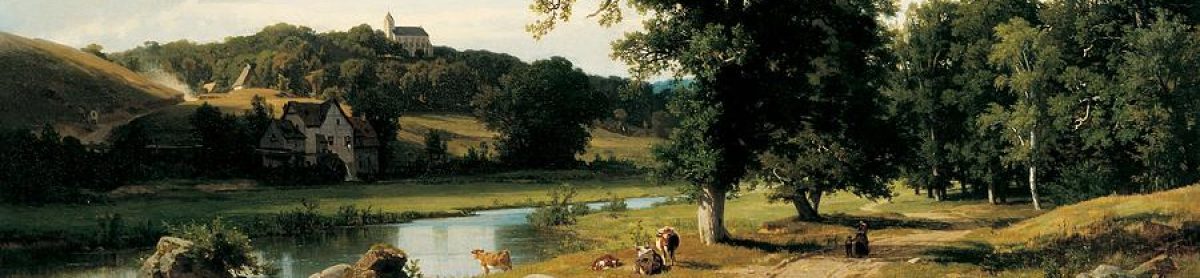
This is Chapter Two of nine. This chapter covers the early dramatic events of the 162os: a foolish knife fight, how land was distributed, how cattle and other livestock were shared, and how The Colony started to find itself.
In the last chapter, we wrote about picturing our ancestors in our mind’s eye. One of the drawbacks about that way of pondering the Pilgrims is this — it is normal to picture them in a bucolic environment, with ordered streets, clean clothes, rosy cheeks. Hollywood has never really been very good at looking at how rough and tough things initially were for them.
When the Mayflower finally disappeared over the horizon, they were truly alone in the New World.

(Image courtesy of the Brandywine Museum of Art).
Only 53 Passengers Remained
Consider the fact that the Mayflower was the home of the Pilgrims for a long time and that it was a very old merchant ship.
“During the winter, the passengers [had] remained on board Mayflower, suffering an outbreak of a contagious disease described as a mixture of scurvy, pneumonia, and tuberculosis. After it was over, only 53 passengers remained—just over half; half of the crew died as well. In the spring, they built huts ashore, and the passengers disembarked from Mayflower on March 31, 1621.”
Captain Christopher “Jones had originally planned to return to England as soon as the Pilgrims found a settlement site. But his crew members began to be ravaged by the same diseases that were felling the Pilgrims, and he realized that he had to remain in Plymouth Harbor ‘till he saw his men began to recover.’ Mayflower lay in New Plymouth harbor through the winter of 1620–21, then set sail for England on April 15, 1621. As with the Pilgrims, her sailors had been decimated by disease. Jones had lost his boatswain, his gunner, three quartermasters, the cook, and more than a dozen sailors. Mayflower made excellent time on her voyage back to England. The westerly winds that had buffeted her on the initial voyage pushed her along on the return trip home. She arrived in London on May 16, 1621, less than half the time that it had taken her to sail to America.” (Wikipedia)
Historian Caleb Johnson writes that, “Christopher Jones took the ship out on a trading voyage to Rochelle, France, in October 1621, returning with a cargo of Bay salt. [As the] master and quarter-owner of the Mayflower, [he] died and was buried at Rotherhithe, County. Surrey, England, on 5 March 1621/2. No further record of the Mayflower is found until May 1624, when it was appraised for the purposes of probate and was described as being in ‘ruinis’. The ship was almost certainly sold off as scrap.” (Mayflower History.com)
With all of the many demands put upon the new shore-bound Plymouth community, our ancestor Edward Doty was about to steal the spotlight through a bit of infamy. (1)
Seeing Red + Flying Off The Handle = (We’re) Fit to Be Tied
Well, the two Edwards seemed to have had quite enough of each other and entered into a duel. It is reportedly the first duel fought in New England, which may be true, but how can you prove something like that? Who would want to?
Edward Doty and Edward Leister were both young men who were indentured servants in the home of the Stephen Hopkins family. Admittedly, the initial voyage of the Mayflower had been harrowing… they were both living as servants in a tiny, rather rough looking house, in far away new world colony… Mr. Hopkins ran a tavern (out of his home?) and just about everyone drank beer in those days because water could be contaminated… Was a young lady involved? Who knows? — but their rather intense dust-up has been featured by historians for over 400 years, which is a rather long time for a local fight to echo through history.
From the standpoint of their community, this fight took place slightly less than eight weeks after the Mayflower had departed for England. Everyone was probably exhausted after leaving the ship, continuing to care for the sick and dying, building huts to live in, and trying to source food in a new land. Who had the free time or energy to get caught up in a duel? Apparently, these two did.
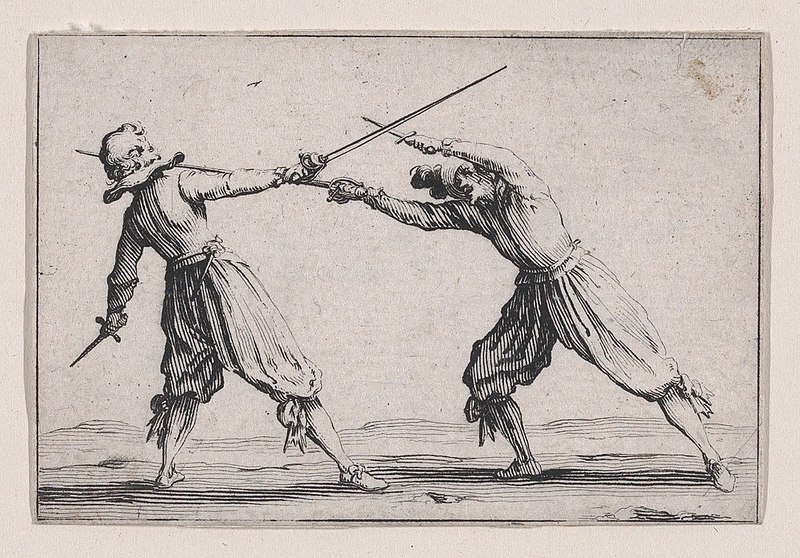
from “Les Caprices” (Image courtesy of The Metropolitan Museum of Art).
William Bradford, the Governor of the Plymouth Colony at the time, recorded the details in his journal, but that original document was eventually lost. Transcriptions of what was recorded have survived and we found an account published in a Boston newspaper called The Liberator, on June 12, 1840. In an intriguing way, we noticed this newspaper account falls (more-or-less) at the halfway point between the 1620s and our present era.

(Image courtesy of Newspapers.com).
If history has a way a not-forgetting, then perhaps we all need to mind our manners in today’s world? It seems that Edward Doty had a history of being in court frequently in the Plymouth Colony being on both sides of things. Maybe he was a bit of a hot head? As elaborated upon by our quite far distant cousin Anna Kasper in her blog post, Anna’s Musings & Writings, 52 Ancestors in 52 Weeks, Week 7: “…Edward Doty did not always make good on that promise of ‘a better carriage.’ He did not like to pay his servants, he just let his cattle kind of wander around, he got into fights, and is found in the Plymouth Court records numerous times! To say that Edward was notably a contentious man would be correct.”
We are reminded of our ancestor David Du Four from a separate family line who we chronicled in The DeVoe Line, A Narrative — Two. (David did not seem to be a contentious man). We wrote this in the section subtitled:
For. Every. Little. Kerfuffle. With. Your. Neighbors.
“It seems that David Du Four had several showings in court because the records have survived. Here’s a little background on the times. In 1670s he was a “frequent flyer” at court, with several cases. In New Amsterdam, people from all walks of life could bring a case to court. They could defend the case themselves, or ask someone to speak for them. It was not necessary for them to have a lawyer for every case. This is because…” there wasn’t a true court system existent. “To a degree, it seems like going to court was similar to being sent to the Principal’s Office. You had to go and plead your case.”
Then, whatever happened to Edward Leister? We don’t know very much. Governor William Bradford later recorded, “Lester, after he was at liberty, went to Virginia and there died”. American Ancestors has discerned a bit more, by evaluating some of the surviving colonial documents: “…in the 1623 division of land are two men with [the] first name [of] Edward but without surnames; these must be his two servants, Edward Doty and Edward Leister. But Leister is not in the 1627 division of cattle, so he must have left for Virginia between those two dates. He does not appear in the February 1623/4 list of those in Virginia living and dead, or in the February 1624/5 Virginia muster of inhabitants.”

by Matthäus Merian der Ältere (Matthew Merian), 1638.
For Edward Doty, we do not know exactly when, nor where, he was born. He was recorded as being of London, but we don’t know if he had been born in another part of England and then had perhaps migrated to London. When he was a signer of the Mayflower Compact, there is speculation that he may have been slightly underage, but the Mayflower Society believe that he was probably at least 18 years of age. (It appears that there are a couple of other signers who were in similar circumstances). We do know however, that as an indentured servant to Stephen Hopkins, he was contracted to that obligation until the age of 25 years.
With that fact in mind, we can parse that he was likely born circa 1598. (2)
The Common Cause of Labor
“Working communally — also known as the “common course of labor” — was a key part of the business model planned for Plymouth Colony. In the original terms and conditions for funding and planting the colony, all the colonists agreed to work together for seven years at commercial fishing, trading, and farming “making such commodities as shall be most useful for the colony.” At the end of the seven years, the terms and conditions dictated that the colonists would receive a share of the common stock including land and livestock.
After three years, Plymouth Colony’s governor William Bradford ended communal work as related to farming, because it caused too much internal conflict and resulted in poor corn harvests. Without a good corn harvest to feed the colony and without regular supplies from England, the colony would not survive. It is interesting to note, however, that this injunction affected only grain and other field production. All other group work — hunting, fishing, trading and defense – continued as before and seemingly without tension.” (Plimoth Patuxet)
Edward continued to do his work for the Hopkins family as part of his commitment to the greater good. However, as one of the original settlers (the old-comers) within the Plymouth Colony, he was entitled a certain privileges which this status afforded him. One of these was the right to have land tenure.
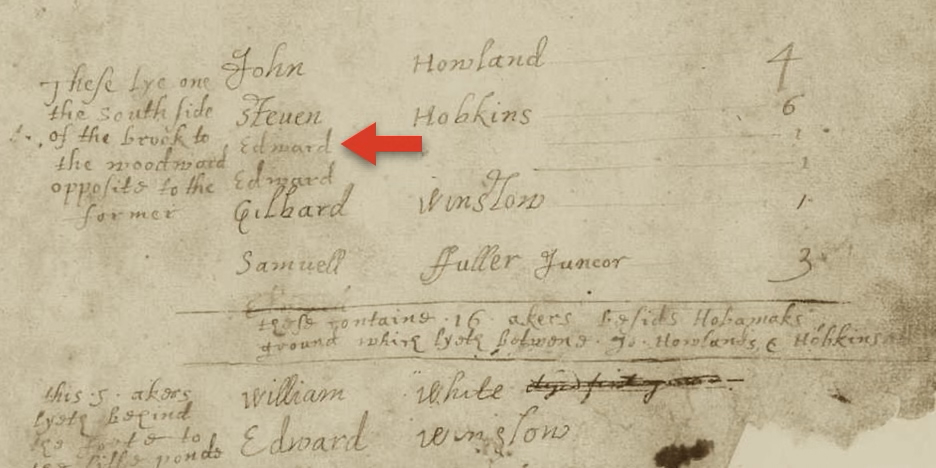
It is likely that Edward was about 25 years old at this time. “In 1623 a parcel of land was allotted to each man to till for his family and to maintain those who were exempt from agricultural employment because of other duties. Each family was given one acre per family member. In abandoning the ‘common course and condition’ everyone worked harder and more willingly. The food problem was ended, and after the first abundant harvest under individual cultivation, the Pilgrims did not have to endure the meager rations of the first years. The plots assigned them permanently in 1624 became privately owned in 1627.” (Images of Old Hawaii)
“The people mentioned in the Division of Land came on the Mayflower (1620), the Fortune (1621), and the Anne (1623). A couple may have arrived on the Swan(1622) or the Little James (1623), but these were small ships carrying mostly cargo. The Division of Land is recorded in Volume XII of the ‘Records of the Colony of New Plymouth’ ”(TPCAP – The Plymouth Colony Archive Project)
At this time, one acre of land was distributed to each family member. As he was a single man, Edward Doty received one acre of land described communally as, “These lye on the South side of the brook to the woodward opposite to the former”. (Family Search) (3)

(Image courtesy of Wikimedia Commons).
About The Division of Cattle
Like the distribution of land in 1623, in 1627, the Pilgrims divided their livestock (cattle, goats, etc.) into separate lots.
“The Pilgrims did not bring any large livestock animals with them on the Mayflower. In fact, the only animals known with certainty to have come on the Mayflower were two dogs, an English mastiff and an English spaniel, who are mentioned on a couple of occasions in the Pilgrims’ journals.
In 1624, [Governor William] Bradford reports that ‘Mr. Winslow came over, and brought a prety good supply, and the ship came on fishing, a thing fatall to this plantation. He brought 3. Heifers & a bull, the first begining of any catle of that kind in ye land’. Other cattle came, some nicknamed the Great Black Cow, the Lesser Black Cow, and the Great White-Backed Cow. By 1627, both the Lesser Black Cow and the Great White-backed Cow had calves.

Onboard the Jacob in 1624 were four black heifers (a heifer is a young female cow that has not yet had a calf.) The four black heifers were nicknamed Least, Raghorn, Blind, and Smooth-Horned. There was also a Red Cow that belonged to the poor of the colony, which had a red female calf around 1625, and a male calf in 1627. By May 1627, there were 16 head of cattle and at least 22 goats living in Plymouth.” (Images of Old Hawaii)
It appears that Edward Doty, as part of the group of colonists (listed above as part of ‘John Howland & his company’), communally shared the ‘4 heyfers’ which had arrived on the ship Jacob in 1624. (4)
The Council for New England
We understand that Edward Doty was a man who didn’t die a poor man by the standards of his era. He was an early investor in the development of the Plymouth Colony and a land owner. The three passages excerpted below describe the business aspects he was involved with in those early decades.
“The Council for New England was a 17th-century English joint stock company to which James I of England awarded a royal charter, with the purpose of expanding his realm over parts of North America by establishing colonial settlements. The Council was established in November of 1620, and was disbanded (although with no apparent changes in land titles) in 1635. It provided for the establishment of the Plymouth Colony, the Province of New Hampshire, the Massachusetts Bay Colony, the New Haven Colony, and the Province of Maine”.

Wearing the Jewel Called the Three Brothers in His Hat, circa 1605, (after) John de Critz.
Upper right: The Seal of The Council For New England, and
Lower right: (Shown at a small scale, the actual Peirce Patent from 1621.. It is cited as one of the most important documents in Anglo-American history.)
“In 1621, King James I authorized the Council for New England to plant and govern land in this area. This Council granted the Peirce Patent, confirming the Pilgrims’ settlement and governance of Plymouth. Peirce and his associates, the merchant adventurers, were allotted 100 acres for each settler the Company transported. The Pilgrims had a contract with the Company stating all land and profits would accrue to the Company for 7 years at which time the assets would be divided among the shareholders. Most of the Pilgrims held some stock. The Pilgrims negotiated a more favorable contract with the Company in 1626. In 1627, 53 Plymouth freemen, known as “The Purchasers,” agreed to buy out the Company over a period of years. In turn, 12 “Undertakers” (8 from Plymouth and 4 from London) agreed to pay off Plymouth’s debts in return for trade benefits”. (Pilgrim Hall Museum)
“In 1626, Edward Doty was one of twenty-seven Purchasers involved with the colony joint-stock company which afterwards was turned over to the control of senior colony members. That group [of investors] was called the “Undertakers”, and was made up initially of William Bradford, Myles Standish and Isaac Allerton, who were later joined by Edward Winslow, William Brewster, John Howland, John Alden, Thomas Prence, and four former Merchant Adventurers back in London. On the agreement, dated October 26, 1626, his surname appears as ‘Dotey’.” (Wikipedia) (5)
We continue our narrative about the Edward Doty in the next chapter, with his initial focus on acquiring stability through land ownership. (After all, a farmer who works the land, might want to own it too.) Then we look back a bit at the immigration unrest in Ipswich, England — which was certainly not a merry place at this time.
Following are the footnotes for the Primary Source Materials,
Notes, and Observations
Only 53 passengers Remained
(1) — three records
The Departure of the Mayflower for England in 1621
by N.C. Wyeth
https://collections.brandywine.org/objects/11394/the-departure-of-the-mayflower-for-england-in-1621?ctx=a8ad2d38-5e2e-466c-ae9e-f1f68e71df17&idx=8
Note: This was part of a series of murals the artist created for the MetLife building in New York City in 1941.
Mayflower
https://en.wikipedia.org/wiki/Mayflower
Note: For the text.
Caleb Johnson’s Mayflower History.com
The End of the Mayflower
https://mayflowerhistory.com/end-of-the-mayflower
Note: For the text.
Seeing Red + Flying Off The Handle = (We’re) Fit to Be Tied
(2) — seven records
The Met [The Metropolitan Museum of Art]
Copy of Le Duel a l’Épée et au Poignard (The Duel with the Sword and Dagger),
from Les Caprices
by Anonymous, (After Jacques Callot French, 17th century)
https://www.metmuseum.org/art/collection/search/417395
Note: For the illustration.
Edward Doty and Edward Leister duel 1621
https://www.newspapers.com/article/the-liberator-edward-doty-and-edward-lei/5952148/
Note: From Newspapers.com “The Liberator was a radical [their words] abolitionist newspaper published from 1831-65 in Boston, Massachusetts. A weekly four-page paper, it was the most influential abolitionist publication in the United States during the nineteenth century. At its peak, the Liberator was circulating 3,000 copies a week, primarily across the free North. It was funded and read largely by the free Black population in the North”.
HOW THE PILGRIM FATHERS SERVED DUELISTS.
The following account of the first duel fought in New England, and the second political offence committed in the Plymouth Colony, we take from a work entitled The New-England Chronology.’ The date of the event is June 8th, 1621.
The second offence is the first duel fought in New-England, upon a challenge to single combat, with sword and dagger, between Edward Doty and Edward Leister, servants of Mr. Hopkins. Both being wounded, the one in the hand, the other in the thigh, they are adjudged by the whole company to have their head and feet tied together, and so to lie for twenty-four hours, without meat or drink; which is begun to be inflicted. But within an hour, because of their great pains, at their own and their master’s humble request, upon promise of better carriage, they are released by the Governor.’
— Pa. Observer.
The DeVoe Line, A Narrative — Two
https://ourfamilynarratives.wordpress.com/wp-admin/post.php?post=13086&action=edit
Note: For the text in the section —
For. Every. Little. Kerfuffle. With. Your. Neighbors.
Anna’s Musings & Writings
52 Ancestors in 52 Weeks. Week 7: Landed. February Theme: Branching Out. My Contentious and Quarrelsome Mayflower Pilgrim Ancestor Edward Doty.
https://anna-kasper.com/2022/02/15/my-contentious-and-quarrelsome-mayflower-pilgrim-ancestor-edward-doty/
Note: For the text.
Hi cousin!

.American Ancestors 2020
Edward Leister
https://mayflower.americanancestors.org/edward-leister-biography#:~:text=Edward%20Leister%20came%20to%20Plymouth,%5BBradford%20442%2C%20445%5D.
Note: For the text.
Battlemaps.us
Panoramic View of London in the early 1600s,
by Matthäus Merian der Ältere (Matthew Merian), 1638
https://www.battlemaps.us/products/london-1600s-panoramic-view?srsltid=AfmBOoqFDoZLYTk2TCIRr2uUgV98KngVjw-QLKUO2raArsDdj_lOQJsq
Note: For the panoramic view of London.
The Mayflower Society
The Doty Family, Passenger Profile
https://themayflowersociety.org/passenger-profile/passenger-profiles/edward-doty/
Note: For the text.
The Common Cause of Labor
(3) — five records
Plimoth Patuxet Museums
As Precious As Silver
https://plimoth.org/yath/unit-3/as-precious-as-silver
Note: For the text.
Dividing the Land and Development of Towns
https://imagesofoldhawaii.com/wp-content/uploads/Dividing-the-Land-and-Development-of-Towns.pdf
Note: For the text.
Plymouth Colony 1623 Division of Land document
Massachusetts, Land Records, 1620-1986 > Plymouth > Deeds 1620-1651 vol 1
https://www.familysearch.org/ark:/61903/3:1:3QS7-89Z7-5Z3H?i=7&wc=MCBR-538%3A361612701%2C362501301&lang=en
Note 1: One acre of land for Edward Doty, as an unmarried man.
Note 2: This file is available at two locations. As indicated above, and also here:
https://www.familysearch.org/ark:/61903/3:1:3QS7-89Z7-5Z3H?i=7&wc=MCBR-538:361612701,362501301&lang=en
Book page: 4, Digital page: Image 8 of 239, Lower portion of page.
Note 3: He is the first Edward listed after Steven Hopkins’s name.
(TPCAP)
The Plymouth Colony Archive Project
Plymouth Colony Division of Land, 1623
http://www.histarch.illinois.edu/plymouth/landdiv.html
Note: For the text. Additional context, “In 1623, the Pilgrims divided up their land. The people mentioned in the Division of Land came on the Mayflower (1620), the Fortune (1621), and the Anne (1623). A couple may have arrived on the Swan(1622) or the Little James (1623), but these were small ships carrying mostly cargo. The Division of Land is recorded in Volume XII of the ‘Records of the Colony of New Plymouth’, and reprinted in the ‘Mayflower Descendant’, 1:227-230. Each family was given one acre per family member”.
About The Division of Cattle
(4) — four records
Animals Resting in the Pasture
by Paulus Potter, circa 1650
File:Paulus Potter – Animals Resting in the Pasture.jpg
https://commons.wikimedia.org/wiki/File:Paulus_Potter_-_Animals_Resting_in_the_Pasture.jpg
Note: For the painting image.
Plymouth Colony 1627 Division of Cattle document
Massachusetts, Land Records, 1620-1986 > Plymouth > Deeds 1620-1651 vol 1https://www.familysearch.org/ark:/61903/3:1:3QS7-99Z7-5ZZW?i=31&wc=MCBR-538%3A361612701%2C362501301&lang=en
Book page: 52, Digital page: Image 32 of 239, Middle of page.
Note: For the image. Edward Doty is listed in the Fourth Lot, as #11, named Edward Dolton.
The Plymouth Colony Archive Project
Plymouth Colony Division of Cattle, 1627
http://www.histarch.illinois.edu/plymouth/cattlediv.html
Note: Additional context, “1627. At a publique court held the 22th of May it was concluded by the whole Companie, that the cattle wch were the Companies, to wit, the Cowes & the Goates should be equal devided to all the posts of the same company & she kept until the expiration of ten years after the date above written & that every one should well and sufficiently paid for there own pt under penalty of forfeiting the same. That the old stock with half th increase should remain for common use to be divided at then of the said terms or otherwise as location fallers out, & the other half to be their own for ever. Upon wch agreement they were equally divided by Lotts she as the burthen of keeping the males then being should be borne for common use by those to whose lot the best Cowes should fall & so the Lotts fell as followers. thirteenepsonts being portioned to one lot.”
Division of Cattle
https://imagesofoldhawaii.com/wp-content/uploads/Division-of-Cattle.pdf
Note: For the text.
The Council for New England
(5) — six records

Council for New England
https://en.wikipedia.org/wiki/Council_for_New_England
Note: For the text.
Painting of James VI and I Wearing the Jewel Called the Three Brothers in His Hat, circa 1605
by (after) John de Critz
File:Portrait of James I of England wearing the jewel called the Three Brothers in his hat.jpg
https://commons.wikimedia.org/wiki/File:Portrait_of_James_I_of_England_wearing_the_jewel_called_the_Three_Brothers_in_his_hat.jpg
Note: For the portrait of James I.
Digital Commonwealth
Seal of the Council for New England
https://www.digitalcommonwealth.org/search/commonwealth:h128nr41z
Note: For the seal artwork.
Plymouth Live
Important piece of American history is being brought to Plymouth
https://www.plymouthherald.co.uk/whats-on/whats-on-news/important-piece-american-history-being-2587196
Note: For the Peirce Patent document image.
Pilgrim Hall Museum
Beyond The Pilgrim Story
https://pilgrimhall.org/bradford_17th_century_documents.htm
Note: Excerpted text is from the section, Willliam Bradford: a 1626 “Undertaker”.
Note: For the text.
Edward Doty
https://en.wikipedia.org/wiki/Edward_Doty#CITEREFBanks2006
Note: For the text.

 Our Ancestors, Our Narratives


Hello cousin! Thanks so much for the ping back. 🙂
LikeLiked by 1 person
We enjoyed reading your blog insights about collective family. We footnoted your blog too, so that hopefully more people will see your nice writing.
LikeLiked by 1 person
Thank you so very much!!!! 🙂
LikeLike