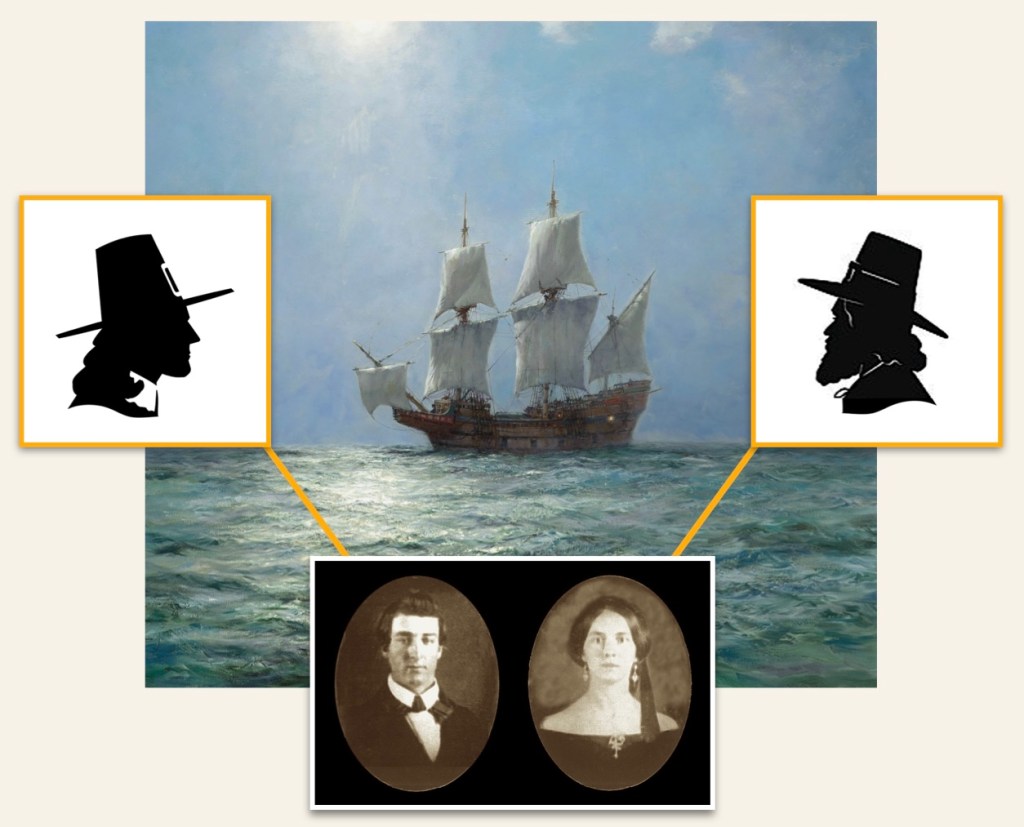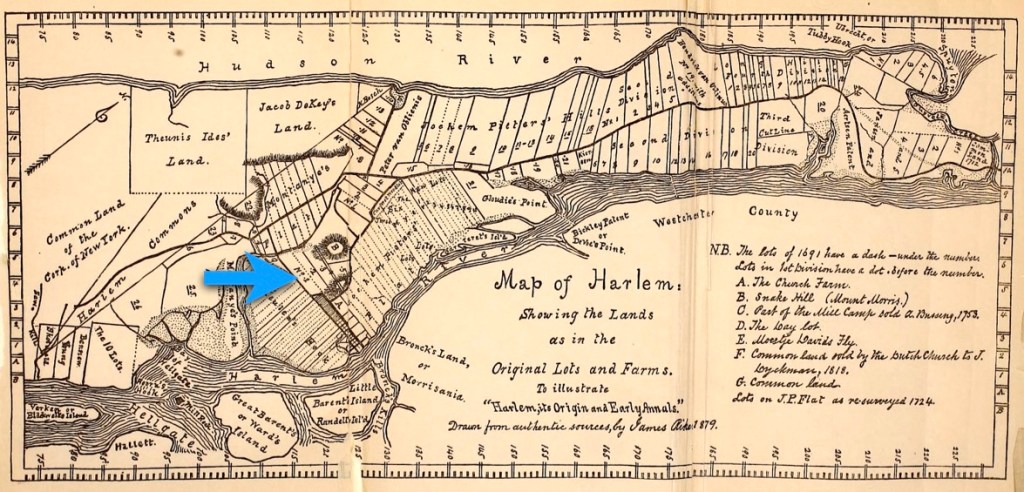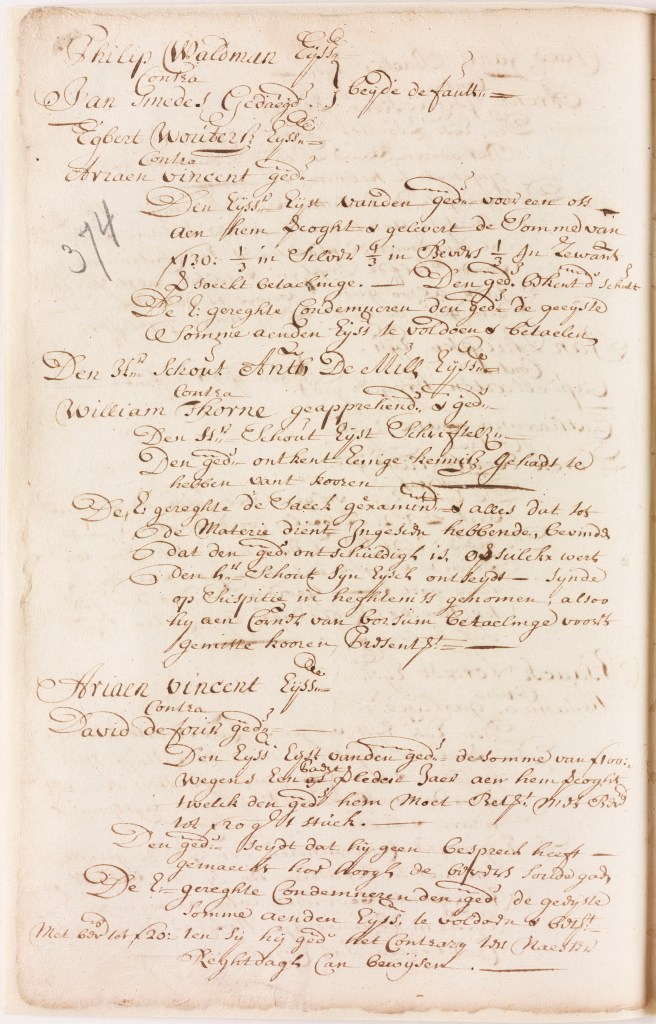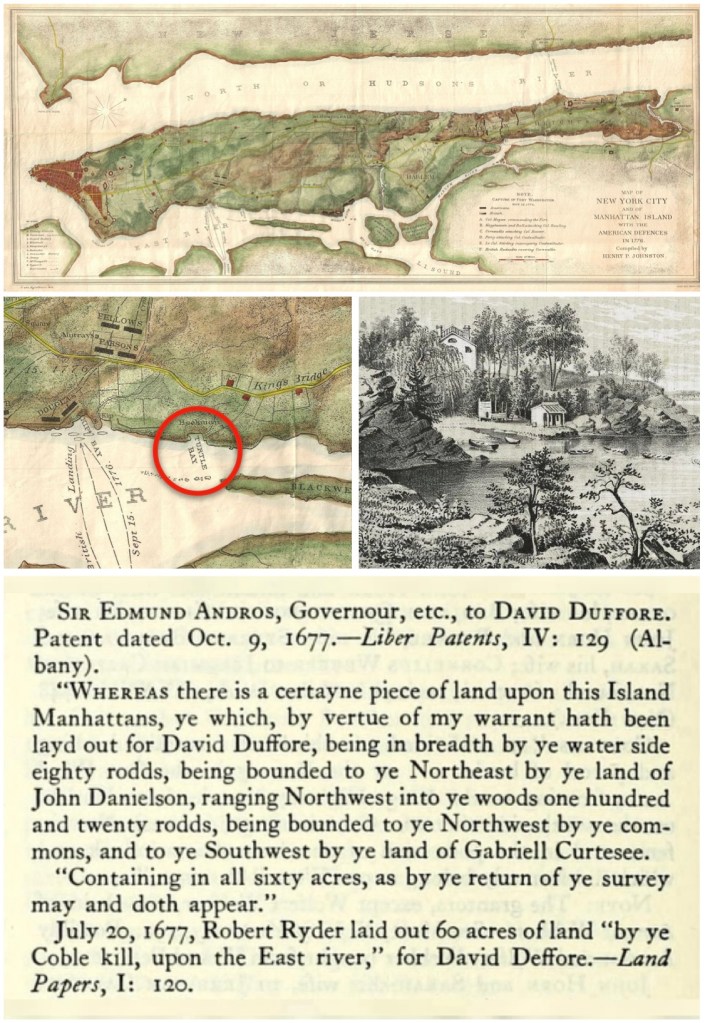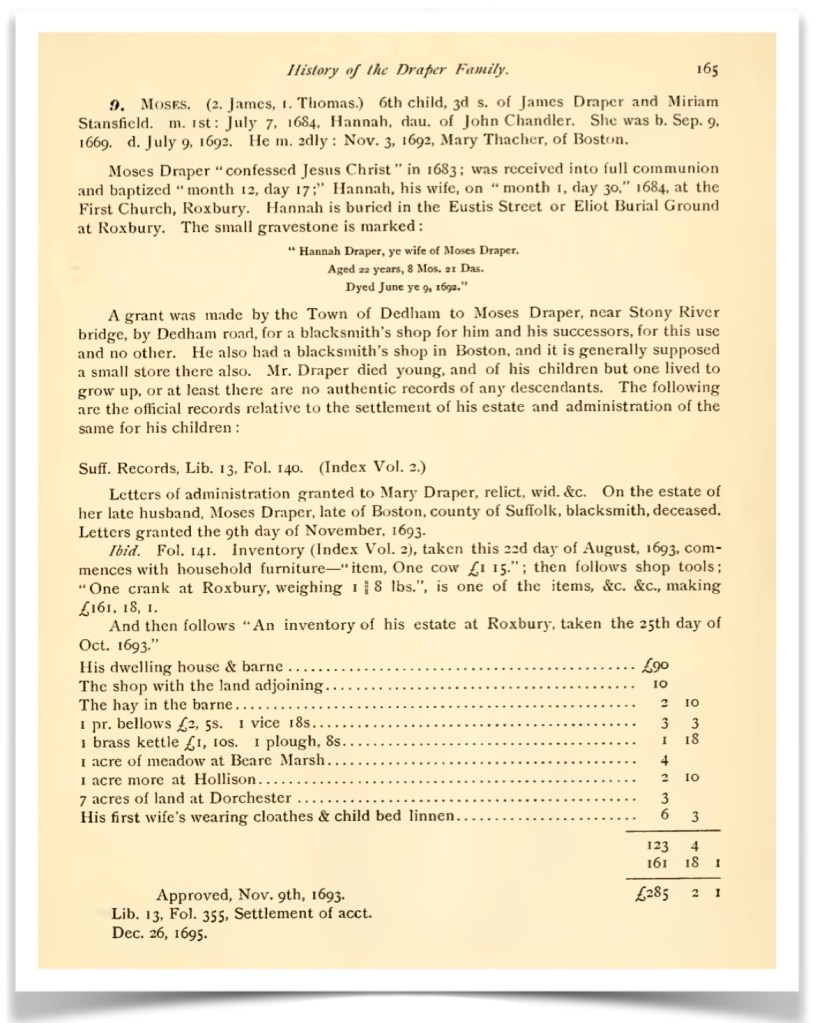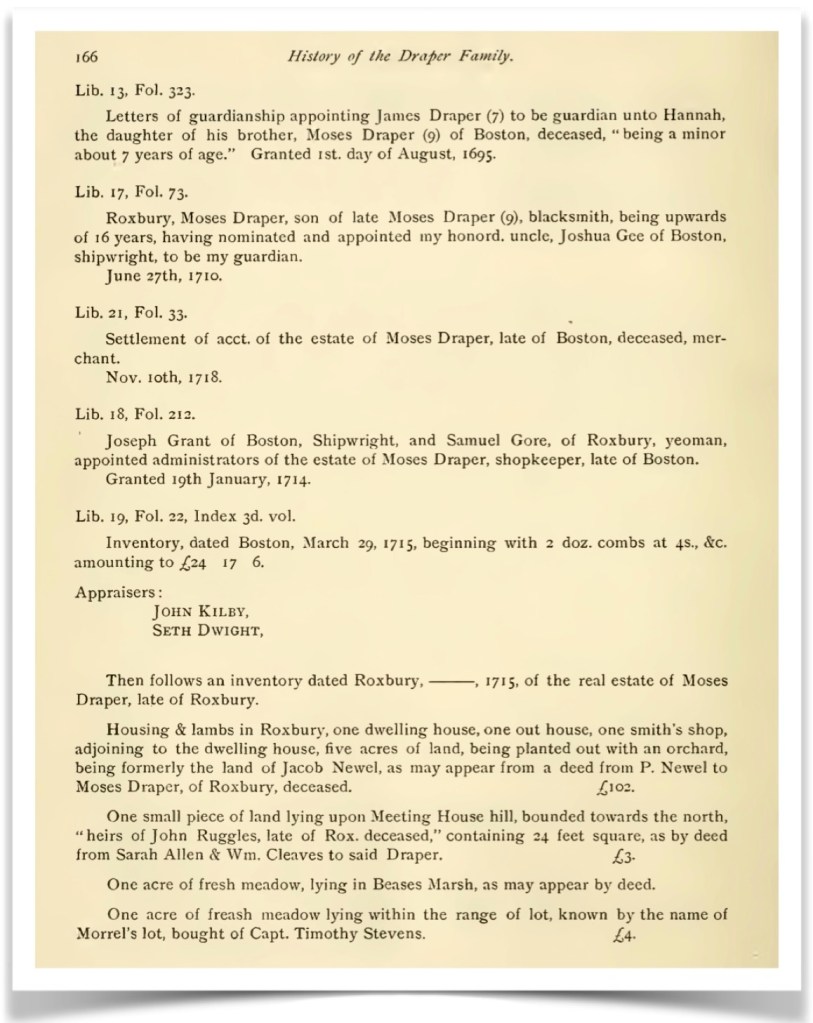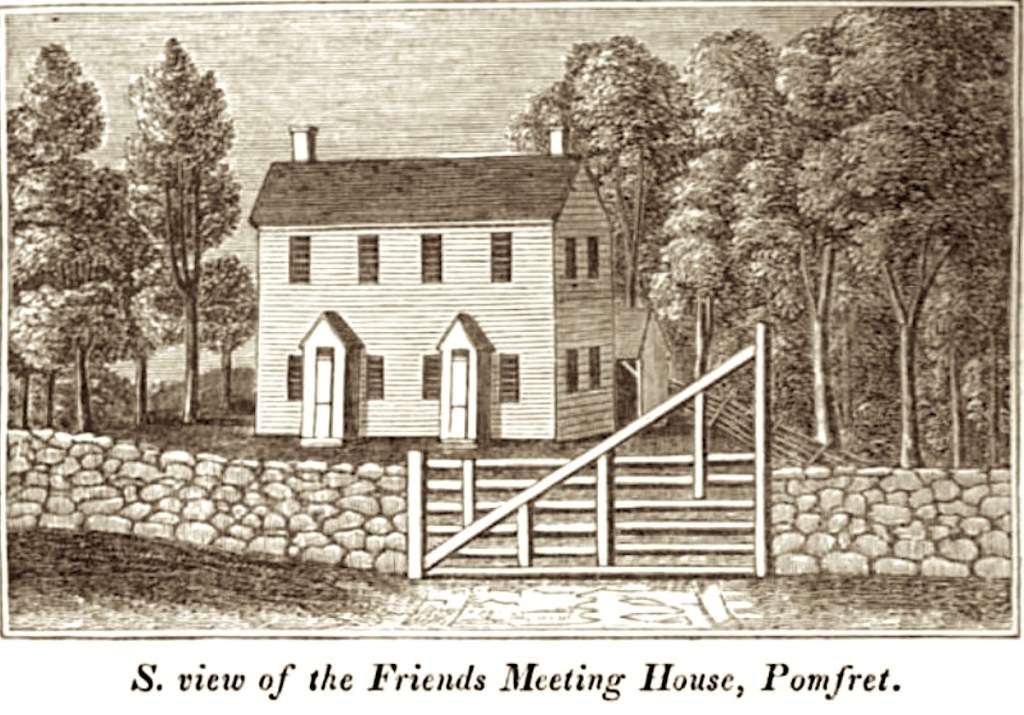
The Doty Line, A Narrative — Seven

This is Chapter Seven of nine. We have wondered if Joseph Doty, Jr. moved from New Amsterdam, up to the Nine Partners area of the Hudson River Valley due to the influence of the family of his wife Geisje (Lucretia) Van Schaick. Perhaps he somehow connected with her family through the prevalence of the Dutch culture of Manhattan when he lived there? (His militia service was also was affiliated with the Dutch Burgher Guards).

Joseph also had his cousins Charles and Elias Doty from Oyster Bay, living in the Dutchess County area. So, it’s also possible that he and Lucretia could have connected through family, or the Dutch Reformed Church. Who knows, we’re just glad that they met!
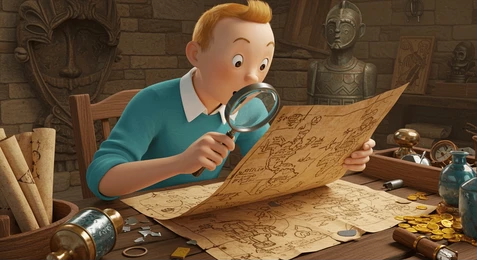
Tintin struggles as he peers intently at a map of the Hudson River Valley. He is surrounded by clues and artifacts, piecing them together to try to puzzle-out the hidden locations.
(Image courtesy of Shutterstock).

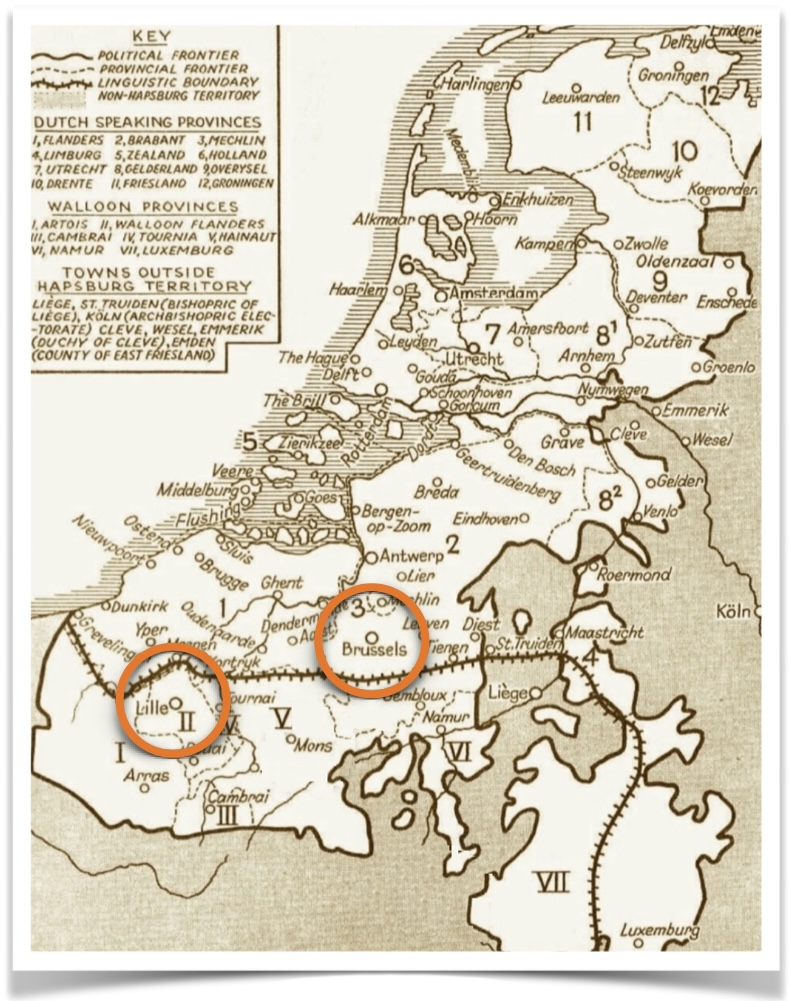
From Wikipedia, The Adventures of Tintin is a series of 24 comic albums created by Belgian cartoonist Georges Remi, who wrote under the pen name Hergé. The series was one of the most popular European comics of the 20th century. The country of Belgium was created in 1830, after it gained independence from the Southern Netherlands.

Let’s Talk About Place Names

During their lifetimes, our ancestors lived in locations that changed name(s) quite a few times. This gets quite confusing. We have corrected the history in this chapter to reflect these transformations.

We have observed that many researchers have rather clumsily used inappropriate place names for locations mentioned in this history. Some of this is understandable, since two different countries clashed over who had control of the area. Be that as it may, many past record sources, and then more contemporary records, have not thought about this sufficiently. We are following them in time and have a longer view of how the area names and boundaries evolved. So let’s address this issue —

New Netherland vs. The Province of New York
The area was first known as New Netherland, a Dutch colony, until 1664. The English renamed it when they took control in 1664 as the Province of New York, after the Duke of York (later King James II).

New Amsterdam > Manhattan
First, it was called New Amsterdam, then the English changed the name to New York City in 1664, for the same reason cited above.

Fort Orange > Albany
Located on the upper Hudson River, it was named as Fort Orange by the Dutch. It was initially founded in 1614-1624 as a fur trading post. The English then renamed it Albany, designating it first as a settlement in 1664, a county in 1686, then as a city in 1686. It is the oldest city in New York State.
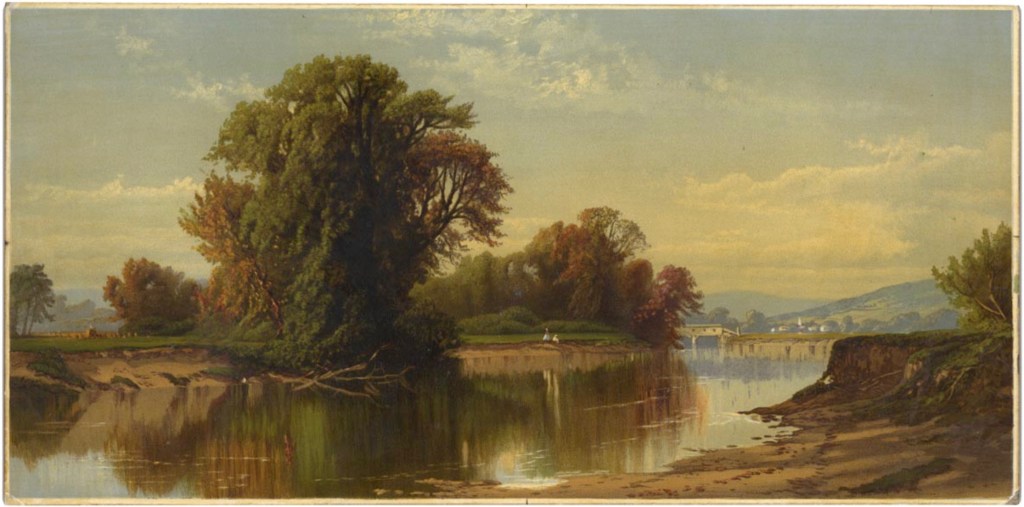
Early Autumn on Esopus Creek, by A. T. Bircher. (Image courtesy of The Old Print Shop).

Esopus > Wiltwyck > Kingston
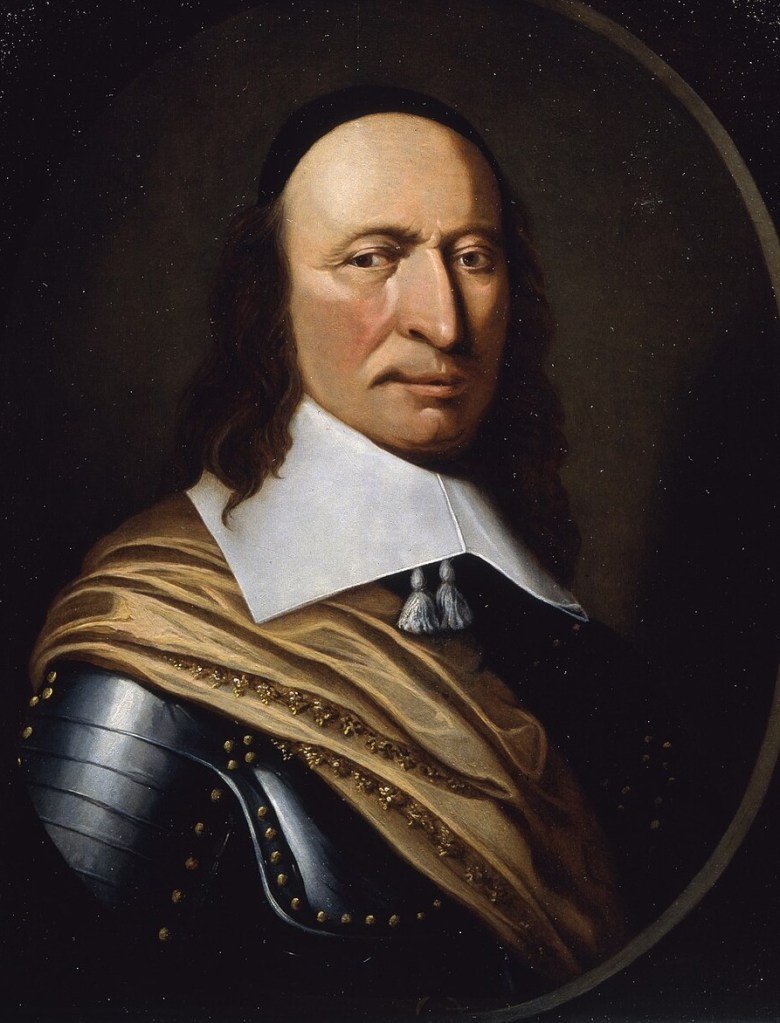
This was a broad area on the upper Hudson River named by Native Peoples to describe a creek. The Dutch used this name because it was convenient to do so. In 1657, Peter Stuyvesant, the director-general of New Netherland, built a stockade to protect the Dutch, and renamed the Esopus village Wiltwyck. A few years later, the English renamed portions of it as Kingston in 1669.

Kinderhook
This was a settlement which existed prior to 1651. First it was in Albany County, then this area became Columbia County in 1786, after the American Revolutionary War.

Ulster County
Derived from parts of the Esopus area by the Duke of York in 1683. Prior to that it was simply named Esopus. (Note: The Dutch were not very concerned about the names of interior settlements, since they concentrated mostly on extracting resources, such as beaver pelts from along the Hudson River). (1)
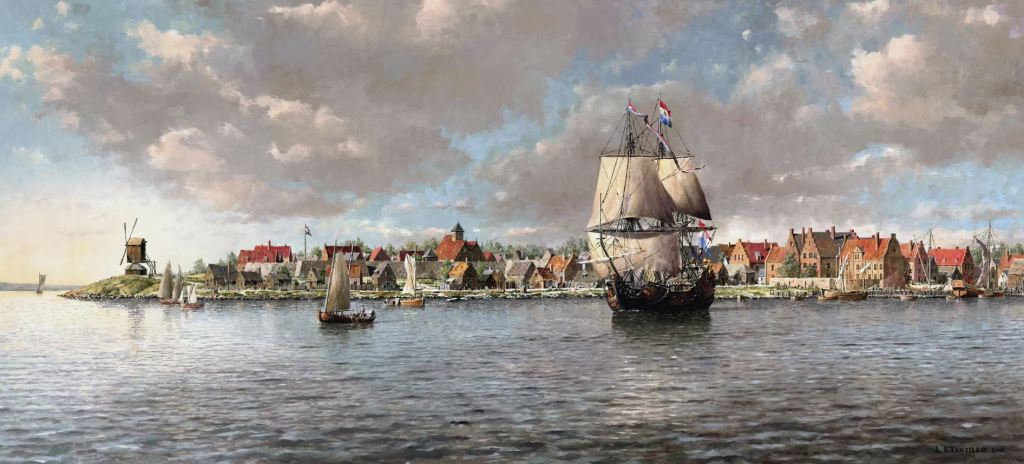
Manhattan 1660* (view from Governor’s Island), by L. F. Tantillo Fine Art.
(Image courtesy of the New Amsterdam History Center, via The Dutch Collection of the Metropolitan Museum of Art). *Technically, the location then is New Amsterdam.

The De Longs, and The Van Schaicks, Come to America

Both family genealogical histories for our 6x Great Grandmother Geisje (Lucretia) DeLong’s maternal and paternal lines begin in The Netherlands (Holland). These lines then cross the Atlantic Ocean to America in a like manner, with them then building new lives in a Dutch-controlled New Amsterdam (Manhattan), in a similar time frame. However, the two families then diverge slightly for a couple of generations, before coming together in the third generation. We’ll start with the De Longs, who are the paternal side. Please note that in all records there are several spellings for this family surname. Among them: Delange, De Lange, Delong, De Long.

The Paternal Line, the De Langes / De Longs —
During this period of history, it was completely normal for Dutch immigrants to enter America through New Amsterdam. We don’t know the amount of time this family actually stayed there, but it seems plausible that fairly quickly they chose to relocate again. This time, they moved northward up the Hudson River to the area known by the Dutch as Esopus. In that area, they are considered to be very early pioneers since that area was still a rough frontier.
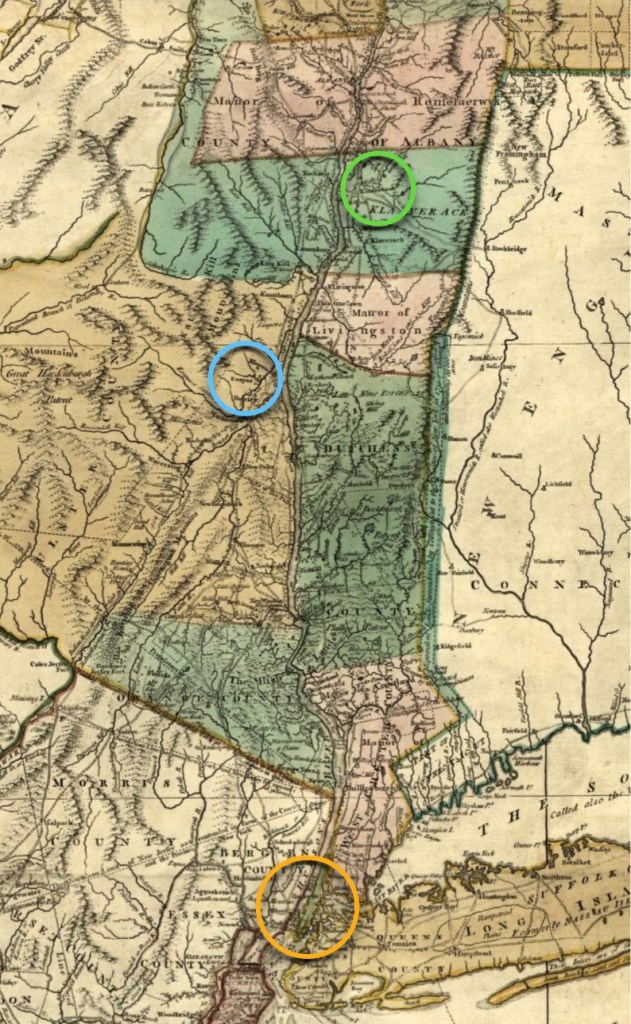
Detail excerpt from The Provinces of New York and New Jersey; with part of Pensilvania, 
and the Province of Quebec,
by Thomas Pownall, and Samuel Holland, circa 1776.
(Image courtesy of the Library of Congress).
The lower orange circle indicates where the De Longs and the Van Schaicka certainly first entered New Amsterdam. The upper blue circle indicates where the De Long family was active; the upper green circle, where the Van Schaicks were active.

The first DeLange to arrive in America was Franciscus Adrianus (Arie) De Lange, born about 1627 in Leur, Etten-Leur, Noord-Brabant, The Netherlands — died April 17, 1699 in Kingston, the Province of New York. He married Anna (maiden name unknown).

In the next generation, the De Lange line continues on in the Esopus and (then the) Kingston areas. Adrianus Franciscusz De Lange, was born about 1650, in the same location as his father Arie — died before April 17, 1699 in Brabant, an area of Kingston, Ulster County, the Province of New York. He married first Rachel Jansen, date unknown. He married second, Anna (maiden name unknown), date unknown.

The Maternal Line, the Van Schaicks
For Geisje (Lucretia) maternal family line, we return to The Netherlands. This history begins with Niclass Laurenzen Van Schaick*, born about 1633 in Utrecht, The Netherlands — died about 1688 at Kinderhook, Albany County, the Province of New York. He married Jennetjie Cornelis* circa 1664, before they immigrated to America. She was born about 1642, (possibly) in Beverwyck, Netherlands — died February 8, 1728, in the same location as her husband.

*Quite interestingly, we learned that through these ancestors, our 8x Great Grandparents, Niclass Laurenzen Van Schaick and Jennetjie Cornelis — that we connect to the famous Roosevelt family of U.S. Presidential fame. (Please see The Roosevelt Family Connection at the very end of this chapter).

Fort Orange and The Patroon’s House, by L. F. Tantillo.
(Image courtesy of the New York State Museum).

As with the De Longs, we do not know how long the Van Schaicks were in New Amsterdam. Some of the literature suggests a family connection — and that perhaps Niclass was the brother of Gerrit Goosensz Van Schaick, who was also born in Utrecht, The Netherlands. Known as Goosen, he was one of the original settlers in the community of Fort Orange > Albany. It makes sense that Niclass and Jennetje would live in the same area.

Often, other researchers have not captured the birth of all ten of Niclass and Jannetje’s children. Maritje Van Schaick, our 7x Great Grandmother was the last of their children, born about 1683 at Kinderhook, Albany settlement, (Albany County in 1686). After several generations in America, the DeLange/DeLong family is finally joined by marriage to the Van Schaick family.
(See our Research Observation in the footnotes).

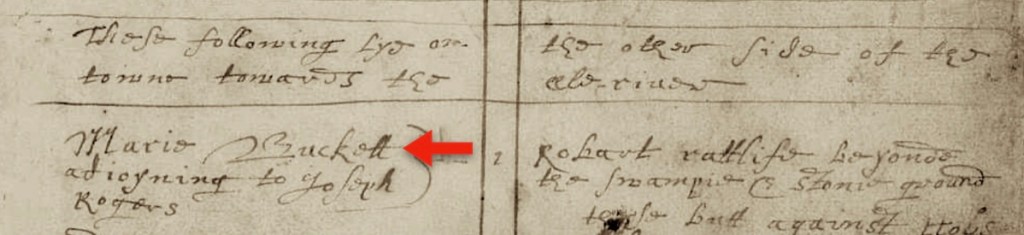
Marriage Record of September 6, 1703 for Frans Arie DeLong and Maritje Van Schaick.
(Note that their names are spelled differently).
From the records of the Dutch Reformed Church in Albany, the Province of New York.

Frans Arie DeLong, born April 24, 1681, in Ulster County, the Province of New York – died May 29, 1755, in Beekman, Dutchess County, same Province. He married Maritje Van Schaick, September 6, 1703. She was born October 19, 1683, in Stuvesant/Kinderhook, Albany County [Columbia County, circa 1786] – died February 1758 in Dutchess County, Province of New York. Frans and Maritje (Van Schaick) DeLong had a large family of twelve children, with the eleventh being our 6x Great Grandmother, Giesje (De Lange/De Long) Doty. (2)

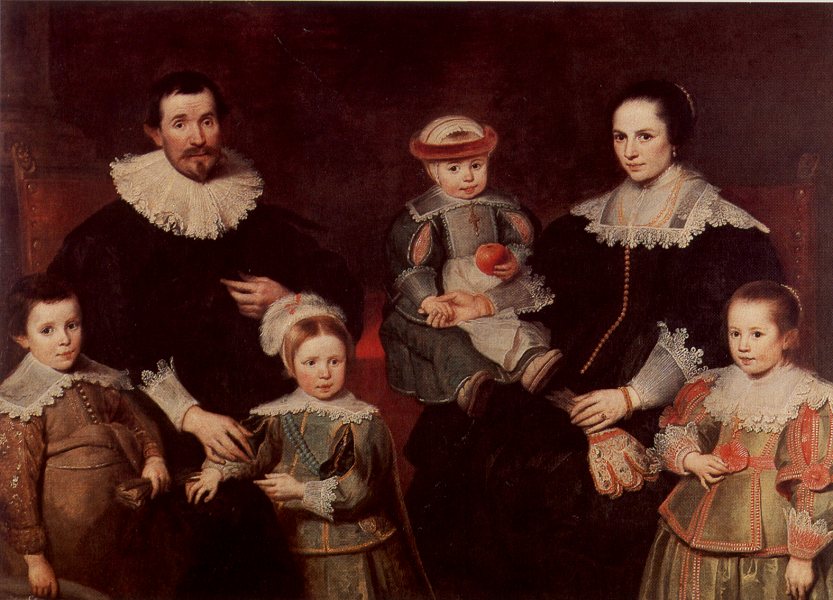
If the DeLange, or Van Schaick families were dressed in their very, very, very best clothes,
their portraits would have looked somewhat like this.
(Image courtesy of Nicole Kipar’s late 17th Century Costume history).

A Flourishing Family In The Hudson River Valley

The Joseph Doty Jr. family spent the arc of their lifetimes situated on either Long Island Sound, or within the Hudson River Valley. He was born in 1708 in Oyster Bay, Long Island, New York Province — died about 1788 likely in Lansingburgh, Rensselaer  County, New York State.

Marriage Record of March 20, 1743 for Joseph Doty Jr. and Giesje De Lange.
From the records of the Dutch Reformed Church in Fishkill (Rombout Patent), Dutchess County, the Province of New York.

On March 20, 1743, Joseph Doty Jr., married Geisje De Lange* at the Dutch Reformed Church located in the hamlet of Fishkill, Rombount Precinct, Dutchess County, New York Province. She was born in the Crum Elbow Precinct, Dutchess County, the Province of New York, about 1725, daughter of Frans Arie DeLong and Maritje (Van Schaick) DeLong. She died after 1773, likely in Lansingburgh, Rensselaer County.

*Geisje DeLong’s surname became anglicized to De Long (from De Lange). On many records, her first name is recorded as “Lucretia”. This was actually her nickname which she used for most of her life.

The Dutch Reformed Church in Fishkill, New York, date unknown.
(Image courtesy of Ancestry.com).

Together Joseph and Lucretia had 10 children, who are listed below. The records cited are quoted from the The Doty-Doten Family in America (DDFA) book.
Note: All of their children were born in the Province of New York. We have made corrections to their birth locations.

The first five children, Ormond, Peter, Rebecca, Elizabeth, and Rhoda, were born in the Crum Elbow Precinct, Dutchess County:

  • Ormond Doty was born November 24, 1746 in Crum Elbow Precinct, Dutchess County. He died in South Wallingford, Vermont, November 18, 1826. He married Phoebe Vail; she died at the same location, May 1, 1830. “It is reported that during the Revolution Ormond Doty lived at or in the vicinity of Albany, N. Y.; that he was a Loyalist and was imprisoned at Albany for some time on that charge, but at the intercession of his brothers, who were Patriots, he was released on the condition of going to South Wallingford, Vermont, at that time a wilderness. He removed there with his family, where they settled and remained”.
  • Peter Doty was born about 1750 in Crum Elbow Precinct, Dutchess County. He died in 1811 after a Will was written dated July 2, 1811. He married Catharine Overrocker, who died January 1820.“They lived Schaghticoke. N. Y. He was a prosperous farmer there. His Will, dated July 2, 1811, is on record at Troy, N. Y.”.
  • Rebecca Doty (twin) was born about 1756 in Crum Elbow Precinct, Dutchess, New York. She married (1) John Irish; (2) Stutely Stafford.
    “She married first John Irish. He was killed as a British spy at Tinmouth, Vermont, during the Revolution. She married second, Stutely Stafford. They lived South Wallingford, Vermont”.
  • Elizabeth Doty (twin) was born about 1756 in Crum Elbow Precinct, Dutchess County. She married Daniel Barheit.
  • Rhoda Doty (also known as Rhody), was born about 1759 in Crum Elbow Precinct, Dutchess County. She married Jacob Stover.
    “They lived Schaghticoke. N. Y., and it is probable that descendants lived Schuylerville, Saratoga County, and Greenwich, Washington County, N. Y.”.

    The next three children, Mary, Jacob, and Marian, were born in the same location, but it had been renamed as the Charlotte Precinct, Dutchess County:
  • Mary Doty (also known as Polly), was born about 1763 in Charlotte Precinct, Dutchess County. She married Leonard Schermerhorn. “They lived Berne, N. Y.”.
  • Jacob Doty was born about 1766, in Charlotte Precinct, Dutchess County. He married Zilla Berrie. “He is said to have lived in Albany or vicinity, during the Revolution, but afterward removed to Vermont”.
  • Marian Doty was born about 1768 in Charlotte Precinct, Dutchess County. She married Ephraim Putnam.

    The last two children, Lydia and Nancy, were born in a new location: Lansingburgh, Rensselaer County:
  • Lydia Doty was born in December 1769, in Lansingburgh, Rensselaer County. She married Daniel Shaw about 1783. Lydia died November 2, 1830 in Schaghticoke, also in Rensselaer County.
    (We are descended from Lydia and Daniel).
  • Nancy Doty was born about 1773, in Lansingburgh, Rensselaer, County. She married Mark Jimney. (3)
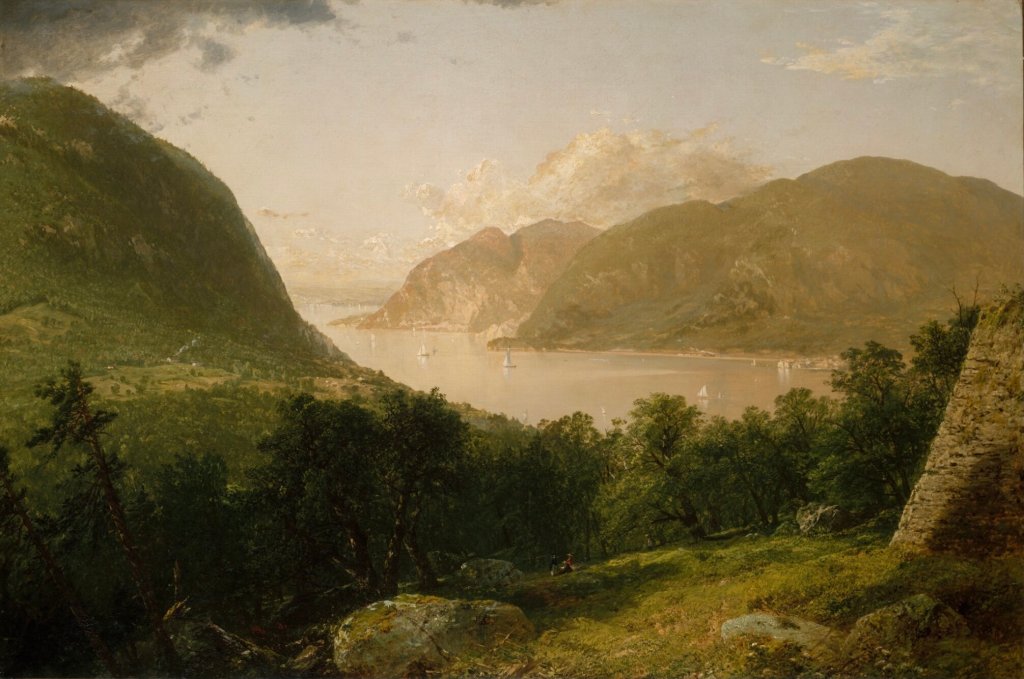
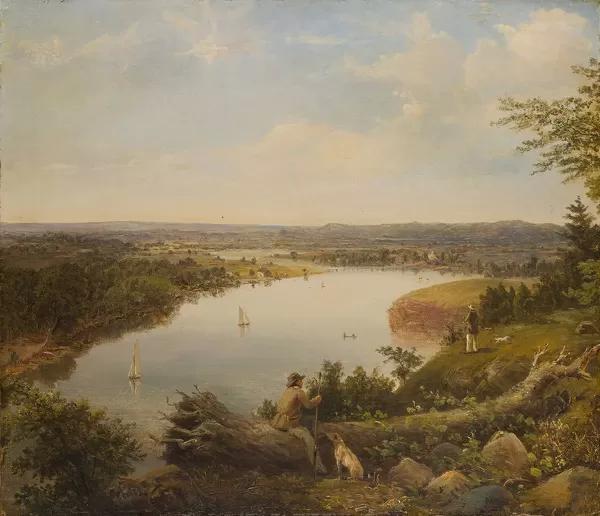
Hudson River Scene, by John Frederick Kensett.
(Image courtesy of the Beacon Historical Society via the Metropolitan Museum of Art).

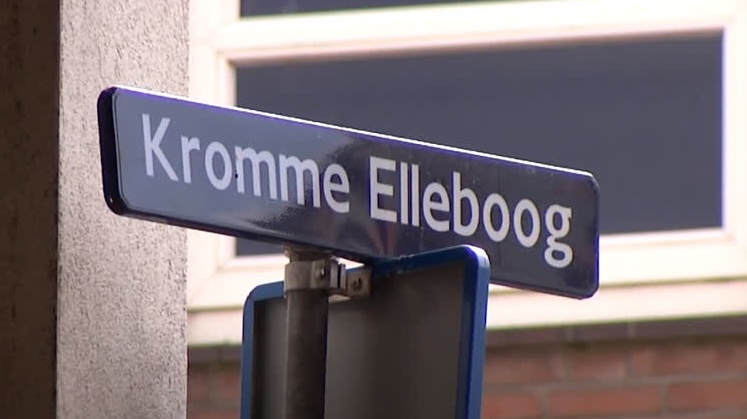
The Dutch Words Were — Kromme Elleboog

While doing research for this chapter on the Doty Family, we encountered these odd-seeming place names in the Hudson River Valley: Crum Elbow, or Crom Elbow. They seemed like real head scratchers to us, but we’ve seen other odd things — such as trying to interpret quill-pen written manuscripts where the writer was implausibly scribbling away while experiencing a serious medical emergency.

Therefore, we were delighted to learn the following, simply because it made this aspect of our family history, that much more interesting. From the Dutchess County Historical Society Yearbook of 1933 —

In the seventeenth century, while the Dutch held sovereignty over the valley of the Hudson, that is: from 1609 to 1664, they established settlements at three places,—one on the site of the city of New York, one on the site of Albany and one on the site of Kingston. They made no attempt to explore or to clear the forested regions on either side of the river between New York and Albany, chiefly because they were greatly concerned with the trade in furs, and the three settlements just mentioned did an active business as trading posts.

Ignoring the hinterland [the interior land areas], the Dutch plied the river in sailboats, learned to know the river well and had names for many of the sailing courses and for natural features along the shores.

In 1664 sovereignty over the Hudson valley passed to the English. They, after a few years, began to be interested in the regions east and west of the river and in 1683 the colonial legislature passed an Act by which those lands were laid out into counties. Coincidently with the creation of counties there arose an era of speculation in land, during which the desirable tracts along the river were bought up and ultimately opened for settlement.

In the course of the development, government officials filed documents and conducted correspondence in English and encouraged the common use of that tongue. It took just about a century for the English language to supplant the Dutch and, while the two were in use at once, original documents were recorded in which may now be found many instances of phonetic spelling, occasions when an Englishman tried to write down the Dutch words he heard in use about him.

An instance of such phonetic spelling and of partial translation is the place-name: Krom Elbow. The Dutch words were: Kromme Elleboog, meaning a bent or crooked elbow. In the seventeenth and eighteenth centuries; Kromme was rendered in the records as: Krom, Krum, Crom, Crum and even Crown (K being a characteristic Dutch letter and C English), while Elleboog was translated in full into Elbow.

[Excerpted from from an article by Helen Wilkinson Reynolds,
in The Dutchess County Historical Society Yearbook for 1933.]

The following bit of information from the excerpt above, became very important with the ongoing history of the Doty Family. “In 1683… coincidently with the creation of counties there arose an era of speculation in land, during which the desirable tracts along the river were bought up and ultimately opened for settlement”. (4)

The Nine Partners Patent in Dutchess County

“The Great Nine Partners Patent, also known as the ‘Lower Nine Partners Patent,’ was a land grant in Dutchess County, New York, made on May 27, 1697, by New York governor Benjamin Fletcher. The parcel included about four miles (6 km) along the Hudson River and was eight to ten miles (13 to 16 km) wide, extending from the Hudson River to the Connecticut border…

It was the ninth of fourteen patents granted between 1685 and 1706 which came to cover the entirety of historic Dutchess County [which until 1812 also included today’s Putnam County]. (Wikipedia, 9 Partners) Some modern writers also refer to the patent as the Nine Partners area.

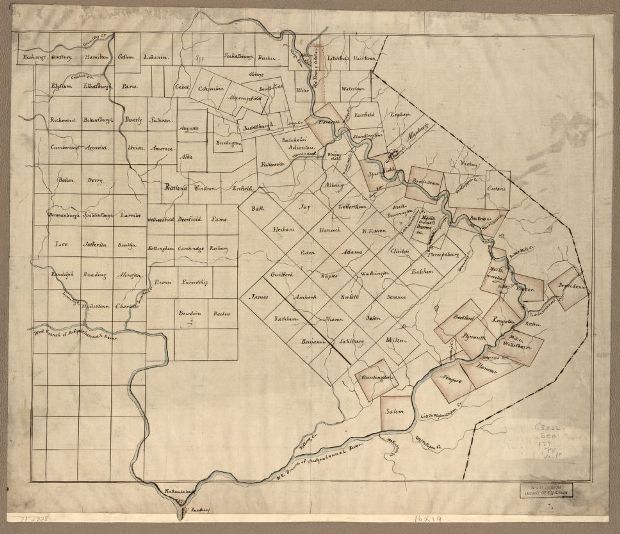
The sepia rectangle shows The Great Nine Partners Patent, a land grant in Dutchess County, New York, as surveyed by Richard Edsall, circa 1740. [It is barely legible] The map which overlays the The Great Nine Partners Patent map is from the Dutchess Count Historical Society yearbook of 1939, and indicates the many land patents that were scattered over the breadth of Dutchess County.

Note also in the lower left corner of Duchess County is the hamlet of Fishkill in the Rombout Patent. This is the place where Joseph Doty and his wife Giesje De Lange (Lucretia De Long) were married.

The Crum Elbow Precinct
Encouraging settlers to move into the new counties that lined the Hudson River superhighway was very successful.“Prior to 1734, there had been little settlement in the area, but it proceeded rapidly thereafter. Settlers came to the area up the Hudson, but also from New England. When the legislature divided Dutchess County into precincts in 1737, the Nine Partners Grant was included in the Crum Elbow Precinct.” (Wikipedia, 9 Partners)

Observation: The Province of New York used many Precinct Names in this era, but not many town names. ‘Towns’ were quite frequently scattered, and being very tiny hamlets, of not much more than where two paths crossed. Some modern researchers have developed a tendency to magnify and enlarge some of these characteristics of places / hamlets / crossroads in their desire for a sense of a ‘town’.

So the historical place naming sequence (generally speaking) is:
> Counties (commencing in 1683)
> Patents (for Dutchess County, from 1685 until 1706)
> Precincts (or Dutchess County, in 1737, and then ongoing as needed for an administrative function)
> Town names (This varies, but precincts were eliminated in 1788. From that point on, only town names were used).

Detail excerpt from The Provinces of New York and New Jersey; with part of Pensilvania,
and the Province of Quebec, by Thomas Pownall, and Samuel Holland, circa 1776.
(Image courtesy of the Library of Congress).

The area outlined in white (above) is the border of the Crum Elbow Precinct from 1697 through 1762. The Doty family lived within this Precinct for most of their time in Dutchess County. Seven years later, in 1769, the entire family relocated north to Lansingburg, Rensselaer County.

The Crum Elbow Precinct Is Divided Twice More
In 1762, the Crum Elbow Precinct was divided into two new precincts, called the Amenia, and the Charlotte Precincts. From that point forward, the Amenia Precinct was a separate entity. In 1786, Charlotte Precinct was divided again into: the Clinton Precinct, and the Washington Precinct. Washington Precinct included the towns presently known as Stanford and Washington. Clinton Precinct included present-day Clinton, Hyde Park, and Pleasant Valley.

The later divisions of 1786 did not affect this family, because, in 1769, the whole family relocated to Lansingburg, Rensselaer County, which was the next county north of Dutchess County moving up the Hudson River.

The Doty family had lived in the Crum Elbow Precinct for many years, but we do not know exactly where. We likely will never know exactly where, unless some new records turn up. Some researchers have mentioned the Charlotte Precinct, but the Dotys only experienced that place name for about seven years before they moved. Some have mentioned the Clinton Precinct, but this precinct did not exist when they lived there. (5)

The Van Allen Homestead, by Henry A. Ferguson
(Courtesy of the Albany Institute of History & Art).

Literally Mending Fences Here And There

This was an era when there was no municipal government to take care of roads so that they were safe and passable. In addition, since many people had livestock, and boundary markers were generally a bit vague, someone had to pay attention to where the fences actually were. Joseph Doty was not alone in this role. Many of his neighbors had similar roles and a few interesting records do survive, such as —

In the book Records of Crum Elbow Precinct, Dutchess County, New York, 1738… President Franklin D. Roosevelt (who knew he liked genealogy?), cited that Joseph Doty [Jr.] was:

  • Either an Overseer, or a Path Master of the High Ways in the Crum Elbow Precinct for the years: 1756 and 1759
  • Then the same role for the Charlotte Precinct four years later
  • The Delong family’s bridge (of his wife’s family) is also mentioned as being in the Charlotte Precinct in 1772
    (See footnotes). (6)
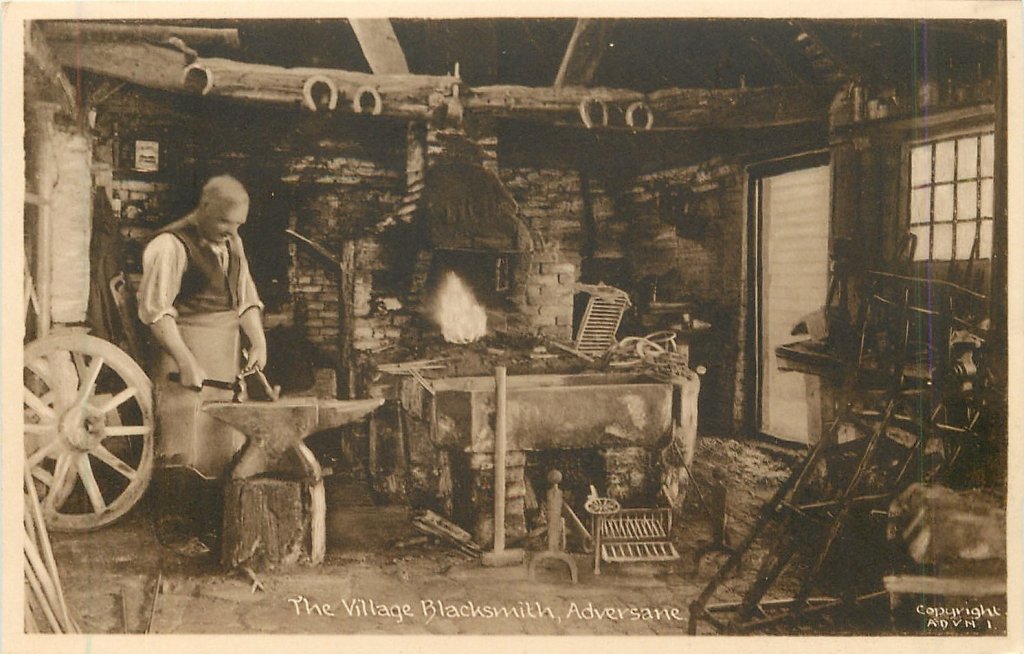
A Blacksmith, Probably in Good Circumstances

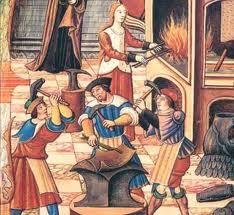
In the later 1760s, Joseph and Lucretia sold some of their properties in the Crum Elbow Precinct (which had recently been renamed as the Charlotte Precinct). There are two records which are written about in the Doty-Doten Family book, on page 505 — “Joseph Doty was a blacksmith, probably in good circumstances, his sons and daughters all being people of good position… June 5, 1767. Joseph Doty, blacksmith, of Crum Elbow, Dutchess Co., N. Y., mortgages land there. March 30, 1769. Joseph Doty, blacksmith, and his wife Cashea [Lucretia] of Charlotte, sell lots there, being part of nine partners, to Samuel Smith, Jr. of Jamaica, Queens Co., and Melancthon Smith of Charlotte”. The Precinct they lived in was populated by farmers and tradesmen. We speculate that Joseph may have learned the blacksmith trade during his time in Manhattan, perhaps as part of his militia service role?

From these old records we were able to learn about his profession as a blacksmith. Also, we recovered an index record for the second land sale (likely due to the fact that we were fortunate to have a distinctive name such as Melancthon Smith to work with). The index indicates that the original deed is found on page 292, but the original record book is not cited. What’s more, we found a tax record for Joseph Doty of Nine Partners / Crum Elbow / Charlotte, for the time period of June 1754 – June 1768. This supports both his residency there, and the fact that since his tax record ends in June 1768, that there was change afoot. (See footnotes).

Dutchess County, Grantee Deed Indexes. (Image courtesy of Family Search)

Observation: Finding colonial era records in New York State is a very hit-or-miss affair, due to both the history of the area, and to be quite honest, the State of New York bureaucracy. They have not been very organized when it comes to digitizing older documents. We don’t have any records for when the Dotys first acquired property. So, we can only speculate as to when they left Fishkill, and moved north to the Crum Elbow Precinct. Does this mean that their residency there began about June 1754, as the tax records could imply? No, not really, because tax records for the years 1749, 1750, 1751, and 1752 are missing.

Records are quite scant. Censuses for the population did not yet exist, nor did income taxes, and you cannot pay property taxes, unless you own property. (7)
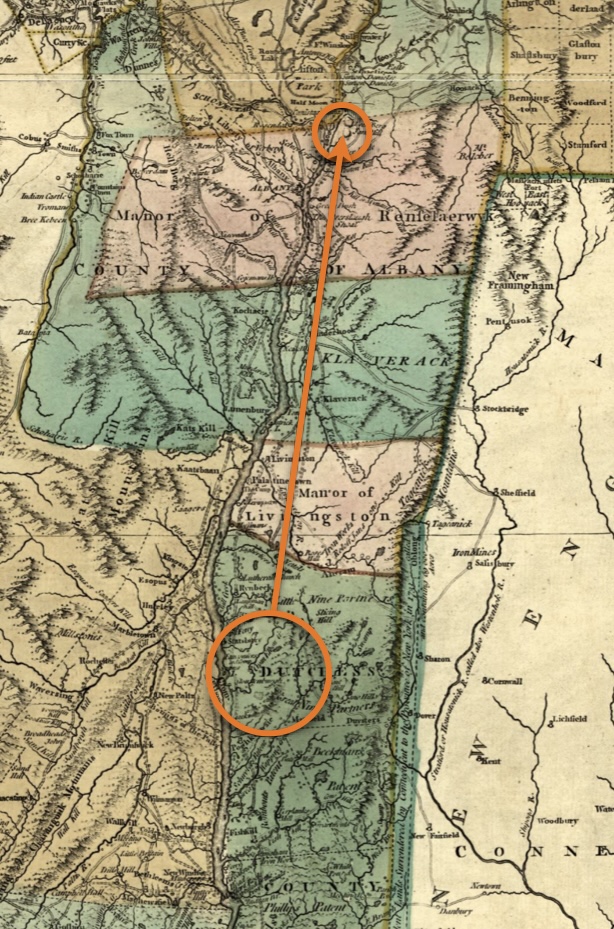
Detail excerpt from The Provinces of New York and New Jersey; with part of Pensilvania,
and the Province of Quebec, by Thomas Pownall, and Samuel Holland, circa 1776.
(Image courtesy of the Library of Congress).
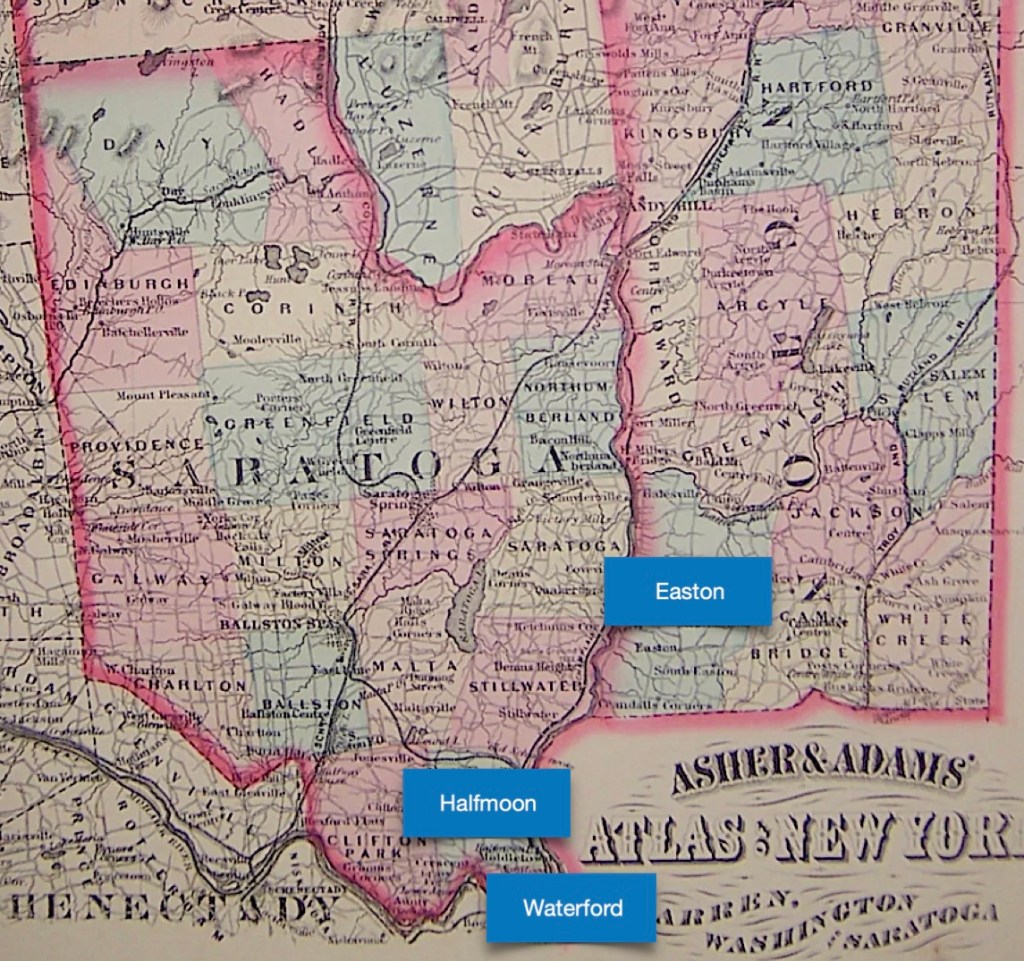
This map documents the family’s transition from the Crum Elbow Precinct in Dutchess County, to the new town of Lansingburg in Rensselaer County in 1769.

Where the Hudson Meets the Mohawk

In 1769, they moved to Lansingburgh [Village], New York, located further north in Rensselaer County. The specific area where they moved to was at first, very sparsely settled. This is where the Hudson River meets the Mohawk River. Just slightly north, across the rivers was the established community of Halfmoon, and the town of Albany was to the south. (Albany had long been established; initially as a Dutch trading post in 1614).

The book, the History of Rensselaer County records, “The purchase by Abraham Jacob Lansing on June 21, 1763, was followed soon after by his actual settlement. Two or three other families were already here… and several others soon followed. In seven years quite a settlement was formed. The map of the city plat laid out by Mr. Lansing was tiled May 11, 1771. The survey had taken place a year or two earlier, for quite a number of lots were sold in 1770, and the town-meeting that adopted the ‘proposals’ had met in January before the map was tiled”. This book does not record that they were purchasers of property there.

Initially the area was called the New City. A. J. Weise’s History of Lansingburgh records that there were an estimated 50 people living there in 1771, 400 living there in 1780, and that by 1790, the population had increased to 500 people. In 1788, the year that Joseph Doty, Jr. likely passed away, this enthusiastic description was written: “Elkanah Watson, a traveler, thus writes in his journal concerning New City, in the year 1788: “This place is thronged with merchants, emigrants, principally, from New England, who have enjoyed a very extensive and lucrative trade, supplying Vermont and the region on both banks of the Hudson,  as far as Lake George, with merchandise, and receiving in payment wheat,  pot [potash] and pearl ashes, and lumber”. (See footnotes). (8)

These two maps indicate the position of the ‘New City’ of Lansingburgh
near the town of Halfmoon, the Province of New York.
(Images courtesy of the Lansingburgh Historical Society).

Our story about the Dotys is nearing its final resolution with the Doty family name giving way to the Shaw family name in the next chapter. Be that as it may, we have one more chapter to go, where the Shaw name then gives way to the Devoe family name, of which we have much, much history. However, before we go there, we have learned some interesting things…

The Roosevelt Family Connection

We connect to the Theodore Roosevelt Jr. family through Great Grandparents — For his generation, they were the 5x Great Grandparents; for our generation, the 8x Great Grandparents.

As a reminder, this is how we introduced them earlier:
The Maternal Line, the Van Schaicks
For Geisje (Lucretia) maternal family line, we return to The Netherlands. This history begins with Niclass Laurenzen Van Schaick*, born about 1633 in Utrecht, The Netherlands — died about 1688 at Kinderhook, Albany County, the Province of New York. He married Jennetjie Cornelis* circa 1664, before they immigrated to America. She was born about 1642, (possibly) in Beverwyck, Netherlands — died February 8, 1728, in the same location as her husband.

The 10 children of Nicholas Van Schaick and Jannetje are as follows:

  1. Cornelia, who was born about 1668 and married Hendrick <Joris> Van Salsbergen.
  2. Nicholas was born about 1666
  3. Fytje was born about 1668 and died 1735; married Dirk Dirksz van der Karre
  4. Dominicus Van Schaick, who was born 1671 and married Rebecca Groesbeck
  5. Arent, who was born about 1674 and married Maria Van Loon
  6. Laurens, who was born about 1675 and married Jannetje Oothout*
  7. Emanuel, who was born 1678 and married Margrietje Wyngaert*
  8. Jannetje, who married Johannes Van Hoese.
  9. Elias
  10. Marritje, who was born about 1683 and married Frans De Lange*

Of these children, their youngest daughter ‘10. Marritje’ is our 7x Great Grandmother. Her brother, ‘7. Emanuel’ is the one that married into the family line which became the Roosevelt line.
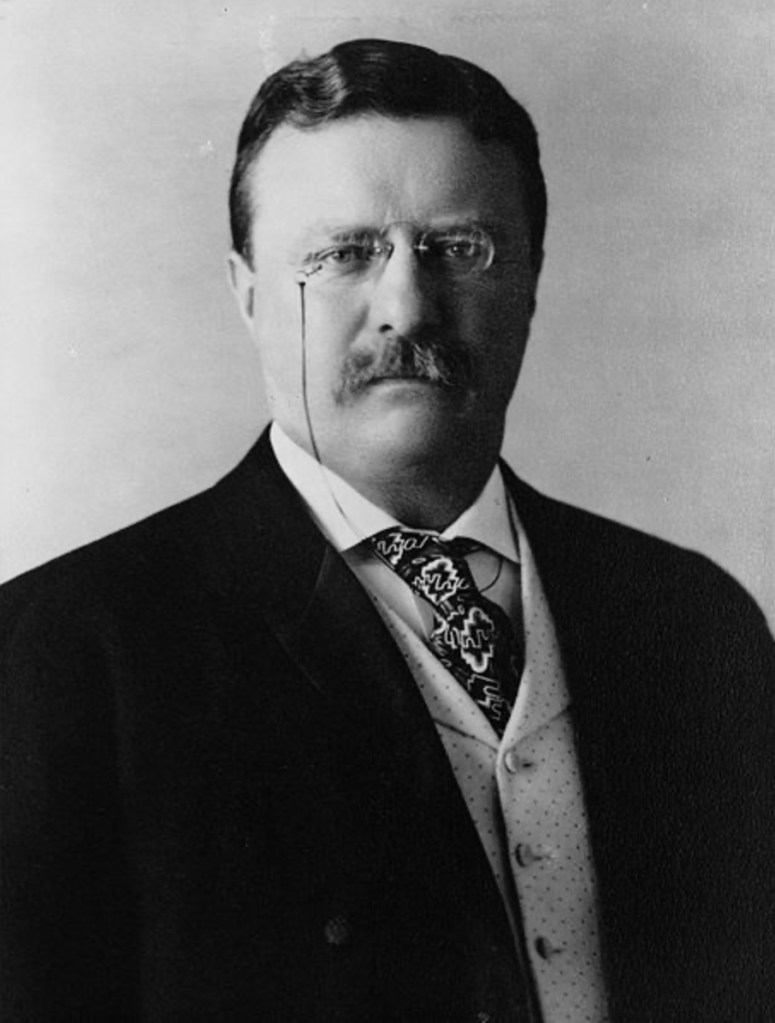
Theodore Roosevelt Jr., circa 1904. 26th President of the United States, 1901 – 1909.
(Image courtesy of Wikimedia Commons).

Shown below in two parts, is the family tree related to this lineage:
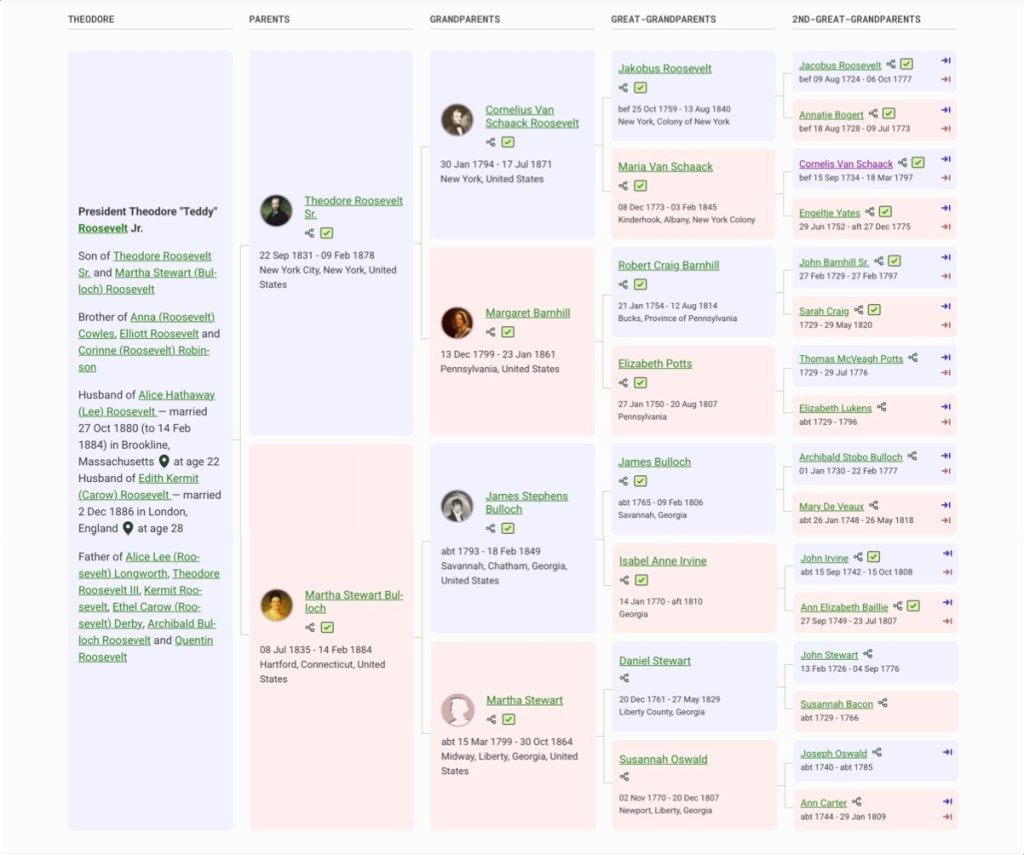
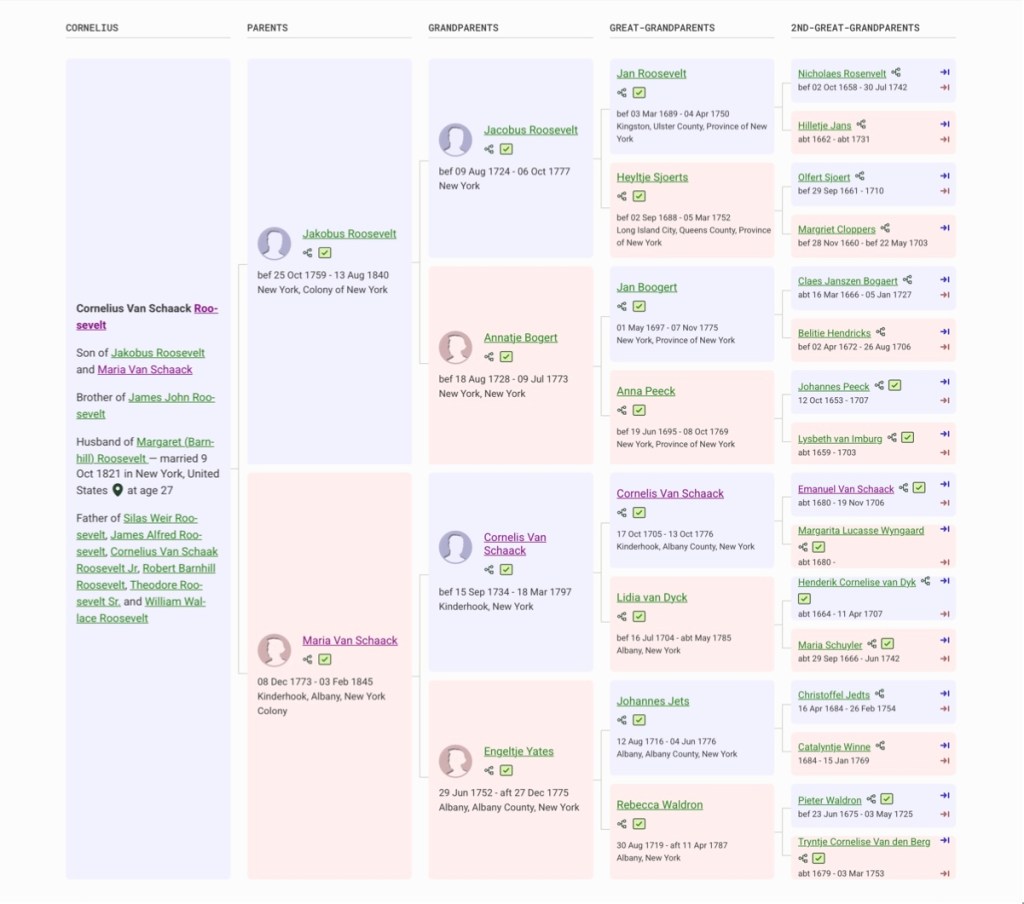
When you look at the family tree for Theodore Roosevelt Jr., working from left to right, you can observe that his 2x Great Grandfather is Cornelius Van Schaak, (upper right in purple text).
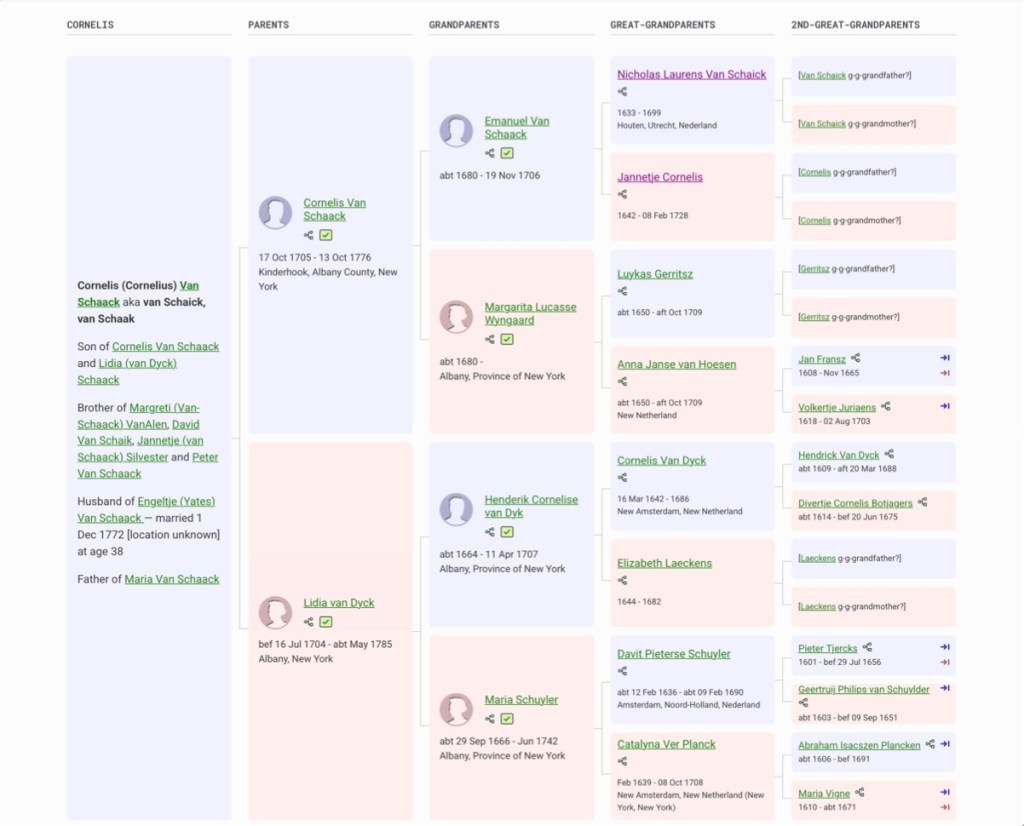
Continuing from Cornelius and moving right to the column of Great Grandparents, we see Theodore’s 5x Great Grandparents, Nicholas Laurens Van Schaick and Jannetjie Cornelis. (Again, they are our 8x Great Grandparents.)
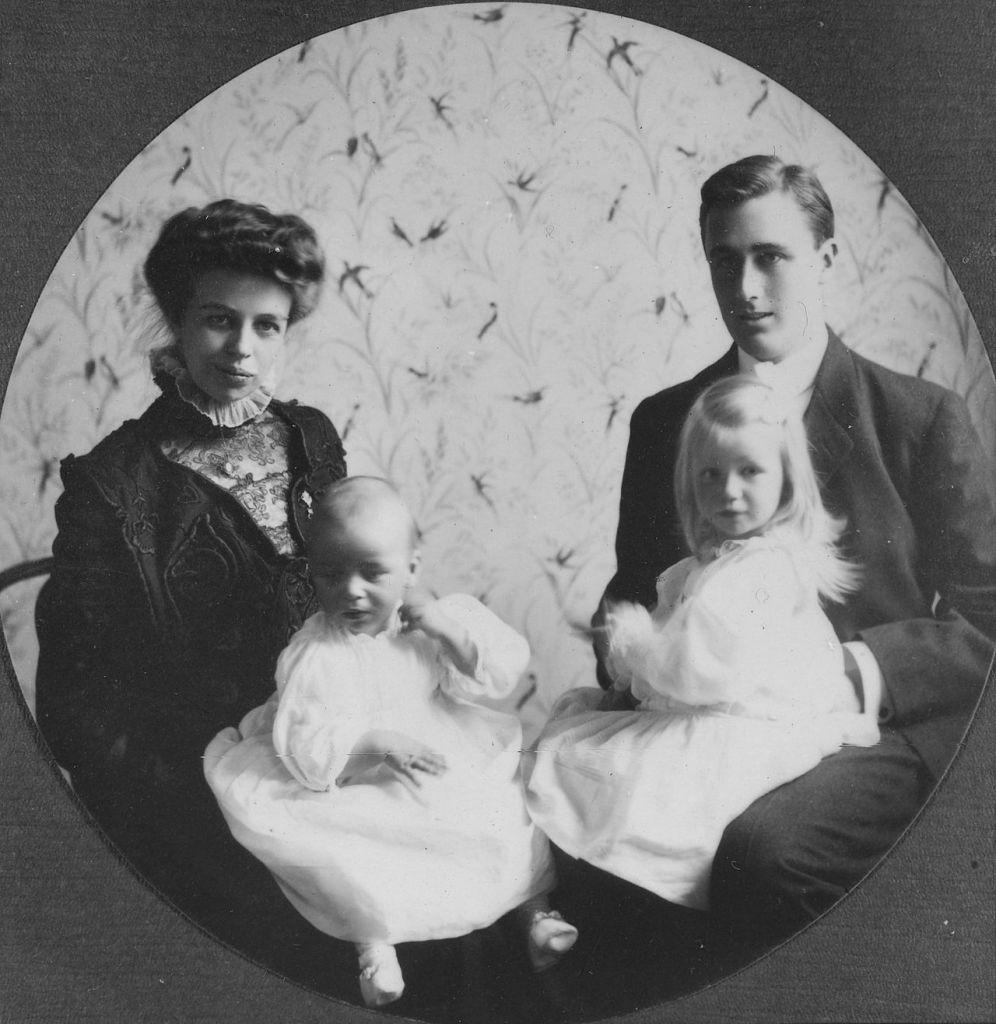
Franklin D. Roosevelt and Eleanor Roosevelt with Anna and baby James,
Hyde Park, New York, circa 1908. FDR was the 32nd President of the United States.
(Image courtesy of Wikipedia Commons).

Franklin Delano Roosevelt and his wife Eleanor —
Another Roosevelt connection of note, is the person shown in the upper chart at top center position. The man is named Grandparent: Cornelius Van Schaak Roosevelt and he leads to two connections: Theodore Roosevelt Jr.’s fifth cousin Franklin Delano Roosevelt, and Franklin’s wife Anna Eleanor Roosevelt, who was Theodore’s niece. This is diagrammed simply below:
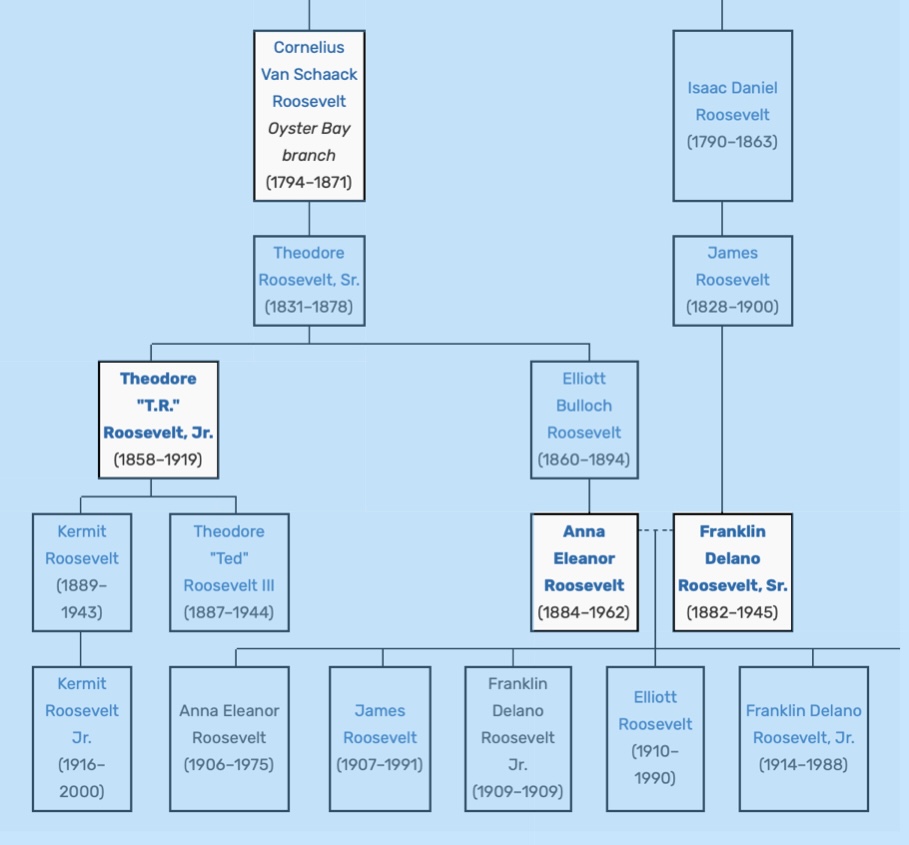
Cornelius Van Schaak Roosevelt has also led to some interesting family connections.
(Image courtesy of Fandom).

When you look at the family tree for Cornelius Van Schaak Roosevelt, working from left to right with the purple text, you can observe that his 2x Great Grandfather is Emanuel Van Schaak, (Marritje’s brother).
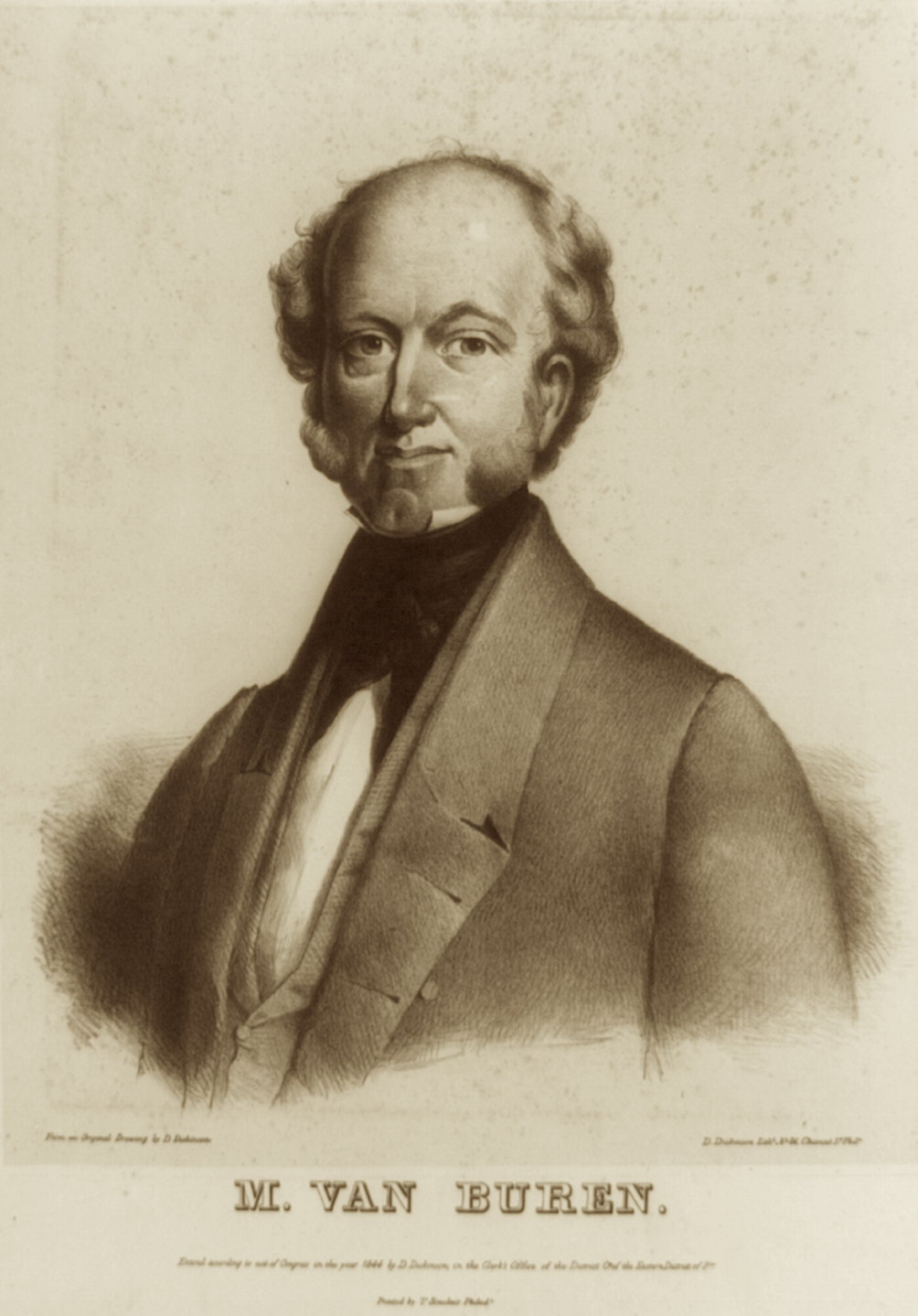
Lithograph of Martin Van Buren by Daniel Dickinson, c. 1820s.
(Image courtesy of Wikimedia Commons).

One More President

These same Dutch grandparents Nicholas Van Schaick and Jannetje Cornelis, led us to the Roosevelt family, but they also connect us to another United States President. Their son, ‘6. Laurens’ is the one that married into the family line which led to the 8th United States President, Martin Van Buren.
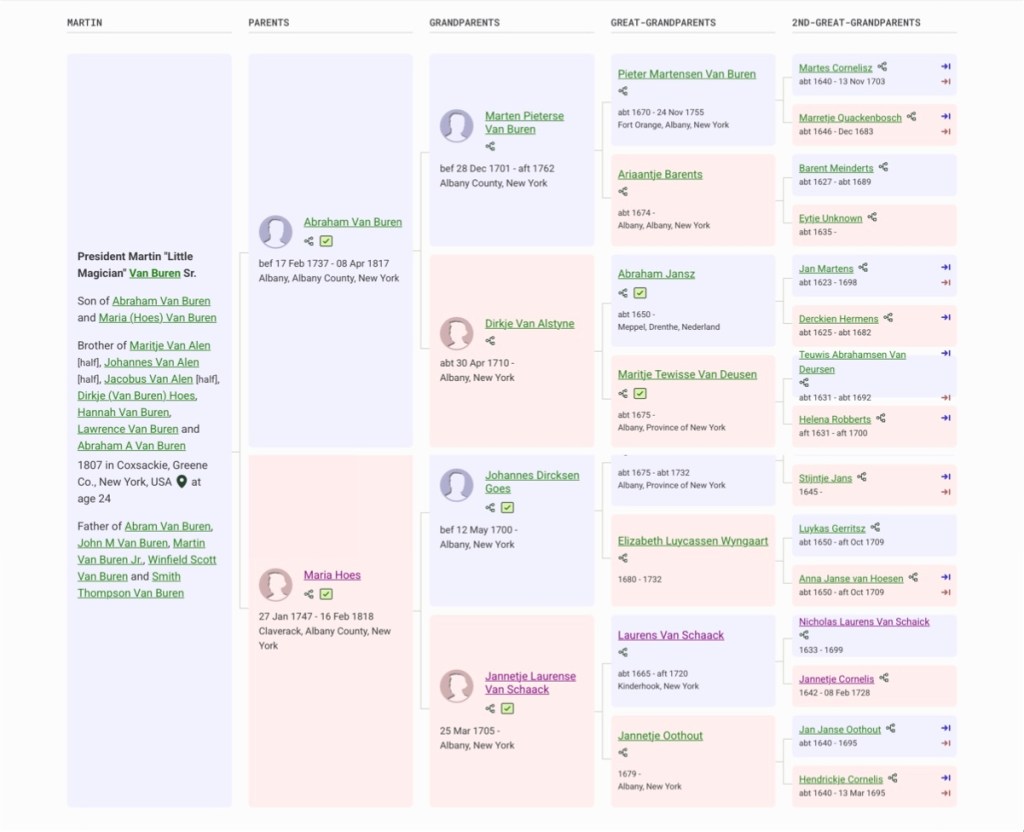
When you look at the family tree for Martin Van Buren Sr., working from left to right with the purple text, you can observe that his Great Grandfather is Laurens Van Schaak, (Marritje’s brother). (9)

So, what would our parents have thought about this?

Throughout their 50 year marriage, our parents used to have some really very absurd arguments about which-side-of-the-family-had-more-important-ancestors. However, they actually knew very little about their true family histories* — so much of these conversations consisted of them blowing cigarette smoke at each other and making offhand comments.
*Much of the research and discovery has emerged in the present generation due to online research capabilities.

But first, a bit of background —
We have all heard the expression that opposites attract, and sometimes it does indeed prove true. Mom and Pop had a mixed-marriage, in the fact that Mom was a country Republican from the mold of: I believe in Civil Rights, but I think we pay too much in taxes! (She always voted Republican). Pop was a Democrat, who grew up in the city during the Great Depression and he felt that FDR had been very helpful to his family. (He always voted Democrat).

Mom would definitely say that Theodore was a Win! for her side, and Pop would counter that FDR was a Win! for his side, and that he had been President for far longer. We never really saw them come to détente on discussions like this… So, when they voted, the actual irony was this: they always ended up canceling-out each other’s vote.

The same hue and pitch entered discussions about family lines, and the same pattern usually continued. In thinking about this, we have pondered, Were they just looking at their various kids’ genes and trying to puzzle-out what they as parents, perceived about each child, one way or another?

Following are the footnotes for the Primary Source Materials,
Notes, and Observations

Let’s Talk About Place Names

(1) — nine records

Tintin and Snowy

The Adventures of Tintin
https://en.wikipedia.org/wiki/The_Adventures_of_Tintin
Note: For information on Tintin and his creator Hergé.

Province of New York
https://en.wikipedia.org/wiki/Province_of_New_York
Note: For the data.

History of Manhattan
https://en.wikipedia.org/wiki/History_of_Manhattan
Note: For the data.

Fort Orange (New Netherland)
https://en.wikipedia.org/wiki/Fort_Orange_(New_Netherland)
Note: For the data.
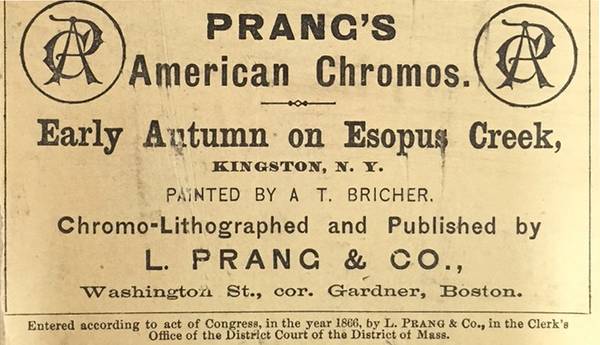
Verso of Bricher’s painting.

The Old Print Shop
Early Autumn on Esopus Creek
by A. T. Bricher, circa 1875
https://oldprintshop.com/product/147946
Note: For the landscape image.

Esopus Creek
https://en.wikipedia.org/wiki/Esopus_Creek
and
Esopus, New York
https://en.wikipedia.org/wiki/Esopus,_New_York
Notes: For the data.

Kinderhook, New York
https://en.wikipedia.org/wiki/Kinderhook,_New_York
Note: For the data.

Ulster County, New York
https://en.wikipedia.org/wiki/Ulster_County,_New_York
Note: For the data.

The De Longs, and The Van Schaicks Come to America

(2) — eleven records

The New Amsterdam History Center,
via The Dutch Collection of the Metropolitan Museum of Art
Manhattan 1660 (view from Governor’s Island), by L. F. Tantillo Fine Art.
https://newamsterdamhistorycenter.org/fat-event/metropolitan-museum-of-art/
Note: For the panoramic artwork of New Amsterdam.

Library of Congress
The Provinces of New York and New Jersey;
with part of Pensilvania, and the Province of Quebec.
by Thomas Pownall, and Samuel Holland, circa 1776
https://www.loc.gov/resource/g3800.ar104500/?r=0.402,1.183,0.673,0.371,0
Note: For sections of the map which indicate the areas of Esopus and New Amsterdam.

Franciscus Adrianus De Lange
https://www.geni.com/people/Franciscus-De-Lange/6000000002665615528
Note: For the data. (Use this file with caution!)

Adrianus Franciscuzs DeLange
https://www.geni.com/people/Adrianus-Franciscusz-De-Lange/6000000000115739032
Note: For the data. (Use this file with caution!)

Nicholas <Laurens or Gerrit?> Van Schaick
https://freepages.rootsweb.com/~rclarke/genealogy/page1/vschai-n.htm
Note 1: For the birth order of Maritjie with her siblings.
Note 2: She is listed as number eleven in the tracing, but looking closely, you will observe that she is child #10.

Nicholas Laurens Van Schaick (1633 – 1699)
https://www.wikitree.com/wiki/Van_Schaick-116
Note: This document (also) lists Maritje as his daughter.

New York State Museum
Introduction to the Fort Orange Educational Guide
Fort Orange and The Patroon’s House
by L. F. Tantillo.
https://nysm.nysed.gov/fort-orange-educational-guide
Note: For the landscape image.

Frans Arie DeLong
https://www.geni.com/people/Frans-DeLong/6000000002665613104
Note: For the data. (Use this file with caution!)

Maria Van Schaak
in the U.S., Dutch Reformed Church Records in Selected States, 1639-1989
New York > Albany > Albany, Vol II, Book 2
https://www.ancestry.com/search/collections/6961/records/2220205
Book page: 230, Digital page: 234/308
Note: For the marriage record.

Maritje van SCHAAK
Web: Netherlands, GenealogieOnline Trees Index, 1000-2015
https://www.ancestry.com/search/collections/9289/records/20450007
Note: For the data on her birth year.

Research Observation: Unfortunately, many, many, (if not most), genealogical websites and family trees have incorrectly identified Lucretia’s mother, Maritje Van Schaick. Often she is listed as the daughter of Iden Van Schaick and Isabel Bloedgoet. Iden and Isobel did have a daughter named Maritje, but she is not the Maritje Van Schaick who was born in Kinderhook, New York. In fact, it is completely implausible that this mother (Isabel Bloedgoet), uniquely gave birth to Maritje in 1680s Kinderhook, which is about 130 miles further north, when all her other children were born in New Amsterdam.

Nicole Kipar’s 17 the century Costume Archive
The Painter’s Family, circa 1630-35
by Cornelis De Vos
http://www.kipar.org/archive/period-galleries/galleries_dutch_paintings1.html
Note: For the family portrait.

A Flourishing Family In The Hudson River Valley

(3) — nine records
(DDFA)
Doty-Doten Family in America
Descendants of Edward Doty, an Emigrant by the Mayflower, 1620

by Ethan Allan Doty, 1897
https://archive.org/details/dotydotenfamilyi00doty/page/504/mode/2up?view=theater
Book pages: 505-506, Digital pages: 504-506 /1048
Note: For the text.

Giesje De Lange
in the U.S., Dutch Reformed Church Records in Selected States, 1639-1989
New York > Fishkill > Hopewell, Fishkill and MarbleTown, Book 14
https://www.ancestry.com/search/collections/6961/records/2028806
Book page: 127, Digital page: 33/56
Note: For the marriage record of Joseph Doty, Jr, and Giesje De Lange [Lucretia (De Long) Doty]

Fishkill NY Dutch Reformed Church
https://www.ancestry.com/mediaui-viewer/tree/87441358/person/320142427851/media/ecda803e-41ca-42b7-afa8-374708585ea5
Note: For the church image.

Hudson-Mohawk Genealogical and Family Memoirs:
a record of achievements of the people of the Hudson and Mohawk valleys in New York state, included within the present counties of Albany, Rensselaer, Washington, Saratoga, Montgomery, Fulton, Schenectady, Columbia and Greene

Volume 3
Cuyler Reynolds, 1866-1934, ed
https://babel.hathitrust.org/cgi/pt?id=njp.32101030753469&seq=170
Book page: 1058, Digital page: 170/680
Note: On the page, see the entry for Doty-Eaton.

(DDFA)
Doty-Doten Family in America
Descendants of Edward Doty, an Emigrant by the Mayflower, 1620

by Ethan Allan Doty, 1897
https://archive.org/details/dotydotenfamilyi00doty/page/504/mode/2up?view=theater
Book pages: 505-506, Digital pages: 504-506 /1048
Note: For the text, and for the brief biographies of the children.

Apparently, to this day this name is still used for streets in The Netherlands. (Image courtesy of: https://www.rtvdordrecht.nl/nieuws/de-kromme-elleboog-is-een-logische-straatnaam-voor-het-centrum).

The Dutch Words Were — Kromme Elleboog

(4) — five records

The Dutchess County Historical Society Yearbook for 1933, Volume 18
Kromme Elleboog
A Seventeenth Century Place-Name in the Hudson Valley

by Helen Wilkinson Reynolds
https://issuu.com/dchsny/docs/dchs_yb_v018_1933_masterfile/s/15204965
Note: For the text.

Hudson River Scene
John Frederick Kensett, circa 1857
https://www.metmuseum.org/art/collection/search/11310
Note: For the landscape image.

Library of Congress
The Provinces of New York and New Jersey;
with part of Pensilvania, and the Province of Quebec.
by Thomas Pownall, and Samuel Holland, circa 1776
https://www.loc.gov/resource/g3800.ar104500/?r=0.402,1.183,0.673,0.371,0
Note: For sections of the map which indicate the Great Nine Partners purchase and the Crum Elbow Precinct.

Timeline of Town Creation in the Hudson Valley
https://en.wikipedia.org/wiki/Timeline_of_town_creation_in_the_Hudson_Valley
Note: For the data.

The Nine Partners Patent in Dutchess County

(5) — three records

(Wikipedia, 9 Partners)
Great Nine Partners Patent
https://en.wikipedia.org/wiki/Great_Nine_Partners_Patent
Note: For the text.

Untitled Manuscript Map of Great Nine Partners Patent
in Dutchess County, New York

by Richard Edsall (surveyor), circa 1740
https://digitalcollections.nypl.org/items/140a7300-fcc4-0132-425e-58d385a7b928?canvasIndex=0
Note: For the map image, (Image ID 5376733)

Dutchess County Historical Society
18th Century Maps
by Author unknown
https://dchsny.org/18th-century-maps/
Note: For the DCHS 1939 Yearbook (map)

Literally Mending Fences Here And There

(6) — two records

Left: Franklin Delano Roosevelt, 1882 — 1945.
32nd President of the United States, and Right: Frontispiece for Records of Crum Elbow precinct, Dutchess county, New York… Maybe his interest in genealogy is a genetic trait? There must be something there, because we have it too…

Records of Crum Elbow Precinct, Dutchess County, New York, 1738-1761,
together with records of Charlotte precinct, 1762-1785,
records of Clinton precinct, 1786-1788, and
records of the town of Clinton, 1789-1799

by Franklin Delano Roosevelt, 1882-1945, editor
https://archive.org/details/recordsofcrumelb00roos/page/n7/mode/2up
Note 1: Joseph Doty is listed as either an Overseer, or a Path Master of the High Ways in the Crum Elbow Precinct for the years: 1756 (page 28), 1759 (page 30); then for the Charlotte Precinct in 1763 (page 66).
Note 2: The Delong family’s bridge is mentioned in the Charlotte Precinct in 1772 (page 75).

The Making of the Hudson River School, The Improved Landscape
The Van Allen Homestead
by Henry A. Ferguson 
https://www.albanyinstitute.org/online-exhibition/the-making-of-the-hudson-river-school/section/the-improved-landscape
Note: For the painting.

A Blacksmith, Probably in Good Circumstances

(7) — three records

TuckDB Postcards
The Village Blacksmith
https://www.tuckdbpostcards.org/items/16508-the-village-blacksmith
Note: For the postcard image.

Joseph Doty
Mentioned in the Record of Melancthon Smith
Land – New York, Land Records, 1630-1975
https://www.familysearch.org/ark:/61903/1:1:Z82J-HL6Z?lang=en
Note: For the land deed.
Book page: 2144, Digital page: Image 11 of 347
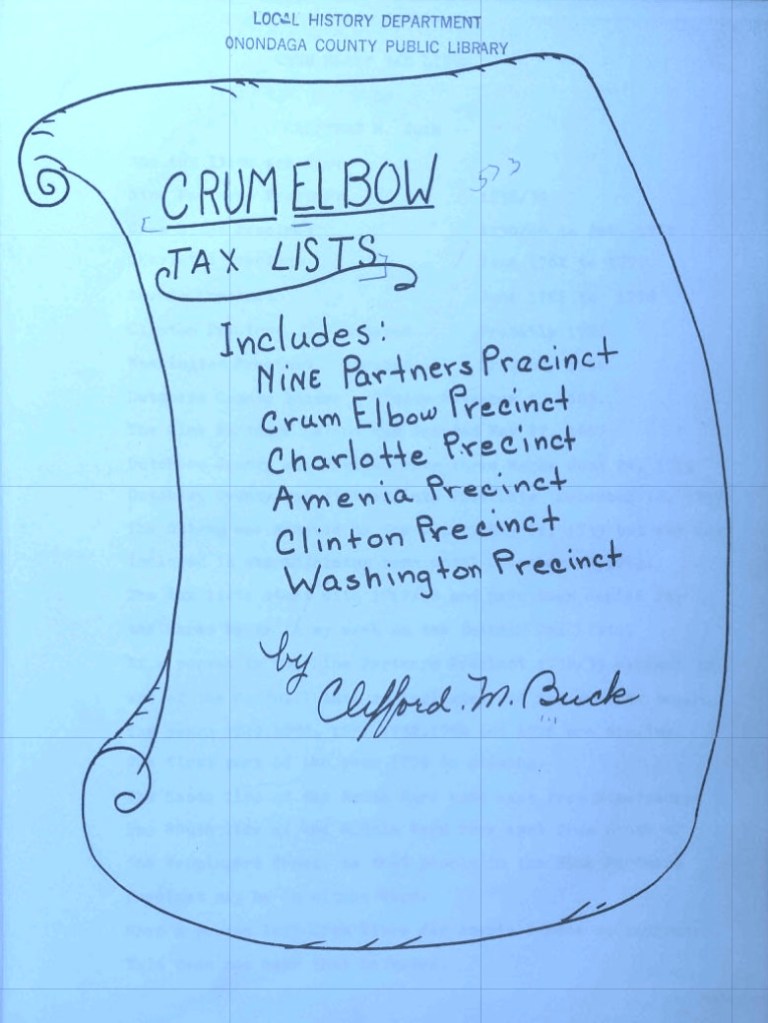
Crum Elbow tax lists: includes Nine Partners precinct, Crum Elbow precinct, Charlotte precinct, Amenia precinct, Clinton precinct, Washington precinct
by Clifford M. Buck
https://www.familysearch.org/library/books/viewer/296090/?offset=0#page=13&viewer=picture&o=info&n=0&q=
Book page 12, Digital page: 13/76
Note 1: Typed tax record for Joseph Doty of Crum Elbow, for the the time period of June 1754 – June 1768.
Note 2: Document identifier number 285952.

Where the Hudson Meets the Mohawk

(8) — five records

Library of Congress
The Provinces of New York and New Jersey;
with part of Pensilvania, and the Province of Quebec.
by Thomas Pownall, and Samuel Holland, circa 1776
https://www.loc.gov/resource/g3800.ar104500/?r=0.402,1.183,0.673,0.371,0
Note: For sections of the map documenting the transition from the Crum Elbow Precinct in Dutchess County, to the hamlet of Lansingburg Village in Rensselaer County in 1769.
History of Rensselaer Co., New York
by Nathaniel Bartlett Sylvester, circa 1880
https://archive.org/details/historyofrenssel00sylv/mode/2up
Book page: 293, Digital page: 292/844
Note: For the text on the history of Lansingburgh Village.

Albany, New York
https://en.wikipedia.org/wiki/Albany,_New_York
Note: For reference.

The History of Lansingburgh, N. Y.
From the Years 1760 to 1877

by A. J. Weise, A. M., circa 1877
https://ia801209.us.archive.org/6/items/historyoflansing00weis/historyoflansing00weis.pdf
Note 1: Book page 39 — for the text regarding population statistics.
Note 2: Book page 11 — for the quote from the traveler Elkanah Watson.
Note 3: Book page 7 — For the description of the original town map, as follows,
“The Map is filed in the Albany County Clerk’s office, and is marked number 18. The following description is attached to it: ‘This Map describeth a tract of land lying on the east side of Hudson’s river, about eight miles above the City of Albany, and is layed out in a regular square for the erecting a City by the name of Lansingburgh; the lots are one hundred and twenty feet long and fifty wide. The streets are seventy feet wide, and the alleys are twenty feet wide the oblong square (the Green or Park) in the center is reserved for publick uses. Laid down by a scale of ninety feet to an inch. June 7, 1771. 
Joseph Blanchard, Surveyor. May 11, 1771. A. Jacob Lansingh’.”

Lansingburgh Historical Society
Old Maps of Lansingburgh
https://www.lansingburghhistoricalsociety.org/old-maps
Notes: For the two map images, described accordingly on their website —
“Detail showing New City within boundaries of (unlabeled) Stone Arabia, and Iron Hill north of it. Cropped from ‘A chorographical map of the Northern Department of North-America’ (1780)”
and
“This Map describeth a Tract of Land […] Lay’d out in a Regular form for the Erecting a city by the name of Lansinghburrough”

The Roosevelt Family Connection, and One More President

(9) — ten records

Theodore Roosevelt Jr. (1858 – 1919)
https://www.wikitree.com/wiki/Roosevelt-18
Note: For the Family Tree of Theodore Roosevelt Jr., part one

Cornelis Van Schaack (bef. 1734 – 1797)
https://www.wikitree.com/wiki/Van_Schaack-2
Note: For the Family Tree of Theodore Roosevelt Jr., part two.

Theodore Roosevelt, circa 1904
File:President Theodore Roosevelt, 1904.jpg
https://commons.wikimedia.org/wiki/File:President_Theodore_Roosevelt,_1904.jpg
Note: For his portrait.

File:Franklin D. Roosevelt and Eleanor Roosevelt with Anna and baby James, formal portrait in Hyde Park, New York 1908.jpg
https://commons.wikimedia.org/wiki/File:Franklin_D._Roosevelt_and_Eleanor_Roosevelt_with_Anna_and_baby_James,_formal_portrait_in_Hyde_Park,_New_York_1908.jpg
Note: For the family portrait.

Roosevelt family
Fandom
https://familypedia.fandom.com/wiki/Roosevelt_family
Note: For the simple FDR family tree.

Franklin Delano Roosevelt (1882 – 1945)
https://www.wikitree.com/wiki/Roosevelt-1
Note: For the Family Tree of Franklin Delano Roosevelt, part one
Cornelius Van Schaack Roosevelt (1794 – 1871)
https://www.wikitree.com/wiki/Roosevelt-72
Note: For the Family Tree of Franklin Delano Roosevelt, part two. Which leads to Emanuel Van Schaack.

History Facts
FDR was related to 11 other presidents
by Michael Nordine
https://historyfacts.com/famous-figures/fact/fdr-related-to-11-presidents/
Note: For the data.

Martin Van Buren Sr. (1782 – 1862)
https://www.wikitree.com/wiki/Van_Buren-1
Note: For the Family Tree of Martin Van Buren Sr., which leads to Laurens Van Schaack.

Martin Van Buren
https://en.wikipedia.org/wiki/Martin_Van_Buren
Note: For his biography and portrait.
The Doty Line, A Narrative — Six

This is Chapter Six of nine. The settlement of the Isaac Doty family in Oyster Bay, Long Island was the first step in their journey away from the Plymouth Colony. Time brought even more change… In this chapter we will be focusing on the son Joseph Doty Sr. and his wife Sarah (whose last name is unknown), and their family.

Seascape

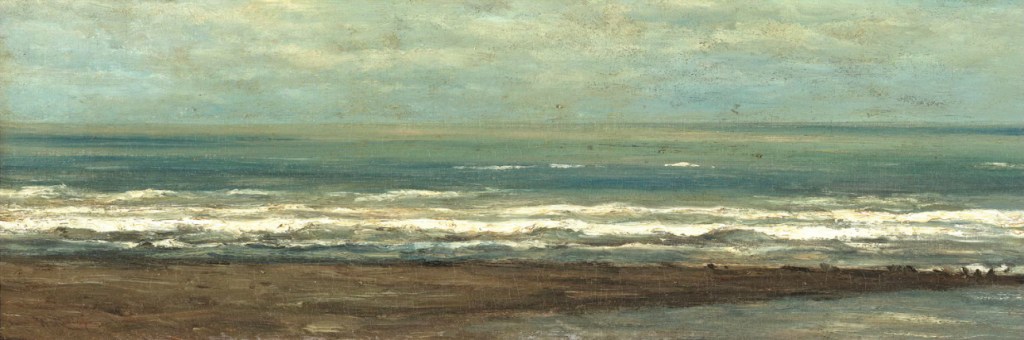
In the same way that a wave returns the borrowed grains of a sandcastle back to their beach — once gone, we only see the newly smoothed surface. And like that, we know very little about the life of our ancestor Joseph Doty Sr., because records about his life are very scant, or perhaps, they have not yet been discovered.

Seascape Near Heijst, by Willem Roelofs, 19th century. (Image courtesy of Fine Art America).

Despite this, we do know a few things about his lifetime: He lived his entire life in Oyster Bay, Long Island, the Province of New York. He married a woman named Sarah (maiden name unknown), and he was the father of four children. Joseph died remarkably young, probably around the age of 36. When he died, his wife Sarah was pregnant with their fourth child. We know these things from the only meaningful record we have from this portion of his life — his 1716 Will.

Author Ethan Allan Doty tells us in his book, The Doty-Doten Family in America,
“His will is recorded at Jamaica, Queens Co., N. Y. , signed Joseph Doughty of Oyster Bay, made July 7, 1716, and devises his estate to his eldest son Joseph, to his son Isaac, to his daughter Sarah, and to his wife Sarah, and provides for a child in case his wife be with child.” It seems likely that his Will was written in haste, so something must have been going on with either his health or perhaps he’d been in a life threatening accident. We do not know.

We can infer from this document that his children were all born in Oyster Bay, and that their names are:

  • Sarah Doty, born about 1706, “She married John Jackson, probably the son of James Jackson and Rebecca Hallett.”
  • Joseph Doty Jr., born about 1708,
    (We are descended from Joseph Jr.).
  • Isaac Doty, born 1711, and who probably died young
  • Elizabeth Doty, born about 1716, most likely after Joseph Sr.’s death. [She] Married there 1730, Daniel Dunning (or Downing). Marriage license issued to Daniel Dunning and Elizabeth Doty of Queens County,
    N. Y., August 4, 1730”.

Interestingly, the document also mentions receipts, which are “When an executor or administrator paid debts owed by the estate and collected money from those who owed the deceased person, receipts were issued which were filed with the annual accounting and final settlement. Among these will be receipts signed by the heirs as they receive money from the estate”. (Family Search)

  • His widow Sarah, received receipts for her share of above, January 29, 1717. From this date it is safe to assume that Joseph Sr. most likely died shortly after writing his Will.
  • Sarah (Doty) Jackson, wife John Jackson, received receipts May 7, 1724. 
  • Joseph Doty Jr. receipts for 178£*, in full. May 6, 1729. 
  • Elizabeth Doty received receipts for her share, July 24, 1736.

*Observation: It is certain that Joseph Jr. received this money from his late father’s estate around the time of his 21st birthday. The value of 178£ calculates to over $44,500 dollars in today’s currency, (see footnotes). Cha-ching!

It also seems that property Joseph Sr. owned in Oyster Bay was eventually sold, about two years after he died. On “July 30, 1718, Jervis Mudge, Thomas Cirby and Joseph Carpenter, executors of Joseph Doty, deceased, sell to Isaac Doty, Jr., certain land at Oyster Bay, which is an equal one-third of land given by their father, Isaac Doty, Sr., to his three sons, Joseph, Jacob and James.” (1)

A Panoramic View of New York Harbor As Seen From Long Island, 1727 by Henry Popple, and issued in 1733. (Image courtesy of Wikipedia).

Manhattan Calling

We know that Joseph Jr. was soon living in Manhattan, and that he didn’t have to travel very far to get there. Why was he there? Of course, we don’t know for certain. Nevertheless, receiving the equivalent of $44,500 plus dollars when you are aged 21 years in Colonial America, certainly eased this transition.

In those days, despite the Dutch having first colonized the area, the population was a mixture of many different types of people. The English population eventually came to dominant governance. Wikipedia tells us, “By 1700, the Lenape population [Native Peoples]of New York had diminished to 200. The Dutch West Indies Company transported African slaves to the post as trading laborers used to build the fort and stockade, and some gained freedom under the Dutch. After the seizure of the colony in 1664, the slave trade continued to be legal. In 1703, 42% of the New York households had slaves; they served as domestic servants and laborers but also became involved in skilled trades, shipping and other fields. Yet following reform in ethics according to American Enlightenment thought, by the 1770s slaves made up less than 25% of the population”.

It was into this colonial admixture of European Dutch and English immigrants, and enslaved peoples, that Joseph Jr.had moved. (2)

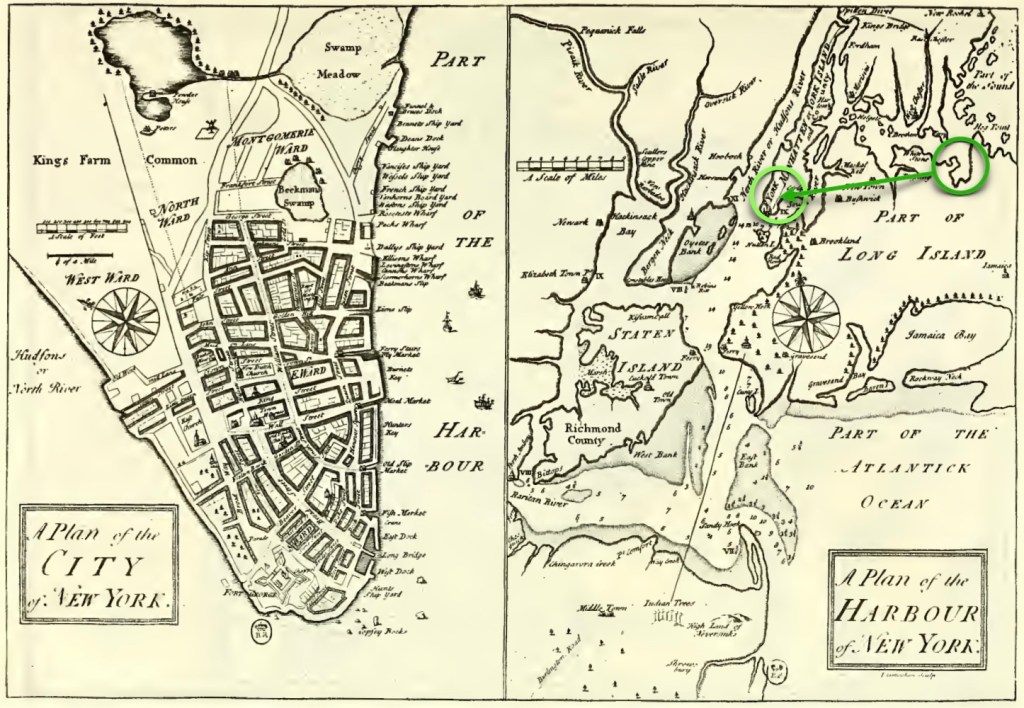
The image on the right shows the short distance that Joseph Doty, Jr. needed to travel to relocate to Manhattan. (Note that the geography of Long Island is not very accurate).
Plate 27-A from, A Plan of the City of New York (and) A Plan of the Harbour of New York
by Author unknown, circa 1730-35, from Bibliotheque Nationale, Paris, Print Department.
Plate 32-A from, A Plan of the City and Environs of New York [Grim’s General Plan
by David Grim, circa 1742-44, from from The New York Historical Society.

All three map plates shown above are derived from the book, The Iconography of Manhattan Island, Volume 1, by I. N. Phelps Stokes, circa 1915.

The Burgher Guards

The Burgher Guard of Manhattan, also known as the Burgher Militia, was a citizen militia organized by the Dutch West India Company in 1640 to protect New Amsterdam (Manhattan) from external threats. These local militias were utilized to supplement the presence of the Dutch garrison, and were known as the Burgher Guards. These citizen-soldiers, composed of adult male residents, were responsible for maintaining order and defending the colony. Membership in the Burgher Guard was a sign of citizenship and was initially restricted to certain residents, excluding indentured servants and enslaved Africans. 

After the English takeover in 1664, the Burgher Guard was eventually absorbed into the English colonial militia system, with the burgher class-right transitioning to the English concept of freemanship. (3)

Captain Charles Laroex’s Company of New York City Militia in 1738

The world of 1730s Manhattan was still a far-flung New England outpost of the British Empire, and despite a century of colonization, the English were still trying to figure out how to appropriately govern the area. With regard to defense, it was not practical for England to maintain standing armies throughout the colonies. So, it makes sense that they carried over one of the same systems that they already knew —that of forming local militias.

These groups were a community-based force, with Companies drawn from specific geographic areas within towns. They varied in size, with a minimum of 24 men to form a company and larger companies including officers like captains, lieutenants, and sergeants. Their main function included maintaining order, providing local defense, and assisting in emergencies. The militias also played a role in town governance, with records of town meetings reflecting militia-related concerns such as fence heights, road maintenance, and care for the poor.

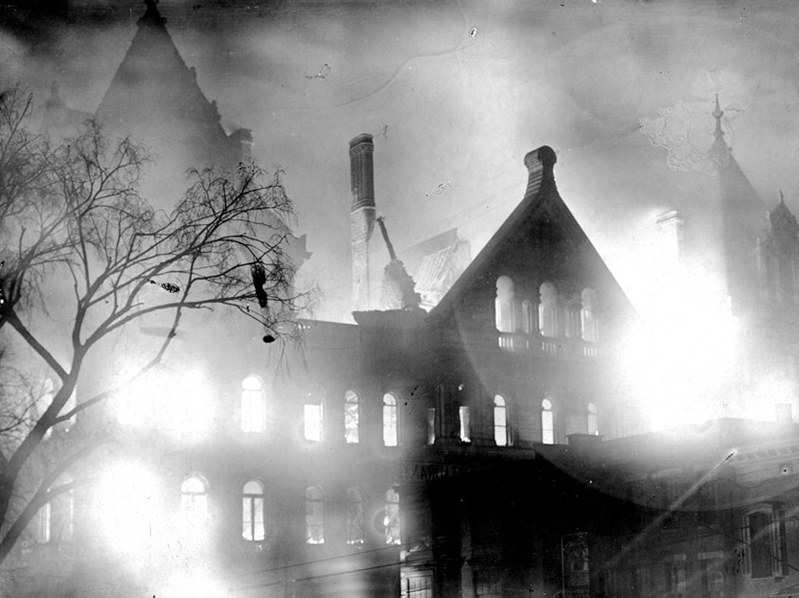
When we discovered that our 6x Great Grandfather Joseph Doty, Jr. had been cited repeatedly by other researchers as being a private in Captain Charles Laroex’s Company of New York City Militia in 1738, but no one had provided any support for this intriguing fact. We searched high-and-low to verify this. A big concern was the fact that the 1911 fire at the State Library in Albany, New York had destroyed many colonial era records. “The English volumes of Colonial Manuscripts included censuses, assessment lists, muster rolls, and other items useful to genealogists, almost all of which were destroyed by the fire.” (See footnotes, NYG&B) However, despite our concerns, diligence finally paid off.

Detail from an article titled Great War Marks End Of Burgher Guards, found on page 10 of the August 19, 1917 edition of The Sun newspaper. (See footnotes).

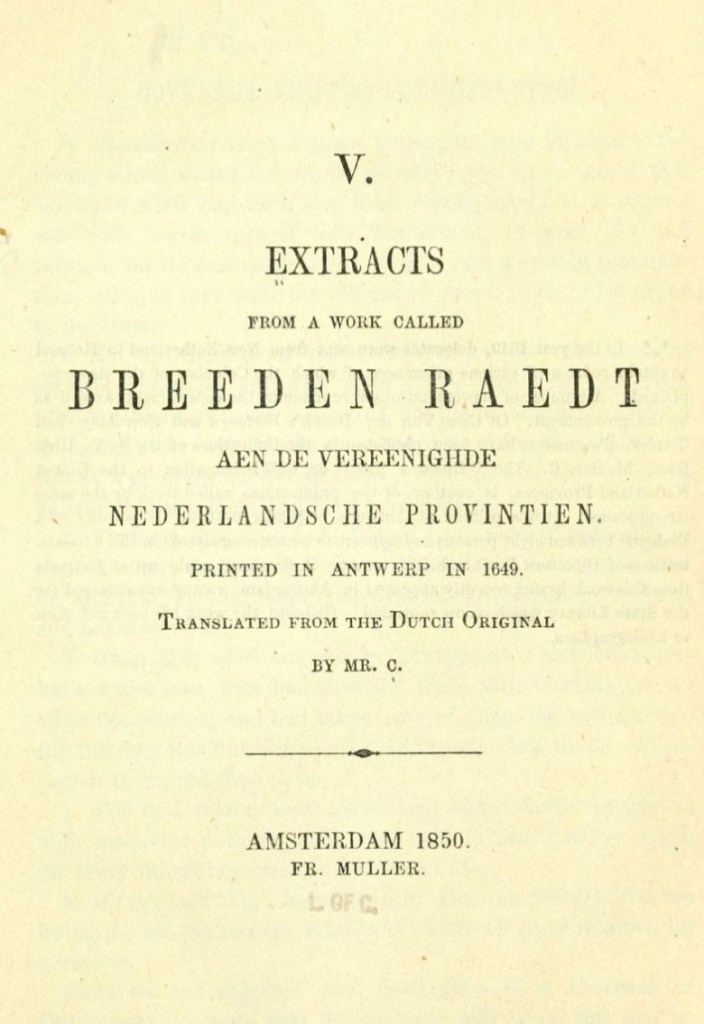
We first found confirmation that the Laroex Company did indeed exist. It is mentioned in an August 19, 1917 The Sun newspaper article, “…But the old burgher spirit could not be ‘snuffed out’, and as late as 1738 the Independent companies in this city were almost exclusively Dutch American. They were Beekmans’s, Laroex’s, Stuyvesant’s, Richard’s, Van Horn’s and Cuyler’s and the Blue Artillery”. (The Sun) Digging further, we found a book at the Library of Congress, published in Amsterdam in 1850, titled Breeden Raedt Aen De Vereenighde Nederlandsche Provintien. (It had been translated from the original Dutch). This book contained many records of 1738 Manhattan, as well as the full rosters the various militia companies. (4)

Excerpted from Breeden Raedt Aen De Vereenighde Nederlandsche Provintien. (Image courtesy of the Library of Congress).

The Fires and Riots of 1741...

As we had written about the population of enslaved people in Manhattan at that time, “By the 1740s, 20% of the residents of New York were slaves, totaling about 2,500 people… After a series of fires in 1741, the city panicked over rumors of its black population conspiring with some poor whites to burn the city. Historians believe their alarm was mostly fabrication and fear, but officials rounded up 31 black and 4 white people, who over a period of months were convicted of arson. Of these, the city executed 13 black people by burning them alive and hanged the remainder of those incriminated.”

Propagandist illustrations documenting the New York Slavery Conspiracy of 1741, taken from The Evolution of Slavery, Abolition in NY, and the NY Courts, The Lemmon Slave Case.

Comment: That text about the 1741 riots and lynch mobs is difficult to read, but sometimes we see that there is much cruelty in history. We don’t know if Joseph Doty was still involved with the Laroex Company militia at that time, or quite honestly, if he even was still living in Manhattan by 1741. If he was there, we wonder if perhaps these events influenced his decision to leave the city? (5)

In due course, he moved up the Hudson River to the community of Nine Partners — in the Crum Elbow Precinct of Duchess County, and by 1744 he was married.

Before we leave Manhattan and the Oyster Bay area, we thought it would be very interesting to take a look at the history of oysters in New York Harbor. It’s not with every ancestor that you get to delve into something so unique!

Slurp, painting by Pam Talley. (Image courtesy of Fine Art America).

Oysters and New York’s Past

It might seem obvious, but why was the town which Isaac Doty and his family lived in called Oyster Bay?

In 1609, when English explorer Henry Hudson sailed into the harbor of what later became known as New York City, he “could not have seen… [that there] were 220,000 acres of oyster beds below the surface on the harbor floor, constituting nearly half of the oysters in the entire world”. Later in time, on nearby Long Island, the early Dutch settlers referred to the area as Oyster Bay due to the vast number of high-quality oysters native to the region. Oysters became a staple of the colonial New York diet. (Untapped New York)

It was the Lenape people [Native Peoples] who showed the settlers how to harvest oysters from the harbor. “The local Lenape had been living off the reefs for generations. They would open the oyster shells by wrapping the entire oyster in seaweed before tossing them into the fire”.

Mine oysters – Dredging boats in the Chesapeake, from Harper’s Weekly magazine, March 16, 1872. (Image courtesy of The New York Public Library Digital Collections).

“Oysters were always popular and in high demand. Literal tons of oysters were eaten everyday. Worried that the supply might not last, the local government introduced a conservation law in 1715, banning the harvest of oysters during the months without an R, which lasts from May to August. The popularity of New York oysters [continued to] spread across the nation and to Europe, where large shipments of oysters were being sold. In order to meet the demand, the conservation law from 1715 was lifted in 1807, prompting the unsustainable harvesting of the oyster reefs. The supply was still not enough to meet the demand, and so oysters from Long Island, Connecticut, and New Jersey were brought into New York. These oysters were able to be sold as New York oysters because they were in the harbor for a short amount of time”. (Untapped New York, and the Billion Oyster Project)

Historically, oysters were deeply woven into the life of East Coast cities, as Charles Dickens described enthusiastically in his 1842 travelogue American Notes. He then “describes cellars serving oysters, pretty nigh as large as cheese-plates”. (BBC)

Eventually, pollution in New York Harbor decimated the viability of the oyster harvest. Recent efforts to revitalize the harbor and bring back the native oysters is ongoing. “That thriving population of oysters is long gone. But over the past 10 years, one of New York’s most ambitious rewilding projects has sought to revive its once-famous oysters, adding 150 million larvae across 20 acres of harbour since its beginnings. The goal: restoring the city’s coastal habitat, improving water quality and educating the public.” (BBC) (6)

Detail excerpt from The Provinces of New York and New Jersey; with part of Pensilvania,
and the Province of Quebec, by Thomas Pownall, and Samuel Holland, circa 1776.
(Image courtesy of the Library of Congress).

This map documents the family’s transition from Oyster Bay, Long Isand, to the Crum Elbow Precinct in Dutchess County, to the hamlet of Lansingburg Village in Rensselaer County.

Saying Farewell to Oyster Bay

When you eat a well prepared fresh oyster it should taste a bit like the sea… just a bit salty (and delicious!) We say this because, when we have been researching out ancestral lines, occasionally we come across an intriguing bit of family folklore that sometimes leads us down a new and exciting path. However, sometimes a fanciful story can lead us down a rabbit hole. Such is the story with a legend we encountered in the Doty-Doten book (DDFA) , and this story must be taken with a very large grain of salt. Like your food, you can immediately tell when it is just too salty.

Wikipedia tells us that “To take something with a ‘grain of salt’ or ‘pinch of salt’ is an English idiom that suggests to view something, specifically claims that may be misleading or unverified, with skepticism or not to interpret something literally. In the old-fashioned English units of weight, a grain weighs approximately 65 mg, which is about how much table salt a person might pick up between the fingers as a pinch.

On the left, Pliny the Elder, author of Naturalis Historia. He is also noted for dying in the AD 79 explosion of Mount Vesuvius, which buried the City of Pompeii. At right, a 1917 Morton Salt Company advertisement featuring the famous slogan, ‘When It Rains It Pours’ and an image of the Morton Salt Girl.

The phrase is thought to come from Pliny the Elder’s Naturalis Historia, regarding the discovery of a recipe written by the Pontic King Mithridates to make someone immune to poison. One of the ingredients in the recipe was a grain of salt. Threats involving poison were thus to be ‘with a grain of salt,’ and therefore, taken less seriously.”

Ethan Alan Doty had written this:
“The legend in the family was that Elsha Van Schaick was daughter and sole heir of an Amsterdam banker, and that she eloped with Francis De Long, who was a French officer. This story made it difficult to obtain full items [property?] of some branches, who were suspicious that they were to be defrauded of their share of valuable estate.”

Comment: What a great story! Even so, it’s just not true. We extensively researched the Van Schaick family. The closest this branch ever came to anything to do with banking was long after Lucretia’s lifetime. Another branch of the family is actually featured in a prestigious vanity book from 1881 titled, Contributions to the History of Ancient Families of New Amsterdam and New York, by Edwin R. Purple.* We suspect that this book was printed for Gilded Age Manhattan families who swirled on dance floors in New York High Society circles.
* The perfect name for a writer of that genre. See “Quote or No Quote?” in the footnotes at the end of this chapter.

The Van Schaicks were indeed very early in New Amsterdam, and then Manhattan. Some branches of the family went into the Hudson River Valley, therefore the history truly develops from what branch of the family you belong within. Then, what was going on with this tale of a banking heiress and a French army officer? We came upon a well researched file about Lucretia’s father Frans DeLang, which covers this family legend. It states:

“In discussing the marriage of Joseph Doty and Geesje (Lucretia) De Long, the Doty Genealogy gives her parents as Frans and ‘Elsha’, the latter an obvious error and presumably confusion with Maritje’s youngest daughter Egge or Echa.” Lucretia’s mother was named Maritje Van Schaick.

“The story is also another of the 19th century attempts to assign a French heritage to a Dutch family. Frans was not a French officer, he was born to Dutch parents and in the new world. I doubt if Claas Van Schaick was an Amsterdam banker before emigration, and Maritje was not likely his sole heir.

“An even more inane version appears in the History of Danby (Vermont) which says Lucretia Doty was daughter of ‘Hielcha DeLong, the wife of Francis DeLong, a French officer. They say she let herself down from a two story building in Amsterdam in 1780, came to America, and settled on Long Island.’ So this puts American-born Frans in Amsterdam and eloping at the age of 99! I hope he didn’t hold her ladder.”

For an extensive history of the De Lange /De Lang / De Long family, please see the footnote for Frans DeLang at the end of this chapter. It is written by Delong family descendant Roy Delong, basing his observations on, “…the following notes from the late John D. Baldwin (50+ year Delong researcher). (Note various spellings of surname in this text…”). (7)

In the next chapter, we follow the Joseph Doty Jr. as he leaves Manhattan, and first ventures forth into Dutchess County. Then with his new wife Geisje ‘Lucretia’ De Long and their family, they settle in the oddly-named Crum Elbow Precinct in Dutchess County. Eventually, Life then takes them still further in their northward trek up the Hudson River Valley, and finally into Rensselaer County.

Following are the footnotes for the Primary Source Materials,
Notes, and Observations

Seascape

(1) — seven records

Fine Art America
Seascape Near Heijst
painting by Willem Roelofs, 19th century
https://fineartamerica.com/featured/seascape-near-heijst-willem-roelofs-1822-1897.html
Note: For the seascape image.

(DDFA)
Doty-Doten Family in America
Descendants of Edward Doty, an Emigrant by the Mayflower, 1620

by Ethan Allan Doty, 1897
https://archive.org/details/dotydotenfamilyi00doty/page/500/mode/2up
Book pages: 501, Digital pages: 500 /1048
and
https://archive.org/details/dotydotenfamilyi00doty/page/504/mode/2up?view=theater
Book pages: 505, Digital pages: 504 /1048
Note: For the texts.

U.S. Probate Records Class Handout
Under the subtitle: Distributing the Estate
https://www.familysearch.org/en/wiki/U.S._Probate_Records_Class_Handout
Note: To explain the role of receipts in a Colonial American Will.

Pounds Sterling to Dollars: Historical Conversion of Currency
https://www.uwyo.edu/numimage/currency.htm
Note: For the calculation of the inheritance value for Joseph Doty, Jr. from his late father’s estate when he was 21 years old.

Joseph Doty
in the Mayflower Births and Deaths, Vol. 1 and 2

https://www.ancestry.com/search/collections/3718/records/37992?tid=&pid=&queryId=ab22e56d-3bb2-4c0f-b15c-cffa1c314979&_phsrc=ylI10&_phstart=successSource
Book page: 422, Digital page: 434/537
Note: For confirmation of birth date and his Will date.

Joseph Doty
in the U.S., Find a Grave Index, 1600s-Current
https://www.ancestry.com/search/collections/60525/records/137781328
and
Joseph Doty
in the Global, Find a Grave Index for Burials at Sea and other Select Burial Locations, 1300s-Current
https://www.ancestry.com/search/collections/60541/records/182712503
Joseph Doty
https://www.findagrave.com/memorial/172015138/joseph-doty
Note: For the data.

Manhattan Calling

(2) — four records

A Panoramic View of New York Harbor As Seen From Long Island, 1727
by Henry Popple, and originally engraved by William Henry Toms
(who also signed it) & R.W. Seale, issued in 1733
https://en.wikipedia.org/wiki/History_of_New_York_City#/media/File:New_York_Harbor_Waterfront_1727_panorama_map.jpg
Note: This is an inset from A Map of the British Empire in America with the French and Spanish Settlements adjacent thereto…

History of New York City
https://en.wikipedia.org/wiki/History_of_New_York_City
Note: For the text.

The three map plates in this chapter are derived from the book,
The Iconography of Manhattan Island, Volume 1

by I. N. Phelps Stokes, circa 1915 —

Plate 27-A
Bibliotheque Nationale, Paris, Print Department
A Plan of the City of New York (and) A Plan of the Harbour of New York
by Author unknown, circa 1730-35
https://upload.wikimedia.org/wikipedia/commons/8/84/IA_Query_”sponsor-(Sloan)_date-(1000_TO_1925)_publisher-((New_York)_OR_Chicago_OR_Jersey_OR_Illan)”_(IA_iconographyofman01stok).pdf
Book pages: 260-261, for map explanation
Note: For the map.

Plate 32-A
from The New York Historical Society
A Plan of the City and Environs of New York [Grim’s General Plan]
by David Grim, circa 1742-44
https://upload.wikimedia.org/wikipedia/commons/8/84/IA_Query_”sponsor-(Sloan)_date-(1000_TO_1925)_publisher-((New_York)_OR_Chicago_OR_Jersey_OR_Illan)”_(IA_iconographyofman01stok).pdf
Book pages: 270-271, for map explanation
Note: For the data.

The Burgher Guards

(3) — one record

New Amsterdam Stories
What happened to the burgher right after the English invasion in 1664? 
https://newamsterdamstories.archives.nyc/english-invasion#:~:text=The burgher right continued to, a sign of municipal identity.
Note: For research on the text.

Captain Charles Laroex’s Company of New York City Militia in 1738

(4) — four records

Journal of the American Revolution
Colonial Militia on the Eve of War, Prewar Conflict (< 1775)
by Michael Cecere
https://allthingsliberty.com/2025/04/colonial-militia-on-the-eve-of-war/
Note: For research on the text.

(NYG&B)
New York Genealogical & Biographical Society
The 1911 State Library Fire And Its Effect On New York Genealogy
by Harry Macy, Jr.
https://www.newyorkfamilyhistory.org/knowledgebase/1911-state-library-fire-and-its-effect-new-york-genealogy
Note: For the text.

Page 10 article titled Great War Marks End Of Burgher Guards, found in the
August 19, 1917 edition of The Sun newspaper.

NYS Historic Newspapers
The Sun, 19 August 1917
Article: Great War Marks End of Burgher Guards
https://www.nyshistoricnewspapers.org/?a=d&d=suna19170819-01.1.72&e=——-en-20–1–txt-txIN———-
Newspaper page: 10, Filmstrip pdf page: 72
Note: For the specific page reference.

V. Extracts From A Work Called Breeden Raedt Aen De Vereenighde Nederlandsche Provintien. Translated From The Dutch Original by Mr. C.
A List of the Company [of Militia]
Belonging Under the Command of Capt. Charles Laroexs
https://tile.loc.gov/storage-services/public/gdcmassbookdig/extractsfromwork00mely/extractsfromwork00mely.pdf
Book page: 213-214
Note: For the listing of Joseph Doty in the 1738 New York City Militia Company of Captain Charles Laroexs.

The Fires and Riots of 1741...

(5) — two records

History of New York City
https://en.wikipedia.org/wiki/History_of_New_York_City
Note: For various texts.

The Historical Society of New York Courts
The Evolution of Slavery, Abolition in NY, and the NY Courts,
The Lemmon Slave Case
by Hon. Albert M. Rosenblatt
https://history.nycourts.gov/wp-content/uploads/2020/05/20200420-Lemmon-Slave-Case-Slide-Presentation.pdf
Note: For the images.

Oysters and New York’s Past

(6) — six records

Fine Art America
Slurp 
painting by Pam Talley
https://fineartamerica.com/featured/slurp-pam-talley.html?product=poster
Note: For the oyster painting..

Untapped New York
Aw Shucks: The Tragic History of New York City Oysters
by Thomas Hynes
https://www.untappedcities.com/history-new-york-oysters/
Note: For the text.

History of New York Harbor
https://www.billionoysterproject.org/harbor-history
Note: For the text.

The Oysters of New York’s Past
by Wenjun Liang
https://storymaps.arcgis.com/stories/1ce158b2123a4c9c9898278e98f015d5
Note: For reference.

The New York Public Library Digital Collections
Mine oysters – Dredging boats in the Chesapeake
from Harper’s Weekly magazine, March 16, 1872

https://iiif-prod.nypl.org/index.php?id=4018402&t=v
Note: For the 1872 image of the oyster farmers.

BBC
Oysters as large as cheese plates:
How New Yorkers are reclaiming their harbour’s heritage

by Anna Bressanin
https://www.bbc.com/future/article/20241118-how-new-yorkers-are-reclaiming-their-harbours-heritage
Note: For the text.

Saying Farewell to Oyster Bay

(7) — eight records

Library of Congress
The Provinces of New York and New Jersey;
with part of Pensilvania, and the Province of Quebec.
by Thomas Pownall, and Samuel Holland, circa 1776
https://www.loc.gov/resource/g3800.ar104500/?r=0.402,1.183,0.673,0.371,0
Note: For sections of the map which document this family’s journey from Oyster Bay, Long Island to Rensellaer County, the Province of New York.

Encyclopædia Britannica
Pliny the Elder
https://www.britannica.com/biography/Pliny-the-Elder
Note: For the portrait.

Made In Chicago Museum
Morton Salt Company, est. 1848
https://www.madeinchicagomuseum.com/single-post/morton-salt-co/
Note: An advertisement from 1917/1918, featuring the original iteration of the Morton Salt Girl and the “It Pours” slogan on the blue can.

A grain of salt”
https://en.wikipedia.org/wiki/A_grain_of_salt
Note: For just a pinch of the text.

(DDFA)
Doty-Doten Family in America
Descendants of Edward Doty, an Emigrant by the Mayflower, 1620

by Ethan Allan Doty, 1897
https://archive.org/details/dotydotenfamilyi00doty/page/504/mode/2up?view=theater
Book pages: 505-506, Digital pages: 504-506 /1048
Note: For the text.

Contributions to the History of Ancient Families of New Amsterdam and New York
by Edwin R. Purple, circa 1881
https://archive.org/details/ldpd_6499396_000/page/n11/mode/2upBook page: 9, Digital page: 30/164
Note: For the text.

Professor Buzzkill podcast
Quote or No Quote? Who Said,
“If you don’t have anything nice to say, come and sit here by me”?

https://professorbuzzkill.com/2023/11/29/quote-or-no-quote-who-said-if-you-dont-have-anything-nice-to-say-come-and-sit-here-by-me/
Note 1: For the text.
Note 2: Gilded Age Society has some interesting stories —
“If you don’t have anything nice to say about someone, come sit here by me,” It was originally said by Alice Roosevelt, the eldest daughter of President Theodore Roosevelt. [From the Oyster Bay, New York social circles…]

By the time her father ascended to the Presidency, Alice Roosevelt was a prominent writer and well-known socialite in New York and Washington. According to the most solid evidence we have, what Alice said (or, more accurately, what she had embroidered on a couch pillow) was ‘If you can’t say something good about someone, sit here by me.

Alice Roosevelt Longworth

From all accounts, Alice Roosevelt was vivacious, intelligent, curious, and constantly in motion. She was known to come into the President’s office, unbidden, several times a day, to offer her thoughts and suggestions on politics and to make comments on social affairs. Apparently, this frustrated the President greatly. So much so, in fact, that, after multiple ‘Alice interruptions’ one morning, Teddy Roosevelt turned to an advisor and said, ‘I can either run the country, or I can attend to Alice, but I cannot possibly do both.’”

Frans DeLang
https://www.findagrave.com/memorial/103424712/frans-delang?_gl=1*1hxjf0b*_gcl_au*MTM3MTk4NzE2Mi4xNzQ5MDYwMjEx*_ga*MTAxNTA3NTUwNi4xNzMyMjExNDYx*_ga_4QT8FMEX30*c2M1ZjIzNmVmLTZkNDEtNGRhYS05ZGEyLTQ1OTBlY2Q0OTZkOSRvNjkkZzEkdDE3NTQ3Njk1MzkkajM0JGwwJGgw*_ga_LMK6K2LSJH*c2M1ZjIzNmVmLTZkNDEtNGRhYS05ZGEyLTQ1OTBlY2Q0OTZkOSRvNjgkZzEkdDE3NTQ3Njk1MzkkajM0JGwwJGgw
Note 1: For three quotes from the text.
Note 2: The content of this extensive history is researched and excerpted from
“…the following notes from the late John D. Baldwin (50+ year Delong researcher). (Note various spellings of surname in this text…”.

The Doty Line, A Narrative — Five

This is Chapter Five of nine. When our ancestor Edward Doty Sr. died in 1655, his son Isaac was only about seven years old. As he had grown up in a large family with eight other siblings. Some of these brothers and sisters stayed local and then had big families of their own… so, we speculate that he may have gotten just a bit tired of seeing so many Doty relatives everywhere he looked?

This suggests that he then sought out some new horizons. Author Ethan Allan Doty wrote, “At the death of his father he was just six years of age, and probably continued to live with his mother until about the time of her marriage to John Phillips, in 1667. It is somewhat doubtful where he spent the next five years of his life, but it is probable that it was in Sandwich. Mass.. where his brother Joseph was also, early in life, a resident. But it is possible that he may have visited in this period Oyster Bay on Long Island where he subsequently lived”. (Doty-Doten Family in America, DDFA) (1)

Map of New Netherland and New England, and also parts of Virginia, also known as the Novi Belgii Novæque Angliæ nec non partis Virginiæ tabula. Although this map is not considered to be very accurate for its geography, but it is correct for the time period in which Isaac Doty lived.

Drawn in 1685 by Nicolaes Visscher, it shows the distance that Isaac Doty traveled from the Plymouth Colony area which was undertake control of England — to the area of Oyster Bay, Long Island, New Amsterdam, which was under the control of the Dutch.
(Map image courtesy of Wikimedia Commons).
Created a mere 70 years later than the map above, A Map of the Most Inhabited Part of New England, by Braddock Mead (alias John Green) — this clearly shows how much cartography [map making] skills had improved in those years.
(Map image courtesy of the Norman B. Levanthal Map & Education Center Collection).

Breaking New Ground

For reasons which we continue to ponder, Isaac Doty, broke away from the Plymouth Colony and relocated much further west, settling at Oyster Bay, Long Island. At the time, this area was the border between the English settlements in the New York Colony, and the Dutch settlement of New Amsterdam. We will write in detail about both the historical details and Isaac’s family history later on in this chapter. First, we would like to set the stage about what was happening in Long Island before he moved there.

The name ’t Lange Eylandt alias Matouwacs” appears in Dutch maps from the 1650s, with ’t Lange Eylandt translating to Long Island from Old Dutch. The English referred to Long Island as Nassau Island, after the House of Nassau of the Dutch Prince William of Nassau, Prince of Orange (who later also ruled as King William III of England). It is unclear when the name Nassau Island was discontinued. Another indigenous name from colonial time, Paumanok, comes from the Native American name for Long Island and means “the island that pays tribute”. (Wikipedia)

Writer John E. Hammond from The Oyster Bay Historical Society, [as quoted throughout,] tells us in The Early Settlement of Oyster Bay — “The original settlers of the area [and the group which Isaac Doty had the most contact with, were the Matinecocks. In their language, their name meant] “at the hilly ground”. They were part of the thirteen tribes who made up the Matouwack Confederacy, (see map below).

“They were a part of the Algonquin language and cultural group but had no written language. When the first Europeans arrived in the early 1600s the total population of the 13 chieftaincies on Long Island was estimated at about 6,500.” Like many of our other family lines who were in New England in this era, they witnessed that the Europeans “had a great impact on the” Native Peoples; “many were decimated by diseases which they had no resistance to”. (2)

Shows areas of Long Island held by the various Native People tribes that made up the Matouwack Confederacy as of 1609. Isaac Doty interacted with the Matinecocs.
(Image courtesy of the Brooklyn Public Library).

The Matinecock People

As with other tribal groups in the area, “their leaders were called sachems and were shown great respect by the other members of the community”. Furthermore, “…the sachems sought the opinions of the other members of the community while sitting in council, and the sachem’s decision on any subject was always final”. When the Dutch and English settlers began buying up the land, many of the native sachems “thought this was just another form of tribute; many did not believe that they were actually selling off the rights to their land”.

The effect on the population from the diminishing ravages of disease cannot be underestimated. “By the year 1685, the last piece of land was bought by the European settlers”. By 1709, there were no Native Peoples left on the island “except small remnants of a few scattered communities. The remaining Matinecocks moved to join with the Shinnecocks and Montaucks… Those that chose to stay on their ancestral land settled within small hamlets near sites of their earlier villages and sought work on English plantations”. (Hammond)

An unknown artist’s representation of the Matinecock People (note the colonial era ship in the distance). This is a screen grab of a video about the Matinecocks which we have linked in the footnotes.

The decades before Isaac Doty’s arrival in the Oyster Point area saw the Matinecocks facing profound challenges, including conflicts like Kieft’s War and the Battle of Madnan’s Neck, which further impacted their population and landholdings. (Wikipedia, see footnotes). (3)

The Dutch Held New Amsterdam

In this period, Manhattan Island was called New Amsterdam* because it was under the control of the Dutch, who desired to control more land territory. Very close to the mouth of the Hudson River, there was also Long Island, where the Dutch controlled the western one-third, and the eastern two-thirds of Long Island was controlled by the English.
(*and sometimes it was also called, the New Netherlands)

The point where there was tension between the two empires, was more-or-less right through the area of Oyster Bay.

Left image: Map of Long Island [Long Iland sirvaide], by Robert Ryder, circa 1675. (Image courtesy of The Brooklyn Library). Right image: A contemporary map of Oyster Bay to better understand the true landscape and harbors. (image courtesy of Historical Nautical Charts of New York).

Again, as explained by writer Hammond, the Dutch and the British had different perspectives about what constituted the exact boundaries of Oyster Bay. This caused much confusion about who had the right to govern the area… The Dutch perspective was that only Part A below was Oyster Bay. (They referred to Part B as Martin Gerritsen’s Bay). The English perspective was that Oyster Bay was both Part A and Part B, as shown below.

The Dutch had difficulty in populating the territory after they claimed the New Netherlands and freely accepted English settlers within their territory. [This was] allowed, provided the English settlers swore an oath to the Dutch Directors and paid their tithes; one tenth of all their crops were taken by the Dutch as taxes.

The settlement at Oyster Bay was by a group of traders from Plymouth who neither swore any oath to the Dutch nor had any political connection with the Hartford or New Haven colonies. The Oyster Bay settlement was under no government and was therefore the center of a long dispute between the Dutch at New Amsterdam and the English in New England.” (4)

The Stuarts: King Charles II (reigned 1660 – 1685). The Houses of Stuart and Orange: James, first as the Duke of York, then King James II (reigned 1685 – 1688). Peter Stuyvesant, Director-General of New Netherland, (1647 – 1664).

The 1660s Brought Change and a Charter

Continuing with Hammond, “In 1660 King Charles II was restored to the throne in England. Believing that all of the English villages on the western end of Long Island were now theirs, the General Court of Hartford ordered on October 23, 1662, that all English towns on Long Island send representatives to the General Assembly at Hartford. This was the first time that the settlement at Oyster Bay came under the protection of any government other than themselves.

…on March 22, 1664, King Charles II gave the entire territory to his brother James, Duke of York [the future King James II] and Oyster Bay then became part of the North Riding of Yorkshire. In August 1664, Peter Stuyvesant was forced to relinquish all control over New Amsterdam. The Duke’s Laws were issued in 1665, and in 1667 the settlement at Oyster Bay received its charter from the new colony and thereby formally began the political entity we know today as the Township of Oyster Bay.

[From 1664 until 1776, what was once called the New York Colony became known as the Province of New York]. (5)

Oyster Bay, by William Langson Lathrop, 1933, via the Heckscher Museum.
(Image courtesy of the Empire State Plaza & New York State Capitol).

Isaac Doty Acquires a Home and Land

The records for very old property deeds in the Oyster Bay Area are not that great, and many original documents are simple gone. We think that this may have had something to do with the fact that “Oyster Bay settlement was under no government” until the later 1670s, and even then, it took some time to get everything settled. There are however, a few bright spots where we have located either a mention of property he was involved with, or property he owned.

First, we need a little background about his life in Plymouth. When his father Edward Doty Sr., died, he left extensive land holdings which were divided up between his many children. One of those areas was property in Yarmouth, Barnstable County, on Cape Cod, near Plymouth County where Isaac had grown up. The map below show the town of Sandwich just south of Plymouth and not far from Yarmouth, which was to the east.

From the book The Doty-Doten Family in America (DDFA), written by his descendant Ethan Allan Doty, we learned that the settlement of Oyster Bay began thus, “The first purchase, as above said, was made in 1651 and by emigrants from Sandwich, the principal of whom were Peter and Anthony Wright, two brothers, who, with their father, had come from Lynn, Mass., to Sandwich, shortly before. The larger part of the emigrants for the next twenty or thirty years came from Sandwich and it is probable that Isaac Doty, having spent a portion of his minority there, was attracted by the reports of returning visitors to his new home on Long Island”. It was here that Isaac likely met the Wright family, of which, Anthony Wright was to have much influence on his life.

“The first purchase… was made in 1651 and by emigrants from Sandwich, the principal of whom were Peter and Anthony Wright, two brothers, who, with their father, had come from Lynn, Mass., to Sandwich, shortly before. The larger part of the emigrants for the next twenty or thirty years came from Sandwich… and that it is probable that Isaac Doty, having spent a portion of his minority there [in Plymouth and Sandwich], was attracted by the reports of returning visitors to [then relocate to]his new home on Long Island”.

He was received with favor. A piece of land for a house lot was at once granted, January 6 [or 23], 1673, and he proceeded to build a house upon it. It is probable that he was married by this time, as the house lot was seldom granted by the town to a young single man.

Oyster Bay property records from the description found in the book, The Village of Oyster Bay,
Its Founding and Growth From 1653 to 1700
, by Van S. Merle-Smith, Jr.
This set of two maps indicates at least some of the property that Isaac Doty owned in Oyster Bay, Long Island, New York Colony. At left, the circle indicates property that he purchased circa 1682-1685. At right, Lot 23 in the township settlement. (Images derived from The Village of Oyster Bay, Its Founding and Growth From 1653 to 1700, by Van S. Merle-Smith, Jr.).

[Lot 23] — This plot was situated upon what is known in the present village as South street, at the head of that street and the corner of Pine Hollow road. He continued to live there several years, while he added constantly to his possessions through the neighboring country.”

All of the following records are from the The Doty-Doten Family in America book, unless noted otherwise:

1675
“On the town records it appears, under date of 26th June, 1675, Anthony Wright by a deed of gift to James Townsend and Isaac Douty, all of Oyster Bay, conveys a certain piece of meadow land at Monensscussott Beach in Sandwich in Plymouth Colony, said lot having been granted to said Anthony Wright by the town of Sandwich in return for certain services rendered the town. And Anthony Wright’s will, made 20th of 3d month. 1678, bequeaths to ‘James Townsend five shillings; to his wife, Elizabeth Townsend, two shillings six pence; and to Isaack Dotye, one cow.’

It is a matter of speculation why Isaac Doty should have received these repeated favors from Anthony Wright; for besides the direct gifts he probably owed his favorable reception in the town and the grants of land there by the town meeting to the influence of this same Anthony Wright. It can hardly have been by reason of any connection by marriage, for Anthony Wright was not married, or at least had no issue. He died September 9, 1680, and aside from the above bequests left his whole estate to Alice, the widow of his brother, Peter Wright.

Page 90 from The Village of Oyster Bay.

1676 through 1678
In 1676, his name appears in deeds; May 21, 1677. A list of the freeholders, among whom, entitled to one share of the town, was Isaac Doutty; [in] 1678, he bought one share at Unkaway Neck. [This strange name is an obsolete name for a section of land in the southern part of Oyster Bay].

The 1680s
July 5, 1681. He buys of the Indians a plot where he lives on the east side of Hempstead Harbor; October 16, 1682. Isaac Doughty and William N. Crooker hire for seven years the farm at Littleworth of Robert Godfree. Littleworth was in the western part of the town on the eastern side of Hempstead Harbor; it is now known as Glenwood [Glen Cove] and is in the town of North Hempstead; Up to this time the Indians had continued to hold a considerable part of their old possessions, but in 1685 Isaac Doughty, with a number of others, united and purchased from the chief of the Matinecocks [The Sachem] the balance of their lands in this vicinity.

“A List Of The Estates Of Ye Inhabitants Of Oyster Baye For A Contry Rate, This 29Te Of Sept 1683.” From Documentary History of the State of New-York, Volume Two by Edmund Bailey O’Callaghan). Image courtesy of the Internet Archive).

In 1688, his wife, Elizabeth, joins with him in executing a deed, which she signs with her mark; but the absence of her name in other deeds, both before and after, has no significance, as it was not customary at this time for the wife to sign deeds with the husband. Throughout this period Isaac Doty was frequently appointed to ‘lay out lots,’ to settle boundary lines and to act as commissioner for various purposes, which show him to have been held in high respect by his neighbors, and his judgment to have been greatly esteemed.

In 1703, he is mentioned as one of the proprietors of Littleworth, and in 1704, in a deed, calls his residence at Oyster Bay, New York. (6)

Farmer At The Plough, from  John Tobler’s Almanack, 1761, published by Christopher Sower, the Library Company of Philadelphia. (Image courtesy of Who Built America?)

In consideration of filial duty and affection

Isaac Doty, Sr. was born on February 8, 1648 in the Plymouth, Massachusetts Colony – died about 1728 in Oyster Bay, Long Island, New York Colony. He married Elizabeth Wood* about 1672, in the same location. Elizabeth was born in Portsmouth, Rhode Island and Providence Plantations — died about 1722 in Oyster Bay, Long Island, New York Colony.

*The John Wood Family
There is much information circulating online that records Elizabeth’s family surname as England, rather than as Wood. (However, the name England is an error. This mistake stems from a misreading of a 1684 Will of a man named Hugh Parsons. Please see the footnotes for a detailed explanation).

Together Isaac and Elizaeth had six children (all boys), who were born, lived and died in Oyster Bay, Long Island, the Province of New York. The land and civic records cited are from the The Doty-Doten Family in America (DDFA) book —

  • Isaac Doty, Jr. was born about 1673 – died after 1718
    He married Elizabeth Jackson and they lived in Oyster Bay. On March 29th, 1697, his father “By a deed of gift he conveys to his son, Isaac, Jr., a farm”.
  • Joseph Doty (Sr.?) was born about 1680 – died July 7, 1716. He married Sarah (last name unknown). On “June 9th, 1704. In consideration of filial duty and affection he conveys a farm to his son Joseph, and the same day another to his son Jacob.”
    We are descended from Joseph and Sarah.
Road to the Beach, Shinnecock Hills, by Charles L. Wright II, 1891
(Image courtesy of the Long Island Museum).
  • Jacob Doty was born June 19, 1683 – died after 1750. He married Penelope Albertson on September 2, 1713 in Oyster Bay. She was born in 1694 — death date unknown. (See June 9th, 1704 land record above).
  • Solomon Doty was born about 1691 – died about 1761. He married Rachel Seaman about 1722.
  • James Doty was born about 1693 – died about 1773. He married Catherine Latting about 1730. She was born about 1710 – died about 1781. In a notation for his brother Samuel Doty, it is shown that he had a farm near his brothers.
  • Samuel Doty was born about 1695 – died about 1741. He married Charity Mudge, and records indicate that this family were members of the Society of Friends [the Quakers]. On “March 5th, 1723. In consideration of his fatherly love for his son, Samuel, he conveys to him a farm, adjoining those of his brothers, Jacob, Joseph, Isaac and James”.
It is likely that the properties Isaac Doty Sr. gifted to his sons were located in the western section of Oyster Bay, near Hempstead Harbor. The views then would have been similar to this —
Paradise Woods, Southold, Long Island, by Whitney M. Hubbard.
(Image courtesy of the Long Island Museum).

Outside of records which account for property he left his sons, there are also a couple of civic records. Isaac Doty Sr., “was a member of the Episcopal Church of Oyster Bay and at the meetings held 12th January, 1703, and 14th January, 1707, was appointed vestryman; the first time his name is written Isaac Doughty; the second time it is Isaac Doty, Sr., his son Isaac being now also a householder”. According to idiom.com, A vestryman is a person who “is a member of the vestry, a committee of parishioners responsible for the financial and administrative affairs of a church. As a vestryman, he contributed to the decision-making process regarding church maintenance and community events”.

“September 29th, 1727. He acknowledged in person deeds made by him, 1702-3. [and] January 7th, 1728. He appeared before a magistrate to identify some old landmarks or boundary lines, testifying that he was then about seventy nine years of age. This is the last reference to him upon the records of the town, but he probably died shortly after, and must have been buried in the Episcopal Cemetery at Oyster Bay, though no stone now marks his resting place”.

In his summation about Isaac Doty Sr., author Ethan Allan Doty wrote, “It may be readily seen from the documents already quoted that Isaac Doty was of an exceptionally strong character. He possessed in a marked degree that element of industry and thrift which characterized, to greater or less extent, every one of the children of Edward Doty. With an energy that was commendable, he pushed out to a new territory, constantly extended his lines, and lived to see a prosperous settlement and each one of his sons provided with a farm well cleared and tilled, which his foresight had made possible, and which his fatherly affection had secured.

Upright in all his dealings, his word was respected by his neighbors, who were glad to refer their disputes to his arbitration. He was an active member and supporter of the established church of his town, and encouraged the attendance of his family. His posterity have generally maintained these characteristics, and there have been no more solid and highly esteemed men in the localities where they have lived than his immediate descendants on Long Island and in the western part of Dutchess County. N.Y.”. (7)

A rare image of Christ Church in Oyster Bay, Long Island, New York Colony in 1750. Image courtesy of Historic Structures, see footnotes).

The Christ Church (Episcopal) of Oyster Bay

We looked into the available history for the Episcopal Church of Oyster Bay and found some interesting information about its founding. “From a genealogical record in Thompson’s History of Long Island it appears that a great-grandson of the Rev. John ‘was a leading man in the Episcopal ’ and did much toward the erection of a place of worship for that denomination on or near the site of the present Oyster Bay academy, which land is still known as the church lot. This Mr. Youngs was born in 1716, and his exertions must have been directed toward the completion of the church.

The question of the actual date of the erection of the first church is now definitively settled by a letter from the Rev. Mr. Thomas to the Society for the Propagation of the Gospel in Foreign Parts, in which he speaks of a church having been erected in Oyster Bay. The date of the letter is April 22nd 1707”.

The church was built and thrived for many years, however, life did eventually intervene… Soldiers on both sides of the Revolutionary War took shelter there, and took wooden planks and stones from the church structure to supply their firewood and to build fortifications. “The church finally blew down, and the materials were sold at auction in 1804. The last vestige of the church having disappeared, and there being in all probability no Episcopalian in the parish, the church ground was taken for the location of an academy. One or more of the persons having charge of this new institution set out trees in the yard, took up tombstones and leveled graves, which at one time were numerous in all parts of the yard”. (History of Queens County, New York)

This means that if Isaac Doty Sr. and his wife Elizabeth were indeed buried there, then their graves ended up under ‘an academy’. Subsequent history indicates that the academy eventually evolved into another place of worship. In total, it is likely that through both rebuilding and remodeling, at least five church structures have likely stood on the site.

For an interesting historical viewpoint from more current times, the present (Episcopal) Christ Church in Oyster Bay (on that same site) has this distinction that, “The most famous parishioner of Christ Church was President Theodore Roosevelt, whose funeral took place here on January 8, 1919”. It turns out that we actually have connections to the Roosevelt Family Line, see: The Doty Line, A Narrative — Seven. (8)

As we continue the generations of the Doty family, we move into the next two generations which follow — both ancestors are named with the same name. The first is Joseph Doty, Sr., followed by his son Joseph Doty, Jr., being the one who sought out new areas to live in the Hudson River Valley.

Following are the footnotes for the Primary Source Materials,
Notes, and Observations

(1) — one record

(DDFA)
Doty-Doten Family in America
Descendants of Edward Doty, an Emigrant by the Mayflower, 1620

by Ethan Allan Doty, 1897
https://archive.org/details/dotydotenfamilyi00doty/page/496/mode/2up
Book pages: 496-500 Digital pages: 496-500 /1048
Note: For the text.

Breaking New Ground

(2) — five records

Map of New Netherland and New England, and also parts of Virginia,
which is also known as the
Novi Belgii Novæque Angliæ nec non partis Virginiæ tabula
by Nicolaes Visscher, 1685
https://en.wikipedia.org/wiki/New_Netherland#/media/File:Map-Novi_Belgii_Novæque_Angliæ_(Amsterdam,_1685).jpg
Note: For the map image.

Boston Public Library
Norman B. Levanthal Map & Education Center Collection
A Map of the Most Inhabited Part of New England
by Braddock Mead (alias John Green)
https://commons.wikimedia.org/wiki/File:A_map_of_the_most_inhabited_part_of_New_England_(2674889207).jpg
Note: “This large, detailed map of New England was compiled by Braddock Mead (alias John Green), and first published by Thomas Jefferys in 1755. Green was an Irish translator, geographer, and editor, as well as one of the most talented British map-makers at mid-century. The map was re-published at the outset of the American Revolution, as it remained the most accurate and detailed survey of New England.”

Long Island
https://en.wikipedia.org/wiki/Long_Island
Note: For the text.

(Hammond)
The Oyster Bay Historical Society
The Early Settlement of Oyster Bay
by John E. Hammond
https://www.oysterbayhistorical.org/history-of-oyster-bay.html
Note: Their .pdf download of the town’s history is from:
The Freeholder, Spring 2003, Volume 7, no. 4. 3-9, 18-19.
https://www.oysterbayhistorical.org/uploads/4/9/5/1/4951065/__the_early_settlement_of_oyster_bay.pdf
Note: For the text.

The Matinecock People

(3) — four records

Brooklyn Public Library
Center for Brooklyn History Map Collections
The Indian Tribes of Long Island

(Designed, compiled and lithographed) by Victor G. Becker, 1934
https://mapcollections.brooklynhistory.org/map/the-indian-tribes-of-long-island-designed-compiled-and-lithographed-by-victor-g-becker/
Note: For the map image.

(Hammond)
The Oyster Bay Historical Society
The Early Settlement of Oyster Bay
by John E. Hammond
https://www.oysterbayhistorical.org/history-of-oyster-bay.html
Note: Their .pdf download of the town’s history is from:
The Freeholder, Spring 2003, Volume 7, no. 4. 3-9, 18-19.
https://www.oysterbayhistorical.org/uploads/4/9/5/1/4951065/__the_early_settlement_of_oyster_bay.pdf
Note: For the text.

Lost Matinecock Tribe of Flushing, College Point, Whitestone, Bayside, Douglaston, Little Neck, NY
by Thomas Byrne
Note: To watch this short video, please click this link:
https://www.youtube.com/watch?v=zX7LFjs_9TM

Kieft’s War
https://en.wikipedia.org/wiki/Kieft%27s_War
Note: For reference only.

The Dutch Held New Amsterdam

(4) — five records

Brooklyn Public Library
Center for Brooklyn History Map Collections
Map of Long Island [Long Iland sirvaide]
by Robert Ryder, circa 1675
https://mapcollections.brooklynhistory.org/map/long-iland-sirvaide-by-robartt-sic-ryder/
Note 1: From the Blathwayt Atlas in the John Carter Brown Library, 1949
Note 2: Also available at this link —
https://hdl.huntington.org/digital/collection/p15150coll4/id/2688/

Historical Nautical Charts of New York
Harbor Charts of Long Island – Page 2
Chart 367 – Oyster Bay 1916
https://www.old-maps.com/NY/ny_Nautical_Historical_LI_Harbors_2.htm
Note: This map better documents the land and harbors of Oyster Bay, New York.

(Hammond)
The Oyster Bay Historical Society
The Early Settlement of Oyster Bay
by John E. Hammond
https://www.oysterbayhistorical.org/history-of-oyster-bay.html
Note: Their .pdf download of the town’s history is from:
The Freeholder, Spring 2003, Volume 7, no. 4. 3-9, 18-19.
https://www.oysterbayhistorical.org/uploads/4/9/5/1/4951065/__the_early_settlement_of_oyster_bay.pdf
Note: For the text.

The 1660s Brought Change and a Charter

(5) — nine records

Charles II of England: History, Family, Reign & Achievements
https://simple.wikiquote.org/wiki/Charles_II_of_England
Note: For his portrait.

List of English Monarchs
Houses of Stuart and Orange
https://en.wikipedia.org/wiki/List_of_English_monarchs
Note: For the portrait of James II.

Peter Stuyvesant,
Director-General of New Netherland, (1647 – 1664)
https://en.m.wikipedia.org/wiki/File:Petrus_(Peter_Pieter)_Stuyvesant_portrait_c1660.jpg
Note: For his portrait.

The Empire State Plaza & New York State Capitol
Oyster Bay
by William Langson Lathrop, 1933, via the Heckscher Museum
https://empirestateplaza.ny.gov/hall-new-york/long-island
Note: For the painting.

Isaac Doty Acquires a Home and Land

(6) — six records

(DDFA)
Doty-Doten Family in America
Descendants of Edward Doty, an Emigrant by the Mayflower, 1620

by Ethan Allan Doty, 1897
https://archive.org/details/dotydotenfamilyi00doty/page/496/mode/2up
Book pages: 496-500 Digital pages: 496-500 /1048
Note: For the text.

The Village of Oyster Bay,
Its Founding and Growth From 1653 to 1700

by Van S. Merle-Smith, Jr.
https://archive.org/details/villageofoysterb00merl/page/n5/mode/2up
Book page 62, Digital page: 62/136
Note 1: Small inset township map of home lots, titled The Town Spot Oyster Bay 1685.
Book page 73, Digital page: 72/136
Note 2: Description for Lot. 23 where Isaac Doty had his homesite. Also shown at left is property that he purchased circa 1682-1685.
Note 3: The background map was created from the book endsheets.
Book pages: front and back end sheets
Book page 90, Digital page: 118/136
Note 4: Isaac Doty’s surviving real estate records from 1677 through at least 1702.

(Hammond)
The Oyster Bay Historical Society
The Early Settlement of Oyster Bay
by John E. Hammond
https://www.oysterbayhistorical.org/history-of-oyster-bay.html
Note: Their .pdf download of the town’s history is from:
The Freeholder, Spring 2003, Volume 7, no. 4. 3-9, 18-19.
https://www.oysterbayhistorical.org/uploads/4/9/5/1/4951065/__the_early_settlement_of_oyster_bay.pdf
Note: For the text.

Documentary History of the State of New-York
Volume Two

by Edmund Bailey O’Callaghan
https://archive.org/details/documentaryhisto00ocal_0/page/n327/mode/2up
Book page: 306-307, Digital page: 328/766
Note 1: For the record of “A List Of The Estates Of Ye Inhabitants Of Oyster Baye For A Contry Rate, This 29Te Of Sept 1683.”
Note 2: See —Isack dotty…………..066, Left column, 19th entry

Who Built America?, Volume 1, Chapter 3
Family Labor and the Growth of the Northern Colonies, 1640-1760
Farmer At The Plough, from  John Tobler’s Almanack, 1761
published by Christopher Sower, the Library Company of Philadelphia.
https://www.whobuiltamerica.org/book/wba/part-i-colonization-and-revolution-1492-1815/family-labor-and-the-growth-of-the-northern-colonies-1640-1760/
Note: For the image

In consideration of filial duty and affection

(7) — eleven records

(DDFA)
Doty-Doten Family in America
Descendants of Edward Doty, an Emigrant by the Mayflower, 1620

by Ethan Allan Doty, 1897
https://archive.org/details/dotydotenfamilyi00doty/page/496/mode/2up
Book pages: 496-504 Digital pages: 496-504 /1048
Note: For the text.

John Wood of Rhode Island and
His Early Descendants on the Mainland

by Bertha W. Clark
https://www.ancestry.com/imageviewer/collections/28334/images/dvm_GenMono007787-00001-0?usePUB=true&_phsrc=YEO2&pId=2000000000
Book pages: 11-11~1/2) and 15-16, Digital pages: 23-24/171 and 28-29/171).
Note: For the data.

Elizabeth (Wood) Doty And Susanna (Wood) (England) Carpenter
Of Rhode Island And Long Island:
Daughters Of John Wood, Not William England 

by Henry B. Hoff
Excerpted from:
The Mayflower Descendant: A Magazine of Pilgrim Genealogy and History
Volume: 54, Page 27, Winter 2005
https://www.americanancestors.org/DB407/i/14019/27/259013230
The same article is also found here:
Elizabeth Wood Doty
unknown – unknown – Burial Details Unknown
https://www.findagrave.com/memorial/57325018/elizabeth-doty
Note: For the text.

From The Mayflower Descendant article by Henry B. Hoff:

“In the sketch of William England of Portsmouth, R.I., Austin’s Genealogical Dictionary of Rhode Island informs us that England’s widow Elizabeth married second Hugh Parsons whose 1684 will “to wife Elizabeth’s two daughters living on Long Island, viz.: Susannah Carpenter and Elizabeth Doty, certain legacies,” Subsequent works, such as the 1897 Doty genealogy and the 1901 Carpenter genealogy, explained the sole rationale for identifying Hugh Parsons’ stepdaughters as children of William England; namely, the marriage of Ephrain: Carpenter and Susanna England in Oyster Bay, Long Island on 3 December 1677. From this record Austin and others had assumed that this was Susanna’s first marriage and so her maiden name (and that of her sister Elizabeth) was England — and thus Hugh Parsons’ wife Elizabeth was the widow of William England.

However, since 1966 the correct identification of Susanna and Elizabeth has been available at the New England Historic Genealogical Society in Boston, Mass., and several other libraries from a typescript by Bertha W. Clark, “John Wood of Rhode Island and His Early Descendants on the Mainland.” On pages 10 through 16, Miss Clark, an accomplished genealogist, showed that Hugh Parsons married Elizabeth, the widow of John Wood of Portsmouth, and that her daughter Susanna Wood married first Josiah England and second Ephraim Carpenter. Miss Clark cited the 1655 settlement of John Wood’s estate.

The Empire State Plaza & New York State Capitol
Road to the Beach, Shinnecock Hills,
by Charles L. Wright II, 1891, via the Long Island Museum).
https://empirestateplaza.ny.gov/hall-new-york/long-island
Note: Named after the Shinnecock Nation, these sprawling hills in Suffolk County are the highest point on Long Island’s East End, and the only place on the island where one can see both shorelines. Charles L. Wright II (1876-1966) was born in Long Island and lived there until the age of 15 when he left to study art in Paris. Following his studies, Wright gained notoriety for his landscape paintings, especially of the area surrounding Shinnecock Hills, and for his movie poster art for RKO studios.

The Empire State Plaza & New York State Capitol
Paradise Woods, Southold, Long Island
by Whitney M. Hubbard, via the Long Island Museum
https://empirestateplaza.ny.gov/hall-new-york/long-island
Note: Whitney M. Hubbard (1875-1965) was educated at the Art Students League in New York. He led a secluded life in Greenport, Long Island for seventy years, producing a body of marine and landscape paintings. When he died in 1965, Hubbard’s paintings were not highly valued, but have since gained recognition for their exceptional quality and authentic impressions of Long Island.

Idiom.com English Dictionary
Vestryman Role
https://getidiom.com/dictionary/english/vestryman-role
Note: For the text.

The Christ Church (Episcopal) of Oyster Bay

(8) — three records

Historic Structures
Christ Church, Oyster Bay New York
https://www.historic-structures.com/ny/oyster_bay/christ-church-oyster-bay/
Note: For the 1750 church image.

History of Queens County, New York
with Illustrations, Portraits, & Sketches

Town Village and City Histories: Oyster Bay
https://archive.org/details/historyofqueensc00unse/page/n535/mode/2up?view=theater
Book pages: 500-502, Digital pages: 536-538/617
Note: For the text and the image of the 1878 building of Christ Church, Oyster Bay.

Theodore Roosevelt, 1858 — 1919.
26th President of the United States

Christ Church Oyster Bay
History of Christ Church Oyster Bay
https://christchurchoysterbay.org/who-we-are/history
Note: For the text about President Theodore Roosevelt.

The Doty Line, A Narrative — Four

This is Chapter Four of nine. After more than a dozen years in the Plymouth Colony, Edward Doty’s life is about to take an affection new direction with his kindred. In this chapter, we are writing about his wife Faith, their children, and the end of this Mayflower Pilgrim’s journey with us.

The Freemen of 1633

In 1633, the Records of the Colony of New Plymouth in New England, list ‘Edward Dowty’ as being a Freeman. This meant that in the Plymouth Colony, being a Freeman gave him a specific legal and political status that granted certain rights and responsibilities. Freemen were considered part of the community and had the right to participate in the colony’s governance by voting and holding office. They were also expected to uphold the laws and contribute to the colony’s success. (1)

This anecdote has been transmitted from father to son…

Edward Doty’s land dealings are where he created much of his prosperity. As we learned in Chapter Two, his real estate holdings commenced with the 1623 Division of Land. Even earlier than this, however, it appears that as a young man, he was a bit eager and impatient to be a landholder — as this story from Thacher’s History of the Town of Plymouth relates:

History of the Town of Plymouth, by James Thacher, page 330. (See footnotes).

Wikipedia also tells us that “… later [he was] granted an additional twenty acres. Records of the 1630s and 1640s show numerous land transactions by him apparently making him quite prosperous. Per the record of December 4, 1637, one such land transaction involved land being granted to him and Tristram Clarke, ‘his father in law.’ It is known that he did own land in central Plymouth where the Mayflower Society House now stands.” Also, “he periodically received land grants from court as with other residents, and received other property rights and benefits from being classed as a ‘first comer’ ”. (Wikipedia) (2)

Arrival of Winthrops Company in Boston Harbor 1630
by William Formby Halsall, 1880
(Image courtesy of Merchant’s House Museum).

The Arrival of The Francis

After the Francis left Ipswich, England in late April 1634, it arrived in Plymouth Harbor likely in late May, or early June 1634.

“The years 1630 to 1640 are known as the Great Migration. The largely Puritan immigrants from England settled in New England, north of the settlement at Plymouth Bay, in a stretch of land known as the Massachusetts Bay Colony. The major centers of the new colony were the eastern coastal Massachusetts towns of Boston and Salem. During the Great Migration, an estimated two hundred ships reportedly carrying approximately 20,000 people arrived in Massachusetts.” (Ebsco) The ship Francis anchored in Plymouth Harbor, but it may have also visited the Massachusetts Bay Colony to the north of Plymouth.

It turns out that in 1634, Edward was soon share his life in the Plymouth Colony with the Clarkes (also spelled Clearke) family, of which his wife #2 was a member. In a ship reference list simply titled, Pilgrim Ship Lists Early 1600’s (see footnotes), the ship Francis’s passenger list includes:

  • Clearke Thurston, aged 44, and
  • Clearke Ffaythe, aged 15, (listed as a Ward of J Pease)

We know that Thurston Clearke, is actually Thurston Clarke Sr., the Clark family patriarch. Ffaythe Clearke, is his daughter Faith Clarke. (Why she was traveling as a ward of J. Pease is unknown). He is listed as Pease John, aged 27, “From Baddow, Magna, Essex, bound for Salem, Edgartown”.

Writer Ethan Allan Doty, writes about Faith and her family, in Doty-Doten Family in America,“Faith Clarke was born 1610, and was at this time but sixteen years of age, was the daughter of Thurston Clarke and Faith [same named], his wife. They came to Plymouth from Ipswich, Suffolk, England, in 1634 in the Francis, he being at that time forty-four years of age. His name is sometimes written Tristram Clarke.

Besides their daughter Faith they had two sons, Thurston, Jr., and Henry. They probably had no issue. [Meaning the brothers] Under date of 1st April, 1690, we find: ‘The selectmen of Duxborough having reported that two of their inhabitants, Henry Clarke and Thirston Clarke, by reason of their age indiscretion & weakness of understanding are incapable of their own support notwithstanding that they have an estate sufficient, and John Dotey of Plymouth their nephew having promised to take prudent care of them Is allowed to recoup himself from their estate,’ under certain conditions mentioned. (Doty-Doten Family in America, DDFA)

Excerpted illustration from Foxe’s Book of Martyrs, published in 1570.

The reason for their emigration was likely religious. The Clarke family, being from Ipswich, England, would have been very aware of the persecution of Protestants in their town’s history. Wikipedia states, “In the time of Queen Mary [ruled 1553 – 1558] the Ipswich Martyrs were burnt at the stake on the Cornhill for their Protestant beliefs… From 1611 to 1634 Ipswich was a major centre for emigration to New England. This was encouraged by the Town Lecturer, Samuel Ward”.

Who was George Clarke?
Not everyone who lived in the Plymouth Colony who had the surname Clarke was related to the Thurston Clarke family. “Since several of Doty’s court cases involved Thurston Clarke and George Clarke, it would appear that some of his legal situations, including fights, were the result of in-law domestic problems. (Wikipedia) However, Ethan Allen Doty’s history of this family, states that George Clarke was not related to the Thurston Clarke family. (Doty-Doten Family in America, DDFA)

On January 6, 1635 Edward Doty and Faith Clarke were married. The actual Court Record reads, “6th Jany 1634-5. Edward Doten and Fayth Clarke wore married.” 

Faith Clarke was born at Ipswich, England about 1619. When they married, Edward* was about 36 years old and Faith was about 16 years old. They had at least nine children over a period of about 16 years, all born at Plymouth, Massachusetts Colony. 
*Going forward, after the birth of his oldest son, we will now refer to him as Edward Sr. (3)

With Six Boys, and Three Girls

Back in this era children were born at home, and very few records were kept that have survived. For nearly all of the Doty children, their birth dates are educated guesses.

  • Edward Doty Jr., born about 1637 – died about December 20, 1675. He was married February 25, 1662 to Sarah Faunce in the same location. They had eleven children, with their last child Benjamin likely being born a few months after his father had already passed on.

    “It is related that in a storm on the 8th Feb., 1689-90. Edward Dotey, with his son John and Elkanah Watson, another resident of Plymouth, were drowned in Plymouth harbor, or, perhaps more properly, by the wreck of their vessel in attempting to enter the harbor… On the 18th March following, Sarah Dotey relict widdow of Edward Dotey late of Plimouth deceased,” made oath to an inventory of the estate, to which her brother-in-law, ‘John Doten’, and son-in-law, James Warren, were witnesses. The widow continued to live in Plymouth until 1693, whereon the 26th April of that year she married John Buck, of Scituate, Mass… It is probable that at her second marriage Mrs. Buck removed to Scituate, where her death occurred 27th June, 1695.”
Illustration from the Handbook of Old Burial Hill, Plymouth, Massachusetts, page 6.
(Image courtesy of the Library of Congress).
  • John Doty, born about 1639-40 — May 8, 1701. He married first Elizabeth Cooke in Plymouth in 1667; she died in 1692. They had nine children. [Her mother was a daughter of Mayflower passenger Stephen Hopkins and her father was a son of Mayflower passenger Francis Cooke. (Wikipedia)]

    He married second Sarah (Rickard) Jones in 1695, also in Plymouth; they had three children. From his two marriages, John Doty had twelve children. It seems John Doty became the caretaker for his extended family. The following two passages are examples:

    “1690, April 1. The selectmen of Duxborough having reported that two of their inhabitants Henry Clarke and Thisten Clarke, [his maternal uncles] by reason of their age, indiscretion and weakness of understanding are incapable of their own support notwithstanding they have an estate sufficient, and John Dotey of Plymouth their nephew having promised to take prudent care of them, is allowed to recoup himself from their estate, under certain provisions…”

    In 1695, after the death of his brother Edward’s widow, [(Sarah (Faunce) Doty]he and Elmer Faunee were appointed guardians for her minor children.”
  • Thomas Doty, born about 1641 — died about 1679. He was married to Mary Churchill about 1638; they had two children both born in Plymouth. From Wikipedia, “On January 17, 1671 Mary Churchill confessed she had gotten pregnant by Thomas, son of Edward Doty, with whom she had ‘carnall coppulation’ three times – first time on July 15, second time on August 8 and the third was about ‘senight’ after. A sergeant went to Mary Churchill’s house, found Doty there and took him into custody. Doty was warned ‘take heed lest evil come of such carriages’. Mary Churchill was fined and at the time of his court hearing Doty fled the colony, but the two finally married about the time of the birth of their first child.”
Puritans Going To Church, Mezzotint after George Henry Boughton, circa 1884.
  • Samuel Doty, born about 1643 — died November 15, 1715. He was most likely the first of the Doty siblings to leave Plymouth Colony, moving to New Jersey. He married to Jeane Harmon about 1678 in Piscataway, Middlesex, New Jersey; they had thirteen children. “He was the ancestor of the very large and influential branch of the Doty family, who, from the State of New Jersey, have gone forth as pioneers to the West and the South.” Comment: With thirteen children (!), no wonder they were a ‘large and influential branch’ of the family.
  • Desire (Doty) Sherman/ Holmes/ Standish, born about 1645 — died January 1731. She was married three times, and outlived all three of her husbands. All of her marriages took place in Marshfield, Massachusetts. With her three husbands she had twelve children. She married first William Sherman on December 25, 1667; he died in 1679. She married second Israel Holmes on November 24, 1681; he died in 1684. She married third Alexander Standish in 1686; he died in 1702. Observation: in 1667, her mother Faith (Clarke) Doty was remarried to John Phillips and they relocated to the town of Marshfield, just north of Plymouth. It seems that Desire likely lived near her mother.

    “She was a remarkable woman, as is evident from her history. Born on the High Cliff at Plymouth, losing her father at the age of ten years, her early married life especially unfortunate by reason of the insanity of her first* and the early death of her second husband, she not only successfully raised the young children left to her care, but her troubles had borne so lightly upon her that she attracted the attention of and married the well-to-do farmer of Duxbury [Alexander Standish, son of Miles Standish]. She lived to see her children well married and prosperous, and before her death her pathway was smoothed by hosts of grandchildren at Marshfield and Duxbury, who must have found delight in listening to the tales of one who had had such a long and varied experience.”

    *Observation: Please see the footnotes for two passages which describe some of the likely circumstances which contributed to William Sherman’s being described as having died from insanity.
A 1930 postcard image of the Governor Winslow House in Marshfield, Massachusetts. It was built in 1699, and is still standing today. Desire (Doty) Standish lived until 1731, so this building would have been something that she knew. (Image courtesy of Picture Rock Treasures).
  • Elizabeth (Doty) Rouse, born about 1647 — died April 7, 1741 in Marshfield, Massachusetts. She married John Rouse on January 13, 1675 in Plymouth; they had three children. She married second William Carver on January 28, 1718.
  • Isaac Doty, born February 8, 1648 — died (after) January 7, 1728 in Oyster Bay, Queens County (existent as Nassau in 1899), New York. He married Elizabeth Wood about 1672 in the same county, and they had six children. They are profiled in the next chapter.
    We are descended from Isaac and Elizabeth.
  • Joseph Doty, born April 30, 1651 — died about 1732 in Rochester, Plymouth County (existent 1685). He was married three times and outlived all three of his wives. He married first Elizabeth Warren about 1674 in Plymouth; they had two children. He married second Deborah Hatch about 1680 in Sandwich, (Barnstable County, existent 1685); they had seven children. He married Sarah Edwards on March 9, 1712 in Rochester, Plymouth County. From his three marriages, John Doty had nine children.

    “He was thus, at the death of his father, but four years of age. He doubtless lived with his mother at Plymouth up to about the time of her marriage to John Phillips in 1667, and must have enjoyed considerable advantage in having the aid and counsel of his brothers, Edward and John, both of whom were now well established householders and prosperous and examplary citizens. The Colony records show that in 1672, he was living at Plymouth, and it is probable that he did not remove with his mother and sisters to Marshfield… Sepecan, or Scippican, was the early name for Rochester, Mass., which was also known as Mattapoiset. He became one of the original purchasers of Rochester, but apparently did not take up his residence there till about 1683”.
The town which became Rochester, was earlier known as Sepecan, or Scippican,
and also as Mattapoisett. It is located in the southwestern corner of Plymouth County.
(Map image courtesy of the Mattapoisett Museum).
  • Mary (Doty) Hatch, born about 1653 in Plymouth — died (before) June 13, 1728. She married Samuel Hatch July 10, 1677 in Scituate, Plymouth Colony. (4)

Know All Men To Whom It May Concern

Pilgrim Edward Doty Sr. died on August 23, 1655 at Plymouth after having been ill. As per the Doty-Doten Family in America (DDFA) book, “His Will is dated there three months earlier, and as it states him then sick it is probable that his sickness continued altogether many months”. Also note that whoever wrote the document, created yet another spelling of his surname — now written as Dotten.

May the 20th 1655

In the Name of God Amen

Know all men to whom It may concerne that I Edward Dotten senir: of the Towne of New Plymouth in New England being sicke and yett by the mercye of God in prfect memory and upon matture Consideration Doe by this my last will and Testament leave and bequeath my purchase land lying att Coaksett unto my sons; my son Edward I give a Double portion and to the rest of my sonnes equall alike if they live to the age of one and twenty if they Die before then to bee prted among the rest onely to my wife I leave a third During her life and then after to returne to my sonnes, And unto my loveing wife I give and bequeath my house and lands and meddows within the precincts of New Plymouth together with all Chattles and moveables that are my proper goods onely Debts and engagements to bee paied; As for my Share of land att Punckquetest if it come to anything I give it unto my son Edward; This being my last will and Testament; I Edward Dotten Doe owne it for my Act and Deed before these my loveing ffrinds whoe are Witnesses; and Doe sett my hand to the same; the Day and yeare abovewritten

Witness 
John howland Edward Dotten 
James hurst his Marke 
John Cooke 
William hoskins

Ther being many names besides Coaksett I mean all my purchase land According to the Deed

Att the generall court held the fift of March 1655; faith the wife of Edward Dotten Decased Did give up and make over all her right and enterest she had in the land of Edward Dotten Att Coaksett or places adjacent unto her Children this shee Did in the prsence of the said Court; held att Plymouth yt Day and yeare above expressed;

The above written Will and Testament of Edward Dotten Deceased was exhibited to the Court held att Plymouth the fift of March 1655 on the oathes of
Mr John howland
James hurst
John Cooke
and William Hoskins

Edward Sr. was interred at the Burial Hill cemetery… “Behind Plymouth’s town square, a steep hill abruptly rising to the height of 165 feet marks the site where the Pilgrims originally erected a stockade and meeting house. In the 1630s, however, the site began to be used as the town’s cemetery. Several of the Mayflower passengers were interred there, including Governor William Bradford, Church Elder William Brewster, and Mary Allerton, the last surviving passenger.” (TripSavvy)

Contemporary photograph of Burial Hill cemetery in Plymouth, Massachusetts. (Photo by Ken Weidemann / Getty Images, via the TripSavvy article).

[A few years] “after Doty’s death, Faith [Doty] married John Philips on March 14, 1667 as his 2nd wife. She moved to Marshfield and died there December 21, 1675. She was buried at Winslow Cemetery in Marshfield.” (Wikipedia) (5)

The Prosperity of An Early Investor

Upon Edward Doty Sr. death, he left a considerable amount of real estate through his wheeling & dealing / negotiating / bargaining / deal making / horse-trading / and investing. These properties were then distributed amongst his heirs. The place names for several of these locations have changed over the centuries, but we have been able to investigate historical documents and records to discern the locations as diagrammed on the two maps below. Note that several of the properties are situated further away from the Plymouth Colony.

The first map shows the property known by the names of Heigh Cliffe, or High Cliff, or Skeart Hill, described as “six acres of meadow there” and “a locality still known by that name, being the extreme north of town, bordering on Kingston.” (DDFA) It has been described by researchers that he likely maintained this location as his residence throughout his life, after relocating there from the initial Watson Hill site. The inventory of his estate identifies “three score acres of upland with the meadow adjoining it” [which is 60+ acres]. So it seems that indeed, he came to own more land at High Cliff than just the first six acres with which he started.

Manuscript map of Plymouth harbor, circa 1795. Note the inset detail written as Doten’s Cliff.
(Image courtesy of Massachusetts Historical Society).

As we had learned in the The Doty Line, A Narrative — Two chapter, “In 1626, Edward Doty was one of twenty-seven Purchasers involved with the colony joint-stock company which afterwards was turned over to the control of senior colony members. That group [of investors] was called the “Undertakers”, and was made up initially of William Bradford, Myles Standish and Isaac Allerton, who were later joined by Edward Winslow, William Brewster, John Howland, John Alden, Thomas Prence, and four former Merchant Adventurers back in London. On the agreement, dated October 26, 1626, his surname appears as ‘Dotey’”. (Wikipedia)

Through an analysis of real estate place names, his Will, and the inventory of his estate, we have learned that Edward Doty eventually owned properties in the locations listed below on the following map.

This map of Massachusetts by John Hinton, 1781 , documents the locations where Pilgrim Edward Doty Sr. had held property more than a century earlier. (Map courtesy of the Library Congress).

New Plymouth
This area includes the lands known as High Cliff, and…

Clarke’s Island
Even though as a young man he was eager to set foot on this island in Plymouth Bay and was held back by other explorers on the Mayflower, ironically, he did eventually own the island.

The Dartmouth Tract
Doty had been an early investor in properties that fell to the southwest area of Plymouth. This area was eventually formalized by treaty as The Dartmouth Tract (or Old Dartmouth) in 1652, but he had been acquiring lands in that area for some years prior to that event. This area held several properties, including…

Coaksett (also known as Cohasset), and Mount’s Hill
These areas are mentioned in his Will, and are part of what became the town of Dartmouth. Of note, Mount’s Hill is where the University of Massachusetts Dartmouth is located.

Lakenham
This area was originally part of part of the hamlet of Plympton (see map above), and eventually became known first as Carver, and then North Carver.

Punckquesett (spelled as Punckquetest in his Will)
This area eventually became Tiverton, until 1676, when the border between colonies of Massachusetts Colony and Rhode Island Colony were adjusted.

Yarmouth
He was described as a large purchaser at Yarmouth, located on Cape Cod. (6)

Item: a ‘candlesticke’

The inventory of Edward Doty Sr.’s estate in November 1655, contains an entry for “6 pewter dishes and a candlesticke”, which could be the item below. (Look closely — it is hanging on a larger display pedestal). It doesn’t really look like a ‘candlesticke’ to our modern eyes, but we are writing with a description of how someone else saw it nearly 400 years ago. In any case, the Pilgrim House Museum contains this item. It is rather remarkable that it has survived through time to our era.

We wonder about the times when either Edward Sr. or Faith once lit this simple candleholder — initially, it was probably the only source of light in their home, except of course, for the fire in their hearth. How many simple things do any of us hold in our hands today, of which one of our future descendants could write about in another 4oo years?

As it is sometimes said, just as one candle can light another without diminishing — that the flame will continue on from generation-to-generation. Of the many children this family brought forth, we are descended from their son Isaac Doty and his wife Elizabeth Wood. We will be writing about their lives in the next chapter. (7)

Following are the footnotes for the Primary Source Materials,
Notes, and Observations

The Freemen of 1633

(1) — one record

Records of the Colony of New Plymouth in New England
by New Plymouth Colony; Nathaniel Bradstreet Shurtleff, David Pulsifer
https://archive.org/details/recordsofcolonyo0102newp/page/n5/mode/2up
Book page: 3, Digital pages: 24/432
Note: ‘Edward Dowty’ listed as being a Freeman

This anecdote has been transmitted from father to son…

(2) — three records

Edward Doty
https://en.wikipedia.org/wiki/Edward_Doty
Note: For the text.

History of the Town of Plymouth,
from its first settlement in 1620, to the present time

by James Thacher, circa 1835
https://archive.org/details/historyoftownofp03thac/page/330/mode/2up?view=theater
Book page: 330, Digital page: 348/424.
Note: For the Clark’s Island story.

Merchant’s House Museum
Arrival of Winthrops Company in Boston Harbor 1630
by William Formby Halsall, 1880
https://merchantshouse.org/blog/seabury-tredwell-ancestry/
Note: For the image of the painting.

The Arrival of The Francis

(3) — eight records

Pilgrim Ship Lists Early 1600’s
 Over 7100 families and 290 ships

General list —
https://www.packrat-pro.com/ships/shiplist.htm
and the ship Francis
https://www.packrat-pro.com/ships/francis.htm
Note: For the data.

Edward Doty
https://en.wikipedia.org/wiki/Edward_Doty
Note: For the text.

(DDFA)
Doty-Doten Family in America

Descendants of Edward Doty, an Emigrant by the Mayflower, 1620
by Ethan Allan Doty, 1897
https://archive.org/details/dotydotenfamilyi00doty/page/26/mode/2up
Book pages: 27-28, Digital pages: 32-34 /1048
Note: For the text about Faith Clarke’s family, her parents and her brothers, and this quote below —
“Thurston Clarke, the elder died at Duxbury, Mass., 1661. His widow died about 1663, as appears by an entry in the records 1st June, 1663. ‘The Court have ordered concerning the disposing of the estate of Faith Clarke widdow, deceased, that her daughter Faith Dotey widdow shall have a quarte pte,’ etc.”

Ipswich
https://en.wikipedia.org/wiki/Ipswich
Note: For the text.

The Armory
A Large Volume of Foxe’s Book of Martyrs 1570, by An Impartial Hand. Detailing the Burning at the Stake of the Protestant Martyrs Under Queen ‘Bloody’ Mary the 1st’s Rule, Published 1741, Formerly Part of the Richard Hoare Collection.
https://www.thelanesarmoury.co.uk/shop.php?code=19180
Note: For the excerpted illustration from Foxe’s Book of Martyrs.

(DDFA)
Doty-Doten Family in America
Descendants of Edward Doty, an Emigrant by the Mayflower, 1620

by Ethan Allan Doty, 1897
https://archive.org/details/dotydotenfamilyi00doty/page/16/mode/2up
Book pages: 17, Digital pages: 16/1048
Note: For the comment about George Clarke not being related to the Thurston Clarke family.

Ebsco
History of immigration from 1620 to 1783
https://www.ebsco.com/research-starters/history/history-immigration-1620-1783#:~:text=The%20years%201630%20to%201640,as%20the%20Massachusetts%20Bay%20Colony.
Note: For the text.

With Six Boys, and Three Girls

(4) — eighteen records

(DDFA)
Doty-Doten Family in America
Descendants of Edward Doty, an Emigrant by the Mayflower, 1620

by Ethan Allan Doty, 1897
https://archive.org/details/dotydotenfamilyi00doty/page/n5/mode/2up
Book pages: 6- 29, Digital pages: 12-34/1048
Note: For various texts as noted below:

*Indicates specific passages from the Doty-Doten book:

*Edward Doty, Jr., and Sarah Faunce
“It is related thather death occurred 27th June, 1095.”
https://archive.org/details/dotydotenfamilyi00doty/page/30/mode/2up
Book page: 31-32, Digital page: 30/1048
Note: For the data.

Library of Congress
Handbook of Old Burial Hill, Plymouth, Massachusetts
Its history, its famous dead, and its quaint epitaphs

https://www.loc.gov/resource/gdcmassbookdig.handbookofoldbur00perki/?st=gallery
Book page: 6, Digital page: 12/86
Note: For the image of the sailing ship nears Clark’s Island.

*John Doty, and (w1) Elizabeth Cooke, (w2) Sarah Rickard
“1690, April 1. The selectmenfor her minor children.”
https://archive.org/details/dotydotenfamilyi00doty/page/142/mode/2up
Book page: 143, Digital page: 142/1048
and
Edward Doty
https://en.wikipedia.org/wiki/Edward_Doty
Note: For the information about Elizabeth Cooke’s relatives.

Thomas Doty, and Mary Churchill
Edward Doty
https://en.wikipedia.org/wiki/Edward_Doty
Note: For Mary Churchill’s admission about Thomas Doty.
and
Plymouth Colony, Its History & People, 1620-1691
by Eugene Aubrey Stratton
https://archive.org/details/plymouthcolonyit0000stra/mode/2up
Note: The Wikipedia link lists the relevant page as 194.

Puritans Going To Church,
Mezzotint after George Henry Boughton, circa 1884.
https://commons.wikimedia.org/wiki/File:Puritans_going_to_church)_-_G.H._Boughton_%2784_LCCN2006678318.jpg
and
https://www.pinterest.com/pin/529102656205618784/
Note: For the image.

*Samuel Doty, and Jeane Harmon
“He was the ancestor of … pioneers to the West and the South.”
https://archive.org/details/dotydotenfamilyi00doty/page/276/mode/2up
Book page: 276, Digital page: 282/1048
Note: For the text.

*Desire (Doty) Sherman Holmes Standish
“She was a remarkable womana long and varied experience.”
https://archive.org/details/dotydotenfamilyi00doty/page/492/mode/2up
Book page: 492, Digital page: 492/1048
Note: For the text.

Re: William Sherman and ‘insanity’
The following two passages describe some of the likely circumstances which contributed to William Sherman’s being described as having died from insanity. It is possible that perhaps he had a form of what we refer to today as post-traumatic stress disorder (PTSD). https://archive.org/details/dotydotenfamilyi00doty/page/490/mode/2up. (Please note the word choices are those of the original author).

“Desire Doty and her husband, William Sherman, lived at Marshfield. He was an extensive farmer there and an active man, and when the great Indian War, known as King Philip’s War, broke out in 1675, he, with most of the other able bodied men of the town, shouldered his musket and went to the front. The war proved in many respects a very severe one. The border settlements, which had now begun to be established at favorable points in the interior, as far as Springfield, were attacked, captured, burned and the settlers massacred. It taxed the utmost resources of the colony to cope with it, and it was not until some six hundred lives had been lost, twelve or thirteen towns had been destroyed and the colony had expended the immense sum of $500,000 that King Philip, the Indian chief, was tracked to his lair at Narragansett in the latter part of 1676 and killed”.

A group of Indians armed with bow-and-arrow, along with a fire in a carriage ablaze, burn a log-cabin in the woods during King Philip’s War, 1675-1676, hand-colored woodcut from the 19th century. https://commons.wikimedia.org/wiki/File:KingPhilipsWarAttack.webp

“In atrocities by the Indians on the defenseless settlers and on prisoners, this war was unquestionably a most harrowing experience for the colonists and William Sherman, by reason of the exposures and hardships, and witnessing the cruelties of that campaign, was subject after his return to periods of insanity during the balance of his life. In consideration of his affliction the colony, in 1675, granted him relief. And it has been noted before that, in 1677, after the death of Mrs. Faith Phillips, that thirty shillings of her estate by the consent of her sons, was to be divided in equal proportions between her daughters, Desire Sherman, Elizabeth Rouse and Mary Doten, unless the two younger sisters shall see reason, in respect of the low condition of the eldest, to consider her in that respect.”

Postcard MA Governor Winslow House Marshfield
from Picture Rock Treasures
https://www.ebay.com/itm/235827821669
Note: for the 1930 postcard image of the Governor Winslow House in Marshfield, Massachusetts

Elizabeth Doty
https://www.ancestry.com/family-tree/person/tree/1409952/person/418525322/facts
Note: For the three children of Elizabeth (Doty) Rouse.

*Joseph Doty, and (w1) Elizabeth Warren, (w2) Deborah Hatch, w3) Sarah Edwards
https://archive.org/details/dotydotenfamilyi00doty/page/626/mode/2up
“He was thus, at the death of his fatheroccupation than that of farmer.”
Book page: 626, Digital page: 626/1048
Note: For the text.

Mary Hatch
in the U.S., New England Marriages Prior to 1700
https://www.ancestry.com/search/collections/3824/records/152808?tid=&pid=&queryId=a87de511-8463-4be3-9006-5c96cb3e99c1&_phsrc=sWy4&_phstart=successSource
Note: For the reference on her husband.

Map image of southwestern Plymouth County
courtesy of the Mattapoisett Museum
https://www.mattapoisettmuseum.org
Note: For the map image.

Know All Men To Whom It May Concern

(5) — three records

Caleb Johnson’s Mayflower History.com
Will of Edward Doty
https://mayflowerhistory.com/will-of-edward-doty
Note: For the text.

(DDFA)
Doty-Doten Family in America
Descendants of Edward Doty, an Emigrant by the Mayflower, 1620

by Ethan Allan Doty, 1897
https://archive.org/details/dotydotenfamilyi00doty/page/22/mode/2up
Book page: 23/1035, Digital page: 22/1048
Note: For Edward Doty Sr.’s Will

Trip Savvy
The Top Things to Do in Plymouth, Massachusetts
by Rich Warren
https://www.tripsavvy.com/top-things-to-do-in-plymouth-massachusetts-5077597
Note: For the text and photograph.

The Prosperity of An Early Investor

(6) — five records

(DDFA)
Doty-Doten Family in America
Descendants of Edward Doty, an Emigrant by the Mayflower, 1620

by Ethan Allan Doty, 1897
https://archive.org/details/dotydotenfamilyi00doty/page/18/mode/2up
Book pages: 18-24, Digital pages: 18-26/1048
Note: For the descriptions of his lands at High Cliff, and other properties

Massachusetts Historical Society
Doten’s Cliff
Manuscript map of Plymouth harbor, circa 1795
https://www.masshist.org/database/viewer.php?item_id=1711
and for detail:
https://www.masshist.org/database/viewer.php?item_id=1711&mode=zoomify&img_step=1&
Note: This early map shows the location for the High Cliff property.

Old Dartmouth
https://en.wikipedia.org/wiki/Old_Dartmouth
Note: For the land purchase information.

Library of Congress
A new and accurate map of the colony of Massachusets [i.e. Massachusetts] Bay,
in North America, from a late survey.

by John Hinton, 1781
https://www.loc.gov/resource/g3760.ar088100/?r=-0.402,-0.067,1.841,0.917,0
Note: Published in London in 1780.

Item: a ‘candlesticke’

(7) — three records

Pilgrim Edward Doty Society
Edward Doty & Kin
https://www.edwarddoty.org/edward-doty-kin/
Note: For the oil lamp image.

Mayflower House Museum
https://en.wikipedia.org/wiki/Mayflower_House_Museum
and
Mayflower Society
https://en.wikipedia.org/wiki/Mayflower_Society
Note: For the text and photograph.

The Doty Line, A Narrative — Three

This is Chapter Three of nine. Edward Doty was a farmer, but he is sometimes also written of as being a yeoman (which is the same as a farmer), or sometimes as a plantor. (With the ‘or’ suffix spelling, plantor is likely an antique mis-spelling).

He was never a ‘Capital P’ Planter — which is something different, being a more elevated class of (usually tropical) plantation owners.

“What is the difference between a colonial farmer & a Planter? The difference between a colonial farmer and a Planter is a farmer worked in small, family-run farms. Farmers also cleared land, dug ditches, built fences and farm buildings, plowed, and did other heavy labor. Planters were wealthy, educated men who oversaw the operations on their large farms, or plantations.” (IPL, Learneo Services) (1)

Mr. Hot Under The Collar?

You Prigger! No I’m not , you’re a Prancer!! You’re a Doxie! Is that so?! Gilt! Rum Dubber!! You’re a Palliard and always will be! Your family are Clapperdogeons! [Faux Gasp] You Filching Cove! You should talk, you’re a Filching Mort! You’re a Lubber and so are all your Lollpooping friends! Rook! Rook! Rook!

…And so it goes, on and on in every era… These are just a few of the Colonial Era insults that used to be bandied about by some of our forebears. The Offended might have occasionally whispered under their breath that The Offender was A Gentlleman of Three Outs. (See footnotes).

We mentioned in the last chapter that Edward Doty had a history of being in court frequently in the Plymouth Colony being on both sides of things. As an example of a typical case, here is an excerpt from The Plymouth Colony Archive Project, from the Records of the General Court 1 April 1633, Records of Plymouth Colony 1:12“William Bennet accuses Dowty of New Plymouth’ of slander by calling him a rogue. 😡 The foreman of the jury, Josuah Pratt found Dowty guilty and fined him 50 shillings, plus 20 for ‘the King’ and gave him eight month to make payment”.

An intriguing entry from 1643, (about Wolf Traps, yikes!) notes the following, “At a Townes meeting holden the xth ffebruary 1643 It is agreed That wolfe traps be made according to the order of the Court in manner following, That one be made at Playne Dealing — by Mr Combe, Mr Lee ffrancis Billington Georg Clark John Shawe and Edward Dotey”.

Near Watson Hill “…in 1624, Edward received his share of land allotment [for a home lot] and in 1627, in an allotment given to “heads of families and young men of prudence…” Edward was, also, given a share, even though he was unmarried, which shows him to have gained the confidence of the governor.” (Mayflower Ancestors)

This is a foldout map from the 1835 book, History of the Town of Plymouth, by James Thacher,
which clearly shows where Edward Doty began his real estate holding in Plymouth, with land near Watson’s Hill.

Watson Hill is uniquely remembered because it is the vantage point from which the Native Person Samoset first observed the Pilgrims. “Stephen Hopkins, who had previously lived at Jamestown and, through interaction with the Powhatan tribe of Virginia, knew a little of the Algonquian language Samoset spoke”.(World History Encyclopedia) This resulted in Samoset staying in Hopkins’s home that evening, which is the same home that Edward Doty was also living. We speculate, that through his association with first Samoset, and then Squanto, that perhaps Doty favored Watson Hill as his home site. We cover much about the relationship between the Pilgrims and Native Peoples in the [same-named] chapter The Pilgrims — The Native Peoples. (2)

Whatever Happened to Edwards’s First Wife?

Plymouth Archives have Edward Doty records for everything from court cases, to land-dealing records, to the birth of his children… it’s actually a bit exhausting to wade through all of it. That may be, but as we wrote, there are many straightforward records of his real estate transactions in the Plymouth documents. He left much property to his children upon his death, which we will review in the later chapter, The Doty Line, A Narrative — Four.

Edward Doty had two wives, but there are no credible surviving records about who wife #1 actually was. There has been speculation that his first wife was in England, but if that were true, historians should be able to locate something? However, the fact that Edward Doty’s origins in England are also quite obscure, doesn’t help matters much, does it? He could have married someone who arrived on a later ship?

The issue with that is the timing —Edward Doty received land in 1623, but both he and Edward Leister are listed under Stephen Hopkins’s name. This leads us to believe that neither man was yet married, probably because their indentures to Hopkins were coming to an end. In the 1627 Division of Cattle, as with our other Pilgrim ancestor George Soule, if Doty had been married then, his wife would have been entitled to an additional share. Yet, no spouse is listed for him. (Could have had a very short marriage between 1623 and 1627? Perhaps.) About seven more years would pass before he would meet his wife #2. During this interval, many, many ships came to the New England Colonies during the Great Migration. They brought immigrants to the far north of Maine, all the way south to and beyond Jamestown, Virginia. Some of these ships did come through Plymouth.

If indeed Doty had a wife in the Plymouth Colony before he married wife #2 in 1635, then certainly Governor William Bradford would have recorded this in his manuscript, Of Plimoth Plantation. It is highly unlikely that under the meticulous and watchful eyes of Bradford, that Doty’s first marriage would have been unobserved, much less disregarded, but it could have happened. (3)

From the original document Of Plimoth Plantation, by William Bradford. Edward Doty is listed as having had a second wife. Note that it indicates 7 children — after this was initially written, they had 2 more children, for a total of 9 children in the family. (Image courtesy of the State Library of Massachusetts, Digital Collections).

Comment: The following section below is adapted from a post made at Fine Artist Made, (see footnotes).

Edward Doty Wasn’t The Only Person Who Could Get Upset
— The Incident At Ipswich, England

Back in England, by 1630, Britain had already been entrenched, for a number of years, in a period of political turmoil, social unrest and economic uncertainty. On top of that, the Church of England, in consort with the Crown, had launched a campaign of religious persecution against a growing Puritan reform movement, whose mission was to revitalize a church grown stale, tyrannical and corrupt. The Great Migration of Puritans to British North America had begun, and would continue fitfully until the pending English Civil War.

The situation worsened for the Puritans in 1633, with the appointment of William Laud, a fierce opponent to their cause, as the Archbishop of Canterbury. They would need to take their chances in the untested wilderness of the Massachusetts Bay Colony.

A romantic painting by Bernard Gribble (1872–1962), showing The Pilgrim Fathers Boarding the Mayflower for Their Voyage to America. Although the Mayflower was certainly not this grand and imposing, this painting does show what it was like for emigrants going to British North America to travel on merchant ships in that era. (Image courtesy of the Times Literary Supplement).

The process, technicalities and red tape involved with preparations for a voyage of this magnitude were likely frustrating and expensive. Passengers (Puritans and Others) had to acquire licenses and documents to pass the port — then locate a ship. Finding an appropriate vessel would have involved an intensive search followed by serious negotiations. They had to procure provisions for their passage, as well as for their first year in New England. All this by necessity must have been accomplished surreptitiously.

Early in February 1634, two vessels were moored in Ipswich Harbor on the estuary of the Orwell River. Their passenger lists consisted largely of single men, married couples, and families — as many children as adults; some as young as one year old. They were middle class artisans and farmers. The first ship, called the Francis* was commanded by Master John Cutter and carried 84 passengers. The other was the Elizabeth with 101 passengers and Master William Andrewes at her helm. These two captains were planning to make their passage in tandem for their mutual benefit and safety. Their ships, rigged for a lengthy uncertain voyage, suddenly had their passages blocked.
(*Please see the last paragraph at the end of this chapter).

What happened was this: there was immediate opposition to this “progressive” contingent by the conservative officials in the Church of England, (who felt no sympathy for the Puritan’s case). On February 4, the Archdeacon of Suffolk’s agent, Henry Dade, the Commissary of Suffolk, wrote a letter from his office in Ipswich, to the Church of England’s principal leader, the Archbishop of Canterbury, William Laud. Dade reported that two ships were about to sail from Ipswich Port with men and provisions for their abiding in New England, and that in each ship “are appointed to go about six score men.” He supposed they were debtors or persons discontented with the government of the Church of England.

In this 1874 engraving, English Puritans Escaping to America, was captioned “strength of faith and character mark the faces of those setting forth to the New World”. (Image courtesy of British Heritage Travel).

[Our observation: It seems Dade had worked himself up into quite a frothy state.] He told the Archbishop that his intelligence had informed him, that some 600 more were planning to shortly follow and described the “ill effects of suffering such swarms going out of England could cause; that trade would be overthrown and persons indebted would flee to New England to avoid bankruptcy and be treated as religious men for leaving the kingdom because they could not endure the ceremonies of the church.

He blamed the Puritan minister, Samuel Ward, for inciting desire among his flock to relocate to Massachusetts. Ward was stationed in the ancient church of St. Mary-le-Tower, the civic church of the Corporation of Ipswich. The records of the Privy Council show that a warrant for tying up the two Ipswich vessels was issued within the week. A few days later, on February 14, similar steps were taken for the detention of ten other ships lying in the Thames near London — all under similar charters for Massachusetts Bay Colony.

(Here is where we invoke long story short…) After much drama, these conditions were imposed on everyone for the voyages:

  • If anyone blasphemes or profanes the holy name of God, they shall be severely punished.
  • On the ship, everyone must attend when the “Booke of Common Prayer” (established in the Church of England) were said at both Morning and Evening Prayers.
  • All persons must have the ‘Certificate from the officers of the port’ where they departed, have taken both the oath of allegiance and supremacie (the belief that a particular group is superior to others, and should dominate them).
  • That upon their return to this Kingdom they certify to the Board, the names of all persons transported, together with their proceedings in the execution of the aforesaid articles.

Finally, in mid to late April 1634, once the powers that be had sufficiently flexed their muscles, the Francis and Elizabeth set sail. Plying the vast Atlantic without further incident or loss of life, they entered the clear unfettered waters of the Massachusetts Bay some five to ten weeks later.

From left to right: William Laud, the Archbishop of Canterbury, Center: A painting, Ipswich England harbor, Boat on Beach, Sunset, by John Moore of Ipswich, and Right: Samuel Ward, of the ancient church of St. Mary-le-Tower

Then by November, Samuel Ward (thanks to Dade’s efforts), was banned from preaching for life for encouraging immigration to New England. There were riots in the streets of Ipswich. The Corporation of Ipswich refused to replace Ward, paid his stipend for life and after his death in 1640, supported his widow and eldest son who could not work himself. In 1637, Ward’s compatriot, Timothy Dalton, after his own suspension, immigrated to New Hampshire.

In the end, the Henry Dade as the Commissary of Suffolk’s unyielding persecutor of the Puritans of Ipswich — this would prove to be undoing. Amidst charges of corruption, oppression and extortion brought by a friend of Ward’s, a humble Puritan cobbler, he was compelled to resign his posts. (The cobbler himself was faced with excommunication and sought asylum in New England).

As for Dade’s accomplice, William Laud, the Archbishop of Canterbury — in 1645, in the midst of the English Civil War, in part, for his crimes against the Puritans — he was beheaded.

The importance of relating this saga about strife and bureaucracy in England, with the ship Francis, is that this ship brought our 9x Great Grandmother Faith Clarke (along with her father Thurston Clarke), to the Plymouth Colony. The good news is, that very soon, we will meet the new Mrs. Doty. (4)

Following are the footnotes for the Primary Source Materials,
Notes, and Observations

(1) — one record

IPL, Learneo Services
What Is The Difference Between A Colonial Farmer And A Planter?
https://www.ipl.org/essay/What-Is-The-Difference-Between-A-Colonial-17E05078F5C70CC6
Note: For the text.

Mr. Hot Under The Collar?

(2) — seven records

Medium
The Art and Science of Swearing
by Robert Roy Britt
https://medium.com/wise-well/the-art-and-science-of-swearing-5fadb0b6c979
Note: For the insult cloud artwork.

10 Colonial Insults for Lollpools, Doxies and Prigs
by The New England Historical Society
https://newenglandhistoricalsociety.com/lollpoops-doxies-prigs-ten-colonial-insults/#google_vignette
Note: For the reference, you _______!

The Plymouth Colony Archive Project
EDWARD DOTEY (DOTEN, DOTTEN, DOTY, DOWTIE)
of Plymouth
http://www.histarch.illinois.edu/plymouth/DOTEYED.htm
Note: For the text.

Mayflower Ancestors
Edward Doty & Descendants
Edward Doty: 1599 – 1655
https://gardenmayflowerancestors.wordpress.com/
Note: For the text.

History of the Town of Plymouth,
from its first settlement in 1620, to the present time

by James Thacher, circa 1835
https://archive.org/details/historyoftownofp03thac/page/n11/mode/2up
Note: For the foldout map at the beginning of the book.

World History Encyclopedia
Samoset
https://www.worldhistory.org/Samoset/
Note: For the text.

Interview of Samoset With The Pilgrims, book engraving
by Artist unknown, circa 1853
File:Interview of Samoset with the Pilgrims.jpg
https://commons.wikimedia.org/wiki/File:Interview_of_Samoset_with_the_Pilgrims.jpg
Note: For the image of Interview of Samoset With The Pilgrims

Whatever Happened to Edwards’s First Wife?

(3) — two records

The Plymouth Colony Archive Project
EDWARD DOTEY (DOTEN, DOTTEN, DOTY, DOWTIE)
of Plymouth
http://www.histarch.illinois.edu/plymouth/DOTEYED.htm
Note: For the text.

State Library of Massachusetts Digital Collections
Of Plimoth Plantation: manuscript, 1630-1650
https://archives.lib.state.ma.us/items/db0e9f79-477c-4a4c-979b-359c2be1d4ad
Note 1: The notation for Edward Doty having a wife from a second marriage is located very close to the end of the book.
Note 2: There are no page numbers, but the page is possibly — Digital page:534/546, left column.
Note 3: The document is digitized and available as a .pdf download at the above link, file name: ocn137336369-Of-Plimoth-Plantation.pdf

Edward Doty Wasn’t The Only Person Who Could Get Upset
— The Incident At Ipswich, England

(4) — seven records

Fine Artist Made
Incident at Ipswich, Part 1
https://www.fineartistmade.com/blog/blog-detail.php?Incident-at-Ipswich-part-1-68
and
Incident at Ipswich, Part 2
https://www.fineartistmade.com/blog/blog-detail.php?Incident-at-Ipswich-part-2-70
by Patrick Mealey and Joyce Jackson
Note: For the text.Historic UK

Times Literary Supplement
The Pilgrim Fathers Boarding the Mayflower for their Voyage to America
by Bernard Gribble, (1872–1962)
https://www.the-tls.com/history/early-modern-history/mayflower-voyage-400
Note: For the ship painting.

British Heritage Travel
From East Anglia to A City Upon A Hill
https://britishheritage.com/from-east-anglia-to-a-city-upon-a-hill
Note: Primedia Archive, for the fleeing Puritans in a boat image.

The Life and Death of William Laud
https://www.historic-uk.com/HistoryUK/HistoryofEngland/The-Life-and-Death-Of-Wiliam-Laud/
Note: For the Laud portrait.
Boat on Beach, Sunset
by John Moore of Ipswich (1821–1902)
https://artuk.org/discover/artworks/boat-on-beach-sunset-12029
Note: For the Ipswich, England harbor scene.

The Digital Puritan
Samuel Ward
https://digitalpuritan.net/samuel-ward/
Note: For the Samuel Ward portrait.
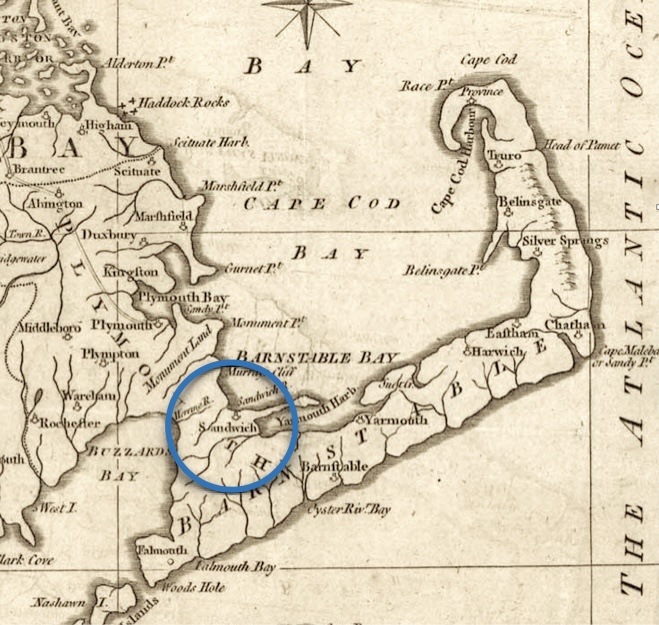
The Doty Line, A Narrative — Two

This is Chapter Two of nine. This chapter covers the early dramatic events of the 162os: a foolish knife fight, how land was distributed, how cattle and other livestock were shared, and how The Colony started to find itself.

In the last chapter, we wrote about picturing our ancestors in our mind’s eye. One of the drawbacks about that way of pondering the Pilgrims is this — it is normal to picture them in a bucolic environment, with ordered streets, clean clothes, rosy cheeks. Hollywood has never really been very good at looking at how rough and tough things initially were for them.

When the Mayflower finally disappeared over the horizon, they were truly alone in the New World.

The Departure of the Mayflower for England in 1621 by N.C. Wyeth. This was part of a series of murals the artist created for the MetLife building in New York City in 1941.
(Image courtesy of the Brandywine Museum of Art).

Only 53 Passengers Remained

Consider the fact that the Mayflower was the home of the Pilgrims for a long time and that it was a very old merchant ship.

“During the winter, the passengers [had] remained on board Mayflower, suffering an outbreak of a contagious disease described as a mixture of scurvy, pneumonia, and tuberculosis. After it was over, only 53 passengers remained—just over half; half of the crew died as well. In the spring, they built huts ashore, and the passengers disembarked from Mayflower on March 31, 1621.”

Captain Christopher “Jones had originally planned to return to England as soon as the Pilgrims found a settlement site. But his crew members began to be ravaged by the same diseases that were felling the Pilgrims, and he realized that he had to remain in Plymouth Harbor ‘till he saw his men began to recover.’  Mayflower lay in New Plymouth harbor through the winter of 1620–21, then set sail for England on April 15, 1621. As with the Pilgrims, her sailors had been decimated by disease. Jones had lost his boatswain, his gunner, three quartermasters, the cook, and more than a dozen sailors. Mayflower made excellent time on her voyage back to England. The westerly winds that had buffeted her on the initial voyage pushed her along on the return trip home. She arrived in London on May 16, 1621, less than half the time that it had taken her to sail to America.” (Wikipedia)

Historian Caleb Johnson writes that, “Christopher Jones took the ship out on a trading voyage to Rochelle, France, in October 1621, returning with a cargo of Bay salt. [As the] master and quarter-owner of the Mayflower, [he] died and was buried at Rotherhithe, County. Surrey, England, on 5 March 1621/2. No further record of the Mayflower is found until May 1624, when it was appraised for the purposes of probate and was described as being in ‘ruinis’.  The ship was almost certainly sold off as scrap.” (Mayflower History.com)

With all of the many demands put upon the new shore-bound Plymouth community, our ancestor Edward Doty was about to steal the spotlight through a bit of infamy. (1)

Seeing Red + Flying Off The Handle = (We’re) Fit to Be Tied

Well, the two Edwards seemed to have had quite enough of each other and entered into a duel. It is reportedly the first duel fought in New England, which may be true, but how can you prove something like that? Who would want to?

Edward Doty and Edward Leister were both young men who were indentured servants in the home of the Stephen Hopkins family. Admittedly, the initial voyage of the Mayflower had been harrowing… they were both living as servants in a tiny, rather rough looking house, in far away new world colony… Mr. Hopkins ran a tavern (out of his home?) and just about everyone drank beer in those days because water could be contaminated… Was a young lady involved? Who knows? — but their rather intense dust-up has been featured by historians for over 400 years, which is a rather long time for a local fight to echo through history.

From the standpoint of their community, this fight took place slightly less than eight weeks after the Mayflower had departed for England. Everyone was probably exhausted after leaving the ship, continuing to care for the sick and dying, building huts to live in, and trying to source food in a new land. Who had the free time or energy to get caught up in a duel? Apparently, these two did.

Copy of Le Duel a l’Épée et au Poignard (The Duel with the Sword and Dagger),
from “Les Caprices” (Image courtesy of The Metropolitan Museum of Art).

William Bradford, the Governor of the Plymouth Colony at the time, recorded the details in his journal, but that original document was eventually lost. Transcriptions of what was recorded have survived and we found an account published in a Boston newspaper called The Liberator, on June 12, 1840. In an intriguing way, we noticed this newspaper account falls (more-or-less) at the halfway point between the 1620s and our present era.

Excerpted newspaper account from The Liberator newspaper, June 12, 1840, page 4.
(Image courtesy of Newspapers.com).

If history has a way a not-forgetting, then perhaps we all need to mind our manners in today’s world? It seems that Edward Doty had a history of being in court frequently in the Plymouth Colony being on both sides of things. Maybe he was a bit of a hot head? As elaborated upon by our quite far distant cousin Anna Kasper in her blog post, Anna’s Musings & Writings, 52 Ancestors in 52 Weeks, Week 7: “…Edward Doty did not always make good on that promise of ‘a better carriage.’ He did not like to pay his servants, he just let his cattle kind of wander around, he got into fights, and is found in the Plymouth Court records numerous times! To say that Edward was notably a contentious man would be correct.”

We are reminded of our ancestor David Du Four from a separate family line who we chronicled in The DeVoe Line, A Narrative — Two. (David did not seem to be a contentious man). We wrote this in the section subtitled:
For. Every. Little. Kerfuffle. With. Your. Neighbors.
“It seems that David Du Four had several showings in court because the records have survived. Here’s a little background on the times. In 1670s he was a “frequent flyer” at court, with several cases. In New Amsterdam, people from all walks of life could bring a case to court. They could defend the case themselves, or ask someone to speak for them.  It was not necessary for them to have a lawyer for every case. This is because…” there wasn’t a true court system existent. “To a degree, it seems like going to court was similar to being sent to the Principal’s Office. You had to go and plead your case.”

Then, whatever happened to Edward Leister? We don’t know very much. Governor William Bradford later recorded, “Lester, after he was at liberty, went to Virginia and there died”. American Ancestors has discerned a bit more, by evaluating some of the surviving colonial documents: “…in the 1623 division of land are two men with [the] first name [of] Edward but without surnames; these must be his two servants, Edward Doty and Edward Leister. But Leister is not in the 1627 division of cattle, so he must have left for Virginia between those two dates. He does not appear in the February 1623/4 list of those in Virginia living and dead, or in the February 1624/5 Virginia muster of inhabitants.”

Panoramic View of London in the early 1600s,
by Matthäus Merian der Ältere (Matthew Merian), 1638.

For Edward Doty, we do not know exactly when, nor where, he was born. He was recorded as being of London, but we don’t know if he had been born in another part of England and then had perhaps migrated to London. When he was a signer of the Mayflower Compact, there is speculation that he may have been slightly underage, but the Mayflower Society believe that he was probably at least 18 years of age. (It appears that there are a couple of other signers who were in similar circumstances). We do know however, that as an indentured servant to Stephen Hopkins, he was contracted to that obligation until the age of 25 years.

With that fact in mind, we can parse that he was likely born circa 1598. (2)

The Common Cause of Labor

“Working communally — also known as the “common course of labor” — was a key part of the business model planned for Plymouth Colony. In the original terms and conditions for funding and planting the colony, all the colonists agreed to work together for seven years at commercial fishing, trading, and farming “making such commodities as shall be most useful for the colony.” At the end of the seven years, the terms and conditions dictated that the colonists would receive a share of the common stock including land and livestock.

After three years, Plymouth Colony’s governor William Bradford ended communal work as related to farming, because it caused too much internal conflict and resulted in poor corn harvests. Without a good corn harvest to feed the colony and without regular supplies from England, the colony would not survive. It is interesting to note, however, that this injunction affected only grain and other field production. All other group work — hunting, fishing, trading and defense – continued as before and seemingly without tension.” (Plimoth Patuxet)

Edward continued to do his work for the Hopkins family as part of his commitment to the greater good. However, as one of the original settlers (the old-comers) within the Plymouth Colony, he was entitled a certain privileges which this status afforded him. One of these was the right to have land tenure.

The 1623 Division of Land in which Edward Doty received one acre. As described above, “These lye on the South side of the brook to the woodward opposite to the former”

It is likely that Edward was about 25 years old at this time. “In 1623 a parcel of land was allotted to each man to till for his family and to maintain those who were exempt from agricultural employment because of other duties. Each family was given one acre per family member. In abandoning the ‘common course and condition’ everyone worked harder and more willingly. The food problem was ended, and after the first abundant harvest under individual cultivation, the Pilgrims did not have to endure the meager rations of the first years. The plots assigned them permanently in 1624 became privately owned in 1627.” (Images of Old Hawaii)

“The people mentioned in the Division of Land came on the Mayflower (1620), the Fortune (1621), and the Anne (1623). A couple may have arrived on the Swan(1622) or the Little James (1623), but these were small ships carrying mostly cargo. The Division of Land is recorded in Volume XII of the ‘Records of the Colony of New Plymouth’ ”(TPCAP – The Plymouth Colony Archive Project)

At this time, one acre of land was distributed to each family member. As he was a single man, Edward Doty received one acre of land described communally as, “These lye on the South side of the brook to the woodward opposite to the former”. (Family Search) (3)

Animals Resting in a Pasture, by Paulus Potter, circa 1650.
(Image courtesy of Wikimedia Commons).

About The Division of Cattle

Like the distribution of land in 1623, in 1627, the Pilgrims divided their livestock (cattle, goats, etc.) into separate lots.

“The Pilgrims did not bring any large livestock animals with them on the Mayflower. In fact, the only animals known with certainty to have come on the Mayflower were two dogs, an English mastiff and an English spaniel, who are mentioned on a couple of occasions in the Pilgrims’ journals.

In 1624, [Governor William] Bradford reports that ‘Mr. Winslow came over, and brought a prety good supply, and the ship came on fishing, a thing fatall to this plantation. He brought 3. Heifers & a bull, the first begining of any catle of that kind in ye land’. Other cattle came, some nicknamed the Great Black Cow, the Lesser Black Cow, and the Great White-Backed Cow. By 1627, both the Lesser Black Cow and the Great White-backed Cow had calves.

The 1627 Division of Cattle. Edward Doty is listed as #11, as Edward Dolton. “The fourth lot fell to John Howland & his company Joyned to him his wife. To this lot fell one of the 4 heyfers Came in the Jacob Called ”

Onboard the Jacob in 1624 were four black heifers (a heifer is a young female cow that has not yet had a calf.) The four black heifers were nicknamed Least, Raghorn, Blind, and Smooth-Horned. There was also a Red Cow that belonged to the poor of the colony, which had a red female calf around 1625, and a male calf in 1627. By May 1627, there were 16 head of cattle and at least 22 goats living in Plymouth.” (Images of Old Hawaii)

It appears that Edward Doty, as part of the group of colonists (listed above as part of ‘John Howland & his company’), communally shared the ‘4 heyfers’ which had arrived on the ship Jacob in 1624. (4)

The Council for New England

We understand that Edward Doty was a man who didn’t die a poor man by the standards of his era. He was an early investor in the development of the Plymouth Colony and a land owner. The three passages excerpted below describe the business aspects he was involved with in those early decades.

“The Council for New England was a 17th-century English joint stock company to which James I of England awarded a royal charter, with the purpose of expanding his realm over parts of North America by establishing colonial settlements. The Council was established in November of 1620, and was disbanded (although with no apparent changes in land titles) in 1635. It provided for the establishment of the Plymouth Colony, the Province of New Hampshire, the Massachusetts Bay Colony, the New Haven Colony, and the Province of Maine”.

Left image: The Stuarts, King James I (reigned 1603 – 1625). Painting of James VI and I
Wearing the Jewel Called the Three Brothers in His Hat, circa 1605, (after) John de Critz.
Upper right: The Seal of The Council For New England, and
Lower right: (Shown at a small scale, the actual Peirce Patent from 1621.. It is cited as one of the most important documents in Anglo-American history.)

“In 1621, King James I authorized the Council for New England to plant and govern land in this area. This Council granted the Peirce Patent, confirming the Pilgrims’ settlement and governance of Plymouth. Peirce and his associates, the merchant adventurers, were allotted 100 acres for each settler the Company transported. The Pilgrims had a contract with the Company stating all land and profits would accrue to the Company for 7 years at which time the assets would be divided among the shareholders. Most of the Pilgrims held some stock. The Pilgrims negotiated a more favorable contract with the Company in 1626. In 1627, 53 Plymouth freemen, known as “The Purchasers,” agreed to buy out the Company over a period of years. In turn, 12 “Undertakers” (8 from Plymouth and 4 from London) agreed to pay off Plymouth’s debts in return for trade benefits”. (Pilgrim Hall Museum)

“In 1626, Edward Doty was one of twenty-seven Purchasers involved with the colony joint-stock company which afterwards was turned over to the control of senior colony members. That group [of investors] was called the “Undertakers”, and was made up initially of William Bradford, Myles Standish and Isaac Allerton, who were later joined by Edward Winslow, William Brewster, John Howland, John Alden, Thomas Prence, and four former Merchant Adventurers back in London. On the agreement, dated October 26, 1626, his surname appears as ‘Dotey’.” (Wikipedia) (5)

We continue our narrative about the Edward Doty in the next chapter, with his initial focus on acquiring stability through land ownership. (After all, a farmer who works the land, might want to own it too.) Then we look back a bit at the immigration unrest in Ipswich, England — which was certainly not a merry place at this time.

Following are the footnotes for the Primary Source Materials,
Notes, and Observations

Only 53 passengers Remained

(1) — three records

The Departure of the Mayflower for England in 1621
by N.C. Wyeth
https://collections.brandywine.org/objects/11394/the-departure-of-the-mayflower-for-england-in-1621?ctx=a8ad2d38-5e2e-466c-ae9e-f1f68e71df17&idx=8
Note: This was part of a series of murals the artist created for the MetLife building in New York City in 1941.

Mayflower
https://en.wikipedia.org/wiki/Mayflower
Note: For the text.

Caleb Johnson’s Mayflower History.com
The End of the Mayflower
https://mayflowerhistory.com/end-of-the-mayflower
Note: For the text.

Seeing Red + Flying Off The Handle = (We’re) Fit to Be Tied

(2) — seven records

The Met [The Metropolitan Museum of Art]
Copy of Le Duel a l’Épée et au Poignard (The Duel with the Sword and Dagger),
from Les Caprices
by Anonymous, (After Jacques Callot French, 17th century)
https://www.metmuseum.org/art/collection/search/417395
Note: For the illustration.

Edward Doty and Edward Leister duel 1621
https://www.newspapers.com/article/the-liberator-edward-doty-and-edward-lei/5952148/
Note: From Newspapers.com “The Liberator was a radical [their words] abolitionist newspaper published from 1831-65 in Boston, Massachusetts. A weekly four-page paper, it was the most influential abolitionist publication in the United States during the nineteenth century. At its peak, the Liberator was circulating 3,000 copies a week, primarily across the free North. It was funded and read largely by the free Black population in the North”.

HOW THE PILGRIM FATHERS SERVED DUELISTS.
The following account of the first duel fought in New England, and the second political offence committed in the Plymouth Colony, we take from a work entitled The New-England Chronology.’ The date of the event is June 8th, 1621.

The second offence is the first duel fought in New-England, upon a challenge to single combat, with sword and dagger, between Edward Doty and Edward Leister, servants of Mr. Hopkins. Both being wounded, the one in the hand, the other in the thigh, they are adjudged by the whole company to have their head and feet tied together, and so to lie for twenty-four hours, without meat or drink; which is begun to be inflicted. But within an hour, because of their great pains, at their own and their master’s humble request, upon promise of better carriage, they are released by the Governor.’
— Pa. Observer.

The DeVoe Line, A Narrative — Two
https://ourfamilynarratives.wordpress.com/wp-admin/post.php?post=13086&action=edit
Note: For the text in the section —
For. Every. Little. Kerfuffle. With. Your. Neighbors.

Anna’s Musings & Writings
52 Ancestors in 52 Weeks. Week 7: Landed. February Theme: Branching Out. My Contentious and Quarrelsome Mayflower Pilgrim Ancestor Edward Doty.
https://anna-kasper.com/2022/02/15/my-contentious-and-quarrelsome-mayflower-pilgrim-ancestor-edward-doty/
Note: For the text.
Hi cousin!

A contemporary reenactment of a farm laborer from the Plimouth Plantation Living Museum.

.American Ancestors 2020
Edward Leister
https://mayflower.americanancestors.org/edward-leister-biography#:~:text=Edward%20Leister%20came%20to%20Plymouth,%5BBradford%20442%2C%20445%5D.
Note: For the text.

Battlemaps.us
Panoramic View of London in the early 1600s,
by Matthäus Merian der Ältere (Matthew Merian), 1638
https://www.battlemaps.us/products/london-1600s-panoramic-view?srsltid=AfmBOoqFDoZLYTk2TCIRr2uUgV98KngVjw-QLKUO2raArsDdj_lOQJsq
Note: For the panoramic view of London.

The Mayflower Society
The Doty Family, Passenger Profile
https://themayflowersociety.org/passenger-profile/passenger-profiles/edward-doty/
Note: For the text.

The Common Cause of Labor

(3) — five records

Plimoth Patuxet Museums
As Precious As Silver
https://plimoth.org/yath/unit-3/as-precious-as-silver
Note: For the text.

Dividing the Land and Development of Towns
https://imagesofoldhawaii.com/wp-content/uploads/Dividing-the-Land-and-Development-of-Towns.pdf
Note: For the text.

Plymouth Colony 1623 Division of Land document
Massachusetts, Land Records, 1620-1986 > Plymouth > Deeds 1620-1651 vol 1
https://www.familysearch.org/ark:/61903/3:1:3QS7-89Z7-5Z3H?i=7&wc=MCBR-538%3A361612701%2C362501301&lang=en
Note 1: One acre of land for Edward Doty, as an unmarried man.
Note 2: This file is available at two locations. As indicated above, and also here:
https://www.familysearch.org/ark:/61903/3:1:3QS7-89Z7-5Z3H?i=7&wc=MCBR-538:361612701,362501301&lang=en
Book page: 4, Digital page: Image 8 of 239, Lower portion of page.
Note 3: He is the first Edward listed after Steven Hopkins’s name.

(TPCAP)
The Plymouth Colony Archive Project
Plymouth Colony Division of Land, 1623
http://www.histarch.illinois.edu/plymouth/landdiv.html
Note: For the text. Additional context, “In 1623, the Pilgrims divided up their land. The people mentioned in the Division of Land came on the Mayflower (1620), the Fortune (1621), and the Anne (1623). A couple may have arrived on the Swan(1622) or the Little James (1623), but these were small ships carrying mostly cargo. The Division of Land is recorded in Volume XII of the ‘Records of the Colony of New Plymouth’, and reprinted in the ‘Mayflower Descendant’, 1:227-230. Each family was given one acre per family member”.

About The Division of Cattle

(4) — four records

Animals Resting in the Pasture
by Paulus Potter, circa 1650
File:Paulus Potter – Animals Resting in the Pasture.jpg
https://commons.wikimedia.org/wiki/File:Paulus_Potter_-_Animals_Resting_in_the_Pasture.jpg
Note: For the painting image.

Plymouth Colony 1627 Division of Cattle document
Massachusetts, Land Records, 1620-1986 > Plymouth > Deeds 1620-1651 vol 1https://www.familysearch.org/ark:/61903/3:1:3QS7-99Z7-5ZZW?i=31&wc=MCBR-538%3A361612701%2C362501301&lang=en
Book page: 52, Digital page: Image 32 of 239, Middle of page.
Note: For the image. Edward Doty is listed in the Fourth Lot, as #11, named Edward Dolton.

The Plymouth Colony Archive Project
Plymouth Colony Division of Cattle, 1627
http://www.histarch.illinois.edu/plymouth/cattlediv.html
Note: Additional context, “1627. At a publique court held the 22th of May it was concluded by the whole Companie, that the cattle wch were the Companies, to wit, the Cowes & the Goates should be equal devided to all the posts of the same company & she kept until the expiration of ten years after the date above written & that every one should well and sufficiently paid for there own pt under penalty of forfeiting the same. That the old stock with half th increase should remain for common use to be divided at then of the said terms or otherwise as location fallers out, & the other half to be their own for ever. Upon wch agreement they were equally divided by Lotts she as the burthen of keeping the males then being should be borne for common use by those to whose lot the best Cowes should fall & so the Lotts fell as followers. thirteenepsonts being portioned to one lot.”

Division of Cattle
https://imagesofoldhawaii.com/wp-content/uploads/Division-of-Cattle.pdf
Note: For the text.

The Council for New England

(5) — six records

The Coat of Arms of King James VI and I

Council for New England
https://en.wikipedia.org/wiki/Council_for_New_England
Note: For the text.

Painting of James VI and I Wearing the Jewel Called the Three Brothers in His Hat, circa 1605
by (after) John de Critz 
File:Portrait of James I of England wearing the jewel called the Three Brothers in his hat.jpg
https://commons.wikimedia.org/wiki/File:Portrait_of_James_I_of_England_wearing_the_jewel_called_the_Three_Brothers_in_his_hat.jpg
Note: For the portrait of James I.

Digital Commonwealth
Seal of the Council for New England
https://www.digitalcommonwealth.org/search/commonwealth:h128nr41z
Note: For the seal artwork.

Plymouth Live
Important piece of American history is being brought to Plymouth
https://www.plymouthherald.co.uk/whats-on/whats-on-news/important-piece-american-history-being-2587196
Note: For the Peirce Patent document image.

Pilgrim Hall Museum
Beyond The Pilgrim Story
https://pilgrimhall.org/bradford_17th_century_documents.htm
Note: Excerpted text is from the section, Willliam Bradford: a 1626 “Undertaker”.
Note: For the text.

Edward Doty
https://en.wikipedia.org/wiki/Edward_Doty#CITEREFBanks2006
Note: For the text.

The Doty Line, A Narrative — One

This is Chapter One of nine. We hope that you have taken the time to read the opening chapters we wrote based on the lives of The Pilgrims. It will help to make these The Doty Line chapters more accessible.

As the authors of this family history genealogy blog, we are in the 12th generation of Doty descendants in America. Pilgrim Edward Doty and his wife Faith (Clarke) Doty Phillips are our 9x Great Grandparents. He was one of our two Mayflower ancestors, with the other being Pilgrim George Soule whose family line is profiled in The Soule Line’s seven chapters.

A map of London during the Tudor Period and prior to 1561,
by Georg Braun and Frans Hogenberg in Civitates Orbis Terrarum.
(Image courtesy of Wikipedia).

A Man “of London

Unfortunately, no one has been able to discern specifically the early origins for our 9x Great Grandfather Pilgrim Edward Doty. We wished to uncover more, but for now, until more credible evidence turns up, we must settle for the 20,000 foot view as to where he came from. One of these fine days, someone, somewhere, perhaps an observant researcher — will discover a clue that will reveal his true origins. For us, his name first comes up first in connection with the voyage of the Mayflower.

It’s 1620. He is sailing westward to the new colonies in North America, and for a few years, he is an indentured servant to the Stephen Hopkins family. This means that he was responsible for contributing to the success of the Hopkins family for a period of time, and until he had achieved the age of 25 years, he could not be released from this condition. Edward Leister, his fellow indentured traveler with the Hopkins family, was of the same status.

The original document Of Plimoth Plantation, by William Bradford, page 530. Edward Doty is listed as traveling with the Steven (Stephen) Hopkins family. (Image courtesy of the State Library of Massachusetts, Digital Collections).

He is then briefly mentioned in a pamphlet titled Mourt’s Relation, written by Thomas Winslow of the New Plymouth Colony, with contributions from William Bradford. This booklet eventually gained great fame.

From the website Voyaging Through History

The manuscript was carried out of New Plymouth by Robert Cushman, Chief Agent in London for the settlers, on board the Fortune in 1621. When Mourt’s Relation was sold in John Bellamy’s London bookshop in the 1620s its readers could have scarcely imagined this would become one of the most well-known texts in American history… Perhaps the most significant feature of Mourt’s Relation is its inclusion of ‘The Mayflower Compact’: the first governing document of Plymouth Colony. Signed on November 21, 1620 (prior to landing), the text gave a legal framework of government to the eventual settlement… Over time the Mayflower Compact has become revered as an antecedent to the American Constitution.

Something else we were able to see within Mourt’s Relation, is this text below. This is the only reference yet where we have found any indication for his origin before the Mayflower sailed.

In this pamphlet, Edward’s name is mentioned as being of London next to the name of the man he was indentured to, “Steeuen Hopkins”, (Stephen Hopkins). For more about what Indentured Servitude was, please see our chapters on The Pilgrims — specifically the chapter: The Pilgrims — A Mayflower Voyage.

A note about name spellings:
Historical sources vary much in how these names are spelled. Stephen Hopkins’s first name is written as Steven, Stephen, or Steeuen in original documents. [We are using Stephen for our text]. Edward Doty’s surname has several spellings in original documents, including: Doty, Dotte, Doten, Dotten, Dotey, Dowty, and Dolton. [Whew! We are using Doty for our text].

Most importantly, we know that Edward Doty was one the people who ‘signed’ The Mayflower Compact. However, the names of the signatories to the document were not published for many years out of the fear of reprisals from the British Monarchy. In any case, we know that Edward could not write his name:

“One is that no copy of the original [Mayflower Compact] document survives. Therefore, unfortunately we can’t see his signature. But considering he signed other legal documents, including his Will, with ‘his mark,’ he appears not to have learned how to write and we wouldn’t see much in the way of a signature anyway. Nevertheless, all accounts of the document give him credit for being among the 41 men who signed the pact.” (AFHB – A Family History Blog, see footnotes). (1)

As with many of our ancestors, their ability to read, write, and sign their name was not as important then as it is today. Clearly, someone drafted the text to Edward’s 1655 Will and wrote his name. He then endorsed this with ‘his marke’, a double flourish which we have circled.

Being thus arrived in a good harbor

Only one primary source account exists which describes the events while the Mayflower was at sea. It was written by Plymouth Colony Governor William Bradford in his History of Plymouth Plantation. It concludes with this dramatic passage:

Being thus arrived in a good harbor and brought safe to land, they fell upon their knees and blessed the God of heaven, who had brought them over the vast and furious ocean, and delivered them from all the perils and miseries thereof, again to set their feet on the firm and stable earth, their proper element. And no marvel if they were thus joyful, seeing wise Seneca was so affected with sailing a few miles on the coast of his own Italy; as he affirmed, that he had rather remain twenty years on his way by land, then pass by sea to any place in a short time; so tedious and dreadful was the same unto him.

When Edward Doty and Edward Leister arrived with the Hopkins family in Plymouth Harbor, there were no truly accurate maps of the area, but that was soon to change. The 1623 map below shows the location of the Plymouth Colony, along with other (new) local names. The nearby Native People populations are also indicated. (2)

This map from the book Three Visitors to Early Plymouth, captures the geography
of early New England, including most of the settlements that began in 1623.
(Image courtesy of the Internet Archive).

So, Who Was Stephen Hopkins?

He was a man of many accomplishments. Wikipedia sums it up best when they describe him: “Steven Hopkins (fl. 1579 – d. 1644) was an English adventurer to the Virginia Colony and Plymouth Colony. Most notably, he was a passenger on the Mayflower in 1620, one of 41 signatories of the Mayflower Compact, and an assistant to the governor of Plymouth Colony through 1636. He worked as a tanner and merchant and was recruited by the Company of Merchant Adventurers of London to provide the governance for the colony and to assist with the colony’s ventures.

He was also the only Mayflower  passenger with prior New World experience, having been shipwrecked [from the ship Sea Venture] in Bermuda in 1609 en route to Jamestown, Virginia. Hopkins left Jamestown in 1614 and returned to England. Hopkins traveled to New England in 1620 and died there in 1644.” (Wikipedia)

It is interesting to note that that he spent five years in Jamestown, Virginia after being shipwrecked. He was there for so long that his first wife Mary (who was living in England with their three children) died, leaving the children without a parent present. This could be one reason why he returned to England, where he married his second wife Elizabeth, who came with him on the Mayflower. For more information on the disastrous Jamestown Colony, please see our chapter, The Pilgrims — Colonial Pursuits.

The first page of Shakespeare’s The Tempest, printed in the First Folio of 1623.
(Image courtesy of Wikimedia Commons).

During his tenure in Bermuda (long story short), he was accused of treason and nearly beheaded. It is thought by scholars that the character of ‘Stephano’ in William Shakespeare’s The Tempest is based upon Stephen Hopkins’s experiences in Bermuda. (The play was first performed in November 1611). (3)

Living With The Hopkins Family in the Plimoth Plantation

The entire Hopkins family and their two indentured servants survived the first terrible winter, which is rather remarkable since so many other of their fellow travelers had passed away. What was it like for the indentured servants Edward Doty and Edward Leister to be living in the Stephen Hopkins home? Likely very crowded.

The image at the left shows the reproduction home of the Stephen Hopkins family located at the Plimoth Patuxet Museum historical site. The “elaborated” 1879 map at right show the location of that home within the context of William Bradford’s original sketch for New Plymouth. (See footnotes).

“The Mayflower Quarterly of December 2011, in an article on Plymouth-area taverns, has a paragraph on Stephen Hopkins, who kept an ‘ordinary’ (tavern) in Plymouth on the north side of Leyden Street from the earliest days of the colony.

The article defines a 17th-century ‘ordinary’ as a term for a tavern where set mealtimes and prices were offered. Terms such as ‘inn, alehouse and tavern’ were used interchangeably with ‘ordinary’ in early Plymouth records. Hopkins kept this tavern from the early colony days until his death in 1644. In the early 1600s he had also had an alehouse in Hampshire with his wife Mary and his mother-in-law Joan, which they maintained after he left for America in 1609.

Hopkins apparently had problems with the Court over his tavern. Plymouth records indicate that Hopkins let ‘men drink in his house upon the Lords day’, ‘for suffering servants and others to sit drinking in his house’ (contrary to Court orders), also to play games ‘& such like misdemeanors, is therefore fined fourty shillings.’ In addition, the Court had several charges against him ‘for selling wine, beere, strong waters, and nutmeggs at excessiue rates, is fined.’” (Wikipedia) (4)

Now that we have arrived in the new Plymouth Colony, the next chapters will narrate how the Doty Family grew, how they developed and changed, and what Life brought them during the subsequent generations.

Following are the footnotes for the Primary Source Materials,
Notes, and Observations

A Man “of London

(1) — six records

Tudor London
https://en.wikipedia.org/wiki/Tudor_London
Note: For the 1561 “Civitates Orbis Terrarum” map image.

State Library of Massachusetts Digital Collections
Of Plimoth Plantation: manuscript, 1630-1650
https://archives.lib.state.ma.us/items/db0e9f79-477c-4a4c-979b-359c2be1d4ad
The actual page 530 is here:
https://archives.lib.state.ma.us/server/api/core/bitstreams/4d69e338-cc1b-4eda-b2ff-57bfbbb5c6ed/content
Note 1: For the original document on which Edward Doty is listed as a passenger on the Mayflower.
Note 2: The document is digitized and available as a .pdf download at the above link, file name: ocn137336369-Of-Plimoth-Plantation.pdf
Digital page: 530/546. First page, right column at center, with the Steven (Stephen) Hopkins family.

Voyaging Through History, the Mayflower and Britain
Mourt’s Relation (1622)

https://voyagingthroughhistory.exeter.ac.uk/2020/08/25/mourts-relation-1622/
Note: For the text.

Mourt’s Relation or Journal of The Plantation at Plymouth
by William Bradford, 1590-1657; Edward Winslow, 1595-1655; 
(and Henry Martyn Dexter, 1821-1890)
https://archive.org/details/cu31924028815079/mode/2up
Digital pages: 100-102/242, Book pages: 43-45/176
Note: This edition is circa 1865.

(AFHB)
A Family History Blog
Signer of the Mayflower Compact
by Jamie
https://genealogy.thundermoon.us/blog/2020/09/26/signer-of-the-mayflower-compact/
Note 1: For the text, and the double flourish signature of Edward Doty.
Note 2: Jamie, the author of A Family History Blog, is another cousin. He is a descendant of Edward Doty’s son Isaac and his wife Elizabeth (England), as we are also. Hi cousin!

Being thus arrived in a good harbor

(2) — two records

Mayflower
by Rootsweb Author, kee46@msn.com
https://homepages.rootsweb.com/~ahopkins/cushman/mayflowe.htm
Note: For the text.

Three Visitors to Early Plymouth
by Sydney V. James, Samuel Eliot Morison, Isaack de Rasieres; John Pory; Emmanuel Altham
https://archive.org/details/plymtuxet005/plymtuxet005_epub/
Digital page: 2/133
Note: For the map image.

So, Who Was Stephen Hopkins?

(3) — three records

Stephen Hopkins (pilgrim)
https://en.wikipedia.org/wiki/Stephen_Hopkins_(pilgrim)
Note: For the data.

The Bermudian.com (magazine)
The Wreck of the Sea Venture: The Untold Story
by Gavin Shorto
https://www.thebermudian.com/history/history-history/the-wreck-oftheseaventure-the-untold-story/
Notes: For the antique map image of the island of Bermuda, and the wreck of the Sea Venture ship painting.

The Tempest
https://en.wikipedia.org/wiki/The_Tempest
Note: For the folio image.

Living With The Hopkins Family in the Plimoth Plantation

(4) — three records

Stephen Hopkins’ House, Plimoth Plantation
https://www.worldhistory.org/image/13127/stephen-hopkins-house-plimoth-plantation/
Note: For the replica house photograph,
stephen-hopkins-house-plimoth-plantation-13127.jpg

The Pilgrim Republic : an historical review of the colony of New Plymouth, with sketches of the rise of other New England settlements, the history of Congregationalism, and the creeds of the period
by John Abbot Goodwin, 1824-1884
https://archive.org/details/pilgrimrepublic01goodgoog/page/106/mode/2up
Book page: 106, Digital page: 159/722
Note: For the plan image of early Plymouth.

Stephen Hopkins (pilgrim)
https://en.wikipedia.org/wiki/Stephen_Hopkins_(pilgrim)
Note: As cited in the article (footnote 17) —
Suitably Provided and Accommodated: Plymouth Area Taverns
by Stephen C. O’Neill
The Mayflower Quarterly (Plymouth, MA: The General Society of Mayflower Descendants), December 2011, vol. 77, no. 4, pp. 335, 336

The Soule Line, A Narrative — Seven

This is Chapter Seven of seven. In this last narrative on the descendants of Pilgrim George Soule, we cover Generations Five and Six in America. Both of these generations carry the new family surname of Warner.

Preface

Our introduction to the Drinkwater name family goes back to the early 1970s, when first heard the name Mercy Drinkwater from our Grandmother Lulu Gore. Mercy was the 2x Great Grandmother to Lulu, and it was likely that Mercy’s first name evolved from an idea in Christian theology. The “seven lively virtues… are those opposite to the seven deadly sins. They are often enumerated as chastity, temperance, charity, diligence, kindness, patience, and humility.” (Wikipedia). We could see the name ‘Mercy’ falling right in line with that point-of-view. (1)

Just ask Homer Simpson which one has more fun.

However, we must admit a bit sheepishly that the ‘deadly sin’ part of our personalities cannot help but notice that when you say her name out loud, it sounds distinctly like you are either openly worrying about dehydration, or echoing the emergency response team from the Poison Control Center:
Mercy! Drink water!

So much… for lively virtue.

Woodbury, Connecticut Colony

Like our ancestors who founded the Plymouth Colony in Massachusetts, the settlers who founded Woodbury, Connecticut were also religious objectors. “The founders of Woodbury came from Stratford, Connecticut, in the early 1670s. Ancient Woodbury consisted of the present towns of Woodbury, Southbury, Roxbury, Bethlehem, most of Washington and parts of Middlebury and Oxford.

Two groups of settlers came from Stratford. The first, religious dissidents unhappy with the church in Stratford, was led by Woodbury’s first minister, the Reverend Zachariah Walker. The second, led by Deacon Samuel Sherman, had been given approval by the general court to purchase land from local Native Americans in order to establish a new settlement. Together, fifteen families (about fifty people), arrived in ancient Woodbury, known as ‘Pomperaug Plantation’, early in 1673”. (Wikipedia, Woodbury Connecticut)

“By the end of the eighteenth century Woodbury had developed as a thriving center of agricultural trade because of its proximity to the Housatonic River, which provided a major navigational route to the coast. A measure of Woodbury’s wealth was the large number of artisans and tradesmen such as millers, blacksmiths, wheelwrights and clothiers as well as tinsmiths, tanners, joiners and goldsmiths.” (The Old Woodbury Historical Society)

Plan of the Colony of Connecticut in North America, by Moses Park, 1766.
Mercy Drinkwater is from the area of the larger circle to the left; Eliphaz Warner, from the smaller circle to the right. (Image courtesy of the Boston Public Library).

One of the things about our Ancestral Grandmothers is the fact that not many records survive about these women. The eras that they lived in didn’t allow the creation of many meaningful records due to the customs of the time: things like civic records, inheritance laws, even Census data until about 1850… there just isn’t much there, or even that has survived. So it is with Mercy Drinkwater, especially as a young child.

We know when she was born, and that she was the youngest of 12 children from her father’s first wife. Her mother Elizabeth (Benedict) Drinkwater, died in 1749 when Mercy was about 15 months old. Her father William then remarried Susannah Washburn in 1751, when Mercy was about 3. Then in 1758, when Mercy was 10 years old, the records tell us that both William and her step-mother Susannah (Washburn) Drinkwater died.

So our primary question became, Who then raised Mercy for the next 10-11 years until she married? Was it her mother’s family the Benedicts? Or perhaps an older sister? How did she meet her husband, Eliphaz Warner? When exactly did they marry? We were not able to resolve these questions. We have looked everywhere and we don’t think that the marriage record has survived. We have to infer from what we know.

Mercy Drinkwater, born March 25, 1748, New Milford, Litchfield County, Connecticut Colony — died October 22, 1813, Sandgate, Bennington, Vermont. She was the daughter of William Drinkwater and Elizabeth Benedict.

Eliphaz Warner, born September 1, 1742, Middletown, Hartford* County, Connecticut Colony — died March 12, 1816, Sandgate, Bennington, Vermont. He was the son of Jabez Warner and Hannah Warner. He married Mercy Drinkwater by 1769, in an unknown location* in Connecticut; together they had seven children.

*We believe that the exact record for their marriage has been lost. This could be due to destruction caused by the church burning down, arson from conflicts with the Native Peoples, natural forces like a flood… Sometimes when the organizing government domain changes, records disappear through lack of oversight. Hartford County became Middlesex County in May 1785, being created from portions of Hartford County and New London County. Perhaps the record was lost then?

What we do know is this — it is highly probable is that they married in one of the three communities where their family members lived: Ridgefield, New Milford, or Woodbury. We just don’t know exactly where at this time. (2)

“This old map of Middlesex County, CT was commissioned in 1934 by the Connecticut League of Women Voters. S. Jerome Hoxie illustrated the map and it was printed by The Riverside Press in Mystic Connecticut.” (See footnotes).

Eliphaz and Mercy (Drinkwater) Warner Children

The first two children were born in Judea Parrish, Woodbury, Litchfield County, Connecticut Colony. “Before it became a separate town in 1779, and chose to name itself ‘Washington’, the area was known as ‘Judea’, and was part of Woodbury, Connecticut”. (Wikipedia, Judea Cemetery)

  • William S. Warner, born November 12, 1770 — died May 24, 1856, Sandgate, Bennington County, Vermont. He married first, (1798) Lucy Coan, in Woodbury, Litchfield County, Connecticut; they had 7 children. He married second, (circa 1816-17), Abigail Root; they had no children. He married third, (circa 1819) Prudence B. Nickerson, in Sandgate, Bennington, Vermont; they had 4 children.
    (We are descended from William and Prudence (Nickerson) Warner).
  • Dr. John Warner, born December 1772 — died September 4, 1839, Starkey, Yates County, New York. He married Mary DeWitt in October 1808.
  • Anna Warner, born 1773 in Middletown, Middlesex County, Connecticut Colony — died September 30, 1834, Sandgate, Bennington, Vermont. (Note: Anna may have been born in either Judea Parrish, Woodbury, Litchfield County, Connecticut, or Middletown, Middlesex County, Connecticut. The records conflict on this detail).

    By 1776 the family moved from Connecticut to Sandgate, Bennington County, The Vermont Republic (1771-1791), where the next four children were born .
  • Elizabeth Warner, born 1777 — died April 7, 1845, Salem, Washington County, New York. She married Joel Bassett, born Feb. 5, 1782 — died September 5, 1840, same location.
  • Hannah Warner, born 1783 — died October 13, 1818, Sandgate, Bennington County, Vermont.
  • Dr. James Warner, born 1785 — died February 21, 1813, Jericho, Chittenden County, Vermont.
  • Jabez Joseph Warner, born December 14, 1791 — died February 1, 1792 Sandgate, Bennington, County, Vermont.

A few years before they moved to the Vermont frontier, this document appears. It’s one of the few things with Mercy (Drinkwater) Warner’s name attached to it. Why was this document done in 1770, 12 years after her father William Drinkwater had died? We speculate that perhaps Mercy and her husband Eliphaz Warner wanted to make sure that any portion of his estate (she was due), had been delivered to her? (3)

Administration papers from the estate of William Drinkwater, circa 1770.
From the Connecticut, U.S., Wills and Probate Records, 1609-1999.

Colonel Seth Warner, a Distant Cousin

The Warner’s were a large family. And in those days, cousins married each other, which sometimes causes us to “fret and pull our hair out” when trying to figure out who is related to who… in this case our “cousinship” to Seth Warner is distant for us, but much closer to our Warner line during the 1760s and 1770s.

  • Seth Warner’s 2x Great-Grandfather, John Warner, Jr. was also the father of our 4x Great-Grandmother, Hannah (Warner) Warner.
  • She was married to her first cousin, Jabez Warner, our 4x Great-Grandfather.
  • Their son Eliphaz Warner, was our 3x Great Grandfather.

In 1754 Hannah and Jabez Warner moved to Woodbury, Litchfield, Connecticut Colony, a town next to Roxbury where lived Seth Warner and Ethan Allen, cousins via their Baker relatives. We can’t know how much they interacted some 150 years ago, but they were all of the same age and the adventuresome sort. At this time the state of Vermont did not exist yet. The area was called the New Hampshire Grants. It was a wild and unsettled area in the early 1760s. There were constant disputes between New York and New Hampshire as the Grants were being settled.

This print accompanied the narrative Seth Hubbell published in 1824
about his years spent struggling to establish a farm in the wilds of Vermont in 1789.
(Image courtesy of the Vermont Historical Society).

Dr. Benjamin Warner, Seth’s father, moved his family to this area in 1763. We know that they settled in what is now Bennington, Vermont. But there is some evidence that Seth held property in a small section called Sandgate, about 20 miles north of Bennington. At this time, families from Roxbury, Woodbury, and other parts of Connecticut began moving into the New Hampshire Grants. The Hurds, the Hurlburts, the Bakers and the Allens settled throughout the area and eventually, the Eliphaz Warners settled in Sandgate.

Under-appreciated by History?
Seth Warner is famous in Vermont history through his activities with Ethan Allen of the Green Mountain Boys just prior to and during the Revolutionary War. However, we wonder if perhaps he has been under-appreciated by American historians in general. We learned, from a fascinating online article by writer Gene Procknow at All Things Liberty —

“The legendary stories of Ethan Allen and Vermont’s Green Mountain Boys have long been part of American folklore. Their heroically described exploits are fabled in many fictional accounts and in children’s books. Allen’s name is synonymously linked with the Green Mountain Boys as if he was their sole leader.  However, while Allen receives the fame, there is a strong case that Seth Warner, a lesser-known member of the Green Mountain Boys, was the more impactful military leader during the American Revolution.

From left to right, the Colonel Seth Warner Monument in Bennington, Vermont.
Center: The flag of the Green Mountain Boys,
Right: Green Mountain Rangers, 1776 by Lt. Charles M. Lefferts. (See footnotes).

During the revolution, Seth Warner emerged as the leader of the Green Mountain Boys.  A day after Fort Ticonderoga fell [Allan’s victory], Warner led a contingent of the Green Mountain Boys in capturing British forces at Crown Point [Warner’s victory]. Both Warner and Ethan Allen traveled to Philadelphia to meet with the Continental Congress to obtain military pay for the Green Mountain Boys and to obtain permission to enlist a Green Mountain regiment in the Continental Army.  They returned with both. [The Green Mountain Boys were then referred to as the Green Mountain Rangers, and Warner’s Regiment].

In July 1777, he ably commanded undersized rear guard units at the battle of Hubbarton, Vermont and rallied his troops to cement a patriot victory at Bennington* in August.  British losses at these two battles weakened their invasion force, which aided the Continental Army victory at Saratoga in October.  After the 1777 campaign, Warner continued leading his regiment despite declining health until the unit was disbanded on January 1, 1781.
* See the text, The Battle of Bennington below.

Seth Warner was the elected and recognized commander of the Green Mountain Boys during their entire service with the Continental Army, with Ethan Allen playing the important political roles of firebrand, publicist, and spokesperson. Clearly, the American cause benefited from Seth Warner’s military leadership, while Ethan Allen’s political leadership was critical to the formation of Vermont as a distinct, independent sovereign entity”. (All Things Liberty) (4)

Being Early to Bennington, Republic of Vermont

Even though Vermont is recognized as the 14th state of the United States, it was born out of a complicated mess of issues as to who had the right to live in that rural territory, and who had the right to govern it. Among the interested parties were (quite naturally) the Native Peoples, the French Government and their settlers, and the British Government and their settlers. Like a tide that kept washing in and out, people came in and went out. After the French were defeated in the French and Indian War, the rights to this area were given by the Treaty of Paris (in 1763), to the British.

Be that as it may, the New York Colony, and the Province of Massachusetts Bay Colony, and the Province of New Hampshire continued to squabble over who had the land rights to the territory. Much of this was due to the fact that the population of the area increased dramatically in a short period of less than 30 years. “In the 28 years from 1763 to 1791, the non-Indian population of ‘New Hampshire Grants’ rose from 300 to 85,000.

Plan of Sandgate (map), by Benning Wentworth, circa 1761.
(Image courtesy of the Library of Congress).

New Hampshire’s [Colonial] governor, Benning Wentworth, [had] issued a series of 135 land grants between 1749 and 1764 called the New Hampshire Grants. Many of these were in a large valley on the west (or New York side) of the Green Mountains and only about forty miles from Albany. The town was laid out in 1749 and was settled after the war in 1761. The town was named Bennington for Wentworth. Ultimately, by 1754, Wentworth had granted lands for 15 towns. (Wikipedia, History of Vermont)

“The first settler in Sandgate was Reuben Thomas, who came from Woodbury, Connecticut. Congregational Church records show “1769, December 27th — Reuben Thomas Esqr. moved his family which was the first family into this town.” (Sandgate Vermont)

“In 1770, Ethan Allen—along with his brothers Ira and Levi, as well as Seth Warner—recruited an informal militia, the Green Mountain Boys, to protect the interests of the original New Hampshire settlers against the new migrants from New York. A significant standoff occurred at the Breakenridge farm in Bennington, when a sheriff from Albany arrived with a posse of 750 men to dispossess Breakenridge. The residents raised a body of about 300 armed men to resist. The Albany sheriff demanded Breakenridge, and was informed, ‘If you attempt it, you are a dead man.’ The sheriff returned to Albany.

In the summer of 1776, the first general convention of freemen of the New Hampshire Grants met in Dorset, Vermont, resolving ‘to take suitable measures to declare the New Hampshire Grants a free and independent district.’ On January 15, 1777, representatives of the New Hampshire Grants convened in Westminster and declared their land an independent republic, The Vermont Republic (from 1777 until 1791). Then in 1791, Vermont became a state.

Vermont, from actual survey, by Amos Doolittle and Mathew Carey, circa 1795. This map shows where the Warners were living in the small town of Sandgate, Vermont from 1776 onwards. (Image courtesy of the Library of Congress).

Observation: 1776 is the year when the Eliphaz Warner family moved from the Woodbury, Litchfield County, Connecticut area to Sandgate, Bennington, Vermont Republic. They moved right into the very thick of things.

On June 2, [1776] a second convention of 72 delegates met at Westminster, known as the ‘Westminster Convention’. At this meeting, the delegates adopted the name ‘Vermont’ on the suggestion of Dr. Thomas Young of Philadelphia, a supporter of the delegates who wrote a letter advising them on how to achieve statehood. [One month later…] On July 4, the Constitution of Vermont was drafted during a violent thunderstorm at the Windsor Tavern owned by Elijah West. It was adopted by the delegates on July 8 after four days of debate. This was the first written constitution in North America to provide for the abolition of slavery (for adults), suffrage [voting rights] for men who did not own land, and public schools.” (Wikipedia, History of Vermont) (5)

The first page of the original Constitution for Vermont, with a vintage postcard featuring the Old Constitution House, the former Windsor Tavern. (See footnotes).

Or This Night Molly Stark Sleeps a Widow!

“During the summer of 1777, the invading British army of General John Burgoyne slashed its way southward through the thick forest, from Quebec to the Hudson River, captured the strategic stronghold of Fort Ticonderoga, and drove the Continental Army into a desperate southward retreat. Raiding parties of British soldiers and native warriors freely attacked, pillaged and burned the frontier communities of the Champlain Valley and threatened all settlements to the south. The Vermont frontier collapsed in the face of the British invasion. The New Hampshire legislature, fearing an invasion from the west, mobilized the state’s militia under the command of General John Stark.

General Burgoyne received intelligence that large stores of horses, food and munitions were kept at Bennington, which was the largest community in the land grant area. He dispatched 2,600 troops, nearly a third of his army, to seize the colonial storehouse there, unaware that General Stark’s New Hampshire troops were then traversing the Green Mountains to join up at Bennington with the Vermont continental regiments commanded by Colonel Seth Warner, together with the local Vermont and western Massachusetts militia. 

The combined American forces, under Stark’s command, attacked the British column at Hoosick, New York, just across the border from Bennington. General Stark reportedly challenged his troops to fight to the death, telling them ‘There are your enemies, the redcoats and the Tories. They are ours, or this night Molly Stark sleeps a widow!’ ” (Wikipedia, History of Vermont) (6)

Battle of Bennington, 1777 by Alonzo Chappel.
(Image courtesy of The Bennington Museum).

The Battle of Bennington

“The town is known in particular for the Battle of Bennington, which took place during the Revolutionary War. Although the battle took place approximately 12 miles (19 km) to the west in what is now the state of New York, an ammunition storage building located in Bennington was an important strategic target. On August 16, 1777, Gen. John Stark’s 1,500-strong New Hampshire Militia defeated 800 German (Hessian) mercenaries, local Loyalists, Canadians and Indians under the command of German Lt. Col. Friedrich Baum. German reinforcements under the command of Lt. Col. Heinrich von Breymann looked set to reverse the outcome, but were prevented by the arrival of Seth Warner’s Green Mountain Boys, the Vermont militia founded by Ethan Allen”. (Wikipedia, Bennington Vermont)

This illustration depicts Ethan Allen [pointing at the map]
and the other leaders of the Green Mountain Boys, which included Seth Warner.
(Image courtesy of the Library of Congress).

The “all-day battle fought in intense summer heat, the army of Yankee farmers defeated the British, killing or capturing 900 soldiers. Burgoyne never recovered from this loss and eventually surrendered at Saratoga on October 17. (Wikipedia, History of Vermont)

During the War, Eliphaz Warner was called to serve in several instances. Shown below is one of the payroll records “for service done to guard the frontiers”. (7)

From the book, Rolls of the Soldiers in the Revolutionary War, 1775 to 1783,
by John E, Goodrich. “Payroll under Col. G. Warren’s Regiment under the command
of Capt. Gideon Ormsby”, pages: 76-77. (Image courtesy of the Library of Congress).
For other rosters, see the footnotes.

Time’s Arrow Points in One Direction

If anyone has spent any time glancing over census data, it quickly becomes clear that early censuses were simple, and later ones grew increasingly more complex. “Statistics show that as the Nation’s population grew and its demographics changed, so did the decennial* census evolve in order to measure that growth and change. As a result, no two censuses are exactly alike. To count a population of 3,329,326 in 1790, the census cost $44,377, utilized 1,650 enumerators, and culminated in one published volume totaling 56 pages. The 1990 Census counted a population of 248,709,873, cost $2.5 billion, and culminated in published census reports totaling 450,000 pages”.
*All of the following censuses are decennial, meaning they recur every ten years.

From the Vermont Historical Society, this painting titled
Derby View, 1939 by William Dean Fausett,
was painted to portray what colonial era Vermont would have looked like.

1790 —
“The census began on Monday, August 2, 1790, and was finished within 9 months, under the rules and directions established in an Act of Congress approved March 1, 1790. The 1790 population census was the First Decennial* Census of the United States”. (The National Archives)

The 1790 United States census for Sandgate, Vermont.

The 1790 census tells us that Eliphaz Warner had 8 people in his home, who were enumerated as follows (with our observations for people inserted):

  • 3 men of 16 years & upwards, including heads of families: sons William, John, and father Eliphaz — Head of Family
    • 1 boy under 16 years: son James
    • 4 women including heads of families: daughters Anna, Elizabeth, Hannah, and mother Mercy
Townscape of Bennington; Landscape View of Old Bennington, circa 1798, by Ralph Earl.
It is interesting to note how the landscape had changed from dense forest to open fields.
(Image courtesy of the Bennington Museum).

In 1798, Eliphaz and Mercy’s oldest son William Warner, married (1) Lucy Coan, daughter of Mulford and Elizabeth (Howd) Coan, in Woodbury, Litchfield, Connecticut. William returned to Woodbury for their marriage, and together she went with him to Sandgate, Vermont. They had seven children, who are interwoven throughout the following years of Census data shown below. (8)

For clarity, here is a list of their seven children:

  • Mary Warner, 1799 – 1859
  • William Warner, Jr., 1801-1890
  • Joseph Warner, 1803 -1890
  • Lucina Warner, 1805 – 1874
  • Gaylord Coan Warner, 1808 – 1886
  • Benjamin Stone Warner, 1810 – 1893
  • John Warner, 1812 – 1889

A New Century Begins

1800 —
“The census began on Monday, August 4, 1800, and was finished within 9 months, under the rules and directions established in an Act of Congress approved February 28, 1800. The 1800 population census was the Second Decennial Census of the United States”.

The 1800 United States census for Sandgate, Vermont.

For the Eliphaz Warner family, there were 5 people living there, as follows:

  • 1 boy 10 thru 15: son James
  • 1 man 45 and over: Eliphaz – Head of Family
  • 2 women 16 thru 25: daughters Hannah, Anna
  • 1 female 45 and over: mother Mercy

    This same 1800 census shows us that son William Warner is counted as a separate household. He is likely living nearby, if not next door. He had four people living in his home, enumerated as follows:
  • 2 men 26 thru 44: William – Head of Family, and an (unknown male)
  • 1 girl under 10: daughter Mary
  • 1 woman 45 and over: mother Lucy Coan (William’s first wife)

Observation: As we analyzed the censuses, it became clear that these two families lived next door to each other and that their lives were all intertwined. Eliphaz always had William living nearby, and after Eliphaz was no more, William usually had a sibling, or one of his own children nearby.

1810 —
“The census began on Monday, August 6, 1810, and was finished within 9 months, under the rules and directions established in an Act of Congress approved March 26, 1810. The 1810 population census was the Third Decennial Census of the United States”.

The 1810 United States census for Sandgate, Vermont. Note that Eliphaz’s name is positioned below his son William’s name.

This Census tells us that Eliphaz had 5 people in his home, who were enumerated as follows (with our observations of whom inserted):

  • 1 man 26 thru 44: son James (son John married, 1808 and lived in New York)
  • 1 man 45 and over: father Eliphaz – Head of Family
  • 2 women 26 thru 44: daughters Anna and Hannah (daughter Elizabeth married, 1808 and lived in New York)
  • 1 woman 45 and over: mother Mercy
Macdonough’s victory on Lake Champlain and defeat of the British Army at Plattsburg
by Genl. Macomb, Sept. 11 1814. Hand colored engraving by Benjamin Tanner, circa 1816.
(Image courtesy of Wikimedia Commons).

The 1810 Census is the last census that Eliphaz and Mercy appear in. From this point forward, all descriptions will only be about William Warner Sr.’s family. The 1810 Census further tells us that William Sr. had 9 people in his home, who were enumerated as follows (with our observations of whom inserted):

  • 4 boys under 10: sons William Jr., Joseph, Gaylord, and Benjamin
  • 1 man 26 thru 44: William Sr. – Head of Family
  • 2 girls under 10: daughters Lucina, and (unknown girl)
  • 1 girl: 10 thru 15: daughter Mary
  • 1 woman 26 thru 44: mother Lucy Coan

When the War of 1812 broke out in the young United States, Vermont was mostly removed from the battle sites of the war. The closest battle was The Battle of Plattsburg, which took place at the northern end of Lake Champlain, not very far away in New York State. “A relatively small force of approximately 5,000 Americans, including 2,200 Vermont militiamen, defeated a formidable force of roughly 11,000 British sailors on Sept. 11, 1814. This battle ended the British Invasion from Canada”. (Vermont National Guard Museum) We have not located any records that confirm that this branch of the Warner family actually participated in this war.

Besides, William Warner Sr. had his hands quite full. There was a house abundant of young children, his parents were elderly, and it seems that his wife Lucy had her troubles also — Several members of this family died during this decade; all of them in Vermont. Son Dr. James Warner died February 21, 1813 in Jericho, Chittenden County and is buried there. Mercy (Drinkwater) Warner soon followed. She died in October 22, 1813 in Sandgate, Bennington County and is buried in the Sandgate Center Cemetary. Eliphaz Warner died March 12, 1816 in Sandgate and is buried near his wife Mercy. Daughter Hannah Warner died October 13, 1818 in Sandgate and is buried near her parents. (9)

This brings us to…

The Decade of Three Wives

William Warner Sr.’s first wife, Lucy Coan, who had come to Vermont with him from Connecticut, died on October 2, 1815. She is buried at Sandgate Center Cemetery.

William was a widower with young children. He remarried after 1815 to his second wife (2) Abagail (Root) Warner. She was born about 1784 (based on the age of 34 years listed on her death record). Abagail has left very few records. She died soon after they were married, on June 13, 1818; there were no children.

At age 25, (3) Prudence B. Nickerson entered the family when she married William Warner in 1819; they had 4 children, James Ward, Lucy Mercy, Ira Nickerson, and Mary Ann. Like Abagail Root before her, there are very few records of her life prior to when she married William Sr. We know she was born in 1794 supposedly in Massachusetts, although some documents identify her birth in Vermont. We also note that there was a 24 year age gap when they married – William was 49 at the time.

Together, they are our 3x Great Grandparents — we are descended from William and Prudence B. (Nickerson) Warner and their daughter Mary Ann Warner.

The 1820 United States census for Sandgate, Vermont for William Warner and his unmarried sister Anna Warner.

1820 —
“The census began on Monday, August 7, 1820, and was finished within 6 months, under the rules and directions established in an Act of Congress approved March 14, 1820. The 1820 population census was the Fourth Decennial Census of the United States”. The census tells us that 10 people are living there. William Sr.’s sister Anna never married and is living next door, probably in her parents home. She is listed separately on this census. (10)

  • 2 boys under 10: sons Benjamin, John.
  • 1 boy 10 to 15: son Gaylord
  • 1 boy from 16 to 18: (unknown male)
  • 2 men 16 to 25: sons Joseph, William Jr.
  • 1 man 45 and upwards: William Sr. — Head of Family
  • 1 girl from 10 to 15: daughter Lucina
  • 1 girl/woman from 16 to 25: daughter Mary
  • 1 woman 26 to 45: (step-mother) Prudence.
Baaa-aaa-ah. Who knew? Where are the trees?
(Image courtesy of the Vermont Historical Society).

A World Awash in Merino Sheep

William Warner Sr. was a farmer, but we don’t know if he raised sheep. If he needed any, he wouldn’t have needed to go very far. From the Vermont History Explorer, “Vermont’s landscape looks very different today than it did nearly 200 years ago. Many places that are now covered with trees were open fields. In the 1830s and 1840s, those fields were full of Merino sheep. Almost 1.7 million sheep lived in Vermont in 1840. At the same time, fewer than 300,000 people lived in the state. There were nearly six times more sheep than people in Vermont! These sheep produced almost 3.7 million pounds of wool.”

The 1830 United States census for Sandgate, Vermont.

1830 —
“The census began on Tuesday, June 1, 1830, and was finished within 6 months, under the rules and directions established in an Act of Congress approved March 23, 1830. The 1830 population census was the Fifth Decennial Census of the United States”. The census tells us that 9 people are living in the Warner home. William Sr.’s sister Anna is still living next door and is listed separately on this census.

  • 1 boy under 5: son Ira (likely an infant)
  • 1 boy 6 to 10: son James Ward
  • 1 boy 15 to 20: sons, Benjamin or John
  • 1 man 20 to 29: son Gaylord
  • 1 man 50 to 59: William — Head of Family
  • 1 girl under 5: (unknown girl)
  • 2 girls 5 to 9: daughter Lucy Mercy, and (unknown girl)
  • 1 woman 30 to 39: mother Prudence

This is the first census that begins counting the children that were born after Prudence and William Sr. married circa 1819. Their children were born in Sandgate, Bennington, Vermont.

Son James Ward Warner was born September 26, 1820 — died October 25, 1908, in Kennewick, Benton, Washington. (For a fuller description of his descendants, See Descendant Appendix A in the footnotes for this section). Daughter Lucy Mercy Warner was born May 2, 1823 — died November 14, 1879, Bennington, Bennington, Vermont. (For a fuller description of her descendants, See Descendant Appendix B in the footnotes for this section). Son Ira Nickerson Warner was born May 20, 1830 — died March 6, 1877 in Aurora, DuPage, Illinois. (For a fuller description of his descendants, See Descendant Appendix C in the footnotes for this section).

The 1840 United States census for Sandgate, Vermont.

1840 —
“The census began on Monday, June 1, 1840, and was finished within five months, under the rules and directions established in an Act of Congress approved March 3, 1839. The 1840 population census was the Sixth Decennial Census of the United States”. The census tells us that 7 people are living there. William’s oldest daughter Mary (Warner) Meeker is living next door, and is listed separately on this census.

  • 1 boy 10 to 14: son Ira
  • 1 boy 15 to 19: son James
  • 1 man 60 to 69: William – Head of Family
  • 1 girl 5 to 9: daughter Mary Ann
  • 1 girl 15 to 19: daughter Lucy Mercy
  • 1 woman 40 to 49: mother Prudence
  • 1 woman 70 to 79: (unknown woman)
Taking the census — after a sketch by Thomas Worth.
As published in Harper’s Weekly magazine, 1870.
(Image courtesy of the Library of Congress).

In 1833, Prudence and William had their last child, a daughter, Mary Ann Warner. She was born on February 9, 1833 — died April 10, 1899 in South Russell, Geauga, Ohio. On February 2, 1856 she married Peter A. DeVoe; they had 2 children. They are our Great-Great-Grandparents — we are descended from Peter and Mary Ann. For the history of Peter and Mary Ann’s further lives together, please see: The DeVoe Line, A Narrative — Nine.

The 1850 United States census for Sandgate, Vermont.

1850 —
“The census began on Saturday, June 1, 1850, and was finished within 5 months, under the rules and directions established in an Act of Congress approved May 23, 1850. The 1850 population census was the Seventh Decennial Census of the United States”. The is the first Census where we see all members of the household listed.

Things seem to have quieted down a lot at the Warner home with just William and Prudence living there. In 1850, their daughter Mary Ann is living nearby in Sandgate, at her older sister Mary Meeker’s home, where her brother Ira is also residing. Mary Ann’s name is sometimes recorded as Ann, probably because (in this case) there were two people living there with the same name of Mary.

The 1850 United States census for Sandgate, Vermont.

William Warner Sr. died on May 24, 1856. He is buried at Sandgate Center Cemetery, at which a remarkable number of Warner family members are also interred. Near William are his wives Lucy, and Abagail, some of his siblings, and several of his children. For his estate papers, please see the footnotes. (11)

Sometimes Life Is A Circle

From the 1830s through this pre Civil War period, seven of William Sr.’s eleven children, relocated from Vermont to the Connecticut Western Reserve of Ohio. This emigration included his youngest daughter Mary Ann (Warner) DeVoe and her husband, Peter A. DeVoe. William’s surviving wife Prudence moved there by 1870 and is buried near their daughter.

As we learned more about Mary Ann Warner’s history — we found that by 1855, she had already been residing in the town of Wilton in Saratoga County, New York for three years. She is working as a weaver at the nearby Saratoga Victory Manufacturing Company, in Victory Village. An ironic thing about her occupation, is the fact that the wool she was likely using to manufacture products, had likely been produced right in her old backyard in Bennington, Vermont. Like Mary Ann Warner at her loom — we ourselves also gather the threads, of family stories, and weave them into the warp and weft of a meaningful family narrative.

We are descended from two of the original Plymouth Pilgrim families, from the 1620 voyage
of the Mayflower. Both of these lines meet with our 2x Great Grandparents, through
the marriage of Peter A. DeVoe (for Edward Doty), and Mary Ann Warner (for George Soule).
Background image, Isolation: The Mayflower Becalmed on a Moonlit Night, by Montague Dawson.

With Generation Seven in America, the Warner family surname gives way to the surname of DeVoe. Mary Ann’s husband, Peter A. DeVoe, is a direct descendant of another Mayflower passenger, Pilgrim Edward Doty. Not only does this line of descent circle back to the Mayflower, but the DeVoe line traces its origins back to the same region of Holland where Pilgrim George Soule began his journey.

You can read about the DeVoe family, who have their own amazing history starting with, The DeVoe Line, A Narrative — One, Holland & Huguenots, and the Doty family, starting with, The Doty Line, A Narrative — One. (12)

Following are the footnotes for the Primary Source Materials,
Notes, and Observations

Preface

(1) — one record

Seven virtues
https://en.wikipedia.org/wiki/Seven_virtues#:~:text=In%20Christian%20history%2C%20the%20seven,faith%2C%20hope%2C%20and%20charity.
Note: For the text.

Woodbury, Connecticut Colony

(2) — eleven records

Woodbury, Connecticut
https://en.wikipedia.org/wiki/Woodbury,_Connecticut
Note: For the text.

The Old Woodbury Historical Society
History of Woodbury
https://www.owhs.org/history.html
Note: For the text.

Boston Public Library
Norman B. Levanthal Map & Education Center Collection
Plan of the Colony of Connecticut in North America
by Moses Park, 1766
https://collections.leventhalmap.org/search/commonwealth:z603vt46p
Note: For the map image. “Moses Park, a surveyor from Preston, Connecticut, executed this map in 1766 with the assistance of Asa Spaulding of Norwalk and Samuel Mott of Preston.”

Mercy Drinkwater
in the Connecticut, U.S., Town Birth Records, pre-1870 (Barbour Collection)
New Milford Vital Records 1712-1860

https://www.ancestry.com/search/collections/1034/records/191129?tid=&pid=&queryId=65f6527a-b69f-4af3-8bf1-1576fb5d0bef&_phsrc=dRx1&_phstart=successSource
Book page: 76, Digital page: 74/232
Note: Listed as the 14th entry on the page.

Mercy Warner
in the U.S., Find a Grave Index, 1600s-Current
https://www.ancestry.com/search/collections/60525/records/91584565
and
Mercy Drinkwater Warner
https://www.findagrave.com/memorial/16704122/mercy-warner
Note: For the data.

Eliphaz Warner
The Descendants of Andrew Warner (book)
Fourth Generation
https://www.ancestry.com/imageviewer/collections/15319/images/dvm_GenMono000758-00056-0?usePUB=true&_phsrc=dRx5&pId=104&backlabel=Return&queryId=0095c2f420af5ec55c6e85937768fa6e&rcstate=dvm_GenMono000758-00056-0:227,1330,361,1362;361,1329,481,1353;352,1361,477,1388;332,1395,456,1420;336,1428,458,1453;324,1462,456,1491;359,1493,479,1523;320,1561,446,1588;466,1625,594,1653;502,1743,709,1774;191,1793,321,1821;429,1868,578,1897;890,104,1041,127;729,413,857,443;426,602,641,631;177,649,307,678;179,771,308,799;681,761,831,791;650,803,804,832;980,878,1128,909;947,999,1099,1034;365,1195,488,1219;348,1229,469,1254
Book page: 98, Digital page: 107/184

Eliphaz Warner
in the U.S., Find a Grave Index, 1600s-Current
https://www.ancestry.com/search/collections/60525/records/91584550?tid=&pid=&queryId=e60befba-7e73-4827-b3c5-efdd800afda8&_phsrc=PRY1&_phstart=successSource
and
Eliphaz Warner
https://www.findagrave.com/memorial/16704105/eliphaz-warner
Note: For the data.

Middletown, Connecticut
https://en.wikipedia.org/wiki/Middletown,_Connecticut
Note: For the data.

KNOWOL
Historical Map of Middlesex County, Connecticut
https://www.knowol.com/information/connecticut/middlesex-county-map/
Note: For the map image and caption.

The Eliphaz and Mercy Warner Children

(3) — eight records

Eliphaz Warner
The Descendants of Andrew Warner (book)
Fifth Generation
https://www.ancestry.com/imageviewer/collections/15319/images/dvm_GenMono000758-00084-0?usePUB=true&_phsrc=dRx4&pId=160&backlabel=Return&queryId=0095c2f420af5ec55c6e85937768fa6e&rcstate=dvm_GenMono000758-00084-0:268,488,490,523;500,489,714,516;183,529,337,564;336,529,493,563;903,649,1071,679;339,933,477,957;304,1033,420,1059;369,1066,492,1093;349,1398,468,1422;324,1431,444,1456;637,1560,835,1588;240,1603,419,1639;419,1602,573,1638;484,1763,633,1795;887,83,1037,105;314,159,435,183;378,193,499,216;379,226,495,250;349,292,473,316;328,358,449,382
Book page: 154, Digital page 163/184
Note: For his family records.

Judea Cemetery
https://en.wikipedia.org/wiki/Judea_Cemetery
Note: For the text.

William Drinkwater
in the Connecticut, U.S., Wills and Probate Records, 1609-1999
Woodbury District > Probate Packets, Downs, C-Edmond, M, 1720-1880
https://www.ancestry.com/imageviewer/collections/9049/images/007629576_00856?usePUB=true&_phsrc=VgH4&_phstart=successSource&usePUBJs=true&pId=2465233
Digital page: 856/1417
Note: Case 1384 — Administration papers from the estate of William Drinkwater, circa 1770.

Colonel Seth Warner, a Distant Cousin

(4) — five records

Journal of The American Revolution
Seth Warner or Ethan Allen: Who Led the Green Mountain Boys?
by Gene Procknow
https://allthingsliberty.com/2014/05/seth-warner-or-ethan-allen-who-led-the-green-mountain-boys/
Note: For the text.

VT Digger, News and Culture
Then Again: Plagued by Diversity, Wolcott’s First Settler Persevered
by Mark Bushnell
https://vtdigger.org/2018/09/09/plagued-adversity-wolcotts-first-settler-persevered/
Note: For the image.

The Historical Marker Database
Colonel Seth Warner
https://www.hmdb.org/m.asp?m=77023
Note: For the image, Photo 6 by Howard C. Ohlhous, October 24, 2008.

Flag of the Green Mountain Boys
https://en.wikipedia.org/wiki/Flag_of_the_Green_Mountain_Boys
Notes: Also known as the Stark Flag, this image is replica flag made by Amber Kincaid.

Uniforms of The American Revolution
Green Mountain Rangers, 1776
by Lt. Charles M. Lefferts, circa 1926
https://www.srcalifornia.com/uniforms/p24.htm
Note: For the image.

Being Early to Bennington (Vermont)

(5) — six records

History of Vermont
https://en.wikipedia.org/wiki/History_of_Vermont
Note: For the text.

Library of Congress
Plan of Sandgate (map)
by Benning Wentworth, circa 1809
https://www.loc.gov/resource/g3754s.ar087800/?r=-1.311,-0.37,3.622,1.808,0
Note: For the map image.

Sandgate Vermont
Early Settlers
https://www.sandgatevermont.com/settlers.php

Library of Congress
Vermont, from actual survey
by Amos Doolittle and Mathew Carey, circa 1795
https://www.loc.gov/resource/g3750.ct000093/?r=-0.878,-0.069,2.756,1.376,0
Note: For the map image.

Vermont History Explorer
The Vermont Constitution
https://vermonthistoryexplorer.org/the-vermont-constitution
Note: For the image of page one of the Vermont Constitution.

Hip Postcard
Vermont WINDSOR Old Constitution House, Built 1777 — DB
United States — Vermont — Other, Postcard

https://www.hippostcard.com/listing/vermont-windsor-old-constitution-house-built-1777-db/33113359
Note: For the vintage postcard image.

Or This Night Molly Stark Sleeps a Widow!

(6) — one record

History of Vermont
https://en.wikipedia.org/wiki/History_of_Vermont
Note: For the text.

The Battle of Bennington

(7) — eight records

Battle of Bennington, 1777 https://bennington.pastperfectonline.com/webobject/A4B796E5-ADE8-455B-8DF7-217237214000
by Alonzo Chappel.
Note: For the battle painting.

Bennington, Vermont
https://en.wikipedia.org/wiki/Bennington%2C_Vermont
Note: For the text.

Library of Congress
[Ethan Allen, 1738-1789, full-length portrait, standing,
before “the Green Mountain Boays in Council”, examining map]
digital file from b&w film copy neg.
https://www.loc.gov/resource/cph.3a47655/
Note: For the image.

History of Vermont
https://en.wikipedia.org/wiki/History_of_Vermont
Note: For the text.

Eliphaz Warner
The Descendants of Andrew Warner (book)
Fifth Generation
https://www.ancestry.com/imageviewer/collections/15319/images/dvm_GenMono000758-00084-0?usePUB=true&_phsrc=dRx4&pId=160&backlabel=Return&queryId=0095c2f420af5ec55c6e85937768fa6e&rcstate=dvm_GenMono000758-00084-0:268,488,490,523;500,489,714,516;183,529,337,564;336,529,493,563;903,649,1071,679;339,933,477,957;304,1033,420,1059;369,1066,492,1093;349,1398,468,1422;324,1431,444,1456;637,1560,835,1588;240,1603,419,1639;419,1602,573,1638;484,1763,633,1795;887,83,1037,105;314,159,435,183;378,193,499,216;379,226,495,250;349,292,473,316;328,358,449,382
Book page: 154, Digital page 163/184
Note: For his Revolutionary War service records.

Library of Congress
Rolls of the Soldiers in the Revolutionary War,
1775 to 1783

by John E, Goodrich, circa 1904
https://www.loc.gov/resource/gdcmassbookdig.rollsofsoldiersi01verm/?sp=7&r=-1.249,-0.065,3.497,1.718,0
Records from 3 sections as follows:
Shown with the Revolutionary War Subtitle Section.
— Col. G. Warren’s Regiment under command of Capt. Gideon Ormsby
Book pages: 76-77, Digital pages: 106-107/964

— Capt. Lemuel Bradley’s Company
Book page: 414, Digital pages: 444/964
— Capt. Richard Hurd’s Company in Col. Ira Allen’s Regiment
Book page: 457, Digital pages: 487/964

Time’s Arrow Points in One Direction

(8) — seven records

STEM Fellowship
The Arrow of Time
https://live.stemfellowship.org/the-arrow-of-time/
Note: For the data.

Vermont History
Vermont Historical Society Mounting a Major Exhibition:
For The Love of Vermont: The Lyman Orton Collection

Derby View
by William Dean Fausett, circa 1939
https://vermonthistory.org/lyman-orton-for-the-love-of-vermont-art-exhibition
Note: For the paining by William Dean Fausett.

Library of Congress
U.S. Census Connections: A Resource Guide
History of the U.S. Census
https://guides.loc.gov/census-connections/census-history
Note: For the text.

The National Archives
1790 Census Records
https://www.archives.gov/research/census/1790
Note: For the data.

Townscape of Bennington; Landscape View of Old Bennington, circa 1798
by Ralph Earl
https://commons.wikimedia.org/wiki/File:View_of_Bennington,_by_Ralph_Earl_(1798).jpg
Note: For the landscape image.

Eliphas Warner
in the 1790 United States Federal Census
Vermont > Bennington > Sandgate
https://www.ancestry.com/search/collections/5058/records/398650?tid=&pid=&queryId=98a8efe8-5fcc-4d84-9d21-54d2862efc2c&_phsrc=Qmi3&_phstart=successSource
Book page: 21, Digital page: 1 of 2
Note: For the data.

William Warner
in the North America, Family Histories, 1500-2000
https://www.ancestry.com/search/collections/61157/records/1807060
Note: For the data about his 1798 marriage to Lucy Coan.

A New Century Begins

(9) — twelve records

The National Archives
1800 Census Records
https://www.archives.gov/research/census/1800
Note: For the data.

Eliphaz Warner
in the 1800 United States Federal Census
Vermont > Bennington > Sandgate
https://www.ancestry.com/search/collections/7590/records/517748?tid=&pid=&queryId=4786d902-5d82-43a8-b238-b7cf626d86d1&_phsrc=Qmi4&_phstart=successSource

The National Archives
1810 Census Records
https://www.archives.gov/research/census/1810?_ga=2.101688962.2084972955.1741276218-755645739.1741276218
Note: For the data.

Macdonough’s Victory on Lake Champlain and Defeat of the British Army
at Plattsburg by Genl. Macomb, Sept. 11 1814.
Engraverː Benjamin Tanner, after painting by Hugh Reinagle, circa 1816
File:Macdonough’s victory on Lake Champlain and defeat of the British Army at Plattsburg by Genl. Macomb, Sept. 11 1814 (cropped).jpg
https://commons.wikimedia.org/wiki/File:Macdonough’s_victory_on_Lake_Champlain_and_defeat_of_the_British_Army_at_Plattsburg_by_Genl._Macomb,_Sept._11_1814_(cropped).jpg
Note: For the engraved war image.

1810 United States Federal Census
Vermont > Bennington > Sandgate
https://www.ancestry.com/search/collections/7613/records/613235?tid=&pid=&queryId=e72c38ad-6cba-40d7-8668-722546e89da1&_phsrc=LaX10&_phstart=successSource
Note: Digital page: 5/7
Note 1: For the data.
Note 2: We found this under the name of another community member: Stephen Scinter because it found not appear in searches using either Warner family name.

Vermont National Guard
Home > Museum >  > History > Wars > War Of 1812
Museum > > History > Wars > War Of 1812
https://vt.public.ng.mil/Museum/History/Wars/War-of-1812/#:~:text=A relatively small force of,the British Invasion from Canada.
Note: For the text.”>https://vt.public.ng.mil/Museum/History/Wars/War-of-1812/#:~:text=A relatively small force of,the British Invasion from Canada.
Note: For the text.

Dr. James Warner
https://www.findagrave.com/memorial/15098846/james-warner
Note: For her death record in 1813.

Hannah Warner
https://www.findagrave.com/memorial/16704110/hannah-warner
Note: For her death record in 1818.

Mercy Warner
in the U.S., Find a Grave Index, 1600s-Current
https://www.ancestry.com/search/collections/60525/records/91584565
and
Mercy Drinkwater Warner
https://www.findagrave.com/memorial/16704122/mercy-warner
Note: For the data.

Eliphaz Warner
in the U.S., Find a Grave Index, 1600s-Current
https://www.ancestry.com/search/collections/60525/records/91584550?tid=&pid=&queryId=e60befba-7e73-4827-b3c5-efdd800afda8&_phsrc=PRY1&_phstart=successSource
and
Eliphaz Warner
https://www.findagrave.com/memorial/16704105/eliphaz-warner
Note: For the data.

The Decade of Three Wives

(10) — ten records

Pinterest
Birds’ Nests (illustrations)
by Carl F. Gronemann
https://www.pinterest.com/pin/7951736837238337/
Notes: For the nest images.

Lucy Warner
in the U.S., Find a Grave Index, 1600s-Current
https://www.ancestry.com/search/collections/60525/records/91584559https://www.findagrave.com/memorial/16704116/lucy-warner
and
Lucy Coan Warner
https://www.findagrave.com/memorial/16704116/lucy-warner?_gl=1*qogcgg*_gcl_au*MTgzMjczMjIxLjE3NDE0NDY3MzA.*_ga*MTQ0MTY4ODk1OS4xNzQxNDQ2NzMw*_ga_4QT8FMEX30*MmMwNGE4ZTItNTkwOC00ZGIwLWFjMmItZWZiMjgxMTllMWVlLjIuMS4xNzQxNDU2ODEyLjU5LjAuMA..
Note: For the death data.

203 William Warner
The Descendants of Andrew Warner (book)
Sixth Generation
https://www.ancestry.com/imageviewer/collections/15319/images/dvm_GenMono000758-00134-0?usePUB=true&_phsrc=mYH3&pId=260&backlabel=Return&queryId=38e8346280d3fd1c8363358237de551d&rcstate=dvm_GenMono000758-00134-0%3A172%2C1481%2C285%2C1510%3B285%2C1481%2C417%2C1509%3B667%2C1482%2C770%2C1515%3B581%2C1522%2C679%2C1551%3B915%2C1683%2C1009%2C1716%3B714%2C413%2C802%2C442%3B338%2C1152%2C476%2C1180%3B727%2C1250%2C809%2C1274%3B548%2C1281%2C636%2C1314%3B791%2C1280%2C892%2C1314
Book page: 254, Digital page: 263/814
Note: For the Lucy Coan marriage data.

Abaigail Warner
in the Vermont, U.S., Vital Records, 1720-1908
https://www.ancestry.com/search/collections/4661/records/475913?tid=&pid=&queryId=4f4a50a5-af4e-4843-8b1b-e00c55e93578&_phsrc=mYH31&_phstart=successSource
and
Abigail Warner
in the U.S., Find a Grave Index, 1600s-Current
https://www.ancestry.com/search/collections/60525/records/91584543
and
https://www.findagrave.com/memorial/16704098/abigail-warner
Note: For the data.

Prudence Nickerson
in the North America, Family Histories, 1500-2000
W > Warner > The descendants of Andrew Warner
https://www.ancestry.com/search/collections/61157/records/1810112
Book page: 254, Digital page: 262/812
Note: For her marriage information.

The National Archives
1820 Census Records
https://www.archives.gov/research/census/1820?_ga=2.45009575.2084972955.1741276218-755645739.1741276218
Note: For the data.

William Warner
in the 1820 United States Federal Census
https://www.ancestry.com/search/collections/7734/records/166385?tid=&pid=&queryId=6f327c11-f22f-48ff-a316-60e1b9de1f93&_phsrc=unJ1&_phstart=successSource
Digital page: 1/6
Note: For the data.

A World Awash in Merino Sheep

(11) — twenty records, and three Descendant Appendices: A, B, C

Vermont History Explorer
Sheep in Vermont
https://vermonthistoryexplorer.org/sheep-in-vermont
Note: For the text.

The National Archives
1830 Census Records
https://www.archives.gov/research/census/1830?_ga=2.68161170.2084972955.1741276218-755645739.1741276218
Note: For the data.

Wm Warner
in the 1830 United States Federal Census
Vermont > Bennington > Sandgate
https://www.ancestry.com/search/collections/8058/records/781387?tid=&pid=&queryId=f25c311a-c9c4-4a64-bab4-cdb98f9bf760&_phsrc=unJ7&_phstart=successSource
Digital page: 1/12
Note: For the data.

Descendant Appendix A
Son James Ward Warner was married twice and had four children.

  • James Ward Warner was born September 26, 1820 — died October 25, 1908, in Kennewick, Benton, Washington. He married first Jane Mary Walton in 1845 in Manchester, Vermont. She died in 1854 in Wisconsin where they had moved. From this marriage, they had 3 children:
  • Sylvester C, 1842-1847 (possibly born before their marriage),
  • Helen Agnes, 1848-1931 and
  • James, born 1860 – date unknown
  • He married second, Anne Ross in 1856. She was born in 1826 in New York and died 1902 in Spokane, Washington. They had one son:
  • William Abner, 1860 – 1912. It appears William Abner moved west to Washington State where his parents died and are buried in Spokane. He died in Santa Monica, Los Angeles, California.

Descendant Appendix B
Daughter Lucy Mercy Warner married twice and had two children.

  • Lucy Mercy Warner was born May 2, 1823 — died November 14, 1879, Bennington, Bennington, Vermont. She married first in 1844 Henry G. Stewart, 1806 – 1848. They had 1 daughter:
  • Ellen 1845-1922. Ellen married Alexander Chapman in 1867, and they had two sons: George 1873 – unknown date, and John, 1878 – 1938.
  • After Henry Stewart’s death, Lucy married second Thomas Jefferson (TJ) Albro in 1859; they had 1 daughter:
  • Theresa, 1860 – 1921. Theresa married Frank Henry Crawford in 1884, and they had 3 children: Randall who lived for 11 months in 1885, Buel, 1887 – 1958, and Alida ‘Lida’ (Crawford) Beran, 1894 – 1945.

Descendant Appendix C
Son Ira Nickerson Warner married once and had five children.

  • Ira Nickerson Warner was born May 20, 1830 — died March 6, 1877 in Aurora, DuPage, Illinois. By 1858 he married Julia Barrett, 1833 – unknown date. They had 5 children:
  • Charles D., 1859 – 1864
  • George A., 1864 – unknown date
  • Frederick A. 1866 – 1935
  • Ida Rowena, 1869 – 1943
  • Lillian J., 1872 – 1899

James Ward Warner
https://www.familysearch.org/en/tree/person/details/L69H-5CC
Note: For the data.

Lucy Mercy Warner
https://www.familysearch.org/en/tree/person/details/LZ6N-QJX
Note: For the data.

Ira N Warner
Pension – United States, General Index to Pension Files, 1861-1934
https://www.familysearch.org/ark:/61903/1:1:QJD5-MLYG?lang=en
Notes: For the data. James Warner was the beneficiary of his brother Ira’s military pension?  We find this curious because he and Julia were married in 1860 at beginning of Civil War.

Ira Nickerson Warner
https://www.findagrave.com/memorial/39675687/ira-n-warner
Note 1: For the data. His death date on his tombstone is incorrect.
Note 2: Posted at the findagrave website:
“Civil War Soldier – Source The Beacon News Online, May 13, 2005.
Ira Nickerson Warner, born in Sandgate, VT 20 May 1830 was the son of William Warner and Prudence Nickerson. He enlisted 29 July 1862; mustered in 1 September 1862 as Private, Company E, 10th Vermont Infantry. He was wounded May 10, 1864 in the Battle of Spotsylvania Court House in Virginia, the second major engagement in Lt. Gen. Ulysses S. Grant’s Overland Campaign; 30,000 soldiers lost their lives during this battle that lasted 14 days. Source: U.S., Civil War Soldier Records and Profiles, 1861-1865. In 1865 he married Julia ___ and had a son Fred born in 1866. He died in 1877 of typhoid pneumonia in Aurora, Kane, IL.”

Library of Congress
Taking the census — after sketch by Thomas Worth, circa 1870.
https://www.loc.gov/item/93510014/
Note: For the illustration.

The National Archives
1840 Census Records
https://www.archives.gov/research/census/1840?_ga=2.46571940.2084972955.1741276218-755645739.1741276218
Note: For the data.

Wm Warner
in the 1840 United States Federal Census
Sandgate > Bennington > Vermont
https://www.ancestry.com/search/collections/8057/records/3433594?tid=&pid=&queryId=e99fa725-5ecf-4b6d-a915-76171699b658&_phsrc=unJ9&_phstart=successSource
Digital page: 9/15
Note: For the data.

The National Archives
1850 Census Records
https://www.archives.gov/research/census/1850?_ga=2.43385638.2084972955.1741276218-755645739.1741276218
Note: For the data.

William Warner
in the 1850 United States Federal Census
Sandgate > Bennington > Vermont
https://www.ancestry.com/search/collections/8054/records/1138454?tid=&pid=&queryId=586edbac-fa8d-451e-b15b-03df2333af9c&_phsrc=unJ11&_phstart=successSource
Digital page: 3/21
Note: For the data, entry lines 13 and 14.

Mary Hecker [Meeker]
in the 1850 United States Federal Census
Vermont > Bennington > Sandgate
https://www.ancestry.com/search/collections/8054/records/1138439?tid=&pid=&queryId=672895b9-401b-4f6a-963d-4078278551fd&_phsrc=nVv10&_phstart=successSource
Digital page: 2/21, entry lines 40 to 42.
Note: Her married surname is Meeker, but in this file it is incorrectly recorded as Hecker.

William Warner
in the U.S., Find a Grave Index, 1600s-Current
https://www.ancestry.com/search/collections/60525/records/91584571
and
William Warner
https://www.findagrave.com/memorial/16704128/william-warner
Note: For the data.

William Warner Sr 1770-1856
https://www.ancestry.com/mediaui-viewer/collection/1030/tree/85459977/person/44522992343/media/da5e28d8-21ce-479f-bba0-208da4f29196?queryId=41c505ab-9453-432d-bce5-448937b1d2c9&searchContextTreeId=&searchContextPersonId=&_phsrc=unJ4&_phstart=successSource
Note: For his photographic portrait. It is linked to this file: https://www.ancestry.com/family-tree/person/tree/85459977/person/44522992343/facts

William Warner
in the Vermont, U.S., Wills and Probate Records, 1749-1999
https://www.ancestry.com/search/collections/9084/records/1048224
Note 1: For the documents.
Note 2: There are 10 documents in this set of estate papers, organized as Will, administration papers, guardianship papers, and order papers.

Prudence B Warner
in the U.S., Find a Grave Index, 1600s-Current
https://www.ancestry.com/search/collections/60525/records/70522415?tid=&pid=&queryId=a898bdda-9ee5-4082-b05b-37c14c260542&_phsrc=Qok1&_phstart=successSource
and
Prudence B Nickerson Warner
https://www.findagrave.com/memorial/97254137/prudence-b-warner
Note: For the data.

Sometimes Life Is A Circle

(12) — two records

Warp and weft
https://en.wikipedia.org/wiki/Warp_and_weft
Note: For the data.

Isolation: The Mayflower becalmed on a moonlit night
by Montague Dawson, (British, 1890-1973)
https://www.mutualart.com/Artwork/Isolation–The-Mayflower-becalmed-on-a-m/FD8D6C1A6976C620
Note: For the image of the Mayflower painting.

The Soule Line, A Narrative — Six

This is Chapter Six of seven. The Drinkwater surname continues in this Generation Four in America, with the marriage to both the Benedict, and Washburn families.

We have been in the area of the Province of Massachusetts ever since George Soule set foot on Plymouth Rock. In this chapter we finally get out of town and make our way to some new places. Unlike the previous generation of the Drinkwater family, where it was difficult to understand why they moved around so much, this generation stayed anchored in one area of the Connecticut Colony. They also left many interesting records.

Carte De La Nouvelle Angleterre Nouvelle Yorck et Pensilvanie,
by Jacques Nicholas Bellin, circa 1757. (Image courtesy of Barry Lawrence Ruderman
Antique Maps, Inc).

Most of the life of our 5x Great Grandfather William Drinkwater had been lived in the half century previous to when this elegant looking map was made. The westward migration of this branch of the family, from the communities near Plymouth County, Massachusetts — all the way across to the western edge of Connecticut Colony — had them moving toward areas which were still thought of as the frontier.

With Rods Belaboured

“New-York, December 27th 1733 — We hear from Ridgefield, near the County of Westchester, that one William Drinkwater, late an inhabitant there, proving quarrelsome with his Neighbours and abusive to his Wife, the good Women of the Place took the Matter into Consideration and laid hold of an Opportunity to get him tied to a Cart, and there with Rods belaboured him on his Back, till, in striving to get away, he pulled one of his Arms out of joint, and then they unti’d him.

Mr. Drinkwater complained to sundrie Magistrates of this useage, but all he got by it was to be Laughed at. Whereupon he moved to New-Milford where we hear he proves a good Neighbour and a loveing Husband. A remarkable reformation arising from the Justice of the good Women!

—John Peter Zenger, The New-York Weekly Journal, Dec. 31, 1733”

Comment: Word must have travelled fast! As we all know, gossip can move like a whirlwind. — Ridgefield was a small town in the western side of Fairfield County, Connecticut. It is currently across the state line from Westchester County, New York. Everybody knows that marriages have ups and downs, but obviously they must have had a way of working things out —they had 12 children. (In those days it took time for stories to reach and get published in a newspaper. Please see the footnotes). (1)

Colonial Grist Mill, photograph by Paul Ward.

Having Been Put Through The Mill

From the book, Two Centuries Of New Milford, Connecticut: “William settled in New Milford about 1730 [likely circa 1732] where some of his family became Quakers… [and] on Apr 20, 1730, William bought land from Zachariah Ferris where he built a Gristmill. The mill was located on the East Aspetuck, near or at the site of the present paper mill. He sold the mill to Nathan Terrill in March 1735. William was a prominent, active citizen, but died in 1758, leaving a large family.”

Having a grist mill allows William to be in the know about goings on in the community. “Aside of the ingenuity, the grist mill was also a social hub, of such importance that it turns out our language still reflects its impact. For example, if a number of people were looking to have their grains milled, a line would form. Unlike today’s supermarkets, where you just quietly stand in line and perhaps spy on the shopping cart of the stranger in front of you, this would have been a situation in which people knew each other. Those lines would result in ‘milling about’ while they gossiped, which is still referred to as a ‘rumor mill.’

Meanwhile, inside the grist mill, the floor would have been covered with a hay like material, referred to as thresh. A piece of wood at the doorway would help keep the thresh in place, which you’d stand on when you crossed the ‘threshold’.” (Hidden New England)

William’s younger brother John was also living in the area in the mid-1730s. “John Drinkwater, came from Rhode Island, and bought of Wm. Drinkwater, 10 acres of ‘near Little Mount Tom, with a dwelling-house on it,’ March 30, 1735, and sold the same to John Sherwood, July 5, 1736, and removed from the town so far as known.” (History of the Towns of New Milford and Bridgewater, Connecticut, 1703-1882) (2)

Plan of the Colony of Connecticut in North America,
by Moses Park, 1766. (Image courtesy of the Boston Public Library).

There’s Many Trees In That Orchard!

Some of our ancestors stepped right up and took the Genesis 1:28 Biblical commandment to “be fruitful and multiply” quite seriously.

William Drinkwater, born about 1701 in Touisset (an area of) Swansea, Bristol, PMB — died circa 1758 in New Milford, Litchfield, Connecticut Colony, age 57. He married first Elizabeth Benedict, December 18, 1728 in New Milford, Connecticut Colony; they had 12 children. She was born January 17, 1704 in Ridgefield, Fairfield, Connecticut Colony — died July 2, 1749, in New Milford, Litchfield, Connecticut Colony, age 45.

Excerpted from History of the Towns of New Milford and Bridgewater, Connecticut, 1703-1882
by Samuel Orcutt, circa 1882. Note: Despite all of these children, the list is still missing daughter Sarah, born February 18, 1737. There were 16 children in total.

Also please note: We have corrected mistakes, updated spelling, birthdates, etc. from records of both Ridgefield, and New Milford, Connecticut — which varies from what is shown in the book image above. See footnotes).

On May 10, 1666 Fairfield County was established by an act of the Connecticut General Court along with Hartford County, New Haven County, and New London County; which were the first four Connecticut counties. On October 9, 1751 Litchfield County was created by an act of the Connecticut General Court from land belonging to Fairfield, New Haven, and Hartford counties.

William and Elizabeth’s children were born in both counties. Births for the first two, Thomas and John Drinkwater, are recorded in the town of Ridgefield, Fairfield County:

  • Thomas Drinkwater*, born November 3, 1729 —died November 3, 1755
  • John Drinkwater*, born July 3, 1731 —died September 8, 1755

    Births for Elizabeth (3) through Mercy (12) are recorded in the town of New Milford, Litchfield County:
  • Elizabeth Drinkwater, born April 2, 1733 — married John Beeman, May 1755
  • Hanah Drinkwater, born August 11, 1734
  • Mary Drinkwater, born February 5, 1735/6
  • Abigail Drinkwater, born March 15, 1736
  • Sarah Drinkwater, born February 18, 1738 — married Stephen Ferriss, August 27, 1771
  • Jerusha Drinkwater, born June 16, 1740 — married Gamaliel Hurlbut, February 19, 1758
  • William Drinkwater, Jr., born May 3, 1742
  • Samuel Drinkwater, born June 27, 1744 — married Olive Gray, July 27, 1769 
  • Ann Drinkwater, born June 11, 1746
  • Mercy Drinkwater, born March 25, 1748 — died October 22, 1813 in Sandgate, Bennington, Vermont. She married Eliphaz Warner, in 1769. (We are descended from Mercy and Eliphaz).

*Both died in the French and Indian War; see subtitle The French and Indian War below for more information

A New England Dame school in old colonial times, 1713 by Artist unknown.
(Image courtesy of Wikimedia Commons).

After the death of William Drinkwater’s wife Elizabeth (Benedict) Drinkwater, He married second Susanna Washburn, March 14, 1751; they had 4 children. The youngest four children were born in the town of New Milford, in Litchfield, County.

  • Ebenezer Drinkwater, born December 25, 1751
  • Joannah Drinkwater, July 26, 1753
  • Thomas Drinkwater, born January 13, 1756
  • Ann Drinkwater, born May 17 or 19, 1758.

William’s second wife Susanna died at a young age in in 1758. We don’t know what happened, but in that era it could have been something from a long list of troubles. For example, just a couple of years earlier in 1755-56, “Epidemics of smallpox and measles strike in Massachusetts, Rhode Island, Connecticut, New York, and Pennsylvania. The population, both of settlers and Native peoples, is already weakened by the measles epidemic when the smallpox outbreak occurs.” (3)

The beginnings of the town of New Milford and the church
are so intermingled that they are inseparable.
What occurred to the church occurred to the town . . . Towns were considered the basic structure for protection of individuals
and the central part of that structure came from a church and
the teachings of its minister. 

Ross Detwiler,
The Whole Story History Of The First Congregational Church

The Separatists’ Church of New Milford

We noted several times in our research of New Milford town records, that William Drinkwater was quite involved in both the civic affairs and goings-on with the local church. Considering that he had acquired a reputation for disreputable behavior when he was a younger man, this was quite a change of character. Here’s an example entry: “On Apr 11, 1731, the Separatist Church voted to take out part of the women’s seats in the Meetinghouse. Nathaniel Bostwick, Ebenezer Fisk and William Drinkwater were selected to do the work. William was among 35 members of the Separatist’s Church who became influential leaders. (History of the Towns of New Milford and Bridgewater…)

We wanted to understand more about his transformation, which led us to a larger understanding of what church life meant to our ancestors in colonial New England. No matter where you lived, it always began with the Meeting House. From an 1891 issue of The Atlantic magazine, writer Alice Morse Earle, wrote:

“When the Pilgrim Fathers landed at Plymouth, they at once assigned a Lord’s Day meeting-place for the Separatist church, — “a timber fort both strong and comely, with flat roof and battlements; ” and to this fort, every Sunday, the men and women walked reverently, three in a row, and in it they worshiped until they built for themselves a meeting-house in 1648.

As soon as each successive outlying settlement was located and established, the new community built a house for the purpose of assembling therein for the public worship of God; this house was called a meeting-house. Cotton Mather saith distinctly that he “found no just ground in Scripture to apply such a trope as church to a house for public assembly.” The church, in the Puritan’s way of thinking, worshiped in the meeting-house, and he was as bitterly opposed to calling this edifice a church as he was to calling the Sabbath Sunday. His favorite term for that day was the Lord’s Day.

The settlers were eager and glad to build their meeting-houses; for these houses of God were to them the visible sign of the establishment of that theocracy which they had left their fair homes and had come to New England to create and perpetuate. But lest some future settlements should be slow or indifferent about doing their duty promptly, it was enacted in 1675 that a meeting-house should be erected in every town in the colony; and if the people failed to do so at once, the magistrates were empowered to build it, and to charge the cost of its erection to the town. The number of members necessary to establish a separate church was very distinctly given in the Platform of Church Discipline : “ A church ought not to be of greater number than can ordinarilie meet convenientlie in one place, nor ordinarilie fewer than may conveniently carry on church-work.” Each church was quite independent in its work and government, and had absolute power to admit, expel, control, and censure its members.”

The First New Haven Meeting House, New Haven Colony, c. 1690, by Artist unknown, (1892).
(Image courtesy of Wikimedia Commons).

So we were a bit confused to read this: “The beginning of the influences which were largely the cause of the formation and existence of the Separatists’ Church, in New Milford, were started and propagated by the idea of compelling people to obey the regulations of a legal church, while still pretending that the gospel taught the spirit of freedom and kindness. This occurred in a town vote in 1745, upon the question of settling a minister, the Rev. Noah Wells. The proceedings were such on that occasion as to lead thirty-five influential men to pledge themselves against that action, and to induce two of the leaders to pledge themselves to prosecute the matter in the county court if the decision of the meeting should be carried out in the settlement of Mr. Wells. These leaders, Joseph Ruggles and William Drinkwater, afterwards became strong men in starting, sustaining, and upholding the Separate Church. They were men of decided ability, means, and public influence, although they did not long remain in the town.” (History of the Towns of New Milford and Bridgewater…)

There again. It had been stated two times: Separatists’ Church and the Separate Church — but what were they separating from? We knew that the Quakers had built their own Meeting House in town in 1741, so was this related to that, or was there some other schism going on?

What was going on requires some explanation about the Connecticut Colony in that era. “Other religions may have made inroads in 18th-century Connecticut, but Puritanism, now known as Congregationalism, remained the faith of the ruling elite, and the Congregational Church remained the established church of the colony. The majority of the population remained Congregationalist. Like their Puritan forebears, Congregationalists believed that governments existed for the benefit of the people, and that governors needed to rule according the will of God.” (Connecticut History.org)

Furthermore, “The original colonies along the Connecticut River and in New Haven were established by separatist Puritans who were connected with the Massachusetts and Plymouth colonies. They held Calvinist religious beliefs similar to the English Puritans, but they maintained that their congregations needed to be separated from the English state church. They had immigrated to New England during the Great Migration. In the middle of the 18th century, the government restricted voting rights with a property qualification and a church membership requirement. (Wikipedia, Connecticut Colony)

Colonial Church Design, Early American Church Spires Vintage Print Meeting Houses.
(Image courtesy of Pinterest, via Etsy).

So after learning all about the Congregationalist viewpoint of that era, this passage suddenly made sense: “KINDNESS, used as an element of power, instead of law, would have saved the Church and the world millions of men, treasure, and great honor, and would have elevated the human race far beyond anything as yet attained. While law is not to be discarded, yet it is proper to recognize the fact that it has been used, in a vast majority of cases, in the Church and out of it, as a matter of will, to gratify the anger and dictatorial feelings of men.” (History of the Towns of New Milford and Bridgewater…)

Summary: The gist of it is this — the State had made a law that crossed a line and determined who could be a member of a church. In other words, the beliefs that had brought the earlier generations of Puritans to America were being eroded, by the State sticking its nose into church matters. Connecting the ideas of voting rights and property ownership, to the right of personal religious worship as one saw fit — People did not like this development at all.

It was as if the State was dictating who had appropriate, approved spirituality, and who did not. (Just like back in the English State Church which they had all left behind). In the same manner that the Pilgrims had once been called Separatists — the Separatists’ Church in New Milford was then conceived. (4)

Four Sons, and the French and Indian War

The William Drinkwater family had four sons who served in The French and Indian War, even though much of the action for that conflict took place far away from where they lived in Connecticut. The two oldest sons, Thomas and John, both died in battles in 1755. The two younger sons, William Jr. and Samuel, served from 1759 until 1762 in various capacities.

Sons John and Thomas—
Both of these sons were serving at Fort Edward, located on a bend in the Hudson River, at Lake George in the Province of New York. (In the present day, this is Washington County, New York).

At 24 years old, John died at the Battle of Lake George, serving under Captain Banjamin Hinman. It  was “fought on 8 September 1755, in the north of the Province of New York, as part of a campaign by the British to expel the French from North America…The battle consisted of three separate phases and ended in victory for the British and their allies”.

Thomas, aged 25, is recorded as dying on November 3, 1755, also at Fort Edward under Captain Samuel Demmik. Based upon our research it seems he died either from wounds incurred in the earlier Battle of Lake George, or in skirmishes which occurred after that confrontation.

A Prospective Plan of the Battle Fought near Lake George on the 8th of September 1755,
by Thomas Johnston.
(Image courtesy of the Smithsonian American Art Museum).

Sons Willam Jr. and Samuel —
We observed in the Rolls of the Connecticut Men in The French and Indian War, that son William, who was born in 1742, was involved in the 1759 Campaign of Connecticut Forces, and served from April 1 through December 1, 1759 (for 6 months). “In the Tenth Company of the Second Regiment (Colonel Nathaniel Whiting’s) commanded by Captain Gideon Stoddard, the name of William Drinkwater appears. There are some [family] tales of Bill Drinkwater, of Stephen Terrell, and Thomas Drinkwater, but they are so indefinite that all which can be gleaned from them is that these men went as far as Quebec, and were in the battle on the Heights of Abraham, and, possibly, in some of the others.” (Two Centuries Of New Milford, Connecticut — 2 Centuries…)

“A View of the Taking of Quebec”, September 13, 1759. Published by Laurie and Whittle, 1759.
This engraving shows the three stages of the battle: the British disembarking,
scaling the cliff and the battle. (Image courtesy of the Library and Archives Canada).

“The Battle of the Plains of Abraham, also known as the Battle of Quebec (French: Bataille des Plaines d’Abraham, Première bataille de Québec), was a pivotal battle in the Seven Years’ War (referred to as the French and Indian War to describe the North American theatre). The battle, which began on 13 September 1759, was fought on a plateau by the British Army and Royal Navy against the French Army, just outside the walls of Quebec City… The battle involved fewer than 10,000 troops in total, but proved to be a deciding moment in the conflict between France and Britain over the fate of New France, influencing the later creation of Canada.” (Wikipedia)

From the same Connecticut Rolls book, we saw records that William and his younger brother Samuel (born 1744) were listed in the muster roll for the Connecticut Forces for the Campaign of 1761. They were in Captain Archibald McNeill’s Eleventh Company, recorded in June 1761.

Then, this book lists them again the next year as part of the muster roll of Captain Archibald McNeill’s Ninth Company, recorded June 1762.
William was enlisted from: March 27 until December 3, for slightly over eight months; Samuel,for a few days more, from: March 22 until December 3. (5)

The Death of General Montgomery in the Attack on Quebec, December 31, 1775, by John Trumbull,
circa 1786. (Image courtesy of Yale University Art Gallery).

Two Sons, and the Revolutionary War

Wiliam Drinkwater Jr. was apparently quite the Patriot. Not only did he serve in the French and Indian War, but he “was a private in the Continental Army. He was in Captain Starr’s Company when he was captured near Montreal Sept 25.” (2 Centuries…) This had to be in the months leading up to what is now called the Battle of Quebec. “Shortly after the American Revolutionary War broke out in April 1775, a small enterprising force led by Ethan Allen and Benedict Arnold captured the key [strategically important] Fort Ticonderoga on May 10. Arnold followed up the capture with a raid on Fort Saint-Jean not far from Montreal, alarming the British leadership there.

The Battle of Quebec (French: Bataille de Québec) was fought on December 31, 1775, between American Continental Army forces and the British defenders of Quebec City early in the American Revolutionary War. The battle was the first major defeat of the war for the Americans, and it came with heavy losses. General Richard Montgomery was killed, Benedict Arnold was wounded, and Daniel Morgan and more than 400 men were taken prisoner.” (Wikipedia)

Two Centuries Of New Milford, Connecticut continues, “William was captured and after being confined for a number of weeks in the Sugar House, prisoners were taken to the prison ship Dutton. Two hundred were transported to Milford and put ashore. Twenty were dead before the ship arrived and 20 more died soon after. All 40 are buried in a graveyard there.

Of the 12 men of New Milford, only four returned – Roger Blaisdell, David Buell, William Drinkwater and Lyman Noble. Through friends in Milford, they were able to secure a horse, and thus worked their way back to New Milford, reaching there about March 1777.” (6)

Burning of Fairfield, 1779, by Artist unknown.
(Image courtesy of the Connecticut Museum of History and Culture).

“Many of the residents who lost their homes were offered the choice of money or an equivalent value of land from the half-million acres owned by Connecticut in what is now part of Ohio. Many took the property in what came to be called ‘the Fire Lands’ and never returned.”

The Burning of the Towns of Danbury, and Fairfield

Yet, he continued to serve even after his ordeal. “Capt. Bostwick appeared as a leader in the Danbury alarm. [The burning of Danbury, Connecticut Continental Army military supply depots by the British forces]. With him were John Terrell and David Buell and Bill Drinkwater. The group from Capt. Bostwick’s company was camped four days in the Danbury alarm.

The following story regarding this little band is extant: The British had commenced their retreat from Danbury by way of Ridgefield and our men were following them up very earnestly, pressing close to a grenadier regiment which was the rear guard of the head force. John Terrell, William Noble, Bill Drinkwater and David Buell rushed together up one side of the famous Ridgefield Hill, while the grenadiers [a soldier armed with grenades] were still on the other side. Men who crossed the Delaware with Capt Bostwick of New Milford, Dec. 25, 1776, and were in the battles of Trenton and Princeton, included William.” (2 Centuries…)

Where was Samuel Drinkwater?
We were wondering why there was no apparent military records for Samuel Drinkwater during the Revolutionary War in Connecticut. The answer was unexpected, and it turns out that the records were in New York, not Connecticut. From WikiTree we learned, “Samuel Drinkwater, the 3rd generation of this surname found in early America and a descendant of Thomas Drinkwater, changed the family name to DeWaters after the Revolutionary War. He, and his wife’s family, were Loyalists. Loyalists were punished by the Patriots and some fled to England or Canada. Loyalists were not allowed to own land and some had their lands confiscated, and some were jailed.” (WikiTree)

We were able to confirm his Loyalist behavior based on the “Minutes of the Committee and of the First Commission for Detecting and Defeating Conspiracies in the State of New York” which documents every detail. (See the footnotes). When we thought about it, the French and Indian War he had served in earlier, was a war fought to protect British interests in America. Samuel eventually ended up in Michigan where his son Amos purchased land for him to live on.

Samuel’s behavior was in contrast to that of his brother William. Despite that, William Jr. still got into much trouble by being in the wrong place, at the wrong time, with the wrong people. The same “Minutes of the Committee…” book explains — it seems that he was with a group of people one evening, and a couple of them were disaffected people which means Loyalist. This was reported, and he got in trouble for it, but he went through the interrogation process, and voluntarily took the “Oath of Allegiance to this State” and was then released. That was in April 1777.

His has many records in the system, quite a few indicating that he was sick, excused, or on furlough. We suspect that he may have gotten ill while he was on the prison ship Dutton. One record notes him as deserting (with an evident question mark ?), in April of 1779, after a little more than two years of service. Other records indicate that he was discharged from service on January 1, 1780. We are not exactly sure what happened there — perhaps he had had quite enough, thank you. He may have ended up raising a family in Dartmouth, Massachusetts, but again, we just don’t know. (7)

William Drinkwater, Late of New Milford

When William Drinkwater Sr. died, as was customary at the time, his estate needed to be inventoried and his debts settled. William and both of his wives are buried in the Northville Cemetery, New Milford, Litchfield County, Connecticut.

Inventory documents from the Probate of William Drinkwater’s estate.

The next chapter is our final chapter in the Soule line. We begin in the Connecticut Colony with William Drainkwater’s daughter Mercy, who is the matriarch of Generation Five in America, with a new family line. (8)

Following are the footnotes for the Primary Source Materials,
Notes, and Observations

With Rods Belaboured

(1) — five records

Barry Lawrence Ruderman
Antique Maps, Inc.
Carte De La Nouvelle Angleterre Nouvelle Yorck et Pensilvanie
by Jacques Nicholas Bellin, circa 1757
https://www.raremaps.com/gallery/detail/97868/carte-de-la-nouvelle-angleterre-nouvelle-yorck-et-pensilvan-bellin
Note: For the map image.

We initially found this newspaper excerpt attached to this file:
William Drinkwater
https://www.findagrave.com/memorial/147201109/william-drinkwater
Note: For the newspaper story by John Peter Zenger, The New-York Weekly Journal, Dec. 31, 1733.

However, the original newspaper story was excerpted two more times in the next two centuries, once in Lippincott’s Magazine, circa 1876 and once more in the The Hudson Valley Review, circa 2016 (see footnotes below). The newspaper publisher, John Peter Zenger became an important historical figure in the cause for freedom of the press in the United States:
The New York Weekly Journal
https://en.wikipedia.org/wiki/The_New_York_Weekly_Journal
Note: For the reference.

Lippincott’s Magazine of Popular Literature And Science
February, 1876., Vol. XVII.
Our Monthly Gossip > Our Early Newspapers
https://www.gutenberg.org/files/13154/13154-h/13154-h.htm 
Note: This publication does not have page numbers; proceed to [pg 261].

The Hudson Valley Review, Spring 2016
Charivari on the Hudson:
Misrule, Disorder, and Festive Play, 1750-1900
by Thomas S. Wermuth
https://www.slideshare.net/slideshow/hrvr-2016/64294627#15
Book page: 46, Digital page: 57/137
Note: This version starts to stray from the original details.

Having Been Put Through The Mill

(2) — three records

PX Pixels
Colonial Grist Mill
by Paul Ward
https://pixels.com/featured/colonial-grist-mill-paul-ward.html
Note: For the mill image.

Two Centuries Of New Milford, Connecticut
An Account Of The Bi-Centennial Celebration Of The Founding Of The Town Held June 15, 16, 17 And 18, 1907, With A Number Of Historical Articles And Reminiscences

https://www.gutenberg.org/files/49048/49048-h/49048-h.htm
Notes: For the text.

Hidden New England
New England’s Grist Mills: Not Run-of-the-mill Historic Buildings
by Jay Bell
https://www.newenglandgoodlife.com/hidden-new-england/new-englands-grist-mills-not-run-of-the-mill-historic-buildings
Note: For the text.

There’s Many Trees In That Orchard!

(3) — fourteen records

Boston Public Library
Norman B. Levanthal Map & Education Center Collection
Plan of the Colony of Connecticut in North America
by Moses Park, 1766
https://collections.leventhalmap.org/search/commonwealth:z603vt46p
Note: For the map image. “Moses Park, a surveyor from Preston, Connecticut, executed this map in 1766 with the assistance of Asa Spaulding of Norwalk and Samuel Mott of Preston.”

William Drinkwater
in the U.S., Find a Grave Index, 1600s-Current
https://www.ancestry.com/search/collections/60525/records/122023930?tid=&pid=&queryId=4843a9fd-46f5-46ab-9c74-022e2410976d&_phsrc=qwN1&_phstart=successSource
and
William Drinkwater
https://www.findagrave.com/memorial/147201109/william-drinkwater
Note: For the data.

William Drinkwater
in the Connecticut, U.S., Town Marriage Records, pre-1870 (Barbour Collection)
New Milford Vital Records 1712-1860
https://www.ancestry.com/search/collections/1062/records/191143
Book page: 76, Digital page: 74/232
Note: For marriage 1.

Elizabeth Drinkwater
in the U.S., Find a Grave Index, 1600s-Current
https://www.ancestry.com/search/collections/60525/records/122024145
and
Elizabeth Benedict Drinkwater
https://www.findagrave.com/memorial/147201356/elizabeth-drinkwater
Note: For the text.

History of the Towns of New Milford and Bridgewater, Connecticut, 1703-1882
Genealogies (chapter)
by Samuel Orcutt, circa 1882
https://archive.org/details/ldpd_11727486_000/page/16/mode/2up
Book page: 692-693, Digital page: 724-725/943
Note: For the text.

Susanah Washburn
in the Connecticut, U.S., Town Marriage Records, pre-1870 (Barbour Collection) New Milford Vital Records 1712-1860
https://www.ancestry.com/search/collections/1062/records/186662?tid=&pid=&queryId=5d790e3c-e896-4e69-844c-f5687b26d2ed&_phsrc=Puk2&_phstart=successSource
Book page: 221, Digital page:219/232
Note: For marriage 2.

Susanna Drinkwater
in the U.S., Find a Grave Index, 1600s-Current
https://www.ancestry.com/search/collections/60525/records/122023247
and
Susanna Washburn Drinkwater
https://www.findagrave.com/memorial/147200354/susanna-drinkwater
Note: For the data.

To account for the births, deaths and marriages of the Drinkwater children from these two families, we created a chart based upon Family Search files, explaining below how to link to the actual files.

1729Thomas2795Birth
1755Thomas2976Death
1731John2961Birth
1755John2962Death
1733Elizabeth2951Birth
1755Elizabeth2953Marriage
1734Hanah2955Birth
1735/46Mary2963Birth
1736Abigail
1738Sarah2972Birth
1771Sarah2974Marriage
1740Jerusha2958Birth
1758Jerusha2959Marriage
1742William Jr.2983Birth
1744Samuel2969 / 2970Birth
1769Samuel2971Marriage
1746Ann
1748Mercy2965Birth
UnknownMercyOther file linkMarriage
1748MercyOther file linkDeath
1751Ebenezer2947 / 2949Birth
1753Johannah2960Birth
1756Thomas2977Birth
1758Ann2940Birth

A New England Dame school in old colonial times, 1713
by Artist unknown, Engraving. (Bettman Archive)
https://commons.wikimedia.org/wiki/File:Dame_School.jpeg
Note: For the image.

NIH > NLM, Native Voices
1755–56: Smallpox sweeps through northern British colonies
https://www.nlm.nih.gov/nativevoices/timeline/223.html
Note: For the text.

The Separatists’ Church of New Milford

(4) — eight records

Church History — The Whole Story History Of The First Congregational Church
New Milford, Connecticut

by Ross Detwiler, originally published November, 1983
revised 2001 and 2016
https://nmchurch.org/long-history/
Note: For the text.

History of the Towns of New Milford and Bridgewater, Connecticut, 1703-1882
Chapter VI. A Meeting-House and the North Purchase, 1716-1731
https://www.ancestry.com/imageviewer/collections/14676/images/dvm_LocHist003746-00063-0?usePUB=true&_phsrc=KMS3&pId=108&backlabel=Return&queryId=9c7228bee4240813c3a8238a9c32f67b&rcstate=dvm_LocHist003746-00038-1:285,940,575,978;1104,1012,1291,1051;1308,2571,1597,2610;1084,3234,1269,3273;1558,3365,1680,3408;103,940,286,978
Book page: 98 Digital page: 109/943
Note: For the text.

The Atlantic
The New England Meeting-House
by Alice Morse Earle
https://www.theatlantic.com/magazine/archive/1891/02/the-new-england-meeting-house/633979/
Note 1: This is not a typo. This is the February 1891 issue.
Note 2: For the text.

The First New Haven Meeting House, New Haven Colony, c. 1690
by Artist unknown, (1892)
File:The First New Haven Meeting House, New Haven Colony restored.jpg
https://commons.m.wikimedia.org/wiki/File:The_First_New_Haven_Meeting_House,_New_Haven_Colony_restored.jpg
Note: For the image.

Connecticut History.org
The Importance of Being Puritan: Church and State in Colonial Connecticut
https://connecticuthistory.org/the-importance-of-being-puritan-church-and-state-in-colonial-connecticut/
Note: For the text.

Wikipedia
Connecticut Colony
Religion
https://en.wikipedia.org/wiki/Connecticut_Colony
Note: For the text.History of the Towns of New Milford and Bridgewater, Connecticut, 1703-1882

Pinterest
Colonial Church Design
Early American Church Spires Vintage Print Meeting Houses | Etsy
https://www.pinterest.com/pin/331014641364220283/
Note: For the image.

History of the Towns of New Milford and Bridgewater, Connecticut, 1703-1882
Chapter XII, Church Of The Separates, 1753—1812
by Samuel Orcutt, circa 1882
https://archive.org/details/ldpd_11727486_000/page/16/mode/2up
Book page: 191 >, Digital page: 222 > (222/1014)
Note: For the text.

Four Sons, and the French and Indian War

(5) — six records

A Prospective Plan of the Battle Fought near Lake George on the 8th of September 1755, by Thomas Johnston
File:A Prospective Plan of the Battle Fought near Lake George on the 8th of September 1755-saam 1966.48.82.jpg
https://commons.wikimedia.org/wiki/File:A_Prospective_Plan_of_the_Battle_Fought_near_Lake_George_on_the_8th_of_September_1755-saam_1966.48.82.jpg
Note: For this image.

Collection of The Connecticut Historical Society, Volume X, circa 1905
Rolls of Connecticut Men in The French and Indian War, 1755-1762, Volume II, 175801762, Appendixes 1755-1764
File:Collections of the Connecticut historical society (IA collectionsofcon00conn).pdf
https://commons.wikimedia.org/wiki/File:Collections_of_the_Connecticut_historical_society_(IA_collectionsofcon00conn).pdf
Note: Pages 142, 280, and 338-339.

Bird’s-eye-view of New Milford, Connecticut, 1906, by Hughes & Bailey, circa 1906.
(Image courtesy of the Library of Congress).

(2 Centuries…)
Two Centuries Of New Milford, Connecticut
An Account Of The Bi-Centennial Celebration Of The Founding Of The Town Held June 15, 16, 17 And 18, 1907, With A Number Of Historical Articles And Reminiscences

https://www.gutenberg.org/files/49048/49048-h/49048-h.htm
Note 1: For the text.
Note 2: This book does not have page numbers. Refer to footnote number on the right-hand side of the page {33} and {34}.

The Canadian Encyclopedia
Battle of the Plains of Abraham
https://www.thecanadianencyclopedia.ca/en/article/battle-of-the-plains-of-abraham
Note: For the image, “A View of the Taking of Quebec, September 13, 1759”.

Battle of the Plains of Abraham
https://en.wikipedia.org/wiki/Battle_of_the_Plains_of_Abraham
Note: For the text.

Capt Archibald McNeill Jr.
https://www.findagrave.com/memorial/67585021/archibald-mcneill
Note: For his correct surname spelling.

Two Sons, and the Revolutionary War

(6) — three records

The Death of General Montgomery in the Attack on Quebec, December 31, 1775,
by John Trumbull, circa 1786.
https://en.wikipedia.org/wiki/File:The_Death_of_General_Montgomery_in_the_Attack_on_Quebec_December_31_1775.jpeg
Note: For this image.

(2 Centuries…)
Two Centuries Of New Milford, Connecticut
An Account Of The Bi-Centennial Celebration Of The Founding Of The Town Held June 15, 16, 17 And 18, 1907, With A Number Of Historical Articles And Reminiscences

https://www.gutenberg.org/files/49048/49048-h/49048-h.htm
Note 1: For the text.
Note 2: This book does not have page numbers. Refer to footnote number on the right-hand side of the page {39} and {40}.

British Merchant east indiaman ‘Dutton’ (1763)
https://threedecks.org/index.php?display_type=show_ship&id=29454
Note 1: The ship nationality is Great Britain, and it was operated by the East India Company until is was utilized to hold prisoners of war.
Note 2: Found in the comments — “Posted by Tom Hogan on Monday 14th of June 2021 12:45, This ship apparently held American prisoners at New York in 1776. In their pension applications, Pvt. Roswell Becket and Pvt. Enoch Greenwood, both taken at Fort Washington, reported being held for a time aboard the Dutton. The ship may have been in the Transport Service and was used as a prison after the large influx of captives from Fort Washington arrived in November 1776.”
Note: For the data about timeframe and country origin.

The Burning of the Towns of Danbury, and Fairfield

(7) — seven records

Connecticut History.org
The Burning of Danbury
https://connecticuthistory.org/the-burning-of-danbury/
Note: For reference.

Connecticut History.org
British Burn Fairfield – Today in History: July 7
Burning of Fairfield, 1779
by Artist unknown
https://connecticuthistory.org/british-burn-fairfield/
Note: For text and the woodcut illustration.

WikiTree
Drinkwater Name Study
Drinkwater Name Changed, Drinkwater > Dewalter
DeWaters
https://www.wikitree.com/wiki/Space:Drinkwater_Name_Study
Note 1: “Samuel (Drinkwater, the 3rd generation of this surname found in early America and a descendant of Thomas Drinkwater, changed the family name to DeWaters after the Revolutionary War. He, and his wife’s family, were Loyalists. Loyalists were punished by the Patriots and some fled to England or Canada. Loyalists were not allowed to own land and some had their lands confiscated, and some were jailed.”

Minutes of the Committee and of the First Commission for Detecting and Defeating Conspiracies in the State of New York, December 11, 1776-September 23, 1778, with collateral documents : to which is added Minutes of the Council of appointment, state of New York, April 2, 1778-May 3, 1779
by New York (State). Commissioners for Detecting and Defeating Conspiracies
https://archive.org/details/minutesofcommitt571newy/page/288/mode/2up

William Drinkwater
in the U.S., Compiled Revolutionary War Military Service Records, 1775-1783
Connecticut > Seventh Regiment > D
https://www.ancestry.com/search/collections/1309/records/440757?tid=&pid=&queryId=9a3bc703-5e28-4bb9-9d44-e4caaae3c054&_phsrc=Qwp1&_phstart=successSource
Digital page: 1409/1879
and
https://www.ancestry.com/search/collections/1309/records/440757?tid=&pid=&queryId=0e9420b9-85e2-45cf-8d6b-6f3652956042&_phsrc=Qwp5&_phstart=successSource
Digital page: 1452/1879
and
https://www.ancestry.com/search/collections/1309/records/440754?tid=&pid=&queryId=a04db6c4-0211-4b51-a0f3-d866cf058fdf&_phsrc=Qwp3&_phstart=successSource
Digital page: 1410/1879
Note: For the data.

William Drinkwater, Late of New Milford

(8) — one record

William Drinkwater
in the Connecticut, U.S., Wills and Probate Records, 1609-1999
Woodbury District > Probate Packets, Downs, C-Edmond, M, 1720-1880
https://www.ancestry.com/search/collections/9049/records/2465233?tid=&pid=&queryId=2aca2ddd-03e3-4f17-b65e-830efbf1bc7c&_phsrc=VgH4&_phstart=successSource
Digital page: 850-857/1417
Note: Case 1384

The Soule Line, A Narrative — Five

This is Chapter Five of seven, where we continue the historical development of the Soule line, as it enigmatically weaves its way slowly westward across the Province of Masssachsetts Bay.

Preface

Family surnames have evolved over time as generations change. Some of these changes happen through clerical records when family surnames were influenced by both profession, and whoever did the record keeping. Even understanding that, family surnames can also change through marriage. Let’s take a moment to review how our primary family surnames have shifted in just a few generations.

The Last Generation, in Europe — We began in chapter one with many name variations being encountered: Sol/Sols/Solis/Soltz/Soule, which connected through marriage with Lapis/Labis/Labus/Lapres/Laber.

Generation One, in America — In chapters two and three, Soule combined with:
Becket/Buckett, to standardize the Soule surname.

Generation Two, in America — (chapter four) The Haskell/Frowd family married with the Soule family, and the Soule name ended for our family. (The Stone and Hardy families also played important roles.)

Generation Three, in America — (Here: chapter five) The Haskell name ends for our family, and this generation is known by the name of Drinkwater.

This vintage crazy quilt, circa 1882, is captioned “The crazy quilt given to Mia in 2016
by Carolyn Crandall Bremner and family in honor of their grandparents…”
(Image courtesy of the Minneapolis Institute of Art).

Every Stone, Every Leaf, Every Clue

A crazy quilt is made from irregular patches of cloth embroidered and gathered together with little or no regard to pattern, but — each piece of cloth has a story, and when they combine, they create a new unique tale. This is how it was with this generation of Drinkwater ancestors: just a crazy quilt of names, locations, dates, and hints of missing history.

We have created a narrative that tells much of their story, and when we see a point where we are not sure exactly what happened, we qualify that part and tell you what we think happened and why.

We have diligently turned over every stone, every leaf, every clue, by pouring through many different resources all trying in vain to locate some concrete information about the early life and parentage of our 6x Great Grandfather, Thomas Drinkwater. Short of holding a séance, we don’t think that his life before he and Elizabeth Haskell met will truly be known, unless new information is discovered and released. (We would welcome that event). (1)

Genealogy research can be quite serious work.

The New England Colonies in the 1670s

This chapter begins with the world of Colonial New England being in a state of continual flux. The part of Massachusetts where they lived for much of their lives, is an area we are already familiar with — the Plymouth Colony going back to the 1620 arrival of the Mayflower. A little more than fifty years after George Soule arrived there, the entire region was engulfed in what is considered to be one of the deadliest conflicts in colonial history, King Phillip’s War. Many, many lives were lost and untold records were destroyed.

We don’t know exactly how, or when, Thomas Drinkwater and Elizabeth Haskell met, nor when they married. The lifetimes of Thomas Drinkwater and Elizabeth Haskell (in total), cover the 50 years from circa 1670 through 1715-20. We believe that they were married before 1699. The lives of their children cover almost the full breadth of the 18th century, from 1700 through 1790.

In the section below, Navigating Their Lives, we created a reconciled list of their children’s birthdates, marriage dates with spouses, and death dates. We needed to consult about 50-60 sources to verify details, so not all of them have footnotes. In doing that, we saw a great lack of conformity in record reporting, even with other modern researchers. We have tried to account for this by noting some important dates that affect interpretation of the surviving records. These items are noted just below this map.

New England Colonies in 1677.
(Map courtesy of the National Geographic Society).

1643 — The official establishment and charter of the Rhode Island and Providence Plantations. Note: We are using Rhode Island Colony for brevity.

1661 — Middleborough / Middleboro / Middlebury is the name of the place formerly called Nemasket. The official town spelling is Middleborough. Middleboro is a shortened form cited in many historical documents for many years, even after 1661. Middlebury is now an archaic form. (Middleborough is just east of Plymouth on the map above. See the John Seeler 1675 map in The Soule Line, A Narrative — Four, for more clarity).

In 1677, Massachusetts was made up of Plymouth Colony and Massachusetts Bay Colony plus the areas of New Hampshire, the Province of Maine, Martha’s Vineyard, and Nantucket. The Connecticut Colony and the Colony of Rhode Island and Providence Plantations, were originally settled by people from Massachusetts. Maine was not officially a state until 1820.

1685 — Plymouth County is established, in anticipation of the merger with the Massachusetts Bay Colony. (Prior to this date, it was simply Plymouth Colony).
and
1685 — Bristol County is also established due to this intended merger.

1691 — PMB explained — is an acronym for the Province of Massachusetts Bay, a royal colony. (The Plymouth Colony merged with the Massachusetts Bay Colony and other territories to form the Province of Massachusetts Bay, which included the counties of Barnstable, Bristol, and Plymouth). Note: We are using PMB (in bold) for this designation for brevity.

1788 — On February 6, 1788, Massachusetts officially becomes a State. (2)

Navigating Their Lives

We have no actual birth and death records for Thomas Drinkwater, so the dates for his lifetime are inferred. We believe he was could have been born circa 1670, possibly in Plymouth, Plymouth Colony, Massachusetts, or possibly in Newport, Rhode Island Colony. (Even though we lack concrete evidence for either location). He died between the dates of September 10, 1711, and certainly before June 21, 1715. (See footnotes).

A New and Accurate Map of the Colony of Massachusets Bay, In North America from a Late Survey,
circa 1780.
(Image courtesy of the Boston Public Library).

We have used colors to indicate on this map the different locations where the family lived and where the children were born.

  • Gray —
    Plymouth and Duxbury are the origin places for the previous generation, and Plymouth is a possible origin place for the father Thomas Drinkwater.
  • Yellow —
    The mother Elizabeth Haskell, was born in Middleborough, July 2, 1672, as were three of her children (see below).
  • Red —
    The location of Freetown turns up in records as a place they lived, but no children are recorded as having been born there.

The eight children of Elizabeth Haskell and Thomas Drinkwater are:

  • Blue —
    Warren (aka Walter) Drinkwater, born August 8, 1700 in Newport, Newport*, Rhode Island Colony — died May 5, 1734 in Falmouth, Cumberland**, Maine.
    Note: Did he change his name from Warren to Walter? No. (See our extensive footnotes).
  • Green —William Drinkwater, born about 1701 in Touisset (an area of) Swansea, Bristol, PMB — died 1758 in New Milford, Litchfield, Connecticut Colony. He married first Elizabeth Benedict, December 18, 1728 in New Milford, Connecticut Colony; they had 12 children. (We are descended from William and his wife Elizabeth.) He married second Susanna Washburn, March 14, 1751. They had 4 more children.
  • Yellow —
    George Drinkwater, born about 1702 in Middleborough, Plymouth, PMB — died November 21, 1737 in Yarmouth, Cumberland**, District of Maine. He married Elizabeth Parker.
  • Yellow —
    John Drinkwater, born March 19, 1703 in Middleborough, PMB — died after 1772 in New Milford, Litchfield, Connecticut Colony, United States. He married Elizabeth Staple, September 23, 1742 in Portsmouth, Newport, Rhode Island Colony.
  • Yellow —
    Elizabeth Drinkwater, born June 18, 1708 in Middleborough, Plymouth, PMB— died after June 18, 1729. She married John Dudly, May 2, 1717 in Dighton, Bristol, PMB.
  • Orange —
    Joseph Drinkwater, born November 10, 1709 in Taunton, Bristol, PMB — died April 18, 1784 in North Yarmouth, Cumberland, District of Maine. He married Jane Latham May 18, 1732 in the same location.
  • Yellow or Orange —
    Samuel Drinkwater, born April 25, 1711 in either Middleborough or Taunton, PMB — died between 1771 to March 6, 1789 in Dighton, Bristol, PMB. He married Dorrity Joselin, April 25, 1734 in same location where he died.
  • Teal —
    Patience Drinkwater, born December 10, 1713 in Swansea, Bristol, PMB —  died 1790 in Dartmouth, Bristol, Massachusetts State.

*became Newport County (in 1703), **became Cumberland County (in 1760)

Roger Williams Sheltered by the Narragansetts, by A. H. Wray, circa 1856. (Image courtesy of the New York Public Library).

Roger Williams (c. 1603 – March 1683) was an English-born New England Puritan minister, theologian, and author who founded Providence Plantations, which became the Colony of Rhode Island and Providence Plantations and later the State of Rhode Island. He was a staunch advocate for religious freedom, separation of church and state, and fair dealings with the Native Americans. (Wikipedia).

Our Analysis: All of the births and deaths of these Great Aunts and Uncles seem pretty straightforward, except for these facts: What this map shows is that their first child (Warren), was born in Newport, Rhode Island Colony, followed by the birth of (William) in Swansea, PMB. Both locations are far away from the towns of Plymouth, Duxbury, and Middleborough, Massachusetts.

The next three children who followed, were born in Middleborough, which is near Elizabeth’s parents who were still living (for a few more years). Other family members were presumably in the area — their availability would have been helpful to this young and growing family.

Next, for child number six (Joseph), we move away again from Middleborough, to Tauton/Dighton.

For child seven (Samuel), born in Middleborough or Taunton, (but likely in Taunton).

Lastly, there is child eight (Patience), born as her older brother William was, in Swansea, PMB. For much of this period, there seems to be much relocation up and down the Taunton Great River.

What does all this mean in the absence of records? We can infer that there were a few years where they seem stable and living in Middleborough. Why were they there? Her parents John and Patience Haskell were near the ends of their lives and it’s plausible that Elizabeth wanted to be near them. Most of the other locations look like they could possibly be maritime related, or at least related to owning property near water that could then transport crops to market. (3)

Newport Rhode Island in 1730, by J.P. Newell.
(Image courtesy of Posterazzi).

The Newport Mystery

Warren being born in Newport, Rhode Island Colony seemed especially odd because it just didn’t fit into any patterns we had seen before. The question became, why Newport? There are no records of the Drinkwater family name in the Plymouth area, until we encounter Thomas. Even though these locations don’t look that far apart on a map, in the 1670s, people just didn’t just pick up and move across land that was still considered to be a dangerous wilderness. When necessary, they probably traveled by water.

Had Thomas Drinkwater been a mariner? A captain of trading ships? More importantly, was there a family connection to that area? This is what we found:

Excerpted from pages 72-73 of the Rhode Island Court Records, Vol. II. Records of the Court of Trials of the Colony of Providence Plantation, 1662-1670. (Image courtesy of Ancestry.com).

A Thomas Drinkwatter (Note the two t’s in the surname spelling) was in Providence, Rhode Island Colony court in November 1668, for a case about illegally burning a fence. He was found not guilty. This event took place in November 1668 which was about two years before Thomas Drinkwater of Plymouth was born. That far back in time (over 350 years ago), there were very few Drinkwaters yet in New England.

We find it quite plausible that this person could be a relative — possibly a father, or an uncle? The fact that the case was in a Providence court was probably due to the fact that Providence was a more secure location inside of Narragansett Bay. That same Bay would have been the local superhighway for travel.

Summary: Our 6x Great Grandfather Thomas Drinkwater may have been from England, but it is more likely that his father, also named Thomas, was an immigrant from England. Our great grandfather was either born at the Rhode Island Providence Plantations, or he immigrated, as a very young child, with his family to America. He married our 6X Great Grandmother Elizabeth Haskell, probably in Middleborough, Massachusetts. They then set out for a life that took them from Newport, Rhode Island, to Plymouth County, Massachusetts, up and down the Great Taunton River. This crazy quilt of a life eventually fostered our 5x Great Grandfather William Drinkwater. (4)

To Finally Slip Away

We learned that Thomas Drinkwater died Intestate (without a Will). On the fifth line in the Drinkwater document below it indicates “Lately dyed Intestate.” This document, dated June 25, 1715, appoints his wife, Elizabeth Drinkwater, as the administrator of his inventory, listed as goods, chattels and credits*.  The list of inventory is also shown below. The document lists September 20 and December 20, 1715 as dates by which the inventory needs to be completed.

We often see June 25, 1715 as the death date for Thomas Drinkwater. This document tells us that he died sometime before that date.

*Goods and chattels generally refer to property that is not real estate… In common law , the term broadly included any moveable property or property rights that did not involve land and real estate, including rights such as leases.” (Cornell Law School)

From the Massachusetts, Plymouth County, Probate Records, 1633-1967.
The document date is June 25, 1715.
The inventory and administration papers of Thomas Drinkwater’s estate.

Notice on the above court document the signatures of Thomas Drinkwater’s sons William Hascall and Josiah Hascall. At first it appears as their signatures, but looking closely you can see the mark X indicating they could not write their names.

We have not located (nor has anyone else) an actual death record for Elizabeth (Haskell) Drinkwater, but nonetheless, we do not understand the 1715 date attached to her ‘findagrave.com’ website file. We believe that it is unlikely she actually died in 1715, because she is signing documents involved with the administration of her husband Thomas Drinkwater’s estate during that time. She had probably passed on by the early 1720s because several of her children are recorded as being involved in property transactions during that period.

We started this chapter by describing crazy quilts. Our Grandmother Lulu Gore used to sit in the church basement with her lady friends, everyone engaged in a group sewing activity. Working together, they carefully crafted quilts which were stretched tightly across wooden frames. It was always a shared experience — the quilting, the sewing, and the sharing of stories about the lives of their children. (5)

Following are the footnotes for the Primary Source Materials,
Notes, and Observations

Every Stone, Every Leaf, Every Clue

(1) — one record

Minneapolis Institute of Art
Mia’s newest crazy quilt recalls a grandmother’s love—and talent
by Leslie Ory Lewellen
https://new.artsmia.org/stories/mias-new-crazy-quilt-recalls-a-grandmothers-love-and-talent
Note: For the crazy quilt photo.

The New England Colonies in the 1670s

(2) — four records

The National Geographic Society
New England Colonies in 1677
https://education.nationalgeographic.org/resource/massachusetts-1677/
Note: For the map image.

Colony of Rhode Island and Providence Plantations
https://en.wikipedia.org/wiki/Colony_of_Rhode_Island_and_Providence_Plantations
Note: For location confirmation and dates.

Plymouth County, Massachsetts
About
https://www.plymouthcountyma.gov/about
Note: For the 1685 text.

National Park Service
Explorers and Settlers
Historical Background
https://www.nps.gov/parkhistory/online_books/explorers/intro25.htm#:~:text=In%201691%2C%20Massachusetts%20was%20granted,as%20formerly%2C%20but%20also%20Plymouth.
Note: For this text: “In 1691, Massachusetts was granted a new charter, as a royal colony, and to it was attached not only Maine, as formerly, but also Plymouth.”

Navigating Their Lives

(3) — nineteen records

The Arms of Drinkwater of Salford County, Lancashire.
Note: We have not been able to prove this familial connection, but we wanted to address this matter since it is out there causing mischief.

Thomas Drinkwater Death
in the U.S., Find a Grave Index, 1600s-Current
https://www.ancestry.com/search/collections/60525/records/73615725
and
Thomas Drinkwater
https://www.findagrave.com/memorial/124601468/thomas-drinkwater
Notes: For both entries, the June 25, 1715 date given for his death is not correct. He died sometime between the dates December 10, 1713— when his last child was born and before June 25, 1715 when his wife was in court being named his administrator because he died Intestate. It is most likely he died near the June 1715 date because the court would not have waited too long after his death to have his inventory completed and his debts paid.

On September 11, 1715 he quitclaimed a deed to John Hascall (brother-in-law) for land his wife inherited from her father, who had passed away.

Thomas Drinkwater
in the Mayflower Deeds and Probates, 1600-1850
https://www.ancestry.com/search/collections/3223/records/13888
Note: September 10, 1711 Quit claim deed record.

Thomas Drinkwater
in the Massachusetts, U.S., Wills and Probate Records, 1635-1991
https://www.ancestry.com/search/collections/9069/records/6848912
Plymouth > Probate Estate Files, No 6744-6790, Drew, William-Dunbar Jesse, Ca. 1686-1881
Digital pages: 104-108/1009 (5 pages Total)
Notes: Document file number is 6747. Probate date is January 21, 1715. It says that he lived in Midbury [Middleborough], Plymouth County.

Elizabeth Drinkwater
in the U.S., Find a Grave Index, 1600s-Current
https://www.ancestry.com/search/collections/60525/records/73615804
Note: For her death record.
and
Elizabeth Haskell Drinkwater
https://www.findagrave.com/memorial/124601558/elizabeth-drinkwater
Note: For her death record.

Boston Public Library
Norman B. Levanthal Map & Education Center Collection
A New and Accurate Map of the Colony of Massachusets Bay, In North America from a Late Survey
https://collections.leventhalmap.org/search/commonwealth:wd3765665
Note: Published in London in 1780.

Sources to create a compilation of the Thomas Drinkwater / Elizabeth Haskell children, were derived from these files—

Thomas Drinkwater
https://www.ancestry.com/family-tree/person/tree/21443362/person/1084690133/facts
Note: These files still required verification and clarity before we could use them.

The Strange Case of Warren and Walter Drinkwater of Freetown, MA – Ruth Wilder Sherman
https://www.ancestry.com/mediaui-viewer/collection/1030/tree/174263639/person/152378340108/media/9c6b8570-ea8b-4eaa-8775-3b092cd01479?galleryindex=1&sort=-created&filter=p

“Although Mayflower records state Warren was born at Middleboro, MA, Rhode Island vital records claim he was born at Newport. Mayflower records have omitted Walter from their list of Thomas’s children, saying ‘although the Drinkwater Family names the eldest son Walter, a diligent search has failed to find any reference to such a person.’ The 1991 addendum to this volume further explains that “Walter changed his name from Walter to Warren” which simply adds to the confusion. (He’s called Warren at birth).

Files however, show there was such a person with two references to Walter and one to Warren taken from Plymouth County deeds. Aug. 1, 1721, Walter Drinkwater of Freetown, (sold) two-ninths to James Rayment; Mar. 15, 1722, Walter Drinkwater of Freetown, to Stephen Easton and Sep 17, 1723, Warren Drinkwater of Freetown to Thomas Croade. The files contain references to all eight of Thomas Drinkwater’s children who deeded one-ninth of the share of their father’s estate, with the eldest deeding two-ninths. The eldest appears to be Walter with no mention of Warren. So, from the records cited, there is a Warren born in 1700, a Walter in 1721, a Walter in 1722 and a Warren in 1723. The only explanation appears to be that Warren changed his name to Walter, it was recorded incorrectly in the records, or they were two separate men. William Coddington, Town Clerk recorded Warren’s birth as May 29, 1723. There is no known marriage or children.

Comments: His father was not alive in 1723, and it is not likely that his mother was either — so the town clerk William Coddington must have been writing about some other Drinkwater family. In addition, May 23, 1723 is after the other property transactions were already concluded.

To support the Ruth Wilder Sherman viewpoint, we provide the following:
Rhode Island, U.S., Vital Extracts, 1636-1899
for Warren Drinkwater
Vol. 04: Newport County: Births, Marriages, Deaths
https://www.ancestry.com/search/collections/3897/records/51157
Book page: 94, Digital page: 218/691,
Note 1: The only Drinkwater reference on the page, it is found at the center, as entry 57
Note 2: It is a reference for a birth. The text reads, “57 DRINKWATER Warren, of Thomas and Elizabeth, Aug. 8, 1700.”
and
Mayflower Births and Deaths, Vol. 1 and 2
forWarren Drinkwater
Volume 2
https://www.ancestry.com/search/collections/3718/records/12189
Book page: 298, Digital page: 301/551
Note: File is just below.

We also discovered several references to Warren Drinkwater connected with three of his brothers and their life in North Yarmouth, Province of Maine.

The above excerpt is from:
Ancient North Yarmouth and Yarmouth, Maine, 1636-1936: a history
Chapter III. North Yarmouth — A plantation. 1690-1733
https://www.ancestry.com/imageviewer/collections/21850/images/dvm_LocHist007949-00051-1?usePUB=true&pId=94
Book page: 79, Digital page: 97/473

As Warren Drinkwater, he is cited in the three court records a couple of years before he passed on:

Drinkwater, Warren
in the Maine Court Records, 1696-1854
https://www.ancestry.com/search/collections/6888/records/41073?tid=&pid=&queryId=58b948a1-40a1-4b77-b90f-35852028f470&_phsrc=bgv5&_phstart=successSource
Note: Court case for debts, January 1732.
and
https://www.ancestry.com/search/collections/6888/records/41108?tid=&pid=&queryId=92ddc495-1aaf-4e32-ac54-58fc3f20ac86&_phsrc=bgv7&_phstart=successSource
Note: Court case for debts, April 1732.
and
https://www.ancestry.com/search/collections/6888/records/47593?tid=&pid=&queryId=3d6e8635-f754-4349-af35-e67ff42119c4&_phsrc=bgv9&_phstart=successSource
Note: Court case for debts, July 1732.

Conclusion: This ancestor was born named Warren Drinkwater. Walter is either his middle name (if he had one), a nick-name (if he had one), or it is a clerical error on past paperwork. OR WAS HE A TWIN?

Comment: Even though we are not descendants of the brother Joseph Drinkwater, we wanted to share this 1901 newspaper clipping we came across here: https://www.findagrave.com/memorial/249845059/joseph-drinkwater . Please note that there are several documents at this location, but some of them could be unverified, apocryphal information.

New York Public Library
Roger Williams Sheltered by the Narragansetts
by A. H. Wray, circa 1856
https://digitalcollections.nypl.org/items/8bfe7940-ba01-0132-96dc-58d385a7bbd0
Note: For this image.

Roger Williams
https://en.wikipedia.org/wiki/Roger_Williams
Note: For his short biographical text.

Posterazzi
Newport Rhode Island in 1730
by J.P. Newell
https://www.posterazzi.com/newport-rhode-island-in-1730-j-p-newell-poster-print-item-varsal900116360/
Note: For the harbor image.

The Newport Mystery

(4) — two records

Rhode Island Court Records, Vol. II. Records of the Court of Trials of the Colony of Providence Plantation, 1662-1670
https://www.ancestry.com/imageviewer/collections/17373/images/dvm_PrimSrc000293-00082-0?queryId=8d913042-3192-4727-84aa-18d70120de9b&usePUB=true&_phsrc=wcy1&_phstart=successSource&pId=99&rcstate=dvm_PrimSrc000293-00098-0:365,3358,655,3407;668,3348,900,3401;562,3423,790,3477;617,3569,819,3614;461,546,612,651;469,832,592,917;471,830,690,942;544,1039,769,1085;585,1182,752,1227;468,1396,586,1460;462,1891,499,1931;633,1956,883,2051;512,2028,751,2111;535,2244,680,2322;552,2452,705,2510;572,2663,724,2744
Book page: 72-73, Digital page: 160-161
Note 1: The Volume II title page is at this link: https://www.ancestry.com/imageviewer/collections/17373/images/dvm_PrimSrc000293-00046-0?usePUB=true&_phsrc=nIq5&pId=54
Note 2: In the original court record of the case is on page 253.
Note 3: In the manner in which the cases are transcribed, makes it appear that this case was tried in 1668, possibly in November.

To Finally Slip Away

(5) — three records

Cornell Law School
Legal Information Institute, Good and Chattels
https://www.law.cornell.edu/wex/goods_and_chattels
Note: For the legal definition.

Massachusetts, Plymouth County, Probate Records, 1633-1967
Probate records 1708-1717 and 1817-1861 vol 3-3P
https://www.familysearch.org/ark:/61903/3:1:3QS7-997D-ZXLV?lang=en&i=181
Book page: 341, Digital page: 182/710
Note: For the record of probate.

Thomas Drinkwater
in the Massachusetts, U.S., Wills and Probate Records, 1635-1991
https://www.ancestry.com/search/collections/9069/records/6848912
Plymouth > Probate Estate Files, No 6744-6790, Drew, William-Dunbar Jesse, Ca. 1686-1881
Digital pages: 104-108/1009 (5 pages Total)
Note 1: 2 documents presented within document file number is 6747.
Note 2: The probate date is January 21, 1715, and it says that he lived in Midbury [Middleborough], Plymouth County

The Soule Line, A Narrative — Four

This is Chapter Four of seven. In this Generation Two in America we learn a bit about the Stone, Haskell, and Hardy families who were early English immigrants to the Massachusetts Colony. Our 7x Great Grandparents John and Patience Haskell continue the history.

The Haskell Family Were Originally From Somerset, England

The Haskell family can be reliably traced back to William Haskell and Elinor Frowd of Charlton Parish, northern Wiltshire, England. This small Parish is near the Shire borders of Dorset, Somerset, and Wiltshire. Elinor and William had seven children, all baptized at this parish, including the oldest son Roger, who was Christened March 6, 1613/14. William Haskell died and is buried there, circa 1630.

From the Somerset, England, Church of England Baptisms, Marriages, and Burials, 1531-1812,
this reads “Roger Haskall the son of William Haskall was baptized the 6th day of March — 1613.
(Image courtesy of Ancestry.com).

The widow Elinor Haskell, then married John Stone “a fellow also with a son, whose wife had died. John Stone had a Certificate from the Minister at Hawkhurst, that stated, they were conformable to the Church of England”, so they immigrated to America [sailing on] the “Elizabeth of London” and tradition is that they sailed from Bristol, England to Salem, [Massachusetts Colony] and anchored in the North River off Massey’s Cove. 

Observations: If they were comformable with the Church of England, they may have been Puritans. “On March 19, 1628, the King [Charles I] granted a royal charter to the Massachusetts Bay Company, promoting the settlement of the territory ‘from sea to sea’ that had been granted to the Puritans, and to govern its colonies. The charter was the first foundation of government for the Massachusetts Bay Colony.” (See footnotes). Therefore, we wonder if those people who were allowed to immigrate to the Massachusetts Bay Colony were encouraged to be Puritans. The Plymouth Colony never received this same status from any King of England. This is one of the contributing factors as to why the Plymouth Colony was eventually absorbed into the Massachusetts Bay Colony in 1691.

“It was common in those early days of the settlement of the new world, that you would gain a deed to the property after having lived there one year. It was an incentive to have people come from England and etc. to move to the new world or the frontier. Often they would apply for additional lands as the years went by.

The Hardships + Sacrifice Masseys Cove Salem 1626 The First Winter. A mighty nation was born God leading these noble men and women.” by John Orne Johnson Frost, circa 1920-28.
(Image courtesy of Historic New England).

Salem and Beverly was separated by a river, and from the increased traffic, it became necessary to provide the means to cross the river and a ferry was provided. John Stone owned and operated the ferry from Massey’s Cove in Salem, later selling it to William Dixie. In a grant of 1637, John Stone and family received 10 acres and on January 1, 1638 an additional 30 acres with him being recorded as having seven in the household…

Roger worked as a farmer and also with John Hardy as a fisherman. The first few years of the Salem Colony, they followed the sea and made fishing their livelihood. It was while he was thus employed, that he became interested in the daughter of John Hardy and undoubtedly had many occasions to come into contact with her during those great fishing years. Roger Haskell and Elizabeth Hardy marry before 1644, when the father-in-law [John Hardy] interceded [with] 6 acres of Meadow Land for Roger. They lived with the Hardys for several years before moving to a house of their own. They had nine children; John, William, Mark, Elizabeth, Hannah, Roger, Josiah, Sarah, and Samuel — 6 boys and 3 girls. 

John Hardy became a well-to-do landowner, and in his Will which “was proved on January 30, 1652… he bequeathed all his land lying near the Basse River to Roger Haskell — my son-in-law (being all the land given him by the town of Salem). He gave Roger a steer and a cow which Roger was then taking care of, also an Ox which John’s wife Elizabeth was to pick from three in the William Flint herd.

Scene of colonial agriculture, Providence 1650, by Jean Blackburn.
(Image courtesy of Ag Learning Hub).

Roger served on a Jury 1655, 1662, and 1664, also was the Constable of the Basse River side for Salem for two years 1657 and 58. He was in the Court Record several times in connection with his job. Due to the land descriptions being somewhat clouded, Roger was in the courts many times clarifying descriptions. Old deeds and documents are most interesting and would often present a problem, as an instance, take this strange and unusual boundary, ‘running to a white oak with a birds nest in it’. Roger acquired considerable land holdings and was in court many times about boundaries.” (FamilySearch Library, 400 Years With Haskells — FSL400) (1)

Enter John Haskell

“John Haskell, [born about 1640, the husband of Patience Soule], was the first son of Roger Haskell, an emigrant from England, and Elizabeth Hardy whose father was in the fishing business. An interesting item was that John was sued for Breach of Promise in an Ipswitch, term of Court by John Proctor, in March of 1665 on behalf of his daughter Martha, which he won. 

It must have not deterred John though, because he married Patience Soule in January 1666.” (FSL400) Their marriage is recorded in the records for Middleborough, Plymouth, Massachusetts Colony.

Patience Sole in the Massachusetts, U.S., Town and Vital Records, 1620-1988.
(Image courtesy of Ancestry.com).

The map below has three arrows on it, for indications as to where these ancestors were born and raised. John Haskell is from Salem [Essex County], indicated by the uppermost white arrow. We already know that Patience Soule is from Duxbury, as shown by the lower white arrow. The bright green arrow indicates where the town of Middleborough, just east of Plymouth, is located. This is where they lived and raised their own family.

A mapp [sic] of New England, by John Seller, circa 1675.
A foundation in the early history of the mapping of New England, this map is the first printed version of William Read’s original survey of 1665.
(Image courtesy of the Norman B. Leventhal Map & Education Center Collection,
of the Boston Public Library).

1661 — Middleborough / Middleboro / Middlebury is the name of the place formerly called Nemasket. The official town spelling is Middleborough. Middleboro is a shortened form cited in many historical documents for many years, even after 1661. Middlebury is now an archaic form.

“As the town records were destroyed in the [King Phillip’s] war, it is impossible to give an exact list of men living in Middleborough… John [and Patience] lived in Middleborough before the year 1670, as the town records show birth of children between that time and the year 1684… [Nonetheless] it is hardly probable that the court at Plymouth would have incorporated a town unless there had been a larger number of inhabitants. We give below a list of forty-one who are known to have lived here, as the names are to be found in Plymouth records, in deeds, as office-holders and freemen, from records of births and deaths, as well as from reliable family note-books, and seven who were here according to generally accepted tradition.” – listed is John Haskall. (History of The Town of Middleboro, Massachusetts – HTM) (2)

The Haskell children in the Massachusetts, U.S., Town and Vital Records, 1620-1988. (Image courtesy of Ancestry.com).

The Haskell Family Children

John and Patience had eight children over a period of about 16 years. All of the children were likely born in Middleborough, Plymouth County [as such in 1685]. All deaths were in the Province of Massachusetts Bay [as such in 1691], unless otherwise noted.

In 1685, Plymouth County and Bristol County were established, in anticipation of pending merger with the Massachusetts Bay Colony. (Prior to this date, it was simply Plymouth Colony).

In 1691, The Plymouth Colony merged with the Massachusetts Bay Colony and other territories to form the Province of Massachusetts Bay, a royal colony. The included counties of Barnstable, Bristol, and Plymouth continued to exist). We use PMB for this designation for brevity.

  • John Haskell, Jr., born June 11, 1670 — died February 17, 1728 in Killingly, Connecticut. He married Mary Squire, March 2, 1700 in Middleborough; they had 12 children.
  • Elizabeth Haskell, born July 2, 1672 — died 1715 in Middleborough, Plymouth County. She married Thomas Drinkwater, circa 1695-99 in Middleborough; they had 8 children.
    We are descended from Elizabeth and Thomas.
  • William Haskell, born June 11, 1674 — died date unknown.
  • Patience Haskell, born February 1, 1679 — died February 14, 1706 in Middleborough, Plymouth County.
  • Bethiah Haskell, born January 15, 1681 — died after March 1739 in Rochester, Plymouth County. She married first Richard Westcott, May 10, 1715 in Dighton, Bristol County. She married second Thomas Childs, August 29, 1727 in Rochester, Plymouth County; she married third, William Sherman; one child.
  • Mary Haskell, born July 4, 1684 — died date unknown. She married Scotto Clarke, April 17, 1706 in Rochester, Plymouth County; they had 10 children.
  • Josiah Haskell, born June 18, 1686 — died in Freetown, Bristol County, before March 1775. He married first Sarah Kenedy/Canady, March 26, 1718 in Middleborough, Plymouth County; they had 6 children. He married second Sarah Brayley, March 27, 1729 in the same location; they had four more children.
  • Susannah Haskell, born January 15, 1691 — died in Freetown, Bristol County, between 1723 and 1731. She married  Thomas Paine, February 21, 1712 in Taunton; they had 5 children. (3)

Also Known As Middleboro John

He was one of twelve who were freemen before the year 1689, and was a large owner of real estate in the Twentysix Men’s Purchase, [and the Sixteen Shillings Purchase], with other purchases. [These purchased properties can be inferred from the map shown below on the left]. At one time he owned, with his brother-in-law, Francis Walker, a tract of land bounded by Raven Brook and the Indian Path, which included the pasture land and swamp later owned by Joshua Eddy, Esq. (HTM)

Two maps from the book, the History of The Town of Middleboro, Massachusetts
by Thomas Weston. The map on the left is a foldout map, that was not completely digitally archived. The map on the right is from 1853, and shows the same area with the town of Middleboro indicated. (See footnotes).

Some records refer to John Haskell as Middleboro John because he owned so much property there. “He not only was a farmer, but also [did] work in wood. He traded 30 wooden oars to Erasmus/Eramus James for one black horse, to be delivered January 15, 1676 at Bass River Ferry. [About the oars], 12 of them to be 26 feet long, 12 to be 24 feet long, and 6 to be 22 feet long. 

Even though he lived in Middleboro there was a great many dealings in the public record, several Beverly business transactions where his father lived, and also with his Uncle William. The family may have thought John wasn’t given a fair share in his father, Roger Haskell’s, Will, for they had him sue his mother and her [second] husband William Berry. Also a forty acre adjustment of land with Richard Dodge which necessitated an original deed of his father’s.” (FSL400)

It would seem that life was pretty good, but fate sometimes intrudes… “they had none of the luxuries, or what we consider to-day comforts, of life; there was also the extreme danger from hostile Indians before King Philip’s War, and the constant annoyance and depredations from wolves and bears, which attacked not only their crops, but sometimes the settlers themselves.’’ (HTM) (4)

The Middleborough Fort and King Phillip’s War

For those of us living today, it’s somewhat difficult to appreciate the utter wilderness that New England was in this period, despite the fact that many native Peoples had lived in the area for many years. This was a region that was in transition and accordingly, it would never be the same. Our ancestors, the Haskell / Soule family were living in a frontier community during this period.

“The proximity to Plymouth [to the East] had for some time kept the early settlers here informed of the danger feared by the authorities. In accordance with the requirements of the laws of the colony, Middleboro men had built a fort for their protection on the western bank of the Nemasket River, not far from the old Indian wading-place, on the land owned in later years by Colonel Peter H. Peirce. No description of this has come down to us. It was evidently something more than a garrison house, and was large enough to accommodate, for more than six weeks, the inhabitants of the town, who, with the men, women, and children, probably numbered seventy-five or more. It was enclosed with a wall strong enough to have deterred the many roving bands of hostile Indians from attempting to attack or to surround it.

During King Phillip’s War, Nipmuc Indians Attack the Settlement
of Brookfield, Massachusetts in August 1675, attributed to the English School.
(Image courtesy of Meisterdrucke, UK).

The war began on the 24th day of June, 1675, [near] the then frontier town of Swansea. The Sunday previous, the Indians had killed many of the cattle belonging to the settlers. Nine men were killed on the highway, and shortly after eight more. Gershom Cobb, a resident of Middleboro, was among the number… Encouraged by the success of their first encounter, they extended their operations to other parts of the colony, stealthily hiding in woods and swamps, behind fences and bushes, killing the whites as they came upon them, and burning their houses.

Shortly before this, many occurrences had served to confirm the fears of the Middleboro settlers. Some of the Indians were sullen and morose, manifesting unusual boldness and eagerness in procuring firearms and powder at almost any cost. This, in addition to ofificiousness [in a domineering manner] in many acts of friendliness with the evident design of covering some plot, did not deceive the settlers, who found their cows milked, and occasionally some animal missing. Most of the inhabitants, especially those living far from the center, thought it unsafe to remain about their farms and came to the garrison, some taking their provision and household furniture, others in such haste that they left everything, on hearing of the attack on Swansea. They were unable to gather any of their crops, and no aid could be sent from Plymouth, as all of the available forces in the colony had been despatched [sic] to towns where the danger was even greater than at Middleboro.

Illustration from “Firearms Of The Frontier Partisans — The Guns Of King Philip’s War.”
(See footnotes).

After the [Middleboro] mill was burned, many of the houses were destroyed by fire; among them the houses of John Tomson, William Nelson, Obadiah Eddy, John Morton, Henry Wood, George Dawson, Francis Coombs, and William Clark.

The inhabitants who had found refuge in the fort remained about six weeks; then it was deemed wise to go to Plymouth. With the small amount of provisions, arms, and ammunition, they would have been wholly unable to resist a siege or an attack from as large a band of warriors as had destroyed Swansea and other towns in the colony. After the abandonment of the fort, it was burned by the Indians. The inhabitants remained in Plymouth till after the close of the war, as did also the inhabitants of Dartmouth and Swansea.

In King Philip’s War, so far as [it] relates to Plymouth Colony, the decisive battle was the engagement at Scituate. If the Indians had not been defeated at that battle, it was their intention to go down along the coast, burn all of the houses, and destroy the inhabitants. Plymouth was not sufficiently fortified to have escaped the general massacre. The able-bodied men in the western part of the colony had joined the forces of Captain Church to meet the Indians, and their families had gone to Plymouth… The little fort at Middleboro was the only one on the west, and there was nothing to have prevented the Indians, had they passed Scituate, from continuing their march of destruction to Plymouth.” (History of The Town of Middleboro, Massachusetts – HTM) (5)

We wonder what Patient (Soule) Haskell really looked like, what her personality was like,
what her thoughts were like?
Artwork which portrays Pilgrim and Puritan women almost always features pious, demure, serious, even dour poses . These moods are choices for ‘ideas about personality’ made by later artists, who are mostly men. As a consequence, these artworks never cover the full range of emotions these women felt from their lived experiences. (For images, see footnotes).

An Outcry

None of us really have any true control on how history records us. The only story we have found about Patience Haskell is a civic matter that involves ‘an out cry’ and a meeting house. From Middleboro History (HTM) —

May 20, 1700.
“Being a town meeting it was voted by the inhabitants that 40 shillings shall be raised on the town to be expended on the raising of the meeting house for the refreshment of such as shall be at the raising. It is likewise agreed on and carried by the vote of the inhabitants of the town that the meeting house shall be raised on that piece of land that lies between the two roads, that is to say, on the Northerly side of the County Road that leads to Plymouth and on the Southeast side of the road that leads to Bridgewater.”

Much more than a year later… August 5, 1701.
At a town meeting of the inhabitants of Midleberry Aug. 5, 1701, the meeting house was exposed to seale at an outcry and Patiance Hascall, the wife of John Hascall, bid five pounds, 2 shillings money to be paid to the selectmen within 3 months and the meeting house to be removed some time between this and winter.” Was this an auction to raise money to build a new meeting house, or tear down the old one? It’s confusing. (HTM)

Or maybe Patience was confused because she was just getting on in years?
Our take on this: If you believe that she was a little bit antsy to get things going on building the new meeting house, you could say she was being Mrs. imPatience Haskall — or —perhaps she got caught up in the moment, because she just wanted to win (!) That was a lot of money to spend back then, even for a meeting house. (6)

Exactly Nine Months Between Them

Patience died March 15, 1705, aged about 58 years and John died exactly none months later on May 15, 1706, aged about sixty-six years. They are buried in the Miles Standish Burial Ground, Duxbury, Plymouth County, Massachusetts. Neither one left a Will; both dying intestate.

Patience (Soule) Haskell’s 1705/06 death record, and John Haskell’s 1706 death record, in the Massachusetts, U.S., Town and Vital Records, 1620-1988. (Image courtesy of Ancestry.com).

The next generation of this family line continues with the marriage and children of daughter Elizabeth Haskell to a new family line, that of Thomas Drinkwater. Due to the King Phillip’s War, many records from their time period were utterly destroyed, yet, we have been able to weave together a story about their life together. The next three generations are about the Drinkwater Family. (7)

Following are the footnotes for the Primary Source Materials,
Notes, and Observations

The Haskell Family Were Originally From Somerset, England

(1) — eight records

Roger Haskall in the 
Somerset, England, Church of England Baptisms, Marriages,
and Burials, 1531-1812

Charlton Musgrove > 1538-1764
https://www.ancestry.com/search/collections/60856/records/938903?tid=&pid=&queryId=f306b694-0713-4f69-baa7-a51945fa9b57&_phsrc=BnS35&_phstart=successSource
Digital page: 16/42. Right page, 6th entry from the top.
Note 1: For his Christening record.
Note 2: Note that church calendar years then ran from April to April in this period. Since his birthday was in March, he was actually born in March 1614, by today’s calendar.

John Stone
in the U.S., Find a Grave Index, 1600s-Current
https://www.ancestry.com/search/collections/60525/records/147265285?tid=&pid=&queryId=e9cc19b1-2d7f-4192-b44d-2ef32ecc451e&_phsrc=BnS32&_phstart=successSource
and
John Stone

https://www.findagrave.com/memorial/183486616/john-stone
Note: For the data.

(FSL400)
FamilySearch Library
400 Years With Haskells
by Ivan Youd Haskell
https://www.familysearch.org/library/books/records/item/559000-redirect#page=1&viewer=picture&o=info&n=0&q=
Note: Family Search Identifier #692782, for the text and chart.

Secretary of the Commonwealth of Massachusetts
William Francis Galvin
Historical Sketch of Massachusetts > Early European Contact
https://www.sec.state.ma.us/divisions/cis/historical/historical-sketch.htm#:~:text=On%20March%2019%2C%201628%2C%20the,for%20the%20Massachusetts%20Bay%20Colony.
Note: For this text: “On March 19, 1628, the King granted a royal charter to the Massachusetts Bay Company, promoting the settlement of the territory “from sea to sea” that had been granted to the Puritans, and to govern its colonies. The charter was the first foundation of government for the Massachusetts Bay Colony.”

Historic New England
“The Hardships + Sacrifice Masseys Cove Salem 1626 The First Winter. A mighty nation was born God leading these noble men and women. JOJ Frost Marblehead.”
by John Orne Johnson Frost, circa 1920-28
https://www.historicnewengland.org/explore/collections-access/gusn/179828
Note: For the landscape image.

John Hardy, in the 
New England, The Great Migration and The Great Migration Begins, 1620-1635
https://www.ancestry.com/search/collections/2496/records/2003?tid=&pid=&queryId=3ada0a72-b896-4161-ac7d-ea4862c0944a&_phsrc=Ixt2&_phstart=successSource
Note: For the data.

Ag Learning Hub
Agriculture During the Colonial Period in the Americas
https://aglearninghub.com/agriculture-during-the-colonial-period-in-the-americas/
Note: For the Providence agricultural image.

Enter John Haskell

(2) — four records

(FSL400)
FamilySearch Library
400 Years With Haskells
by Ivan Youd Haskell
https://www.familysearch.org/library/books/records/item/559000-redirect#page=1&viewer=picture&o=info&n=0&q=
Note: Family Search Identifier #692782, for the text and chart.

This chart with our Haskell ancestors is found on digital page: 392/434.

Patience Sole in the
Massachusetts, U.S., Town and Vital Records, 1620-1988
Middleborough > Town and Proprietors’ Records, with Births, Marriages, and Deaths
https://www.ancestry.com/search/collections/2495/records/58976985?tid=&pid=&queryId=74e44bb9-cd86-4ead-b121-00571c865af0&_phsrc=zBu4&_phstart=successSource
Book page: 3, Digital page: 3/136
Note: Her marriage record to John Haskell.

Norman B. Leventhal Map & Education Center Collection,
of the Boston Public Library
A mapp [sic] of New England,
by John Seller, circa 1675.
https://collections.leventhalmap.org/search/commonwealth:3f462s90h
Note: “A foundation in the early history of the mapping of New England, this map is the first printed version of William Reed’s original survey of 1665. The survey was commissioned by Massachusetts authorities to support the colonial boundaries as described in the first Massachusetts Charter of 1628”.

(HTM)
Library of Congress
History of The Town of Middleboro, Massachusetts
by Thomas Weston, 1834-1920
https://www.loc.gov/resource/gdcmassbookdig.historyoftownofm00wes/?c=160&sp=5&st=pdf
Note: For the text.

The Haskell Family Children

(3) — four records

Plymouth County, Massachsetts
About
https://www.plymouthcountyma.gov/about
Note: For the 1685 text.

National Park Service
Explorers and Settlers
Historical Background
https://www.nps.gov/parkhistory/online_books/explorers/intro25.htm#:~:text=In%201691%2C%20Massachusetts%20was%20granted,as%20formerly%2C%20but%20also%20Plymouth.
Note: For this text: “In 1691, Massachusetts was granted a new charter, as a royal colony, and to it was attached not only Maine, as formerly, but also Plymouth.”

John Haskall
in the Massachusetts, U.S., Town and Vital Records, 1620-1988
Middleborough > Births, Marriages and Death
https://www.ancestry.com/search/collections/2495/records/11903022
Book page: 143, Digital page: 67/2504. Right page, bottom entries.
Note: This document lists — John, Elizabeth, William, Patience, Bethiah, Mary, Josiah, (skip a space) and Susannah.

Patience (Soule) Haskell (abt. 1648 – 1706)
https://www.wikitree.com/wiki/Soule-82
Note: Although this file is quite good, we needed to research each individual child.

Also Known As Middleboro John

(4) — four records

(HTM)
Library of Congress
History of The Town of Middleboro, Massachusetts
by Thomas Weston, 1834-1920
https://www.loc.gov/resource/gdcmassbookdig.historyoftownofm00wes/?c=160&sp=5&st=pdf
Note 1: For the text.
Digital page for the maps vary, see specific notes below —
Note 2: For the partial foldout Map of Original Purchases From The Indians, Digital pages: 627-628/779.
Note 3: For the Map of Middleboro in 1853, Digital page: 17/779.

(FSL400)
FamilySearch Library
400 Years With Haskells
by Ivan Youd Haskell
https://www.familysearch.org/library/books/records/item/559000-redirect#page=1&viewer=picture&o=info&n=0&q=
Note: Family Search Identifier #692782, for the text.

Wooden sports kayak paddle isolated on white background.
https://www.shutterstock.com/image-photo/wooden-sports-kayak-paddle-isolated-on-1662186265
Note: For the image.

Library of Congress
History of The Town of Middleboro, Massachusetts
by Thomas Weston, 1834-1920
https://www.loc.gov/resource/gdcmassbookdig.historyoftownofm00wes/?c=160&sp=5&st=pdf
Note: For the text.

The Middleboro Fort and King Phillip’s War

(5) — three records

(HTM)
Library of Congress
History of The Town of Middleboro, Massachusetts
by Thomas Weston, 1834-1920
https://www.loc.gov/resource/gdcmassbookdig.historyoftownofm00wes/?c=160&sp=5&st=pdf
Note: For the text.

Meisterdrucke, UK
Nipmuc Indians Attack the Settlement of Brookfield, Massachusetts in August 1675
attributed to the English School
https://www.meisterdrucke.uk/fine-art-prints/School-English/1090351/Nipmuc-Indians-attack-the-settlement-of-Brookfield,-Massachusetts-in-August-1675-(coloured-engraving).html
Note: For the image.

Frontier Partisans
Firearms Of The Frontier Partisans — The Guns Of King Philip’s War
by Jim Cornelius
https://frontierpartisans.com/27781/firearms-of-the-frontier-partisans-the-guns-of-king-philips-war/
Note: For the illustration.

An Outcry!

(6) — three records

Library of Congress
A Fair Puritan
by E. Percy Moran
https://www.loc.gov/resource/cph.3g04290/
Note: For the portrait on the left.
and
Quahog.org
Rhode Island History Exhumed
Old Stone Bank History of Rhode Island: Anne Hutchinson
https://quahog.org/FactsFolklore/History/OSBHoRI/Anne_Hutchinson
Note: For the portrait on the right.

(HTM)
Library of Congress
History of The Town of Middleboro, Massachusetts
by Thomas Weston, 1834-1920
https://www.loc.gov/resource/gdcmassbookdig.historyoftownofm00wes/?c=160&sp=5&st=pdf
Note: For the text.

Exactly Nine Months Between Them

(7) — six records

Patience Hascol
in the Massachusetts, U.S., Town and Vital Records, 1620-1988
Middleborough > Town Records, with Births, Marriages, and Deaths
https://www.ancestry.com/search/collections/2495/records/11057713?tid=&pid=&queryId=cd915ce6-5e82-4813-b209-fa0ec3cae38a&_phsrc=zBu1&_phstart=successSource
Book page: 4, Digital page: 19/1022
Note: For her death record.
and
Patience Haskell
in the U.S., Find a Grave Index, 1600s-Current
https://www.ancestry.com/search/collections/60525/records/73615547
and here:
https://www.findagrave.com/memorial/124601265/patience-haskell
Note: For her death record.

John Hascol Sr
in the Massachusetts, U.S., Town and Vital Records, 1620-1988
Middleborough > Town Records, with Births, Marriages, and Deaths
https://www.ancestry.com/search/collections/2495/records/11057672?tid=&pid=&queryId=86becdb1-9936-40bb-b51b-9eb6b558d52e&_phsrc=LSY18&_phstart=successSource
Book page: 4, Digital page: 19/1022
Note: For his death record.
and
John Haskell
in the U.S., Find a Grave Index, 1600s-Current
https://www.ancestry.com/search/collections/60525/records/73615461
and here:
https://www.findagrave.com/memorial/124601170/john-haskell
Note: For his death record.

The Soule Line — A Narrative, Three

This is Chapter Three of seven. It’s important to understand that this era was filled with much conflict. The new British America in which the Soule family lived, was exceedingly different from their European experience.

In this chapter, we are starting to explore the life experiences of the Second Generation in America. Like all generations, the one that follows sometimes does things a bit differently than their parents did…

“In my extreme old age and weakness been tender…”

Mary (Becket/Buckett) Soule died circa December 1676. She is buried in the Miles Standish Burial Ground, Duxbury, Plymouth County, Massachusetts. We know her death date because — her son John Soule indicated this in his account of “the inventory of the goods of George Soule, circa 1679, that ‘since my mother died which was three yeer the Last December except some smale time my sister Patience Dressed his victualls’.” (Pilgrim Hall Museum)

George Soule died shortly before 22 January 1679, when inventory was taken of his estate. He is also buried at Myles Standish Burial Ground in Duxbury, Plymouth County, Massachusetts.

“George Soule [had] made his will on 11 August 1677 and mentions his eldest son John ‘my eldest son John Soule and his family hath in my extreme old age and weakness been tender and careful of me and very helpful to me. John was his executor and to whom was given nearly all of Soule’s estate.

But after he wrote his will, on 12 September 1677 George seemed to have second thoughts and made a codicil to the will to the effect that if John or any family member were to trouble his daughter Patience or her heirs, the Will would be void. And if such happened, Patience would then become the executor of his last Will and Testament with virtually all that he owned becoming hers. To put his youngest daughter to inherit his estate ahead of his eldest son would have been a major humiliation for John Soule. But John must have done well in his father’s eyes since after his father’s death, he did inherit the Duxbury estate. Twenty years later Patience and her husband sold the Middleboro estate they had received from her father.” (Wikipedia)

We observed that in the inventory list of his estate, there was this notation —“Item bookes” — which reinforces the observation that George Soule was a literate, educated man who read. Most people in the Plymouth Colony did not own books, unless it was a Bible. We wish we knew what the titles of these books were, but we will never know and can only dream of what their pages revealed to this 8x Great-Grandfather.

George Soule, with his long life, had outlived all of his associates who were involved in William Brewster’s Subterfuge, even King James I.

Upper image: George Soule Will which he drafted on August 11, 1677. Lower image: Codicil that he added on September 20, 1677.

Here is the codicil of September 12, 1677 —

If my son John Soule above-named or his heirs or assigns or any of them shall at any time disturb my daughter Patience or her heirs or assigns or any of them in peaceable possession or enjoyment of the lands I have given her at Nemasket alias Middleboro and recover the same from her or her heirs or assigns or any of them; that then my gift to my son John Soule shall be void; and that then my will is my daughter Patience shall have all my lands at Duxbury and she shall be my sole executrix of this my last will and testament and enter into my housing lands and meadows at Duxbury. (1)

Kids These Days!

We speculate that there isn’t a parent alive today (and also in the past for that matter), who hasn’t rolled their eyes and thought to themselves with a touch of exasperation, kids these days! George and Mary Soule were likely no exception.

Nathaniel
“Nathaniel may have caused the most colony trouble of any of his siblings. On 5 March 1667/8, he made an appearance in Plymouth court to ‘answer for his abusing of Mr. John Holmes, teacher of the church of Christ at Duxbury, by many false, scandalous and opprobrious speeches’. He was sentenced to make a public apology for his actions, find sureties* for future good behavior and to sit in the stocks, with the stock sentence remitted [because the man he offended asked for mercy to be shown]. His father George and brother John had to pay surety for Nathaniel’s good behavior with he being bound for monies and to pay a fine.
*The Cambridge Dictionary defines surety as “a person who accepts legal responsibility for another person’s debt or behaviour.”

Three years later, on 5 June 1671, he was fined for “telling several lies which tended greatly to the hurt of the Colony in reference to some particulars about the Indians.” And then on 1 March 1674/5 he was sentenced to be whipped for “lying with an Indian woman,” and had to pay a fine in the form of bushels of corn to the Indian woman towards the keeping of her child.”(Wikipedia)

“His crime would have been punished (by the lesser punishment of a fine) if he had committed it with an English woman, but there is other evidence to suggest that sex with Native Americans caused particular anxiety (hence the whipping), as it breached the racial boundaries of the Bible commonwealth itself.) (Whittock)

We wonder is perhaps maybe Nathaniel and Elizabeth could have coordinated their schedules
and just done their time together? Perhaps it would have been easier on George and Mary.
(Image courtesy of the New York Public Library).

Elizabeth
“Elizabeth, like her brother Nathaniel, also had her share of problems with the Plymouth Court. On 3 March 1662/3, the Court fined Elizabeth and Nathaniel Church for committing fornication. Elizabeth then in turn sued Nathaniel Church “for committing an act of fornication with her… and then denying to marry her.” The jury awarded her damages plus court costs.

On 2 July 1667 Elizabeth was sentenced to be whipped at the post “for committing fornication the second time.” And although the man with whom she committed the act was not named, Elizabeth did marry Francis Walker within the following year.” Whittock writes, “These activities do not imply promiscuity on Elizabeth’s part, since many in her society considered intention to marry as allowing licit intercourse. Consequently, about 20 percent of English brides at the time were pregnant at marriage.” (Two sources, see footnotes).

Observations: OK, it’s 400 years later and we’re a bit late to the party. Although we don’t excuse his behavior, perhaps Nathaniel Soule was just both a mouthy cad and a foolish, horny young man? It seems to us however, that Elizabeth was judged a bit unfairly, and likely because she was a woman. Nathaniel Church probably led her on… that seems quite plausible since the court awarded her a judgement. Can you imagine the utter audacity it took for her to sue him in court? And as far as the second case goes, it was likely that her partner was her future husband Francis. But, who knows? Why was this man not named, and why was Elizabeth the only one who was publicly punished?

Around the time when Nathaniel Soule was born, the New England area was engaged in a war with some of the native tribes, namely The Pequots. The various wars with the Native Peoples came and went as the populations within the region shifted. Many of these conflicts played out during the lifetimes of George and Mary Soule’s children—we are going to write about the two major conflicts which directly affected this family. (2)

The Pequot War

“The Pequot War was fought in 1636–37 by the Pequot people against a coalition of English settlers from the Massachusetts Bay, Connecticut, and Saybrook colonies and their Native American allies (including the Narragansett and Mohegan) that eliminated the Pequot as an impediment to English colonization of southern New England. It was an especially brutal war and the first sustained conflict between Native Americans and Europeans in northeastern North America.

Even though our ancestors were Pilgrims and not Puritans, an event like this would have had the same consequences — Puritans Barricading Their House Against Indians, by Albert Bobbett. (Image courtesy of Media Storehouse).

To best understand the Pequot War, one needs to consider the economic, political, and cultural changes brought about by the arrival of the Dutch on Long Island and in the Connecticut River valley at the beginning of the 17th century and of English traders and settlers in the early 1630s. The world into which they entered was dominated by the Pequot, who had subjugated dozens of other tribes throughout the area during the 1620s and early ’30s in an attempt to control the region’s fur and wampum trade. Through the use of diplomacy, coercion, intermarriage, and warfare, by 1635 the Pequot had exerted their economic, political, and military control over the whole of modern-day Connecticut and eastern Long Island and, in the process, established a confederacy of dozens of tribes in the region.

The struggle for control of the fur and wampum trade [decorative strings of beads] in the Connecticut River valley was at the root of the Pequot War. Before the arrival of the English in the early 1630s, the Dutch and Pequot controlled all the region’s trade, but the situation was precarious because of the resentment held by the subservient Native American tribes for their Pequot overlords.


Map of Colonial New England, 1620-40, by Ed Thomasten.
(Image courtesy of Deviantart.com).

The war lasted 11 months and involved thousands of combatants who fought several battles over an area encompassing thousands of square miles. In the first six months of the war, the Pequot, with no firearms, won every engagement against the English. Both sides showed a high degree of sophistication, planning, and ingenuity in adjusting to conditions and enemy countermeasures.

The turning point in the conflict came when the Connecticut colony declared war on the Pequot on May 1, 1637, following a Pequot attack on the English settlement at Wethersfield—the first time women and children were killed during the war. Capt. John Mason of Windsor was ordered to conduct an offensive war against the Pequot in retaliation for the Wethersfield raid.

The most-significant battles of the war then followed, including the Mistick Campaign of May 10–26, 1637 (Battle of Mistick Fort, present day Mystic), during which an expeditionary force of 77 Connecticut soldiers and as many as 250 Native American allies attacked and burned the fortified Pequot village at Mistick. Some 400 Pequot (including an estimated 175 women and children) were killed in less than an hour, half of whom burned to death. 

Engraving depicting The Attack on The Pequot Fort at Mystic, from John Underhill Newes from America, London, 1638. (Image courtesy of Wikipedia).

The Battles of Mistick Fort and the English Withdrawal were significant victories for the English, and they led to their complete victory over the Pequot six weeks later at the Swamp Fight in Fairfield, Connecticut—the last battle of the war.” (Encyclopædia Britannica) (3)

King Philip’s War

Our Soule ancestors were used to thinking about kings and queens of the European sort, but now they were going to meet a local king, who was new to their understanding. The following is excerpted from the Native Heritage Project article, King Philip’s War:

“King Philip’s War was sometimes called the First Indian War, Metacom’s War, or Metacom’s Rebellion and was an armed conflict between Native American inhabitants of present-day southern New England, English colonists and their Native American allies in 1675–76. The war is named after the main leader of the Native American side, Metacomet, known to the English as ‘King Philip’s War.” 

“Throughout the Northeast, the Native Americans had suffered severe population losses due to pandemics of smallpox, spotted fever, typhoid and measles, infectious diseases carried by European fishermen, starting in about 1618, two years before the first colony at Plymouth had been settled. Plymouth, Massachusetts, [which] was established in 1620 with significant early help from Native Americans, particularly… Metacomet’s father and chief of the Wampanoag tribe.”

“Prior to King Philip’s War, tensions fluctuated between different groups of Native Americans and the colonists, but relations were generally peaceful. As the colonists’ small population of a few thousand grew larger over time and the number of their towns increased, the Wampanoag, Nipmuck, Narragansett, Mohegan, Pequot, and other small tribes were each treated individually (many were traditional enemies of each other) by the English colonial officials of Rhode Island, Plymouth, Massachusetts Bay, Connecticut and the New Haven colony.”

The New England Colonies in 1677. (Image courtesy of the National Geographic Society).

Over time, “…the building of [Colonial] towns… progressively encroached on traditional Native American territories. As their population increased, the New Englanders continued to expand their settlements along the region’s coastal plain and up the Connecticut River valley. By 1675 they had even established a few small towns in the interior between Boston and the Connecticut River settlements. Tensions escalated and the war itself actually started almost accidentally, certainly not intentionally, but before long, it has spiraled into a full scale war between the 80,000 English settlers and the 10,000 or so Indians.”

Drawing depicting the capture of Mrs. Rolandson during the King Philip’s War between colonists and New England tribes, 1857, Harper’s Monthly. (Image courtesy Library of Congress).

From Wikipedia: “The war was the greatest calamity in seventeenth-century New England and is considered by many to be the deadliest war in Colonial American history. In the space of little more than a year, 12 of the region’s towns were destroyed and many more were damaged, the economy of Plymouth and Rhode Island Colonies was all but ruined and their population was decimated, losing one-tenth of all men available for military service. More than half of New England’s towns were attacked by Natives.”

King Philip’s War began the development of
an independent American identity.
The New England colonists faced their enemies without support
from any European government or military,
and this began to give them a group identity separate and distinct from Britain.

The Name of War: 
King Philip’s War and the Origins of American Identity
by Jill Lepore

Nine Men’s Misery

Benjamin Soule, the youngest son of George and Mary Soule, “fell with Captain Pierce 26 March 1676 during King Philip’s War.” (The Great Migration) We observed this notation about and researched a bit further, learning that —

“On March 26, 1676, during King Philip’s War, Captain Michael Pierce led approximately 60 Plymouth Colony militia and 20 Wampanoag warriors in pursuit of the Narragansett tribe, who had burned down several Rhode Island settlements and attacked Plymouth Colony. Pierce’s troops caught up with the Narragansett, Wampanoag, Nashaway, Nipmuck, and Podunk fighters, but were ambushed in what is now Central Falls, Rhode Island.

The Narragansett War is another term used to describe King Philip’s War.

Pierce’s troops fought the Narragansett warriors for several hours but were surrounded by the larger force. The battle was one of the biggest defeats of colonial troops during King Philip’s War; nearly all of the colonial militia were killed, including Captain Pierce and their Wampanoag allies (exact numbers vary by account). The Narragansett tribe lost only a handful of warriors.

Ten of the colonists were taken prisoner. Nine of these men were tortured to death by the Narragansett warriors at a site in Cumberland, Rhode Island, currently on the Cumberland Monastery and Library property, along with a tenth man who survived. The nine men were buried by English colonists who found the corpses and created a pile of stones [a cairn] to memorialize the men. This pile is believed to be the oldest war memorial in the United States, and a cairn of stones has continuously marked the site since 1676.” (Wikipedia)

The plaque on the memorial pictured at left reads: NINE MEN’S MISERY, On this spot where they were slain by the Indians were buried the nine soldiers captured in Pierce’s fight, March 26, 1676. (Images courtesy of Atlas Obscura and History Net).

To this day, it is unclear if Benjamin Soule is buried near the battle site, which is now known as the Pierce Park and Riverwalk, Central Falls, Providence County, Rhode Island. Or, if perhaps he was one of the soldiers who were tortured and are buried near the cairn mentioned above.

“In terms of population, King Philip’s War was the bloodiest conflict in American history. Fifty-two English towns were attacked, a dozen were destroyed, and more than 2,500 colonists died — perhaps 30% of the English population of New England.” (Westfield)

In the next chapter, we move continue with the specific history of Generation Two in America of the Soule descendants. We will be focusing on George and Mary’s daughter Patience (Soule) Haskell, our 7x Great Grandmother and her husband John. (5)

Following are the footnotes for the Primary Source Materials,
Notes, and Observations

(1) — seven records

“In my extreme old age and weakness been tender…”

Mary Soule
in the U.S., Find a Grave Index, 1600s-Current
https://www.ancestry.com/discoveryui-content/view/89809163:60525
and here:
Mary Beckett Soule
https://www.findagrave.com/memorial/26862296/mary-soule?_gl=1*1e3xq4g*_ga*MzEyNDMzMzU1LjE3NDAzMzEyOTI.*_ga_4QT8FMEX30*N2Q1YTE1YTQtN2EwYi00ZjFlLTkzYTAtNzIxYzI5ZWMxN2IzLjEuMC4xNzQwMzMxMjkyLjYwLjAuMA..*_gcl_au*NjE1ODQzOTgzLjE3NDAzMzEyOTI.

Pilgrim Hall Museum
The Last Will and Testament of George Soule
https://www.pilgrimhall.org/pdf/George_Soule_Will_Inventory.pdf
Note: For the text.

George Soule
in the U.S., Find a Grave Index, 1600s-Current
https://www.ancestry.com/discoveryui-content/view/2192512:60525
and here:
George Soule
https://www.findagrave.com/memorial/5728447/george-soule

George Soule (Mayflower passenger)
https://en.wikipedia.org/wiki/George_Soule_(Mayflower_passenger)
Note: For the text.

Caleb Johnson’s Mayflower History.com
George Soule
http://mayflowerhistory.com/soule/
Note: For the text regarding his George Soule’s Will codicil.

Kids These Days!

(2) — four records

George Soule (Mayflower passenger)
https://en.wikipedia.org/wiki/George_Soule_(Mayflower_passenger)
Note: For the text.

Cambridge Dictionary
Surety definition
https://dictionary.cambridge.org/dictionary/english/surety#google_vignette
Note: For the text.

Mayflower Lives Pilgrims in a New World and the Early American Experience
by Martyn Whittock
https://myuniuni.oss-cn-beijing.aliyuncs.com/files/sat/Mayflower Lives Pilgrims in a New World and the Early American Experience by Whittock, Martyn (z-lib.org).epub.pdf
Book pages: 242-244
Note 1: .pdf download file from the above link.
Note 2: Chapter 13, “The Rebels’ Story: the Billingtons, the Soules, and Other Challenges to Morality and Order”
Note 3: From the index: Soule, see: 14 The details of the Soules’ offenses and punishments can be found in C. H. Johnson, The Mayflower and Her Passengers, 207–208.

New York Public Library Digital Collections
Man and Woman in Stocks
https://digitalcollections.nypl.org/items/510d47e1-1d93-a3d9-e040-e00a18064a99
Note: For the illustration.

The Pequot War

(3) — four records

Encyclopædia Britannica
Pequot War, United States history [1636–1637]
by Kevin McBride
https://www.britannica.com/topic/Pequot-War
Note: For the text.

Deviantart.com
Colonial New England, 1620-40 (map)
by Ed Thomasten
https://www.deviantart.com/edthomasten/art/New-England-1620-40-245657170
Note: For the map image.

Media Storehouse
Felix Octavius Carr Collection
Puritans Barricading Their House Against Indians
by Albert Bobbett, circa 1877
https://www.mediastorehouse.com/heritage-images/puritans-barricading-house-indians-19044638.html
Note: For the image.

Engraving depicting The Attack on The Pequot Fort at Mystic
from John Underhill Newes from America, London, 1638
by Engraver unknown
File:Mystic Massacre in New England 1638 Photo Facsimile.png
https://commons.wikimedia.org/wiki/File:Mystic_Massacre_in_New_England_1638_Photo_Facsimile.png
Note: For the Pequot Fort image.

King Philip’s War

(4) — eight records

Native Heritage Project
King Philip’s War
https://nativeheritageproject.com/2012/09/02/king-philips-war/

King Philip’s War
https://en.wikipedia.org/wiki/King_Philip’s_War

World History Encyclopedia
Death of King Philip or Metacom
https://www.worldhistory.org/image/13670/death-of-king-philip-or-metacom/
Note: For the illustration.

Britannica.com
King Philip’s War
https://www.britannica.com/event/King-Philips-War
Note: For the illustration, Metacom (King Philip), Wampanoag sachem, meeting settlers, c. 1911

A group of Indians armed with bow-and-arrow, along with a fire in a carriage ablaze, burn a log-cabin in the woods during King Philip’s War, 1675-1676, hand-colored woodcut from the 19th century.
https://commons.wikimedia.org/wiki/File:KingPhilipsWarAttack.webp
Note: For the illustration.

National Geographic | Education
The New England Colonies in 1677
https://education.nationalgeographic.org/resource/massachusetts-1677/
Note: For the map image.

America’s Best History, Pre-Revolution Timeline – The 1600s
1675 Detail
https://americasbesthistory.com/abhtimeline1675m.html
Note: For the illustration depicting the capture of Mrs. Rolandson during the King Philip’s War between colonists and New England tribes, 1857, Harper’s Monthly.

The Name of War: King Philip’s War and the Origins of American Identity
by Jill Lepore
Vintage Books, 1999
Book pages: 5-7
Note: For the text.

Nine Men’s Misery

(5) — eight records

George Soule in the 
New England, The Great Migration and The Great Migration Begins, 1620-1635
https://www.ancestry.com/search/collections/2496/records/65782?tid=&pid=&queryId=41c48ad9-6fb5-45be-b3c3-255e8c9d21f4&_phsrc=GMi2&_phstart=successSource
Book pages: 1704-1708 , Digital pages: 393-397/795
Notes: Not all of this information is considered to be correct by today’s historians. Son Benjamin Soule’s death is mentioned on digital page 396/795.

Deviantart.com
The Narragansett War 1645 (map)
by Ed Thomasten
https://www.deviantart.com/edthomasten/art/The-Narragansett-War-1645-332325221
Notes: For the map image. Observe that the map has the incorrect year of 1645, which we have corrected.

Nine Men’s Misery
https://en.wikipedia.org/wiki/Nine_Men’s_Misery
Note: For the text.

Atlas Obscura
Nine Mens Misery
https://www.atlasobscura.com/places/nine-mens-misery
Note: For the image.

HMdb.org
The Historical Marker Database
Nine Men’s Misery
https://www.hmdb.org/m.asp?m=2924
Notes: For the text on the plaque. 

History Net
King Philip’s War And A Fight Neither Side Wanted
by Douglas L. Gifford
https://www.historynet.com/king-philips-war-and-a-fight-neither-side-wanted/
Note: For the battle illustration.

Benjamin Soule (Veteran)
1651 – 1676 – Pierce Park and Riverwalk
https://www.findagrave.com/memorial/278272111/benjamin-soule
Note: For the plaque image.

Westfield State College
Institute for Massachusetts Studies
Historical Journal of Massachusetts, Volume 37, Fall 2009
“Weltering in Their Own Blood”: Puritan Casualties in King Philip’s War
by Robert E. Cray, Jr.
https://www.westfield.ma.edu/historical-journal/wp-content/uploads/2018/06/Weltering-in-their-Own-Blood-Puritan-Casualties.pdf
Book pages: 106-123
Note: For the text.

The Soule Line — A Narrative, Two

This is Chapter Two of seven. During his lifetime in America, George Soule was known as both a farmer, and for animal husbandry (animals raised for products such as meat, milk, fibers for cloth, etc.). This was a typical profession of the time, if one was to survive in a far off colony, and pay off your debts to the English underwriters. (1)

For a Time, An Indentured Servant

As we learned in previous chapters, George was an indentured servant to the Edward Winslow family. This means that he responsible for contributing to the success of the Winslow family for a period of several years, and until he had achieved the age of 25 years, he could not be released from this condition. Elias Story his fellow travelers with the Winslow family on the Mayflower, was of the same status.

The original document Of Plimoth Plantation, by William Bradford, page 530. George Soule is listed as traveling with the Edward Winslow family. (Image courtesy of the State Library of Massachusetts, Digital Collections).

They arrived in Plymouth at the onset of a terrible winter and were woefully unprepared for their new environment. Within three months half of the people who had sailed, had died. Of the Winslow traveling group, Elias Story and Ellen More died first, and then Edward Winslow’s wife Elizabeth died. She was the last person to pass away in what colony Governor William Bradford called The Great Mortality.

The colony went through many struggles in the first year, but they received much help from the Native Peoples. This was especially true of the Wampanoag Confederacy who helped the settlers adapt and thrive in this new place. (2)

This map from the book Three Visitors to Early Plymouth, captures the geography
of early New England, including most of the settlements that began in 1623.
(Image courtesy of the Internet Archive).

The Common Cause of Labor

“Working communally — also known as the “common course of labor” — was a key part of the business model planned for Plymouth Colony. In the original terms and conditions for funding and planting the colony, all the colonists agreed to work together for seven years at commercial fishing, trading, and farming “making such commodities as shall be most useful for the colony.” At the end of the seven years, the terms and conditions dictated that the colonists would receive a share of the common stock including land and livestock.

After three years, Plymouth Colony’s governor William Bradford ended communal work as related to farming, because it caused too much internal conflict and resulted in poor corn harvests. Without a good corn harvest to feed the colony and without regular supplies from England, the colony would not survive. It is interesting to note, however, that this injunction affected only grain and other field production. All other group work — hunting, fishing, trading and defense – continued as before and seemingly without tension.” (Plimoth Patuxet)

George continued to do his work for the Winslow family as part of his commitment to the greater good. However, as one of the original settlers (the old-comers) within the Plymouth Colony, he was entitled a certain privileges which this status afforded him. One of these was the right to have land tenure.

The 1623 Division of Land in which George Soule received one acre. As described above, “these lye on the South side of the brooke to the baywards.”

“In 1623 a parcel of land was allotted to each man to till for his family and to maintain those who were exempt from agricultural employment because of other duties. Each family was given one acre per family member. In abandoning the “common course and condition” everyone worked harder and more willingly. The food problem was ended, and after the first abundant harvest under individual cultivation, the Pilgrims did not have to endure the meager rations of the first years. The plots assigned them permanently in 1624 became privately owned in 1627.” (Images of Old Hawaii)

“The people mentioned in the Division of Land came on the Mayflower (1620), the Fortune (1621), and the Anne (1623). A couple may have arrived on the Swan (1622) or the Little James (1623), but these were small ships carrying mostly cargo. The Division of Land is recorded in Volume XII of the ‘Records of the Colony of New Plymouth’ ” (The Plymouth Colony Archive Project – TPCAP)

At this time, one acre of land was distributed to each family member. George Soule received one acre of land “between the property of ‘Frances’ Cooke and ‘Mr. Isaak’ Allerton”, as he was a single man. (Wikipedia) (3)

Animals Resting in a Pasture, by Paulus Potter, circa 1650.
(Image courtesy of Wikimedia Commons).

About The Division of Cattle

Th next thing we learn about George is gained from what is known as The 1627 Division of Cattle. “In the 1627 Plymouth division of cattle George Sowle, Mary Sowle, and Zakariah Sowle were the eleventh, twelfth and thirteenth persons in the ninth company.” (American Ancestors) From this we learn that George has married a woman named Mary and that they have a son whom they have named Zachariah. In total, as a family they received 3 cows and 2 goats.

So, who is Mary and where did she come from? (4)

The 1627 Division of Cattle. Note in the lower left corner that George, his wife Mary, and their son Zachariah all received animals.

The Arrival of The Anne and The Little James

It turns out Mary had been in Plymouth since 1623. George’s wife Mary presumably landed at Plymouth on the ship The Anne, on July 10, 1623. She leaves very few historical records. “Mary has been identified by many writers as Mary Buckett of the 1623 land division on that basis that no other Mary was available in the limited Plymouth population of the earliest years).”

The 1623 Division of Land in which Mary Buckett received one acre. “These following lye on the other side of the towne towards the eele-river. Marie Buckett [sic] adioyning to Joseph Rogers.”

The “Anne and Little James [with about 90 new settlers] were the third and fourth ships financed by the London-based Company of Merchant Adventurers to travel together to North America in support of the Plymouth Colony, following Mayflower in 1620 and Fortune in 1621. Anne carried mostly passengers, while the much smaller Little James carried primarily cargo, albeit with a few passengers as well. Soon after arrival, the crew of Anne went to work loading whatever timber and beaver skins could be provided as cargo and sailed straight back across the Atlantic to home on September 10, 1623, carrying Edward Winslow on the first of several voyages back to England.” (Wikipedia, and the Mayflower Quarterly Magazine, Fall 2022)

It is interesting to note that Edward Winslow chose to return to England in 1623, after having left there fearing the wrath of King James I. It seems like Edward probably figured that he was no longer threatened. By this point in time King James “was often seriously ill during the last year of his life. He suffered increasingly from arthritis, gout, and kidney stones. He also lost his teeth and drank heavily. He died in Hertfordshire on March 27, 1625…” (Wikipedia)

Research has determined that Mary Buckett, was likely born “Mary Beckett of Watford, Hertfordshire, was baptized on 24 February 1605, the daughter of John and Ann (Alden) Beckett. It was hypothesized that Mary came on the ship Anne in the care of the Warrens, and that explains George and Mary Soule’s apparent association with the Warren family in the 1627 Division of Cattle. The Warren family was also from Hertfordshire.

Mary Beckett 1605 birth record from the Watford, Hertfordshire, England Parish register.
(See footnotes).

Her father John Becket died in 1619, and no further record “of this Mary Beckett was located in Watford or any of the surrounding parishes; combined with the death of her father in 1619 and non-remarriage of her mother (still a widow in 1622), this further suggests custody of her was transferred to another family and she left the area.” (Caleb Johnson, Soule Kindred in America)

If you know Mayflower Pilgrim names and were wondering…
Researchers have not been able to yet connect her mother’s family surname of Alden, to the John Alden family of Plymouth.

Observation: With grandparents from this far back in time, we are grateful to know what we do know. Their birth records are highly probable, but not specific. We do know when they arrived at the Plymouth Colony, and we do know when they likely passed on. For now, we shall focus next on their family. (5)

Since These Beginnings…

George and Mary had at least nine children over a period of about 24 years. The first three children were born at Plymouth:

  • Zachariah Soule, born by 1627 — died before December 11, 1663. He was married before 1663 to Margaret Ford, who was possibly the daughter of William Ford. “He died during the 1663 Canadian Expedition [fighting Mohawk Indians] and his estate went to his brother John.” There were no children.
  • John Soule, born March 8, 1631/32 — died before November 14, 1707 at Duxbury. Married first circa 1656 to Rebecca Simmons; they had nine children. Married circa 1678 second to Esther Delano Samson; they had three children.
  • Nathaniel Soule, born circa 1637 — died at Dartmouth before October 12, 1699. Married circa 1680 to Rosamund Thorn.

The following six children were born at Duxbury:

  • George Soule, born about circa 1639 — died before June 22, 1704. He married circa 1664 Deborah _____, who was possibly surnamed Thomas; they had eight children.
  • Susanna Soule, born circa 1642 — died date unknown. She married circa 1661 to Francis West.
  • Mary Soule, born circa 1643 — died at Plymouth after 1720. She married John Peterson by 1665; they had nine children.
  • Elizabeth Soule, born circa 1644 — died at Middleboro, date unknown. She married Francis Walker by 1668.
  • Patience Soule, born circa 1648 — died at Middleboro, March 11, 1705/06. Married circa 1666 John Haskell in Middleboro; they had eight children. (We are descended from Patience).
  • Benjamin Soule, born circa 1651 — died at Rhode Island, March 26, 1676, during King Phillip’s War. (6)

Duxbury / Ducksburrow / Duxbarrow

From Wikipedia, “Historic records indicate Soule became a freeman prior to 1632/33 (Johnson) or was on the 1633 list of freemen, [and that in 1633/34, he] “was taxed at the lowest rate which indicates that his estate was without much significance.” We read this to mean that he and Mary were doing fine, but that comfort and prosperity was still not yet achieved. At this point, they had a couple of children, a small amount of acreage for farming, some animals, and certainly, a vegetable garden. George and Mary Soule took their family and moved slightly north of the Plymouth Colony because this new area offered a chance at more prosperity. Nevertheless, George remained involved in the civic life of Plymouth.

These are sample records that record Plymouth Colony deeds for George Soule in 1637 and 1639. In his lifetime there, he was involved in 22 property transactions.

If you recall from The Common Cause of Labor above, the “financial backers in London, [had] required [for the settlers] live together in a tight community for seven years. At the end of that term in 1627, land along the coast was allotted to settlers for farming. Thus, the coastline from Plymouth to Marshfield, including Duxbury, likely named after Myles Standish’s ancestral home of Duxbury Hall in Chorley, was parceled out, and many settlers began moving away from Plymouth.

This map indicates the location of Soule property in the northernmost part of Duxbury at Powder Point. (Image graphics adapted from a contemporary Alden Kindred of America map).

From the mid-1630s forward, a series of small pieces of property were (mostly) granted to him, but there was also a sale completed by 1639. “The 1638 land records note that ‘one acre of land is granted to George Soule at the watering place…and also a parcel of Stony Marsh at Powder Point, containing two acres.’ The land at the ‘watering place’ in south Plymouth was sold the next year, possibly as he was living in Duxbury at that time and did not need his property in south Plymouth. In 1640 he was granted a meadow at Green’s Harbor—now Marshfield.” (Several sources, see footnotes).

Old Dartmouth purchase deed from November 29, 1652.

“The General Court voted 5 March 1639/40 to pay these ‘Purchasers or Old Comers’ for the surrender of their [original land] patent. George’s interests in Old Dartmouth originated in 1652/3, when Plymouth Colony assigned ‘over one hundred thousand acres’ along Buzzards Bay to significant old-comers (i.e., persons ‘who arrived at Plymouth before 1627’), among them George.

This large coastal area, organized as Old Dartmouth in 1664, comprises today the towns of ‘Dartmouth, New Bedford, Westport, Fairhaven, and Acushnet, Massachusetts, and a strip of Tiverton and Little Compton, Rhode Island.’ Assignments were made shortly after 29 Nov 1652, the date on which the indigenous leader Wesamequen and his son Wamsutta ‘sold’ the land to William Bradford, Myles Standish, Thomas Southworth, John Winslow, John Cooke ‘and their associates, the purchasers or old-comers.’

Interests were then assigned to thirty-six old-comers, 7 Mar 1652/3, including George, who received an undivided one thirty-fourth share of the lands.‘As [the assignees] all had their residences in other parts of the colony, it was not expected that they would remove to this territory. It was merely a dividend in land, which cost them nothing to buy and [for a time] nothing in taxes to hold.’ George never settled in Old Dartmouth, but his sons George and Nathaniel did.” (WikiTree)

Gosnold on Cuttyhunk, 1602 by Albert Bierstadt. From Wikipedia, “The first European settlement in the Old Dartmouth area was at present-day Cuttyhunk Island by the explorer Bartholomew Gosnold in 1602.”

By the end of his life, his land holdings included property in several towns, those being Bridgewater, Dartmouth, Duxbury, Marshfield, Nemaskett, (i.e. Middleborough), and Plymouth. He distributed much of this land among his children during the last twenty years of his life. (7)

Excerpted from the book, Sketches of Early Middleborough. (See footnotes).

George’s Role In The Civic Life of The Plymouth Colony

“On 27 September 27, 1642 he appeared before the General Court as one of two ‘Deputies’ or representatives from Duxbury, Plymouth Colony having established representative government in 1639 after finding it no longer practicable to have all the colonists participate as individuals. The representatives were limited to terms of one year and denied the right of succession so we find George Soule serving each alternate year for many years, concluding in June 1654.”

“First in 1642 and last in 1662, he was assigned to at least five grand and petty juries.” George also served on important committees: one for granting land, in 1640 and 1645, a committee on magistrates and deputies in 1650, and another on boundaries in 1658.

We thought that this was curious. “On 20 October 1646 Soule, with Anthony Thatcher, was chosen to be on a ‘committee to draw up an order concerning disorderly drinking (smoking) of tobacco.’ The law, as drawn up, provided strict limitations on where tobacco could be smoked and what fines could be levied against lawbreakers.” (George was ahead of his time!)

Raleigh’s First Pipe in England, an illustration included in the 1859 book, Tobacco, its History and Associations, by Frederick William Fairholt.

As a defender of the colony —
In the 1630s, southeastern New England was rocked by the conflict of the Pequot War. We will be writing about this in the next chapter, but we note it here because George volunteered for Pequot War on June 7, 1637 as one of 42 men under Lieutenant William Holmes and Reverend Thomas Prence as chaplain. Despite this, “when they were ready to march . . . they had word to stay; for the enemy was as good as vanquished and there would be no need.” His name appears on “the 1643 Able to Bear Arms List, with George and his son Zachariah (listed as ‘Georg’ and ‘Zachary’). They appear with those bearing arms from Duxbury (written as ‘Duxbarrow’).” When his estate was evaluated, a gun was listed in the inventory valued at 15 shillings. (Several sources, see footnotes).

In the next chapter, we will take a look at George’s estate, his Will, and the behavior of some of his and Mary’s children. New England was changing with many more people pouring into the area whose aims were different from those of the Pilgrims. The character of some of these new immigrants contributed to tense circumstances, which then lead to ongoing wars with the Native Peoples. (8)

Following are the footnotes for the Primary Source Materials,
Notes, and Observations

(1) — one record

Animal husbandry
https://en.wikipedia.org/wiki/Animal_husbandry
Note: For the data.

For a Time, An Indentured Servant

(2) — three records

State Library of Massachusetts Digital Collections
Of Plimoth Plantation: manuscript, 1630-1650
https://archives.lib.state.ma.us/items/db0e9f79-477c-4a4c-979b-359c2be1d4ad
The actual page 530 is here:
https://archives.lib.state.ma.us/server/api/core/bitstreams/4d69e338-cc1b-4eda-b2ff-57bfbbb5c6ed/content
Note 1: For the original document on which George Soule is listed as a passenger on the Mayflower.
Note 2: The document is digitized and available as a .pdf download at the above link, file name: ocn137336369-Of-Plimoth-Plantation.pdf
Digital page: 530/546. First page, left column at center, with the Edward Winslow family.

Three Visitors to Early Plymouth
by Sydney V. James, Samuel Eliot Morison, Isaack de Rasieres; John Pory; Emmanuel Altham
https://archive.org/details/plymtuxet005/plymtuxet005_epub/
Digital page: 2/133
Note: For the map image.

The Common Cause of Labor

(3) — six records

Plimoth Patuxet Museums
As Precious As Silver
https://plimoth.org/yath/unit-3/as-precious-as-silver
Note: For the text.

Dividing the Land and Development of Towns
https://imagesofoldhawaii.com/wp-content/uploads/Dividing-the-Land-and-Development-of-Towns.pdf
Note: For the text.

Plymouth Colony 1623 Division of Land document
Massachusetts, Land Records, 1620-1986 > Plymouth > Deeds 1620-1651 vol 1
https://www.familysearch.org/ark:/61903/3:1:3QS7-89Z7-5Z3H?i=7&wc=MCBR-538%3A361612701%2C362501301&lang=en
Note 1: One acre of land for George Soule, as an unmarried man.
Note 2: This file is available at two locations. As indicated above, and also here:
https://www.familysearch.org/ark:/61903/3:1:3QS7-89Z7-5Z3H?i=7&wc=MCBR-538:361612701,362501301&lang=en
Digital page: Image 8 of 239, Lower portion of page.

The Plymouth Colony Archive Project
Plymouth Colony Division of Land, 1623
http://www.histarch.illinois.edu/plymouth/landdiv.html
Note: For the text. Additionally, “In 1623, the Pilgrims divided up their land. The people mentioned in the Division of Land came on the Mayflower (1620), the Fortune (1621), and the Anne (1623). A couple may have arrived on the Swan(1622) or the Little James (1623), but these were small ships carrying mostly cargo. The Division of Land is recorded in Volume XII of the ‘Records of the Colony of New Plymouth’, and reprinted in the ‘Mayflower Descendant’, 1:227-230. Each family was given one acre per family member.”

George Soule (Mayflower passenger)
https://en.wikipedia.org/wiki/George_Soule_(Mayflower_passenger)
Note: For the text.

About The Division of Cattle

(4) — three records

Animals Resting in the Pasture
by Paulus Potter, circa 1650
File:Paulus Potter – Animals Resting in the Pasture.jpg
https://commons.wikimedia.org/wiki/File:Paulus_Potter_-_Animals_Resting_in_the_Pasture.jpg
Note: For the painting image.

American Ancestors 2020
George Soule
https://mayflower.americanancestors.org/george-soule-biography
Note: For the text.

Plymouth Colony 1627 Division of Cattle
Massachusetts, Land Records, 1620-1986 > Plymouth > Deeds 1620-1651 vol 1
https://www.familysearch.org/ark:/61903/3:1:3QS7-89Z7-5ZQL?i=33&wc=MCBR-538:361612701,362501301&lang=en
Book page: 56, Digital page: Image 34 of 239, Upper portion of page.
Note: For the image.

The Arrival of The Anne and The Little James

(5) — seven records

The Plymouth Colony Archive Project
Plymouth Colony Division of Land, 1623
http://www.histarch.illinois.edu/plymouth/landdiv.html
Note: For the text.

Plymouth Colony 1623 Division of Land document
Massachusetts, Land Records, 1620-1986 > Plymouth > Deeds 1620-1651 vol 1
https://www.familysearch.org/ark:/61903/3:1:3QS7-99Z7-5ZZ1?i=10&wc=MCBR-538%3A361612701%2C362501301&lang=en
Digital page: Image 11 of 239, Lower portion of page.
Note: One acre of land for Marie Buckett.

Mayflower Quarterly Magazine ( Vol 88 No 3) Fall 2022
by General Society of Mayflower Decendants
https://archive.org/details/mayflower-quarterly-magazine-vol-88-no-3-fall-2022/page/20/mode/2up
Book pages: 20-23, Digital pages: 22-24/28
Note: For the text.

Continuation of Research into the Origin of Mary Buckett,
early Plymouth colonist and wife of Mayflower passenger George Soule

By Caleb H. Johnson, With English research assistance from Simon Neal
Funded by the Soule Kindred in America, 2015
https://www.sherylaperry.com/histories/Caleb%20Johnson%202016%20Research%20Summary%20on%20Mary%20Bucket.pdf
Note: For the text.

James VI and I
https://en.wikipedia.org/wiki/James_VI_and_I
Note: Foe the text regarding the death of King James I.

Vital – England, Births and Christenings, 1538-1975
Mary Becket
https://www.familysearch.org/ark:/61903/1:1:J973-XY2?lang=en
The actual Watford Parish record is here:
https://www.familysearch.org/ark:/61903/3:1:33SQ-GRQK-16Z?i=72&lang=en
Film # 004946648
Digital page: 73/610, The entry is located on the right page, left column, in about the center.
Note: This document is very difficult to read.

Since These Beginnings…

(6) — seven records

Hip Postcard
Massachusetts, Plymouth – Children In Pilgrim Costume – [MA-786]
https://www.hippostcard.com/listing/massachusetts-plymouth-children-in-pilgrim-costume-ma-786/29106265
Note: For the image.

For their childrens’ birth, death, and marriage records, we combined data from these two sources:
The Mayflower Society
The Soule Family, Passenger Profile
https://themayflowersociety.org/passenger-profile/passenger-profiles/the-soule-family/
Note: Note that the birth information for George Soule Sr., on this file is now considered out of date due to Y-DNA data research.
and
American Ancestors 2020
George Soule
https://mayflower.americanancestors.org/george-soule-biography
Note: For the text regarding his childrens’ births, and deaths, and marriages.

Notes for the next two entries below:
There are strong arguments based upon the evidence, that Patience Soule’s likely birth year is actually 1648. (See WikiTree and the FamilySearch Library footnotes).

WikiTree
George Soule Sr (abt. 1601 – bef. 1680)
https://www.wikitree.com/wiki/Soule-33
Note: For the text about Patience Soule’s probable birth year.
“Birth — Arriving at an estimated birth year, is not an exact science. At some times in the past Patience, the daughter of George Soule and Mary Bucket, has been placed earlier in the birth order of George’s children, hence 1630 in Plymouth. An article on John Haskell her husband in the American Genealogist also says born 1639-1640, but if you take the statement that she died in 1706 after 40 years of marriage, that makes her married about 1666. If she were married at 18, she would have been born in 1648. The newer Mayflower Society publications have Patience listed as the next to last child, and born about 1648. Her last child was born 1691, making her aged 43 at this birth [a usual age for birth of last child–after a long series of children].”

FamilySearch Library
400 Years With Haskells
by Ivan Youd Haskell
https://www.familysearch.org/library/books/records/item/559000-redirect#page=1&viewer=picture&o=info&n=0&q=
Notes: Family Search Identifier #692782, for the text and chart.

This chart with our Haskell ancestors is found on digital page: 392/434.

Patience (Soule) Haskell (abt. 1648 – 1706)
https://www.wikitree.com/wiki/Soule-82
Note: Referenced for information about Patience Soule’s birth year.

Westernlady’s Weblog
Our Pilgrim Ancestor George Soule
https://westernlady.wordpress.com/2012/11/11/our-pilgrim-ancestor-george-soule/
Note: For the text regarding Zachariah Soule’s death on the 1663 Canadian Expedition.

Duxbury / Ducksburrow / Duxbarrow

(7) — nine records

George Soule (Mayflower passenger)
https://en.wikipedia.org/wiki/George_Soule_(Mayflower_passenger)
Note: For the text.

Records of the Colony of New Plymouth in New England
by New Plymouth Colony; Nathaniel Bradstreet Shurtleff, David Pulsifer
https://archive.org/details/recordsofcolonyo0102newp/page/n5/mode/2up
Book page: 3-4, Digital pages: 24-26/432
Note: ‘George Sowle’ listed as being a Freeman

Duxbury, Massachusetts
https://en.wikipedia.org/wiki/Duxbury,_Massachusetts
Note: For the text.

Plymouth Colony July 1639 Soule Duxbury property
Massachusetts, Land Records, 1620-1986 > Plymouth > Deeds 1620-1651 vol 1
https://www.familysearch.org/ark:/61903/3:1:3QS7-99Z7-5CYK?i=71&wc=MCBR-538:361612701,362501301&lang=en
Digital page: 72/239, Top of page.
Note: For the record of 22 property deeds during his lifetime.

WikiTree
George Soule Sr (abt. 1601 – bef. 1680)
https://www.wikitree.com/wiki/Soule-33
Note: For the text about the Old Dartmouth property and the deed image.

Old Dartmouth
https://en.wikipedia.org/w/index.php?title=Old_Dartmouth&oldid=1253342937
Note: For the 1652 deed image.

Gosnold at Cuttyhunk, 1602
by Albert Bierstadt
File:Gosnold at Cuttyhunk.jpg
https://commons.wikimedia.org/wiki/File:Gosnold_at_Cuttyhunk.jpg
Note: For the painting image.

The New England Historical and Genealogical Register
Sketches of the Early History of Middleborough (Specific chapter)
by Waters, Henry Fitz-Gilbert Watres), and the New England Historic Genealogical Society, 1848
https://archive.org/details/newenglandhistor001wate/page/334/mode/2up
Book page: 335, Digital page: 334/456
Note: For the excerpted book text.

Excerpt from Mayflower Deeds and Probates, 1600-1850.

Mayflower Deeds and Probates, 1600-1850
Mayflower Deeds and Probates
https://www.ancestry.com/search/collections/3223/records/13373
Book page: 406, Digital page: 418/671

George’s Role In The Civic Life of The Plymouth Colony

(8) — four records

George Soule (Mayflower passenger)
https://en.wikipedia.org/wiki/George_Soule_(Mayflower_passenger)
Note: For the text.

Raleigh’s First Pipe in England
by Artist unknown, circa 1859
File:Raleigh’s first pipe in England.jpeg
https://commons.wikimedia.org/wiki/File:Raleigh%27s_first_pipe_in_England.jpeg
Note: For the image, “An illustration included in Frederick William Fairholt’s Tobacco, its history and associations”.

American Ancestors 2020
George Soule
https://mayflower.americanancestors.org/george-soule-biography
Note: For the text.

Westernlady’s Weblog
Our Pilgrim Ancestor George Soule
https://westernlady.wordpress.com/2012/11/11/our-pilgrim-ancestor-george-soule/
Note: For the text.

The Soule Line — A Narrative, One

This is Chapter One of seven. We hope that you have taken the time to read the opening chapters we wrote based on the lives of The Pilgrims. It will help to make these The Soule Line chapters more accessible.

As the authors of this family history genealogy blog, we are in the 11th generation of Soule descendants in America. George and his wife Mary are our 8x Great Grandparents.

Introduction

The enigmatic Pilgrim George Soule was one of our two Mayflower ancestors. We use the word enigmatic to describe him because we didn’t know very much about him before he appears as a servant traveling with the family of Edward Winslow on that ship. His name appears on the Mayflower Compact as one of the signers. We also learned that he needed to be hidden for a time. Enigmatic and hidden… who doesn’t love to solve a mystery?

So, who was he and what were his origins? Much research has been done in the last decade to work toward a very plausible solution. First though, we should look at what he was not.

George Soule Was Probably Not an Englishman

Researchers at the Mayflower Society would be thrilled to find a birth record for this ancestor in England, but after decades of research, nothing credible has turned up. Additionally, cutting edge genetic research based on his possible Y-DNA chromosome male descendants in England — has also revealed nothing. As such, researchers decided to broaden their horizons and look at the life of the Pilgrims in Leiden, Holland during their years living there before they departed on the Mayflower.

It seems that this avenue of exploration may have yielded the clues his descendants have been looking for. Before we delve into that, we need to circle back for a concise review of the history from that era.

The Pilgrims were Separatists who chose to remove themselves from the Church of England and this act of defiance angered King James I, who was the head of the Church of England. He chose to persecute the Separatists, so in response, the Pilgrims escaped to Leiden, Holland. There they found a more compassionate environment for their point-of-view about religious matters.

View of Leiden From the Northeast, by Jan van Goyen, circa 1650.
(Image courtesy of Wikimedia Commons).

We must note however, that a very important aspect of their Leiden history, is the fact that William Brewster — as a member of the Pilgrim congregation and the future Governor of the Pilgrim Colony — was also a printer. King James I of England viewed Brewster’s printing work as criminal and subversive because it was critical of him and the Church of England. (For a more thorough explanation of this period, please see the chapter, The Pilgrims — Life in Leyden).

Our ancestor was very likely one of Brewster’s printing associates. Therefore, George Soule needed to be hidden for a time. Below is an excellent explanation of those events by the insightful researcher Louise Walsh Throop. We have gathered a very simple synopsis from three research papers she has published in the Mayflower Descendant and the Soule Kindred newsletter. Our synopsis is very basic, so we suggest that you consult her original work to appreciate the richness and clarity of her analysis. (See footnotes).

William Brewster’s Subterfuge

“Almost four hundred years after the event, the arrival of the
Mayflower off the shore of Cape Cod is still associated with a romantic
notion that its passengers were poor English farm folk, eager to take
the word of God to North America. Apparently the leaders were
also united in protecting William Brewster and his associates from the
wrath of King James I, and the romantic notion was part of a successful
deception.

…after May 1619 William Brewster was a fugitive who, if caught, would have been imprisoned or hanged. The printed work that incurred the wrath of King James I was published early in 1619. Entitled Perth Assembly, it was printed in
Holland by Brewster and smuggled into Scotland in a wine vat.” That this publication did not have the name of the printer, nor the location stated, made the printing press illegal under Dutch law.

Leiden Museum de Lakenhal
Perth Assembly, 1619
(Image courtesy of David Calderwood, Leiden University Libraries).
“A year before their departure for America, the Pilgrims published this pamphlet in Leiden. It was immediately banned in England since it criticised royal decisions that had been made during an assembly in Perth, Scotland in 1618. In this pamphlet, the Pilgrims express their dislike of the celebration of Christmas and Easter, the episcopal hierarchy and the practice of kneeling during Holy Communion.”

“Furthermore, when Brewster fled Holland, he brought with him
several of his associates in his printing venture in Leiden— probably to
protect them and prevent the King’s agents from eliciting information
about Brewster from them. To protect Brewster, names were changed
and documents altered—all part of a subterfuge.

The illegal printing of books critical of King James I and the
English Church was carefully planned. Two non-controversial books
were published in Latin in 1617 as a ‘front’ operation and perhaps
to gather the set type and gain income. William Brewster then faded
from view: he appeared in the Spring 1617 book trade catalog but
went underground and did not appear in the Autumn 1618 catalog.

Some of Brewster’s associates in this printing operation are
known—notably John Reynolds and Edward Winslow. [It was also with Winslow’s family that George Soule traveled as a servant on the Mayflower.] Brewster’s supporters and associates were also neighbors in Leiden—the city was teeming with printing associates ready to help.”

Illustration of Johannes Gutenberg’s First Printing Press, from 7 Ways the Printing Press Changed the World. (Image courtesy of History.com).

The Background History of Book Printing in Holland

When printing presses were becoming established, the interruptions which they caused in societies were problematic. The closest analogy we would have today, is when the internet came about and there was much fretting about the changes that were happening in society. In 16th century Holland, these interruptions were managed by regulation.

“Printing was regulated by local and/or regional authorities. Itinerant printers of the late 1500s traveled from town to town peddling pamphlets and broadsides produced on small hand-held presses. In 1608 Leiden banned foreigners from selling such printed matter by ‘calling out’ their wares. The basic printing laws in Holland were put forth in the edict of 1581, renewed and updated at various times from 1608 through 1651.

The salient point of these regulations was to require a printer to include information in his productions about his name, place, year, author, and translators. Anonymity and libel were illegal and fines for such behavior were heavy. Thus, by the printing regulations of the time, many of the books printed for Puritan and Separatist uses in Leiden and Amsterdam were illegal by reason of the omission of printer, author, or other essential data.

Illustration of a 15th century print shop, from 7 Ways the Printing Press Changed the World. (Image courtesy of History.com).

Around 1620 in Leiden, the book trade was in the middle of a transformation from a craft-based occupation peopled with printers, binders, type-founders and compositors to a commercially oriented industry peopled by booksellers, paper sellers, binders, typemakers, and printing firms.

The early printers in Leiden were actually small in number and appear to have known and worked or cooperated with each other. In any one year, there were probably no more than 20 printers working. The industry was growing, and after 1611 grew by 15 or more active workers in an average year. Leiden, with an estimated population in 1622 of 44,745, was home to a total of about 62 printers/booksellers in the period 1601-1625.”

A Friendly Neighbor, Johannes Sol

“A print shop in that period needed a minimum of three persons. William Brewster’s first assistant in this period was John Reynolds, who left after one year left when he married. [His second assistant was] Edward Winslow, who joined Brewster in Leiden late in 1617 after a four-year apprenticeship to stationer John Beal in London. Winslow, like Reynolds, married after assisting Brewster for about a year. Brewster also appears to have had assistance from the print shop of a friendly neighbor, Johannes Sol.

At Johannes Sol’s printshop, Johannes’s teenaged brother George Soule was available (no apprenticeship paperwork was needed). [Since we know George could read and sign his name, he probably also did proofreading.] The change of “Sol” to “Sowle” might have been part of Brewster’s subterfuge — to identify all Mayflower passengers as English.”

“On the recipe for a varnish used by El Greco” by Michel Faver-Félix. (Image courtesy of Conservar Património, no. 26, 2017, Associação Profissional de Conservadores Restauradores de Portugal).

It is likely that “Johannes Sol died suddenly during the winter of 1618/19. A Dutch printer… suffered an accidental, fiery death while boiling printing varnish in country house outside Leiden on a Sabbath day… the printer’s house was burned and he and his only daughter died in the fire.” His death left his younger brother George Sol, without a livelihood” and exposed him as an associate of William Brewster, who was a hunted man.”

Everyone in the Pilgrim community was worried about the long arm of King James I, and we wonder if perhaps the horrid death of Johannes Sol was something instigated by King James I? We will likely never know, but certainly, people were nervous. (1)

A Walloon Refugee Family

We have encountered many spelling alternatives when it comes to the surname for the Soule family. It seems that much of this variation is dependent upon who was doing the record-keeping and what culture they were from. Moreover, much spelling then could sometimes be phonetic. In addition, William Brewster seems to have altered the Sol spelling to Sowle/Soule as part of his great deception to make the name seem more English.

Several researchers have found records for this family that all seem to agree on the point that they were likely a Walloon refugee family. (For an understanding of what was occurring with the Walloons in Europe during this period, please see the chapter of another family line who was experiencing the same difficulties: The DeVoe Line, A Narrative — One, Holland & Huguenots. It is interesting to note that the Soule line connects through marriage to the DeVoe line in 6 generations).

 A Brief History of the Netherlands map, circa 1555, by Brian A. Smith, D.C. The orange circles indicate areas where our Jan Solis and Maecken Labus may have lived in the Walloon Provinces, before going to London, England for a few years.

From researcher Louise Walsh Throop, the “Father Jan Sols experienced in his lifetime the revolt of the Spanish Netherlands, led by William of Orange. In 1568 the 80 Years War between the Netherlands and Spain began. In the 1570s, Protestant refugees fled north to cities like Brussels and Antwerp or across the Channel to England. The assassination of William of Orange in 1584 was followed by the fall of Ghent, Bruges, Brussels, and Antwerp. Refugees fled north [about 1585] to the newly independent Dutch provinces of Holland and Zeeland, or across the  Channel to England. In the province of Holland are located the towns of Haarlem, Amsterdam and Leiden.” (2)

1820 illustration of the Dutch Reformed Church of Austin Friars, based upon illustration in A Topographical and Historical Description of London and Middlesex, by Edward Wedlake Brayley. (Image courtesy of Wikipedia).

The Dutch Reformed Church of Austin Friars

The “origins of George Soule this last variation of Sols/Soltz, i.e., ‘Solis,’ is a clerical variation on the Latinized version: Solius …the marriage record of Jan Solis of Brussels, to Maecken Labus, at the Dutch Reformed Church in Austin Friars, London, dated 30 August 1586,” and “…that “John Sols and his wife” were admitted into the congregation in 1585. Seven other children were born after they returned to Haarlem about 1590” (Soule Kindred newsletter, Summer 2019)

Entry for the marriage record of Jan Solis and Maecken Labus — August 30, 1586,
as published in The Marriage, Baptismal and Burial Registers, 1571-1874,
and Monumental Inscriptions of the Dutch Reformed Church, Austin Friars, London.
(Image courtesy of The Internet Archive).

“Jan and Mayken were Protestant refugees who were married at Austin Friars, London, England, 30 August 1586. They were the parents of seven known children baptized in Haarlem, Holland, between 1590 and 1599. The marriage record of Jan Sol in London, England, in 1586 gives his origin, misread in English as ‘Brussels’ whereas it was more likely referring to what is now Lille, France. ” (Wikitree)

Jan (or John in English) married Mayken/Maecken (Mary in English) in London in 1586 and may have lingered a year or two in or near London. Possibly a proposed tax on refugees provided the impetus for leaving London. The baptisms of seven children in Haarlem 1590-9 means that George Soule would have been born about 1601.” (Throop, 2011)

See the middle entry — August 30, 1586 marriage record for Jan Solis of Brussels,
to Maecken Labus at the Dutch Reformed Church, Austin Friars, London, England.
(Image courtesy of the Soule Kindred Newsletter, Summer 2019).

Indeed, they could have been from Brussels, or they could have been from Lille, France, or they could have been from both places. Due to the conflicts between Kingdoms at that time, the borders were always in flux and people were moving around much. (This same experience happened to our DeVoe family ancestors). What is most important is that they eventually ended up in Haarlem, Holland where they started their family.

Wikitree explains, “The Dutch Reformed Church records in Haarlem give the baptismal records for seven children of Jan Sols/Soltz, of Brussells, and his wife Mayken Labis/Labus/Lapres/Laber, including:

  • Geertrude, baptized February 25, 1590
  • Johannes, baptized October 6, 1591*
  • Sara, baptized September 5, 1593
  • Maria, baptized 28 March 28, 1596
  • Johanna, baptized March 19, 1597
  • Pieter, apparently twin with Susanna, baptized January 17, 1599
  • Susanna, apparently twin with Pieter, baptized January 17, 1599

*This oldest son is the printer Johannes Sol from Leiden.” So where is George Soule in this family group? He was presumably the youngest of the family. (3)

View of Haarlem with Bleaching Grounds, by Jacob van Ruisdael, circa 1665.
(Image courtesy of Wikipedia).

George Soule — Born About 1601

“It is not outside the realm of possibility for Johannes Sol to have a younger brother George, whose Dutch name would have been Joris (also Goris/Jurgem/Jurian/Jurn/Jury/Janz) Sol.” This places George’s birthdate somewhere in the range of November 1599 to November 1602. Therefore, researchers use the date of 1601 for his birthdate, and cite points of evidence for the familial relationship:

“Four of the 14 male servants on the Mayflower signed the Compact: John Howland, George Soule, Edward Doty, and Edward Leister. With regard to these men, we have help in calculating birth years: servants were not eligible to marry until their contract was up, which normally was when a man reached the age if 25 years. Thus, using George Soule’s projected marriage about 1626, his birth year was 1601 or earlier.”

“The naming of his children. “George married about 1626 in Plymouth Colony, and named two children for his presumed parents: Jan/John and Mayken/Mary (Labus/Labis) Sol. George [named a son after himself, and] also named a daughter Susannah, presumably for his sister Susanna, bap. in 1599.” Hence the names: John, Mary, George, Susannah. Mary could have been named for his mother, and/or his wife. (Both sections are Throop, 2009)

“A series of matching Y-DNA test results in 2017 supports the kinship of George Soule to Johannes Sol.” (Throop, 2009 and Wikipedia)

The Sails Fill As The Mayflower Leaves Plymouth, 1620, by Peter Goodhall.
(Image courtesy of American Art Collector).

In Summary, Before We Sail to America —

“The available evidence points to a Dutch birthplace for George Soule with his possible father Jan Sol(s) moving from Brussels in Brabant to Haarlem in the Dutch province of Holland at least 10 years before George’s birth. Being born about 1601, and literate, George was probably handy when presumed brother Johannes Sol needed a printer’s devil or general helper about 1616-1617 in Leiden. About the middle of 1618, George apparently became involved in the efforts of the so-called Pilgrim Press, which was suppressed in September 1619. His association with Brewster and Winslow appears to have led to his inclusion on the passenger list of the Mayflower, and, like Brewster and possibly also Winslow, or he may have been hiding from the Dutch and English authorities.”

Our ancestor, the young George Soule, was likely born in 1601 in Haarlem, Haarlem, Netherlands. “It very well could have been the chance of a lifetime for young George Soule to be part of a group leaving Leiden in the middle of 1620 for the relative freedom of North America.” (Soule, Terry, and Throop, 2000, and Throop 2009) (4)

Following are the footnotes for the Primary Source Materials,
Notes, and Observations

Note, that these four sections all use the same Louise Walsh Throop references:
George Soule Was Probably Not an Englishman
William Brewster’s Subterfuge
The Background History of Book Printing in Holland
A Friendly Neighbor, Johannes Sol

(1) — eight records

Library of Congress
History of The Town of Middleboro, Massachusetts
by Thomas Weston, 1834-1920
https://www.loc.gov/resource/gdcmassbookdig.historyoftownofm00wes/?c=160&sp=5&st=pdf
Book page: 590, Digital page: 644/788
Note: For George Soule & Son 1671 signature

Mayflower Descendant, Volume 66, No. 1: Winter 2018
William Brewster’s Subterfuge
by Louise Walsh Throop
Book pages: 14-22
Note: .pdf file available for purchase from American Ancestors at,
https://shop.americanancestors.org/products/mayflower-descendant-volume-66-no-1-winter-2018?srsltid=AfmBOopdq6ksBjHLwiaPfTnd4DImwKhDX3pjK_h2UsoTorf_pmESZ-C5&pass-through=true
Note: For the text.

This statement by Throop is published as a response at this link: https://www.wikitree.com/wiki/Soule-33

“…in which I describe how William Brewster got out of Leiden before being picked up by the authorities, who were being pressured by the English ambassador. Brewster seems to have taken some of his print crew with him, including George Sowle, an English spelling [as his original name was Dutch and probably Joris Sol]. The modern proof is in y-DNA matching with a Forrest family from southern Scotland, as it appears an orphaned nephew of George Soule was adopted into a Forrest family, probably by remarriage of a widowed mother. The orphaned son was the only surviving child of a printer in Leiden named Johannes Sol; Johannes left an estate so the widow would have been quickly remarried so the new husband could have control of the estate, and baby boy. Johannes’ apprentice left in 1619 for Scotland, apparently taking tell-tale type from Brewster’s presswork, and probably also the (missing) Brewster press. His name was Edward Rabin and he is celebrated for being the first printer in Aberdeen, Scotland [see wikipedia]. In one of his diatribes against Sabbath-breaking and drinking, etc., he mentions without any names his former master who died in a fire [while working on a Sabbath], and whose estate was then (in 1623) under the control of unrelated person(s). The Forrest/Soule y-DNA matches are found on the Soule project housed with FamilyTreeDNA. This whole scenario is described in the article already mentioned in Mayflower Descendant. Now if you know someone who can research in the Netherlands, please let me know! The Soule Kindred in America has been focusing on English research in the past 10 years, probably because they received a bequest for research in England! They have found nothing.”

Merriam Webster Dictionary
Enigmatic definition
https://www.merriam-webster.com/dictionary/enigmatic#:~:text=An%20enigmatic%20person%20is%20someone,tested%20one’s%20alertness%20and%20cleverness.
Note: For the data.

Leiden Museum de Lakenhal
Pilgrims to America — And The Limits of Freedom (Exhibition)
via Heritage Leiden, Stadsarchief 1574 – 1816
Perth Assembly, 1619
(Image courtesy of David Calderwood, Leiden University Libraries).
https://www.lakenhal.nl/en/story/images-and-credit-lines-pilgrims
Notes: “A year before their departure for America, the Pilgrims published this pamphlet in Leiden. It was immediately banned in England since it criticised royal decisions that had been made during an assembly in Perth, Scotland in 1618. In this pamphlet, the Pilgrims express their dislike of the celebration of Christmas and Easter, the episcopal hierarchy and the practice of kneeling during Holy Communion.”

History.com
7 Ways the Printing Press Changed the World
by Dave Roos
https://www.history.com/news/printing-press-renaissance
Notes: For two illustrations, Johannes Gutenberg’s First Printing Press, and a 15th century print shop.

Further Searching for the Origins of Mayflower Passenger
George Soule: Printer’s Devil in Leiden?

by Louise Walsh Throop, M.B.A.
https://web.archive.org/web/20190403203131/https://soulekindred.org/resources/Documents/Newsletters/PDF-Newsletters/Vol.-43-No.-4-Autumn-2009.pdf
Note: For the text.

Conservar Património, no. 26, 2017
Associação Profissional de Conservadores Restauradores de Portugal
“On the recipe for a varnish used by El Greco”
by Michel Faver-Félix
https://www.redalyc.org/jatsRepo/5136/513654156004/html/index.html
Note: For the botanical images.

A Walloon Refugee Family

(2) — three records

The Most Remarkable Lives of Jan Jansen and his son Anthony
A Brief History of the Netherlands (map)
by Brian A. Smith, D.C.
https://ia801604.us.archive.org/32/items/2013JanAndAnthonyJansenPublic/2013 Jan and Anthony Jansen public.pdf
Book page: 3/145
Note: For the map.

Further Searching for the Origins of Mayflower Passenger
George Soule: Printer’s Devil in Leiden?

by Louise Walsh Throop, M.B.A.
https://web.archive.org/web/20190403203131/https://soulekindred.org/resources/Documents/Newsletters/PDF-Newsletters/Vol.-43-No.-4-Autumn-2009.pdf
Note: For the text.

Soule Kindred Newsletter
Fall 2011, Vol. XXXXV, No. 4
Continuing the Search for the Origins of George Soule and
Some Incidental Findings in the Search for His Descendants
by Louise Walsh Throop, M.B.A.
https://soulekindred.org/George-Soule-Research
Note: For the text.

The Dutch Reformed Church of Austin Friars

(3) — five records

London Remembers
First Dutch Church, Austin Friars
https://www.londonremembers.com/subjects/first-dutch-church-austin-friars
Note 1: For the 1820 illustration of the church, based upon A Topographical and Historical Description of London and Middlesex, by Edward Wedlake Brayley.
Note 2: From Wikipedia, “In the night of 15–16 October 1940, just a decade before the Dutch Church celebrated its 400th anniversary, the medieval building was completely destroyed by German bombs. The church’s collection of rare books including Dutch Bibles, atlases and encyclopedias had been moved out of London for safe-keeping one day before the bombing raid that destroyed the building.” Via https://en.wikipedia.org/wiki/Dutch_Church,_Austin_Friars

Soule Kindred Newsletter
Fall 2011, Vol. XXXXV, No. 4
Continuing the Search for the Origins of George Soule and
Some Incidental Findings in the Search for His Descendants
by Louise Walsh Throop, M.B.A.
https://soulekindred.org/George-Soule-Research
Note: For the text.

Soule Kindred Newsletter
Summer 2019, Vol. LIII, No. 2
Soule Sleuths Make Headway in theSearch for George
by Marcy Kelly
https://soulekindred.org/Newsletters-2010s
Note: For the text, and the (personal photograph) image of the marriage record for Jan Solis and Maecken Labus, found in parish registers of Austin Friars.

The Marriage, Baptismal and Burial Registers, 1571-1874, and Monumental Inscriptions of the Dutch Reformed Church, Austin Friars, London; with a short account of the strangers and their churches
by London. Dutch Reformed Church, Austin Friars; William John Charles Moens, 1833-1904 editor
https://archive.org/details/marriagebaptisma00lond/page/134/mode/2up
Book page: 135, Digital page: 190/295
Note: For the text.

WikiTree
George Soule Sr (abt. 1601 – bef. 1680)
https://www.wikitree.com/wiki/Soule-33
Note: For the text.

Note, that these two sections all use the same Louise Walsh Throop reference:
George Soule — Born About 1601
In Summary, Before We Sail to America —

(4) — five records

American Art Collector
The Sails Fill As The Mayflower Leaves Plymouth, 1620
by Peter Goodhall
https://www.americanartcollector.com/shows/1584/peter-goodhall
Note: For the painting image.

Further Searching for the Origins of Mayflower Passenger
George Soule: Printer’s Devil in Leiden?

by Louise Walsh Throop, M.B.A.
https://web.archive.org/web/20190403203131/https://soulekindred.org/resources/Documents/Newsletters/PDF-Newsletters/Vol.-43-No.-4-Autumn-2009.pdf
Note: For the text.

George Soule
Family Search family tree that indicates a 1601 birth
in Haarlem, Haarlem, Netherlands
https://www.familysearch.org/ark:/61903/2:2:QDJH-P1T
Note 1: This circa 2000 reference is cited for this family tree.
Mayflower Families In Progress –
George Soule of the Mayflower and his descendants in the Fifth and Sixth Generations (Families 1-229) ([Plymouth, Massachusetts]: G
by John E. Soule, Col. USA, Ret., M.C.E., Milton E. Terry, Ph.D., and Louise Walsh Throop, M.B.A.,
Note 2: This publication is also available here —
George Soule of the Mayflower and his descendants in the Fifth and Sixth Generations, at: https://archive.org/details/georgesouleofmay2000soul/page/2/mode/2up
Note: For the data.

George Soule (Mayflower passenger)
https://en.wikipedia.org/wiki/George_Soule_(Mayflower_passenger)#cite_note-soulekindred.org-9
Note: For the text.

The Pilgrims — A Thanksgiving

This is Chapter Seven of seven. It is the last of our opening chapters on The Pilgrims. So far we have covered topics such as — how they thought differently than we do today, British colonization, their experiences in Holland, the Mayflower, Plimoth Plantation, and the Native Peoples they encountered. Finally, we get to the part that most of us know, the Thanksgiving celebration. Like a great meal, pass the plate please, because there’s always more to share.

The Thanksgiving holiday is a national ritual that has moved like a resonant wave through American culture for more than 150 years. Iconic images such as those by painter Norman Rockwell have impressed generations, including our own family.

Freedom From Want, by Norman Rockwell, from the Saturday Evening Post magazine,
March 6, 1943. (Image courtesy of the Saturday Evening Port archives).

Freedom From Want

“One of Norman Rockwell’s most well known and adored paintings, ‘Freedom from Want’ was never actually on the cover of the magazine. It appeared as an inside illustration, along with the three other images that represented President Franklin D. Roosevelt’s Four Freedoms: Freedom of Speech, Freedom of Worship, and Freedom from Fear. Hundreds of variations of this image have been created, including ones for our magazine featuring The Muppets and The Waltons.” (The Saturday Evening Post)

These examples pay tribute to the themes represented in Norman Rockwell’s painting, Freedom From Want. (There are many, many versions of this iconic artwork). From left to right, the Peanuts Gang, the Legos, and the Muppets all gather to celebrate. (See footnotes).

The Pilgrims arrived at Cape Cod Bay over 400 years ago. That has been a lot of time for some mythology about the first Thanksgiving to have developed — an event at which two of our ancestors were present. Some myths and rituals are good, because they bring all of us together. We think it will be interesting to look at and write a bit about, both this mythology and the actual history.

Myths are the body of legends and stories that belong to our different societies.  Occasions such as wedding ceremonies, funerals, baptisms, Bar Mitzvah, church services, college graduations, Super Bowl, and Heineken Cup (Rugby) are all examples of the various types of rituals that take place during our normal lives.

It is these myths and rituals that give our societies some meaning and contribute to stability. Indeed, one could say that stability requires its myths and rituals. 

Writer Brian Leggett,
writing on Joseph Campbell’s book, The Power of Myth

“For American culture, the story of the Pilgrims, including their “first Thanksgiving” feast with the local Native Americans, has become the ruling creation narrative, celebrated each November along with turkey, pumpkin pie, and football games. The Pilgrims and Plymouth Rock have eclipsed the earlier 1607 English settlement at Jamestown, Virginia, as the place where America was born.” (National Endowment For The Humanities – NEFTH) (1)

What Happened In That First Winter

Before we can get to the first Thanksgiving celebration we need to pass through the devastating winter which the Saints and Strangers experienced. When they disembarked, it was already a troublesome experience. “With passengers and crew weakened by the voyage and weeks exploring Cape Cod, the Mayflower anchored in Plymouth harbor in late December 1620. The weather worsened, and exposure and infections [began to] take their toll. (PBS)

Immediate decisions were made as to where to begin with the development of structures for shelter. This required felling trees and making their own lumber. — “First to be built was a Common House which would have several huts around it.  Then there would be living quarters built for the settlers.  There would be a total of 19 lots. Because of the hardships that the settlers had to endure in the coming months, the Common House had to be used as living quarters and a hospital. Just as the construction of the Common House began, a storm came along which featured snow that changed to rain. During the next three weeks, there were a number of storms that moved through while producing rain, snow, and sleet. Many settlers lived on the Mayflower and left the ship [only] to work until March when more dwellings were constructed in earnest.” (NY NJ PA Weather – NYNJPA)

The First Winter of the Pilgrims in Massachusetts, 1620. Colored engraving, circa 19th century. (Image courtesy of The Granger Collection).

“Many of the colonists [had fallen] ill. They were probably suffering from scurvy and pneumonia caused by a lack of shelter in the cold, wet weather. Although the Pilgrims were not starving, their sea-diet was very high in salt, which weakened their bodies on the long journey and during that first winter. As many as two or three people died each day during their first two months on land. Only 52 people survived the first year in Plymouth. When the Mayflower left Plymouth on April 5, 1621, she was sailed back to England by only half of her crew.” (Plimoth Pautexet)

By the spring of 1621, about half of the Mayflower’s passengers and crew had died. We obtained these charts from the Pilgrim Hall Museum, and they are perfect for explaining quite clearly what a difference one year made in their lives.

William Bradford kept a registry recording those who had passed. The Plymouth Colony Archive Project shares his entry below. On March 24, 1621 (only three months after they arrived), he wrote —

Elizabeth Winslow: March “Dies Elizabeth, the wife of Master Edward. This month, Thirteen of our number die.”

“And in three months past, die Half our Company. The greatest part in the depth of winter, wanting houses and other comforts; being infected with the scurvy and other diseases which their long voyage and unaccommodate condition bring upon them. So as there die sometimes two or three a day. Of one hundred persons, scarce 50 remain. The living scarce able to bury the dead; the well not sufficient to tend the sick: there being in their time of greatest distress but six or seven who spare no pains to help them. Two of the seven were Master Brewster, their reverend Elder, and Master Standish the Captain.

The like disease fell also among the sailors; so as almost Half their company also die, before they sail.”

(See footnotes — Deetz and Mayflower Society)

“Of the eighteen women who began the journey, only five (Susanna White, Eleanor Billington, Elizabeth Hopkins, Katherine Carver, and Mary Brewster) were alive by the spring of 1621. Of these 5 women, Katherine Carver, wife of Plimoth’s first governor John Carver, would not live to see the year’s end. William Bradford writes that John Carver died in April 1621, and Katherine “his wife, being a weak woman, died within five or six weeks after him.”

“About a year after the arrival of the Mayflower, [around the time of the first Thanksgiving] the ship Fortune reached Plimoth bringing more settlers in November 1621.  Amongst its passengers there were only two women, meaning this small contingent of  adult women were often spread quite thin between the colony’s domestic duties.” (Mayflower Society) (2)

To Celebrate With A Harvest Feast

The Thanksgiving holiday has not existed for 400+ years as many people likely assume. In fact, for a long period of time it was a forgotten event. One of the first places it was mentioned is a small book we referred to in the chapter, The Pilgrims — A Mayflower Voyage.

In fact, “as autumn came, the Pilgrims gathered to in a ‘special manner rejoice together after we had gathered the fruit of our labors,’ wrote one of their number, Edward Winslow.” This same event was held again in 1623, but after that, there are no further records of it. (NEFTH)

Images left to right: Front cover for Mourt’s Relation, circa 1622. Photograph of the original 17th century volume (book) Of Plimoth Plantation. 1945 front cover for George F. Willison book, Saints and Strangers. (See footnotes).

Writer Joshua J. Mark in the World History Encyclopedia, helps us to understand the context of this period in the early 1620s: “The story of the First Thanksgiving comes from only two sources initially: Bradford and Winslow’s ‘Mourt’s Relation’, which gives a detailed account. The book seems to have been an initial success before going out of print and was only brought back to public notice in 1841.

By the fall of 1621, with Squanto’s [and Samoset’s] help, the colonists were able to bring in a good crop and had been shown the best hunting grounds and fishing streams. The colonists decided to celebrate with a harvest feast which has since been defined as the First Thanksgiving.

“Visit of Samoset to the Colony.” Illustration from the 1876 textbook,
A Popular History of the United States, by William Cullen Bryant, circa 1876.

The narrative of the event is usually given along the lines provided by the scholar George F. Willison in his 1945 ‘Saints and Strangers: Being the Lives of the Pilgrim Fathers & Their Families, with Their Friends and Foes’, which is loosely based on Bradford’s and Winslow’s earlier account:

As the day of the harvest festival approached, four men were sent out to shoot waterfowl, returning with enough to supply the company for a week. Massasoit was invited to attend and shortly arrived – with ninety ravenous braves! The strain on the larder was somewhat eased when some of these went out and bagged five deer. Captain Standish staged a military review, there were games of skill and chance, and for three days the Pilgrims and their guests gorged themselves on venison, roast duck, roast goose, clams and other shellfish, succulent eels, white bread, corn bread, leeks and watercress and other “sallet herbes”, with wild plums and dried berries as dessert – all washed down with wine, made of the wild grape, both white and red, which the Pilgrims praised as “very sweete and strong”. At this first Thanksgiving feast in New England, the company may have enjoyed, though there is no mention of it in the record, some of the long-legged “Turkies” whose speed of foot in the woods constantly amazed the Pilgrims.

Gift of Meat from Native Americans to Plymouth Colonists.
Hand-colored woodcut of a 19th-century illustration.
(Illustration courtesy of North Wind Picture Archives).

Bradford’s Of Plymouth Plantation, which references the event in more general terms. (It was brought back into print in 1856). Bradford writes:

They began now [fall of 1621) to gather in the small harvest they had, and to prepare their houses for the winter, being well recovered and in health and strength and plentifully provisioned; for while some had been thus employed in affairs away from home, others were occupied in fishing for cod, bass, and other fish, of which they caught a good quantity, every family having their portion. All summer there was no want. And now, as winter approached, wild fowl began to arrive [and] they got abundance of wild turkeys besides venison. (Book II. ch. 2)

Harvest time had now come, and then instead of famine, God gave them plenty, and the face of things was changed, to the rejoicing of the hearts of many for which they blessed God. And the effect of their particular planting was well seen, for all had, one way or another, pretty well to bring the year about, and some of the abler sort and more industrious had to spare, and sell to others, in fact, no general want or famine has been amongst them since, to this day. (Book II. ch. 4) (3)

The First Thanksgiving In 1621, by Jean Leon Gerome Ferris. Another Ferris painting that, although somewhat romantic and popular, is wrong in most details.

What Was Really On The Menu?

Writer Joshua J. Mark continues: “Bradford mentions turkeys, which most likely were served as part of the feast, but no menu such as provided by Willison appears in the primary documents and, although cranberries probably grew in the nearby wetlands, nothing suggests they were harvested. Further, since the settlement had no ovens, butter, or wheat for crusts, there were no pies, pumpkin or otherwise. The most glaring misrepresentation of the First Thanksgiving story, however, which routinely adheres to the above passage from Willison, is that the Native Americans of the Wampanoag were invited to the feast; neither of the primary documents suggests this in any way.”

In addressing this quandary, Epicurious interviewed Kathleen Curtin the food historian at Plimoth Plantation (Plimoth Patuxet), who shares that “Most of today’s classic Thanksgiving dishes weren’t served in 1621,” says Curtin. “These traditional holiday dishes became part of the menu after 1700. When you’re trying to figure out just what was served, you need to do some educated guesswork. Ironically, it’s far easier to discern what wasn’t on the menu during those three days of feasting than what was!”

First Thanksgiving, by Artist unknown. (Image courtesy of Fine Art Storehouse).

She elaborates further, “Potatoes—white or sweet—would not have been featured on the 1621 table, and neither would sweet corn. Bread-based stuffing was also not made, though the Pilgrims may have used herbs or nuts to stuff birds. Instead, the table was loaded with native fruits like plums, melons, grapes, and cranberries, plus local vegetables such as leeks, wild onions, beans, Jerusalem artichokes, and squash. (English crops such as turnips, cabbage, parsnips, onions, carrots, parsley, sage, rosemary, and thyme might have also been on hand.) And for the starring dishes, there were undoubtedly native birds and game… Fish and shellfish were also likely [served].

“While modern Thanksgiving meals involve a lot of planning and work, at least we have efficient ovens and kitchen utensils to make our lives easier. Curtin says the Pilgrims probably roasted and boiled their food. ‘Pieces of venison and whole wildfowl were placed on spits and roasted before glowing coals, while other cooking took place in the household hearth,’ she notes, and speculates that large brass pots for cooking corn, meat pottages (stews), or simple boiled vegetables were in constant use.” (4)

“To make victuals both more plentiful and comfortable”

“The Pilgrims had to sell their butter in 1620 to pay expensive port fees caused by delays with the Speedwell. Little did they know that they would not taste cows’ milk, butter, or cheese for another four years. On September 8, 1623, Gov. William Bradford and Dep. Governor Isaac Allerton wrote to the Merchant Adventures in London imploring them to send goats and cattle in order ‘to make victuals both more plentiful and comfortable’ and stating that “the Colony will never be in good estate till they have some.

The London investors agreed, and finally sent over one bull and three heifers in 1623 on the Anne and five more cows on the Jacob in 1624. From that time forward, the food shortages came to an end. Why would the addition of cattle make such a difference?

Young Herdsmen with Cows, by Aelbert Cuyp, circa 1655-60.
(Image courtesy of the Metropolitan Museum of Art).

“As the Pilgrims knew, the addition of milk, cheese and butter was so important to the diet of English colonists that it was called ‘white meat.’ The concentrated calories, proteins, calcium and fats were life sustaining, and particularly important for growing children. Most of the Pilgrims came from yeoman farming backgrounds and knew how to effectively use dairy cows. Dairying was ‘women’s work’ and it was hard and labor-intensive. The Colony women would have worked from dawn to dusk taking care of their cattle.

By 1627, the colonists had sufficient cattle to actually divide them by family group among the 156 colonists. The 1627 Division of Cattle into 13 family groups acts as an invaluable census for all those living in Plymouth during that year. The growth in cattle also caused a demand for farms, which led to the settlement of Kingston, Duxbury, Marshfield, and other towns throughout the colony.” (Mayflower Society Newsletter) (5)

Adopted — A Day of For Thanksgiving

Due to the advocacy of one woman, and a President who listened to her, we eventually gained a national holiday in November.

“Sarah Josepha Hale (1788-1879), the writer and editor of the popular periodical Godey’s Lady’s Book, campaigned for the national observance of Thanksgiving Day beginning in 1846. She wrote to each sitting president advocating the adoption of the holiday, but it was only acted upon in 1863 by President Abraham Lincoln (served 1861-1865) during the American Civil War as a means of encouraging national unity.

Sidebar: Sarah Joseph Hale was quite intriguing as she was an early advocate for equal educational opportunities for women. She was the author of the nursery rhyme “Mary Had a Little Lamb” and retired in 1877 at the age of 89. That same year, Thomas Edison spoke the opening lines of Mary’s Lamb as the first speech ever recorded on his newly invented phonograph. Here is a 17 second audio clip (just below his photo), where Edison recalls the original event. Unfortunately, the original recording was too fragile and has not survived.

Inventor Thomas Alva Edison with his early phonograph, circa 1877. (Public domain)
Left image: A typical cover of Godey’s Lady’s Book, circa 1867. Note Hale’s name as editor on the front cover. Right image: Sarah Josepha Hale, 1831 by James Lambdin.

Americans already celebrated the holiday at different times in different places, but Hale wanted a specific national day of giving thanks to God for the blessings received during the past year. The Civil War context made such a day even more necessary, as both sides occasionally proclaimed days of thanksgiving to recognize and potentially foster divine support for their respective causes.” (World History Encyclopedia, WHE)

“Lincoln proved receptive to Hale’s ideas and officially declared the last Thursday in November ‘as a day of Thanksgiving and Praise to our beneficent Father who dwelleth in the Heavens.’ He added (in an October 3, 1863, proclamation written by Secretary of State William H. Seward) that Americans should ‘with humble penitence for our national perverseness and disobedience, commend to His tender care all those who have become widows, orphans, mourners or sufferers in the lamentable civil strife in which we are unavoidably engaged, and fervently implore the interposition of the Almighty Hand to heal the wounds of the nation and to restore it as soon as may be consistent with the Divine purposes to the full enjoyment of peace, harmony, tranquility and Union.’” (Lincoln Presidential Library)

A public notice about one of several Thanksgiving proclamations Lincoln issued
during the Civil War, circa 1863. (Image courtesy of the Lincoln Presidential Library).

“The modern celebration of the holiday was formalized across the United States only as recently as 1963 under President John F. Kennedy (served 1961-1963), although it had been observed regionally for 100 years prior.” (WHE)

Finally, author Kathleen Donegan writes in Seasons of Misery: Catastrophe and Colonial Settlement in Early America, about the Pilgrims and the Native Peoples at the first celebration in 1621 —

“We love the story of Thanksgiving because it’s about alliance and abundance,” Donegan says… ‘But part of the reason that they were grateful was that they had been in such misery; that they had lost so many people — on both sides. So, in some way, that day of thanksgiving is also coming out of mourning; it’s also coming out of grief. It’s a very interesting narrative for a superpower nation. There is something sacred about humble beginnings. A country that has grown so rapidly, so violently, so prodigiously, needs a story of small, humble beginnings.’” (6)

Finally, Thanksgiving Dinner is Just Not Complete Without Pumpkin Pie!

Every year without fail we gathered together for our annual Thanksgiving dinner. Sometimes we would have twenty people gathered around the table at our home. It would always start out very well mannered and civilized, and then evolve into loosened belts, catching up on goings-on, mountains of dishes, and people yelling at the inevitable football games playing on the afternoon television.

Top photo: Around 1990, it looks like everyone decided to go to a restaurant and let someone else do the cooking. (Mom probably appreciated that). From left to right, John Bond, Daniel Bond, Jo Ann (Bond) White, and Marguerite Bond (who is casting glances at George Soule and Edward Doty). Middle right image, Susan Bond helping with a post dinner clean up. Bottom image, an example of our traditional family pumpkin pie, [with an overly crispy crust: ‘A’ for effort; ‘C+’ for execution].

Our mother was a good cook. Later in her life, we convinced her to write out some of her recipes and now we’re glad we did, except for the fact that she had very difficult handwriting to read. (Her excuse was always that when she was younger, she learned shorthand at secretarial school and it had ruined her handwriting. We would not disagree). In any case, for those of you who are interested — her actual recipe as she wrote it out, is transcribed in the footnotes. (7) By the way, the picture of the pie is not Mom’s, it’s from an experiment in pie making by two of her children!

Following are the footnotes for the Primary Source Materials, 
Notes, and Observations


Freedom From Want

(1) — four records

The Saturday Evening Post
Thanksgiving
https://www.saturdayeveningpost.com/collections/thanksgiving/
Note: For the text, and Norman Rockwell’s painting, Freedom From Want, 1943.

If It’s Hip, It’s Here
The 37 Best Parodies of Rockwell’s Freedom From Want (aka Thanksgiving Dinner)
https://www.ifitshipitshere.com/37-best-parodies-rockwells-freedom-want-aka-thanksgiving-dinner/
Notes: Freedom From Want — Peanuts version by Charles Schultz, Lego Version by Greg 50 on Flickr, Muppets version by Jim Henson

IESE Business School, University of Navarra
The Power of Myth, by Joseph Campbell
Review of this book by Brian Liggett
https://blog.iese.edu/leggett/2012/02/27/the-power-of-myth-by-joseph-campbell/
Note: For the text.

(NEFTA)
The National Endowment For The Humanities
Who Were the Pilgrims Who Celebrated the First Thanksgiving?
by Craig Lambert
https://www.neh.gov/humanities/2015/novemberdecember/feature/who-were-the-pilgrims-who-celebrated-the-first-thanksgiving
Note: For the text.

What Happened In That First Winter

(2) — seven records

The First Winter of the Pilgrims in Massachusetts, 1620. Colored engraving, circa 19th century. (Image courtesy of The Granger Collection).
Note: As found here, Exploration and the Early Settlers from Of Plymouth Plantation, on page 106:
https://www.muhlsdk12.org/site/handlers/filedownload.ashx?moduleinstanceid=4199&dataid=8729&FileName=Of%20Plymouth%20Plantation.pdf
Note: For the winter artwork.

PBS Learning Media
The First Winter | The Pilgrims
https://www.pbslearningmedia.org/resource/americanexperience27p-soc-firstwinter/the-first-winter-the-pilgrims/
Note: For the text.

(NYNJPA)
The Pilgrims Barely Survived Their First Winter At Plymouth
https://nynjpaweather.com/public/2023/11/17/the-pilgrims-barely-survived-their-first-winter-at-plymouth/
Note: For the text.

Plimoth Pautexet Museums
Who Were The Pilgrims?
Arrival at Plymouth
https://plimoth.org/for-students/homework-help/who-were-the-pilgrims
Note: For the text.

Pilgrim Hall Museum
Charts About The Mayflower Passengers
https://www.pilgrimhall.org/ce_our_collection.htm
Note: We adapted these graphics for this chapter.

The Plymouth Colony Archive Project
Mayflower Passenger Deaths, 1620-1621
Patricia Scott Deetz and James Deetz

http://www.histarch.illinois.edu/plymouth/maydeaths.html
Note: For the text.

The Mayflower Society
Women of The Mayflower
https://themayflowersociety.org/history/women-of-the-mayflower/
Note: For the text.

To Celebrate With A Harvest Feast

(3) — seven records

(NEFTH)
The National Endowment For The Humanities
Who Were the Pilgrims Who Celebrated the First Thanksgiving?https://www.neh.gov/humanities/2015/novemberdecember/feature/who-were-the-pilgrims-who-celebrated-the-first-thanksgiving
Note: For the text.

(VTHMB)
Voyaging Through History, the Mayflower and Britain
Mourt’s Relation (1622)
https://voyagingthroughhistory.exeter.ac.uk/2020/08/25/mourts-relation-1622/
Note: For the cover image.

State Library of Massachusetts
Bradford’s “Of Plimoth Plantation”
https://www.mass.gov/info-details/bradfords-manuscript-of-plimoth-plantation
Note: For the photograph of the original 17th century volume (book) Of Plimoth Plantation.

Saints and Strangers: Being the Lives of the Pilgrim Fathers & Their Families
by George F. Willison
https://archive.org/details/dli.ernet.13804/page/509/mode/2up
Note: For the cover image.

(WHE)
World History Encyclopedia
Thanksgiving Day: A Brief History
by Joshua J. Mark
https://www.worldhistory.org/article/1646/thanksgiving-day-a-brief-history/
Note: For the text.

“Visit of Samoset to the Colony”
Illustration from the 1876 textbook, A Popular History of the United States 
by William Cullen Bryant, circa 1876
https://commons.wikimedia.org/wiki/File:A_popular_history_of_the_United_States_-_from_the_first_discovery_of_the_western_hemisphere_by_the_Northmen,_to_the_end_of_the_first_century_of_the_union_of_the_states;_preceded_by_a_sketch_of_the_(14597125217).jpg
Book page: 400, Digital page: 472/682
Note: For the Samoset illustration.

North Wind Picture Archives
Gift of Meat from Native Americans to Plymouth Colonists
https://www.northwindprints.com/american-history/gift-meat-native-americans-plymouth-colonists-5877641.html
Note: Fir the hand-colored woodcut of a 19th-century illustration.

What Was Really On The Menu?

(4) — three records

Fine Art America
The First Thanksgiving In 1621
by Jean Leon Gerome Ferris
https://fineartamerica.com/featured/the-first-thanksgiving-in-1621-by-ferris-artist-jean-leon-gerome-ferris.html
Note: For the painting.

The Real Story of The First Thanksgiving
by Joanne Camas
https://www.epicurious.com/holidays-events/the-real-story-of-the-first-thanksgiving-menu-recipes-article
Note: For the text and historical insights.

Fine Art Storehouse
First Thanksgiving
https://www.fineartstorehouse.com/photographers/frederic-lewis/first-thanksgiving-11428168.html
Note: A depiction of early settlers of the Plymouth Colony sharing a harvest Thanksgiving meal with members of the local Wampanoag tribe at the Plymouth Plantation, Plymouth, Massachusetts, 1621.

“To make victuals both more plentiful and comfortable”

(5) — two records

Mayflower Society Newsletter, July 2024
by Lisa H. Pennington, Governor General
Note 1: For the text cited in the article — 2024: The 400th Anniversary of the “Great Black Cow” (Access to this actual article is only available through a membership with the Mayflower Society).
Note 2: We have transcribed the relevant newsletter text below:

The Metropolitan Museum of Art
Young Herdsmen with Cows
by Aelbert Cuyp, circa 1655-1660
https://www.metmuseum.org/art/collection/search/436064
Note: For the painting image.

Adopted — A Day of For Thanksgiving

(6) — eight records

(WHE)
World History Encyclopedia
Thanksgiving Day: A Brief History
by Joshua J. Mark
https://www.worldhistory.org/article/1646/thanksgiving-day-a-brief-history/
Note: For the text.

Godey’s Lady’s Book
https://en.wikipedia.org/wiki/Godey’s_Lady’s_Book
Note: For the cover image.

Sarah Josepha Hale
https://en.wikipedia.org/wiki/Sarah_Josepha_Hale
Note: For the text, and her portrait.
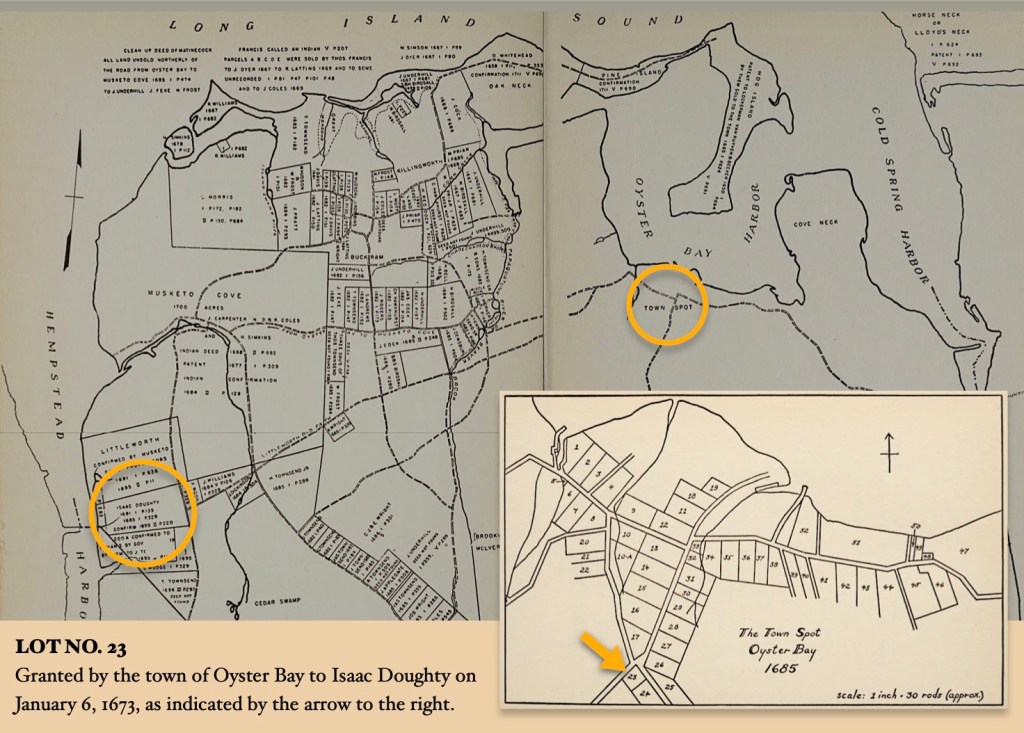
The audio file housed at —
The Internet Archive
Mary had a little lamb
by Thomas Edison
https://archive.org/details/EDIS-SCD-02
Note: For the audio clip reference only.

The Public Domain Review
Edison reading Mary Had a Little Lamb (1927)
https://publicdomainreview.org/collection/edison-reading-mary-had-a-little-lamb-1927/
Note: For the photograph of Thomas Edison, and the MP3 download link at the articles end for the actual audio file used in this chapter.

Abraham Lincoln Presidential Library and Museum
Lincoln and Thanksgiving
https://presidentlincoln.illinois.gov/Blog/Posts/169/Abraham-Lincoln/2022/11/Lincoln-and-Thanksgiving/blog-post/
Note: For the text and 1863 proclamation image.

(NEFTA)
The National Endowment For The Humanities
Who Were the Pilgrims Who Celebrated the First Thanksgiving?
by Craig Lambert
https://www.neh.gov/humanities/2015/novemberdecember/feature/who-were-the-pilgrims-who-celebrated-the-first-thanksgiving
Note: For the text.

Finally, Thanksgiving Dinner is Just Not Complete Without Pumpkin Pie!

(7) — one record

All records are family photographs, or ephemera. Below is a transcription of Marguerite’s Pumpkin Pie recipe exactly as she wrote it out —

The Pilgrims — The Native Peoples

This is Chapter Six of seven. Long before our ancestors had arrived in the New Plymouth, the native peoples who already lived there had more than a century of experience with the Europeans.

In the first chapter, The Pilgrims — Saints & Strangers, we briefly learned about some of the historical consequences of the Columbian Exchange. We were then choosing to apply a light touch to that history, but here in this chapter, we need to delve more deeply.

(The English Exporer) Bartholemew Gosnold trading with the Wampanoag at Martha’s Vineyard,
circa 1597. (Image courtesy of The Newberry Library).

The Americas and The Great Dying

“The first manifestation of the Columbian Exchange may have been the spread of syphilis from the native people of the Caribbean Sea to Europe. The history of syphilis has been well-studied, but the origin of the disease remains a subject of debate.

There are two primary hypotheses: one proposes that syphilis was carried to Europe from the Americas by the crew of Christopher Columbus in the early 1490s, while the other proposes that syphilis previously existed in Europe but went unrecognized. The first written descriptions of syphilis in the Old World came in 1493. The first large outbreak of syphilis in Europe occurred in 1494–1495 among the army of Charles VIII during its invasion of Naples. Many of the crew members who had served with Columbus had joined this army. After the victory, Charles’s largely mercenary army returned to their respective homes, spreading “the Great Pox” across Europe, which killed up to five million people.” (Wikipedia)

This chart looks a bit heavy on the left side, doesn’t it?
Data gathered was from Wikipedia, and The National Library of Medicine, United Kingdom.
(See footnotes).

The Columbian Exchange of diseases towards the New World was far deadlier. The peoples of the Americas had previously had no exposure to Old World diseases and little or no immunity to them. An epidemic of swine influenza beginning in 1493 killed many of the Taino people inhabiting Caribbean islands. The pre-contact population of the island of Hispaniola was probably at least 500,000, but by 1526, fewer than 500 were still alive. Spanish exploitation was part of the cause of the near-extinction of the native people. (Wikipedia)

In 1518, smallpox was first recorded in the Americas and became the deadliest imported Old World disease. Forty percent of the 200,000 people living in the Aztec capital of Tenochtitlan, later Mexico City, are estimated to have died of smallpox in 1520 during the war of the Aztecs with conquistador Hernán Cortés. Epidemics, possibly of smallpox, spread from Central America, devastated the population of the Inca Empire a few years before the arrival of the Spanish. The ravages of Old World diseases and Spanish exploitation reduced the Mexican population from an estimated 20 million to barely more than a million in the 16th century. (Wikipedia)

Known as the Port St. Louis map, by Samuel de Champlain, circa 1605. This image shows the Patuxet settlement (the future Plymouth Colony site), before the plague of 1617. Note the depictions of shelters and abundant cornfields. It was included in the book, Les Voyages du Sievr de Champlain Xaintongeois, 1613. (Image courtesy of the Library of Congress).

“There is disagreement regarding the number of Native Peoples before the first Europeans set foot in North America, but approximately five to eighteen million is currently the best estimate, and a much larger population of over 100 million including throughout the Americas and West Indies is probable. The arrival of Europeans… resulted in a catastrophic ‘demographic collapse’ of up to 95% of the indigenous population. By the beginning of the 20th Century, the number of Native Americans in this country had been reduced to about 237,000 people through disease, war, and relocation.” (See footnotes, Ipswich) (1)

Passage excerpted from: Indian Narratives: Containing a Correct and Interesting History
of the Indian Wars, From the Landing of Our Pilgrim Fathers, 1620. It was published in 1854,
by Henry Trumbull, Susannah Willard, and Zadock Steele. (See footnotes).

Closer to Home in New England

“The Wampanoag Tribe, also known as the People of the First Light, has inhabited present-day Massachusetts and Eastern Rhode Island for more than 12,000 years. In the 1600s, there were as many as 40,000 people in the 67 villages that made up the Wampanoag People, who firstly lived as a nomadic hunting and gathering culture. By about 1000 AD, archaeologists have found the first signs of agriculture, in particular the corn crop, which became an important staple, as did beans and squash.” (Mayflower 400)

Dr. Ian Saxine of Bridgewater State University, when interviewed near the time of the Mayflower’s 400th anniversary stated, “There is evidence that the inhabitants of the Outer Cape had interacted with European sailors from Portugal, England and France for at least 200 years. They traded, and at times, fought.” (GBH News) This area is shown on the right portion of the map below.


Map of Wampanoag Country in the 1600s.
Wampanoag territory in the 1600s was made up of about 67 villages, and this map shows some of them. The larger print shows the Wampanoag name, and the smaller print gives the modern name. (Map courtesy of Plimoth Patuxet Museums).

“Entire villages were lost and only a fraction of the Wampanoag Nation survived. This meant they were not only threatened by the effects of colonisation but vulnerable to rival tribes and struggled to fend off the neighbouring Narragansett, who had been less affected by this plague.

In the winter of 1616-17 an expedition dispatched by Sir Ferdinando Gorges found a region devastated by war and disease, the remaining people so “sore afflicted with the plague, for that the country was in a manner left void of inhabitants”. Two years later another Englishman found “ancient plantations” now completely empty with few inhabitants – and those that had survived were suffering.

In the years before the Mayflower arrived, the effects of colonization had already taken root.” (Mayflower 400)

Front cover and interior page from, Historical, Poetical and Pictorial American scenes:
Principally Moral and Religious: Being a Selection of Interesting Incidents in American History

to Which is Added a Historical Sketch of Each of the United States,
by John W. Barber and Elizabeth G. Barber, 1850. (Images courtesy of the Hathi Trust).

When the sickness came, the reduction of the population may have been incremental, episodic, and continuous, but in the end, it was relentless.
For the tribe with whom our family (mostly) interacted with, “the extraordinary impact of the Great Dying meant the Wampanoag had to reorganize its structure and the Sachems [the North American Indian chiefs] had to join together and build new unions.” (Mayflower 400)

“When we look back on the Aborigines, as the sole proprietors
of our soil, on the places which once knew them,
but are now to know them no more forever,
feelings of sympathy and sadness come over our souls.

In the light of history,
a tribe of men immortal as ourselves… have irrevocably
disappeared from the scenes and concerns of earth.

Joseph Felt writing in his 1834 book,
“History of Ipswich, Essex and Hamilton”

If you recall when we wrote in The Pilgrims — Saints & Strangers, we drew attention to the fact that people then had no concept of germ theory. The very healthy nature of the Native Peoples “proved their undoing, for they had built up no resistance, genetically or through childhood diseases, to the microbes that Europeans and Africans would bring to them. They did not cause the plague and were as baffled as to its origin as the stricken Indian villagers.

These epidemics probably constituted the most important geopolitical event of the early seventeenth century. Their net result was that the English, for their first fifty years in New England, would face no real Indian challenge.” (Lies My Teacher Told Me – LMTTM)

Drawing of a Wampanoag hut. (Image courtesy of the Leiden American Pilgrim Museum).

Nature loves to exploit a new environmental niche, and viruses that complicate our lives are unintentionally skilled at exploiting new opportunities. We all know this, with the most recent example being the global SARS-CoV-2 (COVID-19).

It was into this world of empty landscapes that the Plimoth Plantation began. (2)

First Encounters With The Pilgrims

From the standpoint of the Native People, when the Pilgrims first arrived, their memories of some of their own having been taken prisoner and sold into slavery, led some to act aggressively. “The First Encounter… was not so much an attack on the English settlers as the Wampanoags defending themselves and their culture. Pilgrim records say the Nauset [a neighboring tribe of the Wampanoags] attacked once the Pilgrims had pulled their small boat ashore after spending the day exploring along the coast and were camped out near the beach. Although the Pilgrims and Nauset engaged in a brief firefight, there is no record of any deaths or injuries.

Saxine [of Bridgewater State University] said both sides felt they had won what was the first violent engagement between the Native Americans and the European settlers who would later colonize Plymouth. The Mayflower party felt that they had won because the Nauset fighters pulled back after this firefight,” Saxine said. “The Nauset probably felt they had won because the English people sailed away and left them alone.” (GBH News) (3)

The Pilgrims arrive at Plymouth, Massachusetts on board the Mayflower,
November 1620
(painting), by W.J. Aylward. (Image courtesy of Historynet.com)

These People Were Different.

“The story of the Pilgrims… has been told primarily from the English colonists’ point of view. How the Native Americans felt about the colonists’ arrival in the New World has been mostly absent from the story.” (GBH News)

“Four hundred years ago, this newly organised People [after the Great Dying] watched as yet another ship arrived from the east. These people were different. The Wampanoag watched as women and children walked from the ship, using the waters to wash themselves. Never before had they seen Europeans engage in such an act. They watched cautiously as the men of this new ship explored their lands, finding what remained of Patuxet and building homes. They watched them take corn and beans, probably winter provisions, stored for the harsh conditions that were to come. The Wampanoag People did not react.

Given the horrific nature of the past years, the Wampanoag People were understandably wary of this new group. Months would pass before contact. But in this time, they would have recognised the opportunity for a new alliance to help them survive.” (Mayflower 400) (3)

Discovering Indian Cornand Graves

In the book, 1491: New Revelations of the Americas Before Columbus, author Charles C. Mann, states to National Geographic —

“When the pilgrims arrived in Cape Cod, they were incredibly unprepared. “They were under the persistent belief that because New England is south of the Netherlands and southern England, it would therefore be warmer,” says Mann. “Then they showed up six weeks before winter [actually less than six weeks] with practically no food.” In a desperate state, the pilgrims robbed corn from Native Americans graves and storehouses soon after they arrived; but because of their overall lack of preparation, half of them still died within their first year.

If the pilgrims had arrived in Cape Cod three years earlier, they might not have found those abandoned graves and storehouses… in fact, they might not have had space to land. Europeans who sailed to New England in the early to mid-1610s found flourishing communities along the coast, and little room for themselves to settle. But by 1620, when the Mayflower arrived, the area looked abandoned.

“Having their guns and hearing nobody, they entered the houses and found the people were gone. The sailors took some things but didn’t dare stay. . . . We had meant to have left some beads and other things in the houses as a sign of peace and to show we meant to trade with them. But we didn’t do it because we left in such haste. But as soon as we can meet with the Indians, we will pay them well for what we took.”

“We marched to the place we called Cornhill, where we had found the corn before. At another place we had seen before, we dug and found some more corn, two or three baskets full, and a bag of beans… In all we had about ten bushels, which will be enough for seed. It was with God’s help that we found this corn, for how else could we have done it, without meeting some Indians who might trouble us.”

“A couple of years before, there’d been an epidemic that wiped out most of the coastal population of New England, and Plymouth was on top of a village that had been deserted by disease,” says Mann. “The pilgrims didn’t know it, but they were moving into a cemetery,” he adds.

“The next morning, we found a place like a grave. We decided to dig it up. We found first a mat, and under that a fine bow. . . . We also found bowls, trays, dishes, and things like that. We took several of the prettiest things to carry away with us, and covered the body up again.”

“The newcomers did eventually pay the Wampanoags for the corn they had dug up and taken. Plymouth, unlike many other colonies, usually paid Indians for the land it took. In some instances Europeans settled in Indian towns because Natives had invited them, as protection against another tribe, or a nearby competing European power.” (National Geographic, and LMTTM)

Massasoit Meeting English Settlers, from Lives of Famous Indian Chiefs by Norman B. Wood, 1906. (Image courtesy of Encyclopædia Britannica).

“…just as the Pilgrims don’t represent all English colonists, the Wampanoags, who feasted with them, don’t represent all Native Americans. The Pilgrims’ relations with the Narragansetts, or the Pequots, were completely different.” (National Endowment For The Humanities – NEFTH) (5)

The Wampanoag Confederacy of Massasoit Sachem

The history that has come down to us today, records four individuals who made important differences in the lives of the Pilgrims, and helped them to succeed with their new colony endeavors.

Massasoit was the Sachem, or leader of the Wampanoag confederacy. Massasoit Sachem means the Great Sachem. Although Massasoit was only his title, English colonists mistook it as his name and it stuck. Massasoit needed the Pilgrims just as much as they needed him. [His] people had been seriously weakened by a series of epidemics and were vulnerable to attacks by the Narragansetts, and he formed an alliance with the colonists at Plymouth Colony for defense against them. It was through his assistance that the Plymouth Colony avoided starvation during the early years.

At the time of the Pilgrims’ arrival in Plymouth, the realm of the Wampanoag, also known as the Pokanokets, included parts of Rhode Island and much of southeastern Massachusetts. Massasoit lived in Sowams, a village at Pokanoket in Warren, Rhode Island. He held the allegiance of lesser Pokanoket Sachems [chiefs]. 

Massasoit forged critical political and personal ties with colonial leaders William Bradford, Edward Winslow, Stephen Hopkins, John Carver, and Myles Standish, ties which grew out of a peace treaty negotiated on March 22, 1621. The alliance ensured that the Pokanokets remained neutral during the Pequot War in 1636. According to English sources, Massasoit prevented the failure of Plymouth Colony and the starvation that the Pilgrims faced during its earliest years.

Massasoit Sachem images, from left to right: Pilgrim Edward Winslow comforting Massasoit. Center: A Map of New-England (Woodcut), attributed to John Foster 1677. Note: The crown, indicates the royal seat of Massassoit Sachem of the Wampanoags, and is drawn between the two branches of the Sowams River. Plimoth is nearby to the southeast. Right: 1902 postcard photo showing Profile Rock, …it was thought to be that of the Wampanoag Chief Massasoit Sachem. (See footnotes).

Massasoit was humane and honest, kept his word, and endeavored to imbue his people with a love for peace. He kept the Pilgrims advised of any warlike designs toward them by other tribes. It is unclear when Massasoit died. Some accounts claim that it was as early as 1660; others contend that he died as late as 1662. He was anywhere from 80 to 90 at the time.” (Wikipedia)

“In Winslow’s second published book, ‘Good Newes from New England (1624),’ he recounted at length nursing the Wampanoag leader Massasoit as he lay dying, even to the point of spoon-feeding him chicken broth.” (See footnotes, The Conversation) (6)

Samoset arriving at Plymouth Colony in 1621. (See footnotes).

Samoset, the Abenaki Native American

This is how we first learn of Samoset, “Yet, in March, a lone Indian warrior named Samoset appeared and greeted the settlers, improbably, in English. Soon, the Pilgrims formed an alliance with the Wampanoags and their chief, Massasoit. Only a few years before, the tribe had lost 50 to 90 percent of its population to an epidemic borne by European coastal fisherman. Devastated by death, both groups were vulnerable to attack or domination by Indian tribes. They needed each other.” (NEFTH) 

He “was the Abenaki Native American who first approached the English settlers of Plymouth Colony in friendship, introducing them to [the] natives Squanto and Massasoit who would help save and sustain the colony.

He was a Sagamore (Chief) of the Eastern Abenaki, who was either visiting Massasoit or had been taken prisoner by him sometime before the Mayflower landed off the coast of modern-day Massachusetts in November 1620. Massasoit chose him to make first contact with the pilgrims in March of 1621, and he has been recognized since as instrumental in bringing the Native Americans of the Wampanoag Confederacy and English colonists of Plymouth together in a compact which would remain unbroken for the next 50 years.”

All that is known of Samoset comes from these works except for a passing mention by the explorer Captain Christopher Levett who met Samoset in 1624 at present-day Portland, Maine, and considered it an honor based on Samoset’s role in helping to sustain Plymouth Colony in 1621. Samoset was highly regarded by other English and European colonists following his appearance in Mourt’s Relation, published in 1622. (World History Encyclopedia) (7)

Tisquantum. or Squanto, the Guide and Interpreter
by Charles de Wolf Brownell, circa 1864. (See footnotes).

Tisquantum, Who is Also Known as Squanto

“A Native American called Tisquantum was born in 1580. He became known as Squanto and little is known of his early life. Some believe he was captured as a young man on the coast of what is now Maine by Captain George Weymouth in 1605. Weymouth was an Englishmen commissioned to explore the American coastline and thought his financial backers might like to see Native American people.

“What do most books leave out about Squanto? First, how he learned English. Squanto spent nine years [in England, with three years being in the employ of Ferdinando Gorges]. At length, Gorges helped Squanto arrange passage back to Massachusetts. Some historians doubt that Squanto was among the five Indians stolen in 1605. All sources agree, however, that in 1614 an English slave raider, Thomas Hunt, lured 24 Native Americans on board his ship under the premise of trade. Their number included Tisquantum. Hunt locked them up below deck, sailed for Spain and sold these people into the European slavery in Málaga, Spain. Squanto escaped from slavery, escaped from Spain, and made his way back to England.

Malaga, Spain, circa 1572, 40 years before Tisquantum was delivered there in slavery.
(Image courtesy of Universitätsbibliothek Heidelberg).

After trying to get home via Newfoundland, in 1619 he talked Thomas Dermer into taking him along on his next trip to Cape Cod as an interpreter. He searched for his homeland but tragically, he arrived as the Great Dying reached its horrific climax. His tribe had all been wiped out two years before.. His home village, Patuxet, was lost. — No wonder Squanto threw in his lot with the Pilgrims.” (LMTTM and Mayflower 400)

“Squanto’s travels acquainted him with more of the world than any Pilgrim encountered. He had crossed the Atlantic perhaps six times, twice as an English captive, and had lived in Maine, Newfoundland, Spain, and England, as well as Massachusetts.”
Excerpted from Lies My Teacher Told Me, by James W. Loewen, page 88.

“As translator, ambassador, and technical advisor, Squanto was essential to the survival of Plymouth in its first two years. Like other Europeans in America, the Pilgrims had no idea what to eat or how to raise or find food until American Indians showed them. [Massasoit was, as the Great Sachem of the Wampanoag Confederacy, the one who sent Tisquantum (Squanto) to live among the Pilgrim colonists.]

William Bradford called Squanto “a special instrument sent of God for their good beyond their expectation. He directed them how to set their corn, where to take fish, and to procure other commodities, and was also their pilot to bring them to unknown places for their profit.” Squanto was not the Pilgrims’ only aide: in the summer of 1621 Massasoit sent another Indian, Hobomok, to live among the Pilgrims for several years as guide and ambassador.” (LMTTM)

Importantly, we learned that he “… facilitated understandings between the colony and its native neighbors and established trade relations with a number of villages.” (Wikipedia)

Pilgrim Fathers and Squanto, the Friendly Indian,
after an Illustration by C. W. Jefferys, 1926. (See footnotes).

“With spring, under the careful guidance of a Wampanoag friend, Tisquantum, the settlers planted corn, squash, and beans, with herring for fertilizer. They began building more houses, fishing for cod and bass, and trading with the Native Americans. By October, they had erected seven crude houses and four common buildings.” (NEFTH) (8)

Hobomok, A ‘Pneise’ of the Pokanoket

Almost nothing is known about Hobomok before he began living with the English settlers who arrived aboard the Mayflower. His name was variously spelled in 17th century documents and today is generally simplified as Hobomok, or Hobbamock. He was known as a Pneise, which means he was an elite warrior of the Algonquin people of Eastern Massachusetts. Also, he was a member of the Pokanoket tribe… whom Sachem Massasoit had authority over. William Bradford described him as “a proper lustie man, and a man of accounte for his vallour and parts amongst thed Indeans.”

“Hobomak is known to us primarily for his rivalry with Squanto, who lived with the settlers before him. He was greatly trusted by Myles Standish, the colony’s military commander, and he joined with Standish in a military raid against the Massachuset” [a neighboring tribe].

The March of Miles Standish, postcard image published by Armstrong & Co.
(Image courtesy of the Library of Congress, see footnotes).

Both Bradford and Winslow first record Hobomok’s actions in connection with a crisis in which Squanto was thought to have been kidnapped and possibly murdered. Long story short is that there were ongoing rival factions for control among the various Native nations, and therefore there was an attempt to have Massasoit driven “from his country.” Hobomak aided Miles Standish “to raid Nemasket at night to round up Corbitant and any accomplices.” This was a messy confrontation, but Squanto was released, and Massasoit remained as Sachem.

However, “The affair left the colony feeling exposed. They decided to protect the settlement by taking down tall trees, dragging them from the forest and sinking them in deep holes closely bound to prevent arrows from passing through. [This was the building of a stockade.] Moreover, Standish divided the men into four squadrons and drilled them on how to respond to an emergency, including instructions on how to remain armed and alert to a native attack even during a fire in the town.” (Adapted from Wikipedia)

An artist’s conception of the Plymouth Colony by 1630. (See footnotes).

“Hobomok helped Plymouth set-up fur trading posts at the mouth of the Penobscot and Kennebec rivers in Maine; in Aputucxet, Massachusetts, and in Windsor, Connecticut.” If you recall, the underwriters in London who had financed the voyage of the Mayflower still need to be reimbursed by the Pilgrims. The income generated by the sale and shipment of these fur skins back to the Europeans, helped to alleviate those debts. (LMTTM) (9)

Very Faithful in Their Covenant of Peace

When have written previously that it appeared that the demeanor of the Pilgrims had shifted during their years in Leyden, Holland. Perhaps after all of their harrowing experiences since they left there, some of them were becoming less strident in their views? We observed that instead of viewing the Native Peoples in America as Others — as they themselves had been treated in England — an appreciation and tolerance toward those who are different from them, had begun to take hold.

Left image: Portrait of Plymouth Colony Governor Edward Winslow, Attributed to the school of Robert Walker, circa 1651. Right image: Hand-colored woodcut of Edward Winslow visiting Chief Massasoit. (See footnotes).

“At the same time, Pilgrims did not actively seek the conversion of Native Americans. According to scholars like [Nathaniel] Philbrick, English author Rebecca Fraser and [Mark] Peterson, the Pilgrims appreciated and respected the intellect and common humanity of Native Americans.

An early example of Pilgrim respect for the humanity of Native Americans came from the pen of Edward Winslow. Winslow was one of the chief Pilgrim founders of Plymouth. In 1622, just two years after the Pilgrims’ arrival, he published in the mother country the first book about life in New England, “Mourt’s Relation.”

While opining that Native Americans “are a people without any religion or knowledge of God,” he nevertheless praised them for being “very trusty, quick of apprehension, ripe witted, just.” Winslow added that “we have found the Indians very faithful in their covenant of peace with us; very loving. … we often go to them, and they come to us; some of us have been fifty miles by land in the country with them.” (See footnotes, The Conversation) (10)

Following are the footnotes for the Primary Source Materials, 
Notes, and Observations

The Americas and The Great Dying

(1) — eight records

The Newberry Library
(The English Exporer) Bartholomew Gosnold trading with
Wampanoag Indians at Martha’s Vineyard, Massachusetts
by Theodor de Bay, circa 1597
https://collections.carli.illinois.edu/digital/collection/nby_eeayer/id/3563
Note: For the image.

Post-Columbian Transfer of Diseases chart, sources —
Columbian Exchange
https://en.wikipedia.org/wiki/Columbian_exchange
Note: For the text and the image of, Sixteenth-century Aztec drawings
of victims of smallpox, from the Florentine Codex.
and
New Hypothesis for Cause of Epidemic among Native Americans,
New England, 1616–1619
by John S. Marr and John T. Cathey
https://pmc.ncbi.nlm.nih.gov/articles/PMC2957993/
Note: For the data, “…leptospirosis complicated by Weil syndrome, a rare but severe bacterial infection, spread by non-native black rats that arrived on the settlers’ ships.”
and
Smithsonian Magazine
Alfred W. Crosby on the Columbian Exchange
by Megan Gambino
https://www.smithsonianmag.com/history/alfred-w-crosby-on-the-columbian-exchange-98116477/?no-ist
Note: For the bottom image.

Library of Congress
Les voyages dv sievr de Champlain Xaintongeois,
capitaine ordinaire pour le Roy, en la marine. Divisez en devx livres.
ou, Iovrnal tres-fidele des observations faites és descouuertures
de la Nouuelle France
by Samuel de Champlain, circa 1605
https://www.loc.gov/item/22006274/
Book page: 80, Digital page: 112/436
Note: For book frontipiece and credits.
and
Plimoth Patuxet Museums
Port St. Louis (map)
https://plimoth.org/yath/unit-1/port-st-louis
Note: For the text and map.

(Ipswich)
Historic Ipswich
The Great Dying 1616-1619, “By God’s visitation, a Wonderful Plague.”
https://historicipswich.net/2023/11/17/the-great-dying/

Indian Narratives: Containing a Correct and Interesting History of the Indian Wars,
From the Landing of Our Pilgrim Fathers, 1620,
circa 1854
by Henry Trumbull, Susannah Willard, and Zadock Steele
https://archive.org/details/indiannarrative00steegoog/page/n10/mode/2up
Book page: 76, Digital page: 87/295
Note: For the text.

Closer to Home in New England

(2) — seven records

Mayflower 400
Native America and the Mayflower: 400 years of Wampanoag History
https://www.mayflower400uk.org/education/native-america-and-the-mayflower-400-years-of-wampanoag-history/
Note: For the text.

GBH News
Reframing The Story Of The First Encounter Between
Native Americans And The Pilgrims
by Bob Seay
https://www.wgbh.org/news/local/2019-11-28/reframing-the-story-of-the-first-encounter-between-native-americans-and-the-pilgrims
Note: For the text.

Plimoth Patuxet Museums
Map of Wampanoag Country in the 1600s
https://plimoth.org/yath/unit-1/map-of-wampanoag-country-in-the-1600s
Note: For the map image.

Hathi Trust
Historical, Poetical and Pictorial American scenes:
Principally Moral and Religious: Being a Selection of Interesting Incidents in American History to Which is Added a Historical Sketch of Each of the United States
, 1850
by John W. Barber and Elizabeth G. Barber
https://babel.hathitrust.org/cgi/pt?id=uiuo.ark:/13960/t00057646&seq=199
Book page: 183, Digital page: 199/254
Note: For the text and the image.

History of Ipswich, Essex and Hamilton
by Joseph Barlow Felt, 1834
https://archive.org/details/historyofipswich00felt/page/2/mode/2up
Book page: 2, Digital page: 24/404
Note: For the text (pull-quote).

(LAPM)
Leiden American Pilgrim Museum
https://leidenamericanpilgrimmuseum.org/en
Note: For the illustration of the Wampanoag hut.

(LMTTM)
Lies My Teacher Told Me
by James W. Loewen
https://www.google.pt/books/edition/Lies_My_Teacher_Told_Me/5m23RrMeLt4C?hl=en&gbpv=1&pg=PA1&printsec=frontcover
Book pages: 70-92
Note: Chapter 3: “The Truth About The First Thanksgiving”

First Encounters With The Pilgrims

(3) — two records

GBH News
Reframing The Story Of The First Encounter Between Native Americans And The Pilgrims
by Bob Seay
https://www.wgbh.org/news/local/2019-11-28/reframing-the-story-of-the-first-encounter-between-native-americans-and-the-pilgrims
Note: For the text.

The Pilgrims arrive at Plymouth, Massachusetts on board the Mayflower,
November 1620
(painting)
by W.J. Aylward
https://www.historynet.com/how-collectivism-nearly-sunk-colonies/landing-of-the-pilgrims/
Note: For the painting image.

These People Were Different.

(4) — two records

GBH News
Reframing The Story Of The First Encounter Between Native Americans And The Pilgrims
by Bob Seay
https://www.wgbh.org/news/local/2019-11-28/reframing-the-story-of-the-first-encounter-between-native-americans-and-the-pilgrims
Note: For the text.

Mayflower 400
Native America and the Mayflower: 400 years of Wampanoag History
https://www.mayflower400uk.org/education/native-america-and-the-mayflower-400-years-of-wampanoag-history/
Note: For the text.

Discovering Indian Cornand Graves

(5) — five records

National Geographic
A few things you (probably) don’t know about Thanksgiving
by Becky Little
https://www.nationalgeographic.com/history/article/151121-first-thanksgiving-pilgrims-native-americans-wampanoag-saints-and-strangers
Note: For the text.

Interesting Events in the History of The United States: being a selection of
the most important and interesting events which have transpired…

by John Warner Barber, 1798-1885
https://archive.org/details/intereventshistus00barbrich/page/n5/mode/2up
Note: For text and the illustration, Discovering Indian Corn.

(LMTTM)
Lies My Teacher Told Me
by James W. Loewen
https://www.google.pt/books/edition/Lies_My_Teacher_Told_Me/5m23RrMeLt4C?hl=en&gbpv=1&pg=PA1&printsec=frontcover
Book pages: 70-92
Note 1: Chapter 3 for text, The Truth About The First Thanksgiving
Note 2: The travel map for Squanto was adapted from graphics on page 88.

Encyclopædia Britannica
Wampanoag People
Massasoit Meeting English Settlers
from ‘Lives of Famous Indian Chiefs’ by Norman B. Wood, 1906
https://www.britannica.com/topic/Wampanoag#/media/1/635211/179338
Note: For the image.

(NEFTH)
The National Endowment For The Humanities
Who Were the Pilgrims Who Celebrated the First Thanksgiving?
by Craig Lambert
https://www.neh.gov/humanities/2015/novemberdecember/feature/who-were-the-pilgrims-who-celebrated-the-first-thanksgiving
Note: For the text.

The Wampanoag Confederacy of Massasoit Sachem

(6) — seven records

Primary Source Learning:
The Wampanoag, the Plimoth Colonists & the First Thanksgiving
https://primarysourcenexus.org/2021/11/primary-source-learning-wampanoag-plimoth-colonists-first-thanksgiving/
Note: For the image of Massasoit And His Warriors

Massasoit
https://en.m.wikipedia.org/wiki/Massasoit
Note: For the text.

The Conversation
The First Pilgrims and the Puritans Differed in Their Views on Religion,

Respect for Native Americans
by Michael Carrafiello
https://theconversation.com/how-the-first-pilgrims-and-the-puritans-differed-in-their-views-on-religion-and-respect-for-native-americans-240974
Note: For the text.

Images for the Massasoit collage —
Hathi Trust
Historical, Poetical and Pictorial American scenes:
Principally Moral and Religious: Being a Selection of Interesting Incidents in American History to Which is Added a Historical Sketch of Each of the United States, 1850
by John W. Barber and Elizabeth G. Barber
https://babel.hathitrust.org/cgi/pt?id=uiuo.ark:/13960/t00057646&seq=32
Book page: 16, Digital page: 32/254
Note: For the image of Massasoit.
and
The Massachusetts Historical Society
A Map of New-England (Woodcut)
Attributed to John Foster, 1677
https://www.masshist.org/database/68
Note 1: Originally published in William Hubbard’s Narrative of the Troubles with the Indians. Note 2: The Crown, indicates the royal seat of Massassoit, the Sachem of the Wampanoags, and is drawn between the two branches of the Sowams River.
and

File:Profile Rock (Assonet).jpg
https://commons.wikimedia.org/wiki/File:Profile_Rock_(Assonet).jpg
Note 1: Image, 1902 postcard photo showing Profile Rock; scanned from a private collection.
Note 2: …it was thought to be that of the Wampanoag Chief Massasoit Sachem, from: https://www.atlasobscura.com/places/profile-rock

Samoset, the Abenaki Native American

(7) — two records

Samoset
Samoset arriving at Plymouth Colony in 1621
by Artist unknown
https://kids.britannica.com/kids/article/Samoset/601202

World History Encyclopedia
Samoset
https://www.worldhistory.org/Samoset/
Note: For the text. 

Tisquantum, Who is Also Known as Squanto

(8) — seven records

Antique Print Club
Tisquantum. or Squanto, the Guide and Interpreter
by Charles de Wolf Brownell, circa 1864
https://www.antiqueprintclub.com/Products/Antique-Prints/Historic-Views-People/Americas-Canada/Tisquantum-or-Squanto,-the-guide-and-interpreter-c.aspx
Note 1: For the antique image of Tisquantum. or Squanto.
Note 2: “Rare wood engraving with contemporary hand color, from Charles de Wolf Brownell’s ‘The Indian Races of North and South America: comprising an account of the principal aboriginal races; a description of their national customs, mythology, and religious ceremonies; the history of their most powerful tribes, and of their most celebrated chiefs and warriors…’,
published in Hartford, Connecticut in 1864 by Hurlbut, Scranton & Co.”

Artwork of Málaga in 1572 —
40 years before Tisquantum was delivered there in slavery
Extracted from:
https://en.wikipedia.org/wiki/Squanto
Notes: Georg Braun; Frans Hogenberg: Civitates Orbis Terrarum, Band 1, 1572 (Ausgabe Beschreibung vnd Contrafactur der vornembster Stät der Welt, Köln 1582; [VD16-B7188) Universitätsbibliothek Heidelberg

(LMTTM)
Lies My Teacher Told Me
by James W. Loewen
https://www.google.pt/books/edition/Lies_My_Teacher_Told_Me/5m23RrMeLt4C?hl=en&gbpv=1&pg=PA1&printsec=frontcover
Book pages: 70-92
Note 1: Chapter 3: “The Truth About The First Thanksgiving”
Note 2: For the map from page 88, which we adapted for this chapter.

Mayflower 400
Native America and the Mayflower: 400 years of Wampanoag History
https://www.mayflower400uk.org/education/native-america-and-the-mayflower-400-years-of-wampanoag-history/
Note: For the text.

(NEFTH)
The National Endowment For The Humanities
Who Were the Pilgrims Who Celebrated the First Thanksgiving?
by Craig Lambert
https://www.neh.gov/humanities/2015/novemberdecember/feature/who-were-the-pilgrims-who-celebrated-the-first-thanksgiving
Note: For the text.

Pilgrim Fathers and Squanto, the Friendly Indian
after an Illustration by C. W. Jefferys, 1926
https://www.art.com/products/p53691947530-sa-i8600719/pilgrim-fathers-and-squanto-the-friendly-indian-after-an-illustration-by-c-w-jefferys-1926.htm
Note: For the illustration.

Hobbamock
https://en.wikipedia.org/wiki/Hobbamock#Hobomok_comes_to_live_with_English
Note: For the text about Squanto.

Hobomok, A Pneise of the Pokanoket

(9) — three records

Hobbamock
https://en.wikipedia.org/wiki/Hobbamock#Hobomok_comes_to_live_with_English
Note: For the text.

(LMTTM)
Lies My Teacher Told Me
by James W. Loewen
https://www.google.pt/books/edition/Lies_My_Teacher_Told_Me/5m23RrMeLt4C?hl=en&gbpv=1&pg=PA1&printsec=frontcover
Book pages: 70-92
Note: Chapter 3: “The Truth About The First Thanksgiving”

The Conversation
The First Pilgrims and the Puritans Differed in Their Views on Religion, Respect for Native Americans

by Michael Carrafiello
https://theconversation.com/how-the-first-pilgrims-and-the-puritans-differed-in-their-views-on-religion-and-respect-for-native-americans-240974
Note: For the text.

Very Faithful in Their Covenant of Peace

(10) — three records

Hand-colored woodcut of Edward Winslow visiting Chief Massasoit.
https://www.bostonglobe.com/ideas/2017/11/19/after-first-thanksgiving-things-went-downhill/vvDRodh9iKU7IB2Wegjt8J/story.html
Note: For the image.

The British Empire
Plymouth Colony in 1630
https://www.britishempire.co.uk/maproom/massachusetts/massachusetts3.htm
Note: For the image.

Portrait of Plymouth Colony Governor Edward Winslow
Attributed to the school of Robert Walker, circa 1651
File:Edward Winslow.jpg
https://commons.wikimedia.org/wiki/File:Edward_Winslow.jpg
Note: For the portrait of Edward Winslow.

The Pilgrims — Plimoth Plantation

This is Chapter Five of seven. In this chapter we are going to share some of the knowledge we’ve gained about what it was like to live in the new ‘Plimouth’ Plantation, but first an interesting history that is quite literally, about a rock.

But now, God knows, Anything Goes!

Times have changed / And we’ve often rewound the clock / Since the Puritans got the shock / When they landed on Plymouth Rock
If today / Any shock they should try to stem / ’Stead of landing on Plymouth Rock / Plymouth Rock would land on them!

In 1934, Cole Porter wrote the classic Broadway musical Anything Goes!, and it was quite an enormous hit with the Depression Era audiences. In fact, some of those catchy songs are still popular to this day. However, he got the introductory details in the lyrics just a little off in the title song.

The Puritans didn’t land at Plymouth Rock. Our ancestors the Pilgrims did — or did they?

Stereoscopic card image, circa 1925. (Image courtesy of the Library of Congress).

When you first lay eyes on Plymoth Rock, you can’t help but think, Is that all there is? (Cue singer Peggy Lee). It’s actually just pretty much a boulder. Even when you take a hopeful photograph wishing that through the magic of your camera, it will be… somehow more photogenic. It still ends up looking underwhelming — just like a rock from somebody’s yard down the street.

There are historical reasons for this. (1)

The Real Story of Behind Plymouth Rock

“There’s the inconvenient truth that no historical evidence exists to confirm Plymouth Rock as the Pilgrims’ steppingstone to the New World. Leaving aside the fact that the Pilgrims first made landfall on the tip of Cape Cod in November 1620 before sailing to safer harbors in Plymouth the following month, William Bradford and his fellow Mayflower passengers made no written references to setting foot on a rock as they disembarked to start their settlement on a new continent.

It wasn’t until 1741—121 years after the arrival of the Mayflower—that a 10-ton boulder in Plymouth Harbor was identified as the precise spot where Pilgrim feet first trod. The claim was made by 94-year-old Thomas Faunce, a church elder who said his father, who arrived in Plymouth in 1623, and several of the original Mayflower passengers assured him the stone was the specific landing spot. When the elderly Faunce heard that a wharf was to be built over the rock, he wanted a final glimpse. He was conveyed by chair 3 miles from his house to the harbor, where he reportedly gave Plymouth Rock a tearful goodbye. Whether Faunce’s assertion was accurate oral history or the figment of a doddering old mind, we don’t know.

By the 1770s, just a few years after Faunce made his declaration, Plymouth Rock had already become a tangible monument to freedom. As a revolutionary fever swept through Plymouth in 1774, some of the town’s most zealous patriots sought to enlist Plymouth Rock in the cause. With 20 teams of oxen at the ready, the colonists attempted to move the boulder from the harbor to a liberty pole in front of the town’s meetinghouse. As they tried to load the rock onto a carriage, however, it accidentally broke in two. The bottom portion of Plymouth Rock was left embedded on the shoreline, while the top half was moved to the town square.

On July 4, 1834, Plymouth Rock was on the move again, this time a few blocks north to the front lawn of the Pilgrim Hall Museum. And once again, the boulder had a rough ride. While passing the courthouse, the rock fell from a cart and broke in two on the ground. The small iron fence encircling Plymouth Rock did little to discourage the stream of souvenir seekers from wielding their hammers and chisels to get a piece of the rock. (Even today, chips off the old block are strewn across the country in places such as the Smithsonian Institution and the Plymouth Church in Brooklyn.)

The long history of the Plymouth Rock in images.
Clockwise from the top left: The painting Memorial Housing the Plymouth Rock, (which was built circa 1920), the wharf which was built over the Rock, circa 1860s, a lithographic print of passengers arriving, Plymouth Rock in front of Pilgrim Hall, circa 1834, (note the painted numerals) and from the Historical Marker Database, the Plymouth Rock Marker. (See footnotes).

Finally, in 1880, at the same time that an America torn asunder by the Civil War was stitching itself back together, the top of Plymouth Rock was returned to the harbor and reunited with its base. The date ‘1620’ was carved on the stone’s surface, replacing painted numerals.

In conjunction with the 300th anniversary of the Pilgrims’ arrival, Plymouth’s Rock’s current home, which resembles a Roman temple, was constructed. The boulder now rests on a sandy bed 5 feet below street level, encased in an enclosure like a zoo animal. Given all the whittling and the accidents, Plymouth Rock is estimated to be only a third or half of its original size, and only a third of the stone is visible, with the rest buried under the sand. A prominent cement scar is a reminder of the boulder’s tumultuous journeys around town.” (History.com) (2)

The Landing of the Pilgrims by Henry Bacon, 1877. (Image courtesy of Wikipedia).
Comment: Was Plymouth Rock ever really this big? Or was the painter Henry Bacon just inspired?

English Clothing in the 1620s: Not What You Think

“Many people think the Pilgrims always wore black clothes. This may be because in many images of the time, people are shown wearing black clothes. This is because in the 1620s, the best clothes were often black, and people usually had their portraits painted while wearing their best clothes. It was not easy to dye cloth a solid, long-lasting black. It took a great deal of skill. People kept clothes made of such beautiful, expensive cloth for special occasions. Everyday clothes were made of many colors. Brown, brick red, yellow and blue were common. Other clothes were made of cloth that was not dyed. These clothes were gray or white, the natural color of the cloth.” (Plimoth Pautuxet)

Let’s just clarify something here at the get go —
The Pilgrims were not Puritans, even though they are sometimes labeled as such
by writers and artists from the past. (They just dressed similarly).

A Puritan Woman, About 1640 and A Puritan Man, About 1640.
These cards are from WD & HO Wills, a British tobacco company founded in 1786.
(The series is from 1929, English Period Costumes).
Note: The man’s clothing would likely have been more colorful, despite the fact that many Victorian era illustrators have frequently portrayed the Pilgrims as wearing black.

“Men wore a short jacket called a doublet, which was attached to breeches (which are knee-length pants), to form a suit. Usually they were made of wool cloth or linen canvas. A felt hat often completed the outfit. At the time when the Pilgrims first arrived in Massachusetts, colors were fashionable, and the colonists wore various hues. The wardrobe of colonist William Brewster, for example, included a pair of green trousers and a violet-colored coat.

Women colonists wore elaborate multi-layered outfits: a corset, multiple petticoats, stockings, a dress over those items, and a waistcoat or apron. They also wore linen caps called coifs over their hair, and felt hats as well.” (WordPress, George Soule History) (3)

The Everyday Life of The Settlers

Historian Carla Pestana shares her thoughts on their everyday lives with this story, and reflects on how the world they lived in, was quickly changing:

“One thing I got fascinated with was the everyday reality of the settlers’ lives. In the book, I tell the story of a man named Thomas Hallowell who gets called before the grand jury in Plymouth in 1638 because he’s wearing red stockings. The reason why his neighbors call him on this, is that they know he doesn’t own red stockings and has no honest way to acquire them. So they think it needs to be looked into. When he’s called into court, he immediately confesses, yes, I was up in the very new town of Boston. I saw these stockings laying over a windowsill, drying, and I pocketed them, and brought them back to Plymouth, and put them on, and wore them in front of my neighbors, who knew I didn’t have them.

“It’s just so tempting..”.

That story tells you so much. The neighbors knew exactly what clothes he had, because clothes were really scarce and valuable. The materials to make clothing were not locally available, at first, and so it all has to be imported, which means that it’s expensive. Mostly they have to make do with what they have.

There were lots of references in letters, accounts, and even in the court records about people and their clothing, and about having to provide a suit of clothes to somebody, or having some shoes finally arrive on a ship, and what they’re able to do because the shoes have arrived. You’d think, shoes arrived, no big deal, but the shoes don’t just make themselves!

Cloth is coming in, and it’s being traded with Native hunters, and it’s being used by local people to make clothes. They try to get sheep, so they can have wool and start making woolen cloth. All of this trade is connecting them to other places, where sheep are available, or skills are available, or the cloth is coming from, or the shoes are coming from. That little story about this man’s stockings really tells us so much.

Changes were happening in the wider world, of which they were part. English people are in Virginia and Bermuda. The English are going in and out of the Caribbean all the time, and thinking about setting up settlements down there. Fisherman operating off the Grand Banks and in the northern fisheries are always stumbling into Plymouth. Then shortly after Plymouth, the New Amsterdam [Manhattan Island] colony was founded so English have these not-too-distant European neighbors from the Netherlands. French fishing boats are constantly in the region, so there’s all kinds of activity, and people coming and going.

Woodcut engraving of 17th Century New England Cod-fishing.
(Image courtesy of Granger Art On Demand).

Almost immediately after Plymouth is founded, other peoples from England say, ‘Well, we can go there, too. We don’t need to be part of Plymouth, but we can go to that region, and actually mooch off of Plymouth for a while for food and supplies, and then go set up a trading post somewhere else.’ ” (Smithsonian) (4)

New England’s Great Migration Had Started

The eventual success of the Plimoth Plantation caught the attention of many investors and immigrants back home in England. The inset detail (below) is excerpted from the famous 1676 Map of New York and New England by John Speed of London. (And no, that dark spec next to the ‘New Plymouth’ name is not the Plymouth Rock before it went on all of its adventures).

As part of The Great Migration, a map like this, with all of the various harbors already named, helped familiarize people with this strange new world they had been hearing about.“It depicts the territories acquired by the British with the capture of New Amsterdam in 1664, which changed European influence in the colonies from the Dutch to the English. It is the first appearance of the name Boston, and the first map to use the term New York for both Manhattan and the colony.”

Inset detail showing the town of New Plymouth,
from A Map of New England and New York, by John Speed, circa 1676.
(Image courtesy of Raremaps.com).

“The Great Migration Study Project uses 1620 — the date of the arrival of the Mayflower — as its starting point. The peak years lasted just over ten years — from 1629 to 1640, years when the Puritan crisis in England reached its height.

Motivated primarily by religious concerns, most Great Migration colonists traveled to Massachusetts in family groups. In fact, the proportion of Great Migration immigrants who traveled in family groups is the highest in American immigrant history. Consequently, New England retained a normal, multi-generational structure with relatively equal numbers of men and women. At the time they left England, many husbands and wives were in their thirties and had three or more children, with more yet to be born.

Great Migration colonists shared other distinctive characteristics. New Englanders had a high level of literacy, perhaps nearly twice that of England as a whole. New Englanders were highly skilled; more than half of the settlers had been artisans or craftsmen. Only about seventeen percent came as servants, mostly as members of a household.” (American Ancestors) (5)

Contemporary pushpin map of Plymouth, Massachusetts.
(Image courtesy of Dreamstime).

Let’s Put A Pin In That (Place) Name!

We have come across some name variations about the place where the Pilgrims established their colony, which seem to cause a bit of confusion. We believe that these names depend upon the era in which the history was written, so we have sorted them out a bit.

Plymouth
This is the location of the eventual (future) town on Cape Cod Bay where the Pilgrims established their settlement.

Plimoth Plantation, or Plymouth Plantation
This is name with which Governor William Bradford described their settlement in his journal Of Plimoth Plantation. This old-fashioned spelling was soon supplanted with the more modern spelling: Plymouth Plantation.

Plimoth Colony, or Plymouth Colony
Whether the Name is spelled as Plimoth, or Plymouth depends upon your source material, (and your computer’s fussy spell-check programming). They are the same place, just not the same spelling.

New Plimoth, or New Plymouth
Again, the same place. Some people have assumed that the Pilgrims named Plymouth after the English port city they knew. Actually, John Smith had already named the area New Plimouth on his 1616 map. See the chapter, The Pilgrims — A Mayflower Voyage.

Contemporary photograph of the Plimoth Patuxet historical site.
(Image courtesy of Wikipedia).

Plimoth Patuxet
This is the name of the museum and present day historical (replica village) site near the town of Plymouth. It is viewed as a more accurate representation of the cultures that co-existed at that time. “For the 12,000 years that the Wampanoag lived in and around what is now Plymouth, they called the land Patuxet, meaning ‘place of running water’ in the Wampanoag language. This land that is both Patuxet and Plymouth speaks to the emergence of an Indigenous-English hybrid society that existed here — in conflict and in collaboration – in the 17th century.” (See footnotes, The Enterprise) (6)

William Bradford’s 1620 Sketch of Plymouth

For our two Pilgrim ancestors — George Soule and Edward Doty — we have only been able to discern where the Soule family home was specifically located. We started with William Bradford’s 1620 Sketch of Plymouth, upon which he noted the two primary roads: one labeled the Streete, and the other the High Way. On this sketch, he also indicated where some homes were built, or intended to be built, since it was Winter time.

The second map is from the 19th century. If you look closely, you can see that First Street (the Streete), had a name change to Leyden Street. This happened in 1823, when it was renamed in honor of Leiden, Holland.

Four different plat drawings showing the original housing sites for various Pilgrim families. Top row, left: William Bradford’s original drawing, “The meersteads & garden plots of which came first layed out 1620, is the only known map of the original town layout.” Top row right: 19th century, origin unknown. Bottom row, left: This drawing was originally published in “The Arkansas Gazette (Little Rock, Arkansas), November 21, 1966. Bottom row, right: Origin unknown. (See footnotes).

The third sketch is from the 20th century and is an aerial view of the Plymouth Plantation* for a November 1966 newspaper article in the Arkansas Gazette (Little Rock, Arkansas). The George Soule home is tucked into the upper corner.
*Now known as the Plimoth Patuxet Museum, it opened in 1947.

Lastly, the image shown below at the lower right, appears as if it is from the mid-20th century. Note how several more homesites are accounted for, which earlier documents had not yet indicted. This brings us to any interesting point — it was a big challenge to work out exactly where the Soule house was, because all of these maps / had different authors / in different eras / with different purposes. Even the modern aerial photograph below does not account for a couple of new home additions to the Plimoth Patuxet site. (7)

The George and Mary Soule house as shown situated within Plimoth Patuxet Museum site. (Background image borrowed from Axiom Images, Aerial Stock Photos).

Leyden Street

In the last few years, archeologists have determined that the original location of Plimoth Plantation was likely Leyden Street in the present town of Plymouth, Massachusetts.

From the article See Plymouth, “The Pilgrims began laying out the street before Christmas in 1620 after disembarking from the Mayflower. The original settlers built their houses along the street from the shore up to the base of Burial Hill where the original fort/gun platform building was located, and now is the site of a cemetery and First Church of Plymouth.

Leyden Street is a street in Plymouth, Massachusetts that was created in 1620 by the Pilgrims, and claims to be the oldest continuously inhabited street in the Thirteen Colonies of British America. It was originally named First Street, …named Leyden Street in 1823.” (See Plymouth) (8)

Left image: Leyden Street in the 1800s from a period stereographic photo. Right image: This is a contemporary tourist map which shows the locations of the original Plimouth Colony, where the streets William Bradford sketched are still in use. The arrow indicates the distance to the Plimoth Patuxet Museum site — about 3.2 miles, or 5 kilometers.

If you recall from previous chapters, we learned that the British nobility were interested in developing these American colonies so that they could extract resources and bring those resources back to Europe to make money — and — the Pilgrims also had a responsibility to pay off their debts to the underwriters, who had financed their Mayflower voyage.

This transactional relationship required our ancestors to learn and develop new skills to prosper in this, their new home. They owe much of this success to the help of The Native Peoples.

Following are the footnotes for the Primary Source Materials, 
Notes, and Observations


But now, God knows, Anything Goes!

(1) — three records

Anything Goes! (lyrics)
by Cole Porter
https://www.allmusicals.com/lyrics/anythinggoes/anythinggoes.htm

Ella Fitzgerald – Anything Goes (Verve Records 1956)
We believe that the best version of this song, is this one.
Click on the link to listen:
https://www.youtube.com/watch?v=8NTO2n35Xo0

Library of Congress
Plymouth Rock, Plymouth, Mass. digital file from original
https://www.loc.gov/resource/stereo.1s13324/
Note: For the stereo scope image, circa 1925.

Plymouth Rock

(2) — eight records

History.com
The Real Story Behind Plymouth Rock
by Christopher Klein
https://www.history.com/news/the-real-story-behind-plymouth-rock
Note: For much of the text. Thanks Chris!

Colonial Quills
Saving Plymouth Rock
Massacusetts, Landing at Plymouth 1620

https://colonialquills.blogspot.com/2014/12/saving-plymouth-rock.html
Note: For the boat landing artwork.

The long history of Plymouth Rock in images,
with the five references which follow—
Memorial Housing the Plymouth Rock, Plymouth, Massachusetts
by E. Mote
https://artuk.org/discover/artworks/memorial-housing-the-plymouth-rock-plymouth-massachusetts-147875
Note: For the Roman temple-like image which houses the Plymouth Rock.

Library of Congress
Where the pilgrims landed, Plymouth Rock and Cole’s Hill, Plymouth, Mass., U.S.A.
https://www.loc.gov/item/2018649923/
Note: For the wharf image.

Library of Congress
Plymouth Rock, in front of Pilgrim Hall, ‘1834’ b&w film copy neg.
https://www.loc.gov/resource/cph.3b43231/
Note: For the painted 1620 numerals image.

Mediastorehouse.com
Mayflower passengers landing at Plymouth Rock, 1620
https://www.mediastorehouse.com/north-wind-picture-archives/american-history/mayflower-passengers-landing-plymouth-rock-1620-5877623.html
Note: For the disembarking passengers image.

The Historical Marker Database
1. Plymouth Rock Marker
https://www.hmdb.org/m.asp?m=2896
Note: For the photograph.

The Landing of the Pilgrims
by Henry Bacon, circa 1877
File:The Landing of the Pilgrims (1877) by Henry A. Bacon.jpg
https://commons.wikimedia.org/wiki/File:The_Landing_of_the_Pilgrims_(1877)_by_Henry_A._Bacon.jpg
Note: For the painting image.

English Clothing in the 1620s: Not What You Think

(3) — five records

Plimoth Patuxet Museums
What to Wear?
English Clothing in the 1620s: Not What You Think
https://plimoth.org/for-students/homework-help/what-to-wear
Note: For the text.

George Soule History
Colony Lifestyle: Clothing
https://georgesoulehistory.wordpress.com/tag/mayflower/
Note 1: For the adapted text.
Note 2: Furthermore, it appear that this text above was adapted (or vice-versa), from:
What Did the Pilgrims Wear?
by Rebecca Beatrice Brooks
https://historyofmassachusetts.org/what-did-pilgrims-wear/

A Puritan Woman, About 1640 and A Puritan Man, About 1640.
These cards are from WD & HO Wills, a British tobacco company founded in 1786. (The series is from 1929, English Period Costumes).
Notes: Sources vary. For some of the text, see: https://tommies-militaria-and-collectables.myshopify.com/collections/wd-ho-wills-cigarette-cards For the card images; Google searches, such as: https://www.breakoutcards1.co.uk/a-puritan-woman-about-1640-24-english-period-costumes-1929-wills-card

The Everyday Life of The Settlers

(4) — three records

Smithsonian Magazine
Why the Myths of Plymouth Dominate the American Imagination
by Karin Wulf
https://www.smithsonianmag.com/history/why-myths-plymouth-dominate-american-imagination-180976396/
Note: For the text.

Interview of Samoset With The Pilgrims, book engraving
by Artist unknown, circa 1853
File:Interview of Samoset with the Pilgrims.jpg
https://commons.wikimedia.org/wiki/File:Interview_of_Samoset_with_the_Pilgrims.jpg
Note: For the image of Interview of Samoset With The Pilgrims

Granger Art On Demand
Woodcut engraving of 17th Century New England Cod-fishing
https://grangerartondemand.com/featured/cod-fishing-17th-century-granger.html
Note: For the illustration. Woodcut engraving, American, 1876.

New England’s Great Migration Had Started

(5) — three records

A Map of New England and New York
by John Speed, circa 1676
https://www.raremaps.com/gallery/detail/33805/a-map-of-new-england-and-new-york-speed
Note: For the map image.

Alexandre Antique Prints, Maps & Books
John Speed
A Map of New England and New York.
https://www.alexandremaps.com/pages/books/M8290/john-speed/a-map-of-new-england-and-new-york
Note: For the history of the John Speed map.“It depicts the territories acquired by the British with the capture of New Amsterdam in 1664, which changed European influence in the colonies from the Dutch to the English.. It is the first appearance of name Boston, and the first map to use the term New York for both Manhattan and the colony.”
Note: For the text.

American Ancestors
New England’s Great Migration
by Lynn Fetlock
https://www.americanancestors.org/new-englands-great-migration
Note: For the text.

Let’s Put A Pin In That (Place) Name!

(6) — four records

Dreamstime
A map of Plymouth, Massachusetts marked with a push pin
https://www.dreamstime.com/map-plymouth-massachusetts-marked-push-pin-image138326844
Note: For the map image.

Of Plymouth Plantation
https://en.wikipedia.org/wiki/Of_Plymouth_Plantation#:~:text=Of%20Plymouth%20Plantation%20is%20a,the%20colony%20which%20they%20founded.
Note: For the text.

The Enterprise
Why was Plimoth Plantation changed to Plimoth Patuxet Museums?
https://eu.enterprisenews.com/story/news/history/2024/03/21/why-was-plimoth-plantation-changed-to-plimoth-patuxet-museums/72710390007/
Note: For the text.

File: Plimoth Plantation 2002.JPG
https://commons.wikimedia.org/wiki/File:Plimoth_Plantation_2002.JPG
Note: For contemporary photograph of the Plimoth Patuxet site.

William Bradford’s 1620 Sketch of Plymouth

(7) — six records

The Plymouth Colony Archive Project
Bradford’s 1620 Sketch of Plymouth
http://www.histarch.illinois.edu/plymouth/1620map.html
Note: For the map image.

Stagge-Parker Histories
George Soule 1600-1679
https://stagge-parker.blogspot.com/2009/05/george-soule.html
Note: For the map image.

File:Map of early Plymouth MA home lots.png
https://commons.wikimedia.org/wiki/File:Map_of_early_Plymouth_MA_home_lots.png#mw-jump-to-license
Note: For the map image.

Genealogy Bank
April 2022 Newsletter
Mayflower Descendants: Who’s Who, Part 14
by Melissa Davenport Berry
https://www.genealogybank.com/newsletter-archives/202204/mayflower-descendants-who’s-who-part-14
Note 1: For the map image.
Note 2: This map was originally published in “The Arkansas Gazette (Little Rock, Arkansas), 21 November 1966, page 25.” Original file name: arkansas-gazette-newspaper-1121-1966-plymouth-map.jpg

File:Plimoth Plantation farm house.jpg
https://commons.wikimedia.org/wiki/File:Plimoth_Plantation_farm_house.jpg
Note: 2009 photo of a Pilgrim House, (George Soule and Mary Soule’s) from Plimoth Plantation in Plymouth, Massachusetts, USA.
Note: For the Soule house image.

Axiom Images, Aerial Stock Photos
https://www.axiomimages.com/aerial-stock-photos/view/AX143_108.0000260
Note: Borrowed as the background image of the Plimoth Patuxet site > The Plimoth Plantation museum in Plymouth, Massachusetts Aerial Stock Photo AX143_107.0000194

Leyden Street

(8) — four records

Phys.org
Researchers find evidence of original 1620 Plymouth settlement
https://phys.org/news/2016-11-evidence-plymouth-settlement.html
Note: For the text.

Leyden Street
https://en.wikipedia.org/wiki/Leyden_Street
Note: For the stereographic photo and caption.

See Plymouth Massachusetts
Learn the True Story of the Pilgrims Along the Mayflower Trail —
Leyden Street
https://seeplymouth.com/news/learn-the-true-story-of-the-pilgrims-along-the-mayflower-trail/#:~:text=Leyden%20Street&text=After%20disembarking%20from%20the%20Mayflower,Thanksgiving%20was%20likely%20held%20nearby.
Note: For the text.

(Contemporary) Waterfront Visitors Center Map
https://seeplymouth.com/travel-guides/
Then use this link: https://seeplymouth.com/wp-content/uploads/2024/07/DP-001-24_2024_Map.pdf
Note: To document the location of the Plimoth Patuxet site in relation to contemporary downtown Plymouth, Massachusetts.

The Pilgrims — A Mayflower Voyage

This is Chapter Four of seven. Finally, after many troubles, both Pilgrim Soule and Pilgrim Doty board the Mayflower and sail with the Saints and Strangers to the New World. As we learned in the chapter The Pilgrims — Colonial Pursuits, several European nations in the 15th and 16th centuries were seeking to exploit the resources available in the New World. They just needed good maps to guide them on their various quests.

Samuel de Champlain, Explorer and Cartographer

One of the most famous early explorers and cartographers was the Frenchman, Samuel de Champlain (1574 — 1635). “He made between 21 and 29 trips across the Atlantic Ocean, [creating] the first accurate coastal map during his explorations [as he] founded various colonial settlements.

Born into a family of sailors, Champlain began exploring North America in 1603, under the guidance of his uncle, François Gravé Du Pont. From 1604 to 1607, he participated in the exploration and creation of the first permanent European settlement north of Florida. Champlain was the first European to describe the Great Lakes, and published maps of his journeys and accounts of what he learned from the natives and the French living among the Natives.” (Wikipedia) (1)

Known as the Port St. Louis map, by Samuel de Champlain, circa 1605. This image shows the Patuxet settlement (the future Plymouth Colony site), before the plague of 1617. Note the depictions of shelters and abundant cornfields. It was included in the book, Les Voyages du Sievr de Champlain Xaintongeois, 1613. (Image courtesy of the Library of Congress).

Reliable Maps Were Difficult To Come By

“On March 3, 1614, Captain John Smith set sail for Monhegan Island, a rocky outcrop ten miles off the coast of Maine. The spot was popular for fishing, and the funders of Smith’s voyage expected fresh whale on his return. When Smith and the crew of his two whaling ships landed in what was then called Northern Virginia that April, however, they found rorqual and finback whales to be painfully difficult to catch. To make the trip worthwhile, most of the men fished and traded furs, while Smith and eight other shipmates explored the shore.

Smith quickly discerned that the half-dozen maps of the region he had in his possession were useless, saying that they ‘so unlike each to other; and most so differing from any true proportion, or resemblance of the Countrey [sic], as they did mee [sic] no more good, then so much waste paper, though they cost me more.’

With a humble set of surveying tools—a crude compass, astrolabe, sextant, a lead line to measure depth, a quill pen and paper—they gathered notes for their very own map of what Smith named ‘New England.’ The official map was published alongside Smith’s book, A Description of New England, in 1616.” (Smithsonian)

Captain John Smith’s map of New England, published in 1616. (Image courtesy of Smithsonian).

Many writers feel that the Pilgrims almost certainly had access to the map of New England published by Captain John Smith in 1616. An interesting fact: Some people have assumed that the Pilgrims named Plymouth after the English port city they knew in England. Actually, John Smith had already named the area New Plimouth on his 1616 map. “John Smith had studied the region… he even offered to guide the Pilgrim leaders. They rejected his services as too expensive and carried his guidebook along instead.” (Lies My Teacher Told Me – LMTTM)

An 19th century depiction of the Pilgrim Fathers leaving Delfshaven on their voyage to America. (Image courtesy of History Extra).

Observation: Recalling that two of the concerns which the Pilgrims had when they chose to leave Leyden, Holland, were these: Losing their English culture, and losing their religious viewpoint (their worldviews), to Dutch influence, to Dutch language, and to that culture. Did these ideas in any way influence the possibility that New Amsterdam needed to be avoided? It turns out that this observation is true — “The [Pilgrim] congregation obtained a land patent from the Plymouth Company in June 1619. They had declined the opportunity to settle south of Cape Cod in New Amsterdam because of their desire to avoid the Dutch influence.” (Wikipedia) (2)

But What Destination Exactly Were The Pilgrims Supposed To Sail To?

“In 1620, Virginia extended far beyond its current boundaries and the Mayflower was originally meant to land at its ‘northern parts,’ specifically the Hudson River. When the Mayflower attempted to sail around Cape Cod to reach the Hudson, contrary winds and dangerous shoals forced the ship to turn around and instead anchor in modern day Provincetown Harbor.” (The Mayflower Society)

Was something fishy going on?
“The textbooks say the Pilgrims intended to go to Virginia, where there existed a British settlement already. But “the little party on the Mayflower”, explains American History, “never reached Virginia. On November 9, they sighted land on Cape Cod.” How did the Pilgrims wind up in Massachusetts when they set out for Virginia? “Violent storms blew their ship off course,” according to some textbooks; others blame an “error in navigation.” Both explanations may be wrong. Some historians believe the Dutch bribed the captain of the Mayflower to sail north so the Pilgrims would not settle near New Amsterdam. Others hold that the Pilgrims went to Cape Cod on purpose.

Bear in mind that the Pilgrims numbered only about 35 of the 102 settlers aboard the Mayflower; the rest were ordinary folk seeking their fortunes in the new Virginia colony. Author George Willison [of Saints and Strangers book fame] has argued that the Pilgrim leaders, wanting to be far from Anglican control, never planned to settle in Virginia. According to Willison, they intended a hijacking.” (LMTTM)

The Virginia Company of Plymouth managed the northern section (in yellow), which was much larger than what is shown here. The Virginia Company of London was responsible for the southern section shown in blue. The yellow rectangle designates overlapped responsibility. Competition between the two branches with overlapping territory was intended to motivate efficient settlement.

We have some observations about “something fishy” going on —
Observation 1: Despite what history textbooks say about bad weather hampering their voyage, the Pilgrims still spent about six weeks exploring the coastline along what eventually became the Massachusetts Colony. Even back then, that is a long time to sail up and down the coast line. Suspicious? Perhaps, but the evidence is soft.

Observation 2: Virginia was quite a vast area at that time. Perhaps some writers get confused about what was actually designated as Virginia. The northern area where the Pilgrims settled, was still technically Virginia territory; it was just the very, very outer reaches of Virginia in 1620. Boundaries then were still in flux in North America. As such, this caused many disputes among both nations and their colonizers.

The Pilgrims Patent was in question because of this, and it was a fundamental reason why the Mayflower Compact was crafted. The definition of what was constituted as Virginia and as English territory, settled out in the decades after the Pilgrims landed, and was fully resolved as England gained more control of the area.

Observation 3: Despite their charter, they actually settled quite north of the Hudson River. The Dutch were slowly building strong militarized influence near the Hudson River. Since the Pilgrims had just left Leyden, they wanted to steer completely clear of anything Dutch, their culture, their language, their influences, etc.

Observation 4: Jamestown was further south, in the area that was shared by another charter, so why not go there? At this time, Jamestown was still a tough, difficult colony. If the Pilgrims thought Leyden was wrong for their families, then tales of the many struggles in Jamestown (cannibalism!), probably made going there out of the question. And, it was also a place named after someone who for years had worked actively against their safety and beliefs. So that was not a real possibility either.

What choices did they actually have? Perhaps they intended a hijacking, but it is also plausible that they just couldn’t sail south. (3)

The Mayflower — A Merchant Ship

“The Mayflower was [newly] built shortly before its purchase in 1608. Experts estimate that the length of the deck was between 80 and 90 feet and that the ship was 24 feet at its widest ” (Family Search)

“The Mayflower is first recorded in 1609, at which time it was a merchant ship travelling to Baltic ports, most notably Norway. It was at that time owned by Christopher Nichols, Richard Child, Thomas Short, and Christopher Jones II. The ship was about 180 tons, and rested in Harwich. In its early years it was employed in the transportation of tar, lumber, and fish; and possibly did some Greenland whaling. Later on in its life, it became employed in Mediterranean wine and spice trading.

In 1620, Thomas Weston assisted by John Carver and Robert Cushman, hired the Mayflower and the Speedwell to undertake the voyage to plant a colony in Northern Virginia. Christopher Jones was the captain of the Mayflower when it took the Pilgrims to New England in 1620.” (Rootsweb)

 Mayflower II on Her Sailing Trials in the Waters Off Brixham, South Devon, April 1957
by Montague Dawson. (Image courtesy of Bonhams).

“The Mayflower set sail for home on April 5, 1621, arriving back May 6, 1621. The ship made a few more trading runs, to Spain, Ireland, and lastly to France. However, Captain Christopher Jones died shortly thereafter, and was buried March 5, 1621 or 1622, in Rotherhithe, Surrey, England. The ship lay dormant for about two years, at which point it was appraised for probate.

This probate inventory is the last record of the Mayflower. The ship was not in very good condition, being called “in ruinis” in a 1624 High Court of Admiralty record (HCA 3/30, folio 227) written in Latin. Ships in that condition were more valuable as wood (which was in shortage in England at the time), so the Mayflower was most likely broken apart and sold as scrap.” (Rootsweb)

“After 1624, the Mayflower disappeared from maritime records. Several places in England claim to have a piece of the original ship, but there is no historical proof to support these claims.” (Orange County Register – OCR) (4)

Embarkation of the Pilgrims by Robert Walter Wier, 1857. (Image courtesy of Wikipedia).

Saints, and Strangers, and Pilgrims, and Debts…

At the time, the definition “of who was a Pilgrim was much narrower than it is today. On board the 1620 voyage of the Mayflower to the New World were 102 passengers and 30 crew.” Not Everyone on the Mayflower was a Pilgrim.

The Saints
Of the passengers, 40 or so comprised a band of English seekers of religious independence [religious Separatists, also sometimes called Brownists], These religious people – whose journey to the New World began in Leiden, Holland – referred to themselves as Saints, and to the others – who boarded in Southampton, England — as Strangers.

The Strangers
These passengers are identified as people who were sympathetic to the cause of the Saints, but not necessarily people who shared their exact, specific viewpoint on faith. Some of them were Adventurers, who had contracted with the merchant Thomas Weston (1584-1647), for a ship to take them to the New World. Weston had enlisted some of the Strangers to assist the Separatists in establishing a colony and turning a profit for the investors who financed the expedition.

The Pilgrims
Later in time, William Bradford [the Colony Governor, who once referred to] the so-called Saints as Pilgrims, from an Old Testament reference, and the name eventually stuck. During the bicentennial celebration in 1820 of the founding of Plymouth, the term Pilgrim was broadened to include all of the Mayflower passengers. “The English term ‘pilgrim’ originally comes from the Latin word peregrinus (per, through + ager, field, country, land), which means a foreigner, a stranger, someone on a journey, or a temporary resident”. (University of York)

From the Virginia Historical Society, An example of an Indentured servant agreement
from July 31, 1627. (Image courtesy of Bridgeman Images).

The Indentured Servants
Indentured servitude is a form of labor in which a person is contracted to work without salary for a specific number of years. Between one-half and two-thirds of European immigrants to the American Colonies between the 1630s and the American Revolution came under indentures. The contract [is called an] ‘indenture’, [and] may be entered voluntarily for a prepaid lump sum, as payment for some good or service (e.g. travel), purported eventual compensation, or debt repayment.

Historically, in an apprenticeship, an apprentice worked with no pay for a master tradesman to learn a trade. This was often for a fixed length of time, usually seven years or less. Apprenticeship was not the same as indentureship”.

The Pilgrims started out deeply in debt —
“Seeking the right to worship as they wished, the Pilgrims had signed a contract with the Virginia Company to settle on land near the Hudson River, which was then part of northern Virginia.” (History.com / Mayflower Compact))

“To pay for the journey to America, the Pilgrims took a loan for 1,700 pounds. This was an astronomical sum of money, considering the average day’s wage back then was 10 pence. To repay the loan, the Pilgrims signed a legal contract called an indenture, which obligated them to work for seven years, six days a week, harvesting furs and cod. However, more than half the Pilgrims died from the bitter cold the first winter.” (OCR)

The Pilgrims were finally able to erase their debt to the Merchant Adventurers by 1648. (NY NJ PA Weather – NYNJPA) (5)

However, before we sail, here are some statistics about those who were on board. Of the 132 people on board —

The Julian Calendar Versus The Gregorian Calendar

An important understanding about calendars —
We have come across this important bit of information which we would like to share — When original sources are cited by some writers, it’s important to verify if they are citing dates that make sense with the calendar that is in use today. At the historical time of this journey, two calendars were in use. (Many writers do not realize this error).

“Simply put, the Mayflower passengers used a different calendar than we do now. According to their old-style
Julian calendar,
the Mayflower departed England on September 6, 1620.
However, the actual anniversary of their departure,
according to the Gregorian calendar we use today,
was September 16, 1620.”

Tamura Jones, for
Vita Brevis, Mayflower Myths 2020


“When the Pilgrims lived in Leiden, [known as the Low Countries] the Dutch were using the Gregorian calendar, while the English were still using the Julian calendar.” The difference is about ten days.

“The Julian calendar is named after Julius Caesar, who introduced it as a reform of the Roman calendar. The Gregorian calendar is named after Pope Gregorius XIII, who introduced it as a reform of the Julian calendar. Henry VIII had thumbed his nose at the Pope by creating the Anglican Church, with the English head of state as the head of the Anglican Church. The English monarch was not going to jump at some papal decision. Great Britain and the many English colonies kept using the Julian calendar till 1751.” (Vita Brevis)

Note: In the following section, we have corrected the calendar dates to correspond to the Gregorian calendar we use today. (6)

This map and two others below are from the Oklahoma Society of Mayflower Descendants. (See footnotes).

The Speedwell and The Mayflower

“The Pilgrim’s arduous journey to the New World technically began on August 1, 1620, when a large group of colonists boarded a ship called the Speedwell in the Dutch port city of Delfshaven. From there, they sailed to Southampton, UK, where they met the rest of the passengers as well as a second ship, the Mayflower. The two ships disembarked from Southampton on August 15 with hopes of speedy crossing to northern Virginia.”

The Mayflower and Speedwell in Dartmouth Harbor 
By Leslie Wilcox, circa 1971.

Between August 22 and September 14. through the ports at both Dartmouth and Plymouth, “The Mayflower and Speedwell [had] twice set sail from England and returned because the Speedwell leaked. After the second return, the Speedwell was deemed unseaworthy, although no specific leak was found*. A significant reorganization of the voyage followed. The frustrated and exhausted Pilgrims docked at Plymouth and made the difficult decision to ditch the Speedwell. Some of the Pilgrims also called it quits in Plymouth, but the rest of the passengers and cargo from the Speedwell were transferred to the already overcrowded Mayflower.
*Later it was found to be deliberately sabotaged by the crew who didn’t want to make the long voyage across the ocean on that ship. (NYNJPA)

On September 16, 1620, 102 passengers and 30 crew members crowded on board the Mayflower and set sail again, a month behind schedule. (Some of the passengers had already been living on the ship for one month by this time). They were leaving behind some of the passengers and vital supplies and would be crossing the Atlantic Ocean at the height of the storm season.

The Mayflower was a modest merchant ship built to carry crew and cargo. It had no passenger cabins, beds, dining rooms, or toilets. It also had very little ventilation. The passengers stayed on the gun deck, which measured about five feet tall (152.4 centimeters), preventing anyone taller than that from standing upright. At that time, all ships were cargo ships; the concept of passenger ships would not emerge for another two hundred years.

On November 21, the ship sighted American land, and the passengers rejoiced. However, as they approached the upper end of Cape Cod, they realized they were north of the area where King James had authorized them to settle. (This is the day when they signed The Mayflower Compact). After deliberating with the shipmaster, the Mayflower changed direction to sail south along the coast to its intended destination.

​Within a day, joy turned to terror as treacherous shallow waters and crashing waves threatened to splinter the ship. They could not continue south. Harsh winter weather was upon them, food and drink supplies were nearly gone, and passengers and crew were ill and dying. Having no choice, they reversed their course and sailed back to Cape Cod to look for a place to settle.

The Mayflower anchored at Provincetown. The long voyage was eventful. A baby was born, [They named him Oceanus Hopkins], a young passenger died [William Butten], a main mast cracked and fell during a storm, casting doubt on the ship’s fate until its repair; and a male passenger [John Howland]* fell overboard, requiring a dramatic rescue. In addition, the seas were often stormy, and the relentlessly cold and wet passengers suffered from seasickness, scurvy, dehydration, and hunger.

*Comment: “Howland not only made it to America and worked off his indenture, but married a pretty young woman in the new colony named Elizabeth Tilley. They produced ten children, who begat 88 grandchildren, from whom an estimated two million Americans descended over the next four centuries. These included Ralph Waldo Emerson, Joseph Smith, Franklin Delano Roosevelt, Humphrey Bogart, Chevy Chase, and both Presidents Bush.” (National Endowment For The Humanities – NEFTH) (7)

Man overboard!
John and Elizabeth (Tilley) Howland should be proud of these four grandchildren,
if not many more of their two million (and counting) descendants.
From left to right: Ralph Waldo Emerson, poet and essayist; Franklin Delano Roosevelt,
32nd President of the United States; Humphrey Bogart, Hollywood legend;
and George H.W. Bush, 41st President of the United States.

What Was The Mayflower Compact?

When Pilgrims and other settlers set out on the ship for America in 1620, they intended to lay anchor in northern Virginia. But after treacherous shoals and storms drove their ship off course, the settlers landed in Massachusetts instead, near Cape Cod, outside of Virginia’s jurisdiction.

“English colonies at the time required “patents” – documents granted by the King or authorized companies which gave permission to settle at a particular place.  Since the Mayflower passengers had obtained a patent for Virginia, when they instead landed in New England this patent was no longer valid.” (The Mayflower Society)

Comment: See Observation 2 (from above) under the section, But What Destination Exactly Were The Pilgrims Supposed To Sail To?

The Mayflower at Sea, by John Clark Ridpath. (Image courtesy of Wikimedia Commons).

Tensions arose on board the ship, and discord began before the colonists even left the ship. The strangers argued the Virginia Company contract was void. They felt since the Mayflower had landed outside of Virginia Company territory, they were no longer bound to the company’s charter. The defiant strangers refused to recognize any rules since there was no official government over them. Pilgrim leader William Bradford later wrote, ‘several strangers made discontented and mutinous speeches.’ (BBC)

[The strategy of the Pilgrim leaders was to] to quell the rebellion before it took hold. After all, establishing a New World colony would be difficult enough without dissent in the ranks. The Pilgrims knew they needed as many productive, law-abiding souls as possible to make the colony successful. With that in mind, they set out to create a temporary set of laws for ruling themselves as per the majority agreement.

On November 11, 1620 [November 21 on our Gregorian Calendar], 41 adult male colonists signed the Mayflower Compact, although it wasn’t called that at the time.

Signing The Mayflower Compact 1620, painting by Jean Leon Gerome Ferris, circa 1899.
(Image courtesy of Wikimedia Commons).

The Mayflower Compact created laws for Mayflower Pilgrims and non-Pilgrims alike for the good of their new colony. It was a short document which established that:

  • The colonists would live in accordance with the Christian faith.
  • The colonists would remain loyal subjects to King James, despite their need for self-governance.
  • The colonists would create and enact “laws, ordinances, acts, constitutions and offices…” for the good of the colony, and abide by those laws. 
  • The colonists would create one society and work together to further it.”
    (History.com)

“The influence of the Mayflower Compact has far outlasted and outgrown the Pilgrims’ original intent. Legally, it was superseded when the Pilgrims obtained a patent from the Council of New England for their settlement at Plimoth in 1621. However, the Compact had already gained symbolic importance in the Pilgrims’ lifetimes, as it was considered important enough to be read at government meetings in Plimoth Colony for many years.” (The Mayflower Society)

The text of the Mayflower Compact was published as early as 1622, (see Mourt’s Relation below). However, the names of the signatories of that document were not published for many years due to fears of political retaliation against them. Both of our ancestors, Pilgrim George Soule and Pilgrim Edward Doty, were signers. (8)

Front cover for Mourt’s Relation —“Erroneously attributed to fellow settler George Morton, scholars now believe the work to be written by Edward Winslow with contributions from William Bradford. Their names are not quoted as authors to avoid the association of the new settlement with fugitive Brownist separatists – a fact that could spell trouble for the fledgling colony.” ((VTHMB)

Mourt’s Relation

“The earliest text detailing the settlement of New Plymouth is known as Mourt’s Relation or ‘A Relation or Journal of the Beginning and Proceedings of the English Plantation Settled at Plimoth in New England’ (1622). The manuscript was carried out of New Plymouth by Robert Cushman, Chief Agent in London for the settlers, on board the Fortune in 1621. When Mourt’s Relation was sold in John Bellamy’s London bookshop in the 1620s, its readers could have scarcely imagined this would become one of the most well-known texts in American history.

Perhaps the most significant feature of Mourt’s Relation is its inclusion of ‘The Mayflower Compact’: the first governing document of Plymouth Colony. Signed on November 21, 1620 (prior to landing), the text gave a legal framework of government to the eventual settlement.” (Voyaging Through History, the Mayflower and Britain – VTHMB) (9)

An image of the original handwritten page of Governor William Bradford’s history Of Plimoth Plantation. In the footnotes, we have added an exact, line-by-line transcription with the original spelling and punctuation. (The words of the text have not been modernized). 

Being thus arrived in a good harbor

There is only one primary source account existing which describes the events while the Mayflower was at sea. It was written by Plymouth Colony Governor William Bradford in his History of Plymouth Plantation. It concludes with this dramatic passage:

Being thus arrived in a good harbor and brought safe to land, they fell upon their knees and blessed the God of heaven, who had brought them over the vast and furious ocean, and delivered them from all the perils and miseries thereof, again to set their feet on the firm and stable earth, their proper element. And no marvel if they were thus joyful, seeing wise Seneca was so affected with sailing a few miles on the coast of his own Italy; as he affirmed, that he had rather remain twenty years on his way by land, then pass by sea to any place in a short time; so tedious and dreadful was the same unto him. (10)

Top image: Frontispiece for the History of Plymouth Plantation by William Bradford
(this edition), circa 1890. Background image: The first page of his original document,
Of Plimoth Plantation. (See footnotes).

What Was It Like to Live on the Mayflower Gun Deck?

Writer Jeff Goertzen describes it pretty gruesomely — “You’re crammed in a room, shoulder to shoulder with 100 other passengers. [The distance from the floor to the ceiling was only five feet (152.4 centimeters) — so anyone taller than that, was constantly bent over].*

It’s dark. It smells. It’s wet and very cold. There’s no privacy. No bathrooms. Your meals are pitiful — salted meat and a hard, dry biscuit. [hardtack biscuits] You, and people around you are sick, because the room is rocking side to side. There’s no fresh water and no change of clean clothes. In essence, you‘re trapped because land is thousands of miles away. These conditions seem inhumane, but this was the Mayflower, the Pilgrims’ only means of transportation to a better life in the New Land.

*Observation: (Looking at you artist Jean Leon Gerome Ferris, circa 1899). Many artists like you have painted scenes inside of the Mayflower (gun deck) showing fabulous amounts of head space, lots of light, healthy, noble looking voyagers, etc. We surmise that this made the paintings more palatable to your patrons, rather than realistic looking scenes of seasick people slightly hunched over in the dark?

Of the passengers, most of the men had been farmers and were used to working long, hard hours. But on the ship, they spent most of their time reading or playing board games. The men also met to talk about the journey and plans for their new home. The women: On the ship, women cared for the children, prepared the meals, and sewed clothes. Women were expected to obey their husbands, so they never questioned their decision to go to the New World. Of the children, there were 41 minors on board the Mayflower. Only ten were girls. The older girls helped care for the younger children and there was no place for them to play.” (OCR)

Amazing, isn’t it? We wonder which sizes they eventually had at the first Thanksgiving celebration. (Image modified from Quora clip art).

From Quora: “The Puritans [actually the Pilgrims] brought more beer than water on the Mayflower. They carried 42 tons [tun or tonne] of beer (in contrast to only 14 tons of water) and 10,000 gallons of wine. The beverage of choice for many extended voyages was beer. The casks of fresh water tended to go “off” during long storage. Even on land, water was questionable as a potable drink — sometimes even dangerous. Young children were often given beer to drink as their daily beverage. The brews weren’t necessarily crafted with an eye toward imbibing alcohol; they were actually carried to avoid the water on board the ship.”

Observation: So understandably, beer was the beverage of choice. Thus, as in other earlier historical periods — before there was reliable, clean, fresh water available for people to drink — everyone drank fermented beverages. The microorganisms of the beer-making process rendered the beverage safe, and even the children drank beer. However, we have pondered just how much they could have drunk on a voyage like this — not too much we gather, because the ship was always heaving too and fro.

The Mayflower was originally a merchant ship that transported goods across the English Channel. It’s “castle-like” structures fore and aft (front and back) of the ship were designed to protect the crew from the elements. This made it very difficult to sail against the North Atlantic westerly winds, which is why it took more than two months to complete the journey.

  1. Poop house: Despite this name, this was the living quarters for the Captain, and the higher ranking crew.
  2. Cabin: The general sleeping quarters for the Mayflower’s crew. The 20-30 crewmembers took shifts working the ship and sleeping in this small space.
  3. Steerage Room: Where the pilot steered the Mayflower with a special stick called a whip-staff, which moved the tiller, which then moved the rudder.
  4. Upper Deck: Where the seamen worked and attended to the ship.
  5. Forecastle: Where meals were cooked and the crew’s food supplies were kept.
  6. Capstan: A large apparatus used to lift and lower cargo.
  7. Gun Deck: Where the cannons were located — the ship carried 12 cannons to defend itself against pirates. Also, on merchant ships it was used to hold additional cargo, meaning this is where the ship’s passengers lived day in and day out. Note that there were no windows. All of the 102 passengers on the Mayflower’s journey to the new world lived in this cramped 58 foot x 24 foot space, [which equals 17.6 meters x 7.3 meters]. There was very little privacy and only the occasional opportunity to venture to the top deck to enjoy the sunshine and fresh air.
  8. Cargo Hold: This is where the Pilgrims stored their cargo, which consisted of biscuits, salt, dried beef, salted pork, oats, peas, beer, wheat, clothing, canvas sheets filled with straw bedding, pots and pans, utensils, and tools for building and farming. (OCR) (11)
The Mayflower II from Britannica.

The Pilgrims have finally made it to America, but it is late and Winter was arriving — but truthfully, it had already started! In the next chapter, we are going to write about their initial arrival and life at the Plimoth Plantation.

Following are the footnotes for the Primary Source Materials, 
Notes, and Observations

Samuel de Champlain, Explorer and Cartographer

(1) — three records

Samuel de Champlain
https://en.wikipedia.org/wiki/Samuel_de_Champlain
Note: For the text.

Library of Congress
Les voyages dv sievr de Champlain Xaintongeois,
capitaine ordinaire pour le Roy, en la marine. Divisez en devx livres.
ou, Iovrnal tres-fidele des observations faites és descouuertures
de la Nouuelle France
by Samuel de Champlain, circa 1605
https://www.loc.gov/item/22006274/
Book page: 80, Digital page: 112/436
Note: For the book frontipiece and credits.
and
Plimoth Patuxet Museums
Port St. Louis (map)
https://plimoth.org/yath/unit-1/port-st-louis
Note: For the text and map.

Reliable Maps Were Difficult To Come By

(2) — three records

Smithsonian Magazine
John Smith Coined the Term New England on This 1616 Map
by Megan Gambino
https://www.smithsonianmag.com/history/john-smith-coined-the-term-new-england-on-this-1616-map-180953383/
Note: For the text and the map image.

(LMTTM)
Lies My Teacher Told Me
by James W. Loewen
https://www.google.pt/books/edition/Lies_My_Teacher_Told_Me/5m23RrMeLt4C?hl=en&gbpv=1&pg=PA1&printsec=frontcover
Book pages: 70-92
Note: For Chapter 3: “The Truth About The First Thanksgiving”

History Extra
(The official website for BBC History Magazine)
Your Guide to the Pilgrim Fathers, plus 6 interesting facts
https://www.historyextra.com/period/stuart/pilgrim-fathers-facts-history-mayflower-who-why-leave-religion-new-world/
Note: For the 19th century image of the Pilgrims leaving Delft.

But What Destination Exactly Were The Pilgrims Supposed To Sail To?

(3) — four records

The Mayflower Society
The Mayflower Compact
https://themayflowersociety.org/history/the-mayflower-compact/
Note: For the text.

(LMTTM)
Lies My Teacher Told Me
by James W. Loewen
https://www.google.pt/books/edition/Lies_My_Teacher_Told_Me/5m23RrMeLt4C?hl=en&gbpv=1&pg=PA1&printsec=frontcover
Book pages: 70-92
Note: For Chapter 3: “The Truth About The First Thanksgiving”

Plymouth Colony
https://en.wikipedia.org/wiki/Plymouth_Colony
Note: For the text.

Virginia Company
https://en.m.wikipedia.org/wiki/Virginia_Company
Note: For the text and map.

The Mayflower — A Merchant Ship

(4) — five records

Take a Virtual Tour of the Mayflower
b
y Jessica Grimaud
https://www.familysearch.org/en/blog/virtual-tour-mayflower-ship
Note: For some dimensions of the Mayflower in 1608.

Mayflower
by Rootsweb Author, kee46@msn.com  
https://homepages.rootsweb.com/~ahopkins/cushman/mayflowe.htm
Note: For the text.

Mayflower II on Her Sailing Trials in the Waters
Off Brixham, South Devon, April 1957
by Montague Dawson, (British, 1890-1973)
https://www.bonhams.com/auction/23272/lot/54/montague-dawson-british-1890-1973-mayflower-ii-on-her-sailing-trials-in-the-waters-off-brixham-south-devon-april-1957-together-with-ramseys-book-montague-dawson-rsma-frsa-the-greatest-sea-painter-in-the-world/
Note: For the ship image.

Embarkation of the Pilgrims
by Robert Walter Wier, 1857
https://upload.wikimedia.org/wikipedia/commons/9/94/Robert_Walter_Weir_-_Embarkation_of_the_Pilgrims_-_Google_Art_Project.jpg
Note: For the painting image.

Orange County Register
How 102 Pilgrims Crammed Inside the Mayflower
a Year Before Their First Thanksgiving
by Jeff Goertzen
https://www.ocregister.com/2017/11/20/ahead-of-thanksgiving-day-2017-a-look-back-inside-the-mayflower/amp/
Note: For the text.

Saints, and Strangers, and Adventurers, and Debts…

(5) — six records

The University of York
Pilgrims and Pilgrimage
https://www.york.ac.uk/projects/pilgrimage/intro.html
Note: For text regarding the definition of Pilgrim.

Indentured servant agreement between Richard Lowther and Edward Lyurd, 31st July 1627 (ink on paper)
https://www.bridgemanimages.com/en/american-school/indentured-servant-agreement-between-richard-lowther-and-edward-lyurd-31st-july-1627-ink-on-paper/ink-on-paper/asset/443693
Note: Example document, subtitled as “From the Virginia Historical Society, An example of an Indentured servant agreement from July 31, 1627.”

Indentured Servitude
https://en.wikipedia.org/wiki/Indentured_servitude
Note: For the text.

History.com
Mayflower Compact
https://www.history.com/topics/colonial-america/mayflower-compact
Note: For the text.

Orange County Register
How 102 Pilgrims Crammed Inside the Mayflower
a Year Before Their First Thanksgiving
by Jeff Goertzen
https://www.ocregister.com/2017/11/20/ahead-of-thanksgiving-day-2017-a-look-back-inside-the-mayflower/amp/
Note: For the text.

(NYNJPA)
The Pilgrims Barely Survived Their First Winter At Plymouth
https://nynjpaweather.com/public/2023/11/17/the-pilgrims-barely-survived-their-first-winter-at-plymouth/
Note: For the text.

The Julian Calendar Versus The Gregorian Calendar

(6) — two records

Vita Brevis
Mayflower Myths 2020
by Tamura Jones
https://vitabrevis.americanancestors.org/2020/07/mayflower-myths-2020
Note 1: This reference gives a very precise timeline for the Pilgrims journey from Holland to North America.
Note 2: For information about the differences between the Julian calendar and the Gregorian calendar.

Family Search Blog
When Did the Mayflower Land in America? The Answer Might Surprise You!
b
y  Jessica Grimaud
https://www.familysearch.org/en/blog/when-did-mayflower-land-depart

The Speedwell and The Mayflower

(7) — nine records

Massachusetts Society of Mayflower Descendants
The Mayflower and Speedwell in Dartmouth Harbor 
by Leslie Wilcox, circa 1971
https://www.facebook.com/MassMayflowerDesc/photos/a.397753117000504/408962462546236/?type=3
Note: For this rare painting showing the two ships together.

Descriptions of the voyage are combined from these four sources:
(OCR)
Orange County Register
How 102 Pilgrims Crammed Inside the Mayflower
a Year Before Their First Thanksgiving
by Jeff Goertzen
https://www.ocregister.com/2017/11/20/ahead-of-thanksgiving-day-2017-a-look-back-inside-the-mayflower/amp/
Note: For some captions.
and
The Oklahoma Society of Mayflower Descendants
The Voyage
https://www.okmayflower.com/voyage
and
https://www.okmayflower.com/maps-1
Note 1: For the three maps, and the voyage information.
Note 2: We have corrected the dates from this online article to match the Gregorian calendar as per the Vita Brevis footnote above.
and
History.com
The Pilgrims’ Miserable Journey Aboard the Mayflower
by Dave Roos
https://www.history.com/news/mayflower-journey-pilgrims-america
Note: For the text.
and
(Rootsveb)
Mayflower
by Rootsweb Author, kee46@msn.com  
https://homepages.rootsweb.com/~ahopkins/cushman/mayflowe.htm
Note: For the text.

AP News
Meet John Howland, A Lucky Pilgrim — and Maybe Your Ancestor
by Mark Pratt
https://apnews.com/general-news-0d370c58d0034038b6a16c3f57c22af4
Note: Show off!

(NYNJPA)
The Pilgrims Barely Survived Their First Winter At Plymouth
https://nynjpaweather.com/public/2023/11/17/the-pilgrims-barely-survived-their-first-winter-at-plymouth/
Note: For the text.

(NEFTH)
The National Endowment For The Humanities
Who Were the Pilgrims Who Celebrated the First Thanksgiving?
by Craig Lambert
https://www.neh.gov/humanities/2015/novemberdecember/feature/who-were-the-pilgrims-who-celebrated-the-first-thanksgiving
Note: For the text.

What Was The Mayflower Compact?

(8) — four records

BBC
What is the Mayflower and why is it celebrated 400 years later?
https://www.bbc.co.uk/newsround/54152197
Note: For the text.

The Mayflower Society
The Mayflower Compact
https://themayflowersociety.org/history/the-mayflower-compact/
Note: For the text.

File:The Mayflower at sea.jpg
by John Clark Ridpath
https://commons.wikimedia.org/wiki/File:The_Mayflower_at_sea.jpg
Note: From the 1893 textbook, United States; a history: the most complete and most popular history of the United States of America from the aboriginal times to the present day…

File:The Mayflower Compact 1620 cph.3g07155.jpg
Signing The Mayflower Compact 1620
by Jean Leon Gerome Ferris, circa 1899
https://commons.wikimedia.org/wiki/File:The_Mayflower_Compact_1620_cph.3g07155.jpg
Note: For the painting image.

Mourt’s Relation

(9) — two records

(VTHMB)
Voyaging Through History, the Mayflower and Britain
Mourt’s Relation (1622)
https://voyagingthroughhistory.exeter.ac.uk/2020/08/25/mourts-relation-1622/

Caleb Johnson’s Mayflower History.com
The Mayflower Compact
http://mayflowerhistory.com/mayflower-compact
Note: We have included an exact, line-by-line transcription with the original spelling and punctuation. (The words of the text have not been modernized ).

In ye name of God Amen· We whose names are vnderwriten, 
the loyall subjects of our dread soueraigne Lord King James 
by ye grace of God, of great Britaine, franc, & Ireland king, 
defender of ye faith, &c

Haueing vndertaken, for ye glorie of God, and aduancemente 
of ye christian ^faith and honour of our king & countrie, a voyage to 
plant ye first colonie in ye Northerne parts of Virginia· doe 
by these presents solemnly & mutualy in ye presence of God, and 
one of another, couenant, & combine our selues togeather into a 
ciuill body politick; for ye our better ordering, & preseruation & fur=
therance of ye ends aforesaid; and by vertue hearof, to enacte, 
constitute, and frame shuch just & equall lawes, ordinances, 
Acts, constitutions, & offices, from time to time, as shall be thought 
most meete & conuenient for ye generall good of ye colonie:  vnto 
which we promise all due submission and obedience.  In witnes 
wherof we haue herevnder subscribed our names at Cap=
Codd ye ·11· of Nouember, in ye year of ye raigne of our soueraigne 
Lord king James of England, france, & Ireland ye eighteenth 
and of Scotland ye fiftie fourth. Ano: Dom ·1620·| 

Being thus arrived in a good harbor

(10) — three records

Mayflower
by Rootsweb Author, kee46@msn.com
https://homepages.rootsweb.com/~ahopkins/cushman/mayflowe.htm
Note: For the text.

Library of Congress
History of Plymouth Plantation, circa 1890
by William Bradford, 1590-1657
https://www.loc.gov/resource/gdcmassbookdig.historyofplymout00bra/?st=gallery&c=16
Note: For the cover image.
and
First page of “Of Plimoth Plantation” from a circa 1900 publication.
by William Brewster
File:Of Plimoth Plantation First 1900.jpg
https://commons.wikimedia.org/wiki/File:Of_Plimoth_Plantation_First_1900.jpg
Note: For the background image.

What Was It Like to Live on the Mayflower Gun Deck?

(11) — four records

Take a Virtual Tour of the Mayflower
b
y Jessica Grimaud
https://www.familysearch.org/en/blog/virtual-tour-mayflower-ship
Note: For some captions describing various rooms on the 1620 Mayflower.

(OCR)
The Orange County Register
How 102 Pilgrims Crammed Inside the Mayflower
a Year Before Their First Thanksgiving
by Jeff Goertzen
https://www.ocregister.com/2017/11/20/ahead-of-thanksgiving-day-2017-a-look-back-inside-the-mayflower/amp/
Note: For the ship cut away image, and some captions.

Quora
Did settlers really land at Plymouth Rock because they were out of beer?
by James M. Volo
(MA in Military History and Wars , American Military University)
https://www.quora.com/Did-settlers-really-land-at-Plymouth-Rock-because-they-were-out-of-beer
Note: For the text and the image of the barrels chart.

Mayflower ship
https://www.britannica.com/topic/Mayflower-ship
Note: For the Mayflower II ship image.

The Pilgrims — Life In Leyden

This is Chapter Three of seven. In this chapter, our ancestors really expand their horizons. They discover what it was like to be an exile in nearby Holland, and also, what it was like to boldly venture much further — to the unknown place in the New World across a great ocean.

In the century before our ancestors sailed on the Mayflower, there was much debate going on within the religious circles of Europe, about individual authority for direct religious experience. It is difficult for many of us today to quite understood how radical these thinkers were. This period was known as the Protestant Reformation and its development helped lead our ancestors (both figuratively and literally) out of the Old World and into a New World.

Martin Luther and the 95 Theses

“The Protestant Reformation was a religious reform movement that swept through Europe in the 1500s. It resulted in the creation of a branch of Christianity called Protestantism, a name used collectively to refer to the many religious groups that separated from the Roman Catholic Church due to differences in doctrine.

Martin Luther posting his 95 theses in 1517, by Ferdinand Pauwels.
(Image courtesy of Wikimedia Commons).

The Protestant Reformation began in Wittenberg, Germany, on October 31, 1517, when Martin Luther, a teacher and a monk, published a document he called [the] ‘Disputation on the Power of Indulgences, or 95 Theses’. The document was a series of 95 ideas about Christianity that he invited people to debate with him. These ideas were controversial because they directly contradicted the Catholic Church’s teachings.” (National Geographic)

The Spread of Calvinism —
“Written between 1536 and 1539, [John] Calvin’s ‘Institutes of the Christian Religion’ was one of the most influential works of the era. Toward the middle of the 16th century, these beliefs were formed into one consistent creed which would shape the future definition of the Reformed faith. Through Calvin’s missionary work in France, his program of reform eventually reached the French-speaking provinces of the Netherlands.

Reformed theologians believe that God communicates knowledge of himself to people through the Word of God. People are not able to know anything about God except through this self-revelation. (With the exception of general revelation of God; ‘His invisible attributes, His eternal power and divine nature, have been clearly seen, being understood through what has been made, so that they are without excuse’ [Romans 1:20].) Speculation about anything which God has not revealed through his Word is not warranted.” (Wikipedia)

From left to right: Portrait of Martin Luther, by Lucas Cranach the Elder, circa 1527. Title page to Disputation on the Power of Indulgences, by Martin Luther, circa 1519.
Portrait of John Calvin, by Artist unknown. Title page to Christianae religionis institutio,
by John Calvin, circa 1536. (See footnotes).

The Political Background —
“The Pilgrim migration can be viewed as an aspect of the major changes in church and state throughout Europe which we know as the Renaissance and Reformation and the beginnings of colonialism. The urge to return to an ideal form of the Christian church in conformity with what is described in the New Testament arose from a critical reading of ancient texts which characterized other fields of scholarly enquiry at the time as well. Similar study of the Bible had inspired Martin Luther, Menno Simons,and John Calvin. The state Church of England rejected by the Pilgrims was, however, part of a much larger movement opposed to the religious dominance of Rome and the political dominance of the Catholic Hapsburg Empire.” (Leiden American Pilgrim Museum – LAPM)

The English King “Henry VIII created the Church of England as a religious body unique from the Roman Catholic Church in order to achieve his goal of divorcing his first wife, Catherine of Aragon, in an attempt to remarry and father sons to continue his dynasty. The primary difference between the Catholic Church and the Church of England is that the Catholic Church recognizes the Pope as the Head of the Church, while the Church of England is led by the English monarch as Supreme Head of the Church.” (See footnotes). (1)

James I and England

In 1603, Queen Elizabeth of England was succeeded by James VI and I (James Stuart). He was the King of Scotland, the King of England and the King of Ireland, who faced many complicated religious challenges during his reigns in Scotland and England. For the purposes of this narrative, we are referring to him as James I and focusing solely on England.

Portrait of Jacobus I, 1566-1625, (James I, House of Stuart), by Artist unknown.
(Image courtesy of the Collection Museum Prinsenhof Delft / Loan Mauritshuis, The Hague).
“James I disliked Robert Browne’s followers, who did not care for the episcopal hierarchy of the Anglican state church. The king maintained that God had bestowed upon him his position as absolute ruler, making any criticism of him sacrilege. On James’s orders, the ‘Brownists’, the separatist movement to which the Pilgrims belonged, were fined, imprisoned or banished.”

“On his succession to the English throne in 1603, James was impressed by the church system he found there, which still adhered to an episcopate [the Bishops of the Church of England] and supported the monarch’s position as the head of the church. On the other hand, there were many more Roman Catholics in England than in Scotland, and James inherited a set of penal laws which he was constantly exhorted to enforce against them. Before ascending to the English throne, James had [pledged] that he would not persecute “any that will be quiet and give but an outward obedience to the law,” but he soon reinforced strict penalties against Catholics. Partly triggered by Catholics’ disillusionment with the new King, the Gunpowder Plot of 1605 led to a new wave of anti-Catholicism and even harsher legislation.

James took an interest in the scholarly decisions of [religious] translators, [and] often participated in theological debate. A notable success was the commissioning of a new translation of the Bible, completed in 1611, which became known as the King James… and “Ironically, the most popular translation of that Bible, the King James version, came to be under a monarch who, in a sense, drove the Pilgrims from England.” (Wikipedia) and (National Endowment For The Humanities – NEFTH) (2)

It was one thing to disagree with the church hierarchy, but the political problem was that the head of the Church of England
was also the reigning king. And James I,
was a strong believer in unity when it came to his church;
he had no patience with religious rebels…

“Anyone who separates from the church is not just separating from the church, but they’re separating from royal authority,”
explains Michael Braddick, a historian at the University of Sheffield. “And that’s potentially very dangerous.”

Cited within the article,
Who Were the Pilgrims Who Celebrated the First Thanksgiving?
by Craig Lambert
HUMANITIES, November/December 2015, Volume 36, Number 6

Historic LabelsIdentifying Who “The Others” Are

Many historic references cite different terms when referring to the Pilgrims. They were religious non-conformists, who referred to themselves as Saints, not as Pilgrims. Later in time, William Bradford, the Plymouth Colony Governor, once referred to the Saints as Pilgrims, (from an Old Testament reference) and the name eventually stuck. In addition, “The English term ‘pilgrim’ originally comes from the Latin word peregrinus (per, through + ager, field, country, land), which means a foreigner, a stranger, someone on a journey, or a temporary resident”. (University of York)

People who disagreed with their views referred to them as English Dissenters, or Separatists, or (incorrectly) as Puritans, which was initially a pejorative phrase . The Separatists held many of the same beliefs as the Puritans, but “believed that their congregations should separate from the state church, which led to their being labelled Separatists.” In contrast, although they were perceived as similar, the Puritans wanted to work from within the established church framework to purify it from within.

“Pilgrims and Puritans get blended into one big origin story,
when in fact they are different peoples
with different colonies, patents, and perspectives.”

Abram Van Engen,
A History of American Puritan Literature*

*The Puritans “came to the Americas a decade later, in greater numbers, and with far more institutional resources at their disposal. Whereas 102 Pilgrims came over on the Mayflower, 1,000 Puritans came to Boston. Unlike the Pilgrims, the Puritans had an official charter from the King of England to establish a colony and had not separated from the Church of England.” (Washington University)

Finally, Some older texts refer to them as the Brownists. “The Brownists were a Christian group in 16th-century England. They were a group of English Dissenters or early Separatists from the Church of England. They were named after Robert Browne, [of] the 1550s, [and] the terms were used to describe them by outsiders…” (Wikipedia) (3)

1600s Pilgrim Couple Kneeling In Prayer is a painting by Herbert Paus.
(Image courtesy of History.com)

A Radical Notion At The Time

Having a direct experience of God, without intermediaries, was essentially what the Pilgrims sought in their religious beliefs. As such, “The Pilgrims strongly believed that the Church of England, and the Catholic Church, had strayed beyond Christ’s teachings, and established religious rituals, and church hierarchies, that went against the teachings of the Bible. This belief put them at odds with church officials, who in the early years of King James I tried to have them arrested and thrown in jail for refusing to participate in church rituals.

The Pilgrim church had a number of religious differences with orthodoxy. Here were some of the main points and differences as further explained by Caleb Johnson’s Mayflower History.com —

Predestination 
The Pilgrims believed that before the foundation of the world, God predestined to make the world, man, and all things. He also predestined, at that time, who would be saved, and who would be damned. 

Sacraments and Popery
To the Pilgrims, there were only two sacraments: baptism and the Lord’s Supper. The other sacraments of the Church of England and Roman Catholic church (Confession, Penance, Confirmation, Ordination, Marriage, Confession, Last Rites) were inventions of man, had no scriptural basis, and were therefore superstitions — even to the point of being heretical or idolatrous.

Church Hierarchy
The legitimacy of the Pope, the Saints, bishops, and the church hierarchy were rejected, as was the veneration of relics. The church of the Pilgrims was organized around five officers: pastor, teacher, elder, deacon, and deaconess (sometimes called the “church widow”). However, none of the five offices was considered essential to the church. 

Infant Baptism
The Pilgrims believed baptism was the sacrament that wiped away Original Sin, and was a covenant with Christ and his chosen people, and therefore children should be baptized as infants. 

Holy Days and Religious Holidays
The Pilgrims faithfully observed the Sabbath, and did not work on Sunday. Even when the Pilgrims were exploring Cape Cod, they stopped everything and stayed in camp on Sunday to keep the Sabbath. The Pilgrims did not celebrate Christmas and Easter. 

The Geneva (edition of the) Bible, from 1560.
(Image courtesy of Wikimedia Commons via The Library of Congress).

Religious Texts
The Pilgrims used the Geneva edition of the Bible, first published in English in 1560. The translation and footnotes of the Geneva Bible were made by early Calvinists more trustworthy to the Pilgrims than the later King James Bible (first published in 1611) whose translation and footnotes were written by the Anglican church hierarchy.”

The red arrow indicates the location of the small village of Scrooby, in Nottinghamshire. From the atlas created by cartographer Christopher Saxton as part of his ‘Atlas of the Counties of England and Wales’ — a project commissioned by Queen Elizabeth I — Lincolnia nottinghamia, Map of Nottinghamshire and Lincolnshire from 1576. (Image courtesy of Wikimedia).

“Although most Puritans wanted to reform or ‘purify’ the Church of England [from within], a number of groups believed that the Church was irreparable. One such group of Separatists, as they were known, had its roots in the small village of Scrooby, in Nottinghamshire, England. It was in Scrooby, in the year 1607, that a group of people came together to form an illegal separate church after withdrawing from their Anglican parishes. As English citizens were required by law to become members of the Church of England, many of the Scrooby group suffered persecution, in the form of fines and imprisonments.” (See footnotes, The Plymouth Colony Archive Project – TPCAP) (4)

Excerpted detail showing the Village of Scrooby in Nottinghamshire, England. From the atlas created by cartographer Christopher Saxton as part of his ‘Atlas of the Counties of England and Wales.’ (Image courtesy of Wikimedia Commons).

William Brewster and the Scrooby Village Congregation

William Brewster is an important figure in the life of our ancestor George Soule. Likely born in 1566 or 1567, probably in Scrooby, Nottinghamshire — he was an educated English official. He was an illustrious figure in the Plymouth community, and became the senior elder and the leader there, by virtue of his education and existing stature with those immigrating from the Netherlands.

“Beginning in 1580, he studied briefly at Cambridge University, before entering the service of William Davison, ambassador to the Netherlands, in 1584, giving him opportunity to hear and see more of reformed religion. [As such] Brewster was the only Pilgrim with political and diplomatic experience. With his mentor Davison in prison*, Brewster had returned home to Scrooby for a time, where he took up his father’s former position as postmaster in 1590.”

Sidebar: Davison was an English diplomat and secretary to Queen Elizabeth I. As a Secretary of some influence, he was active in forging alliances with England’s Protestant friends in Holland and Scotland to prevent war with France. He was involved in the 1587 execution of Mary, Queen of Scots, and was made a scapegoat for this event.

The Old Manor House in Scrooby, by Artist unknown. “Not one to miss details, we suspect that she was probably keeping an eye on things going on at Scrooby.” Illustration of Queen Elizabeth I from Saxton’s ‘Atlas of the Counties of England and Wales.’

Using the manor house at Scrooby was a very brave move for this group of people. At that time, property like this was technically owned by the King, even though the era of manor houses was giving way to one of private country mansions. “The Tudor period (16th century) of stability in England saw the building of the first of the unfortified great houses. During the second half of the reign of Queen Elizabeth I and under her successor King James I, the first mansions designed by architects began to make their appearance [and came to] epitomize the English country house.”

“Following the campaign led by Archbishop Bancroft to force puritan ministers out of the Church of England, the Brewsters joined the Brownist church led by John Robinson and Richard Clifton, inviting them to meet in their manor house in Scrooby. Restrictions and pressures applied by the authorities convinced the congregation of a need to emigrate to the more sympathetic atmosphere of Holland, and Brewster organized the removal. Leaving England without permission was illegal at the time, so that departure was a complex matter. On its first attempt, in 1607, the group was arrested at Scotia Creek, but in 1608, Brewster and others were successful in leaving from the Humber,” [on the east coast of northern England]. (Wikipedia) (5)

Fleeing to First to Amsterdam, and Then to Leyden, Holland

“Robinson’s church lived for a year in Amsterdam, but in 1609 one of their fellow Brownist churches there led by John Smyth became the first Baptist church. In the controversy that followed, Robinson and Brewster decided to take their church to Leiden.” (Wikipedia)

Left page only: Permit from the city council of Leyden for 100 Englishmen to be allowed to settle in Leyden, dated February 12, 1609, via Heritage Leiden, Stadsarchief 1574 – 1816. (Image courtesy of Leiden Museum de Lakenhal).

Leyden, or Leiden?
A comment about spelling — the spelling of the city name at the time when the Pilgrims resided there was Leyden (with a y). That is the spelling we prefer to use for this history. However in the present day, the name is spelled Leiden (with an i), which you will see in some quoted contexts.

Images form left to right: “Boats like these sailed from Amsterdam to Leyden.” (Image courtesy of the Leiden American Pilgrim Museum). ‘Imagined’ portrait of William Brewster, (Image courtesy of Family Search. The journey from Amsterdam to Leyden. Map of Holland: According to Astronomical Observations, circa 1791. (See footnotes).

“The move to Leiden was carefully prepared. The city’s permission included the statement, now famous, that Leiden ‘refuses no honest people free entry to come live in the city, as long as they behave honestly and obey all the laws and ordinances, and under those conditions the applicants’ arrival here would be pleasing and welcome.’ Putting inaction to fine words, the city refused to denounce the Pilgrims when the British ambassador requested information about them because they were rumored to be banished Brownists. Town officials let it be known that the city had heard nothing of their being either banished or Brownists, but rather that they were honest people of the Reformed religion – and would His Excellency please excuse them to the King in this matter.” (See footnotes, Leiden American Pilgrim Museum – LAPM) (6)

Winter Scene on a Canal, by Hendrick Avercamp, circa 1615. This painting shows typical winter activities that the Pilgrims would have experienced in Amsterdam and Leyden during the years
when they lived there. (Image courtesy of Wikiart.org).

The Brewster Press

The city of Leyden was the second largest in the Netherlands, with around 40,000 people living there by 1620. “Leiden’s city walls had to expand in 1611, when no more houses could be built in the gardens of the older residences. A city extension was carried out all along the northern side of the town. About a third of Leiden’s inhabitants were refugees from Belgium, and among so many thousands of newcomers, the group of 100 Pilgrims arriving in 1609 attracted little attention.”

Map of Leiden, by Pieter Bast, circa 1600.
(Image courtesy of Doopsgezinden en Remonstranten Leiden. See footnotes).

“Brewster lived near St Peter’s church (Dutch: Pieterskerk) in Leiden with his wife and children. He was chosen as assistant and later as an elder to Pastor John Robinson. (He was still an elder when he travelled to Plymouth Colony in 1620).

In Leiden, the group managed to make a living. Brewster had struggled for money in Amsterdam, but in Leiden he taught English to [Calvinist] university students. Leiden was a fountain of academic publishing; and it was again becoming a major artistic center as it had been in the earlier 16th century. When the Pilgrims were in Leiden, the Latin School counted among its pupils Rembrandt van Rijn.” (LAPM)

Leiden Museum de Lakenhal
Perth Assembly, 1619
(Image courtesy of David Calderwood, Leiden University Libraries).
“A year before their departure for America, the Pilgrims published this pamphlet in Leiden. It was immediately banned in England since it criticised royal decisions that had been made during an assembly in Perth, Scotland in 1618. In this pamphlet, the Pilgrims express their dislike of the celebration of Christmas and Easter, the episcopal hierarchy and the practice of kneeling during Holy Communion.”

“Brewster printed and published religious books for sale in England, but they were prohibited there. The press was prolific, printing “seven books against the regime of the Church of England in 1618 alone. In 1618, Brewster’s press published ‘De regimine Ecclesianae Scoticanae’ by Scottish minister David Calderwood, which was highly critical of James I and his government. They followed it up in April 1619 with ‘Perth Assembly.’

King James ordered an international manhunt for the writer and printer, but Brewster went underground. According to historian Stephen Tomkins, Brewster handed himself over to the Dutch authorities, who refused to send him to his death in England and so told James that they had arrested the wrong person and let him go. Tomkins judges that Brewster’s printing operation ‘came close to ruining his church’s plans for America.’ ” (Wikipedia) Clearly, King James I was against minority opinion being shared publicly.

For our ancestor George Soule, most of his future life experiences would be shaped by this period with William Brewster, and his life underground. (See The Soule Line, A Narrative — One). (7)

The life of man compared to a weaver’s shuttle.”
(
Copperstitch according to Adrian van Venne), from: J. Cats “Old age, country life, and court thoughts, on Sorgh-Vliet” Amsterdam, 1656. (Image courtesy of the Leiden American Pilgrim Museum).

Pilgrim Occupations in Leyden

With so many refugees living in Leyden, the city welcomed some of them to work at the looms. Leiden American Pilgrim Museum notes, that among the Pilgrims, some worked at other professions —

  • Jonathan Brewster was a merchant who produced ribbon, that he exported to England.
  • Samuel Fuller, the Pilgrims’ physician in Plymouth Colony, was a serge-weaver in Leiden.
  • Myles Standish, the colony’s future military leader, was a soldier.
  • Isaac Allerton, later to become well-known as a merchant and Plymouth Colony’s representative in England, was a tailor in Leiden, a trade he had learned in London. 
  • Edward Winslow assisted William Brewster as a printer, (and significantly for us, had George Soule travel with him on the Mayflower as his Servant).
  • Nicholas Claverley was one of Leiden’s first tobacco-pipe makers, involved with other Englishmen in the tobacco trade that could be found wherever English soldiers were garrisoned. (Note: Nicholas Claverley is recorded as being part of the Pilgrim group in Leyden, but he did not travel on the Mayflower).

“But adults and children alike, who’d been farmers in England, now toiled from dawn to dusk, six or seven days a week, weaving cloth in the textile factories. Even with such hardships, the Pilgrims later regarded their Leiden years as a type of glory days, whose difficulties were nothing compared with the ordeals they faced in America.” (NEFTH) (8)

Family photographs from inside of the Leiden American Pilgrim Museum, the Netherlands, November 2023. Located in a beautifully preserved house built circa 1365-1370. (Family photos).

Clockwise from the top: Street views of Beschuitsteeg (Biscuit) Alley), a portrait of Pilgrim Edward Winslow over the fireplace mantle, a view of the storage pantry, the sleeping area*, the museum exterior at the intersection of Beschuitsteeg 9 and Nieuwstraat. *Note: Curiously, in that era, people did not sleep lying down, but instead, slept in a sitting position. Two people and a nursing child would have slept in this nook).

Choosing to Travel to The British Colonies in North America

By 1617, the Separatists were getting anxious to move again. “Their biggest concern after a decade in this foreign land was that their children were becoming Dutch,’ Nathaniel Philbrick, the author of Mayflower explains. ‘They were still very proud of their English heritage. They were also fearful that the Spanish were about to attack again.’

Indeed, a conflict was building between Spain’s Catholic King and European Protestant powers, which would soon embroil the continent in the Thirty Years’ War. Radical Protestants viewed this as a battle between the forces of good (Protestantism) and evil (Roman Catholicism), little short of Armageddon. ‘Everything seemed to be on the edge of complete meltdown,’ Philbrick says. ‘And so they decided it’s time to pull the ripcord once again. Even if it meant leaving everything they had known all their lives.’ ” (NEFTH)

However by then, something had changed, as something had started to shift in their demeanor by living in Leyden, and this affected their views in the future Plymouth Colony —

“They were much more tolerant than people think, particularly for their time,” [Historian Jeremy Bangs] says. ‘They did not require people in the Plymouth Colony to follow Calvinist beliefs. This led to a conscious construction of a society with separation of church and state.’ Bangs, whose extensive research has made him one of the pre-eminent authorities on the Pilgrims, cites a 1645 proposal by the Plymouth Colony leaders that Jews, Catholics, Unitarians and many other sects be accepted in the Plymouth Colony.”

Further, in a Smithsonian magazine interview about her book, The World of Plymouth Plantation, historian Carla Pestana explores Plymouth’s grip on the American historical imagination. She says, “I do think that in Plymouth they tended to be somewhat more tolerant of alternate religious views. Decades later when the Harvard president openly explains that he’s a Baptist and has to leave Massachusetts, he goes to Plymouth. The first Quaker in Massachusetts who gets converted goes to Plymouth. I actually think that’s one reason why Plymouth wins in the sweepstakes for becoming the most important founding moment in the region. They don’t kill witches like Salem. They don’t kill Quakers like Boston. Some of the worst things that people in the late 18th century were starting to be embarrassed about, about their ancestors, didn’t happen in Plymouth.” (Smithsonian, for both Bangs, and Pestana)

We will be writing more about this evolution of their worldviews in the chapter, The Pilgrims — The Native Peoples.

The Departure of the Pilgrim Fathers from Delfshaven on Their Way to America on July 22, 1620.
by Adam Willaerts, circa 1620. When they left Leyden,“They boarded [canal boats] at the Rapenburg, not far from the Pieterskerk and John Robinson’s house.” (Vita Brevis) From there, they sailed to Delfshaven where the Speedwell was waiting to take them to England.
(Image courtesy of The Museum of Fine Arts Boston).

“Brewster and Robinson were the prime movers in the decision to sail for America, but once he was in hiding, the Separatists looked to their deacon John Carver and to Robert Cushman to carry on negotiations with the appropriate officials in London. Brewster returned to the Leiden congregation in 1620, when it was time for the Speedwell to sail to England. He had been hiding out in Netherlands and perhaps even England for the last year. At the time of his return, Brewster was the highest-ranking layman of the congregation and was their designated elder in Plymouth Colony.

When the passengers of the Mayflower landed at Plymouth Colony, Brewster became the senior elder, and so served as the religious leader of the colony in the colony, he became a Separatist leader and preacher, and eventually as an adviser to Governor William Bradford.

As the only university-educated member of the colony, Brewster took the part of the colony’s religious leader until pastor Ralph Smith arrived in 1629. Thereafter, he continued to preach irregularly until his death in April 1644. ‘He was tenderhearted and compassionate of such as were in misery,’ Bradford wrote, ‘but especially of such as had been of good estate and rank and fallen unto want and poverty.’ In 1632, he received lands in nearby Duxbury and removed from Plymouth to create a farm there.”

Our ancestor George Soule, had also done the same. (9)

Following are the footnotes for the Primary Source Materials, 
Notes, and Observations


Martin Luther and the 95 Theses

(1) — nine records

National Geographic
The Protestant Reformation
https://education.nationalgeographic.org/resource/protestant-reformation/
Note: For the text.

Luther Posting His 95 Theses
by Ferdinand Pauwels
https://commons.wikimedia.org/wiki/File:Luther95theses.jpg#file
Note: For the painting.

Reformed Christianity
https://en.wikipedia.org/wiki/Reformed_Christianity
Note: For the text about John Calvin and The Spread of Calvinism.

Nationalmuseum (Stockholm, Sweden)
Martin Luther
(portrait)
by Lucas Cranach the Elder, circa 1527
File:Martin Luther (1483-1546) (Lucas Cranach d.ä.) – Nationalmuseum – 22066.tif
https://collection.nationalmuseum.se/sv/collection/item/22066/
Note: For his portrait.
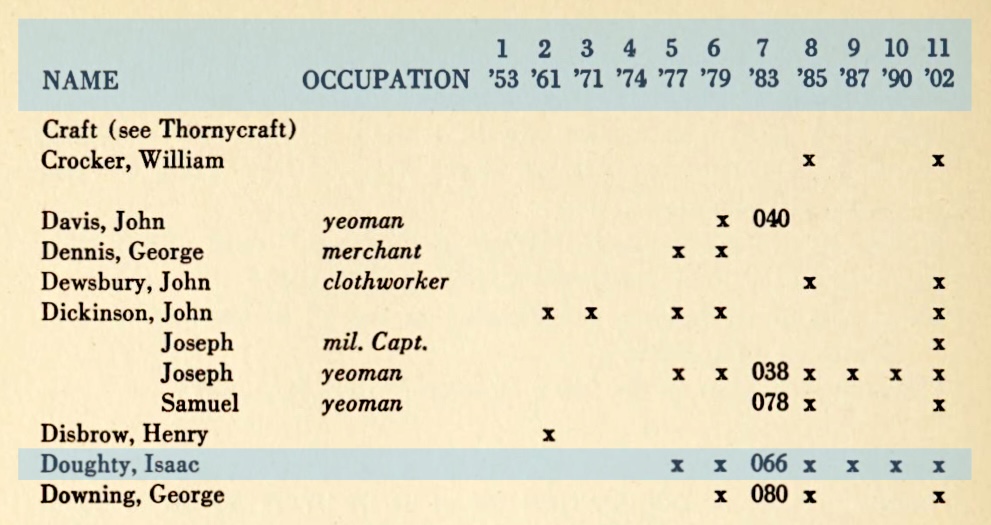
The Huntington Library
Globalizing the Protestant Reformations
[Title page of the]
Disputatio pro declaration virtutis indulgentiarum
(Disputation on the Power of Indulgences)

by Martin Luther, circa 1519
https://huntington.org/verso/globalizing-protestant-reformations
Note: For the book image.

Encyclopædia Britannica
John Calvin (portrait)
by Artist unknown
https://www.britannica.com/biography/John-Calvin#/media/1/90247/113479
Note: For his portrait.
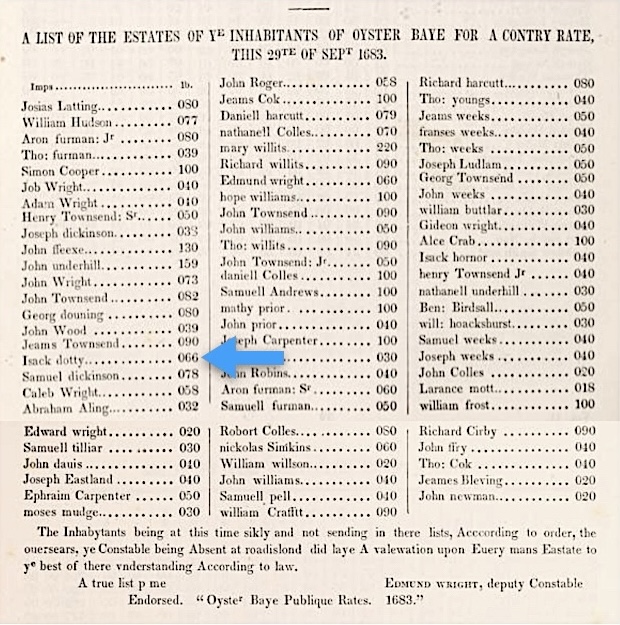
[Title page of the]
Christianae religionis institutio
by John Calvin, circa 1536
File:Christianae religionis institutio (1536).jpg
https://commons.wikimedia.org/wiki/File:Christianae_religionis_institutio_(1536).jpg
Note: For the book image.

(LAPM)
Leiden American Pilgrim Museum
The Political Background
https://leidenamericanpilgrimmuseum.org/en/page/pilgrim-life-in-leiden-the-political-background
Note: For the text.

The Church of England & Henry VIII | Reformation & Events
https://study.com/academy/lesson/henry-viii-and-the-anglican-church.html#:~:text=Henry%20VIII%20created%20the%20Church,sons%20to%20continue%20his%20dynasty.
Note: For the text from Who created the Church of England and why? and What’s the difference between [the] Catholic [Church] and [the] Church of England?

James I and England

(2) — three records

James VI and I and Religious Issues
https://en.wikipedia.org/wiki/James_VI_and_I_and_religious_issues
Note: For the text.

Collection Museum Prinsenhof Delft / Loan Mauritshuis, The Hague
Portrait of Jacobus I, 1566-1625, (James I)
by Artist unknown
https://www.lakenhal.nl/en/story/images-and-credit-lines-pilgrims
Notes: For his portrait.
“James I disliked Robert Browne’s followers, who did not care for the episcopal hierarchy of the Anglican state church. The king maintained that God had bestowed upon him his position as absolute ruler, making any criticism of him sacrilege. On James’s orders, the ‘Brownists’, the separatist movement to which the Pilgrims belonged, were fined, imprisoned or banished.”

(NEFTH)
The National Endowment For The Humanities
Who Were the Pilgrims Who Celebrated the First Thanksgiving?https://www.neh.gov/humanities/2015/novemberdecember/feature/who-were-the-pilgrims-who-celebrated-the-first-thanksgiving
Notes: For the pull-quote and the text.

Historic LabelsIdentifying Who “The Others” Are

(3) — six records

The University of York
Pilgrims and Pilgrimage
The Origins of the Terms ‘Pilgrim’ and ‘Pilgrimage
https://www.york.ac.uk/projects/pilgrimage/intro.html#:~:text=The%20English%20term%20’pilgrim’%20originally,journey%2C%20or%20a%20temporary%20resident.
Note: For the text that is the Latin definition for Pilgrims.

English Dissenters
https://en.wikipedia.org/wiki/English_Dissenters
Note: For the text that defines English Dissenters.

Pilgrims (Plymouth Colony)
https://en.wikipedia.org/wiki/Pilgrims_(Plymouth_Colony)
Note: For the text that defines Separatists.

Washington University Art & Sciences
Pilgrims, Puritans, and the importance of the unexceptional
by John Moore
https://artsci.washu.edu/ampersand/pilgrims-puritans-and-importance-unexceptional
Note: For the text that clarifies the differences between Pilgrims and Puritans, and for the pull-quote by Abram Van Engen.

Brownists
https://en.wikipedia.org/wiki/Brownists
Note: For the text that defines Brownists.

1600s Pilgrim Couple Kneeling In Prayer
painting by Herbert Paus, via History.com
The Puritans
https://www.history.com/topics/colonial-america/puritanism
Note: For the illustration of 1600s Pilgrim Couple Kneeling In Prayer.

A Radical Notion At The Time

(4) — four records

Caleb Johnson’s MayflowerHistory.com
Church and Religion
http://mayflowerhistory.com/religion
Note: For the text regarding key beliefs of the Pilgrim congregation.

File:Geneva Bible.jpg
https://commons.wikimedia.org/wiki/File:Geneva_Bible.jpg
Note: For the image of the Geneva edition of the Bible, first published in English in 1560.

File:Lincolnia nottinghamia Atlas.jpg
by Christopher Saxton, 1576
https://commons.wikimedia.org/wiki/File:Lincolnia_nottinghamia_Atlas.jpg
Note: For the map of Nottinghamshire and Lincolnshire from 1576. Atlas created by cartographer Christopher Saxton as part of his ‘Atlas of the Counties of England and Wales’. Contains hand-written marginal notes.

(TPCAP)
The Plymouth Colony Archive Project
by J. Jason Boroughs
http://www.histarch.illinois.edu/plymouth/jbthesis.html
Note: For the text from the section, Background: The colonization of New England.

William Brewster and the Scrooby Village Congregation

(5) — six records

William Brewster (Mayflower passenger)
https://en.wikipedia.org/wiki/William_Brewster_(Mayflower_passenger)
Note: For the text.

Scrooby
https://en.wikipedia.org/wiki/Scrooby
Note: For the text.

Scrooby Manor House (illustration)
by Artist unknown
https://christianheritage.info/places/united-kingdom/east-midlands/bassetlaw/site/scrooby-manor-house/
Note: For the illustration.

Daniel Crouch Rare Books
Saxton’s Seminal Atlas of England and Wales in full original colour, circa 1579
https://crouchrarebooks.com/product/atlas/saxtons-seminal-atlas-of-england-and-wales-in-full-original-colour/
Note: For the image of Queen Elizabeth I.

File:Lincolnia nottinghamia Atlas.jpg
by Christopher Saxton, 1576
https://commons.wikimedia.org/wiki/File:Lincolnia_nottinghamia_Atlas.jpg
Note: For the map of Nottinghamshire and Lincolnshire from 1576. Atlas created by cartographer Christopher Saxton as part of his ‘Atlas of the Counties of England and Wales’. Contains hand-written marginal notes.

Manor House
https://en.wikipedia.org/wiki/Manor_house
Note: For text under the section, Decline of the Manor House.

Fleeing to First to Amsterdam, and Then to Leyden, Holland

(6) — six records

William Brewster (Mayflower passenger)
https://en.wikipedia.org/wiki/William_Brewster_(Mayflower_passenger)
Note: For the text.

Leiden Museum de Lakenhal
Permit from the city council of Leiden for 100 Englishmen
to be allowed to settle in Leiden, dated 12 February 1609.
Pilgrims to America — And The Limits of Freedom (Exhibition)
via Heritage Leiden, Stadsarchief 1574 – 1816
https://www.lakenhal.nl/en/story/images-and-credit-lines-pilgrims
Notes: (Left page only). This is the written agreement that granted permission for the Pilgrims – around 100 men and women – to settle in Leiden. The document was written on behalf of the city council by city secretary Jan van Hout on February 12, 1609. The religious community around John Robinson was probably larger than the hundred people mentioned in the agreement because children weren’t included.

(LAPM)
Leiden American Pilgrim Museum
Pilgrim Life in Leiden — Coming to Leiden
https://leidenamericanpilgrimmuseum.org/en/page/pilgrim-life-in-leiden-coming-to-leiden
Note 1: For the text.
Note 2: Borrowed image, Boats like these sailed from Amsterdam to Leiden. Engraving by Adrian van de Venne, ca. 1630

Family Search Blog
The Life and Legacy of William Brewster
https://www.familysearch.org/en/blog/william-brewster-legacy
Note: For his portrait.
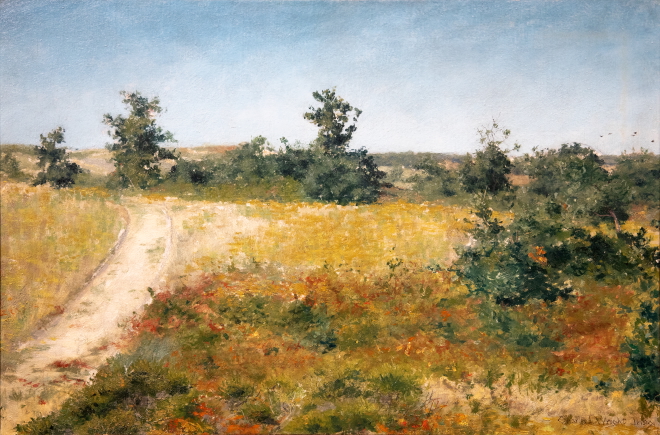
Map of Holland: According to Astronomical Observations, Measurements of Schnellius & c. and the Superiorly Redesigned Special Maps of F. L. Güssefeld, circa 1791.
https://www.loc.gov/resource/gdcwdl.wdl_01132/?r=-0.547,0.047,2.094,1.047,0
Note 1: This map of the Netherlands coast is the work of Prussian cartographer Franz Ludwig Güssefeld (1744-1807). It was drawn based on the calculations of the renowned Dutch mathematician Willebrord Snellius (1580-1626), a professor of mathematics at the University of Leiden, who conceived the idea of measuring the earth using triangulation. Snellius’s discoveries helped to determine the radius of the earth as well as led to more accurate ways of measuring the distance between two cities.
Note 2: Adapted to document travel from Amsterdam to Leyden.

Winter Scene on a Canal
by Hendrick Avercamp, circa 1615
https://www.wikiart.org/en/hendrick-avercamp/winter-scene-on-a-canal
Note 1: For this painting.
Note 2: Avercamp was famed for both his winter landscape paintings and for his superior ability as a draftsman. Today, his drawings are highly valued and are considered to be accurate records of Dutch clothing and lifestyles from this time period.

The Brewster Press

(7) — four records

(LAPM)
Leiden American Pilgrim Museum
Pilgrim Life in Leiden — Leiden, a Fair and Beautiful City
https://leidenamericanpilgrimmuseum.org/en/page/pilgrim-life-in-leiden-leiden-a-fair-and-beautiful-city
Note: For the text.

Doopsgezinden en Remonstranten Leiden, > Geschiedenis
Map of Leiden
by Pieter Bast, circa 1600
https://doreleiden.nl/geschiedenis/
Note 1: For the map.
Note 2: The website section generally translates from the Dutch language as Church History of the Mennonites and Remonstrants

William Brewster (Mayflower passenger)
https://en.wikipedia.org/wiki/William_Brewster_(Mayflower_passenger)
Note: For the text.

(LAPM)
Leiden Museum de Lakenhal
Pilgrims to America — And The Limits of Freedom (Exhibition)
via Heritage Leiden, Stadsarchief 1574 – 1816
Perth Assembly, 1619
(Image courtesy of David Calderwood, Leiden University Libraries).
https://www.lakenhal.nl/en/story/images-and-credit-lines-pilgrims
Notes: “A year before their departure for America, the Pilgrims published this pamphlet in Leiden. It was immediately banned in England since it criticised royal decisions that had been made during an assembly in Perth, Scotland in 1618. In this pamphlet, the Pilgrims express their dislike of the celebration of Christmas and Easter, the episcopal hierarchy and the practice of kneeling during Holy Communion.”

Pilgrim Occupations in Leyden

(8) — three records

(LAPM)
Leiden American Pilgrim Museum
The life of man compared to a weaver’s shuttle.
(
Copperstitch according to Adrian van Venne), from:
J. Cats “Old age, country life, and court thoughts, on Sorgh-Vliet”
Amsterdam, 1656 (For the title in English).
https://www.abebooks.de/servlet/BookDetailsPL?bi=31525694547&cm_sp=collections-_-2gwY4IoWG3dukN4eR0KkQ0_item_1_37-_-bdp
Note: The original image was obtained form from the Leiden American Pilgrim Museum in November 2023.

(LAPM)
Leiden American Pilgrim Museum
Pilgrim Life in Leiden — Pilgrim Occupations in Leiden
https://leidenamericanpilgrimmuseum.org/en/page/pilgrim-life-in-leiden-pilgrim-occupations-in-leiden
Note: For the text.

(NEFTH)
The National Endowment For The Humanities
Who Were the Pilgrims Who Celebrated the First Thanksgiving?https://www.neh.gov/humanities/2015/novemberdecember/feature/who-were-the-pilgrims-who-celebrated-the-first-thanksgiving
Note: For the text.

Choosing to Travel to The British Colonies in North America

(9) — five records

(NEFTH)
The National Endowment For The Humanities
Who Were the Pilgrims Who Celebrated the First Thanksgiving?https://www.neh.gov/humanities/2015/novemberdecember/feature/who-were-the-pilgrims-who-celebrated-the-first-thanksgiving
Note: For the text.

Smithsonian Magazine
The Pilgrims Before Plymouth
by John Hanc
https://www.smithsonianmag.com/travel/the-pilgrims-before-plymouth-111851259/
Note: For the text about religious tolerance.

Smithsonian Magazine
Why the Myths of Plymouth Dominate the American Imagination
by Karin Wulf
https://www.smithsonianmag.com/history/why-myths-plymouth-dominate-american-imagination-180976396/
Note: For the text.

The Museum of Fine Arts Boston
The Departure of the Pilgrim Fathers from Delfshaven on Their Way to America on July 22, 1620.
by Adam Willaerts, circa 1620
https://www.mfa.org/article/2022/the-departure-of-the-pilgrim-fathers-from-delfshaven-on-their-way-to-america
Note: For the (possibly contemporanious to 1620) painting.

William Brewster (Mayflower passenger)
https://en.wikipedia.org/wiki/William_Brewster_(Mayflower_passenger)
Note: For the text.

The Pilgrims — Colonial Pursuits

This is Chapter Two of seven. Here we are examining some of the colonization that Europe attempted in the decades before the Pilgrims sailed to British North America.

Preface Show Me The Money

The first wave of European colonization began with the initial Spanish and Portuguese conquests and explorations. Those kingdoms were the primary ones involved with the European colonization of the New World — thus, the Spanish and Portuguese became profoundly rich. “It was not long before the exclusivity of Iberian claims [Spain and Portugal] to the Americas, was challenged by other European powers, primarily the Netherlands, France, and England.

[Everyone wanted access to the (potential) resources available to them.] “…the English, French and Dutch were no more averse to making a profit than the Spanish and Portuguese, and whilst their areas of settlement in the Americas proved to be devoid of the precious metals found by the Spanish, trade in other commodities and products that could be sold at massive profit in Europe provided another reason for crossing the Atlantic — in particular, furs from Canada, tobacco and cotton grown in Virginia, and sugar in the islands of the Caribbean and Brazil.” (Wikipedia) (1)

Roanoke Wasn’t America’s Only Lost Colony, map courtesy of National Geographic, June 2018 issue. Note that the yellow arrows designate which three colonies we will profile.

England Finally Gets In The Game

“In the early 1600s it was finally England’s turn to play the game.  Much like the young Spanish conquistadores coming to America a century earlier, young English aristocratics, or for that matter anyone seeking social betterment, looked to America in the hope of finding American gold with which they could buy land and thus social status.” (Colonial Foundations)

La Virgenia Pars — map of the E coast of N America from Chesapeake bay to the Florida Keys,
with arms of Sir Walter Raleigh, English vessels, dolphins, fish, whales and sea-monsters,
by John White, circa 1585-1593. (Image courtesy of The British Museum).

Virginia Was the Mother of the Colonies
“The Spanish had established Saint Augustine, Florida in 1565 as a strategic outpost to protect Spain’s Caribbean empire from English privateers. Between Newfoundland and Spanish Florida was a vast unsettled territory. Raleigh named this area Virginia an honor to Queen Elizabeth, (the Virgin Queen), with whom he sought favors. For many years thereafter the vast temperate region of North America was referred to as Virginia. It had no boundaries, and no government.

Each of the other original colonies was directly or indirectly carved out of Virginia. It was the first territory to be claimed by England in North America. At its maximum extent, Virginia encompassed most of what is now the United States, as well as portions of Canada and Mexico.

Virginia was the first of the thirteen original states to be founded and settled. It was generally the tradition of the English during the colonial period to establish large geographic units, and then to subsequently sub-divide them into smaller more manageable units. This two-phase process was conducted in order to establish legal claims to maximum territory.” (See footnotes, How Virginia Got Its Borders — HVGIB) (2)

The Stuarts, King James I (reigned 1603 – 1625). Painting of James VI and I
Wearing the Jewel Called the Three Brothers in His Hat, circa 1605, (after) John de Critz .

King James I and the Virginia Company of 1606

Queen Elizabeth I died in 1603, and the continued development of colonies in the Americas then fell to her successor. “It would have to wait for a new monarch before colonization would become a reality. That monarch was King James I, Elizabeth’s successor. In 1606, he chartered two joint stock companies for the purpose of establishing colonies in Virginia.” (See footnotes, HVGIB)

In Renaissance England, wealthy merchants were eager to find investment opportunities, so they established several companies to trade in various parts of the world. Each company was made up of investors, known as merchant adventurers, who purchased shares of company stock. Profits were shared among the investors according to the amount of stock that each owned. More than 6,300 Englishmen invested in joint-stock companies between 1585 and 1630, trading in Russia, Turkey, Africa, the East Indies, the Mediterranean, and North America.

Example colonial promotions for investors and settlers by The Virginia Company — The New Life of Virginea, circa 1612, from the University of Glasgow Library. A Good Speed to Virginia, circa 1609, and A True Relation, circa 1608, from the Virginia Museum of History & Culture.

The Virginia Company emerged at a time when European empires chartered corporations for their imperial efforts. The English East India Company and Dutch East India Company had both recently received royal charters by their governments. (See also The DeVoe Line, A Narrative — One, Holland & Huguenots). The Virginia Company represented a new strategy that relied less on protected trade and ports — this strategy was settler colonialism.

Images left to right: The front and back of the royal seal of James I of England as the president of the Council of Virginia, the inscriptions signifying: Seal of the King of Great Britain, France, and Ireland, and For his Council of Virginia, circa 1606. The Virginia Company Coat of Arms and flag, circa 1620, the original seal of the London Company of Virginia. (Wikipedia)

Therefore, the English King James I needed money to continue England’s struggle against Spain and was very willing to charter two new colonization efforts to the New World, for the area (at that point) known overall as Virginia. For this effort he created The Virginia Company on April 10, 1606. It was an English trading company chartered with the objective of colonizing the eastern coast of America. “The [initial] Charter of 1606[which] did not mention a Virginia Company or a Plymouth Company; these names were applied somewhat later to the overall enterprise.” (Wikipedia) Hence, the Virginia Company eventually became two companies:

 The Virginia Company of Plymouth was funded by wealthy investors from Plymouth, Bristol, and Exeter such as Sir John Popham. It was responsible for the northern part of Virginia (roughly what was to become New England). On August 13, 1607, the Plymouth Company established the Popham Colony along the Kennebec River in Maine. However, it was abandoned after about a year and the Plymouth Company became inactive. A successor company eventually established a permanent settlement in 1620 when the Pilgrims arrived in Plymouth, Massachusetts, aboard the Mayflower.

The Virginia Company of Plymouth managed the northern section (in yellow), which was much larger than what is shown here. The Virginia Company of London was responsible for the southern section shown in blue. The white rectangle designates overlapped responsibility. Competition between the two branches with overlapping territory was intended to motivate efficient settlement.

The Virginia Company of London was responsible for the southern colony. It was primarily focused on the Chesapeake Bay area of today’s Northern Virginia and Southern Maryland. The company established the Jamestown Settlement in present-day Jamestown, Virginia in 1607. (Overall several sources utilized, see footnotes).

It is quite an understatement to say that establishing a new colony in The Americas took much in terms of resources, and quite honestly, a lot of luck too. Each country was literally building an entire new system for their explorations, along with an ambitious, concurrent new economic model. Hence, the results, whether they understood this or not, were quite new societies.

In summary, Spain, Portugal, and France moved quickly to establish a presence in the New World, while other European countries moved more slowly. The English did not attempt to found colonies until many decades after the explorations of John Cabot, and early efforts were failures — most notably the Roanoke Colony, which vanished about 1590. (3)

Left image: Sir Walter Raleigh, portrait by William Segar.
Right image: The House of Tudor, Queen Elizabeth I (reigned 1558 – 1603).

The Roanoke Colony, 1587 — ?

We learned from How Virginia Got Its Boundaries, that back “when Sir Walter Raleigh founded the first English settlement on Roanoke Island, there was no Virginia. There was only America… [and that] the failure of Roanoke Island was a financial disaster for Queen Elizabeth. She refused to invest further in colonial enterprises. Virginia remained in name only.” (See footnotes, HVGIB)

Some background —
From Wikipedia, Raleigh “was an English statesman, soldier, writer, and explorer. One of the most notable figures of the Elizabethan era, he played a leading part in English colonization of North America. He helped defend England against the Spanish Armada. He rose rapidly in the favour of Queen Elizabeth I and was knighted in 1585. He was granted a royal patent to explore Virginia, paving the way for future English settlements. In 1591, he secretly married Elizabeth Throckmorton, one of the Queen’s ladies-in-waiting, without the Queen’s permission, for which he and his wife were sent to the Tower of London. After his release, they retired to his estate at Sherborne, Dorset.”

Observation: In addition to the cost of her war with Spain, Raleigh’s subterfuge of a marriage was another reason that Queen Elizabeth I decided not to further invest in his colonial adventures.

The Lost Colony, by William Ludwell Sheppard. This illustration from the 1876 textbook,
A Popular History of the United States, by William Cullen Bryant.

England’s desire for empire building finally started emerging — “Roanoke Colony was founded by the governor Ralph Lane in 1585 on Roanoke Island in present-day Dare County, North Carolina. Lane’s colony was troubled by a lack of supplies and poor relations with some of the local Native American tribes. A resupply mission by Sir Richard Grenville was delayed, so Lane abandoned the colony and returned to England with Sir Francis Drake in 1586. Grenville arrived two weeks later and also returned home, leaving behind a small detachment to protect Raleigh’s claim.

A second expedition led by John White landed on the island in 1587 and set up another settlement. Sir Walter Raleigh had sent him to establish the ‘Cittie of Raleigh’ in Chesapeake Bay. That attempt became known as the Lost Colony due to the unexplained disappearance of its population.”

John White illustrations of the Secoton Indians, circa 1585. “…in one of many scenes painted by John White, the Lost Colony’s artist governor. White’s realistic portraits of Native American life… became one of the earliest lenses through which Europeans saw the New World.”

From left to right: An Indian girl shows off an English doll, Equipment for curing fish used by the North Carolina Algonquins, Ritual dances, and the Village of the Secoton. (Images courtesy of The Trustees of The British Museum, and National Geographic).

“The ship was unable to return right away however, because the English at this point were deeply engaged in this struggle for their very survival against the mighty Spanish Armada.  Not until [after] the English survived this danger, three years after originally depositing the settlers in America, was a ship able to send supplies back to the colony.  But upon the ship’s arrival, the settlers were nowhere to be seen — nor was there any indication of where they might be or what had happened to them. The cryptic word ‘CROATOAN’ was found carved into the palisade, which White interpreted to mean that the colonists had relocated to Croatoan Island. Before he could follow this lead, rough seas and a lost anchor forced the mission to return to England.”

The news of the Lost Colony put a serious chill on any further thoughts about another such venture — until another generation came along at a time when the lure of gold seemed to be greater than the fear of failure.” (Overall several sources are utilized, see footnotes). (4)

Left image with inset: A fresh clue to the lost colonists’ fate emerged when curators backlit this 16th-century map of what is now coastal North Carolina and discovered a star-shaped symbol under a patch. Some researchers believe it may mark the location of a fort where the colonists fled after abandoning their settlement on Roanoke Island. (Image courtesy of the Trustees of the British Museum). Right image: Portrait of John Smith via History.com.

The Roanoke Colony in the Popular Imagination

In today’s world, it seems that almost everyone has heard something along the way about the legend of Roanoke Island. One might think that this is a somewhat new phenomena due to the current omni-presence of social media and clickbait alternative reality programming. However, interest in this mystery goes back much further — nearly 200 years .

“United States historians largely overlooked or minimized the importance of the Roanoke settlements until 1834, when George Bancroft lionized the 1587 colonists in ‘A History of the United States’. Bancroft emphasized the nobility of Walter Raleigh, …the courage of the colonists, and the uncanny tragedy of their loss. He was the first since John White to write about Virginia Dare, calling attention to her status as the first English child born on what would become US soil, and the pioneering spirit exhibited by her name. The account captivated the American public.” (Wikipedia)

George Bancroft’s History of the Colonization of the United States,
originally published in 1841.

There were investigations, but those were done in the very early days of the English presence in North America. Nothing conclusive was then determined about the fate of the colonists. Intriguingly, “Two decades later the English established their first permanent beachhead in the Americas, a hundred miles to the north on the James River, in what is now Virginia. Captain John Smith, the leader of the Jamestown colony, heard from the Indians that men wearing European clothes were living on the Carolina mainland west of Roanoke and Croatoan Islands.” (National Geographic)

Modern scholarship combined with many archeological excavations have all but concluded that the Roanoke Colonists were in the area, but had chosen to integrate into the local tribal cultures to survive.

“They say that the colony vanished and they left behind this cryptic message on a tree, ‘Croatoan,’ and no one knows what it means…
The reason they do this is mystery sells, right?
But Croatoan is Hatteras Island. It’s clearly labeled on the maps.”

Scott Dawson, President, Croatoan Archaeologist Society,
Lost Colony Museum on Hatteras Island

Most recently, Dawson revealed that “archaeologists found ‘buckets’ of hammer scale, a leftover material from blacksmithing… ‘This is showing a presence of the English working metal and living in the Indian Village for decades —We’re finding this whole metalworking workshop on the site and natives didn’t do that…’ and ‘The Lost Colony is a marketing campaign that started in 1937 and it created this myth of a colony that vanished, and none of that is real…” (WHRO Public Media)

Playbills from 1937 and 1938 productions of The Lost Colony play.

The marketing campaign from 1937 was a play — We learned that, “The Lost Colony is an historical outdoor drama, written by American Paul Green and produced since 1937 in Manteo, North Carolina… The play was written during the Great Depression by Paul Green, who had earlier won the Pulitzer Prize for drama.”

“The drama attracted enough tourists to stimulate the economy of Roanoke Island and the Outer Banks of North Carolina. Their hotels, motels, and restaurants thrived despite the bleak depression economy. The village of Manteo renamed its streets after historic figures in the drama. Originally intended for one season, the drama was produced again the following year and has since become a North Carolina tradition. Since 1937, more than four million visitors have seen it.”

Mystery sells. Mystery solved. (5)

John Hunt’s map of Fort George, at the failed Popham colony.
(Image courtesy of the Island Institute, The Working Waterfront).

The Popham Colony, 1607-1608

“The Popham Colony—also known as the Sagadahoc Colony — was a short-lived English colonial settlement in North America. It was established in 1607 and was located in the present-day town of Phippsburg, Maine, near the mouth of the Kennebec River. It was founded a few months after its more successful rival, the colony at Jamestown. (See Jamestown below).

Popham was a project of the Plymouth Company, which was one of the two competing parts of the proprietary Virginia Company that King James chartered in 1606 to raise private funds from investors in order to settle Virginia. At the time, the name Virginia applied to the entire east coast of North America from Spanish Florida to New France in modern-day Canada. That area was technically under the claim of the Spanish crown, but was not occupied by the Spanish.

The colony lasted just 14 months. It is likely that the failure of the colony was due to multiple problems: the lack of financial support after the death of Sir John Popham, the inability to find another leader, the cold winter, and finally the hostility of both the native people and the French. The settlement of New England was delayed until it was taken up by refugees instead of adventurers.” (Wikipedia) (6)

Jamestown settlement on the James River, Virginia, as it may have been in 1615, by Sidney E. King.
(Image courtesy of the National Park Service).

 The Jamestown Settlement, 1607

In the beginning, the Jamestown Colony was yet another English disaster. On May 14, 1607, a group of roughly 100 members of the Virginia Company founded the first permanent English settlement in North America on the banks of the James River. (Note: The two key words here are English and permanent). It was “known variously as James Forte, James Towne and James Cittie, the new settlement initially consisted of a wooden fort built in a triangle around a storehouse for weapons and other supplies, a church and a number of houses.

The settlers… suffered greatly from hunger and illnesses like typhoid and dysentery, caused from drinking contaminated water from the nearby swamp. Settlers also lived under constant threat of attack by members of local Algonquian tribes, most of which were organized into a kind of empire under Chief Powhatan.

Images from left to right, Portrait of Captain John Smith, Chief Powhatan, Map detail described “Powhatan held this state & fashion when Capt. Smith was delivered to him prisoner 1607”. Excerpted detail of John Smith’s Map of Virginia used in various publications, first in 1612. (See footnotes).

An understanding reached between Powhatan and John Smith led the settlers to establish much-needed trade with Powhatan’s tribe by early 1608. Though skirmishes still broke out between the two groups, the Native Americans traded corn for beads, metal tools and other objects (including some weapons) from the English, who would depend on this trade for sustenance in the colony’s early years. 

After Smith returned to England in late 1609, the inhabitants of Jamestown suffered through a long, harsh winter known as “The Starving Time,” during which more than 100 of them died. Firsthand accounts describe desperate people eating pets and shoe leather. Some Jamestown colonists even resorted to cannibalism. George Percy, the colony’s leader in John Smith’s absence, wrote: 

“And now famine beginning to look ghastly and pale in every face that nothing was spared to maintain life and to do those things which seem incredible, as to dig up dead corpse out of graves and to eat them, and some have licked up the blood which hath fallen from their weak fellows.”

In the spring of 1610, just as the remaining colonists were set to abandon Jamestown, two ships arrived bearing at least 150 new settlers, a cache of supplies and the new English governor.” (History.com)

Tobacco was a key crop that saved Jamestown, although with later, unintended consequences. Left image: A School History of the United States, 1878 by David B. Scott. Notice how the residents of Jamestown were so eager to plant this crop, that they even planted it in the city streets. Right image: Petum Tabaccam, Plate 14B from the National Library of Medicine. (See footnotes).

Tobacco became Virginia’s first profitable export —
“A period of relative peace followed the marriage in April 1614 of the colonist and tobacco planter John Rolfe to Pocahontas, a daughter of Chief Powhatan who had been captured by the settlers and converted to Christianity. (According to John Smith, Pocahontas had rescued him from death in 1607, when she was just a young girl and he was her father’s captive.) Thanks largely to Rolfe’s introduction of a new type of tobacco grown from seeds from the West Indies, Jamestown’s economy began to thrive. 

Pocahontas Saving The Life of Capt. John Smith, Credited to the New England Chromo. Lith. Company, circa 1870. This is the same Captain John Smith who was the famous cartographer, (see his map near the end of this chapter).

This “genre artwork” lithograph is typical for the period with its historical inaccuracies. The scene is idealized; there are no mountains in Tidewater Virginia, for example, and the Powhatans lived in thatched houses rather than tipis.

In 1619, the colony established a General Assembly with members elected by Virginia’s male landowners; it would become a model for representative governments in later colonies. That same year, the first Africans (around 50 men, women and children) arrived in the English settlement; they had been on a Portuguese slave ship captured in the West Indies and brought to the Jamestown region. They worked as indentured servants at first (the race-based slavery system developed in North America in the 1680s) and were most likely put to work picking tobacco.” (History.com)

Observation: A number of historians actually document that this event — Tobacco fueled English colonization, the use of slave labor — was the true beginning of slavery for the future United States, despite the indentured servitude designation written above. (Historic Jamestowne).

Jamestown 1660s, by artist Keith Rocco. (Image from the artists’s website. See footnotes).

“Also in 1619, the Virginia Company recruited and shipped over about 90 women to become wives and start families in Virginia, something needed to establish a permanent colony. Over one hundred women, who brought or started families, had arrived in prior years, but 1619 was when establishing families became a primary focus.” (Historic Jamestowne)

Wikipedia points out this grim fact about colonial life during this period, “Of the 6,000 people who came to the [Jamestown] settlement between 1608 and 1624, only 3,400 survived.” (7)

Captain John Smith and His Love of Maps

Captain John Smith was an ardent and skilled map maker. He published two maps in England of the east coast of North America, one in 1612, and the other in 1614. These early actions had much impact in how North America was eventually settled. Author Peter Firstbrook wrote in his book, A Man Most Driven: Captain John Smith, Pocahontas and the Founding of America

“When Smith was mapping New England, the English, French, Spanish and Dutch had settled in North America. Each of these European powers could have expanded, ultimately making the continent a conglomerate of similarly sized colonies. But, by the 1630s, after Plymouth and the Massachusetts Bay Colony were established, the English dominated the East Coast—in large part, Firstbrook claims, because of Smith’s map, book and his ardent endorsement of New England back in Britain.”

“Were it not for his authentic representation of what the region was like, I don’t think it would be anywhere near as popular,” says Firstbrook. “He was the most important person in terms of making North America part of the English speaking world.” (Smithsonian)

John Smith’s Virginia was originally published (separately) in London in 1612 and then in the 1612 Oxford publication of John Smith’s A Map of Virginia: With a Description of the Countrey, [sic] the Commodities, People, Government and Religion. Subsequently it appeared in several other works by Smith and other commentators on Virginia. It remained the most influential map of Virginia until the last quarter of the 17th century and many of the place names used by Smith remain in use.

Although our ancestors at Plymouth may have felt they were isolated in a new world of mostly Native Peoples, they were in fact part of an incredibly complex and inter-connected European network of trade and ideas. (8)

Following are the footnotes for the Primary Source Materials, 
Notes, and Observations

Preface Show Me The Money

(1) — one record

First Wave of European Colonization
https://en.wikipedia.org/wiki/First_wave_of_European_colonization
Note: For the text.

England Finally Gets In The Game

(2) — five records

National Geographic
Roanoke Wasn’t America’s Only Lost Colony
by Matthew W. Chwastyk
https://www.nationalgeographic.com/magazine/article/lost-colony-roanoke-virginia-mystery-map-interactive
Note: For the Colonial Pursuits map from the June 2018 issue.

Colonial Foundations
The Virginia Colony, Early 1600s
by Miles Hodges
https://spiritualpilgrim.net/02_America_The-Covenant-Nation/01_Colonial-Foundations/01c_Virginia.htm
Note: For the text.

List of North American Settlements by Year of Foundation
https://en.wikipedia.org/wiki/List_of_North_American_settlements_by_year_of_foundation

La Virgenia Pars — map of the E coast of N America from Chesapeake bay to the Florida Keys, with arms of Sir Walter Raleigh, English vessels, dolphins, fish, whales and sea-monsters
by John White, circa 1585-1593
https://www.britishmuseum.org/collection/object/P_1906-0509-1-2
Note: For the map image.

(HVGIB)
How Virginia Got Its Boundaries
by Karl R. Phillips
http://www.virginiaplaces.org/boundaries/boundaryk.html
Note: For the text.

King James I and the Virginia Company of 1606

(3) — nine records

Painting of James VI and I Wearing the Jewel Called the Three Brothers in His Hat, circa 1605
by (after) John de Critz 
https://commons.wikimedia.org/wiki/File:Portrait_of_James_I_of_England_wearing_the_jewel_called_the_Three_Brothers_in_his_hat.jpg
Note: For the portrait of James I.

(HVGIB)
How Virginia Got Its Boundaries
by Karl R. Phillips
http://www.virginiaplaces.org/boundaries/boundaryk.html
Note: For the text.

Colonial Foundations
The Virginia Colony, Early 1600s
by Miles Hodges
https://spiritualpilgrim.net/02_America_The-Covenant-Nation/01_Colonial-Foundations/01c_Virginia.htm
Note: For the text.

Virginia Company
https://en.m.wikipedia.org/wiki/Virginia_Company
Note: For the text, map, and images.

Plymouth Company
https://en.wikipedia.org/wiki/Plymouth_Company
Note: For the text.

Virginia Company of London
https://en.m.wikipedia.org/wiki/Virginia_Company_of_London
Note: For the text and images.

Virginia Museum of History & Culture
Virginia Company of London
https://virginiahistory.org/learn/virginia-company-london
Note: For the text and images.

University of Glasgow
Special Collections of the Glasgow University Library
Americana
https://www.gla.ac.uk/myglasgow/library/files/special/exhibns/Americana/17th_century.html
Note: For image, The New Life of Virginea.

Jamestown, Virginia
https://en.wikipedia.org/wiki/Jamestown,_Virginia
Note: For the text.

The Roanoke Colony, 1587 — ?

(4) — eleven records

Walter Raleigh (portrait)
by William Segar
https://www.worldhistory.org/Walter_Raleigh/
Note: For his portrait.

Encyclopædia Britannica
Elizabeth I, Queen of England (portrait)
https://www.britannica.com/biography/Elizabeth-I
Note: For her portrait.
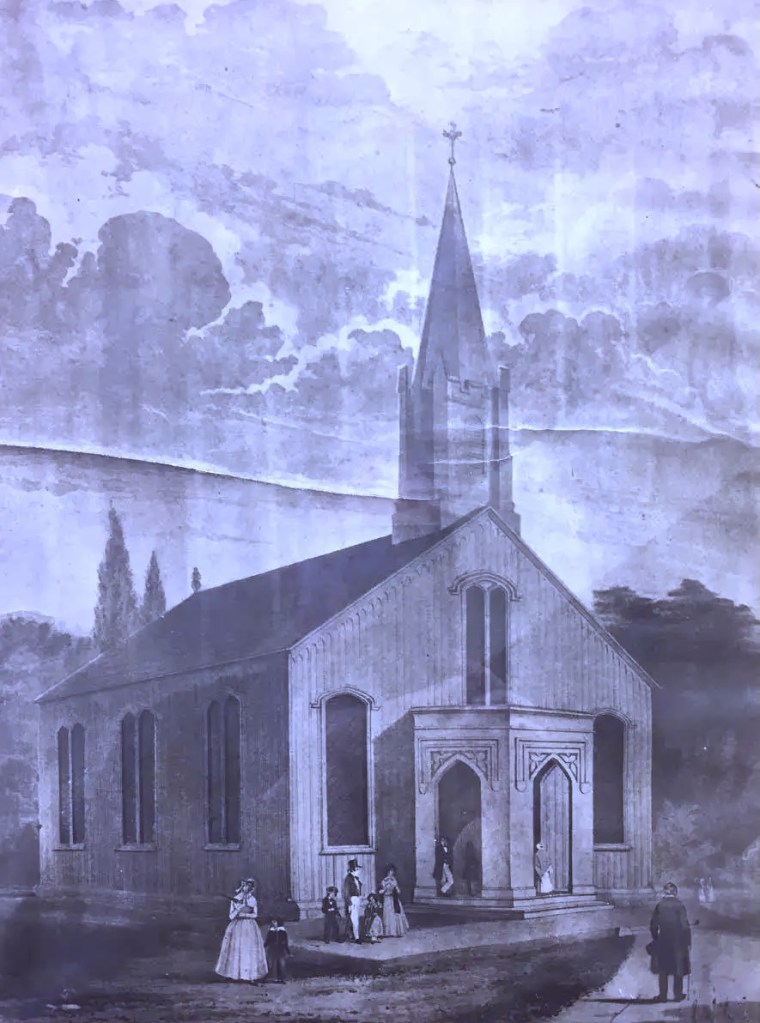
(HVGIB)
How Virginia Got Its Boundaries
by Karl R. Phillips
http://www.virginiaplaces.org/boundaries/boundaryk.html
Note: For the text.

Walter Raleigh
https://en.wikipedia.org/wiki/Walter_Raleigh
Note: For the text.

The Lost Colony,
by William Ludwell Sheppard.
Illustration from the 1876 textbook, A Popular History of the United States 
by William Cullen Bryant, circa 1876
https://commons.wikimedia.org/wiki/File:A_popular_history_of_the_United_States_-_from_the_first_discovery_of_the_western_hemisphere_by_the_Northmen,_to_the_end_of_the_first_century_of_the_union_of_the_states;_preceded_by_a_sketch_of_the_(14781233224).jpg
Notes: “This image depicts John White returning to the Roanoke Colony in 1590 to discover the settlement abandoned. A pallisade had been constructed since White’s departure in 1587, and the word “CROATOAN” was found carved near the entrance. White explained to his men that this was a prearranged signal to indicate that the colony had relocated, but was unable to search Croatoan Island for further information.”

Roanoke Colony
https://en.wikipedia.org/wiki/Roanoke_Colony
Note: For the illustration and text.

National Geographic
It Was America’s First English Colony. Then It Was Gone.
by Andrew Lawler
https://www.nationalgeographic.com/magazine/article/lost-colony-roanoke-history-theories-croatoan
Note: For the text and illustrations.

(HVGIB)
How Virginia Got Its Boundaries
by Karl R. Phillips
http://www.virginiaplaces.org/boundaries/boundaryk.html
Note: For the text.

The Roanoke Map Collage —
The British Museum
La Virginea Pars map
by John White, circa 1585-1590
https://www.britishmuseum.org/collection/object/P_1906-0509-1-3
and
The First Colony Foundation
Hidden Images Revealed on Elizabethan Map of America
by Brent Lane
https://www.firstcolonyfoundation.org/news/hidden-images-revealed-elizabethan-map-america/
Note: Detail of “La Virginea Pars…” by John White showing the area of one of two paper patches (the northern patch) stuck to the map.
and
History.com
John White
By Artist Unknown
https://www.history.com/topics/colonial-america/john-smith
Note: For the John White portrait.

Roanoke in the Popular Imagination

(5) — seven records

Roanoke Colony
https://en.wikipedia.org/wiki/Roanoke_Colony
Note: For the text.

History of the Colonization of The United States
by George Bancroft, circa 1841
https://archive.org/details/historyofcoloniz00banc/page/n7/mode/2up
Book pages: 36-45, Digital pages: 66-74/568
Note: For the text and images.

National Geographic
It Was America’s First English Colony. Then It Was Gone.
by Andrew Lawler
https://www.nationalgeographic.com/magazine/article/lost-colony-roanoke-history-theories-croatoan
Note: For the anecdote about John Smith and stories of the Roanoke Colony.

WHRO Public Media
New Artifacts on Hatteras Point to the Real Fate of The Lost Colony
by Lisa Godley
https://www.whro.org/arts-culture/2025-01-20/new-artifacts-on-hatteras-point-to-the-real-fate-of-the-lost-colony?utm_source=enewsletter&utm_medium=enews&utm_term=text&utm_campaign=241213
Note: For the text.

The Lost Colony (play)
https://en.wikipedia.org/wiki/The_Lost_Colony_(play)

File:Playbill for the 1937 Federal Theatre Project production of Samuel Selden and Paul Green’s The Lost Colony.pdf
https://en.wikipedia.org/wiki/File:Playbill_for_the_1937_Federal_Theatre_Project_production_of_Samuel_Selden_and_Paul_Green’s_The_Lost_Colony.pdf
Note: For the playbill cover artwork for the first year of the production of the play.
and
Library of Congress
The Lost Colony
Playbill from the 1938 production
by Paul Green and Samuel Selden
The Federal Theatre Project
https://www.loc.gov/resource/music.musftpplaybills-200221035/?st=gallery
Note: For the playbill cover artwork for the second year of the production of the play.

The Popham Colony, 1607-1608

(6) — two records

Island Institute, The Working Waterfront
Mysteries of Maine’s First European Colony
by Phil Showell
https://www.islandinstitute.org/working-waterfront/mysteries-of-maines-first-european-colony/
Note: For the text, and John Hunt’s map of Fort St George (Popham Colony).

Popham Colony
https://en.wikipedia.org/wiki/Popham_Colony
Note: For the text.

 The Jamestown Settlement, 1607

(7) — twelve records

The National Park Service
1492–1800 Colonial & Early National Period
https://www.nps.gov/subjects/fossils/1492-1800-colonial-early-national-period.htm
Note: For this painting, “Jamestown settlement on the James River, Virginia,” as it may have been in 1615, by Sidney E. King.

History.com
Jamestown Colony
https://www.history.com/topics/colonial-america/jamestown
Note: For the text.

Encyclopedia Virginia
Powhatan (d. 1618)
https://encyclopediavirginia.org/entries/powhatan-d-1618/
Note: For image of Captain John Smith.
and
Legends of America
Chief Powhatan – Wahunsunacawh
https://www.legendsofamerica.com/chief-powhatan/
Note: For the image of Chief Powhatan.
and
File:Powhatan john smith map.jpg
https://commons.wikimedia.org/wiki/File:Powhatan_john_smith_map.jpg
Note: Map detail described “Powhatan held this state & fashion when Capt. Smith was delivered to him prisoner 1607”. Cropped part of John Smith’s Map of Virginia used in various publications, first in 1612.
Note: For the map detail.

File:Pocahontas Saving the Life of Capt. John Smith – New England Chromo. Lith. Co. LCCN95507872.jpg
https://commons.wikimedia.org/wiki/File:Pocahontas_saving_the_life_of_Capt._John_Smith_-_New_England_Chromo._Lith._Co._LCCN95507872.jpg
Note: For the lithographic print.

For the tobacco illustrations —
A School History of the United States,
from The Discovery of America to the Year 1878

by David B. Scott
https://archive.org/details/schoolhistoryofu00scot/page/40/mode/2up
Bool page: 40, Digital page: 40/431
Note: For tobacco crop illustration.
and
NIH, The National Institutes of Health
National Library of Medicine
Petum Tabaccam, Plate 14B
https://circulatingnow.nlm.nih.gov/2016/04/14/some-of-the-most-beautiful-herbals/page14b/
Note: For the tobacco plant illustration.

A Short History of Jamestown
https://www.nps.gov/jame/learn/historyculture/a-short-history-of-jamestown.htm
Note: Regarding brides and families, 1619.

Historic Jamestowne
A Short History of Jamestown
https://www.nps.gov/jame/learn/historyculture/a-short-history-of-jamestown.htm
Note: For the text.

Jamestown, Virginia 1660s (painting)
https://keithrocco.com/product/jamestown-virginia-1660s/
Note: For his painting image of Jamestown.

Jamestown, Virginia
https://en.wikipedia.org/wiki/Jamestown,_Virginia
Note: For text regarding statistical survivals.

Captain John Smith and His Love of Maps

(8) — two records

Smithsonian Magazine
John Smith Coined the Term New England on This 1616 Map
by Megan Gambino
https://www.smithsonianmag.com/history/john-smith-coined-the-term-new-england-on-this-1616-map-180953383/
Note: For the text.

Virtual Jamestown
Virginia (map)
by John Smith, circa 1612
http://www.virtualjamestown.org/jsmap_large.html
Note: Virginia was originally published (separately) in London in 1612, and then in the 1612 Oxford publication of John Smith’s A Map of Virginia: With a Description of the Countrey [sic], the Commodities, People, Government and Religion
Note: For the map image.

The Pilgrims — Saints & Strangers

This is Chapter One of seven. We have written seven opening chapters about the history of The Pilgrims. They are structured around certain themes which frame the context(s) of the times within which these people lived. Think of them as a multi-lane highway where all lanes point in one direction — forward in time. At certain points, some lanes are more important than others, but together, they all inform the future, where we live.

In American culture, many people think that they have heard so much over the years about the Pilgrims, that there is nothing more they need to know. We disagree, because they haven’t met our family yet.

Two of our ancestors—
Pilgrim George Soule and Pilgrim Edward Doty, were on the 1620 voyage of the Mayflower. They and their fellow travelers, occupy a very prominent space in the collective consciousness of American mythology.

We highly recommend that these chapters be read before taking a look at The Soule Line, A Narrative, or The Doty Line, A Narrative. As with all of our ancestral families, this research honors them. Simply put, that is why we write and share this blog — because sometimes we have to go back, to go forward.

Atlantic Overture

When our Grandmother Lulu Mae (DeVoe) Gore died in 1975, we had to clean her house out of all its possessions. To be honest, although her home was quite neat and tidy, we just weren’t very efficient in getting rid of things. She had lived in that home for 55 years and most things that she owned meant something special to someone, so we took our time and distributed things carefully. We’re glad that we did.

Lulu was the genealogist of the family, and from her research, there had been whispers going on that we had a Mayflower ancestor — we just didn’t know who exactly. Then this book was found tucked amongst others, next to her favorite sitting chair in her dining room. When flipping through the pages, we came across a notation that she had made in the index at some moment in the past.

Who was this person named Soule, George? Is this the ancestor who had been whispered about? Our mother Marguerite (Lulu’s daughter), then took over the genealogy work and completed the history which led her back to our ancestor, Pilgrim George Soule. After Marguerite passed on, Susan (Marguerite’s daughter), took up the mantle as the family genealogist and was able to develop many more family lines because the world had changed. (Much more information was now readily available on the internet). Susan determined that we also had an additional Mayflower ancestor, Pilgrim Edward Doty.

We are descended from two of the original Plymouth Pilgrim families, from the 1620 voyage
of the Mayflower. Both of these lines meet with our 2x Great Grandparents, through
the marriage of Peter A. Devoe (for Edward Doty), and Mary Ann Warner (for George Soule).
Background image, Isolation: The Mayflower Becalmed on a Moonlit Night, by Montague Dawson.

To understand some things about our Pilgrim ancestors, it is important to first understand the times in which they lived. For example,they were coming from the Old World (their known worldviews), to the New World (a strange, unknown place). (1)

The Columbian Exchange

Historically, this time period had an over-arching theme which came to be known as: “The Columbian Exchange is[a]widespread transfer of plants, animals, and diseases between the New World (the Americas) in the Western Hemisphere, and the Old World (Afro-Eurasia) in the Eastern Hemisphere, from the late 15th century on. It is named after the explorer Christopher Columbus and is related to the European colonization and global trade following his 1492 voyage. Some of the exchanges were deliberate while others were unintended.” (Wikipedia) Another aspect of this period is the natural advent of cultural clashes which we will touch upon about in The Pilgrims — The Native Peoples.

Christopher Columbus Arriving in The New World, illustration in
Il Costume Antico et Moderno, i.e. The Ancient and Modern Costume (1817–26).
(Image courtesy of Encyclopædia Britannica).

Observation: Maybe it is due to Hollywood movies, or perhaps it is just a natural way that the human mind works, but… it seems as if everyone, (with us included), tends to have a manner in which we project the consciousness of the present period back upon the times when our ancestors lived. They were not like those of us in the present day, because their eras were very much different from ours. To help understand their worldviews, we are going to outline three ways in which The Pilgrims were unlike people who are living today. (2)

Theirs Was A Pre-Scientific World

Our Pilgrim ancestors were living in a pre-scientific world in which religion was still the dominant player. That point-of-view might be a little hard for those of us in the modern world to understand. Before us, people didn’t have the perspective to comprehend things which we take for granted: stars and planets, germ-theory, equal opportunity, democratic rule, freedom of religion, etc.

New worlds were being discovered, but their world was still the Britain of their ancient forebears. What was ahead was a century of continued ongoing conflict in which royalty and the church were pitted against each other for control of the English people.

“The English Renaissance was a cultural and artistic movement in England from the early 16th century to the early 17th century. It is associated with the pan-European Renaissance that is usually regarded as beginning in Italy in the late 14th century. As in most of the rest of northern Europe, England saw little of these developments until more than a century later. Renaissance style and ideas, however, were slow to penetrate England, and the Elizabethan era in the second half of the 16th century is usually regarded as the height of the English Renaissance.

Shakespeare and his Friends at the Mermaid Tavern, by John Faed, circa 1850.
(Image courtesy of Meisterdrucke Fine Art Prints).

The English Renaissance is different from the Italian Renaissance in several ways. The dominant art forms of the English Renaissance were literature and music. Visual arts in the English Renaissance were much less significant than in the Italian Renaissance. The English period began far later than the Italian…” (Wikipedia)

To understand how much change was afoot in the world — here are just a few of the people who were alive during the century of 1530-1630 outside of England — artists, scientists, philosophers: Michelangelo, Copernicus, Galileo Galilei, René Descartes. Inside of England, it was a virtual hit parade of politicians, but also some explorers and writers: Henry VIII, Elizabeth I, Mary Queen of Scots, Sir Francis Drake, William Shakespeare, Walter Raleigh, Oliver Cromwell.

Our forebears lived during a time at the very beginning of scientific invention, even though much of this information took decades to develop and disperse across the world. The Enlightenment and the Age of Reason were yet to come. As an example, when our ancestors gazed with wonder upon the stars of the night sky, their conception of the world was very different from our understanding today… (3)

The Astronomer, by Johannes Vermeer, circa 1668. This painting was completed almost 50 years after the Pilgrims had already been in Plymouth, New England. (Image courtesy of Wikipedia).

The Earth Was The Center Of Their Universe

We think about what their journey on the Mayflower must have been like — sailing under the vastness of the night sky, with just the cool light of the stars to guide them. Or perhaps standing on the shores of the new Plymouth, staring out at a universe, something they may have wondered about — but then, they barely knew how to think about it like we do. In their world, the Earth was the center of the universe. This is called the Copernican Heliocentric model and what this means is, “…the Sun [is positioned] at the center of the Universe, motionless, with Earth and the other planets orbiting around it in circular paths… at uniform speeds.” (Wikipedia)

This of course, changed in the decades that followed, but few of the Pilgrims likely knew this. Ironically, the telescope was invented in the Netherlands in 1608 while they were living in Leyden [Leiden]. Through subsequent refinements and improvements, the telescope became fundamental in helping Galileo Galilei develop his theories, published in the  Dialogue Concerning the Two Chief World Systems (1632), which was a rejection of the Copernican Heliocentric model.

Galileo Galilei at His Trial by the Inquisition in Rome in 1633., i.e. Galileo pushes away the Bible. (Courtesy of The Wellcome Collection, via Wikimedia Commons).

This “was met with opposition from within the Catholic Church and from some astronomers. The matter was investigated by the Roman Inquisition in 1615, which concluded that his opinions contradicted accepted Biblical interpretations. Galileo later defended his views in Dialogue Concerning the Two Chief World Systems (1632), which appeared to attack and ridicule Pope Urban VIII, thus alienating both the Pope and the Jesuits, who had both strongly supported Galileo up until this point. He was tried by the Inquisition, found ‘vehemently suspect of heresy’, and forced to recant. He spent the rest of his life under house arrest.” (Wikipedia) (4)

Top left: Title page of Galileo Galilei’s Dialogue Concerning the Two Chief World Systems, published by Giovanni Battista Landini in 1632. Top right:  Early depiction of a ‘Dutch telescope’ from the “Emblemata of zinne-werck” by Johan de Brune, in 1624. Bottom image: It was nearly 350 years after the 1620 landing of the Pilgrims, before we saw the first images of the Earth taken from the moon. “This photo was taken from the Apollo 11 Columbia command module, shortly before the lunar module was dispatched to the surface…July 1969”.

They Had No Concept of Germ Theory

We can thank our lucky stars* that we now live in a time when medicine has evolved beyond the ideas that were once widely believed in the time of these ancestors.

“In Tudor times, the understanding of medicine and the human body was based on the theory of the four bodily humours. This idea dates back to ancient Greece, where the body was seen more or less as a shell containing four different humours, or fluids: blood, phlegm, black bile, and yellow bile. The humours affect your whole being, from your health and feelings, to your looks and actions. The key to good health (and being a good person) is to keep your humours in balance. However, everyone has a natural excess of one of the humours, which is what makes us all look unique and behave differently. Shakespeare even mentions them on his plays: how medicine formed part of people’s lives and thoughts.” (Tudorworld.com)

Left image: From Humoralism and The Seasons— There were a number of things that could disrupt [the balance of the humours], including the kind of food you ate, whether or not you were getting enough sleep, and, of course, the changing of the seasons. Spring meant there might [would] be an excess of blood in the body, yellow bile was dominant in the summer, black bile rose to prominence with autumn, and phlegm was associated with winter. Right image: Woodcut print of “Quinta Essentia,”
by Leonhart Thurneisser zum Thurn, circa 1574.

As shown in the images above, the belief then was that humours were tied to the different seasons, and hence, their corresponding astrological signs. [Observation: *Lucky Stars — The use of this funny expression seems to imply that our belief in Astrology is still ok, no?]

“Humorism began to fall out of favor in the 17th century and it was definitively disproved in the 1850s with the advent of germ theory, which was able to show that many diseases previously thought to be humoral were in fact caused by microbes.” (Wikipedia)

“The English of that era really couldn’t bathe even if they wanted to, notes V. W. Greene, a professor of epidemiology at the Ben Gurion Medical School in Beersheva, Israel. “There was no running water, streams were cold and polluted, heating fuel was expensive, and soap was hard to get or heavily taxed. There just weren’t facilities for personal hygiene. Cleanliness wasn’t a part of the folk culture.” (Lies My Teacher Told Me – LMTTM; See footnotes, V. W. Greene)

“Queen Isabella boasted that she took only two baths in her life,
at birth and before her marriage.”

“Colonial America’s leaders deemed bathing impure, since
it promoted nudity, which could only lead to promiscuity.”

excerpts from an article written by Jay Stuller
titled “Cleanliness has only recently become a virtue”
Smithsonian Magazine, February 1991

It’s no wonders perfumes were highly coveted possessions.

It took another 230 to 300 years for the understanding of germ theory to take hold in the popular consciousness. As explained by Encyclopædia Britannica, “Developed, verified, and popularized between 1850 and 1920, germ theory holds that certain diseases are caused by the invasion of the body by microorganisms. Research by Louis Pasteur, [and others] contributed to public acceptance of the once-baffling theory, proving that processes such as fermentation and putrefaction, as well as diseases such as cholera and tuberculosis, were caused by germs.

A representation by Robert Seymour of the cholera epidemic of the 19th century depicts the spread of the disease in the form of deadly air via miasma. (Image courtesy of Wikipedia Commons).

Before germ theory was popularly understood, the methods taken to avoid illness and infection were based on guesses rather than facts. After germ theory’s development and popularization, effective sanitation practices resulted in cleaner homes, hospitals, and public spaces— as well as longer life spans for the people who had never before known how to avoid getting sick.” (Encyclopædia Britannica) (5)

There Was No Concept of An Inherent Bill of Rights

Despite what many people think, the Mayflower Compact was not a democratic declaration of rights. (This is covered in the chapter, The Pilgrims — A Mayflower Voyage). What we want to convey here is that the day-to-day personal rights and freedoms which now exist and which many take for granted, didn’t exist at that time.

Much later than 1620, when the young United States adopted the Bill of Rights as the first 10 amendments to the Constitution in 1791, they began with the “First Amendment and Religion. The First Amendment has two provisions concerning religion: the Establishment Clause and the Free Exercise Clause. The Establishment clause prohibits the government ‘establishing’ a religion. The precise definition of ‘establishment’ is unclear. Historically, it meant prohibiting state-sponsored churches, such as the Church of England.” (See footnotes, United States Courts)

American statesman Patrick Henry (1736-1799) delivers his patriotic “Give me liberty, or give me death” speech before the Virginia Assembly in 1775. Henry was the leading proponent of the Bill of Rights as a bulwark against government overreach. (Image courtesy of The Library of Congress).

For The Pilgrims and all of their forebears, they lived their entire lives under the rule of a Monarch. We understand from their history that The Pilgrims desired to have religious freedom to worship as they saw appropriate. This was certainly a minority opinion when you live under a King who took a strong interest in religious matters. That said, British law had been taking an ever so slow drift toward some personal rights, but the freedom of religious choice and worship was not among them.

However, in the long history of English common law, there were some milestones which came to eventually influence the future American Bill of Rights. These same developments were likely heard as the background music of the Pilgrim experiences in both England and Holland. As such, they may have been thinking about, or debating them occasionally, especially when new emigrants from England entered their community.

Three Key Documents From English Law, and One From Colonial Law

The Teaching American History website, helps us understand how these rights came to be — In the England of 1215, “the most important contribution of the Magna Carta is the claim that there is a fundamental set of principles, which even the King must respect. Above all else, Magna Carta makes the case that the people have a ‘right’ to expect ‘reasonable’ conduct by the monarch. These rights are to be secured by the principle of representation.” (See footnotes, Teaching American History – TAH )

It is interesting to observe that the Magna Carta is about equally distant in time from The Pilgrims, as they are from us today.

Magna Carta, 1297: Widely viewed as one of the most important legal documents in the history of democracy. Courtesy of the David M. Rubenstein Gallery at the National Archives.

The Pilgrims were English citizens (along with some Walloon and Dutch citizens) who, even though they were in the New World, they were required to abide by British law. Soon after they left on the Mayflower, “The 1628 Petition of Right is the second of the three British documents that provided a strong common law component to the development of the American Bill of Rights. In the thirteenth century, the nobles petitioned the King to abandon his arbitrary and tyrannical policies; four centuries later, [and most importantly] it was the commoners who petitioned the King to adhere to the principles of reasonable government bequeathed by the English tradition.”

“The third British contribution to the development of the American Bill of Rights is the 1689 English Bill of Rights… several ancient rights of Englishmen are reaffirmed: the right to petition government for the redress of grievances, the expectation that governmental policy shall confirm to the rule of law… the freedom of speech and debate and that there were to be frequently held elections. Not included, however, in the declaration of rights [is] that Englishmen have are the right to the free exercise of religion and the right to choose their form of government.” (See footnotes, TAH)

Click the link below to see a two minute video of the actual 1689 document: https://www.britannica.com/topic/Bill-of-Rights-British-history/images-videos#/media/1/503538/210012

Outcome: 7 of 26 rights in the U.S. Bill of Rights can be traced to the English Petition of Rights, and 7 more to the English Bill of Rights. However, with some duplication, these all net out to be 10 rights. (7)

From Colonial Law — The Massachusetts Body of Liberties of 1641

“The Massachusetts Body of Liberties, adopted in December 1641, was the first attempt in Massachusetts to restrain the power of the elected representatives by an appeal to a document that lists the rights, and duties, of the people. The document, drafted and debated over several years, combines the American covenanting tradition [to make an agreement; a covenant] with an appeal to the common law tradition.

Pilgrims Going To Church, by George Henry Boughton, circa 1867.
(Image courtesy of Wikipedia).

Even more importantly, there is a distinctively qualitative difference in the emerging Colonial American version of rights. Unique is the emergence of the individual right of religious worship, the political rights of press and assembly, and what became the Sixth Amendment in the U.S. Bill of Rights dealing with accusation, confrontation, and counsel. These are home grown.” (See footnotes, TAH)

Outcome: There is a strong relationship between the U.S. Bill of Rights and the Colonial past. 18 of 26 rights in the U.S. Bill of Rights, or 70%, can be traced directly to the Colonial tradition. And 15 of 26 rights, or 60%, come from one source alone: the Massachusetts Body of Liberties of 1641.

The currents for these reforms began with, and continued to thrive with, our ancestors when they came to this part of the world. This process still continues to evolve, even to this very day. (8)

Following are the footnotes for the Primary Source Materials, 
Notes, and Observations


Atlantic Overture

(1) — two records

Saints and Strangers: Being the Lives of the Pilgrim Fathers & Their Families
by George F. Willison
https://archive.org/details/dli.ernet.13804/page/509/mode/2up
Book page: 509, Digital page: 509/513

Isolation: The Mayflower becalmed on a moonlit night
by Montague Dawson, (British, 1890-1973)
https://www.mutualart.com/Artwork/Isolation–The-Mayflower-becalmed-on-a-m/FD8D6C1A6976C620
Note: For the image of the Mayflower painting.

The Columbian Exchange

(2) — two records

Columbian Exchange
https://en.wikipedia.org/wiki/Columbian_exchange
Note: For the text.

Encyclopædia Britannica
Columbian Exchange
Columbus Arriving in the New World
by Unknown Artist
https://cdn.britannica.com/08/142308-050-B404CF9D/Christoper-Columbus-New-World-worlds-Western-Hemisphere-1492.jpg
Note: Christopher Columbus Arriving in The New World, illustration in
Il Costume Antico et Moderno, i.e. The Ancient and Modern Costume (1817–26).

Theirs Was A Pre-Scientific World

(3) — two records

English Renaissance
https://en.wikipedia.org/wiki/English_Renaissance
Note: For the text.

Shakespeare and his Friends at the Mermaid Tavern
by John Faed, circa 1850
https://www.meisterdrucke.ie/fine-art-prints/John-Faed/281952/Shakespeare-and-His-Friends-at-the-Mermaid-Tavern.html
Note: For the image of the painting.

The Earth Was The Center Of Their Universe

(4) — eight records

The Astronomer
by Johannes Vermeer
File:Johannes Vermeer – The Astronomer – 1668.jpg
https://en.wikipedia.org/wiki/File:Johannes_Vermeer_-_The_Astronomer_-_1668.jpg
Note: For the image of the Vermeer painting.

Copernican Heliocentrism
https://en.wikipedia.org/wiki/Copernican_heliocentrism
Note: This model positioned the Sun at the center of the Universe, motionless, with Earth and the other planets orbiting around it in circular paths, modified by epicycles, and at uniform speeds..

History of The Telescope
https://en.wikipedia.org/wiki/History_of_the_telescope
Note: “The history of the telescope can be traced to before the invention of the earliest known telescope, which appeared in 1608 in the Netherlands“.

Galileo Galilei at His Trial by the Inquisition in Rome in 1633, i.e. Galileo pushes away the Bible.
Courtesy of The Wellcome Collection via Wikimedia Commons
https://commons.wikimedia.org/wiki/File:Galileo_Galilei_at_his_trial_Wellcome_V0018717.jpg#/media/File:Galileo_Galilei;_Galileo_Galilei_at_his_trial_at_the_Inquisi_Wellcome_V0018716.jpg
Note: For the image of the trial of Galileo Galilei.

Galileo Galilei
https://en.wikipedia.org/wiki/Galileo_Galilei
Note: For the text.

File:Galileos Dialogue Title Page.png
https://commons.wikimedia.org/wiki/File:Galileos_Dialogue_Title_Page.png
Note: “Frontispiece (by Stefan Della Bella) and title page of Galileo Galilei’s Dialogue Concerning the Two Chief World Systems, published by Giovanni Battista Landini in 1632 in Florence.”

File:Emblemata 1624.jpg
https://commons.wikimedia.org/wiki/File:Emblemata_1624.jpg
Note: “Early depiction of a ‘Dutch telescope’ from the “Emblemata of zinne-werck” (Middelburg, 1624) of the poet and statesman Johan de Brune (1588-1658).”

Science — 50 Photos Taken on The Moon
by Jessica Learish
https://www.cbsnews.com/pictures/apollo-11-50th-anniversary-50-photos-taken-on-the-moon/
Note: For the July 1969 image, “This photo was taken from the Apollo 11 Columbia command module, shortly before the lunar module was dispatched to the surface.”

They Had No Concept of Germ Theory

(5) — eight records

What Were the Four Humours?
https://tudorworld.com/wp-content/uploads/The-Four-Humours-Information.pdf
Note: For the text.

Humoralism and The Seasons
by Elisabeth Brander
https://becker.wustl.edu/news/humoralism-and-the-seasons/
Note: For the text.

Humorism
https://en.wikipedia.org/wiki/Humorism
Note: For the text.

Book illustration in “Quinta Essentia”
by Leonhart Thurneisser zum Thurn, circa 1574
https://commons.wikimedia.org/wiki/File:Quinta_Essentia_(Thurneisse)_illustration_Alchemic_approach_to_four_humors_in_relation_to_the_four_elements_and_zodiacal_signs.jpg
Note: Woodcut print of the Alchemic approach to four humors in relation to the four elements and zodiacal signs.

V. W. Greene quoted in:
English-Word Information, Ablutions or Bathing, Historical Perspectives
https://wordinfo.info/unit/2701
Notes: “Colonial America’s leaders deemed bathing impure, since it promoted nudity, which could only lead to promiscuity.”
and
“The English of that era really couldn’t bathe even if they wanted to, notes V. W. Greene, a professor of epidemiology at the Ben Gurion Medical School in Beersheva, Israel. “There was no running water, streams were cold and polluted, heating fuel was expensive, and soap was hard to get or heavily taxed. There just weren’t facilities for personal hygiene. Cleanliness wasn’t a part of the folk culture.”

[LMTTM]
Lies My Teacher Told Me
by James W. Loewen
https://www.google.pt/books/edition/Lies_My_Teacher_Told_Me/5m23RrMeLt4C?hl=en&gbpv=1&pg=PA1&printsec=frontcover
Book pages: 70-92
Note: Cited in LMTTM, by author Jay Stuller, — “Cleanliness has only recently become a virtue… Queen Isabella boasted that she took only two baths in her life, at birth and before her marriage.”
Cited in this article by author Jay Stuller —
Smithsonian Magazine
Cleanliness Has Only Recently Become a Virtue
by Jay Stuller
February 1991, pages 126-135

File:Cholera art.jpg
https://commons.wikimedia.org/wiki/File:Cholera_art.jpg
Note: A representation by Robert Seymour of the cholera epidemic of the 19th century depicts the spread of the disease in the form of deadly air via miasma.

Encyclopædia Britannica
What Was Life Like Before We Knew About Germs?
https://www.britannica.com/story/what-was-life-like-before-we-knew-about-germs
Note: For the text.

There Was No Concept of An Inherent Bill of Rights

(6) — two records

United States Courts
First Amendment and Religion
https://www.uscourts.gov/about-federal-courts/educational-resources/about-educational-outreach/activity-resources/first-amendment-and-religion
Note: For the text.

Library of Congress
“Give me liberty, or give me death!” Patrick Henry delivering his great speech on the rights of the colonies, before the Virginia Assembly, convened at Richmond, March 23rd 1775, concluding with the above sentiment, which became the war cry of the revolution.
https://www.loc.gov/pictures/resource/pga.08961/
Note: For the artwork.

Three Key Documents From English Law, and One From Colonial Law

(7) — two records

(TAH)
The Origin of the Bill of Rights
by Natalie Bolton
https://teachingamericanhistory.org/resource/lessonplans/the-origin-of-the-bill-of-rights/
Note: For the text.

The National Archives
Magna Carta
https://www.archives.gov/exhibits/featured-documents/magna-carta
Note: For the image of the Magna Carta document.

From Colonial Law — The Massachusetts Body of Liberties of 1641

(8) — three records

(TAH)
The Origin of the Bill of Rights
by Natalie Bolton
https://teachingamericanhistory.org/resource/lessonplans/the-origin-of-the-bill-of-rights/
Note: For the text.

Encyclopædia Britannica
Bill of Rights: Media
See the Bill of Rights 1689 and the Draft Declaration of Rights (1689)
kept in the United Kingdom Parliamentary Archives Search Room
https://www.britannica.com/topic/Bill-of-Rights-British-history/images-videos#/media/1/503538/210012
Note: For the video link.

Pilgrims Going To Church
by George Henry Boughton, circa 1867
File:George-Henry-Boughton-Pilgrims-Going-To-Church.jpg
https://commons.wikimedia.org/wiki/File:George-Henry-Boughton-Pilgrims-Going-To-Church.jpg
Note: For the image of a Pilgrim church gathering.

The White Line, A Narrative — Four

This is Chapter Four of four. This is the concluding chapter we have written for the White family. They have been quite interesting, what with family legends at sea, modern reservoirs, a ship named Grumpus, Amish people, trees and vines…

This chapter will connect us to several other family lines which we have documented. These chapters are —

  • The Hoggarth Line, A Narrative — One and Two
  • The Peterman Line, A Narrative
  • The Bond Line, A Narrative — Seven

“Sadie, Sadie, Married Lady, That’s Me!”

Ralph Hiram White married “Sadie” i.e. Sarah Alice Elizabeth Hoggarth, on August 23, 1924, in Cuyahoga County, Ohio. She was born December 18, 1898 in Toronto, Ontario, Canada — died September 8, 1989 in Kirtland, Lake County, Ohio. Sadie was the daughter of John Richard Hoggarth Jr. and Alice Lavina Nelson Weegar.

For more about Sadie’s life before she met Ralph, see, The Hoggarth Line, A Narrative — One and Two.

Sadie’s personality would aptly be described as vivacious. She had bright red hair which made her stand out when she entered a room. But the most distinctive characteristic she had was her voice: slightly higher pitched and sing-song like. Talking with her was a contest where you just tried to keep up (!) with her rapid delivery. Thanksgiving dinners were festive affairs, but the conversation always reached a loud fever pitch because Sadie always set the pace.

This is the first ancestor we’ve had who is named Sadie — and with great delight, we just couldn’t resist sharing this…

The film clip above is about 5 minutes long and is from the movie Funny Girl, released in 1968. As sung by Barbra Streisand, the song “Sadie, Sadie Married Lady” is still memorable to this day.

The clip can viewed at this link:
https://www.youtube.com/watch?v=h51msoRqLSo

Ralph and Sadie lived lives anchored in two locations which were not very far apart from each other, on the east side of Cleveland. Their first census finds them living on 2164 Stearns Road, near an area referenced as University Circle. This neighborhood is famous for being a somewhat posh cultural hub. It was then and is now, “a busy cultural hub with institutions like the Cleveland Natural History Museum and the Museum of Contemporary Art, a modern mirrored structure with regularly changing exhibitions. Severance Hall hosts performances by the Cleveland Orchestra, and paths wind past roses and maple trees at the Cleveland Botanical Garden.” It is also the home of the famous Cleveland Museum of Art. (See footnotes).

However, trying to document this exact location sent us on a bit of an adventure, since urban renewal has altered the character of the section where they lived. In fact, it’s just about impossible to specifically map this, but we do know how to describe it.

2164 Stearns Road
1930 Census of Euclid, Cuyahoga County, Ohio. Note that Ralph’s cousin Leo is living with them.

The postcard image below characterizes what Stearns Road was like then. It shows the Normal School, located about one block from their apartment building. Since we know the address they lived at, the Cleveland City Directory for 1930 led us to a man named Dewey M. Cupps (unrelated to our family), who lived at that location. Perhaps he lived there just before they did since the 1930 Directory material would have been gathered before the 1930 Census? Did they know each other? What was especially interesting for us was this anecdote we came across regarding Mr. Cupps and his family: “In 1930 he and his wife and their daughter lived in an apartment they were renting for $35 a month at 2164 Stearns Road in Cleveland, OH. They did have a radio. He worked as a motorman for a street railway.” Interestingly, that $35 rent would translate to about $625 in today’s money, and would never cover the current cost of rent in that area in today’s market. (So it seems that, Mr. Cupps had a good deal then!)

The Cleveland City Directory for 1932 lists Sadie and Ralph by name and indicates that he works as a foreman at the Dairymens Milk Company in Cleveland. The 1930 census had listed him as an auto mechanic, so he must have changed jobs. He worked for the Dairymens Milk Company for many years.

Top image: Vintage postcard of Stearns Road, Cleveland, Ohio in the 1930s very close to their apartment building. Middle: Entries from the 1930 and 1932 Cleveland City Directory.
Bottom: The Dairymens Milk Company where Ralph White worked in 1932. (See footnotes).

The throes of the Great Depression occured during the 1930s. The following excerpt from History.com gives a brief description of the Great Depression suffered by many, (see footnotes).

The Great Depression was the worst economic downturn in the history of the industrialized world, lasting from 1929 to 1939. It began after the stock market crash of October 1929, which sent Wall Street into a panic and wiped out millions of investors. Over the next several years, consumer spending and investment dropped, causing steep declines in industrial output and employment as failing companies laid off workers. By 1933, when the Great Depression reached its lowest point, some 15 million Americans were unemployed and nearly half the country’s banks had failed.” (1)

Euclid Was Once Vineyards

In the 1930s, the White family had moved to the nearby Cleveland Metro area known as Euclid. We have always thought of Euclid as a community given over to much small industrialization. However, 50 years earlier it was quite different. “In the 19th century, the area was largely agricultural. Over 200 acres were given over to vineyards in the 1880s.” (Case Western Reserve University)

“By the turn of the 20th century, winemaking was thriving in Ohio, with dozens of wineries located along the shores of Lake Erie and thousands of gallons of wine produced in this region. The area’s reputation for delicious wines increased vineyards throughout southern Lake Erie, which became famous as the Lake Erie Grape Belt. Despite Prohibition, which effectively wiped-out winemaking in Ohio…” (The History of Wineries and Vineyards in Ohio)

Top image: Greater Cleveland, Ohio area map indicating the location of the city of Euclid.
Center: 1810 East 227th Street home where the Ralph White family lived for more than 25 years.
Bottom: That exact street location for the home. (See footnotes).
1810 East 227th Street
1940 Census of Euclid, Cuyahoga County, Ohio.

The 1940 Census finds Ralph and Sadie as parents with two young children, Alice Ada (9) and Wayne (3). Ralph is still working at the Dairymens Milk Company. By the time of the 1950 Census, their children are teenagers and daughter Alice is attending high school. Ralph is now working as a garage manager in an auto repair business, and Alice is working as a switchboard operator. (2)

1810 East 227th Street
1950 Census of Euclid, Cuyahoga County, Ohio.

What Was Life Like in Euclid During the 1940s and 1950s?

“During World War II, Euclid came to be home to the Tapco defense plant at 23555 Euclid Ave. With that plant came housing projects on East 200th Street and at Briardale Avenue. The post-World War II boom, and the prosperity that went with it, made Euclid an ideal place for families. Neighborhoods were like little villages, boasting their own community centers and activities. Euclid, which had been described as being ‘out in the country’ 15 years earlier, was now a thriving suburb.

With Euclid’s railroad lines and location just beyond Cleveland’s borders, industry poured in. These industries paid taxes, and soon the Euclid Schools rivaled the esteemed Shaker Heights schools as the best in the area. With jobs plentiful and top-notch schools, the population kept on growing.” (Euclid Sun Journal article)

So many previous generations of White family men were farmers… It is interesting to note that Ralph Hiram White seems to have rejected that way of life. Perhaps he didn’t find that path fulfilling as a young man living in rural Middlefield township? His brother Forrest had similarly also decided to not be a farmer, but a postman instead.

Likely, Ralph was also conditioned by the era he was living in, having married in the “Roaring 1920s”. Sadie had always lived in either urban, or suburban environments, so perhaps this was the best way for them to have a happy and successful marriage. We know that people then considered that Euclid was a desirable area to raise a family in. We speculate that they chose that community because it was a good functional midpoint for the both of them: her family was not too far away, his family was not too far away — and so, they located in an area that seemed to be a halfway point and raised their family.

Ralph died in May 1951 at the relatively young age of 55, from cardio vascular renal disease. His wife Sadie lived on for nearly forty more years, passing on in 1989.

Their Euclidian senior high school yearbook photos: Left, Alice Ada (White) Cameron, circa 1950 and Right, Wayne Ronald White, circa 1954.

Alice Ada White married Neil Paul Cameron circa 1957 and they lived in northeast Ohio their entire lives. They did not have children. (See footnotes). Wayne White became our brother-in-law when he married our sister Jo Ann Bond. Their story follows next. (3)

Oh That Matchmaker Marylou!

When Wayne and Jo Ann first met, it was a type of circular story, because it led from suburban Euclid back to rural Geauga County where the White family had long been established. As Ralph White’s son, Wayne had grown up in the somewhat more cosmopolitan suburbs of mid-century Cleveland, in Cuyahoga County. However, it seems that he, unlike his father Ralph, must have had an affection for rural township life. His cousin Marylou Portman (related through his uncle, Forrest White), was the person who initially introduced Wayne to Jo Ann. Jo Ann was a senior at Newbury High School, where she and Marylou were friends. They graduated in 1957.

Jo Ann and Marylou are shown in the 1957 Newbury High School yearbook.

Wayne Ronald White, born July 1, 1936, Cuyahoga County, Ohio — died [unknown date] 2020, in Chardon, Geauga County. He married [First] Jo Ann Bond, October 5, 1958, in Newbury, Geauga County — divorced November 16, 1977, also in Geauga County. She was born May 9, 1939, in Bedford, Cuyahoga County — died August 6, 2010, Chagrin Falls, Cuyahoga County. (All locations are in Ohio).

Together they had two children:

  • Mark Alan White Sr., born 1959
  • Wendy Carol (White) Wright, born 1961

This was quite common for their generation…
Wayne and Jo Ann were married for 19 years, having married in 1958, at a young age. Nonetheless, as these things sometimes go, they both evolved and eventually grew apart. They decided to separate, and their marriage ended in a dissolution in November 1977.

In 1978, Wayne married a second time
Wayne Ronald White married [Second] Sharon L. Stivers, September 16, 1978, Geauga County, Ohio. She was born February 3, 1943. They lived in Middlefield and Claridon townships in Geauga County. (4)

Top image: A mid-century map showing the southern portion of Geauga County, Ohio circa 1950. Middlefield > Burton > Newbury townships are highlighted to show the east to west drift of the successive generations of the White family. Bottom image: From the 1966 Ohio Department of Highways map, “See The Wonderful World Of Ohio!” indicating with the green star, where their home was in Newbury.

Through the 1960s and 1970s

Wayne and Jo Ann settled in Newbury township, Geauga County. Despite spending his youth in the Cleveland suburbs, he returned to the pattern of his forefathers —by being the third generation of his family to live in Geauga County. As explained in the maps above, the White family kept moving westward across Geauga County township-by-township, generation-to-generation: Middlefield > Burton > Newbury. This started with his Great-Great-Grandfather James White, who was one of the first settlers in the area, having arrived in the Western Reserve sometime before 1810.

This Ford Semi-truck is similar to one that Wayne would have driven during his employment with the Cleveland Freight Lines Company.

He preferred to do manual labor…
Similar to his father Ralph, Wayne literally steered toward jobs that were mechanical in nature. First he was partner at a small Texaco gas station in Newbury, then he went to work for Cleveland Freight Lines driving large semi-trucks as part of a delivery fleet. Lastly, he worked for the Andrews Moving and Storage Company helping others to relocate.

Their family life centered around their children…
Mark and Wendy benefited from many school clubs and extra curricular activities: camping, sports, Boy Scouts and Girl Scouts, and 4-H Clubs, which highlighted the end of summer at the Great Geauga County Fair. This fair “is Ohio’s oldest continuous county fair and home to one of the oldest existing agricultural societies in America. It is held annually in Burton, Ohio every Labor Day weekend as a ‘grand finale’ to the summer. It has been around for more than 200 years…” and “Many of the buildings on the grounds used today date back to the nineteenth century, [and are]listed on the National Register of Historic Places.” (Wikipedia)

The Wayne and Jo Ann White family in the 1960s and ’70s.
Upper left: Wayne, Jo Ann, Mark, and Wendy attending the July 1967 Bond family summer reunion. Upper right: Wendy, Wayne, and Mark at home, circa December 1970. Lower right: Wayne and Mark at the 1970 Great Geauga County Fair in Burton, Ohio. Lower right: Wendy practicing baton twirling in the summer of 1969. (Family photographs).

After the end of the marriage, Jo Ann returned to school to gain the practical skills she needed for gainful employment: she became a travel agent and worked in that vocation for 20 years. In the world then (prior to the vast changes the internet brought to the travel industry), everyone was heavily dependent upon travel agents to coordinate all of their travel needs. As such, travel agents could receive ‘perks’ as part of their employment —where, for example, a cruise ship company might offer a free cruise to an agent so that the travel agent could get to know their product. Thus, Jo Ann traveled extensively throughout the Caribbean, (and likely sold a lot of cruise packages).

Most interestingly, at the beginning of her career she went to the mainland of the People’s Republic of China (PRC) in late 1979, or very early in 1980. At the time, this was rather remarkable. She went as part of a group of travel agents who were among the first travel agents to be in China in many, many decades. Their mission was to learn about the newly-opened culture and to promote travel there.

A bit of background…
From Wikipedia, “From February 21 to 28, 1972, United States President Richard Nixon visited the People’s Republic of China (PRC) in the culmination of his administration’s efforts to establish relations with the PRC after years of U.S. diplomatic policy that favored the Republic of China in Taiwan. His visit was the first time a U.S. president had visited the PRC, and his arrival in Beijing ended 25 years of no communication or diplomatic ties between the two countries.” Further on, “Beginning in 1978 and 1979, Deng Xiaoping promoted the development of tourism for purposes of economic development. As tourism became an important means of obtaining foreign currency for the government, China emphasized its exotic qualities to international tourists.

1979 Pan Am Airlines People’s Republic Of China World Tours VTG Travel Booklet. (Image courtesy of eBay.com).

Jo Ann recounted that the hotel facilities were not very comfortable, and we remember that the photographs showed many of the Chinese guides dressed in military fatigues while wearing red hats. Her photographs from that time are now lost. The world has changed very much since then, but the photos of her standing on the Great Wall of China were impressive and exciting. (5)

For more about Jo Ann’s life, see The Peterman Line, and A Narrative,
and The Bond Line, A Narrative — Seven.

Four Generations of Women Gathered In One Photo

In the mid-1960s, Four Generations of Women Gathered In One Photo, was taken. That original version featured the matriarch, Lulu (DeVoe) Gore, her daughter Marguerite (Gore) Bond, her daughter Jo Ann (Bond) White, and finally her daughter Wendy White. That was the first time ever that we had been able to document those relationships in one photograph. Alas, just like Jo Ann’s travel photos, any copies seem to be lost.

A little more than thirty years later (as shown below), we again had the opportunity to document an update to Four Generations of Women Gathered In One Photo. This time, Lulu had long ago passed on, and Emily, Wendy’s daughter, was brand new.

From a genealogical standpoint, it’s not often that we have a family photograph like this one.
Taken in 1996, it shows four generations of women who have contributed to the White family line. Starting with the eldest person who is seated on the right — our mother, Marguerite Lulu (Gore) Bond, standing in back — Jo Ann (Bond) White. Seated on the left, Wendy Carol (White) Wright, holding her daughter Emily Grace Wright. (Family photograph).

Multiple generations of the White family have enriched our lives. It is because of the endurance and the sacrifices of these ancestors that we are here today — and we thank them for that privilege. (4)

Following are the footnotes for the Primary Source Materials, 
Notes, and Observations

“Sadie, Sadie, Married Lady, That’s Me!

(1) — twenty one records

Ralph White
Birth – Ohio, County Births, 1841-2003

https://www.familysearch.org/ark:/61903/1:1:X695-C4C
Book page: 250, Digital page: 159/319, Entry #5526, left page.

Ralph White
in the Ohio, U.S., Births and Christenings Index, 1774-1973

https://www.ancestry.com/search/collections/2541/records/3357416

Ralph H White
https://www.findagrave.com/memorial/42393802/ralph-h-white
Notes: Additional material from the findagrave.com website —
BIRTH: 13 Sep 1895
DEATH: 11 May 1951 (aged 55)
Source: Cleveland Press, Reel #127
“White, Ralph H., 1810 E. 227th St., Euclid, husband of Sadie (nee Hoggarth), father of Alice Ada and Wayne Ronald of Euclid, brother of Blanche Hickox and Forest (deceased).” Name: White, Ralph H., Obituary date: May 12 1951

Ralph Hiram White 1951 death certificate.

Ralph Hiram White
Death – Ohio, Deaths, 1908-1953

https://www.familysearch.org/ark:/61903/1:1:X6GK-Q7Q
Note: Death certificate

Ralph H White
in the U.S., Social Security Applications and Claims Index, 1936-2007

https://www.ancestry.com/search/collections/60901/records/3666670?tid=&pid=&queryId=f648f269-693a-4a17-88f3-e67e507d53fb&_phsrc=RGK4&_phstart=successSource
Note: Confirms birth and death dates.

Sarah E. “Sadie” Hoggarth White
https://www.findagrave.com/memorial/68174060/sarah_e_white
Notes: Additional material from the findagrave.com website —
BIRTH: 18 Dec 1898 Toronto, Toronto Municipality, Ontario, Canada
DEATH: 8 Sep 1989 (aged 90) Kirtland, Lake County, Ohio, USA
Date: 1989-09-09
Source: Plain Dealer, pg. 10 sec. D

Sarah E. White
in the U.S., Social Security Death Index, 1935-2014

https://www.ancestry.com/search/collections/3693/records/66932914?tid=&pid=&queryId=049e9dc6-9371-4bba-ac96-7b36ef769db2&_phsrc=Nif12&_phstart=successSource
Notes: Birth, December 18, 1898.  Death, September 8, 1989

Sarah E Hoggarth
in the Cuyahoga County, Ohio, U.S., Marriage Records and Indexes, 1810-1973
1901-1925

Reel 076 > Marriage Records 1924 Jul – 1924 Dec
https://www.ancestry.com/search/collections/1876/records/2726617
Book page: 235, Digital page: 235/1000, Last entry on the page.
Notes: Married on August 23, 1924.

Funny Girl | Sadie, Sadie, Married Lady | CineStream
https://www.youtube.com/watch?v=h51msoRqLSo
“A major critical and commercial success, Funny Girl became the highest-grossing film of 1968 in the United States and received eight Academy Award nominations. Streisand won the award for Best Actress for her performance, tying with Katharine Hepburn (The Lion in Winter)… Funny Girl is considered one of the greatest musical films ever. In 2016, Funny Girl was deemed ‘culturally, historically, or aesthetically significant’ by the United States Library of Congress, and selected for preservation in the National Film Registry.”

Newly Renovated Office/Lab Opportunity in University Circle
https://images1.showcase.com/d2/mBtoR0y_n996Dofd0VmNcwhhWgYG6tdWL9LE1rFnQUo/document.pdf
Note: For this text, “…a busy cultural hub with institutions like the Cleveland Natural History Museum and the Museum of Contemporary Art, a modern mirrored structure with regularly changing exhibitions. Severance Hall hosts performances by the Cleveland Orchestra, and paths wind past roses and maple trees at the Cleveland Botanical Garden.”

For the 2164 Stearns Road collage —
Cleveland Public Library Digital Gallery
Cleveland Normal School (postcard)
https://clevelandhistorical.org/index.php/files/show/4265
Cleveland City Directory 1930
https://cplorg.contentdm.oclc.org/digital/collection/p16014coll29/id/41130
Book page: 1960, Digital page: 1952/2206
Note: The apartment is found here, for 2164 Stearns Road.
and
and for the Dewey Cupps reference:
https://www.findagrave.com/memorial/18261196/dewey-marquis-cupps
“In 1930 he and his wife and their daughter lived in an apartment they were renting for $35 a month at 2164 Stearns Road in Cleveland, OH. They did have a radio. He worked as a motorman for a street railway.”
and
Cleveland Public Library Digital Gallery
Cleveland City Directory 1932
https://cplorg.contentdm.oclc.org/digital/collection/p16014coll29/id/11603/rec/6
Book page: 1362, Digital page: 1363/1938
Note: They are listed by name.
Cleveland Memory.org
Dairymen’s Milk Company (plant)
https://clevelandmemory.contentdm.oclc.org/digital/collection/press/id/6651/

Calculate the Value of $35 in 1930
https://www.dollartimes.com/inflation/inflation.php?amount=35&year=1930
Note: In 2024, $35 is worth about $625.

Sarah A White
in the 1930 United States Federal Census

Ohio > Cuyahoga > Cleveland (Districts 251-500) > District 0367
https://www.ancestry.com/search/collections/6224/records/73830227?tid=&pid=&queryId=37ad860c-04ec-407a-b577-c8e0885aea44&_phsrc=Nif2&_phstart=successSource
Book page: 5A, Digital page: 7/40, Entries 47 through 49.
Note: Their home address is: 2164 Stearns Road; location not available to map.

For the 1810 East 227th Street collage —
David Rumsey Map Collection
Outline map of Cuyahoga Co. Ohio
By D. J. Lake, circa 1871
https://www.davidrumsey.com/luna/servlet/detail/RUMSEY~8~1~359116~90125968

and
Cleveland Public Library Digital Gallery:
Plat Book of Cuyahoga County, Ohio Volume 5 (Hopkins, 1927-1943)
https://cplorg.contentdm.oclc.org/digital/collection/p4014coll24/id/4985/rec/9
Then click on this link:
Plate 23, Euclid Village
https://cplorg.contentdm.oclc.org/digital/collection/p4014coll24/id/5011/rec/9

History.com
Great Depression History
https://www.history.com/topics/great-depression/great-depression-history

Euclid Was Once Vineyards

(2) — five records

Case Western Reserve University
Encyclopedia of Cleveland History
Euclid
https://case.edu/ech/articles/e/euclid
“In the 19th century, the area was largely agricultural. Over 200 acres were given over to vineyards in the 1880s.”

The History of Wineries and Vineyards in Ohio
by Sabah Drabu
https://cookingenie.com/content/blog/the-history-of-wineries-and-vineyards/

Sarah White
in the 1940 United States Federal Census

Ohio > Cuyahoga > Euclid >18-128
https://www.ancestry.com/search/collections/2442/records/30166899?tid=&pid=&queryId=83b8a363-f27a-420c-9311-d006f513f017&_phsrc=Nif4&_phstart=successSource
Book page: 1B, Digital page: 2/36, Entries 58 through 61.

Ralph Hiram White World War 2 draft registration card

Mrs Sarah Elizabeth White [for husband Ralph]
in the U.S., World War II Draft Registration Cards, 1942

https://www.ancestry.com/search/collections/1002/records/120585725?tid=&pid=&queryId=6c95d513-928b-4847-a09b-30c93a011a36&_phsrc=Nif10&_phstart=successSource

Sadie White
in the 1950 United States Federal Census

Ohio > Cuyahoga > Euclid >18-144
https://www.ancestry.com/search/collections/62308/records/209660545?tid=&pid=&queryId=7458b34d-ee15-4201-924a-7b9230ac8945&_phsrc=Nif6&_phstart=successSource
Book page: 87, Digital page: 92/96, Entries 3 through 6.

What Was Life Like in Euclid During the 1940s and 1950s?

(3) — eight records

Smith’s Restaurant & Cocktail Lounge, Route 283, Euclid, Ohio [postcard]
https://www.digitalcommonwealth.org/search/commonwealth:7p88ck46k

Euclid Sun Journal Had Front Seat to Euclid History
https://www.cleveland.com/euclidsunjournal/2009/07/euclid_sun_journal_had_front_s.html

Euclidian ((Euclid High School yearbook, 1950)
Euclid Senior High School 
Alice White
https://archive.org/details/euclidian1950unse/page/28/mode/2up
Book page: 29, Digital page: 628/188, Right page, lower right corner.

Euclidian (Euclid High School yearbook, 1954)
Euclid High School
Wayne White
https://archive.org/details/euclidian1954unse/page/62/mode/2up
Book page: 62, Digital page: 62/218, Right page, upper right corner.

Alice Ada White Cameron
https://www.findagrave.com/memorial/64105413/alice-ada-cameron?_gl=1*1phbsey*_gcl_au*NTk4MzA1ODk2LjE3MzM5MzU2MjE.*_ga*MTg0ODQyNTE3Ny4xNzMzOTM1NjIx*_ga_4QT8FMEX30*MWU3OTQyNzItNWU3OS00NmVlLTgxOWEtZDE2YmY0MTc4MWVjLjIuMS4xNzMzOTQ1ODM0LjQyLjAuMA..*_ga_LMK6K2LSJH*MWU3OTQyNzItNWU3OS00NmVlLTgxOWEtZDE2YmY0MTc4MWVjLjIuMS4xNzMzOTQ1ODM0LjAuMC4w
Notes: Additional material from the findagrave.com website —
BIRTH: 11 Feb 1931 Cleveland, Cuyahoga County, Ohio, USA
DEATH: 4 May 2000 (aged 69) Garrettsville, Portage County, Ohio, USA
and
Alice Ada Cameron
in the U.S., Find a Grave Index, 1600s-Current
https://www.ancestry.com/search/collections/60525/records/23516688

Alice Ada Cameron
in the Ohio, U.S., Death Records, 1908-1932, 1938-2022

https://www.ancestry.com/search/collections/5763/records/45462?tid=856575&pid=6903443108&ssrc=pt

Neilan Paul Cameron obituary.
(He was the spouse of Alice Ada White).

Oh That Matchmaker Marylou!

(4) — sixteen records

Jo Ann Bond
in the U.S., School Yearbooks, 1900-2016

Ohio > Newbury > Newbury High School > 1957
https://www.ancestry.com/search/collections/1265/records/410027197
Note: For Home Economics class photograph.

Wayne White
in the Ohio, U.S., Birth Index, 1908-2003

https://www.ancestry.com/search/collections/3146/records/2662040?tid=&pid=&queryId=feab2f32-1670-470c-bd18-a363ff238cb2&_phsrc=LGc3&_phstart=successSource

Wayne White
in the Ohio, U.S., Death Records, 1908-1932, 1938-2022

https://www.ancestry.com/search/collections/5763/records/10516626

Jo Ann Bond
in the U.S., School Yearbooks, 1900-2016

Ohio > Newbury > Newbury High School > 1957
https://www.ancestry.com/search/collections/1265/records/410026838?tid=&pid=&queryId=c818fe2f-0e0e-4e0d-a223-9586cfe7c310&_phsrc=LGc14&_phstart=successSource
Note: For her Senior Class graduation photo.

The following four documents are related to the adoption of Jo Ann Peterman Bond White by Dean Phillip Bond in 1948. The original documents were lost and in 1985, duplicate documents were sourced.

June 1985, Letter from Daniel Earl Bond to Clarence Arthur Peterman, Jr. requesting cooperation in providing evidence for adoption(s) of Jo Ann (Peterman) Bond by Dean Phillip Bond. (Family document).
1985 Telephone notes from Daniel Earl Bond’s correspondence with Clarence Arthur Peterman, Jr. Note: “She said she thinks he decided not to execute the form.”
Authorization form for adoption document duplicate.
Jo Ann Bond adoption form (duplicate).

Jo Ann (Bond) White in the Ohio, U.S., Death Records,
1908-1932, 1938-2018

https://www.ancestry.com/discoveryui-content/view/8822354:5763

Wayne R. White
in the U.S., Newspapers.com Marriage Index, 1800s-current

https://www.ancestry.com/search/collections/62116/records/500861666?tid=&pid=&queryId=811f5bdd-b4e7-41f0-a668-8a082aa0ab49&_phsrc=LGc5&_phstart=successSource
Note: For 1958 marriage to Jo Ann Bond.

Wayne White
in the Ohio, U.S., Divorce Abstracts, 1962-1963, 1967-1971, 1973-2007

https://www.ancestry.com/search/collections/2026/records/3176060
Note: For 1977 marriage dissolution with Jo Ann White.

Mark White
in the Ohio, U.S., Birth Index, 1908-2003

https://www.ancestry.com/search/collections/3146/records/7022981?tid=&pid=&queryId=a59f6c5c-a869-4c40-8023-82e483b17e53&_phsrc=zLu2&_phstart=successSource
Note: Certificate #1959093136

Wendy White
in the Ohio, U.S., Birth Index, 1908-2003

https://www.ancestry.com/search/collections/3146/records/7834248?tid=&pid=&queryId=12a00a98-433b-4075-8ff6-dc1ec0a99c9c&_phsrc=zLu5&_phstart=successSource
Note: Certificate #1961098459

Wayne R White
in the Ohio, U.S., Marriage Abstracts, 1970, 1972-2007

https://www.ancestry.com/search/collections/2025/records/794538?tid=&pid=&queryId=42e537cf-aa32-4836-8f72-c1a0b592aef3&_phsrc=LGc2&_phstart=successSource
Note: Marriage 1978 marriage to Sharon L. Stivers.

The National Archives
General Highway Map of Geauga County, Ohio
File:1950 Census Enumeration District Maps – Ohio (OH) – Geauga County – Geauga County – ED 28-1 to 28 – NARA – 26128376.jpg

See The Wonderful World Of Ohio!
1966, Ohio Department of Highways
https://www.oldmapsonline.org/en/Geauga_County,_Ohio?gid=2959dca8-9d79-5d71-914b-651274cf549a#position=9.0073/41.471/-81.263&year=1966

Through the 1960s and 1970s

(5) — five records

1961 Ford HD-1000 Diesel Tractor Truck
https://en.wheelsage.org/ford/h-series_trucks/ford_hd-1000_diesel_tractor_truck

Geauga County Fair https://en.wikipedia.org/wiki/Geauga_County_Fair#:~:text=6%20External%20links-,History,Chardon%2C%20Ohio%20on%20October%2023.

1972 visit by Richard Nixon to China
https://en.wikipedia.org/wiki/1972_visit_by_Richard_Nixon_to_China

Tourism in China
https://en.m.wikipedia.org/wiki/Tourism_in_China

1979 Pan Am Airlines People’s Republic Of China World Tours VTG Travel Booklet
https://www.ebay.com.sg/itm/126864589042

The White Line, A Narrative — Two

This is Chapter Two of four. In this chapter we will write about Joseph White, his family and their 19th century lives, in the Trumbull and Geauga Counties of northeastern Ohio.

Tangible Artifacts

We have been fortunate with our ancestors Joseph and Belinda (Stitle) White, to have discovered a number of nice online photographic images of them. In the era we live in today, with nearly all photographs being created digitally, we benefit from and are grateful for the immediacy of an online electronic file. As such, electronic files don’t exist as tangible artifacts which you can satisfyingly hold in your hands.

With photographs having such immediacy today, does anyone remember what it was like to drop off your film at a local Fotomat, and then pick it up days later?

The days before Instagram.

As it is now, if electronic files go offline, there goes the history (!) This family genealogy blog, by also being electronic, is of that same tentative type. For some of our ancestors we have no images. Even so, for others we are fortunate to have some [paper] photo prints, a couple of daguerreotypes, and even a couple of very old tin types.

We sometimes wonder if this clear absence of physical photographic artifacts will have an impact on the work of those genealogists who follow us? (1)

Together For Almost Half A Century

Joseph White was born on September 25, 1831, in Weatherfield township, Trumbull County, Ohio — died October 13, 1905 in Burton township, Geauga County, Ohio. On February 6, 1856, he married Belinda Stitle in Trumbull County. She was born about 1837, location unknown — died October 1902, Geauga County, Ohio. She was the daughter of Henry Stitle and Elizabeth Bowman. Joseph and Belinda had nine children, (see footnotes).

February 6, 1856 marriage record for Joseph White and Belinda Stitle

The portraits of Joseph White and Belinda Stitle are undated, but we believe that they are circa 1856, being done near the time of their marriage.

In the previous chapter, we saw in the 1850 Census that Joseph White was living at the home of his parents James and Elizabeth White in Weathersfield Township, Trumbull County, Ohio. After they married, they continued living in that township, likely near his parent’s home. According to the 1932 book, Family History of James White and Fannie Pittinger, (which we referred to in chapter one), “They lived in Trumbull County about six years, when they moved to the north-eastern part of Middlefield, Geauga County.” [Ongoing, this book will be referenced as Pittinger].

The James White property in Weatherfield township, from an 1874 map. (Image courtesy of Historic Map Works).
1860 Weathersfield Census for the Joseph White family.

The 1860 Weathersfield Census finds them living there, and the family is growing. His wife Belinda and their two oldest sons William and Lemuel are inferred by their initials. (Some of our family members are descended from Lemuel). Joseph is working as a farmer.

“The first settlers in [nearby] Cuyahoga County followed the usual pioneer routine. They made clearances, planted corn, buckwheat, and rye, fenced in garden patches, and kept oxen, cows, and swine. When the soil had been ‘tamed’ by other crops, they sowed wheat. They carried on their activities in spite of malaria, the ravaging of crops by multitudes of squirrels, and attacks on their livestock by wolves. Many were really professional land clearers who, after a few years, moved on to repeat the farm-making process elsewhere. The remainder, like the incomers [to the Western Reserve] who bought partially cleared holdings, became regular farmers.” (Case Western Reserve University) (2)

If I Were A Carpenter…

When his wife Belinda was 8 months pregnant with their fourth son James Albert, Joseph signed up for the Civil War Draft Registration service. [Comment: We cannot know if this busy young father with many children at home, did this out of a patriotic spirit, or if he was encouraged to do so. His enlistment date was August 24, 1864 and his discharge date was July 18, 1865 — less than one year as the Civil War was coming to an end]. We learned these dates from the Ohio, U.S., Soldier Grave Registrations information, which also told a couple of other interesting things:

  • His enlistment record lists him as a carpenter, not a farmer.
  • Curious about this declaration, we scanned the enlistment lists, and saw that many of the people who were listed as farmers, ended up serving in the infantry. (This means that they marched around a lot!)
  • We speculated that somehow he learned that listing himself as a carpenter would allow him to be valued in a specialized manner. This idea makes sense because he served in the Navy, and not the Army.
  • We had never heard of Ohio having a Navy during the Civil War, but they did, and it had more to do with the Ohio River, rather than Lake Erie. This makes sense, since the river border the southern states.
  • We also noticed that the ship he served on was called the Grampus.

    Seaman Joseph White, United States Civil War Navy recruit, likely boarded a train near Cleveland and made his way across Ohio to Cincinnati for his tenure of service. (3)

The Confederate Gunboat, Grumpus*

There were two ships with this odd name. The first was “a 252-ton stern-wheel river steamer, was built in 1856 at McKeesport, Pennsylvania, for civilian employment. Taken over by the Confederate Army [i.e., captured by them] in early 1862, she served as a transport and gunboat on the Mississippi River. Grampus was scuttled [purposefully sunk by Confederate forces] off Island Number Ten on 7 April 1862 when that fortification surrendered. However, she was apparently raised by Union forces and was probably destroyed by fire on 11 January 1863 under the name Grampus No. 2.

“The second USS Grampus was a side-wheel steamer in the United States Navy… Originally named Ion, she was purchased by Rear Admiral David D. Porter for the U.S. Navy on 22 July 1863, at Cincinnati, Ohio, for US $9750. She was stationed at Cincinnati, Ohio, and used as a receiving ship for the Mississippi Squadron. By 14 November 1863, with Acting Master Elijah Sells in command, she was recognized as a ‘nice little receiving vessel in first-rate order,’ but contained no furnishings or weapons other than ten cutlasses and revolvers.” (Department of The Navy — Naval Historical Center)

This is likely where Joseph White put his carpentry skills to good use since this time period coincides with his enlistment dates. “With Acting Ensign C.W. Litherbury in command, Grampus remained at Cincinnati, Ohio, assisting in stripping of ships for conversion to gunboats, and effecting their delivery to fleet staging points for the Mississippi Squadron, principally Cairo, Illinois, and Mound City, Illinois.” (Wikipedia)

*Comment: With a name like Grumpus, doesn’t it sound like everyone was in a bad mood, or at least their nic-named Odd Uncle was having a tough day? (4)

Family Life in Middlefield and Burton Townships

After his service in the Navy during the Civil War, Joseph returned home to his family and that’s probably when he met his youngest son James for the first time. Pittinger records that, “they built for themselves a log house in the woods on land given to them by his father in the Spring of 1860 or 1861.” Since the Census of 1860 has them living in Weathersfield, it is probable that they moved after that census, or certainly after his Civil War service.

Middlefield township, Geauga County, Ohio. The upper right arrow indicates the first place they lived; the second lower left arrow, where they then moved.

Pittinger further states, “After a few years they sold this land and bought eighty acres one mile south of Middlefield Village and moved a house from the other side of the road to this land. Here they lived for several years…

The Amish Community
Middlefield is renowned for its Amish community. In our modern era, the Amish might seem a bit anachronistic, but when the White family moved there, the Amish looked just like everybody else then. “The Amish are known for simple living, plain dress, Christian pacifism, and slowness to adopt many conveniences of modern technology.” (Wikipedia)

Late in the 19th century, “Amish from Holmes county, in search of fertile farm land, started migrating north into Geauga County, settling in Middlefield township… [this] community is the second largest settlement in Ohio and the fourth largest settlement In North America. Among the businesses are furniture, leather, bakeries, machine shops, stores and construction companies. Some Geauga County Amish supplement their income selling maple syrup, tapping into the extensive maple forests in the area.” (Middlefield Township History)

With the household crowded with the energy of four sons and one daughter, it’s rather nice to see that in the 1870 Census, Belinda finally has some help around the home. Elizabeth Watter, from Massachusetts and aged 47, is there is to help with all the never-ending chores.

The 1870 Census for Middlefield township, Geauga County, Ohio.

The Smithsonian Institution reminds us that a farmer’s wife “had their spheres of responsibility on the busy, self-sufficient farms of the era. As always, the family was the first concern of a homemaker, as she did the housework and child care. In addition, however, she would be responsible for the poultry, the dairy cows, the care of the milk and butter, the garden and the preserving of food for winter. Laundry, ironing, cooking, baking, sewing and mending took much of her waking hours. She also might be called on for occasional light work in the fields, but the mores of the era argued that women didn’t do field work. This was just as well, since she was busy from morning to night with her own work, in addition to being pregnant or nursing through most of her work years.Observation: Neither of us will complain anymore about having too much to do.

Even though they seemed to prosper in Middlefield — in 1872, “they moved to Burton [the township next door]where they spent the remaining years of their lives.” (Pittinger)

It seems that the White family continued steadily forward season-to-season. Their lives, although filled with hard work, improved and they prospered. As we can see on the 1880 census below, even as the parents were in their 40s, their house continued to be filled with children. At this point, their oldest ones would soon start to create their own families within the community. However, we can’t learn anything more about the Whites (from the Census) for the next 20 years.

The 1880 Census for Burton township, Geauga County, Ohio.

The 1890s Census
Unfortunately, the 1890 Census was destroyed by a fire in 1921 at the Commerce Department Building in Washington, D.C. Actually, there was more than one fire, the first one occurring in 1896. First with these fires, then with the further catastrophic damage from the water used to put out the fires, then improper storage of the tatters that remained — the 1890 Census is considered to be utterly lost. (5)

Destruction of the 1890 Census by the Great Fire of 1921 at the Commerce Department Building
in Washington, D.C. (Image courtesy of raogk.org).

The Making of Modern America 

As the century wound down, we observed in the 1900 census much change within the White Family in the last 20 years. Many of their children have moved out of the home. We still see living there sons Milo (37), and Perry (24), both working as farm laborers, and daughter Lillie Belle (21), working as a school teacher.

Though their life was rural, Modern America was unfolding before their eyes — “The end of the 19th century saw the advent of new communication technologies, including the phonograph, the telephone, and radio; the rise of mass-circulation newspapers and magazines; the growth of commercialized entertainment, as well as new sports, including basketball, bicycling, and football, and appearance of new transportation technologies, such as the automobile, electric trains and trolleys.” (Digital History, Overview Of The Gilded Age)

Joseph White, circa late 1880s and 1890s. The background images are scenes of Burton township that era and are from the Burton Memory Project.

As a contrast to all this change, the photo montage above shows scenes from Burton township toward the final period of Joseph and Belinda White’s lives. We believe that the handsome photograph of him (above center) is from this period. Belinda White passed on in 1902, and Joseph White passed on a few years later, in 1905. Their lives were spent almost entirely within the arc of the 19th century.

Joseph and Belinda White, circa 1900.

For much of their lives, photography was expensive and formal, used to document only very special occasions. We rather like this informal snapshot of the Whites, showing them in a casual moment, waiting patiently, not quite sure how to pose for the camera. No doubt it was taken by someone who was happy to use a new portable camera to take a quick ‘snap’ of mom and dad.

In the next chapter, we will be writing about the second oldest son of this family, Lemuel White. He is the Great-Great-Grandfather of some of our family members. (6)

Following are the footnotes for the Primary Source Materials, 
Notes, and Observations

Tangible Artifacts

(1) — one record

Rare Historical Photos
Fotomat: Remembering America’s Drive-Through Photo Processing Booths of the 1980s

https://rarehistoricalphotos.com/fotomat-old-photos/
Note: For the Fotomat “Drive Thru” photograph.

Together For Almost Half A Century

(2) — fourteen records

Joseph White
in the Web: Ohio, Find A Grave Index, 1787-2012

https://www.ancestry.com/search/collections/70559/records/630229?ssrc=pt&tid=49710386&pid=13176192222
and
Joseph White
https://www.findagrave.com/memorial/43606915/j-whit
Notes: Additional material from the findagrave.com website —
BIRTH: 25 Sep 1831, Weathersfield Township, Trumbull County, Ohio, USA
DEATH: 13 Oct 1905 (aged 74)
“Joseph White was a farmer in Middlefield. He was the son of James White and Elizabeth Irwin of Weathersfield Twp. He was a Civil War veteran.
Day of Death: 7 Sources incl. Geauga Co OH VR & Cemetery Records, compiled by Jeannette Grosvenor and the GCGS. Sometimes an online Ohio DC or obituary was the source for dates, locations, relationships. The Geauga Co Archives photo is used with their permission.

Joseph White
in the Ohio, U.S., County Marriage Records, 1774-1993

Trumbull > 1833 – 1870
https://www.ancestry.com/search/collections/61378/records/3883808?tid=&pid=&queryId=4ced6a08-68b7-4ff3-98cf-25e08d1f9408&_phsrc=Ftd3&_phstart=successSource
(Joseph) Book page: 253, Digital page: 127/498

Belinda (Stittle) White
https://www.findagrave.com/memorial/43606997/belinda_white
Notes: Additional material from the findagrave.com website —
BIRTH: 1837, Lordstown, Trumbull County, Ohio, USA
DEATH: Oct 1902 (aged 64–65), Ohio, USA
The short biographical at the top says Belinda was the daughter of Henry and Elizabeth Stittle (or Stitle).

They had nine children, which are more than listed on the findagrave.com website, as follows:

  • William Henry White, 1856 — 1944
  • Lemuel White, 1858 — 1938
    (Some of our family members are descended from Lemuel).
  • Joseph Milo White, 1861 — 1949
  • James Albert White, 1864 — 1918
  • Mary E  (White) Fowler, 1867 — 1943
  • Charles E White*, 1870 — 1954
  • Lucy Ann (White) Donaldson, 1873 — 1956
  • Perry White, 1876 — 1958
  • Lillie (White) Dayton, 1878 — 1954

*Observations 1: There is some confusion with the name of this child. We have speculated that this might have been a twin birth of two boys: Robert and Charles. It is interesting to observe that the name “Robert” is overdrawn on the census sheet in another pen, and that the baby is one month old. However, the census was recorded in March, so this points to a February 1870 birthday, when the birth is listed as May 26, 1870. (see Observation 2) So what’s going on with this census?
Joseph White
in the 1870 United States Federal Census

Ohio > Geauga > Middlefield
https://www.ancestry.com/search/collections/7163/records/38826285
Book page: 5, Digital page:5/37, Entries 31 through 39.

Observation 2: This file records a May 26, 1870 birth date for a Robert White. There is no record for a boy named Charles in this period. It is not clear if this is the date the birth was recoded, or it is the actual birthdate.
Birth – Ohio, County Births, 1841-2003
https://www.familysearch.org/ark:/61903/1:1:X692-SF2
Book pages: 28-29, Digital page: 47/319, Last entry on the page.

Observation 3: It is highly unlikely that when having twins, one preceded the other by two months (and then perhaps died?) We know that Charles White existed and that he used May 26, 1870 as his birthdate. Perhaps they just had a difficult time trying to name this baby?
Charles E White
https://www.findagrave.com/memorial/68152107/charles_e_white

Information on Belinda Stitttle’s parents found in the gallery section of this link. (For names and dates only. Do not use for other information).
https://www.ancestry.com/family-tree/person/tree/193290280/person/182514484827/facts

[Portrait of Joseph W. White]
Joseph W. WHITE
https://www.ancestry.com/mediaui-viewer/tree/193290280/person/182514484792/media/d060d988-9081-4ec8-a710-a32dddb90b3e

[Portrait of Belinda O. Stittle]
Belinda O. STITLE
https://www.ancestry.com/mediaui-viewer/tree/193290280/person/182514484816/media/99946359-9d39-4559-885a-7221de641b12

Family History of James White and Fannie Pittinger and their descendants
by Andrew J. White and Franc White
https://archive.org/details/familyhistoryofj00unse
Note: Pages 100-101 for family profile.

Historic Map Works
ITEM #US20160 
Weathersfield Township
From Trumbull County 1874, Ohio
Published by L. H. Everts in 1874
https://historicmapworks.com/Map/US/20160/Weathersfield+Township/
Note: For their first residence in Weathersfield by the James White home.

Joseph White
in the 1860 United States Federal Census

Ohio > Trumbull > Weatherfield
https://www.ancestry.com/search/collections/7667/records/42167378
Book page: 114, Digital page: 2/76, Entries 8 through 11.
Note1: They are living next door to his brother John White’s family.
Note 2: His wife Belinda and their two oldest sons William and Lemuel are inferred by their initials.

Case Western Reserve University
Encyclopedia of Cleveland History
Agriculture
https://case.edu/ech/articles/a/agriculture

If I Were A Carpenter…

(3) — five records

Joseph White
in the U.S., Civil War Draft Registrations Records, 1863-1865

Ohio > 19th > Class 1, L-Z, Volume 2 of 4
https://www.ancestry.com/search/collections/1666/records/1151389?tid=&pid=&queryId=39b64cdb-0ea9-4522-969f-ac79b801a601&_phsrc=ZiX6&_phstart=successSource
Book page: 581, Digital page: 555/624, Entry line 15.
Note: The ledger for this record has an entry date of June 27, 1863.

Enlistment Date24 Aug 1864
Discharge Date18 Jul 1865
Death Date1905
Burial PlaceMiddlefield, Ohio, USA
CemeteryMiddlefield
Branch of ServiceNav

Joseph White
in the Ohio, U.S., Soldier Grave Registrations, 1804-1958

https://www.ancestry.com/search/collections/61438/records/295185?tid=&pid=&queryId=9d684c8c-0e68-4498-b68a-f5cd31af2fc1&_phsrc=ZiX1&_phstart=successSource
Note: Viewing this file requires a Fold3 membership.

Department of The Navy — Naval Historical Center
Online Library of Selected Images: Ships of the Confederate States
CSS Grampus (1862-1862)
https://www.ibiblio.org/hyperwar/OnlineLibrary/photos/sh-us-cs/csa-sh/csash-ag/grampus.htm
“CSS Grampus, a 252-ton stern-wheel river steamer, was built in 1856 at McKeesport, Pennsylvania, for civilian employment. Taken over by the Confederate Army in early 1862, she served as a transport and gunboat on the Mississippi River. Grampus was scuttled off Island Number Ten on 7 April 1862 when that fortification surrendered. However, she was apparently raised by Union forces and was probably destroyed by fire on 11 January 1863 under the name Grampus No. 2.
Note: For the historical information and the scuttled ships illustration.

Naval History and Heritage Command (for Grumpus ship images)
https://www.history.navy.mil/content/history/nhhc/our-collections/photography/numerical-list-of-images/nhhc-series/nh-series/NH-53000/NH-53762.html
Note: For the historical information, and for the ship in battle illustration.

USS Grampus (1863)
https://en.wikipedia.org/wiki/USS_Grampus_(1863)

Family Life in Middlefield and Burton Townships

(4) — eleven records

Joseph White
in the 1870 United States Federal Census

Ohio > Geauga > Middlefield
https://www.ancestry.com/search/collections/7163/records/38826285
Book page: 5, Digital page: 5/37, Entries lines 31 through 39.
Note 1: They have now relocated to Middlefield, Geauga County, Ohio.
Note 2: In addition to wife Belinda, children are: (Wiliam) Henry, Lemuel, (Joseph) Milo, James, Mary, and Robert, who is one month old.
Note 3: Household servant Elizabeth Watter is from Massachusetts.

The Smithsonian Institution
The Changing Role of Women on the Farm
by Eleanor Arnold
from Family Farming In The Heartland
https://folklife-media.si.edu/docs/festival/program-book-articles/FESTBK1991_10.pdf

Cover for the Atlas of Lake and Geauga Counties 1874, Ohio.

Atlas of Lake and Geauga Counties 1874, Ohio
Published by Titus, Simmons and Titus in 1874
In General: https://cplorg.contentdm.oclc.org/digital/collection/p4014coll25/id/163
Middlefield [map] https://cplorg.contentdm.oclc.org/digital/collection/p4014coll25/id/242

Amish
https://en.wikipedia.org/wiki/Amish

11 Hidden Wonders of Amish Country That Redefine Rural America
https://www.journee-mondiale.com/en/11-hidden-wonders-of-amish-country-that-redefine-rural-america/
Note: For Amish carriage image.

Middlefield Township History
The Rich History of Middlefield Township
https://middlefieldtownship.us/history/

Atlas of Lake and Geauga Counties 1874, Ohio
Published by Titus, Simmons and Titus in 1874
Burton [map] https://cplorg.contentdm.oclc.org/digital/collection/p4014coll25/id/240

Historic Map Works
ITEM #US20291 
Burton Township
From Geauga County 1900, Ohio
Published by Stranahan, H. B. and Company in 1900
https://historicmapworks.com/Map/US/20291/Burton+Township/Geauga+County+1900/Ohio/
Note: For Joseph White Burton township property detail.

Joseph White
in the 1880 United States Federal Census

Ohio > Geauga > Burton > 067
https://www.ancestry.com/search/collections/6742/records/23353169
Book page: 19, Digital page: 17/22, Entries 2 through 12
Note 1: They have now relocated to Burton, Geauga County, Ohio.
Note 2: In addition to wife Belinda (recorded as Melinda), children are: Wiliam Henry, Lemuel, Joseph (Milo), James, Mary E., Charles E., Lucy A., Perry and an Unnamed Daughter, one month old. (Could this be Lillie?)
Note 3: Lillie’s reported birth year on the 1900 Census is 1878.
Note 4: Son Robert from the previous census is absent. (He did not survive).

1890 — The 1890 census has not survived.
Random Acts of Genealogical Kindness
Fate of the 1890 Population Census
https://raogk.org/census-records/1890-fire/
Note: For illustration and historical information.

The Making of Modern America

(5) — six records

Digital History
Overview Of The Gilded Age
https://www.digitalhistory.uh.edu/era.cfm?eraid=9&smtid=1

Joseph White
Ohio > Geauga > Burton > District 0043

in the 1900 United States Federal Census
https://www.ancestry.com/search/collections/7602/records/40096127
Book page: 14, Digital page: 27/38, Entries 21 through 25.
Note: Children present are Milo, Perry, and Lillie B.

Joseph W. White [Portrait as an older man]
Joseph W. White
https://www.ancestry.com/mediaui-viewer/collection/1030/tree/49710386/person/13176192222/media/8d39039b-e965-46e9-a0a8-63f0adb1ae6f?queryId=12b514cb-2b3f-4e86-a421-619ca714e7ef&searchContextTreeId=&searchContextPersonId=&_phsrc=XhQ1&_phstart=successSource

Burton Collage:
The Cleveland Memory Project
Burton Memory Project
https://www.clevelandmemory.org/burton/

[Jpseph W. White and Belinda O. Stitle photograph, circa 1900]
Jester-White Family Photos_0002
https://www.ancestry.com/mediaui-viewer/collection/1030/tree/169247482/person/142193537622/media/cfab5e55-dcf3-4b90-a316-ff8ba2b98190?queryId=d604decd-05d3-4736-8be0-d387bf974f0d&searchContextTreeId=&searchContextPersonId=&_phsrc=mkz17&_phstart=successSource

Joseph W White
in the Ohio, U.S., Wills and Probate Records, 1786-1998

Geauga > Probate Files, Vaughn, Jesse-Whitmore, Stephen
https://www.ancestry.com/search/collections/8801/records/13935968?tid=&pid=&queryId=df692af4-633f-43bd-a63f-e64b23fbe746&_phsrc=kju25&_phstart=successSource
Notes: There are 11 images in this file. Joseph died intestate, meaning that he did not leave a Will.

The White Line, A Narrative — Three

This is Chapter Three of four. We continue this narrative about the White family moving forward through the end of the 19th century and into the first parts of the 20th century.

The Trees and The Vines

Let’s begin with Lemuel White, the son of Joseph and Belinda (Stitle) White. He was born September 16, 1858, Weathersfield township, Trumbull County, Ohio — died March 12, 1938 in Burton, Geauga County, Ohio. He married Jennie Ada Browne on December 21, 1889. She was born November 4, 1858 in Ohio — died April 17, 1930 in Middlefield township, Geauga County, Ohio. Her parents were Hiram Brown and Maria (Burnett) Brown.

Lemuel White and Jennie Ada Brown, circa 1889. We believe that these portraits were done around the time that they were married.

We were curious about the fact that these ancestors were married on the last possible day of 1889 — December 31, 1889 to be precise. It was a Tuesday. Was this date considered Good Luck for the New Year? Was there some sort of looming deadline? It was also just a bit noticeable that this was the first marriage for either of them, and that they were both 31 years old.

We wish that we knew how they met. Not knowing is just annoying, because the possibilities are many. On the midway of the county fair? Introduced by friends at a dance? A church social? We will never know the details, but the thing is, they did marry and we’re glad they did because some of our family members would not be here had they not married.

Eventually, together they had three children:

  • Blanche Marie (White) Hickox, 1892 — 1949
  • Forest Lemuel White, 1894 — 1947
  • Ralph Hiram White, 1895 — 1951
    (Some of our family members are descended from Ralph).

This family is truly about being anchored in one place. As farmers, they literally planted themselves on the landscape and worked on the farm for years. Lemuel and his wife Jennie Ada, as well as their two older children, all stayed local by living in rural Geauga County. Their youngest son, seemed (eventually) to be cut from a different quilt.

The 1890 census was destroyed in a fire — please see The White Line, A Narrative — Two, for details about that tragedy. If we look at the four censuses which follow the lost 1890 Census, we can see a familiar pattern realized.

1900 Census of Burton township, Geauga County, Ohio.
1910 Census of Burton township, Geauga County, Ohio.
1920 Census of Burton township, Geauga County, Ohio.
1930 Census of Burton township, Geauga County, Ohio.

Observation: With our ancestors, some people grow tall like The Trees, their roots anchored deeply into the Earth. And some people grow like The Vines, seeking out new horizons as they spread out across the World’s surface. We are blessed with both – our family lines are filled with both The Trees and The Vines, which makes writing about them much more satisfying. (1)

Burton Township and The Village Green

Burton township was the first permanent settlement in Geauga County. “In 1796, surveyors for the Connecticut Land Company designated an area five miles square surrounding this place as Range 7, Township 7 of the Connecticut Western Reserve. A landowner’s expedition on June 15, 1798, arrived at the northwest corner of the township. One of its members, Thomas Umberfield (Umberville) brought his family to the center of the township (now Burton Village) on June 21, 1798.

Here they built the first home, a simple log cabin located southwest of the spring at the end of Spring Street. The owner of the largest parcel of land in the township, Titus Street, was given the honor of naming the township. He named it after his son, Burton.” (Ohio History Connection)

If you gaze at the map below you can observe a town center, somewhat oval in shape, surrounded by a small grid of streets. This grid quickly yields to meandering country roads. This center area is the Village Green, the anchor for the town. It is also sometimes called The Square (even though that is not the true shape). This village green/historic district is now on the National Register of Historic Places. (See footnotes).

1927 Tax Map indicating the properties of the Lemuel White family
in Burton township, Geauga County, Ohio. It appears that Lemuel had the smaller piece of property labeled No. 50 above in 1900. In 1927, it looks like he had taken over the major portion of the property labeled No. 59 which used to belong to his father Joseph.

“In early Connecticut villages, the Village Green was surrounded by churches, the town hall, and prominent houses. The green was the common land to be used by the people of the township. When settlers arrived in the Connecticut Western Reserve, they chose the same pattern for their villages. This Village Green, platted on July 10, 1798, was given by the original landowners as a gift to the Township of Burton on October 5, 1803.

Some of the early uses of the Village Green in Burton have been to serve as a common pasturing area for farm animals, drilling area for the local militia, place for Independence Day celebrations, site for early agricultural exhibitions, and for maple sugaring. At different times, the school, church, and town hall were located on this green.” (Ohio History Connection)

Some of the imagery shown below is from the period when the Lemuel White family lived in the community. (2)

Top image: Vintage postcard showing the original log cabin Sugar House in the village green, date unknown. [This is where maple syrup is made]. Middle image, left: The Parmalee Brothers quail hunt April 1899. Middle image, right: 1915 poster for The Great Geauga County Fair. Bottom image: From 1909, an image of the west side of Main Street. (All images are courtesy of the Burton Memory Project ).

Lemuel, Jennie Ada, and Their Children

The family photograph below lets us appreciate the different generations of this family. Standing behind Jennie Ada and Lemuel are their three children — so let’s learn a bit more about them.

The White Family, from left to right: Ralph, Jennie Ada, Blanche, Lemuel, and Forrest, date unknown.

Blanche Marie (White) Hickox
The eldest child, she was born on October 3, 1892 — died May 30, 1949. She married John Lynn Hickox whose family were old and early pioneers in the area. Noted by a descendant of her son on the right photo below, “Bob’s mother. She died on May 30, 1949 of a stroke as her brother and family were leaving after a visit here on the farm where I now live. Her youngest son Leonard was on his senior trip at the time.”  —Trudy Hickox

Top left: (Young) Blanche Marie White, year unknown. Top right, (Adult) Blanche, year unknown.
The bottom image is of the Hickox family home near the village green in Burton township.
(House image from the Burton Memory Project).

Forrest Lemuel White
The photo below shows Forrest, who was the middle child. He was born January 16, 1894 — died, February 12, 1947. He was a lifelong resident of the area, spending much of his adult life in the neighboring township of Middlefield. He was married two times, first to Josephine (Hubrath) White who died in 1928. Then to his second wife Edith Isabelle (Powell) White, who survived him. He was active in the Volunteer Fire Department, the Knights of Pythias charitable fraternity, and was the mail carrier for Rural Route One for 21 years.

Top left: Forrest Lemuel White, date unknown. Top right: Colorful membership certificate for the Knights of Pythias charitable fraternity (Wikipedia). Bottom image: Even though this isn’t him, this photo represents what a tough job being a mail carrier would be in the winter time!
(Bottom photo courtesy of the Smithsonian Institution).

Ralph Hiram White
We save the best for last! (We are only writing that because some of our family members are descended from Ralph). He was born September 13, 1895 — died, May 11, 1951. If you look carefully at his WWI Draft Registration card, you can see that at the age of 21 years, he identifies himself as a working farmer, along with his father.

Ralph Hiram White World War I draft registration card.

That seems to be something that was destined to change within a few years. Unlike his two older siblings, he did not stay local, but moved north into the suburban cities of Cleveland Heights and Euclid, Ohio where he lived for the remainder of his life. Why this change away from many generations of his family being farmers? We’ve considered this for some time, and we have some thoughts… (3)

Generational Change

All of the White family children of this generation were born in the 1890s. This decade heralded many changes. “The period 1900 to the great stock market crash of 1929, was one of dramatic change in American society in general, agriculture in particular…. During this period, the Wright Brothers demonstrated their new flying machine at Kitty Hawk, North Carolina, America opened the Panama Canal, a World War was fought and won…” (Frederick Jackson Turner, The Significance of the Frontier in American History).

The Khan Academy tells us in the article America Moves to The City, “Americans increasingly moved into cities over the course of the late nineteenth and early twentieth centuries, a movement motivated in large measure by industrialization. By 1920, more Americans lived in cities than in rural areas for the first time in US history…

In the United States the industrial revolution came in two waves. The first saw the rise of factories and mechanized production in the late 1700s and early 1800s and included steam-powered spinning and weaving machines, the cotton gin, steamboats, locomotives, and the telegraph. The Second Industrial Revolution took off following the Civil War with the introduction of interchangeable parts, assembly-line production, and new technologies, including the telephone, automobile, electrification of homes and businesses, and more. 

The businesses and factories behind the industrial revolution were located in the nation’s towns and cities. Eleven million Americans migrated from the countryside to cities in the fifty years between 1870 and 1920. During these same years an additional 25 million immigrants, most from Europe, moved to the United States—one of the largest mass migrations in human history — and while some settled on farms, most moved into the nation’s growing towns and cities.

So Ralph was right in step with his era — perhaps he preferred to live a life away from rural America and migrate into the opportunities afforded by living in the Cleveland inner suburbs.  Cleveland was the 5th largest city in America by 1920. (See footnotes).

In the next chapter, which is the last one for The White Line, A Narrative, we will write about Ralph’s family life with his wife Sadie (Hoggarth) White and their children. Our sister Jo Ann (Bond) White, was married to Ralph’s son Wayne White. As he was once our brother-in-law, we spent much time in our youth with their family. (4)

Following are the footnotes for the Primary Source Materials, 
Notes, and Observations

The Trees and The Vines

(1) — twelve records

Lemuel White
https://www.findagrave.com/memorial/32512778/l-whit
Notes: Additional material from the findagrave.com website —
BIRTH: 16 Sep 1858 Ohio, USA
DEATH: 12 Mar 1938 (aged 79), Ohio, USA

Lemuel White
in the Ohio, U.S., Rutherford B. Hayes Presidential Center Obituary Index, 1810s-2016

https://www.ancestry.com/search/collections/1671/records/2301646
Note: His obituary.

Lemuel White
in the Geneanet Community Trees Index

https://www.ancestry.com/search/collections/62476/records/5563616506
Note: His birth place is listed as Weathersfield township in Geauga County, but that location is actually in Trumbull County.

[Portrait of Lemuel White]
Lemuel White
https://www.ancestry.com/mediaui-viewer/collection/1030/tree/49710386/person/13176201095/media/1c51dceb-5877-4c48-a429-dfb85b663e7e?queryId=b0d829fd-9003-4d57-b6ac-e97e717f9c6a&searchContextTreeId=&searchContextPersonId=&_phsrc=Nzf5&_phstart=successSource

Jennie Ada Brown White
https://www.findagrave.com/memorial/32512931/jennie_ada_white
Note 1: Additional material from the findave.com website —
BIRTH: 4 Nov 1858, Ohio, USA
DEATH: 27 Apr 1929, (aged 70), Middlefield, Geauga County, Ohio, USA
Note 1: The findagrave website website lists only two children, but she had three: Blanche Marie (White) Hickox, Forrest Lemuel White, and Ralph Hiram White.
Note 2: Her death date on both the Rutherford B. Hayes Presidential Center Obituary Index and her grave marker indicates 1930, not 1929.

[Portrait of Jennie Ada (Brown) White]
Jennie Ada Brown WHite
https://www.ancestry.com/mediaui-viewer/collection/1030/tree/49710386/person/13423844714/media/dd66d4e4-839c-48b5-90cb-9c4b202c45a2?queryId=f4badb04-3e9c-4a52-a642-b502a9dae7e0&searchContextTreeId=&searchContextPersonId=&_phsrc=Nzf10&_phstart=successSource
Note: Written at the source for this file, “Jennie Ada Brown White was born in November 1858 and died April 27, 1930. She gave birth to 8 children, yet only 3 lived: Blanche Marie (my husband’s mother), Forrest Lemuel and Ralph Hiram White.”
— Trudy Hickox

Jennie Ada White
in the Ohio, U.S., Rutherford B. Hayes Presidential Center Obituary Index, 1810s-2016

https://www.ancestry.com/search/collections/1671/records/2216737
Note: Her obituary.

Lemuel White
in the Ohio, U.S., County Marriage Records, 1774-1993

Geauga > 1877-1899
https://www.ancestry.com/search/collections/61378/records/1024610
Book page: 160, Digital page: 267/447, Left page, middle entry.

Lemuel White
in the 1900 United States Federal Census

Ohio > Geauga > Burton > District 0043
https://www.ancestry.com/search/collections/7602/records/40096118?tid=&pid=&queryId=0140b2ee-a246-47df-a1fe-d860e8bc1a34&_phsrc=ttI2&_phstart=successSource
Book page: 14, Digital page: 27/38, Entries 21 through 24.
Note: Their three children are already born, Blanche (7), Forrest (6), Ralph (4).

Lemuel White
in the 1910 United States Federal Census

Ohio > Geauga > Burton > District 0053
https://www.ancestry.com/search/collections/7884/records/21706834
Book page: 9, Digital page: 11/17, Entries 45 through 49.

Lemuel White
in the 1920 United States Federal Census

Ohio > Geauga > Burton > District 0061
https://www.ancestry.com/search/collections/6061/records/33650965
Book page: 3B, Digital page: 6/24, Entries 59 through 63.
Note: They have a Hired Hand.

Lemuel White
in the 1930 United States Federal Census

Ohio > Geauga > Burton > District 0004
https://www.ancestry.com/search/collections/6224/records/72491910
Book page: 2B, Digital page: 4/14, Entries 88 through 91.
Note: They have a Boarder and a Hired Hand.

Burton Township and The Village Green

(2) — four records

Ohio History Connection
Remarkable Ohio, 9-28 Burton, Ohio —
First Permanent Settlement in Geauga County / The Village Green
https://remarkableohio.org/marker/9-28-burton-ohio-first-permanent-settlement-in-geauga-county-the-village-green/

National Register of Historic Places and National Historic Landmarks
Program Records, 2013–2017
Burton Village Historical District
https://catalog.archives.gov/id/71988681

1927 Burton Township Tax Map
indicating the properties of the Lemuel White family
Note: There are three important steps to access this file:
1) Go to this link:
https://adp.geauga.oh.gov/departments/department-of-archives-and-records/history-and-research/records-available-for-research/
2) Select this link: Tax Maps See Geauga County Engineer’s Historical Maps
3) Refer to this graphic below for navigation. In the window that appears in the lower left-hand position of the screen, go to Burton township, (it matches the image below). Click on the small red star labeled 1927., (it will then highlight as green). The map will show up in the right-hand window.

This is enlarged for clarity. Good luck with the actual website!

Burton Collage:
The Cleveland Memory Project
Burton Memory Project
https://www.clevelandmemory.org/burton/

Lemuel, Jennie Ada, and Their Children

(3) — fourteen records

[Photo of the White family]
Ralph, Jennie, Blanche, Lemuel, and Forrest WHITE
https://www.ancestry.com/mediaui-viewer/collection/1030/tree/49710386/person/13176201095/media/0ba18aa2-b334-457b-bb9d-8b3f55b6b5ed?queryId=6fc10f41-43d7-4754-b762-9f4a00d8ff71&searchContextTreeId=&searchContextPersonId=&_phsrc=Nzf6&_phstart=successSource

Blanche Marie (White) Hickox
https://www.findagrave.com/memorial/65197524/blanche-marie-hickox
Notes: Additional material from the findagrave.com website —
BIRTH: 3 Oct 1892 Burton, Geauga County, Ohio, USA
DEATH: 30 May 1949 (aged 56) Geauga County, Ohio, USA

[Photo of Blanche Marie White, younger)
Blanche Marie WHITE
https://www.ancestry.com/mediaui-viewer/collection/1030/tree/27776269/person/12555699177/media/1b894498-8670-431d-a3b1-40fe70b5ccad?galleryindex=1&sort=-created

[Photo of Blanche Marie (White) Hickox, older]
WHITE, Blanche Marie
https://www.ancestry.com/mediaui-viewer/collection/1030/tree/27776269/person/12555699177/media/5f2c3a17-c60b-422b-8992-5f20ba075191?galleryindex=2&sort=-created

John Lynn “Lynn” Hickox
https://www.findagrave.com/memorial/65197560/john_lynn_hickox
Notes: Additional material from the findagrave.com website —
BIRTH: 29 Aug 1881, Mesopotamia, Trumbull County, Ohio, USA
DEATH: 18 Sep 1950 (aged 69), Burton Station, Geauga County, Ohio, USA

Forrest L. White 1947 obituary
from his Findagrave.com file.

Forrest Lewcrel White [His middle name is Lemuel].
https://www.findagrave.com/memorial/29849130/forrest_lewcrel_white
Notes: Additional material from the findagrave.com website —
BIRTH: 16 Jan 1894 Burton, Geauga County, Ohio, USA
DEATH: 12 Feb 1947 (aged 53) Middlefield, Geauga County, Ohio, USA

[Photo of Forrest Lemuel White]
Forest Lemuel WHITE
https://www.ancestry.com/mediaui-viewer/collection/1030/tree/49710386/person/13423877817/media/e693ae88-aeff-4552-9c65-cb82fc2e712c?queryId=14e90997-5ac3-4fb9-987f-91f4111a2127&searchContextTreeId=&searchContextPersonId=&_phsrc=sUL11&_phstart=successSource

Josephine C (Hubrath) White
https://www.findagrave.com/memorial/32512877/josephine-c-white
Notes: Additional material from the findagrave.com website —
BIRTH: 1895 USA
DEATH: 8 Jun 1928 (aged 32–33), Middlefield, Geauga County, Ohio, USA
Note: First wife of Forrest White.

Edith Isabelle (Powell) White
https://www.findagrave.com/memorial/29849043/edith_isabelle_white
Notes: Additional material from the findagrave.com website —
BIRTH: Jun 1899, New Castle, Lawrence County, Pennsylvania, USA
DEATH: 16 Aug 1986 (aged 87), Middlefield, Geauga County, Ohio, USA
Note: Second wife of Forrest White.

Knights of Pythias
https://en.wikipedia.org/wiki/Knights_of_Pythias

Ralph White
Birth – Ohio, County Births, 1841-2003

https://www.familysearch.org/ark:/61903/1:1:X695-C4C
Book page: 250, Digital page: 159/319                Entry #5526, left page.

Ralph White
in the Ohio, U.S., Births and Christenings Index, 1774-1973

https://www.ancestry.com/search/collections/2541/records/3357416

Ralph H White
https://www.findagrave.com/memorial/42393802/ralph-h-white
Notes: Additional material from the findagrave.com website —
BIRTH: 13 Sep 1895
DEATH: 11 May 1951 (aged 55)
Source: Cleveland Press, Reel #127
“White, Ralph H., 1810 E. 227th St., Euclid, husband of Sadie (nee Hoggarth), father of Alice Ada and Wayne Ronald of Euclid, brother of Blanche Hickox and Forest (deceased).” Name: White, Ralph H., Obituary date: May 12, 1951.

Ralph Hiram White
in the U.S., World War I Draft Registration Cards, 1917-1918

Ohio > Geauga County > ALL > Draft Card W
https://www.ancestry.com/discoveryui-content/view/records?recordId=20041023&collectionId=6482&tid=&pid=&queryId=5e594834-b3a5-40d0-b549-95b1c6a1078c&_phsrc=XgI1&_phstart=successSource
Digital page: 101/190

Generational Change

(4) — four records

Chapter 3: From the “Golden Age” to the Great Depression: 1900-1929.
Citing Frederick Jackson Turner, “The Significance of the Frontier in American History,” American Historical Association, Annual Report for the year 1893, Washington, D.C., pp. 199-227.
https://www.govinfo.gov/content/pkg/GPO-CDOC-105sdoc24/html/ch3.html

Khan Academy
America Moves to The City
https://www.khanacademy.org/humanities/us-history/the-gilded-age/gilded-age/a/america-moves-to-the-city

Cleveland City Planning Commission
Cleveland In Perspective
https://planning.clevelandohio.gov/cwp/SummaryPersp.php#:~:text=Cleveland%20is%20now%20the%2033rd,most%20populous%20cities%20until%201970.
“Cleveland is now the 33rd largest city in America (in 2000), after having peaked as the 5th largest city in America in 1920 and having held onto a position in America’s top ten most populous cities until 1970.

Art.com
Greetings from Cleveland, Ohio
https://www.art.com/products/p53776141616-sa-i6092797/greetings-from-cleveland-ohio.htm
Note: Vintage postcard image.

The Hoggarth Line, A Narrative — Two

This is Chapter Two of two. We first met John Richard Hogarth Jr., in the last chapter of our narrative about the Hoggarth family when he was born only a few months before his father John Richard Sr., passed away in 1871. During almost all of his life, he spelled his family surname with a double ‘g’ which is what we will do from this point forward.

Place Names Change All The Time

We find John Jr. in The Toronto City Directory for 1890, on page 798 learning the craft of being a carriage maker. He is boarding at 9 Alice Street, nearby his mother who is living at 12 Alice Street.

The Toronto City Directory for 1890, by R.L. Polk & Co., page 798, and from the
Historical Maps of Toronto, the 1893 Fisk and Co. Map of Toronto.

From, Lost Street Names of Toronto by Chris Bateman, we learned, “Generally speaking, Toronto’s street grid has remained largely unchanged since the early days of the city, but there are a few examples of streets which have [been] demolished, renamed or absorbed into other routes, never to be seen again. Here’s a look at a few: Albert, Louisa and Alice Streets (Eaton Centre).” When a new City Hall was built, and then the Eaton Centre shopping complex, Alice Street largely faded into history.

If you look very carefully at the map, on the north side of Alice Street, one can discern both number 9 (where John boarded), and number 12, (where Elizabeth lived). The blue rectangle represents modern urban development. From The Lost Street Names of Toronto, by Chris Bateman. This background map image is:Wadsworth and Unwin’s Map of the City of Toronto, 1872.

Then, the 1891 Census of Canada finds John living in Toronto with his mother, Elizabeth, and her 5 year old granddaughter (who is a child from one of her other children). John is 20 years old and we see more confirmation that he is working as a carriage builder. This census does not supply us with a specific street address, but it does tell us that they were located in the what was then referred to as East Toronto, in the district of Saint Lawrence Ward. This location is directly east from the old Alice Street location.

The 1891 Census of Canada.

Due to the fact that Toronto was experiencing rapid growth during this period, it seems that as the city grew, it kept incorporating outlying areas over time. For example, East Toronto had been considered an outlying village only a few years earlier. Now it was part of the city. The birds-eye-view image from 1893 (below) consists of three panels. The Hoggarths would have been living somewhere in the middle portion of the right panel.

Observation: In our present time, much of Toronto expanded greatly in an easterly direction. The part of Toronto where the Hoggarth family lived is now referred to as Old Toronto). (1)

1893 Barclay, Clark & Co. Bird’s Eye View Chromolithograph from Historical Maps of Toronto.

The Dixon Carriage Works

We learned from The Toronto City Directory for 1890 that John Richard Hoggarth Jr. worked for “W Dixon”, which is the name of the William Dixon Carriage Manufacturer company. Remember that his father had been a specialized blacksmith? It makes sense that John Jr. would work in an affiliated trade. We know from other research about his life, that this is where he likely learned his future trade, which was carpentry.

We learned about this period from writer Bonnie Durtnall: “Along with Blacksmiths, carriage and wagon makers and repairers played a significant role in the development of Ontario, physically and economically.  Wagons and carriages were the main mode of transportation. They not only carried people from one point to another, but they also conveyed various types of supplies and goods, including those for retailers. Until the railway made shipping goods faster and more practical, wagons fulfilled this essential role in any community…

Wagons and Carriages are similar in one way. They all required horse, oxen or mule power. Beyond that, shapes, sizes and styles differed. The purpose of each vehicle also varied. Wagons were designed for hauling goods and other items; carriages were for riding in… Most carriages and their winter version – cutters, were usually not intended for freight, although they could carry luggage and mail.

Images related to the Dixon Carriage Works, top to bottom.
Top: ‘Lawton Park’, Yonge St., northwest corner of Heath St. West, looking west, Toronto, Ontario (circa 1896). Photograph by John Fisken. Middle: A receipt from the company, circa 1873. Bottom: Adelaide Street where the factory was located, Adelaide Street During the Duke’s Visit (1901), Stereocard by M. H. Zahner. (See footnotes for credits).

There were actually two Dixon brothers — “William became a very accomplished Carriage Maker and at one point was in partnership with his brother, John. The Dixon Brothers Coach and Carriage Manufacturers was located at 149 Queen St. in 1863. They parted ways and each opened their own businesses in Toronto. William Dixon’s Longacre Carriage Works was on Adelaide St. West.” (From findagrave.com, see footnotes).

By the late 1890s, innovation had led to the decline of the traditional horse and carriage. The times were changing and people were in a hurry! Railroads had taken over, and people had just started learning about automobiles. John Dixon, the other Dixon brother, was exploring designs for an electric automobile.

As described in a Globe newspaper account dated Dec. 7, 1896, “Fred [Fetherstonaugh] got together with John Dixon, who owned the Dixon Carriage Works factory on Bay St. near Temperance St., and together they designed a vehicle that weighed 700 pounds and was steered using a tiller. It took [the inventor] still 18 months to complete his work [on an electrical motor] and finally on Dec. 5, 1896, with a recent snow storm having made the streets impassable, the pioneer electric car made several circuits of the interior of the carriage factory.” (Toronto Sun)

Ultimately, nothing much came of all this work on an electric car. We wonder, was it because snow tires had not yet been invented? (2)

From the Toronto Sun, “Seen here is one of the few images of Frederick Barnard Fetherstonaugh’s pioneer electric vehicle. It was built in 1896 in John Dixon’s carriage factory on Toronto’s Bay St. Unfortunately, no one knows what happened to this uniquely Canadian creation.

And Sadie Makes Three

On March 1, 1898, John Richard Hogarth Jr., married Alice Lavina Nelson Weegar. She was born February 25, 1880 — died, July 1, 1910. Alice was the daughter of Jacob Nelson Weegar* and Elizabeth Louisa (Herdon) Weegar.

From Ontario, Canada, Marriages, 1826-1942.

*It’s a bit odd, but sometimes her father Jacob Nelson Weegar dropped his surname Weegar and used Nelson as his surname, which it was not. The marriage record above is an example of this. What was the reason for this reinvention?

From Ontario, Canada Births, 1832-1917.

On December 18, 1898, John and Alice welcomed the birth of their daughter Sarah Alice Elizabeth Hoggarth. In her life, Sarah liked to be called Sadie. (Our family members are descended from Sadie.) Being born 9 months and three weeks after their marriage, gave Sadie honeymoon baby status! (3)

To Renounce Forever All Allegiance and Fidelity To Any Foreign Prince…

John Hoggarth Jr. traveled to the United States and on August 15, 1905, signed a declaration that it was “my intention to become a citizen of the United States…” He also wrote that he had first visited the United States on July 3, 1900.

Shown above is John Richard Hoggarth Jr.’s 1905 Declaration “to become a citizen of the United States” along with the 1905 flanking flags of Canada and the United States.

We don’t know why they chose to immigrate to the United States in 1905. Sometimes these matters have to do with employment and prosperity. They may have been following Alice’s family, since we can observe that they are living in the house of her father Jacob Nelson Weegar in Rockport, Cuyahoga County, Ohio. This is just across Lake Erie from Canada.

The 1910 United States Federal Census for Rockport, Cuyahoga County, Ohio.

Some of the other details we can discern are: John is working as a carpenter and the family is already naturalized. This census also confirms their 1905 immigration date. This west side of Cleveland suburb (Rockport) later became the Village of Rocky River. On maps from that period, their home is actually shown as being in the adjacent community of Lakewood.

In these 1952 maps of Cleveland, Ohio, we can get a sense of where the Hoggarth family lived. Above: The community of Lakewood (number 12) is located on the west side of Cleveland . Below: 1369 Marlowe Avenue, (Rockport neighborhood) Lakewood, where they lived with the Jacob Nelson Weegar family. (See footnotes for sources).
1369 Marlowe Avenue, Lakewood, Ohio. (See footnotes for sources).

We have been fortunate to locate a photograph of John Hoggarth. Comment: However, it is a bit difficult to date this image because this is a black and white photo and there is clearly some visible distortion. He appears to have blond hair and lightly colored eyes. The detachable collar he is wearing was a popular item for men’s fashion from circa the 1890s through 1915. He might be wearing a winter coat? We are guessing that this could have been taken around the time of his second marriage in 1914. (4)

Photograph of John Richard Hogarth Jr.

JHR Jr. Marries For A Second Time

Alice Lavina (Weegar) Hoggarth died in 1910 and four years after her death John remarried on May 21, 1914. His new wife was Teresa M. (Sirl) Payton. Teresa was born in Germany about 1879 and was the daughter of Carl Sirl and Margaret Nagel. She had been married to William Payton in 1899, but the marriage ended in divorce in March 1914.

From the Cuyahoga County, Ohio, U.S., Marriage Records and Indexes, 1810-1973.

Theresa brought her three daughters to the marriage: Margaret (Payton) Hoggarth Rhoades (1900-1976), Helen F. (Payton) Hoggarth (1901-1978), and Eleanor (Payton) Hoggarth (1906-1965). Now the Hoggarths were a blended family of six, including John’s daughter Sadie. (5)

The Hoggarth sisters circa 1916.
In the front: Eleanor; in the back, left to right: Sadie, Helen, and Margaret.

The Hoggarth Sisters

Sadie
(aka Sarah Alice Elizabeth)
Sadie’s story will continue on in The White Line,  A Narrative — Four.

Wedding photograph for the June 1920 wedding of Melvin Jacob Rhoades to Margaret Payton Hoggarth. From right to left: Margaret, Melvin, Bridesmaid Helen Hoggarth, and unknown man.

Margaret
On June 9, 1920, Margaret married Melvin Jacob Rhoades and they lived the rest of their adult lives in the Washington, D.C., area. They had a daughter named Aleen Marie (Rhoades) Cooley. Margaret passed on in 1976 and is buried in Winchester City, Virginia.

Helen and Eleanor
They seem to have lived with their parents for their adult lives. Helen worked for many years as a bookkeeper and accountant. She eventually worked her way up to become the Chief Clerk for the Cleveland Electric Illuminating Company. (6)

The Cleveland City Directory of 1925

1925 finds the family continuing to live at 1430 Winchester Avenue in Lakewood, Ohio. Sadie is not listed in the census because she was working as an accountant and lodging in the home of her maternal grandfather Jacob Nelson Weegar.

1430 Winchester Avenue, Lakewood, Ohio. (See footnotes for sources).

Census materials have consistantly identified John’s trade as being a carpenter. We see this again in the Cleveland City Directory for 1925 on page 1457. He is listed at his home address, as his daughter Helen. (7)

The 1940 Census

The last census we find John Richard Hoggarth Jr. in is the 1940 census. He is 69 years old and likely retired because no occupation is listed. His wife Teresa (60), daughters Helen F. (39), Eleanor (33), and his grandson Richard L. Rhoades (16), are also living there. Their home is at 1467 Belle Avenue in Lakewood, Ohio in a neighborhood where they have lived in since migrating from Canada many years earlier.

1467 Belle Avenue, Lakewood, Ohio. (See footnotes for sources).

John Richard Hoggarth Jr. died on May 7, 1946. His cause of death was heart failure, and his wife Theresa lived on for another few years, passing on in 1950. Eleanor Hoggarth passed on February 22, 1965, and her sister Helen Hoggarth passed on August 2, 1978. The oldest daughter Sarah Alice Elizabeth (Hoggarth) White [i.e. Sadie], outlived all of them. She is our ancestor who will carry forward the history in the next chapter. (8)

Following are the footnotes for the Primary Source Materials, 
Notes, and Observations

Place Names Change All The Time

(1) — six records

John Richard Hogarth [Jr]
in the 1871 Census of Canada
Ontario > Wellington South > Guelph
https://www.ancestry.com/discoveryui-content/view/records?recordId=2934486&collectionId=1578&tid=&pid=&queryId=c48e496c-bc1a-429a-a0e4-18a6d835b46f&_phsrc=UYo20&_phstart=successSource
Digital pages: 500-501/544

Toronto Public Library
Digital Archive
The Toronto City Directory for 1890
by R.L. Polk & Co.
https://digitalarchive.tpl.ca/internal/media/dispatcher/2117803/full
Book page: 798
Note: For John Hogarth working as a carriage builder.

Historical Maps of Toronto
1893 Fisk and Co. Map of Toronto
http://oldtorontomaps.blogspot.com/2013/01/1893-fisk-and-co-map-of-toronto.html
Note: For the 9 Alice Street location.

The Lost Street Names of Toronto
by Chris Bateman
https://www.blogto.com/city/2012/03/the_lost_street_names_of_toronto/

Historical Maps of Toronto
1893 Barclay, Clark & Co. Bird’s Eye View Chromolithograph
by Barclay, Clark & Co. Lithographers
http://oldtorontomaps.blogspot.com/2013/01/1893-barclay-clark-co-birds-eye-view.html

John R Hoggarth
in the 1891 Census of Canada

https://www.ancestry.com/search/collections/1274/records/4103741
Book page: 24 , Digital page: 43/164, Upper page, entries 10 through 12.

The Dixon Carriage Works

(2) — seven records

Guelph Museums
McConnell’s Carriage Works Employees, c.1885
https://guelph.pastperfectonline.com/Photo/E850C32F-A117-455E-A4AA-466016278749

Laboring All Our Lives
Carriages And Wagons: From Minor Repair Work To Manufacturing
by Bonnie Durtnall
https://labouringallourlives.ca/carriages-and-wagons-from-minor-repair-work-to-manufacturing/
Note: For sepia toned photograph of carriage workers and excerpt from article.

For the Dixon collage (next three entries):
Toronto Public Library
Digital Archive
‘Lawton Park’, Yonge St., northwest corner of Heath St. West looking west, Toronto, Ontario
(circa 1896) 
Photograph by John Fisken
https://digitalarchiveontario.ca/objects/347844/fisken-john-lawton-park-yonge-street-northwest-corner?ctx=59219743900965fdde01e5eb65710c99b013da37&idx=99

Toronto Public Library, Digital Archive
Receipt of customer John Lauder Esq. Part of Morris Norman donation of business papers, 2002. [purple receipt]
To William Dixon, carriage manufacturer, carriages, buggies and sleighs of every description kept on hand or made to order, 1873
https://digitalarchiveontario.ca/objects/386538/to-william-dixon-carriage-manufacturer-carriages-buggies?ctx=af05aeea4ce078725be902414073ca6a4dc45d9e&idx=13

Adelaide Street During the Duke’s Visit (1901)
Stereocard by M. H. Zahner
https://jenikirbyhistory.getarchive.net/media/adelaide-street-during-dukes-visit-1901-358964
“A stereocard showing decorations on Adelaide Street in Toronto, Ontario, Canada, in anticipation of the royal tour by the Duke of Cornwall and York (the future George V)”.

William Dixon
1834- 1904,  St. James Cemetery
https://www.findagrave.com/memorial/257650592/william_dixon
Note: For biographical information.
“William became a very accomplished Carriage Maker and at one point was in partnership with his brother, John. The Dixon Brothers Coach and Carriage Manufacturers was located at 149 Queen St. in 1863. They parted ways and each opened their own businesses in Toronto. William Dixon’s Longacre Carriage Works was on Adelaide St. West.”

Toronto Sun
THE WAY WE WERE: Early electric car developed in Toronto
by Mike Filey, published January 25, 2020
https://torontosun.com/opinion/columnists/the-way-we-were-early-electric-car-developed-in-toronto

And Sadie Makes Three

(3) — three records

John Richard Hoggarth
in the Ontario, Canada, Marriages, 1826-1942

Wellington > 1898
https://www.ancestry.com/search/collections/7921/records/3343865
Digital page: 41/99

Alice Lavina Weegar Hoggarth
https://www.findagrave.com/memorial/81820811/alice_lavina_hoggarth
Notes: Additional material from the findagrave.com website —
BIRTH, 25 Feb 1880
Whitby, Durham Regional Municipality, Ontario, Canada
DEATH, 1 Jul 1910 (aged 30)
Lakewood, Cuyahoga County, Ohio, USA
Name: Hoggarth, Alice L.
Date: July 4, 1910
Source: unknown, Reel #38
Notes: Hoggarth-Alice L. (nee Weegar), wife of J. R. Hoggarth, at her residence, 1369 Marlowe st., Lakewood, Friday, July 1…

John Richard Hoggarth
in the Ontario, Canada Births, 1832-1917

York > 1890-1899
https://www.ancestry.com/search/collections/8838/records/15569540
Note: For the birth of daughter Sadie.

To Renounce Forever All Allegiance and Fidelity To Any Foreign Prince…

(4) — eight records

J R Haggarth
Migration – Ohio, County Naturalization Records, 1800-1977

https://www.familysearch.org/ark:/61903/3:1:3QSQ-G996-KWFQ?view=index&personArk=/ark:/61903/1:1:QGT8-TP93&action=view&cc=1987615
Book page: 397, Digital page: 238/290
Note: Declaration No. 19790, signed August 15, 1905.

John Richard Hoggarth
in the Ohio, U.S., County Naturalization Records, 1800-1977

https://www.ancestry.com/search/collections/60096/records/56842
Note: Although born in Canada, (on this form) his birthplace is noted as Great Britain because Canada is under the dominion of Great Britain, i.e. the British Empire.

The World Flag Chart
Flags of 1905
https://flaglog.com/1905

John R Hogarth
in the 1910 United States Federal Census

Ohio > Cuyahoga > Rockport > District 0036
https://www.ancestry.com/discoveryui-content/view/records?recordId=135419572&collectionId=7884&tid=&pid=&queryId=33c5abe8-055a-44ff-84a3-0d93d935f7a4&_phsrc=UYo16&_phstart=successSource
Digital page: 3/36 Entry lines 12-14.
Note 1: He is living with his wife Alice in the house of his father-in-law Jacob Nelson Weegar.
Note 2: Working as a carpenter and already naturalized.
Note 3: Confirms their 1905 immigration date.

Library of Congress
Sanborn Fire Insurance Map from Cleveland, Cuyahoga County, Ohio
Vol. 12, 1913; Republished 1952
https://www.loc.gov/resource/g4084cm.g4084cm_g06648195212/?st=gallery
Note: For Lakewood community location.
and
1369 Marlowe Avenue links: (2 limages were joined to create the one image)
https://www.loc.gov/resource/g4084cm.g4084cm_g06648195212/?sp=41&st=image&r=-0.505,0.007,1.94,0.779,0
and
https://www.loc.gov/resource/g4084cm.g4084cm_g06648195212/?sp=42&st=image

John Richard Hoggarth
Photo gallery image (year unknown)
https://www.ancestry.com/family-tree/person/tree/67591201/person/32170163263/gallery?galleryPage=1&tab=0&sort=-created&filter=s,p

JHR Jr. Marries For A Second Time

(5) — six records

[Second marriage]
John R Hoggarth
in the Cuyahoga County, Ohio, U.S., Marriage Records and Indexes, 1810-1973
1901-1925

Reel 049 > Marriage Records 1913 Dec – 1914 Jul
https://www.ancestry.com/discoveryui-content/view/records?recordId=1056511&collectionId=1876&tid=&pid=&queryId=6d9ae5ff-a37b-4b19-9bdc-176ce36bacb6&_phsrc=oMw6&_phstart=successSource
Note: For marriage to Sirl/Taylor, 21 May 1914.

Theresa M Hoggarth
in the U.S., Find a Grave Index, 1600s-Current

https://www.ancestry.com/search/collections/60525/records/40783284
and
https://www.findagrave.com/memorial/81821100/theresa-m-hoggarth
Notes: Additional material from the findagrave.com website —
Married:
1. William Payton, 26 Oct 1899, Cleveland, Cuyahoga, Ohio
2. John Richard Hoggarth, 21 May 1914, Cuyahoga county, Ohio
Id#: 0150639
Name: Hoggarth, Theresa R
Date: Nov 3 1950
Source: Cleveland Press; Cleveland Necrology File, Reel #038.
“Hoggarth, Theresa R wife of the late John R., beloved mother of Mrs. Margaret Rhoades of Washington, D. C., Helen and Eleanor; grandmother and great-grandmother; residence, 1467 Belle Ave. “Friends may call at the Daniels Funeral Home, 15800 Detroit Ave. Services at St. Clement’s Church (corner of Marlow and Madison). Monday, Nov 6, at 10 a. m.”
Observation: We noticed that the findagrave.com notes do not mention her marriage to William Payton, nor her daughter Margaret.

Hoggarth family memorial marker from Alger Cemetery, Cleveland, Cuyahoga County, Ohio. (Source: findagrave.com)

Theresa Sirl
in the Cuyahoga County, Ohio, U.S., Marriage Records and Indexes, 1810-1973

https://www.ancestry.com/search/collections/1876/records/2446703
Note: Her 1899 marriage to William Payton.

Sara E Hogarth
in the 1920 United States Federal Census

Ohio > Cuyahoga > Cleveland Ward 26 > District 0491
https://www.ancestry.com/search/collections/6061/records/76428272
Book page 21B, Digital page: 42/45, Entries 71 through 76.

Postcard image from left to right, The Payton (Hoggarth) sisters when very young:
Eleanor, Margaret, Helen. (The identity of the infant is unknown).

Hogarth Sisters Helen, Margaret & Eleanor (photo)
https://www.ancestry.com/mediaui-viewer/collection/1030/tree/67591201/person/32170178138/media/5ca89bf4-7a07-460f-a089-fef75ff2080c?queryId=85ecad9f-8ae6-42fb-91a2-7b17be9d01f2&searchContextTreeId=&searchContextPersonId=&_phsrc=hWy1&_phstart=successSource
Note: Description from the file: “Sent by Terry Rhoades Gallagher granddaughter of Margaret.. This picture is a postcard from right to left Aunt Helen, My ( Terry ) my grandmother Margaret, & Aunt Eleanor..I don’t know who the baby is??”

The Hoggarth Sisters

(6) — seven records

Sadie A Hoggarth (photo)
https://www.ancestry.com/mediaui-viewer/tree/67591201/person/270136386791/media/e4588971-178e-4e6b-a8b7-a46cbb85d5dd
Note: We used this file is for the Hogarth sisters photograph only. Other data on the file is not completely accurate.

Margaret Payton Hoggarth
in the Ohio, U.S., County Marriage Records, 1774-1993

Cuyahoga > 1915 – 1930
https://www.ancestry.com/search/collections/61378/records/902399184
Book page: 454, Digital page: 222/1274, Last entry on the page.
Note: Records for her life spell her married surname in two forms: Rhodes, and Rhoades.

Margaret P. Rhoades
https://www.findagrave.com/memorial/3007801/margaret-p.-rhoades
Note: Additional material from the findagrave.com website —
BIRTH: 10 Mar 1900
DEATH: 22 Nov 1976 (aged 76)

Wedding Rhoades Hogarth 9 Jun 1920 Cuyahoga County Ohio (photo)
https://www.ancestry.com/mediaui-viewer/collection/1030/tree/67591201/person/32170178138/media/283d5dd5-6a56-4216-b0bf-b40cfa021bdd?queryId=23e78a18-b49c-4e3a-888e-a67d67a6bd74&searchContextTreeId=&searchContextPersonId=&_phsrc=UIM8&_phstart=successSource
Note: Description from the file: “Melvin & Margaret Hogarth Rhoades.. Maid of honor Helen Hograth, Margaret’s oldest sister.. I don’t know who the man is sitting on the table…. Picture was shared by Theresa Rhoades Gallagher..”
Note: For the Hoggarth/Rhoades wedding photograph.

Helen F Hoggarth
https://www.findagrave.com/memorial/81821098/helen-f-hoggarth
Note: Additional material from the findagrave.com website —
BIRTH: 1901
DEATH: 2 Aug 1978 (aged 76–77)

Helen F Hoggarth
in the U.S., City Directories, 1822-1995

Ohio > Lakewood > 1954 > Lakewood, Ohio, City Directory, 1954
https://www.ancestry.com/search/collections/2469/records/310934844?tid=&pid=&queryId=3e0a0e5d-706c-4e35-833b-9208dade123c&_phsrc=hWy7&_phstart=successSource
Book page: 291, Digital page: 159/667, Right page, left column, near top.

Eleanor Hoggarth
in the U.S., Find a Grave Index, 1600s-Current

https://www.findagrave.com/memorial/81821097/eleanor-hoggarth
Note: Additional material from the findagrave.com website —
BIRTH: 1906
DEATH: 22 Feb 1965 (aged 58–59)
Name: Hoggarth, Eleanor
Date: Feb 26 1965
Source: Plain Dealer; Cleveland Necrology File, Reel #118.
“Hoggarth. Eleanor Hoggarth, dearly beloved sister of Margaret Rhoades and Helen Hoggarth, dear aunt of John and Richard Rhoades and Aleen Cooley, daughter of the late John and Theresa (Sirl), suddenly Monday, late residence, 1467 B? Ave. “Friends received at the Nickels Funeral Home, 14500 Madison Ave. Funeral mass Friday, Feb. 26, St. Clement Church at 11 a. m.”

The Cleveland City Directory of 1925

(7) — three records

Sanborn Fire Insurance Map from Cleveland, Cuyahoga County, Ohio
https://www.loc.gov/resource/g4084cm.g4084cm_g06648195212/?st=gallery
Vol. 12, 1913; Republished 1952
Note: 1430 Winchester Avenue link https://www.loc.gov/resource/g4084cm.g4084cm_g06648195212/?sp=73&st=image&r=0.176,0.087,1.164,0.467,0

John R Hoggarth
in the U.S., City Directories, 1822-1995

Ohio > Cleveland > 1925 > Cleveland, Ohio, City Directory, 1925
https://www.ancestry.com/discoveryui-content/view/records?recordId=291671963&collectionId=2469&tid=&pid=&queryId=248734e5-a90c-47e0-b13d-51bf2d14ba6a&_phsrc=UYo1&_phstart=successSource
Book page: 1457, Digital page: 726/1773, Right page, right column., center.

The 1940 Census

(8) — five records

John R Hoggarth
in the 1940 United States Federal Census

Ohio > Cuyahoga > Lakewood > 18-197
https://www.ancestry.com/search/collections/2442/records/30209052
Book page: 7B, Digital page: 14/22

Sanborn Fire Insurance Map from Cleveland, Cuyahoga County, Ohio
https://www.loc.gov/resource/g4084cm.g4084cm_g06648195212/?st=gallery
Vol. 12, 1913; Republished 1952
Note: 1467 Belle Avenue link https://www.loc.gov/resource/g4084cm.g4084cm_g06648195212/?sp=57&st=image&r=-0.371,0.138,1.617,0.649,0

John R Hoggarth
https://www.findagrave.com/memorial/81821099/john_r_hoggarth
Notes: Additional material from the findagrave.com website —
Id#: 0150638
Name: Hoggarth, John R.
Date: May 10 1946
Source: Source unknown; Cleveland Necrology File, Reel #038.
Hoggarth: John R., beloved husband of Theresa (nee Sirl); father and grandfather; residence 1467 Belle Ave. Services in charge of Holy Grail Commandery Knight Templar. No. 70.

1946 Death Certificate for John Richard Hoggarth Jr.

John R Hoggarth
https://www.ancestry.com/mediaui-viewer/tree/2100335/person/6776450855/media/755efcb5-c0fe-4f87-9d66-ca33af9a06d1
Note: For death Certificate file.

The Hoggarth Line, A Narrative — One

This is Chapter One of two. Researching family lines is a little bit like digging through the soil of a garden where other people had previously had their own version of a garden. You find roots and old growth that lead you in different directions. Sometimes you find an old root that just keeps on going, and going, but you never find the end.

This chapter is about the Hoggarth family line. It will connect up to The White Line — A Narrative. You will notice that this family surname was sometimes spelled slightly different depending upon who was recording the information. Sometimes as Hogarth, and sometimes as Hoggarth with the additional G.

Preface

Does anyone remember when everyone’s mothers had a set of brightly colored Tupperware bowls which nested inside of each other? Think about those bowls as a “stand-in” for understanding how one’s awareness shifts as we each grow up and experience new things. Every phase of our life lifts us outward from the center bowl, on to the next one, as our thinking and consciousness expands.

We grew up in the Great Lakes region of the United States, a land known for snowy winters, hot summers, and football. Our parent’s home was in Newbury township in Geauga County, Ohio just below the southern edge of Lake Erie. Technically speaking, we were about 25 miles east-southeast of the city of Cleveland, but out where we were living, it wasn’t even the suburbs —it was the country. In the summertime, while chasing fire flies in the backyard, one could gaze westward, and see the distant glow of the Cleveland lights under the dome of the night sky. We never thought much about things beyond those horizons.

After we each moved away, we came to appreciate just how close we had lived to another country — Canada — which was just across Lake Erie. Back then, neither of us paid any attention to that. Everyone is familiar with the long northern United States / Canada border which runs along the 49th parallel. What is astonishing about that line is this…

“Actually, many of Canada’s most populated regions (and about 72% of the population) are south of the 49th parallel, including the two largest cities Toronto (43°42′ north) and Montreal (45°30′ north). The federal capital Ottawa (45°25′ north), and the provincial capital of seven provinces (Ontario, Quebec, New Brunswick, Prince Edward Island, Nova Scotia, Newfoundland and Labrador, and British Columbia) are south of the 49th parallel. Three provinces, New Brunswick, Prince Edward Island, and Nova Scotia, are each entirely south of the parallel, but the vast majority of Canadian territory lies north of it.” (Wikipedia)

In other words, Canada has a lot of territory, but just about everyone likes to live near the Great Lakes. One branch of our family, the Hoggarths, were in this part of Canada early on and in this chapter we will be writing about their lives. (1)

The Province of Upper Canada

“The Canada Company was a private British land development company that was established to aid in the colonization of a large part of Upper Canada. It was incorporated by royal charter on August 19, 1826, under the Canada Company Act 1825 of the British parliament, which was given royal assent on June 27, 1825.” (Wikipedia)

Much of this area had been ravaged during the war of 1812. Prior to this, many of the settlers in Upper Canada had come from the American Colonies — some as Loyalists during the Revolutionary War. The British Crown was interested in fostering interest there in new settlement, by people who did not come from the American Colonies.

The three panel map below was produced in London in 1826. Its purpose being to show prospective new settlers the Royal Territories in Upper Canada. (2)

A Map of the Province of Upper Canada and the Adjacent Territories in North America … Shewing the Districts, Counties and Townships in which are situated the Lands purchased from the Crown by The Canada Company”. (Image courtesy of the Stanford Libraries).

Where is the Town of Guelph?

The enlarged map detail below shows where the town of Guelph was established around the time that this map was created. [See the orange circle at the west end of Lake Ontario and the city of Toronto]. This area was eventually organized as Wellington County.

“Guelph began as a settlement in the 1820s, established by John Galt, who was in Upper Canada as the first superintendent of the Canada Company. He based the headquarters, and his home, in the community. The area—much of which became Wellington County—was part of the Halton Block, a Crown reserve for the Six Nations Iroquois. Galt is generally considered Guelph’s founder… [He designed] the town to resemble a European city centre, complete with squares, broad main streets and narrow side streets, resulting in a variety of block sizes and shapes which are still in place today.” (Wikipedia)

“The founding was symbolized by the felling of a tree by Galt and William ‘Tiger’ Dunlop… The name Guelph comes, via the Italian Guelfo, from the Bavarian Welf. It is a reference to the House of Welf, and was chosen to honour King George IV—the reigning British monarch at the time of the city’s founding—whose family, the Hanoverians, descended from the Welfs. It is for this reason that the city has the nickname The Royal City.” (Wikipedia)

From left to right: Left, Portrait of John Galt, by Charles Grey, 1835. Center, Coat of arms for The Canada Company, circa 1828. Right: Lithograph of George IV in profile, by George Atkinson, printed by C. Hullmandel, 1821.

Who Were the John Richard Hogarth Sr. Family?

When we first meet John Richard Hogarth Sr., he is 33 years old, and married to his wife Elizabeth who is 28. They are the parents of three daughters: Annie 5, Almira 3, and Sarah 1. (We learned this from the 1861 Census of Canada, conducted in their province on January 14, 1861).

They are living in the young city of Guelph, Wellington County, Ontario, and he is working as a “f__ier”. We can also see that he is from England.

The 1861 Census for the town of Guelph, Wellington, Canada.

We do not know where he and Elizabeth married, nor exactly what year they came to live in Upper Canada. However, we did find their final resting places in the Woodlawn Memorial Park cemetery. From that we learned the following:

John Richard Hogarth was born in 1826, and from the 1861 census data, we know that it was in England. He died on December 19*, 1871 in Toronto, York County, Ontario. (We will cover the events surrounding his death further down in this narrative). Elizabeth Jane (Lindsay) Hogarth was born in 1839, also in England. She died May 22, 1893 in Guelph, Wellington County, Ontario. Please see the footnotes for a complete list of their children.
*His official death certificate states December 19, 1871, but the findagrave website lists December 20. (3)

Furrier versus Farrier

Trying to discern quill pen writing can be a real challenge to interpret in some of these old documents. When we first came across something that listed John Richard Hogarth Sr.’s profession, we honestly thought it said “furrier” which was intriguing. (Did his wife Elizabeth have gorgeous coats to wear to church?) However, it later became clear that we had not looked closely enough. JRH was what is known as a “farrier” which is the polar opposite of a furrier. A farrier is a specialized blacksmith that shoes horses.

Britannica explains it well:
[A blacksmith is a] “craftsman who fabricates objects out of iron by hot and cold forging on an anvil. Blacksmiths who specialized in the forging of shoes for horses were called farriers. The term blacksmith derives from iron, formerly called ‘black metal,’ and farrier from the Latin ferrum, [for] iron.

Shoeing, 1844. Painting by Sir Edwin Henry Landseer, held at the Tate Britain, London. (Image courtesy of Media Storehouse).

Blacksmiths made an immense variety of common objects used in everyday life: nails, screws, bolts, and other fasteners; sickles, plowshares, axes, and other agricultural implements; hammers and other tools used by artisans; candlesticks and other household objects; swords, shields, and armour; wheel rims and other metal parts in wagons and carriages; fireplace fittings and implements; spikes, chains, and cables used on ships; and the ironwork, both functional and decorative, used in furniture and in the building trades.

From the Wellington County Directory and Gazetteer, 1871-1872, we learned that John’s farrier business was located in the old town section of Guelph, on Nottingham Street. The orange oval indicates the approximate location. (The map is from the year 1847, see footnotes).

The Guelph Historical Society writes: “In the earliest days of settlement, a blacksmith was an extremely important figure. He was the proverbial jack-of-all-trades. While farmers took care of their tools, it was the blacksmith who was trained to make and repair these same tools. Using forge, anvil and hammer, the blacksmith worked with the single most important and common metal of the period – iron…

Village Blacksmith (1947)
This simple silent film from British Pathé shows what it was like for a village blacksmith, or a farrier, to practice his trade. Note: if the film does not load, it can be viewed here: https://www.youtube.com/watch?v=Hs5WBTAzo6s

As Guelph was considered by many as a stop-over in its early years, the blacksmith was involved in a fair amount of vehicular repair. He saw to the shoeing of horses and acted as a veterinarian. This function was essential in a world where horses and oxen played a primary role. In fact, in May 1828, Lynch imported the first horse – a mare – and the first cow, which he loaned to community members. As the only horse within a 14-mile (20 kilometer) radius, she was so over-worked that her healthy condition rapidly deteriorated. Within a few months, she was skin and bones. Fortunately, a merchant, J. D. Oliver, imported a team of horses later that year and the mare received a well-earned rest.” (Guelph Historical Society) (4)

Cityscape of Guelph, Ontario, Canada – 19th Century. (Image courtesy of iStock by Getty Images).

Not All Children Are Found In A Census

When we looked at the files for John and Elizabeth’s gravesite information, we learned that they had a son who had died between the time of the 1861 and 1871 censuses. He was their first son and they named him John R. (likely for the name Richard) Hogarth Jr. He was born in 1862 and he died on December 20, 1869, aged 6-7 years. We have observed in other family lines, that it was not unusual for parents to reuse lost children’s names with subsequent sibling births. (5)

The Tragedy in the 1871 Census

When we looked at the 1871 Census of Canada we were struck by a stark observation. Where was the father? This is what we were able to discern:

1) Although it was unusual to not have a father present, perhaps he was working somewhere else when the census was conducted?

2) A decade later the family has grown. There are now five daughters: Anne (14), who is not in school. The next three are all attending school — Elmira [Almyra Maud] (12), Sarah (11), Mary (9). Martha (4) is yet too young for school. We surmise that perhaps the oldest daughter Anne is not in school because she is helping her mother with the childcare of her siblings, or perhaps she has a job.

3) We see that another son has been born and that he has received the same name as his previous deceased brother. This is John Richard Hogart Jr. (2), from whom our family members are descended. [After this point we will drop the (2) designation from his identification and simple refer to him as Jr.]

4) Observation: This John Richard Hogarth Jr. (later in his life) identified different years for his birth depending upon when he was asked. We have observed this behavior in other family lines, and this is not unusual for the time period — because thoughts about one’s age were more fluid then. He eventually settled on the year 1871, but this census data makes us wonder if he was born in 1870, or 1871? Other pages of this census indicate ages younger than 1, such as 1/12 for a one month old child. John Jr.’s later records state that he was born March 1, 1871, so technically if that is true, he was one month old, and the census enumerator recorded his age incorrectly. Otherwise, he was 13 months old at the time of this census.

The 1871 Census of Canada for the community of Guelph, the Province of Ontario, conducted on April 2, 1871. Note: We excerpted the mother Elizabeth Hogarth from the bottom of the previous census page and inserted her with her family for this exhibit.

We cast a wider net in searching for John Richard Hogarth Sr. and found him in a nearby community, but there were surprises. He is shown below on line 18. If you scan the top columns left to right, the far right category is titled “Infirmities” with column 22 labeled as “Unsound mind”. Suddenly it now made sense why he had not been listed on the Guelph census. He was living in a nearby city and was recorded on the Toronto / York census. It seems that he was housed in an institution that was then referred to as a “lunatic asylum”. (6)

The 1871 Census of Canada for the Province of Ontario, conducted on April 2, 1871.

The Provincial Lunatic Asylum

In the Victorian era, medical science was evolving and mental health science was just non-existent. If someone had something that was viewed as incurable, they were frequently housed away from their home. It seems the John Richard Sr. was suffering from a “brain disease”, but we don’t specifically know what those terms mean today.

“Until the mid-19th century, mental illness was hidden away in Canadian society, and it was left to family members, prisons, and so-called “madhouses” to shoulder the responsibility of caring for the mentally ill. Around 1850, mental healthcare practices throughout North America were called into question and reforms were enacted. Reformers called for humane and hygienic treatment protocols, centralized in one institution, and this movement led to the construction of the Provincial Lunatic Asylum in the City of Toronto.

North View of the Provincial Lunatic Asylum, Toronto, Ontario,
Lithograph from, Scrobie & Balfour, publishers, circa 1850.

Comment: We ponder his condition — was it an organic illness like a cancerous tumor, or perhaps was it the result of the environmental influences from his occupation as a farrier? Could he literally have been kicked by a horse which led to other complications? It’s a tragic story no matter how you look at it, and we will never know the answer to these questions.

1874 Hart & Rawlinson City of Toronto with Fire Limits
Published by Hart & Rawlinson, Toronto. (Image courtesy of Historical Maps of Toronto).

When he passed on, John Sr. was only 44 or 45 years old. His wife Elizabeth had 7 children living at home. It also became apparent to us that their young son John Richard Hogarth Jr., never knew his father. (7)

John Richard Hogarth Sr.’s 1871 death certificate.

Life for Elizabeth Hogarth Afterwards

On John Richard Sr.’s death certificate file, it indicated that they lived in St. Patricks Ward in Guelph. Throughout the 1870s there are several tax records for Elizabeth Hogarth, or Mrs. Hogarth as she was sometimes recorded. These provide some information about her life with her children.

Excerpted detail from an 1873 tax assessment.

At first she lived on Nottingham Street, likely at or near to where John Richard Sr. had his blacksmith shop. By 1873, she owned her own home at a new address: Surrey 166, about two blacks away. Through these years all of her children continued to live with her. She also owned at least two cattle and a hog or two. (Our ancestors in those days had to be quite resourceful. They couldn’t just stop by the Safeway to pick up some groceries!) She likely produced her own milk, butter, and meat. They probably had a summer garden also.

With seven children to support, in those times, it was quite normal for a woman to remarry. (We noticed that there were no records of tax assessments for her after 1874, but we knew that she lived until 1893. So, we went looking…

It seems that she married again, this time to bachelor William B. Chisholm on August 27, 1875. He was born in Elgin, Scotland and worked as a “Cooper” (a barrel maker). Of particular note, we see that this document provides two important pieces of information: the names of her parents, and her birth location in London, England.

By the time of the 1881 census, we find that she is listed as Elizabeth Chisholm, aged 45 and living in Guelph. With her are three of her children: Mary (16), Martha (14) and John Jr. (11). Similar to the 1871 census of 10 years earlier, there is no husband present on the record. This is because Elizabeth’s second husband William B. Chisholm is very ill. He died in July 1882 of consumption, which was then the way which people generally described tuberculosis. As such, he had probably been housed at a hospital or sanitarium that specialized in the treatment of people who had that incurable condition. We can infer this from the fact that his death was in Ontario County and not Wellington County where Guelph is located, and that he was also missing from the 1881 census.

About 15 months later, on October 13, 1883, Elizabeth married for a third time to William Hewes, who was from England. He worked as a “drover”, which means “one who drives cattle, sheep, etc. to market; a dealer in cattle.” (See footnotes). It is interesting to note that for this third marriage, she had already returned to using the Hogarth surname when she married William Hewes.

We have not located a death certificate for Willam Hewes, therefore we do not know if the marriage lasted until his passing, or if it ended in a divorce. (We have not located records which indicate that she ever used the surname of her third husband.) However, we do know from The Toronto City Directory for 1889, that by that time, she was living at 12 Alice Street near the city center, and using the Hogarth surname. She died in 1893, and chose to be buried next to her first husband John Richard Hogarth Sr., with that family name on the grave marker. (8)

The Toronto City Directory for 1889, by R.L. Polk & Co., page 714 and from the
Historical Maps of Toronto, the 1893 Fisk and Co. Map of Toronto.

Why We Cannot Move Further Back In Time

We have not been able to go further back in time with the Hogarth and Lindsay family lines due to the fact that there is not reliable data available. One important aspect of this research is this: both the first names and the family surnames of these ancestors are very, very common. Many, many people with British cultural backgrounds were named John Hogarth, or Elizabeth Jane Lindsay.

Another important concern —much of what exists online within the websites of both Ancestry.com and Familysearch.com has become unusable due to so much information being published without reliable evidence for support. We try our best to maintain high standards for our research, and will not write a family history from records and conclusions which are questionable. As more online records become available in the future, we will monitor this and add data for these families when appropriate.

For now, the next chapter is about their last born son, John Richard Hogarth, Jr., his years in Canada, his marriage and children, as well as his naturalization in the United States.

Following are the footnotes for the Primary Source Materials, 
Notes, and Observations

Preface

(1) — three records

Tupperware mixing bowls
https://www.etsy.com/listing/1578572501/your-choice-vintage-tupperware-mixing

SAS Blogs
Where do Canadians live? (graphically speaking)
https://blogs.sas.com/content/graphicallyspeaking/2021/11/11/where-do-canadians-live/

49th Parallel North
https://en.wikipedia.org/wiki/49th_parallel_north

The Province of Upper Canada

(2) — five records

Stanford Libraries
Barry Lawrence Ruderman Map Collection
A Map of the Province of Upper Canada and the Adjacent Territories in North America … Shewing the Districts, Counties and Townships in which are situated the Lands purchased from the Crown by The Canada Company.
https://exhibits.stanford.edu/ruderman/catalog/kz809km4822
Note: Produced in London, circa 1826.

Canada Company
https://en.wikipedia.org/wiki/Canada_Company

Guelph
https://en.wikipedia.org/wiki/Guelph

File:John Galt – Charles Grey 1835 (cropped).jpg
https://commons.wikimedia.org/wiki/File:John_Galt_-_Charles_Grey_1835_(cropped).jpg
Note: For portrait.

Lithograph of George IV in profile, by George Atkinson,
printed by C. Hullmandel, 1821
https://en.wikipedia.org/wiki/George_IV#/media/File:His_Most_Excellent_Majesty_George_the_Fourth,_lithograph_by_T.C.P.,_from_the_original_by_George_Atkinson,_profile_artist_to_His_Majesty,_printed_by_C._Hullmandel,_published_by_G._Atkinson,_Brighton,_November_15,_1821.jpg
Note: For portrait.
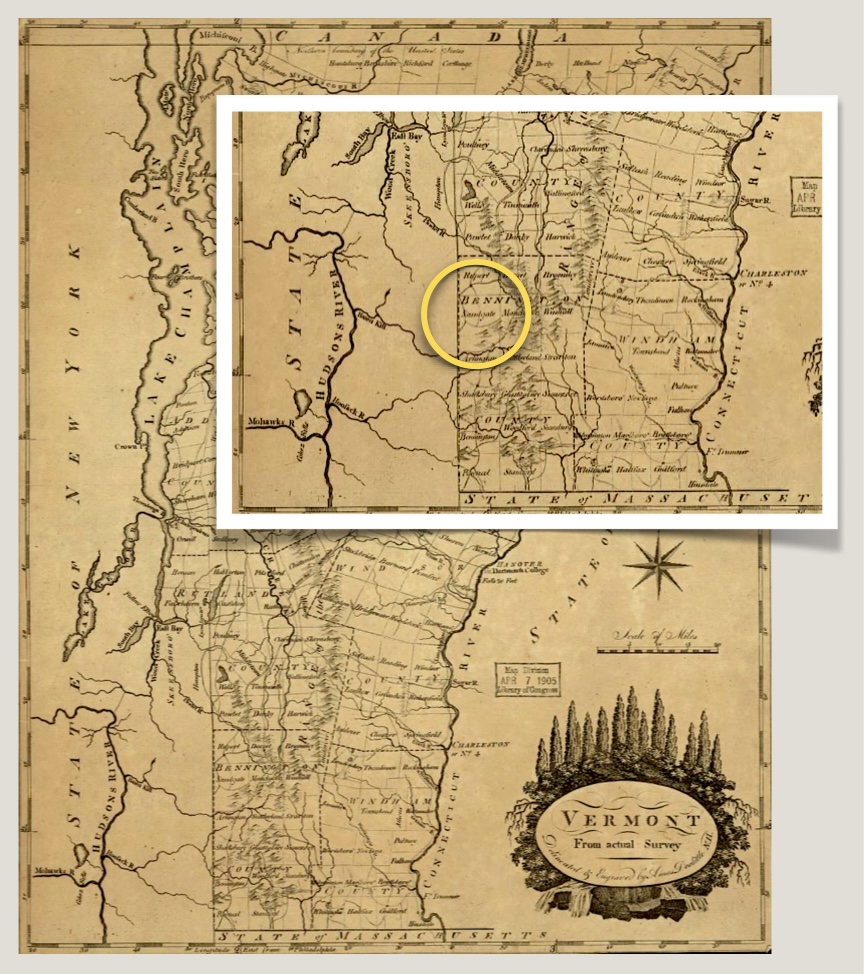
Who Were the John Richard Hogarth Sr. Family?

(3) — seven records

John Hogarth
in the 1861 Census of Canada

Canada West > Wellington
https://www.ancestry.com/discoveryui-content/view/records?recordId=794650132&collectionId=1570&tid=&pid=&queryId=4d5a5f14-a36f-460f-8e3b-6459b81a30a7&_phsrc=iwD3&_phstart=successSource
Book page: 45, Digital page: 556/1610. Entry lines 16 through 20
Note 1: He is lasted as being a Farrier (a specialized blacksmith)
Note 2: He is 33, wife Elizabeth is 28. Their children are: Annie 5, Almira 3, Sarah 1.
This census data is also found here:
Elizth Hogarth
Census – Canada, Ontario, Census, 1861

https://www.familysearch.org/ark:/61903/1:1:MQQ1-WMP
Book page: 45, Digital page: 208/620

Library and Archives Canada
Pre-Confederation, 1825 to 1867 > Census of 1861 > Ontario > Districts and sub-districts: Census of 1861
https://library-archives.canada.ca/eng/collection/research-help/genealogy-family-history/censuses/Pages/pre-confederation.aspx#1861

York County, Ontario
https://en.wikipedia.org/wiki/York_County,_Ontario

John Richard Hogarth
https://www.findagrave.com/memorial/229263133/john_richard_hogarth

Elizabeth Jane Lindsay Hogarth
https://www.findagrave.com/memorial/229263159/elizabeth_jane_hogarth

Note 1: This Ancestry file (immediately below) is here for the sibling list only. The general file contains several factual errors, so please refer to it with caution:
1) Problem — The second son John Richard Hoggarth Jr. (2) is not listed.
2) Problem — The location for the mother’s birth is likely incorrect.
John Richard Hogarth
https://www.ancestry.com/family-tree/person/tree/87252877/person/44564322138/facts?_phsrc=zON15&_phstart=successSource
Note 2: This file lists John Richard Sr., and Elizabeth Hogarth’s children. Of important note, is that the first son John Richard is listed, but the second one John Richard is not. (The researcher probably thought this was a record keeping error, or they just didn’t notice this discrepancy).
Anne Hogarth 1857-
Almyra Maud Hogarth 1858-1928
Sarah Hogarth 1860-
John Richard Hogarth Jr. (1) 1862-1869
Mary Hogarth 1865-1928
Martha Hogarth 1869-1928
[We have added] John Richard Hoggarth Jr. (2) 1870 or 1871-1944

Furrier versus Farrier

(4) — seven records

Blacksmith
https://www.britannica.com/topic/blacksmith#ref321444

Sir Edwin Henry Landseer was a favorite of Queen Victoria.

Shoeing, 1844 (1938)
by Edwin Henry Landseer
https://www.mediastorehouse.com/heritage-images/shoeing-1844-1938-14928366.html

John Hogarth in the Canada, City and Area Directories, 1819-1906
Wellington County Directory and Gazetteer, 1871-1872
https://www.ancestry.com/discoveryui-content/view/records?recordId=334062&collectionId=3789&tid=&pid=&queryId=3e3471e8-06f5-4931-afb9-01b14959b0ca&_phsrc=iwD7&_phstart=successSource
Book page: 45, Digital page: 25/128

Guelph’s Historical Maps And Their Present Usage For Heritage
And Cultural Resources Using GIS Technology

by Anne Holman
https://www.guelphhistoricalsociety.ca/downloads/may-2018-newsletter.pdf
Note: Plan of the Town of Guelph, 1847, by Donald McDonald. (Private Collection)

Archives, Historic Guelph, Volume 46
The Most Important Craftsman In Town
https://www.guelphhistoricalsociety.ca/archives/historic-guelph/volume-46/the-most-important-craftsman-in-town

Village Blacksmith (1947)
https://www.youtube.com/watch?v=Hs5WBTAzo6s

Cityscape of Guelph, Ontario, Canada – 19th Century
https://www.istockphoto.com/pt/vetorial/cityscape-of-guelph-ontario-canada-19th-century-gm1165760324-320880947

Not All Children Are Found In A Census

(5) — one records

John R Hogarth
https://www.findagrave.com/memorial/229263163/john_r_hogarth

The Tragedy in the 1871 Census

(6) — four records

John Richard Hogarth [Jr]
in the 1871 Census of Canada

Ontario > Wellington South > Guelph
https://www.ancestry.com/discoveryui-content/view/records?recordId=2934486&collectionId=1578&tid=&pid=&queryId=c48e496c-bc1a-429a-a0e4-18a6d835b46f&_phsrc=UYo20&_phstart=successSource
Digital pages: 500-501/544
Note 1: His mother is listed as being English, on page 500 (bottom image, entry 20) is aged 36 and married, but where is the father?
Note 2: JRH Jr. is listed as 1 year old, on page 501, top image, entry 6.

1871 Canadian census
https://en.wikipedia.org/wiki/1871_Canadian_census#:~:text=April%202%2C%201871,-General%20information&text=All%20inhabitants%20of%20Canada%20were,New%20Brunswick%2C%20and%20Nova%20Scotia.
“All inhabitants of Canada were included, including aboriginals. While this was the first national census of Canada, only four provinces were enumerated: Ontario, Quebec, New Brunswick, and Nova Scotia.”
and
https://library-archives.canada.ca/eng/collection/research-help/genealogy-family-history/censuses/Pages/dominion-canada.aspx#1871

John Hogarthin the 1871 Census of Canada
Ontario > Toronto West > St Patricks Ward
https://www.ancestry.com/search/collections/1578/records/3169459?tid=&pid=&queryId=99accf29-73ba-4a29-ba27-95c9e0da2080&_phsrc=sGo2&_phstart=successSource
Note: For mental asylum census.

The Provincial Lunatic Asylum

(7) — four records

CanadARThistories via Open Library
The Provincial Lunatic Asylum
(Centre for Addiction and Mental Health),
Toronto (1850)
https://ecampusontario.pressbooks.pub/canadarthistories/chapter/the-provincial-lunatic-asylum-centre-for-addiction-and-mental-health/

Images of the Toronto Provincial Asylum, 1846-1890
by Nathan Flis
https://www.erudit.org/fr/revues/scientia/2009-v32-n1-scientia3237/037628ar.pdf

1874 Hart & Rawlinson City of Toronto with Fire Limits
http://oldtorontomaps.blogspot.com/2013/01/1874-hart-rawlinson-city-of-toronto.html

John Hogarth
in the Ontario, Canada, Deaths and Deaths Overseas, 1869-1950

York > 1871
https://www.ancestry.com/discoveryui-content/view/records?recordId=1681563&collectionId=8946&tid=&pid=&queryId=82ec3039-6f5e-45dd-9839-109e19f28f27&_phsrc=iwD1&_phstart=successSource
Book page: 410, Digital page: 87/124, Right page, entry 1.
Note: Death certificate, entry number 027222.

Life for Elizabeth Hogarth Afterwards

(8) — eleven records

Elizabeth Hogarth
Tax – Canada, Ontario Tax Assessment Rolls, 1834-1899

1871
https://www.familysearch.org/ark:/61903/1:1:682V-CK1V
Digital page: 355/593, entry 135
Note: Living on Nottingham Street, likely near where her husband had his blacksmith business.
Note: 7 children living at home, and 2 cattle, 1 hog.

Elizabeth Hogarth
Tax – Canada, Ontario Tax Assessment Rolls, 1834-1899

1872
https://www.familysearch.org/ark:/61903/1:1:66NZ-Z5PS
Digital page: 58/581, entry 229
Note 1: Living on Nottingham Street, likely near where her husband had his blacksmith business.
Note 2: 7 children living at home, and 2 cattle.

Elizabeth Hogarth
Tax – Canada, Ontario Tax Assessment Rolls, 1834-1899

1873
https://www.familysearch.org/ark:/61903/1:1:66N7-D3NV
Digital page: 339/581, entry 26
Note 1: Now living at 166 Surrey address, in Guelph. She owns this property.
Note 2: 7 children living at home, and 3 cattle, 1 hog.

Elizabeth Hogarth
Tax – Canada, Ontario Tax Assessment Rolls, 1834-1899

1874
https://www.familysearch.org/ark:/61903/1:1:6D3J-S1RX
Digital page: 43/608
Note 1: Continues living at 166 Surrey address, in Guelph.
Note 2: 7 children living at home, and 3 cattle, 3 hogs.

[Marriage 2]
Elizabeth Hoggarth
Marriage – Canada, Ontario Marriages, 1869-1927

https://www.familysearch.org/ark:/61903/1:1:FMND-KWT
Book page: 202, Digital page: 208/508 Center entry #009723
Note 1: This document provides information about her parents and that she is from London, England.
Note 2: This is the first place we see the Hogarth surname spelled with 2 g’s.

[Marriage 3]
Elizabeth Hogarth
Marriage – Canada, Ontario Marriages, 1869-1927

https://www.familysearch.org/ark:/61903/1:1:FMJH-8DQ
Book page: 546, Digital page: 401/628, Right entry #013176.

Old Occupations & Trade Names, and what they mean
https://homepages.rootsweb.com/~george/oldprofessions.html
Note: Regarding drover.

Elizabeth Chisholm
in the 1881 Census of Canada
Ontario > Wellington South > Guelph
https://www.ancestry.com/search/collections/1577/records/3509449?tid=&pid=&queryId=40c105eb-a1c7-4171-b728-52e1fe02c870&_phsrc=rim13&_phstart=successSource
Book page: 21, Digital page: 225/263, Lower page, entries 16 through 19.

William B. Chisholm death certificate, 1882.

William Chisholm
in the Ontario, Canada, Deaths and Deaths Overseas, 1869-1950
https://www.ancestry.com/search/collections/8946/records/891754?tid=&pid=&queryId=cce51ff9-ade1-4427-a19d-95f1d73be186&_phsrc=dsN20&_phstart=successSource
Book page: 291, Digital page: 31/84, Right page, Entry 1.
Note: Death certificate, entry #012936 (barely legible).

Toronto Public Library
Digital Archive
The Toronto City Directory for 1889
by R.L. Polk & Co.
https://digitalarchive.tpl.ca/internal/media/dispatcher/2117802/full
Book page: 714, Right column, lower portion.
Note: For Elizabeth Hogarth living at 12 Alice Street in 1889.

Historical Maps of Toronto
1893 Fisk and Co. Map of Toronto
http://oldtorontomaps.blogspot.com/2013/01/1893-fisk-and-co-map-of-toronto.html
Note: For the 12 Alice Street location.

The DeVoe Line, A Narrative — Nine

This is Chapter Nine of eleven. In this chapter we write about the two Peters: father Peter M., and his son Peter A. We try to consistently use the letters of their middle names to distinguish them from each other, because it seems that in life, they each used their middle initial frequently to do exactly that. Despite this, it is ironic that we have never seen documentation which actually informs us of either of their complete middle name(s).

A Chip Off The Old Block?

As we learned in the previous chapter, Peter A. DeVoe was the fourth of eight children born to his father Peter M. DeVoe and his mother Alida (Shaw) DeVoe. We don’t know very much about the first twenty years of his life, but his father was a prosperous farmer, so it’s likely that the younger Peter A. followed the same model — at least for a while, anyway.

Map excerpted from the 1813 edition of H.G. Spafford’s gazetteer: A gazetteer of the
State of New-York. Albany, 1813. (Image courtesy of the Library of Congress).

The above map shows the eastern edge of New York State and the western edge of Vermont as they abutted each other just after the War of 1812, and before the commencement of the Civil War. The three principal communities indicated show where our ancestors lived during this period, prior to the westward emigration of our Great-Great-Grandparents to the Ohio Country. (1)

Learning From the 1855 New York State Census

Here is what makes the 1855 New York state census unique and also very helpful with our research: “The 1855 New York state census is notable because it was the first to record the names of every individual in the household. It also asked about the relationship of each family member to the head of the household—something that was not asked in the federal census until 1880. 

The 1855 New York state census also provides the length of time that people had lived in their towns or cities as well as their state or country of origin—this is particularly helpful for tracing immigrant ancestors. If born in New York State, the county of birth was noted, which is helpful for tracing migration within New York State.

Peter A. DeVoe is listed on line 10, as being 20 years old, living in his parents’ home, working as a farmer, and that he was born in Saratoga County, New York.

1855 New York State Census for Easton, Washington County.

In 1855, Mary Ann was already residing in the town of Wilton* in Saratoga County, for three years, having moved there from Sandgate, Vermont. She is shown on line 24, as being 22 years old, and working as a weaver. We can also observe that she was born in Vermont, and that she is a boarder among ten other women who are also working as weavers. All of these women are living in a boarding house belonging to Bethelvel Shaw.

1855 New York State Census for Wilton, Saratoga County.

*In carefully analyzing the census materials, we learned that the landlord, Bethelvel Shaw and his family, ran a boarding house (which appears to have been situated amongst other boarding houses), in Victory Village, Saratoga County, New York. For both the 1855 and 1860 censuses, it is that same location, [despite being recorded as Wilton on the 1855 census].

Left to right, top: A cotton flower and bole, a millworker weaver working bobbins.
Center: Map of the Victory Mills hamlet in Saratoga County, New York, where our 2x Great Grandmother Mary Ann lived and worked in the early 1850s. Bottom: Stereoscopic view of a cotton mill in Lowell, Massachusetts, (See footnotes for credits).

When Mary Ann Warner lived there she worked as a weaver, so we analyzed histories of Saratoga County and maps from that era. We learned that there were very few mills that processed wool or cotton in Saratoga County during the period of 1852 through 1855. Having determined that she was recorded as living in Victory Village, the only place she could have worked at was the nearby Saratoga Victory Manufacturing Company. (2)

The Saratoga Victory Manufacturing Company

We don’t know what brought Mary Ann Warner to come and leave Vermont and move to Saratoga County, New York, but it plausibly could have been for economic opportunity. In the 1820s, one of the first cotton factory mills to have opened to great success in the United States was in Lowell, Massachusetts, and word likely spread out from there about employment.

As the National Park Service writes: “The term ‘mill girls’ was occasionally used in [1840s] antebellum newspapers and periodicals to describe the young Yankee women, generally 15 – 30 years old, who worked in the large cotton factories… To find workers for their mills in early Lowell, the textile corporations recruited women from New England farms and villages.”

Female textile workers often described themselves
as
mill girls, while affirming the virtue of their class and
the dignity of their labor. 

These “daughters of Yankee farmers” had few economic opportunities, and many were enticed by
the prospect of monthly cash wages and room and board
in a comfortable boardinghouse.

The Mill Girls of Lowell
The National Park Service

Beginning in 1823, with the opening of Lowell’s first factory, large numbers of young women moved to the growing city. In the mills, female workers faced long hours of toil and often grueling working conditions. Yet many female textile workers saved money and gained a measure of economic independence. In addition, the city’s shops and religious institutions, along with its educational and recreational activities, offered an exciting social life that most women from small villages had never experienced.

Recruitment flyer for mill workers, circa 1840s.
(Image courtesy of Medium, via Thinking Citizen Blog).

Although not as famous as the factories in Lowell, Massachusetts, the Saratoga Victory Manufacturing Company grew to be a very large business enterprise. It operated under several owners until finally closing in the year 2000.

From the Eustace Families Association website:
“The village of Victory is a suburb of Schuylerville, Saratoga County, New York. Victory is located just south of Schuylerville on Fish Creek, a tributary to the historic Hudson River… Victory is the product of the industrial revolution. The number of textile mills, which required abundant waterpower, grew rapidly during the mid-1800s… [By 1846], The Saratoga Victory Manufacturing Company [was built as]a three-story cotton cloth manufacturing plant costing $425,000. The company flourished and the number of employees living near the mill increased. In 1850, the cotton mill employed 160 men, 209 women, working at 12,500 spindles and 309 looms and produced over 1,800,000 yards of cotton cloth.”

“The development and expansion of Victory Mill coincided with the Potato Famine in Ireland. As a result, many Irish Catholic immigrants found work at the mills and as early as 1847, there was already a significant number of Irish families settled there.Observation: The frequency of Irish family names was something that we took note of when we analyzed the census materials. In this era, on our father’s side of the family, our Irish 2x Great Grandmother Elizabeth (McGuire) McMahon also worked as a weaver at a mill in Doune Village, Stirlingshire, Scotland. (See The McMahon / McCall Lines, A Narrative — One). (3)

The City’s Shops and Religious Institutions… Offered an Exciting Social Life

To be honest, we really don’t know how, nor where, Peter A. and Mary Ann met. Were they introduced by friends at a dance, or a picnic? We have read that for many of the young women who worked in the mills, churches offered an acceptable social outlet for their young lives. At nearly 170 years ago, one can only conjecture what the circumstance was.

We also understand from his 1909 obituary, “He and his wife confessed Christ and united with Baptist Church in the East”. This explains how they became involved with the Baptist Church — but for all of the Dutch generations before him, his family had been devout members of the Dutch Reformed Church. Was this conversion the influence of Mary Ann’s family, or was it a natural progression of life, as one moves away from their parent’s home and ventures out into the world to find one’s self?

Photos to record the wedding of Peter A. and Mary Ann (Warner) DeVoe, circa 1856.
Marriage date: February 2, 1856
(Contemporary family photographs obtained from daguerratypes).
The Descendants of Andrew Warner > Seventh Generation, page 381.

Peter A. DeVoe and Mary Ann Warner were married on February 2, 1856. The location is likely either in Sandgate, Bennington County, Vermont, or in Easton, Washington County, New York. However, we cannot yet confirm the exact location, because a specific marriage record has not been discovered. We will keep on searching for it, but for now, we have relied on other credible sources for their marriage date. Mary Ann Warner is the youngest daughter of our 3x Great-Grandparents William Warner of Vermont, and his third wife, Prudence Nickerson.

Peter A. and Mary Ann had two children:

  • Clinton Chauncey DeVoe, born in New York, April 10, 1858 — died November 19, 1930 (We are descended from Clinton).
    For the specifics about Clinton Chauncey DeVoe’s life, please see
    The DeVoe Line, A Narrative — Ten.
  • Charles Raymond DeVoe, (see below)

Charles Raymond DeVoe was the younger son in the family. He was born at home in Russell, Geauga County, Ohio on November 4, 1861. He died July 28, 1939 also in Russell, Ohio. Charles DeVoe married Adeline M. “Addie” Parker, on November 4, 1884, in Geauga, Ohio. She was born on November 10, 1865 in Munson, Geauga, Ohio, the daughter of DeWitt Clinton Parker and Lucina Robinson. She died on March 25, 1944 in Auburn, Geauga, Ohio. (4)

Marriage License for Charles R. Devoe and Addie M. Parker,1884.

The Years Before the Civil War — How Did They Travel?

We do not know by which route Peter A., Mary Ann, and young Clinton Devoe traveled to Northeast Ohio. In the late 1850s, for people emigrating westward to Ohio from the counties in New York and Vermont where our ancestors lived — they would have likely traveled by a combination of canals, railroads, and roads.

This contemporary image indicates the travel options that existed in the 1850s
between Saratoga County, New York and the Western Reserve of Ohio. (Image courtesy of Quora).
Red = roadway routes, Blue = canal routes, Black = railway routes

The Canal Routes
The primary water route was a series of linked canals, dominated by the Erie Canal, which connected with the Champlain Canal. The Champlain ran between the Saratoga and Washington County borders, where Peter A.’s parents and other relatives lived. It would have been very easy for them to access this route. Wikipedia states about the Erie,“The Erie’s peak year was 1855 when 33,000 commercial shipments took place.

View on the Erie Canal (1830-32) by John William Hill
via The New York Public Library.

The Railway Routes
During this decade, railroad lines were also being constructed. If a traveler were fortunate, a rail line might exist for their destination. From Wikipedia: “The Mohawk and Hudson Railroad opened in 1837, providing a bypass to the slowest part of the canal between Albany and Schenectady. Other railroads were soon chartered and built to continue the line west to Buffalo, and in 1842 a continuous line (which later became the New York Central Railroad and its Auburn Road in 1853) was open the whole way to Buffalo”.

The Roadway Routes
Roadways, however, were a rough, mixed-bag of environments. What type of road surface one encountered depended upon the circumstances of the area you were passing through. There were: improved surfaces, packed dirt, corduroy (felled trees were used as planks), and pathways through fields. Taking a land route the entire way would have been the most difficult option.

We heard family stories about wagon travel, but to be honest, we just do not know how they made their way to northeast Ohio. What we do know is that the western end of the Erie Canal, and the endpoint for the railroads [in 1859], was at Buffalo, New York, on Lake Erie. This became the decision point about what to do next.

Inset image: Horse drawn covered wagon. (Image courtesy of the Little House books).
Background image: Gathering With Covered Wagon, 20th century image correct for
Conestoga wagon, oxen, style of dress, and Ohio designation.
(Image courtesy of digitalcommonwealth.org).

At Buffalo, a horse drawn wagon, or a heavy covered wagon such as the Conestoga wagon, would have been required for travel across Pennsylvania to the their new home in the Western Reserve of Ohio. This type of wagon was extremely popular in the years just before the Civil War, which started in 1861. (5)

Map of the Western Reserve Including the Fire Lands 1826. On this map, Geauga County is still combined with the future Lake County and Russell township (pink area) is not yet named. (Image courtesy of Wikimedia Commons).

Many New Englanders Were Moving to the Western Reserve in Ohio

We believe that their attraction to northeast Ohio was most likely because the influence of family members from Mary Ann’s side of the marriage. She was part of the large, extended Warner family.

Note: Her father William S. Warner Sr., was married three times: first to Lucy Coan which brought seven children into the world, and second to Abigail Root —a brief marriage due to Abigail’s death; without children. William Warner’s third marriage was to Mary Ann’s mother, Prudence B. Nickerson, bringing four more children.

From William’s first marriage to Lucy Coan, five older brothers of Mary Ann were living in the Western Reserve of Ohio, all of them in Geauga County. Her older sister, Lucina married Clark Reed and they settled in Pike County, in southeast Ohio. The Warner siblings migrated to Ohio in two waves. The first was in the 1830s, and the second was in the 1850s. The Willoughby Independent Newspaper, of Willoughby, Ohio, in 1881, recounts:

“Out of a family of eleven children of William Warner, Sr. of Sandgate, Bennington County, Vermont, seven migrated to Geauga County, Ohio at a time in American history when Ohio was considered the far west. Six located permanently in Geauga County, the other, Lusina (Warner) Reed, removed with her husband Clark Reed, to Pike County, Ohio.”

“The first to arrive was Gaylord C., who came in 1830 followed the next year by his brothers, William Jr., Joseph and Benjamin and later John and a sister, [Mary] Ann, who married Peter DeVoe and settled in Russell. For the past 120 years these Warners, with their descendants, have contributed their bit to the progress of the Western Reserve. There are at present descendants of the family living in 10 of the 16 townships of Geauga. Besides many who moved on to help build a bigger and better America.” For many decades up to the present time, a yearly Warner Family Reunion has been held. The first reunion was in 1880 at the home of William Warner Jr.

Peter A. DeVoe’s 1909 obituary states that they entered Ohio in 1859. The 1860 United States Federal Census records them living in Russell township, Geauga County, Ohio.

1860 United States Federal Census for Russell township, Geauga County, Ohio.
1863 Civil War draft registration record for the counties of northeast Ohio in 1863.
Note that below Peter’s name is his younger brother Chauncey Devoe,
who must have been living in the area before he returned to New York state.

In the midst of the Civil war period, Peter A.’s younger brother Chauncey must have been living in the area, because he and Peter registered for Civil War service. Even though the War did not affect Ohio very much, Peter’s obituary in 1909 states, “His musical talent was above the ordinary… He served for a short time in the Civil war as a musician.

March 1870 United States Federal Census for Russell township, Geauga County, Ohio.

By the time of the March 1870 census, Prudence Warner, Mary Ann’s mother, is living with them. We observed that one of the children listed — Warren French, is the neighbor’s child who must have been residing there also. We are neither sure when, nor how, Prudence Warner in her elder years, traveled to Ohio from Sandgate, Vermont. Since it was the 1860s, railroad lines were fast developing, and it is quite possible that perhaps the entire trip was by railroad. (6)

Russell Township, from the Atlas of Lake and Geauga Counties 1874, Ohio
Published by Titus, Simmons and Titus, Philadelphia. Image courtesy of historicmapworks.com.

The Last Township to be Named

If you look carefully at the 1826 Western Reserve Firelands map/illustration a few paragraphs above, you can see that Russell township is not yet named. When researching why this is, we came across this passage from the 1878 book, the History of Geauga and Lake Counties, Ohio:
“Russell was the last to be peopled, of all the townships, and the most of her early inhabitants removed to her borders from the surrounding country. This is said by her historians to have resulted from the high prices at which the proprietors held the land. It was also due to the generally low estimate which prevailed, set upon her soil and timber.

This was rather startling to read, because (at present) the township is heavily forested and there is also much farmland. We wonder if perhaps local politics and land speculation was affecting the early settlers, of which there were many in our family. From the 1880 edition of the Pioneer and General History of Geauga County..., we learned that both aspects were true.
“At the commencement of its settlement, it was called the West Woods by the people of Newbury. The reason why it was not settled as soon as the adjoining townships, I suppose, to be that the speculators who bought of the Connecticut Land company, held it out of the market, or held it above the market price.

Interestingly, we learned that other people from Bennington County, Vermont, where the Warner family hailed from, were present in the area since the 1820s…
“Clark Robinson moved from Shaftsbury, Bennington County, Vermont, to Middlefield, in the fall of 1820… and bought a lot of land in Russell Center at three dollars per acre…on the eighth of November, 1825, moved his family into the body of a log house…” (7)

The Legacy of Briar Hill and Old Riverview

Riverview Chapel, 1930s newspaper epherma, Old Riverview / Briar Hill Cemetery,
Russell township, Ohio.

Amongst old family ancestry records we discovered a portion of a small 1910s(?), 1920s(?) newspaper article about our 2x Great Grandfather Peter A. Devoe. It describes how in earlier years he had donated a portion of his land to create the Riverview Cemetery, an adjunct to the Briar Hill Cemetery. If you examine his property map (shown above) from 1874, you can discern on the upper corner that it says Wesleyan Cemetery and shows a small indication labeled ‘Ch’ for a church, or chapel.

From the 1880 edition of the Pioneer and General History of Geauga County..., we discovered this:
“The Wesleyan Methodist Church. — About the year 1848 there was a division among the Methodists on the slavery question, a part of the members withdrew, and a Wesleyan Methodist church was organized embracing two families that were left of a Congregational church, that was formed in the northwest part of Russell, in the summer of 1840, when J. M. Childs was chosen deacon, and A. H. Childs was chosen clerk, which had become reduced to the two families mentioned, when their organization was given up, and they, uniting with those who came away from the Methodist Episcopal church, formed the Wesleyan Methodist church, and in 1850 they bought a piece of land of L. T. Tambling, two miles north of the center, on the west side of the Chillicothe road, a nice sandy knoll for a burying ground, and to build a meeting house on, and four of them paid for it, to-wit: H. Cummins, John Wesley, David Nutt, and J. M. Childs, and had it deeded to the trustees of the first Wesleyan Methodist church in Russell, and to their successors in office. The first three named that paid for the burying ground are dead and gone to their reward; Mr. Childs is living yet. He says that in 1851 they began to make preparations to build a meeting house, but, being poor, and new beginners, it went on slow, but with a hard struggle with poverty and bad management, it was finished.

The Wesleyan Cemetery eventually became known as Briar Hill Cemetery. The meeting house became the Riverview Chapel where Baptist religious services were held. Peter A. Devoe and his extended family members gathered there for worship. Our Grandmother Lulu Mae (DeVoe) Gore often spoke of his love of music and how he would lead musical performances at the chapel.

There are six generations of our family buried in Riverview Cemetery. These family lines are: Bond, DeVoe, Gore, McClintock, and Warner. (8)

They Joined Their Ancestors

Both Peter and Mary Ann were descended from many generations of people who earned their living as farmers from an agrarian economy. They carried on that tradition, as their sons did after them.

Mary A. Devoe death record, 1899.

Mary Ann (Warner) DeVoe was the first to pass away on April 10, 1899. We have found two records about her death, and they indicate that she died from either consumption, or measles.

Peter A. DeVoe was born on June 23, 1834 in Saratoga County, New York. After his wife Mary Ann passed away, he lived into the 20th century for another ten years . He died on October 31, 1909 from an accidental fall. This newspaper account describes what happened. Peter’s obituary (further below) speaks to how beloved he was in his community. (9)

An account of his death was published in
The Geauga Republican, or the Cleveland Leader, on November 3, 1909.
Peter died on October 31, 1909. This obituary was published (likely in the Geauga Republican)
on November 12, 1909.

In the next chapter we will write about Peter and Mary Ann’s son Clinton Chauncey DeVoe, his wife Clara Antionette McClintock, and their children.

Following are the footnotes for the Primary Source Materials,
Notes, and Observations

A Chip Off The Old Block?

(1) — one records

Library of Congress
State of New-York for Spafford’s gazetteer, 1813
https://www.loc.gov/resource/g3800.ct003432/?r=-0.195,0.049,1.46,0.862,0
Note: For a portion of the map image.

Learning From the 1855 New York State Census

(2) — eight records

New York Genealogical & Biographical Society
New York State Census Records Online
https://www.newyorkfamilyhistory.org/subject-guide/new-york-state-census-records-online#1855

Peter M Devoe
in the 1860 United States Federal Census

New York > Washington > Easton
https://www.ancestry.com/discoveryui-content/view/48630571:7667?tid=&pid=&queryId=35ec4bd5-43de-42e5-bb2e-505bfa1707e1&_phsrc=Rxw27&_phstart=successSource
Book page: 160, Digital page: 28/80, Entries 23 through 29.

Mary A Warner
Census – New York State Census, 1855

https://www.familysearch.org/ark:/61903/1:1:K63D-4G5
Digital page: 247/481, Entry 24.
Note: This census is recoded as Election District 2 / Wilton, but the location it covered for our Great-Great-Grandmother Mary Ann Warner is actually the small town of Victory Village, just south of Wilton. See the notes below on Bethuel Shaw.

Bethuel Shaw (or Nathaniel Shaw)
https://www.findagrave.com/memorial/118426704/bethuel-sha
Notes: Much research was done on Bethuel Shaw, and the following was determined — He and his family ran a boarding house (which appears to have been situated amongst other boarding houses), in Saratoga County, New York. For the 1855 “Wilton” census and for the “Victory Village” 1860 census, it is the same location because the names of the neighbors are exactly the same (the Taylor family and the Kelly family). On the 1860 census, his name Bethuel is recorded as Nathaniel.

History of Saratoga County, New York, with Biographical Sketches of Some of its Prominent Men and Pioneers
by Nathaniel Bartlett Sylvester, 1878
https://archive.org/details/cu31924028833064/page/n7/mode/2up

New Topographical Atlas Of Saratoga Co. New York
From Actual Surveys by S.N. & D.G. Beers and Assistants

Stone & Stewart, Publishers. Philadelphia. 1866
https://mathcs.clarku.edu/~djoyce/gen/saratoga/Atlas.html

Gossypium barbadense, cotton plant
Illustration from the Botany Library Plate Collection held at the
Natural History Museum, London
https://www.mediastorehouse.com.au/mary-evans-prints-online/gossypium-barbadense-cotton-plant-8613143.html
Note: For the cotton plant illustration.

Resources for History Teachers
The New England Textile Industry in the 19th Century
http://resourcesforhistoryteachers.pbworks.com/w/page/125185436/The%20New%20England%20Textile%20Industry%20in%20the%2019th%20Century
Note: For the Lowell, Massachusetts stereoscopic view card mill image.

The Saratoga Victory Manufacturing Company

(3) — four records

The Mill Girls of Lowell
https://www.nps.gov/lowe/learn/historyculture/the-mill-girls-of-lowell.htm#:~:text=To find workers for their,board in a comfortable boardinghouse.

Eustace Families Association
http://www.roneustice.com/Family History/IrishFamiliessub/EustisVictoryMills/VictoryMills.6.7.09.htm

Thinking Citizen Blog — Massachusetts (Part Two) Textiles, Shoes, Telephones
https://john-muresianu.medium.com/thinking-citizen-blog-massachusetts-part-two-textiles-shoes-telephones-55beeb38c6de

“Several companies owned and operated the facility over the years and unfortunately ended up closing its doors in 2000.”
https://www.villageofvictory.com/about-historical-victory/

The City’s Shops and Religious Institutions… Offered an Exciting Social Life

(4) — five records

The Descendants of Andrew Warner
> Seventh Generation
Compiled by Lucien C. Warner and Mrs. Josephine Genung Nichols
https://archive.org/details/descendantsofand00warn/page/380/mode/2up?view=theater
Book page: 381-382, Digital page: 380-382/804, Right page, entry 355.
Note: “Ann (or Mary Ann) Warner marries Peter DeVoe”

Charles R. Devoe
Marriage – Ohio, County Marriages, 1789-2016

https://www.familysearch.org/ark:/61903/1:1:XD2M-HMQ
Book page: 321, Digital page: 182/516      Right page bottom, entry 3.
Note 1: Spouse is, Addie Parker / Adeline M. Parker
Note 2: Marriage date, November 4.1884, in Geauga County, Ohio

Chas Raymond Devoe
Death – Ohio Deaths, 1908-1953

https://www.familysearch.org/ark:/61903/1:1:X8MR-L8D
Digital page: 1544/3320
Note: This file also documents his birth date.

Charles Raymond DeVoe death certificate, 1939.

Addie Parker Devoe
Death – Ohio Deaths, 1908-1953

https://www.familysearch.org/ark:/61903/1:1:X8ML-Y6F
Digital page: 2697/3295
Notes: Birth date and location, death date and location. 

Addie M. (Parker) DeVoe death certificate, 1944.

Adeline M. Parker
https://www.familysearch.org/tree/person/details/99B3-JDD
Note: Addie DeVoe’s parents are: DeWitt Clinton Parker and Lucina Robinson.

The Years Before the Civil War — How Did They Travel?

(5) — five records

Quora map image
How would someone in the 1850s get from New York to Kansas?https://www.quora.com/How-would-someone-in-the-1850s-get-from-New-York-to-Kansas

CBS News
All Hail The Erie Canal
“View on the Erie Canal” (1830-32) by John William Hill
via The New York Public Library
https://www.cbsnews.com/news/all-hail-the-erie-canal-200th-anniversary/
Note: For the landscape painting.

Erie Canal
https://en.wikipedia.org/wiki/Erie_Canal

Covered Wagon With Horses photo
Little House Books
http://lhbooks.weebly.com/covered-wagons.html
Note: For the covered wagon image in color.

Gathering With Covered Wagon
by Associated Photofeature Syndicate, 58 Charles Street, Boston, Massachusetts
https://www.digitalcommonwealth.org/search/commonwealth:0r96gd67j
Note: For the covered wagon image, sepia toned.

Many New Englanders Were Moving to the Western Reserve in Ohio

(6) — six records

Western Reserve Including the Fire Lands 1826
https://commons.wikimedia.org/wiki/File:Western_Reserve_Including_the_Fire_Lands_1826.jpg
Note: On this map, Geauga County is still combined with the future Lake County and Russell township is not yet named.

North America, Family Histories, 1500-2000 for Ann Warner
W > Warner > The Descendants of Andrew Warner
https://www.ancestry.com/imageviewer/collections/61157/images/46155_b290135-00262?usePUB=true&usePUBJs=true&pId=1810137
Book page: 254-255, Digital page: 262-263/812
Note: Entry 355 on page 263, is a notation for her marriage to Peter Devoe.

P Devon
in the 1860 United States Federal Census

https://www.ancestry.com/discoveryui-content/view/43403745:7667?tid=&pid=&queryId=a14478bc-ce31-4745-9564-8089cb4f9791&_phsrc=cUK2&_phstart=successSource
Book page: 18, Digital page: 18/25, Entries 27-29.

Peter Devoe
in the U.S., Civil War Draft Registrations Records, 1863-1865

Ohio > 19th > Class 1, A-K, Volume 1 of 4
https://www.ancestry.com/discoveryui-content/view/1035699:1666?tid=&pid=&queryId=74778971-fe58-4cc5-a090-2f50318fd932&_phsrc=cUK4&_phstart=successSource
Book page: 145, Digital page: 168/338, Entries 13 and 14.

Peter De Voe
Census – United States Census, 1870

https://www.familysearch.org/ark:/61903/1:1:M62W-W7Z
Book page: 2-3, Digital page: 612-613/733
Notes: Entries 35 through 40 at the bottom of the left page and entry 1
at the top of the (next right) page.

Extracts from the Willoughby Independent, 1881, Willoughby, Ohio Newspaper
Judy Jane Stebbins, 3/1/2013
https://usgenwebsites.org/OHLake/newspaper/Willoughby%20Independent%201881c%20Stebbins.pdf

The Last Township to be Named

(7) — three records

Cover for the Atlas of Lake and Geauga Counties 1874, Ohio.

Historic Map Works
Russell, Fowler’s Mills
From Lake and Geauga Counties 1874, Ohio

Published by Titus, Simmons and Titus in 1874
https://historicmapworks.com/Map/US/24292/Russell++Fowler+s+Mills/

History of Geauga and Lake Counties, Ohio
https://archive.org/details/oh-geauga-lake-1879-williams/page/n9/mode/2up
Book page: 207, Digital page: 318/443

1798 – 1880, Pioneer and General History of Geauga County, with Sketches
of Some of the Pioneers and Prominent Men
by The Historical Society of Geauga County
Russell > For Early Proprietors, and > Early Events:
https://archive.org/details/oh-geauga-1880-historical-society/page/109/mode/2up?view=theater
Book page: 109-110, Digital page: 109-110/821

The Legacy of Briar Hill and Old Riverview

(8) — two records

Russell Township
Township Cemeteries
https://russelltownship.us/departments/administration-1/cemetery
Note: For the Riverview Chapel image.

1798 – 1880, Pioneer and General History of Geauga County, with Sketches of Some of the Pioneers and Prominent Men
by The Historical Society of Geauga County
Russell > The Wesleyan Methodist Church
https://archive.org/details/oh-geauga-1880-historical-society/page/113/mode/2up?view=theater
Book page: 114, Digital page: 113/821

They Joined Their Ancestors

(9) — four records

Mary A. Devoe
Vital – Ohio Deaths and Burials, 1854-1997

https://www.familysearch.org/ark:/61903/1:1:F6D5-ST5
Book page: 8, Digital page: 435/469, Left page, entry #4828.
Note: her cause of death is listed as consumption (tuberculosis).

Peter Devoe
Death – Ohio Deaths, 1908-1953

https://www.familysearch.org/ark:/61903/1:1:X6XS-W2N
Digital page: 98/3051

Peter A. DeVoe death certificate, 1909.

Peter Devoe
in the Ohio, U.S., Rutherford B. Hayes Presidential Center Obituary Index, 1810s-2016

https://www.ancestry.com/discoveryui-content/view/2222115:1671?tid=&pid=&queryId=8f21bb29-7ea3-4d5b-9aed-f7ae3dc6ea30&_phsrc=bTB3&_phstart=successSource

Ohio, U.S., Wills and Probate Records, 1786-1998 for Peter De Voe
Geauga > Probate Files, Dutton, Charles O-Downing, Cornelia A
https://www.ancestry.com/imageviewer/collections/8801/images/005441006_01234?pId=15350799
Digital pages: 1234 through 1250
Note: There are about 17 images in this docket.

Peter Devoe
in the Ohio, U.S., Death Records, 1908-1932, 1938-2018

D
https://www.ancestry.com/discoveryui-content/view/6201688:5763?tid=&pid=&queryId=138f15d6-7ebf-4d55-ae45-6660f57adcfa&_phsrc=Wxe18&_phstart=successSource
Book page: 335, Digital page: 30/2684, Entry 15 from the bottom.

The DeVoe Line, A Narrative — Seven

This is Chapter Seven of eleven parts. An unusual circumstance has required an unusual chapter for our DeVoe family history. We’ve created this unique chapter to address both the scarcity of records on this branch of the family, and to document our insights about working through a knotty challenge like this.

Ballston Spa was the “Center” of Saratoga County

Saratoga County Courthouse, built 1819. From the Saratoga Today newspaper article
How Ballston Spa Became the County Seat, published April 1, 2021.

If you give a couple of ne’er-do-well convicts a lighted candle, they just might burn the jail down — and this is exactly what happened. According to the newspaper, Saratoga Today
“Fire broke out in the courthouse in the middle of the night on March 23 [1816]. Two prisoners, Fones Cole of Northampton (held on a forgery charge) and Peter Drapoo (a horse thief) used a candle they purchased from the jailor (reportedly for playing cards) to set fire to their cell and escape. Two other prisoners also escaped during the fire but a fifth prisoner, George Billings, was chained to the floor and perished in the flames.”

After the drama of that event, for three years, different interested Saratoga County towns vied for the new courthouse to be built in their community, but when all was said and done, the new courthouse stayed in Ballston Spa, opening in 1819. “The style of the building was essentially the same as the original building on Courthouse Hill, though they built this one out of brick.

At the time of this chapter in our family history, the Surrogate of the County of Saratoga was George Palmer, esq., and he was working from this new courthouse. (1)

Our Dilemma With Peter M. DevoeThat “M” is Pretty Important!

In our search for our 3x Great Grandfather, Peter M. Devoe — as sometimes happens in genealogy research, you find yourself tracing a relative who has a rather common name. In this part of the world at that time, there were many, many Devoe(s) living in New York State. Also, the first name of Peter was (and stilll is!) quite popular. Occasionally we might luck out and see a middle name initial: Peter D., Peter J., etc., but without that special “M” nothing could be certain we had the right person.

And then there’s the surname. The Holland Society records these variants for the Devoe surname: De Voew, De Vous, Devoe, Du Fou, Du Voe, D. Fou, d. Fou, D. Vou, De Voe, Devou, De Vous, Vous, Du Vou. In a preliterate world, we find many of these spellings on census records, court records, correspondence… you name it!

We found his 1829 marriage record to Alida Shaw, and we will be writing about his and his family’s life together in the next chapter. The only other document we have located, where we are certain that it is him, is the Last Will and Testament of Elias Devoe. This 1832 Will is a treasured document from our research, — it is the only document that captures the name of Peter M. Devoe, and lists all the people who are his likely siblings. Being a rare item, we feel that it is important to explain to readers exactly how we came to these conclusions. (2)

Reading The Will by David Wilkie, 1820. (Image courtesy of Wikimedia Commons).

The Enigmatic Last Will and Testament of Elias Devoe

We are presenting the actual pages of Elias Devoe’s will as written on July 17, 1832, and probated on October 8, 1832. Each page has the actual words, first shown in the court copy, with a transcription following.

Last Will and Testament of Elias Devoe, page 1.

“Be it remembered that on this 8 day of October 1832, came before me George Palmer, Surrogate of the county of Saratoga, at my offices in the village of Stillwater Maria Devoe and Hoffman Steenburgh executors named in the last Will and Testament of Elias Devoe late of the town of Halfmoon in said County deceased and showed to said Surrogate that they and duly cited and notified Isaac M. Devoe, Peter M. Devoe, Maria Devoe, Elizabeth Quackenbush, Getty Gray, Catherine Vandekar, Alida Devoe, Anna Quik, Martin Van Curen and Asahel Philo Guardian to Maria Van Curen and Alida Van Curen minors, being the heirs at law and next of kin of the said deceased that they would on the said 8 day of October, at the place aforesaid present said will to the said Surrogate to be proved and allowed as a will of real a personal estate, and also on Cornelius Devoe, also an heir and next of kin of the said deceased to the same effect.

An example of American mourning artwork, circa 1830.
(Image courtesy of herald net.com).

And leave being given to the said Maria and Hoffman they then and there produced to said Surrogate a certain instrument in writing purporting to be the last Will and Testament of the said Elias bearing date the Seventeenth day of July in the year of our Lord, one thousand, Eight hundred and thirty two and that then and there introduced Abram Van Wart and James McNiece who”

Last Will and Testament of Elias Devoe, page 2.

“being duly sworn did say that they were present and saw the said Elias _____ said instrument by signing the same, and adopting the seal and heard him declare the same to be his last Will and Testament and that they put their names to the same as witnesses in the presence of the testator and of each other, and of Platt Burtis, who also signed his name as a witness in presence of the said testator and of this witnesses. And that the said testator at the time of so executing the same was of sound mind and memory, and Hoffman Steenburgh also a witness to said Will being duly sworn says that at a subsequent day he was called on to be a witness to said Will, that the testator acknowledged to him that he executed said instrument as his Will and that when he so made his acknowledgement he was of sound mind and memory and then this deponent put his name to said Will as a witness in presence of the said testator. And hereupon the said James further said that he wrote said Will by actions of the testator, and that he was perfectly rational and knew well what he was about. And on the application of the said executors, I adjourned the further hearing and consideration of the proof of said Will until the 13th day of October, 1832 at 12 O clock noon, at my office in the village aforesaid, at which time and place came the said Platt Burtis also a witness to said Will, who being duly sworn and said that he was in presence of the testator at the time the above named Abram and James signed their names to said Will, that he then signed his, that the said testator in presence of these three witnesses acknowledged the execution of said instrument as his last Will and Testament and that at the time thereof, the said testator was of sound disposing mind and memory. And the said witnesses declared the testator above the age of twenty-one. It appearing to said Surrogate that said Will was properly executed, and that the testator at the time of executing the same was in all respects competent to devise real estate, and not under restraint, the said Surrogate records said Will and certifies to be in the words and figures following: In the name of God, Amen. I, Elias Devoe of the town of Halfmoon, in the county of Saratoga and State of New York being weak in body, but of sound mind and memory, and knowing the uncertainty of this life, for the purpose of making a disposition of such property real and personal, wherewith it has pleased Almighty God to bless me in this present world do make this my last Will and Testament, as follows, viz: Item. I give devise, and bequeath unto my”

Last Will and Testament of Elias Devoe, page 3.

“beloved wife Maria Devoe all my real estate, situate in the town of Halfmoon in the county of Saratoga aforesaid for and during her natural life, or as long as she shall live excepting therefrom my right in the mill lot, one third of which belongs to the estate of Cornelius Fonda, Deceased, one third to Henry Fonda, and the remaining third to myself, and also my store on the west side of the canal together with the basin on the east side of the same and also a small piece of Lands along the west side of the new roads, leading from the aquaduct [sic] to Tartalus Frosts and north of the road leading from the aquaduct [sic] to the village of Middletown all of which I do hereby except from this above devise of my real estate to my said wife Maria. Item. I do also hereby give, devise and bequeath unto my said wife Maria all my personal property for her own and sole use, benefit, and behoof forever. Item. From and after the death of my said wife, Maria, I do hereby give devise and bequeath unto my two sons Elias Devoe and Stephen Devoe all the real estate above given devised and bequeathed unto my said wife Maria to be divided equally between them share and share alike to them, their heirs, and assigns forever. Item. I give devise and bequeath unto Elias Link son of John Link, of the town of Watervliet in the county of Albany the above mentioned excepted small piece of land lying on the west side of the new road leading from the aqueduct to Tartalus Frosts and north of the road leading from the aqueduct to the village of Middletown, to him his heirs and assigns forever. Item. I order will and direct that my right in the mill lot above mentioned excepted be sold by my executrix and executor hereinafter named for the purpose of paying off and satisfying my just debts and the overflows if any there be, I hereby give to my said wife Maria. Lastly, I do hereby nominate, constitute and appoint my said wife Maria Devoe executrix and Hoffman Steenburgh Executor of the town of Halfmoon in the county of Saratoga aforesaid, of this my last will and testament, hereby revoking and annulling all former wills by me made, if any therebe. In witness whereof I have hereunto in my hand and seal, as and for my last will and testament this seventeenth of July, in the year of our Lord, One thousand Eight hundred and thirty two in the presence of the subscribing witnesses disinterested persons who have”

Hereunto subscribed their names as witnesses hereto in my presence and in the presence of each other. Elias Devoe, SS. Witnesses present Abram M. Van Wart of Halfmoon, Saratoga County. Platt Burtis, Jas. [or Jan] McNiece of Halfmoon, Saratoga County. Hoffman Steenburgh of Halfmoon, Saratoga county.

I, George Palmer, Surrogate of the county of Saratoga do certify that the preceding record is a true copy of the last Will and Testament of Elias Devoe, of Halfmoon, in said county, deceased.

George Palmer, esq.” (3)

Further Notes Regarding Elias Devoe’s Estate

In an earlier era of America, when someone died, if their estate had any debts such as unpaid bills, mortgages which were not yet completed, etc., the courts required that their assets be evaluated for sale to satisfy the debts owed. This was very difficult for some families.

An example of 1830 American currency.

Some of the other Surrogate Court documents which follow from the Probate of the Will, are shown with a transcription, or are simply described:

March 11, 1833
Further notes regarding Elias Devoe’s estate: This is a public notice for people to appear before the court Surrogate George Palmer on April 27, [1833], is they have concerns about property being sold to pay off debts from the estate.

April 27, 1833
Further notes regarding Elias Devoe’s estate: Land surveying is described.

July 19, 1833
Further notes regarding Elias Devoe’s estate: George Palmer is acknowledging that some property has been sold.

October 12, 1832
This notice regards the documentation that the Van Curen children are heirs to the Will of Elias Devoe.

Portrait of Two Children, circa 1830, American School.
(Artwork courtesy of Mutual Art).

“ Asahel Philo, Esq. Is appointed special guardian to Maria Van Curen and Alida Van Curen infant heirs and ___ next of kin of Elias Devoe late of Half Moon deceased, for the sole purpose of appearing for and taking care of this interest under an application of Maria Devoe and Hoffmann Steenbergh executors named in the last will of the said deceased to have the same ____ __recorded as a ____ of __ formal estate. George Palmer, esq.”

October 21, 1833
This notice describes guardianships for both the Devoe and Van Curen children who are mentioned in Elias Devoe’s Will.

“Asahel Philo is appointed guardian to Elias Link and to Stephen Devoe & Elias Devoe; and also Maria Van Curen & Alida Van Curen infant heirs as days [daughters], of Elias Devoe late of Halfmoon deceased, to take care of the interest of said infants under the application of Hoffman Steenbergh one of the executors of said Elias for the authority to mortgage, base or __ so much of the residue os his real estate as said be moneys [?] to pay the balance of his assets. George Palmer, esq.”

December 2, 1833
Further notes regarding Elias Devoe’s estate: It seems that at this point Elias Devoe had enough debts that what was sold previously, did not fulfill the obligations to pay off all of his estate debts. More land was to be sold and very specific descriptions of the property dimensions are specified.

Note: As stated in the chapter The DeVoe Line, A Narrative — Six, this Probate document is where we learned of the death of our 4x Great-Grandfather, Martinus Devoe.

“…to the estate of the said deceased, by mortgage or lease, it is ordered by said Surrogate, and he doth hereby order, pursuant to the Revised Statutes, that the said Executor Sale the following real Estate of the said deceased, to enable him to pay the balance of the debts of the said deceased, vis, that certain piece, track or parcel of land situated in the town of Halfmoon and county of Saratoga and being part of a lot of land known and distinguished in the map of Halfmoon patent by the name of the mill rights which lately belonged to Martin Devoe, deceased, described and bounded as follows…”

February 20, 1834
Further notes regarding Elias Devoe’s estate: Confirmation for the land sale to Joseph Knights in the amount of $130.88 on “first Monday of December last” — (December 2, 1833). (4)

What Do We Know About Elias Devoe, Outside of His Death?

Compiled sample, Index — United States, New York Land Records,
1630-1975, page 584. (For the year 1830).

There just aren’t a lot of records… but, there are tax records for his land holdings in the Halfmoon / Waterford community, so we believe that he was a farmer like many of his other relatives. Shown above is a representative sample of a land sale he did with his father Martin Devoe in 1830. In this case, Martin as the Grantor, was transferring ownership of a portion of his land to the Grantee, his son Elias DeVoe.

When he was a teenager, we know that Elias DeVoe served in the 2nd Regiment of Varian’s New York Militia in the War of 1812. His commander was Lieutenant Colonel Jonathan Varian of Westchester County. In the years after the war, there are no records of a pension being drawn for his service. (5)

To Sum Up, Who Were These Ancestors?

From our family stories, we knew that Canada was somehow involved in the story of Peter M. Devoe’s father, but the information was (to be polite) rather cloudy. The story about Canada found its resolution in the chapter: The DeVoe Line, A Narrative — Five. We had also heard that there were up to twelve children in this family, which made us conclude that inherited resources were apt to be thinly spread. That realization supported our idea as to why some of the descendants of these Devoe siblings eventually emigrated west to the northeast Ohio frontier.

When looking at the various censuses in the previous chapter, we were especially interested in the 1810 census — this seemed to represent the largest number of people who were living together. Since records no longer exist, we really had no idea of the actual names for some of the household occupants, but now we think we know. The Will of Elias DeVoe was the key document which helped us solve this riddle. In 1810, including Martinus, listed are 14 people total:

  • 2 woman 26 to 45 years old: the mother Maria, and daughter Marytje
  • 3 boys under 10 years old
  • 1 boy 10 to 16 years old
  • 2 men from 26 to 45 years old: Martinus – the Head of Household and one more
  • 2 girls under 10 years old
  • 4 girls 10 to 16 years old
Compiled image for the 1810 United States Federal Census
for Halfmoon, Saratoga County, New York.

It took many hours of research, but we were able to correlate the next of kin from this Will, the Notice of Probate, one birth record, and several census records. Now we finally have the identities of all of the siblings of our 3x Great Grandfather Peter M. Devoe. Listed in the chart below are the immediate family — only the parents, Martinus and Maria (Steenbergh) Devoe, and their children.

Now that we have resolved the enigma of this era of our family’s records, let’s move on to the life of our 3x Great Grandfather Peter M. Devoe and his family. (6)

Following are the footnotes for the Primary Source Materials,
Notes, and Observations

Ballston Spa was the “Center” of Saratoga County

(1) — one record

Saratoga Today [newspaper article]
How Ballston Spa Became the County Seat, published April 1, 2021
https://saratogatodaynewspaper.com/history/item/13327-how-ballston-spa-became-the-county-seat

Our Dilemma With Peter M. Devoe — That “M” is Pretty Important!

(2) — one record

Records of the Reformed Dutch Church of Albany,
New York, 1683–1809

Excerpted from Year Books of the Holland Society of New York
http://aleph0.clarku.edu/~djoyce/gen/albany/part3.html
Note: Listed under “D” in the Preface to The Index at the bottom of the scrolled file.

The Enigmatic Last Will and Testament of Elias Devoe

(3) — four records

New York Probate Records
https://www.familysearch.org/en/wiki/New_York_Probate_Records
“Probate is the “court procedure by which a will is proved to be valid or invalid” and encompasses “all matters and proceedings pertaining to the administration of estates, guardianships, etc.” Genealogists often refer to ‘Probate Records’ as “All records which relate to the disposition of an estate,” whether the person died leaving a will (testate) or not (intestate).”

Reading The Will
painting by David Wilkie, 1820
https://commons.wikimedia.org/wiki/File:Wilkie,_David_-_Reading_the_Will_-_1820.jpg
Note: For the genre painting.

Elias Devoe
in the New York, U.S., Wills and Probate Records, 1659-1999

https://www.ancestry.com/discoveryui-content/view/6723613:8800?tid=&pid=&queryId=88d79b36-b6ab-407f-9e67-eda45e0e1fb4&_phsrc=dYM5&_phstart=successSource
October 8, 1832
The Last Will and Testament of Elias Devoe.
Book pages: 39-42, Digital Pages: 402-404 /538

This mourning picture from about 1830 sold for over $22,000
https://www.heraldnet.com/life/this-mourning-picture-from-about-1830-sold-for-over-22000/
Note: This is an example image from the period and not related to our specific family.

Further Notes Regarding Elias Devoe’s Estate

(4) — five records

Image of Currency from 1830
Philadelphia, Bank of the United States, December 2, 1830
https://www.currencyquest.com/item.php?item_id=2475

Mutual Art
Portrait of Two Children, circa 1830
American School, 19th Century
https://www.mutualart.com/Artwork/Portrait-of-Two-Children/A0CFE61DF82FAAD6
Note: For their portrait.

Elias Devoe
in the New York, U.S., Wills and Probate Records, 1659-1999

Saratoga > Minutes, 1832-1842
https://www.ancestry.com/discoveryui-content/view/8359086:8800?tid=&pid=&queryId=3f388875-8429-4056-b4e4-a90559098290&_phsrc=Teb3&_phstart=successSource
Book page: 17, Digital page: 16/538
Note 1: October 12, 1832, This notice regards the documentation that the Van Curen children are heirs to the Will of Elias Devoe.
Note 2: The date on this Ancestry file is not correct.

New York, U.S., Wills and Probate Records, 1659-1999 for Elias Devoe
Saratoga > Minutes, 1832-1842
https://www.ancestry.com/discoveryui-content/view/8359187:8800
October 21, 1833
Book page: 45 , Digital page: 30/538
Note: This notice describes guardianships for both the Devoe and Van Curen children who are mentioned in Elias Devoe’s Will.

New York, U.S., Wills and Probate Records, 1659-1999 for Elias Devoe
Saratoga > Minutes, 1832-1842
https://www.ancestry.com/discoveryui-content/view/8359187:8800
Book pages: 55-56 , Digital pages: 35-36/538
Note: December 2, 1833, This Probate document describes additional land sales to satisfy the debts of Elias Devoe’s estate. Most importantly it states, “the mill rights which lately belonged to Martin Devoe, deceased…”

What Do We Know About Elias Devoe, Outside of His Death?

(5) — six records

Pritzker Military Museum & Library
Soldier Dress & Uniform in the War of 1812
https://www.pritzkermilitary.org/soldier-dress-uniform-war-1812#:~:text=Soldiers%20wore%20a%20single%2Dbreasted,wools%20were%20used%20as%20well.
Note: For soldier uniform images.

Elias Devoe
in the U.S., War of 1812 Service Records, 1812-1815

https://www.ancestry.com/discoveryui-content/view/351001:4281?tid=&pid=&queryId=179239cb-6fcf-484d-8ac2-0f12cfd342cc&_phsrc=mAt30&_phstart=successSource
and here:
Elias Devoe
Military – United States, War of 1812 Index to Service Records, 1812-1815

https://www.familysearch.org/ark:/61903/1:1:Q29K-9VCL
Digital page: 1,429/2,229

New York State Militia Index, as of 4 July 1812
Gary M. Gibson, ed.
Derived primarily from the Military Minutes of the Council of Appointment
of the State of New York 1783-1821,

Volume II (Albany: James B. Lyon, 1901) pp.1400-1409
https://www.napoleon-series.org/military-info/Warof1812/2018/Issue28/NewYorkStateMilitiaIndex.pdf

Elias DeVoe
Index to Land – United States, New York Land Records, 1630-1975

https://www.familysearch.org/ark:/61903/1:1:DCPC-2Q2M
Book page: 584, Digital page: 142/627
Note: For 1830.

Grantor Vs. Grantee: What Do They Mean In Real Estate?
https://www.forbes.com/advisor/mortgages/real-estate/grantor-vs-grantee/#:~:text=What%20Is%20a%20Grantor%3F,their%20property%20to%20someone%20else.

To Sum Up, Who Were These Ancestors?

(6) — eight records

Elias Devoe
in the New York, U.S., Wills and Probate Records, 1659-1999

Saratoga > Wills, Vol 0007-0009, 1791-1836
https://www.ancestry.com/discoveryui-content/view/6723613:8800?tid=&pid=&queryId=88d79b36-b6ab-407f-9e67-eda45e0e1fb4&_phsrc=dYM5&_phstart=successSource
Book pages: 39-42, Digital Pages: 402-404/538
Note: October 8, 1832, The Last Will and Testament of Elias Devoe.

Town of Half Moon Cemeteries
West Cresent Cemetery, Town of Half Moon Saratoga Co NY
https://www.ancestry.com/imageviewer/collections/16573/images/dvm_LocHist004233-00071-1?ssrc=&backlabel=Return&pId=69
Book page: (SAHM 18) or 2, Digital page: 72/76
Note: For Elizabeth (DeVoe) Quackenbush marriage to Isaac Quackenbush

Town of Half Moon Cemeteries
West Crescent Cemetery, Town of Half Moon Saratoga Co NY
https://www.ancestry.com/imageviewer/collections/16573/images/dvm_LocHist004233-00071-1?ssrc=&backlabel=Return&pId=69
Book page: (SAHM 18) or 2, Digital page: 72/76
Note: For Gitty (DeVoe) Gray marriage to James Gray
and
Gitty Gray
in the U.S., Find a Grave Index, 1600s-Current

https://www.ancestry.com/search/collections/60525/records/25706499?tid=&pid=&queryId=a224a20b-c0af-4610-9121-3d82a76423d0&_phsrc=UnS7&_phstart=successSource

Headstone DeVoe Elida wife of Issac
https://www.ancestry.com/mediaui-viewer/collection/1030/tree/81477860/person/320109355934/media/84c3c62d-6fc3-4895-a264-272f2b4f5d47?queryId=ff05a863-5bc7-4690-ae93-4ad0f7355844&_phsrc=sRF2&_phstart=successSource
Note: For confirmation of her marriage to Isaac M. Devoe.

Town of Half Moon Cemeteries
Union Cemetery Crescent Town of Half Moon Saratoga Co NY
https://www.ancestry.com/imageviewer/collections/16573/images/dvm_LocHist004233-00066-1?ssrc=&backlabel=Return&pId=64
Book page: (SAHM 17) or 2, Digital page: 67/76
Note: We believe that the death dates for the wives are in error.

Martin Devoe
https://www.findagrave.com/memorial/95514353/martin-devoe?_gl=1*1y0v87m*_gcl_au*NjkzNDQwODk0LjE3MDMyMzUyNDU.*_ga*MzQ2NDI3NzguMTcwMzIzNTI0Nw..*_ga_4QT8FMEX30*MGI0MjUzNzYtMWEyZi00ZDdmLTlmNGItMWEzMTc1ODQxM2FhLjEwLjEuMTcwMzY5Njg3Ny41OS4wLjA.*_ga_LMK6K2LSJH*MGI0MjUzNzYtMWEyZi00ZDdmLTlmNGItMWEzMTc1ODQxM2FhLjEwLjEuMTcwMzY5Njg3Ny4wLjAuMA..
Note: This record is for Elizabeth (West) DeVoe, the wife of Martin DeVoe.

Peter Devoe
in the U.S., Dutch Reformed Church Records in Selected States, 1639-1989

New York > Bought > Bought, Book 6
https://www.ancestry.com/discoveryui-content/view/216615:6961
Book page: 13, Digital page: 59/105, Peter M. DeVoe, entry 1 / Cornelius DeVoe, entry 3.
Note: For the marriage dates both men.

The DeVoe Line, A Narrative — Five

This is Chapter Five of eleven. In 1939, Winston Churchill was giving a radio address when he coined a phrase that ended up becoming an idiom. He said, “It is a riddle wrapped in a mystery inside an enigma, but perhaps there is a key”. When it comes to “a riddle wrapped in a mystery”… well, that seems to aptly sum up what we came up against with this chapter on the Devoes.

Preface — Sometimes Family Stories Are Just Plain Wrong

Tracing the history of our 4x Great Grandfather Martinus Devoe has been frustrating, difficult, and challenging. Our troubles began with his son, Peter M. Devoe (our 3x Great Grandfather), who was an enigma to us. We knew when he was born, we knew whom he married, we knew when he died, but beyond that… c r i c k e t s . We couldn’t be sure of exactly who his parents were. It didn’t help that our Grandmother Lulu (DeVoe) Gore, and our Mother (Lulu’s daughter) Marguerite (Gore) Bond, weren’t comfortable discussing him. It seems they thought he had turned his back on the American Colonies and made his way to Canada. (What?! This was news to our ears.)

From left to right, Marguerite (Gore) Bond, Richard and Daniel Bond, Lulu (De Voe) Gore,
at home circa 1954. (Family photograph).

Hearing something like that raised even more questions and it opened up a lot of mysterious doors for us as we did our research. It turns out that they were incorrect in their understanding of the actual family history for both Peter M. Devoe and his father Martinus Devoe. It’s quite likely that they had heard family stories, and as families do over time, they knitted something together which made sense for them. Whatever they thought they knew, it wasn’t an accurate history. However, there were some clues here and there…

Very little evidence about Martinus Devoe, prior to the 1780s, has survived and now we know why. There was a war and the Devoes lived right in the midst of it. We’ve finally unwrapped the riddle, having solved what really happened in the story of Martinus Devoe (this generation) and the one which followed (his son Peter M). It’s actually quite an interesting account.

A Map of the Provinces of New-York and New-Yersey [sic], with a part of Pennsylvania
and the Province of Quebec
, by Claude Joseph Sauthier, and Matthäus Albrecht Potter
Published in Augsburg, 1777.

The focus of this chapter is specifically on the period of the Revolutionary War when the Devoe family and their extended clan were living in different communities along the Hudson River Valley. Martinus Devoe’s family was centered around Halfmoon and Albany, but some of the story also unfolds just across the border within Canada.

Of special note: In this era, the Hudson River waterway was the superhighway of its time and led directly north from the Atlantic Ocean at Manhattan, all the way up to Lake Champlain and Canada.

The map above, which was printed in Europe in 1777, show how the borders of the American Colonies were still in flux. Vermont does not yet exist, the border with Canada was somewhat permeable, New Jersey was misspelled as New-Yersey, many Native American tribes lived in their own ‘country’, and the mapmakers colorfully described one section as The Endless Mountains. (1)

This contemporary map, shows the constraints of the 13 American Colonies in 1775.
Note how New York State contained an area which eventually became Vermont.
Much of what eventually became the United States was still held by other interests.
(Image Courtesy of The American Battlefield Trust).

The Patriots, The Loyalists, and The Fence-Sitters

In the midst of the Revolutionary War, the population of the British Colonies of North America could be divided into three groups. Those who wanted the War of Independence to succeed were called The Patriots. On the other side of the coin were The Loyalists who felt much more comfortable staying aligned with Great Britain and the interests of King George III. Between them were The Fence-Sitters. No matter which side you were on, there was much colorful language used all around to describe those on the other side, but we will keep things polite, and generally use: Patriots and Loyalists.

The Patriots
We all know who the Patriots were — a veritable cascade of famous names from American history: George Washington, John Adams, Thomas Jefferson, Benjamin Franklin, Paul Revere, Betsy Ross, etc. Besides being the winners of the war, they got to write The History. This means, as it always has with the victors of any conflict, that they could shape the history of those who lost in whatever form they wanted.

Any early example of viral media meme that existed centuries before the internet,
Benjamin Franklin’s 1754 cartoon “Join Or Die” depicted the original 13 American colonies.
Later, the Colonists repurposed it as a symbol of their unity against British rule.

What we never really learn about when studying American history, is what it was like for the people on the other side, or even more so, for those who were in the middle. It always seems to be a binary choice: The Patriots are usually given many virtues, and The Loyalists are dismissed as being unworthy traitors and losers. For our family, especially those living in the Hudson River Valley, the truth was not so black-and-white. There are many more shades to consider when writing about the character of —

The Loyalists
From the book, Loyalism in New York During The American Revolution by Alexander Clarence Flick, Ph.D., —“The loyalists were Americans, not Englishmen… Most American historians have characterized them as unprincipled royal office-holders, scheming political trimmers, a few aristocratic landlords and merchants, who were fearful of losing their wealth and indifferent to the rights of man…”, but there was actually more to this…

Flick continues, “Thus it appears that the loyalists of New York had within their ranks persons of all social positions from that of the poor emigrant but recently come to America; to the oldest and wealthiest family in the colony; from the ignorant agriculturist to the president of the only college in the province; from the humble cobbler and blacksmith to the most celebrated lawyer and physician in the metropolis…

The Wheat Field, by Currier & Ives. Reproduced from the article,
New York: The Original Breadbasket of America, by Museum of the City of New York.

[There were many] conservative farmers in all parts of the colony, but especially in Queens, Kings, Richmond, Westchester, Albany and Tryon counties. They were happy and prosperous under the old regime. They did not feel the burdens complained of by the revolutionists, and consequently, had no sympathy with whig [Patriot] principles. But when their incomes were injured by the edicts of congress and committees and by war, their eyes turned toward the king’s army to restore their former peace and security”.

The Fence-Sitters
These people were the ones caught in the middle. The neighbor on this side could be an excitable Patriot (!), and the neighbor on that side could be an excitable Loyalist (!), and what was one to do (?) when the crops needed to be tended to, the children fed, etc.

In actuality, there was a third group that very nearly made
up the majority of the populous. Nearly 40% of the colonists were neither Patriot nor Loyalist, but neutral. These people
were the type that were either pacifists, recent immigrants,
or simply apolitical. They simply had no interest in the matter
or committing to either cause.
Another term for this group was ‘fence-sitters’.

From Loyalists vs Patriots: America’s Revolutionary Divide
History In Charts

The Wikipedia article Loyalists Fighting In The American Revolution states: “The Loyalists were as socially diverse as their Patriot opponents but some groups produced more Loyalists. Thus they included… many tenant farmers in New York and people of Dutch origin in New York and New Jersey. Loyalists were most often people who were conservative by nature or in politics, [and who] valued order…

Finally, again from Wikipedia: “The great majority of Loyalists never left the United States; they stayed on and were allowed to be citizens of the new country. Some became nationally prominent leaders…

Map of the State of New York, 1788 via the New York State Archives Partnership Trust
Although this map is from five years after the end of the American War for Independence,
it delineates the ten counties and Native Peoples territories which existed in 1788.
(That is the year that New York became a State).

Creating A Continental Army
Initially in this era, being a soldier was not a full time job for many recruits. That might seem odd today, but back then a soldier would sign up for a term of work and then be relieved when he had to attend to farm duties, or if there were acute and pressing needs for his family.

In the archive of the Library of Congress: “In order to ‘preserve a good army’, one had to be created in the first place. It was a long and difficult road from the Continental Congress’s edict designating the militia around Boston as a Continental Army and creating such an army in fact. Although many colonials had had some military experience in the French and Indian War, most had served in militia units, a far cry from service in a regular European-style army.

This watercolor by Charles M. Lefferts shows the wide variety of soldiers who made up the Continental Army. (Courtesy of Wikimedia Commons).

“Prior to 1777, enlistment in the Continental Army was of various durations but generally for a year of service. After 1778, Congress changed the rules and men served for either three years or the duration of the war. In some cases, bounties were paid to entice men to enlist or for men who chose to serve longer. Bounties could consist of additional money, additional clothing, or land west of the Ohio River, where many veterans would settle after the war.

Life in the Continental Army was difficult. It was mundane and monotonous. Generally, when not engaged in combat, soldiers in the Continental Army served three duties: fatigue or manual labor, such as digging vaults (latrines), clearing fields, or erecting fortifications. They also served on guard duty and drilled daily with their musket and in marching formations.
— The Fighting Man of the Continental Army, Daily Life as a Soldier

Jacobus Van Schoonhoven’s Regiment of Militia,
and the 12th Albany County Militia Regiment

We believe that our 4x Great Grandfather Martinus Devoe was a Patriot, because we can document that part of his history, starting in 1777. Of the Devoes listed below, Isaac Devoe, Jr. is likely his brother, and some of the others are cousins.

New York in the Revolution, page 120.

From Wikipedia, “The Van Schoonoven’s Regiment of Militia, also known as the 12th Albany County Militia Regiment, was called up in July 1777 at Halfmoon, New York, to reinforce Gen. Horatio Gates’s Continental Army during the Saratoga Campaign. The regiment served in Brigadier General Abraham Ten Broeck’s brigade.” The Saratoga Campaign was a resounding success for the Patriots in the war. (See The Saratoga Campaigns below).

When a young person is taught about the advent of the American Revolutionary War, the events are typically described almost as a level of mythos, (a body of interconnected myths or stories, especially those belonging to a particular religious or cultural tradition.) The midnight ride of Paul Revere, the Boston Tea Party, Patrick Henry’s Give Me liberty, or give me death! — Americans are taught about the battles of Lexington and Concord, since they are the initial (1775) incidents… but the fact is, New York State was the scene of many terrible, epic battles. These events greatly affected our family. (3)

Pressed From All Sides: New York State in the Revolution

When the invasion of New York City was imminent, George Washington, as Commander of the Continental Army, wanted to burn The City to the ground, rather than allow that to happen. Congress disagreed and let it be invaded. In August 1776, British forces attacked Long Island in southern New York and within days, took over control of Manhattan Island for the duration of the war, (1776 to 1783). Due to the fact that much property was owned there by British occupants (Tories) and Loyalist sympathizers, Manhattan was never directly bombed by the British navy.

The Saratoga Battles: Burgoyne’s March on Albany June-October 1777.
Note: Observe how Lake Champlain leads directly to Albany, New York as the Sauthier / Potter map (from above) indicates. (Image courtesy of wikipedia.com).

Written below are very brief notes about a few of the nearby battles.

The Saratoga Campaign
North of New York City, as the Hudson River moved north toward Lake Champlain, our ancestors were living in the area of Albany and Halfmoon. (Albany was just south of the area where the Battle of Saratoga took place, and Half Moon was slightly west). The Saratoga Campaign, which was actually two major battles in that area, was a complicated situation. Pressed from the north by the British forces from Quebec, who were moving south along Lake Champlain, and pressed from the south by the British forces around Manhattan who were moving north along the Hudson River, our ancestors were caught right in the middle.

Ultimately, the Patriots prevailed in the Saratoga Campaign and several important things resulted for the American Cause. The British learned that ‘the Rebels’ could be fierce fighters even with the haphazard state of the Continental Army at that time. In addition, the country of France decided to support the Americans (likely because they despised the British and hoped to make money and ruin England at the same time).

The Battle of Oriskany
From Wikipedia, “The Battle of Oriskany was a significant engagement of the Saratoga campaign of the  American Revolutionary War, and one of the bloodiest battles in the conflict between Patriot forces and those loyal to Great Britain”. It took place in the Mohawk Valley on the Mohawk River which joins the Hudson River just above Albany. (This would be near the area of Halfmoon).

Patriot General Herkimer at the Battle of Oriskany by Frederick Coffay Yohn.
(Image courtesy of the public library of Utica, New York).

“The battle also marked the beginning of a war among the Iroquois, as Oneida warriors allied with the Patriot cause, as did the Tuscarora. The Mohawk, Seneca, Cayuga and Onondaga allied with the British. Each tribe was highly decentralized, and there were internal divisions among bands of the Oneida, some of whom became allies of the British. The battle location is known in Iroquois oral histories ‘A Place of Great Sadness. ’ ”
Wikipedia — The Battle of Oriskany

Hand-drawn map indicating specific points at The Battle of Klock’s Field. Note that the city of Albany is shown on the right-hand side, on the Hudson River.

The Battle of Klock’s Field
Our 4x Great Grandfather Martinus Devoe, could have participated in The Battle of Klock’s Field which occurred in 1780 on the north side of the Mohawk River. (It is likely that other members of his family did). Some regiments from Albany County were called up to fight, but we cannot verify conclusively whether-or-not he was there, because very soon after this battle, he and his cousin William were kidnapped by the British. (This would also be near Halfmoon). (4)

Excerpted from the Public Papers of George Clinton, First Governor of New York,
1777-1795, 1801-1804… This is the key document that helped us trace what happened to Martinus Devoe in Canada during a portion of the Revolutionary War.

Taken From Albany County Under Trick, Coercion and Violence

When we discovered the bit of evidence about Martinus Devoe’s life, it was the exciting key catalyst that helped us learn much more about him. When we analyzed it carefully, we learned that:

  • It confirmed that Isaac Devoe is indeed his father
  • Isaac Devoe’s brother Ruliff (Roelof), is the father of William Devoe
  • Martinus and William are therefore cousins
  • Martinus and William align with The Patriots
  • Joseph Bettes (Bettys) is their kidnaper
  • This petition was filed with George Clinton, Governor of the Province of New York
  • It was either filed with, or recorded on the date: May 14, 1781
  • The leader of their Albany regiment, Jacobus Van Schoonhoven (who was retired at this time), signed the petition along with “many others”

The Devoe families of Martinus and William were hopeful for a prisoner “exchange”, but this did not happen. Unbeknownst to them at the time, this type of complicated arrangement was only (and rarely) done for members of the Continental Army who were officers. Martinus and William never rose above the rank of Private. Additionally, The British were reluctant to recognize prisoner exchanges because that would have meant that they recognized The American Rebels as a sovereign state.

Observation: Martinus had indeed gone to Canada, not as someone who chose to be there, but as a kidnaping victim. We realized that this document confirmed what our mother and grandmother certainly did not knowthat this part of the story was new information. They thought that Martinus’s son, Peter M. Devoe, had gone to Canada, and they likely didn’t seem to even know who Martinus was.

We had always wondered what the “M” stood for in Peter M. Devoe’s name, and now we think it possibly could have stood for Martinus, or Martin. It now made sense that over the generations as people shared stories, any mention of Canada just automatically came to mean that that person was a Loyalist “traitor”. Now we understand that perhaps Marguerite and Lulu had some familial self-imposed shame with this matter.

George Clinton, by Ezra Ames, circa 1814.

Joseph Bettys, Professional Scoundrel
The man who had arranged for the kidnapping to happen was one Joseph Bettys. A local man from Albany County known as “a renowned kidnapper of patriots in upstate New York with St. Johns, Canada as his base”. (McBurney, see footnotes) In writing about him, Wikipedia states: “He joined the Patriot forces and was made a Sergeant. He was said to be courageous, but intolerant of military discipline, for which he was demoted. In the summer of 1776 he was again promoted, and transferred to the fleet on Lake Champlain commanded by Benedict Arnold.

Illustration of the capture of British Loyalist spy Joseph Bettys
in the town of Ballston, New York, 1782, United States Magazine, 1857, p. 569.

On October 11, 1776 he distinguished himself in the Battle of Valcour Island, but was captured by the British and taken as a prisoner to Canada. In 1777, during his captivity, he changed sides, joining the British forces as an ensign. He served as a spy and messenger for the British; at one point he was captured, but was freed due to influence of family and friends. He rejoined British service and began recruiting soldiers among the population of Saratoga County[at that time still Albany County], raiding, burning farms and taking captives or killing Patriots”.

Observation: Joseph Bettys may have indeed “recruited” some people to the Loyalist side, but those words sound to us more like a euphemism for forced servitude.

In 1782, Bettys was captured and sent to Albany, where that year on the orders of General George Washington, he was tried and executed by hanging. Actually — after the noose was around his neck, he jumped down and died from the choking while falling. (We wonder if they kicked him when he was down).

British Prison Ship 1770s, Five Americans Escaping From The British Prison Ship Jersey
Anchored In The East River New York During The Revolutionary War
Wood Engraving American 1838.

The British Prison Ships
It was not that uncommon for soldiers, and especially for sailors, to be kidnapped and forced to serve for the opposing side. The worst possible fate that could befall someone in that situation would be that they were classified as a traitor to Great Britain, and be sent to rot in one of the many prison ships which were located in New York harbor… Wikipedia confirms the cruelty shown The patriots: “King George III of Great Britain had declared American forces traitors in 1775, which denied them prisoner-of-war status. However, British strategy in the early conflict included [the] pursuit of a negotiated settlement, and so officials declined to try or hang them, the usual procedure for treason, to avoid unnecessarily risking any public sympathy the British might still enjoy.”

History.com writes, “Most of the young Americans knew what imprisonment would mean. Colonial newspapers had reported on the horrific conditions and brutal treatment aboard the prison ships from the beginning…” And from the George Washington Presidential Library: “Though estimates vary, between eight and eleven thousand American prisoners (or perhaps higher) died in British custody in New York. These deaths were not caused by a deliberate policy, but rather through poor or indifferent planning and care”. [Read: cruelty, disease, pestilence, and indifference] (5)

Following the Breadcrumbs That Led Us to Canada

Early on, we first came across a record of a Martin Dafoe [Martinus Devoe?] in an ancestry.com file. His was a name at that point which we had never heard of, and the file was a puzzling record stating “War Office Records: Monthly Return of Loyalists coming in from the Colonies to Lower Canada, from Halfmoon”. Much later we then came then across this record:

Excerpted from The Old United Empire Loyalists List, (Supplementary List, Appendix B).

We learned that in Canada, the name Devoe was frequently spelled as Dafoe in record-keeping, and we uncovered a name for something called the King’s Rangers. Suddenly, the bread crumbs that we had already found were starting to point us into a direction where everything was new. Long story short: many months later we eventually came upon a resource which pulled everything together: A Short Service History and Master Roll of James Rogers’ 2nd Battalion, King’s Rangers, by Gavin K. Watt.

From Watt’s book: “Some of the best known Loyalist names that have ties to the King’s Rangers include Bell, Brisco, Dafoe, Kemp, Pringles, and of course Rogers.” We found our ancestor (!) listed there:

Dafoe, Martin
Alternate spellings of surname: Dave, Devore, Dave, Devon
Alternate spellings of given name: Martin, Martinne, Martain
Rank: Private
Enlistment date: November 18, 1780
Company: Captain Azariah Pritchard’s
Age: 29 [This is incorrect — he was closer to 26.]
Height: 5 feet, 6 inches
Place from and trade: Albany City, New York, and farmer

Excerpted from A Short Service History and Master Roll of James Rogers’ 2nd Battalion, King’s Rangers, page 50/85. Please see the footnotes for the explanation of codes.

Something was puzzling about the entry. His arrival date in Canada was listed as November 18, 1780? Earlier we had assumed that if he was in Canada the arrival date should correspond to something closer to the date noted on the Petition to Governor Clinton of New York. That date was May 15, 1781, fully six months later… what was going on? It now makes sense that the families of Martinus and William, were probably beside themselves with worries. It would have required much time and difficult logistics for the petition to be drafted, to gather multiple signatures, to present it to the Governor, etc. All of this while the War was raging all around them — that is why we believe that the 1781 date is likely the recording date.

Some of the other names we saw on this roster confirmed other data we had previously collected. The William Devoe who arrived on “18 Nov 80” was likely his cousin William, a fellow kidnap victim. Observe the names of the brothers Abraham and Jacob Dafoe, sons of John Ernst Devoe from a different Devoe line. The arrival dates for Abraham and Jacob are the same 01 Oct 80”, having arrived about six weeks earlier. There is a notation that Abraham arrived via boat. There is another record of Jacob Defoe dated 1782- 1783, recorded near the end of the War (see footnotes). John Ernst DeVoe and his sons were Loyalist during the Revolutionary War. After the war the family remained in Canada. We even came across one of Abraham’s payroll sheets. Conversely, if Martinus and William were ever paid for their time in the KIng’s Rangers, those records have not been found. (6)

Corporal Abraham Defoe’s sheet from the Pay Roll of Ruiter’s Company.
Image courtesy of A Short Service History and Master Roll of James Rogers’ 2nd Battalion,
King’s Rangers
, by Gavin K. Watt, page 18.
Siege of The Fort Saint-Jean, circa 1775, Watercolor by James Peachey (d. 1797)

Fort St. Jean, now known as Fort St. John

The operational center for the King’s Rangers was Fort St. Jean, Quebec. Martinus and William were fortunate enough* that they ended up at Fort St. Jean — which was just across the border from New York Province in Quebec. (See map at the top of this chapter). In fact, this fort was exactly 207 miles directly north from Albany City, New York, where they were likely ensconced until taken to Canada.

*If they had been P.O.W.s, they could have been sent to the death ships in New York Harbor. Since they were kidnapped and forcibly recruited, they were probably assigned with tasks like cleaning horse stables, and digging latrines, etc. We conjecture that they kept their heads down and decided to lay low. We observed on The Old United Empire Loyalists List from above, that William Devoe had deserted, but we do not know when this happened.

There were those in the fledgling United States who believed that it was their right to annex portions of Canada as new territories.

The Siege of Fort St. Jean
From the Siege of Fort St. Jean… article in the Revolutionary War Journal — “By late summer, 1775, the American Second Congress was determined to bring Canada, the British 14th colony in America, into the fold of rebellion along with the other thirteen colonies. Two small American armies would advance into Canada. The larger, commanded first by Major General Phillip Schuyler and later by General Richard Montgomery, would push up Lake Champlain and the Richelieu River into Canada. They would quickly capture Montreal. Then head northeast, down the St. Lawrence River to join the other American force approaching Quebec through Maine, led by Colonel Benedict Arnold. Together, the two factions would claim the crown of the Canadian colony; Quebec City’s Citadel”.

Ultimately, even though the Americans had prevailed at first, many of their soldiers grew sick over the winter. When reinforcements from Great Britain arrived six months later, the Americans withdrew and returned to the Colonies. (7)

Plan of Fort St. Jean in Quebec, Canada, circa 1775.
(Image courtesy of Bibliothèque et Archives Canada).

The King’s Rangers, also known as The King’s American Rangers

There were many companies on both sides of the war which used the word Rangers in their name. Our research has shown that our ancestors were part of the King’s Rangers, which is sometimes also referred to as The King’s American Rangers.

“In September 1779, the Second Battalion of King’s Rangers were garrisoned for a time at Fort St. Johns on the Richelieu River (now Saint Jean, Quebec). In October of 1780, a detachment of the Second Battalion took part in raids by Major Christopher Carleton into the Champlain Valley and the attacks on Fort Anne and Fort George NY. When rebels surrendered at Fort Anne, the King’s Rangers took advantage of an easy opportunity: they recruited 16 of the enemy prisoners into their own relatively small ranks.

There was, however, another side of the war. The Second Battalion was involved in the business of spying for the British. One of the more interesting missions was when James Breakenridge, Jr. of the King’s Rangers accompanied another loyalist carrying a secret proposal from Vermont’s Governor Thomas Chittendon and Ethan Allen regarding negotiations for Vermont to become a Canadian province. [In other words, similar to the earlier ambitions of the American Second Congress regarding Canada, both sides wanted more territory]. Known as The Vermont Negotiations, Major James Rogers was reportedly heavily involved in correspondence and face to face meetings with Allen and his associates”.
— Excerpted from History of the King’s Rangers, via James Breakenridge’s Company of the King’s Rangers

From Wikipedia, “Despite recruitment issues being faced by the Rangers, the second battalion was active in scouting and recruiting along the frontiers of New York, Lake Champlain and the area that was to later become Vermont. They also engaged in the taking of Patriot prisoners of war… Due to the relatively small size of the Rangers, [they were] restricted [in] their operational capabilities to conducting reconnaissance for other corps, constructing fortifications, executing general garrison duties, assisting refugees in Quebec, aiding the escape of Loyalist families, and guarding prisoners of war”. (8)

These illustrations represent descriptions of the uniforms worn by The King’s Rangers.
Artwork by artist Don Troiani.

The Winding Down of The War, and The Treaty of Paris

The American War for Independence formally ended with the signing of the Treaty of Paris in 1783. From the National Archives: “The American War for Independence (1775-1783) was actually a world conflict, involving not only the United States and Great Britain, but also France, Spain, and the Netherlands. The peace process brought a nascent United States into the arena of international diplomacy, playing against the largest and most established powers on earth”.

Page one of twelve pages for the Treaty of Paris; September 3, 1783,
Perfected Treaties, 1778 – 1945, General Records of the United States Government,
Record Group 11, National Archives Building, Washington, DC.

“The three American negotiators – John Adams, Benjamin Franklin, and John Jay – proved themselves ready for the world stage, achieving many of the objectives sought by the new United States. Two crucial provisions of the treaty were British recognition of U.S. independence and the delineation of boundaries that would allow for American western expansion”.

American Commissioners of the Preliminary Peace Agreement with Great Britain, 1783-1784,
London, England, by Benjamin West
(oil on canvas, unfinished sketch), Winterthur Museum, Winterthur, Delaware
From left to right: John Jay, John Adams, Benjamin Franklin, Henry Laurens, and William Temple Franklin. The British commissioners refused to pose, and the picture was never finished.

As a perfect bookend to where our search for Martinus Devoe began, we came across the file that is the Canadian record for when he returned to New York State. “Martin Dafoe” returned from Fort St. Jean in Canada sometime in 1782-1783. We conjecture that is was likely 1783 after the Treaty of Paris had been signed. The record reads: Memorandum — of the names of the whole 245 Persons of the King’s Rangers — collected from the Muster Rolls and paylists of Maj. Rogers’s, Capn. Pritchards and Capn. Ruiters Co. in the years 1782-83″

The above document is a record of payment found in The George Washington Presidential Library at Mount Vernon. It was payment given to troops that were held as prisoners-of-war in Virginia. We have not been able to locate a similar payment record for Martinus which records him as a prisoner-of-war. This confirms our belief that, unlike Abraham Devoe, he may not have been paid due to his forced servitude.

Martinus Devoe’s payment for Revolutionary War service. Payment date is December 14, 1784.

However, our 4x Great Grandfather Martinus was indeed paid for his service in the Continental Army. On the above record, the four sets of numbers correspond to certificates that all soldiers and sailors were given. It is interesting and a bit ironic to see that the records are in (£) British Pound Stirling . English Sterling was the money standard until after the Revolution. Money was scarce, with only two to three million pounds in circulation. (Hammersley) The newly formed USA did not have much cash money on hand, but it made promises, i.e. some soldiers received land in newly opening areas such as the Ohio Valley to the west.

Our next chapter will discuss Martinus’s life in Halfmoon, New York, his marriage, and his rather large brood of children, from which, our 3x Great Grandfather Peter M. Devoe emerges. (9)

“Tory Refugees on the Way to Canada” by Howard Pyle.
The work appeared in Harper’s Monthly in December 1901.

Following are the footnotes for the Primary Source Materials,
Notes, and Observations

Preface — Sometimes Family Stories Are Just Plain Wrong

(1) — one record

“a riddle, wrapped in a mystery, inside an enigma”
https://idioms.thefreedictionary.com/a+riddle%2C+wrapped+in+a+mystery%2C+inside+an+enigma

The Patriots, The Loyalists, and The Fence-Sitters

(2) — nine records

Library of Congress
A Map of the Provinces of New-York and New-Yersey, with a part of Pennsylvania and the Province of Quebec
by Sauthier, Claude Joseph and Lotter, Matthäus Albrecht, 1741-1810
Published in Augsburg, 1777.
https://www.loc.gov/item/74692644
Note: For the map image.

The American Battlefield Trust
American Revolution Facts
https://www.battlefields.org/learn/articles/american-revolution-faqs

History.com
How Benjamin Franklin’s Viral Political Cartoon United the 13 Colonies
https://www.history.com/news/ben-franklin-join-or-die-cartoon-french-indian-war
Note: For the drawing.

Loyalism In New York During The American Revolution
by Alexander Clarence Flick, Ph.D.
https://archives.gnb.ca/exhibits/forthavoc/html/NYLoyalism.aspx?culture=en-CA

Loyalists Fighting in the American Revolution
https://en.wikipedia.org/wiki/Loyalists_fighting_in_the_American_Revolution

Loyalist (American Revolution)
https://en.wikipedia.org/wiki/Loyalist_(American_Revolution)

The Wheat Field, by Currier & Ives.
Reproduced from the article, New York: The Original Breadbasket of America, by Museum of the City of New York
https://www.mcny.org/story/new-york-original-breadbasket-america
Note: For the farming image.

Loyalists vs Patriots: America’s Revolutionary Divide
https://historyincharts.com/patriot-and-loyalist-support-for-the-american-revolution/

New York State Archives Partnership Trust
Map of the State of New York, 1788
1788 Map of New York State showing native lands and ten counties, printed by Hoffman & Knickerbocker, Albany, N.Y.
https://www.nysarchivestrust.org/education/consider-source/browse-primary-source-documents/indigenous-history/map-state-new-york-1788
Note: For the map image.

Jacobus Van Schoonhoven’s Regiment of Militia,
and the 12th Albany County Militia Regiment

(3) — six records

Library of Congress
Creating a Continental Army
https://www.loc.gov/classroom-materials/united-states-history-primary-source-timeline/american-revolution-1763-1783/creating-a-continental-army/

The American Battlefield Trust
The Fighting Man of the Continental Army, Daily Life as a Soldier
https://www.battlefields.org/learn/articles/fighting-man-continental-army

Van Schoonhoven’s Regiment of Militia
https://en.wikipedia.org/wiki/Van_Schoonhoven%27s_Regiment_of_Militia

Jacobus Van Schoonhoven
https://en.wikipedia.org/wiki/Jacobus_Van_Schoonhoven

New York In The Revolution as Colony and State
A Compilation of Documents and Records From the Office Of the State Comptroller
https://archive.org/details/newyorkrevolution01statrich/page/120/mode/2up?view=theater
Book page: 120, Digital page: 120/534

Myth
https://en.wikipedia.org/wiki/Myth#:~:text=Because%20%22myth%22%20is%20sometimes%20used,particular%20religious%20or%20cultural%20tradition.

Pressed From All Sides: New York State in the Revolution

(4) — five records

The George Washington Presidential Library at Mount Vernon
British Occupation of New York City
https://www.mountvernon.org/library/digitalhistory/digital-encyclopedia/article/british-occupation-of-new-york-city/#:~:text=Five%20days%20later%2C%20an%20expeditionary,the%20City%20of%20New%20York.

Battles of Saratoga
https://en.wikipedia.org/wiki/Battles_of_Saratoga

Saratoga Campaign
https://en.wikipedia.org/wiki/Saratoga_campaign

Battle of Oriskany
https://en.wikipedia.org/wiki/Battle_of_Oriskany

Battle of Klock’s Field
https://en.wikipedia.org/wiki/Battle_of_Klock’s_Field

Taken From Albany County Under Trick, Coercion and Violence

(5) — nine records

Petition for Exchange of William and Martinus Devoe, Taken from Albany County under Trick, Coercion and Violence
from the Public Papers of George Clinton,
First Governor of New York, 1777-1795, 1801-1804 …
by New York (State). Governor (1777-1795 : Clinton)
https://archive.org/details/publicpapersofge06innewy/page/906/mode/2up
Book page: 906, Digital page: 906/918

Early New Netherlands Settlers
David <?> Du Four, (Rn=25344)
https://freepages.rootsweb.com/~rclarke/genealogy/page1/dufour.htm
Note: Information about Isaac, Roelof, and William Devoe.

George Clinton
by Ezra Ames, circa 1814
https://en.wikipedia.org/wiki/File:George_Clinton_by_Ezra_Ames_(full_portrait).jpg
Note: For his portrait.
Journal of The American Revolution
What do you think was the strangest or most unconventional moment, battle or event of the Revolution?
https://allthingsliberty.com/2017/01/weirdest-moment/
I would have to pick the antics of Joseph Bettys, a Tory who became a renowned kidnapper of patriots in upstate New York with St. Johns, Canada as his base.  In the Great Kidnapping Caper of 1781, the British Secret Service at St. Johns planned for eight parties of kidnappers to attempt abducting upstate New York patriots at the same time so as to keep the element of surprise.  The leader of one of the bands, Joseph Bettys, was charged with kidnapping a Patriot in Ballstown, New York.  Bettys had a crush on a local young woman.  Amazingly, he left his band in the lurch and went off to persuade her to run off with him, which she did.  Her outraged father, even though he was a Tory, went to the local Patriot committee, called the Albany County Commissioners for Detecting and Defeating Conspiracies.  This alerted Patriots the entire kidnapping plot.  None of them succeeded, but Bettys did successfully bring his girlfriend to Canada.  Later, after succeeding in kidnapping some Patriots, Bettys was captured and hanged”. –Christian M. McBurney

Joseph Bettys
https://en.wikipedia.org/wiki/Joseph_Bettys#:~:text=Joseph%20Bettys%20(%22Joe%22),a%20British%20Spy%20in%201782.&text=Joe%20was%20born%20and%20grew,Town%20of%20Ballston,%20New%20York.

The Capture of Joe Bettys
United States Magazine, 1857, p. 569.
https://en.wikipedia.org/wiki/Joseph_Bettys#/media/File:The_Capture_of_Joe_Bettys.png
Note: For the Bettys illustration.

Prisoners of War in the American Revolutionary War
https://en.wikipedia.org/wiki/Prisoners_of_war_in_the_American_Revolutionary_War

History.com
The Appalling Way the British Tried to Recruit Americans Away from Revolt
https://www.history.com/news/british-prison-ships-american-revolution-hms-jersey

The George Washington Presidential Library at Mount Vernon
Prisoners of War
https://www.mountvernon.org/library/digitalhistory/digital-encyclopedia/article/prisoners-of-war/

Following the Breadcrumbs That Led Us to Canada

(6) — five records

Martin Devoe
in the Canadian Immigrant Records, Part One

War Office Records: Monthly Return of Loyalists coming in from the Colonies to Lower Canada, from Half Moon
https://www.ancestry.com/discoveryui-content/view/118848:3795?tid=&pid=&queryId=35bfa0c6-6799-4cd1-8778-623c4e66d6b6&_phsrc=Fpd49&_phstart=successSource
National Archives of Canada:
Microfilm Reel No. B-2867 (MG 11 W.O. 28/10), page 118

The Old United Empire Loyalists List (Supplementary List, Appendix B)
https://www.ancestry.com/imageviewer/collections/48267/images/OldEmpireLoyalists-006200-293?treeid=&personid=&queryId=f6d5dc2a-b2db-4138-8a89-4648724a3b67&usePUB=true&_phsrc=Rlk7&_phstart=successSource&pId=273793&rcstate=OldEmpireLoyalists-006200-293:180,1134,275,1159;279,1135,411,1161;180,1164,274,1191;290,1453,429,1480;180,1071,275,1097;180,1103,275,1129 
Book page: 293, Digital page: 297/339

A Short Service History and Master Roll of James Rogers’ 2nd Battalion,
King’s Rangers

By Gavin K. Watt
Published by Global Heritage Press, Milton, 2015
ISBN 978-1-77240-029-8
https://globalgenealogy.com/countries/canada/loyalist/resources/101044.htm
Note: Digital edition, .pdf download for purchase. Page 50/85 is the roster page which contains Martinus Devoe’s information.

The five listings below are the specific information for each transcription from the above reference, for the roster records for Martinus Devoe:
(P2)
Return of a Detachment of the King’s Rangers Commanded by Major James Rogers, in Canada, for which he is entitled to the King’s Bounty, at five Dollars pr. Man. St. John’s, 10th January 1782. AO, HO, AddMss21827, 296-97.
(S11)
E. Keith Fitzgerald, Loyalist Lists: Over 2000 Loyalist names and families from the Haldimand papers (Toronto: Ontario Genealogical Society, 1984) transcribed from the LAC transcript, MG21, B166, ff154-56. (AddMss21826) circa 1783.
(T2)
Muster Roll of a Detachment (three companies) of the King’s Rangers Commanded by Major James Rogers, St. John’s 27th July 1781. Horst Dresler research. LAC, W028/4/96-98.
(T3)
A Return of the Names, Cuntry [sic], Age, size and tim [sic] of service of a Detachment of the Kings rangers quartered at St. Johns — 1st January 1782. Braisted research. LAC, W028/10-142-43.
(T6)
Nominal Rolls of the King’s Rangers, 27th January, 1784. LAC, HP, B160 (AddMss21820) 153-56. Transcribed in H.M., Rogers’ Rangers, A History (Toronto: self published, 1953) 187-202.

Jacob Dafoe
in the Canadian Immigrant Records, Part Two

https://www.ancestry.com/discoveryui-content/view/1648:3798?ssrc=pt&tid=14402677&pid=427511048


Early New Netherlands Settlers
David <?> Du Four, (Rn=25344)
https://freepages.rootsweb.com/~rclarke/genealogy/page1/dufour.htm
Note: Reference for information about the various DeVoe’s: William, Abraham, and Jacob Devoe.

Fort St. Jean, now known as Fort St. John

(7) — four records

Siege of The Fort Saint-Jean, circa 1775
Watercolor by James Peachey (d. 1797) https://en.wikipedia.org/wiki/Fort_Saint-Jean_(Quebec)#/media/File:FortStJeanPeachey1790.jpg
Note: For the fort image.

Siege of Fort St. Jean, September 17 – November 3, 1775
https://revolutionarywarjournal.com/siege-of-fort-st-jean-september-17-november-3-1775/

Fort Saint-Jean (Quebec)
https://en.wikipedia.org/wiki/Fort_Saint-Jean_(Quebec)

[Plan of Fort St. Jean in Quebec, Canada, circa 1775]
Plan des redoutes érigées à Saint-Jean lors de l’été 1775. Bibliothèque et Archives Canada, NMC-2771
https://en.wikipedia.org/wiki/Siege_of_Fort_St._Jean#/media/File:Redoutes_Sud_et_Nord_1775.jpg

The King’s Rangers, also known as The King’s American Rangers

(8) — three records

James Breakenridge’s Company of the King’s Rangers
History of the King’s Rangers
http://www.kingsrangers.org/history.php

King’s Rangers
https://en.wikipedia.org/wiki/King%27s_Rangers#:~:text=The%20King’s%20Rangers%2C%20also%20known,during%20the%20American%20Revolutionary%20War.

Pinterest, King’s Royal Regiment of New York
by Don Troiani
https://fi.pinterest.com/pin/483362972507218407/
Note: For the King’s Ranger’s uniforms.

The Winding Down Of The War, and The Treaty of Paris

(9) — nine records

National Archives, Milestone Documents
Treaty of Paris (1783)
https://www.archives.gov/milestone-documents/treaty-of-paris

American Commissioners of the Preliminary Peace Agreement
with Great Britain, 1783-1784, London, England, by Benjamin West
(oil on canvas, unfinished sketch), Winterthur Museum, Winterthur, Delaware
From left to right: John Jay, John Adams, Benjamin Franklin, Henry Laurens, and William Temple Franklin.
https://en.wikipedia.org/wiki/Treaty_of_Paris_(1783)#/media/File:Treaty_of_Paris_by_Benjamin_West_1783.jpg
Note: The British commissioners refused to pose, and the picture was never finished.

Martin Dafoe
in the Canadian Immigrant Records, Part Two

https://www.ancestry.com/discoveryui-content/view/1650:3798?tid=&pid=&queryId=76c7720d-1bb8-48a9-af88-2ad63bd07ae4&_phsrc=Fpd55&_phstart=successSource
Transcribed from original documents held in the collection of the
National Archives of Canada [Ottawa]: RG 19, vol. 4447, file 36.

Prisoners of War in the American Revolutionary War
https://en.wikipedia.org/wiki/Prisoners_of_war_in_the_American_Revolutionary_War

The George Washington Presidential Library at Mount Vernon
Prisoners of War
https://www.mountvernon.org/library/digitalhistory/digital-encyclopedia/article/prisoners-of-war/

New York. Military Records 1775–1783
https://www.familysearch.org/ark:/61903/3:1:3QS7-89WB-8Z7H?view=index&action=view
Digital page: 125/691
and
Martinus Deve
in the U.S., Compiled Revolutionary War Military Service Records, 1775-1783

New York > Van Schoonhoven´s Regiment (Albany County), Militia > A – Z
https://www.ancestry.com/search/collections/1309/records/218144?tid=&pid=&queryId=47f4707e-798a-418b-83ac-3a4bb9d45038&_phsrc=dxF1&_phstart=successSource
Digital page: 380-381/1593

The History of Waterford, New York
by Sydney Ernest Hammersley, 1957
https://archive.org/details/historyofwaterfo00hamm/page/n5/mode/2up

“Tory Refugees on the Way to Canada” by Howard Pyle.
https://en.wikipedia.org/wiki/Loyalist_(American_Revolution)#/media/File:Tory_Refugees_by_Howard_Pyle.jpg
Note 1: For the illustration.
Note 2: The work appeared in Harper’s Monthly in December 1901.

The DeVoe Line, A Narrative — Two

This is Chapter Two of eleven. In this chapter we introduce you to our 11x Great Grandfather David Du Four, who was the progenitor of our DeVoe line in North America. He had an interesting life in New Amsterdam, which in today’s world we know as one of the world’s most famous places — Manhattan, New York City.

“What’s in a name? That which we call a rose / By any other name would smell as sweet.” — William Shakespeare

The Cobbe Portrait of WillIam Shakespeare (1564-1616), artist unknown. (Image courtesy of wikipedia.org).

Writer Chris Waugh comments that “William Shakespeare made these lines immortal in his legendary tale of star-crossed lovers named Romeo & Juliet. The question within the quote (What’s in a name?) is still regularly used today as a popular adage expressing the point that the name or label we put on things or persons may vary, but these can still accurately describe the subject at hand. Simply put: “It is what it is” and “You are what you are.” 

In this part of our history, we’ve carefully observed that the DeVoe family surname varies much in spelling within the records. Do not be alarmed, because the spelling of family surnames in this pre-literate era was not yet considered to be very important. Among the jumble of variations you will observe here are: de Foar, De Foo, De Four, Du Four, De Vaux, Devauxe, De Voor, DeVors, Devoor, and DeVoe.

Frontispiece for Revised History of Harlem (City of New York): its origin and early annals
by James Riker, which is cited much in this history.

James Riker wrote in The Revised History of Harlem — “From Mons, the rich capital of this province, seated to the north of Avesnes… came David du Four whose posterity, which became numerous in his coimtry [territory or country], changed the form of their name to Devoor and Devoe.”

Our research turned up a similar story of surname confusion with a French immigrant family named Vorce. Their history relates, “there is the same confusion as other family names arising from the fact of their being written by those unfamiliar with their correct spelling… [hence, converted] comfortably to the pronunciation of their Dutch neighbors.” They even quoted Riker’s speculative story about David Du Four, “…settled in Harlem, where… in 1662… he was residing when Nicholas de Vaux arrived from France. The surnames of each being so much alike, they may have been led to the conclusion they were kinsmen, which led DeFour to alter the F to V, which later became DeVors, Devoe and other forms of the name…” The Vorce family solved the confusion around their surname by deciding “they were all Dutch together.” It’s likely Du Four also decided: Let’s All Be Dutch. (1)

Was David Du Four Belgian?

Not really… Belgium didn’t exist then.

Belgium didn’t become Belgium until more than 200 years after David Du Four was born. From Wikipedia, “For most of its history, what is now Belgium was either a part of a larger territory, such as the Carolingian Empire, or divided into a number of smaller states, prominent among them being the Duchy of Brabant, the County of Flanders, the Prince-Bishopric of Liège, the County of Namur, the County of Hainaut [where he lived], and the County of Luxembourg. Due to its strategic location as a country of contact between different cultures, Belgium has been called the ‘crossroads of Europe’; for the many armies fighting on its soil, it has also been called the ‘battlefield of Europe’…”

Map of the Netherlands in the Shape of a Lion, by Leo Belgicus, circa 1650.
(Image courtesy of Wikimedia Commons).

Historically, there were royal families ruling Europe at this time, and conquest whether for resources, or for religious reasons, was in its heyday. The locations where the Du Fours lived were border areas, and hence regions of conflict, with battles fought repeatedly. Over the 16th, 17th, and 18th centuries, this area was repeatedly attacked and occupied by the Dutch, Spanish, French, and English forces. (At the beginning of the David Du Four’s life, Spain was supposedly in control of the area where David lived the Southern Netherlands but, neighboring France, and also Holland, wanted control).

Observation: Like a tide that kept washing in and out, it was a long era of endless hostilities…

Here is the short history version, continuing with Wikipedia: “The Eighty Years’ War (1568–1648) later led to the split between a northern Dutch Republic and the Southern Netherlands from which Belgium and Luxembourg developed. The area, long a Habsburg stronghold, briefly came under Bourbon control during the War of the Spanish Succession.

This map from 1705, indicates (with the red oval) the very southerly region within which our ancestors lived, before they emigrated to New Amsterdam.

The French Revolutionary wars led to Belgium becoming part of France in 1795. After the defeat of the French in 1814, the Congress of Vienna created two new states, the United Kingdom of the Netherlands and the Grand Duchy of Luxembourg… The Southern Netherlands rebelled during the 1830 Belgian Revolution, establishing the modern Belgian state…” (2)

A portion of the Walloon Region in present day Belgium. Namvrcvm Comitatvs, (county of Namur) circa 1665. (Image courtesy of Blaeu Prints).

David Du Four Identified as a Walloon

What this means essentially, is that he lived in a part of the world, where his cultural identity was not necessarily tied to the nearby borders (which were always in flux). The Wallonia region is part of the low-lying area of Flanders and the hilly region of the Ardennes. The ancestral description of being a Walloon refers to the ancient Roman populations of the Burgundian Netherlands. As we have learned, this area was occupied by other nations many times, consequently, the Walloons are a mixed cultural ancestry of French / Dutch / Germanic / Celtic. Today, being Walloon is still a unique culture-based identity, recognized within the present borders of Belgium. David likely spoke in French dialects (or perhaps some Flemish), and then later in life, in Dutch.

Wikipedia writes: “Walloons are primarily Roman Catholic, with a historical minority of Protestantism which dates back to the Reformation era.” We know through research in the historical records, that David Du Four was a Protestant, and that eventually his family were members of the Dutch Reformed Church. It also seems that they likely also had affinities with the Huguenots and their diaspora. We speculate that perhaps with all of the religious and political turmoil within Wallonia — this may have inspired him to relocate his family to New Amsterdam. (3)

Map of Mons in the 16th century by Lodovico Guicciardini

The Man From Mons

David Du Four was born about 1620 at Bergen, Graafschap Henegouwen, Habsburgse Nederlanden (now Mons), Province de Hainaut, Southern Netherlands (now Belgium). He married twice — died before May 1699 at age 79, in Harlem or Turtle Bay, Manhattan, New York City, British American Colonies. [Note: New Amsterdam officially became New York City in the British American Colonies in 1665.]

Riker continues, “David Du Four, a native of Mons, in Hainault, upon this place being threatened by the successes of the French in the Walloon districts, retired [relocated] with others of his family to Sedan, and afterward to Amsterdam, where Du Four, though fitted by education for a better position, became an “opperman,” or drayman*. Left by the death of his wife, Marie Boulen [Boulyn], with a young child, Jean [John], born during their stay at Sedan…”
*A drayman was historically the driver of a dray, a low, flat-bed wagon without sides, pulled generally by horses or mules that were used to transport all kinds of goods. (Wikipedia) 

Contemporary map of the Netherlands, Belgium, and Luxembourg, (c. 1900), which shows the exact locations where the David Du Four family lived in Europe. Please note: The borders of these countries did not look at all like this in earlier centuries: see The DeVoe Line, A Narrative — One, Holland & Huguenots.

So, David’s first wife was Marie Boulyn. After they had relocated to Sedan, Ardennes, France, they had a boy whose name is John. Marie died sometime before 1657, and unfortunately, other than those facts, we really don’t know very much about her life.

Archief van de Burgerlijke, 1657, (Civil Archives of 1657).

In those days, especially if a man had a young child, he usually remarried pretty quickly. Again, from Riker: “…He found another companion in Jeanne Franzes, a lady of mature thirty-two years, from Queivrain, a little east of Mons, to whom he was married July 10th, 1657. That same year, with his new wife and his little son aforesaid [Jean], he sailed for Manhattan Island.”

Jeanne (Franzes) Du Four was born about 1625 at Quievremont, Province de Hainaut, Belgium — died after 1699 at Coale Kill, Turtle Bay, Manhattan, New Amsterdam, [New York City] after 74 years of age. Together, including the first born son John (1), they had seven children:

  • John DeVoor (1), born about 1651, Sedan, Provence du Picardie, France — died before April 1724, Bloemendaal (Bloomingdale), Manhattan, New York City, British American Colonies, 73 years of age. (We are descended from John (1), whose name is also sometimes recorded as Jan, or Jean).
  • Joris DeVoor, baptized July 7, 1658, and died before 1671
  • David DeVoor, baptized October 5, 1659, and married Elizabeth (Jansen) DeVoor
  • Pieter DeVoor, baptized October 15, 1662
  • Anthony /Teunis DeVoor, born about 1664 — died August 31, 1668.
  • Adriaen DeVoor, baptized January 28, 1665 — died before 1671
  • Glaude DeVoor, born about 1667 — died after February 1687. (4)
Map of New Netherland published by Nicolaes Visscher II (1649–1702) in 1684. (Image courtesy of world history.org).

A New Life In Harlem, New Amsterdam

We have not located the actual ship that David Du Four traveled on with his wife Jeanne and their son John. In fact, we are not sure if he arrived in 1657, or soon after, but we do know that he was there early on. We would be very lucky indeed if we found a ship manifest which names him, but at that time and in that era, it was not considered essential and was usually done only if the ship Captain thought it was necessary.

According to the Wikipedia article New Netherland, “The colony experienced dramatic growth during the 1650s, and became a major center for trade across the North Atlantic… The inhabitants of New Netherland were European colonists, Native Americans, and Africans imported as slave laborers. Not including Native Americans, the colonial population, many of whom were not of Dutch descent, was 4,301 in 1650, and 8,000 to 9,000 at the time of transfer to England in 1674.” (Colonial America to 1763)

View of New Amsterdam circa 1653, copy of a 17th Century painting for I.N. Stokes —
Iconography of Manhattan Island, vol. IV plate 9, NYC Municipal Library.

We learned that he had been there “for three years” already by the “close of 1661” when it was documented in Riker’s Harlem history on page 183: “For three years this had been steadily growing, and at the close of 1661 contained over thirty adult male residents, mostly heads of families and freeholders. The following [top chart below] are the names of these pioneers, who first succeeded in planting the seeds of civilization and religion in this vicinity.” David is in the lower left column: note that he is listed by “nationality” as one of four Walloons, amongst French, Hollanders, Danes, Swedes, and Germans.

Charts extracted from the Revised History of Harlem (City of New York) by James Riker,
from pages 183, 186 and 190.

More records continued — The middle and bottom charts show that, not surprisingly, he was a farmer who owned land. From the Riker book, (paraphrasing)… It seems that he had tired of being a drayman, so then he was helping his neighbors by shepherding their cows and oxen. Things didn’t go so well and somehow he lost some of the oxen. His understandably upset neighbors complained loudly and he had to find something else to do.

Riker wrote “Du Four, the Amsterdam drayman, better at driving a team [farming] than stupid cows, was soon disgusted with his new occupation and turned it over to Jean Gervoe, the soldier. But now the cattle were not well looked after, as was alleged; in fact, some of the oxen, when needed for the yoke, were missing.” Apparently one of the ways that Du Four had to compensate his neighbors, was by paying them “guilders” and giving them butter…

In early 1662, “the Van Keulen Hook lots were drawn” and we noticed that David was first on the list. The final chart, from slightly later in 1662, shows the amount of land he owned: 10 morgen(s). Hopefully, his neighbors were no longer upset about the oxen incident.

The blue arrow indicates David Du Four’s property. Map of Harlem, Showing the Lands as in the Original Lots and Farms. Appendix F from the Revised History of Harlem (City of New York) by James Riker.

The word morgen is from both the Dutch and German languages, and was used in their former colonies. It means morning. In practical usage it corresponds to as much land as one person can plow in a morning. As a unit of land measure it is equal to about two acres, or 0.8 hectare. (Dictionary.com) (5)

The Tragic Death of Young Teunis

On top of all the other many unfortunate things that our ancestors dealt with, one particular event has stood out in the historical record. The Du Four son Teunis (also known as Anthony), was accidentally murdered by John Copstaff, a drunken soldier who was shooting off a gun. He was only about four years old.(Riker) “In 1668, Du Four, passing in a canoe un the East River, and with him his child, Anthony, when, between Turtle Bay and Blackwell’s Island, John Copstaff, a drunken soldier in another boat, let off a gun which wounded little Anthony; this was on August 18, and he died August 31. Copstaff was convicted of manslaughter. Du Four being very ill, he and wife, Jannetie, made a will, September 14, 1671, naming…” The Will was a precaution against future unknown circumstances. Both of the Du Four parents lived for many more years. (6)

For. Every. Little. Kerfuffle. With. Your. Neighbors.

It seems that David Du Four had several showings in court because the records have survived. Here’s a little background on the times. In 1670s he was a “frequent flyer” at court, with several cases. In New Amsterdam, people from all walks of life could bring a case to court. They could defend the case themselves, or ask someone to speak for them.  It was not necessary for them to have a lawyer for every case. This is because…

The city tavern was renamed the City Hall, the Stadt Huys in 1653.
George Hayward for I.N. Stokes — Iconography of Manhattan Island.
(Image courtesy of the NYC Municipal Library).

(The following is extracted from Wikipedia)
“In the first years after Henry Hudson sailed up the river in 1609 and claimed the area for the Dutch East India Company and… there was no real New Netherlands government and judicial system. The inhabitants of the small trading community of Manhattan Island as well as the members of the crew of the ships that came to the area, were subject to the rule of their captains.”

Around 1621, “the Dutch presence in America intensified and… the New Amsterdam judicial system was initially developed privately by the Dutch East India Company, and gradually brought into closer conformity with Dutch law of the period. There were no jury trials and the use of arbitration to resolve disputes was widespread. Although the magistrates were laymen, they were generally held to have a good knowledge of Dutch (customary) law. The Dutch East India Company provided law books…”

To a degree, it seems like going to court was similar to being sent to the Principals Office. You had to go and plead your case. For example:

Case: Ariaen Vincent v. David de Four:
demand for payment of debt for a purchased horse: disputed: ordered to pay.

Case minutes for Ariaen Vincent v. David de Four, 1674. (Our ancestor’s case is found in the bottom section).

Our transcription will give you the gist of it:
Mr. Vincent (the plaintiff) demands payment from the defendant (Mr. de Four), the sum of 100 florins for a horse sold him last year, which defendant must pay him in beavers* at 20 florins the [a] piece. Defendant says, he did not make any agreement, how high the beavers should go [sounds like it was about the price per beaver?]. The W. Court condemns the defendant to satisfy and pay the plaintiff the sum demanded in beavers at 20 florins, unless he [the] defendant proves[s] the contrary at the next Court day. (7)

*We’re just guessing, but that must be about 5 beavers?

New Amsterdam Becomes New York

The English had their own designs for the developing colonies in the New World, and their plans did not include letting the Dutch keep control of Manhattan. However, getting the Dutch out of Manhattan is not the same as getting the Dutch out of Manhattan. Much culture remained, and it took years for things to settle out.

Wikipedia writes: “The city was captured by the English in 1664; they took complete control of the colony in 1674 and renamed it New York. [The official name change was in 1665]. However the Dutch landholdings remained, and the Hudson River Valley maintained a traditional Dutch character until the 1820s.” and “…British ships entered Gravesend Bay in modern Brooklyn, and troops marched to capture the ferry across the East River to the city, with minimal resistance: the governor at the time, Peter Stuyvesant, was unpopular with the residents of the city. Articles of Capitulation 1664 were drawn up, the Dutch West India Company’s colors were struck on September 8, 1664, and the soldiers of the garrison marched to the East River for the trip home to the Netherlands…”

By 1677, the residents of Harlem were collectively desiring to expand their land holdings under the British. This was something that involved the attentions of the new Governor Andros. James Riker writes, “No little concern was felt at the silence of Governor Andros in regard to his promise to distribute more land among them, and at reports of the large grants he was intending to make in their immediate vicinity, and even within their limits.” A resolution was reached and new farms were established along the banks of the East River. Later that year, “60 [acres were granted] to David du Four and son [likely John 1]at Turtle Bay. (Notice that the land measurement units were no longer the Dutch morgens, but are now the English acres).

Manhattan map, inset detail, illustration and deed showing the location of the Turtle Bay farm.

Side Bar Observation: My, how times change! To be honest, as descendants of David Du Four, we wish that our family still owned that land at Turtle Bay… Presently it is the site of the United Nations Headquarters in New York City.

“Standing on the eastern shore of Manhattan Island, on the banks of New York City’s East River, the 18-acre UN Headquarters remains both a symbol of peace and a beacon of hope.”

“During the latter half of 1946, following selection of the US as host country, a special UN site committee studied possible locations in such places as Philadelphia, Boston and San Francisco. While consideration was given at first to areas north of New York City, crowded Manhattan had not been seriously investigated. A last-minute offer of $8.5 million by John D. Rockefeller, Jr. for the purchase of the present site was accepted by a large majority of the General Assembly on 14 December 1946. The site chosen by the UN was a run-down area of slaughterhouses, light industry and a railroad barge landing.”
— History of United Nations Headquarters. (8)

Some Thoughts About Their Lives

Mary Louise Booth writes in her book, the History of The City of New York that, “In the beginning of the settlement, the people had been forced to accommodate themselves to the necessities of a new country, and their houses, furniture and apparel had necessarily been of the rudest kind… the houses were one story in height with two rooms on a floor. The chimneys were of wood, and the roofs were thatched with reeds and straw. The furniture was of the rudest kind, carpets were unknown, as indeed they continued to be for many years after; the stools and tables were hewn out of rough planks by the hands of the colonists; wooden platters and pewter spoons took the place of more expensive crockery, and naught but the indispensable chest of homespun linen and a stray piece of plate or porcelain, a treasured memento of the Fatherland, was seen to remind one of civilization.”

Dutch Cottage in New York, 1679. (Image courtesy of the New York Public Library Digital Collections).

She continues, “As the forests became cleared away, and the colony increased, the style of living experienced a material change. The straw roofs and wooden chimneys were deemed unsafe, and were ordered to be removed ; and the settlers commenced to build their houses of brick and stone…

Household in the old Dutch Colony times. (From the History of The City of New York, by Mary Louise Booth, page 176).

The windows were small and the doors large; the latter were divided horizontally, so that, the upper half being swung open, the burgher could lean on the lower and smoke his pipe in peaceful contemplation. Not less comfortable were the social “ stoeps,” and the low, projecting eaves, beneath which the friendly neighbors congregated at twilight to smoke their long pipes and discuss the price of beaver-skins. These institutions have come down to our own times, and are still known and appreciated in the suburbs of the city.”

Upper portion of page one of David Du Four’s 1671 Will.

David Du Four died before May 1699 at age 79, in Harlem or Turtle Bay, Manhattan, New Amsterdam, [New York City]. His wife Jeanne (Frances) Du Four, died after 1699 at the same location after 74 years of age. 

Page 97 extract, Calendar of Wills on File and Recorded in the Offices of the Clerk of the Court of Appeals, of the County Clerk at Albany, and of the Secretary of State, 1626-1836

On September 14, 1671, after the unexpected death of their son Teunis, they had written a Will. Historian James Riker indicates that, more than twenty five years later “His will was proved May 1, 1699. It names his children Jan [John 1], David, Pieter and Glaude.” The Will had not been updated in those years, and not all of these sons had survived as long as their father, or mother. (9)

Importantly for our family, we are descended from the oldest son, John (1). We will write about the history of his family in the next chapter.

Following are the footnotes for the Primary Source Materials,
Notes, and Observations

“What’s in a name? That which we call a rose / By any other name would smell as sweet.”

(1) — eight records

“What’s In A Name?”
by Chris Haugh
http://www.historysharkproductions.com/whats-in-a-name.html

The Cobbe Portrait of WillIam Shakespeare (1564-1616)
File:Cobbe portrait of Shakespeare.jpg
https://en.wikipedia.org/wiki/File:Cobbe_portrait_of_Shakespeare.jpg

Genealogy of the De Veaux Family
Introducing the Numerous Forms of Spelling the Name by Various Branches

and Generations in the Past Eleven Hundred Years
by Thomas F. De Voe
https://archive.org/details/genealogyofdevea00devo/page/n3/mode/2up

Revised History of Harlem (City of New York): Its Origin and Early Annals
by James Riker
https://archive.org/details/revisedhistoryh00unkngoog/page/n12/mode/2up
Note: For general biographical information —
Book page: 65, Digital page: 64/907
Book page: 193, Digital page: 192/907
Book page: 408, Digital page: 408/907

VORCE
https://freepages.rootsweb.com/~hubbard/genealogy/NNY_index/vorce.html
and
Genealogical and Family History of Northern New York:
A Record of The Achievements of Her People in the Making of a Commonwealth and The Founding of a Nation
by William Richard Cutter, 1847 edition
https://archive.org/details/genealogicalfami02incutt/page/430/mode/2up
Book page: 431, Digital page: 430/860

Was David Du Four Belgian?

(2) — four records

Belgium’s Independence (1830 – present time)
“… A provisional government declared independence on October 4th, 1830.”
https://www.belgium.be/en/about_belgium/country/history/belgium_from_1830#:~:text=Following%20this%20rising%20Belgium%20separated,or%20who%20had%20special%20qualifications.

History of Belgium
https://en.wikipedia.org/wiki/History_of_Belgium

Map of the Netherlands in the Shape of a Lion, by Leo Belgicus, circa 1650
https://commons.wikimedia.org/wiki/File:Joannes_van_Deutecum_-_Leo_Belgicus_1650_-_published_by_Claes_Jansz_Visscher_Amsterdam.jpg
Note: For the map image.

Sanderus Antique Maps & Books
Northern Netherlands (VII Provinces), by Pieter Mortier. c. 1705
https://sanderusmaps.com/our-catalogue/antique-maps/europe/low-countries-netherlands/northern-netherlands-vii-provinces-by-pieter-mortier
“United Provinces of the Netherlands with their Acquisitions in Flanders, Brabant, Limburg, and Lyege and the Places which they possessed on the Rhine, in the Duchy of Cleves, and in the Archbishopric and Electorate of Cologne.”
Note: For the map image.

David Du Four Identified as a Walloon

(3) — three records

Namvrcvm Comitatvs, circa 1665 (map)
Prints Blaeu website
https://shop.blaeuprints.com/buy/maps/belgium/namur-malonne-jambes/?v=35357b9c8fe4 
Note: ‘Namvrcvm Comitatvs’ translates to ‘County of Namur’ in English.

The Flag of Wallonia

Walloons
https://en.wikipedia.org/wiki/Walloons
and
Flag of Wallonia
https://en.wikipedia.org/wiki/Flag_of_Wallonia

The Man From Mons

(4) — sixteen records

Map of Mons in the 16th Century, circa 1550
by Lodovico Guicciardini
https://en.wikipedia.org/wiki/Mons,_Belgium#/media/File:Stadsplan_Mons_uit_de_zestiende_eeuw.jpg
Note: For the map image.

Revised History of Harlem (City of New York): Its Origin and Early Annals
by James Riker
https://archive.org/details/revisedhistoryh00unkngoog/page/n12/mode/2up
Book pages: 99-100, Digital pages: 98-100/907
Note: For general biographical information.

Drayman
https://en.wikipedia.org/wiki/Drayman

Davidt de Four (abt. 1625 – bef. 1699)
https://www.wikitree.com/wiki/De_Four-2
Notes: Various points of information were pulled from this file:
– David Du Four’s exact birthplace
– The marriage certificate of David du Four and Jeanne Franzen —
https://archief.amsterdam/indexen/persons?ss=%7B%22q%22:%22Jeanne%20Fransen%22%7D
File number: OTR00052000157, Digital page: 15C/242, Left page, entry 1.

WikiTree
Marie (Boulen) Bouvie (1635 – bef. 1657)
https://www.wikitree.com/wiki/Boulen-1

Britannica.com
Map of the Netherlands, Belgium, and Luxembourg, (c. 1900), 
from the article Low Countries in the 10th edition of Encyclopedia Britannica
https://www.britannica.com/place/Low-Countries
Note: For the map image.

WikiTree
Jeanne Frans (abt. 1625 – aft. 1699)
https://www.wikitree.com/wiki/Frans-85
Note: For Jeanne (Franzen) Du Four’s death location

David Du Four
in the Netherlands, Select Marriages, 1565-1892

https://www.ancestry.com/discoveryui-content/view/611949:60076?tid=&pid=&queryId=4ea6d503-225d-4d73-bf58-9ed334277e1c&_phsrc=LhJ2&_phstart=successSource

Early New Netherlands Settlers
David <?> Du Four, (Rn=25344)
https://freepages.rootsweb.com/~rclarke/genealogy/page1/dufour.htm

Jean Du Voor
in the U.S. and Canada, Passenger and Immigration Lists Index, 1500s-1900s

https://www.ancestry.com/discoveryui-content/view/1620944:7486?ssrc=pt&tid=108788208&pid=162384998722
Notes: Sourced from the book The Early Germans of New Jersey, Their History, Churches and Genealogies, Dover, NJ: Theodore Frelinghuysen Chambers, 1895, located at: https://archive.org/details/earlygermansofne00cham/page/344/mode/2up?view=theater&q=%22Du+Voor%22
Book pages: 344-345, Digital pages: 334-345/667

Baptisms from 1639 to 1730 in the Reformed Dutch Church, New York
by Thomas Grier Evans
https://archive.org/details/baptismsfrom163921evan/page/n11/mode/2up
Notes: These are transcribed records. The following children of David du Four and Jeanne (Frans) Du Four are confirmed in this book, as follows:
Joris, Book page: 49, Digital page: 104/680
David, Book page: 54, Digital page: 114/680
Pieter, Book page: 67, Digital page: 126/680
Adriaen, Book page: 78, Digital page: 162/680

A New Life In Harlem, New Amsterdam

(5) — six records

New Netherland
https://en.wikipedia.org/wiki/New_Netherland
and
Colonial America to 1763
by Thomas L. Purvis.
https://archive.org/details/colonialamericat00purv_0/page/128/mode/2up
Book page: 128, Digital page: 128/386

New York City Department of Records & Information Services
View of New Amsterdam circa 1653,
copy of a 17th Century painting for I.N. Stokes —
Iconography of Manhattan Island, vol. IV plate 9, NYC Municipal Library.
From:
A Charter for New Amsterdam: February 2, 1653
https://www.archives.nyc/blog/2023/1/31/a-charter-for-new-amsterdam-february-2-1653

Revised History of Harlem (City of New York): Its Origin and Early Annals
by James Riker
https://archive.org/details/revisedhistoryh00unkngoog/page/n12/mode/2up
Note: For general biographical information, three charts,
and the oxen incident
Book pages: 182-183, Digital page: 182/907
Book page: 186, Digital page: 186/907
Book page: 190, Digital page: 190/907
Book pages: 193-194, Digital pages: 192-194/907

Revised History of Harlem (City of New York): Its Origin and Early Annals
by James Riker
https://archive.org/details/revisedhistoryof01rike/page/n861/mode/2up?view=theater&q=1
Book page: Appendix F, pull-out map, Digital page: 862/952
Note: This is a different edition from the above reference, and is for the pull-out map Appendix F only featured at the back of this edition.

Dictionary.com
Morgen
https://www.dictionary.com/browse/morgen#

The Tragic Death of Young Teunis

(6) — one record

Revised History of Harlem (City of New York): its origin and early annals
by James Riker
https://archive.org/details/revisedhistoryh00unkngoog/page/n12/mode/2up
Book page: 408, Digital page: 408/907
Note: General biographical information.

For. Every. Little. Kerfuffle. With. Your. Neighbors.

(7) — six records

Stadt Huys (City Hall) in 1679
https://commons.wikimedia.org/wiki/File:The_Stadt_Huys_(City_Hall)_of_New_York_in_1679_at_Pearl_Street.jpg

New Amsterdam Judicial System
https://en.wikipedia.org/wiki/New_Amsterdam_judicial_system

New York Municipal Archives
Guide to the records of New Amsterdam, 1647-1862
Collection No. MSS 0040
https://www.nyc.gov/assets/records/pdf/Dutch-NewAmsterdam_MSS0040_MASTER.pdf

The records of New Amsterdam from 1653 to 1674 anno Domini
Vol. VII. Court minutes of New Amsterdam
https://www.ancestry.com/imageviewer/collections/12896/images/dvm_PrimSrc000280-01255-0?treeid=&personid=&queryId=efac883e-ba59-4547-b7e9-bfda4edf6885&usePUB=true&_phsrc=LhJ1&_phstart=successSource&pId=2487&rcstate=dvm_PrimSrc000280-01255-0:1086,1979,1290,2028
Digital page: 2489/2765

New Amsterdam History Center
Mapping New York | Encyclopedia
Document: Minutes | Case | Philip Waldman v. Jan Smedes: default
https://encyclopedia.nahc-mapping.org/document/minutescasephilip-waldman-v-jan-smedes-default

Vintage BEAVER print
https://www.etsy.com/listing/156335324/vintage-beaver-print?utm_source=Pinterest&utm_medium=PageTools&utm_campaign=Share&epik=dj0yJnU9MnJJVzhqQTcwWTdJckhfeE1UakNfd2FhVGtEd2Q3LXcmcD0wJm49cGpfWGlUSXA2ZkJneGlUWXRrVGpNQSZ0PUFBQUFBR1o5Z1N3

New Amsterdam Becomes New York

(8) — seven records

Colonial History of the United States
https://en.wikipedia.org/wiki/Colonial_history_of_the_United_States

Conquest of New Netherland
https://en.wikipedia.org/wiki/Conquest_of_New_Netherland

Revised History of Harlem (City of New York): Its Origin and Early Annals
by James Riker
https://archive.org/details/revisedhistoryh00unkngoog/page/n12/mode/2up
Book page: 338-340, Digital page: 338-340/907
Note: General biographical information.

Map of New York City and of Manhattan Island with the American Defences in 1776.
https://commons.wikimedia.org/wiki/File:1878_Bien_and_Johnson_Map_of_New_York_City_(Manhattan_Island)_During_the_Revolutionary_War_-_Geographicus_-_NewYorkCity-johnsonbien-1878.jpg
Note: Used for two small inset maps to indicate where David Du Four owned property in Turtle Bay, Manhattan.

Turtle Bay, East River, N.Y. 1853
by George Hayward
https://commons.wikimedia.org/wiki/File:Turtle_Bay,_Manhattan_1853.jpg
Note: For the Turtle Bay image.

The Iconography of Manhattan Island, 1498-1909
by Isaac Newton Phelps Stokes,1867-1944; Victor Hugo Paltsits,1867-1952; Frederik Caspar Wieder, 1874-1943
https://archive.org/details/iconographyofman06stok/page/n239/mode/2up
Book page: 138, Digital page: 240/820.
Note: Left page, right column, under the heading: The Edmund Seaman Farm, Block Check List. 1345-1364-1325-1362, Introduction: The Grant to David du Four

History of United Nations Headquarters
https://www.un.org/sites/un2.un.org/files/headquarters.pdf
Note: For the building image.

Some Thoughts About Their Lives

(9) — six records

History of The City of New York, from its Earliest Settlement to The Present Time
by Booth, Mary Louise, 1831-1889
https://archive.org/details/historyofcityofn00boot_0/page/194/mode/2up

Dutch Cottage in New York, 1679
The New York Public Library Digital Collections
https://digitalcollections.nypl.org/items/510d47e1-2ba1-a3d9-e040-e00a18064a99

1648: A Glimpse into Dutch Household: Daily Life in New (Nieuw) Amsterdam
https://www.history101.nyc/dutch-household-new-amsterdam-1600s?v=2

David Du Four
in the New York County, New York, U.S., Wills and Probate Records, 1658-1880 (NYSA)
J0038-82: Probated Wills, 1671-1815 > Wills, Box 04-06, Crispell, Cornelius-Erwin, Samuel, 1767-1778
https://www.ancestry.com/discoveryui-content/view/52776:60387?tid=&pid=&queryId=f8d0f93f-3723-4704-8f8a-6f507ee548b1&_phsrc=LiJ42&_phstart=successSource
Digital pages: 197-201/964
and
David Du Foor
in the New York, U.S., Wills and Probate Records, 1659-1999

https://www.ancestry.com/discoveryui-content/view/1747140:8800?tid=&pid=&queryId=14cf0f49-97b0-412e-82e5-d6dab8e8581c&_phsrc=LhJ4&_phstart=successSource
Digital pages: 501-504/688

The Dutch language Will of David Du Four, from the New York, U.S., Wills and Probate Records, 1659-1999. (See footnotes).

Calendar of Wills on File and Recorded in the Offices of the Clerk of the Court of Appeals, of the County Clerk at Albany, and of the Secretary of State, 1626-1836
by Fernow, Berthold, 1837-1908, Comptroller of the New York (State) Court of Appeals; Albany County (N.Y.); New York (State) Secretary’s Office
https://archive.org/details/calendarwillson00appegoog/page/97/mode/2up?view=theater
Book page: 97, Digital page: 97/657, Left page, entry 3

The DeVoe Line, A Narrative — One, Walloons in The Low Countries

This is Chapter One of eleven. With this chapter we begin a long and complicated history of the DeVoe branch of our family. There will be eleven chapters total in this family line.

Nearly all of our family lines were in North America very early on, including the DeVoes. Like the tap root of a tree, the key foundational event for America is the Pilgrims landing at Plymouth Rock, and their founding of the first sustained immigrant community. It is also because of the DeVoe line, that we connect to two Mayflower passengers: Pilgrim George Soule, and Pilgrim Edward Doty. In future posts, we will be writing their family narratives.

The Best Place to Find a Needle is a Haystack

On the one hand, we have found that doing genealogy research can bring a happiness which results from discovering something cool about an ancestor you only vaguely knew. (Or better yet, finding ancestors you never knew existed!) On the other hand, frustration comes when you know the beginning and ending to a story, but the needed documents which connect those ends, are like trying to find a needle in the proverbial haystack.

Haystacks, End of Summer, by Claude Monet, 1890-1891

From writer Mark Baker, “Conventional wisdom tells us that the best place for a needle is in a needle case, and the best place for hay is in a haystack. If you want to find something, or want other people to find it, you should put it in the right place. As we were all taught: a place for everything, and everything in its place.That was true when we lived in the physical world. But we don’t live in the physical world anymore. We live on the Internet, and the Internet is topsy turvey world in which the best place to find a needle is actually a haystack. [As we know…]

Internet research has become the defacto tool of this era, and sometimes it is like a haystack. With this family, we found all the needles we were looking for, and some we weren’t, and learned a thing or two along the way. We have a great story to tell. So please, enjoy!

Preface: This particular history has two important paths, Politics and Religions. The first path is Politics. It is about the land — who lived where, and who was in charge of that land, etc. The second path is Religions — concerning what was happening with religious conflicts throughout these areas, during these centuries.

A note before we begin: For this blog chapter we are streamlining the complex history of this region, and only focusing on the time periods that affected our ancestors. Please think of this chapter as a synthesized history from many sources, (see footnotes). (1)

The First Path: Politics and Land — Understanding the Low Countries

The Low Countries, historically also known as the Netherlands, is a coastal lowland region in Northwestern Europe… consisting today of the three modern “Benelux” countries: Belgium, Luxembourg, and the Netherlands. Up until the very recent past this was not the case, because the region was almost continually overrun by ambitious imperial powers from adjoining regions. Over the centuries, geographically and historically, the area has also included parts of France and Germany.

Map showing the northern border of the Roman Empire (the Lines), which ran through what is now the Netherlands. (Image courtesy of Quora.com).

Comment: It’s natural for people today to think that their ancestors are defined by today’s borders, because for the most part, we live in an era where borders hardly move at all. Today, we identify through Borders. But this isn’t the way it should be thought about regarding ancestors who precede us. The world was different then. These ancestors lived in a place that doesn’t exist anymore. To use the “Benelux” example from above: then, Belgium didn’t exist; then, the Netherlands was an unrecognizable mash-up; then, Luxembourg was an obscure, distant Netherlands province.

Medieval Market Scene, (Public domain).

From the Romans to the Mid-1400s
During the Roman Empire, the region of the Low Countries contained a militarized frontier and was the contact point between Rome and the Germanic tribes. After the long decline of the Roman Empire, this area was the scene of the early independent trading centers that marked the reawakening of Europe in the 12th century. As such, during the Middle Ages, the Low Countries were divided into numerous semi-independent principalities, where guilds and councils governed most of the cities along with a figurehead ruler. Interaction with these various rulers was regulated by a strict set of rules describing what the latter could and could not expect. All of the regions mainly depended on trade, manufacturing, and the encouragement of the free flow of goods and craftsmen.

What was very, very slowly emerging as the Netherlands, rivaled northern Italy as one of the most densely populated regions of Western Europe. Dutch and French dialects were the main languages used in secular city life.

Otto I, known as Otto the Great, (912 – 973), founder of the Holy Roman Empire, The House of Valois-Burgundy, Mary of Burgundy (1457 – 1482), Charles V, Holy Roman Emperor (1500 – 1558) Archduke of Austria, King of Spain, and Lord of the Netherlands [as the titular Duke of Burgundy].

The Holy Roman Empire and The Habsburg Netherlands 
The Saxony kings and emperors ruled the Netherlands in the 10th and 11th centuries. The Holy Roman Empire was founded by Otto I, known as Otto the Great. Through strategic marriages and personal appointments, Otto installed members of his family in the Duchy of Saxony kingdom’s most important duchies [the future Germany]. This strategy reduced the various dukes, who had previously been co-equals with the king, to royal subjects under his authority. In the latter part of his life, he conquered the Kingdom of Italy, thus being crowned in 962, Emperor of the Holy Roman Empire, by Pope John XII in Rome. Hence, Germany was called the Holy Roman Empire after the coronation of King Otto the Great, as Emperor.

About 500 years later, the Habsburg Netherlands was the Renaissance period collection of feudal land estates in the Low Countries, held together by the Holy Roman Empire’s House of Habsburg. The Hapsburg rule began in 1482, when Mary of Burgundy died. She was the last Valois-Burgundy ruler of the Netherlands, and the wife of Maximilian I of Austria. Their grandson, Emperor Charles V, was born in the Habsburg Netherlands and made Brussels one of his capitals. The Seventeen Provinces (the de facto fiefs of the Holy Roman Empire) formed the core of the Habsburg Netherlands, which passed to the Spanish Habsburgs, upon the abdication of Emperor Charles V in 1556.

 A Brief History of the Netherlands map, circa 1555, by Brian A. Smith, D.C. The red circles indicate areas where our ancestors would live in the Walloon Provinces, during a time of shifting borders. Note: These Walloon Provinces are important to our family history.

The Spanish Netherlands
Becoming known as the Seventeen Provinces in 1549, they were held by the Spanish branch of the Habsburgs from 1556, and known as the Spanish Netherlands from that time on. They named the area Flandes, which evolved into the name Flanders, and the Army of Flanders was given the task of defending the territory under Spanish service. 

These Seventeen Provinces were already changing… In 1581, in the midst of the Dutch Revolt (see next section), the northern portion came together as the Seven United Provinces, and seceded from the rest of this territory to form the Dutch Republic. They still stayed under Spanish rule until the War of the Spanish Succession, (circa 1700). The remaining 10 provinces, in the area to the south where our ancestors lived, were also under Spanish control, but the area was referred to as the Southern Netherlands.

As the power of the Spanish branch of the Habsburgs waned in the latter decades of the 17th century, the territory of the Netherlands under Habsburg rule, was repeatedly invaded by the French and an increasing portion of the territory came under French control in many successive wars. (2)

The Battle of Gibraltar, 1607, by Cornelis Claesz van Wieringen, circa 1621. (Image courtesy of Wikimedia Commons).

The Dutch Revolt and the 80 Years War

The Eighty Years’ War, or Dutch Revolt, was an armed conflict in the [Spanish] Habsburg Netherlands between disparate groups of rebels, and the Spanish government. The causes of the war included the Reformation, centralization, taxation, and the rights and privileges of the nobility and cities. After the initial stages, Philip II of Spain, the sovereign of the Netherlands, deployed his armies and regained control over most of the rebel-held territories. However, widespread mutinies in the Spanish army caused a general uprising.

The view from history is that “The Reformation led to many Netherlanders leaving the Catholic church and joining Protestant churches. The rise of Protestantism became closely linked to the movement for independence from Spain.” (Family Search) This desire to be free from Spain makes sense for our ancestors because they lived in a conflicted border area…. Some sections of the Low Countries were Catholic, and some sections were turning to the Reformation-led Protestantism…. This led to more strife. The Seven Provinces which had formed the Dutch Republic in 1581, were considered to be Protestant dominant by 1588.

The Oudewater Massacre, committed by Spanish soldiers against Dutch civilians in 1575, during the 80 Years War. (Image courtesy of Wikipedia.com).

Observation: This revolt began in 1568 and ended in 1648, hence it’s aptly named as the Eighty Years’ War. When our ancestor was born into this milieu, [surroundings, setting, scene, environment] in 1620, the War had been going on for over half a century at that point.

In the ten years thereafter, the Dutch Republic made remarkable conquests in the north and east against a struggling Spanish Empire, and received diplomatic recognition from both France and England in 1596. The Dutch colonial empire emerged, which began with Dutch attacks on Portugal’s overseas territories.

The two sides agreed to a Twelve Years’ Truce in 1609; when it expired in 1621, fighting resumed as part of the broader Thirty Years’ War. An end was reached in 1648 with the Peace of Münster (a treaty part of the Peace of Westphalia), when Spain recognized the Dutch Republic as an independent country. (3)

The Syndics of the Drapers’ Guild, by Rembrandt, 1662. (Image courtesy of Google Art Project).

The Dutch Golden Age and The United East India Company

This was a period in the history of the Netherlands, roughly spanning the era from 1588 until 1672 , in which Dutch trade, science, art, and the Dutch military were among the most acclaimed in Europe. The Golden Age continued in peacetime during the Dutch Republic until the end of the century, when expensive conflicts fueled economic decline. The transition by the Netherlands to becoming the foremost maritime and economic power in the world has been called the “Dutch Miracle” by some historians.

…both foreigners and Dutchmen were apt to believe that the
Dutch Republic was unique in permitting an unprecedented degree of freedom in the fields of religion, trade, and politics…
In the eyes of contemporaries it was this combination of freedom and economic predominance that constituted the true miracle
of the Dutch Republic.

Koenraad Wolter Swart
Professor of Dutch History and Institutions in the University of London
An Inaugural Lecture Delivered at University College London
on November 6, 1967

The United East India Company* was a chartered company established on the March 20, 1602 by the States General of the Netherlands uniting existing companies into the first joint-stock company in the world, granting it a 21-year monopoly to carry out trade activities in Asia. Shares in the company could be bought by any resident of the United Provinces and then subsequently bought and sold in open-air secondary markets (one of which became the Amsterdam Stock Exchange). It is sometimes considered to have been the first multinational corporation.

Various artifacts of the Dutch East India Company, left to right: An Arita Dish, Eco Period, Japan / The Arms of the Dutch East India Company and of the Town of Batavia / Logo of the Amsterdam Chamber of the Dutch East India Company / copper coins / Batavia Ship Replica (See footnotes).

It was a powerful company, possessing quasi-governmental powers, including: the ability to wage war, imprison and execute convicts, negotiate treaties, strike its own coins, and establish colonies.

*In Dutch, the name of the company was the Vereenigde Nederlandsche Geoctroyeerde Oostindische Compagnie (abbreviated as the VOC), literally the “United Dutch Chartered East India Company”. Today, we generally refer to this company as The Dutch East India Company. (4)

The Second Path: Religious Persecution

James Riker wrote in The Revised History of Harlem — “From Mons, the rich capital of this province, seated to the north of Avesnes… came David du Four, of the same name, — and not improbably the same blood, as the martyr of Le Cateau [*], but whose posterity, which became numerous in his coimtry [territory or country], changed the form of their name to Devoor and Devoe.”

*This is what happened to the “The martyr of Le Cateau“— He was a man named David Du Four of whom Riker wrote: “Huguenots being held prisoners in the neighboring village of Troisville by the castellan and echevins [Roman Catholics] of Le Cateau, David Du Four and others went with arms and liberated them…” This happened in the late summer and autumn of 1566. The aftermath didn’t go so well: “Many executions followed during the ensuing month. One was that of David Du Four, before named. He was a tailor at Le Cateau, and only twenty-two years of age. But on his examination he with firmness declared that ‘he paid more regard to his salvation and to God, than to men.’ He and four others were hung, on April 9th [1567].

The Persecution of Huguenots in France
Before the Edict of Nantes, 1598
. Woodcut, 19th century.

Our immigrant ancestor to New Amsterdam will also be named David Du Four, but he won’t be born for another half century yet [1620], but that’s in the next chapter. Back to our telling of this tale…

This was the first intriguing reference we had found as to where our possible ancestor with the DeVoe family name had originated, and it was linked in the context with the word martyrdom. Riker’s book was about the New Amsterdam Colony in North America, but this was about some place in Europe…

After much research, and coming to an understanding about what Holland was like in this period, we learned that our ancestors in Holland identified as Walloons. (See The DeVoe Line, A Narrative — Two). This was compelling, because we had been coming across some histories [like Genealogy of The De Veaux Family], indicating that our DeVoe ancestors could have been Huguenots. (Observation: Some contemporary writers have picked up on this Huguenot idea and run with it.) However, we have come to believe that the Holland DeVoe(s) were likely surrounded by Huguenots due to where they lived, not because of who they were. Due to religious persecution, many Huguenots were fleeing the areas in France where they lived, and resettling in England. This June 2012 article from The International Institute of Genealogical Studies, explains the situation very well.

History and Beliefs
The French-speaking Protestants who fled from religious persecution and civil war on the continent are all loosely referred to as Huguenots, however this term properly refers to only those from France, and not to the Walloons from the Low Countries. However, it is often impossible to distinguish the two groups because of the shared language and churches as well as much intermarriage in the early communities in England. Their beliefs were Calvinistic [Protestant] and closest to the English Presbyterian style of church government.

Landing of the Walloons at Albany, circa 1620s.
(Image courtesy of the New York Public Library Digital Collections).

Walloons
The first wave of many thousands of French-speaking Protestants were Walloon refugees who arrived in England from the Spanish Netherlands (now Belgium and the Netherlands) in 1567, having been forced to flee the suppression of Protestantism by King Philip of Spain’s forces lead by the Duke of Alva. This group had been in England for over a century before the true Huguenots came and the two groups settled in London and the same south-eastern towns.

And in the Province of New York in New Amsterdam
From Genealogy Magazine.com: It was French-speaking Walloons from Hainaut who were among the first to settle the Hudson River Valley and Manhattan Island between 1620 and 1626. Eight Belgian [Southern Netherlands Walloon] Protestant families, fleeing from Catholic Spanish religious persecution, joined the Dutch settlers in 1624 to settle what became New Amsterdam. [Apparently, some writers as late as 2006, fail to understand that Belgium didn’t exist for 200 more than years, that is, until 1830.]

“An example of a round robin, which was a document written in circular fashion to disguise the order in which it was done. This document is a promise by certain Walloons and French to go and inhabit Virginia, a land under obedience of the Kings of Great Britain’. 1621.” (Image courtesy of The National Archives, Great Britain).

Huguenots
The Huguenots, (Protestants from France), first came in 1572 [to England] after the Massacre of St. Bartholomew in Paris,which saw 70,000 Huguenots across France brutally murdered. Elizabeth I’s court enter a period of mourning in honor of the Protestant lives lost to the Catholic terror. Although there was support for their religious freedom during the reigns of Elizabeth and James I, during that of Charles I… [there were restrictions imposed which forced the Huguenots to consider resettling somewhere else again]. In response, some moved to Holland, and the majority to the USA* [many to the new Amsterdam Colony in New York Province] taking their craft skills with them. 

*OK, it should be obvious, but there was no USA yet. At the time, North America had Native Peoples, and was colonized by the British, Dutch, French, Spanish, and anybody else who could row a boat there. (5)

The Massacre of St. Bartholomew in Paris

St. Bartholomew’s Day Massacre, by François Dubois. (Image courtesy of Wikimedia Commons).

The St. Bartholomew’s Day massacre in 1572 was a targeted group of assassinations and a wave of Catholic mob violence, directed against the Huguenots (French Protestants) during the French Wars of Religion. Traditionally believed to have been instigated by Queen Catherine de’ Medici, the mother of King Charles IX.

The massacre started a few days after the marriage on August 18, 1572 of the king’s sister Margaret to the Protestant King Henry III of Navarre. Many of the wealthiest and most prominent Huguenots had gathered in largely Catholic Paris to attend the wedding.

Catherine de Medici Gazing at Protestants in the Aftermath of the Massacre of St. Bartholomew
by Édouard Debat-Ponsan, 1880. (Image courtesy of Wikipedia).

The massacre began in the night of August 23-24, 1572, the eve of the feast of Bartholomew the Apostle, two days after the attempted assassination of Admiral Gaspard de Coligny, the military and political leader of the Huguenots. King Charles IX ordered the killing of a group of Huguenot leaders, including Coligny, and the slaughter spread throughout Paris. Lasting several weeks in all, the massacre expanded outward to the countryside and other urban centres. Modern estimates for the number of [the initially] dead across France vary widely, from 5,000 to 30,000. [Eventually] between two and four million people died from violence, famine or disease directly caused by the conflict, and it severely damaged the power of the French monarchy. 

The massacre marked a turning point in the French Wars of Religion. The Huguenot political movement was crippled by the loss of many of its prominent aristocratic leaders. The fighting ended with a compromise in 1598, when Henry of Navarre, who had converted to Catholicism in 1593, was proclaimed King Henry IV of France and issued the Edict of Nantes, which granted substantial rights and freedoms to the Huguenots. However, Catholics continued to disapprove of Protestants and of Henry, and his assassination in 1610 triggered a fresh round of Huguenot rebellions in the 1620s. (Wikipedia) (6)

The popular name for this image is “All The Ways to Leave France,” from 1696, by Élie Benoist. In many ways, it aptly portrays the scattering of the Dutch Huguenots. (Image courtesy of Wikimedia Commons).

The Global Diaspora of The Huguenots and Their Protestant Allies

We’ve described the persecutions of the Huguenots, and their resulting diaspora. The term diaspora comes from an ancient Greek word meaning “to scatter about.” And that’s exactly what the people of a diaspora do — they scatter from their homeland to places across the globe, spreading their culture as they go. Our ancestors were Protestants, and eventually members of the Dutch Reformed Church.

In total, around 200,000 Huguenots were believed to have left France with around 50,000 settling in England. Many others immigrated to the American Colonies directly from France and indirectly from the Protestant countries of Europe, including the Netherlands, England, Germany, and Switzerland. Although the Huguenots settled along almost the entire eastern coast of North America, they showed a preference for what are now the states of Massachusetts, New York, Pennsylvania, Virginia, and South Carolina. The colonists became farmers, laborers, ministers, soldiers, sailors, and people who engaged in government. (7)

Our ancestors have followed many roads. In the next chapter, we will meet David Du Four, our Walloon ancestor from the Southern Netherlands who immigrated to New Amsterdam, which eventually became New York City.

Following are the footnotes for the Primary Source Materials,
Notes, and Observations

The Best Place to Find a Needle is a Haystack

(1) — two records

Every Page is Page One
The Best Place to Find a Needle is a Haystack
by Mark Baker
https://everypageispageone.com/2011/10/12/the-best-place-to-find-a-needle-is-a-haystack/

Haystacks, End of Summer
by Claude Monet, 1890-1891
https://en.m.wikipedia.org/wiki/File:Claude_Monet._Haystack._End_of_the_Summer._Morning._1891._Oil_on_canvas._Louvre,_Paris,_France.jpg
Note: For the haystack image.

The First Path: Politics and Land — Understanding the Low Countries

(2) — thirteen records

Low Countries
https://en.wikipedia.org/wiki/Low_Countries

Was the Netherlands part of the Roman Empire?
https://www.quora.com/Was-the-Netherlands-part-of-the-Roman-Empire
Note: For the map.

Representation of a guild in the Middle Ages. (Public domain)

Brewminate: A Bold Blend of News and Ideas
The Economics of Medieval and Early Modern Guilds
By Dr. Sheilagh Ogilvie
Professor of Economic History, University of Cambridge
https://brewminate.com/the-economics-of-medieval-and-early-modern-guilds/

Otto I, Holy Roman Emperor, invading Italy (cropped image)
By Tancredi Scarpelli
https://www.meisterdrucke.ie/fine-art-prints/Tancredi-Scarpelli/36868/Otto-I,-Holy-Roman-Emperor,-invading-Italy.html
(Image courtesy of Meisterdrucke).

Otto the Great
https://en.wikipedia.org/wiki/Otto_the_Great
Note: For his portrait.
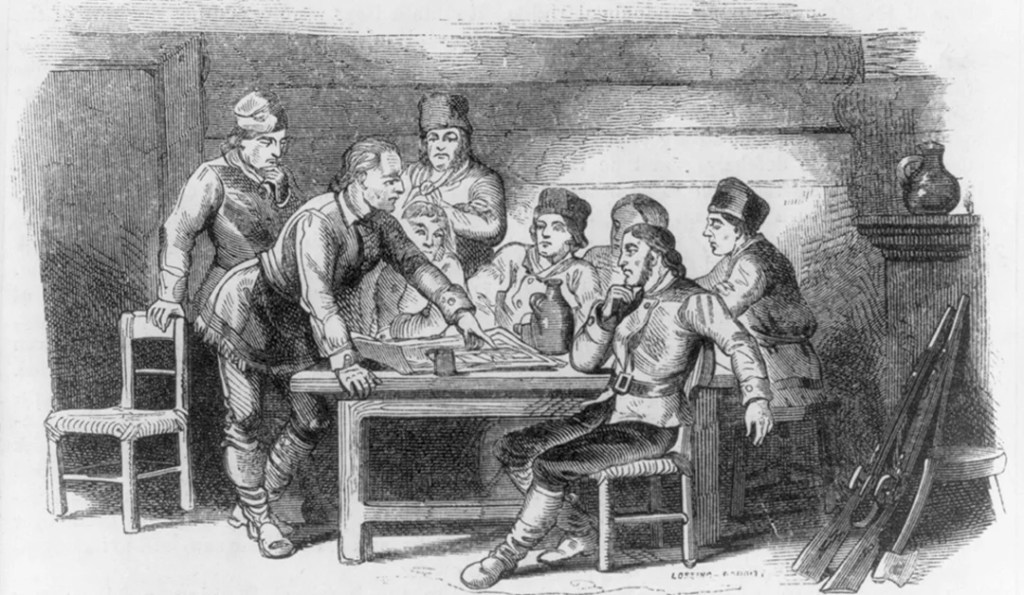
Mary of Burgundy (1458–1482)
Attributed to Michael Pacher
File:Mary of Burgundy (1458–1482), by Netherlandish or South German School of the late 15th Century.jpg
https://en.wikipedia.org/wiki/Mary_of_Burgundy#/media/File:Mary_of_Burgundy_(1458–1482),_by_Netherlandish_or_South_German_School_of_the_late_15th_Century.jpg
Note: For her portrait.
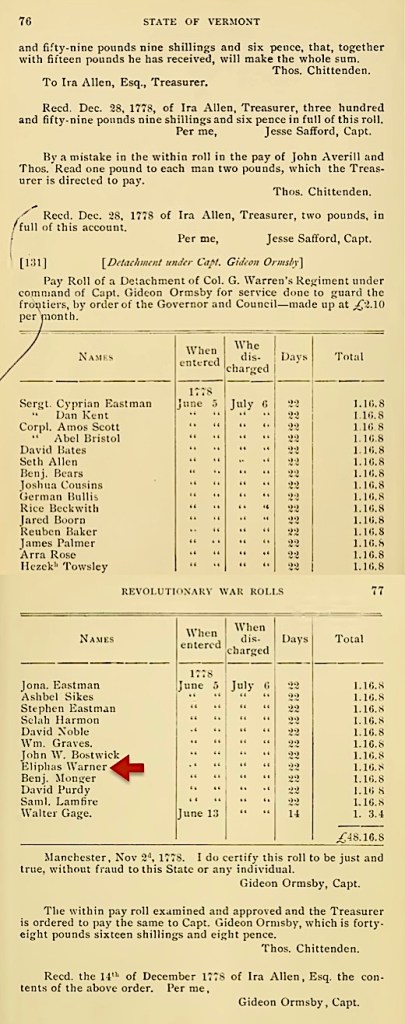
Mary of Burgundy
https://en.wikipedia.org/wiki/Mary_of_Burgundy

Ficheiro:Barend van Orley – Portrait of Charles V – Google Art Project.jpg
by Bernaert van Orley, circa 1515
https://pt.m.wikipedia.org/wiki/Ficheiro:Barend_van_Orley_-_Portrait_of_Charles_V_-_Google_Art_Project.jpg
Note: For his portrait.
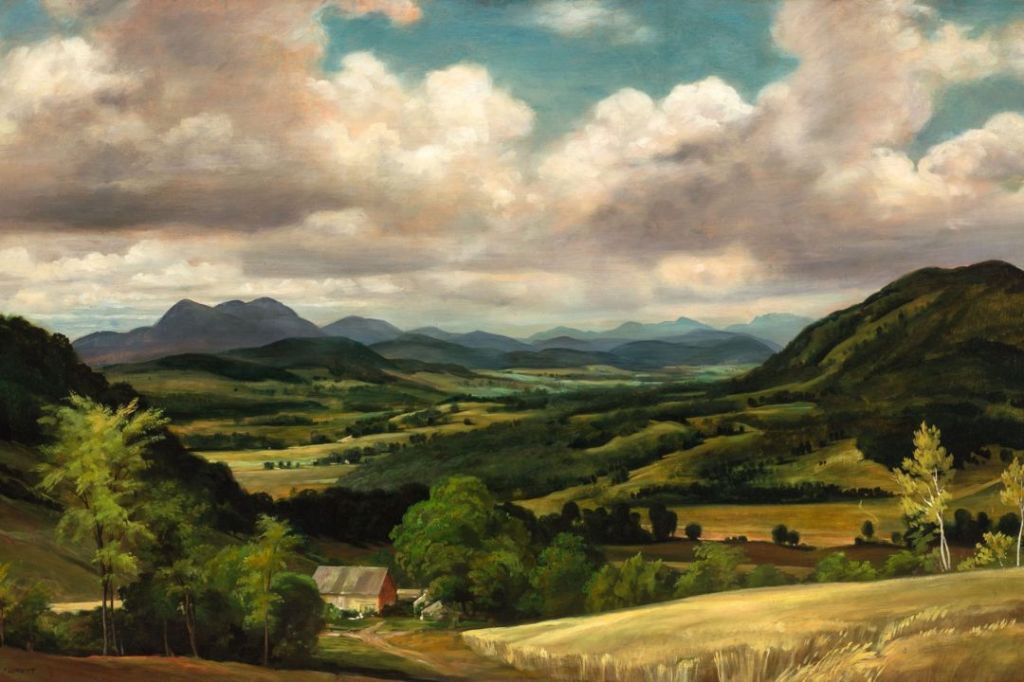
Charles V, Holy Roman Emperor
https://en.wikipedia.org/wiki/Charles_V,_Holy_Roman_Emperor

The Most Remarkable Lives of Jan Jansen and his son Anthony
A Brief History of the Netherlands (map)
By Brian A. Smith, D.C.
https://ia801604.us.archive.org/32/items/2013JanAndAnthonyJansenPublic/2013 Jan and Anthony Jansen public.pdf
Book page: 3/145
Note: For the map.

History Maps
Part of the Holy Roman Empire
https://history-maps.com/story/History-of-the-Netherlands
History of the Netherlands, 5000 BCE – 2024

Habsburg Netherlands
https://en.wikipedia.org/wiki/Habsburg_Netherlands

Spanish Netherlands
https://en.wikipedia.org/wiki/Spanish_Netherlands

The Dutch Revolt and the 80 Years War

(3) — five records

The Battle of Gibraltar, 1607
by Cornelis Claesz van Wieringen, circa 1621
File:Slag bij Gibraltar in 1607 Het ontploffen van het Spaanse admiraalsschip tijdens de zeeslag bij Gibraltar, 25 april 1607, SK-A-2163.jpg

History Maps
The Dutch Revolt
https://history-maps.com/story/History-of-the-Netherlands
History of the Netherlands, 5000 BCE – 2024

Netherlands Church History
https://www.familysearch.org/en/wiki/Netherlands_Church_History

The killing of Oudewater (Netherlands) Spanish troops murder al civilisans after a siege during the eighty years war.
https://en.wikipedia.org/wiki/Siege_of_Oudewater_(1575)#/media/File:Oudewater_moord.jpg
Note: For the The Oudewater massacre… image.

Siege of Oudewater (1575)
https://en.wikipedia.org/wiki/Siege_of_Oudewater_(1575)#:~:text=II of Spain.-,Siege and massacre,leading to a major conflagration.

The Dutch Golden Age and The United East India Company

(4) — eight records

The Syndics of the Drapers’ Guild
by Rembrandt, 1662
File:Rembrandt – De Staalmeesters- het college van staalmeesters (waardijns) van het Amsterdamse lakenbereidersgilde – Google Art Project.jpg

The flag of the Dutch East India Company.

Dutch East India Company
https://en.wikipedia.org/wiki/Dutch_East_India_Company#:~:text=In%20Dutch%2C%20the%20name%20of,the%20United%20East%20India%20Company).

Diana Muir Appelbaum
(We are posting this essay by Koenraad Wolter Swart (1916—1992) both because it is still useful and in order to spare would-be readers the eye strain that results from reading it on microfiche).
Miracle of the Dutch Republic
By K. W. Swart
Professor of Dutch History and Institutions in the University of London
An Inaugural Lecture Delivered at University College London on
November 6, 1967
http://www.dianamuirappelbaum.com/?p=583

Footnotes for the Dutch East India Company artifacts images:
Christie’s
An Arita Dish Commissioned by the Dutch East India Company
Edo Period, Late 17th Century
https://onlineonly.christies.com/s/japanese-art-english-court/arita-dish-commissioned-dutch-east-india-company-39/13671

The Arms of the Dutch East India Company and of the Town of Batavia,
Jeronimus Becx (II), 1651
https://www.rijksmuseum.nl/en/collection/SK-A-4643

Logo of the Amsterdam Chamber of the Dutch East India Company
https://en.m.wikipedia.org/wiki/File:VOC-Amsterdam.svg

Dutch East India Company, Gelderland (1726-1793), Duit(C) coins
https://www.educationalcoin.com/product/dutch-east-india-company-gelderland-1726-1793-duitc/

Batavia Dutch East India Company Ship Replica
https://www.amazon.com/Old-Modern-Handicrafts-Batavia-Collectible/dp/B00OP971EA

The Second Path: Religious Persecution

(5) — seven records

Revised History of Harlem (City of New York): Its Origin and Early Annals
by James Riker
https://archive.org/details/revisedhistoryh00unkngoog/page/n12/mode/2up
Book pages: 35-36, Digital pages: 34-36/907
Note: For general biographical information.

The Persecution of Huguenots in France Before the Edict of Nantes, 1598.
Wood engraving, late 19th century
https://www.walmart.com/ip/Huguenot-Persecution-Nthe-Persecution-Of-Huguenots-In-France-Before-The-Edict-Of-Nantes-1598-Wood-Engraving-Late-19Th-Century-Poster/508758362
Note: For The Persecution of Huguenots image.

Genealogy of The De Veaux Family : Introducing the Numerous Forms of Spelling the Name by Various Branches and Generations in the Past Eleven Hundred Years
by Thomas Farrington De Voe, 1811-1892
https://archive.org/details/genealogyofdevea00thom/page/n7/mode/2up

The International Institute of Genealogical Studies
England History of Huguenots, Walloons, Flemish Religions
https://www.familysearch.org/en/wiki/England_History_of_Huguenots,_Walloons,_Flemish_Religions_-_International_Institute

Genealogy Magazine.com
Belgian Migrations: Walloons Arrived Early in America
https://www.genealogymagazine.com/belgian-migrations-walloons-arrived-early-in-america/
and
Landing of the Walloons at Albany
https://digitalcollections.nypl.org/items/510d47e0-f393-a3d9-e040-e00a18064a99
Note: For the Landing of the Walloons at Albany image.

The National Archives
A ‘round robin’ from Walloon emigrants
https://www.nationalarchives.gov.uk/education/resources/huguenots-in-england/huguenot-migrants-in-england-source-3a/

The Massacre of St. Bartholomew in Paris

(6) — three records

St. Bartholomew’s Day Massacre
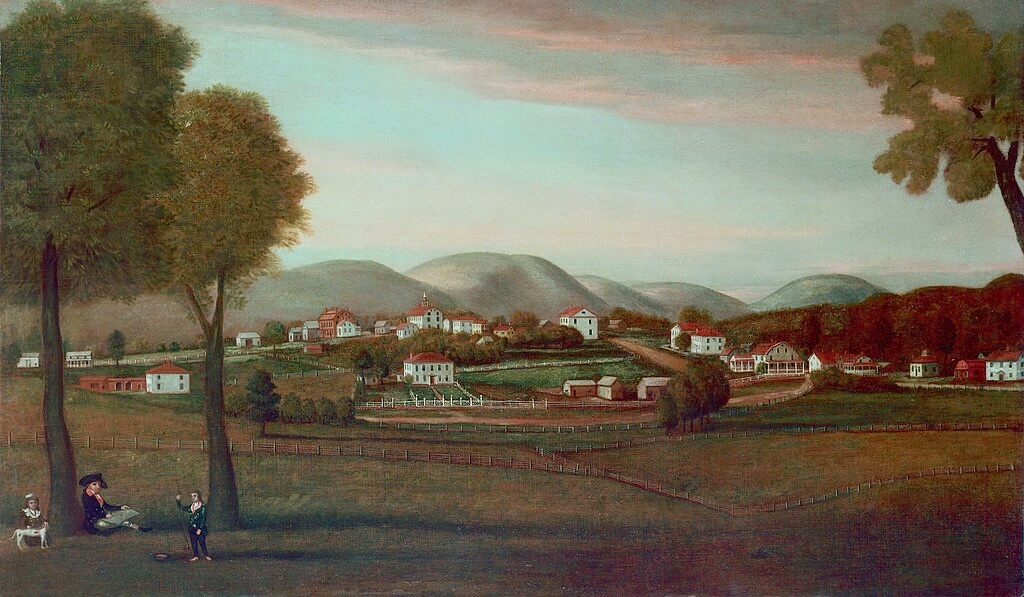
by François Dubois, a Huguenot painter who fled France after the massacre.
https://commons.wikimedia.org/wiki/File:La_masacre_de_San_Bartolomé,_por_François_Dubois.jpg
Note: For the St. Bartholomew’s Day image.

French Wars of Religion
https://en.wikipedia.org/wiki/French_Wars_of_Religion

Is it just us, or does Catherine de Medici remind you of this famous Disney villain?

Catherine de Medici Gazing at Protestants in the Aftermath of the Massacre of St. Bartholomew
by Édouard Debat-Ponsan, 1880
https://pt.m.wikipedia.org/wiki/Ficheiro:Debat-Ponsan-matin-Louvre.jpg
Note: For the Catherine de Medici image.

The Global Diaspora of The Huguenots and Their Protestant Allies

(7) — four records

Vocabulary.com
Diaspora definition
https://www.vocabulary.com/dictionary/diaspora#:~:text=The%20term%20diaspora%20comes%20from,their%20culture%20as%20they%20go.

Historic UK
The Huguenots – England’s First Refugees
https://www.historic-uk.com/HistoryUK/HistoryofEngland/The-Huguenots/

The Huguenot Society of America
The Huguenots in America
https://www.huguenotsocietyofamerica.org/history/huguenot-history/

Historie Der Gereformeerde Kerken Van Vrankryk
(History of the Reformed Churches of Vrankryk)
by Élie Benoist, 1696
https://commons.wikimedia.org/wiki/File:Houghton_Typ_632.96.202_-_Historie_Der_Gereformeerde_Kerken_Van_Vrankryk.jpg
Note: For the “All The Ways to Leave France” image.

The DeVoe Line, A Narrative — Eight

This is Chapter Eight of eleven. This chapter of our family’s history takes place almost entirely within Saratoga County and the adjacent Washington County in New York State. Our 3x Great Grandparents Peter M. Devoe and Alida Shaw had a large family and much prosperity during a period of time which saw the advent of The Civil War.

Introduction — A Family of the 19th Century

Some of our ancestors didn’t move around very much. This is likely due to the fact that many of them were farmers and they owned land. Peter and Alida lived most of their lives within (no more than) a thirty mile radius (48 km) of where they were born.

Excerpt showing Saratoga and Washington counties, from
the Atlas & Asher New Topographical Gazetteer of New York, circa 1871.

When they married, our ancestors lived in Halfmoon — but were married in the Dutch Reformed Church located in the nearby hamlet of Boght “Some of the earliest European settlements in Albany County were located in the general Boght Corners area [a hamlet of the present-day town of Colonie, New York],which is usually cited as ‘The Boght’ or ‘The Boght of the Kahoos’ in early colonial documents. ‘Boght’ is a corruption of the Old Dutch word for “bay” or “bend” referring to the bend in the Mohawk River... While hamlets in New York do not have specifically demarcated borders, the corners in the name itself is from the four corners created by the intersection of Boght Road and [present-day]US Route 9.

The first church in this area, the Reformed Dutch Church of the Boght, was established in 1781. The church, which was the first north of the city of Albany, was established on petition from the citizens of that city. The church was an offspring of the Niskayuna Reformed Church due to the common pastorate; this union of the two churches ended in 1803. The church worship was conducted in the Dutch language until the first decade of the 19th century. (Wikipedia) (1)

Peter M. Devoe and Alida Shaw Marry

Marriage of Peter M. Devoe to Alida Shaw, 1829, (This is a 20th century transcription due to being a typewritten entry). Bought U.S. Dutch Reformed Church, Boght, Albany, New York
Background image: Middle Dutch Church, New York City, by William Burgis.
(Courtesy of wikimedia.org).

Peter M. DeVoe was the eleventh of twelve children in the family, born at home in Saratoga County, New York on March 1, 1807. He died on December 26, 1888 in Easton, Washington County, New York. Peter M. Devoe married Alida [or Elida] Shaw on January 22, 1829 in Boght, Albany County, New. York at the Dutch Reformed Church. She was born on April 10, 1812, in Rensselaer County, New York, the daughter of Orman Shaw and Elizabeth ________ (Last name unknown). Alida died on February 17, 1896, in Easton, Washington County, New York. We observed that in some documents, she is also named as Olive, which may have been a nick name.

They had eight children:

  • Clarissa (DeVoe) Doty, born May 1, 1830 — died December 14, 1865
  • Lewis DeVoe, born May 31, 1831 — died January 26, 1901
  • Norman DeVoe, born 1832 — died October 16, 1900
  • Peter A. DeVoe, born June 23, 1834 — died October 31, 1909
    (We are descended from Peter A.)
  • Charles DeVoe, born 1837 — died December 22, 1886
  • Chauncey DeVoe, born 1838 — died November 7, 1902
  • Esther (DeVoe) Norton, born 1840 — died date unknown
  • Sarah C. (DeVoe) Cozzens, born December 25, 1842 — died March 5, 1911

We have not delineated the marriages for all of these siblings, but in the footnotes for this section we have included a chart created by our Grandmother Lulu Mae (DeVoe) Gore, where she has noted the spousal names and some of their children. This chart is also found in the footnotes for The DeVoe Line, A Narrative — Eleven. (2)

The Hudson River Valley near Hudson, New York, ca. 1850.
(Image courtesy of Media Storehouse).

Putting On Our Detective Hats When Looking at the Early Census Materials

As we have done research on our family lines, we have always found census material to be helpful, but also sometimes problematic. Early Federal census material lacks much information and as just discussed, we end up having to put on our detective hats to take a look at what was likely going on.

After we were able to solve the mysteries of the parent’s names and the names of all the siblings through our analysis of the Will of Elias DeVoe… We continued to be confounded by a lack of many surviving early records which mention Peter M. Devoe. For a time, we even made comments about him just magically appearing in 1829 to marry Alida Shaw.

The 1840 United States Federal Census
The sixth Federal Census of the United States was done in 1840. The census began on June 1, 1840, and lasted six months. We did locate this particular census record, which shows him already living in the community of Easton, Washington County, New York.

Compiled sample for Peter M. Devoe — United States Federal Census of 1840.

From this Federal census we can learn that including him, listed are 10 people total:

  • 2 boys under 5 years old: Charles, Chauncey
  • 3 boys from 5 to 10 years old: Lewis, Norman, and Peter A.
  • 1 man from 30 to 40 years old: Peter M. — the Head of Household
  • 1 man from 50 to 60 years old: unknown male, perhaps Maty?
  • 1 girl under 5 years old: Esther
  • 1 girl 10 to 15 years old: Clarissa
  • 1 woman 20 to 30 years old: the mother Alida

Here is an example where we have to interpret data: The general guidance on census information is this: you don’t know who answered the questions… you don’t know who was at the door… you don’t know what they knew or didn’t know… you don’t know if perhaps they were guessing, in a hurry, etc., etc.

Author Thomas Halliday describes this type of analysis, when he writes —

“Everything that we will see is nonetheless grounded in fact, either directly observable… [or] strongly inferred, or, where our knowledge is incomplete, plausible based on what we can say for sure.”

Thomas Halliday,
from his book “Otherlands, A Journey Through Earth’s Extinct Worlds”

We see that there is a girl under 5 years old living in the home, yet we have no record of a daughter (Esther) being born until the next year (1841). Yet it makes the most sense to us that this is the daughter Esther — even though some later records say 1841 is her birth year. Since we do not have an actual birth record for her, it’s more than likely that she was born in 1840, perhaps late in the year.

The Consequences of the 1911 New York State Fire
New York State conducted their own census every five years, starting in 1825. However, we learned from the New York Genealogical and Biographical Society that: “The first three state censuses for New York are difficult to access and largely unavailable online…” (1825, 1835, and 1845) “Most records have been lost—due to the 1911 State Capitol fire, all copies of this state census held by New York at that time were completely destroyed.

On March 29, 1911, the collections of the New York State Library,
Manuscripts and Special Collections, Albany, New York, burned entirely. State census records from 1825, 1835, and 1845 were lost.

The 1850 Federal Census
By the 1850 Federal Census, (the seventh census) we are able to account for one additional daughter: Sarah, born in December 1842. Being pretty good detectives, we also started to notice something unusual in the census material starting around 1850. We noticed that a Matey Devoe is listed as being age 60, and a male. We had no accounting as to who this person was.

1850 United States Federal Census — Line 17, Matey (male)
Note: The age is noted incorrectly as 60, (the actual age is 65).

The 1855 New York State Census
We learn (again) from the New York Genealogical and Biographical Society that: “The 1855 New York state census is notable because it was the first to record the names of every individual in the household. It also asked about the relationship of each family member to the head of the household—something that was not asked in the federal census until 1880. The 1855 New York state census also provides the length of time that people had lived in their towns or cities as well as their state or country of origin—this is particularly helpful for tracing immigrant ancestors.”

Extract from the New York State Census of 1855

What caught our attention were two notes listed on line 15, next to the name Maty Devoe — this description noted Maty as being 70 years old, and also a hermaphrodite (known today as intersex), and as a brother to Peter M.

Detail from line 15 of the New York State Census of 1855.

This was a surprise, but a pleasant one and after we spent much time talking about it, it made sense. We had always wondered who this person was and why their name had different spellings and genders in various documents over time.

Marytje Defoe’s birth record in the
U.S., Dutch Reformed Church Records in Selected States, 1639-1989,
Schenectady, Berne, and Schaghticoke, Book 5 (hand transcription).

We believe that Maty is Peter M. Devoe’s oldest sister Marytje, who was born on April 17, 1786. (Please see The DeVoe Line, A Narrative — Six). Also, we have come to believe that Marytje Devoe / Maty Devoe never married and lived their life in the home of relatives. It seems that at first Marytje lived with her parents Martinus and Maria Devoe of Halfmoon, until they passed away in the 1830s. From the 1840s onward, as Maty Devoe, they lived in the home of Peter M. Devoe and his wife Elida in Easton.

The 1860 Federal Census
The eighth census of the United States took place on June 1, 1860 and took five months. We noticed several important changes in the home — Peter M. and his wife Elida still lived there. Their son Norman also lived there along with his wife Julia. Peter and Elida’s daughters Sarah (aged 17), and Elida (aged 3), were still at home.

Extract from the United States Federal Census of 1860.

Of note, it appears that Marytje / Maty is still living in the home, but now is identified as being named Mita… [Is this a phonetic spelling? One thing to interject here is that census takers were often wrong in how to spell someone’s name.] Interestingly, they are listed with a small ‘f’ for female gender, when five years earlier in the New York State Census of 1855, they were listed a hermaphrodite, and a brother. Perhaps the federal form (and/or the census taker) had no way to reconcile hermaphroditic, intersex information?

This is the last record we see of Marytje /Maty/ Mita, since they are not on the 1865 New York State Census. We believe that they must have passed on before 1865, having lived a long life. (3)

Intersex and Hermaphroditic People

Please note that this section contains an image of sensitive historical medical photography.

We were curious about how our intersex ancestor would have been perceived and how they would have lived during a much earlier era. It seemed to us, even though we cannot document this, that we observed Marytje /Maty as being loved by their family — certainly through the fact that they were always part of either their parent’s, or their brother’s homes.

From the John Hopkins University Press we read: “In early America, there was no surgery to “correct” genital anomalies; people lived with whatever bodies they were born with, in whichever gender that most suited them—though not without worry that their difference would be found out, particularly if they sometimes crossed the gender divide in their daily lives.”

Hermaphrodite (Nadar) is a series of medical photographs of a young intersex person, who had a male build and stature and may have been assigned female or self-identified as female.
Photo taken by the French photographer Nadar (real name Gaspard-Félix Tournachon) in 1860.
(Image courtesy of wikipedia.org).

Having focused on the word “hermaphrodite” found in the census material, we came to understand the need for a more contemporary term. From Wikipedia: “Terms used to describe intersex people are contested, and change over time and place. Intersex people were previously referred to as “hermaphrodites” or “congenital eunuchs”. In the 19th and 20th centuries, some medical experts devised new nomenclature in an attempt to classify the characteristics that they had observed… terms including the word “hermaphrodite” are considered to be misleading, stigmatizing, and scientifically specious in reference to humans… Some people with intersex traits use the term “intersex”, and some prefer other language.” (4)

Peter and Alida Devoe Owned Much Property

The last census in which we see Peter M. Devoe is the Federal Census from 1800. We observe that he and his wife Elida are the only ones living at home, but his son Chauncey and wife Calpurna appear to be living next door. Both men are noted as Farmers, and both women are Keeping house.

Extract from the United States Federal Census of 1880.

When Peter M. Devoe died on December 26, 1888, he had left a Last Will and Testament*, with both monies and land distributed to his wife Alida and amongst his various children. We noticed that he had to sign his Will with an “X” which indicated that he had not received any formal education. His Will was dated June 29, 1881, and probated on August 16, 1889 — (Please see the footnotes).

We found the following map, which is the only resource we have located, which shows Peter M. Devoe’s properties in Easton, Washington County, on the Hudson River. We know that he also owned property in Halfmoon, Saratoga County which was right next door.

Inset detail indicating the two properties owned by Peter M. Devoe in the 1850s in Easton, Washington County, New York. (Image courtesy of the Library of Congress).
Map of Washington County, New York
by Morris Levy, James D. Scott, Robert Pearsall Smith, Published in Philadelphia in 1853.

Being a farmer, it seems that he left a substantial estate. For example: In the Will he left his son Norman the oddly particular amount of $2,763 dollars. Today, that dollar value would be $91,345 — and Norman was just one of many people named… Lands were also distributed and the eventual administration of these ended up figuring into a lawsuit which the oldest son, Lewis Devoe, brought to the New York Supreme Court ten years later in 1899.

We cannot verify if Peter M. Devoe had received any property from his father Martinus Devoe, when Martinus died circa 1831-32, but… We do know from Lewis’s court paperwork that Peter M. was already acquiring land starting in the 1830s, and that he held on to that land for fifty years.

Sample document which shows the values of Peter M. Devoe’s land holdings in Washington County, New York, as of June 3, 1880.

Many years later our generation heard family stories, in which it was rumored that Peter M. Devoe had much money — but — he also had a lot of children. So when it came down to our 2x Great Grandfather, Peter A. Devoe, there weren’t many resources left. It seems that this doesn’t ring quite true because Peter A. received $1,150 in cash when his father died, which was a substantial amount at that time ($38,019 today). Peter A. also received property even though he had relocated to Ohio decades earlier. (5)

The Lewis Devoe New York State Supreme Court Case

What we have been able to discern from these documents from over 100 years ago, is that Lewis was looking into the records about how different pieces of his family’s land were being assessed in Washington County, New York. It is interesting to note that this occurred nearly ten years after his father Peter M. Devoe had passed away, and also after his mother Alida had passed in 1896.

Compiled Excerpt from the Washington Grantee index 1891-1900 vol 7. 

Observation: Perhaps the death of his mother brought new information to light? Apparently Lewis had strong concerns about what he learned, because he then brought a suit against his siblings that went all the way to the New York State Supreme Court. The gist of all this brouhaha was this: It seems that he was quite upset that properties had been rented to tenants, then monies collected, and… well… Where was the accounting of this? Where did the money go to? To the children of the siblings?

Exterior folder, Page One for the documents relating to the 1899 Lewis Devoe lawsuit.
(Family documents, — please see the footnotes).

What was the outcome of this case? To be certain, we haven’t been able to locate documents which provide resolution, but it is quite likely that it was settled amongst the various family members.

Except for the two siblings who had died in earlier years: Clarissa (DeVoe) Doty, who passed away in 1865, and Charles Devoe, who passed in 1886 — most of the children of Peter M. and Alida Devoe all passed away in the course of the next twelve years. As follows: Lewis (1901), Norman (1900), Peter A. (1909), Chauncey (1902), Esther (unknown), and Sarah (1911).

The Will Found, painting by George Smith, 1868
(Image courtesy of MutualArt).

In the next chapter we will be writing about our 2x Great Grandfather, Peter A. DeVoe, and his life in Ohio. He was very important and influential in the life of our Grandmother Lulu Mae (DeVoe) Gore. (6)

Following are the footnotes for the Primary Source Materials,
Notes, and Observations

Introduction — A Family of the 19th Century 

(1) — three records

Boght Corners, New York
https://en.wikipedia.org/wiki/Boght_Corners,_New_York

Watervliet (town), New York
https://en.wikipedia.org/wiki/Watervliet_(town),_New_York
Note: Watervliet is now known in the present day as Colonie.

Cover page for Atlas & Asher New Topographical Gazetteer of New York, circa 1871

Atlas & Asher New Topographical Gazetteer of New York, circa 1871
https://digitalcollections.nypl.org/items/510d47e3-1c74-a3d9-e040-e00a18064a99/book?parent=49161ec0-c5f6-012f-15b7-58d385a7bc34#page/2/mode/1up

Peter M. Devoe and Alida Shaw Marry

(2) — fourteen records

Maps of Antiquity
1871 – Warren, Washington, and Saratoga Counties – Antique Map
https://mapsofantiquity.com/products/warren-washington-and-saratoga-counties-asher-and-adams-nyo523
Note: For the map image.

Peter Devoe
in the U.S., Dutch Reformed Church Records in Selected States, 1639-1989

New York > Bought > Bought, Book 6
https://www.ancestry.com/discoveryui-content/view/216615:6961
Book page: 13, Digital page: 59/105, Entry 1.

Middle Dutch Church, New York City, by William Burgis
https://commons.wikimedia.org/wiki/File:Middle_Dutch_Church,_New_York_City,_by_William_Burgis.jpg
Note: For background image.

Clarissa Doty
https://www.findagrave.com/memorial/117887685/clarissa-doty?
and
Claracy Devorux
in the New York, U.S., County Marriage Records, 1847-1849, 1907-1936

https://www.ancestry.com/search/collections/61377/records/900482362?tid=&pid=&queryId=b5d3795d-78f4-416b-8f9f-b43b80be9baa&_phsrc=UnS9&_phstart=successSource
Washington > 1841-1908
Digital page: 41/428, Left column, entry 1.

Doty-Doten Family in America
Descendants of Edward Doty, an Emigrant by the Mayflower, 1620

by Ethan Allan Doty, 1897
https://archive.org/details/dotydotenfamilyi00doty/page/562/mode/2up
Book pages: 562, Digital pages: 562 /1048
Note 1: Clarissa DeVoe is also recoded in this history which has been used frequently in our history of The Doty Line — A Narrative. She and her husband Jacob N. Doty are listed in entry 7401.
Note 2: The book index has her listed as entry 7403, which is an error.

As explained by Susan Deanna Bond in an email dated August 9, 2025:

Lewis DeVoe
https://www.findagrave.com/memorial/120850897/lewis-devoe

Norman Devoe
https://www.findagrave.com/memorial/95566454/norman-devoe

Peter A. DeVoe
Note: We have written extensively about the life of Peter A. DeVoe in the next chapter. (Please see The DeVoe Line, A Narrative — Nine).

Charles DeVoe
in the U.S., Find a Grave Index, 1600s-Current

https://www.ancestry.com/discoveryui-content/view/133711122:60525?tid=&pid=&queryId=0630ab78-d8a5-459e-b4a6-5124ba69049a&_phsrc=FsV3&_phstart=successSource
and
Charles Devoe
https://www.findagrave.com/memorial/163938371/charles-devoe

Chauncey DeVoe
https://www.findagrave.com/memorial/179186338/chauncey-devoe

Esther DeVoe
Census – New York State Census, 1875
https://www.familysearch.org/ark:/61903/1:1:VNVQ-CT8
Book page: 10, Digital page: 141/488 Entry line 10
Note: We know her married name is Norton through Peter M. Devoe’s Will.

Sarah C. DeVoe Cozzens
https://www.findagrave.com/memorial/84524682/sarah-c-cozzens

Media Storehouse
The Hudson River Valley Near Hudson (Looking Toward Albany, New York)
by Unknown Painter, American School, circa 1850
https://www.mediastorehouse.com.au/heritage-images/hudson-river-valley-near-hudson-new-york-ca-19843763.html
Note: For the landscape image.

Lulu Mae Devoe Gore’s handwritten genealogy notes as she diagrammed her family relationships. (Family epherma).

Putting On Our Detective Hats When Looking at the Early Census Materials

(3) — eleven records

The National Archives
1840 Census Records
https://www.archives.gov/research/census/1840

Peter M Daves
in the 1840 United States Federal Census

New York > Washington > Easton
https://www.ancestry.com/discoveryui-content/view/1616065:8057?tid=&pid=&queryId=326ef017-2790-44e9-921e-30cf4aca7577&_phsrc=Zxc2&_phstart=successSource
Book page: 142 (or 266), Digital page: 31/40, Entry 12 from the bottom.

Cover for the book Otherlands by Thomas Halliday.

Otherlands, A Journey Through Earth’s Extinct Worlds
or
Otherlands, A World in the Making
by Thomas Halliday, 2022
ISBN-10: ‎ 0593132882, ISBN-13: ‎ 978-0593132883

Fire at the New York State Library
https://www.newyorkfamilyhistory.org/blog/fire-new-york-state-library

Peter M Devoe
in the 1850 United States Federal Census

https://www.ancestry.com/discoveryui-content/view/8764443:8054?tid=&pid=&queryId=d9214997-668a-4c15-919e-cc751384d5b2&_phsrc=Rxw29&_phstart=successSource
Book page: 364, Digital page: 37/77, Entries 8 through 18.
Note: Entry 18 lists a 24 year old woman named Mary Augen, from Ireland. We believe that she may have been a servant girl.

The New York Genealogical and Biographical Society
New York State Census Records Online — 1855 New York State Census
https://www.newyorkfamilyhistory.org/subject-guide/new-york-state-census-records-online#:~:text=1825%2C%201835%2C%20and%201845%20New%20York%20State%20Censuses&text=In%20some%20cases%2C%20counties%20may,by%20checking%20with%20county%20repositories.

Peter M Devoe
in the New York, U.S., State Census, 1855

https://www.ancestry.com/discoveryui-content/view/1654641341:7181?tid=&pid=&queryId=202e327c-c66c-478c-9b6b-4ba4ad93da39&_phsrc=Rxw12&_phstart=successSource
Digital page: 4/32, Left page, entries 7 through 15.
Notes: Of particular importance is entry 16 — Maty Devoe, listed as a brother of Peter M. Devoe, aged 70 years, and who is noted as an hermaphrodite.

Martynus Devoe
in the U.S., Dutch Reformed Church Records in Selected States, 1639-1989

New York > Schaghticoke > Schenectady, Berne, and Schaghticoke, Book 5
https://www.ancestry.com/discoveryui-content/view/150048134:6961
Book page: 393, Digital page: 118/209, Entry 4 from the page bottom.
Note: The record for their daughter Marytje, born on April 17, 1786.
and here:
Records for 1786
Holland Society Archives > 10 Research Collections > 4 Collegiate / Dutch Reformed Church Collections > 3 Dutch Church Records, 42037 > Book 05 – Schenectady Berne Schaghticoke
https://hsny.localarchives.net/?a=d&d=A-RG10-SG04-S03-Bk-05-Schenectady-Berne-Schaghticoke.1.153&e=——-en-20–1–txt-txIN%7ctxTA%7ctxCO%7ctxTY%7ctxTI%7ctxRG%7ctxSG%7ctxSE%7ctxSB%7ctxCT%7ctxIE%7ctxIT%7ctxTE%7ctxLA%7ctxSU%7ctxSP%7ctxDS%7ctxAD%7ctxPR%7ctxTR%7ctxFI-Schenectady———-
Book page: 393, Digital page: Image 153, Entry 4 from the page bottom.

The United States Census Bureau
1860 Census: Population of the United States
https://www.census.gov/library/publications/1864/dec/1860a.html

Peter M Devoe
in the 1860 United States Federal Census

New York > Washington > Easton
https://www.ancestry.com/discoveryui-content/view/48630571:7667?tid=&pid=&queryId=35ec4bd5-43de-42e5-bb2e-505bfa1707e1&_phsrc=Rxw27&_phstart=successSource
Book page: 160, Digital page: 28/80, Entries 23 through 29.

Intersex and Hermaphroditic People

(4) — three records

Intersex People In The Past and Present:
Contemporary Advocacy in Historical Context
by Elizabeth Reis, Macaulay Honors College, City University of New York
https://www.press.jhu.edu/newsroom/intersex-people-past-and-present-contemporary-advocacy-historical-context
Note: Ms Reis is the author of Bodies In Doubt, An American History of Intersex

Intersex
https://en.wikipedia.org/wiki/Intersex

Self portrait in Smock Félix Nadar, photographer,
(Image courtesy of The Getty Center via commons.wikimedia.org).

Hermaphrodite (Nadar)
1860s medical photography by Nadar
https://en.wikipedia.org/wiki/Hermaphrodite_(Nadar)

Peter and Alida Devoe Owned Much Property

(5) — five records

Map of Washington County, New York Copy 1
by Morris Levy, James D. Scott, Robert Pearsall Smith
Published in Philadelphia in 1853
https://www.loc.gov/resource/g3803w.la000573/?r=0.043,-0.261,1.472,0.74,0
Note: At this link the map is zoomable for more detail.

Peter Devoe
Census – United States Census, 1880
https://www.familysearch.org/ark:/61903/1:1:MZNZ-9DY
Digital page: 141/898, Entries 27 through 30.

Peter M Deroe
in the New York, U.S., Wills and Probate Records, 1659-1999

Washington > Wills, Vol V-W, 1888-1892
https://www.ancestry.com/discoveryui-content/view/4806965:8800?tid=&pid=&queryId=5ac78e48-6b64-4511-8d11-0221dae472df&_phsrc=BYb9&_phstart=successSource
Book pages: 240-244 , Digital pages: 130-132/663
Notes: This record appears to be a handwritten transcription from the original document. Below is a typed transcription of the Will from the above file:
__________________________________________

I, Peter M. Devoe, of the town of Easton, in the County of Washington, State of New York, being of sound mind and memory, do make ordain, publish and declare this to be my last will and testament, that is to say:

FIRST — After all my lawful debts are paid and discharged, I give, devise and bequeath to my beloved wife, Alida Devoe, in lieu of ___r, the sole use and control of my homestead farm, with all the appurtenances thereto, including Stock, Horses, Wagons, Plows and all the farming implements, together with all the household furniture, Beds, Bedding, &c., during her natural life.

2nd — I give devise and bequeath to my grand-daughter, Anna Doty, one hundred (100) dollars.

3rd — After the death of my said wife, Alida. I give devise and bequeath to my sons Lewis, Norman, Peter, Charles, and Chauncey and to my daughters, Esther Norton and Sarrah C. Cozzens, and to their heirs, all the residue of my estate, both Real and Personal in whatever it may consist to be divided between them equally, share and share alike, including the several sums or portions heretofore Paid or given to them, which sums are as follows, viz: I have given to Lewis, fifteen hundred and fifty (1550) dollars, to Norman, twenty-seven hundred and sixty three (2763) dollars. For fifteen hundred (1500) Dollars of which I had a mortgage against him, which said mortgage I direct my executors to cancel and discharge after my death, without interest. To Peter, eleven hundred and fifty (1150) Dollars. Charles, three hundred (300) Dollars. To Chauncey, fourteen hundred and seventy (1470) dollars, and to my daughter, Sarah C. Cozzens two hundred (200) Dollars.

4th — I further direct that the premises known as the “Hemlock Grocery.” situated on the Champlain canal, between Schuyler Ville and Cove Ville, shall be included in the portion of Lewis, at the price of six hundred (600) dollars, and hereby give, devise and bequeath same unto him.

5th — 1 further direct that my farm of Forty (40) acres, situated in the town of Halfmoon and known as the “John Simmons” Farm shall be included in the portion of Chauncey, at the price of one thousand (1000) dollars, and I hereby give, devise and bequeath the same to him.

6th — I further direct that the income derived from all Moneys [sic], Notes, Bonds or other indences of debt of which I may be possessed at my death, shall be at the disposal of my said Wife, Alida, if she shall need the same for her support or comfort, and if the same shall not be needed by her as above stated, then I direct that my executors place the same at interest in some safe place, or invest in some safe securities to be accounted for at her decease.

7th and lastly —I further direct that no interest shall be charged on any of the sums paid or given to any my children above named.

Likewise, I make, constitute and appoint my said Wife Alida Devoe, and my son-in-law, Frederick Cozzens, at Easton and Greenwich, in Washington county respectively residing, to be executrix and executor of this my last Will and Testament. hereby revoking all former Wills by me made.

In Witness Whereof, I have hereunto subscribed my name and affixed my seal the 29th day of June in the year of our Lord one thousand eight hundred and eighty-one (1881).

PETER M.  X   DEVOE [his mark]

Witness to mark, J. T. Smith
The above instrument consisting of one sheet, was at the date thereof subscribed by Peter M. Devoe, in the presence of us and each he at the time of making such subscription, acknowledged that he made the same, and declared the said instrument so subscribed by him to be his last Will + Testament. Whereupon we then and there at his request and in his presence and in the presence of each other subscribed our names as witnesses hereto.

J. T. SMITH, residing at Schuyler Ville, N. Y.
Thomass Toohey, residing at Schuyler Ville, N. Y.

__________________________________________

Peter M Deroe
in the New York, U.S., Wills and Probate Records, 1659-1999

Washington > Minutes, Vol W-X, 1889-1891
https://www.ancestry.com/discoveryui-content/view/1724296:8800?tid=&pid=&queryId=78260969-514b-4129-bba5-ddbee3a9efea&_phsrc=BYb13&_phstart=successSource
Digital pages:
Note 1: Peter M. Devoe’s Will was entered into Probate until August 16, 1889. Note 2: Leading up to this there were additional notices filed with the Court on the following 1889 dates: January 14, February 18, April 8, August 16.

“$1 in 1888 is worth $33.06 today…”
https://www.in2013dollars.com/us/inflation/1888

The Lewis Devoe New York State Supreme Court Case

(6) — two records

Land – United States, New York Land Records, 1630-1975
Washington Grantee index 1891-1900 vol 7 

https://www.familysearch.org/ark:/61903/3:1:3QS7-89WC-KCWH?i=121&cc=2078654&personaUrl=%2Fark%3A%2F61903%2F1%3A1%3AC33P-G4PZ
Book page: 216, Digital page: 122/531
Note: Categorized as Land Assessment and Deed Records

Exterior folder, Page One for the documents relating to the 1899 Lewis Devoe lawsuit,
(Family documents).
Page Two for the documents relating to the 1899 Lewis Devoe lawsuit,
(Family documents).
Page Three for the documents relating to the 1899 Lewis Devoe lawsuit,
(Family documents).

MutualArt
The Will Found, by George Smith, 1868
https://www.mutualart.com/Artwork/THE-WILL-FOUND/A5D86394FC8B44A0
Note: For the genre painting.

The Gore Line, A Narrative — Five

This is Chapter Five of eight. In this chapter we will be writing about how our ancestors migrated first into New York State, and then how the next generation spread into other states and territories to the west, outside of New England. This was an era of much conflict with the French and Indian War, the War for Independence, and the War of 1812.

When we were younger, our Grandmother Lulu Gore lived near us for much of our childhood years. As a creative, can-do type of Grandma, she inspired us with her gardens, her interesting holiday decorations, and her interest in family history. We lived in a rural Ohio area, and Lulu was the wife of our Grandfather Harley Gore. He had passed away years before we were born. However, before his death she helped him begin his Gore genealogy work. Toward the end of his life in 1941, as he was dying of heart disease, he asked his wife if she could begin the story of his family’s origins. The work was never finished, (as genealogy work never is…) However, we feel honored to continue what she began.

Grandma Moses Certainly Knew How to Paint The Rural Life

Anna Mary Robertson Moses, also known as Grandma Moses was a prolific American painter of the last century. From Wikipedia: “Moses painted scenes of rural life from earlier days, which she called ‘old-timey’ New England landscapes. Moses said that she would ‘get an inspiration and start painting; then I’ll forget everything, everything except how things used to be and how to paint it so people will know how we used to live.’ ” Grandma Moses artwork has appeared in museums and galleries the world over, and often, she painted scenes of New England life.

Moving Day on the Farm, circa 1951.
Anna Mary Robertson Moses, known as ‘Grandma Moses’
(Courtesy of wikiart.org).

We know that our ancestors didn’t live in a pastoral, problem-free world, but the work of Anna May Robinson Moses inspires us to reconnect with our many ancestors who lived before our time. (1)

Elijah Gore Sr., and Desire Safford Have a Big Family

As the third son of Samuel Gore (3) and Desire (Safford) Gore, Elijah Gore Sr., was born on February 11, 1743 in Norwich, Connecticut Colony – died about 1794, probably in Halifax, Windham, Vermont. He married Sarah Little December 11, 1767 in Voluntown, Connecticut Colony, when he was 24 and she was 18. She was born September 5, 1749 in Sutton, Worcester, Massachusetts Colony – died August 26, 1805 in Halifax, Windham, Vermont, aged 60.

*see The 1790 “Census” of Vermont (below)

The birth registrations for Sarah Little and her older brother Moses.
Massachusetts, Town Clerk, Vital and Town Records, 1626-2001.

Sarah (Little) Gore was the daughter of Ezekiel and Margret (Fitts) Little. She is buried at Stafford Cemetery in Halifax , and it is assumed that Elijah is buried next to her, even though there is no headstone, nor record of his death.

Before 1779, Elijah Gore Sr. and his family left Connecticut for Vermont. They settled in Halifax, Windham (county), Vermont. Here he owned land located on Vermont’s southern border with Massachusetts. As is often the case, as pioneers moved from place to place they named their new towns and counties after the places they had previously lived. As a result, Windham County is in both Connecticut, and Vermont. Some of their family records also cite the adjacent location of Guilford township, which borders Halifax on its eastern side.

McClelland’s Map of Windham County, Vermont, circa 1856.
Inset image: Halifax and Guilford townships from Vermont’s southern border.
(Image courtesy of the Library of Congress).

Elijah and Sarah Gore had ten children. Their first born, Elijah Jr., was born in Killingly, Connecticut Colony, the next four were born in Voluntown, Connecticut Colony, and the rest in Halifax, Vermont Colony. (2)

  • Elijah Gore Jr., born (Killingly, Connecticut Colony), September 5, 1768 – died 1798
  • Ezekiel Gore, born November 20, 1770 – died May 14, 1847 in Bernardston, Franklin, Massachusetts
  • Margaret (Gore) Stafford, born February 10, 1773 – died March 10, 1864 in Monroe, Franklin, Massachusetts
  • Samuel Gore (4), born, April 10, 1775 – died August 10, 1815 in Belleville, Jefferson, New York (We are descended from Samuel 4).
  • Obadiah Gore born November 20, 1777 – death date unknown
  • Hannah (Gore) Starr, born September 1, 1779 – died 1819 in Halifax, Windham, Vermont
  • Lucy (Gore) Bennett, born May 21, 1781 – death date unknown
  • Daniel Gore, born October 30, 1783 and died April 10, 1859 in Monroe, Franklin, Massachusetts
  • Desire (Gore) Bixby, born November 8, 1786 – died December 8, 1833 in Guilford, Windham, Vermont
  • Sarah (Gore) Slater, born August 12, 1789 and died September 19, 1858 in Chardon, Geauga, Ohio

The French and Indian War

Like the previous narrative, The Gore Line — Four, wars were an elemental part of history in the new American Colonies. In 1666, France claimed ‘Vermont’ as part of New France. From Wikipedia: “French explorer Samuel de Champlain claimed the area of what is now Lake Champlain, giving the name, Verd Mont (Green Mountain) to the region he found, on a 1647 map”.

British forces under fire from the French and Indian forces.

“The French and Indian War (1754–1763) was a theater of the Seven Years’ War, which pitted the North American colonies of the British Empire against those of the French, each side being supported by various Native American tribes. At the start of the war, the French colonies had a population of roughly 60,000 settlers, compared with 2 million in the British colonies. The outnumbered French particularly depended on their native allies. French Canadians call it the guerre de la Conquête  — ‘War of the Conquest’.”

“Following France’s loss in the French and Indian War, the 1763 Treaty of Paris gave control of the whole region to the British... The end of the war brought new settlers to Vermont. The first settler of the grants was Samuel Robinson, who began clearing land in Bennington in 1761.. In the 28 years from 1763 to 1791, the non-Indian population of Vermont rose from 300 to 85,000”.

The Elijah Gore Family were living in a territory that was a disputed frontier, likely quite rugged, and similar enough to other areas their forebears had lived in — that it was filled with opportunity. Indeed, this family was living in ‘Vermont’ before Vermont was Vermont. (3)

Many People Had Tried to Claim Land in Vermont

It’s a complicated situation which played out over several decades and involved different English monarchs, Colonial Governors and various legal representatives, as the borders of Vermont were always in dispute — not only with the French, but also with the neighboring colonies, whose settlers seemed to continually want to expand their land holdings. Some of our ancestors probably got up in the morning and thought to themselves, “I feel a bit betwixt and between — wonder who is in charge today?

From Wikipedia, on the History of Vermont: “A fort at Crown Point had been built in 1759, and the road stretched across the Green Mountains from Springfield to Chimney Point, making traveling from the neighboring British colonies easier than ever before. Three colonies laid claim to the area. The Province of Massachusetts Bay claimed the land on the basis of the 1629 charter of the Massachusetts Bay Colony. The Province of New York claimed Vermont based on land granted to the Duke of York (later King James II & VII) in 1664. The Province of New Hampshire, whose western limits had never been determined, also claimed Vermont, in part based upon a decree of George II in 1740”.

Engraving depicting Ethan Allen at the Capture of Fort Ticonderoga in 1775.
(Image courtesy of Wikipedia.org).

There was a lot of acrimonious behavior: “In 1770, Ethan Allen—along with his brothers Ira and Levi, as well as Seth Warner—recruited an informal militia, the Green Mountain Boys, to protect the interests of the original New Hampshire settlers against the new migrants from New York… The American Revolution changed the face of these various conflicts after the battle of Bennington, Vermont became important. ‘The battle was a major strategic success for the American cause…’ ”

In Guilford, the township adjacent to Halifax, we learn from the website, We Are Vermont: “There was so much controversy between Yorkist and Vermont factions at the beginning of the Revolutionary War that 2 sets of officials were fighting for control in Guilford. The fighting escalated to a point where, in 1783, the Vermont government sent Ethan Allen with a Militia to the town to enforce martial law and collect taxes. This was known as the ‘Guilford War’ and eventually those who opposed Vermont’s laws moved to settle in New York.” (4)

*The ‘Census’ of Vermont

According to the National Archives: “Vermont became a state on March 4, 1791, [as the 14th state] so the census was taken in Vermont in 1791…” Specifically, “The Census was taken in Rhode Island on 7-5-1790 and in Vermont on 3-2-1791 [March 2, 1791], after they ratified the constitution.” [USGenWeb] Even though Vermont had a census, it was after everyone else’s census, and it continues to be mistakenly referred to as the “1790” census.

Our research has concluded that our ancestor Elijah Gore, even though we do not know his exact death date, was still alive after March 1791. We analyzed the census and believe this for the following reasons:

Heads of Families first Vermont census, Page 50, conducted on March 2, 1791.
  1. Their son Elijah Jr. married Susannah Barney on August 17, 1789, in nearby Guilford, so he was likely no longer living with his parents. (When the census was done, it would be highly improbable that his household numbers could match up with the 1791 census data.) Even though he has the same name as his father Elijah Sr., there is only one listing for a man with this name in Halifax Town, Windham County, Vermont, at this time.
  2. The Free White Males of 16 years and upward including heads of families would be Elijah Gore Sr., our grandfather, and his son Ezekiel, age 20 years.
  3. The categories show only one Free White Males under 16 years living in the home. That would likely be our ancestor Samuel Gore (4), who was 15 at the time.
  4. The Free White Females including heads of families indicates one person, who is likely our grandmother Sarah Little.
  5. All other free persons are everyone else who was living in the home. That number is 8, which corresponds exactly to everyone else, from Margaret through Sarah.
  6. Lastly, there are no slaves listed. We would expect this from people who identified as Puritans.

Unfortunately, there is scant evidence on the life activities of this ancestor. Elijah’s occupation is unknown, but it’s very likely, he was a farmer. (5)

Two Locations in Windham County?

This branch of the Gore family, owned land in Windham county in two adjacent townships: Halifax and Guilford. (This explains why family records intermix the two locations). The Official History of Guilford, Vermont, 1678-1961, cites the sale of land in Guilford, as illustrated below.

Note that Lot 168 is mentioned as being “on the Halifax line”. It also appears that Elijah Gore may have also owned a portion of Lot 167.

A plan of Guilford, drawn by Nathan Dwight, surveyor, in 1765, showing the original 50-acre and 100-acre lots. The names of many of the earliest settlers have been added, according to the best information available in existing records. From the Official History of Guilford, Vermont, 1678-1961, Digital pages, Inset: 309/585 and for Map: 396/610.

Even though these two townships are next door neighbors, because they were in disputed areas, the records are a bit complicated. Initially, the Royal Governor of New Hampshire, Benning Wentworth, was in charge of the area. From Wikipedia: “Halifax was the second town chartered, west of the Connecticut River on May 11, 1750 by New Hampshire Governor Benning Wentworth, meaning Halifax is the second oldest town in the state after Bennington…” and also, Guilford was “Chartered as Guilford New Hampshire in 1754… chartered [again] as Guilford, Vermont in 1791” when Vermont became an official state. Additionally, Guilford is “the most populous town in Vermont from 1791-1820”.

This may also help explain that our research turned up that Elijah Gore Sr. is recorded as having served in the American Revolutionary War, under the banner of Captain Samuel Fillbrick’s Company in (oddly enough) New Hampshire. From the Official history of Guilford, Vermont, 1678-1961, page 135:

This puzzled us at first, but it makes sense that some militias would be organized under the names of other Colonies, since Vermont did not technically exist until after the war, in 1791. (6)

Samuel Gore (4) and Rebeckah Barney Marry

Our ancestor, Samuel Gore (4), born April 10, 1775 Voluntown, Windham, Connecticut Colony – died August 10, 1815 in Belleville, Jefferson County, New York. He married Rebeckah Barney on February 22, 1798, in a ceremony at Halifax, Vermont, officiated by Darius Bullock. She was born April 6, 1782 Guilford, Windham, Vermont – died October 26, 1860 in Belleville, Jefferson, New York. They likely met socially through family or friends because their home townships, Halifax and Guilford, were adjacent to each other.

Rebeckah was the daughter of Deacon Edward Barney, who was a physician and Baptist Deacon. He was born August 18, 1749 in Rehoboth, Bristol, Massachusetts Colony – died August 9, 1839 in Ellisburg, Jefferson, New York. Rebeckah’s mother was Elizabeth Brown, born October 3, 1750 in Middletown, Middlesex, Connecticut – died March 5, 1793 in Guilford, Windham, Vermont. Elizabeth died in childbirth with her 12th pregnancy at the age of 42 — her newborn infant daughter Mabel was buried with her. [William Barney and Familysearch.com footnotes] Together the Barneys had twelve children, with Rebeckah being the 7th child.

Our 4x Great-Grandmother, Rebeckah (Barney) Gore.

Samuel (4) and Rebecca had seven children. The first five were born in Halifax, Windham, Vermont and the youngest two were born in Belleville, Jefferson County, New York.

Observation: Quite notable about this family group, is that these are the first ancestors of whom we have photographic portraits! We’ll meet their children in just a moment, but first, we need to discuss this newly invented portraiture… (7)

The Waking Century — The Advent of Portrait Photography

Suddenly, a new age was upon us…

“Getting painted portraits done used to be exclusive to families in the upper classes of society. That all changed when photography came into existence. In 1839, Robert Cornelius shot the first successful portrait, a self-portrait (a selfie, no less), using the venerable daguerreotype. Cornelius took advantage of the light outdoors to get a faster exposure. Sprinting out of his father’s shop, Robert held this pose for a whole minute before rushing back and putting the lens cap back on”.

“You see, shooting with the daguerreotype required between 3 to 15 minutes of exposure time depending on the available light — making portraiture incredibly impractical if not impossible.” [Soriano, A Brief History of Portrait Photography]

Robert Cornelius’s Self-Portrait, 1839.

Did you ever wonder why the ancestors in many old photographs are not smiling, which is our custom today? From Time Magazine: “Experts say that the deeper reason for the lack of smiles early on is that photography took guidance from pre-existing customs in painting—an art form in which many found grins uncouth and inappropriate for portraiture. Accordingly, high-end studio photographers would create an elegant setting and direct the subject how to behave, producing the staid expressions which are so familiar in 19th century photographs. The images they created were formal and befitted the expense of paying to have a portrait made, especially when that portrait might be the only image of someone. Indeed, these are the scant few images we have of these ancestors…

Observation: It is quite notable that this generation, born after the Revolutionary War, began heading west and moved into new states and territories: Iowa, Minnesota, New York, Ohio, and Wisconsin — none of them died in Vermont.

Shown below are each of the Samuel and Rebeckah Gore children, with their families and respective portraits.

Gratia (Gore) Cook, born September 27, 1800, Halifax, Windham, Vermont – died, February 16, 1876, Winneconne, Winnebago, Wisconsin.
Left to right: Gratia (Gore) Cook; her sons Eugene Kincaid Cook, and Malcolm G. Cook.

Hart Gore [twin of Clark], born December 13, 1802, Halifax, Windham, Vermont – died February 11, 1892, Rushford, Fillmore, Minnesota.
Top Row, left to right: Hart Gore, his wife Miranda Goodenough, their son Leslie Gore, Bottom row, left to right: Their son Charles W. Gore, his wife Martha E. (Bartley) Gore, and their daughter Mary Jeanette (Gore) Valentine.

Clark Gore [twin of Hart] born December 13, 1803 in Halifax, Windham, Vermont. He married Lydia Burge and they had three children: Martha Lydia Gore, Myron Gore, and Alice Gore.

Luke Gore, born April 1, 1805, Halifax, Windham, Vermont – died October 2, 1868, Newbury, Geauga, Ohio (We are descended from Luke.)
Top Row, left to right: Luke Gore, his second wife, Electa (Stanhope) Gore (our grandmother). Milan R. Gore,* Bottom row, left to right: Crockett Gore*, his wife Lois (Haven) Gore, and Crockett’s son Dana D. Gore.
*Milan and Crockett are the children of Luke Gore and his first wife: Mila Gore. She was born in 1813 in Halifax, Windham, Vermont – died September 29, 1848 in Newbury, Geauga, Ohio. Luke and Mila were first cousins.

Belinda (Gore) Barton, born July 15, 1807, Halifax, Windham, Vermont – died August 15, 1900, Madison, Lake, Ohio
Top row, left to right: Belinda (Gore) Barton, her husband Horace Barton, and their son Hanford Barton. Bottom row, left to right: Their daughter Frances (Barton) Cook, and her husband Eugene Kincaid Cook. Note: Frances (Barton) Cook married her first cousin Eugene Kincaid Cook [see Gratia (Gore) Cook above].

Susan (Gore) Bishop, born February 27, 1812, Belleville, Jefferson, New York – died August 15, 1897, Jefferson County, New York.
Left image: Susan (Gore) Bishop and Center image: Her daughter Emogene Matilda Birdy Bishop.

Mary Genette (Gore) Brayman, born June 18, 1814, Belleville, Jefferson, New York – died February 28, 1891, Farmington, Van Burn, Iowa.
Top Row, left to right: Mary Genette (Gore) Brayman, her daughter Victoria Icebenda (Brayman) Goodenough, and Victoria’s husband Gilbert Clark Goodenough. Bottom row, left to right: The Brayman children — their sons Andrew Jackson Brayman, Edward Barney Brayman, and their daughter Flora Arabella (Brayman) Orr. (8)

Ellisburgh, and Belleville, Jefferson County, New York

After his wife Elizabeth died in 1793, Deacon Edward Barney eventually remarried. He and his second wife Phebe Bennett had six more children. They also moved from Vermont to New York just after the turn of the 19th century.

From the book, The Growth of A Century: “Deacon Edward Barney came from Guilford, Vermont, about 1803 and settled in the town of Ellisburgh. He was a physician and farmer. He died in 1835, aged 86 years. Three of his sons, substantial business men, settled and raised families in that town, and were foremost in efforts to repel invasion during the War of 1812, especially in defence of Sackets Harbor”. [More on this area below.]

So, it’s clear that he relocated his family to New York State, and it was quite a move(!) They relocated up near the border with Canada at the eastern edge of Lake Ontario. Apparently, Samuel Gore (4) and his wife Rebeckah also followed sometime between 1807 when Belinda was born in Vermont, and 1812 when Susan was born in New York.

Ellisburgh and Belleville are located at the eastern edge of Lake Ontario, as indicated by
the inset image. Map of New York 1814 by Mathew Carey from “Careys General Atlas”
(Image courtesy of Old-maps.com).

We often wondered what made them decide to emigrate to a new area after spending generations in New England. The article The Coming of the Pioneers from newyorkgenealogy.org helped explain what had been in the air: “By 1800 the tide of immigration towards Northern New York had definitely set in. The lure of cheap lands in a new country brought settlers by the hundreds from the New England states and the still new settlements in the vicinity of Utica. Marvelous tales were told there of the fertility of the lands in the Black River Country, of corn planted in the ground without plowing growing to over eleven feet in height and of wheat yielding from twenty-five to thirty-five bushels to the acre. A traveling missionary commenting on the universal contention of the pioneers in their new homes along the Black river said that he had not “seen an unhappy person for 90 miles on that river.”

“These tales and others brought sturdy, young men and their families from Vermont and Plattsburgh over the woodland trail into Chateaugay and finally to the infant settlements springing up along the St. Lawrence, the Grass and the St. Regis rivers. They brought others, their household goods laden on crude wood sleds, drawn by oxen, up through the trackless woods of the Black River Country…

To this day, according to Wikipedia, Ellisburgh, New York is still considered a village, and Belleville, (just north of Ellisburgh even smaller), is considered a hamlet. Most of our ancestors who were there, left the area, or didn’t stay there for very long. The only exception was Susan (Gore) Bishop, who was a lifelong resident. (9)

The War of 1812

Like his father Elijah before him, Samuel Gore (4) participated in the new country’s war efforts, as a private in Captain Jonathan Scott’s Company of Colonel Anthony Sprague’s Regiment Jefferson County Militia, New York. (Curiously, his wife Rebeckah never claimed his war pension, likely because he survived unhurt: “All pensions granted to veterans of the War of 1812 and their surviving dependents before 1871 were based exclusively on service-connected death or disability”.)

We had always thought that the War of 1812 was fought because England was rather cranky and upset that they had lost the American Revolutionary War a generation earlier. [Honestly, it just wasn’t deemed to be that important in American high school history classes.] However, there was much more to the conflict.

From the USS Constitution Museum.org: “The War of 1812 pitted the young United States in a war against Great Britain, from whom the American colonies had won their independence in 1783. The conflict was a byproduct of the broader conflict between Great Britain and France over who would dominate Europe and the wider world.” If you recall, in The Gore Line, A Narrative — Four, we had commented on the fact that England had crafted an economic model that benefited them by extracting resources from their Colonies. This changed after the War For Independence, and was aggravated further when President Jefferson passed the Embargo Act of 1807 in retaliation for what was happening to America’s ships and sailors at sea. The embargo was hard on American farmers because it reduced the market for their products, but they weathered the storm, so to speak.

“In Britain’s effort to control the world’s oceans, the British Royal Navy encroached upon American maritime rights and cut into American trade during the Napoleonic Wars. In response, the young republic declared war on Britain on June 18, 1812. The two leading causes of the war were the British Orders-in-Council, which limited American trade with Europe, and impressment, [read as: kidnapping and forced servitude] the Royal Navy’s practice of taking seamen from American merchant vessels to fill out the crews of its own chronically undermanned warships. Under the authority of the Orders in Council, the British seized some 400 American merchant ships and their cargoes between 1807 and 1812”.

It’s hard to believe this today, but in the expansionist era our ancestors lived in, and with everything else that was going on… There were many Hawks in the Continental Congress who believed, The War would allow them to expand American territory into the areas of Canada, which were defined as Upper Canada (essentially Ontario), and Lower Canada (present day Quebec).

The acquisition of Canada this year, as far as the neighborhood of Quebec, will be a mere matter of marching; and will give us experience for the attack of
Halifax the next, and the final expulsion of England from
the American continent.

Thomas Jefferson to William Duane, 4 August 1812

According to the National Park Service: “…many Americans assumed that the Canadian population would welcome the arrival of American forces. In reality, the inhabitants of Canada—a mix of French settlers, American loyalists who had fled north during the War of Independence, and a growing population of ambivalent American transplants – had little reason to embrace an incursion from the south”.

Indeed, “Jefferson also overestimated the readiness of the American armies. Optimists assumed that the U.S. army could be effective as an invading and occupying force… Jefferson also misjudged the effectiveness of the British army. Their own success fighting and defeating the British redcoats during their War of Independence proved a deceptive lesson. Unlike the British troops Americans faced during the Revolution, the British army that arrived in Canada was better led and battle-hardened by twenty years of experience fighting against Napoleonic France”.

However, with our ancestors living where they lived, it was a prime area for much conflict. “Jefferson County early became the theater of active military and naval operations. Sackets Harbor was then the most important point on Lake Ontario. It was made the headquarters of the northern division of the American fleet, and here were fitted out numerous important expeditions against the British in Canada”. [RootsWeb, Child’s Gazetteers 1890]

Furthermore, “The war started in 1812 and lasted until 1815, though a peace treaty had been signed in 1814. Over 2200 US soldiers died and over 1600 British. Jefferson County played a central role in the war, from beginning to end. It was the headquarters of Commodore Isaac Chauncey and the US Navy of the Great Lakes. Six armed engagements were fought in Jefferson County during the war, more so than any other county on American soil. The successful campaigns against York and Niagara (1813) were launched from Sackets Harbor, as were the not so successful campaigns on Montreal and Niagara (1814). Perry’s victory on Lake Erie was also directed from Jefferson County under the command of Isaac Chauncey.” [Jefferson County NY Wiki]

As far as we know, it’s a miracle that none of our family members in this line, died during this time. In Part Six we are writing about our ancestor Luke Gore and his family, as they move west from New England — perhaps following other family members who led the way. (10)

Following are the footnotes for the Primary Source Materials,
Notes, and Observations

A Special Note About This Chapter
There is a wealth of well done documentation completed by other fellow researchers about this family line, in the Familysearch.org website. We would like to bring this work to your attention, as follows:

Note 1: For an excellent traditional muti-generational classical family tree which includes names, dates, marriages, and children, see —
https://www.familysearch.org/tree/pedigree/landscape/LQ5C-1D1

Note 2: The research also contains a robust amount of detail and source information for those researchers who would like to research their ancestors beyond the classical family tree level.

Note 3: Here is an example — again from this link: https://www.familysearch.org/tree/pedigree/landscape/LQ5C-1D1 , then click on the name Samuel Gore found within the center screen block above his wife’s name, Rebeckah Barney. This will open a biography box on the right side of your screen.

From there, click on the PERSON box, just below Samuel’s birth and death information. This will open a new window which displays useful links such as Details, Sources, etc.

Here is the path: Pedigree landscape view (classical tree) > Samuel Gore biography page > PERSON link > Useful links

Grandma Moses Certainly Knew How to Paint The Rural Life

(1) — two records

Moving Day on the Farm
Painting by Anna Mary Robertson Moses, known as ‘Grandma Moses’
https://www.wikiart.org/en/grandma-moses/morning-day-on-the-farm-1951

Grandma Moses
https://en.wikipedia.org/wiki/Grandma_Moses

Elijah Gore Sr., and Desire Safford Have a Big Family

(2) — eight records

Elijah Gore
Birth – Connecticut Births and Christenings, 1649-1906
 https://www.familysearch.org/ark:/61903/1:1:F74J-LJY
Note: This is his christening record, one week after his birth.

Sarah Little
Vital – Massachusetts, Town Clerk, Vital and Town Records, 1626-2001

https://www.familysearch.org/ark:/61903/1:1:F4FR-L9K
Book page: 117, Digital page: 65/544.    Right page, last entry.
Note: For her birth registration.

Elijah Gore and Sarah Little marriage
Marriage – Connecticut, Vital Records, Prior to 1850

https://www.familysearch.org/ark:/61903/1:1:QPQ7-57TX
Digital page: 8822/10,566
Note: For the data.

Sarah Little Gore
https://www.findagrave.com/memorial/57390841/sarah-gore
Note: For the data.

Elijah Gore
in the Connecticut, U.S., Town Marriage Records, pre-1870 (Barbour Collection)

Voluntown Vital Records 1708-1850
https://www.ancestry.com/discoveryui-content/view/225419:1062?tid=&pid=&queryId=1d2415c4e44686d563db8be245d11749&_phsrc=DZs10&_phstart=successSource
Book page: 180, Digital page: 52/122, Lower portion of page.
Note: For the Gore family children born in Voluntown, Connecticut.

The Descendants of George Little Who Came to Newbury, Massachusetts, in 1640, from the American Genealogical-Biographical Index (AGBI)
by George Thomas Little, A.M., 1892
https://www.ancestry.com/imageviewer/collections/10376/images/dvm_GenMono000214-00002-0?ssrc=&backlabel=Return&pId=2000000000
Book pages: 53-54, Digital pages: 73-74/664 Under Entry 200
Note: This file lists a Joseph Gore born 1797, a child which we have not included because we believe that it is an error.

Elijah Gore
in the Geneanet Community Trees Index
https://www.ancestry.com/discoveryui-content/view/6873371156:62476
Note: This file lists a Joseph Gore born 1797, a child which we have not included because we believe that it is an error.

Library of Congress
McClellan’s Map of Windham County, Vermont
by J. Chace, C. McClellan & Co.
https://www.loc.gov/resource/g3753w.la001192/?r=-0.491,0.249,1.604,0.777,0
Note: For map image.

The French and Indian War

(3) — three records

History of Vermont
https://en.wikipedia.org/wiki/History_of_Vermont
Note: For the data.

French and Indian War
https://en.wikipedia.org/wiki/French_and_Indian_War
Note: For the data and illustration.

We Are The Mighty
Today in Military History: George Washington spills first blood of French and Indian War
https://www.wearethemighty.com/articles/today-in-military-history-george-washington-spills-first-blood-of-french-and-indian-war/
Note: For the illustration.

Many People Had Tried to Claim Land in Vermont

(4) — four records

History of Vermont
https://en.wikipedia.org/wiki/History_of_Vermont
Note: For the data.

Battle of Bennington
https://en.wikipedia.org/wiki/Battle_of_Bennington
Note: For the data.

File:Fort Ticonderoga 1775.jpg
https://commons.wikimedia.org/wiki/File:Fort_Ticonderoga_1775.jpg
Note: For the Illustration of Ethan Allen.

Vermont.com
Vermont.com Guide to Guilford
https://vermont.com/cities/guilford/
Note: For the data.

The 1790 ‘Census’ of Vermont

(5) — four records

1790 Census: Heads of Families at the First Census of the United States 
Taken in the Year 1790

https://www.census.gov/library/publications/1907/dec/heads-of-families.html
Note 1: 5 Downloadable .pdf files
Note 2: Click on Vermont, Published in 1907 > Download All Vermont [21.0 MB]

The National Archives
1790 Census Records
https://www.archives.gov/research/census/1790
Note: For the data.

USGenWeb Free Census Project Help, HISTORY of the United States – Federal Census, 1790-1920
http://www.usgwcensus.org/help/history.html
Note: For the data.

Elijah Gove Jr
in the Vermont, U.S., Vital Records, 1720-1908

https://www.ancestry.com/discoveryui-content/view/345462:4661
Digital page: 2859/4084
Note: For the data.

Two Locations in Windham County?

(6) — four records

Official History of Guilford, Vermont, 1678-1961.
With Genealogies and Biographical Sketches
Edited by National Grange, Vermont State Grange, Broad Brook Grange No. 151, Guilford
https://archive.org/details/officialhistoryo00unse/page/308/mode/2up
Note 1: Gore farm sale, Book page 309, Digital page: 308/585
Note 2: Tipped-in, foldout map of original property lots, Digital page 396/610

Halifax, Vermont
https://en.wikipedia.org/wiki/Halifax,_Vermont#External_links
Note: For the data.

Guilford, Vermont
https://en.wikipedia.org/wiki/Guilford,_Vermont
Note: For the data.

Official History of Guilford, Vermont, 1678-1961.
With Genealogies and Biographical Sketches
Edited by National Grange, Vermont State Grange, Broad Brook Grange No. 151, Guilford
https://archive.org/details/officialhistoryo00unse/page/308/mode/2up
Note: Elijah Gore Revolutionary War service, page 135.

Samuel Gore (4) and Rebeckah Barney Marry

(7) — three records

Genealogy.com
Re: Barneys and Potters and Briggs, Oh My:-)
By William Barney
https://www.genealogy.com/forum/surnames/topics/barney/776/
Note: Home > Forum > Surnames > Barney

Mrs Elizabeth Barney
Vital – Vermont, Vital Records, 1760-1954

https://www.familysearch.org/ark:/61903/1:1:XFFT-335
Digital page: 2891/4008
Note: For her death record.

Family Search Tree (not our files)
https://www.familysearch.org/tree/pedigree/landscape/LQ5C-1D1
Note 1: Our source for only the Gore Family Photograph Portraits.
Note 2: This is not a family tree of our construction, therefore, we have not verified other information here.

The Waking Century — The Advent of Portrait Photography

(8) — two records

Photography by Jay
A Brief History of Portrait Photography
by Jay Soriano
https://jaysoriano.com/a-brief-history-of-portrait-photography/
Note: For the text and image.

Time
Now You Know: Why Do People Always Look So Serious in Old Photos?
by Merrill Fabray
https://time.com/4568032/smile-serious-old-photos/
Note: For the text.

Ellisburgh, and Belleville, Jefferson County, New York

(9) — six records

Growth of a Century: as illustrated in the history of Jefferson County, New York, from 1793 to 1894
by John A. Haddock https://archive.org/details/growthofcenturya00hadd/page/n749/mode/2up
Note: For information on the Barney family and Deacon Edward Barney.

NY Genealogy
The Coming of the Pioneers
Franklin County, Jefferson County, Lewis County, Oswego County, Saint Lawrence County
by New York Genealogy
https://newyorkgenealogy.org/franklin/the-coming-of-the-pioneers.htm
Note: For the data.

Old Maps
Map of New York 1814 by Mathew Carey from “Careys General Atlas
by Mathew Carey
http://www.old-maps.com/NY/ny-state/NY_1814_Carey-web.jpg
Note: For map image.

ThoughtCo.
History of American Agriculture
American Agriculture 1776–1990
by Mary Bellis
[Under the subhead] Agricultural Advances in the United States, 1775–1889
https://www.thoughtco.com/history-of-american-agriculture-farm-machinery-4074385
Note: For the farm scene image.

Ellisburg, New York
https://en.wikipedia.org/wiki/Ellisburg,_New_York
and
Belleville, New York
https://en.wikipedia.org/wiki/Belleville%2C_New_York
Note: For the data.

The War of 1812

(10) — nine records

USS Constitution Museum
The War of 1812 Overview
https://ussconstitutionmuseum.org/major-events/war-of-1812-overview/#:~:text=The%20two%20leading%20causes%20of,its%20own%20chronically%20undermanned%20warships.
Note: For the data.

Samuel Gore
Military – United States War of 1812 Index to Service Records, 1812-1815

https://www.familysearch.org/ark:/61903/3:1:33SQ-G5Z8-9GNM?view=index&action=view&cc=1916219
Digital page: 2210/2843
Note: For the data.

Samuel Gore
in the U.S., War of 1812 Pension Application Files Index, 1812-1815

https://www.ancestry.com/discoveryui-content/view/72654:1133
Digital page: 740/946
Note: For the data.

National Archives and Records Administration
Bounty-Land Warrants for Military Service, 1775–1855
https://www.archives.gov/files/dc-metro/know-your-records/genealogy-fair/2012/handouts/war-of-1812-bounty-lands.pdf
and
Publication Number: M-313
Publication Title: Index to War of 1812 Pension Application Files
https://www.archives.gov/files/research/military/army/dc/m313.pdf
Note: For the data.

Encyclopædia Britannica
Embargo Act , United States [1807]
https://www.britannica.com/topic/Embargo-Act
Note: For the data.

The National Park Service, article —
“The acquisition of Canada this year will be a mere matter of marching”
https://www.nps.gov/articles/a-mere-matter-of-marching.htm
Note: For the data.

Jefferson County NY Wiki
War of 1812
https://jeffcowiki.miraheze.org/wiki/War_of_1812#:~:text=Jefferson%20County%20played%20a%20central,other%20county%20on%20American%20soil.
Note: For the data.

WAR OF 1812
(from Child’s Gazetteer(1890) – pp. 141-171)
https://freepages.rootsweb.com/~twigs2000/genealogy/warchilds.html
Note: For the data.

The War of 1812 Gallery images:
From various sources on Google search.

The Gore Line, A Narrative — Four

This is Chapter Four of eight. In this chapter of the Gore narrative, we are documenting a momentous century in the lives of the men and women in two more generations of our family. They journey from their homes in Roxbury, Massachusetts Colony, to the Connecticut Colony, and eventually find themselves facing the American Revolution.

Our ancestors were born into a world already in transition… before we venture further, it is important to understand some of what had been occurring in the New England area of their births.

The New England Colonies in 1677. (Image courtesy of the National Geographic Society).

Preface: Troubles Brewing — Change is Fomenting

The English Monarchy governed its far-flung colonies by the power of extracting resources, then having those resources shipped to England for their own manufacturing use. These raw materials were then processed into goods (for example, textiles such as blankets), which were then shipped to the North American Colonies, sold and taxed. This scheme worked very well for England, but added to a growing sense of displacement which many Colonists felt about their place in the world. What were their rights to self-governance? How did a distant, far off monarchy fit into their worldviews?

Literally and figuratively, boundaries were shifting.
Literally, with the actuality that colonies, territories, and borders, were all shifting in a state of flux. Unlike today, as we move through a highly-bound, demarcated world, they were somewhat unbound, trying to figure it out as they went along. Figuratively, our ancestors were starting to form a ‘mental map’ of a world which was really quite different from that of their forbearers.

The English Monarchy was also going through some important changes. From essayist Joerg Knipprath: “There have been few times as crucial to the development of English constitutional practice as the 17th century. The period began with absolute monarchs ruling by the grace of God and ended with a new model of a constitutional monarchy under law created by Parliament. That story was well known to the Americans of the founding period.

The Gore family had settled in Roxbury, Massachusetts, which is on the far eastern shore of the North American continent. As time went on, more colonists arrived and land holdings expanded to fill what was available under British governance. People wanted stability and prosperity, but the choices about where to further go were somewhat limited. For the settlers, this meant that ‘you’ needed to expand to the colonies to the north, or to the south. Movement into the western areas, was prohibited, but also, those areas in the 17th century were wilderness, unexplored, and generally hostile. (1)

King Philip’s War

Our ancestors were used to thinking about kings and queens of the European sort, but now they were going to meet a local king, who was new to their understanding. The following is excerpted from the Native Heritage Project article, King Philip’s War:

“King Philip’s War was sometimes called the First Indian War, Metacom’s War, or Metacom’s Rebellion and was an armed conflict between Native American inhabitants of present-day southern New England, English colonists and their Native American allies in 1675–76. The war is named after the main leader of the Native American side, Metacomet, known to the English as “King Philip”. 

“Throughout the Northeast, the Native Americans had suffered severe population losses due to pandemics of smallpox, spotted fever, typhoid and measles, infectious diseases carried by European fishermen, starting in about 1618, two years before the first colony at Plymouth had been settled. Plymouth, Massachusetts, [which]was established in 1620 with significant early help from Native Americans, particularly… Metacomet’s father and chief of the Wampanoag tribe.”

“Prior to King Philip’s War, tensions fluctuated between different groups of Native Americans and the colonists, but relations were generally peaceful. As the colonists’ small population of a few thousand grew larger over time and the number of their towns increased, the Wampanoag, Nipmuck, Narragansett, Mohegan, Pequot, and other small tribes were each treated individually (many were traditional enemies of each other) by the English colonial officials of Rhode Island, Plymouth, Massachusetts Bay, Connecticut and the New Haven colony.”

Over time, “…the building of [Colonial] towns… progressively encroached on traditional Native American territories. As their population increased, the New Englanders continued to expand their settlements along the region’s coastal plain and up the Connecticut River valley. By 1675 they had even established a few small towns in the interior between Boston and the Connecticut River settlements. Tensions escalated and the war itself actually started almost accidentally, certainly not intentionally, but before long, it has spiraled into a full scale war between the 80,000 English settlers and the 10,000 or so Indians.”

Drawing depicting the capture of Mrs. Rolandson during the King Philip’s War between colonists and New England tribes, 1857, Harper’s Monthly. (Image courtesy Library of Congress).

From Wikipedia: “The war was the greatest calamity in seventeenth-century New England and is considered by many to be the deadliest war in Colonial American history. In the space of little more than a year, 12 of the region’s towns were destroyed and many more were damaged, the economy of Plymouth and Rhode Island Colonies was all but ruined and their population was decimated, losing one-tenth of all men available for military service. More than half of New England’s towns were attacked by Natives.” (2)

King Philip’s War began the development of
an independent American identity.
The New England colonists faced their enemies without support
from any European government or military,
and this began to give them a group identity separate and distinct from Britain.

The Name of War: 
King Philip’s War and the Origins of American Identity
by Jill Lepore

Philip Wells and The Dominion of New England,
1686-1689

The institution of The Dominion of New England by the Royal Fiat of King Charles II added to an already existing stew of tensions in the colonies. It didn’t last that long, and Sir Edmund Andros was dispatched by the Colonists fairly quickly. For our family, the most important resulting aspect was this:

The British rulers knew that when you have accurate maps, you have power.

From the Historical Journal of Massachusetts: “The arrival of Wells and Andros’s government in Massachusetts signaled a major change in how the colonists described borders. In late 1686, King James II appointed Edmund Andros as the governor of the Dominion of New England, an administrative body that combined all the colonies.”

“While previously Massachusetts colonists selected their governors, Andros was an imposition from the King. King James II aimed to streamline the administration of the small New England colonies and bring their unruly subjects more directly under imperial control. A stark contrast to the less experienced, agrarian focused, and rurally raised leaders of early New England.

“Although Massachusetts colonists had begun to gradually embrace mapping as a tool after the 1650s, the Dominion, an imperial tool, accelerated this process. Unsurprisingly, Andros employed familiar tools of state building and state power, including maps. He gave Wells a new appointment as the head surveyor for the Dominion and hired at least three deputy surveyors, Richard Clements, John Gore, and John Smith. Each man generally operated in a particular area…John Gore in ‘Napmuge [Nipmuck] Country’ in present-day central Massachusetts.” (3)

Did the Gore Brothers See An Opportunity?

When we first met our ancestor Samuel Gore (1) in The Gore Line — Three, we learned that he had been born in Roxbury, Massachusetts Colony, in October 1652. He was not the oldest surviving son in the family. That distinction belonged to his older brother John (2), who was the (part-time) Writ for the town of Roxbury, and was also a sought-after, skilled surveyor. These positions would have required some degree of formal education, and would be in demand in a fast-growing colony.

Inset: A youthful George Washington surveying at Pope’s Creek, Virginia. (Image courtesy of the National Park Service via Medium). Background: Frontispiece from Samuel Wyld’s The Practical Surveyor (1780). (Image courtesy of the American Philosophical Society, APS).

Notes: As the oldest son, John (2) would have benefited from primogeniture*, which was the standard for that time. (This meant that the Lions Share of the father’s estate went to the oldest son before any other person.) However, this did not always happen in the Northern Colonies, and in his father’s Will of 1657, this did not happen for John (2), as he had already received his portion of his father’s estate. Hence, his younger brother Samuel (1) likely benefited somewhat.

*primogeniture (noun)
– the state or fact of being the firstborn of children of the same parents.
Law. the system of inheritance or succession by the firstborn, specifically the eldest son.

Observation: Additionally, as a surveyor, he was involved in projects which may have influenced the younger Samuel in his choices about where his family would live. They appear to have interacted frequently throughout their lives, as they both did surveying work, and were land-holders themselves. During a time of frequent land speculation, it seems quite likely, that they both benefited from information gained while doing their professions. From the Cameron County Genealogy Project: “Samuel Gore came into the sole possession of his father’s common lands in 1716… On 2 March 1712/13 he was elected one of the Fence Viewers of Roxbury and 3 March 1717 was one of the Surveyors of Highways.” (4)

The New Roxbury Colony, and The Mashamoquet Purchase

The people of Roxbury, Massachusetts Colony had run out of land and they decided to do something about it rather than wait for permission from, or action by, their British Governor-by-fiat, Sir Edmund Andros.

The town of Roxbury was one of the most ancient and influential
in Massachusetts Colony.
The Roxbury people were the best that came from England,
and filled many of the highest offices in the colonial government.

Nothing was lacking for their growth and prosperity
but a larger area of territory, then “limits being so scanty and not capable of enlargement that several persons…
— were compelled to remove out of the town and colony.

Ellen D. Larned
author of The History of Windham County,
page 18

In 1642, the Woodward and Saffery line was established as the southern border of the Massachusetts Colony, and thus, the northern border of the Connecticut Colony. Within a couple of decades of that date, in the rough-and-tumble early Colonial period, the people of Massachusetts wanted more land, and their neighbors to the south in the Connecticut Colony, started to take issue with what they felt was their land. It all got very complicated.

In addition, many skirmishes between the Colonists and the Native American tribes had resulted in King Philip’s War, which had destroyed much infrastructure and weakened both sides. The ‘Indians’ in shock from their defeat, had started to return to their old haunts, which the Colonists were looking to expand into. Perhaps the Roxbury settlers were spurred on by the arrival of The Dominion, because by 1686, boundaries and settlements were changing.

There was a grant for ‘Indian’ lands that consisted of two portions in Nipmuck County — one portion was called Myanexet, and the other Quinnatesset. This land had been acquired by the English representatives William Stoughton and Joseph Dudley; purchased in 1682 from the Indian representative Black James, for £50 by the English Government. From The History of Windham County: Among the first to “The land thus purchased was laid out in June, 1684, by John Gore [2], of Roxbury, under the supervision of Colonel William Dudley.”

This colorful image purports to show George Washington working as a surveyor in Colonial America. We are using it as a stand-in for our ancestor John Gore working with ‘Indian’ guides in the wilds of the Massachusetts and Connecticut colonies.

Circa May 1686 —
“In May, they were visited by Samuel Williams, Sen., Lieutenant Timothy Stevens and John Curtis, who, with John Gore as surveyor, came as committee from Roxbury, ‘to view the land, in order to the laying out of the same; settle the southern bounds (upon or near the colony line)… Eleven days were spent by Mr. Gore in making the needful surveys and measurements — Massachusetts’ South boundary line evaded their search, so they made a station about one and a half miles south of Plaine Ilill, and thence marked trees east and west for the south line of their grant, nearly two miles south of the invisible Woodward’s and Safferys line, thus securing to Massachusetts another strip of Connecticut territory”.

Problems arose due to the perceived position of the Woodward and Saffery line, and then it was not clear who exactly who was at fault with information from 1642. (Remember, earlier maps were not very precise before this period). Ultimately, what was surveyed created problems for both Colonies.

This chart from page 15 of Windham County shows the survey work by John Gore (2) that was completed for the Quinnatesset portion of the land purchase. The horizontal line is the Woodward and Saffery line. Above that line is Massachusetts and below it is Connecticut. The small letter ‘e’ on the left portion is the designation for Samuel Gore (1)’s purchase — the father of John Gore (2). For whatever reason, land purchased by both Thompson and Gore ended up “being-kind-of-ish” in Connecticut, not Massachusetts. This was a problem in the fact that the Colonies were (of course) governed by Britain, and these two colonies had separate governments whose interests were not aligned.

Further excerpted material from Windham County: “No attempt was made to occupy and cultivate these farms by their owners. Thompson’s land remained in his family for upwards of an hundred years, and the town that subsequently included it was named in his honor”.

As time went on, Mashamoquet was the name of a river which was frequently used as a boundry marker. By 1686, the land was known as the Mashamoquet Purchase, and the village settlement was called New Roxbury.

“The survey and divisions (of land) were accomplished during the winter, and on March 27th, 1694, nearly eight years after the date of purchase, the several proprietors received their allotments in the following order: 1, Esther Grosvenor; 2, Thomas Mowry; 3, John Ruggles; 4, John Gore; 5, Samuel Gore [1]’s heirs; 6, Samuel Ruggles; 7, John Chandler; 8, Jacob, Benjamin and Daniel Dana; 9, Benjamin Sabin; 1 0, Thomas and Elizabeth Ruggles; 11, John White; 12, Joseph Griffin… Note that Samuel Gore’s heirs received his allotment of land. Samuel died in 1694, age 41, two years before the division of land in Connecticut was completed”.

In 1690, the village was renamed Woodstock.

Connecticut was originally settled by Dutch Fur Traders. The first English settlers arrived in Connecticut in 1663 under the leadership of Reverenced Thomas Hooker. They were Puritans from the Massachusetts Bay Colony.

“By the settlement of Massachusetts boundary line in 1713… Massachusetts was forced to admit that Woodward’s and Saffery’s line ran some miles south of the bound prescribed by her patent… That Connecticut had a lawful right to the fee as well as jurisdiction of this land no one could deny, but beset by enemies at home and abroad she was forced to yield it to the stronger Colony, and allowed Massachusetts, by formal agreement and covenant, to keep the towns laid out by her in Connecticut territory, and the various grantees to retain possession of this land, receiving as equivalent an equal number of acres in distant localities. Under this arrangement, Connecticut yielded: To the town of Woodstock, 50,410 acres. …To John Gore, 500 acres…

…and in 1749 the town officially chose to became part of Connecticut.

In the more southern portion of the Mashamoquet Purchase, below the village of Woodstock (formerly New Roxbury), another small township was established named Pomfret. It was incorporated in 1713, and is important to the next generation of the Gore Family. (5)

Captain Samuel Gore (2) Marries Hannah Draper

Samuel Gore (2) was born on October 20, 1681, in Roxbury, Massachusetts Colony – died May 27, 1756, in Norwich, Connecticut Colony. He married Hannah Draper about 1703, when he was 22 and she was 17 years old. Hannah was born April 8, 1686 in Roxbury, Massachusetts Colony and died July 11, 1741, in Norwich, Connecticut Colony. They are both buried in the Eliot Burying Ground in Roxbury, Suffolk County, Massachusetts.

Hannah was the daughter of Moses Draper and Hannah Chandler. He was born on September 15, 1664 in Dedham, Massachusetts – died August 14, 1693 in Boston, Massachusetts Colony, age 29. His parents were James Draper and Miriam Stansfield.

Hannah (Chandler) Draper, was born September 19, 1669 in Roxbury, Suffolk, Massachusetts Colony – died June 9, 1692 in Roxbury, Massachusetts, age 22. Her parents were John Chandler and Elizabeth Douglass.

Hannah (Draper) Gore was six years old when her mother died in July 1692. In November 1962 her father, Moses Draper, married Mary Thatcher. A child, Moses Draper, Jr. was born September 12, 1693. However, the father, Moses, had died the month before his birth. By age seven, Hannah was an orphan. Her guardianship was given to her Uncle James Draper on August 1, 1695. It is unclear if she was raised by him, or remained with Mary (Thatcher) Draper and her step-brother Moses. Below is interesting information regarding the settlement by 1715 of Moses Draper’s estate.

All three pages above are from The Drapers In America, Being a History and Genealogy Those of That Name and Connection, by Thomas Wall-Morgan Draper, 1892. Note on the third page (167): A past genealogist wrote-in “Samuel” in pencil, to correct the author’s error about her husband.

Samuel Gore (2) and Hannah (Draper) Gore Family

For the first eleven years of their marriage Samuel (2) and Hannah lived in Roxbury, Massachusetts where the first six of their nine children were born.
Note: CTC = Connecticut Colony, CT = Connecticut State

  • Elizabeth (Gore) Witter, born January 12, 1704 – died April 9, 1761 Preston, CTC
  • Samuel Gore, born March 26, 1705 – died May 22, 1706 (one year old)
  • Samuel Gore (3), born May 29, 1707 – died July 26, 1791 Voluntown, CT
    (We are descended from Samuel 3).
  • Moses Gore, born September 23, 1709 – died 1786 Cornwallis, Kings, Nova Scotia, Canada
  • John Gore, born October 11, 1711 – died January 19, 1735, Norwich CTC
  • Obadiah Gore, born July 26, 1714 – died 10 January 1779, of smallpox in Wyoming, Pennsylvania. Notably, he lost several adult children in another Native American ‘Indian War’ — the Wyoming Valley Massacre July 3, 1778.

    Their youngest three were born in Norwich, Connecticut Colony (CTC):
  • Daniel Gore, born September 6, 1719- died October 4, 1719 (one month old)
  • Hannah (Gore) Burrow Gallup, born December 20, 1720 – died March 19, 1810 Stonington, CT
  • Sarah (Gore) Hobart born January 15, 1723 – died July 28, 1743 Stonington, CTC

After his wife Hannah (Draper) Gore died in 1741, Samuel (2) married for a second time to Mrs. Dorcas Blunt on May 13, 1742. (6)

What The Connecticut Charter of 1662 Accomplished

The Conneticut Charter was remarkable for several reasons. From Wikipedia: The English Parliament restored the monarchy in 1660, and King Charles II assumed the English throne. Connecticut had never been officially recognized as a colony by the English government, so the General Court determined that the independence of Connecticut must be legitimized... The key document mapping out Connecticut’s original boundaries wasn’t in fact a map. It was, instead, a royal charter… arguably the most important document in Connecticut’s history—contains among its other provisions a written description of the colony’s boundaries that served the same function as a drawn map.

Charter of the Colony of Connecticut, 1662 – Connecticut State Library.

The document described Connecticut’s western borders extending through Pennsylvania-claimed lands all the way to the ‘southern sea”. From Connecticut History.org: “The ‘South Sea’—what we call the Pacific Ocean—was well known to early navigators, but its exact location in relation to Connecticut Colony was unclear in 1662. What England’s King Charles II effectively granted Connecticut through that grandiose wording was a swath of land some 70 miles north to south, stretching from the Narragansett Bay on the east to the northern California/Oregon coast just west of Mount Shasta...

“Historians have long marveled at the generous provisions of the 1662 royal charter. In addition to the transcontinental footprint, the king also granted Connecticut virtually complete governmental autonomy more than a century before the Declaration of Independence. The charter’s provisions in this regard were so complete that when other states scrambled to create new constitutions at the start of the American Revolution, Connecticut simply replaced the king’s name with ‘the people of Connecticut’ and continued using the charter as its constitution until 1818”.

Observations: It is plausible that these boundaries would could have influenced the choices of the ancestral descendants found further on in The Gore Line after this era. For us in the present day, the ‘western’ boundary became a defining feature of where we grew up in Ohio. (7)

The Houses of Stuart and Orange: Queen Anne (reigned 1702 – 1707), and then she continued as Queen under The House of Stuart, (reigned 1707 – 1714), The House of Hanover, George I (reigned 1714-1727), George II (reigned 1727 – 1760).

The Samuel Gore Family Moves to Norwich in the Connecticut Colony

Observation: Samuel Gore (2), was the son of a carpenter and part-time surveyor, but most importantly, he was connected through his relatives to land investments in New England. Land ownership may have been his primary means of retaining wealth. He may have been a farmer (yeoman), but we doubt that he ever pushed a plow in his early life. He likely leased his lands and had other people to do much of the hard labor. (This may have been different for his children and grandchildren…)

The History of Windham County records that John Chandler, the grandfather of Hannah (Chandler) Gore purchased Pomfret land from Samuel Gore (2) about 1716. It is probable that Samuel (2) had likely acquired the land he sold, through his inheritance from his father Samuel (1). John then moved his family from Roxbury, Massachusetts Colony to Pomfret, Connecticut Colony. Pomfret was then a newly established area formed from the Mashamoquet Purchase.

Additionally, the Weld Collections, by Charles Frederick Robinson, records of Samuel (2)… “He was of Roxbury in 1719, and 20 July, 1734, he was of Norwich, Conn. He sold on the former date [1719] land in Roxbury on the Dedham road, for £420, Hannah his wife releasing her right of dower (SD 57.16)”. It is likely that this land ‘on Dedham Road’ was the original land of Moses Draper, the father of his wife Hannah, (see Drapers in America, p 165 above).

In 1721, Samuel (2) was commissioned Captain of the 5th Company, Connecticut Militia, located in Norwich. (8)

The Susquehanna Company

Can we acquire that land?
… this refrain seems to be a dominant theme for these generations of the Gore Family. From Connecticut History.Org: “In 1753, amidst a flurry of land speculation and westward expansion that captivated the imagination of American colonists, Connecticut settlers formed the Susquehanna Company for the purposes of developing the Wyoming Valley in northeastern Pennsylvania... a shortage of farmland and a growing population had encouraged some in Connecticut to revisit the terms of the colony’s original land grant…” — the one that promised that Connecticut’s borders extended ever westward. See above: What The Connecticut Charter of 1662 Accomplished

“Pennsylvania also had a royal charter, issued in 1681 by the same king, that gave it title to the territory in question. This was not unusual, as the imperial bureaucracy back in England often possessed only rudimentary knowledge of the vast American terrain”.

Map The Part of Pennsylvania that Lies Between the Forks of the Susquehanna, Divided into Townships, ca. 1790s. (Image courtesy of the Library of Congress, Geography and Map Division).

“So, in 1754, when the Susquehanna Company acquired the land for 2,000 pounds from an Iroquois delegation at a conference in Albany, New York, many called the validity of the transaction into question. Settlement of the area (which also included land west of the Wyoming Valley and made up almost one-third of Pennsylvania) quickly became a divisive issue among Connecticut, Pennsylvania, and several tribal nations, as well as within the Connecticut colony itself.”

Samuel Gore (2) and his son, Obadiah Gore, had become members of The Susquehanna Company. As owners of one right, or share, their names appear among the names of the grantees in the Indian deed of July 11, 1754. Twenty-four years later the younger Gore generation would fight in the Battle of Wyoming (a county in Pennsylvania).

Ultimately by 1799, Connecticut gave up any claim it had to lands in Pennsylvania, but this was not before one particularly famous, but truly terrible battle, changed the lives of some of our ancestors. (9)

The Battle of Wyoming (County), Pennsylvania

The situation in Pennsylvania came to a head in the Wyoming Valley Massacre of July 3, 1778. The family of Captain Obadiah Gore did not fare well. (10)

Battle Of Wyoming, 1778 by Alonzo Chapel (1858). Public domain.

“When the Battle of Wyoming was fought, Capt. Obadiah Gore was one of the small company of old men who remained in Forty fort for its defense…” Three of Obadiah Gore’s sons and two sons-in-law died in the Battle of Wyoming that day fighting for The Continental Army. Fully recounted below, more than a century later, in A History Of, Luzerne County, Pennsylvania, 1893 edition:

Samuel Gore (3) Marries Desire Safford

Samuel Gore (3) was born on May 29, 1707, in Roxbury, Massachusetts Colony – died July 26, 1791, in Voluntown, Connecticut, USA. He moved with his parents to Norwich, Connecticut sometime in his childhood. He married Desire Safford, February 25, 1735/36 in Norwich, New London County, Connecticut Colony. She was born on October 18, 1717 in Voluntown, Connecticut Colony – died September 11, 1772, same location. Desire was the daughter of John Safford and Dorothy Larrabee.

From Family Search.org: “Before 1881, Voluntown belonged to Windham County, Connecticut, instead of New London County. Much of the land situated in what is now Voluntown was granted to the volunteers of the Narragansett War in 1700. The name Volunteer’s Town turned into what is now known as Voluntown.

Although this map was created in 1856, Voluntown boundaries had stayed the same since Samuel Gore (3)’s lifetime.

Samuel Gore (3) and Desire had nine children. He moved his family from Voluntown, some 14 miles north east of Norwich, and then returned to Norwich, and even later returned to Voluntown. He owned land in both places, and where they were living influenced where each child’s birth was recorded, as noted below — all were born in either Norwich, New London County, or Voluntown, Windham County, Connecticut Colony.
Note: CTC = Connecticut Colony, CT = Connecticut State

  • John Gore, born November 15,1736, Norwich, New London, CTC – died August 15, 1773, Norwich, CT
  • Elizabeth (Gore) Eddy, born December 15, 1738, Voluntown, New London, CTC – died March 14, 1790, Salisbury, Litchfield, CT
  • Hannah Gore, born June 26, 1741, Voluntown, CTC – death date unknown
  • Dorothy (Gore) Titus, born February 6, 1746/47, Norwich, New London, CTC- died 1816, Stirling City, Windham, CT
  • Desire Gore, born April 19, 1750, Norwich, New London, CTC – death date unknown
  • Elijah Gore, born February 11, 1754, Norwich, CTC – died after 1791 Halifax, Windham, Vermont.
    (We are descended from Elijah).
  • Amos Gore, born October 9, 1755, Norwich, New London, CTC- died June 11, 1827, Halifax, Windham, Vermont
  • Esther (Gore) Stafford, born January 22, 1759, Norwich, New London, CTC – October 24, 1836, Halifax, Windham, Vermont
  • Ebenezer Gore, born February 3, 1762, Voluntown, New London, CTC- died September 30, 1790, Killingly, Windham, CT

Observation: Elijah Gore and family along with his siblings, Amos and Lydia (Carpenter) Gore, and Samuel and Esther (Gore) Stafford, moved to Halifax, Windham, Vermont, where they lived for the rest of their lives. Note that the name Windham County (confusingly!) repeats in Vermont.

Samuel Gore (3) was a beneficiary of his father’s estate, so this may have provided him with the economic means to live the life of a gentleman farmer: he was a land-holder, who also did some farming. It also seems that his life was quieter than those of his father’s and grandfathers’ generations. The administrative documents for his estate are interesting, extensive, and quite illegible. In those times, all debts were to be settled when the Will was probated, so sometimes an extensive inventory of assets were necessary.

Comment: The frequent bane of our research, is trying to interpret the poor quill-penmanship of court administrators and census takers! ‘Our hats are off to you’ if you can read the 34 administrative papers!) (11)

First page of the administrative documents for the estate of Samuel Gore (3), circa 1791.

The Last King of America

From Wikipedia.org: “George III’s life and reign were marked by a series of military conflicts involving his kingdoms, much of the rest of Europe, and places farther afield in Africa, the Americas and Asia. Early in his reign, Great Britain defeated France in the Seven Years’ War, becoming the dominant European power in North America and India. However, many of Britain’s American colonies were soon lost in the American War of Independence… [The War] was the culmination of the civil and political American Revolution. In the 1760s, a series of acts by Parliament was met with resistance in Britain’s Thirteen Colonies in America. In particular they rejected new taxes levied by Parliament, a body in which they had no direct representation. The colonies had previously enjoyed a high level of autonomy in their internal affairs and viewed Parliament’s acts as a denial of their rights as Englishmen… The colonies declared their independence in July 1776…” (12)

The House of Hanover, George III (reigned 1760-1820). King George III in his Coronation Robes, by Allan Ramsay, circa 1765. (Image courtesy of Wikimedia Commons).

In the next chapter, The Gore Line — Five, we will feature the last of our Gore relatives who live in Connecticut. They venture on to Vermont, and then move westward to New York state. Indeed very soon, the people of the newly formed United States of America begin their westward journey.

Following are the footnotes for the Primary Source Materials,
Notes, and Observations

Preface: Troubles Brewing — Change is Fomenting

(1) — two records

National Geographic | Education
The New England Colonies in 1677
https://education.nationalgeographic.org/resource/massachusetts-1677/
Note: For the map image.

King vs. Parliament in 17th Century England: From Absolutism to Constitutional Monarchy, Influence on American Governing
https://constitutingamerica.org/90day-aer-king-vs-parliament-17th-century-england-from-absolutism-to-constitutional-monarchy-influence-on-american-governing-guest-essayist-joerg-knipprath/
Note: For the data.

King Philip’s War

(2) — seven records

Native Heritage Project
King Philip’s War
https://nativeheritageproject.com/2012/09/02/king-philips-war/
Note: For the text and the image.

King Philip’s War
https://en.wikipedia.org/wiki/King_Philip’s_War
Note: For the text.

World History Encyclopedia
Death of King Philip or Metacom
https://www.worldhistory.org/image/13670/death-of-king-philip-or-metacom/
Note: For the illustration.

Encyclopædia Britannica
King Philip’s War
https://www.britannica.com/event/King-Philips-War
Note: For the illustration, Metacom (King Philip), Wampanoag sachem, meeting settlers, c. 1911

A group of Indians armed with bow-and-arrow, along with a fire in a carriage ablaze, burn a log-cabin in the woods during King Philip’s War, 1675-1676, hand-colored woodcut from the 19th century.
https://commons.wikimedia.org/wiki/File:KingPhilipsWarAttack.webp
Note: For the illustration.

America’s Best History, Pre-Revolution Timeline — The 1600s
1675 Detail
https://americasbesthistory.com/abhtimeline1675m.html
Note: For the illustration depicting the capture of Mrs. Rolandson during the King Philip’s War between colonists and New England tribes, 1857, Harper’s Monthly.

The Name of War: King Philip’s War and the Origins of American Identity
by Jill Lepore
Vintage Books, 1999
Book pages: 5-7
Note: For the pull quote.

Philip Wells and The Dominion of New England,
1686-1689

(3) — one record

Historical Journal of Massachusetts, Winter 2020
Article: Colonial Mapping in Massachusetts, 1629-1688
by Thomas Graves and Phillip Wells
https://www.westfield.ma.edu/historical-journal/wp-content/uploads/2020/Colonial-Mapping-FINAL1.pdf
Downloadable .pdf document, Page 165
Note: For the text.

Did the Gore Brothers See An Opportunity?

(4) — four records

Medium
Ink sketch of young George Washington…
https://medium.com/@NGA_GEOINT/plotting-the-course-5b9a35d24a01
Note: “Ink sketch of young George Washington surveying the area around the Popes Creek plantation. Credit: National Park Service, U.S. Dept. of the Interior, National Park Service Historical Handbook Series No. 26, frontispiece”.
Note: For the illustration.

American Philosophical Society
A Few Technical Items: Questions about 18th Century Surveying Instruments Answered (Part I)
by Erin Holmes
https://www.amphilsoc.org/blog/few-technical-items-questions-about-18th-century-surveying-instruments-answered-part-i
Note: For the background image.

Dictionary.com
primogeniture
https://www.dictionary.com/browse/primogeniture
Note: For the data.

Cameron County Genealogy Project, Gore Family
Contributed by Mike Wennin
https://sites.rootsweb.com/~pacamero/gorefam.htm
Note: For the text.

The New Roxbury Colony, and The Mashamoquet Purchase

(5) — six records

History of Windham County, Connecticut
Volume 1 1600 – 1760
Ellen D. Larned, 1874 edition
https://archive.org/details/historywindhamc01larngoog/page/n10/mode/2up
Note: For the text.

George Washington, Surveyor
https://images.slideplayer.com/9/2519012/slides/slide_1.jpg
Note: For the illustration.

Woodstock, Connecticut
https://en.wikipedia.org/wiki/Woodstock,_Connecticut
Note: For the data.

Sutori
The Connecticut Colony
https://www.sutori.com/en/story/the-connecticut-colony–koYJgeyWL5FQjAtCQWEP3yzM
Note: For the image and data.

[For the list of siblings]
Lt Samuel Gore Jr
https://www.ancestry.com/family-tree/person/tree/40371118/person/28057081430/facts
and
Saved Ancestry Family Trees for Lt Samuel Gore Jr
https://www.ancestry.com/family-tree/pt/PersonMatch.aspx?tid=40371118&pid=28057081430&src=m
Note: For the data.

Captain Samuel Gore Marries Hannah Draper

(6) — eight records

History of the Town of Stonington, County of New London, Connecticut,
from its First Settlement in 1649 to 1900
by Richard Anson Wheeler
https://archive.org/details/historytownston00wheegoog/mode/2up
Digital pages: 398-399/754
Note: For the data.

The Drapers In America, Being a History and Genealogy Those of That Name and Connection
by Thomas Wall-Morgan Draper, 1892
https://ia600905.us.archive.org/26/items/drapersinamerica00drap/drapersinamerica00drap.pdf
Downloadable .pdf document, Book pages: 165-167
Note: For the data.

Genealogy of the Kennan Family
by Thomas Lathrop Kennan
https://archive.org/details/genealogyofkenna00kenn/page/n7/mode/2up
Book pages: 94-98, Digital pages: 94-98/164
Note: For the data.

The Genealogy of the Payne and Gore Families
Compiled by W. H. Whitmore
https://archive.org/details/genealogypaynea00whitgoog/page/n21/mode/2up
Book Pages: 28, Digital Pages: 38/80
Note: For the data.

Weld Collections
by Charles Frederick Robinson
https://www.familysearch.org/search/catalog/2558919
and
ibid.
https://www.familysearch.org/library/books/viewer/357789/?offset=0#page=59&viewer=picture&o=download&n=0&q=
Downloadable .pdf document, Section No. 9,
Book page: 59/267, Left column center.
Note: For the data.

Capt Samuel Gore Jr.
[Samuel Gore 2]
https://www.findagrave.com/memorial/129489751/samuel-gore
Note: For the data.

Samuel Gore III
[Samuel Gore 3]
https://www.findagrave.com/memorial/129491438/samuel-gore?_gl=1*19z07sy*_gcl_au*OTc0NzY2ODkxLjE2OTA5MjM3MzU.*_ga*MTU4MTY5MjA2NC4xNjkwOTIzNzM2*_ga_4QT8FMEX30*OWE5NjcyMGEtZTNmMC00ZjRlLWFjYTctNTNkYzMyMzFmMmY5LjIwLjEuMTY5NjE5NjczMC41OS4wLjA.*_ga_LMK6K2LSJH*OWE5NjcyMGEtZTNmMC00ZjRlLWFjYTctNTNkYzMyMzFmMmY5LjMuMS4xNjk2MTk2NzMwLjAuMC4w
Note: For the data.

What The Connecticut Charter of 1662 Accomplished

(7) — seven records

History of the Connecticut Constitution
https://en.wikipedia.org/wiki/History_of_the_Connecticut_Constitution
Note: For the text.

Connecticut History.org
From the State Historian: The Map That Wasn’t a Map
https://connecticuthistory.org/from-the-state-historian-the-map-that-wasnt-a-map/
Note: For the text and image.

List of English Monarchs
Houses of Stuart and Orange
https://en.wikipedia.org/wiki/List_of_English_monarchs
Note: For their portraits.

List of British monarchs
https://en.wikipedia.org/wiki/List_of_British_monarchs
Note: For the data.

Queen Anne
File:Dahl, Michael – Queen Anne – NPG 6187.jpg
https://commons.wikimedia.org/wiki/File:Dahl,MichaelQueen_Anne-_NPG_6187.jpg
Note: For her portrait.

King George I
File:King George I by Sir Godfrey Kneller c.1715-1719.jpg
Note: For his portrait.

King George II
https://commons.wikimedia.org/wiki/File:King_George_II_by_Charles_Jervas.jpg
Note: For his portrait.

The Samuel Gore Family Moves to Norwich in the Connecticut Colony

(8) — four records

CT Genealogy
Early Settlement of Pomfret Connecticut
by Dennis Partridge
https://connecticutgenealogy.com/windham/pomfret_early_settlement.htm
Note: For the text.

Connecticut Historical Collections, Containing a General Collection of Interesting Facts, Traditions, Biographical Sketches, Anecdotes &c, Relating to the History and Antiquities of Every Town in Connecticut
by John Warner Barber
https://www.google.pt/books/edition/Connecticut_Historical_Collections/zQwWAAAAYAAJ?hl=pt-PT&gbpv=1&dq=John+Warner+Barber&printsec=frontcover
Book pages and Digital pages are the same:
Woodstock, 294-304
Pomfret, 437-440
Norwich, 294-304
Note: For the illustrations.

Maps Of The Past
Historic State Map – Connecticut Colony – 1766 – 23 X 31.56 – Vintage Wall Art
https://www.mapsofthepast.com/colony-of-connecticut-county-map-1766.html

The Susquehanna Company

(9) — two records

Connecticut History.org
The Susquehanna Settlers
https://connecticuthistory.org/the-susquehanna-settlers/

The Gore Family History — Jeff Gore’s Blog
https://jgoredotorg.wordpress.com/2018/05/27/the-gore-family-history/

The Battle of Wyoming (County), Pennsylvania

(10) — three records

The Battle of Wyoming
Painting by Alonzo Chapel, 1858
https://pabook.libraries.psu.edu/literary-cultural-heritage-map-pa/feature-articles/neighbor-vs-neighbor-wyoming-valley
Note: For the battle image.

A History of Luzerne County, Pennsylvania, 1893 edition [only]
by H. C. Bradsby, editor
https://www.google.pt/books/edition/History_of_Luzerne_County_Pennsylvania/4BkVAAAAYAAJ?hl=pt-PT&gbpv=1&dq=A+History+Of+Wilkes-Barre,+Luzerne+County,+Pennsylvania,+c1893,+Chapter+XII&pg=PR6&printsec=frontcover
Book pages and digital pages are the same: 347-348 (Chapter XII)

Gallery photos courtesy of:
Wyoming Commemoration Association Facebook Group
https://www.facebook.com/Wyomingcommemorative/photos

Samuel Gore (3) Marries Desire Safford

(11) — eleven records

Samuel Gore III
https://www.findagrave.com/memorial/129491438/samuel-gore?_gl=1*19z07sy*_gcl_au*OTc0NzY2ODkxLjE2OTA5MjM3MzU.*_ga*MTU4MTY5MjA2NC4xNjkwOTIzNzM2*_ga_4QT8FMEX30*OWE5NjcyMGEtZTNmMC00ZjRlLWFjYTctNTNkYzMyMzFmMmY5LjIwLjEuMTY5NjE5NjczMC41OS4wLjA.*_ga_LMK6K2LSJH*OWE5NjcyMGEtZTNmMC00ZjRlLWFjYTctNTNkYzMyMzFmMmY5LjMuMS4xNjk2MTk2NzMwLjAuMC4w

Dorothy Larrabee
https://www.familysearch.org/tree/person/details/LHRW-J5S
and
https://www.familysearch.org/tree/pedigree/landscape/LH2S-MS8
and
https://www.familysearch.org/tree/pedigree/landscape/LH2S-MS8

Elijah Gore
in the Connecticut, U.S., Town Marriage Records, pre-1870 (Barbour Collection)

Voluntown Vital Records 1708-1850
https://www.ancestry.com/discoveryui-content/view/225419:1062?tid=&pid=&queryId=1d2415c4e44686d563db8be245d11749&_phsrc=DZs10&_phstart=successSource
Book page: 180, Digital page: 52/122, Lower portion of page.
Note: For the Gore family children born in Voluntown, Connecticut.

Amos Gore
https://www.findagrave.com/memorial/43068929/amos-gore

Esther Gore Stafford
https://www.findagrave.com/memorial/60666654/esther-stafford

Old Maps
Voluntown , Connecticut 1856 Windham Co. – Old Map Custom Print
https://shop.old-maps.com/connecticut/towns/windham-co-ct-1856-town/voluntown-connecticut-1856-windham-co-old-map-custom-print/
Note: For map image.

Grammarist.com
Hats Off (to You) – Idiom & Meaning In English
https://grammarist.com/idiom/hats-off-to/

Voluntown, New London County, Connecticut Genealogy
https://www.familysearch.org/en/wiki/Voluntown,_New_London_County,_Connecticut_Genealogy

Samuel Gore
in the Connecticut, U.S., Wills and Probate Records, 1609-1999

https://www.ancestry.com/discoveryui-content/view/2422197:9049?tid=&pid=&queryId=8b401cb68de4c847bc225eb31904b5ab&_phsrc=qGQ4180&_phstart=successSource
Digital pages: 682-716/1402
Note: There are 35 images in this docket.

The Last King of America

(12) — two records

George III
https://en.wikipedia.org/wiki/George_III

King George III Coronation Portrait
by Allan Ramsay, circa 1765
https://commons.wikimedia.org/wiki/File:Allan_Ramsay_-_King_George_III_in_coronation_robes_-_Google_Art_Project.jpg
Note: For his portrait.

The Gore Line, A Narrative — Three

This is Chapter Three of eight. Our Gore relatives move from the United Kingdom to the New England Colonies in the New World. The relationship of the Gore(s) to the British Crown, like many others in the Great Migration, was one of physical distance, and then increasingly emotional distance.

In this chapter, we are covering the first two generations of the Gore Family in the Massachusetts Bay Colony.

The Stuarts: King James I (reigned 1603 – 1625), King Charles I (reigned 1625 – 1649), and King Charles II (reigned 1660 – 1685). The Stuarts represent the Union of Scottish and the English Crowns. As such, they were the first kings of the United Kingdom. (1)

The Great Migration, 1620-1640

The term Great Migration can refer to the migration in the period of English Puritans to the New England colonies, starting with the Plymouth Colony and then the Massachusetts Bay Colony, (where the Gore family immigrated to). They came in family groups rather than as isolated individuals and were mainly motivated for their freedom to practice their beliefs.

This religious conflict worsened after Charles I became king in 1625, and Parliament increasingly opposed his authority. In 1629, Charles dissolved Parliament with no intention of summoning a new one, in an ill-fated attempt to neutralize his enemies there, which included numerous Puritans. With the religious and political climate so unpromising, many Puritans decided to leave the country. (2)

A New Era Begins in The American Colonies

Richard and Elizabeth Gore’s son John Gore (John 1 in America), born 1606 in Alton, East Hampshire District, Hampshire – died June 4, 1657 in Roxbury, Suffolk County, Massachusetts, British Colonies. He was interred at the Eliot Burying Ground at the same location. In England, he lived in North Baddesley and Southampton, Hampshire.

In July 1625 John Gore, aged 19, earned a B.A. from Queens College in Cambridge. He married Rhoda Gardner, on July 24, 1627, at Saint Trinity The Less, London Hackney, London. We believe she was born circa 1605, [“Rhoda wife of John Gore deposed on May 19, 1655aged forty-five years or thereabouts”] near Waltham Abbey, Essex, England. By 1635, they had immigrated to Boston, Massachusetts Bay Colony in the British North America. Soon thereafter they moved to Roxbury where they had 10 children, all of them born in Roxbury, except as noted:

  • Mary (Gore) Mylame, born March 1632 (baptized April 1) in England in the parish of Ippolitts in Hertfordshire; the only record we’ve found of her is in her father’s Will
  • John (John 2, in America), born May 23, 1634 in England and baptized in the parish of Ippolitts in Hertfordshire in England – died June 26, 1706
  • Obadiah (I), born June 1636 – died September 1636 (3 months)
  • Abigail (I), born August 1641 – died before May 1643 (1 year)
  • Abigail (II), born May 7, 1643 – died October 31, 1671
  • Hannah, born May 1646 – died July 1686
  • Obadiah (II), born 1648 – died September 3, 1653
  • Gore Twins, birth & death dates unknown (possibly stillborn)*
  • Samuel (1), born June 11, 1651 – died July 26, 1692 (We are descended from Samuel).
    * The birth and death dates for the Gore twins is incomplete and contradictory in various records.

John Gore (1) was one of the few men in Roxbury who were given the honorific title of “Mister”. When he died in 1657, he provided in his Will for his wife and his five surviving children, as follows:

1657 Will of John Gore of Roxbury, Massachusetts Colony.

Rhoda married a second time, about 1659, to John Remington. Documentation found in Volume 3 of the book, The Great Migration…, indicates that “‘on 14 July 1662, Rhoda Gore executrix aforesaid’ stated that she had “some years since married with Lieutenant John Remington of Rowley, and that an event following the marriage had taken place ‘two years since (i.e., two years ago)’”. She married for the third time on June 3, 1674, to Edward Porter. Finally, she married for the fourth time, after February 12, 1677-78 and before May 15, 1679 to Joshua Tidd. 

Rhoda (Gardner) Gore Remington Porter Tidd died August 22, 1693 in Roxbury, Norfolk County, Massachusetts. She outlived three of her husbands, and her burial details are unknown.

In our research on our Gore family we came across a wonderful and very thorough Gore Family History written by a “cousin”, Jeff Gore. We have excerpted some of his writing in our narrative. You can find his complete Gore Family History at: https://jgoredotorg.wordpress.com/2018/05/27/the-gore-family-history/. Thank you, Jeff! (3)

The Massachusetts Bay Colony 

Arrival of the Winthrop Colony, by William F. Halsall,
(W. F. Halsall, Public Domain).

“John and Rhoda Gore arrived at the Massachusetts Bay Colony in 1635 with two young children. At the time of their arrival there were only a few thousand colonists in all of New England. This was just fifteen years after the Pilgrims arrived at Plymouth Rock, and five years after John Winthrop founded the city of Boston following the arrival of a fleet containing eleven ships and 700 colonists (see drawing by Halsall above). This was the second attempt by a group of investors to colonize the area, after an unsuccessful attempt in 1623 to establish a settlement further north on Cape Ann. This second attempt was successful, with about 20,000 people migrating to New England in the 1620s and 1630s in what is known as the Great Migration. The Puritans had been embroiled in a long dispute with the Monarchy regarding the practice of their religion, culminating in King Charles I dissolving a rebellious Parliament in 1629.”

Bird‘s-eye-view of Queen’s College, Cambridge by David Loggan, published in 1690, probably drawn in 1685. (Image courtesy of Wikimedia Commons).

John immigrated to the American colonies seven years after graduating from Queen’s College in Oxford University (drawing of Queen’s College above is from 1690). Although Harvard would not be founded for another year, Queen’s College was approaching its 300 year anniversary. John was from a wealthy English family, son of Richard Gore (1574-1644) of North Baddesley and Southampton, Hampshire. Richard [had] married Elizabeth Gore (1576- 1650) in 1599 and together they had two sons, John and Thomas.

Research has not revealed what the reasons were regarding John’s decision to immigrate to the Massachusetts Bay Colony with his family.

Plan of Boston showing existing ways and owners on December 25, 1635
George Lamb, creator. ) Image courtesy of the Boston Public Library, Norman B. Leventhal Map Center).

“At the time of John Gore’s arrival, the town of Boston was unrecognizable. Most strikingly, the Back Bay and South End were not yet filled in, meaning that only a narrow spit of land connected the town of Boston to Roxbury and the rest of the mainland (see far left in image above). “The “Field near Colbron’s” will turn into Boston Common, whereas what we refer to as Beacon Hill extends from the region labeled “West Hill” to the original “Beacon Hill” to the South. The town of Boston was still so small that this map could list the name of the owner of each house in the map! (4)

First in Boston, Then Settling in Roxbury


Plan of Roxbury, made by John G. Hales.
(Image courtesy of digitalcommonwealth.org).

“In 1637, John Gore moved to Roxbury, just across the isthmus from Boston, with his wife Rhoda Gardner and the beginnings of their family. Although Roxbury is now a neighborhood within Boston, at the time it was an independent town. It was one of the first towns established in the Massachusetts Bay Colony”.

1839 engraving from Historical Collections, Being a General Collection of Interesting Facts,
Traditions, Biographical Sketches, Anecdotes &c, Relating to the History and Antiquities
of Every Town in Massachusetts, by John Warner Barber. (See footnotes).

“Originally the name was spelled ‘Rocksbury,’ and Barber, in his Historical Collections, says: ‘A great part of this town is rocky land; hence the name of Rocksbury.’ The rocky soil caused challenges for farming, and William Pynchon, the original founder of Rocksbury, gave up on the location just before John Gore settled there and left with a third of the population to settle what became Springfield. Despite these initial challenges, Roxbury eventually became famous for its apples, pears, and other fruits’”.

John arrived in Roxbury with his wife Rhoda on
April 18, 1637 and was one of the few men in the colony honored with the title of “Mister”. He is mentioned in a list of landowners of the year 1643 as owning 188 acres.

When he landed at Boston and passed on Boston Neck to Roxbury, “Mrs Gore was carried by two men, as the ground was wet and swampy. Arriving at Roxbury, the men stopped with their fair burden on a small hill, when Mrs Gore,
who was much fatiqued, exclaimed “This is Paradise”, and the spot was henceforth named “Paradise Hill”.

from the Cameron County Genealogy Project

“In 1638, John was a member of the Ancient and Honorable Artillery Company, the oldest chartered military organization in North America and the third oldest chartered military organization in the world. Multiple generations of the Gore family stayed in the Roxbury area, and indeed many of the early Gore Family, including John, are buried in the Eliot Burial Ground.

“Finally, John Gore was one of the founders of Roxbury Latin School, and his signature is on the school charter. His son John was an early graduate of the school, studied at Harvard from 1651-1654, and later became a master in 1673 back at Roxbury Latin.

“About 1674 he leased the Bell Homestead in Roxbury for twenty-one years, agreeing [either to] teach the free school, to provide a substitute teacher, or to pay twelve pounds yearly in corn or cattle.” — Cutter

“At the time of his death, John Gore’s estate contained 812 pounds of real estate and buildings, including 4000 acres (over six square miles).” (5)

The Gore Family Home

The Town of Roxbury: its Memorable Persons and Places…
by Francis Samuel Drake, 1828-1885, (Image courtesy of The Internet Archive).

Excerpted from the article Paul Gore, written by Walter H. Marx for the Jamaica Plain Historical Society, in September 1990:

“The Gores prospered and early appear as selectmen in the Town of Roxbury.  Their homestead (see picture from Drake’s ‘Town of Roxbury’ above) stood by Stony Brook (before it was put into a culvert) and Tremont Street near Roxbury Crossing.  A piece of the estate was later sliced off when the railroad to Providence was built. 

The homestead, however, continued to stand until 1876 and was inhabited by the Gores, until the land was sold and cut up as a prize location in a Roxbury that was rapidly becoming industrialized.  The present Gore Street, running parallel to Tremont Street on the west side into Parker Street, still commemorates the ancient Roxbury family and is probably the reason why the municipal government ordered Paul added to the Gore Street in Jamaica Plain to prevent confusion.”

Left: Detail of the 1843 Map of The City of Roxbury, Charles Whitney, cr.
Right: Detail of the Map of the City of Boston and Immediate Neighborhood, Henry McIntyre cr.
(Images courtesy of the Boston Public Library, Norman B. Leventhal Map Center).

“…a happy side effect of the Revolutionary War was that Britain became exceedingly interested in the Boston Area and commisioned a number of maps to be made, the most famous of which is likely the Pelham map.” (6)

A Plan of Boston in New England with its Environs
Henry Pelham, cartographer, Francis Jukes, engraver, published 1777.
(Image courtesy of the Mount Vernon Ladies Association).

Samuel Gore, The Second Generation

“John and Rhoda had ten children, and [we] descend from his son Samuel (1638 – 1692, although some sources list 1651 as [his]birth date). As we have seen in discussions of the original Homestead, many of the descendants of John Gore Jr stayed in the Boston region, whereas many of Samuel’s descendants spread across the Union. Although primogeniture [*]was not commonly practiced in the Northern colonies, there may still have been a difference in inheritance that led to this asymmetry.

*primogeniture (noun)
– the state or fact of being the firstborn of children of the same parents.
Law. the system of inheritance or succession by the firstborn, specifically the eldest son.

Samuel was still relatively young when his father passed away in 1657, but his father’s property should have provided a launching pad for the young Samuel. His mother also received land, and in any case within two years was remarried to Lieutenant John Remington.

Samuel grew up to be a carpenter and, [and also did surveying work] like his father John Gore, served as selectman in Roxbury. In 1689, Samuel was one of the three officers in the military company from the town of Roxbury that took part in what you might consider a prelude to the Revolutionary War that would occur nearly a century later.”

The Houses of Stuart and Orange: King James II (reigned 1685 – 1688), Queen Mary II (reigned 1689 – 1694), and King William III (reigned 1689 – 1703). James II was ousted by Parliament less than four years after ascending to the throne. To settle the question of who should replace the deposed monarch, a Convention Parliament elected James’ daughter Mary II and her husband (also his nephew) William III co-regents, in the Glorious Revolution.

“In 1684, King Charles II revoked the charter of the Massachusetts Bay Colony because the colonial leaders had refused [to] make administrative changes that would have brought the colony under tighter control of the Crown.

In response, King James II–the successor to King Charles II after his passing in 1685–created the Dominion of New England and appointed [the] former governor of New York, Sir Edmund Andros, dominion. This was deeply unpopular among the colonists, and in 1689 there was an uprising in which 2000 militia members rose up and deposed Andros, eventually leading to the restoration of the Massachusetts Bay Colony.

Note: The Dominion of New England is also revisited in The Gore Line — Four.

Observation: Having an education afforded John Gore the ability to be the ‘Writ’ (the clerk) of the local Roxbury government. When you read the ancient records of Roxbury, you are reading our ancestor’s handiwork, see below. (7)

Top image, inset excerpt from: The Town of Roxbury: its memorable people and places…
Background image: The Expulsion of Sir Edmund Andros. (See footnotes).

Samuel Gore (1) Marries Elizabeth Weld

“At the age of 21, Samuel [on August 28, 1672]married Elizabeth Weld (1655-1717). [She was the]granddaughter of Captain Joseph Weld. Joseph Weld was one of the richest men in Massachusetts, and indeed the Weld family has a long distinguished history within the region (William Weld, governor of Massachusetts from 1991-1997, is the most famous living member of the Weld family). Given that the Weld and Gore families both had extensive land holdings in Roxbury, the families would have known each other well. Indeed, both Samuel and Elizabeth were born in Roxbury, with Samuel born four years earlier.”

During their marriage Samuel (1) and Elizabeth had seven children. All of the children were born in Roxbury, Massachusetts.

  • Abigail, born May 29, 1673 – died July 1675
  • John, born November 10, 1676 – died March 10, 1679
  • Child Gore born and died September 24, 1680
  • Samuel Jr. (2), October 20, born 1681 – died May 27, 1756
    (We are descended from Samuel).
  • John, born June 22, 1683 – died November 12, 1720
  • Thomas, born August 16, 1686 – died October 17, 1689
  • Obadiah, born July 13, 1688 – died 8, 1721*

Samuel Gore (1) lived his entire life in Roxbury. “He was Lieutenant in the Military Company of Roxbury in 1689, which took part in the revolution that overthrew the government of Sir Edmund Andros…” [Abbott, Courtright footnote]

Samuel Gore (1) death record, July 4, 1692.

He died on July 4, 1692 at age 41 and is buried at the Eliot Burying Ground in Roxbury, Massachusetts.

*For an interesting side story about a grandson of Obadiah Gore, please see the footnotes. (8)

The Weld Family Was Famous and Prosperous

Map of New England printed by John Seller John in 1675 CE, based on William Reed’s original survey of 1665 CE. (Image courtesy of the Norman B. Leventhal Map Center).

“Elizabeth Weld was the daughter of John Weld (1630-1691) and Margaret Bowen (1623 – 1692). As was the case for most of these early colonists, her family traced their roots back to Wales and England. Captain Joseph Weld (1599–1646) was the youngest of the three brothers who immigrated from England. For his role in the Pequot War of 1637, the colonial legislature granted Weld 278 acres (1.13 km2) in the town of Roxbury. Captain Weld’s land is now much of present-day Jamaica Plain and Roslindale, and in particular the Arnold Arboretum. With the wealth generated from this grant, Joseph Weld became one of the first donors to Harvard and a founder of the Ancient and Honorable Artillery Company of Massachusetts.”

After Samuel Gore died in 1692, Elizabeth (Weld) Gore married Benjamin Tucker in 1695. He died in 1713 and this left Elizabeth a widow once again. Ten years later in 1723 , aged 68, she married John Smith. Elizabeth (Weld) Gore Tucker Smith died in 1725. It is assumed that she is buried in the Eliot Burying Grounds with her family members. (9)

Women in Colonial America

Throughout the Gore narratives, we have been documenting what we can about our many ancestral grandmothers, but records are scarce. Sometimes we come upon source material that enlightens us as to what was expected of women from that era, and select a passage or two, to share. It can be difficult to understand and to not judge ancestors who held different beliefs from those we hold in the modern era.

A colonial woman’s main duty was to be married and bear as many children as possible to contribute to populating the new American country. It was common for women to have as many as six to twelve children by the time she was 40 – 45. Unfortunately, many of these children did not live into adolescence. A woman could have easily gone through her entire adulthood being pregnant and/or nursing a child. All too often many women died before reaching age 50.

“Women primarily worked at home.”
(Illustration from Women in Colonial America, courtesy of Study.com).

In addition to bearing children a woman’s day of labor began at dawn and ended when the work was completed. From page 108 in Women of Colonial America

“Wherever she lived, whether in a colonial town, on a farm or on the distant frontier, she began her day with a dizzying whirl of daily chores. Her family’s survival often depended upon her skills and efforts – her mastering housewifery.”

“Her duties included management of the house and yard which included dairy (milking, making cheese) planting and tending a kitchen garden, taking care of the hen house and often small animals such as a pig or goat. Of course, she also had to cook, clean the home, make the clothes and care for the children. If the children lived past infancy they were able to help with daily chores, including the farm work”.

Of course, some women did ‘make a name’ for themselves. We have included the following information about Anne Hutchinson because we think it is interesting to understand how women with their own ideas were treated in the very early years of America. Additionally, our ancestor, Joseph Weld and his uncle, the Reverend Thomas Weld, are mentioned. Here is a very brief summary of her story from Women of Colonial America:

Free thought and expression did not go well for Anne Hutchinson.

Anne Hutchinson “A Woman Unfit for Our Society”

Excerpted from page 55: Will and Anne Hutchinson and their eleven children arrived in the Massachusetts Bay Colony in 1634 as a part of the Puritan movement to America. At that time John Winthrop was the most powerful man, and minister, in the Colony.

“Puritans believed revelation came through scripture interpreted by a minister. Anne claimed God had revealed himself directly to her, a claim considered a vain and arrogant boast for a woman – she placed herself on an equal plane with her betters, the ministers.”

Free thought and expression did not go well for Anne Hutchinson.

On November 7, 1637 at age 46 and during her 16th pregnancy, Anne was tried by a jury of men led by John Winthrop because “she commented, interpreted and preached on church doctrine. She encouraged her followers to evaluate and question their ministers.”

“The men confronting Anne in the Cambridge meetinghouse that day
saw a dangerous threat to authority, a woman who dabbled in matters
not befitting a female. There was something dark, they thought, something of the devil in a woman so bold and sharp-tongued as Mistress Hutchinson.”

Anne was tried for her interpretation of God and her indiscretions to the men of the Puritan church. Her sentence “was to be banished from our jurisdiction as being a woman unfit for our society and are to be imprisoned till the court shall send you away.”

Portrait of John Winthrop of the Massachusetts Bay Colony, date unknown .
(Image courtesy of the World History Encyclopedia).

At this point in Anne’s trial, the Weld(s) are involved.

“That long cold winter Anne lived under house arrest at the home of Joseph Weld.”
(Captain) Joseph Weld was Elizabeth (Weld) Gore’s grandfather. He and his brother, Reverend Thomas Weld, were deeply involved with the Puritan church. Thomas Weld was one of the ministers who took part in Anne Hutchinson’s trial. Eventually, Anne and her family were expelled from Massachusetts Bay Colony and moved on to the Rhode Island Colony.

Other women were thought to be witches and went through some real terror.

The Examination of a Witch (1853), depicting the trial of Quaker preacher Mary Fisher in 1656. Oil on canvas, 97.8 x 137 cm (38.5 x 53.9 in). (Image courtesy of the Peabody Essex Museum, Salem, Massachusetts, via Wikipedia Commons).

1692/1693: from Smithsonian Magazine “The Salem witch trials occurred in colonial Massachusetts between early 1692 and mid-1693. More than 200 people were accused of practicing witchcraft—the devil’s magic—and 20 were executed.” (10)

Observation: Some of these Puritan ancestors don’t appear to be (as we would phrase it today) a barrel of laughs...

In Part 4 we will be continuing the story of the Gore(s), writing about the son Samuel Gore (2) and his wife Hannah Draper, covering two generations.

Following are the footnotes for the Primary Source Materials,
Notes, and Observations

(1) — three records

World History Encyclopedia
James I of England
https://www.worldhistory.org/James_I_of_England/
Note: For his portrait.

Study.com
Charles I of England History & Facts
https://study.com/learn/lesson/charles-i-england-history-trial-execution.html
Note: For his portrait.

Charles II of England: History, Family, Reign & Achievements
https://simple.wikiquote.org/wiki/Charles_II_of_England
Note: For his portrait.

The Great Migration

(2) — one record

Puritan Migration to New England (1620–1640)
https://en.wikipedia.org/wiki/Puritan_migration_to_New_England_(1620–1640)
Note: For the data.

New England, The Great Migration and The Great Migration Begins, 1620-1635
Great Migration, Vol 3, G-H
https://www.ancestry.com/imageviewer/collections/2496/images/42521_b158314-00000?ssrc=&backlabel=Return
Book pages: 114-120, Digital pages: 197-203/682
Note: For the text.

A New Era Begins in The American Colonies

(3) — twenty-three records

John Gore I
https://www.ancestry.com/family-tree/person/tree/38440429/person/29794662765/facts
and
John Goare Sr
https://www.ancestry.com/family-tree/person/tree/51080710/person/382429869086/facts
and
John Gore Sr
https://www.findagrave.com/memorial/148040209/john-gore?_gl=15iqp3u_gaNjM1OTE4NzE2LjE2NzQxNjc5NjI._ga_4QT8FMEX30*MTY3NDI0Nzk0Mi4yLjEuMTY3NDI2OTc2MC4xNi4wLjA.
Note: For the data.

John Gore in the U.S. and Canada, Passenger and Immigration Lists Index, 1500s-1900s
https://www.ancestry.com/discoveryui-content/view/718912:7486?ssrc=pt&tid=38440429&pid=29794662770
Note: For the data.

Nutfield Genealogy
Surname Saturday ~ Gore of Roxbury, Massachusetts
https://nutfieldgenealogy.blogspot.com/2013/09/surname-saturday-gore-of-roxbury.html
Note: For the data.

Rhoda Gardner
https://www.ancestry.com/family-tree/person/tree/38440429/person/29794662770/facts
and
Thoda Gardner Gore
in the U.S. and Canada, Passenger and Immigration Lists Index, 1500s-1900s
https://www.ancestry.com/discoveryui-content/view/721129:7486
and
Rhoda Gore Remington Porter Tidd
https://www.findagrave.com/memorial/37144161/rhoda-gore_remington_porter_tidd?_gl=1fdkuhw_gaNDM0NTIxMTQ0LjE2NzQzNDU3MDk._ga_4QT8FMEX30*MTY3NDM0NTcwOC4xLjEuMTY3NDM1NDUwOS41Ny4wLjA.
Note: For the data.

Rhoda Gore
in the U.S., New England Marriages Prior to 1700

U.S., New England Marriages Prior to 1700 for Rhoda Gore
Second Supplement To Torrey´s New England Marriages Prior to 1700
https://www.ancestry.com/discoveryui-content/view/900183268:3824
Note: For the data.

Rhoda Gore in the U.S., Sons of the American Revolution Membership Applications, 1889-1970
https://www.ancestry.com/discoveryui-content/view/12954:2204
Digital pages: 512-513/651
and
Rhoda Gore Remington Porter Tidd
https://www.ancestry.com/family-tree/person/tree/51080710/person/382429870496/facts
and
Rhoda Tidd 
in the Massachusetts, U.S., Town and Vital Records, 1620-1988

Roxbury
Births, Marriages, Deaths Publishments, 1630-1844
https://www.ancestry.com/discoveryui-content/view/43486033:2495?ssrc=pt&tid=47996627&pid=20148939490
Digital page: 86/243, Left page, entry for August 22.
and
Rhoda Tidd (unknown)
https://www.geni.com/people/Rhoda-Tidd/6000000000112109712
and
Rhoda Gardner
https://www.ancestry.com/family-tree/person/tree/47996627/person/20148939490/facts
Note: For the data. The information on Rhoda’s parents is incorrect.

The Courtright (Kortright) family: descendants of Bastian Van Kortryk,
a Native of Belgium Who Emigrated to Holland About 1615
by John Howard Abbott
https://www.familysearch.org/library/books/viewer/130441/?offset=0#page=2&viewer=picture&o=info&n=0&q=
Book pages: 106-110, Digital pages: 110-114/153
Note: For the data. Some date details are incorrect.

John Gore
New England Historical Genealogical Register Online
https://www.familysearch.org/en/wiki/New_England_Historical_Genealogical_Register_Online
Note: For the copy of his Will.

The New England Historical and Genealogical Register, Volume 8, 1854
by New England Historic Genealogical Society
https://books.google.pt/books?id=IhHtlHzeygYC&printsec=frontcover&hl=pt-PT&source=gbs_ge_summary_r&cad=0#v=onepage&q&f=false
Book page: 282
Note: For the data.

WMGS Members’ Genealogy
The Gore Family of Roxbury: New Evidence and Suspected Connections
by Douglas Richardson
https://trees.wmgs.org/showsource.php?sourceID=S267&tree=Schirado
Note: For the data.

Dawes-Gates Ancestral Lines : A Memorial Volume Containing the American Ancestry of Rufus R. Dawes, Vol. I, 1943
Compiled by Mary Walton Ferris

https://www.ancestry.com/search/collections/11708/ Vol I. Gore
Book pages: 320-325, Digital pages: 354-360/1773
Note: For the data.

John Gore
in the Massachusetts, U.S., Town and Vital Records, 1620-1988

Roxbury > Births, Marriages, Deaths Publishments, 1630-1844
https://www.ancestry.com/search/collections/2495/records/43485741?tid=&pid=&queryId=6b685af7-cede-4892-b3a5-86ce74f4f577&_phsrc=wVz1&_phstart=successSource
Book page (original from transcription): p. 182, Digital page: 81/243
Note: For the data. John Gore death, first entry for June 1657, right page.

Cameron County Genealogy Project
Contributed by Mike Wennin
https://sites.rootsweb.com/~pacamero/gorefam.htm
Note: For the text.

History of the Town of Stonington, County of New London, Connecticut,
from its First Settlement in 1649 to 1900
by Richard Anson Wheeler
https://archive.org/details/historytownston00wheegoog/mode/2up
Digital pages: 396-398/754
Note: For the data.

The Genealogy of the Payne and Gore Families
Compiled by W. H. Whitmore
https://archive.org/details/genealogypaynea00whitgoog/page/n21/mode/2up
Book Pages: 26-30, Digital Pages: 38-42/80
Note: For the data.

The Massachusetts Bay Colony

(4) — four records

The Gore Family History — Jeff Gore’s Blog
https://jgoredotorg.wordpress.com/2018/05/27/the-gore-family-history/
Note: For the text.

WikiTree
Arrival of Winthrop’s Company in Boston Harbor (1630)
by William Formby Halsall (painted ca. 1880)
https://www.wikitree.com/photo/jpg/Puritan_Great_Migration_Editing_Guidance-1
Note: For the ship(s) painting.

File: Queens’ College, Cambridge by Loggan 1690
https://upload.wikimedia.org/wikipedia/commons/thumb/d/df/Queens%27_College%2C_Cambridge_by_Loggan_1690_-quns_Loggan1685.jpg/1280px-Queens%27_College%2C_Cambridge_by_Loggan_1690-_quns_Loggan1685.jpg
Note: For image of the college.

Boston Public LIbrary
Norman B. Leventhal Map & Education Center Collection
Plan of Boston showing existing ways and owners on December 25, 1635
by George Lamb
https://collections.leventhalmap.org/search/commonwealth:9s161947r
Note: For the map image.

First in Boston, Then Settling in Roxbury

(5) — four records

The Gore Family History — Jeff Gore’s Blog
https://jgoredotorg.wordpress.com/2018/05/27/the-gore-family-history/
Note: For the text.

Digital Commonwealth
Massachusetts Collections Online
Plan of Roxbury made by John G. Hales, dated 1830
https://www.digitalcommonwealth.org/search/commonwealth:25152n00g
Note: For the map image.

The Town of Roxbury: its Memorable Persons and Places…
Francis S. Drake, 1828-1885
https://archive.org/details/townofroxburyits00drak/page/320/mode/2up
Book Page: 321, Digital Page: 320/475
Note: For the data.

Historical Collections, Being a General Collection of Interesting Facts, Traditions, Biographical Sketches, Anecdotes &c, Relating to the History and Antiquities of Every Town in Massachusetts
by John Warner Barber
https://books.google.pt/books?id=XYEUAAAAYAAJ&printsec=frontcover&hl=pt-PT&source=gbs_ge_summary_r&cad=0#v=onepage&q&f=false
Book pages: 482-486
Note: For the data.

The Gore Family Home

(6) — six records

The Gore Family History — Jeff Gore’s Blog
https://jgoredotorg.wordpress.com/2018/05/27/the-gore-family-history/
Note: For the text.

Jamaica Plain Historical Society
Paul Gore
https://www.jphs.org/people/2005/4/14/paul-gore.html
Note: For the data.

The Town of Roxbury: its memorable persons and places, its history and antiquities, with numerous illustrations of its old landmarks and noted personages
Francis Samuel Drake
https://archive.org/details/townofroxburyits00drak
For The Revolution of 1689: Book page 19, Digital page: 18/475
Note: For the data.

Map of the City of Roxbury
https://collections.leventhalmap.org/search/commonwealth:9s161f230
Note: For the map image.

Map of the City of Boston and Immediate Neighborhood : from original surveys
https://collections.leventhalmap.org/search/commonwealth:3f4632536
Note: For the map image.

A Plan of Boston in New England with its Environs
by Henry Pelham, cartographer; Francis Jukes, engraver, 1775-1777
https://encyclopediavirginia.org/4702hpr-66c692627255665/
Note: For the map image.

Samuel Gore, The Second Generation

(7) — four records

The Gore Family History — Jeff Gore’s Blog
https://jgoredotorg.wordpress.com/2018/05/27/the-gore-family-history/
Note: For the text.

Dictionary.com
primogeniture
https://www.dictionary.com/browse/primogeniture
Note: For the data.

List of English Monarchs
Houses of Stuart and Orange
https://en.wikipedia.org/wiki/List_of_English_monarchs
Note: For their portraits.

1689 Boston Revolt
https://en.wikipedia.org/wiki/1689_Boston_revolt
Background image source:
File:AndrosaPrisonerInBoston.png
https://commons.wikimedia.org/wiki/File:AndrosaPrisonerInBoston.png
Note: For the data and image.

Samuel Gore Marries Elizabeth Weld

(8) — eight records

The Gore Family History — Jeff Gore’s Blog
https://jgoredotorg.wordpress.com/2018/05/27/the-gore-family-history/
Note: For the text.

Jamaica Plain Historical Society
The Weld Family
https://www.jphs.org/people/2005/3/14/the-weld-family.html
Note: For the text.

Weld Collections
by Charles Frederick Robinson
https://www.familysearch.org/search/catalog/2558919
and
ibid.
https://www.familysearch.org/library/books/viewer/357789/?offset=0#page=59&viewer=picture&o=download&n=0&q=
(Downloadable pdf) Book page: 59/267
Note: For the data.

The Genealogy of the Payne and Gore Families
Compiled by W. H. Whitmore
https://archive.org/details/genealogypaynea00whitgoog/page/n21/mode/2up
Book Pages: 26-30, Digital Pages: 38-42/80
Note: For the data.

Genealogy of the Kennan Family
by Thomas Lathrop Kennan
https://archive.org/details/genealogyofkenna00kenn/page/n7/mode/2up
Book pages: 94-98, Digital pages: 94-98/164
Note: For the data.

Samuel Gore
in the Massachusetts, U.S., Town and Vital Records, 1620-1988

Roxbury > Records Births, Marriages, Deaths, 1630-1785
https://www.ancestry.com/discoveryui-content/view/43450206:2495?ssrc=pt&tid=73698554&pid=78019623135
Digital page: 35/115
Note: For his death record. Left page, entry 2 from the bottom.

*Regarding Obadiah Gore,
from The Gore Family History — Jeff Gore’s Blog
https://jgoredotorg.wordpress.com/2018/05/27/the-gore-family-history/

We wanted to share the following because it is quite interesting:

“…it is worth mentioning that one of Samuel Gore Sr.’s other sons, Obadiah Gore, was the grandfather of Christopher Gore (1758 – 1827), who was a well-known lawyer, financier, and politician. He served as Governor of Massachusetts as well as US Senator from Massachusetts. His summer home, Gore Place (image above), is in Waltham and can still be visited. In addition, the former library at Harvard, Gore Hall, was named after Christopher (donations by the childless Christopher probably helped…). Gore Hall played a major role in the history and identity of the City of Cambridge, and indeed an image of Gore Hall is in the official seal of Cambridge (below). Unfortunately, Christopher Gore did not have any children”.

The Weld Family Was Famous and Prosperous

(9) — five records

The Gore Family History — Jeff Gore’s Blog
https://jgoredotorg.wordpress.com/2018/05/27/the-gore-family-history/
Note: For the text.

Elizabeth Weld
in the Massachusetts, U.S., Town and Vital Records, 1620-1988

Roxbury > Records Births, Marriages, Deaths, 1630-1785; Vol. 1
https://www.ancestry.com/discoveryui-content/view/43457021:2495?tid=&pid=&queryId=745a397cad972b36c88900114e9a711f&_phsrc=udC9&_phstart=successSource
Digital page: 8/168, Left page, entry 9 [borne] November 14.
Note: For her birth date.

Elisebeth Weld
in the Massachusetts, U.S., Compiled Birth, Marriage, and Death Records, 1700-1850

Roxbury
https://www.ancestry.com/discoveryui-content/view/91619543:61401?tid=&pid=&queryId=f9f0ed1b4c6cb58fba34bd64ce57a8db&_phsrc=iQQ14&_phstart=successSource
Book page: 174, Digital page: 572/1080
Note: For her marriage to Samuel Gore, 1672, Lower middle of page.

Elizabeth Tucker
in the U.S., New England Marriages Prior to 1700

Marriage to Benjamin Tucker, 1695
New England Marriages Prior to 1700
https://www.ancestry.com/discoveryui-content/view/170884:3824?tid=&pid=&queryId=d2f2b2b4b8c5f28a262df4364d572d78&_phsrc=udC14&_phstart=successSource
Book page: 174, Digital page: 771/1022
Note: For her marriage to Benjamin Tucker, Lower middle of page.

Elizabeth Tucker
in the Massachusetts, U.S., Town and Vital Records, 1620-1988

Roxbury > Records Births, Marriages, Deaths, 1630-1785
https://www.ancestry.com/discoveryui-content/view/66339175:2495?tid=&pid=&queryId=30a6e31fedac6ede9684cb128a297249&_phsrc=iQQ8&_phstart=successSource
Digital page: 62/115
Note: For her marriage to John Smith, 1723, Left page, center.

Women in Colonial America,
Anne Hutchinson “A Woman Unfit for Our Society”

(10) — five records

Women of Colonial America
13 Stories of Courage and Survival in the New World, page 55 & 108
by Brandon Marie Miller
https://www.chicagoreviewpress.com/women-of-colonial-america-products-9781556524882.php
Note: For the text.

Study.com
Women in Colonial America
https://study.com/learn/lesson/women-in-colonial-america-roles-rights-significance.html
Note: For the illustration, “Women worked primarily in the home.

John Winthrop, Governor of the Massachusetts Bay Colony
by A follower of Anthony van Dyck [attribution]
https://www.worldhistory.org/image/13016/john-winthrop-governor-of-massachussets-bay-colony/
Note: For his portrait.

Smithsonian Magazine
A Brief History of the Salem Witch Trials
One town’s strange journey from paranoia to pardon
by Jess Blumberg
https://www.smithsonianmag.com/history/a-brief-history-of-the-salem-witch-trials-175162489/#:~:text=The%20Salem%20witch%20trials%20occurred,magic—and%2020%20were%20executed.
Note: For the text.

File:Examination of a Witch – Tompkins Matteson.jpg
by T.H. Matteson, 1853
https://commons.wikimedia.org/wiki/File:Examination_of_a_Witch_-_Tompkins_Matteson.jpg
Note: For the painting image.


The Gore Line, A Narrative — Two

This is Chapter Two of eight. The years we will be covering are a period of 375 years, from circa 1272 to circa 1644. We’ve observed that some historical records for our family are scant prior to 1272, and we believe that this is due to the long term after-effects of the Plague of Justinian.

In Part One we looked at the long history of the Comyn family in Scotland, England, and Ireland, ending with Lady Eleanor Comyn. Her story is foundational to our family history because she is the first ancestor from this period that we can locate in a specific place at a specific time. Note: A few ancestors preceded her, but we have records neither for their years, nor their locations.

Observation: Sometimes, we think we are lucky to be here at all! Her history begins circa 1355, right after the lingering finish for the period of The Black Death.

These three images show plague times in Europe. Left image: St. Sebastian pleads for those afflicted with plague during the 7th century plague of Pavia, by Josse Lieferinxe. Middle image: a plague doctor during the Black Death. Right image: Triumph of Death by Pieter Bruegel the Elder during the second plague. (All images courtesy of Wikimedia Commons).

The Plague of Justinian and the Second Plague, aka The Black Death

The first plague, the Plague of Justinian in the 6th and 7th centuries is the first known attack on record, and marks the first firmly recorded pattern of plague. From historical descriptions, as much as 40% of the population of Constantinople died from the plague. Modern estimates suggest that half of Europe’s population died as a result of this first plague pandemic before it disappeared in the 700s.

The Black Death (also known as the Pestilence, the Great Mortality or the Plague) was a bubonic plague pandemic occurring in Western Eurasia and North Africa from 1346 to 1353. It is the most fatal pandemic recorded in human history, causing the deaths of 75–200 million people, peaking in Europe from 1347 to 1351. Although the plague died out in most places, it became endemic and recurred regularly.

OK — so that history is very sobering and grim. Let’s lighten up a bit and look into the name origins for both the surnames Gore and Gower. (1)

Who’s Behind Door Number 1, Door Number 2, or Door Number 3?

Surnames became necessary when governments introduced personal taxation (surnamedb.com). In other words, it became important to know peoples’ occupation and possessions for tax purposes.

When it comes to understanding either the Gore surname, or the Gower surname, there are a dizzying amount of choices depending upon where you look. France, Germany, Wales, England… all of them contribute something to such a simple family name.

Let’s start with what either Gore, or Gower might mean. Many resources point to the belief that Gore describes a triangular piece of land:

Honestly, it doesn’t really matter if the family name of Gore / Gower came from one particular place. After a while, it’s like a bowl of Northern European soup where everything blends together into one tasty dish.

By the close of the 16th century, the spelling of the name in England had been formulated to that of Gore, although there were a few isolated exceptions. All of those bearing this name who came to New England, Maryland, and the Carolinas used the spelling of Gore. It seems that those coming to Virginia used the name Gore, as well as the variant spellings of Gower, Goar, Goare and Goore, probably due to lack of formal education not only by family members, but by those occupying positions at the church parishes and courthouses.

Eating Pigs (from London, British Library, Additional 18851, fol. 6r).
(Image courtesy of Leiden Medievalists Blog).

Finally here’s a unique file found at familysearch.com:
“French: from Old French gore ‘sow’ (a word of allegedly imitative origin, reflecting the grunting of the animal), applied as a metaphoric occupational name for a swineherd…” (2)

Some Notes As We Begin

  • When we are researching our ancestors we look at many samples of family trees, quite a few which have inaccurate dates for birth and death and sometimes mix up or add incorrect family members! [This is understandable when trying to find ancestors from long ago. A lot of research in very old documents and books have to be located and interpreted… even when written in Early English]. The Internet Archive and Google Books have been invaluable for our research. We reference them in the footnotes so that others can look at them there if interested.
  • Then we begin the task of figuring out who is who, the approximate times they lived in, who they were related to, and where they lived.
  • All births and deaths are in England, unless noted otherwise.
  • The Gower family used the names Richard and Thomas for many generations. Don’t worry about being confused — it’s all sorted.
  • For an understanding of Manor House estates from this era, please see:
    The Bond Line, A Narrative — Two, under the subhead Slavery, The Feudal System, and the Manor System
  • For context, as the easiest way to understand the times within which our ancestors lived, we organize each section utilizing the various Houses of the English Monarchy.

We Begin in the Era of the Three King Edwards, 1272-1377

For this era, shown above are these Plantagenet Kings of England:
Edward I (reigned 1272-1307), Edward II (reigned 1307-1327), Edward III (reigned 1327-1377).

Richard 1, and Thomas 1
In the time of Edward I of England (reigned 1272-1307), genealogists have recorded that a man named Richard Gower (Richard 1) who lived in England. “A right ancient family whose pedigree is recorded in all the visitations…” taken from [The Landed Gentry by Burke]. We speculate that he may have arrived with William the Conqueror, but we do not have direct evidence of this. He had a son named Thomas Gower (Thomas 1), who married Margery.

Richard 2
In the time of Edward II (reigned 1307-1327), Thomas (Thomas 1) and Margery had a son named Richard Gower (Richard 2), named after his grandfather (Richard 1). This second Richard Gower married (unknown wife). In the time of Edward III (reigned 1327-1377), they had a son also named Richard Gower (Richard 3).

We have created this map of England circa 1450 to help locate where our ancestors lived at different times. The time period is: 1285 through 1644.

From 1337 until 1453: The Hundred Years’ War was a series of armed conflicts between the kingdoms of England and France during the Late Middle Ages. It originated from disputed claims to the French throne between the English House of Plantagenet and the French royal House of Valois. The Hundred Years’ War was one of the most significant conflicts of the Middle Ages. For 116 years, interrupted by several truces, five generations of kings from two rival dynasties fought for the throne of the dominant kingdom in Western Europe. 

The next three succeeding Kings of England: The House of Plantagenet, Richard II (reigned 1377 – 1399), The House of Lancaster, Henry IV (reigned 1399 – 1413), Henry V (reigned 1413 – 1422).

Richard 3
Richard Gower (Richard 3) was born during the reign of Edward III – died (unknown date). He married Lady Elyanor Comyn, born (date unknown), from the Manor of Newbold Comyn, Warwickshire – died (unknown date). They had a son named Thomas Gower (Thomas 2) born during the reign of Edward III – died circa 1458.

You will find in The Gore Line – One, a helpful narrative, with footnotes, about the Comyns in Ireland and England. It is from this family group that we believe our ancestor, Elyanor (Comyn) Gower emerges. Through primary source documents, The Antiquities of Warwickshire Illustrated and The Visitation of 1569, we found references to Elyanor Comyn of Newbold Comyn. There is no mention of her parents. Using the references The Irish Comyns, by E. St. John Brooks and Notes on the Comyn Pedigree, by David Comyn we learned how, through the marriage of Elias Comyn and Joan, the location became known as “Newbold Comyn”. In the Antiquities of Warwickshire Illustrated, we found the following passage: “for it appears that in 8 H (Henry VIII) the moytie [one-half of the property] of this Mannour, with the moytie also of Poston-Underhill were past away by Robert Dineley, cosin [cousin?] to the said Elene, and Joan his wife, to Thomas Gower of Woodhall and his heirs”….

Since we do not have the date of this dealing other than the reference to Henry VIII, the Thomas Gower that was involved was most likely Thomas, second son of Thomas 6 and Anne (Washbourne) Gower and the 4th great-grandson of Elyanor (Comyn) Gower. We are left to speculate on why Thomas Gower stepped in and purchased one-half of the Manor of Newbold Comyn.

The Antiquities of Warwickshire Illustrated: from Records, Leiger-books, Manuscripts, Charters, Evidences, Tombes, and Armes: Beautified with Maps, Prospects, and Portraictures
by Sir William Dugdale, 1605-1686, page 295.

Thomas 2
Thomas Gower (Thomas ) married Katherine Ward. Katherine was born (unknown date) – died (unknown date). They had two sons, Thomas Gower (Thomas 3) born circa 1375- died (unknown date), and Nicholas (dates unknown). Burke’s Landed Gentry describes Thomas 2 thus “resided at Woodhall in Norton juxta Kempsey co. Worcester, which is described by Habingdon as “Woodhall in Norton the fayre seat of the Gowers”. Thomas 2 served as the Escheator of Worcestershire during the reign of Henry V (reigned 1413-1422). (The medieval English escheator was a royal official who seized the goods and chattels of felons, fugitives and outlaws for the crown’s benefit.)

Thomas 3
Thomas Gower of Woodhall (Thomas 3), was born circa 1375 in Woodhall, Worcestershire – died before 1431, in the same place. He married circa 1395 Lady Katherine, daughter of John, the Third Lord Sutton of Dudley. She was born circa 1380 – died circa 1431 in Woodhall. In the time of Henry VI (reigned 1422-1461 and 1470-1471), they had a son named Thomas Gower (Thomas 4).

Thomas 3 was also an Escheator of Worcestershire: Excerpted from British History Online— “Thomas Gower, escheator of Worcestershire in 1419-20, settled it (Woodhall) in 1410 upon himself and his wife Katherine, in whose right he appears to have held it… She was, according to a pedigree of the Gower family given in the Visitation of Worcestershire, 1569, a daughter of Lord Dudley… Habington mentions that he has seen in a book of the bishopric of Worcester the Lady Dudley called lady of Woodhall… Thomas Gower died before 1431, and his widow married John Finch, who is called ‘of Woodall’ in 1431.”

The House of Lancaster, King Henry VI (reigned 1422-1461 and 1470-1471), The House of York, King Edward IV (reigned 1461 -1470 and 1471 – 1483), King Edward V (reigned 1483).

Thomas 4
Thomas Gower (Thomas 4), Lord of the Manor of Crookbarrow and Woodhall, was born circa 1398 – died circa 1440. He married Alice, daughter of John Attwood of Northwick, Worcestershire in 1422. She was born (unknown date) – died circa 1470 in Worcester, Worcestershire. They had a son named Thomas (Thomas 5).

From the book, The Attwood Family with Historic Notes & Pedigrees, page 17.

Thomas Gower 5 was born in the time of King Henry VI (reigned 1422-1461 and 1470-1471). He had five brothers.

  • Thomas 5 (We are descended from Thomas 5).
  • Richard
  • Robart
  • William
  • John
  • Humfrey
Contemporary planning map for Worcestershire, England showing the ancient sites of Crookbarrow Manor and Woodall.

Sir Thomas Gower (Thomas 5) Lord of the Manor of Woodhall, married circa 1470 Lady Anne, daughter of Lord Norman Washbourne of Stanford, Wichenford, Worcestershire, and Margaret Lepoor, Heiress of Wichenford. Lady Anne was born circa 1455 – died (unknown date). (3)

 They had eight children — five sons and three daughters:

  • John Gower
  • Thomas
  • Frauncis
  • Robart
  • Richard (4) (We are descended from Richard 4).
  • Anne
  • Margery
  • Margarett

The End of the Plantagenet Reign and The Beginning of The Tudor Reign

The House of York, King Richard III (reigned 1483-1485, The House of Tudor, King Henry VII (reigned 1485-1509, King Henry VIII, (reigned 1509-1547).

From 1455 until 1487: The Wars of the Roses, known at the time and for more than a century after, as the Civil Wars, were a series of internal wars fought over control of the English throne in the mid-to-late fifteenth century.

1492: Christopher Columbus, an Italian navigator, began his initial voyage (the first of four voyages), across the Atlantic ocean sponsored by the Catholic Monarchs of Spain, opening the way for the widespread European exploration and colonization of the Americas. His expeditions were the first known European contact with the Caribbean, Central America, and South America.

Richard Gower (Richard 4), born circa 1480 – Woodhall, Worcestershire – died May 11, 1543. He married circa 1501 Cornelia Bronson, born circa 1485 in Earls Colne, Essex – died circa 1550. They had a son, Richard (Richard 5).

Observation: In records for this generation and those following, we noticed that the family surname was transitioning in general. This was likely due to record-keeping and errors from different locations and periods. The name was anglicized, (to alter to a characteristic English form, sound, or spelling), similar to this pattern: Gower > Goare > Goore > Gore.

Richard Goare (Richard 5), born in Nether Wallop, Hampshire, circa 1500 – died May 21, 1543, in the same location. He married Elizabeth Stephenson circa 1523. She was born circa 1506 in Waltham Abbey, Great Waltham, Essex – died August 19, 1551 in Chichester, Sussex. Records vary, but they may have had four children: Dates are approximate.

  • Elizabeth, born 1523
  • Nicholas, born 1524 – died 1561 (We are descended from Nicholas).
  • Michael, born 1529 – died 1604
  • John, born 1532

Observation: We noted that Cornelia Bronson’s husband, Richard Gower (Richard 4) died May 11, 1543, and her son Richard (Richard 5) died ten days later, on May 21, 1543. With both of these deaths coming so close in time, they may be linked to the spread of the plague in 1543, in one of its recurrent phases.

Henry VIII’s idea of social distancing was seven miles.

There was plague and ‘great death’ in the capital [London]
in 1543, when a proclamation forbade Londoners from
coming within seven miles of the King.

Alison Weir
“Ramping up the proclamations – how Henry VIII dealt with epidemics”
via Culturefly

1534: For reasons not only to do with his marital situation, Henry VIII broke with Rome, the Pope and the Catholic Church. At the time the Catholic monasteries (and abbeys, priories, convents and friaries) owned over a quarter of all the cultivated land in England. Henry declared himself the Supreme Head of the Church of England and as such he had the authority to do what he wanted with all this church estate. He took possession of their assets. The Pope retaliated by excommunicating Henry in 1538. (Henry continued his plunder and pillage, breaking up over 850 monasteries in total.) Observation: In this chaos, records again were lost.

The House of Tudor, King Edward VI (reigned 1547 – 1553), [Sorry, we skipped over Jane Grey, the 9-day Queen], Queen Mary I (reigned 1553 – 1558), Queen Elizabeth I (reigned 1558 – 1603).

Nicholas Goore, Gentleman, born circa 1524 in Nether Wallop, Hampshire – died November 7, 1561 in the same location. On November 13, 1549 he married Dorothy Thistlewaite. She was born 1532 in Trowbridge, Mendip, Wiltshire and died after 1582 in Nether Wallop, Hampshire. It is not established specifically how many children they had. We do know they had at least one son, William Goore (William 1).

William Goore, Gentleman, (William 1), was born December 21, 1550 in Nether Wallop, Hampshire – died November 9 or 11, 1587 in the same location. He married Joan Pittman (date unknown). She was born circa 1562 at or near Nether Wallop, Hampshire – died circa 1610 in Nether Wallop, Hampshire.

From William Goore’s published Will, we know that they had nine children:

  • William
  • Richard (Richard 6) (We are descended from Richard).
  • John
  • Nicholas
  • William, The Younger
  • Agnes
  • Elizabeth
  • Barbara
  • Margery
The 1587 will of William Goore of Nether Wallop
The New England Historical and Genealogical Register, Volume 40, 1886, page 38

Richard Goare, Gentleman (Richard 6) born circa 1581 at Nether Wallop, Hampshire – died January 3, 1643 in Southampton, Hampshire. He married Elizabeth Mainwaring circa 1599 in Waltham Abbey, Essex, England. She was born circa 1582 in the area of Waltham Abbey, Essex – died after 1643 in Southampton, Hampshire. Her father Oliver, of Windleshaw of Lancashire Manwaring, claimed to be a Descendant of Charlemagne. Oliver also immigrated to the American British Colonies because he died in Port Tobacco, Charles, Maryland Colony. Elizabeth’s mother Margaret Tarbock (or Torbock), claimed descendancy from King Edward I.

Richard was a leading sergemaker (clothier) in Southampton, England. In 1610, he was one of the overseers of the poor in the Parish of All Saints of Southampton. They may have had at least four children:

  • Thomas,  born circa 1602 – died June 1646
  • John (John 1), born 1606 (We are descended from John 1).
  • William, born 1611
  • Margaret, born 1614

* Observation: Due to the ongoing repetitive nature of many of our grandfathers first names, we have been numbering them throughout to keep them sorted. Henceforth, as our history shifts to the British Colonies in America, John Gore will be designated as “John 1” (to start fresh).

The wax seal referred to above, likely looked similar to this example. It belonged to Thomas Gore (1631 -1684), of Alderton in Wiltshire.

Now located in the Massachusetts Bay Colony (upcoming in The Gore Line — Four), John Gore 1 was living in Massachusetts when his father, Richard 6, died. He was the executor of his father’s Will, and in 1644 he was required to send a letter to Attorney Joseph Browne of Halster, Southampton, England to prove [his father] Richard’s will, about December 23, 1644.

Dawes-Gates Ancestral Lines : A Memorial Volume Containing
the American Ancestry of Rufus R. Dawes, page 320

Richard Gore’s Will, from — sites.rootsweb.com:
“Richard Gore left a will dated 6 January 1643 that was written at Nether Wallop, Hampshire, England, and bears the wax seal with the Gore Coat of Arms consisting of three bulls’ heads with sabre and crescent.

He gave to son Thomas GOARE the living at Baddesley in the County of Southampton, “… wherein I lately lived together with all my cattle and the corn in the barns, and all the corn now standing or growing upon the ground there, and also one furnace now standing in the house together with the one half of all my goods of household stuff; also 200 pounds*. Give to wife Elizabeth GOARE the other half of all my household goods and implements of household, together with all my wool and yarn and 200 pounds*. [At this point in history, wool was England’s most valuable export]. Give to servants, three ministers of the towns of Southampton videlt[?] and Baddesley & the poor of those towns. All the rest of goods and chattles unbequeathed after expenses and legacies paid to eldest son John GOARE, sole executor. Well beloved friends Mr. John MAYOR and Mr. Nicholas CAPELIN the executors in trust. Wits. Augustine FULL, Mary MAUGER, Ffran. WEEKES.”

* The values of 200 pounds sterling equals about $58,000 today. Some researchers estimate that his total wealth was closer to 800 pounds…

At this point in our narrative, their association with England shifts gears. Much more happens to these ancestors — a tiny bit more in England, and then on to the British Colonies in America. (4)

We believe that Grog is definitely not one of Gore surname spellings.
Cartoon borrowed from The Far Side by Gary Larson,
Copyright 2019-2022 by FarWorks, Inc. Thanks Gary!

Following are the footnotes for the Primary Source Materials,
Notes, and Observations

The Plague of Justinian and the Second Plague, aka The Black Death

(1) — five records

Plague of Justinian
https://en.wikipedia.org/wiki/Plague_of_Justinian
Note: For the text.

File:Plaguet03.jpg, (for Justinian Plague image)
https://commons.wikimedia.org/wiki/File:Plaguet03.jpg
Note: For the image, St. Sebastian pleads for those afflicted with plague during the 7th century plague of Pavia, by Josse Lieferinxe.

The Black Death
https://en.wikipedia.org/wiki/Black_Death
Note: For the text and the Bruegel the Elder artwork.

Paul Fürst
Der Doctor Schnabel von Rom (coloured version).png
https://commons.wikimedia.org/wiki/File:Paul_Fürst,_Der_Doctor_Schnabel_von_Rom_(coloured_version).png
Note: For the colored Black Plague doctor image.

Second Plague Pandemic
https://en.wikipedia.org/wiki/Second_plague_pandemic
Note: For the text.

Who’s Behind Door Number 1, Door Number 2, or Door Number 3?

(2) — eight records

G O R E
https://www.familysearch.org/en/surname?surname=GORE
Note: For the text.

The Story of Surnames by L. G. Pine
https://archive.org/details/storyofsurnames0000pine/mode/2up?view=theater
Book page: 54, Digital Pages: 54/156
Note: For the text.

English Surnames
by Charles Waring Bardsley
https://archive.org/details/englishsurnames0000char/page/n5/mode/2up?view=theater
Book page: 130, Digital Pages: 130/648, Left page, middle.
Note: For the text.

The Origin of English Surnames
by Percy H.  Reaney, 1880-1968
https://archive.org/details/originofenglishs0000rean/mode/2up
Book pages: 50 and 200, Digital Pages: 50 and 200/419
Note: For the text.

Welcome to the Gore Family Connection
https://homepages.rootsweb.com/~goredata/index.html
and Granny Stories
by James L. Gore, Story #2
https://homepages.rootsweb.com/~goredata/granny2.html
Note: For the text.

The Internet Surname Database
Last name: Gower
https://www.surnamedb.com/Surname/Gower
Note: For the text.

Leiden Medievalists Blog
Proverbial Pigs in the Middle Ages:
Ten Medieval Proverbs Featuring Swine
by Thijs Porck (This really is his surname).
https://www.leidenmedievalistsblog.nl/articles/proverbial-pigs
Note: For the swineherd image.

The Gowers Name Their Generations Either Richard or Thomas

(3) — thirty two records

Project Britain, British Life and Culture
Timeline of the Kings and Queens of England
by Mandy Barrow
http://projectbritain.com/kings.htm
Note: For the data.

Historic UK
Edward I
https://www.historic-uk.com/HistoryUK/HistoryofEngland/Edward-I/
Note: For his portrait.

History Extra
The big debate: was Edward II really murdered?
https://www.historyextra.com/period/medieval/the-big-debate-was-edward-ii-really-murdered/
Note: For his portrait.

Luninarium Encyclopedia Project
The Hundered Years’ War
King Edward III of England
https://www.luminarium.org/encyclopedia/edward3.htm
Note: For his portrait.

Landed Gentry
by Bernard Burke
https://www.google.com/books/edition/A_Genealogical_and_Heraldic_History_of_t/3RVXAAAAYAAJ?hl=en&gbpv=1&dq=Elyanor+Comyn&pg=PA41&printsec=frontcover
Book page: 41
Leiden Medievalists Blog

The Gower name also has an interesting history… Derived from both surnamed.com and Welcome to the Gore Family Connection:
Last name: Gower
SurnameDB
Last name: Gower
https://www.surnamedb.com/Surname/Gower
and
Granny Stories
by James L. Gore of Lake Park, GA
https://homepages.rootsweb.com/~goredata/granny.html
Note: For the text.

Here are a few of the Gower origin stories:

Wales
“This ancient and distinguished surname, with several notable entries in the National Biography, may be either of Welsh or English (Norman) origin. As a Welsh surname Gower is locational from the Gower or Gwyr peninsula, in West Glamorgan, Wales, and the first recording from this source is particularly early.

England
The first recorded spelling of the family name is shown to be that of Walter de Guher, which was dated 1130, in the “Pipe Rolls of Carmarthenshire”, during the reign of King Henry 1, known as “The Lion of Justice”, 1100-1135.

Among the earliest records of the family in England are those of William ad le Gorwege of Cambridge in the year 1273; those of Allan atte Gora of Essex in 1292; those of Thomas de la Gore of Suffolk in 1292; those of Simon atte Gore of Somersetshire in 1327; those of Richard Gorwaye of Somersetshire in 1327; and those of Thomas Pegrim Gore and Mary Gore also of Somersetshire in 1367.

There is a further place called Gower north west of Eastry in Kent from which the name may also conceivably derive, as surname recordings are particularly prevalent in 16th Century Church Registers of Kent and Surrey. John Gower was christened at Farnham, Surrey, on September 22, 1552, and on June 9, 1591, Katherine Gower and Thomas Henshaw were married at Waldershare, Kent. 

France
There are three Norman origins for the modern surname Gower: the first of these is regional for someone who came from the district north of Paris, known in Old French as “Gohiere”; the second is locational from any of the various places in Northern France called Gouy (from the Gallo-Roman personal name “Gaudius”, with the addition of the Anglo-Norman French suffix ‘-er’). 

Probably also from a familiar / vernacular form of the personal name Grégoire, shortened to Gore. In the United States, the Americanized form of Dutch Goor and Breton Gour .

Germany
Finally, Gower may derive from a Norman personal name “Go(h)ier”, an adoption of the Old German “Godehar”, composed of the elements “gode”, good, and “heri, hari”, army. 

‘Gower03’
Families covered: Gower of Crookbarrow, Gower of Earl’s Court (Worcestershire), Gower of Woodhall
https://www.stirnet.com/genie/data/british/gg/gower03.php

Elinor Gower
https://wc.rootsweb.com/trees/244390/I12217/elinor-gower/individual
Note: For the data.

Name: john_d_newport — Ancestry of John D Newport
Richard Gower
https://worldconnect.rootsweb.com/trees/159295/I64497/richard-gower/individual
and
https://worldconnect.rootsweb.com/trees/159295/I64497/richard-gower/descendancy
and
Eleanor Comyn
https://worldconnect.rootsweb.com/trees/159295/I64496/eleanor-comyn/individual
and
https://worldconnect.rootsweb.com/trees/159295/I64496/eleanor-comyn/descendancy
Note: For the data.

Eleanor Comyn
https://www.geneagraphie.com/getperson.php?personID=I580377&tree=1
Note: For the data.

Sir Thomas Gore or Gower
https://www.ancestry.com/family-tree/person/tree/47708080/person/382108692939/facts
Note: The wife’s name is incorrect.

The 100 Years’ War
https://en.wikipedia.org/wiki/Hundred_Years%27_War
Note: For the data.

Richard II, King of England
https://www.britannica.com/biography/Richard-II-king-of-England
Note: For his portrait.

King Henry IV of England
https://www.thoughtco.com/king-henry-iv-of-england-1788991
https://www.britannica.com/biography/Richard-II-king-of-England
Note: For his portrait.

Note: For his portrait.

King Henry V of England
https://www.bridgemanimages.com/en/search?filter_text=Henry%20V%20of%20England%20engraving&filter_group=all&filter_region=USA&sort=most_popularhttps://www.bridgemanimages.com/en/search?filter_text=Henry%20V%20of%20England%20engraving&filter_group=all&filter_region=USA&sort=most_popular
Note: For his portrait.

JSTOR
The Journal of the Royal Society of Antiquaries of Ireland
Vol. 86, No. 2 (1956), pp. 170-186 (17 pages)
The Early Irish Comyns
by E. St. John Brooks
https://www.jstor.org/stable/25509253

Notes on the Comyn pedigree:
http://www.limerickcity.ie/media/nmas%2003%2001,%2002%20Notes%20on%20the%20Comyn%20pedigree.%20By%20David%20Comyn.pdf

The Antiquities of Warwickshire Illustrated: From Records, Leiger-Books, Manuscripts, Charters, Evidences, Tombes, and Armes : Beautified with Maps, Prospects, and Portraitures
by Sir William Dugdale and Wenceslaus Hollar
https://archive.org/details/antiquitiesofwar00dugd/page/294/mode/2up
Book pages: 295-296, Digital Pages: 294-295/826
Note: For the text and book page image.

BHO | British History Online
Parishes: Norton-juxta-Kempsey
https://www.british-history.ac.uk/vch/worcs/vol3/pp453-456#h3-0002
Note: For the data.

Journal of Medieval History 
Volume 45, 2019 – Issue 2
People, places and possessions in late medieval England
by Chris Briggs, Alice Forward, Ben Jervis, and Matthew Tompkins
https://www.tandfonline.com/doi/abs/10.1080/03044181.2019.1593624#:~:text=The%20medieval%20English%20escheator%20was,outlaws%20for%20the%20crown%27s%20benefit.
Note: Escheator explained: People, possessions and domestic space in the late medieval escheators’ records.


The Publications of the Harleian Society
Volume 27, 1888
The Visitation of Worcestershire, 1569
https://books.googleusercontent.com/books/content?req=AKW5QacTn-ee6iL3WyJcOOwUNKfeiHxbeJbUZBX7Jg73QQM6pK1BxYaSNX9NIm-CKpPaHk25Kdmlub88W4rRdK6Fffn5v4EtNQkkhmPSF9nXX63IubdBXIuGnkp730Az9sNRThzWD92L0wJLfzGnfvJMYvEq7BDCmIlW6Jp6McSyfOqDRUA2TcZpjBoWEhYzot6EdMEwemmO1TOw07cDYon9NFK5IZUCtTEpZ3WLpEoZQsL27n9okhsBI2ggrHlMo1dlcwljeGtRycfZt8PTGV0MeguvcgKEvYmbE2aUFXPPYpmul1Gp_Sk
Book pages: 59-61
Note: Scroll to pages 59-61 to see the charts.

A Genealogical and Heraldic History of the Landed Gentry
Landed Gentry
by Bernard Burke
https://www.google.com/books/edition/A_Genealogical_and_Heraldic_History_of_t/3RVXAAAAYAAJ?hl=en&gbpv=1&dq=Elyanor+Comyn&pg=PA41&printsec=frontcover
Book page: 41

Britannica.com
Henry VI, King of England
https://www.britannica.com/biography/Henry-VI-king-of-England
Note: For his portrait.

National Portrait Gallery
King Edward IV
https://www.npg.org.uk/collections/search/portrait/mw02028/King-Edward-IV
Note: For his portrait.

Royal Collection Trust
Edward, Prince of Wales, later Edward V (1483)
by Henry Pierce Bond
https://www.rct.uk/collection/422354/edward-prince-of-wales-later-edward-v-1470-1483
Note: For his portrait.

The Attwood Family with Historic Notes & Pedigrees
by John Robinson
https://archive.org/details/attwoodfamilywit00byurobi/mode/2up?view=theater
Book page: 17, Digital Pages: 56/309, Near page bottom.

Worcester Government, Committee Planning Document
Worcestershire Parkway SGA, Draft Spatial Framework 2022
https://committee.worcester.gov.uk/documents/s54946/40WPDraftSpatialFrameworkSept2022.pdf
Page: 14/60

Anne Washbourne
https://www.ancestry.com/family-tree/person/tree/24107871/person/12136785402/facts
Note: We are somewhat leary of Ancestry file dates.

The End of the Plantagenet Reign and The Beginning of The Tudor Reign

(4) — thirty records

The War of The Roses
https://en.wikipedia.org/wiki/Wars_of_the_Roses
and
History.com
9 Things You Should Know About The War of The Roses
by Evan Andrews
https://www.history.com/news/9-things-you-should-know-about-the-wars-of-the-roses

Christopher Columbus
https://en.wikipedia.org/wiki/Christopher_Columbus

King Richard III from NPG (2).jpg
https://commons.wikimedia.org/wiki/File:King_Richard_III_from_NPG_%282%29.jpg

From the Collection: Portrait of Henry VII of England (portrait courtesy of)
https://blog.mam.org/2020/09/29/from-the-collection-portrait-of-henry-vii-of-england/

Henry VIII
https://www.rct.uk/collection/403368/henry-viii-1491-1547
Note: For his portrait.

Richard Gore (1480 — 4th Richard)
https://www.ancestry.com/family-tree/person/tree/183092650/person/422384406870/facts

Corneilia Bronson
https://www.ancestry.com/family-tree/person/tree/183092650/person/422384406871/facts
Note: We are somewhat leary of Ancestry file dates.

Culturefly article
Alison Weir: Ramping up the proclamations – how Henry VIII dealt with epidemics
https://culturefly.co.uk/alison-weir-ramping-up-the-proclamations-how-henry-vii-dealt-with-epidemics/

Richard Gore (1500 — 5th Richard)
Your Heritage, Person Page 51076
https://sites.rootsweb.com/~havens5/p51076.htm

London Remembers
Dissolution of the Monasteries
https://www.londonremembers.com/subjects/dissolution-of-the-monasteries

Edward VI
https://en.wikipedia.org/wiki/Edward_VI
Note: For his portrait.

Mary I of England
https://en.wikipedia.org/wiki/Mary_I_of_England

Elizabeth I, Queen of England
https://www.britannica.com/biography/Elizabeth-I

Nicholas Gore
https://www.ancestry.com/family-tree/person/tree/183092650/person/422384406866/facts
Note: We are somewhat leary of Ancestry file dates.
and
Nicholas Gore
Your Heritage, Person Page 51074
https://sites.rootsweb.com/~havens5/p51074.htm

Nicholas Gore, Gentleman
in the Hampshire, England, Wills and Probates, 1398-1858

https://www.ancestry.com/discoveryui-content/view/56516:62475?tid=&pid=&queryId=dbc6f983eaa78d059dcfd31d8d5aa8b3&_phsrc=DPR1&_phstart=successSource
Note: We are somewhat leary of Ancestry file dates.

Dorothy Thistlewaite
https://www.ancestry.com/family-tree/person/tree/183092650/person/422384406867/facts
Note: We are somewhat leary of Ancestry file dates.
and
Dorothy Thistlewaite
Your Heritage, Person Page 51075
https://sites.rootsweb.com/~havens5/p51075.htm

William Gore
Your Heritage, Person Page 51072
https://sites.rootsweb.com/~havens5/p51072.htm
and
William Gore * P Inlaw Of 8th C-8
https://www.ancestry.com/family-tree/person/tree/51080710/person/382429877941/facts
Note: We are somewhat leary of Ancestry file dates.

William Gore
https://www.ancestry.com/family-tree/person/tree/100384577/person/292453598283/facts
Note: We are somewhat leary of Ancestry file dates.

[For the will of William Goore]
The New England Historical and Genealogical Register
Volume 40, 1886
https://www.google.com/books/edition/The_New_England_Historical_and_Genealogi/_P1v1mqnsOYC?hl=en&gbpv=1
Book page: 38

Richard Gore
Your Heritage, Person Page 51070
https://sites.rootsweb.com/~havens5/p51070.htm
and
Richard Gore
https://www.ancestry.com/family-tree/person/tree/100384577/person/292453598079/facts
Note: We are somewhat leary of Ancestry file dates.

Joan Pittman
Your Heritage, Person Page 51073
https://sites.rootsweb.com/~havens5/p51073.htm
and
Joane Lee Pitman
https://www.ancestry.com/family-tree/person/tree/51080710/person/382429877943/facts
Note: We are somewhat leary of Ancestry file dates.

Elizabeth Hill
https://sites.rootsweb.com/~havens5/p51071.htm

Elizabeth Mainwaring
https://www.ancestry.com/family-tree/person/tree/51080710/person/382429871791/facts
and
Elizabeth Mainwaring
https://www.ancestry.com/family-tree/person/tree/100384577/person/292287622333/facts

For the three bulls seal] Thomas Gore (1631 -1684)
https://armorial.library.utoronto.ca/stamp-owners/GOR007
” Thomas Gore, of Alderton in Wiltshire, was the third son of Charles Gore, of Alderton, and Lydias, daughter and heir of William White, citizen and draper of London”.

Pounds Sterling to Dollars: Historical Conversion of Currency
by Eric Nye, Department of English, University of Wyoming
https://www.uwyo.edu/numimage/currency.htm

Dawes-Gates Ancestral Lines : A Memorial Volume Containing the American Ancestry of Rufus R. Dawes, Vol. I, 1943
Compiled by Mary Walton Ferris
https://www.ancestry.com/search/collections/11708/ Vol I. Gore
Book pages: 320-325, Digital pages: 354-360/1773

The Gore Line, A Narrative — One

This is Chapter One of eight. When it came to our mother, she used to say that her roots, were from a “proud, noble people”. We were never quite sure about what she was getting at specifically, but in her mind’s eye, she probably pictured history similar to the way that mid-century Hollywood movies portrayed it.

A scene from the Metro-Goldwn-Mayer movie, Plymouth Adventure, circa 1952.

We do know that she was quite the enthusiast for her genealogy studies, as was her mother before her. Their time existed before online research was possible, so it limited what they were able to achieve. As we all know, the world has changed a lot, and we have taken up the mantle to continue in our own way, with what they started. (1)

Sometimes Our Ancestral Grandmothers Are More Interesting
Than Our Ancestral Grandfathers

Human societies weren’t always male-dominated. The switch came when we became farmers — about 12,000 years ago in the Mesopotamian region. That was a long time ago, and the transition from egalitarian family unit to a patriarchal family structure was not something that happened overnight.

After years of researching our family lines, we have most often dealt with the histories of men. This is due to the fact that the men are the ones whose stories were / are often recorded, and most of the time we don’t hear the stories about the women. When we do find their stories, they tend to be within the last few hundred years, but generally speaking, they are rare.

Farmers Harvesting Crops by Pietro de Crescenzi.
From ‘Opus Ruralium Commmodorum’ (1471), Vollbehr Collection, Rare Book Collection
(Image courtesy of The Library of Congress.

Interestingly, in genealogy a woman’s name can provide a valuable link to an entire family history that had remained hidden. So it is with our 20x Great-Grandmother Lady Elyanor Comyn. She lived circa 1355, and was married to Richard Gower. Her life provides the foundational link that connects our family to Scottish Royalty and the Noble Class from that part of the world. We write about her influence in The Gore Line, A Narrative — Two.

We will commence with the history of her forefathers, but remember, the foremothers are quietly there too. (2)

What’s in a Name?
For this blog chapter, we are presenting a deep history of the Scottish Kings and Rulers to provide historical context. Eventually, we will relate this to the Comyn Family and our own history.

Note: Many of the personal names and place names written in this history are difficult for the modern reader to read and pronounce. Don’t worry about it. These names are from very old languages: Scots, and Scottish Gaelic. Just let the names wash over you as you read the history —it’s more fun that way!

The Kingdom of The PictsThe Kingdom of AlbaThe Kingdom of Scotland

The Kingdom of the Picts just became known as the Kingdom of Alba in Scottish Gaelic, which later became known in Scots and English as Scotland; the terms are retained in both languages to this day. By the late 11th century at the very latest, Scottish kings were using the term rex Scottorum, or King of Scots, to refer to themselves in Latin.

Illustration of typical Pict clothing, circa 1000.
(Image courtesy of Merlin’s Tales of Britannia Wiki).

“Pictish kingship didn’t pass from father to son but from relative to relative through choice. Some scholars have speculated that royal blood wasn’t patrilineal for the Picts, but matrilineal, meaning that the women of the clan (sisters, nieces, etc.) were the only ones who could give birth to kings.

Matrilineality allowed the Picts a larger pool of kingly candidates to choose from, as opposed to one or two sons of a single monarch. Although scholars aren’t completely sure exactly how the Picts chose their kings, it’s worth noting that if power passed through the mother’s bloodline, this didn’t necessarily mean that women were given more power in society.”

The reign of Kenneth MacAlpin begins with what is often called the House of Alpin, an entirely modern concept. The descendants of Kenneth MacAlpin were divided into two branches; the crown would alternate between the two, the death of a king from one branch often hastened by war or assassination by a pretender from the other. [Note: This is important to understand, that these two intertwined lines give us the early Kings of Scotland. We have documented Elyanor Comyn’s line through direct descendancy as much as possible.]

For Scottish Kings, an illustration of the Stone of Scone in the Coronation Chair at Westminster Abbey, 1855. (Image courtesy of Wikimedia Commons).

Note: All births and deaths are in Scotland, unless noted otherwise.

Alpín macEchdach
From wikipedia.com: Alpín macEchdach, born 778 at Dunollie Castle, Argyll – died (unknown date). He was a supposed king of Dál Riata, an ancient kingdom that included parts of Ireland and Scotland. Alpín’s mother was the sister and heiress of Causantín macFergusa, King of the Picts. Alpín married a ‘Scottish Princess’, and fathered two sons: Domnall mac Ailpín and Kenneth MacAlpin.

Alpín macEchdach, born (date unknown) – died in July or August 834, when he was either killed while fighting the Picts in Galloway, or beheaded after the battle. He was succeeded by his son Cináed Mac Ailpin, i.e. Kenneth macAlpin.

Illustration of Kenneth macAlpin
(Image courtesy of britroyals.com).

Kenneth macAlpin, Cináed macAilpin, born 810 on the ‘Scottish’ Isle of Iona – died February 13, 858, in Forteviot, Perthshire. Kenneth I is traditionally considered the founder of Scotland, which was then known as Alba, although like his immediate successors, he bore the title of King of the Picts. The name of his wife is unknown, but they had four children:

  • Causantín macCináeda, Constantine I, King of Alba
  • Áed of the White Flowers macCináeda, King of Alba
  • Unknown daughter; she married Rhun ab Arthgal
  • Máel Muire ingen Cináeda; she married Áed Findliath

Succession in the kingdom was carried out in the form of tanistry* so Kenneth’s successor was his brother Donald, rather than his eldest son. After the death of Donald I (Domnall MacAilpín), the sons of Kenneth I — Causantín macCináeda and Áed macCináeda, inherited the crown. The Alpínid dynasty, which ruled Scotland until the beginning of the 11th century, was formed during this period.

*Tanistry is a Gaelic system for passing on titles and lands. In this system the Tanist is the office of heir-apparent, or second-in-command, among the (royal) Gaelic patrilineal dynasties of Ireland, Scotland and Mann.

Donald I / Constantine I, King of Alba
(Image courtesy of The National Galleries of Scotland).

Donald I, Causantín macCináeda
He inherited the throne upon the death of his uncle Donald I (Domnall MacAilpín), April 13, 862. Often known as Constantine I, born circa 862 – died in 877, possibly in Fife, Scotland. At the time, his Kingdom was battling the Vikings. The name of his wife is unknown, but they had a son: Donald II (Domnall macCausantín), King of the Picts of Alba.

Donald II, King of The ‘Scottish Picts’ of Alba.
(Image courtesy of The National Galleries of Scotland).

Donald II, Domnall macCausantín
Donald II, King of The ‘Scottish Picts’ of Alba, born 862 Forres, Moray – died in the same location in 900, in a battle with invading Dane Tribes. His death in 900 marks the transition for the use of Picts as a title, to Scots as a title. He married circa 887 Lady Sigurd Orkney (location unknown). They had one son: Máel Coluim macDomnaill. The Chronicle of the Kings of Alba has Donald succeeded by his cousin Constantine II.

Malcolm I of Scotland
(Image courtesy of http://www.britannica.com).

Malcom I King of Alba, Mael Coluim macDomnaill was the son of Donald II. Born October 5, 887, Auchencairn, Kirkcudbrightshire – died December 3, 954, at Dunnottar Castle, Fordoun, Kincardineshire. He became king when his cousin Constantine II abdicated the throne to become a monk. Like the generations before him, he also died a violent death in battle. The name of his wife is unknown, but they had two children: Dubh mac Mhaoil Chaluim (Dub), King of Alba (Scotland), and Kenneth II, King of Alba (Scotland), Cináed macMaíl Coluim.

Kenneth II King of Alba (Scotland), Cináed macMaíl Coluim,
(Image courtesy of Hulton Archive/Getty Images).

Kenneth II King of Alba (Scotland), Cináed macMaíl Coluim, born (unknown date) – died 995, was King of Scots from 971 to 995. The son of Malcolm I, he succeeded King Cuilén (Cuilén mac Iduilb) on the latter’s death in 971. The name of his wife is unknown.

According to John of Fordun (14th century), Kenneth II Alba (Scotland) attempted to change the succession rules, allowing “the nearest survivor in blood to the deceased king to succeed”, thus securing the throne for his own descendants. He reportedly did so to specifically exclude Constantine (III) and Kenneth (III), called Gryme in this source. The two men then jointly conspired against him, convincing Lady Finella, to kill the king. She reportedly did so to achieve personal revenge, as Kenneth II had killed her own son. Again, we don’t have a record of his wife’s name, but we know that he had at least one son, Máel Coluim macCináeda, Malcom II of Scotland.

Malcolm II, Máel Coluim macCináeda, of Scotland.
(Image courtesy of scotclans.com).

Malcolm II of Scotland, Máel Coluim macCináeda
Malcolm II of Scotland was the last king of the House of Alpin. Born circa 954 (location unknown) – died November 25, 1034 in Glamis. The name of his wife is unknown.

He demonstrated a rare ability to survive among early Scottish kings by reigning for 29 years. He was determined to retain the succession within his own line, but since Malcolm II had no son of his own… He strategically undertook to negotiate a series of dynastic marriages of his three daughters, to men who might otherwise be his rivals, while securing the loyalty of the principal chiefs, their relatives. His daughters were:

  • Bethóc ingen Maíl Coluim meic Cináeda, married Crínán of Dunkeld, mother of his successor, Duncan I.
  • Donalda, married Findláech of Moray, mother of Macbeth, King of Scotland
  • Olith, married Sigurd Hlodvirsson, Earl of Orkney, mother of Thorfinn the Mighty

In his reign, Malcom II successfully crushed all opposition to him and, having no sons, was able to pass the crown to his daughter’s son, Duncan I, Crínán of Dunkeld, who inaugurated the House of Dunkeld.

Bethoc Beatrix.
(Image courtesy of http://www.whobegatwhom.co.uk)

Bethoc Beatrix, Bethóc ingen Maíl Coluim meic Cináeda
Sometimes referred to as a princess of Scotland, this mother of the future Duncan I of Scotland, Donnchad Mac Crínáin, was the daughter of Malcolm II of Scotland. She was born circa 984 in Perth, Perthshire – died circa 1045 in the same location. She was married to the Crínán of Dunkeld, who was also known as Crinan de Mormaer.

Abbot Crínán of Dunkeld, who was also known as: Crinan de Mormaer, and Mormaer of Atholl
(Artwork: Abbott Crinan of Dunkeld by Netanel Miles-Yepez, 2006, from the artists’s website)

Crínán of Dunkeld, born circa 976/980 (unknown location) – died 1045 (unknown location) was the hereditary abbot of the monastery of Dunkeld, and perhaps the Mormaer of Atholl. Crínán was progenitor of the House of Dunkeld, the dynasty which would rule Scotland until the later 13th century. He was the son-in-law of one king, and the father of another.

The House of Dunkeld (in Scottish Gaelic: Dùn Chailleann) is a genealogical construct to illustrate the clear succession of Scottish kings from 1034 to 1040 and from 1058 to 1286. The line is also variously referred to by historians as ‘The Canmores’ and ‘MacMalcolm’.

Bethoc Beatrix and Crínán of Dunkeld had two sons: Duncan I of Scotland, Donnchad Mac Crínáin, (as mentioned above) and Maldred mac Crínán, Earl of Dunbar, Lord of Cumbria & Allerdale, born 1015 – died 1045.

Duncan I of Scotland, Donnchad Mac Crínáin
(Image courtesy of ancestry.com).

Duncan I of Scotland, Donnchad mac Crinain, born circa 1001 (unknown location) – died August 14, 1040 in Bothnagowan. He was king of Scotland from 1034 to 1040. He married Sibylla of Northumbia (anglicized as Sibyl Fitzsiward), born circa 1009/1014 (unknown location) – died 1070 (unknown location). They had three children:

  • Malcolm III of Scotland, also known as Máel Coluim mac Donnchada and Malcolm Canmore, died 1093
  • Donald III of Scotland, also known as Domnall Mac Donnchada and Donalbain
  • Máel Muire, Earl of Atholl, also known as Melmare

He is the historical basis of the ‘King Duncan’ in Shakespeare’s play Macbeth. The early period of Duncan’s reign was apparently uneventful, perhaps a consequence of his youth. His cousin Macbeth (Mac Bethad mac Findláich) is recorded as having been his dux, today rendered as ‘duke’ (and meaning nothing more than the rank between prince and marquess) — but then still having the Roman meaning of ‘war leader’. This suggests that Macbeth may have been the power behind the throne.

In 1039, Duncan led a large Scots army south to besiege Durham, but the expedition ended in disaster. Duncan survived, but the following year he led an army north into Moray, Macbeth’s domain, apparently on a punitive expedition against Moray. There he was killed in action, at the battle of Bothnagowan, by the men of Moray led by Macbeth, probably on August 14, 1040. He is thought to have been buried at Elgin, before later relocation to the island of Iona. (3)

The first page of Macbeth from the First Folio of William Shakespeare, 1623.
(Image courtesy of wikipedia.com).

Let’s Talk About William Shakespeare for a Moment

All of us are familiar with the name Macbeth from the writings of William Shakespeare. Even though it is a beautiful work of fiction, it is rather intriguing to know that it involves (in name only) some of the people from the Gore family line.

From IPL, the Internet Public Library:
“William Shakespeare’s play, Macbeth, turned what people knew as Scottish history into a powerful act of betrayal; a madman murdering a good king out of greed. Shakespeare wrote Macbeth for [the] reigning king of England, King James I of England (James VI of Scotland) who had a strong belief in all things dark and supernatural, like witches.

Macbeth includes multiple historical characters, all previous kings of Scotland; but why? Shakespeare uses the characters King Duncan, King Macbeth, and King Malcolm to explore the royalty of Scotland throughout time and to appease the king with a dark story about history.

Chandos portrait of William Shakespeare
Attributed to John Taylor, 1600 – 1610.
(Image courtesy of Wikipedia, via The National Portrait Gallery).

Furthermore, why did Shakespeare pick a real Scottish King to be the protagonist of his play Macbeth and then not use his actual history?

Because he was forced to.

Shakespeare was commissioned to write a play for James I, who incorrectly believed that he was descended from Banquo.
Of course, Banquo is a fictional character.

He had to write a play about what happens to someone who kills a king, or what James I believed should happen to someone who kills a king. After all, the Catholics had unsuccessfully plotted to kill him [in the Gunpowder Plot].

Joseph Langford, author of
Macbeth – Chapters Unspoken at My House

Observation: Shakespeare wrote the play Macbeth in 1606, about 600 years after Duncan I of Scotland, Donnchad Mac Crínáin was born. For perspective, we are yet another 400+ years distant from Shakespeare. (4)

Kings and Queens, Princes and Princesses, Lords and Ladies

Portrait of Donald III of Scotland, by George Jamesone.
(Image courtesy of wikipedia.org).

Donald III of Scotland
The second son of Duncan I of Scotland, and Sibylla of Northumbia, Sibyl Fitzsiward, was Donald III of Scotland also known as Domnall mac Donnchada and Donalbain (now that’s a mouthful!). He was born circa 1034, Atholl, Perth – died 1099, Rescobie {prison], Angus. In 1059, he married Hextilda fitz Andlaw of Perth in Rescobie, Angus. She was born in 1040, Perth – died 1100, in Argyll (unknown date). They were the parents of one daughter: Bethoc Ingen Domnail Bane, Princess of Scotland.

Following his father’s death, Donald went into hiding in Ireland for 17 years, for fear that he would be killed by Macbeth. It was during this time that Malcolm’s grandfather, Crinan of Dunkeld, who was married to Malcolm II’s daughter, was killed fighting Macbeth. The minor character of Donalbain in William Shakespeare’s play Macbeth represents Donald III.

1072: William The Conqueror invades Scotland. This forced the Royal Court of Malcolm III to sign the Treaty of Abernethy. The extended result was that Scotland became a liege state (subordinate) to William the Conqueror’s England.

The Purple Thistle, the floral symbol of Scotland.
(Image courtesy of Alamy.com).

Bethoc Ingen Domnail Bane, Tynedale, Princess of Scotland, born 1087, Morayshire, Scotland – died 1160 Perthshire, Scotland. She married Uchtred de Tyndale, Lord of Tynedale, about 1121, in Morayshire, Scotland. They were the parents of at least four sons and one daughter:

  • Ranulf of Tynedale, born 1113
  • Simon of Tynedale, born 1115
  • Adam of Tynedale, born 1117
  • Robert Untried de Tynedale, born 1120
  • Hextilda of Tynedale, 1122 – 1182

Through Hextilda’s marriage, we will meet the very powerful Comyn family of medieval Scotland. Although Hextilda was not a ruler, in this line she is the first iconic and significant Grandmother we have found. This echos our premise from the introduction, that “sometimes Our Ancestral Grandmothers are more interesting than our Ancestral Grandfathers”. (5)

All Things in Comyn: The Origins of the Clan Comyn in England and Scotland

The Comyn surname is of Norman origin. It is either a place-name possibly derived from Comines, near Lille, in France, or possibly derived from Bosc-Bénard-Commin, near Rouen in the Duchy of Normandy.

This clan is believed to descend from Robert de Comyn, (or Comines, or Comminges), a companion of William the Conqueror who accompanied him in his conquest of England in the year 1066. Shortly after his participation in the Battle of Hastings, Robert was made Earl of Northumberland, and when David I came to Scotland to claim his throne, Richard de Comyn, the grandson of Robert, was among the Norman knights that followed him.

This grandson, Richard de Comyn, quickly gained land and influence in Scotland through an advantageous marriage to the granddaughter of the former Scottish King Donald III, Hextilda of Tynedale. She was a Princess of Scotland.

The Purple Thistle, the floral symbol of Scotland.
(Image courtesy of Shutterstock.com).

Hextilda of Tynedale Countess of Atholl, born 1122, Tindale, Northumberland, England – died 1182, Moulin, Perthshire. She married Richard de Comyn, born 1115 in Northalteron, Morayshire – died 1179, Altyre, Morayshire. The Justiciar of Lothian in 1145, Badenoch, Invernesshire, Scotland. The Justiciars of Lothian were responsible for the administration of royal justice in the province of Lothian. They had at least seven children:

  • Idonea de Comyn, born 1148
  • Odinel (Odo) de Commi, born 1150
  • John de Comyn, 1146 – 1152/1159
  • Christien, born 1160
  • Simon, born 1161
  • William Comyn, Earl of Buchan, Lord of Badenoch, born 1163 – died 1233
  • Ada, born – (unknown dates)

The Clan Comyn was very successful for centuries in Scotland, and it has been confusing to keep the names, titles, descendants, etc., properly sorted and noted for this blog chapter. This account from Electric Scotland has great merit for providing a credible record of their times. We cover their history up until the time of Elyanor Comyn and Richard Gower. (6)

The Clan Comyn

THERE WAS NO GREATER NAME in Scotland towards the end of the thirteenth century, than that of Comyn. With their headquarters in Badenoch the chiefs and gentlemen of the clan owned broad lands in nearly every part of Scotland, and the history of the time is full of their deeds and the evidences of their influence.

Writers who seek to derive this clan from a Celtic source cite the existence of two abbots of lona of the name who held office in the years 597 and 657 respectively. The latter of these was known as Comyn the Fair, and from one or another of them the name of Fort Augustus, “Ku Chuimein,” was probably derived. Another origin of the family is recounted by Wyntoun in his Cronykil of Scotland. According to this writer, there was at the court of Malcolm III, a young foreigner. His occupation was that of Door-ward or usher of the royal apartment, but, to begin with, he knew only two words of the Scottish language, “Cum in,” and accordingly became known by that name.

He married the only daughter of the king’s half-brother Donald, and his descendants therefore represented the legitimate line of the old Celtic kings of Scotland, as against the illegitimate line descending from Malcolm III. The Comyns themselves claim descent from Robert de Comyn, Earl of Northumberland, who fell along with Malcolm III, at the battle of Alnwick in 1093. That Robert de Comyn, again, claimed descent, through the Norman Counts de Comyn, from no less a personage than Charlemagne. The probability appears to be that a scion of the house of Northumberland came north in the days of Malcolm III, and obtained lands in the county of Roxburgh, where one ‘of the name’ is found settled in the reign of Malcolm’s son, David I.

Map of the erritories of Regional Rulers and other Lordships in Medieval Scotland, c. 1230.
(Image courtesy of wikipedia.com).

A few years later, in the reign of Alexander III, there were in Scotland, according to the historian Fordun, three powerful Earls: Buchan, Menteith, and Atholl, and no fewer than thirty-two knights of the name of Comyn. There was also Comyn, Lord of Strathbogie. As Lords of Badenoch they owned the formidable stronghold of Lochindorb in that district, and a score of castles throughout the country besides. Stories of their deeds and achievements well nigh fill the annals of the north of that time.

In the boyhood of Alexander III, when Henry III of England was doing his best by fraud and force to bring Scotland under his power — it was Walter Comyn, Earl of Menteith, who stood out as the most patriotic of all the Scottish nobles to resist the attempts of the English king.

When Henry, at the marriage of his daughter to the boy-king of Scots, suggested that the latter should render fealty for the kingdom of Scotland, it was probably Walter Comyn who put the answer into Alexander’s mouth “That he had come into England upon a joyful and pacific errand, and would not treat upon so arduous a question without the advice of the Estates of his realm”. And when Henry marched towards the Scottish Border at the head of an army, it was Walter Comyn who collected a Scottish host, and made the English king suddenly modify his designs. Alas! at the very moment when he seemed to have achieved his purpose, when the English faction had been driven out, and Alexander and the Comyns, with the queen-mother, the famous Marie de Couci, had established a powerful government in Scotland, the Earl of Menteith suddenly died.

William Comyn, Earl of Buchan, Lord of Badenoch grave marker.
(Image courtesy of findagrave.com).

William Comyn, Earl of Buchan, Lord of Badenoch
William Comyn was Lord of Badenoch and Earl of Buchan. He was born 1163, in Altyre, Moray – died 1233 in Buchan, Moray, where he is buried in Deer Abbey.

William made his fortune in the service of King William I of Scotland fighting  rebellions in the north. William witnessed no fewer than 88 charters of the king. and he was sheriff of Forfar (1195–1211). Between 1199 and 1200, he was sent to England to discuss important matters on King William’s behalf with the new king, John.

William was appointed to the prestigious office of Justiciar of Scotia, the most senior royal office in the kingdom, in 1205. Between 1211 and 1212, William, as Warden of Moray (or Guardian of Moray) fought against the insurgency of Gofraid mac Domnaill (of the Meic Uilleim family), whom William beheaded in Kincardine in 1213. Upon finally destroying the Meic Uilleim(s) in 1229, he was given the Lordship of Badenoch and the lands it controlled.

Deer Abbey is a Cistercian monastery in Buchan, Scotland founded by William Comyn, Earl of Buchan in 1219; where he is buried. (Image courtesy of Wikipedia.com).

William Comyn married two times. His first wife Sarah Fitzhugh (aka Sarah filia Roberti) born 1155/1160 – died 1204, married 1193. Their children are:

  • Walter, Lord of Badenoch, born 1190 – died circa 1258,
    married Isabella, Countess of Menteith
  • Richard, Lord of Badenoch, born 1194-died 1249,
    married Eve Amabilia de Galloway
  • Jardine Comyn, Lord of Inverallochy, born 1190 (or before)
  • Johanna (aka Jean), born 1198 – died 1274,
    married 1220, Uilleam I, Earl of Ross
  • John Comyn, Earl of Angus, born – died (unknown dates),
    married Matilda, Countess of Angus (aka. Maud)
  • David Comyn, Lord of Kilbride, born (unknown date) – died 1247,
    married Isabel de Valoigne

William’s second wife and family are:
Marjory (aka. Margaret), Countess of Buchan (aka Margaret Colhan of Buchan), born circa 1190/1194 — died 1244. They married circa 1209/1212.

  • Idonea (a.k.a Idoine), born circa 1215/1221 -died (unknown date),
    married 1237, Gilbert de Haya of Erroll
  • Alexander, Earl of Buchan, born 1217 – died 1290,
    married, Elizabetha de Quincy
  • William, born 1217
  • Margaret, born 1215 – died (unknown date),
    married Sir John de Keith, Marischal of Scotland
  • Fergus, Lord of Gorgyn, born 1219– died 1260,
    married 1249 to (unknown wife)
  • Elizabeth, born 1223 – died 1267,
    married Uilleam, Earl of Mar
  • Agnes, born 1225 (unknown location) – died (unknown date),
    married 1262, Sir Philip de Meldrum, Justiciar of Scotia
The Purple Thistle, the floral symbol of Scotland.
(Image courtesy of Etsy.com).


Richard Comyn, Lord of Badenoch, the eldest son of William Comyn and Sarah Fitzhugh, is unique. There is little information about his life which has yet come to light. He appears to have continued the tradition of managing his family’s extensive landholdings and estates in England and South Scotland. When his brother Walter died in 1258, he was also bestowed the title Earl of Menteith.

He was born 1194, in Aberdeenshire, Scotland – died 1249, in the same location, and is buried in Kelso Abbey. He married Eve Amabilia de Galloway, born 1215, Ayr, Ayrshire, Scotland – died 1280, (unknown locations). They had three sons:

  • Sir John I, The Red, Comyn, Lord of Badenoch
  • William Comyn, born 1227 – died 1258
  • Richard Comyn, born (unknown date) – died 1264
The Comyn Family Crest,
(Image courtesy of Scots Connection).


Sir John Comyn I Lord of Badenoch, was a land Baron known as Rufus and the Red Comyn, a nickname more commonly applied to his grandson, John Comyn III. He was born 1215 – died 1274.

The Comyn family were important and powerful in Scotland when Alexander III of Scotland was a minor, and John was one of those with court influence. He was an ambassador from Alexander II of Scotland to Louis IX of France in 1246. On the death of his uncle Walter Comyn in 1258, he received all of Walter’s titles (as the new Lord of Badenoch) and estates, and became the head of his family. He was appointed justiciary of Galloway in March 1258 – 1259. John Comyn I was entrusted by Alexander III of Scotland with the defence of Scotland’s northern territories from invasion by the Vikings and the Danes.

His first wife was called Eve Stewart, born 1224 – died (unknown date);
married 1240 (unknown location). They had seven children:

  • John of Badenoch, who succeeded his father
  • William of Kirkintilloch, born 1240 – died (unknown date);
    married Isabella Russell, daughter of John Russell and Isabella, Countess of Menteith
  • Alexander, married Eva, widow of Alexander Murray.
  • Marian, married Richard Siward
  • a daughter, married Geoffrey Moubray
  • a daughter, married Alexander of Argyll
  • a daughter, married Sir Andrew Moray

His second wife was Lady Alice de Roos (possibly Lindsay), born (unknown date) – died April 29, 1286; married circa 1260. They had four children:

  • John ‘le jeon’ born 1260 – died (possibly) 1279 
  • Robert, married Margaret Comyn (a cousin), daughter of William Comyn of Lochaber
  • a daughter, Alice
  • an unknown daughter, married Sir William Galbraith, 4th Chief of that Ilk, Lord of Kyncaith
Coat-of-Arms of Comyn, Earl of Buchan
(Image courtesy of Scotclans).

John ‘le jean’ Comyn II of Badenoch, nicknamed the Black Comyn, was a Scottish nobleman; a Guardian of Scotland. He was born 1215 (unknown location) – died 1302, Inverness, Scotland.

In 1284, he joined with other Scottish noblemen who acknowledged Margaret of Norway as the heir of King Alexander. John Comyn is credited with the building of several large castles or castle houses in and around Inverness. Parts of Mortlach (Balvenie Castle) and Inverlochy Castle. As his father before him, he was entrusted by Alexander III of Scotland with the defence of Scotland’s northern territories from invasion by the Vikings and the Danes.

Again, from Electric Scotland — On the death of the Maid of Norway, the infant queen of Scotland, in the year 1290, John Comyn, Lord of Badenoch, known popularly as the Black Comyn, was one of the twelve claimants to the Scottish throne, and the tradition of the marriage of the young Comyn of Malcolm III’s time with the daughter of Donald, King Duncan’s legitimate son, is proved to be authentic by the fact that the Lord of Badenoch’s claim to the throne was based upon that descent. He was among the knights who supported King John Baliol against Edward I’s invasion in 1297, but was one of those forced to surrender in the castle of Dunbar after the defeat of the Scots at that place.

The ruins of Inverlochy Castle, painted by Horatio McCulloch in 1857.
(Image courtesy of Wikipedia.com).

Comyn married Eleanor (Alianora) de Balliol, born 1245 (unknown location) – died 1302 in Badenoch, Inverness, Scotland, at his castle of Lochindorb. She was the daughter of John I de Balliol of Barnard Castle, sister of King John of Scotland.

They were the parents of at least one son: John Comyn III of Badenoch.

A recovered badge that adorned the horse of Sir John Comyn, the Lord of Badenoch, 
​found in a boggy field in Kinross. (Image courtesy of The Jordan Family, see footnotes).

John Comyn III of Badenoch, nicknamed the Red, was born 1274 (unknown location) – died February 10, 1306, at Greyfriars Church, Dumfries.

He was a leading Scottish baron and magnate (a man of higher nobility) who played an important role in the First War of Scottish Independence. He served as Guardian of Scotland after the forced [1296] abdication of his uncle, King John Balliol (reigned 1292–1296), and for a time commanded the defence of Scotland against English attacks. At this time there were 12 or 13 contenders for the throne of Scotland through different birth lines: John Comyn III and Robert The Bruce among them. There was much tension in the air…

John Comyn III of Badenoch, married Lady Joan de Valence of Pembroke, born 1230 – died after September 20, 1307, (locations unknown) daughter of William de Valence, 1st Earl of Pembroke, who was the half-brother to Henry III of England, and uncle of Edward I of England.

Robert The Bruce stabs John Comyn III to death before the high altar of the Greyfriars Church in Dumfries. Known as Comyn Stabbed By Bruce (illustration) by Patten Wilson (1902). The artwork was published in a 1902 edition of A Child’s History of England by Charles Dickens. (see footnotes).

Bruce and Comyn met to discuss their differences on February 10, 1306 at the Church of the Grey Friars in Dumfries, leaving their swords outside the church. An argument between the pair ensued and Bruce drew his dagger in anger and stabbed Comyn in front of the high altar of the church. He then fled the church, telling his followers outside what had occurred. Sir Roger Kirkpatrick went back inside and finished off the seriously wounded Comyn, and also slew his uncle, Sir Robert Comyn, who tried to save John. A letter from the English court to the Pope stated – 

‘Bruce rose against King Edward as a traitor and murdered Sir John Comyn, Lord of Badenoch, in the church of the Friars Minor in the town of Dumfries, at the high altar, because John would not assent to the treason which Bruce planned… to resume war.. and make himself king of Scotland.’ 

It is unlikely that Bruce had gone to the meeting with the intention of murdering Comyn in a church. However, the deed was done and there was no going back. He proceeded to attack the strongholds of the Comyns in Southern Scotland. The Bruce confessed his crime to his supporter, Robert Wishart, Bishop of Glasgow, and received absolution, on condition that as King, he would be respectful of the church, he was, nonetheless, later excommunicated by the Pope for the act. 

On March 25, 1306, Robert the Bruce, was crowned Robert I, King of Scots at Scone. John (III) the Red Comyn’s only son, died at the Battle of Bannockburn, while fighting on the English side. After the Battle of Bannockburn, the estates of the Scottish Clan Comyn were distributed to other families. (7)

Let’s Learn About The Irish Comyns

Parallel to the busy marriages, alliances, fighting, murdering, etc., that was going on with the Comyn families in England and Scotland, it seems that there is another aspect to this family which needs to be explained. There were also Comyn(s) living in Ireland.

From the journal article, The Early Irish Comyns, the author wrote: “There is little reason to doubt that the ancestors of the various Anglo-Irish families of Comyn (Cumin) in Ireland came to this country in the wake of John Comyn, the first Anglo-Norman archbishop of Dublin. John Comyn became archbishop in 1182 and died in 1212. No Comyns are known in Ireland before this time.”

He wrote further: “There is little doubt that a family contemporary with him, that of Comyn of Newbold Comyn, Warwickshire, Walcott, Wiltshire and Kinsaley, County Dublin* was closely related to him. It has been suggested that his family was ultimately the same as the great Scottish house of that name.”

Swords Castle was built for the Archbishops of Dublin in the 12th century.
(Image courtesy of wikipedia.com).

Comment: We researched the Irish branch of the Comyn family and the history of Newbold Comyn, because we have come across files on several genealogy websites which purport to record that Lady Elyanor Comyn’s father was named Newbold Comyn. When studying these files, there is no documentation whatsoever to support this viewpoint. Additionally, this error keeps being repeated again-and-again by other would be tree-makers.

*David Comyn, the author of Notes On The Comyn Pedigree, wrote: “These land holdings came into the Comyn family through the marriage of Elias Comyn to the heiress Johanna, the heiress of Newbolt and Walcott in Warwickshire. In about 1293 he [Elias or Helias] was granted the lands of Kinsale by the Abbot of The Holy Trinity, Dublin to Elias Comyn circa 1281.” It seems however, the Elias’s older brother John was the first trustee of these holdings. We found the record of an agreement from 1246 – 1247, between John Comyn and Geoffrey de Semele, allowing the Comyn’s “the right to fish in the River Leam” at Newbold Comyn.

Left and center: Farmhouse, Newbold Comyn, by W. Colliss, and Newbold Comyn, Home of Miss Walker. Both images courtesy of the leamington History Group. Right image: Newbold Comyn, 19th century, by John Rawson Walker, 1855. (Image courtesy of Mutual Art).

Our research has determined that Newbold Comyn, on the Eastern edge of Leamington Spa, Warwickshire, England, has never been a person’s name. It is the location of a very old estate. From the Leamington History Group: “Newbold Comyn, in [the] Domesday [Book] is recorded as having 5 Hides of land (1 Hide is generally thought to be sufficient land to support 1 family). Newbold was divided between two landlords: 3 Hides were held by Malmesbury Abbey, the gift of the former owner Wulfwine, to enable him to retire to the Abbey as a monk. The remaining 2 were held by the Count of Meulan, a major landowner in Warwickshire”. (8)

The Domesday Book, 1085
Land of Malmesbury (St Mary), abbey of.., Warwickshire folio 3, page 3.
Newbold [Comyn], 25 households
The Domesday Book, 1085
Land of Count of Meulan, Warwickshire folio 6, page 6.
Newbold [Comyn], 25 households

Kith, Kin, and Clan

Your kith are the people you know very well, but who aren’t related to you. If you’re asking all of your best friends over for dinner, you can say that you’re inviting your kith. Your kin are “family or relatives”. Call them what you will, but you’re stuck with those people related to you by blood or marriage. It is a bit old-fashioned now, but when when someone refers to their kith and kin, they mean their friends and family. 

clan is an extended family. Your clan might include your parents and siblings, but also your cousins, and second cousins, aunts and uncles, and grandparents. Families that are related to each other, whether through marriage or as distant cousins, are members of the same clan. If you get together with a big family group every summer, you can say [that] you vacation with your clan. In Scotland, a person’s clan has a specific name, like “Clan Comyn”. The word comes from the Gaelic clann, “family or offspring”’ with the Latin root planta, “offshoot”.

Truthfully, we have not been able to determine exactly which specific branch of the Clan Comyn, Lady Elyanor Comyn emerged from. Her family represented lines of people from Flanders, Scotland, England, and Ireland — areas which came to be very important for our family history.

Sadly, the names of many, many daughters were not recorded and in a sense, they become submerged by recorded history. What we do know about our 20x Great-Grandmother is that she married Richard Gower. From their union, the Gore family line from which we descend, came to be. Her life provides the foundational link that connects our family across England in The Gore Line, A Narrative — 2. (9)

Following are the footnotes for the Primary Source Materials,
Notes, and Observations

(1) — two records

What Does Take Up the Mantle Mean?
https://writingexplained.org/idiom-dictionary/take-up-the-mantle
Note: For the data.

Warner Brothers
Plymouth Adventure > Gallery
https://www.warnerbros.com/movies/plymouth-adventure
Note: For the film still and the movie poster.

Sometimes Our Ancestral Grandmothers Are More Interesting
Than Our Ancestral Grandfathers

(2) — four records

Library of Congress
Farmers Harvesting Crops
by Pietro de Crescenzi
From ‘Opus Ruralium Commmodorum’ (1471),
Vollbehr Collection, Rare Book Collection
https://mercantile.palouseheritage.com/blog/2020/4/3/the-cerealization-of-europe
Note: For the artwork.

New Scientist
Society
The origins of sexism: How men came to rule 12,000 years ago
by Anil Ananthaswamy and Kate Douglas
https://www.newscientist.com/article/mg23831740-400-the-origins-of-sexism-how-men-came-to-rule-12000-years-ago/
Note: For the text.

Ranker
14 Facts About The Picts, A Scottish Tribe That Gave The Roman Empire Hell,
under the subhead: They Might’ve Chosen Royalty Through Female Bloodlines
by Carly Silver
https://www.ranker.com/list/ancient-pict-facts/carly-silver
Note: For the text.

Scots language
https://en.wikipedia.org/wiki/Scots_language
Note: For the data.

The Kingdom of The Picts… then The Kingdom of Albathen Scotland

(3) — thirty records

List of Scottish monarchs
https://en.wikipedia.org/wiki/List_of_Scottish_monarchs
Note: For the data.

Fandom: Merlin’s Tales of Britannia Wiki
Clothing and fashion,
under the subhead: Clothing
https://merlins-tales-of-britannia.fandom.com/wiki/Clothing_and_fashion
Note: For the image.

The Stone of Scone in the Coronation Chair at Westminster Abbey (engraving)
by Artist unknown
https://commons.wikimedia.org/wiki/File:Coronation_Chair_and_Stone_of_Scone.jpg
Note: For the illustration.

Alpín mac Echdach
https://en.wikipedia.org/wiki/Alp%C3%ADn_mac_Echdach
Note: For the data.

Kenneth MacAlpin
https://en.wikipedia.org/wiki/Kenneth_MacAlpin
and
Britroyals
King Kenneth MacAlpin
https://britroyals.com/scots.asp?id=kenneth1
Note: For the text and his portrait.

Constantine I of Scotland
https://www.wikidata.org/wiki/Q317457#/media/File:Constantine_I_of_Scotland_(Holyrood).jpg
and
National Galleries of Scotland
Constantine I of Scotland
https://www.nationalgalleries.org/art-and-artists/104719/constantine-i-d-879-king-alba
Note: For the text and his portrait.

Causantín mac Cináeda
https://en.wikipedia.org/wiki/Causant%C3%ADn_mac_Cináeda
and
National Galleries of Scotland
Donald II Legendary King of Scotland
https://www.nationalgalleries.org/art-and-artists/104734/donald-ii-legendary-king-scotland
Note: For the text and his portrait.

Family History of Philip Wilson
Donald KING OF SCOTLAND (c. 860-900)
Donald II, King of the Picts of Alba
https://www.whobegatwhom.co.uk/ind1996.html
Note: For the text and his portrait.

Monarchy of Britain Wiki
Malcolm I, King of Scotland
https://monarchy-of-britain.fandom.com/wiki/Malcolm_I,King_of_Scotland?file=Malcolm_I_of_Scotland%2528Holyrood%2529.jpg
and
Britannica.com
Malcolm I of Scotland
https://www.britannica.com/biography/Malcolm-I
Note: For the text and his portrait.

Scotclans
Kenneth II (971-995)
https://www.scotclans.com/pages/kenneth-ii-971-995
Note: For the text and his portrait.

Kenneth II of Scotland
https://en.wikipedia.org/wiki/Kenneth_II_of_Scotland
Note: For the data.

Scotclans
Malcolm II (1005-1034)
https://www.scotclans.com/pages/malcolm-ii-1005-1034
Note: For the text and his portrait.

Malcolm II of Scotland
https://en.wikipedia.org/wiki/Malcolm_II_of_Scotland
Note: For the data.

Genealogy Online
Family tree Cromer/Russell/Buck/Pratt » Dunegal (Duncan) Eryvine (988-1040)
https://www.genealogieonline.nl/en/family-tree-cromer-russell-buck-pratt/P23383.php
Note: For the data.

Family History of Philip Wilson
Bethoc ( – )
https://www.whobegatwhom.co.uk/ind1991.html
Note: For the portrait image of Bethoc (Beatrix) of Scotland.

Bethóc
https://en.wikipedia.org/wiki/Bethóc
and
Genealogy Online
Bethoc (Beatrice) Macalpine, Princess of Scotland
https://www.genealogieonline.nl/en/family-tree-cromer-russell-buck-pratt/P23371.php
Note: For the data.

Abbot Crinan of Dunkeld
http://netanelmy.com/saints-and-exemplars/br36kw39ac1qagidmytj1aqm3ni72r
Note: For the portrait image of Abbot Crinan of Dunkeld.

Crínán of Dunkeld
https://en.wikipedia.org/wiki/Cr%C3%ADnán_of_Dunkeld
and
Genealogy ‘The Thane’ Grimus of Dunkeld
https://www.genealogieonline.nl/en/family-tree-cromer-russell-buck-pratt/P23371.php
Note: For the data.

Saints and Exemplars — Netanel Miles-Yépez
Abbott Crinan of Dunkeld
by Netanel Miles-Yépez (2006)
https://netanelmy.com/saints-and-exemplars/br36kw39ac1qagidmytj1aqm3ni72r
Note: For the portrait Abbott Crinan of Dunkeld, (Crínán of Dunkeld).

Britroyals
King Duncan of Scotland
https://britroyals.com/scots.asp?id=duncan1
Note: For his portrait.

Duncan I of Scotland
https://en.wikipedia.org/wiki/Duncan_I_of_Scotland
and
Genealogy Online
Duncan I ‘The Gracious’ King of Scotland
https://www.genealogieonline.nl/en/family-tree-cromer-russell-buck-pratt/P23284.php
and
Duncan of Scotland I
https://www.ancestry.com/family-tree/person/tree/47708080/person/382110416930/facts
Note: For the text and his portrait.

Suthen Sibylla of Northumbria
https://www.geni.com/people/Suthen-Sibylla-of-Northumbria/6000000000424732452
Note: For the data.

Let’s Talk About Shakespeare for a Moment

(4) — five records

IPL
Shakespeare’s Macbeth-Changes In The Name Of History:
An Exploration Into The Historical Characters of Shakespeare’s Macbeth

https://www.ipl.org/essay/Historical-Events-In-Macbeth-FJE9G8ERU
Note: For the data.

Macbeth
https://en.wikipedia.org/wiki/Macbeth
Note: For the text.

Chandos portrait of William Shakespeare
Attributed to John Taylor., 1600 – 1610.
https://en.wikipedia.org/wiki/Chandos_portrait
Note: From Wikipedia via the National Portrait Gallery.

Quora
Why did Shakespeare pick a real Scottish King to be the protagonist of his play Macbeth and then not use his actual history?
https://www.quora.com/Why-did-Shakespeare-pick-a-real-Scottish-King-to-be-the-protagonist-of-his-play-Macbeth-and-then-not-use-his-actual-history
Note: For the text.

Gunpowder Plot
https://en.wikipedia.org/wiki/Gunpowder_Plot
Note: For the data.

Kings and Queens, Princes and Princesses, Lords and Ladies

(5) — seven records

Donald III of Scotland
https://en.wikipedia.org/wiki/Donald_III_of_Scotland
and
Genealogy Online
Donald III ‘The White of Fair’ King of Scotland
https://www.genealogieonline.nl/en/family-tree-cromer-russell-buck-pratt/P23318.php
Note: For the text and his portrait.

Alamy
Thistle flower and ornament round leaf thistle,
The Symbol Of Scotland

https://www.alamy.com/thistle-flower-and-ornament-round-leaf-thistle-the-symbol-of-scotland-image372999310.html
Note: For the artwork.

Tyndall
https://en.wikipedia.org/wiki/Tyndall#William_Tyndale
Note: For the data.

Hextilda fitz Andlaw of Perth
https://ancestors.familysearch.org/G8N5-3RG/hextilda-fitz-andlaw-of-perth-1040-1100
Note: For the data.

Bethoc Ingen Domnaill Bain
https://ancestors.familysearch.org/en/GDBS-1JV/bethoc-ingen-domnaill-bain-1087-1160
Note: For the data.

Waltheof, Earl of Northumbria
https://www.englishmonarchs.co.uk/normans_13.html
Note: For the data. ‘Uchtred of Tynedale married Bethoc…’ within text 1050 – 31 May 1076 at (3)

All Things in Comyn: The Origins of the Clan Comyn in England and Scotland

(6) — nine records

Clan Cumming
http://www.1066.co.nz/Mosaic%20DVD/whoswho/text/Clan_Cumming[1].htm
Note: For the text.

Clan Cumming
https://www.wikitree.com/wiki/Space:Clan_Cumming
Note: For the text.

Shutterstock
Scottish thistle .Symbol of Scotland. Vector
https://www.shutterstock.com/pt/image-vector/scottish-thistle-symbol-scotland-vector-1325362010
Note: For the artwork.

Genealogy Online
Hextilda of Tynedale, Countess of Atholl
https://www.genealogieonline.nl/en/family-tree-cromer-russell-buck-pratt/P17126.php
and
Hextilda of Tynedale
https://ancestors.familysearch.org/en/9MT8-HNV/hextilda-of-tynedale-1122-1182
Note: The references for their children: confuse the possible children from her first marriage to Richard de Comyn, and her second marriage to Máel Coluim, Earl of Atholl.
Note: For the data.

Peerage of Scotland
https://en.wikipedia.org/wiki/Peerage_of_Scotland
Note: For the data and the artwork.

SVG Scottish Thistle Cutout for popular cutting and engraving machines or other graphic design uses
https://www.etsy.com/uk/listing/1240021840/svg-scottish-thistle-cutout-for-popular
Note: For the thistle artwork.

Richard Comyn
https://en.wikipedia.org/wiki/Richard_Comyn
Note: The file references for their children are credible
and
Genealogy Online
Richard de Comyn, Justiciar of Lothian, Lord of Tyndale…
https://www.genealogieonline.nl/en/family-tree-cromer-russell-buck-pratt/P17125.php
Note: For the data.

The Clan Comyn

(7) — twenty three records

Clan Comyn, Cumming
https://electricscotland.com/webclans/atoc/cumming2.html
File:Scotland grevskap.png
Note: For the text and artwork.

forgottenbooks.com/en/download/TheHighlandClansofScotland_10863025.pdf,
or:
TheHighlandClansofScotland_10863025-2.pdf
Book pages: 59-66, Digital Pages: 104-115/384
Note: For the data.

William Comyn, Lord of Badenoch
https://en.wikipedia.org/wiki/William_Comyn,_Lord_of_Badenoch
and
Genealogy Online
Sarah Fitzhugh…
https://www.genealogieonline.nl/en/family-tree-cromer-russell-buck-pratt/P15279.php
and
William Comyn
https://www.findagrave.com/memorial/98653470/william-comyn
Note: For the map, various texts and data.

An even more famous Dear Abby from May 3, 1972.

Deer Abbey
https://en.wikipedia.org/wiki/Deer_Abbey
Note: For the text and image of Deer Abbey.

The Hennessee Family Genealogy Pages
Richard Comyn, of Badenoch
http://www.thehennesseefamily.com/getperson.php?personID=I45621&tree=Hennessee
and
Lord of Badenoch Richard Comyn
https://www.findagrave.com/memorial/226086011/richard-comyn
and
Eve Amabilia de Galloway Comyn
https://www.findagrave.com/memorial/227331245/eve-amabilia-comyn
Note: For the data.

Scotclans
Clan Cumming Crest & Coats of Arms
https://www.scotclans.com/blogs/clans-c2/clan-cumming-crest-coats-of-arms
Note: For the Coat-of-Arms.

John Comyn
https://www.wikitree.com/wiki/Comyn-32
and
Lord of Badenoch John “The Red” Comyn I
https://www.findagrave.com/memorial/226086500/john-comyn
and
Lady Alice de Ros (second wife)
https://www.findagrave.com/memorial/106529821/alice-de-ros
Note: For the data.

John Comyn II of Badenoch
https://en.wikipedia.org/wiki/John_Comyn_II_of_Badenoch
and
Alianora Balliol
https://www.wikitree.com/wiki/Balliol-3
and
https://www.geni.com/people/Alianora-de-Baliol/6000000000337440467
Note: For the data.

Scots Connection
Cumming Clan Crest
https://www.scotsconnection.com/clan_crests/cumming.htm
Note: For the image of the crest.

Inverlochy Castle
https://en.wikipedia.org/wiki/Inverlochy_Castle
Note: For the data and castle artwork.

Wappen Wiki
House of Comyn — Coat-of-Arms, Cadet Branches, and Personal Arms
https://wappenwiki.org/index.php/House_of_Comyn
Note: For the artwork. (Much more detail can be observed here).

Album
Comyn Stabbed By Bruce (illustration)
by Patten Wilson (1902)
https://www.album-online.com/detail/fr/MTYzYzVmMA/comyn-stabbed-by-bruce-1902-john-iii-red-lord-badenoch-alb3910464
Note: The artwork was published in a 1902 edition of A Child’s History of England by Charles Dickens. 

An American Quilt
https://www.anamericanquilt.com/red-comyn.html
Note: For the image of the John The Red Comyn badge (The Jordan Family).

John Comyn the Red, Lord of Badenoch
John Comyn [III] the Red, Lord of Badenoch
https://www.englishmonarchs.co.uk/bruce_7.html
Note: For the data.

Let’s Learn About The Irish Comyns

(8) — eight records

JSTOR
The Early Irish Comyns
E. St. John Brooks
The Journal of the Royal Society of Antiquaries of Ireland
Vol. 86, No. 2 (1956), pp. 170-186 (17 pages)
https://www.jstor.org/stable/25509253
Note: For the text.

John Comyn (bishop)
https://en.wikipedia.org/wiki/John_Comyn_(bishop)
Note: For the text.

Swords Castle [in 1792]
https://en.wikipedia.org/wiki/Swords_Castle#/media/File:Swords_Castle_(Co._Dublin).jpg
Note: For the image of the castle, circa 1792.

Open Domesday
Newbold [Comyn]
https://opendomesday.org/place/SP3365/newbold-comyn/
Note: For the data and the text images.

Leamington History Group
Newbold Comyn
https://leamingtonhistory.co.uk/newbold-comyn/
Note: For the data and two artworks: Farmhouse, Newbold Comyn, by W. Colliss, and Newbold Comyn, Home of Miss Walker.

Mutual Art
Newbold Comyn, 19th century
by John Rawson Walker, 1855
https://www.mutualart.com/Artwork/John-Rawson-Walker-1855—Newbold-Comyn/0603E2489773D39C9ED437D7963E949E
Note: For the artwork.

Newbold Comyn
https://en.wikipedia.org/wiki/Newbold_Comyn
Note: For the data.

Notes on the Comyn pedigree
http://www.limerickcity.ie/media/nmas%2003%2001,%2002%20Notes%20on%20the%20Comyn%20pedigree.%20By%20David%20Comyn.pdf
Note: For the data.

Warwickshire County Record Office
Heritage and Culture Warwickshire
Warwickshire’s Past Unlocked
02123 – WILLES FAMILY OF NEWBOLD COMYN – 12th century-20th century
…fishing rights…
https://archivesunlocked.warwickshire.gov.uk/CalmView/Record.aspx?src=CalmView.Catalog&id=02123%2f2%2f1%2f21%2f5%2f1&pos=165
Note: For the data.

Kith, Kin, and Clan

(9) — three records

Definitions from vocabulary.com:
kith
https://www.vocabulary.com/dictionary/kith
kin
https://www.vocabulary.com/dictionary/kin
clan
https://www.vocabulary.com/dictionary/clan

The Bond Line, A Narrative — Five

This is Chapter Five of seven: Peter Bond, The Immigrant, seeks a fresh start in the British Colonies in America. We then move through several generations in Maryland, and eventually, we find ourselves moving further west to the Ohio frontier.

Preface: Be Wary Of Those K rations!

Our father Dean Phillip Bond, loved to fuss around in his summer vegetable garden every year. He was proud that he had grown beautiful, tasty vegetables which we very gratefully devoured practically every evening. As children, when we observed him taking a pause in his labors, he would rock back on his heels, and take a long drag on his ever-present cigarette, moving his arm in a long slow arc. We’re sure that he certainly thought about the demonic mosquitos and three corner flies which tormented him… but occasionally, we would see him staring off somewhere into the middle distance. Perhaps he was dreaming about his “unlived life” — that of a gentleman farmer.

 United States sailor holds a carton of Philip Morris cigarettes under one arm and a duffle bag over his other shoulder, while smoking a cigarette. (Image courtesy of http://www.azcentral.com).

Pop started smoking in WWII when he would receive K rations, which included four cigarettes, and a small book of matches. (He said that before that time, he had never smoked.) His habit eventually became a two-pack-a-day routine need, which seemed to be typical of many in his generation. Three months after our parents 50th wedding anniversary, he passed away from lung disease.

We bring this is up because there is a lot of rich irony in this history of our family. The progenitor of our line in America is Peter Bond, The Immigrant. In 1660 Peter arrived in the British Colony of Maryland and eventually prospered as he became a tobacco planter. In his era, tobacco was such a precious item that it was literally used as currency for many years. In other words, he could grow his own money.

If our father had known of this fantastical, but true story, we’re sure that he would have dreamed and desired to somehow take his cigarette butts and grow his own magic money. Or better yet, drop a penny into a garden furrow and let each one grow into a crisp one hundred dollar bill. (1)

The British Colonies Desperately Needed Workers

Until 1680 or so, due to the fact that the British Colonies in North America were large and had become quite successful, England determined that relocating “labor” to the Colonies was in their best interest. Ships from certain ports would transport people from the Mother Country to America. Each empty ship would then load up on valuable items which were much desired back home in England. This included prized commodities like cotton, indigo, tobacco, and sugar. This was a scheme where English merchants made money on both sections of the voyage.

View of Bristol Harbour with the Cathedral and the Quay, by Nicholas Pocock, 1740-1821.
(Image courtesy of Art UK).

From the article, Indentured Servants at Gunston Hall

“When English settlers arrived in the New World, they brought indentured servitude with them.  Under this system, people worked for a set period of time as a payment for something. — Indentured servants were men and women who willingly signed a contract in which they agreed to work for a certain number of years to compensate for their voyage to America. 

Three different types of indentured servant agreements existed in the 18th century: free-willers, King’s passengers, and redemptioners… Free-will indentured servants decided to come to America on their own merit and willingly signed a contract before departing England. King’s passengers, [also known as convict servants], were criminals who were sent to America to serve a term of seven or fourteen years, depending on the crime they committed. Finally, redemptioners were passengers who were given two weeks to redeem the price of their voyage once they got to America and if they were unable to make the payment, they were sold to the highest bidder.”

In these modern times, a phrase such as “sold to the highest bidder” gives us a bit of pause. Early on, the English had such a desperate fever to send laborers to The Colonies that many unscrupulous people, orphans, and indigents were “spirited” away [kidnapped, and not at their choice], who became a commodity in places like Virginia and Maryland. The city of Bristol, England was the epicenter for this white slave trade, which was lucrative for both the merchants and their agents. England was then, and still is to some extent now, a class-driven society. One has to wonder if this spiriting practice was unfortunately due to the “undesirables and destitute” being from a lower social class? Many of these poor people didn’t last very long in the Colonies due to poor health and mistreatment.

Cartouche detail from the Fry-Jefferson map, by Joshua Fry and Peter Jefferson.
(Image courtesy of Encyclopedia Virginia).

This however, wasn’t true for all people who immigrated. For Peter Bond, and many people in his class, to become an indentured servant was not something that carried a stigma. As a free-will indentured servants, he was an immigrant who was under a contract, for a short period of years. Once he had met his commitment, he was free by having paid his freedom dues. His passage and care had been provided, and he could now practice a new trade. That is why they were referred to as Servants.

“In the 1650s, an estimated 72,000 individuals, the majority of them indentured servants, went from England to the New World.” By this point in time, to remedy the problem of many [slave] laborers dying in The Colonies, and to create a more attractive market for immigrants, the courts required that proper records be kept and they were. The existing indenture system was revitalized and its use brought many new people to America. A register, known as the Tolzey Booke [1654], introduced by the Common Council in 1654, indicates that The Servants, rather than being the destitute, actually consisted of: 

Yeomen39 per cent
(yeomen were a wide range of agricultural workers) 
Artisans23 per cent
Husbandmen16 per cent
Labourers13 per sent
Gentlemen2 per cent
Unknown7 per cent 
The Servants as documented in the 1654 Tolzey Booke. We derived these figures from information scattered throughout the text. (See footnotes).

After 1680, the plantation owners in North America came to the conclusion that it was too expensive to continue with the English indentured servant system to staff workers for their properties. Over the next century, servant contracts tapered off. From this period forward, they transitioned to purchasing many more slaves from Africa. Hence, the slave system became quite firmly embedded in the central and southern portion of the British Colonies, as well as the Caribbean. (2)

Example of an indentured
servant contract from 1738,
for British North America.
(Image courtesy of
Wikimedia Commons)
.

The Bristol Registry of Servants Sent to Foreign Plantations 1654-1686

There probably was not much for Peter Bond to inherit from his family by this period. The economy in London was very depressed at that time, as a consequence of the English Civil War. So we conjecture that perhaps he wanted to try his luck in the New World — as many young men of his class did at the time.

The Bristol Registry of Servants Sent to Foreign Plantations 1654-1686, page 121 detail.

At 19, Peter became a free-will indentured servant on November 29, 1659. He was one of eight people so indentured to a merchant named Henry Read, who was the agent. (This meant that he negotiated the contract(s) with the ship captain). For a few years prior to 1659, registries had become exacting by listing parents, destinations, etc., but apparently by November ’59, registries were getting “thinner” and less detailed.

There are several things to note here: 1) Peter’s parents are not named because we know that both of them had died before his departure. 2) Nor is his destination given. 3) He gave his residence as Whitechapel in London which is the section of London where he was born and grew up in, which assures us that it is indeed our Peter, and 4) For the times, an indenture of four years is remarkable for all eight people. Many contracts were longer, so it certifies that none of them were criminals. Perhaps this was also indicative of their social class? (3)

The Early Settlers of Maryland

The Early Settlers of Maryland, title page.

Some other researchers propose that Peter Bond went for a short time to Virginia, and then to Maryland. Some ships in that era, would go to a port, load up on trade goods, and then go to another port. We have found no concrete evidence to support that this happened with Peter.

In fact, in the book The Early Settlers of Maryland, Peter Bond is listed as being in Maryland in 1660. We know that this is our ancestor, because he is listed as being from Anne Arundel County, which is in fact where he lived. Of note, there are two other Peter Bond(s) listed as being transported: one in 1653; another 1679. The word transported meant that they were indentured servants of some type. (We wonder if their same name(s) have confused other researchers?) Interestingly, Peter is not listed as being transported, even though we know that he had also been an indentured servant.

Peter Bond detail on page 48/525 of The Early Settlers of Maryland.

Fantastically, some people have proposed that he had a wife and child in England who traveled with him. Then his wife died, unnamed in records. Also, that he had two marriages in Maryland. Again, no concrete evidence of that. (4)

The Maryland Colony

The Maryland Colony was founded for religious reasons, not business reasons.

“The Province began as a proprietary colony of the English Lord Baltimore, who wished to create a haven for English Catholics in the New World at the time of the European wars of religion. Although Maryland was an early pioneer of religious toleration in the English colonies, religious strife among Anglicans, Puritans, Catholics, and Quakers was common in the early years…” Ultimately, due to the influx of the indentured servants, the majority of the population at that time were Protestants, and eventually they supplanted the Catholics.

“…the Province of Maryland developed along very similar lines to Virginia… and, like Virginia, Maryland’s economy quickly became centered on the cultivation of tobacco, for sale in Europe.

British Roots of Maryland Families, page 61.

We see land ownership in the above passage from the book British Roots of Maryland Families which confirms that both Peter Bond and William Jones received their land under the “headright” system, which was used to attract immigrants to Maryland. From Wikipedia: “Headrights were granted to anyone who would pay for the transportation costs of an indentured laborer. These land grants consisted of 50 acres for someone newly moving to the area and 100 acres for people previously living in the area.” Indentured servants were not allowed to obtain rights to land until their period of service obligations had been met.

A New Map of Virginia, Maryland, And The Improved Parts Of Pennsylvania & New Jersey by Christopher Browne, 1685. (Image courtesy of Wikimedia Commons).

There is much evidence that Peter, his descendants and associates prospered during their years in Maryland as evidenced by the extensive records of land ownership that still exist — as we wrote in the preface, we knew he had an extensive tobacco plantation. Most of the properties our direct ancestors held were in both Anne Arundel County (AA) and Baltimore County (Bal). To our modern eyes, some of these property names seem both curious and quaint.

Settlers of Maryland, 1679-1783, Consolidated Edition.
This book lists various Bond properties in Maryland in the 1679-1783 period,
assembled here into one file.

We know that he received some land starting sometime in 1667, as written on page 61 in the book British Roots of Maryland Families. Allen Kerr Bond wrote in The Story of The Bonds of Earth, “Nine years after, he is repaid by the authorities a considerable amount of tobacco (the local currency) for services of a nature not specified; and again, in 1678, for services, not military, to the government in a brief war with the Indians.” Further, “Ten years after this [about 1688], Peter becomes a planter… along the Patapsco [river]… on ‘three hundred and one acres, to be recorded as Bond’s Forest on the rent rolls of Lord Baltimore.’”

“It is difficult to determine where Peter lived in Anne Arundel County because the land records were destroyed in a fire in 1703, but one deed dated 12 JUL 1673 regarding him was brought in when the new court house was built that proves he owned a tract on Swan Point on the north side of the Severn River when he conveyed a 40 acre part of his plantation to James Smith.”

Alan Kerr Bond wrote further, “…in 1698 the boundary between Anne Arundel and the newly formed Baltimore County” shifted, and “Baltimore County had moved to him…” (5)

Peter Bond Marries the Widow, Alice (Cole) Gill Drury

By 1677, Peter Bond was a married man. We haven’t discovered much personal information about him, except for some land records, until his marriage to Alice (Cole) Gill Drury.

Alice’s origins are a mystery. Was she born in England or America approximately between 1650-1655, or earlier? Why was she in Maryland? We first see references to her when she appears in marriage records. Before her marriage to Peter Bond, Alice was married twice. Her first husband was Stephen Gill, Sr. and with him Alice had a son named Stephen Gill, Jr., (born about 1673). Her second husband, William Drury, a widower, left a Will naming Alice as his wife on August 22, 1676. This is proved because Peter & Alice Bond sued Drury’s executor for her share of his estate in June 1678. By the time she married Peter in late 1676 or early 1677 she had been twice widowed with one child.

Peter and Alice were the parents of four sons who are mentioned in his Will:

  • Peter Bond Jr., born 1676 – died, February 28, 1718
  • Thomas Bond, born May 26, 1679 – died, December 18, 1755
    (We are descended from Thomas).
  • William Bond, born 1685 – died, August 23, 1742
  • John Bond, born 1689 – died, April 17, 1720

After Peter’s death Alice Bond was married for the fourth time by May 14, 1707 to Philip Washington. The couple were living apart by 1708 and the following year an agreement appears in the records which states :

“Whereas Philip Washington and Alice, his wife, have joyously consent to separate and live apart…”, etc. — Peter Bond, Jr. posted a (£ One Hundred Sterling) bond that stated he would support his mother.

After a long, and interesting life, Peter Bond, Sr. wrote a Will on August 23, 1704; probated April 28, 1705. This informs us that he died sometime during that period. He had written [concise form] —
     “I, Peter Bond, being sick and weak in body butt still In sound and perfect memory I make this my last will testamentItem I doe give and bequeth my soul to my Lord god and maker and my body to ye Earth from where It Came
     Item – I doe Leave my well beloved wife Ealse (Alice) Bond my soule and hole Execkticx
[Executrix]
     Item – I give and bequeth unto forsaid wife my plantation and the land belonging to it during her Life and afterward to my son Peter Bon
d
     Item – I give and bequeth to my three sons Thomas William and John Bond Equally divided between them 300 Acres of Land Lying in aforesaid County att the head if bush River as will appears
     Item – I give and bequeth unto my son Thomas Bond one Cos
(cow?)Called Dollor and her hefor
     Item – I give and bequeth after my wifes desease my personal Effects to be Equally Divided among my three sons Peter William and John further my will is that my two sons William and John be free and to work for them – att ye adge (age) of Eighteene Of hears unto Enter thangably sett my hand and seale ye day and years above written. Peter Bond.”
(6)

Was Peter Bond a Quaker?

The proof that Peter Bond, The Immigrant was a Quaker, is pretty thin.

As a group in Britain, the Quakers suffered great abuse for their beliefs, and the progenitor, George Fox spent much of the 1660s jailed. However, he did have adherents who continued to grow the movement. When William Penn in 1681 created the Pennsylvania Colony as a sanctuary for religious freedom and tolerance, thousands of British people immigrated there.

George Fox, English missionary and founder of the Society of Friends (Quakers),
preaching in a tavern, c. 1650. (Image courtesy of Encyclopædia Britannica).

“The Religious Society of Friends, also referred to as the Quaker Movement, was founded in England in the 17th century by George Fox. He and other early Quakers, or Friends, were persecuted for their beliefs, which included the idea that the presence of God exists in every person. Quakers rejected elaborate religious ceremonies, didn’t have official clergy and believed in spiritual equality for men and women. Quaker missionaries first arrived in America in the mid-1650s. Quakers, who practice pacifism, played a key role in both the abolitionist and women’s rights movements.

In April 1649, [Maryland] colonists voted into law An Act Concerning Religion (later known as the Maryland Toleration Act), which granted freedom of worship for all Christians. Although permanently repealed in 1692, the act was one of the first statutes granting religious liberty of any kind and was an important step toward true freedom of religion in the United States.

Quaker missionaries arrived in North America in the mid-1650s. The first was Elizabeth Harris, who visited Virginia and Maryland. By the early 1660s, more than 50 other Quakers had followed Harris. So, Peter Bond was likely aware of the Quaker Movement, but whether or not he was a believer isn’t proven. Among his sons and extended family, there were Quakers, with some even donating land for meeting houses and schools. (7)

Pierce Brosnan as James Bond 007. Since he is an avid genealogist, we consulted with him about the Quaker pedigree of Peter Bond, The Immigrant. (His dubious expression says it all.)
Image courtesy of the Guardian.com.

Thomas Bond was The Father of Eight Sons and Two Daughters

Of Peter Bond’s four sons, his son Thomas became regarded as an esteemed, respected citizen of Maryland. He was sometimes written of as Thomas of Emmorton, based upon the community where he lived.

Allen Kerr Bond wrote —
“Locating with his two brothers, William and John, lads not yet of age, in the present Harford County, on the three hundred acres of ‘Harris His Trust’ given them by their father, Thomas Bond seems to have put all of his energies into the accumulation of enormous holdings of the fertile forest uplands in that vicinity.” [If you consult the Bond Properties Chart shown above, you will see that this is quite true.]

Thomas was likely very aware of the Society of Friends movement which had been occurring in Great Britain, which also was attracting many immigrants to relocate to the British Colonies, seeking freedom to practice their religious beliefs in peace. Maryland had attracted many believers and the founder of the sect, George Fox, had visited the area in 1672 when Thomas would have been about thirteen years old. It seems there was a lot of Quaker energy present in the area.

Thomas Bond married Anne Robison on September 20, 1770 at All Hallows Parish, Anne Arundel, Maryland . Her father may have been a John Robison (or Robinson) and her mother is unknown. Thomas Bond died at ‘Kalmia’, his Emmorton, Maryland estate on December 18, 1755. He may have been buried ‘under a tree’ on his property, however there is no official record of his burial. Anne was born on March 28, 1680 in West River, a community in Anne Arundel County. Her death date is unknown.

Thomas and Anne had a large family of ten children. In order of their births:

  • Thomas Bond (Jr), born 1703 – died 1781
  • Peter Bond, born April 28, 1705 – died December 23, 1738
  • William Bond, born 1708 – died 1769
  • John Bond, born November 10, 1712 – died March 11, 1786
    (We are descended from John).
  • Sarah Bond, born April 29, 1715 – died, December 12, 1759
  • Joshua Bond (1), born October 8, 1718 – died March 30, 1720
  • Ann Bond, born May 29, 1720 – died, August 20, 1720
  • Jacob Bond, born 1725 – died, November 30, 1780
  • Daniel Bond, born 1727 – died (by) August 11, 1780
  • Joshua Bond (2), born 1729 – died, July 8, 1768

Observation: It is probable that John and Anne became Quakers at some point during their marriage. Their headstones probably never existed, because before the mid-19th century Quaker headstones were rare, as they are not in keeping with the plain life.

Unbeknownst to either of us, and as a wonderful surprise, it turns out that two very good friends of ours, the sisters Lessley and Barbara Berry, are our (very) distant cousins. We were friends for many years before we discovered this fact! From our shared ancestor, Thomas Bond, we are descended from two of his sons, John [>Susan and Thomas] and *Jacob [>Lessley and Barbara]. The world can be a small place sometimes.

*Jacob Bond — “The most prominent of the Bonds from the standpoint of Harford history, was Jacob, who died in November, 1780. He was a prominent member of the Committee of Harford County in the Revolution, having been elected by the people, and was captain of Company Eleven, of Harford militia, in the Revolution… Jacob Bond represented Harford County in the convention which met at Annapolis in 1776 and formed the first constitution of the State… He was also one of Harford’s representatives in the Annapolis convention of June 22, 1774, which protested against the tax on tea…” Jacob married Frances Partridge on December 28, 1747 at St. Paul’s Protestant Episcopal Church, Baltimore Co, Maryland.

We know from several records that some of Thomas and Anne’s children became Quakers. It can be taken for granted that those who fought in the early wars were no longer Quakers, and that records show many Bonds within the early Military Records.

History of Harford County, p. 206

Thomas of Emmorton, as he was known, was generous to his fellow Quakers by providing a Friends Meeting House at Fallston, for their worship. These buildings were designed in simple, domestic styles unlike more elaborate church architecture.

History of Harford County, p. 207

Thomas Bond may have been a man of good piety, but it seems that some of his prodigy were, how shall we say, not up to standard. This generation was “the first to backslide and fall under the displeasure of the Friends Meeting.” The offenders are pointed out in the following excerpts (below) of carefully kept records from Maryland Friends Meetings. (8)

What Would These Quaker Ancestors Think About Our Time?

Below is some of the information we found regarding the discipline and dismissal of Bond’s who were Quakers. By today’s standards most of this seems extreme!

U.S., Quaker Meeting Records, 1681-1935
Baltimore, Maryland, Gunpowder Monthly Meeting, Minutes, 1768-1784

“John Bond married out of meeting – dismissed; James Bond – plays the fiddle – disowned; Samuel Bond – joins the Militia disciplined; Ann Bond – gone contrary to principle (pretty bonnet) disciplined; Susannah Bond – taking undue liberties and going to places of diversion and dancing – disowned; Joshua Bond – plays cards – disciplined: John Bond lends a man a gun disciplined; Hannah Bond married by a priest – disowned.” (9)

Gentleman John Bond and His Wife Aliceanna Webster

What was a Gentleman in Colonial Maryland? The Colony of Virginia and the Province of Maryland carried over some of the old social class structures from England, and then remodeled them to fit life in the British Colonies. In England, the lowest level of the Landed Gentry were The Gentlemen. They lived on plantations, and unlike their forebears, they no longer had to work with their own hands. Many were involved in managing their properties and investing in business ventures. After a plantation had been settled for several generations, the Planter would be free to have himself referred to as a Gentleman, or Gentleman Planter, as he wished.

John Bond and Elizanna (Aliceanna) Webster marriage record in the U.S., Quaker Meeting Records, 1681-1935, Nottingham Monthly Meeting, page J4.

On May 26, 1734, John Bond married Aliceanna Webster at the Nottingham Meeting of The Society of Friends in Harford County, Maryland. This is our first solid clue of Quakerism in the Bond family. Aliceanna was born on January 21, 1716 and she died on October 13, 1768, aged 52 years. She was the daughter of John Webster and Hannah Butterworth. The Websters and Butterworths played a large role in the settling of Harford County, Maryland.

In addition to raising her large family Aliceanna was highly regarded as a midwife. Here is a transcription by (present day) Thomas Bond of her obituary:

“On the 13th day of Octr. 1768, died Alisanna Bond wife of John Bond of Fells Point, aged 52 years, and on the 18th: was Intsred [Interred] at the Burying Ground of the Quaker Meeting on Bonds Forrest where was a large _____ [?] of that family. She was Youngest Daughter of John Webster Senior, who had many good Qualities and Understood Medicine and Midwifery which she administered without fees or reward. She left 10 children to console her loose [loss] with their Father. give her the fruits of her hands ___ own works ___ praise her.”

Alisanna Bond obituary, courtesy of The Fells Point Story, addendum exhibits at near book’s end, app. page 102.

John and Aliceanna had eleven children. In the order of their births:

  • Samuel Bond, born January 23, 1736 – died October 19, 1801
  • Ann (Bond) Fell, born June 27, 1737 – died July 27, 1791
  • Thomas Bond, born September 29, 1739 – died January 23, 1791
  • Pamela (Bond) Moore, born May 30, 1740 – died September 28, 1801
  • Abigail Bond, born May 17, 1741 – died, May 26, 1805
  • Susanna (Bond) Hunt, born 1742 – died February 14, 1817
  • Jane Bond, born July 28, 1743 – died, January 30, 1812
  • William Bond, born March 8, 1746 – died unknown
    (We are descended from William).
  • John Bond, born November 30, 1748 – died December 8, 1812
  • Aliceanna (Bond) Kell, born 1749 – died, May 30, 1767
  • Hannah (Bond) Johns, is the eleventh child born (unknown) – death (unknown), however, we have her marriage record of January 27, 1757. We find Hannah in her father’s will, (see John Bond footnotes).

Having accrued a degree of wealth, our ancestor Gentleman John Bond lived his life on the plantation, and in the winter, at the Fells Point area of Baltimore. “He was a large land owner and merchant, shipping tobacco from Joppa and Baltimore to England…” He served as a justice of the peace, coroner, judge of the Orphan’s Court (1769-73).

Since he had taken an oath of office, the Quakers were aggrieved with this “going against testimony” and felt it went contrary to their principles. As a consequence, Gentleman John was “finally read out of meeting for his contumacy.” (That word means: stubborn resistance to authority.) He was an investor in not only his plantations, but also in ship building, home construction and mining. Some of his correspondence from his mercantile ventures survive, with one example shown below.

Letter from John Philpot of London to John Bond — April 24, 1766, courtesy of The Fells Point Story, addendum exhibits at near book’s end, app. page 104.

From the Maryland Genealogical and Memorial Encyclopedia —“He was a large land owner and merchant, shipping tobacco from Joppa and Baltimore to England, until he became involved in financial difficulties connected with the Bush River Company, which he and his father-in-law had organized.”

From The Bonds of Earth by Allen Kerr Bond — “Maryland contains a great variety of mineral deposits, which were worked profitably in many of her counties… Exactly when John Bond began to mine this ore, I do not know… Three years later [about 1762], John seems already to be a partner in the Bush River Company, formed by a number of Hartford County gentlemen… In 1773 it was sold out.” They had been mining iron ore (or what they called pig iron), but by 1773, the vein ran out. Prior to this time, “in the colonial days [they]were forbidden to manufacture anything from our iron. We must send the pig iron to England and buy back from that ‘Mother’ country the finished articles we needed; so that British manufacturing business might be built up.”

When the mine failed, Gentleman John found himself in debt for £3000 Stirling. His plantation home was nearly sold at auction, but it was rescued and saved by his son Thomas, “the Methodist”. His will also mentions the Fountain Copper Works, of which he and four other planters were all partners. It was located in Frederick County, not far from the town of Union Bridge. His four planter-partners must have also been English, because it is recorded that the mine closed at the beginning of the Revolutionary War, when the other partners returned to England.

Observations: This makes us wonder if John Bond and some members of his family were torn between loyalty to England, or loyalty to (the new) Maryland. Our family was involved with three groups, all of whom had a stake in the game, as it were… Many colonists were troubled about exorbitant British taxes and frustrated about how they were forced to purchase imported goods that they could have made themselves. They wanted change now. Some of the planter class were worried that their livelihoods were threatened — some wanted change and some wanted the status quo. The Quakers were pacifists, and they were having serious problems with the institution of slavery, and the idea of going to war. Quakerism had started in England, and even though many were persecuted, it was still a confusing period for them.

Eighteen yeas after his beloved wife Aliceanna died John Bond, Gentleman, died on March 11, 1786 in Harford County, Maryland.

John and Aliceanna’s daughter Ann married Edward Fell on November 2, 1758. They were first cousins as he was the son of William and Sarah (Bond) Fell. (Sarah was a younger sister of John Bond). The Fells were the original settlers of Fells Point in Baltimore. Edward and Ann lived at Fells Point and were very active in beginning to develop it as a place to live. He died six short years after their marriage and the birth of their son, William Fell. William was born on August 28, 1759 and died, unmarried, on October 6, 1786.

After Edward’s death Ann, with the help of her father, Gentleman John Bond, was heavily involved in the continued development of Fells Point. At this time in colonial history it was unusual for a woman to develop land or a community. To this day their is a Bond Street and an Aliceanna Street in Fells Point, Baltimore, Maryland. Further, “…200 years ago, it was one of colonial America’s biggest seaports, one that played a key role in thwarting the British during the War of 1812.

In 1744 Ann (Bond) Fell married James Giles and they had three children together. Ann died in 1791 in Baltimore County, Maryland. (10)

Portrait of Ann Bond Fell by John Hesselius, (1728 – 1778).
(Image courtesy of The National Portrait Gallery, Washington, DC).

The William and Sarah (Wrongs) Bond Family

In this generation, with this particular family, the historical record gets a bit sparse. This has required us to make some inferential observations when we lack a direct record.

William Bond was the eighth child of John and Aliceanna Bond. His first seven siblings were all born in quick, nearly unbroken succession, and then after his sister Jane, there was a pause before we meet William. That’s a lot of siblings, and there were three more after William. In general, it seems they all lived long lives. All except for William, which we will get to in a bit.

William and Sarah Wrongs were married on November 16, 1771, in St. George’s Parish Baltimore County, Maryland. St. George’s, also known as the Spesutia Parish… [was] the oldest Episcopal parish in Maryland. [The Episcopal Church describes itself “Protestant, yet Catholic” and claims apostolic succession, tracing its bishops back to the apostles via holy orders… The Episcopal Church was formally separated from the Church of England in 1789 so that American clergy would not be required to accept the supremacy of the British monarch.]

Observation: The fact that they were married in a parish that was an Anglican order, and Episcopalian in its practice, points to the strong possibility that she might have been British and baptized into the Church of England. We have found a record in the papers of All Saints Wakefield Cathedral, West Yorkshire, England, which is part of the Church of England that may be a record of Sarah Wrongs birth. We have not found a birth record for her in America, and we first meet her when she marries William Bond.

Sarah D: of Robt Brook Wrongs [Sarah, daughter of Robert Brook Wrongs].
Baptismal record from Wakefield All Saints Cathedral, dated March 12, 1747.
South East View of the Parish Church of All Saints Wakefield, aquatint, by I. Cawthorn, circa 1807. Courtesy of The British Library.

When William married Sarah, it did not sit well with the Quakers. They had an expectation that partners would be selected from within their own community, certainly at the meeting house. In 1772, the Society of Friends, upset with both William and his brother Thomas for their marriages, removed them from participation in the Society of Friends.

Excerpted from Quaker meeting notes from the Gunpowder Monthly Meeting, Baltimore County, Maryland. (What is shown below below are from the bottom of one page, and the top of the next page).

“Where as Thomas and William Bond (sons of John Bond) have had a Birthright Among us the People Called Quakers but they having gone out in Marriage to Women of Other Professions Contrary to the good Order used Amongst Friends, Which Mission = doest [?] of theirs we Testify Against and Disown them from being any longer members of Our Society, unlike they Condemn their outgoing to the satisfaction of this Meeting and that their Conduct For later may Render them Worthy of Our Notice and Christian Care is Our Desire. Given forth from Our Monthly Meeting Held at Gunpowder the 25th of the 3rd month 1772. [March 25, 1772]

We next find William and Sarah in the Maryland Preliminary Census of 1776 which lists both of them as 30 years old. At that time, it was “taken for the purpose of setting Maryland’s quota for a tax to support the Revolutionary War.” We have not been able to identify the other people who are listed with them on this census.

Maryland Records, 1776 Harford County, Bush River Lower census cover sheet and p. 127

William and Sarah were the parents of four children:

  • John Bond, born, 1772 – died, unknown
  • Abigail (Bond) Everist, born 1776 – died, unknown
  • Edward Fell Bond, born March 4, 1777 – died, February 20, 1822
    (We are descended from Edward Fell).
  • Jane (Bond) Bradford, born 1782 – died, January 7, 1860

William Bond, being a child of the planter class, had inherited property from his father John Bond, the Gentleman. We don’t know much about his and Sarah’s life together at this point, simply because no records have been located. We can however, infer some things about William…

Observation: Even though the Quakers seriously rebuked him, we think that he may have still retained some of their pacifist tendencies. Alan Kerr Bond wrote in The Bonds of Earth, that William “was a non-associator in 1775 and 1776; yet like others in Quaker families who would not take up arms, he may have later become county magistrate…”

Like his father John Bond, William chose to disregard the Quaker prohibition against taking oaths, and we locate him as the probable “the worshipful William Bond” administering the Oath of Fidelity and Support to mustered militia men from Harford County. From Wikipedia: The term Non-Associators was applied to American colonists who refused to support and sign “military association” charters.

Also from Wikipedia: “In 1777, all Maryland voters were required to take the Oath of Fidelity and Support. This was an oath swearing allegiance to the state of Maryland and denying allegiance and obedience to Great Britain. As enacted by the Maryland General Assembly in 1777, all persons holding any office of profit or trust, including attorneys at law, and all voters were required to take the oath no later than March 1, 1778.”

Alan Kerr Bond identified William as a probable magistrate, which was defined in colonial times as “…the major figure in the colonial court system… the magistrate (a local official with limited power), often called justice of the peace or, simply, judge. This person mostly dealt with petty (minor) crimes in his local area.” Further, dictionary.com defines worshipful as —WorshipfulBritish. a formal title of honor used in announcing or mentioning certain highly regarded or respected persons.

Observation: William saw his father John suffer at the burden of British taxes on his tobacco and sugar shipments. He may have felt a need to do what he could to support and help create a new Maryland? Perhaps he felt being a magistrate was a non-violent way to participate in the cause?

Some ‘Quakers’ took up arms against the British, but some did not. Pacifist Quakers were treated with some disdain by their neighbors during and after the Revolutionary War. There are two other men named William Bond from other Maryland Counties, which we found records for, which have survived. It seems likely that our William Bond, unlike the others, never took up arms, but had found a social balance between engagement and pacifism to sustain himself and his family. (11)

The Kentucky Mystery

The rise of maintaining family histories through family bibles, journal stories, and embroidered family trees has had a long history. First, in the British Colonies, and then in the subsequent United States. By the 1800s, some families started cataloging their ancestors as a way to create their own history — “…some Americans came to see the process of learning one’s family history as a moral endeavor—a person could learn much from what her ancestors had done right or wrong… Even before the Civil War, there was ‘lineage consciousness’ among those descended from elite colonial families, who used their descent from ‘high’ birth to justify and enforce their higher social rank.”

We agree that some of these records can be filled with rich information, but you always need to verify your sources. In our research on our family lines, we have encountered two Daughters of the American Revolution publications which have asked us to call into question if they are accurate. Both state that William Bond “was killed by Indians on his way to Kentucky.” We believe that this is an error, and that this mistake has been perpetuated through several other subsequent publications.

Records were kept by the new United States Confederation which documented in careful detail who was entitled to land (due to their war service), in new frontier areas (like Kentucky). William Bond’s name does not appear on any of these records, nor does his wife’s name appear on any war service pension records.

The fate of William Bond and Sarah Wrongs is a mystery. (This aspect of our family history will still continue to be researched). We know what happened with their four children. We are descended from their son Edward Fell Bond.(For more about his story, see The Bond Line — Part Six). Their daughter, Jane (Bond) Bradford’s son went on to have a high profile role in Maryland history. (12)

Where are William and Sarah Bond hiding?

Jane (Bond) Bradford and Her Famous Son Augustus

Edward Fell Bond’s younger sister Jane Bond, married Samuel Bradford on July 21, 1803 in Harford County. Their son, Augustus Williamson Bradford was born on January 9, 1806, in Bel Air, Maryland, a community near Baltimore.

Augustus was a law school graduate; politically first a Whig and then a Democrat. He was elected Governor of Maryland and served from January 8, 1862 – January 10, 1866 (essentially the length of the Civil War). As Governor, he was a staunch Union supporter and a fierce opponent of slavery.

During the American Civil War (1861–1865), Maryland, a slave state, was one of the border states, straddling the South and North. Despite some popular support for the cause of the Confederate States of America, Maryland did not secede during the Civil War. Across the state, some 50,000 citizens signed up for the military, with most joining the Union Cause. Approximately 5,000 citizens went south to fight for the Confederacy. This was a rough period for Maryland, because as a border state, it saw much conflict, due to military activity and unrest among a conflicted population.

Augustus Williamson Bradford, circa 1855-65, Photograph by Mathew Brady.
(Image courtesy of The Library of Congress).

In April 1864, both President Lincoln and Governor Augustus Bradford spoke at a fair in Baltimore, Maryland, which was held to raise funds for the welfare of Union soldiers. Certainly then, they knew each other.

Three months later — “During the War, the Confederates invaded Maryland three times. During the last of these, Bradley T. Johnson’s raiders visited Bradford’s home in July of 1864, and during his absence, burned it to the ground together with all his furniture, library, and papers.”  Learning this, it’s regrettable how much information from our family history was likely lost.

Augustus Williamson Bradford died in Baltimore on March 1, 1881, at the age of seventy-six.

Historical marker in Maryland concerning our distant relative.
(Photo courtesy of civilwarquilts.blogspot.com).

About nine months later, on April 14, 1865 the actor John Wilkes Booth assassinated President Abraham Lincoln at Ford’s Theatre in Washington, D.C. Booth was a Marylander and a Confederate sympathizer.

Memory: In March 1975, we traveled with our parents to Washington, D.C., to see the historical sites in anticipation of the approaching 1976 Bicentennial year. Among the memories was a visit to Ford’s Theatre and the upstairs bedroom across the street where Lincoln had died. At that time, we knew next to nothing about our family history. (13)

Unused Ticket for Ford’\’s Theatre April 14, 1865 (The night Lincoln was assassinated there).
Image courtesy of http://www.shapell.org

Following are the footnotes for the Primary Source Materials,
Notes, and Observations

Preface: Be Wary Of Those K rations!

(1) — two records

AZ Central
Vintage: Romantic Photos of The Soldier and The Cigarette
A United States sailor holds a carton of Philip Morris cigarettes under one arm and a duffle bag over his other shoulder while smoking a cigarette.
https://www.azcentral.com/picture-gallery/money/business/2014/04/02/vintage-romantic-photos-of-the-soldier-and-the-cigarette/7217459/
Note: For the photograph.

Maryland State Archives — Guide to Government Records
Understanding Maryland Records Money
https://guide.msa.maryland.gov/pages/viewer.aspx?page=money
Note: For the data, “Because coined and printed money were in short supply during the early Colonial period, records frequently showed payments being made in pounds of tobacco”.

The British Colonies Desperately Needed Workers

(2) — five records

Art UK
View of Bristol Harbour with the Cathedral and the Quay 
by Nicholas Pocock (1740–1821)
https://artuk.org/discover/artworks/view-of-bristol-harbour-with-the-cathedral-and-the-quay-188964
Note: For the painting.

George Mason’s Gunston Hall
Indentured Servants at Gunston Hall
https://gunstonhall.org/learn/people-of-gunston-hall/indentured-servants/

Encyclopedia Virginia
Cartouche on Fry-Jefferson Map
https://encyclopediavirginia.org/1018hpr-0194e1b221bf0c6/
Note: For the cartouche map artwork.

U.S. History, Pre-Columbian to the New Millenium
The Southern Colonies
Indentured Servants
https://www.ushistory.org/us/5b.asp

The Widening Gate
Bristol and the Atlantic Economy, 1450-1700

by David Harris Sacks
University of California Press
UC Press E-Books Collection, 1982-2004
>The Capitalism of the Spirit, 1650–1700 > A Shoemakers’ Holiday
https://publishing.cdlib.org/ucpressebooks/view?docId=ft3f59n8d1&chunk.id=d0e20595&toc.id=ch8&toc.depth=1&brand=ucpress;query=Tilley&anchor.id=d0e20643#X
Note: Footnote 8 references BRO… Bristol Record Office, Common Council Proceedings, Vol. 5, p. 72, with this text: “all Boyes Maides and other persons which for the future shall be transported beyond the Seas as servants… before their going aship board to have their Covenants or Indentures of service and apprenticeship inrolled in the Tolzey booke as other Indentures of apprenticeship are and haue used to be and that noe Master or other officer whatsoever of any ship or vessell shall (before such inrolment be made) receive into his or their ship or vessell or therein permit to be transported beyond the Seas such Boyes Maides or other persons”.

The Bristol Registry of Servants Sent to Foreign Plantations 1654-1686

(3) — four records

An indenture signed by Henry Mayer, with an “X”, in 1738. This contract bound Mayer to Abraham Hestant of Bucks County, Pennsylvania, who had paid for Mayer to travel from Europe.
https://commons.wikimedia.org/wiki/File:Indenturecertificate.jpg
Note: For the sample contract.

The Bristol Registry of Servants Sent to Foreign Plantations 1654-1686
1659
by Peter Wilson Coldham
https://www.ancestry.com/imageviewer/collections/49090/images/FLHG_BristolRegistersofServants-0132?treeid=&lang=en-US&pId=14021
Book pages: 121-122, Digital Pages: 131-132/502
And confirmed here:
Virtual Jamestown.org
Indentured Servants Basic Search Results
http://www.virtualjamestown.org/indentures/search_indentures.cgi?search_type=basic&start_page=0&servant_ln=Bond&servant_fn=Peter&servant_place=&servant_occ=&destination=&ship=&year-ops=&year=&year1=&sex=male&agent_ln=&agent_fn=&agent_place=&agent_occ=&result_order=&submit=Initiate+Search&db=bristol_ind

Price Genealogy
Origins of Colonial Chesapeake Indentured Servants: American and English Sources
https://www.pricegen.com/genealogy-learning-center/overseas-origins/

The Early Settlers of Maryland

(4) — one record

The Early Settlers of Maryland; an index to names of immigrants compiled from records of land patents, 1633-1680, in the Hall of Records, Annapolis, Maryland
https://archive.org/details/earlysettlersofm00skor/page/n5/mode/2up
by Gust Skordas, John M, Brewer, Arthur Trader
Book page: 16 and 48, Digital Pages: 16 and 48/525
Note 1: Page 48/525 which list: our Peter, other Peter(s), and other Bonds.
Note 2: Our Peter is from Anne Arundel County and immigrated in 1660.

The Maryland Colony

(5) — five records

Province of Maryland
https://en.wikipedia.org/wiki/Province_of_Maryland

British Roots of Maryland Families
by Robert W. Barnes
B (section)
https://www.ancestry.com/imageviewer/collections/49095/images/FLHG_BritishRoots-0101?usePUB=true&_phsrc=Ovg3&pId=15510
Book pages: 61, Digital Pages: 101/686

A New Map of Virginia, Maryland, And The Improved Parts
Of Pennsylvania & New Jersey 
by Christopher Browne, 1685
https://commons.wikimedia.org/wiki/File:A_new_map_of_Virginia,_Mary-land_and_the_improved_parts_of_Penn-sylvania_%26_New_Jersey_(4231929854).jpg

Settlers of Maryland, 1679-1783. [Consolidated Edition]
by Peter Wilson Coldham
B (section)
Explanation of file data: Various Bond properties are shown on this link which we have assembled into a chart for this blog chapter —
https://www.ancestry.com/imageviewer/collections/49058/images/FLHG_SettlersMaryland2-0074?treeid=&personid=&usePUB=true&_phsrc=Xqj2&_phstart=successSource&pId=101720&rcstate=FLHG_SettlersMaryland2-0074%3A337%2C703%2C422%2C732%3B556%2C703%2C643%2C733%3B653%2C703%2C742%2C733%3B821%2C745%2C935%2C775%3B224%2C952%2C313%2C982%3B820%2C953%2C933%2C985%3B223%2C1160%2C313%2C1190%3B223%2C1241%2C313%2C1270%3B594%2C1243%2C680%2C1273%3B820%2C1285%2C933%2C1316%3B223%2C1324%2C312%2C1354%3B820%2C1408%2C931%2C1438%3B818%2C1451%2C931%2C1480%3B818%2C1491%2C931%2C1521%3B818%2C1533%2C931%2C1563%3B818%2C1574%2C931%2C1605%3B818%2C1618%2C930%2C1648%3B815%2C2075%2C928%2C2105%3B813%2C2119%2C928%2C2149%3B813%2C2160%2C926%2C2190%3B813%2C2200%2C926%2C2230%3B813%2C2368%2C926%2C2399%3B813%2C2410%2C925%2C2440%3B813%2C2452%2C925%2C2482%3B810%2C2577%2C930%2C2608%3B1500%2C2624%2C1591%2C2656%3B810%2C2747%2C928%2C2777%3B210%2C2955%2C300%2C2986%3B807%2C2959%2C920%2C2990%3B807%2C2999%2C920%2C3031%3B1030%2C217%2C1312%2C254%3B225%2C457%2C314%2C487%3B823%2C456%2C941%2C487%3B224%2C539%2C314%2C569%3B337%2C539%2C422%2C569%3B821%2C580%2C935%2C611%3B224%2C703%2C314%2C733
Book pages: 59-61, Digital Pages: 73-75/906.
Note: This book lists land ownership in Maryland in the 1679-1783 period.

The Story of The Bonds of Earth
by Allen Kerr Bond
https://archive.org/details/storyofbondsofea00bond/mode/2up
Book pages: 164-166. Digital pages: 164-166/299

Peter Bond Marries the Widow, Alice (Cole) Gill Drury

(6) — five records

WikiTree
Peter Bond (abt. 1636 – bef. 1705)
https://www.wikitree.com/wiki/Bond-340
Note: Some smaller details in this link do not agree with other reliable sources.

WikiTree
Alice (Cole) Washington (abt. 1638 – aft. 1708)
Alice Cole, Washington (abt. 1638 – aft. 1708)
https://www.wikitree.com/wiki/Bond-340
Note: Some smaller details in this link do not agree with other reliable sources.

Baltimore County Families 1659-1759
by Robert W. Barnes
For the Peter Bond Family
— Book page: 47, Digital page: 57/935
https://www.ancestry.com/imageviewer/collections/48162/images/BaltimoreCoFamilies-002226-47?treeid=&personid=&usePUB=true&_phsrc=jhl2&_phstart=successSource&pId=224348&rcstate=BaltimoreCoFamilies-002434-255%3A167%2C1264%2C239%2C1285%3B332%2C1265%2C426%2C1285%3B1241%2C1262%2C1296%2C1282%3B695%2C1363%2C759%2C1384%3B166%2C1432%2C199%2C1451%3B666%2C1431%2C728%2C1451%3B719%2C1531%2C775%2C1557%3B979%2C1529%2C1034%2C1550%3B1163%2C1563%2C1220%2C1584%3B775%2C1598%2C830%2C1617%3B656%2C1866%2C718%2C1886%3B1176%2C1864%2C1238%2C1884%3B673%2C161%2C839%2C181%3B887%2C764%2C946%2C784%3B370%2C797%2C425%2C824%3B423%2C797%2C594%2C821%3B257%2C830%2C314%2C851%3B1129%2C828%2C1187%2C849%3B999%2C863%2C1056%2C883%3B258%2C997%2C313%2C1022%3B665%2C1063%2C722%2C1082%3B167%2C1097%2C201%2C1117%3B1178%2C1228%2C1302%2C1249

Rhinehart & Bassett Family Tree
Peter Bond’s probated Will from 1705:
http://www.bassett.net/gendata-o/p10576.htm
and from the:
Maryland Calendar of Wills:
by Jane Cotten, Roberta Bolling Henry, Eleanor Janet Whitall
https://archive.org/details/marylandcalendar03cott/page/n107/mode/2up?q=bond
Book page: 49, Digital page: 108/680
Bond, Peter, Balto. Co., 23rd Aug., 1704; 28th Apr., 1705.
“To wife Alice, extx., plantation and land during life; to pass to son Peter and hrs. at her decease. To sons Thomas, William and John, 300 A. at hd. of Bush R. To sons afsd., residue of estate afsd. at decease of wife. Sons William and John to be of age at 18 yrs.” Test: Lancelott Todd, John Lockett, Wm. Felps. 3. 451

Was Peter Bond a Quaker?

(7) — six records

Quakers
https://www.history.com/topics/immigration/history-of-quakerism

Quakers in Great Britain; 1650s-1750s
https://haygenealogy.com/hay/quaker/quaker-GB.html

George Fox
https://en.wikipedia.org/wiki/George_Fox

George Fox

Quakers & Slavery
George Fox’s Ambiguous Anti-Slavery Legacy
https://web.tricolib.brynmawr.edu/speccoll/quakersandslavery/commentary/people/fox.php

Encyclopædia Britannica
Society of Friends
https://www.britannica.com/topic/Society-of-Friends
Note: Describes as, “George Fox, English missionary and founder of the Society of Friends (Quakers), preaching in a tavern, c. 1650”.

The Guardian newspaper
Pierce Brosnan: I was ‘kicked to the kerb’ as James Bond after Die Another Day
https://www.theguardian.com/film/2015/nov/24/pierce-brosnan-james-bond-kicked-to-the-kerb-after-die-another-day
Note: For the photo of Pierce Brosnan as James Bond 007

Thomas Bond was The Father of Eight Sons and Two Daughters

(8) — six records

The Story of The Bonds of Earth
by Allen Kerr Bond
https://archive.org/details/storyofbondsofea00bond/mode/2up
Book page: 186, Digital page: 186/299

Thomas Bond
Vital – Maryland, Marriages, 1666-1970

Maryland Marriages, 1666-1970
https://www.familysearch.org/ark:/61903/1:1:F4V7-5M7?from=lynx1UIV8&treeref=LTV6-2WQ
and here:
All Hollows Parish, Anne Arundel, Maryland (1691 — 1858)
https://www.familysearch.org/ark:/61903/3:1:3Q9M-CSMZ-Q7HL-8
Book page: 32, Digital page: 1377/1933, 10th transcribed entry, SER Number #00044-8

Baltimore County Families 1659-1759
by Robert W. Barnes
For the Peter Bond Family
and
For Thomas Bond
https://www.ancestry.com/imageviewer/collections/48162/images/BaltimoreCoFamilies-002227-48?treeid=&personid=&usePUB=true&_phsrc=jhl2&_phstart=successSource&pId=224349&rcstate=BaltimoreCoFamilies-002434-255%3A167%2C1264%2C239%2C1285%3B332%2C1265%2C426%2C1285%3B1241%2C1262%2C1296%2C1282%3B695%2C1363%2C759%2C1384%3B166%2C1432%2C199%2C1451%3B666%2C1431%2C728%2C1451%3B719%2C1531%2C775%2C1557%3B979%2C1529%2C1034%2C1550%3B1163%2C1563%2C1220%2C1584%3B775%2C1598%2C830%2C1617%3B656%2C1866%2C718%2C1886%3B1176%2C1864%2C1238%2C1884%3B673%2C161%2C839%2C181%3B887%2C764%2C946%2C784%3B370%2C797%2C425%2C824%3B423%2C797%2C594%2C821%3B257%2C830%2C314%2C851%3B1129%2C828%2C1187%2C849%3B999%2C863%2C1056%2C883%3B258%2C997%2C313%2C1022%3B665%2C1063%2C722%2C1082%3B167%2C1097%2C201%2C1117%3B1178%2C1228%2C1302%2C1249
Book page: 48, Digital page: 58/935

Ann Robinson
https://www.ancestry.com/family-tree/person/tree/100009207/person/192283883876/facts
Note: Possible portrait of Ann Robison.

History of Harford County Maryland
by Walter W. Preston, 1901
Jacob Bond
https://archive.org/details/historyharfordc00changoog/page/n226/mode/2up?view=theater
Book pages: 206-207, Digital page: 227/413

Sarah Brown Bond
https://www.findagrave.com/memorial/63562855/sarah-bond
Note: This gravesite is noted on this blog only for this specific quotation:
“Quaker headstones before the mid-19th century are rare, as they are not in keeping with the plain life.”

What Would These Quaker Ancestors Think About Our Time?

(9) — two records

Scattered Leaves: Genealogy of the Johnson – Bond
and Utermoehlen (and) Bredehoeft Families
by Robert E. Johnson
https://www.familysearch.org/library/books/viewer/531365/?offset=0#page=14&viewer=picture&o=info&n=0&q=
Book page: 10, Digital page: 12/174
Note: Excerpted from the document: “The family of Thomas Bond seems to be the first to backslide and fall under the displeasure of Friends Meeting (Quakers)”.

Susanna Bond
in the U.S., Quaker Meeting Records, 1681-1935

Maryland > Baltimore > Gunpowder Monthly Meeting > Minutes, 1768-1784
https://www.ancestry.com/discoveryui-content/view/1107209832:2189?_phsrc=dGC21&_phstart=successSource&gsfn=Susannah&gsln=Bond&ml_rpos=4&queryId=1fe861c3b709e46848daa11c6905627c
Book page: “50”, Digital Pages: 54/374

Gentleman John Bond and His Wife Aliceanna Webster

(10) — eight records

John Bond
in the U.S., Quaker Meeting Records, 1681-1935

Pennsylvania > Chester > Nottingham Monthly Meeting > Minutes, 1730-1889
https://www.ancestry.com/discoveryui-content/view/1107234025:2189
Book page: 14, Digital Pages: 16/392

The Fells Point Story, cover.

The Fells Point Story
by Norman G. Rukert, 1976
https://www.rukert.com/docs/FellsPointStory1976.pdf
From a section with our direct page numbers, titled “Bond and Fell Papers”
– app. page 102, Alisanna Bond obituary, courtesy of Brown’s Wharf Museum.
– app. page 104, Letter from John Philpot in London…, courtesy of Brown’s Wharf Museum.

Genealogical and Memorial Encyclopedia of the State of Maryland: A Record of the Achievements of Her People in the Making of a Commonwealth and the Founding of a Nation, Vol 1
by Richard Henry Spencer
The only section is under Thomas Emerson Bond, MD. (5 pages only).
https://www.ancestry.com/imageviewer/collections/7719/images/7719-Volume1-0057?treeid=&personid=&usePUB=true&_phsrc=tTC5&_phstart=successSource&pId=57&rcstate=7719-Volume1-0058%3A766%2C958%2C882%2C1003%3B332%2C1205%2C558%2C1262%3B694%2C1267%2C814%2C1312%3B837%2C1267%2C953%2C1312%3B1034%2C1940%2C1260%2C1998%3B514%2C2131%2C631%2C2178%3B1378%2C649%2C1499%2C695%3B97%2C708%2C213%2C755%3B294%2C710%2C488%2C756%3B97%2C894%2C216%2C940%3B326%2C958%2C446%2C1004%3B627%2C959%2C748%2C1004
Book pages: 48-52,  Digital Pages: 1-5

The Story of The Bonds of Earth
by Allen Kerr Bond
https://archive.org/details/storyofbondsofea00bond/page/196/mode/2up
Book pages: 197- 199, Digital pages: 196-198/299

Wilson Cary notes on the Bond family*
https://usgenwebsites.org/MDBaltimore/family/bondresearchnotes.html
Note: These files migrated to ancestry.com when the company was acquired. We have not been able to relocate them there — however, *we did locate this data (copied below), in 2024.

John Bond of Harford Co [County]
Lud [land} to be div [divided amongst] his 3 sons Samuel — John — & William 5$ ea. & no more of his R&P. est. [right & proper estate].

— To gr. son John Bond (s. Thomas) [son of Thomas] that pl. [plantation] of “Bonds Forest” where I now dwell adj. [adjoining] Jacob Rush & Wm Tnuch [?] – Wm Baxler, Spring branch Falls – including Enoch William land & Benj Lancaster ld [land] — ½ & cd [called] “Fountain Copper Mines”, ½ of the pl [plantation of resurv. [resurveyed] next adj. [adjoining] that I now hold wh. [which] is the 1/3 pl [plantation] thereof of & the other pls [plantations] that has fallen to the company by any means so ever (being a copper mine in Feda Co. [Frederick County] — also ½ of my lots w.s. [west-south of?] Thames St [Street] Fells Pt [Point] — wh. [which] prop. [property] is to be left in the hands of my son Thomas for [the] bringing up & ed. [educating] of my grand son John Bond (s. of Thos) [son of Thomas] till 21 & then to be put in full pos. [possession] 

— to gr. Son [grandson] Thomas Bond (s.Thomas) [son of Thomas] ½ of sd [said] Fountain Copper Mines & ½ Thames St Lots & so on as above 

— to gr. Son William Bd [grand son William Bond] (s. Samuel) [son of Samuel] 5A.[?] on Great Road W. the Quaker Meeting house & adj [adjoining] Wm Smith Esq [Esquire]

— Dau [daughter] Alesanna Kell (ux [wife of] Thomas Kell) the plant [plantation] where as she now lives being 2 t. [tracts] of ld cd [land called] 2d Thory pt [Thorny Point?] & 2d T. [?] improved & all that pl [plantation] of Bonds Pleast[ant] Hills that lies adj [adjoining] Prospect & Capt[ain] Thos Kell’s ld [land] & what I have before given her & no money of my est. [estate] whatever 

— to my dau [daughter] Hannah Johns ux [wife of] (Aquilla) 20₤. 

— Dau [daughter] Susanna Hunt (ux [wife of] Phineus) ₤50. 

— Gr Dau [Grand daughter] Alisana Lockwood ₤50. 

— Dau [daughter] Pameula Moore (ux [wife of William) of Balt[imore]town my ho. [house?] on Fells Pt Cd [Fells Point called] & known by name of The Coffee House and also 1 lot wh. [with] improvements & house built by Hy Carver E.S. Thames St 

— Gr. Son [Grandson] John Bond (s. Wm) [son of William] pt [plantation] of l. cd [lands called] “Bonds Forest” where Wm [William] Bond now lives & all the ld [land] that lies betw [between 2 brs [branches or brooks] Overshot & old Ives Spring Branch down to the Falls & over to the Bond’s Forest line 

— To Gr son [Grandson] EdwD [Edward] Fell Bond (s. Wm) [son of William] the pl [plantation] of (cont. [containing] 2nd Page 4a) Bonds Forest where the Strandfords now live – ho [?] & orchard estb [established] at 100A [acres} – also t. [tract] where Amos Jones lives 65A. [acres]

— Gr son [Grandson] John Bond Fell (s. Thomas) [son of Thomas] pl [plantation] Bonds Pleast[ant] Hills where Iona Ady now lives estd 100A. [acres] 

— Frnd [Friend? Quaker?] Isaac Everett l. [lots] where he now lives bdg [bordering] on Olojues Sp’g br. – [branch or brook]

Exrs [executors]
— son Thomas Bond (surv. exr [surveyed executor] at probate) & 
— s.-1. c [said 1 called] Capt Thos Kell [Captain Thomas Kell]
– Bro Jno Bond [Brother John ]

wits [witnesses] 
— George Rush 
— Enoch Williams (Quaker) 
— Benj Rush Jr. (Quaker)

*As stated above, we located this data in 2024:
Baltimore County MDGenWeb, BOND Family Research Notes
Bond Family Notes of Wilson Cary, Found in Maryland Historical Society
Transcribed by Lawrence E. Alley
https://usgenwebsites.org/MDBaltimore/family/bondresearchnotes.html
Note: This transcription may not match this original transcription exactly… Transcription of John Bond, Gentleman’s Will based on Wilson Carey content and annotations, written in 1786:

John Bond of HarfordCo lud to be div his 3 sons Samuel – John – & William 5$ ea. & no more of his R&P. est. To gr. son John Bond (s. Thomas) that pl. of “Bonds Forest” where I now dwell adj. Jacob Rush & Wm Tnuch? – Wm Baxler, Spring branch Falls – including Enoch William land & Benj Lancaster ld – ½ & cd? “Forunlain? Copper Mines”, ½ of the pl of resurv. next adj. that I now hold wh. is the 1/3 pl thereof of & the other pls that has fallen to the company by any means so ever (being a copper mine in Feda Co. – also ½ of my lots w.s. Thames SFells Pt – wh. prop. is to be left in the hands of my son Thomas for bringing up & ed. of my grand son John Bond (s. of Thos) till 21 & then to be put in full pos. To gr. Son Thomas Bond (s.Thomas) – ½ of sd Forulain? Copper Mines & ½ Thames St Lots & so on as above – to gr. Son William Bd (s. Samuel) 5A. on Great Road W. the Quaker Meeting house & adj Wm Smith Esq – Dau Alesanna Kell (ux Thomas Kell) the plant where as she now lives being 2 t. of ld cd 2d Thory pt & 2d T. improved & all that pl of Bonds Pleast Hills that lies adj Prospect & Capt Thos Kell’s ld & what I have before given her & no money of my est. whatever – to my dau Hannah Johns ux (Aquilla) 20₤. Dau Susanna Hunt (ux Phineus) ₤50. Gr Dau Alisana Lockwood ₤50. Dau Pameula Moore (ux Wm) of Balt. town my ho. on Fells Pt Cd & known by name of The Coffee House and also 1 lot wh. improvements & house built by Hy Carver E.S. Thames St – Gr. Son John Bond (s. Wm) pt of l. cd “Bonds Forest” where Wm Bond now lives & all the ld that lies betw 2 brs Overshot & old Ives Spring Branch down to the Falls & over to the Bond’s Forest line – To Gr son EdwD Fell Bond (s. Wm) the pl of (cont. 2nd Page 4a) Bonds Forest where the Strandfords now live – ho & orchard estb at 100A – also t. where Amos Jones lives 65A. – Gr son – John Bond Fell (s. Thomas) pl Bonds Pleast Hills where Iona Ady now lives estd 100A. Frnd Isaac Everett l. where he now lives bdg on Olojues Sp’g br. – 

Exrs son Thomas Bond (surv. exr at probate) & s.-1. c Capt Thos Kell – Bro Jno Bond.

wits George Rush. Enoch Williams (Quaker). Benj Rush Jr. (Quaker)

Maryland Historical Magazine
Mining For Copper and Related Materials in Maryland
by Nancy C. Pearre
March 1964
https://msa.maryland.gov/megafile/msa/speccol/sc5800/sc5881/000001/000000/000233/pdf/msa_sc_5881_1_233.pdf
Note: Page 20 mentions the the Fountain Copper Works.

Baltimore County Families 1659-1759
by Robert W. Barnes
For John Bond
https://www.ancestry.com/imageviewer/collections/48162/images/BaltimoreCoFamilies-002229-50?treeid=&personid=&usePUB=true&_phsrc=jhl2&_phstart=successSource&pId=224351&rcstate=BaltimoreCoFamilies-002434-255%3A167%2C1264%2C239%2C1285%3B332%2C1265%2C426%2C1285%3B1241%2C1262%2C1296%2C1282%3B695%2C1363%2C759%2C1384%3B166%2C1432%2C199%2C1451%3B666%2C1431%2C728%2C1451%3B719%2C1531%2C775%2C1557%3B979%2C1529%2C1034%2C1550%3B1163%2C1563%2C1220%2C1584%3B775%2C1598%2C830%2C1617%3B656%2C1866%2C718%2C1886%3B1176%2C1864%2C1238%2C1884%3B673%2C161%2C839%2C181%3B887%2C764%2C946%2C784%3B370%2C797%2C425%2C824%3B423%2C797%2C594%2C821%3B257%2C830%2C314%2C851%3B1129%2C828%2C1187%2C849%3B999%2C863%2C1056%2C883%3B258%2C997%2C313%2C1022%3B665%2C1063%2C722%2C1082%3B167%2C1097%2C201%2C1117%3B1178%2C1228%2C1302%2C1249
Book pages: 50-51, Digital page: 60-61/935

The Society for the Preservation of Federal Hill and Fells Point
Rediscover
Fells Point During the War of 1812
https://www.preservationsociety.com/rediscover/fells-point-during-the-war-of-1812
Note: For “…200 years ago, it was one of colonial America’s biggest seaports…

The National Portrait Gallery
Portrait of Ann Bond Fell, circa 1764
by John Hesselius (1728 – 1778)
https://npg.si.edu/object/npg_1986.105.4_MDHS?destination=edan-search/catalog_of_america%3Freturn_all%3D1%26edan_local%3D1%26edan_q%3DAnn%252BBond%252BFell
Note: For her portrait.

The William Bond and Sarah Wrongs Family

(11) —twenty records

William Bond
in the Maryland, U.S., Compiled Marriages, 1655-1850

https://www.ancestry.com/discoveryui-content/view/20002:7846

St. George’s Spesutia, Maryland’s Oldest Episcopal Parish, to End Worship Services
https://www.baltimoresun.com/ph-ag-st-georges-closing-1109-20121108-story.html

Episcopal Church (United States)
https://en.wikipedia.org/wiki/Episcopal_Church_(United_States)

History of the Episcopal Church (United States)
https://en.wikipedia.org/wiki/History_of_the_Episcopal_Church_(United_States)

Sarah Wrong
in the West Yorkshire, England, Church of England Baptisms,

Marriages and Burials, 1512-1812
Wakefield, All Saints > 1747
https://www.ancestry.com/discoveryui-content/view/9793815:2256?tid=&pid=&queryId=37e0ee6ae697c64b5a80b5cef8723c13&_phsrc=cqI3&_phstart=successSource
Book page: 14, Digital page: 7/16

Wakefield Cathedral
https://en.wikipedia.org/wiki/Wakefield_Cathedral
Note: For the engraving.

Baltimore County Families 1659-1759
by Robert W. Barnes

For William Bond
https://www.ancestry.com/imageviewer/collections/48162/images/BaltimoreCoFamilies-002232-53?treeid=&personid=&usePUB=true&_phsrc=jhl2&_phstart=successSource&pId=224354&rcstate=BaltimoreCoFamilies-002434-255%3A167%2C1264%2C239%2C1285%3B332%2C1265%2C426%2C1285%3B1241%2C1262%2C1296%2C1282%3B695%2C1363%2C759%2C1384%3B166%2C1432%2C199%2C1451%3B666%2C1431%2C728%2C1451%3B719%2C1531%2C775%2C1557%3B979%2C1529%2C1034%2C1550%3B1163%2C1563%2C1220%2C1584%3B775%2C1598%2C830%2C1617%3B656%2C1866%2C718%2C1886%3B1176%2C1864%2C1238%2C1884%3B673%2C161%2C839%2C181%3B887%2C764%2C946%2C784%3B370%2C797%2C425%2C824%3B423%2C797%2C594%2C821%3B257%2C830%2C314%2C851%3B1129%2C828%2C1187%2C849%3B999%2C863%2C1056%2C883%3B258%2C997%2C313%2C1022%3B665%2C1063%2C722%2C1082%3B167%2C1097%2C201%2C1117%3B1178%2C1228%2C1302%2C1249
Book page: 53, Digital page: 63/935

William Bond
in the U.S., Quaker Meeting Records, 1681-1935

https://www.ancestry.com/discoveryui-content/view/1107209922:2189?tid=&pid=&queryId=e9ff387cc8a9d899f26526d32b1d3f98&_phsrc=bKo4&_phstart=successSource
Book page: ‘78’, Digital page: 82/374

Maryland Records
Colonial, Revolutionary, County and Church from Original Sources

Volume II
http://www.grasslandfoundation.com/wp-content/uploads/2014/08/Maryland-Records-II.pdf
Book page: 122, for 1776 Hartford County, Bush River Lower Hundred census
Book page: 236, for Harford County, Oaths of Fidelity, March Court, 1778 “The Worshipful William Bond’s Returns

Abigal Bond
Mentioned in the Record of Joshua Everist (Abigal Bond’s Husband)
Vital – Maryland, Marriages, 1666-1970

https://www.familysearch.org/ark:/61903/1:1:F4J2-CM9?from=lynx1UIV8&treeref=KHDZ-XP9

Jane Bond
Mentioned in the Record of Samuel Bradford (Jane Bond’s Husband)
Vital – Maryland, Marriages, 1666-1970

https://www.familysearch.org/ark:/61903/1:1:F4J7-3QC

The Story of The Bonds of Earth
by Allen Kerr Bond
https://archive.org/details/storyofbondsofea00bond/page/204/mode/2up
Book pages 205- 206, Digital pages: 204-206/299

Maryland State Archives — Guide to Government Records
Information on S961 — (Census of 1776)
http://guide.msa.maryland.gov/pages/series.aspx?action=viewseries&id=s961

Associators
https://en.wikipedia.org/wiki/Associators

Oath of Fidelity and Support
https://en.wikipedia.org/wiki/Oath_of_Fidelity_and_Support

Finding The Maryland 400
Persecuted in Revolutionary Baltimore: The Sufferings of Quakers
https://msamaryland400.com/2016/08/31/persecuted-in-revolutionary-baltimore-the-sufferings-of-quakers/

The Kentucky Mystery

(12) — three records

Why Are We All So Obsessed with Genealogy?
by Lilly Copeland
https://lithub.com/we-are-we-all-so-obsessed-with-genealogy/

William Bond
in the North America, Family Histories, 1500-2000

D > Daughters of the American Revolution > Lineage Book : NSDAR : Volume 087 : 1911
https://www.ancestry.com/discoveryui-content/view/2593487:61157?_phsrc=tuJ4&_phstart=successSource&gsfn=William&gsln=Bond&ml_rpos=21&queryId=67a251fade8a58408ae339fc2c081458
Book page: 287,  Digital Pages: 293/362
Note 1: Lineage Book, National Society of the Daughters of the American Revolution, volume LXXXVII, 86001-87000, published 1911, Entry 86899
Note 2: We believe that this history in in error, and that this did not happen: “…and was killed by Indians on his way to Kentucky.”

Sarah Wrongs
in the North America, Family Histories, 1500-2000

D > Daughters of the American Revolution > Lineage Book : NSDAR : Volume 021 : 1897
https://www.ancestry.com/discoveryui-content/view/1946106:61157
Book page: 236,  Digital Pages: 249/418
Note 1: Lineage Book, National Society of the Daughters of the American Revolution, volume LXXXVII, 20001-21000, published 1897, Entry 20672
Note 2: We believe that this history in in error, and that this did not happen: “…and was killed by Indians on his way to Kentucky.”

iStock
Book and Magnifying Glass
https://www.istockphoto.com/pt/vetorial/book-and-magnifying-glass-gm947299110-258660933
Note: For the illustration.

Jane (Bond) Bradford and Her Famous Son Augustus

(13) — eight records

Genealogy Trails History Group
Maryland Genealogy Trails, Governors of Maryland, 31st-35th
Augustus Williamson Bradford
http://genealogytrails.com/mary/governors7.html

File: Augustus Williamson Bradford – photo portrait standing.jpg
by Mathew Brady
https://commons.wikimedia.org/wiki/File:Augustus_Williamson_Bradford_-_photo_portrait_standing.jpg
Note: For the photograph.

Maryland in the American Civil War
https://en.wikipedia.org/wiki/Maryland_in_the_American_Civil_War

Baltimore American newspaper front page
April 19, 1864
https://msa.maryland.gov/megafile/msa/speccol/sc3500/sc3520/001400/001463/tif/baltam4-19-1864.tif
and
Black Past
(1864) Abraham Lincoln “Address At A Sanitary Fair”
https://www.blackpast.org/african-american-history/1864-abraham-lincoln-definition-liberty/

Archives of Maryland (Biographical Series)
Augustus W. Bradford (1806-1881)
https://msa.maryland.gov/megafile/msa/speccol/sc3500/sc3520/001400/001463/html/1463bio2.html

Civil War Quilts
Quilts & Women’s History Focusing on the American Civil War
by Barbara Brackman
Maryland State Historical Marker (photo)
http://civilwarquilts.blogspot.com/2020/01/baltimore-marylands-sanitary-fair-union.html
Note: Historical marker in Maryland concerning our distant relative.
Photo caption, “Co-Chair Elizabeth Kell Bradford (1818-1894) was Governor Augustus Bradford’s wife. The family was enough of a Union symbol that Confederate troops burned their house a month or two after the fair in the closest raid the South made to Baltimore”.

Shapell Manuscript Foundation
Unused Ticket for Ford’s Theatre April 14, 1865 — The Night Lincoln Was Assassinated There
https://www.shapell.org/manuscript/ticket-for-fords-theatre-april-1865-night-of-lincoln-assassination/
Note: For the ticket image.

The Bond Line, A Narrative — Four

This is Chapter Four of seven: Our intrepid predecessors, moved to Holwood Manor — then to London — and then to the British Colonies in America.

A Pre-Scientific World

In the The Bond Line, A Narrative — One, we discussed the historical evolution of heraldry, and how that proved useful to our ancestors for ordering their lives. This set of “identities” developed and changed over time as societies evolved. Communities became less centralized, individual family surnames became more important, people moved around a little more. However, our ancestors were still living in a pre-scientific world in which religion was still the dominant player.

Galileo Galilei at His Trial by the Inquisition in Rome in 1633., i.e. Galileo pushes away the Bible. (Courtesy of The Wellcome Collection via Wikimedia Commons).

That perspective might be a little hard for those of us in the modern world to understand. Before us, people didn’t have the perspective to comprehend things which we take for granted: stars and planets, germ-theory, equal opportunity, democratic rule, freedom of religion, etc.

New worlds were being discovered, but their world was still the Britain of their ancient forebears. What was ahead was a century of continued ongoing conflict in which royalty and the church were pitted against each other for control of the English people. (1)

The Italians Were Winning The Renaissance Footrace

“The English Renaissance was a cultural and artistic movement in England from the early 16th century to the early 17th century. It is associated with the pan-European Renaissance that is usually regarded as beginning in Italy in the late 14th century. As in most of the rest of northern Europe, England saw little of these developments until more than a century later. Renaissance style and ideas, however, were slow to penetrate England, and the Elizabethan era in the second half of the 16th century is usually regarded as the height of the English Renaissance.

The English Renaissance is different from the Italian Renaissance in several ways. The dominant art forms of the English Renaissance were literature and music. Visual arts in the English Renaissance were much less significant than in the Italian Renaissance. The English period began far later than the Italian…”

Stage setting design drawing by Cyril Walter Hodges.
(Image courtesy of the Folger Shakespeare Library).

To understand how much change was a foot in the world — here are just a few of the people who were alive during the century of 1530-1630 outside of England — artists, scientists, philosophers: Michelangelo, Copernicus, Galileo Galilei, René Descartes. Inside of England, it was a virtual hit parade of politicians, but also some explorers and writers: Henry VIII, Elizabeth I, Mary Queen of Scots, Sir Francis Drake, William Shakespeare, Walter Raleigh, Oliver Cromwell. (2)

Dramatic Religious and Military Upheaval

It was always a challenge with English history to figure out where your family fits in, much less what was their religious philosophy. For everyday Englishmen, the times of the Tudors and the times of the Stuarts were especially rough. Looking back on this period, it’s a bit of a paradox . England was entrenched in various religious persecutions, as if their old worldview was clashing with the newly emerging one. Geographic boundaries expanded —the world had entered an age of discovery. Inner boundaries shifted — the age of enlightenment was at hand, which would bring great change to our ancestral family.

Martin Luther posting his 95 theses in 1517, by Belgian artist Ferdinand Pauwels.
(Image courtesy of Wikimedia Commons).

On October 31, 1517, Martin Luther, that strong willed German monk, posted his 95 arguments against the Catholic Church, ushering in the Reformation.  Declaring Faith and Scripture alone as necessary for Christian salvation, Luther’s rejection of papal authority opened the floodgates for an increasingly varied array of personal revelations and Christian beliefs… Aided by the newly emergent printing press, and a growing humanist unease at the worldly ambitions of Renaissance popes, Luther’s ideas quickly spread.”  Most Christian rulers strongly condemned these heretical Lutherans; rightly fearing that

…if the Pope’s supremacy could be toppled,
what would stop a king’s subjects from someday condemning their own divinely crowned ruler?
  Chaos, anarchy, and civil war would surely follow.

Candis Murray, Ph.D.
writing for the Shaker Heritage Society

Before 1534, England was Roman Catholic; Wales and Ireland were Roman Catholic as well, but Scotland was largely Pagan. (3)

The Tudor Family Put the ‘fun’ in Dysfunctional

1534 marks the date when Henry VIII wished a divorce, so he split with the Roman Catholic Church (during the Reformation) to create the Church of England with himself [as] head instead of the Pope. His three successors in 1547-1603 varied between Catholic and Protestant, with each successive monarch trying to purge the country of the opposite religion.

1547: Henry VIII dies, and is succeeded by his son Edward VI.

1585: The Roanoke Island colony, the first English settlement in the New World, is founded by English explorer Sir Walter Raleigh.


Painting of Elizabeth I of England, attributed to George Gower, circa 1585.
(Image courtesy of WorldHistory.com).

1603: Following Queen Elizabeth I’s death, the Venetian ambassador writes that the “late queen had ruled over five different ‘peoples’ – English, Welsh, Cornish, Scottish, and Irish”. 

Protestant James I’s reign (1603-1625) culminated with the start of the cataclysmic Thirty Years War (1618-1648) which raged throughout central Europe primarily between Protestants and Catholics, with 1643-1647 being an English Civil War.


The Miseries of War; No. 11, The Hanging, or Les Miseres et les Mal-Hevrs de la Guerre
by Jacques Callot, between 1632 and 1633. (Image courtesy of Art Gallery NSW).

To put this time period into perspective: Thus, religious intolerance was extreme for the entire century… with much bloodshed and deep-seated hatred between those of different views. The end of the Thirty Years War (no victors; it ended by treaty), did not ring in a period of tolerance for all religions.

To our good fortune, the Bond family lines passed through this period without much turmoil. This was likely due to being far removed from much of the conflicts due to their estates being in Cornwall. (4)

London CallingLiving Near the Fulham Palace

Thomas Bond, first of Erth and Holwood, relinquished Holwood to his young son, William, and moved on to Fulham, a hamlet of London. We speculate that his wife Jone remained at Holwood to raise their son “The Court Rolls show that Thomas Bonde held property in several parts of Fulham…” In 1566, he and some others were “fined 12 pence because he had no bows...” The Court inflicted this fine under a statute passed in the reign of Philip and Mary.

Excerpted text from the book,
Fulham Old And New: Being An Exhaustive History Of The Ancient Parish of Fulham, Volume II, page 254.

From the above record, we have inferred that Thomas either lived in, or lived adjacent to the manor-house, or palace of Fulham. It had been, from a very early period, the principal summer residence of the Bishops of London. The renowned gardens at Fulham “first became remarkable in the time of Bishop Grindall, who was one of the earliest encouragers of botany, and the first person who imported the tamarisk-tree into this country, about the year 1560. His grapes, at Fulham, were esteemed of that value, and a fruit the Queen stood so well affected to, and so early ripe, that the Bishop used every year to send her Majesty a present of them.

1795 engraving of Fulham Palace. (Image courtesy of Layers of London).
Excerpted text from the book
Fulham Old And New: Being An Exhaustive History Of The Ancient Parish of Fulham, Volume I, Page 236.

A very remarkable memorial tablet to Thomas Bonde, dated 1600, is described in the book Fulham Old And New: Being An Exhaustive History Of The Ancient Parish of Fulham, Volume II (page 235). His will is dated 20 March 1599, (old calendar). The memorial tablet is dated March 1600, (also old calendar where the new year began 25 March). Thus he died between 25 and 31 March 1600.

Detail extracted from the lower photo. If you look carefully, there is marshalled heraldry
shown in four quadrants for the following:
Upper left: Bonds of Erth, Upper right: Erth, Lower left: Maynard (of Easton, Essex)
Lower right: Coryton. These families are written about in The Bond Line — A Narrative, Three.
Memorial plaque for Thomas Bonde found at the All Saints Churchyard in
Fulham, London (Borough of Hammersmith and Fulham, Greater London), England. If you look carefully at the top portion, there is marshalled heraldry for— Upper left: Bonds of Erth, Upper right: Erth, Lower left: Maynard (of Easton, Essex) Lower right: Coryton.

The poem on the memorial plaque reads:
“At Earth in Cornwall was my firste beginnings
From Bonde’s and Corringstone (Coritons), as it may apere;
Now to Earth in Fulham God disposed my endinge
In March, the thousand and six hundred yere,
Tyll both in body and soul I shall be fully blest.

Thomas Bonde, obit A Aetatis Sure 68 (68 years old)

We are not sure how Thomas made his fortune(s), but he must have been a man of some prominence. His Will, dated March 20, 1599/1600 and proved April 18, 1600: He left “Margaret Meridith, a widow, a piece of farm land and arranged for 20 shillings to be paid yearly forever to the officers of the poor unless the field was given for the use of the poor.” (This is the first time we see the name Margaret Meredith , a widow, in connection to Thomas Bond. We have not located records as to what their relationship was.) For the transcribed Will with annotations giving us an idea of Thomas’s generosity, see the footnotes.

Observation: 1620: The Mayflower is on route to America with the Pilgrims. (5)

The William and Alice (Hall) Bond Family

William Bond son of William Bond and Wilmot (Haughton) Bond, was born in 1608 at Holwood Manor, County Cornwall, England. He died in England, but the exact date is unknown. Other family records determine that his death was likely after 1643, and before 1659. William was born in Cornwall in 1608 and thus a descendant of the Bonds of Erth and Holwood. Was he taken to London about 1620 to learn the mariner’s trade? He could have been sponsored by his grandfather, Thomas Bond, then living in Fulham, or by half-brother Thomas Bond, a member of Parliament and the Virginia Company.

London, England, Church of England Baptisms, Marriages and Burials, 1538-1812,
Tower Hamlets, St Dunstan and All Saints, Stepney, 1609-1632.

The above original document is a record of the marriage for Alice Hall and William Bond on September 21, 1630 in St. Dunstan, Stepney, London, England. William’s church was St. Botulphs Without Bishopsgate. Wikipedia tells us that Bishopsgate was one of the eastern gates in London’s former defensive wall. The gate gave its name to the Bishopsgate Ward of the City of London. The ward is traditionally divided into Bishopsgate Within, inside the line wall, and Bishopsgate Without, beyond it. Bishopsgate Without is described as part of London’s East End. In the marriage record William is identified as a Mariner.

Alice Hall was the daughter of Captain Henry Hall, Jr. and Elizabeth Martin. She was christened April 12, 1615 in St. Dunstan, Stepney, London. At the time they married Alice was only 15 years old and William was 22 years old. Alice (Hall) Bond died in London, aged 44. She was buried 22 March 22, 1659 in St. Olave Churchyard, Hart Street, London, England, as shown in the record below, (noted as Alce Bond). Her husband, William, had died before her, because she is listed as a “widdowe” (widow).

Observation: Was there an illness circulating in London at this time? The Great Plague was still five years in the future… The year 1659 saw the following deaths in the Alice (Hall) Bond family: Elizabeth (Martin) Hall, her mother, died on February 3, with burial on February 4. Alice herself died and was buried on March 22 (as noted above). Her father, Henry Hall, Jr. died on March 31, 1659. Three deaths in quick succession is startling, but no evidence of the cause of their deaths has been uncovered.

From The Registers of St. Olave, Hart Street, London, 1563-1700 with Alce Bond listed last.

William and Alice had six children. Sarah Bond was christened September 2, 1632 in St. Botolph, Bishopsgate, London, England. The other five children were all christened at St. Olave, Hart Street, Stepney, London. John Bond was christened October 18, 1635. Ann Bond was christened March 18, 1638.

Peter Bond was christened March 15, 1640. (We are descended from Peter.) William Bond Jr. was christened 22 Aug 1641. Finally, Christopher Bond was christened 21 Dec 1642. (6)

Peter Bond christening, March 15, 1640. St. Olave, Hart Street, 1631-1707 Note: It is very faint, but legible. Look for the number 15 on the left.
Peter Bond christening, March 15, 1640. The Registers of St. Olave, Hart Street, London, 1563-1700

The family may have lived in Whitechapel, an east suburb of Old London about a mile from the now famous London Tower. It is evident that although William was most likely away, Alice with her children, stayed in the area of London where she was born.

The Commonwealth Period

At the time of Charles I’s beheading Peter Bond was nine years old. The English government became the Commonwealth run by Oliver Cromwell and his son Richard from 1653-1659. In May 1660, the House of Stuart was restored.

“In retrospect, the period of republican rule for England was a failure in the short term. During the 11-year period, no stable government was established to rule the English state for longer than a few months at a time. Several administrative structures were tried, and several Parliaments called and seated, but little in the way of meaningful, lasting legislation was passed. The only force keeping it together was the personality of Oliver Cromwell, who exerted control through the military…Not only did Cromwell’s regime crumble into near anarchy upon his death and the brief administration of his son, but the monarchy he overthrew was restored in 1660, and its first act was officially to erase all traces of any constitutional reforms of the Republican period. Still, the memory of the Parliamentarian cause, [would] eventually result in a constitutional monarchy.” (Wikipedia)

Our direct ancestor, Peter Bond, lived in London during this period before departing for the British Colonies in North America. (7)

Vintage engraving of a Birds-eye view of Westminster, London in the 16th Century. 1584

“Terra Maria” in the British American Colonies

“In 1608, Captain John Smith thought there was ‘no place more perfect for man’s habitation’ than the Chesapeake Bay. [Maryland] Fur trader William Claiborne thought so, too, and set up a fur trading post on Kent Island in 1631. This was the first English settlement in the upper Chesapeake.

Maryland began as a colony when King Charles I promised George Calvert, the first Lord Baltimore, a colony north of Virginia. Before he could visit the colony, George Calvert died. His son, Cecilius, became the second Lord Baltimore and the Lord Proprietor of Maryland. He named his colony ‘Terra Maria’, or ‘Maryland’ in honor of the king’s wife, Queen Henrietta Maria. Because Cecilius Calvert had to remain in England, he sent his younger brother, Leonard, to accompany the colonists and to be the first governor.”

It is recorded that Peter Bond arrived in Maryland in 1660, aged 20 years old.  Having been born and raised in London, he was witness to the chaos and ineffectiveness of the Commonwealth government run by Cromwell. Also, his mother Alice (Hall) Bond and both of her parents, had died the year before he left, as well as his father’s unknown death date. The aftermath of the English Civil War of his childhood, (1642-1651) had left the economy severely depressed. We wonder if these many events had anything to do with his leaving for America? As a young man, perhaps he just wanted a fresh start? (8)

Most importantly for us, our path was headed to the New World in the West.

Borrowed from The Far Side by Gary Larson
Copyright 2019-2022 by FarWorks, Inc. Thanks Gary!

Bubonic Plague and The Great London Fire

About five years after Peter Bond left for the Maryland colony, central London was devastated by two disasters. Plague returned in 1665, killing one-quarter of the population. The next year, 1666, The Great Fire completely destroyed everything in central London that was enclosed by the ancient Roman walls.

To watch, clink on this link, or see the footnotes:
https://www.youtube.com/watch?v=SPY-hr-8-M0

This amazing short 3-1/2 minute video by six students from De Montfort University (taking part in the Crytek Off the Map project), have built a virtual 3D representation of 17th century London before The Great Fire of 1666. (9)

With Bubonic plague and fires burning down everything around you — what our ancestors really needed was for James Bond 007 to step in and just fix things with a couple of fabulous martinis.

Despite plague, fires, and the general mayhem of 1660s London, Timothy Dalton as James Bond 007, always maintains his cool. Film still from the movie, A License to Kill.
Since you asked, we can certainly state with conviction: Martinis always soothe the nerves.
(Image courtesy of The Hollywood Reporter).

Following are the footnotes for the Primary Source Materials,
Notes, and Observations

A Pre-Scientific World

(1) — one record

Galileo Galilei at His Trial by the Inquisition in Rome in 1633,
i.e. Galileo pushes away the Bible.
Courtesy of The Wellcome Collection via Wikimedia Commons
https://commons.wikimedia.org/wiki/File:Galileo_Galilei_at_his_trial_Wellcome_V0018717.jpg#/media/File:Galileo_Galilei;_Galileo_Galilei_at_his_trial_at_the_Inquisi_Wellcome_V0018716.jpg

The Italians Were Winning The Renaissance Footrace

(2) — two records

English Renaissance
https://en.wikipedia.org/wiki/English_Renaissance

Folger Shakespeare Library
Stage setting design drawing
by Cyril Walter Hodges
https://www.folger.edu/blogs/shakespeare-and-beyond/playhouses-closed-shakespeare-distance-performance/045736-sm/
Note 1: For the drawing.
Note 2: Found as ART Box H688 no.1 pt.4

Dramatic Religious and Military Upheaval

(3) — three records

Luther Posting His 95 Theses
by Ferdinand Pauwels
https://commons.wikimedia.org/wiki/File:Luther95theses.jpg#file
Note: For painting.

Shaker Heritage Society
For God, King, & Country: Why the Shakers Irritated England
by Candis Murray, Ph.D
https://home.shakerheritage.org/god-king-country-shakers-irritated-england/
Note: For the quote.

Art Gallery NSW
The Hanging, or Les Miseres et les Mal-Hevrs de la Guerre
from the suite The Miseries and Misfortunes of War, 1633
by Jacques Callot
https://www.artgallery.nsw.gov.au/collection/works/DO10.1963.11/

The Tudor Family Put the ‘fun’ in Dysfunctional

(4) — three records

World History Encyclopedia
Elizabeth I Armada Portrait
https://www.worldhistory.org/image/12284/elizabeth-i-armada-portrait/
Note: For her portrait.

IntoCornwall.com
Cornwall History Timeline
https://www.intocornwall.com/features/cornwall-history-timeline.asp

History.com
This Day In History
1590, Roanoke Colony Deserted
https://www.history.com/this-day-in-history/roanoke-colony-deserted

London CallingLiving Near the Fulham Palace

(5) — nine records

BHO | British History Online
Fulham
https://www.british-history.ac.uk/london-environs/vol2/pp344-424#p29

Layers of London
Engraving — Fulham Palace
https://www.layersoflondon.org/map/records/engraving-fulham-palace
Note: The engraved image is circa 1795.

Fulham Old And New: Being An Exhaustive History
Of The Ancient Parish Of Fulham
Volume II
For a description regarding bows and arrows:
https://archive.org/details/b29010433_0002/page/254/mode/2up
Book page: 254, Digital page: 254/311
and
Fulham Old And New: Being An Exhaustive History
Of The Ancient Parish Of Fulham
Volume I
For a description regarding tree trimming:
https://archive.org/details/b29010433_0001/page/236/mode/2up
Book page: 236, Digital page: 236/350
and
Fulham Old And New: Being An Exhaustive History
Of The Ancient Parish Of Fulham
Volume I
For a mention of his Will, and his cemetery monument:
https://archive.org/details/b29010433_0001/page/234/mode/2up?q=Bonde
Book page: 235, Digital page: 234/350

Thomas Bonde
https://www.findagrave.com/memorial/64029140/thomas-bonde
Note: For the memorial plaque image.

The Story of The Bonds of Earth
by Allen Kerr Bond
https://archive.org/details/storyofbondsofea00bond/mode/2up
Book page: 37-47, Digital page: 36-46/299

Note: The Will of Thomas Bonde (as transcribed below by Susan Bond), is from source material originally found on Rootsweb.com, a company which was then subsequently acquired by Ancestry.com. The original digital transcription file is referenced online, but cannot now be located, likely due the business merger.

(Our observations are in bold italic).

Thomas Bond 1599/1600 Will 

In the name of God Amen The Twentieth day of March in the Two and Fortieth [42nd] year of our Sovereign Lady Elizabeth by the grace of god Queen of England France and Ireland defender of the … and in the year of our Lord god One thousand five hundred ninety nine. [20 March 1600 new calendar]

I Thomas Bond of Fulham in the county Middlesex gent [gentleman] although weak of bodies yet perfect mind and memory thanks be to god do make and ordain this my perfect testimony conveying therein my last will in manner and form following that it to say finite and principally & command my soul into the hands of Almighty god my creator. And I also trust my Redeemer and Savior by the merit of what death and passion I trust that my sins are forgiven me and that in the resurrection of the righteous I shall be made perfect of the joys eternal prepared for the faithful and elected [chosen] children.  Amen

My body to be buried at the discretion of my Governor and overseers hereafter named. And as to the disposition of all my goods & chattels, lands & cenemente [?] what serve my mind & will is in manner & form following:

Item: I give and bequeath to Mary Meredith, widow, my two acres and a rood [a measure of land area equal to a quarter of an acre] of Freehold Land I have in a … field in Fulham called Anscens Field with the appurtenances [accessories] to have and to hold the said two acres and a rood land with the appurtenances unto the said Margaret Meredith and her heirs and fignes [?]  for over conditionally that the said Margaret Meredith and her heirs shall yearly pay to the collectors or other officers for the poor in the same parish for the time being and their …to the use of the poor of the same parish for … Twenty Shillings [= 1 Pound] of good and lawful money of England Balse [?] nearly by porcine [in person]… that if the said Margaret Meredith or her …. shall …or deme [deny]  to pay the said some of Twenty Shillings in manor and form of ore [?] said being lawfully demanded, then my will and mind is that from and asce [after? anie?] …Two acres and a rood of land with appurtenances shall … remain and to be churchwardens of the said parishes for the time being and their … forever to the rest of the poor people of the same parish of Fulham to be distributed amongst them upon the day of my funeral by the discretion of my Governor and… Twenty Shillings …

Item:  I give and bequeath to every one of William Arnold’s children being seaven(?) Twenty Shillings a piece Bequeathed 7 Pounds 

Item:  I give and bequeath to every one of Mathew Robyn’s children being Four-Twenty Shillings a piece Bequeathed 4 Pounds

Item:  I give and bequeath to every one of Margaret Meredith’s children being Four-Twenty Shillings a piece. Bequeathed 4 Pounds

Item:  I give and bequeath to Robert Wardon – Son of Sable Wardon my wife’s daughter Twenty Shillings Bequeathed 2 Pounds

Item:  I give and bequeath to each one of John Chandlehill’s children being Two Twenty Shillings a piece Bequeathed 2 Pounds

Item: I give and bequeath to my goddaughter Cathorin Weimall Twenty Shillings Bequeathed 1 Pound

Item:  Whereas I am behind and unpaid one yearly annuity of Twenty Shillings from the decease of William Bond my oldest brother somet mes [?] of Earth in the county of Cornwall bc gentleman, by virtue of one writing or deed …the hand and seal of the said William bearing date the eight day of December in the First year of the reign of our late Sovereign Lady Queen Mary (1553) as by the same deed more at ardge [?] appeared.

I do give and bequeath to Roger Bond my brother & Elizabeth Jackman my sister, if they be living the said yearly, annuity of Twenty Shillings [1 Pound] and the armories thereof behind together with the said deed & all my estate and intoees [?] which I have orchad [?] in the same or anie of them to have and to hold to the said Roger and Elizabeth if the be living and to the survivor of them to their own proper use forever.

Bequeathed 1 Pound each x 2 people for the rest of their lives

Item:  I do give and bequeath to William Wrennolle my first gown and my best gown a woolen snit-x waistcoat and my service books

Item:  I do give and bequeath to Latherin Arnold the wife of William Arnold holder my best gold ring

Item:  I do give and bequeath to Ronny Francis my godson my best satin doublet.

Item:  I do give and bequeath to Ellyn Robin of Rown To Mary Idlott of old as Branitford & Ellin Donbee of ntuvy(?) to each of them a smock and one apron of my wife’s

Item:  I do give and bequeath to John Bond four Pounds and eleven Shillings which he owed me and I give and bequeath to him more five Pounds & one Shilling of lawful money of England to make it. Bequeath = 10 Pounds

Item:  I do give and bequeath to Johan (Jone) (blank space), widow, my servant, forty Shillings if she happen to dwell with me at the time of my death.

Bequeathed 4 Pounds

Item:  I do give and bequeath to Elizabeth and Blanse my servant and John Ronney my countryman if they marry together my best mattress a feather bolster a coverlet the brought with herself a pair of Heels, a plain bedstead, a brass pot, broad mouthed and peered in the brime and forty Shillings of lawful money of England The residue of all goods moveable and unmovable my debts paid and legacies performed.

Bequeathed 4 Pounds

I give and bequeath to Richard Rawles my nephew whom I make my sole governor of my will and I do ordain and make my loving friends master… Edward person of Chelsey and Ronney Thorneton of Fulham my overseers

And I do give and bequeath to each of them forty Shillings towards their [?] anies herein to be taken Provided always that if my said governor shall refuse to be ordered and directed by my said overseers or the survivor of them and that testified under their hands and seals in writing them my will and mind is that from and after such certificate his interest of governorship aforesaid shall cease and be void.

Bequeathed 4 Pounds each = 12 Pounds total

And that then and from thence forth my said brother Roger shall be my governor and pay and do as is aforesaid In witness whereof I have hereunto set my hand & seal the day & year above said this will be subscribed sealed & acknowledged for his last will the day and year above said in the presence of us
Thomas Burton John Burtons msc. Thomas Burton Smith

Thomas Bond A short paragraph written in Latin

The will is dated 20 March 1599, (old calender). The memorial tablet is dated March 1600, (also old calender where the new year began on 25 March). Thus he died between 25 and 31 March 1600.

The Richard Bond Family in America
by Rev. Thomas A. Bond, Abbey of the Genesee, 1981
Microfilmed by the Genealogical Department of the Church of Jesus Christ of Latter-day Saints on April 9, 1986
(Item 14, Project and Roll XLIB 7-102 2017, G.S. Call 1321093)

The William Bond and Alice Hall Family

(6) — eight records

William Bond
in the London, England, Church of England Baptisms,

Marriages and Burials, 1538-1812
Tower Hamlets > St Dunstan and All Saints > Stepney, 1609-1632
https://www.ancestry.com/discoveryui-content/view/1098358:1624
Digital page: 131/140, Left page, entry for September 21, 1630.
Note: Peter was actually christened in 1640, not 1639.

Bishopsgate
https://en.wikipedia.org/wiki/Bishopsgate

Elizabeth Martin
https://www.ancestry.com/family-tree/person/tree/166487322/person/422244353591/facts

Henry Hall, Jr.
https://www.ancestry.com/family-tree/person/tree/166487322/person/422244353564/facts

Peter Bond
in the London, England, Church of England Baptisms,
Marriages and Burials, 1538-1812

City of London > St. Olave, Hart Street > 1631-1707 https://www.ancestry.com/imageviewer/collections/1624/images/31281_a100776-00011?pId=4754774
Note 1: Digital page: 10/75, Entry for March 15 (left page and very faint).
Note 2: The Church was using the old calendar where the new year began on March 25. This later changed, so therefore, we believe that his baptism was actually on March 15, 1640.

The Registers of St. Olave, Hart Street, London, 1563-1700
by Bruce W. Bannerman, 1862-1933
https://archive.org/details/registersofstola46stol/mode/2up
Note 1: For Peter Bond’s christening. see book page 49. Digital page: 48/362.
Note 2: Asserted in the footnote above, The Church was using the old calendar where the new year began on March 25. This later changed, so therefore, we believe that his baptism was actually on March 15, 1640.
Note 3: For Alice Bond’s burial, see book page 192. Digital page: 192/362.

Richard Bond and desendents [sic]
https://www.ancestry.com/mediaui-viewer/tree/10403921/person/6979535919/media/5f0ecfd9-3dd2-4c1a-a1ab-bfb0e84b19f6?_phsrc=qGQ3868&_phstart=successSource

Birds-Eye View of Westminster, London in the 16th Century
https://www.istockphoto.com/vector/birds-eye-view-of-westminster-london-in-the-16th-century-gm1136341577-302600877

The Commonwealth Period

(7) — two records

Commonwealth of England
https://en.wikipedia.org/wiki/Commonwealth_of_England

Portrait of Oliver Cromwell
by Samuel Cooper
https://en.wikipedia.org/wiki/Oliver_Cromwell#/media/File:Oliver_Cromwell_by_Samuel_Cooper.jpg

Terra Maria” in the British American Colonies

(8) — one record

Maryland Office of Tourism
The First Marylanders — Native Americans and The First Colonists
https://www.visitmaryland.org/info/first-marylanders
Note: For the reference, “He named his ‘Terra Maria’, ‘Maryland’ in honor of the king’s wife, Queen Henrietta Maria.

Bubonic Plague and The Great London Fire

(9) — two records

Pudding Lane Productions, Crytek Off The Map
A virtual recreation of 17th century London…
https://www.youtube.com/watch?v=SPY-hr-8-M0

The Hollywood Reporter
How ‘Licence to Kill’ Put the James Bond Franchise on Ice
by Phil Pirelli
https://www.hollywoodreporter.com/movies/movie-features/how-licence-kill-almost-killed-james-bond-franchise-1224180/
Note: For the Timothy Dalton image.

The Bond Line, A Narrative — Three

This is Chapter Three of seven: Digging deeper into our Cornwall ancestors— from Erth Barton, to Holwood Manor.

Wessex, one of the kingdoms of Anglo-Saxon England, was land which now approximates the modern counties of Hampshire, Dorset, Wiltshire, and Somerset, and eventually expanded westward to cover Devon and Cornwall.

This may be how the name Bondi, came to be identified as the Bonds of Erth, who were located near the border of Devon and Cornwall, near Plymouth Sound. We do not know when our ancestors arrived in Penryn, Cornwall, but we do know that about the year 1400 our ancestor Robert Bond (of Penryn) married Elizabeth de Erth (Earth) and that upon that marriage, the Bonds of Erth began. (1)

Map of Cornwall and the South West, extracted from the map of England by Matthew Paris, circa 1250. The names Cornwall, Devon, and Somerset are large labels written in blue and red ink, with Dorset written in red ink. (Map detail courtesy of World History Encyclopedia).

The Cornish Gentry

Gentry is defined as an old English word signifying people from a high social class, i.e. the landed gentry.

The names of most of the Cornish gentry are local — “The Cornish,” says Carew, “entitle one another with his owne and his father’s Christian name, and conclude with the place of his dwelling.” Carew was the author of the 1602 edition of the Survey of Cornwall.

The practice of families taking their names from the place of their abode, with the addition of de, was, at an early period, more or less prevalent throughout England. “Bond, of Earth, near Saltash, married the heiress of an ancient family, who took their name from that Barton [the manor house of a farm].”

Trematon Castle, Cornwall by Petit W Le, after T Allom,
published 1830 by Fisher, Son & Co. London.

Before the Duchy of Cornwall was created, as an annex to the English crown in 1337, Trematon Castle was one of four principal residences of the Earls of Cornwall. (2)

Hugh de Erth and His Descendants

We first learned about the de Erth family with the mention of both Hugh and William de Erth in a long-titled book — A Continuation of the Complete History of England: containing the lives and reigns of Edward I, II & III and Richard the Second by Robery Brady, published in 1700. (This is the only historical reference we have found for William de Erth.)

On page 78 of that book, Brady writes that in 1304, the Terms given to, and accepted by John Comyn [terms of submission by the Scots after the last insurrection] … “These things are agreed on with Monsieur Richard de Burgh, earl of Ulster, Monsieur Aymer de Valance, … Monsieur Henry de Percy, Knights, and John Comyn of Badenagh, for Himself and his Aydants of Scotland, … in the Name  of the King, … Monsieur Hugh de Erth, Monsieur William de Erth, Monsieur James de Ross, … Knights, for themselves and all their Scots assistants, who would be sworn in the Peace and Faith of the King, were Sworn.

Hence, Hugh de Erth was sworn as a Knight for his faithful service in battles for King Edward I, who reigned from A.D. 1272 – 1307. Edward was also known as Edward Longshanks, and the Hammer of the Scots. Hugh de Erth must have been very brave and valiant in battles to catch the attention of the King. Here is a little background:
24 February 1303: The Battle of Roslin takes place between English and Scottish forces at Roslin, south of Edinburgh, resulting in a Scottish victory. 
– An irritated and impatient man, King Edward I, in May 1303, invaded Scotland once more, with a view to subjugating the country once and for all. 
3 February 1304: The Community of Scotland under the Guardianship of John III Comyn agrees to a peace treaty with King Edward I.

A Continuation of the Complete History of England…by Robery Brady, 1700.
Detail excerpt from page 78. Note the use of the French language.

Obviously, King Edward I and his successors thought highly of the de Erth family from Cornwall. In 1299, Henry de Erth was born in Erth, St. Stephens Parish, Cornwall. His father was Sir Hugh de Erth, Knight, but his mother’s name is unrecorded. (Possibly her name could have been Helena Beckstead?)

In research from nearly a century ago, Allen Kerr Bond wrote in The Story of The Bonds of Earth“The first mention of Earth in history that I can find, is in the English Calendar of Patent Rolls for 1337 A.D. (for King Edward III) when Henry de Erth [a Knight] is made Constable of the strong castle of Tremerton [Trematon], a few miles from Earth. Although this Knight of Earth was not a Bond, it was by marriage with one of his heiress descendants a little later that the first Bond came to Earth as its knightly possessor…” Henry de Erth had been bestowed these lands for services rendered to John of Eltham, the Earl of Cornwall, and the brother of King Edward III who reigned from A.D. 1327-1377. (Note: Kerr Bond uses the spelling Earth while we have chosen to use the original spelling Erth).

It must have been nice to be “in good” with the royal family. Hugh de Erth’s son, Sir Henry de Erth, was also a Knight, and apparently a very good friend and servant to John of Eltham, the Duke of Cornwall, a younger brother of King Edward III.

Excerpts from the 1337 Calendar of the Patent Rolls
for Edward III A. D. 1334-1338. From pages 382-383, 395, and 509.

There are (shown above) three excerpts from the 1337 Calendar of the Patent Rolls for Edward III A. D. 1334-1338, which identify Sir Henry de Erth specifically. The first two are the most important:
– The first excerpt endows him with the constableship of Tremonton Castle, which is a Knight’s role.
– The second excerpt reinforces the first endowment, establishes the terms, and recognizes Sir Henry de Erth’s long time services to John of Eltham. It further identifies Henry’s role as a “baneour”. That important role is the chief standard-bearer of the King; a Knight Banneret. John of Eltham was a warrior prince and Henry would have been right there in battle, beside him. In 1333, King Edward III made his greatest expedition against Scotland, resulting in the capture and permanent annexation to England of the strong Scottish border fortress of Berwick.

A medieval depiction of King Edward III at the siege of Berwick.
The Knight Banneret carrying the square-shaped banner is Sir Henry de Erth.
Here is the original context of the Sir Henry de Erth image, as found in a French illuminated manuscript. (See footnotes).

Sir Henry de Erth’s son Geoffrey de Erth, was likely born at Erth in St. Stephen’s Parish, Saltash, and died circa 1405. Geoffrey had a daughter named Elizabeth de Erth. As the heiress of Erth, she was his favored daughter — her birth is estimated to be circa 1375. Elizabeth is written about (below) in Our Erth Ancestors. (3)

Nearby is the Village of Saltash, Cornwall, England, Courtesy of Magna Britannia, Vol. III — Cornwall, circa 1814. (Image courtesy of Archive.org).

Where on Earth was Erth?

The Erth settlement, or estate, was likely located on the Lynher river, which connected to Plymouth Sound, not very far from the village of Trematon. From the book, The Bonds of Earth, by Allen Kerr Bond: “The great harbor of Plymouth, marking the beginning of the line of boundary between Cornwall and Devonshire; and beside a little river of Cornwall which enters this great harbor is the homestead ‘Earth’ or ‘Erth’, the ancient dwelling of the Bonds of Cornwall.

Richard Carew (1555-1620), Aged 32, as High-Sherriff and Deputy-Lieutenant of Cornwall. (Image courtesy of Wikimedia Commons).

A Genealogical and Heraldic History of the Commoners of Great Britain and Ireland, Vol. I, provides two relevant (but unattributed) references. The second entry follows: “In following the course of the Lyner [the Lynher river], you fall down by Master Bond’s ancient house at Erth, descended to his ancestors from a daughter and heir of that name”. We discovered that this quote was taken from The Survey of Cornwall by Richard Carew, published in 1602.

Carew’s Survey of Cornwall, page 111, published 1602.

In the “Table of the Second Booke” Bond is listed as being in the East Hundred, [similar to a county]. This is the easternmost county of Cornwall. This table falls near the end of the book.

Our research led us to add many new sources which confirm the establishment of the Bond family at Erth. (4)

We cited the two books in the top row left and center, in our writing about Hugh de Erth and His Descendants. Excerpts from the other four sources are situated below:

The Parochial History of Cornwall, Vol. 3, page 465, published 1838.

Note: Galfridus is an Anglo-Norman variant of the name Geoffrey.

The Battle Abbey Roll , page 138, published 1889.
Magna Britannia, page 290, published 1814.
Magna Britannia, page c, published 1814.
Magna Britannia, page cxxxii, published 1814.

Our Erth Ancestors

We know some of the lineage of the de Erth line and the names of some of the early family. For the de Erth family, their gentry status within the Cornish society, we can infer: 1) Their names are location-based and so they must be from the landowning classes. 2) In a feudal society, land was power and so this placed them well above most Englishmen.

This map is included to show the difference in location from Penryn to Erth, Cornwall. Trains travelling from Penryn to Saltash cover a distance of around 43 miles (69 km) during the journey. Our ancestors could have easily sailed from one location to the other.


 [Cornwall] Cornubia sive Cornwallia, by Willem Janszoon Blaeu, Amsterdam, circa 1650.
The circled areas indicate Penryn on the left, and Erth on the right.
(Image courtesy of Barry Lawrence Ruderman Antique Maps).

The deErth and Penryn ancestors for whom we have records, are listed below interspersed with important historical points. All births and deaths were in Cornwall, England, unless noted. For the Bonds of Penryn, we show a list only, as we have no knowledge of them as persons; how they lived, their education, and little of their professions.

When Goffery de Erth died, (Hugh de Erth and His Descendants section), the next owner of Erth Barton was Robert Bond of Penryn, who had married his daughter, Elizabeth de Erth.

  1. Robert Bond was born est. 1370, in Penryn, Cornwall and died est.1434 at Erth, Saltash, Cornwall . He married Elizabeth de Erth who was born est. 1375 and died est. 1434. Elizabeth was likely born at Erth, Saltash, Cornwall and died in the same location. The Barton of Erth is located in St. Stephen Parish. As a result of this advantageous marriage, the Bonds of Penryn became the Bonds of Erth, and Robert Bond vastly increased his landholdings.
Ancient Family Crest for de Erth
Ancient Family Crest for Bond

Elizabeth and Robert had three sons, all born at Erth, Saltash, Cornwall:
– Thomas born est. 1400 – death date unknown
– Robert born est. 1408 – death date unknown
Richard born est. 1410 and died est. 1462
We are descended from Richard Bond — He remained at Erth and continued the direct family line there. His brother Robert, is the founder of the Dorset Branch of the Bond family.

1387: John Trevisa of Cornwall wrote the first book about England in the English language (previously Latin was the language most frequently used by authors).

2. Richard Bond born est. 1410 at Erth, Saltash, Cornwall and died est. 1462 in the same place. Richard married first Elizabeth Maynard est. 1400-1430 of Dorset, and subsequently after her death he married, in 1434, her sister, Agenta ‘Agnes’ Maynard who was born est. 1411 in Dorset and died est. 1470 at Erth, Saltash, Cornwall. It has been written that Agnes Maynard was an heiress of an old Cornish family said to be descended from Irish kings.

John Burke, Esq. wrote A Genealogical and Heraldic History of the Commoners of Great Britain and Ireland, in 4 Volumes, published between 1833-1838. According to Burke: “Richard, of Earth , who m. in 1434 , (during the reign of 12th Henry VI) Agnes, second daughter and co-heiress of Richard Maynard, and their posterity were still residing at Earth at the visitation of Cornwall , anno 1620 . The Bonds, of Holwood, in the same county, were a younger branch of those of Earth , and are now represented by Thomas Bond in the county of Cornwall.

Ancient Family Crest for Maynard in Cornwall, and Essex

Richard and Agnes had two sons: Thomas and Richard.
(We are descended from Thomas).

3. Thomas Bond was born est. 1440 and died est. 1510, both at Erth, Saltash, Cornwall. (The website findagrave.com states Thomas was born in 1450, but that would make him a pre-teen when married!)

Thomas Bond married Elizabeth Kendall of Duloe, Cornwall, date unknown. She was born est. 1445 in Duloe to Richard and Jane (Penpons) Kendall and died est. 1516 at Erth, Saltash, Cornwall. Thomas and Elizabeth are buried in the ancient St. Stephen Churchyard in Saltash, Cornwall, England.

Ancient Family Crest for Kendall

Thomas and Elizabeth had three children, all born at Erth, Saltash, Cornwall.
– John born est. 1462 – death date unknown
– William (Willms) born est. 1465 – death est. 1529 also at Erth, Cornwall
(We are descended from William).
– Agenta born est. 1467 – death date unknown.

1485: Polydore Vergil, an Italian cleric commissioned by King Henry VII to write a history of England, states that “The whole country of Britain is divided into four parts, whereof the one is inhabited by Englishmen, the other of Scots, the third of Welshmen, the fourth of Cornish people … and which all differ among themselves either in tongue, either in manners, or else in laws and ordinances.” 

4. William (Willms) Bond married Jane Gibbs of Dorset about 1500. She was born est. 1480 in Dorset and died est. 1539 at Erth, Saltash, Cornwall. Both are buried in St. Stephen Parish churchyard in Saltash.

William and Jane had three children at Erth, Saltash:
– William II born est. 1503 – death date unknown
– Richard born 1507 and died 1553 at Erth.
(We are descended from Richard).
– Elizabeth est. 1509 – death date unknown. She was married three times; William Killigrewe, Robert Trevisa, and John Piper.

1498: Plague, a.k.a. the Black Death which one of the most devastating pandemics in human history sweeps England.

Portrait of Henry VIII of England (1491-1547), by Meynnart Wewyck, circa 1509.
(Image courtesy of Wikimedia Commons).

1509: Henry VIII’s coronation procession includes “nine children of honour” representing England and France, Gascony, Guienne, Normandy, Anjou, Cornwall, Wales and Ireland. 

Oh No! 1509-1510 More Plague in Cornwall...

1533-1540 Henry VIII founds Church of England and commences the Reformation. Dissolution of the Monasteries including Glasney College in Penryn (Part One). 

5. Richard Bond was born September 22, 1507 and died December 20, 1553, both at Erth, Saltash, Cornwall. In 1530, Richard married Elizabeth Coriton of Saltash, Cornwall, daughter and co-heiress of Thomas Coryton/Coriton. Why the spelling of the Coryton name changed is unknown . Elizabeth was the widow of John Batten. The Coritons (Coryton) were an old family who as far back as 1250 were seated at Coryton in Devonshire. Elizabeth was born est. 1508 in Saltash, Cornwall. Her death date is unknown but she most likely died at Erth, Saltash, Cornwall.

Richard and Elizabeth had seven children. Their son, Thomas Bond, was born est. 1532 at Erth Barton, Saltash, Cornwall and died in 1600 at Fulham, London, England. (We are descended from Thomas, see The Bond Line, A Narrative — Four) (5)

Ancient Family Crest for Coryton

1545: The captain of Henry VIII’s ship the Mary Rose, Roger Grenville of Stowe (father of Sir Richard Grenville of the Revenge) dies in the sinking of the ship. This ship was acting as the flagship of vice-admiral Sir George Carew when the ship was struck by a squall and sank at Spithead (Portsmouth) on July 19th. Comment: In the 1980s, our parents toured the recovered and restored ship wreck, Mary Rose, at the Cleveland Historical Society at University Circle, Cleveland, Ohio.

It should be noted that the Bonds of Erth continued through Thomas’s brother, William Bond, who married Katherine Fitz de Ford and carried on the family Bonds of Erth. There are indications that other children and their decedents moved north of Quethiock to an area known as Tresunger in St. Endellion, County Cornwall. (5)

Historic Ordnance Survey Map of Devonport, 1899-1900,
for the extracted detail of Erth Barton, Cornwall.
(Image courtesy of The Francis Frith Collection, see footnotes.).

Erth Barton

The ancient ancestral Bond Estate is located close to the small city of Saltash in Cornwall, near Plymouth Sound. The Erth House is a Norman Manor House, and the Barton, or Farm, was once called Goffery Manor, in the 9th Century AD.

In 1610, a study was commissioned to determine if Erth House was the oldest building in Cornwall, and the conclusion was that it indeed was the oldest building due to large sections of the interior structure being intact. It did however, receive remodeling in the 17th century.  It is documented as a “barton at Erth held by Golfridus [Geoffrey] de Earth temp Henry IV (1399-1413)”. The building is today a country manor Bed and Breakfast with the same name.

The present day Erth Barton looks like a nice place to stay if you are in the Cornwall, England area. When I wrote about glancing backward in the preface for The Bond Line, A Narrative — Two, I now realize that if I had earlier attained this level of scholarship about family genealogy — I (Thomas) would certainly have found a pathway for our parents to see the significant, original Bond estate. (6)

Quite Quintessentially Quethiocke – Our Holwood Ancestors

6. Thomas Bond married Jone (maiden name unknown) about 1560 and acquired the Holwood estate by marriage with Jone. She had probably inherited it from her family. Jone was the widow of T. Tome and had a daughter named Sable Tome. From the website findagrave.com for Thomas Bond(e) the following is a description of Holwood, the estate of Thomas and Jone Bond. “Thomas Bonde, a younger son, left Earth and located at Holwood, a seat higher up the river Lyner, of very great antiquity,… from him descend the family of ‘Bonds of Erth and Holwood.’ … Gilbert describes the place as “a fine estate abounding in tillage and pasture lands, excellent timber and fruits.” Holwood is 2 miles west of Quethiock Parish, Cornwall. It is also about seven miles northwest of the Bonds of Erth, Saltash, also in County Cornwall.

Depending upon who was recording the information, the new parish was called Quethiocke, which had been known by other names. According to Bannister’s Glossary of Names: “The parish, formerly called Quethiocke, Quedic, Queidike, and Cruetheke, means ‘The weaver’s place (gwia) to weave’. And from genuki.org:
“The parish of Quethiock, (Cornish: Gwydhek), is pronounced ‘Gwithick’; anciently called Cruetheke… It is named after the Old Cornish for a wooded place”.

Holwood Manor on the River Lynher, Cornwall. Quethiocke Parish is shown at top center.
Historic Ordnance Survey Map of Doddycross, 1900.
(Image courtesy of The Francis Frith Collection, see footnotes.).
Quethiock Church & Its Interior Manuments
Gilbert’s An Historical Survey of the County of Cornwall, 1820 edition, page 462.

7. William Bond, the only child of Thomas and Jone Bond, was born in 1561 at Holewood Manor, Quethiock, County Cornwall and died there in 1610. In 1582 William married Jane Sproue, daughter of Thomas Sproue of Northill. Children born to this marriage were: Eleanor 1583 (wife of Hugh Rositer), Thomas 1584 (the Second, of Holwood), Susanna 1587 (wife of Peter Hunt), John 1689, Christopher 1591, Anna 1593 (wife of Richard Roberts), and (possibly) Richard 1594. Jane (Sproue) Bond died, death date unknown.

At some point in time, we know that Thomas removed from Holwood and moved to Fulham, London, England. We can only speculate why and when this occurred. His young son, William, became “the lord of the manor”. We will elaborate on Thomas Bond of Fulham in The Bond Line, A Narrative — Four.

Sir Roger Moore as James Bond 007.
Clearly perplexed, he’s likely trying to sort out the endless stream of male ancestors
named “William Bond” over the generations. (Image courtesy of Digital Spy).

After the death of his first wife, Jane, William Bond married a second time about 1606, to Wilmot Haughton, widow of Philip Stroud. Wilmot was born about 1570 at Haughton Towers in Lancashire, England to William and Anne (DeVerney) Haughton. Wilmot’s death at Holwood Manor is estimated about 1633. To this marriage two sons were born: William Bond 1608 (our ancestor) and his brother Peter Bond 1610. We will follow our ancestor William Bond in Section Four.

Thomas, the first born son of William and Jane (Sproue) Bond, most likely inherited Holwood Manor, as cited below, by the reign of Charles II (1660-1685). In the following generations of the William and Jane (Sproue) Bond’s family there are several males named William. As the generations grew it is likely that Thomas (b. 1688, son of William, b. 1663), had likely inherited Holwood. However, he “died without offspring”. In his will, dated April 18, 1723, he left all of his lands to Richard, his first cousin… with “the provision that he make either the mansion of Earth or Holwood his principle place of residence, under penalty of forfeiture of all lands so demised.” Richard chose Holwood, but he also died without offspring. With their deaths, Erth and Holwood probably passed out of the family’s hands.

A description of Holwood.
Gilbert’s An Historical Survey of the County of Cornwall, 1820 edition, page 465.
Magna Britannia, vol. 3, page 274.

Our line of the Bonds of Erth and Holwood were minor political players, still mostly concerned with tending to their country manor houses, with their plantations, and Devon cattle. Eventually, some of the Bond cousins of the Dorset line would become rather prominent in London, but that is not our direct lineage. Some in our line stayed at Erth, some went just a bit north to Holwood for a few generations, and some went to Fulham, London. (7)

Following are the footnotes for the Primary Source Materials,
Notes, and Observations

(1) — one record

Britannica
Wessex
https://www.britannica.com/place/Wessex-historical-kingdom

The Cornish Gentry

(2) — two records

World History Encyclopedia
Matthew Paris’ Map of Britain
https://www.worldhistory.org/image/14133/matthew-paris-map-of-britain/
Note: For the Map of Cornwall and the South West, extracted from the map of England by Matthew Paris, circa 1250.

BHO | British History Online
General history: Gentry
Cornish Gentry
https://www.british-history.ac.uk/magna-britannia/vol3/xcviii-cxviii

Hugh de Erth and His Descendants

(3) — thirteen records

A Continuation of the Complete History of England:
Containing the Lives and Reigns of Edward I, II & III and Richard the Second 
by Robery Brady, 1627 — 1700
https://wellcomecollection.org/works/evc94t65
and
https://wellcomecollection.org/works/evc94t65/items?canvas=88
Book page: 78, Digital page: 88/636.

The Story of The Bonds of Earth
by Allen Kerr Bond
https://archive.org/details/storyofbondsofea00bond/mode/2up
Book page: 1-2, Digital page: 15-16/299.

Three mentions of Henry de Erth in the
Calendar of the Patent Rolls for Edward III A. D. 1334-1338:
Excerpt One: Membrane 39
Book page: 383, Digital page: 395/820, Located about halfway down the page. https://babel.hathitrust.org/cgi/pt?id=mdp.39015011275826&view=1up&seq=395&skin=2021
Excerpt Two: Membrane 32
Book page: 382-393, Digital page: 405/820, Located near the bottom and at the top of the next page.
https://babel.hathitrust.org/cgi/pt?id=mdp.39015011275826&view=1up&seq=405&skin=2021
Excerpt Three: Membrane 6
Book page: 497, Digital page 509/820, Located near the bottom and at the top of the next page.
“Henry de Erth had been bestowed these lands for services rendered to John of Eltham, the Earl of Cornwall, and brother of Edward II.”

Many Mini Biographies
Bond Family History in England
by Rodney Bond
http://www.teachergenealogist007.com/2009/12/bond-256-257.html

Henry DeErth
https://www.ancestry.com/family-tree/person/tree/84073441/person/32503277148/facts

Geoffrey DeErth
https://www.ancestry.com/family-tree/person/tree/58654237/person/44036735936/facts

Knight Banneret
https://en.wikipedia.org/wiki/Knight_banneret

Outer book cover artwork for:
Les nouvelles Croniques de France et d’Angleterre, made and compiled by Jehan Froissart

The Seige of Berwick (1333) https://en.wikipedia.org/wiki/Siege_of_Berwick_(1333)
and for the illustration link:
File:Edouard III devant Berwick.jpg
Note: Here is the painting in its original context:
BnF Archives et Manuscrits, Français 2643 -2646
Chroniques sire JEHAN FROISSART ». Français 2643
Froissart, Jean (1337?-1410?). Auteur du texte
https://gallica.bnf.fr/ark:/12148/btv1b84386043/f90#

BONDWORLD
Bond, Where Did You Come From?
(An interesting personal reflection of Bond family history by Peter Bond)
https://web.archive.org/web/20150515032419/http://myweb.tiscali.co.uk/bondworld/page03.htm

Where on Earth was Erth?

(4) — seven records

Richard Carew (1555-1620), aged 32,
as High Sheriff & Deputy-Lieutenant of Cornwall
https://commons.wikimedia.org/wiki/File:British_%28English%29_School_-_Richard_Carew_%281555–1620%29,_Aged_32,_as_High-Sherrif_and_Deputy-Lieutenant_of_Cornwall_-_352348_-_National_Trust.jpg
Note: For his portrait.

Carew’s Survey of Cornwall
by Richard Carew, of Antoine, Esq.
https://archive.org/details/surveycornwalla00caregoog/page/n250/mode/2up?view=theater
Book page: 111, Digital page: 251/377

The Parochial History of Cornwall, Vol. III
Founded on the manuscript histories of Mr. Hals and Mr. Tonkin, with
with additions and various appendices by Davies Gilbert, 1838
https://archive.org/details/parochialhistory03gilb/page/464/mode/2up
Book page: 465, Digital page: 464/470

The Battle Abbey Roll
by The Duchess of Cleveland
https://archive.org/details/battleabbeyrollw01battuoft/page/n5/mode/2up
Book page: 138, Digital page: 138/352

Magna Brittanica, Being a Concise Topographical Account
of the Several Counties of Great Britain, Volume The Third
by Rev. Daniel Lysons and Samuel Lysons, Esq., 1814
https://archive.org/details/magnabrittanicab03lyso/page/n7/mode/2up
Book page: 290, Digital page: 291/360
Book page: C, Digital page: 124/780
Book page: cxxxii, Digital page: 156/780
Digital page: 650/780 (for the Village of Saltash illustration)

Our Erth Ancestors

(5) — ten records

Barry Lawrence Ruderman Antique Maps
 [Cornwall] Cornubia sive Cornwallia
by Willem Janszoon Blaeu, Amsterdam, circa 1650
https://www.raremaps.com/gallery/detail/111054
Note: For the map image.

An Historical Survey of the County of Cornwall: to which is added, a complete heraldry, by C. S. Gilbert, 1817 (This edition contains the heraldry bookplates.)
https://wellcomecollection.org/works/g68eerr8/items?canvas=9
Note 1: Book page: 30, Digital page: 30/441, for the Bond family reference.
Note 2: For five Coat of Arms, as follows:
– Bond Coat of Arms, Plate VI (6)
– De Erth Coat of Arms, Plate XIII (13)
– Coryton Coat of Arms, Plate VI (6)
– Kendall Coat of Arms, Plate XV (15)
– Maynard Coat of Arms, Plate XVII (17)
Note 3: The Maynard family coat of arms (as demonstrated in Gilbert’s book),
may be a localized Cornwall variation. Excerpted from the Description found in this file: https://commons.wikimedia.org/wiki/File:Maynard_%28of_Easton,_Essex%29_Arms.svg , as follows:
Maynard Baronets, Baron Maynard, Viscount Maynard. Descended from Maynard of Sherford in the parish of Brixton, Devon (as is stated on monument to Sir Henty Maynard (d.1610).
The Visitations of the County of Devon: Comprising the Heralds’ Visitations of 1531, 1564 & 1620, Exeter, 1895, p.561); Sherford located in parish of Brixton per Risdon, Tristram, Survey of Devon, 1811 edition, London, 1811, with 1810 Additions, p.392.

A Genealogical and Heraldic History of the Commoners of Great Britain and Ireland…
by John Burke
https://archive.org/details/genealogicalheral01burk/page/n27/mode/2up

IntoCornwall.com
Cornwall History Timeline
https://www.intocornwall.com/features/cornwall-history-timeline.asp

Portrait of Henry VIII of England (1491-1547)
by Meynnart Wewyck, circa 1509.
https://commons.wikimedia.org/wiki/File:HenryVIII_1509.jpg
Note: For his portrait.

Robert of Penryn Bond
https://www.ancestry.com/family-tree/person/tree/50985043/person/27101647611/facts

Thomas Bond
https://www.findagrave.com/memorial/175760445/thomas-bond
Elizabeth Kendall Bond
https://www.findagrave.com/memorial/175760509/elizabeth_bond
Note: For burial references at St. Stephen Churchyard, Saltash, Cornwall.

The Story of The Bonds of Earth
by Allen Kerr Bond
https://archive.org/details/storyofbondsofea00bond/mode/2up
Book page: 37-47, Digital page: 36-46/299

Erth Barton

(6) — three records

The Francis Frith Collection
Historic Ordnance Survey Map of Devonport, 1899-1900
https://www.francisfrith.com/devonport/map-of-devonport-1899-1900_rnc690529
Note: For the discreet map image of Erth Barton’s location.

Heritage Gateway
Historic England Research Records
Earth Barton
https://www.heritagegateway.org.uk/Gateway/Results_Single.aspx?uid=436604&resourceID=19191
Note: For ownership details

The present day country manor bed and breakfast: https://www.tripadvisor.com/Hotel_Review-g209971-d310884-Reviews-Erth_Barton-Saltash_Cornwall_England.html

Quite Quintessentially QuethiockeOur Holwood Ancestors

(7) – thirteen records

This image has an empty alt attribute; its file name is bannisterss-glossary-.jpg

A Glossary of Cornish Names
by John Bannister, 1871
https://babel.hathitrust.org/cgi/pt?id=coo1.ark:/13960/t2s477p68&view=2up&seq=160

GENUKI, UK and Ireland Genealogy
Quethiock
https://www.genuki.org.uk/big/eng/CON/Quethiock

Geni
William Bond, of Holewood
https://www.geni.com/people/William-Bond-of-Holewood/6000000174135300843

An Illustrated Postal Directory, Twenty Parishes in East Cornwall, page 125, circa 1901.

An Illustrated Postal Directory, Twenty Parishes in East Cornwall
for The New Century
by Venning and Birkbeck, third edition 1901
Book page: 228, Digital page: 228/280, for “Holwood or Holloughwood”
https://archive.org/details/illustratedposta00venn/page/n33/mode/2up?view=theater

The Francis Frith Collection
Historic Ordnance Survey Map of Doddycross, 1900
https://www.francisfrith.com/trehawke/map-of-doddycross-1900_rnc691465
Note: For the discreet images of Holwood and Quethiocke Parish.

Gilbert’s An Historical Survey of the County of Cornwall, 1820 edition.

An Historical Survey of the County of Cornwall:
To Which Is Added, A Complete Heraldry
by C. S. Gilbert, 1820
https://archive.org/details/b2201195x_0002/page/n7/mode/2up?view=theater Book page: Frontispiece, Digital page: 8/1082
and here:
https://wellcomecollection.org/works/g68eerr8/items?canvas=9
Note: For both versions, this edition did NOT contain heraldry bookplates.

Magna Brittanica, Being a Concise Topographical Account
of the Several Counties of Great Britain, Volume The Third
by Rev. Daniel Lysons and Samuel Lysons, Esq., 1814
Holloughwood, or Holwood Manor
Book page: 274 (bottom) — 275 (top), Digital page: 274-275/361, for
https://archive.org/details/magnabrittanicab03lyso/page/274/mode/2up

BHO | British History Online
Parishes: Quethiock – Ruan Minor
Quethiock, or Quithiock
https://www.british-history.ac.uk/magna-britannia/vol3/pp274-280

The Richard Bond Family in America
by Rev. Thomas A. Bond, Abbey of the Genesee, 1981
Microfilmed by the Genealogical Department of the Church of Jesus Christ of Latter-day Saints on April 9, 1986
(Item 14, Project and Roll XLIB 7-102 2017, G.S. Call 1321093)

Richard Bond and desendents [sic]
https://www.ancestry.com/mediaui-viewer/tree/10403921/person/6979535919/media/5f0ecfd9-3dd2-4c1a-a1ab-bfb0e84b19f6?_phsrc=qGQ3868&_phstart=successSource

IntoCornwall.com
Cornwall History Timeline
https://www.intocornwall.com/features/cornwall-history-timeline.asp

Digital Spy
Sir Roger Moore, star of James Bond, has sadly died aged 89
https://www.digitalspy.com/movies/a829011/sir-roger-moore-james-bond-obituary-dies/
Note: For his portrait.