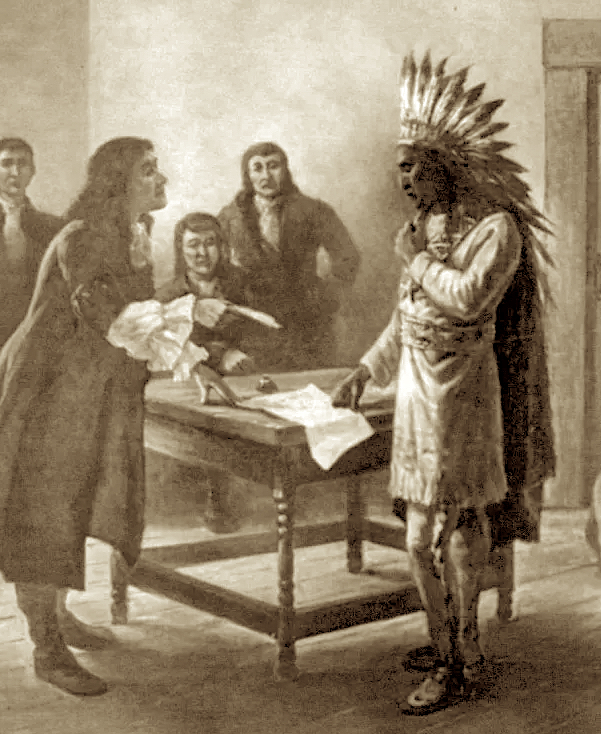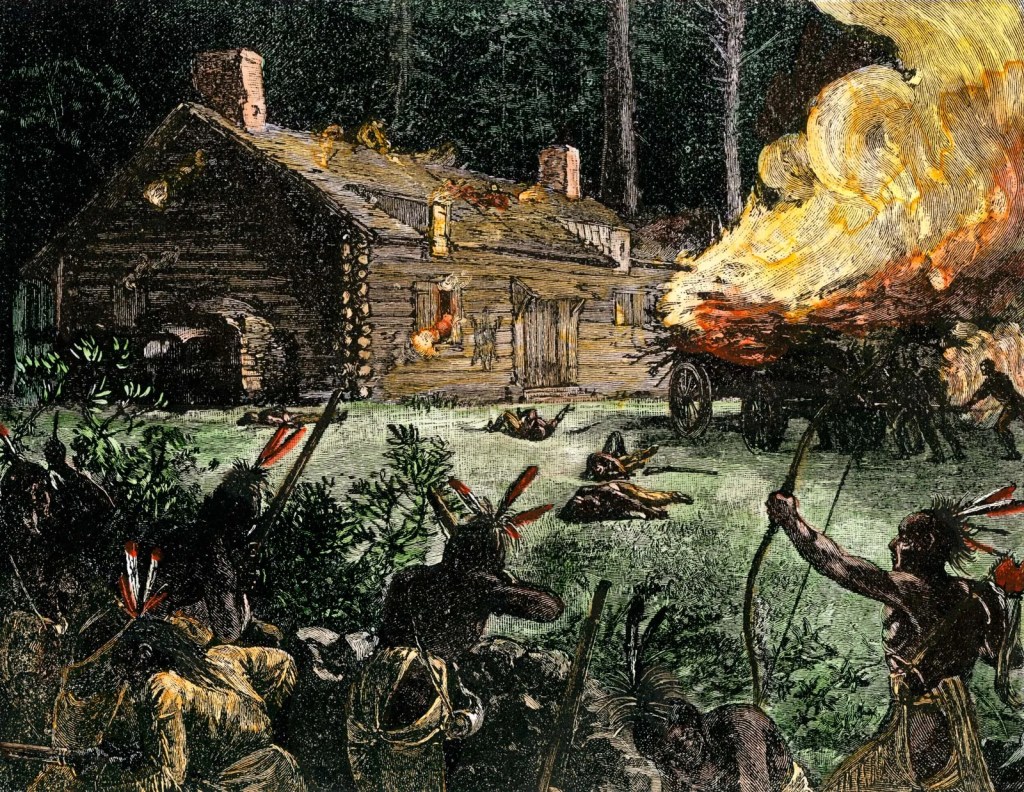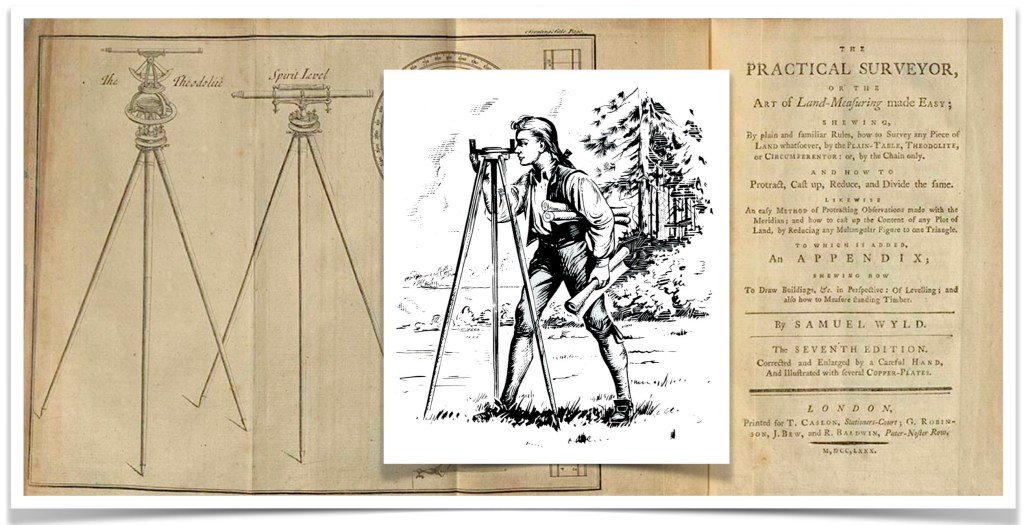
The Gore Line, A Narrative — Five

This is Chapter Five of eight. In this chapter we will be writing about how our ancestors migrated first into New York State, and then how the next generation spread into other states and territories to the west, outside of New England. This was an era of much conflict with the French and Indian War, the War for Independence, and the War of 1812.

When we were younger, our Grandmother Lulu Gore lived near us for much of our childhood years. As a creative, can-do type of Grandma, she inspired us with her gardens, her interesting holiday decorations, and her interest in family history. We lived in a rural Ohio area, and Lulu was the wife of our Grandfather Harley Gore. He had passed away years before we were born. However, before his death she helped him begin his Gore genealogy work. Toward the end of his life in 1941, as he was dying of heart disease, he asked his wife if she could begin the story of his family’s origins. The work was never finished, (as genealogy work never is…) However, we feel honored to continue what she began.

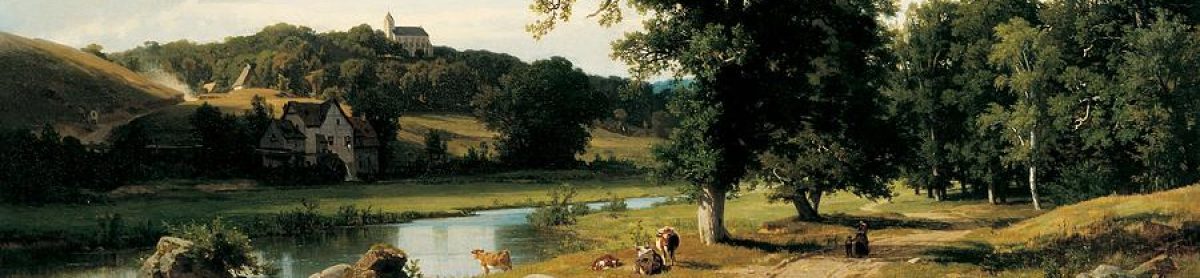
Grandma Moses Certainly Knew How to Paint The Rural Life

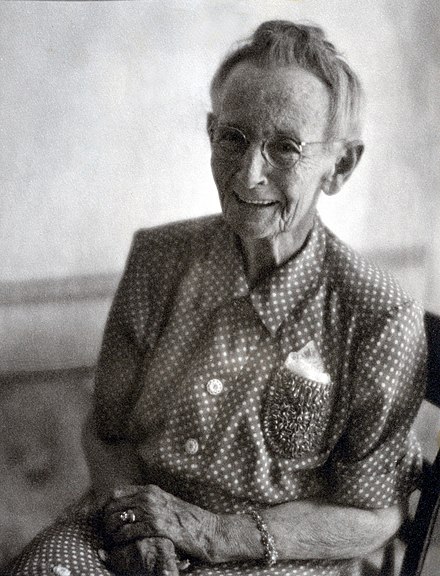
Anna Mary Robertson Moses, also known as Grandma Moses was a prolific American painter of the last century. From Wikipedia: “Moses painted scenes of rural life from earlier days, which she called ‘old-timey’ New England landscapes. Moses said that she would ‘get an inspiration and start painting; then I’ll forget everything, everything except how things used to be and how to paint it so people will know how we used to live.’ ” Grandma Moses artwork has appeared in museums and galleries the world over, and often, she painted scenes of New England life.

Moving Day on the Farm, circa 1951.
Anna Mary Robertson Moses, known as ‘Grandma Moses’
(Courtesy of wikiart.org).

We know that our ancestors didn’t live in a pastoral, problem-free world, but the work of Anna May Robinson Moses inspires us to reconnect with our many ancestors who lived before our time. (1)

Elijah Gore Sr., and Desire Safford Have a Big Family

As the third son of Samuel Gore (3) and Desire (Safford) Gore, Elijah Gore Sr., was born on February 11, 1743 in Norwich, Connecticut Colony – died about 1794, probably in Halifax, Windham, Vermont. He married Sarah Little December 11, 1767 in Voluntown, Connecticut Colony, when he was 24 and she was 18. She was born September 5, 1749 in Sutton, Worcester, Massachusetts Colony – died August 26, 1805 in Halifax, Windham, Vermont, aged 60.

*see The 1790 “Census” of Vermont (below)

The birth registrations for Sarah Little and her older brother Moses.
Massachusetts, Town Clerk, Vital and Town Records, 1626-2001.

Sarah (Little) Gore was the daughter of Ezekiel and Margret (Fitts) Little. She is buried at Stafford Cemetery in Halifax , and it is assumed that Elijah is buried next to her, even though there is no headstone, nor record of his death.

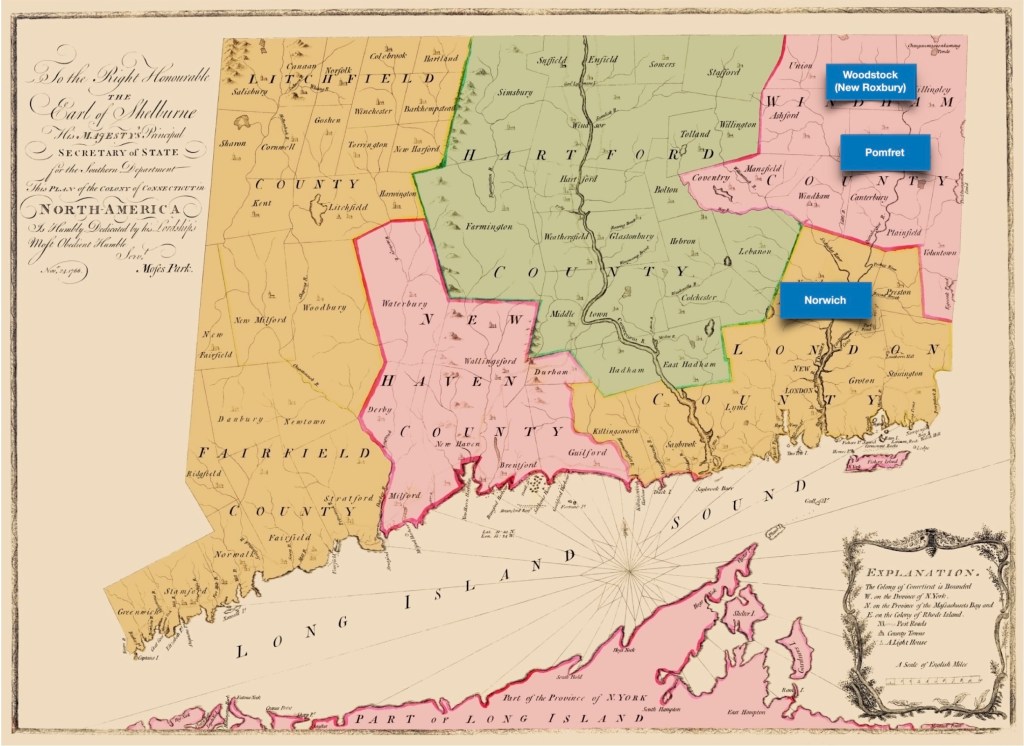
Before 1779, Elijah Gore Sr. and his family left Connecticut for Vermont. They settled in Halifax, Windham (county), Vermont. Here he owned land located on Vermont’s southern border with Massachusetts. As is often the case, as pioneers moved from place to place they named their new towns and counties after the places they had previously lived. As a result, Windham County is in both Connecticut, and Vermont. Some of their family records also cite the adjacent location of Guilford township, which borders Halifax on its eastern side.

McClelland’s Map of Windham County, Vermont, circa 1856.
Inset image: Halifax and Guilford townships from Vermont’s southern border.
(Image courtesy of the Library of Congress).

Elijah and Sarah Gore had ten children. Their first born, Elijah Jr., was born in Killingly, Connecticut Colony, the next four were born in Voluntown, Connecticut Colony, and the rest in Halifax, Vermont Colony. (2)

  • Elijah Gore Jr., born (Killingly, Connecticut Colony), September 5, 1768 – died 1798
  • Ezekiel Gore, born November 20, 1770 – died May 14, 1847 in Bernardston, Franklin, Massachusetts
  • Margaret (Gore) Stafford, born February 10, 1773 – died March 10, 1864 in Monroe, Franklin, Massachusetts
  • Samuel Gore (4), born, April 10, 1775 – died August 10, 1815 in Belleville, Jefferson, New York (We are descended from Samuel 4).
  • Obadiah Gore born November 20, 1777 – death date unknown
  • Hannah (Gore) Starr, born September 1, 1779 – died 1819 in Halifax, Windham, Vermont
  • Lucy (Gore) Bennett, born May 21, 1781 – death date unknown
  • Daniel Gore, born October 30, 1783 and died April 10, 1859 in Monroe, Franklin, Massachusetts
  • Desire (Gore) Bixby, born November 8, 1786 – died December 8, 1833 in Guilford, Windham, Vermont
  • Sarah (Gore) Slater, born August 12, 1789 and died September 19, 1858 in Chardon, Geauga, Ohio

The French and Indian War

Like the previous narrative, The Gore Line — Four, wars were an elemental part of history in the new American Colonies. In 1666, France claimed ‘Vermont’ as part of New France. From Wikipedia: “French explorer Samuel de Champlain claimed the area of what is now Lake Champlain, giving the name, Verd Mont (Green Mountain) to the region he found, on a 1647 map”.

British forces under fire from the French and Indian forces.

“The French and Indian War (1754–1763) was a theater of the Seven Years’ War, which pitted the North American colonies of the British Empire against those of the French, each side being supported by various Native American tribes. At the start of the war, the French colonies had a population of roughly 60,000 settlers, compared with 2 million in the British colonies. The outnumbered French particularly depended on their native allies. French Canadians call it the guerre de la Conquête  — ‘War of the Conquest’.”

“Following France’s loss in the French and Indian War, the 1763 Treaty of Paris gave control of the whole region to the British... The end of the war brought new settlers to Vermont. The first settler of the grants was Samuel Robinson, who began clearing land in Bennington in 1761.. In the 28 years from 1763 to 1791, the non-Indian population of Vermont rose from 300 to 85,000”.

The Elijah Gore Family were living in a territory that was a disputed frontier, likely quite rugged, and similar enough to other areas their forebears had lived in — that it was filled with opportunity. Indeed, this family was living in ‘Vermont’ before Vermont was Vermont. (3)

Many People Had Tried to Claim Land in Vermont

It’s a complicated situation which played out over several decades and involved different English monarchs, Colonial Governors and various legal representatives, as the borders of Vermont were always in dispute — not only with the French, but also with the neighboring colonies, whose settlers seemed to continually want to expand their land holdings. Some of our ancestors probably got up in the morning and thought to themselves, “I feel a bit betwixt and between — wonder who is in charge today?”

From Wikipedia, on the History of Vermont: “A fort at Crown Point had been built in 1759, and the road stretched across the Green Mountains from Springfield to Chimney Point, making traveling from the neighboring British colonies easier than ever before. Three colonies laid claim to the area. The Province of Massachusetts Bay claimed the land on the basis of the 1629 charter of the Massachusetts Bay Colony. The Province of New York claimed Vermont based on land granted to the Duke of York (later King James II & VII) in 1664. The Province of New Hampshire, whose western limits had never been determined, also claimed Vermont, in part based upon a decree of George II in 1740”.
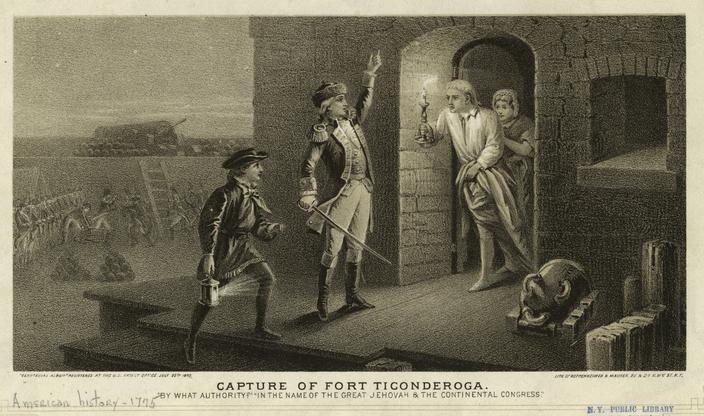
Engraving depicting Ethan Allen at the Capture of Fort Ticonderoga in 1775.
(Image courtesy of Wikipedia.org).

There was a lot of acrimonious behavior: “In 1770, Ethan Allen—along with his brothers Ira and Levi, as well as Seth Warner—recruited an informal militia, the Green Mountain Boys, to protect the interests of the original New Hampshire settlers against the new migrants from New York… The American Revolution changed the face of these various conflicts after the battle of Bennington, Vermont became important. ‘The battle was a major strategic success for the American cause…’ ”

In Guilford, the township adjacent to Halifax, we learn from the website, We Are Vermont: “There was so much controversy between Yorkist and Vermont factions at the beginning of the Revolutionary War that 2 sets of officials were fighting for control in Guilford. The fighting escalated to a point where, in 1783, the Vermont government sent Ethan Allen with a Militia to the town to enforce martial law and collect taxes. This was known as the ‘Guilford War’ and eventually those who opposed Vermont’s laws moved to settle in New York.” (4)

*The ‘Census’ of Vermont

According to the National Archives: “Vermont became a state on March 4, 1791, [as the 14th state] so the census was taken in Vermont in 1791…” Specifically, “The Census was taken in Rhode Island on 7-5-1790 and in Vermont on 3-2-1791 [March 2, 1791], after they ratified the constitution.” [USGenWeb] Even though Vermont had a census, it was after everyone else’s census, and it continues to be mistakenly referred to as the “1790” census.

Our research has concluded that our ancestor Elijah Gore, even though we do not know his exact death date, was still alive after March 1791. We analyzed the census and believe this for the following reasons:

Heads of Families first Vermont census, Page 50, conducted on March 2, 1791.
  1. Their son Elijah Jr. married Susannah Barney on August 17, 1789, in nearby Guilford, so he was likely no longer living with his parents. (When the census was done, it would be highly improbable that his household numbers could match up with the 1791 census data.) Even though he has the same name as his father Elijah Sr., there is only one listing for a man with this name in Halifax Town, Windham County, Vermont, at this time.
  2. The Free White Males of 16 years and upward including heads of families would be Elijah Gore Sr., our grandfather, and his son Ezekiel, age 20 years.
  3. The categories show only one Free White Males under 16 years living in the home. That would likely be our ancestor Samuel Gore (4), who was 15 at the time.
  4. The Free White Females including heads of families indicates one person, who is likely our grandmother Sarah Little.
  5. All other free persons are everyone else who was living in the home. That number is 8, which corresponds exactly to everyone else, from Margaret through Sarah.
  6. Lastly, there are no slaves listed. We would expect this from people who identified as Puritans.

Unfortunately, there is scant evidence on the life activities of this ancestor. Elijah’s occupation is unknown, but it’s very likely, he was a farmer. (5)

Two Locations in Windham County?

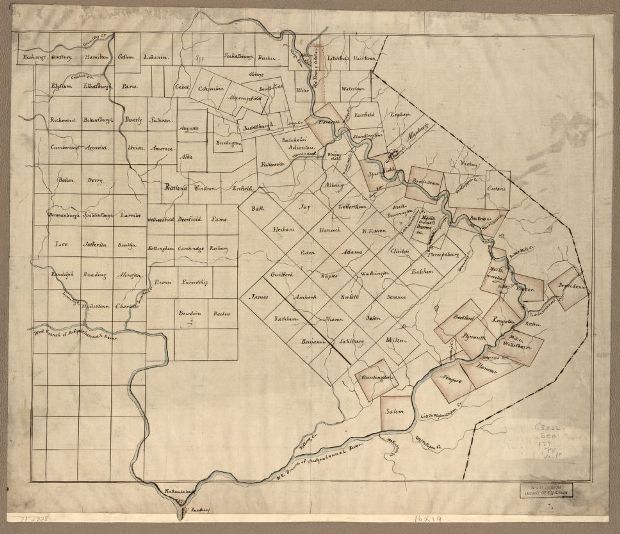
This branch of the Gore family, owned land in Windham county in two adjacent townships: Halifax and Guilford. (This explains why family records intermix the two locations). The Official History of Guilford, Vermont, 1678-1961, cites the sale of land in Guilford, as illustrated below.

Note that Lot 168 is mentioned as being “on the Halifax line”. It also appears that Elijah Gore may have also owned a portion of Lot 167.

A plan of Guilford, drawn by Nathan Dwight, surveyor, in 1765, showing the original 50-acre and 100-acre lots. The names of many of the earliest settlers have been added, according to the best information available in existing records. From the Official History of Guilford, Vermont, 1678-1961, Digital pages, Inset: 309/585 and for Map: 396/610.

Even though these two townships are next door neighbors, because they were in disputed areas, the records are a bit complicated. Initially, the Royal Governor of New Hampshire, Benning Wentworth, was in charge of the area. From Wikipedia: “Halifax was the second town chartered, west of the Connecticut River on May 11, 1750 by New Hampshire Governor Benning Wentworth, meaning Halifax is the second oldest town in the state after Bennington…” and also, Guilford was “Chartered as Guilford New Hampshire in 1754… chartered [again] as Guilford, Vermont in 1791” when Vermont became an official state. Additionally, Guilford is “the most populous town in Vermont from 1791-1820”.

This may also help explain that our research turned up that Elijah Gore Sr. is recorded as having served in the American Revolutionary War, under the banner of Captain Samuel Fillbrick’s Company in (oddly enough) New Hampshire. From the Official history of Guilford, Vermont, 1678-1961, page 135:

This puzzled us at first, but it makes sense that some militias would be organized under the names of other Colonies, since Vermont did not technically exist until after the war, in 1791. (6)

Samuel Gore (4) and Rebeckah Barney Marry

Our ancestor, Samuel Gore (4), born April 10, 1775 Voluntown, Windham, Connecticut Colony – died August 10, 1815 in Belleville, Jefferson County, New York. He married Rebeckah Barney on February 22, 1798, in a ceremony at Halifax, Vermont, officiated by Darius Bullock. She was born April 6, 1782 Guilford, Windham, Vermont – died October 26, 1860 in Belleville, Jefferson, New York. They likely met socially through family or friends because their home townships, Halifax and Guilford, were adjacent to each other.

Rebeckah was the daughter of Deacon Edward Barney, who was a physician and Baptist Deacon. He was born August 18, 1749 in Rehoboth, Bristol, Massachusetts Colony – died August 9, 1839 in Ellisburg, Jefferson, New York. Rebeckah’s mother was Elizabeth Brown, born October 3, 1750 in Middletown, Middlesex, Connecticut – died March 5, 1793 in Guilford, Windham, Vermont. Elizabeth died in childbirth with her 12th pregnancy at the age of 42 — her newborn infant daughter Mabel was buried with her. [William Barney and Familysearch.com footnotes] Together the Barneys had twelve children, with Rebeckah being the 7th child.
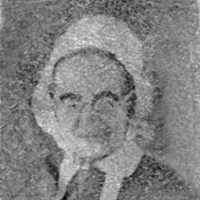
Our 4x Great-Grandmother, Rebeckah (Barney) Gore.

Samuel (4) and Rebecca had seven children. The first five were born in Halifax, Windham, Vermont and the youngest two were born in Belleville, Jefferson County, New York.

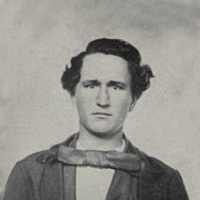
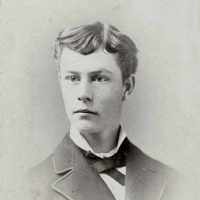
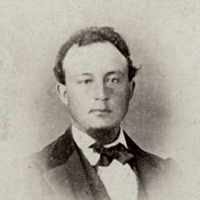
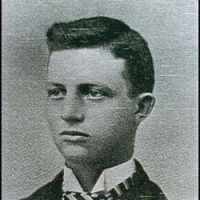
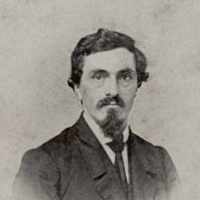
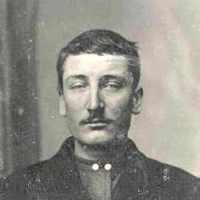
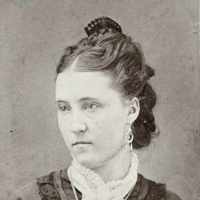
Observation: Quite notable about this family group, is that these are the first ancestors of whom we have photographic portraits! We’ll meet their children in just a moment, but first, we need to discuss this newly invented portraiture… (7)

The Waking Century — The Advent of Portrait Photography

Suddenly, a new age was upon us…

“Getting painted portraits done used to be exclusive to families in the upper classes of society. That all changed when photography came into existence. In 1839, Robert Cornelius shot the first successful portrait, a self-portrait (a selfie, no less), using the venerable daguerreotype. Cornelius took advantage of the light outdoors to get a faster exposure. Sprinting out of his father’s shop, Robert held this pose for a whole minute before rushing back and putting the lens cap back on”.

“You see, shooting with the daguerreotype required between 3 to 15 minutes of exposure time depending on the available light — making portraiture incredibly impractical if not impossible.” [Soriano, A Brief History of Portrait Photography]

Robert Cornelius’s Self-Portrait, 1839.

Did you ever wonder why the ancestors in many old photographs are not smiling, which is our custom today? From Time Magazine: “Experts say that the deeper reason for the lack of smiles early on is that photography took guidance from pre-existing customs in painting—an art form in which many found grins uncouth and inappropriate for portraiture. Accordingly, high-end studio photographers would create an elegant setting and direct the subject how to behave, producing the staid expressions which are so familiar in 19th century photographs. The images they created were formal and befitted the expense of paying to have a portrait made, especially when that portrait might be the only image of someone.” Indeed, these are the scant few images we have of these ancestors…

Observation: It is quite notable that this generation, born after the Revolutionary War, began heading west and moved into new states and territories: Iowa, Minnesota, New York, Ohio, and Wisconsin — none of them died in Vermont.

Shown below are each of the Samuel and Rebeckah Gore children, with their families and respective portraits.

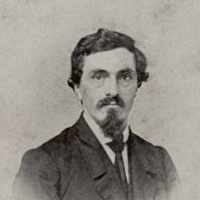
Gratia (Gore) Cook, born September 27, 1800, Halifax, Windham, Vermont – died, February 16, 1876, Winneconne, Winnebago, Wisconsin.
Left to right: Gratia (Gore) Cook; her sons Eugene Kincaid Cook, and Malcolm G. Cook.

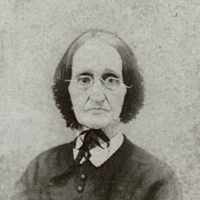
Hart Gore [twin of Clark], born December 13, 1802, Halifax, Windham, Vermont – died February 11, 1892, Rushford, Fillmore, Minnesota.
Top Row, left to right: Hart Gore, his wife Miranda Goodenough, their son Leslie Gore, Bottom row, left to right: Their son Charles W. Gore, his wife Martha E. (Bartley) Gore, and their daughter Mary Jeanette (Gore) Valentine.
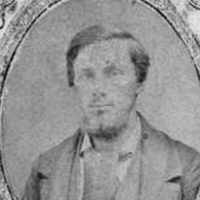
Clark Gore [twin of Hart] born December 13, 1803 in Halifax, Windham, Vermont. He married Lydia Burge and they had three children: Martha Lydia Gore, Myron Gore, and Alice Gore.

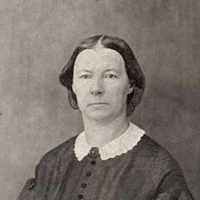
Luke Gore, born April 1, 1805, Halifax, Windham, Vermont – died October 2, 1868, Newbury, Geauga, Ohio (We are descended from Luke.)
Top Row, left to right: Luke Gore, his second wife, Electa (Stanhope) Gore (our grandmother). Milan R. Gore,* Bottom row, left to right: Crockett Gore*, his wife Lois (Haven) Gore, and Crockett’s son Dana D. Gore.
*Milan and Crockett are the children of Luke Gore and his first wife: Mila Gore. She was born in 1813 in Halifax, Windham, Vermont – died September 29, 1848 in Newbury, Geauga, Ohio. Luke and Mila were first cousins.
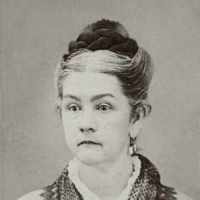
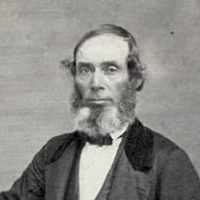
Belinda (Gore) Barton, born July 15, 1807, Halifax, Windham, Vermont – died August 15, 1900, Madison, Lake, Ohio
Top row, left to right: Belinda (Gore) Barton, her husband Horace Barton, and their son Hanford Barton. Bottom row, left to right: Their daughter Frances (Barton) Cook, and her husband Eugene Kincaid Cook. Note: Frances (Barton) Cook married her first cousin Eugene Kincaid Cook [see Gratia (Gore) Cook above].
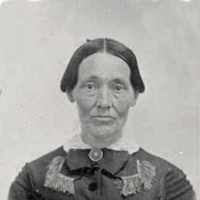
Susan (Gore) Bishop, born February 27, 1812, Belleville, Jefferson, New York – died August 15, 1897, Jefferson County, New York.
Left image: Susan (Gore) Bishop and Center image: Her daughter Emogene Matilda Birdy Bishop.

Mary Genette (Gore) Brayman, born June 18, 1814, Belleville, Jefferson, New York – died February 28, 1891, Farmington, Van Burn, Iowa.
Top Row, left to right: Mary Genette (Gore) Brayman, her daughter Victoria Icebenda (Brayman) Goodenough, and Victoria’s husband Gilbert Clark Goodenough. Bottom row, left to right: The Brayman children — their sons Andrew Jackson Brayman, Edward Barney Brayman, and their daughter Flora Arabella (Brayman) Orr. (8)

Ellisburgh, and Belleville, Jefferson County, New York

After his wife Elizabeth died in 1793, Deacon Edward Barney eventually remarried. He and his second wife Phebe Bennett had six more children. They also moved from Vermont to New York just after the turn of the 19th century.

From the book, The Growth of A Century: “Deacon Edward Barney came from Guilford, Vermont, about 1803 and settled in the town of Ellisburgh. He was a physician and farmer. He died in 1835, aged 86 years. Three of his sons, substantial business men, settled and raised families in that town, and were foremost in efforts to repel invasion during the War of 1812, especially in defence of Sackets Harbor”. [More on this area below.]

So, it’s clear that he relocated his family to New York State, and it was quite a move(!) They relocated up near the border with Canada at the eastern edge of Lake Ontario. Apparently, Samuel Gore (4) and his wife Rebeckah also followed sometime between 1807 when Belinda was born in Vermont, and 1812 when Susan was born in New York.
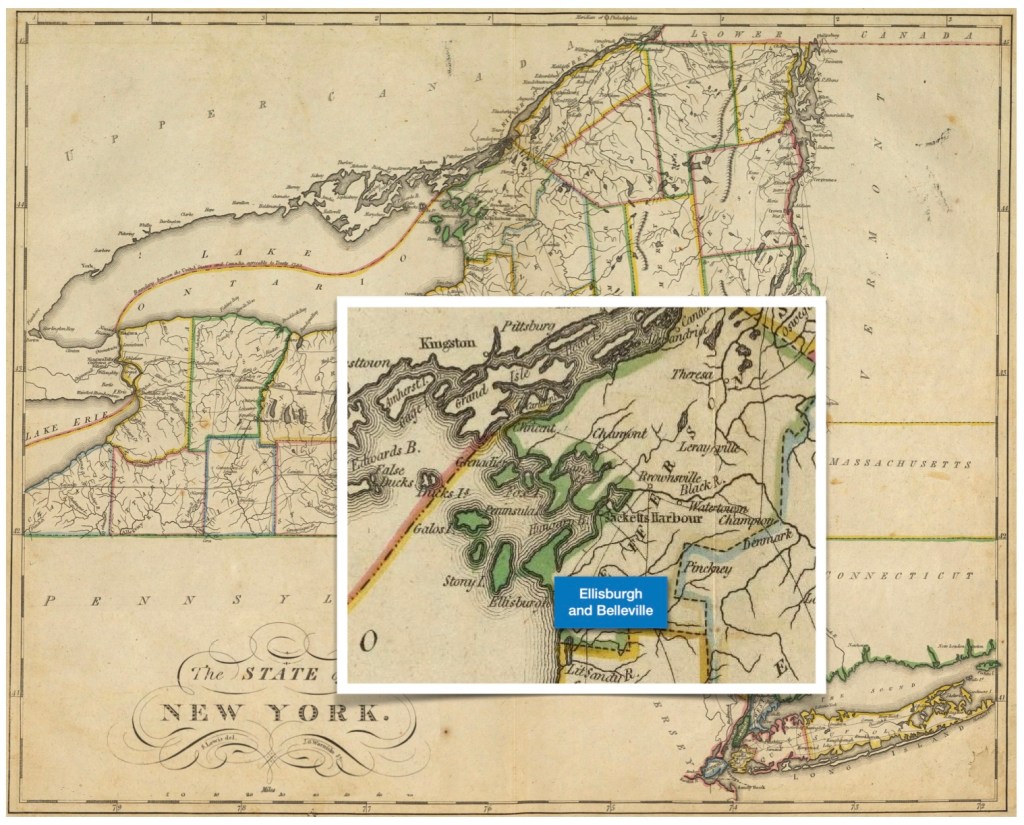
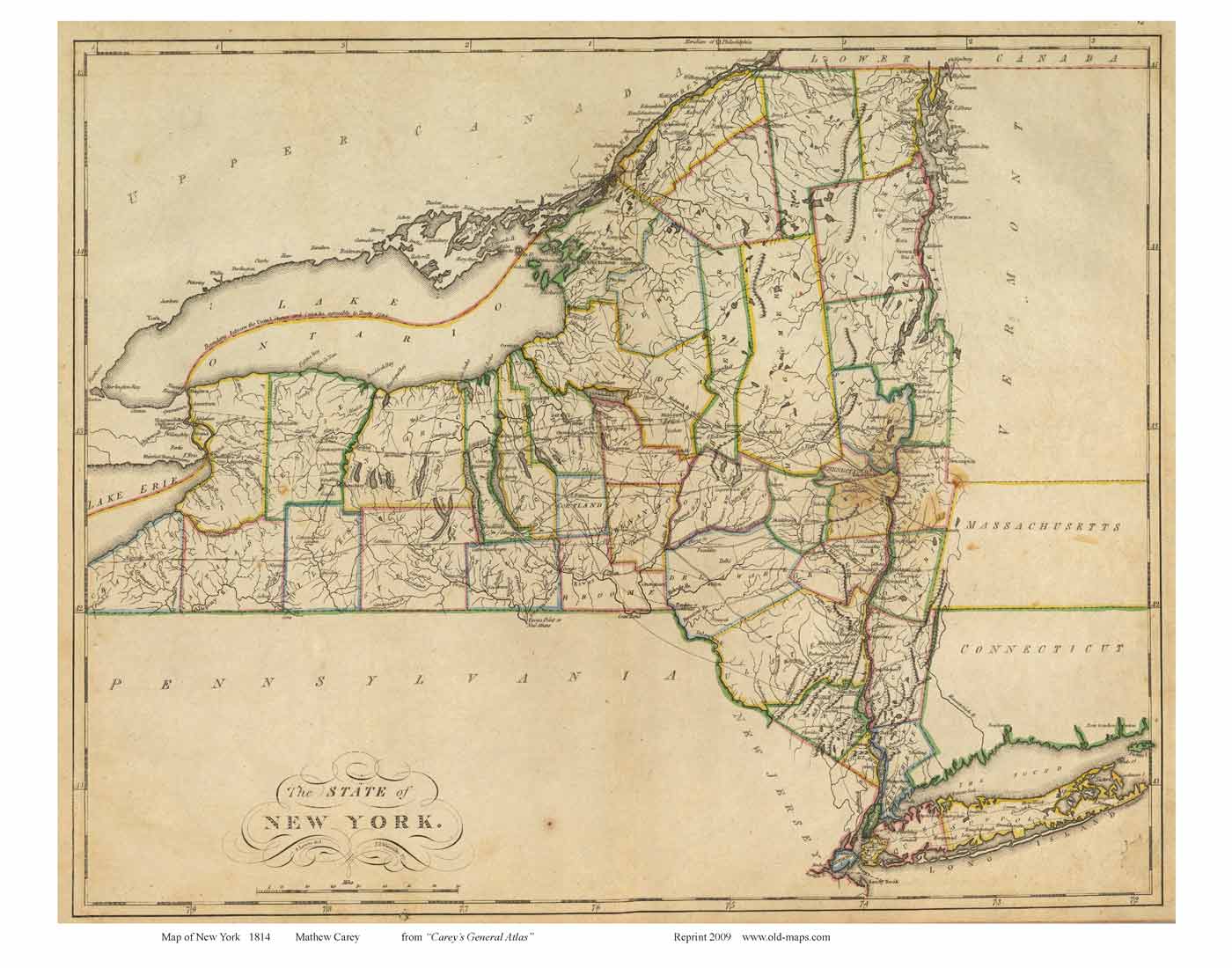
Ellisburgh and Belleville are located at the eastern edge of Lake Ontario, as indicated by
the inset image. Map of New York 1814 by Mathew Carey from “Careys General Atlas”
(Image courtesy of Old-maps.com).

We often wondered what made them decide to emigrate to a new area after spending generations in New England. The article The Coming of the Pioneers from newyorkgenealogy.org helped explain what had been in the air: “By 1800 the tide of immigration towards Northern New York had definitely set in. The lure of cheap lands in a new country brought settlers by the hundreds from the New England states and the still new settlements in the vicinity of Utica. Marvelous tales were told there of the fertility of the lands in the Black River Country, of corn planted in the ground without plowing growing to over eleven feet in height and of wheat yielding from twenty-five to thirty-five bushels to the acre. A traveling missionary commenting on the universal contention of the pioneers in their new homes along the Black river said that he had not “seen an unhappy person for 90 miles on that river.”
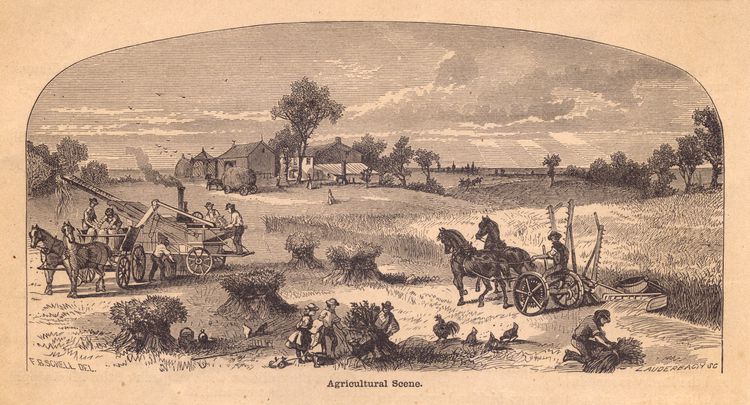
“These tales and others brought sturdy, young men and their families from Vermont and Plattsburgh over the woodland trail into Chateaugay and finally to the infant settlements springing up along the St. Lawrence, the Grass and the St. Regis rivers. They brought others, their household goods laden on crude wood sleds, drawn by oxen, up through the trackless woods of the Black River Country…”

To this day, according to Wikipedia, Ellisburgh, New York is still considered a village, and Belleville, (just north of Ellisburgh even smaller), is considered a hamlet. Most of our ancestors who were there, left the area, or didn’t stay there for very long. The only exception was Susan (Gore) Bishop, who was a lifelong resident. (9)

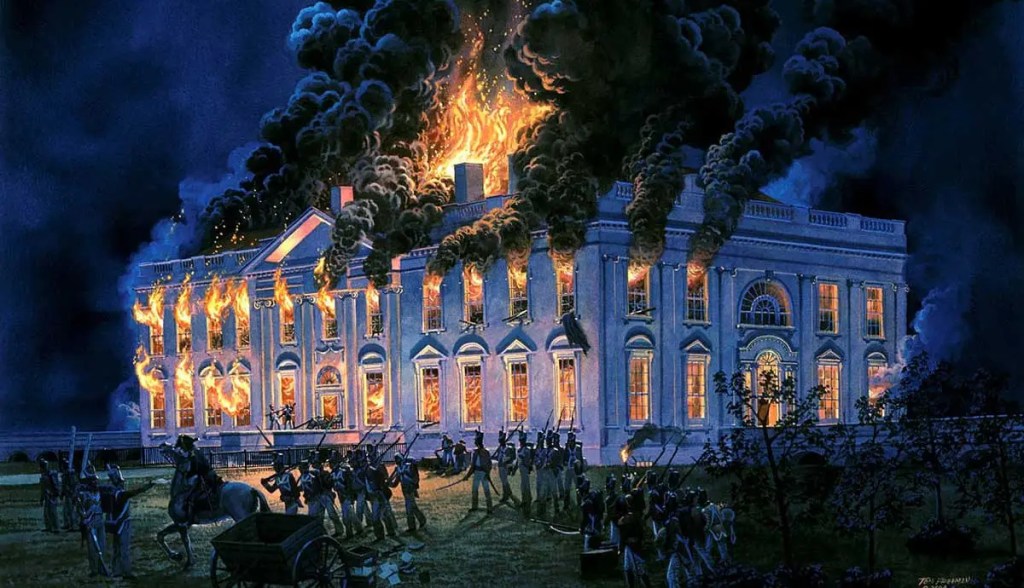
The War of 1812

Like his father Elijah before him, Samuel Gore (4) participated in the new country’s war efforts, as a private in Captain Jonathan Scott’s Company of Colonel Anthony Sprague’s Regiment Jefferson County Militia, New York. (Curiously, his wife Rebeckah never claimed his war pension, likely because he survived unhurt: “All pensions granted to veterans of the War of 1812 and their surviving dependents before 1871 were based exclusively on service-connected death or disability”.)

We had always thought that the War of 1812 was fought because England was rather cranky and upset that they had lost the American Revolutionary War a generation earlier. [Honestly, it just wasn’t deemed to be that important in American high school history classes.] However, there was much more to the conflict.

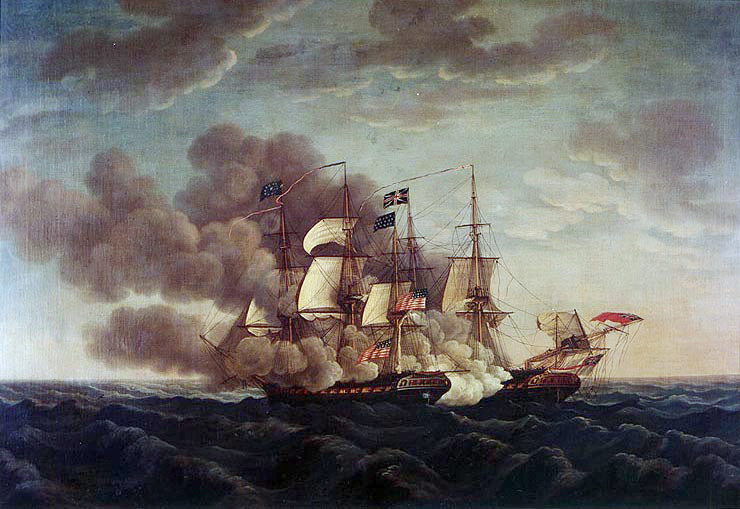
From the USS Constitution Museum.org: “The War of 1812 pitted the young United States in a war against Great Britain, from whom the American colonies had won their independence in 1783. The conflict was a byproduct of the broader conflict between Great Britain and France over who would dominate Europe and the wider world.” If you recall, in The Gore Line, A Narrative — Four, we had commented on the fact that England had crafted an economic model that benefited them by extracting resources from their Colonies. This changed after the War For Independence, and was aggravated further when President Jefferson passed the Embargo Act of 1807 in retaliation for what was happening to America’s ships and sailors at sea. The embargo was hard on American farmers because it reduced the market for their products, but they weathered the storm, so to speak.
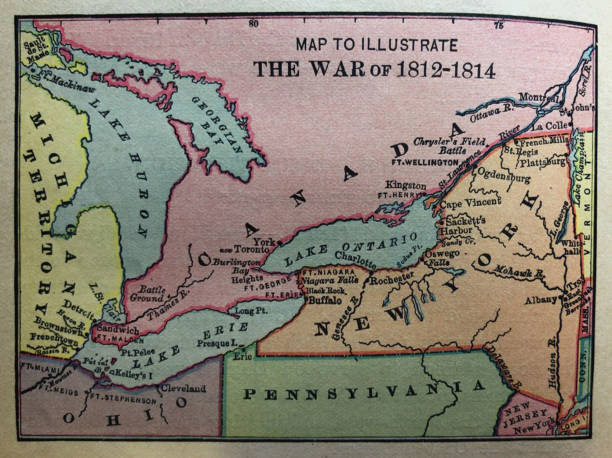
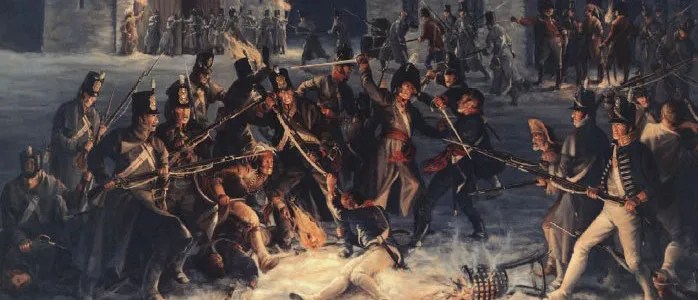
“In Britain’s effort to control the world’s oceans, the British Royal Navy encroached upon American maritime rights and cut into American trade during the Napoleonic Wars. In response, the young republic declared war on Britain on June 18, 1812. The two leading causes of the war were the British Orders-in-Council, which limited American trade with Europe, and impressment, [read as: kidnapping and forced servitude] the Royal Navy’s practice of taking seamen from American merchant vessels to fill out the crews of its own chronically undermanned warships. Under the authority of the Orders in Council, the British seized some 400 American merchant ships and their cargoes between 1807 and 1812”.

It’s hard to believe this today, but in the expansionist era our ancestors lived in, and with everything else that was going on… There were many Hawks in the Continental Congress who believed, The War would allow them to expand American territory into the areas of Canada, which were defined as Upper Canada (essentially Ontario), and Lower Canada (present day Quebec).

The acquisition of Canada this year, as far as the neighborhood of Quebec, will be a mere matter of marching; and will give us experience for the attack of
Halifax the next, and the final expulsion of England from
the American continent.

Thomas Jefferson to William Duane, 4 August 1812

According to the National Park Service: “…many Americans assumed that the Canadian population would welcome the arrival of American forces. In reality, the inhabitants of Canada—a mix of French settlers, American loyalists who had fled north during the War of Independence, and a growing population of ambivalent American transplants – had little reason to embrace an incursion from the south”.

Indeed, “Jefferson also overestimated the readiness of the American armies. Optimists assumed that the U.S. army could be effective as an invading and occupying force… Jefferson also misjudged the effectiveness of the British army. Their own success fighting and defeating the British redcoats during their War of Independence proved a deceptive lesson. Unlike the British troops Americans faced during the Revolution, the British army that arrived in Canada was better led and battle-hardened by twenty years of experience fighting against Napoleonic France”.
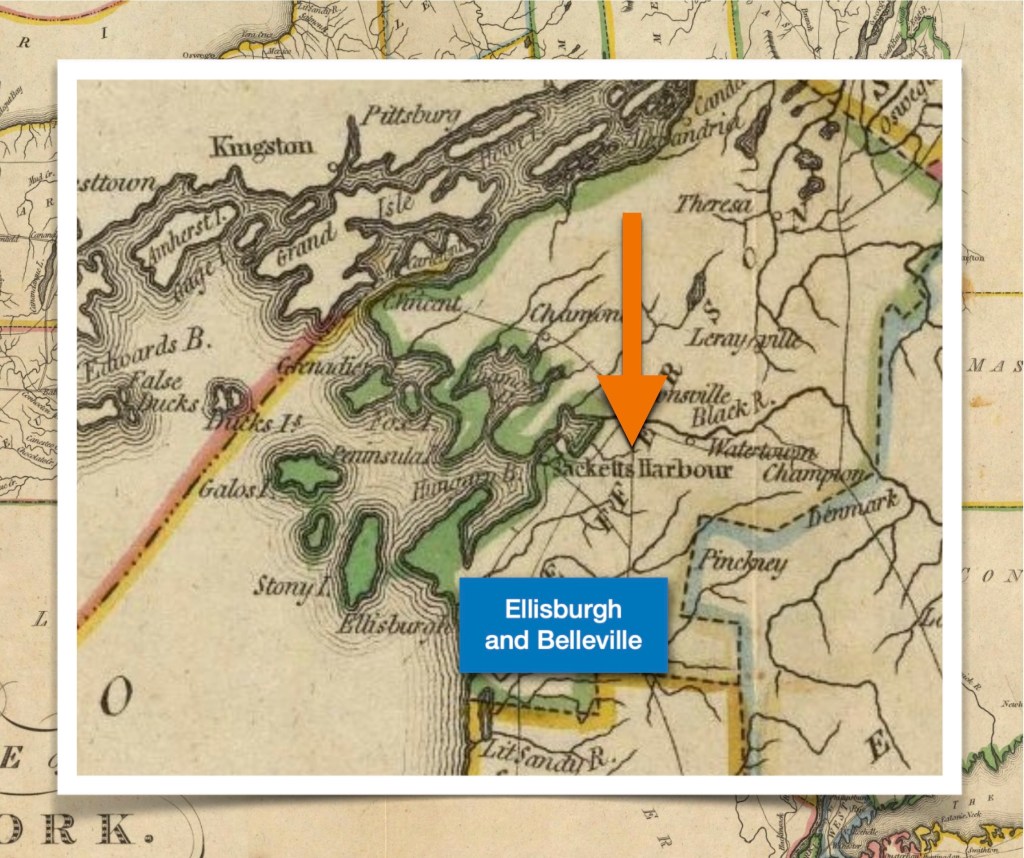
However, with our ancestors living where they lived, it was a prime area for much conflict. “Jefferson County early became the theater of active military and naval operations. Sackets Harbor was then the most important point on Lake Ontario. It was made the headquarters of the northern division of the American fleet, and here were fitted out numerous important expeditions against the British in Canada”. [RootsWeb, Child’s Gazetteers 1890]

Furthermore, “The war started in 1812 and lasted until 1815, though a peace treaty had been signed in 1814. Over 2200 US soldiers died and over 1600 British. Jefferson County played a central role in the war, from beginning to end. It was the headquarters of Commodore Isaac Chauncey and the US Navy of the Great Lakes. Six armed engagements were fought in Jefferson County during the war, more so than any other county on American soil. The successful campaigns against York and Niagara (1813) were launched from Sackets Harbor, as were the not so successful campaigns on Montreal and Niagara (1814). Perry’s victory on Lake Erie was also directed from Jefferson County under the command of Isaac Chauncey.” [Jefferson County NY Wiki]

As far as we know, it’s a miracle that none of our family members in this line, died during this time. In Part Six we are writing about our ancestor Luke Gore and his family, as they move west from New England — perhaps following other family members who led the way. (10)

Following are the footnotes for the Primary Source Materials,
Notes, and Observations

A Special Note About This Chapter
There is a wealth of well done documentation completed by other fellow researchers about this family line, in the Familysearch.org website. We would like to bring this work to your attention, as follows:

Note 1: For an excellent traditional muti-generational classical family tree which includes names, dates, marriages, and children, see —
https://www.familysearch.org/tree/pedigree/landscape/LQ5C-1D1

Note 2: The research also contains a robust amount of detail and source information for those researchers who would like to research their ancestors beyond the classical family tree level.

Note 3: Here is an example — again from this link: https://www.familysearch.org/tree/pedigree/landscape/LQ5C-1D1 , then click on the name Samuel Gore found within the center screen block above his wife’s name, Rebeckah Barney. This will open a biography box on the right side of your screen.

From there, click on the PERSON box, just below Samuel’s birth and death information. This will open a new window which displays useful links such as Details, Sources, etc.

Here is the path: Pedigree landscape view (classical tree) > Samuel Gore biography page > PERSON link > Useful links

Grandma Moses Certainly Knew How to Paint The Rural Life

(1) — two records

Moving Day on the Farm
Painting by Anna Mary Robertson Moses, known as ‘Grandma Moses’
https://www.wikiart.org/en/grandma-moses/morning-day-on-the-farm-1951
Grandma Moses
https://en.wikipedia.org/wiki/Grandma_Moses

Elijah Gore Sr., and Desire Safford Have a Big Family

(2) — eight records

Elijah Gore
Birth – Connecticut Births and Christenings, 1649-1906
 https://www.familysearch.org/ark:/61903/1:1:F74J-LJY
Note: This is his christening record, one week after his birth.

Sarah Little
Vital – Massachusetts, Town Clerk, Vital and Town Records, 1626-2001

https://www.familysearch.org/ark:/61903/1:1:F4FR-L9K
Book page: 117, Digital page: 65/544.    Right page, last entry.
Note: For her birth registration.

Elijah Gore and Sarah Little marriage
Marriage – Connecticut, Vital Records, Prior to 1850

https://www.familysearch.org/ark:/61903/1:1:QPQ7-57TX
Digital page: 8822/10,566
Note: For the data.

Sarah Little Gore
https://www.findagrave.com/memorial/57390841/sarah-gore
Note: For the data.

Elijah Gore
in the Connecticut, U.S., Town Marriage Records, pre-1870 (Barbour Collection)

Voluntown Vital Records 1708-1850
https://www.ancestry.com/discoveryui-content/view/225419:1062?tid=&pid=&queryId=1d2415c4e44686d563db8be245d11749&_phsrc=DZs10&_phstart=successSource
Book page: 180, Digital page: 52/122, Lower portion of page.
Note: For the Gore family children born in Voluntown, Connecticut.

The Descendants of George Little Who Came to Newbury, Massachusetts, in 1640, from the American Genealogical-Biographical Index (AGBI)
by George Thomas Little, A.M., 1892
https://www.ancestry.com/imageviewer/collections/10376/images/dvm_GenMono000214-00002-0?ssrc=&backlabel=Return&pId=2000000000
Book pages: 53-54, Digital pages: 73-74/664 Under Entry 200
Note: This file lists a Joseph Gore born 1797, a child which we have not included because we believe that it is an error.

Elijah Gore
in the Geneanet Community Trees Index
https://www.ancestry.com/discoveryui-content/view/6873371156:62476
Note: This file lists a Joseph Gore born 1797, a child which we have not included because we believe that it is an error.

Library of Congress
McClellan’s Map of Windham County, Vermont
by J. Chace, C. McClellan & Co.
https://www.loc.gov/resource/g3753w.la001192/?r=-0.491,0.249,1.604,0.777,0
Note: For map image.

The French and Indian War

(3) — three records

History of Vermont
https://en.wikipedia.org/wiki/History_of_Vermont
Note: For the data.

French and Indian War
https://en.wikipedia.org/wiki/French_and_Indian_War
Note: For the data and illustration.

We Are The Mighty
Today in Military History: George Washington spills first blood of French and Indian War
https://www.wearethemighty.com/articles/today-in-military-history-george-washington-spills-first-blood-of-french-and-indian-war/
Note: For the illustration.

Many People Had Tried to Claim Land in Vermont

(4) — four records

History of Vermont
https://en.wikipedia.org/wiki/History_of_Vermont
Note: For the data.

Battle of Bennington
https://en.wikipedia.org/wiki/Battle_of_Bennington
Note: For the data.

File:Fort Ticonderoga 1775.jpg
https://commons.wikimedia.org/wiki/File:Fort_Ticonderoga_1775.jpg
Note: For the Illustration of Ethan Allen.

Vermont.com
Vermont.com Guide to Guilford
https://vermont.com/cities/guilford/
Note: For the data.

The 1790 ‘Census’ of Vermont

(5) — four records
1790 Census: Heads of Families at the First Census of the United States 
Taken in the Year 1790

https://www.census.gov/library/publications/1907/dec/heads-of-families.html
Note 1: 5 Downloadable .pdf files
Note 2: Click on Vermont, Published in 1907 > Download All Vermont [21.0 MB]

The National Archives
1790 Census Records
https://www.archives.gov/research/census/1790
Note: For the data.

USGenWeb Free Census Project Help, HISTORY of the United States – Federal Census, 1790-1920
http://www.usgwcensus.org/help/history.html
Note: For the data.

Elijah Gove Jr
in the Vermont, U.S., Vital Records, 1720-1908

https://www.ancestry.com/discoveryui-content/view/345462:4661
Digital page: 2859/4084
Note: For the data.

Two Locations in Windham County?

(6) — four records

Official History of Guilford, Vermont, 1678-1961.
With Genealogies and Biographical Sketches
Edited by National Grange, Vermont State Grange, Broad Brook Grange No. 151, Guilford
https://archive.org/details/officialhistoryo00unse/page/308/mode/2up
Note 1: Gore farm sale, Book page 309, Digital page: 308/585
Note 2: Tipped-in, foldout map of original property lots, Digital page 396/610

Halifax, Vermont
https://en.wikipedia.org/wiki/Halifax,_Vermont#External_links
Note: For the data.

Guilford, Vermont
https://en.wikipedia.org/wiki/Guilford,_Vermont
Note: For the data.
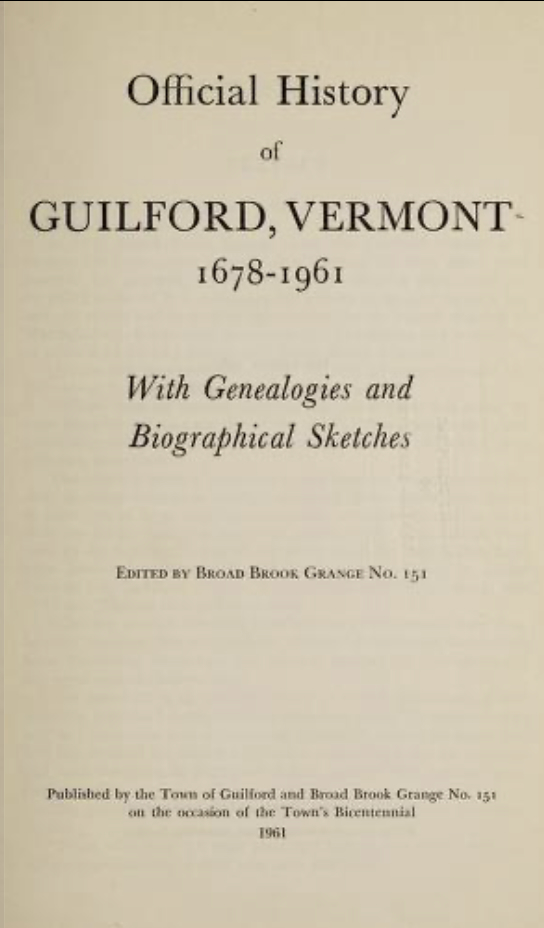
Official History of Guilford, Vermont, 1678-1961.
With Genealogies and Biographical Sketches
Edited by National Grange, Vermont State Grange, Broad Brook Grange No. 151, Guilford
https://archive.org/details/officialhistoryo00unse/page/308/mode/2up
Note: Elijah Gore Revolutionary War service, page 135.

Samuel Gore (4) and Rebeckah Barney Marry

(7) — three records

Genealogy.com
Re: Barneys and Potters and Briggs, Oh My:-)
By William Barney
https://www.genealogy.com/forum/surnames/topics/barney/776/
Note: Home > Forum > Surnames > Barney

Mrs Elizabeth Barney
Vital – Vermont, Vital Records, 1760-1954

https://www.familysearch.org/ark:/61903/1:1:XFFT-335
Digital page: 2891/4008
Note: For her death record.

Family Search Tree (not our files)
https://www.familysearch.org/tree/pedigree/landscape/LQ5C-1D1
Note 1: Our source for only the Gore Family Photograph Portraits.
Note 2: This is not a family tree of our construction, therefore, we have not verified other information here.

The Waking Century — The Advent of Portrait Photography

(8) — two records

Photography by Jay
A Brief History of Portrait Photography
by Jay Soriano
https://jaysoriano.com/a-brief-history-of-portrait-photography/
Note: For the text and image.

Time
Now You Know: Why Do People Always Look So Serious in Old Photos?
by Merrill Fabray
https://time.com/4568032/smile-serious-old-photos/
Note: For the text.

Ellisburgh, and Belleville, Jefferson County, New York

(9) — six records

Growth of a Century: as illustrated in the history of Jefferson County, New York, from 1793 to 1894
by John A. Haddock https://archive.org/details/growthofcenturya00hadd/page/n749/mode/2up
Note: For information on the Barney family and Deacon Edward Barney.

NY Genealogy
The Coming of the Pioneers
Franklin County, Jefferson County, Lewis County, Oswego County, Saint Lawrence County
by New York Genealogy
https://newyorkgenealogy.org/franklin/the-coming-of-the-pioneers.htm
Note: For the data.

Old Maps
Map of New York 1814 by Mathew Carey from “Careys General Atlas”
by Mathew Carey
http://www.old-maps.com/NY/ny-state/NY_1814_Carey-web.jpg
Note: For map image.

ThoughtCo.
History of American Agriculture
American Agriculture 1776–1990
by Mary Bellis
[Under the subhead] Agricultural Advances in the United States, 1775–1889
https://www.thoughtco.com/history-of-american-agriculture-farm-machinery-4074385
Note: For the farm scene image.

Ellisburg, New York
https://en.wikipedia.org/wiki/Ellisburg,_New_York
and
Belleville, New York
https://en.wikipedia.org/wiki/Belleville%2C_New_York
Note: For the data.

The War of 1812

(10) — nine records

USS Constitution Museum
The War of 1812 Overview
https://ussconstitutionmuseum.org/major-events/war-of-1812-overview/#:~:text=The%20two%20leading%20causes%20of,its%20own%20chronically%20undermanned%20warships.
Note: For the data.

Samuel Gore
Military – United States War of 1812 Index to Service Records, 1812-1815

https://www.familysearch.org/ark:/61903/3:1:33SQ-G5Z8-9GNM?view=index&action=view&cc=1916219
Digital page: 2210/2843
Note: For the data.

Samuel Gore
in the U.S., War of 1812 Pension Application Files Index, 1812-1815

https://www.ancestry.com/discoveryui-content/view/72654:1133
Digital page: 740/946
Note: For the data.

National Archives and Records Administration
Bounty-Land Warrants for Military Service, 1775–1855
https://www.archives.gov/files/dc-metro/know-your-records/genealogy-fair/2012/handouts/war-of-1812-bounty-lands.pdf
and
Publication Number: M-313
Publication Title: Index to War of 1812 Pension Application Files
https://www.archives.gov/files/research/military/army/dc/m313.pdf
Note: For the data.

Encyclopædia Britannica
Embargo Act , United States [1807]
https://www.britannica.com/topic/Embargo-Act
Note: For the data.

The National Park Service, article —
“The acquisition of Canada this year will be a mere matter of marching”
https://www.nps.gov/articles/a-mere-matter-of-marching.htm
Note: For the data.

Jefferson County NY Wiki
War of 1812
https://jeffcowiki.miraheze.org/wiki/War_of_1812#:~:text=Jefferson%20County%20played%20a%20central,other%20county%20on%20American%20soil.
Note: For the data.

WAR OF 1812
(from Child’s Gazetteer(1890) – pp. 141-171)
https://freepages.rootsweb.com/~twigs2000/genealogy/warchilds.html
Note: For the data.

The War of 1812 Gallery images:
From various sources on Google search.
The Gore Line, A Narrative — Four

This is Chapter Four of eight. In this chapter of the Gore narrative, we are documenting a momentous century in the lives of the men and women in two more generations of our family. They journey from their homes in Roxbury, Massachusetts Colony, to the Connecticut Colony, and eventually find themselves facing the American Revolution.

Our ancestors were born into a world already in transition… before we venture further, it is important to understand some of what had been occurring in the New England area of their births.

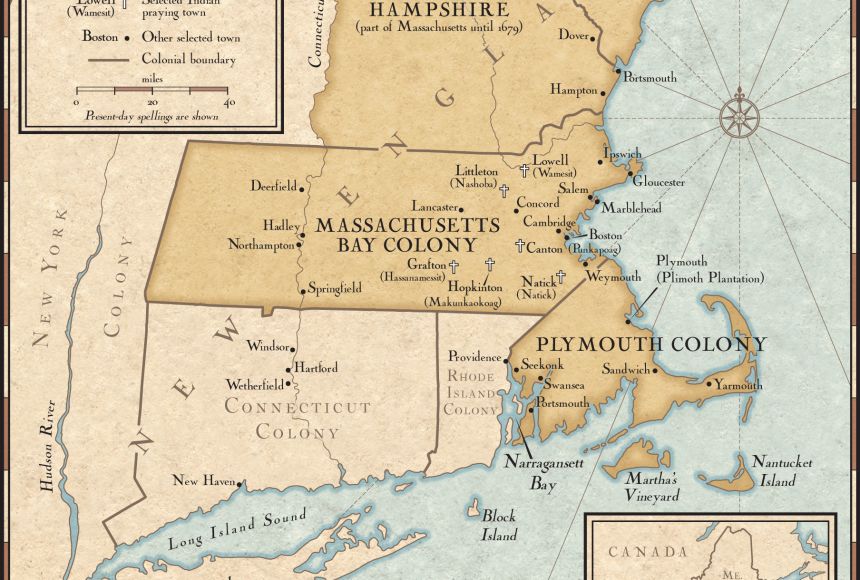
The New England Colonies in 1677. (Image courtesy of the National Geographic Society).

Preface: Troubles Brewing — Change is Fomenting

The English Monarchy governed its far-flung colonies by the power of extracting resources, then having those resources shipped to England for their own manufacturing use. These raw materials were then processed into goods (for example, textiles such as blankets), which were then shipped to the North American Colonies, sold and taxed. This scheme worked very well for England, but added to a growing sense of displacement which many Colonists felt about their place in the world. What were their rights to self-governance? How did a distant, far off monarchy fit into their worldviews?

Literally and figuratively, boundaries were shifting.
Literally, with the actuality that colonies, territories, and borders, were all shifting in a state of flux. Unlike today, as we move through a highly-bound, demarcated world, they were somewhat unbound, trying to figure it out as they went along. Figuratively, our ancestors were starting to form a ‘mental map’ of a world which was really quite different from that of their forbearers.

The English Monarchy was also going through some important changes. From essayist Joerg Knipprath: “There have been few times as crucial to the development of English constitutional practice as the 17th century. The period began with absolute monarchs ruling by the grace of God and ended with a new model of a constitutional monarchy under law created by Parliament. That story was well known to the Americans of the founding period.”

The Gore family had settled in Roxbury, Massachusetts, which is on the far eastern shore of the North American continent. As time went on, more colonists arrived and land holdings expanded to fill what was available under British governance. People wanted stability and prosperity, but the choices about where to further go were somewhat limited. For the settlers, this meant that ‘you’ needed to expand to the colonies to the north, or to the south. Movement into the western areas, was prohibited, but also, those areas in the 17th century were wilderness, unexplored, and generally hostile. (1)

King Philip’s War

Our ancestors were used to thinking about kings and queens of the European sort, but now they were going to meet a local king, who was new to their understanding. The following is excerpted from the Native Heritage Project article, King Philip’s War:

“King Philip’s War was sometimes called the First Indian War, Metacom’s War, or Metacom’s Rebellion and was an armed conflict between Native American inhabitants of present-day southern New England, English colonists and their Native American allies in 1675–76. The war is named after the main leader of the Native American side, Metacomet, known to the English as “King Philip”. 

“Throughout the Northeast, the Native Americans had suffered severe population losses due to pandemics of smallpox, spotted fever, typhoid and measles, infectious diseases carried by European fishermen, starting in about 1618, two years before the first colony at Plymouth had been settled. Plymouth, Massachusetts, [which]was established in 1620 with significant early help from Native Americans, particularly… Metacomet’s father and chief of the Wampanoag tribe.”

“Prior to King Philip’s War, tensions fluctuated between different groups of Native Americans and the colonists, but relations were generally peaceful. As the colonists’ small population of a few thousand grew larger over time and the number of their towns increased, the Wampanoag, Nipmuck, Narragansett, Mohegan, Pequot, and other small tribes were each treated individually (many were traditional enemies of each other) by the English colonial officials of Rhode Island, Plymouth, Massachusetts Bay, Connecticut and the New Haven colony.”

Over time, “…the building of [Colonial] towns… progressively encroached on traditional Native American territories. As their population increased, the New Englanders continued to expand their settlements along the region’s coastal plain and up the Connecticut River valley. By 1675 they had even established a few small towns in the interior between Boston and the Connecticut River settlements. Tensions escalated and the war itself actually started almost accidentally, certainly not intentionally, but before long, it has spiraled into a full scale war between the 80,000 English settlers and the 10,000 or so Indians.”

Drawing depicting the capture of Mrs. Rolandson during the King Philip’s War between colonists and New England tribes, 1857, Harper’s Monthly. (Image courtesy Library of Congress).

From Wikipedia: “The war was the greatest calamity in seventeenth-century New England and is considered by many to be the deadliest war in Colonial American history. In the space of little more than a year, 12 of the region’s towns were destroyed and many more were damaged, the economy of Plymouth and Rhode Island Colonies was all but ruined and their population was decimated, losing one-tenth of all men available for military service. More than half of New England’s towns were attacked by Natives.” (2)

King Philip’s War began the development of
an independent American identity.
The New England colonists faced their enemies without support
from any European government or military,
and this began to give them a group identity separate and distinct from Britain.

The Name of War: 
King Philip’s War and the Origins of American Identity
by Jill Lepore

Philip Wells and The Dominion of New England,
1686-1689

The institution of The Dominion of New England by the Royal Fiat of King Charles II added to an already existing stew of tensions in the colonies. It didn’t last that long, and Sir Edmund Andros was dispatched by the Colonists fairly quickly. For our family, the most important resulting aspect was this:

The British rulers knew that when you have accurate maps, you have power.

From the Historical Journal of Massachusetts: “The arrival of Wells and Andros’s government in Massachusetts signaled a major change in how the colonists described borders. In late 1686, King James II appointed Edmund Andros as the governor of the Dominion of New England, an administrative body that combined all the colonies.”

“While previously Massachusetts colonists selected their governors, Andros was an imposition from the King. King James II aimed to streamline the administration of the small New England colonies and bring their unruly subjects more directly under imperial control. A stark contrast to the less experienced, agrarian focused, and rurally raised leaders of early New England.”

“Although Massachusetts colonists had begun to gradually embrace mapping as a tool after the 1650s, the Dominion, an imperial tool, accelerated this process. Unsurprisingly, Andros employed familiar tools of state building and state power, including maps. He gave Wells a new appointment as the head surveyor for the Dominion and hired at least three deputy surveyors, Richard Clements, John Gore, and John Smith. Each man generally operated in a particular area…John Gore in ‘Napmuge [Nipmuck] Country’ in present-day central Massachusetts.” (3)

Did the Gore Brothers See An Opportunity?

When we first met our ancestor Samuel Gore (1) in The Gore Line — Three, we learned that he had been born in Roxbury, Massachusetts Colony, in October 1652. He was not the oldest surviving son in the family. That distinction belonged to his older brother John (2), who was the (part-time) Writ for the town of Roxbury, and was also a sought-after, skilled surveyor. These positions would have required some degree of formal education, and would be in demand in a fast-growing colony.

Inset: A youthful George Washington surveying at Pope’s Creek, Virginia. (Image courtesy of the National Park Service via Medium). Background: Frontispiece from Samuel Wyld’s The Practical Surveyor (1780). (Image courtesy of the American Philosophical Society, APS).

Notes: As the oldest son, John (2) would have benefited from primogeniture*, which was the standard for that time. (This meant that the Lions Share of the father’s estate went to the oldest son before any other person.) However, this did not always happen in the Northern Colonies, and in his father’s Will of 1657, this did not happen for John (2), as he had already received his portion of his father’s estate. Hence, his younger brother Samuel (1) likely benefited somewhat.

*primogeniture (noun)
– the state or fact of being the firstborn of children of the same parents.
– Law. the system of inheritance or succession by the firstborn, specifically the eldest son.

Observation: Additionally, as a surveyor, he was involved in projects which may have influenced the younger Samuel in his choices about where his family would live. They appear to have interacted frequently throughout their lives, as they both did surveying work, and were land-holders themselves. During a time of frequent land speculation, it seems quite likely, that they both benefited from information gained while doing their professions. From the Cameron County Genealogy Project: “Samuel Gore came into the sole possession of his father’s common lands in 1716… On 2 March 1712/13 he was elected one of the Fence Viewers of Roxbury and 3 March 1717 was one of the Surveyors of Highways.” (4)

The New Roxbury Colony, and The Mashamoquet Purchase

The people of Roxbury, Massachusetts Colony had run out of land and they decided to do something about it rather than wait for permission from, or action by, their British Governor-by-fiat, Sir Edmund Andros.

The town of Roxbury was one of the most ancient and influential
in Massachusetts Colony.
The Roxbury people were the best that came from England,
and filled many of the highest offices in the colonial government.

Nothing was lacking for their growth and prosperity
but a larger area of territory, then “limits being so scanty and not capable of enlargement that several persons…
— were compelled to remove out of the town and colony.

Ellen D. Larned
author of The History of Windham County,
page 18

In 1642, the Woodward and Saffery line was established as the southern border of the Massachusetts Colony, and thus, the northern border of the Connecticut Colony. Within a couple of decades of that date, in the rough-and-tumble early Colonial period, the people of Massachusetts wanted more land, and their neighbors to the south in the Connecticut Colony, started to take issue with what they felt was their land. It all got very complicated.

In addition, many skirmishes between the Colonists and the Native American tribes had resulted in King Philip’s War, which had destroyed much infrastructure and weakened both sides. The ‘Indians’ in shock from their defeat, had started to return to their old haunts, which the Colonists were looking to expand into. Perhaps the Roxbury settlers were spurred on by the arrival of The Dominion, because by 1686, boundaries and settlements were changing.

There was a grant for ‘Indian’ lands that consisted of two portions in Nipmuck County — one portion was called Myanexet, and the other Quinnatesset. This land had been acquired by the English representatives William Stoughton and Joseph Dudley; purchased in 1682 from the Indian representative Black James, for £50 by the English Government. From The History of Windham County: Among the first to “The land thus purchased was laid out in June, 1684, by John Gore [2], of Roxbury, under the supervision of Colonel William Dudley.”

This colorful image purports to show George Washington working as a surveyor in Colonial America. We are using it as a stand-in for our ancestor John Gore working with ‘Indian’ guides in the wilds of the Massachusetts and Connecticut colonies.

Circa May 1686 —
“In May, they were visited by Samuel Williams, Sen., Lieutenant Timothy Stevens and John Curtis, who, with John Gore as surveyor, came as committee from Roxbury, ‘to view the land, in order to the laying out of the same; settle the southern bounds (upon or near the colony line)… Eleven days were spent by Mr. Gore in making the needful surveys and measurements — Massachusetts’ South boundary line evaded their search, so they made a station about one and a half miles south of Plaine Ilill, and thence marked trees east and west for the south line of their grant, nearly two miles south of the invisible Woodward’s and Safferys line, thus securing to Massachusetts another strip of Connecticut territory”.

Problems arose due to the perceived position of the Woodward and Saffery line, and then it was not clear who exactly who was at fault with information from 1642. (Remember, earlier maps were not very precise before this period). Ultimately, what was surveyed created problems for both Colonies.

This chart from page 15 of Windham County shows the survey work by John Gore (2) that was completed for the Quinnatesset portion of the land purchase. The horizontal line is the Woodward and Saffery line. Above that line is Massachusetts and below it is Connecticut. The small letter ‘e’ on the left portion is the designation for Samuel Gore (1)’s purchase — the father of John Gore (2). For whatever reason, land purchased by both Thompson and Gore ended up “being-kind-of-ish” in Connecticut, not Massachusetts. This was a problem in the fact that the Colonies were (of course) governed by Britain, and these two colonies had separate governments whose interests were not aligned.

Further excerpted material from Windham County: “No attempt was made to occupy and cultivate these farms by their owners. Thompson’s land remained in his family for upwards of an hundred years, and the town that subsequently included it was named in his honor”.

As time went on, Mashamoquet was the name of a river which was frequently used as a boundry marker. By 1686, the land was known as the Mashamoquet Purchase, and the village settlement was called New Roxbury.

“The survey and divisions (of land) were accomplished during the winter, and on March 27th, 1694, nearly eight years after the date of purchase, the several proprietors received their allotments in the following order: 1, Esther Grosvenor; 2, Thomas Mowry; 3, John Ruggles; 4, John Gore; 5, Samuel Gore [1]’s heirs; 6, Samuel Ruggles; 7, John Chandler; 8, Jacob, Benjamin and Daniel Dana; 9, Benjamin Sabin; 1 0, Thomas and Elizabeth Ruggles; 11, John White; 12, Joseph Griffin… Note that Samuel Gore’s heirs received his allotment of land. Samuel died in 1694, age 41, two years before the division of land in Connecticut was completed”.

In 1690, the village was renamed Woodstock.

Connecticut was originally settled by Dutch Fur Traders. The first English settlers arrived in Connecticut in 1663 under the leadership of Reverenced Thomas Hooker. They were Puritans from the Massachusetts Bay Colony.

“By the settlement of Massachusetts boundary line in 1713… Massachusetts was forced to admit that Woodward’s and Saffery’s line ran some miles south of the bound prescribed by her patent… That Connecticut had a lawful right to the fee as well as jurisdiction of this land no one could deny, but beset by enemies at home and abroad she was forced to yield it to the stronger Colony, and allowed Massachusetts, by formal agreement and covenant, to keep the towns laid out by her in Connecticut territory, and the various grantees to retain possession of this land, receiving as equivalent an equal number of acres in distant localities. Under this arrangement, Connecticut yielded: To the town of Woodstock, 50,410 acres. …To John Gore, 500 acres… ”

…and in 1749 the town officially chose to became part of Connecticut.

In the more southern portion of the Mashamoquet Purchase, below the village of Woodstock (formerly New Roxbury), another small township was established named Pomfret. It was incorporated in 1713, and is important to the next generation of the Gore Family. (5)

Captain Samuel Gore (2) Marries Hannah Draper

Samuel Gore (2) was born on October 20, 1681, in Roxbury, Massachusetts Colony – died May 27, 1756, in Norwich, Connecticut Colony. He married Hannah Draper about 1703, when he was 22 and she was 17 years old. Hannah was born April 8, 1686 in Roxbury, Massachusetts Colony and died July 11, 1741, in Norwich, Connecticut Colony. They are both buried in the Eliot Burying Ground in Roxbury, Suffolk County, Massachusetts.

Hannah was the daughter of Moses Draper and Hannah Chandler. He was born on September 15, 1664 in Dedham, Massachusetts – died August 14, 1693 in Boston, Massachusetts Colony, age 29. His parents were James Draper and Miriam Stansfield.

Hannah (Chandler) Draper, was born September 19, 1669 in Roxbury, Suffolk, Massachusetts Colony – died June 9, 1692 in Roxbury, Massachusetts, age 22. Her parents were John Chandler and Elizabeth Douglass.

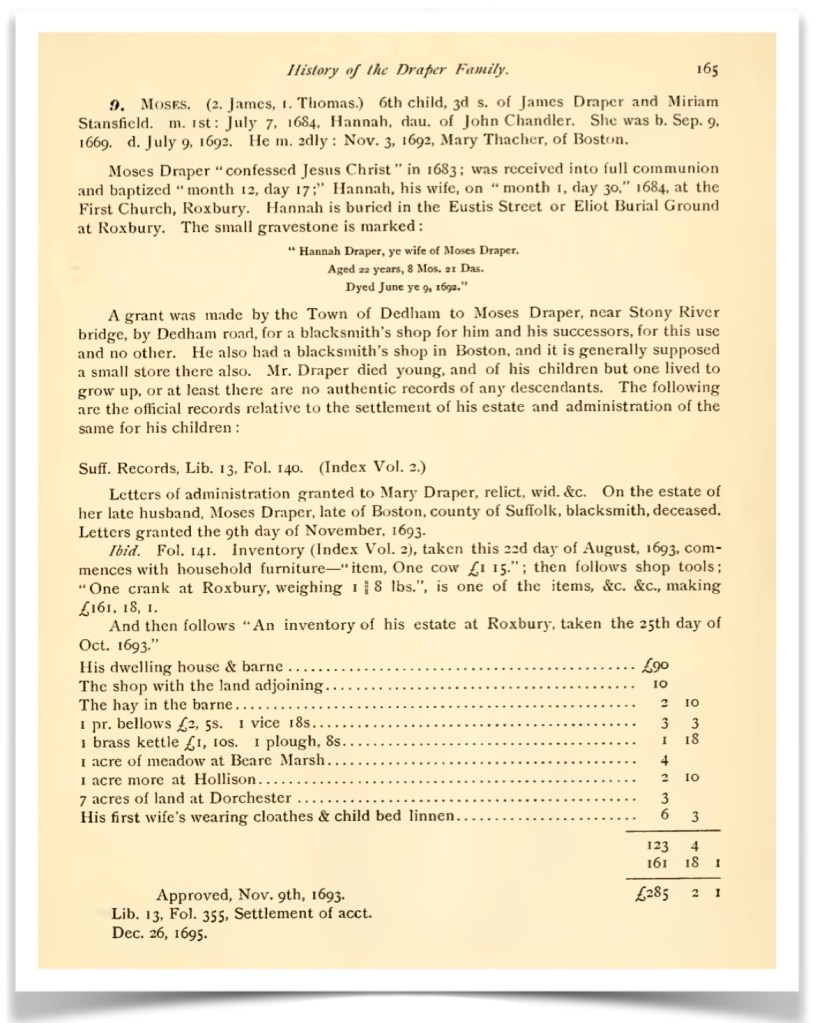
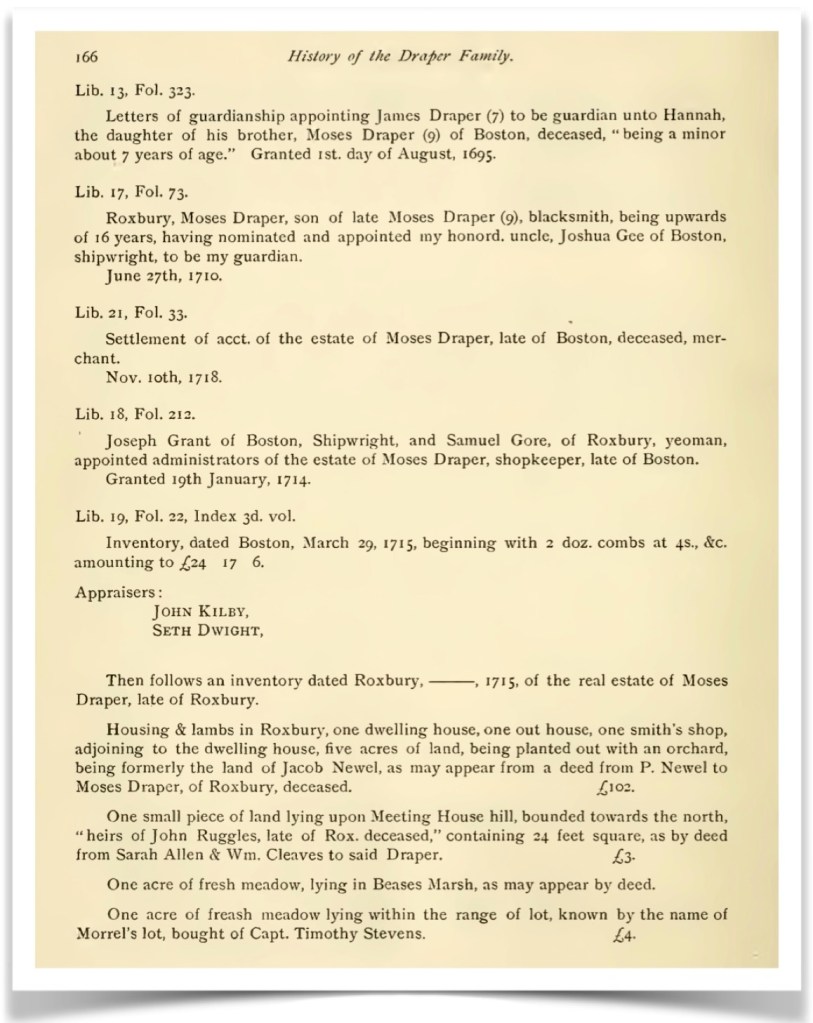
Hannah (Draper) Gore was six years old when her mother died in July 1692. In November 1962 her father, Moses Draper, married Mary Thatcher. A child, Moses Draper, Jr. was born September 12, 1693. However, the father, Moses, had died the month before his birth. By age seven, Hannah was an orphan. Her guardianship was given to her Uncle James Draper on August 1, 1695. It is unclear if she was raised by him, or remained with Mary (Thatcher) Draper and her step-brother Moses. Below is interesting information regarding the settlement by 1715 of Moses Draper’s estate.

All three pages above are from The Drapers In America, Being a History and Genealogy Those of That Name and Connection, by Thomas Wall-Morgan Draper, 1892. Note on the third page (167): A past genealogist wrote-in “Samuel” in pencil, to correct the author’s error about her husband.

Samuel Gore (2) and Hannah (Draper) Gore Family

For the first eleven years of their marriage Samuel (2) and Hannah lived in Roxbury, Massachusetts where the first six of their nine children were born.
Note: CTC = Connecticut Colony, CT = Connecticut State

  • Elizabeth (Gore) Witter, born January 12, 1704 – died April 9, 1761 Preston, CTC
  • Samuel Gore, born March 26, 1705 – died May 22, 1706 (one year old)
  • Samuel Gore (3), born May 29, 1707 – died July 26, 1791 Voluntown, CT
    (We are descended from Samuel 3).
  • Moses Gore, born September 23, 1709 – died 1786 Cornwallis, Kings, Nova Scotia, Canada
  • John Gore, born October 11, 1711 – died January 19, 1735, Norwich CTC
  • Obadiah Gore, born July 26, 1714 – died 10 January 1779, of smallpox in Wyoming, Pennsylvania. Notably, he lost several adult children in another Native American ‘Indian War’ — the Wyoming Valley Massacre July 3, 1778.

    Their youngest three were born in Norwich, Connecticut Colony (CTC):
  • Daniel Gore, born September 6, 1719- died October 4, 1719 (one month old)
  • Hannah (Gore) Burrow Gallup, born December 20, 1720 – died March 19, 1810 Stonington, CT
  • Sarah (Gore) Hobart born January 15, 1723 – died July 28, 1743 Stonington, CTC

After his wife Hannah (Draper) Gore died in 1741, Samuel (2) married for a second time to Mrs. Dorcas Blunt on May 13, 1742. (6)

What The Connecticut Charter of 1662 Accomplished

The Conneticut Charter was remarkable for several reasons. From Wikipedia: The English Parliament restored the monarchy in 1660, and King Charles II assumed the English throne. Connecticut had never been officially recognized as a colony by the English government, so the General Court determined that the independence of Connecticut must be legitimized... The key document mapping out Connecticut’s original boundaries wasn’t in fact a map. It was, instead, a royal charter… arguably the most important document in Connecticut’s history—contains among its other provisions a written description of the colony’s boundaries that served the same function as a drawn map.

Charter of the Colony of Connecticut, 1662 – Connecticut State Library.

The document described Connecticut’s western borders extending through Pennsylvania-claimed lands all the way to the ‘southern sea”. From Connecticut History.org: “The ‘South Sea’—what we call the Pacific Ocean—was well known to early navigators, but its exact location in relation to Connecticut Colony was unclear in 1662. What England’s King Charles II effectively granted Connecticut through that grandiose wording was a swath of land some 70 miles north to south, stretching from the Narragansett Bay on the east to the northern California/Oregon coast just west of Mount Shasta...”

“Historians have long marveled at the generous provisions of the 1662 royal charter. In addition to the transcontinental footprint, the king also granted Connecticut virtually complete governmental autonomy more than a century before the Declaration of Independence. The charter’s provisions in this regard were so complete that when other states scrambled to create new constitutions at the start of the American Revolution, Connecticut simply replaced the king’s name with ‘the people of Connecticut’ and continued using the charter as its constitution until 1818”.

Observations: It is plausible that these boundaries would could have influenced the choices of the ancestral descendants found further on in The Gore Line after this era. For us in the present day, the ‘western’ boundary became a defining feature of where we grew up in Ohio. (7)

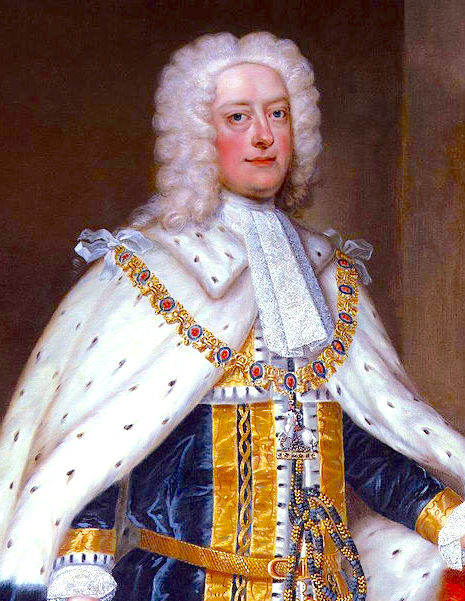
The Houses of Stuart and Orange: Queen Anne (reigned 1702 – 1707), and then she continued as Queen under The House of Stuart, (reigned 1707 – 1714), The House of Hanover, George I (reigned 1714-1727), George II (reigned 1727 – 1760).

The Samuel Gore Family Moves to Norwich in the Connecticut Colony

Observation: Samuel Gore (2), was the son of a carpenter and part-time surveyor, but most importantly, he was connected through his relatives to land investments in New England. Land ownership may have been his primary means of retaining wealth. He may have been a farmer (yeoman), but we doubt that he ever pushed a plow in his early life. He likely leased his lands and had other people to do much of the hard labor. (This may have been different for his children and grandchildren…)

The History of Windham County records that John Chandler, the grandfather of Hannah (Chandler) Gore purchased Pomfret land from Samuel Gore (2) about 1716. It is probable that Samuel (2) had likely acquired the land he sold, through his inheritance from his father Samuel (1). John then moved his family from Roxbury, Massachusetts Colony to Pomfret, Connecticut Colony. Pomfret was then a newly established area formed from the Mashamoquet Purchase.

Additionally, the Weld Collections, by Charles Frederick Robinson, records of Samuel (2)… “He was of Roxbury in 1719, and 20 July, 1734, he was of Norwich, Conn. He sold on the former date [1719] land in Roxbury on the Dedham road, for £420, Hannah his wife releasing her right of dower (SD 57.16)”. It is likely that this land ‘on Dedham Road’ was the original land of Moses Draper, the father of his wife Hannah, (see Drapers in America, p 165 above).

In 1721, Samuel (2) was commissioned Captain of the 5th Company, Connecticut Militia, located in Norwich. (8)

The Susquehanna Company

Can we acquire that land?
… this refrain seems to be a dominant theme for these generations of the Gore Family. From Connecticut History.Org: “In 1753, amidst a flurry of land speculation and westward expansion that captivated the imagination of American colonists, Connecticut settlers formed the Susquehanna Company for the purposes of developing the Wyoming Valley in northeastern Pennsylvania... a shortage of farmland and a growing population had encouraged some in Connecticut to revisit the terms of the colony’s original land grant…” — the one that promised that Connecticut’s borders extended ever westward. See above: What The Connecticut Charter of 1662 Accomplished

“Pennsylvania also had a royal charter, issued in 1681 by the same king, that gave it title to the territory in question. This was not unusual, as the imperial bureaucracy back in England often possessed only rudimentary knowledge of the vast American terrain”.

Map The Part of Pennsylvania that Lies Between the Forks of the Susquehanna, Divided into Townships, ca. 1790s. (Image courtesy of the Library of Congress, Geography and Map Division).

“So, in 1754, when the Susquehanna Company acquired the land for 2,000 pounds from an Iroquois delegation at a conference in Albany, New York, many called the validity of the transaction into question. Settlement of the area (which also included land west of the Wyoming Valley and made up almost one-third of Pennsylvania) quickly became a divisive issue among Connecticut, Pennsylvania, and several tribal nations, as well as within the Connecticut colony itself.”

Samuel Gore (2) and his son, Obadiah Gore, had become members of The Susquehanna Company. As owners of one right, or share, their names appear among the names of the grantees in the Indian deed of July 11, 1754. Twenty-four years later the younger Gore generation would fight in the Battle of Wyoming (a county in Pennsylvania).

Ultimately by 1799, Connecticut gave up any claim it had to lands in Pennsylvania, but this was not before one particularly famous, but truly terrible battle, changed the lives of some of our ancestors. (9)

The Battle of Wyoming (County), Pennsylvania

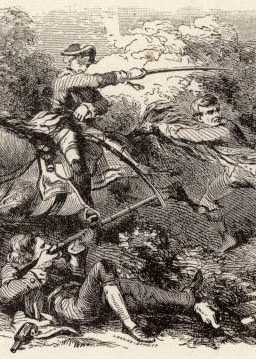
The situation in Pennsylvania came to a head in the Wyoming Valley Massacre of July 3, 1778. The family of Captain Obadiah Gore did not fare well. (10)

Battle Of Wyoming, 1778 by Alonzo Chapel (1858). Public domain.

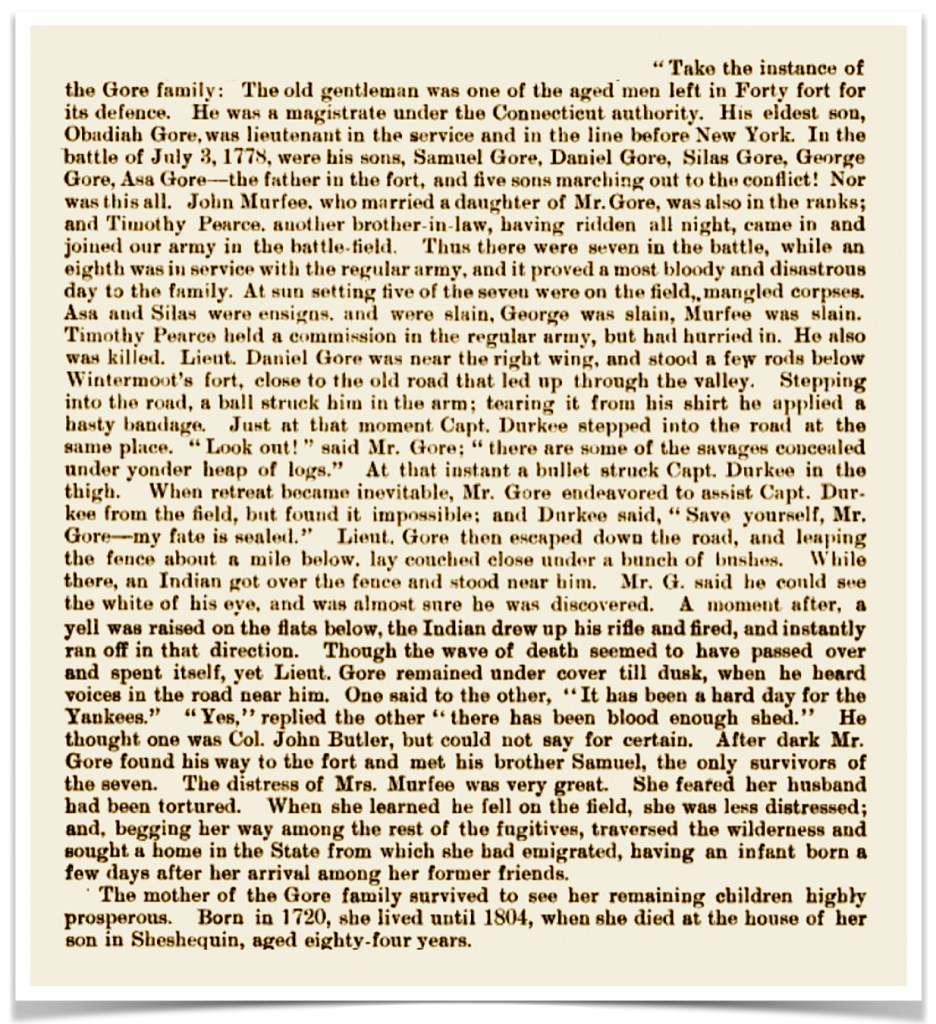
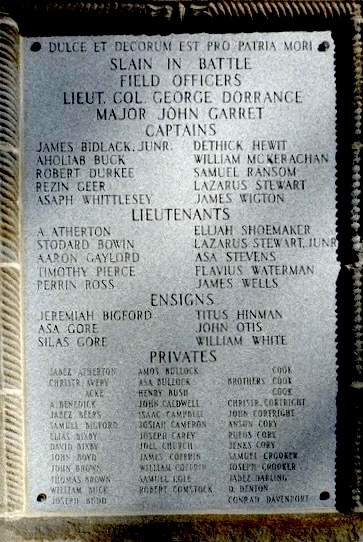
“When the Battle of Wyoming was fought, Capt. Obadiah Gore was one of the small company of old men who remained in Forty fort for its defense…” Three of Obadiah Gore’s sons and two sons-in-law died in the Battle of Wyoming that day fighting for The Continental Army. Fully recounted below, more than a century later, in A History Of, Luzerne County, Pennsylvania, 1893 edition:

Samuel Gore (3) Marries Desire Safford

Samuel Gore (3) was born on May 29, 1707, in Roxbury, Massachusetts Colony – died July 26, 1791, in Voluntown, Connecticut, USA. He moved with his parents to Norwich, Connecticut sometime in his childhood. He married Desire Safford, February 25, 1735/36 in Norwich, New London County, Connecticut Colony. She was born on October 18, 1717 in Voluntown, Connecticut Colony – died September 11, 1772, same location. Desire was the daughter of John Safford and Dorothy Larrabee.

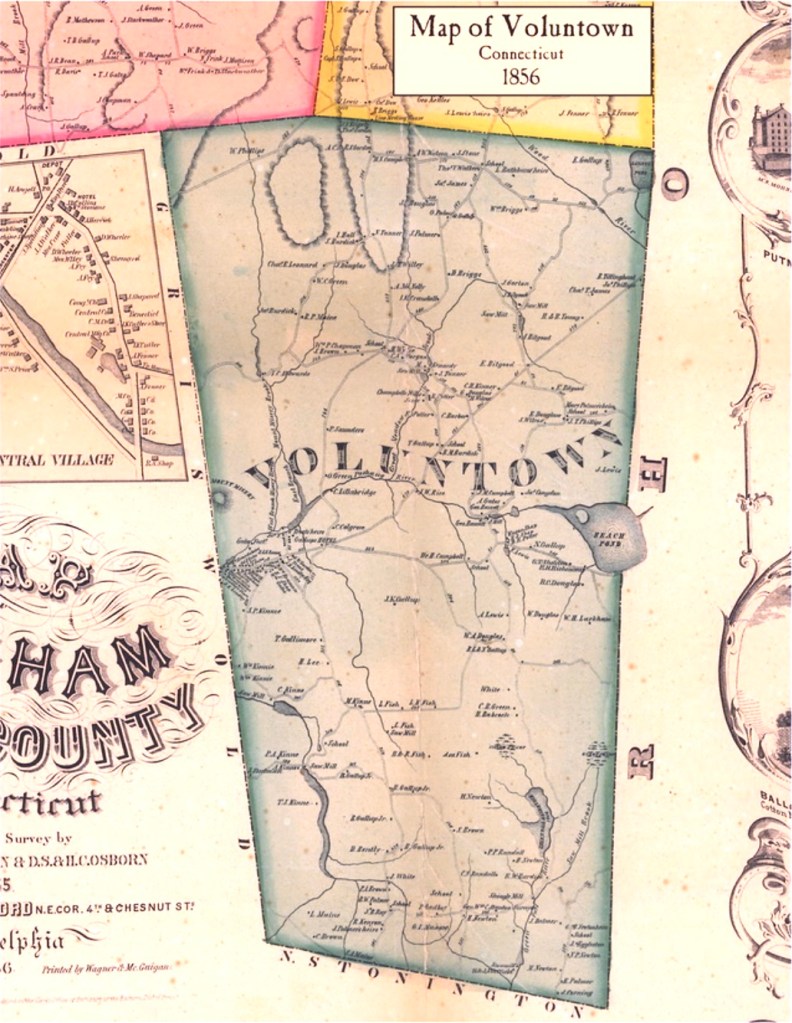
From Family Search.org: “Before 1881, Voluntown belonged to Windham County, Connecticut, instead of New London County. Much of the land situated in what is now Voluntown was granted to the volunteers of the Narragansett War in 1700. The name Volunteer’s Town turned into what is now known as Voluntown.”

Although this map was created in 1856, Voluntown boundaries had stayed the same since Samuel Gore (3)’s lifetime.

Samuel Gore (3) and Desire had nine children. He moved his family from Voluntown, some 14 miles north east of Norwich, and then returned to Norwich, and even later returned to Voluntown. He owned land in both places, and where they were living influenced where each child’s birth was recorded, as noted below — all were born in either Norwich, New London County, or Voluntown, Windham County, Connecticut Colony.
Note: CTC = Connecticut Colony, CT = Connecticut State

  • John Gore, born November 15,1736, Norwich, New London, CTC – died August 15, 1773, Norwich, CT
  • Elizabeth (Gore) Eddy, born December 15, 1738, Voluntown, New London, CTC – died March 14, 1790, Salisbury, Litchfield, CT
  • Hannah Gore, born June 26, 1741, Voluntown, CTC – death date unknown
  • Dorothy (Gore) Titus, born February 6, 1746/47, Norwich, New London, CTC- died 1816, Stirling City, Windham, CT
  • Desire Gore, born April 19, 1750, Norwich, New London, CTC – death date unknown
  • Elijah Gore, born February 11, 1754, Norwich, CTC – died after 1791 Halifax, Windham, Vermont.
    (We are descended from Elijah).
  • Amos Gore, born October 9, 1755, Norwich, New London, CTC- died June 11, 1827, Halifax, Windham, Vermont
  • Esther (Gore) Stafford, born January 22, 1759, Norwich, New London, CTC – October 24, 1836, Halifax, Windham, Vermont
  • Ebenezer Gore, born February 3, 1762, Voluntown, New London, CTC- died September 30, 1790, Killingly, Windham, CT

Observation: Elijah Gore and family along with his siblings, Amos and Lydia (Carpenter) Gore, and Samuel and Esther (Gore) Stafford, moved to Halifax, Windham, Vermont, where they lived for the rest of their lives. Note that the name Windham County (confusingly!) repeats in Vermont.

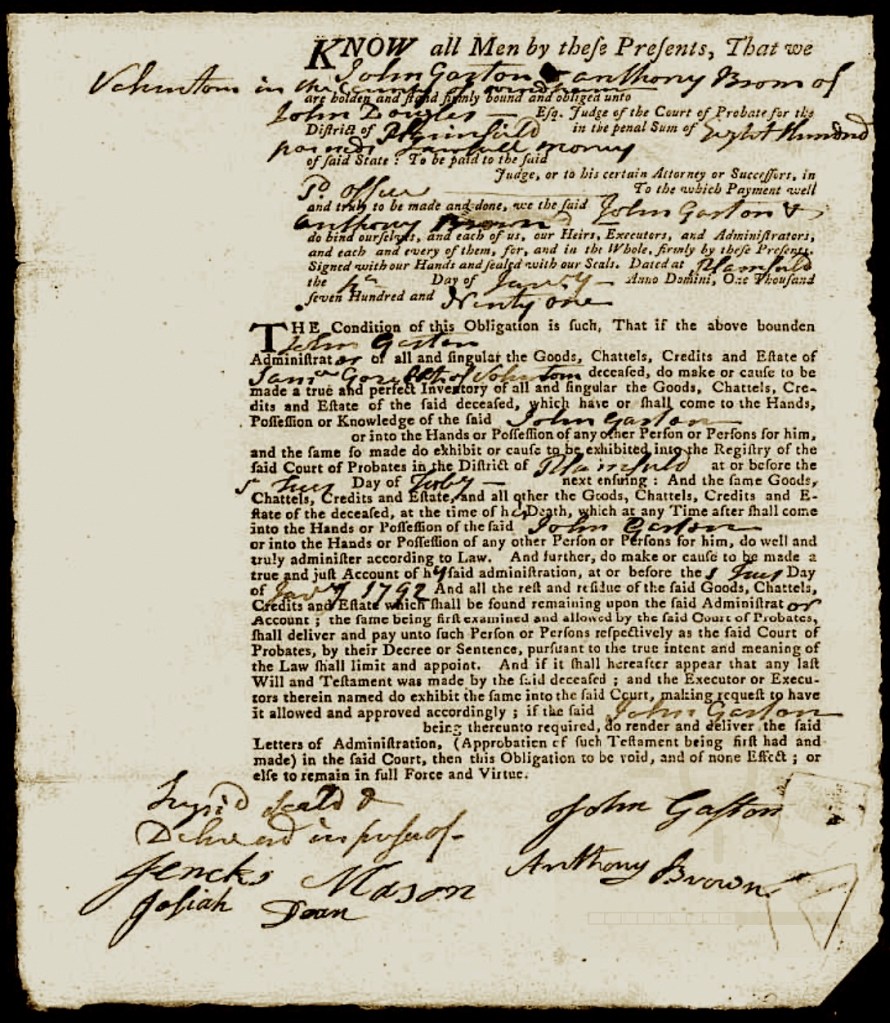
Samuel Gore (3) was a beneficiary of his father’s estate, so this may have provided him with the economic means to live the life of a gentleman farmer: he was a land-holder, who also did some farming. It also seems that his life was quieter than those of his father’s and grandfathers’ generations. The administrative documents for his estate are interesting, extensive, and quite illegible. In those times, all debts were to be settled when the Will was probated, so sometimes an extensive inventory of assets were necessary.

Comment: The frequent bane of our research, is trying to interpret the poor quill-penmanship of court administrators and census takers! ‘Our hats are off to you’ if you can read the 34 administrative papers!) (11)

First page of the administrative documents for the estate of Samuel Gore (3), circa 1791.

The Last King of America

From Wikipedia.org: “George III’s life and reign were marked by a series of military conflicts involving his kingdoms, much of the rest of Europe, and places farther afield in Africa, the Americas and Asia. Early in his reign, Great Britain defeated France in the Seven Years’ War, becoming the dominant European power in North America and India. However, many of Britain’s American colonies were soon lost in the American War of Independence… [The War] was the culmination of the civil and political American Revolution. In the 1760s, a series of acts by Parliament was met with resistance in Britain’s Thirteen Colonies in America. In particular they rejected new taxes levied by Parliament, a body in which they had no direct representation. The colonies had previously enjoyed a high level of autonomy in their internal affairs and viewed Parliament’s acts as a denial of their rights as Englishmen… The colonies declared their independence in July 1776…” (12)

The House of Hanover, George III (reigned 1760-1820). King George III in his Coronation Robes, by Allan Ramsay, circa 1765. (Image courtesy of Wikimedia Commons).

In the next chapter, The Gore Line — Five, we will feature the last of our Gore relatives who live in Connecticut. They venture on to Vermont, and then move westward to New York state. Indeed very soon, the people of the newly formed United States of America begin their westward journey.

Following are the footnotes for the Primary Source Materials,
Notes, and Observations

Preface: Troubles Brewing — Change is Fomenting

(1) — two records

National Geographic | Education
The New England Colonies in 1677
https://education.nationalgeographic.org/resource/massachusetts-1677/
Note: For the map image.

King vs. Parliament in 17th Century England: From Absolutism to Constitutional Monarchy, Influence on American Governing
https://constitutingamerica.org/90day-aer-king-vs-parliament-17th-century-england-from-absolutism-to-constitutional-monarchy-influence-on-american-governing-guest-essayist-joerg-knipprath/
Note: For the data.

King Philip’s War

(2) — seven records

Native Heritage Project
King Philip’s War
https://nativeheritageproject.com/2012/09/02/king-philips-war/
Note: For the text and the image.

King Philip’s War
https://en.wikipedia.org/wiki/King_Philip’s_War
Note: For the text.

World History Encyclopedia
Death of King Philip or Metacom
https://www.worldhistory.org/image/13670/death-of-king-philip-or-metacom/
Note: For the illustration.

Encyclopædia Britannica
King Philip’s War
https://www.britannica.com/event/King-Philips-War
Note: For the illustration, Metacom (King Philip), Wampanoag sachem, meeting settlers, c. 1911

A group of Indians armed with bow-and-arrow, along with a fire in a carriage ablaze, burn a log-cabin in the woods during King Philip’s War, 1675-1676, hand-colored woodcut from the 19th century.
https://commons.wikimedia.org/wiki/File:KingPhilipsWarAttack.webp
Note: For the illustration.

America’s Best History, Pre-Revolution Timeline — The 1600s
1675 Detail
https://americasbesthistory.com/abhtimeline1675m.html
Note: For the illustration depicting the capture of Mrs. Rolandson during the King Philip’s War between colonists and New England tribes, 1857, Harper’s Monthly.

The Name of War: King Philip’s War and the Origins of American Identity
by Jill Lepore
Vintage Books, 1999
Book pages: 5-7
Note: For the pull quote.

Philip Wells and The Dominion of New England,
1686-1689

(3) — one record

Historical Journal of Massachusetts, Winter 2020
Article: Colonial Mapping in Massachusetts, 1629-1688
by Thomas Graves and Phillip Wells
https://www.westfield.ma.edu/historical-journal/wp-content/uploads/2020/Colonial-Mapping-FINAL1.pdf
Downloadable .pdf document, Page 165
Note: For the text.

Did the Gore Brothers See An Opportunity?

(4) — four records

Medium
Ink sketch of young George Washington…
https://medium.com/@NGA_GEOINT/plotting-the-course-5b9a35d24a01
Note: “Ink sketch of young George Washington surveying the area around the Popes Creek plantation. Credit: National Park Service, U.S. Dept. of the Interior, National Park Service Historical Handbook Series No. 26, frontispiece”.
Note: For the illustration.

American Philosophical Society
A Few Technical Items: Questions about 18th Century Surveying Instruments Answered (Part I)
by Erin Holmes
https://www.amphilsoc.org/blog/few-technical-items-questions-about-18th-century-surveying-instruments-answered-part-i
Note: For the background image.

Dictionary.com
primogeniture
https://www.dictionary.com/browse/primogeniture
Note: For the data.

Cameron County Genealogy Project, Gore Family
Contributed by Mike Wennin
https://sites.rootsweb.com/~pacamero/gorefam.htm
Note: For the text.

The New Roxbury Colony, and The Mashamoquet Purchase

(5) — six records

History of Windham County, Connecticut
Volume 1 1600 – 1760
Ellen D. Larned, 1874 edition
https://archive.org/details/historywindhamc01larngoog/page/n10/mode/2up
Note: For the text.

George Washington, Surveyor
https://images.slideplayer.com/9/2519012/slides/slide_1.jpg
Note: For the illustration.

Woodstock, Connecticut
https://en.wikipedia.org/wiki/Woodstock,_Connecticut
Note: For the data.

Sutori
The Connecticut Colony
https://www.sutori.com/en/story/the-connecticut-colony–koYJgeyWL5FQjAtCQWEP3yzM
Note: For the image and data.

[For the list of siblings]
Lt Samuel Gore Jr
https://www.ancestry.com/family-tree/person/tree/40371118/person/28057081430/facts
and
Saved Ancestry Family Trees for Lt Samuel Gore Jr
https://www.ancestry.com/family-tree/pt/PersonMatch.aspx?tid=40371118&pid=28057081430&src=m
Note: For the data.

Captain Samuel Gore Marries Hannah Draper

(6) — eight records

History of the Town of Stonington, County of New London, Connecticut,
from its First Settlement in 1649 to 1900
by Richard Anson Wheeler
https://archive.org/details/historytownston00wheegoog/mode/2up
Digital pages: 398-399/754
Note: For the data.

The Drapers In America, Being a History and Genealogy Those of That Name and Connection
by Thomas Wall-Morgan Draper, 1892
https://ia600905.us.archive.org/26/items/drapersinamerica00drap/drapersinamerica00drap.pdf
Downloadable .pdf document, Book pages: 165-167
Note: For the data.

Genealogy of the Kennan Family
by Thomas Lathrop Kennan
https://archive.org/details/genealogyofkenna00kenn/page/n7/mode/2up
Book pages: 94-98, Digital pages: 94-98/164
Note: For the data.

The Genealogy of the Payne and Gore Families
Compiled by W. H. Whitmore
https://archive.org/details/genealogypaynea00whitgoog/page/n21/mode/2up
Book Pages: 28, Digital Pages: 38/80
Note: For the data.

Weld Collections
by Charles Frederick Robinson
https://www.familysearch.org/search/catalog/2558919
and
ibid.
https://www.familysearch.org/library/books/viewer/357789/?offset=0#page=59&viewer=picture&o=download&n=0&q=
Downloadable .pdf document, Section No. 9,
Book page: 59/267, Left column center.
Note: For the data.

Capt Samuel Gore Jr.
[Samuel Gore 2]
https://www.findagrave.com/memorial/129489751/samuel-gore
Note: For the data.

Samuel Gore III
[Samuel Gore 3]
https://www.findagrave.com/memorial/129491438/samuel-gore?_gl=1*19z07sy*_gcl_au*OTc0NzY2ODkxLjE2OTA5MjM3MzU.*_ga*MTU4MTY5MjA2NC4xNjkwOTIzNzM2*_ga_4QT8FMEX30*OWE5NjcyMGEtZTNmMC00ZjRlLWFjYTctNTNkYzMyMzFmMmY5LjIwLjEuMTY5NjE5NjczMC41OS4wLjA.*_ga_LMK6K2LSJH*OWE5NjcyMGEtZTNmMC00ZjRlLWFjYTctNTNkYzMyMzFmMmY5LjMuMS4xNjk2MTk2NzMwLjAuMC4w
Note: For the data.

What The Connecticut Charter of 1662 Accomplished

(7) — seven records

History of the Connecticut Constitution
https://en.wikipedia.org/wiki/History_of_the_Connecticut_Constitution
Note: For the text.

Connecticut History.org
From the State Historian: The Map That Wasn’t a Map
https://connecticuthistory.org/from-the-state-historian-the-map-that-wasnt-a-map/
Note: For the text and image.

List of English Monarchs
Houses of Stuart and Orange
https://en.wikipedia.org/wiki/List_of_English_monarchs
Note: For their portraits.

List of British monarchs
https://en.wikipedia.org/wiki/List_of_British_monarchs
Note: For the data.

Queen Anne
File:Dahl, Michael – Queen Anne – NPG 6187.jpg
https://commons.wikimedia.org/wiki/File:Dahl,Michael–Queen_Anne-_NPG_6187.jpg
Note: For her portrait.

King George I
File:King George I by Sir Godfrey Kneller c.1715-1719.jpg
Note: For his portrait.

King George II
https://commons.wikimedia.org/wiki/File:King_George_II_by_Charles_Jervas.jpg
Note: For his portrait.

The Samuel Gore Family Moves to Norwich in the Connecticut Colony

(8) — four records

CT Genealogy
Early Settlement of Pomfret Connecticut
by Dennis Partridge
https://connecticutgenealogy.com/windham/pomfret_early_settlement.htm
Note: For the text.

Connecticut Historical Collections, Containing a General Collection of Interesting Facts, Traditions, Biographical Sketches, Anecdotes &c, Relating to the History and Antiquities of Every Town in Connecticut
by John Warner Barber
https://www.google.pt/books/edition/Connecticut_Historical_Collections/zQwWAAAAYAAJ?hl=pt-PT&gbpv=1&dq=John+Warner+Barber&printsec=frontcover
Book pages and Digital pages are the same:
Woodstock, 294-304
Pomfret, 437-440
Norwich, 294-304
Note: For the illustrations.

Maps Of The Past
Historic State Map – Connecticut Colony – 1766 – 23 X 31.56 – Vintage Wall Art
https://www.mapsofthepast.com/colony-of-connecticut-county-map-1766.html

The Susquehanna Company

(9) — two records

Connecticut History.org
The Susquehanna Settlers
https://connecticuthistory.org/the-susquehanna-settlers/

The Gore Family History — Jeff Gore’s Blog
https://jgoredotorg.wordpress.com/2018/05/27/the-gore-family-history/

The Battle of Wyoming (County), Pennsylvania

(10) — three records

The Battle of Wyoming
Painting by Alonzo Chapel, 1858
https://pabook.libraries.psu.edu/literary-cultural-heritage-map-pa/feature-articles/neighbor-vs-neighbor-wyoming-valley
Note: For the battle image.

A History of Luzerne County, Pennsylvania, 1893 edition [only]
by H. C. Bradsby, editor
https://www.google.pt/books/edition/History_of_Luzerne_County_Pennsylvania/4BkVAAAAYAAJ?hl=pt-PT&gbpv=1&dq=A+History+Of+Wilkes-Barre,+Luzerne+County,+Pennsylvania,+c1893,+Chapter+XII&pg=PR6&printsec=frontcover
Book pages and digital pages are the same: 347-348 (Chapter XII)

Gallery photos courtesy of:
Wyoming Commemoration Association Facebook Group
https://www.facebook.com/Wyomingcommemorative/photos

Samuel Gore (3) Marries Desire Safford

(11) — eleven records

Samuel Gore III
https://www.findagrave.com/memorial/129491438/samuel-gore?_gl=1*19z07sy*_gcl_au*OTc0NzY2ODkxLjE2OTA5MjM3MzU.*_ga*MTU4MTY5MjA2NC4xNjkwOTIzNzM2*_ga_4QT8FMEX30*OWE5NjcyMGEtZTNmMC00ZjRlLWFjYTctNTNkYzMyMzFmMmY5LjIwLjEuMTY5NjE5NjczMC41OS4wLjA.*_ga_LMK6K2LSJH*OWE5NjcyMGEtZTNmMC00ZjRlLWFjYTctNTNkYzMyMzFmMmY5LjMuMS4xNjk2MTk2NzMwLjAuMC4w

Dorothy Larrabee
https://www.familysearch.org/tree/person/details/LHRW-J5S
and
https://www.familysearch.org/tree/pedigree/landscape/LH2S-MS8
and
https://www.familysearch.org/tree/pedigree/landscape/LH2S-MS8

Elijah Gore
in the Connecticut, U.S., Town Marriage Records, pre-1870 (Barbour Collection)

Voluntown Vital Records 1708-1850
https://www.ancestry.com/discoveryui-content/view/225419:1062?tid=&pid=&queryId=1d2415c4e44686d563db8be245d11749&_phsrc=DZs10&_phstart=successSource
Book page: 180, Digital page: 52/122, Lower portion of page.
Note: For the Gore family children born in Voluntown, Connecticut.

Amos Gore
https://www.findagrave.com/memorial/43068929/amos-gore

Esther Gore Stafford
https://www.findagrave.com/memorial/60666654/esther-stafford

Old Maps
Voluntown , Connecticut 1856 Windham Co. – Old Map Custom Print
https://shop.old-maps.com/connecticut/towns/windham-co-ct-1856-town/voluntown-connecticut-1856-windham-co-old-map-custom-print/
Note: For map image.

Grammarist.com
Hats Off (to You) – Idiom & Meaning In English
https://grammarist.com/idiom/hats-off-to/

Voluntown, New London County, Connecticut Genealogy
https://www.familysearch.org/en/wiki/Voluntown,_New_London_County,_Connecticut_Genealogy

Samuel Gore
in the Connecticut, U.S., Wills and Probate Records, 1609-1999

https://www.ancestry.com/discoveryui-content/view/2422197:9049?tid=&pid=&queryId=8b401cb68de4c847bc225eb31904b5ab&_phsrc=qGQ4180&_phstart=successSource
Digital pages: 682-716/1402
Note: There are 35 images in this docket.

The Last King of America

(12) — two records

George III
https://en.wikipedia.org/wiki/George_III

King George III Coronation Portrait
by Allan Ramsay, circa 1765
https://commons.wikimedia.org/wiki/File:Allan_Ramsay_-_King_George_III_in_coronation_robes_-_Google_Art_Project.jpg
Note: For his portrait.

The Gore Line, A Narrative — Three

This is Chapter Three of eight. Our Gore relatives move from the United Kingdom to the New England Colonies in the New World. The relationship of the Gore(s) to the British Crown, like many others in the Great Migration, was one of physical distance, and then increasingly emotional distance.

In this chapter, we are covering the first two generations of the Gore Family in the Massachusetts Bay Colony.

The Stuarts: King James I (reigned 1603 – 1625), King Charles I (reigned 1625 – 1649), and King Charles II (reigned 1660 – 1685). The Stuarts represent the Union of Scottish and the English Crowns. As such, they were the first kings of the United Kingdom. (1)

The Great Migration, 1620-1640

The term Great Migration can refer to the migration in the period of English Puritans to the New England colonies, starting with the Plymouth Colony and then the Massachusetts Bay Colony, (where the Gore family immigrated to). They came in family groups rather than as isolated individuals and were mainly motivated for their freedom to practice their beliefs.

This religious conflict worsened after Charles I became king in 1625, and Parliament increasingly opposed his authority. In 1629, Charles dissolved Parliament with no intention of summoning a new one, in an ill-fated attempt to neutralize his enemies there, which included numerous Puritans. With the religious and political climate so unpromising, many Puritans decided to leave the country. (2)

A New Era Begins in The American Colonies

Richard and Elizabeth Gore’s son John Gore (John 1 in America), born 1606 in Alton, East Hampshire District, Hampshire – died June 4, 1657 in Roxbury, Suffolk County, Massachusetts, British Colonies. He was interred at the Eliot Burying Ground at the same location. In England, he lived in North Baddesley and Southampton, Hampshire.

In July 1625 John Gore, aged 19, earned a B.A. from Queens College in Cambridge. He married Rhoda Gardner, on July 24, 1627, at Saint Trinity The Less, London Hackney, London. We believe she was born circa 1605, [“Rhoda wife of John Gore deposed on May 19, 1655aged forty-five years or thereabouts”] near Waltham Abbey, Essex, England. By 1635, they had immigrated to Boston, Massachusetts Bay Colony in the British North America. Soon thereafter they moved to Roxbury where they had 10 children, all of them born in Roxbury, except as noted:

  • Mary (Gore) Mylame, born March 1632 (baptized April 1) in England in the parish of Ippolitts in Hertfordshire; the only record we’ve found of her is in her father’s Will
  • John (John 2, in America), born May 23, 1634 in England and baptized in the parish of Ippolitts in Hertfordshire in England – died June 26, 1706
  • Obadiah (I), born June 1636 – died September 1636 (3 months)
  • Abigail (I), born August 1641 – died before May 1643 (1 year)
  • Abigail (II), born May 7, 1643 – died October 31, 1671
  • Hannah, born May 1646 – died July 1686
  • Obadiah (II), born 1648 – died September 3, 1653
  • Gore Twins, birth & death dates unknown (possibly stillborn)*
  • Samuel (1), born June 11, 1651 – died July 26, 1692 (We are descended from Samuel).
    * The birth and death dates for the Gore twins is incomplete and contradictory in various records.

John Gore (1) was one of the few men in Roxbury who were given the honorific title of “Mister”. When he died in 1657, he provided in his Will for his wife and his five surviving children, as follows:

1657 Will of John Gore of Roxbury, Massachusetts Colony.

Rhoda married a second time, about 1659, to John Remington. Documentation found in Volume 3 of the book, The Great Migration…, indicates that “‘on 14 July 1662, Rhoda Gore executrix aforesaid’ stated that she had “some years since married with Lieutenant John Remington of Rowley, and that an event following the marriage had taken place ‘two years since (i.e., two years ago)’”. She married for the third time on June 3, 1674, to Edward Porter. Finally, she married for the fourth time, after February 12, 1677-78 and before May 15, 1679 to Joshua Tidd. 

Rhoda (Gardner) Gore Remington Porter Tidd died August 22, 1693 in Roxbury, Norfolk County, Massachusetts. She outlived three of her husbands, and her burial details are unknown.

In our research on our Gore family we came across a wonderful and very thorough Gore Family History written by a “cousin”, Jeff Gore. We have excerpted some of his writing in our narrative. You can find his complete Gore Family History at: https://jgoredotorg.wordpress.com/2018/05/27/the-gore-family-history/. Thank you, Jeff! (3)

The Massachusetts Bay Colony 

Arrival of the Winthrop Colony, by William F. Halsall,
(W. F. Halsall, Public Domain).

“John and Rhoda Gore arrived at the Massachusetts Bay Colony in 1635 with two young children. At the time of their arrival there were only a few thousand colonists in all of New England. This was just fifteen years after the Pilgrims arrived at Plymouth Rock, and five years after John Winthrop founded the city of Boston following the arrival of a fleet containing eleven ships and 700 colonists (see drawing by Halsall above). This was the second attempt by a group of investors to colonize the area, after an unsuccessful attempt in 1623 to establish a settlement further north on Cape Ann. This second attempt was successful, with about 20,000 people migrating to New England in the 1620s and 1630s in what is known as the Great Migration. The Puritans had been embroiled in a long dispute with the Monarchy regarding the practice of their religion, culminating in King Charles I dissolving a rebellious Parliament in 1629.”

Bird‘s-eye-view of Queen’s College, Cambridge by David Loggan, published in 1690, probably drawn in 1685. (Image courtesy of Wikimedia Commons).

“John immigrated to the American colonies seven years after graduating from Queen’s College in Oxford University (drawing of Queen’s College above is from 1690). Although Harvard would not be founded for another year, Queen’s College was approaching its 300 year anniversary. John was from a wealthy English family, son of Richard Gore (1574-1644) of North Baddesley and Southampton, Hampshire. Richard [had] married Elizabeth Gore (1576- 1650) in 1599 and together they had two sons, John and Thomas.”

Research has not revealed what the reasons were regarding John’s decision to immigrate to the Massachusetts Bay Colony with his family.

Plan of Boston showing existing ways and owners on December 25, 1635
George Lamb, creator. ) Image courtesy of the Boston Public Library, Norman B. Leventhal Map Center).

“At the time of John Gore’s arrival, the town of Boston was unrecognizable. Most strikingly, the Back Bay and South End were not yet filled in, meaning that only a narrow spit of land connected the town of Boston to Roxbury and the rest of the mainland (see far left in image above). “The “Field near Colbron’s” will turn into Boston Common, whereas what we refer to as Beacon Hill extends from the region labeled “West Hill” to the original “Beacon Hill” to the South. The town of Boston was still so small that this map could list the name of the owner of each house in the map!” (4)

First in Boston, Then Settling in Roxbury


Plan of Roxbury, made by John G. Hales.
(Image courtesy of digitalcommonwealth.org).

“In 1637, John Gore moved to Roxbury, just across the isthmus from Boston, with his wife Rhoda Gardner and the beginnings of their family. Although Roxbury is now a neighborhood within Boston, at the time it was an independent town. It was one of the first towns established in the Massachusetts Bay Colony”.

1839 engraving from Historical Collections, Being a General Collection of Interesting Facts,
Traditions, Biographical Sketches, Anecdotes &c, Relating to the History and Antiquities
of Every Town in Massachusetts, by John Warner Barber. (See footnotes).

“Originally the name was spelled ‘Rocksbury,’ and Barber, in his Historical Collections, says: ‘A great part of this town is rocky land; hence the name of Rocksbury.’ The rocky soil caused challenges for farming, and William Pynchon, the original founder of Rocksbury, gave up on the location just before John Gore settled there and left with a third of the population to settle what became Springfield. Despite these initial challenges, Roxbury eventually became famous for its apples, pears, and other fruits’”.

John arrived in Roxbury with his wife Rhoda on
April 18, 1637 and was one of the few men in the colony honored with the title of “Mister”. He is mentioned in a list of landowners of the year 1643 as owning 188 acres.

When he landed at Boston and passed on Boston Neck to Roxbury, “Mrs Gore was carried by two men, as the ground was wet and swampy. Arriving at Roxbury, the men stopped with their fair burden on a small hill, when Mrs Gore,
who was much fatiqued, exclaimed “This is Paradise”, and the spot was henceforth named “Paradise Hill”.

from the Cameron County Genealogy Project

“In 1638, John was a member of the Ancient and Honorable Artillery Company, the oldest chartered military organization in North America and the third oldest chartered military organization in the world. Multiple generations of the Gore family stayed in the Roxbury area, and indeed many of the early Gore Family, including John, are buried in the Eliot Burial Ground.”

“Finally, John Gore was one of the founders of Roxbury Latin School, and his signature is on the school charter. His son John was an early graduate of the school, studied at Harvard from 1651-1654, and later became a master in 1673 back at Roxbury Latin.”

“About 1674 he leased the Bell Homestead in Roxbury for twenty-one years, agreeing [either to] teach the free school, to provide a substitute teacher, or to pay twelve pounds yearly in corn or cattle.” — Cutter

“At the time of his death, John Gore’s estate contained 812 pounds of real estate and buildings, including 4000 acres (over six square miles).” (5)

The Gore Family Home

The Town of Roxbury: its Memorable Persons and Places…
by Francis Samuel Drake, 1828-1885, (Image courtesy of The Internet Archive).

Excerpted from the article Paul Gore, written by Walter H. Marx for the Jamaica Plain Historical Society, in September 1990:

“The Gores prospered and early appear as selectmen in the Town of Roxbury.  Their homestead (see picture from Drake’s ‘Town of Roxbury’ above) stood by Stony Brook (before it was put into a culvert) and Tremont Street near Roxbury Crossing.  A piece of the estate was later sliced off when the railroad to Providence was built. 

The homestead, however, continued to stand until 1876 and was inhabited by the Gores, until the land was sold and cut up as a prize location in a Roxbury that was rapidly becoming industrialized.  The present Gore Street, running parallel to Tremont Street on the west side into Parker Street, still commemorates the ancient Roxbury family and is probably the reason why the municipal government ordered Paul added to the Gore Street in Jamaica Plain to prevent confusion.”

Left: Detail of the 1843 Map of The City of Roxbury, Charles Whitney, cr.
Right: Detail of the Map of the City of Boston and Immediate Neighborhood, Henry McIntyre cr.
(Images courtesy of the Boston Public Library, Norman B. Leventhal Map Center).

“…a happy side effect of the Revolutionary War was that Britain became exceedingly interested in the Boston Area and commisioned a number of maps to be made, the most famous of which is likely the Pelham map.” (6)

A Plan of Boston in New England with its Environs
Henry Pelham, cartographer, Francis Jukes, engraver, published 1777.
(Image courtesy of the Mount Vernon Ladies Association).

Samuel Gore, The Second Generation

“John and Rhoda had ten children, and [we] descend from his son Samuel (1638 – 1692, although some sources list 1651 as [his]birth date). As we have seen in discussions of the original Homestead, many of the descendants of John Gore Jr stayed in the Boston region, whereas many of Samuel’s descendants spread across the Union. Although primogeniture [*]was not commonly practiced in the Northern colonies, there may still have been a difference in inheritance that led to this asymmetry.”

*primogeniture (noun)
– the state or fact of being the firstborn of children of the same parents.
– Law. the system of inheritance or succession by the firstborn, specifically the eldest son.

“Samuel was still relatively young when his father passed away in 1657, but his father’s property should have provided a launching pad for the young Samuel. His mother also received land, and in any case within two years was remarried to Lieutenant John Remington.

Samuel grew up to be a carpenter and, [and also did surveying work] like his father John Gore, served as selectman in Roxbury. In 1689, Samuel was one of the three officers in the military company from the town of Roxbury that took part in what you might consider a prelude to the Revolutionary War that would occur nearly a century later.”

The Houses of Stuart and Orange: King James II (reigned 1685 – 1688), Queen Mary II (reigned 1689 – 1694), and King William III (reigned 1689 – 1703). James II was ousted by Parliament less than four years after ascending to the throne. To settle the question of who should replace the deposed monarch, a Convention Parliament elected James’ daughter Mary II and her husband (also his nephew) William III co-regents, in the Glorious Revolution.

“In 1684, King Charles II revoked the charter of the Massachusetts Bay Colony because the colonial leaders had refused [to] make administrative changes that would have brought the colony under tighter control of the Crown.

In response, King James II–the successor to King Charles II after his passing in 1685–created the Dominion of New England and appointed [the] former governor of New York, Sir Edmund Andros, dominion. This was deeply unpopular among the colonists, and in 1689 there was an uprising in which 2000 militia members rose up and deposed Andros, eventually leading to the restoration of the Massachusetts Bay Colony.”

Note: The Dominion of New England is also revisited in The Gore Line — Four.

Observation: Having an education afforded John Gore the ability to be the ‘Writ’ (the clerk) of the local Roxbury government. When you read the ancient records of Roxbury, you are reading our ancestor’s handiwork, see below. (7)

Top image, inset excerpt from: The Town of Roxbury: its memorable people and places…
Background image: The Expulsion of Sir Edmund Andros. (See footnotes).

Samuel Gore (1) Marries Elizabeth Weld

“At the age of 21, Samuel [on August 28, 1672]married Elizabeth Weld (1655-1717). [She was the]granddaughter of Captain Joseph Weld. Joseph Weld was one of the richest men in Massachusetts, and indeed the Weld family has a long distinguished history within the region (William Weld, governor of Massachusetts from 1991-1997, is the most famous living member of the Weld family). Given that the Weld and Gore families both had extensive land holdings in Roxbury, the families would have known each other well. Indeed, both Samuel and Elizabeth were born in Roxbury, with Samuel born four years earlier.”

During their marriage Samuel (1) and Elizabeth had seven children. All of the children were born in Roxbury, Massachusetts.

  • Abigail, born May 29, 1673 – died July 1675
  • John, born November 10, 1676 – died March 10, 1679
  • Child Gore born and died September 24, 1680
  • Samuel Jr. (2), October 20, born 1681 – died May 27, 1756
    (We are descended from Samuel).
  • John, born June 22, 1683 – died November 12, 1720
  • Thomas, born August 16, 1686 – died October 17, 1689
  • Obadiah, born July 13, 1688 – died 8, 1721*

Samuel Gore (1) lived his entire life in Roxbury. “He was Lieutenant in the Military Company of Roxbury in 1689, which took part in the revolution that overthrew the government of Sir Edmund Andros…” [Abbott, Courtright footnote]

Samuel Gore (1) death record, July 4, 1692.

He died on July 4, 1692 at age 41 and is buried at the Eliot Burying Ground in Roxbury, Massachusetts.

*For an interesting side story about a grandson of Obadiah Gore, please see the footnotes. (8)

The Weld Family Was Famous and Prosperous

Map of New England printed by John Seller John in 1675 CE, based on William Reed’s original survey of 1665 CE. (Image courtesy of the Norman B. Leventhal Map Center).

“Elizabeth Weld was the daughter of John Weld (1630-1691) and Margaret Bowen (1623 – 1692). As was the case for most of these early colonists, her family traced their roots back to Wales and England. Captain Joseph Weld (1599–1646) was the youngest of the three brothers who immigrated from England. For his role in the Pequot War of 1637, the colonial legislature granted Weld 278 acres (1.13 km2) in the town of Roxbury. Captain Weld’s land is now much of present-day Jamaica Plain and Roslindale, and in particular the Arnold Arboretum. With the wealth generated from this grant, Joseph Weld became one of the first donors to Harvard and a founder of the Ancient and Honorable Artillery Company of Massachusetts.”

After Samuel Gore died in 1692, Elizabeth (Weld) Gore married Benjamin Tucker in 1695. He died in 1713 and this left Elizabeth a widow once again. Ten years later in 1723 , aged 68, she married John Smith. Elizabeth (Weld) Gore Tucker Smith died in 1725. It is assumed that she is buried in the Eliot Burying Grounds with her family members. (9)

Women in Colonial America

Throughout the Gore narratives, we have been documenting what we can about our many ancestral grandmothers, but records are scarce. Sometimes we come upon source material that enlightens us as to what was expected of women from that era, and select a passage or two, to share. It can be difficult to understand and to not judge ancestors who held different beliefs from those we hold in the modern era.

A colonial woman’s main duty was to be married and bear as many children as possible to contribute to populating the new American country. It was common for women to have as many as six to twelve children by the time she was 40 – 45. Unfortunately, many of these children did not live into adolescence. A woman could have easily gone through her entire adulthood being pregnant and/or nursing a child. All too often many women died before reaching age 50.

“Women primarily worked at home.”
(Illustration from Women in Colonial America, courtesy of Study.com).

In addition to bearing children a woman’s day of labor began at dawn and ended when the work was completed. From page 108 in Women of Colonial America…

“Wherever she lived, whether in a colonial town, on a farm or on the distant frontier, she began her day with a dizzying whirl of daily chores. Her family’s survival often depended upon her skills and efforts – her mastering housewifery.”

“Her duties included management of the house and yard which included dairy (milking, making cheese) planting and tending a kitchen garden, taking care of the hen house and often small animals such as a pig or goat. Of course, she also had to cook, clean the home, make the clothes and care for the children. If the children lived past infancy they were able to help with daily chores, including the farm work”.

Of course, some women did ‘make a name’ for themselves. We have included the following information about Anne Hutchinson because we think it is interesting to understand how women with their own ideas were treated in the very early years of America. Additionally, our ancestor, Joseph Weld and his uncle, the Reverend Thomas Weld, are mentioned. Here is a very brief summary of her story from Women of Colonial America:

Free thought and expression did not go well for Anne Hutchinson.

Anne Hutchinson “A Woman Unfit for Our Society”

Excerpted from page 55: Will and Anne Hutchinson and their eleven children arrived in the Massachusetts Bay Colony in 1634 as a part of the Puritan movement to America. At that time John Winthrop was the most powerful man, and minister, in the Colony.

“Puritans believed revelation came through scripture interpreted by a minister. Anne claimed God had revealed himself directly to her, a claim considered a vain and arrogant boast for a woman – she placed herself on an equal plane with her betters, the ministers.”

Free thought and expression did not go well for Anne Hutchinson.

On November 7, 1637 at age 46 and during her 16th pregnancy, Anne was tried by a jury of men led by John Winthrop because “she commented, interpreted and preached on church doctrine. She encouraged her followers to evaluate and question their ministers.”

“The men confronting Anne in the Cambridge meetinghouse that day
saw a dangerous threat to authority, a woman who dabbled in matters
not befitting a female. There was something dark, they thought, something of the devil in a woman so bold and sharp-tongued as Mistress Hutchinson.”

Anne was tried for her interpretation of God and her indiscretions to the men of the Puritan church. Her sentence “was to be banished from our jurisdiction as being a woman unfit for our society and are to be imprisoned till the court shall send you away.”

Portrait of John Winthrop of the Massachusetts Bay Colony, date unknown .
(Image courtesy of the World History Encyclopedia).

At this point in Anne’s trial, the Weld(s) are involved.

“That long cold winter Anne lived under house arrest at the home of Joseph Weld.”
(Captain) Joseph Weld was Elizabeth (Weld) Gore’s grandfather. He and his brother, Reverend Thomas Weld, were deeply involved with the Puritan church. Thomas Weld was one of the ministers who took part in Anne Hutchinson’s trial. Eventually, Anne and her family were expelled from Massachusetts Bay Colony and moved on to the Rhode Island Colony.

Other women were thought to be witches and went through some real terror.

The Examination of a Witch (1853), depicting the trial of Quaker preacher Mary Fisher in 1656. Oil on canvas, 97.8 x 137 cm (38.5 x 53.9 in). (Image courtesy of the Peabody Essex Museum, Salem, Massachusetts, via Wikipedia Commons).

1692/1693: from Smithsonian Magazine — “The Salem witch trials occurred in colonial Massachusetts between early 1692 and mid-1693. More than 200 people were accused of practicing witchcraft—the devil’s magic—and 20 were executed.” (10)

Observation: Some of these Puritan ancestors don’t appear to be (as we would phrase it today) a barrel of laughs...

In Part 4 we will be continuing the story of the Gore(s), writing about the son Samuel Gore (2) and his wife Hannah Draper, covering two generations.

Following are the footnotes for the Primary Source Materials,
Notes, and Observations

(1) — three records

World History Encyclopedia
James I of England
https://www.worldhistory.org/James_I_of_England/
Note: For his portrait.

Study.com
Charles I of England History & Facts
https://study.com/learn/lesson/charles-i-england-history-trial-execution.html
Note: For his portrait.

Charles II of England: History, Family, Reign & Achievements
https://simple.wikiquote.org/wiki/Charles_II_of_England
Note: For his portrait.

The Great Migration

(2) — one record

Puritan Migration to New England (1620–1640)
https://en.wikipedia.org/wiki/Puritan_migration_to_New_England_(1620–1640)
Note: For the data.

New England, The Great Migration and The Great Migration Begins, 1620-1635
Great Migration, Vol 3, G-H
https://www.ancestry.com/imageviewer/collections/2496/images/42521_b158314-00000?ssrc=&backlabel=Return
Book pages: 114-120, Digital pages: 197-203/682
Note: For the text.

A New Era Begins in The American Colonies

(3) — twenty-three records

John Gore I
https://www.ancestry.com/family-tree/person/tree/38440429/person/29794662765/facts
and
John Goare Sr
https://www.ancestry.com/family-tree/person/tree/51080710/person/382429869086/facts
and
John Gore Sr
https://www.findagrave.com/memorial/148040209/john-gore?_gl=15iqp3u_gaNjM1OTE4NzE2LjE2NzQxNjc5NjI._ga_4QT8FMEX30*MTY3NDI0Nzk0Mi4yLjEuMTY3NDI2OTc2MC4xNi4wLjA.
Note: For the data.

John Gore in the U.S. and Canada, Passenger and Immigration Lists Index, 1500s-1900s
https://www.ancestry.com/discoveryui-content/view/718912:7486?ssrc=pt&tid=38440429&pid=29794662770
Note: For the data.

Nutfield Genealogy
Surname Saturday ~ Gore of Roxbury, Massachusetts
https://nutfieldgenealogy.blogspot.com/2013/09/surname-saturday-gore-of-roxbury.html
Note: For the data.

Rhoda Gardner
https://www.ancestry.com/family-tree/person/tree/38440429/person/29794662770/facts
and
Thoda Gardner Gore
in the U.S. and Canada, Passenger and Immigration Lists Index, 1500s-1900s
https://www.ancestry.com/discoveryui-content/view/721129:7486
and
Rhoda Gore Remington Porter Tidd
https://www.findagrave.com/memorial/37144161/rhoda-gore_remington_porter_tidd?_gl=1fdkuhw_gaNDM0NTIxMTQ0LjE2NzQzNDU3MDk._ga_4QT8FMEX30*MTY3NDM0NTcwOC4xLjEuMTY3NDM1NDUwOS41Ny4wLjA.
Note: For the data.

Rhoda Gore
in the U.S., New England Marriages Prior to 1700

U.S., New England Marriages Prior to 1700 for Rhoda Gore
Second Supplement To Torrey´s New England Marriages Prior to 1700
https://www.ancestry.com/discoveryui-content/view/900183268:3824
Note: For the data.

Rhoda Gore in the U.S., Sons of the American Revolution Membership Applications, 1889-1970
https://www.ancestry.com/discoveryui-content/view/12954:2204
Digital pages: 512-513/651
and
Rhoda Gore Remington Porter Tidd
https://www.ancestry.com/family-tree/person/tree/51080710/person/382429870496/facts
and
Rhoda Tidd 
in the Massachusetts, U.S., Town and Vital Records, 1620-1988

Roxbury
Births, Marriages, Deaths Publishments, 1630-1844
https://www.ancestry.com/discoveryui-content/view/43486033:2495?ssrc=pt&tid=47996627&pid=20148939490
Digital page: 86/243, Left page, entry for August 22.
and
Rhoda Tidd (unknown)
https://www.geni.com/people/Rhoda-Tidd/6000000000112109712
and
Rhoda Gardner
https://www.ancestry.com/family-tree/person/tree/47996627/person/20148939490/facts
Note: For the data. The information on Rhoda’s parents is incorrect.

The Courtright (Kortright) family: descendants of Bastian Van Kortryk,
a Native of Belgium Who Emigrated to Holland About 1615
by John Howard Abbott
https://www.familysearch.org/library/books/viewer/130441/?offset=0#page=2&viewer=picture&o=info&n=0&q=
Book pages: 106-110, Digital pages: 110-114/153
Note: For the data. Some date details are incorrect.

John Gore
New England Historical Genealogical Register Online
https://www.familysearch.org/en/wiki/New_England_Historical_Genealogical_Register_Online
Note: For the copy of his Will.

The New England Historical and Genealogical Register, Volume 8, 1854
by New England Historic Genealogical Society
https://books.google.pt/books?id=IhHtlHzeygYC&printsec=frontcover&hl=pt-PT&source=gbs_ge_summary_r&cad=0#v=onepage&q&f=false
Book page: 282
Note: For the data.

WMGS Members’ Genealogy
The Gore Family of Roxbury: New Evidence and Suspected Connections
by Douglas Richardson
https://trees.wmgs.org/showsource.php?sourceID=S267&tree=Schirado
Note: For the data.

Dawes-Gates Ancestral Lines : A Memorial Volume Containing the American Ancestry of Rufus R. Dawes, Vol. I, 1943
Compiled by Mary Walton Ferris

https://www.ancestry.com/search/collections/11708/ Vol I. Gore
Book pages: 320-325, Digital pages: 354-360/1773
Note: For the data.

John Gore
in the Massachusetts, U.S., Town and Vital Records, 1620-1988

Roxbury > Births, Marriages, Deaths Publishments, 1630-1844
https://www.ancestry.com/search/collections/2495/records/43485741?tid=&pid=&queryId=6b685af7-cede-4892-b3a5-86ce74f4f577&_phsrc=wVz1&_phstart=successSource
Book page (original from transcription): p. 182, Digital page: 81/243
Note: For the data. John Gore death, first entry for June 1657, right page.

Cameron County Genealogy Project
Contributed by Mike Wennin
https://sites.rootsweb.com/~pacamero/gorefam.htm
Note: For the text.

History of the Town of Stonington, County of New London, Connecticut,
from its First Settlement in 1649 to 1900
by Richard Anson Wheeler
https://archive.org/details/historytownston00wheegoog/mode/2up
Digital pages: 396-398/754
Note: For the data.

The Genealogy of the Payne and Gore Families
Compiled by W. H. Whitmore
https://archive.org/details/genealogypaynea00whitgoog/page/n21/mode/2up
Book Pages: 26-30, Digital Pages: 38-42/80
Note: For the data.

The Massachusetts Bay Colony

(4) — four records

The Gore Family History — Jeff Gore’s Blog
https://jgoredotorg.wordpress.com/2018/05/27/the-gore-family-history/
Note: For the text.

WikiTree
Arrival of Winthrop’s Company in Boston Harbor (1630)
by William Formby Halsall (painted ca. 1880)
https://www.wikitree.com/photo/jpg/Puritan_Great_Migration_Editing_Guidance-1
Note: For the ship(s) painting.

File: Queens’ College, Cambridge by Loggan 1690
https://upload.wikimedia.org/wikipedia/commons/thumb/d/df/Queens%27_College%2C_Cambridge_by_Loggan_1690_-quns_Loggan1685.jpg/1280px-Queens%27_College%2C_Cambridge_by_Loggan_1690-_quns_Loggan1685.jpg
Note: For image of the college.

Boston Public LIbrary
Norman B. Leventhal Map & Education Center Collection
Plan of Boston showing existing ways and owners on December 25, 1635
by George Lamb
https://collections.leventhalmap.org/search/commonwealth:9s161947r
Note: For the map image.

First in Boston, Then Settling in Roxbury

(5) — four records

The Gore Family History — Jeff Gore’s Blog
https://jgoredotorg.wordpress.com/2018/05/27/the-gore-family-history/
Note: For the text.

Digital Commonwealth
Massachusetts Collections Online
Plan of Roxbury made by John G. Hales, dated 1830
https://www.digitalcommonwealth.org/search/commonwealth:25152n00g
Note: For the map image.

The Town of Roxbury: its Memorable Persons and Places…
Francis S. Drake, 1828-1885
https://archive.org/details/townofroxburyits00drak/page/320/mode/2up
Book Page: 321, Digital Page: 320/475
Note: For the data.

Historical Collections, Being a General Collection of Interesting Facts, Traditions, Biographical Sketches, Anecdotes &c, Relating to the History and Antiquities of Every Town in Massachusetts
by John Warner Barber
https://books.google.pt/books?id=XYEUAAAAYAAJ&printsec=frontcover&hl=pt-PT&source=gbs_ge_summary_r&cad=0#v=onepage&q&f=false
Book pages: 482-486
Note: For the data.

The Gore Family Home

(6) — six records

The Gore Family History — Jeff Gore’s Blog
https://jgoredotorg.wordpress.com/2018/05/27/the-gore-family-history/
Note: For the text.

Jamaica Plain Historical Society
Paul Gore
https://www.jphs.org/people/2005/4/14/paul-gore.html
Note: For the data.

The Town of Roxbury: its memorable persons and places, its history and antiquities, with numerous illustrations of its old landmarks and noted personages
Francis Samuel Drake
https://archive.org/details/townofroxburyits00drak
For The Revolution of 1689: Book page 19, Digital page: 18/475
Note: For the data.

Map of the City of Roxbury
https://collections.leventhalmap.org/search/commonwealth:9s161f230
Note: For the map image.

Map of the City of Boston and Immediate Neighborhood : from original surveys
https://collections.leventhalmap.org/search/commonwealth:3f4632536
Note: For the map image.

A Plan of Boston in New England with its Environs
by Henry Pelham, cartographer; Francis Jukes, engraver, 1775-1777
https://encyclopediavirginia.org/4702hpr-66c692627255665/
Note: For the map image.

Samuel Gore, The Second Generation

(7) — four records

The Gore Family History — Jeff Gore’s Blog
https://jgoredotorg.wordpress.com/2018/05/27/the-gore-family-history/
Note: For the text.

Dictionary.com
primogeniture
https://www.dictionary.com/browse/primogeniture
Note: For the data.

List of English Monarchs
Houses of Stuart and Orange
https://en.wikipedia.org/wiki/List_of_English_monarchs
Note: For their portraits.

1689 Boston Revolt
https://en.wikipedia.org/wiki/1689_Boston_revolt
Background image source:
File:AndrosaPrisonerInBoston.png
https://commons.wikimedia.org/wiki/File:AndrosaPrisonerInBoston.png
Note: For the data and image.

Samuel Gore Marries Elizabeth Weld

(8) — eight records

The Gore Family History — Jeff Gore’s Blog
https://jgoredotorg.wordpress.com/2018/05/27/the-gore-family-history/
Note: For the text.

Jamaica Plain Historical Society
The Weld Family
https://www.jphs.org/people/2005/3/14/the-weld-family.html
Note: For the text.

Weld Collections
by Charles Frederick Robinson
https://www.familysearch.org/search/catalog/2558919
and
ibid.
https://www.familysearch.org/library/books/viewer/357789/?offset=0#page=59&viewer=picture&o=download&n=0&q=
(Downloadable pdf) Book page: 59/267
Note: For the data.

The Genealogy of the Payne and Gore Families
Compiled by W. H. Whitmore
https://archive.org/details/genealogypaynea00whitgoog/page/n21/mode/2up
Book Pages: 26-30, Digital Pages: 38-42/80
Note: For the data.

Genealogy of the Kennan Family
by Thomas Lathrop Kennan
https://archive.org/details/genealogyofkenna00kenn/page/n7/mode/2up
Book pages: 94-98, Digital pages: 94-98/164
Note: For the data.

Samuel Gore
in the Massachusetts, U.S., Town and Vital Records, 1620-1988

Roxbury > Records Births, Marriages, Deaths, 1630-1785
https://www.ancestry.com/discoveryui-content/view/43450206:2495?ssrc=pt&tid=73698554&pid=78019623135
Digital page: 35/115
Note: For his death record. Left page, entry 2 from the bottom.

*Regarding Obadiah Gore,
from The Gore Family History — Jeff Gore’s Blog
https://jgoredotorg.wordpress.com/2018/05/27/the-gore-family-history/

We wanted to share the following because it is quite interesting:

“…it is worth mentioning that one of Samuel Gore Sr.’s other sons, Obadiah Gore, was the grandfather of Christopher Gore (1758 – 1827), who was a well-known lawyer, financier, and politician. He served as Governor of Massachusetts as well as US Senator from Massachusetts. His summer home, Gore Place (image above), is in Waltham and can still be visited. In addition, the former library at Harvard, Gore Hall, was named after Christopher (donations by the childless Christopher probably helped…). Gore Hall played a major role in the history and identity of the City of Cambridge, and indeed an image of Gore Hall is in the official seal of Cambridge (below). Unfortunately, Christopher Gore did not have any children”.

The Weld Family Was Famous and Prosperous

(9) — five records

The Gore Family History — Jeff Gore’s Blog
https://jgoredotorg.wordpress.com/2018/05/27/the-gore-family-history/
Note: For the text.

Elizabeth Weld
in the Massachusetts, U.S., Town and Vital Records, 1620-1988

Roxbury > Records Births, Marriages, Deaths, 1630-1785; Vol. 1
https://www.ancestry.com/discoveryui-content/view/43457021:2495?tid=&pid=&queryId=745a397cad972b36c88900114e9a711f&_phsrc=udC9&_phstart=successSource
Digital page: 8/168, Left page, entry 9 [borne] November 14.
Note: For her birth date.

Elisebeth Weld
in the Massachusetts, U.S., Compiled Birth, Marriage, and Death Records, 1700-1850

Roxbury
https://www.ancestry.com/discoveryui-content/view/91619543:61401?tid=&pid=&queryId=f9f0ed1b4c6cb58fba34bd64ce57a8db&_phsrc=iQQ14&_phstart=successSource
Book page: 174, Digital page: 572/1080
Note: For her marriage to Samuel Gore, 1672, Lower middle of page.

Elizabeth Tucker
in the U.S., New England Marriages Prior to 1700

Marriage to Benjamin Tucker, 1695
New England Marriages Prior to 1700
https://www.ancestry.com/discoveryui-content/view/170884:3824?tid=&pid=&queryId=d2f2b2b4b8c5f28a262df4364d572d78&_phsrc=udC14&_phstart=successSource
Book page: 174, Digital page: 771/1022
Note: For her marriage to Benjamin Tucker, Lower middle of page.

Elizabeth Tucker
in the Massachusetts, U.S., Town and Vital Records, 1620-1988

Roxbury > Records Births, Marriages, Deaths, 1630-1785
https://www.ancestry.com/discoveryui-content/view/66339175:2495?tid=&pid=&queryId=30a6e31fedac6ede9684cb128a297249&_phsrc=iQQ8&_phstart=successSource
Digital page: 62/115
Note: For her marriage to John Smith, 1723, Left page, center.

Women in Colonial America,
Anne Hutchinson “A Woman Unfit for Our Society”

(10) — five records

Women of Colonial America
13 Stories of Courage and Survival in the New World, page 55 & 108
by Brandon Marie Miller
https://www.chicagoreviewpress.com/women-of-colonial-america-products-9781556524882.php
Note: For the text.

Study.com
Women in Colonial America
https://study.com/learn/lesson/women-in-colonial-america-roles-rights-significance.html
Note: For the illustration, “Women worked primarily in the home.”

John Winthrop, Governor of the Massachusetts Bay Colony
by A follower of Anthony van Dyck [attribution]
https://www.worldhistory.org/image/13016/john-winthrop-governor-of-massachussets-bay-colony/
Note: For his portrait.

Smithsonian Magazine
A Brief History of the Salem Witch Trials
One town’s strange journey from paranoia to pardon
by Jess Blumberg
https://www.smithsonianmag.com/history/a-brief-history-of-the-salem-witch-trials-175162489/#:~:text=The%20Salem%20witch%20trials%20occurred,magic—and%2020%20were%20executed.
Note: For the text.

File:Examination of a Witch – Tompkins Matteson.jpg
by T.H. Matteson, 1853
https://commons.wikimedia.org/wiki/File:Examination_of_a_Witch_-_Tompkins_Matteson.jpg
Note: For the painting image.


The Gore Line, A Narrative — Two

This is Chapter Two of eight. The years we will be covering are a period of 375 years, from circa 1272 to circa 1644. We’ve observed that some historical records for our family are scant prior to 1272, and we believe that this is due to the long term after-effects of the Plague of Justinian.

In Part One we looked at the long history of the Comyn family in Scotland, England, and Ireland, ending with Lady Eleanor Comyn. Her story is foundational to our family history because she is the first ancestor from this period that we can locate in a specific place at a specific time. Note: A few ancestors preceded her, but we have records neither for their years, nor their locations.

Observation: Sometimes, we think we are lucky to be here at all! Her history begins circa 1355, right after the lingering finish for the period of The Black Death.

These three images show plague times in Europe. Left image: St. Sebastian pleads for those afflicted with plague during the 7th century plague of Pavia, by Josse Lieferinxe. Middle image: A plague doctor during the Black Death. Right image: Triumph of Death by Pieter Bruegel the Elder during the second plague. (All images courtesy of Wikimedia Commons).

The Plague of Justinian and the Second Plague, aka The Black Death

The first plague, the Plague of Justinian in the 6th and 7th centuries is the first known attack on record, and marks the first firmly recorded pattern of plague. From historical descriptions, as much as 40% of the population of Constantinople died from the plague. Modern estimates suggest that half of Europe’s population died as a result of this first plague pandemic before it disappeared in the 700s.

The Black Death (also known as the Pestilence, the Great Mortality or the Plague) was a bubonic plague pandemic occurring in Western Eurasia and North Africa from 1346 to 1353. It is the most fatal pandemic recorded in human history, causing the deaths of 75–200 million people, peaking in Europe from 1347 to 1351. Although the plague died out in most places, it became endemic and recurred regularly.

OK — so that history is very sobering and grim. Let’s lighten up a bit and look into the name origins for both the surnames Gore and Gower. (1)

Who’s Behind Door Number 1, Door Number 2, or Door Number 3?

Surnames became necessary when governments introduced personal taxation (surnamedb.com). In other words, it became important to know peoples’ occupation and possessions for tax purposes.

When it comes to understanding either the Gore surname, or the Gower surname, there are a dizzying amount of choices depending upon where you look. France, Germany, Wales, England… all of them contribute something to such a simple family name.

Let’s start with what either Gore, or Gower might mean. Many resources point to the belief that Gore describes a triangular piece of land:

Honestly, it doesn’t really matter if the family name of Gore / Gower came from one particular place. After a while, it’s like a bowl of Northern European soup where everything blends together into one tasty dish.

By the close of the 16th century, the spelling of the name in England had been formulated to that of Gore, although there were a few isolated exceptions. All of those bearing this name who came to New England, Maryland, and the Carolinas used the spelling of Gore. It seems that those coming to Virginia used the name Gore, as well as the variant spellings of Gower, Goar, Goare and Goore, probably due to lack of formal education not only by family members, but by those occupying positions at the church parishes and courthouses.

Eating Pigs (from London, British Library, Additional 18851, fol. 6r).
(Image courtesy of Leiden Medievalists Blog).

Finally here’s a unique file found at familysearch.com:
“French: from Old French gore ‘sow’ (a word of allegedly imitative origin, reflecting the grunting of the animal), applied as a metaphoric occupational name for a swineherd…” (2)

Some Notes As We Begin…

  • When we are researching our ancestors we look at many samples of family trees, quite a few which have inaccurate dates for birth and death and sometimes mix up or add incorrect family members! [This is understandable when trying to find ancestors from long ago. A lot of research in very old documents and books have to be located and interpreted… even when written in Early English]. The Internet Archive and Google Books have been invaluable for our research. We reference them in the footnotes so that others can look at them there if interested.
  • Then we begin the task of figuring out who is who, the approximate times they lived in, who they were related to, and where they lived.
  • All births and deaths are in England, unless noted otherwise.
  • The Gower family used the names Richard and Thomas for many generations. Don’t worry about being confused — it’s all sorted.
  • For an understanding of Manor House estates from this era, please see:
    The Bond Line, A Narrative — Two, under the subhead Slavery, The Feudal System, and the Manor System
  • For context, as the easiest way to understand the times within which our ancestors lived, we organize each section utilizing the various Houses of the English Monarchy.

We Begin in the Era of the Three King Edwards, 1272-1377

For this era, shown above are these Plantagenet Kings of England:
Edward I (reigned 1272-1307), Edward II (reigned 1307-1327), Edward III (reigned 1327-1377).

Richard 1, and Thomas 1
In the time of Edward I of England (reigned 1272-1307), genealogists have recorded that a man named Richard Gower (Richard 1) who lived in England. “A right ancient family whose pedigree is recorded in all the visitations…” taken from [The Landed Gentry by Burke]. We speculate that he may have arrived with William the Conqueror, but we do not have direct evidence of this. He had a son named Thomas Gower (Thomas 1), who married Margery.

Richard 2
In the time of Edward II (reigned 1307-1327), Thomas (Thomas 1) and Margery had a son named Richard Gower (Richard 2), named after his grandfather (Richard 1). This second Richard Gower married (unknown wife). In the time of Edward III (reigned 1327-1377), they had a son also named Richard Gower (Richard 3).

We have created this map of England circa 1450 to help locate where our ancestors lived at different times. The time period is: 1285 through 1644.

From 1337 until 1453: The Hundred Years’ War was a series of armed conflicts between the kingdoms of England and France during the Late Middle Ages. It originated from disputed claims to the French throne between the English House of Plantagenet and the French royal House of Valois. The Hundred Years’ War was one of the most significant conflicts of the Middle Ages. For 116 years, interrupted by several truces, five generations of kings from two rival dynasties fought for the throne of the dominant kingdom in Western Europe. 

The next three succeeding Kings of England: The House of Plantagenet, Richard II (reigned 1377 – 1399), The House of Lancaster, Henry IV (reigned 1399 – 1413), Henry V (reigned 1413 – 1422).

Richard 3
Richard Gower (Richard 3) was born during the reign of Edward III – died (unknown date). He married Lady Elyanor Comyn, born (date unknown), from the Manor of Newbold Comyn, Warwickshire – died (unknown date). They had a son named Thomas Gower (Thomas 2) born during the reign of Edward III – died circa 1458.

You will find in The Gore Line – One, a helpful narrative, with footnotes, about the Comyns in Ireland and England. It is from this family group that we believe our ancestor, Elyanor (Comyn) Gower emerges. Through primary source documents, The Antiquities of Warwickshire Illustrated and The Visitation of 1569, we found references to Elyanor Comyn of Newbold Comyn. There is no mention of her parents. Using the references The Irish Comyns, by E. St. John Brooks and Notes on the Comyn Pedigree, by David Comyn we learned how, through the marriage of Elias Comyn and Joan, the location became known as “Newbold Comyn”. In the Antiquities of Warwickshire Illustrated, we found the following passage: “for it appears that in 8 H (Henry VIII) the moytie [one-half of the property] of this Mannour, with the moytie also of Poston-Underhill were past away by Robert Dineley, cosin [cousin?] to the said Elene, and Joan his wife, to Thomas Gower of Woodhall and his heirs”….

Since we do not have the date of this dealing other than the reference to Henry VIII, the Thomas Gower that was involved was most likely Thomas, second son of Thomas 6 and Anne (Washbourne) Gower and the 4th great-grandson of Elyanor (Comyn) Gower. We are left to speculate on why Thomas Gower stepped in and purchased one-half of the Manor of Newbold Comyn.

The Antiquities of Warwickshire Illustrated: from Records, Leiger-books, Manuscripts, Charters, Evidences, Tombes, and Armes: Beautified with Maps, Prospects, and Portraictures
by Sir William Dugdale, 1605-1686, page 295.

Thomas 2
Thomas Gower (Thomas ) married Katherine Ward. Katherine was born (unknown date) – died (unknown date). They had two sons, Thomas Gower (Thomas 3) born circa 1375- died (unknown date), and Nicholas (dates unknown). Burke’s Landed Gentry describes Thomas 2 thus “resided at Woodhall in Norton juxta Kempsey co. Worcester, which is described by Habingdon as “Woodhall in Norton the fayre seat of the Gowers”. Thomas 2 served as the Escheator of Worcestershire during the reign of Henry V (reigned 1413-1422). (The medieval English escheator was a royal official who seized the goods and chattels of felons, fugitives and outlaws for the crown’s benefit.)

Thomas 3
Thomas Gower of Woodhall (Thomas 3), was born circa 1375 in Woodhall, Worcestershire – died before 1431, in the same place. He married circa 1395 Lady Katherine, daughter of John, the Third Lord Sutton of Dudley. She was born circa 1380 – died circa 1431 in Woodhall. In the time of Henry VI (reigned 1422-1461 and 1470-1471), they had a son named Thomas Gower (Thomas 4).

Thomas 3 was also an Escheator of Worcestershire: Excerpted from British History Online— “Thomas Gower, escheator of Worcestershire in 1419-20, settled it (Woodhall) in 1410 upon himself and his wife Katherine, in whose right he appears to have held it… She was, according to a pedigree of the Gower family given in the Visitation of Worcestershire, 1569, a daughter of Lord Dudley… Habington mentions that he has seen in a book of the bishopric of Worcester the Lady Dudley called lady of Woodhall… Thomas Gower died before 1431, and his widow married John Finch, who is called ‘of Woodall’ in 1431.”

The House of Lancaster, King Henry VI (reigned 1422-1461 and 1470-1471), The House of York, King Edward IV (reigned 1461 -1470 and 1471 – 1483), King Edward V (reigned 1483).

Thomas 4
Thomas Gower (Thomas 4), Lord of the Manor of Crookbarrow and Woodhall, was born circa 1398 – died circa 1440. He married Alice, daughter of John Attwood of Northwick, Worcestershire in 1422. She was born (unknown date) – died circa 1470 in Worcester, Worcestershire. They had a son named Thomas (Thomas 5).

From the book, The Attwood Family with Historic Notes & Pedigrees, page 17.

Thomas Gower 5 was born in the time of King Henry VI (reigned 1422-1461 and 1470-1471). He had five brothers.

  • Thomas 5 (We are descended from Thomas 5).
  • Richard
  • Robart
  • William
  • John
  • Humfrey
Contemporary planning map for Worcestershire, England showing the ancient sites of Crookbarrow Manor and Woodall.

Sir Thomas Gower (Thomas 5) Lord of the Manor of Woodhall, married circa 1470 Lady Anne, daughter of Lord Norman Washbourne of Stanford, Wichenford, Worcestershire, and Margaret Lepoor, Heiress of Wichenford. Lady Anne was born circa 1455 – died (unknown date). (3)

 They had eight children — five sons and three daughters:

  • John Gower
  • Thomas
  • Frauncis
  • Robart
  • Richard (4) (We are descended from Richard 4).
  • Anne
  • Margery
  • Margarett

The End of the Plantagenet Reign and The Beginning of The Tudor Reign

The House of York, King Richard III (reigned 1483-1485, The House of Tudor, King Henry VII (reigned 1485-1509, King Henry VIII, (reigned 1509-1547).

From 1455 until 1487: The Wars of the Roses, known at the time and for more than a century after, as the Civil Wars, were a series of internal wars fought over control of the English throne in the mid-to-late fifteenth century.

1492: Christopher Columbus, an Italian navigator, began his initial voyage (the first of four voyages), across the Atlantic ocean sponsored by the Catholic Monarchs of Spain, opening the way for the widespread European exploration and colonization of the Americas. His expeditions were the first known European contact with the Caribbean, Central America, and South America.

Richard Gower (Richard 4), born circa 1480 – Woodhall, Worcestershire – died May 11, 1543. He married circa 1501 Cornelia Bronson, born circa 1485 in Earls Colne, Essex – died circa 1550. They had a son, Richard (Richard 5).

Observation: In records for this generation and those following, we noticed that the family surname was transitioning in general. This was likely due to record-keeping and errors from different locations and periods. The name was anglicized, (to alter to a characteristic English form, sound, or spelling), similar to this pattern: Gower > Goare > Goore > Gore.

Richard Goare (Richard 5), born in Nether Wallop, Hampshire, circa 1500 – died May 21, 1543, in the same location. He married Elizabeth Stephenson circa 1523. She was born circa 1506 in Waltham Abbey, Great Waltham, Essex – died August 19, 1551 in Chichester, Sussex. Records vary, but they may have had four children: Dates are approximate.

  • Elizabeth, born 1523
  • Nicholas, born 1524 – died 1561 (We are descended from Nicholas).
  • Michael, born 1529 – died 1604
  • John, born 1532

Observation: We noted that Cornelia Bronson’s husband, Richard Gower (Richard 4) died May 11, 1543, and her son Richard (Richard 5) died ten days later, on May 21, 1543. With both of these deaths coming so close in time, they may be linked to the spread of the plague in 1543, in one of its recurrent phases.

Henry VIII’s idea of social distancing was seven miles.

There was plague and ‘great death’ in the capital [London]
in 1543, when a proclamation forbade Londoners from
coming within seven miles of the King.

Alison Weir
“Ramping up the proclamations – how Henry VIII dealt with epidemics”
via Culturefly

1534: For reasons not only to do with his marital situation, Henry VIII broke with Rome, the Pope and the Catholic Church. At the time the Catholic monasteries (and abbeys, priories, convents and friaries) owned over a quarter of all the cultivated land in England. Henry declared himself the Supreme Head of the Church of England and as such he had the authority to do what he wanted with all this church estate. He took possession of their assets. The Pope retaliated by excommunicating Henry in 1538. (Henry continued his plunder and pillage, breaking up over 850 monasteries in total.) Observation: In this chaos, records again were lost.

The House of Tudor, King Edward VI (reigned 1547 – 1553), [Sorry, we skipped over Jane Grey, the 9-day Queen], Queen Mary I (reigned 1553 – 1558), Queen Elizabeth I (reigned 1558 – 1603).

Nicholas Goore, Gentleman, born circa 1524 in Nether Wallop, Hampshire – died November 7, 1561 in the same location. On November 13, 1549 he married Dorothy Thistlewaite. She was born 1532 in Trowbridge, Mendip, Wiltshire and died after 1582 in Nether Wallop, Hampshire. It is not established specifically how many children they had. We do know they had at least one son, William Goore (William 1).

William Goore, Gentleman, (William 1), was born December 21, 1550 in Nether Wallop, Hampshire – died November 9 or 11, 1587 in the same location. He married Joan Pittman (date unknown). She was born circa 1562 at or near Nether Wallop, Hampshire – died circa 1610 in Nether Wallop, Hampshire.

From William Goore’s published Will, we know that they had nine children:

  • William
  • Richard (Richard 6) (We are descended from Richard).
  • John
  • Nicholas
  • William, The Younger
  • Agnes
  • Elizabeth
  • Barbara
  • Margery
The 1587 will of William Goore of Nether Wallop
The New England Historical and Genealogical Register, Volume 40, 1886, page 38

Richard Goare, Gentleman (Richard 6) born circa 1581 at Nether Wallop, Hampshire – died January 3, 1643 in Southampton, Hampshire. He married Elizabeth Mainwaring circa 1599 in Waltham Abbey, Essex, England. She was born circa 1582 in the area of Waltham Abbey, Essex – died after 1643 in Southampton, Hampshire. Her father Oliver, of Windleshaw of Lancashire Manwaring, claimed to be a Descendant of Charlemagne. Oliver also immigrated to the American British Colonies because he died in Port Tobacco, Charles, Maryland Colony. Elizabeth’s mother Margaret Tarbock (or Torbock), claimed descendancy from King Edward I.

Richard was a leading sergemaker (clothier) in Southampton, England. In 1610, he was one of the overseers of the poor in the Parish of All Saints of Southampton. They may have had at least four children:

  • Thomas,  born circa 1602 – died June 1646
  • John (John 1), born 1606 (We are descended from John 1).
  • William, born 1611
  • Margaret, born 1614

* Observation: Due to the ongoing repetitive nature of many of our grandfathers first names, we have been numbering them throughout to keep them sorted. Henceforth, as our history shifts to the British Colonies in America, John Gore will be designated as “John 1” (to start fresh).

The wax seal referred to above, likely looked similar to this example. It belonged to Thomas Gore (1631 -1684), of Alderton in Wiltshire.

Now located in the Massachusetts Bay Colony (upcoming in The Gore Line — Four), John Gore 1 was living in Massachusetts when his father, Richard 6, died. He was the executor of his father’s Will, and in 1644 he was required to send a letter to Attorney Joseph Browne of Halster, Southampton, England to prove [his father] Richard’s will, about December 23, 1644.

Dawes-Gates Ancestral Lines : A Memorial Volume Containing
the American Ancestry of Rufus R. Dawes, page 320

Richard Gore’s Will, from — sites.rootsweb.com:
“Richard Gore left a will dated 6 January 1643 that was written at Nether Wallop, Hampshire, England, and bears the wax seal with the Gore Coat of Arms consisting of three bulls’ heads with sabre and crescent.

He gave to son Thomas GOARE the living at Baddesley in the County of Southampton, “… wherein I lately lived together with all my cattle and the corn in the barns, and all the corn now standing or growing upon the ground there, and also one furnace now standing in the house together with the one half of all my goods of household stuff; also 200 pounds*. Give to wife Elizabeth GOARE the other half of all my household goods and implements of household, together with all my wool and yarn and 200 pounds*. [At this point in history, wool was England’s most valuable export]. Give to servants, three ministers of the towns of Southampton videlt[?] and Baddesley & the poor of those towns. All the rest of goods and chattles unbequeathed after expenses and legacies paid to eldest son John GOARE, sole executor. Well beloved friends Mr. John MAYOR and Mr. Nicholas CAPELIN the executors in trust. Wits. Augustine FULL, Mary MAUGER, Ffran. WEEKES.”

* The values of 200 pounds sterling equals about $58,000 today. Some researchers estimate that his total wealth was closer to 800 pounds…

At this point in our narrative, their association with England shifts gears. Much more happens to these ancestors — a tiny bit more in England, and then on to the British Colonies in America. (4)

We believe that Grog is definitely not one of Gore surname spellings.
Cartoon borrowed from The Far Side by Gary Larson,
Copyright 2019-2022 by FarWorks, Inc. Thanks Gary!

Following are the footnotes for the Primary Source Materials,
Notes, and Observations

The Plague of Justinian and the Second Plague, aka The Black Death

(1) — five records

Plague of Justinian
https://en.wikipedia.org/wiki/Plague_of_Justinian
Note: For the text.

File:Plaguet03.jpg, (for Justinian Plague image)
https://commons.wikimedia.org/wiki/File:Plaguet03.jpg
Note: For the image, St. Sebastian pleads for those afflicted with plague during the 7th century plague of Pavia, by Josse Lieferinxe.

The Black Death
https://en.wikipedia.org/wiki/Black_Death
Note: For the text and the Bruegel the Elder artwork.

Paul Fürst
Der Doctor Schnabel von Rom (coloured version).png
https://commons.wikimedia.org/wiki/File:Paul_Fürst,_Der_Doctor_Schnabel_von_Rom_(coloured_version).png
Note: For the colored Black Plague doctor image.

Second Plague Pandemic
https://en.wikipedia.org/wiki/Second_plague_pandemic
Note: For the text.

Who’s Behind Door Number 1, Door Number 2, or Door Number 3?

(2) — eight records

G O R E
https://www.familysearch.org/en/surname?surname=GORE
Note: For the text.

The Story of Surnames by L. G. Pine
https://archive.org/details/storyofsurnames0000pine/mode/2up?view=theater
Book page: 54, Digital Pages: 54/156
Note: For the text.

English Surnames
by Charles Waring Bardsley
https://archive.org/details/englishsurnames0000char/page/n5/mode/2up?view=theater
Book page: 130, Digital Pages: 130/648, Left page, middle.
Note: For the text.

The Origin of English Surnames
by Percy H.  Reaney, 1880-1968
https://archive.org/details/originofenglishs0000rean/mode/2up
Book pages: 50 and 200, Digital Pages: 50 and 200/419
Note: For the text.

Welcome to the Gore Family Connection
https://homepages.rootsweb.com/~goredata/index.html
and Granny Stories
by James L. Gore, Story #2
https://homepages.rootsweb.com/~goredata/granny2.html
Note: For the text.

The Internet Surname Database
Last name: Gower
https://www.surnamedb.com/Surname/Gower
Note: For the text.

Leiden Medievalists Blog
Proverbial Pigs in the Middle Ages:
Ten Medieval Proverbs Featuring Swine
by Thijs Porck (This really is his surname).
https://www.leidenmedievalistsblog.nl/articles/proverbial-pigs
Note: For the swineherd image.

The Gowers Name Their Generations Either Richard or Thomas

(3) — thirty two records

Project Britain, British Life and Culture
Timeline of the Kings and Queens of England
by Mandy Barrow
http://projectbritain.com/kings.htm
Note: For the data.

Historic UK
Edward I
https://www.historic-uk.com/HistoryUK/HistoryofEngland/Edward-I/
Note: For his portrait.

History Extra
The big debate: was Edward II really murdered?
https://www.historyextra.com/period/medieval/the-big-debate-was-edward-ii-really-murdered/
Note: For his portrait.

Luninarium Encyclopedia Project
The Hundered Years’ War
King Edward III of England
https://www.luminarium.org/encyclopedia/edward3.htm
Note: For his portrait.

Landed Gentry
by Bernard Burke
https://www.google.com/books/edition/A_Genealogical_and_Heraldic_History_of_t/3RVXAAAAYAAJ?hl=en&gbpv=1&dq=Elyanor+Comyn&pg=PA41&printsec=frontcover
Book page: 41
Leiden Medievalists Blog

The Gower name also has an interesting history… Derived from both surnamed.com and Welcome to the Gore Family Connection:
Last name: Gower
SurnameDB
Last name: Gower
https://www.surnamedb.com/Surname/Gower
and
Granny Stories
by James L. Gore of Lake Park, GA
https://homepages.rootsweb.com/~goredata/granny.html
Note: For the text.

Here are a few of the Gower origin stories:

Wales
“This ancient and distinguished surname, with several notable entries in the National Biography, may be either of Welsh or English (Norman) origin. As a Welsh surname Gower is locational from the Gower or Gwyr peninsula, in West Glamorgan, Wales, and the first recording from this source is particularly early.

England
The first recorded spelling of the family name is shown to be that of Walter de Guher, which was dated 1130, in the “Pipe Rolls of Carmarthenshire”, during the reign of King Henry 1, known as “The Lion of Justice”, 1100-1135.

Among the earliest records of the family in England are those of William ad le Gorwege of Cambridge in the year 1273; those of Allan atte Gora of Essex in 1292; those of Thomas de la Gore of Suffolk in 1292; those of Simon atte Gore of Somersetshire in 1327; those of Richard Gorwaye of Somersetshire in 1327; and those of Thomas Pegrim Gore and Mary Gore also of Somersetshire in 1367.

There is a further place called Gower north west of Eastry in Kent from which the name may also conceivably derive, as surname recordings are particularly prevalent in 16th Century Church Registers of Kent and Surrey. John Gower was christened at Farnham, Surrey, on September 22, 1552, and on June 9, 1591, Katherine Gower and Thomas Henshaw were married at Waldershare, Kent. 

France
There are three Norman origins for the modern surname Gower: the first of these is regional for someone who came from the district north of Paris, known in Old French as “Gohiere”; the second is locational from any of the various places in Northern France called Gouy (from the Gallo-Roman personal name “Gaudius”, with the addition of the Anglo-Norman French suffix ‘-er’). 

Probably also from a familiar / vernacular form of the personal name Grégoire, shortened to Gore. In the United States, the Americanized form of Dutch Goor and Breton Gour .

Germany
Finally, Gower may derive from a Norman personal name “Go(h)ier”, an adoption of the Old German “Godehar”, composed of the elements “gode”, good, and “heri, hari”, army. 

‘Gower03’
Families covered: Gower of Crookbarrow, Gower of Earl’s Court (Worcestershire), Gower of Woodhall
https://www.stirnet.com/genie/data/british/gg/gower03.php

Elinor Gower
https://wc.rootsweb.com/trees/244390/I12217/elinor-gower/individual
Note: For the data.

Name: john_d_newport — Ancestry of John D Newport
Richard Gower
https://worldconnect.rootsweb.com/trees/159295/I64497/richard-gower/individual
and
https://worldconnect.rootsweb.com/trees/159295/I64497/richard-gower/descendancy
and
Eleanor Comyn
https://worldconnect.rootsweb.com/trees/159295/I64496/eleanor-comyn/individual
and
https://worldconnect.rootsweb.com/trees/159295/I64496/eleanor-comyn/descendancy
Note: For the data.

Eleanor Comyn
https://www.geneagraphie.com/getperson.php?personID=I580377&tree=1
Note: For the data.

Sir Thomas Gore or Gower
https://www.ancestry.com/family-tree/person/tree/47708080/person/382108692939/facts
Note: The wife’s name is incorrect.

The 100 Years’ War
https://en.wikipedia.org/wiki/Hundred_Years%27_War
Note: For the data.

Richard II, King of England
https://www.britannica.com/biography/Richard-II-king-of-England
Note: For his portrait.

King Henry IV of England
https://www.thoughtco.com/king-henry-iv-of-england-1788991
https://www.britannica.com/biography/Richard-II-king-of-England
Note: For his portrait.

Note: For his portrait.

King Henry V of England
https://www.bridgemanimages.com/en/search?filter_text=Henry%20V%20of%20England%20engraving&filter_group=all&filter_region=USA&sort=most_popularhttps://www.bridgemanimages.com/en/search?filter_text=Henry%20V%20of%20England%20engraving&filter_group=all&filter_region=USA&sort=most_popular
Note: For his portrait.

JSTOR
The Journal of the Royal Society of Antiquaries of Ireland
Vol. 86, No. 2 (1956), pp. 170-186 (17 pages)
The Early Irish Comyns
by E. St. John Brooks
https://www.jstor.org/stable/25509253

Notes on the Comyn pedigree:
http://www.limerickcity.ie/media/nmas%2003%2001,%2002%20Notes%20on%20the%20Comyn%20pedigree.%20By%20David%20Comyn.pdf

The Antiquities of Warwickshire Illustrated: From Records, Leiger-Books, Manuscripts, Charters, Evidences, Tombes, and Armes : Beautified with Maps, Prospects, and Portraitures
by Sir William Dugdale and Wenceslaus Hollar
https://archive.org/details/antiquitiesofwar00dugd/page/294/mode/2up
Book pages: 295-296, Digital Pages: 294-295/826
Note: For the text and book page image.

BHO | British History Online
Parishes: Norton-juxta-Kempsey
https://www.british-history.ac.uk/vch/worcs/vol3/pp453-456#h3-0002
Note: For the data.

Journal of Medieval History 
Volume 45, 2019 – Issue 2
People, places and possessions in late medieval England
by Chris Briggs, Alice Forward, Ben Jervis, and Matthew Tompkins
https://www.tandfonline.com/doi/abs/10.1080/03044181.2019.1593624#:~:text=The%20medieval%20English%20escheator%20was,outlaws%20for%20the%20crown%27s%20benefit.
Note: Escheator explained: People, possessions and domestic space in the late medieval escheators’ records.


The Publications of the Harleian Society
Volume 27, 1888
The Visitation of Worcestershire, 1569
https://books.googleusercontent.com/books/content?req=AKW5QacTn-ee6iL3WyJcOOwUNKfeiHxbeJbUZBX7Jg73QQM6pK1BxYaSNX9NIm-CKpPaHk25Kdmlub88W4rRdK6Fffn5v4EtNQkkhmPSF9nXX63IubdBXIuGnkp730Az9sNRThzWD92L0wJLfzGnfvJMYvEq7BDCmIlW6Jp6McSyfOqDRUA2TcZpjBoWEhYzot6EdMEwemmO1TOw07cDYon9NFK5IZUCtTEpZ3WLpEoZQsL27n9okhsBI2ggrHlMo1dlcwljeGtRycfZt8PTGV0MeguvcgKEvYmbE2aUFXPPYpmul1Gp_Sk
Book pages: 59-61
Note: Scroll to pages 59-61 to see the charts.

A Genealogical and Heraldic History of the Landed Gentry
Landed Gentry
by Bernard Burke
https://www.google.com/books/edition/A_Genealogical_and_Heraldic_History_of_t/3RVXAAAAYAAJ?hl=en&gbpv=1&dq=Elyanor+Comyn&pg=PA41&printsec=frontcover
Book page: 41

Britannica.com
Henry VI, King of England
https://www.britannica.com/biography/Henry-VI-king-of-England
Note: For his portrait.

National Portrait Gallery
King Edward IV
https://www.npg.org.uk/collections/search/portrait/mw02028/King-Edward-IV
Note: For his portrait.

Royal Collection Trust
Edward, Prince of Wales, later Edward V (1483)
by Henry Pierce Bond
https://www.rct.uk/collection/422354/edward-prince-of-wales-later-edward-v-1470-1483
Note: For his portrait.

The Attwood Family with Historic Notes & Pedigrees
by John Robinson
https://archive.org/details/attwoodfamilywit00byurobi/mode/2up?view=theater
Book page: 17, Digital Pages: 56/309, Near page bottom.

Worcester Government, Committee Planning Document
Worcestershire Parkway SGA, Draft Spatial Framework 2022
https://committee.worcester.gov.uk/documents/s54946/40WPDraftSpatialFrameworkSept2022.pdf
Page: 14/60

Anne Washbourne
https://www.ancestry.com/family-tree/person/tree/24107871/person/12136785402/facts
Note: We are somewhat leary of Ancestry file dates.

The End of the Plantagenet Reign and The Beginning of The Tudor Reign

(4) — thirty records

The War of The Roses
https://en.wikipedia.org/wiki/Wars_of_the_Roses
and
History.com
9 Things You Should Know About The War of The Roses
by Evan Andrews
https://www.history.com/news/9-things-you-should-know-about-the-wars-of-the-roses

Christopher Columbus
https://en.wikipedia.org/wiki/Christopher_Columbus

King Richard III from NPG (2).jpg
https://commons.wikimedia.org/wiki/File:King_Richard_III_from_NPG_%282%29.jpg

From the Collection: Portrait of Henry VII of England (portrait courtesy of)
https://blog.mam.org/2020/09/29/from-the-collection-portrait-of-henry-vii-of-england/

Henry VIII
https://www.rct.uk/collection/403368/henry-viii-1491-1547
Note: For his portrait.

Richard Gore (1480 — 4th Richard)
https://www.ancestry.com/family-tree/person/tree/183092650/person/422384406870/facts

Corneilia Bronson
https://www.ancestry.com/family-tree/person/tree/183092650/person/422384406871/facts
Note: We are somewhat leary of Ancestry file dates.

Culturefly article
Alison Weir: Ramping up the proclamations – how Henry VIII dealt with epidemics
https://culturefly.co.uk/alison-weir-ramping-up-the-proclamations-how-henry-vii-dealt-with-epidemics/

Richard Gore (1500 — 5th Richard)
Your Heritage, Person Page 51076
https://sites.rootsweb.com/~havens5/p51076.htm

London Remembers
Dissolution of the Monasteries
https://www.londonremembers.com/subjects/dissolution-of-the-monasteries

Edward VI
https://en.wikipedia.org/wiki/Edward_VI
Note: For his portrait.

Mary I of England
https://en.wikipedia.org/wiki/Mary_I_of_England

Elizabeth I, Queen of England
https://www.britannica.com/biography/Elizabeth-I

Nicholas Gore
https://www.ancestry.com/family-tree/person/tree/183092650/person/422384406866/facts
Note: We are somewhat leary of Ancestry file dates.
and
Nicholas Gore
Your Heritage, Person Page 51074
https://sites.rootsweb.com/~havens5/p51074.htm

Nicholas Gore, Gentleman
in the Hampshire, England, Wills and Probates, 1398-1858

https://www.ancestry.com/discoveryui-content/view/56516:62475?tid=&pid=&queryId=dbc6f983eaa78d059dcfd31d8d5aa8b3&_phsrc=DPR1&_phstart=successSource
Note: We are somewhat leary of Ancestry file dates.

Dorothy Thistlewaite
https://www.ancestry.com/family-tree/person/tree/183092650/person/422384406867/facts
Note: We are somewhat leary of Ancestry file dates.
and
Dorothy Thistlewaite
Your Heritage, Person Page 51075
https://sites.rootsweb.com/~havens5/p51075.htm

William Gore
Your Heritage, Person Page 51072
https://sites.rootsweb.com/~havens5/p51072.htm
and
William Gore * P Inlaw Of 8th C-8
https://www.ancestry.com/family-tree/person/tree/51080710/person/382429877941/facts
Note: We are somewhat leary of Ancestry file dates.

William Gore
https://www.ancestry.com/family-tree/person/tree/100384577/person/292453598283/facts
Note: We are somewhat leary of Ancestry file dates.

[For the will of William Goore]
The New England Historical and Genealogical Register
Volume 40, 1886
https://www.google.com/books/edition/The_New_England_Historical_and_Genealogi/_P1v1mqnsOYC?hl=en&gbpv=1
Book page: 38

Richard Gore
Your Heritage, Person Page 51070
https://sites.rootsweb.com/~havens5/p51070.htm
and
Richard Gore
https://www.ancestry.com/family-tree/person/tree/100384577/person/292453598079/facts
Note: We are somewhat leary of Ancestry file dates.

Joan Pittman
Your Heritage, Person Page 51073
https://sites.rootsweb.com/~havens5/p51073.htm
and
Joane Lee Pitman
https://www.ancestry.com/family-tree/person/tree/51080710/person/382429877943/facts
Note: We are somewhat leary of Ancestry file dates.

Elizabeth Hill
https://sites.rootsweb.com/~havens5/p51071.htm

Elizabeth Mainwaring
https://www.ancestry.com/family-tree/person/tree/51080710/person/382429871791/facts
and
Elizabeth Mainwaring
https://www.ancestry.com/family-tree/person/tree/100384577/person/292287622333/facts

For the three bulls seal] Thomas Gore (1631 -1684)
https://armorial.library.utoronto.ca/stamp-owners/GOR007
” Thomas Gore, of Alderton in Wiltshire, was the third son of Charles Gore, of Alderton, and Lydias, daughter and heir of William White, citizen and draper of London”.

Pounds Sterling to Dollars: Historical Conversion of Currency
by Eric Nye, Department of English, University of Wyoming
https://www.uwyo.edu/numimage/currency.htm

Dawes-Gates Ancestral Lines : A Memorial Volume Containing the American Ancestry of Rufus R. Dawes, Vol. I, 1943
Compiled by Mary Walton Ferris
https://www.ancestry.com/search/collections/11708/ Vol I. Gore
Book pages: 320-325, Digital pages: 354-360/1773

The Gore Line, A Narrative — One

This is Chapter One of eight. When it came to our mother, she used to say that her roots, were from a “proud, noble people”. We were never quite sure about what she was getting at specifically, but in her mind’s eye, she probably pictured history similar to the way that mid-century Hollywood movies portrayed it.

A scene from the Metro-Goldwn-Mayer movie, Plymouth Adventure, circa 1952.

We do know that she was quite the enthusiast for her genealogy studies, as was her mother before her. Their time existed before online research was possible, so it limited what they were able to achieve. As we all know, the world has changed a lot, and we have taken up the mantle to continue in our own way, with what they started. (1)

Sometimes Our Ancestral Grandmothers Are More Interesting
Than Our Ancestral Grandfathers

Human societies weren’t always male-dominated. The switch came when we became farmers — about 12,000 years ago in the Mesopotamian region. That was a long time ago, and the transition from egalitarian family unit to a patriarchal family structure was not something that happened overnight.

After years of researching our family lines, we have most often dealt with the histories of men. This is due to the fact that the men are the ones whose stories were / are often recorded, and most of the time we don’t hear the stories about the women. When we do find their stories, they tend to be within the last few hundred years, but generally speaking, they are rare.

Farmers Harvesting Crops by Pietro de Crescenzi.
From ‘Opus Ruralium Commmodorum’ (1471), Vollbehr Collection, Rare Book Collection
(Image courtesy of The Library of Congress.

Interestingly, in genealogy a woman’s name can provide a valuable link to an entire family history that had remained hidden. So it is with our 20x Great-Grandmother Lady Elyanor Comyn. She lived circa 1355, and was married to Richard Gower. Her life provides the foundational link that connects our family to Scottish Royalty and the Noble Class from that part of the world. We write about her influence in The Gore Line, A Narrative — Two.

We will commence with the history of her forefathers, but remember, the foremothers are quietly there too. (2)

What’s in a Name?
For this blog chapter, we are presenting a deep history of the Scottish Kings and Rulers to provide historical context. Eventually, we will relate this to the Comyn Family and our own history.

Note: Many of the personal names and place names written in this history are difficult for the modern reader to read and pronounce. Don’t worry about it. These names are from very old languages: Scots, and Scottish Gaelic. Just let the names wash over you as you read the history —it’s more fun that way!

The Kingdom of The Picts… The Kingdom of Alba… The Kingdom of Scotland

The Kingdom of the Picts just became known as the Kingdom of Alba in Scottish Gaelic, which later became known in Scots and English as Scotland; the terms are retained in both languages to this day. By the late 11th century at the very latest, Scottish kings were using the term rex Scottorum, or King of Scots, to refer to themselves in Latin.

Illustration of typical Pict clothing, circa 1000.
(Image courtesy of Merlin’s Tales of Britannia Wiki).

“Pictish kingship didn’t pass from father to son but from relative to relative through choice. Some scholars have speculated that royal blood wasn’t patrilineal for the Picts, but matrilineal, meaning that the women of the clan (sisters, nieces, etc.) were the only ones who could give birth to kings.

Matrilineality allowed the Picts a larger pool of kingly candidates to choose from, as opposed to one or two sons of a single monarch. Although scholars aren’t completely sure exactly how the Picts chose their kings, it’s worth noting that if power passed through the mother’s bloodline, this didn’t necessarily mean that women were given more power in society.”

The reign of Kenneth MacAlpin begins with what is often called the House of Alpin, an entirely modern concept. The descendants of Kenneth MacAlpin were divided into two branches; the crown would alternate between the two, the death of a king from one branch often hastened by war or assassination by a pretender from the other. [Note: This is important to understand, that these two intertwined lines give us the early Kings of Scotland. We have documented Elyanor Comyn’s line through direct descendancy as much as possible.]

For Scottish Kings, an illustration of the Stone of Scone in the Coronation Chair at Westminster Abbey, 1855. (Image courtesy of Wikimedia Commons).

Note: All births and deaths are in Scotland, unless noted otherwise.

Alpín macEchdach
From wikipedia.com: Alpín macEchdach, born 778 at Dunollie Castle, Argyll – died (unknown date). He was a supposed king of Dál Riata, an ancient kingdom that included parts of Ireland and Scotland. Alpín’s mother was the sister and heiress of Causantín macFergusa, King of the Picts. Alpín married a ‘Scottish Princess’, and fathered two sons: Domnall mac Ailpín and Kenneth MacAlpin.

Alpín macEchdach, born (date unknown) – died in July or August 834, when he was either killed while fighting the Picts in Galloway, or beheaded after the battle. He was succeeded by his son Cináed Mac Ailpin, i.e. Kenneth macAlpin.

Illustration of Kenneth macAlpin
(Image courtesy of britroyals.com).

Kenneth macAlpin, Cináed macAilpin, born 810 on the ‘Scottish’ Isle of Iona – died February 13, 858, in Forteviot, Perthshire. Kenneth I is traditionally considered the founder of Scotland, which was then known as Alba, although like his immediate successors, he bore the title of King of the Picts. The name of his wife is unknown, but they had four children:

  • Causantín macCináeda, Constantine I, King of Alba
  • Áed of the White Flowers macCináeda, King of Alba
  • Unknown daughter; she married Rhun ab Arthgal
  • Máel Muire ingen Cináeda; she married Áed Findliath

Succession in the kingdom was carried out in the form of tanistry* so Kenneth’s successor was his brother Donald, rather than his eldest son. After the death of Donald I (Domnall MacAilpín), the sons of Kenneth I — Causantín macCináeda and Áed macCináeda, inherited the crown. The Alpínid dynasty, which ruled Scotland until the beginning of the 11th century, was formed during this period.

*Tanistry is a Gaelic system for passing on titles and lands. In this system the Tanist is the office of heir-apparent, or second-in-command, among the (royal) Gaelic patrilineal dynasties of Ireland, Scotland and Mann.

Donald I / Constantine I, King of Alba
(Image courtesy of The National Galleries of Scotland).

Donald I, Causantín macCináeda
He inherited the throne upon the death of his uncle Donald I (Domnall MacAilpín), April 13, 862. Often known as Constantine I, born circa 862 – died in 877, possibly in Fife, Scotland. At the time, his Kingdom was battling the Vikings. The name of his wife is unknown, but they had a son: Donald II (Domnall macCausantín), King of the Picts of Alba.

Donald II, King of The ‘Scottish Picts’ of Alba.
(Image courtesy of The National Galleries of Scotland).

Donald II, Domnall macCausantín
Donald II, King of The ‘Scottish Picts’ of Alba, born 862 Forres, Moray – died in the same location in 900, in a battle with invading Dane Tribes. His death in 900 marks the transition for the use of Picts as a title, to Scots as a title. He married circa 887 Lady Sigurd Orkney (location unknown). They had one son: Máel Coluim macDomnaill. The Chronicle of the Kings of Alba has Donald succeeded by his cousin Constantine II.

Malcolm I of Scotland
(Image courtesy of http://www.britannica.com).

Malcom I King of Alba, Mael Coluim macDomnaill was the son of Donald II. Born October 5, 887, Auchencairn, Kirkcudbrightshire – died December 3, 954, at Dunnottar Castle, Fordoun, Kincardineshire. He became king when his cousin Constantine II abdicated the throne to become a monk. Like the generations before him, he also died a violent death in battle. The name of his wife is unknown, but they had two children: Dubh mac Mhaoil Chaluim (Dub), King of Alba (Scotland), and Kenneth II, King of Alba (Scotland), Cináed macMaíl Coluim.

Kenneth II King of Alba (Scotland), Cináed macMaíl Coluim,
(Image courtesy of Hulton Archive/Getty Images).

Kenneth II King of Alba (Scotland), Cináed macMaíl Coluim, born (unknown date) – died 995, was King of Scots from 971 to 995. The son of Malcolm I, he succeeded King Cuilén (Cuilén mac Iduilb) on the latter’s death in 971. The name of his wife is unknown.

According to John of Fordun (14th century), Kenneth II Alba (Scotland) attempted to change the succession rules, allowing “the nearest survivor in blood to the deceased king to succeed”, thus securing the throne for his own descendants. He reportedly did so to specifically exclude Constantine (III) and Kenneth (III), called Gryme in this source. The two men then jointly conspired against him, convincing Lady Finella, to kill the king. She reportedly did so to achieve personal revenge, as Kenneth II had killed her own son. Again, we don’t have a record of his wife’s name, but we know that he had at least one son, Máel Coluim macCináeda, Malcom II of Scotland.

Malcolm II, Máel Coluim macCináeda, of Scotland.
(Image courtesy of scotclans.com).

Malcolm II of Scotland, Máel Coluim macCináeda
Malcolm II of Scotland was the last king of the House of Alpin. Born circa 954 (location unknown) – died November 25, 1034 in Glamis. The name of his wife is unknown.

He demonstrated a rare ability to survive among early Scottish kings by reigning for 29 years. He was determined to retain the succession within his own line, but since Malcolm II had no son of his own… He strategically undertook to negotiate a series of dynastic marriages of his three daughters, to men who might otherwise be his rivals, while securing the loyalty of the principal chiefs, their relatives. His daughters were:

  • Bethóc ingen Maíl Coluim meic Cináeda, married Crínán of Dunkeld, mother of his successor, Duncan I.
  • Donalda, married Findláech of Moray, mother of Macbeth, King of Scotland
  • Olith, married Sigurd Hlodvirsson, Earl of Orkney, mother of Thorfinn the Mighty

In his reign, Malcom II successfully crushed all opposition to him and, having no sons, was able to pass the crown to his daughter’s son, Duncan I, Crínán of Dunkeld, who inaugurated the House of Dunkeld.

Bethoc Beatrix.
(Image courtesy of http://www.whobegatwhom.co.uk)

Bethoc Beatrix, Bethóc ingen Maíl Coluim meic Cináeda
Sometimes referred to as a princess of Scotland, this mother of the future Duncan I of Scotland, Donnchad Mac Crínáin, was the daughter of Malcolm II of Scotland. She was born circa 984 in Perth, Perthshire – died circa 1045 in the same location. She was married to the Crínán of Dunkeld, who was also known as Crinan de Mormaer.

Abbot Crínán of Dunkeld, who was also known as: Crinan de Mormaer, and Mormaer of Atholl
(Artwork: Abbott Crinan of Dunkeld by Netanel Miles-Yepez, 2006, from the artists’s website)

Crínán of Dunkeld, born circa 976/980 (unknown location) – died 1045 (unknown location) was the hereditary abbot of the monastery of Dunkeld, and perhaps the Mormaer of Atholl. Crínán was progenitor of the House of Dunkeld, the dynasty which would rule Scotland until the later 13th century. He was the son-in-law of one king, and the father of another.

The House of Dunkeld (in Scottish Gaelic: Dùn Chailleann) is a genealogical construct to illustrate the clear succession of Scottish kings from 1034 to 1040 and from 1058 to 1286. The line is also variously referred to by historians as ‘The Canmores’ and ‘MacMalcolm’.

Bethoc Beatrix and Crínán of Dunkeld had two sons: Duncan I of Scotland, Donnchad Mac Crínáin, (as mentioned above) and Maldred mac Crínán, Earl of Dunbar, Lord of Cumbria & Allerdale, born 1015 – died 1045.

Duncan I of Scotland, Donnchad Mac Crínáin
(Image courtesy of ancestry.com).

Duncan I of Scotland, Donnchad mac Crinain, born circa 1001 (unknown location) – died August 14, 1040 in Bothnagowan. He was king of Scotland from 1034 to 1040. He married Sibylla of Northumbia (anglicized as Sibyl Fitzsiward), born circa 1009/1014 (unknown location) – died 1070 (unknown location). They had three children:

  • Malcolm III of Scotland, also known as Máel Coluim mac Donnchada and Malcolm Canmore, died 1093
  • Donald III of Scotland, also known as Domnall Mac Donnchada and Donalbain
  • Máel Muire, Earl of Atholl, also known as Melmare

He is the historical basis of the ‘King Duncan’ in Shakespeare’s play Macbeth. The early period of Duncan’s reign was apparently uneventful, perhaps a consequence of his youth. His cousin Macbeth (Mac Bethad mac Findláich) is recorded as having been his dux, today rendered as ‘duke’ (and meaning nothing more than the rank between prince and marquess) — but then still having the Roman meaning of ‘war leader’. This suggests that Macbeth may have been the power behind the throne.

In 1039, Duncan led a large Scots army south to besiege Durham, but the expedition ended in disaster. Duncan survived, but the following year he led an army north into Moray, Macbeth’s domain, apparently on a punitive expedition against Moray. There he was killed in action, at the battle of Bothnagowan, by the men of Moray led by Macbeth, probably on August 14, 1040. He is thought to have been buried at Elgin, before later relocation to the island of Iona. (3)

The first page of Macbeth from the First Folio of William Shakespeare, 1623.
(Image courtesy of wikipedia.com).

Let’s Talk About William Shakespeare for a Moment

All of us are familiar with the name Macbeth from the writings of William Shakespeare. Even though it is a beautiful work of fiction, it is rather intriguing to know that it involves (in name only) some of the people from the Gore family line.

From IPL, the Internet Public Library:
“William Shakespeare’s play, Macbeth, turned what people knew as Scottish history into a powerful act of betrayal; a madman murdering a good king out of greed. Shakespeare wrote Macbeth for [the] reigning king of England, King James I of England (James VI of Scotland) who had a strong belief in all things dark and supernatural, like witches.

Macbeth includes multiple historical characters, all previous kings of Scotland; but why? Shakespeare uses the characters King Duncan, King Macbeth, and King Malcolm to explore the royalty of Scotland throughout time and to appease the king with a dark story about history.”

Chandos portrait of William Shakespeare
Attributed to John Taylor, 1600 – 1610.
(Image courtesy of Wikipedia, via The National Portrait Gallery).

Furthermore, why did Shakespeare pick a real Scottish King to be the protagonist of his play Macbeth and then not use his actual history?

Because he was forced to.

Shakespeare was commissioned to write a play for James I, who incorrectly believed that he was descended from Banquo.
Of course, Banquo is a fictional character.

He had to write a play about what happens to someone who kills a king, or what James I believed should happen to someone who kills a king. After all, the Catholics had unsuccessfully plotted to kill him [in the Gunpowder Plot].

Joseph Langford, author of
Macbeth – Chapters Unspoken at My House

Observation: Shakespeare wrote the play Macbeth in 1606, about 600 years after Duncan I of Scotland, Donnchad Mac Crínáin was born. For perspective, we are yet another 400+ years distant from Shakespeare. (4)

Kings and Queens, Princes and Princesses, Lords and Ladies

Portrait of Donald III of Scotland, by George Jamesone.
(Image courtesy of wikipedia.org).

Donald III of Scotland
The second son of Duncan I of Scotland, and Sibylla of Northumbia, Sibyl Fitzsiward, was Donald III of Scotland also known as Domnall mac Donnchada and Donalbain (now that’s a mouthful!). He was born circa 1034, Atholl, Perth – died 1099, Rescobie {prison], Angus. In 1059, he married Hextilda fitz Andlaw of Perth in Rescobie, Angus. She was born in 1040, Perth – died 1100, in Argyll (unknown date). They were the parents of one daughter: Bethoc Ingen Domnail Bane, Princess of Scotland.

Following his father’s death, Donald went into hiding in Ireland for 17 years, for fear that he would be killed by Macbeth. It was during this time that Malcolm’s grandfather, Crinan of Dunkeld, who was married to Malcolm II’s daughter, was killed fighting Macbeth. The minor character of Donalbain in William Shakespeare’s play Macbeth represents Donald III.

1072: William The Conqueror invades Scotland. This forced the Royal Court of Malcolm III to sign the Treaty of Abernethy. The extended result was that Scotland became a liege state (subordinate) to William the Conqueror’s England.

The Purple Thistle, the floral symbol of Scotland.
(Image courtesy of Alamy.com).

Bethoc Ingen Domnail Bane, Tynedale, Princess of Scotland, born 1087, Morayshire, Scotland – died 1160 Perthshire, Scotland. She married Uchtred de Tyndale, Lord of Tynedale, about 1121, in Morayshire, Scotland. They were the parents of at least four sons and one daughter:

  • Ranulf of Tynedale, born 1113
  • Simon of Tynedale, born 1115
  • Adam of Tynedale, born 1117
  • Robert Untried de Tynedale, born 1120
  • Hextilda of Tynedale, 1122 – 1182

Through Hextilda’s marriage, we will meet the very powerful Comyn family of medieval Scotland. Although Hextilda was not a ruler, in this line she is the first iconic and significant Grandmother we have found. This echos our premise from the introduction, that “sometimes Our Ancestral Grandmothers are more interesting than our Ancestral Grandfathers”. (5)

All Things in Comyn: The Origins of the Clan Comyn in England and Scotland

The Comyn surname is of Norman origin. It is either a place-name possibly derived from Comines, near Lille, in France, or possibly derived from Bosc-Bénard-Commin, near Rouen in the Duchy of Normandy.

This clan is believed to descend from Robert de Comyn, (or Comines, or Comminges), a companion of William the Conqueror who accompanied him in his conquest of England in the year 1066. Shortly after his participation in the Battle of Hastings, Robert was made Earl of Northumberland, and when David I came to Scotland to claim his throne, Richard de Comyn, the grandson of Robert, was among the Norman knights that followed him.

This grandson, Richard de Comyn, quickly gained land and influence in Scotland through an advantageous marriage to the granddaughter of the former Scottish King Donald III, Hextilda of Tynedale. She was a Princess of Scotland.

The Purple Thistle, the floral symbol of Scotland.
(Image courtesy of Shutterstock.com).

Hextilda of Tynedale Countess of Atholl, born 1122, Tindale, Northumberland, England – died 1182, Moulin, Perthshire. She married Richard de Comyn, born 1115 in Northalteron, Morayshire – died 1179, Altyre, Morayshire. The Justiciar of Lothian in 1145, Badenoch, Invernesshire, Scotland. The Justiciars of Lothian were responsible for the administration of royal justice in the province of Lothian. They had at least seven children:

  • Idonea de Comyn, born 1148
  • Odinel (Odo) de Commi, born 1150
  • John de Comyn, 1146 – 1152/1159
  • Christien, born 1160
  • Simon, born 1161
  • William Comyn, Earl of Buchan, Lord of Badenoch, born 1163 – died 1233
  • Ada, born – (unknown dates)

The Clan Comyn was very successful for centuries in Scotland, and it has been confusing to keep the names, titles, descendants, etc., properly sorted and noted for this blog chapter. This account from Electric Scotland has great merit for providing a credible record of their times. We cover their history up until the time of Elyanor Comyn and Richard Gower. (6)

The Clan Comyn

THERE WAS NO GREATER NAME in Scotland towards the end of the thirteenth century, than that of Comyn. With their headquarters in Badenoch the chiefs and gentlemen of the clan owned broad lands in nearly every part of Scotland, and the history of the time is full of their deeds and the evidences of their influence.

Writers who seek to derive this clan from a Celtic source cite the existence of two abbots of lona of the name who held office in the years 597 and 657 respectively. The latter of these was known as Comyn the Fair, and from one or another of them the name of Fort Augustus, “Ku Chuimein,” was probably derived. Another origin of the family is recounted by Wyntoun in his Cronykil of Scotland. According to this writer, there was at the court of Malcolm III, a young foreigner. His occupation was that of Door-ward or usher of the royal apartment, but, to begin with, he knew only two words of the Scottish language, “Cum in,” and accordingly became known by that name.

He married the only daughter of the king’s half-brother Donald, and his descendants therefore represented the legitimate line of the old Celtic kings of Scotland, as against the illegitimate line descending from Malcolm III. The Comyns themselves claim descent from Robert de Comyn, Earl of Northumberland, who fell along with Malcolm III, at the battle of Alnwick in 1093. That Robert de Comyn, again, claimed descent, through the Norman Counts de Comyn, from no less a personage than Charlemagne. The probability appears to be that a scion of the house of Northumberland came north in the days of Malcolm III, and obtained lands in the county of Roxburgh, where one ‘of the name’ is found settled in the reign of Malcolm’s son, David I.

Map of the erritories of Regional Rulers and other Lordships in Medieval Scotland, c. 1230.
(Image courtesy of wikipedia.com).

A few years later, in the reign of Alexander III, there were in Scotland, according to the historian Fordun, three powerful Earls: Buchan, Menteith, and Atholl, and no fewer than thirty-two knights of the name of Comyn. There was also Comyn, Lord of Strathbogie. As Lords of Badenoch they owned the formidable stronghold of Lochindorb in that district, and a score of castles throughout the country besides. Stories of their deeds and achievements well nigh fill the annals of the north of that time.

In the boyhood of Alexander III, when Henry III of England was doing his best by fraud and force to bring Scotland under his power — it was Walter Comyn, Earl of Menteith, who stood out as the most patriotic of all the Scottish nobles to resist the attempts of the English king.

When Henry, at the marriage of his daughter to the boy-king of Scots, suggested that the latter should render fealty for the kingdom of Scotland, it was probably Walter Comyn who put the answer into Alexander’s mouth “That he had come into England upon a joyful and pacific errand, and would not treat upon so arduous a question without the advice of the Estates of his realm”. And when Henry marched towards the Scottish Border at the head of an army, it was Walter Comyn who collected a Scottish host, and made the English king suddenly modify his designs. Alas! at the very moment when he seemed to have achieved his purpose, when the English faction had been driven out, and Alexander and the Comyns, with the queen-mother, the famous Marie de Couci, had established a powerful government in Scotland, the Earl of Menteith suddenly died.

William Comyn, Earl of Buchan, Lord of Badenoch grave marker.
(Image courtesy of findagrave.com).

William Comyn, Earl of Buchan, Lord of Badenoch
William Comyn was Lord of Badenoch and Earl of Buchan. He was born 1163, in Altyre, Moray – died 1233 in Buchan, Moray, where he is buried in Deer Abbey.

William made his fortune in the service of King William I of Scotland fighting  rebellions in the north. William witnessed no fewer than 88 charters of the king. and he was sheriff of Forfar (1195–1211). Between 1199 and 1200, he was sent to England to discuss important matters on King William’s behalf with the new king, John.

William was appointed to the prestigious office of Justiciar of Scotia, the most senior royal office in the kingdom, in 1205. Between 1211 and 1212, William, as Warden of Moray (or Guardian of Moray) fought against the insurgency of Gofraid mac Domnaill (of the Meic Uilleim family), whom William beheaded in Kincardine in 1213. Upon finally destroying the Meic Uilleim(s) in 1229, he was given the Lordship of Badenoch and the lands it controlled.

Deer Abbey is a Cistercian monastery in Buchan, Scotland founded by William Comyn, Earl of Buchan in 1219; where he is buried. (Image courtesy of Wikipedia.com).

William Comyn married two times. His first wife Sarah Fitzhugh (aka Sarah filia Roberti) born 1155/1160 – died 1204, married 1193. Their children are:

  • Walter, Lord of Badenoch, born 1190 – died circa 1258,
    married Isabella, Countess of Menteith
  • Richard, Lord of Badenoch, born 1194-died 1249,
    married Eve Amabilia de Galloway
  • Jardine Comyn, Lord of Inverallochy, born 1190 (or before)
  • Johanna (aka Jean), born 1198 – died 1274,
    married 1220, Uilleam I, Earl of Ross
  • John Comyn, Earl of Angus, born – died (unknown dates),
    married Matilda, Countess of Angus (aka. Maud)
  • David Comyn, Lord of Kilbride, born (unknown date) – died 1247,
    married Isabel de Valoigne

William’s second wife and family are:
Marjory (aka. Margaret), Countess of Buchan (aka Margaret Colhan of Buchan), born circa 1190/1194 — died 1244. They married circa 1209/1212.

  • Idonea (a.k.a Idoine), born circa 1215/1221 -died (unknown date),
    married 1237, Gilbert de Haya of Erroll
  • Alexander, Earl of Buchan, born 1217 – died 1290,
    married, Elizabetha de Quincy
  • William, born 1217
  • Margaret, born 1215 – died (unknown date),
    married Sir John de Keith, Marischal of Scotland
  • Fergus, Lord of Gorgyn, born 1219– died 1260,
    married 1249 to (unknown wife)
  • Elizabeth, born 1223 – died 1267,
    married Uilleam, Earl of Mar
  • Agnes, born 1225 (unknown location) – died (unknown date),
    married 1262, Sir Philip de Meldrum, Justiciar of Scotia
The Purple Thistle, the floral symbol of Scotland.
(Image courtesy of Etsy.com).


Richard Comyn, Lord of Badenoch, the eldest son of William Comyn and Sarah Fitzhugh, is unique. There is little information about his life which has yet come to light. He appears to have continued the tradition of managing his family’s extensive landholdings and estates in England and South Scotland. When his brother Walter died in 1258, he was also bestowed the title Earl of Menteith.

He was born 1194, in Aberdeenshire, Scotland – died 1249, in the same location, and is buried in Kelso Abbey. He married Eve Amabilia de Galloway, born 1215, Ayr, Ayrshire, Scotland – died 1280, (unknown locations). They had three sons:

  • Sir John I, The Red, Comyn, Lord of Badenoch
  • William Comyn, born 1227 – died 1258
  • Richard Comyn, born (unknown date) – died 1264
The Comyn Family Crest,
(Image courtesy of Scots Connection).


Sir John Comyn I Lord of Badenoch, was a land Baron known as Rufus and the Red Comyn, a nickname more commonly applied to his grandson, John Comyn III. He was born 1215 – died 1274.

The Comyn family were important and powerful in Scotland when Alexander III of Scotland was a minor, and John was one of those with court influence. He was an ambassador from Alexander II of Scotland to Louis IX of France in 1246. On the death of his uncle Walter Comyn in 1258, he received all of Walter’s titles (as the new Lord of Badenoch) and estates, and became the head of his family. He was appointed justiciary of Galloway in March 1258 – 1259. John Comyn I was entrusted by Alexander III of Scotland with the defence of Scotland’s northern territories from invasion by the Vikings and the Danes.

His first wife was called Eve Stewart, born 1224 – died (unknown date);
married 1240 (unknown location). They had seven children:

  • John of Badenoch, who succeeded his father
  • William of Kirkintilloch, born 1240 – died (unknown date);
    married Isabella Russell, daughter of John Russell and Isabella, Countess of Menteith
  • Alexander, married Eva, widow of Alexander Murray.
  • Marian, married Richard Siward
  • a daughter, married Geoffrey Moubray
  • a daughter, married Alexander of Argyll
  • a daughter, married Sir Andrew Moray

His second wife was Lady Alice de Roos (possibly Lindsay), born (unknown date) – died April 29, 1286; married circa 1260. They had four children:

  • John ‘le jeon’ born 1260 – died (possibly) 1279 
  • Robert, married Margaret Comyn (a cousin), daughter of William Comyn of Lochaber
  • a daughter, Alice
  • an unknown daughter, married Sir William Galbraith, 4th Chief of that Ilk, Lord of Kyncaith
Coat-of-Arms of Comyn, Earl of Buchan
(Image courtesy of Scotclans).

John ‘le jean’ Comyn II of Badenoch, nicknamed the Black Comyn, was a Scottish nobleman; a Guardian of Scotland. He was born 1215 (unknown location) – died 1302, Inverness, Scotland.

In 1284, he joined with other Scottish noblemen who acknowledged Margaret of Norway as the heir of King Alexander. John Comyn is credited with the building of several large castles or castle houses in and around Inverness. Parts of Mortlach (Balvenie Castle) and Inverlochy Castle. As his father before him, he was entrusted by Alexander III of Scotland with the defence of Scotland’s northern territories from invasion by the Vikings and the Danes.

Again, from Electric Scotland — On the death of the Maid of Norway, the infant queen of Scotland, in the year 1290, John Comyn, Lord of Badenoch, known popularly as the Black Comyn, was one of the twelve claimants to the Scottish throne, and the tradition of the marriage of the young Comyn of Malcolm III’s time with the daughter of Donald, King Duncan’s legitimate son, is proved to be authentic by the fact that the Lord of Badenoch’s claim to the throne was based upon that descent. He was among the knights who supported King John Baliol against Edward I’s invasion in 1297, but was one of those forced to surrender in the castle of Dunbar after the defeat of the Scots at that place.

The ruins of Inverlochy Castle, painted by Horatio McCulloch in 1857.
(Image courtesy of Wikipedia.com).

Comyn married Eleanor (Alianora) de Balliol, born 1245 (unknown location) – died 1302 in Badenoch, Inverness, Scotland, at his castle of Lochindorb. She was the daughter of John I de Balliol of Barnard Castle, sister of King John of Scotland.

They were the parents of at least one son: John Comyn III of Badenoch.

A recovered badge that adorned the horse of Sir John Comyn, the Lord of Badenoch, 
​found in a boggy field in Kinross. (Image courtesy of The Jordan Family, see footnotes).

John Comyn III of Badenoch, nicknamed the Red, was born 1274 (unknown location) – died February 10, 1306, at Greyfriars Church, Dumfries.

He was a leading Scottish baron and magnate (a man of higher nobility) who played an important role in the First War of Scottish Independence. He served as Guardian of Scotland after the forced [1296] abdication of his uncle, King John Balliol (reigned 1292–1296), and for a time commanded the defence of Scotland against English attacks. At this time there were 12 or 13 contenders for the throne of Scotland through different birth lines: John Comyn III and Robert The Bruce among them. There was much tension in the air…

John Comyn III of Badenoch, married Lady Joan de Valence of Pembroke, born 1230 – died after September 20, 1307, (locations unknown) daughter of William de Valence, 1st Earl of Pembroke, who was the half-brother to Henry III of England, and uncle of Edward I of England.

Robert The Bruce stabs John Comyn III to death before the high altar of the Greyfriars Church in Dumfries. Known as Comyn Stabbed By Bruce (illustration) by Patten Wilson (1902). The artwork was published in a 1902 edition of A Child’s History of England by Charles Dickens. (see footnotes).

Bruce and Comyn met to discuss their differences on February 10, 1306 at the Church of the Grey Friars in Dumfries, leaving their swords outside the church. An argument between the pair ensued and Bruce drew his dagger in anger and stabbed Comyn in front of the high altar of the church. He then fled the church, telling his followers outside what had occurred. Sir Roger Kirkpatrick went back inside and finished off the seriously wounded Comyn, and also slew his uncle, Sir Robert Comyn, who tried to save John. A letter from the English court to the Pope stated – 

‘Bruce rose against King Edward as a traitor and murdered Sir John Comyn, Lord of Badenoch, in the church of the Friars Minor in the town of Dumfries, at the high altar, because John would not assent to the treason which Bruce planned… to resume war.. and make himself king of Scotland.’ 

It is unlikely that Bruce had gone to the meeting with the intention of murdering Comyn in a church. However, the deed was done and there was no going back. He proceeded to attack the strongholds of the Comyns in Southern Scotland. The Bruce confessed his crime to his supporter, Robert Wishart, Bishop of Glasgow, and received absolution, on condition that as King, he would be respectful of the church, he was, nonetheless, later excommunicated by the Pope for the act. 

On March 25, 1306, Robert the Bruce, was crowned Robert I, King of Scots at Scone. John (III) the Red Comyn’s only son, died at the Battle of Bannockburn, while fighting on the English side. After the Battle of Bannockburn, the estates of the Scottish Clan Comyn were distributed to other families. (7)

Let’s Learn About The Irish Comyns

Parallel to the busy marriages, alliances, fighting, murdering, etc., that was going on with the Comyn families in England and Scotland, it seems that there is another aspect to this family which needs to be explained. There were also Comyn(s) living in Ireland.

From the journal article, The Early Irish Comyns, the author wrote: “There is little reason to doubt that the ancestors of the various Anglo-Irish families of Comyn (Cumin) in Ireland came to this country in the wake of John Comyn, the first Anglo-Norman archbishop of Dublin. John Comyn became archbishop in 1182 and died in 1212. No Comyns are known in Ireland before this time.”

He wrote further: “There is little doubt that a family contemporary with him, that of Comyn of Newbold Comyn, Warwickshire, Walcott, Wiltshire and Kinsaley, County Dublin* was closely related to him. It has been suggested that his family was ultimately the same as the great Scottish house of that name.”

Swords Castle was built for the Archbishops of Dublin in the 12th century.
(Image courtesy of wikipedia.com).

Comment: We researched the Irish branch of the Comyn family and the history of Newbold Comyn, because we have come across files on several genealogy websites which purport to record that Lady Elyanor Comyn’s father was named Newbold Comyn. When studying these files, there is no documentation whatsoever to support this viewpoint. Additionally, this error keeps being repeated again-and-again by other would be tree-makers.

*David Comyn, the author of Notes On The Comyn Pedigree, wrote: “These land holdings came into the Comyn family through the marriage of Elias Comyn to the heiress Johanna, the heiress of Newbolt and Walcott in Warwickshire. In about 1293 he [Elias or Helias] was granted the lands of Kinsale by the Abbot of The Holy Trinity, Dublin to Elias Comyn circa 1281.” It seems however, the Elias’s older brother John was the first trustee of these holdings. We found the record of an agreement from 1246 – 1247, between John Comyn and Geoffrey de Semele, allowing the Comyn’s “the right to fish in the River Leam” at Newbold Comyn.

Left and center: Farmhouse, Newbold Comyn, by W. Colliss, and Newbold Comyn, Home of Miss Walker. Both images courtesy of the leamington History Group. Right image: Newbold Comyn, 19th century, by John Rawson Walker, 1855. (Image courtesy of Mutual Art).

Our research has determined that Newbold Comyn, on the Eastern edge of Leamington Spa, Warwickshire, England, has never been a person’s name. It is the location of a very old estate. From the Leamington History Group: “Newbold Comyn, in [the] Domesday [Book] is recorded as having 5 Hides of land (1 Hide is generally thought to be sufficient land to support 1 family). Newbold was divided between two landlords: 3 Hides were held by Malmesbury Abbey, the gift of the former owner Wulfwine, to enable him to retire to the Abbey as a monk. The remaining 2 were held by the Count of Meulan, a major landowner in Warwickshire”. (8)

The Domesday Book, 1085
Land of Malmesbury (St Mary), abbey of.., Warwickshire folio 3, page 3.
Newbold [Comyn], 25 households
The Domesday Book, 1085
Land of Count of Meulan, Warwickshire folio 6, page 6.
Newbold [Comyn], 25 households

Kith, Kin, and Clan

Your kith are the people you know very well, but who aren’t related to you. If you’re asking all of your best friends over for dinner, you can say that you’re inviting your kith. Your kin are “family or relatives”. Call them what you will, but you’re stuck with those people related to you by blood or marriage. It is a bit old-fashioned now, but when when someone refers to their kith and kin, they mean their friends and family. 

A clan is an extended family. Your clan might include your parents and siblings, but also your cousins, and second cousins, aunts and uncles, and grandparents. Families that are related to each other, whether through marriage or as distant cousins, are members of the same clan. If you get together with a big family group every summer, you can say [that] you vacation with your clan. In Scotland, a person’s clan has a specific name, like “Clan Comyn”. The word comes from the Gaelic clann, “family or offspring”’ with the Latin root planta, “offshoot”.

Truthfully, we have not been able to determine exactly which specific branch of the Clan Comyn, Lady Elyanor Comyn emerged from. Her family represented lines of people from Flanders, Scotland, England, and Ireland — areas which came to be very important for our family history.

Sadly, the names of many, many daughters were not recorded and in a sense, they become submerged by recorded history. What we do know about our 20x Great-Grandmother is that she married Richard Gower. From their union, the Gore family line from which we descend, came to be. Her life provides the foundational link that connects our family across England in The Gore Line, A Narrative — 2. (9)

Following are the footnotes for the Primary Source Materials,
Notes, and Observations

(1) — two records

What Does Take Up the Mantle Mean?
https://writingexplained.org/idiom-dictionary/take-up-the-mantle
Note: For the data.

Warner Brothers
Plymouth Adventure > Gallery
https://www.warnerbros.com/movies/plymouth-adventure
Note: For the film still and the movie poster.

Sometimes Our Ancestral Grandmothers Are More Interesting
Than Our Ancestral Grandfathers

(2) — four records

Library of Congress
Farmers Harvesting Crops
by Pietro de Crescenzi
From ‘Opus Ruralium Commmodorum’ (1471),
Vollbehr Collection, Rare Book Collection
https://mercantile.palouseheritage.com/blog/2020/4/3/the-cerealization-of-europe
Note: For the artwork.

New Scientist
Society
The origins of sexism: How men came to rule 12,000 years ago
by Anil Ananthaswamy and Kate Douglas
https://www.newscientist.com/article/mg23831740-400-the-origins-of-sexism-how-men-came-to-rule-12000-years-ago/
Note: For the text.

Ranker
14 Facts About The Picts, A Scottish Tribe That Gave The Roman Empire Hell,
under the subhead: They Might’ve Chosen Royalty Through Female Bloodlines
by Carly Silver
https://www.ranker.com/list/ancient-pict-facts/carly-silver
Note: For the text.

Scots language
https://en.wikipedia.org/wiki/Scots_language
Note: For the data.

The Kingdom of The Picts… then The Kingdom of Alba… then Scotland

(3) — thirty records

List of Scottish monarchs
https://en.wikipedia.org/wiki/List_of_Scottish_monarchs
Note: For the data.

Fandom: Merlin’s Tales of Britannia Wiki
Clothing and fashion,
under the subhead: Clothing
https://merlins-tales-of-britannia.fandom.com/wiki/Clothing_and_fashion
Note: For the image.

The Stone of Scone in the Coronation Chair at Westminster Abbey (engraving)
by Artist unknown
https://commons.wikimedia.org/wiki/File:Coronation_Chair_and_Stone_of_Scone.jpg
Note: For the illustration.

Alpín mac Echdach
https://en.wikipedia.org/wiki/Alp%C3%ADn_mac_Echdach
Note: For the data.

Kenneth MacAlpin
https://en.wikipedia.org/wiki/Kenneth_MacAlpin
and
Britroyals
King Kenneth MacAlpin
https://britroyals.com/scots.asp?id=kenneth1
Note: For the text and his portrait.

Constantine I of Scotland
https://www.wikidata.org/wiki/Q317457#/media/File:Constantine_I_of_Scotland_(Holyrood).jpg
and
National Galleries of Scotland
Constantine I of Scotland
https://www.nationalgalleries.org/art-and-artists/104719/constantine-i-d-879-king-alba
Note: For the text and his portrait.

Causantín mac Cináeda
https://en.wikipedia.org/wiki/Causant%C3%ADn_mac_Cináeda
and
National Galleries of Scotland
Donald II Legendary King of Scotland
https://www.nationalgalleries.org/art-and-artists/104734/donald-ii-legendary-king-scotland
Note: For the text and his portrait.

Family History of Philip Wilson
Donald KING OF SCOTLAND (c. 860-900)
Donald II, King of the Picts of Alba
https://www.whobegatwhom.co.uk/ind1996.html
Note: For the text and his portrait.

Monarchy of Britain Wiki
Malcolm I, King of Scotland
https://monarchy-of-britain.fandom.com/wiki/Malcolm_I,King_of_Scotland?file=Malcolm_I_of_Scotland%2528Holyrood%2529.jpg
and
Britannica.com
Malcolm I of Scotland
https://www.britannica.com/biography/Malcolm-I
Note: For the text and his portrait.

Scotclans
Kenneth II (971-995)
https://www.scotclans.com/pages/kenneth-ii-971-995
Note: For the text and his portrait.

Kenneth II of Scotland
https://en.wikipedia.org/wiki/Kenneth_II_of_Scotland
Note: For the data.

Scotclans
Malcolm II (1005-1034)
https://www.scotclans.com/pages/malcolm-ii-1005-1034
Note: For the text and his portrait.

Malcolm II of Scotland
https://en.wikipedia.org/wiki/Malcolm_II_of_Scotland
Note: For the data.

Genealogy Online
Family tree Cromer/Russell/Buck/Pratt » Dunegal (Duncan) Eryvine (988-1040)
https://www.genealogieonline.nl/en/family-tree-cromer-russell-buck-pratt/P23383.php
Note: For the data.

Family History of Philip Wilson
Bethoc ( – )
https://www.whobegatwhom.co.uk/ind1991.html
Note: For the portrait image of Bethoc (Beatrix) of Scotland.

Bethóc
https://en.wikipedia.org/wiki/Bethóc
and
Genealogy Online
Bethoc (Beatrice) Macalpine, Princess of Scotland
https://www.genealogieonline.nl/en/family-tree-cromer-russell-buck-pratt/P23371.php
Note: For the data.

Abbot Crinan of Dunkeld
http://netanelmy.com/saints-and-exemplars/br36kw39ac1qagidmytj1aqm3ni72r
Note: For the portrait image of Abbot Crinan of Dunkeld.

Crínán of Dunkeld
https://en.wikipedia.org/wiki/Cr%C3%ADnán_of_Dunkeld
and
Genealogy ‘The Thane’ Grimus of Dunkeld
https://www.genealogieonline.nl/en/family-tree-cromer-russell-buck-pratt/P23371.php
Note: For the data.

Saints and Exemplars — Netanel Miles-Yépez
Abbott Crinan of Dunkeld
by Netanel Miles-Yépez (2006)
https://netanelmy.com/saints-and-exemplars/br36kw39ac1qagidmytj1aqm3ni72r
Note: For the portrait Abbott Crinan of Dunkeld, (Crínán of Dunkeld).

Britroyals
King Duncan of Scotland
https://britroyals.com/scots.asp?id=duncan1
Note: For his portrait.

Duncan I of Scotland
https://en.wikipedia.org/wiki/Duncan_I_of_Scotland
and
Genealogy Online
Duncan I ‘The Gracious’ King of Scotland
https://www.genealogieonline.nl/en/family-tree-cromer-russell-buck-pratt/P23284.php
and
Duncan of Scotland I
https://www.ancestry.com/family-tree/person/tree/47708080/person/382110416930/facts
Note: For the text and his portrait.

Suthen Sibylla of Northumbria
https://www.geni.com/people/Suthen-Sibylla-of-Northumbria/6000000000424732452
Note: For the data.

Let’s Talk About Shakespeare for a Moment

(4) — five records

IPL
Shakespeare’s Macbeth-Changes In The Name Of History:
An Exploration Into The Historical Characters of Shakespeare’s Macbeth

https://www.ipl.org/essay/Historical-Events-In-Macbeth-FJE9G8ERU
Note: For the data.

Macbeth
https://en.wikipedia.org/wiki/Macbeth
Note: For the text.

Chandos portrait of William Shakespeare
Attributed to John Taylor., 1600 – 1610.
https://en.wikipedia.org/wiki/Chandos_portrait
Note: From Wikipedia via the National Portrait Gallery.

Quora
Why did Shakespeare pick a real Scottish King to be the protagonist of his play Macbeth and then not use his actual history?
https://www.quora.com/Why-did-Shakespeare-pick-a-real-Scottish-King-to-be-the-protagonist-of-his-play-Macbeth-and-then-not-use-his-actual-history
Note: For the text.

Gunpowder Plot
https://en.wikipedia.org/wiki/Gunpowder_Plot
Note: For the data.

Kings and Queens, Princes and Princesses, Lords and Ladies

(5) — seven records

Donald III of Scotland
https://en.wikipedia.org/wiki/Donald_III_of_Scotland
and
Genealogy Online
Donald III ‘The White of Fair’ King of Scotland
https://www.genealogieonline.nl/en/family-tree-cromer-russell-buck-pratt/P23318.php
Note: For the text and his portrait.

Alamy
Thistle flower and ornament round leaf thistle,
The Symbol Of Scotland

https://www.alamy.com/thistle-flower-and-ornament-round-leaf-thistle-the-symbol-of-scotland-image372999310.html
Note: For the artwork.

Tyndall
https://en.wikipedia.org/wiki/Tyndall#William_Tyndale
Note: For the data.

Hextilda fitz Andlaw of Perth
https://ancestors.familysearch.org/G8N5-3RG/hextilda-fitz-andlaw-of-perth-1040-1100
Note: For the data.

Bethoc Ingen Domnaill Bain
https://ancestors.familysearch.org/en/GDBS-1JV/bethoc-ingen-domnaill-bain-1087-1160
Note: For the data.

Waltheof, Earl of Northumbria
https://www.englishmonarchs.co.uk/normans_13.html
Note: For the data. ‘Uchtred of Tynedale married Bethoc…’ within text 1050 – 31 May 1076 at (3)

All Things in Comyn: The Origins of the Clan Comyn in England and Scotland

(6) — nine records

Clan Cumming
http://www.1066.co.nz/Mosaic%20DVD/whoswho/text/Clan_Cumming[1].htm
Note: For the text.

Clan Cumming
https://www.wikitree.com/wiki/Space:Clan_Cumming
Note: For the text.

Shutterstock
Scottish thistle .Symbol of Scotland. Vector
https://www.shutterstock.com/pt/image-vector/scottish-thistle-symbol-scotland-vector-1325362010
Note: For the artwork.

Genealogy Online
Hextilda of Tynedale, Countess of Atholl
https://www.genealogieonline.nl/en/family-tree-cromer-russell-buck-pratt/P17126.php
and
Hextilda of Tynedale
https://ancestors.familysearch.org/en/9MT8-HNV/hextilda-of-tynedale-1122-1182
Note: The references for their children: confuse the possible children from her first marriage to Richard de Comyn, and her second marriage to Máel Coluim, Earl of Atholl.
Note: For the data.

Peerage of Scotland
https://en.wikipedia.org/wiki/Peerage_of_Scotland
Note: For the data and the artwork.

SVG Scottish Thistle Cutout for popular cutting and engraving machines or other graphic design uses
https://www.etsy.com/uk/listing/1240021840/svg-scottish-thistle-cutout-for-popular
Note: For the thistle artwork.

Richard Comyn
https://en.wikipedia.org/wiki/Richard_Comyn
Note: The file references for their children are credible
and
Genealogy Online
Richard de Comyn, Justiciar of Lothian, Lord of Tyndale…
https://www.genealogieonline.nl/en/family-tree-cromer-russell-buck-pratt/P17125.php
Note: For the data.

The Clan Comyn

(7) — twenty three records

Clan Comyn, Cumming
https://electricscotland.com/webclans/atoc/cumming2.html
File:Scotland grevskap.png
Note: For the text and artwork.

forgottenbooks.com/en/download/TheHighlandClansofScotland_10863025.pdf,
or:
TheHighlandClansofScotland_10863025-2.pdf
Book pages: 59-66, Digital Pages: 104-115/384
Note: For the data.

William Comyn, Lord of Badenoch
https://en.wikipedia.org/wiki/William_Comyn,_Lord_of_Badenoch
and
Genealogy Online
Sarah Fitzhugh…
https://www.genealogieonline.nl/en/family-tree-cromer-russell-buck-pratt/P15279.php
and
William Comyn
https://www.findagrave.com/memorial/98653470/william-comyn
Note: For the map, various texts and data.

An even more famous Dear Abby from May 3, 1972.

Deer Abbey
https://en.wikipedia.org/wiki/Deer_Abbey
Note: For the text and image of Deer Abbey.

The Hennessee Family Genealogy Pages
Richard Comyn, of Badenoch
http://www.thehennesseefamily.com/getperson.php?personID=I45621&tree=Hennessee
and
Lord of Badenoch Richard Comyn
https://www.findagrave.com/memorial/226086011/richard-comyn
and
Eve Amabilia de Galloway Comyn
https://www.findagrave.com/memorial/227331245/eve-amabilia-comyn
Note: For the data.

Scotclans
Clan Cumming Crest & Coats of Arms
https://www.scotclans.com/blogs/clans-c2/clan-cumming-crest-coats-of-arms
Note: For the Coat-of-Arms.

John Comyn
https://www.wikitree.com/wiki/Comyn-32
and
Lord of Badenoch John “The Red” Comyn I
https://www.findagrave.com/memorial/226086500/john-comyn
and
Lady Alice de Ros (second wife)
https://www.findagrave.com/memorial/106529821/alice-de-ros
Note: For the data.

John Comyn II of Badenoch
https://en.wikipedia.org/wiki/John_Comyn_II_of_Badenoch
and
Alianora Balliol
https://www.wikitree.com/wiki/Balliol-3
and
https://www.geni.com/people/Alianora-de-Baliol/6000000000337440467
Note: For the data.

Scots Connection
Cumming Clan Crest
https://www.scotsconnection.com/clan_crests/cumming.htm
Note: For the image of the crest.

Inverlochy Castle
https://en.wikipedia.org/wiki/Inverlochy_Castle
Note: For the data and castle artwork.

Wappen Wiki
House of Comyn — Coat-of-Arms, Cadet Branches, and Personal Arms
https://wappenwiki.org/index.php/House_of_Comyn
Note: For the artwork. (Much more detail can be observed here).

Album
Comyn Stabbed By Bruce (illustration)
by Patten Wilson (1902)
https://www.album-online.com/detail/fr/MTYzYzVmMA/comyn-stabbed-by-bruce-1902-john-iii-red-lord-badenoch-alb3910464
Note: The artwork was published in a 1902 edition of A Child’s History of England by Charles Dickens. 

An American Quilt
https://www.anamericanquilt.com/red-comyn.html
Note: For the image of the John The Red Comyn badge (The Jordan Family).

John Comyn the Red, Lord of Badenoch
John Comyn [III] the Red, Lord of Badenoch
https://www.englishmonarchs.co.uk/bruce_7.html
Note: For the data.

Let’s Learn About The Irish Comyns

(8) — eight records

JSTOR
The Early Irish Comyns
E. St. John Brooks
The Journal of the Royal Society of Antiquaries of Ireland
Vol. 86, No. 2 (1956), pp. 170-186 (17 pages)
https://www.jstor.org/stable/25509253
Note: For the text.

John Comyn (bishop)
https://en.wikipedia.org/wiki/John_Comyn_(bishop)
Note: For the text.

Swords Castle [in 1792]
https://en.wikipedia.org/wiki/Swords_Castle#/media/File:Swords_Castle_(Co._Dublin).jpg
Note: For the image of the castle, circa 1792.

Open Domesday
Newbold [Comyn]
https://opendomesday.org/place/SP3365/newbold-comyn/
Note: For the data and the text images.

Leamington History Group
Newbold Comyn
https://leamingtonhistory.co.uk/newbold-comyn/
Note: For the data and two artworks: Farmhouse, Newbold Comyn, by W. Colliss, and Newbold Comyn, Home of Miss Walker.

Mutual Art
Newbold Comyn, 19th century
by John Rawson Walker, 1855
https://www.mutualart.com/Artwork/John-Rawson-Walker-1855—Newbold-Comyn/0603E2489773D39C9ED437D7963E949E
Note: For the artwork.

Newbold Comyn
https://en.wikipedia.org/wiki/Newbold_Comyn
Note: For the data.

Notes on the Comyn pedigree
http://www.limerickcity.ie/media/nmas%2003%2001,%2002%20Notes%20on%20the%20Comyn%20pedigree.%20By%20David%20Comyn.pdf
Note: For the data.

Warwickshire County Record Office
Heritage and Culture Warwickshire
Warwickshire’s Past Unlocked
02123 – WILLES FAMILY OF NEWBOLD COMYN – 12th century-20th century
…fishing rights…
https://archivesunlocked.warwickshire.gov.uk/CalmView/Record.aspx?src=CalmView.Catalog&id=02123%2f2%2f1%2f21%2f5%2f1&pos=165
Note: For the data.

Kith, Kin, and Clan

(9) — three records

Definitions from vocabulary.com:
kith
https://www.vocabulary.com/dictionary/kith
kin
https://www.vocabulary.com/dictionary/kin
clan
https://www.vocabulary.com/dictionary/clan

The Bond Line, A Narrative — Five

This is Chapter Five of eight: Peter Bond, The Immigrant, seeks a fresh start in the British Colonies in America. We then move through several generations in Maryland, and eventually, we find ourselves moving further west to the Ohio frontier.

Preface: Be Wary Of Those K rations!

Our father Dean Phillip Bond, loved to fuss around in his summer vegetable garden every year. He was proud that he had grown beautiful, tasty vegetables which we very gratefully devoured practically every evening. As children, when we observed him taking a pause in his labors, he would rock back on his heels, and take a long drag on his ever-present cigarette, moving his arm in a long slow arc. We’re sure that he certainly thought about the demonic mosquitos and three corner flies which tormented him… but occasionally, we would see him staring off somewhere into the middle distance. Perhaps he was dreaming about his “unlived life” — that of a gentleman farmer.

 United States sailor holds a carton of Philip Morris cigarettes under one arm and a duffle bag over his other shoulder, while smoking a cigarette. (Image courtesy of http://www.azcentral.com).

Pop started smoking in WWII when he would receive K rations, which included four cigarettes, and a small book of matches. (He said that before that time, he had never smoked.) His habit eventually became a two-pack-a-day routine need, which seemed to be typical of many in his generation. Three months after our parents 50th wedding anniversary, he passed away from lung disease.

We bring this is up because there is a lot of rich irony in this history of our family. The progenitor of our line in America is Peter Bond, The Immigrant. In 1660 Peter arrived in the British Colony of Maryland and eventually prospered as he became a tobacco planter. In his era, tobacco was such a precious item that it was literally used as currency for many years. In other words, he could grow his own money.

If our father had known of this fantastical, but true story, we’re sure that he would have dreamed and desired to somehow take his cigarette butts and grow his own magic money. Or better yet, drop a penny into a garden furrow and let each one grow into a crisp one hundred dollar bill. (1)

The British Colonies Desperately Needed Workers

Until 1680 or so, due to the fact that the British Colonies in North America were large and had become quite successful, England determined that relocating “labor” to the Colonies was in their best interest. Ships from certain ports would transport people from the Mother Country to America. Each empty ship would then load up on valuable items which were much desired back home in England. This included prized commodities like cotton, indigo, tobacco, and sugar. This was a scheme where English merchants made money on both sections of the voyage.

View of Bristol Harbour with the Cathedral and the Quay, by Nicholas Pocock, 1740-1821.
(Image courtesy of Art UK).

From the article, Indentured Servants at Gunston Hall —

“When English settlers arrived in the New World, they brought indentured servitude with them.  Under this system, people worked for a set period of time as a payment for something. — Indentured servants were men and women who willingly signed a contract in which they agreed to work for a certain number of years to compensate for their voyage to America. 

Three different types of indentured servant agreements existed in the 18th century: free-willers, King’s passengers, and redemptioners… Free-will indentured servants decided to come to America on their own merit and willingly signed a contract before departing England. King’s passengers, [also known as convict servants], were criminals who were sent to America to serve a term of seven or fourteen years, depending on the crime they committed. Finally, redemptioners were passengers who were given two weeks to redeem the price of their voyage once they got to America and if they were unable to make the payment, they were sold to the highest bidder.”

In these modern times, a phrase such as “sold to the highest bidder” gives us a bit of pause. Early on, the English had such a desperate fever to send laborers to The Colonies that many unscrupulous people, orphans, and indigents were “spirited” away [kidnapped, and not at their choice], who became a commodity in places like Virginia and Maryland. The city of Bristol, England was the epicenter for this white slave trade, which was lucrative for both the merchants and their agents. England was then, and still is to some extent now, a class-driven society. One has to wonder if this spiriting practice was unfortunately due to the “undesirables and destitute” being from a lower social class? Many of these poor people didn’t last very long in the Colonies due to poor health and mistreatment.

Cartouche detail from the Fry-Jefferson map, by Joshua Fry and Peter Jefferson.
(Image courtesy of Encyclopedia Virginia).

This however, wasn’t true for all people who immigrated. For Peter Bond, and many people in his class, to become an indentured servant was not something that carried a stigma. As a free-will indentured servants, he was an immigrant who was under a contract, for a short period of years. Once he had met his commitment, he was free by having paid his freedom dues. His passage and care had been provided, and he could now practice a new trade. That is why they were referred to as Servants.

“In the 1650s, an estimated 72,000 individuals, the majority of them indentured servants, went from England to the New World.” By this point in time, to remedy the problem of many [slave] laborers dying in The Colonies, and to create a more attractive market for immigrants, the courts required that proper records be kept and they were. The existing indenture system was revitalized and its use brought many new people to America. A register, known as the Tolzey Booke [1654], introduced by the Common Council in 1654, indicates that The Servants, rather than being the destitute, actually consisted of: 

Yeomen39 per cent
(yeomen were a wide range of agricultural workers) 
Artisans23 per cent
Husbandmen16 per cent
Labourers13 per sent
Gentlemen2 per cent
Unknown7 per cent 
The Servants as documented in the 1654 Tolzey Booke. We derived these figures from information scattered throughout the text. (See footnotes).

After 1680, the plantation owners in North America came to the conclusion that it was too expensive to continue with the English indentured servant system to staff workers for their properties. Over the next century, servant contracts tapered off. From this period forward, they transitioned to purchasing many more slaves from Africa. Hence, the slave system became quite firmly embedded in the central and southern portion of the British Colonies, as well as the Caribbean. (2)

Example of an indentured
servant contract from 1738,
for British North America.
(Image courtesy of
Wikimedia Commons)
.

The Bristol Registry of Servants Sent to Foreign Plantations 1654-1686

There probably was not much for Peter Bond to inherit from his family by this period. The economy in London was very depressed at that time, as a consequence of the English Civil War. So we conjecture that perhaps he wanted to try his luck in the New World — as many young men of his class did at the time.

The Bristol Registry of Servants Sent to Foreign Plantations 1654-1686, page 121 detail.

At 19, Peter became a free-will indentured servant on November 29, 1659. He was one of eight people so indentured to a merchant named Henry Read, who was the agent. (This meant that he negotiated the contract(s) with the ship captain). For a few years prior to 1659, registries had become exacting by listing parents, destinations, etc., but apparently by November ’59, registries were getting “thinner” and less detailed.

There are several things to note here: 1) Peter’s parents are not named because we know that both of them had died before his departure. 2) Nor is his destination given. 3) He gave his residence as Whitechapel in London which is the section of London where he was born and grew up in, which assures us that it is indeed our Peter, and 4) For the times, an indenture of four years is remarkable for all eight people. Many contracts were longer, so it certifies that none of them were criminals. Perhaps this was also indicative of their social class? (3)

The Early Settlers of Maryland

The Early Settlers of Maryland, title page.

Some other researchers propose that Peter Bond went for a short time to Virginia, and then to Maryland. Some ships in that era, would go to a port, load up on trade goods, and then go to another port. We have found no concrete evidence to support that this happened with Peter.

In fact, in the book The Early Settlers of Maryland, Peter Bond is listed as being in Maryland in 1660. We know that this is our ancestor, because he is listed as being from Anne Arundel County, which is in fact where he lived. Of note, there are two other Peter Bond(s) listed as being transported: one in 1653; another 1679. The word transported meant that they were indentured servants of some type. (We wonder if their same name(s) have confused other researchers?) Interestingly, Peter is not listed as being transported, even though we know that he had also been an indentured servant.

Peter Bond detail on page 48/525 of The Early Settlers of Maryland.

Fantastically, some people have proposed that he had a wife and child in England who traveled with him. Then his wife died, unnamed in records. Also, that he had two marriages in Maryland. Again, no concrete evidence of that. (4)

The Maryland Colony

The Maryland Colony was founded for religious reasons, not business reasons.

“The Province began as a proprietary colony of the English Lord Baltimore, who wished to create a haven for English Catholics in the New World at the time of the European wars of religion. Although Maryland was an early pioneer of religious toleration in the English colonies, religious strife among Anglicans, Puritans, Catholics, and Quakers was common in the early years…” Ultimately, due to the influx of the indentured servants, the majority of the population at that time were Protestants, and eventually they supplanted the Catholics.

“…the Province of Maryland developed along very similar lines to Virginia… and, like Virginia, Maryland’s economy quickly became centered on the cultivation of tobacco, for sale in Europe.”

British Roots of Maryland Families, page 61.

We see land ownership in the above passage from the book British Roots of Maryland Families which confirms that both Peter Bond and William Jones received their land under the “headright” system, which was used to attract immigrants to Maryland. From Wikipedia: “Headrights were granted to anyone who would pay for the transportation costs of an indentured laborer. These land grants consisted of 50 acres for someone newly moving to the area and 100 acres for people previously living in the area.” Indentured servants were not allowed to obtain rights to land until their period of service obligations had been met.

A New Map of Virginia, Maryland, And The Improved Parts Of Pennsylvania & New Jersey by Christopher Browne, 1685. (Image courtesy of Wikimedia Commons).

There is much evidence that Peter, his descendants and associates prospered during their years in Maryland as evidenced by the extensive records of land ownership that still exist — as we wrote in the preface, we knew he had an extensive tobacco plantation. Most of the properties our direct ancestors held were in both Anne Arundel County (AA) and Baltimore County (Bal). To our modern eyes, some of these property names seem both curious and quaint.

Settlers of Maryland, 1679-1783, Consolidated Edition.
This book lists various Bond properties in Maryland in the 1679-1783 period,
assembled here into one file.

We know that he received some land starting sometime in 1667, as written on page 61 in the book British Roots of Maryland Families. Allen Kerr Bond wrote in The Story of The Bonds of Earth, “Nine years after, he is repaid by the authorities a considerable amount of tobacco (the local currency) for services of a nature not specified; and again, in 1678, for services, not military, to the government in a brief war with the Indians.” Further, “Ten years after this [about 1688], Peter becomes a planter… along the Patapsco [river]… on ‘three hundred and one acres, to be recorded as Bond’s Forest on the rent rolls of Lord Baltimore.’”

“It is difficult to determine where Peter lived in Anne Arundel County because the land records were destroyed in a fire in 1703, but one deed dated 12 JUL 1673 regarding him was brought in when the new court house was built that proves he owned a tract on Swan Point on the north side of the Severn River when he conveyed a 40 acre part of his plantation to James Smith.”

Alan Kerr Bond wrote further, “…in 1698 the boundary between Anne Arundel and the newly formed Baltimore County” shifted, and “Baltimore County had moved to him…” (5)

Peter Bond Marries the Widow, Alice (Cole) Gill Drury

By 1677, Peter Bond was a married man. We haven’t discovered much personal information about him, except for some land records, until his marriage to Alice (Cole) Gill Drury.

Alice’s origins are a mystery. Was she born in England or America approximately between 1650-1655, or earlier? Why was she in Maryland? We first see references to her when she appears in marriage records. Before her marriage to Peter Bond, Alice was married twice. Her first husband was Stephen Gill, Sr. and with him Alice had a son named Stephen Gill, Jr., (born about 1673). Her second husband, William Drury, a widower, left a Will naming Alice as his wife on August 22, 1676. This is proved because Peter & Alice Bond sued Drury’s executor for her share of his estate in June 1678. By the time she married Peter in late 1676 or early 1677 she had been twice widowed with one child.

Peter and Alice were the parents of four sons who are mentioned in his Will:

  • Peter Bond Jr., born 1676 – died, February 28, 1718
  • Thomas Bond, born May 26, 1679 – died, December 18, 1755
    (We are descended from Thomas).
  • William Bond, born 1685 – died, August 23, 1742
  • John Bond, born 1689 – died, April 17, 1720

After Peter’s death Alice Bond was married for the fourth time by May 14, 1707 to Philip Washington. The couple were living apart by 1708 and the following year an agreement appears in the records which states :

“Whereas Philip Washington and Alice, his wife, have joyously consent to separate and live apart…”, etc. — Peter Bond, Jr. posted a (£ One Hundred Sterling) bond that stated he would support his mother.

After a long, and interesting life, Peter Bond, Sr. wrote a Will on August 23, 1704; probated April 28, 1705. This informs us that he died sometime during that period. He had written [concise form] —
     “I, Peter Bond, being sick and weak in body butt still In sound and perfect memory I make this my last will testamentItem I doe give and bequeth my soul to my Lord god and maker and my body to ye Earth from where It Came
     Item – I doe Leave my well beloved wife Ealse (Alice) Bond my soule and hole Execkticx
[Executrix]
     Item – I give and bequeth unto forsaid wife my plantation and the land belonging to it during her Life and afterward to my son Peter Bon
d
     Item – I give and bequeth to my three sons Thomas William and John Bond Equally divided between them 300 Acres of Land Lying in aforesaid County att the head if bush River as will appears
     Item – I give and bequeth unto my son Thomas Bond one Cos
(cow?)Called Dollor and her hefor
     Item – I give and bequeth after my wifes desease my personal Effects to be Equally Divided among my three sons Peter William and John further my will is that my two sons William and John be free and to work for them – att ye adge (age) of Eighteene Of hears unto Enter thangably sett my hand and seale ye day and years above written. Peter Bond.”
(6)

Was Peter Bond a Quaker?

The proof that Peter Bond, The Immigrant was a Quaker, is pretty thin.

As a group in Britain, the Quakers suffered great abuse for their beliefs, and the progenitor, George Fox spent much of the 1660s jailed. However, he did have adherents who continued to grow the movement. When William Penn in 1681 created the Pennsylvania Colony as a sanctuary for religious freedom and tolerance, thousands of British people immigrated there.

George Fox, English missionary and founder of the Society of Friends (Quakers),
preaching in a tavern, c. 1650. (Image courtesy of Encyclopædia Britannica).

“The Religious Society of Friends, also referred to as the Quaker Movement, was founded in England in the 17th century by George Fox. He and other early Quakers, or Friends, were persecuted for their beliefs, which included the idea that the presence of God exists in every person. Quakers rejected elaborate religious ceremonies, didn’t have official clergy and believed in spiritual equality for men and women. Quaker missionaries first arrived in America in the mid-1650s. Quakers, who practice pacifism, played a key role in both the abolitionist and women’s rights movements.”

In April 1649, [Maryland] colonists voted into law An Act Concerning Religion (later known as the Maryland Toleration Act), which granted freedom of worship for all Christians. Although permanently repealed in 1692, the act was one of the first statutes granting religious liberty of any kind and was an important step toward true freedom of religion in the United States.

Quaker missionaries arrived in North America in the mid-1650s. The first was Elizabeth Harris, who visited Virginia and Maryland. By the early 1660s, more than 50 other Quakers had followed Harris. So, Peter Bond was likely aware of the Quaker Movement, but whether or not he was a believer isn’t proven. Among his sons and extended family, there were Quakers, with some even donating land for meeting houses and schools. (7)

Pierce Brosnan as James Bond 007. Since he is an avid genealogist, we consulted with him about the Quaker pedigree of Peter Bond, The Immigrant. (His dubious expression says it all.)
Image courtesy of the Guardian.com.

Thomas Bond was The Father of Eight Sons and Two Daughters

Of Peter Bond’s four sons, his son Thomas became regarded as an esteemed, respected citizen of Maryland. He was sometimes written of as Thomas of Emmorton, based upon the community where he lived.

Allen Kerr Bond wrote —
“Locating with his two brothers, William and John, lads not yet of age, in the present Harford County, on the three hundred acres of ‘Harris His Trust’ given them by their father, Thomas Bond seems to have put all of his energies into the accumulation of enormous holdings of the fertile forest uplands in that vicinity.” [If you consult the Bond Properties Chart shown above, you will see that this is quite true.]

Thomas was likely very aware of the Society of Friends movement which had been occurring in Great Britain, which also was attracting many immigrants to relocate to the British Colonies, seeking freedom to practice their religious beliefs in peace. Maryland had attracted many believers and the founder of the sect, George Fox, had visited the area in 1672 when Thomas would have been about thirteen years old. It seems there was a lot of Quaker energy present in the area.

Thomas Bond married Anne Robison on September 20, 1770 at All Hallows Parish, Anne Arundel, Maryland . Her father may have been a John Robison (or Robinson) and her mother is unknown. Thomas Bond died at ‘Kalmia’, his Emmorton, Maryland estate on December 18, 1755. He may have been buried ‘under a tree’ on his property, however there is no official record of his burial. Anne was born on March 28, 1680 in West River, a community in Anne Arundel County. Her death date is unknown.

Thomas and Anne had a large family of ten children. In order of their births:

  • Thomas Bond (Jr), born 1703 – died 1781
  • Peter Bond, born April 28, 1705 – died December 23, 1738
  • William Bond, born 1708 – died 1769
  • John Bond, born November 10, 1712 – died March 11, 1786
    (We are descended from John).
  • Sarah Bond, born April 29, 1715 – died, December 12, 1759
  • Joshua Bond (1), born October 8, 1718 – died March 30, 1720
  • Ann Bond, born May 29, 1720 – died, August 20, 1720
  • Jacob Bond, born 1725 – died, November 30, 1780
  • Daniel Bond, born 1727 – died (by) August 11, 1780
  • Joshua Bond (2), born 1729 – died, July 8, 1768

Observation: It is probable that John and Anne became Quakers at some point during their marriage. Their headstones probably never existed, because before the mid-19th century Quaker headstones were rare, as they are not in keeping with the plain life.

Unbeknownst to either of us, and as a wonderful surprise, it turns out that two very good friends of ours, the sisters Lessley and Barbara Berry, are our (very) distant cousins. We were friends for many years before we discovered this fact! From our shared ancestor, Thomas Bond, we are descended from two of his sons, John [>Susan and Thomas] and *Jacob [>Lessley and Barbara]. The world can be a small place sometimes.

*Jacob Bond — “The most prominent of the Bonds from the standpoint of Harford history, was Jacob, who died in November, 1780. He was a prominent member of the Committee of Harford County in the Revolution, having been elected by the people, and was captain of Company Eleven, of Harford militia, in the Revolution… Jacob Bond represented Harford County in the convention which met at Annapolis in 1776 and formed the first constitution of the State… He was also one of Harford’s representatives in the Annapolis convention of June 22, 1774, which protested against the tax on tea…” Jacob married Frances Partridge on December 28, 1747 at St. Paul’s Protestant Episcopal Church, Baltimore Co, Maryland.

We know from several records that some of Thomas and Anne’s children became Quakers. It can be taken for granted that those who fought in the early wars were no longer Quakers, and that records show many Bonds within the early Military Records.

History of Harford County, p. 206

Thomas of Emmorton, as he was known, was generous to his fellow Quakers by providing a Friends Meeting House at Fallston, for their worship. These buildings were designed in simple, domestic styles unlike more elaborate church architecture.

History of Harford County, p. 207

Thomas Bond may have been a man of good piety, but it seems that some of his prodigy were, how shall we say, not up to standard. This generation was “the first to backslide and fall under the displeasure of the Friends Meeting.” The offenders are pointed out in the following excerpts (below) of carefully kept records from Maryland Friends Meetings. (8)

What Would These Quaker Ancestors Think About Our Time?

Below is some of the information we found regarding the discipline and dismissal of Bond’s who were Quakers. By today’s standards most of this seems extreme!

U.S., Quaker Meeting Records, 1681-1935
Baltimore, Maryland, Gunpowder Monthly Meeting, Minutes, 1768-1784

“John Bond married out of meeting – dismissed; James Bond – plays the fiddle – disowned; Samuel Bond – joins the Militia disciplined; Ann Bond – gone contrary to principle (pretty bonnet) disciplined; Susannah Bond – taking undue liberties and going to places of diversion and dancing – disowned; Joshua Bond – plays cards – disciplined: John Bond lends a man a gun disciplined; Hannah Bond married by a priest – disowned.” (9)

Gentleman John Bond and His Wife Aliceanna Webster

What was a Gentleman in Colonial Maryland? The Colony of Virginia and the Province of Maryland carried over some of the old social class structures from England, and then remodeled them to fit life in the British Colonies. In England, the lowest level of the Landed Gentry were The Gentlemen. They lived on plantations, and unlike their forebears, they no longer had to work with their own hands. Many were involved in managing their properties and investing in business ventures. After a plantation had been settled for several generations, the Planter would be free to have himself referred to as a Gentleman, or Gentleman Planter, as he wished.

John Bond and Elizanna (Aliceanna) Webster marriage record in the U.S., Quaker Meeting Records, 1681-1935, Nottingham Monthly Meeting, page J4.

On May 26, 1734, John Bond married Aliceanna Webster at the Nottingham Meeting of The Society of Friends in Harford County, Maryland. This is our first solid clue of Quakerism in the Bond family. Aliceanna was born on January 21, 1716 and she died on October 13, 1768, aged 52 years. She was the daughter of John Webster and Hannah Butterworth. The Websters and Butterworths played a large role in the settling of Harford County, Maryland.

In addition to raising her large family Aliceanna was highly regarded as a midwife. Here is a transcription by (present day) Thomas Bond of her obituary:

“On the 13th day of Octr. 1768, died Alisanna Bond wife of John Bond of Fells Point, aged 52 years, and on the 18th: was Intsred [Interred] at the Burying Ground of the Quaker Meeting on Bonds Forrest where was a large _____ [?] of that family. She was Youngest Daughter of John Webster Senior, who had many good Qualities and Understood Medicine and Midwifery which she administered without fees or reward. She left 10 children to console her loose [loss] with their Father. give her the fruits of her hands ___ own works ___ praise her.”

Alisanna Bond obituary, courtesy of The Fells Point Story, addendum exhibits at near book’s end, app. page 102.

John and Aliceanna had eleven children. In the order of their births:

  • Samuel Bond, born January 23, 1736 – died October 19, 1801
  • Ann (Bond) Fell, born June 27, 1737 – died July 27, 1791
  • Thomas Bond, born September 29, 1739 – died January 23, 1791
  • Pamela (Bond) Moore, born May 30, 1740 – died September 28, 1801
  • Abigail Bond, born May 17, 1741 – died, May 26, 1805
  • Susanna (Bond) Hunt, born 1742 – died February 14, 1817
  • Jane Bond, born July 28, 1743 – died, January 30, 1812
  • William Bond, born March 8, 1746 – died unknown
    (We are descended from William).
  • John Bond, born November 30, 1748 – died December 8, 1812
  • Aliceanna (Bond) Kell, born 1749 – died, May 30, 1767
  • Hannah (Bond) Johns, is the eleventh child born (unknown) – death (unknown), however, we have her marriage record of January 27, 1757. We find Hannah in her father’s will, (see John Bond footnotes).

Having accrued a degree of wealth, our ancestor Gentleman John Bond lived his life on the plantation, and in the winter, at the Fells Point area of Baltimore. “He was a large land owner and merchant, shipping tobacco from Joppa and Baltimore to England…” He served as a justice of the peace, coroner, judge of the Orphan’s Court (1769-73).

Since he had taken an oath of office, the Quakers were aggrieved with this “going against testimony” and felt it went contrary to their principles. As a consequence, Gentleman John was “finally read out of meeting for his contumacy.” (That word means: stubborn resistance to authority.) He was an investor in not only his plantations, but also in ship building, home construction and mining. Some of his correspondence from his mercantile ventures survive, with one example shown below.

Letter from John Philpot of London to John Bond — April 24, 1766, courtesy of The Fells Point Story, addendum exhibits at near book’s end, app. page 104.

From the Maryland Genealogical and Memorial Encyclopedia —“He was a large land owner and merchant, shipping tobacco from Joppa and Baltimore to England, until he became involved in financial difficulties connected with the Bush River Company, which he and his father-in-law had organized.”

From The Bonds of Earth by Allen Kerr Bond — “Maryland contains a great variety of mineral deposits, which were worked profitably in many of her counties… Exactly when John Bond began to mine this ore, I do not know… Three years later [about 1762], John seems already to be a partner in the Bush River Company, formed by a number of Hartford County gentlemen… In 1773 it was sold out.” They had been mining iron ore (or what they called pig iron), but by 1773, the vein ran out. Prior to this time, “in the colonial days [they]were forbidden to manufacture anything from our iron. We must send the pig iron to England and buy back from that ‘Mother’ country the finished articles we needed; so that British manufacturing business might be built up.”

When the mine failed, Gentleman John found himself in debt for £3000 Stirling. His plantation home was nearly sold at auction, but it was rescued and saved by his son Thomas, “the Methodist”. His will also mentions the Fountain Copper Works, of which he and four other planters were all partners. It was located in Frederick County, not far from the town of Union Bridge. His four planter-partners must have also been English, because it is recorded that the mine closed at the beginning of the Revolutionary War, when the other partners returned to England.

Observations: This makes us wonder if John Bond and some members of his family were torn between loyalty to England, or loyalty to (the new) Maryland. Our family was involved with three groups, all of whom had a stake in the game, as it were… Many colonists were troubled about exorbitant British taxes and frustrated about how they were forced to purchase imported goods that they could have made themselves. They wanted change now. Some of the planter class were worried that their livelihoods were threatened — some wanted change and some wanted the status quo. The Quakers were pacifists, and they were having serious problems with the institution of slavery, and the idea of going to war. Quakerism had started in England, and even though many were persecuted, it was still a confusing period for them.

Eighteen yeas after his beloved wife Aliceanna died John Bond, Gentleman, died on March 11, 1786 in Harford County, Maryland.

John and Aliceanna’s daughter Ann married Edward Fell on November 2, 1758. They were first cousins as he was the son of William and Sarah (Bond) Fell. (Sarah was a younger sister of John Bond). The Fells were the original settlers of Fells Point in Baltimore. Edward and Ann lived at Fells Point and were very active in beginning to develop it as a place to live. He died six short years after their marriage and the birth of their son, William Fell. William was born on August 28, 1759 and died, unmarried, on October 6, 1786.

After Edward’s death Ann, with the help of her father, Gentleman John Bond, was heavily involved in the continued development of Fells Point. At this time in colonial history it was unusual for a woman to develop land or a community. To this day their is a Bond Street and an Aliceanna Street in Fells Point, Baltimore, Maryland. Further, “…200 years ago, it was one of colonial America’s biggest seaports, one that played a key role in thwarting the British during the War of 1812.”

In 1744 Ann (Bond) Fell married James Giles and they had three children together. Ann died in 1791 in Baltimore County, Maryland. (10)

Portrait of Ann Bond Fell by John Hesselius, (1728 – 1778).
(Image courtesy of The National Portrait Gallery, Washington, DC).

The William and Sarah (Wrongs) Bond Family

In this generation, with this particular family, the historical record gets a bit sparse. This has required us to make some inferential observations when we lack a direct record.

William Bond was the eighth child of John and Aliceanna Bond. His first seven siblings were all born in quick, nearly unbroken succession, and then after his sister Jane, there was a pause before we meet William. That’s a lot of siblings, and there were three more after William. In general, it seems they all lived long lives. All except for William, which we will get to in a bit.

William and Sarah Wrongs were married on November 16, 1771, in St. George’s Parish Baltimore County, Maryland. St. George’s, also known as the Spesutia Parish… [was] the oldest Episcopal parish in Maryland. [The Episcopal Church describes itself “Protestant, yet Catholic” and claims apostolic succession, tracing its bishops back to the apostles via holy orders… The Episcopal Church was formally separated from the Church of England in 1789 so that American clergy would not be required to accept the supremacy of the British monarch.]

Observation: The fact that they were married in a parish that was an Anglican order, and Episcopalian in its practice, points to the strong possibility that she might have been British and baptized into the Church of England. We have found a record in the papers of All Saints Wakefield Cathedral, West Yorkshire, England, which is part of the Church of England that may be a record of Sarah Wrongs birth. We have not found a birth record for her in America, and we first meet her when she marries William Bond.

Sarah D: of Robt Brook Wrongs [Sarah, daughter of Robert Brook Wrongs].
Baptismal record from Wakefield All Saints Cathedral, dated March 12, 1747.
South East View of the Parish Church of All Saints Wakefield, aquatint, by I. Cawthorn, circa 1807. Courtesy of The British Library.

When William married Sarah, it did not sit well with the Quakers. They had an expectation that partners would be selected from within their own community, certainly at the meeting house. In 1772, the Society of Friends, upset with both William and his brother Thomas for their marriages, removed them from participation in the Society of Friends.

Excerpted from Quaker meeting notes from the Gunpowder Monthly Meeting, Baltimore County, Maryland. (What is shown below below are from the bottom of one page, and the top of the next page).

“Where as Thomas and William Bond (sons of John Bond) have had a Birthright Among us the People Called Quakers but they having gone out in Marriage to Women of Other Professions Contrary to the good Order used Amongst Friends, Which Mission = doest [?] of theirs we Testify Against and Disown them from being any longer members of Our Society, unlike they Condemn their outgoing to the satisfaction of this Meeting and that their Conduct For later may Render them Worthy of Our Notice and Christian Care is Our Desire. Given forth from Our Monthly Meeting Held at Gunpowder the 25th of the 3rd month 1772. [March 25, 1772]”

We next find William and Sarah in the Maryland Preliminary Census of 1776 which lists both of them as 30 years old. At that time, it was “taken for the purpose of setting Maryland’s quota for a tax to support the Revolutionary War.” We have not been able to identify the other people who are listed with them on this census.

Maryland Records, 1776 Harford County, Bush River Lower census cover sheet and p. 127

William and Sarah were the parents of four children:

  • John Bond, born, 1772 – died, unknown
  • Abigail (Bond) Everist, born 1776 – died, unknown
  • Edward Fell Bond, born March 4, 1777 – died, February 20, 1822
    (We are descended from Edward Fell).
  • Jane (Bond) Bradford, born 1782 – died, January 7, 1860

William Bond, being a child of the planter class, had inherited property from his father John Bond, the Gentleman. We don’t know much about his and Sarah’s life together at this point, simply because no records have been located. We can however, infer some things about William…

Observation: Even though the Quakers seriously rebuked him, we think that he may have still retained some of their pacifist tendencies. Alan Kerr Bond wrote in The Bonds of Earth, that William “was a non-associator in 1775 and 1776; yet like others in Quaker families who would not take up arms, he may have later become county magistrate…”

Like his father John Bond, William chose to disregard the Quaker prohibition against taking oaths, and we locate him as the probable “the worshipful William Bond” administering the Oath of Fidelity and Support to mustered militia men from Harford County. From Wikipedia: The term Non-Associators was applied to American colonists who refused to support and sign “military association” charters.

Also from Wikipedia: “In 1777, all Maryland voters were required to take the Oath of Fidelity and Support. This was an oath swearing allegiance to the state of Maryland and denying allegiance and obedience to Great Britain. As enacted by the Maryland General Assembly in 1777, all persons holding any office of profit or trust, including attorneys at law, and all voters were required to take the oath no later than March 1, 1778.”

Alan Kerr Bond identified William as a probable magistrate, which was defined in colonial times as “…the major figure in the colonial court system… the magistrate (a local official with limited power), often called justice of the peace or, simply, judge. This person mostly dealt with petty (minor) crimes in his local area.” Further, dictionary.com defines worshipful as —Worshipful, British. a formal title of honor used in announcing or mentioning certain highly regarded or respected persons.

Observation: William saw his father John suffer at the burden of British taxes on his tobacco and sugar shipments. He may have felt a need to do what he could to support and help create a new Maryland? Perhaps he felt being a magistrate was a non-violent way to participate in the cause?

Some ‘Quakers’ took up arms against the British, but some did not. Pacifist Quakers were treated with some disdain by their neighbors during and after the Revolutionary War. There are two other men named William Bond from other Maryland Counties, which we found records for, which have survived. It seems likely that our William Bond, unlike the others, never took up arms, but had found a social balance between engagement and pacifism to sustain himself and his family. (11)

The Kentucky Mystery

The rise of maintaining family histories through family bibles, journal stories, and embroidered family trees has had a long history. First, in the British Colonies, and then in the subsequent United States. By the 1800s, some families started cataloging their ancestors as a way to create their own history — “…some Americans came to see the process of learning one’s family history as a moral endeavor—a person could learn much from what her ancestors had done right or wrong… Even before the Civil War, there was ‘lineage consciousness’ among those descended from elite colonial families, who used their descent from ‘high’ birth to justify and enforce their higher social rank.”

Daughters of Revolution, by Grant Wood in 1932. (Image courtesy of the Cincinnati Art Museum via Wikimedia Commons).

We agree that some of these records can be filled with rich information, but you always need to verify your sources. In our research on our family lines, we have encountered two Daughters of the American Revolution publications which have asked us to call into question if they are accurate. Both state that William Bond “was killed by Indians on his way to Kentucky.” We believe that this is an error, and that this mistake has been perpetuated through several other subsequent publications.

Records were kept by the new United States Confederation which documented in careful detail who was entitled to land (due to their war service), in new frontier areas (like Kentucky). William Bond’s name does not appear on any of these records, nor does his wife’s name appear on any war service pension records.

The fate of William Bond and Sarah Wrongs is a mystery. (This aspect of our family history will still continue to be researched). We know what happened with their four children. We are descended from their son Edward Fell Bond.(For more about his story, see The Bond Line, A Narrative — Six). Their daughter, Jane (Bond) Bradford, had a son who went on to have a high profile role in Maryland history. (12)

Where are William and Sarah Bond hiding?

Jane (Bond) Bradford and Her Famous Son Augustus

Edward Fell Bond’s younger sister Jane Bond, married Samuel Bradford on July 21, 1803 in Harford County. Their son, Augustus Williamson Bradford was born on January 9, 1806, in Bel Air, Maryland, a community near Baltimore.

Augustus was a law school graduate; politically first a Whig and then a Democrat. He was elected Governor of Maryland and served from January 8, 1862 – January 10, 1866 (essentially the length of the Civil War). As Governor, he was a staunch Union supporter and a fierce opponent of slavery.

During the American Civil War (1861–1865), Maryland, a slave state, was one of the border states, straddling the South and North. Despite some popular support for the cause of the Confederate States of America, Maryland did not secede during the Civil War. Across the state, some 50,000 citizens signed up for the military, with most joining the Union Cause. Approximately 5,000 citizens went south to fight for the Confederacy. This was a rough period for Maryland, because as a border state, it saw much conflict, due to military activity and unrest among a conflicted population.

Augustus Williamson Bradford, circa 1855-65, Photograph by Mathew Brady.
(Image courtesy of The Library of Congress).

In April 1864, both President Lincoln and Governor Augustus Bradford spoke at a fair in Baltimore, Maryland, which was held to raise funds for the welfare of Union soldiers. Certainly then, they knew each other.

Three months later — “During the War, the Confederates invaded Maryland three times. During the last of these, Bradley T. Johnson’s raiders visited Bradford’s home in July of 1864, and during his absence, burned it to the ground together with all his furniture, library, and papers.”  Learning this, it’s regrettable how much information from our family history was likely lost.

Augustus Williamson Bradford died in Baltimore on March 1, 1881, at the age of seventy-six.

Historical marker in Maryland concerning our distant relative.
(Photo courtesy of civilwarquilts.blogspot.com).

About nine months later, on April 14, 1865 the actor John Wilkes Booth assassinated President Abraham Lincoln at Ford’s Theatre in Washington, D.C. Booth was a Marylander and a Confederate sympathizer.

Memory: In March 1975, we traveled with our parents to Washington, D.C., to see the historical sites in anticipation of the approaching 1976 Bicentennial year. Among the memories was a visit to Ford’s Theatre and the upstairs bedroom across the street where Lincoln had died. At that time, we knew next to nothing about our family history. (13)

Unused Ticket for Ford’\’s Theatre April 14, 1865 (The night Lincoln was assassinated there).
Image courtesy of http://www.shapell.org

Following are the footnotes for the Primary Source Materials,
Notes, and Observations

Preface: Be Wary Of Those K rations!

(1) — two records

AZ Central
Vintage: Romantic Photos of The Soldier and The Cigarette
A United States sailor holds a carton of Philip Morris cigarettes under one arm and a duffle bag over his other shoulder while smoking a cigarette.
https://www.azcentral.com/picture-gallery/money/business/2014/04/02/vintage-romantic-photos-of-the-soldier-and-the-cigarette/7217459/
Note: For the photograph.

Maryland State Archives — Guide to Government Records
Understanding Maryland Records Money
https://guide.msa.maryland.gov/pages/viewer.aspx?page=money
Note: For the data, “Because coined and printed money were in short supply during the early Colonial period, records frequently showed payments being made in pounds of tobacco”.

The British Colonies Desperately Needed Workers

(2) — five records

Art UK
View of Bristol Harbour with the Cathedral and the Quay 
by Nicholas Pocock (1740–1821)
https://artuk.org/discover/artworks/view-of-bristol-harbour-with-the-cathedral-and-the-quay-188964
Note: For the painting.

George Mason’s Gunston Hall
Indentured Servants at Gunston Hall
https://gunstonhall.org/learn/people-of-gunston-hall/indentured-servants/

Encyclopedia Virginia
Cartouche on Fry-Jefferson Map
https://encyclopediavirginia.org/1018hpr-0194e1b221bf0c6/
Note: For the cartouche map artwork.

U.S. History, Pre-Columbian to the New Millenium
The Southern Colonies
Indentured Servants
https://www.ushistory.org/us/5b.asp

The Widening Gate
Bristol and the Atlantic Economy, 1450-1700

by David Harris Sacks
University of California Press
UC Press E-Books Collection, 1982-2004
>The Capitalism of the Spirit, 1650–1700 > A Shoemakers’ Holiday
https://publishing.cdlib.org/ucpressebooks/view?docId=ft3f59n8d1&chunk.id=d0e20595&toc.id=ch8&toc.depth=1&brand=ucpress;query=Tilley&anchor.id=d0e20643#X
Note: Footnote 8 references BRO… Bristol Record Office, Common Council Proceedings, Vol. 5, p. 72, with this text: “all Boyes Maides and other persons which for the future shall be transported beyond the Seas as servants… before their going aship board to have their Covenants or Indentures of service and apprenticeship inrolled in the Tolzey booke as other Indentures of apprenticeship are and haue used to be and that noe Master or other officer whatsoever of any ship or vessell shall (before such inrolment be made) receive into his or their ship or vessell or therein permit to be transported beyond the Seas such Boyes Maides or other persons”.

The Bristol Registry of Servants Sent to Foreign Plantations 1654-1686

(3) — four records

An indenture signed by Henry Mayer, with an “X”, in 1738. This contract bound Mayer to Abraham Hestant of Bucks County, Pennsylvania, who had paid for Mayer to travel from Europe.
https://commons.wikimedia.org/wiki/File:Indenturecertificate.jpg
Note: For the sample contract.

The Bristol Registry of Servants Sent to Foreign Plantations 1654-1686
1659
by Peter Wilson Coldham
https://www.ancestry.com/imageviewer/collections/49090/images/FLHG_BristolRegistersofServants-0132?treeid=&lang=en-US&pId=14021
Book pages: 121-122, Digital Pages: 131-132/502
And confirmed here:
Virtual Jamestown.org
Indentured Servants Basic Search Results
http://www.virtualjamestown.org/indentures/search_indentures.cgi?search_type=basic&start_page=0&servant_ln=Bond&servant_fn=Peter&servant_place=&servant_occ=&destination=&ship=&year-ops=&year=&year1=&sex=male&agent_ln=&agent_fn=&agent_place=&agent_occ=&result_order=&submit=Initiate+Search&db=bristol_ind

Price Genealogy
Origins of Colonial Chesapeake Indentured Servants: American and English Sources
https://www.pricegen.com/genealogy-learning-center/overseas-origins/

The Early Settlers of Maryland

(4) — one record

The Early Settlers of Maryland; an index to names of immigrants compiled from records of land patents, 1633-1680, in the Hall of Records, Annapolis, Maryland
https://archive.org/details/earlysettlersofm00skor/page/n5/mode/2up
by Gust Skordas, John M, Brewer, Arthur Trader
Book page: 16 and 48, Digital Pages: 16 and 48/525
Note 1: Page 48/525 which list: our Peter, other Peter(s), and other Bonds.
Note 2: Our Peter is from Anne Arundel County and immigrated in 1660.

The Maryland Colony

(5) — five records

Province of Maryland
https://en.wikipedia.org/wiki/Province_of_Maryland

British Roots of Maryland Families
by Robert W. Barnes
B (section)
https://www.ancestry.com/imageviewer/collections/49095/images/FLHG_BritishRoots-0101?usePUB=true&_phsrc=Ovg3&pId=15510
Book pages: 61, Digital Pages: 101/686

A New Map of Virginia, Maryland, And The Improved Parts
Of Pennsylvania & New Jersey 
by Christopher Browne, 1685
https://commons.wikimedia.org/wiki/File:A_new_map_of_Virginia,_Mary-land_and_the_improved_parts_of_Penn-sylvania_%26_New_Jersey_(4231929854).jpg

Settlers of Maryland, 1679-1783. [Consolidated Edition]
by Peter Wilson Coldham
B (section)
Explanation of file data: Various Bond properties are shown on this link which we have assembled into a chart for this blog chapter —
https://www.ancestry.com/imageviewer/collections/49058/images/FLHG_SettlersMaryland2-0074?treeid=&personid=&usePUB=true&_phsrc=Xqj2&_phstart=successSource&pId=101720&rcstate=FLHG_SettlersMaryland2-0074%3A337%2C703%2C422%2C732%3B556%2C703%2C643%2C733%3B653%2C703%2C742%2C733%3B821%2C745%2C935%2C775%3B224%2C952%2C313%2C982%3B820%2C953%2C933%2C985%3B223%2C1160%2C313%2C1190%3B223%2C1241%2C313%2C1270%3B594%2C1243%2C680%2C1273%3B820%2C1285%2C933%2C1316%3B223%2C1324%2C312%2C1354%3B820%2C1408%2C931%2C1438%3B818%2C1451%2C931%2C1480%3B818%2C1491%2C931%2C1521%3B818%2C1533%2C931%2C1563%3B818%2C1574%2C931%2C1605%3B818%2C1618%2C930%2C1648%3B815%2C2075%2C928%2C2105%3B813%2C2119%2C928%2C2149%3B813%2C2160%2C926%2C2190%3B813%2C2200%2C926%2C2230%3B813%2C2368%2C926%2C2399%3B813%2C2410%2C925%2C2440%3B813%2C2452%2C925%2C2482%3B810%2C2577%2C930%2C2608%3B1500%2C2624%2C1591%2C2656%3B810%2C2747%2C928%2C2777%3B210%2C2955%2C300%2C2986%3B807%2C2959%2C920%2C2990%3B807%2C2999%2C920%2C3031%3B1030%2C217%2C1312%2C254%3B225%2C457%2C314%2C487%3B823%2C456%2C941%2C487%3B224%2C539%2C314%2C569%3B337%2C539%2C422%2C569%3B821%2C580%2C935%2C611%3B224%2C703%2C314%2C733
Book pages: 59-61, Digital Pages: 73-75/906.
Note: This book lists land ownership in Maryland in the 1679-1783 period.

The Story of The Bonds of Earth
by Allen Kerr Bond
https://archive.org/details/storyofbondsofea00bond/mode/2up
Book pages: 164-166. Digital pages: 164-166/299

Peter Bond Marries the Widow, Alice (Cole) Gill Drury

(6) — five records

WikiTree
Peter Bond (abt. 1636 – bef. 1705)
https://www.wikitree.com/wiki/Bond-340
Note: Some smaller details in this link do not agree with other reliable sources.

WikiTree
Alice (Cole) Washington (abt. 1638 – aft. 1708)
Alice Cole, Washington (abt. 1638 – aft. 1708)
https://www.wikitree.com/wiki/Bond-340
Note: Some smaller details in this link do not agree with other reliable sources.

Baltimore County Families 1659-1759
by Robert W. Barnes
For the Peter Bond Family
— Book page: 47, Digital page: 57/935
https://www.ancestry.com/imageviewer/collections/48162/images/BaltimoreCoFamilies-002226-47?treeid=&personid=&usePUB=true&_phsrc=jhl2&_phstart=successSource&pId=224348&rcstate=BaltimoreCoFamilies-002434-255%3A167%2C1264%2C239%2C1285%3B332%2C1265%2C426%2C1285%3B1241%2C1262%2C1296%2C1282%3B695%2C1363%2C759%2C1384%3B166%2C1432%2C199%2C1451%3B666%2C1431%2C728%2C1451%3B719%2C1531%2C775%2C1557%3B979%2C1529%2C1034%2C1550%3B1163%2C1563%2C1220%2C1584%3B775%2C1598%2C830%2C1617%3B656%2C1866%2C718%2C1886%3B1176%2C1864%2C1238%2C1884%3B673%2C161%2C839%2C181%3B887%2C764%2C946%2C784%3B370%2C797%2C425%2C824%3B423%2C797%2C594%2C821%3B257%2C830%2C314%2C851%3B1129%2C828%2C1187%2C849%3B999%2C863%2C1056%2C883%3B258%2C997%2C313%2C1022%3B665%2C1063%2C722%2C1082%3B167%2C1097%2C201%2C1117%3B1178%2C1228%2C1302%2C1249

Rhinehart & Bassett Family Tree
Peter Bond’s probated Will from 1705:
http://www.bassett.net/gendata-o/p10576.htm
and from the:
Maryland Calendar of Wills:
by Jane Cotten, Roberta Bolling Henry, Eleanor Janet Whitall
https://archive.org/details/marylandcalendar03cott/page/n107/mode/2up?q=bond
Book page: 49, Digital page: 108/680
Bond, Peter, Balto. Co., 23rd Aug., 1704; 28th Apr., 1705.
“To wife Alice, extx., plantation and land during life; to pass to son Peter and hrs. at her decease. To sons Thomas, William and John, 300 A. at hd. of Bush R. To sons afsd., residue of estate afsd. at decease of wife. Sons William and John to be of age at 18 yrs.” Test: Lancelott Todd, John Lockett, Wm. Felps. 3. 451

Was Peter Bond a Quaker?

(7) — six records

Quakers
https://www.history.com/topics/immigration/history-of-quakerism

Quakers in Great Britain; 1650s-1750s
https://haygenealogy.com/hay/quaker/quaker-GB.html

George Fox
https://en.wikipedia.org/wiki/George_Fox

George Fox

Quakers & Slavery
George Fox’s Ambiguous Anti-Slavery Legacy
https://web.tricolib.brynmawr.edu/speccoll/quakersandslavery/commentary/people/fox.php

Encyclopædia Britannica
Society of Friends
https://www.britannica.com/topic/Society-of-Friends
Note: Describes as, “George Fox, English missionary and founder of the Society of Friends (Quakers), preaching in a tavern, c. 1650”.

The Guardian newspaper
Pierce Brosnan: I was ‘kicked to the kerb’ as James Bond after Die Another Day
https://www.theguardian.com/film/2015/nov/24/pierce-brosnan-james-bond-kicked-to-the-kerb-after-die-another-day
Note: For the photo of Pierce Brosnan as James Bond 007

Thomas Bond was The Father of Eight Sons and Two Daughters

(8) — six records

The Story of The Bonds of Earth
by Allen Kerr Bond
https://archive.org/details/storyofbondsofea00bond/mode/2up
Book page: 186, Digital page: 186/299

Thomas Bond
Vital – Maryland, Marriages, 1666-1970

Maryland Marriages, 1666-1970
https://www.familysearch.org/ark:/61903/1:1:F4V7-5M7?from=lynx1UIV8&treeref=LTV6-2WQ
and here:
All Hollows Parish, Anne Arundel, Maryland (1691 — 1858)
https://www.familysearch.org/ark:/61903/3:1:3Q9M-CSMZ-Q7HL-8
Book page: 32, Digital page: 1377/1933, 10th transcribed entry, SER Number #00044-8

Baltimore County Families 1659-1759
by Robert W. Barnes
For the Peter Bond Family
and
For Thomas Bond
https://www.ancestry.com/imageviewer/collections/48162/images/BaltimoreCoFamilies-002227-48?treeid=&personid=&usePUB=true&_phsrc=jhl2&_phstart=successSource&pId=224349&rcstate=BaltimoreCoFamilies-002434-255%3A167%2C1264%2C239%2C1285%3B332%2C1265%2C426%2C1285%3B1241%2C1262%2C1296%2C1282%3B695%2C1363%2C759%2C1384%3B166%2C1432%2C199%2C1451%3B666%2C1431%2C728%2C1451%3B719%2C1531%2C775%2C1557%3B979%2C1529%2C1034%2C1550%3B1163%2C1563%2C1220%2C1584%3B775%2C1598%2C830%2C1617%3B656%2C1866%2C718%2C1886%3B1176%2C1864%2C1238%2C1884%3B673%2C161%2C839%2C181%3B887%2C764%2C946%2C784%3B370%2C797%2C425%2C824%3B423%2C797%2C594%2C821%3B257%2C830%2C314%2C851%3B1129%2C828%2C1187%2C849%3B999%2C863%2C1056%2C883%3B258%2C997%2C313%2C1022%3B665%2C1063%2C722%2C1082%3B167%2C1097%2C201%2C1117%3B1178%2C1228%2C1302%2C1249
Book page: 48, Digital page: 58/935

Ann Robinson
https://www.ancestry.com/family-tree/person/tree/100009207/person/192283883876/facts
Note: Possible portrait of Ann Robison.

History of Harford County Maryland
by Walter W. Preston, 1901
Jacob Bond
https://archive.org/details/historyharfordc00changoog/page/n226/mode/2up?view=theater
Book pages: 206-207, Digital page: 227/413

Sarah Brown Bond
https://www.findagrave.com/memorial/63562855/sarah-bond
Note: This gravesite is noted on this blog only for this specific quotation:
“Quaker headstones before the mid-19th century are rare, as they are not in keeping with the plain life.”

What Would These Quaker Ancestors Think About Our Time?

(9) — two records

Scattered Leaves: Genealogy of the Johnson – Bond
and Utermoehlen (and) Bredehoeft Families
by Robert E. Johnson
https://www.familysearch.org/library/books/viewer/531365/?offset=0#page=14&viewer=picture&o=info&n=0&q=
Book page: 10, Digital page: 12/174
Note: Excerpted from the document: “The family of Thomas Bond seems to be the first to backslide and fall under the displeasure of Friends Meeting (Quakers)”.

Susanna Bond
in the U.S., Quaker Meeting Records, 1681-1935

Maryland > Baltimore > Gunpowder Monthly Meeting > Minutes, 1768-1784
https://www.ancestry.com/discoveryui-content/view/1107209832:2189?_phsrc=dGC21&_phstart=successSource&gsfn=Susannah&gsln=Bond&ml_rpos=4&queryId=1fe861c3b709e46848daa11c6905627c
Book page: “50”, Digital Pages: 54/374

Gentleman John Bond and His Wife Aliceanna Webster

(10) — eight records

John Bond
in the U.S., Quaker Meeting Records, 1681-1935

Pennsylvania > Chester > Nottingham Monthly Meeting > Minutes, 1730-1889
https://www.ancestry.com/discoveryui-content/view/1107234025:2189
Book page: 14, Digital Pages: 16/392

The Fells Point Story, cover.

The Fells Point Story
by Norman G. Rukert, 1976
https://www.rukert.com/docs/FellsPointStory1976.pdf
From a section with our direct page numbers, titled “Bond and Fell Papers”
– app. page 102, Alisanna Bond obituary, courtesy of Brown’s Wharf Museum.
– app. page 104, Letter from John Philpot in London…, courtesy of Brown’s Wharf Museum.

Genealogical and Memorial Encyclopedia of the State of Maryland: A Record of the Achievements of Her People in the Making of a Commonwealth and the Founding of a Nation, Vol 1
by Richard Henry Spencer
The only section is under Thomas Emerson Bond, MD. (5 pages only).
https://www.ancestry.com/imageviewer/collections/7719/images/7719-Volume1-0057?treeid=&personid=&usePUB=true&_phsrc=tTC5&_phstart=successSource&pId=57&rcstate=7719-Volume1-0058%3A766%2C958%2C882%2C1003%3B332%2C1205%2C558%2C1262%3B694%2C1267%2C814%2C1312%3B837%2C1267%2C953%2C1312%3B1034%2C1940%2C1260%2C1998%3B514%2C2131%2C631%2C2178%3B1378%2C649%2C1499%2C695%3B97%2C708%2C213%2C755%3B294%2C710%2C488%2C756%3B97%2C894%2C216%2C940%3B326%2C958%2C446%2C1004%3B627%2C959%2C748%2C1004
Book pages: 48-52,  Digital Pages: 1-5

The Story of The Bonds of Earth
by Allen Kerr Bond
https://archive.org/details/storyofbondsofea00bond/page/196/mode/2up
Book pages: 197- 199, Digital pages: 196-198/299

Wilson Cary notes on the Bond family*
https://usgenwebsites.org/MDBaltimore/family/bondresearchnotes.html
Note: These files migrated to ancestry.com when the company was acquired. We have not been able to relocate them there — however, *we did locate this data (copied below), in 2024.

John Bond of Harford Co [County]
Lud [land} to be div [divided amongst] his 3 sons Samuel — John — & William 5$ ea. & no more of his R&P. est. [right & proper estate].

— To gr. son John Bond (s. Thomas) [son of Thomas] that pl. [plantation] of “Bonds Forest” where I now dwell adj. [adjoining] Jacob Rush & Wm Tnuch [?] – Wm Baxler, Spring branch Falls – including Enoch William land & Benj Lancaster ld [land] — ½ & cd [called] “Fountain Copper Mines”, ½ of the pl [plantation of resurv. [resurveyed] next adj. [adjoining] that I now hold wh. [which] is the 1/3 pl [plantation] thereof of & the other pls [plantations] that has fallen to the company by any means so ever (being a copper mine in Feda Co. [Frederick County] — also ½ of my lots w.s. [west-south of?] Thames St [Street] Fells Pt [Point] — wh. [which] prop. [property] is to be left in the hands of my son Thomas for [the] bringing up & ed. [educating] of my grand son John Bond (s. of Thos) [son of Thomas] till 21 & then to be put in full pos. [possession] 

— to gr. Son [grandson] Thomas Bond (s.Thomas) [son of Thomas] ½ of sd [said] Fountain Copper Mines & ½ Thames St Lots & so on as above 

— to gr. Son William Bd [grand son William Bond] (s. Samuel) [son of Samuel] 5A.[?] on Great Road W. the Quaker Meeting house & adj [adjoining] Wm Smith Esq [Esquire]

— Dau [daughter] Alesanna Kell (ux [wife of] Thomas Kell) the plant [plantation] where as she now lives being 2 t. [tracts] of ld cd [land called] 2d Thory pt [Thorny Point?] & 2d T. [?] improved & all that pl [plantation] of Bonds Pleast[ant] Hills that lies adj [adjoining] Prospect & Capt[ain] Thos Kell’s ld [land] & what I have before given her & no money of my est. [estate] whatever 

— to my dau [daughter] Hannah Johns ux [wife of] (Aquilla) 20₤. 

— Dau [daughter] Susanna Hunt (ux [wife of] Phineus) ₤50. 

— Gr Dau [Grand daughter] Alisana Lockwood ₤50. 

— Dau [daughter] Pameula Moore (ux [wife of William) of Balt[imore]town my ho. [house?] on Fells Pt Cd [Fells Point called] & known by name of The Coffee House and also 1 lot wh. [with] improvements & house built by Hy Carver E.S. Thames St 

— Gr. Son [Grandson] John Bond (s. Wm) [son of William] pt [plantation] of l. cd [lands called] “Bonds Forest” where Wm [William] Bond now lives & all the ld [land] that lies betw [between 2 brs [branches or brooks] Overshot & old Ives Spring Branch down to the Falls & over to the Bond’s Forest line 

— To Gr son [Grandson] EdwD [Edward] Fell Bond (s. Wm) [son of William] the pl [plantation] of (cont. [containing] 2nd Page 4a) Bonds Forest where the Strandfords now live – ho [?] & orchard estb [established] at 100A [acres} – also t. [tract] where Amos Jones lives 65A. [acres]

— Gr son [Grandson] John Bond Fell (s. Thomas) [son of Thomas] pl [plantation] Bonds Pleast[ant] Hills where Iona Ady now lives estd 100A. [acres] 

— Frnd [Friend? Quaker?] Isaac Everett l. [lots] where he now lives bdg [bordering] on Olojues Sp’g br. – [branch or brook]

Exrs [executors]
— son Thomas Bond (surv. exr [surveyed executor] at probate) & 
— s.-1. c [said 1 called] Capt Thos Kell [Captain Thomas Kell]
– Bro Jno Bond [Brother John ]

wits [witnesses] 
— George Rush 
— Enoch Williams (Quaker) 
— Benj Rush Jr. (Quaker)

*As stated above, we located this data in 2024:
Baltimore County MDGenWeb, BOND Family Research Notes
Bond Family Notes of Wilson Cary, Found in Maryland Historical Society
Transcribed by Lawrence E. Alley
https://usgenwebsites.org/MDBaltimore/family/bondresearchnotes.html
Note: This transcription may not match this original transcription exactly… Transcription of John Bond, Gentleman’s Will based on Wilson Carey content and annotations, written in 1786:

“John Bond of HarfordCo lud to be div his 3 sons Samuel – John – & William 5$ ea. & no more of his R&P. est. To gr. son John Bond (s. Thomas) that pl. of “Bonds Forest” where I now dwell adj. Jacob Rush & Wm Tnuch? – Wm Baxler, Spring branch Falls – including Enoch William land & Benj Lancaster ld – ½ & cd? “Forunlain? Copper Mines”, ½ of the pl of resurv. next adj. that I now hold wh. is the 1/3 pl thereof of & the other pls that has fallen to the company by any means so ever (being a copper mine in Feda Co. – also ½ of my lots w.s. Thames St Fells Pt – wh. prop. is to be left in the hands of my son Thomas for bringing up & ed. of my grand son John Bond (s. of Thos) till 21 & then to be put in full pos. To gr. Son Thomas Bond (s.Thomas) – ½ of sd Forulain? Copper Mines & ½ Thames St Lots & so on as above – to gr. Son William Bd (s. Samuel) 5A. on Great Road W. the Quaker Meeting house & adj Wm Smith Esq – Dau Alesanna Kell (ux Thomas Kell) the plant where as she now lives being 2 t. of ld cd 2d Thory pt & 2d T. improved & all that pl of Bonds Pleast Hills that lies adj Prospect & Capt Thos Kell’s ld & what I have before given her & no money of my est. whatever – to my dau Hannah Johns ux (Aquilla) 20₤. Dau Susanna Hunt (ux Phineus) ₤50. Gr Dau Alisana Lockwood ₤50. Dau Pameula Moore (ux Wm) of Balt. town my ho. on Fells Pt Cd & known by name of The Coffee House and also 1 lot wh. improvements & house built by Hy Carver E.S. Thames St – Gr. Son John Bond (s. Wm) pt of l. cd “Bonds Forest” where Wm Bond now lives & all the ld that lies betw 2 brs Overshot & old Ives Spring Branch down to the Falls & over to the Bond’s Forest line – To Gr son EdwD Fell Bond (s. Wm) the pl of (cont. 2nd Page 4a) Bonds Forest where the Strandfords now live – ho & orchard estb at 100A – also t. where Amos Jones lives 65A. – Gr son – John Bond Fell (s. Thomas) pl Bonds Pleast Hills where Iona Ady now lives estd 100A. Frnd Isaac Everett l. where he now lives bdg on Olojues Sp’g br. – 

Exrs son Thomas Bond (surv. exr at probate) & s.-1. c Capt Thos Kell – Bro Jno Bond.

wits George Rush. Enoch Williams (Quaker). Benj Rush Jr. (Quaker)”

Maryland Historical Magazine
Mining For Copper and Related Materials in Maryland
by Nancy C. Pearre
March 1964
https://msa.maryland.gov/megafile/msa/speccol/sc5800/sc5881/000001/000000/000233/pdf/msa_sc_5881_1_233.pdf
Note: Page 20 mentions the the Fountain Copper Works.

Baltimore County Families 1659-1759
by Robert W. Barnes
For John Bond
https://www.ancestry.com/imageviewer/collections/48162/images/BaltimoreCoFamilies-002229-50?treeid=&personid=&usePUB=true&_phsrc=jhl2&_phstart=successSource&pId=224351&rcstate=BaltimoreCoFamilies-002434-255%3A167%2C1264%2C239%2C1285%3B332%2C1265%2C426%2C1285%3B1241%2C1262%2C1296%2C1282%3B695%2C1363%2C759%2C1384%3B166%2C1432%2C199%2C1451%3B666%2C1431%2C728%2C1451%3B719%2C1531%2C775%2C1557%3B979%2C1529%2C1034%2C1550%3B1163%2C1563%2C1220%2C1584%3B775%2C1598%2C830%2C1617%3B656%2C1866%2C718%2C1886%3B1176%2C1864%2C1238%2C1884%3B673%2C161%2C839%2C181%3B887%2C764%2C946%2C784%3B370%2C797%2C425%2C824%3B423%2C797%2C594%2C821%3B257%2C830%2C314%2C851%3B1129%2C828%2C1187%2C849%3B999%2C863%2C1056%2C883%3B258%2C997%2C313%2C1022%3B665%2C1063%2C722%2C1082%3B167%2C1097%2C201%2C1117%3B1178%2C1228%2C1302%2C1249
Book pages: 50-51, Digital page: 60-61/935

The Society for the Preservation of Federal Hill and Fells Point
Rediscover
Fells Point During the War of 1812
https://www.preservationsociety.com/rediscover/fells-point-during-the-war-of-1812
Note: For “…200 years ago, it was one of colonial America’s biggest seaports…”

The National Portrait Gallery
Portrait of Ann Bond Fell, circa 1764
by John Hesselius (1728 – 1778)
https://npg.si.edu/object/npg_1986.105.4_MDHS?destination=edan-search/catalog_of_america%3Freturn_all%3D1%26edan_local%3D1%26edan_q%3DAnn%252BBond%252BFell
Note: For her portrait.

The William Bond and Sarah Wrongs Family

(11) —twenty records

William Bond
in the Maryland, U.S., Compiled Marriages, 1655-1850

https://www.ancestry.com/discoveryui-content/view/20002:7846

St. George’s Spesutia, Maryland’s Oldest Episcopal Parish, to End Worship Services
https://www.baltimoresun.com/ph-ag-st-georges-closing-1109-20121108-story.html

Episcopal Church (United States)
https://en.wikipedia.org/wiki/Episcopal_Church_(United_States)

History of the Episcopal Church (United States)
https://en.wikipedia.org/wiki/History_of_the_Episcopal_Church_(United_States)

Sarah Wrong
in the West Yorkshire, England, Church of England Baptisms,

Marriages and Burials, 1512-1812
Wakefield, All Saints > 1747
https://www.ancestry.com/discoveryui-content/view/9793815:2256?tid=&pid=&queryId=37e0ee6ae697c64b5a80b5cef8723c13&_phsrc=cqI3&_phstart=successSource
Book page: 14, Digital page: 7/16

Wakefield Cathedral
https://en.wikipedia.org/wiki/Wakefield_Cathedral
Note: For the engraving.

Baltimore County Families 1659-1759
by Robert W. Barnes

For William Bond
https://www.ancestry.com/imageviewer/collections/48162/images/BaltimoreCoFamilies-002232-53?treeid=&personid=&usePUB=true&_phsrc=jhl2&_phstart=successSource&pId=224354&rcstate=BaltimoreCoFamilies-002434-255%3A167%2C1264%2C239%2C1285%3B332%2C1265%2C426%2C1285%3B1241%2C1262%2C1296%2C1282%3B695%2C1363%2C759%2C1384%3B166%2C1432%2C199%2C1451%3B666%2C1431%2C728%2C1451%3B719%2C1531%2C775%2C1557%3B979%2C1529%2C1034%2C1550%3B1163%2C1563%2C1220%2C1584%3B775%2C1598%2C830%2C1617%3B656%2C1866%2C718%2C1886%3B1176%2C1864%2C1238%2C1884%3B673%2C161%2C839%2C181%3B887%2C764%2C946%2C784%3B370%2C797%2C425%2C824%3B423%2C797%2C594%2C821%3B257%2C830%2C314%2C851%3B1129%2C828%2C1187%2C849%3B999%2C863%2C1056%2C883%3B258%2C997%2C313%2C1022%3B665%2C1063%2C722%2C1082%3B167%2C1097%2C201%2C1117%3B1178%2C1228%2C1302%2C1249
Book page: 53, Digital page: 63/935

William Bond
in the U.S., Quaker Meeting Records, 1681-1935

https://www.ancestry.com/discoveryui-content/view/1107209922:2189?tid=&pid=&queryId=e9ff387cc8a9d899f26526d32b1d3f98&_phsrc=bKo4&_phstart=successSource
Book page: ‘78’, Digital page: 82/374

Maryland Records
Colonial, Revolutionary, County and Church from Original Sources

Volume II
http://www.grasslandfoundation.com/wp-content/uploads/2014/08/Maryland-Records-II.pdf
Book page: 122, for 1776 Hartford County, Bush River Lower Hundred census
Book page: 236, for Harford County, Oaths of Fidelity, March Court, 1778 “The Worshipful William Bond’s Returns”

Abigal Bond
Mentioned in the Record of Joshua Everist (Abigal Bond’s Husband)
Vital – Maryland, Marriages, 1666-1970

https://www.familysearch.org/ark:/61903/1:1:F4J2-CM9?from=lynx1UIV8&treeref=KHDZ-XP9

Jane Bond
Mentioned in the Record of Samuel Bradford (Jane Bond’s Husband)
Vital – Maryland, Marriages, 1666-1970

https://www.familysearch.org/ark:/61903/1:1:F4J7-3QC

The Story of The Bonds of Earth
by Allen Kerr Bond
https://archive.org/details/storyofbondsofea00bond/page/204/mode/2up
Book pages 205- 206, Digital pages: 204-206/299

Maryland State Archives — Guide to Government Records
Information on S961 — (Census of 1776)
http://guide.msa.maryland.gov/pages/series.aspx?action=viewseries&id=s961

Associators
https://en.wikipedia.org/wiki/Associators

Oath of Fidelity and Support
https://en.wikipedia.org/wiki/Oath_of_Fidelity_and_Support

Finding The Maryland 400
Persecuted in Revolutionary Baltimore: The Sufferings of Quakers
https://msamaryland400.com/2016/08/31/persecuted-in-revolutionary-baltimore-the-sufferings-of-quakers/

The Kentucky Mystery

(12) — six records

Why Are We All So Obsessed with Genealogy?
by Lilly Copeland
https://lithub.com/we-are-we-all-so-obsessed-with-genealogy/

William Bond
in the North America, Family Histories, 1500-2000

D > Daughters of the American Revolution > Lineage Book : NSDAR : Volume 087 : 1911
https://www.ancestry.com/discoveryui-content/view/2593487:61157?_phsrc=tuJ4&_phstart=successSource&gsfn=William&gsln=Bond&ml_rpos=21&queryId=67a251fade8a58408ae339fc2c081458
Book page: 287,  Digital Pages: 293/362
Note 1: Lineage Book, National Society of the Daughters of the American Revolution, volume LXXXVII, 86001-87000, published 1911, Entry 86899
Note 2: We believe that this history in in error, and that this did not happen: “…and was killed by Indians on his way to Kentucky.”

Sarah Wrongs
in the North America, Family Histories, 1500-2000

D > Daughters of the American Revolution > Lineage Book : NSDAR : Volume 021 : 1897
https://www.ancestry.com/discoveryui-content/view/1946106:61157
Book page: 236,  Digital Pages: 249/418
Note 1: Lineage Book, National Society of the Daughters of the American Revolution, volume LXXXVII, 20001-21000, published 1897, Entry 20672
Note 2: We believe that this history in in error, and that this did not happen: “…and was killed by Indians on his way to Kentucky.”

Daughters of Revolution (painting)
by Grant Wood, 1932
https://commons.wikimedia.org/wiki/File:Daughters_of_Revolution.jpg
Note: For the group painting.

Daughters of Revolution (article)
https://en.wikipedia.org/wiki/Daughters_of_Revolution
Note: For the background information on this painting. The painting’s history ties in with our own observation about the character of some records found within the DAR.

From Wikipedia, “In 1927, Wood was commissioned to create a stained glass window in the Veterans Memorial Coliseum in Cedar Rapids, Iowa. Unhappy with the quality of domestic glass sources, he used glass made in Germany. The local chapter of the Daughters of the American Revolution (DAR) complained about the use of a German source for a World War I memorial, as Germany had been an enemy of the US in that war. They expressed a lingering anti-German sentiment in society, and other people in Cedar Rapids also protested the German source. As a result, the window was not dedicated until 1955.

Wood was said to have described the DAR as ‘those Tory gals’ and ‘people who are trying to set up an aristocracy of birth in a Republic.’ Five years later Wood painted Daughters of Revolution, which he described as his only satire. He emphasized the contrast of three aged women in faded dresses framed against the heroic 1851 painting of Washington Crossing the Delaware, which, ironically, was painted in Germany by the German-American artist Emanuel Leutze. Wood depicted his mother’s clothing on the models, including a lace collar and amber pin he bought for her in Germany.”

iStock
Book and Magnifying Glass
https://www.istockphoto.com/pt/vetorial/book-and-magnifying-glass-gm947299110-258660933
Note: For the illustration.

Jane (Bond) Bradford and Her Famous Son Augustus

(13) — eight records

Genealogy Trails History Group
Maryland Genealogy Trails, Governors of Maryland, 31st-35th
Augustus Williamson Bradford
http://genealogytrails.com/mary/governors7.html

File: Augustus Williamson Bradford – photo portrait standing.jpg
by Mathew Brady
https://commons.wikimedia.org/wiki/File:Augustus_Williamson_Bradford_-_photo_portrait_standing.jpg
Note: For the photograph.

Maryland in the American Civil War
https://en.wikipedia.org/wiki/Maryland_in_the_American_Civil_War

Baltimore American newspaper front page
April 19, 1864
https://msa.maryland.gov/megafile/msa/speccol/sc3500/sc3520/001400/001463/tif/baltam4-19-1864.tif
and
Black Past
(1864) Abraham Lincoln “Address At A Sanitary Fair”
https://www.blackpast.org/african-american-history/1864-abraham-lincoln-definition-liberty/

Archives of Maryland (Biographical Series)
Augustus W. Bradford (1806-1881)
https://msa.maryland.gov/megafile/msa/speccol/sc3500/sc3520/001400/001463/html/1463bio2.html

Civil War Quilts
Quilts & Women’s History Focusing on the American Civil War
by Barbara Brackman
Maryland State Historical Marker (photo)
http://civilwarquilts.blogspot.com/2020/01/baltimore-marylands-sanitary-fair-union.html
Note: Historical marker in Maryland concerning our distant relative.
Photo caption, “Co-Chair Elizabeth Kell Bradford (1818-1894) was Governor Augustus Bradford’s wife. The family was enough of a Union symbol that Confederate troops burned their house a month or two after the fair in the closest raid the South made to Baltimore”.

Shapell Manuscript Foundation
Unused Ticket for Ford’s Theatre April 14, 1865 — The Night Lincoln Was Assassinated There
https://www.shapell.org/manuscript/ticket-for-fords-theatre-april-1865-night-of-lincoln-assassination/
Note: For the ticket image.

The Bond Line, A Narrative — Four

This is Chapter Four of eight: Our intrepid predecessors, moved to Holwood Manor — then to London — and then to the British Colonies in America.

A Pre-Scientific World

In the The Bond Line, A Narrative — One, we discussed the historical evolution of heraldry, and how that proved useful to our ancestors for ordering their lives. This set of “identities” developed and changed over time as societies evolved. Communities became less centralized, individual family surnames became more important, people moved around a little more. However, our ancestors were still living in a pre-scientific world in which religion was still the dominant player.

Galileo Galilei at His Trial by the Inquisition in Rome in 1633., i.e. Galileo pushes away the Bible. (Courtesy of The Wellcome Collection via Wikimedia Commons).

That perspective might be a little hard for those of us in the modern world to understand. Before us, people didn’t have the perspective to comprehend things which we take for granted: stars and planets, germ-theory, equal opportunity, democratic rule, freedom of religion, etc.

New worlds were being discovered, but their world was still the Britain of their ancient forebears. What was ahead was a century of continued ongoing conflict in which royalty and the church were pitted against each other for control of the English people. (1)

The Italians Were Winning The Renaissance Footrace

“The English Renaissance was a cultural and artistic movement in England from the early 16th century to the early 17th century. It is associated with the pan-European Renaissance that is usually regarded as beginning in Italy in the late 14th century. As in most of the rest of northern Europe, England saw little of these developments until more than a century later. Renaissance style and ideas, however, were slow to penetrate England, and the Elizabethan era in the second half of the 16th century is usually regarded as the height of the English Renaissance.

The English Renaissance is different from the Italian Renaissance in several ways. The dominant art forms of the English Renaissance were literature and music. Visual arts in the English Renaissance were much less significant than in the Italian Renaissance. The English period began far later than the Italian…”

Stage setting design drawing by Cyril Walter Hodges.
(Image courtesy of the Folger Shakespeare Library).

To understand how much change was a foot in the world — here are just a few of the people who were alive during the century of 1530-1630 outside of England — artists, scientists, philosophers: Michelangelo, Copernicus, Galileo Galilei, René Descartes. Inside of England, it was a virtual hit parade of politicians, but also some explorers and writers: Henry VIII, Elizabeth I, Mary Queen of Scots, Sir Francis Drake, William Shakespeare, Walter Raleigh, Oliver Cromwell. (2)

Dramatic Religious and Military Upheaval

It was always a challenge with English history to figure out where your family fits in, much less what was their religious philosophy. For everyday Englishmen, the times of the Tudors and the times of the Stuarts were especially rough. Looking back on this period, it’s a bit of a paradox . England was entrenched in various religious persecutions, as if their old worldview was clashing with the newly emerging one. Geographic boundaries expanded —the world had entered an age of discovery. Inner boundaries shifted — the age of enlightenment was at hand, which would bring great change to our ancestral family.

Martin Luther posting his 95 theses in 1517, by Belgian artist Ferdinand Pauwels.
(Image courtesy of Wikimedia Commons).

“On October 31, 1517, Martin Luther, that strong willed German monk, posted his 95 arguments against the Catholic Church, ushering in the Reformation.  Declaring Faith and Scripture alone as necessary for Christian salvation, Luther’s rejection of papal authority opened the floodgates for an increasingly varied array of personal revelations and Christian beliefs… Aided by the newly emergent printing press, and a growing humanist unease at the worldly ambitions of Renaissance popes, Luther’s ideas quickly spread.”  Most Christian rulers strongly condemned these heretical Lutherans; rightly fearing that…”

…if the Pope’s supremacy could be toppled,
what would stop a king’s subjects from someday condemning their own divinely crowned ruler?
  Chaos, anarchy, and civil war would surely follow.

Candis Murray, Ph.D.
writing for the Shaker Heritage Society

Before 1534, England was Roman Catholic; Wales and Ireland were Roman Catholic as well, but Scotland was largely Pagan. (3)

The Tudor Family Put the ‘fun’ in Dysfunctional

1534 marks the date when Henry VIII wished a divorce, so he split with the Roman Catholic Church (during the Reformation) to create the Church of England with himself [as] head instead of the Pope. His three successors in 1547-1603 varied between Catholic and Protestant, with each successive monarch trying to purge the country of the opposite religion.

1547: Henry VIII dies, and is succeeded by his son Edward VI.

1585: The Roanoke Island colony, the first English settlement in the New World, is founded by English explorer Sir Walter Raleigh.


Painting of Elizabeth I of England, attributed to George Gower, circa 1585.
(Image courtesy of WorldHistory.com).

1603: Following Queen Elizabeth I’s death, the Venetian ambassador writes that the “late queen had ruled over five different ‘peoples’ – English, Welsh, Cornish, Scottish, and Irish”. 

Protestant James I’s reign (1603-1625) culminated with the start of the cataclysmic Thirty Years War (1618-1648) which raged throughout central Europe primarily between Protestants and Catholics, with 1643-1647 being an English Civil War.


The Miseries of War; No. 11, The Hanging, or Les Miseres et les Mal-Hevrs de la Guerre
by Jacques Callot, between 1632 and 1633. (Image courtesy of Art Gallery NSW).

To put this time period into perspective: Thus, religious intolerance was extreme for the entire century… with much bloodshed and deep-seated hatred between those of different views. The end of the Thirty Years War (no victors; it ended by treaty), did not ring in a period of tolerance for all religions.

To our good fortune, the Bond family lines passed through this period without much turmoil. This was likely due to being far removed from much of the conflicts due to their estates being in Cornwall. (4)

London Calling — Living Near the Fulham Palace

Thomas Bond, first of Erth and Holwood, relinquished Holwood to his young son, William, and moved on to Fulham, a hamlet of London. We speculate that his wife Jone remained at Holwood to raise their son “The Court Rolls show that Thomas Bonde held property in several parts of Fulham…” In 1566, he and some others were “fined 12 pence because he had no bows...” The Court inflicted this fine under a statute passed in the reign of Philip and Mary.

Excerpted text from the book,
Fulham Old And New: Being An Exhaustive History Of The Ancient Parish of Fulham, Volume II, page 254.

From the above record, we have inferred that Thomas either lived in, or lived adjacent to the manor-house, or palace of Fulham. It had been, from a very early period, the principal summer residence of the Bishops of London. The renowned gardens at Fulham “first became remarkable in the time of Bishop Grindall, who was one of the earliest encouragers of botany, and the first person who imported the tamarisk-tree into this country, about the year 1560. His grapes, at Fulham, were esteemed of that value, and a fruit the Queen stood so well affected to, and so early ripe, that the Bishop used every year to send her Majesty a present of them.”

1795 engraving of Fulham Palace. (Image courtesy of Layers of London).
Excerpted text from the book
Fulham Old And New: Being An Exhaustive History Of The Ancient Parish of Fulham, Volume I, Page 236.

A very remarkable memorial tablet to Thomas Bonde, dated 1600, is described in the book Fulham Old And New: Being An Exhaustive History Of The Ancient Parish of Fulham, Volume II (page 235). His will is dated 20 March 1599, (old calendar). The memorial tablet is dated March 1600, (also old calendar where the new year began 25 March). Thus he died between 25 and 31 March 1600.

Detail extracted from the lower photo. If you look carefully, there is marshalled heraldry
shown in four quadrants for the following:
Upper left: Bonds of Erth, Upper right: Erth, Lower left: Maynard (of Easton, Essex)
Lower right: Coryton. These families are written about in The Bond Line — A Narrative, Three.
Memorial plaque for Thomas Bonde found at the All Saints Churchyard in
Fulham, London (Borough of Hammersmith and Fulham, Greater London), England. If you look carefully at the top portion, there is marshalled heraldry for— Upper left: Bonds of Erth, Upper right: Erth, Lower left: Maynard (of Easton, Essex) Lower right: Coryton.

The poem on the memorial plaque reads:
“At Earth in Cornwall was my firste beginnings
From Bonde’s and Corringstone (Coritons), as it may apere;
Now to Earth in Fulham God disposed my endinge
In March, the thousand and six hundred yere,
Tyll both in body and soul I shall be fully blest.
”
Thomas Bonde, obit A Aetatis Sure 68 (68 years old)

We are not sure how Thomas made his fortune(s), but he must have been a man of some prominence. His Will, dated March 20, 1599/1600 and proved April 18, 1600: He left “Margaret Meridith, a widow, a piece of farm land and arranged for 20 shillings to be paid yearly forever to the officers of the poor unless the field was given for the use of the poor.” (This is the first time we see the name Margaret Meredith , a widow, in connection to Thomas Bond. We have not located records as to what their relationship was.) For the transcribed Will with annotations giving us an idea of Thomas’s generosity, see the footnotes.

Observation: 1620: The Mayflower is on route to America with the Pilgrims. (5)

The William and Alice (Hall) Bond Family

William Bond son of William Bond and Wilmot (Haughton) Bond, was born in 1608 at Holwood Manor, County Cornwall, England. He died in England, but the exact date is unknown. Other family records determine that his death was likely after 1643, and before 1659. William was born in Cornwall in 1608 and thus a descendant of the Bonds of Erth and Holwood. Was he taken to London about 1620 to learn the mariner’s trade? He could have been sponsored by his grandfather, Thomas Bond, then living in Fulham, or by half-brother Thomas Bond, a member of Parliament and the Virginia Company.

London, England, Church of England Baptisms, Marriages and Burials, 1538-1812,
Tower Hamlets, St Dunstan and All Saints, Stepney, 1609-1632.

The above original document is a record of the marriage for Alice Hall and William Bond on September 21, 1630 in St. Dunstan, Stepney, London, England. William’s church was St. Botulphs Without Bishopsgate. Wikipedia tells us that Bishopsgate was one of the eastern gates in London’s former defensive wall. The gate gave its name to the Bishopsgate Ward of the City of London. The ward is traditionally divided into Bishopsgate Within, inside the line wall, and Bishopsgate Without, beyond it. Bishopsgate Without is described as part of London’s East End. In the marriage record William is identified as a Mariner.

Alice Hall was the daughter of Captain Henry Hall, Jr. and Elizabeth Martin. She was christened April 12, 1615 in St. Dunstan, Stepney, London. At the time they married Alice was only 15 years old and William was 22 years old. Alice (Hall) Bond died in London, aged 44. She was buried 22 March 22, 1659 in St. Olave Churchyard, Hart Street, London, England, as shown in the record below, (noted as Alce Bond). Her husband, William, had died before her, because she is listed as a “widdowe” (widow).

Observation: Was there an illness circulating in London at this time? The Great Plague was still five years in the future… The year 1659 saw the following deaths in the Alice (Hall) Bond family: Elizabeth (Martin) Hall, her mother, died on February 3, with burial on February 4. Alice herself died and was buried on March 22 (as noted above). Her father, Henry Hall, Jr. died on March 31, 1659. Three deaths in quick succession is startling, but no evidence of the cause of their deaths has been uncovered.

From The Registers of St. Olave, Hart Street, London, 1563-1700 with Alce Bond listed last.

William and Alice had six children. Sarah Bond was christened September 2, 1632 in St. Botolph, Bishopsgate, London, England. The other five children were all christened at St. Olave, Hart Street, Stepney, London. John Bond was christened October 18, 1635. Ann Bond was christened March 18, 1638.

Peter Bond was christened March 15, 1640. (We are descended from Peter.) William Bond Jr. was christened 22 Aug 1641. Finally, Christopher Bond was christened 21 Dec 1642. (6)

Peter Bond christening, March 15, 1640. St. Olave, Hart Street, 1631-1707 Note: It is very faint, but legible. Look for the number 15 on the left.
Peter Bond christening, March 15, 1640. The Registers of St. Olave, Hart Street, London, 1563-1700

The family may have lived in Whitechapel, an east suburb of Old London about a mile from the now famous London Tower. It is evident that although William was most likely away, Alice with her children, stayed in the area of London where she was born.

The Commonwealth Period

At the time of Charles I’s beheading Peter Bond was nine years old. The English government became the Commonwealth run by Oliver Cromwell and his son Richard from 1653-1659. In May 1660, the House of Stuart was restored.

“In retrospect, the period of republican rule for England was a failure in the short term. During the 11-year period, no stable government was established to rule the English state for longer than a few months at a time. Several administrative structures were tried, and several Parliaments called and seated, but little in the way of meaningful, lasting legislation was passed. The only force keeping it together was the personality of Oliver Cromwell, who exerted control through the military…Not only did Cromwell’s regime crumble into near anarchy upon his death and the brief administration of his son, but the monarchy he overthrew was restored in 1660, and its first act was officially to erase all traces of any constitutional reforms of the Republican period. Still, the memory of the Parliamentarian cause, [would] eventually result in a constitutional monarchy.” (Wikipedia)

Our direct ancestor, Peter Bond, lived in London during this period before departing for the British Colonies in North America. (7)

Vintage engraving of a Birds-eye view of Westminster, London in the 16th Century. 1584

“Terra Maria” in the British American Colonies

“In 1608, Captain John Smith thought there was ‘no place more perfect for man’s habitation’ than the Chesapeake Bay. [Maryland] Fur trader William Claiborne thought so, too, and set up a fur trading post on Kent Island in 1631. This was the first English settlement in the upper Chesapeake.

Maryland began as a colony when King Charles I promised George Calvert, the first Lord Baltimore, a colony north of Virginia. Before he could visit the colony, George Calvert died. His son, Cecilius, became the second Lord Baltimore and the Lord Proprietor of Maryland. He named his colony ‘Terra Maria’, or ‘Maryland’ in honor of the king’s wife, Queen Henrietta Maria. Because Cecilius Calvert had to remain in England, he sent his younger brother, Leonard, to accompany the colonists and to be the first governor.”

It is recorded that Peter Bond arrived in Maryland in 1660, aged 20 years old.  Having been born and raised in London, he was witness to the chaos and ineffectiveness of the Commonwealth government run by Cromwell. Also, his mother Alice (Hall) Bond and both of her parents, had died the year before he left, as well as his father’s unknown death date. The aftermath of the English Civil War of his childhood, (1642-1651) had left the economy severely depressed. We wonder if these many events had anything to do with his leaving for America? As a young man, perhaps he just wanted a fresh start? (8)

Most importantly for us, our path was headed to the New World in the West.

Borrowed from The Far Side by Gary Larson
Copyright 2019-2022 by FarWorks, Inc. Thanks Gary!

Bubonic Plague and The Great London Fire

About five years after Peter Bond left for the Maryland colony, central London was devastated by two disasters. Plague returned in 1665, killing one-quarter of the population. The next year, 1666, The Great Fire completely destroyed everything in central London that was enclosed by the ancient Roman walls.

To watch, clink on this link, or see the footnotes:
https://www.youtube.com/watch?v=SPY-hr-8-M0

This amazing short 3-1/2 minute video by six students from De Montfort University (taking part in the Crytek Off the Map project), have built a virtual 3D representation of 17th century London before The Great Fire of 1666. (9)

With Bubonic plague and fires burning down everything around you — what our ancestors really needed was for James Bond 007 to step in and just fix things with a couple of fabulous martinis.

Despite plague, fires, and the general mayhem of 1660s London, Timothy Dalton as James Bond 007, always maintains his cool. Film still from the movie, A License to Kill.
Since you asked, we can certainly state with conviction: Martinis always soothe the nerves.
(Image courtesy of The Hollywood Reporter).

Following are the footnotes for the Primary Source Materials,
Notes, and Observations

A Pre-Scientific World

(1) — one record

Galileo Galilei at His Trial by the Inquisition in Rome in 1633,
i.e. Galileo pushes away the Bible.
Courtesy of The Wellcome Collection via Wikimedia Commons
https://commons.wikimedia.org/wiki/File:Galileo_Galilei_at_his_trial_Wellcome_V0018717.jpg#/media/File:Galileo_Galilei;_Galileo_Galilei_at_his_trial_at_the_Inquisi_Wellcome_V0018716.jpg

The Italians Were Winning The Renaissance Footrace

(2) — two records

English Renaissance
https://en.wikipedia.org/wiki/English_Renaissance

Folger Shakespeare Library
Stage setting design drawing
by Cyril Walter Hodges
https://www.folger.edu/blogs/shakespeare-and-beyond/playhouses-closed-shakespeare-distance-performance/045736-sm/
Note 1: For the drawing.
Note 2: Found as ART Box H688 no.1 pt.4

Dramatic Religious and Military Upheaval

(3) — three records

Luther Posting His 95 Theses
by Ferdinand Pauwels
https://commons.wikimedia.org/wiki/File:Luther95theses.jpg#file
Note: For painting.

Shaker Heritage Society
For God, King, & Country: Why the Shakers Irritated England
by Candis Murray, Ph.D
https://home.shakerheritage.org/god-king-country-shakers-irritated-england/
Note: For the quote.

Art Gallery NSW
The Hanging, or Les Miseres et les Mal-Hevrs de la Guerre
from the suite The Miseries and Misfortunes of War, 1633
by Jacques Callot
https://www.artgallery.nsw.gov.au/collection/works/DO10.1963.11/

The Tudor Family Put the ‘fun’ in Dysfunctional

(4) — three records

World History Encyclopedia
Elizabeth I Armada Portrait
https://www.worldhistory.org/image/12284/elizabeth-i-armada-portrait/
Note: For her portrait.

IntoCornwall.com
Cornwall History Timeline
https://www.intocornwall.com/features/cornwall-history-timeline.asp

History.com
This Day In History
1590, Roanoke Colony Deserted
https://www.history.com/this-day-in-history/roanoke-colony-deserted

London Calling — Living Near the Fulham Palace

(5) — nine records

BHO | British History Online
Fulham
https://www.british-history.ac.uk/london-environs/vol2/pp344-424#p29

Layers of London
Engraving — Fulham Palace
https://www.layersoflondon.org/map/records/engraving-fulham-palace
Note: The engraved image is circa 1795.

Fulham Old And New: Being An Exhaustive History
Of The Ancient Parish Of Fulham
Volume II
For a description regarding bows and arrows:
https://archive.org/details/b29010433_0002/page/254/mode/2up
Book page: 254, Digital page: 254/311
and
Fulham Old And New: Being An Exhaustive History
Of The Ancient Parish Of Fulham
Volume I
For a description regarding tree trimming:
https://archive.org/details/b29010433_0001/page/236/mode/2up
Book page: 236, Digital page: 236/350
and
Fulham Old And New: Being An Exhaustive History
Of The Ancient Parish Of Fulham
Volume I
For a mention of his Will, and his cemetery monument:
https://archive.org/details/b29010433_0001/page/234/mode/2up?q=Bonde
Book page: 235, Digital page: 234/350

Thomas Bonde
https://www.findagrave.com/memorial/64029140/thomas-bonde
Note: For the memorial plaque image.

The Story of The Bonds of Earth
by Allen Kerr Bond
https://archive.org/details/storyofbondsofea00bond/mode/2up
Book page: 37-47, Digital page: 36-46/299

Note: The Will of Thomas Bonde (as transcribed below by Susan Bond), is from source material originally found on Rootsweb.com, a company which was then subsequently acquired by Ancestry.com. The original digital transcription file is referenced online, but cannot now be located, likely due the business merger.

(Our observations are in bold italic).

Thomas Bond 1599/1600 Will 

In the name of God Amen The Twentieth day of March in the Two and Fortieth [42nd] year of our Sovereign Lady Elizabeth by the grace of god Queen of England France and Ireland defender of the … and in the year of our Lord god One thousand five hundred ninety nine. [20 March 1600 new calendar]

I Thomas Bond of Fulham in the county Middlesex gent [gentleman] although weak of bodies yet perfect mind and memory thanks be to god do make and ordain this my perfect testimony conveying therein my last will in manner and form following that it to say finite and principally & command my soul into the hands of Almighty god my creator. And I also trust my Redeemer and Savior by the merit of what death and passion I trust that my sins are forgiven me and that in the resurrection of the righteous I shall be made perfect of the joys eternal prepared for the faithful and elected [chosen] children.  Amen

My body to be buried at the discretion of my Governor and overseers hereafter named. And as to the disposition of all my goods & chattels, lands & cenemente [?] what serve my mind & will is in manner & form following:

Item: I give and bequeath to Mary Meredith, widow, my two acres and a rood [a measure of land area equal to a quarter of an acre] of Freehold Land I have in a … field in Fulham called Anscens Field with the appurtenances [accessories] to have and to hold the said two acres and a rood land with the appurtenances unto the said Margaret Meredith and her heirs and fignes [?]  for over conditionally that the said Margaret Meredith and her heirs shall yearly pay to the collectors or other officers for the poor in the same parish for the time being and their …to the use of the poor of the same parish for … Twenty Shillings [= 1 Pound] of good and lawful money of England Balse [?] nearly by porcine [in person]… that if the said Margaret Meredith or her …. shall …or deme [deny]  to pay the said some of Twenty Shillings in manor and form of ore [?] said being lawfully demanded, then my will and mind is that from and asce [after? anie?] …Two acres and a rood of land with appurtenances shall … remain and to be churchwardens of the said parishes for the time being and their … forever to the rest of the poor people of the same parish of Fulham to be distributed amongst them upon the day of my funeral by the discretion of my Governor and… Twenty Shillings …

Item:  I give and bequeath to every one of William Arnold’s children being seaven(?) Twenty Shillings a piece Bequeathed 7 Pounds 

Item:  I give and bequeath to every one of Mathew Robyn’s children being Four-Twenty Shillings a piece Bequeathed 4 Pounds

Item:  I give and bequeath to every one of Margaret Meredith’s children being Four-Twenty Shillings a piece. Bequeathed 4 Pounds

Item:  I give and bequeath to Robert Wardon – Son of Sable Wardon my wife’s daughter Twenty Shillings Bequeathed 2 Pounds

Item:  I give and bequeath to each one of John Chandlehill’s children being Two Twenty Shillings a piece Bequeathed 2 Pounds

Item: I give and bequeath to my goddaughter Cathorin Weimall Twenty Shillings Bequeathed 1 Pound

Item:  Whereas I am behind and unpaid one yearly annuity of Twenty Shillings from the decease of William Bond my oldest brother somet mes [?] of Earth in the county of Cornwall bc gentleman, by virtue of one writing or deed …the hand and seal of the said William bearing date the eight day of December in the First year of the reign of our late Sovereign Lady Queen Mary (1553) as by the same deed more at ardge [?] appeared.

I do give and bequeath to Roger Bond my brother & Elizabeth Jackman my sister, if they be living the said yearly, annuity of Twenty Shillings [1 Pound] and the armories thereof behind together with the said deed & all my estate and intoees [?] which I have orchad [?] in the same or anie of them to have and to hold to the said Roger and Elizabeth if the be living and to the survivor of them to their own proper use forever.

Bequeathed 1 Pound each x 2 people for the rest of their lives

Item:  I do give and bequeath to William Wrennolle my first gown and my best gown a woolen snit-x waistcoat and my service books

Item:  I do give and bequeath to Latherin Arnold the wife of William Arnold holder my best gold ring

Item:  I do give and bequeath to Ronny Francis my godson my best satin doublet.

Item:  I do give and bequeath to Ellyn Robin of Rown To Mary Idlott of old as Branitford & Ellin Donbee of ntuvy(?) to each of them a smock and one apron of my wife’s

Item:  I do give and bequeath to John Bond four Pounds and eleven Shillings which he owed me and I give and bequeath to him more five Pounds & one Shilling of lawful money of England to make it. Bequeath = 10 Pounds

Item:  I do give and bequeath to Johan (Jone) (blank space), widow, my servant, forty Shillings if she happen to dwell with me at the time of my death.

Bequeathed 4 Pounds

Item:  I do give and bequeath to Elizabeth and Blanse my servant and John Ronney my countryman if they marry together my best mattress a feather bolster a coverlet the brought with herself a pair of Heels, a plain bedstead, a brass pot, broad mouthed and peered in the brime and forty Shillings of lawful money of England The residue of all goods moveable and unmovable my debts paid and legacies performed.

Bequeathed 4 Pounds

I give and bequeath to Richard Rawles my nephew whom I make my sole governor of my will and I do ordain and make my loving friends master… Edward person of Chelsey and Ronney Thorneton of Fulham my overseers

And I do give and bequeath to each of them forty Shillings towards their [?] anies herein to be taken Provided always that if my said governor shall refuse to be ordered and directed by my said overseers or the survivor of them and that testified under their hands and seals in writing them my will and mind is that from and after such certificate his interest of governorship aforesaid shall cease and be void.

Bequeathed 4 Pounds each = 12 Pounds total

And that then and from thence forth my said brother Roger shall be my governor and pay and do as is aforesaid In witness whereof I have hereunto set my hand & seal the day & year above said this will be subscribed sealed & acknowledged for his last will the day and year above said in the presence of us
Thomas Burton John Burtons msc. Thomas Burton Smith

Thomas Bond A short paragraph written in Latin

The will is dated 20 March 1599, (old calender). The memorial tablet is dated March 1600, (also old calender where the new year began on 25 March). Thus he died between 25 and 31 March 1600.

The Richard Bond Family in America
by Rev. Thomas A. Bond, Abbey of the Genesee, 1981
Microfilmed by the Genealogical Department of the Church of Jesus Christ of Latter-day Saints on April 9, 1986
(Item 14, Project and Roll XLIB 7-102 2017, G.S. Call 1321093)

The William Bond and Alice Hall Family

(6) — eight records

William Bond
in the London, England, Church of England Baptisms,

Marriages and Burials, 1538-1812
Tower Hamlets > St Dunstan and All Saints > Stepney, 1609-1632
https://www.ancestry.com/discoveryui-content/view/1098358:1624
Digital page: 131/140, Left page, entry for September 21, 1630.
Note: Peter was actually christened in 1640, not 1639.

Bishopsgate
https://en.wikipedia.org/wiki/Bishopsgate

Elizabeth Martin
https://www.ancestry.com/family-tree/person/tree/166487322/person/422244353591/facts

Henry Hall, Jr.
https://www.ancestry.com/family-tree/person/tree/166487322/person/422244353564/facts

Peter Bond
in the London, England, Church of England Baptisms,
Marriages and Burials, 1538-1812

City of London > St. Olave, Hart Street > 1631-1707 https://www.ancestry.com/imageviewer/collections/1624/images/31281_a100776-00011?pId=4754774
Note 1: Digital page: 10/75, Entry for March 15 (left page and very faint).
Note 2: The Church was using the old calendar where the new year began on March 25. This later changed, so therefore, we believe that his baptism was actually on March 15, 1640.

The Registers of St. Olave, Hart Street, London, 1563-1700
by Bruce W. Bannerman, 1862-1933
https://archive.org/details/registersofstola46stol/mode/2up
Note 1: For Peter Bond’s christening. see book page 49. Digital page: 48/362.
Note 2: Asserted in the footnote above, The Church was using the old calendar where the new year began on March 25. This later changed, so therefore, we believe that his baptism was actually on March 15, 1640.
Note 3: For Alice Bond’s burial, see book page 192. Digital page: 192/362.

Richard Bond and desendents [sic]
https://www.ancestry.com/mediaui-viewer/tree/10403921/person/6979535919/media/5f0ecfd9-3dd2-4c1a-a1ab-bfb0e84b19f6?_phsrc=qGQ3868&_phstart=successSource

Birds-Eye View of Westminster, London in the 16th Century
https://www.istockphoto.com/vector/birds-eye-view-of-westminster-london-in-the-16th-century-gm1136341577-302600877

The Commonwealth Period

(7) — two records

Commonwealth of England
https://en.wikipedia.org/wiki/Commonwealth_of_England

Portrait of Oliver Cromwell
by Samuel Cooper
https://en.wikipedia.org/wiki/Oliver_Cromwell#/media/File:Oliver_Cromwell_by_Samuel_Cooper.jpg

“Terra Maria” in the British American Colonies

(8) — one record

Maryland Office of Tourism
The First Marylanders — Native Americans and The First Colonists
https://www.visitmaryland.org/info/first-marylanders
Note: For the reference, “He named his ‘Terra Maria’, ‘Maryland’ in honor of the king’s wife, Queen Henrietta Maria.”

Bubonic Plague and The Great London Fire

(9) — two records

Pudding Lane Productions, Crytek Off The Map
A virtual recreation of 17th century London…
https://www.youtube.com/watch?v=SPY-hr-8-M0

The Hollywood Reporter
How ‘Licence to Kill’ Put the James Bond Franchise on Ice
by Phil Pirelli
https://www.hollywoodreporter.com/movies/movie-features/how-licence-kill-almost-killed-james-bond-franchise-1224180/
Note: For the Timothy Dalton image.

The Bond Line, A Narrative — Three

This is Chapter Three of eight: Digging deeper into our Cornwall ancestors— from Erth Barton, to Holwood Manor.

Wessex, one of the kingdoms of Anglo-Saxon England, was land which now approximates the modern counties of Hampshire, Dorset, Wiltshire, and Somerset, and eventually expanded westward to cover Devon and Cornwall.

This may be how the name Bondi, came to be identified as the Bonds of Erth, who were located near the border of Devon and Cornwall, near Plymouth Sound. We do not know when our ancestors arrived in Penryn, Cornwall, but we do know that about the year 1400 our ancestor Robert Bond (of Penryn) married Elizabeth de Erth (Earth) and that upon that marriage, the Bonds of Erth began. (1)

Map of Cornwall and the South West, extracted from the map of England by Matthew Paris, circa 1250. The names Cornwall, Devon, and Somerset are large labels written in blue and red ink, with Dorset written in red ink. (Map detail courtesy of World History Encyclopedia).

The Cornish Gentry

Gentry is defined as an old English word signifying people from a high social class, i.e. the landed gentry.

The names of most of the Cornish gentry are local — “The Cornish,” says Carew, “entitle one another with his owne and his father’s Christian name, and conclude with the place of his dwelling.” Carew was the author of the 1602 edition of the Survey of Cornwall.

The practice of families taking their names from the place of their abode, with the addition of de, was, at an early period, more or less prevalent throughout England. “Bond, of Earth, near Saltash, married the heiress of an ancient family, who took their name from that Barton [the manor house of a farm].”

Trematon Castle, Cornwall by Petit W Le, after T Allom,
published 1830 by Fisher, Son & Co. London.

Before the Duchy of Cornwall was created, as an annex to the English crown in 1337, Trematon Castle was one of four principal residences of the Earls of Cornwall. (2)

Hugh de Erth and His Descendants

We first learned about the de Erth family with the mention of both Hugh and William de Erth in a long-titled book — A Continuation of the Complete History of England: containing the lives and reigns of Edward I, II & III and Richard the Second by Robery Brady, published in 1700. (This is the only historical reference we have found for William de Erth.)

On page 78 of that book, Brady writes that in 1304, the Terms given to, and accepted by John Comyn [terms of submission by the Scots after the last insurrection] … “These things are agreed on with Monsieur Richard de Burgh, earl of Ulster, Monsieur Aymer de Valance, … Monsieur Henry de Percy, Knights, and John Comyn of Badenagh, for Himself and his Aydants of Scotland, … in the Name  of the King, … Monsieur Hugh de Erth, Monsieur William de Erth, Monsieur James de Ross, … Knights, for themselves and all their Scots assistants, who would be sworn in the Peace and Faith of the King, were Sworn.”

Hence, Hugh de Erth was sworn as a Knight for his faithful service in battles for King Edward I, who reigned from A.D. 1272 – 1307. Edward was also known as Edward Longshanks, and the Hammer of the Scots. Hugh de Erth must have been very brave and valiant in battles to catch the attention of the King. Here is a little background:
–24 February 1303: The Battle of Roslin takes place between English and Scottish forces at Roslin, south of Edinburgh, resulting in a Scottish victory. 
– An irritated and impatient man, King Edward I, in May 1303, invaded Scotland once more, with a view to subjugating the country once and for all. 
– 3 February 1304: The Community of Scotland under the Guardianship of John III Comyn agrees to a peace treaty with King Edward I.

A Continuation of the Complete History of England…by Robery Brady, 1700.
Detail excerpt from page 78. Note the use of the French language.

Obviously, King Edward I and his successors thought highly of the de Erth family from Cornwall. In 1299, Henry de Erth was born in Erth, St. Stephens Parish, Cornwall. His father was Sir Hugh de Erth, Knight, but his mother’s name is unrecorded. (Possibly her name could have been Helena Beckstead?)

In research from nearly a century ago, Allen Kerr Bond wrote in The Story of The Bonds of Earth — “The first mention of Earth in history that I can find, is in the English Calendar of Patent Rolls for 1337 A.D. (for King Edward III) when Henry de Erth [a Knight] is made Constable of the strong castle of Tremerton [Trematon], a few miles from Earth. Although this Knight of Earth was not a Bond, it was by marriage with one of his heiress descendants a little later that the first Bond came to Earth as its knightly possessor…” Henry de Erth had been bestowed these lands for services rendered to John of Eltham, the Earl of Cornwall, and the brother of King Edward III who reigned from A.D. 1327-1377. (Note: Kerr Bond uses the spelling Earth while we have chosen to use the original spelling Erth).

It must have been nice to be “in good” with the royal family. Hugh de Erth’s son, Sir Henry de Erth, was also a Knight, and apparently a very good friend and servant to John of Eltham, the Duke of Cornwall, a younger brother of King Edward III.

Excerpts from the 1337 Calendar of the Patent Rolls
for Edward III A. D. 1334-1338. From pages 382-383, 395, and 509.

There are (shown above) three excerpts from the 1337 Calendar of the Patent Rolls for Edward III A. D. 1334-1338, which identify Sir Henry de Erth specifically. The first two are the most important:
– The first excerpt endows him with the constableship of Tremonton Castle, which is a Knight’s role.
– The second excerpt reinforces the first endowment, establishes the terms, and recognizes Sir Henry de Erth’s long time services to John of Eltham. It further identifies Henry’s role as a “baneour”. That important role is the chief standard-bearer of the King; a Knight Banneret. John of Eltham was a warrior prince and Henry would have been right there in battle, beside him. In 1333, King Edward III made his greatest expedition against Scotland, resulting in the capture and permanent annexation to England of the strong Scottish border fortress of Berwick.

A medieval depiction of King Edward III at the siege of Berwick.
The Knight Banneret carrying the square-shaped banner is Sir Henry de Erth.
Here is the original context of the Sir Henry de Erth image, as found in a French illuminated manuscript. (See footnotes).

Sir Henry de Erth’s son Geoffrey de Erth, was likely born at Erth in St. Stephen’s Parish, Saltash, and died circa 1405. Geoffrey had a daughter named Elizabeth de Erth. As the heiress of Erth, she was his favored daughter — her birth is estimated to be circa 1375. Elizabeth is written about (below) in Our Erth Ancestors. (3)

Nearby is the Village of Saltash, Cornwall, England, Courtesy of Magna Britannia, Vol. III — Cornwall, circa 1814. (Image courtesy of Archive.org).

Where on Earth was Erth?

The Erth settlement, or estate, was likely located on the Lynher river, which connected to Plymouth Sound, not very far from the village of Trematon. From the book, The Bonds of Earth, by Allen Kerr Bond: “The great harbor of Plymouth, marking the beginning of the line of boundary between Cornwall and Devonshire; and beside a little river of Cornwall which enters this great harbor is the homestead ‘Earth’ or ‘Erth’, the ancient dwelling of the Bonds of Cornwall.”

Richard Carew (1555-1620), Aged 32, as High-Sherriff and Deputy-Lieutenant of Cornwall. (Image courtesy of Wikimedia Commons).

A Genealogical and Heraldic History of the Commoners of Great Britain and Ireland, Vol. I, provides two relevant (but unattributed) references. The second entry follows: “In following the course of the Lyner [the Lynher river], you fall down by Master Bond’s ancient house at Erth, descended to his ancestors from a daughter and heir of that name”. We discovered that this quote was taken from The Survey of Cornwall by Richard Carew, published in 1602.

Carew’s Survey of Cornwall, page 111, published 1602.

In the “Table of the Second Booke” Bond is listed as being in the East Hundred, [similar to a county]. This is the easternmost county of Cornwall. This table falls near the end of the book.

Our research led us to add many new sources which confirm the establishment of the Bond family at Erth. (4)

We cited the two books in the top row left and center, in our writing about Hugh de Erth and His Descendants. Excerpts from the other four sources are situated below:

The Parochial History of Cornwall, Vol. 3, page 465, published 1838.

Note: Galfridus is an Anglo-Norman variant of the name Geoffrey.

The Battle Abbey Roll , page 138, published 1889.
Magna Britannia, page 290, published 1814.
Magna Britannia, page c, published 1814.
Magna Britannia, page cxxxii, published 1814.

Our Erth Ancestors

We know some of the lineage of the de Erth line and the names of some of the early family. For the de Erth family, their gentry status within the Cornish society, we can infer: 1) Their names are location-based and so they must be from the landowning classes. 2) In a feudal society, land was power and so this placed them well above most Englishmen.

This map is included to show the difference in location from Penryn to Erth, Cornwall. Trains travelling from Penryn to Saltash cover a distance of around 43 miles (69 km) during the journey. Our ancestors could have easily sailed from one location to the other.


 [Cornwall] Cornubia sive Cornwallia, by Willem Janszoon Blaeu, Amsterdam, circa 1650.
The circled areas indicate Penryn on the left, and Erth on the right.
(Image courtesy of Barry Lawrence Ruderman Antique Maps).

The deErth and Penryn ancestors for whom we have records, are listed below interspersed with important historical points. All births and deaths were in Cornwall, England, unless noted. For the Bonds of Penryn, we show a list only, as we have no knowledge of them as persons; how they lived, their education, and little of their professions.

When Goffery de Erth died, (Hugh de Erth and His Descendants section), the next owner of Erth Barton was Robert Bond of Penryn, who had married his daughter, Elizabeth de Erth.

  1. Robert Bond was born est. 1370, in Penryn, Cornwall and died est.1434 at Erth, Saltash, Cornwall . He married Elizabeth de Erth who was born est. 1375 and died est. 1434. Elizabeth was likely born at Erth, Saltash, Cornwall and died in the same location. The Barton of Erth is located in St. Stephen Parish. As a result of this advantageous marriage, the Bonds of Penryn became the Bonds of Erth, and Robert Bond vastly increased his landholdings.
Ancient Family Crest for de Erth
Ancient Family Crest for Bond

Elizabeth and Robert had three sons, all born at Erth, Saltash, Cornwall:
– Thomas born est. 1400 – death date unknown
– Robert born est. 1408 – death date unknown
– Richard born est. 1410 and died est. 1462
We are descended from Richard Bond — He remained at Erth and continued the direct family line there. His brother Robert, is the founder of the Dorset Branch of the Bond family.

1387: John Trevisa of Cornwall wrote the first book about England in the English language (previously Latin was the language most frequently used by authors).

2. Richard Bond born est. 1410 at Erth, Saltash, Cornwall and died est. 1462 in the same place. Richard married first Elizabeth Maynard est. 1400-1430 of Dorset, and subsequently after her death he married, in 1434, her sister, Agenta ‘Agnes’ Maynard who was born est. 1411 in Dorset and died est. 1470 at Erth, Saltash, Cornwall. It has been written that Agnes Maynard was an heiress of an old Cornish family said to be descended from Irish kings.

John Burke, Esq. wrote A Genealogical and Heraldic History of the Commoners of Great Britain and Ireland, in 4 Volumes, published between 1833-1838. According to Burke: “Richard, of Earth , who m. in 1434 , (during the reign of 12th Henry VI) Agnes, second daughter and co-heiress of Richard Maynard, and their posterity were still residing at Earth at the visitation of Cornwall , anno 1620 . The Bonds, of Holwood, in the same county, were a younger branch of those of Earth , and are now represented by Thomas Bond in the county of Cornwall.”

Ancient Family Crest for Maynard in Cornwall, and Essex

Richard and Agnes had two sons: Thomas and Richard.
(We are descended from Thomas).

3. Thomas Bond was born est. 1440 and died est. 1510, both at Erth, Saltash, Cornwall. (The website findagrave.com states Thomas was born in 1450, but that would make him a pre-teen when married!)

Thomas Bond married Elizabeth Kendall of Duloe, Cornwall, date unknown. She was born est. 1445 in Duloe to Richard and Jane (Penpons) Kendall and died est. 1516 at Erth, Saltash, Cornwall. Thomas and Elizabeth are buried in the ancient St. Stephen Churchyard in Saltash, Cornwall, England.

Ancient Family Crest for Kendall

Thomas and Elizabeth had three children, all born at Erth, Saltash, Cornwall.
– John born est. 1462 – death date unknown
– William (Willms) born est. 1465 – death est. 1529 also at Erth, Cornwall
(We are descended from William).
– Agenta born est. 1467 – death date unknown.

1485: Polydore Vergil, an Italian cleric commissioned by King Henry VII to write a history of England, states that “The whole country of Britain is divided into four parts, whereof the one is inhabited by Englishmen, the other of Scots, the third of Welshmen, the fourth of Cornish people … and which all differ among themselves either in tongue, either in manners, or else in laws and ordinances.” 

4. William (Willms) Bond married Jane Gibbs of Dorset about 1500. She was born est. 1480 in Dorset and died est. 1539 at Erth, Saltash, Cornwall. Both are buried in St. Stephen Parish churchyard in Saltash.

William and Jane had three children at Erth, Saltash:
– William II born est. 1503 – death date unknown
– Richard born 1507 and died 1553 at Erth.
(We are descended from Richard).
– Elizabeth est. 1509 – death date unknown. She was married three times; William Killigrewe, Robert Trevisa, and John Piper.

1498: Plague, a.k.a. the Black Death which one of the most devastating pandemics in human history sweeps England.

Portrait of Henry VIII of England (1491-1547), by Meynnart Wewyck, circa 1509.
(Image courtesy of Wikimedia Commons).

1509: Henry VIII’s coronation procession includes “nine children of honour” representing England and France, Gascony, Guienne, Normandy, Anjou, Cornwall, Wales and Ireland. 

Oh No! 1509-1510 More Plague in Cornwall...

1533-1540 Henry VIII founds Church of England and commences the Reformation. Dissolution of the Monasteries including Glasney College in Penryn (Part One). 

5. Richard Bond was born September 22, 1507 and died December 20, 1553, both at Erth, Saltash, Cornwall. In 1530, Richard married Elizabeth Coriton of Saltash, Cornwall, daughter and co-heiress of Thomas Coryton/Coriton. Why the spelling of the Coryton name changed is unknown . Elizabeth was the widow of John Batten. The Coritons (Coryton) were an old family who as far back as 1250 were seated at Coryton in Devonshire. Elizabeth was born est. 1508 in Saltash, Cornwall. Her death date is unknown but she most likely died at Erth, Saltash, Cornwall.

Richard and Elizabeth had seven children. Their son, Thomas Bond, was born est. 1532 at Erth Barton, Saltash, Cornwall and died in 1600 at Fulham, London, England. (We are descended from Thomas, see The Bond Line, A Narrative — Four) (5)

Ancient Family Crest for Coryton

1545: The captain of Henry VIII’s ship the Mary Rose, Roger Grenville of Stowe (father of Sir Richard Grenville of the Revenge) dies in the sinking of the ship. This ship was acting as the flagship of vice-admiral Sir George Carew when the ship was struck by a squall and sank at Spithead (Portsmouth) on July 19th. Comment: In the 1980s, our parents toured the recovered and restored ship wreck, Mary Rose, at the Cleveland Historical Society at University Circle, Cleveland, Ohio.

It should be noted that the Bonds of Erth continued through Thomas’s brother, William Bond, who married Katherine Fitz de Ford and carried on the family Bonds of Erth. There are indications that other children and their decedents moved north of Quethiock to an area known as Tresunger in St. Endellion, County Cornwall. (5)

Historic Ordnance Survey Map of Devonport, 1899-1900,
for the extracted detail of Erth Barton, Cornwall.
(Image courtesy of The Francis Frith Collection, see footnotes.).

Erth Barton

The ancient ancestral Bond Estate is located close to the small city of Saltash in Cornwall, near Plymouth Sound. The Erth House is a Norman Manor House, and the Barton, or Farm, was once called Goffery Manor, in the 9th Century AD.

In 1610, a study was commissioned to determine if Erth House was the oldest building in Cornwall, and the conclusion was that it indeed was the oldest building due to large sections of the interior structure being intact. It did however, receive remodeling in the 17th century.  It is documented as a “barton at Erth held by Golfridus [Geoffrey] de Earth temp Henry IV (1399-1413)”. The building is today a country manor Bed and Breakfast with the same name.

The present day Erth Barton looks like a nice place to stay if you are in the Cornwall, England area. When I wrote about glancing backward in the preface for The Bond Line, A Narrative — Two, I now realize that if I had earlier attained this level of scholarship about family genealogy — I (Thomas) would certainly have found a pathway for our parents to see the significant, original Bond estate. (6)

Quite Quintessentially Quethiocke – Our Holwood Ancestors

6. Thomas Bond married Jone (maiden name unknown) about 1560 and acquired the Holwood estate by marriage with Jone. She had probably inherited it from her family. Jone was the widow of T. Tome and had a daughter named Sable Tome. From the website findagrave.com for Thomas Bond(e) the following is a description of Holwood, the estate of Thomas and Jone Bond. “Thomas Bonde, a younger son, left Earth and located at Holwood, a seat higher up the river Lyner, of very great antiquity,… from him descend the family of ‘Bonds of Erth and Holwood.’ … Gilbert describes the place as “a fine estate abounding in tillage and pasture lands, excellent timber and fruits.” Holwood is 2 miles west of Quethiock Parish, Cornwall. It is also about seven miles northwest of the Bonds of Erth, Saltash, also in County Cornwall.

Depending upon who was recording the information, the new parish was called Quethiocke, which had been known by other names. According to Bannister’s Glossary of Names: “The parish, formerly called Quethiocke, Quedic, Queidike, and Cruetheke, means ‘The weaver’s place (gwia) to weave’. And from genuki.org:
“The parish of Quethiock, (Cornish: Gwydhek), is pronounced ‘Gwithick’; anciently called Cruetheke… It is named after the Old Cornish for a wooded place”.

Holwood Manor on the River Lynher, Cornwall. Quethiocke Parish is shown at top center.
Historic Ordnance Survey Map of Doddycross, 1900.
(Image courtesy of The Francis Frith Collection, see footnotes.).
Quethiock Church & Its Interior Manuments
Gilbert’s An Historical Survey of the County of Cornwall, 1820 edition, page 462.

7. William Bond, the only child of Thomas and Jone Bond, was born in 1561 at Holewood Manor, Quethiock, County Cornwall and died there in 1610. In 1582 William married Jane Sproue, daughter of Thomas Sproue of Northill. Children born to this marriage were: Eleanor 1583 (wife of Hugh Rositer), Thomas 1584 (the Second, of Holwood), Susanna 1587 (wife of Peter Hunt), John 1689, Christopher 1591, Anna 1593 (wife of Richard Roberts), and (possibly) Richard 1594. Jane (Sproue) Bond died, death date unknown.

At some point in time, we know that Thomas removed from Holwood and moved to Fulham, London, England. We can only speculate why and when this occurred. His young son, William, became “the lord of the manor”. We will elaborate on Thomas Bond of Fulham in The Bond Line, A Narrative — Four.

Sir Roger Moore as James Bond 007.
Clearly perplexed, he’s likely trying to sort out the endless stream of male ancestors
named “William Bond” over the generations. (Image courtesy of Digital Spy).

After the death of his first wife, Jane, William Bond married a second time about 1606, to Wilmot Haughton, widow of Philip Stroud. Wilmot was born about 1570 at Haughton Towers in Lancashire, England to William and Anne (DeVerney) Haughton. Wilmot’s death at Holwood Manor is estimated about 1633. To this marriage two sons were born: William Bond 1608 (our ancestor) and his brother Peter Bond 1610. We will follow our ancestor William Bond in Section Four.

Thomas, the first born son of William and Jane (Sproue) Bond, most likely inherited Holwood Manor, as cited below, by the reign of Charles II (1660-1685). In the following generations of the William and Jane (Sproue) Bond’s family there are several males named William. As the generations grew it is likely that Thomas (b. 1688, son of William, b. 1663), had likely inherited Holwood. However, he “died without offspring”. In his will, dated April 18, 1723, he left all of his lands to Richard, his first cousin… with “the provision that he make either the mansion of Earth or Holwood his principle place of residence, under penalty of forfeiture of all lands so demised.” Richard chose Holwood, but he also died without offspring. With their deaths, Erth and Holwood probably passed out of the family’s hands.

A description of Holwood.
Gilbert’s An Historical Survey of the County of Cornwall, 1820 edition, page 465.
Magna Britannia, vol. 3, page 274.

Our line of the Bonds of Erth and Holwood were minor political players, still mostly concerned with tending to their country manor houses, with their plantations, and Devon cattle. Eventually, some of the Bond cousins of the Dorset line would become rather prominent in London, but that is not our direct lineage. Some in our line stayed at Erth, some went just a bit north to Holwood for a few generations, and some went to Fulham, London. (7)

Following are the footnotes for the Primary Source Materials,
Notes, and Observations

(1) — one record

Britannica
Wessex
https://www.britannica.com/place/Wessex-historical-kingdom

The Cornish Gentry

(2) — two records

World History Encyclopedia
Matthew Paris’ Map of Britain
https://www.worldhistory.org/image/14133/matthew-paris-map-of-britain/
Note: For the Map of Cornwall and the South West, extracted from the map of England by Matthew Paris, circa 1250.

BHO | British History Online
General history: Gentry
Cornish Gentry
https://www.british-history.ac.uk/magna-britannia/vol3/xcviii-cxviii

Hugh de Erth and His Descendants

(3) — thirteen records

A Continuation of the Complete History of England:
Containing the Lives and Reigns of Edward I, II & III and Richard the Second 
by Robery Brady, 1627 — 1700
https://wellcomecollection.org/works/evc94t65
and
https://wellcomecollection.org/works/evc94t65/items?canvas=88
Book page: 78, Digital page: 88/636.

The Story of The Bonds of Earth
by Allen Kerr Bond
https://archive.org/details/storyofbondsofea00bond/mode/2up
Book page: 1-2, Digital page: 15-16/299.

Three mentions of Henry de Erth in the
Calendar of the Patent Rolls for Edward III A. D. 1334-1338:
Excerpt One: Membrane 39
Book page: 383, Digital page: 395/820, Located about halfway down the page. https://babel.hathitrust.org/cgi/pt?id=mdp.39015011275826&view=1up&seq=395&skin=2021
Excerpt Two: Membrane 32
Book page: 382-393, Digital page: 405/820, Located near the bottom and at the top of the next page.
https://babel.hathitrust.org/cgi/pt?id=mdp.39015011275826&view=1up&seq=405&skin=2021
Excerpt Three: Membrane 6
Book page: 497, Digital page 509/820, Located near the bottom and at the top of the next page.
“Henry de Erth had been bestowed these lands for services rendered to John of Eltham, the Earl of Cornwall, and brother of Edward II.”

Many Mini Biographies
Bond Family History in England
by Rodney Bond
http://www.teachergenealogist007.com/2009/12/bond-256-257.html

Henry DeErth
https://www.ancestry.com/family-tree/person/tree/84073441/person/32503277148/facts

Geoffrey DeErth
https://www.ancestry.com/family-tree/person/tree/58654237/person/44036735936/facts

Knight Banneret
https://en.wikipedia.org/wiki/Knight_banneret

Outer book cover artwork for:
Les nouvelles Croniques de France et d’Angleterre, made and compiled by Jehan Froissart

The Seige of Berwick (1333) https://en.wikipedia.org/wiki/Siege_of_Berwick_(1333)
and for the illustration link:
File:Edouard III devant Berwick.jpg
Note: Here is the painting in its original context:
BnF Archives et Manuscrits, Français 2643 -2646
Chroniques sire JEHAN FROISSART ». Français 2643
Froissart, Jean (1337?-1410?). Auteur du texte
https://gallica.bnf.fr/ark:/12148/btv1b84386043/f90#

BONDWORLD
Bond, Where Did You Come From?
(An interesting personal reflection of Bond family history by Peter Bond)
https://web.archive.org/web/20150515032419/http://myweb.tiscali.co.uk/bondworld/page03.htm

Where on Earth was Erth?

(4) — seven records

Richard Carew (1555-1620), aged 32,
as High Sheriff & Deputy-Lieutenant of Cornwall
https://commons.wikimedia.org/wiki/File:British_%28English%29_School_-_Richard_Carew_%281555–1620%29,_Aged_32,_as_High-Sherrif_and_Deputy-Lieutenant_of_Cornwall_-_352348_-_National_Trust.jpg
Note: For his portrait.

Carew’s Survey of Cornwall
by Richard Carew, of Antoine, Esq.
https://archive.org/details/surveycornwalla00caregoog/page/n250/mode/2up?view=theater
Book page: 111, Digital page: 251/377

The Parochial History of Cornwall, Vol. III
Founded on the manuscript histories of Mr. Hals and Mr. Tonkin, with
with additions and various appendices by Davies Gilbert, 1838
https://archive.org/details/parochialhistory03gilb/page/464/mode/2up
Book page: 465, Digital page: 464/470

The Battle Abbey Roll
by The Duchess of Cleveland
https://archive.org/details/battleabbeyrollw01battuoft/page/n5/mode/2up
Book page: 138, Digital page: 138/352

Magna Brittanica, Being a Concise Topographical Account
of the Several Counties of Great Britain, Volume The Third
by Rev. Daniel Lysons and Samuel Lysons, Esq., 1814
https://archive.org/details/magnabrittanicab03lyso/page/n7/mode/2up
Book page: 290, Digital page: 291/360
Book page: C, Digital page: 124/780
Book page: cxxxii, Digital page: 156/780
Digital page: 650/780 (for the Village of Saltash illustration)

Our Erth Ancestors

(5) — ten records

Barry Lawrence Ruderman Antique Maps
 [Cornwall] Cornubia sive Cornwallia
by Willem Janszoon Blaeu, Amsterdam, circa 1650
https://www.raremaps.com/gallery/detail/111054
Note: For the map image.

An Historical Survey of the County of Cornwall: to which is added, a complete heraldry, by C. S. Gilbert, 1817 (This edition contains the heraldry bookplates.)
https://wellcomecollection.org/works/g68eerr8/items?canvas=9
Note 1: Book page: 30, Digital page: 30/441, for the Bond family reference.
Note 2: For five Coat of Arms, as follows:
– Bond Coat of Arms, Plate VI (6)
– De Erth Coat of Arms, Plate XIII (13)
– Coryton Coat of Arms, Plate VI (6)
– Kendall Coat of Arms, Plate XV (15)
– Maynard Coat of Arms, Plate XVII (17)
Note 3: The Maynard family coat of arms (as demonstrated in Gilbert’s book),
may be a localized Cornwall variation. Excerpted from the Description found in this file: https://commons.wikimedia.org/wiki/File:Maynard_%28of_Easton,_Essex%29_Arms.svg , as follows:
– Maynard Baronets, Baron Maynard, Viscount Maynard. Descended from Maynard of Sherford in the parish of Brixton, Devon (as is stated on monument to Sir Henty Maynard (d.1610).
– The Visitations of the County of Devon: Comprising the Heralds’ Visitations of 1531, 1564 & 1620, Exeter, 1895, p.561); Sherford located in parish of Brixton per Risdon, Tristram, Survey of Devon, 1811 edition, London, 1811, with 1810 Additions, p.392.

A Genealogical and Heraldic History of the Commoners of Great Britain and Ireland…
by John Burke
https://archive.org/details/genealogicalheral01burk/page/n27/mode/2up

IntoCornwall.com
Cornwall History Timeline
https://www.intocornwall.com/features/cornwall-history-timeline.asp

Portrait of Henry VIII of England (1491-1547)
by Meynnart Wewyck, circa 1509.
https://commons.wikimedia.org/wiki/File:HenryVIII_1509.jpg
Note: For his portrait.

Robert of Penryn Bond
https://www.ancestry.com/family-tree/person/tree/50985043/person/27101647611/facts

Thomas Bond
https://www.findagrave.com/memorial/175760445/thomas-bond
Elizabeth Kendall Bond
https://www.findagrave.com/memorial/175760509/elizabeth_bond
Note: For burial references at St. Stephen Churchyard, Saltash, Cornwall.

The Story of The Bonds of Earth
by Allen Kerr Bond
https://archive.org/details/storyofbondsofea00bond/mode/2up
Book page: 37-47, Digital page: 36-46/299

Erth Barton

(6) — three records

The Francis Frith Collection
Historic Ordnance Survey Map of Devonport, 1899-1900
https://www.francisfrith.com/devonport/map-of-devonport-1899-1900_rnc690529
Note: For the discreet map image of Erth Barton’s location.

Heritage Gateway
Historic England Research Records
Earth Barton
https://www.heritagegateway.org.uk/Gateway/Results_Single.aspx?uid=436604&resourceID=19191
Note: For ownership details

The present day country manor bed and breakfast: https://www.tripadvisor.com/Hotel_Review-g209971-d310884-Reviews-Erth_Barton-Saltash_Cornwall_England.html

Quite Quintessentially Quethiocke — Our Holwood Ancestors

(7) – thirteen records

This image has an empty alt attribute; its file name is bannisterss-glossary-.jpg

A Glossary of Cornish Names
by John Bannister, 1871
https://babel.hathitrust.org/cgi/pt?id=coo1.ark:/13960/t2s477p68&view=2up&seq=160

GENUKI, UK and Ireland Genealogy
Quethiock
https://www.genuki.org.uk/big/eng/CON/Quethiock

Geni
William Bond, of Holewood
https://www.geni.com/people/William-Bond-of-Holewood/6000000174135300843

An Illustrated Postal Directory, Twenty Parishes in East Cornwall, page 125, circa 1901.

An Illustrated Postal Directory, Twenty Parishes in East Cornwall
for The New Century
by Venning and Birkbeck, third edition 1901
Book page: 228, Digital page: 228/280, for “Holwood or Holloughwood”
https://archive.org/details/illustratedposta00venn/page/n33/mode/2up?view=theater

The Francis Frith Collection
Historic Ordnance Survey Map of Doddycross, 1900
https://www.francisfrith.com/trehawke/map-of-doddycross-1900_rnc691465
Note: For the discreet images of Holwood and Quethiocke Parish.

Gilbert’s An Historical Survey of the County of Cornwall, 1820 edition.

An Historical Survey of the County of Cornwall:
To Which Is Added, A Complete Heraldry
by C. S. Gilbert, 1820
https://archive.org/details/b2201195x_0002/page/n7/mode/2up?view=theater Book page: Frontispiece, Digital page: 8/1082
and here:
https://wellcomecollection.org/works/g68eerr8/items?canvas=9
Note: For both versions, this edition did NOT contain heraldry bookplates.

Magna Brittanica, Being a Concise Topographical Account
of the Several Counties of Great Britain, Volume The Third
by Rev. Daniel Lysons and Samuel Lysons, Esq., 1814
– Holloughwood, or Holwood Manor…
Book page: 274 (bottom) — 275 (top), Digital page: 274-275/361, for
https://archive.org/details/magnabrittanicab03lyso/page/274/mode/2up

BHO | British History Online
Parishes: Quethiock – Ruan Minor
Quethiock, or Quithiock
https://www.british-history.ac.uk/magna-britannia/vol3/pp274-280

The Richard Bond Family in America
by Rev. Thomas A. Bond, Abbey of the Genesee, 1981
Microfilmed by the Genealogical Department of the Church of Jesus Christ of Latter-day Saints on April 9, 1986
(Item 14, Project and Roll XLIB 7-102 2017, G.S. Call 1321093)

Richard Bond and desendents [sic]
https://www.ancestry.com/mediaui-viewer/tree/10403921/person/6979535919/media/5f0ecfd9-3dd2-4c1a-a1ab-bfb0e84b19f6?_phsrc=qGQ3868&_phstart=successSource

IntoCornwall.com
Cornwall History Timeline
https://www.intocornwall.com/features/cornwall-history-timeline.asp

Digital Spy
Sir Roger Moore, star of James Bond, has sadly died aged 89
https://www.digitalspy.com/movies/a829011/sir-roger-moore-james-bond-obituary-dies/
Note: For his portrait.

The Ancient Bonds of Erth — One, Family Heraldry

This is Chapter One of eight: Please start here — everything will be explained in due time. We’re not in a rush.

Introduction: Hollywood Has Really Messed Things Up

If you think about classic movies like The Adventures of Robin Hood, or Monty Python and the Holy Grail, viewers have the sanitized impression that the Middle Ages were a lot of fun and games, hither ’n yon, etc., but of course… we all know that just wasn’t true.

There were a lot of wars, people were stressed out, dry cleaners didn’t exist, and worst of all (!), there was no Tylenol available for those tension headaches after a night of drinking too much “mulled wine”. But our ancestors, resourceful as they were, somehow pulled through. We know, we’ve got their genes.

The costume designer obviously had a “bedazzled” phase with that Pegasus motif.

At some point, our ancestors switched from eating like this:

We still eat like this — especially when we get a bucket of Extra Crispy at KFC.

To eating like this:

We wonder what type of family crest they had at Downton Abbey?

Surely, we jest? But there is signifigance in what a Pegasus heraldry symbol meant to the other troops, and what the finally laid table of an upperclass British family meant to the villagers: there was always an audience looking on.

When it comes to the ancient deErth family and the ancient Bond family, we had heraldry for a purpose. Let us explain… (1)

Let’s Pause for a Moment to Look at Symbolic Thinking

We all know what these symbols mean, right? Creating and adding meaning to symbols is a uniquely human trait. As such, symbolic thinking is a feature which sets us apart from all other thinking creatures.

In the pre-literate world, symbols became very important, because once learned, they guided people to understand with whom, or what, they were dealing with. To an extant, that is still true today, especially with sports, commerce, and religion.

Heraldry originated when most people were illiterate, but could easily recognize a bold, striking, and simple design. I guess you could call it an early form of social media, with the court heralds being influencers.

What is a Coat-of-Arms?

Words used to describe symbols like these, are called “blazons”.

How did a coat-of-arms get started? The first coat-of-arms were used to distinguish one knight from another. When a knight had on his full armor, including plate mail and helmet, even his friends couldn’t recognize him. Because of this, knights began to paint symbols on their shields. The symbols on a coat-of-arms were meant to represent the achievements of the person, manor, or state, to whom the arms were granted. They eventually began to put the symbol on their banner and the cloth surcoat they wore over their armor. This is how it got the name coat-of-arms. 

To use and legally bear a coat-of-arms, a person had to be granted the honor by a ruling monarch. The laws and rules regarding the right to use them, and if they could be passed on varied greatly by region, ruler, and country. In England and Scotland, the individual granted the coat-of-arms was the only one who could use it and display it. It wasn’t until King Richard I, in the 13th century, that a coat-of-arms became hereditary.

Coat-of-Arms for the DeErth and Bonds of Erth Families

Ancient heraldry for the deErth family. The only design which was evident within the Bond family following the deErth family’s three deer heads of Erth. The subsequent black chevron with three gold bezants (coins), is the registered and recognized Bonds of Erth heraldry.

Arms of Bond of Erth Barton, near Saltash, Cornwall.
(Image courtesy of Wikipedia.com).

At first glance, we thought that this coat-of-arms was just a little bit plain jane. Then we came to realize that this is what authenticity looks like.

What Did the Colors Mean?

The colors in heraldry are called tinctures. Old French words were used to describe the colors of the background, which came to have different meanings. Red (gules) was the color of a warrior and nobility, blue (azure) for truth and sincerity, black (sable) for piety and knowledge, and green (vert) for hope and joy. Presently, English heraldry has seven colors (tinctures) including two metals (gold, silver) and five colors (blue, red, purple, black, green).

  • Estucheon, the shape of the shield.
  • Helm, the top center of this shape, where future generations might add elements to represent their individual family.
  • Charge, the main picture in the center of the coat of arms. In our family, we had a black Chevron, that is the pointed shape on the estucheon.
  • Ordinaries, designs that appeared on the field. In our family, we had Bezants, these are the three gold coins diplayed on the black chevron. This motif is derived from Richard, the Earl of Cornwall.

What is a Family Crest?

Everyone gets confused and uses these coat-of-arms and family crest interchangeably. They are not the same. The crest is the helm (top portion) of the coat-of-arms and is actually part of the overall design. The crest is an identifier for what the person (who was originally granted the coat-of-arms) did, in order to receive the honor. Some families have used it as a symbol, without the full arms beneath it.

In the Introduction we wrote about how different eating styles have evolved over time. Family crests evolved for the fortunate few to to use to mark their property. For example, if your Family Shield was too complex to recreate at a small scale, a family crest would be used. Perfect for stamping on the silverware to show your pedigree!

Courtesy of http://www.martyndowner.com

The Heralds Were Busy Bureaucrats…

It became the job of people called heralds to keep track of the different coats-of-arms. They made sure that each design was unique, and they also kept track as to whom each Family Arms belonged. 

From Britannica: “In the second half of the 12th century the men who supervised festivities and delivered invitations to guests were often the same minstrels who, after tournaments and battles, extolled [sang the praises of] the virtues and deeds of the victors. Heralds can be identified in the descriptions of tournaments from about 1170. The duties of minstrels and messengers appear then to have merged, and, as the minstrels recounted the deeds and virtues of their masters and their masters’ ancestors, their interest in genealogy developed. That new skill was related to their tournament duties, which included the necessity to recognize the banners and shields of all those invited to attend”. In other words, somebody had to keep things sorted out.

Pictures of heralds from H. Ströhl’s Heraldischer Atlas. (Image courtesy of Wikipedia).

By the 12th century, the use of the coat-of-arms had become much more common, and in the 13th-century family use of the coat-of-arms became common as the symbols had been passed down from ancestors in the previous centuries. Usually, the oldest son would often inherit the coat-of-arms from his father without any changes, while younger brothers often added symbols to make theirs unique. When a woman married, the coat-of-arms of her family was often added to her husband’s arms, called marshaling.

As families grew, the shield of the coat-of-arms was sometimes divided into different parts (e.g. quartered) to represent the merging of families (although this is not the only reason a shield might be divided). Even still, families would have to alter the Arms enough to distinguish it from prior generations. This is where it would become a Family Arms, the symbol for the family, instead of the symbol for an individual.

Even though this map by John Speed, dates from 1611, one can see that there was still a lot of heraldry going on. (Image courtesy of University of Cambridge Digital Library).

Cornish heraldry generally conformed with the rules and customs of English heraldry… however, the use of arms was far more widespread amongst the Cornish than the English and there was far less control over the use of heraldry. The writer Richard Carew wrote in the early 17th century, “The Cornish appear to change and diversify their arms at pleasure… The most Cornish gentlemen can better vaunt of their pedigree than their livelihood for that they derive from great antiquity, and I make question whether any shire in England of but equal quantitie can muster a like number of faire coate-armours”. Even back then, Carew was sniffing out the socially ambitious families.

This is why you will see several Arms for one surname or family, that can look only slightly different, or can look entirely different from each other.

Our cousins — the Bonds of Grange — and their Family Arms.

Notice in the above example of heraldry for The Bonds of Grange from A Genealogical and Heraldic History of the Commoners of Great Britain and Ireland, Vol. I. The Coat-of-Arms for that particular family has been marshaled (four quadrants) and elements have been added to the top (the helm). If you look carefully, you can still see the chevron with the three bezants.

From The Story of The Bonds of Earth, by Allen Kerr Bond, Pegasus Press, 1930.

Notice in the example above how the Bond Coat-of-Arms has gotten a lot more decorated. There’s even a catchy motto added. This phrase is frequently translated from Latin as: The World Does Not Suffice, or The World Is Not Enough.

As the Bond family married, immigrated, and went on with their lives, it once again became fashionable (rather than a basic necessity) to have a family coat-of-arms. The trouble was, there were so many Bond families, and not a lot of widespread scholarship to support what designs went forward. There were no more heralds to manage who-really-was-who.

Even George Lazenby, in his only film as James Bond, got in on the act.

Film still from On Her Majesty’s Secret Service

As we all know, James Bond always prevailed in his fight for good-versus-evil. (Even with that modern, exuberant coat-of-arms). That’s why we love him. (2)

Following are the footnotes for the Primary Source Materials,
Notes, and Observations

Introduction: Hollywood Has Really Messed Things Up

(1) — two records

The Adventures of Robin Hood, 1938
http://deepfocusreview.com/definitives/the-adventures-of-robin-hood/

TV Series Finale
Downton Abbey: Crewmembers Recall the Final Season’s Big Dinner Table Scene
https://tvseriesfinale.com/tv-show/downton-abbey-crewmembers-recall-final-seasons-big-dinner-table-scene/

(2) — twelve records

For these six Sections listed below, all records are adapted from the links that follow:

Let’s Pause for a Moment to Look at Symbolic Thinking
What is a Coat-of-Arms?
Coat-of-Arms for the DeErth and Bonds of Erth Families
What Did the Colors Mean?
What is a Family Crest?
The HeraldsWere Busy Bureaucrats…

Encyclopædia Britannica
Heraldry
https://www.britannica.com/topic/heraldry

An Historical Survey of the County of Cornwall: to which is added, a complete heraldry, by C. S. Gilbert, 1817
https://wellcomecollection.org/works/g68eerr8/items?canvas=9
Note 1: Book page: 30, Digital page: 30/441, for the Bond family historical text reference.
Note 2: For two Coat-of-Arms, as follows:
– Bond Coat-of-Arms, Plate VI (6)
– De Erth Coat-of-Arms, Plate XIII (13)
Note: This edition contains the heraldry bookplates.

A Genealogical and Heraldic History of the Commoners
of Great Britain and Ireland, Vol. I
https://www.ancestry.com/imageviewer/collections/48501/images/CommGBIrelandI-005335-243?pId=368839&lang=en-US
Book page: 243, Digital page: 306/787
– Bond (ancient) — A fess or. [a horizontal belt of honor]
– Bond, of Cornwall — Arg. on a chevron sa. Three bezants

The Gene Genie
Coat-of-Arms and Crests, What’s The Difference?https://thegenegenieblog.wordpress.com/2017/07/09/coat-of-arms-and-crests-whats-the-difference/

Cornish Heraldry
https://en.wikipedia.org/wiki/Cornish_heraldry

The Heraldry Society
The Emergence of the Heraldic Phrase in the Thirteenth Century https://www.theheraldrysociety.com/articles/the-emergence-of-the-heraldic-phrase-in-the-thirteenth-century/

Ducksters
Middle Ages, A Knight’s Coat-of-Arms https://www.ducksters.com/history/middle_ages/knight_coat_of_arms.php

Heraldischer Atlas
https://en.wikipedia.org/wiki/Heraldischer_Atlas
Note: For the pictures of heralds

(John Speed Map of Cornwall, 1611)
University of Cambridge Digital Library
The theatre of the empire of Great Britaine: presenting an exact geography of the kingdomes of England, Scotland, Ireland,… (Atlas.2.61.1)
https://cudl.lib.cam.ac.uk/view/PR-ATLAS-00002-00061-00001/18

A Genealogical and Heraldic History of the Commoners
of Great Britain and Ireland, Vol. I
https://www.ancestry.com/imageviewer/collections/48501/images/CommGBIrelandI-005332-240?pId=368839
Book page: 240, Digital page: 303/787
Note: For the Bonds of Grange coat-of-arms image.

The Story of The Bonds of Earth
by Allen Kerr Bond
https://archive.org/details/storyofbondsofea00bond/page/n5/mode/2up
Book page: Frontispiece image, Digital page: 6/332.
Note: For the Bonds of Erth and Holewood coat-of-arms image.

Film still from: On Her Majesty’s Secret Service https://www.reddit.com/r/MovieDetails/comments/dt1imx/on_her_majestys_secret_service_james_bonds_family/

George Lazenby as James Bond 007.
(Image courtesy of http://www.jamesbondlifestyle.com).

The Bond Line, A Narrative — Two

This is Chapter Two of eight: There’s a lot to write about! In this part, we will cover Our Earliest History up to and including Penryn, Cornwall, England.

Preface: Let’s Begin with Bond Street in London

Our parents were not world travelers. Outside of my father’s experiences as a World War II sailor in the Pacific Theater, and some trips to Ontario, Canada, they seemed to be the most comfortable traveling within the mainland USA. In 1988, I (Thomas) volunteered to be their chaperone if they would come to London for a week, to see some places involved with their family heritage. So they came.

We called our father “Pop”. Our parents were simply Mom and Pop. 

Dean Phillip Bond in London, England, 1988. (Family photograph).

Pop had always embraced his Irish heritage; our Mom, her English roots. He desired to be All Things Irish, but that was truly only a part of him. For both of them, Britain itself played the largest role.

One day we found ourselves in the very posh Mayfair District, seeking out a place we had learned of — Bond Street. To our delight, we saw that there were actually two sections: Old Bond Street and New Bond Street. Pop stood on the old side, I stood on the new side, and we reached out and hugged each other. He was tickled pink.

— Thomas

Bond Street in the Mayfair District of London, England. (Image courtesy of wikipedia.org).

The story about London’s Bond Street is emblematic of how family histories are always about connecting the old with the new. The old path merges with the new path, both united, always following time’s arrow in one direction. By glancing backward, we seek to try and discern clues about our fleeting, ever-receding past.

Introduction: Our Ancient Origins

Located at the fringes of Europe, Britain received European technological and cultural developments much later than Southern Europe and the Mediterranean region did, during prehistory. By around 4000 BC, the island was populated by people with a Neolithic culture. No written language of the pre-Roman inhabitants of Britain is known; therefore, the history, culture and way of life of pre-Roman Britain are known mainly through archeological finds. This evidence demonstrates that ancient Britons were involved in extensive maritime trade and cultural links with the rest of Europe from the Neolithic onwards, especially by exporting tin that was in abundant supply.

Recent archeological evidence (based on measuring specific isotopes found in tin), has revealed that ancient tin ingots found in Israel — prove the metal was mined in Cornwall as long ago as 2000 BC. Through trade routes from thousands of years ago, these ingots ended up in the far eastern Meiterranean. There is some current controversy over whether the Phoenicians had ever reached Britain, and that is for others to settle. As always, new evidence sometimes takes a while to be accepted. They may have gotten there… certainly someone did. (1)

The earliest known reference to the inhabitants of Britain was by Pytheas, a Greek geographer who made a voyage of exploration around the British Isles between 330 and 320 BC.

Wikipedia, Pytheas of Massalia

Although none of his own writings remain, writers during the time of the Roman Empire made much reference to Britons. Pytheas called the people of Britain the Pretanoí or Bretanoí. Pliny’s Natural History (77 AD) says the older name for the island was Albion, and Avenius calls it insula Albionum, “island of the Albions”.  

The Latin name for the Britons was Britanni. The last centuries before the Roman invasion saw an influx of Celtic speaking refugees from Gaul ,[modern-day description: generally where France meets Belgium], who were displaced as the Roman Empire expanded around 50 BC. They settled along most of the coastline of southern Britain between about 200 BC and 43 AD, although it is hard to estimate what proportion of the population they formed there. In the first century BC, Roman leader Julius Caesar reported that the Gauls called themselves ‘Celts’ — Thus whether it was given to them by others or not, it was used by the Celts themselves.

The southwest peninsular location of the Cornovii.
(Image courtesy of Vividmaps.com).

In pre-Roman times, Cornwall was part of the kingdom of Dumnonia. The ancient Britons formed a series of tribes, cultures and identities: the Dumnonii and Cornovii were the Celtic tribes who inhabited what was to become Cornwall during the Iron Age, Roman, and post-Roman periods. The map above shows the Cornovii tribe in the southwest peninsula of “England”, the area now known as Cornwall.

The Cornovii, Who Become The Cornish People

The Sack of Rome in the year 410 prompted a complete Roman departure from Britain, and Cornwall then experienced an influx of Celtic Christian missionaries from Ireland who had a profound effect upon the early Cornish people, their culture, faith, and architecture. These first centuries after the Romans left are known as the age of the saints. The ensuing decline of the Roman Empire encouraged the Anglo-Saxon invasion of Britain. The Angles, Jutes, Frisia, and Saxons, Germanic peoples from northern [mostly coastal] Europe, established petty kingdoms and settled in different regions of what was to become England, and parts of southern Scotland.

Historically, the Anglo-Saxon period denotes the period in Britain between about 450 and 1066. The early Anglo-Saxon period includes the creation of an English nation, of which many aspects still survive today, including regional government by shires and counties (also known as hundreds). During this period, Christianity was established and there was a flowering of literature and language. Charters and law were also established. The term Anglo-Saxon is popularly used for the language that was spoken and written by the Anglo-Saxons in England and southeastern Scotland from at least the mid-5th century until the mid-12th century. It is more commonly called Old English. (2)

The Norsemen, The Danes, and The Vikings

The Viking Age in Scandinavian history is recorded as the period from 793, the earliest record of the first Danish sea raids on England by Norsemen, lasting until the Norman Conquest of England in 1066. At that time, the present day nations of Norway, Sweden and Denmark did not exist. Those who came to the British Isles have been generally referred to as Vikings [from Scandinavia]. However, some scholars debate whether the term Viking represented all settlers, or just those who raided England and other countries.

In the 700s, Frankish and English records of political, military, and economic interactions with the north, describe the Danes as one people ruled by a king, and Denmark as comprising the peninsula of Jutland, all the islands, and Scania (part of Sweden). A unified realm was initiated by King Harald I Fairhair in the 9th century. His efforts in unifying the petty kingdoms of Norway resulted in the first known Norwegian central government.

The Age of Viking Voyages. Notes the years indicated on the orange boxes.
Bright green: territories, and bright blue: sailing routes. (Image courtesy of Wikipedia.org).

Sabine Baring-Gould writes in his Family Names and Their Meaning:

“It is now generally recognized that the name Bonde… (plural Bonder) was not originally a family name; but was the designation of a class of Norse landholders. 

The old Norse Bonde was the man in highest position after the Earl. He was the free-holder responsible to none save the Earl. It was because [King] Harold Fairhair resolved on introducing the feudal tenure of land into Norway, that a great exodus of the Bonder took place; and they migrated and colonized Iceland and the Faroe Isles”.

Bonders emigrated to England from Scandinavian with, or as, Vikings. They may have arrived as early as the 800s and became landholders. They lived among the people and became “English”. At the onset of the Norman Conquest in 1066 they were initially overwhelmed in a common ruin with the Saxons and other tribes. However, not for long; within in a generation or two they adjusted to Norman rule, re-established themselves and began to identify by the old class title: Bond.

Observations: This establishes that the Bond name and its variations, was present throughout England in the centuries before the Norman Conquest, and that many of them were landholders during the Anglo-Saxon period. It is reasonable to assume that some of these Bond(ers) ended up in Cornwall.

The Anglo-Saxons referred to Cornwall as West Wales, to distinguish it from North Wales (modern-day Wales). The Saxons, of the Kingdom of Wessex, were expanding their territory westwards toward Cornwall. The Cornish were frequently embattled with the West Saxons, until King Athelstan of England, 927-939, determined that the River Tamar would become the formal boundary between the West Saxons and the Cornish in the year 936, making Cornwall one of the last retreats of the older Britons that encouraged the development of a distinct Cornish identity.

Arrival in England scene [39] from the Bayeux Tapestry, depicting ships grounding and horses landing. (Image courtesy of Wikipedia.org).

The Norman Conquest of England, which began with an invasion by the troops of William, Duke of Normandy (King William I of England) in 1066, resulted in the removal of the Anglo-Saxon derived monarchy, aristocracy, and clerical hierarchy. It was replaced by Normans, Scandinavian Vikings from northern France and their Breton allies where they maintained rule in the Brittonic-speaking parts of the conquered lands. England would come to absorb the Normans, but the Cornish (Cornwall) “vigorously resisted” their influence.

The Normans themselves were descendants of those Vikings who had been given feudal over-lordship of areas in northern France, namely the Duchy of Normandy, in the 10th century. In that respect, descendants of the Vikings continued to have an influence in northern Europe.

William the Conqueror, William I of England (circa 1028-1087). First Norman King of England (1066-1087), holding Battle Abbey, illuminated manuscript portrait painting
by Matthew Paris circa 1250-1259. (Image courtesy of Alamy).

Edward The Confessor died in January 1066 after a reign of 23 years as King of England. Edward was childless and had no heir to the throne. After his death there were several claimants to the English throne. Harold Godwinson, Harald Hardrada, King of Norway and Duke William II of Normandy. William was a first cousin once-removed of Edward the Confessor. Harold Godwinson repelled Hardrada and claimed the throne for 282 days. Duke William II of Normandy invaded England and defeated Harold at the Battle of Hastings in October 1066. He became William the Conqueror and King William I of England.

The Domesday Book

Oxford Reference defines the Domesday Book as “A survey of property in England conducted in 1086. Conceived by William I, but probably to some extent based on pre-Conquest administrative records. It was the most comprehensive assessment of property and land ever undertaken in medieval Europe. Its purpose was to maximize the revenues from the land tax…” The holdings / estates that became connected to the Bond families are mentioned in two places. Note: We have included these references to demonstrate that there were Bond, Bonde, Le Bonde, Bondi, Bondu etc., families present before the Norman invasion and that these families already had long histories in England.

The Domesday Book was a comprehensive survey and record of all the landowners, property, tenants and serfs of medieval Norman England. It was compiled in 1086-7 under the orders of William the Conqueror (r. 1066-87).

The Domesday Book established that the “Bondi” (derived from Bonder) family in ª(the future Wiltshire county) were endowed with ancient land holdings. At that time the recognition of land ownership gave them rights and privileges that were excluded from most other people.

Domesday Book, Folio Wiltshire, page 17, is where we see the name Bondi specifically mentioned:

Fisherton-de-la-mere, Folio Wiltshire, page 17, Domesday Book

Domesday Book, Folio Wiltshire, page 10, is where the Fisherton estate (in Wilts) is specifically mentioned. Lord Roger DeCourseulles (also known as De Courcil) 1030-1121, came to England with William The Conqueror in 1066. In this Folio he is identified as the tenant in chief of Fisherton Delaware, Wiltshire, England. The Lord of Fisherton was surnamed Bondi. Lord Roger’s second son, Hugh Fitz Roger married the Bondi sister and heiress. Upon this marriage their offspring assumed the Bondi name. Note: From Lord Roger’s first son, John de Curichil, the family line eventually leads to Sir Winston Churchill.


Fisherton [Anger], Folio Wiltshire, page 10, Domesday Book

In Cornwall, the Domesday Survey identified that the major landholders were King William I, his half-brother Robert, Count of Mortain and the Bishop of Exeter of Tavistock Abbey. (3)

Slavery, The Feudal System, and the Manor System

Throughout Europe, wartime captives were commonly forced into slavery — something that remained true for the people captured during Viking raids. As European kingdoms transitioned to feudal societies, serfdom began to replace slavery as the main economic and agricultural engine. From Slavery to Tenant Farming — “In England, slaves (or slave families) are recorded at the village level in the Domesday Book (1086). If counted as heads of households, the c. 28,000 slaves made up just over ten percent of the recorded population. In general, slavery was more prevalent in southwest England than in the east of England.” English Christians nominally discontinued owning slaves after the 1066 conquest. It is difficult to be certain about slave numbers, however, since the old Roman word for slave (servus) continued to be applied to unfree people whose status later was reflected by the term serf.

The system of having slaves gave way to the feudal system. It is most assured that our ancestors of the High Middle Ages worked under the feudal system.

From Western European Feudalism —
Establishing Order: “By the High Middle Ages… feudalism was completely developed and the Europeans benefited from it. Feudalism established a strong social order that provided protection and safety. Under feudalism, Europeans were linked to each other with promises which helped both parties, up and down in the hierarchy. The feudal system was just like an ecosystem – without one level, the entire system would fall apart. The hierarchies were formed of four main parts: Monarchs, Lords/Ladies (Nobles), Knights, and Peasants/Serfs. Each of the levels depended on each other on their everyday lives.”

From Wikipedia.org —
“The classic version of feudalism describes a set of reciprocal legal and military obligations which existed among the warrior nobility, revolving around the three key concepts of lords, vassals, and fiefs. In broad terms, a lord was a noble who held land, a vassal was a person who was granted possession of the land by the lord, and the land was known as a fief. In exchange for the use of the fief and protection by the lord, the vassal would provide some sort of service to the lord,” [such as tenant farming, and military service].


Penhallam Manor, with an example of a a 13th century manor house inner courtyard.
(Image courtesy of English Heritage, see footnotes).

The feudal system slowly morphed into “manorialism”. Again, from Wikipedia.org — “Manorialism, also known as the manor system, was the method of land ownership in parts of Europe, notably England, during the Middle Ages. Its defining features included a large, sometimes fortified manor house in which the lord of the manor and his dependents lived and administered a rural estate, and a population of labourers who worked the surrounding land to support themselves and the lord. Manorialism is sometimes included as part of the feudal system.” (4)

The Bond Family Surname

As explained in the section The Norsemen, The Danes, and The Vikings, the Bond family name has its origins in a class of landholders originally from Scandinavia who settled in England. As a consequence of the Norman Invasion and the purging of Anglo-Saxon culture, some Bond families (through good fortune) retained their land. Some had already transitioned to the use of surnames, which eventually came to be recognized through heraldry.

Sabine Baring-Gould: (An apt example) “Richard, the Bonde immigrant settler, became Richard Bonde [landowner], as the terror of the Norman rule relaxed. The completeness of the catastrophe of the Conquest may be perceived by the total and permanent disappearance of Saxon and Norse personal names.”

Throughout the records and rolls of
the 12th and 13th centuries we find [that]
all our personal names are Norman.
The Saxon seems almost extinct.
This lament applies with full force to the
Bonds of Cornwall.
Thomas, William, Richard, Henry, [and] John repeat themselves generation after generation. …this compliance with Norman custom was really due to a contempt for everything pre-Conquest…

Sabine Baring-Gould,
Family Names And Their Story

Ancestry.com also has a good summation of the origins the Bond surname —
English: status name for a peasant farmer or husbandman, Middle English bonde (Old English bonda, bunda, reinforced by Old Norse bóndi). The Old Norse word was also in use as a personal name, and this has given rise to other English and Scandinavian surnames alongside those originating as status names.

Sean Connery as James Bond in Dr. No (1962).
Definitely not a peasant farmer: So, who’s your favorite Bond?

From A Genealogical and Heraldic History of the Commoners of Great Britain and Ireland, Vol. I, provides two relevant (but unattributed) references. The first follows:

“Mr. Bond has an old MS. pedigree on vellum, dated 1636, which deduces their descent from a Norman, who came in at the Conquest, and married the daughter and heiress of Bond, of Penrynin Cornwall: and in Andersen’s pedigree, of Churchill, Duke of Marlborough, we find that Hugh Fitz Roger, second son of Roger de Council, (a follower of William the Conqueror, and who obtained from him extensive estates in Somersetshire, Dorsetshire, and Wiltshire, as appears by Domesday ) [circa 1086-1087], espousing the sister and heiress, lord of Fisherton, their offspring assumed the surname and arms of that family, viz sa fess or, and hence came the family of Bond. This Bond (or Bondi as he is called in the Domesday book) appears to have been a Saxon, and is mentioned in that record as holding Fisherton in Wilts, as well as other lordships in Dorset and Somerset, as early as the time of Edward the Confessor.”

Observation: In the first sentence Roger De Courcil is marrying the daughter and heiress of Bond in Penryn, Cornwall. In Collins’s Peerage of England, Roger De Courcil wedded Gertruda, daughter of Sir Guy de Torbay. Then the mention of Hugh Fitz Roger marrying a sister and heiress of Fisherton and taking on the Bondi surname. All of the historical documents we have discovered, go back-and-forth in time with their references. As such, “what happened when and to whom” from a thousand years ago, can get a little cloudy. (5)

The Emerging Bond Family Lineage in Cornwall and Wilts

Our research has led us to believe that our Bond family line originates to a large extent, in Penryn, Cornwall, England. Cornwall was a distinct and to a great extent, separate part of the kingdom. In 1485, Polydore Vergil, the Italian cleric commissioned by King Henry VII to write a history of England, wrote that “The whole country of Britain is divided into four parts, whereof the one is inhabited by Englishmen, the other of Scots, the third of Welshmen, the fourth of Cornish people … and which all differ among themselves either in tongue, either in manners, or else in laws and ordinances.”

The ancient town of Penryn.
(Image courtesy of Cornish Studies Resources).

Penryn is one of Cornwall’s most ancient towns, located on the southwest coast of Cornwall. The town first appears in the Domesday Book under the name of Trelivel, and was named Penryn in 1216 by the Bishop of Exeter. It was once an important harbor, handling granite and tin, trade to be shipped to other parts of the country and the world, during the medieval period. We don’t know what our Penryn ancestors did for their living over the centuries. It seems likely that some of them could have been engaged (in some form) with the acquisition and refinement of tin.

At the time that our early Bonds lived there, Penryn was administered by the Bishop of Exeter. He had a manor house and our ancestors most likely were among the people who supported his manor through both trade and tax. (6)

The Two Centuries After William The Conqueror

Two years after the Norman Conquest, in 1068, there was a rebellion in the Southwest (Cornwall), causing King William I, to order that castles be built there. At this time, the Manor of Trematon was in the hands of William’s half-brother Robert, the Count of Mortain. Robert chose for his castle a site about 1-1/2 miles southeast of Trematon village, overlooking the Lynher estuary. The original castle defenses consisted of earthworks and timber palisades — it was built upon the Roman ruins of an earlier fort. Four Norman castles were built in east Cornwall at different periods, at Launceston, Trematon, Restormel, and Tintagel.

Trematon Castle on the River Lynher, from Magna Britannia, Vol. III, Cornwall, circa 1814.
(Image courtesy of Archive.org).

Trematon Castle became the administrative center for the area, and Robert, (the Count) soon founded and promoted a weekly market outside the castle’s gate. This functioned administratively to focus the population on him charitably. In 1075, Robert ceded the Manor of Trematon to Richard de Valletort, a Norman knight who had fought at the Battle of Hastings.

From the Battle Abbey Roll:

The Battle Abbey Roll , page 138.

Observation: We do not know with certainty if these ancients Bond(s) were Saxon, or Norman, or perhaps a bit of both.

The following text is taken directly from A Genealogical and Heraldic History of the Commoners of Great Britain and Ireland, Vol. I — “The family of Bond were of great antiquity in the county of Cornwall and are said to have been originally seated at Penryn in that county, but removed thence, at a very early period, to Earth, in the parish of St. Stephens, [near Trematon Castle] an estate they acquired in marriage with the daughter and heiress of a very ancient house, which took its name from that place.” (7)

Our Bond Penryn Ancestors

We have tried to give a bit of history of the possible origins of Bonds in England. However, we do not have documented records of Bonds until we learn of Robert Bond marrying Elizabeth de Erth in Saltash, Cornwall about 1400. Below are some references to Bonds found in family trees in Ancestry and/or Family Search. Without actual source material it is difficult to know the exact nature of our early ancestors.

The early Penryn ancestors (without sources) are listed below interspersed with important historical points:

1. John Le Bond I, born est. 1220

Observations: John LeBond is generally recognized as the progenitor of the Bond family line in Cornwall, but there are almost no verifiable records of him. It is interesting to note that his surname begins with ‘Le’. Could this be a Norman influence? Interestingly, in the Cornish language there is a word Laë , which means “High”. Perhaps Le Bond was a designation of high status?

1258: Grant to Bishop of Exeter for a market and fair at Penryn. “The granting of the right to hold markets and fairs was a very significant development for any town in the medieval period; they provided the underpinning for the economy of the town and brought trade in from the surrounding countryside.”

2. Gnu Le Bond est. 1250 – 1307, (A son with a curious name… Obviously the name is transcribed from some ancient name which we do not have reference to.)

1265: Glasney College was founded at Penryn by the Bishop of Exeter. On completion this fortified residence housed 26 clerics with its own church, domestic quarters, refectory, chapter house, mills, and cemetery. It was subsequently destroyed during the Reformation. 

3. John Le Bond II est. 1280-1340, married toMnu 1285-1345 (What a name! — perhaps her name could be Mary?).

4. Richard of Penryn Bond est. 1300-1350, Penryn, Cornwall, married Sarah, Lady Bragham, est. 1300 -1330, Penryn, Cornwall.

1315-1317: Total failure of the harvest in Cornwall through bad weather. In Europe, climate change leads to the Great Famine. 

5. Richard II of Penryn Bond est. 1330-1380, Penryn, Cornwall

The Black Death (or “Great Pestilence”) reached Cornwall 1349, almost certainly by a ship, peaking in 1350-51 and breaking-out again in 1352. Estimates suggest that towns in Cornwall such as Truro and Bodmin lost half of their populations.

6. John of Penryn Bond est. 1350-1400, Penryn, Cornwall England, married to Mary, dates unknown.

1360-1362: Second outbreak of The Black Death in Cornwall lasting to 1362.

After this period, we have records which indicate that Robert Bond est. 1375 – about 1434, relocated east to Erth, Saltash to marry Elizabeth deErth. Erth (Earth) is the area near Tremanton Castle and Plymouth Sound. Subsequent posts will show, that our Cornwall family history will move through: Penryn > Erth > Holwood > London to America. (8)
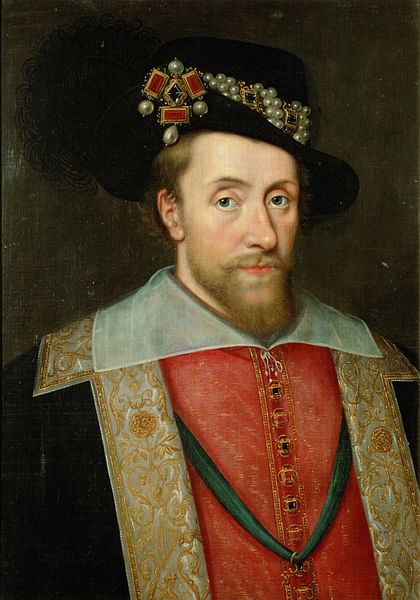
Following are the footnotes for the Primary Source Materials,
Notes, and Observations

Introduction: Our Ancient Origins

(1) — five records

Adapted from three sources:
Celtic Britons
https://en.wikipedia.org/wiki/Celtic_Britons
Celts
https://en.wikipedia.org/wiki/Celts
Prehistoric Britain
https://en.wikipedia.org/wiki/Prehistoric_Britain

Map from The Times of Israel: Tin deposits on the Eurasian continent and distribution of tin finds in the area studied dating from 2500-1000 BCE. The arrow does not indicate the actual trade route but merely illustrates the assumed origin of the Israeli tin based on the data.
(Credit: Berger et al. 2019; Prepared by Daniel Berger)

The Times of Israel
Groundbreaking study: Ancient tin ingots found in Israel were mined in England
by Amanda Borschel-Dan
https://www.timesofisrael.com/groundbreaking-study-ancient-tin-ingots-found-in-israel-were-mined-in-england/

Vivid Maps
Roman Britain Explained in Maps
Britain and Ireland just before the Roman invasion (10 AD)
https://vividmaps.com/roman-britain/
Note: Scroll down, and the entry is found in the Comments section, as submitted under the name Chaplin.

The Cornovii, Who Become The Cornish People
and
The Norsemen, The Danes, and The Vikings

(2) — eight records

Adapted from six sources:

Cornish People
https://en.wikipedia.org/wiki/Cornish_people
Norman Conquest
https://en.wikipedia.org/wiki/Norman_Conquest
and
Anglo-Saxons
https://en.wikipedia.org/wiki/Anglo-Saxons
Vikings
https://en.wikipedia.org/wiki/Vikings
Viking activity in the British Isles
https://en.wikipedia.org/wiki/Viking_activity_in_the_British_Isles
and
Pre-Viking And Viking Age Denmark
https://www.encyclopedia.com/humanities/encyclopedias-almanacs-transcripts-and-maps/pre-viking-and-viking-age-denmark

The Story of The Bonds of Earth
by Allen Kerr Bond
https://archive.org/details/storyofbondsofea00bond/mode/2up
Book page: 17-18. Digital page: 33-34/328.

Alamy
William the Conqueror, William I of England (circa 1028-1087). First Norman King of England (1066-1087), holding Battle Abbey, illuminated manuscript portrait painting
by Matthew Paris circa 1250-1259
https://www.alamy.com/william-the-conqueror-william-i-of-england-circa-1028-1087-first-norman-king-of-england-1066-1087-holding-battle-abbey-illuminated-manuscript-portrait-painting-by-matthew-paris-circa-1250-1259-image545386459.html

The Domesday Book

(3) — eight records

The Domesday Book (as illustrated) by William Andrews, circa 1900, from “Historic Byways and Highways of Old England” (Image courtesy of Wikipedia.org).

Domesday Book
https://www.worldhistory.org/Domesday_Book/

Domesday Book (explained): https://www.oxfordreference.com/view/10.1093/oi/authority.20110803095725686

Here are the actual folios of the Domesday book from:
https://opendomesday.org

“This Bond (or Bondi as he is called in the Domesday book) appears to have been a Saxon, and is mentioned in that record as holding Fisherton in Wilts…” The two estates of ‘Fisherton’ in Wiltshire are mentioned in these folios, as follows:

First: https://opendomesday.org/place/SU0038/fisherton-de-la-mere/
and the original folios of the Domesday Book, Wiltshire, page 17, where the name Bondi is specifically mentioned: https://opendomesday.org/book/wiltshire/17/

Second: https://opendomesday.org/place/SU1329/fisherton-anger/
and the original folios of the Domesday B00k, Wiltshire, page 10: https://opendomesday.org/book/wiltshire/10/

Collins’s Peerage of England, Genealogical, Biographical, and Historical,
published 1812
by Sir Edgerton Brydges, K. J.
https://archive.org/details/collinsspeerage_01coll/page/n387/mode/2up?ref=ol&view=theater
Book page: 362, Digital page: 388/608

Slavery, The Feudal System, and the Manor System

(4) — six records

From Slavery to Tenant Farming
Elite Economies in the Nordic Area

c.1050 — 1250
by Frode Iversen
https://www.khm.uio.no/om/organisasjon/arkeologisk-seksjon/ansatte/frodeiv/frodes-artikler/iversen-2019.-from-slavery-to-tenant-farming.-nordic-elites-1050-1250-vol-1-with-list-of-contributors.pdf
and
Slavery in Medieval Europe https://en.wikipedia.org/wiki/Slavery_in_medieval_Europe

Western European Feudalism
Relationships Between The Levels

https://westerneuropefeudalism.weebly.com/relationships-between-levels.html

Feudalism
https://en.wikipedia.org/wiki/Feudalism
and
Manorialism
https://en.wikipedia.org/wiki/Manorialism

English Heritage
Home > Visit > Places to Visit > Penhallam Manor > History
https://www.english-heritage.org.uk/visit/places/penhallam-manor/history/
Note: Image located under the subtitle, The West Range.

The Bond Family Surname

(5) — five records

Excerpt from page 116 of Family Names and Their Story.

Family Names and Their Story
by Sabine Baring-Gould
https://archive.org/details/familynamestheir00bari/page/n5/mode/2up?ref=ol&view=theater
Book page: 116, Digital page: 116/431
Book page: 186, Digital page: 186/431
Book page: 190, Digital page: 190/431

Bond Family History / Bond Surname Meaning
https://www.ancestry.com/name-origin?surname=bond

Den of Geek
Sean Connery, Acting Icon and Original James Bond, Dies at 90
by Tony Sokol
https://www.denofgeek.com/movies/sean-connery-acting-icon-and-original-james-bond-dies-at-90/
Note: For the film still of Sean Connery as James Bond in the film Dr. No (1962).

A Genealogical and Heraldic History of the Commoners
of Great Britain and Ireland, Vol. I
History of the Commoners of Great Britain and Ireland
by John Burke, Esq.
https://www.ancestry.com/imageviewer/collections/48501/images/CommGBIrelandI-005332-240?pId=368839&lang=en-US
Book page: 240, Digital page: 303/787

Collins’s Peerage of England, Genealogical, Biographical, and Historical,
published 1812
by Sir Edgerton Brydges, K. J.
https://archive.org/details/collinsspeerage_01coll/page/n387/mode/2up?ref=ol&view=theater
Book page: 362, Digital page: 388/608

The Emerging Bond Family Lineage in Cornwall

(6) — two records

Cornwall Heritage Trust
Medieval Cornwall
https://www.cornwallheritagetrust.org/timeline/medieval-cornwall/
Note: “In 1485, Polydore Vergil… “

Penryn, Cornwall
https://en.wikipedia.org/wiki/Penryn,_Cornwall

The Two Centuries After William The Conqueror

(7) — five records

Welcome to Saltash
History 1066 to 1200
https://kernoweb.neocities.org/saltash/bhs1066.htm

Magna Brittanica, Being a Concise Topographical Account
of the Several Counties of Great Britain, Volume The Third
by Rev. Daniel Lysons and Samuel Lysons, Esq., 1814
by Daniel Lysons and Samuel Lysons
https://archive.org/details/b22012369_0002/page/288/mode/1up
Digital page: 671/800 (for the Trematon Castle on the River Lynher illustration)

The Battle Abbey Roll
by The Duchess of Cleveland
https://archive.org/details/battleabbeyrollw01battuoft/page/n5/mode/2up
Book page: 138, Digital page: 138/352

A Genealogical and Heraldic History of the Commoners
of Great Britain and Ireland, Vol. I
History of the Commoners of Great Britain and Ireland
by John Burke, Esq.
https://www.ancestry.com/imageviewer/collections/48501/images/CommGBIrelandI-005332-240?pId=368839&lang=en-US
Book page: 240, Digital page: 303/787
Note: For the Bonds of Grange coat-of-arms image.

Cornish Studies Resources
North Petherwin: the theft of a parish
https://bernarddeacon.com/2022/07/08/north-petherwin-the-theft-of-a-parish/
Note: For the 1812 map image of Cornwall and the town of Penryn.

Our Penryn Ancestors

(8) — three records

IntoCornwall.com
Cornwall History Timeline
https://www.intocornwall.com/features/cornwall-history-timeline.asp

John LeBond
https://www.ancestry.com/family-tree/person/tree/50985043/person/132260923995/facts

Poppyland Publishing
East Anglian History Books
Baldock
https://www.poppyland.co.uk/baldock.html#:~:text=The%20granting%20of%20the%20right,in%20from%20the%20surrounding%20countryside.
Note: For “The granting of the right to hold markets and fairs was a very significant development for any town in the medieval period; they provided the underpinning for the economy of the town and brought trade in from the surrounding countryside.”