The Bond Line, A Narrative — Five

This is Chapter Five of eight: Peter Bond, The Immigrant, seeks a fresh start in the British Colonies in America. We then move through several generations in Maryland, and eventually, we find ourselves moving further west to the Ohio frontier.

Preface: Be Wary Of Those K rations!

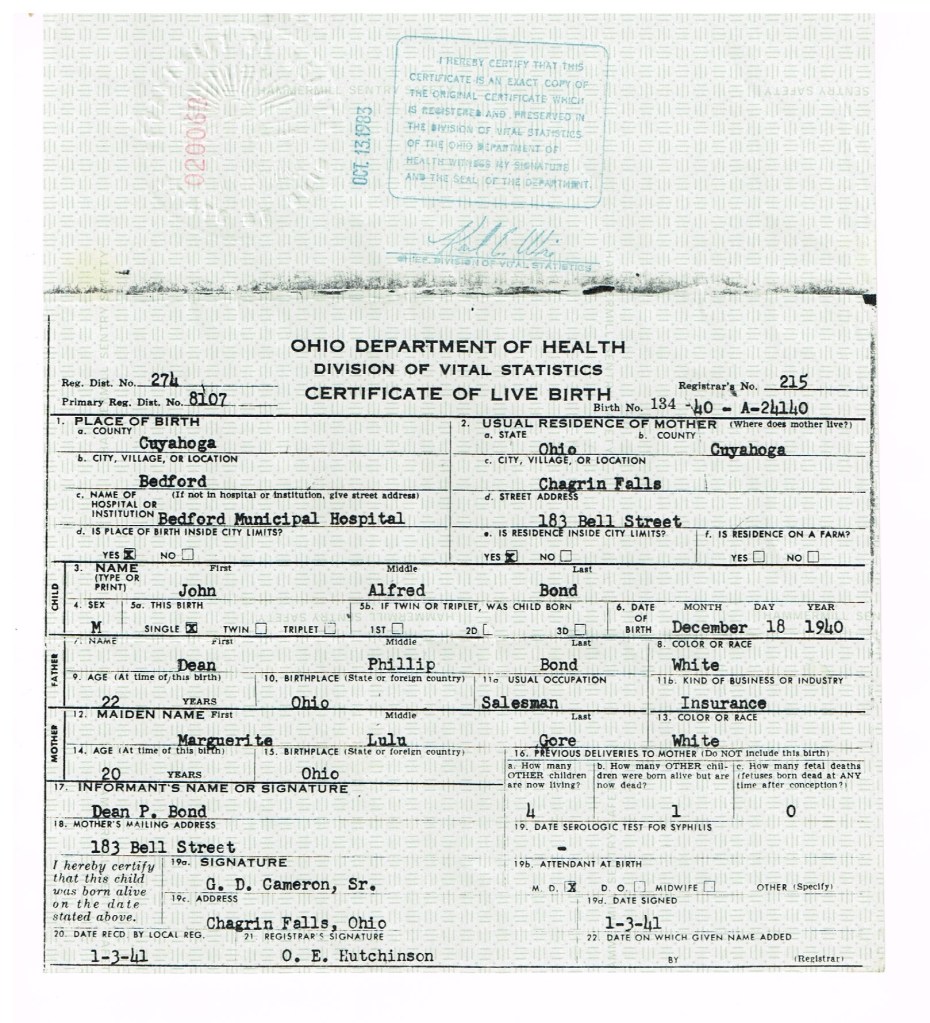
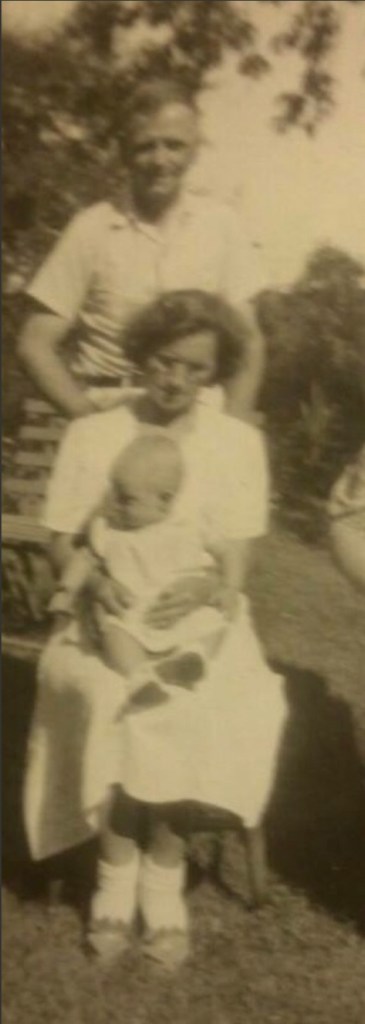
Our father Dean Phillip Bond, loved to fuss around in his summer vegetable garden every year. He was proud that he had grown beautiful, tasty vegetables which we very gratefully devoured practically every evening. As children, when we observed him taking a pause in his labors, he would rock back on his heels, and take a long drag on his ever-present cigarette, moving his arm in a long slow arc. We’re sure that he certainly thought about the demonic mosquitos and three corner flies which tormented him… but occasionally, we would see him staring off somewhere into the middle distance. Perhaps he was dreaming about his “unlived life” — that of a gentleman farmer.

 United States sailor holds a carton of Philip Morris cigarettes under one arm and a duffle bag over his other shoulder, while smoking a cigarette. (Image courtesy of http://www.azcentral.com).

Pop started smoking in WWII when he would receive K rations, which included four cigarettes, and a small book of matches. (He said that before that time, he had never smoked.) His habit eventually became a two-pack-a-day routine need, which seemed to be typical of many in his generation. Three months after our parents 50th wedding anniversary, he passed away from lung disease.

We bring this is up because there is a lot of rich irony in this history of our family. The progenitor of our line in America is Peter Bond, The Immigrant. In 1660 Peter arrived in the British Colony of Maryland and eventually prospered as he became a tobacco planter. In his era, tobacco was such a precious item that it was literally used as currency for many years. In other words, he could grow his own money.

If our father had known of this fantastical, but true story, we’re sure that he would have dreamed and desired to somehow take his cigarette butts and grow his own magic money. Or better yet, drop a penny into a garden furrow and let each one grow into a crisp one hundred dollar bill. (1)

The British Colonies Desperately Needed Workers

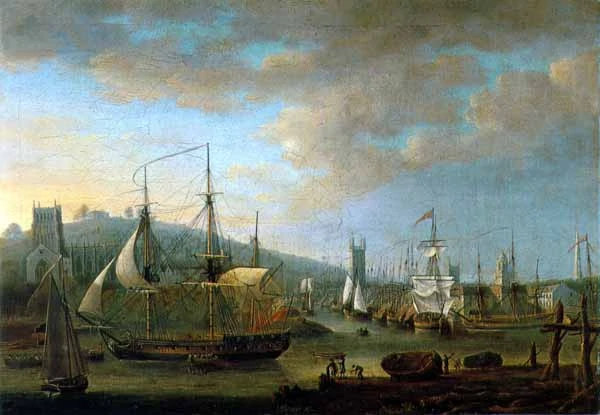
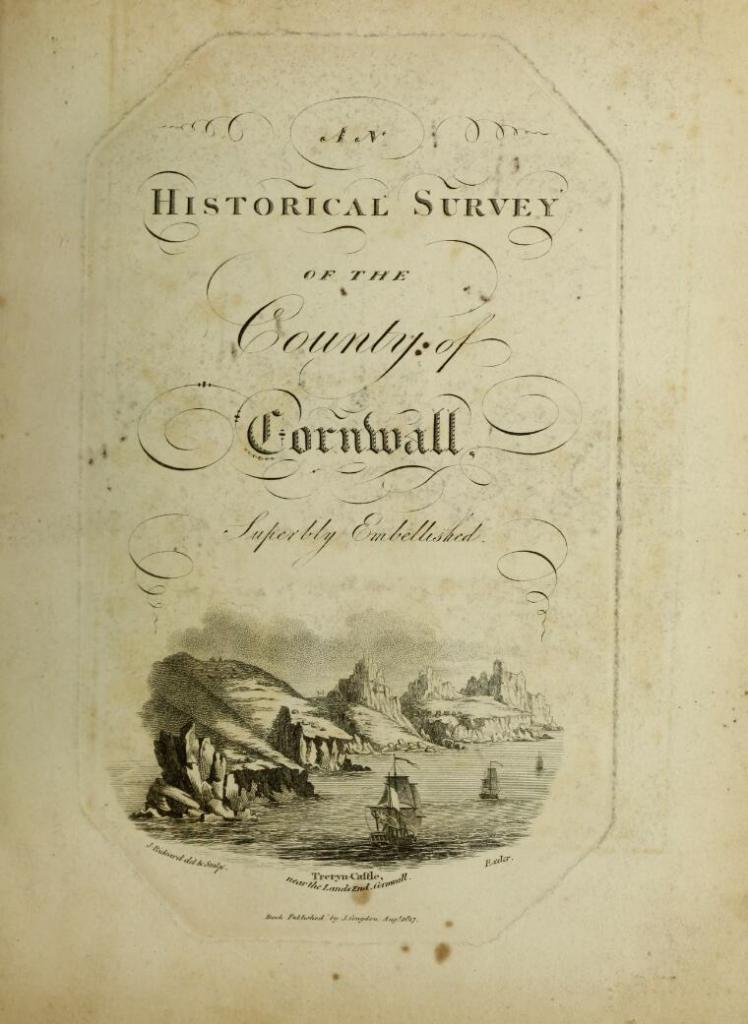
Until 1680 or so, due to the fact that the British Colonies in North America were large and had become quite successful, England determined that relocating “labor” to the Colonies was in their best interest. Ships from certain ports would transport people from the Mother Country to America. Each empty ship would then load up on valuable items which were much desired back home in England. This included prized commodities like cotton, indigo, tobacco, and sugar. This was a scheme where English merchants made money on both sections of the voyage.

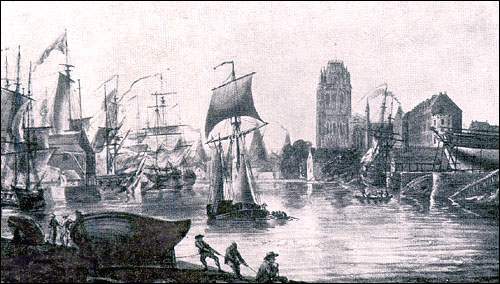
View of Bristol Harbour with the Cathedral and the Quay, by Nicholas Pocock, 1740-1821.
(Image courtesy of Art UK).

From the article, Indentured Servants at Gunston Hall

“When English settlers arrived in the New World, they brought indentured servitude with them.  Under this system, people worked for a set period of time as a payment for something. — Indentured servants were men and women who willingly signed a contract in which they agreed to work for a certain number of years to compensate for their voyage to America. 

Three different types of indentured servant agreements existed in the 18th century: free-willers, King’s passengers, and redemptioners… Free-will indentured servants decided to come to America on their own merit and willingly signed a contract before departing England. King’s passengers, [also known as convict servants], were criminals who were sent to America to serve a term of seven or fourteen years, depending on the crime they committed. Finally, redemptioners were passengers who were given two weeks to redeem the price of their voyage once they got to America and if they were unable to make the payment, they were sold to the highest bidder.”

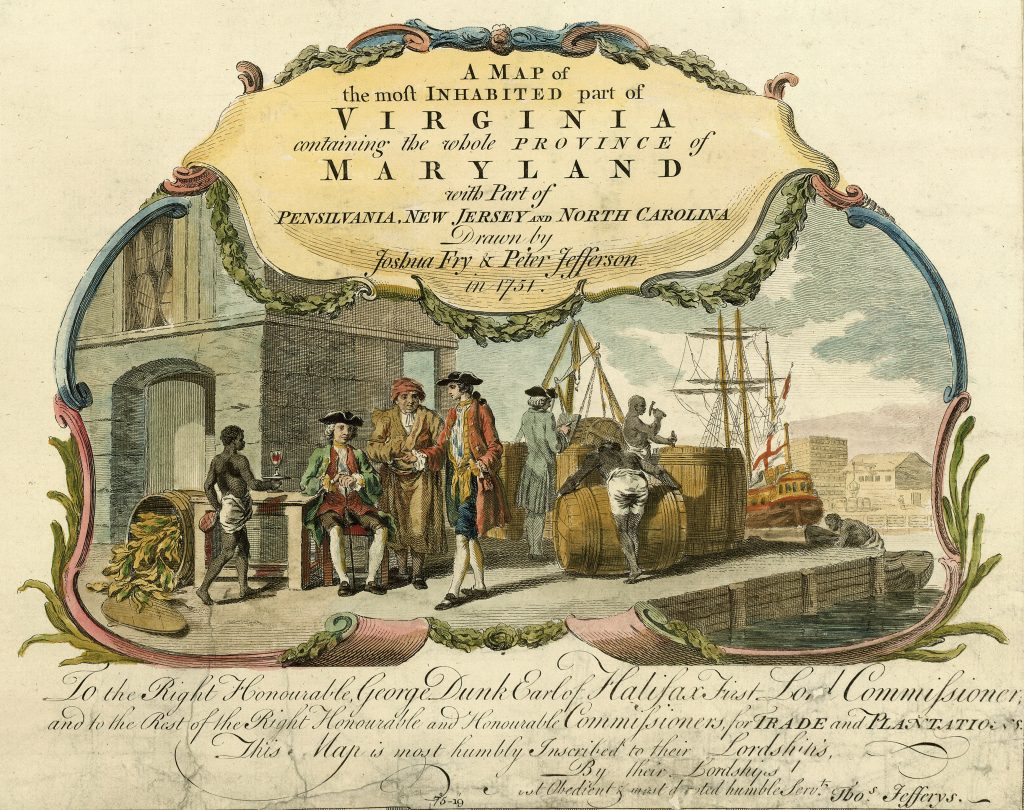
In these modern times, a phrase such as “sold to the highest bidder” gives us a bit of pause. Early on, the English had such a desperate fever to send laborers to The Colonies that many unscrupulous people, orphans, and indigents were “spirited” away [kidnapped, and not at their choice], who became a commodity in places like Virginia and Maryland. The city of Bristol, England was the epicenter for this white slave trade, which was lucrative for both the merchants and their agents. England was then, and still is to some extent now, a class-driven society. One has to wonder if this spiriting practice was unfortunately due to the “undesirables and destitute” being from a lower social class? Many of these poor people didn’t last very long in the Colonies due to poor health and mistreatment.

Cartouche detail from the Fry-Jefferson map, by Joshua Fry and Peter Jefferson.
(Image courtesy of Encyclopedia Virginia).

This however, wasn’t true for all people who immigrated. For Peter Bond, and many people in his class, to become an indentured servant was not something that carried a stigma. As a free-will indentured servants, he was an immigrant who was under a contract, for a short period of years. Once he had met his commitment, he was free by having paid his freedom dues. His passage and care had been provided, and he could now practice a new trade. That is why they were referred to as Servants.

“In the 1650s, an estimated 72,000 individuals, the majority of them indentured servants, went from England to the New World.” By this point in time, to remedy the problem of many [slave] laborers dying in The Colonies, and to create a more attractive market for immigrants, the courts required that proper records be kept and they were. The existing indenture system was revitalized and its use brought many new people to America. A register, known as the Tolzey Booke [1654], introduced by the Common Council in 1654, indicates that The Servants, rather than being the destitute, actually consisted of: 

Yeomen39 per cent
(yeomen were a wide range of agricultural workers) 
Artisans23 per cent
Husbandmen16 per cent
Labourers13 per sent
Gentlemen2 per cent
Unknown7 per cent 
The Servants as documented in the 1654 Tolzey Booke. We derived these figures from information scattered throughout the text. (See footnotes).

After 1680, the plantation owners in North America came to the conclusion that it was too expensive to continue with the English indentured servant system to staff workers for their properties. Over the next century, servant contracts tapered off. From this period forward, they transitioned to purchasing many more slaves from Africa. Hence, the slave system became quite firmly embedded in the central and southern portion of the British Colonies, as well as the Caribbean. (2)

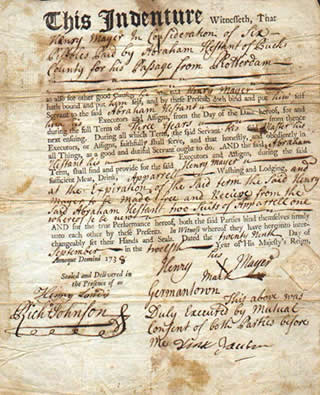
Example of an indentured
servant contract from 1738,
for British North America.
(Image courtesy of
Wikimedia Commons)
.

The Bristol Registry of Servants Sent to Foreign Plantations 1654-1686

There probably was not much for Peter Bond to inherit from his family by this period. The economy in London was very depressed at that time, as a consequence of the English Civil War. So we conjecture that perhaps he wanted to try his luck in the New World — as many young men of his class did at the time.

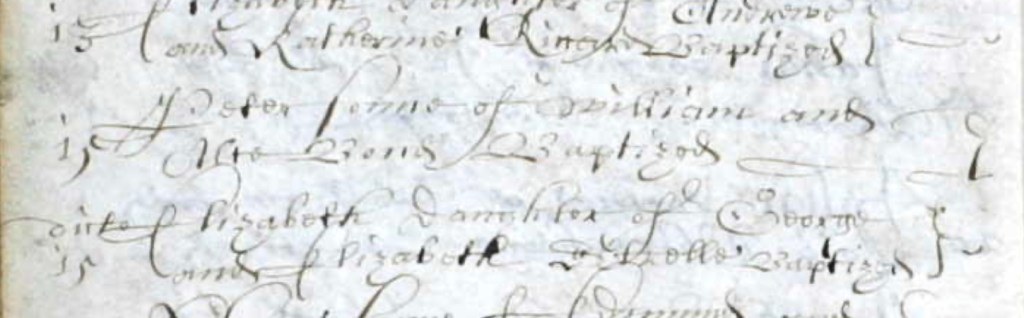
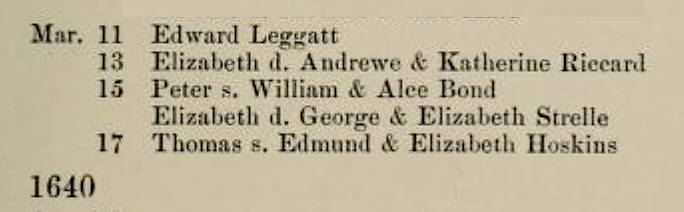
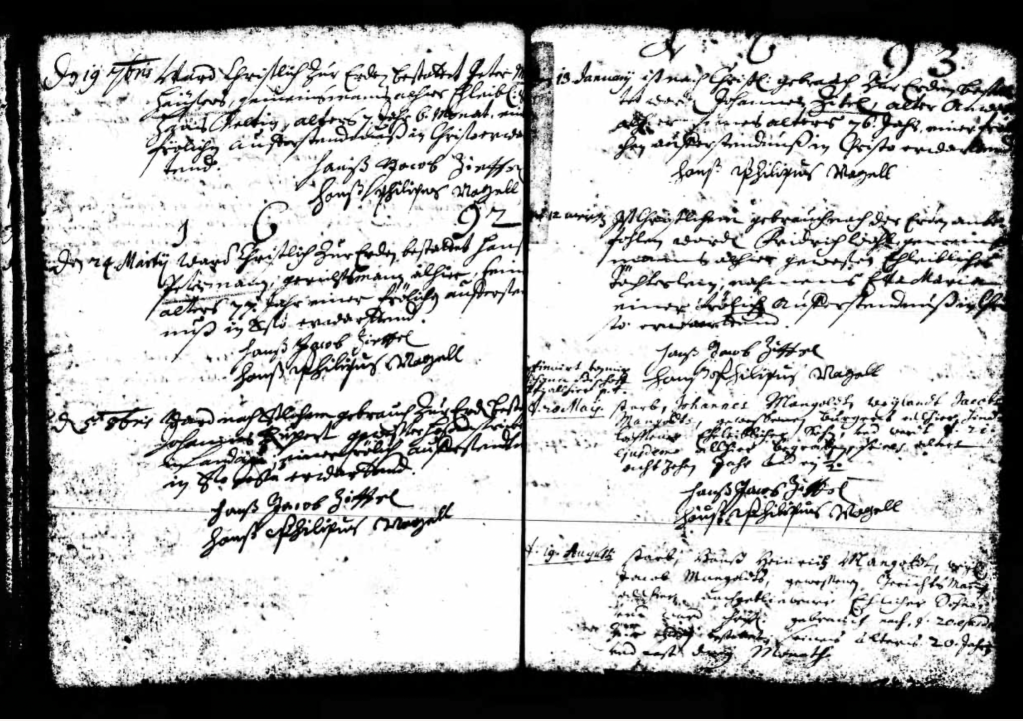
The Bristol Registry of Servants Sent to Foreign Plantations 1654-1686, page 121 detail.

At 19, Peter became a free-will indentured servant on November 29, 1659. He was one of eight people so indentured to a merchant named Henry Read, who was the agent. (This meant that he negotiated the contract(s) with the ship captain). For a few years prior to 1659, registries had become exacting by listing parents, destinations, etc., but apparently by November ’59, registries were getting “thinner” and less detailed.

There are several things to note here: 1) Peter’s parents are not named because we know that both of them had died before his departure. 2) Nor is his destination given. 3) He gave his residence as Whitechapel in London which is the section of London where he was born and grew up in, which assures us that it is indeed our Peter, and 4) For the times, an indenture of four years is remarkable for all eight people. Many contracts were longer, so it certifies that none of them were criminals. Perhaps this was also indicative of their social class? (3)

The Early Settlers of Maryland

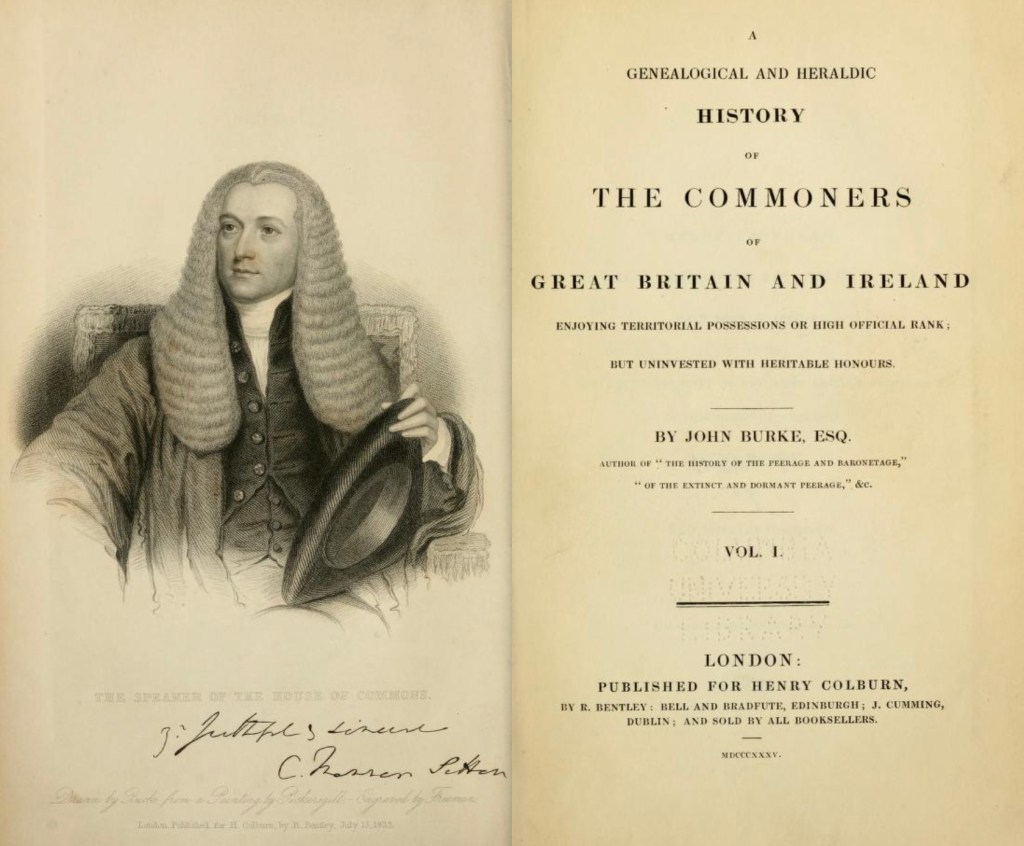
The Early Settlers of Maryland, title page.

Some other researchers propose that Peter Bond went for a short time to Virginia, and then to Maryland. Some ships in that era, would go to a port, load up on trade goods, and then go to another port. We have found no concrete evidence to support that this happened with Peter.

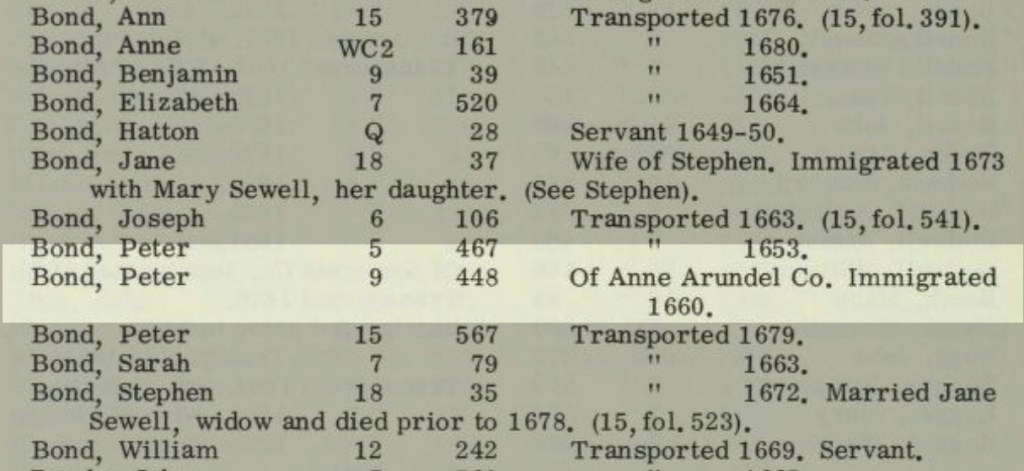
In fact, in the book The Early Settlers of Maryland, Peter Bond is listed as being in Maryland in 1660. We know that this is our ancestor, because he is listed as being from Anne Arundel County, which is in fact where he lived. Of note, there are two other Peter Bond(s) listed as being transported: one in 1653; another 1679. The word transported meant that they were indentured servants of some type. (We wonder if their same name(s) have confused other researchers?) Interestingly, Peter is not listed as being transported, even though we know that he had also been an indentured servant.

Peter Bond detail on page 48/525 of The Early Settlers of Maryland.

Fantastically, some people have proposed that he had a wife and child in England who traveled with him. Then his wife died, unnamed in records. Also, that he had two marriages in Maryland. Again, no concrete evidence of that. (4)

The Maryland Colony

The Maryland Colony was founded for religious reasons, not business reasons.

“The Province began as a proprietary colony of the English Lord Baltimore, who wished to create a haven for English Catholics in the New World at the time of the European wars of religion. Although Maryland was an early pioneer of religious toleration in the English colonies, religious strife among Anglicans, Puritans, Catholics, and Quakers was common in the early years…” Ultimately, due to the influx of the indentured servants, the majority of the population at that time were Protestants, and eventually they supplanted the Catholics.

“…the Province of Maryland developed along very similar lines to Virginia… and, like Virginia, Maryland’s economy quickly became centered on the cultivation of tobacco, for sale in Europe.

British Roots of Maryland Families, page 61.

We see land ownership in the above passage from the book British Roots of Maryland Families which confirms that both Peter Bond and William Jones received their land under the “headright” system, which was used to attract immigrants to Maryland. From Wikipedia: “Headrights were granted to anyone who would pay for the transportation costs of an indentured laborer. These land grants consisted of 50 acres for someone newly moving to the area and 100 acres for people previously living in the area.” Indentured servants were not allowed to obtain rights to land until their period of service obligations had been met.

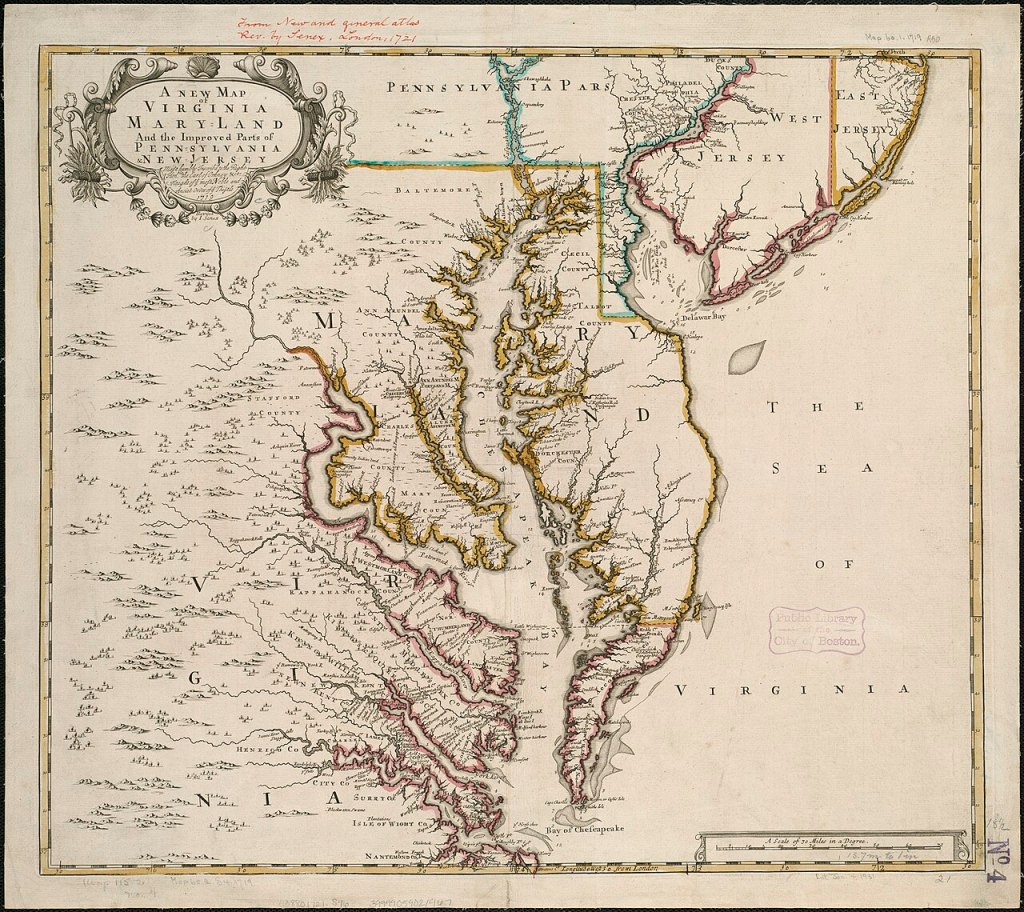
A New Map of Virginia, Maryland, And The Improved Parts Of Pennsylvania & New Jersey by Christopher Browne, 1685. (Image courtesy of Wikimedia Commons).

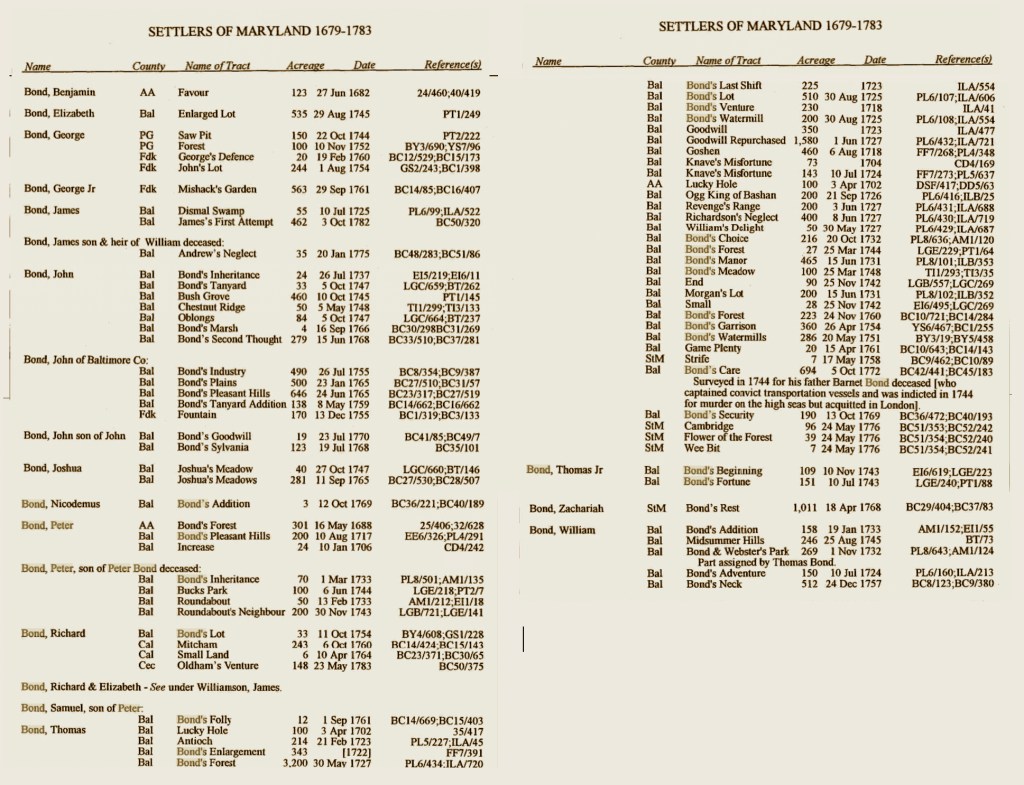
There is much evidence that Peter, his descendants and associates prospered during their years in Maryland as evidenced by the extensive records of land ownership that still exist — as we wrote in the preface, we knew he had an extensive tobacco plantation. Most of the properties our direct ancestors held were in both Anne Arundel County (AA) and Baltimore County (Bal). To our modern eyes, some of these property names seem both curious and quaint.

Settlers of Maryland, 1679-1783, Consolidated Edition.
This book lists various Bond properties in Maryland in the 1679-1783 period,
assembled here into one file.

We know that he received some land starting sometime in 1667, as written on page 61 in the book British Roots of Maryland Families. Allen Kerr Bond wrote in The Story of The Bonds of Earth, “Nine years after, he is repaid by the authorities a considerable amount of tobacco (the local currency) for services of a nature not specified; and again, in 1678, for services, not military, to the government in a brief war with the Indians.” Further, “Ten years after this [about 1688], Peter becomes a planter… along the Patapsco [river]… on ‘three hundred and one acres, to be recorded as Bond’s Forest on the rent rolls of Lord Baltimore.’”

“It is difficult to determine where Peter lived in Anne Arundel County because the land records were destroyed in a fire in 1703, but one deed dated 12 JUL 1673 regarding him was brought in when the new court house was built that proves he owned a tract on Swan Point on the north side of the Severn River when he conveyed a 40 acre part of his plantation to James Smith.”

Alan Kerr Bond wrote further, “…in 1698 the boundary between Anne Arundel and the newly formed Baltimore County” shifted, and “Baltimore County had moved to him…” (5)
Peter Bond Marries the Widow, Alice (Cole) Gill Drury

By 1677, Peter Bond was a married man. We haven’t discovered much personal information about him, except for some land records, until his marriage to Alice (Cole) Gill Drury.

Alice’s origins are a mystery. Was she born in England or America approximately between 1650-1655, or earlier? Why was she in Maryland? We first see references to her when she appears in marriage records. Before her marriage to Peter Bond, Alice was married twice. Her first husband was Stephen Gill, Sr. and with him Alice had a son named Stephen Gill, Jr., (born about 1673). Her second husband, William Drury, a widower, left a Will naming Alice as his wife on August 22, 1676. This is proved because Peter & Alice Bond sued Drury’s executor for her share of his estate in June 1678. By the time she married Peter in late 1676 or early 1677 she had been twice widowed with one child.

Peter and Alice were the parents of four sons who are mentioned in his Will:

  • Peter Bond Jr., born 1676 – died, February 28, 1718
  • Thomas Bond, born May 26, 1679 – died, December 18, 1755
    (We are descended from Thomas).
  • William Bond, born 1685 – died, August 23, 1742
  • John Bond, born 1689 – died, April 17, 1720

After Peter’s death Alice Bond was married for the fourth time by May 14, 1707 to Philip Washington. The couple were living apart by 1708 and the following year an agreement appears in the records which states :
“Whereas Philip Washington and Alice, his wife, have joyously consent to separate and live apart…”, etc. — Peter Bond, Jr. posted a (£ One Hundred Sterling) bond that stated he would support his mother.

After a long, and interesting life, Peter Bond, Sr. wrote a Will on August 23, 1704; probated April 28, 1705. This informs us that he died sometime during that period. He had written [concise form] —
     “I, Peter Bond, being sick and weak in body butt still In sound and perfect memory I make this my last will testamentItem I doe give and bequeth my soul to my Lord god and maker and my body to ye Earth from where It Came
     Item – I doe Leave my well beloved wife Ealse (Alice) Bond my soule and hole Execkticx
[Executrix]
     Item – I give and bequeth unto forsaid wife my plantation and the land belonging to it during her Life and afterward to my son Peter Bon
d
     Item – I give and bequeth to my three sons Thomas William and John Bond Equally divided between them 300 Acres of Land Lying in aforesaid County att the head if bush River as will appears
     Item – I give and bequeth unto my son Thomas Bond one Cos
(cow?)Called Dollor and her hefor
     Item – I give and bequeth after my wifes desease my personal Effects to be Equally Divided among my three sons Peter William and John further my will is that my two sons William and John be free and to work for them – att ye adge (age) of Eighteene Of hears unto Enter thangably sett my hand and seale ye day and years above written. Peter Bond.”
(6)

Was Peter Bond a Quaker?

The proof that Peter Bond, The Immigrant was a Quaker, is pretty thin.

As a group in Britain, the Quakers suffered great abuse for their beliefs, and the progenitor, George Fox spent much of the 1660s jailed. However, he did have adherents who continued to grow the movement. When William Penn in 1681 created the Pennsylvania Colony as a sanctuary for religious freedom and tolerance, thousands of British people immigrated there.

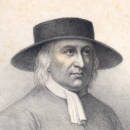
George Fox, English missionary and founder of the Society of Friends (Quakers),
preaching in a tavern, c. 1650. (Image courtesy of Encyclopædia Britannica).

“The Religious Society of Friends, also referred to as the Quaker Movement, was founded in England in the 17th century by George Fox. He and other early Quakers, or Friends, were persecuted for their beliefs, which included the idea that the presence of God exists in every person. Quakers rejected elaborate religious ceremonies, didn’t have official clergy and believed in spiritual equality for men and women. Quaker missionaries first arrived in America in the mid-1650s. Quakers, who practice pacifism, played a key role in both the abolitionist and women’s rights movements.

In April 1649, [Maryland] colonists voted into law An Act Concerning Religion (later known as the Maryland Toleration Act), which granted freedom of worship for all Christians. Although permanently repealed in 1692, the act was one of the first statutes granting religious liberty of any kind and was an important step toward true freedom of religion in the United States.

Quaker missionaries arrived in North America in the mid-1650s. The first was Elizabeth Harris, who visited Virginia and Maryland. By the early 1660s, more than 50 other Quakers had followed Harris. So, Peter Bond was likely aware of the Quaker Movement, but whether or not he was a believer isn’t proven. Among his sons and extended family, there were Quakers, with some even donating land for meeting houses and schools. (7)

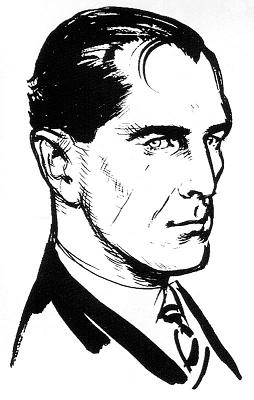
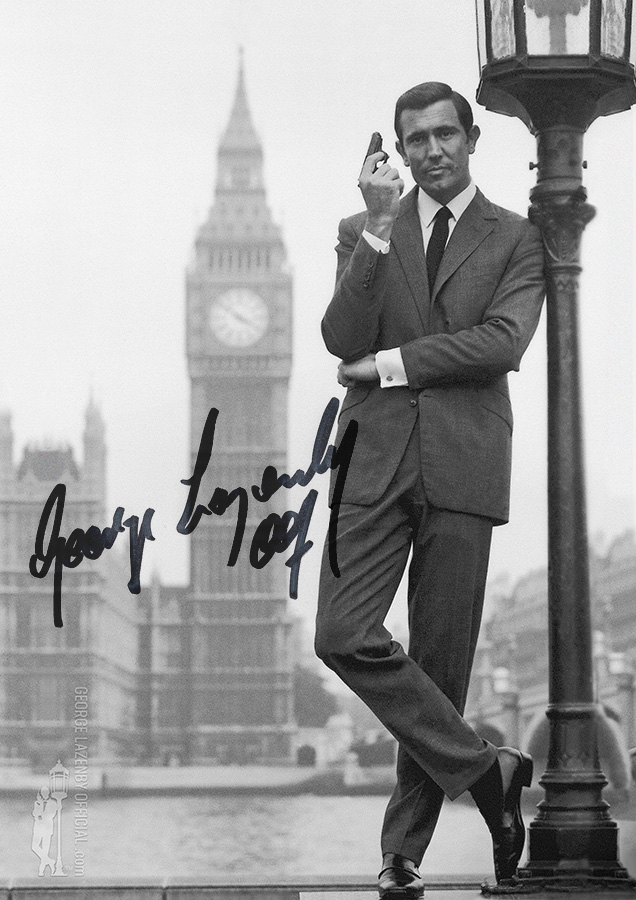
Pierce Brosnan as James Bond 007. Since he is an avid genealogist, we consulted with him about the Quaker pedigree of Peter Bond, The Immigrant. (His dubious expression says it all.)
Image courtesy of the Guardian.com.

Thomas Bond was The Father of Eight Sons and Two Daughters

Of Peter Bond’s four sons, his son Thomas became regarded as an esteemed, respected citizen of Maryland. He was sometimes written of as Thomas of Emmorton, based upon the community where he lived.

Allen Kerr Bond wrote —
“Locating with his two brothers, William and John, lads not yet of age, in the present Harford County, on the three hundred acres of ‘Harris His Trust’ given them by their father, Thomas Bond seems to have put all of his energies into the accumulation of enormous holdings of the fertile forest uplands in that vicinity.” [If you consult the Bond Properties Chart shown above, you will see that this is quite true.]

Thomas was likely very aware of the Society of Friends movement which had been occurring in Great Britain, which also was attracting many immigrants to relocate to the British Colonies, seeking freedom to practice their religious beliefs in peace. Maryland had attracted many believers and the founder of the sect, George Fox, had visited the area in 1672 when Thomas would have been about thirteen years old. It seems there was a lot of Quaker energy present in the area.

Thomas Bond married Anne Robison on September 20, 1770 at All Hallows Parish, Anne Arundel, Maryland . Her father may have been a John Robison (or Robinson) and her mother is unknown. Thomas Bond died at ‘Kalmia’, his Emmorton, Maryland estate on December 18, 1755. He may have been buried ‘under a tree’ on his property, however there is no official record of his burial. Anne was born on March 28, 1680 in West River, a community in Anne Arundel County. Her death date is unknown.

Thomas and Anne had a large family of ten children. In order of their births:

  • Thomas Bond (Jr), born 1703 – died 1781
  • Peter Bond, born April 28, 1705 – died December 23, 1738
  • William Bond, born 1708 – died 1769
  • John Bond, born November 10, 1712 – died March 11, 1786
    (We are descended from John).
  • Sarah Bond, born April 29, 1715 – died, December 12, 1759
  • Joshua Bond (1), born October 8, 1718 – died March 30, 1720
  • Ann Bond, born May 29, 1720 – died, August 20, 1720
  • Jacob Bond, born 1725 – died, November 30, 1780
  • Daniel Bond, born 1727 – died (by) August 11, 1780
  • Joshua Bond (2), born 1729 – died, July 8, 1768

Observation: It is probable that John and Anne became Quakers at some point during their marriage. Their headstones probably never existed, because before the mid-19th century Quaker headstones were rare, as they are not in keeping with the plain life.

Unbeknownst to either of us, and as a wonderful surprise, it turns out that two very good friends of ours, the sisters Lessley and Barbara Berry, are our (very) distant cousins. We were friends for many years before we discovered this fact! From our shared ancestor, Thomas Bond, we are descended from two of his sons, John [>Susan and Thomas] and *Jacob [>Lessley and Barbara]. The world can be a small place sometimes.

*Jacob Bond — “The most prominent of the Bonds from the standpoint of Harford history, was Jacob, who died in November, 1780. He was a prominent member of the Committee of Harford County in the Revolution, having been elected by the people, and was captain of Company Eleven, of Harford militia, in the Revolution… Jacob Bond represented Harford County in the convention which met at Annapolis in 1776 and formed the first constitution of the State… He was also one of Harford’s representatives in the Annapolis convention of June 22, 1774, which protested against the tax on tea…” Jacob married Frances Partridge on December 28, 1747 at St. Paul’s Protestant Episcopal Church, Baltimore Co, Maryland.

We know from several records that some of Thomas and Anne’s children became Quakers. It can be taken for granted that those who fought in the early wars were no longer Quakers, and that records show many Bonds within the early Military Records.

History of Harford County, p. 206

Thomas of Emmorton, as he was known, was generous to his fellow Quakers by providing a Friends Meeting House at Fallston, for their worship. These buildings were designed in simple, domestic styles unlike more elaborate church architecture.

History of Harford County, p. 207

Thomas Bond may have been a man of good piety, but it seems that some of his prodigy were, how shall we say, not up to standard. This generation was “the first to backslide and fall under the displeasure of the Friends Meeting.” The offenders are pointed out in the following excerpts (below) of carefully kept records from Maryland Friends Meetings. (8)

What Would These Quaker Ancestors Think About Our Time?

Below is some of the information we found regarding the discipline and dismissal of Bond’s who were Quakers. By today’s standards most of this seems extreme!

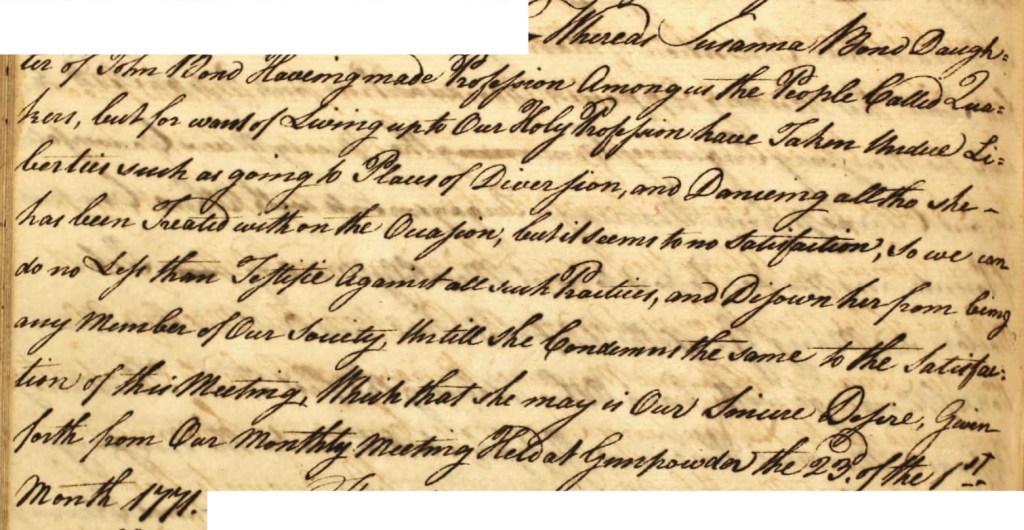
U.S., Quaker Meeting Records, 1681-1935
Baltimore, Maryland, Gunpowder Monthly Meeting, Minutes, 1768-1784

“John Bond married out of meeting – dismissed; James Bond – plays the fiddle – disowned; Samuel Bond – joins the Militia disciplined; Ann Bond – gone contrary to principle (pretty bonnet) disciplined; Susannah Bond – taking undue liberties and going to places of diversion and dancing – disowned; Joshua Bond – plays cards – disciplined: John Bond lends a man a gun disciplined; Hannah Bond married by a priest – disowned.” (9)

Gentleman John Bond and His Wife Aliceanna Webster

What was a Gentleman in Colonial Maryland? The Colony of Virginia and the Province of Maryland carried over some of the old social class structures from England, and then remodeled them to fit life in the British Colonies. In England, the lowest level of the Landed Gentry were The Gentlemen. They lived on plantations, and unlike their forebears, they no longer had to work with their own hands. Many were involved in managing their properties and investing in business ventures. After a plantation had been settled for several generations, the Planter would be free to have himself referred to as a Gentleman, or Gentleman Planter, as he wished.

John Bond and Elizanna (Aliceanna) Webster marriage record in the U.S., Quaker Meeting Records, 1681-1935, Nottingham Monthly Meeting, page J4.

On May 26, 1734, John Bond married Aliceanna Webster at the Nottingham Meeting of The Society of Friends in Harford County, Maryland. This is our first solid clue of Quakerism in the Bond family. Aliceanna was born on January 21, 1716 and she died on October 13, 1768, aged 52 years. She was the daughter of John Webster and Hannah Butterworth. The Websters and Butterworths played a large role in the settling of Harford County, Maryland.

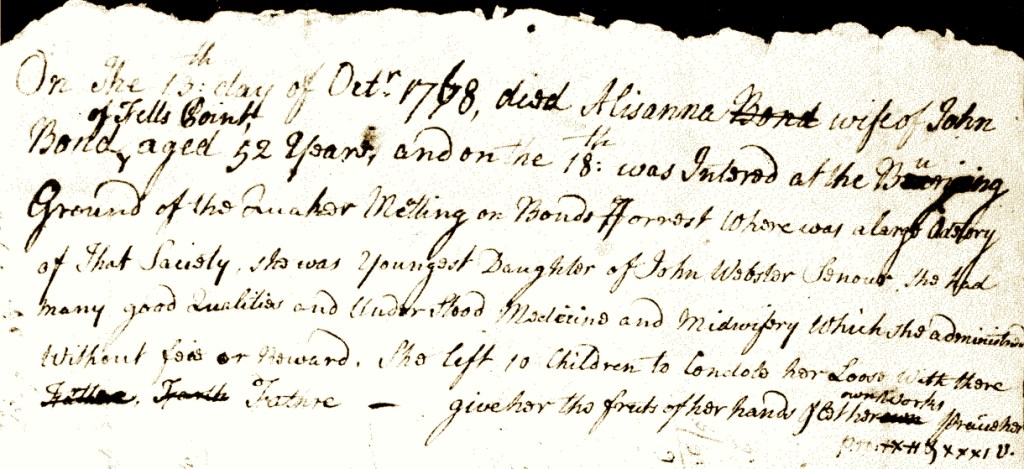
In addition to raising her large family Aliceanna was highly regarded as a midwife. Here is a transcription by (present day) Thomas Bond of her obituary:

“On the 13th day of Octr. 1768, died Alisanna Bond wife of John Bond of Fells Point, aged 52 years, and on the 18th: was Intsred [Interred] at the Burying Ground of the Quaker Meeting on Bonds Forrest where was a large _____ [?] of that family. She was Youngest Daughter of John Webster Senior, who had many good Qualities and Understood Medicine and Midwifery which she administered without fees or reward. She left 10 children to console her loose [loss] with their Father. give her the fruits of her hands ___ own works ___ praise her.”

Alisanna Bond obituary, courtesy of The Fells Point Story, addendum exhibits at near book’s end, app. page 102.

John and Aliceanna had eleven children. In the order of their births:

  • Samuel Bond, born January 23, 1736 – died October 19, 1801
  • Ann (Bond) Fell, born June 27, 1737 – died July 27, 1791
  • Thomas Bond, born September 29, 1739 – died January 23, 1791
  • Pamela (Bond) Moore, born May 30, 1740 – died September 28, 1801
  • Abigail Bond, born May 17, 1741 – died, May 26, 1805
  • Susanna (Bond) Hunt, born 1742 – died February 14, 1817
  • Jane Bond, born July 28, 1743 – died, January 30, 1812
  • William Bond, born March 8, 1746 – died unknown
    (We are descended from William).
  • John Bond, born November 30, 1748 – died December 8, 1812
  • Aliceanna (Bond) Kell, born 1749 – died, May 30, 1767
  • Hannah (Bond) Johns, is the eleventh child born (unknown) – death (unknown), however, we have her marriage record of January 27, 1757. We find Hannah in her father’s will, (see John Bond footnotes).

Having accrued a degree of wealth, our ancestor Gentleman John Bond lived his life on the plantation, and in the winter, at the Fells Point area of Baltimore. “He was a large land owner and merchant, shipping tobacco from Joppa and Baltimore to England…” He served as a justice of the peace, coroner, judge of the Orphan’s Court (1769-73).

Since he had taken an oath of office, the Quakers were aggrieved with this “going against testimony” and felt it went contrary to their principles. As a consequence, Gentleman John was “finally read out of meeting for his contumacy.” (That word means: stubborn resistance to authority.) He was an investor in not only his plantations, but also in ship building, home construction and mining. Some of his correspondence from his mercantile ventures survive, with one example shown below.

Letter from John Philpot of London to John Bond — April 24, 1766, courtesy of The Fells Point Story, addendum exhibits at near book’s end, app. page 104.

From the Maryland Genealogical and Memorial Encyclopedia —“He was a large land owner and merchant, shipping tobacco from Joppa and Baltimore to England, until he became involved in financial difficulties connected with the Bush River Company, which he and his father-in-law had organized.”

From The Bonds of Earth by Allen Kerr Bond — “Maryland contains a great variety of mineral deposits, which were worked profitably in many of her counties… Exactly when John Bond began to mine this ore, I do not know… Three years later [about 1762], John seems already to be a partner in the Bush River Company, formed by a number of Hartford County gentlemen… In 1773 it was sold out.” They had been mining iron ore (or what they called pig iron), but by 1773, the vein ran out. Prior to this time, “in the colonial days [they]were forbidden to manufacture anything from our iron. We must send the pig iron to England and buy back from that ‘Mother’ country the finished articles we needed; so that British manufacturing business might be built up.”

When the mine failed, Gentleman John found himself in debt for £3000 Stirling. His plantation home was nearly sold at auction, but it was rescued and saved by his son Thomas, “the Methodist”. His will also mentions the Fountain Copper Works, of which he and four other planters were all partners. It was located in Frederick County, not far from the town of Union Bridge. His four planter-partners must have also been English, because it is recorded that the mine closed at the beginning of the Revolutionary War, when the other partners returned to England.

Observations: This makes us wonder if John Bond and some members of his family were torn between loyalty to England, or loyalty to (the new) Maryland. Our family was involved with three groups, all of whom had a stake in the game, as it were… Many colonists were troubled about exorbitant British taxes and frustrated about how they were forced to purchase imported goods that they could have made themselves. They wanted change now. Some of the planter class were worried that their livelihoods were threatened — some wanted change and some wanted the status quo. The Quakers were pacifists, and they were having serious problems with the institution of slavery, and the idea of going to war. Quakerism had started in England, and even though many were persecuted, it was still a confusing period for them.

Eighteen yeas after his beloved wife Aliceanna died John Bond, Gentleman, died on March 11, 1786 in Harford County, Maryland.

John and Aliceanna’s daughter Ann married Edward Fell on November 2, 1758. They were first cousins as he was the son of William and Sarah (Bond) Fell. (Sarah was a younger sister of John Bond). The Fells were the original settlers of Fells Point in Baltimore. Edward and Ann lived at Fells Point and were very active in beginning to develop it as a place to live. He died six short years after their marriage and the birth of their son, William Fell. William was born on August 28, 1759 and died, unmarried, on October 6, 1786.

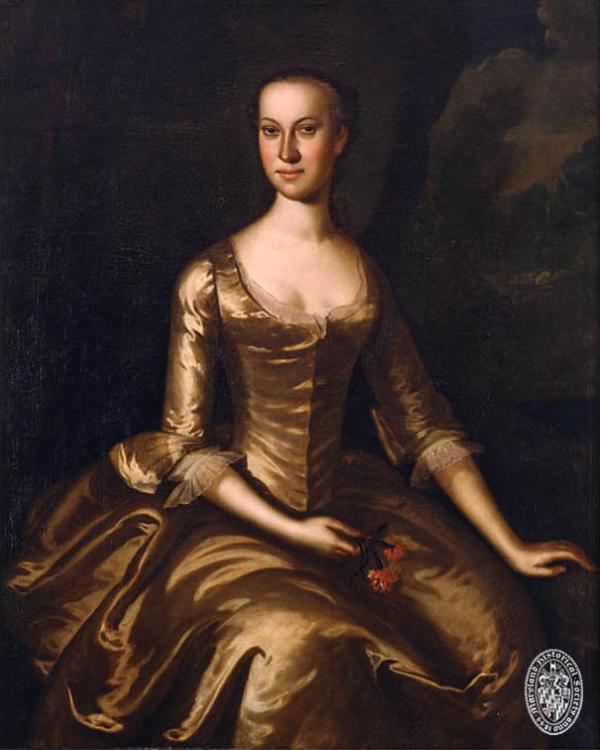
After Edward’s death Ann, with the help of her father, Gentleman John Bond, was heavily involved in the continued development of Fells Point. At this time in colonial history it was unusual for a woman to develop land or a community. To this day their is a Bond Street and an Aliceanna Street in Fells Point, Baltimore, Maryland. Further, “…200 years ago, it was one of colonial America’s biggest seaports, one that played a key role in thwarting the British during the War of 1812.

In 1744 Ann (Bond) Fell married James Giles and they had three children together. Ann died in 1791 in Baltimore County, Maryland. (10)

Portrait of Ann Bond Fell by John Hesselius, (1728 – 1778).
(Image courtesy of The National Portrait Gallery, Washington, DC).

The William and Sarah (Wrongs) Bond Family

In this generation, with this particular family, the historical record gets a bit sparse. This has required us to make some inferential observations when we lack a direct record.

William Bond was the eighth child of John and Aliceanna Bond. His first seven siblings were all born in quick, nearly unbroken succession, and then after his sister Jane, there was a pause before we meet William. That’s a lot of siblings, and there were three more after William. In general, it seems they all lived long lives. All except for William, which we will get to in a bit.

William and Sarah Wrongs were married on November 16, 1771, in St. George’s Parish Baltimore County, Maryland. St. George’s, also known as the Spesutia Parish… [was] the oldest Episcopal parish in Maryland. [The Episcopal Church describes itself “Protestant, yet Catholic” and claims apostolic succession, tracing its bishops back to the apostles via holy orders… The Episcopal Church was formally separated from the Church of England in 1789 so that American clergy would not be required to accept the supremacy of the British monarch.]

Observation: The fact that they were married in a parish that was an Anglican order, and Episcopalian in its practice, points to the strong possibility that she might have been British and baptized into the Church of England. We have found a record in the papers of All Saints Wakefield Cathedral, West Yorkshire, England, which is part of the Church of England that may be a record of Sarah Wrongs birth. We have not found a birth record for her in America, and we first meet her when she marries William Bond.

Sarah D: of Robt Brook Wrongs [Sarah, daughter of Robert Brook Wrongs].
Baptismal record from Wakefield All Saints Cathedral, dated March 12, 1747.
South East View of the Parish Church of All Saints Wakefield, aquatint, by I. Cawthorn, circa 1807. Courtesy of The British Library.

When William married Sarah, it did not sit well with the Quakers. They had an expectation that partners would be selected from within their own community, certainly at the meeting house. In 1772, the Society of Friends, upset with both William and his brother Thomas for their marriages, removed them from participation in the Society of Friends.

Excerpted from Quaker meeting notes from the Gunpowder Monthly Meeting, Baltimore County, Maryland. (What is shown below below are from the bottom of one page, and the top of the next page).

“Where as Thomas and William Bond (sons of John Bond) have had a Birthright Among us the People Called Quakers but they having gone out in Marriage to Women of Other Professions Contrary to the good Order used Amongst Friends, Which Mission = doest [?] of theirs we Testify Against and Disown them from being any longer members of Our Society, unlike they Condemn their outgoing to the satisfaction of this Meeting and that their Conduct For later may Render them Worthy of Our Notice and Christian Care is Our Desire. Given forth from Our Monthly Meeting Held at Gunpowder the 25th of the 3rd month 1772. [March 25, 1772]

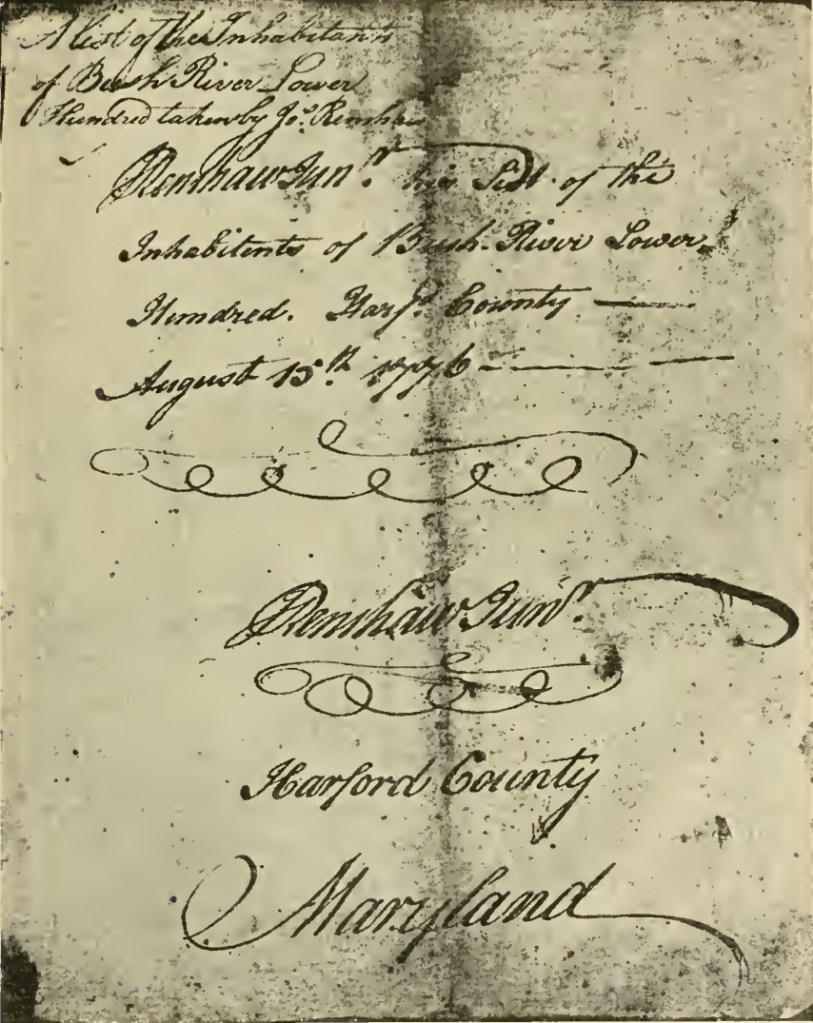
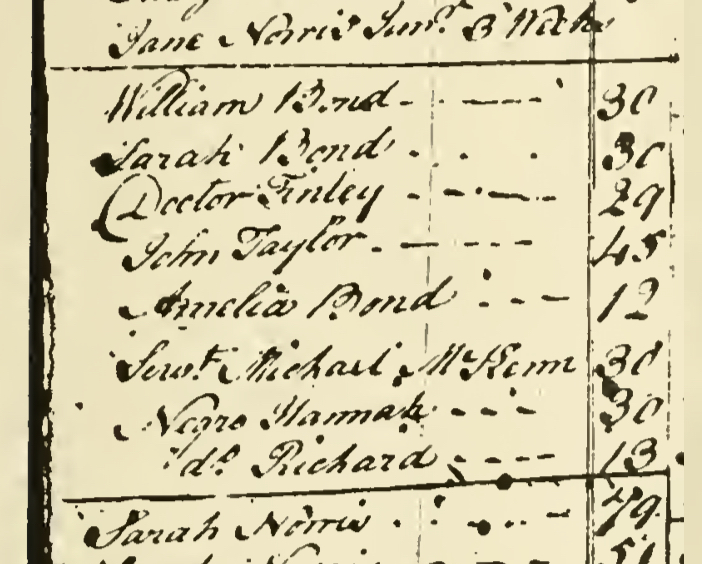
We next find William and Sarah in the Maryland Preliminary Census of 1776 which lists both of them as 30 years old. At that time, it was “taken for the purpose of setting Maryland’s quota for a tax to support the Revolutionary War.” We have not been able to identify the other people who are listed with them on this census.

Maryland Records, 1776 Harford County, Bush River Lower census cover sheet and p. 127

William and Sarah were the parents of four children:

  • John Bond, born, 1772 – died, unknown
  • Abigail (Bond) Everist, born 1776 – died, unknown
  • Edward Fell Bond, born March 4, 1777 – died, February 20, 1822
    (We are descended from Edward Fell).
  • Jane (Bond) Bradford, born 1782 – died, January 7, 1860

William Bond, being a child of the planter class, had inherited property from his father John Bond, the Gentleman. We don’t know much about his and Sarah’s life together at this point, simply because no records have been located. We can however, infer some things about William…

Observation: Even though the Quakers seriously rebuked him, we think that he may have still retained some of their pacifist tendencies. Alan Kerr Bond wrote in The Bonds of Earth, that William “was a non-associator in 1775 and 1776; yet like others in Quaker families who would not take up arms, he may have later become county magistrate…”
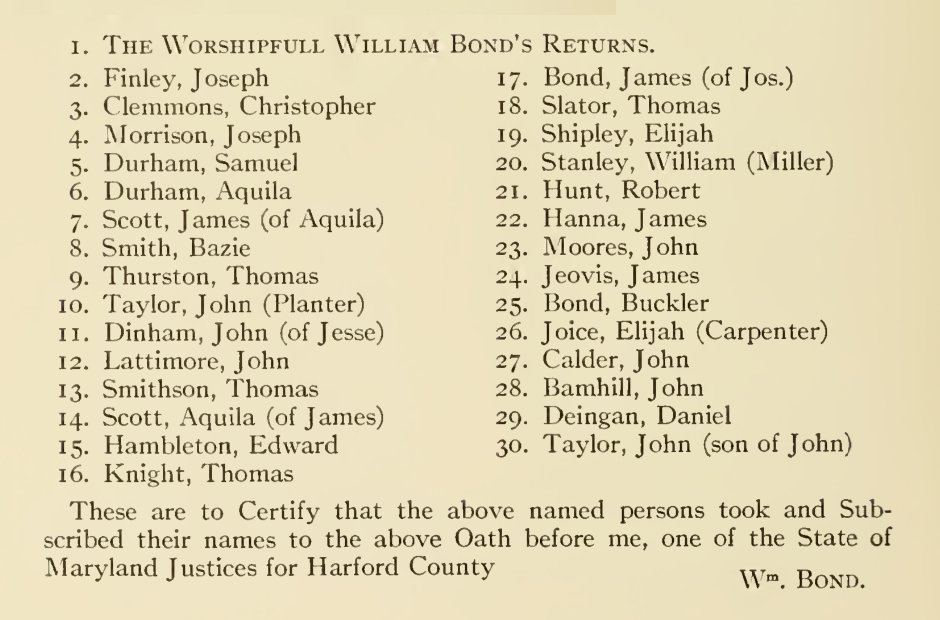
Like his father John Bond, William chose to disregard the Quaker prohibition against taking oaths, and we locate him as the probable “the worshipful William Bond” administering the Oath of Fidelity and Support to mustered militia men from Harford County. From Wikipedia: The term Non-Associators was applied to American colonists who refused to support and sign “military association” charters.

Also from Wikipedia: “In 1777, all Maryland voters were required to take the Oath of Fidelity and Support. This was an oath swearing allegiance to the state of Maryland and denying allegiance and obedience to Great Britain. As enacted by the Maryland General Assembly in 1777, all persons holding any office of profit or trust, including attorneys at law, and all voters were required to take the oath no later than March 1, 1778.”

Alan Kerr Bond identified William as a probable magistrate, which was defined in colonial times as “…the major figure in the colonial court system… the magistrate (a local official with limited power), often called justice of the peace or, simply, judge. This person mostly dealt with petty (minor) crimes in his local area.” Further, dictionary.com defines worshipful as —WorshipfulBritish. a formal title of honor used in announcing or mentioning certain highly regarded or respected persons.

Observation: William saw his father John suffer at the burden of British taxes on his tobacco and sugar shipments. He may have felt a need to do what he could to support and help create a new Maryland? Perhaps he felt being a magistrate was a non-violent way to participate in the cause?

Some ‘Quakers’ took up arms against the British, but some did not. Pacifist Quakers were treated with some disdain by their neighbors during and after the Revolutionary War. There are two other men named William Bond from other Maryland Counties, which we found records for, which have survived. It seems likely that our William Bond, unlike the others, never took up arms, but had found a social balance between engagement and pacifism to sustain himself and his family. (11)

The Kentucky Mystery

The rise of maintaining family histories through family bibles, journal stories, and embroidered family trees has had a long history. First, in the British Colonies, and then in the subsequent United States. By the 1800s, some families started cataloging their ancestors as a way to create their own history — “…some Americans came to see the process of learning one’s family history as a moral endeavor—a person could learn much from what her ancestors had done right or wrong… Even before the Civil War, there was ‘lineage consciousness’ among those descended from elite colonial families, who used their descent from ‘high’ birth to justify and enforce their higher social rank.”

We agree that some of these records can be filled with rich information, but you always need to verify your sources. In our research on our family lines, we have encountered two Daughters of the American Revolution publications which have asked us to call into question if they are accurate. Both state that William Bond “was killed by Indians on his way to Kentucky.” We believe that this is an error, and that this mistake has been perpetuated through several other subsequent publications.

Records were kept by the new United States Confederation which documented in careful detail who was entitled to land (due to their war service), in new frontier areas (like Kentucky). William Bond’s name does not appear on any of these records, nor does his wife’s name appear on any war service pension records.

The fate of William Bond and Sarah Wrongs is a mystery. (This aspect of our family history will still continue to be researched). We know what happened with their four children. We are descended from their son Edward Fell Bond.(For more about his story, see The Bond Line — Part Six). Their daughter, Jane (Bond) Bradford’s son went on to have a high profile role in Maryland history. (12)

Where are William and Sarah Bond hiding?

Jane (Bond) Bradford and Her Famous Son Augustus

Edward Fell Bond’s younger sister Jane Bond, married Samuel Bradford on July 21, 1803 in Harford County. Their son, Augustus Williamson Bradford was born on January 9, 1806, in Bel Air, Maryland, a community near Baltimore.

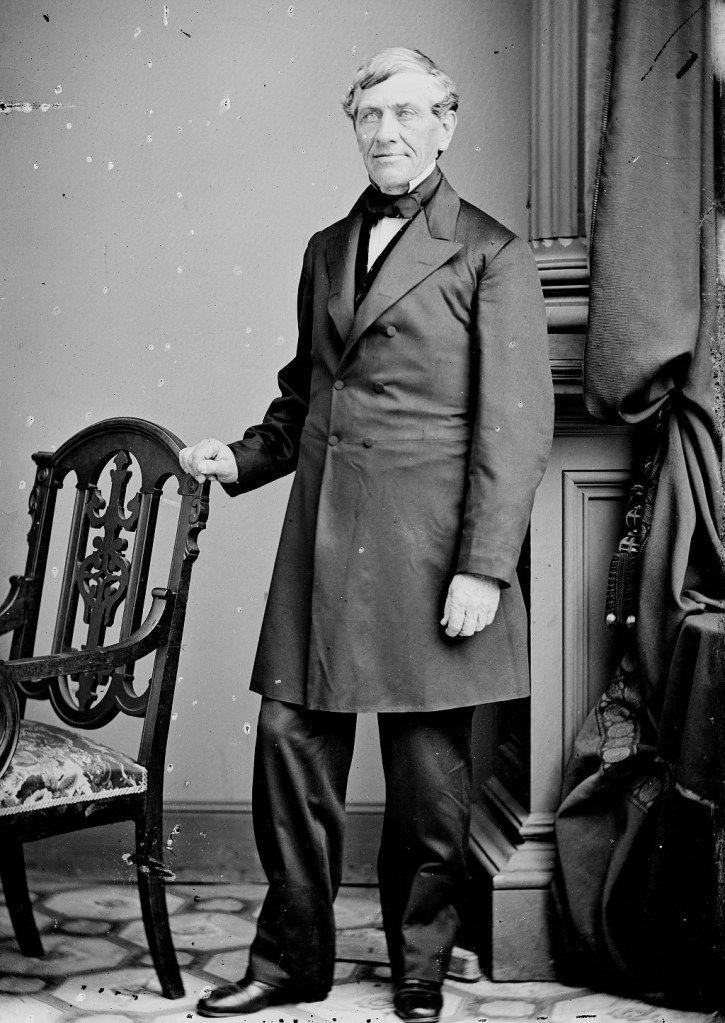
Augustus was a law school graduate; politically first a Whig and then a Democrat. He was elected Governor of Maryland and served from January 8, 1862 – January 10, 1866 (essentially the length of the Civil War). As Governor, he was a staunch Union supporter and a fierce opponent of slavery.

During the American Civil War (1861–1865), Maryland, a slave state, was one of the border states, straddling the South and North. Despite some popular support for the cause of the Confederate States of America, Maryland did not secede during the Civil War. Across the state, some 50,000 citizens signed up for the military, with most joining the Union Cause. Approximately 5,000 citizens went south to fight for the Confederacy. This was a rough period for Maryland, because as a border state, it saw much conflict, due to military activity and unrest among a conflicted population.

Augustus Williamson Bradford, circa 1855-65, Photograph by Mathew Brady.
(Image courtesy of The Library of Congress).

In April 1864, both President Lincoln and Governor Augustus Bradford spoke at a fair in Baltimore, Maryland, which was held to raise funds for the welfare of Union soldiers. Certainly then, they knew each other.

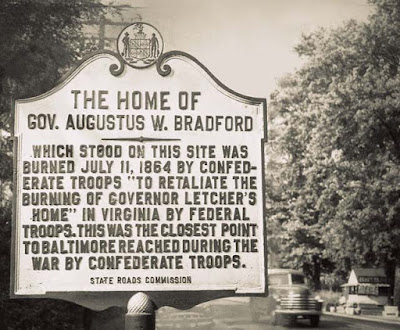
Three months later — “During the War, the Confederates invaded Maryland three times. During the last of these, Bradley T. Johnson’s raiders visited Bradford’s home in July of 1864, and during his absence, burned it to the ground together with all his furniture, library, and papers.”  Learning this, it’s regrettable how much information from our family history was likely lost.

Augustus Williamson Bradford died in Baltimore on March 1, 1881, at the age of seventy-six.

Historical marker in Maryland concerning our distant relative.
(Photo courtesy of civilwarquilts.blogspot.com).

About nine months later, on April 14, 1865 the actor John Wilkes Booth assassinated President Abraham Lincoln at Ford’s Theatre in Washington, D.C. Booth was a Marylander and a Confederate sympathizer.

Memory: In March 1975, we traveled with our parents to Washington, D.C., to see the historical sites in anticipation of the approaching 1976 Bicentennial year. Among the memories was a visit to Ford’s Theatre and the upstairs bedroom across the street where Lincoln had died. At that time, we knew next to nothing about our family history. (13)

Unused Ticket for Ford’\’s Theatre April 14, 1865 (The night Lincoln was assassinated there).
Image courtesy of http://www.shapell.org

Following are the footnotes for the Primary Source Materials,
Notes, and Observations

Preface: Be Wary Of Those K rations!

(1) — two records

AZ Central
Vintage: Romantic Photos of The Soldier and The Cigarette
A United States sailor holds a carton of Philip Morris cigarettes under one arm and a duffle bag over his other shoulder while smoking a cigarette.
https://www.azcentral.com/picture-gallery/money/business/2014/04/02/vintage-romantic-photos-of-the-soldier-and-the-cigarette/7217459/
Note: For the photograph.

Maryland State Archives — Guide to Government Records
Understanding Maryland Records Money
https://guide.msa.maryland.gov/pages/viewer.aspx?page=money
Note: For the data, “Because coined and printed money were in short supply during the early Colonial period, records frequently showed payments being made in pounds of tobacco”.

The British Colonies Desperately Needed Workers

(2) — five records

Art UK
View of Bristol Harbour with the Cathedral and the Quay 
by Nicholas Pocock (1740–1821)
https://artuk.org/discover/artworks/view-of-bristol-harbour-with-the-cathedral-and-the-quay-188964
Note: For the painting.

George Mason’s Gunston Hall
Indentured Servants at Gunston Hall
https://gunstonhall.org/learn/people-of-gunston-hall/indentured-servants/

Encyclopedia Virginia
Cartouche on Fry-Jefferson Map
https://encyclopediavirginia.org/1018hpr-0194e1b221bf0c6/
Note: For the cartouche map artwork.

U.S. History, Pre-Columbian to the New Millenium
The Southern Colonies
Indentured Servants
https://www.ushistory.org/us/5b.asp

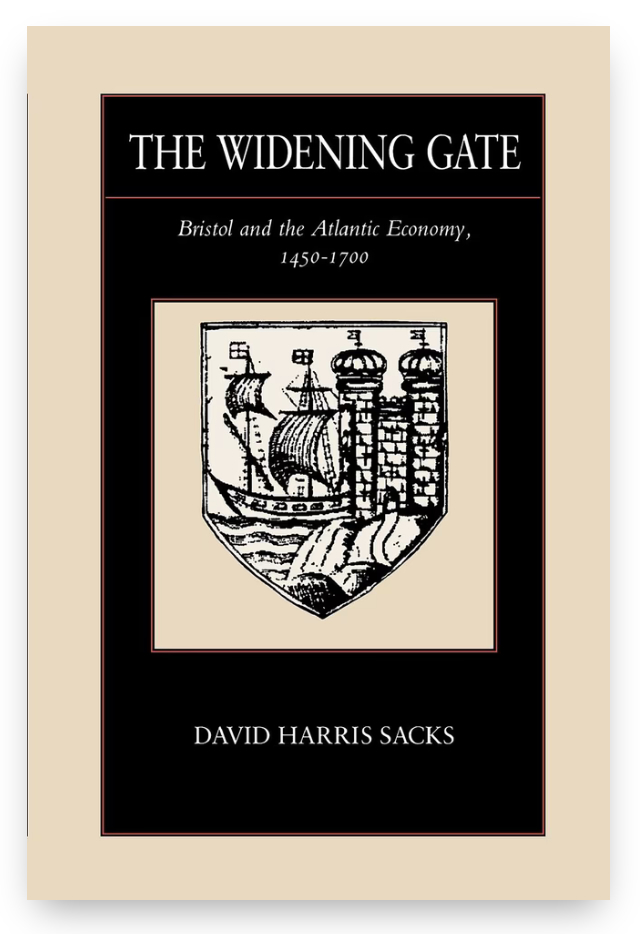
The Widening Gate
Bristol and the Atlantic Economy, 1450-1700

by David Harris Sacks
University of California Press
UC Press E-Books Collection, 1982-2004
>The Capitalism of the Spirit, 1650–1700 > A Shoemakers’ Holiday
https://publishing.cdlib.org/ucpressebooks/view?docId=ft3f59n8d1&chunk.id=d0e20595&toc.id=ch8&toc.depth=1&brand=ucpress;query=Tilley&anchor.id=d0e20643#X
Note: Footnote 8 references BRO… Bristol Record Office, Common Council Proceedings, Vol. 5, p. 72, with this text: “all Boyes Maides and other persons which for the future shall be transported beyond the Seas as servants… before their going aship board to have their Covenants or Indentures of service and apprenticeship inrolled in the Tolzey booke as other Indentures of apprenticeship are and haue used to be and that noe Master or other officer whatsoever of any ship or vessell shall (before such inrolment be made) receive into his or their ship or vessell or therein permit to be transported beyond the Seas such Boyes Maides or other persons”.

The Bristol Registry of Servants Sent to Foreign Plantations 1654-1686

(3) — four records

An indenture signed by Henry Mayer, with an “X”, in 1738. This contract bound Mayer to Abraham Hestant of Bucks County, Pennsylvania, who had paid for Mayer to travel from Europe.
https://commons.wikimedia.org/wiki/File:Indenturecertificate.jpg
Note: For the sample contract.

The Bristol Registry of Servants Sent to Foreign Plantations 1654-1686
1659
by Peter Wilson Coldham
https://www.ancestry.com/imageviewer/collections/49090/images/FLHG_BristolRegistersofServants-0132?treeid=&lang=en-US&pId=14021
Book pages: 121-122, Digital Pages: 131-132/502
And confirmed here:
Virtual Jamestown.org
Indentured Servants Basic Search Results
http://www.virtualjamestown.org/indentures/search_indentures.cgi?search_type=basic&start_page=0&servant_ln=Bond&servant_fn=Peter&servant_place=&servant_occ=&destination=&ship=&year-ops=&year=&year1=&sex=male&agent_ln=&agent_fn=&agent_place=&agent_occ=&result_order=&submit=Initiate+Search&db=bristol_ind

Price Genealogy
Origins of Colonial Chesapeake Indentured Servants: American and English Sources
https://www.pricegen.com/genealogy-learning-center/overseas-origins/

The Early Settlers of Maryland

(4) — one record

The Early Settlers of Maryland; an index to names of immigrants compiled from records of land patents, 1633-1680, in the Hall of Records, Annapolis, Maryland
https://archive.org/details/earlysettlersofm00skor/page/n5/mode/2up
by Gust Skordas, John M, Brewer, Arthur Trader
Book page: 16 and 48, Digital Pages: 16 and 48/525
Note 1: Page 48/525 which list: our Peter, other Peter(s), and other Bonds.
Note 2: Our Peter is from Anne Arundel County and immigrated in 1660.

The Maryland Colony

(5) — five records

Province of Maryland
https://en.wikipedia.org/wiki/Province_of_Maryland

British Roots of Maryland Families
by Robert W. Barnes
B (section)
https://www.ancestry.com/imageviewer/collections/49095/images/FLHG_BritishRoots-0101?usePUB=true&_phsrc=Ovg3&pId=15510
Book pages: 61, Digital Pages: 101/686

A New Map of Virginia, Maryland, And The Improved Parts
Of Pennsylvania & New Jersey 
by Christopher Browne, 1685
https://commons.wikimedia.org/wiki/File:A_new_map_of_Virginia,_Mary-land_and_the_improved_parts_of_Penn-sylvania_%26_New_Jersey_(4231929854).jpg

Settlers of Maryland, 1679-1783. [Consolidated Edition]
by Peter Wilson Coldham
B (section)
Explanation of file data: Various Bond properties are shown on this link which we have assembled into a chart for this blog chapter —
https://www.ancestry.com/imageviewer/collections/49058/images/FLHG_SettlersMaryland2-0074?treeid=&personid=&usePUB=true&_phsrc=Xqj2&_phstart=successSource&pId=101720&rcstate=FLHG_SettlersMaryland2-0074%3A337%2C703%2C422%2C732%3B556%2C703%2C643%2C733%3B653%2C703%2C742%2C733%3B821%2C745%2C935%2C775%3B224%2C952%2C313%2C982%3B820%2C953%2C933%2C985%3B223%2C1160%2C313%2C1190%3B223%2C1241%2C313%2C1270%3B594%2C1243%2C680%2C1273%3B820%2C1285%2C933%2C1316%3B223%2C1324%2C312%2C1354%3B820%2C1408%2C931%2C1438%3B818%2C1451%2C931%2C1480%3B818%2C1491%2C931%2C1521%3B818%2C1533%2C931%2C1563%3B818%2C1574%2C931%2C1605%3B818%2C1618%2C930%2C1648%3B815%2C2075%2C928%2C2105%3B813%2C2119%2C928%2C2149%3B813%2C2160%2C926%2C2190%3B813%2C2200%2C926%2C2230%3B813%2C2368%2C926%2C2399%3B813%2C2410%2C925%2C2440%3B813%2C2452%2C925%2C2482%3B810%2C2577%2C930%2C2608%3B1500%2C2624%2C1591%2C2656%3B810%2C2747%2C928%2C2777%3B210%2C2955%2C300%2C2986%3B807%2C2959%2C920%2C2990%3B807%2C2999%2C920%2C3031%3B1030%2C217%2C1312%2C254%3B225%2C457%2C314%2C487%3B823%2C456%2C941%2C487%3B224%2C539%2C314%2C569%3B337%2C539%2C422%2C569%3B821%2C580%2C935%2C611%3B224%2C703%2C314%2C733
Book pages: 59-61, Digital Pages: 73-75/906.
Note: This book lists land ownership in Maryland in the 1679-1783 period.

The Story of The Bonds of Earth
by Allen Kerr Bond
https://archive.org/details/storyofbondsofea00bond/mode/2up
Book pages: 164-166. Digital pages: 164-166/299

Peter Bond Marries the Widow, Alice (Cole) Gill Drury

(6) — five records

WikiTree
Peter Bond (abt. 1636 – bef. 1705)
https://www.wikitree.com/wiki/Bond-340
Note: Some smaller details in this link do not agree with other reliable sources.

WikiTree
Alice (Cole) Washington (abt. 1638 – aft. 1708)
Alice Cole, Washington (abt. 1638 – aft. 1708)
https://www.wikitree.com/wiki/Bond-340
Note: Some smaller details in this link do not agree with other reliable sources.

Baltimore County Families 1659-1759
by Robert W. Barnes
For the Peter Bond Family
— Book page: 47, Digital page: 57/935
https://www.ancestry.com/imageviewer/collections/48162/images/BaltimoreCoFamilies-002226-47?treeid=&personid=&usePUB=true&_phsrc=jhl2&_phstart=successSource&pId=224348&rcstate=BaltimoreCoFamilies-002434-255%3A167%2C1264%2C239%2C1285%3B332%2C1265%2C426%2C1285%3B1241%2C1262%2C1296%2C1282%3B695%2C1363%2C759%2C1384%3B166%2C1432%2C199%2C1451%3B666%2C1431%2C728%2C1451%3B719%2C1531%2C775%2C1557%3B979%2C1529%2C1034%2C1550%3B1163%2C1563%2C1220%2C1584%3B775%2C1598%2C830%2C1617%3B656%2C1866%2C718%2C1886%3B1176%2C1864%2C1238%2C1884%3B673%2C161%2C839%2C181%3B887%2C764%2C946%2C784%3B370%2C797%2C425%2C824%3B423%2C797%2C594%2C821%3B257%2C830%2C314%2C851%3B1129%2C828%2C1187%2C849%3B999%2C863%2C1056%2C883%3B258%2C997%2C313%2C1022%3B665%2C1063%2C722%2C1082%3B167%2C1097%2C201%2C1117%3B1178%2C1228%2C1302%2C1249

Rhinehart & Bassett Family Tree
Peter Bond’s probated Will from 1705:
http://www.bassett.net/gendata-o/p10576.htm
and from the:
Maryland Calendar of Wills:
by Jane Cotten, Roberta Bolling Henry, Eleanor Janet Whitall
https://archive.org/details/marylandcalendar03cott/page/n107/mode/2up?q=bond
Book page: 49, Digital page: 108/680
Bond, Peter, Balto. Co., 23rd Aug., 1704; 28th Apr., 1705.
“To wife Alice, extx., plantation and land during life; to pass to son Peter and hrs. at her decease. To sons Thomas, William and John, 300 A. at hd. of Bush R. To sons afsd., residue of estate afsd. at decease of wife. Sons William and John to be of age at 18 yrs.” Test: Lancelott Todd, John Lockett, Wm. Felps. 3. 451

Was Peter Bond a Quaker?

(7) — six records

Quakers
https://www.history.com/topics/immigration/history-of-quakerism

Quakers in Great Britain; 1650s-1750s
https://haygenealogy.com/hay/quaker/quaker-GB.html

George Fox
https://en.wikipedia.org/wiki/George_Fox

George Fox

Quakers & Slavery
George Fox’s Ambiguous Anti-Slavery Legacy
https://web.tricolib.brynmawr.edu/speccoll/quakersandslavery/commentary/people/fox.php

Encyclopædia Britannica
Society of Friends
https://www.britannica.com/topic/Society-of-Friends
Note: Describes as, “George Fox, English missionary and founder of the Society of Friends (Quakers), preaching in a tavern, c. 1650”.

The Guardian newspaper
Pierce Brosnan: I was ‘kicked to the kerb’ as James Bond after Die Another Day
https://www.theguardian.com/film/2015/nov/24/pierce-brosnan-james-bond-kicked-to-the-kerb-after-die-another-day
Note: For the photo of Pierce Brosnan as James Bond 007

Thomas Bond was The Father of Eight Sons and Two Daughters

(8) — six records

The Story of The Bonds of Earth
by Allen Kerr Bond
https://archive.org/details/storyofbondsofea00bond/mode/2up
Book page: 186, Digital page: 186/299

Thomas Bond
Vital – Maryland, Marriages, 1666-1970

Maryland Marriages, 1666-1970
https://www.familysearch.org/ark:/61903/1:1:F4V7-5M7?from=lynx1UIV8&treeref=LTV6-2WQ
and here:
All Hollows Parish, Anne Arundel, Maryland (1691 — 1858)
https://www.familysearch.org/ark:/61903/3:1:3Q9M-CSMZ-Q7HL-8
Book page: 32, Digital page: 1377/1933, 10th transcribed entry, SER Number #00044-8

Baltimore County Families 1659-1759
by Robert W. Barnes
For the Peter Bond Family
and
For Thomas Bond
https://www.ancestry.com/imageviewer/collections/48162/images/BaltimoreCoFamilies-002227-48?treeid=&personid=&usePUB=true&_phsrc=jhl2&_phstart=successSource&pId=224349&rcstate=BaltimoreCoFamilies-002434-255%3A167%2C1264%2C239%2C1285%3B332%2C1265%2C426%2C1285%3B1241%2C1262%2C1296%2C1282%3B695%2C1363%2C759%2C1384%3B166%2C1432%2C199%2C1451%3B666%2C1431%2C728%2C1451%3B719%2C1531%2C775%2C1557%3B979%2C1529%2C1034%2C1550%3B1163%2C1563%2C1220%2C1584%3B775%2C1598%2C830%2C1617%3B656%2C1866%2C718%2C1886%3B1176%2C1864%2C1238%2C1884%3B673%2C161%2C839%2C181%3B887%2C764%2C946%2C784%3B370%2C797%2C425%2C824%3B423%2C797%2C594%2C821%3B257%2C830%2C314%2C851%3B1129%2C828%2C1187%2C849%3B999%2C863%2C1056%2C883%3B258%2C997%2C313%2C1022%3B665%2C1063%2C722%2C1082%3B167%2C1097%2C201%2C1117%3B1178%2C1228%2C1302%2C1249
Book page: 48, Digital page: 58/935

Ann Robinson
https://www.ancestry.com/family-tree/person/tree/100009207/person/192283883876/facts
Note: Possible portrait of Ann Robison.

History of Harford County Maryland
by Walter W. Preston, 1901
Jacob Bond
https://archive.org/details/historyharfordc00changoog/page/n226/mode/2up?view=theater
Book pages: 206-207, Digital page: 227/413

Sarah Brown Bond
https://www.findagrave.com/memorial/63562855/sarah-bond
Note: This gravesite is noted on this blog only for this specific quotation:
“Quaker headstones before the mid-19th century are rare, as they are not in keeping with the plain life.”

What Would These Quaker Ancestors Think About Our Time?

(9) — two records

Scattered Leaves: Genealogy of the Johnson – Bond
and Utermoehlen (and) Bredehoeft Families
by Robert E. Johnson
https://www.familysearch.org/library/books/viewer/531365/?offset=0#page=14&viewer=picture&o=info&n=0&q=
Book page: 10, Digital page: 12/174
Note: Excerpted from the document: “The family of Thomas Bond seems to be the first to backslide and fall under the displeasure of Friends Meeting (Quakers)”.

Susanna Bond
in the U.S., Quaker Meeting Records, 1681-1935

Maryland > Baltimore > Gunpowder Monthly Meeting > Minutes, 1768-1784
https://www.ancestry.com/discoveryui-content/view/1107209832:2189?_phsrc=dGC21&_phstart=successSource&gsfn=Susannah&gsln=Bond&ml_rpos=4&queryId=1fe861c3b709e46848daa11c6905627c
Book page: “50”, Digital Pages: 54/374

Gentleman John Bond and His Wife Aliceanna Webster

(10) — eight records

John Bond
in the U.S., Quaker Meeting Records, 1681-1935

Pennsylvania > Chester > Nottingham Monthly Meeting > Minutes, 1730-1889
https://www.ancestry.com/discoveryui-content/view/1107234025:2189
Book page: 14, Digital Pages: 16/392

The Fells Point Story, cover.

The Fells Point Story
by Norman G. Rukert, 1976
https://www.rukert.com/docs/FellsPointStory1976.pdf
From a section with our direct page numbers, titled “Bond and Fell Papers”
– app. page 102, Alisanna Bond obituary, courtesy of Brown’s Wharf Museum.
– app. page 104, Letter from John Philpot in London…, courtesy of Brown’s Wharf Museum.

Genealogical and Memorial Encyclopedia of the State of Maryland: A Record of the Achievements of Her People in the Making of a Commonwealth and the Founding of a Nation, Vol 1
by Richard Henry Spencer
The only section is under Thomas Emerson Bond, MD. (5 pages only).
https://www.ancestry.com/imageviewer/collections/7719/images/7719-Volume1-0057?treeid=&personid=&usePUB=true&_phsrc=tTC5&_phstart=successSource&pId=57&rcstate=7719-Volume1-0058%3A766%2C958%2C882%2C1003%3B332%2C1205%2C558%2C1262%3B694%2C1267%2C814%2C1312%3B837%2C1267%2C953%2C1312%3B1034%2C1940%2C1260%2C1998%3B514%2C2131%2C631%2C2178%3B1378%2C649%2C1499%2C695%3B97%2C708%2C213%2C755%3B294%2C710%2C488%2C756%3B97%2C894%2C216%2C940%3B326%2C958%2C446%2C1004%3B627%2C959%2C748%2C1004
Book pages: 48-52,  Digital Pages: 1-5

The Story of The Bonds of Earth
by Allen Kerr Bond
https://archive.org/details/storyofbondsofea00bond/page/196/mode/2up
Book pages: 197- 199, Digital pages: 196-198/299

Wilson Cary notes on the Bond family*
https://usgenwebsites.org/MDBaltimore/family/bondresearchnotes.html
Note: These files migrated to ancestry.com when the company was acquired. We have not been able to relocate them there — however, *we did locate this data (copied below), in 2024.

John Bond of Harford Co [County]
Lud [land} to be div [divided amongst] his 3 sons Samuel — John — & William 5$ ea. & no more of his R&P. est. [right & proper estate].

— To gr. son John Bond (s. Thomas) [son of Thomas] that pl. [plantation] of “Bonds Forest” where I now dwell adj. [adjoining] Jacob Rush & Wm Tnuch [?] – Wm Baxler, Spring branch Falls – including Enoch William land & Benj Lancaster ld [land] — ½ & cd [called] “Fountain Copper Mines”, ½ of the pl [plantation of resurv. [resurveyed] next adj. [adjoining] that I now hold wh. [which] is the 1/3 pl [plantation] thereof of & the other pls [plantations] that has fallen to the company by any means so ever (being a copper mine in Feda Co. [Frederick County] — also ½ of my lots w.s. [west-south of?] Thames St [Street] Fells Pt [Point] — wh. [which] prop. [property] is to be left in the hands of my son Thomas for [the] bringing up & ed. [educating] of my grand son John Bond (s. of Thos) [son of Thomas] till 21 & then to be put in full pos. [possession] 

— to gr. Son [grandson] Thomas Bond (s.Thomas) [son of Thomas] ½ of sd [said] Fountain Copper Mines & ½ Thames St Lots & so on as above 

— to gr. Son William Bd [grand son William Bond] (s. Samuel) [son of Samuel] 5A.[?] on Great Road W. the Quaker Meeting house & adj [adjoining] Wm Smith Esq [Esquire]

— Dau [daughter] Alesanna Kell (ux [wife of] Thomas Kell) the plant [plantation] where as she now lives being 2 t. [tracts] of ld cd [land called] 2d Thory pt [Thorny Point?] & 2d T. [?] improved & all that pl [plantation] of Bonds Pleast[ant] Hills that lies adj [adjoining] Prospect & Capt[ain] Thos Kell’s ld [land] & what I have before given her & no money of my est. [estate] whatever 

— to my dau [daughter] Hannah Johns ux [wife of] (Aquilla) 20₤. 

— Dau [daughter] Susanna Hunt (ux [wife of] Phineus) ₤50. 

— Gr Dau [Grand daughter] Alisana Lockwood ₤50. 

— Dau [daughter] Pameula Moore (ux [wife of William) of Balt[imore]town my ho. [house?] on Fells Pt Cd [Fells Point called] & known by name of The Coffee House and also 1 lot wh. [with] improvements & house built by Hy Carver E.S. Thames St 

— Gr. Son [Grandson] John Bond (s. Wm) [son of William] pt [plantation] of l. cd [lands called] “Bonds Forest” where Wm [William] Bond now lives & all the ld [land] that lies betw [between 2 brs [branches or brooks] Overshot & old Ives Spring Branch down to the Falls & over to the Bond’s Forest line 

— To Gr son [Grandson] EdwD [Edward] Fell Bond (s. Wm) [son of William] the pl [plantation] of (cont. [containing] 2nd Page 4a) Bonds Forest where the Strandfords now live – ho [?] & orchard estb [established] at 100A [acres} – also t. [tract] where Amos Jones lives 65A. [acres]

— Gr son [Grandson] John Bond Fell (s. Thomas) [son of Thomas] pl [plantation] Bonds Pleast[ant] Hills where Iona Ady now lives estd 100A. [acres] 

— Frnd [Friend? Quaker?] Isaac Everett l. [lots] where he now lives bdg [bordering] on Olojues Sp’g br. – [branch or brook]

Exrs [executors]
— son Thomas Bond (surv. exr [surveyed executor] at probate) & 
— s.-1. c [said 1 called] Capt Thos Kell [Captain Thomas Kell]
– Bro Jno Bond [Brother John ]

wits [witnesses] 
— George Rush 
— Enoch Williams (Quaker) 
— Benj Rush Jr. (Quaker)

*As stated above, we located this data in 2024:
Baltimore County MDGenWeb, BOND Family Research Notes
Bond Family Notes of Wilson Cary, Found in Maryland Historical Society
Transcribed by Lawrence E. Alley
https://usgenwebsites.org/MDBaltimore/family/bondresearchnotes.html
Note: This transcription may not match this original transcription exactly… Transcription of John Bond, Gentleman’s Will based on Wilson Carey content and annotations, written in 1786:

John Bond of HarfordCo lud to be div his 3 sons Samuel – John – & William 5$ ea. & no more of his R&P. est. To gr. son John Bond (s. Thomas) that pl. of “Bonds Forest” where I now dwell adj. Jacob Rush & Wm Tnuch? – Wm Baxler, Spring branch Falls – including Enoch William land & Benj Lancaster ld – ½ & cd? “Forunlain? Copper Mines”, ½ of the pl of resurv. next adj. that I now hold wh. is the 1/3 pl thereof of & the other pls that has fallen to the company by any means so ever (being a copper mine in Feda Co. – also ½ of my lots w.s. Thames SFells Pt – wh. prop. is to be left in the hands of my son Thomas for bringing up & ed. of my grand son John Bond (s. of Thos) till 21 & then to be put in full pos. To gr. Son Thomas Bond (s.Thomas) – ½ of sd Forulain? Copper Mines & ½ Thames St Lots & so on as above – to gr. Son William Bd (s. Samuel) 5A. on Great Road W. the Quaker Meeting house & adj Wm Smith Esq – Dau Alesanna Kell (ux Thomas Kell) the plant where as she now lives being 2 t. of ld cd 2d Thory pt & 2d T. improved & all that pl of Bonds Pleast Hills that lies adj Prospect & Capt Thos Kell’s ld & what I have before given her & no money of my est. whatever – to my dau Hannah Johns ux (Aquilla) 20₤. Dau Susanna Hunt (ux Phineus) ₤50. Gr Dau Alisana Lockwood ₤50. Dau Pameula Moore (ux Wm) of Balt. town my ho. on Fells Pt Cd & known by name of The Coffee House and also 1 lot wh. improvements & house built by Hy Carver E.S. Thames St – Gr. Son John Bond (s. Wm) pt of l. cd “Bonds Forest” where Wm Bond now lives & all the ld that lies betw 2 brs Overshot & old Ives Spring Branch down to the Falls & over to the Bond’s Forest line – To Gr son EdwD Fell Bond (s. Wm) the pl of (cont. 2nd Page 4a) Bonds Forest where the Strandfords now live – ho & orchard estb at 100A – also t. where Amos Jones lives 65A. – Gr son – John Bond Fell (s. Thomas) pl Bonds Pleast Hills where Iona Ady now lives estd 100A. Frnd Isaac Everett l. where he now lives bdg on Olojues Sp’g br. – 

Exrs son Thomas Bond (surv. exr at probate) & s.-1. c Capt Thos Kell – Bro Jno Bond.

wits George Rush. Enoch Williams (Quaker). Benj Rush Jr. (Quaker)

Maryland Historical Magazine
Mining For Copper and Related Materials in Maryland
by Nancy C. Pearre
March 1964
https://msa.maryland.gov/megafile/msa/speccol/sc5800/sc5881/000001/000000/000233/pdf/msa_sc_5881_1_233.pdf
Note: Page 20 mentions the the Fountain Copper Works.

Baltimore County Families 1659-1759
by Robert W. Barnes
For John Bond
https://www.ancestry.com/imageviewer/collections/48162/images/BaltimoreCoFamilies-002229-50?treeid=&personid=&usePUB=true&_phsrc=jhl2&_phstart=successSource&pId=224351&rcstate=BaltimoreCoFamilies-002434-255%3A167%2C1264%2C239%2C1285%3B332%2C1265%2C426%2C1285%3B1241%2C1262%2C1296%2C1282%3B695%2C1363%2C759%2C1384%3B166%2C1432%2C199%2C1451%3B666%2C1431%2C728%2C1451%3B719%2C1531%2C775%2C1557%3B979%2C1529%2C1034%2C1550%3B1163%2C1563%2C1220%2C1584%3B775%2C1598%2C830%2C1617%3B656%2C1866%2C718%2C1886%3B1176%2C1864%2C1238%2C1884%3B673%2C161%2C839%2C181%3B887%2C764%2C946%2C784%3B370%2C797%2C425%2C824%3B423%2C797%2C594%2C821%3B257%2C830%2C314%2C851%3B1129%2C828%2C1187%2C849%3B999%2C863%2C1056%2C883%3B258%2C997%2C313%2C1022%3B665%2C1063%2C722%2C1082%3B167%2C1097%2C201%2C1117%3B1178%2C1228%2C1302%2C1249
Book pages: 50-51, Digital page: 60-61/935

The Society for the Preservation of Federal Hill and Fells Point
Rediscover
Fells Point During the War of 1812
https://www.preservationsociety.com/rediscover/fells-point-during-the-war-of-1812
Note: For “…200 years ago, it was one of colonial America’s biggest seaports…

The National Portrait Gallery
Portrait of Ann Bond Fell, circa 1764
by John Hesselius (1728 – 1778)
https://npg.si.edu/object/npg_1986.105.4_MDHS?destination=edan-search/catalog_of_america%3Freturn_all%3D1%26edan_local%3D1%26edan_q%3DAnn%252BBond%252BFell
Note: For her portrait.

The William Bond and Sarah Wrongs Family

(11) —twenty records

William Bond
in the Maryland, U.S., Compiled Marriages, 1655-1850

https://www.ancestry.com/discoveryui-content/view/20002:7846

St. George’s Spesutia, Maryland’s Oldest Episcopal Parish, to End Worship Services
https://www.baltimoresun.com/ph-ag-st-georges-closing-1109-20121108-story.html

Episcopal Church (United States)
https://en.wikipedia.org/wiki/Episcopal_Church_(United_States)

History of the Episcopal Church (United States)
https://en.wikipedia.org/wiki/History_of_the_Episcopal_Church_(United_States)

Sarah Wrong
in the West Yorkshire, England, Church of England Baptisms,

Marriages and Burials, 1512-1812
Wakefield, All Saints > 1747
https://www.ancestry.com/discoveryui-content/view/9793815:2256?tid=&pid=&queryId=37e0ee6ae697c64b5a80b5cef8723c13&_phsrc=cqI3&_phstart=successSource
Book page: 14, Digital page: 7/16

Wakefield Cathedral
https://en.wikipedia.org/wiki/Wakefield_Cathedral
Note: For the engraving.

Baltimore County Families 1659-1759
by Robert W. Barnes

For William Bond
https://www.ancestry.com/imageviewer/collections/48162/images/BaltimoreCoFamilies-002232-53?treeid=&personid=&usePUB=true&_phsrc=jhl2&_phstart=successSource&pId=224354&rcstate=BaltimoreCoFamilies-002434-255%3A167%2C1264%2C239%2C1285%3B332%2C1265%2C426%2C1285%3B1241%2C1262%2C1296%2C1282%3B695%2C1363%2C759%2C1384%3B166%2C1432%2C199%2C1451%3B666%2C1431%2C728%2C1451%3B719%2C1531%2C775%2C1557%3B979%2C1529%2C1034%2C1550%3B1163%2C1563%2C1220%2C1584%3B775%2C1598%2C830%2C1617%3B656%2C1866%2C718%2C1886%3B1176%2C1864%2C1238%2C1884%3B673%2C161%2C839%2C181%3B887%2C764%2C946%2C784%3B370%2C797%2C425%2C824%3B423%2C797%2C594%2C821%3B257%2C830%2C314%2C851%3B1129%2C828%2C1187%2C849%3B999%2C863%2C1056%2C883%3B258%2C997%2C313%2C1022%3B665%2C1063%2C722%2C1082%3B167%2C1097%2C201%2C1117%3B1178%2C1228%2C1302%2C1249
Book page: 53, Digital page: 63/935

William Bond
in the U.S., Quaker Meeting Records, 1681-1935

https://www.ancestry.com/discoveryui-content/view/1107209922:2189?tid=&pid=&queryId=e9ff387cc8a9d899f26526d32b1d3f98&_phsrc=bKo4&_phstart=successSource
Book page: ‘78’, Digital page: 82/374

Maryland Records
Colonial, Revolutionary, County and Church from Original Sources

Volume II
http://www.grasslandfoundation.com/wp-content/uploads/2014/08/Maryland-Records-II.pdf
Book page: 122, for 1776 Hartford County, Bush River Lower Hundred census
Book page: 236, for Harford County, Oaths of Fidelity, March Court, 1778 “The Worshipful William Bond’s Returns

Abigal Bond
Mentioned in the Record of Joshua Everist (Abigal Bond’s Husband)
Vital – Maryland, Marriages, 1666-1970

https://www.familysearch.org/ark:/61903/1:1:F4J2-CM9?from=lynx1UIV8&treeref=KHDZ-XP9

Jane Bond
Mentioned in the Record of Samuel Bradford (Jane Bond’s Husband)
Vital – Maryland, Marriages, 1666-1970

https://www.familysearch.org/ark:/61903/1:1:F4J7-3QC

The Story of The Bonds of Earth
by Allen Kerr Bond
https://archive.org/details/storyofbondsofea00bond/page/204/mode/2up
Book pages 205- 206, Digital pages: 204-206/299

Maryland State Archives — Guide to Government Records
Information on S961 — (Census of 1776)
http://guide.msa.maryland.gov/pages/series.aspx?action=viewseries&id=s961

Associators
https://en.wikipedia.org/wiki/Associators

Oath of Fidelity and Support
https://en.wikipedia.org/wiki/Oath_of_Fidelity_and_Support

Finding The Maryland 400
Persecuted in Revolutionary Baltimore: The Sufferings of Quakers
https://msamaryland400.com/2016/08/31/persecuted-in-revolutionary-baltimore-the-sufferings-of-quakers/

The Kentucky Mystery

(12) — three records

Why Are We All So Obsessed with Genealogy?
by Lilly Copeland
https://lithub.com/we-are-we-all-so-obsessed-with-genealogy/

William Bond
in the North America, Family Histories, 1500-2000

D > Daughters of the American Revolution > Lineage Book : NSDAR : Volume 087 : 1911
https://www.ancestry.com/discoveryui-content/view/2593487:61157?_phsrc=tuJ4&_phstart=successSource&gsfn=William&gsln=Bond&ml_rpos=21&queryId=67a251fade8a58408ae339fc2c081458
Book page: 287,  Digital Pages: 293/362
Note 1: Lineage Book, National Society of the Daughters of the American Revolution, volume LXXXVII, 86001-87000, published 1911, Entry 86899
Note 2: We believe that this history in in error, and that this did not happen: “…and was killed by Indians on his way to Kentucky.”

Sarah Wrongs
in the North America, Family Histories, 1500-2000

D > Daughters of the American Revolution > Lineage Book : NSDAR : Volume 021 : 1897
https://www.ancestry.com/discoveryui-content/view/1946106:61157
Book page: 236,  Digital Pages: 249/418
Note 1: Lineage Book, National Society of the Daughters of the American Revolution, volume LXXXVII, 20001-21000, published 1897, Entry 20672
Note 2: We believe that this history in in error, and that this did not happen: “…and was killed by Indians on his way to Kentucky.”

iStock
Book and Magnifying Glass
https://www.istockphoto.com/pt/vetorial/book-and-magnifying-glass-gm947299110-258660933
Note: For the illustration.

Jane (Bond) Bradford and Her Famous Son Augustus

(13) — eight records

Genealogy Trails History Group
Maryland Genealogy Trails, Governors of Maryland, 31st-35th
Augustus Williamson Bradford
http://genealogytrails.com/mary/governors7.html

File: Augustus Williamson Bradford – photo portrait standing.jpg
by Mathew Brady
https://commons.wikimedia.org/wiki/File:Augustus_Williamson_Bradford_-_photo_portrait_standing.jpg
Note: For the photograph.

Maryland in the American Civil War
https://en.wikipedia.org/wiki/Maryland_in_the_American_Civil_War

Baltimore American newspaper front page
April 19, 1864
https://msa.maryland.gov/megafile/msa/speccol/sc3500/sc3520/001400/001463/tif/baltam4-19-1864.tif
and
Black Past
(1864) Abraham Lincoln “Address At A Sanitary Fair”
https://www.blackpast.org/african-american-history/1864-abraham-lincoln-definition-liberty/

Archives of Maryland (Biographical Series)
Augustus W. Bradford (1806-1881)
https://msa.maryland.gov/megafile/msa/speccol/sc3500/sc3520/001400/001463/html/1463bio2.html

Civil War Quilts
Quilts & Women’s History Focusing on the American Civil War
by Barbara Brackman
Maryland State Historical Marker (photo)
http://civilwarquilts.blogspot.com/2020/01/baltimore-marylands-sanitary-fair-union.html
Note: Historical marker in Maryland concerning our distant relative.
Photo caption, “Co-Chair Elizabeth Kell Bradford (1818-1894) was Governor Augustus Bradford’s wife. The family was enough of a Union symbol that Confederate troops burned their house a month or two after the fair in the closest raid the South made to Baltimore”.

Shapell Manuscript Foundation
Unused Ticket for Ford’s Theatre April 14, 1865 — The Night Lincoln Was Assassinated There
https://www.shapell.org/manuscript/ticket-for-fords-theatre-april-1865-night-of-lincoln-assassination/
Note: For the ticket image.

The Bond Line, A Narrative — Four

This is Chapter Four of eight: Our intrepid predecessors, moved to Holwood Manor — then to London — and then to the British Colonies in America.

A Pre-Scientific World

In the The Bond Line, A Narrative — One, we discussed the historical evolution of heraldry, and how that proved useful to our ancestors for ordering their lives. This set of “identities” developed and changed over time as societies evolved. Communities became less centralized, individual family surnames became more important, people moved around a little more. However, our ancestors were still living in a pre-scientific world in which religion was still the dominant player.

Galileo Galilei at His Trial by the Inquisition in Rome in 1633., i.e. Galileo pushes away the Bible. (Courtesy of The Wellcome Collection via Wikimedia Commons).

That perspective might be a little hard for those of us in the modern world to understand. Before us, people didn’t have the perspective to comprehend things which we take for granted: stars and planets, germ-theory, equal opportunity, democratic rule, freedom of religion, etc.

New worlds were being discovered, but their world was still the Britain of their ancient forebears. What was ahead was a century of continued ongoing conflict in which royalty and the church were pitted against each other for control of the English people. (1)

The Italians Were Winning The Renaissance Footrace

“The English Renaissance was a cultural and artistic movement in England from the early 16th century to the early 17th century. It is associated with the pan-European Renaissance that is usually regarded as beginning in Italy in the late 14th century. As in most of the rest of northern Europe, England saw little of these developments until more than a century later. Renaissance style and ideas, however, were slow to penetrate England, and the Elizabethan era in the second half of the 16th century is usually regarded as the height of the English Renaissance.

The English Renaissance is different from the Italian Renaissance in several ways. The dominant art forms of the English Renaissance were literature and music. Visual arts in the English Renaissance were much less significant than in the Italian Renaissance. The English period began far later than the Italian…”

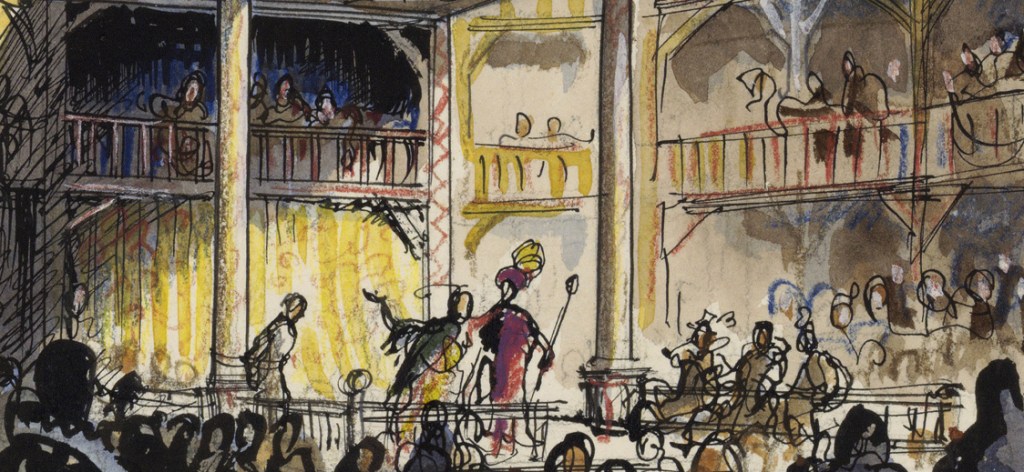
Stage setting design drawing by Cyril Walter Hodges.
(Image courtesy of the Folger Shakespeare Library).

To understand how much change was a foot in the world — here are just a few of the people who were alive during the century of 1530-1630 outside of England — artists, scientists, philosophers: Michelangelo, Copernicus, Galileo Galilei, René Descartes. Inside of England, it was a virtual hit parade of politicians, but also some explorers and writers: Henry VIII, Elizabeth I, Mary Queen of Scots, Sir Francis Drake, William Shakespeare, Walter Raleigh, Oliver Cromwell. (2)

Dramatic Religious and Military Upheaval

It was always a challenge with English history to figure out where your family fits in, much less what was their religious philosophy. For everyday Englishmen, the times of the Tudors and the times of the Stuarts were especially rough. Looking back on this period, it’s a bit of a paradox . England was entrenched in various religious persecutions, as if their old worldview was clashing with the newly emerging one. Geographic boundaries expanded —the world had entered an age of discovery. Inner boundaries shifted — the age of enlightenment was at hand, which would bring great change to our ancestral family.

Martin Luther posting his 95 theses in 1517, by Belgian artist Ferdinand Pauwels.
(Image courtesy of Wikimedia Commons).

On October 31, 1517, Martin Luther, that strong willed German monk, posted his 95 arguments against the Catholic Church, ushering in the Reformation.  Declaring Faith and Scripture alone as necessary for Christian salvation, Luther’s rejection of papal authority opened the floodgates for an increasingly varied array of personal revelations and Christian beliefs… Aided by the newly emergent printing press, and a growing humanist unease at the worldly ambitions of Renaissance popes, Luther’s ideas quickly spread.”  Most Christian rulers strongly condemned these heretical Lutherans; rightly fearing that

…if the Pope’s supremacy could be toppled,
what would stop a king’s subjects from someday condemning their own divinely crowned ruler?
  Chaos, anarchy, and civil war would surely follow.

Candis Murray, Ph.D.
writing for the Shaker Heritage Society

Before 1534, England was Roman Catholic; Wales and Ireland were Roman Catholic as well, but Scotland was largely Pagan. (3)

The Tudor Family Put the ‘fun’ in Dysfunctional

1534 marks the date when Henry VIII wished a divorce, so he split with the Roman Catholic Church (during the Reformation) to create the Church of England with himself [as] head instead of the Pope. His three successors in 1547-1603 varied between Catholic and Protestant, with each successive monarch trying to purge the country of the opposite religion.

1547: Henry VIII dies, and is succeeded by his son Edward VI.

1585: The Roanoke Island colony, the first English settlement in the New World, is founded by English explorer Sir Walter Raleigh.


Painting of Elizabeth I of England, attributed to George Gower, circa 1585.
(Image courtesy of WorldHistory.com).

1603: Following Queen Elizabeth I’s death, the Venetian ambassador writes that the “late queen had ruled over five different ‘peoples’ – English, Welsh, Cornish, Scottish, and Irish”. 

Protestant James I’s reign (1603-1625) culminated with the start of the cataclysmic Thirty Years War (1618-1648) which raged throughout central Europe primarily between Protestants and Catholics, with 1643-1647 being an English Civil War.


The Miseries of War; No. 11, The Hanging, or Les Miseres et les Mal-Hevrs de la Guerre
by Jacques Callot, between 1632 and 1633. (Image courtesy of Art Gallery NSW).

To put this time period into perspective: Thus, religious intolerance was extreme for the entire century… with much bloodshed and deep-seated hatred between those of different views. The end of the Thirty Years War (no victors; it ended by treaty), did not ring in a period of tolerance for all religions.

To our good fortune, the Bond family lines passed through this period without much turmoil. This was likely due to being far removed from much of the conflicts due to their estates being in Cornwall. (4)

London CallingLiving Near the Fulham Palace

Thomas Bond, first of Erth and Holwood, relinquished Holwood to his young son, William, and moved on to Fulham, a hamlet of London. We speculate that his wife Jone remained at Holwood to raise their son “The Court Rolls show that Thomas Bonde held property in several parts of Fulham…” In 1566, he and some others were “fined 12 pence because he had no bows...” The Court inflicted this fine under a statute passed in the reign of Philip and Mary.

Excerpted text from the book,
Fulham Old And New: Being An Exhaustive History Of The Ancient Parish of Fulham, Volume II, page 254.

From the above record, we have inferred that Thomas either lived in, or lived adjacent to the manor-house, or palace of Fulham. It had been, from a very early period, the principal summer residence of the Bishops of London. The renowned gardens at Fulham “first became remarkable in the time of Bishop Grindall, who was one of the earliest encouragers of botany, and the first person who imported the tamarisk-tree into this country, about the year 1560. His grapes, at Fulham, were esteemed of that value, and a fruit the Queen stood so well affected to, and so early ripe, that the Bishop used every year to send her Majesty a present of them.

1795 engraving of Fulham Palace. (Image courtesy of Layers of London).
Excerpted text from the book
Fulham Old And New: Being An Exhaustive History Of The Ancient Parish of Fulham, Volume I, Page 236.

A very remarkable memorial tablet to Thomas Bonde, dated 1600, is described in the book Fulham Old And New: Being An Exhaustive History Of The Ancient Parish of Fulham, Volume II (page 235). His will is dated 20 March 1599, (old calendar). The memorial tablet is dated March 1600, (also old calendar where the new year began 25 March). Thus he died between 25 and 31 March 1600.

Detail extracted from the lower photo. If you look carefully, there is marshalled heraldry
shown in four quadrants for the following:
Upper left: Bonds of Erth, Upper right: Erth, Lower left: Maynard (of Easton, Essex)
Lower right: Coryton. These families are written about in The Bond Line — A Narrative, Three.
Memorial plaque for Thomas Bonde found at the All Saints Churchyard in
Fulham, London (Borough of Hammersmith and Fulham, Greater London), England. If you look carefully at the top portion, there is marshalled heraldry for— Upper left: Bonds of Erth, Upper right: Erth, Lower left: Maynard (of Easton, Essex) Lower right: Coryton.

The poem on the memorial plaque reads:
“At Earth in Cornwall was my firste beginnings
From Bonde’s and Corringstone (Coritons), as it may apere;
Now to Earth in Fulham God disposed my endinge
In March, the thousand and six hundred yere,
Tyll both in body and soul I shall be fully blest.

Thomas Bonde, obit A Aetatis Sure 68 (68 years old)

We are not sure how Thomas made his fortune(s), but he must have been a man of some prominence. His Will, dated March 20, 1599/1600 and proved April 18, 1600: He left “Margaret Meridith, a widow, a piece of farm land and arranged for 20 shillings to be paid yearly forever to the officers of the poor unless the field was given for the use of the poor.” (This is the first time we see the name Margaret Meredith , a widow, in connection to Thomas Bond. We have not located records as to what their relationship was.) For the transcribed Will with annotations giving us an idea of Thomas’s generosity, see the footnotes.

Observation: 1620: The Mayflower is on route to America with the Pilgrims. (5)

The William and Alice (Hall) Bond Family

William Bond son of William Bond and Wilmot (Haughton) Bond, was born in 1608 at Holwood Manor, County Cornwall, England. He died in England, but the exact date is unknown. Other family records determine that his death was likely after 1643, and before 1659. William was born in Cornwall in 1608 and thus a descendant of the Bonds of Erth and Holwood. Was he taken to London about 1620 to learn the mariner’s trade? He could have been sponsored by his grandfather, Thomas Bond, then living in Fulham, or by half-brother Thomas Bond, a member of Parliament and the Virginia Company.

London, England, Church of England Baptisms, Marriages and Burials, 1538-1812,
Tower Hamlets, St Dunstan and All Saints, Stepney, 1609-1632.

The above original document is a record of the marriage for Alice Hall and William Bond on September 21, 1630 in St. Dunstan, Stepney, London, England. William’s church was St. Botulphs Without Bishopsgate. Wikipedia tells us that Bishopsgate was one of the eastern gates in London’s former defensive wall. The gate gave its name to the Bishopsgate Ward of the City of London. The ward is traditionally divided into Bishopsgate Within, inside the line wall, and Bishopsgate Without, beyond it. Bishopsgate Without is described as part of London’s East End. In the marriage record William is identified as a Mariner.

Alice Hall was the daughter of Captain Henry Hall, Jr. and Elizabeth Martin. She was christened April 12, 1615 in St. Dunstan, Stepney, London. At the time they married Alice was only 15 years old and William was 22 years old. Alice (Hall) Bond died in London, aged 44. She was buried 22 March 22, 1659 in St. Olave Churchyard, Hart Street, London, England, as shown in the record below, (noted as Alce Bond). Her husband, William, had died before her, because she is listed as a “widdowe” (widow).

Observation: Was there an illness circulating in London at this time? The Great Plague was still five years in the future… The year 1659 saw the following deaths in the Alice (Hall) Bond family: Elizabeth (Martin) Hall, her mother, died on February 3, with burial on February 4. Alice herself died and was buried on March 22 (as noted above). Her father, Henry Hall, Jr. died on March 31, 1659. Three deaths in quick succession is startling, but no evidence of the cause of their deaths has been uncovered.

From The Registers of St. Olave, Hart Street, London, 1563-1700 with Alce Bond listed last.

William and Alice had six children. Sarah Bond was christened September 2, 1632 in St. Botolph, Bishopsgate, London, England. The other five children were all christened at St. Olave, Hart Street, Stepney, London. John Bond was christened October 18, 1635. Ann Bond was christened March 18, 1638.

Peter Bond was christened March 15, 1640. (We are descended from Peter.) William Bond Jr. was christened 22 Aug 1641. Finally, Christopher Bond was christened 21 Dec 1642. (6)

Peter Bond christening, March 15, 1640. St. Olave, Hart Street, 1631-1707 Note: It is very faint, but legible. Look for the number 15 on the left.
Peter Bond christening, March 15, 1640. The Registers of St. Olave, Hart Street, London, 1563-1700

The family may have lived in Whitechapel, an east suburb of Old London about a mile from the now famous London Tower. It is evident that although William was most likely away, Alice with her children, stayed in the area of London where she was born.

The Commonwealth Period

At the time of Charles I’s beheading Peter Bond was nine years old. The English government became the Commonwealth run by Oliver Cromwell and his son Richard from 1653-1659. In May 1660, the House of Stuart was restored.

“In retrospect, the period of republican rule for England was a failure in the short term. During the 11-year period, no stable government was established to rule the English state for longer than a few months at a time. Several administrative structures were tried, and several Parliaments called and seated, but little in the way of meaningful, lasting legislation was passed. The only force keeping it together was the personality of Oliver Cromwell, who exerted control through the military…Not only did Cromwell’s regime crumble into near anarchy upon his death and the brief administration of his son, but the monarchy he overthrew was restored in 1660, and its first act was officially to erase all traces of any constitutional reforms of the Republican period. Still, the memory of the Parliamentarian cause, [would] eventually result in a constitutional monarchy.” (Wikipedia)

Our direct ancestor, Peter Bond, lived in London during this period before departing for the British Colonies in North America. (7)

Vintage engraving of a Birds-eye view of Westminster, London in the 16th Century. 1584

“Terra Maria” in the British American Colonies

“In 1608, Captain John Smith thought there was ‘no place more perfect for man’s habitation’ than the Chesapeake Bay. [Maryland] Fur trader William Claiborne thought so, too, and set up a fur trading post on Kent Island in 1631. This was the first English settlement in the upper Chesapeake.

Maryland began as a colony when King Charles I promised George Calvert, the first Lord Baltimore, a colony north of Virginia. Before he could visit the colony, George Calvert died. His son, Cecilius, became the second Lord Baltimore and the Lord Proprietor of Maryland. He named his colony ‘Terra Maria’, or ‘Maryland’ in honor of the king’s wife, Queen Henrietta Maria. Because Cecilius Calvert had to remain in England, he sent his younger brother, Leonard, to accompany the colonists and to be the first governor.”

It is recorded that Peter Bond arrived in Maryland in 1660, aged 20 years old.  Having been born and raised in London, he was witness to the chaos and ineffectiveness of the Commonwealth government run by Cromwell. Also, his mother Alice (Hall) Bond and both of her parents, had died the year before he left, as well as his father’s unknown death date. The aftermath of the English Civil War of his childhood, (1642-1651) had left the economy severely depressed. We wonder if these many events had anything to do with his leaving for America? As a young man, perhaps he just wanted a fresh start? (8)

Most importantly for us, our path was headed to the New World in the West.

Borrowed from The Far Side by Gary Larson
Copyright 2019-2022 by FarWorks, Inc. Thanks Gary!

Bubonic Plague and The Great London Fire

About five years after Peter Bond left for the Maryland colony, central London was devastated by two disasters. Plague returned in 1665, killing one-quarter of the population. The next year, 1666, The Great Fire completely destroyed everything in central London that was enclosed by the ancient Roman walls.

To watch, clink on this link, or see the footnotes:
https://www.youtube.com/watch?v=SPY-hr-8-M0

This amazing short 3-1/2 minute video by six students from De Montfort University (taking part in the Crytek Off the Map project), have built a virtual 3D representation of 17th century London before The Great Fire of 1666. (9)

With Bubonic plague and fires burning down everything around you — what our ancestors really needed was for James Bond 007 to step in and just fix things with a couple of fabulous martinis.

Despite plague, fires, and the general mayhem of 1660s London, Timothy Dalton as James Bond 007, always maintains his cool. Film still from the movie, A License to Kill.
Since you asked, we can certainly state with conviction: Martinis always soothe the nerves.
(Image courtesy of The Hollywood Reporter).

Following are the footnotes for the Primary Source Materials,
Notes, and Observations

A Pre-Scientific World

(1) — one record

Galileo Galilei at His Trial by the Inquisition in Rome in 1633,
i.e. Galileo pushes away the Bible.
Courtesy of The Wellcome Collection via Wikimedia Commons
https://commons.wikimedia.org/wiki/File:Galileo_Galilei_at_his_trial_Wellcome_V0018717.jpg#/media/File:Galileo_Galilei;_Galileo_Galilei_at_his_trial_at_the_Inquisi_Wellcome_V0018716.jpg

The Italians Were Winning The Renaissance Footrace

(2) — two records

English Renaissance
https://en.wikipedia.org/wiki/English_Renaissance

Folger Shakespeare Library
Stage setting design drawing
by Cyril Walter Hodges
https://www.folger.edu/blogs/shakespeare-and-beyond/playhouses-closed-shakespeare-distance-performance/045736-sm/
Note 1: For the drawing.
Note 2: Found as ART Box H688 no.1 pt.4

Dramatic Religious and Military Upheaval

(3) — three records

Luther Posting His 95 Theses
by Ferdinand Pauwels
https://commons.wikimedia.org/wiki/File:Luther95theses.jpg#file
Note: For painting.

Shaker Heritage Society
For God, King, & Country: Why the Shakers Irritated England
by Candis Murray, Ph.D
https://home.shakerheritage.org/god-king-country-shakers-irritated-england/
Note: For the quote.

Art Gallery NSW
The Hanging, or Les Miseres et les Mal-Hevrs de la Guerre
from the suite The Miseries and Misfortunes of War, 1633
by Jacques Callot
https://www.artgallery.nsw.gov.au/collection/works/DO10.1963.11/

The Tudor Family Put the ‘fun’ in Dysfunctional

(4) — three records

World History Encyclopedia
Elizabeth I Armada Portrait
https://www.worldhistory.org/image/12284/elizabeth-i-armada-portrait/
Note: For her portrait.

IntoCornwall.com
Cornwall History Timeline
https://www.intocornwall.com/features/cornwall-history-timeline.asp

History.com
This Day In History
1590, Roanoke Colony Deserted
https://www.history.com/this-day-in-history/roanoke-colony-deserted

London CallingLiving Near the Fulham Palace

(5) — nine records

BHO | British History Online
Fulham
https://www.british-history.ac.uk/london-environs/vol2/pp344-424#p29

Layers of London
Engraving — Fulham Palace
https://www.layersoflondon.org/map/records/engraving-fulham-palace
Note: The engraved image is circa 1795.

Fulham Old And New: Being An Exhaustive History
Of The Ancient Parish Of Fulham
Volume II
For a description regarding bows and arrows:
https://archive.org/details/b29010433_0002/page/254/mode/2up
Book page: 254, Digital page: 254/311
and
Fulham Old And New: Being An Exhaustive History
Of The Ancient Parish Of Fulham
Volume I
For a description regarding tree trimming:
https://archive.org/details/b29010433_0001/page/236/mode/2up
Book page: 236, Digital page: 236/350
and
Fulham Old And New: Being An Exhaustive History
Of The Ancient Parish Of Fulham
Volume I
For a mention of his Will, and his cemetery monument:
https://archive.org/details/b29010433_0001/page/234/mode/2up?q=Bonde
Book page: 235, Digital page: 234/350

Thomas Bonde
https://www.findagrave.com/memorial/64029140/thomas-bonde
Note: For the memorial plaque image.

The Story of The Bonds of Earth
by Allen Kerr Bond
https://archive.org/details/storyofbondsofea00bond/mode/2up
Book page: 37-47, Digital page: 36-46/299

Note: The Will of Thomas Bonde (as transcribed below by Susan Bond), is from source material originally found on Rootsweb.com, a company which was then subsequently acquired by Ancestry.com. The original digital transcription file is referenced online, but cannot now be located, likely due the business merger.

(Our observations are in bold italic).

Thomas Bond 1599/1600 Will 

In the name of God Amen The Twentieth day of March in the Two and Fortieth [42nd] year of our Sovereign Lady Elizabeth by the grace of god Queen of England France and Ireland defender of the … and in the year of our Lord god One thousand five hundred ninety nine. [20 March 1600 new calendar]

I Thomas Bond of Fulham in the county Middlesex gent [gentleman] although weak of bodies yet perfect mind and memory thanks be to god do make and ordain this my perfect testimony conveying therein my last will in manner and form following that it to say finite and principally & command my soul into the hands of Almighty god my creator. And I also trust my Redeemer and Savior by the merit of what death and passion I trust that my sins are forgiven me and that in the resurrection of the righteous I shall be made perfect of the joys eternal prepared for the faithful and elected [chosen] children.  Amen

My body to be buried at the discretion of my Governor and overseers hereafter named. And as to the disposition of all my goods & chattels, lands & cenemente [?] what serve my mind & will is in manner & form following:

Item: I give and bequeath to Mary Meredith, widow, my two acres and a rood [a measure of land area equal to a quarter of an acre] of Freehold Land I have in a … field in Fulham called Anscens Field with the appurtenances [accessories] to have and to hold the said two acres and a rood land with the appurtenances unto the said Margaret Meredith and her heirs and fignes [?]  for over conditionally that the said Margaret Meredith and her heirs shall yearly pay to the collectors or other officers for the poor in the same parish for the time being and their …to the use of the poor of the same parish for … Twenty Shillings [= 1 Pound] of good and lawful money of England Balse [?] nearly by porcine [in person]… that if the said Margaret Meredith or her …. shall …or deme [deny]  to pay the said some of Twenty Shillings in manor and form of ore [?] said being lawfully demanded, then my will and mind is that from and asce [after? anie?] …Two acres and a rood of land with appurtenances shall … remain and to be churchwardens of the said parishes for the time being and their … forever to the rest of the poor people of the same parish of Fulham to be distributed amongst them upon the day of my funeral by the discretion of my Governor and… Twenty Shillings …

Item:  I give and bequeath to every one of William Arnold’s children being seaven(?) Twenty Shillings a piece Bequeathed 7 Pounds 

Item:  I give and bequeath to every one of Mathew Robyn’s children being Four-Twenty Shillings a piece Bequeathed 4 Pounds

Item:  I give and bequeath to every one of Margaret Meredith’s children being Four-Twenty Shillings a piece. Bequeathed 4 Pounds

Item:  I give and bequeath to Robert Wardon – Son of Sable Wardon my wife’s daughter Twenty Shillings Bequeathed 2 Pounds

Item:  I give and bequeath to each one of John Chandlehill’s children being Two Twenty Shillings a piece Bequeathed 2 Pounds

Item: I give and bequeath to my goddaughter Cathorin Weimall Twenty Shillings Bequeathed 1 Pound

Item:  Whereas I am behind and unpaid one yearly annuity of Twenty Shillings from the decease of William Bond my oldest brother somet mes [?] of Earth in the county of Cornwall bc gentleman, by virtue of one writing or deed …the hand and seal of the said William bearing date the eight day of December in the First year of the reign of our late Sovereign Lady Queen Mary (1553) as by the same deed more at ardge [?] appeared.

I do give and bequeath to Roger Bond my brother & Elizabeth Jackman my sister, if they be living the said yearly, annuity of Twenty Shillings [1 Pound] and the armories thereof behind together with the said deed & all my estate and intoees [?] which I have orchad [?] in the same or anie of them to have and to hold to the said Roger and Elizabeth if the be living and to the survivor of them to their own proper use forever.

Bequeathed 1 Pound each x 2 people for the rest of their lives

Item:  I do give and bequeath to William Wrennolle my first gown and my best gown a woolen snit-x waistcoat and my service books

Item:  I do give and bequeath to Latherin Arnold the wife of William Arnold holder my best gold ring

Item:  I do give and bequeath to Ronny Francis my godson my best satin doublet.

Item:  I do give and bequeath to Ellyn Robin of Rown To Mary Idlott of old as Branitford & Ellin Donbee of ntuvy(?) to each of them a smock and one apron of my wife’s

Item:  I do give and bequeath to John Bond four Pounds and eleven Shillings which he owed me and I give and bequeath to him more five Pounds & one Shilling of lawful money of England to make it. Bequeath = 10 Pounds

Item:  I do give and bequeath to Johan (Jone) (blank space), widow, my servant, forty Shillings if she happen to dwell with me at the time of my death.

Bequeathed 4 Pounds

Item:  I do give and bequeath to Elizabeth and Blanse my servant and John Ronney my countryman if they marry together my best mattress a feather bolster a coverlet the brought with herself a pair of Heels, a plain bedstead, a brass pot, broad mouthed and peered in the brime and forty Shillings of lawful money of England The residue of all goods moveable and unmovable my debts paid and legacies performed.

Bequeathed 4 Pounds

I give and bequeath to Richard Rawles my nephew whom I make my sole governor of my will and I do ordain and make my loving friends master… Edward person of Chelsey and Ronney Thorneton of Fulham my overseers

And I do give and bequeath to each of them forty Shillings towards their [?] anies herein to be taken Provided always that if my said governor shall refuse to be ordered and directed by my said overseers or the survivor of them and that testified under their hands and seals in writing them my will and mind is that from and after such certificate his interest of governorship aforesaid shall cease and be void.

Bequeathed 4 Pounds each = 12 Pounds total

And that then and from thence forth my said brother Roger shall be my governor and pay and do as is aforesaid In witness whereof I have hereunto set my hand & seal the day & year above said this will be subscribed sealed & acknowledged for his last will the day and year above said in the presence of us
Thomas Burton John Burtons msc. Thomas Burton Smith

Thomas Bond A short paragraph written in Latin

The will is dated 20 March 1599, (old calender). The memorial tablet is dated March 1600, (also old calender where the new year began on 25 March). Thus he died between 25 and 31 March 1600.

The Richard Bond Family in America
by Rev. Thomas A. Bond, Abbey of the Genesee, 1981
Microfilmed by the Genealogical Department of the Church of Jesus Christ of Latter-day Saints on April 9, 1986
(Item 14, Project and Roll XLIB 7-102 2017, G.S. Call 1321093)

The William Bond and Alice Hall Family

(6) — eight records

William Bond
in the London, England, Church of England Baptisms,

Marriages and Burials, 1538-1812
Tower Hamlets > St Dunstan and All Saints > Stepney, 1609-1632
https://www.ancestry.com/discoveryui-content/view/1098358:1624
Digital page: 131/140, Left page, entry for September 21, 1630.
Note: Peter was actually christened in 1640, not 1639.

Bishopsgate
https://en.wikipedia.org/wiki/Bishopsgate

Elizabeth Martin
https://www.ancestry.com/family-tree/person/tree/166487322/person/422244353591/facts

Henry Hall, Jr.
https://www.ancestry.com/family-tree/person/tree/166487322/person/422244353564/facts

Peter Bond
in the London, England, Church of England Baptisms,
Marriages and Burials, 1538-1812

City of London > St. Olave, Hart Street > 1631-1707 https://www.ancestry.com/imageviewer/collections/1624/images/31281_a100776-00011?pId=4754774
Note 1: Digital page: 10/75, Entry for March 15 (left page and very faint).
Note 2: The Church was using the old calendar where the new year began on March 25. This later changed, so therefore, we believe that his baptism was actually on March 15, 1640.

The Registers of St. Olave, Hart Street, London, 1563-1700
by Bruce W. Bannerman, 1862-1933
https://archive.org/details/registersofstola46stol/mode/2up
Note 1: For Peter Bond’s christening. see book page 49. Digital page: 48/362.
Note 2: Asserted in the footnote above, The Church was using the old calendar where the new year began on March 25. This later changed, so therefore, we believe that his baptism was actually on March 15, 1640.
Note 3: For Alice Bond’s burial, see book page 192. Digital page: 192/362.

Richard Bond and desendents [sic]
https://www.ancestry.com/mediaui-viewer/tree/10403921/person/6979535919/media/5f0ecfd9-3dd2-4c1a-a1ab-bfb0e84b19f6?_phsrc=qGQ3868&_phstart=successSource

Birds-Eye View of Westminster, London in the 16th Century
https://www.istockphoto.com/vector/birds-eye-view-of-westminster-london-in-the-16th-century-gm1136341577-302600877

The Commonwealth Period

(7) — two records

Commonwealth of England
https://en.wikipedia.org/wiki/Commonwealth_of_England

Portrait of Oliver Cromwell
by Samuel Cooper
https://en.wikipedia.org/wiki/Oliver_Cromwell#/media/File:Oliver_Cromwell_by_Samuel_Cooper.jpg

Terra Maria” in the British American Colonies

(8) — one record

Maryland Office of Tourism
The First Marylanders — Native Americans and The First Colonists
https://www.visitmaryland.org/info/first-marylanders
Note: For the reference, “He named his ‘Terra Maria’, ‘Maryland’ in honor of the king’s wife, Queen Henrietta Maria.

Bubonic Plague and The Great London Fire

(9) — two records

Pudding Lane Productions, Crytek Off The Map
A virtual recreation of 17th century London…
https://www.youtube.com/watch?v=SPY-hr-8-M0

The Hollywood Reporter
How ‘Licence to Kill’ Put the James Bond Franchise on Ice
by Phil Pirelli
https://www.hollywoodreporter.com/movies/movie-features/how-licence-kill-almost-killed-james-bond-franchise-1224180/
Note: For the Timothy Dalton image.

The Bond Line, A Narrative — Three

This is Chapter Three of eight: Digging deeper into our Cornwall ancestors— from Erth Barton, to Holwood Manor.

Wessex, one of the kingdoms of Anglo-Saxon England, was land which now approximates the modern counties of Hampshire, Dorset, Wiltshire, and Somerset, and eventually expanded westward to cover Devon and Cornwall.

This may be how the name Bondi, came to be identified as the Bonds of Erth, who were located near the border of Devon and Cornwall, near Plymouth Sound. We do not know when our ancestors arrived in Penryn, Cornwall, but we do know that about the year 1400 our ancestor Robert Bond (of Penryn) married Elizabeth de Erth (Earth) and that upon that marriage, the Bonds of Erth began. (1)

Map of Cornwall and the South West, extracted from the map of England by Matthew Paris, circa 1250. The names Cornwall, Devon, and Somerset are large labels written in blue and red ink, with Dorset written in red ink. (Map detail courtesy of World History Encyclopedia).

The Cornish Gentry

Gentry is defined as an old English word signifying people from a high social class, i.e. the landed gentry.

The names of most of the Cornish gentry are local — “The Cornish,” says Carew, “entitle one another with his owne and his father’s Christian name, and conclude with the place of his dwelling.” Carew was the author of the 1602 edition of the Survey of Cornwall.

The practice of families taking their names from the place of their abode, with the addition of de, was, at an early period, more or less prevalent throughout England. “Bond, of Earth, near Saltash, married the heiress of an ancient family, who took their name from that Barton [the manor house of a farm].”

Trematon Castle, Cornwall by Petit W Le, after T Allom,
published 1830 by Fisher, Son & Co. London.

Before the Duchy of Cornwall was created, as an annex to the English crown in 1337, Trematon Castle was one of four principal residences of the Earls of Cornwall. (2)

Hugh de Erth and His Descendants

We first learned about the de Erth family with the mention of both Hugh and William de Erth in a long-titled book — A Continuation of the Complete History of England: containing the lives and reigns of Edward I, II & III and Richard the Second by Robery Brady, published in 1700. (This is the only historical reference we have found for William de Erth.)

On page 78 of that book, Brady writes that in 1304, the Terms given to, and accepted by John Comyn [terms of submission by the Scots after the last insurrection] … “These things are agreed on with Monsieur Richard de Burgh, earl of Ulster, Monsieur Aymer de Valance, … Monsieur Henry de Percy, Knights, and John Comyn of Badenagh, for Himself and his Aydants of Scotland, … in the Name  of the King, … Monsieur Hugh de Erth, Monsieur William de Erth, Monsieur James de Ross, … Knights, for themselves and all their Scots assistants, who would be sworn in the Peace and Faith of the King, were Sworn.

Hence, Hugh de Erth was sworn as a Knight for his faithful service in battles for King Edward I, who reigned from A.D. 1272 – 1307. Edward was also known as Edward Longshanks, and the Hammer of the Scots. Hugh de Erth must have been very brave and valiant in battles to catch the attention of the King. Here is a little background:
24 February 1303: The Battle of Roslin takes place between English and Scottish forces at Roslin, south of Edinburgh, resulting in a Scottish victory. 
– An irritated and impatient man, King Edward I, in May 1303, invaded Scotland once more, with a view to subjugating the country once and for all. 
3 February 1304: The Community of Scotland under the Guardianship of John III Comyn agrees to a peace treaty with King Edward I.

A Continuation of the Complete History of England…by Robery Brady, 1700.
Detail excerpt from page 78. Note the use of the French language.

Obviously, King Edward I and his successors thought highly of the de Erth family from Cornwall. In 1299, Henry de Erth was born in Erth, St. Stephens Parish, Cornwall. His father was Sir Hugh de Erth, Knight, but his mother’s name is unrecorded. (Possibly her name could have been Helena Beckstead?)

In research from nearly a century ago, Allen Kerr Bond wrote in The Story of The Bonds of Earth“The first mention of Earth in history that I can find, is in the English Calendar of Patent Rolls for 1337 A.D. (for King Edward III) when Henry de Erth [a Knight] is made Constable of the strong castle of Tremerton [Trematon], a few miles from Earth. Although this Knight of Earth was not a Bond, it was by marriage with one of his heiress descendants a little later that the first Bond came to Earth as its knightly possessor…” Henry de Erth had been bestowed these lands for services rendered to John of Eltham, the Earl of Cornwall, and the brother of King Edward III who reigned from A.D. 1327-1377. (Note: Kerr Bond uses the spelling Earth while we have chosen to use the original spelling Erth).

It must have been nice to be “in good” with the royal family. Hugh de Erth’s son, Sir Henry de Erth, was also a Knight, and apparently a very good friend and servant to John of Eltham, the Duke of Cornwall, a younger brother of King Edward III.

Excerpts from the 1337 Calendar of the Patent Rolls
for Edward III A. D. 1334-1338. From pages 382-383, 395, and 509.

There are (shown above) three excerpts from the 1337 Calendar of the Patent Rolls for Edward III A. D. 1334-1338, which identify Sir Henry de Erth specifically. The first two are the most important:
– The first excerpt endows him with the constableship of Tremonton Castle, which is a Knight’s role.
– The second excerpt reinforces the first endowment, establishes the terms, and recognizes Sir Henry de Erth’s long time services to John of Eltham. It further identifies Henry’s role as a “baneour”. That important role is the chief standard-bearer of the King; a Knight Banneret. John of Eltham was a warrior prince and Henry would have been right there in battle, beside him. In 1333, King Edward III made his greatest expedition against Scotland, resulting in the capture and permanent annexation to England of the strong Scottish border fortress of Berwick.

A medieval depiction of King Edward III at the siege of Berwick.
The Knight Banneret carrying the square-shaped banner is Sir Henry de Erth.
Here is the original context of the Sir Henry de Erth image, as found in a French illuminated manuscript. (See footnotes).

Sir Henry de Erth’s son Geoffrey de Erth, was likely born at Erth in St. Stephen’s Parish, Saltash, and died circa 1405. Geoffrey had a daughter named Elizabeth de Erth. As the heiress of Erth, she was his favored daughter — her birth is estimated to be circa 1375. Elizabeth is written about (below) in Our Erth Ancestors. (3)

Nearby is the Village of Saltash, Cornwall, England, Courtesy of Magna Britannia, Vol. III — Cornwall, circa 1814. (Image courtesy of Archive.org).

Where on Earth was Erth?

The Erth settlement, or estate, was likely located on the Lynher river, which connected to Plymouth Sound, not very far from the village of Trematon. From the book, The Bonds of Earth, by Allen Kerr Bond: “The great harbor of Plymouth, marking the beginning of the line of boundary between Cornwall and Devonshire; and beside a little river of Cornwall which enters this great harbor is the homestead ‘Earth’ or ‘Erth’, the ancient dwelling of the Bonds of Cornwall.

Richard Carew (1555-1620), Aged 32, as High-Sherriff and Deputy-Lieutenant of Cornwall. (Image courtesy of Wikimedia Commons).

A Genealogical and Heraldic History of the Commoners of Great Britain and Ireland, Vol. I, provides two relevant (but unattributed) references. The second entry follows: “In following the course of the Lyner [the Lynher river], you fall down by Master Bond’s ancient house at Erth, descended to his ancestors from a daughter and heir of that name”. We discovered that this quote was taken from The Survey of Cornwall by Richard Carew, published in 1602.

Carew’s Survey of Cornwall, page 111, published 1602.

In the “Table of the Second Booke” Bond is listed as being in the East Hundred, [similar to a county]. This is the easternmost county of Cornwall. This table falls near the end of the book.

Our research led us to add many new sources which confirm the establishment of the Bond family at Erth. (4)

We cited the two books in the top row left and center, in our writing about Hugh de Erth and His Descendants. Excerpts from the other four sources are situated below:

The Parochial History of Cornwall, Vol. 3, page 465, published 1838.

Note: Galfridus is an Anglo-Norman variant of the name Geoffrey.

The Battle Abbey Roll , page 138, published 1889.
Magna Britannia, page 290, published 1814.
Magna Britannia, page c, published 1814.
Magna Britannia, page cxxxii, published 1814.

Our Erth Ancestors

We know some of the lineage of the de Erth line and the names of some of the early family. For the de Erth family, their gentry status within the Cornish society, we can infer: 1) Their names are location-based and so they must be from the landowning classes. 2) In a feudal society, land was power and so this placed them well above most Englishmen.

This map is included to show the difference in location from Penryn to Erth, Cornwall. Trains travelling from Penryn to Saltash cover a distance of around 43 miles (69 km) during the journey. Our ancestors could have easily sailed from one location to the other.


 [Cornwall] Cornubia sive Cornwallia, by Willem Janszoon Blaeu, Amsterdam, circa 1650.
The circled areas indicate Penryn on the left, and Erth on the right.
(Image courtesy of Barry Lawrence Ruderman Antique Maps).

The deErth and Penryn ancestors for whom we have records, are listed below interspersed with important historical points. All births and deaths were in Cornwall, England, unless noted. For the Bonds of Penryn, we show a list only, as we have no knowledge of them as persons; how they lived, their education, and little of their professions.

When Goffery de Erth died, (Hugh de Erth and His Descendants section), the next owner of Erth Barton was Robert Bond of Penryn, who had married his daughter, Elizabeth de Erth.

  1. Robert Bond was born est. 1370, in Penryn, Cornwall and died est.1434 at Erth, Saltash, Cornwall . He married Elizabeth de Erth who was born est. 1375 and died est. 1434. Elizabeth was likely born at Erth, Saltash, Cornwall and died in the same location. The Barton of Erth is located in St. Stephen Parish. As a result of this advantageous marriage, the Bonds of Penryn became the Bonds of Erth, and Robert Bond vastly increased his landholdings.
Ancient Family Crest for de Erth
Ancient Family Crest for Bond

Elizabeth and Robert had three sons, all born at Erth, Saltash, Cornwall:
– Thomas born est. 1400 – death date unknown
– Robert born est. 1408 – death date unknown
Richard born est. 1410 and died est. 1462
We are descended from Richard Bond — He remained at Erth and continued the direct family line there. His brother Robert, is the founder of the Dorset Branch of the Bond family.

1387: John Trevisa of Cornwall wrote the first book about England in the English language (previously Latin was the language most frequently used by authors).

2. Richard Bond born est. 1410 at Erth, Saltash, Cornwall and died est. 1462 in the same place. Richard married first Elizabeth Maynard est. 1400-1430 of Dorset, and subsequently after her death he married, in 1434, her sister, Agenta ‘Agnes’ Maynard who was born est. 1411 in Dorset and died est. 1470 at Erth, Saltash, Cornwall. It has been written that Agnes Maynard was an heiress of an old Cornish family said to be descended from Irish kings.

John Burke, Esq. wrote A Genealogical and Heraldic History of the Commoners of Great Britain and Ireland, in 4 Volumes, published between 1833-1838. According to Burke: “Richard, of Earth , who m. in 1434 , (during the reign of 12th Henry VI) Agnes, second daughter and co-heiress of Richard Maynard, and their posterity were still residing at Earth at the visitation of Cornwall , anno 1620 . The Bonds, of Holwood, in the same county, were a younger branch of those of Earth , and are now represented by Thomas Bond in the county of Cornwall.

Ancient Family Crest for Maynard in Cornwall, and Essex

Richard and Agnes had two sons: Thomas and Richard.
(We are descended from Thomas).

3. Thomas Bond was born est. 1440 and died est. 1510, both at Erth, Saltash, Cornwall. (The website findagrave.com states Thomas was born in 1450, but that would make him a pre-teen when married!)

Thomas Bond married Elizabeth Kendall of Duloe, Cornwall, date unknown. She was born est. 1445 in Duloe to Richard and Jane (Penpons) Kendall and died est. 1516 at Erth, Saltash, Cornwall. Thomas and Elizabeth are buried in the ancient St. Stephen Churchyard in Saltash, Cornwall, England.

Ancient Family Crest for Kendall

Thomas and Elizabeth had three children, all born at Erth, Saltash, Cornwall.
– John born est. 1462 – death date unknown
– William (Willms) born est. 1465 – death est. 1529 also at Erth, Cornwall
(We are descended from William).
– Agenta born est. 1467 – death date unknown.

1485: Polydore Vergil, an Italian cleric commissioned by King Henry VII to write a history of England, states that “The whole country of Britain is divided into four parts, whereof the one is inhabited by Englishmen, the other of Scots, the third of Welshmen, the fourth of Cornish people … and which all differ among themselves either in tongue, either in manners, or else in laws and ordinances.” 

4. William (Willms) Bond married Jane Gibbs of Dorset about 1500. She was born est. 1480 in Dorset and died est. 1539 at Erth, Saltash, Cornwall. Both are buried in St. Stephen Parish churchyard in Saltash.

William and Jane had three children at Erth, Saltash:
– William II born est. 1503 – death date unknown
– Richard born 1507 and died 1553 at Erth.
(We are descended from Richard).
– Elizabeth est. 1509 – death date unknown. She was married three times; William Killigrewe, Robert Trevisa, and John Piper.

1498: Plague, a.k.a. the Black Death which one of the most devastating pandemics in human history sweeps England.

Portrait of Henry VIII of England (1491-1547), by Meynnart Wewyck, circa 1509.
(Image courtesy of Wikimedia Commons).

1509: Henry VIII’s coronation procession includes “nine children of honour” representing England and France, Gascony, Guienne, Normandy, Anjou, Cornwall, Wales and Ireland. 

Oh No! 1509-1510 More Plague in Cornwall...

1533-1540 Henry VIII founds Church of England and commences the Reformation. Dissolution of the Monasteries including Glasney College in Penryn (Part One). 

5. Richard Bond was born September 22, 1507 and died December 20, 1553, both at Erth, Saltash, Cornwall. In 1530, Richard married Elizabeth Coriton of Saltash, Cornwall, daughter and co-heiress of Thomas Coryton/Coriton. Why the spelling of the Coryton name changed is unknown . Elizabeth was the widow of John Batten. The Coritons (Coryton) were an old family who as far back as 1250 were seated at Coryton in Devonshire. Elizabeth was born est. 1508 in Saltash, Cornwall. Her death date is unknown but she most likely died at Erth, Saltash, Cornwall.

Richard and Elizabeth had seven children. Their son, Thomas Bond, was born est. 1532 at Erth Barton, Saltash, Cornwall and died in 1600 at Fulham, London, England. (We are descended from Thomas, see The Bond Line, A Narrative — Four) (5)

Ancient Family Crest for Coryton

1545: The captain of Henry VIII’s ship the Mary Rose, Roger Grenville of Stowe (father of Sir Richard Grenville of the Revenge) dies in the sinking of the ship. This ship was acting as the flagship of vice-admiral Sir George Carew when the ship was struck by a squall and sank at Spithead (Portsmouth) on July 19th. Comment: In the 1980s, our parents toured the recovered and restored ship wreck, Mary Rose, at the Cleveland Historical Society at University Circle, Cleveland, Ohio.

It should be noted that the Bonds of Erth continued through Thomas’s brother, William Bond, who married Katherine Fitz de Ford and carried on the family Bonds of Erth. There are indications that other children and their decedents moved north of Quethiock to an area known as Tresunger in St. Endellion, County Cornwall. (5)

Historic Ordnance Survey Map of Devonport, 1899-1900,
for the extracted detail of Erth Barton, Cornwall.
(Image courtesy of The Francis Frith Collection, see footnotes.).

Erth Barton

The ancient ancestral Bond Estate is located close to the small city of Saltash in Cornwall, near Plymouth Sound. The Erth House is a Norman Manor House, and the Barton, or Farm, was once called Goffery Manor, in the 9th Century AD.

In 1610, a study was commissioned to determine if Erth House was the oldest building in Cornwall, and the conclusion was that it indeed was the oldest building due to large sections of the interior structure being intact. It did however, receive remodeling in the 17th century.  It is documented as a “barton at Erth held by Golfridus [Geoffrey] de Earth temp Henry IV (1399-1413)”. The building is today a country manor Bed and Breakfast with the same name.

The present day Erth Barton looks like a nice place to stay if you are in the Cornwall, England area. When I wrote about glancing backward in the preface for The Bond Line, A Narrative — Two, I now realize that if I had earlier attained this level of scholarship about family genealogy — I (Thomas) would certainly have found a pathway for our parents to see the significant, original Bond estate. (6)

Quite Quintessentially Quethiocke – Our Holwood Ancestors

6. Thomas Bond married Jone (maiden name unknown) about 1560 and acquired the Holwood estate by marriage with Jone. She had probably inherited it from her family. Jone was the widow of T. Tome and had a daughter named Sable Tome. From the website findagrave.com for Thomas Bond(e) the following is a description of Holwood, the estate of Thomas and Jone Bond. “Thomas Bonde, a younger son, left Earth and located at Holwood, a seat higher up the river Lyner, of very great antiquity,… from him descend the family of ‘Bonds of Erth and Holwood.’ … Gilbert describes the place as “a fine estate abounding in tillage and pasture lands, excellent timber and fruits.” Holwood is 2 miles west of Quethiock Parish, Cornwall. It is also about seven miles northwest of the Bonds of Erth, Saltash, also in County Cornwall.

Depending upon who was recording the information, the new parish was called Quethiocke, which had been known by other names. According to Bannister’s Glossary of Names: “The parish, formerly called Quethiocke, Quedic, Queidike, and Cruetheke, means ‘The weaver’s place (gwia) to weave’. And from genuki.org:
“The parish of Quethiock, (Cornish: Gwydhek), is pronounced ‘Gwithick’; anciently called Cruetheke… It is named after the Old Cornish for a wooded place”.

Holwood Manor on the River Lynher, Cornwall. Quethiocke Parish is shown at top center.
Historic Ordnance Survey Map of Doddycross, 1900.
(Image courtesy of The Francis Frith Collection, see footnotes.).
Quethiock Church & Its Interior Manuments
Gilbert’s An Historical Survey of the County of Cornwall, 1820 edition, page 462.

7. William Bond, the only child of Thomas and Jone Bond, was born in 1561 at Holewood Manor, Quethiock, County Cornwall and died there in 1610. In 1582 William married Jane Sproue, daughter of Thomas Sproue of Northill. Children born to this marriage were: Eleanor 1583 (wife of Hugh Rositer), Thomas 1584 (the Second, of Holwood), Susanna 1587 (wife of Peter Hunt), John 1689, Christopher 1591, Anna 1593 (wife of Richard Roberts), and (possibly) Richard 1594. Jane (Sproue) Bond died, death date unknown.

At some point in time, we know that Thomas removed from Holwood and moved to Fulham, London, England. We can only speculate why and when this occurred. His young son, William, became “the lord of the manor”. We will elaborate on Thomas Bond of Fulham in The Bond Line, A Narrative — Four.

Sir Roger Moore as James Bond 007.
Clearly perplexed, he’s likely trying to sort out the endless stream of male ancestors
named “William Bond” over the generations. (Image courtesy of Digital Spy).

After the death of his first wife, Jane, William Bond married a second time about 1606, to Wilmot Haughton, widow of Philip Stroud. Wilmot was born about 1570 at Haughton Towers in Lancashire, England to William and Anne (DeVerney) Haughton. Wilmot’s death at Holwood Manor is estimated about 1633. To this marriage two sons were born: William Bond 1608 (our ancestor) and his brother Peter Bond 1610. We will follow our ancestor William Bond in Section Four.

Thomas, the first born son of William and Jane (Sproue) Bond, most likely inherited Holwood Manor, as cited below, by the reign of Charles II (1660-1685). In the following generations of the William and Jane (Sproue) Bond’s family there are several males named William. As the generations grew it is likely that Thomas (b. 1688, son of William, b. 1663), had likely inherited Holwood. However, he “died without offspring”. In his will, dated April 18, 1723, he left all of his lands to Richard, his first cousin… with “the provision that he make either the mansion of Earth or Holwood his principle place of residence, under penalty of forfeiture of all lands so demised.” Richard chose Holwood, but he also died without offspring. With their deaths, Erth and Holwood probably passed out of the family’s hands.

A description of Holwood.
Gilbert’s An Historical Survey of the County of Cornwall, 1820 edition, page 465.
Magna Britannia, vol. 3, page 274.

Our line of the Bonds of Erth and Holwood were minor political players, still mostly concerned with tending to their country manor houses, with their plantations, and Devon cattle. Eventually, some of the Bond cousins of the Dorset line would become rather prominent in London, but that is not our direct lineage. Some in our line stayed at Erth, some went just a bit north to Holwood for a few generations, and some went to Fulham, London. (7)

Following are the footnotes for the Primary Source Materials,
Notes, and Observations

(1) — one record

Britannica
Wessex
https://www.britannica.com/place/Wessex-historical-kingdom

The Cornish Gentry

(2) — two records

World History Encyclopedia
Matthew Paris’ Map of Britain
https://www.worldhistory.org/image/14133/matthew-paris-map-of-britain/
Note: For the Map of Cornwall and the South West, extracted from the map of England by Matthew Paris, circa 1250.

BHO | British History Online
General history: Gentry
Cornish Gentry
https://www.british-history.ac.uk/magna-britannia/vol3/xcviii-cxviii

Hugh de Erth and His Descendants

(3) — thirteen records

A Continuation of the Complete History of England:
Containing the Lives and Reigns of Edward I, II & III and Richard the Second 
by Robery Brady, 1627 — 1700
https://wellcomecollection.org/works/evc94t65
and
https://wellcomecollection.org/works/evc94t65/items?canvas=88
Book page: 78, Digital page: 88/636.

The Story of The Bonds of Earth
by Allen Kerr Bond
https://archive.org/details/storyofbondsofea00bond/mode/2up
Book page: 1-2, Digital page: 15-16/299.

Three mentions of Henry de Erth in the
Calendar of the Patent Rolls for Edward III A. D. 1334-1338:
Excerpt One: Membrane 39
Book page: 383, Digital page: 395/820, Located about halfway down the page. https://babel.hathitrust.org/cgi/pt?id=mdp.39015011275826&view=1up&seq=395&skin=2021
Excerpt Two: Membrane 32
Book page: 382-393, Digital page: 405/820, Located near the bottom and at the top of the next page.
https://babel.hathitrust.org/cgi/pt?id=mdp.39015011275826&view=1up&seq=405&skin=2021
Excerpt Three: Membrane 6
Book page: 497, Digital page 509/820, Located near the bottom and at the top of the next page.
“Henry de Erth had been bestowed these lands for services rendered to John of Eltham, the Earl of Cornwall, and brother of Edward II.”

Many Mini Biographies
Bond Family History in England
by Rodney Bond
http://www.teachergenealogist007.com/2009/12/bond-256-257.html

Henry DeErth
https://www.ancestry.com/family-tree/person/tree/84073441/person/32503277148/facts

Geoffrey DeErth
https://www.ancestry.com/family-tree/person/tree/58654237/person/44036735936/facts

Knight Banneret
https://en.wikipedia.org/wiki/Knight_banneret

Outer book cover artwork for:
Les nouvelles Croniques de France et d’Angleterre, made and compiled by Jehan Froissart

The Seige of Berwick (1333) https://en.wikipedia.org/wiki/Siege_of_Berwick_(1333)
and for the illustration link:
File:Edouard III devant Berwick.jpg
Note: Here is the painting in its original context:
BnF Archives et Manuscrits, Français 2643 -2646
Chroniques sire JEHAN FROISSART ». Français 2643
Froissart, Jean (1337?-1410?). Auteur du texte
https://gallica.bnf.fr/ark:/12148/btv1b84386043/f90#

BONDWORLD
Bond, Where Did You Come From?
(An interesting personal reflection of Bond family history by Peter Bond)
https://web.archive.org/web/20150515032419/http://myweb.tiscali.co.uk/bondworld/page03.htm

Where on Earth was Erth?

(4) — seven records

Richard Carew (1555-1620), aged 32,
as High Sheriff & Deputy-Lieutenant of Cornwall
https://commons.wikimedia.org/wiki/File:British_%28English%29_School_-_Richard_Carew_%281555–1620%29,_Aged_32,_as_High-Sherrif_and_Deputy-Lieutenant_of_Cornwall_-_352348_-_National_Trust.jpg
Note: For his portrait.

Carew’s Survey of Cornwall
by Richard Carew, of Antoine, Esq.
https://archive.org/details/surveycornwalla00caregoog/page/n250/mode/2up?view=theater
Book page: 111, Digital page: 251/377

The Parochial History of Cornwall, Vol. III
Founded on the manuscript histories of Mr. Hals and Mr. Tonkin, with
with additions and various appendices by Davies Gilbert, 1838
https://archive.org/details/parochialhistory03gilb/page/464/mode/2up
Book page: 465, Digital page: 464/470

The Battle Abbey Roll
by The Duchess of Cleveland
https://archive.org/details/battleabbeyrollw01battuoft/page/n5/mode/2up
Book page: 138, Digital page: 138/352

Magna Brittanica, Being a Concise Topographical Account
of the Several Counties of Great Britain, Volume The Third
by Rev. Daniel Lysons and Samuel Lysons, Esq., 1814
https://archive.org/details/magnabrittanicab03lyso/page/n7/mode/2up
Book page: 290, Digital page: 291/360
Book page: C, Digital page: 124/780
Book page: cxxxii, Digital page: 156/780
Digital page: 650/780 (for the Village of Saltash illustration)

Our Erth Ancestors

(5) — ten records

Barry Lawrence Ruderman Antique Maps
 [Cornwall] Cornubia sive Cornwallia
by Willem Janszoon Blaeu, Amsterdam, circa 1650
https://www.raremaps.com/gallery/detail/111054
Note: For the map image.

An Historical Survey of the County of Cornwall: to which is added, a complete heraldry, by C. S. Gilbert, 1817 (This edition contains the heraldry bookplates.)
https://wellcomecollection.org/works/g68eerr8/items?canvas=9
Note 1: Book page: 30, Digital page: 30/441, for the Bond family reference.
Note 2: For five Coat of Arms, as follows:
– Bond Coat of Arms, Plate VI (6)
– De Erth Coat of Arms, Plate XIII (13)
– Coryton Coat of Arms, Plate VI (6)
– Kendall Coat of Arms, Plate XV (15)
– Maynard Coat of Arms, Plate XVII (17)
Note 3: The Maynard family coat of arms (as demonstrated in Gilbert’s book),
may be a localized Cornwall variation. Excerpted from the Description found in this file: https://commons.wikimedia.org/wiki/File:Maynard_%28of_Easton,_Essex%29_Arms.svg , as follows:
Maynard Baronets, Baron Maynard, Viscount Maynard. Descended from Maynard of Sherford in the parish of Brixton, Devon (as is stated on monument to Sir Henty Maynard (d.1610).
The Visitations of the County of Devon: Comprising the Heralds’ Visitations of 1531, 1564 & 1620, Exeter, 1895, p.561); Sherford located in parish of Brixton per Risdon, Tristram, Survey of Devon, 1811 edition, London, 1811, with 1810 Additions, p.392.

A Genealogical and Heraldic History of the Commoners of Great Britain and Ireland…
by John Burke
https://archive.org/details/genealogicalheral01burk/page/n27/mode/2up

IntoCornwall.com
Cornwall History Timeline
https://www.intocornwall.com/features/cornwall-history-timeline.asp

Portrait of Henry VIII of England (1491-1547)
by Meynnart Wewyck, circa 1509.
https://commons.wikimedia.org/wiki/File:HenryVIII_1509.jpg
Note: For his portrait.

Robert of Penryn Bond
https://www.ancestry.com/family-tree/person/tree/50985043/person/27101647611/facts

Thomas Bond
https://www.findagrave.com/memorial/175760445/thomas-bond
Elizabeth Kendall Bond
https://www.findagrave.com/memorial/175760509/elizabeth_bond
Note: For burial references at St. Stephen Churchyard, Saltash, Cornwall.

The Story of The Bonds of Earth
by Allen Kerr Bond
https://archive.org/details/storyofbondsofea00bond/mode/2up
Book page: 37-47, Digital page: 36-46/299

Erth Barton

(6) — three records

The Francis Frith Collection
Historic Ordnance Survey Map of Devonport, 1899-1900
https://www.francisfrith.com/devonport/map-of-devonport-1899-1900_rnc690529
Note: For the discreet map image of Erth Barton’s location.

Heritage Gateway
Historic England Research Records
Earth Barton
https://www.heritagegateway.org.uk/Gateway/Results_Single.aspx?uid=436604&resourceID=19191
Note: For ownership details

The present day country manor bed and breakfast: https://www.tripadvisor.com/Hotel_Review-g209971-d310884-Reviews-Erth_Barton-Saltash_Cornwall_England.html

Quite Quintessentially QuethiockeOur Holwood Ancestors

(7) – thirteen records

This image has an empty alt attribute; its file name is bannisterss-glossary-.jpg

A Glossary of Cornish Names
by John Bannister, 1871
https://babel.hathitrust.org/cgi/pt?id=coo1.ark:/13960/t2s477p68&view=2up&seq=160

GENUKI, UK and Ireland Genealogy
Quethiock
https://www.genuki.org.uk/big/eng/CON/Quethiock

Geni
William Bond, of Holewood
https://www.geni.com/people/William-Bond-of-Holewood/6000000174135300843

An Illustrated Postal Directory, Twenty Parishes in East Cornwall, page 125, circa 1901.

An Illustrated Postal Directory, Twenty Parishes in East Cornwall
for The New Century
by Venning and Birkbeck, third edition 1901
Book page: 228, Digital page: 228/280, for “Holwood or Holloughwood”
https://archive.org/details/illustratedposta00venn/page/n33/mode/2up?view=theater

The Francis Frith Collection
Historic Ordnance Survey Map of Doddycross, 1900
https://www.francisfrith.com/trehawke/map-of-doddycross-1900_rnc691465
Note: For the discreet images of Holwood and Quethiocke Parish.

Gilbert’s An Historical Survey of the County of Cornwall, 1820 edition.

An Historical Survey of the County of Cornwall:
To Which Is Added, A Complete Heraldry
by C. S. Gilbert, 1820
https://archive.org/details/b2201195x_0002/page/n7/mode/2up?view=theater Book page: Frontispiece, Digital page: 8/1082
and here:
https://wellcomecollection.org/works/g68eerr8/items?canvas=9
Note: For both versions, this edition did NOT contain heraldry bookplates.

Magna Brittanica, Being a Concise Topographical Account
of the Several Counties of Great Britain, Volume The Third
by Rev. Daniel Lysons and Samuel Lysons, Esq., 1814
Holloughwood, or Holwood Manor
Book page: 274 (bottom) — 275 (top), Digital page: 274-275/361, for
https://archive.org/details/magnabrittanicab03lyso/page/274/mode/2up

BHO | British History Online
Parishes: Quethiock – Ruan Minor
Quethiock, or Quithiock
https://www.british-history.ac.uk/magna-britannia/vol3/pp274-280

The Richard Bond Family in America
by Rev. Thomas A. Bond, Abbey of the Genesee, 1981
Microfilmed by the Genealogical Department of the Church of Jesus Christ of Latter-day Saints on April 9, 1986
(Item 14, Project and Roll XLIB 7-102 2017, G.S. Call 1321093)

Richard Bond and desendents [sic]
https://www.ancestry.com/mediaui-viewer/tree/10403921/person/6979535919/media/5f0ecfd9-3dd2-4c1a-a1ab-bfb0e84b19f6?_phsrc=qGQ3868&_phstart=successSource

IntoCornwall.com
Cornwall History Timeline
https://www.intocornwall.com/features/cornwall-history-timeline.asp

Digital Spy
Sir Roger Moore, star of James Bond, has sadly died aged 89
https://www.digitalspy.com/movies/a829011/sir-roger-moore-james-bond-obituary-dies/
Note: For his portrait.

The Ancient Bonds of Erth — One, Family Heraldry

This is Chapter One of eight: Please start here — everything will be explained in due time. We’re not in a rush.

Introduction: Hollywood Has Really Messed Things Up

If you think about classic movies like The Adventures of Robin Hood, or Monty Python and the Holy Grail, viewers have the sanitized impression that the Middle Ages were a lot of fun and games, hither ’n yon, etc., but of course… we all know that just wasn’t true.

There were a lot of wars, people were stressed out, dry cleaners didn’t exist, and worst of all (!), there was no Tylenol available for those tension headaches after a night of drinking too much “mulled wine”. But our ancestors, resourceful as they were, somehow pulled through. We know, we’ve got their genes.

The costume designer obviously had a “bedazzled” phase with that Pegasus motif.

At some point, our ancestors switched from eating like this:

We still eat like this — especially when we get a bucket of Extra Crispy at KFC.

To eating like this:

We wonder what type of family crest they had at Downton Abbey?

Surely, we jest? But there is signifigance in what a Pegasus heraldry symbol meant to the other troops, and what the finally laid table of an upperclass British family meant to the villagers: there was always an audience looking on.

When it comes to the ancient deErth family and the ancient Bond family, we had heraldry for a purpose. Let us explain… (1)

Let’s Pause for a Moment to Look at Symbolic Thinking

We all know what these symbols mean, right? Creating and adding meaning to symbols is a uniquely human trait. As such, symbolic thinking is a feature which sets us apart from all other thinking creatures.

In the pre-literate world, symbols became very important, because once learned, they guided people to understand with whom, or what, they were dealing with. To an extant, that is still true today, especially with sports, commerce, and religion.

Heraldry originated when most people were illiterate, but could easily recognize a bold, striking, and simple design. I guess you could call it an early form of social media, with the court heralds being influencers.

What is a Coat-of-Arms?

Words used to describe symbols like these, are called “blazons”.

How did a coat-of-arms get started? The first coat-of-arms were used to distinguish one knight from another. When a knight had on his full armor, including plate mail and helmet, even his friends couldn’t recognize him. Because of this, knights began to paint symbols on their shields. The symbols on a coat-of-arms were meant to represent the achievements of the person, manor, or state, to whom the arms were granted. They eventually began to put the symbol on their banner and the cloth surcoat they wore over their armor. This is how it got the name coat-of-arms

To use and legally bear a coat-of-arms, a person had to be granted the honor by a ruling monarch. The laws and rules regarding the right to use them, and if they could be passed on varied greatly by region, ruler, and country. In England and Scotland, the individual granted the coat-of-arms was the only one who could use it and display it. It wasn’t until King Richard I, in the 13th century, that a coat-of-arms became hereditary.

Coat-of-Arms for the DeErth and Bonds of Erth Families

Ancient heraldry for the deErth family. The only design which was evident within the Bond family following the deErth family’s three deer heads of Erth. The subsequent black chevron with three gold bezants (coins), is the registered and recognized Bonds of Erth heraldry.

Arms of Bond of Erth Barton, near Saltash, Cornwall.
(Image courtesy of Wikipedia.com).

At first glance, we thought that this coat-of-arms was just a little bit plain jane. Then we came to realize that this is what authenticity looks like.

What Did the Colors Mean?

The colors in heraldry are called tinctures. Old French words were used to describe the colors of the background, which came to have different meanings. Red (gules) was the color of a warrior and nobility, blue (azure) for truth and sincerity, black (sable) for piety and knowledge, and green (vert) for hope and joy. Presently, English heraldry has seven colors (tinctures) including two metals (gold, silver) and five colors (blue, red, purple, black, green).

  • Estucheon, the shape of the shield.
  • Helm, the top center of this shape, where future generations might add elements to represent their individual family.
  • Charge, the main picture in the center of the coat of arms. In our family, we had a black Chevron, that is the pointed shape on the estucheon.
  • Ordinaries, designs that appeared on the field. In our family, we had Bezants, these are the three gold coins diplayed on the black chevron. This motif is derived from Richard, the Earl of Cornwall.

What is a Family Crest?

Everyone gets confused and uses these coat-of-arms and family crest interchangeably. They are not the same. The crest is the helm (top portion) of the coat-of-arms and is actually part of the overall design. The crest is an identifier for what the person (who was originally granted the coat-of-arms) did, in order to receive the honor. Some families have used it as a symbol, without the full arms beneath it.

In the Introduction we wrote about how different eating styles have evolved over time. Family crests evolved for the fortunate few to to use to mark their property. For example, if your Family Shield was too complex to recreate at a small scale, a family crest would be used. Perfect for stamping on the silverware to show your pedigree!

Courtesy of http://www.martyndowner.com

The Heralds Were Busy Bureaucrats

It became the job of people called heralds to keep track of the different coats-of-arms. They made sure that each design was unique, and they also kept track as to whom each Family Arms belonged. 

From Britannica: “In the second half of the 12th century the men who supervised festivities and delivered invitations to guests were often the same minstrels who, after tournaments and battles, extolled [sang the praises of] the virtues and deeds of the victors. Heralds can be identified in the descriptions of tournaments from about 1170. The duties of minstrels and messengers appear then to have merged, and, as the minstrels recounted the deeds and virtues of their masters and their masters’ ancestors, their interest in genealogy developed. That new skill was related to their tournament duties, which included the necessity to recognize the banners and shields of all those invited to attend”. In other words, somebody had to keep things sorted out.

Pictures of heralds from H. Ströhl’s Heraldischer Atlas. (Image courtesy of Wikipedia).

By the 12th century, the use of the coat-of-arms had become much more common, and in the 13th-century family use of the coat-of-arms became common as the symbols had been passed down from ancestors in the previous centuries. Usually, the oldest son would often inherit the coat-of-arms from his father without any changes, while younger brothers often added symbols to make theirs unique. When a woman married, the coat-of-arms of her family was often added to her husband’s arms, called marshaling.

As families grew, the shield of the coat-of-arms was sometimes divided into different parts (e.g. quartered) to represent the merging of families (although this is not the only reason a shield might be divided). Even still, families would have to alter the Arms enough to distinguish it from prior generations. This is where it would become a Family Arms, the symbol for the family, instead of the symbol for an individual.

Even though this map by John Speed, dates from 1611, one can see that there was still a lot of heraldry going on. (Image courtesy of University of Cambridge Digital Library).

Cornish heraldry generally conformed with the rules and customs of English heraldry… however, the use of arms was far more widespread amongst the Cornish than the English and there was far less control over the use of heraldry. The writer Richard Carew wrote in the early 17th century, “The Cornish appear to change and diversify their arms at pleasure… The most Cornish gentlemen can better vaunt of their pedigree than their livelihood for that they derive from great antiquity, and I make question whether any shire in England of but equal quantitie can muster a like number of faire coate-armours”. Even back then, Carew was sniffing out the socially ambitious families.

This is why you will see several Arms for one surname or family, that can look only slightly different, or can look entirely different from each other.

Our cousins — the Bonds of Grange — and their Family Arms.

Notice in the above example of heraldry for The Bonds of Grange from A Genealogical and Heraldic History of the Commoners of Great Britain and Ireland, Vol. I. The Coat-of-Arms for that particular family has been marshaled (four quadrants) and elements have been added to the top (the helm). If you look carefully, you can still see the chevron with the three bezants.

From The Story of The Bonds of Earth, by Allen Kerr Bond, Pegasus Press, 1930.

Notice in the example above how the Bond Coat-of-Arms has gotten a lot more decorated. There’s even a catchy motto added. This phrase is frequently translated from Latin as: The World Does Not Suffice, or The World Is Not Enough.

As the Bond family married, immigrated, and went on with their lives, it once again became fashionable (rather than a basic necessity) to have a family coat-of-arms. The trouble was, there were so many Bond families, and not a lot of widespread scholarship to support what designs went forward. There were no more heralds to manage who-really-was-who.

Even George Lazenby, in his only film as James Bond, got in on the act.

Film still from On Her Majesty’s Secret Service

As we all know, James Bond always prevailed in his fight for good-versus-evil. (Even with that modern, exuberant coat-of-arms). That’s why we love him. (2)

Following are the footnotes for the Primary Source Materials,
Notes, and Observations

Introduction: Hollywood Has Really Messed Things Up

(1) — two records

The Adventures of Robin Hood, 1938
http://deepfocusreview.com/definitives/the-adventures-of-robin-hood/

TV Series Finale
Downton Abbey: Crewmembers Recall the Final Season’s Big Dinner Table Scene
https://tvseriesfinale.com/tv-show/downton-abbey-crewmembers-recall-final-seasons-big-dinner-table-scene/

(2) — twelve records

For these six Sections listed below, all records are adapted from the links that follow:

Let’s Pause for a Moment to Look at Symbolic Thinking
What is a Coat-of-Arms?
Coat-of-Arms for the DeErth and Bonds of Erth Families
What Did the Colors Mean?
What is a Family Crest?
The HeraldsWere Busy Bureaucrats

Encyclopædia Britannica
Heraldry
https://www.britannica.com/topic/heraldry

An Historical Survey of the County of Cornwall: to which is added, a complete heraldry, by C. S. Gilbert, 1817
https://wellcomecollection.org/works/g68eerr8/items?canvas=9
Note 1: Book page: 30, Digital page: 30/441, for the Bond family historical text reference.
Note 2: For two Coat-of-Arms, as follows:
– Bond Coat-of-Arms, Plate VI (6)
– De Erth Coat-of-Arms, Plate XIII (13)
Note: This edition contains the heraldry bookplates.

A Genealogical and Heraldic History of the Commoners
of Great Britain and Ireland, Vol. I
https://www.ancestry.com/imageviewer/collections/48501/images/CommGBIrelandI-005335-243?pId=368839&lang=en-US
Book page: 243, Digital page: 306/787
– Bond (ancient) — A fess or. [a horizontal belt of honor]
– Bond, of Cornwall — Arg. on a chevron sa. Three bezants

The Gene Genie
Coat-of-Arms and Crests, What’s The Difference?https://thegenegenieblog.wordpress.com/2017/07/09/coat-of-arms-and-crests-whats-the-difference/

Cornish Heraldry
https://en.wikipedia.org/wiki/Cornish_heraldry

The Heraldry Society
The Emergence of the Heraldic Phrase in the Thirteenth Century https://www.theheraldrysociety.com/articles/the-emergence-of-the-heraldic-phrase-in-the-thirteenth-century/

Ducksters
Middle Ages, A Knight’s Coat-of-Arms https://www.ducksters.com/history/middle_ages/knight_coat_of_arms.php

Heraldischer Atlas
https://en.wikipedia.org/wiki/Heraldischer_Atlas
Note: For the pictures of heralds

(John Speed Map of Cornwall, 1611)
University of Cambridge Digital Library
The theatre of the empire of Great Britaine: presenting an exact geography of the kingdomes of England, Scotland, Ireland,… (Atlas.2.61.1)
https://cudl.lib.cam.ac.uk/view/PR-ATLAS-00002-00061-00001/18

A Genealogical and Heraldic History of the Commoners
of Great Britain and Ireland, Vol. I
https://www.ancestry.com/imageviewer/collections/48501/images/CommGBIrelandI-005332-240?pId=368839
Book page: 240, Digital page: 303/787
Note: For the Bonds of Grange coat-of-arms image.

The Story of The Bonds of Earth
by Allen Kerr Bond
https://archive.org/details/storyofbondsofea00bond/page/n5/mode/2up
Book page: Frontispiece image, Digital page: 6/332.
Note: For the Bonds of Erth and Holewood coat-of-arms image.

Film still from: On Her Majesty’s Secret Service https://www.reddit.com/r/MovieDetails/comments/dt1imx/on_her_majestys_secret_service_james_bonds_family/

George Lazenby as James Bond 007.
(Image courtesy of http://www.jamesbondlifestyle.com).

The Narusch Line, A Narrative

Lithuania has a very long and very complicated history. Over the centuries, many people ruled the area, and depending upon which / occupier / tribe / kingdom / duchy / tsar / country / was in charge, hence, the borders were always in flux.

Lithuania’s name first written in 1009, in the annals of the Quedlinburg Abbey, Germany. (Courtesy of Wikipedia).

The Grand Duchy of Lithuania

“The history of Lithuania dates back to settlements founded many thousands of years ago, but the first written record of the name for the country dates back to 1009 AD. The Union of Lublin [1569] and the integration of the two countries [Poland and Lithuania] notwithstanding, Lithuania continued to exist as a grand duchy within the Polish–Lithuanian Commonwealth for over two centuries. It retained separate laws as well as an army and a treasury. Within the Commonwealth, the grand duchy made important contributions to European economic, political, and cultural life — Western Europe was supplied with grain, along with sea routes for trade… The early Commonwealth’s religious tolerance and democracy among the ruling noble class were unique in Europe.

The Grand Duchy of Lithuania within The Polish–Lithuanian Commonwealth c. 1635
Courtesy of Wikiwand (Sweden)
Szlachta [the Noble Class} in costumes of the Voivodeships of the Crown of the KIngdom of Poland, Grand Duchy of Lithuania and the Polish–Lithuanian Commonwealth in the 17th and 18th century. (Courtesy of Wikipedia).

The Polish–Lithuanian Commonwealth lasted until 1795, when the last of the Partitions of Poland erased both Lithuania and Poland from the political map. After the dissolution, Lithuanians lived under the rule of the Russian Empire until the 20th century. Tsar Alexander I [decided that] the southwestern part of Lithuania [would] became a part of the Russian-controlled Kingdom of Poland in 1815. The rest of Lithuania continued to be administered as a Russian province. There were several [failed] major rebellions, especially in 1830-1831, and 1863. Lithuania ceased to exist as a distinct entity for more than a century.

Large numbers of Lithuanians emigrated to the United States in 1867–1868 after a famine in Lithuania. Between 1868 and 1914, approximately 635,000 people, almost 20 percent of the population, left Lithuania. Lithuanian cities and towns were growing under the Russian rule, but the country remained underdeveloped by the European standards and job opportunities were limited.” (1)

Enter the Narusch Family

One of the easier things about researching ancestors like Joseph T. Narusch, is that not many people have a name spelled exactly as N A R U S C H. There are variations, such as Narish, or Narusis. They may also be phonetic spellings by immigration officials at Castle Garden, or Ellis Island, who were dealing with a large audience of immigrants. Or there may be families who spell their name that way. We were not able to find any definitive proof of Joseph Thomas Narusch’s arrival path and naturalization into the United States. However, some intriguing clues were found.

We have wondered why they chose Scranton, Pennsylvania as the place they would settle in? It most likely had to do with coal mining, steel manufacturing, and railroads. “How did [the] word of plentiful employment opportunities spread? Agents from the Pennsylvania’s Coal and Railroad Companies traveled throughout eastern and southern Europe, seeking cheap labor. Word spread quickly about the streets of America being paved with gold. These stories hastened the Lithuanians to head towards the ports of Bremen and Hamburg, creating a labor shortage in their own land and prompting the Russian government to prohibit lawful immigration.”

Our narrative begins with Mikolas P. Narusis (Michael P. Narusch), who was born in 1866 in Russia, which Czar Alexander I had annexed about six decades earlier. At the time, it was part of an ‘erased’ Lithuania and Poland.

Mikolas Narusis (Michael P. Narusch) and Anna P. (Hankwicz) Narusus (Anna P. Narusch), date unknown. These are likely colorized daguerreotypes.

In the second year of the Russian Revolution, on 16 February 1918, Lithuania was re-established as a democratic state. From this time forward we start to see Lithuania appearing here-and-there on some documents. However, Russia is still documented and we see a mix of the two countries overlapping each other on records. Perhaps the use of ‘Lithuania’ was a desire to connect with an authentic homeland, and distance oneself from a Czarist / Stalinist Russia.

Mikolas died as Michael P. Narish, in Scranton, Lackawanna County, Pennsylvania on May 8, 1927. On his death certificate, his place-of-birth is identified as Lithuania. The certificate was signed by Anthony Narusch, his son. Also, on this certificate it indicates that Michael Narusch father’s name was George Narish. We do not have any other information on the father George.

Michael was married to Anna (Hankricz) Narusis — there is no information on a marriage date. Anna’s birth year was 1868 and she was born in (Russia) Lithuania. She died on November 10, 1938 (as Anna Narish) in Scranton, Pennsylvania. A note on their estimated year(s) of birth: Their first child was born in 1881. If the dates are correct, Michael would have been 15 and Anna 13, when this child was born. These ages are confirmed by their respective death certificates, but, is it probable they were that young?

The Narusch family tree names eight children born to the couple, but only gives information about Joseph T. Narusch. The information below about his siblings is derived from other records, (see footnotes).

  • Joseph Thomas Narusch — born on September 17, 1881. His birthplace has been identified by others in a couple of locations. From our research, the most logical location seems to be in (present day spelling and location): Mikyciai (village), Lazdijai (municipal district), Altus (County), Russia (Lithuania). This village is located in the southwest corner of Lithuania, about 12 miles from the border with Poland. Joseph died on August 24, 1954 in Akron, Ohio. He is buried in Holy Cross Cemetery, Akron, Ohio.
  • Anthony Narish — born August 26, 1885 (likely) in Mikyciai, Russia; died October 2, 1969 (likely) in Scranton, Lackawanna County, Pennsylvania
  • William Narish — born March 4, 1888 (likely) in Mikyciai, Russia; died February 9, 1926 in San Antonio, Bexar County, Texas
  • Peter Narish — born 1888, (likely) in Mikyciai, Russia; death date and location unknown. Observation: Brothers William and Peter were both born in 1888. Were they actual twins, or ‘Irish twins’ meaning, they were siblings born in the same year.
  • Frank Narish — born June 3, 1895 in Scranton, Pennsylvania; died April 7, 1966, at the same location
  • Eva ‘Effie’ (Narish) Kerchowskas — born about 1897 in Scranton, Pennsylvania; died in 1933 at the same location
  • Paul Narish — born January 24, 1899 in Scranton, Pennsylvania; died March 4, 1977 in San Diego, San Diego County, California
  • Anna (Narish) Staninas — born about 1900 in Scranton, Pennsylvania; death date and location unknown

On the 1930 United States census for Joseph Thomas Narish, who is living in Akron, Summit County, Ohio — he indicates that the family left Russia and immigrated to America in 1890. In the same census, his brother Anthony states 1891. We have not been able to determine what port they came through. (2)

Their New Life in The United States

Scranton, Pennsylvania, circa early 1900s.

The family settled in Scranton, Lackawanna County, Pennsylvania, and our history continues with Joseph Thomas Narusch.

In 1903, Joseph is working as a brakeman for the railroads. Then in 1904, he is working in the same city as a bartender at the M P Narusch Saloon, likely owned by his father. Over the years, the general occupation of Joseph was related to working for the railroads.

Michael P Narusch, Lackawanna, Pennsylvania,  U.S., City Directories, 1822-1995, (Ancestry.com).

In 1906, Joseph was living in Meadville, Crawford County, Pennsylvania, not far from the Ohio state line. On July 17, 1906, Joseph Narusch and Janet J. Klinginsmith were married in Meadville. Janette was from the town of Orangeville, Trumbull County, Ohio — which is on the Ohio / Pennsylvania state line. (We don’t know why her surname is written as Klinginsmith on the wedding document. Her family name is Klinesmith. If you examine their wedding certificate carefully, there is one consistent style of handwriting throughout. Perhaps someone was filling it out for them? More likely, Joseph and Janette hadn’t the ability to read and write. Being reliant on others, perhaps it didn’t occur to them to verify her name?)

Soon, Janette was expecting a baby. Unfortunately, they had an unnamed child who died from premature birth on April 1, 1907. In the 1910 Census, they are living with Janet’s parents in Hartford, Trumbull County, Ohio, not far from Orangeville. ‘Railroad’ is listed as his occupation. In 1912, he is back in Meadville and working as a brakeman for the railroad. On June 23, 1913, having been married for seven years, Joseph and Janet (Klinesmith) Narusch were divorced in Mercer County, Pennsylvania.

Joseph Thomas Narusch, circa 1906 and Inez M. Cole, date unknown.

In 1914, Joseph was working on the railroad in Corry, Erie County, Pennsylvania. We do not know when or where he met his future wife Inez M. Cole, but we do have a record of their marriage. Joseph and Inez M. Cole were married on May 23, 1914 in Jamestown, Chautauqua, New York. Inez was the daughter of Frank Kiser Cole and Maude (Hurlburt) Cole. (3)

Frank Kiser Cole and Maude Hurlbert, of the Cole Family

Frank Kiser Cole, was born on November 6, 1863 in Mina, Chautauqua County, New York. On the 1865 New York State census, the Cole family is living in the same town. Frank’s father was Elisha Cole, who was born in 1824 in Herkimer County, New York. His mother, Lucy A. Bailey was born in 1827 in Chautauqua County, New York. There are six children listed on the 1865 census: William, age 17; James, age 13; Emily, age 11; Ida, age 6; Eva, age 4 and Frank, age one. Fifteen years later on the 1880 United States Census all of the children, except the eldest William, are still living at home. Frank is 16 years old and is listed as going to school.

1882 Bird’s eye view of the village of Jamestown, Chautauqua County, New York. Drawn by H. Brosius & A. F. Poole. Beck & Pauli, lithographers.

On the 1880 census, the Hurlbert family is living in Corry, Erie County, Pennsylvania and Maude Herlbert is 10 years old. She was born in July 1870. Her father is William Hurlbert, whose occupation is listed as a molder. (From the website, Family Tree Researcher, Dictionary of Old Occupations: “Moulder: a person who carved stone, a skilled occupation. The occupational term evolved to include casting iron”). He was 42 years old, born about 1838 in Canada, as were both of his parents. Maude’s mother is Mary (maiden name unknown) Hurlbert. Mary was 27 years old, born about 1853 in Pennsylvania. She indicates that her father was also born in Pennsylvania and her mother was born in New York. Other information about her parents is unknown. On this census we learn there is a 15 year age difference between William and Mary Hurlbert. Given that Maude was 10 years old in 1880, her mother would have been about 17 and her father 32 when she was born. Also listed on the census are two additional children: Claud(e) age 8, born 1872, and Pearl age one, born 1889.

Frank Kiser Cole, age 24 married Maude Hurlbert, age 18 on November 1, 1888 in Jamestown, Chautauqua, New York. Their first child, Hazel Irene Cole was born in 1889, and died in 1892. Their son, Ray F., was born in 1891, and died in 1918 at age 27, from the Spanish flu epidemic. Their second daughter was born in 1893, and they named her Irene Hazel, perhaps in honor of her sister. The last child born into this family is Inez M. Cole, born on May 5, 1895. 

On October 31, 1900 Inez’s mother, Maude (Hurlbert) Cole, died age 30. Her cause of death is unknown. Frank Cole was now widowed with three young children. Three years later, on September 2, 1903, he married Marjorie E. Johnston, of Harrisburg, Brant County, Ontario, Canada. They were married in Jamestown, New York.

Frank Kiser Cole, circa 1888.

Frank and Marjorie (Johnston) Cole were married for a truly short time. On April 20, 1904, Frank Kiser Cole, age 40, died of gastroenteritis. Married for less than a year, Marjorie Cole was now raising her step-children alone. In 1914, when Inez married Joseph Narusch, she named Marjorie as her mother on their marriage certificate. It is quite possible that she barely remembered her birth mother, Maude (Hurlbert) Cole. However, in 1943 on the Social Security Application & Claims Index, Inez (Cole) Narusch’s mother is listed as Maude Hurlbert.

In 1919, Marjorie (Johnston) Cole went on to marry Henry Dallenbach. (4)

The Nine Children of Joseph and Inez (Cole) Narusch

Joseph and Inez had a very large family, many of them eventually settled in Ohio, but one son went to live as far away as Alaska. The son who carries the Narusch line forward is: Thomas Joseph Narusch.

Thomas Joseph Narusch, circa 1938.
  • Thomas Joseph Narusch was born on November 20, 1914 in Corry, Erie County, Pennsylvania He died on September 27, 1972 in Chardon, Geauga, Ohio. He was married to Mary Schott. Thomas and Mary are buried in the All Souls Cemetery in Chardon, Geauga County, Ohio.
  • Francis “Frank” Joseph Narusch was born on March 6, 1916 in Scranton, Lackawanna County, Pennsylvania. He died on May 2, 1966 in Alaska. He was married to Valaria E. Lashinski.
  • Joseph Narusch was born on May 12, 1917 in Akron, Summit County, Ohio. He died on November 5, 1918 in Akron, Ohio, age 1.5 years old. His cause of death was from bronchial pneumonia, as a consequence of having had the flu. The timing of his death coincides with the 1918 Spanish Flu Pandemic.
  • Anna Narusch was born in 1918 in Akron, Ohio. She died on January 27, 1923 in Akron, at age 4. She should be listed on the 1920 Census, but we cannot locate a 1920 Census record for Joseph and Inez Narusch.
  • Michael John Joseph Narusch was born on October 2, 1921 in Akron, Ohio. He died on January 19, 1988 in Cleveland, Cuyahoga County,  Ohio. He was married to Doris Ann McDaniels. Michael and Doris are buried in All Souls Cemetery in Chardon, Ohio.
  • Paul W. Narusch was born on November 7, 1924 in Akron, Ohio. He died on January 30, 1998 in Akron, Ohio. He was married to Marilyn J. Vereshack.
  • James Thomas Narusch was born on July 16, 1926 in Akron, Ohio. He died on October 12, 1977 in Painesville, Lake County, Ohio. He was married to Beverly J. Shook. James and Beverly are buried in All Souls Cemetery in Chardon, Ohio.
  • Eva Mae (Narusch) Shook Stahl was born on December 16, 1927 (likely) in Akron, Ohio. She was married to Donald C. Shook, brother of Beverly Shook, who was married to James Narusch. She was also married to David T. Stahl. Eva Mae died in 2015, location unknown.
  • Mary Helen (Narusch) Allshouse was born on April 13, 1929 in Akron, Ohio. She died on January 3, 1990 in Calaveras County, California. She was married to James Allshouse. (5)

Joseph and Inez Build a Life Together in Akron, Ohio

In 1918, Joseph and Inez Narusch were living at 532 Spalding Avenue, Akron, Summit County, Ohio. On his WW I Draft Registration Card, he identifies himself as a Brakeman for the Erie Railroad. He is 37 years old, described as tall, slender, with brown eyes, and dark brown hair. 

The United States established diplomatic relations with Lithuania on July 28, 1922. A poster from Lithuania celebrating the recognition of Lithuania by the United States.

Many Lithuanians, who, as part of a global diaspora from Europe, relocated as immigrants to the Akron area. “In 1920, the top immigrant groups in Akron were Germans, Hungarians, Austrians, and Russians. The immigrants during this period formed social organizations, clubs, and churches. They settled in ethnic neighborhoods, often near the booming rubber factories that were giving Akron its claim to fame as the ‘Rubber Capital of the World’.  There was a Polish-American club on Glenwood Avenue, and Hungarian and German Clubs on Grant Street.  (Many of these clubs and organizations still exist).  The immigrants also held picnics, parades and other cultural affairs to celebrate their cultural heritages. Most of the immigrants of the period eventually moved out of these ethnic areas by the second generation.”

Most of the information we have been able to learn from the family comes from census material. Throughout the history of the census, the questions asked can vary from one decade to the next. The 1930 census offers the most information about Joseph Narusch’s background. In this census he tells us that he immigrated to the United States in 1890. (His brother Anthony states it was 1891.) He would have been nine years old. It is fair to assume that he came to the United States with his parents, and perhaps some siblings, even though we have been unable to confirm, with documentation, when and where they immigrated. The census states that he was a naturalized citizen by 1930.

A family listens to the radio in the 1930s — the Census Bureau collected radio ownership data
in 1930 on the population schedule. National Archive photo from Radio In The 1930s.
(Image courtesy of United States Census Bureau).

The 1930 census further tells us that the family still lived in Akron, and that Joseph owned his home which was valued at $4000. One of the questions asked was“Is there a Radio Set in the home”? (This question was asked to learn how many homes had electricity in 1930. They reported no). Although electricity was discovered in 1882, only half of the homes in the United States had electricity by 1925. An article in Ohio History Connections tells the story of Ohio’s major role in getting electricity into businesses and homes. At that time television was unavailable, so the radio was the major form of communication.

He reports his, and his parents, place of birth as Lithuania. They spoke Lithuanian at home before they came to the United States. Joseph’s occupation is as an engineer for the Quaker Oats Company. He most likely transported Quaker Oats products, or materials to make the products, by train. There are seven surviving children living at home. Two of the children had died: Joseph in 1918, Anna in 1922.

 In the 1940 Census, the family continues to live in Akron and five of the children are still living at home. The oldest two brothers, Thomas and Francis Narusch, are located on other 1940 censuses. New information in this census tells us that Joseph attended school through 5th grade and Inez went through 7th grade. In this census, Joseph is 58 and does not list an occupation. He is selected for supplementary questioning and he lists his “usual occupation” as a steam engineer for the Quaker Oats Rubber Company.

Front page of the Akron Beacon Journal newspaper, December 8, 1941.

America declared war on December 8, 1941 after Japan attacked the United States Navy in Pearl Harbor, Hawaii territory. In 1942, Joseph registers for the Draft for WW II. He is 61 years old. It was considered very patriotic to register and enlist in the armed services. Several of his sons served in WW II. There is no evidence that Joseph Narusch actually joined one of the services.

Inez (Cole) Narusch died May 5, 1944 in Akron, Ohio of a cerebral hemorrhage due to cardio-vascular and renal disease. She is buried in Holy Cross Cemetery. Akron, Ohio. Joseph Thomas Narusch died on August 24, 1954 in Akron, Ohio. He is also buried in Holy Cross Cemetery. We were unable to locate his death certificate. (6)

Thomas Joseph — The Oldest Narusch Son, Marries Mary Schott

When Thomas was 23, and his bride Mary was 20, they married on January 4, 1938, in Akron, Ohio.

Marriage record for Thomas Joseph Narusch and Mary Schott. (Family ephemera).

Mary was born on February 23, 1917 in Akron, Ohio to John and Mary (Muck) Schott. Her birth name is Marie. She grew up in a blended family with three step-brothers: Harry, George, and John Muth. At age 94, Mary died on September 6, 2011, while living in a Long Term Care home in Parma, Ohio.

Top row, left: Thomas and Mary Naurusch with son Tommy, circa 1945.
Center: Thomas and Mary, circa 1938. Right: Mary, Thomas, son Tommy, daughter Marjorie, Mary and Henry Muth, with Harry Muth behind. Bottom row, left: Inez M. (Cole) Narusch and Joseph Thomas Narusch, circa 1914. Right: Inez and Joseph Thomas, circa 1942. (Family photographs).

After their marriage, Thomas and Mary lived in Shaker Heights, Ohio. On the 1940 Census they are living with the Athel Wood family. Mr. Wood was the general manager of the Cleveland Slag Manufacturing Company. He and his wife, Alice Wood, had three children ages 12, 4, and 11 months. Mary is listed as a servant in the Wood home where she (most probably) helped with the children. Thomas Narusch is listed as a fireman at the same slag manufacturing company where Mr. Wood worked. The census identifies them as high school graduates. Thomas’s salary was $1200 and Mary’s was $300. While they were living in Shaker Heights, Thomas registered for the World War II draft. 

They moved back to Akron where on April 7, 1942 their daughter, Marjorie Ann Narusch was born. Their son, Thomas Michael Narusch was born on April 21, 1945. At age 14 Thomas Joseph Narusch died of leukemia on February 29, 1960.  He is buried in All Souls Cemetery, Chardon, Geauga County, Ohio.

At some point the family moved to Newbury, Ohio where Marge and Tommy attended Newbury School. 

Marge graduated from Newbury High School in 1959 and was married on October 28, 1961 to John Alfred Bond. John was born on December 18, 1940 in Bedford, Cuyahoga County, Ohio, to Clarence Arthur ‘Art’ Peterman Jr., and Marguerite (Gore) Peterman. After Art and Marguerite divorced, John was adopted by Marguerite’s second husband Dean Phillip Bond. (See The Bond Line, A Narrative — Seven, and the footnotes).

Four generations together: Foreground: Marjorie Ann (Narusch) Bond, John Alfred Bond, Second row, left: Mary (Schott) Narusch, Thomas Narusch, Mary (Muck) Muth Schall, holding Linda Christine Bond, Betty (Hines) Peterman Lemr, holding Catherine Marie (Bond) Brigham, Frank Lemr, circa December 1963. Photograph provided courtesy of their great-granddaughter Heidi Louise (Bond) Lahammer. (Family photograph).

On November 29, 1977, John and Marge Bond were divorced in Geauga County, Ohio. Marjorie Ann (Narusch) Bond passed away on April 25, 2022 from renal failure. She is buried at All Souls Cemetery in Chardon, Ohio. (7)

John Alfred Bond and Marjorie Ann (Narusch) Bond had five children:

  • Linda Christine Bond, born 1962
  • Catherine Marie (Bond) Brigham, born 1963
  • Heidi Louise (Bond) Lahammer, born 1964
  • Holly Annette (Bond) Territ Bond, born 1967
  • John Patrick Bond, born 1970

Following are the footnotes for the Primary Source Materials,
Notes, and Observations

The Grand Duchy of Lithuania

(1) — four records

Annals of Quedlinburg (for the opening image)
https://en.wikipedia.org/wiki/Annals_of_Quedlinburg

History of Lithuania (adapted text)
https://en.wikipedia.org/wiki/History_of_Lithuania

Grand Duchy of Lithuania (for map)
https://www.wikiwand.com/en/Grand_Duchy_of_Lithuania

Szlachta (for image)
https://en.wikipedia.org/wiki/Szlachta

Enter the Narusch Family

(2) — fourteen records

Vil News, The Voice of International Lithuania
Hordes of Lithuanians came to Pennsylvania to work in coal mines
http://vilnews.com/2012-04-12858

The Narusch Family Tree
https://www.ancestry.com/family-tree/tree/150702081/family/familyview?cfpid=152000068888

Micheal P Narish
in the Pennsylvania, U.S., Death Certificates, 1906-1971

1927 > 051001-054000
https://www.ancestry.com/imageviewer/collections/5164/images/42342_649063_0666-01575?pId=484386
Digital page: 1575/3278

Anna Narish
in the Pennsylvania, U.S., Death Certificates

1939 > 098001-101000
https://www.ancestry.com/imageviewer/collections/5164/images/42342_647680_0939-00575?pId=4014482
Digital page: 575/3649

Anthony Narish, date unknown

Anthony Narish
in the 1930 United States Federal Census

Pennsylvania > Lackawanna > Scranton > District 0008
https://www.ancestry.com/discoveryui-content/view/52138255:6224?tid=&pid=&queryId=5f24940385a55a4f945ed36dd8024397&_phsrc=TXf2&_phstart=successSource
Book page: 17B, Digital page: 28/31, Entries 57 through 59.
Note: This census indicates that the family immigrated to the United States in 1891.
and [death date] here:
Anthony P. Narish Narusch
in the U.S., Find a Grave Index, 1600s-Current

https://www.ancestry.com/discoveryui-content/view/155396097:60525?tid=&pid=&queryId=4d449941417980af5071dc1ca41f0bdd&_phsrc=TXf7&_phstart=successSource

William Narish, date unknown

William Narish
in the Texas, U.S., Death Certificates, 1903-1982

Bexar > 1926 > Jan-Mar
https://www.ancestry.com/discoveryui-content/view/30205817:2272?tid=&pid=&queryId=dd284fdcb788b080c1a46cac7928866e&_phsrc=TXf9&_phstart=successSource
Digital page: 691/1068
Note: This record also provides his birthdate and location.

Peter Narish, date unknown

Peter Narish
in the 1930 United States Federal Census

Illinois > Cook > Chicago (Districts 251-500) > District 0384
https://www.ancestry.com/discoveryui-content/view/104275717:6224?tid=&pid=&queryId=11055ce75a7103968159cdb3a772fa12&_phsrc=TXf13&_phstart=successSource
Book page: 15A, Digital page: 28/58, Entries 45 through 50.
Note: At age 42, he reports being born (1888) in Lithuania (Russia), but is incorrect in indicating that his family immigrated to the United States in 1910.

Effie Kerchowskas
in the 1930 United States Federal Census

Pennsylvania > Lackawanna > Scranton > District 0006
https://www.ancestry.com/discoveryui-content/view/52108096:6224
Book page: 44A, Digital page: 65/75, Entries 14 through 17.
and here:
Eve/Effie Narush
https://www.ancestry.com/family-tree/person/tree/159144999/person/192084084375/facts

Paul Narish, date unknown

Paul Narish
in the Pennsylvania, U.S., World War I Veterans Service and Compensation Files, 1917-1919, 1934-1948

Navy > Mutchler, Arthur F – Norstedt, Eric O (532)
https://www.ancestry.com/imageviewer/collections/60884/images/41744_2421406272_1138-00718?pId=503795
Digital page: 781/3441
and [death date] here:
Paul Narish
in the California, U.S., Death Index, 1940-1997
https://www.ancestry.com/discoveryui-content/view/5278008:5180?ssrc=pt&tid=36197115&pid=112373793018

Frank C Narish
in the Pennsylvania, U.S., Death Certificates, 1906-1971

1966 > 037051-039900
Pennsylvania, U.S., Death Certificates, 1906-1968 for Frank C. Narish
https://www.ancestry.com/imageviewer/collections/5164/images/48221_1421012671_0048-00226?treeid=&personid=&hintid=&usePUB=true&usePUBJs=true&_gl=1*1uzf1l7*_ga*Njg3OTM4ODY1LjE2NTE1MzY2OTc.*_ga_4QT8FMEX30*MTY1MTc5MTYxOS45LjEuMTY1MTc5MTkxNS4w&_ga=2.223918616.2095495925.1651536697-687938865.1651536697&pId=14896932
Digital page: 226/2874
Note: This document records his birth date and his mother Anna’s maiden name as “Stankevitch”.

Anna Staninas
in the Pennsylvania, U.S., Marriages, 1852-1968

Lackawanna > Marriage license dockets, [vol. 280-281], 2697-3091 — 1941; [vol. 282-284], 1-1283 — 1942
https://www.ancestry.com/discoveryui-content/view/903023116:61381?tid=&pid=&queryId=96042539351939f9f64e30f6d77172ca&_phsrc=Ydb8&_phstart=successSource
Digital page: 352/870
Note: This record provides her birth year and his mother Anna’s maiden name as “Stankiewicz”.

Their New Life in The United States

(3) — nine records

History of the Lackawanna Valley
https://www.lackawannapagenweb.com/history/scranton.html
Note: For panoramic photo image.

Joseph T. Narusch 1906 marriage to Janet J. Klinginsmith, (her actual name is Janette Kleinsmith), in Pennsylvania, U.S., Marriages, 1852-1968 (right page) https://www.ancestry.com/discoveryui-content/view/2013682:61381?tid=&pid=&queryId=717d9b9cbc23fe45b16114d921741578&_phsrc=FCW2&_phstart=successSource

Janette Narwsch
in the Pennsylvania, U.S., Birth Certificates, 1906-1915

1907 > All > 036751-039750
https://www.ancestry.com/discoveryui-content/view/2280421:60484?tid=&pid=&queryId=c9085c57bc82ec240bb2530ac3aae505&_phsrc=uZJ2&_phstart=successSource
Digital page: 4342/4715
Note: Birth certificate for unnamed baby boy
and [death date] here:
Janette Kleinsmith 
in the Pennsylvania, U.S., Death Certificates, 1906-1968

1907 > 034501-038170
https://search.ancestry.com/cgi-bin/sse.dll?indiv=1&dbid=5164&h=750079927&tid=&pid=&queryId=c9085c57bc82ec240bb2530ac3aae505&usePUB=true&_phsrc=uZJ1&_phstart=successSource&_gl=11ijdwuz_gaNjg3OTM4ODY1LjE2NTE1MzY2OTc._ga_4QT8FMEX30*MTY1MTYzNzIyNC41LjEuMTY1MTYzODM3My4w
Digital page: 3376/3890

Joseph R Narusch
in the 1910 United States Federal Census

Ohio > Trumbull > Hartford > District 0214
https://www.ancestry.com/discoveryui-content/view/22608399:7884?tid=&pid=&queryId=717d9b9cbc23fe45b16114d921741578&_phsrc=LbP7&_phstart=successSource
Book page: 12A , Digital page: 23/31, Entry lines 34 through 38.

Joseph Narusch
in the 1912 Meadville, Pennsylvania

U.S., City Directories, 1822-1995
Pennsylvania > Meadville > 1912 > Meadville, Pennsylvania, City Directory, 1912
https://www.ancestry.com/discoveryui-content/view/180506032:2469?tid=&pid=&queryId=717d9b9cbc23fe45b16114d921741578&_phsrc=LbP2&_phstart=successSource
Book page: 216, Digital page: 110/166, Left page, near the bottom.

Joseph T Narusch
in the New York, U.S., County Marriage Records, 1847-1849, 1907-1936

Chautauqua > 1911-1940
https://www.ancestry.com/discoveryui-content/view/963053:61377?tid=&pid=&queryId=a84882a96b3053436357aae03a13c04c&_phsrc=sPA2&_phstart=successSource
Digital page:1130/1437
Note: This is his second marriage after a divorce. We are able to determine from this document, that Joseph was divorced from his first wife Janette Kleinsmith in Mercer County, Pennsylvania on June 23, 1913.
and here:
Joseph T Narusch
in the New York, U.S., County Marriage Records, 1847-1849, 1907-1936

Chautauqua > 1910-1918
https://www.ancestry.com/imageviewer/collections/61377/images/TH-1-159371-34794-74?pId=1050096549
Book page: 538, Digital page: 249/518, Left page, bottom, Entry #2690.
and here:
Joseph T Narusch
in the New York, U.S., County Marriage Records, 1847-1849, 1907-1936

https://www.ancestry.com/discoveryui-content/view/963054:61377?tid=&pid=&queryId=baa60fdeda27aac55a63718e760fe758&_phsrc=DdN4&_phstart=successSource
Digital page: 1093/1437

Frank Kiser Cole and Maude Hurlbert, of the Cole Family

(4) — eightteen records

World Maps Online
Historic Map – Jamestown, NY – 1882
https://www.worldmapsonline.com/historic-map-jamestown-ny-1882/

Frank Cole
in the New York, U.S., state census, 1865

Chautauqua > Mina
https://www.ancestry.com/discoveryui-content/view/886071:7218
Book page: 15, Digital page: 8/34, Entries 18 through 25, Right page, center.

Frank Cole
in the 1880 United States Federal Census

New York > Chautauqua > Ellicott > 052
https://www.ancestry.com/discoveryui-content/view/38319357:6742
Book page: 4, Digital page: 4/35, Left page top, Entries 1 through 7.

Maude Hurlbert 
in the New York State, Marriage Index, 1881-1967

1888 > Marriage
https://search.ancestry.com/cgi-bin/sse.dll?indiv=1&dbid=61632&h=3541699&tid=&pid=&queryId=7e99cea473447476ee9101840e167cea&usePUB=true&_phsrc=VmU19&_phstart=successSource&_gl=11gf0wo5_gaNDE5MDU3MDQxLjE2NTE4MDM1NDM._ga_4QT8FMEX30*MTY1MTc5MTYxOS45LjEuMTY1MTgxMzE4MS4w
Book page: 352, Digital page: 358/818, Left column, entry 2 under Hurlbert.

Maude Hurbbert
in the 1880 United States Federal Census

Pennsylvania > Erie > Corry > 142
https://www.ancestry.com/discoveryui-content/view/37313828:6742
Book page: 6, Digital page: 6/58, Left page, entries 15 through 19.
Note: This census determines her birth year.

Family Researcher
Dictionary of Old Occupations
Definitions of jobs Monger – Mustarder > Moulder
https://www.familyresearcher.co.uk/glossary/Dictionary-of-Old-Occupations-Index.html
Note: “Moulder: earliest use was as a person who carved stone, a skilled occupation. The occupational term evolved to include casting iron. Is also a pottery industry term for a Presser.”

Hazel Irene Cole
https://www.findagrave.com/memorial/233454599/hazel-irene-cole
Note: 1892 death information for daughter Hazel Irene Cole
and [death date] here:
Hazel Irene Cole
Death – New York, Church and Civil Deaths, 1797-1963

https://www.familysearch.org/ark:/61903/3:1:3QS7-L9KT-226N
Digital page: 1072/2208

Ray F. Cole
Death – New York, Church and Civil Deaths, 1797-1963

https://www.familysearch.org/ark:/61903/3:1:3QS7-99KT-29L6
Digital page: 1234/1726
Note: On this certificate, Ray’s mother is listed as Maude Colburn Cole. We believe that this is an error, and that Colburn was not her middle name.

Irene Hazel Cole
Mentioned in the Record of Frederick S Propheter (Irene Hazel Cole’s Husband)

Marriage – New York, County Marriages, 1778-1848; 1908-1937
https://www.familysearch.org/ark:/61903/3:1:9Q97-YS89-H37?i=354&cc=1618491
Digital page: 1459/1998
Note: This document informs us of her age, to infer her birth year.
and here:
Frederick S Prophetre
Marriage – New York, County Marriages, 1778-1848; 1908-1937

https://www.familysearch.org/ark:/61903/1:1:FF5B-1FX
Book page: 620, Digital page: 354/566, Left page, left column, entry 1, #3096.

Frank K Cole
Census – United States, Census, 1900

https://www.familysearch.org/ark:/61903/3:1:S3HT-DZP6-DX?i=31&cc=1325221&personaUrl=%2Fark%3A%2F61903%2F1%3A1%3AMS6J-8XT
Book page: 60 A and 60B, Digital page: 60-61/199, Entries 48 through 52.
Note: This census starts at the bottom of the left page and continues at the top of the right page.

Maud L Cole 
in the New York, U.S., Death Index, 1852-1956

New York State Department of Health > 1900
https://search.ancestry.com/cgi-bin/sse.dll?indiv=1&dbid=61535&h=314154&tid=&pid=&queryId=164292a3fd1905c654249f1b5fff6d99&usePUB=true&_phsrc=EhO2&_phstart=successSource&_gl=11xr46xt_gaNTEyODc0Nzk4LjE2NTE4MjAwNTk._ga_4QT8FMEX30*MTY1MTgyMDA1OC4xLjEuMTY1MTgyMDIwNC4w
Book page: 156 (very faint), Digital page: 159/592, Right column, entry 2. Certificate Number: 44399

Frank K. Cole
in the New York State, Marriage Index, 1881-1967

1903 > Marriage
https://search.ancestry.com/cgi-bin/sse.dll?indiv=1&dbid=61632&h=5592763&tid=&pid=&queryId=99d8185cb2fc91c798c159b4b10feece&usePUB=true&_phsrc=nwP14&_phstart=successSource&_gl=1vxwn12_gaNzU5Mzc4MTEzLjE2NTE4NzA1MDI._ga_4QT8FMEX30*MTY1MTg3MjU5Ny4yLjEuMTY1MTg3NzMwMC4w
Digital page: 180/1074, Left column, near bottom, entry 17687.
Note: For marriage to Marjorie E. Johnston.

Frank K. Cole
in the U.S., Find a Grave Index, 1600s-Current
https://www.ancestry.com/discoveryui-content/view/187857254:60525
and [death date] here:
Frank K. Cole
https://www.findagrave.com/memorial/218240620/frank-k.-cole
and death certificate here:
Frank K. Cole
Death – New York, Church and Civil Deaths, 1797-1963

https://www.familysearch.org/ark:/61903/1:1:FD1Q-J3V
Digital page: 1594/2520

Marjorie Johnston Cole
in the New York, U.S., County Marriage Records, 1847-1849, 1907-19
Chautauqua > 1917-1919

https://www.ancestry.com/discoveryui-content/view/901047836:61377?tid=&pid=&queryId=74f694709cb40e81221953e7c768b1d0&_phsrc=nwP13&_phstart=successSource
533/2350
Note: For her marriage Henry Dallenbach.

The Nine Children of Joseph and Inez Narusch

(5) — twenty one records

Thomas Joseph Narusch, 1914 certificate of birth, (1947 duplicate). (Family ephemera).

Thomas Joseph Narusch
1914 Certificate of birth
(above)
Corry, Erie County, Pennsylvania

Thomas Narusch
in the Ohio, U.S., Death Records, 1908-1932, 1938-2022

https://www.ancestry.com/discoveryui-content/view/756789:5763?tid=&pid=&queryId=01cfe1b7cdb0ea3a480d0b4c3692a8fd&_phsrc=biy1&_phstart=successSource

Thomas Joseph Narusch, 1973 obituary. (Family ephemera).
Francis ‘Frank’ Narusch, date unknown.

Frank Joseph Narusch
in the U.S., World War II Draft Cards Young Men, 1940-1947

Pennsylvania > Nartowicz-Natale > Nartowicz, Frank-Natale, Domenico
https://www.ancestry.com/search/collections/2238/records/7723407?tid=&pid=&queryId=7e23591c-62a5-4115-aee1-dfc82d85c041&_phsrc=KlP5&_phstart=successSource
Digital page: 13/2003
Note: For his birth date.
and [death date] here:
Frank J. Narusch
in the U.S., Find a Grave Index, 1600s-Current

https://www.ancestry.com/discoveryui-content/view/28693331:60525?ssrc=pt&tid=4790125&pid=112234828268
and his obituary here:
Newspaper clipping [from the]
Fairbanks Daily News-Miner,
Frank J Narusch 2 May 1966 Obit
https://www.ancestry.com/mediaui-viewer/tree/4790125/person/112234828268/media/18e97695-4e21-4d11-b7c2-f0d468da2e4c?_phsrc=DdN5&_phstart=successSource

Joseph Narusch
in the Ohio, U.S., Birth Index, 1908-2003

https://www.ancestry.com/discoveryui-content/view/880442:3146?tid=&pid=&queryId=388f92b563f832e1ecd724816348f911&_phsrc=Qtc3&_phstart=successSource
Note: Certificate #1917067375
and [death date] here:
Joseph Narusch
Death – Ohio, Deaths, 1908-1953

https://www.familysearch.org/ark:/61903/1:1:X66Z-MZ9
Digital page: 199/3291
Note: His death could be related to the 1918 Spanish Flu pandemic?

Anna Narusch
https://www.ancestry.com/family-tree/person/tree/23972759/person/13042086659/facts?_phsrc=Qtc9&_phstart=successSource
Note: For 1918 birth reference.

Anna Narusch
in the Ohio, U.S., Death Records, 1908-1932, 1938-2022

N
https://www.ancestry.com/discoveryui-content/view/5406861:5763?ssrc=pt&tid=23972759&pid=13042086659
Book page: 6127, Digital page: 426/972, Entry about 2/3’s down the page and reads as follows: 77 COUNTY SUMMIT NARUSH ANNA
Note: It is reported among the family that Anna died from burns due to a fire.

Michael J. Narusch, date unknown

Michael John Joseph Narusch
in the U.S., World War II Draft Cards Young Men, 1940-1947

Ohio > Molarchik-Newell > Nanney, Lawrence-Nashe, Grady
https://www.ancestry.com/discoveryui-content/view/200966930:2238?tid=&pid=&queryId=91f35abe0a2203f12b6254d27060ba20&_phsrc=Qtc16&_phstart=successSource
Digital page: 1421/2213
and [death date] here:
Michael J Narusch
in the Ohio, U.S., Death Records, 1908-1932, 1938-2018

https://www.ancestry.com/discoveryui-content/view/1704527:5763?tid=&pid=&queryId=91f35abe0a2203f12b6254d27060ba20&_phsrc=Qtc13&_phstart=successSource
and here:
Michael J Narusch
in the U.S., Find a Grave Index, 1600s-Current

https://www.ancestry.com/discoveryui-content/view/133952853:60525?tid=&pid=&queryId=bbdacf6f612164d39da9479fcd16cbc1&_phsrc=Qtc15&_phstart=successSource
and here:
Michael J Narusch
https://www.findagrave.com/memorial/165899123/michael-j-narusch

Paul William Narusch, date unknown

Paul W Narusch
in the Ohio, U.S., Death Records, 1908-1932, 1938-2022

https://www.ancestry.com/discoveryui-content/view/2340494:5763?ssrc=pt&tid=23972759&pid=1451867834

James Thomas Narusch, date unknown

James Narusch
in the U.S., Social Security Death Index, 1935-2014

https://search.ancestry.com/cgi-bin/sse.dll?indiv=1&dbid=3693&h=44764536&ssrc=pt&tid=23972759&pid=1451867835&_gl=1ywup9m_gaNzU5Mzc4MTEzLjE2NTE4NzA1MDI._ga_4QT8FMEX30*MTY1MTg5MTM2My4zLjEuMTY1MTg5ODUwMS4w
and [death date] here:
James Narusch
in the Ohio, U.S., Death Records, 1908-1932, 1938-2022

https://www.ancestry.com/discoveryui-content/view/1062827:5763?ssrc=pt&tid=23972759&pid=1451867835

Eva Narusch
in the Ohio, U.S., Birth Index, 1908-2003

https://www.ancestry.com/discoveryui-content/view/1906492:3146
and [death date] here:
Eva Mae Stahl
in the U.S., Find a Grave Index, 1600s-Current

https://www.ancestry.com/discoveryui-content/view/197619813:60525
and [death date] here:
Eva Mae Narusch Stahl
https://www.findagrave.com/memorial/228118242/eva-mae-stahl

Mary Ann Narusch, date unknown

Mary Helen Allshouse
in the U.S., Find a Grave Index, 1600s-Current

https://www.ancestry.com/discoveryui-content/view/45016457:60525
and
Mary Helen Narusch Allshouse
https://www.findagrave.com/memorial/95117958/mary-helen-allshouse

Joseph and Inez Build a Life Together in Akron, Ohio

(6) — eleven records

Lithuania—United States relations (for the Lithuanian poster image)
https://www.wikiwand.com/en/Lithuania–United_States_relations

Joseph Thomas Narusch in 
U.S., World War I Draft Registration Cards, 1917-1918
https://www.ancestry.com/discoveryui-content/view/1802744:6482?tid=&pid=&queryId=c835d4a80e38cc46bc981c300fcd5655&_phsrc=LbP18&_phstart=successSource

Derived from: Black, White & Beyond, An Interactive History, Immigration & Migration In The Industrial Age 1870-1930 https://learn.uakron.edu/beyond/industrialage.htm

Joseph T Narusch in the
1930 United States Federal Census, entries 22 through 30 https://www.ancestry.com/discoveryui-content/view/69115568:6224?tid=&pid=&queryId=f44b681d1d6d1b8bb2d459925a4cb28c&_phsrc=XSp1&_phstart=successSource

Ohio History Central
Electricity https://ohiohistorycentral.org/w/Electricity#:~:text=1929.,to%20light%20cities%20at%20night

National Archive photo from the United States Census Bureau article,
Radio In The 1930s
https://www.census.gov/library/photos/radio-in-the-1930s.html

Joseph T Narusch in the 1940 United States Federal Census, entries 14 through 20 and supplemental questions at the bottom of the page (link entry 14)
https://www.ancestry.com/discoveryui-content/view/30863556:2442?tid=&pid=&queryId=7e3237663b5668ebde467f63e039cd06&_phsrc=XSp4&_phstart=successSource

Joseph Thomas Narusch in U.S., World War I Draft Registration Cards, 1917-1918
https://www.ancestry.com/discoveryui-content/view/1802744:6482?tid=&pid=&queryId=c835d4a80e38cc46bc981c300fcd5655&_phsrc=LbP18&_phstart=successSource

Joseph Thomas Narusch in U.S., World War II Draft Registration Cards, 1942 https://www.ancestry.com/discoveryui-content/view/8248533:1002?tid=&pid=&queryId=717d9b9cbc23fe45b16114d921741578&_phsrc=LbP1&_phstart=successSource

Joseph T. Narusch in the U.S., Find a Grave Index, 1600s-Current https://www.ancestry.com/discoveryui-content/view/197619751:60525?tid=&pid=&queryId=717d9b9cbc23fe45b16114d921741578&_phsrc=LbP10&_phstart=successSource

Inez M. (Cole) Narusch 1944 death certificate:

Inez M. (Cole) Narusch, 1944 death certificate. (Family ephemera).

Thomas Joseph — The Oldest Narusch Son, Marries Mary Schott

(7) — thirteen records

Mary Schott, 1917 birth registration. (Family ephemera).

Marie Schott
in the Ohio, U.S., Birth Index, 1908-1998

https://www.ancestry.com/discoveryui-content/view/613877:3146
Note: Certificate #1917015887

Mary Mnarusch
in the Ohio, U.S., Death Records, 1908-1932, 1938-2022
https://www.ancestry.com/discoveryui-content/view/9252160:5763

Mary Muth
in the 1930 United States Federal Census

https://www.ancestry.com/imageviewer/collections/6224/images/4661198_00191?pId=69013255
Note: For “She grew up in a blended family with three step-brothers…”

Athel Wood
in the 1940 United States Federal Census

Ohio > Cuyahoga > Shaker Heights > 18-2781940
https://www.ancestry.com/discoveryui-content/view/32797641:2442?tid=&pid=&queryId=e7711eac0668f3d13ce7749b2b891f23&_phsrc=lYM20&_phstart=successSource
Note: For their location in 1940, within their employer’s home.

Thomas M Narusch
in the Ohio, U.S., Death Records, 1908-1932, 1938-2018

https://www.ancestry.com/discoveryui-content/view/2655782:5763?_phsrc=lYM1&_phstart=successSource&gsfn=Thomas+M&gsln=Narusch&ml_rpos=1&queryId=cc3d108309684efb4677ef1734cf0512
Note: The Ohio Death Records correctly give the date of death as February 29, 1960.
and
Thomas M Narusch
https://www.findagrave.com/memorial/98402928/thomas-narusch
Note: The Find a Grave website has it incorrectly dated as March 29, 1960.

Thomas Joseph Narusch in the
U.S., World War II Draft Cards Young Men, 1940-1947

Ohio > Molarchik-Newell > Nanney, Lawrence-Nashe, Grady
https://www.ancestry.com/discoveryui-content/view/200967306:2238?tid=&pid=&queryId=cf7cef629f756b8563614324f89543e6&_phsrc=QgS1&_phstart=successSource

Marjorie Ann (Narusch) Bond, date unknown.
Transcribed text from Marjorie Ann Bond obituary, published in 2022,
in the Geauga County Maple Leaf newspaper.

Marjorie Ann Bond [obituary]
https://www.geaugamapleleaf.com/obituaries/marjorie-ann-bond/?fbclid=IwAR0lUuri9IOeszI7gfZ67biIo1yvaA1mTMEWuwlOuBY_16LWgynHnjiOonM

The following four documents are related to the adoption of John Alfred (Peterman) Bond by Dean Phillip Bond in 1948. The original documents were lost and in 1985, duplicate documents were sourced.

June 1985, Letter from Daniel Earl Bond to Clarence Arthur Peterman, Jr. requesting cooperation in providing evidence for adoption(s) of Jo Ann (Peterman) Bond by Dean Phillip Bond. (Family document).
1985 Telephone notes from Daniel Earl Bond’s correspondence with Clarence Arthur Peterman, Jr. Note: “She said she thinks he decided not to execute the form.”
Authorization form for adoption document duplicate.
John Alfred Bond adoption form (duplicate).

Linda Bond
in the Ohio, U.S., Birth Index, 1908-2003

https://www.ancestry.com/discoveryui-content/view/8142348:3146?tid=&pid=&queryId=b355c7fa7c6c160905eaab17d772b14f&_phsrc=QgS20&_phstart=successSource
Note: Certificate #1962074311

Catherine Marie Bond
in the Ohio, U.S., Birth Index, 1908-2003

https://www.ancestry.com/search/collections/3146/records/13776144
Note: Certificate #1963072820

Heidi Louise Bond
in the Ohio, U.S., Birth Index, 1908-2003

https://www.ancestry.com/search/collections/3146/records/9956680
Note: Certificate #1964161995

Holly Annette Bond
in the Ohio, U.S., Birth Index, 1908-2003

https://www.ancestry.com/search/collections/3146/records/9562710
Note: Certificate #1967063375

John Patrick Bond
in the Ohio, U.S., Birth Index, 1908-2003
https://www.ancestry.com/search/collections/3146/records/8274601
Note: Certificate #1970004520

_________________________

Something to share…
In a blog about family genealogy, it is not often that one encounters something so personal about a family member. After she had passed on, I wrote a letter to the children of my former sister-in-law Marjorie Ann (Narusch) Bond. I have decided to share it for posterity, because it captures many of the simple details and nuances we pass through in Life, and these things don’t normally appear in a blog of this kind. (There are four pages which follow below).

Thomas

The Muck Line, A Narrative

A polyglot is defined as a person who can speak and use many languages. (Neither of us are a polyglot — Heavens, no!) However, it seems that many of our ancestors are from parts of the world where, over time, there were many different cultures in charge depending upon the era. “The noun polity refers to a political group of any size or shape— it can be a government, a state, a country, or even a social group. When you hear the word polity, think politics and you’re on the right track.” Maybe it’s time to coin a new word: poly-polity.

From the Celtics, to the Romans, to the Mongols… and so forth

“The history of Budapest began when an early Celtic settlement transformed into the Roman town of Aquincum, the capital of Lower Pannonia. At the time, the settlement was at the edge of the Roman Empire. The Hungarians arrived in the territory in the late 9th century, but the area was pillaged by the Mongols in 1241–42. Over the centuries, the area became known as Buda.

Location of Aquincum within the Roman Empire. (Image courtesy of Wikipedia).

It became one of the centers for Italian Renaissance culture by the 15th century, [which] was particularly significant during the reign of King Matthias Corvinus. His library, the Bibliotheca Corviniana, was Europe’s greatest collection of historical chronicles and philosophic and scientific works in the 15th century, and second in size only to the Vatican library. After the foundation of the first Hungarian university in Pécs in 1367, the second one was established in Óbuda in 1395. The first Hungarian book was printed in Buda in 1473, [and it had] about 5,000 inhabitants around 1500.

 Buda during the Middle Ages, woodcut from the Nuremberg Chronicle (1493).
(Image courtesy of Wikipedia).

The Ottoman Turks conquered Buda in 1526, as well in 1529, and finally occupied it in 1541. Turkish rule lasted for more than 150 years. The unoccupied western part of the country became part of the Habsburg monarchy as Royal Hungary.

The 19th century was dominated by the Hungarian struggle for independence and modernisation. The national insurrection against the Habsburgs began in the Hungarian capital in 1848 and was defeated one and a half years later, with the help of the Russian Empire. 1867 was the year of [the] Reconciliation that brought about the birth of the Austro-Hungarian Empire…  After the unification of Buda, Óbuda, and Pest on November 17, 1873, with the name Budapest given to the new capital, [which] made Budapest the twin capital of a dual monarchy. The Austro-Hungarian Empire [was] dissolved in 1918, following [the end of]  WW I.” (1)

Mary Muck Immigrates to America

Our ancestor Maria Muck, was born on April 4, 1896, in Bogyiszló, Pest-Pilis-Solt-Kiskun, in the Austro-Hungarian Empire. (Present day Budapest, Hungary). Her parents were Pál (Paul) Muck and Erszébet (Elizabeth), last name unknown. We really don’t know anything about her parents. Her baptismal name is Maria, but it seems she became Mary upon her arrival in America.

The steamer Lapland, courtesy of ancestry.com.

Mary immigrated to America on the steamer ship Lapland leaving from Antwerp, Belgium on November 20, 1913, and arriving at Ellis Island, New York on December 8, 1913. Closely examining the immigration document from Ellis Island, it appears she traveled with three other young women: Rosalina Urspringer, Maria Schmidt, and Maria Shiener.

Historical Observation —
One can see in the postcard image above, as stated, that they had sailed on the Red Star Line steamer ship, the Lapland. This was in 1913. During our research, we discovered that this particular ship had been designated in April 1912 (the previous year), for a special sailing. It returned the 172 surviving crew members of the R.M.S. Titanic, from New York City, to Plymouth, England. (See footnotes).

Returning to Maria and her fellow travelers — all four claimed Bikacs, Hungary, as their last permanent address. Each listed themselves as a servant ranging in ages from 18 to 22, and all were single. Lastly, all four identified Akron, Ohio, as their final destination for permanent residence. There are two categories in which they gave the same answer— 

Nationality (country): Hungary
Race or People: German

The original document found online is slightly trimmed off at the bottom, but in the notes section it indicates that a cousin, Konrad Hartenstein, was Mary’s contact in Akron. Researching that name, we found a Konrad Hartenstein who immigrated to America from Hungary in 1910. He was a 31 year old man whose destination was also Akron, Ohio. What brought them both to Akron, Ohio? It may have been the opportunity to work in one of the thriving rubber companies: Goodyear Rubber Co., Goodrich Rubber Co., or Firestone.

The Firestone Tire and Rubber Company, The General Tire and Rubber Company, The B.F. Goodrich Rubber Company, early 20th century. (Images ourtesy of bonanza.com).

“What might be called the ‘first wave’ of Hungarians to Akron and Summit County occurred in mid 1890s and continued up until the First World War when a lull in European immigration occurred. During this time period, only the Germans, Irish, and Italians sent more immigrants to the U.S. than those from the Austria-Hungary Empire. The vast majority of these initial immigrants from Hungary were unskilled laborers and were met with suspicion and the derisive American slang epithet of ‘Hunkie’.

By November of 1911, the Beacon Journal was trumpeting the fact that Akron was the home of 6,000 Hungarians known as the ‘Akron Colony,’ and they formed ‘the larger part of the foreign population’ within the city… Akron, with its expanding factories and corresponding constant demand for additional laborers, …that “not a day passes but that Hungarians from across the seas locate in Akron.” (2)

Hungarian immigrants celebrating the sunflower harvest in [nearby] Cleveland, 1913.
(Image courtesy of commons.wikimedia.org).

John Schott, the Young Widower

On the immigration document Mary identified herself as a servant, but it appears she eventually became a rubber worker. That is the occupation she named on the marriage application when she married John Schott. We don’t know specifically when, or where, Mary Muck met John Schott, but it seems logical that they met through their work. Both of them worked within the community of people who worked at the numerous Akron rubber plants. John Schott was a young widower. He had married Teres Mandl on October 13, 1914. We have no further records on her, but we know that she died within the first year of their marriage. John indicated that on his marriage document with Mary, (that Teres was no longer living).

Three years after her arrival, Mary and John were married on November 12, 1915 in Akron, Ohio. Their daughter Mary Schott was born on February 23, 1917. She was only eight months old when her father died on October 12, 1917. His death certificate indicates that he died aged 21 years, 4 months, 27 days. John’s cause of death was general septicemia (a bacterial blood infection), complicated by emphysema.

Mary was now a 23 year old widow with a daughter to raise. (3)

Six Months Later She Married Henry Muth

Hendrick (Harry) Muth immigrated to America in 1907 when he was 17 years old. He traveled on the ship Bluecher departing from Hamburg, Germany. On the ship’s manifest he identifies his previous location as Ketfel, Hungary. At the time, the town was on the Austria-Hungary border, and today it is in Romania. For an unknown reason Henry submitted two Declaration of Intentions documents for naturalization. The first was in 1915 when he lived in Michigan. He may have intended to get his citizenship at that time but did not complete it. The other in 1923, is when he lived in Ohio and eventually did become a citizen. On both naturalization papers he indicates his birth location as Csikóstőttős, Austria-Hungary. While living in Michigan, he did complete a registration card for WW I. He was 5 foot eight inches tall, weighed 154 pounds, had blond/light brown hair and blue grey eyes. 

The Bluecher, Hamburg-American line, circa 1902.

Once he arrived in America his whereabouts from 1907 to January 1915 is unknown. Records appear when he marries Karoline Dakart in Michigan.  

On January 30, 1915 Henry Muth and Karoline Dakart were married in Detroit, Michigan. She was born in Austria-Hungary in 1894. On November 15, 1915 they had a son, Harry H. Muth, born in Detroit. At some time before March 1917, they moved to Riverdale, Cook County, Illinois, a suburb of Chicago. On March 11, 1917, a second son, Leonard Muth was born. 

This was both a very joyous and a very sad period of time in Henry Muth’s life. He was married with two sons. Then on December 2, 1917 his wife Karoline died, reason unknown. Two months and a few days later, on February 8, 1918, baby son Leonard died — he was only eleven months old. Both mother and son are buried in the Mount Olivet Catholic Cemetery in Chicago, Illinois. After these two deaths, Henry and his son Harry moved to Akron, Ohio. (4)

A Blended Family

Henry Muth, a widower,
and Mary (Muck) Schott,
a widow, were married
on April 16, 1918, in Akron,
Ohio. On their marriage
license he names his
parents as Phillip Muth
and Katherine Keller.
Mary names her father as
Paul Muck and her mother
as Elizabeth Muck. (Our
research has not revealed Elizabeth’s maiden name.)

The Muth marriage began
with two very young children. Harry Henry Muth was two years, six months and Mary Schott was one year, two months. Two more sons joined the family.

On January 19, 1919, George Muth, a honeymoon baby,
was born in Akron, Ohio
almost nine months
to the day from when his
parents married. On
January 23, 1922, John Muth
was born. This completed the blended Muth family.

In the 1920 census, the family was comprised of Henry and Mary, sons Harry, age 4, George, age 11 months, and daughter Mary Schott, age 3. Henry identified his occupation as a machinist, as he will continue to do on all future censuses. Both Henry and Mary indicated that the language spoken at home was German — they could speak English, but must have preferred speaking German.

By the 1930 census, John has joined the family. This census has a mistake in that their son George is identified as a stepson. His name is listed right after Mary’s who is listed as stepdaughter. Also, Mary’s last name, Schott, is not used on this census as it was on the 1920 Census. We find that there is often inconsistency with some census material. Either the person giving the information, or the person taking it, make mistakes when writing it down.

The information on this census tells us that Henry owned his home which was valued at $7000. He became a naturalized citizen in 1926, but Mary (his wife) was identified as an alien. An undated document from the Department of Labor, Immigration and Naturalization Services has Mary’s birth date, country of birth, date and port of arrival. It is witnessed by George and Eva Kohler and the address is in Cuyahoga Falls, which means it was completed at a later time. The line where a date for naturalization should be filled in is blank. So perhaps, Mary never became a naturalized United States citizen, or someone forgot to fill in the date.

U. S. S. Macon – Navy Blimp and Goodyear Zeppelin Airship Hanger Akron
— 1940’s Ohio Vintage Postcard. (Image courtesy of amazon.com).

On the 1940 census, George and John are still living at home with their parents. Daughter Mary is not on the 1940 census because she married Thomas Narusch in 1938. (See the chapter, The Narusch Line, A Narrative.)

Front row: Marjorie Narusch, Carole Muth. Second Row: Mary Muth, Henry Muth, Jo Muth, George Muth. Back Row: Harry Muth, John Muth, circa 1948.

On the 1950 census, just Henry and Mary are living at home. Henry is still working in the rubber industry, as a machinist, molder, and polisher. There are two additional interesting things to note on this census. First, Mary was selected for a few additional questions, which correlated to her entry line 24. Secondly, notice that in column 13, the census asked about place of birth. The next column ‘Leave Blank B’ follows. If you were born in Ohio, the B Column is left blank. If you are born in a state or country outside of Ohio, a code number would be written there. “These codes were added later, after the enumerator had handed in their work, as part of the editing process. After the census data was collected it needed to be translated into codes on punch cards that the machines could read, and then tabulated into statistical information.” The number 126 is beside both of their names with 26 being the country code for Hungary. (5)

Harry, George, and John Muth

Harry Muth was not on the 1940 census because he joined the United States Navy in April 1940, before the United States entered WW II. He served in the Navy until May 1962. Harry Muth died in 1993 in California. He and his wife Goldie Marie (Neuenschwander) Muth are buried in the San Joaquin National Cemetery in Merced County, California. 

George Muth married Josephine Miller in 1942 in Akron. He joined the Army in 1943 and served until the end of World War II in 1945. George died in Northampton Township, Summit County, Ohio, in 1997.

John Muth joined the United States Navy and served in WW II and the Korean War. In 1956, he married Julia Aswad in Alameda, California and lived the rest of his life in Northern California. He died in 2010, and is buried in the Sacramento Valley National Cemetery in Solano County, California. (6)

The Third Husband, John George Schall, is Also a Widower

On December 15, 1951, Henry Muth died in Akron, Ohio. His cause of death is unknown. He is buried at the Chestnut Hill Memorial Park in Cuyahoga Falls, Cuyahoga County, Ohio.

Four generations together: Foreground: Marjorie Ann (Narusch) Bond, John Alfred Bond, Second row, left: Mary (Schott) Narusch, Thomas Narusch, Mary (Muck) Muth Schall, holding Linda Christine Bond, Betty (Hines) Peterman Lemr, holding Catherine Marie (Bond) Brigham, Frank Lemr, circa December 1963. (Family photograph).

One can surmise that Mary (Muck) Schott Muth liked being married to Hungarian gentlemen, and that the ones who came her way, were widowers. She married a third time to John George Schall on October 19, 1953, in Akron, Ohio. As expected, John was a widower whose wife Elizabeth (Binder) Schall, had died about 1952. They moved to Whittier, California where Mary died on November 25, 1965. She is buried in Chestnut Hill Memorial Park with her second husband, Henry Muth, in Cuyahoga Falls, Cuyahoga County, Ohio. John George Schall died on August 23, 1970, in Whittier, and is buried at Rose Hills Memorial Park in Whittier, Los Angeles County, California. (7)

Following are the footnotes for the Primary Source Materials,
Notes, and Observations

Polyglot:
https://www.vocabulary.com/dictionary/polyglot
and
Polity:
https://www.vocabulary.com/dictionary/polity

From the Celtics, to the Romans, to the Mongols… and so forth

(1) — two records

Budapest
https://en.wikipedia.org/wiki/Budapest
Note: For historical adaptation and the “Buda during the Middle Ages” image.
and
Aquincum
https://en.wikipedia.org/wiki/Aquincum
Note: For the map image.

Mary Muck Immigrates to America

(2) — eight records

Mária Muck
Vital – Hungary, Reformed Church Christenings, 1624-1895

https://www.familysearch.org/ark:/61903/1:1:VJRW-5MH
Digital page: 243/257, Left page center, Entry 11.
and here,
Mária Muck
in the Hungary, Select Reformed Church Christenings, 1624-1895

https://www.ancestry.com/discoveryui-content/view/3088428:9893?tid=&pid=&queryId=c0e633b41d4958e2b35c0ea51b299be3&_phsrc=FNQ3&_phstart=successSource

Maria Muckin the New York, U.S., Arriving Passenger and Crew Lists (including Castle Garden and Ellis Island), 1820-1957
Date > 1913 > December > 08 > Lapland
https://www.ancestry.com/search/collections/7488/records/4014576185?tid=&pid=&queryId=3cd0009a-c57a-4cc2-8c79-09b95f1ddcd7&_phsrc=kWI48&_phstart=successSource
Digital page: 42/239, Entry 22 near page bottom.
Note 1: Manifest for the steamer ship Lapland.
Note 2: Entry 22 is a bit obscured by overwriting.

Passenger Ships and Images
L > Lapland > 1908-1934
https://www.ancestry.com/imageviewer/collections/8944/images/IMUSA1858_003-0028?backUrl=http%3A%2F%2Fsearch.ancestry.com%2Fcgi-bin%2Fsse.dll%3Fdbid%3D7488%26h%3D4014576185%26indiv%3Dtry%26o_vc%3DRecord%3AOtherRecord%26rhSource%3D9893%26_gl%3D1sm5k9y_gaOTY5MDc2MTEuMTY1MjA2NTk5OQ.._ga_4QT8FMEX30MTY1MjMxOTY0OS42LjEuMTY1MjMyMDUxMS4w&ssrc=&rdb=nypl&st=r&_gl=11t3io2x_gaOTY5MDc2MTEuMTY1MjA2NTk5OQ.._ga_4QT8FMEX30MTY1MjMxOTY0OS42LjEuMTY1MjMyMTIwMC4w&_ga=2.196000748.1516287730.1652300528-96907611.1652065999&pId=4014576185
Digital page: 2/4

Titanic Belfast
History of Titanic, 20th April 1912
https://www.titanicbelfast.com/history-of-titanic/on-this-day/20th-april-1912/#:~:text=On%20the%20morning%20of%2020,this%20number%20were%2020%20stewardesses.
Note: For the story of the R.M.S. Titanic crew.

(Click on the link below).
What Happened to Titanic’s Surviving Crew After the Sinking?
https://www.youtube.com/watch?v=_swzJ4JvI_Y
Note: For the story of the R.M.S. Titanic crew.

Konrád Hartenstein
in the New York, U.S., Arriving Passenger and Crew Lists

(including Castle Garden and Ellis Island), 1820-1957
https://search.ancestry.com/cgi-bin/sse.dll?indiv=1&dbid=7488&h=4012275415&tid=&pid=&queryId=2f87280754e53c301946f080c257d993&usePUB=true&_phsrc=BOf2&_phstart=successSource&_gl=1x5w1gj_gaOTY5MDc2MTEuMTY1MjA2NTk5OQ.._ga_4QT8FMEX30*MTY1MjM5MTIwMi44LjEuMTY1MjM5MTI5MS4w
Digital page: 223/406, Entry 7.

Akron’s Hungarian Immigrants https://www.akronlibrary.org/images/Divisions/SpecCol/images/PastPursuits/pursuits82.pdf

John Schott, the Young Widower

(3) — eight records

Passenger Ships and Images
https://www.ancestry.com/discoveryui-content/view/11728:8944?_phsrc=Szg38&_phstart=successSource&ml_rpos=1&queryId=4e7b8fb657ba0e465044f35adf9ad524
Digital page: 2/2
Note: SS Blücher, of the Bluecher, Hamburg-American Line

John Schott
in the Ohio, U.S., County Marriage Records, 1774-1993

https://www.ancestry.com/discoveryui-content/view/2136807:61378?tid=&pid=&queryId=0f2a75092abb33ea60d178bf74216894&_phsrc=CXh4&_phstart=successSource
Book page: 487, Digital page: 500/518, Right page, 2nd entry.
Note: For his first marriage in 1914 to Teres Mandl.

Teres Mandl
https://www.ancestry.com/family-tree/person/tree/169377899/person/412198119326/facts
Note: For her family information.

John Schott
in the Summit County, Ohio, U.S., Marriage Records, 1840-1980

915-1924, Volumes 26-43 > Vol 26 (p. 292-end)-Vol 27 (p. 1-507, cont), 1915-1916
https://www.ancestry.com/imageviewer/collections/2145/images/4441426_00350?pId=148987
Book page: 162, Digital page: 344/592, Left page, entry 1.
Note: For his second marriage in 1915 to Mary Muck.

Mary Schott, 1917 birth registration. Photocopy provided courtesy of her granddaughter, Catherine Marie (Bond) Brigham.

Marie Schott
in the Ohio, U.S., Birth Index, 1908-1998

https://www.ancestry.com/discoveryui-content/view/613877:3146
Note: Certificate #1917015887.

John Schott 1917 death certificate.

John Schott
Vital • Ohio, Death Index, 1908-1932, 1938-1944, and 1958-2007

https://www.familysearch.org/ark:/61903/3:1:33SQ-GPJ1-QWZ2?i=993&cc=1307272&personaUrl=%2Fark%3A%2F61903%2F1%3A1%3AX8JT-45T
Digital page: 994/3306, File number range: 66911-69850.

Johann Schott (gravesite)
https://www.findagrave.com/memorial/119756345/johann-schott
Notes: Translation from German: Here lies Johann Schott Husband of Maria [Muck] Schott, Father of Maria [Mary, daughter] Schott, Born on 21 July 1896, Died on 12 October 1917

Six Months Later She Married Henry Muth

(4) — six records

Heinrich Muth
in the Hamburg Passenger Lists, 1850-1934

1907 > Direkt Band 186 (Jan 1907)
https://www.ancestry.com/discoveryui-content/view/1675836:1068?tid=&pid=&queryId=eec1ad31aa370646a3e5416dc3247085&_phsrc=shr5&_phstart=successSource
Digital page: 100/246, Left page center, entry 440.
Note: Entry 440 is a bit obscured by overwriting.

Henry Muth
in the Michigan, U.S., Marriage Records, 1867-1952

https://search.ancestry.com/cgi-bin/sse.dll?indiv=1&dbid=9093&h=434797&tid=&pid=&queryId=6f35958b7ec91b18b3d1952482f093ad&usePUB=true&_phsrc=BOf4&_phstart=successSource&_gl=1hn6lt7_gaOTY5MDc2MTEuMTY1MjA2NTk5OQ.._ga_4QT8FMEX30*MTY1MjM5MzkzNy45LjEuMTY1MjM5NDExNy4w
Digital page: 62/867, Entry 3, #14324.
Note: Caroline’s name is actually Karoline Dakar, (see her death certificate).

Henry Muth
in the Michigan, U.S., Federal Naturalization Records, 1887-1931

https://www.ancestry.com/search/collections/61201/records/16844?tid=&pid=&queryId=22a93bda-7900-4efb-9764-46a97528cf20&_phsrc=bnv5&_phstart=successSource
Book page: 324, Digital page: 794/888, See left page.

Karolina Muth
in the Illinois, U.S., Deaths and Stillbirths Index, 1916-1947

https://www.ancestry.com/discoveryui-content/view/1015526:2542?tid=&pid=&queryId=f06b2325a1227ba05767971970a8d98e&_phsrc=ToV12&_phstart=successSource

Henry Muth
in the U.S., World War I Draft Registration Cards, 1917-1918

Michigan > Detroit City > 25 > Draft Card M
https://www.ancestry.com/discoveryui-content/view/33211556:6482
Digital page: 936/956

Leonard Muth
in the Cook County, Illinois, U.S., Deaths Index, 1878-1922

https://www.ancestry.com/discoveryui-content/view/1199477:2552?tid=&pid=&queryId=7cfd0429d9229d4ef8238698eb939330&_phsrc=ToV11&_phstart=successSource

A Blended Family

(5) — ten records

Henry Mutt
in the Summit County, Ohio, U.S., Marriage Records, 1840-1980

https://www.ancestry.com/discoveryui-content/view/175823:2145
Book page: 343, Digital page: 355/582, Right page, entry 1.
for Henry Mutt, 1918 marriage to Mary Schott

Mary (Muck) Schott Muth
https://www.ancestry.com/mediaui-viewer/tree/9743521/person/24439221942/media/368c993c-685a-46e2-bd78-850b8521ca0a
Note: For photograph, IMG_3422.JPG

Henry Muth
Migration • Ohio, County Naturalization Records, 1800-1977

https://www.familysearch.org/ark:/61903/1:1:QG1L-DHTS
Book page: 117, Digital page: 524/861, See right page.
Note: For his second naturalization application, 1923-1926.

Henry Muth
in the 1920 United States Federal Census

Ohio > Summit > Akron Ward 5 > District 0171
https://www.ancestry.com/imageviewer/collections/6061/images/4384870_01017?pId=67027761
Book page: 11B, Digital page: 22/29, Entries 22 through 29.

Henry Muth
in the 1930 United States Federal Census
Ohio > Summit > Northampton > District 0189
https://www.ancestry.com/imageviewer/collections/6224/images/4661198_00191?pId=69013256
Book page: 10B, Digital page: 20/25, Entries 54 through 59.

Ohio, County Naturalization Records, 1800-1977, 1925
(undated naturalization record for Mary Muth) https://www.familysearch.org/ark:/61903/3:1:3QSQ-G99C-Y5QR?i=1245&cc=1987615&personaUrl=%2Fark%3A%2F61903%2F1%3A1%3AK84Y-2ZQ

Henry Muth
in the 1940 United States Federal Census

Ohio > Summit > Northampton > 77-63A
https://www.ancestry.com/discoveryui-content/view/32164562:2442?tid=&pid=&queryId=3b3cbe4363e006af2e47e1a773fee840&_phsrc=sWK7&_phstart=successSource
Book page: 10A, Digital page: 20/25, Entries 2 through 5.

Henry Muth
in the U.S., World War II Draft Registration Cards, 1942

Ohio > Lucas, John Fawnwalt – Raugh, Reeder > Murd, William Nicholas – Myers, Albert Leo
https://www.ancestry.com/discoveryui-content/view/8244303:1002?tid=&pid=&queryId=3b3cbe4363e006af2e47e1a773fee840&_phsrc=sWK6&_phstart=successSource
Digital page: 5138/5555

Henry Muth
in the 1950 United States Federal Census

Ohio > Summit > Northampton > 77-122
https://www.ancestry.com/discoveryui-content/view/205204724:62308?tid=&pid=&queryId=3b3cbe4363e006af2e47e1a773fee840&_phsrc=sWK8&_phstart=successSource
Book page:, Digital page: /, Entries 23 and 24.
Note: Mary was selected for additional questions at the bottom of the census.

Start Researching Genealogy
Revealing Codes in the 1950 Census, Pt. 2: Leave Blank B
https://www.startresearching.com/blog/revealing-codes-in-the-1950-census-pt-2-leave-blank-b-amp-c
Note: “These codes were added later… to the 1950 census”

Harry, George, and John Muth

(6) — eight records

Harry Henry Muth
in the California, U.S., Death Index, 1940-1997

https://www.ancestry.com/discoveryui-content/view/5253668:5180?tid=&pid=&queryId=9122b449cc1d84d6ab3799693177e035&_phsrc=ToV3&_phstart=successSource
Note: For his death in 1993.
and here:
Harry Henry Muth
in the U.S., Find a Grave Index, 1600s-Current

https://www.ancestry.com/discoveryui-content/view/24465261:60525?ssrc=pt&tid=36755905&pid=110133640765
and here:
Harry Henry Muth
https://www.findagrave.com/memorial/53585783/harry-henry-muth

George Muth
Marriage – Ohio, County Marriages, 1789-2016

https://www.familysearch.org/ark:/61903/3:1:S3HT-D1CQ-5P?cc=1614804
Book page: 260, Digital page: 12/280
Note: For 1942 marriage to Josephine Mary Miller.

John Muth
in the California, U.S., Marriage Index, 1949-1959

https://www.ancestry.com/discoveryui-content/view/1435957:5186?tid=&pid=&queryId=5a7b4fafeee5309331564f016d85185b&_phsrc=ToV1&_phstart=successSource
Book page: 758, Digital page: 371/585, Entry 2 near the top of the page.
Note: For 1956 marriage to Julia Aswad.

George Muth
in the Ohio, U.S., Death Records, 1908-1932, 1938-2018
https://www.ancestry.com/discoveryui-content/view/2300260:5763?ssrc=pt&tid=9743521&pid=-750705583
Note: For his 1997 death.

George Muth 1997 obituary, publication unknown. (Family photograph).

John Muth Sr
in the U.S., Veterans’ Gravesites, ca.1775-2019

https://www.ancestry.com/discoveryui-content/view/7800596:8750

The Third Husband, John George Schall, is Also a Widower

(7) — eight records

Henry Muth
in the U.S., Find a Grave Index, 1600s-Current
https://www.ancestry.com/discoveryui-content/view/186882260:60525
and here:
Henry Muth
https://www.findagrave.com/memorial/192876522/henry-muth

John George Schall
in the Summit County, Ohio, U.S., Marriage Records, 1840-1980

1949-1954, Volumes 126-145 > Vol 144, 1953-1954
https://www.ancestry.com/discoveryui-content/view/319218:2145?tid=&pid=&queryId=8933c8fffc2f699e983e479d86cc3dbc&_phsrc=Lsd1&_phstart=successSource
Book page: 139, Digital page: 143/557, Lower half of page.
Note: For John George Schall 1953 marriage to Mary Muth.

John George Schall
Migration – Ohio, County Naturalization Records, 1800-1977

https://www.familysearch.org/ark:/61903/1:1:K84Y-T5C
Digital page: 1954/4894
Note: Naturalization record for John George Schall.

John G Schall
in the 1930 United States Federal Census
https://www.ancestry.com/search/collections/6224/records/69147331?tid=&pid=&queryId=0410e917-0e61-467d-a01f-78ead9130a36&_phsrc=cUP1&_phstart=successSource
Book page: 16A and 16B, Digital page: Bottom of page 24 and top of page 25/94, Entries 50 > 51-53. (The listing ends on the left page and continues on the right page).

Mary Schall
in the U.S., Find a Grave Index, 1600s-Current
https://www.ancestry.com/discoveryui-content/view/88095681:60525
Note: For her 1965 death.
and here:
Mary Schall
Vital – California, Death Index, 1940-1997

https://www.familysearch.org/ark:/61903/1:1:VGR2-VNQ?from=lynx1UIV8&treeref=G7GN-XSV

John George Schall
in the U.S., Find a Grave Index, 1600s-Current

https://www.ancestry.com/discoveryui-content/view/127915781:60525?tid=&pid=&queryId=0d69736ec27f8bf465b6700f41d37e6d&_phsrc=gIn1&_phstart=successSource
and here:
John George Schall
https://www.findagrave.com/memorial/155391409/john-george-schall

The Bond Line, A Narrative — Two

This is Chapter Two of eight: There’s a lot to write about! In this part, we will cover Our Earliest History up to and including Penryn, Cornwall, England.

Preface: Let’s Begin with Bond Street in London

Our parents were not world travelers. Outside of my father’s experiences as a World War II sailor in the Pacific Theater, and some trips to Ontario, Canada, they seemed to be the most comfortable traveling within the mainland USA. In 1988, I (Thomas) volunteered to be their chaperone if they would come to London for a week, to see some places involved with their family heritage. So they came.

We called our father “Pop”. Our parents were simply Mom and Pop. 

Dean Phillip Bond in London, England, 1988. (Family photograph).

Pop had always embraced his Irish heritage; our Mom, her English roots. He desired to be All Things Irish, but that was truly only a part of him. For both of them, Britain itself played the largest role.

One day we found ourselves in the very posh Mayfair District, seeking out a place we had learned of — Bond Street. To our delight, we saw that there were actually two sections: Old Bond Street and New Bond Street. Pop stood on the old side, I stood on the new side, and we reached out and hugged each other. He was tickled pink.

— Thomas

Bond Street in the Mayfair District of London, England. (Image courtesy of wikipedia.org).

The story about London’s Bond Street is emblematic of how family histories are always about connecting the old with the new. The old path merges with the new path, both united, always following time’s arrow in one direction. By glancing backward, we seek to try and discern clues about our fleeting, ever-receding past.

Introduction: Our Ancient Origins

Located at the fringes of Europe, Britain received European technological and cultural developments much later than Southern Europe and the Mediterranean region did, during prehistory. By around 4000 BC, the island was populated by people with a Neolithic culture. No written language of the pre-Roman inhabitants of Britain is known; therefore, the history, culture and way of life of pre-Roman Britain are known mainly through archeological finds. This evidence demonstrates that ancient Britons were involved in extensive maritime trade and cultural links with the rest of Europe from the Neolithic onwards, especially by exporting tin that was in abundant supply.

Recent archeological evidence (based on measuring specific isotopes found in tin), has revealed that ancient tin ingots found in Israel — prove the metal was mined in Cornwall as long ago as 2000 BC. Through trade routes from thousands of years ago, these ingots ended up in the far eastern Meiterranean. There is some current controversy over whether the Phoenicians had ever reached Britain, and that is for others to settle. As always, new evidence sometimes takes a while to be accepted. They may have gotten there… certainly someone did. (1)

The earliest known reference to the inhabitants of Britain was by Pytheas, a Greek geographer who made a voyage of exploration around the British Isles between 330 and 320 BC.

Wikipedia, Pytheas of Massalia

Although none of his own writings remain, writers during the time of the Roman Empire made much reference to Britons. Pytheas called the people of Britain the Pretanoí or Bretanoí. Pliny’s Natural History (77 AD) says the older name for the island was Albion, and Avenius calls it insula Albionum, “island of the Albions”.  

The Latin name for the Britons was Britanni. The last centuries before the Roman invasion saw an influx of Celtic speaking refugees from Gaul ,[modern-day description: generally where France meets Belgium], who were displaced as the Roman Empire expanded around 50 BC. They settled along most of the coastline of southern Britain between about 200 BC and 43 AD, although it is hard to estimate what proportion of the population they formed there. In the first century BC, Roman leader Julius Caesar reported that the Gauls called themselves ‘Celts’ — Thus whether it was given to them by others or not, it was used by the Celts themselves.

The southwest peninsular location of the Cornovii.
(Image courtesy of Vividmaps.com).

In pre-Roman times, Cornwall was part of the kingdom of Dumnonia. The ancient Britons formed a series of tribes, cultures and identities: the Dumnonii and Cornovii were the Celtic tribes who inhabited what was to become Cornwall during the Iron Age, Roman, and post-Roman periods. The map above shows the Cornovii tribe in the southwest peninsula of “England”, the area now known as Cornwall.

The Cornovii, Who Become The Cornish People

The Sack of Rome in the year 410 prompted a complete Roman departure from Britain, and Cornwall then experienced an influx of Celtic Christian missionaries from Ireland who had a profound effect upon the early Cornish people, their culture, faith, and architecture. These first centuries after the Romans left are known as the age of the saints. The ensuing decline of the Roman Empire encouraged the Anglo-Saxon invasion of Britain. The Angles, Jutes, Frisia, and Saxons, Germanic peoples from northern [mostly coastal] Europe, established petty kingdoms and settled in different regions of what was to become England, and parts of southern Scotland.

Historically, the Anglo-Saxon period denotes the period in Britain between about 450 and 1066. The early Anglo-Saxon period includes the creation of an English nation, of which many aspects still survive today, including regional government by shires and counties (also known as hundreds). During this period, Christianity was established and there was a flowering of literature and language. Charters and law were also established. The term Anglo-Saxon is popularly used for the language that was spoken and written by the Anglo-Saxons in England and southeastern Scotland from at least the mid-5th century until the mid-12th century. It is more commonly called Old English. (2)

The Norsemen, The Danes, and The Vikings

The Viking Age in Scandinavian history is recorded as the period from 793, the earliest record of the first Danish sea raids on England by Norsemen, lasting until the Norman Conquest of England in 1066. At that time, the present day nations of Norway, Sweden and Denmark did not exist. Those who came to the British Isles have been generally referred to as Vikings [from Scandinavia]. However, some scholars debate whether the term Viking represented all settlers, or just those who raided England and other countries.

In the 700s, Frankish and English records of political, military, and economic interactions with the north, describe the Danes as one people ruled by a king, and Denmark as comprising the peninsula of Jutland, all the islands, and Scania (part of Sweden). A unified realm was initiated by King Harald I Fairhair in the 9th century. His efforts in unifying the petty kingdoms of Norway resulted in the first known Norwegian central government.

The Age of Viking Voyages. Notes the years indicated on the orange boxes.
Bright green: territories, and bright blue: sailing routes. (Image courtesy of Wikipedia.org).

Sabine Baring-Gould writes in his Family Names and Their Meaning:

“It is now generally recognized that the name Bonde… (plural Bonder) was not originally a family name; but was the designation of a class of Norse landholders. 

The old Norse Bonde was the man in highest position after the Earl. He was the free-holder responsible to none save the Earl. It was because [King] Harold Fairhair resolved on introducing the feudal tenure of land into Norway, that a great exodus of the Bonder took place; and they migrated and colonized Iceland and the Faroe Isles”.

Bonders emigrated to England from Scandinavian with, or as, Vikings. They may have arrived as early as the 800s and became landholders. They lived among the people and became “English”. At the onset of the Norman Conquest in 1066 they were initially overwhelmed in a common ruin with the Saxons and other tribes. However, not for long; within in a generation or two they adjusted to Norman rule, re-established themselves and began to identify by the old class title: Bond.

Observations: This establishes that the Bond name and its variations, was present throughout England in the centuries before the Norman Conquest, and that many of them were landholders during the Anglo-Saxon period. It is reasonable to assume that some of these Bond(ers) ended up in Cornwall.

The Anglo-Saxons referred to Cornwall as West Wales, to distinguish it from North Wales (modern-day Wales). The Saxons, of the Kingdom of Wessex, were expanding their territory westwards toward Cornwall. The Cornish were frequently embattled with the West Saxons, until King Athelstan of England, 927-939, determined that the River Tamar would become the formal boundary between the West Saxons and the Cornish in the year 936, making Cornwall one of the last retreats of the older Britons that encouraged the development of a distinct Cornish identity.

Arrival in England scene [39] from the Bayeux Tapestry, depicting ships grounding and horses landing. (Image courtesy of Wikipedia.org).

The Norman Conquest of England, which began with an invasion by the troops of William, Duke of Normandy (King William I of England) in 1066, resulted in the removal of the Anglo-Saxon derived monarchy, aristocracy, and clerical hierarchy. It was replaced by Normans, Scandinavian Vikings from northern France and their Breton allies where they maintained rule in the Brittonic-speaking parts of the conquered lands. England would come to absorb the Normans, but the Cornish (Cornwall) “vigorously resisted” their influence.

The Normans themselves were descendants of those Vikings who had been given feudal over-lordship of areas in northern France, namely the Duchy of Normandy, in the 10th century. In that respect, descendants of the Vikings continued to have an influence in northern Europe.

William the Conqueror, William I of England (circa 1028-1087). First Norman King of England (1066-1087), holding Battle Abbey, illuminated manuscript portrait painting
by Matthew Paris circa 1250-1259. (Image courtesy of Alamy).

Edward The Confessor died in January 1066 after a reign of 23 years as King of England. Edward was childless and had no heir to the throne. After his death there were several claimants to the English throne. Harold Godwinson, Harald Hardrada, King of Norway and Duke William II of Normandy. William was a first cousin once-removed of Edward the Confessor. Harold Godwinson repelled Hardrada and claimed the throne for 282 days. Duke William II of Normandy invaded England and defeated Harold at the Battle of Hastings in October 1066. He became William the Conqueror and King William I of England.

The Domesday Book

Oxford Reference defines the Domesday Book as “A survey of property in England conducted in 1086. Conceived by William I, but probably to some extent based on pre-Conquest administrative records. It was the most comprehensive assessment of property and land ever undertaken in medieval Europe. Its purpose was to maximize the revenues from the land tax…” The holdings / estates that became connected to the Bond families are mentioned in two places. Note: We have included these references to demonstrate that there were Bond, Bonde, Le Bonde, Bondi, Bondu etc., families present before the Norman invasion and that these families already had long histories in England.

The Domesday Book was a comprehensive survey and record of all the landowners, property, tenants and serfs of medieval Norman England. It was compiled in 1086-7 under the orders of William the Conqueror (r. 1066-87).

The Domesday Book established that the “Bondi” (derived from Bonder) family in ª(the future Wiltshire county) were endowed with ancient land holdings. At that time the recognition of land ownership gave them rights and privileges that were excluded from most other people.

Domesday Book, Folio Wiltshire, page 17, is where we see the name Bondi specifically mentioned:

Fisherton-de-la-mere, Folio Wiltshire, page 17, Domesday Book

Domesday Book, Folio Wiltshire, page 10, is where the Fisherton estate (in Wilts) is specifically mentioned. Lord Roger DeCourseulles (also known as De Courcil) 1030-1121, came to England with William The Conqueror in 1066. In this Folio he is identified as the tenant in chief of Fisherton Delaware, Wiltshire, England. The Lord of Fisherton was surnamed Bondi. Lord Roger’s second son, Hugh Fitz Roger married the Bondi sister and heiress. Upon this marriage their offspring assumed the Bondi name. Note: From Lord Roger’s first son, John de Curichil, the family line eventually leads to Sir Winston Churchill.


Fisherton [Anger], Folio Wiltshire, page 10, Domesday Book

In Cornwall, the Domesday Survey identified that the major landholders were King William I, his half-brother Robert, Count of Mortain and the Bishop of Exeter of Tavistock Abbey. (3)

Slavery, The Feudal System, and the Manor System

Throughout Europe, wartime captives were commonly forced into slavery — something that remained true for the people captured during Viking raids. As European kingdoms transitioned to feudal societies, serfdom began to replace slavery as the main economic and agricultural engine. From Slavery to Tenant Farming “In England, slaves (or slave families) are recorded at the village level in the Domesday Book (1086). If counted as heads of households, the c. 28,000 slaves made up just over ten percent of the recorded population. In general, slavery was more prevalent in southwest England than in the east of England.” English Christians nominally discontinued owning slaves after the 1066 conquest. It is difficult to be certain about slave numbers, however, since the old Roman word for slave (servus) continued to be applied to unfree people whose status later was reflected by the term serf.

The system of having slaves gave way to the feudal system. It is most assured that our ancestors of the High Middle Ages worked under the feudal system.

From Western European Feudalism —
Establishing Order: “By the High Middle Ages… feudalism was completely developed and the Europeans benefited from it. Feudalism established a strong social order that provided protection and safety. Under feudalism, Europeans were linked to each other with promises which helped both parties, up and down in the hierarchy. The feudal system was just like an ecosystem – without one level, the entire system would fall apart. The hierarchies were formed of four main parts: Monarchs, Lords/Ladies (Nobles), Knights, and Peasants/Serfs. Each of the levels depended on each other on their everyday lives.”

From Wikipedia.org —
“The classic version of feudalism describes a set of reciprocal legal and military obligations which existed among the warrior nobility, revolving around the three key concepts of lords, vassals, and fiefs. In broad terms, a lord was a noble who held land, a vassal was a person who was granted possession of the land by the lord, and the land was known as a fief. In exchange for the use of the fief and protection by the lord, the vassal would provide some sort of service to the lord,” [such as tenant farming, and military service].


Penhallam Manor, with an example of a a 13th century manor house inner courtyard.
(Image courtesy of English Heritage, see footnotes).

The feudal system slowly morphed into “manorialism”. Again, from Wikipedia.org — “Manorialism, also known as the manor system, was the method of land ownership in parts of Europe, notably England, during the Middle Ages. Its defining features included a large, sometimes fortified manor house in which the lord of the manor and his dependents lived and administered a rural estate, and a population of labourers who worked the surrounding land to support themselves and the lord. Manorialism is sometimes included as part of the feudal system.” (4)

The Bond Family Surname

As explained in the section The Norsemen, The Danes, and The Vikings, the Bond family name has its origins in a class of landholders originally from Scandinavia who settled in England. As a consequence of the Norman Invasion and the purging of Anglo-Saxon culture, some Bond families (through good fortune) retained their land. Some had already transitioned to the use of surnames, which eventually came to be recognized through heraldry.

Sabine Baring-Gould: (An apt example) “Richard, the Bonde immigrant settler, became Richard Bonde [landowner], as the terror of the Norman rule relaxed. The completeness of the catastrophe of the Conquest may be perceived by the total and permanent disappearance of Saxon and Norse personal names.

Throughout the records and rolls of
the 12th and 13th centuries we find [that]
all our personal names are Norman.
The Saxon seems almost extinct.
This lament applies with full force to the
Bonds of Cornwall.
Thomas, William, Richard, Henry, [and] John repeat themselves generation after generation. …this compliance with Norman custom was really due to a contempt for everything pre-Conquest…

Sabine Baring-Gould,
Family Names And Their Story

Ancestry.com also has a good summation of the origins the Bond surname —
English: status name for a peasant farmer or husbandman, Middle English bonde (Old English bonda, bunda, reinforced by Old Norse bóndi). The Old Norse word was also in use as a personal name, and this has given rise to other English and Scandinavian surnames alongside those originating as status names.

Sean Connery as James Bond in Dr. No (1962).
Definitely not a peasant farmer: So, who’s your favorite Bond?

From A Genealogical and Heraldic History of the Commoners of Great Britain and Ireland, Vol. I, provides two relevant (but unattributed) references. The first follows:

“Mr. Bond has an old MS. pedigree on vellum, dated 1636, which deduces their descent from a Norman, who came in at the Conquest, and married the daughter and heiress of Bond, of Penrynin Cornwall: and in Andersen’s pedigree, of Churchill, Duke of Marlborough, we find that Hugh Fitz Roger, second son of Roger de Council, (a follower of William the Conqueror, and who obtained from him extensive estates in Somersetshire, Dorsetshire, and Wiltshire, as appears by Domesday ) [circa 1086-1087], espousing the sister and heiress, lord of Fisherton, their offspring assumed the surname and arms of that family, viz sa fess or, and hence came the family of Bond. This Bond (or Bondi as he is called in the Domesday book) appears to have been a Saxon, and is mentioned in that record as holding Fisherton in Wilts, as well as other lordships in Dorset and Somerset, as early as the time of Edward the Confessor.

Observation: In the first sentence Roger De Courcil is marrying the daughter and heiress of Bond in Penryn, Cornwall. In Collins’s Peerage of England, Roger De Courcil wedded Gertruda, daughter of Sir Guy de Torbay. Then the mention of Hugh Fitz Roger marrying a sister and heiress of Fisherton and taking on the Bondi surname. All of the historical documents we have discovered, go back-and-forth in time with their references. As such, “what happened when and to whom” from a thousand years ago, can get a little cloudy. (5)

The Emerging Bond Family Lineage in Cornwall and Wilts

Our research has led us to believe that our Bond family line originates to a large extent, in Penryn, Cornwall, England. Cornwall was a distinct and to a great extent, separate part of the kingdom. In 1485, Polydore Vergil, the Italian cleric commissioned by King Henry VII to write a history of England, wrote that “The whole country of Britain is divided into four parts, whereof the one is inhabited by Englishmen, the other of Scots, the third of Welshmen, the fourth of Cornish people … and which all differ among themselves either in tongue, either in manners, or else in laws and ordinances.”

The ancient town of Penryn.
(Image courtesy of Cornish Studies Resources).

Penryn is one of Cornwall’s most ancient towns, located on the southwest coast of Cornwall. The town first appears in the Domesday Book under the name of Trelivel, and was named Penryn in 1216 by the Bishop of Exeter. It was once an important harbor, handling granite and tin, trade to be shipped to other parts of the country and the world, during the medieval period. We don’t know what our Penryn ancestors did for their living over the centuries. It seems likely that some of them could have been engaged (in some form) with the acquisition and refinement of tin.

At the time that our early Bonds lived there, Penryn was administered by the Bishop of Exeter. He had a manor house and our ancestors most likely were among the people who supported his manor through both trade and tax. (6)

The Two Centuries After William The Conqueror

Two years after the Norman Conquest, in 1068, there was a rebellion in the Southwest (Cornwall), causing King William I, to order that castles be built there. At this time, the Manor of Trematon was in the hands of William’s half-brother Robert, the Count of Mortain. Robert chose for his castle a site about 1-1/2 miles southeast of Trematon village, overlooking the Lynher estuary. The original castle defenses consisted of earthworks and timber palisades — it was built upon the Roman ruins of an earlier fort. Four Norman castles were built in east Cornwall at different periods, at Launceston, Trematon, Restormel, and Tintagel.

Trematon Castle on the River Lynher, from Magna Britannia, Vol. III, Cornwall, circa 1814.
(Image courtesy of Archive.org).

Trematon Castle became the administrative center for the area, and Robert, (the Count) soon founded and promoted a weekly market outside the castle’s gate. This functioned administratively to focus the population on him charitably. In 1075, Robert ceded the Manor of Trematon to Richard de Valletort, a Norman knight who had fought at the Battle of Hastings.

From the Battle Abbey Roll:

The Battle Abbey Roll , page 138.

Observation: We do not know with certainty if these ancients Bond(s) were Saxon, or Norman, or perhaps a bit of both.

The following text is taken directly from A Genealogical and Heraldic History of the Commoners of Great Britain and Ireland, Vol. I“The family of Bond were of great antiquity in the county of Cornwall and are said to have been originally seated at Penryn in that county, but removed thence, at a very early period, to Earth, in the parish of St. Stephens, [near Trematon Castle] an estate they acquired in marriage with the daughter and heiress of a very ancient house, which took its name from that place.” (7)

Our Bond Penryn Ancestors

We have tried to give a bit of history of the possible origins of Bonds in England. However, we do not have documented records of Bonds until we learn of Robert Bond marrying Elizabeth de Erth in Saltash, Cornwall about 1400. Below are some references to Bonds found in family trees in Ancestry and/or Family Search. Without actual source material it is difficult to know the exact nature of our early ancestors.

The early Penryn ancestors (without sources) are listed below interspersed with important historical points:

1. John Le Bond I, born est. 1220

Observations: John LeBond is generally recognized as the progenitor of the Bond family line in Cornwall, but there are almost no verifiable records of him. It is interesting to note that his surname begins with ‘Le’. Could this be a Norman influence? Interestingly, in the Cornish language there is a word Laë , which means “High”. Perhaps Le Bond was a designation of high status?

1258: Grant to Bishop of Exeter for a market and fair at Penryn. “The granting of the right to hold markets and fairs was a very significant development for any town in the medieval period; they provided the underpinning for the economy of the town and brought trade in from the surrounding countryside.”

2. Gnu Le Bond est. 1250 – 1307, (A son with a curious name… Obviously the name is transcribed from some ancient name which we do not have reference to.)

1265: Glasney College was founded at Penryn by the Bishop of Exeter. On completion this fortified residence housed 26 clerics with its own church, domestic quarters, refectory, chapter house, mills, and cemetery. It was subsequently destroyed during the Reformation. 

3. John Le Bond II est. 1280-1340, married toMnu 1285-1345 (What a name! — perhaps her name could be Mary?).

4. Richard of Penryn Bond est. 1300-1350, Penryn, Cornwall, married Sarah, Lady Bragham, est. 1300 -1330, Penryn, Cornwall.

1315-1317: Total failure of the harvest in Cornwall through bad weather. In Europe, climate change leads to the Great Famine. 

5. Richard II of Penryn Bond est. 1330-1380, Penryn, Cornwall

The Black Death (or “Great Pestilence”) reached Cornwall 1349, almost certainly by a ship, peaking in 1350-51 and breaking-out again in 1352. Estimates suggest that towns in Cornwall such as Truro and Bodmin lost half of their populations.

6. John of Penryn Bond est. 1350-1400, Penryn, Cornwall England, married to Mary, dates unknown.

1360-1362: Second outbreak of The Black Death in Cornwall lasting to 1362.

After this period, we have records which indicate that Robert Bond est. 1375 – about 1434, relocated east to Erth, Saltash to marry Elizabeth deErth. Erth (Earth) is the area near Tremanton Castle and Plymouth Sound. Subsequent posts will show, that our Cornwall family history will move through: Penryn > Erth > Holwood > London to America. (8)

Following are the footnotes for the Primary Source Materials,
Notes, and Observations

Introduction: Our Ancient Origins

(1) — five records

Adapted from three sources:
Celtic Britons
https://en.wikipedia.org/wiki/Celtic_Britons
Celts
https://en.wikipedia.org/wiki/Celts
Prehistoric Britain
https://en.wikipedia.org/wiki/Prehistoric_Britain

Map from The Times of Israel: Tin deposits on the Eurasian continent and distribution of tin finds in the area studied dating from 2500-1000 BCE. The arrow does not indicate the actual trade route but merely illustrates the assumed origin of the Israeli tin based on the data.
(Credit: Berger et al. 2019; Prepared by Daniel Berger)

The Times of Israel
Groundbreaking study: Ancient tin ingots found in Israel were mined in England
by Amanda Borschel-Dan
https://www.timesofisrael.com/groundbreaking-study-ancient-tin-ingots-found-in-israel-were-mined-in-england/

Vivid Maps
Roman Britain Explained in Maps
Britain and Ireland just before the Roman invasion (10 AD)
https://vividmaps.com/roman-britain/
Note: Scroll down, and the entry is found in the Comments section, as submitted under the name Chaplin.

The Cornovii, Who Become The Cornish People
and
The Norsemen, The Danes, and The Vikings

(2) — eight records

Adapted from six sources:

Cornish People
https://en.wikipedia.org/wiki/Cornish_people
Norman Conquest
https://en.wikipedia.org/wiki/Norman_Conquest
and
Anglo-Saxons
https://en.wikipedia.org/wiki/Anglo-Saxons
Vikings
https://en.wikipedia.org/wiki/Vikings
Viking activity in the British Isles
https://en.wikipedia.org/wiki/Viking_activity_in_the_British_Isles
and
Pre-Viking And Viking Age Denmark
https://www.encyclopedia.com/humanities/encyclopedias-almanacs-transcripts-and-maps/pre-viking-and-viking-age-denmark

The Story of The Bonds of Earth
by Allen Kerr Bond
https://archive.org/details/storyofbondsofea00bond/mode/2up
Book page: 17-18. Digital page: 33-34/328.

Alamy
William the Conqueror, William I of England (circa 1028-1087). First Norman King of England (1066-1087), holding Battle Abbey, illuminated manuscript portrait painting
by Matthew Paris circa 1250-1259
https://www.alamy.com/william-the-conqueror-william-i-of-england-circa-1028-1087-first-norman-king-of-england-1066-1087-holding-battle-abbey-illuminated-manuscript-portrait-painting-by-matthew-paris-circa-1250-1259-image545386459.html

The Domesday Book

(3) — eight records

The Domesday Book (as illustrated) by William Andrews, circa 1900, from “Historic Byways and Highways of Old England” (Image courtesy of Wikipedia.org).

Domesday Book
https://www.worldhistory.org/Domesday_Book/

Domesday Book (explained): https://www.oxfordreference.com/view/10.1093/oi/authority.20110803095725686

Here are the actual folios of the Domesday book from:
https://opendomesday.org

“This Bond (or Bondi as he is called in the Domesday book) appears to have been a Saxon, and is mentioned in that record as holding Fisherton in Wilts The two estates of ‘Fisherton’ in Wiltshire are mentioned in these folios, as follows:

First: https://opendomesday.org/place/SU0038/fisherton-de-la-mere/
and the original folios of the Domesday Book, Wiltshire, page 17, where the name Bondi is specifically mentioned: https://opendomesday.org/book/wiltshire/17/

Second: https://opendomesday.org/place/SU1329/fisherton-anger/
and the original folios of the Domesday B00k, Wiltshire, page 10: https://opendomesday.org/book/wiltshire/10/

Collins’s Peerage of England, Genealogical, Biographical, and Historical,
published 1812
by Sir Edgerton Brydges, K. J.
https://archive.org/details/collinsspeerage_01coll/page/n387/mode/2up?ref=ol&view=theater
Book page: 362, Digital page: 388/608

Slavery, The Feudal System, and the Manor System

(4) — six records

From Slavery to Tenant Farming
Elite Economies in the Nordic Area

c.1050 — 1250
by Frode Iversen
https://www.khm.uio.no/om/organisasjon/arkeologisk-seksjon/ansatte/frodeiv/frodes-artikler/iversen-2019.-from-slavery-to-tenant-farming.-nordic-elites-1050-1250-vol-1-with-list-of-contributors.pdf
and
Slavery in Medieval Europe https://en.wikipedia.org/wiki/Slavery_in_medieval_Europe

Western European Feudalism
Relationships Between The Levels

https://westerneuropefeudalism.weebly.com/relationships-between-levels.html

Feudalism
https://en.wikipedia.org/wiki/Feudalism
and
Manorialism
https://en.wikipedia.org/wiki/Manorialism

English Heritage
Home > Visit > Places to Visit > Penhallam Manor > History
https://www.english-heritage.org.uk/visit/places/penhallam-manor/history/
Note: Image located under the subtitle, The West Range.

The Bond Family Surname

(5) — five records

Excerpt from page 116 of Family Names and Their Story.

Family Names and Their Story
by Sabine Baring-Gould
https://archive.org/details/familynamestheir00bari/page/n5/mode/2up?ref=ol&view=theater
Book page: 116, Digital page: 116/431
Book page: 186, Digital page: 186/431
Book page: 190, Digital page: 190/431

Bond Family History / Bond Surname Meaning
https://www.ancestry.com/name-origin?surname=bond

Den of Geek
Sean Connery, Acting Icon and Original James Bond, Dies at 90
by Tony Sokol
https://www.denofgeek.com/movies/sean-connery-acting-icon-and-original-james-bond-dies-at-90/
Note: For the film still of Sean Connery as James Bond in the film Dr. No (1962).

A Genealogical and Heraldic History of the Commoners
of Great Britain and Ireland, Vol. I
History of the Commoners of Great Britain and Ireland
by John Burke, Esq.
https://www.ancestry.com/imageviewer/collections/48501/images/CommGBIrelandI-005332-240?pId=368839&lang=en-US
Book page: 240, Digital page: 303/787

Collins’s Peerage of England, Genealogical, Biographical, and Historical,
published 1812
by Sir Edgerton Brydges, K. J.
https://archive.org/details/collinsspeerage_01coll/page/n387/mode/2up?ref=ol&view=theater
Book page: 362, Digital page: 388/608

The Emerging Bond Family Lineage in Cornwall

(6) — two records

Cornwall Heritage Trust
Medieval Cornwall
https://www.cornwallheritagetrust.org/timeline/medieval-cornwall/
Note: “In 1485, Polydore Vergil… “

Penryn, Cornwall
https://en.wikipedia.org/wiki/Penryn,_Cornwall

The Two Centuries After William The Conqueror

(7) — five records

Welcome to Saltash
History 1066 to 1200
https://kernoweb.neocities.org/saltash/bhs1066.htm

Magna Brittanica, Being a Concise Topographical Account
of the Several Counties of Great Britain, Volume The Third
by Rev. Daniel Lysons and Samuel Lysons, Esq., 1814
by Daniel Lysons and Samuel Lysons
https://archive.org/details/b22012369_0002/page/288/mode/1up
Digital page: 671/800 (for the Trematon Castle on the River Lynher illustration)

The Battle Abbey Roll
by The Duchess of Cleveland
https://archive.org/details/battleabbeyrollw01battuoft/page/n5/mode/2up
Book page: 138, Digital page: 138/352

A Genealogical and Heraldic History of the Commoners
of Great Britain and Ireland, Vol. I
History of the Commoners of Great Britain and Ireland
by John Burke, Esq.
https://www.ancestry.com/imageviewer/collections/48501/images/CommGBIrelandI-005332-240?pId=368839&lang=en-US
Book page: 240, Digital page: 303/787
Note: For the Bonds of Grange coat-of-arms image.

Cornish Studies Resources
North Petherwin: the theft of a parish
https://bernarddeacon.com/2022/07/08/north-petherwin-the-theft-of-a-parish/
Note: For the 1812 map image of Cornwall and the town of Penryn.

Our Penryn Ancestors

(8) — three records

IntoCornwall.com
Cornwall History Timeline
https://www.intocornwall.com/features/cornwall-history-timeline.asp

John LeBond
https://www.ancestry.com/family-tree/person/tree/50985043/person/132260923995/facts

Poppyland Publishing
East Anglian History Books
Baldock
https://www.poppyland.co.uk/baldock.html#:~:text=The%20granting%20of%20the%20right,in%20from%20the%20surrounding%20countryside.
Note: For “The granting of the right to hold markets and fairs was a very significant development for any town in the medieval period; they provided the underpinning for the economy of the town and brought trade in from the surrounding countryside.”

The Hines Line, A Narrative

Preface

Some family relationships are hidden in plain sight. 

When I was in fourth grade, my teacher Mrs. Blackington, was teaching us about how to refer to different relatives. When I was called to go to the chalkboard and list my Grandmothers — I wrote three names: Grandma Gore, Grandma Bond, Grandma Lemr. Then I took my seat. There was a little buzz going on in the classroom because I had written three names, and Mrs. Blackington told me that I was wrong. No one can have three grandmothers. I pushed my glasses back, and insisted I was right. This went back-and-forth between us for a minute or so. I was feeling a bit defiant that day, so I stood up at my desk and insisted that I was correct. We had reached détente, but she told me I needed to go home and “discuss this matter” with my parents. 

Mrs. Blackington had strong opinions.

It turns out that our mother Marguerite had a previous marriage that I did not know about. When my sister Susan and I talked about this years later, she expressed amazement that we lived in a very small township, that everybody already knew the story, and yet “no one said anything”

This is how I came to learn that “Grandma” Lemr was more of an honorific title. In her life she was Elizabeth “Bessie” (Hines) Peterman Lemr, the mother of Clarence Arthur Peterman, Jr., my mother’s first husband. (See The Peterman Line, A Narrative).

— Thomas, with Susan

Introduction — Newfoundland was an Anomaly…in the British Empire

Our narrative begins in Newfoundland, the most eastern province of Canada, officially known as Newfoundland and Labrador. “The first European contact with North America was that of the medieval Norse settlers arriving via Greenland. For several years after AD 1000 they lived in a village on the tip of the Great Northern Peninsula, known today as L’Anse aux Meadows.”

St. John’s, NL, 1786, “A View of St. John’s and Fort Townsend.”
Courtesy of Library and Archives Canada (R5434 C-002545).

“Newfoundland was an anomaly in the expanding British Empire of the 17th and 18th centuries, because it was considered primarily as an industry rather than as a colony — as an activity rather than as a society.”

“European fishers had been working off Newfoundland and Labrador’s coasts for about 100 years by the turn of the 17th century. Most arrived by May or June to exploit abundant cod stocks before returning overseas in the late summer or early fall. Known as the transatlantic migratory fishery, the enterprise prospered until the early 19th century when it gave way to a resident industry.

As the number of permanent settlers at Newfoundland and Labrador increased throughout the 18th and 19th centuries, the lifestyles of workers engaged in the fishery changed. The household became an important part of the industry because resident fishers were increasingly able to rely on relatives for assistance instead of on hired hands. At the same time, the emergence of the seal hunt and other winter industries allowed fishers to diversify into other sectors and work year-round. A growing resident population also led to dramatic social and political changes, giving fishers and their families access to schools, churches, hospitals, poor relief, and many other services and institutions.

Despite these developments, many similarities remained between fishers in the 19th century and their 17th-century counterparts. Handlines, small open boats, and other gear remained largely unchanged since the days of the migratory fishery, as did the basic techniques of salting and drying fish. Inshore fishers of both the 17th and 19th centuries lived in coastal areas that were close to cod stocks, and they rowed to fishing grounds each morning before returning home in the evening or night.

Codfish painting by Charles M. Harden, courtesy of Fine Art America

The migratory fishery was a seasonal industry that required most of its workers to live in Newfoundland and Labrador on a temporary basis only, usually during the spring and summer when cod were plentiful in offshore waters. France, Spain, and Portugal participated in the early migratory fishery, but it was England that eventually dominated the industry, each year dispatching shiploads of fishers from its West Country ports.

Despite the dangers and expenses associated with annually sending thousands of men across the Atlantic, British fish merchants and government officials did not initially want to establish year-round settlements at Newfoundland and Labrador. The region had limited agricultural potential and offered few opportunities for winter work, which meant the state would likely have to spend large sums of money supporting colonists. Fish merchants also feared a resident industry would interfere with their profits from the lucrative cod trade.

England’s West Country eventually dominated Newfoundland and Labrador’s early migratory fishery. Painting by Nicholas Pocock. From Stanley Hutton, Bristol and its Famous Associations (Bristol: J.W. Arrowsmith, 1907)

As a result, most fishers working at Newfoundland and Labrador in the 17th and 18th centuries were not permanent residents. They instead travelled across the Atlantic each year in large ocean-going vessels and spent only a few months overseas before returning west in the late summer or early fall. During this time, the vast majority of fishing people were separated from their families and their homes.

The lifestyle of fishers remained largely unchanged until the migratory fishery gave way to a resident industry in the early 1800s. The number of permanent settlers at Newfoundland and Labrador gradually increased during the 17th and 18th centuries for a variety of reasons. Planters and merchants hired caretakers to overwinter on the island and guard fishing gear; wars sometimes made it difficult for people to cross the Atlantic and return home; and the emergence of proprietary colonies in the 1600s helped create a foundation for permanent settlement. The Irish and English women who began to come to Newfoundland and Labrador in greater numbers during the 1700s, often to work as servants for resident planters, were crucial to settlement. Many married migratory fishers or male servants and settled on the island to raise families.” (3)

“By the end of the 18th century a mixed English-Irish society was emerging in Newfoundland that was to develop a distinct character, in part because its existence had never been intended… The population was approximately 20,000 by the 1790s, and double that by 1815.” (1)

A Settler’s Life in Newfoundland and Labrador 1780-1840 (short video)

An excellent resource for understanding this time and place is found is found in this short ten minute video. Please take time to watch it. (2)

A remarkable nine minute video from the ‘Newfoundland and Labrador Heritage’ website
explains the history of the area: A Settler’s Life in Newfoundland and Labrador 1780-1840.
Please click on this link for the YouTube.com:
https://www.youtube.com/watch?v=5bU1hWWDnSY&t=550s

We observed while researching this family line, that there was a great deal of variability in how the family surname was recorded. We have seen: Hynes, Hinds, Hinde, Haines, and Hines. For this narrative we will use the spelling Hines.

The Birth of James Hines

Into this population of Newfoundland immigrants, we commence our narrative with James Hines, the first ancestor we were able to find on record. His parents/grandparents may have been a part of the migratory population of Fishers that crossed the ocean from Ireland or England to fish the waters of Newfoundland. He was born in 1817 in Grand Banks, Newfoundland, Canada. The records indicate he married Jane Thornhill on October 2, 1833, in Fortune, Newfoundland. Jane was born on May 15, 1819, and baptized in Grand Bank, Newfoundland. She may have had a twin sister named Elizabeth. She was the daughter of William Thornhill and Ruth (?) whose last name may have been Baggs. The death dates for both James and Jane are unknown.

James and Jane had three children: George, Phebe, and James Wilson. Their eldest son was George Hines, whom we shall write about next.

Newfoundland, circa 1900 (Map image courtesy of Marionopolis College)

George Hines (Hynes) was born in Fortune, Newfoundland, Canada in 1837. He died on January 17, 1909, also in Fortune. It is from his death record that we determined his birth year, since we have not located a birth record. He married Sarah Hickman on June 6, 1864, in Fortune, where she had been born on June 30, 1847. She died on September 14, 1890 in Grand Bank, Newfoundland. Her parents were Robert Hickman and Grace Gallope Keeping.

George and Sarah had nine children, all of whom were born in Fortune, Newfoundland. Their eldest son, George Thomas Hines, furthers our narrative. (3)

Fortune, Newfoundland, circa 1890 (Image courtesy of facebook.com)

The Family Moves to York County, Ontario

Like the generations before him, George Thomas Hines was born in Fortune, on October 6, 1864. He married Olivia Forward Kelley there on August 14, 1886, and he died on June 25, 1921 in York, York County, Ontario. Olivia was born on September 15, 1863 in Fortune, and she died in York on December 30, 1944. They had seven children, all of whom were born in Newfoundland, except for their youngest son, John Oliver Mowt Hines, who was born in Toronto. The 1911 Canada census tells us that the family had relocated to York in the year 1906.

We learned that Olivia’s parents were Samuel Kelley and Jane Lake. Samuel was born about 1834, and died in 1854 in Newfoundland. His parents are Laurence Kelley and Margaret Forsey. Jane was born in Fortune on February 14, 1840. Samuel Kelley and Jane Lake married on September 27, 1860 in Fortune, Newfoundland. Jane (Lake) Kelley’s father, James Lake, was born in 1799 and died in 1854 in Fortune, Newfoundland. Jane’s mother was Susannah Gallope born in 1797 in Fortune. Her death date is unknown. James Lake married Susannah Gallope on May 10, 1835 in Fortune, Newfoundland.

“Who’s a good boy?”
Newfoundland postage stamp. Courtesy of arpinphilately.com

In the George Thomas Hines and Olivia Forward Kelley family, there are seven children. We did not locate birth records for all of the children, so marriage or death information was used to access the birth dates.

The first six children were born in either Fortune or Grand Bank, Newfoundland. The last child was born in Toronto, Canada.

  • Samuel George Hines (birth record name is Sam George) – born January 28, 1887
  • Pricilla Tryphena Keeping Hines – born September 20, 1889 (death dates for Sam and Pricilla are unknown)
  • Emma Jane Hardy Hines – born August 28, 1892 and died April 22, 1985 in Middlefield, Geauga County, Ohio
  • Elizabeth “Bessie” Patten Hines – born July 19, 1900 and died March 10, 1978 in Windber, Somerset County, Pennsylvania
  • Frederick James Hines – born October 19, 1902 and died April 27, 1931 in Toronto, Ontario Canada
  • Alfred Charles Wood Hines – born about 1903  – death date unknown
  • John Oliver Mowt Hines – born May 17, 1910 and died October 22, 1976 in Scarborough (Toronto), Ontario, Canada

    Their fourth child, Elizabeth “Bessie” Patten Hines, figures more prominently in our narrative. (4)

After Fortune, the Hines Family in Toronto

We could not locate the 1901 Canada census to learn about the family at that time. The first census document we found is the 1911 Canada census. It gives several pieces of information. The two eldest children, Sam and Priscilla, are not on this census. Sam would have been 24, and Priscilla 22, by 1911. If they were still living, there is no record of their whereabouts. (Note: this particular census is a good example of how “misinformation” is given to the census taker. For example: Olivia Hines age does not coincide with her birth date — it is off by five years. Frederick is identified as James K., and Alfred is identified as Frederick C.)

Additional information learned, is that the family immigrated from Newfoundland to Toronto, Canada in 1906. At that time the children were living at home. George Hines is working as a laborer, his wife Olivia is working as a washerwoman and the eldest daughter Emma, age 19, is a clerk in a millinery department. (Hat-making or millinery, is the design, manufacture, and sale of hats and head-wear. A person engaged in this trade is called a milliner or hatter.) The remainder of the children are either in school, or too young for school. They identify their religion as Methodist.

The 1921 Canada census tells us that George Thomas Hines was 57 years old and working as a teamster. Living in the home was Olivia age 55, James F. (Frederick) age 19, Alfred age 17, (John) Oliver age 10. The family indicates they are no longer Methodist, but Baptist.

Four generations from left to right: Olivia (Kelley) Hines, Emma Jane (Hines) Wright, Edna Winifred (Wright) Gardner and (in the foreground) Barbara Mae Gardner, circa late 1930s

We also learned that here were other changes within the family. In 1912, Emma Jane Hines had married Alan Hamilton Wright in Ontario, Canada. During their marriage they had five children, all born in Canada. Edna Wright 1913-2003, Vernon ‘Bill’ Wright 1916-1937, Margaret Wright 1919-1921, June Dorothy Wright 1923-2010 and Elizabeth ‘Betts’ Wright 1924 – death unknown. Their daughter June was a life-long friend to our mother Marguerite (Gore) Peterman Bond, and was also a cousin to Clarence Arthur Peterman, our mother’s first husband.

June Dorothy Wright, circa 1940 The photo inscription reads: “To Geet” June’s nickname for Marguerite (Gore) Peterman Bond.

Additionally on the Hines family 1921 Census, Elizabeth/Bessie (Hines) Peterman and her son Clarence Arthur Peterman, Jr. were living with her parents. For some reason, her name on the census is “Mary”. In 1920, her husband Clarence is living in Indianapolis, Indiana with the Stroud family and working as an auto mechanic. (See The Peterman Line, A Narrative)

As that blog post explains: “It seems that while he was in Toronto Clarence Arthur Peterman met, or knew, Elizabeth Patten Hines. At that time, she went by the name Bessie. Later in her life, she was known as Betty Lemr. On August 23, 1918, she gave birth to a son, Clarence Arthur Peterman, Jr. Two weeks later, on September 6, 1918, she and Clarence Sr. were married. On their marriage certificate his occupation is listed as soldier. Bessie returned to York to live with her parents, and Clarence returned to Toronto. The separation may have been because of his service in the Royal Flying Corps, or because they did not intend to live together.”

On June 25, 1921, George Thomas Hines died of a pulmonary disease, most likely COPD. He is buried at the Prospect Cemetery in Toronto, Ontario, Canada. Within a couple of years, the Hines siblings — including Bessie (Hines) Peterman — began crossing from Toronto to Cleveland, Ohio.

In October 1923, Alfred Charles Hines crossed into the United States at Buffalo, New York to visit a friend. It is not known how long he stayed. In August 1936, he married Clementine Ellen Williams in Toronto. There is no further information about Alfred Charles Hines. His wife Clementine (Williams) Hines died in 1975, in Toronto, Canada. 

Euclid Avenue at the corner of East 105th Street, Cleveland, Ohio, circa 1920s. Courtesy of the Cleveland Memory Project.

Also in October 1923, Frederick James Hines applied for Naturalization in the United States. By all accounts, Frederick James Hines’s adult life was tragic. After he entered the United States and settled in Cleveland, he brought his fiancé, Ann Jane Arbour, to Ohio. In May 1924, she entered the U.S., destination Cleveland. Frederick and Ann were married on June 7, 1924, in Cleveland, Ohio. Ann Jane (Arbour) Hines died tragically in Cleveland on July 12, 1924, barely a month after their marriage. Her cause of death is unknown. At some point Frederick J. Hines returned to Canada. On August 16, 1930, he married Gladys Love in Toronto, Canada. Eight months into this marriage, Frederick died on April 27, 1931, of tuberculosis. He is buried at the Prospect Cemetery in Toronto with his parents.

The youngest brother, John Oliver Mowt Hines, remained in Canada. He married Catherine Josephine McLellan on September 23, 1936. John died on October 22, 1976 in Scarborough, Ontario, Canada.

After her husband died in 1921, Olivia (Kelley) Hines spent the rest of her life in Toronto and died on December 30, 1944 in Toronto. She lived to be 81 years old and is buried at the Prospect Cemetery in Toronto with her husband and son. (5)

Bessie/Betty Married Frank Lemr

On January 3, 1924, Betty (as she now called herself) entered the United States in Buffalo, New York with her five year old son, Clarence “Art” Peterman. Her destination was Cleveland, Ohio to visit her sister Emma Jane (Hines) Wright. Presumably, she did not return to Canada. There are no other records of her leaving or re-entering the United States. On April 25, 1929 she married Frank Lemr in Cleveland, Cuyahoga County, Ohio. They never had any children together. In 1936, her son Art Peterman met, and then married, our mother Marguerite Lulu (Gore) Peterman Bond.

In 1937 their first child, James Elwyn Peterman, died within a few hours of his birth. Their next two children, Jo Ann and John Alfred Peterman, are the linkage from the Hines/Petermans to the Bonds. Art and Marguerite Peterman’s marriage ended in 1942. Marguerite married Dean Phillip Bond in 1946. At Art’s request, Dean legally adopted Jo Ann and John. Their last name was now Bond. Dean and Marguerite went on to have four more children. Art had married Dorothy Weyant and they had a son, Dennis. They moved to Pennsylvania. (see The Peterman Line, A Narrative).

On July 10, 1942, Betty Lemr became a naturalized United States citizen.

All of this brings us to memories and remembrances of Betty. She is the link that ties us together as one family. She was the natural grandmother to Jo Ann and John, the “Grandma Lemr” referred to in the preface. As the Bond family grew, the Lemrs were always close by. There was never any discussion about Marguerite’s marriage to Art Peterman. Betty and Frank were just our Grandma and Grandpa Lemr.

Jo Ann (Peterman/ Bond) White, featured in The Plain Dealer newspaper, (Cleveland, Ohio),
Sunday, June 8, 1997

They would do small things for all of the children such as attend birthdays, holidays, graduations, and other special occasions. In 1957, the year Jo Ann Bond was a senior in high school, Betty bought her a beautiful black and white Prom dress. Jo Ann kept the dress and was still able to it wear many years later — even at her 30 year high school class reunion.

In the 1950s Betty was a cook for Newbury School. She was a friendly voice that for many years was was lovingly remembered by the students.

Betty started a catering business in the early 1960s. She and Marguerite focused their entertainment and cooking skills on weddings. These were small weekend affairs where the guests ate canapes, buffet items, and wedding cake. The main table was covered with a white table cloth and tulle to match the wedding party’s color scheme. There were silver platters and a silver tea service to add to the formal occasion. Often the “kids” were enlisted to help with the serving, or hauling items in and out of the reception. (They might get paid as much as $5).

Four generations together: Foreground: Marjorie Ann (Narusch) Bond, John Alfred Bond, Second row, left: Mary (Schott) Narusch, Thomas Narusch, Mary (Muck) Muth Schall, holding Linda Christine Bond, Betty (Hines) Peterman Lemr, holding Catherine Marie (Bond) Brigham, Frank Lemr, circa December 1963. (Family photograph).

The great-grandchildren sometimes had sleep-overs at the Lemr’s home. Betty, who never had a daughter, loved to set the girls’ hair in curlers so they would look cute for church on Sunday. Betty attended Newbury United Community Church on Sunday and always sat in the very last pew.

She had a collection of tea cups she kept on display in her living room. As children we were afraid to go into that room for fear of breaking something. A fun pastime was to play in the creek that ran behind their house, occasionally having to peel off any slugs that (unfortunately) may have become attached.

As Betty grew older, she drove a brown Duster car. Once she was visiting and left the car running with the keys locked inside. She didn’t even realize it until the kids came inside and asked why her car was still on! And there was always the matched set of outfits for the four great-granddaughters. Betty probably thought it was cute to dress all of the girls alike, even though the girls might not agree!

Ralph and Emma (Hines) Wright Daniels, with Frank and Betty (Hines) Peterman Lemr circa 1950’s

Frank Lemr, for many years, was active in the Masons (the secret fraternal order of Free and Accepted Masons), and Betty was busy in its auxiliary organization, Eastern Star. It’s likely that Frank probably started attending meetings at the main lodge in downtown Cleveland, and then they eventually shifted their membership from there, to the Lyndhurst Lodge when they moved to Geauga County. Freemasonry is defined as “…an international fraternity for men (although there are also some lodges for women). [It] is not a religion, but its beliefs are heavily influenced by 18th and 19th century Deism and Universalism. Masons must only swear a belief in a Divine Being, … religion, as well as politics, are forbidden topics in any lodge. How one worships is one’s own private business. All Masonry demands is that you do have religious beliefs to rest your moral development on.”

From Wikipedia: The Square and Compasses joined is the single most identifiable symbol of Freemasonry. Both the square and compasses are architect’s tools and are used in Masonic ritual as emblems to teach symbolic lessons.

Betty and Frank Lemr lived for many years in their house on Music Street, in Newbury Township, Geauga County, Ohio. Frank died of a heart attack on December 8, 1967. He had just begun his retirement. He is buried at the Acacia Masonic Memorial Park in Mayfield Heights, Cuyahoga, Ohio. Betty died on March 10, 1978 in Windber, Pennsylvania. (She had moved to Pennsylvania to be near her son Art Peterman). She is buried with her husband at the Acacia Masonic Memorial Park in Mayfield Heights. (6)

Good advice is always helpful. (Image courtesy of facebook.com).

The story of the Hines family began in Fortune, Newfoundland, Canada and spread to many parts of the United States and Canada. At the time they lived there, Fortune was very small, and (also apparently), refreshingly honest. We found this photo and thought it would be a great one with which to end our Hines Narrative.

Following are the footnotes for the Primary Source Materials,
Notes, and Observations

Introduction, Newfoundland was an Anomaly…in the British Empire

(1) — three records

History of Newfoundland and Labrador
https://en.wikipedia.org/wiki/History_of_Newfoundland_and_Labrador

Voluntary Settlement: The Peopling of Newfoundland to 1820
https://www.heritage.nf.ca/articles/exploration/voluntary-settlement.php

Lifestyle of Fishers, 1600-1900
https://www.heritage.nf.ca/articles/economy/fishers-lifestyle.php

Settler’s Life in Newfoundland and Labrador 1780-1840 (short video)

(2) — one record

YouTube.com
A Settler’s Life in Newfoundland and Labrador 1780-1840
https://www.youtube.com/watch?v=5bU1hWWDnSY

The Birth of James Hines

(3) — eight records

James Hynes
in the Newfoundland, Canada, Births, Marriages, and Deaths, 1757-1901

Burin > Grand Bank (Methodist) > Marriage 1817-1892, Vol. 106
https://www.ancestry.com/discoveryui-content/view/172764:61507?tid=&pid=&queryId=96312ef920e31f1eae4fbf00d44cdfaf&_phsrc=zVN4&_phstart=successSource
Digital page: 9/77, Entry 2.

Jane Thornhill
in the Newfoundland, Canada, Births, Marriages, and Deaths, 1757-1901

Burin > Grand Bank (Methodist) > Birth 1817-1860, Vol. 108
https://www.ancestry.com/discoveryui-content/view/177630:61507?tid=&pid=&queryId=ea4ba1de8ee3f3f9a57b0f213ed31f06&_phsrc=fyU17&_phstart=successSource
Digital page: 2/73, Entry 7.

Hynes Family Tree https://www.familysearch.org/tree/pedigree/landscape/LZN5-WNH

George  Hines (Hynes), Newfoundland, Canada,
Births, Marriages, and Deaths, 1850-1949

Deaths 1907-1910, Volume 05
https://www.ancestry.com/imageviewer/collections/61508/images/FS_004554312_00535?pId=290682
Book page: 437, Digital page: 367/420, Entry 35.
Note: His death age of 72 in 1909, calculates to an 1837 birth year.
and here:
George Hines
in the Ontario, Canada, Toronto Trust Cemeteries, 1826-1989

Prospect Cemetery > Volume 02, 1917-1921
https://www.ancestry.com/discoveryui-content/view/124663:61504?tid=&pid=&queryId=c57b2b56a6f5be3e205d578197271e57&_phsrc=nCc1&_phstart=successSource
Book page: 264, Digital page: 157/179, Entry 26467.
Note: Death age is not correct.

Sarah Hickman
Vital – Canada, Newfoundland, Vital Statistics, 1753-1893

https://www.familysearch.org/ark:/61903/1:1:QK9Y-SPQ9
Digital page: 129/172, Entry 1.

Sarah Hickman
Vital – Canada, Newfoundland, Vital Statistics, 1753-1893

https://www.familysearch.org/ark:/61903/1:1:QK9Y-3HY8
Digital page: 166/193, Entry 8.

Sarah Hickman (death record )
https://www.ancestry.com/family-tree/person/tree/109213947/person/412361910589/facts?_phsrc=Twf5&_phstart=successSource
Note: No supporting documentation provided for this date.

The Family Moves to York County, Ontario

(4) — fourteen records

George Thomas Hinds
in the Newfoundland, Canada, Births, Marriages, and Deaths, 1757-1901

Burin > Grand Bank (Methodist) > Birth 1859-1892, Vol. 106
https://www.ancestry.com/search/collections/61507/records/171494?tid=&pid=&queryId=7e9d5ee5-415b-48e0-b9a9-a78817f88416&_phsrc=oZQ1&_phstart=successSource
Digital page: 17/95, Entry 16.

Olivia Kelly
in the Newfoundland, Canada, Births, Marriages, and Deaths, 1757-1901

Burin > Fortune (Methodist) > Marriage 1851-1891, Vol. 105
https://www.ancestry.com/search/collections/61507/records/900171112?tid=&pid=&queryId=03e2f7fc-9755-4b29-830e-765ee5528353&_phsrc=oZQ7&_phstart=successSource
Digital page: 9/16, Entry 8.

George Hines
in the Ontario, Canada, Toronto Trust Cemeteries, 1826-1989

Prospect Cemetery > Volume 02, 1917-1921
https://www.ancestry.com/discoveryui-content/view/124663:61504?tid=&pid=&queryId=c57b2b56a6f5be3e205d578197271e57&_phsrc=nCc1&_phstart=successSource
Book page: 264, Digital page: 157/179, Entry 26467.
Note: Death age is not correct.

Olivia Forward Kelley (birth record)
Vital – Canada, Newfoundland, Vital Statistics, 1753-1893
https://www.familysearch.org/ark:/61903/1:1:QK9Y-799C?from=lynx1UIV8&treeref=LL97-53K
Digital page: 56/99, Entry: 7.
and here:
Samuel Kelley
in the Newfoundland, Canada, Births, Marriages, and Deaths, 1850-1949

Births 1861-1865, Box 02
https://www.ancestry.com/discoveryui-content/view/15118153:61508?tid=&pid=&queryId=b1092bb15d2571478f551ef11b7e0600&_phsrc=saf12&_phstart=successSource
Digital page: 196/453

Olivia Hines
in the Ontario, Canada, Deaths and Deaths Overseas, 1869-1950

York > 1945
https://www.ancestry.com/discoveryui-content/view/24293382:8946?tid=&pid=&queryId=ff8c03106456bf1b19e7a0370719de96&_phsrc=qrv19&_phstart=successSource
Digital page: 650/10324

George G Hines
in the 1911 Census of Canada

https://search.ancestry.com/cgi-bin/sse.dll?indiv=1&dbid=8947&h=6441262&tid=&pid=&queryId=396f70b51e6450e059269b5c389007cc&usePUB=true&_phsrc=JPm16&_phstart=successSource
Book page: 11, Digital page: 11/17, Entries 2 through 8.
Note: This documents that the family immigrated from Newfoundland to Ontario in 1906, and who is living in the household.

Samuel Kelley
in the Newfoundland, Canada, Births, Marriages, and Deaths, 1757-1901

Burin > Grand Bank (Methodist) > Marriage 1817-1892, Vol. 106
https://www.ancestry.com/search/collections/61507/records/172915?tid=&pid=&queryId=e093879c-3f29-484c-8df6-f6916af790c0&_phsrc=oZQ10&_phstart=successSource
Digital page: 28/77, Entry 5.
Note: This is a marriage record which gives his age as 21, but not his birthdate.

James Lake (for birth record)
Mentioned in the Record of Jane Lake (James Lake’s Daughter)
Vital – Canada, Newfoundland, Vital Statistics, 1753-1893
https://www.familysearch.org/ark:/61903/1:1:QK9Y-QMTC
Digital page: 153/193, Entry 5.

Samuel Kelley
in the Newfoundland, Canada, Births, Marriages, and Deaths, 1757-1901

Burin > Grand Bank (Methodist) > Marriage 1817-1892, Vol. 106
https://www.ancestry.com/discoveryui-content/view/172915:61507?tid=&pid=&queryId=8e65f7e76d7091d2624160c4010ea894&_phsrc=saf9&_phstart=successSource
Digital page: 28/77, Entry 5.

James Lake (birth and death references)
https://www.ancestry.com/family-tree/person/tree/6361924/person/-239819151/facts
Note: No supporting documentation provided for these dates.

James Lake
in the Newfoundland, Canada, Births, Marriages, and Deaths, 1757-1901

Burin > Grand Bank (Methodist) > Marriage 1817-1892, Vol. 106
https://www.ancestry.com/discoveryui-content/view/172767:61507?tid=&pid=&queryId=e97fa119446810635bbda8bd5d046cab&_phsrc=JhM5&_phstart=successSource
Digital page: 9/77, Entry 5.

Susannah KEARLEY Gallop m-Lake (for birth reference)
https://www.ancestry.com/family-tree/person/tree/164729691/person/412294314208/facts
Note: No supporting documentation provided for this date.

Elizabeth Hynes
in the Newfoundland, Church Records, 1793-1899
(for baptismal record)
https://www.ancestry.com/discoveryui-content/view/40523:61509?tid=&pid=&queryId=04f145d844d89ee3fe8a23e694b0f7d2&_phsrc=XMP4&_phstart=successSource
Digital page: 201/406, Left page at center, entry 44.

After Fortune, the Hines Family in Toronto

(5) — ten records listed

George G Hines
in the 1911 Census of Canada

https://search.ancestry.com/cgi-bin/sse.dll?indiv=1&dbid=8947&h=6441262&tid=&pid=&queryId=396f70b51e6450e059269b5c389007cc&usePUB=true&_phsrc=JPm16&_phstart=successSource
Book page: 11, Digital page: 11/17, Entries 2 through 8.
Note: This documents that the family immigrated from Newfoundland to Ontario in 1906, and who is living in the household.

George Hines
in the 1921 Census of Canada
 
Ontario > York South > Sub-District 67 – Toronto (City)
https://www.ancestry.com/imageviewer/collections/8991/images/1921_101-e003054608?treeid=&personid=&rc=&usePUB=true&_phsrc=qGQ3756&_phstart=successSource&pId=2919208
Book page: 2, Digital page: 3/28, Entry lines 19 through 25.
Note: Bessie (Hines) Peterman’s name is listed as Mary. (Why is that?).

Alan Hamilton Wright and Emma Jane Hines, date unknown.

Alan Hamilton Wright
Marriage – Canada, Ontario, Marriages, 1869-1927

https://www.familysearch.org/ark:/61903/1:1:KS88-C3K?from=lynx1UIV8&treeref=27SR-3Z6
Digital page: 860/1344, Stamped #028049.

John Gardner (for marriage to Edna Wright)
in the New York, U.S., County Marriage Records, 1847-1849, 1907-1936
Chautauqua > 1920-1933
https://www.ancestry.com/search/collections/61377/records/1090041?tid=&pid=&queryId=d89f3f81-29ff-40a8-96e4-e6b3b1b9f5b9&_phsrc=oZQ20&_phstart=successSource
Digital file: 1429/1791, Registered No. 1413.

Edna W Gardner
in the 1940 United States Federal Census
Ohio > Cuyahoga > Cleveland > 92-586
https://www.ancestry.com/discoveryui-content/view/34067579:2442?tid=&pid=&queryId=a78932963f99adbe12b9d453ebe8905e&_phsrc=qGQ3803&_phstart=successSource
Book page: 6B, Digital page: 12/18, Entries 65 through 68.

Alan Hamilton Wright
(for the Alan Hamilton Wright and Emma (Hines) Wright family) https://www.familysearch.org/tree/person/details/27SR-3Z6

June Dorothy Wright
https://www.familysearch.org/tree/person/sources/2YGB-8JN

Arthur C Peterman
in the 1920 United States Federal Census

Indiana > Marion > Indianapolis Ward 4 > District 0085
https://www.ancestry.com/discoveryui-content/view/24261493:6061?tid=&pid=&queryId=6161fb8f8410a6ba915a94a4e7c7194f&_phsrc=PNe19&_phstart=successSource
Book page: 5B, Digital page: 10/24, Entry lines 51 through 55.
Note: He is living as a boarder in the Stroud home.

George Hines (for gravesite)
in the Ontario, Canada, Toronto Trust Cemeteries, 1826-1989

Prospect Cemetery > Volume 02, 1917-1921
https://www.ancestry.com/discoveryui-content/view/124663:61504?tid=&pid=&queryId=c57b2b56a6f5be3e205d578197271e57&_phsrc=nCc1&_phstart=successSource
Book page: 264, Digital page: 157/179, Entry 26467.
Note: Death age is not correct.

Ann J Arbour (for marriage to Frederick J. Hines)
in the Cuyahoga County, Ohio, U.S., Marriage Records and Indexes, 1810-1973
1901-1925 > Reel 074 Marriage Records 1924 May – 1924 Jul
https://www.ancestry.com/discoveryui-content/view/2660536:1876?tid=&pid=&queryId=050e7e1a9e795512859c9289c3c5b49c&_phsrc=Shc10&_phstart=successSource
Book page: 200, Digital page: 200/500, Second entry from the bottom, Application No. 190999.

Bessie/Betty Married Frank Lemr

(6) — twelve records listed

New York, Northern Arrival Manifests, 1902-1956 https://www.familysearch.org/ark:/61903/1:1:Q23H-BVVP

Frank Lemr
Marriage – Ohio, County Marriages, 1789-2016

https://www.familysearch.org/ark:/61903/1:1:2Q72-B9B
Book page: 344, Digital page: 483/922, Left page, Second entry from the bottom, Application No. 243219.

Marguerite Gore in the New York State, Marriage Index, 1881-1967
1936 > Marriage  
https://search.ancestry.com/cgi-bin/sse.dll?indiv=1&dbid=61632&h=4705770&tid=&pid=&queryId=f5855cd416ad05e5d2312ba1f6b65641&usePUB=true&_phsrc=PNe56&_phstart=successSource
Book page: 1758, Digital page: 1788/2587, Entry #44279.
Note: Click on the document, then forward click until page 1788 of 2587).

Betty Lemr
in the U.S., Naturalization Records Indexes, 1794-1995

Ohio > Cleveland > Lazar-Lyzen
https://www.ancestry.com/discoveryui-content/view/1263717:1192?tid=&pid=&queryId=d3032076994ac928eebb1bdf6ce4b8cd&_phsrc=SeP2&_phstart=successSource
Digital page: 953/5627, July 10, 1942, No. 5460844

The Masonic Service Association of North America
(for Freemason History and Information), with excerpts from: https://msana.com
and: https://www.freemason.com/history-of-ohio-freemasonry/
and: https://case.edu/ech/articles/m/masons
and: https://en.wikipedia.org/wiki/Square_and_Compasses

Frank Lemr
in the Ohio, U.S., Death Records, 1908-1932, 1938-2022
https://www.ancestry.com/discoveryui-content/view/3345991:5763?tid=&pid=&queryId=1c7e3484b2a0fe23a9947c46b85dd6a1&_phsrc=nCc8&_phstart=successSource

Frank Lemr Jr.
https://www.findagrave.com/memorial/166313097/frank-lemr

Elizabeth “Betty” Hines Lemr
https://www.findagrave.com/memorial/166313098/elizabeth_lemr
and here:
Elizabeth “Betty” Hines Lemr
https://www.ancestry.com/discoveryui-content/view/134210998:60525?tid=&pid=&queryId=d3032076994ac928eebb1bdf6ce4b8cd&_phsrc=nCc10&_phstart=successSource

The Peterman Line, A Narrative

This chapter is about a line from our family that was filled with much mystery and drama. Our research has cleared away many myths…

Preface

In 1936, our mother, Marguerite Lulu (Gore) Peterman Bond eloped with a young man named Clarence Arthur Peterman, Jr., and they married in Ripley, Chautauqua County, New York. The state of New York was chosen because they could travel there by car in one day, and it had laws that allowed a young woman of 16 years to get married without parental permission. Most importantly, even though the marriage was not a successful one, Marguerite had three children with “Art” — James, Jo Ann, and John. Their family lines are documented within this blog, we thought it essential to document the Peterman family line for the future benefit of our many nieces and nephews, and their descendants.

Map of the Rheinland-Pfalz by Gerard de Jode, 1593.
(Image courtesy of Sanderus Antique Maps & Books).

Rhineland-Pfalz, or the Rhineland-Palatinate

The Peterman family is first encountered in the Rhineland-Pfalz (Rhineland-Palatinate), located in the southwestern area of Germany. In those times, this small section of what would later become Germany, was very close to the borders of both France and Belgium. From Britannica.com “Rhineland-Palatinate has had a long history of division and possession by foreign powers…” and,“The Reformation of the 16th and 17th centuries saw further territorial divisions that originated in the conflicts of Protestantism, Roman Catholicism, and Calvinism and led to the Thirty Years’ War (1618–48). Foreign countries and principalities—particularly Bavaria, Spain, Austria, Sweden, and France—determined the political development of Rhineland. In the 17th and 18th centuries the Palatinate had close political and cultural ties with France. Essentially, the area was one of shifting borders, changing political alliances, and religious conflict. (1)

Heraldry for Landau from a 17th century document. (Courtesy of Heraldry-Wiki.com).

The Peterman Line Begins in Bavaria

The oldest surviving records for the Peterman line begin with the birth of Hanns Velti Petermann I in 1615. He lived his life in the small village called Wollmesheim, located adjacent to the city of Landau, in the Rhineland-Palatinate. He died on March 24, 1692. Depending upon who recorded the information and when, records may also list Bayern (Bavaria), and Deutschland (Germany).

We don’t know what he did for a living, but we do know he married a woman named Agnes (maiden name unknown) Petermann who was born circa 1623, also in Rhineland-Pfalz, Germany. She died on April 20, 1701 at the same location. There are two recorded dates for their marriage, one in 1643, and another in 1658, but we cannot confirm which date is the actual year they married. What we did observe is that both of their sons were born after the 1658 date.

Hans Petermann in the Germany, Lutheran Baptisms, Marriages, and Burials, 1500-1971. (Ancestry.com, see footnotes).

The oldest surviving son from the marriage of Hanns Velti Petermann I and Agnes, is their son who was named after his father: Hanss Velten Petermann II. We have learned that he was born in 1659, in Mörzheim, Landau, Bayern, Germany, his death date is unknown. His wife named Margaretha Kuhn. She was born in 1670 in Baden, Preuben, Germany. She died in 1743 at the same location. Hanns II and Margaretha had 7 children. Their oldest son continued the line.

As what seems to have been a strong family tradition with the naming oldest sons, Hans Valentin Petermann III was born on June 4, 1692 in Mörzheim, Stadt Landau, Rhineland-Palatinate, Germany. This was only a few months after his grandfather Hans I had died. He married Anna Elisabeth Barbara (Liebeta) Matthessin, who was born on December 24, 1702, in Odernheim, Bayern, Germany. They married in 1718 and had 12 children, all of whom were born in Mörzheim, Stadt Landau, Rhineland-Palatinate, Germany.

Equestrian portrait of Louis XIV (1638–1715) by René-Antoine Houasse. At this time, “The Sun King” was the most powerful monarch in Europe.

The area that they lived in continued to have much volatility. From britannica.com, “During the War of the Grand Alliance (1689–97), [also known as the Nine Years War] the troops of the French monarch Louis XIV ravaged the Rhenish [Southeastern Germany] Palatinate, causing many Germans to emigrate. Many of the early German settlers of America (the Pennsylvania Germans, commonly called the Pennsylvania Dutch) were refugees from the Palatinate.” (2)

The Harrowing Journey on the Osgood

Wikipedia writes that “Gottlieb Mittelberger (1714 – 1758) was a German author, schoolmaster, organist, and Lutheran pastor. He was best known for his work Journey to Pennsylvania (1756). Mittelberger’s travelogue provides a firsthand historic account of the misery and exploitation of German immigrants during the US colonial period... [He] wrote a two-part travelogue about his voyage and experiences in colonial America... Observing from the perspective of a ship passenger aboard the Dutch vessel Osgood, Mittelberger documented the harrowing experiences of the 400 impoverished European immigrants making the transatlantic voyage from Rotterdam to Philadelphia. The majority of the passengers were representative of the influx of Germans to America from Baden, Württemberg, and the Palatinate.”

The front cover of Gottlieb Mittelberger’s 1756 book, Journey to Pennsylvania in the Year 1750 and Return to Germany in the Year 1754. (Image courtesy of Wikipedia).

As it happens, in 1750, the family immigrated to the American British Colonies, on the same ship, the Osgood. An account of the harrowing passage, including reference to (Johan) Michael Peterman has survived at: http://susanleachsnyder.com/Genealogy/TheOsgoodShip1750.html
(Please see the footnotes section at the end for a complete transcription).

They passed through ports in Holland, and arrived in Philadelphia—but, settled in the town of York, in the newly established (1749) York County, in the Pennsylvania Colony. Their new home was a community of people who, like them, had left Europe behind. Perhaps they were seeking a new start in a place less burdened by tradition, with less strife from wars.  This move afforded their children a chance at new lives, in a new world.

The ship Osgood, circa 1750. The background image is from The Pennsylvania Gazette (Philadelphia), the October 4, 1750 issue. It is included for this line of text announcing the arrival of the ship Osgood a few days earlier: “Since our last Captain Wilkie arrived here from Holland with Palatines.

Hans III died in York, Pennsylvania Colony, on September 26, 1782. He and Ana Elizabetha may have had 12-13 children. Their son Johan Michael Petermann, carried the family line forth in America. (3)

Life in the British Colony of Pennsylvania

Their choice of settling in York, Pennsylvania was a prodigious one. It was laid out as a city in 1741, so they were among the very first settlers. After our ancestors were well established, the city became very famous for being the temporary Capitol of the United States, for the Continental Congress during the Revolutionary War. (1775-1783)

“The City of York, Pennsylvania – named for York, England – was part of the building of our nation, … [the]City was the birthplace of the Articles of Confederation and it was here that the words ‘The United States of America’ were first spoken.”

“The Articles of Confederation and Perpetual Unionwas an agreement among the 13 original states of the United States of America that served as its first frame of government. It was approved after much debate (between July 1776 and November 1777) by the Second Continental Congress on November 15, 1777, and sent to the states for ratification. The Articles of Confederation came into force on March 1, 1781, after ratification by all the states. 

A guiding principle of the Articles was to establish and preserve the independence and sovereignty of the states.” Between 1787-1789, the Articles of Confederation were superseded by the present Constitution of the United States, our main governing document which is still in use to this day.

Continental Congress Court House, circa 1777.

In this new country, Johan Michael Peterman, his wife Anna Maria Wegener, and their children prospered. He had been born on March 15, 1727 in Mörzheim, Stadt Landau, Rhineland-Palatinate, Germany. He died on October 11, 1784 in Windsor, York County, Pennsylvania, United States. His wife Anna Maria Wegener, had been born in the British Colonies in York, Pennsylvania in 1734, and died November 15, 1810 in Baytown, Lancaster County, Pennsylvania.

They married in 1755 in York, Pennsylvania Colony and had 11 children. From this large family, it was their son George Michael Peterman who is our ancestor. (4)

 The Family Name is Shortened by One Letter

It is interesting to note that about this time in this generation, the family surname was shortened by dropping the last letter “n”. From this point forward, the family name was simply spelled as Peterman. With this, George Michael Peterman now had an American name. George was born on September 3, 1763 in Windsor, York County, Pennsylvania (colony), and died on August 20, 1853 in Stoystown, Somerset County, Pennsylvania (state). George was a farmer his entire life.

In 1785, he married Anna Maria Frey in Stoystown, Pennsylvania. She was born on December 18, 1789 in Washington, Franklin County, Pennsylvania and together they had 9 children, all born in Pennsylvania. Anna Maria died in March 9, 1853 in Somerset, Pennsylvania. It is their eldest son, John George Peterman, who carried our family line forward. (5)

O Canada!

John George Peterman was born on May 9, 1785 in Hooverville, Shade Township, Somerset, Pennsylvania. He was the only member of his family who relocated to Vaughn Township, Ontario, Canada. John George, preferred the name “George” and used it throughout his life. He married Susanna Sell in Somerset, sometime before 1812. She was born in Washington, Franklin County, Pennsylvania on December 18, 1789. It seems that George and Susannah moved to Vaughan, Ontario, soon after they were married. Their first child, a daughter, was born in 1813 in Vaughan Township, which was located just north of Little York (Toronto).

We don’t have direct evidence of why they moved to Canada, but we can make observations about the times they lived in. The country of Canada was loyal to the British Crown. Perhaps (John) George Peterman was a Loyalist and thought that he would prosper in a place that was under British rule? It could also be that he was tired of the conflicts generated by the American Revolution, and the approaching War of 1812.

Cover of sheet music for “O Canada,” published by Frederick Harris Music Co.

At the time, Canada’s boundaries were in flux:
“In 1786, Lord Dorchester arrived in Quebec City as Governor-in-Chief of British North America. His mission was to solve the problems of the newly landed Loyalists. At first, Dorchester suggested opening the new Canada West as districts under the Quebec government, but the British Government made known its intention to split Canada into Upper and Lower Canada. Dorchester began organizing for the new province of Upper Canada, including a capital. Dorchester’s first choice was Kingston, but he was aware of the number of Loyalists in the Bay of Quinte and Niagara areas, and he chose instead the location north of the Bay of Toronto, midway between the settlements and 30 miles (48 km) from the US.”

“Dorchester intended for the location of the new capital to be named Toronto. Instead, Lieutenant Governor Simcoe ordered the name of the new settlement to be called York, after the Duke of York, who had guided a recent British victory in Holland. Simcoe is recorded as both disliking aboriginal names and disliking Dorchester. The new capital was named York on August 27, 1793… [named so from 1793 -1834]… To differentiate it from York in England and New York City, the town was known as Little York.”

In America, York County, Pennsylvania, had been important to their family’s history. So, it is very interesting to observe that now there was a place rich with opportunities in Canada which was also called York:

“The Battle of York was an easy win for Americans as they eyed expansion into Canada in the first years of the War of 1812.  On April 27th 1813 in York, Ontario, now present-day Toronto, 2,700 Americans stormed Fort York, defeating the 750 British and Ojibwa Indians defending what was at the time the capitol of Upper Canada…”

American strategy at the beginning of the War of 1812 was one
of a young country looking for room to grow.
Seeing the rivers and lakes to the North as key routes for trade
and transportation, Americans attempted, unsuccessfully at first,
to gain control of Canada.”

The American Battlefield Trust

Perhaps they moved to Canada because they had friends and acquaintances who had already relocated there, and they saw a farmland opportunity as advantageous. He was starting a new family and maybe he wanted a fresh start.

“Despite the hardships of pioneer life, settlers came to Vaughan in considerable numbers. The population grew from 19 men, 5 women, and 30 children in 1800 to 4,300 in 1840. The first people to arrive were mainly Pennsylvania Germans, with a smaller number of families of English descent and a group of French Royalists.” “The first settlers to arrive were Pennsylvanian Germans from the United States, but the influx of homesteaders was a mere trickle at first. In 1800, there were a mere 54 people in all of Vaughan Township. After the war of 1812, however, a massive wave of British migrants flooded the area.”

George and Susanna Peterman, circa 1860.

Canada conducts a census every ten years, beginning in the year 1851. On that census, (John) George’s occupation is listed as farmer.

He and Susanna had nine children, all born in Canada. He died on August 16, 1871, in Vaughan Township, York, Ontario, Canada. Susanna died on January 25, 1866 in the same location. They are buried in the Zion Lutheran Church Cemetery in Vaughan, Ontario. Their last child, a boy named John Peterman, is the next ancestor of whom we will write about.

John George Peterman, Jr. was born on October 20, 1814 in Vaughan, York, Ontario. On May 6, 1834, he married Susan Robins in the Vaughan Township, York, Ontario, Canada of Ontario. She was born on October 1, 1814, location unknown. Between 1886 and the 1900 United States census, John Jr. and Susan had relocated to Cheboygan, Cheboygan County, Michigan. She died there on November 20, 1892. John Jr. had a long life — he died in Cheboygan on January 16, 1911. They had eight children, but one record indicates that perhaps there were two more, for ten total. Their oldest son, George Alfred Peterman, continues the narrative.

George Alfred Peterman was born on October 30, 1832 Vaughan, York, Ontario. He died in the small lake town of Innisfil, Simcoe County, (north of Toronto), on December 20, 1927. He worked as a farmer his entire life. On January 22, 1853, he married Charlotte Elizabeth Shuttleworth in York, Ontario. Charlotte was from Lancashire, England, United Kingdom. She died on January 1, 1911 in Bradford, Simcoe, Ontario.

They had four children, and their second son was William Albert Peterman (Sr). He is the one who continues our narrative. It appears that succeeding generations of the family eventually settled in the nearby town of Newmarket.

William Albert Peterman (Sr.) was a new year’s baby, born on January 1, 1857 in Vaughan, York, Ontario, Canada. He married Mary Strasler in Scott Township, Ontario, on February 8, 1881. Mary was born on November 13, 1858 in Ontario, and both of Mary’s parents, Henry Strasler and Susanna (Meyer) had been born in Switzerland. 

On the 1901 Canada Census, all four children are living at home. William lists his occupation as a carpenter. He identifies their “Race or Tribe” as German, their nationality as Canadian, and their religion as Methodist. Interestingly, on this census they identify their “Race or Tribe” as Dutch*, not German, and their nationality as Canadian. William is listed as a Cabinetmaker who works for himself.

*Could they have been confused about their family’s earlier generations having lived among a Dutch population in Pennsylvania, or perhaps, the family’s passage through Holland
on the way to the American Colonies?

Observations after reviewing documents

William Albert Peterman died on April 17, 1926 in Newmarket, York County, Ontario, Canada. Mary died on May 5, 1938 in the same location. Of their four children, Clarence Arthur Peterman (Sr.) continues the history. (6)

A Man Shrouded in Mystery

Clarence A. Peterman (Sr.) was born in Newmarket, York County, Canada on May 26, 1894. He has been shrouded in mystery over the years and was not on the 1911 Canadian census with his parents. He would have been 17 in 1911 and he may have already left home. The next record we found for him is dated June 5, 1917. He was living in Minneapolis, Minnesota and had filed a US registration card, presumably for World War I. The registration information indicates that he was working as a mechanic for the Oakland Motor Company and that he was a Registered Alien in the US because he was still a Canadian citizen. Information on the card indicates he is 23 years old, single, and had no dependents. He is described as “short, slender, brown eyes, and black hair”.

Clarence Arther Peterman Sr., World War I draft registration card.

Clarence also filed a second WW I registration card. This one was for the British Expeditionary Force of the Royal Flying Corps based in Toronto, Canada. His involvement (or job) in the Corps is unknown. Perhaps he worked as a mechanic. There is no indication that he was a pilot, or that he left Canada to fight in WW I.

It seems that while he was in Toronto Clarence Arthur Peterman met, or knew, Elizabeth Patten Hines. At that time, she went by the name Bessie. Later in her life, she was known as Betty Lemr. On August 23, 1918, she gave birth to a son, Clarence Arthur Peterman, Jr. Two weeks later, on September 6, 1918, she and Clarence Sr. were married. On their marriage certificate his occupation is listed as soldier. Bessie returned to York to live with her parents, and Clarence returned to Toronto. The separation may have been because of his service in the Royal Flying Corps, or because they did not intend to live together.

Eighteen months later, in January 1920, Clarence Sr. is living in Indianapolis, Indiana. This information comes from the 1920 United States census. On the census it specifies he is single, age 26, and is an Alien (Canadian) working in the United States. (29) Since Clarence specified he was single, we looked for a record of a separation or divorce from Bessie (Hines) Peterman. To date, a document has not been located. Therefore, it is possible they were still married, but not living together. On the 1921 Canadian census, Bessie and her two year old son, Clarence Peterman Jr., are living with her parents, George and Olivia Hines in Toronto, Canada.

Map of the city of Indianapolis, Indiana, circa 1926. (See footnotes).

In 1920, Clarence is living as a boarder in the William Stroud home. William is a superintendent in the auto industry and Clarence is working as a mechanic in the same industry. Looking closely at the census, the family he is living with is from Minnesota, where Clarence had previously lived. It’s possible there was a connection in Minnesota. In addition to William Stroud, the other family members are his wife Lydia, age 28, son William, age 10, daughter Doris, age 8, and William’s mother Anna, age 72. The importance of this information will follow.

As stated earlier, Clarence A. Peterman Sr. had been shrouded in mystery over the years. What was his relationship with his son? Why didn’t he remain in Canada and live with his wife and son? One important story has been that he was involved with a woman and wanted to marry her. We know he died young, age 31 on October 16, 1925. The following story in The Indianapolis Times newspaper dated October 17, answers the questions about Clarence Arthur Peterman Sr. – or perhaps creates new ones.

The Indianapolis Times, October 17, 1925 — front page and page 3.

The tragic newspaper account above indicates that on October 16, 1925 he died in a murder/suicide with a gunshot wound to his head. His death certificate indicates that he was married, but with no information about a wife. (Recall, that on the 1920 census he registered as single.) The death certificate is signed by William Stroud, the man in whose home he was boarding.

Clarence Arthur Peterman, Sr. was buried on October 20, 1925 in Newmarket Cemetery, Newmarket, York, Ontario, Canada. He preceded his parents in death. Even though his life ended sordidly, Clarence Arthur Peterman Sr. did have a son with Bessie Hines, who was named after him and is important to the rest of our narrative.

For more information on the Hines family, see The Hines Line, A Narrative. (7)

Building a Nest… or Two

We continue with the childhood of Clarence Arthur Peterman, Jr. He was referred to by the name of “Art” most of his life, so to distinguish him from his father, we will refer to him by that name.

Art was born in Toronto, York County, Ontario on August 23, 1918 and he died on May 10, 1994 in Johnstown, Cambria County, Pennsylvania. His story in Ohio begins when he first entered the United States on January 3, 1924. His mother, Elizabeth “Bessie” (Hines) Peterman crossed into the United States with her 5 year old son Art, through Buffalo, New York. Her destination was Cleveland, Ohio to visit her sister, Emma (Hines) Wright, for three weeks.

Elizabeth ‘Bessie’ (Hines) Peterman 1924 entry card.

It’s unknown how long he remained in the United States. One story is that he was raised by his maternal grandmother, Olivia Hines, in Toronto, Canada. This may be true because his mother Bessie married Frank Lemr in 1929, in Cleveland, Ohio. On the 1930 United States census, Art is not living with them. He cannot be found on either the 1930 United States census, nor the 1931 Canadian census.

As stated in the introduction, in 1936, just after his 18th birthday, he eloped with Marguerite Lulu Gore and they married in Ripley, Chautauqua County, New York on September 19, 1936. Marguerite was born in Russell Township, Geauga County, Ohio on June 28, 1920, and was the only daughter, and the youngest sibling with two older brothers.

Comment: Their trip to a legal marriage was the absolute shortest path possible, so they plotted well (as some teenagers do).The town of Ripley is just over the border from Pennsylvania, so literally their journey was 120 miles — a small jaunt across northeast Ohio, then a short section of Pennsylvania, and then voilà, they were in Ripley. They did this trip in one day — they drove there, got married, drove home, and then told the parents.

This map shows the distance between Chagrin Falls, Ohio and Ripley, New York — about 120 miles of driving. (map image courtesy of Curtis Wright Maps).

They had married quite young and they had a fractious marriage. He was barely 18, and she was 16 — it’s likely that they both thought they were older than their years. Being married was probably quite fun at first, but very quickly, a baby was on the way (!)

Art and Marguerite had three children. James Elwyn Peterman was born on June 26, 1936 in the evening, at Bedford, Cuyahoga County, Ohio. From the very moment he was born, he had severe medical problems with his heart, and also his lungs. We were told that he was a blue baby, which is a condition caused when there is a shortage of oxygen in the baby’s blood. He lived for a few hours and died early in the morning on June 27, 1936 of respiratory failure. The next day, Marguerite turned 17. He is buried in Briar Hill Cemetery (Riverview) in Russell Township, Geauga County, Ohio.

In 1939, Marguerite and Art welcomed their daughter Jo Ann (Peterman) Bond White into their family. She was born on May 9, 1939 in Bedford, and died August 6, 2010. She is buried at the Western Reserve Memorial Gardens in Chesterland, Geauga, Ohio. On December 18, 1940, they also celebrated the holidays with the arrival of their last child, John Alfred (Peterman) Bond, who was also born in Bedford, a few days before Christmas.

The Peterman Family, 1940 US census.

The 1940 Census contains quite a bit of information about their life together. One of the questions asked was where had they lived in 1939? The answer given was Newbury, Geauga, Ohio. It is reasonable to assume they were living with Marguerite’s parents, Harley and Lulu Gore. Art’s job is listed as farm hand. Harley was quite ill and not able to work the farm — his son Leland Gore was operating his father’s farm, as well as his own. Art was most likely working on one, or both of the farms.

By May 1940, Art and Marguerite were living in a house in nearby Chagrin Falls, Ohio. Listed in the home are (Clarence) Art, age 24 [his correct age is almost 22], Marguerite, age 20 (pregnant with son John), Jo Ann, (age one), and June Wright, age 16. June Wright was Art’s cousin and attending Chagrin Falls High School. Art and June are listed as non US citizens, both born in Canada. Also in 1940, Art registered for the WW II draft. He indicates that he is working for City Ice and Fuel, in Cleveland, Ohio. (8)

Clarence Arthur Peterman Jr. Becomes a Naturalized Citizen

To become a United States citizen one needed to complete several documents. In 1941, Art Peterman completed a Petition for Naturalization. He is identified as being 5’6″ tall, weighs 145 pounds, and has brown eyes and dark brown hair. Interestingly, he states his Race as French and his Nationality as Great Britain. Canada was still part of the British Empire at the time, but his nationality should have been Canadian. Why he listed his Race as French is a mystery because the family’s history is German and English, not French.

Clarence Arthur Peterman Jr., Petition for Naturalization, circa 1941 — 1942.

There are two additional documents. An Affidavit of Witness on which two witnesses said they were acquainted with him since August 1938. A third document is the Certificate of Arrival. This document tells us that Art first entered the United States with his mother, Bessie (Hines) Peterman, on January 3, 1924 when he was five years old. They entered the United States in Buffalo, New York on the Michigan Central Railway. Clarence Arthur Peterman became a Naturalized United States Citizen on June 12, 1942.

On November 24, 1941 Harley Gore, Marguerite’s father, died of heart disease. By this time Marguerite and Art had endured a very difficult marriage and had grown apart. After her father’s death, Marguerite and the children, Jo Ann and John, moved into her mother’s home in Newbury, Ohio. By May of 1942, Art and Marguerite Peterman were divorced. On his Order of Admission form dated June 12, 1942, Art Peterman was living in Cleveland, Ohio.

By then the United States was deeply involved in WW II. In October 1942, Clarence Arthur Peterman Jr. joined the United States Coast Guard – Merchant Marines. From 1942 to 1945, he served on ships that transported vast quantities of war materiel, supplies, and equipment needed to fight the war between the United States and parts of Europe. (9)

WWII Recruitment Poster for The Merchant Marines.
(Image courtesy The National WWII Museum, New Orleans).

Life After World War II

Art was discharged from the Coast Guard in 1945 at the end of the war. He and Dorothy Weyant were married, date unknown. On July 19, 1946, their only child, Dennis A. Peterman, was born in Lorain County, Ohio. Also in 1946,  Marguerite (Gore) Peterman married Dean Phillip Bond. At the time of Dean and Marguerite’s marriage, Art asked Dean if he would legally adopt his children, Jo Ann and John. The adoption went forward and thereafter, Jo Ann and John’s legal last surname became Bond, and they were raised by Dean.(See footnotes).

Dennis A. Peterman, circa 1964.

At some point, Art and Dorothy Peterman moved to Johnstown, Pennsylvania. Their son Dennis married Madeline S. Koot on June 17, 1967 in Windber, Pennsylvania. Five years later, Dennis Peterman, aged 32, died on March 23, 1979, cause unknown, in Lorain County, Ohio. His mother Dorothy’s memorial on findagrave.com mentions her daughter-in-law Madeline (Koot) Peterman-Teli, her grandchildren, and her great-grandchildren.

Art Peterman died on May 10, 1994 in Johnstown, Dorothy J. (Weyant) Peterman died on March 19, 2013. Art, Dorothy and Dennis are buried in Richland Cemetery, Richland Township, Cambria County, Pennsylvania. (10)

Following are the footnotes for the Primary Source Materials,
Notes, and Observations

Please note: Ancestry.com and FamilySearch.com were used extensively in researching information for The Peterman Line, A Narrative blog post. We observed that each site had both strengths and weaknesses with regards to correct information. Errors are mostly due to data entry errors by other people. It is important to look for other supporting evidence (when possible) to document correct genealogical histories.

Preface
and
Rhineland-Pfalz, or the Rhineland-Palatinate

(1) — two records

Sanderus Antique Maps & Books
Rheinland-Pfalz by Gerard de Jode, 1593
https://sanderusmaps.com/our-catalogue/antique-maps/europe/germany/old-antique-map-of-rheinland-pfalz-by-de-jode-5335
Note: Palatinatus Rheni & Circumiacentes Regiones, Alsatica, Witebergica, Zweibruckselis

Rhineland — Palatinate
https://www.britannica.com/place/Rhineland-Palatinate
Note: For the historical description.

The Peterman Line Begins in Bavaria

(2) — eleven records

[Author’s note: While researching material for this blog post, we have observed that some of the files on ancestry.com are messy and can lead the viewer down false trails. We include these links only for the interesting details found within them. However, the files found at family search.com are extensive and much more accurate in diagramming this family lineage. For an example, see * below in the section Life in the British Colony of Pennsylvania].

Hanns Velti Petermann I
https://www.ancestry.com/family-tree/person/tree/28909926/person/420055862058/facts
and here:
https://mccurdyfamilylineage.com/ancestry/p11007.htm

Agnes Petermann
https://www.ancestry.com/family-tree/person/tree/28909926/person/420055862121/facts
and here: https://www.ancestry.com/discoveryui-content/view/3654225:9868?s
and here:
https://mccurdyfamilylineage.com/ancestry/p52.htm

Hans Petermann
in the Germany, Lutheran Baptisms, Marriages, and Burials, 1500-1971

Electorate of Bavaria > Wollmesheim > Taufen, Heiraten, Tote, Konfirmationen U Konfirmanden 1685-1839
https://www.ancestry.com/search/collections/61229/records/4032763?tid=&pid=&queryId=f2f7fd6c-6b73-4542-a70a-eb37ac8b6d84&_phsrc=yYL3&_phstart=successSource
Digital page: 279/347

Hanns Velten Petermann II
https://www.ancestry.com/family-tree/person/tree/28909926/person/420055861093/facts

Margaretha Kuhn
https://www.ancestry.com/family-tree/person/tree/28909926/person/420055861221/facts

Hanns Valentin Petermann III
https://www.ancestry.com/family-tree/person/tree/28909926/person/420055860569/facts

Anna Elisabeth Matthessin or Liebeta
https://www.ancestry.com/family-tree/person/tree/28909926/person/420055860596/facts

Nine Years’ War
https://en.wikipedia.org/wiki/Nine_Years’_War
Note: For the Equestrian portrait of Louis XIV (1638–1715) by René-Antoine Houasse. The Sun King was the most powerful monarch in Europe.

The Harrowing Journey on the Osgood

(3) — two records

Gottlieb Mittelberger
https://en.wikipedia.org/wiki/Gottlieb_Mittelberger
Notes: See the section on the Journey to Pennsylvania book and the Dutch vessel the Osgood.

From Gottlieb Mittleberger — 
Journey to Pennsylvania in the Year 1750 and Return to Germany in the Year 1754, trans. Carl Theo Eben (Philadelphia: John Jos. McVey, n.d.), as excerpted from:
http://susanleachsnyder.com/Genealogy/TheOsgoodShip1750.html

Here is the transcription about travel on The Osgood Ship:
A German immigrant by the name of Gottlieb Mittelberger, who arrived along with Michael Peterman in Philadelphia in 1750 on the ship Osgood, gave us a vivid account of his crossing to America.

Both in Rotterdam and in Amsterdam the people are packed densely, like herrings so to say, in the large sea-vessels. One person receives a place of scarcely 2 feet width and 6 feet length in the bedstead, while many a ship carries four to six hundred souls; not to mention the innumerable implements, tools, provisions, water-barrels and other things which likewise occupy such space.

Both in Rotterdam and in Amsterdam the people are packed densely, like herrings so to say, in the large sea-vessels. One person receives a place of scarcely 2 feet width and 6 feet length in the bedstead, while many a ship carries four to six hundred souls; not to mention the innumerable implements, tools, provisions, water-barrels and other things which likewise occupy such space.

On account of contrary winds it takes the ships sometimes 2, 3, and 4 weeks to make the trip from Holland to . . England. But when the wind is good, they get there in 8 days or even sooner. Everything is examined there and the custom — duties paid, whence it comes that the ships ride there 8, 10 or 14 days and even longer at anchor, till they have taken in their full cargoes. During that time every one is compelled to spend his last remaining money and to consume his little stock of provisions which had been reserved for the sea; so that most passengers, finding themselves on the ocean where they would be in greater need of them, must greatly suffer from hunger and want. Many suffer want already on the water between Holland and Old England.

When the ships have for the last time weighed their anchors near the city of Kaupp [Cowes] in Old England, the real misery begins with the long voyage. For from there the ships, unless they have good wind, must often sail 8, 9, 10 to 12 weeks before they reach Philadelphia. But even with the best wind the voyage lasts 7 weeks.

But during the voyage there is on board these ships terrible misery, stench, fumes, horror, vomiting, many kinds of sea-sickness, fever, dysentery, headache, heat, constipation, boils, scurvy, cancer, mouth rot, and the like, all of which come from old and sharply salted food and meat, also from very bad and foul water, so that many die miserably.

Add to this want of provisions, hunger, thirst, frost, heat, dampness, anxiety, want, afflictions and lamentations, together with other trouble, as . . . the lice abound so frightfully, especially on sick people, that they can be scraped off the body. The misery reaches the climax when a gale rages for 2 or 3 nights and days, so that every one believes that the ship will go to the bottom with all human beings on board. In such a visitation the people cry and pray most piteously.

Children from 1 to 7 years rarely survive the voyage. I witnessed . . . misery in no less than 32 children in our ship, all of whom were thrown into the sea. The parents grieve all the more since their children find no resting-place in the earth, but are devoured by the monsters of the sea. That most of the people get sick is not surprising, because, in addition to all other trials and hardships, warm food is served only three times a week, the rations being very poor and very little. Such meals can hardly be eaten, on account of being so unclean. The water which is served out of the ships is often very black, thick and full of worms, so that one cannot drink it without loathing, even with the greatest thirst. Toward the end we were compelled to eat the ship’s biscuit which had been spoiled long ago; though in a whole biscuit there was scarcely a piece the size of a dollar that had not been full of red worms and spiders’ nests. . .

At length, when, after a long and tedious voyage, the ships come in sight of land, so that the promontories can be seen, which the people were so eager and anxious to see, all creep from below on deck to see the land from afar, and they weep for joy, and pray and sing, thanking and praising God. The sight of the land makes the people on board the ship, especially the sick and the half dead, alive again, so that their hearts leap within them; they shout and rejoice, and are content to bear their misery in patience, in the hope that they may soon reach the land in safety. But alas!

When the ships have landed at Philadelphia after their long voyage, no one is permitted to leave them except those who pay for their passage or can give good security; the others, who cannot pay, must remain on board the ships till they are purchased, and are released from the ships by their purchasers. The sick always fare the worst, for the healthy are naturally preferred and purchased first; and so the sick and wretched must often remain on board in front of the city for 2 or 3 weeks, and frequently die, whereas many a one, if he could pay his debt and were permitted to leave the ship immediately, might recover and remain alive.

The sale of human beings in the market on board the ship is carried out thus: Every day Englishmen, Dutchmen and High-German people come from the city of Philadelphia and other places, in part from a great distance, say 20, 30, or 40 hours away, and go on board the newly arrived ship that has brought and offers for sale passengers from Europe, and select among the healthy persons such as they deem suitable for their business, and bargain with them how long they will serve for their passage money, which most of them are still in debt for. When they have come to an agreement, it happens that adult persons bind themselves in writing to serve 3, 4, 5 or 6 years for the amount due by them, according to their age and strength. But very young people, from 10 to 15 years, must serve till they are 21 years old. Many parents must sell and trade away their children like so many head of cattle; for if their children take the debt upon themselves, the parents can leave the ship free and unrestrained; but as the parents often do not know where and to what people their children are going, it often happens that such parents and children, after leaving the ship, do not see each other again for many years, perhaps no more in all their lives. . .

It often happens that whole families, husband, wife and children, are separated by being sold to different purchasers, especially when they have not paid any part of their passage money.

When a husband or wife has died a sea, when the ship has made more than half of her trip, the survivor must pay or serve not only for himself or herself but also for the deceased. When both parents have died over half-way at sea, their children, especially when they are young and have nothing to pawn or pay, must stand for their own and their parents’ passage, and serve till they are 21 years old. When one has served his or her term, he or she is entitled to a new suit of clothes at parting; and if it has been so stipulated, a man gets in addition a horse, a woman, a cow. When a serf has an opportunity to marry in this country, he or she must pay for each year which he or she would have yet to serve, 5 or 6 pounds.

Life in the British Colony of Pennsylvania

(4) — seven records

*Peterman Family Tree https://www.familysearch.org/tree/pedigree/landscape/KGM5-1LD

Palatinate
https://www.britannica.com/place/Palatinate

City of York — The First Capital of the United States
https://www.yorkcity.org/about/history/

Articles of Confederation
https://en.wikipedia.org/wiki/Articles_of_Confederation

Continental Congress Court House, circa 1777 https://www.theconstitutional.com/blog/2021/11/15/articles-confederation-are-approved-day-history-november-15-1777

Johan Michael Petermann
https://www.ancestry.com/family-tree/person/tree/167237401/person/132268324400/facts?_phsrc=qGQ3719&_phstart=successSource

Anna Wegener
https://www.ancestry.com/family-tree/person/tree/28909926/person/420170158952/facts

 The Family Name is Shortened by One Letter

(5) — two records

George Michael Peterman
https://www.ancestry.com/family-tree/person/tree/106211067/person/410051838340/facts?_phsrc=OiU1&_phstart=successSource

Anna Maria Frey
https://www.ancestry.com/family-tree/person/tree/106211067/person/410051838414/facts

O Canada!

(6) — eighteen records

John George Peterman
https://www.ancestry.com/family-tree/person/tree/106211067/person/412295018122/facts

Susanna Sell
https://www.ancestry.com/family-tree/person/tree/85179543/person/332249664555/facts

The Town of York (Toronto)
https://en.wikipedia.org/wiki/Name_of_Toronto

The Battle of York
https://www.battlefields.org/learn/war-1812/battles/york

Vaughn
https://en.wikipedia.org/wiki/Vaughan

History of Vaughan
https://www.yorkregion.com/community-story/1440030-history-of-vaughan/

George and Susanna Peterman
https://www.ancestry.com/mediaui-viewer/tree/88380732/person/202318621457/media/fe04da88-3f41-4405-a5ee-c7206d4f485b?_phsrc=bEu2&_phstart=successSource

Collection and Analysis of Rediscovered Urban Space
P
sychogeography Portrait 32, First Ten Blocks — Toronto 1793 — 2021
http://urbansquares.com/17PsychoPortraits/32blocks1793.html
Note: For the illustrative map of 1834 York (Toronto).

George Peterman
in the 1851 Census of Canada East, Canada West, New Brunswick, and Nova Scotia

Canada West (Ontario) > York County > Vaughan
https://search.ancestry.com/cgi-bin/sse.dll?indiv=1&dbid=1061&h=485128&tid=&pid=&queryId=79bb7547fae894a71cdcace7810e25e4&usePUB=true&_phsrc=bEu1&_phstart=successSource
Book page: 237, Digital page: 238/363, Right page, entry line 20.

Death record for John George Peterman in Canada  
(lower section, center)
https://www.familysearch.org/ark:/61903/3:1:S3HT-DCJZ-9K?i=357&cc=1307826&personaUrl=%2Fark%3A%2F61903%2F1%3A1%3AJK7R-C6R
Book page: 274, Digital page: 358/823, Right page, left entry 019266

Susan Peterman
https://www.findagrave.com/memorial/77871502/susan-peterman

John Peterman
https://www.findagrave.com/memorial/77871467/john-peterman

John Peterman
https://www.ancestry.com/family-tree/person/tree/179335275/person/412334572905/facts

George Alfred Peterman https://www.familysearch.org/tree/pedigree/landscape/KJKR-9JT

Charlotte Elizabeth Shuttleworth https://www.familysearch.org/tree/pedigree/landscape/KJKR-9JT

Mary Strasler death certificate (indicating a Switzerland birth for her parents)
York > 1938 https://www.ancestry.com/imageviewer/collections/8946/images/32917_258645-00024?pId=4033340
Digital page: 8436/9437

1901 Census of Canada for Mary Peterman (William Albert Peterman family)
Ontario > Ontario (West/Ouest) > Newmarket (Town/Ville)
https://www.ancestry.com/imageviewer/collections/8826/images/z000089759?pId=14023400
Book page: 6, Digital page: 43/54, Entry lines 20 through 25.

William Albert Peterman
in the Ontario, Canada, Deaths and Deaths Overseas, 1869-1950

York > 1926
https://www.ancestry.com/discoveryui-content/view/566882:8946?tid=&pid=&queryId=dcf0ea00cd45e80ecacfa68f5ca452e2&_phsrc=PNe3&_phstart=successSource
Book page: 229, Digital page: 2555/3077, Top right corner, entry 038864.

A Man Shrouded in Mystery

(7) — eleven records

Clarance Arthur Peterman [Sr.]
in the Ontario, Canada, Marriages, 1826-1942
York > 1918
https://www.ancestry.com/discoveryui-content/view/404477:8838
Note: His birth registration.

Clarence Arthur Peterman [Sr.]
in the U.S., World War I Draft Registration Cards, 1917-1918
Minnesota > Minneapolis City > 08 > P
https://www.ancestry.com/discoveryui-content/view/29980070:6482?tid=&pid=&queryId=90b71dec2673e1d027ba03d3a24b4370&_phsrc=PNe6&_phstart=successSource
Digital page: 82/415

Clarance Arthur Peterman
in the UK, Royal Air Force Airmen Records, 1918-1940
U.S., Residents Serving in the British Expeditionary Forces, 1917-1919 https://www.ancestry.com/discoveryui-content/view/11190:9178
Note: This file is only visible with a Fold3 membership.

Clarance Arthur Peterman
in the Ontario, Canada, Marriages, 1826-1942

York > 1918
https://www.ancestry.com/discoveryui-content/view/2504323:7921?tid=&pid=&queryId=530df812fc8e99ece1eb40d6f4399dd6&_phsrc=PNe13&_phstart=successSource
Digital page: 7830/11343
Note: 1918 Marriage Certificate for Clarence Arthur Peterman (Sr.) and Bessie Hines.

Arthur C Peterman
in the 1920 United States Federal Census

Indiana > Marion > Indianapolis Ward 4 > District 0085
https://www.ancestry.com/discoveryui-content/view/24261493:6061?tid=&pid=&queryId=6161fb8f8410a6ba915a94a4e7c7194f&_phsrc=PNe19&_phstart=successSource
Book page: 5B, Digital page: 10/24, Entry lines 51 through 55.
Note: He is living as a boarder in the Stroud home.

George Hines
in the 1921 Census of Canada
(for Bessie Peterman)
Ontario > York South > Sub-District 67 – Toronto (City)
https://www.ancestry.com/imageviewer/collections/8991/images/1921_101-e003054608?treeid=&personid=&rc=&usePUB=true&_phsrc=qGQ3756&_phstart=successSource&pId=2919208
Book page: 2, Digital page: 3/28, Entry lines 19 through 25.
Note: Bessie (Hines) Peterman’s name is listed as Mary on line 24. (Why is that?)

Indiana State Library Digital Collections
Map of Indianapolis and Center Township, 1926
https://indianamemory.contentdm.oclc.org/digital/collection/p15078coll8/id/3448/

Hoosier State Chronicles, The Indianapolis Times, Volume 37, Number 145, Indianapolis, 17 October 1925
https://newspapers.library.in.gov/?a=d&d=IPT19251017

Clarence Arthur peterman Sr. 1925 death certificate.

Indiana, U.S., Death Certificates, 1899-2017 for Clarence A Peterman
Certificate > 1925 > 13
https://www.ancestry.com/imageviewer/collections/60716/images/44494_350087-02432?treeid=&personid=&hintid=&queryId=49919fcad6448d7bd33fcd8713da65e6&usePUB=true&_phsrc=PNe23&_phstart=successSource&usePUBJs=true&_ga=2.40688994.1134371682.1650726185-619480823.1591804932&_gac=1.119736698.1648412315.CjwKCAjwloCSBhAeEiwA3hVo_bgMqECwam6dNLYf4c_0Pfwew1zw4GSdvSWgH-yRu8jLAIbooiaoYhoCw0MQAvD_BwE&pId=4832838
Digital page: 2433/2504
Note: His correct death age is 31 years, not 34 as recorded.

Clarence Arthur Peterman
in the Canada, Find a Grave Index, 1600s-Current

https://www.ancestry.com/discoveryui-content/view/143951153:60527?tid=&pid=&queryId=0dd6fd84bb13adb2b9ff80de372085d0&_phsrc=PNe26&_phstart=successSource
and
Clarence Arthur Peterman
https://www.findagrave.com/memorial/179669956/clarence-arthur-peterman

Building a Nest… or Two

(8) — twelve records

The information provided in this link is the only document we have found that lists both his birthdate and location.  https://www.familysearch.org/tree/person/details/GQY6-FT4

Clarence Arthur Peterman (Jr.) Pennsylvania,
U.S., Veterans Burial Cards, 1777-2012

Series 3 (Miscellaneous WWII, Korea, and Vietnam) > Peterman-Pierce
https://www.ancestry.com/discoveryui-content/view/1194755:1967?tid=&pid=&queryId=445cfaa448c7b6cff599077cd830a34c&_phsrc=PNe44&_phstart=successSource
and here:
Clarence A Peterman
in the U.S., Find a Grave Index, 1600s-Current

https://www.ancestry.com/discoveryui-content/view/139853205:60525
and here:
Clarence A Peterman
https://www.findagrave.com/memorial/175180409/clarence-a-peterman

New York, Northern Arrival Manifests, 1902-1956 https://www.familysearch.org/ark:/61903/1:1:Q23H-BVVP

Betty Peterman
Ohio County Marriages, 1789-2016  
https://www.familysearch.org/ark:/61903/1:1:2Q72-BS9
Book page: 344, Digital page: 483/922, Left page, second from the bottom.
Note: Application # 243219.

Marguerite Gore in the New York State, Marriage Index, 1881-1967
1936 > Marriage  
https://search.ancestry.com/cgi-bin/sse.dll?indiv=1&dbid=61632&h=4705770&tid=&pid=&queryId=f5855cd416ad05e5d2312ba1f6b65641&usePUB=true&_phsrc=PNe56&_phstart=successSource
Book page: 1758, Digital page: 1788/2587, Entry #44279.
Note: Click on the document, then forward click until page 1788 of 2587).

Curtis Wright Maps
Nickel Plate Road
https://curtiswrightmaps.com/product/nickel-plate-road/
Note: For map image documenting the distance between Chagrin Falls, Ohio and Ripley, New York.

James Elwyn Peterman death certificate, 1937.

James Elwyn Peterman
Death – Ohio, Deaths, 1908-1953
https://www.familysearch.org/ark:/61903/1:1:XZNY-D86
Digital page: 1337/3301

James Elwyn Peterman (gravesite)
https://www.findagrave.com/memorial/98032182/james-elwyn-peterman

Clarence Peterman [Jr.]
in the 1940 United States Federal Census
Ohio > Cuyahoga > Chagrin Falls > 18-26
https://www.ancestry.com/discoveryui-content/view/30275103:2442?tid=&pid=&queryId=d1a16d76e7790fad9be9bf7e1c754141&_phsrc=AHL41&_phstart=successSource
Book page: 12B, Digital page: 24/28, Entry lines 44 through 47.

Clarence Arthur Peterman [Jr.]
U.S., World War II Draft Cards Young Men, 1940-1947
Ohio > Paterson-Predmore > Petering, Williams-Peters, Ralph
https://www.ancestry.com/discoveryui-content/view/199441456:2238
Digital page: 152/2292
Note: He indicates that he is working for City Ice and Fuel, in Cleveland, Ohio. 

Clarence Arthur Peterman (Jr.) Becomes a Naturalized Citizen

(9) — four records

Clarence Arthur Peterman [Jr.],
In the Ohio, U.S. Naturalization Petition and Record Books, 1988-1946

Northern District, Eastern Division > ALL > 083146-083641
https://search.ancestry.com/cgi-bin/sse.dll?indiv=1&dbid=2363&h=218674&tid=&pid=&queryId=87b55d9605ea14b8ea8fb76f5b605e64&usePUB=true&_phsrc=ksu3&_phstart=successSource
Digital page: 1511/1921, Petition #83536.

Clarence Arthur Peterman [Jr.],
Ohio, U.S., Naturalization Petition and Record Books, 1888-1946

(Affidavit of Witnesses)
Northern District, Eastern Division > ALL > 083146-083641
https://www.ancestry.com/imageviewer/collections/2363/images/m1995_0209-01547?treeid=&personid=&hintid=&queryId=87b55d9605ea14b8ea8fb76f5b605e64&usePUB=true&_phsrc=ksu5&_phstart=successSource&usePUBJs=true&_ga=2.247939265.798631884.1650234939-1046850128.1650234939&pId=218676
Digital page: 1512/1921
Note: This file is the reverse side of the above document: Clarence Arthur Peterman [Jr.], In the Ohio, U.S. Naturalization Petition and Record Books, 1988-1946, Northern District, Eastern Division > ALL > 083146-083641.

Clarence Arthur Peterman [Jr.],
Ohio, U.S., Naturalization Petition and Record Books, 1888-1946

(Certificate of Arrival)
Northern District, Eastern Division > ALL > 083146-083641
https://www.ancestry.com/imageviewer/collections/2363/images/m1995_0209-01545?treeid=&personid=&hintid=&queryId=d087ef2db97004f293ef70ef41176e03&usePUB=true&_phsrc=ksu7&_phstart=successSource&usePUBJs=true&_ga=2.247521345.798631884.1650234939-1046850128.1650234939&pId=218672
Digital page: 1510/1921

U.S., Naturalization Records Indexes, 1794-1995
(“Date of order of admission record”)
Ohio > Cleveland > Pawski-Pirnat
https://www.ancestry.com/discoveryui-content/view/1010151:1192?tid=&pid=&queryId=c8ae2251068e0f9fbe01545c4a31b050&_phsrc=ksu34&_hstart=successSource
Digital page: 1373/3336, Record #5624013

Supplying Victory: The History of Merchant Marine in World War II
https://www.nationalww2museum.org/war/articles/merchant-marine-world-war-ii
Note: For the poster, Let’s Finish The Job!

Life After World War II

(10) — twelve records

Clarence A Peterman [Jr.],
Migration – New York, New York Passenger and Crew Lists, 1909, 1925-1958

https://www.familysearch.org/ark:/61903/1:1:2H36-HPB
Book page: 185, Digital page: 416/772
Note: The ship name: William D Moseley — List or Manifest of Aliens Employed on the Vessel as Members of Crew.

The following six documents are related to the adoption of Jo Ann (Peterman) Bond White, and John Alfred (Peterman) Bond by Dean Phillip Bond in 1948. The original documents were lost and in 1985, duplicate documents were sourced.

June 1985, Letter from Daniel Earl Bond to Clarence Arthur Peterman, Jr. requesting cooperation in providing evidence for adoption(s) of Jo Ann (Peterman) Bond and John Alfred (Peterman) Bond by Dean Phillip Bond. (Family document).
1985 Telephone notes from Daniel Earl Bond’s correspondence with Clarence Arthur Peterman, Jr. Note: “She said she thinks he decided not to execute the form.”
Authorization form for adoption document duplicate.
Jo Ann Bond adoption form (duplicate).
Authorization form for adoption document duplicate.
John Alfred Bond adoption form (duplicate).

Dennis A Peterman
Marriage – Pennsylvania, County Marriages, 1775-1991

https://www.familysearch.org/ark:/61903/1:1:Q285-VPXW?from=lynx1UIV8&treeref=G7S2-TC8
Book page: 162, Digital page: 96/473, Left page.

Dennis A Peterman
Vital – Ohio, Death Index, 1908-1932, 1938-1944, and 1958-2007

https://www.familysearch.org/ark:/61903/1:1:VKGQ-HTT?from=lynx1UIV8&treeref=G7S2-TC8

Clarence Arthur Peterman [Jr.],
in the U.S., Department of Veterans Affairs BIRLS Death File, 1850-2010

https://www.ancestry.com/discoveryui-content/view/11977388:2441?ssrc=pt&tid=108215774&pid=402131733477

Clarence A Peterman [Jr.],
https://www.findagrave.com/memorial/175180409/clarence_a_peterman

Dorothy J. Peterman, date unknown

Dorothy J. Peterman
https://www.findagrave.com/memorial/112661672/dorothy-j-peterman
From the Associated Press: “WINDBER — PETERMAN – Dorothy J., 90, Windber, went home to be with the Lord March 19, 2013. Born March 25, 1922, in Windber. Dorothy lived in Windber for most of her years prior to moving to Richland and recently resided at Church of the Brethren Home. Dorothy graduated from Windber Area High School in 1941 and was a member of Trinity United Methodist Church Scalp Level. She completed her studies in cosmetology and received her license in l961 after which she opened and operated Dorothy’s Beauty Salon in Scalp Level for more than 20 years. She also was a member of Anna L. Windolph Chapter 495 Order of the Eastern Star, Johnstown. Dorothy was a strong, kind-hearted, loving mother and grandmother. Despite her recent set backs, she remained high-spirited. She devoted her life to her family, especially her grandchildren and great-grandchildren who will miss her dearly.

Survivors include her brother, Charles J. Weyant, Richland; daughter-in-law, Madeline (Koot) Peterman-Teli; grandsons, Jason Peterman and Ryan Peterman; and great-grandchildren, Nadine and Caden Peterman, all of Ohio; and her ‘living guardian angel’, Bonnie Ott from Windber. Also survived by several nieces and nephews. Preceded in death by parents, Leslie and Margaret (Shearer); husband, Clarence ‘Art’ Peterman; son, Dennis A. Peterman; brother, Donald Weyant; and devoted friend, Robert ‘Bob’ Caldwell…”

With All Our Grandparents — It’s a Numbers Game

In 2021, we came across this image from a holiday greeting card and took delight in how it diagrams the expansive nature of grandparents as they flow from one generation to the next.

Family trees are frequently diagrammed from the tree base to the upper branches. However, we like how this places “you” as the star at the top, and works through all of the supporting branches to give a more realistic picture that each of us are descended from many others.

A popular song titled The Story, written by Phil Hanseroth, has these lyrics which speak to us about all of our ancestral grandparents. When you read the lyrics and reflect on their meaning, it feels as if this is a song our ancestors sing to us in gratitude for acknowledging them.
“All of these lines across my face
Tell you the story of who I am
So many stories of where I’ve been
And how I got to where I am
Oh, but these stories don’t mean anything
When you’ve got no one to tell them to, it’s true
I was made for you…”

We have discovered many unexpected and interesting things about our various ancestors. For instance, two branches of this tree are linked to our Mayflower ancestors: Pilgrim George Soule (about 11 generations) and Pilgrim Edward Doty (about 12 generations) back. We knew about Soule, but Doty was a surprise.

Family trees are nice to have, but we believe that they truly come alive when given a context within history. Please enjoy the narratives we have undertaken about our family, and come to know the times and places within which they lived.

And finally, as the holiday tree indicates, after about 20 generations… we all have one million grandparents! (That’s a lot of stories!)

The McMahon / McCall Lines, A Narrative — One

This is Chapter One of two, being the very first of our many family lines which we have researched over the last few years. Some of our ancestral lines have enough complete history that we are able to travel very far back in time, and others, we can only link back for a couple of centuries due to the historical circumstances. The McMahon and McCall lines are of the latter category, as you will see…

Ireland — A Country in Transition

The story of the McMahon and the McGuire families requires a brief explanation about the times and places within which they lived. Their history takes place during the past 225 years, primarily in Ireland, and Scotland, and then eventually the United States.

Ireland around the year 1800 was already a country in transition, evolving from a strictly agricultural society, to one where the impact of the Industrial Revolution was altering the landscape of life. Watt’s invention of the steam engine in 1786 was beginning to have an influence on where railroads were built, what materials factories eventually came to manufacture, and where people lived.

A Map of Ireland, by William Faden, 1798.
(Image courtesy of David Rumsey Historical Map Collection).

Most people started to work at a very young age, and what was important in their lives was their labor and their productivity. The very idea of having an education must have seemed like a luxury to them. We see this in the documents that survive from the time period, where our ancestors had to sign their names using an X. Hence, they had to rely on others (witnesses and administrators) to write for them. Sometimes this resulted in errors in the spelling of family names, errors in relying on memory for place names, etc. Not being able to read, nor write, these individuals had to trust that what was recorded was accurate. In actuality, they truly couldn’t verify much. The spelling of names for the same person could vary over time. For example: The Mc prefix on the surname was used to designate the relationship as “son of…” Sometimes this prefix was dropped, sometimes it was altered to M’ or Mac. The same person at different times of their life could be Mahon, M’Mahon, or Macmahon; McGuire could be Maguire, M’Guire, or McGuire.

Our Irish ancestors were Roman Catholic, and by 1800 were emerging from two centuries of oppression by other political and religious movements.

In the 1920’s, a fire In Dublin from the Irish Civil War destroyed almost all of the previous century’s records which were held at the Public Record Office of Dublin’s Four Court complex.

https://en.wikipedia.org/wiki/Four_Courts

Initially, census records in Ireland were haphazard, to nonexistent. The first full census was conducted in 1821 and today only fragments of it exist. In the 1920’s, a fire In Dublin from the Irish Civil War destroyed almost all of the previous century’s records which were held at the Public Record Office of Dublin’s Four Court complex. Very, very few records survived and are generally referred to as census fragments. However, the church parishes had kept marriage and baptismal records — many of those records survived. Forenames and family names were common and tended to be repeated in families over time. This makes it difficult to discern if particular records belong to our ancestors.

Ireland’s history in the 19th century is known for The Great Famine (or The Great Hunger), which devastated Ireland from 1845 to 1852. The population of Ireland greatly declined through disease and emigration and the generational effects from this period lasted much longer than those few years. The accompanying article on The Potato Famine is a good overview of the conditions the Irish lived through.

The Irish Famine: Scene at the Gate of the Work-House
 by Thomas Horsfall of the English School.

This history greatly affected our Irish ancestors, and by fate, our family history. In the case of the McMahon and McGuire families, some of them moved to Scotland seeking work, to build their families, and our futures. (1)

The McMahons and The McKinzies

The research of our McMahon roots via Mary Jane McMahon/McCall/Davin begins with her father Patrick McMahon, born and baptized in Dublin, Ireland.

We first encounter our ancestor Patrick McMahon in the register for his baptism in the Parish Church of Finglas and St. Margaret’s in Dublin, Ireland, in 1834. He was the youngest of four sons from the marriage of Philip Mahon/McMahon and Jane McKenzie. His baptism, as well as the baptisms of his brothers, had been dutifully recorded in the church record “Parish of Finglas and St. Margaret’s Register of Baptisms and Marriages 1821—1841”.

Image from Fingal And Its Churches by Robert Walsh was published in 1888. Fingal is an area of north Dublin that extends from the River Tolka in the south to the River Devlin in the north.

For these ancestors, we have baptism dates, but not birth dates. For Roman Catholics, the baptism of a child was considered essential due to the high infant mortality rate in that era. This meant that the baby was baptized as soon as this could be accomplished with the church. Outside of a religious context, Ireland did not require the civil registration of a child’s birth until 1864.

William Mahon was the first born son in December 1825, followed by John Mahon in October 1828, then Philip Mahon (likely) in December 1830 since his baptism date is January 2, 1831.

Patrick Mahon/McMahon was the last born son, in July 1834, (we are descended from Patrick). His baptism date was August 3, 1834. If Philip and Jane had other children, it is probable that the births would also have been recorded in the Finglas Parish Register. No other records have been identified.

Inset details from A Map of Ireland, by William Faden, 1798.
(Image courtesy of David Rumsey Historical Map Collection).

We don’t know how or when Philip McMahon and Jane McKenzie met, but it’s clear that they were married sometime between the May 1821 Irish census, and the end of December 1825 when their first son William was baptized. (We are still searching for their actual marriage record.) We found that Jane McKenzie’s surname is frequently misspelled on the baptismal records. If they were not married, a proxy for each person would have had to stand-in for them and the parish record would reflect that. We are confident that these ancestors are the parents because of the consistent use of the same parish church for baptisms and importantly, Jane’s surname (McKinzie) is found on Philip and Patrick McMahon’s respective wedding certificates.

A Mackenzie clansmen.
(Image courtesy of highland titles.com).

Patrick McMahon’s mother Jane McKenzie was born in Ballinacargy, Drung & Larah Parish, County Cavan, Ireland, on December 29, 1800, the daughter of Alexander McKinzie and Mary Goggins. We have no evidence of her beginnings, but we did find a clue about her in a census twenty years after her birth.

Through a surviving 1821 Census fragment, we know that Jane was living in County Cavan, at the home of her grandmother Elizabeth Goggins. Also living in the home is her mother Mary McKinzie. Both Elizabeth Goggins and Mary McKenzie were identified as widows. Jane is identified as a granddaughter to Elizabeth Goggins. All of them list their occupation as spinners. The growing of flax fibers and the spinning of those fibers into linen thread, was a strong industry in the north of Ireland.

A young Irish woman working at a spinning wheel.
Engraving by Francis Holl after F.W. Topham, via Wikimedia Commons.

Jane’s mother, Mary (Goggins) McKinzie was the first born in a family of four children, with her siblings being brothers. Their names were John, William, and David Goggins. We know much about the Goggins family, but very little about Mary’s actual life. It appears that she was part of a large extended family, through her brother John’s marriage, but the evidence is circumstantial. 

It’s interesting to note that it was traditional to name your children after other family members such as grandparents, parents, aunts or uncles. It’s one of the biggest challenges in genealogical research to keep all of those overlapping names sorted out! So perhaps Jane’s inspiration for naming her two oldest sons with Patrick Mahon was from her maternal uncles’ names William and John.

The MacMahon Coat of Arms,
(Image courtesy of wikipedia.org).

We think that Patrick’s father Philip Mahon/McMahon, was born somewhere between 1799 and 1805. We have not been able to trace ancestors on this line further back than Philip Mahon/McMahon due to the fact that names like his were very, very common in Ireland. We have several different couples who could have been his parents, but the evidence is not concrete enough at this time to publish the names. We are still researching his origins.

We learned that Irish and English history had an impact on how Irish family names were recorded. Philip McMahon’s forename Mahon in the Finglas Parish baptismal records for his sons, is better understood by reviewing this article from The Irish Times. We don’t know exactly why his name is recorded as Mahon for those records. We know that in that era, some people were starting to restore prefixes to their family names which had been dropped in earlier times. Certainly, surviving records indicate that his sons returned to using the full family name of McMahon. (2)

The Maguires

Patrick and Anne Maguire’s daughters were born in the midst of the Great Famine years in Ireland. The oldest daughter, Mary Francis Maguire was likely born in May 1845 and baptized on June 1 that same year. Our ancestor, Elizabeth Margaret Maguire was born in June 1846 and baptized on July 3. The youngest sister, Margaret Ann Maguire was baptized on November 22, 1847.

The Maguire Coat of Arms,
(Image courtesy of COADB.com).

We know nothing about Elizabeth Maguire’s Irish childhood, nor how long she lived in Ireland.  Across the Irish Sea, Scotland did not suffer the same deprivations and impacts that Ireland had endured during The Famine. Ultimately, many Irish people emigrated to Scotland in search of work and a better life.

We believe that the Maguire/McGuire branch of the family was living in Dublin, Ireland. We noticed on the marriage document that both Patrick and Anne have the same surname Maguire. Was this a coincidence, or were they perhaps cousins? Often second or third cousins married each other. This location, The St. Mary’s Pro-Cathedral in Dublin City, is the same location where their three daughters were baptized. (3)

Their Emigration to Scotland

We know that both Patrick McMahon and Elizabeth Maguire are in Scotland by 1860, because they are living in the village of Doune, and are married in on October 1, 1860 in nearby Stirling, Scotland.

Doune Castle in an 1803 engraving in the publication Scotia Depicta.
In Sir Walter Scott’s first novel, Waverly (1814), the protagonist Edward Waverley
is brought to Doune Castle by the Jacobites.

There are several things to note about their marriage certificate. Both Patrick and Elizabeth lacked education and could not sign their names, so instead they made an X. Witnesses were required to vouch for the signee, so we see other names like Michael McGuire, Richard McGuire, and Edward Maguire. We do not know if these people were relatives, but it’s probable. 

1860 Marriage certificate for Patrick McMahon and Elizabeth McGuire, from
http://www.scotlandspeople.gov.uk.

It’s important to note another observation we have about Elizabeth Maguire’s mother, Anne Maguire. Her name is recorded as Nancy C______ on the marriage document. She is also the only one of the four parents, who was not listed as being “dead” by the time of the October 1860 marriage. In that era, a woman with the name of Anne, was often called Nancy. The name Nancy was originally a diminutive form of Anne or Ann.

We believe that she remarried, hence her surname changed to C______, and she was known as Nancy C______. Due to the obscure penmanship on that 1860 marriage document, we have not been able to decipher the exact spelling of Anne Maguire/Nancy C______’s (new) surname. We did see that her “maiden name Maguire” is written just below her new surname. On Elizabeth’s 1911 death certificate, her mother’s maiden name is written as Kerns. We believe that this is more likely a phonetic spelling for her re-married surname.

For those of us living in current times, it seems strange that Patrick and Elizabeth had difficulties in keeping track of their actual ages. On the marriage register, even though he was 26 when he married Elizabeth, Patrick stated that he was 25. As for Elizabeth, she gave her age as 19 when she was actually only 14. Throughout her life, Elizabeth (and sometimes her daughter Ann Elizabeth) would state ages and locations that were not correct. It’s clear that they were guessing. For her 1860 marriage, perhaps Elizabeth wanted to appear older?

Throughout her life, Elizabeth (and sometimes her daughter
Ann Elizabeth) would state ages and locations that were not correct. It’s clear that they were guessing.
For her 1860 marriage, perhaps Elizabeth wanted to appear older?

An observation we made after analyzing documents

We know that Patrick McMahon’s older brother Philip McMahon had emigrated to Scotland in the 1850s. By 1860, he is living in nearby Kilmadock, Scotland. In 1857 he and Margaret Duncanson were married. 

This map below shows the layout for the region within which they lived in the village of Doune in Stirlingshire. The map is interactive, so if you navigate the map in a “north-westerly fashion” you can see the layout of the Doune Village and the Deanston Cotton Works where Elizabeth worked as a weaver.

This is a screen shot of the map. To navigate through the actual map, go to this link:
https://maps.nls.uk/geo/explore/#zoom=15.598859239260301&lat=56.19056&lon=-4.06328&layers=5&b=1

There were many woolen mills and linen factories in the larger surrounding area. The fact that Elizabeth worked as a weaver on a steam-powered loom is noteworthy. She was likely first employed as a child-laborer in the factories and then worked her way up to that position. Prior to this time, women, like Jane McKenzie, were confined to making thread and men ran the looms. A little more than a generation later, women had advanced and were considered skillful enough to do some of the jobs that men used to do. (4)

Moving Around Frequently — The Central Belt Of Scotland

During the next period of slightly more than 20 years, Patrick and Elizabeth moved around  a lot. Their childrens’ births and deaths were in the areas of Perthshire, Stirlingshire, and North Lanarkshire, Scotland. On a map these locations are in the Central Belt of Scotland, all in a relatively close area. On most of the childrens’ birth registrations Patrick McMahon is identified as a quarryman, or laborer. With an ever growing family, perhaps he was following the best employment opportunities open to him.

Eventually, we learned from the 1900 census, Elizabeth was asked two questions: For mothers,
“How many children has the person had?” and
“How many of those children are living?”

1900 United States Census Question

On the 1900 census, Elizabeth answered that she had had twelve children and that six are living. We have been able to confirm eleven children. Their records are woven together with census and administrative records.

Scotland holds its census very ten years beginning on the first year of the decade (1861, 1871, 1881). The 1861 census has them living in Kilmadock, Scotland. Patrick is listed as an agricultural laborer, and Elizabeth is a cotton weaver.

In the 1871 and 1881 censuses we see the growing McMahon family.

View of the Town of Perth, County Perthshire, Scotland 1837.
(Image courtesy of media storehouse.com.au).

In Kilmadock Parish, Perthshire County, Scotlandtwo children

  • James McMahon born January 24, 1862 in Doune, Kilmadock, Perthshire, Scotland.
  • Mary Jane McMahon born August 4, 1863 in Doune, Kilmadock, Perthshire, Scotland. (We are descended from Mary Jane).
St Ninians, by Jane Anne Wright (1842–1922). (Image courtesy of artuk.org).

In St. Ninians Parish, Stirlingshire County, Scotlandthree children

  • Margaret McMahon born August 12, 1865 in Craigforth, St. Ninians, Stirlingshire, Scotland. Margaret died of hydrocephalus on July 7, 1866 aged 11 months, in Bannockburn.
  • Philip McMahon born May 2, 1867 in Bannockburn, St. Ninians, Stirlingshire, Scotland.
  • John McMahon born December 10, 1868 in Bannockburn, St. Ninians, Stirlingshire, Scotland. John (also) died of hydrocephalus on October 2, 1869 aged 10 months.

By the time of the 1871 census, Elizabeth and Patrick are registered on two separate censuses. There was a pattern of Patrick seeking out work and Elizabeth following with the children. Elizabeth was living in Shotts, Lanarkshire, and with her are James, Mary Jane, (both scholars) and Phillip. Patrick was a boarder living at the home of Mrs. Thomas Mulligan in Wishaw, Lanarkshire. Between the time of the census in the Spring, and Edward’s birth in October, the family had relocated to Wishaw.

Scottish Post Office Directories, Pigot and Co.’s National Commercial Directory
for the Whole of Scotland and of the Isle of Man, page 636.

In Cambusnethan Parish and Shotts Parish, North Lanarkshire County, Scotlandfive children

  • Edward McMahon born October 19, 1871 in Berryhill Rows, Wishaw, Cambusnethan, North Lanarkshire, Scotland
  • Thomas McMahon born August 16, 1873 in Auchinlea, Shotts, North Lanarkshire, Scotland. Thomas died of bronchitis on March 30, 1875, aged 19 months.
  • Ann Elizabeth McMahon born August 15, 1875 in Crossgates, Shotts, North Lanarkshire, Scotland.
Shotts Parish, General Register of Poor, 1870-1894, page 397.

It seems that 1879 was a very difficult year for the McMahon family. We found a poorhouse record indicating that the family needed help. The record states that Patrick was “wholly disabled” and “partially destitute”. Curiously, his name is listed as Peter McMahon, so perhaps his name was Patrick (Peter) McMahon? This cannot be confirmed, but the spouse and children are definitely his family. It also indicates that at 17, James is already working in a mine and that at 15, Mary Jane is described as “sitting at home doing nothing”. Perhaps instead of working in an outside location, Mary Jane was helping her mother with the children?

This document is the only place where their daughter Helen appears. Helen never appeared on a census. Finding her name on the poorhouse document led us to her birth certificate, which we would have never looked for otherwise. Also on the document, a 5-month-old baby boy named Pat appears.

  • Helen McMahon born February 22, 1877 in Crossgates, Shotts, North Lanarkshire, Scotland. Helen died of whooping cough and bronchitis on August 14, 1879, aged 18 months, in Auchinlea, North Lanarkshire.
  • Patrick McMahon born November 9, 1878 in Crossgates, Shotts, North Lanarkshire, Scotland. Patrick died between November 17, 1881 when they arrived in America, and November 1882, when his younger sibling was born in Ohio.

The 1881 census shows us there have been many changes at their Scotland home. Patrick, James, and Phillip are not listed. Living with Elizabeth in Shotts, Lanarkshire, are: Mary Jane (brickwork laborer), Edward, and Ann Elizabeth (both scholars), and baby Patrick, listed at the top of the next page. Curiously, baby Patrick is listed as Peter even though his birth certificate clearly states that his name is Patrick. (5)

In the next chapter, we follow the McMahons as they make a new life in America.

Following are the footnotes for the Primary Source Materials,
Notes, and Observations

Ireland — A Country in Transition

(1) — five records

David Rumsey Historical Map Collection
Ireland
by William Faden, 1798
https://www.davidrumsey.com/luna/servlet/detail/RUMSEY~8~1~24813~960021:A-map-of-Ireland-divided-into-provi?qvq=q:List_No=’2104.009′” ;sort:Pub_Date,Pub_List_No_InitialSort;lc:RUMSEY~8~1&sort=Pub_Date,Pub_List_No_InitialSort&mi=0&trs=1
Full Description: A map of Ireland divided into provinces and counties, shewing the great and cross roads with the distances of the principal towns from Dublin. By Willm. Faden, Geographer to His Majesty and to HRH the Prince of Wales. London, 1798. Pubd. by W. Faden, Charing Cross, Septr. 17, 1798.

National Records of Scotland
Old Parish Registers
https://www.nrscotland.gov.uk/research/guides/birth-death-and-marriage-records/old-parish-registers

When America Despised the Irish: The 19th Century’s Refugee Crisis
https://www.history.com/news/when-america-despised-the-irish-the-19th-centurys-refugee-crisis

Irish Potato Famine
https://www.history.com/topics/immigration/irish-potato-famine

The Irish Famine: Scene at the Gate of a Workhouse
https://www.meisterdrucke.ie/fine-art-prints/English-School/467381/The-Irish-Famine:-Scene-at-the-Gate-of-a-Workhouse-.html

The McMahons and The McKinzies

(2) — seventeen records

Ask About Ireland, Walsh: Fingal and its Churches (illustration)
https://www.askaboutireland.ie/reading-room/digital-book-collection/digital-books-by-county/fingal/walsh-fingal-and-its-chur/

David Rumsey Historical Map Collection
Ireland (Map inset detail)
By William Faden, 1798
https://www.davidrumsey.com/luna/servlet/detail/RUMSEY~8~1~24813~960021:A-map-of-Ireland-divided-into-provi?qvq=q:List_No=’2104.009′” ;sort:Pub_Date,Pub_List_No_InitialSort;lc:RUMSEY~8~1&sort=Pub_Date,Pub_List_No_InitialSort&mi=0&trs=1
Full Description: A map of Ireland divided into provinces and counties, shewing the great and cross roads with the distances of the principal towns from Dublin. By Willm. Faden, Geographer to His Majesty and to HRH the Prince of Wales. London, 1798. Pubd. by W. Faden, Charing Cross, Septr. 17, 1798.

Highland Titles
Clan Mackenzie: History, Tartan, & Crest
https://www.highlandtitles.com/blog/clans-scotland-mackenzie/

Parish of Finglas and St. Margaret’s
Register of Baptisms and Marriages 1821—1841

Dublin > Canice´s (Finglas and St Margaret) > 1828-1841
https://www.ancestry.com/imageviewer/collections/6068/images/41885_b154493-00000?treeid=&personid=&hintid=&queryId=31e294f58f1c630bcf08b050c740fe9e&usePUB=true&_phsrc=TLl3&_phstart=successSource&usePUBJs=true&_ga=2.171396128.148489502.1615786366-1914680158.1615680192&pId=15285622
Digital Page: 1/91 (Cover image only)

Ireland, Select Catholic Birth and Baptism Registers, 1763-1917 
for Philip Mahon
Dublin > Canice´s (Finglas and St Margaret) > 1784-1827
William, of Philip Mahon and Jane McKingly,
https://www.ancestry.com/imageviewer/collections/6068/images/41885_b154492-00150?treeid=&personid=&hintid=&queryId=31e294f58f1c630bcf08b050c740fe9e&usePUB=true&_phsrc=TLl12&_phstart=successSource&usePUBJs=true&_ga=2.3148720.148489502.1615786366-1914680158.1615680192&pId=15283288
Digital Page: 148/160, Entry 3 for December 11.

Ireland, Select Catholic Birth and Baptism Registers, 1763-1917 
for Philip Mahon
Dublin > Canice´s (Finglas and St Margaret) > 1828-1841
John, of Philip Mahon and Jane McKinzey
https://www.ancestry.com/imageviewer/collections/6068/images/41885_b154493-00008?treeid=&personid=&hintid=&queryId=31e294f58f1c630bcf08b050c740fe9e&usePUB=true&_phsrc=TLl4&_phstart=successSource&usePUBJs=true&_ga=2.191644586.148489502.1615786366-1914680158.1615680192&pId=15285492
Digital Page: 9/91, Entry for October 13.

Ireland, Select Catholic Birth and Baptism Registers, 1763-1917 
for Philip Mahon
Dublin > Canice´s (Finglas and St Margaret) > 1828-1841
Philip, of Philip Mahon and Jane Kenzy
https://www.ancestry.com/imageviewer/collections/6068/images/41885_b154493-00020?treeid=&personid=&hintid=&queryId=31e294f58f1c630bcf08b050c740fe9e&usePUB=true&_phsrc=TLl3&_phstart=successSource&usePUBJs=true&_ga=2.171396128.148489502.1615786366-1914680158.1615680192&pId=15285622
Digital Page: 21/91, Entry 2 for January 2.

Our ancestor —
Ireland, Select Catholic Birth and Baptism Registers, 1763-1917 
for Philip Mahon
Dublin > Canice´s (Finglas and St Margaret) > 1828-1841
Patrick, of Philip Mahon and Jane McKenzie
https://www.ancestry.com/imageviewer/collections/6068/images/41885_b154493-00042?treeid=&personid=&rc=&usePUB=true&_phsrc=TLl9&_phstart=successSource&pId=15285826
Digital Page: 43/91, Entry 2 for August 3.

Jane Mc Kinzie
Vital – Ireland, Births and Baptisms, 1620-1881

https://www.familysearch.org/ark:/61903/1:1:F5P2-QW5
On page 662 of 746, the page reads:
“The Parish Book of Drung & Larah Diocese of Kilmore”
And on page 664 of 746, it reads:
“Register book for the parishes of Drung and Larah received in Drung Church on the 7th August 1785 by the Revd Thomas Cradoc — The registry of such families of ancient parishioners as could in any wise be calculated from Ruins of the Old Register Book are inserted in the first six Leaves of this book”

Modern transcription of Jane McKinzie’s birth record
https://www.familysearch.org/ark:/61903/3:1:3Q9M-CSZZ-N9S9-M
Book Page: 17, Digital Page: 368/746

Jane McKenzie
Census – Ireland, Census, 1821

https://www.familysearch.org/ark:/61903/1:1:QV9S-PC6M
Digital Page: 1/4, 7th entry from the top.

“A young girl is sitting at a spinning wheel.”
Engraving by Fr Wellcome V0039573.jpg
https://commons.wikimedia.org/wiki/File:A_young_girl_is_sitting_at_a_spinning_wheel._Engraving_by_Fr_Wellcome_V0039573.jpg

How War Revolutionized Ireland’s Linen Industry
https://daily.jstor.org/how-war-revolutionized-irelands-linen-industry/

Mary Goggins
https://www.ancestry.com/family-tree/person/tree/112231347/person/430099691879/facts
Note: We know very little about Jane’s mother Mary McKinzie.

John Goggins
https://www.ancestry.com/family-tree/person/tree/112231347/person/430099690441/facts
Note: We know much more about the Goggins family through Mary Goggins brother John.

The murder of Shane O’Neill: In the mid-1500s, Sean or Shane O’Neill, the Earl of Tyrone,
was causing so many problems for the English crown that Elizabeth I
banned the name O’Neill, on punishment of death and forfeiture of property.
She would not be pleased to know that today O’Neill is a top ten Irish surname,
and Sean is a top ten Irish given name. (Photograph: Getty Images)

The Irish Times
“A dozen things you might not know about Irish names” https://www.irishtimes.com/culture/books/a-dozen-things-you-might-not-know-about-irish-names-1.2842791

McMahon clans
https://en.wikipedia.org/wiki/McMahon_clans
Note: For family heraldry.

The Maguires

(3) — six records

Patk Maguire
in the Ireland, Catholic Parish Registers, 1655-1915

Dublin > St Mary´s (Pro-Cathedral) > Dublin city, 1826-1855 https://www.ancestry.com/discoveryui-content/view/10222307:61039?tid=&pid=&queryId=f3fe1a0d6d34316a54f6ee169d859e96&_phsrc=mWS24&_phstart=successSource
Book page: 260, Digital Page: 433/518, Right page, Entry 3 or August 18.

Pro-cathedral
https://en.wikipedia.org/wiki/Pro-cathedral

Patrick Maguire
in the Ireland, Catholic Parish Registers, 1655-1915

Dublin > St Mary´s (Pro-Cathedral) > Dublin city, 1826-1855
for Mary Francis Maguire
https://www.ancestry.com/discoveryui-content/view/158048265:61039?tid=&pid=&queryId=41e200fd6cdf1d158ecce8410e21a2cb&_phsrc=FiW6&_phstart=successSource
Book page: 345, Digital Page: 179/518, Right page top, entry for June 1.

Our ancestor —
Elizabeth Margaret Maguire
in the Ireland, Catholic Parish Registers, 1655-1915

Dublin > St Mary´s (Pro-Cathedral) > Dublin city, 1826-1855
https://www.ancestry.com/discoveryui-content/view/8048529:61039?tid=&pid=&queryId=cb6f43b2a8f050540b0b85efce6aa4a0&_phsrc=qdi4&_phstart=successSource
Book page: 361, Digital Page: 187/518, Left page top, entry for July 3.

Patk Maguire
in the Ireland, Catholic Parish Registers, 1655-1915

Dublin > St Mary´s (Pro-Cathedral) > Dublin city, 1826-1855
for Margaret Ann Maguire
https://www.ancestry.com/discoveryui-content/view/158048797:61039?tid=&pid=&queryId=7022b3fde5c88bfe281bf2075f8a484f&_phsrc=FiW8&_phstart=successSource
Book page: 377, Digital Page: 195/518, Left page, Entry 10 for November.

COADB Eledge Family
Maguire Coat of Arms
https://coadb.com/surnames-rough/maguire-coat-of-arms-family-crest
Note: For family heraldry.

Their Emigration to Scotland

(4) — thirty records

Doune Castle
https://www.wikiwand.com/en/Doune_Castle

Scotland’s People
McGuire, Elizabeth (Statutory registers Marriages 490/95) 1860
https://www.scotlandspeople.gov.uk/image-viewer/saved-image/38254302

Philip McMahon
Vital – Scotland, Marriages, 1561-1910

https://www.familysearch.org/ark:/61903/1:1:XY3C-JBW?from=lynx1UIV8&treeref=9S75-SX3
and here:
Scotland’s People
Duncanson, Margaret (Statutory registers Marriages 362/12) 1857
https://www.scotlandspeople.gov.uk/image-viewer/saved-image/40267065

National Library of Scotland
Map Images / Georeferenced Maps
Doune interactive map: https://maps.nls.uk/geo/explore/#zoom=15.598859239260301&lat=56.19056&lon=-4.06328&layers=5&b=1
Note: Navigate the map in a “north-westerly fashion” where you can see the layout of Doune village and the Deanston Cotton Works where Elizabeth worked as a weaver.

Moving Around Frequently — The Central Belt Of Scotland

(5) — twenty four records

Elizebeth C McMahon
Census – United States, Census, 1900
https://www.familysearch.org/ark:/61903/1:1:MSCQ-JQ5
Book page: Sheet 18, Digital page: 318/1069 Entry lines 68 through 71.
Note: Joliet township, Illinois. Included here for the census questions.

Patrick McMahon
in the 1861 Scotland Census
https://www.ancestry.com/discoveryui-content/view/714093:1080?tid=&pid=&queryId=9ed874df43ff76043a60ba1ca7703b56&_phsrc=qGQ1730&_phstart=successSource

Media Storehouse
View of the Town of Perth, County Perthshire, Scotland 1837
https://www.mediastorehouse.com.au/mapseeker/old-views-vistas/19th-18th-century-scottish-views-portfolio/view-town-perth-county-perthshire-scotland-1837-20346987.html
Note: For illustration.

James McMahon, birth certificate
https://www.scotlandspeople.gov.uk/image-viewer/saved-image/40534060

Our ancestor —
Mary Jane McMahon, birth certificate
https://www.scotlandspeople.gov.uk/image-viewer/saved-image/38232612

St Ninians, by Jane Anne Wright (1842–1922)
The Stirling Smith Art Gallery & Museum
https://artuk.org/discover/artworks/st-ninians-235170
Note: For illustration.

Margaret McMahon, birth certificate
https://www.scotlandspeople.gov.uk/image-viewer/saved-image/38232

Margaret McMahon, death certificate
https://www.scotlandspeople.gov.uk/image-viewer/saved-image/38233234

Philip McMahon, birth certificate
https://www.scotlandspeople.gov.uk/image-viewer/saved-image/38232803

John McMahon, birth certificate
https://www.scotlandspeople.gov.uk/image-viewer/saved-image/38232537

John McMahon, death certificate
https://www.scotlandspeople.gov.uk/image-viewer/saved-image/38233010

Scotland’s People
Mcmahon, Elizabeth (Census 559/25/10) Page 10 of 35 1871
St. Ninians, Stirling, Scotland
https://www.scotlandspeople.gov.uk/image-viewer/saved-image/38232038
Book page: 10, Entry 43 near page bottom.

Scotland’s People
Mcmahon, Patrick (Census 282/43 7/9) Page 9 of 19 1871
Wishaw, North Lanarkshire, Scotland
https://www.scotlandspeople.gov.uk/image-viewer/saved-image/38232012
Book page: 9, Entry line 15, near page middle.

Scottish Post Office Directories
Pigot and Co.’s National Commercial Directory for the Whole of Scotland
and of the Isle of Man

https://digital.nls.uk/directories/browse/archive/85592128?mode=transcription
Book page: 636

Edward McMahon, birth certificate
https://www.scotlandspeople.gov.uk/view-image/nrs_stat_births/40541839?image=1&viewed_images=true

Thomas McMahon, birth certificate
https://www.scotlandspeople.gov.uk/image-viewer/saved-image/38232675

Thomas McMahon, death certificate
Note: Patrick McMahon is written as Peter McMahon for some reason.
https://www.scotlandspeople.gov.uk/image-viewer/saved-image/38233184

Ann Elizabeth McMahon, birth certificate
https://www.scotlandspeople.gov.uk/image-viewer/saved-image/38232744

North Lanarkshire, Scotland, Poor Law Applications and Registers,
1849-1917, for Peter McMahon
Shotts Parish > General Register of Poor > 1870-1894
Note: Patrick McMahon is recorded as Peter McMahon for some reason.
https://www.ancestry.com/imageviewer/collections/61702/images/48962_273022002859_0085-00542?treeid=&personid=&hintid=&queryId=beb2167c40a186786da9955cac271563&usePUB=true&_phsrc=UdG3&_phstart=successSource&usePUBJs=true&_ga=2.261243978.630361696.1639162321-1660942128.1639162321&pId=102859
Book page: 397, Digital page: 541/1260

Helen McMahon, birth certificate
https://www.scotlandspeople.gov.uk/image-viewer/saved-image/40497775

Helen McMahon, death certificate
https://www.scotlandspeople.gov.uk/image-viewer/saved-image/40534106
Note: Her name is misspelled as Ellen.

Patrick McMahon, birth certificate
https://www.scotlandspeople.gov.uk/view-image/nrs_stat_births/41531543?image=1&viewed_images=true

Elizabeth McMahon
in the 1881 Scotland Census
https://www.ancestry.com/discoveryui-content/view/1668435:1119
and
https://www.ancestry.com/search/collections/1119/records/1668439
Note: This is one place where we see baby Peter McMahon (baptized Patrick), and the other is on the November 1881 Bothnia ship manifest.