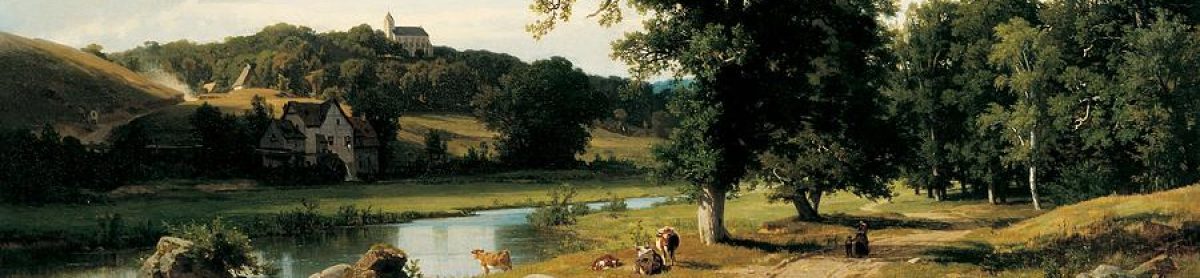
This is Chapter Four of twelve. When we started to research this generation of the Williams family we came to understand that the primary ancestors we are talking about, James Williams Jr. and Sarah Cullen, became adults during the Regency era. Hoping for a bit of Bridgerton glamour… we had to (of course)… recalibrate those expectations.
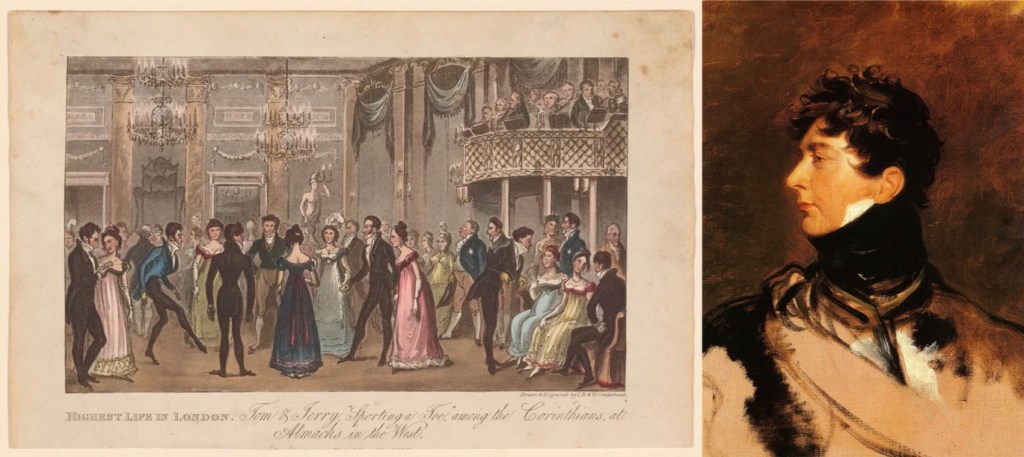
It has a curious caption which reads, “Highest Life in London, Tom & Jerry ‘Sporting a Toe’ among the Corinthians, at Almacks in the West.
At right: Portrait of King George IV, by Thomas Lawrence, circa 1814. (See footnotes).
The Siren Song of Shepton Mallet
During this period of time, it seems that everyone in the surrounding communities was drawn by the allure of Shepton Mallet. It’s credible that this was due to the fact that there was much work to be had there, that wasn’t necessarily agricultural in nature. It was also the Regency Era in England — a period of great contrasts — the landed gentry thrived, and the poor struggled.
“The Regency era of British history is commonly understood as the years between c. 1795 and 1837, although the official regency for which it is named only spanned the years 1811 to 1820. King George III first suffered debilitating illness in the late 1780s, and relapsed into his final mental illness in 1810. By the Regency Act 1811, his eldest son George, Prince of Wales, was appointed Prince Regent to discharge royal functions. The Prince had been a major force in Society for decades. When George III died in 1820, the Prince Regent succeeded him as George IV.
While the Regency is noted for its elegance and achievements in the fine arts and architecture, there was a concurrent need for social, political and economic change. The country was enveloped in the Napoleonic Wars until June 1815 and the conflict heavily impacted commerce at home and internationally. There was mass unemployment and, in 1816, an exceptionally bad harvest. In addition, the country underwent a population boom and the combination of these factors resulted in rampant poverty.
Essentially, England during the Regency era, was a stratified society in which political power and influence lay in the hands of the landed class. Their fashionable locales were worlds apart from the slums in which the majority of people existed… The population boom, comprising an increase from just under a million in 1801 to one and a quarter million by 1820, heightened the crisis.” (Wikipedia) (1)
–––––
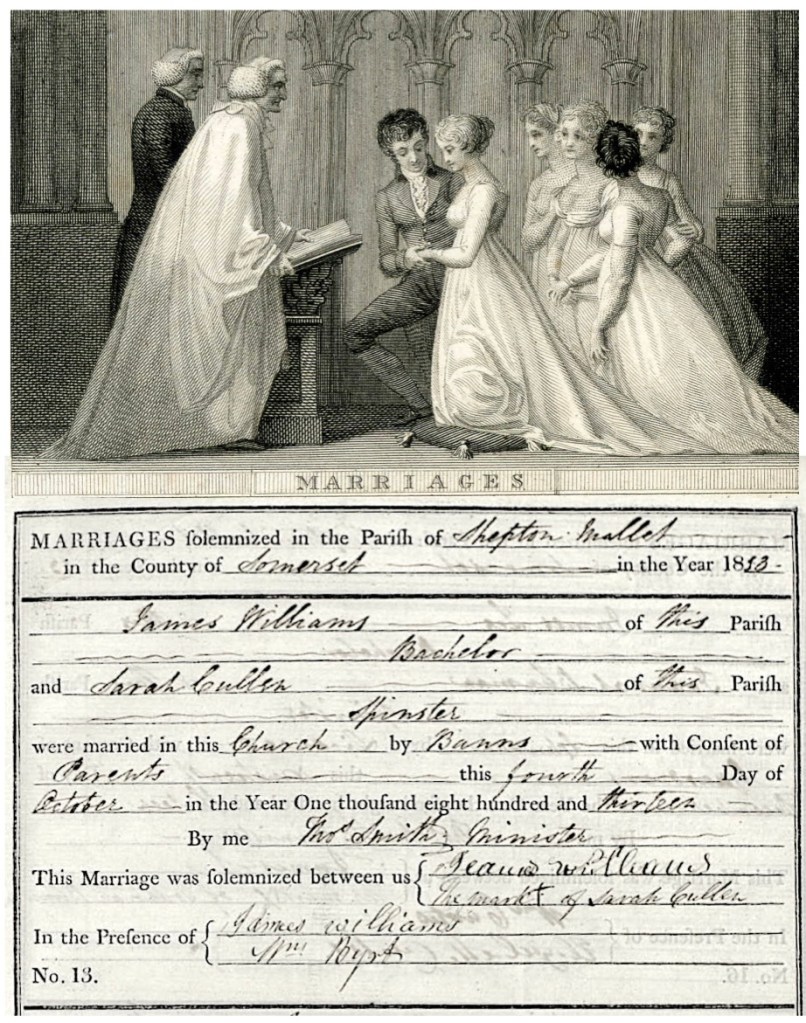
Upper image: Illustration to Crabbe’s poems in the Royal Supplement Pocket Atlas, circa 1810. (Image courtesy of The Trustees of the British Museum via All Things Georgian).
Lower image: James Williams Jr. and Sarah Cullen’s marriage record for the Shepton Mallet Parish, Somerset, on October 4, 1813.
We Love a Name Like ‘Shadrach’
James Jr. and Sarah had several children. We know this because we have been able to discover the birth/baptismal record of their son Shadrach Williams. He was born on April 6, 1816, and baptized September 21 of that same year. It is fantastic that we located him, because with a name like that*, he is essential to helping us understand the rest of this family’s history. No other birth records for their children have surfaced, which makes us believe that the original birth/ baptism registrations exist in records that have either not survived, or have not yet been made available online.
*As was very common then, first names tend to be common and repeated generation-to-generation which makes research much more complicated. (We thank our lucky stars when we find a first name such as Shadrach).
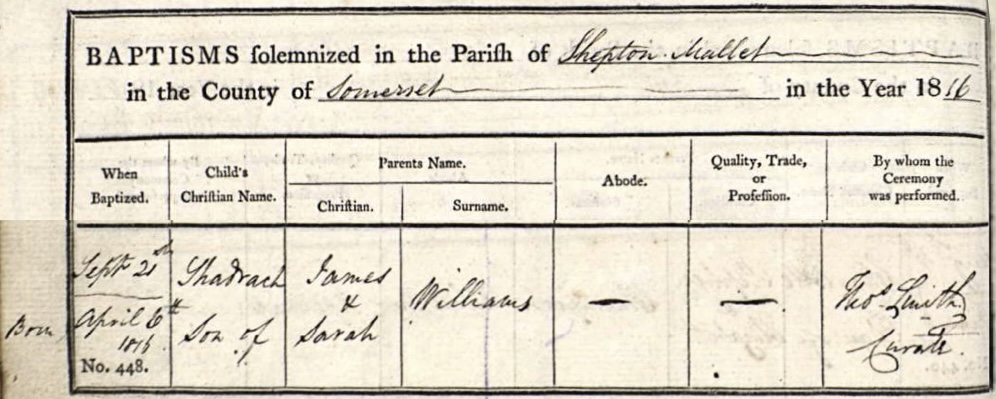
So, when we do not have birth records, we look at census materials to infer the other children in the family, and their possible birth years. It is also likely that James Jr. and Sarah had more children than these census records document, because that was quite normal in their era. Many children are born, and sadly, some pass away. Our research has found the following children:
- Shadrach Williams, born April 6, 1816
- Henry Williams, born circa 1822
- Daniel Williams, born February 15, 1825, Daniel carries the family line forward.
- Mary Joseph (Williams) Weeks, born circa 1826
- Ann Williams, born September 6, 1829
- Eliza Williams, born May 15, 1833
We have a couple of additional observations on 30 years of census data, before going further —
Observation One: Even though the 1841, 1851, and 1861 censuses we evaluated, were conducted on different months in each decade, it is clear that the ages of the parents are a bit off. We have seen documents where James Williams Jr. and his wife Sarah signed their names with an X. This was quite normal for earlier periods where you needed to work if you wanted to eat. Education was an undreamed of luxury for almost everyone. Therefore, things like your age were just not that important.
Observation Two: Even though it is possible, the parents seem just a bit on the older side for their ages, as compared to their children? (Especially for that era…) It is possible, but is it plausible…
We observed that James Williams Jr. was always listed as an agricultural laborer on these censuses. When evaluating the baptism records of his children, before the modern census existed, he noted in 1829 that he was a shoemaker.
The 1841 Census
(Conducted June 1841)
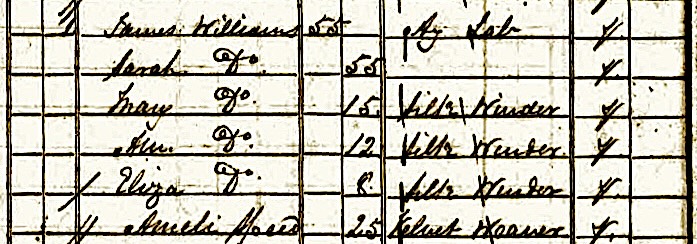
If you recall, the 1841 Census is considered the first modern census completed in the United Kingdom. Every member of the household is accounted for, along with their ages, and professions (if they have one). Specifically, we can see that they are living on Coombe Lane in Shepton Mallet. (The patriarch James Jr., continued to live there for the rest of his life). The following people are recorded: James 55, Sarah, 55, Mary 15, Ann 12, Eliza 8, Ameli Speed 25 (a boarder). James is an agricultural laborer, and Sarah was presumably tending the house because no occupation is listed.
The sons, Shadrock, Henry, and Daniel, are all living in other places. Shadrock and Henry are married and live with their new families. Daniel is living in the home of George Jewel, and at the age of 15, is working as an agricultural laborer. (We will write about Daniel in the next section).
What is quite striking to note is that the three daughters, ages 15, 12, and 8, were all working in one of the cloth manufacturing factories, even though they were still children. All three were employed as Silk Winders. From Family Researcher, here is the definition for that old occupation: “Silk Winder: wound silk onto spools or bobbins prior to the silk being twisted.” The boarder Amelia Speed, being a few year older, is listed as a Velvet Weaver.

For a better understanding of the conditions of both adult and child laborers in these factories, please see the history of Shepton Mallet, The 18th and 19th Century Textile Industries in Chapter Two, or the footnotes for this chapter.
The 1851 Census
(Conducted March 1851)
This census has gotten a little more comprehensive: birth places are also noted now. James has listed his birthplace as West Compton, Somerset (this is a hamlet inside Pilton, Somerset. Sarah lists her birthplace as Stoke Lane, and the daughters are noted as being born in Shepton Mallet. The following people are recorded: James 64, Sarah, 66, Ann 22, Eliza 17, Maria Millard (a boarder). All are listed as Pauper on [the] Parish*, except for daughter Elizabeth who is a Silk Thrower. Again from Family Researcher, “Silk Thrower: prepares silk for weaving by spinning or twisting silk thread.”
* Pauper on [the] Parish
“The New Poor Law altered the system from one which was administered haphazardly at a local parish level to a highly centralized system which encouraged the large-scale development of workhouses by poor law unions.”(Wikipedia)
From Family Search, we learned about what being a pauper on [the] parish actually meant — “Somerset Poor Law: An Act of Parliament in the year 1834 took the responsibility of administering to the poor from the local parish church to the doorstep of civil government. The government grouped each civil parish into a union of parishes. There were nearly 600 such unions throughout England, each one comprising close to 20 or more parishes, and were specifically setup to meet the demands of the poor among their local populations, with a workhouse on the premises.
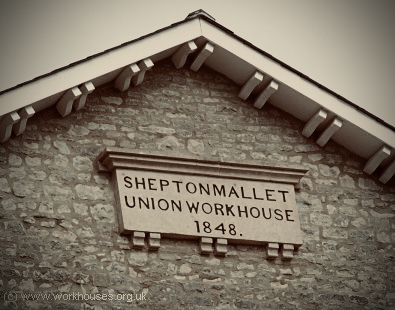
The responsibility was transferred from local parishes to a Board of Guardians in each union. These groupings or unions were known as poor-law unions. Somerset had the following poor-law unions within its boundaries:
Axbridge, Bath Poor Law Union, Bedminster (Long Ashton), Bridgwater, Chard, Clutton, Dulverton, Frome Poor Law Union, Keynsham, Langport, Shepton Mallet, Taunton, Wellington, Wells, Williton, Wincanton, Yeovil Poor Law Union.”

The 1861 Census
(Conducted April 1861)
Their household has grown smaller. It appears that their daughter Ann had not married, but spent her time supporting and caring for her parents. She was working in one of the cloth factories as a Velvet Weaver. The following people are recorded: James 73, Sarah, 74, Ann 32. (2)
Almost Any Book by Charles Dickens
As we mentioned above, the 15 year old son Daniel Williams was working as an agricultural laborer in the home of the George Jewel family in nearby Pilton. We do not know anything about this arrangement, nor why he was not living at home and doing the same thing. However, in an era when child labor was rampant, it could make sense that this is what was necessary for him to do to help his family and/or for his own well being.
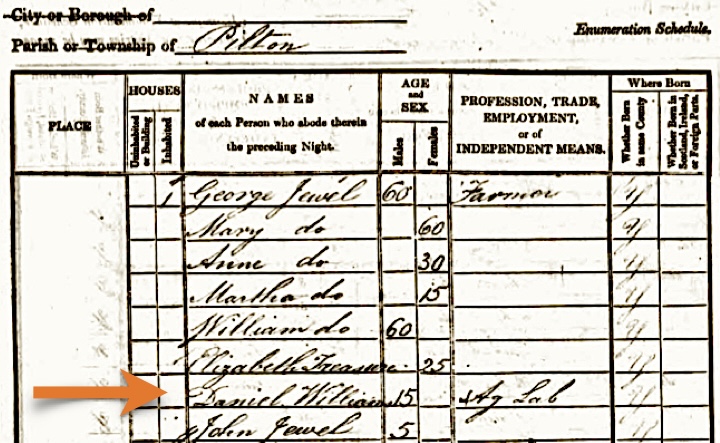
Our research has shown that there are other boys named Daniel Williams also living in the larger Somersetshire area. We sorted through them seeking our ancestor. We feel that the 1841 Census above makes sense.
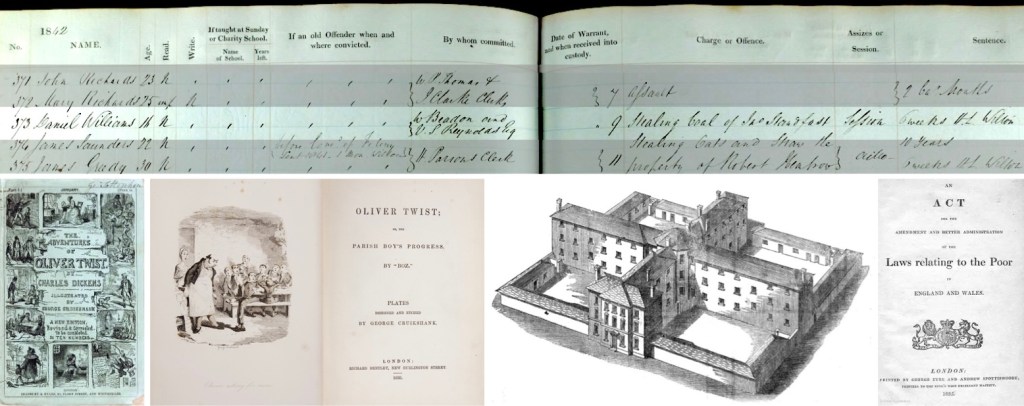
We did come across another record for Daniel Williams and we were not sure what to make of it. It is possible that at the age of 16, Daniel was arrested for larceny (stealing), but we cannot confirm if this was truly him, or another Daniel… The record indicates that this person was imprisoned for six weeks of hard labor at Wilton Goal (prison), for stealing coal from a John Standfast. It is plausible that this was our relative — he was poor, he was a teenager, and teenage boys sometimes do foolish things.
If you have ever read any books by Charles Dickens, you would understand that back then there were no youth detention centers, and no slaps on the wrist. If you committed a crime, the consequence was hard labor. The record indicates that (this particular) Daniel was admitted to Wilton Goal in Taunton, Somerset. That is about 20-22 miles, or 32-35 km to the west of Pilton, Somerset.
We were able to locate a unique map which shows a birds eye view of this section of Somerset and think it might be a good place to summarize the close-knit communities which they lived in over five generations. The total area is not that large — If you were to start in East Pennard and walk northeast toward Stoke Lane, the distance is 9.1 miles (or 14.7 km). (3)
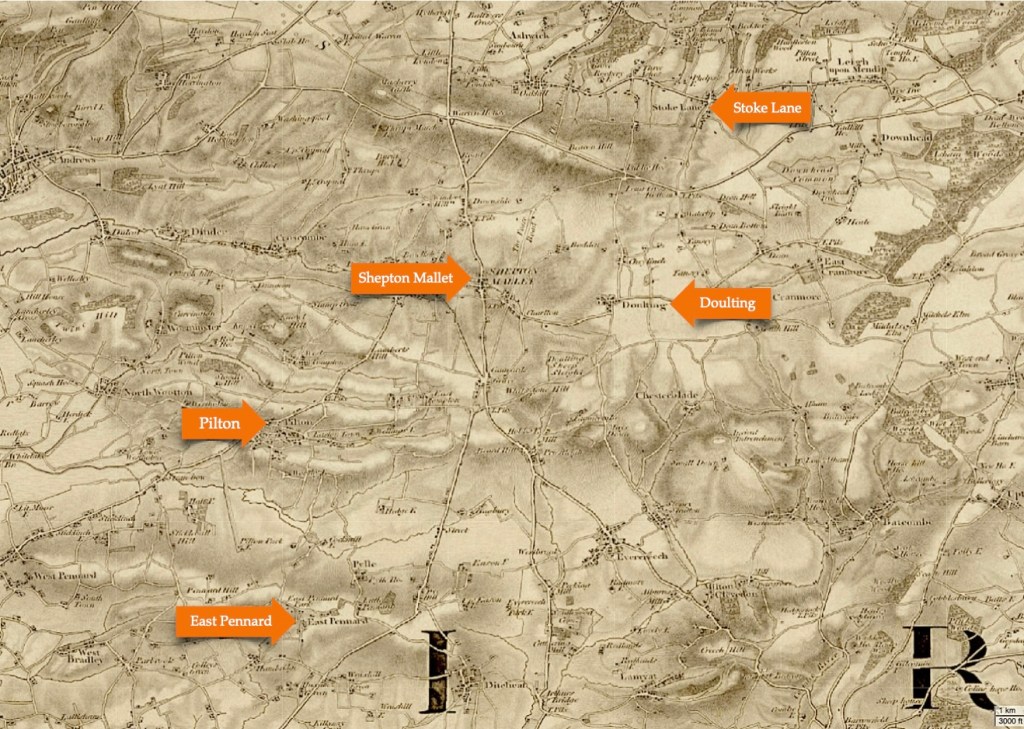
by Archi UK Early OS. (See footnotes).
There was change in the air, as ancestors like the Williams family were becoming aware of many English, Irish, and Welsh families relocating to America. This feeling was different from earlier migrations which had happened in other centuries — America held the promise of a modern future — one that was less constrained by the past. Sometimes it takes a new generation to seek change…
Following are the footnotes for the Primary Source Materials,
Notes, and Observations
The Siren Song of Shepton Mallet
(1) — six records
Regency Era
https://en.wikipedia.org/wiki/Regency_era
Note: For the text.
The Royal Look For Less
Royal Journal
Bridgerton Fact Check: What was the Regency era really like?
https://theroyallookforless.com/blogs/blog/what-was-the-regency-era-like?srsltid=AfmBOooPsdSSWgnNuIQFbrv_fAQLEPfy-x8d4FFb6ez8ZNKpaABkaP6Z
Note: For the image captioned, “.
King George IV
by Thomas Lawrence, circa 1814
https://en.wikipedia.org/wiki/File:George_IV_bust1.jpg
Note: For his portrait. “George IV of the United Kingdom as the Prince Regent, circa 1814. He served as king of the United Kingdom of Great Britain and Ireland from 1820 to 1830. The Regency, George’s nine-year tenure as Prince Regent, which commenced in 1811 and ended with George III’s death in 1820, was marked by victory in the Napoleonic Wars in Europe.”
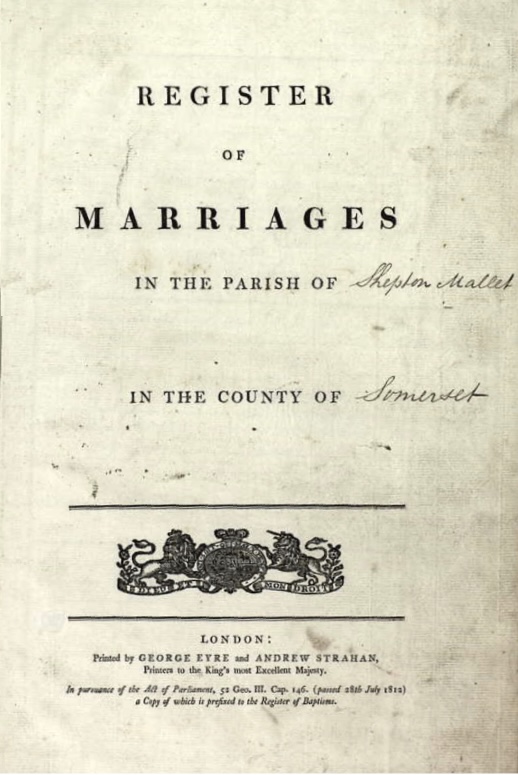
James Williams [Jr]
in the Somerset, England, Marriage Registers, Bonds and Allegations, 1754-1914
Marriage Registers > Shepton Mallet > 1813-1837
https://www.ancestry.com/search/collections/60858/records/1551442
Book page: 5, Digital page: 5/137, Right page, top.
Note: Their marriage date is October 4, 1813; his spouse’s name is Sarah Cullen.
and
James Williams [Jr]
in the Somerset, England, Marriage Registers, Bonds and Allegations, 1754-1914
Marriage Registers > Shepton Mallet > 1790-1816
https://www.ancestry.com/search/collections/60858/records/399634?tid=&pid=&queryId=a9eb2021-1240-4554-ba95-8c882f93e698&_phsrc=CCG3&_phstart=successSource
Digital page: 188/199, Right page, 4th entry.
Note: Banns notification(s) record.
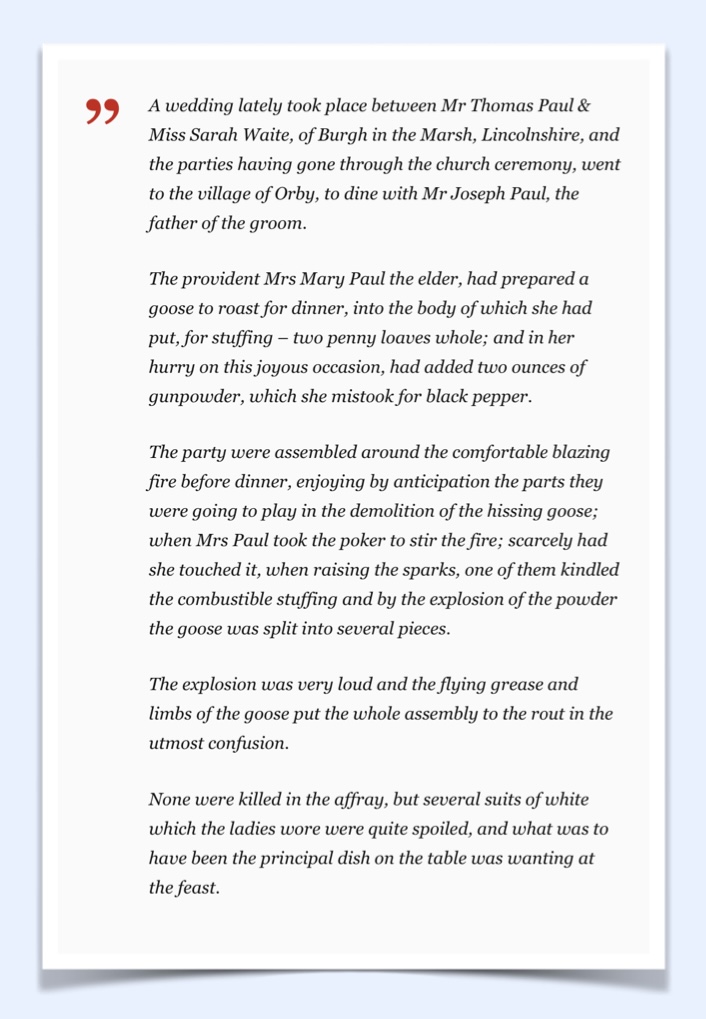
All Things Georgian
The Tale of the Exploding Wedding Goose
by Sarah Murden
https://georgianera.wordpress.com/tag/regency/
Note: For the marriage illustration and the story of the exploding goose.
We Love a Name Like ‘Shadrach’
(2) — sixteen records
Shadrach Williams
in the Somerset, England, Church of England Baptisms, 1813-1914
Shepton Mallet > 1813-1833
https://www.ancestry.com/search/collections/60857/records/222400?tid=&pid=&queryId=ab20a7c6-964c-4196-ad42-e2eb310a063e&_phsrc=Ixg7&_phstart=successSource
Book page: 56, Digital page: 31/154, Entry No. 448, last entry on the left page.
Note: His birthdate is April 6, 1816.
Henry Williams
in the England, Select Marriages, 1538-1973
Marriage Registers > Ditcheat > 1837-1914
https://www.ancestry.com/search/collections/60858/records/2997588
Note: His marriage record to Matilda Reines provides his 1822 birth year.
Daniel Williams
in the U.S., Find a Grave Index, 1600s-Current
https://www.ancestry.com/search/collections/60525/records/130014389?ssrc=pt&tid=22318082&pid=162120441149
and
Daniel Willams
https://www.findagrave.com/memorial/158271603/daniel-williams
Note: His birthdate is February 15, 1825.
Ann Williams
in the Somerset, England, Church of England Baptisms, 1813-1914
Shepton Mallet > 1813-1833
https://www.ancestry.com/search/collections/60857/records/223908?tid=22318082&pid=162120441148&ssrc=pt
Book page: 293, Digital page: 150/154, Entry No. 2340 on the right page.
Note: Her birthdate is September 6, 1829.
Eliza Williams
in the Somerset, England, Church of England Baptisms, 1813-1914
Shepton Mallet > 1813-1833
https://www.ancestry.com/search/collections/60857/records/224293?tid=22318082&pid=162120441152&ssrc=pt
Book page: 293, Digital page: 150/154, Entry No. 2340 on the right page.
Note: Her birthdate is May 15, 1833 .
Shepton Mallett Nub News
The Shepton Riots
by Laura Linham
https://sheptonmallet.nub.news/news/local-news/the-shepton-riots-252234
Notes: For the reference regarding the history of factory laborers.
James Williams
in the 1841 England Census
Somerset > Shepton Mallet > ALL > District 7
https://www.ancestry.com/search/collections/8978/records/13563167
Book page: 31, Digital page: 3/12, Right page, center.
Notes: He is listed as an Agricultural Laborer.
Family Researcher
Dictionary of Old Occupations
https://www.familyresearcher.co.uk/glossary/Dictionary-of-Old-Occupations-Index.html#Old-Occupations-S
> Silk Winder: https://www.familyresearcher.co.uk/glossary/Dictionary-of-Old-Occupations-jobs-beginning-S5.html#Silk-Winder
Note: For the data.
James Williams
in the 1851 England Census
Somerset > Shepton Mallet > ALL > 4c
https://www.ancestry.com/search/collections/8860/records/7359373
Book page: 31, Digital page: 32/47
Note: These is when Englands Poor Laws enter their lives.
Family Researcher
Dictionary of Old Occupations
https://www.familyresearcher.co.uk/glossary/Dictionary-of-Old-Occupations-Index.html#Old-Occupations-S
> Silk Thrower: https://www.familyresearcher.co.uk/glossary/Dictionary-of-Old-Occupations-jobs-beginning-S5.html#Silk-Thrower
Note: For the data.
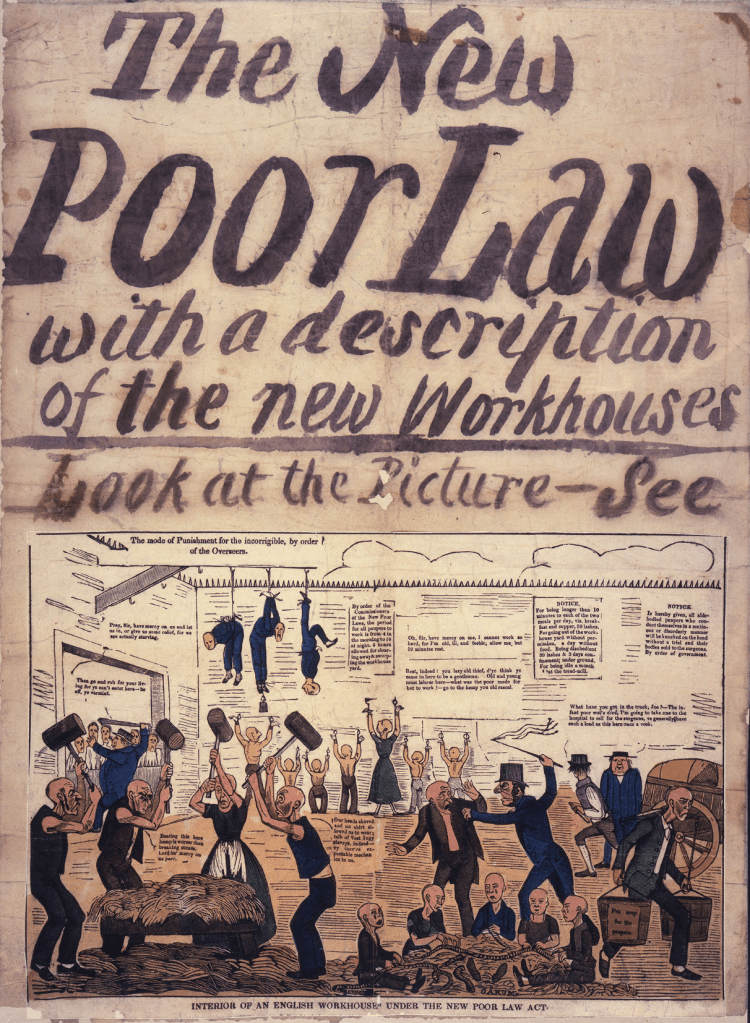
Under the New Poor Law Act, 1837, via The National Archives, UK
https://www.nationalarchives.gov.uk/education/resources/voices-of-the-victorian-poor/have-we-underestimated-the-victorian-poor/poor-law-poster/ .
English Poor Laws
https://en.wikipedia.org/wiki/English_Poor_Laws
Note: For the text.
Somerset Poor Law
https://www.familysearch.org/en/wiki/Somerset_Poor_Law
Note: For the text.
The Workhouse, The Story of an Institution
Shepton Mallet, Somerset
https://www.workhouses.org.uk/SheptonMallet/
Note: For the photograph.
James Williams
in the 1861 England Census
Somerset > Shepton Mallet > ALL > 4c
Somerset > Shepton Mallet > All > District 10
https://www.ancestry.com/search/collections/8767/records/18023200
Book page: 30, Digital page: 36/46
Note: James 73, Sarah 74, Ann 32.
Almost Any Book by Charles Dickens
(3) — four records
Daniel Williams
in the Somerset, England, Gaol Registers, 1807-1879
Wilton Gaol > Register of Prisoners 1831 – 1847
https://www.ancestry.com/search/collections/60900/records/51791
Digital page: 172/296, Entry 373 near the middle of the left page.
Note: At 16, he was imprisoned for six weeks of hard labor at Wilton Goal, for stealing coal from John Standfast. (Larceny)
Note: Admission date is April 9, 1842, at Wilton Goal, Taunton, Somerset.
Oliver Twist
https://en.wikipedia.org/wiki/Oliver_Twist
Note: For the “Cover, first edition of serial, entitled The Adventures of Oliver Twist, January 1846, and the “Frontispiece and title-page, first edition 1838, Illustration and design by George Cruikshank.”
Traveling Through History
The Influence of Art on History, Part 3: Oliver Twist
by Erin
https://www.travelingthruhistory.com/the-influence-of-art-on-history-part-3-oliver-twist/
Archi Early OS (1805-1845)
https://www.archiuk.com/cgi-bin/get_victorian_old_maps_of_the_british_isles_ordnance_survey_1inch_1mile.pl?map_location=Shepton%20Mallet%20%20somerset%20England&point_title=Shepton%20Mallet%20%20somerset%20England&ngr=&is_sub=&pwd=&lidar_model_key=Lidar_Composite_Elevation_LZ_DSM_1m&county=&placename=Shepton%20Mallet%20%20somerset%20England&latitude=51.192330&longitude=-2.561744&postcode=POSTCODE&lidar_template=lidar_simple
Note: “These rare early Ordnance Survey maps (1805–1845) help family historians pinpoint ancestral homes and workplaces, support archaeologists and metal detectorists in researching land terrain and Roman roads, and provide landscape historians with a snapshot of Britain before modern development reshaped the countryside.”


