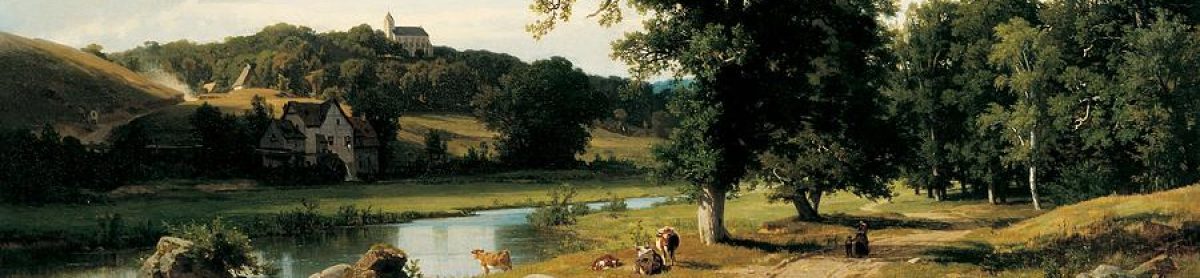
This is Chapter Three of twelve, where we finally meet the family for whom we have named this family narrative. It is Sarah Cullen’s 1813 Regency era marriage to James Williams Jr. that connects us to this family.
The Parish of Pilton, Somersetshire
At the same time that Robert Cullen Jr. and his wife Phillis were raising their family in Stoke Lane just north of Shepton Mallet, the Williams family were doing the same, only south of that same small city. This generation of the Williams family has left few records, but what we have found provides enough essential information to sketch their lives with some clarity: births, a marriage, a family, deaths.
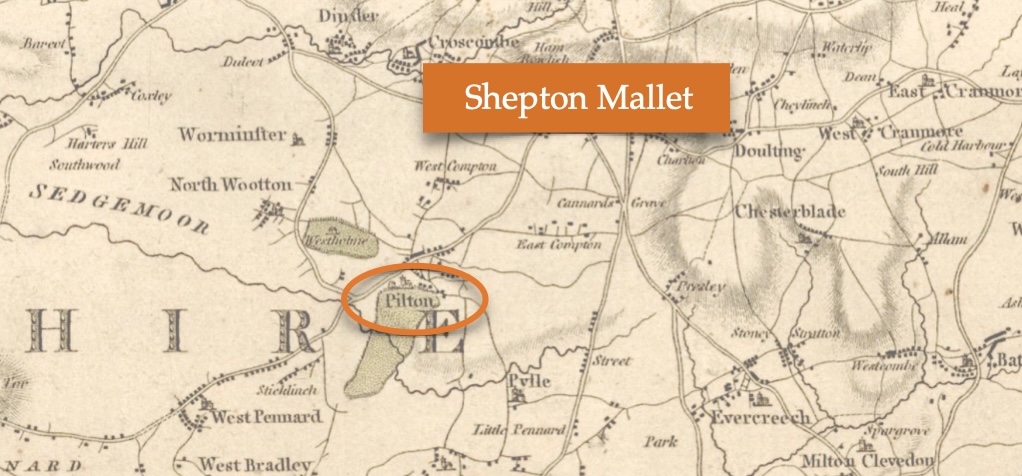
by C. H. Masters, circa 1800. (Image courtesy of The National Library of Scotland).
If you look carefully at the map above, to the southwest of the village of Pilton (circled with an oval), is the town of West Pennard. In modern times, Pilton is frequently found associated with the parish of West Pennard — but, to add confusion to the situation, there is another hamlet in the same area spelled as: Piltown (note the added ‘w’).
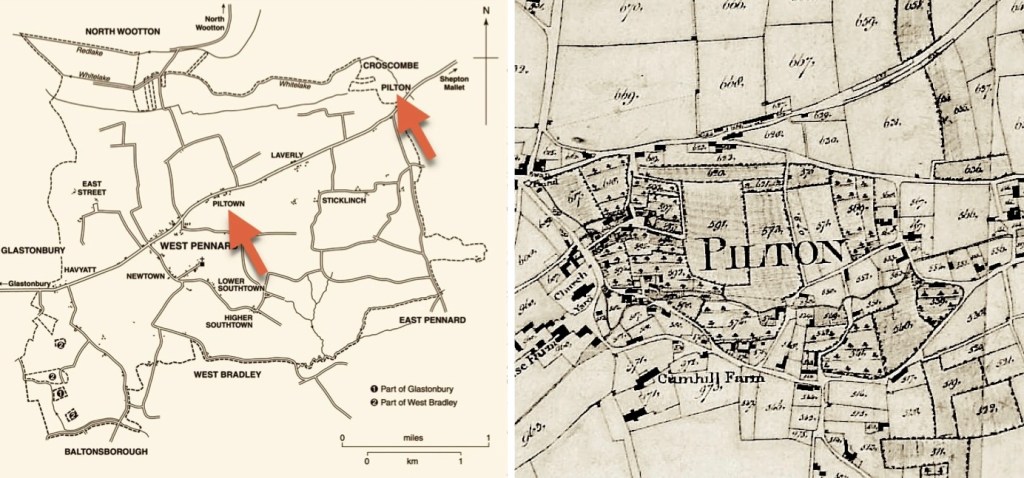
“Piltonis a village andcivil parish in Somerset, England, located about 3miles (or 5km) southwest of Shepton Mallet. The parish includes the hamlets of West Compton, East Compton, Westholme, Beardly Batch, and Cannards Grave.
The village…is almost 20 miles (30km) from the sea but sits on the edge of the Somerset Levels, an area which has now been drained but was once a shallow tidal lake. According to legend in the 1st century, being a landing place then known as Pooltown, it is where Joseph of Arimathea landed in Britain. This is highly unlikely, as the suffix ‘ton’ is Saxon, and therefore cannot be from before 450-500 AD at the earliest.” (Wikipedia) (1)
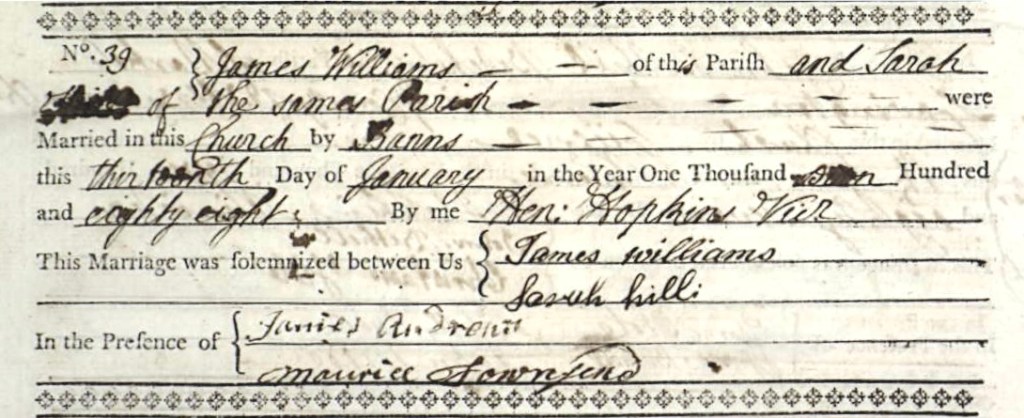
Pilton Parish, for January 13, 1788.
The Williams Family Branches Out
Starting in the new year of 1788, James Williams and Sarah Hill married in the Parish of Pilton. (Contemporary records indicate that this would be The Church of St. John the Baptist, see footnotes). A child was quickly on the way as ten months later, they welcomed their new son into the family. They named him James Williams Jr. in honor of his father. It is quite likely that they had many more children, or sadly, that they also lost some children. (We have discovered no records either way at this point in time). It is perhaps important to note that this record does not indicate his birth year, and that as he aged, he seems to be guessing at this information on the censuses.
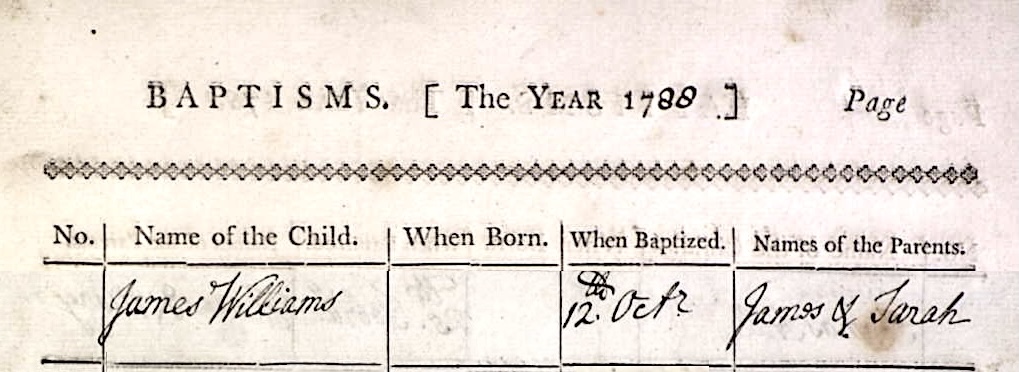
What we do know is this: a number of years later, they had another son in 1810, and named him Samuel. This younger son stayed in Pilton and figures into the latter life of his father James Sr.
How did they support themselves?
To answer this question, we need to infer what we see on the maps and what we can glean from the 1841 Census. It’s certain that all the members of the Williams family were agricultural laborers, or tradesman in support of the community. On the 1841 census, James Williams Jr. and his brother Samuel Williams are identified as —Laborers, or Agricultural Laborers.
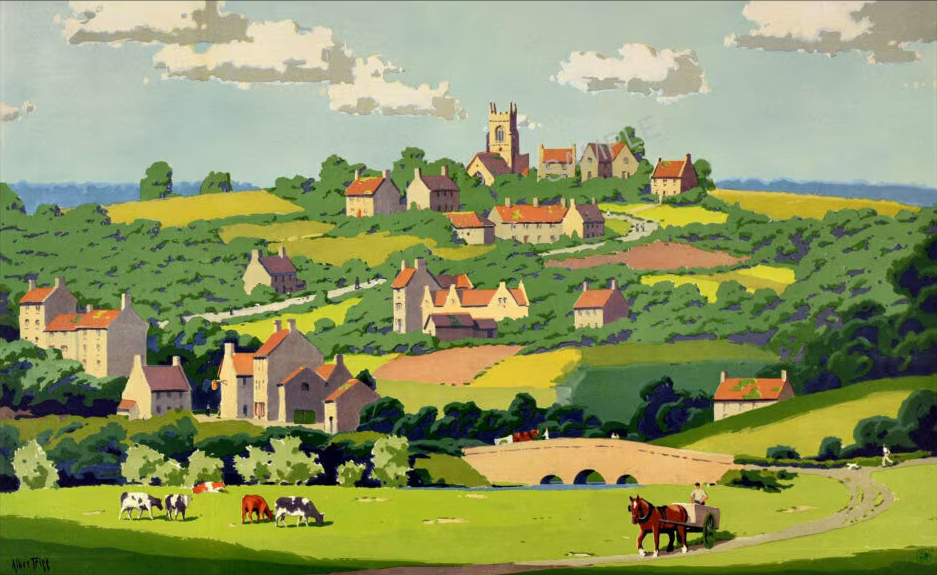
British Railways Vintage Travel Poster, (Image courtesy of Mutual Art).
Around 1800, West Somerset agriculture was dominated by traditional farming techniques focused on raising arable crops. This means that the lands were suitable for growing crops. (This is different from lands only considered generally suitable for animal grazing).
Key crops included: wheat, barley, oats, and turnips (as fodder for animals). Field peas and beans were grown to help fix nitrogen in the soil. Apple orchards were vital for producing cider.
Animals were raised for wool, dairying, and meat:
Sheep — were raised for wool and meat, with wool being very important for the nearby Shepton Mallet cloth factories.
Cattle — known for dairy farming, particularly for cheddar cheese and butter, as well as raising beef cattle.
Pigs — were kept for meat and bacon.
Horses — were used primarily for transportation and for labor on farms. (Extracted from Wikipedia) (2)
Change Was in The Wind…
The Industrial Revolution was slowly underway. The Industrial Revolution was the transition from small cottage industries in which goods were mostly made by hand to new, mass-produced goods in factories using steam and water power.
The Industrial Revolution began in Great Britain around 1760 and many of the early technological innovations happened there. Textiles were the dominant industry of the early Industrial Revolution. The textile industry was also the first to use modern production methods. The Industrial Revolution marked a major turning point in history and almost every aspect of daily life was influenced in some way.” (Students of History)
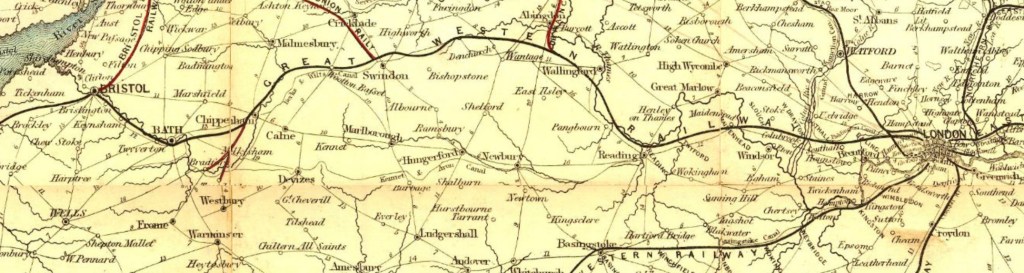
The world was changing, but traditional life in the tiny parish of Pilton would stay the same for a while longer. Specifically, in West Somerset where they lived, industrialization was not as uniform, nor as rapid as in the North of England, but significant development occurred from the late 18th century into the early 19th century, particularly driven by the textile industry. The Great Western Railway pushed westward into the area, but went north to connect London, to the Somerset cities of Bath and Bristol — thereby passing well above the villages, parishes, and hamlets to the south. It reached Bath and Bristol circa 1840-ish, right near the of end-of-life for this generation. In fact, the working residents probably stood in the farm fields, arms akimbo, looking at the distant trail of coal smoke from the train line that would never reach them.
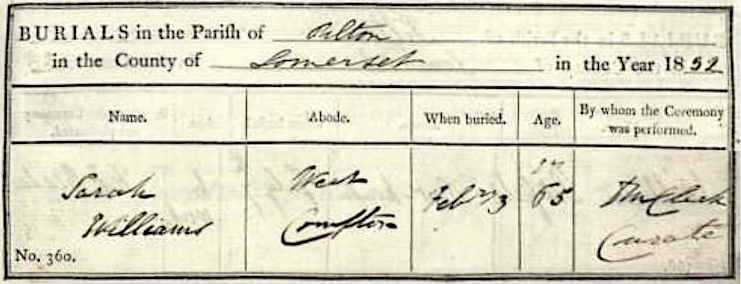
These cultural shifts would affect a place like Shepton Mallet much earlier than an outlying parish like Pilton. It is probable that none of this generation of the Williams family ever experienced any of these changes. The mother of the family, Sarah (Hill) Williams, passed away before her husband James, in early 1833. (3)
The First Modern Census
James Williams Sr. likely never appeared in a Census until his life was nearly over. At 85 years old, he appears in the 1841 Census of England, living in the home of his younger son Samuel, and his family. Between 1801 and 1841, the British government had a rather haphazard approach in trying to capture this information. No one yet seemed to comprehend the pragmatic usefulness of this kind of data.
“There was widespread opposition to an official census until the end of the 18th century. This finally withered away after demographer Thomas Malthus, published his essay on the ‘principle of population’ in 1798. [He] caused great concern by suggesting that population growth would soon outstrip supplies of food and other resources. Unable to support itself, Britain would be hit by famine, disease and other disasters.* Concerned at this alarmist view of the future, people began to see the need for a census. Parliament passed the Census Act in 1800 and the first official census of England and Wales was on March 10, 1801… but the 1841 census, run by the new registration service, is regarded as the first modern census.
*Think of the Irish Potato Famine of 1845 to 1852 — An Gorta Mór(the Great Hunger), see footnotes.
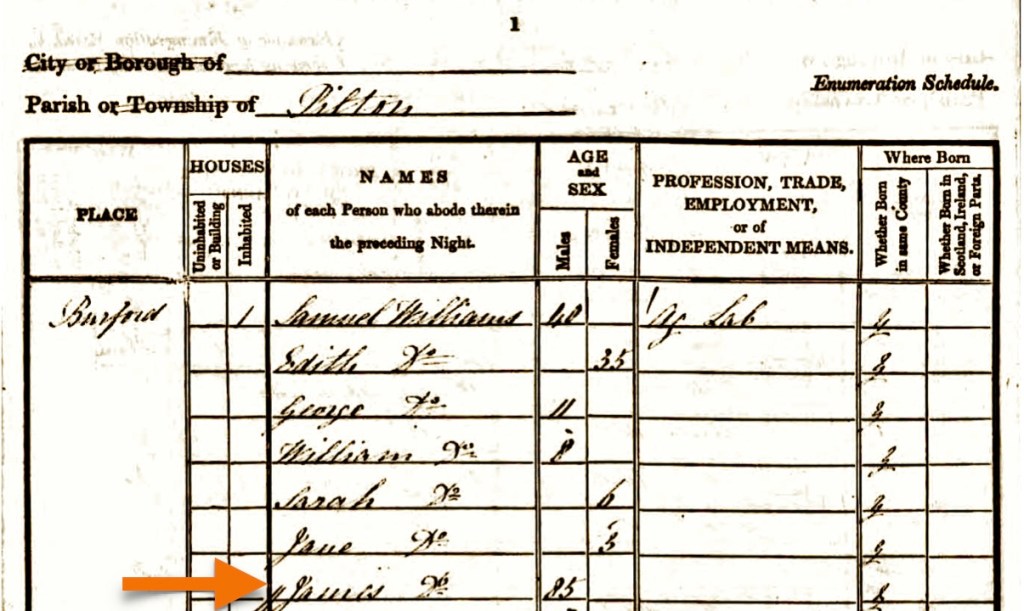
Since 1801 there has been a census every ten years except in 1941, during the Second World War. For the first time, the head of each household was given a form to fill in on behalf of everyone in the household on a certain day. This system has stood the test of time, and it still forms the basis of the method we use today.” (The Office for National Statistics)
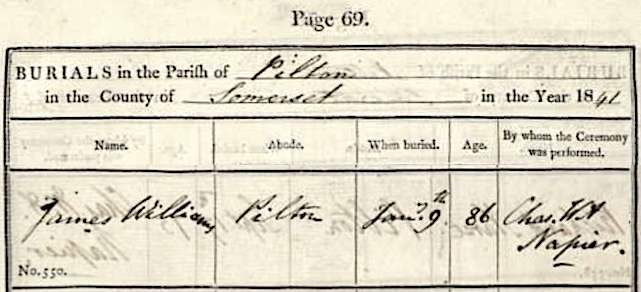
James Williams Sr. passed away within a decade of his wife Sarah’s death. He lived to be about 86 years old, which is quite impressive when you consider the times within which he lived. He was born circa 1765 — a year notable for Great Britain’s Stamp Act. You wonder if his cries at being born, had to compete with the howls of the American Colonists in British North America over yet another tax. That charged event and their response to it, became an ignition point that helped build momentum toward the American Revolution. (See footnotes).
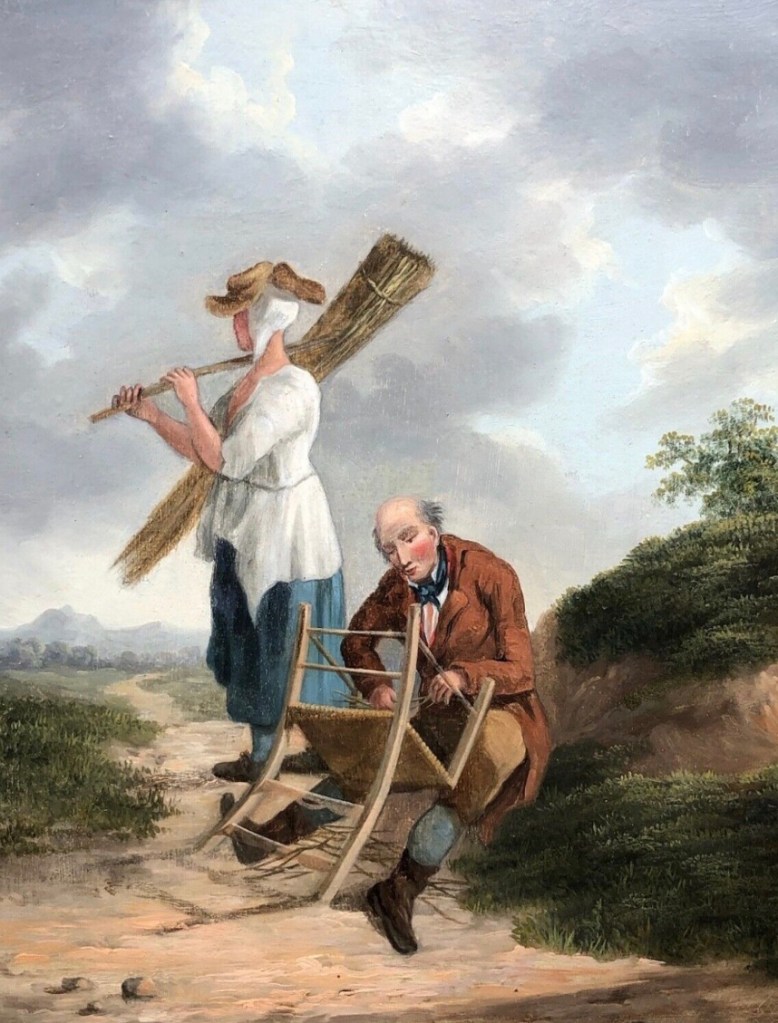
(Image courtesy Strickland & Russell, UK).
At the end of his life, we ponder what James William Sr.’s life was truly about and how he must have felt, as he reflected on the many days which had passed. He probably missed his wife Sarah greatly, but then took some joy in his son Samuel’s home, surrounded by his grandchildren. In the next chapter, we will be looking at the life of his other son James Jr. and his wife Sarah Cullen, who then carry on our Williams family line. (4)
Following are the footnotes for the Primary Source Materials,
Notes, and Observations
The Parish of Pilton, Somersetshire
(1) — five records
The National Library of Scotland
Map of 24 miles round the City of Bath. Most humbly dedicated …
by C. H. Masters, circa 1800
https://maps.nls.uk/counties/rec/13617
Note: Enlarged for detail to show the Somerset villages of East Pennard and Shepton Mallet.
Pilton, Somerset
https://en.wikipedia.org/wiki/Pilton,_Somerset
Note: For the text.
Shepton Mallet
https://en.wikipedia.org/wiki/Shepton_Mallet
Note: For the reference.
BHO | British History Online
Parishes: West Pennard
https://www.british-history.ac.uk/vch/som/vol9/pp142-154
Note: For the 1840 map documenting both Pilton and Piltown.
Roads around Pilton — Illustrated Talk
P.V.H.G. (Pilton History The Heritage of a Somerset Parish)
by Richard Raynsford, January 2025
https://www.piltonhistory.org.uk/topics/travel-and-transport/roads-around-pilton-talk-by-richard-raynsford
Note: For data and 1809 map documenting Pilton.
The Williams Family Branches Out
(2) — seven records
James Williams [Sr]
in the England, Select Marriages, 1538-1973
https://www.ancestry.com/search/collections/9852/records/6807903?tid=&pid=&queryId=8863a398-2bbd-4284-a80c-807c49794e3d&_phsrc=giE15&_phstart=successSource
Note: Their marriage date is January 13, 1788; his wife’s name is Sarah Hill; Pilton, Somerset, England.
And
James Williams [Sr]
in the Somerset, England, Marriage Registers, Bonds and Allegations, 1754-1914
Marriage Registers Pilton 1783-1812
https://www.ancestry.com/search/collections/60858/records/4351154
Digital page: 23/43, Entry No. 39 on the left page.
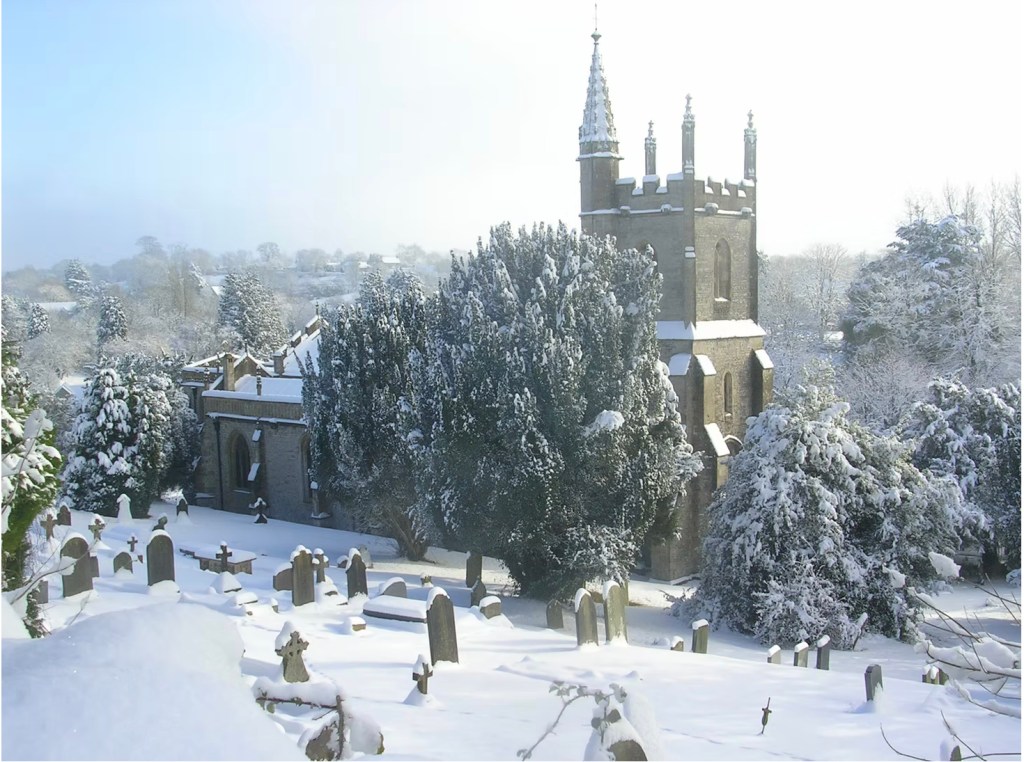
(Imagery courtesy of the Pilton Parish Council).
James Williams [Jr]
in the England, Select Births and Christenings, 1538-1975
Pilton 1783-1813
https://www.ancestry.com/search/collections/9841/records/107149488
Digital page: 9/66, Second entry from the top.
Note: His October 12, 1788 baptismal record.
Note: On the 1851 Census, he states that his birthplace was West Compton, Somerset. (West Compton is a street of, and a very small hamlet in Pilton).
Samuel Williams
in the Somerset, England, Church of England Baptisms, Marriages, and Burials, 1531-1812
Pilton 1783-1813
https://www.ancestry.com/search/collections/60856/records/4350084
Book page: 45, Digital page: 25/66, Sixth entry on the right page.
Note: His September 13, 1801 baptismal record.
Pilton Parish Council,Gallery
Pilton Parish Church in the Snow of 2010.
Contemporary photo by Heather Hall
https://www.piltonparishcouncil.org/gallery?pgid=l5mc2pat-9666a9a3-327e-4bbd-a6d6-f3657d57b912
Mutual Art
British Railways Vintage Travel Poster
Somerset, The Holiday County of Infinite Charm
by Herbert Alker Tripp
https://www.mutualart.com/Artwork/Somerset/0C00B030E62ED037412AA502A8844BF1
British Agricultural Revolution
https://en.wikipedia.org/wiki/British_Agricultural_Revolution
Note: For the extracted data.
Change Was In The Wind
(3) — five records
Students of History
The Beginning of the Industrial Revolution
https://www.studentsofhistory.com/why-the-industrial-revolution-began-in-england
Note: For the text about the beginning of the Industrial Revolution in England.
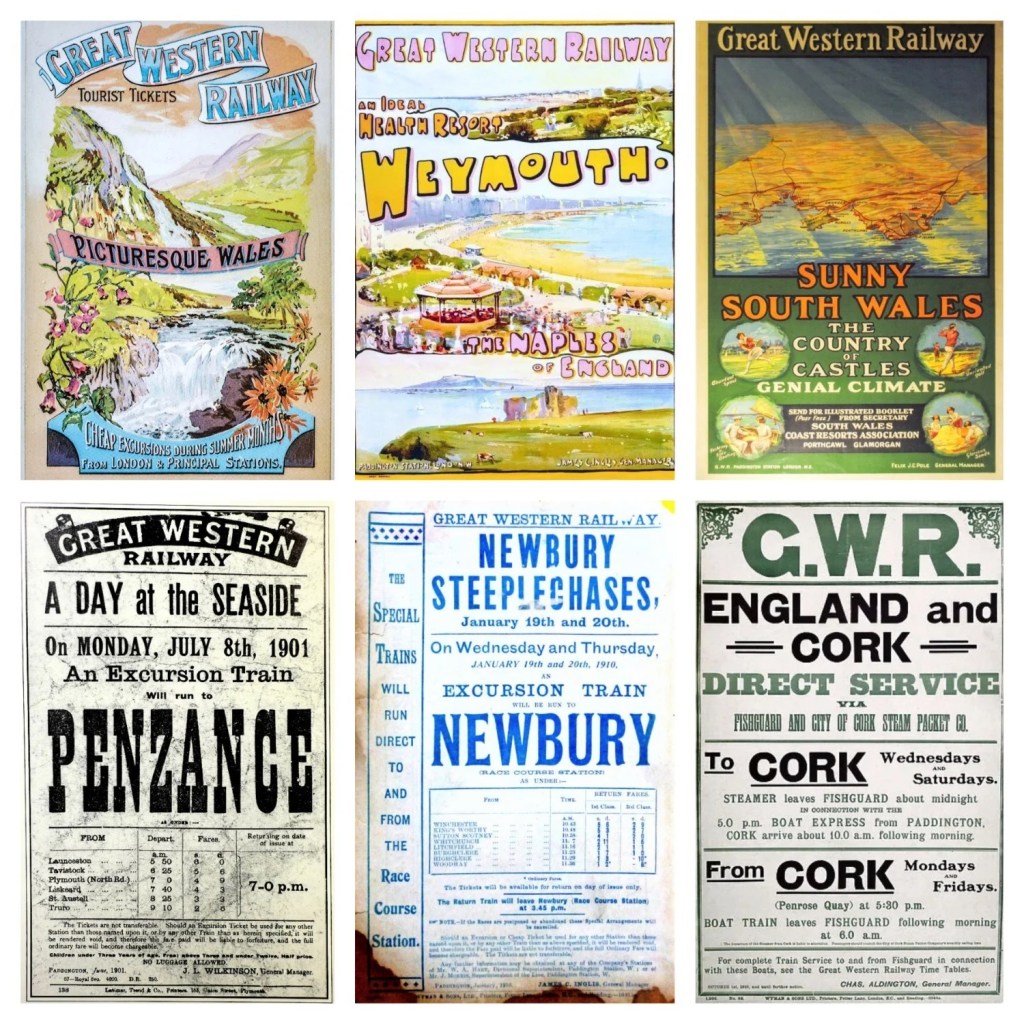
Great Western Railway
https://en.wikipedia.org/wiki/Great_Western_Railway
Note: For both the reference, and for
Cheffin’s Map — Route of Great Western Railway, 1850 map,
by Charles F. Cheffins, circa 1850.
Sarah Williams
in the Somerset, England, Church of England Burials, 1813-1914
Pilton 1813 1913
https://www.ancestry.com/search/collections/60859/records/4979797
Book page: 45, Digital page: 25/103, Entry No. 360 on the right page, (last entry at bottom).
Note: Her birth year is circa 1768, and her burial date was February 3, 1833.
and
Sarah Williams
Vital – England, Somerset, Church Records, 1501-1999
https://www.familysearch.org/ark:/61903/1:1:6D99-397B?lang=en
The First Modern Census
(4) — nine records
The Office for National Statistics
The Modern Census
https://www.ons.gov.uk/census/2011census/howourcensusworks/aboutcensuses/censushistory/themoderncensus#:~:text=The%20first%20official%20census%20was%20in%201801%2C,modern%20census.%20Last%20updated:%2018%20January%202016.
Note: Information about the only Census that James William Sr. ever appeared in (that we have discovered).
James Williams [Sr]
in the 1841 England Census
Somerset Pilton ALL District 13
https://www.ancestry.com/search/collections/8978/records/13558430
Book page: 1 (or 23?), Digital page: 2/7, Left page, 7th entry for the Samuel Williams family.
Note: At 85, he is in the home of his son Samuel Williams.
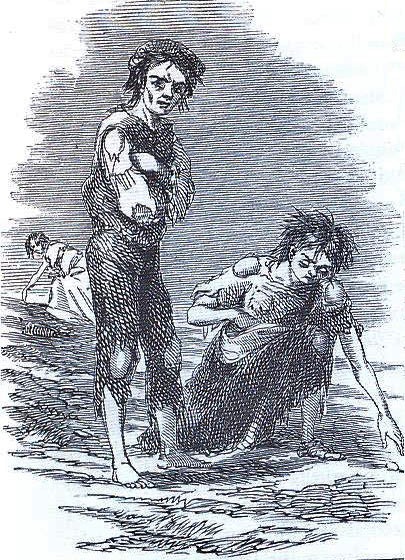
As published in The Illustrated London News.
“The first Sketch is taken on the road, at Cahera, of a famished boy and girl turning up the ground to seek for a potato to appease their hunger. Not far from the spot where I made this sketch, says Mr. Mahoney, and less than fifty perches from the high road, is another of the many sepulchres above ground, where six dead bodies had lain for twelve days, without the least chance of interment, owing to their being so far from the town.” (https://commons.wikimedia.org/wiki/File:Skibbereen_by_James_Mahony,_1847.JPG)
Great Famine (Ireland)
https://en.wikipedia.org/wiki/Great_Famine_(Ireland)#:~:text=The%20Great%20Famine%2C%20also%20known%20as%20the,and%20disease%20in%20Ireland%20from%201845%20to
and
UK Parliament
The Great Famine
https://www.parliament.uk/about/living-heritage/evolutionofparliament/legislativescrutiny/parliamentandireland/overview/the-great-famine/#:~:text=Between%201845%2D52%20Ireland%20suffered,a%20disease%20destroying%20the%20crop.
Note: For the data.
James Williams [Sr]
in the England, Select Deaths and Burials, 1538-1991
https://www.ancestry.com/search/collections/9840/records/4658434
and
James Williams
in the Somerset, England, Church of England Burials, 1813-1914
Pilton 1813-1913
https://www.ancestry.com/search/collections/60859/records/4979987
Book page: 69, Digital page: 37/103, Entry No. 550 on the right page.
Note: The right margin notation indicates that he was the first entry for 1842.
Encyclopædia Britannica
Stamp Act, Great Britain [1765]
https://www.britannica.com/event/Stamp-Act-Great-Britain-1765
Note: For the data.
Strickland & Russell
Selling Antiques
The Chair Mender,
attributed to Francis Wheatley, 18th century
https://www.sellingantiques.co.uk/1051310/attributed-to-francis-wheatley-ra-original-late-18th-century-antique-oil-painting-on-board-the-chair-mender-english-country-landscape
Note: For the image.


