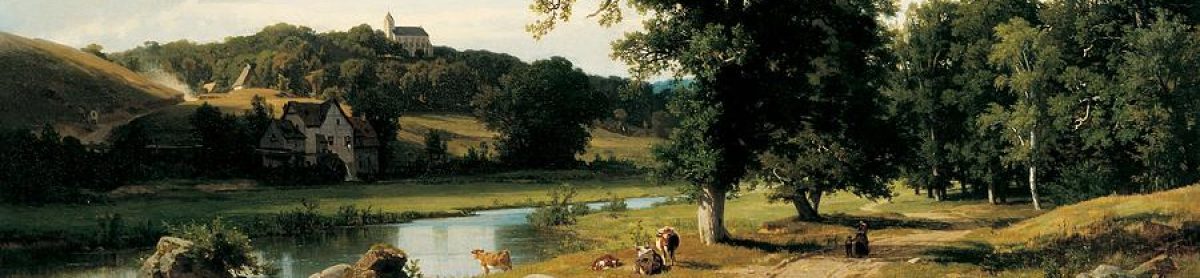
This is Chapter Eight of twelve. This chapters is also set in Wales, where we learn about more family origins, this time with — the Harris family. From their beginnings here, they eventually make their way to America.
Yes, you are! No, we’re not!
In the past, Monmouthshire was sometimes considered part of England, and sometimes part of Wales. This debate dragged on for several centuries, to the point that sometimes competing maps were published at the same time, putting Wales either here, or there… It always depended upon whom you asked, (and honestly, whether they were speaking English, or Welsh).
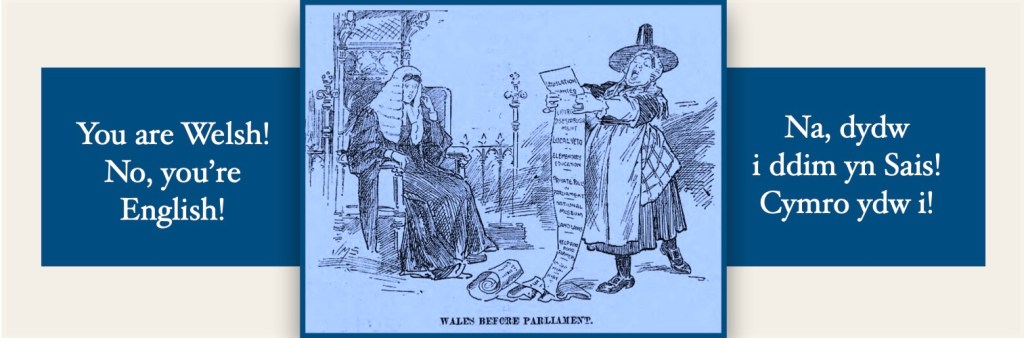
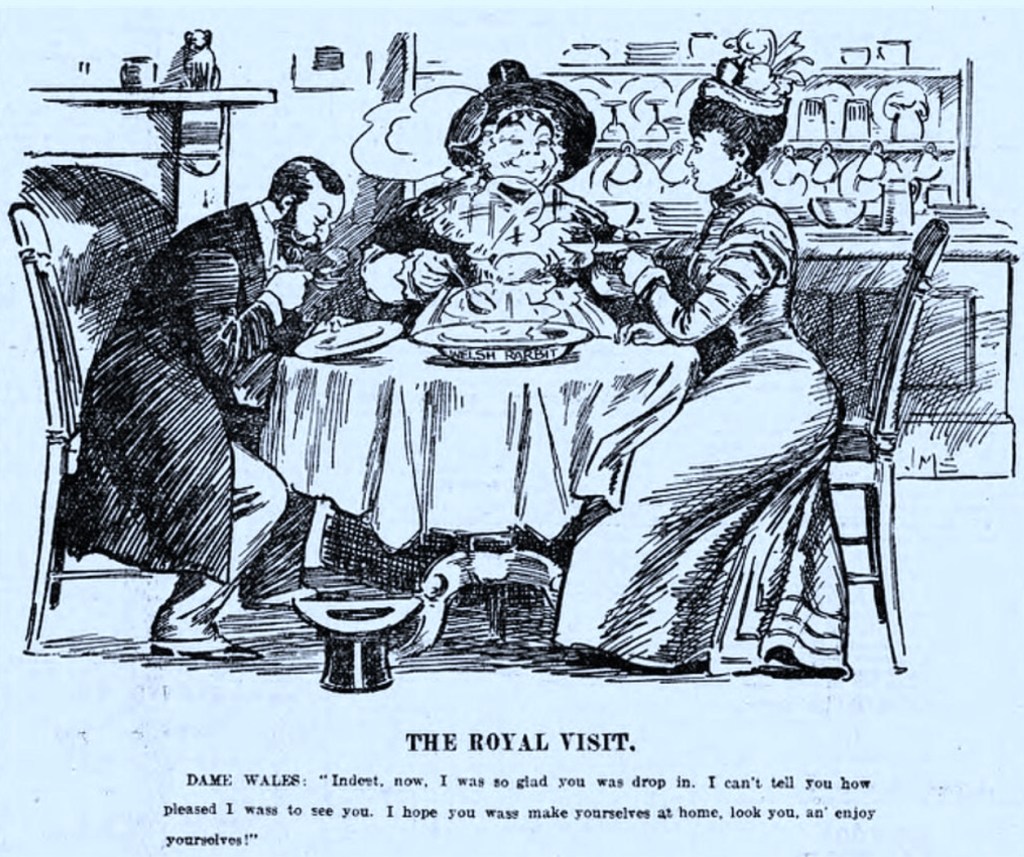
“Dame Wales reads through a long list of desired laws and regulations for the benefit of Wales at Parliament.” The right text translates from Welsh as: No, I am not English! I am Welsh!
(Center image courtesy of Picryl).
From Wikipedia, we see that,“the Laws in Wales Act 1535 integrated Wales directly into the English legal system and the ‘Lordships Marchers within the said Country or Dominion of Wales’ were allocated to existing and new shires. Some lordships were annexed to existing counties in England and some were annexed to existing counties in Wales, with the remainder being divided up into new counties, one of which was Monmouthshire.” What this means is, that as a border area with England, people agonized over who was in charge. This went back-and-forth for much, much time and was eventually resolved by laws passed between 1972-74.
The civil parish where our family lived was called Mynyddyslwyn Parish. It may seem like a detail, but the present name is spelled slightly different today, as Mynyddislwyn, where the y at the center has changed to an i. The governance of the area is quite different also from that earlier era, but it’s not really something we need to go into, because it is quite complicated. The local history reads like a child’s game where a big fish keeps swallowing a smaller one, and this behavior just goes on and on… We feel that what is important is this: what were things like back then where our family experienced them?
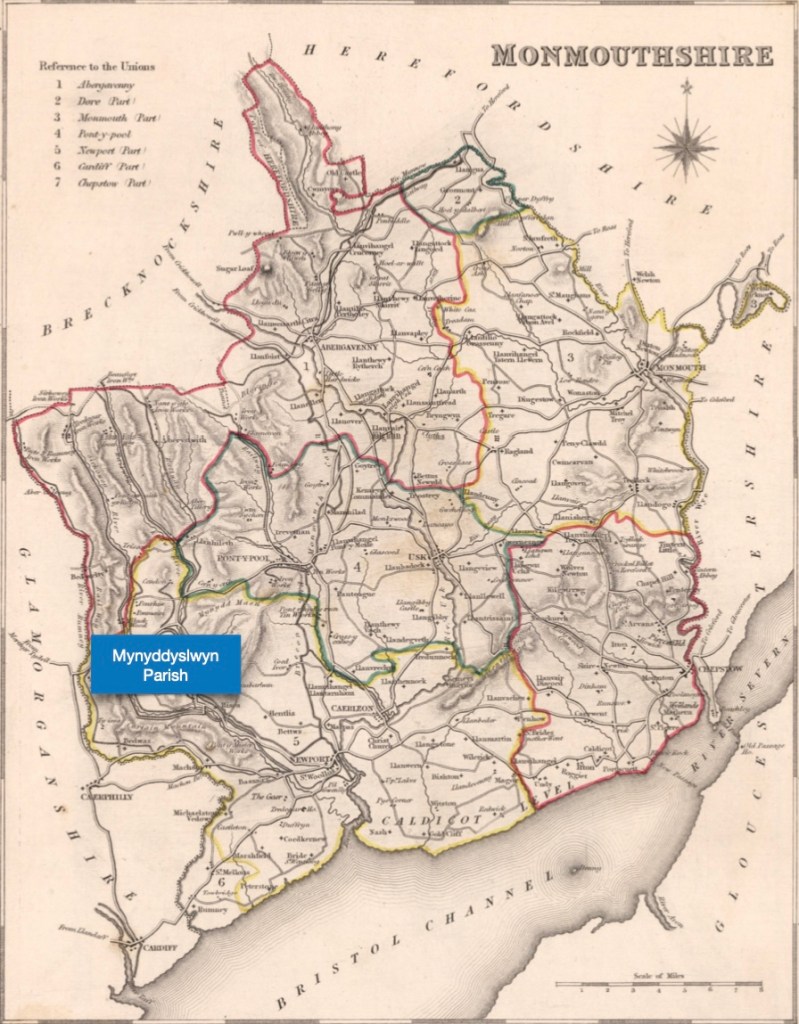
(Image courtesy of David Rumsey Map Collection).
“Mynyddyslwyn was one of the largest parishes in old Monmouthshire, covering nearly 16,000 acres of land. On the westerly side, it adjoined the parishes of Bedwellty and Bedwas although in one place it extended right to the border with the county of Glamorgan. From early times, the parish was divided into three hamlets, Clawrplwyf in the south, Penmaen in the north, and Mynyddmaen in the east.
The western parts of Monmouthshire was mostly mountainous, richly forested from early times, with the main routes and trackways running along the tops of the mountains. There was only a small and scattered population. Even as late as 1801, only about 1,500 persons were recorded as living in the whole Parish.
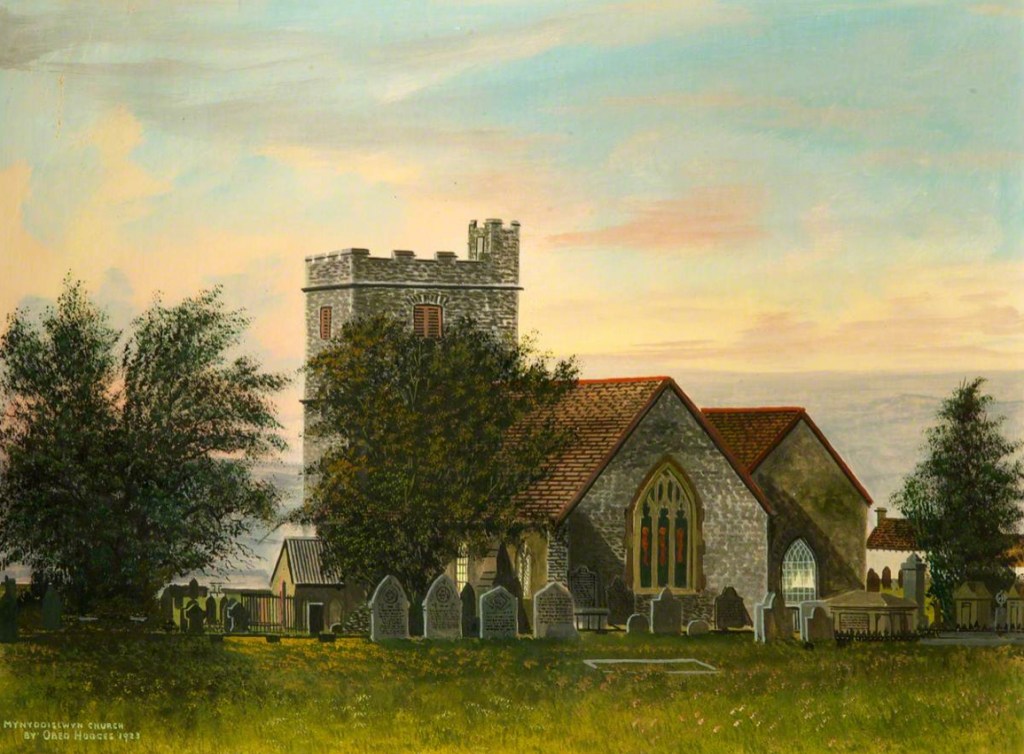
The Parish Church, dedicated to St. Tudor, is situated in a remote position beside the old road, which crosses Mynyddislwyn Mountain on its way to Risca. It stands 1,000 ft above sea level. The original church was one of those granted to Glastonbury Abbey about the year 1102, but later it became a possession of Llantarnam Abbey. The registers started in 1664. The Church was rebuilt in 1820 on the site of the earlier structure.
The lordship of Mynyddislwyn and Abercarn was granted to William, Earl of Pembroke, about the year 1650, but it was sold by his son about the year 1722. Having been passed on by inheritance, it was sold in 1807 to Richard Crawshay, the ironmaster, who gave it to his daughter on her marriage to Benjamin Hall. Their son, also named Benjamin, was Government Commissioner of Works, and was responsible for beautifying some of London’s parks. The bell in the famous clock tower outside the Houses of Parliament was named after him —Big Ben. He later became Lord Llanover.” (Oakdale Village) (1)
Let’s Meet Henry Harris & His Wife Ann ______
We do not know much more about the parents due to the scarcity of records and their very common names.
Throughout the many family lines we have written narratives about, it was quite common for couples to have many children. Usually, every two to three years, or so. This was a common practice because of the high rates of child mortality — many children died before the age of 5 years. With this family, for whatever reason, surviving records are quite scarce. We have discovered verifiable records for five children: their sons Evan, William, Henry, and Watkin, and their daughter Sara.
All records are from the Mynyddyslwyn, Beulah Chapel (Baptist) Registry, in Monmouthshire, Wales. It appears that the first three, Evan, William, and Henry, were all recorded in this register at the same time, even though they had baptisms on different days. Since we are looking at quill pen writing, some details are illegible.
- Evan Harris — born “October the 5th 1802 and baptized November _ 1806”
- William Harris — born “November 13th 1804 and baptized November _ 1806”
- Henry Harris — born “February 15th 1807 and baptized March (illegible)”
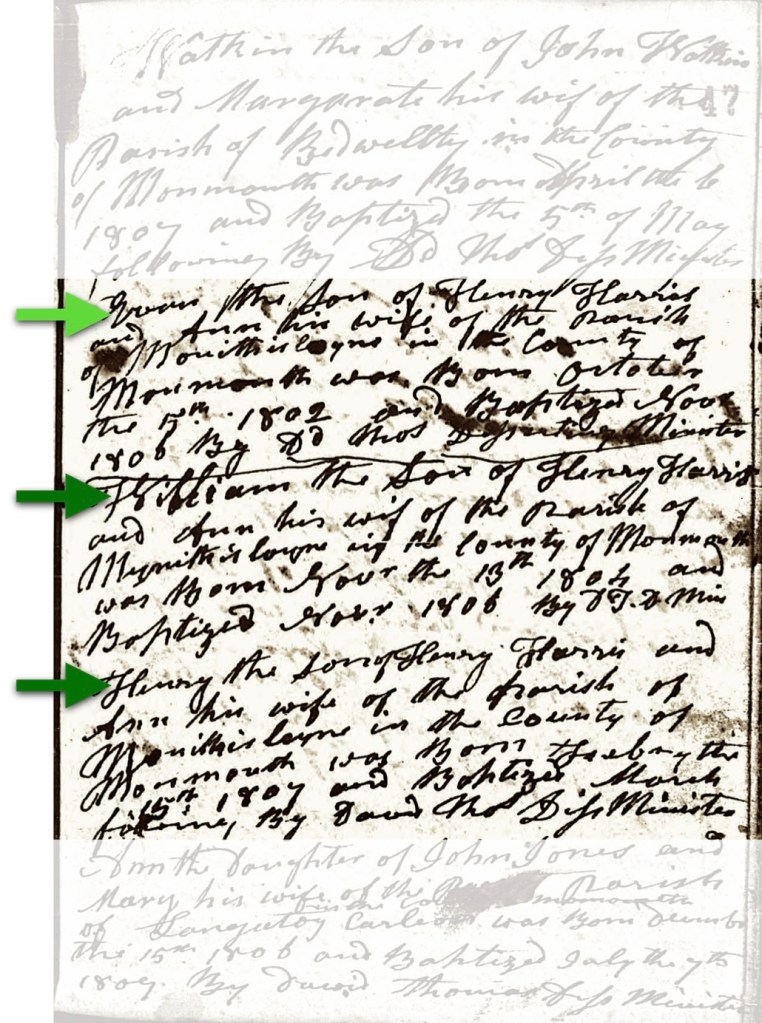
along with his brothers William, and Henry Jr. (following). From the
Mynyddyslwyn, Beulah Chapel (Baptist) Registry, in Monmouthshire, Wales.
The next child is Sara, and the same warning about quill pen writing applies here too.
- Sara Harris – born “April the 1st 1817 and baptized 21 (illegible).”
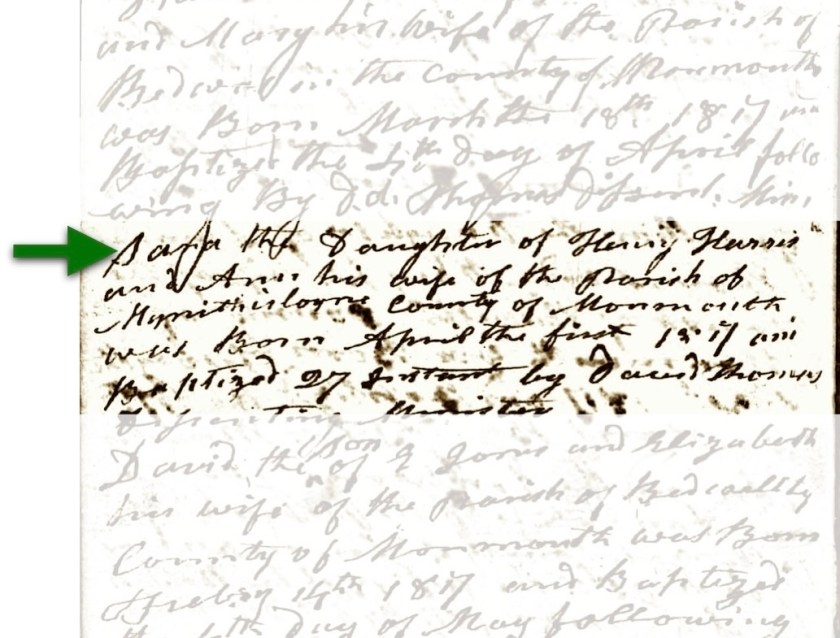
Mynyddyslwyn, Beulah Chapel (Baptist) Registry, in Monmouthshire, Wales.
The last child is Watkin, who we do not know much about.
- Watkin Harris – born “July 25th 1825 and baptized 14th day of September following”
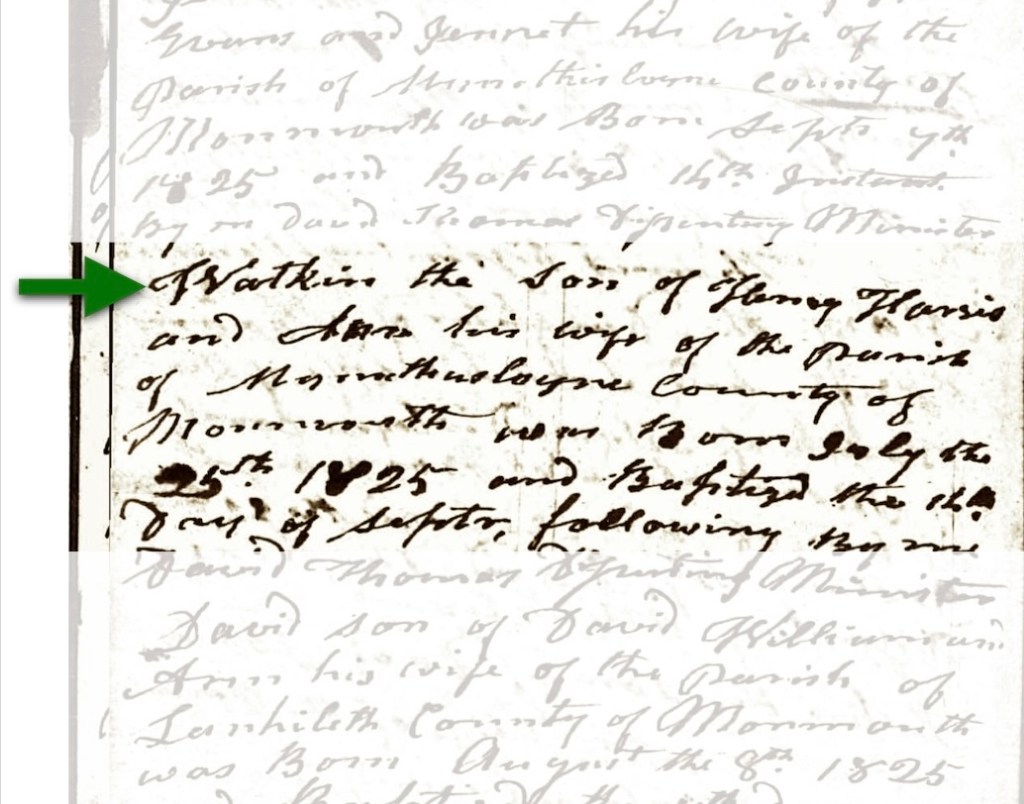
Mynyddyslwyn, Beulah Chapel (Baptist) Registry, in Monmouthshire, Wales.
Of these 5 children, Evan carries the family line forward, but his younger sister Sara also features very prominently in Chapter Eleven. She is fundamentally important for uniting future family lines.
Throughout his life, it became clear that Evan (and also his wife Hannah) were unclear on their exact ages, because the records vary somewhat. We have seen this same phenomena with many other family lines, when the ancestors lived in a pre-literate world. (2)
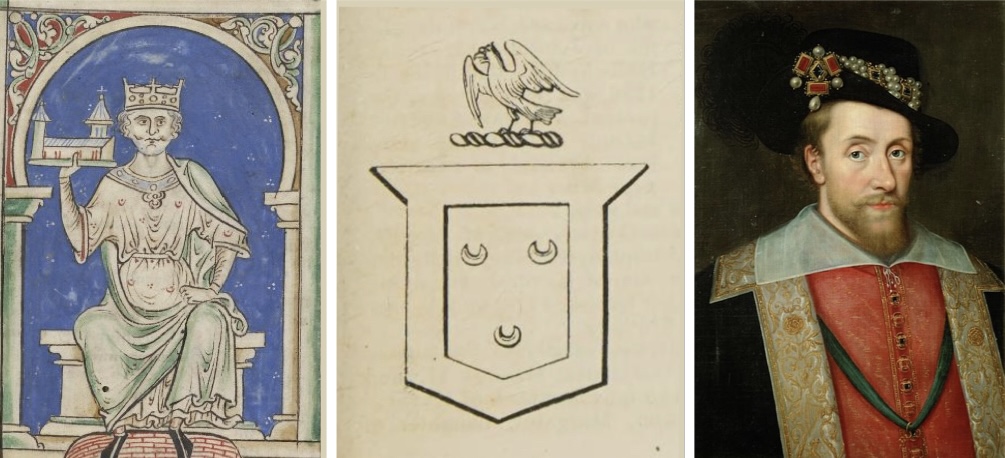
The Origins of the Surname Harris
“Harris is an English and Welsh patronymic [based on the name of the father] surname derived from the personal name Harry (a vernacular form of Henry) and the genitive ending –s. [Genitive indicates possession, or ownership]. The given name Henry itself was introduced to England as Henri by the Normans following the Conquest of 1066, and subsequently became widespread, giving rise to surnames such as Harris and Harrison… Harris is most common surname in South Wales.
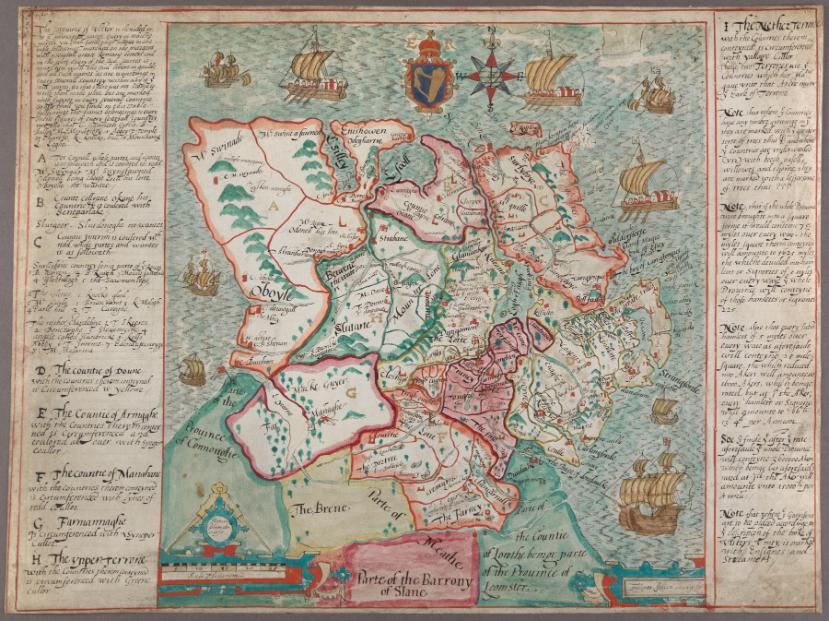
Gaelic lordships in Ulster, but also imposed England’s vision
for the creation of a new county system onto the provincial landscape.
(Image courtesy of Trinity College, Dublin)
The name Harris also found in Ireland, largely as a result of the Plantation of Ulster, though it may in some cases represent an anglicized form of the Gaelic name Ó hEarchadha.
The Plantation of Ulster was the organized colonization (‘plantation’) of the Irish province of Ulster by people from Great Britain in the early 17th century, during the reign of King James I. Most of it was on confiscated Irish land.” (Wikipedia, for all text) (3)
In the next chapter, the Harris family leaves the old ways of Europe behind, and heads across the Atlantic Ocean to create a new life in America.
Following are the footnotes for the Primary Source Materials,
Notes, and Observations
Yes, you are! No, we’re not!
(1) — six records
from https://picryl.com/media/the-royal-visit-jm-staniforth-70301f .
Picryl
Wales Before Parliament (political cartoon)
by JM Staniforth, circa 1899
https://picryl.com/media/wales-before-parliament-jm-staniforth-0b7998
Note: Public domain vintage political cartoon. “Dame Wales reads through a long list of desired laws and regulations for the benefit of Wales at Parliament.”
Monmouthshire (historic)
https://en.wikipedia.org/wiki/Monmouthshire_(historic)
Note: For the text, and for reference.
David Rumsey Map Collection
Monmouthshire County
Drawn by R. Creighton, and published by S. Lewis
https://www.davidrumsey.com/luna/servlet/detail/RUMSEY~8~1~337359~90105199:Monmouthshire-County
Note: From the Atlas to the Topographical Dictionaries of England and Wales published by S. Lewis and Co. in 1844.
Oakdale Village
History of Mynyddislwyn — Portrait of a Parish
https://web.archive.org/web/20081121034133/http://www.oakdalevillage.net/history5.html
Note: For the text.
ArtUK
St Tudor’s Church, Mynyddislwyn
by Obediah Hodges, circa 1923
https://artuk.org/discover/artworks/mynyddislwyn-church-153332
Note: For the painting of the church.
Let’s Meet Henry Harris & His Wife Ann ______
(2) — three records
Evan Harris
in the England & Wales, Non-Conformist and Non-Parochial Registers, 1567-1936
Rg4: Registers of Births, Marriages and Deaths > Monmouthshire > Independent > Piece 1246: Penmain (Independent), 1787-1833
https://www.ancestry.com/search/collections/2972/records/150167990
Digital page: 53/159, Right page.
Note 1: Note: For their birth dates and baptism records.
Note 2: Three records for sibling births and baptisms are recorded at the same time in this register — Evan 1802, William 1804, Henry 1807.
Sara Harris
in the England & Wales, Non-Conformist and Non-Parochial Registers, 1567-1936
Rg4: Registers of Births, Marriages and Deaths > Monmouthshire > Independent > Piece 1246: Penmain (Independent), 1787-1833
https://www.ancestry.com/search/collections/2972/records/168121?tid=11298446&pid=182338476831&ssrc=pt
Digital page: 90/159, Left page.
Note: For her 1817 birth date and baptism record.
Watkin Harris
in the England & Wales, Non-Conformist and Non-Parochial Registers, 1567-1936
Rg4: Registers of Births, Marriages and Deaths > Monmouthshire > Independent > Piece 1246: Penmain (Independent), 1787-1833
https://www.ancestry.com/search/collections/2972/records/169025?tid=11298446&pid=182338476830&ssrc=pt
Digital page: 118/159, Left page.
Note: For his 1825 birth date and baptism record.
Origins for the Surname Harris
(3) — seven records
Alamy
William the Conqueror, William I of England (circa 1028-1087). First Norman King of England (1066-1087), holding Battle Abbey, illuminated manuscript portrait painting
by Matthew Paris circa 1250-1259
https://www.alamy.com/william-the-conqueror-william-i-of-england-circa-1028-1087-first-norman-king-of-england-1066-1087-holding-battle-abbey-illuminated-manuscript-portrait-painting-by-matthew-paris-circa-1250-1259-image545386459.html
Note: For the portrait of William the Conqueror.
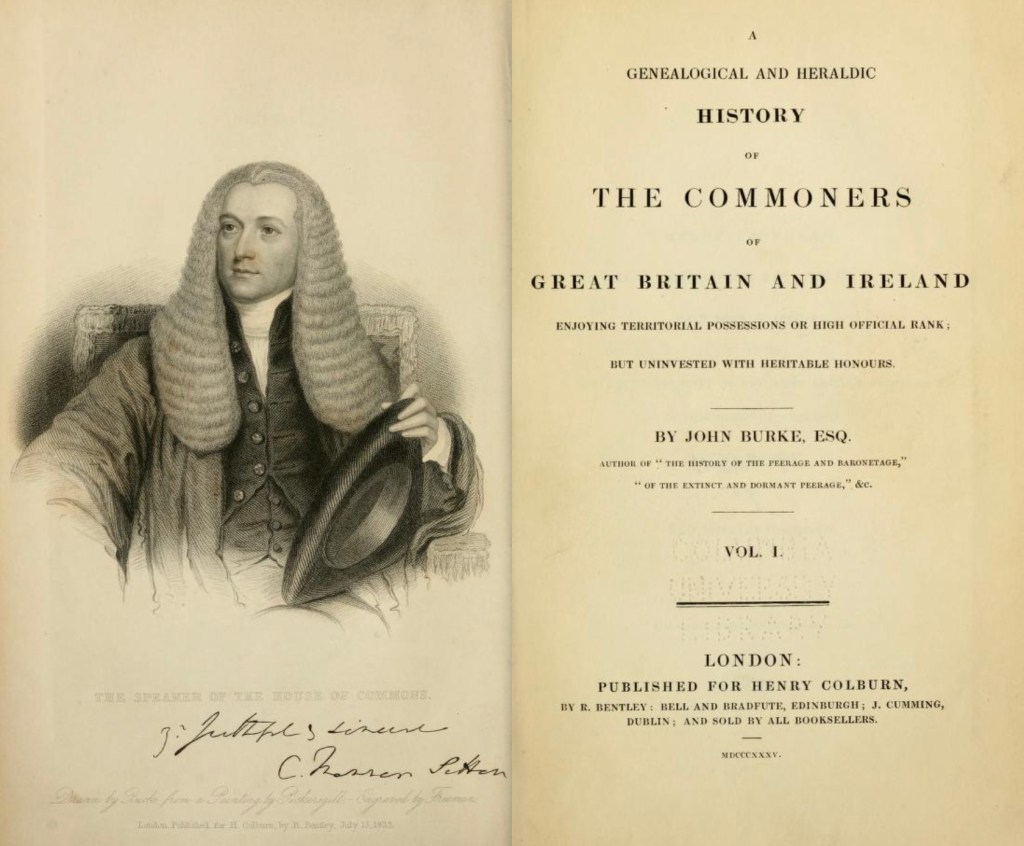
History of the Commoners of Great Britain and Ireland
by John Burke
https://archive.org/details/bwb_KU-314-176_1/page/558/mode/2up
Book page: 559, Digital page: 590/764
Note: For the Harris of Hayne coat-of-arms.
Painting of James VI and I Wearing the Jewel Called the Three Brothers in His Hat, circa 1605
by (after) John de Critz
https://commons.wikimedia.org/wiki/File:Portrait_of_James_I_of_England_wearing_the_jewel_called_the_Three_Brothers_in_his_hat.jpg
Note: For the portrait of James I.
Harris (surname)
https://en.wikipedia.org/wiki/Harris_(surname)
and
Plantation of Ulster
https://en.wikipedia.org/wiki/Plantation_of_Ulster
Trinity College Dublin
New exhibitions spotlight 400 years of Ireland in maps
News & Events
https://www.tcd.ie/news_events/articles/2025/the-island-of-ireland-in-maps/
Note: For the actual Ulster map image.
and
History Ireland
Visualising the Plantation: mapping the changing face of Ulster
https://historyireland.com/visualising-the-plantationmapping-the-changing-face-of-ulster/
Note: For the caption under the map image.


