The Williams / Harris Line, A Narrative — Six

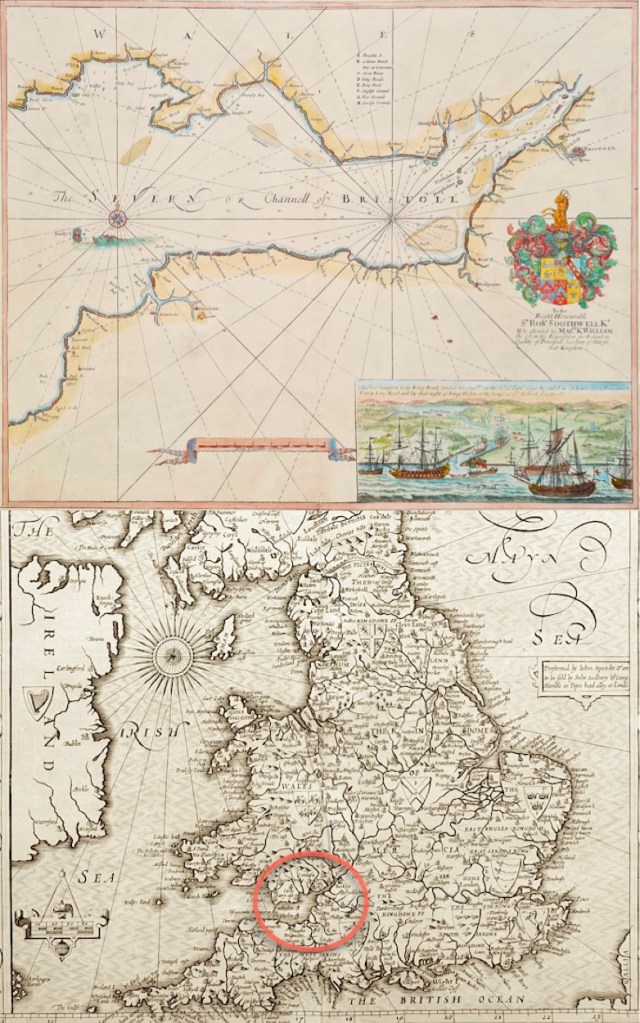
This is Chapter Six of twelve, where we wrap up the story of our (English) Willams ancestors who lived south of the Bristol Channel. In the next chapter, we begin another family history, but now we will be north of the Bristol Channel in Wales.

On repeat, on repeat, on repeat, on repeat…

In 1981, the American country band the Oak Ridge Boys had a massive #1 hit with their earworm* of a song called Elvira. When we learned of our ancestor Elvira Harris, that particular earworm turned on and hasn’t shut off yet. “In 1982, at the 24th Annual Grammy Awards, Elvira by the Oak Ridge Boys won the Grammy for Best Country Performance by a Duo or Group with Vocal.” (Wikipedia)
*It is our nominee for the Earworm Hall of Fame, (please see the footnotes).

Paris Township
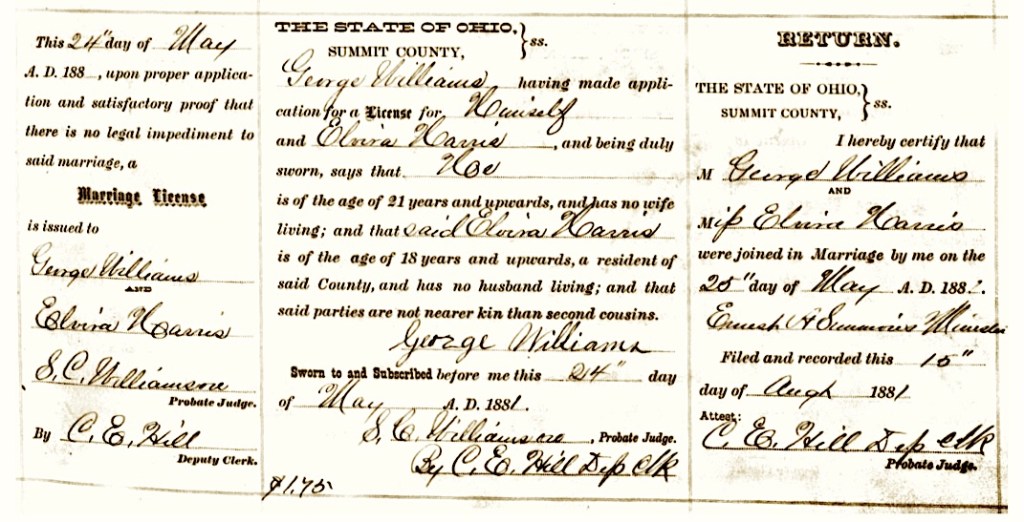
The Summit County, Ohio marriage record for
George Williams and Elvira Harris, for May 25, 1881.

In May 1881, George Williams married Elvira Harris in Cuyahoga Falls, Ohio. They settled, not in Summit County where he was from, but in Paris Township, Portage County which was the adjacent county just east. Elvira’s mother Ann (Thomas) Harris had been born and raised in Palmyra township, just below Paris Township. It’s quite plausible that they chose this area to settle in because there were other family members nearby who could helpful. With this marriage, the Harris name gave way to the Williams family name.
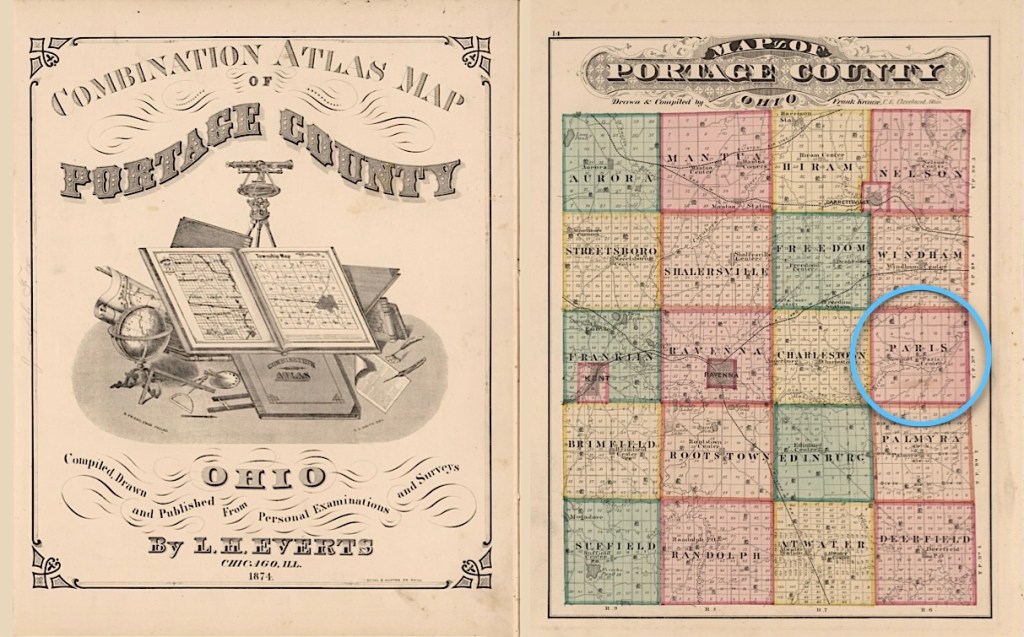
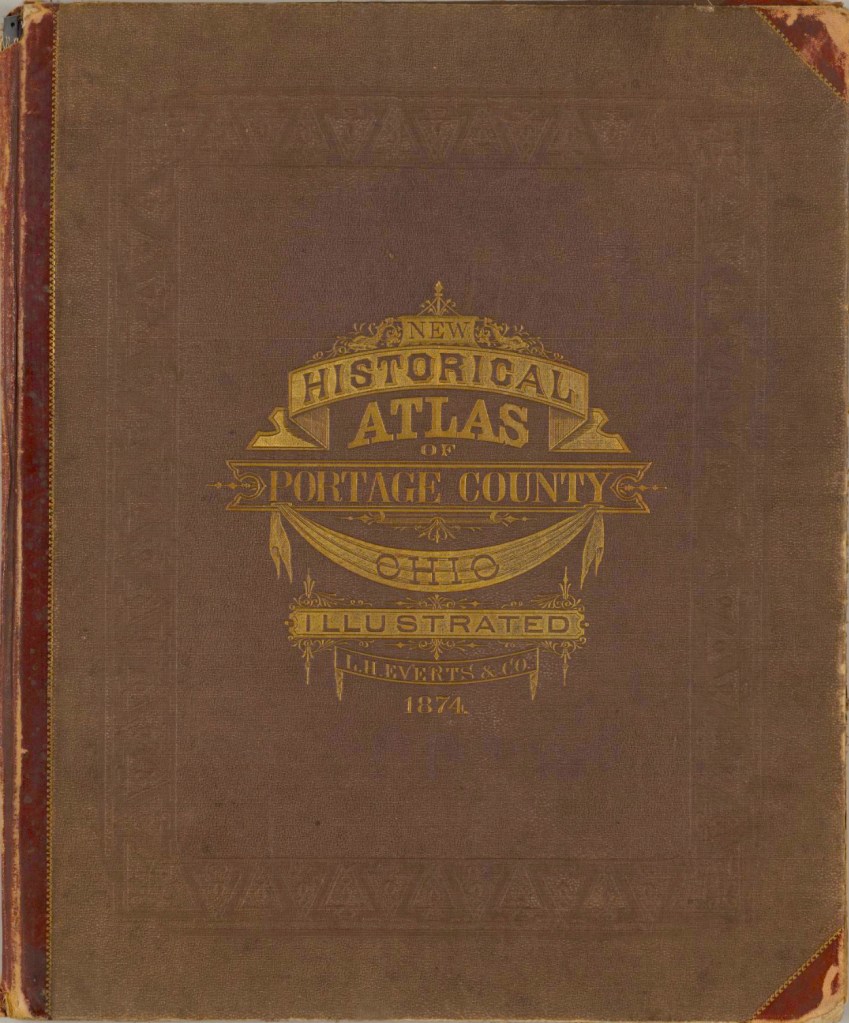
Frontispiece and Portage County map from the
Combination Atlas Map of Portage County, Ohio, by L.H. Everts, 1874.
(Image courtesy of David Rumsey Map Collection).
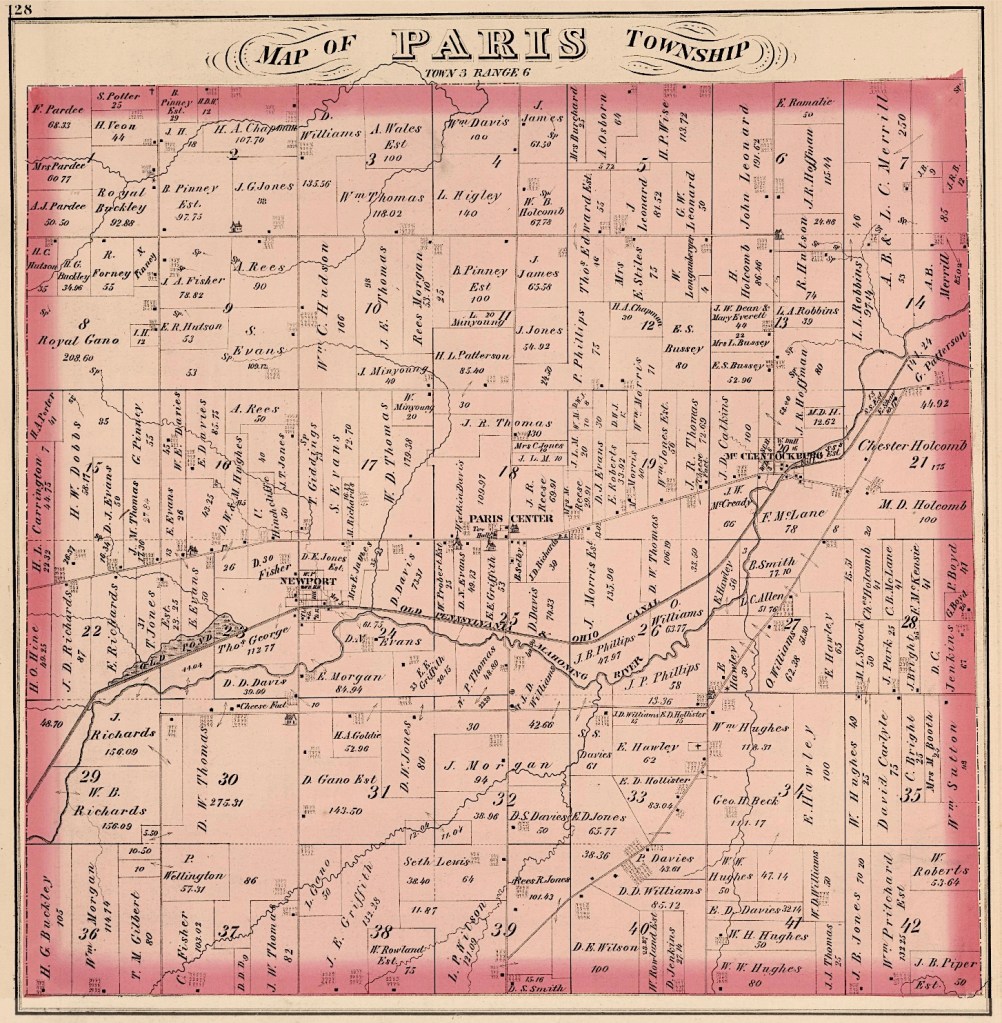
Page 128, Paris Township, Portage County, Ohio,
by L.H. Everts, 1874. (Image courtesy of David Rumsey Map Collection).

Wikipedia relates that “Paris Township was established around 1810. The community derives its name from Paris, New York.” Therefore, it is a very old community for that part of the United States. Additionally, it was intriguing to read that, “In the year of 1831 John Morgan arrived in the township from Wales and purchased part of Lot 32, erecting a log cabin thereon. From this beginning, other countrymen of Morgan’s came from time to time and it is said that by 1885, the population of Paris was two-thirds Welsh. Today a large number of these people have descendants in Paris.” (Portage Heritage)

Sadly, for this generation, we do not have any census information, because they married in 1881, and therefore are listed separately on the 1880 Census, (each in the home of their respective parents). The 1890 Census was lost…

Destruction of the 1890 Census by the Great Fire of 1921 at the Commerce Department Building
in Washington, D.C. (Image courtesy of Random Acts of Genealogical Kindness).

Due to a major fire in 1921, and the subsequent water damage, there are almost no 1890 Census records existing. “A January 10, 1921 fire at the U.S. Department of Commerce building in Washington, DC, destroyed the majority of the population schedules from the 1890 Census. The fire left an enormous gap in many families’ genealogical record. Although alternative records may provide some information, the loss of the 1890 Census schedules remains an insurmountable obstacle for many researchers attempting to trace families between the 1880 and 1900 censuses”. (Census.gov)

What this means for the history of George and Elvira Williams is that we do not know exactly where they lived in Paris Township, nor specifically what they did to earn a living. Everything we can know about them is mostly due to inference and educated guess work. What we do know is this:

It is probable that George worked in agriculture, and that Elvira was keeping house. On the 1880 Census, he is noted to be working as a teamster, which was a role that his father Daniel had been noted with ten years earlier on the 1870 Census. Google defines this occupation as, “In 19th-century agriculture, a teamster was a skilled worker who drove a team of draft animals—typically horses, mules, or oxen—to pull wagons, plows, or other farming equipment. They were essential to the rural economy, responsible for transporting heavy loads such as crops, timber, or supplies, and for breaking ground during planting season.”
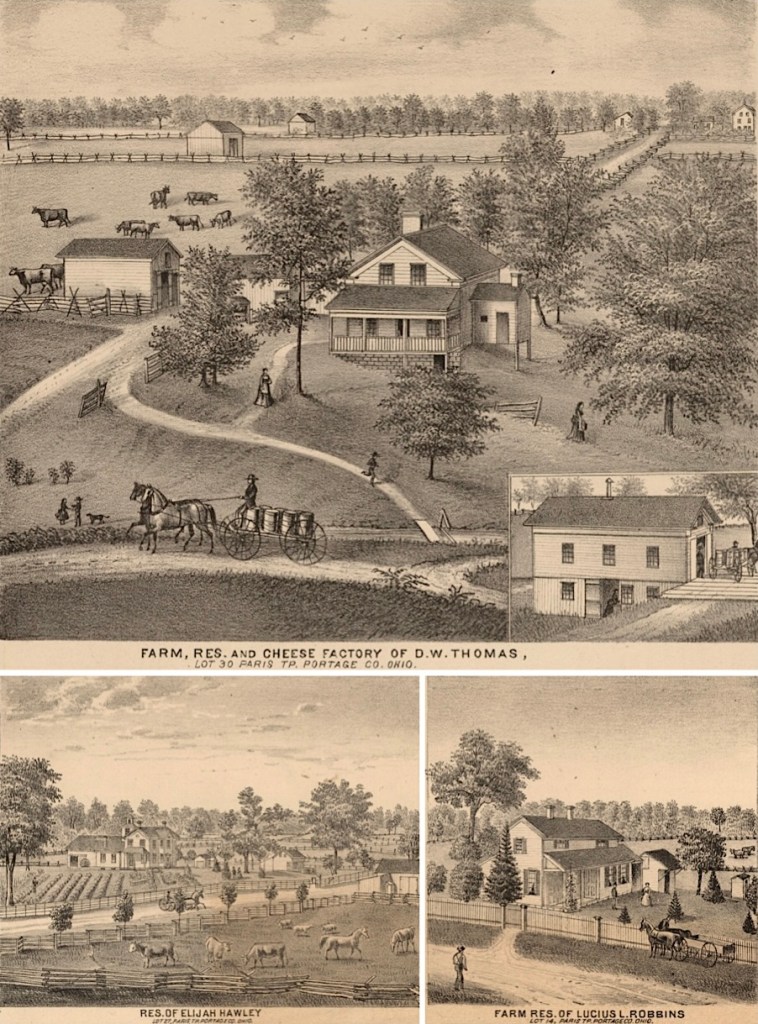
Artist’s renderings of some of the local homes and farms found in Paris Township in the 1874. From the Combination Atlas Map of Portage County, Ohio, by L.H. Everts, 1874.
(Image courtesy of David Rumsey Map Collection).

From the illustrations above, one can discern the well-kept farms, gardens, and pastures of the neighbors of George and Elvira Williams. It is interesting to see neither telephone poles, nor paved roads. In fact, the bucolic scenes look a bit idealized. The world was probably much quieter then… (2)

The Five Williams Children

George and Elvira had five children, their oldest Elmer was born about 11 months after they married — and then went on repeat (just like our familiar song). All of the children were born in Paris Township, Portage County, Ohio:

  • Elmer George Williams, April 3, 1882 – December 2, 1966
  • Berl G. Williams Sr., 1883-1965
  • May Williams, February 12, 1885 – May 31, 1898
  • Clyde Williams, November 1, 1886 – April 17, 1889
  • Benny H. Williams, August 20, 1888 – 1968.

Observation: It is refreshing to see that this generation has evolved the naming conventions of their children. We see (for then) modern, new names: Elmer, Bearl, May, Clyde, and Benny. So many generation prior to this one, fell into patterns where some names such as William and Henry, although nice enough, were used generation-after-generation-after-generation. Repetition seems to be a theme in this chapter?

Sadness came into their lives when son Clyde died at the age of about two and a half; a brief life for one so young. (3)

Of Unknown Causes

Neither Elvira, nor her husband George had long lives. Elvira died on October 12, 1889, of unknown causes. When she passed, this left her youngest child Benny at the age of 1 year, 1 month, and 22 days old. He was probably still nursing and just learning how to walk. Their father, George Williams, was now alone with five very young children to raise… However, he then also died not long after his wife, Elvira. George passed away on March 30, 1893, and son Benny was 4 years, 7 months, and 10 days old. We mention Benny because — somewhere in that time frame (between Elvira’s death and George’s death), Benny was adopted, and the trajectory of his life changed dramatically.

We have been pondering what happened to them? In another family line, from the same timeframe, we had some ancestors who were parents of a similar age and circumstance. — Those ancestors just disappeared, and very quickly. — It took us much time to figure out that they may have died in a Cholera epidemic in Cincinnati, but honestly, we could not concretely prove it. It is just that all signs pointed in that direction. In our present age, and due to the many advancements of medical science in the nearly 140 years since George and Elvira passed on, we are not used to thinking about the many real possibilities of that era. The article, There Were a Million Ways to Die In Old Cincinnati; Here Are 17, is very enlightening. (See the footnotes). (4)
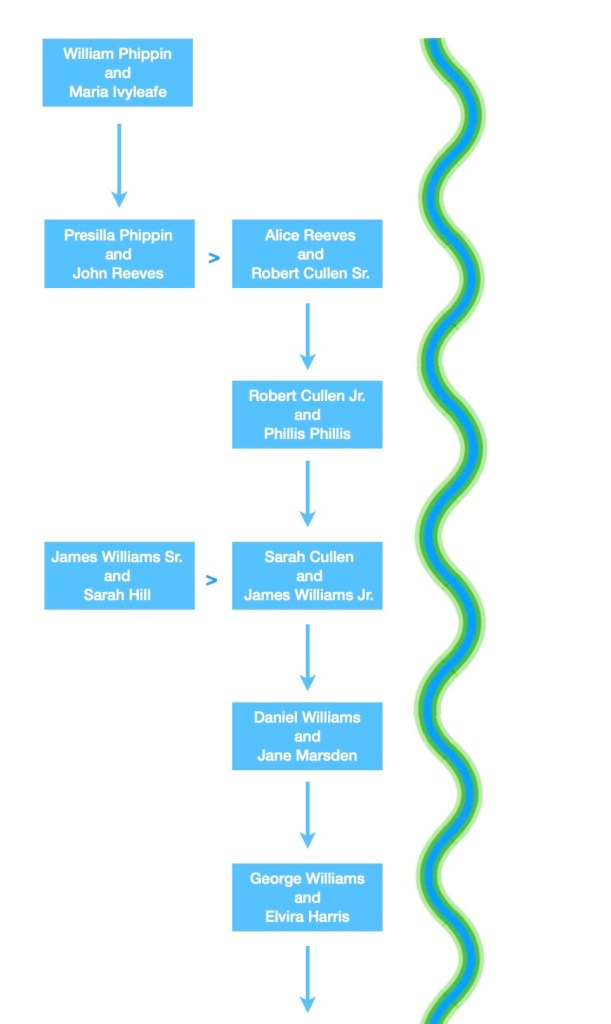
We include here a repeat of the Williams family pedigree flow chart, to review the progression of that family through time, before we transition to the history of the Harris family.

Going forward, we need to go back — back to Europe, and back in time. We are going to cross the Bristol Channel above Somerset, England, and venture into the country of Wales, to learn about the Thomas, and the Harris families.

Following are the footnotes for the Primary Source Materials,
Notes, and Observations

On repeat, on repeat, on repeat, on repeat…

(1) — two records (no pun intended)
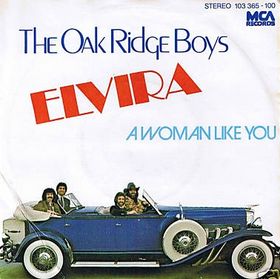
Slip jacket for the single version of Elvira by the Oak Ridge Boys, circa 1981.

Elvira (song)
https://en.wikipedia.org/wiki/Elvira_(song)
Note: For the reference and text.

John F. Kennedy Center for the Performing Arts
Your Brain on Music: Earworms
When songs get stuck… get stuck… get stuck… in our brains

https://www.kennedy-center.org/education/resources-for-educators/classroom-resources/media-and-interactives/media/music/your-brain-on-music/your-brain-on-music/your-brain-on-music-earworms/
Note: For the reference. “Usually an earworm is a fragment of music, usually three or four bars, which go round and round and round,” Dr. Oliver Sacks said in an interview. Dr. Sacks is a neurologist and author who studies music and the brain. “This is a special form of involuntary musical imagery which is out of control and can become…”

Paris Township

(2) — nine records

George Williams
in the Ohio, U.S., County Marriage Records, 1774-1993
Summit > 1881 – 1887
https://www.ancestry.com/search/collections/61378/records/1090220?tid=&pid=&queryId=c1702219-87e8-4a0a-9505-29336083f251&_phsrc=wzL1&_phstart=successSource
Book page: 21, Digital page: 51/495, Right page, last entry.
Note: Marriage record information, for May 25, 1881.
David Rumsey Map Collection
Paris Township, Portage County, Ohio
from the Combination Atlas Map of Portage County, Ohio
by L.H. Everts, 1874
https://www.davidrumsey.com/luna/servlet/detail/RUMSEY~8~1~230088~5508392:Paris-Township,-Portage-County,-Ohi
Book page: 128, Digital page: Follow the link above.
Note: For the 1874 Paris township map, the Atlas frontispiece, and the Portage County map.

Paris Township, Portage County, Ohio
https://en.wikipedia.org/wiki/Paris_Township,_Portage_County,_Ohio
Note: For the text.

Portage Heritage
by James B. Holm
https://archive.org/details/portageheritageh00holm/page/408/mode/2up
Book page: 409 – 415, Digital page: 412 – 419/832
Note: For the quote about Welsh settlers, found in Chapter XXXII, by Elizabeth Thomas.

Random Acts of Genealogical Kindness
Fate of the 1890 Population Census
https://raogk.org/census-records/1890-fire/
Note: For the image.

The United States Census Bureau
U.S. Census Bureau History: 1890 Census Fire, January 10, 1921
https://www.census.gov/history/www/homepage_archive/2021/january_2021.html#:~:text=A January 10, 1921 fire,in many families’ genealogical record.

Note: For the text.

Daniel Williams
in the 1870 United States Federal Census
Ohio > Summit > Tallmadge
https://www.ancestry.com/search/collections/7163/records/38420169
Book page: 10, Digital page: 10/32, Lines 1 through 8.
Note: On this census, George Williams is noted as at home, and his father is noted as a teamster.

Daniel Williams
in the 1880 United States Federal Census
Ohio > Summit > Tallmadge
https://www.ancestry.com/search/collections/6742/records/18590601
Book page: 18, Digital page: 18/30, Lines 24 through 30.
Note: George is 23 and noted as a teamster.

David Rumsey Map Collection
Views of Various Paris Township Homes
from the Combination Atlas Map of Portage County, Ohio
by L.H. Everts, 1874
https://www.davidrumsey.com/luna/servlet/view/search?search=Submit&cat=0&q=Combination+Atlas+Map+of+Portage+County%2C+Ohio&dateRangeStart=&dateRangeEnd=&sort=pub_list_no_initialsort%2Cpub_date%2Cpub_list_no%2Cseries_no
Book pages: 129-130, Digital page: Follow the link above.
Note: All 3 images follow after the Paris Township map page on 128.

The Five Williams Children

(3) — fourteen records

George Williams
in the U.S., Find a Grave Index, 1600s-Current
https://www.ancestry.com/search/collections/60525/records/102869707?tid=&pid=&queryId=4258b3af-1bc6-4dfe-a2cb-04a03c42166b&_phsrc=lFv3&_phstart=successSource
and
George Williams
https://www.findagrave.com/memorial/12416396/george-williams
Note 1: His gravestone indicates these dates, August 5, 1856 – March 30, 1893.
Note 2: The citations from the Akron City Directories (found here) are in error, since these records are for other men named George Williams, and not the man who is from our family. We believe that our ancestor likely worked in agriculture in Paris Township, Portage County, Ohio.

Elvira Williams
in the U.S., Find a Grave Index, 1600s-Current
https://www.ancestry.com/search/collections/60525/records/102869719
and
https://www.findagrave.com/memorial/12416409/elvira-williams
Note: Her gravestone indicates these dates, February 16, 1863 – October 12, 1889.

Elmer George Williams
https://www.findagrave.com/memorial/12416370/elmer-george-williams
Note: His birth and death dates are, April 3, 1882 – December 2, 1966. From 1955 to 1965, he lived at this address: Elmer G. Williams, (Rose J.), home – 2124 4th St., (Cuyahoga Falls, Ohio). Rose was his wife and is interred near him.
and
Elmer D. Williams [the middle initial should be G., not D]
in the Ohio, U.S., Births and Christenings Index, 1774-1973
https://www.ancestry.com/search/collections/2541/records/1383300
Note: For Elmer’s birth confirmation.

Berl G. Williams Sr.
https://www.findagrave.com/memorial/12416382/bearl-g-williams
Note: 1883 – 1965
and
Berl Williams
in the Ohio, U.S., Births and Christenings Index, 1774-1973
https://www.ancestry.com/search/collections/2541/records/1388862
Note: For Berl’s birth confirmation.

May Williams
https://www.findagrave.com/memorial/42507751/may-williams
Note 1: Her birth and death dates are February 12, 1885 – May 31, 1898
Note 2: She was born as Dora Mable Williams, as shown below.
and
Dora Mable Williams
in the Ohio, U.S., Births and Christenings Index, 1774-1973
https://www.ancestry.com/search/collections/2541/records/4429523
Note: For Dora Mable’s birth confirmation.

Clyde Williams
https://www.findagrave.com/memorial/42507745/clyde-williams
Note: His birth and death dates are, November 1, 1886 – April 17, 1889
and
Clyde Williams
in the Ohio, U.S., Births and Christenings Index, 1774-1973
https://www.ancestry.com/search/collections/2541/records/1408501
Note: For Clyde’s birth confirmation.

Benny H. Williams
in the Ohio, U.S., Births and Christenings Index, 1774-1973
https://www.ancestry.com/search/collections/2541/records/1420081?tid=&pid=&queryId=27150e26-be10-4ea3-890f-0c782158bbd3&_phsrc=abx23&_phstart=successSource
and
Benny H. Williams
in the Ohio, U.S., Births and Christenings Index, 1774-1973
https://www.ancestry.com/search/collections/2541/records/1420081
Note: For Benny’s birth confirmation on August 20, 1888.

Of Unknown Causes

(4) — two records
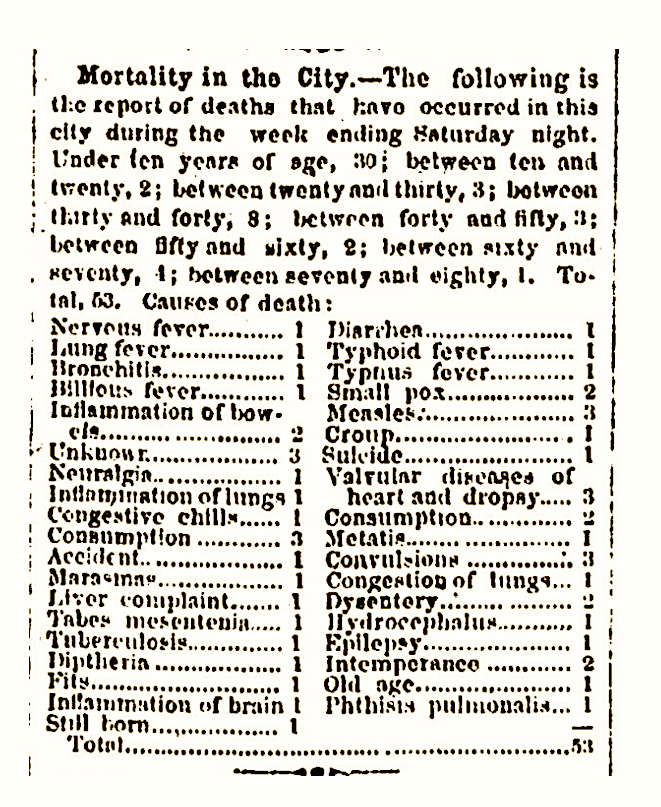
 A single week registered 53 deaths in Cincinnati in 1866, with two-thirds being children under 10 years of age. (Image and text extracted from the Cincinnati Magazine article linked below).

Cincinnati Magazine
There Were a Million Ways to Die In Old Cincinnati; Here Are 17
by Greg Hand
https://www.cincinnatimagazine.com/article/there-were-a-million-ways-to-die-in-old-cincinnati-here-are-17/

George Williams
in the Summit County, Ohio, U.S., Death Records, 1866-1908
Death Index Registers, 1869-1908 > S – Z
https://www.ancestry.com/search/collections/1596/records/35519?tid=&pid=&queryId=d1703b33-a6b4-4864-8c19-e310261b6ffe&_phsrc=Lzl1&_phstart=successSource
Book page: 94, Digital page: 150/156, 12th and 16th entries.
Notes: Something odd about the dates on this file — why are there 2 entries for the same person? It appears that first entry for his death date is March 30, 1893, and the second entry is the same person, but uses a date of one year later, March 30, 1894. His gravestone records the 1893 date.
The Williams / Harris Line, A Narrative — Five

This is Chapter Five of twelve, and we follow the Williams families as they begin their new lives in America. From New York they make their way west to the farm fields of Ohio.

Setting New Horizons

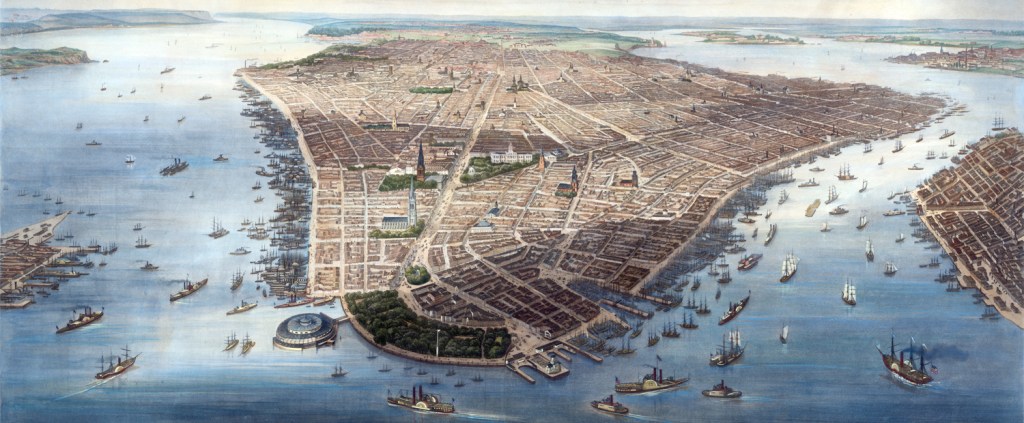
“Beginning in the mid-19th century, waves of new immigrants arrived from Europe, dramatically changing the composition of the city and serving as workers in the expanding industries. Throughout its history, New York has served as a main port of entry for many immigrants, and its cultural and economic influence has made it one of the most important urban areas in the United States and the world.” (Wikipedia)

Illustration of the City of New York — 1851, by Wilhelm Heine.
(Image courtesy of Geographic Guide, Old New York, 19th Century).

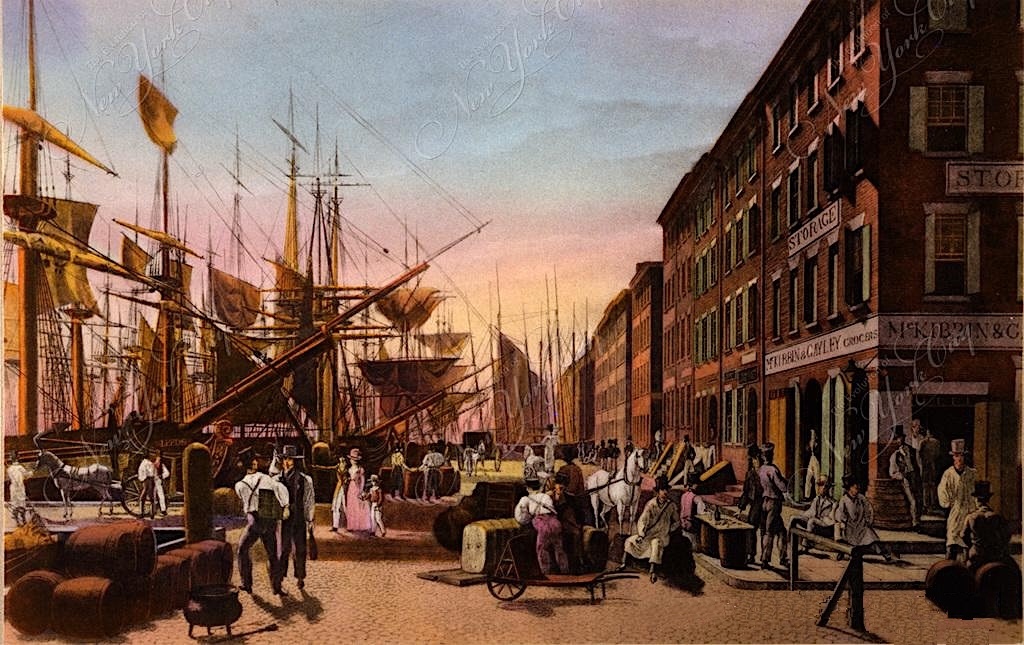
This aerial view of Manhattan in 1850 is remarkable not only for the number of ships that are shown in the harbor, but also, because there were no large bridges spanning the waterways. The famous immigration processing centers had not opened yet — Castle Garden (1855) and Ellis Island (1892) — so the Henry Williams family arrived at one of these many piers.

1850: Busy Scene at The South Street Seaport, by A.R. Waud. (Image courtesy of History101.nyc).

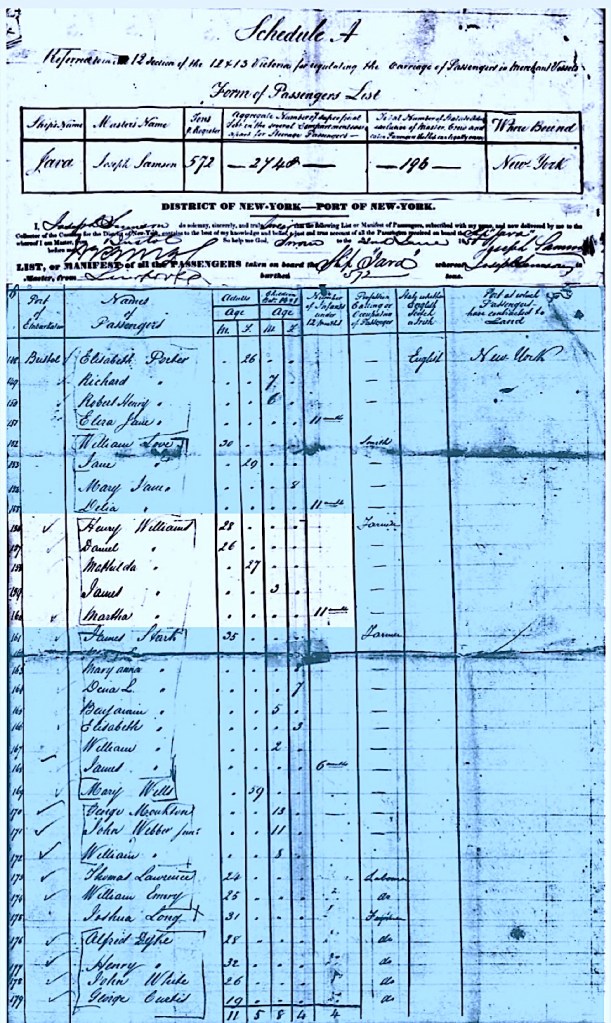
On the actual manifest below, we can see that Daniel Williams is traveling with his brother Henry Williams, and Henry’s wife Mathilda and their children. Note that the son James is only three and the baby Martha is just 11 months old. We comment on that, because we know that the trip must have been challenging for all of them. In that decade, steamships were starting to come to replace sail driven ships, but passage cost much more. Since the Williams family (generally speaking) was not known for having a lot of resources, it is certain that they traveled in steerage, as the manifest shows. The trip would have taken about 4-6 weeks.

The Daniel Williams family as shown on the passenger manifest
for the ship Java, on June 22, 1850 in New York harbor. (See footnotes).

When the Williams family departed England, they sailed from the nearby city of Bristol, as the ship manifest clearly states, (see Port of Embarkation). Bristol and Liverpool were the primary ports where ships sailed from Great Britain to North America, but eventually Liverpool surpassed Bristol in sheer numbers. This ship, which was named Java, and it was likely registered in Liverpool, as the ship’s master was from there also.

We have spent much time trying to ascertain the exact history of this ship, but have not been able to discover her origins. There were at least four other ships with the same name, but two were lost at sea before 1850, and the other two were exclusively chartered for other uses, (such as prisoner and troop transport to Australia). A key determinant for finding this ship is not the actual name, but its tonnage. In this case, it was 572 tons, which is not a very big ship. It is quite possible that this ship, while named Java, was eventually renamed and the records have simply been absorbed into the shadows of history. (1)

Daniel Willams Marries Jane Marsden

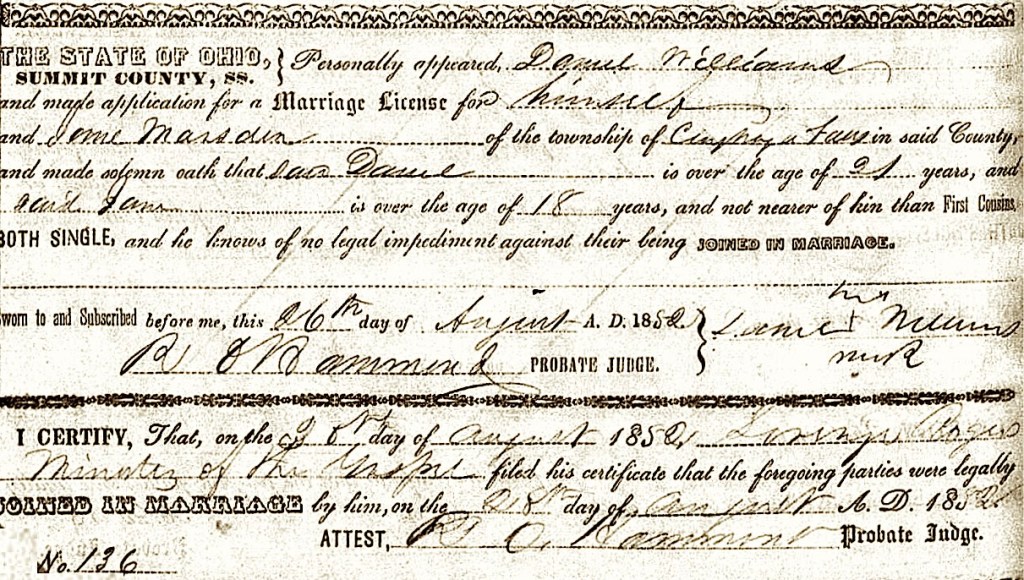
The next place that records appear for Daniel Williams is far away from the ports of Manhattan, and in the southern portion of the Connecticut Western Reserve of Ohio. Specifically, he is found in Cuyahoga Falls, Summit County, Ohio when he marries Jane Marsden.

It was about two years between his arrival as an English immigrant to being a married man in northeast Ohio. He, his brother Henry, and Henry’s family all likely came to Ohio via the railroads, which were being built across the country on a massive scale at that point in time. So, the pace of life was speeding up by mid-century. Certainly, it was faster than it had been in sleepy Somerset.

Cuyahoga Falls township, Ohio, Summit County Marriage Record
for the wedding of Daniel Williams and Jane Marsden, on August 28, 1852.

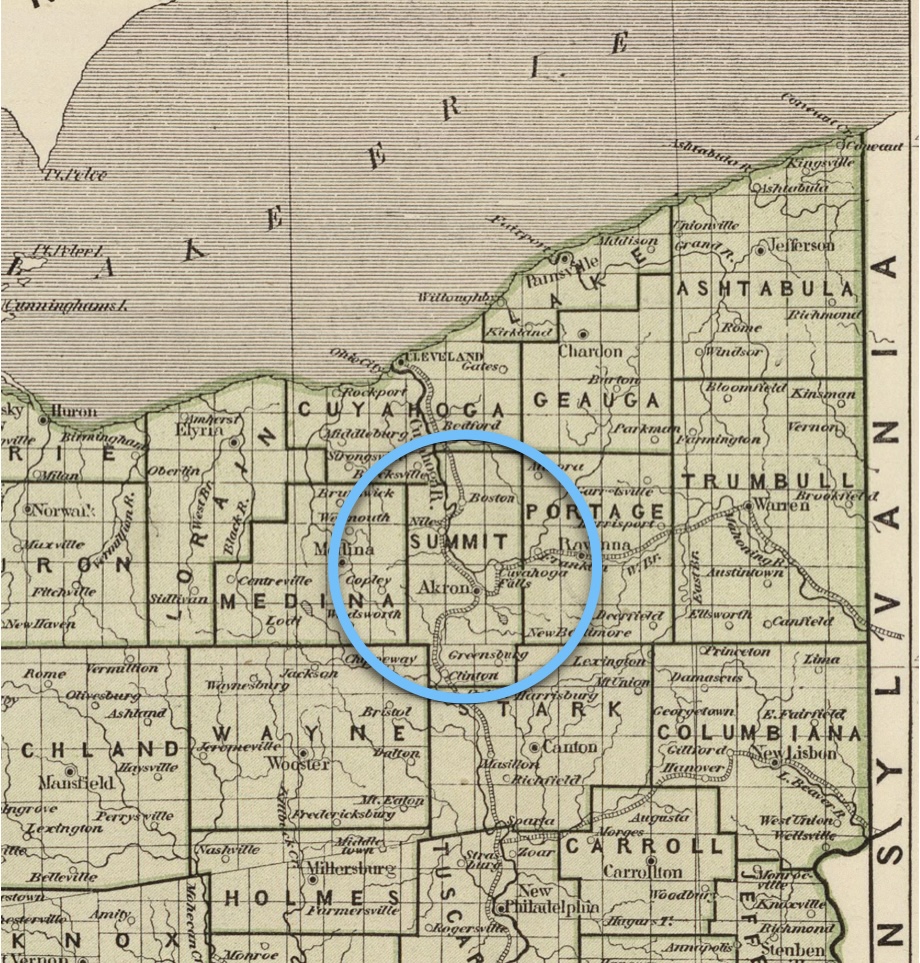
We do not know how Daniel and Jane met. In fact, not much information has turned up thus far on her life before they met. All that we know about her background is that she was noted on the 1850 US Census as being born in England. At 19, she is living in the home of David Thomas and his family, who are from Wales. They reside in the town of Chippewa, Wayne County, which is southwest of Summit County.

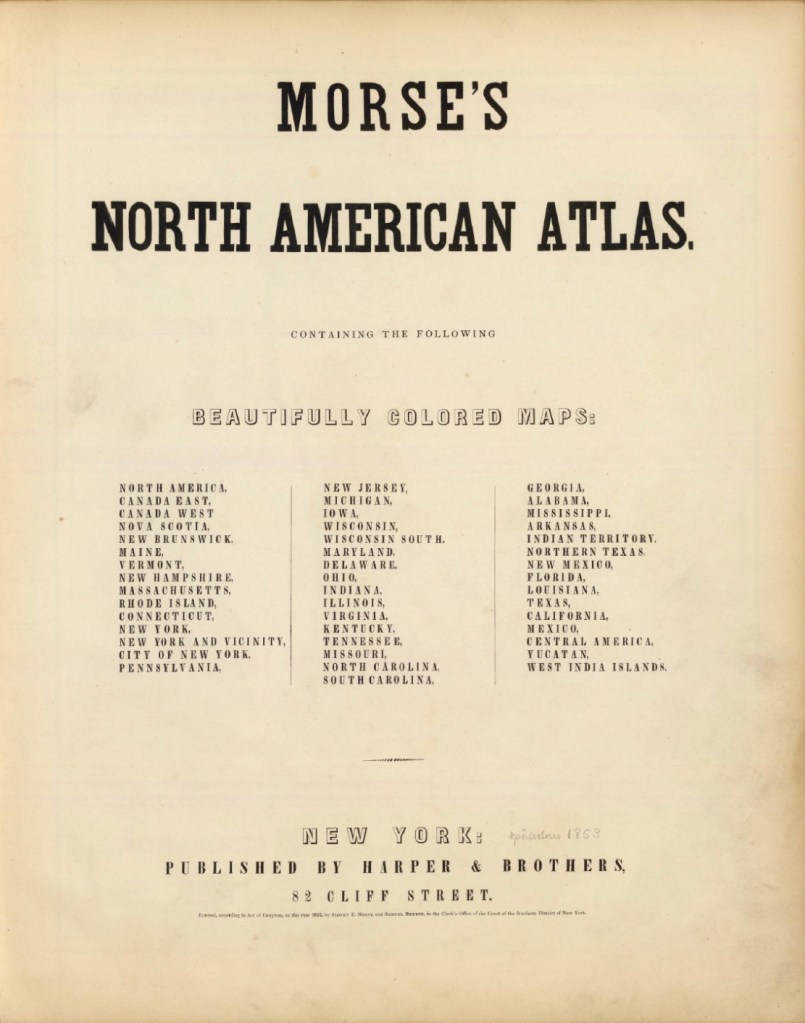
Enlarged detail from Ohio, as originally published in Morse’s North American Atlas, 1842. If you look closely at the center of the blue circle, you can see the town of Cuyahoga Falls, where Daniel and Jane were married. (Image courtesy of the David Rumsey Map Collection).

Since we know where Jane Marsden was for the 1850 Census, we have wondered if Daniel was also recorded on an 1850 US Census, but we have not yet located a record for this. That census was conducted in Tallmadge in September 1850. He arrived in the port of New York on June 22, and his immediate family members, with whom he had traveled, were counted in the Tallmadge Census. So somehow he fell through the cracks when it came to being counted in September.

Since we know much about the new country and community they lived within, let’s learn a bit about Tallmadge, Ohio. (2)

Tallmadge Township

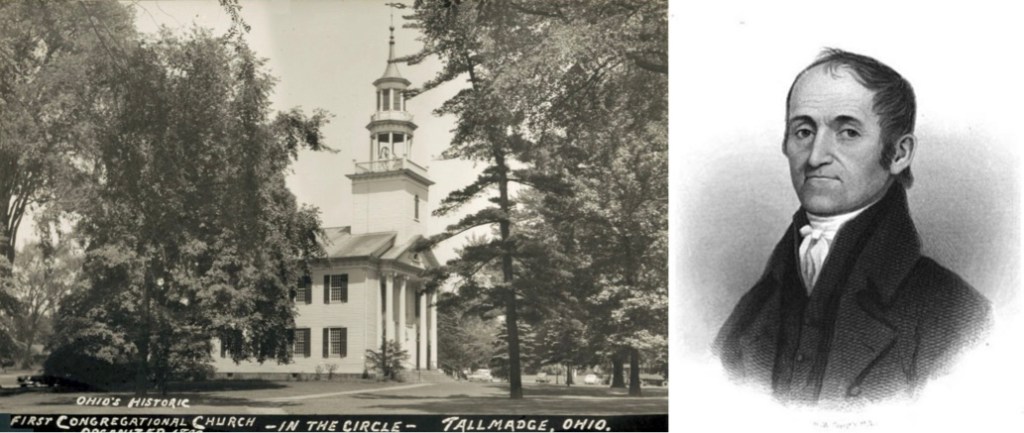
“Tallmadge was founded in 1807 by Reverend David Bacon and is the second-oldest city in Summit County. Before its founding, the town was a part of the Connecticut Western Reserve, a three million acre plot of land in northeast Ohio. The town was named after Benjamin Tallmadge, an American Revolutionary War figure and local landowner. Prior to being named, Tallmadge was a part of Town 2, Range 10 in the Western Reserve.” (The Tallmadge Historical Society)

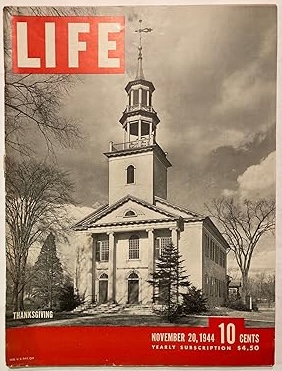
“At the center of the town is the Historic Tallmadge Church (built in 1825), recognized as a historic place by the Ohio Historical Society, and was featured on the cover of the November 20, 1944, edition of Life magazine. An intersection surrounds the church and a small park, the Tallmadge Circle Park, on which the church sits.” (Wikipedia) If you look closely at the township map below, you can observe that before the center of town became a circle, it was a square, similar to many that would have been known to the New England founders of the town. (3)

Left: The famous First Congregational Church of Tallmadge. At right: Portrait of the Reverend David Bacon. (Both images courtesy of the Tallmadge Historical Society).
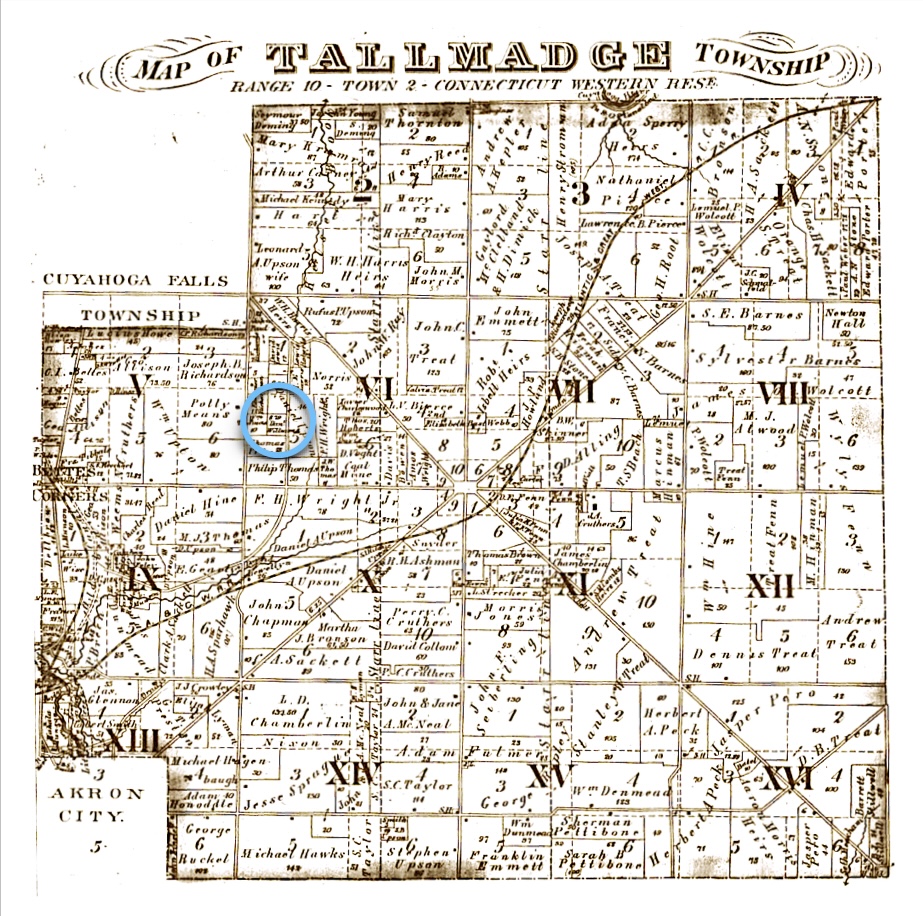
1874 Tallmadge Township map showing property locations. The blue circle indicates where the Daniel Williams family had their farm. Note: This location is important because it is adjacent to the coal mines written about in Chapter 8.

Daniel Was a Farmer at Heart

After they had settled in Summit County, we have found nearly 40 years of census data which tells us much about the family. We did observe that Daniel was either guessing his age on some future censuses, or whoever answered the door was trying to puzzle things out, (or perhaps both things!)

Daniel spent his life as he had when a young man in England, working on agricultural endeavors. Two censuses list him as a farmer, and one lists him as a teamster. In that period of time, when you were identified as a teamster, this meant that you were a person who drove a team of draft animals, usually a wagon drawn by oxen, horses, or mules.

Together, Daniel and Jane had 10 children. We have discovered those following, but our list may not be complete, (see footnotes).

  • Mary (Williams) Gehring, 1853 – 1893
  • John H. Williams, 1855 (born & died)
  • George Williams, 1856 – 1893, George carries the family line forward.
  • Sarah Ann (Williams) Hinman, 1859 – 1935
  • Albert Williams, circa 1862 – 1916
  • Samuel Williams, 1863 – 1879
  • Henry Williams, 1866 – 1868
  • Frank Williams, 1868 – 1874
  • Emma Jane Williams, 1871 – 1948
  • Walter Williams, 1875 – 1941

Even though Daniel was a farmer at heart, many of the people in his community chose to follow another profession, familiar from the old England and Welsh landscapes… (4)

Seeking What They Know

During these decades that they lived in Summit County, we have been thinking a lot about ‘what was it?’ that attracted the Williams family there in the first place. We believe that they must have known other families in the area. If you recall, Jane Marsden initially lived in a nearby county that had many immigrants from Wales already residing there. The Williams family was from Somerset, just across the Severn, or the Bristol Channel from Wales, so it makes much sense that English and Welsh people from the United Kingdom would settle near each other. Even to this day, immigrant communities seek what they know when venturing into a new land.

This period was one of great change across the midwestern United States. Northeast Ohio was a very important part of the (figurative) Underground Railroad during the Civil War. But the literal railroads were also criss-crossing the countryside enabling farm products to reach markets much more quickly, and these railroads needed fuel to run. Thus, they needed coal.

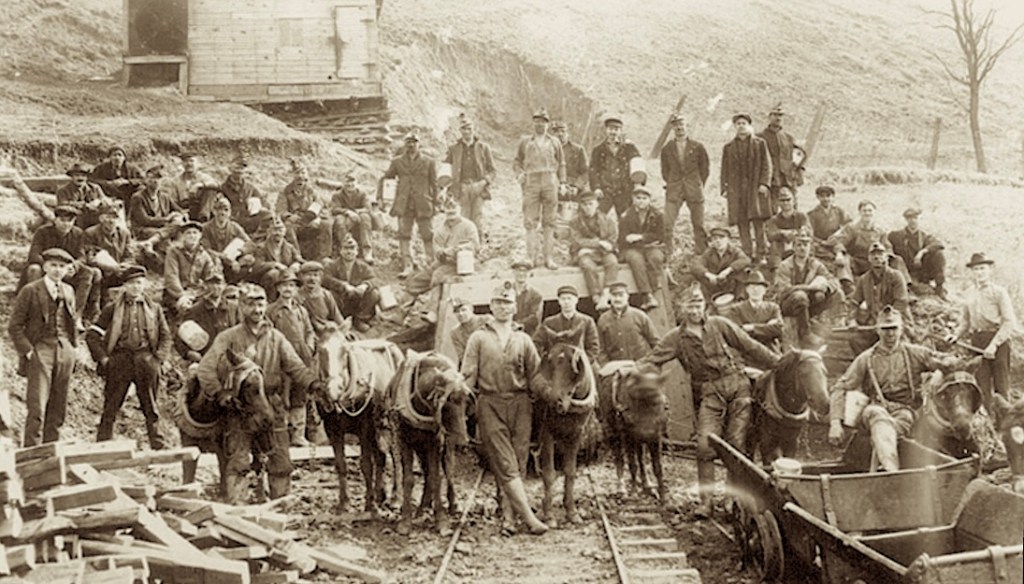
Mules, horses, oxen, goats, and dogs were used to haul coal in Ohio coal mines in the 19th and 20th centuries. (Image courtesy of Ohio Geology, the History of Coal Mining in Ohio).

This caught our eye, “Had it not been for the discovery of coal in Tallmadge and the resultant need for men to work those mines, it is unlikely that the Welsh community that became a viable part of the township would have grown to the size that it did. Even though many of the Welshmen who came to Tallmadge were, by most accounts, actually shoemakers, butchers, tailors, farmers, and blacksmiths, they were drawn to mine work because it was the only thing available at the time that would pay them in cash money. Many families came into the area, worked the mines in order to save a nest egg, and then moved on only to be replaced by others seeking to do the same.” (A History of Tallmadge Coal…)

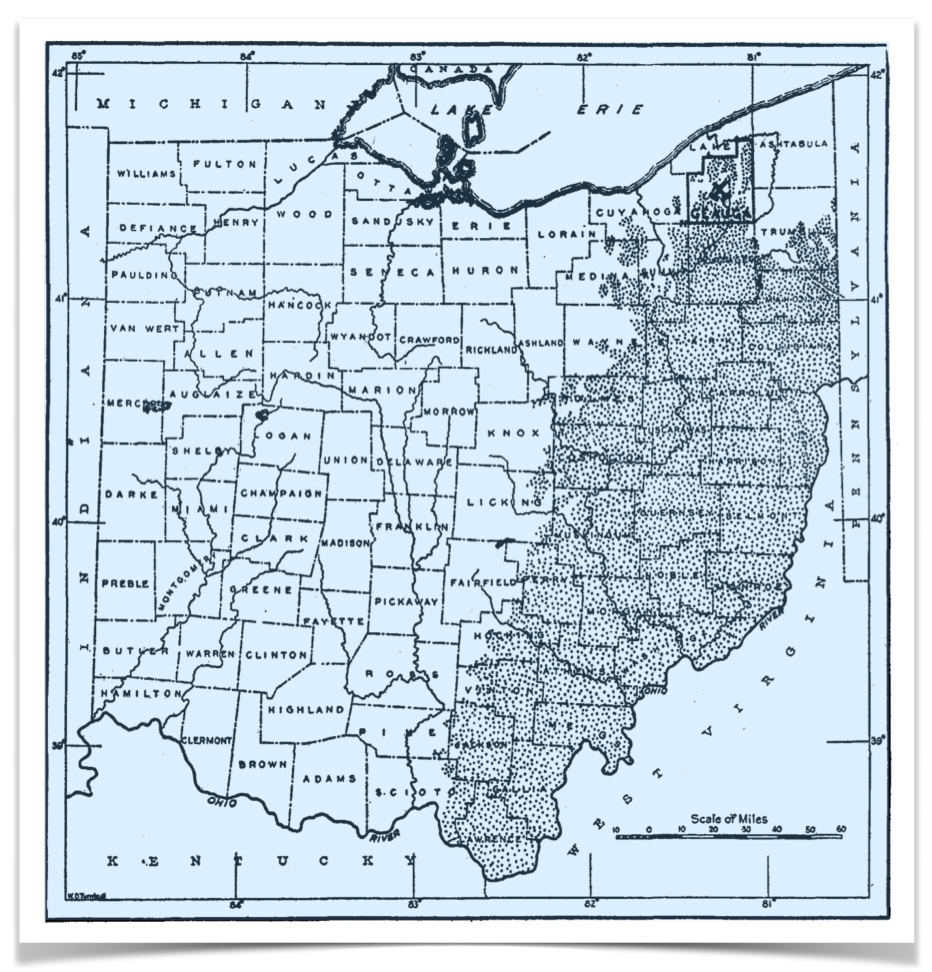
This map circa 1944 from The Ohio Journal of Science shows the distribution of the
Pennsylvanian and Permian Systems across Ohio counties, i.e. the Coal Measures.
This includes the Zeil Pfouts farm, marked at the top by a small x.
(Image courtesy of The History of Ohio’s Northernmost Coal Mine, by Myron T. Sturgeon, 1944).

In our modern era, we have moved away from using coal to obtain energy, hence it is not top of mind anymore — but previous generations used a lot of it. Interestingly, it came right up to our doorways from where we grew up as children. “The Zeil Pfouts farm, located 2.7 miles northwest of Burton Village in Geauga County, Ohio, is similar in appearance to many of the well kept farms in that vicinity. The Pfouts farm, however, has one distinction that is shared with no other farm in the vicinity for miles around; for between 40 and 60 years ago coal was mined from beneath its acres. This mine was unique in that it was the farthest north of any coal mine ever operated in Ohio.”

Artist’s conception of a Permian Age forest. (Image courtesy of SciTech Daily).

So work in mines, or work in agriculture, and familiarity with English and Welsh families is most likely what brought the Williams family to Northeast Ohio. We just didn’t think that we would need to go back to the Pennsylvanian and Permian Ages to truly understand this. (5)

The second generation in America is the son George Williams. It is at this point that a fundamentally important event happened with their lives, which ultimately affected the Williams / Harris family connection.

Following are the footnotes for the Primary Source Materials,
Notes, and Observations

Setting New Horizons

(1) — five records

History of New York City
https://en.wikipedia.org/wiki/History_of_New_York_City
Note: For the text.

Geographic Guide
Old New York, 19th Century
Illustration of the City of New York — 1851
by Wilhelm Heine
https://www.geographicguide.com/united-states/nyc/antique/19th-century/ny-19th-century.htm
Note: For the panoramic harbor scene.

Immigrant Processing Centers for New York City
https://www.genealogybranches.com/ellisisland/#:~:text=August%203%2C%201855%20%2D%20April%2018,1900%20%2D%20July%201924:%20Ellis%20Island
Note: For the data.

History101.nyc
1850: Busy Scene at The South Street Seaport
by A.R. Waud
https://www.history101.nyc/busy-wharf-scene-at-south-street-seaport-1850
Note: This is a restored image by Fine Print Design Studio, from original artwork which is not available online.

Mathilda Williams
in the New York, U.S., Arriving Passenger and Crew Lists (including Castle Garden and Ellis Island), 1820-1957
Date > 1850 > June > 22 > Java
https://www.ancestry.com/search/collections/7488/records/1023754579
Digital page: 6/8, Entries 156 through 160.
Note 1: Ship manifest for Daniel’s immigration passage from England to the United States on June 22, 1850. He is traveling with the family of his older brother Henry Williams and Henry’s wife Mathilda.
Note 2: The ship’s master is from Liverpool. The actual record details the original embarkation point as Bristol, England, not Liverpool, England as the Ancestry record indicates.

Daniel Willams Marries Jane Marsden

(2) — five records

Daniel Williams
in the Ohio, U.S., County Marriage Records, 1774-1993
Summit > 1849 – 1861
https://www.ancestry.com/search/collections/61378/records/3987653
Book page: 288, Digital; page: 158/577, Left page, bottom.
Notes: Their August 28, 1852, marriage license and certificate. His wife is named Jane Marsden.
Jane Marsden
in the 1850 United States Federal Census
Ohio > Wayne > Chippewa
https://www.ancestry.com/search/collections/8054/records/16019445
Digital page: 48/63, Line 17.
Note: For the data. At 19, she is living in the home of David Thomas and his family, who are from Wales.

David Rumsey Map Collection
Ohio
by Samuel Breese and Sidney E. Morse, 1842
https://www.davidrumsey.com/luna/servlet/detail/RUMSEY~8~1~21740~660104
Note: For the map image, as originally published in Morse’s North American Atlas, 1842.

The National Archives
1850 Census Records
https://www.archives.gov/research/census/1850
Note: For the data.

Henry Williams
in the 1850 United States Federal Census
Ohio > Summit > Tallmadge
https://www.ancestry.com/search/collections/8054/records/19600983?tid=113814444&pid=320147487152&ssrc=pt
Note: For the 1850 Census data.

Tallmadge Township

(3) — four records

Tallmadge, Ohio
https://en.wikipedia.org/wiki/Tallmadge,_Ohio

Tallmadge Historical Society
Records > Photos

https://www.tallmadgehistory.com/tallmadge-historical-society-records
Note: For the images of David Bacon and The First Congregational church.

Daniel Williams
in the U.S., Indexed County Land Ownership Maps, 1860-1918
Ohio > Summit, 1874
https://www.ancestry.com/search/collections/1127/records/3962098
Note: For the township image.

The cover for the November 20, 1944, edition of Life magazine.
(Image courtesy of Abe Books, at https://www.abebooks.com/magazines-periodicals/LIFE-Magazine-November-20-1944-Time/31081870142/bd).

Daniel Was a Farmer at Heart

(4) — ten records

Daniel Williams
in the U.S., Find A Grave Index, 1600s-Current
https://www.ancestry.com/search/collections/60525/records/130014389
and
Daniel Williams
https://www.findagrave.com/memorial/158271603/daniel-williams
Note: This file has these dates February 15, 1825 — September 3, 1896, for his lifetime.

Jane Williams
in the U.S., Find A Grave Index, 1600s-Current https://www.ancestry.com/search/collections/60525/records/130014767and
and
Jane Marsden Williams
in the U.S., Find A Grave Index, 1600s-Current
https://www.findagrave.com/memorial/158272097/jane-williams
Note 1: This file has these dates February 10, 1831 — February 16, 1890, for her lifetime.
Note 2: The online death certificate for their daughter, Sarah Hinman, indicates both parents were born in England. Burial location and dates for Jane came from Ohio Genealogy Express web site. The O.G.E. information listed her maiden name as Marsden, which agrees with Sarah’s death certificate.
Tallmadge Cemetery, Summit County, Ohio
https://www.findagrave.com/cemetery/269913/tallmadge-cemetery
Note: In this chapter, we compiled and amended our list of their children sourcing from the Find-a-Grave files (just above), others as noted below, and analysis of the Williams family graves found in the Tallmadge Cemetery.
Albert Williams
https://www.findagrave.com/memorial/177297763/albert-williams
Note: For his birth and death dates.

Walter Williams
https://www.findagrave.com/memorial/11900980/walter-williams
Note: For his birth and death dates.

Daniel Williams
in the 1860 United States Federal Census
Ohio > Summit > Tallmadge
https://www.ancestry.com/search/collections/7667/records/42151587
Book page: 82, Digital page: 4/30, Lines 36 through 40.
Note: Parents are Daniel and Jane Williams, working as farmers. All are noted as being born in England.
Note: Daniel 38, Jane 29, Mary 7, George 4, Sarah 1.

Daniel Williams
in the 1870 United States Federal Census
Ohio > Summit > Tallmadge
https://www.ancestry.com/search/collections/7163/records/38420169
Book page: 10, Digital page: 10/32, Lines 1 through 8.
Note: Daniel 46, Jane 38, George 14, Sarah A. 11, Albert 9, Samuel 7, Frank 2.
Note: All of the children are noted as being born in Ohio.

Daniel Williams
in the 1880 United States Federal Census
Ohio > Summit > Tallmadge
https://www.ancestry.com/search/collections/6742/records/18590601
Book page: 18, Digital page: 18/30, Lines 24 through 30.
Note: Daniel 56, Jane 48, George 23, Sarah 21, Albert 18, Emma J. 9, Walter 5.

Seeking What They Know

(5) — five records

Ohio Geology
Geo Facts No. 14
History of Coal Mining in Ohio
https://www.ohiocoal.com/downloads/history-ohio-coal-mining.pdf
Note: For the photograph of the miners.

Akron-Summit County Public Library
A  History of Tallmadge Coal:
A Tale of Woodchucks, Welshmen, and a Canal
by Judy Anne Davis, 2006
https://www.akronlibrary.org/images/SpecCol/TallmadgeCoal_.pdf#:~:text=
Note: For the text.

The Ohio State University
The History of Ohio’s Northernmost Coal Mine
by Myron T. Sturgeon
https://kb.osu.edu/server/api/core/bitstreams/cd2dbd16-eb3c-5690-bfeb-b24d0a004c88/content
Book pages: 255-264.
Note 1: For the text and coal measure map. This article appeared in The Ohio Journal of Science, Volume 44, No. 6, pages 255-264, with a publication date of November 1944. 
Note 2: This .pdf is credited to the Michigan State Normal College, Ypsilanti, Michigan, and archived with The Ohio State University.

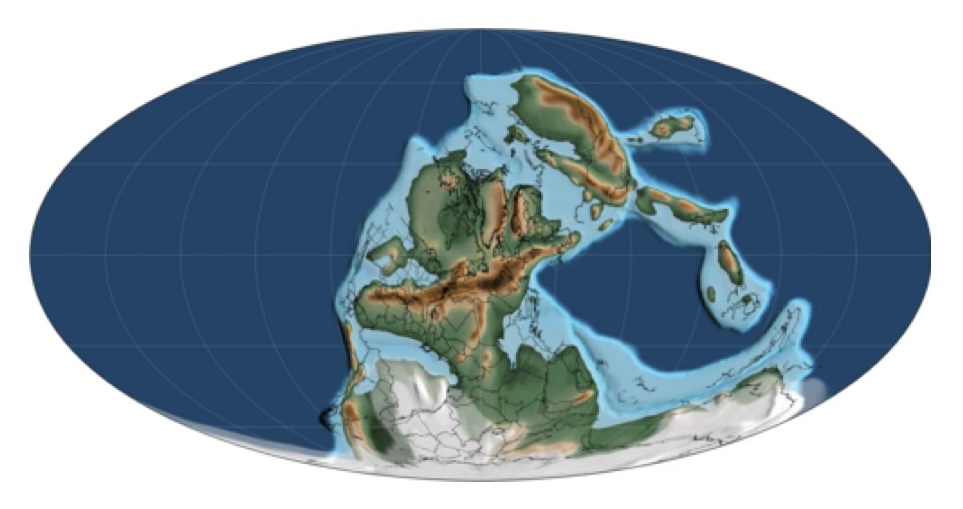
So, if you are as curious as we are, where do you think that Tallmadge, Ohio is located
on this map of the Pennsylvanian and Permian Ages?
(Image courtesy of Wikipedia, https://en.wikipedia.org/wiki/Pennsylvanian_%28geology%29).

SciTech Daily
Scientists Reconstruct Ancient Permian Ecosystem from Ash-Covered Plants
https://scitechdaily.com/scientists-reconstruct-ancient-permian-ecosystem-from-ash-covered-plants/
Note: For the illustration of the Permian forest. However, the article is very interesting!

The Williams / Harris Line, A Narrative — Four

This is Chapter Four of twelve. When we started to research this generation of the Williams family we came to understand that the primary ancestors we are talking about, James Williams Jr. and Sarah Cullen, became adults during the Regency era. Hoping for a bit of Bridgerton glamour… we had to (of course)… recalibrate those expectations.

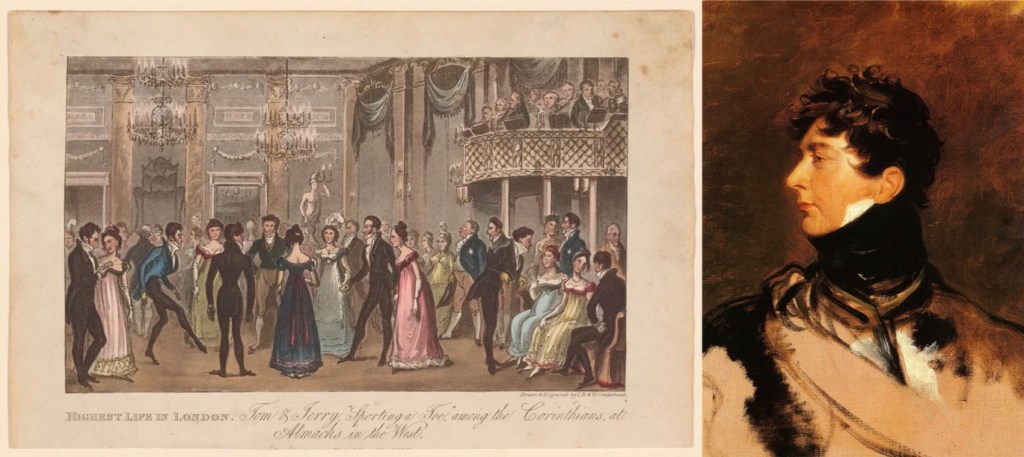
The engraving at left features the posh life of the well-to-do during the Regency Era.
It has a curious caption which reads, “Highest Life in London, Tom & Jerry ‘Sporting a Toe’ among the Corinthians, at Almacks in the West.
At right: Portrait of King George IV, by Thomas Lawrence, circa 1814. (See footnotes).

The Siren Song of Shepton Mallet

During this period of time, it seems that everyone in the surrounding communities was drawn by the allure of Shepton Mallet. It’s credible that this was due to the fact that there was much work to be had there, that wasn’t necessarily agricultural in nature. It was also the Regency Era in England — a period of great contrasts — the landed gentry thrived, and the poor struggled.

“The Regency era of British history is commonly understood as the years between c. 1795 and 1837, although the official regency for which it is named only spanned the years 1811 to 1820. King George III first suffered debilitating illness in the late 1780s, and relapsed into his final mental illness in 1810. By the Regency Act 1811, his eldest son George, Prince of Wales, was appointed Prince Regent to discharge royal functions. The Prince had been a major force in Society for decades. When George III died in 1820, the Prince Regent succeeded him as George IV.

While the Regency is noted for its elegance and achievements in the fine arts and architecture, there was a concurrent need for social, political and economic change. The country was enveloped in the Napoleonic Wars until June 1815 and the conflict heavily impacted commerce at home and internationally. There was mass unemployment and, in 1816, an exceptionally bad harvest. In addition, the country underwent a population boom and the combination of these factors resulted in rampant poverty.

Essentially, England during the Regency era, was a stratified society in which political power and influence lay in the hands of the landed class. Their fashionable locales were worlds apart from the slums in which the majority of people existed… The population boom, comprising an increase from just under a million in 1801 to one and a quarter million by 1820, heightened the crisis.” (Wikipedia) (1)

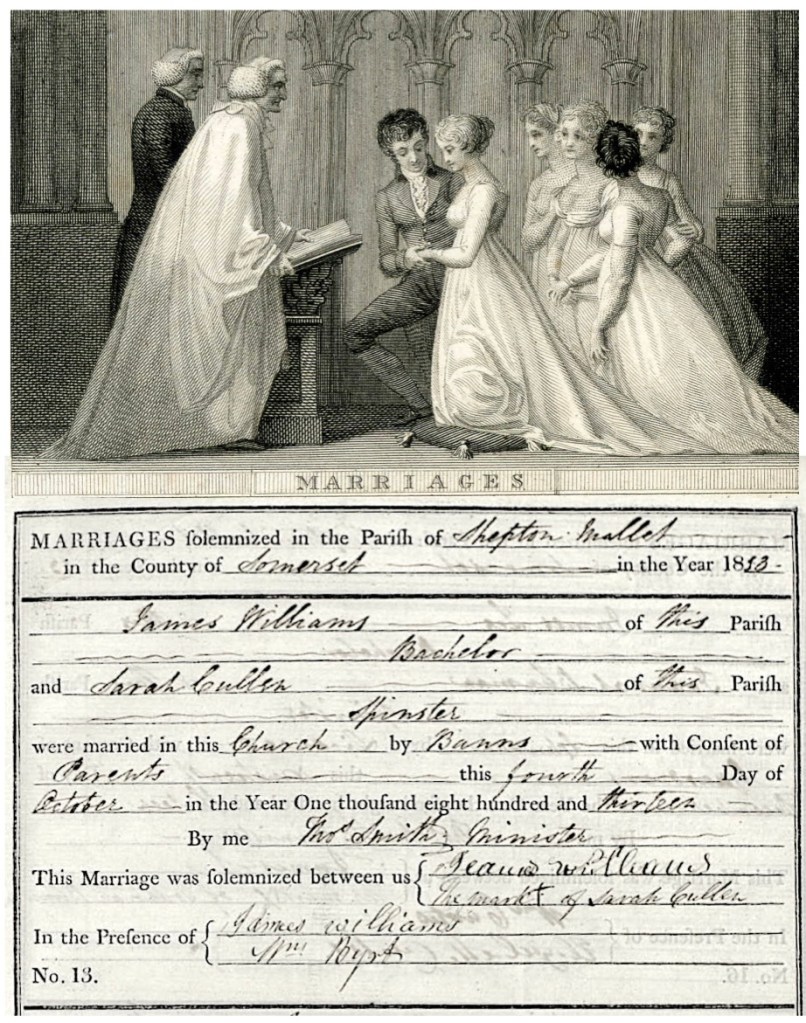
We are quite certain that the actual marriage ceremony of James Williams Jr. and Sarah Cullen was certainly not as posh as this illustration indicates.
–––––
Upper image: Illustration to Crabbe’s poems in the Royal Supplement Pocket Atlas, circa 1810. (Image courtesy of The Trustees of the British Museum via All Things Georgian).
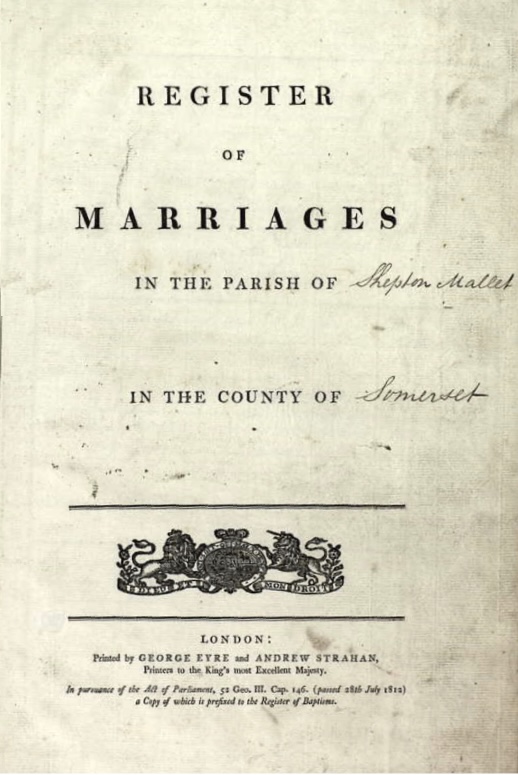
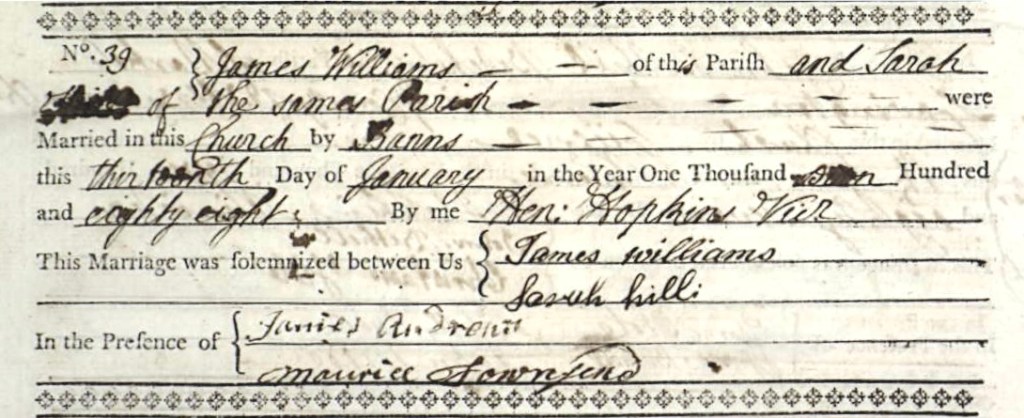
Lower image: James Williams Jr. and Sarah Cullen’s marriage record for the Shepton Mallet Parish, Somerset, on October 4, 1813.

We Love a Name Like ‘Shadrach’

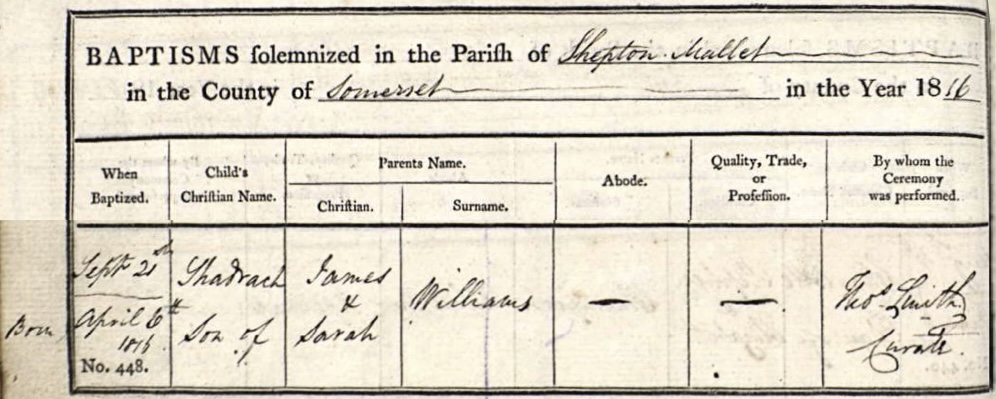
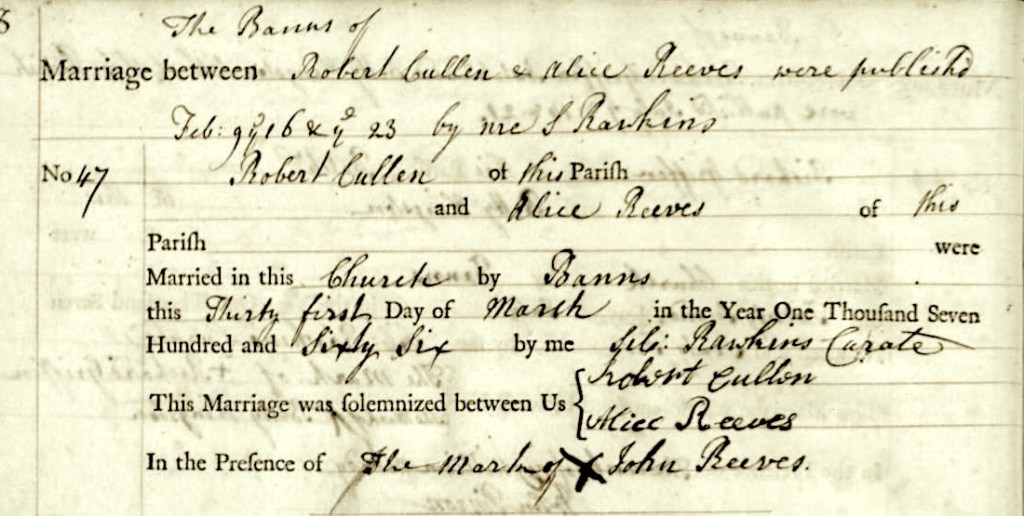
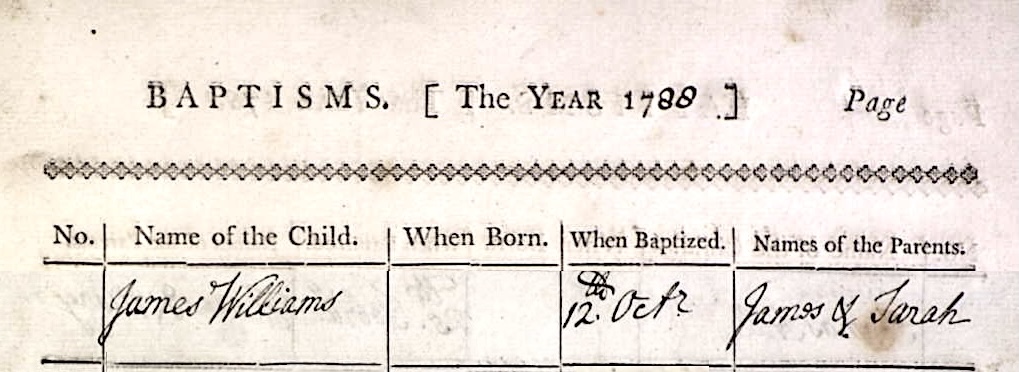
James Jr. and Sarah had several children. We know this because we have been able to discover the birth/baptismal record of their son Shadrach Williams. He was born on April 6, 1816, and baptized September 21 of that same year. It is fantastic that we located him, because with a name like that*, he is essential to helping us understand the rest of this family’s history. No other birth records for their children have surfaced, which makes us believe that the original birth/ baptism registrations exist in records that have either not survived, or have not yet been made available online.
*As was very common then, first names tend to be common and repeated generation-to-generation which makes research much more complicated. (We thank our lucky stars when we find a first name such as Shadrach).

Birth and baptism record for Shadrack Williams, April 6 -September 21, 1816, Shepton Mallet Parish, Somerset County.

So, when we do not have birth records, we look at census materials to infer the other children in the family, and their possible birth years. It is also likely that James Jr. and Sarah had more children than these census records document, because that was quite normal in their era. Many children are born, and sadly, some pass away. Our research has found the following children:

  • Shadrach Williams, born April 6, 1816
  • Henry Williams, born circa 1822
  • Daniel Williams, born February 15, 1825, Daniel carries the family line forward.
  • Mary Joseph (Williams) Weeks, born circa 1826
  • Ann Williams, born September 6, 1829
  • Eliza Williams, born May 15, 1833

We have a couple of additional observations on 30 years of census data, before going further —

Observation One: Even though the 1841, 1851, and 1861 censuses we evaluated, were conducted on different months in each decade, it is clear that the ages of the parents are a bit off. We have seen documents where James Williams Jr. and his wife Sarah signed their names with an X. This was quite normal for earlier periods where you needed to work if you wanted to eat. Education was an undreamed of luxury for almost everyone. Therefore, things like your age were just not that important.

Observation Two: Even though it is possible, the parents seem just a bit on the older side for their ages, as compared to their children? (Especially for that era…) It is possible, but is it plausible…

We observed that James Williams Jr. was always listed as an agricultural laborer on these censuses. When evaluating the baptism records of his children, before the modern census existed, he noted in 1829 that he was a shoemaker.

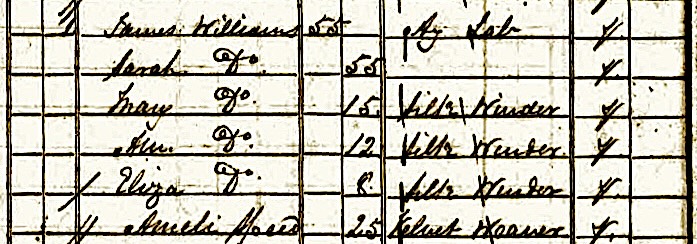
The 1841 England Census for Somerset, Coombe Lane in Shepton Mallet.

The 1841 Census
(Conducted June 1841)
If you recall, the 1841 Census is considered the first modern census completed in the United Kingdom. Every member of the household is accounted for, along with their ages, and professions (if they have one). Specifically, we can see that they are living on Coombe Lane in Shepton Mallet. (The patriarch James Jr., continued to live there for the rest of his life). The following people are recorded: James 55, Sarah, 55, Mary 15, Ann 12, Eliza 8, Ameli Speed 25 (a boarder). James is an agricultural laborer, and Sarah was presumably tending the house because no occupation is listed.

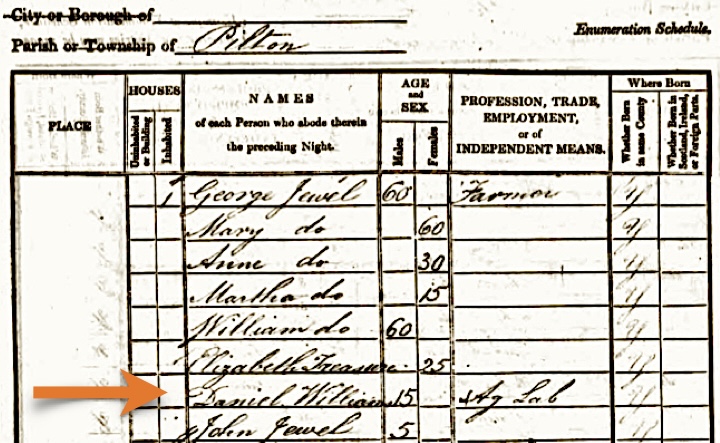
The sons, Shadrock, Henry, and Daniel, are all living in other places. Shadrock and Henry are married and live with their new families. Daniel is living in the home of George Jewel, and at the age of 15, is working as an agricultural laborer. (We will write about Daniel in the next section).

What is quite striking to note is that the three daughters, ages 15, 12, and 8, were all working in one of the cloth manufacturing factories, even though they were still children. All three were employed as Silk Winders. From Family Researcher, here is the definition for that old occupation: “Silk Winder: wound silk onto spools or bobbins prior to the silk being twisted.” The boarder Amelia Speed, being a few year older, is listed as a Velvet Weaver.

The 1851 England Census for Somerset, Coombe Lane in Shepton Mallet.

For a better understanding of the conditions of both adult and child laborers in these factories, please see the history of Shepton Mallet, The 18th and 19th Century Textile Industries in Chapter Two, or the footnotes for this chapter.

The 1851 Census
(Conducted March 1851)
This census has gotten a little more comprehensive: birth places are also noted now. James has listed his birthplace as West Compton, Somerset (this is a hamlet inside Pilton, Somerset. Sarah lists her birthplace as Stoke Lane, and the daughters are noted as being born in Shepton Mallet. The following people are recorded: James 64, Sarah, 66, Ann 22, Eliza 17, Maria Millard (a boarder). All are listed as Pauper on [the] Parish*, except for daughter Elizabeth who is a Silk Thrower. Again from Family Researcher, “Silk Thrower: prepares silk for weaving by spinning or twisting silk thread.”

* Pauper on [the] Parish
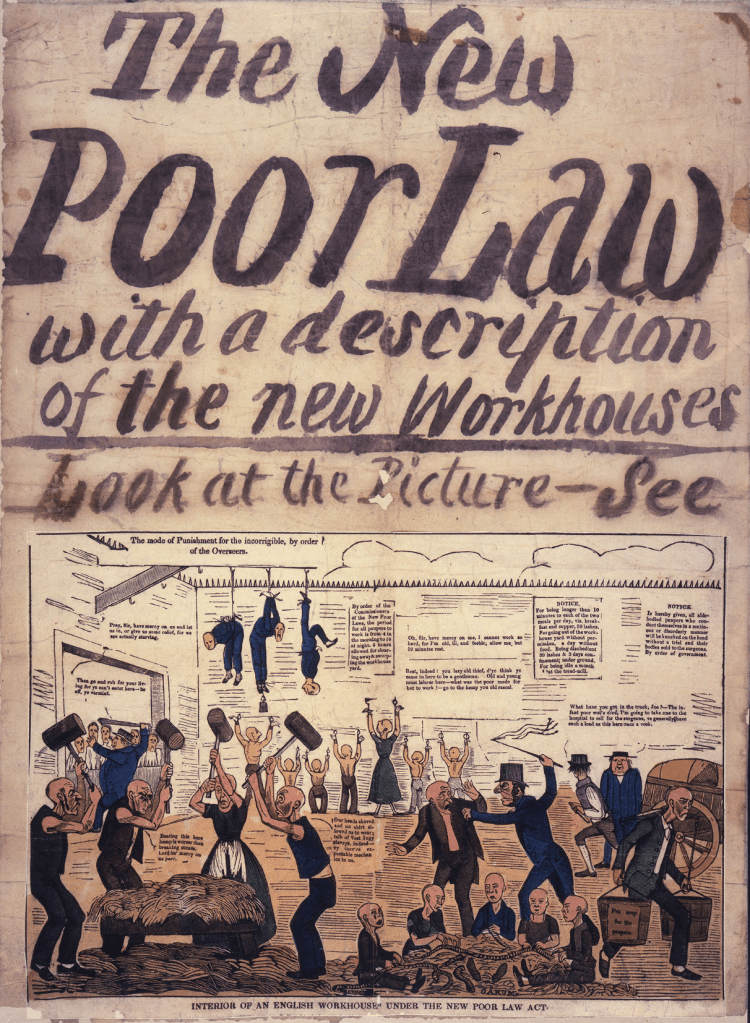
“The New Poor Law altered the system from one which was administered haphazardly at a local parish level to a highly centralized system which encouraged the large-scale development of workhouses by poor law unions.”(Wikipedia)

From Family Search, we learned about what being a pauper on [the] parish actually meant — “Somerset Poor Law: An Act of Parliament in the year 1834 took the responsibility of administering to the poor from the local parish church to the doorstep of civil government. The government grouped each civil parish into a union of parishes. There were nearly 600 such unions throughout England, each one comprising close to 20 or more parishes, and were specifically setup to meet the demands of the poor among their local populations, with a workhouse on the premises.

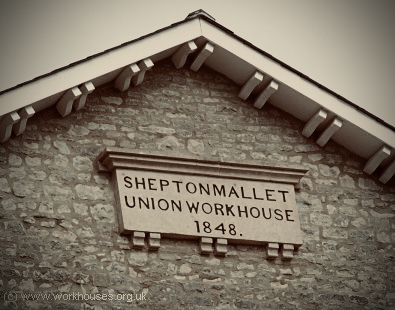
Well…this certainly doesn’t look like a fun place to hang out.

The responsibility was transferred from local parishes to a Board of Guardians in each union. These groupings or unions were known as poor-law unions. Somerset had the following poor-law unions within its boundaries:
Axbridge, Bath Poor Law Union, Bedminster (Long Ashton), Bridgwater, Chard, Clutton, Dulverton, Frome Poor Law Union, Keynsham, Langport, Shepton Mallet, Taunton, Wellington, Wells, Williton, Wincanton, Yeovil Poor Law Union.”

The 1861 England Census for Somerset, Coombe Lane in Shepton Mallet.

The 1861 Census
(Conducted April 1861)
Their household has grown smaller. It appears that their daughter Ann had not married, but spent her time supporting and caring for her parents. She was working in one of the cloth factories as a Velvet Weaver. The following people are recorded: James 73, Sarah, 74, Ann 32. (2)

Almost Any Book by Charles Dickens

As we mentioned above, the 15 year old son Daniel Williams was working as an agricultural laborer in the home of the George Jewel family in nearby Pilton. We do not know anything about this arrangement, nor why he was not living at home and doing the same thing. However, in an era when child labor was rampant, it could make sense that this is what was necessary for him to do to help his family and/or for his own well being.

The 1841 England Census for Pilton Parish, Somerset.

Our research has shown that there are other boys named Daniel Williams also living in the larger Somersetshire area. We sorted through them seeking our ancestor. We feel that the 1841 Census above makes sense.

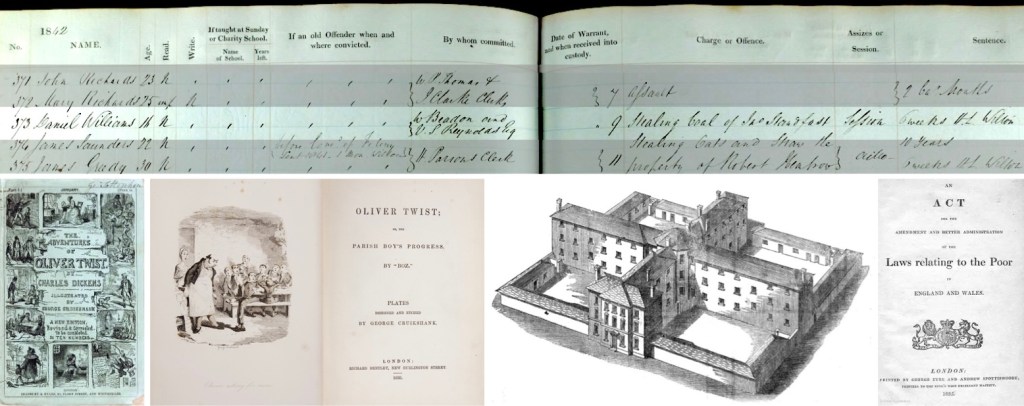
We did come across another record for Daniel Williams and we were not sure what to make of it. It is possible that at the age of 16, Daniel was arrested for larceny (stealing), but we cannot confirm if this was truly him, or another Daniel… The record indicates that this person was imprisoned for six weeks of hard labor at Wilton Goal (prison), for stealing coal from a John Standfast. It is plausible that this was our relative — he was poor, he was a teenager, and teenage boys sometimes do foolish things.

If you have ever read any books by Charles Dickens, you would understand that back then there were no youth detention centers, and no slaps on the wrist. If you committed a crime, the consequence was hard labor. The record indicates that (this particular) Daniel was admitted to Wilton Goal in Taunton, Somerset. That is about 20-22 miles, or 32-35 km to the west of Pilton, Somerset.

Upper image: [A] Daniel Williams in the Somerset, England, Wilton Gaol Prison Register, for 1842. Lower images: Cover and frontispiece for editions of Charles [ Oliver Twist, a typical government workhouse, the Poor Laws Amendment of 1835. (See footnotes).

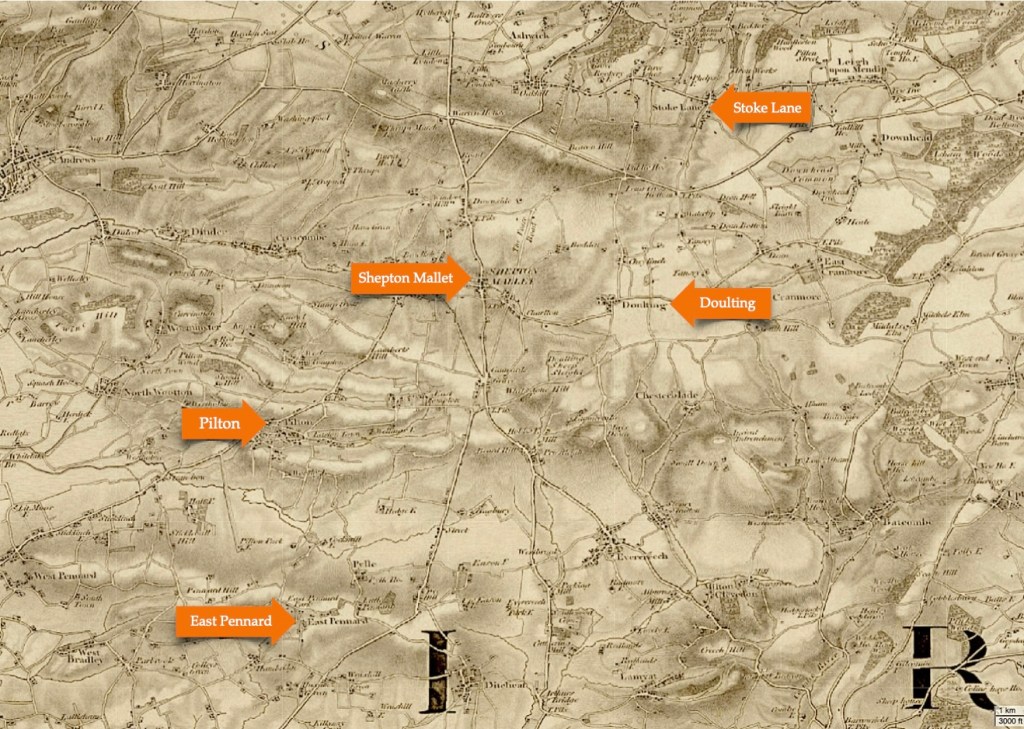
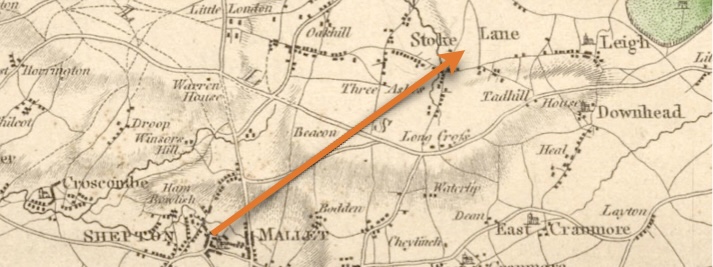
We were able to locate a unique map which shows a birds eye view of this section of Somerset and think it might be a good place to summarize the close-knit communities which they lived in over five generations. The total area is not that large — If you were to start in East Pennard and walk northeast toward Stoke Lane, the distance is 9.1 miles (or 14.7 km). (3)

Early Detailed Old Map of Shepton Mallet Somerset England, (1805-1845)
by Archi UK Early OS. (See footnotes).

There was change in the air, as ancestors like the Williams family were becoming aware of many English, Irish, and Welsh families relocating to America. This feeling was different from earlier migrations which had happened in other centuries — America held the promise of a modern future — one that was less constrained by the past. Sometimes it takes a new generation to seek change…

Following are the footnotes for the Primary Source Materials,
Notes, and Observations

The Siren Song of Shepton Mallet

(1) — six records

Regency Era
https://en.wikipedia.org/wiki/Regency_era
Note: For the text.

The Royal Look For Less
Royal Journal
Bridgerton Fact Check: What was the Regency era really like?
https://theroyallookforless.com/blogs/blog/what-was-the-regency-era-like?srsltid=AfmBOooPsdSSWgnNuIQFbrv_fAQLEPfy-x8d4FFb6ez8ZNKpaABkaP6Z
Note: For the image captioned, “.

King George IV
by Thomas Lawrence, circa 1814
https://en.wikipedia.org/wiki/File:George_IV_bust1.jpg
Note: For his portrait. “George IV of the United Kingdom as the Prince Regent, circa 1814. He served as king of the United Kingdom of Great Britain and Ireland from 1820 to 1830. The Regency, George’s nine-year tenure as Prince Regent, which commenced in 1811 and ended with George III’s death in 1820, was marked by victory in the Napoleonic Wars in Europe.”

James Williams [Jr]
in the Somerset, England, Marriage Registers, Bonds and Allegations, 1754-1914
Marriage Registers > Shepton Mallet > 1813-1837
https://www.ancestry.com/search/collections/60858/records/1551442
Book page: 5, Digital page: 5/137, Right page, top.
Note: Their marriage date is October 4, 1813; his spouse’s name is Sarah Cullen.
and
James Williams [Jr]
in the Somerset, England, Marriage Registers, Bonds and Allegations, 1754-1914
Marriage Registers > Shepton Mallet > 1790-1816
https://www.ancestry.com/search/collections/60858/records/399634?tid=&pid=&queryId=a9eb2021-1240-4554-ba95-8c882f93e698&_phsrc=CCG3&_phstart=successSource
Digital page: 188/199, Right page, 4th entry.
Note: Banns notification(s) record.

All Things Georgian
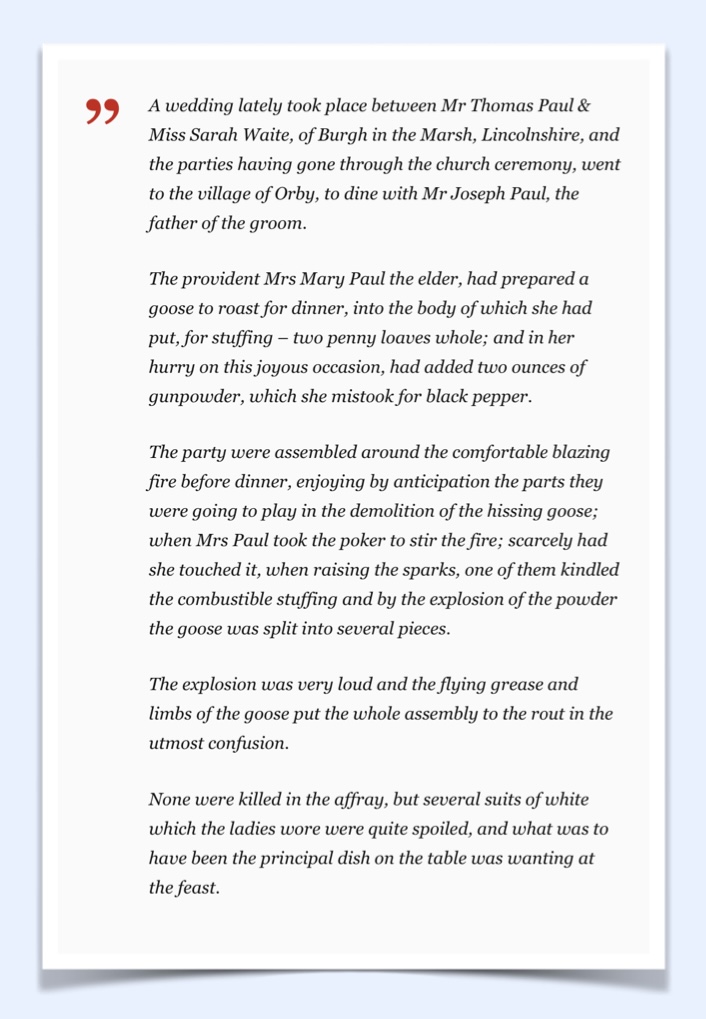
The Tale of the Exploding Wedding Goose
by Sarah Murden
https://georgianera.wordpress.com/tag/regency/
Note: For the marriage illustration and the story of the exploding goose.

We Love a Name Like ‘Shadrach’

(2) — sixteen records

Shadrach Williams
in the Somerset, England, Church of England Baptisms, 1813-1914
Shepton Mallet > 1813-1833
https://www.ancestry.com/search/collections/60857/records/222400?tid=&pid=&queryId=ab20a7c6-964c-4196-ad42-e2eb310a063e&_phsrc=Ixg7&_phstart=successSource
Book page: 56, Digital page: 31/154, Entry No. 448, last entry on the left page.
Note: His birthdate is April 6, 1816.

Henry Williams
in the England, Select Marriages, 1538-1973
Marriage Registers > Ditcheat > 1837-1914
https://www.ancestry.com/search/collections/60858/records/2997588
Note: His marriage record to Matilda Reines provides his 1822 birth year.

Daniel Williams
in the U.S., Find a Grave Index, 1600s-Current
https://www.ancestry.com/search/collections/60525/records/130014389?ssrc=pt&tid=22318082&pid=162120441149
and
Daniel Willams
https://www.findagrave.com/memorial/158271603/daniel-williams
Note: His birthdate is February 15, 1825.

Ann Williams
in the Somerset, England, Church of England Baptisms, 1813-1914
Shepton Mallet > 1813-1833
https://www.ancestry.com/search/collections/60857/records/223908?tid=22318082&pid=162120441148&ssrc=pt
Book page: 293, Digital page: 150/154, Entry No. 2340 on the right page.
Note: Her birthdate is September 6, 1829.

Eliza Williams
in the Somerset, England, Church of England Baptisms, 1813-1914
Shepton Mallet > 1813-1833
https://www.ancestry.com/search/collections/60857/records/224293?tid=22318082&pid=162120441152&ssrc=pt
Book page: 293, Digital page: 150/154, Entry No. 2340 on the right page.
Note: Her birthdate is May 15, 1833 .

Shepton Mallett Nub News
The Shepton Riots
by Laura Linham
https://sheptonmallet.nub.news/news/local-news/the-shepton-riots-252234
Notes: For the reference regarding the history of factory laborers.

James Williams
in the 1841 England Census
Somerset > Shepton Mallet > ALL > District 7
https://www.ancestry.com/search/collections/8978/records/13563167
Book page: 31, Digital page: 3/12, Right page, center.
Notes: He is listed as an Agricultural Laborer.

Family Researcher
Dictionary of Old Occupations
https://www.familyresearcher.co.uk/glossary/Dictionary-of-Old-Occupations-Index.html#Old-Occupations-S
> Silk Winder:
https://www.familyresearcher.co.uk/glossary/Dictionary-of-Old-Occupations-jobs-beginning-S5.html#Silk-Winder
Note: For the data.

James Williams
in the 1851 England Census
Somerset > Shepton Mallet > ALL > 4c
https://www.ancestry.com/search/collections/8860/records/7359373
Book page: 31, Digital page: 32/47
Note: These is when Englands Poor Laws enter their lives.

Family Researcher
Dictionary of Old Occupations
https://www.familyresearcher.co.uk/glossary/Dictionary-of-Old-Occupations-Index.html#Old-Occupations-S
> Silk Thrower:
https://www.familyresearcher.co.uk/glossary/Dictionary-of-Old-Occupations-jobs-beginning-S5.html#Silk-Thrower
Note: For the data.

Interior of an English Workhouse Poster
Under the New Poor Law Act, 1837, via The National Archives, UK
https://www.nationalarchives.gov.uk/education/resources/voices-of-the-victorian-poor/have-we-underestimated-the-victorian-poor/poor-law-poster/ .

English Poor Laws
https://en.wikipedia.org/wiki/English_Poor_Laws
Note: For the text.

Somerset Poor Law
https://www.familysearch.org/en/wiki/Somerset_Poor_Law
Note: For the text.

The Workhouse, The Story of an Institution
Shepton Mallet, Somerset
https://www.workhouses.org.uk/SheptonMallet/
Note: For the photograph.

James Williams
in the 1861 England Census
Somerset > Shepton Mallet > ALL > 4c
Somerset > Shepton Mallet > All > District 10
https://www.ancestry.com/search/collections/8767/records/18023200
Book page: 30, Digital page: 36/46
Note: James 73, Sarah 74, Ann 32.

Almost Any Book by Charles Dickens

(3) — four records

Daniel Williams
in the Somerset, England, Gaol Registers, 1807-1879
Wilton Gaol > Register of Prisoners 1831 – 1847
https://www.ancestry.com/search/collections/60900/records/51791
Digital page: 172/296, Entry 373 near the middle of the left page.
Note: At 16, he was imprisoned for six weeks of hard labor at Wilton Goal, for stealing coal from John Standfast. (Larceny)
Note: Admission date is April 9, 1842, at Wilton Goal, Taunton, Somerset.

Oliver Twist
https://en.wikipedia.org/wiki/Oliver_Twist
Note: For the “Cover, first edition of serial, entitled The Adventures of Oliver Twist, January 1846, and the “Frontispiece and title-page, first edition 1838, Illustration and design by George Cruikshank.”

Traveling Through History
The Influence of Art on History, Part 3: Oliver Twist
by Erin
https://www.travelingthruhistory.com/the-influence-of-art-on-history-part-3-oliver-twist/

Archi Early OS (1805-1845)
https://www.archiuk.com/cgi-bin/get_victorian_old_maps_of_the_british_isles_ordnance_survey_1inch_1mile.pl?map_location=Shepton%20Mallet%20%20somerset%20England&point_title=Shepton%20Mallet%20%20somerset%20England&ngr=&is_sub=&pwd=&lidar_model_key=Lidar_Composite_Elevation_LZ_DSM_1m&county=&placename=Shepton%20Mallet%20%20somerset%20England&latitude=51.192330&longitude=-2.561744&postcode=POSTCODE&lidar_template=lidar_simple
Note: “These rare early Ordnance Survey maps (1805–1845) help family historians pinpoint ancestral homes and workplaces, support archaeologists and metal detectorists in researching land terrain and Roman roads, and provide landscape historians with a snapshot of Britain before modern development reshaped the countryside.”

The Williams / Harris Line, A Narrative — Two

This is Chapter Two of twelve, in which we continue with the Reeves family line in Somersetshire, England. This generation of our family begins with the birth of Robert Cullon Jr. in East Pennard Somerset, England.

Quitting The Parish of East Pennard

As such, it is to this day a small parish known for being the home of the hamlets of Stone, Parbrook, and Huxham. In the present day, only 348 people live there. We write this bit of information, because it appears that it wasn’t very long before our ancestors decided to quit East Pennard and move somewhat north to the bright lights of Shepton Mallet.

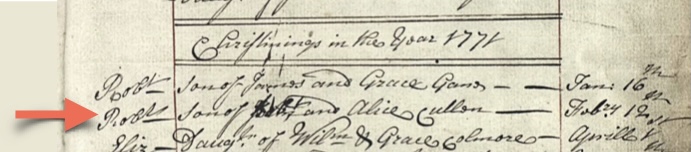
Christening record for Robert Cullen Jr. East Pennard Parish,
Somerset, for February 12, 1771.

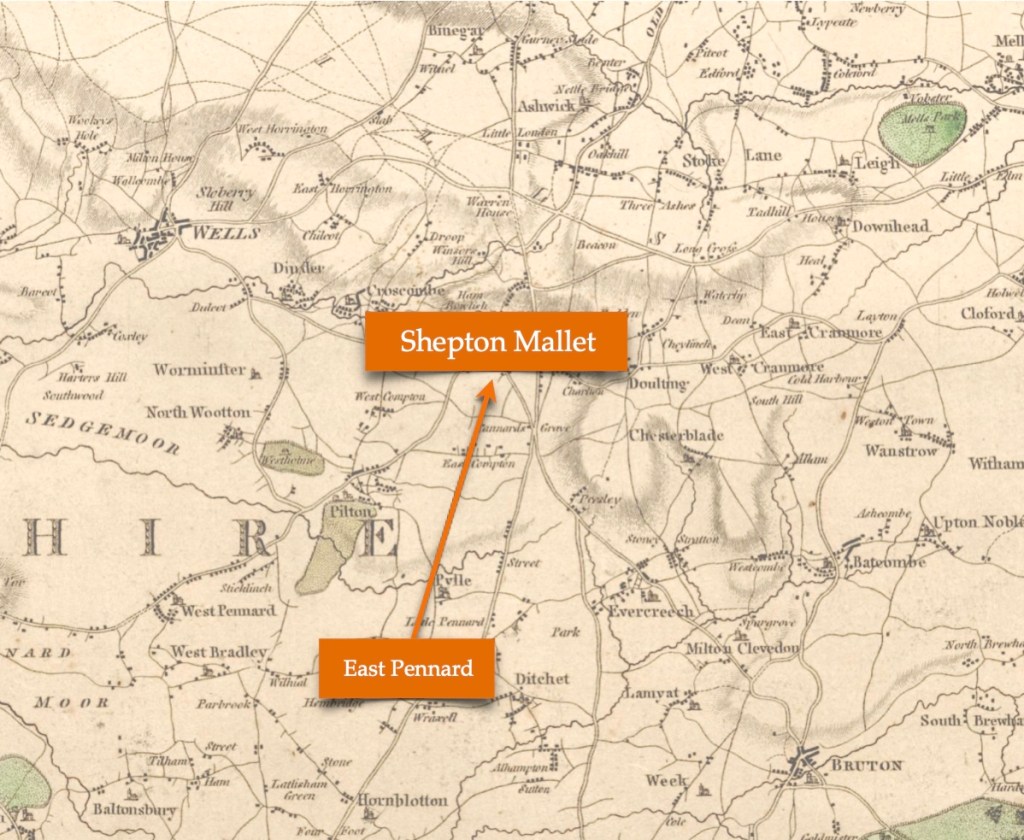
We have observed that these maps look busy with so many little communities identified on them. This tends to make destinations look further apart than they actually are — things are actually much closer. For example… Why did they move about 3-4* miles north? We will never know with certainty, but it doesn’t really matter, because it may have had something to do with having more economic opportunities in the neighboring community. (1)
*This equals about 5.5 to 6.5 kilometers. This distance could be walked in two hours or less with the wind at your back. (This, they probably did).

Enlarged detail from, Map of 24 miles round the City of Bath. Most humbly dedicated …,
by C. H. Masters, circa 1800. (Image courtesy of The National Library of Scotland).

Shepton Mallet, A Market Town

We do not know what the Robert Cullen Jr. family did to earn their income. We already know that his father was a highly respected Master Butcher. Perhaps Robert Jr. had this profession too? The move to Shepton Mallet was likely due to the fact that it was an ancient and well respected market town. The local economy was driven by the propagation of animal husbandry with sheep. This pursuit supplied the local populace with protein, (hence, local meat products) and more importantly, it supplied wool to the many, many cloth factories that populated the Shepton Mallet area.

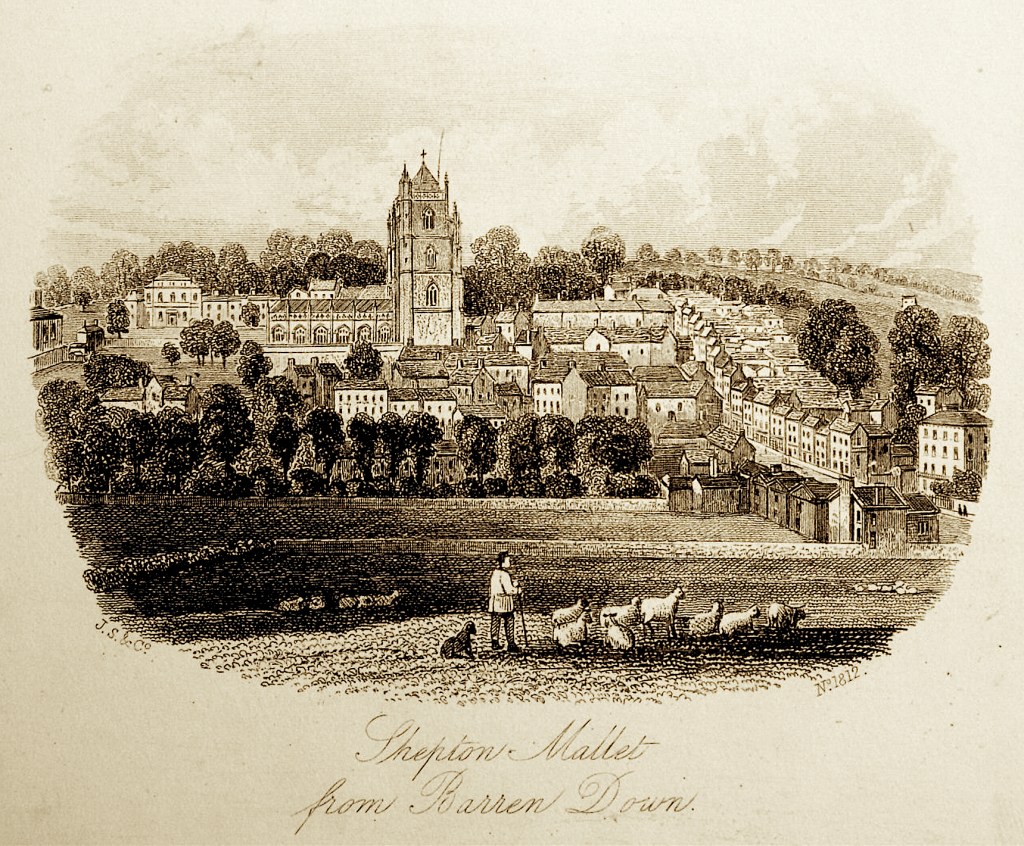
The Barren Down is located just north of the town center.
(Image courtesy of rareoldprints.com).

Ancient Times Through the Roman Period
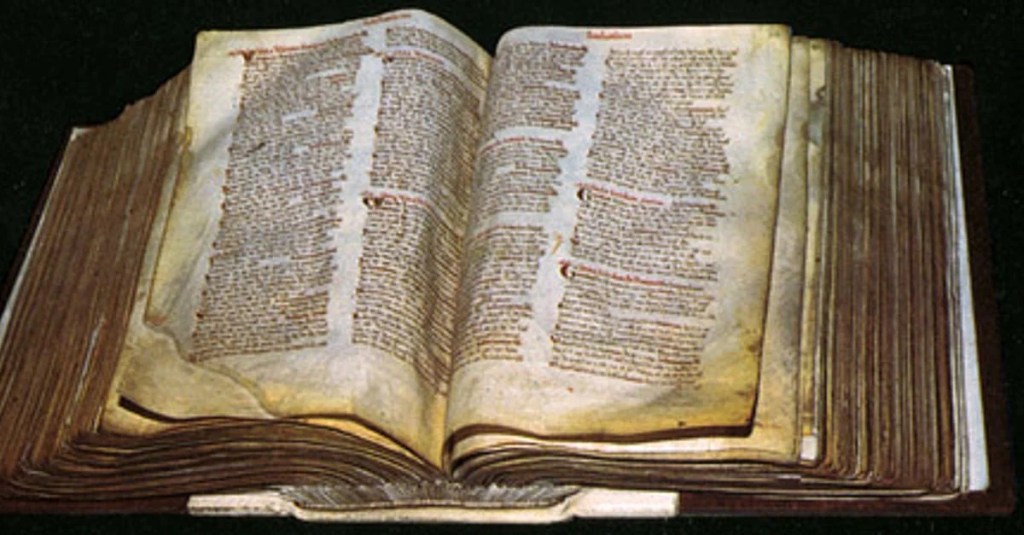
“The name Shepton derives from the Old English scoep and tun, meaning sheep farm; the Domesday Book of 1086 records a settlement known as Sceaptun in the hundred of Whitstone. The current spelling is recorded at least as far back as 1496, in a letter from Henry VII. The second part of the name derives from that of the Norman family of Malet. Gilbert Malet, son of William Malet, Honour of Eye, held a lease from Glastonbury Abbey around 1100.

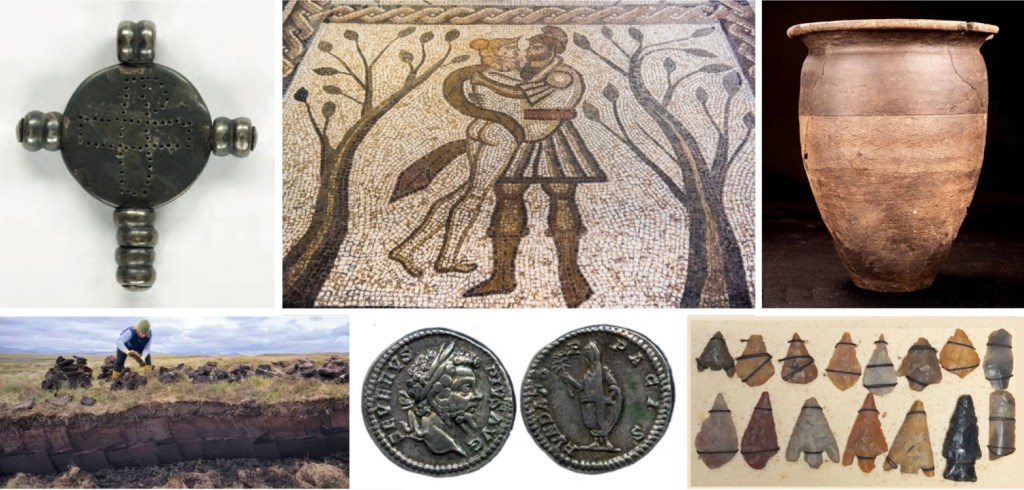
Examples of prehistoric and Roman era artifacts found in the Somerset area.
(Various sources, see footnotes).

Archaeological investigations have found evidence of prehistoric activity in the Shepton Mallet area, with large amounts of Neolithic flint and some pottery fragments of the late Neolithic period. Two barrows on Barren Down, to the north of the town centre, contained cremation burials from the Bronze Age; another Bronze Age burial site contained a skeleton and some pottery. Shepton Mallet is about halfway between the Roman towns of Bath and Ilchester on the Fosse Way. Although there are no visible remains apart from the line of the Roman road, there is archaeological evidence for early military and later civilian settlement lasting into the 5th century.

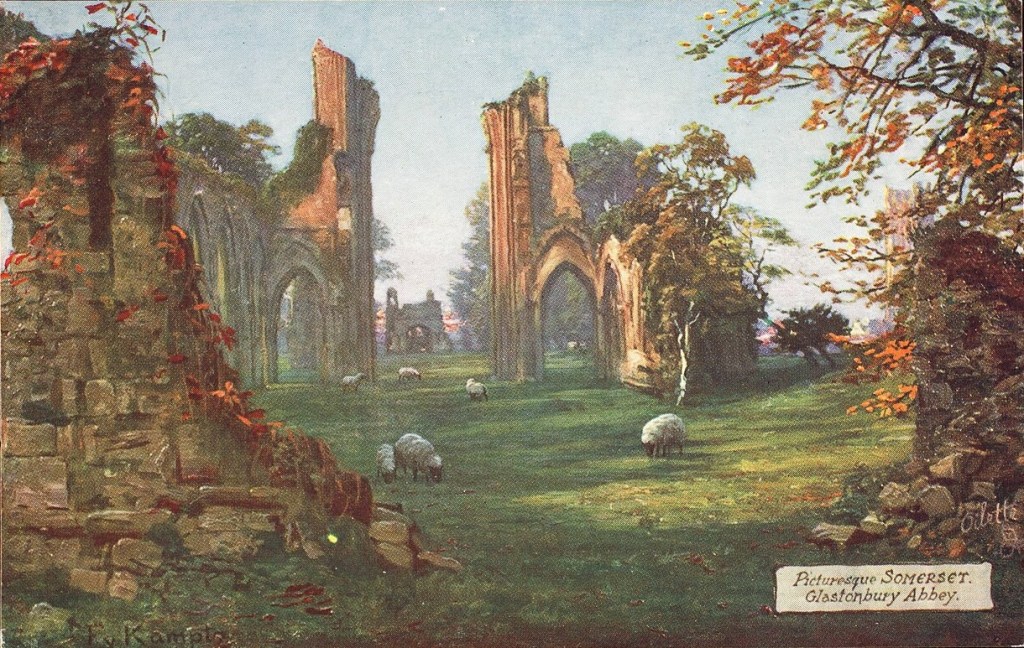
A Tuck & Sons postcard from 1903 features Picturesque Somerset, Glastonbury Abbey,
by Artist Unknown. (Image courtesy of Wikimedia Commons).

The Saxon and Norman Periods, and the Early Middle Ages
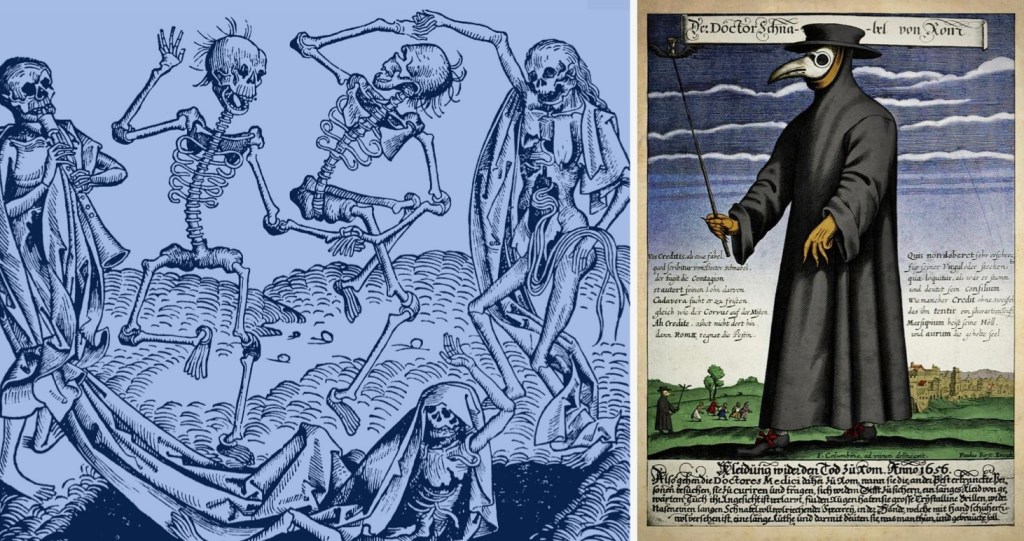
A charter of King Ine of Wessex, from 706, witnessed by nine bishops including the Archbishop of Canterbury, records that the area where Shepton Mallet now stands was passed to Abbot Berwald of Glastonbury Abbey.” (Wikipedia) The Middle Ages were an especially fraught time for the area. The Black Plague would seem like enough to deal with — but like a relentless tide washing in-and-out, the ownership and governance of the area changed with the centuries depending upon who was in power.

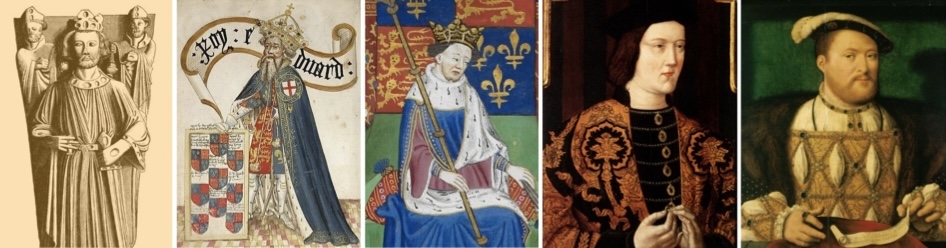
Five Kings of England — Left to right: King John, 1199 – 1216. Edward III, 1327- 1377.
Henry VI, 1422 – 1461 and 1470 – 1471. Henry VI, 1461 – 1470. Edward IV, 1509 – 1547.
(All images courtesy of Wikimedia Commons, see footnotes).

“…around 1100, the land passed to the Malets, a Norman family whose name was added to that of the settlement. The Malets retained the estate until the reign of King John, when on the death of William Malet (fl. 1192–1215) and the payment by his sons-in-law of a fine of 2000 marks for participating in a rebellion against the king, it passed through his daughter Mabel to her husband Hugh de Vivonne. Some generations later, the part of the estate containing Shepton Mallet was sold to a relative, Sir Thomas Gournay. His son, also Thomas, took part in the murder of Edward II. His estates were confiscated by Edward III in 1337, but returned some years later.

When Mathew de Gournay died childless in 1406, the estate reverted to the Crown and [it] was then granted to Sir John de Tiptoft. It was again confiscated from his son by Henry VI during the Wars of the Roses, when the family sided with Edward IV, but [then] restored to Sir John’s grandson, Edward Tiptoft, when Edward IV regained the throne. He died without issue, and there followed a succession of grants and reversions until Glastonbury Abbey was dissolved by Henry VIII, and its lands, including Shepton Mallet, were granted to the Duchy of Cornwall in 1536.” (Wikipedia)

At left: The Dance of Death, circa 1493, by Michael Wolgemut.
At right: Der Doctor Schnabel von Rom (aka The Plague Doctor), by Paul Fürst.
(Both images courtesy of Wikimedia Commons).

The Black Death and The Late Middle Period
“Charters for markets and fairs were granted in 1235, but revoked in 1260 and 1318 after objections by the Bishop of Wells to the competition it represented to the market in his city. This shows that the town was developing and prospering in the 13th and early 14th centuries. The Black Death struck in 1348, reducing the population to about 300.

In the late 14th and early 15th centuries, the population and economy were boosted by craftsmen and merchants arriving from France and the Low Countries, who were escaping wars and religious persecution. They introduced cloth-making, which together with the local wool trade, became a major industry in Shepton and other Somerset and Wiltshire towns.” (Wikipedia) As a consequence, “… before long, West County cloth was considered the best in the country.” (Shepton Mallett Nub News)

England’s story has been called
‘an interwoven pattern of history and legend’, and
the history of Somerset is a good example of this.

The short dark history of Somerset
by Mike Dean, via The History Press

The 18th and 19th Century Textile Industries
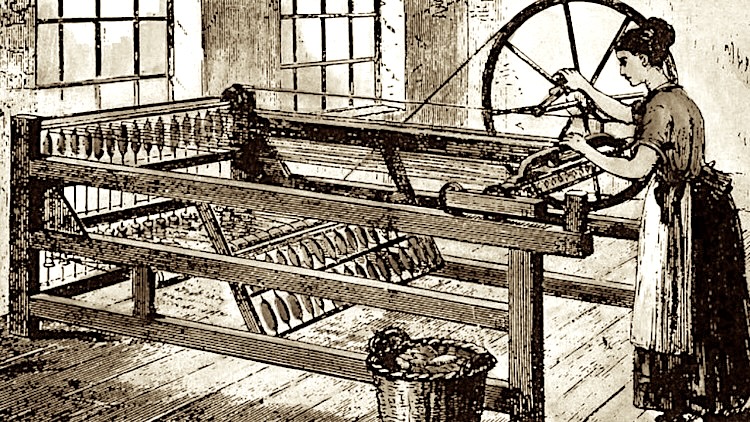
“Many of the workers in the mills were children, some as young as five years old. They had some of the most awful jobs, including cleaning the wool cloth by trampling it in vats of fuller earth and urine… then came the Agricultural and Industrial revolutions — with fewer people needed to do the same amount of work, and once again, it meant more profits for businesses and land-owners, and more local people unemployed and made homeless. The Spinning Jenny was invented by James Hargreaves in 1764. It could spin eight threads at once and there were claims that new machines could do the job of twenty workers.” (Shepton Mallett Nub News)

A Spinning Jenny weaving machine, by Artist Unknown.
(Image courtesy of Shepton Mallett Nub News).

Fluctuating Fortunes
“In 1790 Shepton Mallet was flourishing once again. Unfortunately, its fortunes were to change once more. Advancements in spinning machinery left many workers feeling insecure and riots [again] broke out. These were violent and on a large scale. Local factory owners subsequently failed to install the new machinery available and Shepton Mallet struggled to compete in the market place. Factories closed and hundreds of families suffered. The subsequent manufacture of silk and velvet employed some, but the market suffered. As a result potential new transportation links were abandoned. The 1851 census lists the population for Shepton Mallet as 3,885 and the number of inhabited houses at 825.” (The Cross at Croscombe)

We believe that it was around this point that our ancestors decided to immigrate to America. However, before we sail across the Atlantic Ocean, we still need to cover what happened with this generation of our family (and the next) here in England. (2)

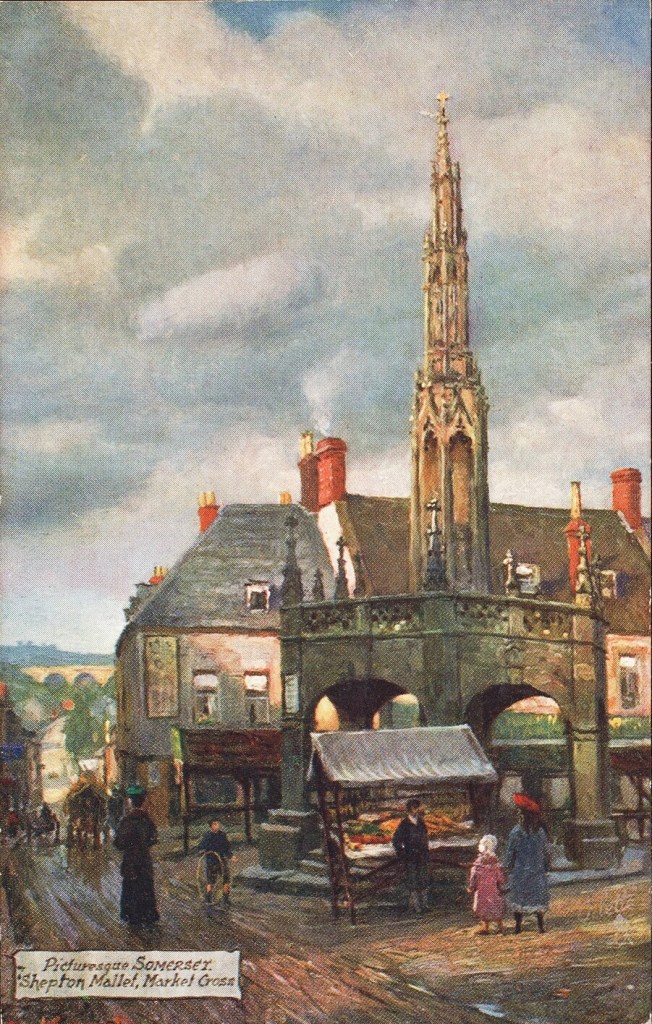
A Tuck & Sons postcard from 1903 features Picturesque Somerset. Shepton Mallet, Market Cross,
by Artist Unknown. (Image courtesy of Wikimedia Commons).

The Parish of Stoke St. Michael, or Stoke Lane

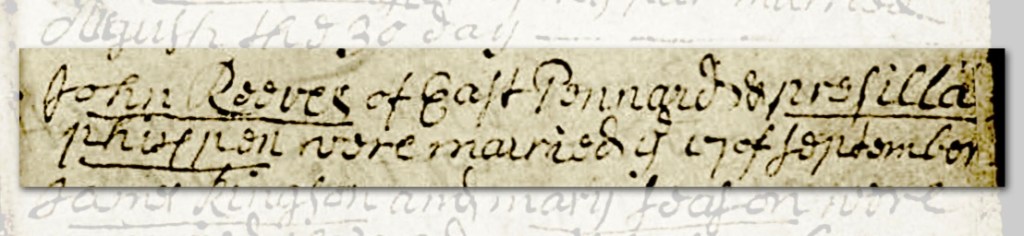
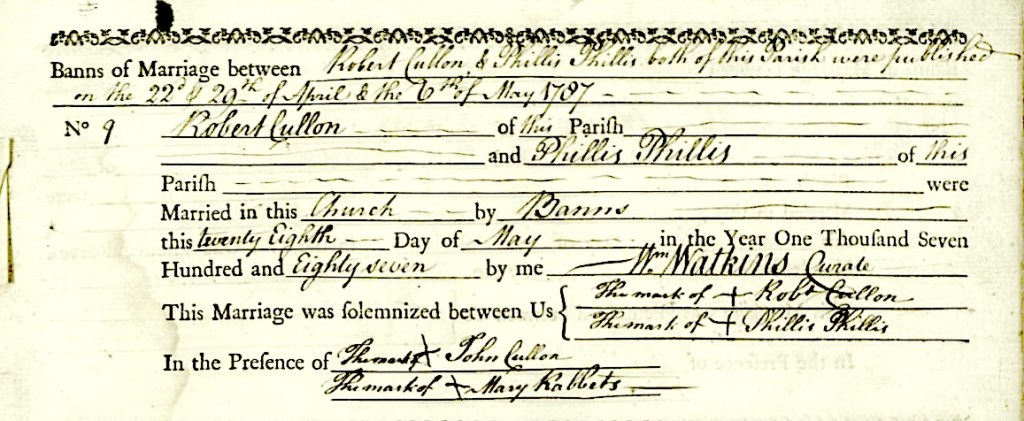
Robert Cullen Jr. and his family likely lived just north of Shepton Mallet, in the village and parish of Stoke St. Michael. (Which is also known as Stoke Lane). We know this because both his marriage and the baptisms of his children were recorded there. On May 6, 1787, Robert Cullen Jr. married (this is not a typo) Phillis Phillis at Stoke St. Michael Parish in Somerset. The Phillis surname then gave way to the Cullen name.

Enlarged detail from, Map of 24 miles round the City of Bath. Most humbly dedicated …,
by C. H. Masters, circa 1800. (Image courtesy of The National Library of Scotland).

This “village became a centre for cloth manufacture with fulling mills being established on the River Frome to the north of the village. Henry Fussell established paper mills in 1803, and his family, who came from the village, including James Fussell established their iron works and edge-tool business in Mells.” (Wikipedia)

The reason they chose to live in this area, may have been influenced by where his wife’s family was living. Certainly, their proximity to the market town of Shelton Mallett was also important.

Banns of Marriage record for Robert Cullen Jr. and Phillis Phillis,
at Stoke St Michael Parish, Somerset, for May 28, 1787.

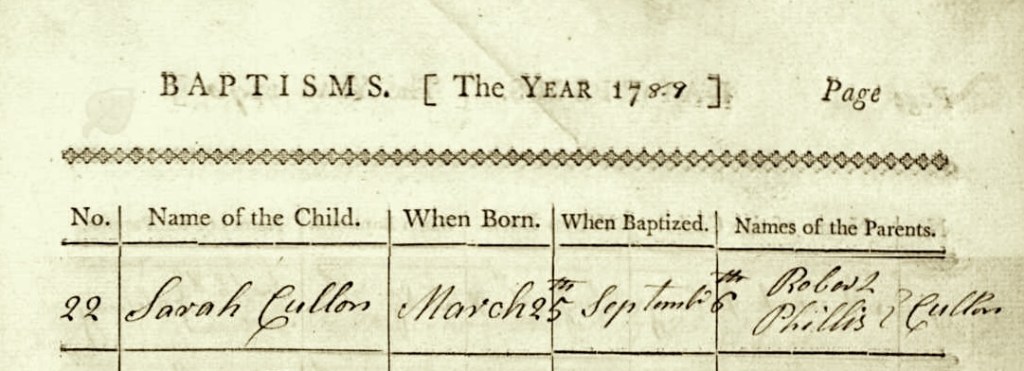
Less than two years later, Phillis gave birth to a daughter named Sarah Cullen, born on March 25, 1789. They likely had more children, but we can only verify Sarah and her brother Thomas Hobbs Cullen, who was born on August 29, 1810. For us, Sarah’s birth is important, because it is from her that the family line continues.

Daughter Sarah Cullen’s birth record at Stoke St Michael Parish, Somerset,
for March 25, 1789, and baptism record for September 6, 1789.
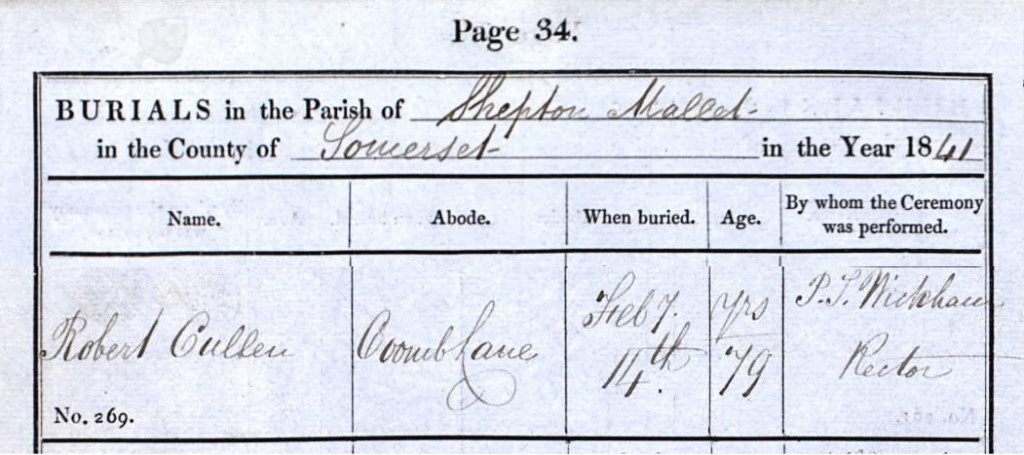
One of the two death records for Robert Cullen Jr., from the Church of England
Burial Records for Shepton Mallet, Somerset, in 1841.

We do not know what became of Phillis (Phillis) Cullen, but we have found two records that indicate Robert Cullen Jr. passed away in 1841. One record indicates February 1841, and another, March 1841. (3)

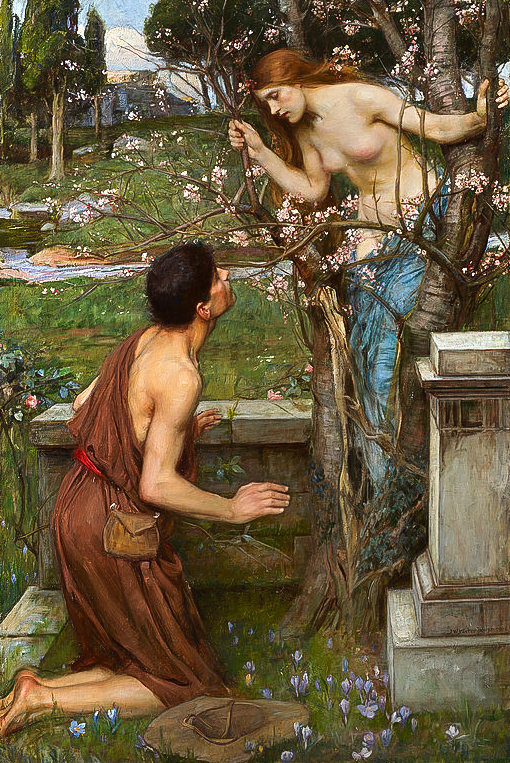
Phillis and Demophoön, by John William Waterhouse, 1905.
(Image courtesy of Wikimedia Commons).

Phillis Was Transformed Into An Almond Tree, Who Knew?

We’ve never before had an ancestor (that we know of) with the truly fabulous name of Phillis Phillis (!), and one cannot help but think it sounds a bit like a modern day showgirl, which we are sure Phillis was not. So we looked up her name and learned a few things. “Phillis is a feminine given name of Greek origin meaning foliage. Phillis is a minor figure in Greek mythology who killed herself in despair when Demophoön of Athens did not return to her and who was transformed into an almond tree by the gods. The name has been in modern use since the 17th century when it was used by English poets John Wilmot, 2nd Earl of Rochester, and Matthew Prior, probably taken from the supposed mistress of Aristotle, or other classical examples.” (Wikipedia)

A traditional family tree is how many people think of genealogy (family roots, branches, etc.) We guess that not many people have an ancestor who was named after someone who (allegedly) literally grew into a tree. Our history continues with the eventual marriage of Phillis’s daughter Sarah Cullen, to James Williams Jr. (4)

Following are the footnotes for the Primary Source Materials,
Notes, and Observations

Quitting The Parish of East Pennard

(1) — two records

Robt Cullen
in the Somerset, England, Church of England Baptisms, Marriages, and Burials, 1531-1812
East Pennard > 1747-1812
https://www.ancestry.com/search/collections/60856/records/1822099
Digital page: 101/171, Second entry after the heading “Christenings in the year 1771”
Note 1: His christening date is February 12, 1771.
Note 2: His parents names are Robert and Alice (Reeves) Cullen. Observe that the recorder originally wrote the name John, and then tried to correct that by overwriting with (what is likely) the name of Robert.

East Pennard
https://en.wikipedia.org/wiki/East_Pennard
Note: For the text.

Shepton Mallet, A Market Town

(2) — twenty records

The National Library of Scotland
Map of 24 miles round the City of Bath. Most humbly dedicated …
by C. H. Masters, circa 1800
https://maps.nls.uk/counties/rec/13617
Note: Enlarged for detail to show the Somerset villages of East Pennard and Shepton Mallet.

Rare Old Prints.com
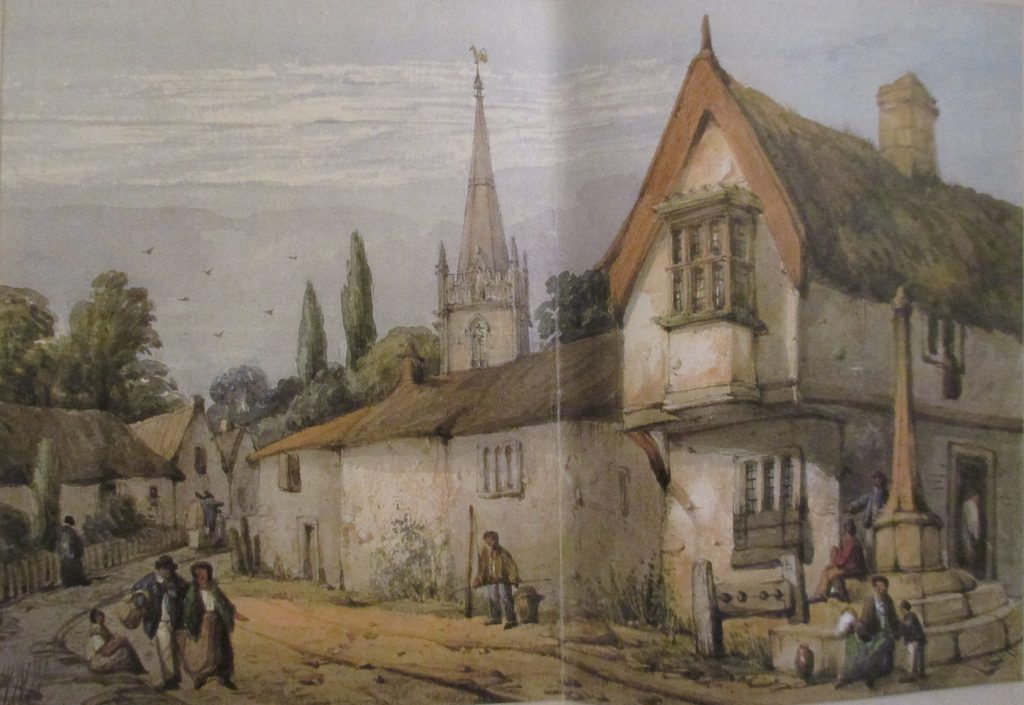
Shepton Mallett from Barren Down
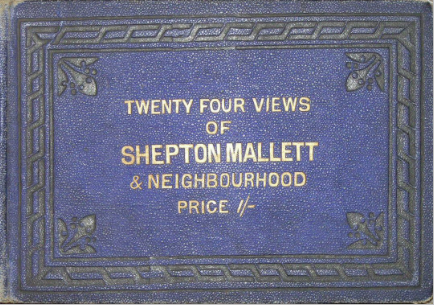
from Twenty Four Views of Spepton Mallett & Neighborhood
by Kershaw & Son and J. S. & Co., 1812
http://www.rareoldprints.com/p/7184
Note: For the artwork.

Shepton Mallet
https://en.wikipedia.org/wiki/Shepton_Mallet 
Note: For the text.

The Shepton Mallet Silver Amulet
by Stephen Minnitt and Matthew Ponting
https://sanhs.org/wp-content/uploads/2020/11/2-Minnitt-and-Ponting.pdf
Note: For the Shepton Mallett Silver Amulet photograph found on page 2/8.

Britain Express
The Somerset Military Museum
The Low Ham Mosaic
https://www.britainexpress.com/attractions.htm?attraction=2390
Note: For the mosaic image.
“This magnificent mosaic floor is one of the finest Roman artefacts in Britain. The mosaic depicts the tragic love story of Dido and Aeneas, as it was related in the poems by Virgil around 25 BC. The mosaic was discovered in the bath complex of a Roman villa at Low Ham, near Langport, where it formed part of an entry to a cold plunge pool. The mosaic was made of over 120,000 individual coloured tiles, or tesserae, made from local limestone and clay. The mosaic was created around AD 350.”

BBC News
Roman cemetery found at Somerton new school site
https://www.bbc.com/news/uk-england-somerset-51018178
Note: For the image of a Roman burial pot.

BBC News
Hoard of Roman silver coins bought by council
by Inaya Mohmood
https://www.bbc.com/news/uk-england-south-yorkshire-65244111
Note: For the image of the coins. “Septimius Severus was Roman emperor from 193 to 211 AD”

Prehistoric Britain, The Trilogy That Changed History
Minerals found in Prehistoric and Roman Quarries
https://prehistoric-britain.co.uk/minerals-found-in-prehistoric-and-roman-quarries#14_Flint
Note: For the peat excavation and flint arrowhead images.

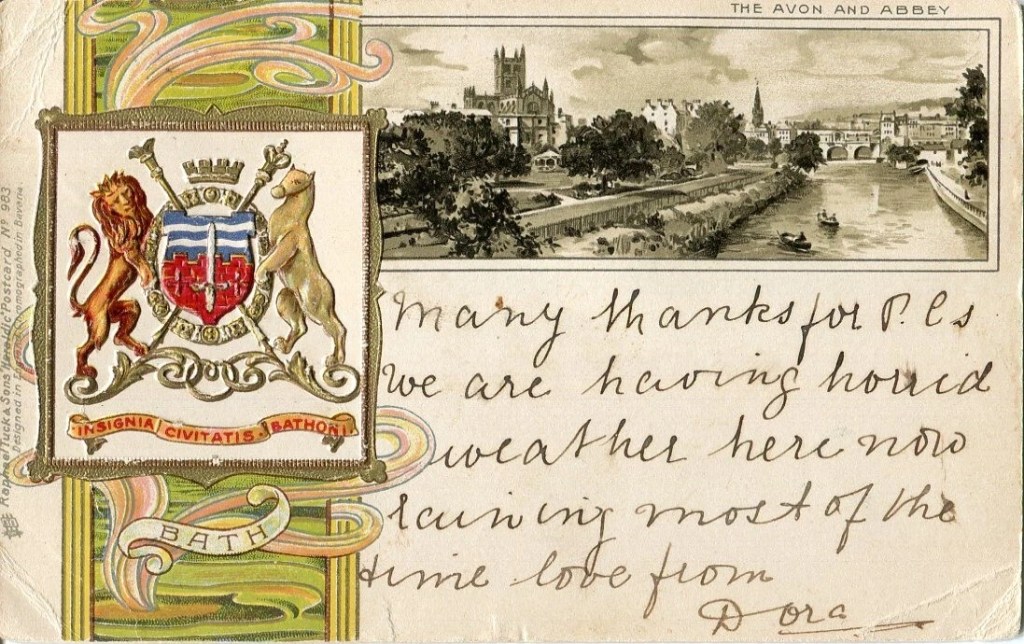
Another Tuck & Sons postcard from Somerset featuring the nearby city of Bath.
(Found at:https://www.ebay.co.uk/b/bn_3326125).

Tuck & Sons 1903 Postcard
Picturesque Somerset, Glastonbury Abbey
by Artist Unknown
https://commons.wikimedia.org/wiki/File:Picturesque_Somerset._Glastonbury_Abbey_(NBY_439956).jpg
Note: For the image of the Glastonbury Abbey ruins.

John, King of England
Effigy of King John on his monument in Worcester Cathedral
https://en.wikipedia.org/wiki/John,_King_of_England#/media/File:Jan_tomb.jpg

Edward III
File:Edward III of England (Order of the Garter).jpg
An illuminated manuscript miniature, c.1430-1440,
of Edward III of England

https://commons.wikimedia.org/wiki/File:Edward_III_of_England_(Order_of_the_Garter).jpg

Henry VI of England
File:Henry VI of England, Shrewsbury book.jpg
Illuminated miniature of Henry VI of England —
between 1444 and 1445
https://commons.wikimedia.org/wiki/File:Henry_VI_of_England,_Shrewsbury_book.jpg

Edward IV
File:Edward IV Plantagenet.jpg
Edward IV York (1442-1483), circa 1520 –
posthumous portrait from original circa 1470-1475
https://commons.wikimedia.org/wiki/File:Edward_IV_Plantagenet.jpg

Henry VIII
File:1491 Henry VIII.jpg
Portrait by Joos van Cleve —
between circa 1530 and circa 1535
https://commons.wikimedia.org/wiki/File:1491_Henry_VIII.jpg

The Dance of Death
by Michael Wolgemut, c. 1493
https://commons.wikimedia.org/wiki/File:Nuremberg_chronicles_-_Dance_of_Death_(CCLXIIIIv).jpg
Note: For the illustration from the Nuremberg Chronicle of Hartmann Schedel

Paul Fürst
Der Doctor Schnabel von Rom (coloured version).png
https://commons.wikimedia.org/wiki/File:Paul_Fürst,_Der_Doctor_Schnabel_von_Rom_(coloured_version).png
Note: For the colored Black Plague doctor image.

The History Press
The short dark history of Somerset
by Mike Dean
https://thehistorypress.co.uk/article/the-dark-history-of-somerset/
Note: For the pull-quote.

Shepton Mallett Nub News
The Shepton Riots
by Laura Linham
https://sheptonmallet.nub.news/news/local-news/the-shepton-riots-252234
Notes: For various texts, and the Spinning Jenny illustration.

From A Potted History of Shepton Mallet, titled
“How Croscombe (and my premises) used to look.”

The Cross at Croscombe
A Potted History of Shepton Mallet
https://www.cross-croscombe.co.uk/blog/potted-history-shepton-mallet/
Note: For the text.

The Parish of Stoke St. Michael, or Stoke Lane

(3) — eight records

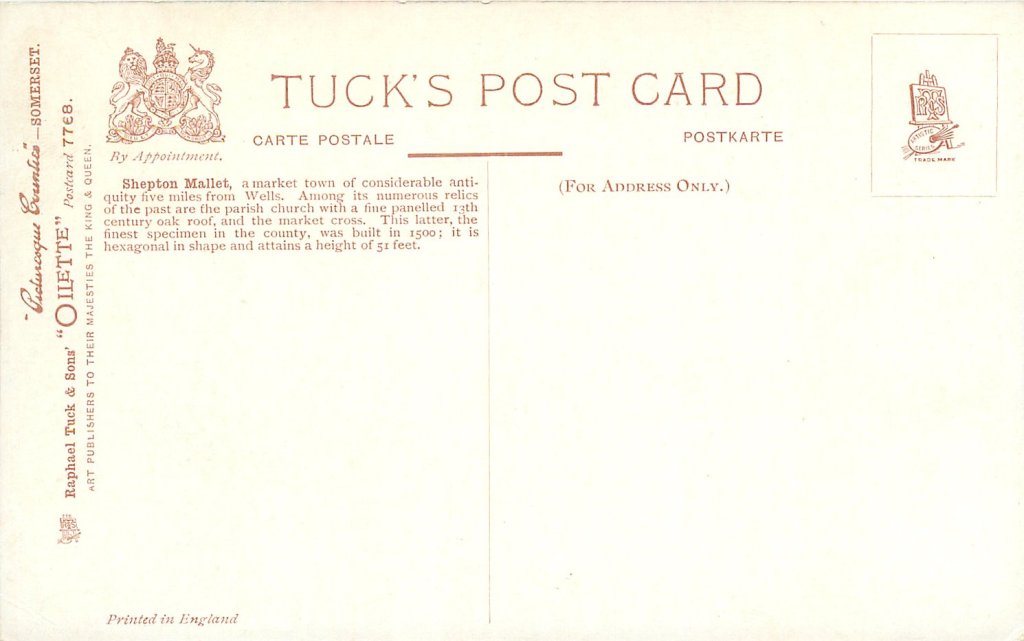
Shepton Mallet, Market Cross postcard back from:
https://www.tuckdbpostcards.org/items/64387-shepton-mallet-market-cross

Tuck & Sons 1903 Postcard
Picturesque Somerset. Shepton Mallet, Market Cross
by Raphael Tuck & Sons
https://commons.wikimedia.org/wiki/File:Picturesque_Somerset._Shepton_Mallet,_Market_Cross_(NBY_440238).jpg
Note: For the illustration of the market.

Stoke St Michael
https://en.wikipedia.org/wiki/Stoke_St_Michael
Note: For the text.

Robert Cullen
in the Somerset, England, Marriage Registers, Bonds and Allegations, 1754-1914 > Marriage Registers > Stoke St Michael > 1754-1808
https://www.ancestry.com/search/collections/60858/records/184825
Digital page: 35/53 , Entry No. 9, right page top.
Note 1:  Their marriage date is May 28, 1787.
Note 2: One of the witnesses to his wedding is John Cullen, who is likely a relative.

Sarah Cullen
in the Somerset, England, Church of England Baptisms, Marriages, and Burials, 1531-1812
Stoke St Michael > 1783-1812
https://www.ancestry.com/search/collections/60856/records/181224?tid=&pid=&queryId=a6c8ff92-7620-4472-ab5d-22274c117c74&_phsrc=OwZ3&_phstart=successSource
Digital page: 11/64, Entry 22 on the right page.
Note: Sarah’s birthdate is March 25, 1789, and her baptism was on September 6, 1789.

Robert Cullen
in the Somerset, England, Church of England Baptisms, Marriages, and Burials, 1531-1812
Shepton Mallet > 1791-1812
https://www.ancestry.com/search/collections/60856/records/150264637
Book page: 222 Digital page: 114/213
Note: Thomas Hobbs Cullen’s birth date is August 29, 1810, and his baptism date is nearly a year later, on July 20, 1811.

Robert Culler [Robert Cullen]
in the Somerset, England, Church of England Burials, 1813-1914
Shepton Mallet > 1839-1863
https://www.ancestry.com/search/collections/60859/records/242299
Book page: 34, Digital page: 20/153, Entry No. 269 on the left page.
Note: His estimated birth year is 1762.
Note: His burial record.

Robert Cullen
in the England & Wales, Civil Registration Death Index, 1837-1915
1841 > Q1-Jan-Feb-Mar > C
https://www.ancestry.com/search/collections/8914/records/8179784
Book page: 144, Digital page: 47/60, Right page, second entry at the top.
Note: His civil registration death index.

Phillis Was Transformed Into An Almond Tree, Who Knew?

(4) — two records

Phyllis
https://en.wikipedia.org/wiki/Phyllis
Note: For the text.

Phyllis and Demophoön
by John William Waterhouse, 1905
File:John William Waterhouse – Phyllis and Demophoon.jpg
https://commons.wikimedia.org/wiki/File:John_William_Waterhouse_-_Phyllis_and_Demophoon.jpg
Note: For the painting, via Wikimedia Commons.

The Williams / Harris Line, A Narrative — One

This is Chapter One of twelve — these chapters for the Williams / Harris line will take us back into the past centuries of England and Wales, and then eventually they lead us to America, through family migrations. There are three family lines involved: two lines are from Wales, and one family line is from England. A significant adoption between family lines opened up new and compelling avenues of exploration for us to investigate.

Detail of a vintage Storkgram card by the Western Union Telegraph Company.
(Image courtesy of the Smithsonian National Museum of American History).

Two Different Windows Into The Past

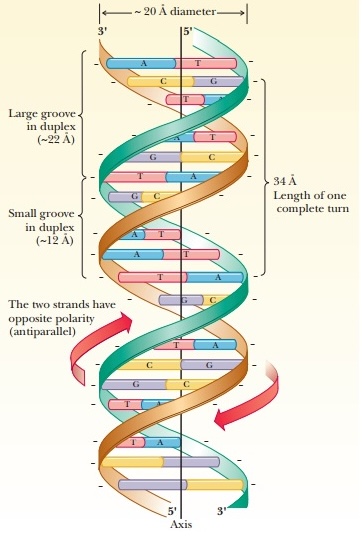
In the past few years there has been a tremendous boom in people’s interest in genetic ancestry. However, there is much more to genealogy than the blueprints of genetics. As explained by the 24 Genetics Academy, “Genealogy connects us with the recent history of our families, gives us names and dates, and allows us to piece together an intimate and direct account, attempting to identify specific people in our family tree. Genetics, on the other hand, offers us a broader, long-term perspective, inviting us to look back not only as individuals, but as part of a collective history… and [our] genetic legacy.”

Without getting too complicated, human genetics are driven through inheritance, based upon on the structure of the DNA molecule. “Cells are the fundamental structural units of all living things; DNA is the information molecule housed within those units.” (Medline Plus)

What is the nature of the DNA double helix?
(Image courtesy of BrainKart.com).

DNA’s structure consists of two molecular strands which wrap around each other as a double helix. This provides an apt analogy for this family history. Like an intertwined, golden braid — one strand is genetics; the other, genealogy. In working together, each family bestows a unique contribution. Both histories enlighten, helping us understand not only the families we are born into, but also the families we create.

This is the Williams family line pedigree flow chart.
Just as DNA progresses with a spiral stand, this family history eventually unfolds in two parallel time lines near in time, but physically disconnected from each other.

Staring with this chapter, we will be looking at aspects of the Williams family in Somerset, England, and then in America for the next five generations — chapters One through Six. At that point, we will be introducing members of the Harris Line. (1)

The top map is known as The Severn or Channell of Bristoll, by Captain Greenville Collins,
as published in The British Coasting Pilot, c. 1693. The bottom map is Britain, also known as
Britain as it was divided in the tyme of the Englifhe Saxons efpecially during their heptarchy,
by John Speed, 1623-27. (Both images are courtesy of Antique Maps Online).

Along The Severn, or The Channel of Bristol

As the southern edge of Wales comes together with the southwest corner of England, we encounter an area known as The Severn, or The Bristol Channel. This location is where this family history commences. Below the channel is Somerset, or Somersetshire, England where the ancestors of the Williams Line resided. Above the channel is the country of Wales. The district known as Monmouth, or Monmouthshire, Wales is where the ancestors for the Harris Line are found. These two families were located very close to each other in the United Kingdom, yet despite that, they did not come together until nearly 200 years after this narrative begins. (2)

The Domesday Book was a comprehensive survey and record of all the landowners, property, tenants and serfs of medieval Norman England. It was compiled in 1086-7 under the orders of William the Conqueror (r. 1066-87).

The Domesday Book

There were then, and are still to this day, many ancient parishes, villages and towns in Somerset. Our family has lived there for more generations than there are existing records.

Oxford Reference defines the Domesday Book as “A survey of property in England conducted in 1086. Conceived by William I, but probably to some extent based on pre-Conquest administrative records. It was the most comprehensive assessment of property and land ever undertaken in medieval Europe. Its purpose was to maximize the revenues from the land tax…”

Two locations which have come up in the early surviving records are Doulting and East Pennard. Doulting is so old that it is mentioned in the Domesday Book, in the Folio Somerset X (Ten).

Excerpted text from the Domesday Book, Doulting, Somerset folio 10.

The Open Domesday website notes these statistics from nearly 1,000 years ago: “It had a recorded population of 20 households in 1086: 18 villagers, 12 smallholders, 4 cottagers, 6 slaves. Additionally, there were: 20 ploughlands, 3 lord’s plough teams, 8 men’s plough teams, 12.0 lord’s lands, Meadow — 53 acres, Pasture — 70 acres, Woodland — 90 acres, 1 mill, value 7 pence, 1 cob [a stocky, sturdy riding horse], 4 cattle, 15 pigs, 340 sheep.”

Hundreds of years later, Wikipedia writes, “The parish of Doulting was part of the Whitstone Hundred. Doulting village dates from the 8th century when King Ine of Wessex gave the local estate to Glastonbury Abbey after his nephew St Aldhelm died in the village in 709. In his honor the local spring which is the source of the River Sheppey, is called St Aldhelm’s Well.” (3)

Illustration of St. Aldhelm’s Well as published in
Shepton Mallet: Notes On Its History, by John E. Farbrother.

Let’s Begin in The Hundred of Doulting

In a somewhat young country like the United States, people are very used to understanding that areas are generally organized to function along these lines: town-village / townships / cities / counties / states / country. That is pretty straightforward, but not as easy to understand in a much older country like England.

Wells Cathedral, Somerset, by John Syer. This famous cathedral is located not far from the parishes of Doulting and East Pennard in Somerset. (Image courtesy ArtUK, via The Cheltenham Trust and Cheltenham Borough Council).

This becomes confusing when trying to ascertain locations for record verification. There is a lot of jurisdictional overlap in the way locations are noted on documents — so the assessment of records must be very carefully vetted. For example, two or three different locations could be noted for the same event, depending upon the record, who was writing things down, and when.

Historically, the English terms are different in both scale and meaning. Roughly, they are: hamlet / parish / village / town-township / hundred / district, or county, or shire / city / region / kingdom, or country. Even though America imported some of this thinking from the United Kingdom, some of the older organizational designations were just eventually phased out. One such designation is called a hundred.

From Wikipedia, “In southern and western England, a hundred was the division of a shire [like a county] for military and judicial purposes under the common law, which could have varying extent of common feudal ownership… Until the introduction of districts by the Local Government Act 1894, hundreds were the only widely used assessment unit intermediate in size between the parish… and the county, with its formal ceremonial functions.” So, a hundred was an amorphous thing — bigger than a parish, but not as big as a county? (4)

Map of Somerset by John Cary. Published in Britannia by William Camden, c. 1789.
The very small villages are marked with ovals as follows: Doulting – the upper blue oval,
and East Pennard — the lower red oval. (Image courtesy of Antique Maps Online).
Inset detail map: Enlarged from, Map of 24 miles round the City of Bath. Most humbly dedicated …,
by C. H. Masters, circa 1800. (Image courtesy of The National Library of Scotland).

The Phippin and Reeves Families

We begin with a man named William Phippin, who was married to a woman named Maria Ivyleafe. They were from the Doulting, Somerset, England area, and on May 29, 1695, they baptized their daughter Presilla Phippin.

She went on to marry a man named John Reeves, on September 7, 1713, also in Doulting. With this marriage the Phippin surname gave way to the Reeves surname.

As was typical for that era, they likely had many children. We are able to verify six of them through records. Luckily for us, the one we needed to verify is the most important one for this history — their youngest daughter, Alice Reeves.

  • Edith Reeves, born June 1721
  • William Reeves, born September 27, 1726
  • Priscilla Reeves, born December 29, 1729
  • Thomas Reeves, born April 8, 1734
  • John Reeves, born August 17, 1736
  • Alice Reeves, born April 11, 1739, Alice carries the family line forward.

We found the burial record for their mother Presilla (Phippen) Reeves. She lived about 74 years — until June 10, 1769 (which is her burial date).

Observation: We have noted that there are several Reeves family generations (delineated in online family trees) which venture back to circa 1580. The consistent problem with many of them is that specific dates and locations are indicated, yet there is a lack of documentation provided. When this happens, we choose not to include information that we cannot verify.

Alice Reeves and Robert Cullen Sr.
We have been able to learn some things about this family, despite scant records. We do know that Alice Reeves married Robert Cullen Sr. on March 31, 1766, in East Pennard, Somerset. She was about 27 years old. Conversely, we do not know when either of these ancestors passed on, nor exactly how many children they had. With this marriage, the Reeves surname gave way to the Cullen surname.

Marriage record for Robert Cullen Sr. and Alice Reeves, on March 31, 1766.

They were living in a nearby village, also located in the Whitstone Hundred, named East Pennard. “The village takes its name from the Brythonic family of Celtic languages: penn-ardd meaning high hill. The estate was granted by King Edred to Aelfgyth, a nun of Wilton and she transferred it to Glastonbury Abbey which retained it until the Dissolution of the monasteries in 1539. It was then given to William Paulet and eventually to his descendants the Napiers of Tintinhull.” (Wikipedia)

Observation: We have observed that this family signed their respective names with their Mark, which was typically an X. This means that they had to rely on the kindness of others to record information for them. Hence, sometimes their family surname is spelled an e (Cullen), or an o (Cullon).

Rob Cullen, in the March 1776 UK Register of Duties Paid for Apprentices’ Indentures, page 43.

Robert Cullen Sr. (sometimes recorded as Rob), didn’t earn his living as a farmer, as many of his neighbors did. He was a tradesman. Specifically, he was a Master Butcher, as the above records indicates, when he was compensated for mentoring an apprentice named John Hoskins. According to Google, “Being a Master Butcher in Somerset, England, in 1776 was a physically demanding yet highly respected skilled trade that placed a person at the heart of their local community’s economy. It was a period where butchers were valued for their deep knowledge of animal anatomy and food safety, with some even viewed as holding a superior knowledge similar to practitioners in medical fields.”

The Village Butcher, by John Cranch, circa 1785-1800.
(Image courtesy of the Royal Albert Memorial Museum & Art Gallery Collections).

About five years after their marriage, the family welcomed a baby boy, who they named Robert Jr. in honor of his father. Robert Jr. carries the family line forward into the next chapter. (5)

Following are the footnotes for the Primary Source Materials,
Notes, and Observations

Two Different Windows Into The Past

(1) — five records

Smithsonian National Museum of American History
Western Union Telegraph Company Records
Storkgram telegram blank, c. 1950
https://americanhistory.si.edu/ko/collections/archival-item/sova-nmah-ac-0205-ref11320
Note: For the image.

24 Genetics Academy
Differences Between Genealogy and Genetic Ancestry
https://academy.24genetics.com/topics/differences-between-genealogy-and-genetic-ancestry/
Note: For the text.

Medline Plus
Help Me Understand Genetics
Cells and DNA
https://medlineplus.gov/download/genetics/understanding/basics.pdf
Note: For the data.

What is the nature of the DNA double helix?
BrainKart.com
Note: For the DNA double helix illustration.

Genetic Ancestry Doesn’t Tell Your Whole Story
by Carles Lalueza-Fox
The MIT Press Reader
https://thereader.mitpress.mit.edu/dna-and-its-discontents/
Note: For reference.

Along The Severn, or The Channel of Bristol

(2) — three records

Antique Maps Online
The Severn or Channell of Bristoll
by Capt. Greenville Collins
https://www.antique-maps-online.co.uk/bristol-channel-collins-4191.html
Note: For the map image, as published in The British Coasting Pilot, c. 1693

Antique Maps Online
Britain, also known as Britain as it was divided in the tyme of the Englifhe Saxons efpecially during their heptarchy
by John Speed, 1623-27
https://www.antique-maps-online.co.uk/britain-speed-3646.html
Note: For the Somerset map image, as published by Sudbury and Humble in The Theatre of the Empire of Great Britaine

The National Library of Scotland
Map of 24 miles round the City of Bath. Most humbly dedicated …
by C. H. Masters, circa 1800
https://maps.nls.uk/counties/rec/13617
Note: Inset map for detail to show the Somerset villages of East Pennard and Shepton Mallet.

The Domesday Book

(3) — three records

The Domesday Book (as illustrated) by William Andrews, circa 1900, from “Historic Byways and Highways of Old England” (Image courtesy of Wikipedia.org).

World History Encyclopedia
Domesday Book
by Mark Cartwright
https://www.worldhistory.org/Domesday_Book/
Note: For the text and image.

Open Domesday
by Anna Powell-Smith
https://opendomesday.org
and
Somerset, page 10, Left column, middle.
https://opendomesday.org/book/somerset/10/

Shepton Mallet: Notes On Its History
by John E. Farbrother
https://archive.org/details/sheptonmalletnot00farbuoft/mode/1up
Note: For the illustration of St. Aldhelm’s Well.

Let’s Begin in The Hundred of Doulting

(4) — three records

Hundred (county division)
https://en.wikipedia.org/wiki/Hundred_(county_division)#:~:text=In%20southern%20and%20western%20England,on%20the%20number%20of%20hides

Wells Cathedral, Somerset
by John Syer
https://artuk.org/discover/artworks/wells-cathedral-somerset-62060
Note: The image is provided via The Cheltenham Trust and Cheltenham Borough Council.

Doulting
https://en.wikipedia.org/wiki/Doulting
Note: For the text.

The Phippin and Reeves Families

(5) — twenty-one records

Antique Maps Online
Somerset
by John Cary
https://www.antique-maps-online.co.uk/somerset-cary-3980.html
Note: For the map image, as published in Britannia by William Camden, c. 1789

Gulielmus Phippin
Somerset, England, Church of England Baptisms, Marriages, and Burials, 1531-1812
Wedmore > 1663-1727
https://www.ancestry.com/search/collections/60856/records/290723
Digital page: 54/109, Right page, 6th entry from the botttom. 
Note 1: Their marriage date is recorded as January 10, 1692. In that era, the Church utilized the Julian calendar year, which began on March 25 and ended on March 24 each year. Using the modern standard of the Gregorian calendar, their actual marriage date is January 10, 1693.
Note 2: In 17th-century England, scribes frequently translated the name William into its Latinized equivalent, Gulielmus.
Note 3: His wife’s name is actually Maria Ivyleafe. Her maiden name as Mariam (is from the Latin), and Jueleast (is from modern machine reading of the document).
Note: 4: Maria Ivyleafe’s baptism record follows with the next footnote.

Marriage record for William Phippin and Maria Ivyleafe.

Maria Ivyleafe
https://www.ancestry.com/family-tree/person/tree/58968748/person/422091224949/facts
Note 1: The linked image is located left of the header for this file titled Maria Ivyleafe. It was provided by another researcher in a Gallery —
https://www.ancestry.com/mediaui-viewer/tree/58968748/person/422091224949/media/1374ff04-5eb2-479d-8a30-3fb9a9678eed
Note 2: The actual notation is found on the lower right page as an entry for January 28, 1673. Applying the same rules for dating as described in the above footnote, her actual baptism date is January 28, 1674.

Baptism record for Maria Ivyleafe.

Priscilla Phippin
in the England, Select Births and Christenings, 1538-1975
https://www.ancestry.com/search/collections/9841/records/24912344
Note: Her baptism date is May 29, 1695.
Note: Her father’s name is William Phippin.
Note: The location is Doulting, Somerset, England, which is near Shelton Mallet.
and
William Phippin
in the England, Select Births and Christenings, 1538-1975
https://www.ancestry.com/search/collections/9841/records/24912343
Note: For the record.

John Reeves
in the Somerset, England, Church of England Baptisms, Marriages, and Burials, 1531-1812
Doulting > 1685-1733
https://www.ancestry.com/search/collections/60856/records/1699333
Book page: Digital page: 12/36, Right page, near the bottom.
and
John Reeves
in the England, Select Marriages, 1538-1973
https://www.ancestry.com/search/collections/9852/records/21523531
Notes: The marriage date is September 7, 1713, and his wife is named Presilla Phippen.

We have been able to verify the following Reeves / Phippen children through the Somerset, England  Church Records, 1501-1999, found on Family Search:

Edith Reeves, baptism June 1721
https://www.familysearch.org/ark:/61903/1:1:6D9N-XG89?lang=en

William Reeves, baptism September 27, 1726
https://www.familysearch.org/ark:/61903/1:1:6D9N-8KQ1?lang=en

Priscilla Reeves, baptism December 29, 1729
https://www.familysearch.org/ark:/61903/1:1:6D9N-K3HV?lang=en

Thomas Reeves, baptism April 8, 1734
https://www.familysearch.org/ark:/61903/1:1:6D9N-XGCR?lang=en

John Reeves, baptism August 16, 1736
https://www.familysearch.org/ark:/61903/1:1:6D9N-FRDD?lang=en

Alice Reeves, baptism April 11, 1739
https://www.familysearch.org/ark:/61903/1:1:6D9N-NB27?lang=en

Alice Reeves
in the Somerset, England, Church of England Baptisms, Marriages, and Burials, 1531-1812
East Pennard > 1608-1747
https://www.ancestry.com/search/collections/60856/records/1493779
Digital page: 29/45, Left page, the first entry at the top.
Note: Her baptism date is April 11, 1739.

Priscilla Reeves
Vital – England, Somerset, Church Records, 1501-1999
https://www.familysearch.org/ark:/61903/1:1:6D99-31FH?lang=en
Note: Her 1769 burial record.

Alice Reeves
in the Somerset, England, Marriage Registers, Bonds and Allegations, 1754-1914
Marriage Registers > East Pennard > 1755-1800
https://www.ancestry.com/search/collections/60858/records/900764042
Book page: 18, Digital page: 12/43, Left page top.
Note: The marriage date for Robert Cullen and Alice Reeves is March 31, 1766.

An example of a rural English fingerpost sign. Before this time, crossroads were typically marked by long-lived yew trees. Note the name of East Pennard in the lower right corner.
(Image courtesy of the National Survey of Wayside Features by The Milestone Society, https://www.geograph.org.uk/photo/6051069).

East Pennard
https://en.wikipedia.org/wiki/East_Pennard
Note: For the text.

Rob Cullen
in the UK, Register of Duties Paid for Apprentices’ Indentures, 1710-1811
Country Registers > 1776 Oct-1779 Feb
https://www.ancestry.com/search/collections/1851/records/316499
Book page: 43, Digital page: 87/449, Upper portion, 16th line, noted as a Butcher.
Note: This file indicates that he worked as a Master Butcher, and that he was compensated for the training an Apprentice named John Hoskins.

Robert Cullen
in the Somerset, England, Church of England Baptisms, Marriages, and Burials, 1531-1812
East Pennard > 1747-1812
https://www.ancestry.com/search/collections/60856/records/1822099
Digital page: 101/171, Second entry after the heading “Christenings in the year 1771”
Note 1: His christening date is February 12, 1771.
Note 2: His parents names are Robert and Alice (Reeves) Cullen. Observe that the recorder originally wrote the name John, and then tried to correct that by overwriting with (what is likely) the name of Robert.

The Williams / Harris Line, A Narrative — Three

This is Chapter Three of twelve, where we finally meet the family for whom we have named this family narrative. It is Sarah Cullen’s 1813 Regency era marriage to James Williams Jr. that connects us to this family.

The Parish of Pilton, Somersetshire

At the same time that Robert Cullen Jr. and his wife Phillis were raising their family in Stoke Lane just north of Shepton Mallet, the Williams family were doing the same, only south of that same small city. This generation of the Williams family has left few records, but what we have found provides enough essential information to sketch their lives with some clarity: births, a marriage, a family, deaths.

Enlarged detail from, Map of 24 miles round the City of Bath. Most humbly dedicated …,
by C. H. Masters, circa 1800. (Image courtesy of The National Library of Scotland).

If you look carefully at the map above, to the southwest of the village of Pilton (circled with an oval), is the town of West Pennard. In modern times, Pilton is frequently found associated with the parish of West Pennard — but, to add confusion to the situation, there is another hamlet in the same area spelled as: Piltown (note the added ‘w’).

At left: An 1840 map demonstrates the confusion with names: Pilton versus Piltown. At right: A map of the Pilton parish in 1809. It is probable that some members of our family lived somewhere within the area of this map at that time.

“Piltonis a village andcivil parish in Somerset, England, located about 3miles (or 5km) southwest of Shepton Mallet. The parish includes the hamlets of West Compton, East Compton, Westholme, Beardly Batch, and Cannards Grave.

The village…is almost 20 miles (30km) from the sea but sits on the edge of the Somerset Levels, an area which has now been drained but was once a shallow tidal lake. According to legend in the 1st century, being a landing place then known as Pooltown, it is where Joseph of Arimathea landed in Britain. This is highly unlikely, as the suffix ‘ton’ is Saxon, and therefore cannot be from before 450-500 AD at the earliest.” (Wikipedia) (1)

James Williams Sr. and Sarah Hill’s marriage record,
Pilton Parish, for January 13, 1788.

The Williams Family Branches Out

Starting in the new year of 1788, James Williams and Sarah Hill married in the Parish of Pilton. (Contemporary records indicate that this would be The Church of St. John the Baptist, see footnotes). A child was quickly on the way as ten months later, they welcomed their new son into the family. They named him James Williams Jr. in honor of his father. It is quite likely that they had many more children, or sadly, that they also lost some children. (We have discovered no records either way at this point in time). It is perhaps important to note that this record does not indicate his birth year, and that as he aged, he seems to be guessing at this information on the censuses.

The baptism record of James Williams Jr., Pilton Parish, Somerset, on October 12, 1788.

What we do know is this: a number of years later, they had another son in 1810, and named him Samuel. This younger son stayed in Pilton and figures into the latter life of his father James Sr.

How did they support themselves?
To answer this question, we need to infer what we see on the maps and what we can glean from the 1841 Census. It’s certain that all the members of the Williams family were agricultural laborers, or tradesman in support of the community. On the 1841 census, James Williams Jr. and his brother Samuel Williams are identified as —Laborers, or Agricultural Laborers.

The bucolic life of Somerset, The Holiday County of Infinite Charm, by Herbert Alker Tripp.
British Railways Vintage Travel Poster, (Image courtesy of Mutual Art).

Around 1800, West Somerset agriculture was dominated by traditional farming techniques focused on raising arable crops. This means that the lands were suitable for growing crops. (This is different from lands only considered generally suitable for animal grazing).

Key crops included: wheat, barley, oats, and turnips (as fodder for animals). Field peas and beans were grown to help fix nitrogen in the soil. Apple orchards were vital for producing cider.

Animals were raised for wool, dairying, and meat:
Sheep — were raised for wool and meat, with wool being very important for the nearby Shepton Mallet cloth factories.
Cattle — known for dairy farming, particularly for cheddar cheese and butter, as well as raising beef cattle.
Pigs — were kept for meat and bacon.
Horses — were used primarily for transportation and for labor on farms. (Extracted from Wikipedia) (2)

Change Was in The Wind

The Industrial Revolution was slowly underway. The Industrial Revolution was the transition from small cottage industries in which goods were mostly made by hand to new, mass-produced goods in factories using steam and water power.

The Industrial Revolution began in Great Britain around 1760 and many of the early technological innovations happened there. Textiles were the dominant industry of the early Industrial Revolution. The textile industry was also the first to use modern production methods. The Industrial Revolution marked a major turning point in history and almost every aspect of daily life was influenced in some way.” (Students of History)

Cheffin’s Map – [The] Route of Great Western Railway, 1850. If you observe carefully at the lower left corner, you will see the village of West Pennard, and the city of Shepton Mallet…. (long dramatic sigh)… so close, and yet, so far. (Image courtesy of Wikimedia Commons).

The world was changing, but traditional life in the tiny parish of Pilton would stay the same for a while longer. Specifically, in West Somerset where they lived, industrialization was not as uniform, nor as rapid as in the North of England, but significant development occurred from the late 18th century into the early 19th century, particularly driven by the textile industry. The Great Western Railway pushed westward into the area, but went north to connect London, to the Somerset cities of Bath and Bristol — thereby passing well above the villages, parishes, and hamlets to the south. It reached Bath and Bristol circa 1840-ish, right near the of end-of-life for this generation. In fact, the working residents probably stood in the farm fields, arms akimbo, looking at the distant trail of coal smoke from the train line that would never reach them.

These cultural shifts would affect a place like Shepton Mallet much earlier than an outlying parish like Pilton. It is probable that none of this generation of the Williams family ever experienced any of these changes. The mother of the family, Sarah (Hill) Williams, passed away before her husband James, in early 1833. (3)

Burial record for Sarah (Hill) Williams. Note that even though the year noted on the page is 1832, she likely died in early 1833. (See footnotes).

The First Modern Census

James Williams Sr. likely never appeared in a Census until his life was nearly over. At 85 years old, he appears in the 1841 Census of England, living in the home of his younger son Samuel, and his family. Between 1801 and 1841, the British government had a rather haphazard approach in trying to capture this information. No one yet seemed to comprehend the pragmatic usefulness of this kind of data.

“There was widespread opposition to an official census until the end of the 18th century. This finally withered away after demographer Thomas Malthus, published his essay on the ‘principle of population’ in 1798. [He] caused great concern by suggesting that population growth would soon outstrip supplies of food and other resources. Unable to support itself, Britain would be hit by famine, disease and other disasters.* Concerned at this alarmist view of the future, people began to see the need for a census. Parliament passed the Census Act in 1800 and the first official census of England and Wales was on March 10, 1801… but the 1841 census, run by the new registration service, is regarded as the first modern census.
*Think of the Irish Potato Famine of 1845 to 1852 — An Gorta Mór(the Great Hunger), see footnotes.

1841 Census of Pilton, Whitstone Hundred, Shelton Mallet District, Somerset.

Since 1801 there has been a census every ten years except in 1941, during the Second World War. For the first time, the head of each household was given a form to fill in on behalf of everyone in the household on a certain day. This system has stood the test of time, and it still forms the basis of the method we use today.” (The Office for National Statistics)

Burial record for James Williams Sr. Even though the year noted on the page is 1841, he likely died at end of 1841, or very early in 1842. (See footnotes).

James Williams Sr. passed away within a decade of his wife Sarah’s death. He lived to be about 86 years old, which is quite impressive when you consider the times within which he lived. He was born circa 1765 — a year notable for Great Britain’s Stamp Act. You wonder if his cries at being born, had to compete with the howls of the American Colonists in British North America over yet another tax. That charged event and their response to it, became an ignition point that helped build momentum toward the American Revolution. (See footnotes).

The Chair Mender, attributed to Francis Wheatley, 18th century.
(Image courtesy Strickland & Russell, UK).

At the end of his life, we ponder what James William Sr.’s life was truly about and how he must have felt, as he reflected on the many days which had passed. He probably missed his wife Sarah greatly, but then took some joy in his son Samuel’s home, surrounded by his grandchildren. In the next chapter, we will be looking at the life of his other son James Jr. and his wife Sarah Cullen, who then carry on our Williams family line. (4)

Following are the footnotes for the Primary Source Materials,
Notes, and Observations

The Parish of Pilton, Somersetshire

(1) — five records

The National Library of Scotland
Map of 24 miles round the City of Bath. Most humbly dedicated …
by C. H. Masters, circa 1800
https://maps.nls.uk/counties/rec/13617
Note: Enlarged for detail to show the Somerset villages of East Pennard and Shepton Mallet.

Pilton, Somerset
https://en.wikipedia.org/wiki/Pilton,_Somerset
Note: For the text.

Shepton Mallet
https://en.wikipedia.org/wiki/Shepton_Mallet
Note: For the reference.

BHO | British History Online
Parishes: West Pennard
https://www.british-history.ac.uk/vch/som/vol9/pp142-154
Note: For the 1840 map documenting both Pilton and Piltown.

Roads around Pilton — Illustrated Talk
P.V.H.G. (Pilton History The Heritage of a Somerset Parish)
by Richard Raynsford, January 2025
https://www.piltonhistory.org.uk/topics/travel-and-transport/roads-around-pilton-talk-by-richard-raynsford
Note: For data and 1809 map documenting Pilton.

The Williams Family Branches Out

(2) — seven records

James Williams [Sr]
in the England, Select Marriages, 1538-1973
https://www.ancestry.com/search/collections/9852/records/6807903?tid=&pid=&queryId=8863a398-2bbd-4284-a80c-807c49794e3d&_phsrc=giE15&_phstart=successSource
Note: Their marriage date is January 13, 1788; his wife’s name is Sarah Hill; Pilton, Somerset, England.
And
James Williams [Sr]
in the Somerset, England, Marriage Registers, Bonds and Allegations, 1754-1914
Marriage Registers Pilton 1783-1812
https://www.ancestry.com/search/collections/60858/records/4351154
Digital page: 23/43, Entry No. 39 on the left page.

Pilton Parish Church in the Snow of 2010, photograph by Heather Hall.
(Imagery courtesy of the Pilton Parish Council).

James Williams [Jr]
in the England, Select Births and Christenings, 1538-1975
Pilton 1783-1813
https://www.ancestry.com/search/collections/9841/records/107149488
Digital page: 9/66, Second entry from the top.
Note: His October 12, 1788 baptismal record.
Note: On the 1851 Census, he states that his birthplace was West Compton, Somerset. (West Compton is a street of, and a very small hamlet in Pilton).

Samuel Williams
in the Somerset, England, Church of England Baptisms, Marriages, and Burials, 1531-1812
Pilton 1783-1813
https://www.ancestry.com/search/collections/60856/records/4350084
Book page: 45, Digital page: 25/66, Sixth entry on the right page.
Note: His September 13, 1801 baptismal record.

Pilton Parish Council,Gallery
Pilton Parish Church in the Snow of 2010.
Contemporary photo by Heather Hall
https://www.piltonparishcouncil.org/gallery?pgid=l5mc2pat-9666a9a3-327e-4bbd-a6d6-f3657d57b912

Mutual Art
British Railways Vintage Travel Poster
Somerset, The Holiday County of Infinite Charm
by Herbert Alker Tripp
https://www.mutualart.com/Artwork/Somerset/0C00B030E62ED037412AA502A8844BF1

British Agricultural Revolution
https://en.wikipedia.org/wiki/British_Agricultural_Revolution
Note: For the extracted data.

Change Was In The Wind

(3) — five records

Students of History
The Beginning of the Industrial Revolution
https://www.studentsofhistory.com/why-the-industrial-revolution-began-in-england
Note: For the text about the beginning of the Industrial Revolution in England.

An assortment of 20th century Great Western Railroad travel posters from the article, The Farthing Layouts, A blog by Mikkel. (Image courtesy of RMweb, via https://www.rmweb.co.uk/blogs/entry/26677-edwardian-gwr-posters-an-overview-of-sorts/).

Great Western Railway
https://en.wikipedia.org/wiki/Great_Western_Railway
Note: For both the reference, and for
Cheffin’s Map — Route of Great Western Railway, 1850 map,
by Charles F. Cheffins, circa 1850.

Sarah Williams
in the Somerset, England, Church of England Burials, 1813-1914
Pilton 1813 1913
https://www.ancestry.com/search/collections/60859/records/4979797
Book page: 45, Digital page: 25/103, Entry No. 360 on the right page, (last entry at bottom).
Note: Her birth year is circa 1768, and her burial date was February 3, 1833.
and
Sarah Williams
Vital – England, Somerset, Church Records, 1501-1999
https://www.familysearch.org/ark:/61903/1:1:6D99-397B?lang=en

The First Modern Census

(4) — nine records

The Office for National Statistics
The Modern Census
https://www.ons.gov.uk/census/2011census/howourcensusworks/aboutcensuses/censushistory/themoderncensus#:~:text=The%20first%20official%20census%20was%20in%201801%2C,modern%20census.%20Last%20updated:%2018%20January%202016.
Note: Information about the only Census that James William Sr. ever appeared in (that we have discovered).

James Williams
[Sr]
in the 1841 England Census
Somerset Pilton ALL District 13
https://www.ancestry.com/search/collections/8978/records/13558430
Book page: 1 (or 23?), Digital page: 2/7, Left page, 7th entry for the Samuel Williams family.
Note: At 85, he is in the home of his son Samuel Williams.

Boy and Girl at Cahera, by James Mahony, 1847.
As published in The Illustrated London News.
“The first Sketch is taken on the road, at Cahera, of a famished boy and girl turning up the ground to seek for a potato to appease their hunger. Not far from the spot where I made this sketch, says Mr. Mahoney, and less than fifty perches from the high road, is another of the many sepulchres above ground, where six dead bodies had lain for twelve days, without the least chance of interment, owing to their being so far from the town.” (https://commons.wikimedia.org/wiki/File:Skibbereen_by_James_Mahony,_1847.JPG)

Great Famine (Ireland)
https://en.wikipedia.org/wiki/Great_Famine_(Ireland)#:~:text=The%20Great%20Famine%2C%20also%20known%20as%20the,and%20disease%20in%20Ireland%20from%201845%20to
and
UK Parliament
The Great Famine
https://www.parliament.uk/about/living-heritage/evolutionofparliament/legislativescrutiny/parliamentandireland/overview/the-great-famine/#:~:text=Between%201845%2D52%20Ireland%20suffered,a%20disease%20destroying%20the%20crop.
Note: For the data.

James Williams [Sr]
in the England, Select Deaths and Burials, 1538-1991
https://www.ancestry.com/search/collections/9840/records/4658434
and
James Williams
in the Somerset, England, Church of England Burials, 1813-1914
Pilton 1813-1913
https://www.ancestry.com/search/collections/60859/records/4979987
Book page: 69, Digital page: 37/103, Entry No. 550 on the right page.
Note: The right margin notation indicates that he was the first entry for 1842.

Encyclopædia Britannica
Stamp Act, Great Britain [1765]

https://www.britannica.com/event/Stamp-Act-Great-Britain-1765
Note: For the data.

Strickland & Russell
Selling Antiques
The Chair Mender,
attributed to Francis Wheatley, 18th century
https://www.sellingantiques.co.uk/1051310/attributed-to-francis-wheatley-ra-original-late-18th-century-antique-oil-painting-on-board-the-chair-mender-english-country-landscape
Note: For the image.