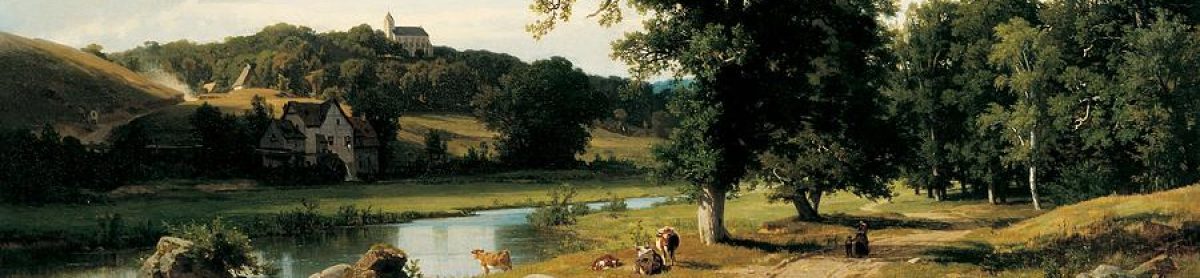
This is Chapter Two of Three where we shit from the Caswell family line to the Patton family line. We have found records for this family that show variations in how the Patton surname was recorded, essentially divided between two spellings: either Patton, or Patten. Either spelling seemed to please our ancestors, (many of whom could neither read, nor write), so we have chosen Patton, based upon most of the records we have located.
What’s In A Name? — Quite A Bit, Apparently.
We learned that Patton as a surname is “English, northern Irish, and Scottish: from the Middle English and Older Scottish personal name Patun, Paton, an Old French diminutive of Pat(e), a pet form [diminutive] of Patrick.” (Family Search)
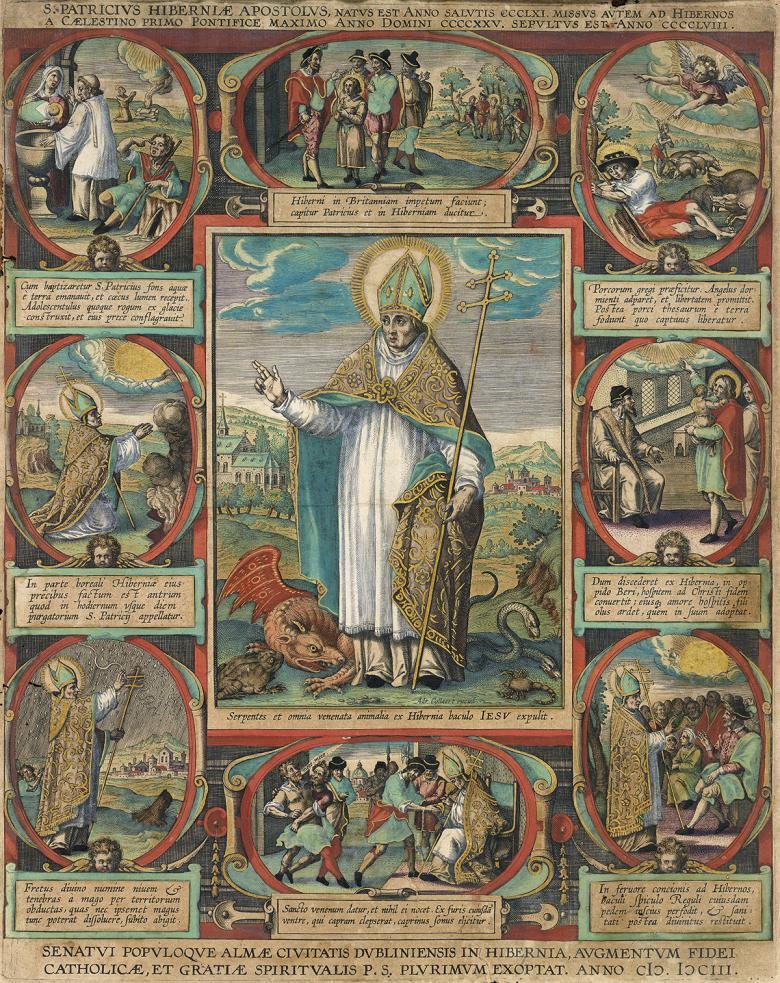
Perhaps this surname is a diminutive in some contexts, but some other sources offer greater elaboration — “The surname Patton boasts a rich heritage deeply rooted in both Scottish and English cultures. It traces its origins to the Latin name ‘Patricius,’ which translates to nobleman or patrician. This connection to nobility and esteemed lineage is intrinsic to the name’s identity. Over the centuries, variations of the name have emerged, including Paten, Paton, and Patten, each reflecting the linguistic evolution and regional dialects of the areas where they were used. This historical transformation showcases how names adapt and change, often influenced by cultural shifts and societal circumstances, ultimately leading to the modern spelling we recognize today as Patton.
During the medieval era, the Patton surname flourished particularly in the Scottish lowlands and northern parts of England. Its holders were frequently linked to land ownership, especially in regions like Dumfriesshire and Ayrshire, where the name became synonymous with the local gentry.” (Patpat) (1)
And Then There Was An Gorta Mór, or The Great Hunger
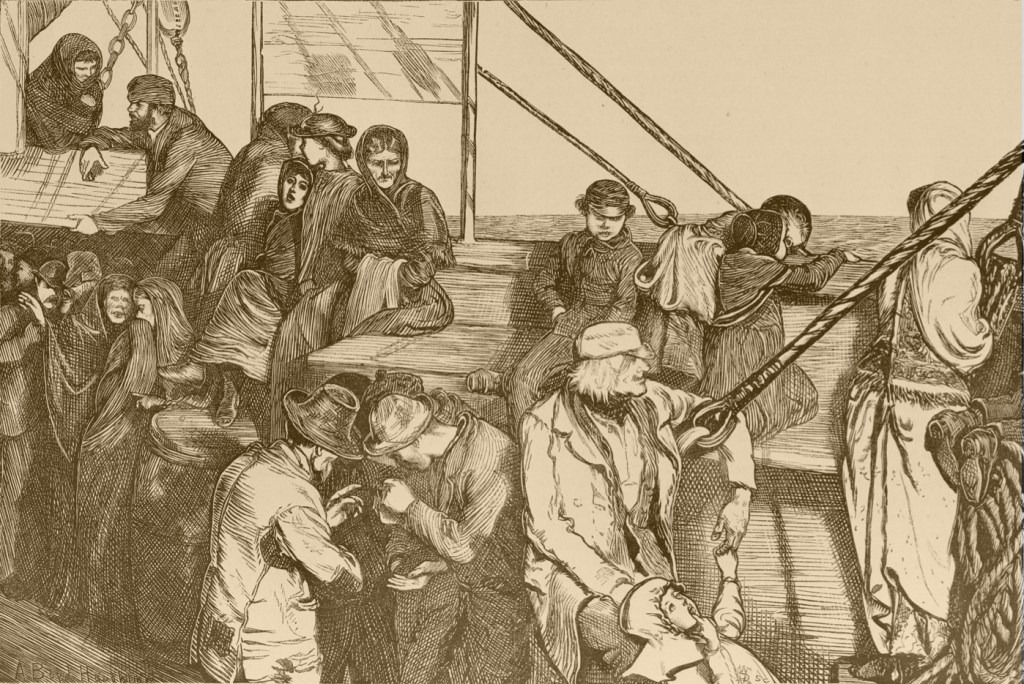
This family line is distinctly Irish in origin, so let’s discuss what is called the An Gorta Mór, or the Great Hunger, (in America, people generally refer to this time as the Potato Famine). “Between 1845 and 1855 more than 1.5 million adults and children left Ireland to seek refuge in America. Most were desperately poor, and many were suffering from starvation and disease. They left because disease had devastated Ireland’s potato crops, leaving millions without food. The Potato Famine killed more than 1 million people in five years and generated great bitterness and anger at the British for providing too little help to their Irish subjects. The immigrants who reached America settled in Boston, New York, and other cities where they lived in difficult conditions. But most managed to survive, and their descendants have become a vibrant part of American culture.” (Teach Democracy) (2)
Hugh Patton, An Irish Immigrant
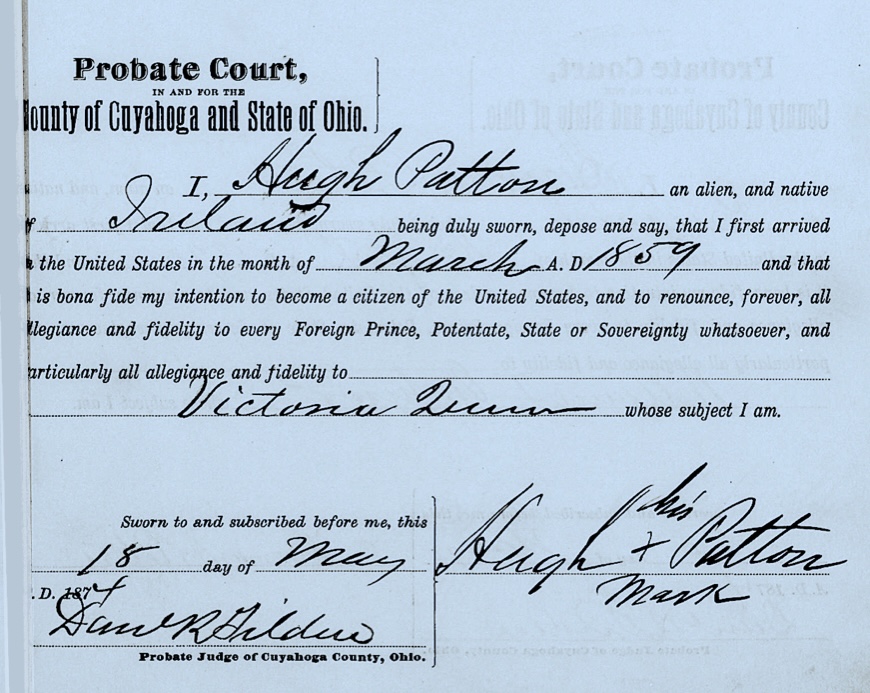
The patriarch for this branch of the Patton family is Hugh Patton. We have not been able to discover much about him prior to May 1874, when he then submitted an application for Naturalization to the Probate Court of Cuyahoga County, Ohio. On that document, he stated that he was a native of Ireland, and that he had entered the country in March 1859, a little more than fifteen years earlier.
information about Hugh is quite scarce before he appears in Cleveland, Ohio censuses. Many factors are contributing to this dearth of records:
- We only know Hugh Patton for about 20 years.
- Is the date of March 1859 the true date for when Hugh Patton entered the United States?
- In trying to trace back to exactly where he could have entered the United States, we can only view the information available for different ports of entry. Not all ship passenger manifests have survived.
- If perhaps, he entered via a land crossing from Canada, there are no records.
- There are many people with his name — it was a very, very popular name for boys in that era.
- For years afterward, there was still a large ongoing Irish Diaspora due to the aftermath of the great Potato Famine, and the lingering poverty it precipitated. Hence, to accommodate the continuing flow of immigrants around 1859, some record keeping was lax.
- (Deep Sigh) These records may exist somewhere, but they have not been made into digital resources for online genealogy researchers. (3)
Did They Live Once in Syracuse, New York?
In genealogy research, sometimes you see a glimmer of something that opens a new door for you, but sometimes that door is only opened to just a tiny little crack of light. There are a couple of records from his two oldest children (after they had grown up), that indicate the family had lived in Syracuse, New York for a period of time, before moving to Cleveland, Ohio.
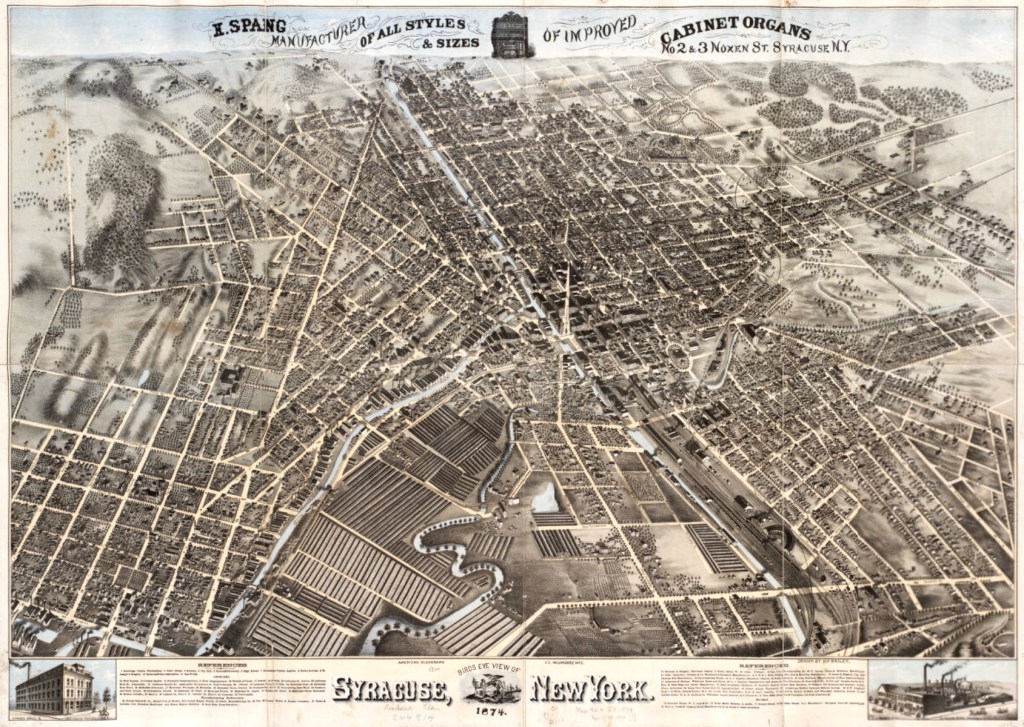
His oldest children, William (b. 1865) and Mary (b. 1869), indicate that they were born in Syracuse, New York. William is especially clear about this. On the death certificate for his infant son Hugh Patton (who is named after his grandfather), he indicates that he was born in Syracuse.
Daughter Mary, sometimes seems to be a little bit wily as she grows older. Sometimes she fudges some dates about her true age, and her actual birth location. It appears that she thought that perhaps shaving a few years off from her age, and writing New York City on her marriage document, to a younger man, was a bit more glamorous than her real age and being born in Syracuse. (See footnotes.) (4)
Rivals: Cleveland versus Newburgh!
Before we dive into the detailed history of this family line, it’s rather important that we acquaint everyone with a bit of Cleveland, Ohio history, versus Newburgh, Ohio history. What is Newburgh, you ask? If you look at the map below, you can see how the city of Cleveland and its adjacent areas were designated in the 1870s. The sizable area of Newburgh is situated in the lower right (southeastern) quadrant — this is where our family lived for much of that decade.
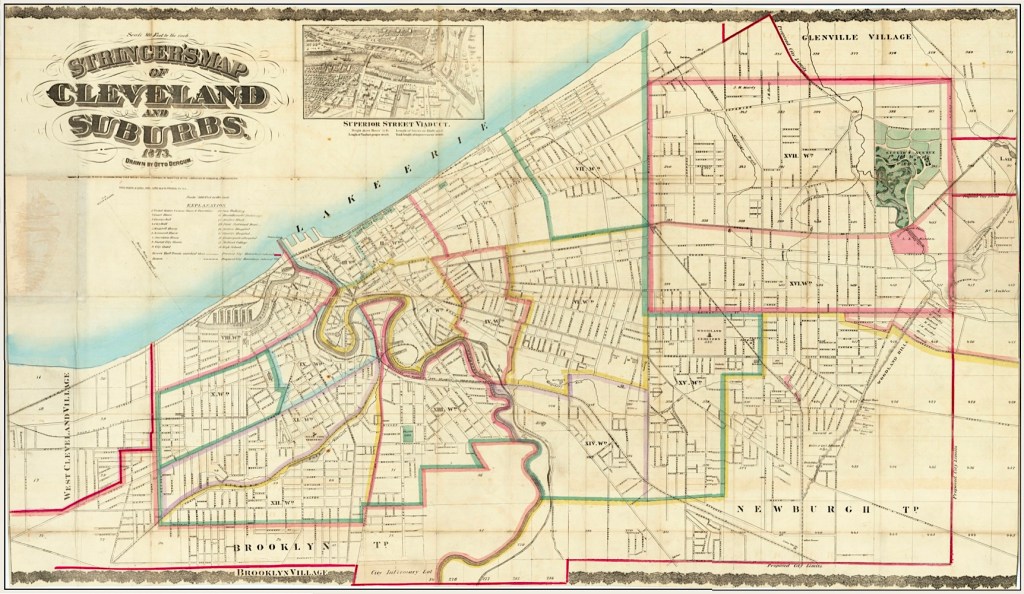
From 1796 until 1824
“Cleveland was founded at the intersection of the Cuyahoga River and Lake Erie, primarily because it was thought to be an ideal location for an agricultural center. The site was part of the [Connecticut] Western Reserve, a portion of land extending from the Pennsylvania border 120 miles westward and 80 miles southward, comprising 2.5 million acres, which was sold to the Connecticut Land Co. by the state of Connecticut… many came to the site seeking a good place to live, raise their families, and harvest bountiful crops — they were often disappointed. Throughout the first 30 years, there was no harbor at Cleveland because the entrance to the river was blocked by sandbars that forced goods and passengers to be off-loaded onto smaller vessels in order to land… the floodplain with its numerous swamps produced an environment filled with disease, which claimed the lives of many early settlers and convinced numerous others to move elsewhere.” (Case Western Reserve University)
“Yet, in those early days Cleveland and Newburgh were rivals; and five years later Newburgh had the larger population. This was due to the malarial conditions existing in Cleveland at that time. The marshes bordering the crooked Cuyahoga River were breeding places for fever and ague. Scarcely any of the early settlers escaped the disease. And it is recorded that after a short sojourn in the Cleveland hamlet, many removed to the higher ground of Newburgh, although most of them retained their land holdings in Cleveland.” (Newburgh, B. Ralph, from the 1893 book)
“Originally, the area’s natural resources were significant enough that Newburgh was the leading settlement in Cuyahoga County, causing Cleveland to be referred to as the town on the lake, six miles from Newburgh, although Cleveland’s location on Lake Erie soon led to its dominance. Cleveland first annexed part of Newburgh Township in 1867 and continued to expand through the next several decades, eventually absorbing the village of Newburgh and most of the rest of the township by 1905.” (Wikipedia)
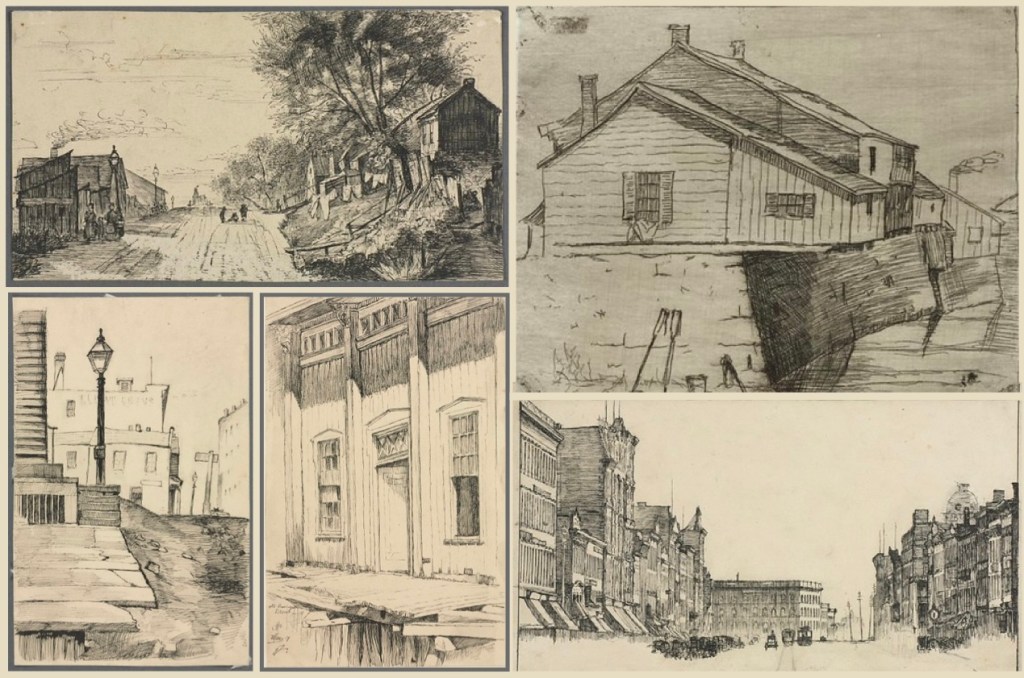
(Images courtesy of Cleveland Area History).
Eventually, through the building of a canal, the sandbars in the Cuyahoga River were cleared away, and Cleveland as a port city started to very slowly prosper. The rivalry between the two locations was eventually won by Cleveland as it grew in size and importance. Through annexation, [Newburgh] “…became part of Cleveland in 1873. This section of town became Cleveland’s 18th ward, dubbed ‘the iron ward’. The remaining portions of the township were incorporated as the Village of Newburgh in 1874, but additional annexations by Cleveland in 1878, 1893, and 1894 further compressed its size.” (Case Western Reserve University)
In the present day, Newburgh is a Cleveland suburb, called Newburgh Heights village, with a total area of 0.58 square miles, or 1.50 km2. (Wikipedia) (5)
– – – – –
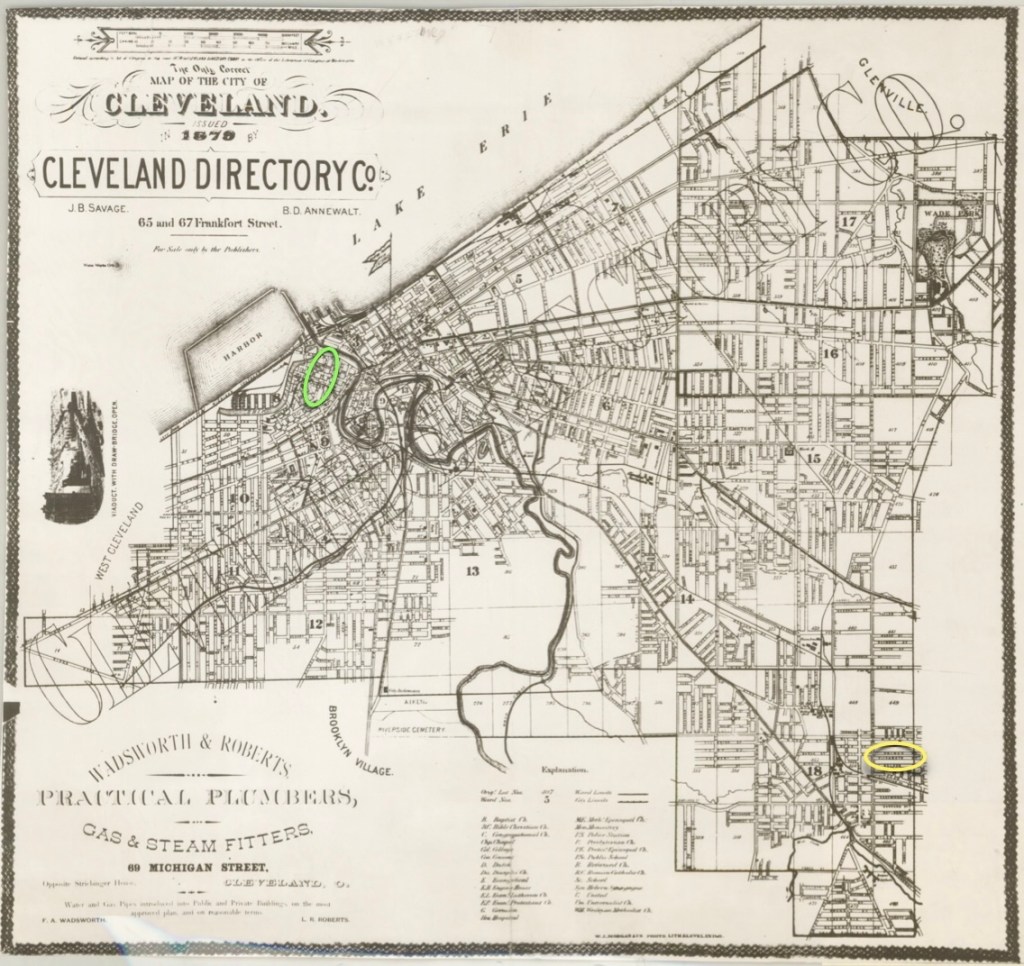
The green oval (upper left) indicates where the Patton family lived in 1870, at 100 Spruce Street. This was adjacent to an Irish settled area known as Whiskey Island.
– – – – –
The yellow oval (lower left) indicates their residence in 1880 at 2021 Elizabeth Street.
Cleveland is a City of Neighborhoods
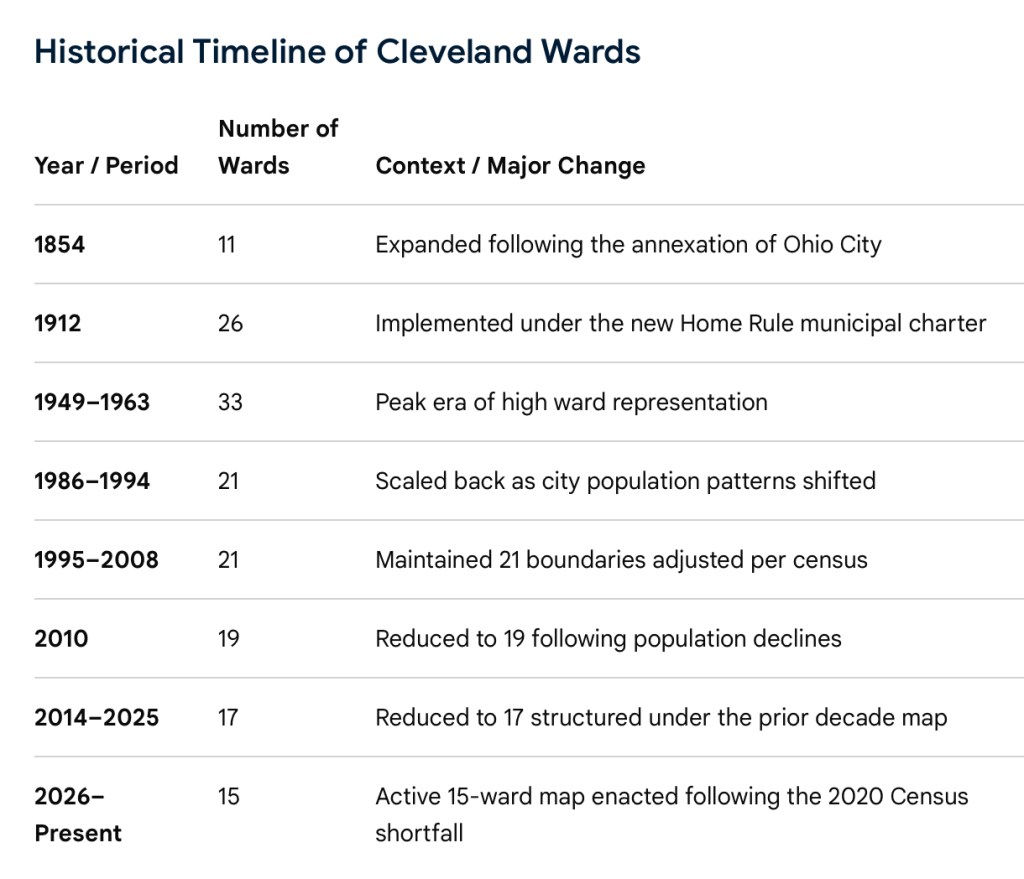
From the past to the present, Cleveland is a city known for its neighborhoods, with its governance being carried forward by a City Council. “Every Clevelander lives in a ward, and each ward elects a councilperson every four years to represent the ward’s residents on Cleveland City Council.” (The Center For Community Solutions) Put more simply, “A ward is a political boundary used to determine representation on Cleveland City Council.” (Signal Cleveland)
Historically the number of Wards has varied depending upon the fluctuations of borders and overall population (and honestly, politics). The peak number of Wards was once 33, and the least number of wards was 11. (See the footnotes for a historical ward chart from Google).
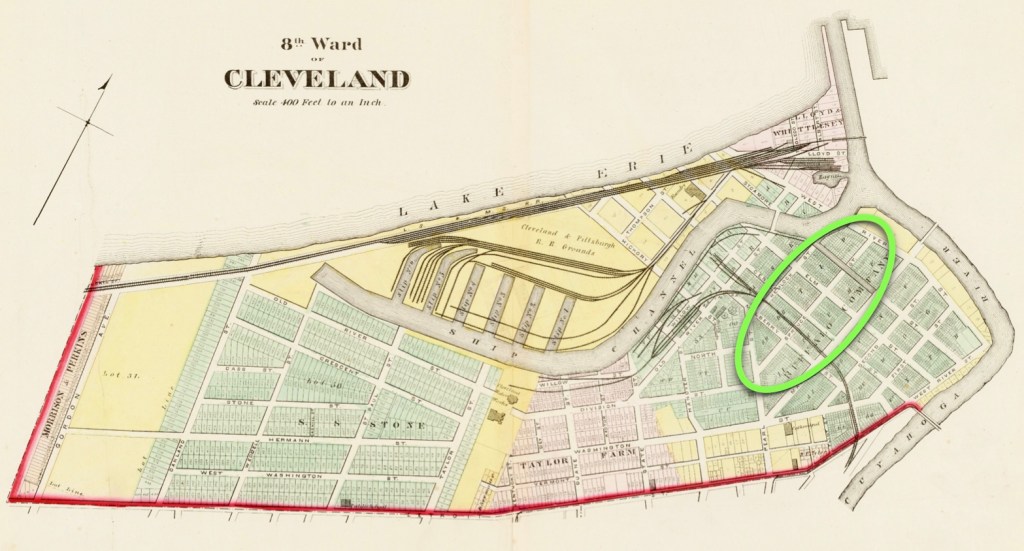
Ward 8
We uncovered a record that someone named Hugh Patton was living in Ward 8 as early as 1867, but we are not sure that this is our ancestor. There were other people with that same name in the area, and one of them lived nearby. Also, we believe that our family was living in Syracuse, New York in 1867 due to the adult records of their two oldest children, William and Margaret. (See footnotes.)

We know that from the 1870 Census that Hugh Patton, our ancestor, and his family were definitely living in Cleveland’s Ward 8 because he was working on the nearby docks. (6)
What Does That First Cleveland Census Tell Us?
First and foremost, this Census tells us that they are living at 100 Spruce in the 8th Ward, (see map above). We know also that there are seven people living in the household.
We have not been able to locate a marriage document for Hugh Patton and Margaret (Nicholson)* in Ireland, nor the United States, nor Canada. Be that as it may, there is some interesting information recorded here —
- Hugh is 52 years old. That means that he was born in Ireland circa 1818.
- His spouse Margaret, is much younger than Hugh, being 25 years old. She was also born in Ireland, circa 1845. Although we don’t have a record of a first marriage for Hugh Patton, it makes sense that he was probably married previously and that Margret Nicholson is his second wife.
- On this Census below, the two oldest children in the home are Margaret (14) and Bridget (11), both born in Ireland. It does not seem plausible that Margaret (Nicholson) is their mother, because she would have been much too young. Therefore, we believe that Margaret (14) and Bridget (11) are either from a first marriage, or they are family-related in some other manner. (Perhaps nieces, or cousins?) We see no reliable records for them after this Census.
*We learned the mother Margaret’s original surname from the marriage documents of her adult children.
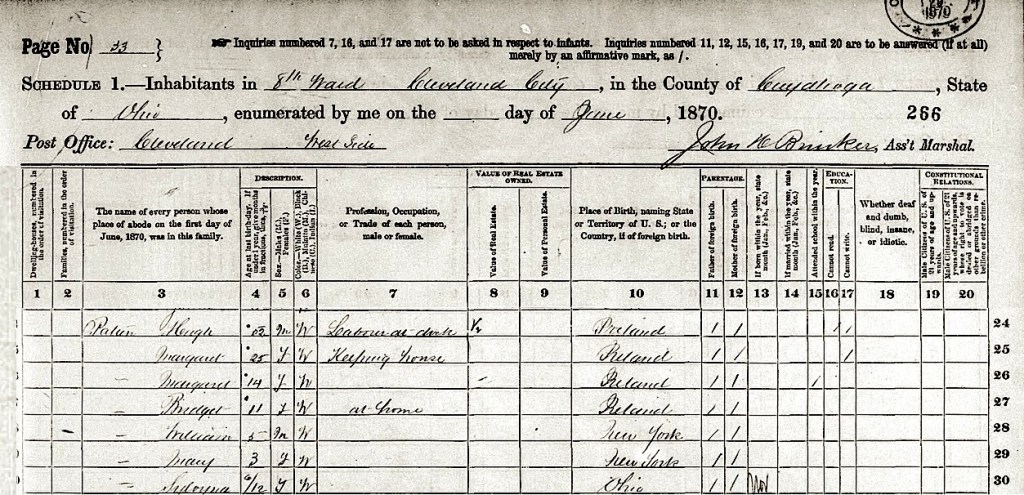
In total, Hugh and Margaret Patton had seven children, with their first two children being born in Syracuse, New York.
- William Patton, born August 26, 1865 — died, date unknown
- Mary A. (Patton) Roediger, born October 17, 1869 — died, February 3, 1944
The next five children were born in Cleveland, Ohio —
- Sabina* (Patton) Caswell, born November, 1869 — died, June 23, 1935
Sabina carries the family line forward. - Catherine ‘Kate’ P. (Patton) Boyd, born 1872 — died 1943
- Owen Patton, born 1873 — died 1875
- Thomas Patton, born and died 1875
- John Hugh Patton, born 1876 — died (after 1943)
*Sabina, as the youngest listed on the 1870 census, is noted as being 6/12 months, additionally, her birth month is noted on this Census as the previous November 1869. Her name is recorded as Syloyna Patton. We wonder if that odd spelling could be a colloquial Irish name, or maybe, the Census enumerator was just trying to puzzle it out as he went along?
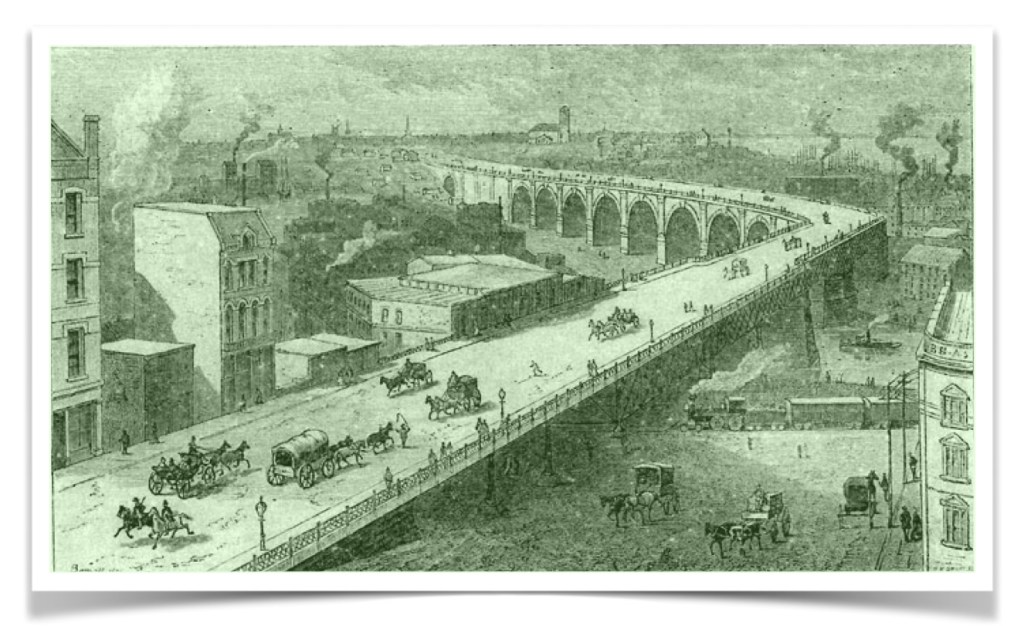
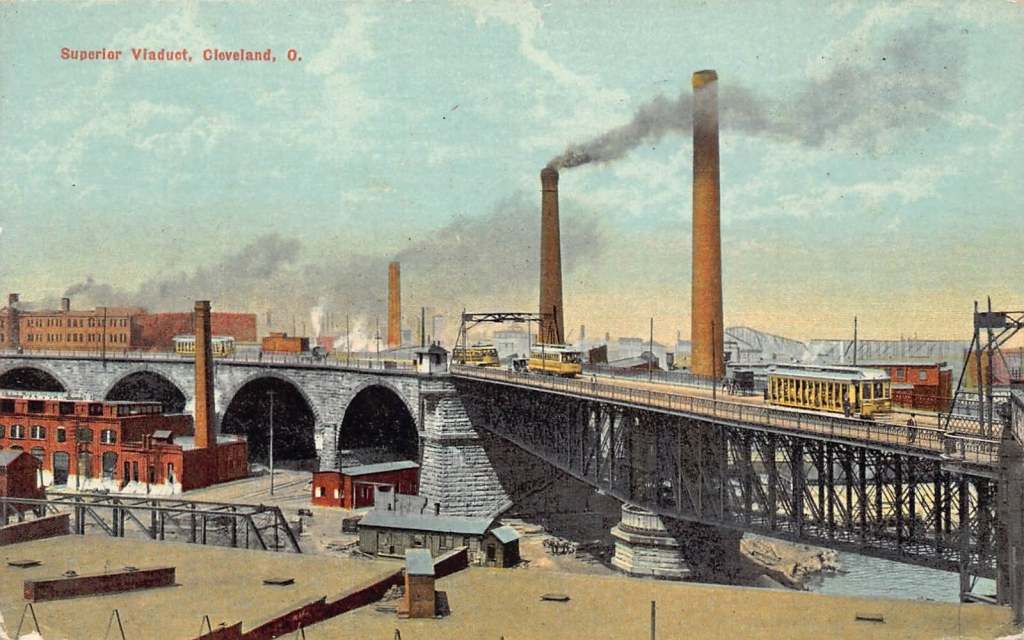
The area where this family lived was a very busy hub of bustling activity. They lived just north of the enormous structure known as the Superior Avenue Viaduct, which ran right through their neighborhood. On the northern boundary of the 8th Ward was Lake Erie, but there also was an ‘island’, then know as Whiskey Island. Many Irish people had settled there, so it makes sense that our family would be near there too. There is definite truth that Immigrants are generally attracted to communities that they already know…
“Docks and manufacturing plants arrived on Whiskey Island around the same time as the Irish. By the 1850s, railroads — quickly making the canal obsolete — also began running their way across the land. By the late nineteenth century, many of the Irish inhabitants had risen in wealth and status and moved to more attractive neighborhoods. As the Irish moved away and Cleveland’s industrial might grew, Whiskey Island became nearly exclusively an industrial area.” (Rotman, Whiskey Island — It’s Actually a Peninsula)
“Many people left Ireland during this time because of the Great Famine of 1845 to 1849. Once immigrants arrived in the United States, they had to find jobs, which became increasingly difficult due to discrimination against Irish immigrants.”
by Zoe Sizemore
Irishtown Bend, Excavating an Irish Immigrant’s Life
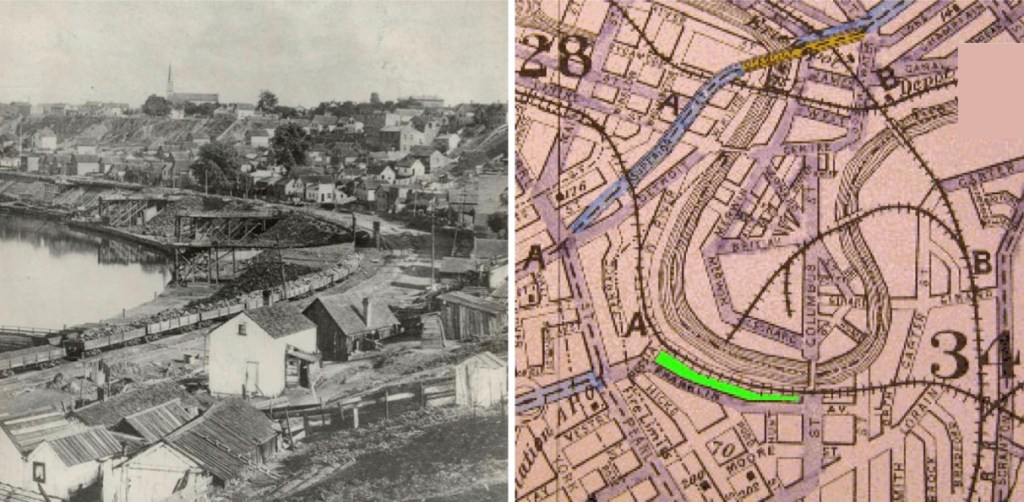
There were so many Irish immigrants, that they spilled over into all areas of the city, but they were quite prominent in the 8th and 9th Wards. Just south of where our family lived was an area known as Irishtown Bend.
– – – – –
Just nearby to the south of the Patton family, at the next bend of the Cuyahoga River, was the 9th Ward community known as Irishtown Bend (Image courtesy of Cleveland Historical).
“Irishtown Bend was developed during the 1830s and ’40s by Irish immigrants who came to Cleveland to work on the canal and railways. Irish immigrants — considered outcasts by many other immigrants — began to build shanties on Whiskey Island. Soon, it became home to many of the city’s new Irish immigrants, with homes, saloons and more.” (DeMarco, The Irish in Cleveland: A History in Photos)
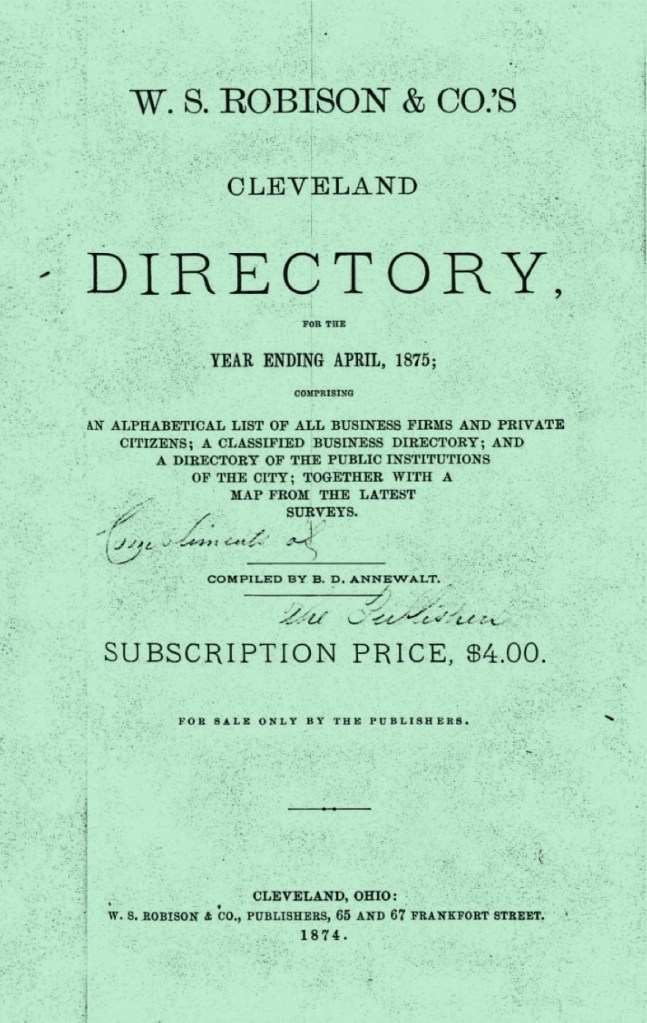
Our family relocated to Cleveland’s 18th Ward by 1874. We know this through a discovery in the Cleveland City Directory for 1874. This community (Cleveland’s old rival Newburgh), was then part of the 18th Ward, but known locally as ‘the iron ward’. (7)
Elizabeth Street in Newburgh
We believe that the family’s choice to relocate from Cleveland’s 8th Ward to the 18th Ward in the City’s southeastern section, in all probability was due to Hugh’s employment. If you lived in this section of Cleveland in the late 19th century, you most likely worked at the Cleveland Rolling Mill, or its related industrial operations in the old Newburgh area. We know that he was a laborer and that this employer was enormous and utterly dominated the area.
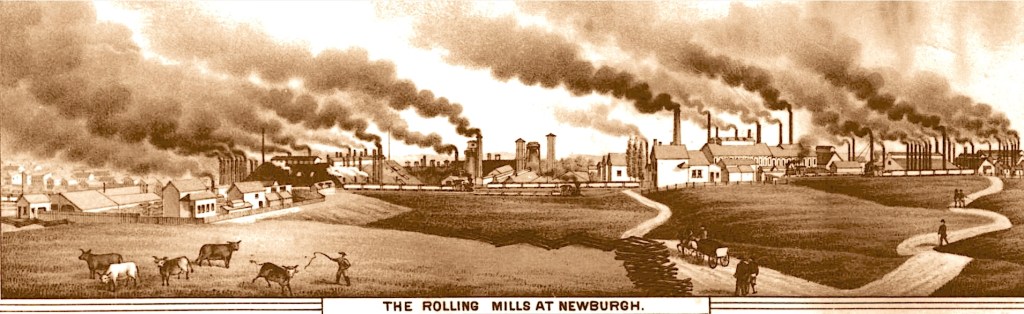
The area was famous for metal mill work. From A History of the City of Cleveland
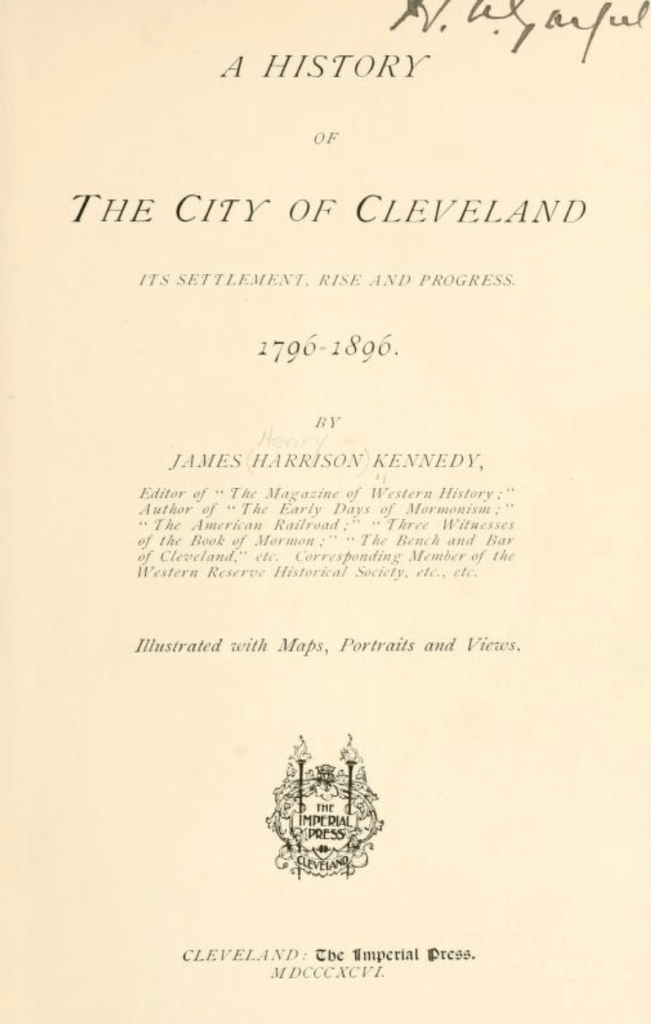
It’s Settlement, Rise and Progress, 1796-1896, by James Harrison Kennedy (1896), “…The next mill was built in 1856, by A. J. Smith and others, to re-roll rails. It was called the Railroad Rolling Mill, and is now owned by the Cleveland Rolling Mill Company. At the same time, a man named Jones, with several associates, built a mill at Newburg, six miles from Cleveland, also to re-roll rails. It was afterwards operated by Stone, Chisholm & Jones, and is now owned by the Cleveland Rolling Mill Company.”
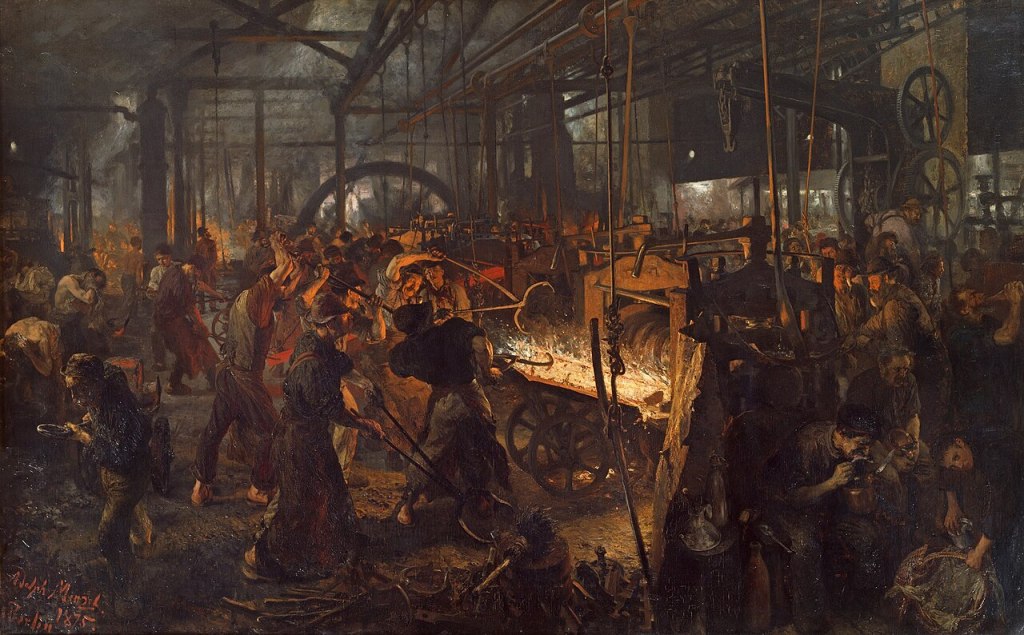
“The township’s most famous industry, the Cleveland Rolling Mill, was started in 1857 by David and John Jones* to re-roll iron rails. The mills changed the ethnic makeup of the community. New England and Manx settlers [people from the Isle of Man] were outnumbered first by Welsh iron puddlers, then by Irish, and finally by Polish and Czech mill laborers. (Case Western Reserve University)
*Both of the Jones brothers were immigrants from Monmouthshire, Wales. (S. J. Kelley, see footnotes).

During an era before antibiotics or vaccinations had become standard medical care, epidemics routinely swept through communities with great devastation. A family tragedy unfolded during this decade. Two of the young boys, Owen Patton and Thomas Patton both passed away in 1875. Both children died of Scarlet Fever — Owen in October 1875; Thomas in December 1875. It must have been terrible for all of those involved. The following year in 1876, Margaret (Nicholson) Patton had another baby boy. His name was John Hugh Patton. (8)
The 1880s, The Late Victorian Era
The 1880s brought much change to this family. The father, Hugh Patton, died in January* 1880 from what was then called lung fever, but which today we know as pneumonia. He was 62 years old. We have found three records that document the end of his life, but one of them*(shown below) disagrees with the other two in an important detail: two documents state that he died on January 21, 1880, and the other states February 1880.

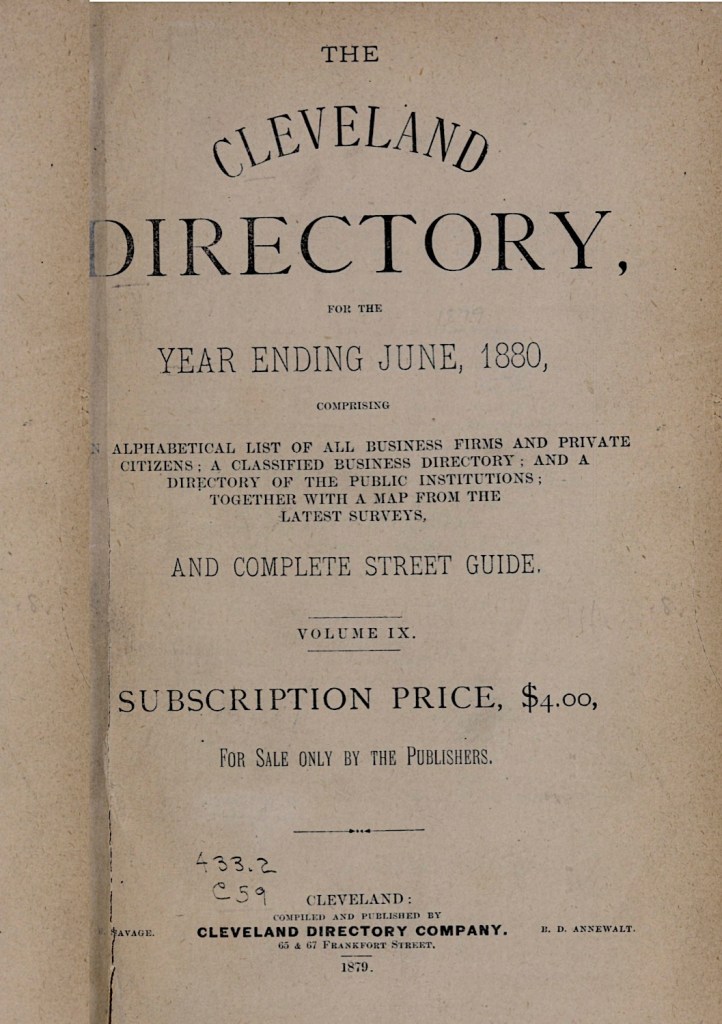
Despite having passed away on January 21, 1880, Hugh continued to live on in the Cleveland City Directory 1879-1880, published later that year. In the days before modern databases existed, these guides were created through a very laborious process that took much time —
1) A neighborhood was canvassed door-to-door to gather handwritten information about the household or business.
2) This data was then compiled by an army of clerks.
3) These compilations were then sorted and typeset by people who worked in a printers guild. Graphic artists would craft artwork to be used wherever it was appropriate.
4) If the book was proofed (meaning that it was proofread to correct errors), then it would proceed to the assembly stage. It was probable that only advertisements were proofed, because those clients actually paid money to have their names and products featured in the directory.
5) The new directory would be printed, assembled, bound, and distributed.
6) It would then be placed for sale to consumers.
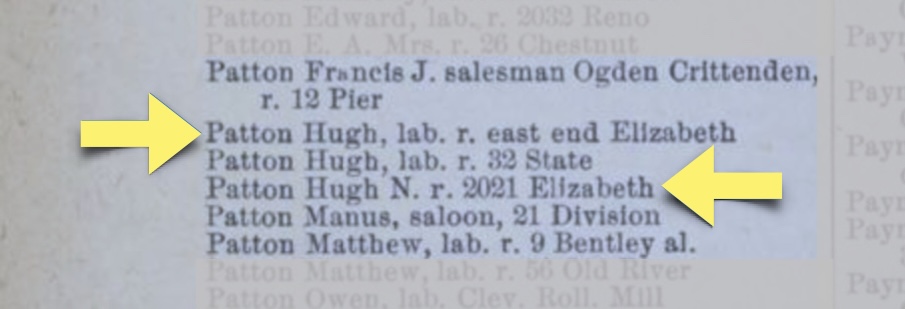
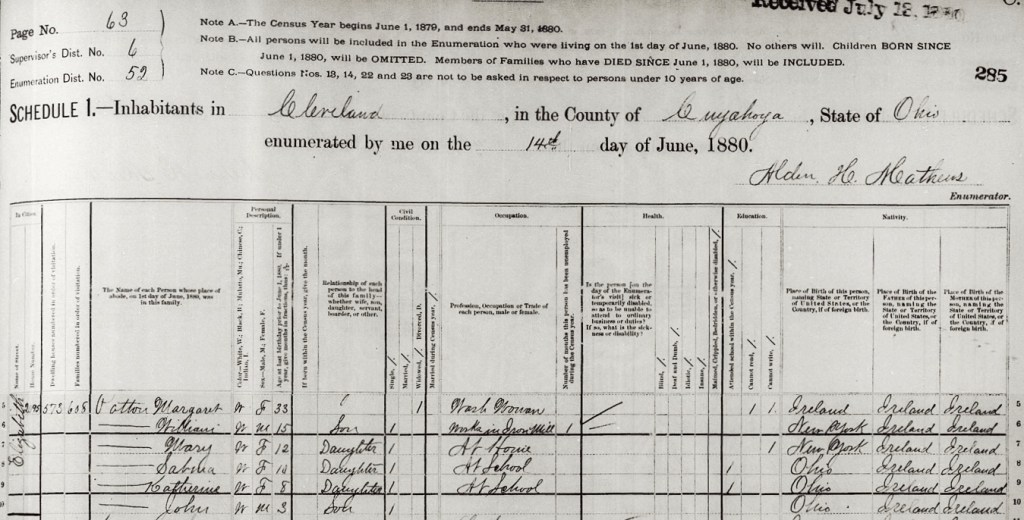
About six months after Hugh had passed away, Margaret continued to live at 2021 Elizabeth Street in Cleveland’s 18th Ward. From the 1880 Census, we learn that she is a widow and a Wash Woman, meaning that she was a laundress. Her children who have survived are still present in the home. Notably, son William and daughter Margaret are (again as in 1870) recorded as being born in New York. It is recorded that William “works in iron mill”. (This was quite probably the Cleveland Rolling Mill, and he was only 15 years old).
Daughter Syloyna, at the age of 10, is now noted as being named Sabina. (9)
Making Ends Meet
Times must have been difficult after Hugh died. Despite son William bringing in a wage while working at The Cleveland Rolling Mill, it likely was not enough in a home that held six people, several of whom were quite young children. So as the mother, Margaret, turned a chore that she normally did into an enterprise — as we learned form the Census, she took in laundry and became a Wash Woman.
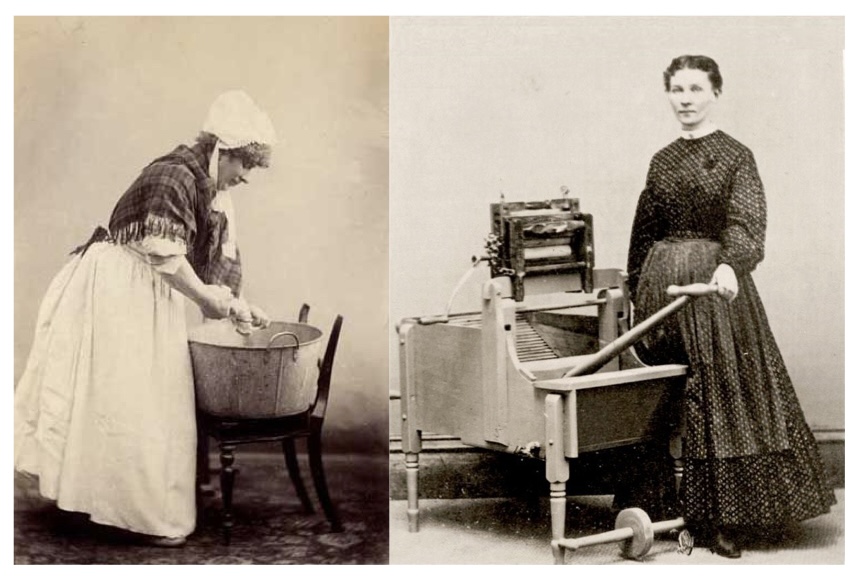
From Wikipedia, “A washerwoman or laundress was a person, usually a woman, employed to wash laundry by hand, before the widespread use of washing machines and commercial laundries. The profession existed in many cultures, spanning from antiquity to the early modern period. While the profession has historically been gendered, [and] often associated with women, in some contexts, men also performed laundry labor. It was typically low-paid, physically arduous, and associated with lower social status.” (10)
Owen Hart, the Man from County Meath
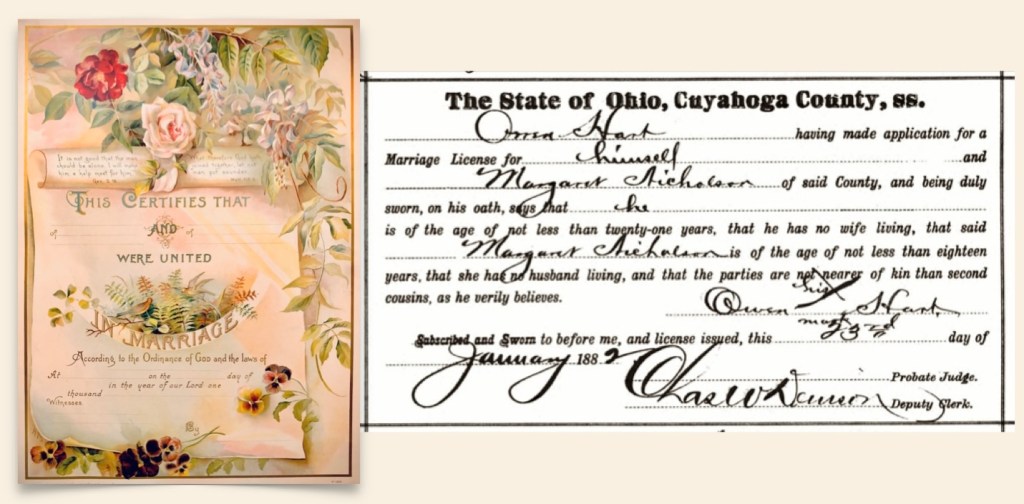
In January 1882, almost two years exactly since her husband Hugh died, Margaret (Nicholson) Patton, became Mrs. Owen Hart, (or to us, Margaret (Nicholson) Patton Hart). We thought it a bit curious that her maiden name was used on the marriage application, but we are quite sure that it is her and not another person. At the time she would have been about 37 years old.
It was a challenge to sort through data about Owen Hart. Margaret’s new husband had a difficult time recording his age properly, and when we see something that doesn’t quite make sense, we note it. Here are several examples:
Birth and baptism, 1832—1833
We know that Owen was born in Ireland circa 1832, because he was baptized in Bohermeen, County Meath, Ireland on December 13, 1833. The records clearly states an 1832 birth. His parents are Pat Hart and Bridget Fullan

In 1851…
He was imprisoned in May 1851 for the minor crime of vagrancy at age 19, and discharged May 27, 1851. This was during the period of An Gorta Mór. (He was released to the care of the Honorable Richard Hare).
This record gives him an 1832 birth year and lists his age as 19. This record is close to his true age.
A December 1865 immigration
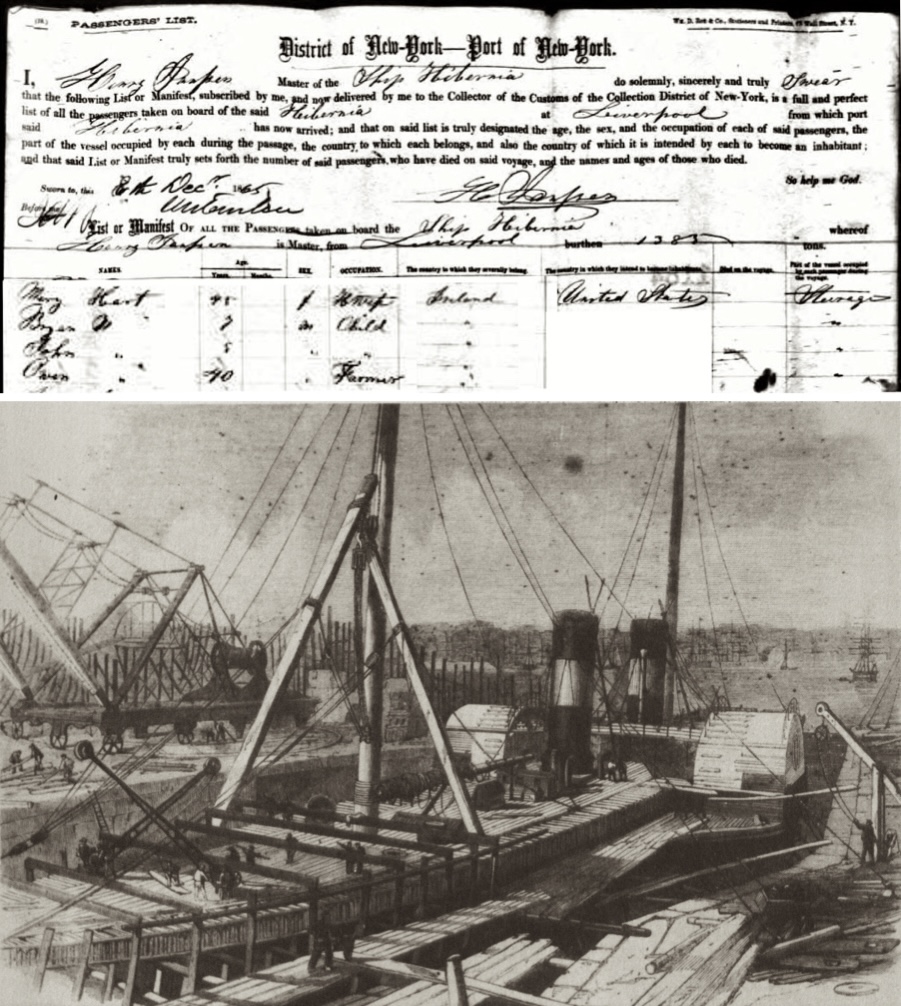
On the Passenger Manifest for the ship Hibernia, which anchored in New York harbor on December 6, 1865, he is listed as 40 years old. Although, he should be actually about 33. He is a farmer, and traveling with his wife Mary Fagan (45), and their sons Bryan (7), and William (5). We wonder if Mary was truly about 45 years old?
The 1870 Census
When we review his history in the Cleveland area, the 1870 Census has him living in Ward 18 in Newburgh, and he is married to the same woman named Mary who immigrated with him from Ireland. He is already employed at the Cleveland Rolling Mill. The following people are listed on the Census — Owen (60*), Mary (50), Thomas (28), Bryan (15), and John (10). Thomas (28) and John (10) are two names on this Census that we do not recognize.
*Shouldn’t Owen be about be about 38?
The 1880 Census
He is still working at the Cleveland Rolling Mill.
Owen (50*), Patrick (29), Brian (24), John (20), Michael (6) (whose son?)
* How does he get to be 10 years younger? Thoughts —Wife Mary had likely died by the time of this Census. Patrick (29) and Michael (6), are two names on this Census that we do not recognize. (11)
Two Coming And One Going
This Owen and Margaret Hart family were fortunate to have two more children. We think that Margaret may have named her new son, for her two sons [Thomas and Owen] who had passed away in 1875. The fact that she married a man named Owen who was now the father, made this middle name choice all that much easier.
- Thomas Owen Hart, born February 14, 1885 — died March 18, 1943
- Helen M. (Hart) Douthitt, born October 27, 1885 — died, April 27, 1945
We noted that Thomas Owen and Helen M. had only a little over nine months between them, therefore there is that old expression about Irish Twins —
“The term Irish twins refers to siblings who are born within 12 months of each other… The phrase Irish twins originated in the late 19th century as a disparaging term associated with Irish immigration to the United States. The implication was that groups of close-in-age siblings were a negative characteristic of large Irish Catholic families… Today, the term is typically not intended as an insult, but rather as a way of classifying siblings born close together.” (Parents, see footnotes).

And then when these children were nearly ten years old, their father Owen Hart passed away on December 3 or 5, 1864. (We have two records that record different dates of his death). (12)
Margaret carried on and moved to a new location in Cleveland.
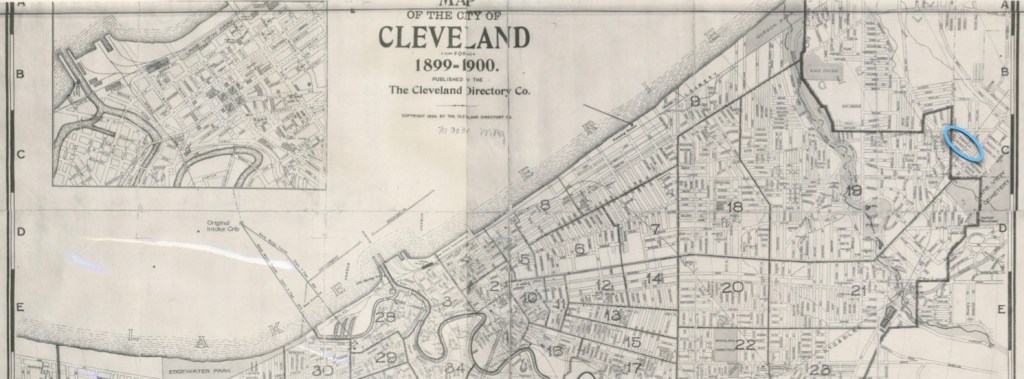
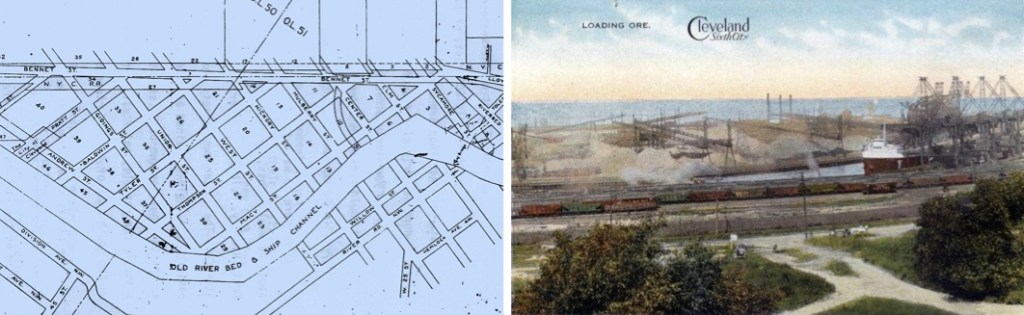
(Image courtesy of the Cleveland Public Library Digital Collection). The blue oval indicates the location where Margaret Hart lived in 1907, at 18 Cobden Court, in East Cleveland.
1907 and Cobden Court in East Cleveland
We feel (as most readers can see when looking at our family history chapters), that using maps is essential for providing clarity about where our various ancestors lived during certain historical periods. We believe that these maps must be created as close as possible to the time period when these ancestors lived, because they reflect more clearly how these ancestors experienced their world. And yet.. sometimes city administrators and city planners make our lives more complicated. Such is the case with the city of Cleveland in 1906.
“Cleveland’s street names historically denoted famous persons, Native American words or names, or regional geographic entities to mark routes, thoroughfares, and residential avenues. Examples include St. Clair Ave., named for Northwest Territory governor Arthur St. Clair (1734-1818), and the many downtown streets representing the Great Lakes, such as Erie St. (E. 9th), Superior Ave., Ontario Ave., and Huron Rd. Michigan Ave. was vacated for the Terminal Tower [Transportaion] Complex.
On 6 March 1906, the Cleveland City Council adopted a numerical system for street names, separating the east and west enumerated streets following a line of demarcation through downtown and Public Square, outward to the (1906) city limits. Effective 1 Dec. 1906, the new grid system for Cleveland’s fan-shaped street layout went into effect. Although many roads retained their original names outside of the city limits, some Cuyahoga County municipalities carried over the numeric designations as their own…”
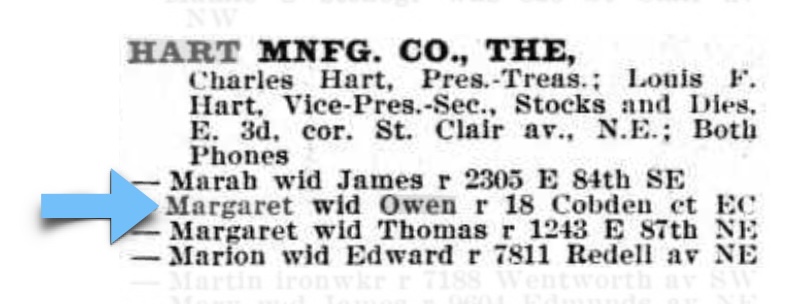
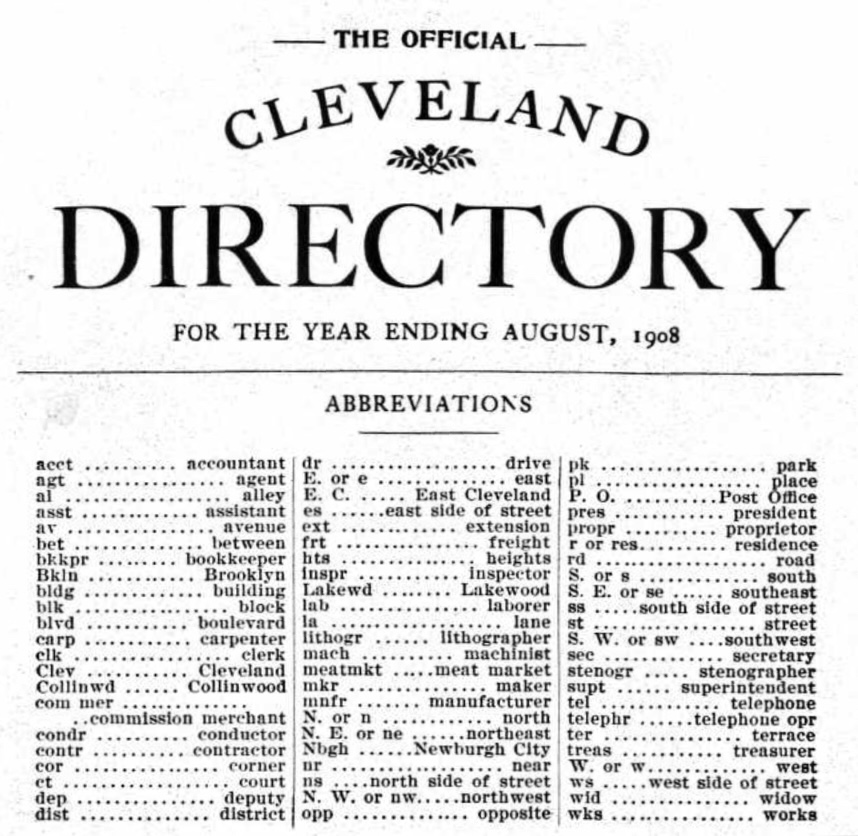
Thus, in more direct terms, this created chaos for future researchers (in our present era). We were able to determine that the location we have circled on the above map, indicates where Margaret lived at the end of her life. It was based upon the above entry found in the Cleveland, Ohio, City Directory for 1907.

Margaret (Nicholson) Patton Hart died on April 30, 1908. She had lived well into a new century. Like her husband Hugh, she died of lung fever, or now since this was the 20th century, it was recorded as pneumonia. She was about 63 years old.
After a life of much hard work, she had crossed an ocean, raised several children, and out-lived two husbands. She may have occasionally missed the beauty of her Irish homeland, but it is not for us to know. The poem which follows, by William Butler Yeats, captures the peace of the Irish countryside —
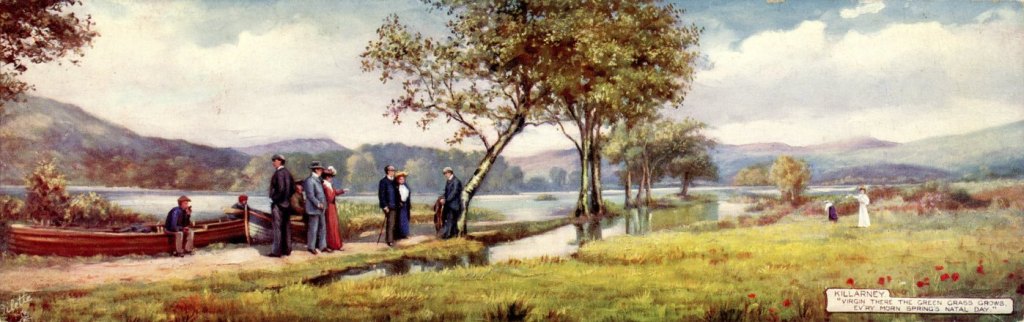
The Lake Isle of Innisfree, by William Butler Yeats
I will arise and go now, and go to Innisfree,
And a small cabin build there, of clay and wattles made;
Nine bean-rows will I have there, a hive for the honey-bee,
And live alone in the bee-loud glade.And I shall have some peace there, for peace comes dropping slow,
Dropping from the veils of the morning to where the cricket sings;
There midnight’s all a glimmer, and noon a purple glow,
And evening full of the linnet’s wings.I will arise and go now, for always night and day
I hear lake water lapping with low sounds by the shore;
While I stand on the roadway, or on the pavements grey,
I hear it in the deep heart’s core.
In the next chapter, we are going to learn much more about the interesting and complicated daughter named Sabina, because she carries the family line forward. (13)
Following are the footnotes for the Primary Source Materials,
Notes, and Observations
What’s In A Name? — Quite A Bit, Apparently.
(1) — three records
Patton Name Meaning
https://www.familysearch.org/en/surname?surname=PATTON
Note: For the text.
The National Gallery of Ireland
Scenes From the Life of Saint Patrick
by Adriaen Collaert, 1603
https://www.nationalgallery.ie/art-and-artists/highlights-collection/scenes-life-saint-patrick
Note: For the St. Patrick artwork. “The Latin inscription, which translates as ‘P.S. greatly wishes an increase of Catholic faith and spiritual grace to the Senate and people of the fair city of Dublin in Ireland’, indicates that it was published to encourage Dublin citizens in their faith. It can be seen as part of a wide cultural movement which aimed to promote and further the aims of Catholic Ireland.”
Pat Pat
Patton Name Meaning and Origin
Home › Blog › Baby Names › Patton
https://www.patpat.com/blogs/baby-names/patton?srsltid=AfmBOoriGrFKBO4cJXeQMqLslIwtgSjJwbzrA4GFmnmUFTNFgnpjuHjg
Note: For the information and text.
And Then There Was An Gorta Mór, or The Great Hunger
(2) — two records
Teach Democracy
The Potato Famine and Irish Immigration to America
https://teachdemocracy.org/online-lesson/the-potato-famine-and-irish-immigration-to-america/
Note: For the text.
Steerage Emigrants,
[print after] Arthur Boyd Houghton, 1870
https://en.wikipedia.org/wiki/Steerage#/media/File:”Steerage_Emigrants”_(The_Graphic)_MET_MM15333.jpg
Note: For the illustration of Steerage Immigrants, circa 1870.
Hugh Patton, An Irish Immigrant
(3) — one record
Hugh Patton
Migration – Ohio, County Naturalization Records, 1800-1977
[Declarations of Aliens]: Cuyahoga. Declarations of Intention May 1, 1873–Oct 12, 1874
https://www.familysearch.org/ark:/61903/1:1:QGR2-DSFN?lang=en
Book page: 379, Digital page: 196/294, Right page, lower entry.
Notes: His application date is May 18, 1874. He states that he entered the United States in March 1859.
Did They Live Once in Syracuse, New York?
(4) — three records
Digital Commonwealth
Boston Public Library > Norman B. Leventhal Map & Education Center Collection > Urban Maps
Birds Eye View of Syracuse, New York: 1874
by Howard Heston Bailey
https://www.digitalcommonwealth.org/search/commonwealth:x633fd56n
Note: For the map image.
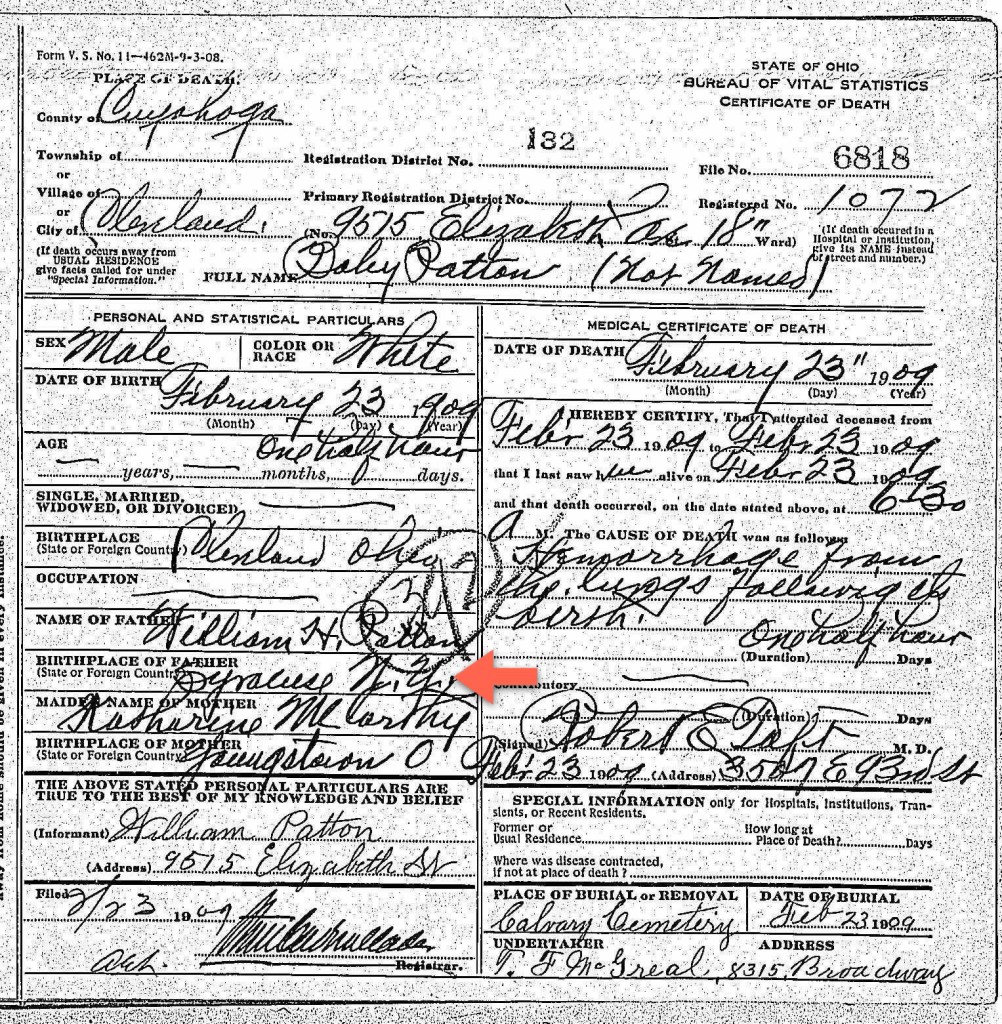
Hugh Patton, aka Baby Patton
(The grandson of Irish immigrant Hugh Patton)
https://www.findagrave.com/memorial/161494979/hugh-patton
Note 1: This death record for the grandson Hugh Patton (born and died on February 23, 1909), was filled out by the boy’s father William H. Patton, the son of Hugh Patton.
Note 2: William H. Patton is probably the oldest son of Irish immigrant Hugh Patton. William states on this document that he/himself was born in Syracuse, New York. Therefore, we find this record valuable for proving that the two older children of this family (Margaret and William), were born in Syracuse, New York.
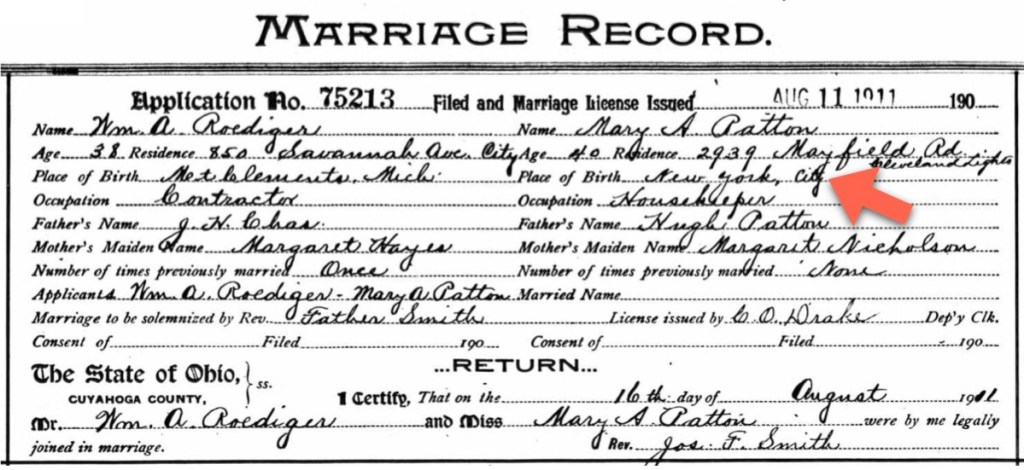
Mary A Patton [Margaret]
Cuyahoga County, Ohio, U.S., Marriage Records and Indexes, 1810-1973
1901-1925 >> Reel 043 Marriage Records 1911 Apr – 1911 Nov
https://www.ancestry.com/search/collections/1876/records/2375369
Book page: 54, Digital page: 554/1000, top entry.
Note 1: Mary has made herself younger on this document than she actually is.
Note 2: For her place of birth she wrote: New York, City — which looks a bit suspicious. The word ‘City’ looks to be an afterthought. We have no evidence that they lived in New York City, so she was likely born in Syracuse.
Rivals: Cleveland versus Newburgh!
(5) — seven records
Ruderman | RareMaps.com
Stringer’s Map of Cleveland and Suburbs, circa 1873
https://raremaps.com/gallery/detail/73942/stringers-map-of-cleveland-and-suburbs-1873
Note: For the hand-colored map image.
Case Western Reserve University
Encyclopedia of Cleveland History
Cleveland: An Historical Overview
https://case.edu/ech/cleveland-historical-overview
Note: For the text.
Case Western Reserve University
Encyclopedia of Cleveland History
Newburgh Township
https://case.edu/ech/articles/n/newburgh-township
Note: For the text.
Newburgh
Transcription by Betty Ralph, from the 1893 book,
Memorial to the Pioneer Women of the Western Reserve
https://usgenwebsites.org/OHCuyahoga/Cities/NewburghTwpPWWR.pdf
Note: For the text.
Cleveland Area History
Cleveland in the 1870s
Our city through the eyes of Otto Bacher
Edited by Christopher Busta-Peck
http://www.clevelandareahistory.org/2010/08/cleveland-in-1870s.html?m=0
Note: For the scenic sketches by artist Otto Bacher of several 1870s Cleveland, Ohio neighborhoods.
Newburgh Heights, Ohio
https://en.wikipedia.org/wiki/Newburgh_Heights,_Ohio
Note: For the data.
Defunct townships of Cuyahoga County, Ohio
Newburgh Township
https://en.wikipedia.org/wiki/Defunct_townships_of_Cuyahoga_County,_Ohio
Note: For the reference.
Cleveland is a City of Neighborhoods
(6) — eight records
Cleveland Public Library Digital Collection
Atlases, Maps and Park Plans of Cleveland and Cuyahoga County
The Only Correct Map of the City of Cleveland, 1879
https://cplorg.contentdm.oclc.org/digital/collection/p4014coll24/id/51/rec/3
Note: For the map image designating the two Wards [8 and 18] which this family lived in while Hugh Patton was alive.
The Center For Community Solutions
Cleveland is a city of neighborhoods…and of wards
by Alex Dorman
https://www.communitysolutions.com/resources/cleveland-is-a-city-of-neighborhoods-and-of-wards
Note: For the text.
and
Signal Cleveland
Understanding Cleveland’s Ward Boundaries (Explainer)
What is a ward?
https://signalcleveland.org/understanding-clevelands-ward-boundaries-explainer/
Note: For the text.
1867
Hugh Patten
U.S., City Directories, 1822-1995
https://www.ancestry.com/search/collections/2469/records/293689414
Note 1: In 1867, this Hugh Patton is living near Spruce Street.
Note 2: This could be our ancestor, but, there is another Hugh Patten / Patton living in the area, so we are cautious.
David Rumsey Map Collection
Atlas of Cuyahoga County, Ohio,
from Actual Surveys by and Under the Directions of D. J. Lake (1874)
https://www.davidrumsey.com/luna/servlet/view/all/what/Atlas+Map/where/Cleveland+(Ohio)?sort=pub_list_no_initialsort,pub_date,pub_list_no,series_no
and
Plate 33, the 8th Ward of Cleveland
https://www.davidrumsey.com/luna/servlet/detail/RUMSEY~8~1~359127~90125980:8th-Ward-of-Cleveland-?sort=pub_list_no_initialsort,pub_date,pub_list_no,series_no&mi=8&trs=119&qvq=w4s:/what/Atlas+Map/where/Cleveland+(Ohio);sort:pub_list_no_initialsort,pub_date,pub_list_no,series_no;lc:RUMSEY~8~1
Note: For the map image.
Hugh Patton
U.S., City Directories, 1822-1995
Wiggins and Weaver´s Directory of the City of Cleveland
and Adjoining Towns, 1870-71
https://www.ancestry.com/search/collections/2469/records/1487455067?tid=&pid=&queryId=20af1f19-c07e-4f6c-8a4c-1e62a792c56d&_phsrc=ggn17&_phstart=successSource
Book page: 229, Digital page 239/358, Right column, 10th entry from the bottom.
Note: In 1870, he is listed as a Laborer, and with his residence at 100 Spruce.
What Does That First Cleveland Census Tell Us?
(7) — fifteen records
1870
Hugh Paton
Census – United States, Census, 1870
https://www.familysearch.org/ark:/61903/1:1:M6KL-GLX?lang=en
Ohio, 1870 federal census: population schedules: Cuyahoga. Census 1870 | Cleveland. Census 1870
Book page: 33, Digital page: 57/458, Lines 24 through 30.
Note 1: They are living at 100 Spruce in the 8th Ward.
Note 2: Two individuals, Margaret (age 14), and Bridget (age 11) are recorded in this Census as residing with this family. However, we believe that they are likely related, but not the children of Hugh Patton and Margaret Nicholson.
Note 3: Sabina, as the youngest, is noted as being 6/12 months, additionally, her birth month is noted as the previous November 1869.
William H. Patton
Death – Ohio, Deaths, 1908-1953
Birth: (Likely) August 26, 1865, in Syracuse, New York
Death: October 8, 1933
https://www.familysearch.org/ark:/61903/1:1:X6QX-2GP?lang=en
Digital page: 2,275/3,230
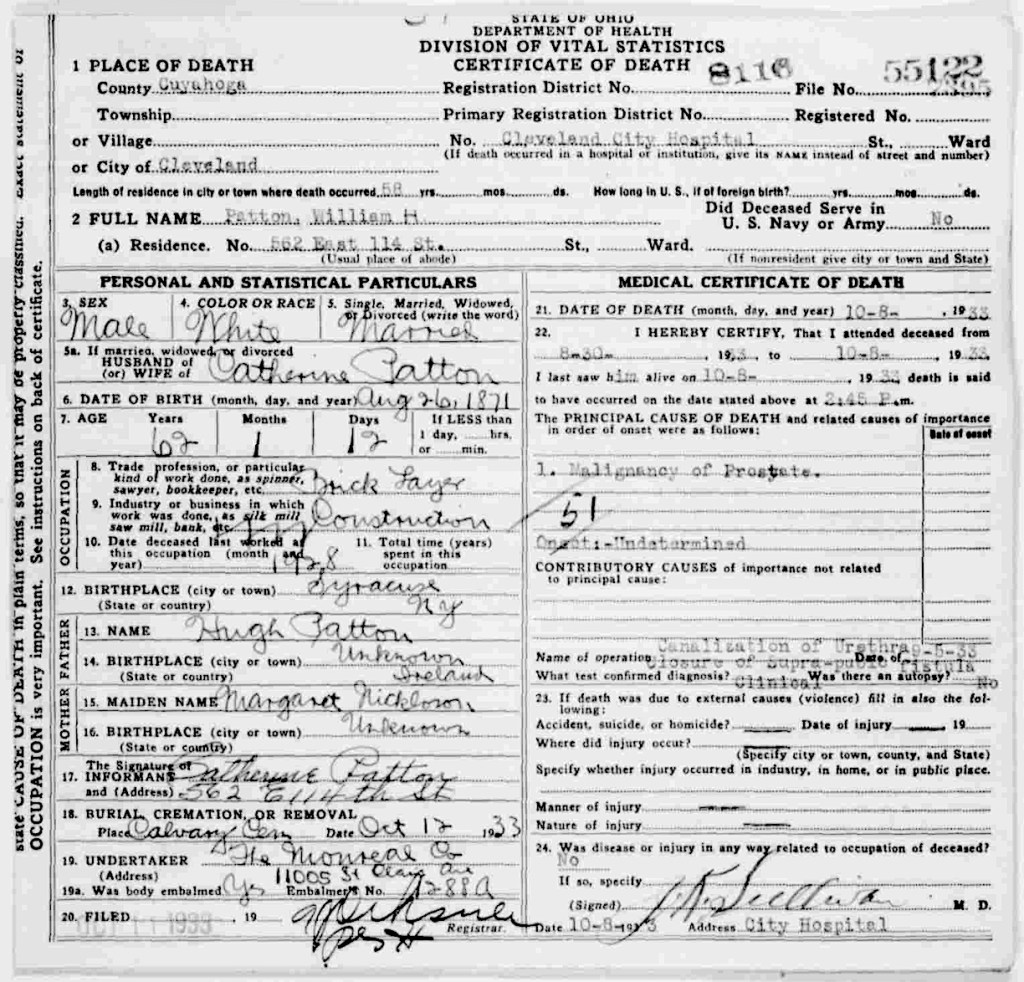
Note 1: William’s birth year on this document is not correct. The 1870 and 1880 Cleveland censuses for him family require an 1865 birth year, since they were already living in Cleveland, Ohio. Therefore, his actual birthdate may be August 26, but not in the year 1871.
Note 2: As per the death record for his infant son Hugh Patton, (who was named after his same-named paternal grandfather, but unnamed on his death certificate), this father William Patton records that he/himself was born in Syracuse, New York.
See this link:
https://www.findagrave.com/memorial/161494979/hugh-patton
Mary A. Roediger
U.S., Find a Grave Index, 1600s-Current
https://www.ancestry.com/search/collections/60525/records/139492288
and
Mary A. Patton Roediger
Birth: October 17, 1869
Death: February 3, 1944
https://www.findagrave.com/memorial/174621260/mary-a.-roediger
Note: For the data.
John Hugh Patton
U.S., Find a Grave Index, 1600s-Current
https://www.ancestry.com/search/collections/60525/records/50147419?tid=&pid=&queryId=adf10e2b-e5f2-4de8-8091-69819a4b936e&_phsrc=WPW14&_phstart=successSource
and
John Hugh Patton
Birth: November 18, 1876
Death: July 25, 1960
https://www.findagrave.com/memorial/73543143/john-hugh-patton
Note: For the data.
Case Western Reserve University
Encyclopedia of Cleveland History
Superior Viaduct
https://case.edu/ech/articles/s/superior-viaduct
The Irish in Cleveland: A History in Photos
by Laura DeMarco, The Plain Dealer
https://www.cleveland.com/entertainment/2016/03/the_irish_in_cleveland_a_visua.html
Note: For the color postcard image.
and
Cleveland Historical
Irishtown Bend, Excavating an Irish Immigrant’s Life
by Zoe Sizemore
https://clevelandhistorical.org/items/show/927
Note: For the text, photo, and map of Irishtown Bend.
Cleveland Historical
Whiskey Island (It’s Actually a Peninsula)
by Michael Rotman
https://clevelandhistorical.org/items/show/68
Note: For the text and the map of Whiskey Island.
Cleveland Historical
Irishtown Bend, Excavating an Irish Immigrant’s Life
by Zoe Sizemore
https://clevelandhistorical.org/items/show/927
Note: For the pull-quote.
The Irish in Cleveland: A History in Photos
by Laura DeMarco, The Plain Dealer
https://www.cleveland.com/entertainment/2016/03/the_irish_in_cleveland_a_visua.html
Note: For the text.
1874
Hugh Patton
U.S., City Directories, 1822-1995
Business Directory, Cleveland City Directory for 1874
Ohio > Cleveland > 1874 > Cleveland, Ohio, City Directory, 1874
https://www.ancestry.com/search/collections/2469/records/336227135?tid=&pid=&queryId=c12b4689-c3dd-45aa-9677-4c2b56d71b8d&_phsrc=tCp74&_phstart=successSource
Book page: 485, Digital page: 270/438, last entry on the right page.
Note 1: The entry reads as — Patton, Hugh, lab. r. Nbgh. This describes him as a laborer who resides in Newburgh (Ward 18).
Elizabeth Street in Newburgh
(8) — seven records
File: Cleveland Rolling Mills — Newburgh.jpg
https://commons.wikimedia.org/wiki/File:Cleveland_Rolling_Mills_-_Newburgh.jpg
Notes: Extracted from a lithograph titled Cleveland, O.:
1885 drawing of the Newburgh Works of the Cleveland Rolling Mill
The Miriam and Ira D. Wallach Division of Art, Prints and Photographs:
Print Collection, The New York Public Library. (1885).
Wikipedia
Cleveland Rolling Mill
https://en.wikipedia.org/wiki/Cleveland_Rolling_Mill
Note: For the reference.
A History of the City of Cleveland
It’s Settlement, Rise and Progress, 1796-1896
by James Harrison Kennedy, 1896
https://archive.org/details/historyofcityofc00kennrich/page/368/mode/2up
Book page: 369, Digital page: 447/685, Right page, lower portion.
Note: For the text.
Case Western Reserve University
Encyclopedia of Cleveland History
Newburgh Township
https://case.edu/ech/articles/n/newburgh-township
Note: For the text.
The Monmouthshire origins of the Jones brothers are found here:
Newburgh In Cleveland Township In Early Years
by S.J. Kelley.
(These articles appeared in the Cleveland Plain Dealer in 1943 and are transcribed here by Laura Hine).
https://usgenwebsites.org/OHCuyahoga/Cities/Newburgh%20SJ%20Kelly%20articles.pdf
Note: For the text and Monmouthshire reference.
Alte Nationalgalerie, Berlin
The Iron Rolling Mill (Modern Cyclopes)
by Adolph Menzel
https://commons.wikimedia.org/wiki/File:Adolph_Menzel_-_Eisenwalzwerk_-_Google_Art_Project.jpg
Note: For the 1875 Rolling Mill painting.
1875
Record of Deaths: Cuyahoga. Death Records 1868–1879
Owen Patten and Thomas Patten 1875 deaths
https://www.familysearch.org/ark:/61903/3:1:3QS7-89ZR-V6Y9?view=index&personArk=/ark:/61903/1:1:F6VW-MTT&action=view&cc=2128172&lang=en&groupId=
Book page: 213, Digital page: 270/386, Upper portion of the left page, last two entries.
Note: Both children died of Scarlet Fever — Owen in October 1875; Thomas in December 1875.
The 1880s, The Late Victorian Era
(9) — seven records
1880
Hugh Patton
Death – Ohio, County Death Records, 1840-2001
Record of Deaths: Cuyahoga. Death Records 1878–1884
https://www.familysearch.org/ark:/61903/1:1:F6FP-PRC?lang=en
Book page: 44, Digital page: 138/397, Entry 46.
Note 1: This record has an error in it. His death date is recorded as February 20, 1880. The other two records below state that he actually died one month earlier, on January 21, 1880.
Note 2: It records that he died of lung fever (pneumonia).
Note 3: Born in Ireland, his parents are named Mike Patton and Mary.
and
Hugh Patten
Death – Ohio, County Death Records, 1840-2001
Cleveland. Cemetery Records 1865–1873,
Death Certificates 1865–1873, 1880–1884, 1873–1879
https://www.familysearch.org/ark:/61903/3:1:3QS7-89ZR-L83Q?view=index&personArk=/ark:/61903/1:1:F6NX-4WY&action=view&cc=2128172&lang=en&groupId=
Digital page: 598/1,038, Entry line 180.
Note: His death date is recorded as January 21, 1880.
and
Hugh Patton
Census – United States Census (Mortality Schedule), 1850-1880
Ohio. Census 1850–1880
https://www.familysearch.org/ark:/61903/1:1:6TMR-BC2Y?lang=en
Digital page: 318/433, Entry line 31.
Note 1: His death date is recorded as January 21, 1880.
Note 2: There is a possible error in this census file —The record indicates that he had only been a resident of the county for 3 years, when actually he had been there many years longer than that. The only way that 3 years residency is plausible, is if his 1874 application for Naturalization took three years to process, and was approved circa 1877. (We do not have a record of the approval). Therefore, 1877 until his death in January 1880 equals approximately three years — which could be this calculation?
1880
Margaret Patton
Census – United States, Census, 1880
https://www.familysearch.org/ark:/61903/1:1:M8MS-SWG?lang=en
Book page: 63, Digital page: 781/799, Lines 5 through 10.
Note 1: Hugh has already passed on by the time of this census.
Note 2: The children are: William, Mary, Sabina, Katherine, and John.
Note 3: Every one of their neighbors on Elizabeth Street are Irish.
1880
Cleveland Public Library Digital Gallery
City Directories of Cleveland
Cleveland City Directory 1879-1880
https://cplorg.contentdm.oclc.org/digital/collection/p16014coll29/id/72854
and
https://cplorg.contentdm.oclc.org/digital/collection/p16014coll29/id/73225
Book page: 388, Digital page: 377/688, Left Column, about 20 entries from the bottom of the page.
Note 1: This directory has catalogued data through June 1880, even though Hugh died unexpectedly in January 1880.
Note 2: There are two relevant entries for — Patton, Hugh. He is noted as a laborer, and they are living on the north side of 2021 Elizabeth Street.
1882
Margaret Patton
U.S., City Directories, 1822-1995
Cleveland, Ohio, City Directory, 1882
Ohio > Cleveland > 1882
https://www.ancestry.com/search/collections/2469/records/277223566?tid=&pid=&queryId=47290174-5299-482c-ae97-a5acb45ae92d&_phsrc=ggn25&_phstart=successSource
Book page: 419, Digital page: 204/389, Right column, 14th entry from the page bottom.
Note 1: His wife Margaret is listed twice as being his widow, once as Margeret and once more as Mary, with both names at the same address.
Note 2: Example — Patton, Margaret, wid. Hugh, r. Elizabeth, nr. city limits. These abbreviations mean that she is a widow, she lives on Elizabeth Street, near the Cleveland city limits.
Making Ends Meet
(10) — three records
Washerwoman
https://en.wikipedia.org/wiki/Washerwoman
Note: For the text.
The Library of Nineteenth-Century Photography
Washerwoman
http://www.19thcenturyphotos.com/’Washerwoman’-121907.htm
and
Pinterest
Vintage Laundry
https://www.pinterest.com/bonnyrigggal/vintage-laundry/
Note: For the two example images of 19th century laundress photographs.
Owen Hart, the Man from County Meath
(11) — eleven records
Etsy
Antique Original Victorian Marriage Certificate
Lithographic Print with Wisteria, Roses, and Pansies
https://www.etsy.com/listing/1060516216/antique-original-victorian-nos-marriage
Note: For the certificate image.
1882
Owen Hart
Cuyahoga County, Ohio, U.S., Marriage Records and Indexes, 1810-1973
1876-1900 > Reel 012 Marriage Records 1881 Jan – 1882 Nov
https://www.ancestry.com/search/collections/1876/records/1010227
Book page: 33, Digital page: 604/1,123
Note: January 23,1882 marriage application to Margaret Nicholson.
And
Margaret Nicholson
Marriage – Ohio, County Marriages, 1789-2016
https://www.familysearch.org/ark:/61903/1:1:ZZ12-CWT2?lang=en
Book page: 33, Digital page: 60/330, Right page, second entry.
Note: It is curious (?) That Margaret used her maiden name.
Owen Hart
https://www.ancestry.com/family-tree/person/tree/112198614/person/180098450118/facts
Note: For the data.
1833
Own Hart [Owen Hart]
Meath > Bohermeen > 1832-1880
Ireland, Catholic Parish Registers, 1655-1915
https://www.ancestry.com/search/collections/61039/records/4353292?tid=&pid=&queryId=4c3ad64c-f26c-4349-9167-5d16f5f7bcbc&_phsrc=yNG1&_phstart=successSource
Digital page: 12/142
Note 1: His baptism date is December 13, 1833, however, other records list his birth year as 1832.
Note 2: His parents are Pat Hart and Bridget Fullan.
1851
Owen Hart
Ireland, Prison Registers, 1790-1924
Cork > Cork County > 1849-1852
https://www.ancestry.com/search/collections/61943/records/69577
Digital page: 221/394, Entry 2360 (8th from the page top)
Note 1: He was imprisoned in May 1851 for vagrancy at age 19, and discharged May 27, 1851. Released to the care of the Honorable Richard Hare.
Note 2: This records gives him an 1832 birth year and lists his age as 19.
1865
Owen Hart
New York, U.S., Arriving Passenger and Crew Lists (including Castle Garden and Ellis Island), 1820-1957
Date > 1865 > December > 06 > Hibernia
https://www.ancestry.com/search/collections/7488/records/5831250
Digital page: 6/9, 15th entry from the page bottom.
Note 1: The ship name is the Hibernia.
Note 2: He is listed as 40 years old [should be about 32 or 33?], a farmer, and traveling with: his wife Mary Fagan (45), and their sons Bryan (7), and William (5).
and
Passenger Ships and Images
Hibernia
H > Hibernia > 1865-1868
https://www.ancestry.com/search/collections/8944/records/152
Note: For the ship image.
1870
Owen Hart
1870 United States Federal Census
Ohio > Cuyahoga > Newburgh
https://www.ancestry.com/search/collections/7163/records/40632645
Book page: 56, Digital page: 56/157, Lines 12 through 16.
Note 1: There are several people in the household, Owen 60*, Mary 50, Thomas 28, Bryan 15, John 10 (ages =/- to immigration doc)
*He should be listed as 38 to 45?
Note 2: They live in Newburgh and he works ‘the Rolling Mill’.
1876
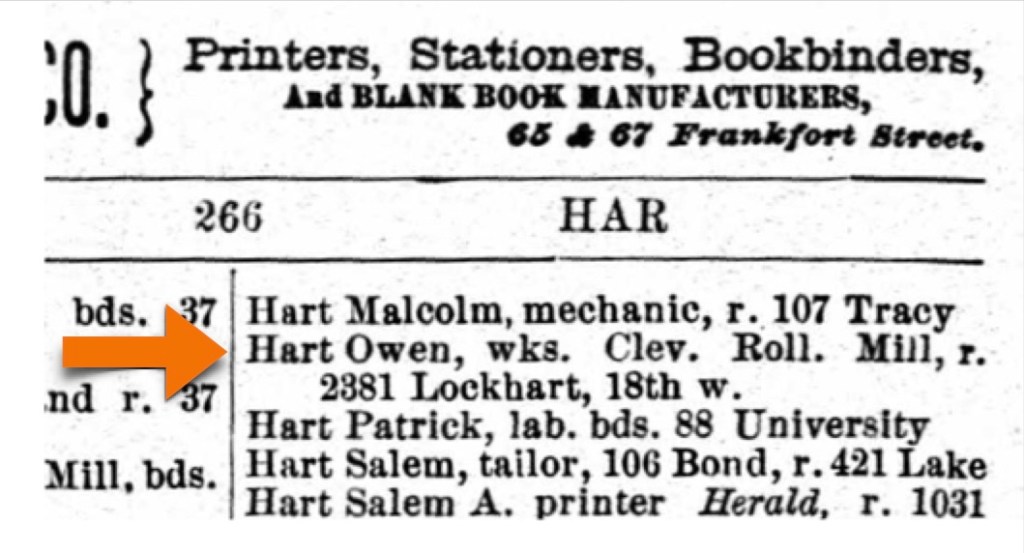
Business Directory, Cleveland City Directory for 1876
Ohio > Cleveland > 1876 > Cleveland, Ohio, City Directory, 1876
Owen Hart
U.S., City Directories, 1822-1995
https://www.ancestry.com/search/collections/2469/records/309469046
Book page: 266, Digital page: 134/435, Left page, right column at top.
Note: For the data.
1880
Owen Hart
1880 United States Federal Census
Ohio > Cuyahoga > Cleveland > 053
https://www.ancestry.com/search/collections/6742/records/23181802
Book page: 56, Digital page: 56/70, Lines 42 through 46.
Note 1: His wife has likely died.
Note 2: They are boarders in the home of the Hugh Graham family.
Owen 50*, Patrick 29, Brian 24, John 20, Michael 6 (whose son?)
* How does he get to be 10 years younger?
Two Coming And One Going
(12) — five records
Thomas O. Hart
https://www.findagrave.com/memorial/158633329/thomas-o.-hart
Note: For the data.
Helen M Hart Douthitt
https://www.findagrave.com/memorial/36129019/helen-m-douthitt
Note: For the data.
Parents
What Are Irish Twins?
https://www.parents.com/irish-twins-8605851
Note: For the text.
Owen Hart
Ohio, U.S., Select County Death Records,1840-1908
Death Register > 1892-1898
https://www.ancestry.com/search/collections/62075/records/169120
Digital page: 388/993, Entry 5621 at page middle.
Note: Owen’s death date is recorded as December 3, 1894.
and
Owen Hart
https://www.findagrave.com/memorial/170687837/owen-hart
Note: Owen’s death date is recorded as December 5, 1894.
1907 and Cobden Court in East Cleveland
(13) — thirteen records
Cleveland Public Library Digital Collection
Atlases, Maps and Park Plans of Cleveland and Cuyahoga County
The Only Correct Map of the City of Cleveland, 1879
https://cplorg.contentdm.oclc.org/digital/collection/p4014coll24/id/51/rec/3
Note: For the map image designating where Margaret (Nicholson) Patton Hart lived at the end of her life.
Cleveland Public Library Digital Collection
Atlases, Maps and Park Plans of Cleveland and Cuyahoga County
Map of the City of Cleveland for 1899-1900
https://cplorg.contentdm.oclc.org/digital/collection/p4014coll24/id/61/rec/1
Note: For the map image.
Margaret Hart
U.S., City Directories, 1822-1995
Ohio > Cleveland > 1907 > Cleveland, Ohio, City Directory, 1907
https://www.ancestry.com/search/collections/2469/records/1112727577
Margaret Hart listing: Book page: 645, Digital page: 332/1127
Index of Abbreviations: Book page: 27. Digital page: 15/1127
Note: wid Owen r 18 Cobdeu ct EC. (This indicates that she is a widow of Owen Hart, and this is her residence — 18 Cobdeu [Cobden] Court in East Cleveland.
Margaret Hart
Ohio, U.S., Select County Death Records,1840-1908
Death Register > 1908
https://www.ancestry.com/search/collections/62075/records/194540
Digital page: 138/301, Entry 7 from the top of the page.
Fresh Water Cleveland Postcard Archives
#PFTL: “Greetings from Cleveland, Ohio” Part 3: The Variants
Greetings From Cleveland, circa 1908
https://www.freshwatercleveland.com/features/PFTL-Greetings-From-Cleveland-Ohio-Part-3-The-Variants_111025.aspx
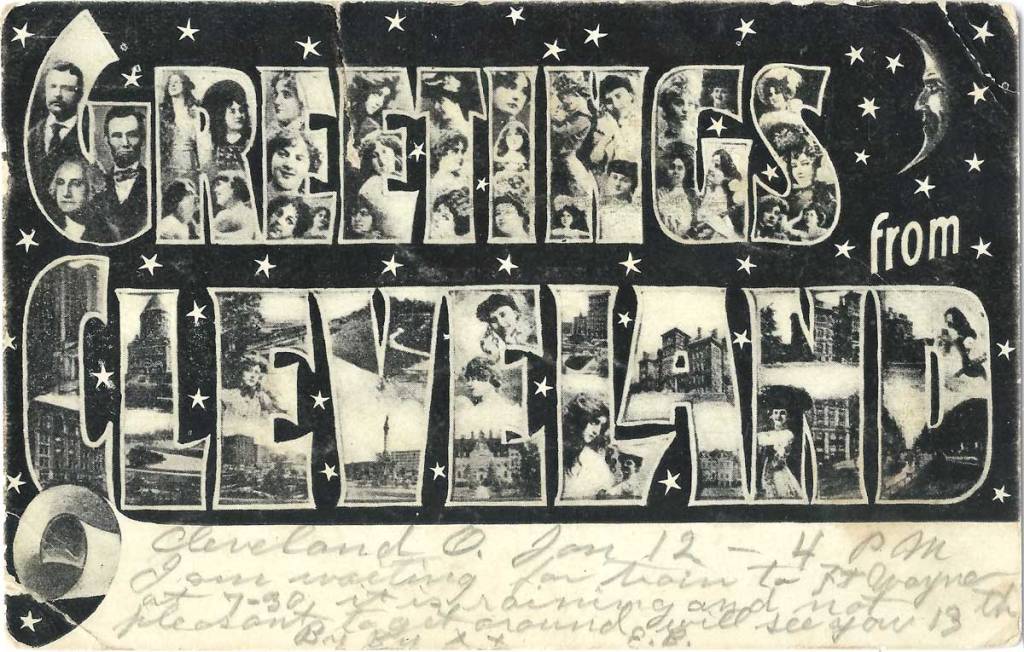
Note: For the postcard image.
Case Western Reserve University
Encyclopedia of Cleveland History
Street Names
https://case.edu/ech/articles/s/street-names
Note: For the text.
Margaret Hart
U.S., Find a Grave Index, 1600s-Current
https://www.ancestry.com/search/collections/60525/records/136660724
and
https://www.findagrave.com/memorial/170687051/margaret-hart
Note: Calvary Cemetary in Cleveland.
The Upper Lake of Killarney (1907 postcard)
https://www.tuckdbpostcards.org/items/130709-the-upper-lake-killarney
Note: The Tuck Postcard Database is found at: https://www.tuckdbpostcards.org/places It states that this series dates from 1907 and were issued as a set of six.
and this was sourced at:
Irish Postcards
https://irishpostcards.wordpress.com/
Note: For the Tuck & Sons 1907 Postcard image.
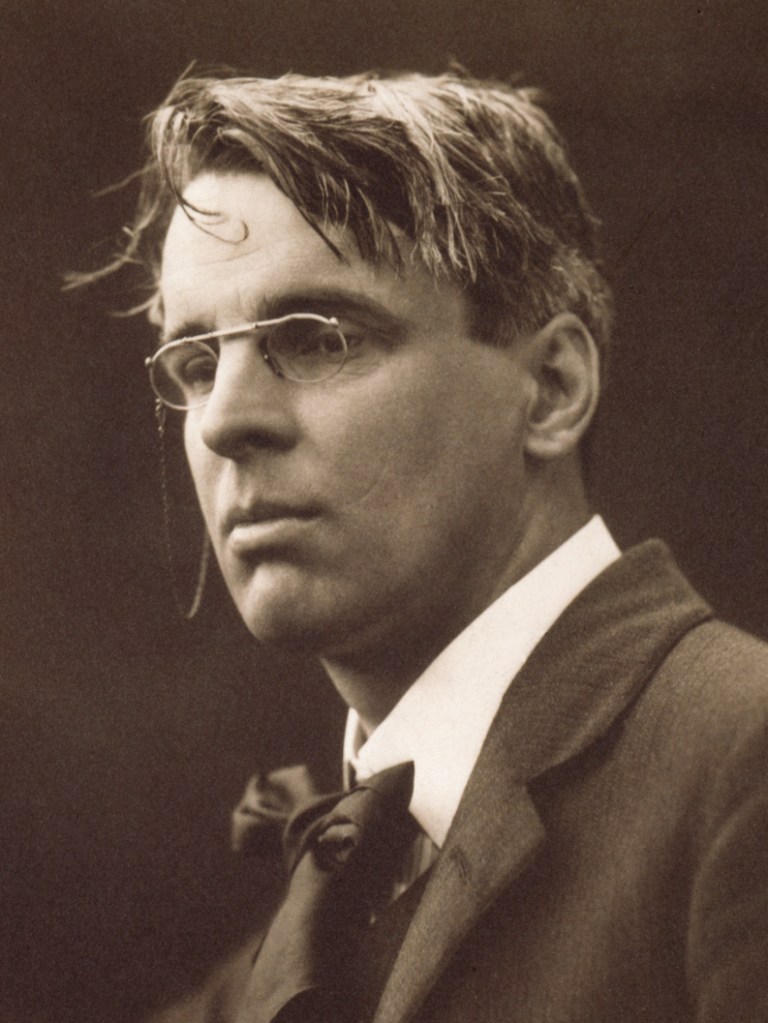
(Image courtesy of the National Portrait Gallery, London, England via Wikimedia Commons).
W. B. Yeats
https://en.wikipedia.org/wiki/W._B._Yeats
Note: For his portrait and his biography.
The Lake Isle of Innisfree (poem)
by William Butler Yeats
https://en.wikipedia.org/wiki/The_Lake_Isle_of_Innisfree
Note: For the text of the poem. “The Lake Isle of Innisfree exemplifies the style of the Celtic Revival: it is an attempt to create a form of poetry that was Irish in origin rather than one that adhered to the standards set by English poets and critics.”


_MET_MM15333.jpg)

