This is Chapter One of two, being the very first of our many family lines which we have researched over the last few years. Some of our ancestral lines have enough complete history that we are able to travel very far back in time, and others, we can only link back for a couple of centuries due to the historical circumstances. The McMahon and McGuire lines are of the latter category, as you will see…
Ireland — A Country in Transition
The story of the McMahon and the McGuire families requires a brief explanation about the times and places within which they lived. Their history takes place during the past 225 years, primarily in Ireland, and Scotland, and then eventually the United States.
Ireland around the year 1800 was already a country in transition, evolving from a strictly agricultural society, to one where the impact of the Industrial Revolution was altering the landscape of life. Watt’s invention of the steam engine in 1786 was beginning to have an influence on where railroads were built, what materials factories eventually came to manufacture, and where people lived.
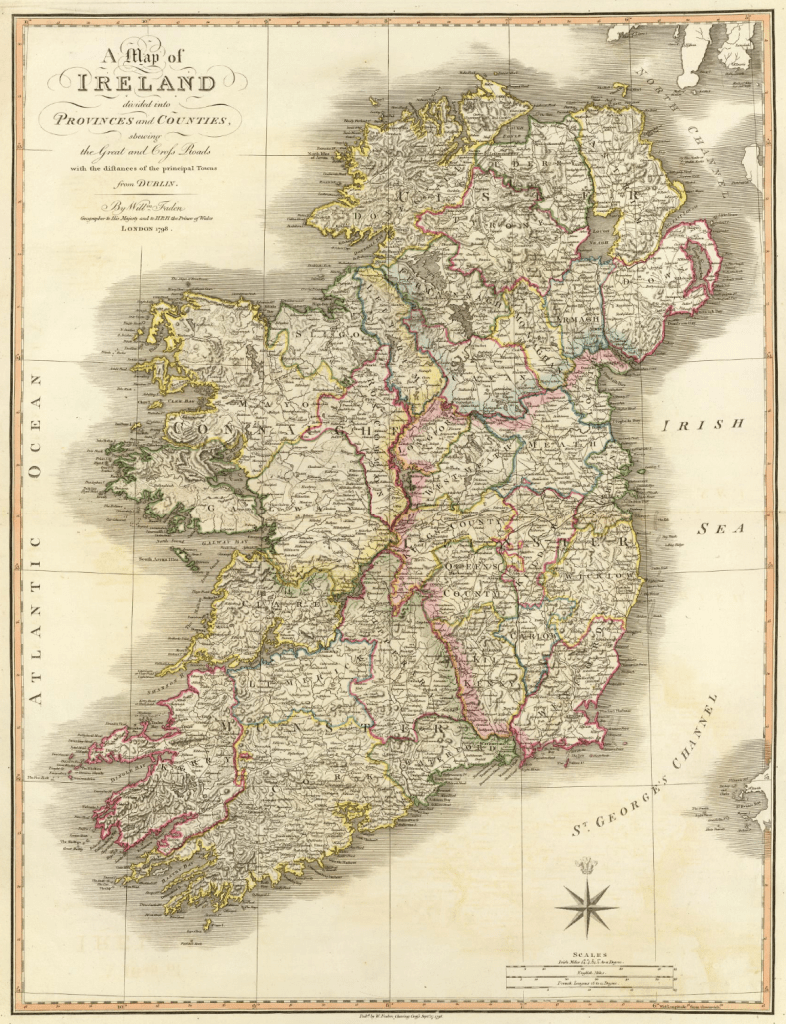
(Image courtesy of David Rumsey Historical Map Collection).
Most people started to work at a very young age, and what was important in their lives was their labor and their productivity. The very idea of having an education must have seemed like a luxury to them. We see this in the documents that survive from the time period, where our ancestors had to sign their names using an X. Hence, they had to rely on others (witnesses and administrators) to write for them. Sometimes this resulted in errors in the spelling of family names, errors in relying on memory for place names, etc. Not being able to read, nor write, these individuals had to trust that what was recorded was accurate. In actuality, they truly couldn’t verify much. The spelling of names for the same person could vary over time. For example: The Mc prefix on the surname was used to designate the relationship as ‘son of…’ Sometimes this prefix was dropped, sometimes it was altered to M’ or Mac. The same person at different times of their life could be Mahon, M’Mahon, or Macmahon; McGuire could be Maguire, M’Guire, or McGuire.
Our Irish ancestors were Roman Catholic, and by 1800 were emerging from two centuries of oppression by other political and religious movements.
In the 1920’s, a fire In Dublin from the Irish Civil War destroyed almost all of the previous century’s records which were held at the Public Record Office of Dublin’s Four Court complex.
https://en.wikipedia.org/wiki/Four_Courts
Initially, census records in Ireland were haphazard, to nonexistent. The first full census was conducted in 1821 and today only fragments of it exist. In the 1920’s, a fire In Dublin from the Irish Civil War destroyed almost all of the previous century’s records which were held at the Public Record Office of Dublin’s Four Court complex. Very, very few records survived and are generally referred to as census fragments. However, the church parishes had kept marriage and baptismal records — many of those records survived. Forenames and family names were common and tended to be repeated in families over time. This makes it difficult to discern if particular records belong to our ancestors.
The impact of an Gorta Mór
Ireland’s history in the 19th century is known for The Great Famine, also known as the Great Hunger (Irish: an Gorta Mór, the Famine and the Irish Potato Famine, which devastated Ireland from 1845 to 1852. The population of Ireland greatly declined through disease and emigration and the generational effects from this period lasted much longer than those few years. “Emigration during the famine years of 1845–1850 was primarily to England, Scotland, South Wales, North America, and Australia… At least a million people are thought to have emigrated as a result of the famine… Families did not migrate en masse, but younger members of families did, so much so that emigration almost became a ‘rite of passage’, as evidenced by the data that show that, unlike similar emigrations throughout world history, women emigrated just as often, just as early, and in the same numbers as men.” In the footnotes, an expansive Wikipedia article explains the long and complex dynamics of this historical period. (Wikipedia)
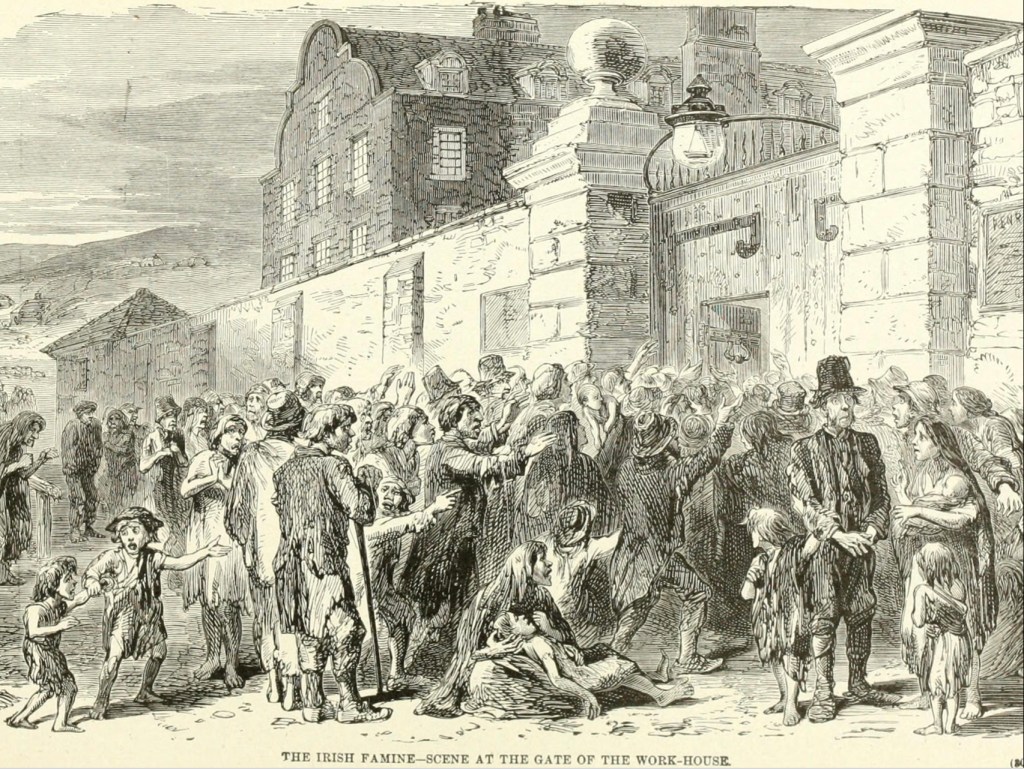
by Thomas Horsfall of the English School.
This history greatly affected our Irish ancestors, and by fate, our family history. In the case of the McMahon and McGuire families, some of them moved to Scotland seeking work, to build their families, and our futures. (1)
The McMahons and The McKinzies
The research of our McMahon roots via Mary Jane McMahon/McCall/Davin begins with her father Patrick McMahon, born and baptized in Dublin, Ireland.

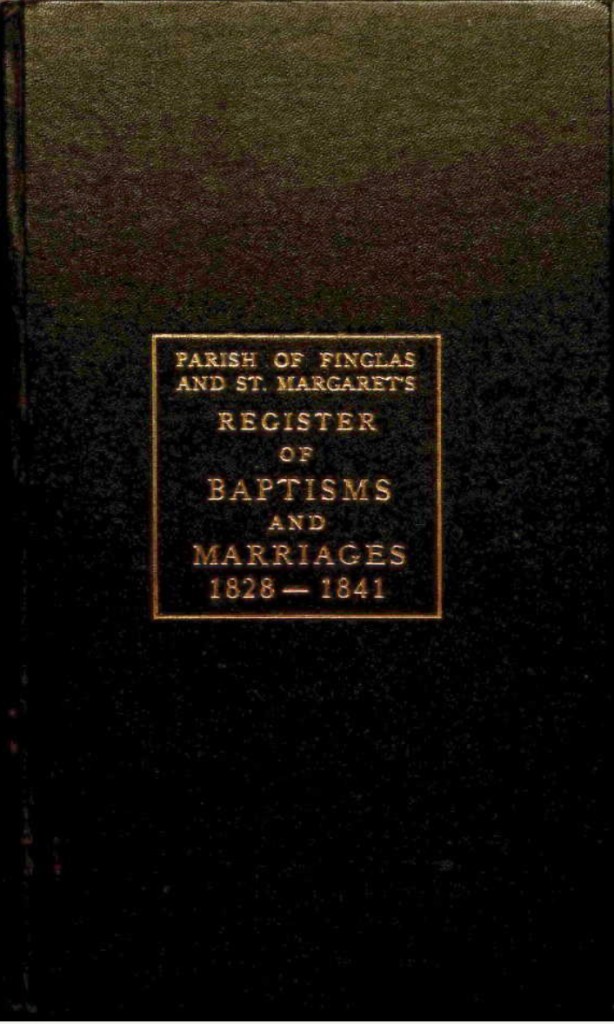
We first encounter our ancestor Patrick McMahon in the register for his baptism in the Parish Church of Finglas and St. Margaret’s in Dublin, Ireland, in 1834. He was the youngest of four sons from the marriage of Philip Mahon/McMahon and Jane McKenzie. His baptism, as well as the baptisms of his brothers, had been dutifully recorded in the church record Parish of Finglas and St. Margaret’s Register of Baptisms and Marriages 1821—1841.
For these ancestors, we have baptism dates, but not birth dates. For Roman Catholics, the baptism of a child was considered essential due to the high infant mortality rate in that era. This meant that the baby was baptized as soon as this could be accomplished with the church. Outside of a religious context, Ireland did not require the civil registration of a child’s birth until 1864.
William Mahon was the first born son in December 1825, followed by John Mahon in October 1828, then Philip Mahon (likely) in December 1830 since his baptism date is January 2, 1831.
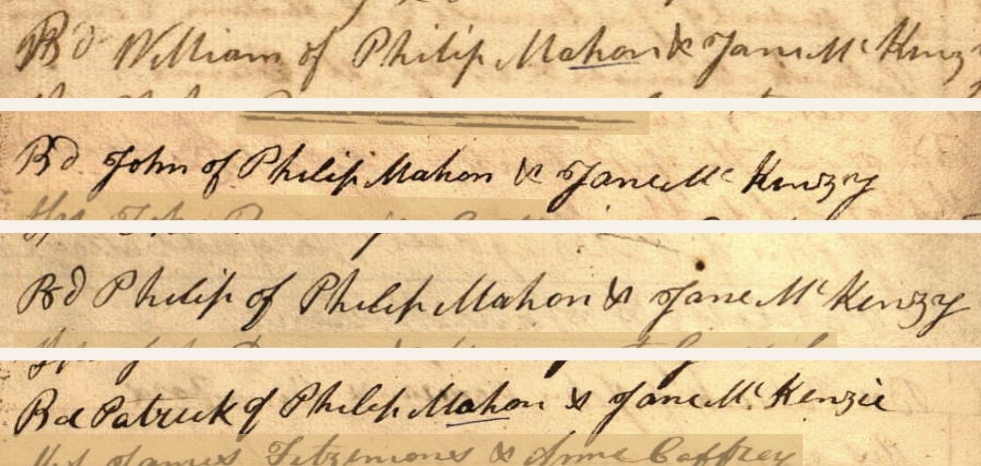
Patrick Mahon/McMahon was the last born son, in July 1834, (we are descended from Patrick). His baptism date was August 3, 1834. If Philip and Jane had other children, it is probable that the births would also have been recorded in the Finglas Parish Register. No other records have been identified.

(Image courtesy of David Rumsey Historical Map Collection).
We don’t know how or when Philip McMahon and Jane McKenzie met, but it’s clear that they were married sometime between the May 1821 Irish census, and the end of December 1825 when their first son William was baptized. (We are still searching for their actual marriage record.) We found that Jane McKenzie’s surname is frequently misspelled on the baptismal records. If they were not married, a proxy for each person would have had to stand-in for them and the parish record would reflect that. We are confident that these ancestors are the parents because of the consistent use of the same parish church for baptisms and importantly, Jane’s surname (McKinzie) is found on Philip and Patrick McMahon’s respective wedding certificates.

(Image courtesy of highland titles.com).
Patrick McMahon’s mother Jane McKenzie was born in Ballinacargy, Drung & Larah Parish, County Cavan, Ireland, on December 29, 1800, the daughter of Alexander McKinzie and Mary Goggins. We have no evidence of her beginnings, but we did find a clue about her in a census twenty years after her birth.
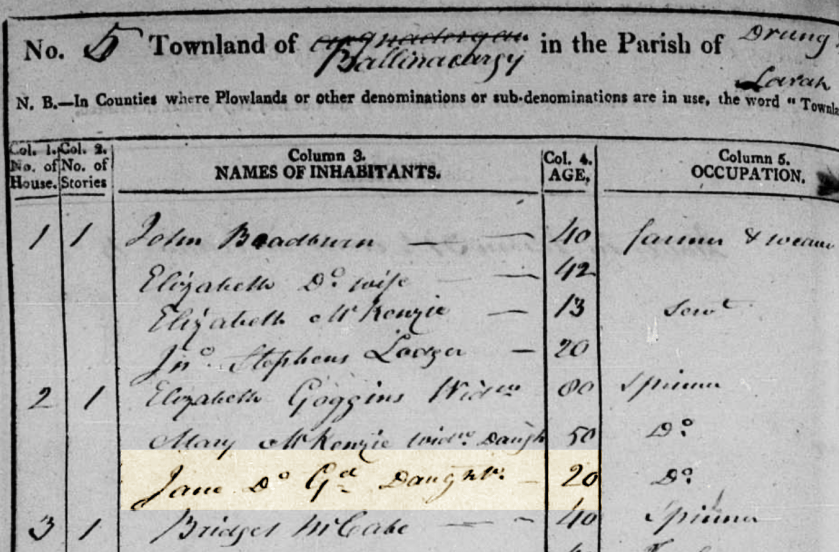
Through a surviving 1821 Census fragment, we know that Jane was living in County Cavan, at the home of her grandmother Elizabeth Goggins. Also living in the home is her mother Mary McKinzie. Both Elizabeth Goggins and Mary McKenzie were identified as widows. Jane is identified as a granddaughter to Elizabeth Goggins. All of them list their occupation as spinners. The growing of flax fibers and the spinning of those fibers into linen thread, was a strong industry in the north of Ireland.
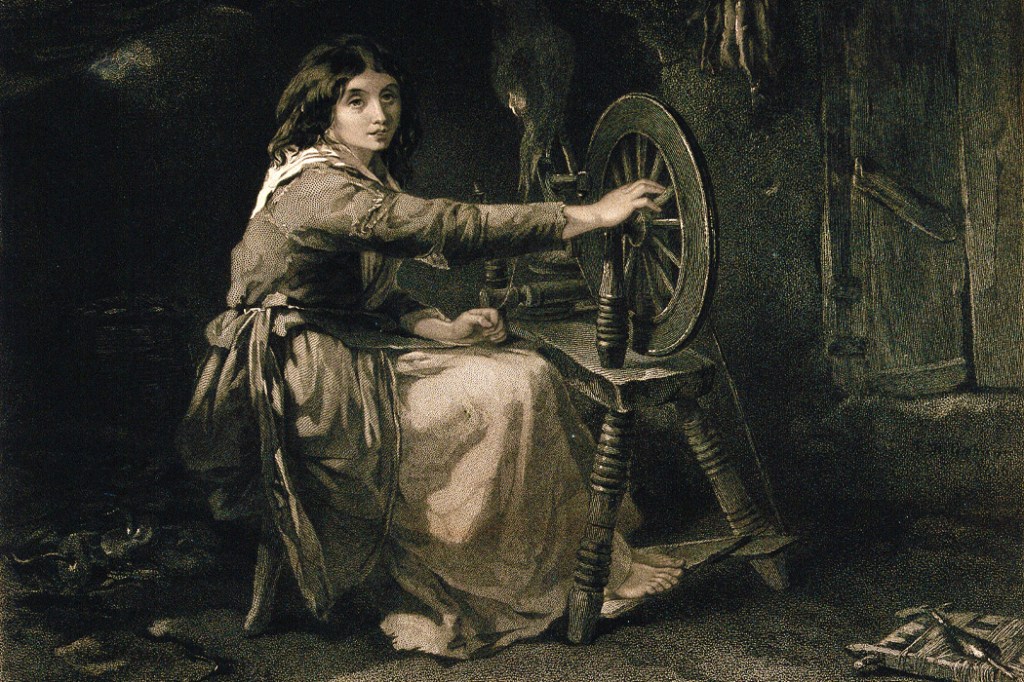
Engraving by Francis Holl after F.W. Topham. (Image courtesy ofWikimedia Commons).
Jane’s mother, Mary (Goggins) McKinzie was the first born in a family of four children, with her siblings being brothers. Their names were John, William, and David Goggins. We know much about the Goggins family, but very little about Mary’s actual life. It appears that she was part of a large extended family, through her brother John’s marriage, but the evidence is circumstantial.
It’s interesting to note that it was traditional to name your children after other family members such as grandparents, parents, aunts,or uncles. It’s one of the biggest challenges in genealogical research to keep all of those overlapping names sorted out! So perhaps Jane’s inspiration for naming her two oldest sons with Patrick Mahon was from her maternal uncles’ names William and John.

(Image courtesy of wikipedia.org).
We think that Patrick’s father Philip Mahon/McMahon, was born somewhere between 1799 and 1805. We have not been able to trace ancestors on this line further back than Philip Mahon/McMahon due to the fact that names like his were very, very common in Ireland. We have several different couples who could have been his parents, but the evidence is not concrete enough at this time to publish the names. We are still researching his origins.
We learned that Irish and English history had an impact on how Irish family names were recorded. Philip McMahon’s forename Mahon in the Finglas Parish baptismal records for his sons, is better understood by reviewing this article from The Irish Times. (See the footnotes). We don’t know exactly why his name is recorded as Mahon for those records. We know that in that era, some people were starting to restore prefixes to their family names which had been dropped in earlier times. Certainly, surviving records indicate that his sons returned to using the full family name of McMahon. (2)
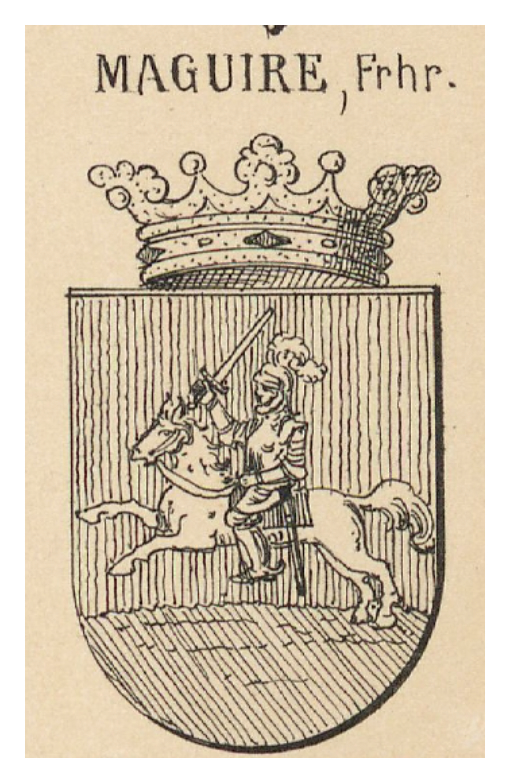
(Image courtesy of COADB.com).
The Maguires
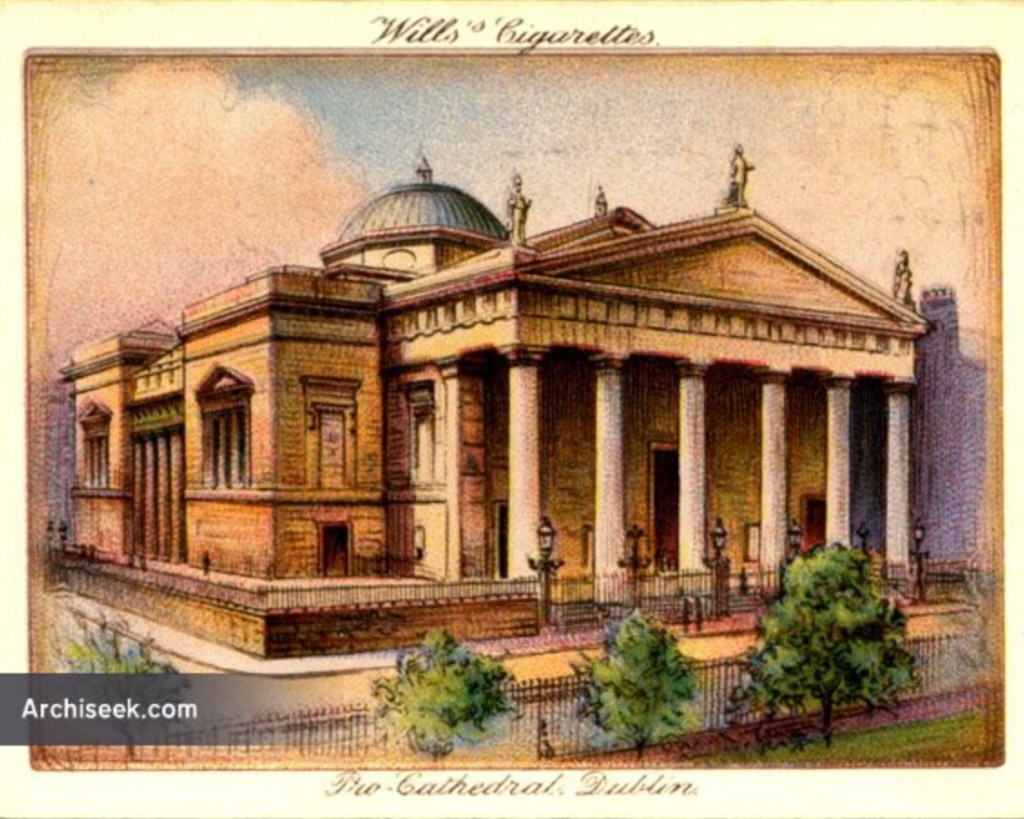
On August 18, 1844, one Maguire married another Maguire at the St. Mary’s Pro-Cathedral in Dublin City. (This the same location where their children were baptized). We noticed on the marriage document that both Patrick and Anne had the same surname, which was an unusual discovery for us. Was this just a coincidence, or were they perhaps cousins? (Often enough in that era, second or third cousins sometimes married each other).

St Mary’s (Pro-Cathedral) of Dublin, Ireland.
Patrick and Anne Maguire’s daughters were born in the midst of the Great Famine years in Ireland. In quick succession, they had three daughters. The oldest daughter, Mary Francis Maguire was likely born in May 1845 and baptized on June 1 of that same year. Our ancestor, Elizabeth Margaret Maguire was born in June 1846 and baptized on July 3. The youngest sister, Margaret Ann Maguire was baptized on November 22, 1847.
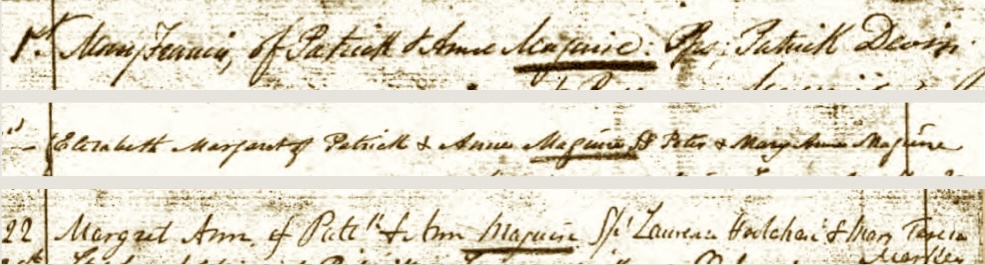
from St Mary’s (Pro-Cathedral) of Dublin, Ireland.
We believe that both the Maguire/McGuire branch of the family was living in Dublin, Ireland, however we know nothing about Elizabeth Maguire’s Irish childhood, nor how long she lived there. Across the Irish Sea, Scotland did not suffer the same deprivations and impacts that Ireland had endured during The Famine. Ultimately, many Irish people emigrated to Scotland in search of work and a better life. (3)
Their Emigration to Scotland
We know that both Patrick McMahon and Elizabeth Maguire are in Scotland by 1860, because they are living in the village of Doune, and are married on October 1, 1860 in nearby Stirling, Scotland.

In Sir Walter Scott’s first novel, Waverly (1814), the protagonist Edward Waverley
is brought to Doune Castle by the Jacobites.
There are several things to note about their marriage certificate. Both Patrick and Elizabeth lacked education and could not sign their names, so instead they made an X. Witnesses were required to vouch for the signee, so we see other names like Michael McGuire, Richard McGuire, and Edward Maguire. We do not know if these people were relatives, but it’s probable.

for Patrick McMahon and Elizabeth McGuire, from
Scotlandspeople.gov.uk.
It’s important to note another observation we have about Elizabeth Maguire’s mother, Anne Maguire. Her name is recorded as Nancy C______ on the marriage document. She is also the only one of the four parents, who was not listed as being ‘dead’ by the time of the October 1860 marriage. In that era, a woman with the name of Anne, was often called Nancy. The name Nancy was originally a diminutive form of Anne or Ann.
We believe that she remarried, hence her surname changed to C______, and she was known as Nancy C______. Due to the obscure penmanship on that 1860 marriage document, we have not been able to decipher the exact spelling of Anne Maguire/Nancy C______’s (new) surname. We did see that her ‘maiden name Maguire’ is written just below her new surname. On Elizabeth’s 1911 death certificate, her mother’s maiden name is written as Kerns. We believe that this is more likely a phonetic spelling for her re-married surname.
For those of us living in current times, it seems strange that Patrick and Elizabeth had difficulties in keeping track of their actual ages. On the marriage register, even though he was 26 when he married Elizabeth, Patrick stated that he was 25. As for Elizabeth, she gave her age as 19 when she was actually only 14. Throughout her life, Elizabeth (and sometimes her daughter Ann Elizabeth) would state ages and locations that were not correct. It’s clear that they were guessing. For her 1860 marriage, perhaps Elizabeth wanted to appear older?
Throughout her life, Elizabeth (and sometimes her daughter
An observation we made after analyzing documents
Ann Elizabeth) would state ages and locations that were not correct. It’s clear that they were guessing.
For her 1860 marriage, perhaps Elizabeth wanted to appear older?
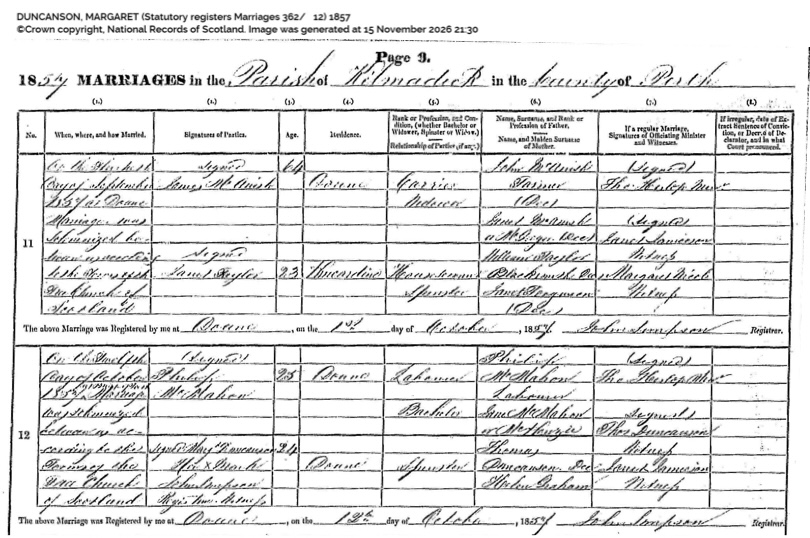
We know that Patrick McMahon’s older brother Philip McMahon had emigrated to Scotland in the 1850s. By 1860, he is living in nearby Kilmadock, Scotland. In 1857 he and Margaret Duncanson were married.
This map below shows the layout for the region within which they lived in the village of Doune in Stirlingshire. The map is interactive, so if you navigate the map in a ‘north-westerly fashion’ you can see the layout of the Doune Village and the Deanston Cotton Works where Elizabeth worked as a weaver.
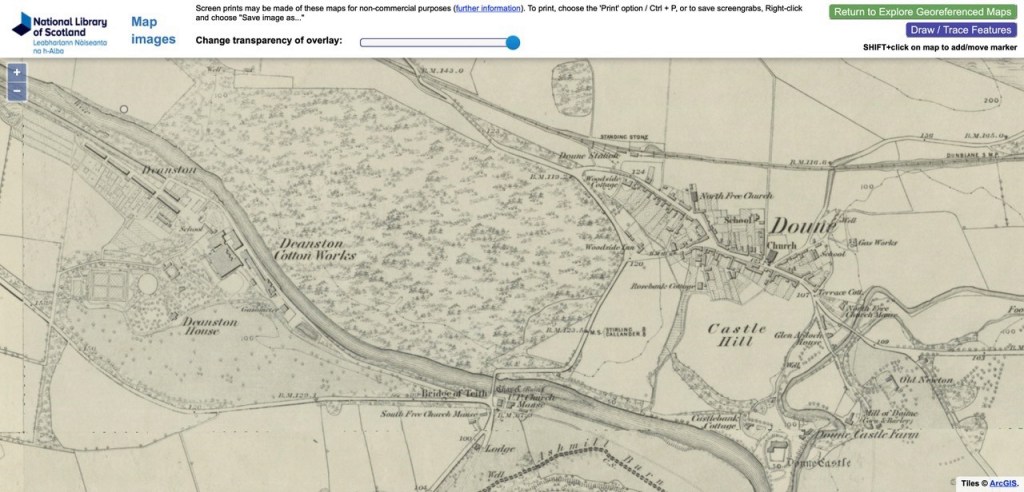
https://maps.nls.uk/geo/explore/#zoom=15.598859239260301&lat=56.19056&lon=-4.06328&layers=5&b=1
There were many woolen mills and linen factories in the larger surrounding area. The fact that Elizabeth worked as a weaver on a steam-powered loom is noteworthy. She was likely first employed as a child-laborer in the factories and then worked her way up to that position. Prior to this time, women, like Jane McKenzie, were confined to making thread and men ran the looms. A little more than a generation later, women had advanced and were considered skillful enough to do some of the jobs that men used to do. (4)
Moving Around Frequently — The Central Belt Of Scotland
During the next period of slightly more than 20 years, Patrick and Elizabeth moved around a lot. Their childrens’ births and deaths were in the areas of Perthshire, Stirlingshire, and North Lanarkshire, Scotland. On a map these locations are in the Central Belt of Scotland, all in a relatively close area. On most of the childrens birth registrations Patrick McMahon is identified as a quarryman, or laborer. With an ever-growing family, perhaps he was following the best employment opportunities open to him.
From what we have been able to discern from surviving records, is that they always seemed to be a family that lived on the edge of poverty. (This is certainly true for the decades they lived in Ireland and Scotland). We have wondered what their lives were like in what were called the Collier Villages (where collier was the then current description for people, both men and women, who worked in the coal mines). Patrick McGuire worked as a quarryman, not a collier, but the work environments had many similarities.
Both jobs involve rugged, physical work focused on breaking, extracting, and hauling heavy materials from the earth. Both deal with dangerous working environments—colliers face cave-ins, toxic gases, and black lung in underground coal mines, while quarrymen face rockfalls, dust-related lung diseases (like silicosis), and the risks of heavy machinery, or explosive splitting methods in rock facing open-air sites.
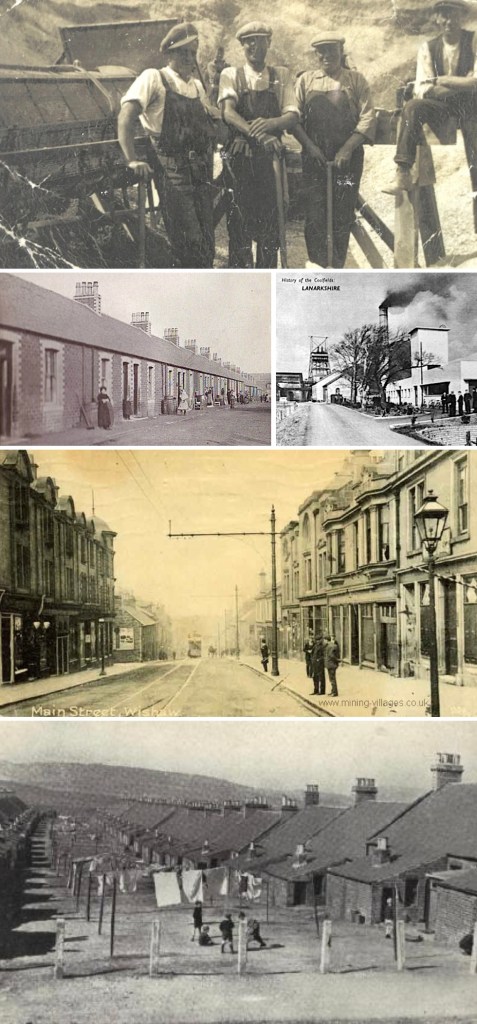
When we looked at the birth and death records of their children, what was particularly evident was their fragile health. The Maguires lived in a world before the advent of modern medical care, before antibiotics, before vaccinations, and before food refrigeration. The environment would have been quite polluted, and in that era, many people did not have running water, nor bathroom facilities within their homes. We came across a description of what home environments were like in these villages, and have excerpted some of the descriptions below.
The following passage was written after the family had already relocated to North America, but the description of their living environment is still accurate. If anything, their years of living in the Collier Villages, may have been even more difficult.
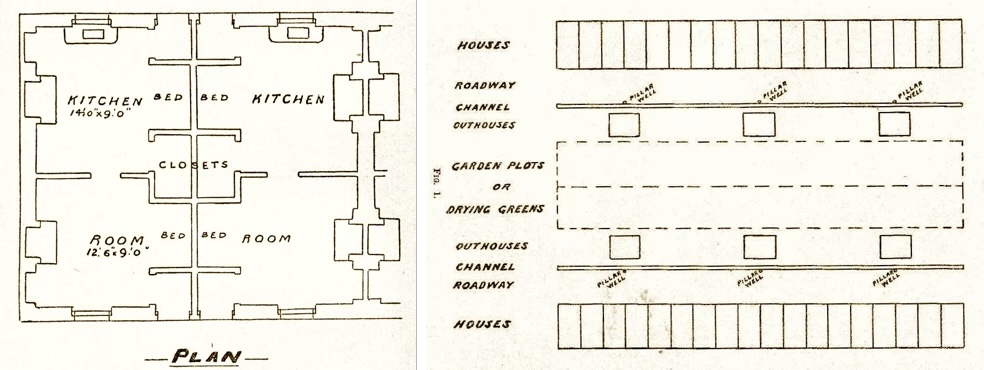
“A collier’s house consists typically of two apartments, a room and kitchen, with a connecting door between [them]… There are two such bedplaces in the kitchen, along one wall, and on the opposite side is the fireplace, perhaps with a good, though small, cooking range. The kitchen has a window looking to the front, and the room another looking to the back, the open door between the apartments permitting some degree of through ventilation. In addition to the two apartments, there may be a small porch built out in front of the kitchen, and used as a store or a scullery, with, or more commonly without, an indoor water supply. Sometimes there are a water tap and sink in the kitchen window place.
The floors are of wood; or the kitchen floor is of pavement brick or cement concrete, and the room floor of wood. The wooden floors are usually ventilated underneath, but not always in the older houses. The ceiling is plastered, or occasionally wood-lined, and the roof is of slate, less frequently of red tiles. The kitchen, excluding the bedplaces, is about 15 feet long by 10 or 11 feet broad and 9 feet high… The roof water may be carried by an eaves gutter and down pipe into a large barrel, for use in clothes washing, but the barrel may be wanting or the eaves gutters broken, and the water may discharge on the ground at the base of the wall.” (Scottish Mining.co.uk > Housing of Scottish Miners) (5)
Finding The McGuire Children
On the 1900 census, Elizabeth answered that she had had twelve children and that six are living. We have been able to confirm eleven children. Their records are woven together from census and administrative records.
Eventually, we learned from the 1900 census that
1900 United States Census Question
Elizabeth was asked two questions:
For mothers,
‘How many children has the person had?’
and
‘How many of those children are living?’
Scotland holds its census very ten years beginning on the first year of the decade (1861, 1871, 1881). The 1861 census has them living in Kilmadock, Scotland. Patrick is listed as an agricultural laborer, and Elizabeth is a cotton weaver.
In the 1871 and 1881 censuses we see the growing McMahon family.
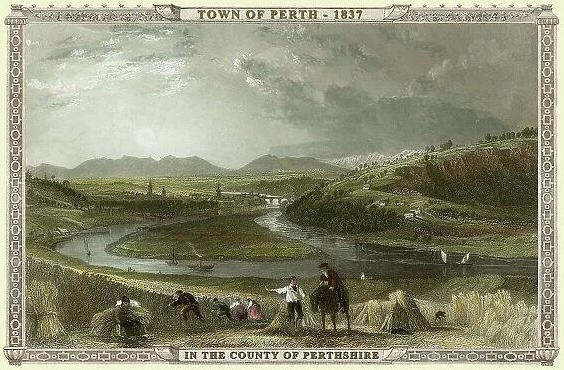
(Image courtesy of media storehouse.com.au).
In Kilmadock Parish, Perthshire County, Scotland — two children…
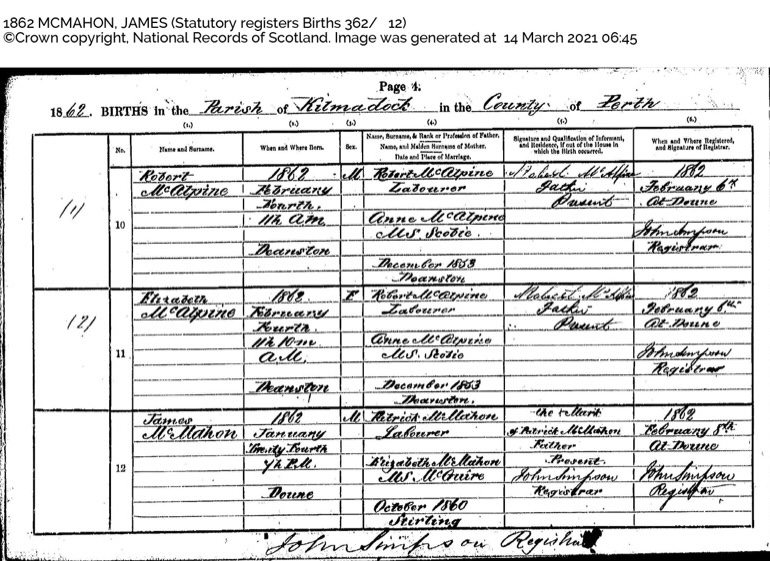
- James McMahon born January 24, 1862 in Doune, Kilmadock, Perthshire, Scotland.
- Mary Jane McMahon born August 4, 1863 in Doune, Kilmadock, Perthshire, Scotland. (We are descended from Mary Jane).
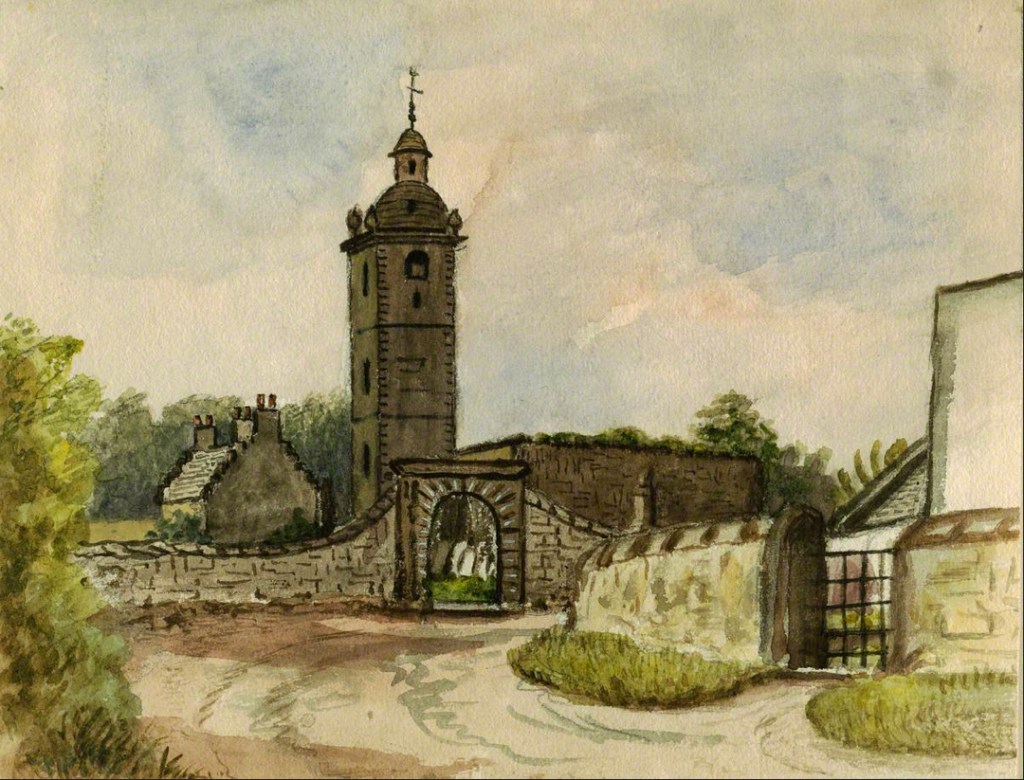
In St. Ninians Parish, Stirlingshire County, Scotland — three children…
- Margaret McMahon born August 12, 1865 in Craigforth, St. Ninians, Stirlingshire, Scotland. Margaret died of hydrocephalus on July 7, 1866 aged 11 months, in Bannockburn.
- Philip McMahon born May 2, 1867 in Bannockburn, St. Ninians, Stirlingshire, Scotland.
- John McMahon born December 10, 1868 in Bannockburn, St. Ninians, Stirlingshire, Scotland. John (also) died of hydrocephalus on October 2, 1869 aged 10 months.
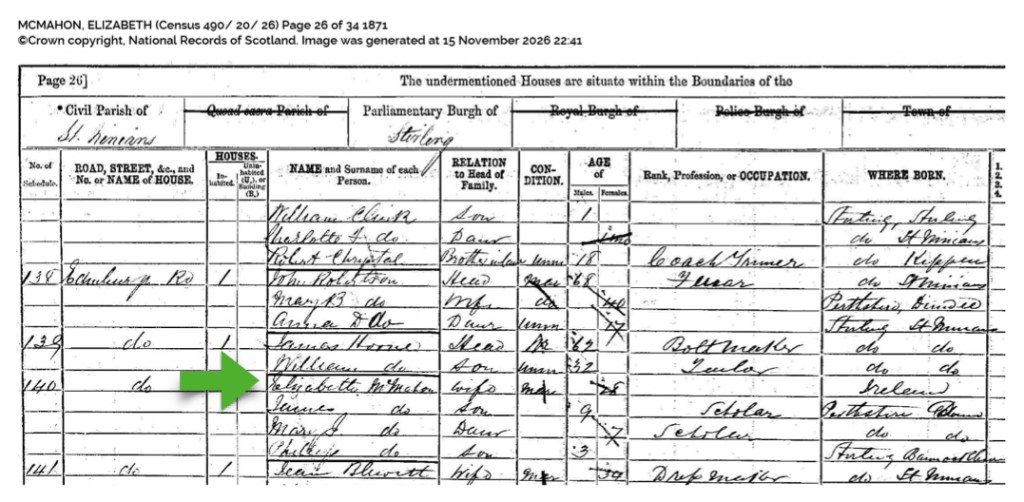
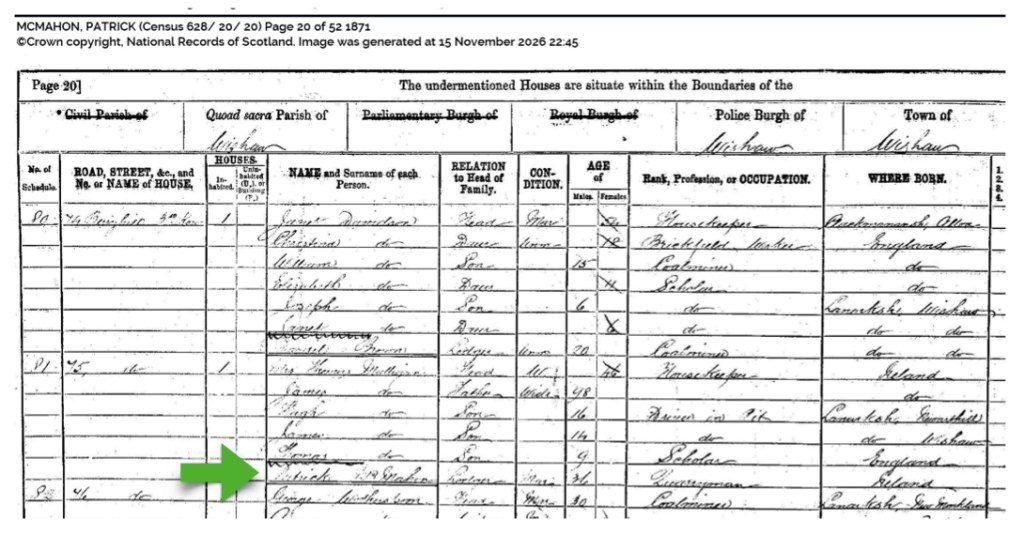
By the time of the 1871 census, Elizabeth and Patrick are registered on two separate censuses. There was a pattern of Patrick seeking out work and Elizabeth following with the children. Elizabeth was living in Shotts, Lanarkshire, and with her are James, Mary Jane, (both scholars) and Phillip. Patrick was a boarder living at the home of Mrs. Thomas Mulligan in Wishaw, Lanarkshire. Between the time of the census in the Spring, and Edward’s birth in October, the family had relocated to Wishaw.

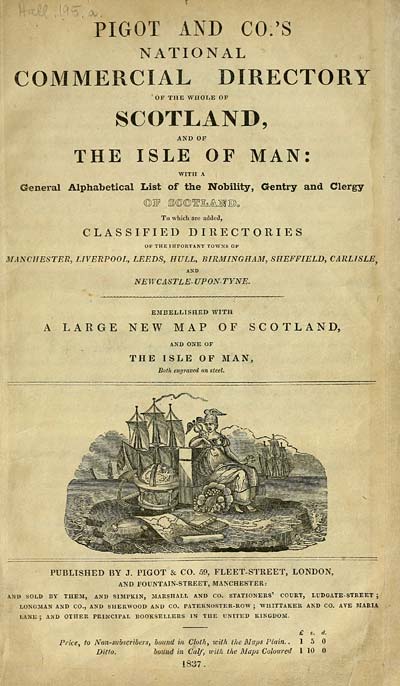
for the Whole of Scotland and of the Isle of Man, page 636.
In Cambusnethan Parish and Shotts Parish, North Lanarkshire County, Scotland — five children…
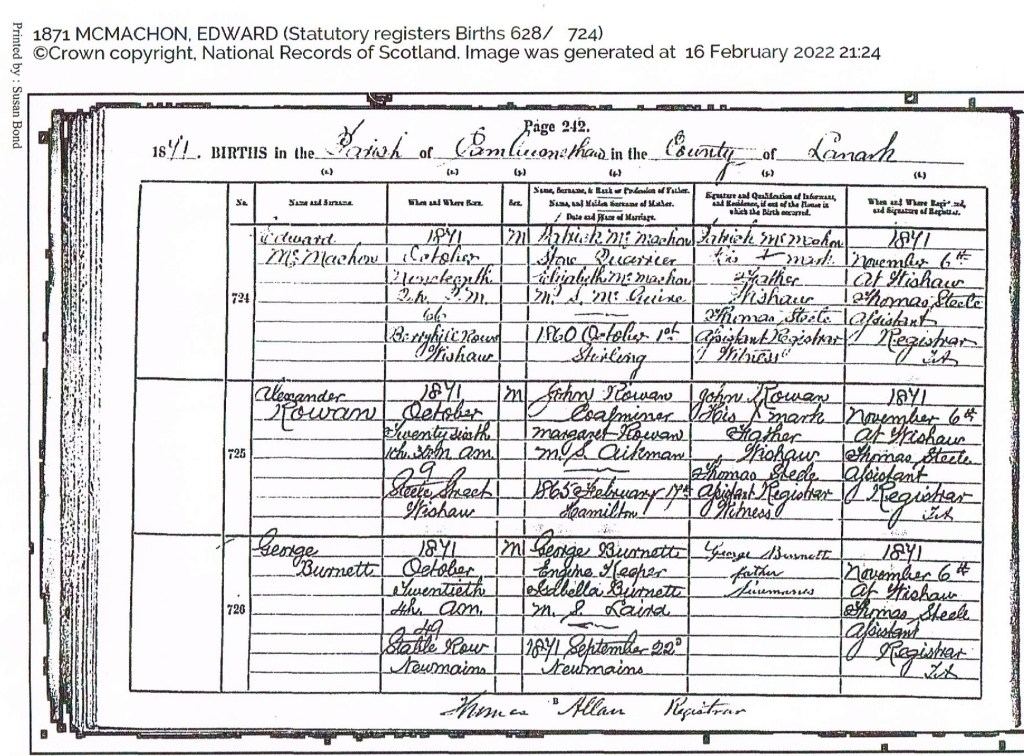
- Edward McMahon born October 19, 1871 in Berryhill Rows, Wishaw, Cambusnethan, North Lanarkshire, Scotland
- Thomas McMahon born August 16, 1873 in Auchinlea, Shotts, North Lanarkshire, Scotland. Thomas died of bronchitis on March 30, 1875, aged 19 months.
- Ann Elizabeth McMahon born August 15, 1875 in Crossgates, Shotts, North Lanarkshire, Scotland.
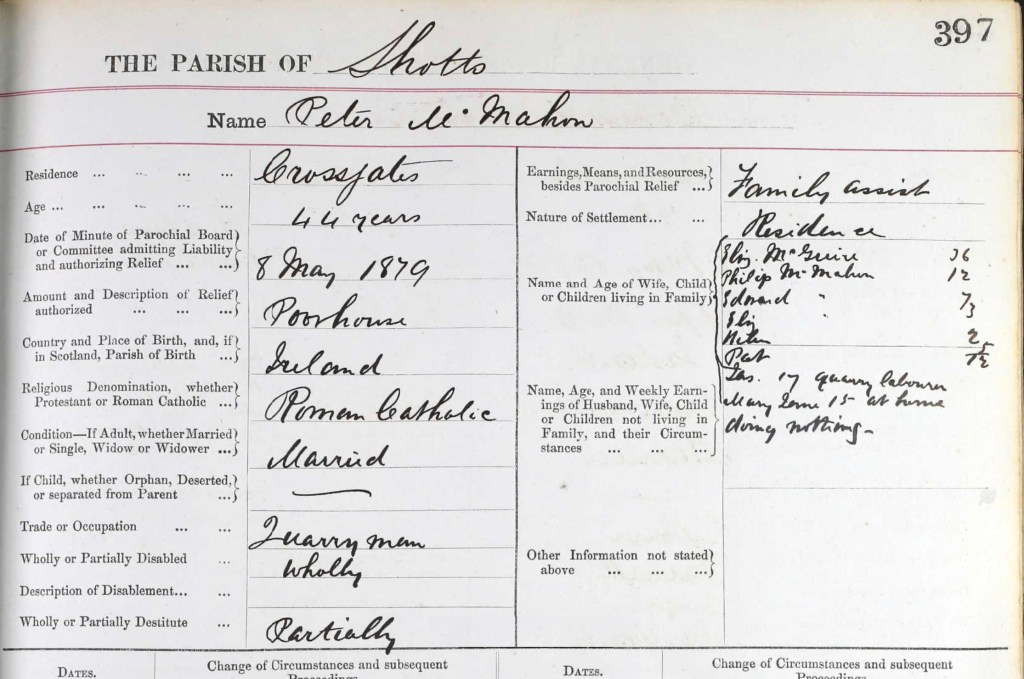
It seems that 1879 was a very difficult year for the McMahon family. We found a poorhouse record indicating that the family needed help. The record states that Patrick was wholly disabled and partially destitute. Curiously, his name is listed as Peter McMahon, so perhaps his name was Patrick (Peter) McMahon? This cannot be confirmed, but the spouse and children are definitely his family. It also indicates that at 17, James is already working in a mine and that at 15, Mary Jane is described as sitting at home doing nothing. Perhaps instead of working in an outside location, Mary Jane was helping her mother with the children?
This document is the only place where their daughter Helen appears, because she never appeared on a census. Finding her name on the poorhouse document led us to her birth certificate, which we would have never looked for otherwise. Also on the document, a 5-month-old baby boy named Pat appears.
- Helen McMahon born February 22, 1877 in Crossgates, Shotts, North Lanarkshire, Scotland. Helen died of whooping cough and bronchitis on August 14, 1879, aged 18 months, in Auchinlea, North Lanarkshire.
- Patrick McMahon born November 9, 1878 in Crossgates, Shotts, North Lanarkshire, Scotland. Patrick died between November 17, 1881 when they arrived in America, and November 1882, when his younger sibling was born in Ohio.
The 1881 census shows us there have been many changes at their Scotland home. Patrick, James, and Phillip are not listed. Living with Elizabeth in Shotts, Lanarkshire, are: Mary Jane (brickwork laborer), Edward, and Ann Elizabeth (both scholars), and baby Patrick, listed at the top of the next page. Curiously, baby Patrick is listed as Peter even though his birth certificate clearly states that his name is Patrick. (6)
In the next chapter, we follow the McMahons as they make a new life in North America.
Following are the footnotes for the Primary Source Materials,
Notes, and Observations
Ireland — A Country in Transition
(1) — six records
David Rumsey Historical Map Collection
Ireland
by William Faden, 1798
https://www.davidrumsey.com/luna/servlet/detail/RUMSEY~8~1~24813~960021:A-map-of-Ireland-divided-into-provi?qvq=q:List_No=’2104.009′” ;sort:Pub_Date,Pub_List_No_InitialSort;lc:RUMSEY~8~1&sort=Pub_Date,Pub_List_No_InitialSort&mi=0&trs=1
Note 1: For the map image.
Note 2: The full description — A map of Ireland divided into provinces and counties, shewing the great and cross roads with the distances of the principal towns from Dublin. By Willm. Faden, Geographer to His Majesty and to HRH the Prince of Wales. London, 1798. Pubd. by W. Faden, Charing Cross, Septr. 17, 1798.
National Records of Scotland
Old Parish Registers
https://www.nrscotland.gov.uk/research/guides/birth-death-and-marriage-records/old-parish-registers
Note: For the data.
When America Despised the Irish: The 19th Century’s Refugee Crisis
https://www.history.com/news/when-america-despised-the-irish-the-19th-centurys-refugee-crisis
Note: For the data.
Great Famine (Ireland)
https://en.wikipedia.org/wiki/Great_Famine_(Ireland)
Note: For the reference and some excerpted text.
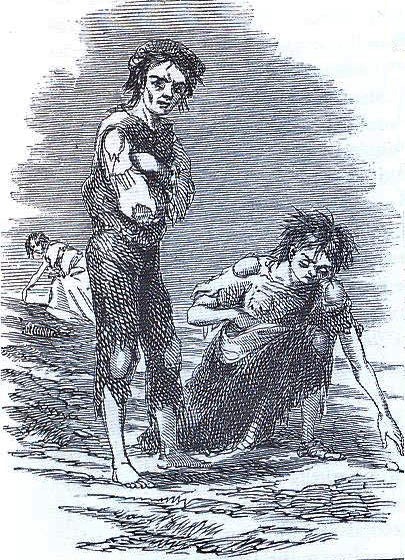
As published in The Illustrated London News.
“The first Sketch is taken on the road, at Cahera, of a famished boy and girl turning up the ground to seek for a potato to appease their hunger. Not far from the spot where I made this sketch, says Mr. Mahoney, and less than fifty perches from the high road, is another of the many sepulchres above ground, where six dead bodies had lain for twelve days, without the least chance of interment, owing to their being so far from the town.” (https://commons.wikimedia.org/wiki/File:Skibbereen_by_James_Mahony,_1847.JPG)
The Irish Famine: Scene at the Gate of a Workhouse
https://www.meisterdrucke.ie/fine-art-prints/English-School/467381/The-Irish-Famine:-Scene-at-the-Gate-of-a-Workhouse-.html
Note: For the illustration.
The McMahons and The McKinzies
(2) — twenty records
Ask About Ireland, Walsh: Fingal and its Churches (illustration)
https://www.askaboutireland.ie/reading-room/digital-book-collection/digital-books-by-county/fingal/walsh-fingal-and-its-chur/
Note: For the church illustration.
David Rumsey Historical Map Collection
Ireland (map inset detail)
By William Faden, 1798
https://www.davidrumsey.com/luna/servlet/detail/RUMSEY~8~1~24813~960021:A-map-of-Ireland-divided-into-provi?qvq=q:List_No=’2104.009′” ;sort:Pub_Date,Pub_List_No_InitialSort;lc:RUMSEY~8~1&sort=Pub_Date,Pub_List_No_InitialSort&mi=0&trs=1
Note 1: For the map image.
Note 2: The full description — A map of Ireland divided into provinces and counties, shewing the great and cross roads with the distances of the principal towns from Dublin. By Willm. Faden, Geographer to His Majesty and to HRH the Prince of Wales. London, 1798. Pubd. by W. Faden, Charing Cross, Septr. 17, 1798.
Highland Titles
Clan Mackenzie: History, Tartan, & Crest
https://www.highlandtitles.com/blog/clans-scotland-mackenzie/
Note: For the Mackenzie clansmen illustration.
Ireland, Select Catholic Birth and Baptism Registers, 1763-1917
for Philip Mahon
Dublin > Canice’s (Finglas and St Margaret) > 1784-1827
William, of Philip Mahon and Jane McKing, https://www.ancestry.com/search/collections/6068/records/15283288?tid=&pid=&queryId=3dabce4a-bd44-446b-8a4f-7cfe96649cfd&_phsrc=HTi1&_phstart=successSource
and
https://www.ancestry.com/imageviewer/collections/6068/images/41885_b154492-00150?treeid=&personid=&hintid=&queryId=31e294f58f1c630bcf08b050c740fe9e&usePUB=true&_phsrc=TLl12&_phstart=successSource&usePUBJs=true&_ga=2.3148720.148489502.1615786366-1914680158.1615680192&pId=15283288
Digital Page: 148/160, Entry 3 for December 11.
Note: For the baptism record.
Ireland, Select Catholic Birth and Baptism Registers, 1763-1917
for Philip Mahon
Dublin > Canice’s (Finglas and St Margaret) > 1828-1841
John, of Philip Mahon and Jane McKinzey https://www.ancestry.com/search/collections/6068/records/15285492?tid=&pid=&queryId=dcd9e158-4897-441b-a644-578203e6dd06&_phsrc=HTi3&_phstart=successSource
and
https://www.ancestry.com/imageviewer/collections/6068/images/41885_b154493-00008?treeid=&personid=&hintid=&queryId=31e294f58f1c630bcf08b050c740fe9e&usePUB=true&_phsrc=TLl4&_phstart=successSource&usePUBJs=true&_ga=2.191644586.148489502.1615786366-1914680158.1615680192&pId=15285492
Digital Page: 9/91, Entry for October 13.
Note: For the baptism record.
Ireland, Select Catholic Birth and Baptism Registers, 1763-1917
for Philip Mahon
Dublin > Canice’s (Finglas and St Margaret) > 1828-1841
Philip, of Philip Mahon and Jane Kenzy https://www.ancestry.com/search/collections/6068/records/15285622?tid=&pid=&queryId=62b833bb-6676-4fbe-a939-74c970d26a1f&_phsrc=HTi4&_phstart=successSource
and
https://www.ancestry.com/imageviewer/collections/6068/images/41885_b154493-00020?treeid=&personid=&hintid=&queryId=31e294f58f1c630bcf08b050c740fe9e&usePUB=true&_phsrc=TLl3&_phstart=successSource&usePUBJs=true&_ga=2.171396128.148489502.1615786366-1914680158.1615680192&pId=15285622
Digital Page: 21/91, Entry 2 for January 2.
Note: For the baptism record.
Ireland, Select Catholic Birth and Baptism Registers, 1763-1917
for Philip Mahon
Dublin > Canice’s (Finglas and St Margaret) > 1828-1841
Patrick, of Philip Mahon and Jane McKenzie https://www.ancestry.com/search/collections/6068/records/15285826?tid=&pid=&queryId=9f97e831-66ab-4ffb-8017-5d8aca90bc01&_phsrc=HTi11&_phstart=successSource
and
https://www.ancestry.com/imageviewer/collections/6068/images/41885_b154493-00042?treeid=&personid=&rc=&usePUB=true&_phsrc=TLl9&_phstart=successSource&pId=15285826
Digital Page: 43/91, Entry 2 for August 3.
Note: For the baptism record.
Jane Mc Kinzie
Vital – Ireland, Births and Baptisms, 1620-1881
https://www.familysearch.org/ark:/61903/1:1:F5P2-QW5
On page 662 of 746, the page reads:
“The Parish Book of Drung & Larah Diocese of Kilmore”
And on page 664 of 746, it reads:
“Register book for the parishes of Drung and Larah received in Drung Church on the 7th August 1785 by the Revd Thomas Cradoc — The registry of such families of ancient parishioners as could in any wise be calculated from Ruins of the Old Register Book are inserted in the first six Leaves of this book”
Modern transcription of Jane McKinzie’s christening record
https://www.familysearch.org/ark:/61903/3:1:3Q9M-CSZZ-N9S9-M
Book Page: 17, Digital Page: 368/746
Note: For the christening record.
Jane McKenzie
Census – Ireland, Census, 1821
https://www.familysearch.org/ark:/61903/1:1:QV9S-PC6M
Digital Page: 99/590, 7th entry from the top.
Note: For the data.
‘A young girl is sitting at a spinning wheel.’
Engraving by Francis Holl after F.W. Topham
https://commons.wikimedia.org/wiki/File:A_young_girl_is_sitting_at_a_spinning_wheel._Engraving_by_Fr_Wellcome_V0039573.jpg
Note: For the illustration.
How War Revolutionized Ireland’s Linen Industry
https://daily.jstor.org/how-war-revolutionized-irelands-linen-industry/
Note: For the data.
Mary Goggins
https://www.ancestry.com/family-tree/person/tree/112231347/person/430099691879/facts
Note: We know very little about Jane’s mother Mary McKinzie.
Note: For the data.
John Goggins
https://www.ancestry.com/family-tree/person/tree/112231347/person/430099690441/facts
Note: For the data — we know much more about the Goggins family through Mary Goggins’s brother John.

was causing so many problems for the English crown that Elizabeth I
banned the name O’Neill, on punishment of death and forfeiture of property.
She would not be pleased to know that today O’Neill is a top ten Irish surname,
and Sean is a top ten Irish given name. (Photograph: Getty Images)
The Irish Times
‘A dozen things you might not know about Irish names’ https://www.irishtimes.com/culture/books/a-dozen-things-you-might-not-know-about-irish-names-1.2842791
Note: For the reference.
McMahon clans
https://en.wikipedia.org/wiki/McMahon_clans
Note: For the family heraldry.
The Maguires
(3) — seven records
COADB Eledge Family
Maguire Coat of Arms
https://coadb.com/surnames-rough/maguire-coat-of-arms-family-crest
Note: For the family heraldry.
Patk Maguire
in the Ireland, Catholic Parish Registers, 1655-1915
Dublin > St Mary’s (Pro-Cathedral) > Dublin city, 1826-1855 https://www.ancestry.com/discoveryui-content/view/10222307:61039?tid=&pid=&queryId=f3fe1a0d6d34316a54f6ee169d859e96&_phsrc=mWS24&_phstart=successSource
Book page: 260, Digital Page: 433/518, Right page, Entry 3 or August 18.
Note: For their marriage record.
Pro-cathedral
https://en.wikipedia.org/wiki/Pro-cathedral
Patrick Maguire
in the Ireland, Catholic Parish Registers, 1655-1915
Dublin > St Mary’s (Pro-Cathedral) > Dublin city, 1826-1855
for Mary Francis Maguire
https://www.ancestry.com/discoveryui-content/view/158048265:61039?tid=&pid=&queryId=41e200fd6cdf1d158ecce8410e21a2cb&_phsrc=FiW6&_phstart=successSource
Book page: 345, Digital Page: 179/518, Right page top, entry for June 1.
Note: For the baptism record.
Elizabeth Margaret Maguire
in the Ireland, Catholic Parish Registers, 1655-1915
Dublin > St Mary’s (Pro-Cathedral) > Dublin city, 1826-1855
https://www.ancestry.com/discoveryui-content/view/8048529:61039?tid=&pid=&queryId=cb6f43b2a8f050540b0b85efce6aa4a0&_phsrc=qdi4&_phstart=successSource
Book page: 361, Digital Page: 187/518, Left page top, entry for July 3.
Note: For the baptism record.
Patk Maguire
in the Ireland, Catholic Parish Registers, 1655-1915
Dublin > St Mary’s (Pro-Cathedral) > Dublin city, 1826-1855
for Margaret Ann Maguire
https://www.ancestry.com/discoveryui-content/view/158048797:61039?tid=&pid=&queryId=7022b3fde5c88bfe281bf2075f8a484f&_phsrc=FiW8&_phstart=successSource
Book page: 377, Digital Page: 195/518, Left page, Entry 10 for November.
Note: For the baptism record.
Their Emigration to Scotland
(4) — thirty records
Doune Castle
https://www.wikiwand.com/en/Doune_Castle
Note: For the illustration.
Scotland’s People
McGuire, Elizabeth (Statutory registers Marriages 490/95) 1860
https://www.scotlandspeople.gov.uk/image-viewer/saved-image/38254302
Note: This page is only viewable via subscription.
for Philip McMahon and Margaret Duncanson, from
http://www.scotlandspeople.gov.uk.
Philip McMahon
Vital – Scotland, Marriages, 1561-1910
https://www.familysearch.org/ark:/61903/1:1:XY3C-JBW?from=lynx1UIV8&treeref=9S75-SX3
and here:
Scotland’s People
Duncanson, Margaret (Statutory registers Marriages 362/12) 1857
https://www.scotlandspeople.gov.uk/image-viewer/saved-image/40267065
Note: This page is only viewable via subscription.
National Library of Scotland
Map Images / Georeferenced Maps
Doune interactive map: https://maps.nls.uk/geo/explore/#zoom=15.598859239260301&lat=56.19056&lon=-4.06328&layers=5&b=1
Note: Navigate the map in a “north-westerly fashion” where you can see the layout of Doune village and the Deanston Cotton Works where Elizabeth worked as a weaver.
Moving Around Frequently — The Central Belt Of Scotland
(5) — six records
BBC
Unearthing the story of Scotland’s industrial ghost village
by Giancarlo Rinaldi
https://www.bbc.com/news/uk-scotland-south-scotland-62036220
Note: For the photogaph labeled Carsphairn Heritage Initiative, (of the four miners).
Scottish Mining Website
Housing
Housing of Scottish Miners – Report on the Housing of Miners
of Stirlingshire and Dunbartonshire
by John C. McVail
http://www.scottishmining.co.uk/379.html
Note: For the photograph of Stirlingshire (Collier housing) labeled as Fig. 3.
Scottish Mining Website
History of the Coalfields: Lanarkshire, The “Black Country” of Scotland
http://www.scottishmining.co.uk/507.html
Note: For the photograph of Hopetoun Colliery, Lanarkshire.
Scottish Mining Website
Cambusnethan Parish
http://www.scottishmining.co.uk/42.html
Note: For the photograph of Main St. Wishaw
The Lanarkshire Mining Industry History of Mining
Miners Rows
http://www.sorbie.net/lanarkshire_mining_industry.htm
Note: For the photograph of the Miners Rows.
Scottish Mining Website
Housing
Housing of Scottish Miners – Report on the Housing of Miners
of Stirlingshire and Dunbartonshire
by John C. McVail
http://www.scottishmining.co.uk/379.html
Note: For the text and two diagrams of the housing at Colliery Villages.
Finding The McGuire Children
(6) — twenty-four records
Elizebeth C McMahon
Census – United States, Census, 1900
https://www.familysearch.org/ark:/61903/1:1:MSCQ-JQ5
Book page: Sheet 18, Digital page: 318/1069 Entry lines 68 through 71.
Note 1: Joliet township, Illinois.
Note 2: Included here only for the census questions.
Patrick McMahon
in the 1861 Scotland Census
https://www.ancestry.com/discoveryui-content/view/714093:1080?tid=&pid=&queryId=9ed874df43ff76043a60ba1ca7703b56&_phsrc=qGQ1730&_phstart=successSource
Note: For the data.
Media Storehouse
View of the Town of Perth, County Perthshire, Scotland 1837
https://www.mediastorehouse.com.au/mapseeker/old-views-vistas/19th-18th-century-scottish-views-portfolio/view-town-perth-county-perthshire-scotland-1837-20346987.html
Note: For the illustration.
James McMahon, birth certificate, entry 12
https://www.scotlandspeople.gov.uk/image-viewer/saved-image/40534060
Note: This page is only viewable via subscription.
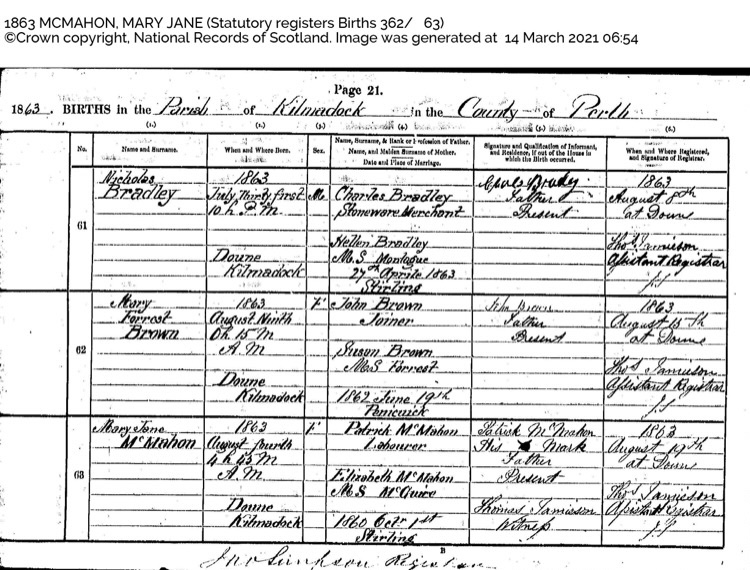
Mary Jane McMahon, birth certificate, entry 63
https://www.scotlandspeople.gov.uk/image-viewer/saved-image/38232612
Note: This page is only viewable via subscription.
St Ninians, by Jane Anne Wright (1842–1922)
The Stirling Smith Art Gallery & Museum
https://artuk.org/discover/artworks/st-ninians-235170
Note: For the illustration.
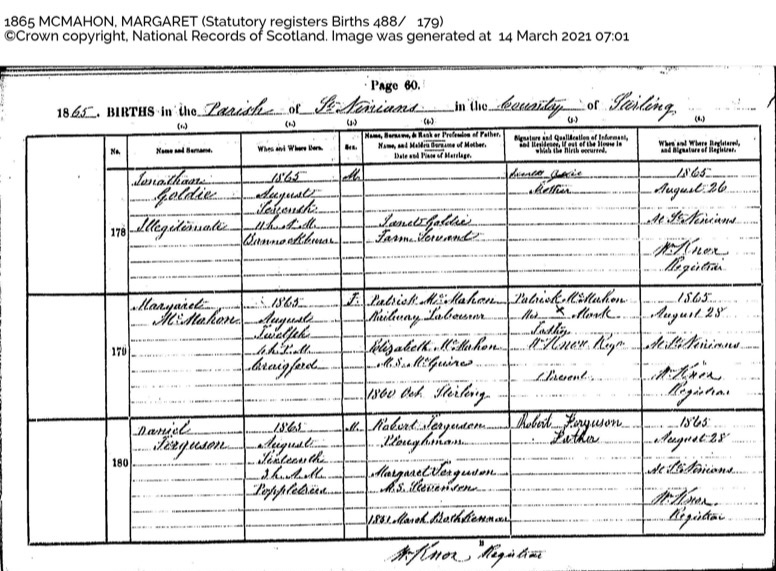
Margaret McMahon, birth certificate, entry 179
https://www.scotlandspeople.gov.uk/image-viewer/saved-image/38232
Note: This page is only viewable via subscription.
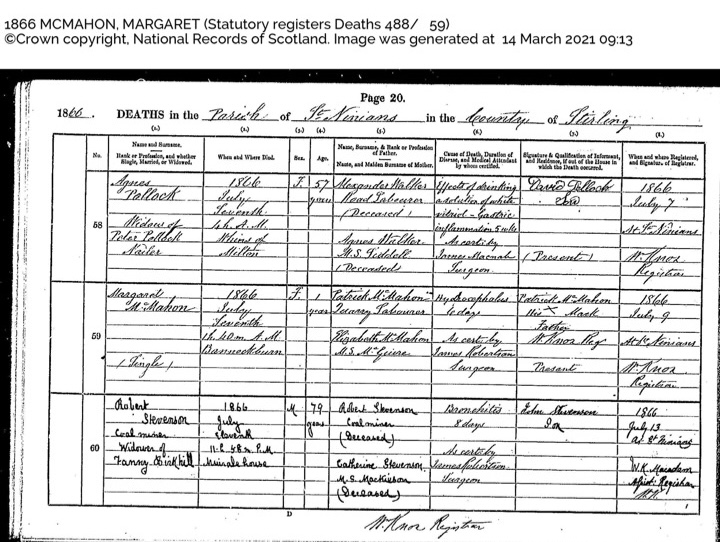
Margaret McMahon, death certificate, entry 59
https://www.scotlandspeople.gov.uk/image-viewer/saved-image/38233234
Note: This page is only viewable via subscription.

Philip McMahon, birth certificate, entry 109
https://www.scotlandspeople.gov.uk/image-viewer/saved-image/38232803
Note: This page is only viewable via subscription.

John McMahon, birth certificate, entry 250
https://www.scotlandspeople.gov.uk/image-viewer/saved-image/38232537
Note: This page is only viewable via subscription.
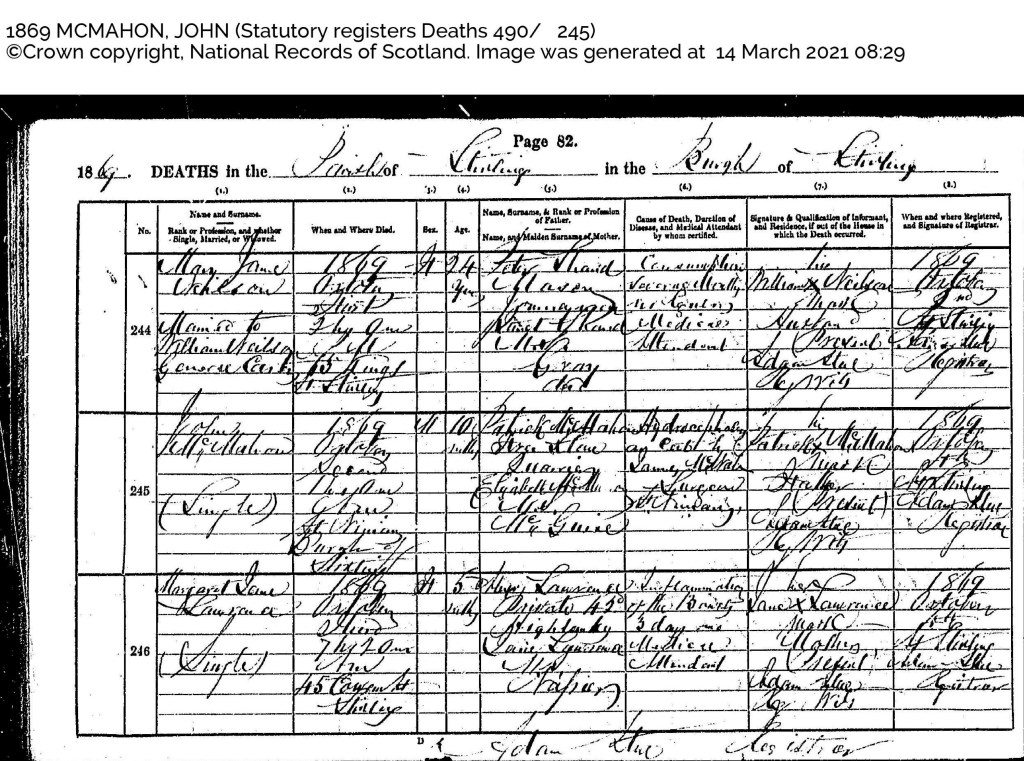
John McMahon, death certificate, entry 245
https://www.scotlandspeople.gov.uk/image-viewer/saved-image/38233010
Note: This page is only viewable via subscription.
Scotland’s People
Mcmahon, Elizabeth (Census 559/25/10) Page 10 of 35
1871
St. Ninians, Stirling, Scotland
https://www.scotlandspeople.gov.uk/image-viewer/saved-image/38232126?headers=0
Book page: 10, Entry 43 near page bottom.
Note: This page is only viewable via subscription.
Scotland’s People
Mcmahon, Patrick (Census 282/43 7/9) Page 9 of 19 1871
Wishaw, North Lanarkshire, Scotland
https://www.scotlandspeople.gov.uk/image-viewer/saved-image/38231973?headers=0
Book page: 9, Entry line 15, near page middle.
Note: This page is only viewable via subscription.
Scottish Post Office Directories
Pigot and Co.’s National Commercial Directory for the Whole of Scotland
and of the Isle of Man
https://digital.nls.uk/directories/browse/archive/85592128?mode=transcription
Book page: 636
Note: For the data and the page image.
Edward McMahon, birth certificate, entry 724
https://www.scotlandspeople.gov.uk/view-image/nrs_stat_births/40541839?image=1&viewed_images=true

Thomas McMahon, birth certificate, entry 198
https://www.scotlandspeople.gov.uk/image-viewer/saved-image/38232675

Thomas McMahon, death certificate, entry 58
Note: Patrick McMahon is written as Peter McMahon for some reason.
https://www.scotlandspeople.gov.uk/image-viewer/saved-image/38233184

Ann Elizabeth McMahon, birth certificate, entry 258
https://www.scotlandspeople.gov.uk/image-viewer/saved-image/38232744
North Lanarkshire, Scotland, Poor Law Applications and Registers,
1849-1917, for Peter McMahon
Shotts Parish > General Register of Poor > 1870-1894
Note: Patrick McMahon is recorded as Peter McMahon for some reason.
https://www.ancestry.com/imageviewer/collections/61702/images/48962_273022002859_0085-00542?treeid=&personid=&hintid=&queryId=beb2167c40a186786da9955cac271563&usePUB=true&_phsrc=UdG3&_phstart=successSource&usePUBJs=true&_ga=2.261243978.630361696.1639162321-1660942128.1639162321&pId=102859
Book page: 397, Digital page: 541/1260
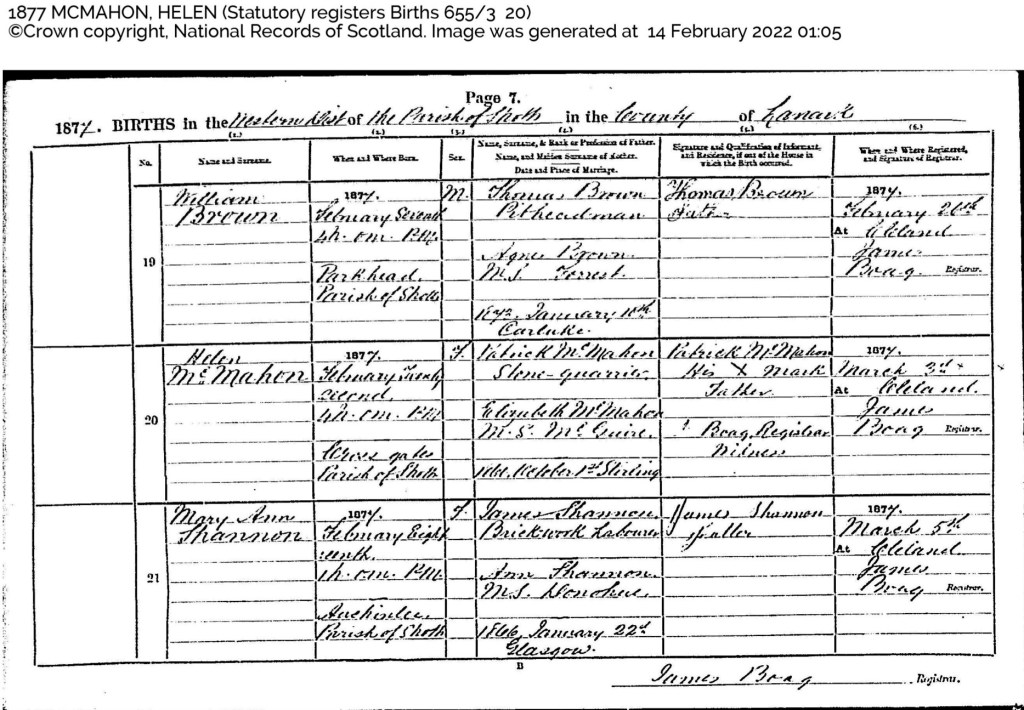
Helen McMahon, birth certificate, entry 20
https://www.scotlandspeople.gov.uk/image-viewer/saved-image/40497775
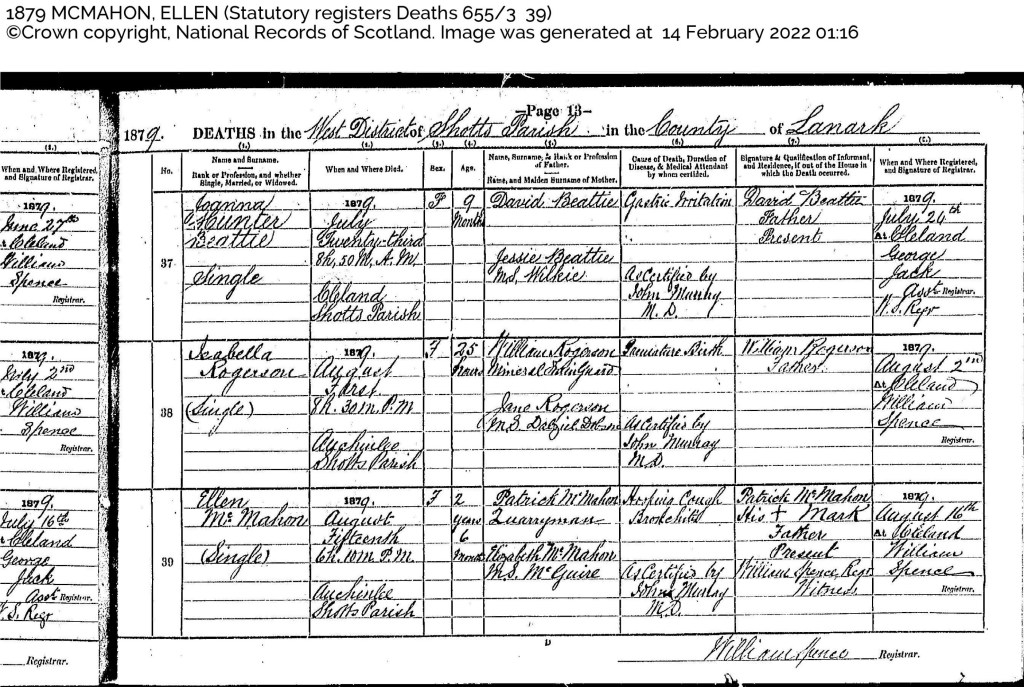
Helen McMahon, death certificate, entry 39
https://www.scotlandspeople.gov.uk/image-viewer/saved-image/40534106
Note: Her name is misspelled as Ellen.

Patrick McMahon, birth certificate, entry 116
https://www.scotlandspeople.gov.uk/view-image/nrs_stat_births/41531543?image=1&viewed_images=true
Elizabeth McMahon
in the 1881 Scotland Census
https://www.ancestry.com/discoveryui-content/view/1668435:1119
and
https://www.ancestry.com/search/collections/1119/records/1668439
Note: This is one place where we see baby Peter McMahon (baptized Patrick), and the other is on the November 1881 Bothnia ship manifest.


