The Williams / Harris Line, A Narrative — Ten

This is Chapter Ten of twelve, the chapter in which the life of Henry E. Harris, the son of Evan Harris, carries the family line forward. He joins with Ann Thomas in America, (whose family we profiled in Chapters Seven and Eight).

Before We Leave Mynyddyslwyn Parish

We could not help but notice that the record below that even though it is the same Beulah Chapel location as the previous chapter — it looks quite different from the previous generation, doesn’t it? Maybe someone decided that the amount of historical illegible calligraphy was just too much of a hassle and then decided to update their process? We think it was a good idea.
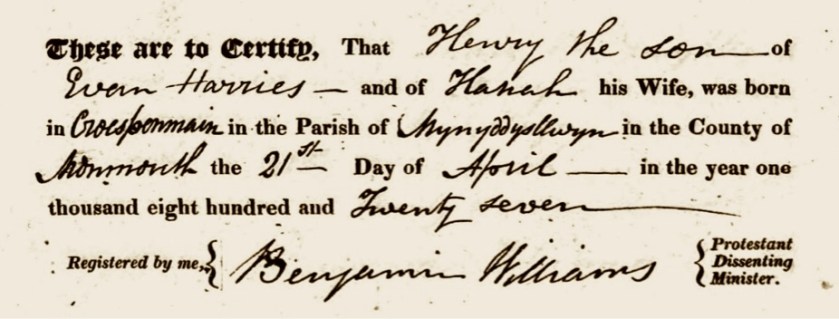
Henry E. Harris April 21, 1827 birth record in the register of the
Mynyddyslwyn (Beulah Chapel), Monmouthshire, Wales.

When Henry E. Harris was born in Mynyddyslwyn, Monmouthshire, Wales in 1827, he certainly had no idea that he would sail across the Atlantic Ocean and live his life in America. We thought it might be a good idea to have a look around the Mynyddyslwyn Parish before we leave it forever.
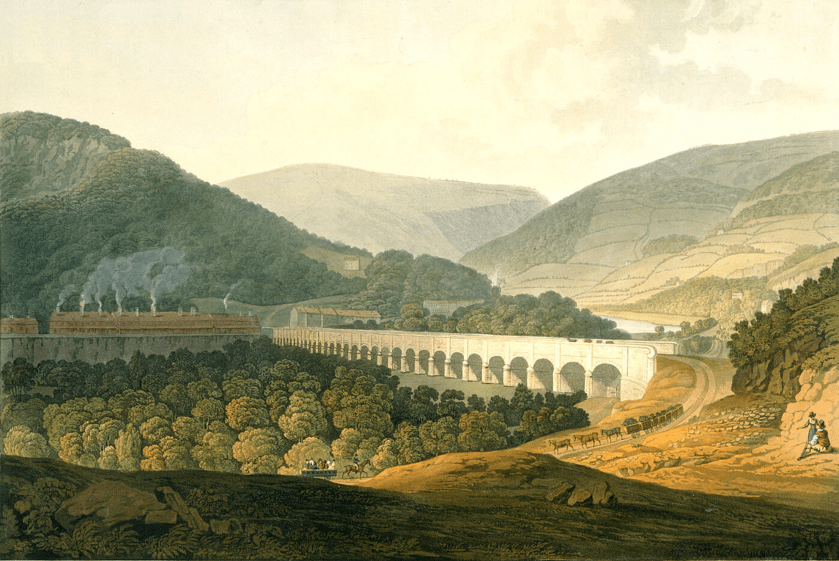
View of a stone bridge across the valley and river at Risca in Monmouthshire,
Coloured aquatint by Edward Pugh, circa 1810.
(Image courtesy of Wikimedia Commons via The National Library of Wales).

Monmouthshire has two main rivers which flow through the area of Mynyddislwyn and embrace the borders of the parish. On the western side there is River Sirhowy, and on the eastern side there is the River Ebbw. The painting above is typical of a scene which Henry would have seen in this parish.

Back then, this part of Wales was giving way from an agricultural economy, to an industrial economy which was based mostly on the mining and the processing of coal and metals. If you look carefully in the 1810 painting at the abundance of trees and the verdant green hills… you can observe a factory in the background billowing smoke into the distant background. An unforeseen circumstance of societal change from this time period was the degradation of the natural environments. The waterways especially became very polluted, and soils were degraded.

“Coal helped pave the way for the Industrial Revolution. But the benefits of coal did not come without a cost… Few places embody the latter view as much as South Wales, once the largest global producer of coal.” (Medium) Eventually, environmental laws reigned in these problems.The long and complicated clean-up process, which has been ongoing for decades, has transformed many former industrial sites into green spaces. (1)
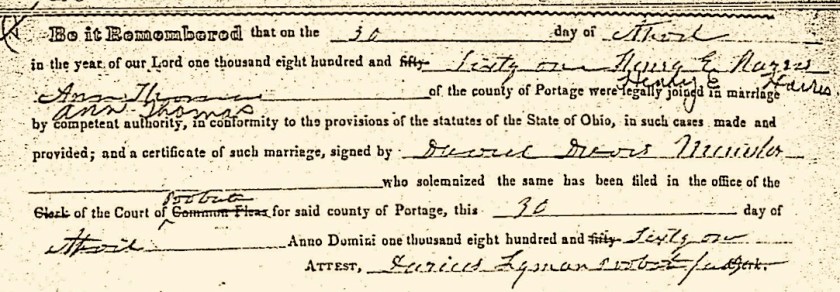
Henry Harris & Ann Thomas’s April 30, 1861 marriage record in Portage, Ohio.

Henry Harris Marries Ann Thomas

We do not know how they met, but it’s probable that they were introduced through family or friends. In a community that was dominated by many Welsh immigrants, people just knew one another.

When they married, Henry was about 34 and Ann was almost 25 years old. (With this marriage, the Thomas name gave way to the Harris name). Within two years, their first child was born. Amongst their children, it is clear that they named their two oldest ones after Henry’s family members: Elvira, in remembrance of his young sister who had passed away, and Evan, in honor of his father.

  • Elvira (Harris) Williams, 1863 – 1889, Elvira carries the family line forward.
  • Evan Harris, 1864 – 1910
  • Rosanna ‘Rose Ann’ (Harris) Sasce, 1866 – 1944
  • Justin Harris, 1868 – 1903
  • John Harris, 1871 – 1906
  • Sarah ‘Sadie’ Harris, 1874 – 1906

What do the Censuses tell us?
Prior to their 1861 marriage, Henry and Ann each lived in the home of their parents. Henry was living in Tallmadge township, Summit County, Ohio. Ann was in living in the adjacent county to the East, in Palmyra township, Portage County.

They appear to have been a stable household for many years. In 1870, Henry’s mother Hannah was living with them. We did observe something intriguing in the 1880 Census. It could be that daughter Elvira may have been counted twice that year? In the Ancestry file, the Harris family is listed on the right-hand page, but on the left-hand page, a 17 year old girl with the (same) name of Elvira Harris is working at the nearby Richardson family home as a ‘hired girl’. Even though this ‘hired girl Elvira’ is one year younger, perhaps our Elvira Harris was counted twice in this census? (See footnotes).
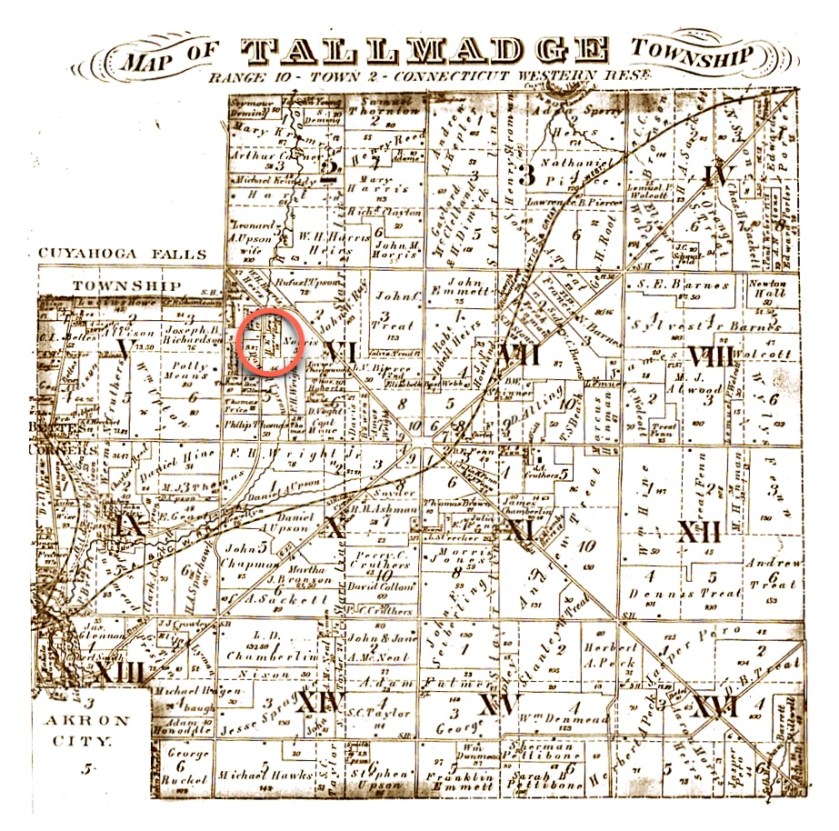
1874 Tallmadge Township map showing property locations. The red circle indicates where the Henry E. Harris family had their property.
The Williams family (from Chapter 5), was living very close by.

When we studied the Census data for this family, we saw that Henry had been identified as coal digger, or a miner, for about 30 years, starting in 1840. That is a very long time to do what must have been rather difficult work. By the time of the 1870 Census, he seemed to change his hats, (so to speak) about his profession. He traded in his miner’s helmet for a straw farmer’s cap. Even then, being a farmer was still a lot of hard work!

As we shall see next, this combination of being a miner, or a farmer, was quite typical of Welsh immigrants. It was normal to seek out what they knew from their old communities in Wales. (2)
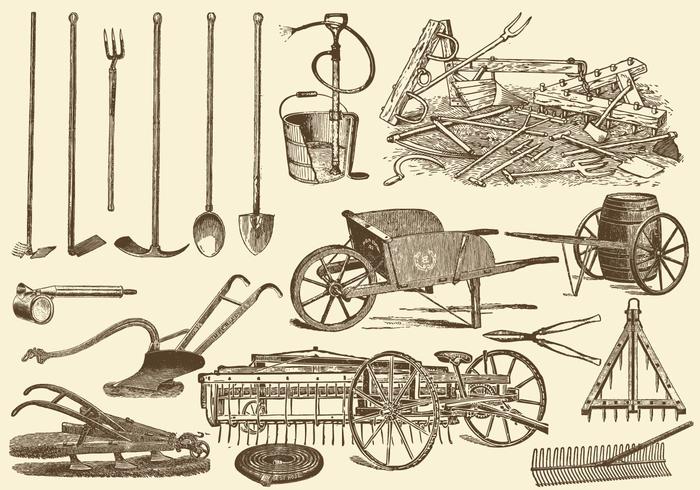
When Coal Was King

If there is something we all learn in life, it is that change is constant. In these decades, Tallmadge had a long run of prosperity through the mining of coal. But coal seams do eventually run out. This is how eventuality affected the community and may have influenced Henry E. Harris to put on his farmer’s hat.

“Two additional factors played important roles in the growth of the coal industry in Tallmadge: the completion of both the Ohio Canal through Akron in 1827 and the Pennsylvania & Ohio Canal in 1841 and the construction of Atlantic and Great Western Railroad lines through Tallmadge in 1864-1865. The connection by canal from Akron to Cleveland enhanced the ability of Tallmadge coal operators to efficiently supply fuel to steamers on the Great Lakes as well as Canadian gasworks in Toronto and Kingston. The Pennsylvania and Ohio Canal enabled Tallmadge coal operators to ship their coal from Akron to Beaver, Pennsylvania, on the Ohio River, thus opening up a still larger market. The coming of the railroad to Tallmadge permitted operators to ship their coal via rail to Akron as well as to Kent, Ravenna, and other points east. Within about twenty years, however, such shipments were abandoned due to the exhaustion of many of the larger veins of mineral in the Tallmadge mine fields. (A  History of Tallmadge Coal…)

In retrospect, it is difficult to actually see the traces that the coal industry left on Tallmadge all these years later. It doesn’t seem that the environmental impacts around there were as profound as they were in other parts of Ohio, (or in South Wales for that matter). Most people living today would look around at Tallmadge, and be completely unaware of the period when coal was king. (3)
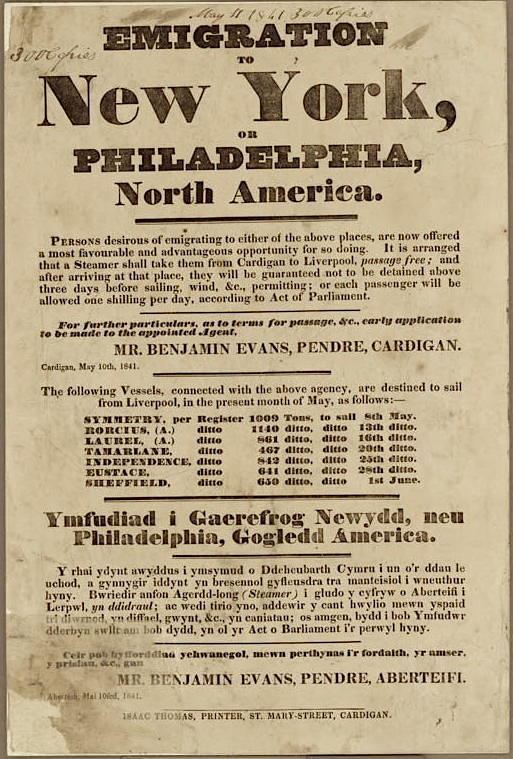
An 1841 poster advertising passage to America, written in English and Welsh.
(Image courtesy of Wikimedia Commons via The National Library of Wales).

The Welsh Population of Ohio

This account of Welsh immigration from the BBC News service begins in Cardiganshire [now named Ceredigion], Wales, which was located northwest of Monmouthshire by the Irish Sea (the Atlantic Ocean).

“A total of 36 people left Aberaeron for Ohio in 1818, but by the end of the 19th Century there was a Welsh community there numbering close to 6,000.

Today, it is thought there may be about 100,000 people in the state who can claim some Welsh descent… The group landed at Chesapeake Bay, Baltimore, where their travails began in earnest. Traveling in wagons to Pittsburgh and then onwards by raft down the Ohio River, they intended to reach a pre-existing Welsh community in Cincinnati, 500 miles (800km) away. Exhausted, they spent the night in Gallia County – where their rafts blew away in a storm – and from there they never moved.

They subsidised their living farming poor land by working on the highway between Chillicothe and Gallipolis. From those harsh beginnings, Wales-Ohio project historian Arwel Jones explains the Welsh immigrants’ luck was about to change. ‘For a decade or more life was very tough and not many more followed the 36 to Ohio, then came the railways, and not long after, the civil war. The Welsh were hard workers, and used to iron, so they formed co-operative forges which made rails all over the US, and produced cannonballs for both the Unionists and the Confederates. That encouraged 3,000 or 4,000 more to leave Cardiganshire between 1830 and the end of the century, spawning success stories” (BBC News)

Further, we learned more about this mass migration of Welshmen. “In the early nineteenth century most of the Welsh settlers were farmers, but later there was emigration by coal miners to the coalfields of Ohio and Pennsylvania and by slate quarrymen from North Wales… As late as 1900, Ohio still had 150 Welsh-speaking church congregations.” (Wikipedia) (4)

We have written previously, an immigrant population seeks out what they know when relocating to a new community. This was very true for many of our family lines. For the Williams, Harris, and Thomas lines, almost all generations were either farmers, or miners. Although that is indeed true and this generation continued to do the same vocations, the world was changing again and becoming much more modern.

Just think of all the changes

Ann Harris died on April 11, 1890 of pneumonia. We were able to locate her obituary in the Y Drych Welsh language newspaper. Originally published in Welsh, we translated it into English (as shown below on the right). “Y Drych, established in 1851, was a weekly Welsh-language newspaper published by Mather Jones. It contained news and information, focusing on religious matters.” (Wikipedia)
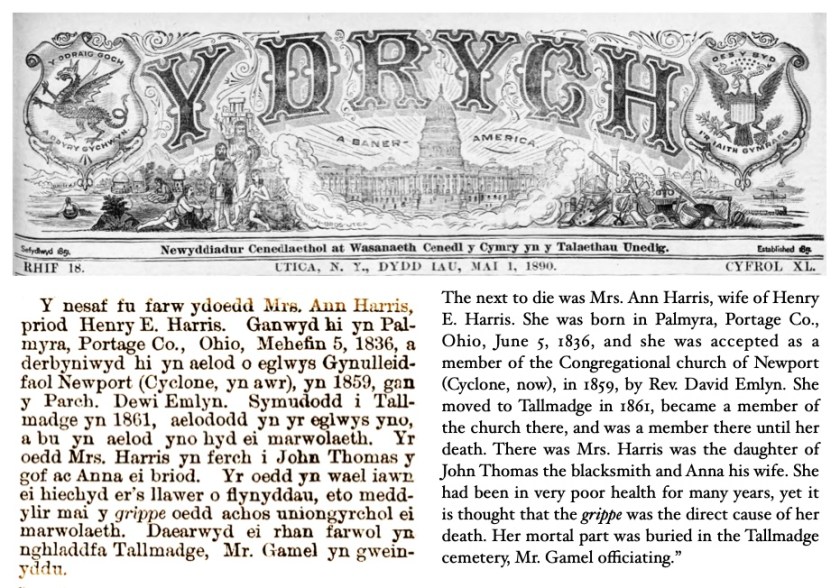
The obituary for Ann (Thomas) Harris as published in the Y Drych (Welsh newspaper),
for the May 1, 1890 issue. Notes: We compiled this specific piece of artwork from original sources for this chapter, and carefully managed a new and accurate translation of Ann’s obituary. The English translation is shown at right.
(Source: Llyfrgell Genedlaethol Cymru, The National Library of Wales).

Henry E. Harrris seemed to have lived his life like the Welsh rivers that he viewed as a child — flowing from the landscape Wales, across the Atlantic Ocean, to the farm fields and coal seams of Northeast Ohio. Henry lived much longer than his wife, carrying on well into the 20th century, passing away on April 25, 1920, just after his 93rd birthday. Just think of all the changes he bore witness to in his long life! (5)

Following are the footnotes for the Primary Source Materials,
Notes, and Observations

Before We Leave Mynyddyslwyn Parish

(1) — three records

Henry Harries
in the England & Wales, Non-Conformist and Non-Parochial Registers, 1567-1936Rg4: Registers of Births, Marriages and Deaths
Monmouthshire > Baptist > Piece 0630: Mynyddyslwyn, Beulah Chapel (Baptist), 1803-1837
https://www.ancestry.com/search/collections/2972/records/45968
Book page: 19 or 21, Digital page: 25/119, Last entry on page.
Note: For the record of his April 21, 1827 birth.

The National Library of Wales
View of a stone bridge across the valley and river at Risca in Monmouthshire,
Coloured aquatint by Edward Pugh, circa 1810
https://commons.wikimedia.org/wiki/File:View_of_a_stone_bridge_across_the_valley_and_river_at_Risca_in_Mon.jpeg
Note: A view of the bridge at Risca, showing horses pulling ore and coal wagons along the tramroad. The copper works can be seen in the distance.

Medium
A Future Black as Coal? — The Underground Heritage of Wales
https://medium.com/tourism-geographic/a-future-black-as-coal-a019113680db
Note: For the text.

Henry Harris Marries Ann Thomas

(2) — twelve records

Henry E. Harris
Marriage – Ohio, County Marriages, 1789-2016
https://www.familysearch.org/ark:/61903/1:1:XZD5-64M?lang=en
Book page: 1216 Digital page: 628/637, Left page, first entry.
Note: For the copy of the April 30, 1861 marriage record.
and
Henry E. Harris
in the Ohio, U.S., County Marriage Records, 1774-1993
https://www.ancestry.com/search/collections/61378/records/2833785
Note: Their marriage date is April 30, 1861.

For the names and dates of their children we looked at and reconciled many sources, such as family trees, Find A Grave profiles, etc. Here is one example for a family tree (which is not ours):
https://www.ancestry.com/family-tree/person/tree/62607448/person/282197451285/facts

H. E. Harris
in the U.S., Indexed County Land Ownership Maps, 1860-1918
Ohio > Summit, 1874
https://www.ancestry.com/search/collections/1127/records/3962102
Digital page: 85/138

1850
Evan Harris
in the 1850 United States Federal Census
Ohio > Summit > Tallmadge
https://www.ancestry.com/search/collections/8054/records/19601199?tid=62607448&pid=282197451798&ssrc=pt
Digital page: 28/60, Lines 31 through 36.
Note 1: Evan 46, Hannah 58, Henry 23, Mary 16, Hannah, Alvira 10.
Note: Evan is listed as a coal digger (miner).
Note 3: Contributor C. E. Tabbert’s notes on daughter Elvira from the FindaGrave website:
https://www.findagrave.com/memorial/269329914/elvira-harris

1850
Ann Thomas
in the 1850 United States Federal Census
Ohio > Portage > Palmyra
https://www.ancestry.com/search/collections/8054/records/19581414
Book page: 207(?), Digital page: 8/26, Lines 28 through 35.
Note: John 51, Hannah 52, Rees 19, Ann 15, Margaret 12, David 9, John 6, Anna Jenkins 4.

1860
Hannah Harris
in the 1860 United States Federal Census
Ohio > Summit > Tallmadge
https://www.ancestry.com/search/collections/7667/records/42152554
Digital page: 15/30, Lines 1 through 9.
Note 1: Hannah 58, Henry 53*, Sarah 30, Mary 26, Anna (Hannah) 22, Thomas 3, Daniel 1, Henry Rees 9, Eliza Rees 7
*His age should be listed as 33.
Note 2: Where is the father Evan? Henry is listed working as a miner.
Note 3: Daughter Sally had previously married Solomon Reese (presumably by the 1850 Census, because she is not listed). Her children, Henry (9) and Eliza (7) are living with this family. (See footnotes in Chapter Nine).

1860
Ann Thomas
in the 1850 United States Federal Census
Ohio > Portage > Palmyra
https://www.ancestry.com/search/collections/7667/records/41939194
Book page: 66-67, Digital page: 8-9/26, See note below.
Note 1: John 61, Anna 62, Rees 19, Ann 24, Margaret 22, David 19, John1 6, Anna Jenkins 14.
Note 2: This census carries over two pages. The parents are on lines 39-40 on page 66; the rest follow lines 1-5 on page 67.

1870
Henry Harris
in the 1870 United States Federal Census
Ohio > Summit > Tallmadge
https://www.ancestry.com/search/collections/7163/records/37748887
Book page: 7, Digital page: 7/32, Lines 10 through 16.
Note: Her parents are Henry and Ann.
Note: Henry 43, Ann 32, Elvira 8, Evan 6, Rosanna 4 , Justin 1, Hannah 72.
Note: Henry Harris, his wife Ann*, and his mother Hannah are born in Wales; all others, Ohio.
Note 1: * This is an enumeration error. Ann was born in Ohio.
Note 2: His occupation is Miner.

1880
Henry E. Harris
in the 1880 United States Federal Census
Ohio > Summit > Tallmadge > 181
https://www.ancestry.com/search/collections/6742/records/18590812
Book page: 21, Digital page: 21/30, Lines 16 through 23.
Note: Henry 53, Ann 44, Elvira 18, Evan 16, Rosanna 14 , Justin 12, John 10, Sarah 6.
Note: It is interesting to note on the adjacent left page (Digital page: 20/30), on line 49 — https://www.ancestry.com/search/collections/6742/records/18590623
A 17 year old girl with the (same) name of Elvira Harris is working at the nearby Richardson family home as a ‘hired girl’. Even though this ‘hired girl Elvira’ is one year younger, perhaps our Elvira Harris was counted twice in this census?

When Coal Was King

(3) — two records
Akron-Summit County Public Library
A  History of Tallmadge Coal:
A Tale of Woodchucks, Welshmen, and a Canal
by Judy Anne Davis, 2006
https://www.akronlibrary.org/images/SpecCol/TallmadgeCoal_.pdf#:~:text=
Notes: In library reference use only. For the texts about the mining operations
and coal seams running out, etc.

Vector
Agriculture Tools
https://www.freevector.com/agriculture-tools-111636
Note: For the image of farm tools.

The Welsh Population of Ohio

(4) — three records

The National Library of Wales
An 1841 poster advertising passage to America,
written in English and Welsh
https://en.wikipedia.org/wiki/Welsh_Americans#/media/File:Emigration_To_New_York_1841.jpg

BBC News
Marking 200 years since Welsh settlers arrived in Ohio
https://www.bbc.com/news/uk-wales-44240447
Note: For the text about Welsh immigrants to Ohio.

Welsh Americans
https://en.wikipedia.org/wiki/Welsh_Americans
Note: For the text.

Just think of all the changes

(5) — seven records

Ann Harris
in the U.S., Find a Grave Index, 1600s-Current
https://www.ancestry.com/search/collections/60525/records/125051575
Note: Census data documents and her birth record, and her obituary say that she was born in OHIO. Only the 1870 Census indicates Wales for her birth, which is likely an error.
and
Ann Thomas Harris
https://www.findagrave.com/memorial/151377869/ann-harris
Note: Her dates are from June 5, 1836 to April 11, 1890.

Anna Harris
in the Summit County, Ohio, U.S., Death Records, 1866-1908
Death Index Registers, 1869-1908 > E – K
https://www.ancestry.com/search/collections/1596/records/47484
Book page: 110, Digital page: 160/169
Note: This confirms her death date of April 11, 1890, (pneumonia).

Llyfrgell Genedlaethol Cymru
The National Library of Wales
Y Drych
(Welsh newspaper), May 1, 1890 issue
https://newspapers.library.wales/view/3539982/3539985
Newspaper page: 3, Right column, lower portion.
Note: Center section of an article titled Tallmadge, Summit Co., O.
Note: The plain text version can be accessed through the manual links (which partition the articles) and are found on the lower portion of the webpage.

Y Drych
https://en.wikipedia.org/wiki/Y_Drych
Note: For the data.

Henry E. Harris
in the U.S., Find a Grave Index, 1600s-Current
https://www.ancestry.com/search/collections/60525/records/240217665?tid=&pid=&queryId=3ce57210-d200-4299-8f41-578eb079cf81&_phsrc=NmT5&_phstart=successSource
and
Henry E. Harris
https://www.findagrave.com/memorial/269323209/henry_e-harris
Note: His dates are, 1827 to April 25, 1920.
The Williams / Harris Line, A Narrative — Eight

This is Chapter Eight of twelve. This chapters is also set in Wales, where we learn about more family origins, this time with — the Harris family. From their beginnings here, they eventually make their way to America.

Yes, you are! No, we’re not!

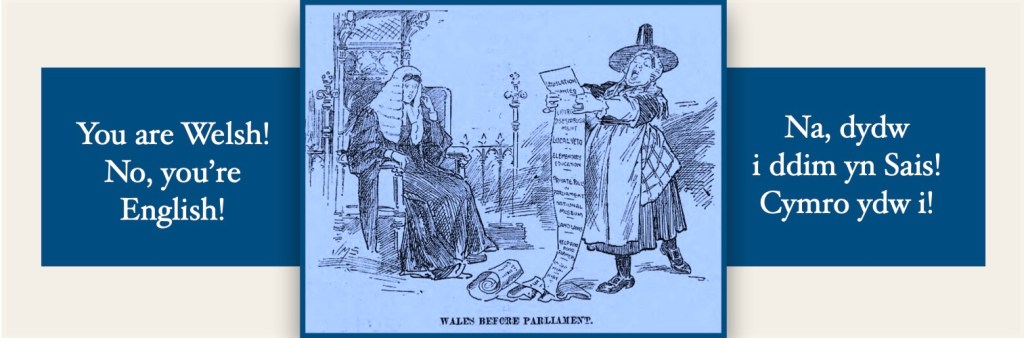
In the past, Monmouthshire was sometimes considered part of England, and sometimes part of Wales. This debate dragged on for several centuries, to the point that sometimes competing maps were published at the same time, putting Wales either here, or there… It always depended upon whom you asked, (and honestly, whether they were speaking English, or Welsh).

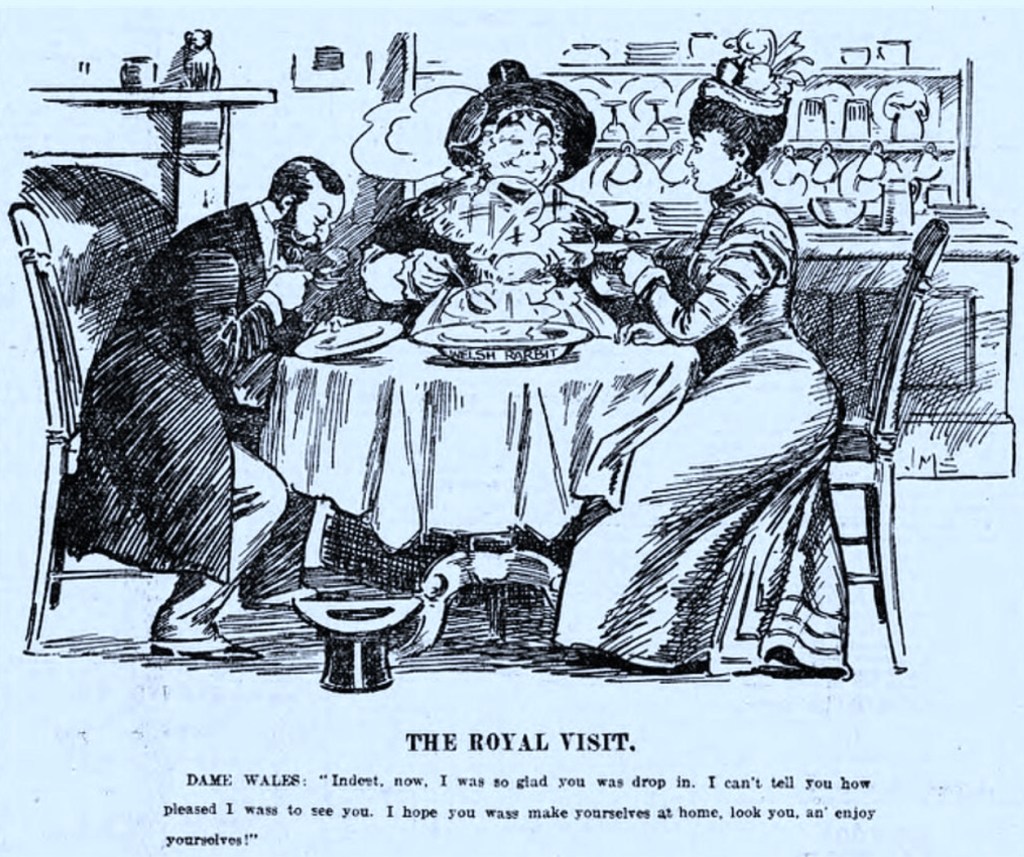
Yes! No! The center political cartoon is by JM Staniforth, circa 1899. It was captioned
“Dame Wales reads through a long list of desired laws and regulations for the benefit of Wales at Parliament.” The right text translates from Welsh as: No, I am not English! I am Welsh!
(Center image courtesy of Picryl).

From Wikipedia, we see that,“the Laws in Wales Act 1535 integrated Wales directly into the English legal system and the ‘Lordships Marchers within the said Country or Dominion of Wales’ were allocated to existing and new shires. Some lordships were annexed to existing counties in England and some were annexed to existing counties in Wales, with the remainder being divided up into new counties, one of which was Monmouthshire.” What this means is, that as a border area with England, people agonized over who was in charge. This went back-and-forth for much, much time and was eventually resolved by laws passed between 1972-74.

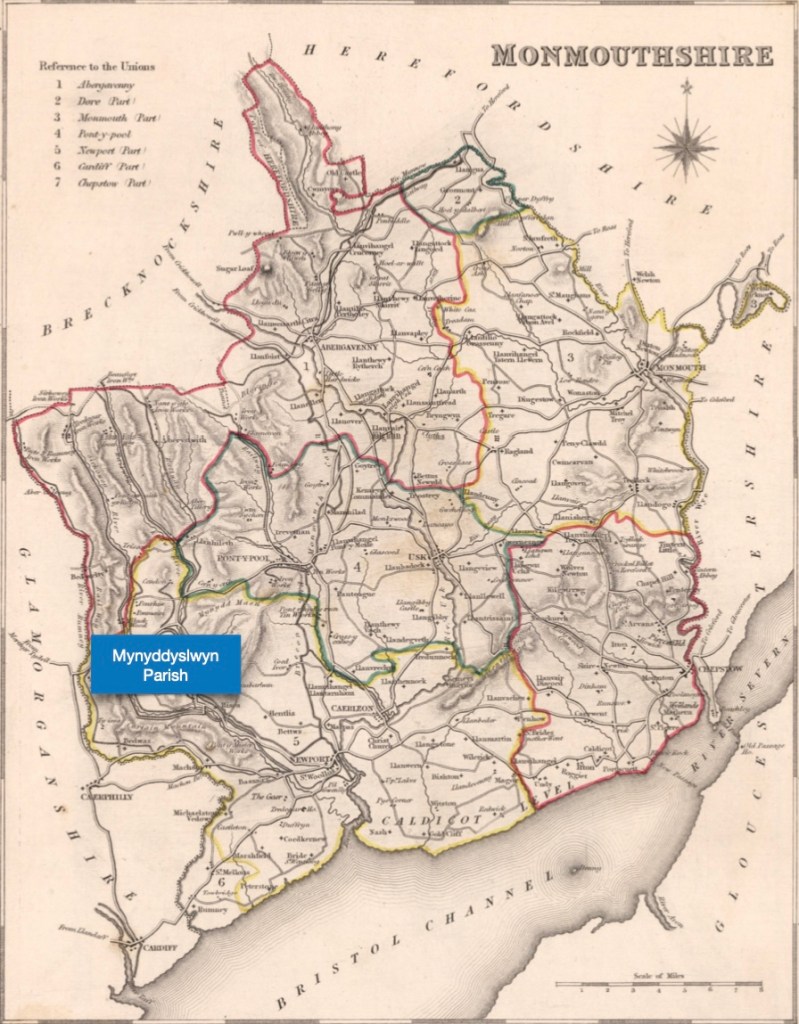
The civil parish where our family lived was called Mynyddyslwyn Parish. It may seem like a detail, but the present name is spelled slightly different today, as Mynyddislwyn, where the y at the center has changed to an i. The governance of the area is quite different also from that earlier era, but it’s not really something we need to go into, because it is quite complicated. The local history reads like a child’s game where a big fish keeps swallowing a smaller one, and this behavior just goes on and on… We feel that what is important is this: what were things like back then where our family experienced them?

Monmouthshire County, drawn by R. Creighton, and published by S. Lewis, 1844.
(Image courtesy of David Rumsey Map Collection).

“Mynyddyslwyn was one of the largest parishes in old Monmouthshire, covering nearly 16,000 acres of land. On the westerly side, it adjoined the parishes of Bedwellty and Bedwas although in one place it extended right to the border with the county of Glamorgan. From early times, the parish was divided into three hamlets, Clawrplwyf in the south, Penmaen in the north, and Mynyddmaen in the east. 

The western parts of Monmouthshire was mostly mountainous, richly forested from early times, with the main routes and trackways running along the tops of the mountains. There was only a small and scattered population. Even as late as 1801, only about 1,500 persons were recorded as living in the whole Parish. 

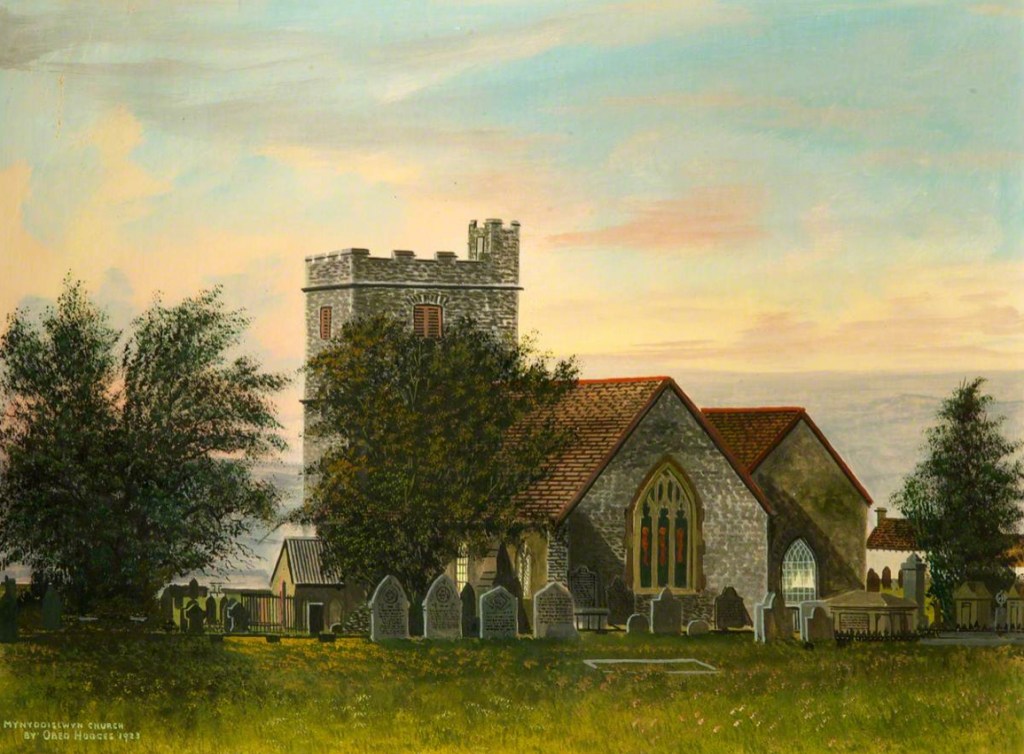
The Parish Church, dedicated to St. Tudor, is situated in a remote position beside the old road, which crosses Mynyddislwyn Mountain on its way to Risca. It stands 1,000 ft above sea level. The original church was one of those granted to Glastonbury Abbey about the year 1102, but later it became a possession of Llantarnam Abbey. The registers started in 1664. The Church was rebuilt in 1820 on the site of the earlier structure. 

St Tudor’s Church, Mynyddislwyn, by Obediah Hodges, circa 1923. (image courtesy of ArtUK).

The lordship of Mynyddislwyn and Abercarn was granted to William, Earl of Pembroke, about the year 1650, but it was sold by his son about the year 1722. Having been passed on by inheritance, it was sold in 1807 to Richard Crawshay, the ironmaster, who gave it to his daughter on her marriage to Benjamin Hall. Their son, also named Benjamin, was Government Commissioner of Works, and was responsible for beautifying some of London’s parks. The bell in the famous clock tower outside the Houses of Parliament was named after him —Big Ben. He later became Lord Llanover.” (Oakdale Village) (1)

Let’s Meet Henry Harris & His Wife Ann ______

We do not know much more about the parents due to the scarcity of records and their very common names.

Throughout the many family lines we have written narratives about, it was quite common for couples to have many children. Usually, every two to three years, or so. This was a common practice because of the high rates of child mortality — many children died before the age of 5 years. With this family, for whatever reason, surviving records are quite scarce. We have discovered verifiable records for five children: their sons Evan, William, Henry, and Watkin, and their daughter Sara.

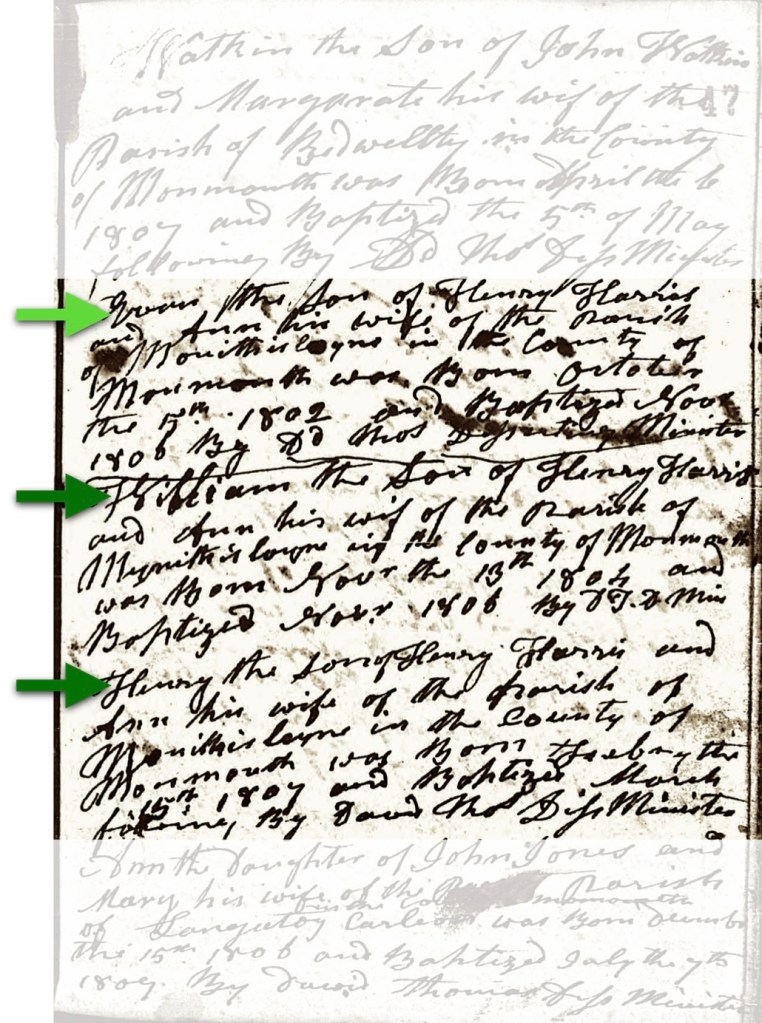
All records are from the Mynyddyslwyn, Beulah Chapel (Baptist) Registry, in Monmouthshire, Wales. It appears that the first three, Evan, William, and Henry, were all recorded in this register at the same time, even though they had baptisms on different days. Since we are looking at quill pen writing, some details are illegible.

  • Evan Harris — born “October the 5th 1802 and baptized November _ 1806”
  • William Harris — born “November 13th 1804 and baptized November _ 1806”
  • Henry Harris — born “February 15th 1807 and baptized March (illegible)”
Registration of both the birth and baptism dates for Evan Harris (at top),
along with his brothers William, and Henry Jr. (following). From the
Mynyddyslwyn, Beulah Chapel (Baptist) Registry, in Monmouthshire, Wales.

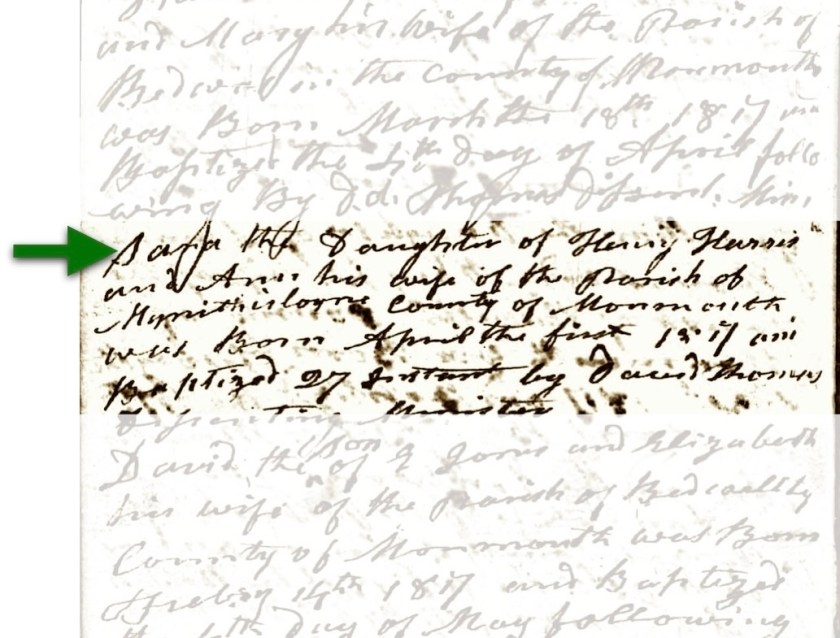
The next child is Sara, and the same warning about quill pen writing applies here too.

  • Sara Harris – born “April the 1st 1817 and baptized 21 (illegible).”
Registration of both the birth and baptism dates for Sara Harris. From the
Mynyddyslwyn, Beulah Chapel (Baptist) Registry, in Monmouthshire, Wales.

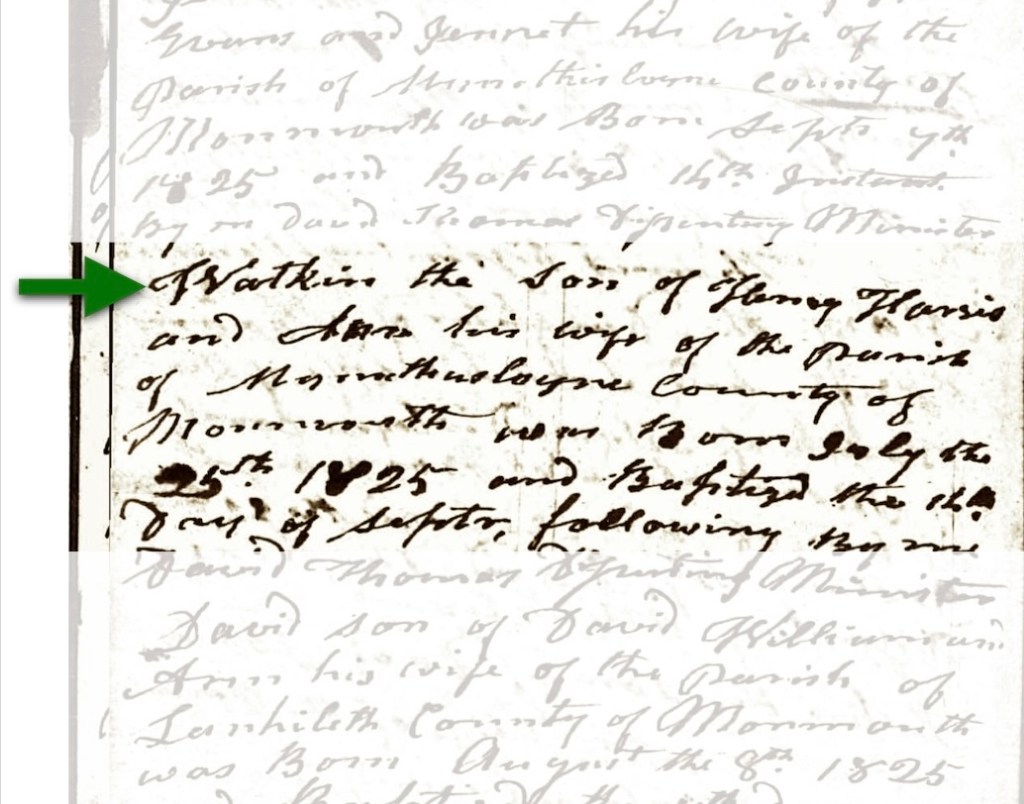
The last child is Watkin, who we do not know much about.

  • Watkin Harris – born “July 25th 1825 and baptized 14th day of September following”
Registration of both the birth and baptism dates for Watkin Harris. From the
Mynyddyslwyn, Beulah Chapel (Baptist) Registry, in Monmouthshire, Wales.

Of these 5 children, Evan carries the family line forward, but his younger sister Sara also features very prominently in Chapter Eleven. She is fundamentally important for uniting future family lines.

Throughout his life, it became clear that Evan (and also his wife Hannah) were unclear on their exact ages, because the records vary somewhat. We have seen this same phenomena with many other family lines, when the ancestors lived in a pre-literate world. (2)

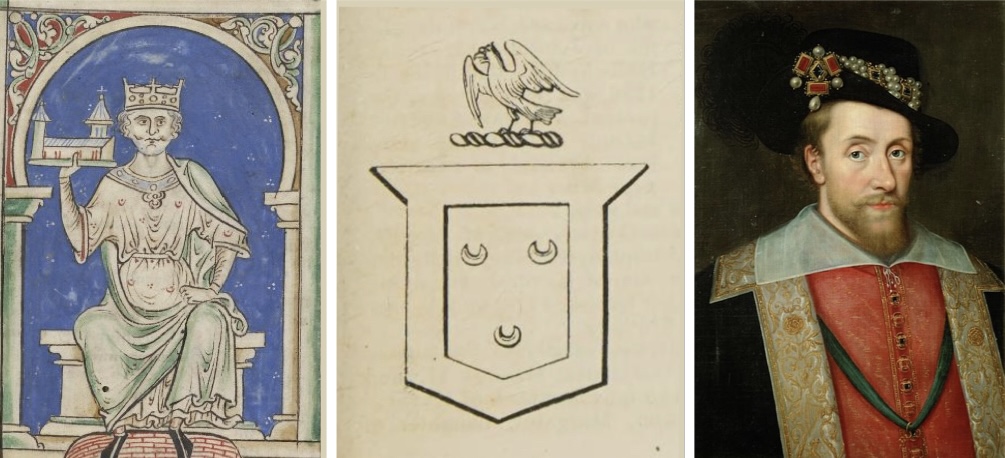
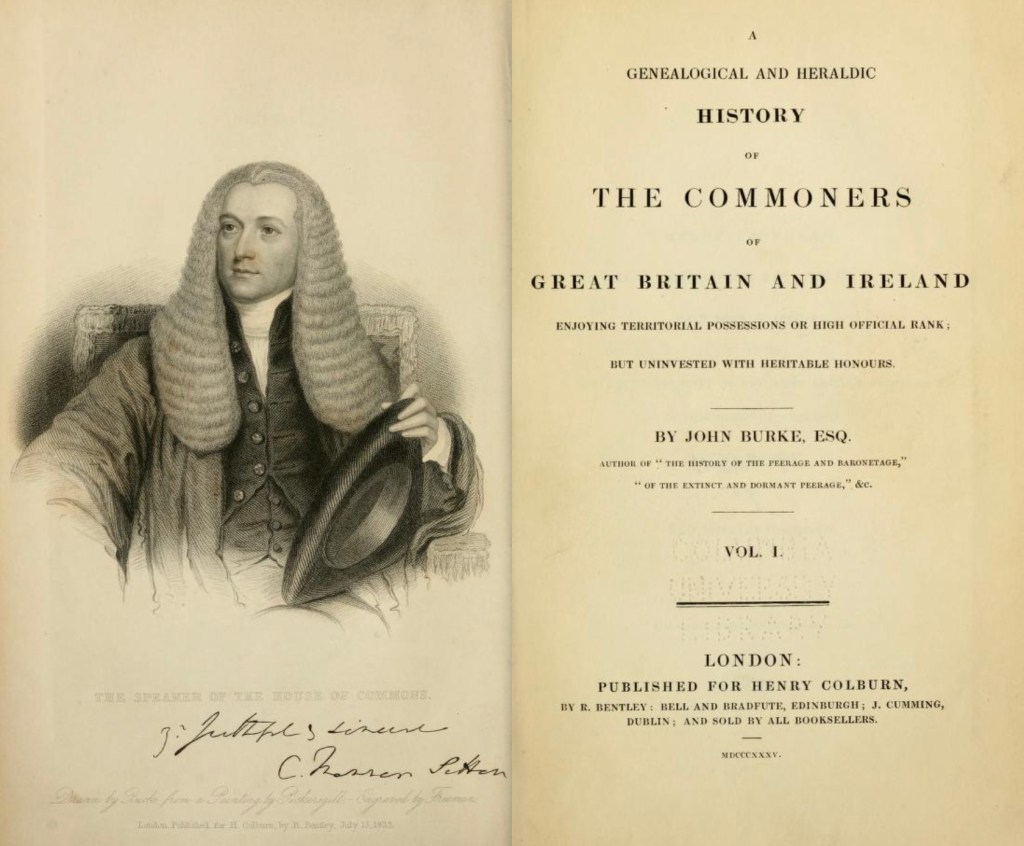
At left:William the Conqueror, William I of England (circa 1028-1087). First Norman King of England, by Matthew Paris circa 1250-1259. Center: An example of the Harris family Coat-of-Arms. At Right: The Stuarts, King James I (reigned 1603 – 1625). Painting of James VI and I, circa 1605, (after) John de Critz . (See footnotes).

The Origins of the Surname Harris

Harris is an English and Welsh patronymic [based on the name of the father] surname derived from the personal name Harry (a vernacular form of Henry) and the genitive ending –s. [Genitive indicates possession, or ownership]. The given name Henry itself was introduced to England as Henri by the Normans following the Conquest of 1066, and subsequently became widespread, giving rise to surnames such as Harris and Harrison… Harris is most common surname in South Wales.

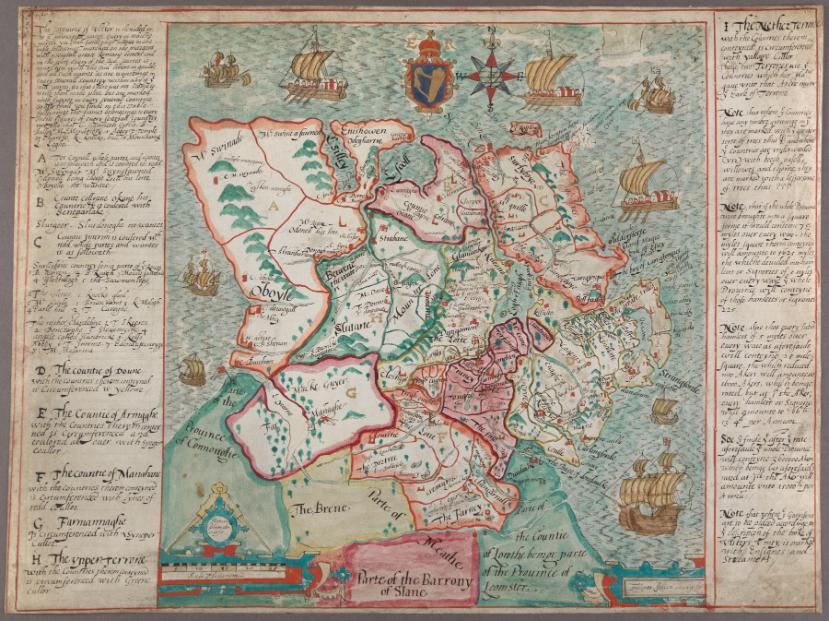
Francis Jobson’s ‘Ulster’ (c. 1598) This provided representations of the
Gaelic lordships in Ulster, but also imposed England’s vision
for the creation of a new county system onto the provincial landscape.
(Image courtesy of Trinity College, Dublin)

The name Harris also found in Ireland, largely as a result of the Plantation of Ulster, though it may in some cases represent an anglicized form of the Gaelic name Ó hEarchadha.

The Plantation of Ulster was the organized colonization (‘plantation’) of the Irish province of Ulster by people from Great Britain in the early 17th century, during the reign of King James I. Most of it was on confiscated Irish land.” (Wikipedia, for all text) (3)

In the next chapter, the Harris family leaves the old ways of Europe behind, and heads across the Atlantic Ocean to create a new life in America.

Following are the footnotes for the Primary Source Materials,
Notes, and Observations

Yes, you are! No, we’re not!

(1) — six records

The Royal Visit, by JM Staniforth,
from https://picryl.com/media/the-royal-visit-jm-staniforth-70301f .

Picryl
Wales Before Parliament (political cartoon)
by JM Staniforth, circa 1899
https://picryl.com/media/wales-before-parliament-jm-staniforth-0b7998
Note: Public domain vintage political cartoon. “Dame Wales reads through a long list of desired laws and regulations for the benefit of Wales at Parliament.”

Monmouthshire (historic)
https://en.wikipedia.org/wiki/Monmouthshire_(historic)
Note: For the text, and for reference.

David Rumsey Map Collection
Monmouthshire County
Drawn by R. Creighton, and published by S. Lewis
https://www.davidrumsey.com/luna/servlet/detail/RUMSEY~8~1~337359~90105199:Monmouthshire-County
Note:
From the Atlas to the Topographical Dictionaries of England and Wales published by S. Lewis and Co. in 1844.

Oakdale Village
History of Mynyddislwyn — Portrait of a Parish
https://web.archive.org/web/20081121034133/http://www.oakdalevillage.net/history5.html
Note: For the text.

ArtUK
St Tudor’s Church, Mynyddislwyn
by Obediah Hodges, circa 1923
https://artuk.org/discover/artworks/mynyddislwyn-church-153332
Note: For the painting of the church.

Let’s Meet Henry Harris & His Wife Ann ______

(2) — three records

Evan Harris
in the England & Wales, Non-Conformist and Non-Parochial Registers, 1567-1936
Rg4: Registers of Births, Marriages and Deaths > Monmouthshire > Independent > Piece 1246: Penmain (Independent), 1787-1833
https://www.ancestry.com/search/collections/2972/records/150167990
Digital page: 53/159, Right page.
Note 1: Note: For their birth dates and baptism records.
Note 2: Three records for sibling births and baptisms are recorded at the same time in this register — Evan 1802, William 1804, Henry 1807.

Sara Harris
in the England & Wales, Non-Conformist and Non-Parochial Registers, 1567-1936
Rg4: Registers of Births, Marriages and Deaths > Monmouthshire > Independent > Piece 1246: Penmain (Independent), 1787-1833
https://www.ancestry.com/search/collections/2972/records/168121?tid=11298446&pid=182338476831&ssrc=pt
Digital page: 90/159, Left page.
Note: For her 1817 birth date and baptism record.

Watkin Harris
in the England & Wales, Non-Conformist and Non-Parochial Registers, 1567-1936
Rg4: Registers of Births, Marriages and Deaths > Monmouthshire > Independent > Piece 1246: Penmain (Independent), 1787-1833
https://www.ancestry.com/search/collections/2972/records/169025?tid=11298446&pid=182338476830&ssrc=pt
Digital page: 118/159, Left page.
Note: For his 1825 birth date and baptism record.

Origins for the Surname Harris

(3) — seven records

Alamy
William the Conqueror, William I of England (circa 1028-1087). First Norman King of England (1066-1087), holding Battle Abbey, illuminated manuscript portrait painting 
by Matthew Paris circa 1250-1259
https://www.alamy.com/william-the-conqueror-william-i-of-england-circa-1028-1087-first-norman-king-of-england-1066-1087-holding-battle-abbey-illuminated-manuscript-portrait-painting-by-matthew-paris-circa-1250-1259-image545386459.html
Note: For the portrait of William the Conqueror.

History of the Commoners of Great Britain and Ireland
by John Burke
https://archive.org/details/bwb_KU-314-176_1/page/558/mode/2up
Book page: 559, Digital page: 590/764
Note: For the Harris of Hayne coat-of-arms.

Painting of James VI and I Wearing the Jewel Called the Three Brothers in His Hat, circa 1605
by (after) John de Critz 
https://commons.wikimedia.org/wiki/File:Portrait_of_James_I_of_England_wearing_the_jewel_called_the_Three_Brothers_in_his_hat.jpg
Note: For the portrait of James I.

Harris (surname)
https://en.wikipedia.org/wiki/Harris_(surname)
and
Plantation of Ulster
https://en.wikipedia.org/wiki/Plantation_of_Ulster

Trinity College Dublin
New exhibitions spotlight 400 years of Ireland in maps
News & Events
https://www.tcd.ie/news_events/articles/2025/the-island-of-ireland-in-maps/
Note: For the actual Ulster map image.
and
History Ireland
Visualising the Plantation: mapping the changing face of Ulster
https://historyireland.com/visualising-the-plantationmapping-the-changing-face-of-ulster/
Note: For the caption under the map image.

The Williams / Harris Line, A Narrative — Seven

This is Chapter Seven of twelve, in which we move across the Bristol Channel from England to Wales. We also meet a new family with a new surname — the Thomas family. By the way, we wish you good luck with pronouncing some of these Welsh words!

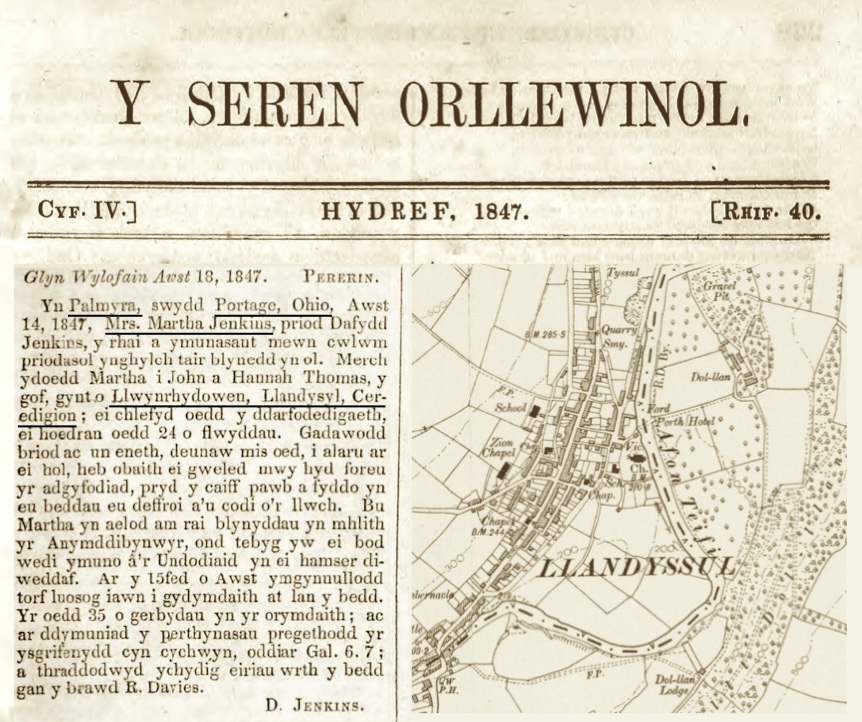
Y Seren OrllewinolWhat’s That Again?

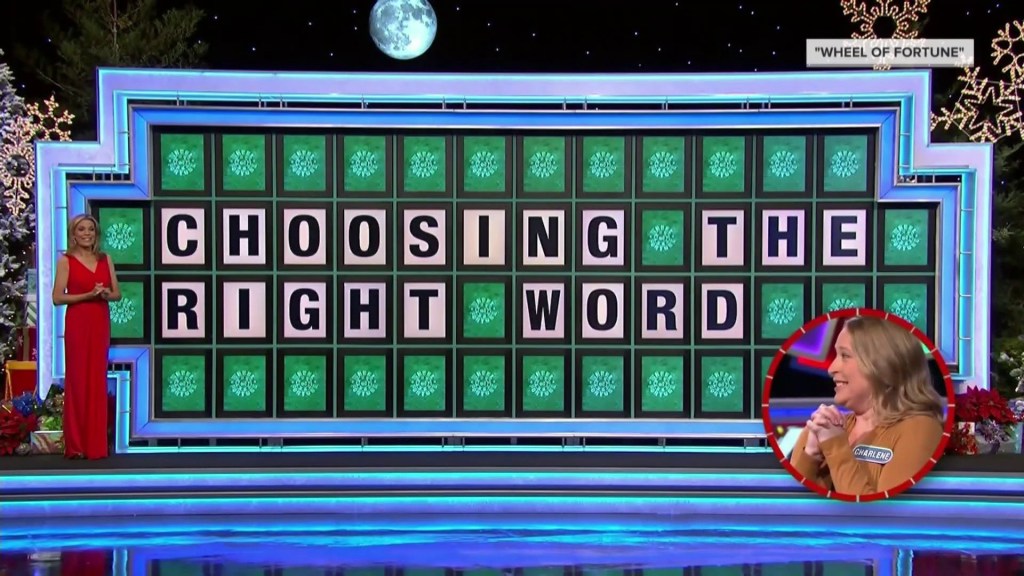
One of the things that presents a challenge in genealogy research is locating exactly where your ancestors are from, if the records are scarce. This is especially true when dealing with the mysteries of the Welsh language. (We swear, that when deciphering Welsh — one dreams of standing before Vanna White on the Wheel of Fortune game show and saying in a demanding voice: “Vanna! I’d like to buy a vowel.”)

Our research eventually led to the discovery of an unfortunate death…

Martha (Thomas) Jenkins 1847 obituary, as seen in the
Y Seren Orllewinol — The Western Star, from October 1847.
(Image courtesy of Llyfrgell Genedlaethol Cymru — The National Library of Wales).

Without getting too far ahead of ourselves with this history, the oldest child in this family line died of tuberculosis as a young adult. Her obituary fortunately stated exactly where in Wales her family had lived. So this confirmed other records we had located, but it was the linchpin we needed to honor this family’s origins. (Please see the footnotes for the English translation of her obituary).

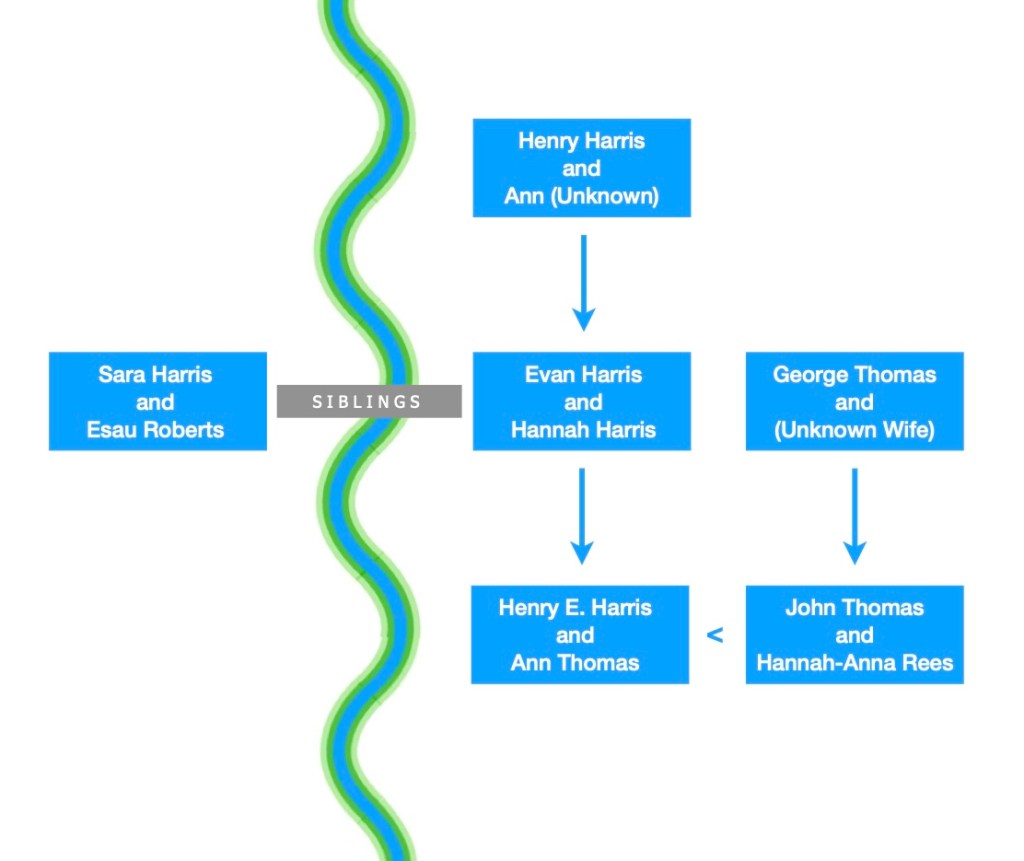
The family pedigree flow chart, for the Thomas and the Harris families.

In the following chapters seven through ten, we are learning some of the history of the Thomas and the Harris families. We begin in Ceredigion, Wales, which used to be called Cardiganshire. (1)

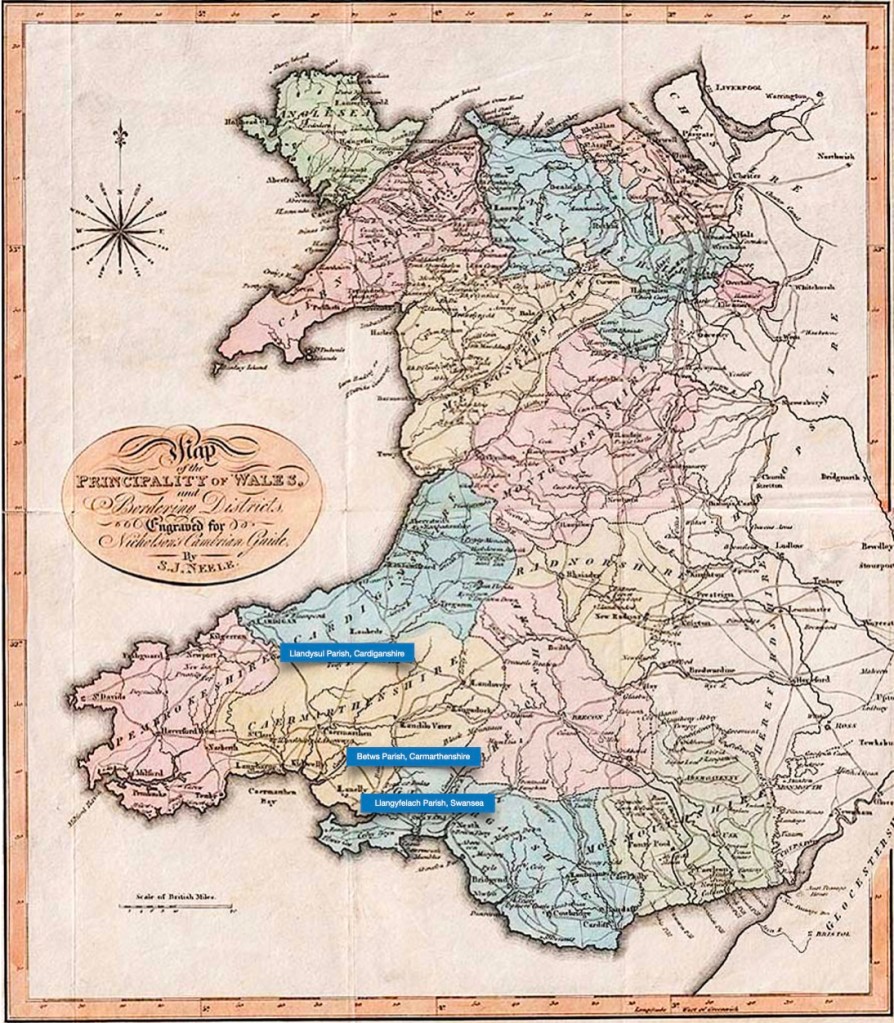
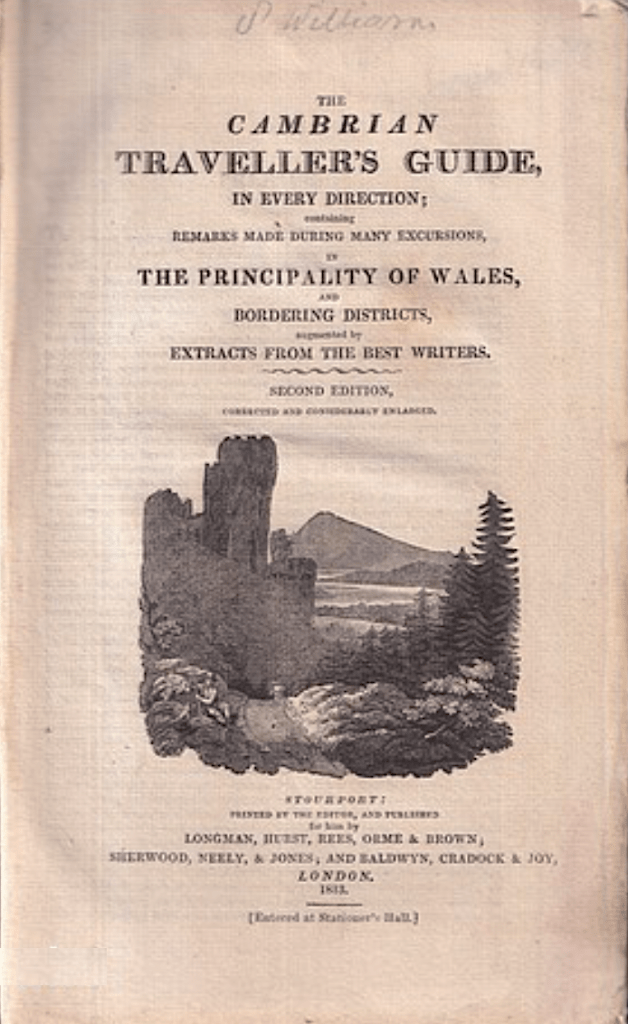
Map of the Principality of Wales and Bordering Districts,
[Engraved for Nicholson’s Cambrian Guide], by S.J. Neele, circa 1813.
Notice the locations of the Bristol Channel above Somerset, England in th closer right,
and the Liverpool seaport in northern England, in the upper right.
(Image courtesy of B.B. Williams Antique Maps & Prints).

Welsh Place Names Are Tongue Twisters!

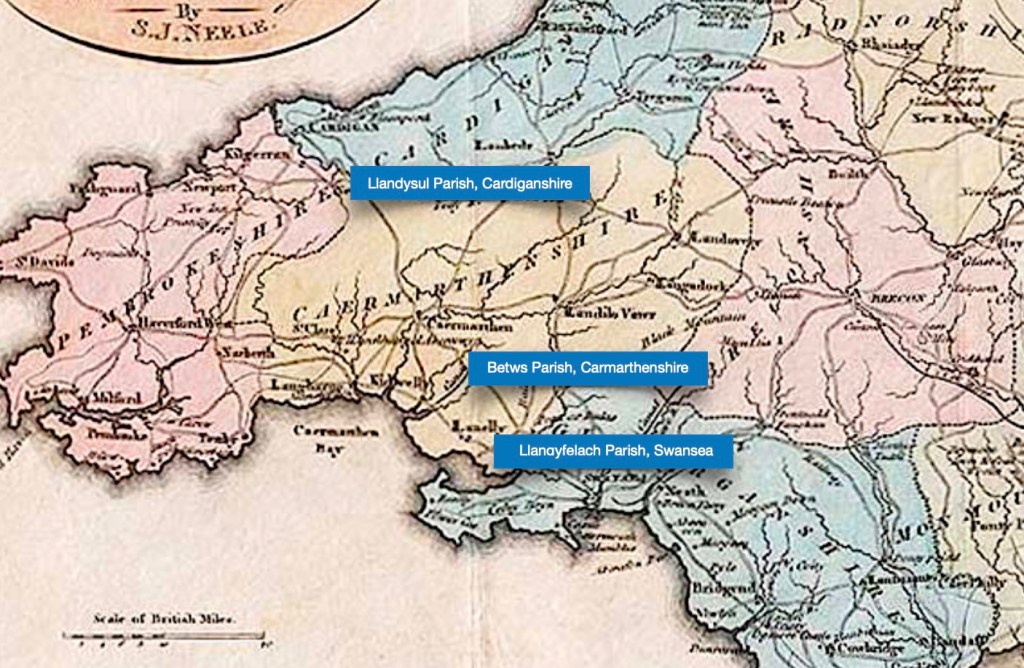
The three locations in Wales that feature in this chapter, are discussed below as follows — OK. Now say those names three times fast! We dare you.

The same map as shown above, just enlarged for clarity on locations.

With so many little parishes, in a not very big country, trying to understand what the various points-of-view were for the different communities required due diligence. We found records that match up with our family in the Horeb Independent Chapel in Llandysul, Cardiganshire. Not much was recorded about the actual building, except for this —“Horeb Independent Chapel was built in 1784, enlarged in 1826 and 1832. The chapel was rebuilt again in 1879 in the Classical style of the gable entry type and with a large arch in the facade.” (Coflein)

What did it mean to be Independent?
In the 1830s in Wales, having a chapel or church recognized as independent (often referred to as Annibynwyr), signified that the congregation was a self-governing, democratic body that operated outside the structure of the Anglican Established Church. This status represented a significant shift toward local democracy, theological autonomy, and a Welsh-speaking cultural identity, separate from the Anglican church and state in England. (Google)

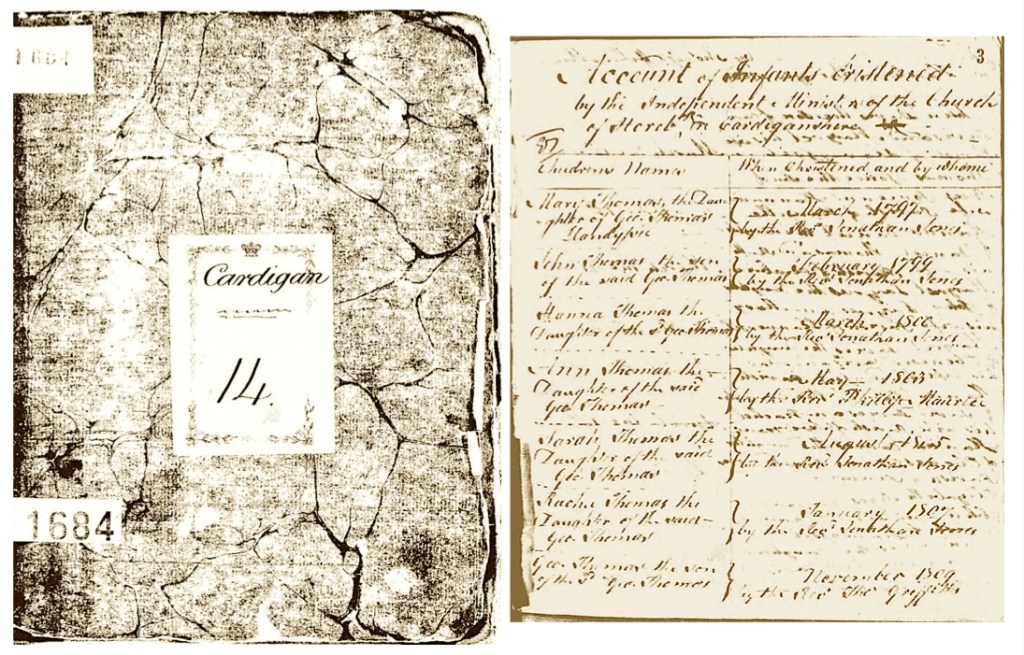
Baptismal record for the children of George Thomas, found in the Llandysul, Cardiganshire, Wales Horeb (Independent) Register of Births, 1797-1837.

Despite the very difficult-to-decipher page photograph above, (the original source was likely semi-transparent vellum paper), we determined that the patriarch of the family is George Thomas. (Mrs. Thomas is not recorded). Below are the baptismal records for his seven children from the Horeb Welsh Independent Chapel. The most important person for our family line is listed second, John Thomas.

  • Mary Thomas, baptism: March 1797
  • John Thomas, baptism February 1799, John carries the family line forward.
  • Hanna Thomas, baptism March 1800
  • Ann Thomas, baptism May 1803
  • Sarah Thomas, baptism August 1805
  • Rachel Thomas, baptism January 1807
  • George Thomas Jr., baptism, November 1809

As sometimes happens with research work like this, we do not know much about George Thomas’s life. This is because his name was just too common for credible records. So we move on from there to his oldest son, John Thomas*, who surfaces in nearby Carmarthenshire about twenty years later.
* John Thomas also seems like a very common name, but in his case, we had other evidence with which to locate him. (2)

John Thomas Weds Hannah Rees

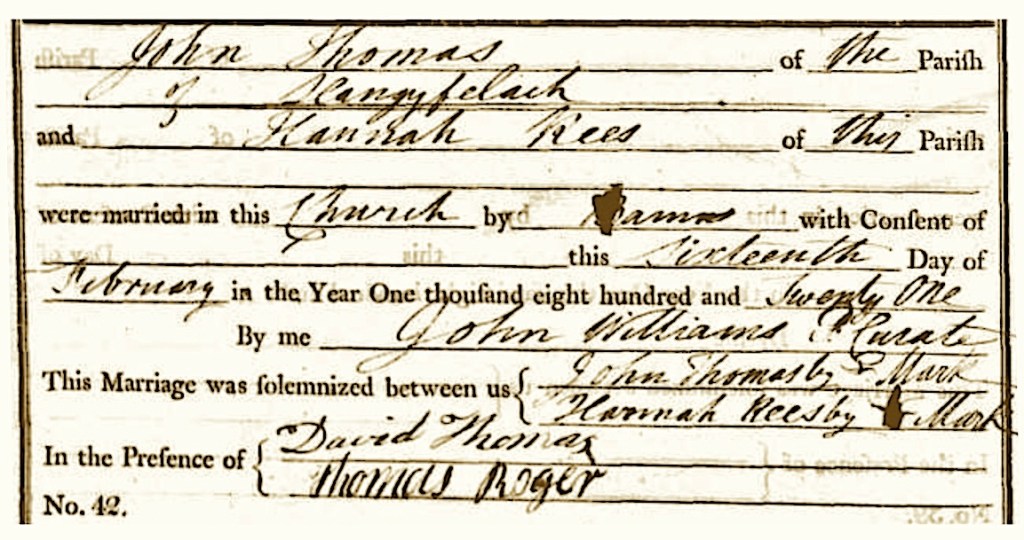
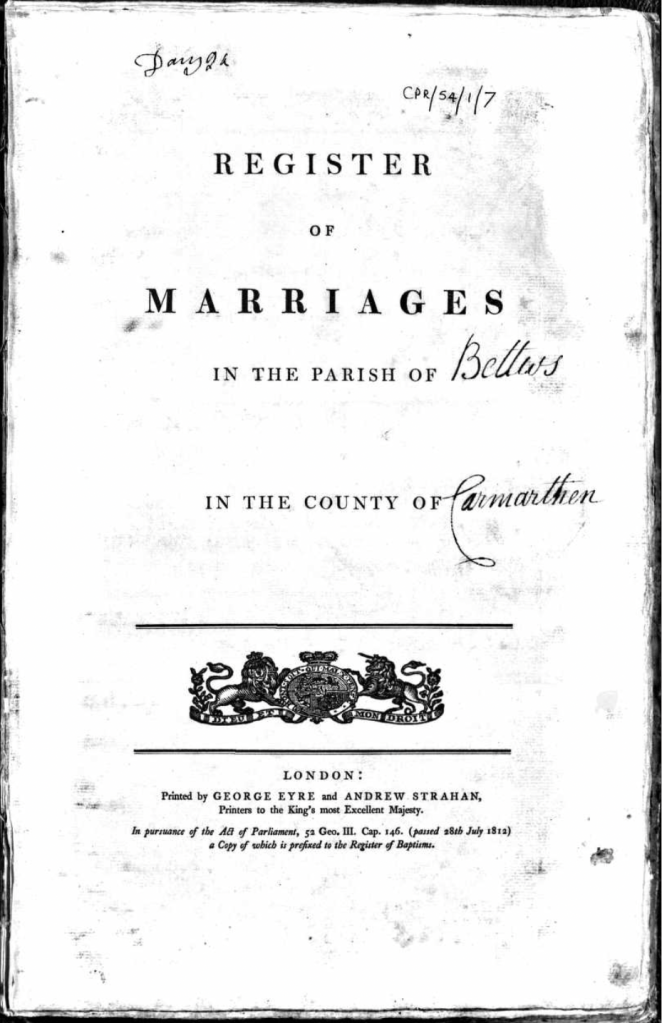
On February 16, 1821, John Thomas wed Hannah Rees in Betws*, Carmarthenshire, Wales. With this marriage, her Rees surname gave way to the Thomas surname. We believe that they married in this location because this is where her family was from. When you peruse the registry in which this record was found, there are many families recorded with the Rees family surname.
*That is not a typo. Betws is an old Welsh word which means Chapel.

John Thomas and Hannah Rees 1821 Betws, Carmarthenshire, Wales marriage record.

As we already know, John was baptized in 1799 at Llandysul, Cardiganshire. His marriage record cites that his parish is Llangyfelach Parish, which is in present day Swansea, Wales, on the Gower Peninsula. We do not know how long he was part of that parish, but we know that after they married, they moved back up to Llandysul Parish, Cardiganshire. The distance from Llandysul and Betws is about 34 miles (54.7 km), and they were connected by a major road.

Hannah Rees was born in 1798. However, her community of Betws was at one point separated from Swansea, and then became part of Carmarthenshire.

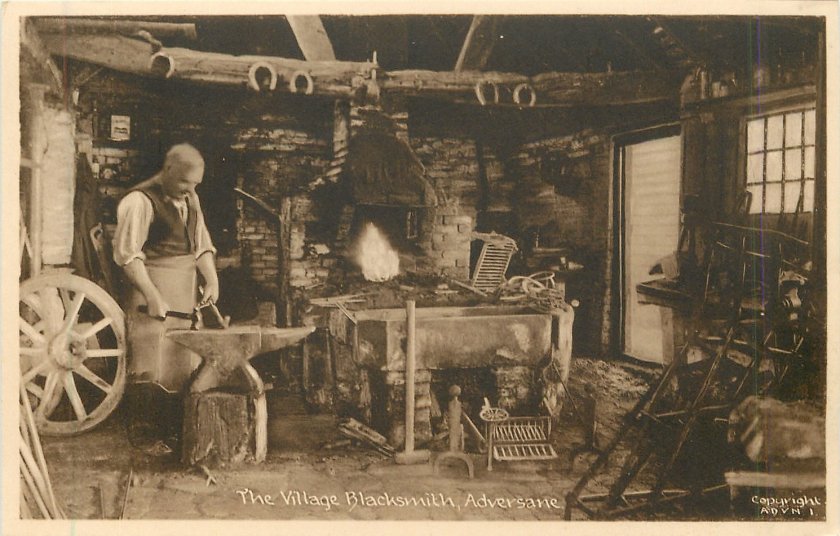
We know that John Thomas was a blacksmith and that he brought those skills to America. He continues to cite this as his profession through the 1850 US Census. (3)

Their Voyage to America On A Liverpool Packet

In the 18th century, transatlantic travel changed much due to so many people immigrating to countries outside of the European kingdoms. In researching how this family left Wales and journeyed to America, we had to learn about packet ships. From the New York Times, “Before steamships started crossing the North Atlantic, the best way to travel between Europe and America was by the sailing ships called packets. Built and run mainly by Americans, the packet lines introduced new concepts and comfort levels for ocean voyages. They dominated the transatlantic traffic for decades, setting key precedents for the steamships that eventually replaced them. Along with their more famous contemporaries, the whaling and clipper ships, they comprised the golden age of American sail. Of these three types, the packets lasted the longest and made the most voyages and money for their owners and crews.”

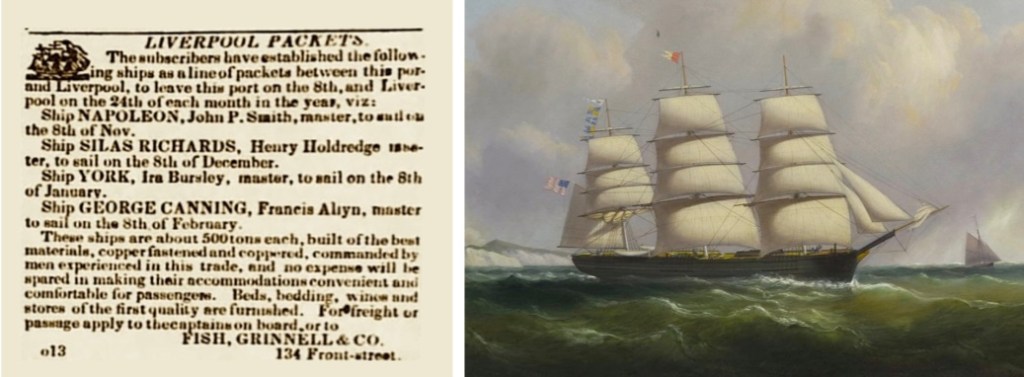
At left, a Fish, Grinell & Co. advertisement for the Silas Mariner packet ship. A typical 3-masted packet ship example, the Patrick Henry. (See footnotes).

“Fish, Grinnell, & Co. began the Swallowtail Line, known as the ‘Fourth Line of Packets for New York,’ their first ships being the Silas Richards, Napoleon, George, and York, which soon moved to bi-weekly service. By 1825, vessels were advertised as leaving New York on the 8th and leaving Liverpool on the 24th of every month. Their actual schedules eventually varied, sometimes wildly, due to weather and other conditions.” (Wikipedia)

It is quite likely that our ancestors were on a ship that was transporting mail, because this is what all packet ships were known for. “Packet boats were medium-sized boats designed mainly for domestic mail and freight transport in European countries and in North American rivers and canals. Eventually including basic passenger accommodation, they were used extensively during the 18th and 19th centuries, and had regularly scheduled services.” (Wikipedia)

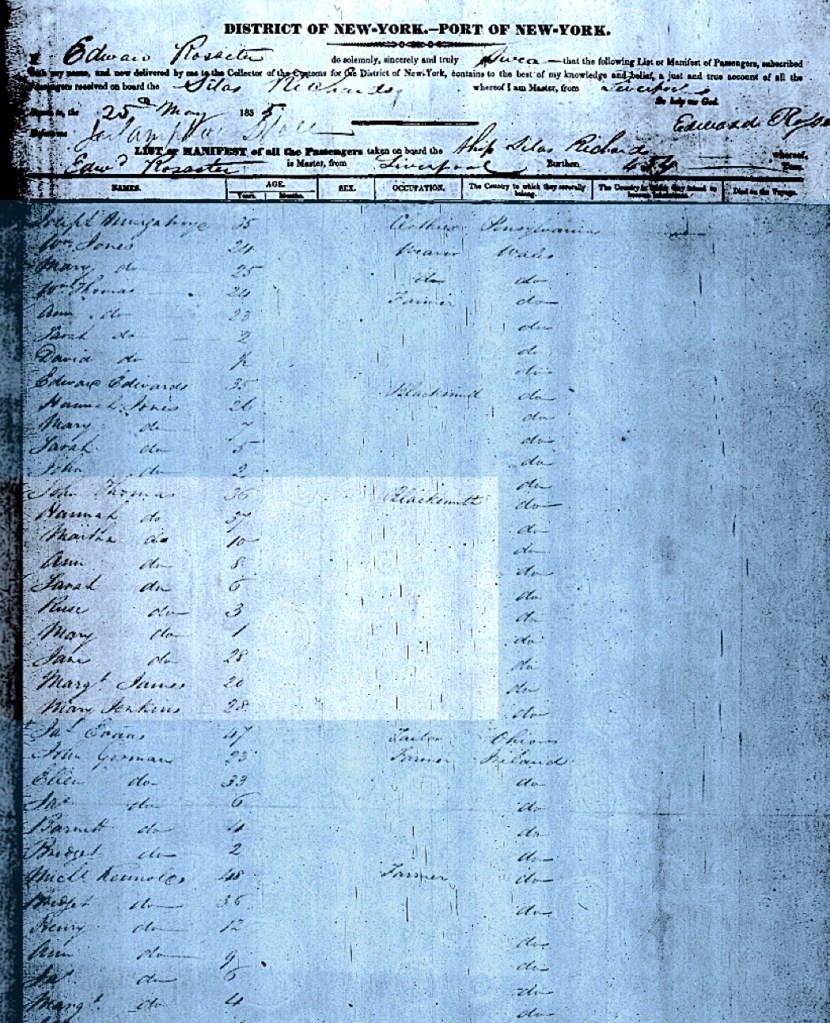
Our ancestors sailed on the Silas Richards, which had departed from Liverpool England. They arrived in New York on May 25, 1835. Note that John Thomas is recorded on the manifest below, as being a blacksmith.

The John Thomas family as shown on the passenger manifest
for the ship Silas Mariner, on May 25, 1835 in New York harbor. (See footnotes).

A very interesting account of travel between Great Britain and Ohio is found within the article Emigration Voyages, which features the account by a man named Thomas Tear who immigrated with his extensive family from the Isle of Man to Leroy Townhip, Geauga County, Ohio. “The account left by Thomas Tear is probably much more typical of the type of conditions encountered by the the ‘middle class’ Manx emigrants of the 1820s and 1830s.”

Cultural and location explanations as follows:

  • Manx refers to anything from the Isle of Man.
  • The Isle of Man is a large island located in the Irish Sea between Ireland and Great Britain.
  • Leroy Township, Geauga County, Ohio became part of Lake County, Ohio in 1840.

Thomas Tear was an educated man, who kept a journal and wrote letters about being an immigrant to the state of Ohio. His records about sailing on a packet ship, and the odyssey of traveling from New York harbor to Ohio in that era, are likely similar to the experiences our ancestors also faced. Here is what he had to say:

“We were finally put on board a small brig, if I remember rightly, of 200 tons, but seems wrong, to me, as she had on 200 passengers, mostly Irish which limited passengers 2 per 5 ton burthen. Her name was Amelia of Liverpool, at the helm was, Captain Tagert. They had no such accommodations, as they advertised. We occupied what was called the second cabin, with some English people, and a few better class Irish, on the opposite side of the cabin. But It was not separated from the steerage, as I think it was called, by any door, which was on the same deck, and just forward of us, and was filled with Irish. It was separated from the cabin by a rough board partition, with cracks that the children could peek through.

The passenger quarters had three rows of berths all around, and there were two low benches, which was all the furniture there was in our part. There were two hatches over the passengers, affording all the light and ventilation that passengers had, and if It was rough, these were partly closed. There was a coal fire, in a grate on deck for the passengers to cook by. One man died on the passage, but to me, the wonder, is that half of them were not dead. The scent down there in that dirty, ill-ventilated hole, was anything but sweet. Mother was sick all the way, also Mrs. Gawne, but the rest, stood it well. The burden of cooking fell on my oldest sister, but she seemed to benefit by it. The passengers carried and cooked their own provisions, and as the fire would not accommodate them all at once. This made considerable dissatisfaction, eating was done, without setting of tables, and just as you could catch it.”

Tear’s initial voyage from England took some 40 days, a few days longer than the average by the faster packets for that time of year.

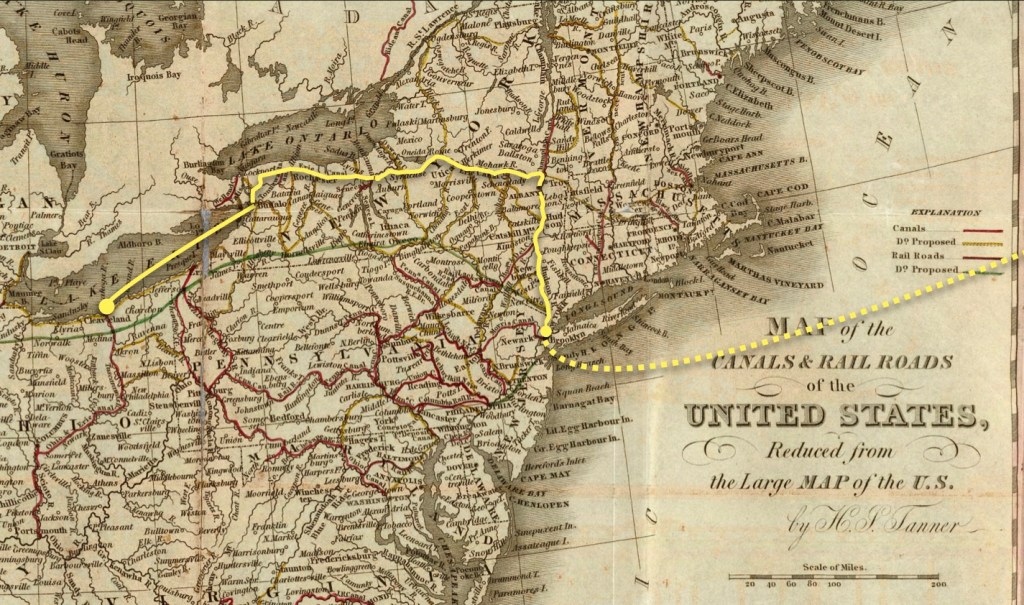
A Connected View of The Whole Internal Navigation of the United States…
by Henry S. Tanner, 1830. (Image courtesy of the David Rumsey Map Collection).
— — — 
Their journey from Liverpool England, to Ohio charted.
The dashed lines represents the 3043 mile segment from Liverpool, England to New York harbor.
From there they traveled by boat up the Hudson River to Albany, New York. Then, via the Erie Canal to Buffalo, New York, and lastly by lake steamer ship to Cleveland, Ohio.

Thomas Tear’s accounts continue, “I will mention here, before reaching Liverpool, they [his parents] expected to take passage to Philadelphia, Pennsylvania. Then travel by wagon, across the country to Jefferson County, Ohio. Two families were there, who had left the Island some 4 years before. At Liverpool, they were informed of the recent completion, of the Erie Canal, enabling them to reach Ohio by way of New York, by water, which was far more preferable. So they went to New York.”

“We were in New York only a few hours, before starting for Albany, on the river. We were on some kind of boat, that was fastened to the side of a steamer, and drawn along, or towed. The boat was open and there were two boats on one side and one on the other side of the steamer. Thus we went up the Hudson River to Albany, in not over 24 hours.

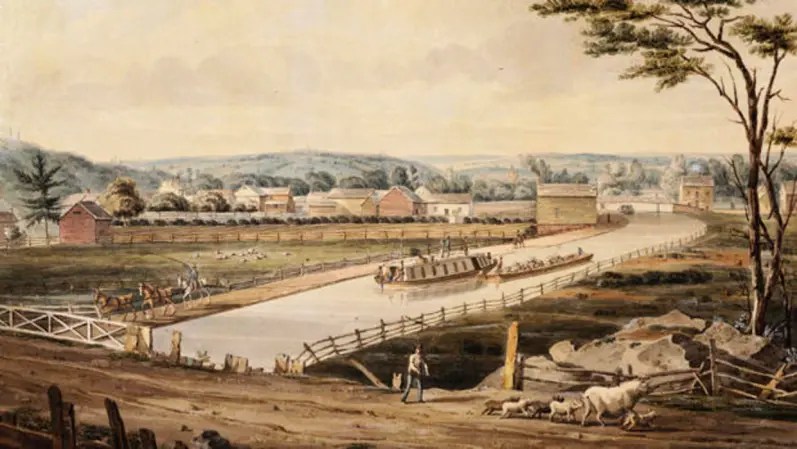
View on the Erie Canal (1830-32) by John William Hill 
via The New York Public Library.

We had gotten to Albany and while waiting on the dock, for a canal boat, on which to take passage, there was a great strife among the boats for the passengers. We finally got aboard a boat, and reached Buffalo in a week.

At Buffalo, we were put aboard a schooner called,‘The Lady of the Lake’; because of foul wind, the flat bottom of the vessel, and the unskillfulness of the seamen, we were two weeks in reaching Fairport, 160 miles. We landed early in the morning, before sunrise, on the 5th of July, 1826. A boat came from shore to take us in, the schooner was not able to enter the harbor, because of a [sand] bar.” (4)

After the Thomas family made their way westward from New York, they settled in the northeast section of Ohio.

The Censuses and Their Family

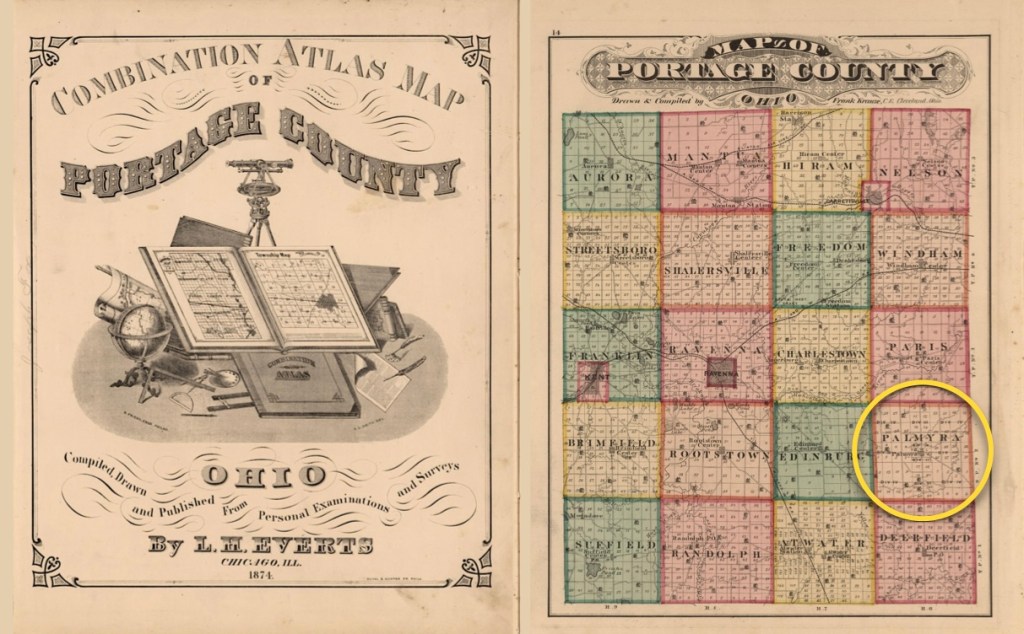
John and Anna settled with their family in Palmyra township, Portage County, Ohio. This community 52 miles (84 km) southeast of the city of Cleveland, where they arrived via a lake steamer ship. As we learned in the previous chapter, there were many immigrants from Wales already living in the area. So it was certainly an area with many familiar cultural touch points.

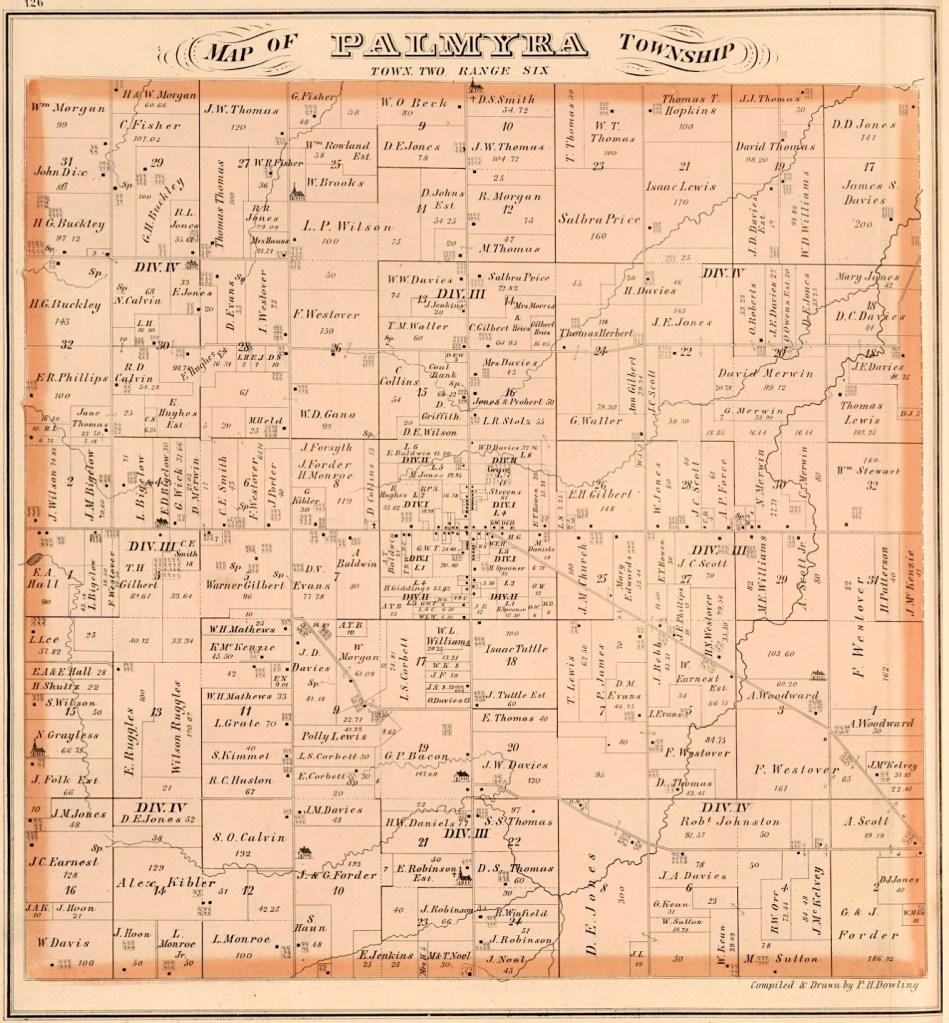
They appear on US Censuses for the years 1840, 1850, and 1860. (See footnotes). John continues to identify his occupation as blacksmith through 1850, but by 1860, he identifies it as a farmer. We do not know if he actually owned farming property in Palmyra township, or if they rented rather than owned, since he had maintained his blacksmithing profession for many years. The 1874 Palmyra township map below, is intriguing for the number of Thomas-named families scattered throughout, but nothing is labeled simply as John Thomas. (And, he had passed on five years before this map was created… we do not know if one of his children, married or otherwise, inherited any property).

His wife Hannah, by 1860, had started to refer to herself as Anna, which we observed in that census. (This is the name was also used on her grave marker). There are a couple of plausible reasons why she dropped the two h’s and simplified her name. It is likely that people just called her Anna as a nick name, or perhaps it was over the death of her daughter, who was also named Hannah. (See below).

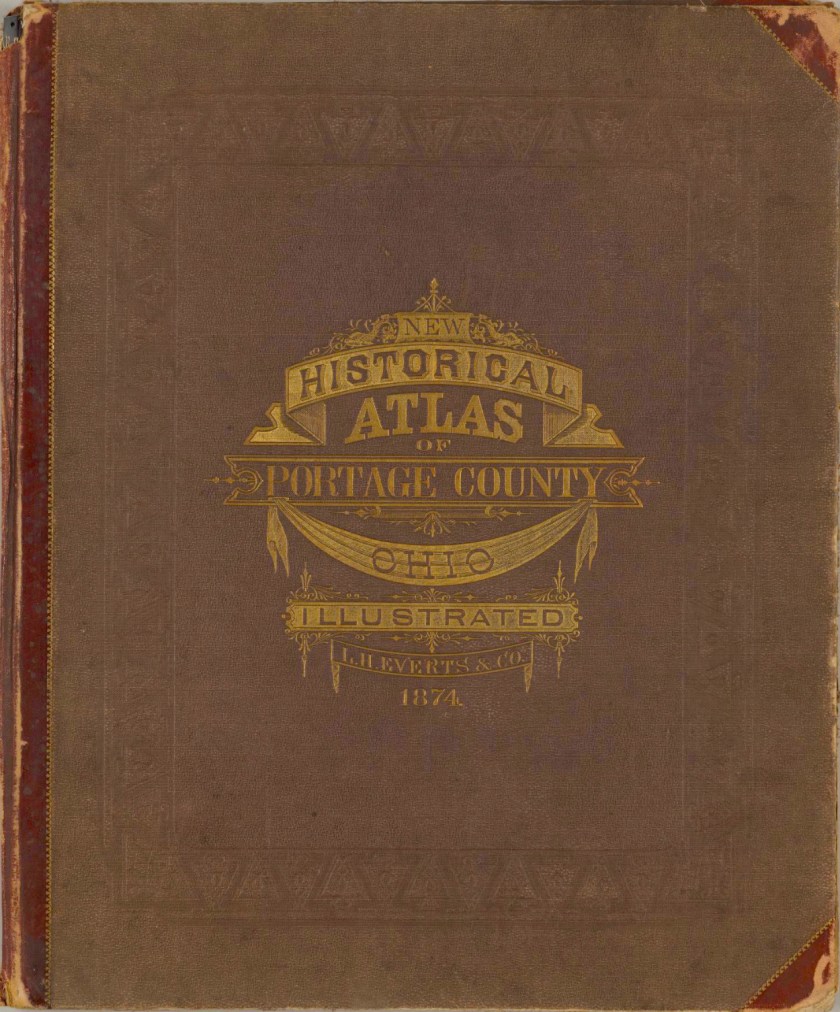
Frontispiece and Portage County map from the
Combination Atlas Map of Portage County, Ohio, by L.H. Everts, 1874.
(Image courtesy of David Rumsey Map Collection).
Page 126, Palmyra Township, Portage County, Ohio,
by L.H. Everts, 1874. (Image courtesy of David Rumsey Map Collection).

John and Anna had ten children. The first five were born in Llwynrhydowen, Llandysul, Ceredigion (Cardiganshire), Wales:

  • Martha (Thomas) Jenkins, 1823 – 1847
  • Anne Thomas, 1827 – 1836
  • Sarah (Thomas) Williams, 1827 – 1899
  • Rees J. Thomas, 1831 – 1905
  • Mary (Thomas) Jones, 1834 – 1854

The next five children were born in Palmyra Township, Portage County, Ohio:

  • Ann (Thomas) Harris, 1836-1890, Ann carries the family line forward.
  • Margaret Evelyn (Thomas) Hughes, 1838 – 1915
  • Hannah Thomas, after the 1840 Census – 1843
  • David J. Thomas, 1841 – 1916
  • John O. Thomas Jr., 1845 – 1863

The mother of the family, Anna (Rees) Thomas passed away first, on February 16, 1867. The father John Thomas Sr., soon followed her, passing away on November 27, 1869. Their daughter Ann Thomas is the ancestor who carries the family line forward with her marriage in Chapter Nine. (5)

We will also learn why Monmouthshire is sometimes included in English maps and not Wales maps, and then sometimes included in Wales maps, but not English maps. This seesaw effect was rather confusing to figure out what people were then thinking, but we figured it out.

Following are the footnotes for the Primary Source Materials,
Notes, and Observations

Wheel of Fortune screen capture form the Today show, via: https://www.today.com/popculture/tv/vanna-white-recalls-wheel-fortune-mistake-left-mortified-rcna13056

Y Seren OrllewinolWhat’s That Again?

(1) — one record

Llyfrgell Genedlaethol Cymru
(The National Library of Wales)
Y Seren Orllewinol (The Western Star)
Hydref 1847 (October 1847)
Martha (Thomas) Jenkins 1847 obituary
https://viewer.library.wales/2726714#?xywh=-2424,0,6958,3511&cv=19
Book page: 246/250, Left column, upper portion.
Note: Her place of origin is recorded in this obituary.

A translation from Welsh to English of the most relevant section states:
“Glyn Wylofain August 18, 1847.                            Pilgrim.
In Palmyra, Portage county, Ohio, August 14, 1847, Mrs. Martha Jenkins, wife of David Jenkins, who joined in a matrimonial bond about three years ago. Martha was the daughter of John and Hannah Thomas, a blacksmith, formerly Llwynrhydowen, Llandysul, Ceredigion [Cardiganshire]; her disease from tuberculosis, her age about 24 years. She left a husband and one girl, aged eighteen months, to mourn her…”

Welsh Place Names Are Tongue Twisters!

(2) — five records

B.B. Williams Antique Maps & Prints
Map of the Principality of Wales and Bordering Districts
[Engraved for Nicholson’s Cambrian Guide]
by S J Neele, circa 1813
https://www.antique-prints-maps.com/acatalog/Map-of-the-Principality-of-Wales-and-Bordering-Districts-Engraved-for-Nicholsons-Cambrian-Guide-by-S-J-Neele–8984182.html
Note: For the locations of their baptisms and marriage.

Geo Thomas
in the England & Wales, Non-Conformist and Non-Parochial Registers, 1567-1936
Rg4: Registers of Births, Marriages and Deaths > Cardiganshire > Independent > Piece 1684: Llandysul, Horeb (Independent), 1797-1837
https://www.ancestry.com/search/collections/2972/records/15287637
Note: Baptismal record for George Thomas’s children and when they were baptized —

  • Mary Thomas, baptism: March 1797
  • John Thomas, baptism February 1799
  • Hanna Thomas, baptism March 1800
  • Ann Thomas, baptism May 1803
  • Sarah Thomas, baptism August 1805
  • Rachel Thomas, baptism January 1807
  • George Thomas Jr., baptism, November 1809

Coflein
Site Record for the Horeb Welsh Independent Chapel, Horeb
https://coflein.gov.uk/en/sites/7283
Note: For the text.

Llangyfelach
https://en.wikipedia.org/wiki/Llangyfelach#:~:text=Llangyfelach%20is%20a%20village%20and,to%20combine%20them%20for%20Llangyfelach.
and
Llangyfelach Parish Church
https://parishofllangyfelachwithclase.org.uk/#:~:text=The%20religious%20site%20at%20Llangyfelach,in%20a%20converted%20Tithe%20Barn.
Note: For the data.

John Thomas Weds Hannah Rees

(3) — seven records

John Thomas
in the U.S., Find a Grave Index, 1600s-Current
https://www.ancestry.com/search/collections/60525/records/28467460
and
John Thomas
https://www.findagrave.com/memorial/43726665/john-thomas
Note: His dates are birth, 1799; death, November 27, 1869, in Palmyra, Portage County.

Anna Thomas

in the U.S., Find a Grave Index, 1600s-Current
https://www.ancestry.com/search/collections/60525/records/28467276?tid=62607448&pid=282197285918&ssrc=pt
and
Anna Rees Thomas
https://www.findagrave.com/memorial/43726451/anna-thomas
Note: Her dates are, birth, 1798 in Wales; death, February 16, 1867, in Palmyra, Portage County.

Hannah Rees
in the Carmarthenshire, Wales, Anglican Baptisms, Marriages and Burials, 1560-1994
Betws > Marriages > 1813-1837
https://www.ancestry.com/search/collections/62102/records/286341?tid=&pid=&queryId=7de970db-a16a-4204-b2f1-5661d20f32e2&_phsrc=Ffd7&_phstart=successSource
Book page: 14, Digital page: 9/23, Entry No. 42, on the left page bottom.
Note: Their marriage date is February 16, 1821.

Betws, Carmarthenshire
https://en.wikipedia.org/wiki/Betws,_Carmarthenshire
Note: For the data.

TuckDB Postcards
The Village Blacksmith
https://www.tuckdbpostcards.org/items/16508-the-village-blacksmith
Note: For the postcard image.

Their Voyage to America On A Liverpool Packet

(4) — seven records

New York, Passenger Lists, 1820-1920
NARA Roll Number – Content > 026 – 26 Mar 1835-22 Jun 1835
https://www.familysearch.org/ark:/61903/3:1:939V-5T27-1?wc=MX62-2NL:165726301&cc=1849782&cc=1849782&lang=en&i=444
Digital Images: 445, 446, and 448/702
Note: The Silas Richards was  a Clipper Packet Ship.
Note: The childrens’ ages are an admixture —some are exactly correct, others are close, but technically not correct.

The Silas Richards 1835 manifestAgeOccupation
John Thomas36Blacksmith
Hannah37
Martha10
Ann8
Sarah6
Rees3
Mary1
Jane28
Margaret James20
Mary Jenkins28

Packet boat
https://en.wikipedia.org/wiki/Packet_boat
Note: For the text, and the Chesterton and Baltimore packet-boat image.

Patrick Henry (packet)
https://en.wikipedia.org/wiki/Patrick_Henry_%28packet%29
Note: For the ship image.

Manx, Isle of Man
History of Manx People Who Came to America
by Mildred Steed, and published by
The Lake County Genealogical Society
https://www.isle-of-man.com/manxnotebook/famhist/genealgy/miom1991.htm
Note: Manx refers to anything from the Isle of Man. The Isle of Man is a large island located in the Irish Sea between Ireland and Great Britain.
and
The above link then leads to this derived article:
Emigration Voyages
https://www.isle-of-man.com/manxnotebook/famhist/genealgy/voyages.htm
Note: See the References from this article for the original sources.

David Rumsey Map Collection
A Connected View of The Whole Internal Navigation of the United States…
by Henry S. Tanner, 1830
https://www.davidrumsey.com/maps1781.html
Note: For the map. The websitemap provides a link, which makes it zoomable for definition and clarity.

CBS News
All Hail The Erie Canal
View on the Erie Canal (1830-32)
by John William Hill 
via The New York Public Library
https://www.cbsnews.com/news/all-hail-the-erie-canal-200th-anniversary/
Note: For the Erie Canal landscape painting.

The Censuses and Their Family

(5) — nineteen records

David Rumsey Map Collection
Palmyra Township, Portage County, Ohio
from the Combination Atlas Map of Portage County, Ohio
by L.H. Everts, 1874
https://www.davidrumsey.com/luna/servlet/detail/RUMSEY~8~1~230086~5508390:Palmyra-Township%2C-Portage-County%2C-O?sort=pub_list_no_initialsort%2Cpub_date%2Cpub_list_no%2Cseries_no&mi=3&trs=7&qvq=q:Palmyra%20Township;sort:pub_list_no_initialsort%2Cpub_date%2Cpub_list_no%2Cseries_no;lc:RUMSEY~8~1
Book page: 126, Digital page: Follow the link above.
Note: For the 1874 Palmyra township map, the Atlas frontispiece, and the Portage County map.

John Thomas
in the 1840 United States Federal Census
Ohio > Portage > Palmyra
https://www.ancestry.com/search/collections/8057/records/3328150?tid=&pid=&queryId=4bd43007-e83a-4cf4-aaa7-eb12c53c13c7&_phsrc=oNB1&_phstart=successSource
Book page: 4, Digital page: 3/18, Center of page, entry 18.
Note: This early census does not list who actually lived in the home, other than John.
Note: This census reconciles to John 41, Hannah, 42, Martha 15, Mary 6, Rees 9, Ann 5, Margaret 2. (Based upon the Silas Richards 1835 ship manifest).

Between censuses, after 1840 > 1843
There is a daughter who was born and died between censuses:
Hannah Thomas
https://www.findagrave.com/memorial/116259443/hannah-thomas
Note: This daughter’s birth is after the 1840 census, and she not on the 1835 manifest for the Silas Richards ship. She is also buried in a Palmyra Welsh Cemetery, separate from the other family members.

John Thomas
in the 1850 United States Federal Census
Ohio > Portage > Palmyra
https://www.ancestry.com/search/collections/8054/records/19581411?tid=&pid=&queryId=0fe2cd28-3dcb-4a92-8ee1-6bb342ad3af9&_phsrc=oNB4&_phstart=successSource
Book page: 207(?) , Digital page: 8/26, Lines 28 through 35.
Note: John 51 [He is a blacksmith], Hannah 52, Rees 19, Ann 15, Margaret 12, David 9, John 6, Anna Jenkins 4.

John Thomas
in the 1860 United States Federal Census
Ohio > Portage > Palmyra
https://www.ancestry.com/search/collections/7667/records/41939242?tid=&pid=&queryId=e72e20be-db5b-4ab7-bc1b-b17f22592b6a&_phsrc=oNB7&_phstart=successSource
Book page: 66-67, Digital page: 8-9/26, Lines 39, 40, 1 through 5.
Note: This census carries over two pages. The parents are on lines of page 66; the rest follow on page 67.
Note 1: John 61 [He is a farmer], Anna 62, Rees 19, Ann 24, Margaret 22, David 19, John1 6, Anna Jenkins 14.
Note 2: Hannah now records herself as Anna.

Martha (Thomas) Jenkins
1823 – 1847
Martha Thomas
in the Ohio, U.S., County Marriage Records, 1774-1993
https://www.ancestry.com/search/collections/61378/records/902850028
and
Martha Jenkins
https://www.findagrave.com/memorial/43726679/martha-jenkins
Note 1: Marriage and then an early death. This is the daughter whose obituary was published in the October 1847 issue of Y Seren Orllewinol — The Western Star.
Note 2: This surname explains who Mary Jenkins is on the Silas Richards manifest: a relation to David Jenkins, and the girl Anna Jenkins who is listed on the 1850 and 1860 censuses.

Anne Thomas
1827 – 1836
Anne Thomas
https://www.findagrave.com/memorial/226240808/anne-thomas
Note: Died on June 14, 1836. Her younger sister was born June 5, 1836, and was likely named Ann in remembrance of her.

Sarah (Thomas) Williams
c. 1827 – 1899
Sarah Thomas
in the Ohio, U.S., County Marriage Records, 1774-1993
https://www.ancestry.com/search/collections/61378/records/902845084
and
Sarah Williams
https://www.findagrave.com/memorial/117162899/sarah-williams
Note: There is an extensive biographic memorial.

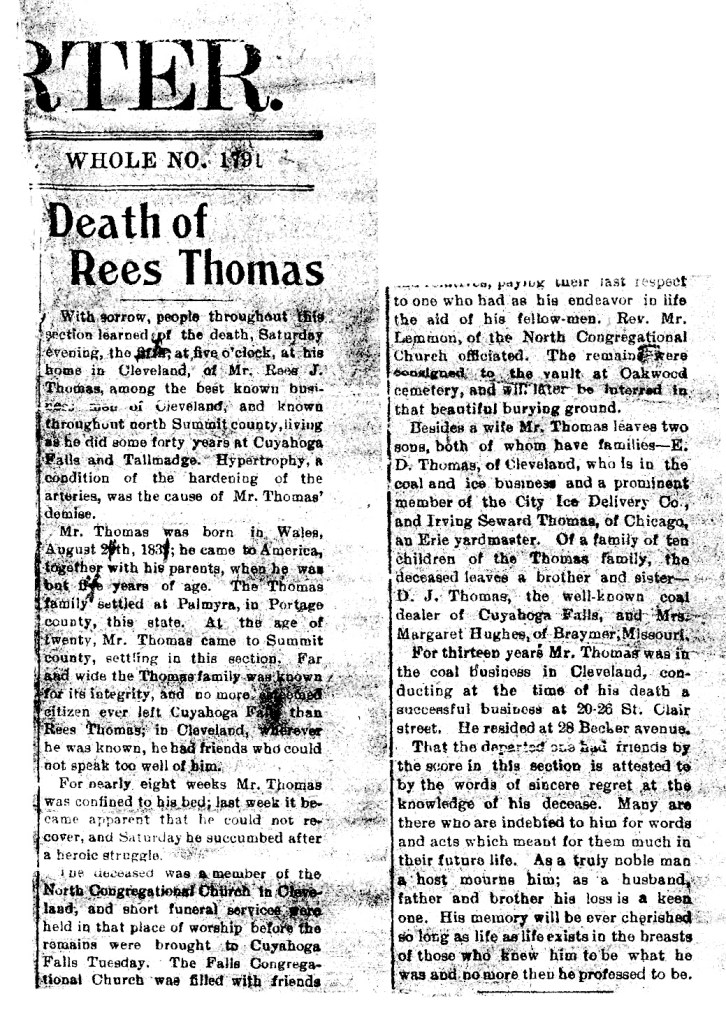
Rees Thomas 1905 obituary from the Findagrave.com website.

Rees J Thomas
1831 – 1905
Rees J Thomas
https://www.findagrave.com/memorial/18990337/rees_j-thomas
Note: His newspaper obituary included above. Observe that marked numeral ‘1’ in a couple of places, so there may be errors in the obituary.

Mary Jones Thomas
1834 – 1854
Note: Although not clearly on the 1850 Census, she is reconciled to the 1840 census; also on the Silas Richards manifest at the age of one.
and
Mary Jones Thomas
https://www.findagrave.com/memorial/226240878/mary-thomas
Note: ‘Mary, daughter , died at Pittsburg, PA July 29, 1854 age 20 yrs buried with John’.

Images from the Findagrave.com website.

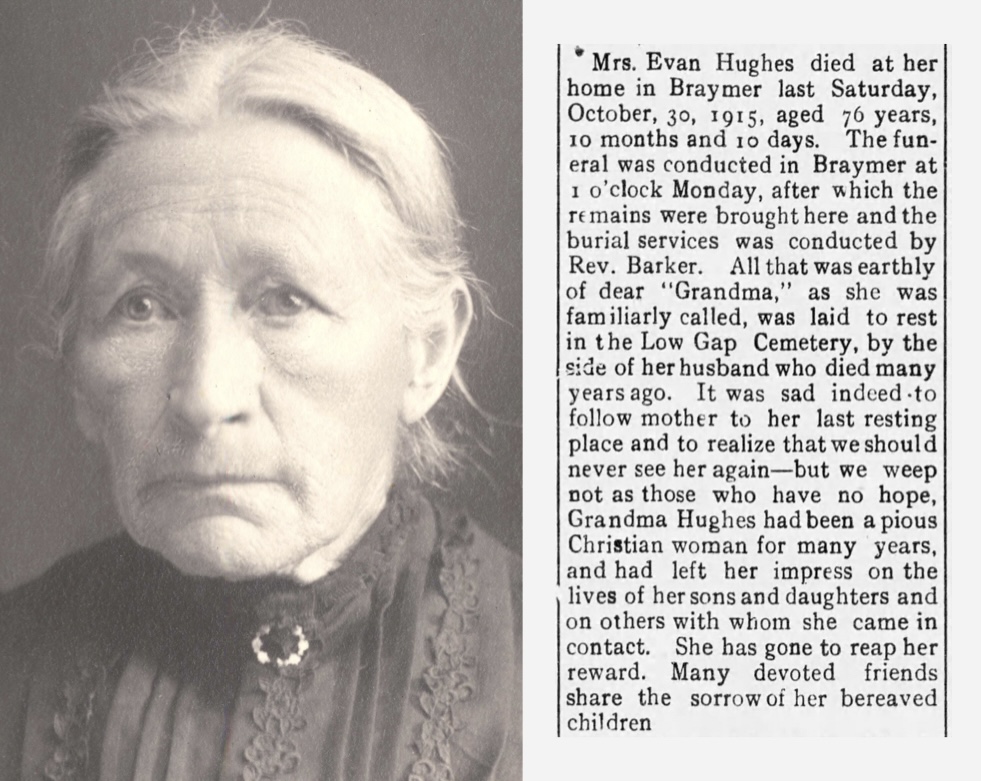
Margaret Evelyn (Thomas) Hughes
1838 – 1915
Margaret Evelyn Hughes
in the U.S., Find a Grave Index, 1600s-Current
https://www.ancestry.com/search/collections/60525/records/109127874
and
Margaret Evelyn Thomas Hughes
https://www.findagrave.com/memorial/132158422/margaret-evelyn-hughes

Portrait from the Findagrave.com website.

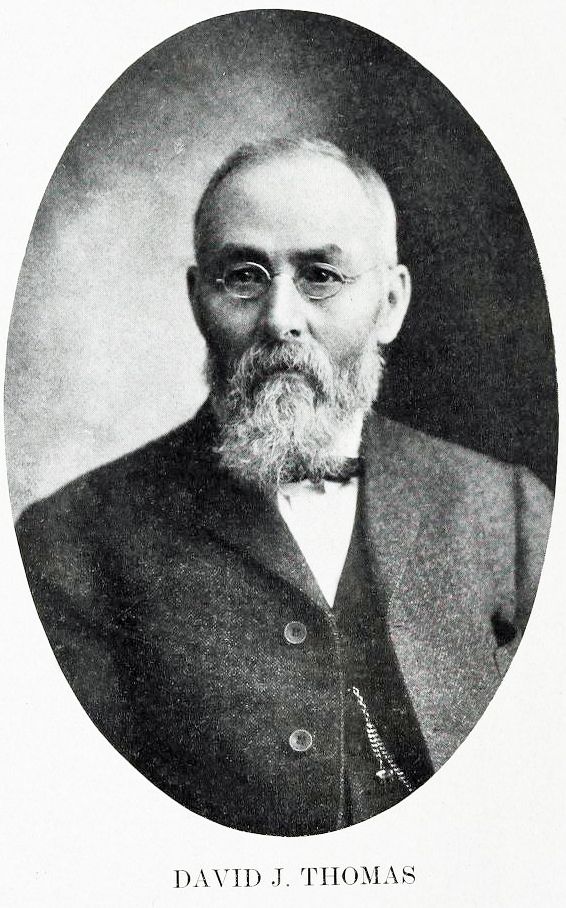
David J Thomas
1841 – 1916
David J Thomas
in the U.S., Find a Grave Index, 1600s-Current
https://www.ancestry.com/search/collections/60525/records/85955222
and
David J. Thomas
https://www.findagrave.com/memorial/18990432/david-j-thomas

Hannah Thomas
After the 1840 census – 1843
https://www.findagrave.com/memorial/116259443/hannah-thomas
Note: This daughter’s birth is after the 1840 census, and she is not on the 1835 manifest for the Silas Richards ship. She is also buried in a Palmyra Welsh Cemetery, separate from the other family members.

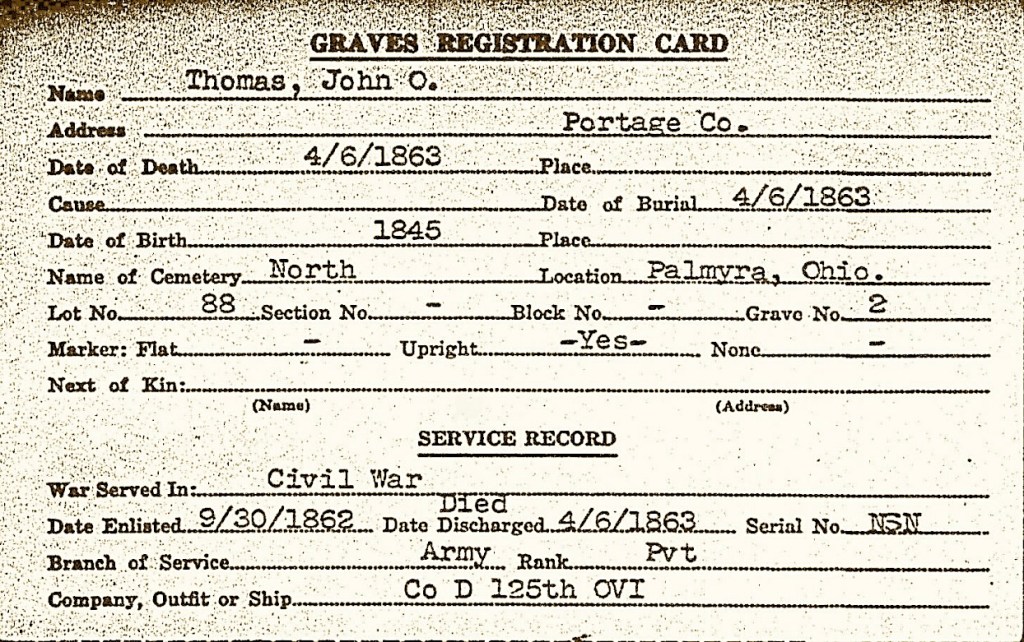
He was a Civil War soldier who died at a military hospital in Tennessee,
and is buried in the national cemetery in the same location.

John O. Thomas Jr.
1845 – 1863
John O Thomas
Death – Find a Grave Index
https://www.familysearch.org/ark:/61903/1:1:QVKX-RKFT?lang=en
and
PVT John O Thomas
https://www.findagrave.com/memorial/43457214/john-o-thomas
Note: He died young as a Civil War soldier.