The Williams / Harris Line, A Narrative — Eleven

This is Chapter Eleven of twelve, where we are nearing the finish to our exploration of the Williams and Harris family lines. Here we introduce another family from Wales, the Roberts family, who were friends with the Harris family in Wales.
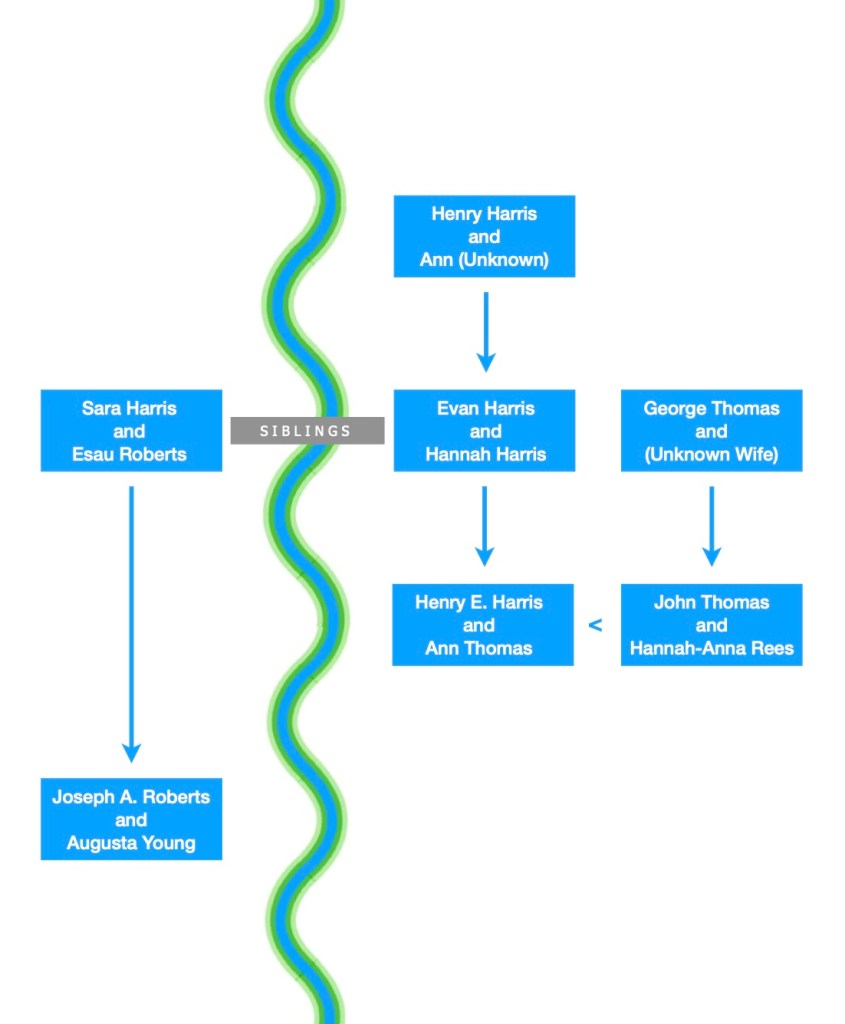
The same Thomas and Harris families family pedigree flow chart —
but now with the addition of the Roberts family line.

Genealogy Gold!

Well, that exciting subtitle might let you believe that we discovered something that made our lives easier. That is partially true, but not the whole truth. Let us explain…

We found two obituaries for the main ancestors within this family line: Esau Roberts, and Sara (Harris) Roberts. Both were very long, rather detailed, and not in complete agreement about all of the facts. We spent much time (as genealogy writers do) mucking about in the dustbins of history to figure out what was likely true and what was just not quite true. So, here we are —

Mrs. Sarah [Harris] Roberts died at a somewhat young age and her very long obituary was published in the Y Cenhadwr Americanaidd (The American Messenger), newspaper, Autumn 1861 issue. We learned that they wrote her birthdate as “January 1, 1819.” ( A New Years Day baby!) Actually, her birthday was April 1, 1819 (Ok, an April Fools Day baby! Even better.)
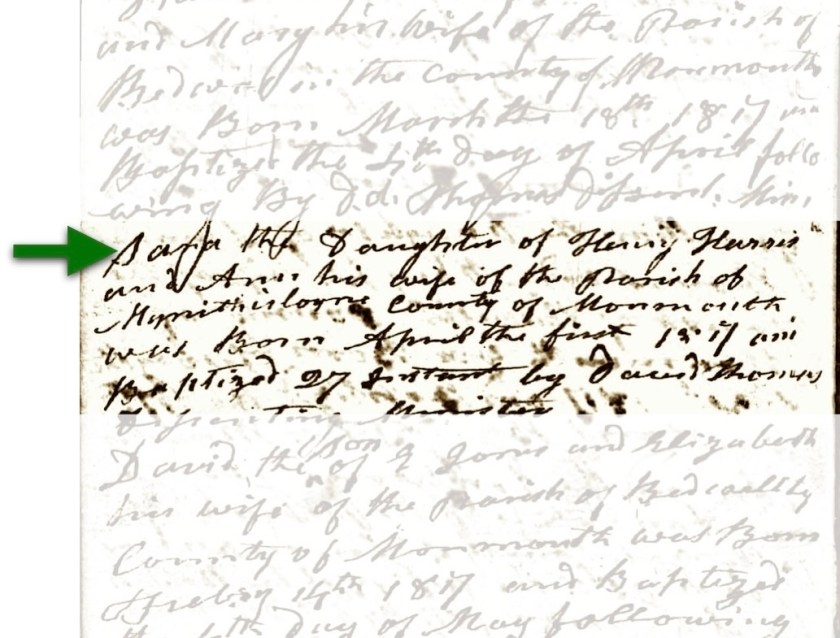
Registration of both the April 1, 1817 birth and baptism dates for Sara Harris. From the
Mynyddyslwyn, Beulah Chapel (Baptist) Registry, in Monmouthshire, Wales.

We believe that Esau Roberts (her future husband) was born in the same year, 1817. His baptismal record indicates a couple of things to examine: his record says 1816 in the upper corner of the page but it is also notes very clearly in the margins of the actual document, that it was the last entry for 1817. We went with 1817 for his birth year, even though future records are all over the map.
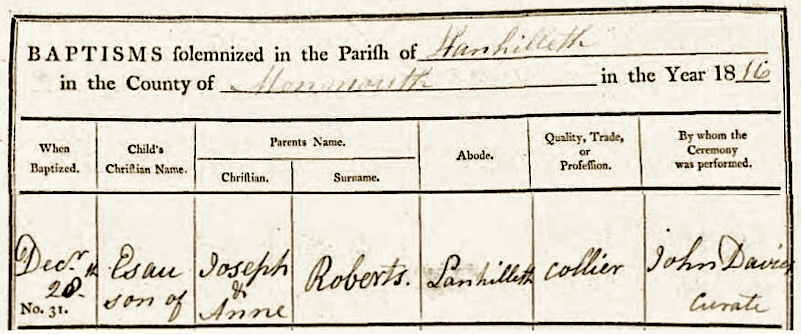
The December 28, 1817 baptism registry for Esau Roberts,
in Lianhilleth, Monmouthshire.

Comment: Try to understand that for our ancestors, who lived in a preliterate world, knowing your exact age was just not an important fact. Most people signed their names with an X, and counted grocery items on their fingers. A birth date, was an idea, not a fact. Specifically, their mental map was different. It was not like today where you need to produce: an identity card, a social security number, bank card, proof of citizenship, and your blood type just to purchase something like bottle of wine!
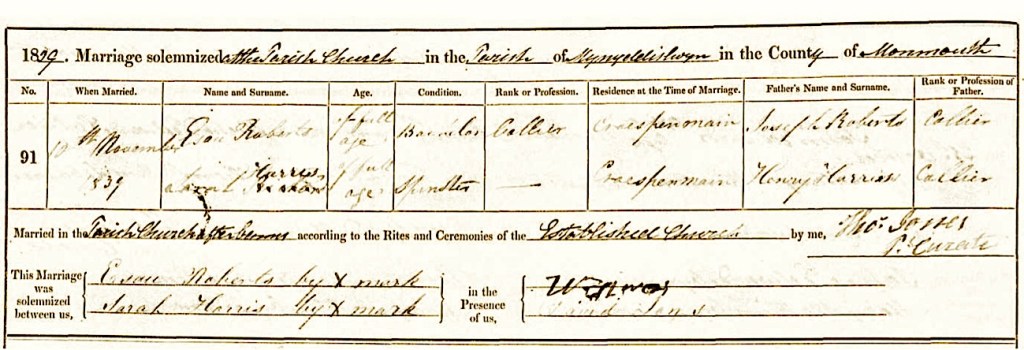
The November 19, 1839 Mynyddyslwyn, Monmouthshire marriage record
for Esau Roberts and Sara Harris.

“They joined in marriage [on] October 11, 1839.” It was not October, it was November 19, 1839. Additionally, “…that year they both left under conviction for their condition, they dedicated themselves to the Lord and went with each other for fellowship in the old church of Penmain, where they were received into communion by Rev. Joshua Thomas, and there they practiced their profession until the year 1838, when they decided to come to America.” That being said, they decided to immigrate to America in 1848, ten years later. (1)

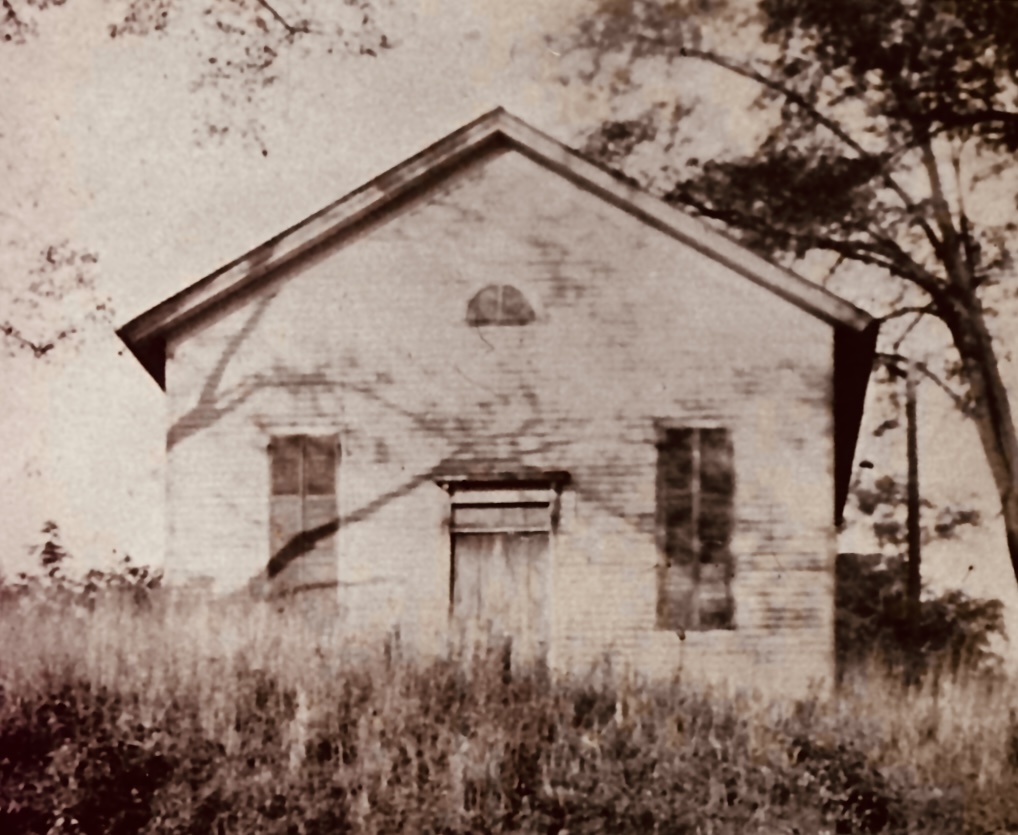
The Old Church of Penmain

From Wikipedia, this is the history of where we believe that they actually resided before immigrating to America — “In 1845, the district of Penmain became an ecclesiastical parish, formed out of the parish of Mynyddislwyn, and in 1855 the Church of St. David was built, having seating for 300 worshippers. Its registers started from 1866.
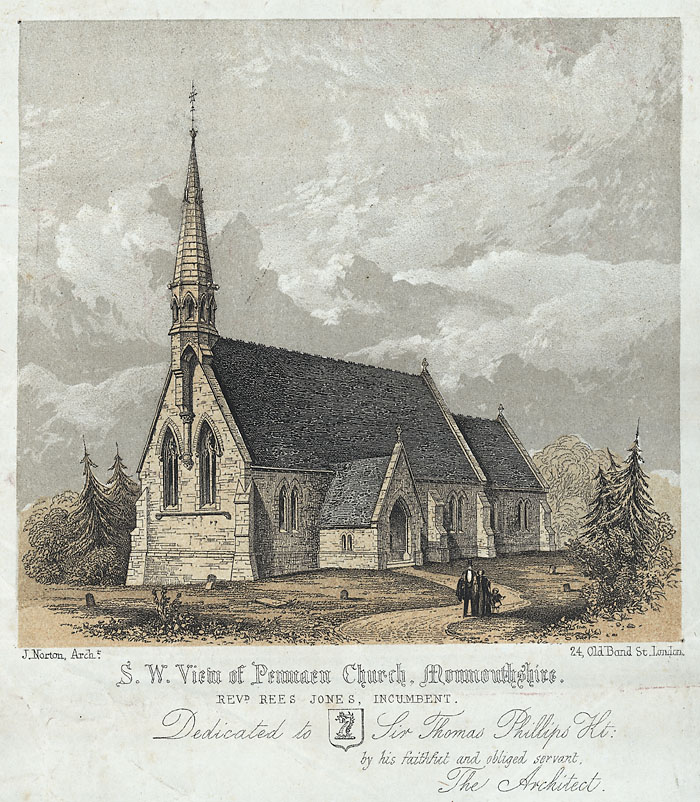
A View of Penmaen Church, by John Norton, circa 1855.
(Image courtesy of Wikimedia Commons via The National Library of Wales).


[Prior to that] In 1618, King James issued the Book of Sports, which relaxed the previous attitudes to Sunday amusements, and set out which times were to be allowed on the Sabbath for these amusements. There was much opposition to this by the clergy, and it continued up to the English Civil War. Afterwards, in 1660, when Charles II came to the throne, he re-introduced it. Many clergymen refused to obey, including Henry Walter, who was dismissed from his position in the Church. He then set up the Independent Chapel at Penmain, although the Nonconformist chapel building was not completed until 1691. Services were held in Welsh. It was rebuilt in 1828, renovated in 1888, and is the second oldest existing Independent Chapel in Wales.” (Wikipedia)

So we can see, that this was a location with a long venerable history. (2)

On the Caleb Grimshaw Ship Manifest

In the late 1840s, many ships were sailing between Great Britain and the New York Harbor area, transporting immigrants who were fleeing the devastation of the “An Gorta Mór or The Great Hunger” in Ireland. But there were many people also traveling from Wales, to work in the coal fields of Ohio and Appalachia.

The long obituary of both Sarah (Harris) Roberts, as published in the Y Cenhadwr Americanaidd (The American Messenger), newspaper, Autumn 1861 issue, states; “On the 7th of April, 1848, they started from there to New York, and they arrived in New York on May 25.” We found them, but it was a bit startling (and also delightful for us) because they were on the Caleb Grimshaw packet ship. This Is the exact same ship voyage and passenger manifest under which the Evan Harris family had traveled. (In fact, the two families are listed near each other on the same page of the manifest. (Please see Chapter Nine on the Harris family, and also for the dramatic history of the Caleb Grimshaw ship).
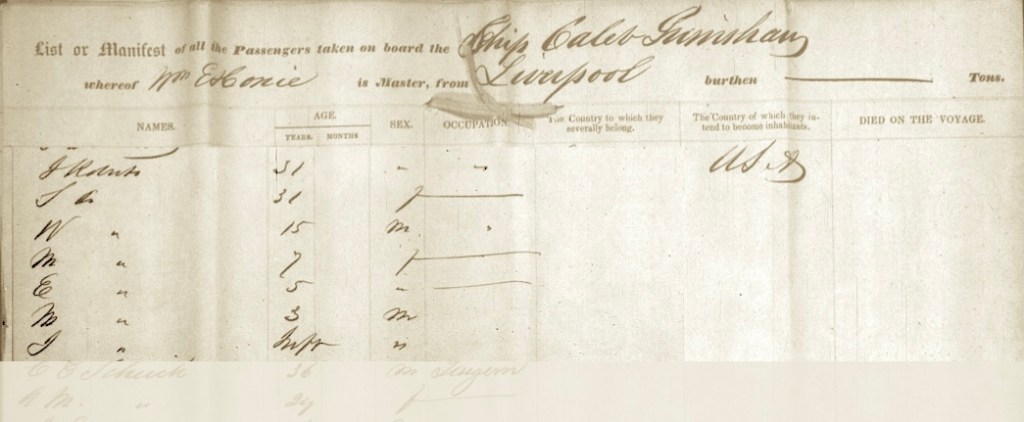
The Roberts family listed on the manifest for the ship Caleb Grimshaw,
with the arrival date in New York of May 27, 1848.

Since Evan Harris and Sara (Harris) Roberts were siblings, this fact reinforces the idea that these two families knew each other in Monmouthshire, Wales. The ship manifest is just further support. Traveling together on this ship was certainly a planned event, since Sara was very pregnant at the time of the ship’s departure from Liverpool. She gave birth to her son John on the voyage.

Of note: Traveling with the Roberts family is a 15 year old young man named ‘W’, as he is listed with them on the Caleb Grimshaw ship manifest. He must have been a relative, but we are not sure of he was connected to Esau and Sara Roberts.
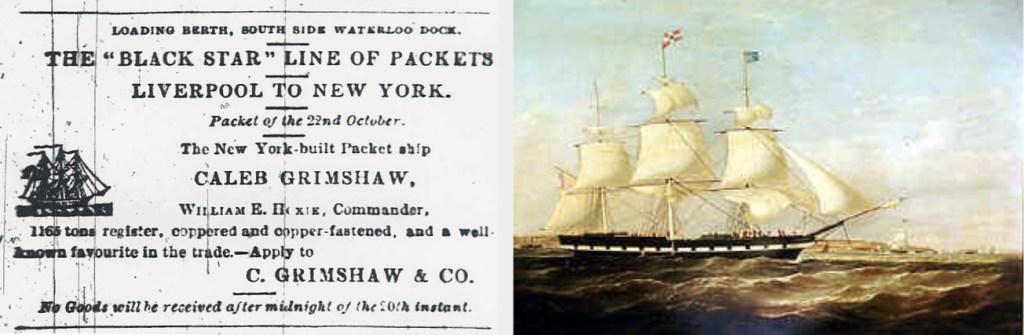
Left to right: Sailing notice for the Caleb Grimshaw to New York,
from the Liverpool Mercury, 1849. Oil painting of the Caleb Grimshaw by Samuel W. Walters,
circa 1848. Walters was considered to be Liverpool’s leading marine artist at the time.
(Both images courtesy of Wikimedia Commons).

We had trouble locating this Roberts family because the passenger manifest had named him Isiah Roberts. Observation: With a traditional Welsh name like E-s-a-u, the head of this family was probably used to having his biblical name misinterpreted by record-keepers in America — or perhaps not? (One gets the feeling that he laughed it off and kept on moving on…) His Welsh accent probably did not help them understand what name he was saying either.

We have encountered his name spelled many ways. Here are a few examples:
Esau, Esay, Essa, Easy, Asa, and Isiah.

Going on, now we can learn about their many children — who are in number, only a few more than the spelling variations which existed for their father Esau’s first name. (3)

On Two Continents and One Ocean

Sarah and Esau had children born over two continents, with one child even being born at sea (between continents!). Consequently, records are a bit scattered.

Birth and death dates for their children
Sarah (Harris) Roberts obituary claims that she was the mother of 14 children. We have been able to locate 10 of them, and wonder if 14 was an accurate number for live births? To reconcile all of these children, we analyzed genealogy records, census data, and cemetery records. We feel that the two lists below are the most accurate representation we can present. Some of the children have left enough records that we have created footnotes for them.

Born In Wales
These children were born in Monmouthshire, Wales and immigrated to America with their parents in 1848.

  • Mary Roberts, born circa 1841
  • Eliza Roberts, circa 1843
  • George Moses Roberts, born circa 1844-1917
  • John Roberts, born at sea on the Caleb Grimshaw, circa 1847

Born in America
These children were born at various locations in Ohio, and Illinois:

  • Anna (Roberts) Miles, 1849-1895
  • Joseph A. Roberts, March 1850- March 1930,
    Joseph carries the family line forward.
  • Benjamin Roberts, 1854-1915
  • William Henry Roberts, 1858-1940
  • Sarah M. (Roberts) Stitt, 1859-1936
  • Hiram Roberts, 1860-1861

They moved quite a bit, which makes us wonder if they were following work locations? The logistics must have been difficult. (4)

Living Here, and Then There…

After they arrived in America, from the obituary of Sara (Harris) Roberts, “They came from there [New York] to Tallmadge. Ohio, [in Summit County] by the 7th September, where they lived seven months in the Independent church of Tallmadge, and loyal to his profession. [During this period, Esau became a naturalized US Citizen at the Summit County Court of Common Pleas in 1853].
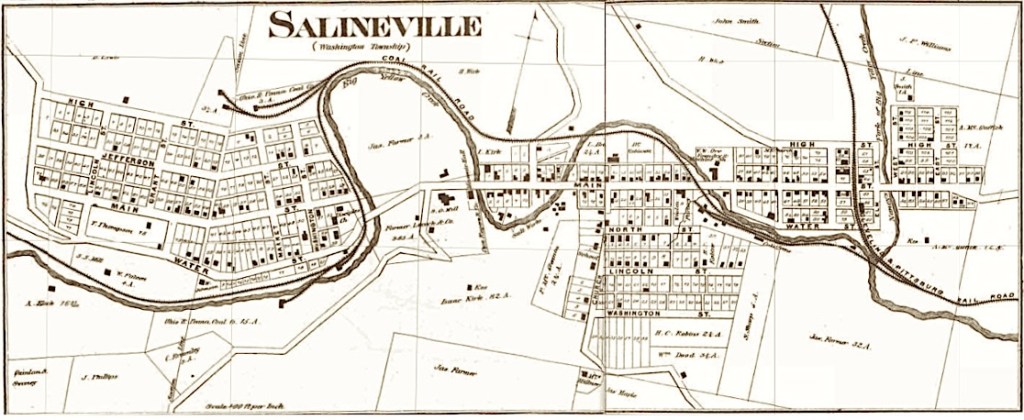
1870 map of Salineville, Washington township, Columbiana County, Ohio.
(Images from the Atlas of Columbiana County, Ohio, 1870, via Family Search).

“They moved from there in the year 1855 to Salinesville, near Wellsville, Ohio. Where they were close with the English; then in 1857 they moved to a place near Danville, Illinois where they lived for about a year and eight months, when they came to the decision to come back to Ohio, and they came here to the Palmyra area in the year 1859.” (Y Cenhadwr Americanaidd)

In Wales, Esau had been a collier, which is the British term for a coal miner. When the arrived in America, it appears that he continued that profession for a few years. They likely moved south to Salineville in Columbiana County because there was coal mining work there.

However, before coal was mined, the area was famous for its salt — an early industry driven by the local brine springs. “…Salt has always played a special role in Salineville’s history, hence the name… Most of the salt mining was not done by sending men down into mines but rather with salt wells that used pressurized water to bring salt to surface. From there the water was boiled off and the salt was transported to the Ohio River where it was then exported around the across the country.” (The Review)

The family only stayed in Salineville for about two years, and then they moved to Illinois for another two years, but after that, they returned to Ohio. (5)

1860 Agricultural Schedule for Palmyra township, Portage County, Ohio

Palmyra

The next time we encounter a record about this family, they are back in Ohio according to the 1860 US Census. It looks as if prosperity has finally arrived on their doorstep (!), and that Esau has decided to be a farmer. He reports the following for the July 1860 Agricultural Schedule:

  • 96 acres of land
  • $3,400 Cash value of the farm
  • $100 value of farming equipment
  • 3 horses
  • 9 milking cows
  • 3 other cattle
  • 65 sheep
  • 100 bushels of ‘Indian’ corn (field corn)
  • 100 bushels of oats

So, where did all of this prosperity come from (so quickly) for a man who was a coal miner most of his life? When did he develop the desire to be a farmer?

We are not sure what happened, but at this same time, Sara’s two brothers (Evan and William H.) who lived in nearby Tallmadge, were making quite a bit of money from their work with coal mining leases. Perhaps they decided to help out their sister and her husband and their very large family. Being settled in the area, with other family members around, provided some comfort and stability.
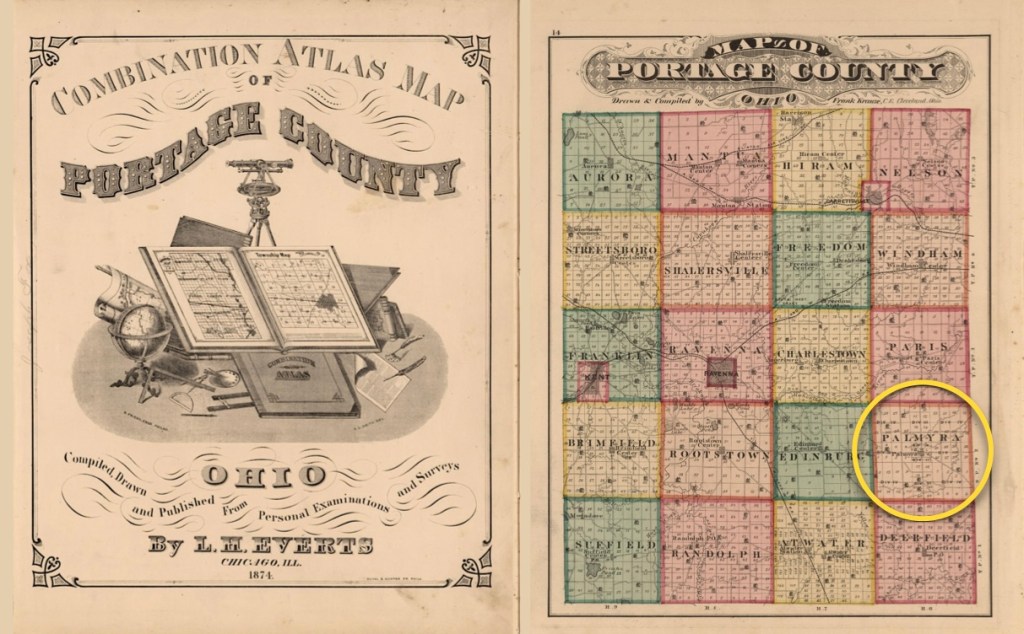
Frontispiece and Portage County map from the
Combination Atlas Map of Portage County, Ohio, by L.H. Everts, 1874.
(Image courtesy of David Rumsey Map Collection).
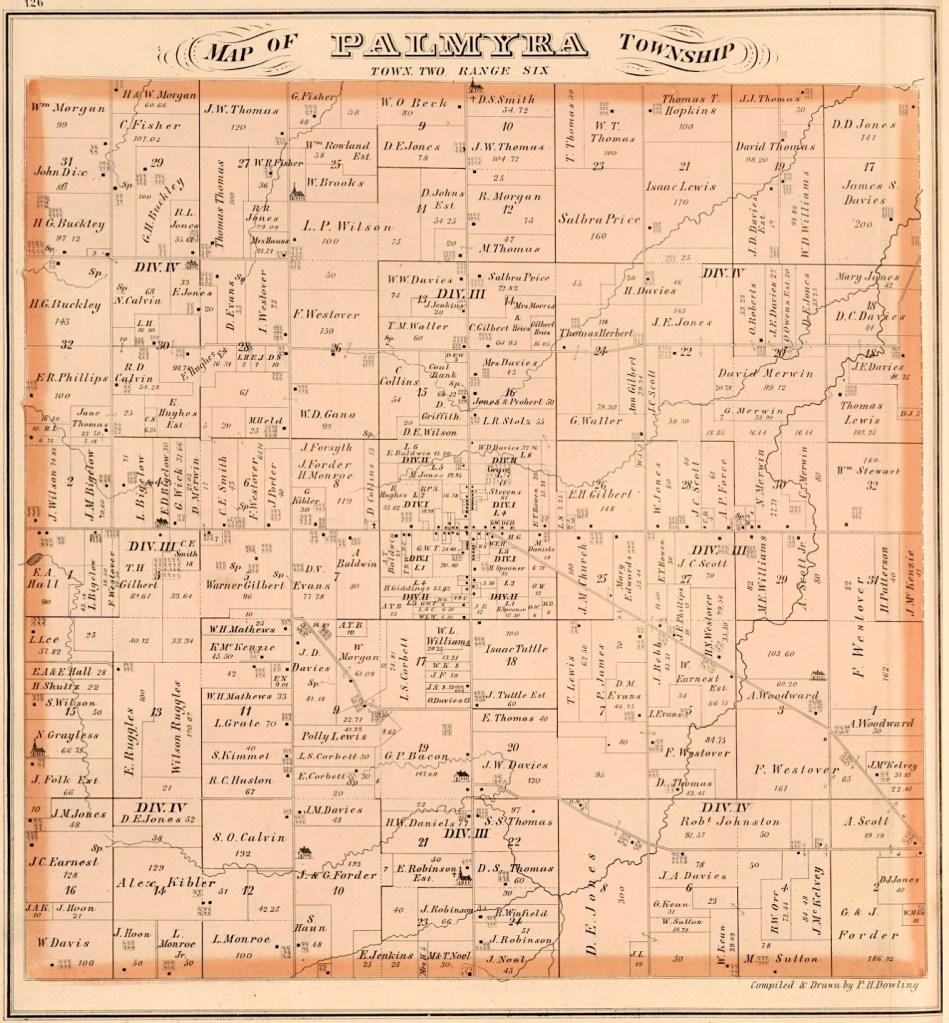
Page 126, Palmyra Township, Portage County, Ohio,
by L.H. Everts, 1874. (Image courtesy of David Rumsey Map Collection).

“The wish of Mrs. Roberts was to live in Palmyra since she first saw the area. They bought a farm here, and she lived here for nearly two years, and on the 22nd of April last they buried their little son, of 1 year and 18 days old — his disease — was (croup). The funeral was officiated by our parish minister Mr. Lloyd.” (Y Cenhadwr Americanaidd)

The child who died was their youngest son Hiram Roberts. “And after about seven weeks after the death of their son, Mrs. Roberts is very sick. The doctor was immediately sought, but despite all the ill devices our dear sister, and another doctor was requested, but despite getting help from a doctor, through everything all comfort failed, he could not work his way, and signs of death were to be found…” (Y Cenhadwr Americanaidd)

Sara (Harris) Roberts passed away on June 25, 1861, from causes that are not indicated in the records. She was 44 years old. In the footnotes, we have included her actual obituary originally published in the Welsh language. We have also translated the document into English.
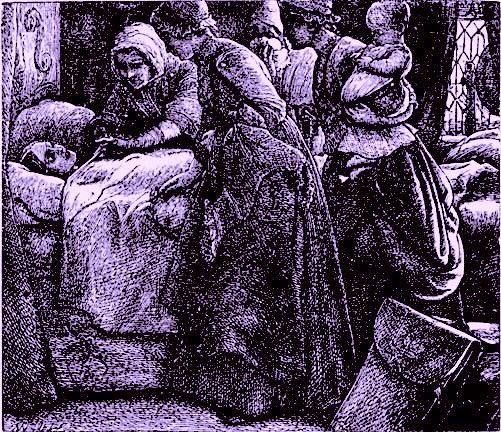
Deathbed engraving from The Lord of Burleigh, by John Everett Millais, circa 1857.
From an 1857 London book titled, Poems by Alfred Tennyson.
(Image courtesy of The Victorian Web).

Her death must have been devastating for Esau. These dark clouds in his life were about to get even darker because 1861 was also the beginning of the American Civil War. “The American Civil War (1861–1865) is the deadliest war in U.S. history, with an estimated 620,000 to 750,000 soldiers dying. This death toll exceeds the combined fatalities of Americans in World War I and World War II, representing a higher loss of life than all other American wars combined until roughly the Vietnam War.” (American Battlefield Trust)

When looking at the patterns in his life, and considering that his wife had just suddenly died, one gets the impression that he decided to just withdraw into himself. This is reinforced from reading the comments about him in his obituary, such as “He buried his wife, July, in 1861, which greatly affected his mind, and in poor health for some years after that… [and], He saw a lot of success and failure. He collected a lot of money through his zeal, and he lost a lot of money because of commercial misfortunes, and his willingness to put too much trust in men. He seems to be a man without a bad mind, and believes the best about people and things, or is thus caught unawares to himself.”

He changed his life away from the farmer’s life he had adopted, and retreated into what he knew earlier in life. (6)
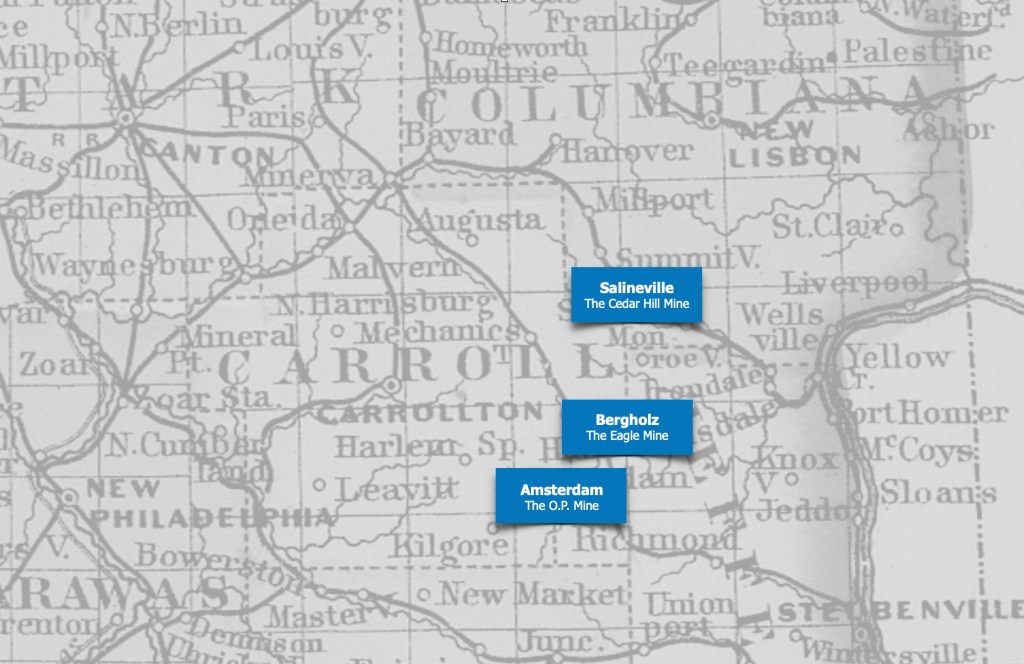
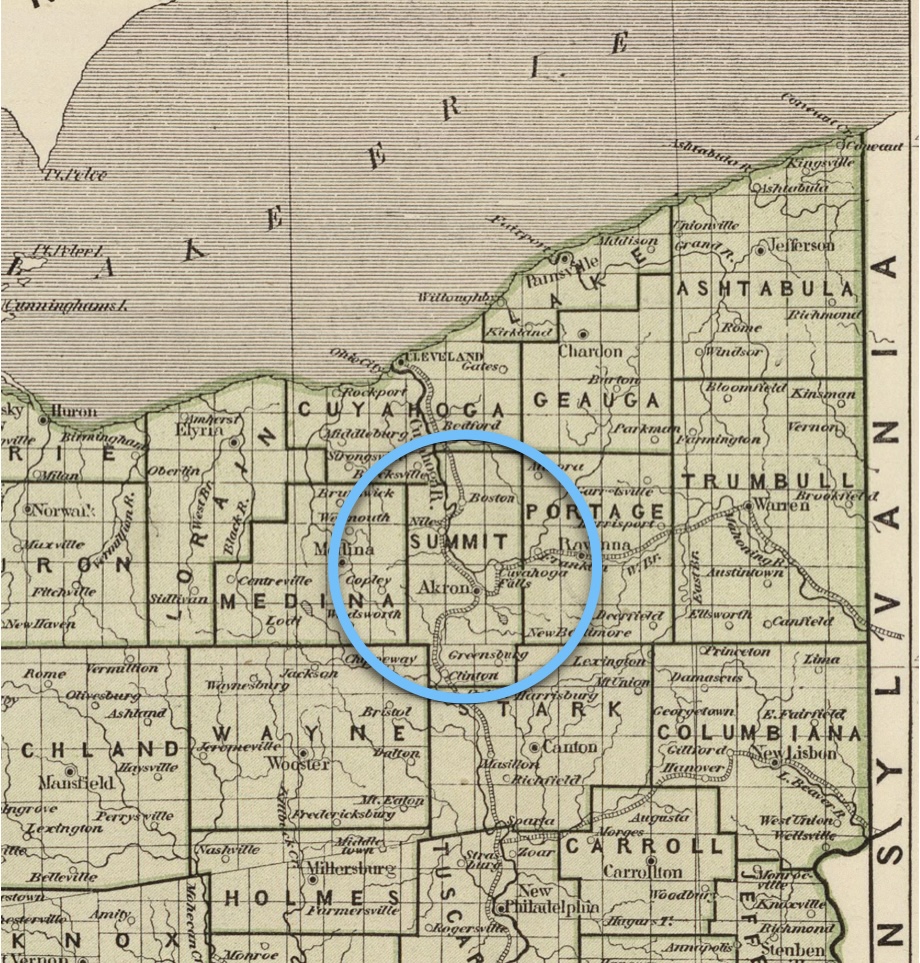
The background map is derived from Ohio, by Samuel Augustus Mitchell, circa 1890. (Image courtesy of the David Rumsey Map Collection).

Esau’s Life After Sara’s Death

The borders where Columbiana County and Carroll County meet, contains the Amsterdam / Salineville coalfield, where there is a cluster of several mines. Esau could have worked at any of these locations when he was younger, but as he aged, he likely stayed near the Salineville coal mines. Among the mine names from that era are the following:

  • Salineville: The Cedar Hill Mine
  • Bergholz: The Eagle Mine, and the Lewis Mine
  • Amsterdam: The O.P. Mine, the Amsterdam Mine, the Wolf Run Mine, and the Jessie Mine

In The 1870 and 1880 Censuses, we see that Esau had returned to the part of Ohio where he lived before his wife Sara passed away. In 1870, he is found in Fox township, Carroll County, working again (at age 53), as a coal miner. Ten years later in 1880, the Census notes that “He is noted as a retired coal dealer.” We observed that his age is correctly recorded as his being 63.
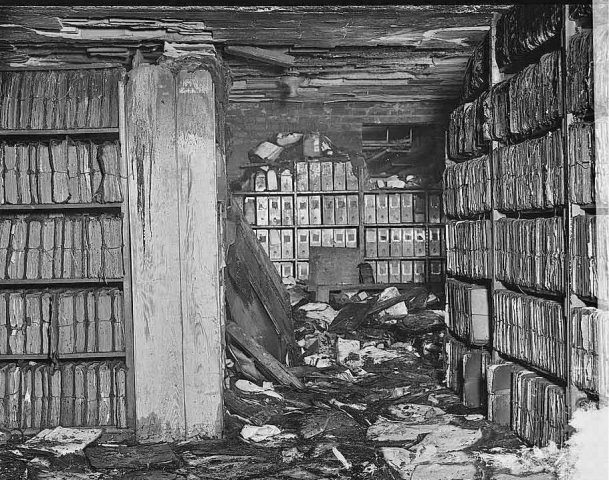
A fire destroyed the majority of the 1890 Census records stored in the basement
of the U.S. Department of Commerce on January 10, 1921.
(Image courtesy of The United States Census Bureau).

The 1890 Census was lost in a fire in the 1920s, so for the last full decade of his life, we do not know where he is. The United States Census Bureau writes about this tragedy, “A January 10, 1921 fire at the U.S. Department of Commerce building in Washington, DC, destroyed the majority of the population schedules from the 1890 Census. The fire left an enormous gap in many families’ genealogical record. Although alternative records may provide some information, the loss of the 1890 Census schedules remains an insurmountable obstacle for many researchers attempting to trace families between the 1880 and 1900 censuses.” (Census.gov) Between the fire, the water used to put the fire out, and the subsequent degradation of what was left through mold, mildew and decay… much was utterly lost.

Esau passed away in June 1891, just over 30 years after his wife Sarah had passed away. He was about 74 years old when he finally set down his coal shovel. Like his wife, there was a very long obituary published about his life. His is in the Welsh language newspaper Y Drych, in the February 2, 1892 issue. In the footnotes, we have included his actual obituary originally published in the Welsh language. We have also translated the document into English.
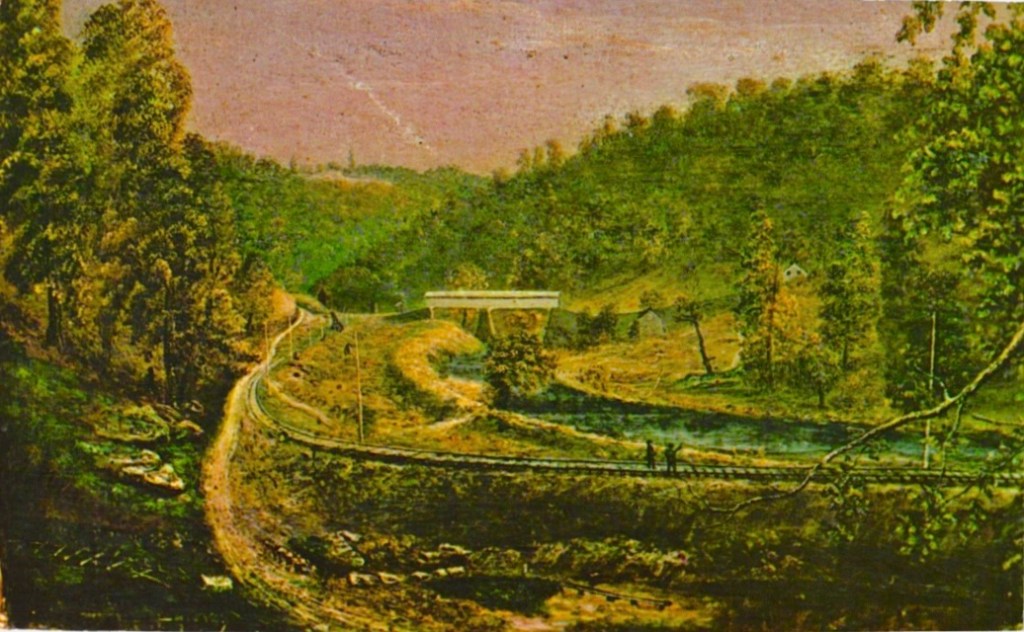
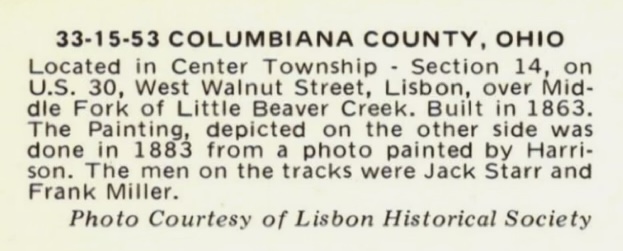
Vintage postcard of a Covered Bridge in Columbiana County, Ohio, circa 1883.
(Image courtesy of Ebay, via The Lisbon Historical Society).

The Find A Grave file for Esau closes with this comment, “The old pilgrim Henry Roberts, who is so well known in this part of the State, is the brother of Esau Roberts, and the oldest of the tealu that remains. He is also in the push of age, but his gait is straight and lively. – Friend.

The old Welsh word tealu, translates as the English word for — family.

Upcoming is our last chapter in the Williams / Harris Line, in which we learn about the life of Esau’s son Joseph A. Roberts, and his wife Augusta Young.

Following are the footnotes for the Primary Source Materials,
Notes, and Observations

Genealogy Gold!

(1) — three records

Y Cenhadwr Americanaidd (The American Messenger)
Autumn 1861
https://viewer.library.wales/2834819#?xywh=-3911,-1023,10309,5902
Book pages: 384-385, Digital pages: 24-25/40, (see the note following)
Note: The link above is the Permalink for the publication. To get to the file “A Brief Memory of Mrs. Sarah Roberts” you must enter 24 of 40 into the upper data field. This obituary covers two pages, 24 and 25.

Sara Harris
in the England & Wales, Non-Conformist and Non-Parochial Registers, 1567-1936
Rg4: Registers of Births, Marriages and Deaths > Monmouthshire > Independent > Piece 1246: Penmain (Independent), 1787-1833
https://www.ancestry.com/search/collections/2972/records/168121?tid=11298446&pid=182338476831&ssrc=pt
Digital page: 90/159, Left page.
Note 1: For her April 1, 1817 birth date and baptism record.
Note 2: Even though her FindaGrave file lists an 1819 birthdate, her birth / baptism record from Wales is 1817.

Esau Roberts
in the Monmouthshire, Wales, Anglican Baptisms, Marriages and Burials, 1551-1994
Llandenny > Mixed > 1710-1919
https://www.ancestry.com/search/collections/62107/records/215961?tid=&pid=&queryId=20a43592-6a87-4e7d-951e-989f80bb91e4&_phsrc=Lml27&_phstart=successSource
Book page: 4, Digital page: 212/1070, Left page, Entry No. 31, 7th of 8 entries. 
Note 1: His actual baptism date is December 28, 1817. It appears that he was the very last entry for the year 1817. > Lianhilleth, Monmouthshire
Note 2: His parents names are Joseph and Anne.
Note 3: His father is also a collier, (a coal miner).

The Old Church of Penmain

(2) — five records

Sarah Harris
in the Monmouthshire, Wales, Anglican Baptisms, Marriages and Burials, 1551-1994
Mynyddislwyn > Marriages and Banns > 1777-1906
https://www.ancestry.com/search/collections/62107/records/549329?tid=&pid=&queryId=a8dd07e6-6d4b-4589-96e2-e3189a00161e&_phsrc=ZcF21&_phstart=successSource
Book page: 46, Digital page: 279/933, Upper entry.
Note 1: The actual marriage date is November 19, 1839.
Note 2: We can see that his father’s name is Joseph, and her father’s name is Henry Harries.
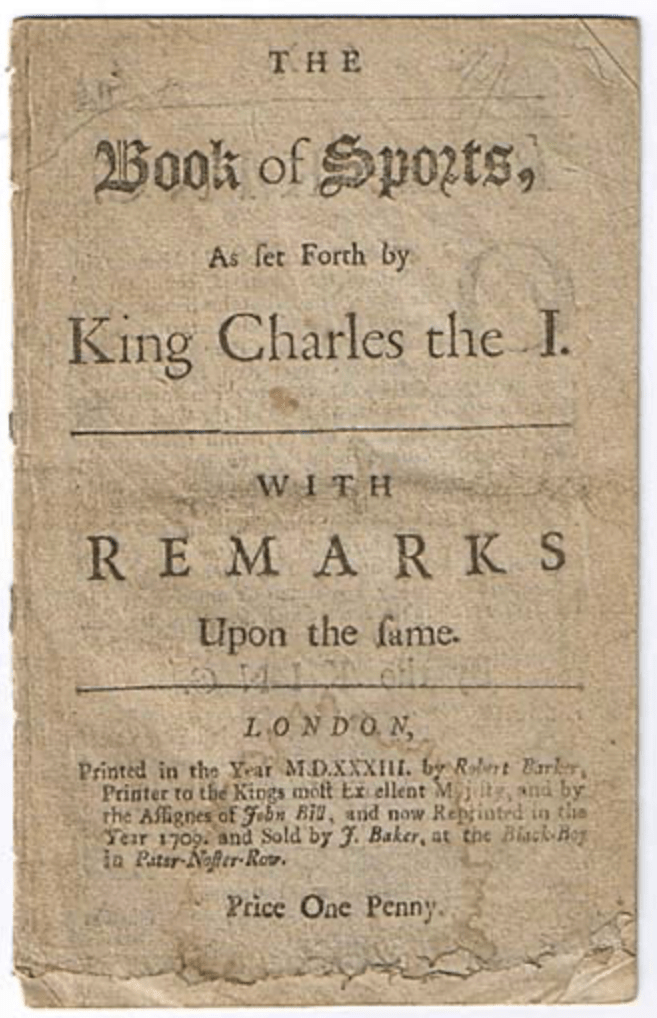
This is what caused all of the hubbub in Penmain. (Image courtesy of https://en.wikipedia.org/wiki/Declaration_of_Sports#/media/File:Book_of_Sports.jpg).

Penmaen, Caerphilly
https://en.wikipedia.org/wiki/Penmaen,_Caerphilly
Note:
For the text.

A View of Penmaen Church
by John Norton, circa 1855
File:S. w. view of Penmaen Church, Monmouthshire.jpeg
https://commons.wikimedia.org/wiki/File:S._w._view_of_Penmaen_Church,_Monmouthshire.jpeg
Note: For the church image.

Essa Roberts
in the 1841 Wales Census
Monmouthshire > Mynyddyslwyn > ALL > District 5
https://www.ancestry.com/search/collections/8979/records/8358032?tid=&pid=&queryId=3478cf31-8920-4554-b4ce-375451305f30&_phsrc=wFr2&_phstart=successSource
Book page: 6, Digital page: 3 /9, Right page, middle.
Note 1: Essa 20, Sara 20, Mary 8 months.
Note 2: This Census was conducted in June 6, 1841, therefore, daughter Mary was born in September 1840.
Note 3: His profession is as a collier (a coal miner).

On the Caleb Grimshaw Ship Manifest

(3) — five records

Isiah Robert
in the New York, U.S., Irish Immigrant Arrival Records, 1846-1851
https://www.ancestry.com/search/collections/5969/records/512126?tid=&pid=&queryId=c14b932a-3a3b-4b44-b74f-43453e5d89fb&_phsrc=vDv43&_phstart=successSource
Note: For the passenger ship record.

New York, Passenger Lists, 1820-1920
Path: Follow these links to arrive at the Caleb Grimshaw passenger manifest for May 27, 1848:
> https://www.familysearch.org/en/search/image/index?owc=http://platform.prod.us-east-1.prod.fslocal.org/records/collections/1849782/waypoints
>> NARA Roll Number – Content, 0072 – 9 May 1848-31 May 1848
>>> https://www.familysearch.org/ark:/61903/3:1:939V-5K6B-8?wc=MX62-DZS:165749401&cc=1849782&cc=1849782&lang=en&i=525
Digital page: 526/838, Film # 004678332,
Note 1: There are 7 people listed at the bottom of the page, by their first initial and then the Roberts surname.
Note 2: Esau Roberts is listed under the name Isiah Robert along with his family.
Note 3: This is the same ship the Evan Harris family traveled on, and they are listed on the same page of the passenger manifest.

Willm. Robert
in the New York, U.S., Irish Immigrant Arrival Records, 1846-1851
https://www.ancestry.com/search/collections/5969/records/512133?tid=&pid=&queryId=962cf719-1047-4b48-83a5-5c11de55bc64&_phsrc=upI15&_phstart=successSource
Note: This is the file for the 15 year old young man who was traveling with the Esau and Sara Roberts family on the Caleb Grimshaw and is listed with them on the ship manifest. He must have been a relative, but we are not sure of he was connected to Esau and Sara Roberts.

Caleb Grimshaw
https://en.wikipedia.org/wiki/Caleb_Grimshaw#:~:text=4%20References-,Construction,May%201848%20and%20August%201849.
Note: For the Liverpool Mercury sailing notice and oil painting portrait of the ship.

On Two Continents and One Ocean

(4) — seven records

Mary Roberts
The 1841 Wales Census was conducted in June 6, 1841, when Mary was reported as being 8 months old. Therefore, she was born in September 1840.
https://www.ancestry.com/search/collections/8979/records/8358032?tid=&pid=&queryId=3478cf31-8920-4554-b4ce-375451305f30&_phsrc=wFr2&_phstart=successSource

Pvt George Moses Roberts
in the U.S., Find A Grave Index, 1600s-Current
https://www.ancestry.com/search/collections/60525/records/14346230
Note: George’s dates are August 10, 1844 to October 7, 1917.

Anna Roberts Miles
https://www.findagrave.com/memorial/80507437/anna-miles
Note: Anna’s dates are 1849 to December 4, 1895.

Benjamin Roberts
in the West Virginia, U.S., Deaths Index, 1853-1973
https://www.ancestry.com/search/collections/2568/records/2433079?tid=&pid=&queryId=db2c1a03-880f-400e-bebe-cb200b3fe816&_phsrc=dRA9&_phstart=successSource
Note: Benjamin’s dates are September 16, 1853 to August 3, 1915.

William H Roberts
in the 1910 United States Federal Census
https://www.ancestry.com/search/collections/7884/records/21539401
Note: For his birth year of 1858.
and
Wm Henry Roberts
in the Ohio, U.S., Death Records, 1908-1932, 1938-2022
Note: For his death date of August 25, 1940. Therefore, William’s dates are 1858 to August 25, 1940.

Sarah M Stitt
https://www.findagrave.com/memorial/78161907/sarah_m-stitt
Note: Sarah’s dates are 1859 to September 28, 1936.

Hiram Roberts
https://www.findagrave.com/memorial/89972944/hiram-roberts
Note: Hiram’s dates are April 5, 1860 to April 21, 1861

Living Here, and Then There…

(5) — five records

Asa [Esau] Roberts
in the 1850 United States FederalCensus
Ohio > Summit > Tallmadge
https://www.ancestry.com/search/collections/8054/records/19600952?tid=&pid=&queryId=591d7f74-4498-4108-a115-cbca010a5633&_phsrc=CZn1&_phstart=successSource
Digital page: 22/60, Lines 36 through 42
Note: ‘Asa’34, Sarah 20*, Mary 9, Eliza 7, Moses 5, John 4, Ann 7/12.
*The mother is mis-labeled? She should be about 33 years old at this point.
Observation: All the people in this census, including this family, are listed as being from England. For some reason, no one is listed as being from Wales. Was this a problem with the enumerator, or were the census-takers guided to write England, or United Kingdom if someone was from Wales?

Easy [Esau] Roberts
in the Ohio, U.S., County Naturalization Records, 1800-1977
https://www.ancestry.com/search/collections/60096/records/89211
Note: In the Court of Common Pleas, Summit, Ohio

Salineville, Ohio
https://en.wikipedia.org/wiki/Salineville,_Ohio
Atlas of Columbiana County, Ohio, 1870
by DJ Lake and Jean Sansenbaugher Morris
https://www.familysearch.org/library/books/records/item/619005-atlas-of-columbiana-county-ohio-1870-1902?offset=503981
Note 1: Salineville is located within Washington township. That map is plate 49, Digital page 45 of 266.
Note 2: The Salineville map is plate 53, which follows on Digital pages 46 -47 of 266.

The Review
https://www.reviewonline.com/news/community-news/2013/07/salt-festival-begins-today/
Note: For the text about the salt mining history in Salineville, Ohio.

Palmyra

(6) — nine records
David Rumsey Map Collection
Palmyra Township, Portage County, Ohio
from the Combination Atlas Map of Portage County, Ohio
by L.H. Everts, 1874
https://www.davidrumsey.com/luna/servlet/detail/RUMSEY~8~1~230086~5508390:Palmyra-Township%2C-Portage-County%2C-O?sort=pub_list_no_initialsort%2Cpub_date%2Cpub_list_no%2Cseries_no&mi=3&trs=7&qvq=q:Palmyra%20Township;sort:pub_list_no_initialsort%2Cpub_date%2Cpub_list_no%2Cseries_no;lc:RUMSEY~8~1
Book page: 126, Digital page: Follow the link above.
Note: For the 1874 Palmyra township map, the Atlas frontispiece, and the Portage County map.

Easy [Esau] Roberts
in the U.S., Selected Federal Census Non-Population Schedules, 1850-1880
Ohio > Agriculture > 1860 > Portage > Palmyra
https://www.ancestry.com/search/collections/1276/records/5895680?tid=&pid=&queryId=4b9cbced-d8c7-4659-96b7-9354811f43a7&_phsrc=nJE6&_phstart=successSource
Digital page: 1/6, Line 25.

Esay [Esau] Roberts
in the 1860 United States Federal Census
Ohio > Portage > Palmyra
https://www.ancestry.com/search/collections/7667/records/41939084?tid=&pid=&queryId=1b5f435d-cb53-481c-ba89-b0848e8e4693&_phsrc=nJE3&_phstart=successSource
Book page: Digital page, Lines through
Book page: 19, Digital page, 19/28 Lines 2 through 11.
Note: Esau 42, Sarah 17*, Eliza 17, Morris** 15, John 13, Ann 10, Joseph 9, Benjamin 6, Henry*** 5, Sarah M. 2, Hiram 3/12.
*The mother is mis-labeled? She should be about 43 years old at this point.
**This is George Morris Roberts.
*** This is William Henry Roberts.

Sarah Roberts
in the U.S., Find A Grave Index, 1600s-Current
https://www.ancestry.com/search/collections/60525/records/22712016
and
Sarah Harris Roberts
https://www.findagrave.com/memorial/43457288/sarah-roberts
Note 1: Her dates are 1819* to June 25, 1861.
Note 2: *Her actual birthdate is 1817 as per her birth record.
Note 3: About Alice Holland…
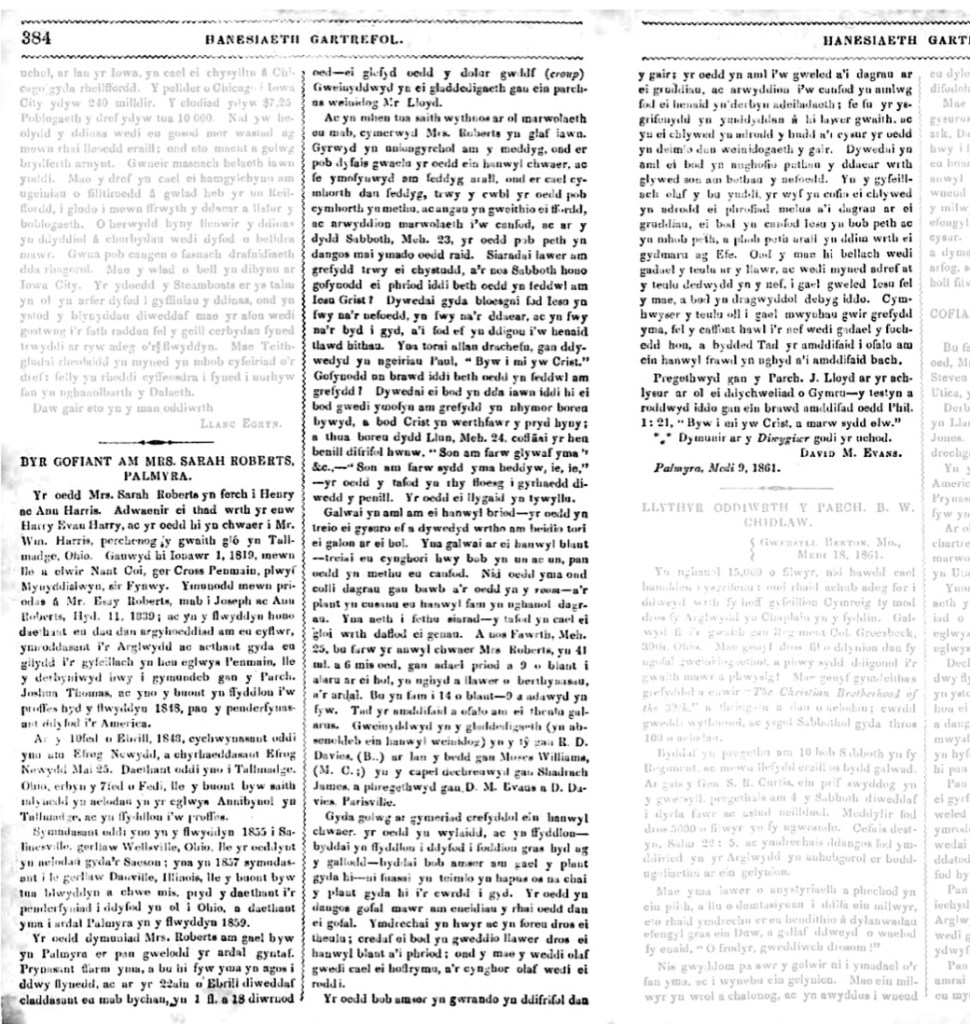
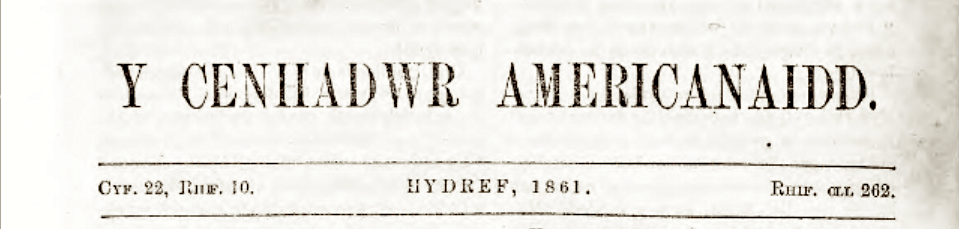
Y Cenhadwr Americanaidd (The American Messenger)
Autumn 1861
https://viewer.library.wales/2834819#?xywh=-3911,-1023,10309,5902
Book pages: 384-385, Digital pages: 24-25/40, (see the note following)
Note: The link above is the Permalink for the publication. To get to the file “A Brief Memory of Mrs. Sarah Roberts” you must enter 24 of 40 into the upper data field. This obituary covers two pages, 24 and 25.

Here is her obituary translated into English, but please remember that there are many factual errors (in the original below) which we have corrected (in this narrative).

__________________________________

A Brief Memory of Mrs. Sarah Roberts

It was Mrs. Sarah Roberts daughter of Henry and Ann Harris. Her father is known as the boy Harry Evan Harry, but she was the sister of Mr. Wm. Harris, owner of a colliery in Tallmadge, Ohio. She was born January 1, 1819, in a place called Nant Coi, near Cross Penmain, Mynyddislwyn, Monmouthshire.

He joined in marriage to Mr. Esay Roberts, son of Joseph and Ann Roberts, Oct. 11, 1839; and yes that year they both left under conviction for their condition, they dedicated themselves to the Lord and went with each other for fellowship in the old church of Penmain, where they were received into communion by Rev. Joshua Thomas, and and there they practiced their profession until the year 1818, why they decided to come to America.

On the 7th of April, 1848, they started from there to New York, and and they arrived in New York on May 25. They came from there to Tallmadge. Ohio, by the by the 7th September, where they lived seven months in the Independent church of Tallmadge, and loyal to his profession.

They moved from there in the year 1855 to Salineville, near Wellsville, Ohio. Where they were close with the English; then in 1857 they moved to a place near Danville, Illinois where they lived for about a year and eight months, when they came to the decision to come back to Ohio, and they came here to the Palmyra area in the year 1859.

The wish of Mrs. Roberts was to live in Palmyra since she first saw the area. They bought a farm here, and she lived here for nearly two years, and on the 22nd of April last they buried their little son, of 1 year and 18 days old — his disease — was (croup). The funeral was officiated by our parish minister Mr. Lloyd.

And after about seven weeks after the death of their son, Mrs. Roberts is very sick. The doctor was immediately sought, but despite all the ill devices our dear sister, and another doctor was requested, but despite getting help from a doctor, through everything all comfort failed, he could not work his way, and signs of death were to be found, and on the Sabbath day, June 23, everything showed that it was necessary to leave. She spoke a lot about religion through her affliction, and that Sunday night her husband asked her what she thought of Jesus Christ? He said with pride that Jesus was greater than the heavens, greater than the earth, and greater than the whole world, and that he was angry with his poor little soul. Then he broke out again, saying in Paul’s words, “Christ is my life.” A brother asked her what she thought about religion? He said that it was the dawn season of life, and that Christ was precious at that time; and about Monday morning, June 24, he remembered that old solemn verse, “I hear talk of death here’ & c., — Talk of death here today, yes, yes” — the tongue was too weak to reach the end of the verse. Eyes were darkening.

She often called for her beloved husband — she tried to comfort him and told him not to break his heart after her. Then she called her beloved children — she tried to advise them one by one, when she couldn’t find them. There was nothing but tears to be shed by everyone who was here but tears to be shed by everyone who was in the room — and the children kissing their dear mother in the midst of tears. Then she became unable to speak — the tongue was locked to the roof of her mouth. And Tuesday night, Jun. 25, the dear sister Mrs Roberts died at 41 years and 6 months old, leaving a spouse and 9 children to mourn her, along with many relatives, and the area. She was the mother of 14 children — 9 of whom were left alive. The father of the orphans will take care of her mourning. The funeral was officiated (in the absence of our beloved pastor) in the house by R. D. Davies (b..) at the graveside of Moses Williams, (M.C.;) in the chapel started by Shadrach James, and preached by D. M. Evans and D. Davies, Parisville.

With regard to the religious character of our dear sister she was humble, and faithful — she would be willing to come and meet grace as far as she could — but she always wanted to have the children with her — she would not have felt happy if the children were not with her for all the meetings. She showed great care for the souls of those under her care. She struggled day and night for her family; I believe that she prays a lot for her beloved children and her husband; but the last prayer has been offered, and the last advice has been given.

He always listened seriously under the word; she was often to be seen with tears on her cheeks, and signs to be found clearly that her soul was receiving edification; he wrote that he spoke to her many times, and hearing her recount the benefit and comfort she felt under the ministry of the word. She often says that she forgets the things of the earth when she hears talk of the things of the heavens. In the last friendship she had, I remember her saying her sweet experience and her tears on her cheeks, that she finds Jesus in everything and in everything, and everything else is nothing compared to Him. But she has now left the family on the floor, and gone home to the happy family in heaven, to be able to see Jesus as he is, and be eternally like him. Let the whole family be allowed to increase true religion here, so that they will have a right to heaven after leaving this life, and may the Father of the orphans take care of our dear brother together with his little orphans. Preached by Rev. J. Lloyd on the occasion after his return from Wales – the text given to him by our orphan brother was Phil. 1:21, “To me is Christ, and to die is gain.”

It is desired that the Reformer raise the above.
David M. Evans
Palmyra, September 9, 1861
__________________________________

American Battlefield Trust
Civil War Casualties
The Cost of War: Killed, Wounded, Captured, and Missing

https://www.battlefields.org/learn/articles/civil-war-casualties#:~:text=The%20Civil%20War%20was,casualties%20unprecedented%20in%20American%20history.
Note: For the statistics and text.
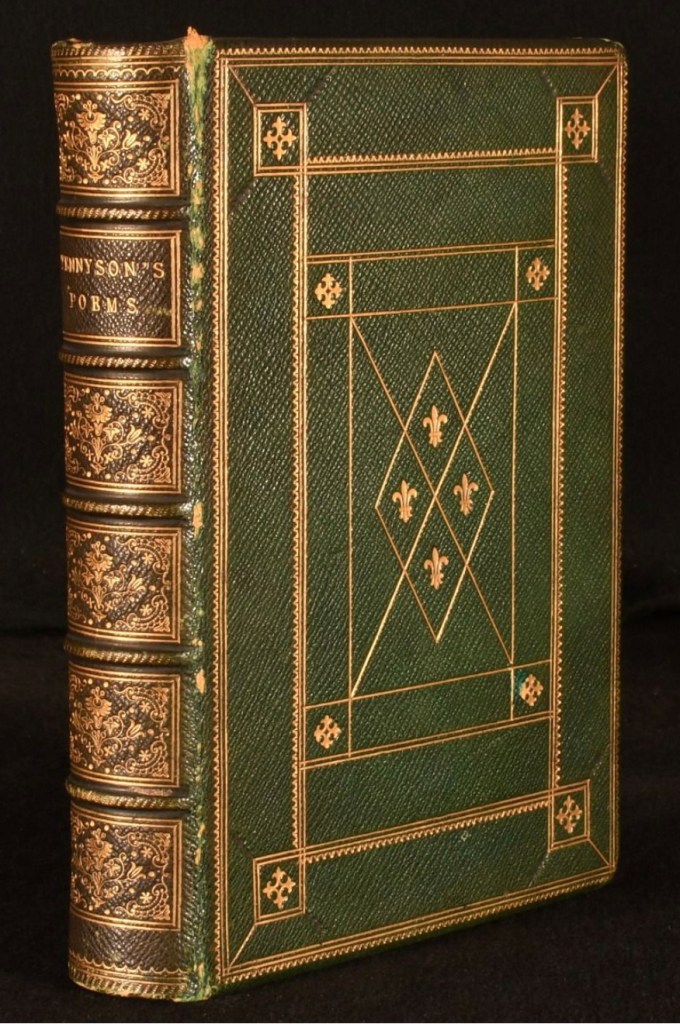
The 1857 edition of Tennyson’s Poems, via: Rooke Books,
https://www.rookebooks.com/1857-poems-alfred-lord-tennyson-first-illustrated-edition

The Victorian Web
Deathbed engraving from The Lord of Burleigh
by John Everett Millais, circa 1857
https://www.victorianweb.org/art/illustration/millais/18.html
Note: This was used in an 1857 London book titled, 
Poems by Alfred Tennyson, D.C.L., Poet Laureate.

Esau’s Life After Sara’s Death

(7) — eleven records

Amsterdam-Salineville Coalfield
https://www.coalcampusa.com/eastoh/amsterdam/amsterdam.htm
Note: For the mine location information.

David Rumsey Map Collection
Ohio. (Mitchell, Samuel Augustus), 1890
[Full title — County & township map of the states (sic) of Ohio and (sic).]
by Samuel Augustus Mitchell, (1890)
https://www.davidrumsey.com/luna/servlet/detail/RUMSEY~8~1~30579~1140106:County-&-township-map-of-the-states
Note: For the grouping of northeastern and eastern Ohio counties: Summit, Portage, Columbiana, and Carroll County.

Esay [Esau] Roberts
in the 1870 United States Federal Census
Ohio > Carroll > Fox
https://www.ancestry.com/search/collections/7163/records/39503557
Book page: 19, Digital page, 19/28 Lines 2 through 11.
Note 1: The location is Fox township, Carroll County, Ohio and he is again working as a miner — Esau 53, William H. 13, Sarah M. 11. We believe that Richard 30, could be a relative. Joseph 22 may also be another relative, but he is not his son. (His son Joseph is 20 years old and living in Paris township, Portage County).
Observation: As in 1850, all the people in this census, including this family, are listed as being from England. For some reason, no one is listed as being from Wales. Was this a problem with the enumerator, or were the census-takers guided to write England, or United Kingdom if someone was from Wales?
Note 3: Richard is likely a relative, we just have not learned how he connects to the family, but we discovered this —
Note 2:
Richard Roberts
https://www.findagrave.com/memorial/135279983/richard-roberts
Richard died in the Atwater Mining Disaster in Portage County, Ohio, see: https://atwaterhistoricalsociety.wordpress.com/coal-mines/
Also, here is an article from the Atwater Historical Society link (just above), which records the disaster:
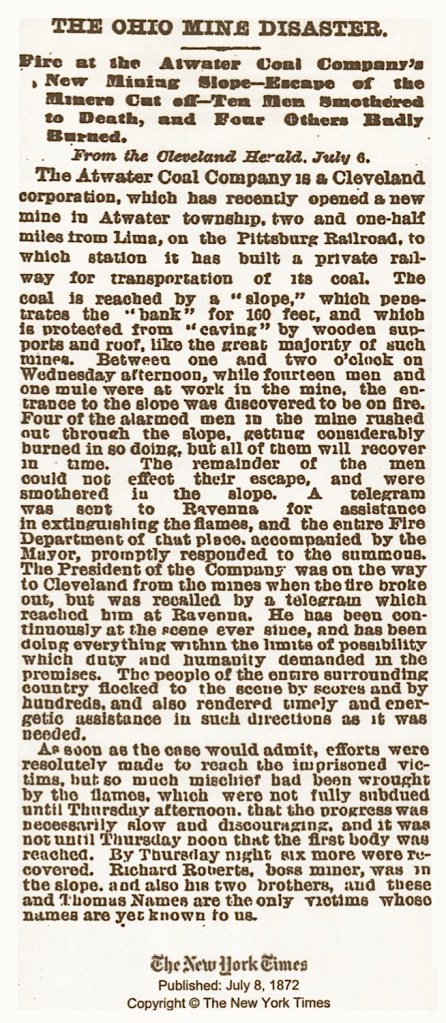
Atwater Mine Disaster article courtesy of the Atwater Historical Society.

Esay [Esau] Roberts
in the 1880 United States Federal Census
Ohio > Carroll > Fox > 034
https://www.ancestry.com/search/collections/6742/records/25102186?tid=&pid=&queryId=711124be-5614-4da4-b181-1a5dd56ffc35&_phsrc=nJE4&_phstart=successSource
Book page: 31, Digital page,31/31 Line 6.
Note: He is noted as a retired coal dealer.

Census.gov
The United States Census Bureau
History and the Census: 1890 Census Fire
https://www.census.gov/about/history/stories/monthly/2021/january-2021.html
Note: For the text about the 1921 fire and the photograph.

Esau Roberts
in the U.S., Find A Grave Index, 1600s-Current
https://www.ancestry.com/search/collections/60525/records/54645622?tid=&pid=&queryId=25484045-65d5-4857-94c3-d4545252d23a&_phsrc=CZn3&_phstart=successSource
Note 1: There is an extensive Welsh newspaper entry for Esau posted at this file. There are some errors in information.
Note 2: We believe that the person listed as a child of this couple, Alice Gray Holland, is a mistaken data entry.
and
Esau Roberts
https://www.findagrave.com/memorial/89972947/esau-roberts?
Note: His dates are July 13, 1817 to December 13, 1891.
Monmouthshire, Wales > Ohio
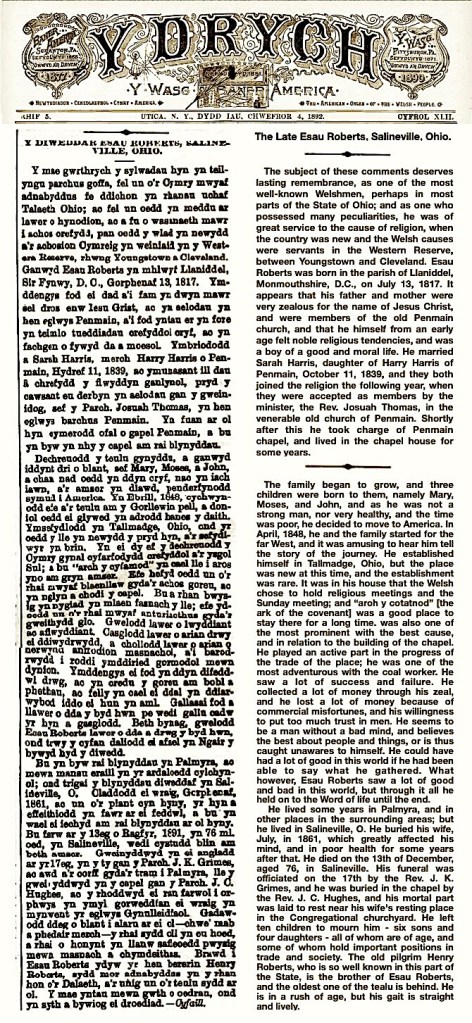
The obituary for Esau Roberts as published in the Y Drych (Welsh newspaper),
for the February 2, 1892 issue. Notes: We compiled this specific piece of artwork from original sources for this chapter, and carefully managed a new and accurate translation of Esau’s obituary. The English translation is shown at right.
(Source: Llyfrgell Genedlaethol Cymru, The National Library of Wales).
—–
We have attempted to correct any factual errors from Esau’s obituary within this narrative.

Llyfrgell Genedlaethol Cymru
The National Library of Wales
Y Drych
(Welsh newspaper), February 4, 1892 issue
https://newspapers.library.wales/view/3540792/3540794
Newspaper page: 2, Right column, lower portion.
Note 1: The plain text version can be accessed through the manual links (which partition the articles) and are found on the lower portion of the webpage.

Ebay, via The Lisbon Historical Society
Vintage postcard of a Covered Bridge
in Columbiana County, Ohio, circa 1883.
https://www.ebay.com/itm/235364406307
Note: From the verso of the postcard…
The Williams / Harris Line, A Narrative — Ten

This is Chapter Ten of twelve, the chapter in which the life of Henry E. Harris, the son of Evan Harris, carries the family line forward. He joins with Ann Thomas in America, (whose family we profiled in Chapters Seven and Eight).

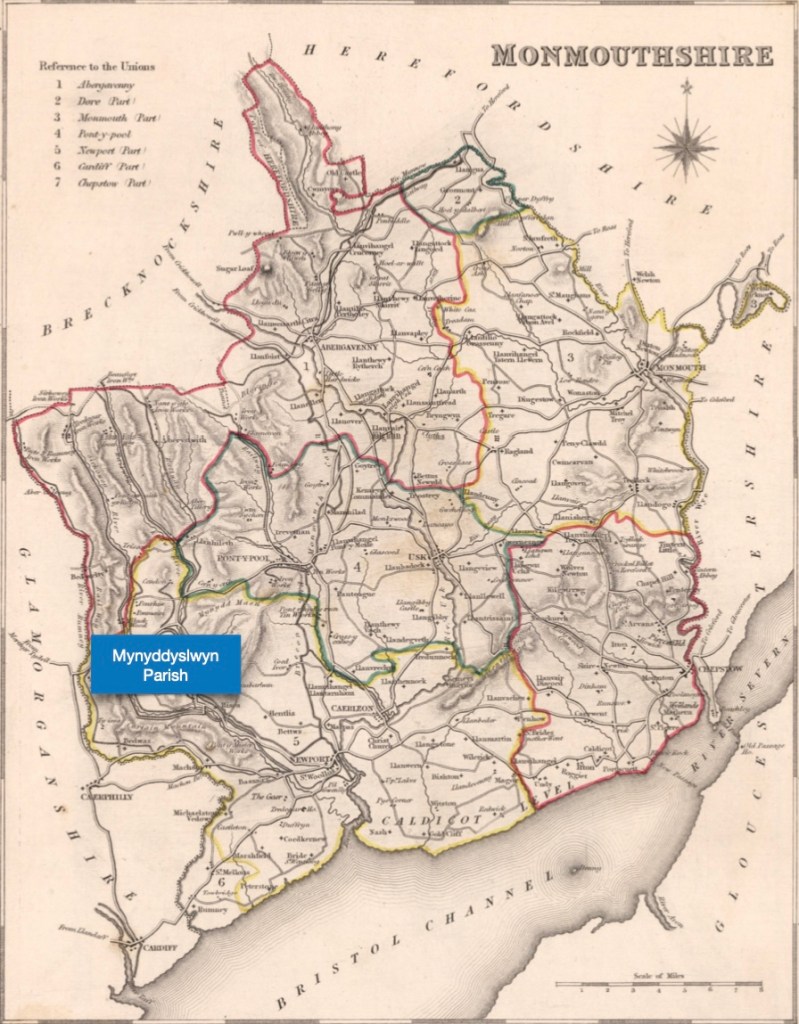
Before We Leave Mynyddyslwyn Parish

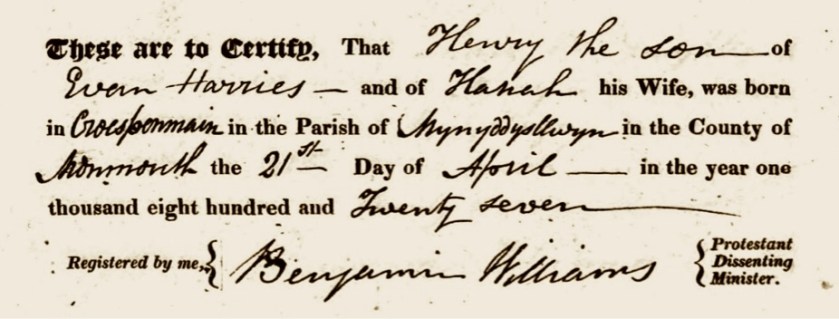
We could not help but notice that the record below that even though it is the same Beulah Chapel location as the previous chapter — it looks quite different from the previous generation, doesn’t it? Maybe someone decided that the amount of historical illegible calligraphy was just too much of a hassle and then decided to update their process? We think it was a good idea.

Henry E. Harris April 21, 1827 birth record in the register of the
Mynyddyslwyn (Beulah Chapel), Monmouthshire, Wales.

When Henry E. Harris was born in Mynyddyslwyn, Monmouthshire, Wales in 1827, he certainly had no idea that he would sail across the Atlantic Ocean and live his life in America. We thought it might be a good idea to have a look around the Mynyddyslwyn Parish before we leave it forever.

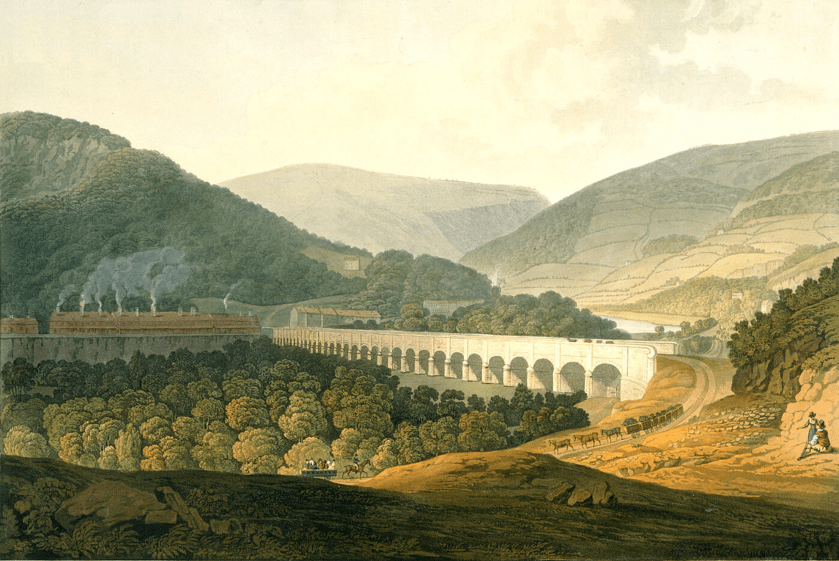
View of a stone bridge across the valley and river at Risca in Monmouthshire,
Coloured aquatint by Edward Pugh, circa 1810.
(Image courtesy of Wikimedia Commons via The National Library of Wales).

Monmouthshire has two main rivers which flow through the area of Mynyddislwyn and embrace the borders of the parish. On the western side there is River Sirhowy, and on the eastern side there is the River Ebbw. The painting above is typical of a scene which Henry would have seen in this parish.

Back then, this part of Wales was giving way from an agricultural economy, to an industrial economy which was based mostly on the mining and the processing of coal and metals. If you look carefully in the 1810 painting at the abundance of trees and the verdant green hills… you can observe a factory in the background billowing smoke into the distant background. An unforeseen circumstance of societal change from this time period was the degradation of the natural environments. The waterways especially became very polluted, and soils were degraded.

“Coal helped pave the way for the Industrial Revolution. But the benefits of coal did not come without a cost… Few places embody the latter view as much as South Wales, once the largest global producer of coal.” (Medium) Eventually, environmental laws reigned in these problems.The long and complicated clean-up process, which has been ongoing for decades, has transformed many former industrial sites into green spaces. (1)

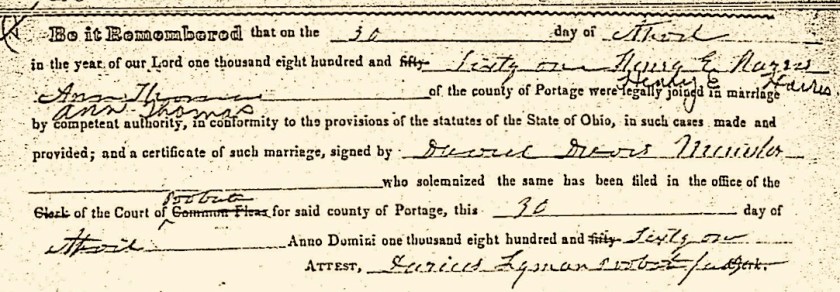
Henry Harris & Ann Thomas’s April 30, 1861 marriage record in Portage, Ohio.

Henry Harris Marries Ann Thomas

We do not know how they met, but it’s probable that they were introduced through family or friends. In a community that was dominated by many Welsh immigrants, people just knew one another.

When they married, Henry was about 34 and Ann was almost 25 years old. (With this marriage, the Thomas name gave way to the Harris name). Within two years, their first child was born. Amongst their children, it is clear that they named their two oldest ones after Henry’s family members: Elvira, in remembrance of his young sister who had passed away, and Evan, in honor of his father.

  • Elvira (Harris) Williams, 1863 – 1889, Elvira carries the family line forward.
  • Evan Harris, 1864 – 1910
  • Rosanna ‘Rose Ann’ (Harris) Sasce, 1866 – 1944
  • Justin Harris, 1868 – 1903
  • John Harris, 1871 – 1906
  • Sarah ‘Sadie’ Harris, 1874 – 1906

What do the Censuses tell us?
Prior to their 1861 marriage, Henry and Ann each lived in the home of their parents. Henry was living in Tallmadge township, Summit County, Ohio. Ann was in living in the adjacent county to the East, in Palmyra township, Portage County.

They appear to have been a stable household for many years. In 1870, Henry’s mother Hannah was living with them. We did observe something intriguing in the 1880 Census. It could be that daughter Elvira may have been counted twice that year? In the Ancestry file, the Harris family is listed on the right-hand page, but on the left-hand page, a 17 year old girl with the (same) name of Elvira Harris is working at the nearby Richardson family home as a ‘hired girl’. Even though this ‘hired girl Elvira’ is one year younger, perhaps our Elvira Harris was counted twice in this census? (See footnotes).

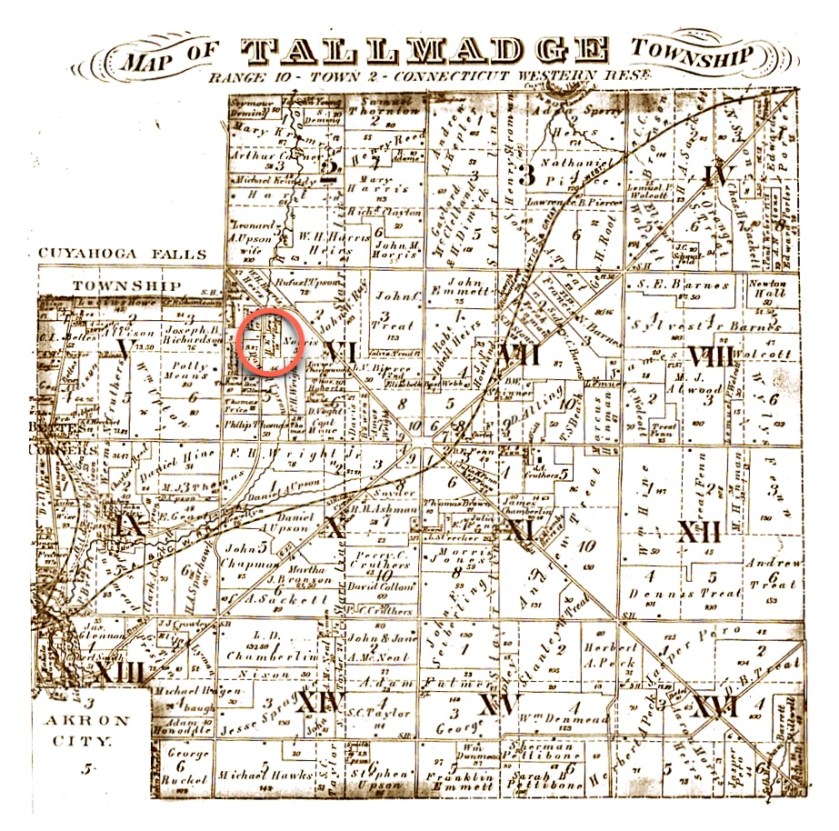
1874 Tallmadge Township map showing property locations. The red circle indicates where the Henry E. Harris family had their property.
The Williams family (from Chapter 5), was living very close by.

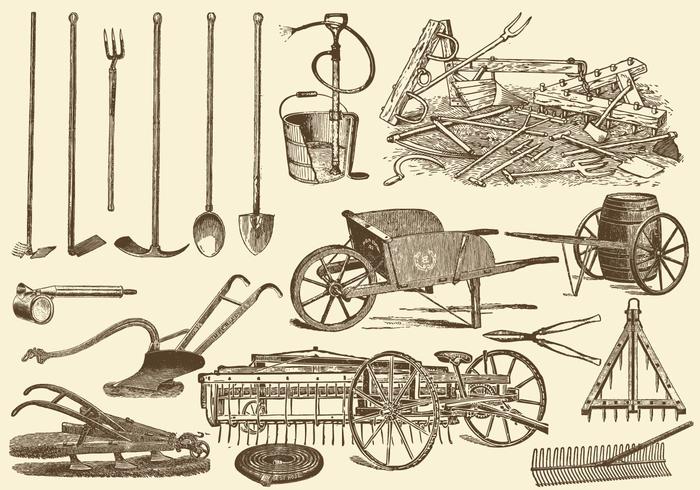
When we studied the Census data for this family, we saw that Henry had been identified as coal digger, or a miner, for about 30 years, starting in 1840. That is a very long time to do what must have been rather difficult work. By the time of the 1870 Census, he seemed to change his hats, (so to speak) about his profession. He traded in his miner’s helmet for a straw farmer’s cap. Even then, being a farmer was still a lot of hard work!

As we shall see next, this combination of being a miner, or a farmer, was quite typical of Welsh immigrants. It was normal to seek out what they knew from their old communities in Wales. (2)

When Coal Was King

If there is something we all learn in life, it is that change is constant. In these decades, Tallmadge had a long run of prosperity through the mining of coal. But coal seams do eventually run out. This is how eventuality affected the community and may have influenced Henry E. Harris to put on his farmer’s hat.

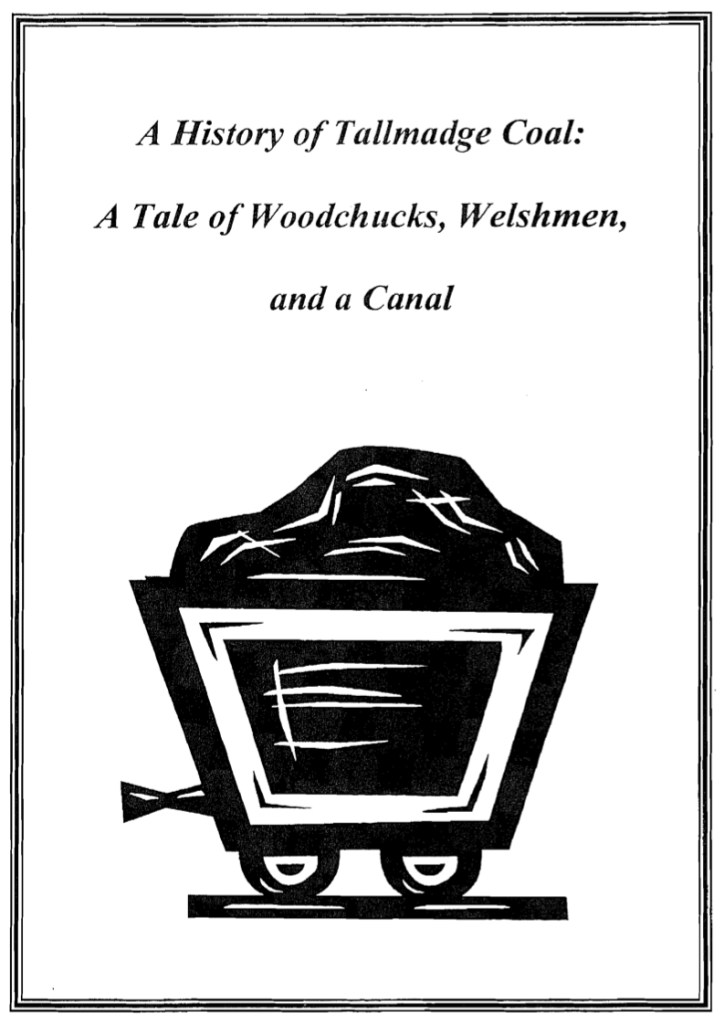
“Two additional factors played important roles in the growth of the coal industry in Tallmadge: the completion of both the Ohio Canal through Akron in 1827 and the Pennsylvania & Ohio Canal in 1841 and the construction of Atlantic and Great Western Railroad lines through Tallmadge in 1864-1865. The connection by canal from Akron to Cleveland enhanced the ability of Tallmadge coal operators to efficiently supply fuel to steamers on the Great Lakes as well as Canadian gasworks in Toronto and Kingston. The Pennsylvania and Ohio Canal enabled Tallmadge coal operators to ship their coal from Akron to Beaver, Pennsylvania, on the Ohio River, thus opening up a still larger market. The coming of the railroad to Tallmadge permitted operators to ship their coal via rail to Akron as well as to Kent, Ravenna, and other points east. Within about twenty years, however, such shipments were abandoned due to the exhaustion of many of the larger veins of mineral in the Tallmadge mine fields. (A  History of Tallmadge Coal…)

In retrospect, it is difficult to actually see the traces that the coal industry left on Tallmadge all these years later. It doesn’t seem that the environmental impacts around there were as profound as they were in other parts of Ohio, (or in South Wales for that matter). Most people living today would look around at Tallmadge, and be completely unaware of the period when coal was king. (3)

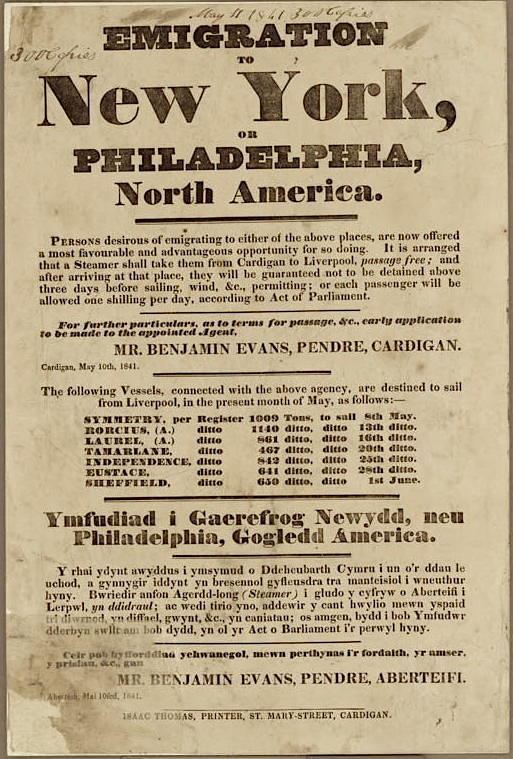
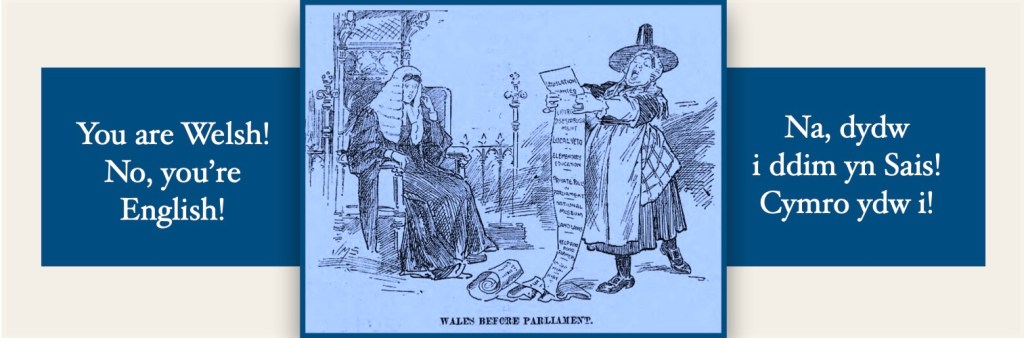
An 1841 poster advertising passage to America, written in English and Welsh.
(Image courtesy of Wikimedia Commons via The National Library of Wales).

The Welsh Population of Ohio

This account of Welsh immigration from the BBC News service begins in Cardiganshire [now named Ceredigion], Wales, which was located northwest of Monmouthshire by the Irish Sea (the Atlantic Ocean).

“A total of 36 people left Aberaeron for Ohio in 1818, but by the end of the 19th Century there was a Welsh community there numbering close to 6,000.

Today, it is thought there may be about 100,000 people in the state who can claim some Welsh descent… The group landed at Chesapeake Bay, Baltimore, where their travails began in earnest. Traveling in wagons to Pittsburgh and then onwards by raft down the Ohio River, they intended to reach a pre-existing Welsh community in Cincinnati, 500 miles (800km) away. Exhausted, they spent the night in Gallia County – where their rafts blew away in a storm – and from there they never moved.

They subsidised their living farming poor land by working on the highway between Chillicothe and Gallipolis. From those harsh beginnings, Wales-Ohio project historian Arwel Jones explains the Welsh immigrants’ luck was about to change. ‘For a decade or more life was very tough and not many more followed the 36 to Ohio, then came the railways, and not long after, the civil war. The Welsh were hard workers, and used to iron, so they formed co-operative forges which made rails all over the US, and produced cannonballs for both the Unionists and the Confederates. That encouraged 3,000 or 4,000 more to leave Cardiganshire between 1830 and the end of the century, spawning success stories” (BBC News)

Further, we learned more about this mass migration of Welshmen. “In the early nineteenth century most of the Welsh settlers were farmers, but later there was emigration by coal miners to the coalfields of Ohio and Pennsylvania and by slate quarrymen from North Wales… As late as 1900, Ohio still had 150 Welsh-speaking church congregations.” (Wikipedia) (4)

We have written previously, an immigrant population seeks out what they know when relocating to a new community. This was very true for many of our family lines. For the Williams, Harris, and Thomas lines, almost all generations were either farmers, or miners. Although that is indeed true and this generation continued to do the same vocations, the world was changing again and becoming much more modern.

Just think of all the changes

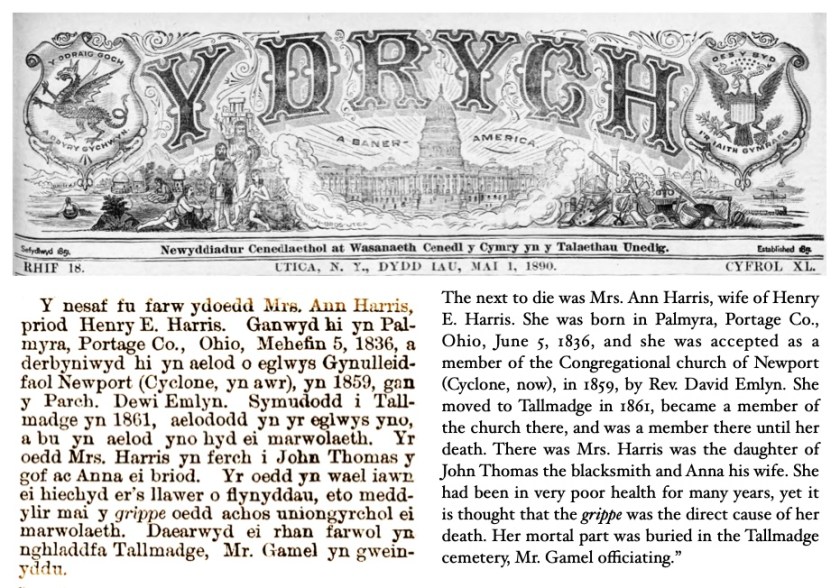
Ann Harris died on April 11, 1890 of pneumonia. We were able to locate her obituary in the Y Drych Welsh language newspaper. Originally published in Welsh, we translated it into English (as shown below on the right). “Y Drych, established in 1851, was a weekly Welsh-language newspaper published by Mather Jones. It contained news and information, focusing on religious matters.” (Wikipedia)

The obituary for Ann (Thomas) Harris as published in the Y Drych (Welsh newspaper),
for the May 1, 1890 issue. Notes: We compiled this specific piece of artwork from original sources for this chapter, and carefully managed a new and accurate translation of Ann’s obituary. The English translation is shown at right.
(Source: Llyfrgell Genedlaethol Cymru, The National Library of Wales).

Henry E. Harrris seemed to have lived his life like the Welsh rivers that he viewed as a child — flowing from the landscape Wales, across the Atlantic Ocean, to the farm fields and coal seams of Northeast Ohio. Henry lived much longer than his wife, carrying on well into the 20th century, passing away on April 25, 1920, just after his 93rd birthday. Just think of all the changes he bore witness to in his long life! (5)

Following are the footnotes for the Primary Source Materials,
Notes, and Observations

Before We Leave Mynyddyslwyn Parish

(1) — three records

Henry Harries
in the England & Wales, Non-Conformist and Non-Parochial Registers, 1567-1936Rg4: Registers of Births, Marriages and Deaths
Monmouthshire > Baptist > Piece 0630: Mynyddyslwyn, Beulah Chapel (Baptist), 1803-1837
https://www.ancestry.com/search/collections/2972/records/45968
Book page: 19 or 21, Digital page: 25/119, Last entry on page.
Note: For the record of his April 21, 1827 birth.

The National Library of Wales
View of a stone bridge across the valley and river at Risca in Monmouthshire,
Coloured aquatint by Edward Pugh, circa 1810
https://commons.wikimedia.org/wiki/File:View_of_a_stone_bridge_across_the_valley_and_river_at_Risca_in_Mon.jpeg
Note: A view of the bridge at Risca, showing horses pulling ore and coal wagons along the tramroad. The copper works can be seen in the distance.

Medium
A Future Black as Coal? — The Underground Heritage of Wales
https://medium.com/tourism-geographic/a-future-black-as-coal-a019113680db
Note: For the text.

Henry Harris Marries Ann Thomas

(2) — twelve records

Henry E. Harris
Marriage – Ohio, County Marriages, 1789-2016
https://www.familysearch.org/ark:/61903/1:1:XZD5-64M?lang=en
Book page: 1216 Digital page: 628/637, Left page, first entry.
Note: For the copy of the April 30, 1861 marriage record.
and
Henry E. Harris
in the Ohio, U.S., County Marriage Records, 1774-1993
https://www.ancestry.com/search/collections/61378/records/2833785
Note: Their marriage date is April 30, 1861.

For the names and dates of their children we looked at and reconciled many sources, such as family trees, Find A Grave profiles, etc. Here is one example for a family tree (which is not ours):
https://www.ancestry.com/family-tree/person/tree/62607448/person/282197451285/facts

H. E. Harris
in the U.S., Indexed County Land Ownership Maps, 1860-1918
Ohio > Summit, 1874
https://www.ancestry.com/search/collections/1127/records/3962102
Digital page: 85/138

1850
Evan Harris
in the 1850 United States Federal Census
Ohio > Summit > Tallmadge
https://www.ancestry.com/search/collections/8054/records/19601199?tid=62607448&pid=282197451798&ssrc=pt
Digital page: 28/60, Lines 31 through 36.
Note 1: Evan 46, Hannah 58, Henry 23, Mary 16, Hannah, Alvira 10.
Note: Evan is listed as a coal digger (miner).
Note 3: Contributor C. E. Tabbert’s notes on daughter Elvira from the FindaGrave website:
https://www.findagrave.com/memorial/269329914/elvira-harris

1850
Ann Thomas
in the 1850 United States Federal Census
Ohio > Portage > Palmyra
https://www.ancestry.com/search/collections/8054/records/19581414
Book page: 207(?), Digital page: 8/26, Lines 28 through 35.
Note: John 51, Hannah 52, Rees 19, Ann 15, Margaret 12, David 9, John 6, Anna Jenkins 4.

1860
Hannah Harris
in the 1860 United States Federal Census
Ohio > Summit > Tallmadge
https://www.ancestry.com/search/collections/7667/records/42152554
Digital page: 15/30, Lines 1 through 9.
Note 1: Hannah 58, Henry 53*, Sarah 30, Mary 26, Anna (Hannah) 22, Thomas 3, Daniel 1, Henry Rees 9, Eliza Rees 7
*His age should be listed as 33.
Note 2: Where is the father Evan? Henry is listed working as a miner.
Note 3: Daughter Sally had previously married Solomon Reese (presumably by the 1850 Census, because she is not listed). Her children, Henry (9) and Eliza (7) are living with this family. (See footnotes in Chapter Nine).

1860
Ann Thomas
in the 1850 United States Federal Census
Ohio > Portage > Palmyra
https://www.ancestry.com/search/collections/7667/records/41939194
Book page: 66-67, Digital page: 8-9/26, See note below.
Note 1: John 61, Anna 62, Rees 19, Ann 24, Margaret 22, David 19, John1 6, Anna Jenkins 14.
Note 2: This census carries over two pages. The parents are on lines 39-40 on page 66; the rest follow lines 1-5 on page 67.

1870
Henry Harris
in the 1870 United States Federal Census
Ohio > Summit > Tallmadge
https://www.ancestry.com/search/collections/7163/records/37748887
Book page: 7, Digital page: 7/32, Lines 10 through 16.
Note: Her parents are Henry and Ann.
Note: Henry 43, Ann 32, Elvira 8, Evan 6, Rosanna 4 , Justin 1, Hannah 72.
Note: Henry Harris, his wife Ann*, and his mother Hannah are born in Wales; all others, Ohio.
Note 1: * This is an enumeration error. Ann was born in Ohio.
Note 2: His occupation is Miner.

1880
Henry E. Harris
in the 1880 United States Federal Census
Ohio > Summit > Tallmadge > 181
https://www.ancestry.com/search/collections/6742/records/18590812
Book page: 21, Digital page: 21/30, Lines 16 through 23.
Note: Henry 53, Ann 44, Elvira 18, Evan 16, Rosanna 14 , Justin 12, John 10, Sarah 6.
Note: It is interesting to note on the adjacent left page (Digital page: 20/30), on line 49 — https://www.ancestry.com/search/collections/6742/records/18590623
A 17 year old girl with the (same) name of Elvira Harris is working at the nearby Richardson family home as a ‘hired girl’. Even though this ‘hired girl Elvira’ is one year younger, perhaps our Elvira Harris was counted twice in this census?

When Coal Was King

(3) — two records

Akron-Summit County Public Library
A  History of Tallmadge Coal:
A Tale of Woodchucks, Welshmen, and a Canal
by Judy Anne Davis, 2006
https://www.akronlibrary.org/images/SpecCol/TallmadgeCoal_.pdf#:~:text=
Notes: In library reference use only. For the texts about the mining operations
and coal seams running out, etc.

Vector
Agriculture Tools
https://www.freevector.com/agriculture-tools-111636
Note: For the image of farm tools.

The Welsh Population of Ohio

(4) — three records

The National Library of Wales
An 1841 poster advertising passage to America,
written in English and Welsh
https://en.wikipedia.org/wiki/Welsh_Americans#/media/File:Emigration_To_New_York_1841.jpg

BBC News
Marking 200 years since Welsh settlers arrived in Ohio
https://www.bbc.com/news/uk-wales-44240447
Note: For the text about Welsh immigrants to Ohio.

Welsh Americans
https://en.wikipedia.org/wiki/Welsh_Americans
Note: For the text.

Just think of all the changes

(5) — seven records

Ann Harris
in the U.S., Find a Grave Index, 1600s-Current
https://www.ancestry.com/search/collections/60525/records/125051575
Note: Census data documents and her birth record, and her obituary say that she was born in OHIO. Only the 1870 Census indicates Wales for her birth, which is likely an error.
and
Ann Thomas Harris
https://www.findagrave.com/memorial/151377869/ann-harris
Note: Her dates are from June 5, 1836 to April 11, 1890.

Anna Harris
in the Summit County, Ohio, U.S., Death Records, 1866-1908
Death Index Registers, 1869-1908 > E – K
https://www.ancestry.com/search/collections/1596/records/47484
Book page: 110, Digital page: 160/169
Note: This confirms her death date of April 11, 1890, (pneumonia).

Llyfrgell Genedlaethol Cymru
The National Library of Wales
Y Drych
(Welsh newspaper), May 1, 1890 issue
https://newspapers.library.wales/view/3539982/3539985
Newspaper page: 3, Right column, lower portion.
Note: Center section of an article titled Tallmadge, Summit Co., O.
Note: The plain text version can be accessed through the manual links (which partition the articles) and are found on the lower portion of the webpage.

Y Drych
https://en.wikipedia.org/wiki/Y_Drych
Note: For the data.

Henry E. Harris
in the U.S., Find a Grave Index, 1600s-Current
https://www.ancestry.com/search/collections/60525/records/240217665?tid=&pid=&queryId=3ce57210-d200-4299-8f41-578eb079cf81&_phsrc=NmT5&_phstart=successSource
and
Henry E. Harris
https://www.findagrave.com/memorial/269323209/henry_e-harris
Note: His dates are, 1827 to April 25, 1920.

The Williams / Harris Line, A Narrative — Nine

This is Chapter Nine of twelve, where for a period of time, packet ships dominated travel and immigration between the United Kingdom and America. Once in America, the Harris brothers — Evan and William — make their mark in Tallmadge, Ohio.

We are fortunate in our research when we come across a birth register in which there are many answers for what we are seeking with a family line. Such is the case with the Mynyddyslwyn, Beulah Chapel (Baptist) Registry, in Monmouthshire, Wales.

A Registry for 3 Sons

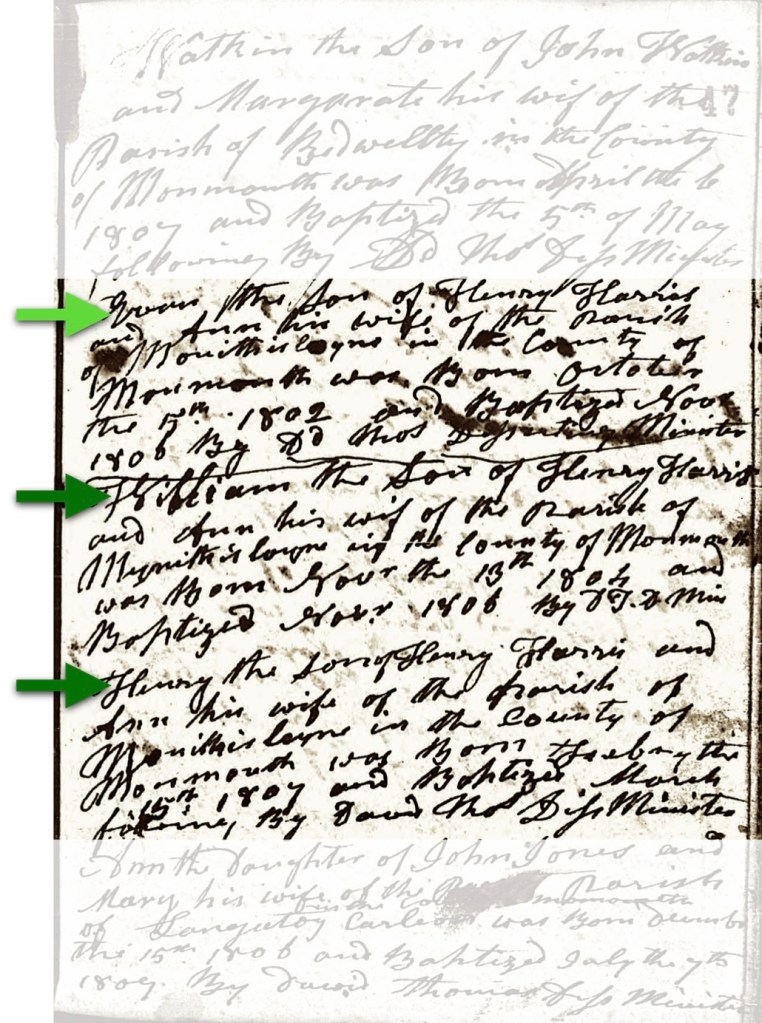
We meet our ancestor Evan Harris in Monmouthshire when his birth and baptism is recorded, along with those of his brothers William and Henry Jr.. As we learned in the last chapter, their parents are named are Henry Harris and Ann (Unknown). (Observation: In some other records, Harris is sometimes spelled as Harries, when we know we are reading records about the same people).

Registration of both the birth and baptism dates for Evan Harris (at top),
along with his brothers William, and Henry Jr. (following). From the
Mynyddyslwyn, Beulah Chapel (Baptist) Registry, in Monmouthshire, Wales.

In the 1806 baptismal record for Evan Harris, the entry states that he was “October the 5th 1802 and baptized November _?_ 1806”. Throughout his life, it became clear that Evan (and also his wife Hannah) were unclear on their exact ages, because the records vary somewhat. We have seen this with many other family lines, when the ancestors lived in a pre-literate world. (1)

Evan Harris Marries Hannah Morris

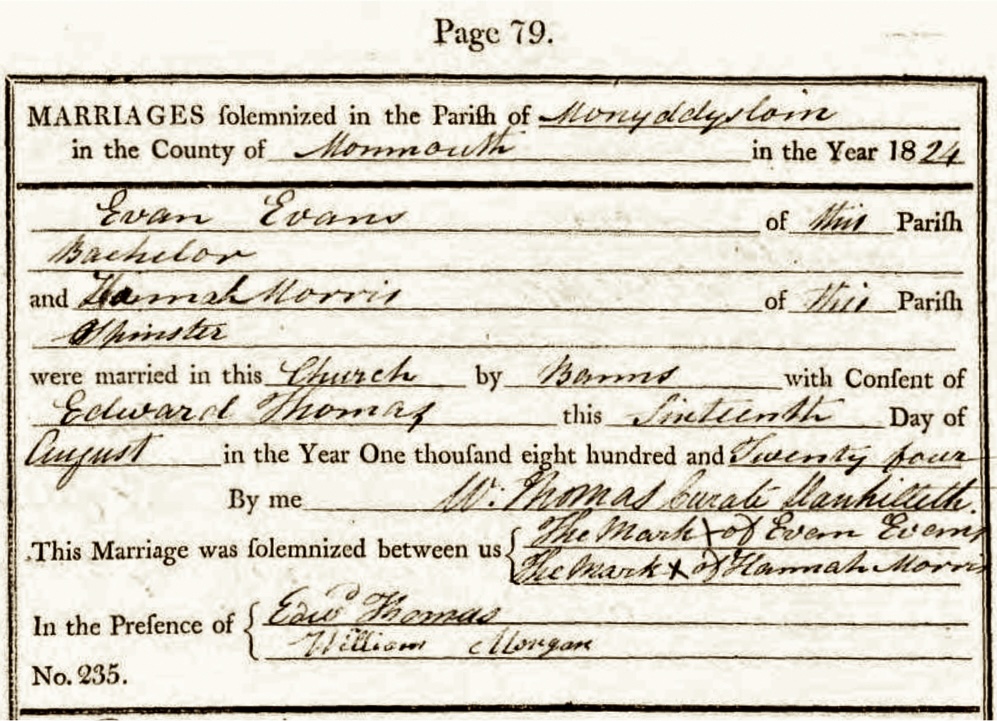
It took us a long while to locate his marriage record and make sense of what we found. Does the name Evan Evans sound familiar? (Of course not). We had been looking for our Grandfather who was named Evan Harris. It seems that whoever was writing this record was a bit confused when writing with their quill pens. We know that this is the correct marriage because of the ages of the people involved, their ages, and the parish. We’ll explain further below the marriage record .

This image has an empty alt attribute; its file name is page-79-marriage-record.1.jpeg
Marriage record for Evan Harris and Hannah Morris in Mynyddyslwyn Parish, Monmouthshire, Wales, on August 16, 1824. Please notes that there are recording errors which we explain below.

When you look at the details, the parish name is misspelled, as Monyddysloin. This name never existed as a real parish, but is certainly a phonetic spelling of the true name Mynyddyslwyn. (Historic records confirm this). Also, it is clear that in a preliterate world, Evan Harris and Hannah (Morris) Harris signed their names with an X, as most of our ancestors did before (circa) the 1880s. They couldn’t verify what was written, but had to rely on the kindness of others for this type of thing.

This image has an empty alt attribute; its file name is rris.1.jpeg

Further, if you look at the actual penmanship for their recorded names, it appears that the last portion, the ‘r-r-i-s’ letters, which both surnames share, look very much the same. as in H-a-r-r-i-s, not E-v-e-r-r-i-s. We don’t know what was going on in the room at the time, put whomever recorded this made a mistake.

Finally, there is a man named Evan Evans living in Monmouthshire at this time, in another parish. In 1824, he is marrying a woman named Rachel Thomas. (Please see the footnotes). (2)

Mysteries Concerning Young Elvira From 1840

We know that Evan and Hannah had at least six children. All of them were born in Mynyddyslwyn Parish, Monmouthshire, Wales.

  • Henry E. Harris, 1827-1920, Henry carries the family name forward.
  • Sally [or] Sarah (Harris) Reese Lewis, 1829-1894*
  • Ann Harris, 1831-Unknown date
  • Mary (Harris) Morris, 1833-1890
  • Hannah (Harris) Thomas, 1838-1910
  • Elvira Harris, 1840-Unknown date
    *She was recorded as Sarah on the 1841 Wales Census, but it appears she used the name Sally in America.

There are a couple of mysteries about their youngest daughter Elvira...
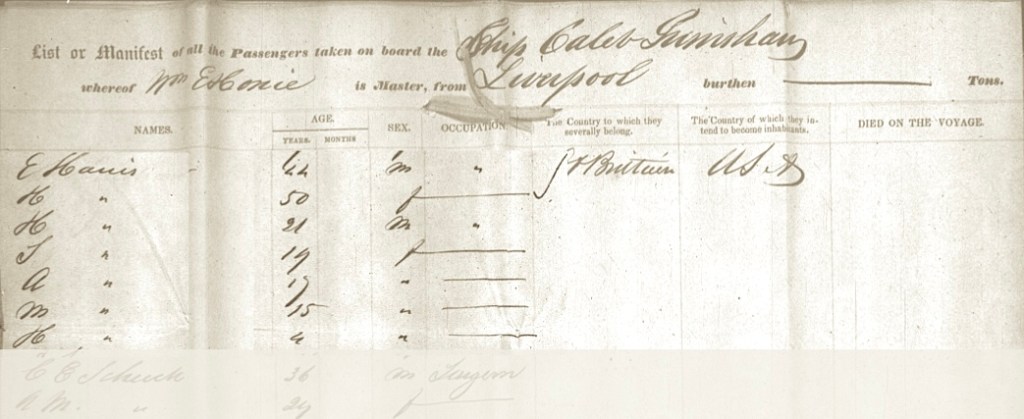
We know she was born in Wales and came to America with her family. For that journey she would have been 8 years old, but mysteriously, she is not listed on the manifest. We thought that perhaps she could have come over with Evan’s younger brother William, since his family moved to America in the same time frame. We found no evidence of that. We poured over the 10 page manifest for their ship, the Caleb Grimshaw, but did not see any entry for an E. Harris at 8 years of age. We noticed that in the entire manifest, there is only one additional mark — it is a deliberate checkmark [√] next to the mother Hannah Harris’s name. Could this notation be the only indication that there was a young child being carried in her mother’s arms?

Elvira is listed on the 1841 Wales Census as being one year old, and she is also found on the 1850 Tallmadge, Ohio Census. Therefore, we know that she traveled from Wales to Ohio by some means. Perhaps the record keeper at the immigration point in New York just missed her?

The Harris family listed on the manifest for the ship Caleb Grimshaw,
with the arrival date in New York of May 27, 1848.

We learned from the Find A Grave website [contributor C. E. Tabbert’s notes] that Elvira “was listed on the 1850 Tallmadge Census age 10… as deaf and dumb… [and] the 1860 census does not have her listed… [nor is she listed in the 1868 draft of her father Evan’s Will]. The name in the Tallmadge Cemetery Lot Book is written over and illegible. There is a headstone in that area of the cemetery that has fallen on its face and is also unreadable. I believe that Elvira is buried in Grave 6. Her parents, brother and other family members are buried in this same lot.” (3)

It’s True. Timing Really Is Everything.

We have speculated about why the Harris family came to the decision to immigrate to America. The only thing that has made sense is the idea that they learned through either friends or (perhaps) family that there were riches to be made, and opportunity to be had, in America. An old story, that was new at that time. The point is, they came and prospered.

This family immigrated to America in 1848 on board the packet ship Caleb Grimshaw. It appears from the ships short history that they were likely on the premier voyage (or close to the premier) when the ship left Liverpool for New York. Their timing was a blessing.

Left to right: Sailing notice for the Caleb Grimshaw to New York,
from the Liverpool Mercury, 1849. Oil painting of the Caleb Grimshaw by Samuel W. Walters,
circa 1848. Walters was considered to be Liverpool’s leading marine artist at the time.
(Both images courtesy of Wikimedia Commons).

Here is the history of the Caleb Grimshaw ship…
“When the influx of Irish migrants hit Liverpool [England] with the start of the potato famine in 1845, an estimated 1.5 million desperate people crossed the Irish Sea heading for the city, three quarters of which then boarded ships to New York, Philadelphia, or elsewhere.

Whilst living in New York in 1818, British merchant Jeremiah Thompson had pioneered the concept of the sailing packet which was guaranteed to depart on schedule rather than (the traditional) waiting until its hold was full. Offering a time table, his Black Ball Line revolutionized the transatlantic trade. British and American merchants joined forces to take full advantage of the migration boom. The Liverpool firm of Caleb Grimshaw & Company, specialists in migration traffic, teamed up as agents for Thompson in 1842 to take charge of the Liverpool to New York route.

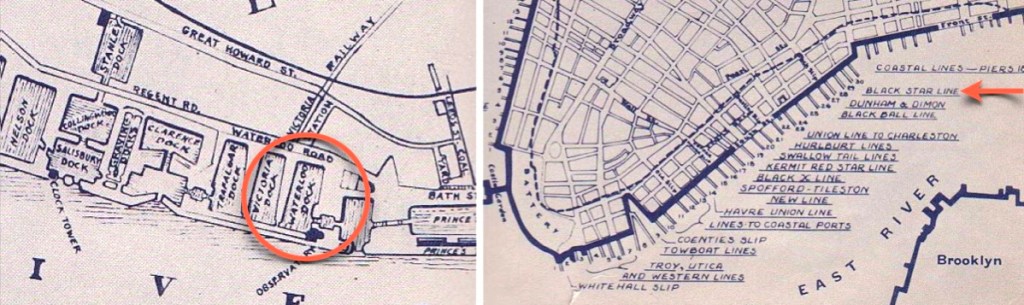
It is not often that we get to show the beginning and ending points for a journey like this one.
Left to right: The Liverpool port area, showing the Waterloo Dock, where their ship
would have departed England. Then, the Lower Part of New York City, 1851, with an arrow indicating the Black Star Line piers, where their ship would have docked.
(Images courtesy of Grimshaw Origins and History).

One of the vessels operated by Grimshaw was the wooden packet ship Caleb Grimshaw (named after the company’s late founder). Built at William Henry Webb’s shipyard in New York and launched in early 1848, she sailed from Liverpool’s Waterloo Dock to New York under command of Captain William Hoxie with a crew of thirty men, carrying a maximum of 427 migrants.

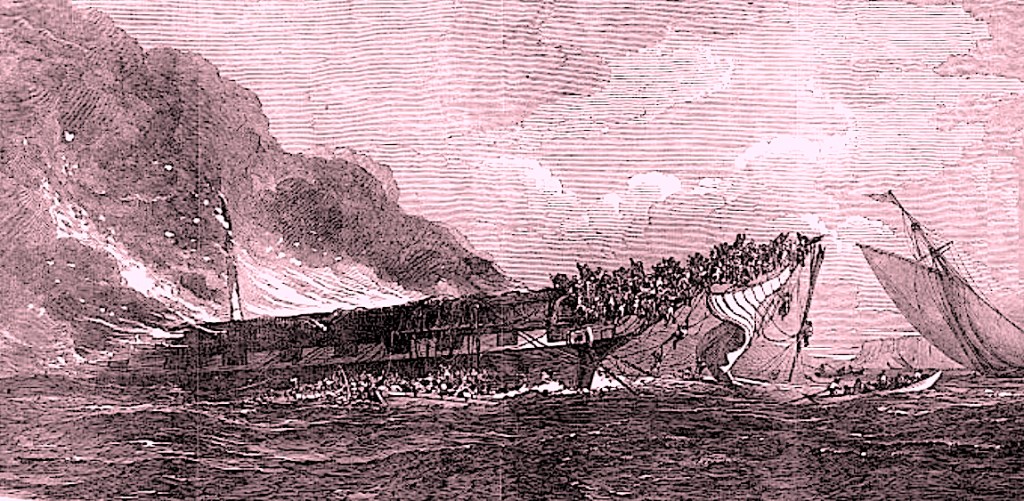
The ship completed a total of five trips before disaster struck on her sixth crossing in November 1849 with 425 migrants aboard. A fire created panic and chaos. A lack of leadership drove some passengers to take matters into their own hands, lowering one of the ship’s boats which crashed into the water. Twelve people were swept away and drowned. Another boat was lowered by the crew, equipped with supplies of food and water for a select number of passengers.

The next morning, with the blaze raging, a boat was reserved for the captain’s wife and daughter who were joined by some of the first-class cabin travelers. Later that day Hoxie himself abandoned ship. The unfortunate migrants in steerage were left behind to fend for themselves, building survival rafts with remaining members of the crew on board.

This engraving shows a similar incident from the same year.
Fire Consumes The American Packet Ship Ocean Monarch,
English Wood Engraving by Morel Fatio, 1848. (Image courtesy of Amazon.com).

Help arrived on the fourth day when the trading barque Sarah, sailing from London to Halifax, drew alongside. Her master David Cooke first rescued the passengers on the boats and rafts, leaving more than 250 passengers on board clinging to the burning wreckage. It took a total of ten days to save the last of the survivors and deliver them safely to the port of Flores in the Azores. When the Caleb Grimshaw finally sank, the lives of ninety migrants had been lost.” (New York Almanack) The Caleb Grimshaw only made five voyages, and this disaster was obviously her last trip.

Since our ancestors lived in a community where many immigrants from Wales and Ireland had moved to, it is likely that they eventually learned of this disaster. One wonders what they may have thought? (4)

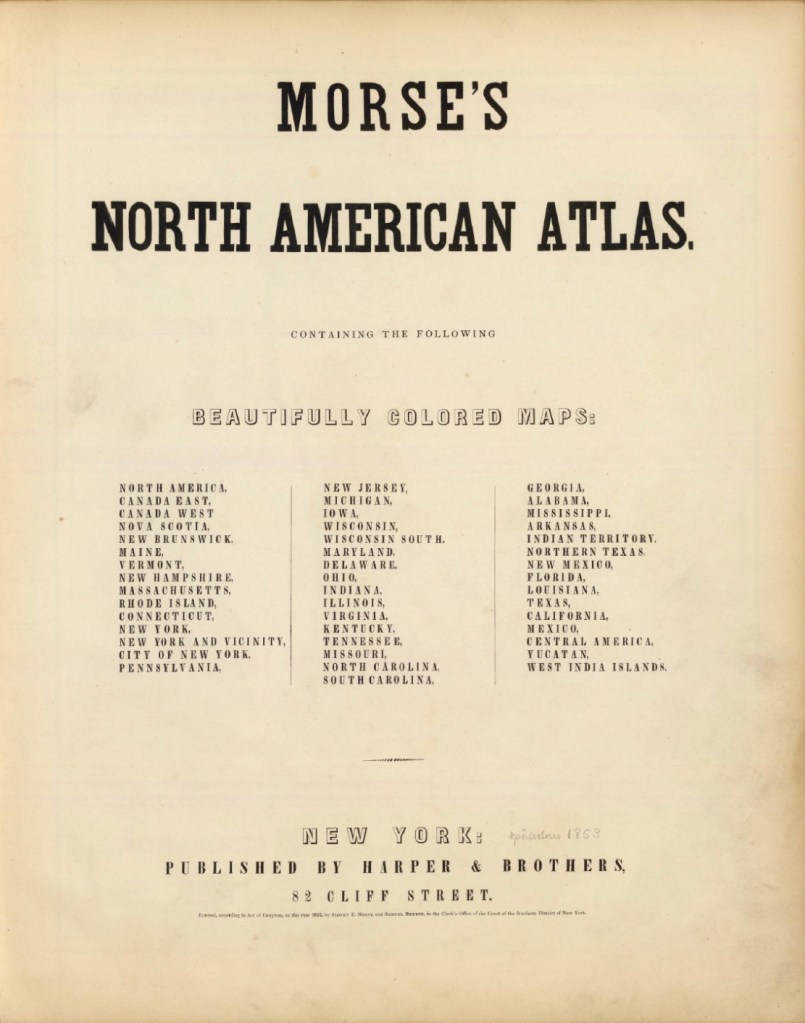
Enlarged detail from Ohio, as originally published in Morse’s North American Atlas, 1842.
(Image courtesy of the David Rumsey Map Collection).

The Harris Brothers Make Their Mark

Evan’s brother William H. Harris was living in the area near to Tallmadge township, Ohio in the very early 1840s, so he obviously immigrated to America before his brother’s family. We know this from records in the Tallmadge cemetery which correspond to the larger family circle*. Since William arrived at least seven years before his brother Evan did, he was established and connected to the community in the area.
*Please see the footnotes regarding his 1841 marriage, and the 1842 birth of his oldest son John Harris.

Communication back then took much more time, but when there is work and opportunity, word still travels pretty far. We are sure that both word-of-mouth and Welsh language newspapers carried the news that coal mining was available and would let you transplant your family to the opportunities in America.


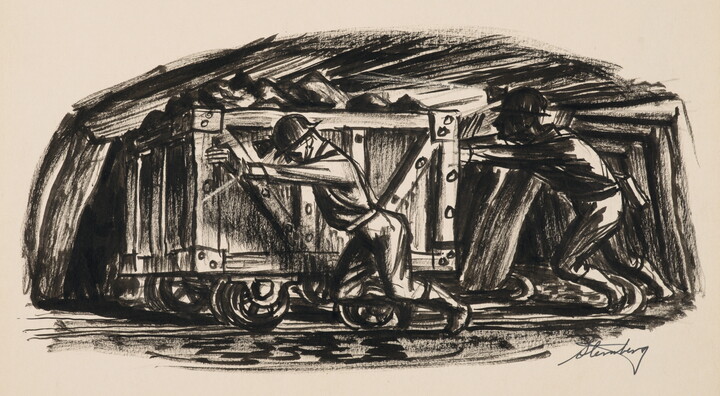
Black ink wash on paper Coal Mining Scene, by Harry Sternberg.
(Image courtesy of the Amon Carter Museum of American Art).

The following is both derived from and quoted from in several sections: A History of Tallmadge Coal: A Tale of Woodchucks, Welshmen, and a Canal, by Judy Anne Davis. It is one of the few publications which document the life of the Welsh community in Tallmadge.

“Coal was first discovered in the southeast corner of the township, with another discovery attributed to a woodchuck digging on ‘Coal Hill’ around 1810. In 1819 or 1820, Samuel Bronson and Samuel Newton opened a mine in the bluff of Coal Hill. By 1827, Henry Newberry began hauling coal by wagon to Lock 16 on the Ohio Canal to sell in Cleveland, although initial sales were slow. Daniel Upson arrived in 1832, recognized the potential, and secured a charter from the Ohio State Legislature in 1838 for the Tallmadge Coal Company. This company consolidated most of the mining rights in Coal Hill, excluding Newberry’s, ultimately controlling around 500 acres.

[This made us take notice…] By 1852, Upson and another major operator, William H. Harris, were shipping 10 to 20 tons of coal daily. In 1855, the Tallmadge Coal Company produced 23,000 tons of coal. The mines operated heavily through the 1850s, with over 300,000 tons removed from just 60 acres by 1857. The industry largely defined the industrial development of early Tallmadge before fading in the late 19th century.”

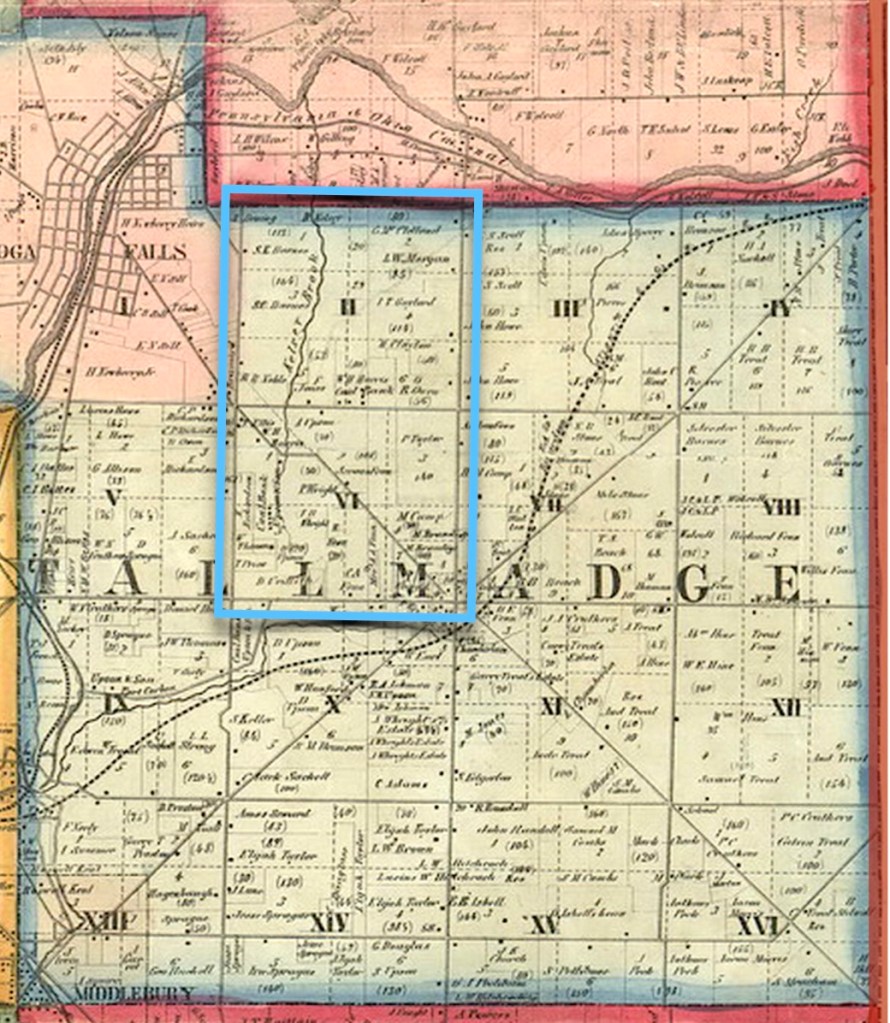
Tallmadge, Ohio 1856 Old Town Map. This image shows Tracts II and VI where William
and Evan Harris held their coal land dealings, during the period matching their records.
(Image courtesy of Old Maps).

Specifically, this document went into more detail about our ancestors. Evan’s brother William was very successful in this business enterprise. From page 13 of the same document —

“By the early 1840’s another Welshman, William Harris, had arrived in Tallmadge and quickly started operations of his own in a coal bank in Tract 2, east of Long Swamp and northeast of Howe Road. He soon had three mines in operation and employed 50 men. Harris is noted especially for his efforts to not only recruit Welshmen to the community but also to assist them in establishing themselves once they arrived. Many of the men he recruited came directly from Wales; when they arrived, he frequently supplied furnished living quarters for them until they had earned enough to go out on their own. The efforts of Harris undoubtedly drew many additional families from Wales into this area.”

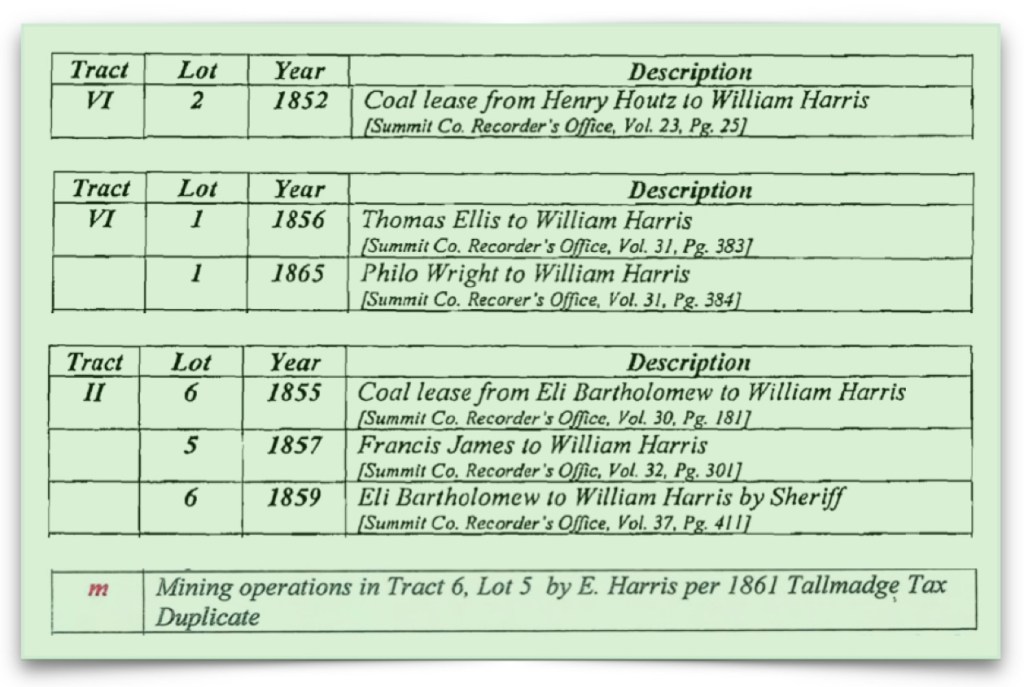
These records are excerpted from the indexes in the A History of Tallmadge Coal… document.

“Harris, too, increased his holdings both by purchase and lease. Land transaction records show that he concentrated his efforts in Tracts 2 and 6. Harris is known to have operated three mines in the area; in addition to the two which were served by his rail road and located east of his home in Tract 2, he also had an entry in the high ground of Tract 1 between Northwest Avenue and Howe Road at the northwest six corners.” (A  History of Tallmadge Coal…) (5)

The Old Welsh Church in Tallmadge

In chapter 5 we wrote about the famous Congregational church which stands to this day at the center of Tallmadge Township. The Harris family may have attended services there, but they could have preferred services at a chapel which conducted services in their native Welsh language.

“Despite this acceptance on the part of the Congregational Church, many of the Welsh longed for a church of their own where services could be conducted in their native language. This was particularly true of those for whom English was an insurmountable challenge.” In about 1860 the town erected a building.

The Old Welsh Church after it had been abandoned, circa 1920s.
(Image courtesy od Summit Memory).

“Mrs. Martha P. Bierce provides a personal sketch of the church in an article she wrote for the Tallmadge Sesqui-Centennial which was then published in the book, A History of Tallmadge, Ohio. According to her description, the church… ‘was a small frame building with a seating capacity of 75 to 100. Perhaps its only claim to beauty was the unusual fan light (window) centered over the double front door, door, There were nice pews with green cushions, a chandelier for coal-oil lamps, and a coal burning stove. Upon the wall hung an antique clock…

Finally, there came a day when all of the church founders were gone. Their descendants having become thoroughly Americanized, gradually drifted away from the old church and from the mother tongue. For many years the old landmark stood abandoned, clinging helplessly to its foothold on the hill. The land reverted to the farm of which it was originally a part. Grading for a paved road made the position of the building precarious and it was thought best to tear it down.” (A  History of Tallmadge Coal…) (6)

Where Was Evan in 1860?

When we see the Tallmadge United States Census for 1850, nothing that unusual stands out. Evan describes himself as a coal digger. The 1860 Census is the similar, where his son Henry describes himself as a miner. There is one thing however on the 1860 Census, — where is Evan? His entire family is listed, but he is not there. We have a record of him paying taxes in Tallmadge in 1861, so likely wasn’t too far away for the rest of the decade. (This 1860 Census mystery is one that we have not yet solved, since he lived until 1869).

Evan Harris died on March 9, 1869 and his Will, which was drafted a year earlier, provides for his wife Hannah and each of his children, as well as some of his grandchildren. Hannah lived on after him for nearly ten years, passing on December 26, 1878 while living in the home of her son, Henry E. Harris, and his family.

It is his family, that of Henry E. Harris and Ann Thomas, which we will be writing about in the next chapter. (7)

Following are the footnotes for the Primary Source Materials,
Notes, and Observations

A Registry for 3 Sons

(1) — five records

Evan Harris
in the England & Wales, Non-Conformist and Non-Parochial Registers, 1567-1936
Rg4: Registers of Births, Marriages and Deaths > Monmouthshire > Independent > Piece 1246: Penmain (Independent), 1787-1833
https://www.ancestry.com/search/collections/2972/records/150167990
Digital page: 53/159, Right page.
Note: His baptism record. Three records for sibling births and baptisms are recorded at the same time in this register — Evan 1802, William 1804, Henry 1807.

Evan Harris
in the U.S., Find A Grave Index, 1600s-Current
https://www.ancestry.com/search/collections/60525/records/125051446
and
Evan Harris
https://www.findagrave.com/memorial/151377723/evan-harris
Note 1: His birth and death dates are, 1801 – March 9, 1869.
Note 2: From the Find A Grave file, Evan was the brother of William H. Harris. Both brothers were from Wales and settled in Tallmadge around 1840.

Hannah Harris
in the U.S., Find A Grave Index, 1600s-Current
https://www.ancestry.com/search/collections/60525/records/125051509
and
Hannah Harris
https://www.findagrave.com/memorial/151377791/hannah-harris
Note: Her birth and death dates are 1796 – December 26, 1878.

Evan Harris Marries Hannah Morris

(2) — two records

Evan Evans
in the Monmouthshire, Wales, Anglican Baptisms, Marriages and Burials, 1551-1994
Mynyddislwyn > Marriages and Banns > 1777-1906
https://www.ancestry.com/search/collections/62107/records/548206
Book page: 79, Digital page: 154/933, Right page, top.
Notes: The parish name is misspelled, and Evan Harris’s surname was incorrectly noted when the record was recorded. Observe that they signed their names with an X, so they likely could not read the record to verify it.

(The real Evan Evans…)
Evan Evans
in the Breconshire, Wales, Marriage Index, 1813-1837
https://www.ancestry.com/search/collections/1175/records/4372
Note: See the suggested search items which support that this person is not the husband of Hannah (Morris) Harris.

Mysteries Concerning Young Elvira From 1840

(3) — three records

Henry Harries
in the England & Wales, Non-Conformist and Non-Parochial Registers, 1567-1936
Rg4: Registers of Births, Marriages and Deaths
Monmouthshire > Baptist > Piece 0630: Mynyddyslwyn, Beulah Chapel (Baptist), 1803-1837
https://www.ancestry.com/search/collections/2972/records/45968
Book page: 19 or 21, Digital page: 25/119, Last entry on page.
Notes: His birth record with his parents Evan and Hannah Harries. The Harris surname is misspelled as Harries on the Ancestry file name.

Birth and death dates for their children
Note: we have compiled and reconciled the birth and death years from various sources for the family from the following link, and other sources.
https://www.ancestry.com/family-tree/person/tree/62607448/person/282197451798/facts , and associated links

Evan Harris
in the New York, U.S., Irish Immigrant Arrival Records, 1846-1851
https://www.ancestry.com/search/collections/5969/?pg=6&f-F000981E=CalebGrimshaw40927May1848
Note: The ship they sailed on from Liverpool was the Caleb Grimshaw, with the arrival date in New York of May 27, 1848.

It’s True. Timing Really Is Everything.

(4) — six records

New York, Passenger Lists, 1820-1920
Path: Follow these links to arrive at the Caleb Grimshaw passenger manifest for May 27, 1848:
> https://www.familysearch.org/en/search/image/index?owc=http://platform.prod.us-east-1.prod.fslocal.org/records/collections/1849782/waypoints
>> NARA Roll Number – Content, 0072 – 9 May 1848-31 May 1848
>>> https://www.familysearch.org/ark:/61903/3:1:939V-5K6B-8?wc=MX62-DZS:165749401&cc=1849782&cc=1849782&lang=en&i=525
Digital page: 526/838, Film # 004678332,
Note: There are 7 people listed in the middle of the page, by their first initial and then the Harris surname.

New York Almanack
Massacres & Migrants at Sea: Deadly Voyages To New York
by Jaap Harskamp
https://www.newyorkalmanack.com/2023/01/migrants-at-sea-deadly-voyages-to-new-york/
Note: For the text.

Caleb Grimshaw
https://en.wikipedia.org/wiki/Caleb_Grimshaw#:~:text=4%20References-,Construction,May%201848%20and%20August%201849.
Note: For the Liverpool Mercury sailing notice and oil painting portrait of the ship.

Grimshaw Origins and History
Beginnings, History, Emigration Patterns, Prominent Families
The Caleb Grimshaw
http://grimshaworigins.org/prominent-grimshaw-individuals/the-caleb-grimshaw-immigrant-ship/
Note: For the Waterloo and Black Star Line dock maps.

Fire Consumes The American Packet Ship Ocean Monarch
English Wood Engraving
by Morel Fatio, 1848
https://www.amazon.ca/Shipwreck-Accidental-Brazilian-Survivors-Engraving/dp/B07DPGS51D
Note: For the illustration as a parallel 1848 example of what also happened on the Caleb Grinshaw packet ship.

The Harris Brothers Make Their Mark

(5) — eight records

David Rumsey Map Collection
Ohio
by Samuel Breese and Sidney E. Morse, 1842
https://www.davidrumsey.com/luna/servlet/detail/RUMSEY~8~1~21740~660104
Note: For the map image, as originally published in Morse’s North American Atlas, 1842.

William H. Harris
https://www.findagrave.com/memorial/10969120/william_h-harris
Note: “Husband of Mary Harris. William was the brother of Evan Harris. William came from Wales and settled in Tallmadge around 1840.”

William Harris
in the Ohio, U.S., County Marriage Records, 1774-1993
https://www.ancestry.com/search/collections/61378/records/2846284?tid=&pid=&queryId=c4ba7271-7af4-4973-9640-f6a6844396f5&_phsrc=NFU21&_phstart=successSource
Note: For his June 19, 1841 marriage record to Mary Lewis.

John Harris
https://www.findagrave.com/memorial/261975898/john-harris
Note: William Harris’s oldest child, with notes from his Find A Grave file —
“was born in Middlebury, East Akron [on March 9, 1842]. He is the son of Will H. Harris (b. Wales) and Mary Lewis (b. England). The informant on his death certificate is Stanley Harris of Akron.”

Amon Carter Museum of American Art
Coal Mining Scene, Black ink wash [drawing] on paper
by Harry Sternberg
https://www.cartermuseum.org/collection/coal-mining-scene-1998121
Note: For the artwork.

Akron-Summit County Public Library
A  History of Tallmadge Coal:
A Tale of Woodchucks, Welshmen, and a Canal
by Judy Anne Davis, 2006
https://www.akronlibrary.org/images/SpecCol/TallmadgeCoal_.pdf#:~:text=
Notes: In library reference use only. For the texts about the mining operations, and the Harris brothers.

Old Maps
Tallmadge, Ohio 1856 Old Town Map Custom Print – Summit Co.
https://shop.old-maps.com/ohio/towns/summit-co-oh-1856-town/tallmadge-ohio-1856-old-town-map-custom-print-summit-co/?srsltid=AfmBOoqBXTOqBHIS8GqjhNgXCYqzxlkZKeSGmQogsdpHa8y8cLxklOcH
Note: For the 1856 map image.

The Old Welsh Church in Tallmadge

(6) — two records

Akron-Summit County Public Library
A  History of Tallmadge Coal:
A Tale of Woodchucks, Welshmen, and a Canal
by Judy Anne Davis, 2006
https://www.akronlibrary.org/images/SpecCol/TallmadgeCoal_.pdf#:~:text=
Notes: In library reference use only. For the text about the old Welsh church.

Summit Memory
Old Welsh Church (photograph)
by Unknown photographer, circa 1925
https://www.summitmemory.org/digital/collection/tallmadge/id/8/rec/1
Notes: “Located at the Northwest Six Corners, the Welsh Church played an important role in the religious life of Tallmadge.  Many people emigrated from Wales to Tallmadge to take advantage of the coal mining industry, at its peak in this area between 1860 and 1870.   A religious people, they soon formed a church. The Welsh Congregational Church disbanded by the 1890s, and the building was abandoned.  It was demolished about 1925.”

Where Was Evan in 1860?

(7) — seven records

Eran Harris [Evan Harris]
in the 1841 Wales Census
Monmouthshire > Mynyddyslwyn > ALL > District 5
https://www.ancestry.com/search/collections/8979/records/8358140
Book page: 8-9, Digital page: 5-6/9, Right page, bottom.
Note 1: This census covers two pages. It carries over from the bottom of one page, to the top of the following page.
Note: Evan 35, Hannah 40, Henry 14, Sarah [or] Sally 12, Mary 10, Hannah 3, Alvira 1.

Evan Harris
in the 1850 United States Federal Census
Ohio > Summit > Tallmadge
https://www.ancestry.com/search/collections/8054/records/19601199?tid=62607448&pid=282197451798&ssrc=pt
Digital page: 28/60, Lines 31 through 36.
Note 1: Evan 46, Hannah 58, Henry 23, Mary 16, Hannah, Alvira 10.
Note: Evan is listed as a coal digger (miner).
Note 3: Contributor C. E. Tabbert’s notes on daughter Elvira from the FindaGrave website:
https://www.findagrave.com/memorial/269329914/elvira-harris

Hannah Harris
in the 1860 United States Federal Census
Ohio > Summit > Tallmadge
https://www.ancestry.com/search/collections/7667/records/42152554
Digital page: 15/30, Lines 1 through 9.
Note 1: Hannah 58, Henry 53*, Sarah 30, Mary 26, Anna (Hannah) 22, Thomas 3, Daniel 1, Henry Rees 9, Eliza Rees 7
*His age should be listed as 33.
Note 2: Where is the father Evan? Henry is listed working as a miner.
Note 3: Daughter Sally had previously married Solomon Reese (presumably by the 1850 Census, because he is not listed). Her children, Henry (9) and Eliza (7) are living with this family.

Sarah Harris
in the Ohio, U.S., County Marriage Records, 1774-1993
Summit > 1840 – 1861
https://www.ancestry.com/search/collections/61378/records/903330820
Book page: 535, Digital page: 599/667, Right page, 2nd entry.
Note: Sally married first Solomon Rees [Reese] who died in 1855, then she married second Caleb Lewis, in 1857.

Evan Harris
in the Ohio, U.S., Wills and Probate Records, 1786-1998
Summit > Old Original Wills, No 9-5296, 453, 1840-1884
https://www.ancestry.com/search/collections/8801/records/15505944?tid=62607448&pid=282197451798&ssrc=pt
Digital pages: 2,159 – 2,163/5,157
Note: The file information indicates that he drafted his four page Will in 1863.

Hannah Harris
in the 1870 United States Federal Census
Ohio > Summit > Tallmadge
https://www.ancestry.com/search/collections/7163/records/40038061
Book page: 7, Digital page:7/32, Lines 10 through 15.
Note 1: Evan Harris has passed away and Hannah is living on the home of her son Henry E. Harris and his family.
Note 2: The notation that Henry’s wife Ann was born in Wales is a mistake by the enumerator. She was born in Palmyra township, Summit County, Ohio.

The Williams / Harris Line, A Narrative — Eight

This is Chapter Eight of twelve. This chapters is also set in Wales, where we learn about more family origins, this time with — the Harris family. From their beginnings here, they eventually make their way to America.

Yes, you are! No, we’re not!

In the past, Monmouthshire was sometimes considered part of England, and sometimes part of Wales. This debate dragged on for several centuries, to the point that sometimes competing maps were published at the same time, putting Wales either here, or there… It always depended upon whom you asked, (and honestly, whether they were speaking English, or Welsh).

Yes! No! The center political cartoon is by JM Staniforth, circa 1899. It was captioned
“Dame Wales reads through a long list of desired laws and regulations for the benefit of Wales at Parliament.” The right text translates from Welsh as: No, I am not English! I am Welsh!
(Center image courtesy of Picryl).

From Wikipedia, we see that,“the Laws in Wales Act 1535 integrated Wales directly into the English legal system and the ‘Lordships Marchers within the said Country or Dominion of Wales’ were allocated to existing and new shires. Some lordships were annexed to existing counties in England and some were annexed to existing counties in Wales, with the remainder being divided up into new counties, one of which was Monmouthshire.” What this means is, that as a border area with England, people agonized over who was in charge. This went back-and-forth for much, much time and was eventually resolved by laws passed between 1972-74.

The civil parish where our family lived was called Mynyddyslwyn Parish. It may seem like a detail, but the present name is spelled slightly different today, as Mynyddislwyn, where the y at the center has changed to an i. The governance of the area is quite different also from that earlier era, but it’s not really something we need to go into, because it is quite complicated. The local history reads like a child’s game where a big fish keeps swallowing a smaller one, and this behavior just goes on and on… We feel that what is important is this: what were things like back then where our family experienced them?

Monmouthshire County, drawn by R. Creighton, and published by S. Lewis, 1844.
(Image courtesy of David Rumsey Map Collection).

“Mynyddyslwyn was one of the largest parishes in old Monmouthshire, covering nearly 16,000 acres of land. On the westerly side, it adjoined the parishes of Bedwellty and Bedwas although in one place it extended right to the border with the county of Glamorgan. From early times, the parish was divided into three hamlets, Clawrplwyf in the south, Penmaen in the north, and Mynyddmaen in the east. 

The western parts of Monmouthshire was mostly mountainous, richly forested from early times, with the main routes and trackways running along the tops of the mountains. There was only a small and scattered population. Even as late as 1801, only about 1,500 persons were recorded as living in the whole Parish. 

The Parish Church, dedicated to St. Tudor, is situated in a remote position beside the old road, which crosses Mynyddislwyn Mountain on its way to Risca. It stands 1,000 ft above sea level. The original church was one of those granted to Glastonbury Abbey about the year 1102, but later it became a possession of Llantarnam Abbey. The registers started in 1664. The Church was rebuilt in 1820 on the site of the earlier structure. 

St Tudor’s Church, Mynyddislwyn, by Obediah Hodges, circa 1923. (image courtesy of ArtUK).

The lordship of Mynyddislwyn and Abercarn was granted to William, Earl of Pembroke, about the year 1650, but it was sold by his son about the year 1722. Having been passed on by inheritance, it was sold in 1807 to Richard Crawshay, the ironmaster, who gave it to his daughter on her marriage to Benjamin Hall. Their son, also named Benjamin, was Government Commissioner of Works, and was responsible for beautifying some of London’s parks. The bell in the famous clock tower outside the Houses of Parliament was named after him —Big Ben. He later became Lord Llanover.” (Oakdale Village) (1)

Let’s Meet Henry Harris & His Wife Ann ______

We do not know much more about the parents due to the scarcity of records and their very common names.

Throughout the many family lines we have written narratives about, it was quite common for couples to have many children. Usually, every two to three years, or so. This was a common practice because of the high rates of child mortality — many children died before the age of 5 years. With this family, for whatever reason, surviving records are quite scarce. We have discovered verifiable records for five children: their sons Evan, William, Henry, and Watkin, and their daughter Sara.

All records are from the Mynyddyslwyn, Beulah Chapel (Baptist) Registry, in Monmouthshire, Wales. It appears that the first three, Evan, William, and Henry, were all recorded in this register at the same time, even though they had baptisms on different days. Since we are looking at quill pen writing, some details are illegible.

  • Evan Harris — born “October the 5th 1802 and baptized November _ 1806”
  • William Harris — born “November 13th 1804 and baptized November _ 1806”
  • Henry Harris — born “February 15th 1807 and baptized March (illegible)”
Registration of both the birth and baptism dates for Evan Harris (at top),
along with his brothers William, and Henry Jr. (following). From the
Mynyddyslwyn, Beulah Chapel (Baptist) Registry, in Monmouthshire, Wales.

The next child is Sara, and the same warning about quill pen writing applies here too.

  • Sara Harris – born “April the 1st 1817 and baptized 21 (illegible).”
Registration of both the birth and baptism dates for Sara Harris. From the
Mynyddyslwyn, Beulah Chapel (Baptist) Registry, in Monmouthshire, Wales.

The last child is Watkin, who we do not know much about.

  • Watkin Harris – born “July 25th 1825 and baptized 14th day of September following”
Registration of both the birth and baptism dates for Watkin Harris. From the
Mynyddyslwyn, Beulah Chapel (Baptist) Registry, in Monmouthshire, Wales.

Of these 5 children, Evan carries the family line forward, but his younger sister Sara also features very prominently in Chapter Eleven. She is fundamentally important for uniting future family lines.

Throughout his life, it became clear that Evan (and also his wife Hannah) were unclear on their exact ages, because the records vary somewhat. We have seen this same phenomena with many other family lines, when the ancestors lived in a pre-literate world. (2)

At left:William the Conqueror, William I of England (circa 1028-1087). First Norman King of England, by Matthew Paris circa 1250-1259. Center: An example of the Harris family Coat-of-Arms. At Right: The Stuarts, King James I (reigned 1603 – 1625). Painting of James VI and I, circa 1605, (after) John de Critz . (See footnotes).

The Origins of the Surname Harris

Harris is an English and Welsh patronymic [based on the name of the father] surname derived from the personal name Harry (a vernacular form of Henry) and the genitive ending –s. [Genitive indicates possession, or ownership]. The given name Henry itself was introduced to England as Henri by the Normans following the Conquest of 1066, and subsequently became widespread, giving rise to surnames such as Harris and Harrison… Harris is most common surname in South Wales.

Francis Jobson’s ‘Ulster’ (c. 1598) This provided representations of the
Gaelic lordships in Ulster, but also imposed England’s vision
for the creation of a new county system onto the provincial landscape.
(Image courtesy of Trinity College, Dublin)

The name Harris also found in Ireland, largely as a result of the Plantation of Ulster, though it may in some cases represent an anglicized form of the Gaelic name Ó hEarchadha.

The Plantation of Ulster was the organized colonization (‘plantation’) of the Irish province of Ulster by people from Great Britain in the early 17th century, during the reign of King James I. Most of it was on confiscated Irish land.” (Wikipedia, for all text) (3)

In the next chapter, the Harris family leaves the old ways of Europe behind, and heads across the Atlantic Ocean to create a new life in America.

Following are the footnotes for the Primary Source Materials,
Notes, and Observations

Yes, you are! No, we’re not!

(1) — six records

The Royal Visit, by JM Staniforth,
from https://picryl.com/media/the-royal-visit-jm-staniforth-70301f .

Picryl
Wales Before Parliament (political cartoon)
by JM Staniforth, circa 1899
https://picryl.com/media/wales-before-parliament-jm-staniforth-0b7998
Note: Public domain vintage political cartoon. “Dame Wales reads through a long list of desired laws and regulations for the benefit of Wales at Parliament.”

Monmouthshire (historic)
https://en.wikipedia.org/wiki/Monmouthshire_(historic)
Note: For the text, and for reference.

David Rumsey Map Collection
Monmouthshire County
Drawn by R. Creighton, and published by S. Lewis
https://www.davidrumsey.com/luna/servlet/detail/RUMSEY~8~1~337359~90105199:Monmouthshire-County
Note:
From the Atlas to the Topographical Dictionaries of England and Wales published by S. Lewis and Co. in 1844.

Oakdale Village
History of Mynyddislwyn — Portrait of a Parish
https://web.archive.org/web/20081121034133/http://www.oakdalevillage.net/history5.html
Note: For the text.

ArtUK
St Tudor’s Church, Mynyddislwyn
by Obediah Hodges, circa 1923
https://artuk.org/discover/artworks/mynyddislwyn-church-153332
Note: For the painting of the church.

Let’s Meet Henry Harris & His Wife Ann ______

(2) — three records

Evan Harris
in the England & Wales, Non-Conformist and Non-Parochial Registers, 1567-1936
Rg4: Registers of Births, Marriages and Deaths > Monmouthshire > Independent > Piece 1246: Penmain (Independent), 1787-1833
https://www.ancestry.com/search/collections/2972/records/150167990
Digital page: 53/159, Right page.
Note 1: Note: For their birth dates and baptism records.
Note 2: Three records for sibling births and baptisms are recorded at the same time in this register — Evan 1802, William 1804, Henry 1807.

Sara Harris
in the England & Wales, Non-Conformist and Non-Parochial Registers, 1567-1936
Rg4: Registers of Births, Marriages and Deaths > Monmouthshire > Independent > Piece 1246: Penmain (Independent), 1787-1833
https://www.ancestry.com/search/collections/2972/records/168121?tid=11298446&pid=182338476831&ssrc=pt
Digital page: 90/159, Left page.
Note: For her 1817 birth date and baptism record.

Watkin Harris
in the England & Wales, Non-Conformist and Non-Parochial Registers, 1567-1936
Rg4: Registers of Births, Marriages and Deaths > Monmouthshire > Independent > Piece 1246: Penmain (Independent), 1787-1833
https://www.ancestry.com/search/collections/2972/records/169025?tid=11298446&pid=182338476830&ssrc=pt
Digital page: 118/159, Left page.
Note: For his 1825 birth date and baptism record.

Origins for the Surname Harris

(3) — seven records

Alamy
William the Conqueror, William I of England (circa 1028-1087). First Norman King of England (1066-1087), holding Battle Abbey, illuminated manuscript portrait painting 
by Matthew Paris circa 1250-1259
https://www.alamy.com/william-the-conqueror-william-i-of-england-circa-1028-1087-first-norman-king-of-england-1066-1087-holding-battle-abbey-illuminated-manuscript-portrait-painting-by-matthew-paris-circa-1250-1259-image545386459.html
Note: For the portrait of William the Conqueror.

History of the Commoners of Great Britain and Ireland
by John Burke
https://archive.org/details/bwb_KU-314-176_1/page/558/mode/2up
Book page: 559, Digital page: 590/764
Note: For the Harris of Hayne coat-of-arms.

Painting of James VI and I Wearing the Jewel Called the Three Brothers in His Hat, circa 1605
by (after) John de Critz 
https://commons.wikimedia.org/wiki/File:Portrait_of_James_I_of_England_wearing_the_jewel_called_the_Three_Brothers_in_his_hat.jpg
Note: For the portrait of James I.

Harris (surname)
https://en.wikipedia.org/wiki/Harris_(surname)
and
Plantation of Ulster
https://en.wikipedia.org/wiki/Plantation_of_Ulster

Trinity College Dublin
New exhibitions spotlight 400 years of Ireland in maps
News & Events
https://www.tcd.ie/news_events/articles/2025/the-island-of-ireland-in-maps/
Note: For the actual Ulster map image.
and
History Ireland
Visualising the Plantation: mapping the changing face of Ulster
https://historyireland.com/visualising-the-plantationmapping-the-changing-face-of-ulster/
Note: For the caption under the map image.