This is Chapter Six of twelve, where we wrap up the story of our (English) Willams ancestors who lived south of the Bristol Channel. In the next chapter, we begin another family history, but now we will be north of the Bristol Channel in Wales.
On repeat, on repeat, on repeat, on repeat…
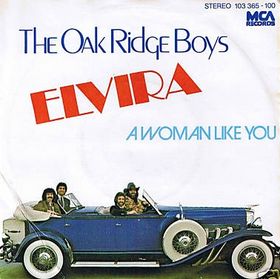
In 1981, the American country band the Oak Ridge Boys had a massive #1 hit with their earworm* of a song called Elvira. When we learned of our ancestor Elvira Harris, that particular earworm turned on and hasn’t shut off yet. “In 1982, at the 24th Annual Grammy Awards, Elvira by the Oak Ridge Boys won the Grammy for Best Country Performance by a Duo or Group with Vocal.” (Wikipedia) *It is our nominee for the Earworm Hall of Fame, (please see the footnotes).
Paris Township
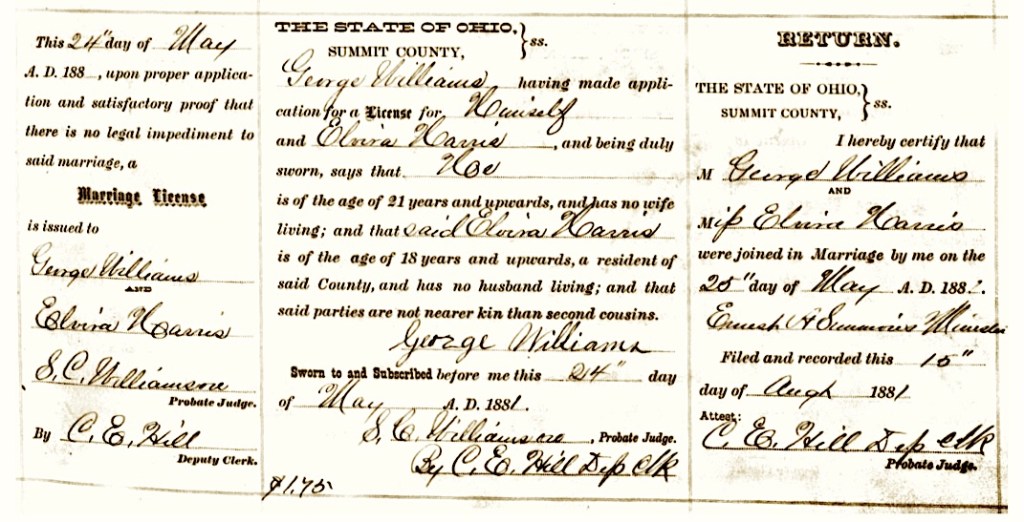
The Summit County, Ohio marriage record for George Williams and Elvira Harris, for May 25, 1881.
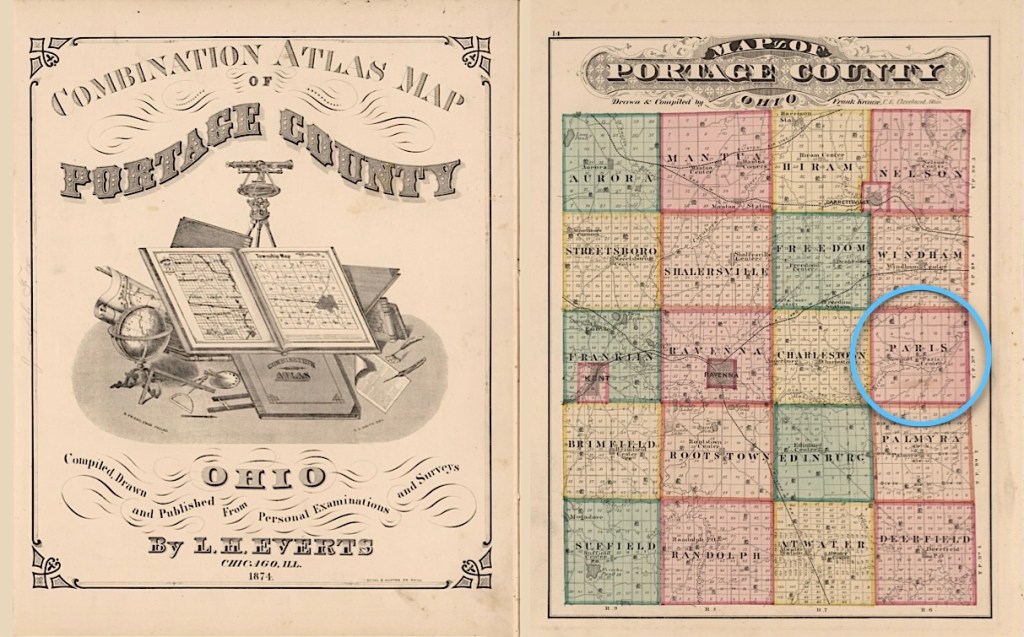
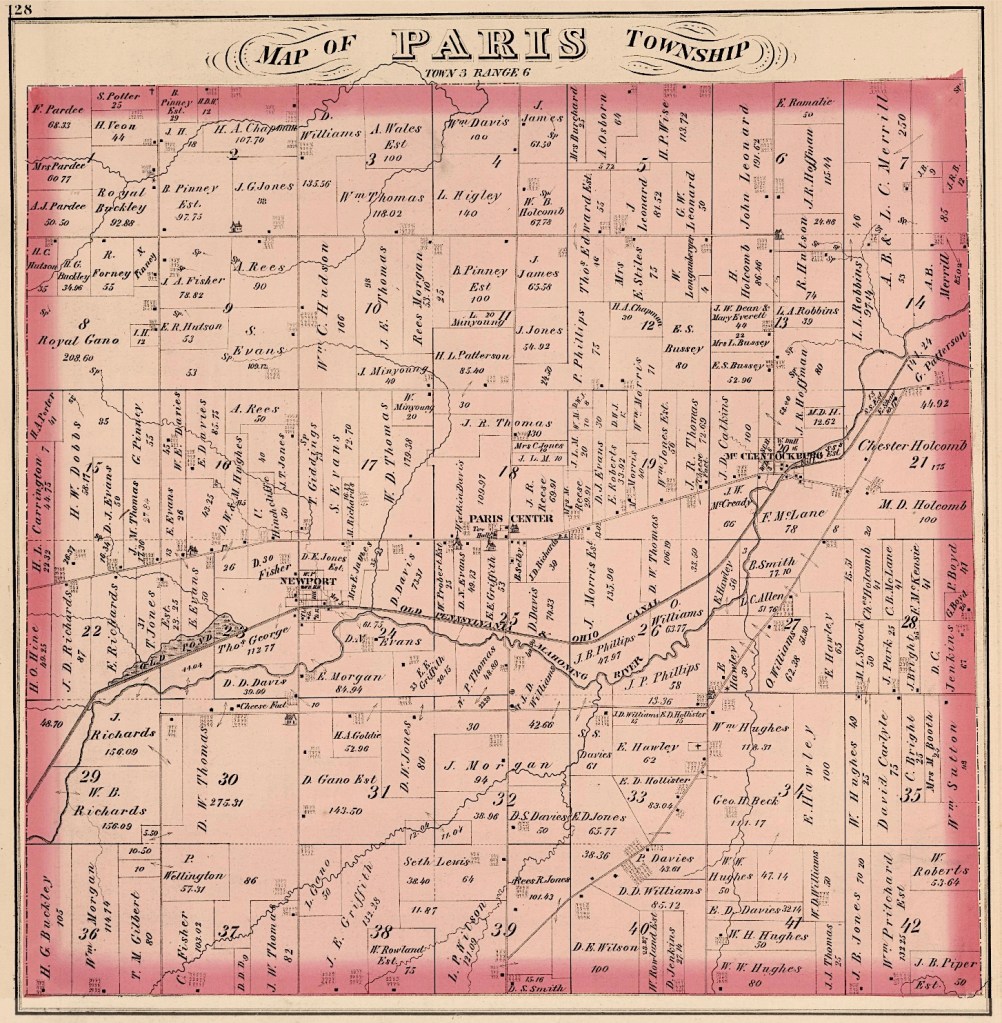
In May 1881, George Williams married Elvira Harris in Cuyahoga Falls, Ohio. They settled, not in Summit County where he was from, but in Paris Township, Portage County which was the adjacent county just east. Elvira’s mother Ann (Thomas) Harris had been born and raised in Palmyra township, just below Paris Township. It’s quite plausible that they chose this area to settle in because there were other family members nearby who could helpful. With this marriage, the Harris name gave way to the Williams family name.
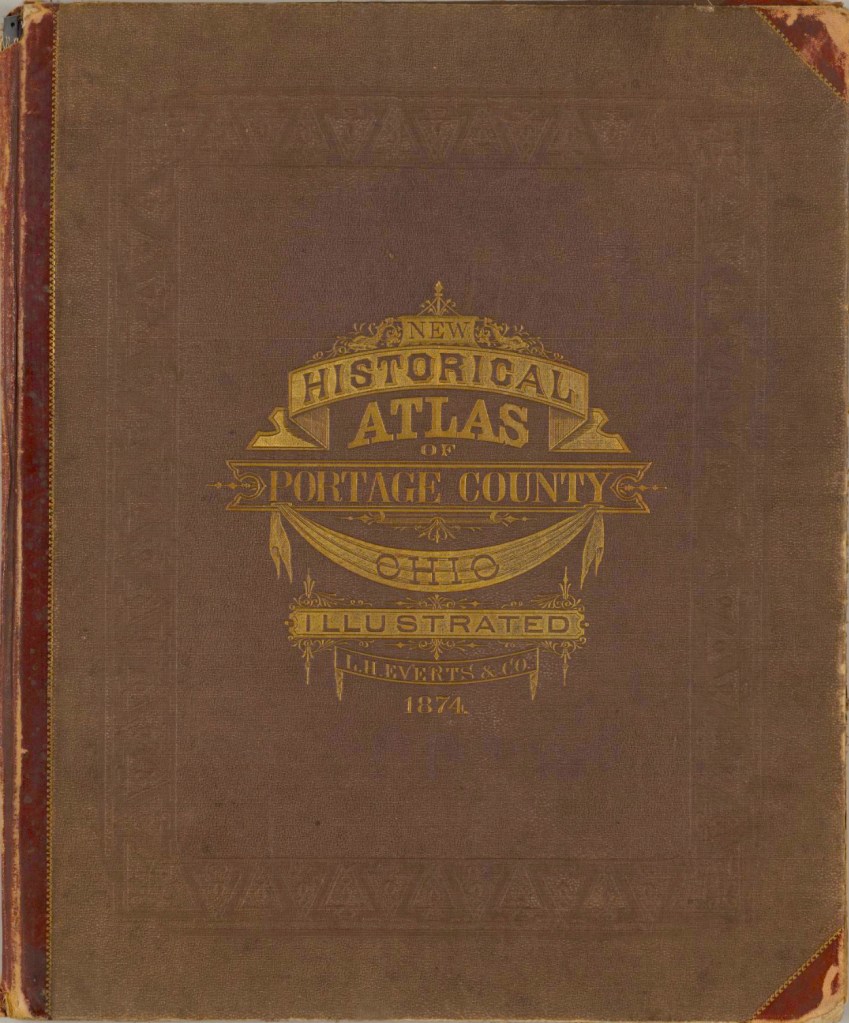
Frontispiece and Portage County map from the Combination Atlas Map of Portage County, Ohio, by L.H. Everts, 1874. (Image courtesy of David Rumsey Map Collection).Page 128, Paris Township, Portage County, Ohio, by L.H. Everts, 1874. (Image courtesy of David Rumsey Map Collection).
Wikipedia relates that “Paris Township was established around 1810. The community derives its name from Paris, New York.” Therefore, it is a very old community for that part of the United States. Additionally, it was intriguing to read that, “In the year of 1831 John Morgan arrived in the township from Wales and purchased part of Lot 32, erecting a log cabin thereon. From this beginning, other countrymen of Morgan’s came from time to time and it is said that by 1885, the population of Paris was two-thirds Welsh. Today a large number of these people have descendants in Paris.” (Portage Heritage)
Sadly, for this generation, we do not have any census information, because they married in 1881, and therefore are listed separately on the 1880 Census, (each in the home of their respective parents). The 1890 Census was lost…
Destruction of the 1890 Census by the Great Fire of 1921 at the Commerce Department Building in Washington, D.C. (Image courtesy of Random Acts of Genealogical Kindness).
Due to a major fire in 1921, and the subsequent water damage, there are almost no 1890 Census records existing. “A January 10, 1921 fire at the U.S. Department of Commerce building in Washington, DC, destroyed the majority of the population schedules from the 1890 Census. The fire left an enormous gap in many families’ genealogical record. Although alternative records may provide some information, the loss of the 1890 Census schedules remains an insurmountable obstacle for many researchers attempting to trace families between the 1880 and 1900 censuses”. (Census.gov)
What this means for the history of George and Elvira Williams is that we do not know exactly where they lived in Paris Township, nor specifically what they did to earn a living. Everything we can know about them is mostly due to inference and educated guess work. What we do know is this:
It is probable that George worked in agriculture, and that Elvira was keeping house. On the 1880 Census, he is noted to be working as a teamster, which was a role that his father Daniel had been noted with ten years earlier on the 1870 Census. Google defines this occupation as, “In 19th-century agriculture, a teamster was a skilled worker who drove a team of draft animals—typically horses, mules, or oxen—to pull wagons, plows, or other farming equipment. They were essential to the rural economy, responsible for transporting heavy loads such as crops, timber, or supplies, and for breaking ground during planting season.”
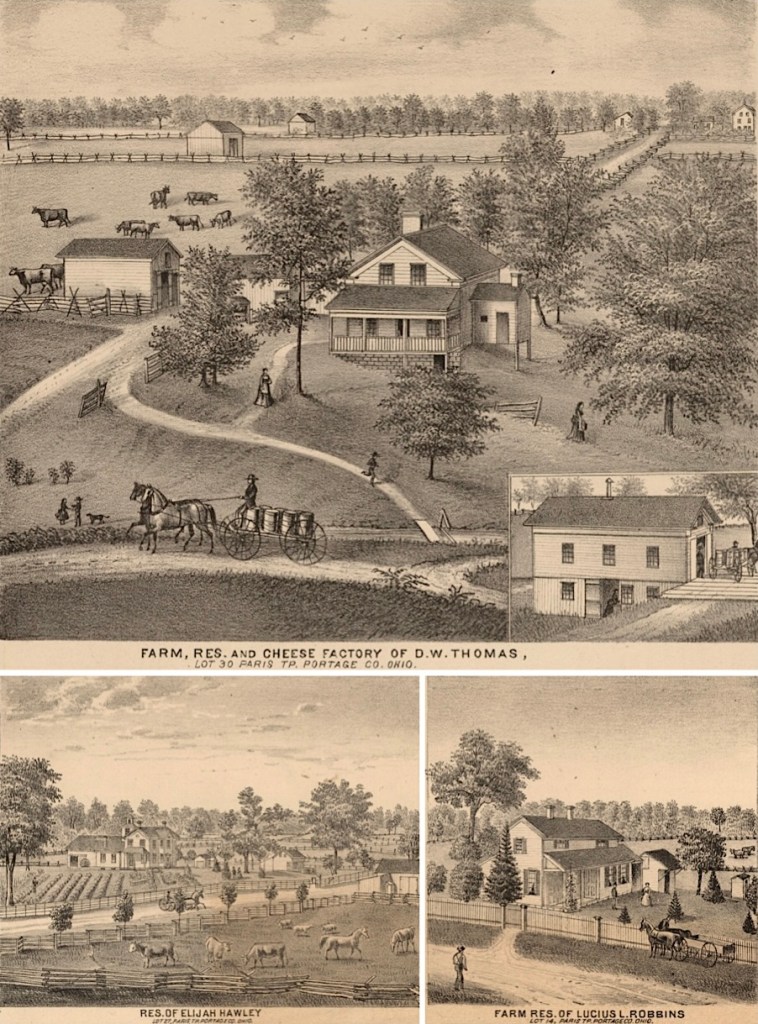
Artist’s renderings of some of the local homes and farms found in Paris Township in the 1874. From the Combination Atlas Map of Portage County, Ohio, by L.H. Everts, 1874. (Image courtesy of David Rumsey Map Collection).
From the illustrations above, one can discern the well-kept farms, gardens, and pastures of the neighbors of George and Elvira Williams. It is interesting to see neither telephone poles, nor paved roads. In fact, the bucolic scenes look a bit idealized. The world was probably much quieter then… (2)
The Five Williams Children
George and Elvira had five children, their oldest Elmer was born about 11 months after they married — and then went on repeat (just like our familiar song). All of the children were born in Paris Township, Portage County, Ohio:
Elmer George Williams, April 3, 1882 – December 2, 1966
Berl G. Williams Sr., 1883-1965
May Williams, February 12, 1885 – May 31, 1898
Clyde Williams, November 1, 1886 – April 17, 1889
Benny H. Williams, August 20, 1888 – 1968.
Observation: It is refreshing to see that this generation has evolved the naming conventions of their children. We see (for then) modern, new names: Elmer, Bearl, May, Clyde, and Benny. So many generation prior to this one, fell into patterns where some names such as William and Henry, although nice enough, were used generation-after-generation-after-generation. Repetition seems to be a theme in this chapter?
Sadness came into their lives when son Clyde died at the age of about two and a half; a brief life for one so young. (3)
Of Unknown Causes
Neither Elvira, nor her husband George had long lives. Elvira died on October 12, 1889, of unknown causes. When she passed, this left her youngest child Benny at the age of 1 year, 1 month, and 22 days old. He was probably still nursing and just learning how to walk. Their father, George Williams, was now alone with five very young children to raise… However, he then also died not long after his wife, Elvira. George passed away on March 30, 1893, and son Benny was 4 years, 7 months, and 10 days old. We mention Benny because — somewhere in that time frame (between Elvira’s death and George’s death), Benny was adopted, and the trajectory of his life changed dramatically.
We have been pondering what happened to them? In another family line, from the same timeframe, we had some ancestors who were parents of a similar age and circumstance. — Those ancestors just disappeared, and very quickly. — It took us much time to figure out that they may have died in a Cholera epidemic in Cincinnati, but honestly, we could not concretely prove it. It is just that all signs pointed in that direction. In our present age, and due to the many advancements of medical science in the nearly 140 years since George and Elvira passed on, we are not used to thinking about the many real possibilities of that era. The article, There Were a Million Ways to Die In Old Cincinnati; Here Are 17, is very enlightening. (See the footnotes). (4)
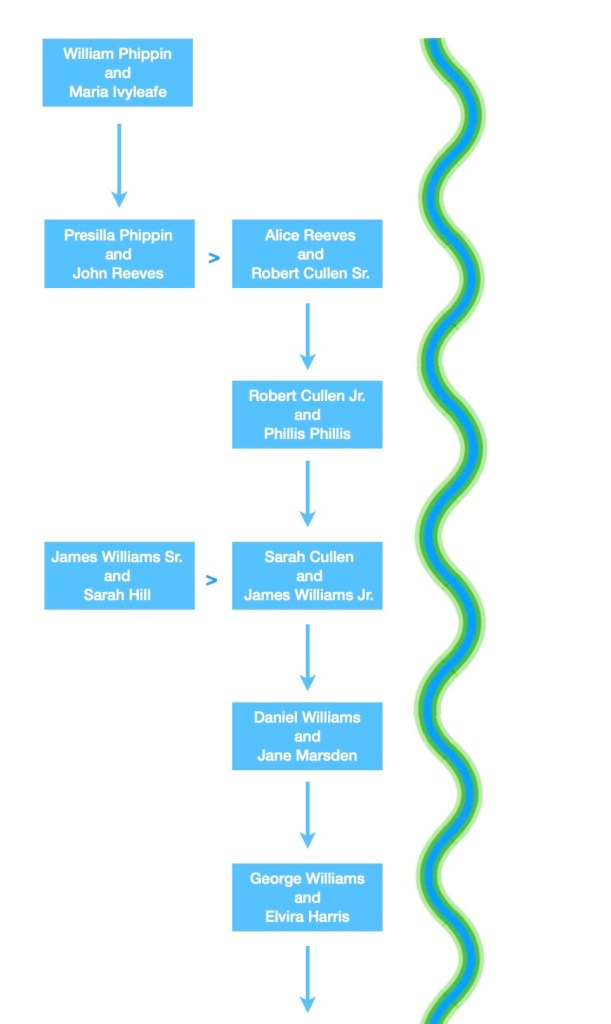
We include here a repeat of the Williams family pedigree flow chart, to review the progression of that family through time, before we transition to the history of the Harris family.
Going forward, we need to go back — back to Europe, and back in time. We are going to cross the Bristol Channel above Somerset, England, and venture into the country of Wales, to learn about the Thomas, and the Harris families.
Following are the footnotes for the Primary Source Materials, Notes, and Observations
On repeat, on repeat, on repeat, on repeat…
(1) — two records (no pun intended)
Slip jacket for the single version of Elvira by the Oak Ridge Boys, circa 1981.
Daniel Williams in the 1870 United States Federal Census Ohio > Summit > Tallmadge https://www.ancestry.com/search/collections/7163/records/38420169 Book page: 10, Digital page: 10/32, Lines 1 through 8. Note: On this census, George Williams is noted as at home, and his father is noted as a teamster.
Elmer George Williams https://www.findagrave.com/memorial/12416370/elmer-george-williams Note: His birth and death dates are, April 3, 1882 – December 2, 1966. From 1955 to 1965, he lived at this address: Elmer G. Williams, (Rose J.), home – 2124 4th St., (Cuyahoga Falls, Ohio). Rose was his wife and is interred near him. and Elmer D. Williams [the middle initial should be G., not D] in the Ohio, U.S., Births and Christenings Index, 1774-1973 https://www.ancestry.com/search/collections/2541/records/1383300 Note: For Elmer’s birth confirmation.
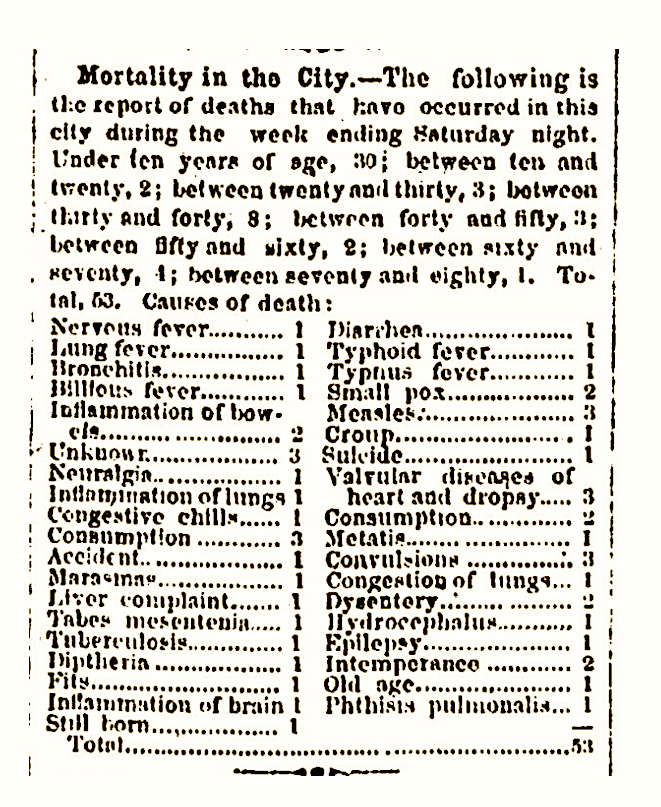
A single week registered 53 deaths in Cincinnati in 1866, with two-thirds being children under 10 years of age. (Image and text extracted from the Cincinnati Magazine article linked below).
George Williams in the Summit County, Ohio, U.S., Death Records, 1866-1908 Death Index Registers, 1869-1908 > S – Z https://www.ancestry.com/search/collections/1596/records/35519?tid=&pid=&queryId=d1703b33-a6b4-4864-8c19-e310261b6ffe&_phsrc=Lzl1&_phstart=successSource Book page: 94, Digital page: 150/156, 12th and 16th entries. Notes: Something odd about the dates on this file — why are there 2 entries for the same person? It appears that first entry for his death date is March 30, 1893, and the second entry is the same person, but uses a date of one year later, March 30, 1894. His gravestone records the 1893 date.
This is Chapter Six of eight: Finally we cross over into the Ohio frontier and meet several more generations of Bonds as they make their way toward the 20th century. (Thanks for sticking with us through this long history!) But first, we still have to cover some interesting history in Maryland.
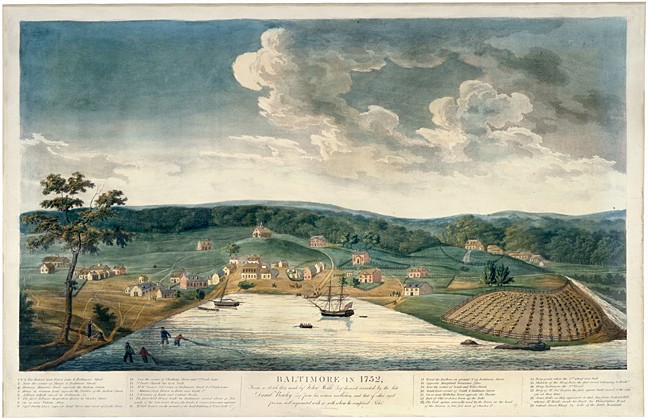
Baltimore in 1752, by William Strickland. The scene depicted is about 25 years before Edward Fell Bond was born. (Image courtesy of the Maryland Center for History and Culture).
We are descended from Edward Fell Bond, who relocated from Maryland to Ohio when he was an adult. Having been born in 1777, the last of four children of William and Sarah (Wrongs) Bond, his childhood was during the American Revolutionary War. He is the first grandfather in our lineage who was born and raised without the oversight of a monarch. For about 800 years, the Bond family had both prospered, and suffered, due to the British class system, but now — all of that was changing.
Who Was Sarah Franklin Smith?
We have discovered that Edward had two marriages. His first marriage was to Sarah Franklin Smith on Christmas Eve, December 24, 1807, at St. James Parish, Baltimore County.
Edward Fell Bond and Sarah Franklin Smith marriage certificate, 1807.
Sarah was born on October 12, 1784 in St. Johns Parish, Baltimore County, Maryland, to James and Sarah Smith. Her parents had two more children, Franklin James Smith, who had a long life, and a boy named James Smith, Jr. who died young in 1791. Prior to the time of her christening, the St. Johns Parish and the St. James Parish had been combined. (In some records, both parishes are cited together, even though they separated in 1777). It appears that both this christening and her marriage took place at the same parish.
Observation: There are scant records on Sarah’s life. We can deduce that she was 23 years old when she married William. At 30, he was seven years older. Their son, William H. Bond was born August 12, 1808 in Baltimore County, Maryland. We have calculated his birth date based upon Jefferson County, Ohio court records.
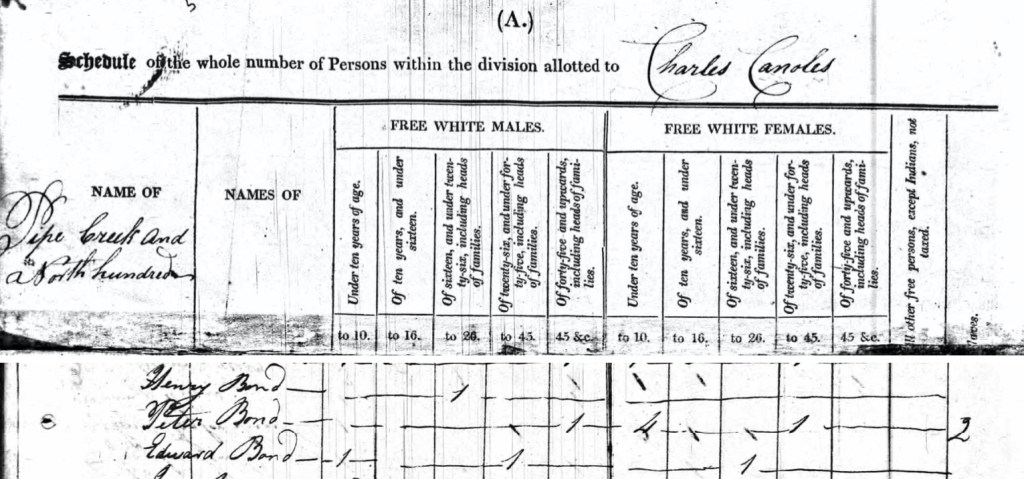
The next record we can find about Edward is the August 1810 census that was conducted in the Pipe Creek and North Hundred area of Baltimore County. It was the third census of the United States.
1810 United States Federal Census for Edward Bond, Maryland, Baltimore
From this census, we can discern a few things. Edward was 32 or 33, there is a male child in the home who is under 10 years of age, (likely William H.), and there is a female in the home who is between the ages of 26 and 45. From our research, we are not able to document specifically who is the female person. It is at this point in our narrative that Sarah Franklin (Smith) Bond just disappears from the records, and we have not discovered what happened to her despite long, fruitless efforts. The female cited in the census, could be her before she “disappears”. We assume Sarah (Smith) Bond had died.
Following this census the records show that on January 24, 1811, Edward Fell Bond, aged 33 married Frances Harrison Hawkins, aged 19 (born November 29, 1791) in Baltimore County, Maryland. She took over the motherly responsibilities of raising young William, who was about 3-1/2 at this time. (1)
Who Were These Hawkins People?
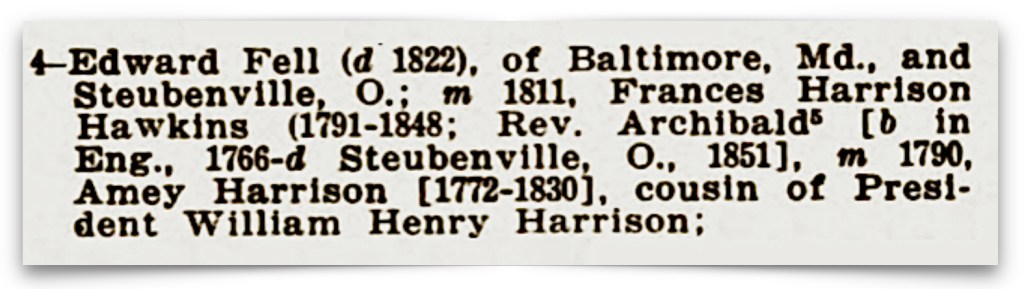
The Compendium of American Genealogy, Volume 5, 1933, by Frederick Adams Virkus.
Frances’s father was the Reverend Archibald D. Hawkins, who was born in England, and her mother was Amey Hawkins Harrison. Frances had four younger brothers one of whom was Ezekiel Cooper Hawkins, a celebrated pioneering daguerreotype photographer.
Francis Harrison Hawkins family line was noteworthy for some of her illustrious relatives. The first two relatives were within her lifetime… Benjamin Harrison V, considered to be one of the Founding Fathers of the United States. He was a governor of Virginia, and a signer of the Declaration of Independence. His son William Henry Harrison was the 9th US President in 1841. After her lifetime, the great-grandson of Benjamin Harrison V, the same-named 23rd President Benjamin Harrison (1889-1893), was also a relation.
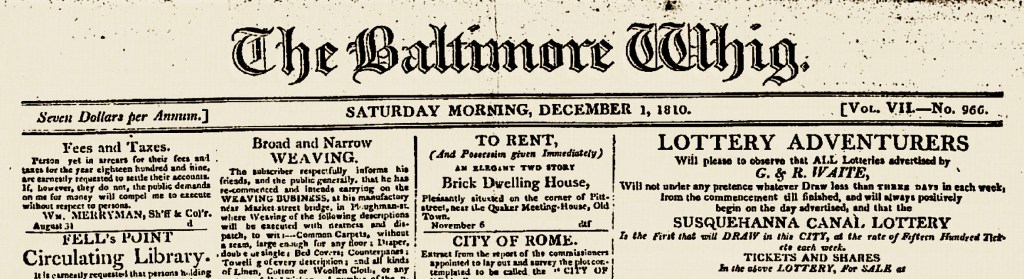
Masthead for the Baltimore Whig newspaper, circa 1810. Our research has shown that the marriage of Edward Fell Bond and Frances Harrison Hawkins was announced in The Baltimore Whig newspaper, in the January 28, 1811 issue. The notice mentioned that she was a cousin to the (Virginia) Harrison family through her mother’s side of the family. (See footnotes).
From http://www.whitehouse.gov — “William Henry Harrison, an American military officer and politician, was the ninth President of the United States (1841), the oldest President to be elected at the time. On his 32nd day, he became the first to die in office, serving the shortest tenure in U.S. Presidential history…” and also, “Benjamin Harrison was the 23rd President of the United States from 1889 to 1893, elected after conducting one of the first ‘front-porch’ campaigns by delivering short speeches to delegations that visited him in Indianapolis.”
Comment: The election of William Henry Harrison as the 9th President of the United States, resulted in a bit of irony for our family history. He displaced Martin Van Buren, the 8th President, to whom we are directly related through his Dutch grandparents. Additionally, those same grandparents lead us to the eminent Roosevelt family, who also gave the United States two more Presidents. We cover these connections in another family line, please see The Doty Line, A Narrative — Seven. (2)
Their Life in Baltimore County
There are a few direct records that inform us of their lives in Baltimore. Edward F. Bond is listed in The New Baltimore Directory, and Annual Register; for 1800 and 1801, as being a grocer. In those days, a grocer would have had an emporium that we would likely call a general store. Except for bakeries, food stores were not specialized in those days to sell only food. They also had to provide for the larger needs of the community. Interestingly, the location of his business was at McElderry Wharf which had become an area for import/export businesses to situate themselves. Records indicate that some of the businesses located there were dealing with fine antiques, such as Chippendale and Hepplewhite furniture.
“McElderry Park takes its name from the McElderry family, who were wealthy merchants in Baltimore in the early 19th century. Irish immigrant Thomas McElderry (1758 – 1810) arrived in Baltimore in 1793 and quickly established himself—building a wharf that bore his name, improving Market Square, and helping found the Baltimore Water Company.”
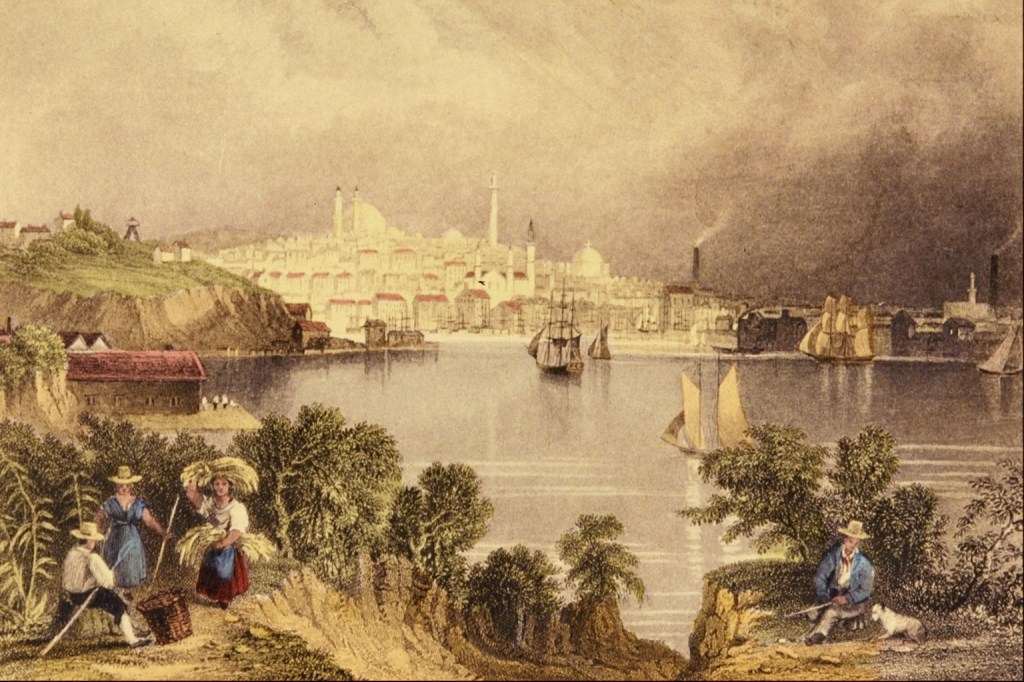
View of Baltimore (before 1840) by William Henry Bartlett (1809–1854). (Image courtesy of Wikipedia Commons).
Observation: It is likely that Edward took notice of the fine home furnishings around him and perhaps pondered how to increase his fortunes. We found a record for an E. F. Bond arriving at the port of Philadelphia in 1804, which could be construed that he had traveled as part of creating his own import/export business.
By 1815, he had relocated and now presided over The Queen’s Ware Store, located at 44 North Howard Street, Baltimore.Queen’s Ware, or cream ware as it was also called, was a style of fine dishware pioneered by Josiah Wedgwood in England in the 1760s. Over time it became so popular, that the Americans tried to manufacture their own versions.
“Creamware was popular for a wide range of household pottery appearing in the Georgian dining-room and on the tea-table. It brought a finer kind of tableware to middle-class families, and wasn’t only for the rich. It was also used for commemorative items, like the pitcher, or jug…” Edward wasn’t a pottery maker, but a merchant, who seemed to appreciate finely crafted items.
Baltimore Street Map, 1838 by T. G. Bradford, G. W. Boyton. (Image courtesy of Wikipedia Commons). Note:The map colors are a bit odd, with the areas of water colored as gray.
The 1838 map above shows specific items of historical interest for the Bond family. Each city section, or ward, has a specific number, and the arrows help with locating the details.
Ward 1: The location of Fell Street, near Fells Point.
Ward 2:Alice Ann street, named after Aliceanna (Webster) Bond.
Ward 3: Bond Street, named after Gentleman John Bond, and the location of McElderry Wharf (curious — it’s not on the water?). McElderry Wharf is where Edward Fell Bond’s first business was located.
Ward 10: The location of Howard Street, where Edward Fell Bond’s Queens Ware store was located.
Creamware pitcher circa 1800 , with transfer-printed “The Apotheosis of George Washington”. (Image courtesy of Home Things Past).
Edward Fell Bond and Francis Hawkins had four children, three of their own, and William H., from Edward’s first marriage. Many of our ancestors, like others in their time, lived in a blended family. Their children are:
William H. Bond, born August 12, 1808 – died, unknown (We are descended from William H.)
Mary Emeley Bond, born November 8, 1811 – died, January 24, 1815
Amy Jane Bond, born May 2, 1816 – died, August 13, 1891
Edward Fell Bond, Jr., born January 5, 1818 – died, January 10, 1884
Observation: We have never discovered what the ‘H’ stood for in William H. Bond’s name. Maybe the letter was added in later after Edward Sr., met Frances? If that is the case, it may have been Harrison, or Hawkins… (3)
On To New Frontiers — Send Us a Postcard!
The western frontier of the new United States expanded greatly with Thomas Jefferson’s Louisiana Purchase of 1803. In addition, the Northwest Territory was just starting to settle out, and many people wanted to relocate there. Edward Fell Bond was the last inhis line of Bond ancestors that still benefitted from the earlier wealth of his colonial ancestors. As the country changed, and generations came and went, landed estates had been broken down into smaller and smaller parcels, until there wasn’t much left to be shared or inherited.
“Following the Revolutionary War, for the next 25 years, Ohio became the primary destination of westward bound pioneers because of the fertile farmland in the Ohio River Valley.
Some families stayed for the remainder of their lives. Others simply passed through on their way west.”
United States Migration Patterns Beverly Whitaker, CG
Additionally, this period in Baltimore was a troubled time. There was a crippling trade embargo in 1807, then the War of 1812. Their daughter Mary Emeley died very young in 1815, and it appears that by 1811, Frances’s parents, Rev. Archibald and Amy (Harrison) Hawkins, had moved west to the frontier community of Steubenville, Ohio, which was part of the Northwest Territory.
“Commodore Perry Leaving the Lawrence for the Niagara: at the Battle of Lake Erie”, by Thomas Birch, 1815. (Image courtesy of Wikimedia Commons).
“Between 1812 and 1820 several families moved to Steubenville who afterwards contributed not only to the artistic and literary side of this western society, but whose immediate and subsequent descendants gained a national reputation. The first of these was Rev. Archibald Hawkins, who came to Steubenville from Baltimore in 1811 and built a house on South Third Street, lately occupied by his granddaughter, Miss Rebecca Hawkins. He was a local Methodist preacher and is said to have been specially intimate friend of Rev. Father Morse, of St. Paul’s, who came a few years later. At that time he had a son Ezekiel, three years old, who early gave indications of precocity as an artist.”
We imagine that Edward Sr.’s business on Howard Street in Baltimore was also suffering. During the early nineteenth century, conflict between England and France led to an [1807] American trade embargo that restricted the importation of goods from these countries. Soon after, English hostilities on the high seas that led to the War of 1812, also stopped the flow of foreign goods to America, including fine British ceramics. Merchants like Edward couldn’t obtain the imported goods they had been selling, so for a while, perhaps he turned to domestically made American products?
By May 1816, we know that they were living In Steubenville, Ohio because their daughter, Amy Jane Bond, was born there in that year. (4)
Sanborn Fire Insurance Map from Steubenville, Jefferson County, Ohio, masthead 1892. Courtesy of the Library of Congress.
Greetings From Steubenville, Ohio
Edward Sr. and Frances (Hawkins) Bond followed her parent’s path to Steubenville, Ohio. The trip certainly lacked many of the comforts that they were accustomed to in Baltimore. Ohio was still considered to be frontier territory, even though it acquired statehood in 1803. Prior to 1803 Steubenville had been surveyed in 1796 and was well established by the time the Bonds arrived.
There were very few improved roads, no railroads had been built through, and the canals (a new technology then) were located far away. Horse drawn wagons weren’t much of an option until the muddy, rutted roads were much improved. The only way that people traveled initially was by horseback, on flat river boats, or sometimes by stagecoach. Frequently, it was a combination of all three. (It makes us tired just thinking about it!)
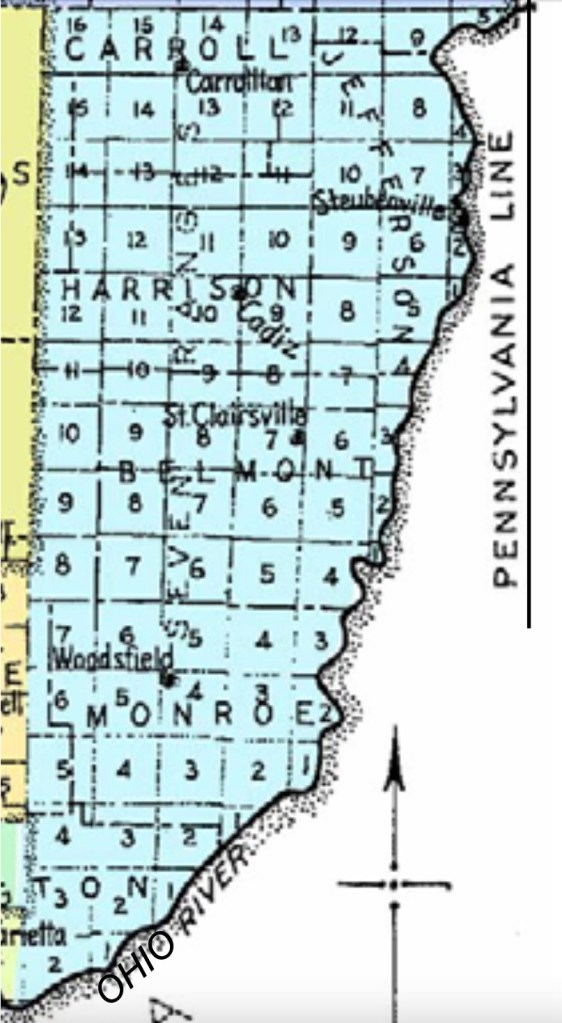
The area where Steubenville is located was then called the Seven Ranges, in southeastern Ohio.
Ohio was a place where business entities and governments from other states had rights to certain enormous parcels of land. Hence, many Eastern land speculators were hoping to make a profit on the western migration.
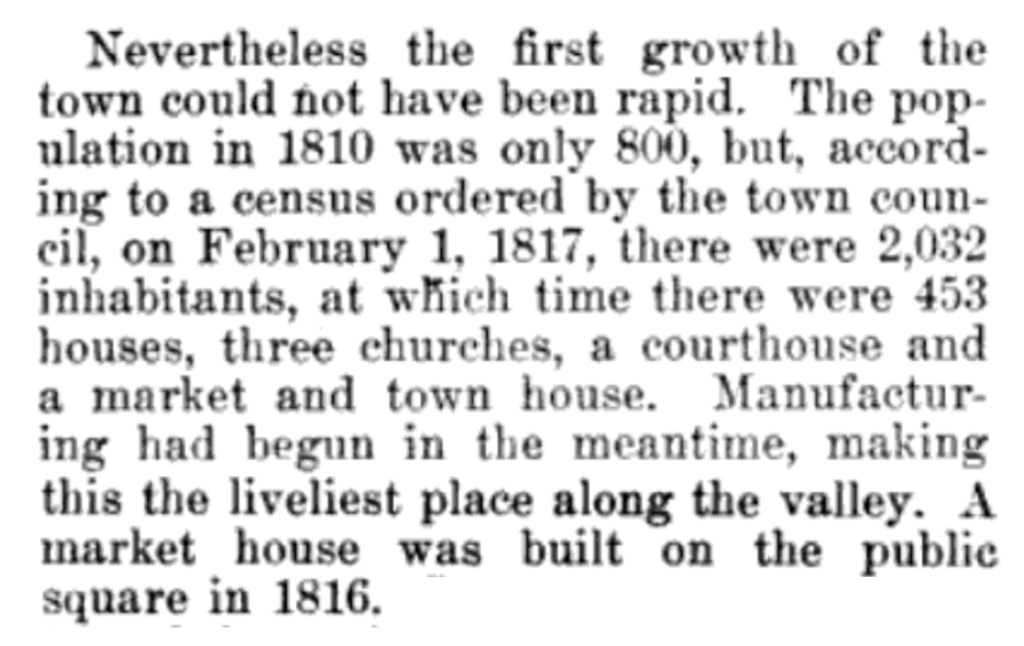
From the book, 20th Century History of Steubenville and Jefferson County, Ohio and Representative Citizens, Volume 1, we learned the tremendous population growth in seven years time:
20th Century History of Steubenville and Jefferson County, Ohio, page 368.
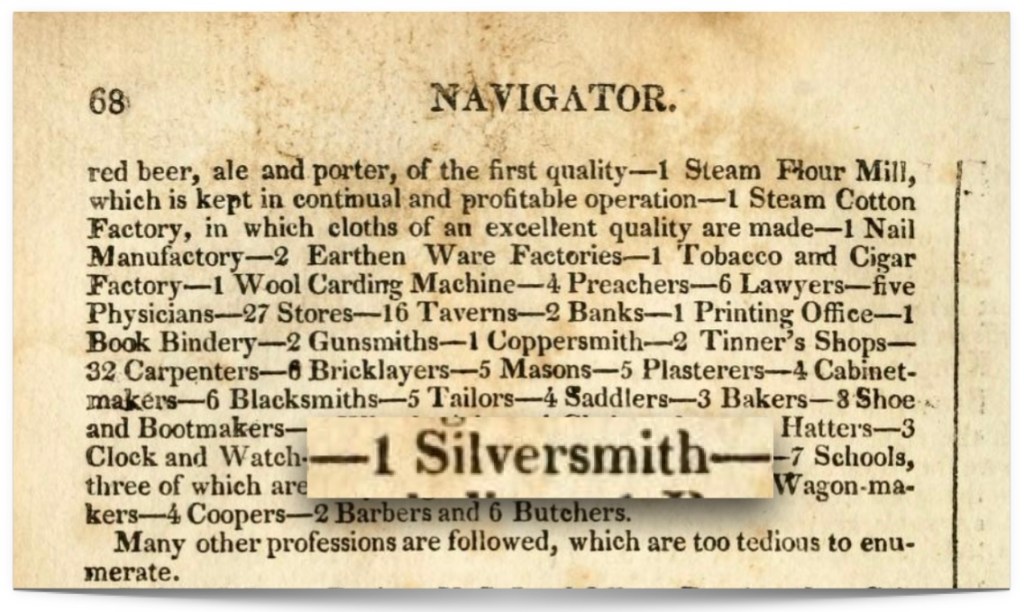
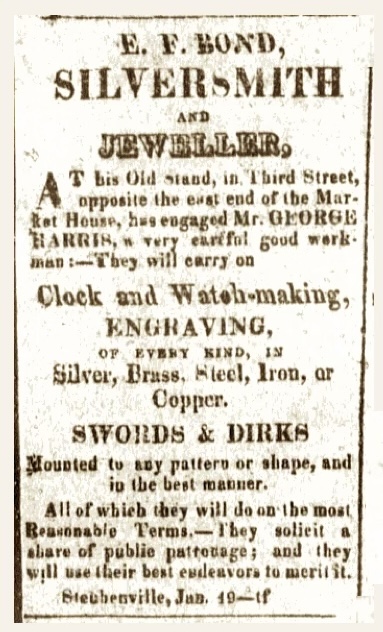
Edward Sr., returned to his appreciation of finer things when he set up a home in Steubenville. We know this because a couple of newspaper notices have survived the last 200 years. Additionally, he offered his services to the community as a silversmith and jeweler. The Navigator, a publication highly valued by those who traveled on the waterways within the Ohio frontier, published in their 1821 edition, the following list of industries and professions in Steubenville at that time. We excerpted the section below to show that the listed profession of ‘1 silversmith’, is our Edward Fell Bond.
While they were living in Steubenville Frances had her last two children, Amy Jane Bond, born May 2, 1816 – died August 13, 1891, and Edward Fell Jr., born, January 5, 1818 – died November 10, 1884.
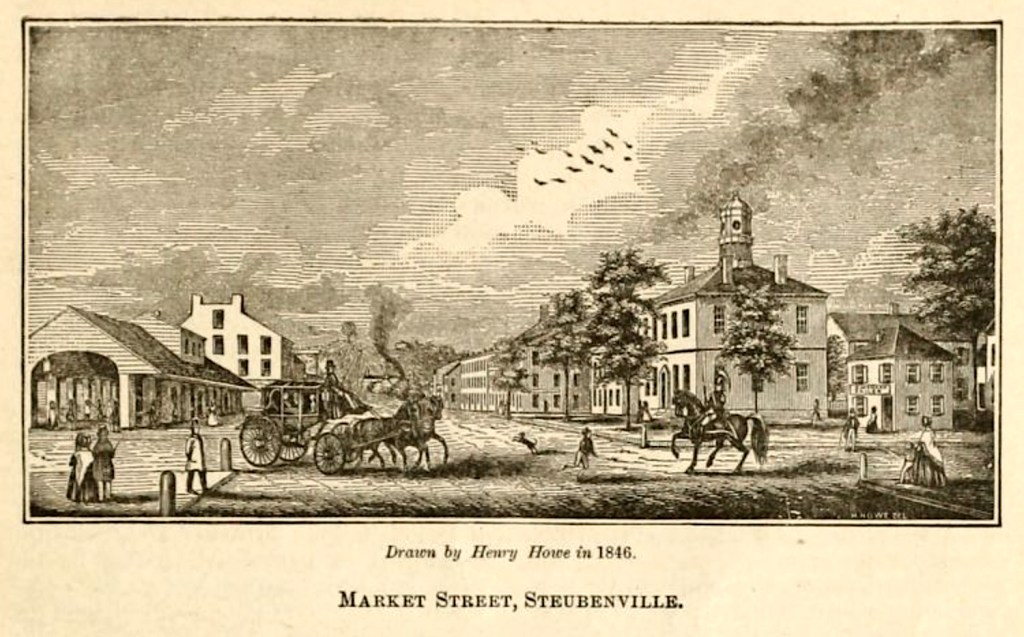
This illustration is actually from later decades in the 19th century. There just isn’t that much art which documents Steubenville in the 1820s, but it demonstrates the scale of the small city.
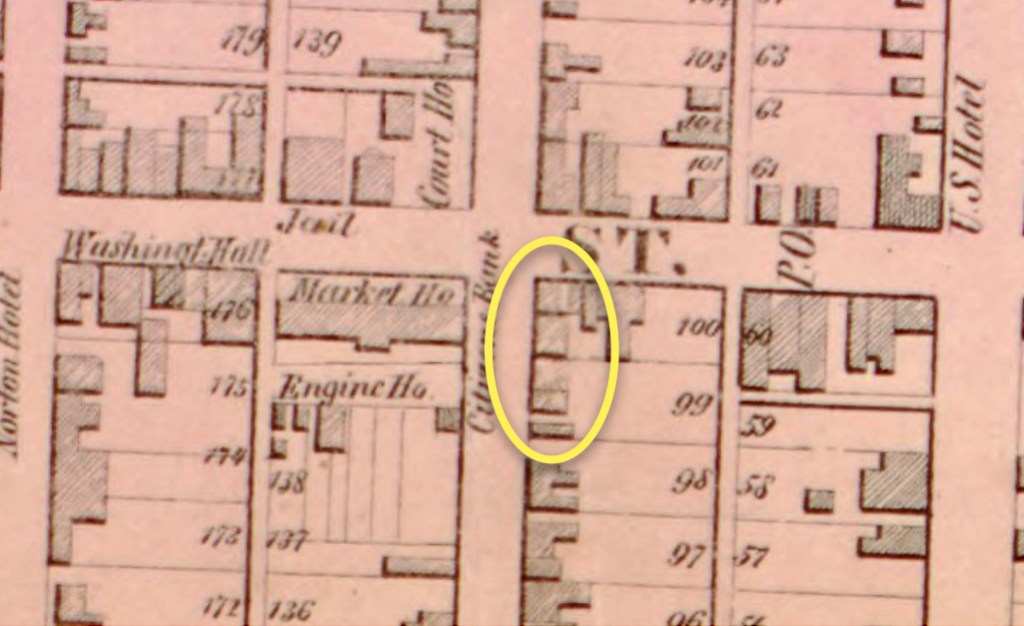
This map image is excerpted from the 1856 James Keyly map of Steubenville and it shows what we have discerned is the likely location of E. F. Bond’s Silversmith business.
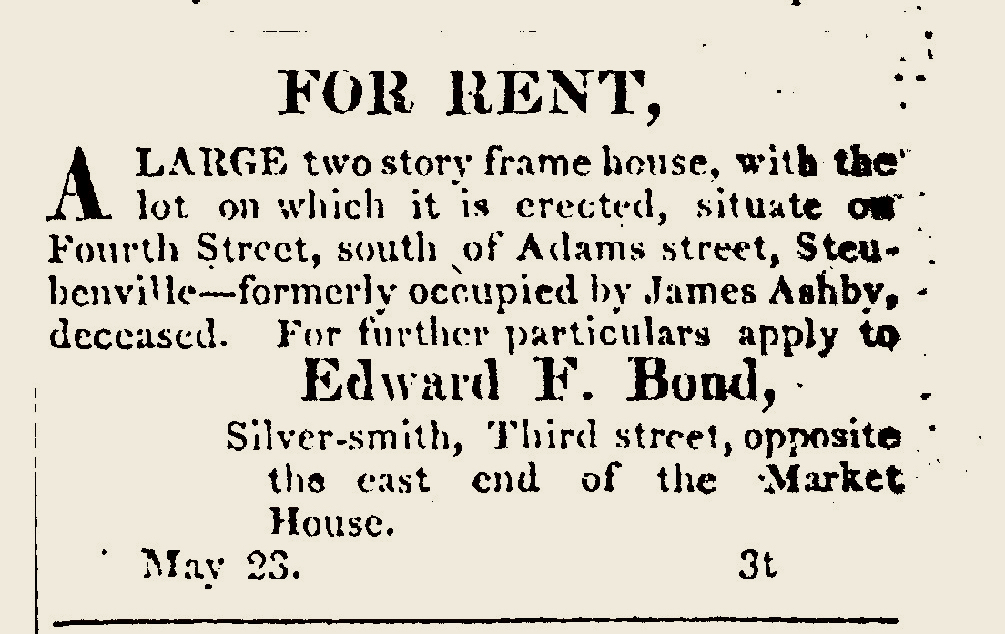
From the newspaper clipping, we have made a couple of observations: First, this For Rent notice from the Steubenville Herald of May 23, 1817, is for a two story framed house. Having a framed house at that early time indicates that there was a local mill which was supplying improved wood. Prior to this, many buildings were somewhat reminiscent of timbered log cabins. They must have either rented, or purchased this house soon after their arrival in Steubenville.
Just a few years later, this second newspaper clipping, also from the Steubenville Herald, of January 19, 1822 indicates that Mr. George Harris had been hired to carry on, which means that E. F. Bond Sr., was not well.
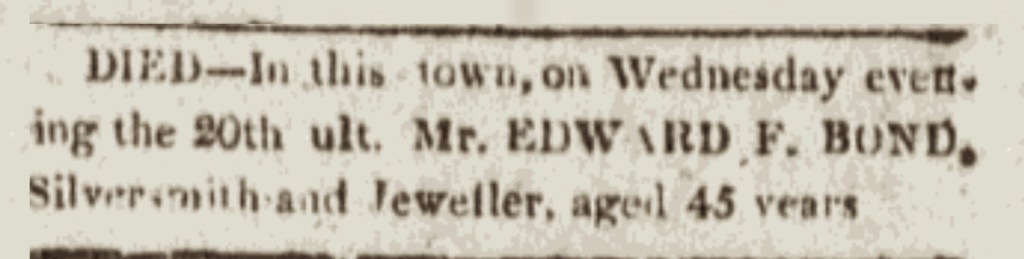
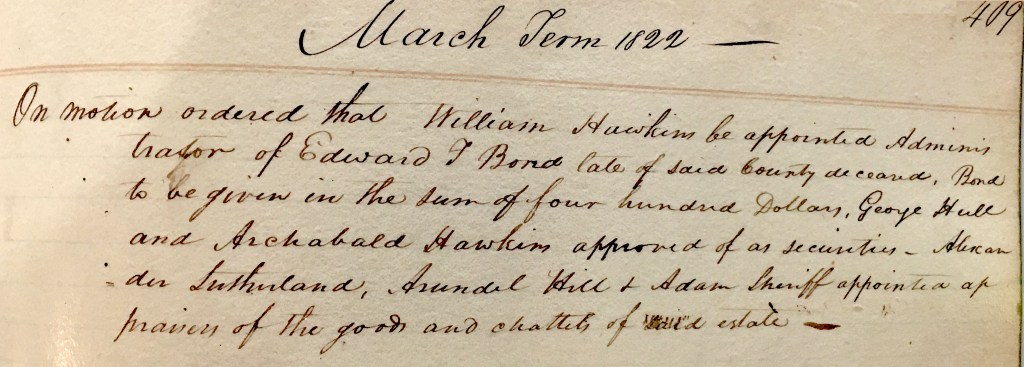
Indeed, he certainly was not well — Edward Fell Bond, Sr., passed away on February 20, 1822, just two weeks before his 45th birthday. This notice from the same newspaper cited above, was published on March 2, 1822. This left his wife Frances to carry on with four young children. As shown below, his brother-in-law William Hawkins was appointed to administer his estate. (5)
The Curious Story of William H. Bond
1822 When his father Edward died, William H. Bond would have been about 13 years old. (Remember, he lost his birth mother when he was very young). He was technically now an orphan because both of his birth parents were dead and he was under the age of 21.
Jefferson County, Ohio, County Marriages, 1789-2016.
His father’s wife, Frances Hawkins, was technically his stepmother. At that time in our cultural history women had very few rights and most often were dependent on the support of a husband, or male relative. As his stepmother, she was not considered appropriate as a guardian for an underage boy.
Jefferson County Common Pleas Journal D, 1819-1822.
William Hawkins, the brother of widowed Frances, was the administrator of Edward Fell Bond’s estate (as shown above). The elder William’s occupation was as a painter, which may have some influence on the rest of this history…
1824 Two years after Edward Fell Bond, Sr. died, Frances married John Odbert on June 17, 1824, in Jefferson County, Ohio. (Recording date: July 13, 1824). The Minister who married them was her father, the Reverend Archibald Hawkins. By that time William H. was almost 16 years old.
1825 By March 1825, nine months after his stepmother remarried, William H. Bond was in court “choosing William Hawkins for his guardian — the court approved the choice”. Perhaps they had grown closer in the last couple of years, and this had been one of the reasons considered for his being chosen as the guardian for young William H. Additionally, William Hawkins had perhaps been mentoring him as an apprentice in the painting trade?
Jefferson County Common Pleas Journal E, 1822-1827.
The document above is important for establishing William H.’s exact birthdate in a court of law. This is the only reliable source we have found for William H.’s birthdate, which we determined is August 12, 1808. This places him in Baltimore County, Maryland for his birth, and also confirms that Sarah Franklin Smith is his birth mother.
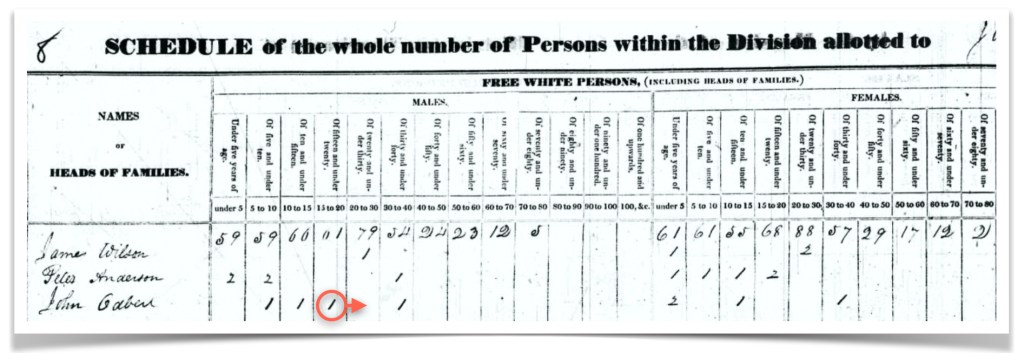
1826 to 1830 After the guardianship, the documentation on William H. is sporadic. It’s not clear if he was in the home of his stepfather John Odbert for the Federal Census of 1830. This census was conducted on June 1, and the categories only captured the ages of who was reported to be living in the home. We are able to discern that the following people lived there:
1830 Federal census, conducted on June 1, 1830.
Archibald Odbert , age 5
Edward Fell Bond Jr., age 12
William H. Bond, age 21 ? (Note: He is marked in the wrong age category.)
John Odbert, age 31
Two girls, ages between 0-5 (We have no idea who they are.)
Amy Jane Bond, age 14
Frances (Hawkins) Bond Odbert, age 39
We find it odd that he is not listed in the correct age category, but we don’t know who was providing the information at the front door. Observation: Why would William be (potentially) living in the Odbert home at the age of 21? That is the age of maturity for a free, white male in 1830, and his guardian is William Hawkins, not John Odbert. However, we also don’t find him in the home of his legal guardian William Hawkins for the same 1830 census.
After 1830 In surviving records after this time, there is much inconsistency about the exact year and place of William H. Bond’s birth. He came to Ohio when he was a young boy of probably seven or eight years. His birth mother was deceased by the time he was 2-1/2. It is written (above) that he was 3-1/2 when Edward married his stepmother Francis …so he probably didn’t remember his actual birth mother. He lost his father when he was 13, so in this state of loss, he probably just accepted what other people told him when it came to his age. Hence, we are sticking to the Jefferson County guardianship court record for his correct age.
Elizabeth Jane Bond born July 11, 1841 – died, August 18, 1911
Alexander Norton Bond, born February 1, 1848 – died, October 21, 1897. (We are descended from Alexander).
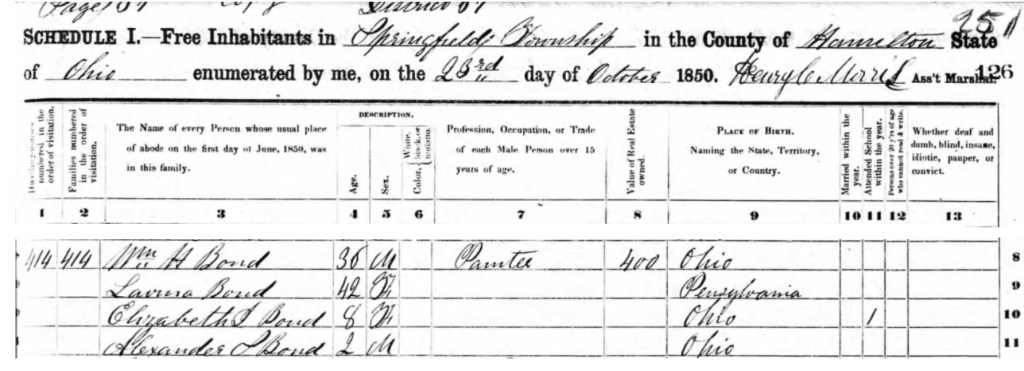
1850 The next time we come across a record of William H. Bond, it is 1850, twenty years have passed, and many things have changed in his life. He is married to Lavina (maiden name unknown), and they have two children: William’s occupation is identified as a painter, which meant he was both a sign painter and a house painter. As we wrote earlier he most likely learned this skill from his former guardian, William Hawkins, a well known painter in the Steubenville area. The Bonds lived in Springfield Township, Hamilton County, Ohio, just a few miles north of Cincinnati, Ohio.
Where had he been from 1830 to 1850? Who was his wife Lavinia? We know she was born in Pennsylvania, but truly nothing else. We will continue to research him and Lavina and update this information if we come across credible sources.
1850 United States Federal Census for Springfield Township, Hamilton County, Ohio
There are at least three errors in this census record: 1) We observed that William and Lavina’s birthdates are likely transposed, or again, William didn’t really know his birth year. 2) William lists his birthplace as Ohio, when it is actually Maryland. 3) Alexander’s middle name is written as ‘S’, but his middle name is actually Norton. Since we do not know who was giving the census information, it is most likely he or she was unaware of the correct dates and places. This is an ongoing problem with early census information. (6)
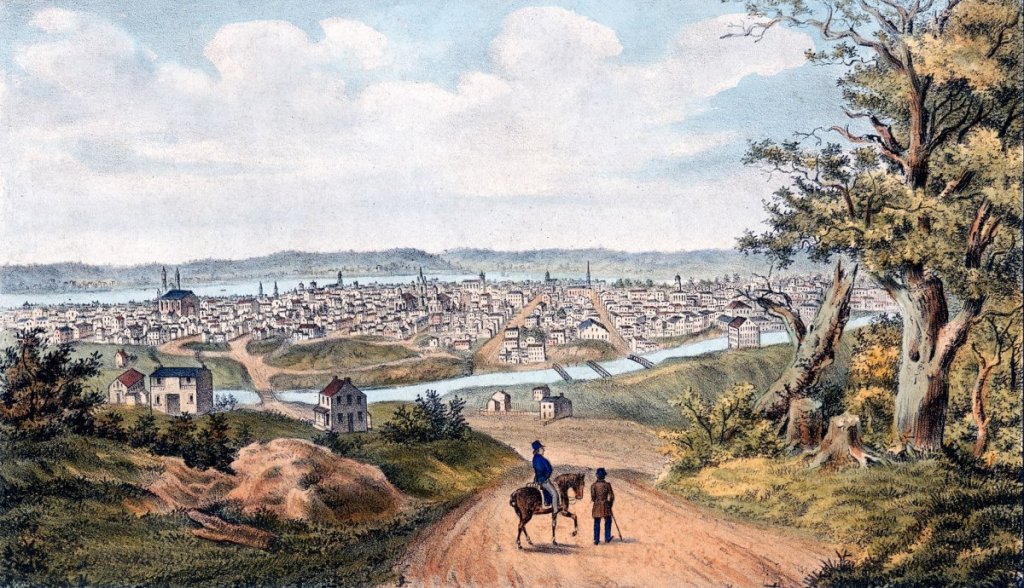
A View of Cincinnati in 1841. (Image courtesy of Wikimedia Commons).
A Time of Cholera
From our extensive research on this Great-Great-Grandfather and his family we have not been able to determine much about his adult life, and sadly, he seems to fade into obscurity.
We have wondered if William and Lavina may have died in one of the many massive cholera outbreaks that was affecting their area of Ohio for several years. Most people who came down with Cholera died very quickly — sometimes within one day. Local newspapers published daily lists of those who had passed away… From The Specter of Cholera in Nineteenth Century Cincinnati by Matthew D. Smith:
“Before the Civil War, Cincinnati was one of the most flourishing cities in the United States, but epidemic outbreaks of cholera in 1832, 1849, and 1866 threatened a social and economic meltdown. Previously unknown beyond Asia, cholera was a disease of modernity, reflecting new pathways in immigration, transportation, and human settlement. Cincinnati’s per-capita death toll was worse than that of almost any other major city in the United States, and containment proved practically impossible. The city’s central location on the Ohio River left it continuously exposed to infection and reinfection. To make matters worse, cholera’s impact radiated beyond the urban center, as waves of refugees spilled out across the Ohio Valley, spreading panic and disease wherever they went.”
Cincinnati Daily Gazette cholera death postings, October 25, 1832, page 3. Cholera burials, and Graphic illustration about Cholera, This Is Not A Time For Sleep, 1883. (See footnotes).
Cholera returned several times after 1849, including to Springfield Township where the Bond family lived. As noted in Cincinnatians and Cholera, “When the disease returned in 1850, 1851, 1852, 1853, 1866, and 1873 Cincinnatians, at least partially, had to blame themselves…”
We do not know if, nor when, William and Lavina died, however, after the 1850 census we no longer find any record of either of them. (7)
Daniel Craig as James Bond 007. We wonder — could he be contemplating the “disappearance” of William and Lavina Bond? (Image courtesy of http://www.variety.com).
After Springfield Township, the Return Back to Steubenville
Through our searches as to whatever became of William H. and Lavina, we soon discovered that their children Elizabeth Jane and Alexander were living on the opposite side of the state of Ohio in Steubenville, with their Aunts. One of these Aunts, Amy Jane (Bond) Halsted, is who we are writing about next.
On October 26, 1836, Amy Jane Bond married Robert H. Halsted in Steubenville, Jefferson County, Ohio where they lived and raised their family. Robert was born on April 28, 1809 in New York to Jacob and Mary (Anderson) Halsted.
October 26, 1836 marriage record for Robert H. Halsted and Amy J. Bond in Jefferson County, Ohio.
Amy Jane and Robert had three children — a son John, and two daughters Mary Frances, and Margaret Jane. (For a fuller description of their descendants, See Descendant Appendix A in the footnotes for this section).
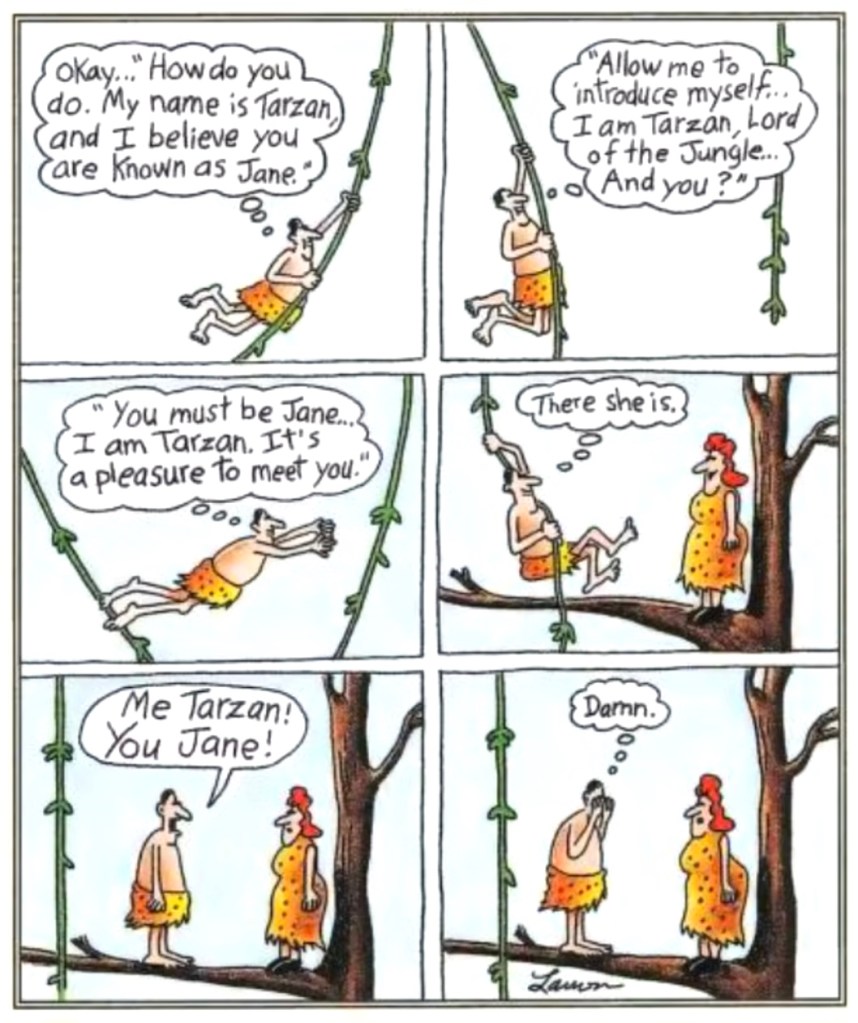
Observation 1: Was it chic to give your daughter the middle name of ‘Jane’ in this period? We have Amy Jane, Elizabeth Jane, Margaret Jane… (Please see the end of the footnotes).
On the 1860 Census, Alexander is living in the home of his paternal Aunt Amy Jane (Bond) Halsted, under the guardianship of her husband Robert.
Observation 2: Alexander has been living with them since at least 1858 when his sister Elizabeth Jane married Jeremiah Northrup. Perhaps earlier? (For a fuller description of her descendants, See Descendant Appendix B in the footnotes for this section).
One thing is clear — he was raised as part of the Halsted family. Therefore, he would have identified with this family because he was very young when his parents disappeared. He followed Robert Halsted into the shoe business as a clerk according to the 1870 census. Also on the same census, Robert Halsted’s prosperity is considerable at $10,000 dollars — (shoes and boots were a good business!) Alexander was 22 years old and still living with them in 1870. By 1872, he and Ruth Linton were married.
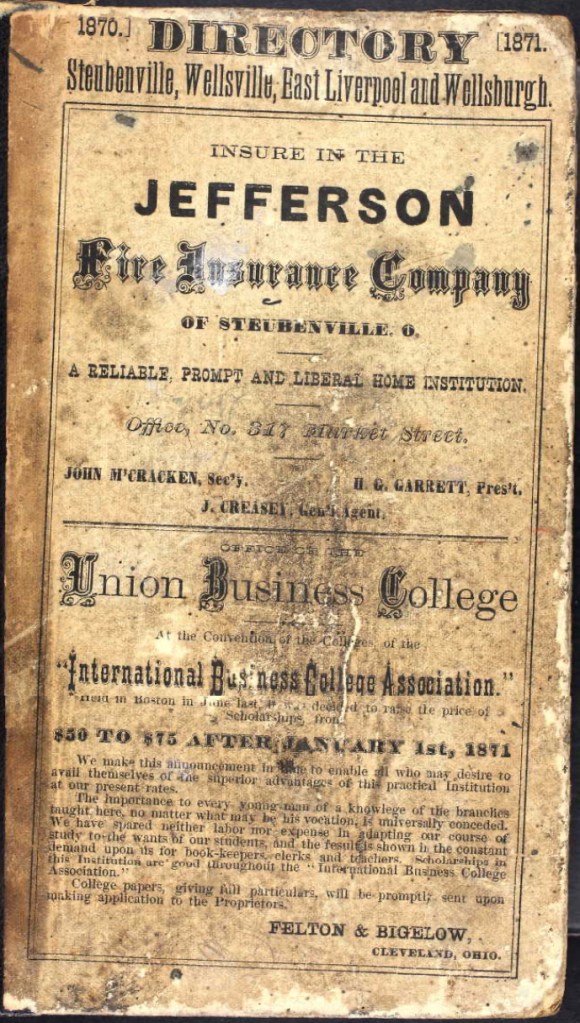
Wiggins and Weavers Directory of Steubenville, Wellsville, East Liverpool and Wellsburg, 1870-71, page 44.
Robert H. Halsted died on July 30, 1882 aged 73, in Jefferson County, Ohio. Amy Jane (Bond) Halsted died on August 13, 1891 aged 75, in Pittsburgh, Pennsylvania where she lived with her daughter Mary (Halsted) Boyle and husband John Boyle. Both Robert H. and Amy Jane Halsted are buried at the Union Cemetery in Steubenville, Jefferson County, Ohio.
It is important to note that although Alexander was raised in the Halsted home with his cousins he had other family members in Steubenville. His father’s younger brother, Edward Fell Bond, Jr. born January 5, 1818 was married to Drucilla McClelland on April 30, 1846. Drucilla was born in Washington, Pennsylvania on October 9, 1826. (For a fuller description of their descendants, See Descendant Appendix C in the footnotes for this section). (8)
From Merchants and Craftsmen — A Traveling Salesman
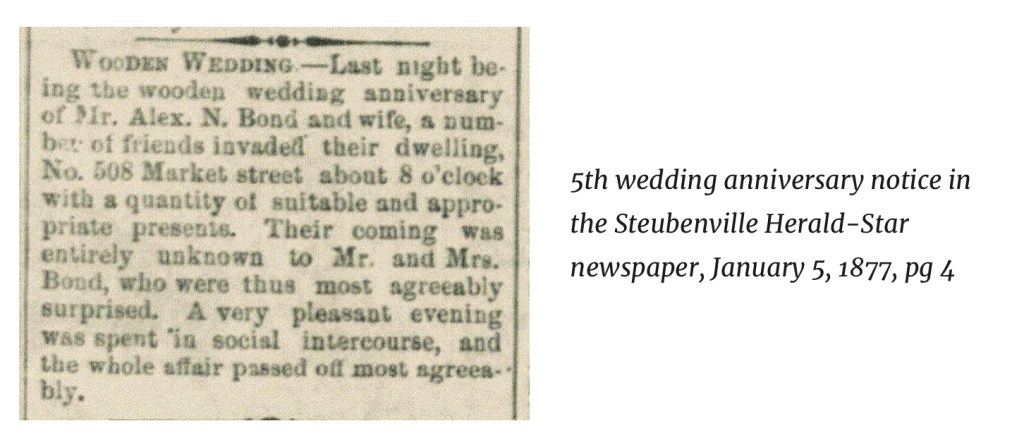
Ringing in the New Year for 1872, Alexander Bond married Ruth Linton at the Minister of Disciples Church, Jefferson County, Ohio on January 1, 1872. He was 23 and she was 25.
Ruth was born as the ninth of ten children in nearby Welles township on October 24, 1846; her parents being Benjamin and Anna (Dean) Linton. They settled in the Ohio river-located town of Brilliant, where all of their children were born. Their son Dean Linton Bond was born on September 29, 1873, followed four years later by their daughter Edna Jane Bond, born on January 31, 1878.
Alexander Norton Bond was descended from several generations of merchants and craftsmen. Since he spent most of his childhood in the Halsted home, his path was similar, but also a bit different. As a younger man, when he had clerked for his uncle Robert Halsted in the boot and shoe shop, he had learned a trade. This carried this forth to his traveling salesman career selling boots and shoes. He covered a large territory which reached as far as Columbus, Ohio.
Columbus, Ohio, City Directory, 1883, page: 105.
We find the 1880 census under his wife Ruth’s name. On May 9, 1882, their daughter Lily Victoria Bond was born. We conjecture that because he traveled to support his family, perhaps this explains why the births of his children are 4-6 years apart. On May 6, 1888, our Great Grandfather Earl Alexander Bond was born. (9)
Alexander and Ruth Bond lived at Lot 16, indicated by the blue rectangle.
From Wikipedia.com: “Brilliant was laid out in 1819… a new addition was laid out in 1836 named La Grange… In 1880, the Brilliant Glass Company was established… the town later adopted the name of the glass company and was incorporated as Brilliant.”
The Tragedies of the ColumbusTrain Accident
In July 1890, our great-grandparents Alexander and Ruth Bond, along with their son Earl, were either traveling to (or returning from) Columbus, Ohio to the Steubenville, Ohio area. Several railroad lines criss-crossed the distance that connected the two regions. We have not been able to discover what the exact nature of the trip was, but we do know that Alexander kept a business address in Columbus at 110 North High Street. Perhaps they were traveling there for his boot and shoe business? Another possibility is that they were attending a conference for the Disciples of Christ church in which Ruth was very involved. We will continue our research on this accident.
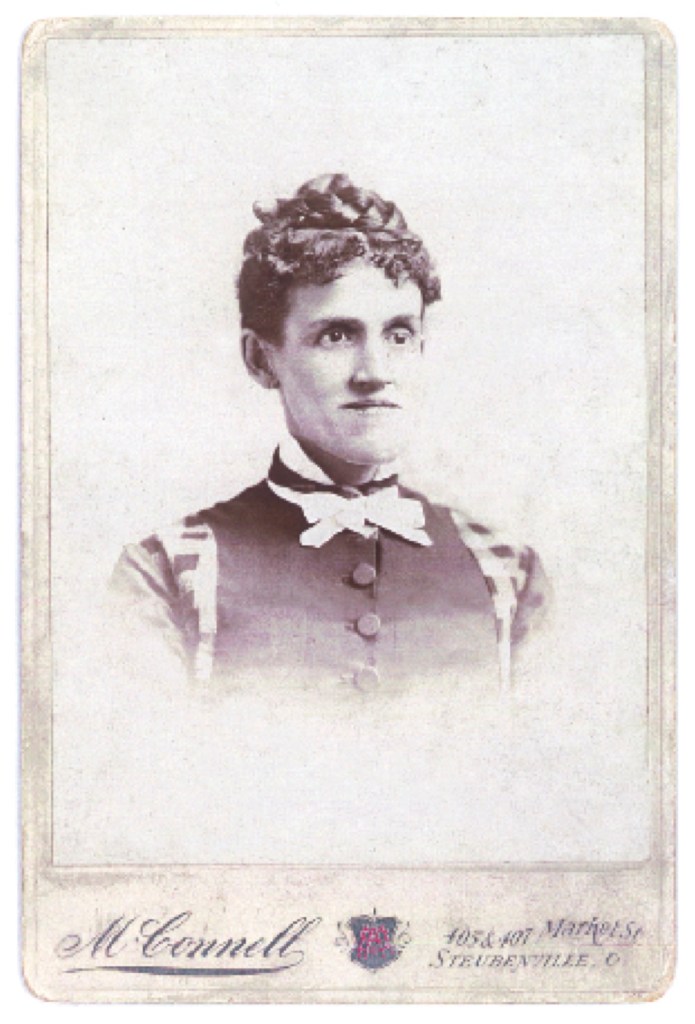
Ruth Linton Bond, circa 1886.
The Disciples of Christ church was a Protestant denominated fellowship which was popular in the state at that time.
With fewer local churches than other Christian denominations, the Disciples of Christ made less of an impact on moral and social reform and missions than Congregationalists or Presbyterians… Still, their activity was substantial. With the success of the Baptists’ union in mind, churches formed the Disciples’ Union in 1885 to coordinate mission, social work, and communication.
Encyclopedia of Cleveland History
There is a story in our family, the gist of which goes something like this: They were on a train near Columbus, which stopped on an incline to take on water. The last two cars, where the family was located, broke off (decoupled?) and started to slide down the incline gaining speed. The cars crashed violently. Ruth and Alexander were severely injured. Earl was thrown from the car and rolled down the hill where he was later rescued lying by a tree, near a small river, or stream.
The trauma from this experience caused our Grandfather Earl Bond, to develop a stuttering problem which plagued him for the rest of his life.
We will likely never learn why they were on that particular trip. (In those days, accidents were routinely covered up. Unluckily, several years of research has never turned up any actual records of the accident). What we do know is this: Great-Grandmother Ruth’s injuries were so severe that she was taken to a hospital in Columbus, admitted on July 16, and died on July 23, 1890. Her death record looks rather “thin” on details…
J. A. Norton Railroad Map of Ohio published by the State, 1892. This map diagrams the probable route for travel between Steubenville and Columbus, Ohio in 1890. The insets are obituaries of our Great-Grandparents Alexander and Ruth Bond, (see footnotes).
If Alexander was hospitalized, we don’t have a record for that, but we know by way of a story passed down through the family, that he had injuries to his spinal vertebrae which caused him to be seriously disabled for years. From Ruth’s obituary we know that her brother, Benjamin Linton, returned her body to Brilliant, Ohio for burial.
At some point Alexander returned to Brilliant where he and the children lived. We think that he most likely no longer worked as a traveling salesman. From a recording made by his daughter Lily (Bond) Connelly, when she was a very old woman, we have the following quote:
“My brother Dean, joined and carried a Bible to church. He was the first convert to church that Mother and Brother Wilcox built. After her death he felt being a minister would please her most, to carry on her religious ideas. He was 16 and went south to Knoxville, Tennessee, and stayed in the South.” Dean Linton Bond was a preacher for the rest of his life.
Alexander lived for seven more years until October 21, 1897. From records, we know that he suffered a debilitating stroke about eight weeks before his death. Edna, who would have been 19, may have still been living at home, or she may have already moved to Cleveland, Ohio where she stayed for the rest of her life. Lily was 15, and Earl was 9 years old. Both being minors meant they had to have a guardian, which is covered in the following post The Bond Line, A Narrative — Seven.
Alexander and Ruth Bond were buried in the Barrett Family Cemetery in Brilliant, Ohio. Today, the old cemetery is nearly lost to the encroaching forest. In June 2020, we found their grave marker, which has a curious epitaph: They have done what they could...
Several members of the Linton family are also buried there. (10)
Following are the footnotes for the Primary Source Materials, Notes, and Observations
Wilson Cary notes on the Bond family http://usgenwebsites.org/MDAnnArundel/firstfam/bondfam.htm Note: These files migrated to ancestry.com when the company was acquired. We have not been able to relocate them there — however, *we did locate this data (copied below), in 2024.
JSTOR The Origins of Land Buyers, Steubenville Land Office, 1800 – 1820 by David T. Stephens and Alexander T. Bobersky https://www.jstor.org/stable/2976385
Edward F. Bond estate administration record Jefferson County Common Pleas Journal D, 1819-1822 March 1822 term, Entry 409 Obtained from an on-site visit to the Jefferson County Historical Society, Steubenville, Ohio, on June 16, 2020
William H. Bond guardianship record Jefferson County Common Pleas Journal E, 1822-1827 March 1822 term, Entry 409 Obtained from an on-site visit to the Jefferson County Historical Society, Steubenville, Ohio, on June 16, 2020.
Descendant Appendix A Amy Jane and Robert Halsted had three children:
Son John Halsted was born November 1, 1837 in Steubenville and died there on April, 26,1886. He was unmarried.
Mary Frances Halsted, their second child, was born February 1841 in Steubenville and died on December 8, 1911 in Pittsburgh, Allegheny County, Pennsylvania. She married John Dawson Boyle on October 6, 1859 in Steubenville. John was born April 9, 1832 in Union, Fayette, Pennsylvania and died March 25, 1915 in Pittsburgh, Allegheny, Pennsylvania. Mary Francis and John Boyle had five children:
Robert H. Boyle born March 27,1861 in Union, Fayette, Pennsylvania and died November 11, 1916 in Pittsburgh, Pennsylvania.
Margaret Boyle born November 7, 1862 in Washington, Pennsylvania and died September 3, 1938 in Pittsburgh, Pennsylvania.
Laura A. Boyle born July 9, 1866 in Washington, Pennsylvania and died February 10, 1948 in Pittsburgh, Pennsylvania.
Hetty Boyle born February 17, 1868 in Washington, Pennsylvania – her death date and location is unknown.
John E. Boyle born in 1871 in Washington, Pennsylvania and died in 1938 in California.
Margaret Jane Halsted, Amy Jane and Robert’s third child, was born on July 23, 1843 in Steubenville and died on April 23, 1922 in Steubenville, Ohio. She married Jonathan Hagan, Jr. on December 1, 1863 in Jefferson County, Ohio. Jonathan was born in 1839 in Steubenville, Ohio and died there on September 16, 1891. They are buried near her parents in Union Cemetery in Steubenville, Ohio. Margaret and Jonathan had seven children:
Emma J. Hagan born January 1, 1865 in Steubenville and died there October 12, 1871, at age 6.
Twin Sons: Calvin H. Hagan born 1867 in Steubenville and died April 28, 1935 in Seattle, King County, Washington and William E. Hagan also born in 1867 in Steubenville and died in 1911 in Kirkland, King, Washington.
Mary H. Hagan born in 1869 in Steubenville and died there on February 4, 1923.
Frances M. Hagan born February 7, 1872 in Steubenville and died there on July 7, 1945.
Margaret C. Hagan born June 3, 1875 in Steubenville and died there in 1965. Hetty or Beatty Hagan born August 21, 1878 in Steubenville and died there on December 23, 1956.
Descendant Appendix B The Elizabeth Jane (Bond) Northup and Jeremiah Northup family.
In 1858, William H. and Lavina’s daughter Elizabeth Jane married Jeremiah Northrup in Steubenville, Ohio. She was only 17 and the marriage record indicates that Elizabeth was “given permission” to marry by her guardian, (uncle) Robert Halsted. Robert was married to Amy Jane (Bond) Halsted, William H.’s sister and Elizabeth Jane’s aunt.
Excerpt from The Northrup-Northrop genealogy… Published 1908.
From the family lineage book about the Northrup family, we see the listing of the marriage and it identifies Elizabeth Jane’s parents, William and Lavina Bond. They are listed in entry #320. The above entry indicates that Elizabeth and Jeremiah had no children, however, this is not true. Our research shows that there are several decendants from William and Lavina Bond and perhaps we can learn more about these relatives.
Jeramiah and Elizabeth Jane (Bond) Northrup had a daughter:
Matilda ‘Tilda’ Peterson Northrup was born on July 29, 1862 in Sweedon, Edmonson County, Kentucky. She died at the young age of 28 on February 3, 1891 in Kirkwood, St. Louis, Missouri.
‘Tilda’ Northrup married Albert David Spencer, Sr. on February 23, 1884 in Kimmswick, Jefferson Co., Missouri. David was born November 30, 1835 in Megisville, Ohio and died August 21, 1934 in Evansville, Indiana. Tilda and Albert Spencer had two children, a daughter and a son:
Georgia Spencer, born March 31, 1885 in Kimmswick, Windsor Township, Jefferson, County, Missouri, and died in 1920. She married John Montague on June 11, 1902 in Kimmswick. They had two sons, Donald and John S. Montague.
Stanley P. Spencer born December 1890 in St. Louis, Missouri, and died May 12, 1902, age eleven, in McConnelsville, Morgan County, Ohio.
Descendants of William H. and Lavina Bond would have been carried forward via the lineages of: Elizabeth Jane (Bond) Northrup, Matilda ‘Tilda’ (Northrup) Spencer, and Georgia (Spencer) Montague.
Upon their deaths, Jeremiah Watson Northrup on September 3, 1882, and Elizabeth Jane (Bond) Northrup on August 18, 1917 their bodies were returned to Ohio and are buried at Spring Grove Cemetery, Cincinnati, Ohio in the Northrup family burial plot.
Descendant Appendix C Five sons were born to Edward and Drucilla Bond.
Leonidas W. Bond born March 2, 1847 in Steubenville, Ohio and died April 11, 1908 in Rochester, Beaver County, Pennsylvania. He married Mary Martin in 1873 in Steubenville. He served as a Private in the Civil War from May – September 1864.
Oldbert F. Bond born in 1849 in Steubenville and death date and location is unknown.
Robert (L.D.) Bond born in 1858 in Steubenville and died July 7, 1911 in Dennison, Tuscarawas County, Ohio.
Edward J. Bond born in 1864 and died in April 1864 in Marion, Grant County, Indiana. He married Johanna Prendeville about 1890 in Indiana. She was born in Ireland and they had six children.
Harry Bond born March 26, 1868 in Steubenville and died February 4, 1941 in Potter, Beaver, Pennsylvania. On an 1899 Tax Document for Beaver Falls, Harry is listed as an invalid.
Just a passing thought regarding the bestowing of the name Jane on so many of our female relatives —
Borrowed from The Far Side by Gary Larson Copyright 2019-2022 by FarWorks, Inc. Thanks Gary!
From Merchants and Craftsmen — A Traveling Salesman
Newspaper clipping, Ruth Linton Bond obituary Steubenville Daily Herald July 24, 1890 Jefferson County Historical research Schiappa Library archive, Steubenville, Ohio, Film Roll B14
Newspaper clipping, Alexander Norton Bond obituary Steubenville Daily Herald October 21, 1897 Jefferson County Historical research Schiappa Library archive, Steubenville, Ohio, Film Roll B40