This is Chapter Seven of twelve, in which we move across the Bristol Channel from England to Wales. We also meet a new family with a new surname — the Thomas family. By the way, we wish you good luck with pronouncing some of these Welsh words!
Y Seren Orllewinol — What’s That Again?
One of the things that presents a challenge in genealogy research is locating exactly where your ancestors are from, if the records are scarce. This is especially true when dealing with the mysteries of the Welsh language. (We swear, that when deciphering Welsh — one dreams of standing before Vanna White on the Wheel of Fortune game show and saying in a demanding voice: “Vanna! I’d like to buy a vowel.”)
Our research eventually led to the discovery of an unfortunate death…
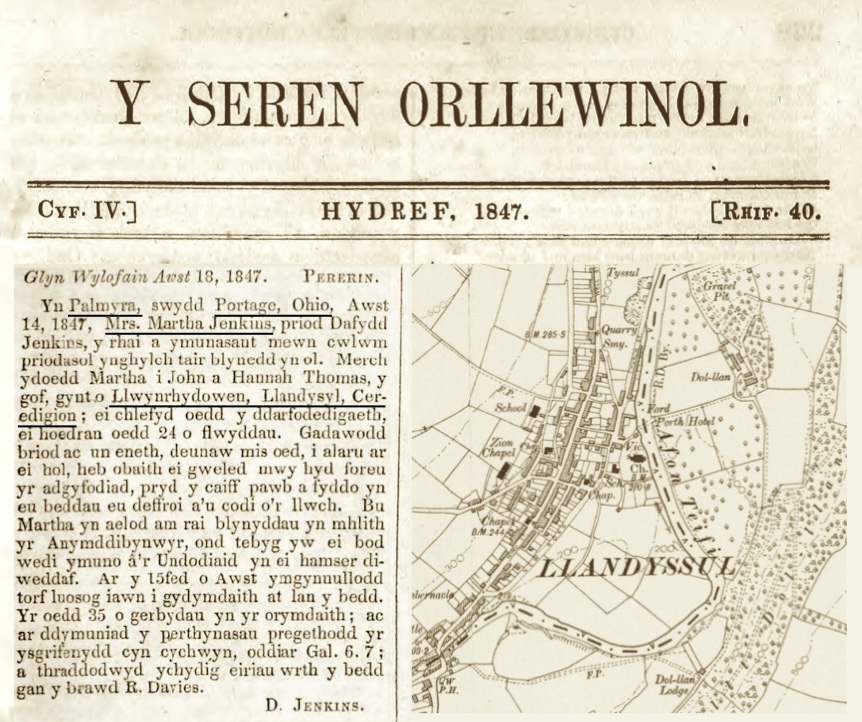
Y Seren Orllewinol — The Western Star, from October 1847.
(Image courtesy of Llyfrgell Genedlaethol Cymru — The National Library of Wales).
Without getting too far ahead of ourselves with this history, the oldest child in this family line died of tuberculosis as a young adult. Her obituary fortunately stated exactly where in Wales her family had lived. So this confirmed other records we had located, but it was the linchpin we needed to honor this family’s origins. (Please see the footnotes for the English translation of her obituary).
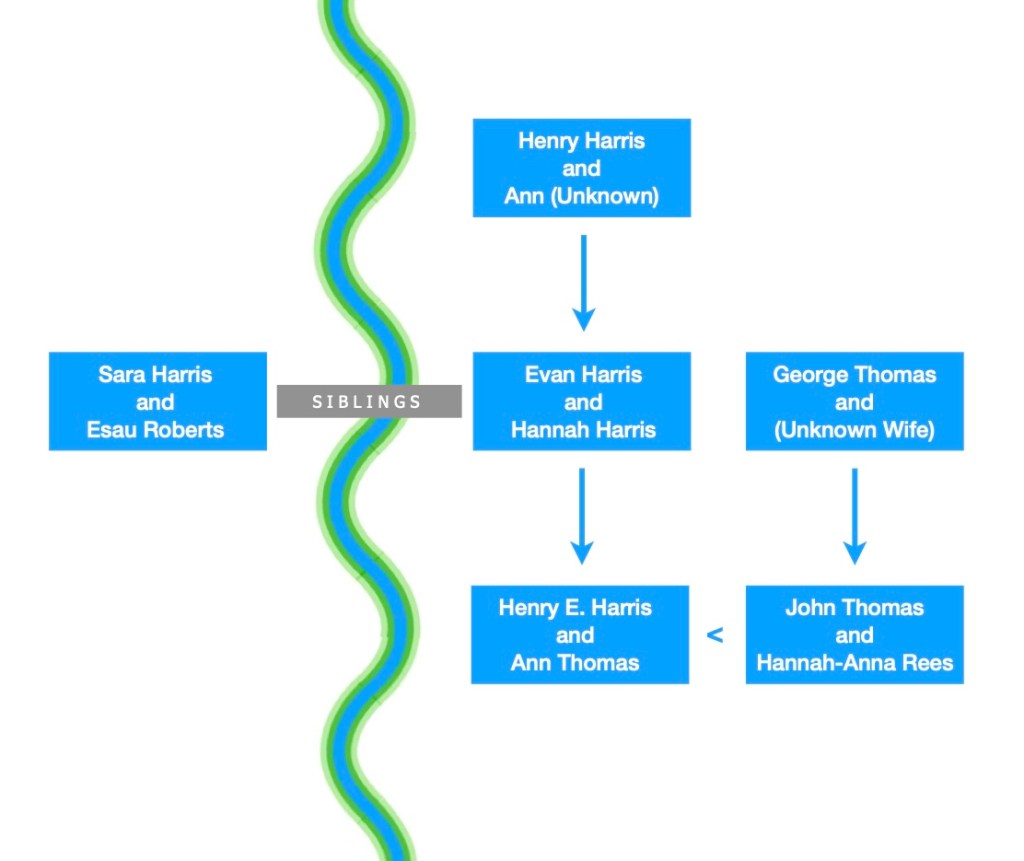
In the following chapters seven through ten, we are learning some of the history of the Thomas and the Harris families. We begin in Ceredigion, Wales, which used to be called Cardiganshire. (1)
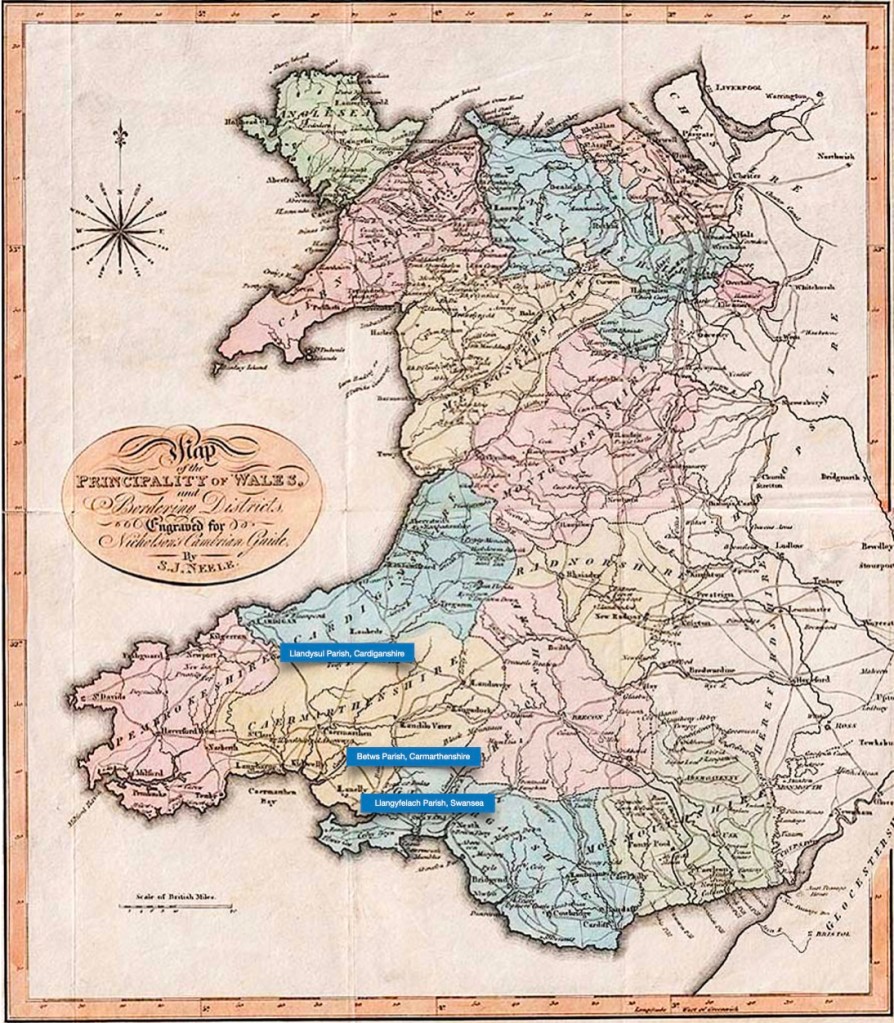
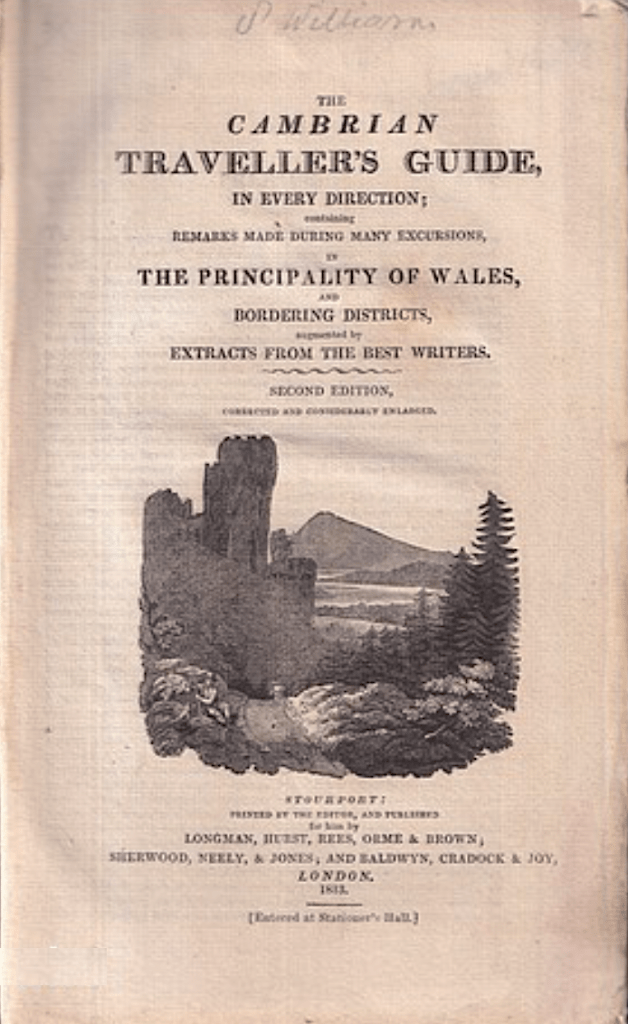
[Engraved for Nicholson’s Cambrian Guide], by S.J. Neele, circa 1813.
Notice the locations of the Bristol Channel above Somerset, England in th closer right,
and the Liverpool seaport in northern England, in the upper right.
(Image courtesy of B.B. Williams Antique Maps & Prints).
Welsh Place Names Are Tongue Twisters!
The three locations in Wales that feature in this chapter, are discussed below as follows — OK. Now say those names three times fast! We dare you.
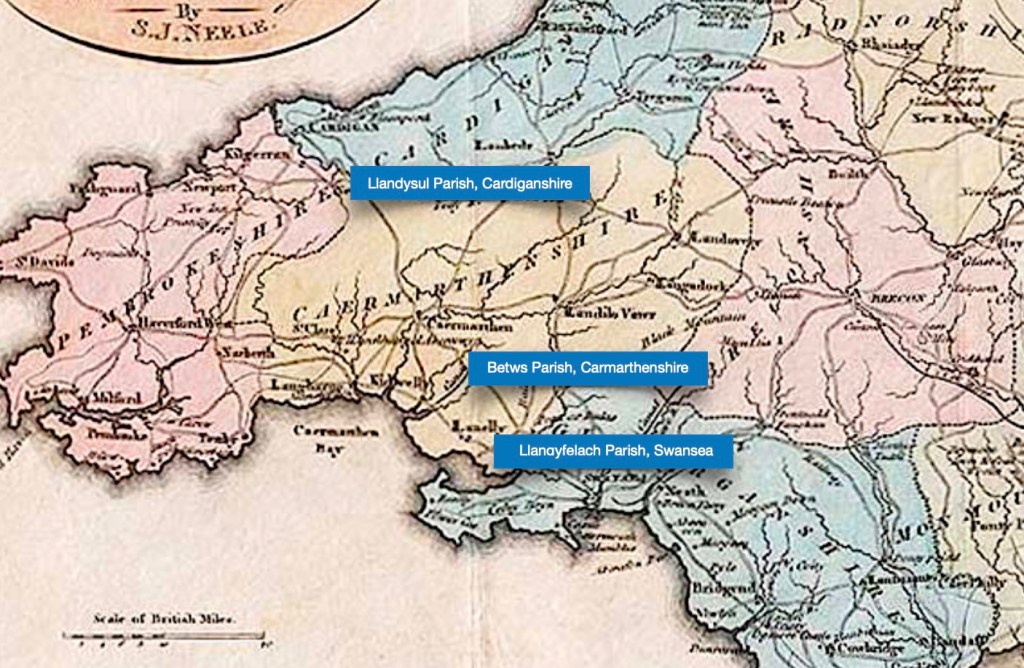
With so many little parishes, in a not very big country, trying to understand what the various points-of-view were for the different communities required due diligence. We found records that match up with our family in the Horeb Independent Chapel in Llandysul, Cardiganshire. Not much was recorded about the actual building, except for this —“Horeb Independent Chapel was built in 1784, enlarged in 1826 and 1832. The chapel was rebuilt again in 1879 in the Classical style of the gable entry type and with a large arch in the facade.” (Coflein)
What did it mean to be Independent?
In the 1830s in Wales, having a chapel or church recognized as independent (often referred to as Annibynwyr), signified that the congregation was a self-governing, democratic body that operated outside the structure of the Anglican Established Church. This status represented a significant shift toward local democracy, theological autonomy, and a Welsh-speaking cultural identity, separate from the Anglican church and state in England. (Google)
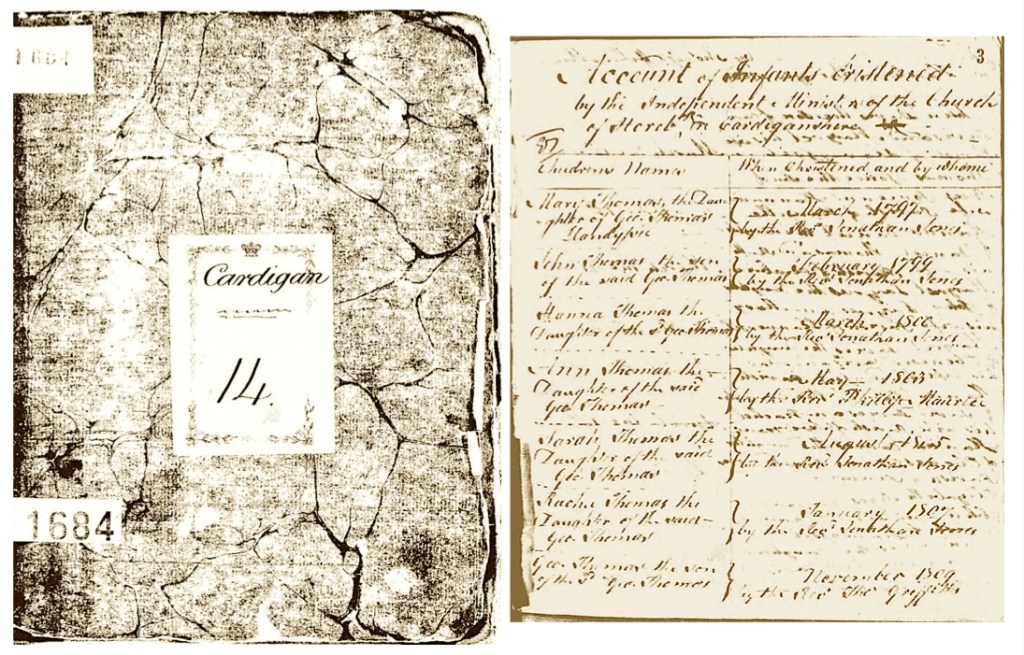
Despite the very difficult-to-decipher page photograph above, (the original source was likely semi-transparent vellum paper), we determined that the patriarch of the family is George Thomas. (Mrs. Thomas is not recorded). Below are the baptismal records for his seven children from the Horeb Welsh Independent Chapel. The most important person for our family line is listed second, John Thomas.
- Mary Thomas, baptism: March 1797
- John Thomas, baptism February 1799, John carries the family line forward.
- Hanna Thomas, baptism March 1800
- Ann Thomas, baptism May 1803
- Sarah Thomas, baptism August 1805
- Rachel Thomas, baptism January 1807
- George Thomas Jr., baptism, November 1809
As sometimes happens with research work like this, we do not know much about George Thomas’s life. This is because his name was just too common for credible records. So we move on from there to his oldest son, John Thomas*, who surfaces in nearby Carmarthenshire about twenty years later.
* John Thomas also seems like a very common name, but in his case, we had other evidence with which to locate him. (2)
John Thomas Weds Hannah Rees
On February 16, 1821, John Thomas wed Hannah Rees in Betws*, Carmarthenshire, Wales. With this marriage, her Rees surname gave way to the Thomas surname. We believe that they married in this location because this is where her family was from. When you peruse the registry in which this record was found, there are many families recorded with the Rees family surname.
*That is not a typo. Betws is an old Welsh word which means Chapel.
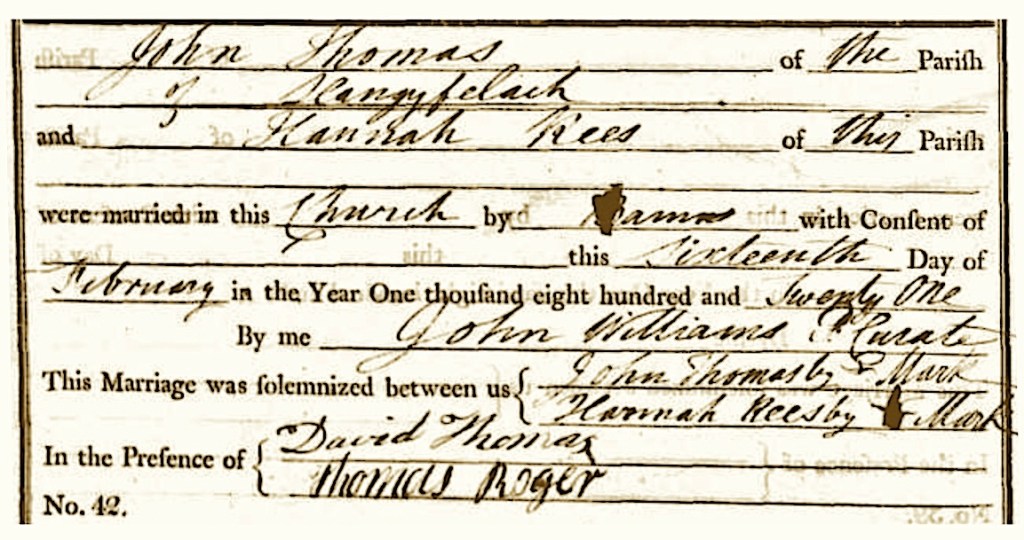
As we already know, John was baptized in 1799 at Llandysul, Cardiganshire. His marriage record cites that his parish is Llangyfelach Parish, which is in present day Swansea, Wales, on the Gower Peninsula. We do not know how long he was part of that parish, but we know that after they married, they moved back up to Llandysul Parish, Cardiganshire. The distance from Llandysul and Betws is about 34 miles (54.7 km), and they were connected by a major road.
Hannah Rees was born in 1798. However, her community of Betws was at one point separated from Swansea, and then became part of Carmarthenshire.
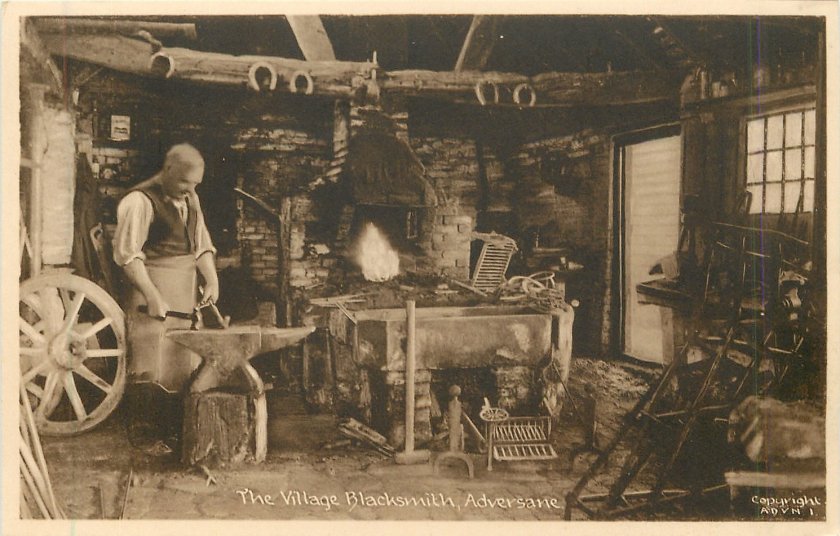
We know that John Thomas was a blacksmith and that he brought those skills to America. He continues to cite this as his profession through the 1850 US Census. (3)
Their Voyage to America On A Liverpool Packet
In the 18th century, transatlantic travel changed much due to so many people immigrating to countries outside of the European kingdoms. In researching how this family left Wales and journeyed to America, we had to learn about packet ships. From the New York Times, “Before steamships started crossing the North Atlantic, the best way to travel between Europe and America was by the sailing ships called packets. Built and run mainly by Americans, the packet lines introduced new concepts and comfort levels for ocean voyages. They dominated the transatlantic traffic for decades, setting key precedents for the steamships that eventually replaced them. Along with their more famous contemporaries, the whaling and clipper ships, they comprised the golden age of American sail. Of these three types, the packets lasted the longest and made the most voyages and money for their owners and crews.”
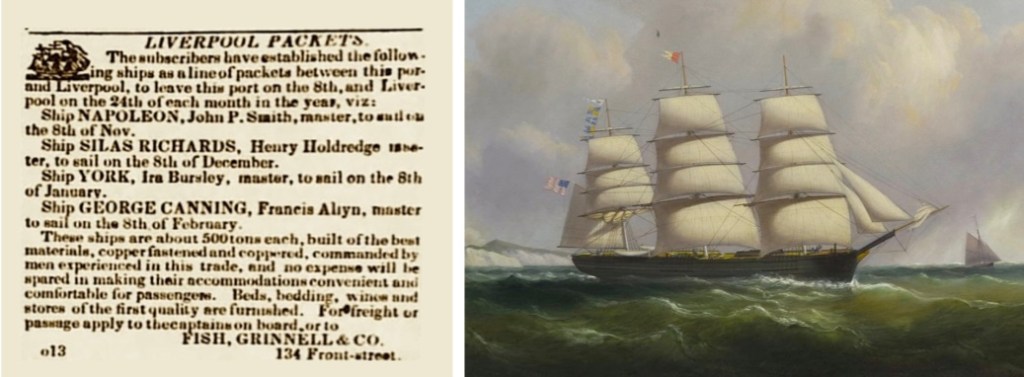
“Fish, Grinnell, & Co. began the Swallowtail Line, known as the ‘Fourth Line of Packets for New York,’ their first ships being the Silas Richards, Napoleon, George, and York, which soon moved to bi-weekly service. By 1825, vessels were advertised as leaving New York on the 8th and leaving Liverpool on the 24th of every month. Their actual schedules eventually varied, sometimes wildly, due to weather and other conditions.” (Wikipedia)
It is quite likely that our ancestors were on a ship that was transporting mail, because this is what all packet ships were known for. “Packet boats were medium-sized boats designed mainly for domestic mail and freight transport in European countries and in North American rivers and canals. Eventually including basic passenger accommodation, they were used extensively during the 18th and 19th centuries, and had regularly scheduled services.” (Wikipedia)
Our ancestors sailed on the Silas Richards, which had departed from Liverpool England. They arrived in New York on May 25, 1835. Note that John Thomas is recorded on the manifest below, as being a blacksmith.
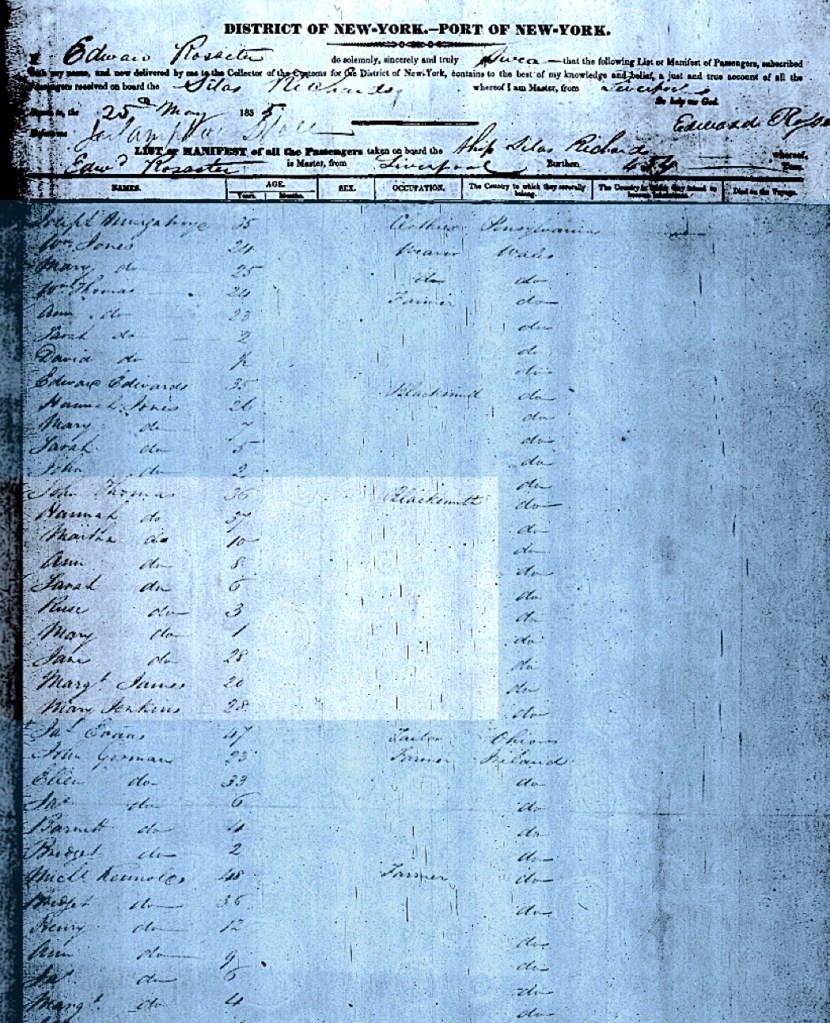
for the ship Silas Mariner, on May 25, 1835 in New York harbor. (See footnotes).
A very interesting account of travel between Great Britain and Ohio is found within the article Emigration Voyages, which features the account by a man named Thomas Tear who immigrated with his extensive family from the Isle of Man to Leroy Townhip, Geauga County, Ohio. “The account left by Thomas Tear is probably much more typical of the type of conditions encountered by the the ‘middle class’ Manx emigrants of the 1820s and 1830s.”
Cultural and location explanations as follows:
- Manx refers to anything from the Isle of Man.
- The Isle of Man is a large island located in the Irish Sea between Ireland and Great Britain.
- Leroy Township, Geauga County, Ohio became part of Lake County, Ohio in 1840.
Thomas Tear was an educated man, who kept a journal and wrote letters about being an immigrant to the state of Ohio. His records about sailing on a packet ship, and the odyssey of traveling from New York harbor to Ohio in that era, are likely similar to the experiences our ancestors also faced. Here is what he had to say:
“We were finally put on board a small brig, if I remember rightly, of 200 tons, but seems wrong, to me, as she had on 200 passengers, mostly Irish which limited passengers 2 per 5 ton burthen. Her name was Amelia of Liverpool, at the helm was, Captain Tagert. They had no such accommodations, as they advertised. We occupied what was called the second cabin, with some English people, and a few better class Irish, on the opposite side of the cabin. But It was not separated from the steerage, as I think it was called, by any door, which was on the same deck, and just forward of us, and was filled with Irish. It was separated from the cabin by a rough board partition, with cracks that the children could peek through.
The passenger quarters had three rows of berths all around, and there were two low benches, which was all the furniture there was in our part. There were two hatches over the passengers, affording all the light and ventilation that passengers had, and if It was rough, these were partly closed. There was a coal fire, in a grate on deck for the passengers to cook by. One man died on the passage, but to me, the wonder, is that half of them were not dead. The scent down there in that dirty, ill-ventilated hole, was anything but sweet. Mother was sick all the way, also Mrs. Gawne, but the rest, stood it well. The burden of cooking fell on my oldest sister, but she seemed to benefit by it. The passengers carried and cooked their own provisions, and as the fire would not accommodate them all at once. This made considerable dissatisfaction, eating was done, without setting of tables, and just as you could catch it.”
Tear’s initial voyage from England took some 40 days, a few days longer than the average by the faster packets for that time of year.
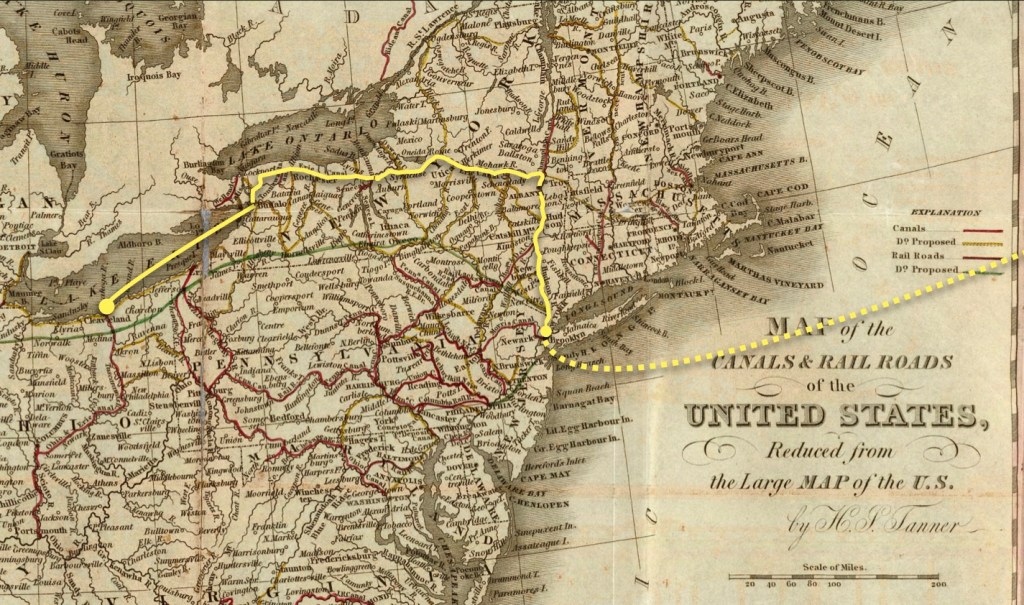
by Henry S. Tanner, 1830. (Image courtesy of the David Rumsey Map Collection).
— — —
Their journey from Liverpool England, to Ohio charted.
The dashed lines represents the 3043 mile segment from Liverpool, England to New York harbor.
From there they traveled by boat up the Hudson River to Albany, New York. Then, via the Erie Canal to Buffalo, New York, and lastly by lake steamer ship to Cleveland, Ohio.
Thomas Tear’s accounts continue, “I will mention here, before reaching Liverpool, they [his parents] expected to take passage to Philadelphia, Pennsylvania. Then travel by wagon, across the country to Jefferson County, Ohio. Two families were there, who had left the Island some 4 years before. At Liverpool, they were informed of the recent completion, of the Erie Canal, enabling them to reach Ohio by way of New York, by water, which was far more preferable. So they went to New York.”
“We were in New York only a few hours, before starting for Albany, on the river. We were on some kind of boat, that was fastened to the side of a steamer, and drawn along, or towed. The boat was open and there were two boats on one side and one on the other side of the steamer. Thus we went up the Hudson River to Albany, in not over 24 hours.
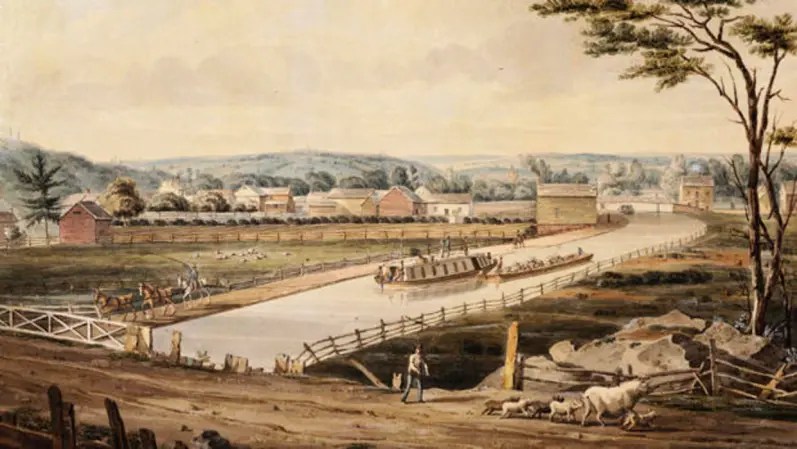
via The New York Public Library.
We had gotten to Albany and while waiting on the dock, for a canal boat, on which to take passage, there was a great strife among the boats for the passengers. We finally got aboard a boat, and reached Buffalo in a week.
At Buffalo, we were put aboard a schooner called,‘The Lady of the Lake’; because of foul wind, the flat bottom of the vessel, and the unskillfulness of the seamen, we were two weeks in reaching Fairport, 160 miles. We landed early in the morning, before sunrise, on the 5th of July, 1826. A boat came from shore to take us in, the schooner was not able to enter the harbor, because of a [sand] bar.” (4)
After the Thomas family made their way westward from New York, they settled in the northeast section of Ohio.
The Censuses and Their Family
John and Anna settled with their family in Palmyra township, Portage County, Ohio. This community 52 miles (84 km) southeast of the city of Cleveland, where they arrived via a lake steamer ship. As we learned in the previous chapter, there were many immigrants from Wales already living in the area. So it was certainly an area with many familiar cultural touch points.
They appear on US Censuses for the years 1840, 1850, and 1860. (See footnotes). John continues to identify his occupation as blacksmith through 1850, but by 1860, he identifies it as a farmer. We do not know if he actually owned farming property in Palmyra township, or if they rented rather than owned, since he had maintained his blacksmithing profession for many years. The 1874 Palmyra township map below, is intriguing for the number of Thomas-named families scattered throughout, but nothing is labeled simply as John Thomas. (And, he had passed on five years before this map was created… we do not know if one of his children, married or otherwise, inherited any property).
His wife Hannah, by 1860, had started to refer to herself as Anna, which we observed in that census. (This is the name was also used on her grave marker). There are a couple of plausible reasons why she dropped the two h’s and simplified her name. It is likely that people just called her Anna as a nick name, or perhaps it was over the death of her daughter, who was also named Hannah. (See below).
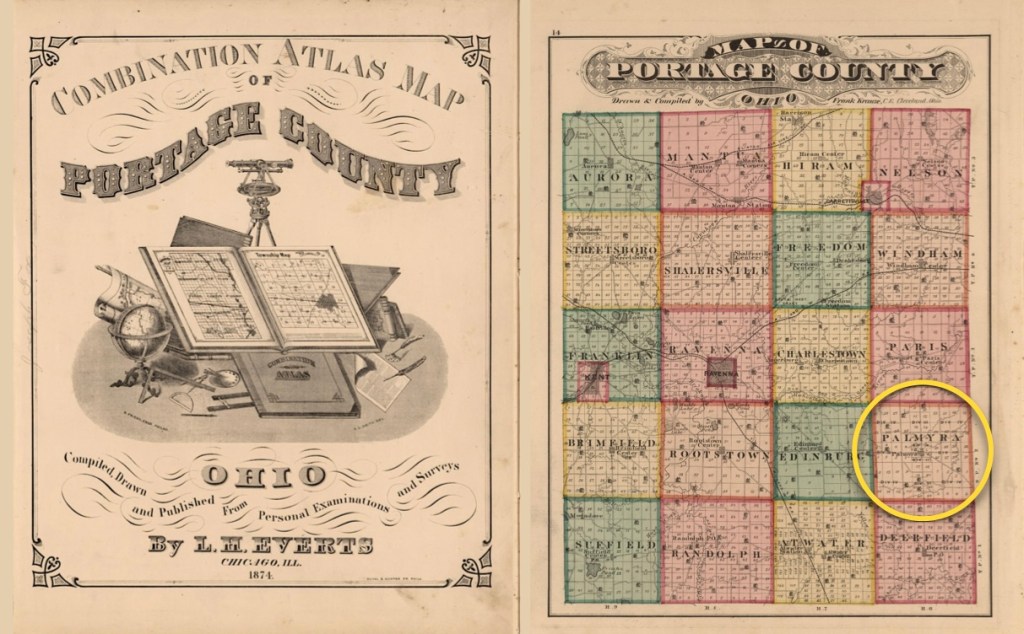
Combination Atlas Map of Portage County, Ohio, by L.H. Everts, 1874.
(Image courtesy of David Rumsey Map Collection).
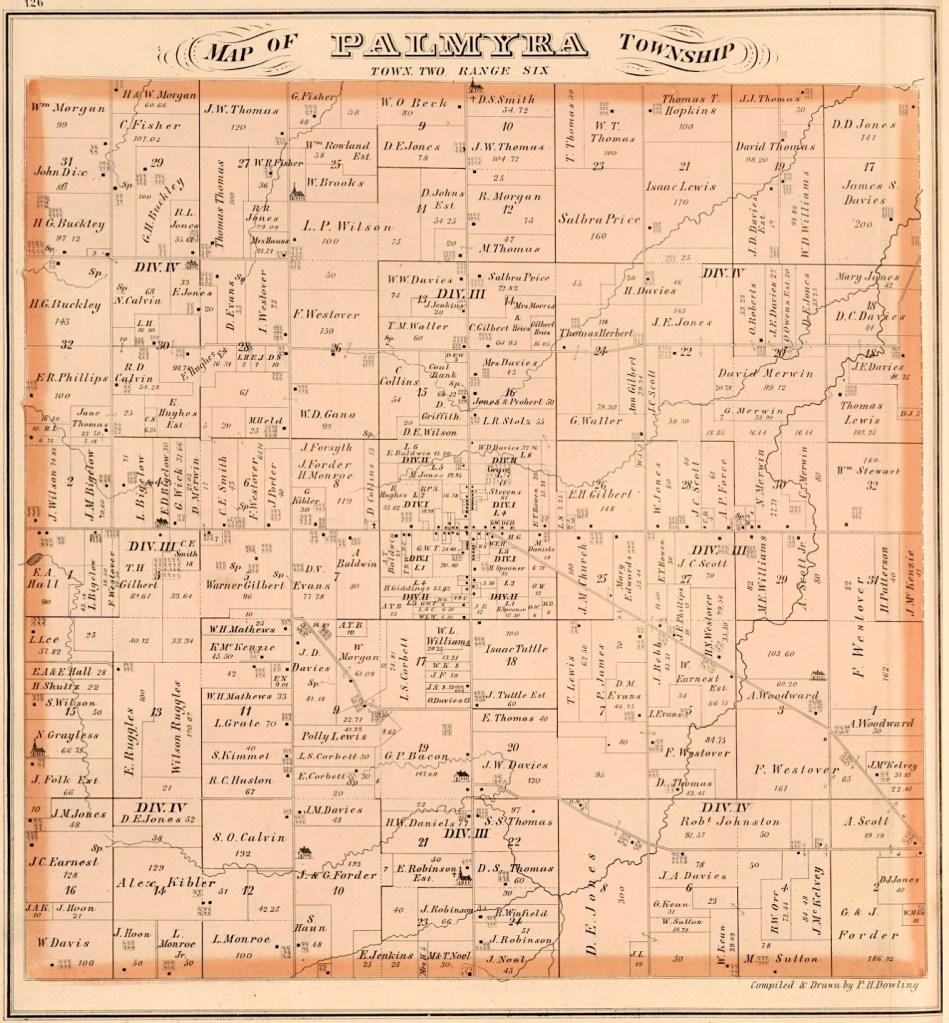
by L.H. Everts, 1874. (Image courtesy of David Rumsey Map Collection).
John and Anna had ten children. The first five were born in Llwynrhydowen, Llandysul, Ceredigion (Cardiganshire), Wales:
- Martha (Thomas) Jenkins, 1823 – 1847
- Anne Thomas, 1827 – 1836
- Sarah (Thomas) Williams, 1827 – 1899
- Rees J. Thomas, 1831 – 1905
- Mary (Thomas) Jones, 1834 – 1854
The next five children were born in Palmyra Township, Portage County, Ohio:
- Ann (Thomas) Harris, 1836-1890, Ann carries the family line forward.
- Margaret Evelyn (Thomas) Hughes, 1838 – 1915
- Hannah Thomas, after the 1840 Census – 1843
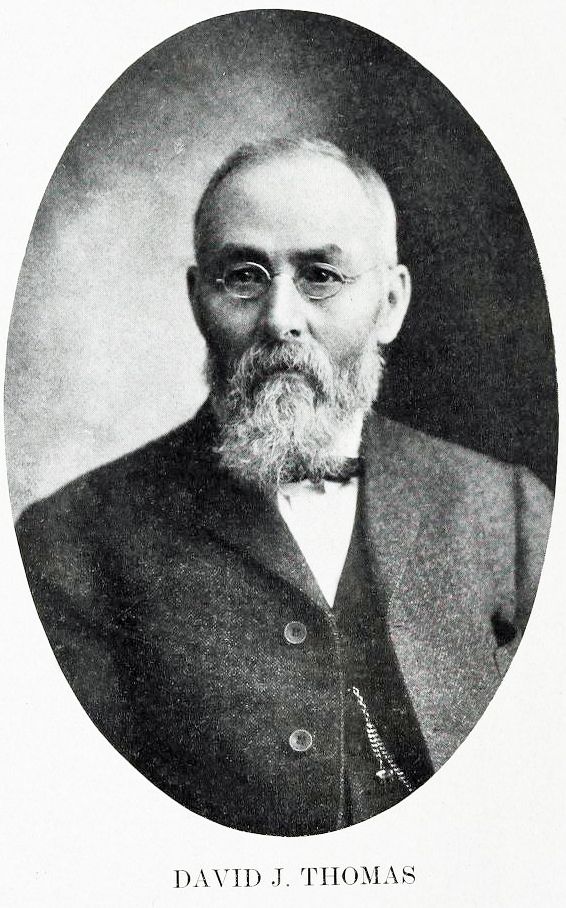
- David J. Thomas, 1841 – 1916
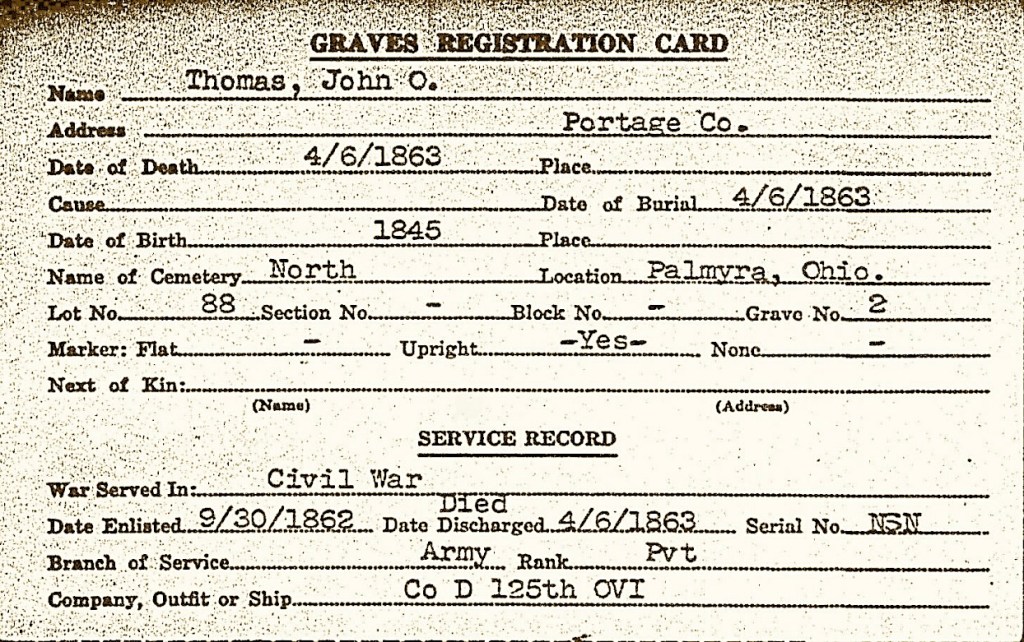
- John O. Thomas Jr., 1845 – 1863
The mother of the family, Anna (Rees) Thomas passed away first, on February 16, 1867. The father John Thomas Sr., soon followed her, passing away on November 27, 1869. Their daughter Ann Thomas is the ancestor who carries the family line forward with her marriage in Chapter Nine. (5)
We will also learn why Monmouthshire is sometimes included in English maps and not Wales maps, and then sometimes included in Wales maps, but not English maps. This seesaw effect was rather confusing to figure out what people were then thinking, but we figured it out.
Following are the footnotes for the Primary Source Materials,
Notes, and Observations
Y Seren Orllewinol — What’s That Again?
(1) — one record
Llyfrgell Genedlaethol Cymru
(The National Library of Wales)
Y Seren Orllewinol (The Western Star)
Hydref 1847 (October 1847)
Martha (Thomas) Jenkins 1847 obituary
https://viewer.library.wales/2726714#?xywh=-2424,0,6958,3511&cv=19
Book page: 246/250, Left column, upper portion.
Note: Her place of origin is recorded in this obituary.
A translation from Welsh to English of the most relevant section states:
“Glyn Wylofain August 18, 1847. Pilgrim.
In Palmyra, Portage county, Ohio, August 14, 1847, Mrs. Martha Jenkins, wife of David Jenkins, who joined in a matrimonial bond about three years ago. Martha was the daughter of John and Hannah Thomas, a blacksmith, formerly Llwynrhydowen, Llandysul, Ceredigion [Cardiganshire]; her disease from tuberculosis, her age about 24 years. She left a husband and one girl, aged eighteen months, to mourn her…”
Welsh Place Names Are Tongue Twisters!
(2) — five records
B.B. Williams Antique Maps & Prints
Map of the Principality of Wales and Bordering Districts
[Engraved for Nicholson’s Cambrian Guide]
by S J Neele, circa 1813
https://www.antique-prints-maps.com/acatalog/Map-of-the-Principality-of-Wales-and-Bordering-Districts-Engraved-for-Nicholsons-Cambrian-Guide-by-S-J-Neele–8984182.html
Note: For the locations of their baptisms and marriage.
Geo Thomas
in the England & Wales, Non-Conformist and Non-Parochial Registers, 1567-1936
Rg4: Registers of Births, Marriages and Deaths > Cardiganshire > Independent > Piece 1684: Llandysul, Horeb (Independent), 1797-1837
https://www.ancestry.com/search/collections/2972/records/15287637
Note: Baptismal record for George Thomas’s children and when they were baptized —
- Mary Thomas, baptism: March 1797
- John Thomas, baptism February 1799
- Hanna Thomas, baptism March 1800
- Ann Thomas, baptism May 1803
- Sarah Thomas, baptism August 1805
- Rachel Thomas, baptism January 1807
- George Thomas Jr., baptism, November 1809
Coflein
Site Record for the Horeb Welsh Independent Chapel, Horeb
https://coflein.gov.uk/en/sites/7283
Note: For the text.
Llangyfelach
https://en.wikipedia.org/wiki/Llangyfelach#:~:text=Llangyfelach%20is%20a%20village%20and,to%20combine%20them%20for%20Llangyfelach.
and
Llangyfelach Parish Church
https://parishofllangyfelachwithclase.org.uk/#:~:text=The%20religious%20site%20at%20Llangyfelach,in%20a%20converted%20Tithe%20Barn.
Note: For the data.
John Thomas Weds Hannah Rees
(3) — seven records
John Thomas
in the U.S., Find a Grave Index, 1600s-Current
https://www.ancestry.com/search/collections/60525/records/28467460
and
John Thomas
https://www.findagrave.com/memorial/43726665/john-thomas
Note: His dates are birth, 1799; death, November 27, 1869, in Palmyra, Portage County.
Anna Thomas
in the U.S., Find a Grave Index, 1600s-Current
https://www.ancestry.com/search/collections/60525/records/28467276?tid=62607448&pid=282197285918&ssrc=pt
and
Anna Rees Thomas
https://www.findagrave.com/memorial/43726451/anna-thomas
Note: Her dates are, birth, 1798 in Wales; death, February 16, 1867, in Palmyra, Portage County.
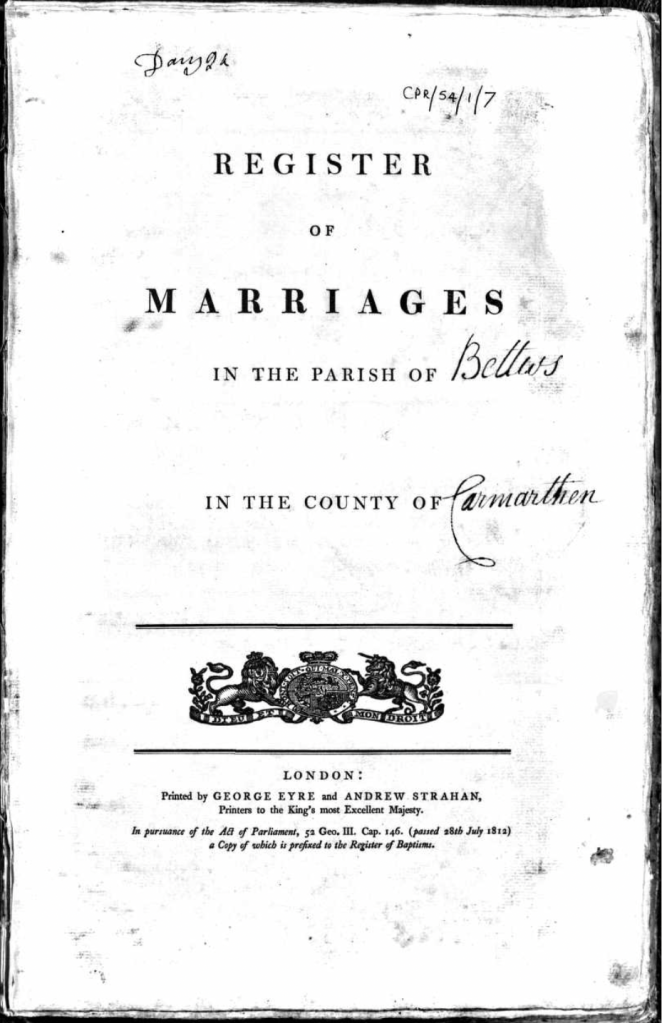
Hannah Rees
in the Carmarthenshire, Wales, Anglican Baptisms, Marriages and Burials, 1560-1994
Betws > Marriages > 1813-1837
https://www.ancestry.com/search/collections/62102/records/286341?tid=&pid=&queryId=7de970db-a16a-4204-b2f1-5661d20f32e2&_phsrc=Ffd7&_phstart=successSource
Book page: 14, Digital page: 9/23, Entry No. 42, on the left page bottom.
Note: Their marriage date is February 16, 1821.
Betws, Carmarthenshire
https://en.wikipedia.org/wiki/Betws,_Carmarthenshire
Note: For the data.
TuckDB Postcards
The Village Blacksmith
https://www.tuckdbpostcards.org/items/16508-the-village-blacksmith
Note: For the postcard image.
Their Voyage to America On A Liverpool Packet
(4) — seven records
New York, Passenger Lists, 1820-1920
NARA Roll Number – Content > 026 – 26 Mar 1835-22 Jun 1835
https://www.familysearch.org/ark:/61903/3:1:939V-5T27-1?wc=MX62-2NL:165726301&cc=1849782&cc=1849782&lang=en&i=444
Digital Images: 445, 446, and 448/702
Note: The Silas Richards was a Clipper Packet Ship.
Note: The childrens’ ages are an admixture —some are exactly correct, others are close, but technically not correct.
| The Silas Richards 1835 manifest | Age | Occupation |
| John Thomas | 36 | Blacksmith |
| Hannah | 37 | |
| Martha | 10 | |
| Ann | 8 | |
| Sarah | 6 | |
| Rees | 3 | |
| Mary | 1 | |
| Jane | 28 | |
| Margaret James | 20 | |
| Mary Jenkins | 28 |
Packet boat
https://en.wikipedia.org/wiki/Packet_boat
Note: For the text, and the Chesterton and Baltimore packet-boat image.
Patrick Henry (packet)
https://en.wikipedia.org/wiki/Patrick_Henry_%28packet%29
Note: For the ship image.
Manx, Isle of Man
History of Manx People Who Came to America
by Mildred Steed, and published by
The Lake County Genealogical Society
https://www.isle-of-man.com/manxnotebook/famhist/genealgy/miom1991.htm
Note: Manx refers to anything from the Isle of Man. The Isle of Man is a large island located in the Irish Sea between Ireland and Great Britain.
and
The above link then leads to this derived article:
Emigration Voyages
https://www.isle-of-man.com/manxnotebook/famhist/genealgy/voyages.htm
Note: See the References from this article for the original sources.
David Rumsey Map Collection
A Connected View of The Whole Internal Navigation of the United States…
by Henry S. Tanner, 1830
https://www.davidrumsey.com/maps1781.html
Note: For the map. The websitemap provides a link, which makes it zoomable for definition and clarity.
CBS News
All Hail The Erie Canal
View on the Erie Canal (1830-32)
by John William Hill
via The New York Public Library
https://www.cbsnews.com/news/all-hail-the-erie-canal-200th-anniversary/
Note: For the Erie Canal landscape painting.
The Censuses and Their Family
(5) — nineteen records
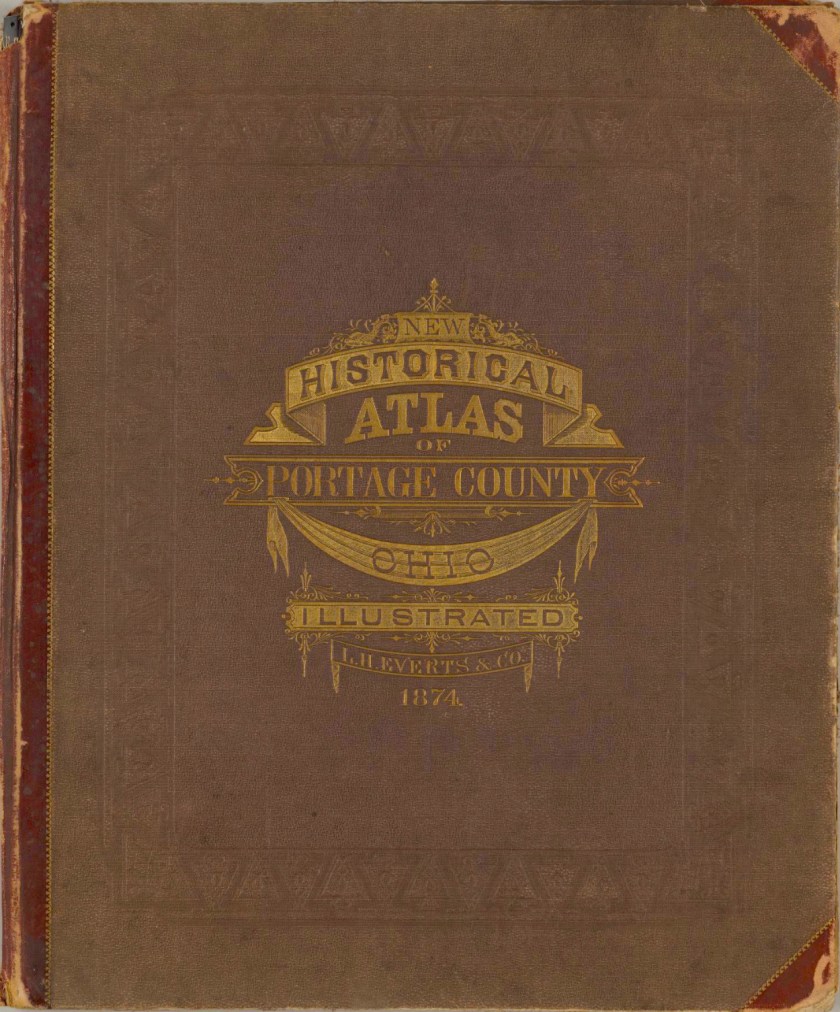
David Rumsey Map Collection
Palmyra Township, Portage County, Ohio
from the Combination Atlas Map of Portage County, Ohio
by L.H. Everts, 1874
https://www.davidrumsey.com/luna/servlet/detail/RUMSEY~8~1~230086~5508390:Palmyra-Township%2C-Portage-County%2C-O?sort=pub_list_no_initialsort%2Cpub_date%2Cpub_list_no%2Cseries_no&mi=3&trs=7&qvq=q:Palmyra%20Township;sort:pub_list_no_initialsort%2Cpub_date%2Cpub_list_no%2Cseries_no;lc:RUMSEY~8~1
Book page: 126, Digital page: Follow the link above.
Note: For the 1874 Palmyra township map, the Atlas frontispiece, and the Portage County map.
John Thomas
in the 1840 United States Federal Census
Ohio > Portage > Palmyra
https://www.ancestry.com/search/collections/8057/records/3328150?tid=&pid=&queryId=4bd43007-e83a-4cf4-aaa7-eb12c53c13c7&_phsrc=oNB1&_phstart=successSource
Book page: 4, Digital page: 3/18, Center of page, entry 18.
Note: This early census does not list who actually lived in the home, other than John.
Note: This census reconciles to John 41, Hannah, 42, Martha 15, Mary 6, Rees 9, Ann 5, Margaret 2. (Based upon the Silas Richards 1835 ship manifest).
Between censuses, after 1840 > 1843
There is a daughter who was born and died between censuses:
Hannah Thomas
https://www.findagrave.com/memorial/116259443/hannah-thomas
Note: This daughter’s birth is after the 1840 census, and she not on the 1835 manifest for the Silas Richards ship. She is also buried in a Palmyra Welsh Cemetery, separate from the other family members.
John Thomas
in the 1850 United States Federal Census
Ohio > Portage > Palmyra
https://www.ancestry.com/search/collections/8054/records/19581411?tid=&pid=&queryId=0fe2cd28-3dcb-4a92-8ee1-6bb342ad3af9&_phsrc=oNB4&_phstart=successSource
Book page: 207(?) , Digital page: 8/26, Lines 28 through 35.
Note: John 51 [He is a blacksmith], Hannah 52, Rees 19, Ann 15, Margaret 12, David 9, John 6, Anna Jenkins 4.
John Thomas
in the 1860 United States Federal Census
Ohio > Portage > Palmyra
https://www.ancestry.com/search/collections/7667/records/41939242?tid=&pid=&queryId=e72e20be-db5b-4ab7-bc1b-b17f22592b6a&_phsrc=oNB7&_phstart=successSource
Book page: 66-67, Digital page: 8-9/26, Lines 39, 40, 1 through 5.
Note: This census carries over two pages. The parents are on lines of page 66; the rest follow on page 67.
Note 1: John 61 [He is a farmer], Anna 62, Rees 19, Ann 24, Margaret 22, David 19, John1 6, Anna Jenkins 14.
Note 2: Hannah now records herself as Anna.
Martha (Thomas) Jenkins
1823 – 1847
Martha Thomas
in the Ohio, U.S., County Marriage Records, 1774-1993
https://www.ancestry.com/search/collections/61378/records/902850028
and
Martha Jenkins
https://www.findagrave.com/memorial/43726679/martha-jenkins
Note 1: Marriage and then an early death. This is the daughter whose obituary was published in the October 1847 issue of Y Seren Orllewinol — The Western Star.
Note 2: This surname explains who Mary Jenkins is on the Silas Richards manifest: a relation to David Jenkins, and the girl Anna Jenkins who is listed on the 1850 and 1860 censuses.
Anne Thomas
1827 – 1836
Anne Thomas
https://www.findagrave.com/memorial/226240808/anne-thomas
Note: Died on June 14, 1836. Her younger sister was born June 5, 1836, and was likely named Ann in remembrance of her.
Sarah (Thomas) Williams
c. 1827 – 1899
Sarah Thomas
in the Ohio, U.S., County Marriage Records, 1774-1993
https://www.ancestry.com/search/collections/61378/records/902845084
and
Sarah Williams
https://www.findagrave.com/memorial/117162899/sarah-williams
Note: There is an extensive biographic memorial.
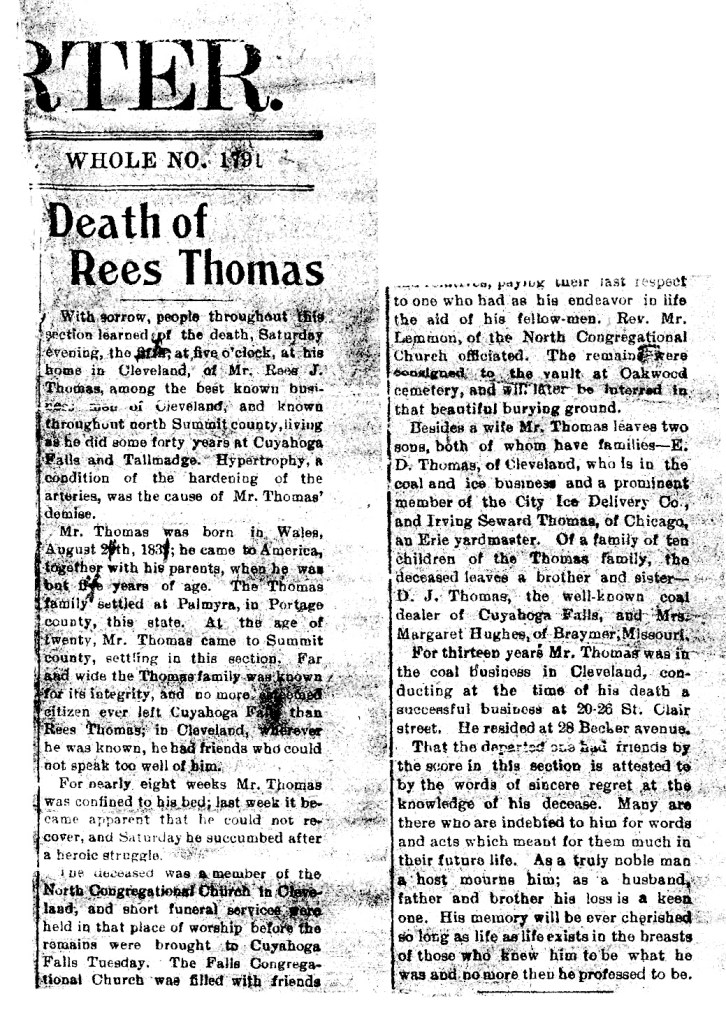
Rees J Thomas
1831 – 1905
Rees J Thomas
https://www.findagrave.com/memorial/18990337/rees_j-thomas
Note: His newspaper obituary included above. Observe that marked numeral ‘1’ in a couple of places, so there may be errors in the obituary.
Mary Jones Thomas
1834 – 1854
Note: Although not clearly on the 1850 Census, she is reconciled to the 1840 census; also on the Silas Richards manifest at the age of one.
and
Mary Jones Thomas
https://www.findagrave.com/memorial/226240878/mary-thomas
Note: ‘Mary, daughter , died at Pittsburg, PA July 29, 1854 age 20 yrs buried with John’.
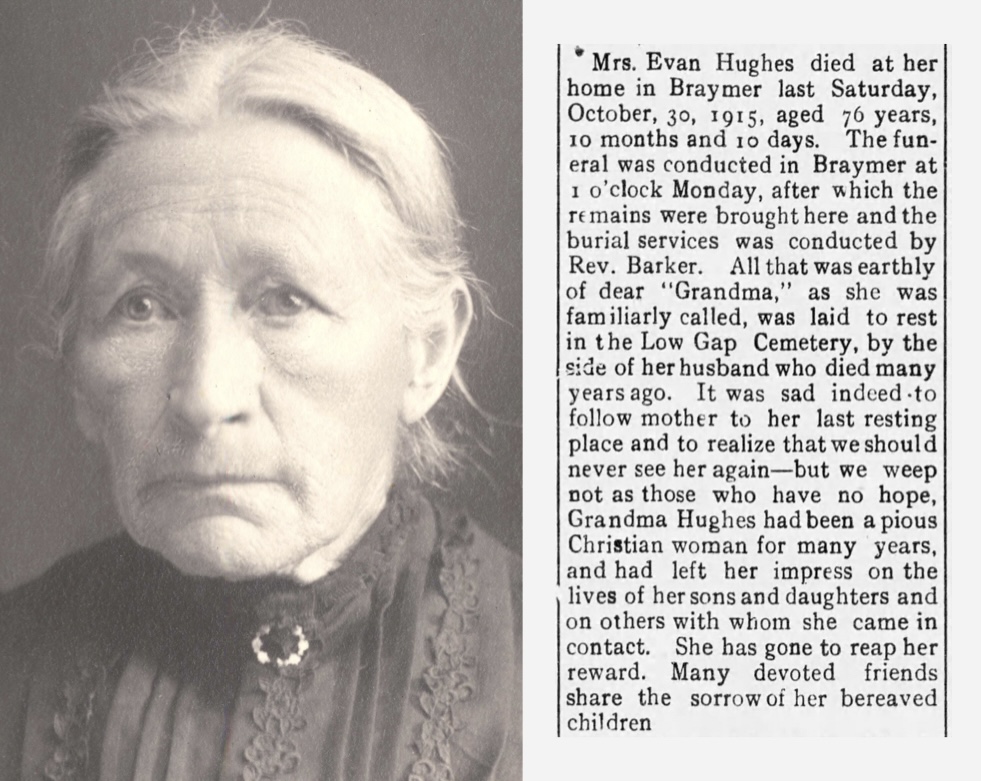
Margaret Evelyn (Thomas) Hughes
1838 – 1915
Margaret Evelyn Hughes
in the U.S., Find a Grave Index, 1600s-Current
https://www.ancestry.com/search/collections/60525/records/109127874
and
Margaret Evelyn Thomas Hughes
https://www.findagrave.com/memorial/132158422/margaret-evelyn-hughes
David J Thomas
1841 – 1916
David J Thomas
in the U.S., Find a Grave Index, 1600s-Current
https://www.ancestry.com/search/collections/60525/records/85955222
and
David J. Thomas
https://www.findagrave.com/memorial/18990432/david-j-thomas
Hannah Thomas
After the 1840 census – 1843
https://www.findagrave.com/memorial/116259443/hannah-thomas
Note: This daughter’s birth is after the 1840 census, and she is not on the 1835 manifest for the Silas Richards ship. She is also buried in a Palmyra Welsh Cemetery, separate from the other family members.
and is buried in the national cemetery in the same location.
John O. Thomas Jr.
1845 – 1863
John O Thomas
Death – Find a Grave Index
https://www.familysearch.org/ark:/61903/1:1:QVKX-RKFT?lang=en
and
PVT John O Thomas
https://www.findagrave.com/memorial/43457214/john-o-thomas
Note: He died young as a Civil War soldier.

